


Cover archive photograph: the west front of the United States Capitol, 1997. Photograph provided by the Architect of the Capitol, via Wikimedia Commons. Public domain: a work produced in the official duties of the U.S. federal government. The image has only been proportionally resized and compressed as a JPEG for this report.
Research Abstract
A change in the congressional majority first changes the constraints under which U.S. policy is made. For Chinese manufacturing, the central questions are whether this institutional adjustment can make trade more predictable, and who will ultimately capture the benefits.
The report's central assessment is that trade in general merchandise has scope to gain more stable rules and longer procurement plans, while restrictions concerning strategic technology, industrial subsidies and supply-chain sourcing are more likely to persist. Even where treatment of particular products improves, Chinese factories' profits will still depend on buyer bargaining, distribution inventories, financing and exchange rates. Research should therefore focus on specific statutory authorities, product eligibility and transaction structures when assessing the implications of party control. Congressional oversight may raise the political cost of broad measures while making scrutiny of particular industries more detailed. Cooperation in non-sensitive goods can coexist with restrictions on strategic industries. The effects on each business depend on the constraints it already faces: stable expectations have value where policy uncertainty has delayed customer purchases; businesses constrained by undifferentiated products, low margins and long payment terms also need to improve their own terms of trade.
Accordingly, this report centres on transmission to orders and profits and on differences between industries. Institutional analysis establishes the premises, while practical business arrangements appear in an appendix. The consumer-goods analysis focuses on retail sell-through and inventories; machinery and electrical equipment on engineering validation and service; new energy on the distinction between genuine demand and eligibility for incentives; and advanced technology on licensing and capital restrictions. The outlook uses three conditional scenarios, with observable indicators that could overturn each assessment.
Principal Findings
- The value of stable rules may first appear in longer procurement horizons. For suppliers already qualified by customers, production planning, spare parts and joint development become more likely to earn a return.
- Lower tariffs, more orders and higher profits are three separate outcomes. Benefit sharing, inventory adjustment and cash requirements stand between them.
- Differences between industries outweigh a single judgment about manufacturing as a whole. Product use, purchaser identity, technology provenance and policy eligibility should enter the analysis before broad industry labels.
- International expansion requires genuine production and service capabilities. Engineering support in China, overseas organisation and global customer relationships jointly determine whether a business can retain earnings over time.
Research Scope and Standards of Evidence
Research date and treatment of the election: as of the evening of November 4, 2026, Beijing time, vote-count assessments by major news organisations support Democratic control of both the House of Representatives and the Senate. On that basis, this report examines the industrial implications of Republicans losing their majorities in both chambers. It does not use seat totals that have yet to be finalised or equate media assessments with final state certification. The statutory term of the new Congress begins on January 3, 2027. All future effects discussed here are conditional analyses based on the available evidence. Statistics are identified by their reporting periods, and policy measures are distinguished according to whether they are in force, awaiting entry into force, or still subject to procedural steps.
The election assessment draws on Axios's election-night reporting and a Reuters report republished by Investing.com. The start of the new congressional term follows the Twentieth Amendment to the U.S. Constitution. This report uses public statistics, formal policy documents and attributed research. It does not draw on factory-site interviews. Assumptions are stated separately wherever illustrative business calculations are used.
The industrial effects proposed in this report must be tested against future evidence. The basic method is to distinguish three points in time: political change, formal rule changes and commercial outcomes. If a rule changed before the election, its entire effect cannot be attributed to the election. If a proposal has yet to enter into force, business expectations cannot substitute for implementation results. Recording these dates and then comparing affected and unaffected products provides a clearer way to identify possible mechanisms.
Public statistics describe industrial conditions at the research date; legal and implementation documents establish policy boundaries; transmission to businesses and future paths are the Institute's analysis. Hypothetical calculations explain mechanisms only. Archive photographs depict institutional, logistics and production settings; they are not evidence of changes in capacity or orders in 2026.
I. Institutional Change and the Trade-Policy Baseline
Congressional majorities can change the agenda, budgets and oversight. Presidential executive authority, judicial review and existing law will continue jointly to constrain specific outcomes.
1. The Distance Between a Congressional Majority and Executive Authority
The loss of Republican majorities in both chambers means that the president will face two gateways controlled by the other party when advancing an agenda through Congress. The House can determine whether a substantial share of bills receives substantive consideration; the Senate influences legislative progress and confirmation of important appointments; and committees can require executive agencies to explain the legal basis and consequences of policy. The new majority can give consumer prices, local employment, manufacturing input costs and the boundaries of delegated authority greater prominence in hearings. It can also propose new restrictions concerning labour, supply-chain security or domestic industry. Greater oversight can lead in either direction, so the party affiliation of those conducting it is insufficient grounds to assume that policy towards China will ease. Congressional Research Service, Congressional Oversight Manual. This change must be understood within the U.S. institutional system. A midterm election does not elect a new president. The president retains control of the executive branch and lawful authority to implement trade measures. Congress must complete procedures in both chambers to constrain the president by amending legislation; the president can veto a bill, and overriding that veto requires the constitutional threshold in each chamber. A new simple majority can therefore increase political resistance without necessarily translating every objection into law. Negotiation still separates winning seats from delivering policy. National Archives, Constitution Questions and Answers.
Senate procedure is particularly easy to misread. Invoking cloture on ordinary legislation generally requires three-fifths of senators duly chosen and sworn, normally sixty votes when all one hundred seats are filled. This threshold concerns the debate procedure; it does not mean that every bill requires sixty votes to pass. Budget reconciliation limits debate and can, when its conditions are met, avoid the usual cloture obstacle. Its content is constrained by budget rules, however, and it does not remove the requirement for presidential signature or the possibility of a veto. These distinctions are essential to assessing how much room a campaign proposal has to become policy. Senate explanation of filibusters and cloture; CRS explanation of budget reconciliation.
A simple majority creates new political constraints. Turning those constraints into law requires the relevant procedures.
For manufacturers, these institutional details affect the credibility of policy promises. Where a tariff reduction requires statutory amendment and its supporters hold only a simple majority, a business should not enter the proposal directly into next year's profit budget. Where an adjustment already falls within an agency's lawful discretion over exclusions, licensing or implementation guidance, congressional oversight may encourage faster clarification by raising the political cost of delay. Businesses must nevertheless wait for formal documents. A practical assessment begins with who has authority, proceeds to the stage the process has reached, and ends with the conditions for actual entry into force.
Budgets provide another important channel. Congress can use appropriations, conditions and oversight to influence agencies' implementation capacity, affecting the pace of customs administration, industrial support and infrastructure projects. Stalled budget negotiations can also introduce uncertainty. If some U.S. agencies experience a lapse in appropriations, certain administrative services may slow, while multiyear appropriations, permanent appropriations and statutory exceptions may allow other activities to continue. A government shutdown should not be imagined as the simultaneous suspension of all customs, regulatory and procurement functions, still less as a dependable operating opportunity for Chinese exporters. Government Accountability Office, Lapses in Appropriations. Confirmation of appointments also affects policy timing. A new Senate majority can influence consideration and advancement of major nominations, potentially slowing changes in agency leadership or requiring more compromise. Incumbent officials' statutory powers do not disappear when the majority changes, and established agency procedures continue to operate. For businesses dependent on export licences, technology reviews or approval of long-term projects, the useful questions concern staffing stability, consistency of review and the ability to reduce backlogs. These developments are often closer to business operations than a single public statement by a politician. Senate explanation of nominations.
The election can thus be understood as a change in the way U.S. policy is produced. Executive efforts to introduce broad measures may encounter greater resistance, while measures supported across party lines for particular industries may still advance. Some disputes will enter public hearings; others will become arguments over budgets, appointments and judicial interpretation. Chinese businesses need a more accurate institutional map. Such a map identifies routes, checkpoints and timing without claiming that the future follows one unbroken straight line.
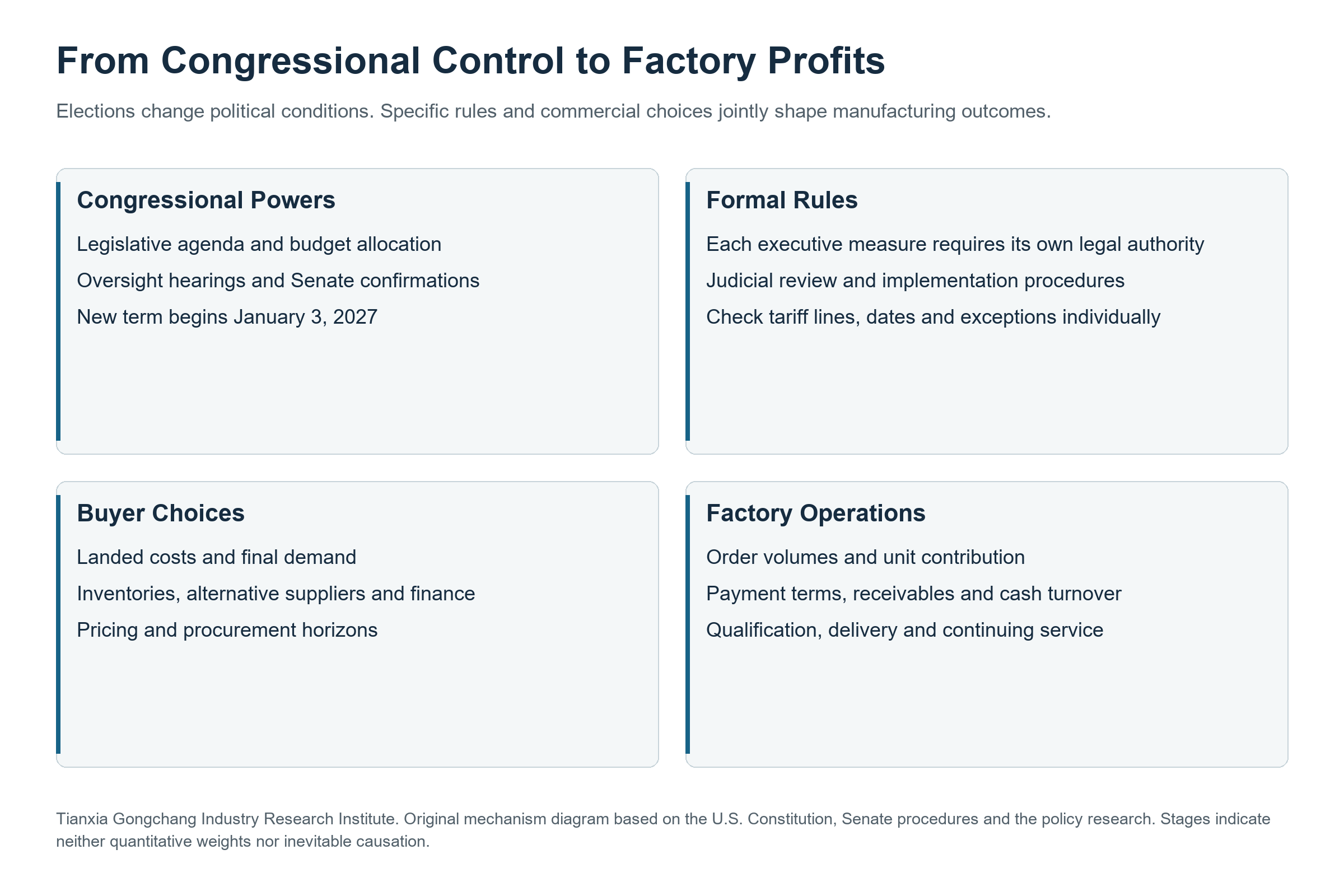
Figure 1 is the Institute's mechanism diagram, based on the U.S. Constitution, Senate procedures and the formal policy documents discussed below. It does not assign quantitative weights.
2. Tariff Authorities and Their Scope
Discussion of November 2026 needs to move beyond impressions formed by the news of 2025. On February 20, 2026, the U.S. Supreme Court held that the International Emergency Economic Powers Act, commonly known as IEEPA, does not authorise the president to impose tariffs. That judicial conclusion established the boundary of one statutory authority. It did not simultaneously repeal every other trade law or return every Chinese product entering the United States to the same starting tax burden. Supreme Court judgment in Learning Resources. The subsequent substitution of legal instruments is more revealing than any single change in a tariff rate. The administration used Section 122 of the Trade Act of 1974 to introduce a temporary import surcharge. The original proclamation provided for a 150-day period beginning on February 24 and ending on July 24. At this report's research date, that transitional measure can no longer serve as a uniform current baseline. A business still calculating November shipments using a temporary rate reported early in the year may produce tidy accounts on an obsolete legal premise. White House proclamation on the temporary import surcharge.
When one tariff authority is constrained, the continuing applicability of other authorities must be checked separately.
In July, the Office of the United States Trade Representative took action following new investigations under Section 301 of the Trade Act of 1974, imposing tariff measures concerning sixty economies. Its stated basis was a U.S. determination that the economies concerned had not adequately adopted and enforced bans on imports of products made with forced labour. This is a policy determination by the U.S. investigating authority; it should not be presented as this Institute's factual adjudication of those economies. Implementation materials from U.S. Customs and Border Protection, referred to below as CBP, show that the action applied an additional 12.5% duty to goods of Chinese origin outside the specified exceptions, effective July 24. That figure describes this measure alone; it is not the total tariff rate on Chinese goods entering the United States. USTR's July final-action announcement; CBP implementation guidance. In particular, the action provides exclusions for goods, and relevant portions of goods, already subject to Section 232 duties, alongside other product exceptions. Section 232 measures in this report arise under Section 232 of the Trade Expansion Act of 1962, a different statutory authority from Section 301. The 12.5% rate therefore cannot simply be added to every steel or aluminium product, electrical device or related derivative. Ordinary duties, existing China-specific Section 301 measures, the new Section 301 action, Section 232, product exclusions and antidumping or countervailing duties may combine differently for different products. The proper unit of calculation is the specific product, tariff classification, origin, entry date and applicable legal document. A country name alone is insufficient. USTR fact sheet on the new Section 301 action.
| Legal or policy layer | Boundary used in this report | What businesses must check |
|---|---|---|
| IEEPA and temporary transitional instruments | Distinguish the 2026 judgment and the duration of measures; do not carry forward a uniform impression from early in the year | Statutory authority, applicable dates and treatment of existing transactions |
| Existing and new Section 301 measures | Assess investigations, tariff lines and exclusions separately | Product classifications, exceptions and conditions for cumulative application |
| Section 232 measures | Check rules for steel, aluminium, related derivatives and other products individually | Duty base, material scope and use |
| Product admission and supply-chain enforcement | Treat separately from the obligation to pay duties | Testing, traceability, end use and entity eligibility |
Table 1 summarises the preceding formal materials. Its rows cannot be added to produce a single tariff rate.
This evolution has two implications for assessing the election. First, judicial and legislative constraints have practical force: presidential trade authority cannot be described as unlimited. Second, policy objectives may be pursued through other existing authorities: constraining one legal basis does not end all restrictions. Similar substitution between instruments may occur after both chambers change hands. Congressional increases in administrative costs, tighter judicial interpretation of delegated authority and executive searches for alternative routes can occur simultaneously. The actual manufacturing environment depends on how those forces eventually take shape in specific rules.
Existing China-specific Section 301 measures still require independent checking. Different tariff lines have undergone phased changes and product exclusions; the new action does not erase those earlier arrangements. The final modification notice issued in 2024 already scheduled adjustments for some strategic products in 2025 and 2026, illustrating continuity in protection for strategic industries across administrations. Research can use this to assess policy persistence, but a 2024 notice cannot substitute for the complete tariff schedule applicable in November 2026. USTR entry point for China Section 301 actions and exclusions; final modifications following the 2024 four-year review. Section 232 measures likewise need to be understood individually. Rules for steel, aluminium, copper and related derivatives changed several times in 2026, with differences in duty bases, product categories and exceptions. The use of steel in a machine does not automatically mean that the entire machine is subject to a headline tariff rate. Similar metal content also does not guarantee identical treatment across tariff classifications. These details affect quotations, material choices and customer purchasing. A business deciding whether to leave a market solely on the largest tariff number in the news may abandon products that remain commercially viable. June 2026 Federal Register notice on metals adjustments under Section 232.
Tariffs are also only part of the conditions for admission. After duties have been paid, goods may still be subject to product-safety rules, forced-labour import enforcement, end-use controls or other regulatory requirements. The July Section 301 action concerning economies' institutional arrangements is a different system from import enforcement under Section 307 of the Tariff Act of 1930 and the Uyghur Forced Labor Prevention Act. The former does not mean that every taxed product has been individually found to involve forced labour; nor can payment of duties substitute for supply-chain evidence. CBP's 2026 update for importers.
Easing that has practical value for businesses must ultimately take the form of verifiable tariff lines, licences, time periods and implementation standards.
3. Negotiated Commitments and Formal Implementation
The election does not take place in the absence of a negotiating foundation. In September 2026, China and the United States reached new arrangements on several trade and economic matters. The eight-point outcomes published by China's Ministry of Foreign Affairs refer to advancing a board of trade, reciprocal tariff reductions and implementation of earlier consultation outcomes. The Ministry of Commerce subsequently explained that products worth approximately US$30 billion on each side were covered, and explicitly stated that implementation would occur simultaneously after each side completed its domestic legal procedures. USTR's corresponding statement also used the language of recommendations and future treatment. Together, the three sources establish that cooperation already has product lists and mechanisms. They do not establish that tariff reductions have already been completed for all the products concerned. Chinese Ministry of Foreign Affairs, eight-point outcomes; Ministry of Commerce explanation of the eighth round of consultations; USTR statement on recommendations from the U.S.-China Board of Trade. The US$30 billion arrangement does not mean that Chinese exports immediately increase by US$30 billion. The lists concern policy treatment of existing or potential trade; trade values also depend on demand, prices and supply. Since each side has its own arrangements, the two amounts cannot simply be added to claim US$60 billion of additional orders flowing in one direction to China. For a business, the decisive questions are whether its products appear on the final list, which additional duty is reduced, when the change applies and under what entry conditions, and whether other restrictions remain. An aggregate figure indicates the scale of negotiations without revealing a particular factory's profits.
A change in congressional control may alter the political environment for implementing these arrangements. Legislators concerned about prices may support lower costs for some goods; those concerned about industrial employment may seek to exclude sensitive products. The executive branch may use arrangements for non-sensitive goods to sustain commercial stability while retaining restrictions on strategic technology. Such differentiated cooperation fits the present institutional structure more closely than a wholesale return to earlier conditions. For Chinese manufacturing, securing specific market opportunities requires a sufficiently detailed understanding of products. A general assessment of bilateral relations cannot replace the actual conditions applying to each good.
Negotiated arrangements change the possible scope of subsequent cooperation. Actual treatment at entry continues to depend on formal implementation conditions.
Measures nearing expiry make the importance of procedure especially clear. Formal documents available at the research date extend some existing Section 301 product exclusions to the specified evening deadline on November 9. Further extension of the suspension of Section 301 response measures concerning maritime transport, logistics and shipbuilding still requires attention to final documentation. Suspension and resumption of the affiliates rule of the U.S. Department of Commerce's Bureau of Industry and Security, or BIS, have their own legal arrangements. Even if a political consensus discusses extending a truce, dates under different statutory authorities cannot all be revised on that basis. For goods at sea, a difference of a few days may change the applicable conditions; businesses must check the formal text. Formal notice extending existing Section 301 exclusions; request for comments on a proposed extension concerning maritime measures; BIS document on suspension and resumption of the affiliates rule. Future stability involves more than a tariff reduction on a particular occasion. It also depends on whether rule durations cover production and transport, agency answers are consistent, applications for exceptions are transparent, and businesses can plan purchasing and delivery accordingly. A short-lived benefit with frequent date changes may be insufficient to support long-term investment. Stricter rules with clear boundaries may, by contrast, allow capable firms to reassess viable projects. Manufacturing needs enough time to fulfil commitments. Material purchasing, tooling development, product testing and customer acceptance must all be completed within that period.
II. How Policy Reaches Orders and Profits
This is the key to assessing short-term effects. Policy signals reaching manufacturers must ultimately pass through customers' cost calculations, inventory positions and financing arrangements.
1. The Starting Position of Chinese Manufacturing
When the U.S. election takes place, Chinese manufacturing is already experiencing structural divergence. On October 19, the National Bureau of Statistics reported merchandise exports of RMB23.1979 trillion in the first three quarters of 2026, up 16.4% year on year, with mechanical and electrical products accounting for 64.3% of total exports. The same release showed manufacturing investment falling 2.1% year on year. Together, these figures show that nominal export growth can coexist with cautious investment; they resist a simple description of the sector as either strong or weak. Higher export revenue does not mean that every industry and every size of business is increasing capital expenditure. NBS release on economic performance in the first three quarters of 2026. Manufacturing investment depends jointly on future demand, existing capacity, financing conditions and expected returns. A firm can export more by raising utilisation of existing lines while postponing a new factory. It may also reduce spending on low-return activities while sales of higher-end products grow. National export growth and investment growth can move in different directions partly because they measure different economic activities: the former records the nominal value of goods already crossing borders, while the latter reflects fixed-asset expenditure. Their divergence is an industrial signal requiring further explanation.
The manufacturing purchasing managers' index, or PMI, stood at 49.3 in October: 50.2 for large enterprises, 48.4 for medium-sized enterprises and 47.5 for small enterprises. PMI is a diffusion index that primarily reflects the distribution of changes reported by surveyed businesses relative to the preceding month; 50 marks the boundary between expansion and contraction. A reading of 49.3 cannot be interpreted as a 0.7% year-on-year decline in output, nor can weaker readings for smaller businesses be directly converted into declines in profits. The differences by size nevertheless suggest that aggregate export growth may not yet have translated widely into better business conditions. NBS purchasing managers' indices for October 2026.
Structural differences separate aggregate growth from improvement in individual businesses, and those differences require explanation.
The manufacturing product mix helps explain this divergence. Large equipment, electronics and electrical products have relatively high transaction values, so expansion in overseas markets can substantially raise export receipts. Firms with fragmented orders and weaker bargaining power may keep delivering while facing lower unit prices and longer payment terms. This is a possible explanatory path; aggregate statistics alone do not establish that it applies to every industry. Assessing a particular industry still requires export volumes, unit prices, raw-material costs, order continuity and business size to be considered together. Statistical analysis must also respect valuation methods. Nominal export growth in renminbi incorporates changes in volume, prices, product composition and exchange rates. It cannot be described as an equivalent year-on-year rise in physical export volume. A rising share of high-value products can lift receipts more rapidly; falling unit prices in some goods can cause nominal receipts to understate shipment growth. For factories, shipments indicate production workload, selling prices and costs determine unit earnings, and conversion of foreign-currency receipts determines renminbi cash. Each measure has a distinct role.
U.S. direct-import data provide another window. The Census Bureau's current goods-trade table for China records U.S. imports from China of US$440.3194 billion in 2024 and US$308.6519 billion in 2025; the cumulative figure through August 2026 is US$183.5240 billion. The table is in nominal U.S. dollars, is not seasonally adjusted, and extends only through August at the research date. It shows changes in the value of direct bilateral trade, but the first eight months of 2026 cannot be aligned directly with China's first-three-quarter figures, and a year-to-date amount cannot be treated as a full-year result. U.S. Census Bureau goods-trade table for China.
A decline in the value of direct goods shipments to the United States does mean that some businesses face contraction in an important market or changes in trade routes. Chinese manufacturing's U.S. exposure nevertheless has other layers: Chinese firms supply components, materials and equipment to third countries whose producers then serve the U.S. market; U.S. multinationals adjust procurement budgets across regions; and dollar financing and access to technology influence production within China. A lower share of direct trade can reduce one form of concentration without proportionately reducing dependence through other channels. Separating these paths is necessary to assess whether diversification is real. For managers, useful statistics should connect back to their own factories. Revenue can be organised separately by the location of direct customers, final sales markets and sources of critical technology, keeping those three dimensions distinct. A factory supplying European customers may ultimately depend heavily on U.S. demand. A firm with little U.S. revenue may rely on key equipment incorporating U.S. technology. Conversely, a high U.S. revenue share does not imply identical security restrictions across all products. Geographic shares are a starting point, not a complete risk assessment. The election may improve some external conditions for Chinese manufacturing, but it cannot replace this internal analysis. If product homogeneity has already exposed a business to sustained price pressure, a reduction in external tariffs may be insufficient to restore reasonable profits. If the business has process and delivery advantages but customers have delayed purchases because of policy uncertainty, more stable rules may release deferred demand. The size of the effect depends on the original constraint. Policy change improves business performance only when it acts on a constraint that genuinely matters to the firm.
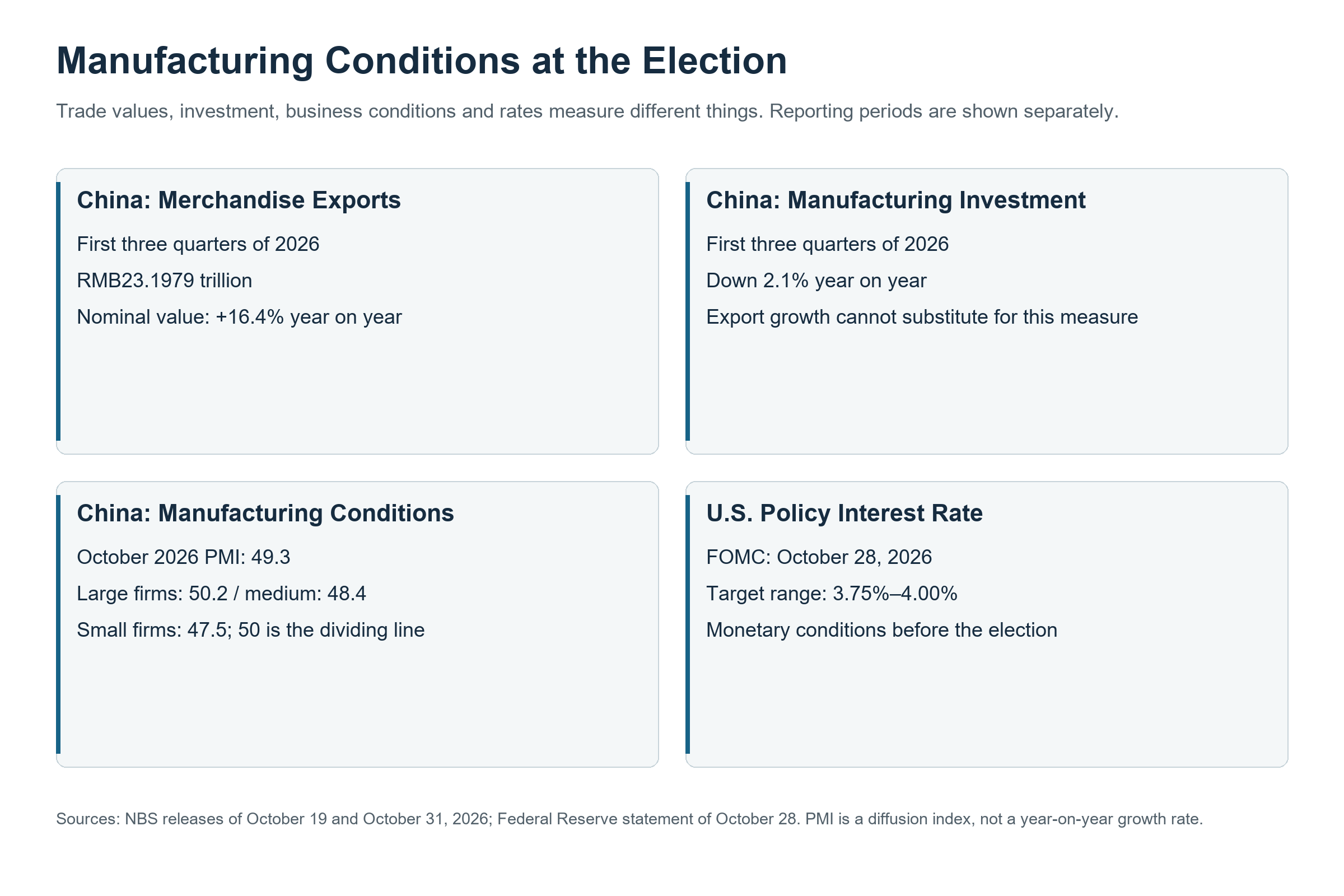
Data and definitions: NBS first-three-quarter release; October PMI; Federal Reserve statement of October 28.
2. Sharing the Benefits of a Change in Duties
A tariff difference creates a benefit to be shared. Bargaining power determines how much the factory can retain.
Tariff changes do not flow directly into a Chinese factory's income statement. After the U.S. importer pays customs duties, it may absorb the cost or redistribute it through lower factory prices, higher retail prices, reduced purchases or a change of suppliers. Federal Reserve Bank of New York research on the 2025 tariffs found that much of the burden fell on the U.S. importing side, while the distribution of that burden can change over time. This finding concerns import prices and cost incidence. It does not mean that final consumers bear the entire burden, and it certainly does not establish that Chinese factories suffer no losses. New York Fed research on who pays the 2025 tariffs. When rates fall, benefits must likewise be allocated. If factory prices remain unchanged, the importer's landed cost may fall. If the importer demands that the supplier concede part of the benefit, the improvement for the Chinese factory becomes smaller. Where retail competition is intense, the tariff difference may reach consumers through promotions. Who retains the profit depends on alternative sources of supply, brands, product differentiation, distribution inventories and contractual arrangements. Cooperation created at the political level must pass through market bargaining before becoming an accounting result for a business.
A tariff adjustment can change a transaction's landed cost without automatically changing the bargaining structure already established between buyer and seller. For the same product, a customer facing low supplier-switching costs may immediately incorporate the tariff difference into another round of price comparisons. Where a supplier has stable processes, a qualification record and delivery capabilities that cannot readily be replicated, the customer must also consider the costs of revalidation, downtime or shortages. The size of the policy benefit therefore interacts with the firm's existing competitive position. Assessing opportunities in a product category requires answers to two questions: do the rules create room for lower costs, and does the supplier have the capacity to retain some of that room? Answering only the first can overstate general benefits; focusing only on the second can overlook how better external conditions amplify existing capabilities.
This mechanism also changes the sequence of business expansion. If downstream promotions absorb most of a tariff reduction, a factory may increase shipments without having sufficient reason to expand its lines immediately. If a customer exchanges a longer procurement plan, prepayment or joint development for a price concession, the supplier may instead gain a more stable overall return. Both transactions can appear as rising exports while differing in the quality of earnings. For macroeconomic research, value and price information need to be combined with volumes and sector composition. For firm-level research, transaction prices should be interpreted alongside unit contribution, repeat purchases and cash turnover. This is why the report places business calculations in an appendix: examples help identify mechanisms and do not replace research on actual businesses.
3. Inventories and Contracts Determine the Speed of Transmission
Buyer inventories are especially important. Stocks imported at higher duty costs do not disappear simply because future shipments may qualify for lower tariffs. If old inventory turns slowly, buyers may postpone replenishment while waiting for retail sales and prices to stabilise. More inquiries reaching a factory may indicate that buyers are comparing suppliers again, without yet producing executable orders. Conversely, where customer inventories are low, sell-through is stable and products are difficult to substitute, clearer policy boundaries may lead to orders more quickly. Order tracking should therefore examine final sales, customer inventories and ability to pay together. Pricing responses also take time. Retail prices reflect previous purchasing, freight, promotional plans and competitors' prices; they do not always move in step with current customs rates. New York Fed research on consumer-price transmission distinguishes direct effects through imported goods from indirect effects spreading through input chains. For Chinese manufacturing, easing policy and better orders may therefore be separated by a lag. Treating that lag as proof that policy is wholly ineffective, or interpreting brief restocking as lasting demand growth, can lead businesses to adjust too far. New York Fed research on tariff transmission to consumer prices.
Expectations about rules can change quickly. Inventories already purchased take time to clear.
Changing expectations often affect contract duration first. Under unstable rules, buyers may shorten quotation validity, reduce individual order sizes, retain cancellation rights or qualify several suppliers at once. These arrangements may not immediately reduce annual purchasing, but they shift inventory, scheduling and financing pressure towards factories. If congressional checks and administrative procedures improve expectations, customers may become willing to resume longer procurement plans. Greater predictability has value in itself: material purchases can be scheduled more evenly, production changeovers become less frequent, and delivery commitments become more reliable.
Another possibility remains. More oversight and litigation may make rules more complicated, require additional agency explanations and encourage buyers to reduce supplier numbers for administrative convenience. Large suppliers able to provide complete traceability and stable delivery may gain a stronger position. Smaller firms without dedicated teams may bear higher fixed compliance costs. Stronger institutional constraints and easier commercial transactions do not necessarily improve together at every stage. Policy research needs to examine whether rules are workable, rather than simply count restrictive provisions.
More complex rules can also concentrate supply. To reduce audit and coordination costs, buyers reassess how many suppliers, sets of documents and types of responsibility they will maintain. If these fixed administrative costs rise, firms able to sustain complete records may gain a relative advantage. Smaller businesses need to share the burden through professional service providers and cooperation within industrial clusters. An institutional change that reduces political discretion overall may thus increase documentation and audit thresholds at the firm level. Assessing whether the trading environment has improved requires simultaneous attention to predictability, practical compliance and customers' willingness to share implementation costs.
Operationally, a transaction can be divided into price, volume and financing. Price determines unit contribution, volume determines capacity utilisation, and financing determines whether the factory can continue to deliver. A tariff reduction may improve price without increasing volume; restocking may raise volume while extending payment terms; exchange-rate movements may offset some unit gains. Improvement across all three gives a business a firmer basis for expansion. Treating order value as the sole measure can expose factories to greater cash pressure beneath apparent growth. The earliest and most informative evidence of the election's effects may therefore emerge outside aggregate exports. Customers' willingness to reduce cancellation clauses, accept reasonable prepayments, share policy-change risks or extend procurement plans from weeks to a fuller production cycle may reveal changes in relationships sooner. These observations must be verified using businesses' own contracts and transaction records. The Institute does not claim that broad improvement has already occurred; it proposes an observational method with which to test future assessments.
4. The Independent Role of U.S. Demand and Financing Conditions
A change in the congressional majority does not automatically instruct the Federal Reserve to cut interest rates. In its October 28 statement, the Fed maintained the federal funds target range at 3.75%–4.00%. That is the monetary environment preceding the election. Future adjustments still depend on inflation, employment, financial conditions and the Fed's assessment of risks. Congress establishes policy objectives and conducts oversight; the Fed chooses how to pursue those objectives within the institutional framework. The two roles are distinct. Federal Reserve statement of October 28, 2026; Federal Reserve explanation of monetary-policy independence.
A better trade environment needs purchasing power and financing conditions to support sustained demand.
For furniture, household appliances, renovation materials and some machinery, interest rates matter at least as much as tariff rates. Household homebuying and renovation, business equipment renewal and importers' ability to finance inventories all respond to credit conditions. If trade policy eases while financing remains expensive, buyers may first repair their inventory mix rather than expand long-term purchasing. Factories should monitor actual sell-through and capital expenditure instead of interpreting better policy sentiment as a complete recovery in final demand. Fiscal policy also works in both directions. Divided government can make negotiations over large increases in spending harder, while allowing compromise on certain infrastructure and industrial projects. If fiscal disputes raise budget uncertainty, businesses become more cautious about delivery and payment. Longer-term arrangements may instead improve predictability in project procurement. Research cannot determine aggregate fiscal spending from the party configuration alone, still less infer a particular Chinese supplier's orders directly from that aggregate. Whether funds have been appropriated and disbursed, projects have begun and products qualify for procurement all require further checking.
The direction of the dollar should also be treated conditionally. Expectations of constraints on future fiscal expansion may influence interest rates and the dollar in one way; demand for safe assets arising from budget disputes may work in the opposite direction. Energy prices, global conflicts, growth in other economies and investors' asset allocation all affect exchange-rate outcomes. The Institute therefore does not present the election as the starting point of certain renminbi appreciation or depreciation. For manufacturers, the more useful question is how different exchange-rate paths affect costs and receipts. A business quoting in dollars and paying most costs in renminbi may receive fewer renminbi when the currency appreciates. If it also imports dollar-priced materials, some costs may fall. Dollar-denominated liabilities introduce a further change in debt-service pressure. Actual outcomes depend on the currencies of receipts and payments, settlement timing and exchange-rate management already in place. Treating the renminbi exchange rate as a variable with the same directional effect on every manufacturer overlooks these operating structures. In thin-margin orders especially, modest combined movements in exchange rates and material prices can offset apparently substantial policy benefits.
Global demand is not determined by the U.S. Congress alone. The World Trade Organization's October update of its merchandise-trade volume outlook for 2026 and 2027, and the International Monetary Fund's October global forecasts, discuss trade, investment and macroeconomic risks within a wider set of conditions. These are forecasts, not full-year outturns. Growth in global trade volume also cannot be equated with growth in Chinese exports. For businesses, the forecasts provide an external-demand background that must be interpreted alongside their own customer industries and market composition. WTO trade outlook, October 2026; IMF World Economic Outlook, October 2026.
Housing-related consumption, business equipment renewal and infrastructure projects are different sources of demand. Furniture and some appliances depend on major household purchases; general-purpose equipment depends on business investment returns; and power-grid and factory-utility equipment is also constrained by project approval, construction and acceptance schedules. Even if these customers all face clearer trade rules, procurement can recover at different speeds. Analysis must therefore follow customers' capital expenditure and use cases into greater detail: is project financing secured, is procurement budgeted, can the product enter the approved-supplier system, and does demand depend on benefits that have not yet been implemented? This level of detail translates macroeconomic assessments into industrial judgments and helps prevent factories from treating all positive news as a single reason to expand capacity.
III. Industry Effects and Competitive Positions
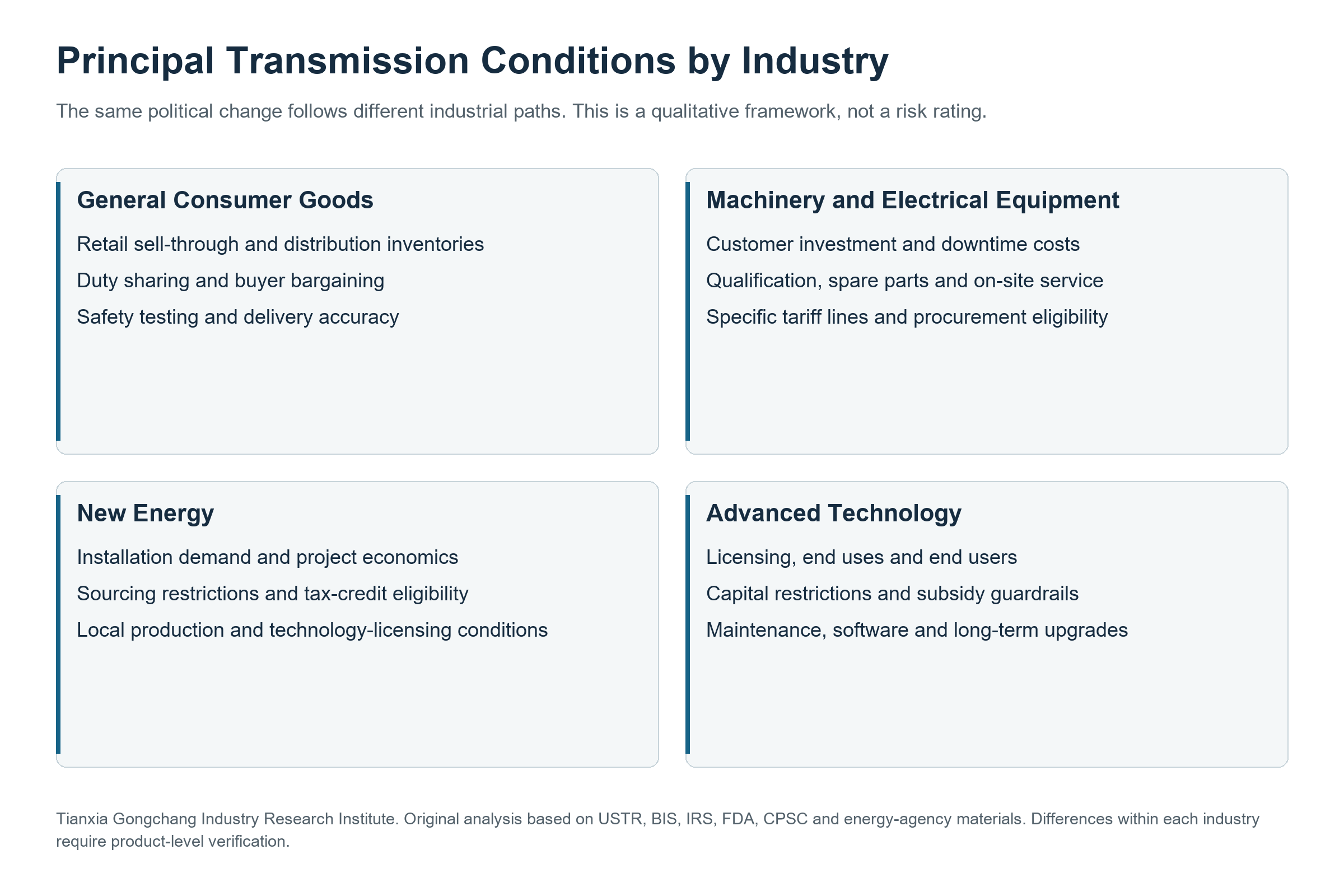
Consumer goods, engineering equipment and strategic technology face different constraints. The report therefore assesses demand, eligibility, delivery and earnings separately, rather than assign one uniform magnitude of benefit to all manufacturing.

Photograph provided by BMW Werk Leipzig. Source: Wikimedia Commons file page. Licence: CC BY-SA 2.0 DE. Only proportional resizing and JPEG compression have been applied. The photograph remains available under that licence.
| Industry | Primary transmission conditions | Earlier evidence of improvement | Conditions that must still be met independently |
|---|---|---|---|
| General consumer goods | Sell-through, inventories and landed costs | Repeated replenishment of the same products at stable gross margins | Safety testing, distribution responsibilities and delivery |
| Machinery and electrical equipment | Customer investment and engineering reliability | Project acceptance, repeat purchases and service contracts | Standards, spare parts and specific procurement eligibility |
| New energy | Project economics and market eligibility | Executable projects that do not depend on unconfirmed incentives | Sourcing requirements, technology licences and tax-credit conditions |
| Advanced technology | Licensing, capital and long-term R&D | Sustained adoption in markets accessible under applicable rules | End use, entity restrictions and subsidy guardrails |
| Medical supply chains | Quality responsibility and continuity of supply | Consistent batches, quality records and repeat purchases | Applicable registration, quality requirements and premarket procedures |
Table 2 is a qualitative research framework, not an industry scorecard or a ranking of forecasts.
1. Price Elasticity and Distribution Inventories in General Consumer Goods
Consumer goods respond relatively directly to price changes. Sustained improvement still needs to be demonstrated through sell-through and repeat purchasing.
Household appliances, furniture, textiles, clothing, toys and household goods are usually affected relatively directly by U.S. landed costs and household purchasing power. If arrangements for non-sensitive goods are lawfully implemented, or tariff uncertainty declines, buyers may reassess replenishment. This is one of the more plausible areas of selective improvement after the election. Consumer categories nevertheless differ markedly: furniture and large appliances depend on housing and renovation, seasonal goods face limited selling windows, and everyday consumables have their own repeat-purchase cycles. For bulky furniture and appliances, ocean freight, warehousing, last-mile delivery and returns are important costs. Even if duties fall, higher freight charges or slower warehouse turnover may erode the gain. A factory comparing only free-on-board quotations may overestimate its price advantage. Discussions of end-to-end costs should also consider packaging volume, container-loading efficiency, damage rates, spare parts and after-sales arrangements. The report estimates no uniform share for these costs because products and channels differ substantially; businesses need to calculate them using their own records.
Another condition for textiles, clothing and toys is supply substitution. Buyers can compare prices across origins, so competition can readily redistribute the benefits of lower duties. A Chinese supplier relying mainly on a low one-off price may win more orders without improving profits. A supplier able to handle small batches reliably, adjust quickly, perform complex processes and deliver on time increases the customer's management cost of switching. This capability needs to appear in verifiable performance, including repair, delivery and replenishment records, rather than a general claim of high quality. Product-safety obligations do not disappear when congressional control changes. The U.S. Consumer Product Safety Commission explains that children's products subject to the relevant rules require testing by accepted third-party laboratories and certification; other applicable products also have compliance-certificate requirements. Import records, certificate data and product liability are already part of procurement. Lower tariffs reduce some costs without replacing testing, material controls or responsibility arrangements. CPSC guidance on testing and certification; eFiling resources for importers.
Cross-border e-commerce also requires a fresh assessment of small-parcel shipping and overseas warehouses. CBP's 2026 guidance and subsequent rules show that the IEEPA tariff judgment did not automatically restore duty-free treatment for low-value parcels from all countries. Adjusted compliance dates for certain postal-data requirements likewise cannot be interpreted as restoration of the US$800 exemption. Overseas warehousing can shorten delivery but adds responsibility for stocks, returns and sales forecasting. Channel changes need a full economic calculation and cannot be treated as the disappearance of regulatory obligations. CBP explanation of low-value shipments; October 2026 adjustment of postal-process compliance dates.
General consumer-goods businesses should also examine concentration among final customers. Having several trading-company customers does not necessarily diversify demand: concentration remains high if they ultimately serve the same U.S. retail group. Customers registered in different countries may likewise use the same sales channels. Within reasonable and lawful commercial-information boundaries, firms can progressively identify final demand and payment responsibility, avoiding the use of customer counts as a substitute for genuine market distribution. A future assessment of recovery in consumer goods requires changes in repeat purchasing, transaction prices and collection quality to be observed together. More inquiries indicate attention; more initial orders may include trials and supplier-substitution tests. Repeated purchases of the same product at stable gross margins are closer to evidence of recovering demand. If customers cite anticipated tariff reductions to demand early factory-price cuts before formal measures are implemented, suppliers also need clear conditions for adjusting the price difference. For smaller factories with limited cash, these contractual details often protect operations more effectively than macroeconomic sentiment.
2. Reliable Supply and Engineering Service in Machinery and Electrical Equipment
Competition in mechanical components and general-purpose equipment often extends beyond a single purchase price. If a bearing, valve, seal or control component affects an entire customer production line, procurement must assess dimensional consistency, service life, spare parts, maintenance and delivery. Once qualified, suppliers accumulate trust grounded in engineering records. When political uncertainty falls, businesses already holding that trust are often better placed to convert deferred demand into orders because customers need not validate every technical condition from the beginning. Chinese businesses can seek to express manufacturing capability in benefits customers can calculate. More consistent batch quality reduces inspection and rework; fuller spare-parts documentation shortens maintenance preparation; and suitable modular design lowers equipment-upgrade costs. Test records, delivery records and user feedback are needed to demonstrate these benefits. A quotation led solely by discounts invites customers to bargain as though the product were readily interchangeable. Explaining costs over the full operating life creates room for a more complete engineering discussion.
Engineering records can turn a quality advantage into operating benefits that customers can calculate.
For smaller component factories, this need not mean immediately building an expensive overseas organisation. A first step is to organise specifications, materials, process versions and inspection documents so that customers can confirm consistency with each repeat purchase. A second is to clarify substitute spare parts, delivery commitments and responsibility for handling deviations. As actual orders accumulate, the business can then select partner service locations or local inventory. Capability can be built progressively, provided each step solves an existing customer problem. Adding an overseas address alone does not improve a product's usefulness.
Investment in U.S. domestic manufacturing may generate demand for general supporting equipment, but suppliers need to identify their position in the procurement hierarchy. Major factory construction involves electrical, cooling, testing, handling and plant-utility equipment. Some Chinese businesses may participate through compliant components, production equipment or projects in other regions. Total project investment establishes a demand background; accessible business still depends on procurement eligibility, technical specifications, delivery location and the customer's supplier system. The more precisely a firm identifies the engineering problem it solves, the easier it becomes to avoid vague discussions based solely on aggregate investment. Grid equipment provides a clear example of demand and constraints existing together. U.S. Department of Energy materials dated October 26, 2026 discuss rising demand for power and distribution transformers, supply-chain bottlenecks and pressure on lead times, while supporting alternative materials, refurbishment and reuse. They establish genuine equipment demand in the United States while also showing that policy seeks to build domestic supply. Opportunities for Chinese firms may exist at different levels and in different markets; a single route centred on complete-unit exports is insufficient. U.S. Department of Energy discussion of grid-equipment shortages and solutions. Transformers, switchgear, power electronics and related testing equipment must match customers' grid conditions, technical standards and maintenance arrangements. Manufacturer competitiveness rests on engineering coordination as well as capacity. Businesses offering complete technical documents, dependable tests, project plans and long-term parts support are better able to turn delivery advantages into cooperation. Certain projects may be more suitable for participation through vetted components, production equipment or non-sensitive uses; other markets may offer more direct opportunities for complete units. Product capabilities and market selection should jointly determine investment.
Investment in artificial intelligence and data centres also connects electrical and mechanical supply. Power distribution, cooling, racks, connectors, ordinary structural parts and advanced computing chips occupy different positions in technical requirements and regulation. Chinese manufacturers can examine specific requirements for materials, thermal management and reliability as equipment density rises, without reducing every opportunity to chips. The sustainable direction is to develop products customers are willing to validate and that suppliers can maintain. If the investment cycle changes, firms also need other customers and applications to avoid committing all capacity to one fashionable industry.
Steel, aluminium and derivative-product rules affect these products' costs, but operating improvement has other sources. Better structural design, lower material waste, shorter assembly times and improved repairability can all reduce lifetime costs. Technical improvement must not depend on false classification or concealed material content. Manufacturing capability has value because it genuinely reduces resource use and operating risk; compliance documentation has value because it allows customers and regulators to verify those improvements. Together they form a credible basis for operating in complex markets. If the congressional shift gives U.S. downstream manufacturers more opportunity to express input-cost pressures, some product exceptions and implementation problems may receive more discussion. This creates scope for communication by Chinese firms with clearly defined engineering applications, grounded in specific costs, substitutability and continuity of supply. Useful support from industry associations and public-service bodies includes documenting differences in standards, providing testing resources and explaining formal policy. Businesses need usable information, not political assessments converted into another set of general slogans.
Opportunities in machinery and electrical equipment must be understood within customers' systems. An equipment or component quotation covers only part of procurement cost; downtime, maintenance, spare parts and upgrades continue to affect lifecycle costs. For firms already admitted to a customer's system, stable rules may first release supplementary purchasing and long-term maintenance demand. For firms not yet qualified, a policy opening can improve entry conditions, but validation still has to be completed. Research should therefore avoid treating total equipment demand as the market available to Chinese suppliers. Accessible markets require product functionality, delivery systems, procurement eligibility and reasonable transaction costs to be satisfied together. Failure on any one condition can leave nominal demand beyond the factory's reach.
3. Expanding Demand and Policy Eligibility in New Energy
Demand growth can coexist with restrictions on sourcing. Installation prospects and the market accessible to a particular business need separate calculations.
New energy is especially vulnerable to oversimplification based on party labels. Democratic support for clean energy can coexist with support for domestic manufacturing, union employment and supply-chain independence. For Chinese firms, expanding installation demand and restrictions on import sources can readily occur together. Industrial analysis needs to distinguish vehicles, batteries, solar photovoltaics, energy storage and equipment, then separate permission to sell, import costs, tax incentives and public-procurement eligibility within each stage. Only by separating these layers can genuinely accessible commercial opportunities be identified.
At the research date, U.S. clean-vehicle tax policy already differs from the original framework of the Inflation Reduction Act of 2022. Current IRS guidance states that the Section 30D new-vehicle credit, Section 25E used-vehicle credit and Section 45W commercial clean-vehicle credit no longer apply to vehicles acquired after September 30, 2025. Vehicles acquired earlier but placed in service later are subject to separate conditions. Analysis of 2027 demand should start from this legal baseline. Restoring or changing a form of support requires new policy action; a congressional majority change cannot be entered in advance into a consumer vehicle-purchase model. IRS current qualified-manufacturer requirements for clean vehicles.
The battery industry's strengths arise from cumulative development in materials, processes, equipment, scale and engineering talent. The International Energy Agency's 2026 battery study discusses the efficiency and supporting supply base of Chinese manufacturing, while noting the ramp-up between factory construction and achievement of nominal output in other regions. These capabilities develop over a longer period than a single election cycle. U.S. policy changes market accessibility and investment returns; businesses must deploy their accumulated capabilities across markets, technologies and customer requirements. IEA research on electric-vehicle batteries, 2026. Energy-storage analysis can begin with project economics. Cells, modules, system integration, inverters, grid connections, construction and operations and maintenance perform different functions. Customers consider availability, service life, enforceable warranties, insurance and long-term maintenance as well as initial equipment prices. Chinese firms able to provide dependable solutions across these functions have grounds to compete beyond price. Whether a particular project depends on a specific U.S. credit, and how supplier identity affects eligibility, must nevertheless be clarified before contracting. IRS Notice 2026-15 explains restrictions concerning prohibited foreign entities and material assistance for certain clean-energy credits. Ownership, technology licensing and input sourcing can affect eligibility for a particular incentive, a separate question from whether a product can be sold. Businesses should calculate project economics both with and without the credit and understand why customers choose particular supply structures. If a project is viable only under incentives that have not been confirmed, a factory should not use it as the sole demand basis for large-scale capacity expansion. IRS explanation of credit restrictions concerning prohibited foreign entities.
New-energy vehicle manufacturers can also distinguish several forms of participation. Direct vehicle sales, component supply to North American automotive chains, sales in other countries and genuine overseas production each face different costs and rules. Markets for battery materials, thermal management, connectors, precision machining and testing equipment do not move exactly in step with complete-vehicle trade. The deeper the analysis reaches into functions and components, the more likely firms are to identify routes suited to their capabilities. Restrictions in some parts of an industry can coexist with global expansion elsewhere in the chain.
For photovoltaics, shifts in short-term shipment timing should be distinguished from long-term demand. The White House's August 2026 measures concerning polysilicon and derivatives are scheduled in the proclamation to take effect on December 4; anti-stockpiling arrangements followed in September. At the report date, they should respectively be identified as announced measures awaiting entry into force and associated implementation constraints. Firms seeing orders brought forward towards year-end need to determine how much reflects genuinely additional installations and how much reflects policy timing. Earlier shipments can change the annual distribution without increasing total demand over subsequent years. White House proclamation on polysilicon and derivatives; formal polysilicon anti-stockpiling rule.
Future opportunities for Chinese photovoltaic and storage businesses still need to be found within global energy systems. Electricity prices, sunlight, financing, land, grid connections and maintenance conditions differ substantially across regions, requiring different product combinations. Design, certification and service adapted to those differences offer a more durable approach than copying one solution across all markets. Overseas customers ultimately buy energy systems that operate and generate returns. Manufacturers willing to develop a deeper understanding of systems can build relationships extending beyond a one-off module sale. This transition also requires operating discipline. System solutions and long-term warranties extend responsibility over time, requiring adequate quality records, service capacity and funding. Technology licensing can reduce some manufacturing investment but introduces intellectual-property, contractual and local-regulatory issues. Local joint ventures can bring resources but need clear governance. Each model requires its own commercial rationale, rather than hurried adoption because a temporary policy opening appears. Capabilities and responsibilities must expand together for industrial advantages to yield stable returns.
For China's domestic industrial system, changes in new-energy policy are a test. Firms with cost efficiency, sustained R&D and reliable quality can reallocate resources across markets. Those dependent on a single incentive, a single customer or undisciplined expansion are more exposed. Supporting sound industrial development should include stronger standards, better transaction discipline, less wasteful competition and greater global service capacity. External policy can redirect orders; domestic industrial organisation determines firms' capacity to absorb the change.
4. Licensing and Long-Term Capability in Advanced Technology
The persistence of institutional constraints is especially pronounced in advanced technology.
Semiconductors, high-end equipment and industrial software require a longer time horizon. U.S. restrictions on technological capability, end uses and capital flows already operate through multiple institutional layers: export licensing, entity and affiliation rules, investment screening, outbound-investment rules and subsidy conditions. A congressional majority change may affect oversight and specific legislative amendments, while businesses' technology paths remain subject to continuing constraints across these layers. Even where selective adjustments occur, their objects and effective conditions need to be identified individually. BIS's selective January 2026 adjustment of licence-review policy for certain advanced chips destined for China shows that technology policy is not entirely static. Case-by-case review nevertheless requires the relevant conditions to be met; it cannot establish unrestricted access for equipment, software, all end users or future products. For manufacturers, a more useful task is to map dependencies: which production tasks rely on particular hardware, which maintenance requires remote services, which software updates require permission, and which alternatives have been validated? Clearer dependencies help businesses retain initiative as opportunities change. BIS announcement on semiconductor licence-review policy. Capital rules also differ by direction. The Committee on Foreign Investment in the United States, or CFIUS, primarily reviews relevant security risks arising from foreign investment in the United States. The U.S. Outbound Investment Security Program addresses specified transactions involving U.S. capital and sensitive technology activities abroad. The Treasury's existing programme and October 2026 COINS proposed rule show an existing regime alongside a proposed expansion. The proposed scope remains subject to procedure; firms can study and prepare for it without treating all new restrictions as already in force. Treasury CFIUS entry point; Outbound Investment Program; October 2026 proposed-rule announcement.
Support for advanced manufacturing within the United States has not been withdrawn as a whole. IRS instructions for Form 3468 state a 35% Section 48D advanced manufacturing investment credit for qualifying facilities placed in service in 2026 and later, subject to facility-use, construction-start and entity conditions. CHIPS funding guardrails also impose long-term limits on certain overseas capacity expansion by recipients. Together, these measures shape investment locations. The end of some clean-vehicle credits can occur alongside stronger semiconductor investment incentives; industrial policy cannot be summarised as one uniform retreat or expansion. IRS instructions for Form 3468; NIST questions and answers on CHIPS guardrails.
Chinese firms responding to advanced-technology restrictions need to preserve engineering efficiency and long-term R&D together. In the short term, inventory management, spare-parts planning and validated alternatives can protect production. Over the medium and long term, capabilities in materials, equipment, software and system integration must improve. R&D should serve customers' actual operating conditions and technological evolution, rather than end at replacing one imported model. A firm copying functions around an existing restricted product may encounter the next generation of demand just as substitution is completed. Continued application-led improvement gives independent capability market value. Domestic validation of high-end equipment particularly requires customer participation. Test platforms, process data, reliability assessment and production feedback shorten the distance between prototypes and stable use. Public support should focus more on shared testing conditions, standards and engineering talent, giving firms opportunities to undergo demanding validation. Manufacturing progress often takes place through recurring production problems: fluctuations in a batch of materials, failure of a component or an unstable software response. The willingness to resolve those problems over time builds capabilities that external rules cannot rapidly change.
International cooperation in advanced technology continues to have value. Within current rules, firms should maintain academic, standards, commercial and engineering exchanges, understand customer demand and global technology directions, and improve intellectual-property and contract management. Open learning and independent R&D can support each other. Future competitiveness comes from continuous absorption, validation and improvement; neither isolation nor dependence on a single direction produces it automatically. U.S. political changes may adjust some areas of cooperation. Chinese firms need substantive capabilities to turn the available space into results.
5. Continuity and Quality Responsibility in Medical Supply Chains
Medical devices, medicines, intermediates and general consumables cannot be combined into a single tariff industry. Their product risks, regulatory procedures, purchasers and quality responsibilities differ substantially. U.S. pharmaceutical Section 232 measures in 2026 already distinguish patented medicines, generic medicines, related ingredients and other categories. Headline high rates cannot be applied to every medical product. A manufacturer's first task is to locate its product within regulation and tariff classification, then assess how policy changes affect customer costs and purchasing. White House Section 232 proclamation on pharmaceuticals and ingredients; CBP pharmaceutical implementation guidance. Medical-device requirements for consistent quality, traceability and allocation of responsibility lead to relatively long supplier-validation cycles. The U.S. Food and Drug Administration, or FDA, requires applicable foreign device manufacturers to meet conditions including registration, listing, quality management, premarket procedures and labelling. The Quality Management System Regulation, QMSR, effective February 2, 2026, also changes the relevant framework. A quality-system certificate, a U.S. agent or establishment registration does not mean that every product is authorised for marketing. FDA explanation of medical-device imports; FDA quality and compliance guidance.
Stable quality and the fulfilment of responsibilities can gradually build longer supplier relationships.
These requirements also point to a constructive industrial direction. Firms maintaining consistent material batches, dependable testing, complete records and sustained resolution of quality problems accumulate conditions for cooperation that are difficult to replace quickly. Continuity of supply has value in itself for hospitals and medical suppliers. Chinese firms improving risk management, after-sales service and product development can build firmer relationships across markets. Policy easing can reduce some transaction costs; long-term responsibility for quality determines whether cooperation lasts. Medical supply chains also need to balance costs and redundancy. Customers may retain several qualified sources to protect continuity. Chinese suppliers can reduce single-market volatility through moderate inventories, validation of alternative materials and certification for multiple markets. Such arrangements require actual demand, avoiding excessive simultaneous certification costs in pursuit of every possible market. Selecting a few products and regions that can be served over time, with sustained improvement, is often more valuable than widespread entry without subsequent maintenance.
IV. Global Production Networks and Overseas Operations
Direct trade, sources of value added and business earnings describe different aspects of international production networks.

Photograph by Bigg(g)er. Source: Wikimedia Commons file page. Licence: CC BY-SA 3.0. Only proportional resizing and JPEG compression have been applied. The photograph remains available under that licence.
1. Trade Routes and Actual Production
Direct-trade statistics record where goods enter the United States from, while value-added research asks which countries create their value. These are different questions. A product may undergo final assembly in one country while incorporating materials, components, equipment and technical services from others. The OECD's Trade in Value Added database, usually abbreviated TiVA, distinguishes sources of value in cross-border production. The final data year in the version available at the research date is not 2026. It therefore helps explain structure and cannot serve as a real-time gauge of Chinese manufacturing content for the current year. OECD Trade in Value Added country note for China; U.S. International Trade Commission explanation of trade in value added. This distinction determines how rising third-country exports should be understood. Some growth may reflect changes in existing trade routes, some an expansion of real local production, and some new divisions of labour between Chinese firms and local suppliers. Their economic meanings and legal characteristics differ. Describing all third-country exports as rerouted Chinese goods erases the value created by local workers, land, energy, management and services. Describing every decline in direct trade as China's exit from global supply chains overlooks the continuing role of Chinese intermediate inputs and manufacturing equipment. An IMF working paper published in 2025 uses trade, investment and input-output information for several Asian economies to distinguish production reallocation from simple transshipment, finding different evidence across economies. Federal Reserve research on Mexico in 2026 also identifies genuine trade substitution, production relocation and Chinese inputs within its sample period, cautioning against treating all change as transshipment. These studies concern economic mechanisms in historical samples. They cannot determine the origin of a particular shipment in 2026 or replace customs-enforcement findings. IMF research on trade patterns in a fragmenting world; Federal Reserve research on Mexico in U.S. supply chains.
A change in the place from which goods are declared needs to be interpreted alongside the value actually created locally.
For Chinese manufacturing, new international divisions of labour can bring two simultaneous changes. Some final-assembly orders within China may decline, while overseas demand for moulds, materials, critical components and production equipment may rise. The former affects local employment and capacity utilisation; the latter may support expansion in more technically demanding activities. Net effects need to be assessed by region, industry and business, rather than subsumed under a single concept of relocation. Industrial research should examine which capabilities remain in China, which extend abroad, and whether value creation and distribution of earnings improve.
Real manufacturing relocation entails organisational costs. Shipping equipment overseas fulfils only part of the production requirements. Process transfer, staff training, supplier quality, maintenance parts, energy security and on-site management require continuing investment. Advantages of mature Chinese industrial clusters often lie in experience accumulated jointly by many neighbouring businesses. An abnormal machining parameter can quickly bring together materials, cutting-tool, mould and testing specialists. Such cooperation is difficult to replicate immediately by moving one firm. Initial overseas project costs may therefore exceed what apparent wage differences imply. Local manufacturing can also create new capabilities. Closer proximity to customers shortens response times, improves understanding of operating conditions, builds service networks and gradually establishes local purchasing and engineering teams. If these capabilities genuinely improve delivery reliability, overseas production has an independent commercial rationale. An overseas presence used only to avoid one tariff can lose its foundation when rules change. Connecting customers, production and services can instead establish a basis for sustained operations. The two kinds of project may choose similar sites yet deliver very different long-term returns.
Origin is another concept that must be separated into its constituent regimes. Origin eligibility under preferential trade agreements, ordinary import origin determinations, circumvention inquiries concerning antidumping and countervailing measures, and sourcing requirements for subsidies or public procurement serve different purposes. Satisfying one regime does not automatically satisfy another. The U.S. Department of Commerce explains that some third-country assembly or processing arrangements may be subject to circumvention inquiries. This neither makes all third-country capacity circumvention nor means that a certificate of origin covers every risk. Commerce Department explanation of trade remedies and circumvention.
Investment in Mexico particularly requires analysis beyond a simple expectation of duty-free access. Following the July 2026 joint review, the United States did not agree to extend the United States-Mexico-Canada Agreement on its existing terms, but the agreement remains in force and proceeds into further consultations and annual reviews. The six-year review does not mean that the agreement expires in that year. Firms can still operate under current rules while incorporating future reviews and rule changes into long-term costs. Factory investment horizons normally exceed the duration of a political suspension arrangement; projects must withstand that timing difference. USTR statement on the USMCA joint review.
2. The Functions and Organisational Costs of Overseas Investment
A congressional majority change may alter uncertainty in U.S. trade policy, but it cannot decide where a firm's production belongs. Overseas projects need operating rationales that remain valid under different policies: proximity to long-term customers, shorter service distances, access to local talent, better logistics, or genuine manufacturing and procurement requirements. A tariff difference can enter the calculation. If the entire project return depends on that difference persisting indefinitely, however, its investment foundation is fragile. Long-lived assets need particular resilience to changing policy paths.
| Overseas function | Primary commercial purpose | Foundations to validate |
|---|---|---|
| Sales and service | Understand customers; provide installation, maintenance and response | Customer density, professional teams and responsibility arrangements |
| Overseas warehousing | Shorten delivery distances | Sell-through forecasts, inventory turnover and returns handling |
| Processing and assembly | Locate near downstream customers and perform specific processes | Processes, supply, quality and genuine economic links |
| Full manufacturing | Establish stable local supply | Personnel, energy, supporting industries, governance and working capital |
Table 3 compares investment functions. It does not imply that every business should adopt them in sequence.
Firms should first distinguish the functions of overseas operations. A sales office develops customer understanding and handles commercial matters; a warehouse changes delivery and inventory location; a service point supports installation and maintenance; an assembly plant undertakes some processing; and a complete manufacturing base requires deeper supply, process and management capabilities. Funding, staffing and responsibilities differ greatly. Grouping all choices under international expansion can lead a business to assume the heaviest asset structure before validating customer demand. A sensible investment sequence becomes possible once functions are clear. For many machinery and electrical-equipment firms, service capability may earn a return before full manufacturing does. Equipment customers need installation, commissioning, spare parts and fault response. Solving those problems through partner service teams can provide a better understanding of local demand before decisions about inventory or processing. Overseas warehousing may matter more for standardised consumer products, although its value depends on forecasting and turnover. For materials and intermediate goods, logistics and technical support close to downstream plants may be more important. Different industries require different sequences.
A project should identify which customers it serves before deciding how much asset investment to assume.
Overseas project costs also require a complete calculation. Buildings, equipment and wages are visible; staff turnover, training, scrap, downtime, repairs, compliance services and management time are easily underestimated. Firms also need to understand local tax, labour, environmental, product-liability and data requirements. Tasks that mature suppliers solve quickly in China may fall to an internal team in a new location. Budgets comparing only nominal wages and tariff rates often fail to explain the difference after production starts. Between a project announcement and actual output lies the development of organisational capability. Equipment can be installed on schedule, but stable yields require materials, processes, people and the operating environment to work together. Customers may demand continuing batch performance after first-article approval. Firms should record construction start, trial production, attainment of planned output, customer acceptance and stable cash collection separately, avoiding the treatment of construction progress as profitability progress. Public research on how labour, exchange rates, demand and policy uncertainty constrain gains in Mexico also highlights these multiple conditions. Dallas Fed research on opportunities and constraints in Mexican manufacturing.
Local procurement can reduce some transport and exchange-rate risks and strengthen a project's genuine economic links, but supplier development takes patience. A new supplier's quoted cost may differ from the actual cost of use. Material consistency, lead times, process compatibility and quality traceability all require validation. Chinese firms can bring established quality-management methods overseas while understanding the limits of local suppliers' capabilities. Long-term cooperation helps both parties improve; selecting solely on the lowest quotation may introduce greater production volatility. Overseas-team governance determines whether a project can last. Headquarters needs appropriate control over finance, quality, major contracts and technical assets, while local teams need sufficient authority to address customer and site problems. If every decision returns across time zones to headquarters, small issues can accumulate into delivery delays. Without common records and accountability, local improvements may instead damage overall quality. Clear delegation, genuine data and stable communication matter more than copying a domestic organisation chart. Firms should build systems around real tasks rather than merely create positions. Local employees and partners also need sustainable relationships. Training, career development, workplace safety and reasonable management are part of stable manufacturing capability. Treating local production only as a temporary route can produce high turnover, weak commitment and quality fluctuations. Building engineering teams and supplier relationships is more likely to create independent competitiveness. This judgment asks investment calculations to include actual people and organisation, not for firms to assume unlimited responsibility. Manufacturing capacity resides in skilled cooperation as well as machines.
Funding arrangements should distinguish factory-construction capital from working capital. Even after buildings and equipment are funded, projects still need materials, work in progress, inventories, receivables and tax payments. Faster customer-order growth may increase initial cash requirements. If headquarters finances several overseas projects simultaneously, domestic cash flow can also be affected. Each project needs a separate funding plan, a minimum cash reserve and clear exit conditions so that headquarters can make informed decisions to continue, adjust or contract. Investment reversibility also belongs in the decision. Leased premises, modular equipment, transferable tooling and phased capacity preserve room to adjust while demand is validated. Sharing dedicated-asset costs with customers and agreeing reasonable procurement periods also reduce unilateral risk. Reversibility does not mean remaining small forever. It means matching early investment to evidence. Once orders, quality and collections form a stable record, expansion has a stronger foundation. The more uncertain policy becomes, the more valuable this sequence is.
The economic value of overseas capacity must be confirmed by dependable delivery and cash collection.
V. Scenarios and Tests for 2027–2030
The period from 2027 to 2030 cannot be represented by a curve extending in a straight line from the election result. The new majority begins work in 2027; presidential and congressional elections in 2028 will introduce further institutional variables, while global demand and technology cycles continue to change. The Institute therefore develops three conditional scenarios to organise judgment and observation, without assigning probabilities unsupported by a model. They may occur simultaneously in different industries or alternate across stages.
| Conditional scenario | Signals supporting the assessment | Counterevidence that should reduce confidence |
|---|---|---|
| Competition under more stable rules | Longer formal validity periods, consistent agency explanations and longer procurement plans | Frequent document changes, unstable services and customers retaining short orders |
| Continued escalation of executive instruments | Final measures broaden product, entity or traceability scope | Tighter delegated authority, explicit exceptions and lawful suspension of restrictions |
| Selective agreements on non-sensitive goods | Formal tariff lines and actual customs treatment are implemented together | Narrower lists, procedural delays or offsetting increases in other costs |
Table 4 organises future observations. It assigns no subjective probabilities.
1. Competition Under More Stable Rules
In the first scenario, new congressional oversight raises the political cost of broad executive measures, while budgetary and judicial constraints place greater emphasis on procedure, exceptions and implementation guidance. Restrictions on strategic industries remain, but the duration and predictability of rules for general merchandise improve. Under these conditions, the first benefit for Chinese manufacturing may be customers' greater willingness to plan medium- and long-term purchasing, rather than simultaneous reductions in every tariff. Firms with existing advantages in qualification, customers and delivery are better placed to translate predictability into orders.
This scenario has clear tests. Do formal product exclusions receive lawful extensions? Are agency answers consistent? Do rules allow reasonable transitions? Do customers reduce last-minute cancellations and accept longer plans? If policy documents change more frequently, budget disputes destabilise implementation services or buyers still insist on short orders, confidence in gains from stable rules should be reduced. Stability needs to be demonstrated by conduct and documents, not political language alone. The corresponding business response is to improve fulfilment and customer relationships. Under more stable rules, investment in certification, spare parts, joint development and quality improvement has more time to earn a return. Factories can negotiate price together with procurement duration, payment and service, creating cooperation both sides are willing to maintain. Projects previously postponed because of policy volatility can be reassessed in stages. Investment timing still needs actual orders; stable conditions do not imply unlimited demand.
2. Continued Escalation of Executive Instruments
In the second scenario, stalled domestic legislation leads the executive branch to use more of its still-valid trade, technology, security and procurement instruments, while Congress develops bipartisan support on some China-related industrial issues. This may produce more detailed requirements concerning product scope, end uses and supply relationships. The substitution of instruments after one statutory authority was constrained in 2026 establishes a real basis for this mechanism. Whether it strengthens depends on courts, domestic cost pressures and negotiation outcomes. Supreme Court tariff judgment, 2026; USTR's new Section 301 action in July. Under this scenario, pressure on businesses may arise increasingly from fixed compliance costs, customer screening and cash tied up in operations. Suppliers with dedicated teams can provide documentation more readily; smaller factories may need industrial-cluster cooperation and professional services to share the burden. Important observations include whether investigations become final measures, whether proposed technology and investment rules change in scope, whether buyers demand deeper supply-chain disclosure, and whether alternative capacity genuinely passes qualification. Counting headlines about new restrictions does not measure the actual impact.
More detailed scrutiny may turn part of the pressure into fixed compliance costs and customer screening.
Firms should preserve alternative routes and cash reserves while avoiding the immediate restructuring of every activity. Critical product and technology dependencies need validation first; overseas projects should proceed cautiously in stages; and relationships with customers in multiple markets need continuing attention. If courts further constrain authority, domestic downstream costs generate more exceptions or negotiations produce suspensions, the risk assessment should be revised accordingly. The objective is to preserve operating choices, without assuming in advance that the most restrictive outcome is inevitable.
3. Selective Agreements on Non-Sensitive Goods
In the third scenario, China and the United States continue work through existing trade mechanisms and product lists, complete their respective domestic procedures and lawfully implement improved treatment for some non-sensitive goods. Stable prices and commercial relationships may have value for the executive branch, while the interests of some businesses and consumers may generate support in Congress. Restrictions on advanced technology and strategic industries continue at the same time. Such selective cooperation has clear product boundaries and does not require a comprehensive restoration of bilateral relations. The September arrangements provide an institutional basis for continued observation. Ministry of Commerce explanation of the eighth round of trade consultations.
This scenario should be tested through formal tariff lines, implementation dates, synchronised procedures on both sides and actual customs duty amounts. If lists shrink, procedures remain incomplete for long periods or other policies raise costs at the same time, selective gains may be weaker than expected. Even smooth implementation may cover too little trade to change the trajectory of Chinese manufacturing as a whole. Firms need to establish whether they are actually covered, rather than allocate an imagined market from aggregate negotiating values. For covered firms, the opportunity is to turn cost changes into lasting relationships. After a tariff difference improves, customers and suppliers can discuss stable purchasing, reasonable inventories and service investment, avoiding benefits limited to a single promotion. Firms outside the lists can study related products and customer needs while maintaining truthful classification and commercial discipline. Selective agreements may have initial value in demonstrating that specific cooperation remains possible and establishing repeatable procedures for other non-sensitive areas. They provide practice that can be extended, not a comprehensive outcome already guaranteed.
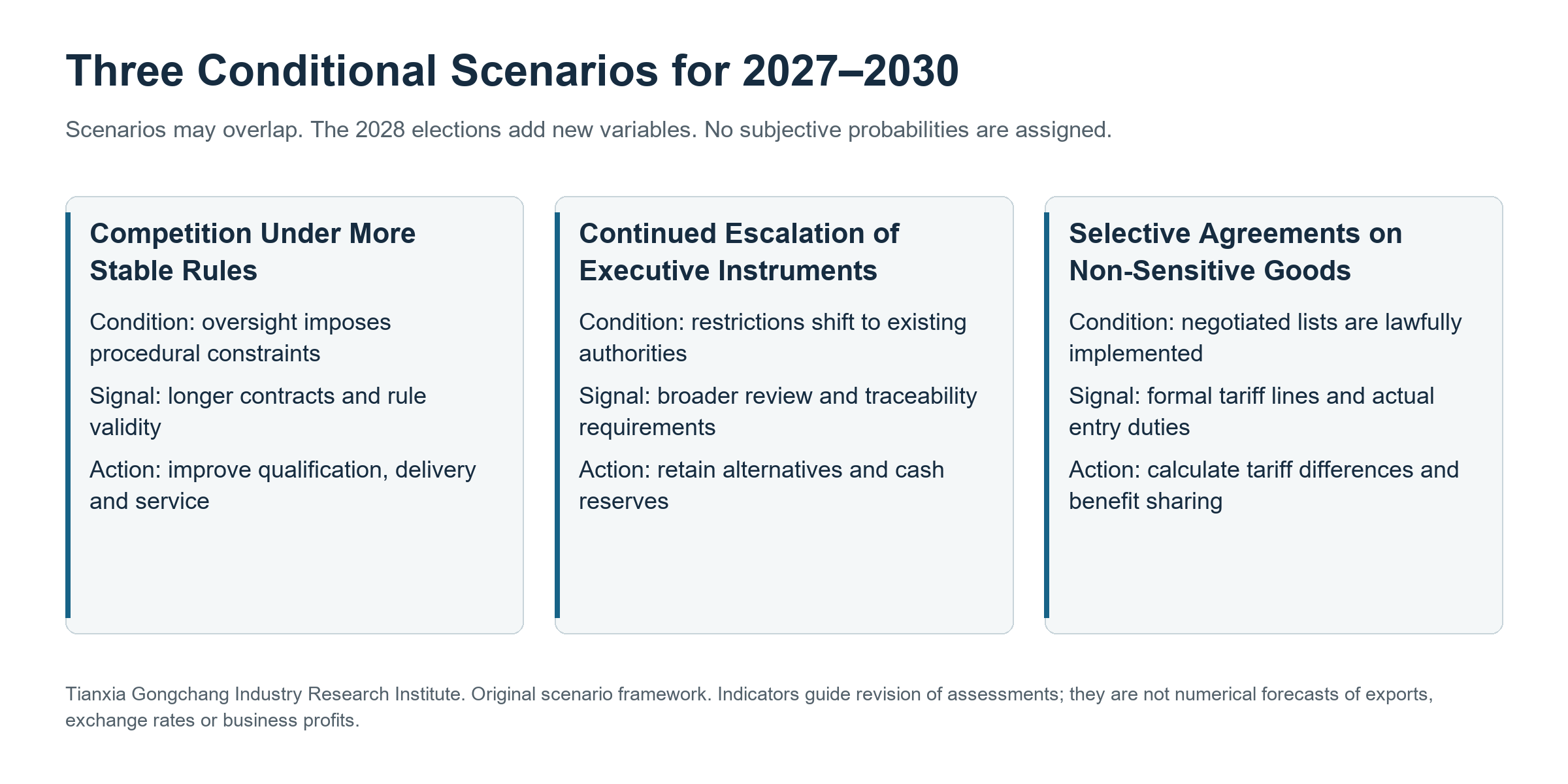
4. Time Horizons and Long-Term Position
Different horizons require different evidence. From late 2026 to early 2027, quotations, delivery responsibilities and customer plans may change first. Firms can follow formal rules, arrival conditions and contractual arrangements, converting media assessments into verifiable items. Timing is particularly important for measures nearing expiry or entry into force. The immediate task is to give orders in progress a clear basis and make reversible preparations for possible renewed customer purchasing. The more important question in 2027 is whether procurement expectations become continuing business. Repeated purchases, reasonable unit contribution and stable collections as orders grow determine the quality of improvement. If goods are merely shipped early ahead of a policy deadline and subsequent inventory clearance follows, long-term capacity should not be expanded on that evidence. If order horizons, financing and user feedback improve persistently, firms can gradually increase investment in qualification, service and technology. Sustained orders should precede asset expansion.
Improvements in transactions during 2027 must still withstand political changes in 2028 and businesses' actual performance.
U.S. political variables will change again in 2028, so Chinese firms should not treat the 2027 institutional configuration as permanent. Long-term contracts can include reasonable policy-renegotiation provisions; overseas projects need adjustment capacity; and R&D should avoid serving only a temporary licensing window. Where firms and customers have already established stable operating relationships, they may have stronger incentives to seek lawful, feasible arrangements together as policy changes. The value of long-term cooperation emerges under uncertainty, but it rests on a prior record of genuine fulfilment. By 2029–2030, assessment of Chinese manufacturing's position should focus more on capabilities. Have firms created greater value in materials, processes, design and system services? Have domestic industrial clusters retained a dense engineering base? Can overseas teams operate independently and reliably? Does revenue from multiple markets come with reasonable profits and cash collection? These questions provide a more complete picture than a single export ranking. Direct-trade statistics remain important but need to be interpreted alongside value added, production networks and business earnings. Mature internationalisation must ultimately be demonstrated by sustained operations.
Industries may also follow different timelines. General consumer-goods purchasing adjusts relatively quickly, major equipment takes longer to qualify and deliver, and advanced technology has still longer R&D and customer-adoption cycles. Research should not require every industry to show the same outcome in the same quarter. Firms can set observation windows around their own product cycles, aligning policy assessment with operating rhythms. Appropriate time horizons reduce the risk of mistaking normal fluctuations for long-term trends. Long-term outlooks also need to guard against new concentrations. Artificial intelligence, power grids and new energy create demand opportunities, but simultaneous expansion by many firms around the same expectations can generate fresh supply-demand pressures. Future opportunities should be grounded in customer projects, technical requirements and actual ability to pay. Identifying demand boundaries is often as important as capturing demand. Manufacturing investments take years to recover; capital discipline needs to accompany technological ambition.
5. Tracking Evidence and Making Counterfactual Comparisons
If orders improve in future, attribution needs care. Simultaneous improvement in markets outside the United States may reflect a global industry cycle. Clear changes confined to products covered by a particular rule offer stronger clues to a policy effect. Firms can compare quotations, order durations and collections for the same product in the United States and other markets, then examine differences before and after formal rule changes. Such comparisons still do not fully replace rigorous econometric identification, but they come closer to the facts than attributing every change to the election.
At the macroeconomic level, continued observations can include Chinese export volumes and prices, direct U.S. imports, and relevant industry investment and inventories. At the business level, they can include gross margins, order duration, customer concentration, collections and capacity utilisation. Reporting periods, currencies and adjustment methods must be retained across sources instead of suppressed to make charts look uniform. When databases are revised, earlier conclusions should be updated. Research rigour lies in acknowledging data boundaries and correcting judgments promptly, rather than defending an initial assessment as permanently right. At the policy level, formal documents and applicable dates should be retained. Section 301 exclusions, the BIS affiliates-rule suspension and the suspension of maritime measures nearing relevant deadlines at the research date have separate procedures. December polysilicon measures and proposed expansion of outbound-investment rules are also at different implementation stages. Use of this report after those dates requires fresh verification. Explicit updating conditions let a long report remain a useful analytical framework rather than become a conclusion mechanically repeated after dates change.
Firms can also compare expectations and results periodically. If a tariff reduction expected to encourage repeat orders fails to do so, inventories, final demand, competitors and contract conditions need examination. If a restriction expected to stop all supply later permits lawful trade in some products, the product scope needs to be reassessed. Attention to counterevidence helps businesses avoid overreaction and places positive judgments on firmer foundations. Tianxia Gongchang Industry Research Institute studies how policy enters real production. Policy documents explain manufacturing only when connected to products, customers and processes; business accounts enter reliable research only when their sources and scope are clear. Future enterprise research should supplement this report with attributed materials, verifiable orders and actual operating records, without allowing a few impressions to stand for whole industries. Testing macroeconomic change against factory experience, and factory experience against broader evidence, offers a sound route to understanding Chinese manufacturing's future position.
VI. Domestic Industrial Capabilities and Public Services
External rules define the range of available markets. Manufacturing and organisational capabilities determine whether firms can enter those markets and retain earnings.
The congressional shift may expose some restrictions to greater oversight, but long-term returns in Chinese manufacturing still need to rest on firms' own capabilities. Even where a duty falls, customers continue to compare prices, quality, delivery and service. Even where some rules persist, Chinese firms can seek opportunities through process improvement, diversified markets and different forms of cooperation. External conditions affect which markets are available; domestic capabilities determine which of them businesses can choose. Together, they form the full subject of the outlook.
1. Industrial Clusters and Shared Engineering Resources
Industrial clusters will become more important. An individual small or medium-sized factory may lack sufficient resources for complex qualification and traceability requirements. Cooperation among testing institutions, materials firms, equipment-service providers and professional organisations can lower shared costs. Local public services offering reliable standards information, quality infrastructure, training and connections to overseas services can help spread the fixed burdens of more complex rules. This support is directly relevant to the present U.S. policy environment: as competition depends more on verifiable capability, shared infrastructure becomes more valuable. Industrial clusters also help firms develop more complete delivery capabilities. Dense supporting industries in China enable repeated prototyping, rapid modification and stable mass production, an important source of Chinese manufacturing's appeal. If some final assembly is located abroad, domestic R&D, moulds, core materials and critical components need continued improvement. Retaining these capabilities means increasing their indispensable value within international networks, rather than simply preserving every existing activity. Businesses should be able to explain the specific problems the domestic system solves for global customers.
Overseas expansion can also create shared-service demand within industrial clusters. Professional institutions can share resources in testing, law, finance and tax, logistics, training and equipment maintenance, lowering the fixed costs borne by individual firms. Public support should help firms obtain dependable information and service choices, without substituting for commercial judgment or promising that overseas projects will necessarily succeed. An appropriate division of labour gives smaller firms access to international markets without requiring each to build every capability itself.
The domestic market can also support the development of engineering capability. Under external technology restrictions, advanced equipment and materials need real applications, while users need reliable products. Testing, trials and clear quality responsibilities can deepen cooperation between the two. Public support should encourage rigorous validation and continued improvement, giving promising products reasonable testing opportunities while protecting users' normal production. Procurement support without engineering feedback is unlikely to build lasting capability. Products tested in demanding domestic applications also have stronger evidence when entering overseas markets.
Shared testing, validation and standards information are important ways for smaller firms to spread fixed costs.
2. Domestic and Overseas Specialisation and Continuous Improvement
For China's industrial policy, the priority is to support genuine international operating capability while maintaining the domestic engineering and supporting industrial base. Output produced by overseas factories cannot continue to be counted as manufacturing value added within China. Overseas businesses can nevertheless connect with the domestic system through R&D, equipment, components and services. Making these links more technically valuable and allowing greater participation in earnings requires specific institutions and corporate governance. Measuring international expansion only by announced investment values can overlook production start-up, yields, cash collection and long-term local operations.
Relationships between domestic and overseas production can be organised around the product lifecycle. R&D, rapid prototyping, complex processes and critical components may continue to depend on dense domestic supply networks; final processing, assembly and service close to customers can gradually develop overseas. The division of labour will adjust as local capabilities grow. Firms should focus on quality, efficiency and returns across the network instead of mechanically assigning the same functions to every location. This form of internationalisation extends Chinese firms' capabilities and requires clear records of the real contribution made in each place.
Innovation should be connected to product use. In general machinery, it can improve service life, noise, energy consumption and maintainability; in electrical equipment, reliability, testing and engineering compatibility; in consumer goods, design, materials, safety and rapid response. Not every business needs to enter frontier technologies, but every firm can identify important improvements in its own products. As U.S. customers screen suppliers again for localisation and compliance, these accumulated gains can help Chinese factories remain among the choices. Long-term development of people and management also deserves attention. Engineers, skilled workers, quality personnel and international-service teams jointly sustain manufacturing capability. A response to external policy focused only on sales can overlook production and service foundations. Firms can turn customer quality problems into training and process improvement, and overseas-service feedback into design updates, returning knowledge from international markets to domestic R&D. Such a cycle makes market diversification a source of capability improvement as well as a change in order destinations.
Market diversification needs genuinely different sources of demand. A business entering several countries may still rely on the same final industry, type of capital expenditure or sales channel, leaving risk merely dispersed geographically. More resilient arrangements introduce differences in products, customer uses, channels and currency conditions, matched to the firm's capabilities. Excessive diversification also consumes resources. Firms should prioritise markets they can serve over time. Stable relationships have more value than repeatedly seeking large numbers of low-quality inquiries.
3. Transaction Discipline and Policy-Information Services
Stable domestic trading practices are equally important. Exporters need to pay suppliers on time; suppliers need to invest in quality and innovation; and customers need reliable delivery. If an industry passes pressure along the chain by continually extending payment terms, weak links may lose cash first when external policy changes. Better payment discipline, less destructive price competition and more enforceable contracts help manufacturing networks withstand fluctuations together. These measures cannot replace external negotiations, but they improve the retention of benefits after negotiations succeed. For local governments and industry institutions, the election offers an opportunity to reorganise services. Firms need formal policy explanations, checks linking tariff classifications to products, testing resources, credit services and professional support. Connecting these services reduces repeated searches across institutions. Policy information should identify sources and update dates, with outdated material removed promptly. Stable, specific and usable public information comes closer to factories' actual needs than frequent statements of general direction.
Support should take the form of usable engineering, credit and information services while preserving firms' own commercial judgment.
VII. Research Conclusions
The Republican loss of both congressional majorities opens a period of renewed policy bargaining. For Chinese manufacturing, some opportunities arise from more stable rules under stronger constraints, others from specific cooperation on non-sensitive goods. More of the long-term opportunity still comes from product and engineering capabilities that markets can validate. Chinese firms have reason to pursue these opportunities seriously, and need contracts, quality, cash and organisation to sustain them. The more complex the external environment becomes, the clearer the value of specific capabilities.
The report concludes that external opportunities available to Chinese manufacturing should first be identified as improvements in concrete transaction conditions: usable market eligibility, calculable costs, performable contracts and investments that can earn their costs back. Confidence in the assessment should advance with evidence, and the pace of expansion should match organisational capability.
Future manufacturing competition will continue between the workshop and the marketplace. A dependable batch of materials, an accurate delivery, a warranty fulfilled and a process repeatedly validated will gradually build a firm's international position. Washington's majorities can change and global demand can shift; the capability to keep solving real production problems can still create new reasons for cooperation. The outlook for Chinese manufacturing should ultimately be written in commitments that can be honoured over time.
Appendix. Business Calculations and Monitoring Arrangements
The following material turns the mechanisms discussed above into methods businesses can observe and calculate. Both examples use explicit assumptions. They do not represent current tariff rates or actual company operating data.
A. Product, Customer and Contract Information
A manufacturer facing the new environment first needs a product-and-customer table suitable for decisions. It should identify product tariff classifications, origin, direct customers, principal end uses, revenue, gross margins, payment terms and critical technology dependencies. Policy information should separately identify legal documents, scope, dates and responsible personnel. The table need not be elaborate. Its essential purpose is to show which order is changed by a specific rule. News becomes decision material once operating information is linked to policy information.
Customer management should consider commercial value and credit together. Large customers can offer stable orders and may also hold stronger bargaining power. New customers offer diversification but require checks on payment, purchasing authority and actual demand. Firms can progressively establish sensible customer categories, with clear initial-order conditions, credit limits and exception handling. For customers on long payment terms, sales growth should be assessed alongside receivables performance. If sales teams are measured only by order value, risk may become concentrated and visible only after production is complete. Quotations need clear tax and policy assumptions. Factory price, transport, insurance, customs declarations, warehousing, demurrage and return responsibilities should be agreed according to the transaction structure. Where a tariff change triggers requotation, the trigger and timing should be as explicit as possible. Where a customer requests a fixed landed price, the factory must fully understand the boundary of its exposure. Trade terms allocate some costs and delivery responsibilities but do not replace every regulatory obligation. Specific contracts still require review against applicable law and the circumstances of the transaction.
B. A Hypothetical Example of Tariff Differences and Supplier Profits
Order growth can coexist with lower unit contribution.
The following hypothetical example illustrates benefit sharing. It represents neither a real company nor current U.S. tariff rates. Assume a simplified customs value of US$100 per unit, fixed other landed costs of US$5 and only one hypothetical ad valorem duty. If the duty falls from 20% to 10% while the factory price remains unchanged, simplified landed cost falls from US$125 to US$115. The US$10 reduction per unit first appears on the import side; its allocation upstream and downstream still depends on the transaction. If the buyer simultaneously demands a factory-price reduction from US$100 to US$97, the same simplified assumptions give a new landed cost of US$97 × 1.10 + US$5, or US$111.70. The import side saves US$13.30 relative to the original position. If the factory's unit cost remains US$90, its unit contribution falls from US$10 to US$7. The contribution on the original 1,000 units was US$10,000. Even if later sales rise to 1,100 units, contribution is only US$7,700, a decline of 23%. Actual customs valuation and combinations of duties can be more complicated. The example shows only why order growth and profit changes need separate calculations.
This result does not mean that tariff reductions necessarily harm suppliers. It shows why factories should participate actively in sharing the benefits. Businesses can demonstrate their value through quality, delivery, R&D and service, and link price adjustments to purchase volumes, payment conditions and contract duration. If customers provide steadier plans and reasonable prepayments, a moderate price reduction may improve overall operations. Negotiation should balance total returns and risks, rather than judge success by one upward or downward movement in unit price.
C. A Hypothetical Example of Payment Terms and Cash Requirements
Cash flow requires a separate calculation. This example is also hypothetical. Suppose a factory has average daily operating cash expenditure of RMB30,000, combined production and inventory time of thirty days, receivables of sixty days and payables of twenty days. Its simplified cash-conversion cycle is seventy days, corresponding to approximately RMB2.1 million tied up. If the customer extends payment to ninety days with everything else unchanged, the cycle rises to one hundred days and cash required reaches approximately RMB3 million, an increase of RMB900,000. This calculation ignores taxes, advance receipts and seasonal fluctuations; it only illustrates how longer payment terms absorb cash.
For a factory, the extra funding is not an abstract number. It may use up material-purchasing capacity, delay equipment maintenance or compress the budget for developing new customers. If customer price pressure and order growth occur together, management must assess whether additional orders can bear the extra financing cost. Moderate prepayments, phased deliveries, staged acceptance and regular account reconciliation are all negotiable tools. Credit insurance, bank financing and exchange-rate management also have conditions and costs. They should be selected for actual risks instead of applied identically to every order because policy is uncertain. Inventory strategy can begin with purpose rather than total value. Critical long-lead-time components need a safety margin; standard materials and finished goods need attention to turnover and realisable value. Building large stocks of dedicated products to ship ahead of a policy deadline converts regulatory risk into inventory risk. Firms should check whether customers have explicit acceptance obligations, products can be resold, and warehousing and returns responsibilities are allocated. For measures announced but not yet effective, anti-stockpiling provisions and other transitional conditions must also be confirmed.
Cash turnover needs to be managed alongside sales growth.
D. Supply Preparedness and Decision Responsibilities
Supply-chain preparation can be more targeted. Critical materials and technology dependencies warrant validated alternative sources. For ordinary interchangeable components, firms should avoid excessive management costs in pursuit of diversification in form alone. A genuinely valuable backup must be able to meet quality and lead-time requirements when needed. A supplier list without samples, tests and delivery validation may be unusable during a disruption. Limited resources should be directed first towards activities whose interruption would have the greatest production impact. Quality and traceability documents should match the production process. Verifiable links between material batches, suppliers, process versions, inspection results and finished-goods deliveries support customer audits, after-sales analysis and compliance explanations. Reliable documentation comes from routine records; retrospective paperwork rarely reconstructs the actual process. Digital tools reduce repeated entry and search time, but should serve specific operations. For smaller firms, accurate critical records and clear responsibilities, followed by gradual system integration, are usually more useful.
Managers also need a decision rhythm. A policy news item can first trigger a check for a formal document. A group of inquiries can first trigger validation of customer-product fit. Sustained orders can then trigger capacity and funding assessments. Different evidence should lead to different degrees of action, reducing emotion-driven adjustments. Major irreversible investments need stronger evidence, while routine reversible improvements can proceed continuously. This sequence preserves the ability to act without letting each political change disrupt production. Internal responsibilities also need clarity. Sales understands customers and pricing; production understands capacity and yields; finance understands cash and credit; compliance personnel or professional advisers interpret applicable rules. Important orders need those perspectives together, rather than placing responsibility on one department alone. Management's role is to organise dispersed facts into executable choices and record assumptions. Investment continues when assumptions are validated and is revised promptly when they change. Part of operating capability is maintaining this learning process under incomplete information. For businesses, the most useful warnings normally have specific triggers: a formal rule covers a tariff line currently being quoted; a customer requests a substantial extension of payment terms; alternative samples of a critical material repeatedly fail validation; or overseas project collections deviate from plan. Warnings should identify a responsible person and action, avoiding large volumes of unattended information. Industrial research institutions can provide organised rule information, industry comparisons and methodological support so that firms focus on changes that genuinely affect operations.
Data Sources and Principal References
The report's statistical and policy facts draw on the public materials below. The sources were checked on November 4, 2026; publication dates, statistical periods and legal implementation status follow the explanations in the text and the original documents. Dynamic pages may be revised, and sample periods in historical research are not real-time descriptions of 2026. Scenarios, business methods and hypothetical calculations are the Institute's analysis. Future outcomes have not been presented as events that have already occurred.
- Tianxia Gongchang industrial platform, the research brand and company-information entry point.
- Axios election-night reporting.
- Reuters report republished by Investing.com.
- Twentieth Amendment to the U.S. Constitution.
- Congressional Research Service, Congressional Oversight Manual.
- National Archives, Constitution Questions and Answers.
- Senate explanation of filibusters and cloture.
- CRS explanation of budget reconciliation.
- Government Accountability Office, Lapses in Appropriations.
- Senate explanation of nominations.
- Supreme Court judgment in Learning Resources.
- White House proclamation on the temporary import surcharge.
- USTR July final-action announcement.
- CBP implementation guidance.
- USTR fact sheet on the new Section 301 action.
- USTR entry point for China Section 301 actions and exclusions.
- Final modifications following the 2024 four-year review.
- June 2026 Federal Register notice on metals adjustments under Section 232.
- CBP 2026 update for importers.
- Chinese Ministry of Foreign Affairs, eight-point outcomes.
- Ministry of Commerce explanation of the eighth round of consultations.
- USTR statement on recommendations from the U.S.-China Board of Trade.
- Formal notice extending existing Section 301 exclusions.
- Request for comments on a proposed extension concerning maritime measures.
- BIS document on suspension and resumption of the affiliates rule.
- New York Fed research on who pays the 2025 tariffs.
- New York Fed research on tariff transmission to consumer prices.
- NBS release on economic performance in the first three quarters of 2026.
- NBS purchasing managers' indices for October 2026.
- U.S. Census Bureau goods-trade table for China.
- Federal Reserve statement of October 28.
- Federal Reserve explanation of monetary-policy independence.
- WTO trade outlook, October 2026.
- IMF World Economic Outlook, October 2026.
- OECD Trade in Value Added country note for China.
- U.S. International Trade Commission explanation of trade in value added.
- IMF research on trade patterns in a fragmenting world.
- Federal Reserve research on Mexico in U.S. supply chains.
- Commerce Department explanation of trade remedies and circumvention.
- USTR statement on the USMCA joint review.
- CPSC guidance on testing and certification.
- CPSC eFiling resources for importers.
- CBP explanation of low-value shipments.
- October 2026 adjustment of postal-process compliance dates.
- U.S. Department of Energy discussion of grid-equipment shortages and solutions.
- IRS current qualified-manufacturer requirements for clean vehicles.
- IEA research on electric-vehicle batteries, 2026.
- IRS explanation of credit restrictions concerning prohibited foreign entities.
- White House proclamation on polysilicon and derivatives.
- Formal polysilicon anti-stockpiling rule.
- BIS announcement on semiconductor licence-review policy.
- Treasury CFIUS entry point.
- U.S. Outbound Investment Program.
- October 2026 proposed-rule announcement.
- IRS instructions for Form 3468.
- NIST questions and answers on CHIPS guardrails.
- White House Section 232 proclamation on pharmaceuticals and ingredients.
- CBP pharmaceutical implementation guidance.
- FDA explanation of medical-device imports.
- FDA quality and compliance guidance.
- Dallas Fed research on opportunities and constraints in Mexican manufacturing.
Open-Licence Photographs and Attribution
The cover and two photographs in the body have independent sources and licences. Archive images do not depict on-site conditions in 2026. Each photographic licence applies to the corresponding image; its inclusion does not automatically place this report's original prose and analytical diagrams under the same licence.
- Cover: Architect of the Capitol, United States Capitol - west front.jpg, 1997. Public domain: a U.S. federal government work produced in official duties.
- Figure 3: BMW Werk Leipzig, BMW Leipzig MEDIA 050719 Download Karosseriebau max.jpg, July 19, 2005. CC BY-SA 2.0 DE.
- Figure 5: Bigg(g)er, Panorama Yangshan.jpg, September 11, 2010. CC BY-SA 3.0.
Image processing is limited to proportional resizing and JPEG compression; no scene content has been added or removed. Open-licence photographs and any applicable modifications remain available under their respective original licences. Source file pages retain author information and full licensing details.