

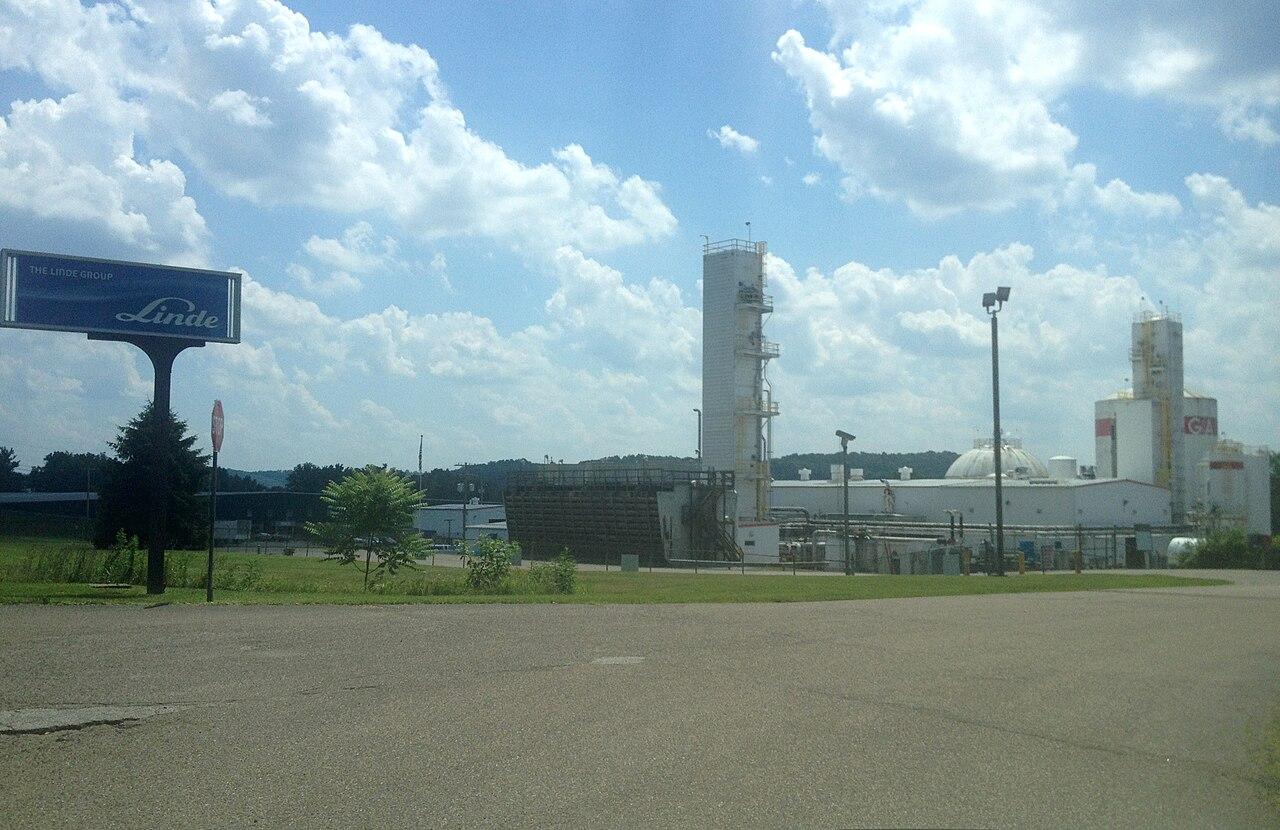
Cover photograph. A Linde air separation plant in West Virginia, United States. Photograph by Snoopywv, 2014. Resized proportionally. Original photograph · CC BY-SA 3.0
In February 2024 two oxygen plants at Shanxi Jingang Intelligent Manufacturing were priced together at RMB 305 million, including tax. One was rated at 30,000 normal cubic metres of oxygen per hour, the other at 50,000. The buyer, Hangyang, would also invest in a new 80,000 Nm³/h plant on site. The steelworks would continue to make steel and its furnaces would still need oxygen. What changed was who would pay for the next major overhaul and who would carry the equipment when steel sold poorly and the converters ran fewer heats.[2][3]
In a steelworks cost statement, oxygen is easily reduced to a unit price. In the shift log of an air separation unit (ASU), it has a flow rate, a pressure and a delivery time. Its production has to be scheduled alongside nitrogen and argon. The two records together explain what the industrial gas business sells. Steelmakers can release capital tied up in equipment and draw on a specialist’s machinery and maintenance capability. In return they take on payment obligations that outlast almost every steel order. The economics depend on what each company must still pay at the bottom of the demand cycle.
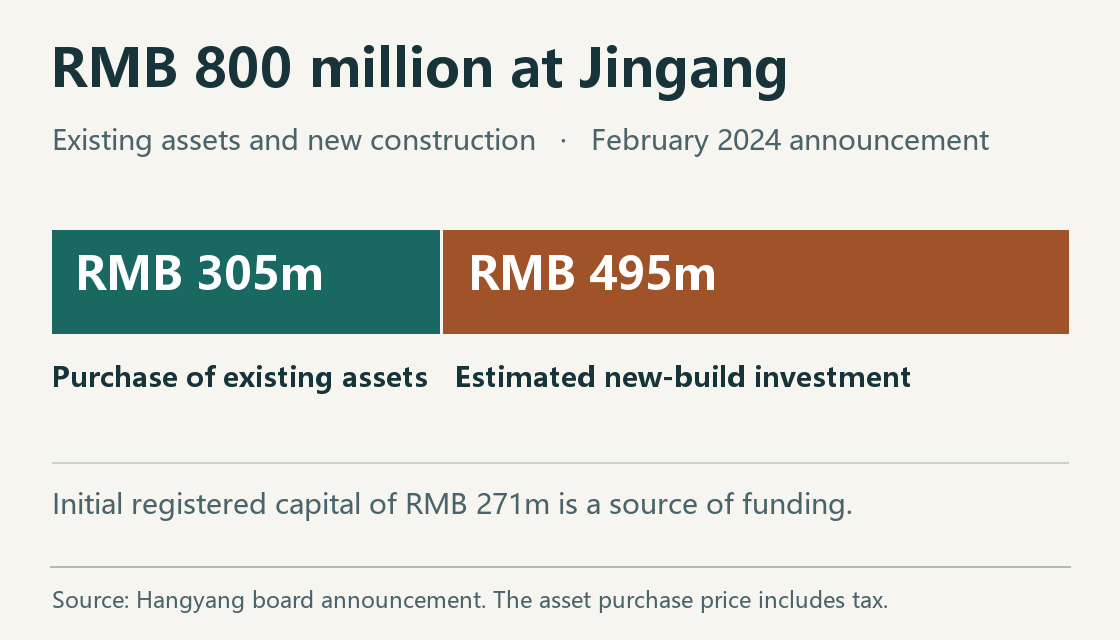
Of the RMB 800 million project estimate, RMB 305 million was for existing assets and RMB 495 million for the new plant. Graphic by Tianxia Factory Industry Research Institute, based on [3].
1. The Jingang oxygen asset sale
Three different amounts define the Bagong transaction. RMB 305 million is the tax-inclusive transfer price of the two existing units and associated assets within the agreed scope. RMB 495 million is the investment estimate for the new 80,000 Nm³/h unit. Together they make up the RMB 800 million estimated total project investment in Hangyang’s announcement. The often-cited RMB 271 million is the project company’s original proposed registered capital, a source of financing. Adding it to the RMB 800 million counts part of the investment twice. Treating the whole RMB 800 million as proceeds for Jingang turns a plant yet to be built into income from an asset sale.[3]
Table 1. Assets and financing in the Jingang project
| Item | RMB 100 million | Basis |
|---|---|---|
| Existing units | 3.05 | Tax-inclusive acquisition price |
| New unit | 4.95 | Estimated construction investment |
| Total project | 8.00 | Acquisition and new construction |
| Initial registered capital | 2.71 | One source of funding |
Amounts from the board announcement of February 2024.[3]
An equipment sale might bring to mind machinery leaving the steelworks through the gates. Here the existing units stay where the gas is consumed, and the new project is also inside the works. Air is drawn locally and the steelworks takes its gases through facilities on site. The seller disposes of a defined bundle of assets. The buyer takes on the business of supplying gas at the same location for years. Proximity saves the cost of moving gas or finding a new site. It also makes it difficult to take the investment elsewhere if the customer relationship ends. The very distance advantage that makes construction worthwhile becomes a constraint on exit.
The valuation provided a starting point. At 31 October 2023 the existing asset package was valued at approximately RMB 273 million excluding tax and RMB 306 million including VAT. The agreed tax-inclusive consideration was close to the latter. The appraisal covered the equipment and facilities in the asset schedule. That proximity says little about either the gain on disposal for the steelmaker or the return to the gas supplier. The former depends on book value, transaction costs and tax treatment. The latter depends on operation, maintenance, sales and collection after the valuation date.[3]
Why add an 80,000 Nm³/h unit where two units already add up to the same rating? The announcement describes provision for the upgrade of Jingang’s industrial park. It gives no hour-by-hour operating plan for the three units. Adding 30,000, 50,000 and 80,000 gives their combined nameplate oxygen capacity. The figure cannot be counted as all-new capacity or billed around the clock for 20 years. Two units were already there. Only production records can establish their operating hours after commissioning, their baseload or peak roles and their maintenance periods. The supplier operates a portfolio of equipment. The customer buys the capacity it may call upon under the contract. Dispatch determines how the two relate.
The agreement also sets the clock. The cooperation arrangements disclosed in January 2024 start the 20 contract years on the day the new ASU actually supplies gas. The February board resolution settled the acquisition price, investment arrangements and project-company proposal. A financing disclosure in 2025 records a supply contract between Zezhou Hangyang and Jingang, with responsibility for construction, operation and management assigned. On 4 February 2026 the developer issued its first notice for environmental acceptance on completion. It said the main works and environmental facilities had been completed the previous day. It gave no date for commercial settlement. Projecting 20 years from the announcement counts construction as supply. A completion notice cannot substitute for both parties’ record of first gas.[2][4][5]
The acquisition followed by construction has an industrial significance that is easy to miss. The new equipment has to be manufactured, installed and integrated. Existing steel production does not make room for an ownership transfer by suspending operations automatically. The old units have a transaction value and an established link to production. Keeping them supplying gas, connecting old pipework with the new unit and maintaining the common water and power systems determine whether the buyer takes over a going concern or a set of fixed assets awaiting reorganisation. An asset register lists equipment item by item. Continuity is demonstrated over time.
The seller receives cash over a relatively concentrated period. Debt repayment, investment in steelmaking and additional working capital would each generate a different return. The disclosure does not say how Jingang used the proceeds. In exchange, the steelworks gives up some operating discretion. Previously, changes to the oxygen shop’s schedule could be coordinated internally. A process modification that changes peak flows or furnace shutdown days may now require another company to adjust equipment, revise its schedule and agree new billing terms. Measuring the capital released alone overlooks what the steelworks undertakes to do over time.
The buyer starts from a different position. It can procure equipment it knows, deploy maintenance experience across subsidiaries and sell liquid products in regions with customers for them. Each advantage has conditions. Equipment expertise gives little control over steel prices. Customers elsewhere cannot take pipeline oxygen from Shanxi, and a group structure does not guarantee prompt payment of a particular plant’s receivables. Each site builds revenue from local demand, local power prices and reachable merchant markets. Scale gives the group an opportunity to organise those elements better. Its average margin cannot underwrite every project.
Hangyang’s 2024 list of new large on-site pipeline projects illustrates the distinction. It gives Zezhou an ASU rating of 80,000 Nm³/h, separately identifying the acquired 30,000 and 50,000 units. An acquisition expands the capacity a gas company manages without increasing the industry’s physical operating capacity by the same amount. Adding a number for every activity in the disclosure could turn an equipment order, a gas company asset and capacity available to the steelmaker into three separate instances of growth. This matters particularly in an industry that both manufactures equipment and operates it.[6]
Consider a hypothetical overhaul of the existing equipment. Both companies know work is due but differ on whether to do it before or after handover. If the seller completes it early, is that expenditure reflected in the price? If the buyer does it afterwards, will the steelworks accept a temporary reduction in supply? This is an illustration, not a reported Jingang dispute. It shows why transaction value depends on equipment condition, maintenance windows and the contract together. The cost of a similarly sized greenfield project is an inadequate basis for valuing a plant that must keep supplying gas.
Industrial statistics often classify on-site gas production broadly as outsourcing. That label conceals important differences. The steelmaker may retain the assets, pay for power and outsource operations alone. It may sell the assets and leave power procurement, investment, operation and gas sales to the supplier. The parties may also own a company together. Even within long-term supply, the quoted gas price changes according to who buys electricity, and responsibility for maintaining pipes on either side of the delivery point changes fixed expenditure. Bagong is worth examining because its disclosures bring the acquisition, capital addition and supply term together in one transaction.
The RMB 800 million still needs a denominator at the furnace. For how many hours, at what rate and to which specification does the mill need gas? Some materials can be bought cheaply in advance and kept in a stockyard, separating procurement from consumption. Bulk pipeline oxygen gives purchasing staff less latitude. The heat scheduled for tomorrow morning cannot use oxygen consumed last month or wait for cheaper supply next quarter. That constraint on timing is why steelmakers build substantial fixed assets around a raw material as readily available as air.
2. Gas demand in steel production
The converter illustrates oxygen demand most directly. Hot metal contains carbon. Producing steel to a specified composition requires oxidising some of it while controlling temperature and other elements. Worldsteel illustrates the speed of modern basic oxygen steelmaking by the time taken per heat. For the gas plant the essential feature is that production comes in heats. Charging, blowing and tapping occupy different periods, so demand rises and falls with the furnace schedule. Total consumption in an hour and the particular minutes in which two furnaces call for oxygen together are separate questions.[7]
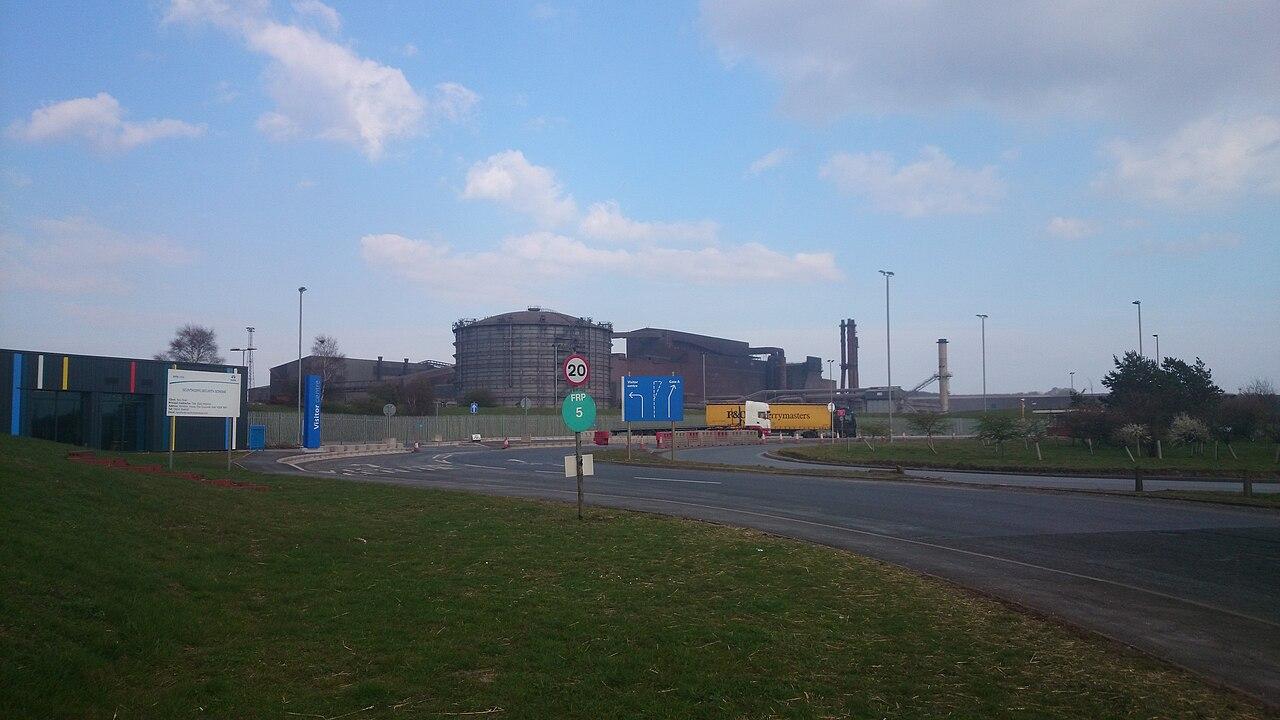
Exterior of the basic oxygen steelmaking shop at Scunthorpe, United Kingdom. Photograph by Jaxboy32, 2014. Resized proportionally. Original photograph · CC0 1.0
Oxygen enrichment of a blast furnace creates a different load. During continuous operation, the oxygen content of the blast has to match the fuel mix, furnace condition and hot-metal programme. Converter blowing is intermittent. Blast enrichment may provide relatively sustained demand. A site with both processes can combine a steadier component with a fluctuating one. Shutting down a blast furnace may remove precisely the load that supports continuous operation of the oxygen plant. Multiplying an annual reduction in crude steel by a fixed oxygen intensity generally misses that change.
Electric arc furnaces also consume oxygen. Even when the heat source and metallic charge change, chemical energy inputs and decarburisation can require oxygen. The Heyuan Derun feasibility study provides a clear example. The steelmaker planned a short-process electric-furnace specialty steel project, yet the first gas phase required an 11,000 Nm³/h ASU. It was sized for the mill’s first phase, with nitrogen, argon and liquid products also in scope. A process-route label cannot be converted directly into a gas quantity. Demand from the ultimate steel capacity cannot all be assigned to the first equipment phase.[8]
Nitrogen and argon complicate the picture. Nitrogen can protect or purge suitable processes. Argon can stir and shield liquid steel at stages that directly affect quality. Even per tonne of steel, grades have different tolerances on composition and impurities, affecting permissible gases, specifications and consumption. If a mill makes fewer commodity grades and more grades requiring tighter control of composition, the oxygen, nitrogen and argon sales mix may shift. Oxygen volume alone misses an important part of both the margin and the difficulty of delivery.
In 2018 Baosteel’s Central Research Institute documented an apparent paradox at its Baoshan base. Seven oxygen plants were in place, yet the works had surplus oxygen and insufficient nitrogen. Blast furnaces, steelmaking shops and cold mills all needed nitrogen, at different pressures. Scheduling around nitrogen could produce oxygen without an immediate outlet. Liquefaction for storage or sale required suitable equipment. Cutting ASU load simply because the oxygen meter showed a surplus might constrain the nitrogen customers first. That historical operating condition does not describe Baoshan’s balance today, but it explains why separate load curves for all three gases matter.[9]
Bulk gases are measured at standard conditions because actual volume varies with temperature and pressure. This report follows the disclosures in using Nm³, normal cubic metres, and Nm³/h for flow. Actual contracts specify their metering basis. An 80,000 Nm³/h unit is rated for oxygen under defined operating conditions. At a hypothetical steady 8,000 hours it would produce 640 million Nm³. That calculation makes no allowance for outages, turndown, internal consumption or unsold product and does not add other gases to oxygen. It illustrates scale at assumed output, not Jingang’s actual offtake.
An annual average hides cost-relevant details. Suppose one shop draws at 60,000 Nm³/h for the first half-hour and 20,000 for the second, a total of 40,000 Nm³. Another draws a constant 40,000 Nm³/h and takes the same volume. If the supply can deliver only a steady 40,000 Nm³/h, the first shop faces a 10,000 Nm³ deficit in the first half-hour and an equal surplus in the second. To use that surplus against the earlier peak requires stock before the peak or a change in the production schedule. Volumes that cancel in arithmetic do not cancel in time.
Nor can two converters’ respective peaks simply be added. Staggered blows reduce the peak the network sees below the sum of individual maxima. Maintenance or a grade change can bring previously staggered peaks together, increasing the instantaneous delivery requirement while barely changing the hourly average. The supplier needs the simultaneous load profiles. For the steelworks, staggering can mean waiting for hot metal or adjusting continuous casting downstream. Optimising the gas station in isolation for minimum electricity consumption could impose a larger waiting cost on the works.
Useful load records include pressure and quality. Even if pressure is adequate at the supplier’s outlet header, pipe diameter, distance and simultaneous withdrawals affect pressure at the most distant user. Where a branch needs higher pressure, the supplier can compress before delivery or the mill can boost pressure inside its boundary. The first may carry a higher gas price, the second a larger in-plant power bill. Comparing prices at two mills without specifying delivery point and pressure mixes different engineering scopes into the price spread. Purity guarantees and test procedures also affect comparisons.
The same applies to oxygen per tonne of steel. The numerator might be the converter meter reading, oxygen consumption by all plant equipment or purchases at the incoming header. The denominator might be saleable billet, crude steel or rolled product. A rolling mill buying in billets can increase finished output without raising its own converter production. Transfers of hot metal and billets between entities further separate process and company boundaries. Consistent monthly data can reveal deviations at one company. Cross-company comparisons require those definitions first. A few words in the unit description can send engineers looking for an energy saving that never occurred.
Billing staff usually work with monthly figures. Equipment staff need the distribution of loads over time. Sorting hourly take from highest to lowest shows the number of hours above any given flow. The flatter part informs baseload sizing. A short high tail informs reserves, interconnections and scheduling. Sorting loses sequence, so the original time series matters too. Twenty-four low-load hours scattered across 24 afternoons have different implications from a continuous 24-hour shutdown. One may require repeated dispatch changes, the other may accommodate maintenance, despite identical annual consumption.
One easily discarded figure is what the mill wanted but could not take because supply was constrained. Designing the new system around historic delivered peaks may mistake the old system’s limit for an upper bound on demand. Curtailment notices, explanations for rescheduled heats, quality objections and jointly recorded restriction periods can corroborate unmet demand. Conversely, a forecast peak submitted by the mill is not an observed load. Construction starts, equipment arrivals and production schedules should progressively substantiate it. Fair sizing retains actual take, requested take, constrained demand and planned demand as distinct records.
People work across these timescales. A heat must be coordinated in minutes, the next overhaul booked in advance, gas bills settled by accounting period and equipment paid back over years. Within one company a dispatcher, purchasing manager and finance director may use “oxygen demand” to mean pressure in the next half-hour, next month’s purchase volume and next year’s minimum obligation respectively. Restoring the time dimension turns disagreements into verifiable technical questions. The minutes that matter most to the mill’s costs may be invisible in a monthly average.
Equipment selection follows from this. Establish demand by process and operating state, identify which demands can coincide, and then choose the number of units, operating flexibility and external connections. Buying a large unit with an attractive investment cost per unit of capacity before finding a steady load leaves sales staff to absorb optimism built into the engineering. At a site such as Jingang with both existing and new assets, dispatch also has to reflect what the old system can actually deliver. Providing for those loads is what the next chapter costs out.
3. The cost of in-house oxygen production
When a steelmaker makes its own oxygen, its electricity bill is easy to find. A cost statement directly comparable with an outsourcing quote is much harder. The oxygen shop draws electricity, water and spares. Another department runs power distribution, finance records depreciation, a central crew services several shops, and backup liquid oxygen may be purchased centrally. Shop costs divided by output show how the shop accounted for the past year. Deciding whether to operate or buy next year requires identifying costs that disappear after a sale, those that stay, and the cost of future replacements.
Cryogenic air separation exploits differences in boiling points to separate air by low-temperature distillation. Marketable gases also require air compression, purification, heat exchange and, where necessary, product compression and liquid handling. The air comes from the site. Delivering oxygen, nitrogen and argon on time at the required quality and pressure takes electricity and a complete plant. Electricity consumption varies with the product mix. Increasing liquid output or delivery pressure, or changing a unit’s load, can change energy use per unit of saleable product. Multiplying the main machine’s quoted power consumption by the local tariff leaves work outside the calculation.
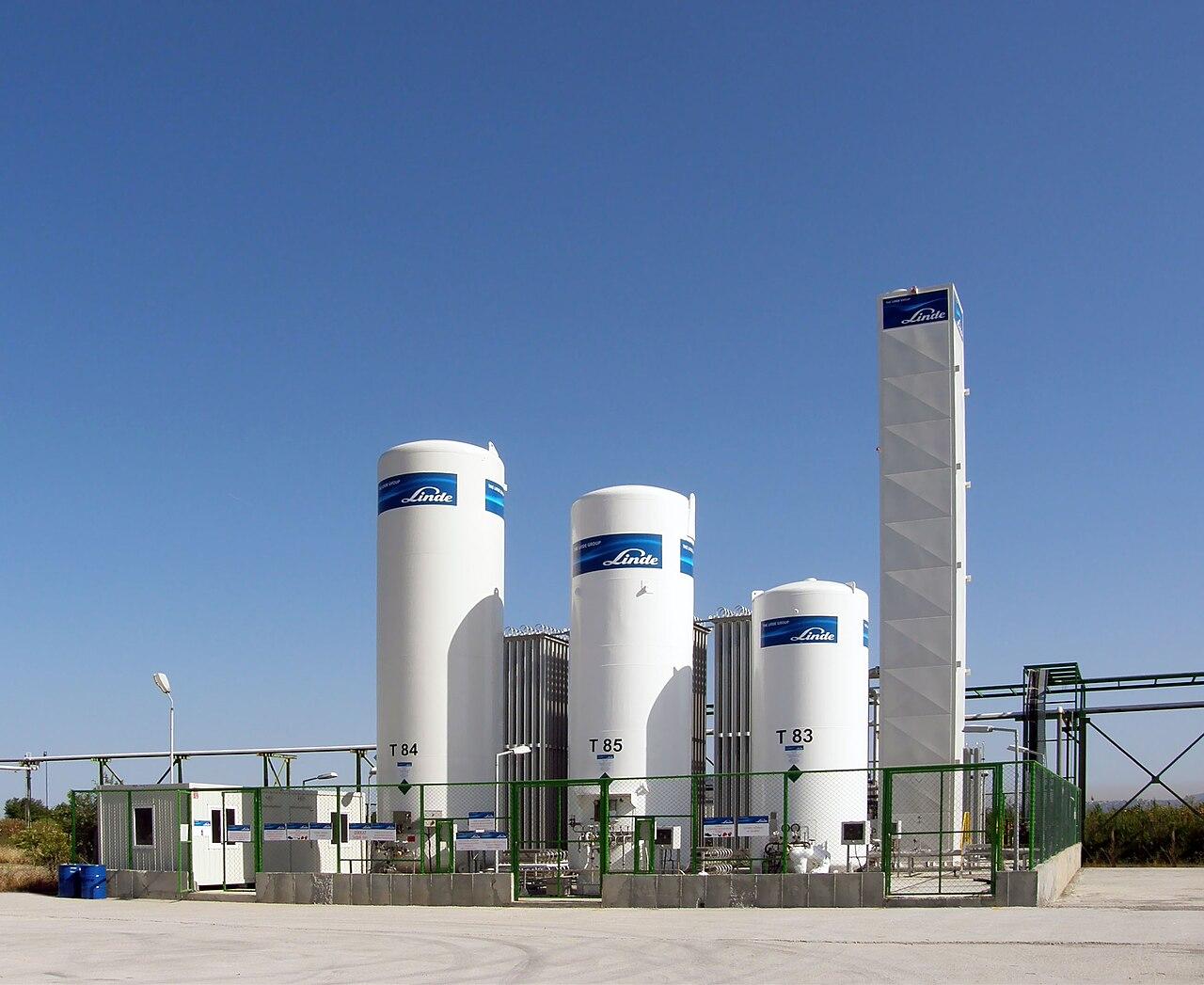
Industrial nitrogen production equipment illustrates another use of air separation. Photograph by Engineer09. Resized proportionally. Original photograph · CC BY-SA 3.0
Heyuan offers an unusually detailed public forecast. Of the approximately RMB 140 million estimated investment, equipment procurement accounted for about RMB 90.12 million, civil works RMB 14.54 million and installation about RMB 10 million. Other engineering, contingency, construction interest and initial working capital were listed separately. Equipment purchases alone were around 64% of the estimate. Dividing a quotation for the principal ASU equipment by projected sales omits buildings, installation, hook-up and capital tied up before completion. Heyuan’s proportion must be recalculated for different plant sizes, site conditions and delivery scopes.[8]
The same document assumed 8,400 supply hours per year and forecast about RMB 104 million of annual sales at design output. First-year purchased utilities were approximately RMB 78.06 million, wages and benefits RMB 1.44 million, depreciation and amortisation RMB 6.10 million and finance expense RMB 4.80 million. Purchased utilities accounted for about four-fifths of the roughly RMB 97.41 million in total costs and expenses. This was a feasibility forecast covering several gases and liquid products. It measures exposure in one case, not the electricity share of oxygen costs at Chinese mills generally. Sales revenue as the denominator gives a share of about three-quarters. The two percentages answer different questions.[8]
The forecast supports a limited sensitivity test. Hold volume, product mix and all other revenues and costs constant. Increasing purchased utility costs by 5% adds roughly RMB 3.90 million annually. Against first-year forecast profit before tax of about RMB 6.70 million, that would leave about RMB 2.80 million. Actual contracts may adjust prices for electricity and the utility line comprises different items, so this is not an earnings forecast. Where profit is a thin layer of revenue, a few percentage points of change in power cost make the scope and effective month of price adjustments consequential.[8]
Captive generation can make the calculation less transparent. Internal electricity tariffs may reflect historic costs or serve departmental performance targets. If the mill keeps supplying power after selling its ASU, some former electricity expense becomes sales revenue from the gas company. If the supplier buys power independently, the mill’s remaining purchase conditions may change with energy volume and maximum demand. The relevant effect for the steel company is the change in external net outflows and alternative uses of generation. Counting the power department’s surplus as a gain overlooks the electricity the works used before the transaction.
Joint products further complicate oxygen unit costs. One separation system produces oxygen and nitrogen and, where configured to do so, recovers argon. The common cost of air compression has no natural correspondence with three sales invoices. A volume allocation charges more to high-volume products. A realisable-value allocation puts more cost on higher-priced products. Treating oxygen as the principal product and crediting net proceeds from nitrogen and argon produces another measure suitable for some investment decisions. Each has a purpose. A few cents’ difference between one works’ net oxygen cost after credits and another’s manufacturing cost before allocation is little evidence of superior technology.
“Realisable” is the important qualification. Separating a nitrogen stream does not establish a nearby buyer for the whole volume at the quoted price. Further compression, liquefaction, storage and delivery reduce incremental proceeds. Nitrogen used reliably on site can be credited at the purchase cost it displaces. A stream without a current use or future outlet has no claim to the highest outside price. Crediting all theoretical joint products at local list prices can make in-house oxygen look remarkably cheap on paper without putting any more cash in the plant’s account.
Depreciation introduces another mismatch. A long-serving unit may be nearly fully depreciated and show a low current cost. Good equipment that needs no major work for several years is a genuine advantage for in-house operation. But replacement of critical machinery or substantial piping three years from now to maintain equivalent service belongs in the decision. Conversely, high depreciation on a new unit does not mean each additional cubic metre consumes that much cash. One more heat today calls for an incremental cash-cost calculation. A 20-year supply decision calls for the cost of capital over the life of the project.
For existing equipment, start with avoidable expenditure from today. Suppose keeping the plant entails minor work now, an overhaul in year three and replacement in year eight. A sale brings cash now, followed by contractual gas payments and perhaps retained maintenance on internal piping and backup connections. The sale proceeds are a single inflow under the sale option. The original equipment price was paid in the past and cannot be charged again to continued operation. Keeping the plant forgoes the available sale proceeds, an opportunity cost already captured in the difference between routes. Charging it separately to the retention route while also crediting it to sale distorts the comparison.
Nor can people be removed from the calculation by deleting a box on an organisation chart. Redeployment and resettlement of oxygen personnel, and the actual reduction in central maintenance and emergency staffing, determine how short-run cash savings differ from eventual headcount changes. Knowledge of equipment history, signs of trouble and internal contacts is valuable during handover. Payroll may be a small share of cost while a single misjudgement after expertise is lost can affect production. Though difficult to price exactly, handover duration, training and overlapping shifts to cross-check operations can be budgeted.
Compare both options at a common delivery point, for example the agreed inlet to the steelmaking shop. Both must offer equivalent quality, pressure, availability and credible backup. For in-house operation, include net power purchases, routine running costs, overhauls, renewals, working capital and realisable joint-product proceeds. For outside supply, include basic and variable charges, power adjustments, utilities retained by the mill, backup and retained personnel. Align the tax treatment and payment dates before comparing what the steelmaker actually pays under equivalent production conditions.
A mature steelworks can win that comparison. Reliable existing equipment, stable loads, use of recovered energy and long experience coordinating maintenance with steelmaking all favour continued operation. At a mill planning major modifications, a poor match between old equipment and future product proportions, difficulty recruiting specialists or low utilisation of a dedicated backup system can favour outside supply. Industrial gas service competes on these specific costs, which the companies can influence in different ways and which are ultimately tested by the same furnaces.
4. Recovering investment in on-site supply
Hangyang committed funds in two distinct ways at Bagong. Buying old assets pays for existing equipment and facilities to be recovered through continued operation. Building a new unit places funds in construction ahead of the first gas revenue. Combining them in one forecast and counting expenditure only from commissioning omits the time for which the acquisition money was tied up. Counting full revenue from all three units at signing lets unfinished equipment earn money early. Investment cash flow must follow the engineering calendar.
The original estimate breaks down the construction timetable in financial terms. Of the RMB 495 million, Hangyang allocated about RMB 459 million to construction investment, RMB 18.36 million to contingency, RMB 10.61 million to construction interest and RMB 6.99 million to initial working capital. Rounding produces minor differences in the total. Interest accrues between the equipment payment and the first sale of on-spec gas. Working capital is needed because power and labour must be paid after completion before invoices are collected.[4]
Equity funding of a project company differs from paying for an entire plant with shareholder cash. The initial announcement provided for external financing beyond registered capital. Subtracting the initial RMB 271 million from the RMB 800 million investment gives a planned funding gap of RMB 529 million, not an audited outstanding loan balance. Construction payments, use of issuance proceeds, later shareholder injections and borrowing terms alter funding sources. Hangyang’s 2026 interim report lists RMB 371 million of registered capital for Zezhou Hangyang, which also undertakes other projects. The subsidiary’s entire balance sheet cannot be assigned to Jingang alone.[3][10]
A gas plant has annual earnings and cash movements outside current profit. Collecting last month’s invoice raises cash, repaying principal reduces it and replacing equipment uses it. Depreciation reduces earnings without paying again for the plant on the date of the charge. To examine debt service, subtract operating payments, taxes, sustaining investment and working-capital increases from collections on pipeline and merchant sales. Shareholder returns also depend on specific borrowings, interest and principal repayments. A sales gross margin alone cannot tell when the investment is recovered or in which year liquidity is tightest.
Consider an example requiring no confidential project data. Invest RMB 100 million at the outset and receive equal net cash flows at the end of each of the next 20 years, with no residual value or intervening investment. At 6%, the annuity factor is about 11.47. About RMB 8.72 million per year is needed for the present value of receipts to match the outlay. Dividing by 20 gives RMB 5 million a year but values money in 20 years at the same price as money today. At 8%, the annual requirement becomes about RMB 10.19 million. These are net cash flows after operating costs, not the basic gas charge.
Delay the start of supply one year. With the RMB 100 million already spent, defer all 20 receipts by a year without changing their amount or number. At 6%, their present value falls from RMB 100 million to about RMB 94.34 million, a loss of RMB 5.66 million. If investment payments can also be deferred, the loss is smaller. If most civil and equipment costs have been paid but the steel project slips, the cost of waiting comes closer to the example. Starting the agreement at actual supply defines the contract years. It does not automatically reimburse every earlier interest payment.
Public feasibility studies reveal something a level annuity cannot. Heyuan’s first phase assumed 8,400 hours of operation annually and 100% production load from year one. That gives substantial revenue from the outset. A slower steelworks ramp-up spreads plant depreciation and fixed staffing over fewer sales. A basic charge can soften the loss to the seller, depending on when it applies and whether the first year is phased. Equal annual projected revenues are feasibility assumptions, not evidence that actual steel production held constant for 20 years.[8]
Older equipment introduces a further clock. New equipment payback, the next overhaul of the old machinery and the supply contract’s expiry may all fall at different dates. A mid-contract refurbishment needs cash. If assets still have useful life at expiry, access to the site, the land lease, the connection to the customer’s network and a successor operating agreement determine residual value. Applying a fixed percentage of original cost may overvalue a plant difficult to move; setting scrap value at zero may undervalue continued use or a negotiated transfer. Those are scenarios. Ownership and the customer relationship determine the realisable outcome.
Heyuan provides a land example. The project company disclosed plans to lease relevant plots from the steelmaker and described agreements on ownership of buildings, structures and equipment on leased land. A gas company can own the assets yet depend on access inside the customer’s works. Investors reading that a company owns its plant should also read provisions on land use, entry, utilities and arrangements after termination. They rarely generate a separate gas invoice, but they decide whether fixed assets can operate after 20 years. Engineers and contract terms together determine financial residual value.[8]
Why would an equipment manufacturer take on this business? Hangyang’s 2025 annual report shows a measurable change. Gas sales reached about RMB 9.207 billion, 61.04% of revenue and 13.66% higher year on year. Considerable capital and personnel now serve long-lived gas operations. Equipment sales are linked to project delivery. Owning plants extends the customer relationship to operation, maintenance and expansion. Recurring gas receipts come with greater long-term exposure. The company figure covers pipeline and other sales; it does not measure total steel-sector outsourcing or Jingang’s market share.[11]
Long-term revenue also concentrates counterparty risk. However large the face value of a site contract with one main steel customer, deterioration in its ability to pay widens the gap between contractual claims and cash. A solvent mill extending payment terms initially consumes working capital. Changes to its lines that permanently reduce offtake can trigger contract revisions. Retirement of its main production assets can impair a long-lived ASU that is hard to relocate. These risks can be listed separately but often coincide. Model explicitly the months when the supplier must pay for power and service debt while the mill’s invoice remains overdue.
A supplier can diversify some risk across projects, but their number is a poor substitute for analysing exposure. Two plants in different provinces serving similar steel products may face correlated orders. Staggered outages may allow teams to work across sites; simultaneous overhauls strain reserve vehicles, spares and staff. These are the mechanisms through which group scale pays. Adding contract values without allowing for common exposure to steel demand, electricity and local merchant prices overstates diversification.
For the mill, the question is whether the supplier can still perform in a downturn. A quote leaving almost nothing for renewals looks good in the procurement budget but can force renegotiation when equipment needs replacing in year ten. A supplier relying on full annual output and high merchant prices may in turn demand a high minimum that burdens the customer in a slump. Pricing negotiations have to identify which investment is covered in normal years and who takes each shortfall in abnormal ones. Their answer is often recorded in just a few lines of billing terms.
5. Long-term pricing and volume risk
The most consequential provisions of an industrial gas contract often become apparent only when the mill takes less gas. At full load, most bids can be expressed as a few tenths of a yuan per normal cubic metre. A minimum purchase, a basic charge and payment for actual take can look similar. When steel orders fall and fewer heats are scheduled, furnaces consume less oxygen. Whether purchasing can reduce payment proportionately is a different question. Dispatch follows production requirements. The contract settles investment and obligations previously undertaken. The difference measures the capacity cost the steelmaker bears in a downturn.
One Hangyang prospectus describes two steel projects with 20-year terms. Heyuan Derun Steel pays basic and variable gas charges. For Henan Jiyuan Steel, monthly actual volume is compared with the contractual standard: actual take is paid for above the standard, the agreed volume below it. Both support some income for on-site investment but produce different payment curves. The comparison table discloses the structures without specifying the actual basic charges and minimum quantities for the two companies. All rates, quantities and monthly charges in the following comparison are the Institute’s illustrative assumptions.[8]
Table 2. Published long-term steel-sector billing structures
| Steelmaker | Term | Charging basis |
|---|---|---|
| Heyuan Derun Steel | 20 years | Basic plus variable charge |
| Henan Jiyuan Steel | 20 years | Higher of monthly actual and agreed volumes |
Terms as summarised by the listed company. Prices and volumes in the calculation below are separate assumptions.[8]
In a normal month assume that the mill receives 10 million Nm³ of on-spec oxygen and makes 200,000 tonnes of crude steel, or 50 Nm³ per tonne. That factor defines only this example. Both bids cost RMB 6 million in a normal month, excluding tax, for this gas alone, with no electricity price change or subsidy. Plan A has a monthly basic fee of RMB 2 million and a variable rate of RMB 0.40/Nm³. Plan B charges RMB 0.60/Nm³ with an 8 million Nm³ monthly minimum. Each month is settled separately. There is no carryover, make-up gas or early termination. All reductions originate in the mill’s production plan, and the supplier remains capable of full contractual delivery.
In units of RMB 10,000 and 10,000 Nm³, the bill under A is 200 plus 0.4 times actual take. Under B it is 0.6 times the greater of actual take and 800. If steel output and gas take fall 10%, the mill produces 180,000 tonnes and draws 9 million Nm³. A costs RMB 5.6 million and B costs RMB 5.4 million. B remains above its floor, saving RMB 0.60 for every unit forgone. A’s basic fee remains payable, saving only RMB 0.40. Quotes identical at normal load already differ by RMB 200,000. Output has fallen but the gas plant maintains the same available capacity. A prices this obligation explicitly.
At 160,000 tonnes and 8 million Nm³, A costs RMB 5.2 million and B costs RMB 4.8 million. B is exactly at the minimum and still costs RMB 0.60 per unit taken. At 120,000 tonnes and 6 million Nm³, B still costs RMB 4.8 million, now RMB 0.80 per unit drawn. A costs RMB 4.4 million, about RMB 0.733 per unit. The ranking has reversed. Under B the shortfall of 2 million Nm³ enters the billing calculation but never enters the pipe. The mill is paying for capacity reserved on its behalf and carrying the cost of falling below the agreed take.
The crossover can be calculated directly. Below the floor B costs RMB 4.8 million. In the units above, setting 200 plus 0.4 times take equal to 480 gives 7 million Nm³ or 140,000 tonnes of steel. Between 7 million and 10 million Nm³, B is cheaper in this example; below 7 million it is dearer. Above 10 million, assuming both suppliers can deliver at unchanged rates, A rises more slowly because its variable rate is lower. A bid therefore has to be read against the future load distribution. Looking only at the minimum percentage or rejecting an explicit basic fee as expensive can select the wrong proposal.
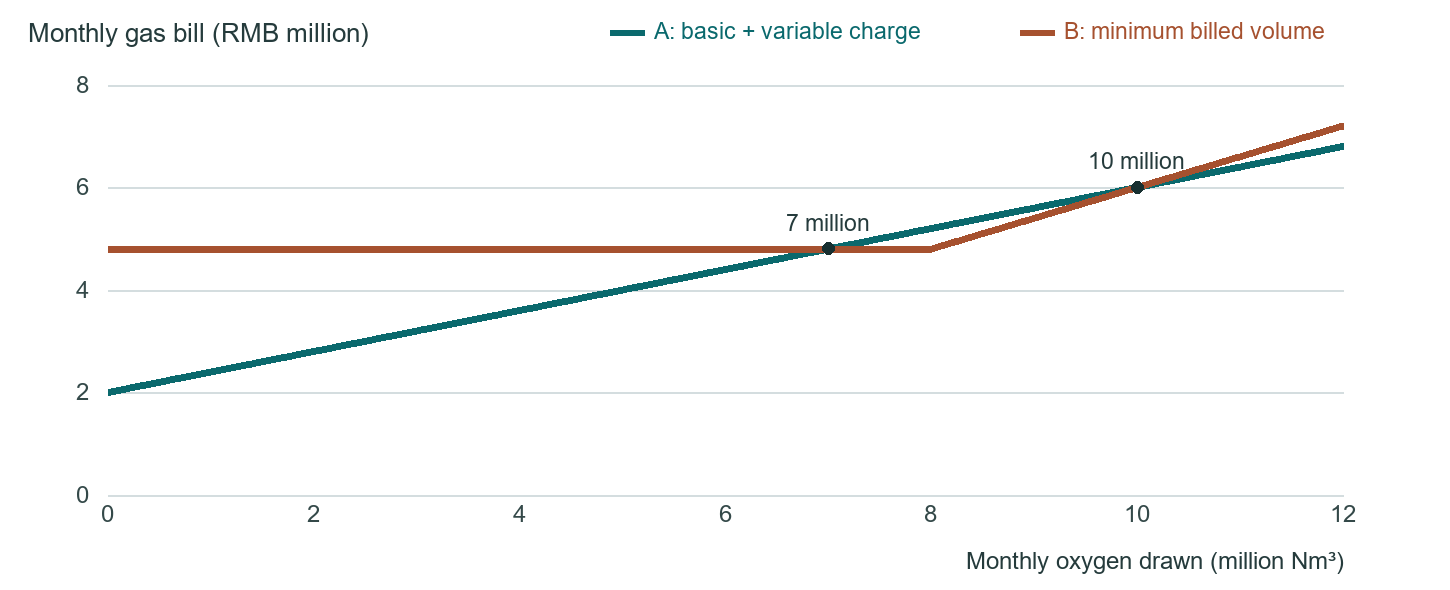
Monthly bills under the two charging structures. The Tianxia Factory Industry Research Institute plotted the illustrative assumptions in this chapter.
Dividing by crude steel output reveals a second effect. Both plans charge RMB 30 per tonne of steel in a normal month. At 120,000 tonnes, A costs about RMB 36.67 per tonne and B costs RMB 40. Both total bills are lower than at full production but unit steel costs rise. Fixed internal power distribution and maintenance costs would add to the increase. If the cut falls on low-oxygen grades, gas take and steel output may change by different proportions. Management reporting needs the total gas bill, effective price per unit taken and gas cost per tonne of steel together. The three can move in different directions.
Table 3. Production cuts, monthly bills and gas cost per tonne of steel
| Steel (10,000 t) | Oxygen drawn (10,000 Nm³) | A: monthly bill (RMB 10,000) | B: monthly bill (RMB 10,000) | A and B per tonne of steel (RMB) |
|---|---|---|---|---|
| 20 | 1000 | 600 | 600 | 30.00 / 30.00 |
| 18 | 900 | 560 | 540 | 31.11 / 30.00 |
| 16 | 800 | 520 | 480 | 32.50 / 30.00 |
| 14 | 700 | 480 | 480 | 34.29 / 34.29 |
| 12 | 600 | 440 | 480 | 36.67 / 40.00 |
Institute calculations. Plan A charges RMB 2 million plus RMB 0.40 per Nm³ drawn. B charges RMB 0.60/Nm³ with a monthly billing minimum of 8 million Nm³.
An easy short-term mistake is to treat the average cost from the whole bill as the incremental cost of each heat. Suppose planned production under B uses 6 million Nm³ but the mill must pay for 8 million. An extra steel order would consume another 500,000 Nm³. With capacity available, delivery in the same billing month and no supplemental charges, this gas adds nothing to that month’s bill. The paid but undrawn balance falls from 2 million to 1.5 million Nm³. The sales price still has to cover incremental metallics, energy, labour and delivery risk, but charging the order the full average gas price of RMB 0.80 again would double-count cost.
The converse also matters. Suppose B is expected to take precisely 8 million Nm³, then sales cancels orders accounting for 500,000 Nm³. That saves zero on the gas bill. A budget multiplying the cancelled volume by RMB 0.60 would report RMB 300,000 of imaginary savings. Lost steel production still needs to be evaluated against sales price, materials, transport and inventory. This calculation covers gas alone. It does not mean the mill should always make more steel. The marginal gas payment in a given month can be low while marginal steel production costs remain high.
The month-end boundary introduces another distinction. Under B, take 6 million Nm³ in one month and 10 million in the next. The combined 16 million equals two monthly minima. Monthly settlement costs RMB 4.8 million plus RMB 6 million, or RMB 10.8 million. If a different contract tested the same minimum over the two months combined at the same rate, total take would meet the floor and cost RMB 9.6 million. Identical gas volumes give a difference of RMB 1.2 million. Identical average take does not give the customer identical scheduling freedom. A longer test also shifts more monthly variation to the supplier, which may seek compensation elsewhere in the contract.
Longer test periods do appear in public disclosures. A Lüliang project in the same prospectus serves chemical companies. Actual take is billed for the first 11 months. The minimum is reconciled at the end of the twelfth month and any shortfall is paid then. This illustrates annual testing; it does not establish an undisclosed annual offset for Jiyuan Steel. Longer periods can be valuable where production is seasonal and recoverable over the year. If load stays low for the whole year, they mainly defer the cash payment without eliminating the annual shortfall.[8]
A shortfall payment and make-up rights are distinct. Whether a customer that paid for the monthly minimum can later draw the unused volume depends on contractual rights, permitted timing, expiry and the supplier’s obligations above normal delivery capacity. The example assumes no such right. If make-up is permitted only when the supplier has spare capacity and the customer already exceeds its minimum, value depends on those conditions coinciding. A steelmaker persistently running at low load may hold an entitlement without finding a suitable month in which to exercise it. Paid, eligible and actually recovered volumes should then be tracked separately.
Even the minimum may move with the metering definition. It can be a fixed monthly volume or an hourly standard multiplied by eligible supply hours. It may be set by product, pressure grade or project phase. An hourly minimum times eligible hours can produce different obligations in February and March. Whether jointly recognised outages are excluded affects the result. One fewer calendar day need not mean one fewer day’s charge. The purchasing officer signing a 20-year agreement may never process the bills personally, but successive teams will interpret those few words every month.
Electricity indexation addresses a different risk. In a separate illustration, suppose the variable component has a contractual energy coefficient of 0.5 kWh/Nm³. An RMB 0.08/kWh increase passed through immediately in full adds RMB 0.04 per applicable Nm³. Applied to 6 million Nm³ actually taken, the uplift is RMB 240,000. If the contract applies it to the 8 million billed units, it is RMB 320,000. The former follows physical output more closely; the latter also adjusts part of the undrawn volume. A billing coefficient need not equal measured consumption at every load. The interaction between indexation and the minimum becomes clear only when they are multiplied together.
With a quarter’s lag the mill may see gas prices rise just as current electricity prices fall, while the supplier has funded the earlier energy increase. Four details matter: whether the benchmark is a local index or the plant bill, which utility charges it includes, whether it uses a monthly average or specific hours, and whether decreases and increases pass through symmetrically. Even unchanged electricity prices can produce different costs if purchases shift between hours. If the customer controls night-time offtake while the supplier pays time-of-use tariffs, sharing scheduling gains on the invoice can align the power to save energy with the benefit.
A steel downturn, a supplier breakdown, scheduled mill maintenance and a public-grid outage can all produce the same metered monthly volume. They do not imply the same responsibility under a minimum. If the supplier fails delivery conditions and the mill cuts output, its availability obligation and the agreed deductions govern whether the affected hours count. If both parties scheduled an overhaul, the agreement determines whether charges are waived, deferred or the basic fee remains payable. A monthly report saying only “insufficient take” leaves economically different events to be disputed at settlement.
Process routes can change during a 20-year agreement. Blast-furnace modification, increased scrap use, grade shifts and moving a process off site can all alter gas requirements. Contracts can distinguish committed base capacity, additional volumes activated by specified conditions and indicative long-range forecasts, with clear triggers for recalculation. If the mill may reduce volume early, the supplier needs a way to recover dedicated investment. If every forecast becomes an immediate firm minimum, the mill pays for production lines not yet operating. Phased pricing distinguishes irreversible capital spending from plans that can still change.
Twenty years also spans management changes and shifts in financial condition. If a low-take invoice is paid six months late, nominal revenue is unchanged, but the supplier’s power and loan payments have not moved. A mill facing several minimum purchase commitments in a downturn cannot be assessed from the gas station’s position alone. A revealing stress test combines low offtake, collection delays and rising electricity costs in the same month, identifies who runs short of cash first and then considers payment terms, available security and renegotiation conditions. Testing three modest independent changes can understate their combined effect.
For Jingang, public documents establish the asset price, investment scale, supply term and start condition. They do not contain the complete pricing schedules needed to reconstruct its monthly bill. The parties placed substantial site-specific investment within a long-term relationship. How much less Jingang would pay after a 40% production cut requires the actual price formula, metering period and attribution of responsibility. Heyuan and Jiyuan give that phrase “long-term relationship” two concrete Chinese comparisons. With the same supplier, the same industry and the same 20-year term, contracts can still allocate low-load costs differently.
6. Maintenance and backup supply
A line in the Jiyuan Steel project disclosure comes close to the workings of the mill. The 40,000 Nm³/h unit would supply pipeline gas, with liquid products first reserved for vaporised backup to the steelworks. Only the remainder would be sold. That order determines who controls a tonne of liquid oxygen. The steelworks wants it in the tank when an unplanned outage occurs. Sales may already have a well-priced order waiting to load. Counting all design liquid output as merchant sales can put reserves already promised to the mill into projected retail profit.[8]
Normal productivity favours high utilisation. Reliable supply requires some capability that is routinely idle. Heyuan’s equipment list includes an air turbo-compressor, main heat exchanger and distillation columns alongside liquid oxygen, nitrogen and argon tanks and gas holders. The feasibility study priced storage for the three liquids separately under auxiliary production facilities, estimating the liquid oxygen storage system alone at RMB 9.102 million. These facilities provide storage, buffering and turnover. Operating rules determine the commercially available share. Some backup costs are committed with the civil works, long before anyone orders emergency tanker loads.[8]
Inventory, flow and duration impose separate constraints. In a purely economic example, a backup stock equivalent to 120,000 Nm³ against a shortfall of 30,000 Nm³/h appears to cover four hours. If the backup equipment can deliver only 20,000 Nm³/h at contracted pressure and quality, there remains a 10,000 Nm³/h shortfall even with the tank full. Conversely, adequate delivery capacity with two hours’ stock still falls short of four hours. Qualified engineers must verify actual performance. Contract analysis identifies responsibility for each kind of deficit; a single inventory figure cannot stand in for both guarantees.
If reducing load extends coverage, the mill and gas plant have to agree which operations are protected. Keeping all production running normally can require much more gas than sustaining critical operations through a controlled transition. The mill knows process interdependencies and the effects of curtailment. The supplier knows current inventory, alternative unit capacity and external replenishment time. If emergency oxygen is promised without specifying users, pressure, duration or recovery sequence, neither side can price the obligation in advance. After production recovers, concurrent changes in raw materials, energy and other equipment further complicate attributing losses.
Planned maintenance offers scope for mutual gain. If the steelworks has scheduled a major equipment shutdown, suitable gas-plant work inside that window may avoid some backup purchases and duplicate production losses. Dates alone are insufficient. A mill scheduled to resume on a given day does not need rated flow in every branch at midnight. Completing mechanical work at the gas plant does not make every gas immediately on spec. A workable annual programme sets when each party needs first on-spec gas, when normal demand returns and which subsequent tasks a delay will affect. Vague handover criteria make it easier for both sides to charge waiting time to the other.
The bill for purchased liquids during maintenance also depends on whose assets are down. When the mill stops, the gas plant may adjust production within its approved envelope or serve others. When the gas plant stops while the mill needs continuous supply, backup and transport must be organised. For a common upstream disruption such as a shared power source, nominal standby units on both sides must actually be available in that event. Adding equipment that relies on the same utilities can improve reliability for some faults while doing little against common-cause interruption.
Claims of mutual support between sites can be tested in concrete terms. Another nearby plant with capacity is a potential source. A contractually deliverable alternative requires a pipeline connection or arrangements for loading, transport and vaporisation. Capacity already reserved for the alternative site’s main customer, transport within the required time, receiving capability and product approval all matter. Two sites close together on a map may not be able to substitute for each other that morning. Linde describes interconnected pipelines separately from liquid distribution: dense demand and connected infrastructure support multi-site operations, whereas liquid distribution incurs transport and terminal storage costs.[12]
A mill’s cost of interruption cannot be inferred from outage length alone. An hour during a joint overhaul and an hour during a critical production sequence may have entirely different effects. Some output can be made up later, leaving waiting and overtime costs. Breaking a process sequence can raise energy use, require rework or affect deliveries. Deduct recoverable production contribution and distinguish temporarily deferred sales from sales permanently lost. Using average hourly sales revenue as the loss per hour counts avoidable material costs and sales subsequently recovered as losses.
Reliability rates need similar care. Suppose each of two systems failed to deliver agreed flow for 15 minutes in a year. One had three five-minute events, the other a continuous 15-minute event. If buffers bridge five minutes but not 15, the furnace experiences distinctly different service. Distinguish machine operation, availability at the plant outlet and on-spec delivery at the customer boundary. A main-unit outage successfully covered by backup may never interrupt the customer. A healthy main unit can coexist with inadequate downstream pressure and stalled production. The performance metric should correspond to the contracted delivery point.
The records left for shift staff affect actual recovery time. Plant history includes asset files, interfaces modified after past repairs and records of where mill expansion added demand. Asset numbers can identify transferred machinery precisely, but operating knowledge is passed on through routine work, handovers and drills. If only sound property is handed over, without equipment state, contact authority and agreed exceptions, the minutes spent reconstructing them in an abnormal event may cost more than the quoted unit-price difference. Here the value of outsourcing faces a practical test.
There is no single appropriate allocation of backup costs. A mill requiring dedicated stock beyond normal service can pay a basic charge for carrying it. If the supplier buys in because of a failure on its side, the extra cost of fulfilling existing obligations follows the agreed allocation of responsibility. A mill unexpectedly calling for volume beyond committed capacity creates a different purchase again. One delivered price for all three obscures who paid in advance for reliability and who calls on emergency resources at short notice. Transparent pricing allows discussion of which reserves can be shared and which must remain dedicated to one production line.
Jiyuan’s priority for backup over outside sales creates a calculable boundary. To find what can be loaded today, start with usable stock, deduct what the main customer needs until replenishment can arrive and consider delivery capacity, committed orders and scheduled maintenance. The result is usually less than the physical level in the tanks and changes with steel schedules. Even when the tank farm is quiet, dispatch decisions are determining the mill’s margin in the next abnormal event. Merchant analysis begins by leaving this already committed gas in place.
7. Conditions for merchant liquid sales
Pipeline oxygen has a major customer just across the fence. Liquid oxygen serves a network of roads, tanks, vehicles and dispersed users. Both can come from one ASU but have different buyers and earnings. Merchant sales can improve pipeline project returns by reaching demand outside the anchor customer. Their value depends on producing a marketable specification, delivering at reasonable cost and collecting on the terms customers will accept. A fall in pipeline oxygen consumption does not by itself reveal how much more liquid can be sold.
An ASU can have oxygen capacity and facilities for liquefaction, storage and loading. When pipeline flow falls, the operator can consider reducing load, changing the mix or increasing sales, subject to plant design and other gas commitments. Each additional tonne of liquid requires refrigeration and energy, plus tank space. A supplier committed to nitrogen or argon for the mill cannot adjust all parameters solely for the liquid oxygen price. Spare capacity in one operating condition cannot necessarily be converted at equal volume and cost into any saleable product. Physical and marketable capacity diverge here too.
Hangyang’s 2025 annual report records more than 3.6 million tonnes of group liquid sales, up 27.66% year on year. It also describes pipeline and merchant supply as operating categories. Liquid sales can therefore be a substantial business for a large gas group. The number is measured in tonnes and refers to group sales. It does not state how much came from Jingang and cannot be divided directly by an 80,000 Nm³/h oxygen rating. One figure combines products and entities and measures the scale of the group’s sales network. The other gives one project’s oxygen flow under specified conditions.[11]
International operators likewise distinguish the routes their products travel. Linde’s 2025 report separates on-site pipeline, bulk liquid and cylinder deliveries. Large, relatively steady users can justify local plants; bulk liquids generally move by tanker to customer storage. For oxygen and nitrogen, transport costs limit the economic delivery area. The report supplies no kilometre radius universally applicable to China. Selling price, product, vehicle availability, travel times and competing plants shift the boundary. Counting every industrial firm within a fixed radius as an attainable customer misrepresents the business.[12]
A tanker load’s margin is easier to understand working backwards from the delivered price. In a separate example excluding tax, a customer pays RMB 700 per tonne delivered. Incremental production and loading cost RMB 400 per tonne, with another RMB 30 per tonne in delivery-related variable costs. A fixed RMB 3,000 round trip spread over 20 delivered tonnes costs RMB 150 per tonne and leaves a contribution of RMB 120. If the customer can receive only 10 tonnes that day, all else equal, transport costs RMB 300 per tonne and contribution turns negative at minus RMB 30. The customer price and route are unchanged. Only the amount delivered per trip differs.
The example also shows the value and limits of sharing a route. If two customers each take 10 tonnes on the same route and compliant shared delivery is feasible, the extra contribution from the fuller load may exceed the second stop’s cost. If both require the same narrow time window, gate procedures are slow, or quality and batch rules differ, adjacent customers on a map may be unsuitable for one run. A reliable full-load buyer can reduce average delivery costs more than several small customers paying a higher headline price. That organising ability is an asset for a regional distributor.
Customer storage and inventory practices constrain the plant in turn. A call only when stock is nearly exhausted leaves a narrow delivery window, potentially forcing a lightly loaded trip before another customer is ready. A supplier financing and maintaining customer tanks can recover capital through a service fee or sales margin. The delivered price then covers liquid, transport and storage service. Comparing it with another customer’s ex-works price for self-collection into its own tank requires separating those costs. Multiplying a published local ex-works price by projected volumes omits some of the hardest work in the sales contract.
Local supply can rise simultaneously. If several mills cut production in a weak region, their gas plants may all seek outside sales. When the extra liquids chase the same customers, prices can fall and delivery distances lengthen. The merchant revenue that supplements full-load sales may not absorb all spare output at earlier prices in the weakest steel months. Conversely, simultaneous regional ASU maintenance can lift short-term liquid prices and raise the mill’s backup purchase cost. Pipeline and merchant business can complement each other in ordinary times while transmitting the same shock into both accounts at other times.
Regional economics have to be assessed product by product. Oxygen, nitrogen and argon serve different processes and differ in unit value, contract term, delivery size and volatility. A steelworks may take argon steadily without influencing another region’s liquid argon quote. Hospitals or electronics manufacturers in the area establish potential applications, not that an ordinary industrial plant already has the necessary qualifications, purity, validation and customer approval. Feasibility studies listing nearby industries need to be checked against specific product and entry requirements. Many possible uses do not immediately translate into invoices.
Regional expansion sometimes pays first through costs avoided. Hangyang reports relationships with Jingang, Lanhua and Tianze in Jincheng. In early 2026 it disclosed a separate proposed 42,000 Nm³/h unit for Lanhua Coal Chemical through Zezhou Hangyang. This explains the regional interest without establishing an operating interconnected pipeline. Local maintenance crews and spares may support several stations. Better routing can shorten return legs and make supplementary liquids easier to obtain. Actual gas transfers between sites still depend on physical connections, specifications and existing commitments.[13]
The steelmaker selling the plant also has to identify whose merchant earnings are being transferred. If its plant already sells liquids, disposal may relinquish an existing cash flow. The in-house option should retain actual proceeds net of costs. If the old plant lacks liquefaction, sales staff and real customers, the outside company’s planned merchant business depends mainly on its new investment. Expected value can be shared in the asset price or long-term tariff. The mill cannot sell all gross margin it has never earned as current profit, and the supplier cannot readily finance an undeveloped market as certain income.
The best evidence can be prosaic. Reconcile product loading slips with signed receipts, journey times and payloads. Examine purchased supply during shortages, replenishment sources, each customer’s actual delivery frequency, payment dates and cancellations across several months. Deduct terminal equipment costs, maintenance and distribution from margin. The result may be less flattering than a sales total but reveals whether equipment, customer density or transport organisation creates advantage. It can also expose a misleading expansion in which vehicles work harder and more tonnes are sold while less cash remains at the plant.
The Jingang announcement speaks of regional competitiveness in Shanxi and influence in the liquids market. In operation that proposition has to be earned order by order. Anchor pipeline demand underpins investment, and spare capacity creates a possibility of outside sales. Only when local users take delivery, inventory can leave the site and contribution remains adequate after delivery does that possibility turn into earnings. The fence marks the assets. The market boundary is set by the distances over which a tanker can deliver the right quality on time and return economically.[3]
8. Choosing a supply model
A steelmaker can make three decisions separately: who finances the plant, who operates it, and who carries future volume and price changes. Jingang assigned acquisition of existing assets, new investment and long-term supply to a specialist, one combination of the three. Another mill may retain the assets and outsource operations alone, or invest jointly with the supplier. The more alike the labels sound, the more important it is to ask whose account pays when steel prices fall, electricity prices rise and an overhaul comes due. This question is closer to an actual decision than a universal ranking of supply models.
The gas operations serving Zhanjiang Steel offer a comparison. The organisation that assessed the project’s safety records that under the original arrangement Baosteel Zhanjiang owned the air separation and hydrogen equipment and entrusted operations to Baowu Clean Energy (Guangdong) Gas. Later, a joint venture established by the parties became the asset owner, while production, maintenance and technical support continued under service contracts with a specialist team. This describes the period covered by the assessment. Ownership can change while specialist service continues. Classifying a new operator, an asset transfer and metered purchases from an independent third party alike as outsourcing conceals three distinct decisions.[14]
Another option is to retain existing air separation and add supply for a specific new load. Equipment supplier PKU Pioneer describes a Changjiang Steel project where an existing cryogenic plant could produce 52,000 m³/h of oxygen. When two blast furnaces simultaneously increased enrichment, demand exceeded output by about 10,000 m³/h. Purchased liquid oxygen had filled the gap. The company introduced pressure swing adsorption oxygen production for furnace enrichment. This account documents the supplier’s project background and solution; its claims of savings are not audited steelmaker earnings. A discrete gap serving a process that accepts the relevant product specification can be addressed separately. The example does not establish that the same method replaces all steelmaking oxygen or co-produced nitrogen and argon.[15]
For a mill with an established oxygen system, continued operation first depends on remaining life and the match to demand. Keeping a sound main unit and replacing inefficient components may cost less than selling the entire plant and paying a gas tariff that recovers new construction. Future training, continued availability of parts and spare capacity in power and piping after expansion also matter. If the machinery is serviceable and the gap is specialist maintenance, contracted operation or a technical service agreement offers a more reversible option. Identifying the specific weakness can avoid transferring a whole system to solve one local problem.
At a greenfield site there are no existing asset-sale proceeds to compare. The choice is between financing construction and carrying ramp-up risk, or letting a supplier invest in exchange for future contracted offtake. Clear main-works milestones, phased gas requirements and verified supplier experience can make long-term on-site supply a way to reduce initial mill investment. With lengthy development phases and an uncertain eventual product mix, guaranteeing all future demand at the outset turns plans into cash obligations before production exists. Phased construction or triggers for further investment can matter more than negotiating the lowest first-phase unit price.
For an existing mill, consider a 20-year incremental example. Selling the old plant generates RMB 100 million net now. Both routes deliver equivalent quality. For each year subtract the full net cost of in-house supply from that of outside supply, including gas fees, retained utilities, avoidable maintenance and realisable by-product proceeds. If buying costs an extra RMB 7 million each year, the excess has a present value of approximately RMB 80.29 million at 6%. Against the initial RMB 100 million receipt, sale has an advantage of about RMB 19.71 million. Raise the extra annual payment to RMB 10 million, with a present value of about RMB 114.70 million, and retaining the plant becomes preferable by roughly RMB 14.70 million.
Table 4. Additional annual cost after sale and difference in present value
| Additional annual purchase cost (RMB 10,000) | PV of 20 years’ extra cost (RMB 10,000) | Net advantage of sale (RMB 10,000) |
|---|---|---|
| 700 | 8,029 | +1,971 |
| Approx. 872 | Approx. 10,000 | Approx. 0 |
| 1,000 | 11,470 | −1,470 |
Institute calculations. Initial net proceeds of RMB 100 million, level year-end payments, 6% discount rate and zero difference in terminal value. Rounded to the nearest RMB 10,000.
The comparison temporarily sets future renewals, residual value differences and extra taxes to zero. A real decision must account for them. Suppose retaining the assets requires a RMB 20 million renewal at the end of year six, the supplier assumes it after sale, and the annual difference above excludes it. Retention then costs about another RMB 14.10 million in present value. A realisable residual value on mill-owned equipment at expiry must conversely be credited to retention after discounting. Receiving RMB 100 million does not establish a windfall, any more than outsourcing must be dearer. A missing renewal or end-of-term ownership provision can reverse a close comparison.
The board should see which condition flips the decision. All else equal in the example, roughly RMB 8.72 million of extra annual expenditure is the break-even point between sale and retention. Break that difference down into long-term basic charges, power procurement terms and actual maintenance savings. A negotiation that moves only the variable rate while leaving fixed low-load obligations untouched may meet the average annual target yet strain cash during a two- or three-year slump. Present value compares whole-life costs. Year-by-year liquidity still needs separate analysis.
To distinguish bids, give every bidder the same anonymised historical loads and confirmed modification dates and ask for monthly invoices repriced under its own terms. Include a normal peak, a spell of weak orders and an outage requiring coordination. Use common definitions for delivery point, gas specification and standby service. For a proposed line, test delayed commissioning and low initial loading separately. On identical records a cheaper average tariff can demand more cash in the hardest quarter, while a slightly higher quote can preserve flexibility to change the production lines. Actual dates and amounts give the parties something to negotiate.
Specialist suppliers also need verifiable information before bidding. Recent grade mix, changes at delivery points, available power and land, furnace outage calendars and payment history affect plant design, construction, minimum payments and collections respectively. The more dedicated capital the customer requires the supplier to carry, the stronger the case for evidencing future demand and allowing reasonable recovery. Excessive minima lock a mill into yesterday’s capacity plan. Too little protection deprives the supplier of the ability to renew equipment. Effective negotiation makes shared risks explicit and preserves a return for the party prepared to invest and able to manage each exposure.
A statistical transfer also affects interpretation of China’s industrial gas industry. Oxygen made in-house is an internal intermediate. Transfer the plant to an independent supplier and that supplier’s external sales increase even if steel output and actual oxygen consumption are unchanged. Some industry growth comes from previously internal production entering the specialist market. Other growth reflects increased demand, new products or broader delivery scope. When an equipment manufacturer moves into gas operations, ask first how much growth comes from taking on existing assets, new plants, liquid volumes or prices. Only then infer anything about industry demand. Jingang is representative precisely where sales statistics and physical production give different answers.
In 20 years the mill may change products, the supplier may replace its main machinery, and the original negotiators may have left. The tax-inclusive price of Bagong’s two old units can be specified to the last yuan. The experience accumulated in years of operation, the coordination between gas and steelmaking crews, and how each side will share the loss when a few heats are unexpectedly cancelled are harder to value. A gas project that lasts through a steel cycle leaves the agreement intelligible to the people who inherit it. With order books thin, they can explain why the bill is still due. When a furnace calls, they can also find the party that has been paid to deliver and can actually send the gas.
References
[1] 天下工厂制造业数据库 (Tianxia Factory Manufacturing Database).
[6] Hangyang Group Co., Ltd. 2024 Board of Directors’ Report, March 2025. Major investments.
[7] World Steel Association. The Steel Story. Basic oxygen steelmaking and heats.
[11] Hangyang Group Co., Ltd. 2025 Annual Report. Operating results, gas revenue and liquid sales volume.
[13] Hangyang Group. Cooperation with Lanhua Group expands gas supply in Jincheng, 1 January 2026.