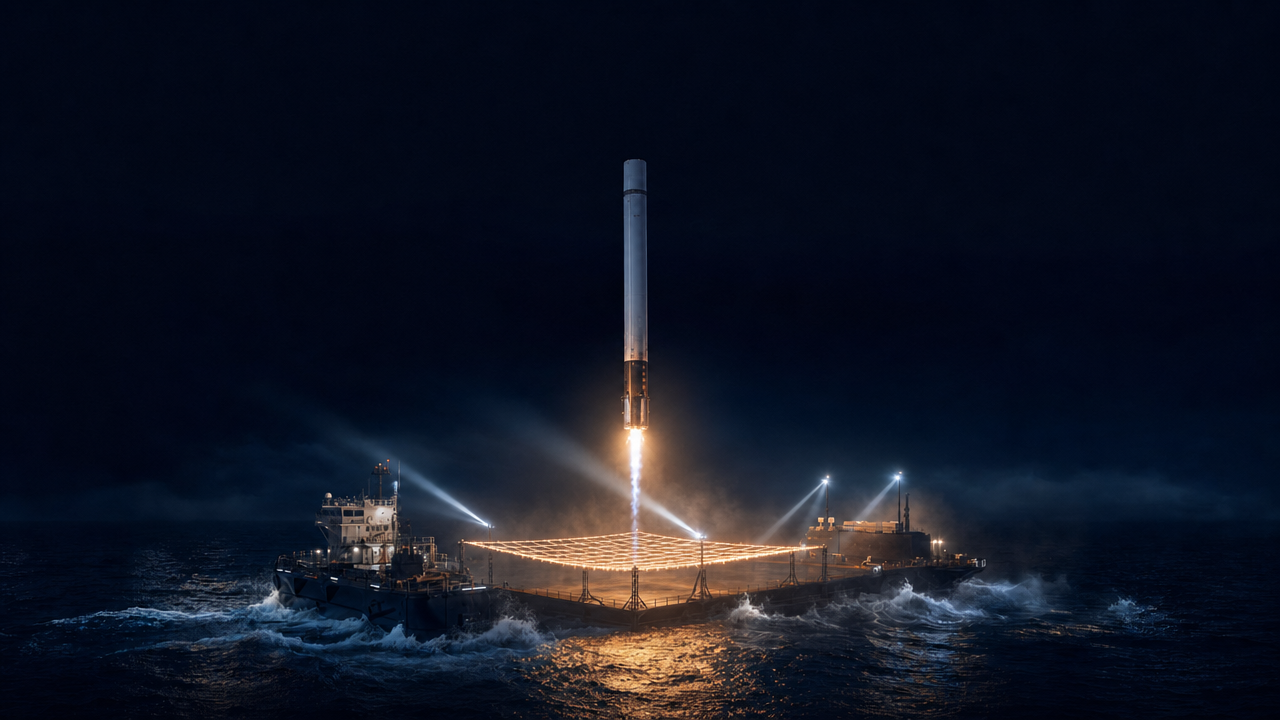

At 12:15 on July 10, 2026, at the Hainan Commercial Spacecraft Launch Site, the Long March 10B (CZ-10B) carrier rocket made its maiden flight. About six minutes after first- and second-stage separation, its first stage did not plunge into the sea like every piece of rocket debris of the past six decades, nor did it deploy landing legs and stand itself on a deck like Falcon 9 — it was caught by a net. For the first time anywhere in the world, the first stage of an orbital-class rocket returned to Earth by way of "net capture."
This report is not a retelling of the news. What concerns us is the longer thread behind the news: "reusability" looks like an aerospace-technology question, but at its core it is a manufacturing question — whoever can turn the rocket from a hand-crafted work of art into a mass-produced, cheap, rugged, refurbishable factory product holds the ticket to the low-Earth-orbit era. And China's answer is intriguing: not to copy the Falcon playbook, but to take the act of "recovery" off the rocket itself and hand it to nets, cables, and ships at sea — landing squarely where China's supply chain is at its thickest.
The full report runs to roughly 53,000 Chinese characters in twelve chapters. Chapters 1 and 2 reconstruct the event and its technical mechanics; Chapters 3 and 4 lay open the global genealogy of recovery routes and the ledger of reuse economics; Chapters 5 through 7 dissect the supply chain along the thread of "a fiber — a net — a ship," with Chapter 6 giving an honest account of a bout of market speculation over supplier attribution and the regulatory action it drew — telling the real supply chain apart is precisely where industry research earns its keep; Chapters 8 and 9 examine the private-sector cohort and the demand-side pull of constellation deployment; Chapter 10 offers an international comparison; Chapter 11 gathers all the companies and links that appear across the report into a single map of industrial opportunities; Chapter 12 closes with three testable forward-looking judgments.
Every fact is sourced. Supplier attributions are strictly graded into three tiers — "officially confirmed / company announcement / market rumor" — and unverified claims are explicitly flagged in the text. Data are current as of July 11, 2026.
1. The Muffled Thud at a Quarter Past Noon: A Full Record of the Event and Its Milestone Coordinates
At 12:15 on July 10, 2026, at Launch Complex 2 of the Hainan Commercial Spacecraft Launch Site in Wenchang, Hainan, the Long March 10B carrier rocket ignited and lifted off, its exhaust plume lighting a second sun over the midday coastline. This was the 657th launch of the Long March family (CASC) — judged by the ascent alone, it was no different in kind from the 656 that came before. The difference came after launch: in every previous mission, the first stage was fated to fall into the sea or slam into a ravine in the drop zone; this time, on the waters beyond the launch site, a 25,000-tonne ship had spread a giant flexible net, waiting to catch — intact — an empty booster returning from tens of kilometers up. On launch number 657, China "picked up" a spent rocket first stage for the first time, and did it in a posture no one in the world had ever used.
From ignition to being "embraced": a full record of roughly 11 minutes
First, pin down the timeline. Ignition came at 12:15 (0415 UTC); the rocket's first and second stages separated normally, the second stage flew on, and the official release said it "successfully delivered the satellite into its intended orbit" — the payload's specific name and mass were not officially disclosed, and this report treats it throughout as an "undisclosed payload," offering no guesses. The real protagonist was the separated first stage: it turned around, decelerated, re-entered, and about six minutes after stage separation was successfully recovered by the offshore recovery platform via net capture (Science and Technology Daily); roughly 11 minutes after liftoff, CASC publicly confirmed the first-stage recovery a success (SpaceNews). From ignition to "being caught," the whole affair took less time than a lunch.
Per the official account disclosed by Science and Technology Daily, the return proceeded in four phases: coast and attitude adjustment, powered deceleration, aerodynamic deceleration, and landing. The final phase is the hardest maneuver of the entire mission — the vehicle had to use a "quasi-hover" control strategy paired with online trajectory planning, generating an optimal control sequence in real time, to thread precisely through a 54 m × 54 m "skylight" atop the shipborne recovery tower: an empty booster 5 meters in diameter and weighing tens of tonnes, falling from tens of kilometers up, had to drop into that square frame as it pitched with the waves amid sea-state disturbances — with no second chance. At the instant it passed through the skylight, four titanium-alloy herringbone capture hooks on the interstage caught the net cables laid out in a grid pattern, and damping devices absorbed the remaining kinetic energy; the lower end of the booster was then secured by another set of net cables, the manipulator arm embraced the rocket, and recovery was complete (Guancha). Xinhua's wire story left the maneuver an official, home-grown metaphor: the rocket came back through the atmosphere and "flew straight into a great net at sea, where it was gently 'embraced'" (Xinhua Xianbao).
This maneuver has a ready-made close relative in the history of human engineering. A CCTV reporter, inside the final-assembly hall, pointed out to viewers the pair of herringbone hooks on the interstage; the developer's analogy for them was a single sentence: "the principle is similar to a carrier-based aircraft landing on an aircraft carrier" (CCTV). The engineering division of labor behind that official analogy — how the hooks catch hold, how the net sheds the load, how the ship stands steady, how the handover chain from hook-on to lock-down links together — is left for Chapter 2 to take apart link by link.
A rocket designed to be caught
The Long March 10B is a large two-stage tandem-configuration liquid-propellant carrier rocket, 5 meters in diameter, without boosters, about 63 meters in overall length (63.6 meters per CCTV's factory-visit account, extendable to 70 meters in later variants), with a liftoff mass of about 760 tonnes and a liftoff thrust of about 890 tonnes. Its first stage clusters seven YF-100K liquid-oxygen/kerosene engines developed by the Academy of Aerospace Propulsion Technology (the Sixth Academy) — five gimbaled and two fixed, five of them restartable in flight; "restart capability" is precisely the precondition for powered deceleration on the return leg. The second stage carries a single liquid-oxygen/methane engine which, according to the developer, adopts a low-cost design to suit the demands of commercial launch. In its reusable (recovery) configuration, the rocket delivers 16 tonnes to a 200 km low Earth orbit (CASC's official figure). The prime development organization is CALT (the China Academy of Launch Vehicle Technology) under CASC.
Genealogically, the Long March 10B is not an isolated model but a "commercial spillover" of the crewed lunar-landing program. The baseline Long March 10 is a three-module strap-on lunar rocket, built to launch the Mengzhou crewed spacecraft and the Lanyue lunar lander in service of the national mission of putting Chinese astronauts on the Moon before 2030 (CNSA); the Long March 10A is a two-stage, booster-free, reusable crewed configuration with a low-Earth-orbit capacity of no less than 14 tonnes, intended to launch the near-Earth version of the Mengzhou crewed spacecraft and carry crew and cargo to the space station, with a maiden flight expected in 2026; the Long March 10B subtracts from the 10A configuration — removing the safety redundancies required for crewed launch and swapping the second stage to a liquid-oxygen/methane engine — to become a pure cargo version aimed at the commercial launch market. A Guancha column summed the pattern up as a "rocket off the shared menu": reusing en masse the modules and technologies already built for the lunar rocket — even the pair of recovery hooks on the interstage, according to CALT expert Chen Muye, is "unique to the Long March 10A family." This means the recovery technology validated on this maiden flight will feed straight back into the lunar-landing program — SpaceNews's assessment was that the flight could validate key technologies for the Long March 10A.
The design decision most worth recording is what this rocket does not have: it dispensed with landing legs. Landing legs are luggage carried the whole way for nothing — pure dead weight during ascent, useful only in the final seconds before touchdown. Chen Muye supplied the official characterization: "Net-capture recovery helps simplify the onboard structure, reduce the vehicle's weight, and increase payload capacity." How much capacity the weight saving buys back has a quantified industry benchmark: land-based recovery of a vertical-takeoff-vertical-landing rocket costs roughly 40% of payload capacity, while offshore-platform recovery can cut the loss to about 23% (per rocket firm Space Epoch; the three-tier breakdown of this ledger and its sourcing are saved for the reuse economics of Chapter 4). Take the job of landing attenuation off the rocket and hand it to a ship and a net at sea, and the rocket can carry more actual cargo — this "dead weight for payload" arithmetic is the key to understanding the entire technical route, and this is the first appearance of the through-line that runs the length of this report.
The other protagonist, at sea: Linghangzhe
The ship that caught the rocket is named Linghangzhe ("Navigator"), the world's first offshore platform purpose-designed for rocket net-capture recovery. Three items for its file up front: a full-load displacement of 25,000 tonnes; converted over 22 months from an unpowered barge by Guangzhou Shipyard International (Wenchong), with the Institute of Deep-sea Science and Engineering, CAS participating in the development; and DP2-class dynamic positioning capability (21st Century Business Herald). The 21st Century Business Herald's headline stamped a seal on the ship's provenance — "smart-made in Guangzhou"; from the start of feasibility studies to catching a rocket in live service took less than two years, a very "Chinese shipyard" tempo. The ship's very existence is a footnote to the technical route: China did not pile the whole difficulty of recovery onto the rocket, but shifted a substantial share of it into the fields it commands best — shipbuilding and offshore engineering. How it carries a steel net tower tens of meters tall and holds that 54-meter-square "skylight" steady in the waves — Chapter 7 is devoted to taking this ship apart.
"The second country": a dual characterization, official and foreign
The official characterization of the mission comes at two levels. Xinhua's wording is "China's first successful controlled recovery of a carrier rocket first stage" (Xinhua); CASC supplied the global coordinate — the mission was also the world's first net-capture recovery of a carrier rocket, validating multiple key core technologies for first-stage reuse, including net-capture recovery on an offshore platform. CCTV's formulation was more engineering-minded: this was the first engineering application of offshore-platform net-capture recovery technology in China. Official elaboration of the significance points in three directions; in Xinhua Xianbao's original words, it "will provide more economical and feasible solutions for satellite constellation deployment, deep-space exploration, crewed lunar landing and other missions, and greatly enhance China's capacity to access space."
The reaction in the English-speaking world is equally worth recording. SpaceNews's headline delivered a straight verdict: China has become the second country to successfully recover an orbital-class booster; the article also stressed that doing away with landing legs by catching the stage in a net was the first engineering realization of the technique ("a first for the technique"). Look closely at the technical facts, though, and the more accurate statement is this: China copied neither Falcon 9's landing legs nor Starship's "chopsticks," but chose a road SpaceX never walked — a net. Acknowledging the milestone while keeping the coordinate system anchored to "catching up with SpaceX" — the full coordinate system of foreign commentary behind this subtle double attitude, together with the recovery report cards handed in by the world's other nations, is saved for Chapter 10.
Coordinates: a first in 657 launches, and an industrial cluster taking shape
Pull the camera back, and this mission holds a place in two histories at once. In the history of Chinese spaceflight, it is the first recovery of a first stage in 657 Long March launches, and officials have already spelled out the next step: a re-flight of this recovered first stage is expected before the end of the year (per Chen Muye). In the history of global commercial spaceflight, it turned orbital-class booster recovery from one country's monopoly into two countries' capability, and contributed a third "rocket-catching posture" after landing legs and catch arms.
The ground (and sea) infrastructure holding all of this up is on a milestone cadence of its own. The Hainan Commercial Spacecraft Launch Site is China's first commercial spacecraft launch site, located in Wenchang, with two pads at present: Pad 1 is dedicated to the Long March 8 and made its debut on March 12, 2025 with an "eighteen satellites on one rocket" mission, offering a rapid test-and-launch capability of "7 days to launch, 7 days to reset" (Xinhua); Pad 2, a general-purpose liquid-propellant pad, is the one used for this Long March 10B maiden flight. The two pads are each designed for 16 launches a year — a combined magnitude of 32 annually; as of the end of May 2026 the site had completed 15 launches within the year (including a Long March 8 on May 17 lofting the ninth batch of Qianfan ("Thousand Sails") constellation satellites, eighteen at once); two more pads will be completed by the end of 2026, and a high-density commercial launch system is to be fully in place by 2027. The industrial ledger is just as striking: Hainan's commercial space industry booked revenue exceeding RMB 8 billion in 2025, up 120% year on year, of which rockets and associated industries accounted for RMB 4.5 billion, up 150%; the local targets are to exceed RMB 50 billion by 2027 and form a hundred-billion-yuan industry cluster by 2030, with the long-range vision of "airline-style" rocket launches (China News Service Hainan). Chen Muye said explicitly that the Long March 10B is "aimed mainly at China's commercial launch market, with stronger payload capacity and broader mission adaptability" — the national team's lunar technology is being converted, through this model, into commercial launch capacity. There is also a telling coincidence of timing: in the same July, Hainan caught a national-team rocket with a net at sea while Jiuquan waited on land for the privately built Zhuque-3 to land on its legs — the first time China's reusable-rocket effort has seen two routes hand in their papers in the same month; that private-sector thread is unspooled in Chapter 8. And between capital-market sentiment and industrial fact yawns an enormous gap — a gap this report deals with in its own right further on.
Finally, back to the net. The ship has a name — Linghangzhe; the rocket has a designation — Long March 10B; the engine has a model number — YF-100K. Only the grid-pattern net that actually "caught" the rocket remains anonymous in every authoritative report from Xinhua, Science and Technology Daily and Cailian Press — no official source has ever named the arresting net's supplier. What fiber is it woven from, who spun the filament, who braided the rope, who converted the barge into a recovery ship? Market rumor has been boiling around these questions for the better part of a year — one listed company has even been placed under formal regulatory investigation for riding the rumors. Taking that net apart fiber by fiber, and identifying the real Chinese factory behind every length of rope, is the task of Chapters 5, 6 and 7. Before that, a more basic physics question needs answering first: how, exactly, does a net catch tens of tonnes of steel falling out of the sky? The next chapter turns to the technical deconstruction.
2. How a Net Catches Tens of Tonnes of Steel: Deconstructing Offshore Net-Capture Recovery
In the sixth minute after stage separation, an empty booster 5 meters in diameter and weighing tens of tonnes fell vertically out of the sky, threaded through a 54-meter-square "skylight," and was cradled by net cables arranged in a grid pattern. Chapter 1 has already pinned down that scene's historical coordinates; this chapter moves the camera from the rocket to the system that caught it, because a more intriguing fact hides there: of the most technically demanding work in this recovery, half happened on the rocket — and the other half happened on a 25,000-tonne ship. Below, the system is taken apart link by link: how each link works, where the difficulty lies, and why it dared to remove the landing legs from the rocket altogether.
Six minutes, four phases: a launch flown in reverse
Start with the rocket's half. Per the official account disclosed by Science and Technology Daily, after the first stage separates from the second, the return proceeds in four phases: coast and attitude adjustment, powered deceleration, aerodynamic deceleration, and landing. Four bland-sounding names, but each phase solves a problem of a different nature.
The coast and attitude-adjustment phase solves the "turnaround." At the instant of separation, the first stage still carries the enormous velocity accumulated during ascent and keeps charging upward, nose first and tail behind. During its unpowered coast it must swing itself around so that the engine nozzles point back into the direction of flight, ready for the retro-burn to come. One of the protagonists of this phase is the grid fins on the interstage — CALT's Chen Muye, speaking to CCTV cameras in the final-assembly hall, offered the analogy that "during recovery it works like a steering wheel, controlling the rocket's attitude."
The powered-deceleration phase solves the "braking." Of the first stage's seven YF-100K liquid-oxygen/kerosene engines, five can restart in flight — a capability built in precisely for the return: some of the engines reignite at high altitude, their nozzles thrusting against the direction of flight to force the speed down. The engine itself was born for "seven-engine clustering and repeated on-off cycling": the YF-100K is a 130-tonne-class post-pump-gimbal high-pressure staged-combustion liquid-oxygen/kerosene engine developed by the Academy of Aerospace Propulsion Technology (the Sixth Academy), and China's first high-thrust rocket engine to adopt the post-pump gimbal scheme (The Paper) — moving the gimbal mechanism aft of the turbopump keeps the mass eccentricity small and the swing envelope tight, which is what lets seven engines fit into the tail of a 5-meter-diameter vehicle and each swing clear of the others. For a liquid engine working at hundred-tonne-class thrust, "shutting down and starting again" is nothing like turning a key: turbopumps and combustion devices must pass a second trial in the cold of high altitude; multiple engine restarts and high-altitude ignition, together with high-precision guidance and control and sea-based net-capture recovery, make up the list of key technologies this mission set out to validate (Leonard David).
The aerodynamic-deceleration phase solves "braking without burning fuel." Once back in the atmosphere, the dense air is itself a decelerator that costs nothing: the vehicle takes the aerodynamic drag tail-first, handing most of its remaining speed over to air friction to be consumed, while the grid fins keep correcting its attitude throughout this segment. Whatever speed the atmosphere can shed need not be shed by burning propellant — for a rocket that must hold enough fuel in reserve for the final landing maneuver, this is the inevitable choice of careful bookkeeping.
The landing phase solves the "netting" — and it is the segment no rocket in the world had ever completed by flying into a net: tens of tonnes of booster must ride its engines down, squeeze its descent rate into an extremely narrow window, and pass precisely through the offshore platform's skylight. From stage separation to netting took about six minutes in all; counted from liftoff, the timeline SpaceNews recorded has CASC confirming recovery success roughly 11 minutes in. A textbook launch, played backwards in under a quarter of an hour.
Quasi-hover and online trajectory planning: not aiming at a point, but chasing a window
The landing phase conceals the two technologies at the core of this mission's control problem. Science and Technology Daily's formulation: a "quasi-hover" control strategy and online trajectory planning were adopted to achieve an optimal control sequence and complete the net capture on the offshore platform.
Online trajectory planning first. A conventional rocket's trajectory is a "timetable" computed on the ground before launch; the rocket simply flies to the table. Recovery cannot work that way: position, velocity, and attitude at separation scatter from flight to flight; high-altitude winds and atmospheric density vary along the way down; and — more awkward still — what waits below is not a fixed slab of ground but a ship afloat on the sea. That means the onboard computer must re-solve the problem while falling — from its actual current state and the target position, compute a fresh optimal path in real time, then translate engine thrust and grid-fin deflection into a string of control commands. By analogy: a preset trajectory is driving to the navigation route; online planning is re-routing on the move once conditions change — except the time left for "re-routing" is a few minutes, with no option whatsoever to pull over.
Now quasi-hover. The "quasi" is the key — the rocket is not made to hang in the air like a helicopter; rather, in the terminal moments before netting, its descent rate is compressed into a controllable band close to zero, buying margin for corrections while threading the skylight. The strategy's cleverness lies in how it matches the capture method: per industry analysis cited by Sina Finance, net-capture recovery demands less hover precision than SpaceX's Starship "chopsticks" scheme, because the flexible net provides a larger tolerance window. In other words, the Long March 10B does not need to park its body at a centimeter-level position; it only needs to enter a 54-meter-square tolerance zone at a low enough speed and an upright enough attitude — the rest is the net's business.
This is the first key to understanding the whole scheme: what the control system pursues is not extreme precision, but the downgrading of a "hit a point" problem into a "fall through a window" problem. Every notch the precision requirement drops, the tolerance for engine-throttling error, navigation error, and sea-state disturbance rises a notch, and the engineering feasibility of the whole system improves accordingly.
Four titanium hooks, one grid net, one 54-meter skylight
Now the ship's half — the capture mechanism. It consists of three elements, each worth examining in its own right.
The first element is the hooks. The Long March 10B's interstage carries four titanium-alloy capture hooks on its outer surface; CCTV described them as "herringbone hooks," and Chen Muye noted specifically that the device is "unique to" the Long March 10A family, supplying the official analogy: "the principle is similar to a carrier-based aircraft landing on an aircraft carrier." A carrier aircraft snags an arresting cable on the deck with its tailhook and stops within 300 meters; the Long March 10B snags net cables with four hooks and stops inside the tower on a ship — China has carried decades of carrier-landing engineering over to rocket recovery. Judging from CCTV's on-site narration — "the flexible cable ... passes through the hook and finally jams inside it, hooking onto the net" — the function of the herringbone opening can be understood like this: it gives the net cable a wide-in, narrow-out sliding channel, and once a cable slips into the hook slot it is jammed fast, with no active grabbing action required. The hook itself has not a single moving part; the reliability of capture depends on no mechanism's motion, only on geometry — a textbook case of the "trade simplicity for reliability" design disposition.
The second element is the net. Per Guancha's technical read-out, the net cables on the recovery tower are laid out in a grid ("#") pattern: as the booster drops into the grid, the four hooks each catch one of the crisscrossing net cables; once capture is complete the engines shut down, and the booster's residual kinetic energy is absorbed by damping devices on the net-cable supports, completing the final deceleration; then another set of grid-pattern net cables at the base of the tower closes in, securing the booster's lower end; finally, the manipulator arm mounted on the support structure grips the rocket, locking it down for good. Note the sequence — hook-on, shutdown, damping, lower-end securing, arm lock-down — an interlocking handover chain; the rocket's identity switch from "flying machine" back to "industrial product" is completed within those few seconds.
The third element is the skylight. The booster must pass precisely through the 54 m × 54 m opening at the top of the shipborne recovery tower. The difficulty deserves one honest conversion: a booster 5 meters in diameter against a 54-meter-square window is a ratio of roughly 1 to 11 — like dropping a pen vertically into a frame two hand-spans on a side. That sounds far less hair-raising than the exaggerated metaphors in circulation, but the real difficulty was never in the geometric ratio; it is in the dynamics: this "pen" weighs tens of tonnes, falls from tens of kilometers up, and gets exactly one chance — while the "frame" floats on the sea, rising and falling with the waves. Put the other way around: it is precisely those 54 meters of tolerance that make the "downgrading" of the previous section hold. Every meter of the window's width was bought with complexity in the shipboard systems.
The art of shedding load: moving the buffer from the rocket to the ship
Capture is only the beginning; the real mechanics problem comes in the one or two seconds after it: tens of tonnes of booster slam into the net carrying residual speed, and that kinetic and potential energy must have somewhere to go.
The somewhere is the ship. Industry expert Xu Xuelei's explanation to Cailian Press lays bare the mechanical essence of the whole scheme: net-capture recovery "is friendlier to the rocket's landing requirements ... most of the kinetic and potential energy is absorbed by the ground-side buffer mechanisms, greatly lowering the design demands on the rocket's own buffer structures." SpaceNews's English report adds the means of implementation: this is a flexible net-capture system with hydraulic damping — once the hooks catch the net cables, the cables drive hydraulic damping mechanisms that do work, flattening the impact force across a cushioning stroke, the way a trampoline stretches a falling body's shock into one gentle deceleration. As for exactly how much force the net cables and stays must bear, no official figure has been published; the "200-tonne-class high-strength damping cables" figure circulating in the market appears only in self-media posts and is unverified — this report does not adopt it. The only thing that can responsibly be written down is an order-of-magnitude judgment: the impact load is in the hundreds-of-tonnes class (industry estimate, not officially confirmed).
With the buffer mechanism left on the ship, the rocket is free to subtract — and that is "dead weight for payload." Landing legs are the most visible line item in this ledger: they do their work only in the final seconds before touchdown, yet ride through the entire ascent as unadulterated dead weight, crowding out exactly the payload capacity. The analysis cited by Sina Finance puts it bluntly: landing legs add structural weight and require sacrificing part of the launch efficiency. Chen Muye's official characterization (see Chapter 1) is precisely this scheme's value anchor — convert the simplified structure and the weight removed directly into payload capacity; CASC researcher Hao Jingjie, interviewed by Leonard David, was more even-handed — landing legs and net capture are "two recovery methods, each with its own advantages," and the choice of net capture ultimately raised the rocket's payload capacity.
The order-of-magnitude anchor for this ledger was given in Chapter 1: roughly 40% payload loss for land recovery, versus about 23% for offshore-platform recovery (the three-tier breakdown and the vetting of these figures are in Chapter 4). Officials have never published the specific tonnage of dead weight the net scheme saves, but the 40%-versus-23% gap noted earlier is enough to explain why a rocket with a liftoff mass of about 760 tonnes can still hold on to 16 tonnes of capacity to a 200 km low Earth orbit in recovery configuration (CASC's figure). Every tonne of dead weight saved is hard cash in payload; and under the official plan, this maiden-flight recovered first stage is expected to complete a re-flight before the end of the year — the dead weight saved will soon fly again and hand in its own answer.
Linghangzhe and design for tolerance: the hardest part floats at sea
The precondition for subtraction on the rocket is that the ship can bear the addition. Linghangzhe, which performed this capture, is a 25,000-tonne offshore recovery platform converted from an unpowered barge over 22 months — the ship's full dossier and the story of its conversion are taken apart in Chapter 7; here we look only at the two capabilities with which it underwrites the mechanics of this scheme.
The first is DP2-class dynamic positioning (21st Century Business Herald). What DP2 means, in one sentence: the ship uses its thrusters to automatically cancel the shoving of wind, waves, and current, "pinning" itself to the sea surface, and the positioning system carries redundant design, so that after any single-point failure it can still hold station — for an operation in which a hair's-breadth error means a wrecked rocket and a torn net, redundancy is not a bonus; it is the price of admission. The second is the knack of standing steady with a tall tower on its back: the net-recovery system is a towering truss structure, heavy and high in its center of gravity — the equivalent of erecting, amidships, an iron tower tens of meters tall that naturally amplifies every roll. The ship must be steady, the tower must be tall, and the sea will not cooperate; how that innate contradiction gets solved, Chapter 7 leaves to the ship's chief designer to answer.
Gather up the chapter's threads, and the scheme's philosophy of tolerance reveals itself as defense in depth. Layer one, control tolerance: quasi-hover plus online trajectory planning — betting not on computing it right once, but on being able to revise at any moment. Layer two, capture tolerance: a 54-meter skylight plus a flexible net, highly adaptive to touchdown dispersion, with the coordinated net system effectively enlarging the capture window (CGTN) and a hover-precision requirement below the "chopsticks" catch. Layer three, structural tolerance: passive herringbone hooks plus hydraulic damping — the capture action depends on no mechanism sequencing, and the load-shedding does not depend on the rocket body soaking up the impact. All three layers point to the same design credo: spend complexity in the ship's systems to buy simplicity in the rocket's. The simpler the rocket, the lighter, cheaper, and more rugged it becomes — the closer to a factory product that can be refurbished and reused in volume; and the complexity is transferred to nets, cables, buffer mechanisms, and a 25,000-tonne offshore engineering ship — all, as it happens, categories in which China's manufacturing system holds deep reserves. Industry opinion points the same way: a rocket-company source told Cailian Press that offshore net-capture recovery, "once the mode is validated as mature, could become an efficient new technical path, given its high fault tolerance and small payload loss."
This "hook, net, ship" combination is no flash-of-inspiration invention. Before it, humanity had already spent more than forty years trying to "catch the rocket": the Space Shuttle gambled on gliding the whole vehicle home, Falcon 9 chose to carry its own landing legs, Starship staked its bet on the launch tower's catch arms, and scattered between them lie parachutes, airbags, helicopter mid-air snags, and a long list of abandoned postures. The Long March 10B's grid net is merely the newest stroke on that genealogy chart — why it grew into this shape, what it gave up, and whom it inherits from require pulling the camera back forty years and reading the history of recovery-route trade-offs from the beginning.
3. A Genealogy of Recovery Routes: Forty Years of Trade-offs from the Space Shuttle to the Grid Net
On July 9, 2026, at Cape Canaveral, Falcon 9 first stage B1067 ignited and lifted off for its 36th flight, setting a new reuse record for a single booster — just three flights short of the Space Shuttle Discovery's historic mark of 39 (Spaceflight Now). Less than 24 hours later, the Long March 10B made its maiden flight in Hainan, and its first stage's four capture hooks hooked onto the grid net of the recovery ship Linghangzhe. The two closest milestones in the forty-year genealogy of rocket recovery thus turned up in the same news cycle. Stretch the timeline and you find that legs, chopsticks, and nets — routes that seem to fork apart — are all answering the same exam question: where does the recovery hardware's dead weight go? How tight must terminal precision be squeezed? And who bears the cost of failure? The first paper handed in on that exam was, as it happens, an expensive cautionary tale.
The reuse pioneer's ledger: why the Space Shuttle failed economically
The Space Shuttle was humanity's first orbital-class system to practice "reuse" at scale: the winged orbiter glided to a horizontal landing and was reused; the two solid rocket boosters (SRBs) parachuted into the sea, were fished out and reused; only the external tank was thrown away. At program approval in 1972, the picture NASA painted for Congress was a cost-to-orbit of roughly $260 per kilogram (in 1972 dollars); once all development and maintenance costs were counted, amortized across all missions and adjusted for inflation, the actual cost per launch came to roughly $1.5 billion (in 2008 dollars), or about $60,000 per kilogram — and even counting only the marginal cost of a single mission, the various estimates fall in a range of $450 million to $1.5 billion (Wikipedia). Between promise and reality lay a gap of more than two orders of magnitude.
The problem was not "whether it could be reused" but what had to happen after each reuse. The extreme stresses of launch turned every "reuse" into a deep refurbishment: after every flight, the orbiter's tens of thousands of thermal tiles were inspected tile by tile and its three main engines torn down and overhauled; and after a soak in seawater, an SRB's refurbishment cost approached the cost of building new. The design's economic premise was a weekly flight rate, spreading fixed costs thin through high frequency; the actual result was 135 flights in 30 years — an average of 4.5 a year (NSS). Former NASA administrator Michael Griffin's 2007 summation to Aviation Week reads like the official epitaph: "The Space Shuttle was designed to be cost effective at a weekly flight rate, a goal that was never credible" — the Shuttle's design premise was that only a weekly flight rate made it cost-effective, and that goal was never believable.
The Shuttle left three lessons for those who came after: winged horizontal landing dragged the enormous dead weight of wings, landing gear, and thermal tiles onto every single mission; carrying crew and cargo together amplified the cost of safety; and at low flight rates, fixed costs can never be spread thin. That something can be reused does not mean reuse pays — every recovery-route trade-off of the next forty years is a footnote to that sentence.
Parachutes, a dead end: how Falcon 9 arrived at grid fins and landing legs
The technical wellspring of vertical landing long predates SpaceX. On August 18, 1993, the DC-X demonstrator, built by McDonnell Douglas for the "Star Wars" office, rose to 46 meters over White Sands, hovered, translated 107 meters sideways, and set down softly on its tail — the first vertical landing of a rocket on Earth. The DC-X flew 12 low-altitude tests in all; in 1996 it tipped over and burned after a landing-leg failure, and the program died at the demonstrator stage when its funding was cut off. SpaceX's Grasshopper, which began hop tests in 2012, is its direct successor in the technical genealogy.
But few remember that Musk's original recovery concept was not vertical landing but parachutes: every Falcon 1, and the first two Falcon 9 flights of June and December 2010, carried parachutes on the first stage — and every one of those stages broke apart and burned during re-entry; the chutes never lived to see deployment (Wikipedia). The physical reason is blunt: an orbital-class first stage separates at as much as Mach 6–8, and without an engine burn to kill the speed it does not survive to low altitude. This prehistory of failure laid the shared foundation of every route that followed — first use the engines to kill the speed, then talk about how to land.
Once the pivot to retropropulsion was made, the milestones fell one after another: on December 21, 2015, on the Orbcomm OG2 mission, an orbital-class rocket's first stage made history's first successful vertical recovery on land; on April 8, 2016, the CRS-8 mission made the first landing on an uncrewed drone ship at sea; on March 30, 2017, the SES-10 mission re-flew a recovered booster for the first time (NASASpaceflight), and the reuse loop was closed. The technical configuration also settled through iteration: grid fins — machined from single-piece titanium castings and billed as reusable indefinitely — handle aerodynamic control; four deployable landing legs handle touchdown; high-energy missions land on the drone ship, saving the propellant of a return to the launch site.
The price is just as clear. Grid fins, landing legs, and the propellant reserve needed for landing cost Falcon 9's reusable configuration roughly 30%–40% of its capacity relative to fully expendable — 5,500 kg versus 8,300 kg in GTO terms (SpaceNews). SpaceX's arithmetic: build the rocket one size larger, pay a one-time loss of capacity, and in exchange fly the first stage — the bulk of the whole vehicle's cost — again and again. B1067's 36 flights, and the certification target of 40 reuses, prove the arithmetic closes — and it remains the only route validated as economical at scale. The route now has its first formal heir: Blue Origin's New Glenn completed its first landing on the Atlantic platform ship Jacklyn in November 2025, and on its third mission in April 2026 re-flew that same booster — legs plus drone ship is becoming the industry's default answer, which in turn makes the Long March 10B's "no legs," discussed below, look all the more deliberate.
Starship's "chopsticks": leaving the dead weight on the ground
Falcon 9 proved that legs work; Starship began questioning whether legs are necessary. The Super Heavy booster returns to the launch site, where the two catch arms of the launch tower "Mechazilla" — the "chopsticks" — grip it in mid-air at hardpoints below the grid fins; the booster itself carries no landing legs at all. The first attempt, on the fifth test flight on October 13, 2024, succeeded outright; the seventh test flight, in January 2025, succeeded again (Space.com).
The route's trade-off logic is Falcon 9's pushed to the extreme: for a 70-meter-class giant booster, landing legs mean tonnes of dead weight, and tower catching transfers that dead weight wholesale to ground infrastructure, with the landing point right beside the pad — in theory enabling re-flight within hours. The price is terminal precision pushed to its limit — hover alignment must reach centimeter-to-decimeter class — and a failure mode that directly threatens the launch tower itself: strike the tower and the whole site is paralyzed. This route's validation, too, is still in mid-passage: the chopsticks have caught the booster, but not yet the validation endpoint of the whole architecture; the latest developments of 2026 are saved for the international comparison in Chapter 10.
Net-capture prehistory: two abandonments of "catch it"
With the Long March 10B using a net, it is tempting to tell the story as something out of thin air. In fact, commercial spaceflight had already run two full rounds of the "catch it" maneuver — and both rounds ended in abandonment. That prehistory rewards closer reading than the success stories do.
The first round was SpaceX itself. From 2018, two converted platform supply vessels (Mr. Steven, later renamed Ms. Tree, and sister ship Ms. Chief) rigged giant nets over their bows to catch parachuting fairing halves at sea. Not until the seventh attempt — the STP-2 mission of June 25, 2019 — did a catch first succeed; the success rate never stabilized, and in April 2021 both net ships were retired (Space.com). The reason for abandonment was not that catching was impossible, but that it was not worth it: once the fairings were waterproofed and sealed, they could simply float on the sea, be fished out, rinsed, and reused — the net ships had become pure surplus cost.
The second round was Rocket Lab. The Electron rocket is too small — its LEO capacity is in the 300 kg class — to afford the propellant reserve and landing legs of a retropropulsive landing, so it had to take the passive route: the first stage re-enters and deploys a parachute, and a Sikorsky S-92 helicopter hooks the chute line in mid-air. On May 2, 2022, the helicopter caught a booster for the first time at an altitude of about 2,000 meters — but the pilots found the load characteristics did not match the rehearsals, and promptly jettisoned it into the sea (Spaceflight Now); a second attempt that November was called off over a momentary telemetry dropout. From 2023, CEO Peter Beck announced the helicopter route abandoned in favor of ocean splashdown, retrieval, and refurbishment — the retrieved boosters came back in better condition than expected, and fishing them from the sea also saved the helicopter's operating costs (SpaceNews). As of mid-2026, Electron has re-flown one refurbished Rutherford engine; a complete re-flight of a full first stage has yet to happen.
Count further back, and the Shuttle's SRB parachute-and-retrieval operation ran for 30 years, proving passive recovery workable for solid casings — and expensive to refurbish. Put the three prehistories together, and "net capture's" standing record in engineering reputation actually reads: one retirement, one abandonment, and one too expensive to pay for itself.
Where the grid net parts ways: kinematics, tolerance, and a four-way trade-off
So why did the Long March 10B still dare to use a net? The answer hides in the kinematics — it is not catching the same kind of thing.
The nets and helicopters of the prehistory all caught passive, parachuting objects: once the chute opens, the booster or fairing is surrendered to the wind, and the catcher must maneuver in pursuit of a target it does not control, with the capture window dictated by the weather. The Long March 10B inverts that relationship entirely: the first stage descends under power and control the whole way, through the four phases of coast and attitude adjustment, powered deceleration, aerodynamic deceleration, and landing, and at the terminal end — by quasi-hover plus online trajectory planning — delivers its own four titanium-alloy herringbone capture hooks on the interstage through the "skylight" of Linghangzhe's 54 m × 54 m shipborne tower and onto the hydraulically damped grid-pattern net cables. The net does no homing; it is responsible only for the final hundred meters of tolerance and energy absorption. Any "catch it" scheme must first solve powered deceleration; the "catch" replaces only the last hundred meters — that is the iron law written by Falcon 9's parachute failures, and the Long March 10B inherits it in full. Using Ms. Tree's retirement to prophesy the grid net's fate is an analogy aimed at the wrong object.
On the genealogy chart, the Long March 10B has in fact taken Starship's idea of "transferring the dead weight to the ground" and moved it out to sea: carrying no legs, it is lighter than Falcon 9; replacing catch arms with a net, it gains a two-dimensional tolerance zone where the arms offer only a one-dimensional, line-shaped one — naturally more forgiving of touchdown dispersion. CALT's Chen Muye's official formulation names exactly these three things: net-capture recovery simplifies the onboard structure, cuts vehicle weight, and increases payload capacity, and it adapts well to touchdown dispersion, with the coordinated net system effectively enlarging the capture window (CGTN). The offshore platform, meanwhile, keeps the old dividend of the drone-ship route — the recovery point sits downrange along the flight track, saving return-to-site propellant; the 40%-versus-23% capacity-loss gap cited in Chapter 1 quantifies exactly this dividend, with the detailed ledger kept in Chapter 4. Lay the forty years of trade-offs out on a single table:
| Route | Where the dead weight goes | Terminal precision required | Sea-state exposure | Cost of failure |
|---|---|---|---|---|
| Space Shuttle (winged glide) | Wings + landing gear + thermal tiles ride the whole flight | Runway-class | SRB retrieval at sea | Refurbishment costs out of control |
| Falcon 9 (legs + drone ship) | Legs + grid fins + landing propellant; 30%–40% capacity loss | Pinpoint landing on drone-ship deck | Drone ship weather-constrained; recoveries repeatedly delayed | Loss of one booster |
| Starship (tower chopsticks) | Near zero; transferred to the launch tower | Centimeter-to-decimeter hover alignment | None | Tower strike = site-wide paralysis |
| Electron (helicopter, abandoned) | No retropropulsion; parachute + waterproofing | Helicopter mid-air pursuit of the chute line | Dual windows, air and sea | Booster lost to the sea |
| Long March 10B (hooks + offshore net) | Near zero; transferred to net and recovery ship | Two-dimensional tolerance across the net; wider capture window | Platform designed for 4 m sea state (DP2 dynamic positioning) | Loss of one booster; survival of net and ship unproven |
The sea-state column deserves an extra word: the drone-ship route's losses to sea conditions are a matter of public record, and the Long March 10B's answer is Linghangzhe — 25,000 tonnes of displacement, DP2 dynamic positioning, able to operate in 4-meter seas — converted and built by Guangzhou Shipyard International in Guangzhou, with the Institute of Deep-sea Science and Engineering, CAS participating; Chapter 7 takes the ship apart in full. And this route's true unknowns must be stated just as plainly: net wear, the hook-on impact loads imposed on the vehicle, and the reuse life of the whole net system — for none of these is there public data yet. CASC plans to re-fly this first stage before the end of 2026 (SpaceNews) — only on the day that re-flight succeeds does the grid net truly claim its formal seat in the genealogy.
Where the four routes converge is here: not one of them can defend itself on "the technology works" alone; every one must pass the audit of the ledger. The Shuttle died by the ledger; Falcon 9 lives on the ledger; the ledgers of the chopsticks and the grid net have only just turned to page one. More noteworthy still, the essence of China's route is to take the act of recovery off the rocket and hand it to an engineering system of nets, cables, and ships on the ground and at sea — and with that, the ledger's center of gravity shifts from the rocket to manufacturing. The next chapter opens that ledger: what share of a whole vehicle's cost the first stage accounts for, what a single refurbishment actually costs, how launch cadence decides whether reuse lives or dies — and why the Long March 10B's cost ledger only truly begins to be written on the day it flies again.
4. The Economics of Reuse: How the Ledger of Rocket Cost Reduction Really Adds Up
Just one day before the maiden flight of the Long March 10B (CZ-10B), booster B1067—the one discussed in Chapter 3—had completed its 36th flight. The outermost mark on the reuse era's scale and China's starting point stood less than a day apart. That is not coincidence; it is the gravity of the ledger: everyone in the world who builds rockets is doing the same arithmetic—no reuse, no survival. But this ledger is nowhere near as simple as "recovery equals savings." It has structure, preconditions, and traps—the Space Shuttle died on this very ledger. This chapter lays the accounts out in full.
Why the First Stage Is Worth 70 Percent
Which stage carries the money determines which stage is worth recovering. Between 2017 and 2020, Elon Musk repeatedly gave the Falcon 9's cost structure: the first stage accounts for roughly 60% of whole-vehicle cost, the upper stage about 20%, the fairing about 10%, and launch operations about 10% (compiled by ElonX; company self-reported figures, unaudited). The logic is not complicated: a rocket's most expensive components are its engines, and the overwhelming majority of engines sit on the first stage—the Falcon 9 carries nine engines on its first stage and only one on its upper stage, so materials and labor naturally concentrate at the bottom. China's figure runs one notch higher: the first stage of the Long March 10B accounts for roughly 70% of whole-vehicle cost (Science and Technology Daily, July 2026). The gap between the two numbers stems from differences in vehicle configuration and accounting boundaries, but the direction is fully consistent. In Chapters 8 and 9, where this report works through the ledgers of private-sector rockets and constellation launch capacity, we uniformly adopt the Chinese-vehicle figure that "the first stage accounts for roughly 70% of whole-vehicle cost" and do not re-derive it.
Seventy percent is a materials account that can be locked in on paper—but "on paper" is an expensive phrase. To bring a first stage back alive, three bills must be paid: the performance tax (payload capacity lost to the propellant reserve and structural dead weight retained for recovery), refurbishment costs (inspection and repair after each return), and the fixed costs of the recovery system (landing zones, barges or recovery fleets, refurbishment lines). The entire content of reuse economics is working out when these three bills add up to less than the cost of building a new first stage.
The Falcon 9 Ledger: Refurbishment Costs and 36 Re-flights
Start with the only ledger in the world that has been validated at scale. A newly built Falcon 9 first stage costs about $50 million (Musk's 2020 figure); refurbishment cost is the most disputed cell in the entire ledger and must be presented in three tiers side by side: the company's promotional figure runs as low as $250,000 per flight (2020); ARK Invest estimated that refurbishment costs fell from roughly $13 million to roughly $1 million over five years (spanning roughly 2020 to 2024); and conservative third-party estimates put it at around $10 million per flight. Taken together, Musk said in 2020 that the marginal cost of a launch in the reusable configuration was, in the best case, about $15 million—roughly 70% below building new.
Here is a transparent calculation on the numbers above (our own extrapolation, not any institution's figure): if a $50 million first stage is reused 20 times at the conservative $10 million per refurbishment, the first-stage cost allocated to each mission is about $12.5 million—75% below the expendable approach; use the company's $250,000 refurbishment figure and the drop is steeper still. The two ends of the refurbishment range differ by a factor of 40, yet the direction of the conclusion is not in dispute—this is precisely the signature of the reuse ledger: the parameters get fought over fiercely, but the direction cannot be. And B1067's 36 re-flights, the fleet's routine of multiple boosters flying more than 20 times, and the reuse-certification target being raised to 40 flights have effectively made the denominator—the number of reuses—real: the larger the denominator, the thinner the per-flight allocation. Beyond the denominator there is turnaround speed—according to public reporting, Falcon 9 booster refurbishment turnaround has been compressed to as fast as a matter of weeks (2025 reporting)—and the faster the turnaround, the more revenue lines a single booster can book in a year.
The first tax of reuse must also be entered honestly: grid fins, landing legs, and landing propellant reserves cost the reusable Falcon 9 configuration roughly 30–40% of payload capacity relative to the fully expendable configuration (GTO figures falling from 8,300 kg to 5,500 kg, per SpaceNews's analysis of the official price sheet). SpaceX's solution was to build the rocket one size larger and swallow the loss—a design philosophy inherited by both New Glenn and the CZ-10B. Once both sides are netted out, the result is this: at list-price terms, a reusable Falcon 9 launch works out to roughly $2,000–2,500 per kilogram, or roughly 14,000–18,000 yuan (Cailian Press, 2026; this is the external service price, a different accounting basis from internal cost estimates, and the two do not contradict each other)—a drop of more than 95% from the Space Shuttle era's fully amortized cost of roughly $60,000 per kilogram (in 2008 dollars, the account from Chapter 3). While we are at it, let us spell out the arithmetic: take the same Falcon 9, amortize the 2024 list price of about $67 million over a full LEO load of 18.5 tonnes, and you get about $3,620 per kilogram—depending on whether the numerator is price or cost, and whether the denominator is full capacity or a typical payload, the result can differ severalfold. This is exactly why this report annotates the accounting basis every time it cites a per-kilogram price.
The Hidden Premise: Without Flight Rate, Reuse Is Just Expensive Refurbishment
Buried in the ledger is a premise that appears on no price sheet. Chapter 3 dissected the Space Shuttle's account: its economic premise was one flight per week, using high frequency to amortize fixed costs; in reality it flew only 135 times in 30 years, an average of 4.5 flights per year, and "reuse" thereby degenerated into expensive refurbishment.
Abstracted into one sentence: reuse saves marginal cost, but the recovery fleet, the refurbishment line, and the inspection system are all fixed costs—fly too little and the fixed costs cannot be divided down, and the ledger flips negative at once. The hidden premise of reuse economics is launch frequency. This is also the first question to ask when evaluating any "reusable rocket" pitch: how many times a year does your rocket fly?
SpaceX's answer to this problem was to manufacture its own demand. In 2024–2025 the Falcon 9 flew more than 130 times a year, roughly two-thirds of them the company's own Starlink missions—the constellation fed the rocket's flight rate, and the rocket's cost-level pricing in turn made it affordable for the satellites to iterate rapidly on a five-year generational cycle and simply be replaced when they failed; once scale arrived, Starlink could even afford to cut prices and push down-market internationally, with average revenue per user (ARPU) falling from $86 a year earlier to $66 in the first quarter of 2026 (third-party tracking figures), trading a low-cost structure for scale. This is a self-locking flywheel; the full comparative data on constellation scale, subscribers, and revenue is left to the demand-side ledger of Chapter 9. The Shuttle's failure and Starlink's solution are the two faces of the same law. For China, this premise is just now coming into being: in the first half of 2026 China completed 44 space launches, of which satellite-internet constellation-building missions accounted for 17—nearly 40% (Taibo Research figures)—constellations have already become the largest single source of demand in China's launch market. The three 10,000-satellite-class constellations to be unpacked in Chapter 9 have filed for nearly 40,000 satellites combined—precisely China's version of the "source of frequency"; without them, reusable rockets would re-enact the Shuttle's manner of death.
Where Did the Dividend Go: Fifteen Years of Prices That Only Rose
Reuse drove costs down—what about prices? The trajectory of the Falcon 9's list price is a line that only climbs: $61.2 million in the early 2010s, $62 million in 2016, $67 million in 2022, $69.75 million in 2024, rising to about $74 million around March 2026 (Motley Fool; price points consistent across multiple sources). Over fifteen years, reuse went from zero to 36 flights, and the list price never fell a cent—it rose about 20%; the discount the reusable configuration offered customers was no more than about 30% (2016–2017 figures, SpaceNews). At the other end, NextBigFuture estimated in February 2026 that the Falcon 9's true launch cost is roughly $660 per kilogram, just 25% of the external sale price (NextBigFuture, third-party estimate).
Set the two lines side by side and the destination of the dividend becomes clear: the money reuse saved was not passed on to the launch market but went into two pockets—the company's own gross margin, and Starlink's in-house launch capability. The latter is the deeper moat: SpaceX launches its own constellation's satellites at internal cost, while competitors buying launch at market price naturally pay three to four times more (multi-source estimates). In a market with no peer competitor, launch pricing is monopoly pricing, not cost pricing—there is simply no need to cut. What this chain of facts implies for China is harder than any slogan: the reuse dividend will not spill over through purchased services; whoever wants access to cost-level pricing must have a reusable rocket of their own. The entire sense of urgency in the private-sector cohort of Chapter 8 traces back to this paragraph.
China's Ledger: From 50,000–100,000 Yuan Down to Under 20,000 Yuan
Now turn to China's column as it stands. Mainstream domestic commercial launch prices run about 50,000–100,000 yuan per kilogram; solid rockets about 60,000–70,000 yuan; some small rockets or special orbits as high as 150,000 yuan (Cailian Press, 2026). The floor prices of in-service expendable Long March vehicles are also on the record: the Long March 2D was procured by Chang Guang Satellite in 2022 at 113 million yuan per launch, which at 4 tonnes of capacity works out to roughly 28,200 yuan per kilogram; the Long March 3B averaged about 390 million yuan across 5 missions in 2023, or roughly 70,900 yuan per kilogram at 5.5 tonnes—the latter is a high-orbit figure and cannot be compared directly against low-orbit prices (Guancha, 2024). One widely circulated accounting trap must also be cleared away here: the 2024 argument that "on unit price, Chinese rockets are a match for SpaceX" holds only for the government batch-production prices of certain Long March models; it does not hold for commercial market prices—all price comparisons in this chapter use the commercial-market basis. Against the reusable Falcon 9's external price of roughly 14,000–18,000 yuan per kilogram, the gap is roughly 6- to 10-fold ("at most 6x" is Cailian Press's headline figure; computing 150,000 yuan against 14,000 yuan gives roughly 10x—both bases are recorded). The consequence lands directly on the constellation ledger: at current prices, a 300-kg-class communications satellite (the industry's typical class) costs 15–30 million yuan in launch fees alone, and a 10,000-satellite-class constellation faces launch fees on the order of 150–300 billion yuan—beyond the financing ceiling of any constellation company. Without cost reduction, the network cannot be built.
Reusability pulls the target price into a different order of magnitude. Zhuque-3's ultimate target is a launch fee under 20,000 yuan per kilogram, on a 20-reuse design; at 5 reuses, per-flight cost falls about 45% from the maiden flight, and at 20 it approaches marginal cost (Jiemian, December 2025 target figures); in December 2025 it reached orbit on its maiden flight but failed first-stage recovery; its June 2026 prospectus disclosed launch-service revenue of about 150 million yuan per launch (Sina Tech, June 2026). Lijian-2 in its expendable configuration runs about 30,000 yuan per kilogram, with a reusable-version target below 15,000 yuan (an alternative figure of "20,000-plus yuan" also circulates; both bases are retained); Tianlong-3's expendable price is 20,000–30,000 yuan, expected to fall to 15,000–20,000 yuan with reuse.
| Vehicle | Status (2026-07) | Price basis | Year basis |
|---|---|---|---|
| Falcon 9 (reusable) | In service | External ~$2,000–2,500/kg; internal estimates ~$660–900/kg | Prices 2024–2026; internal figures are third-party estimates |
| Long March 2D | In service, expendable | ~28,200 yuan/kg | Converted from 2022 procurement price |
| Long March 3B | In service, expendable | ~70,900 yuan/kg (high orbit) | Converted from 2023 average price |
| Domestic commercial solid rockets | In service | 60,000–70,000 yuan/kg (up to 150,000) | 2026 quoted prices |
| Zhuque-3 | Maiden flight reached orbit; recovery unsuccessful | Target under 20,000 yuan/kg | Dec 2025 target basis |
| Lijian-2 (reusable version) | In development | Target below 15,000 yuan/kg | 2024–2026 target basis |
| Long March 10B | Maiden flight with successful recovery | No official target published | 2026-07 |
The CZ-10B row deserves a calculation of its own, because what it touches is the "recovery tax" line of the ledger. Media-relayed industry comparison figures (not official program-office data): vertical recovery to a land landing zone costs roughly 40% of payload capacity, vertical landing on an offshore platform about 23%, and a Starship-style splashdown about 10% (Sina Finance, July 2026; the 40%-versus-23% comparison also appears in Cailian Press citing Jianyuan Technology). The CZ-10B carries no landing legs—only 4 titanium-alloy herringbone capture hooks—shifting the dead weight of the mechanisms that absorb kinetic and potential energy wholesale onto the offshore platform. The official characterization by CALT's Chen Muye (see Chapter 1) points at exactly this line of the account: simplified structure, lighter vehicle, more payload capacity. Its recovery configuration still retains 16 tonnes to LEO and 11 tonnes to a 900-km sun-synchronous orbit—the same class as the reusable Falcon 9—indirectly confirming the payload-retention rate of the net-capture route. As for the CZ-10B's per-launch cost and target unit price, officials have never published them—"poised to rival the Falcon 9, below $1,000 per kilogram" is media speculation, not a cost commitment from CASC, and this report does not treat it as fact. This first stage is slated to re-fly before the end of 2026; only after that re-flight does China's reuse ledger truly begin keeping entries: refurbishment costs, wear on net and hooks, turnaround days—every cell still blank.
Having taken the account this far, we have treated one premise as given: that the net really can catch a booster of several dozen tonnes, time after time. The net's build cost, service life, and per-capture wear sit directly in the denominator of the "recovery tax"—every cent by which the net-capture route looks better on paper must ultimately be redeemed by manufacturing on the ground and at sea. The next chapter cuts the lens from accounting lines to materials: how ultra-high-molecular-weight polyethylene (UHMWPE) fiber—the fiber this net is woven from, an industry in which China's capacity already accounts for two-thirds of the world's—made its way from fishing nets and lifting slings all the way to catching rockets.
5. The War of a Single Fiber: UHMWPE and China's High-Performance Fiber Industry
At 12:15 on July 10, 2026, the Long March 10B (CZ-10B) lifted off from the Hainan Commercial Spacecraft Launch Site. About 6 minutes after first- and second-stage separation, the first stage descended toward the Linghangzhe ("Navigator") at sea, and the 4 titanium-alloy herringbone capture hooks on its interstage caught the grid-pattern net cables spread within the 54-meter-square "skylight" between the shipborne towers. The true protagonist of this net, these cables, and the entire damping system behind them is a fiber less dense than water—ultra-high-molecular-weight polyethylene (UHMWPE) fiber. It is light enough to float on water, yet its specific strength is 10–15 times that of steel wire of the same cross-section. Chapter 1 ended with the question "who made this net?"—and the answer has to begin with this fiber, because behind it lies an industrial war fought for more than four decades that has only just completed a reversal of offense and defense: the Dutch who invented it have sold the brand to the Americans, while more than two-thirds of global capacity now sits on the shop floors of Chinese factories.
Boiled Noodles and Combed-Straight Molecular Chains
Chemically speaking, UHMWPE is the same substance as a supermarket plastic bag—polyethylene. The differences lie in just two places: how long the molecular chains are, and how neatly they are arranged. Ordinary polyethylene has a molecular weight of tens of thousands to a few hundred thousand; the resin used for UHMWPE fiber runs in the millions—about 2 million for domestic Chinese feedstock, about 2.5 million for the material used by DSM and Honeywell. Picture a molecular chain as a boiled noodle: ordinary plastic is a bowl of short noodles in a tangle, holding together under load only through the entanglement between noodles, falling apart at a pull; the manufacturing process for UHMWPE fiber is, in essence, taking a pot of extra-long noodles and untangling them one by one, combing them straight, and bundling them tightly in parallel, so that external force is transmitted directly along the carbon–carbon covalent backbone rather than tearing at the tangled knots.
The key process that accomplishes this "combing" is gel spinning: UHMWPE resin is dissolved in a solvent to form a semi-dilute solution, spun into gel-state precursor fiber, then subjected to ultra-high-ratio hot drawing so that the entangled macromolecules fully disentangle, orient to a high degree along the fiber axis, and crystallize extensively (China Nonwovens & Industrial Textiles Association). The process splits into two main routes: the dry route uses decalin as the solvent—shorter process flow, directly recoverable solvent, better fiber crystallinity and thermal stability—and is the route of DSM and, domestically, Yizheng Chemical Fibre; the wet route uses white oil or paraffin oil as the solvent followed by extraction, pioneered by Honeywell and widely adopted by Chinese producers—of the roughly 20 domestic manufacturers, 91% of capacity runs the wet route (Guosen Securities).
The performance after combing is brutal: density about 0.97 g/cm³, the highest specific strength of any commercialized fiber, plus abrasion resistance, UV resistance, seawater-corrosion resistance, flex-fatigue endurance, and high work-to-break—light, strong, and pliant, which is exactly the full set of requirements for the act of "catching a rocket falling from the sky": the net structure cannot be overweight, the net body must withstand impact loads, and it must absorb the kinetic energy through flexible deformation. Its only weakness is heat—a melting point of just 135–150°C—so in high-temperature settings it is paired with aramid, which withstands over 200°C and is flame-resistant without melt-dripping: one bears the load, the other bears the heat. It must be noted that the specific formulation—"the CZ-10B arresting net is a UHMWPE–aramid composite"—has never been officially disclosed, and remains an inference by brokerages and media.
The Inventor Exits: A $1.485 Billion Deal
The first three decades of this fiber's history are a chronicle of Euro-American monopoly. The Netherlands' DSM invented gel spinning in the late 1970s and industrialized it around 1990 under the Dyneema trademark; for the decades that followed, Dyneema was all but synonymous with the category. America's Honeywell, with its Spectra product line, held the position of originator of the wet route, focused on U.S. military ballistic protection and specialty ropes. Japan's Toyobo, with historical joint-venture ties to DSM, pursued differentiated processes such as film slitting-and-drawing, at a scale of merely hundreds of tonnes. China began tracking the technology in the "Sixth Five-Year Plan" period, with Donghua University and other institutes at work on it over the long term; in 1999 Tongyizhong (Beijing Tongyizhong New Material) was founded in Beijing, becoming one of the first domestic companies to industrialize UHMWPE fiber; the wet white-oil route then spread across China, Yizheng Chemical Fibre cracked the dry route, and in the late 2010s domestic fiber displaced imports at scale in the ballistic-protection and rope-and-cable markets (China Chemical Information Weekly).
Then came two landmark turns. First, during the three pandemic years DSM's European lines went idle for a time, and Chinese companies seized both the capacity and the export markets—by China Industry News's 2023 figures, China's UHMWPE fiber capacity stood at about 45,000 tonnes per year, more than 67% of total global capacity (China Industry News). Second, in 2022, as part of its overall breakup, DSM sold the protective-materials business containing Dyneema to America's Avient for $1.485 billion—the inventor handed its own signboard to someone else and exited the war. For comparison, DSM's capacity basis is about 17,600 tonnes per year and Honeywell's about 3,000 tonnes per year: on capacity alone, the overseas incumbents combined amount to less than half of China's.
Our judgment is that this is a textbook "reversal of the landscape," but not "comprehensive surpassing." What has reversed is capacity and market dominance; what has not reversed is the highest-end grades—domestic resin still trails the feedstock of DSM and Honeywell in molecular weight, particle stability, and batch-to-batch consistency, and what the overseas players hold is the tip of the pyramid and the brand premium. This is precisely the significance of July 10: a fiber whose capacity China dominates was, for the first time, placed under the spotlight of a world-first aerospace undertaking—if the inferred arresting-net formulation is accurate, then the "industrial reversal" and the "scenario first" converged on the very same day.
The Chinese Map: Nanjing First, Beijing Second, and Seven Front-Runners Abreast
By the China Chemical Fibers Association's output ranking, the domestic top seven are, in order: Jiuzhou Xingji, Tongyizhong, Yizheng Chemical Fibre, Qianxi Longxian, Changqingteng, Qiangnima, and Shandong Aidi (Qianzhan Industry Research Institute). The leading tier looks like this:
| Company | Location | Capacity basis | Notes |
|---|---|---|---|
| Jiuzhou Xingji | Nanjing, Jiangsu | 30,000–32,000 t/yr, plus 6,000 t/yr of UD fabric | National No. 1; unlisted, completed a strategic financing round of nearly 1 billion yuan in December 2025 |
| Tongyizhong | Beijing E-Town (production lines in Xintai, Shandong, and elsewhere) | 7,960 t/yr | Domestic No. 2, global No. 3; listed on the STAR Market |
| Yizheng Chemical Fibre | Yizheng, Jiangsu | Output among the top three | Sinopec subsidiary; one of the few national-team players on the dry route |
| Qianxi Longxian | Laizhou, Shandong | Same tier as Tongyizhong | Leading private producer; ranked fourth by the association |
Jiuzhou Xingji's size deserves a note of its own: its 30,000-tonne-class capacity alone matches the combined overseas incumbency of DSM plus Honeywell, and in December 2025 it secured nearly 1 billion yuan in strategic financing co-led by the CNBM New Materials Fund and IDG Capital (China Strategic Emerging Industries); to this day it remains unlisted—which means that every "UHMWPE leader" narrative in the equity market has in fact bypassed the true national No. 1 in capacity. On industry concentration: in 2023 the CR3 of the "ultra-high-strength" segment reached 78.04%, but the industry overall "has yet to form an absolute leader," with several front-runners running abreast.
Two accounting bases must be nailed down here, because they are the two most frequently conflated items in this market run. The first is capacity: the 45,000 tonnes per year refers to UHMWPE fiber; the separate claim of "about 250,000 tonnes per year in production domestically, 340,000 tonnes under construction" refers to UHMWPE resin—the feedstock for pipe, sheet, and lithium-battery separators, a different market from fiber. The second is price: UHMWPE fiber trades at roughly 50,000–150,000 yuan per tonne, with ballistic grades above general-purpose grades; the 2024 domestic average fiber price was about 72,900 yuan per tonne, on a market size of 2.77 billion yuan (Huajing Industry Research Institute); resin, by contrast, trades at just over 10,000 yuan per tonne—an order of magnitude apart. Any analysis that plugs resin prices in the ten-thousand-yuan-per-tonne range into the material cost of a rocket recovery net can be judged, on the spot, not to have worked out which substance it is pricing.
Tongyizhong: The Fiber Specialist with a Central-SOE Pedigree
On this map, Tongyizhong is the only company that collects all three labels—central-SOE background, STAR Market listing, and dual high-performance fibers—and the listed entity most closely tied to the CZ-10B supply-chain discussion; it merits digging one level deeper.
First, the foundations. Tongyizhong was registered in June 1999 in the Beijing Economic-Technological Development Area and belongs to the State Development & Investment Corporation (SDIC) system—held 97.5% by China Textile Investment in its early years, it is now, following asset restructuring, a subsidiary of SDIC International Trade (SSE prospectus); it listed on the STAR Market in October 2021. As of end-2024, its UHMWPE fiber capacity was 7,960 tonnes per year—domestic No. 2, global No. 3—composed of three blocks: the Xintai branch in Shandong at 4,060 tonnes, Youhebo at 3,000 tonnes, and the Tongzhou branch in Nantong, Jiangsu at 900 tonnes, running close to full capacity over a long stretch; it also plans to invest 198 million yuan in a new 2,400-tonne-per-year line at Xintai, with a construction period of about 10 months.
Next, the business. Revenue in 2025 was 976 million yuan, up 50.30% year on year, of which the UHMWPE fiber business contributed 658 million yuan, up 3.17%; the main source of the high growth was the acquisition of an 83.52% stake in Chaomeisi New Material and the consolidation of a new meta-aramid segment, which contributed 299 million yuan of revenue; net profit attributable to the parent was 109 million yuan, down 15.92% year on year—revenue up but profit down, mainly on consolidation and mix changes (Tongyizhong 2025 annual report). The acquisition carries an intriguing industrial implication: as noted earlier, scenarios like the recovery net call for "UHMWPE to bear the load, aramid to bear the heat"—and those two fiber lines have now converged inside a single listed company. Structurally, Tongyizhong's chain runs from upstream fiber (rope-grade yarn, ballistic yarn, cut-resistant yarn) through midstream UD fabric to downstream ballistic helmets and body armor, making it one of the most vertically integrated players in China's ballistic-protection chain, driven by the twin wheels of military-and-police defense and civilian rope, fishery, and protective applications.
Finally, its real relationship to the CZ-10B—and here strict tiering is required. What can be confirmed: mainstream supply-chain mappings list Tongyizhong among the CZ-10B's "lightweight consumables suppliers," alongside Guangwei Composites, AVIC High-Tech, Boyun New Materials, and Chaojie Co. (Sina Finance). But the official coverage of the July 10 mission by Xinhua, Cailian Press, and others named no arresting-net supplier whatsoever (Xinhua); as for the market claims that it "exclusively supplies the recovery-net base material" and that "a single net consumes 5–8 tonnes of its fiber," no attributable authoritative source can be found—these can only be treated as market circulation (unconfirmed by officials). Our judgment: even if the supply relationship were confirmed, the recovery net's significance for Tongyizhong would be symbolic far more than financial—set the rumored per-net tonnage against 7,960 tonnes of annual capacity and it is a rounding item; the equity market's resonance across the high-performance-fiber sector after July 10 is another matter entirely, unrelated to the order book. What is genuinely valuable is the scenario endorsement itself: once an aerospace-grade impact-load scenario is proven out, the technical narrative toward downstream defense, offshore-engineering, and robotics customers upgrades across the board.
From Body Armor to Robot Tendon Cords: The Application Map and Two New Variables
On the demand side, this fiber's existing markets are decidedly hard-core: in 2023, domestic demand broke down as military and police equipment 38%, marine industries 30%, and occupational safety protection 25%; in 2024 the three converged toward balance (roughly 24.4%, 23.3%, and 22.5% respectively). In concrete scenarios, that means body armor, ballistic helmets, and armor plate (with UD fabric as the core intermediate product); ship mooring lines and deep-sea tethers; fishing gear and offshore aquaculture cages; safety ropes and cut-resistant gloves; even surgical sutures, bowstrings, and kite line. What this portfolio shares: all of it pays a premium for "light yet extremely strong, pliant yet durable."
The increments come from two new variables. The first is tendon cords for the dexterous hands of humanoid robots—the fingers' "tendons" require thin cords that are high-strength, low-creep, and tolerant of repeated flexing, and UHMWPE fiber is the mainstream candidate material; Haitong Securities flagged this direction explicitly as early as February 2025. Tongyizhong's fiber reaches strengths of 36–40 cN/dtex and the company is advancing tendon-cord R&D and sampling; "sampling, starting from small batches" is the appropriate phrasing for now—media accounts of "already in volume production" coexist with the company's own statement that it has "not yet signed direct orders with robot manufacturers," and with two figures on record one should not take the higher. The second new variable is the rocket recovery net. The crux of the CZ-10B route was covered in Chapter 2: the vehicle carries only 4 lightweight capture hooks and no landing legs, delegating all buffering and energy absorption to the flexible net system aboard the ship—offload the dead weight from the rocket, and the payload-loss account becomes the aforementioned roughly 40% on land versus roughly 23% at sea (bases and sources detailed in Chapter 4). In other words, this technical route in essence trades high-strength fiber, rigging, and offshore-engineering equipment for rocket payload capacity—demand has been structurally transferred from "alloys on the rocket" to "fiber on the ship," and the latter happens to land exactly where China's supply chain runs thickest.
Fiber, however, is only the first half of this war. To turn yarn priced at 50,000–150,000 yuan a tonne into net bodies, tension cables, and damping systems that can catch tens of tonnes of steel in 4-meter waves, a whole discipline of rigging engineering stands in between—weaving, braiding and splicing, end terminations, energy-absorption design. That is the craft of another set of factories, and it is also the zone of this market run where concept speculation runs thickest and real suppliers are hardest to tell from fake ones. In the next chapter we walk into the rigging industry: on one side, the real craftsmanship that served the Hong Kong–Zhuhai–Macao Bridge; on the other, the "recovery leader" persona now under regulatory investigation. Picking the real supply chain out of the fog of speculation is precisely where industry research earns its keep.
6. From Lifting Slings to Catching Rockets: The Rigging Industry and the Debunking of a Speculative Frenzy
9.9651 million yuan. That is the total value of its 2025 commercial-aerospace orders that Juli Sling itself disclosed in its clarification announcement of February 11, 2026—set against the year's revenue of 2.570 billion yuan, a share of less than 0.5%. Yet in the two-plus months before that announcement, the equity market had cast this company as the "rocket-recovery leader" and "recovery-system prime integrator," with circulated order figures of "a 458 million yuan contract win" and "over 200 million yuan in hand." The two sets of numbers differ by more than an order of magnitude, and what lies between them is a textbook case of concept speculation. At the moment on July 10 when the Long March 10B (CZ-10B) was caught by the great net at sea, the embers of that speculation had not yet cooled—to understand the real supply chain behind the net, this affair must first be told in full.
Xushui's "King of Rigging": An Underrated Foundational Business
Rigging is the classic hidden-in-plain-sight industrial product: the link that connects heavy loads to lifting equipment—lifting slings, wire-rope rigging, chain rigging, steel tie rods, cables, spreaders, and connecting hardware of every kind. The capacity ceiling of any crane is ultimately realized through these connectors, which range from a few kilograms to tens of tonnes. The category is low in unit price and nearly invisible, but high-end engineered rigging—bridge cables, tie rods for stadium roofs, mooring lines for offshore platforms—demands materials, processes, and inspection from an entirely different world than the ordinary lifting sling in a hardware store.
Juli Sling is the most famous Chinese company in this category. Established in December 2004 and listed on the Shenzhen Stock Exchange in January 2010, it is headquartered in Xushui District, Baoding, Hebei Province; its parent, Juli Group, is a Yang-family enterprise. Its product lines span nine categories—synthetic-fiber sling rigging, wire-rope rigging, steel tie rods, beam spreaders, cables, metallurgical clamps, chain rigging, rigging connectors, and rigging equipment. It is a national-level single-item manufacturing champion enterprise, home to a national enterprise technology center, a CNAS-accredited laboratory, and a postdoctoral research workstation; the trade calls it the "King of Rigging" (Xushui District Government).
Its engineering record is real and verifiable: its rigging products have been used on the Hong Kong–Zhuhai–Macao Bridge; in the ground lifting and transfer support for launches of aerospace programs including the Shenzhou series of crewed spacecraft; and on the "Sanxia Yinling" floating offshore wind platform and the "Haiyou Guanlan" deep-sea offshore wind platform (Juli Sling official website); from 2023 it went overseas, setting up a Saudi subsidiary and signing the King Fahd Stadium project. Note the precise proportions here: what the Shenzhou program used was its ground lifting rigging, not on-vehicle products; what the wind platforms used were mooring and engineering rigging—for decades, it has been the reliable but inconspicuous supporting player in megaprojects.
In size, this is a typical big-revenue, thin-profit traditional manufacturer: 2025 revenue of 2.570 billion yuan, up 16.08% year on year, but net profit attributable to the parent of only 17.4364 million yuan, after a loss of 46.81 million yuan the year before (China Fund News). A 2.5-billion-yuan business with under 20 million yuan of profit—set that base color against the later "aerospace leader" narrative, and the tension was already in place.
Its Real Position in the CZ-10B Chain: One Supporting Supplier Among Several
Juli Sling genuinely does aerospace-recovery-related business. By the company's own account, its product lines include rocket-recovery "capture manipulator arms," test tension cables, ground-test cable rigs, and recovery transfer equipment, with actual supporting-supply cooperation with multiple launch-vehicle developers, private rocket companies included. In the Long March 10B mission chain, its confirmable role is that of one of the supporting suppliers of capture manipulator arms, test tension cables, and recovery transfer equipment—ground-support and recovery-auxiliary hardware, not on-vehicle products, and certainly not "prime integration of the recovery system." The latter positioning the company itself denied in its clarification announcement: "the company's main products are all general-purpose lifting rigging products, and the products' applications are generic" (Securities Times).
The scale was given above: cumulative commercial-aerospace orders of 9.9651 million yuan in 2025, with revenue recognizable that year amounting to less than 0.5% of total revenue; from the start of 2026 to the clarification date, new orders of 1.2865 million yuan. For a rigging maker with 2.5 billion yuan of revenue, aerospace is a real but marginal increment. There is nothing undignified in that—it is precisely the norm of megaproject supply chains: a new scenario emerges and first brings mature factories supporting orders in the ten-million-yuan range; only once it is proven out and scaled up does reshaping the business mix come into question. The problem was never the business itself, but what the business was narrated into.
The Net's Materials Alliance: Aramid and the Other Half of the Formula
The previous chapter covered the weakness of UHMWPE (ultra-high-molecular-weight polyethylene) fiber—it bears load but fears heat—and the industry's standard practice of having aramid fill the gap, "one bears the load, the other bears the heat"; the composite formulation remains an inference by brokerages and media, and the disclaimer was already given in Chapter 5, so it is not repeated here.
But the aramid industry itself deserves a paragraph. The domestic leader, Tayho New Material, is based in Yantai, Shandong; in 2011 it commissioned China's first thousand-tonne-class para-aramid production line, breaking the overseas monopoly. By 2024, its meta-aramid capacity was 17,000 tonnes per year—second in the world, at a share of about 30%—and its para-aramid capacity 16,000 tonnes per year, the largest in China (Qianzhan Industry Research Institute). The global pattern still shows a gap: in meta-aramid, DuPont holds about 42% and China about 41%—already a close-quarters fight; in para-aramid, DuPont, Teijin, Kolon, and Tayho together hold about 84%, with the overseas share still as high as about 82%—import substitution in para-aramid is far from complete. One further development was covered in the previous chapter: meta-aramid producer Chaomeisi New Material had an 83.52% stake acquired by Tongyizhong in 2025, folding the two high-performance fiber lines into a single listed company.
On the materials side, the same discipline of accounting basis must hold: as with the rigging suppliers, officials have not named a single fiber supplier for the arresting net—not one word.
The Building and Collapse of a Persona: A Complete Timeline
The speculation began with a coincidence of timing. At the end of November 2025 the recovery vessel Linghangzhe ("Navigator") was delivered, and it was named in December—the ship was real, the net towers were real, and the recovery test rocket was on the bowstring. The equity market promptly set about finding a ticker to answer "who supplies the net," and Juli Sling—with its "King of Rigging" title and its genuinely existing capture-arm product line—became the readiest answer. The market took the ship's delivery and extrapolated the company's orders from it (Securities Times), while the company, on the Shenzhen Stock Exchange's Hudongyi investor-interaction platform, repeatedly gave answers that amplified the positives and evaded the true scale of the business—that is not outside conjecture; it is the after-the-fact finding of the Hebei Securities Regulatory Bureau. What unfolded next deserves to be recorded in a full table:
| Date | Event |
|---|---|
| From December 2025 | The reusable-rocket concept ferments; on Hudongyi the company repeatedly gives misleading answers that amplify positives and evade the true scale of the business (as regulators later found) |
| From February 4, 2026 | Market rumors circulate: "won a 458 million yuan Hainan offshore rocket-recovery system project," "over 200 million yuan of aerospace orders in hand," "production scheduled through Q3 2026" |
| February 11, 2026 | The company issues a clarification announcement: it denies all of the foregoing rumors, states explicitly that it is not a "core technology provider for rocket-recovery nets," and discloses for the first time the 9.9651 million yuan of 2025 aerospace orders |
| March 18, 2026 | Public censure by the Shenzhen Stock Exchange of the company, Chairman Yang Jianguo, President Yang Chao, and Board Secretary Zhang Yun (Sina Finance) |
| May 15, 2026 | Formal investigation by the CSRC into the company for suspected misleading statements in information disclosure (Jiemian News); the Hebei Securities Regulatory Bureau proposes fines totaling 9.5 million yuan on the company and two then-serving executives (The Paper) |
| July 10, 2026 | The CZ-10B's maiden flight and recovery succeed; official coverage names no arresting-net supplier |
The most unusual feature of this timeline is that the first document to puncture the persona was issued by the company itself. The February 11 clarification announcement denied the 458 million yuan project, denied the "recovery leader" positioning, and volunteered the 9.9651 million yuan figure. Under the information-disclosure regime, rumors can circulate without accountability, but announcements carry legal liability—which is why the truth tends to appear in announcements first. What the public censure and the formal investigation punished, likewise, was not the rigging business but those earlier "amplifications and evasions" on Hudongyi. Separately, by media tallies, the Yang family has cumulatively cashed out more than 2.8 billion yuan through share sales since the company's listing—more than the sum of the company's net profits over 16 years (36Kr)—a figure this report has not been able to verify independently and records solely as the media's account.
One more point needs stating plainly: the landing of penalties does not mean the company's real business disappears. The supporting work on capture manipulator arms, test tension cables, and recovery transfer equipment continues; the 9.9651 million yuan of orders is real; and the rigging on the Hong Kong–Zhuhai–Macao Bridge still hangs there. The purpose of debunking is not to nail a factory to the pillory, but to put it back in its true place.
The Blank Space, the Fill-in-the-Blank Game, and a Method for Telling Real from Fake
Looking back, this speculation grew to such a size half on the strength of the storytellers, and half on an objectively existing blank: the entire body of authoritative coverage of the July 10 mission—Xinhua, Cailian Press, 21st Century Business Herald—named no supplier of the arresting net at all. The official narrative stops at "who built the ship": the CZ-10B was developed under the prime responsibility of CASC's CALT, and the Linghangzhe was converted by CSSC's Guangzhou Shipyard International (Wenchong) together with the Institute of Deep-sea Science and Engineering, CAS. As for who supplied the net, who supplied the cables, who supplied the fiber—that was left blank.
A blank will inevitably be filled in. Stock forums and "wealth accounts" produced the "prime integrator" version for Juli Sling; Tongyizhong had its own corresponding rumors—"exclusive supplier of the recovery-net base material," "a single net consumes 5–8 tonnes"—likewise without any attributable source; there even circulated a competing version claiming "Youfu Co. is the real supplier." That several versions contradict one another is precisely the proof that they share a single source: imagination.
From this case one can distill a verification method that ordinary readers can execute. The first layer is source ranking: company announcements and exchange regulatory documents > official wire copy > brokerage research > stock forums and wealth accounts. Announcements are backed by legal liability—in this case, the price of misspeaking was a proposed fine of 9.5 million yuan; official wire copy is weighed word by word, and remember that silence is itself information—whatever officials have not said, anyone saying it on their behalf is making an inference; brokerage research is signed inference, usable for reference but never as hard proof; stock forums and wealth accounts are unsigned, unaccountable, and costless, fit only to serve as a thermometer of sentiment. The second layer is three cross-checks: first, look at the order-to-revenue ratio—9.9651 million yuan against 2.570 billion yuan, a proportion under which the "leader" narrative fails on arithmetic alone; second, look at product nature—the company itself says "general-purpose lifting rigging," and a generic-product supplier and a "core technology provider" are two different businesses; third, look at whether behavior and narrative cohere—a listed company that had genuinely won a 458 million yuan contract would issue a contract-award announcement at once, not a clarification announcement more than two months later. The third layer is a discipline of phrasing: tag every supply-chain attribution with one of three tiers—officially confirmed / company announcement / market circulation. This report applies that standard throughout, and we recommend readers use it to test any supply-chain mapping they encounter.
The supply chain of net-capture recovery is real and vast—fiber, rigging, damping, offshore engineering; every link has real factories doing real business. It is precisely because it is real that the fake deserves to be picked out. The value of industry research lies not in being more excited than the market, but in being better than the market at telling things apart.
The stories of rigging and fiber converge on a single closing point: officials would not name the net's supplier, yet freely published the ship's builder—CSSC's Guangzhou Shipyard International (Wenchong), together with the Institute of Deep-sea Science and Engineering, CAS, spent 22 months converting an unpowered barge into the Linghangzhe, a 25,000-tonne recovery platform (21st Century Business Herald). The segment of this supply chain with the greatest tonnage, the firmest figures, and the least controversy floats at sea. In the next chapter we board the ship: recovery vessels, launch vessels, and offshore engineering equipment—how China's shipbuilding industry is becoming the other half of the reusable rocket's "ground segment."
7. The Other Half at Sea: Recovery Vessels, Launch Ships, and Offshore Engineering Equipment
At noon on July 10, 2026, the world's cameras were all pointed at the rocket in the sky. About 11 minutes after liftoff, an empty 5-meter-diameter rocket body passed through a 54 m x 54 m "skylight" and was caught firmly by a grid-pattern net—but in this world-first offshore net-capture recovery, the other lead actor was sitting in seawater: a vessel 144 meters long with a full-load displacement of 25,000 tonnes. The most counterintuitive line on its resume: 22 months earlier, it was not even a powered ship.
From Unpowered Barge to "Steady as Mount Tai": The Full Dossier on Linghangzhe
Linghangzhe ("Navigator") was not built new. It was converted from an unpowered barge—converted and outfitted by Guangzhou Shipyard International under China State Shipbuilding Corporation, with participation from the Institute of Deep-sea Science and Engineering, CAS, and rebuilt for the China Academy of Launch Vehicle Technology (CALT), prime developer of the Long March 10B (CZ-10B); the actual work was carried out at Guangzhou Shipyard International (Wenchong), the group's repair-and-conversion yard. Its timeline is implausibly tight for a "world-first" engineering project:
| Milestone | Date |
|---|---|
| Feasibility study launched | September 2024 |
| Scheme design completed | December 2024 |
| Conversion work began | April 2025 |
| Delivery (named in December) | November 30, 2025 |
| First operational trial: uncrewed dynamic positioning in sea state 5 | February 2026 |
| Operational success: world's first offshore net-capture recovery of an orbital launch vehicle | July 10, 2026 |
From the start of feasibility studies to operational success took less than 22 months. Set that against what this vessel was built to do—catch a rocket falling out of the sky, something humanity had never before done at sea with a net—and the conversion timeline itself is evidence for the argument this chapter will develop below.
The vessel's file: 144 meters long, 50 meters wide, 5.5-meter draft, 25,000-tonne full-load displacement; DP2-class dynamic positioning; a 36-meter-tall arresting-net truss; able to operate stably in 4-meter waves, with remote-control operation capability. It has also obtained classification and statutory certificates from the China Classification Society (CCS), making it China's first certified offshore platform for rocket net-capture recovery. That "a ship with no precedent anywhere in the world" and "a ship certified within the regulatory framework" are both true at once means the classification society's rule-making capability was pulled into this new category along with it.
More precisely, Linghangzhe is not a deck but a machine. Chapter 2 already dissected the full capture sequence—hook-on, engine shutdown, damping, lower-end securing—so here we look only at the ship-side increment: the net-cable supports carry built-in damping devices, a setup SpaceNews summarized as a "flexible net-capture system with hydraulic damping"; CCTV described how the cables work: "the flexible cable catches the rocket body—the cable passes through the hook and finally locks inside it, hanging the rocket onto the net"; finally, a manipulator arm mounted on the support structure grabs the rocket to complete the securing. Capture, damping, securing, transfer—the entire sequence happens on the ship; all that remains on the rocket is four lightweight hooks.
The rocket side likewise has to cooperate fully with this "deck landing." According to the official account disclosed by Science and Technology Daily, the first stage's return passes through four phases—coast and attitude adjustment, powered deceleration, aerodynamic deceleration, and landing—with the recovery segment using a "quasi-hover" control strategy plus online trajectory planning, synchronized against the ship's dynamic cooperative positioning, culminating in the hook-and-cable flexible capture. The ship chases the rocket's landing point through the waves while the rocket corrects its own trajectory in the air—both sides solving in real time and accommodating each other. "Ship-rocket coordination" is the true engineering interface of this recovery.
Where this machine's difficulty lies, chief designer He Guangwei put plainly: it must simultaneously satisfy roll, pitch, yaw, and dynamic-positioning accuracy requirements across wave headings of "60 or even 90 degrees"; the net-capture recovery system is a tall truss structure, "heavy, with a high center of gravity," an inherent challenge to ship stability; and the concentrated load at the instant of touchdown must be absorbed outright by the hull structure. After July 10, his verdict on his own creation ran to a single phrase: "Our recovery vessel is steady as Mount Tai!"
DP2: Pinning 25,000 Tonnes of Steel in the Waves
Within the phrase "net-capture recovery," the most easily overlooked technical premise is this: the net must stay exactly where the rocket is coming, with error measured in meters—and the sea does not cooperate.
DP (Dynamic Positioning) solves precisely this. Without anchoring or mooring, the ship continuously senses its own drift through position-reference systems; a computer solves in real time the combined disturbance of wind, waves, and current, then commands the thrusters to vector their output, "pinning" the ship at the designated position and heading. DP2 is the redundancy grade of this system—key equipment is configured redundantly, so no single-point failure can cost the vessel its positioning capability. For an oil-drilling platform, losing position means an accident; for Linghangzhe, losing position means a falling rocket loses its landing site, with no window whatsoever to "restart and try again."
In its first operational trial in February 2026, Linghangzhe achieved dynamic positioning in sea state 5 while uncrewed—note the word "uncrewed": at the moment a rocket comes hurtling toward the deck, no one can be aboard; positioning, attitude adjustment, and capture must all be completed under remote control and automation. That stacks yet another layer of constraint onto conventional offshore DP scenarios: carrying a 36-meter-tall, extremely top-heavy truss, the ship must hold station in the waves while also coordinating attitude with a reentering rocket body—the official formulation quoted by 21st Century Business Herald calls it "highly coordinated ship-rocket landing attitude."
Worth noting is where this capability comes from. Dynamic positioning, stability design for towering structures, large-scale repair and conversion—none of these are new disciplines invented for rockets within China's offshore engineering system; they are legacy engineering capabilities fed by drilling platforms, deep-sea research, offshore wind installation, and similar work. Linghangzhe's roster of participants tells the story by itself: the construction was done by a repair-and-conversion yard within the mainstream shipbuilding system, the research support came from a CAS institute whose business is deep-sea engineering, and the certification was completed by the China Classification Society—no purpose-built new production line, no decade-long-campaign narrative. A ship without precedent was fitted into a 22-month conversion window and delivered, using this system's off-the-shelf capabilities.
Home Port and Fleet: Offshore Launch and Recovery Is Becoming a System
Linghangzhe is not a lone ship; it slots into an offshore system now taking shape.
To the north is the Oriental Spaceport at Haiyang, Yantai, Shandong: home to the launch vessel Dongfang Hangtiangang ("Oriental Spaceport"), officially described as the world's first intelligent platform for all-sea-area mobile launch and recovery; 2026 also saw the launch of Dongfang Hengyuan, China's first offshore launch command-and-support ship. This home-port system has even drawn dedicated study from across the ocean—the China Aerospace Studies Institute (CASI) at the U.S. Air University produced a standalone report on it.
Nor is net capture the only recovery capability line. In February 2026, China completed its first sea salvage recovery of a rocket first stage (the splashdown-and-salvage route); on February 11, it completed its first sea search-and-rescue recovery drill for a crewed spacecraft return capsule; on July 10, Linghangzhe completed the net-capture recovery. Salvage, search-and-rescue, net capture—three offshore recovery capability lines assembled within half a year.
To the south is this launch's point of origin, the Hainan Commercial Spacecraft Launch Site in Wenchang, Hainan: China's first commercial launch site, currently with two pads (Pad 1 dedicated to the Long March 8; Pad 2, the general-purpose liquid pad, used for this CZ-10B maiden flight), each with a design capacity of 16 launches per year; two more pads are due for completion by the end of 2026, with a high-cadence commercial launch system fully built out by 2027. The cadence is already up and running: as of May 31, 2026, 15 launches had been completed within the year. On the industry side, Hainan's commercial space industry revenue in 2025 surpassed 8 billion yuan, up 120% year on year, of which rockets and related industries accounted for 4.5 billion yuan, up 150%; local targets call for surpassing 50 billion yuan by 2027 and forming a 100-billion-yuan-scale industry cluster by 2030, with "airline-style" scheduled rocket launches.
Spread the map out: launch pads on shore, launch and recovery vessels at sea, command-and-support ships weaving between them, the home port handling integration, testing, and putting to sea. "The other half at sea" is not any single ship but the entire launch site-home port-fleet infrastructure. Every time rockets raise their launch cadence another notch, this offshore system gains another increment of orders—it is the port and shipping lane of the LEO era.
Offloading the Difficulty from the Rocket—Straight into Shipbuilding's Hands
Now we can answer the question in this report's main thread: why the net-capture recovery route is "in essence a manufacturing proposition," and why it happens to be a distinctly Chinese answer.
Start with the mechanism. The CZ-10B first stage dispensed with landing legs; only four lightweight capture hooks remain on the rocket, with all buffering and energy absorption borne by the ship-side flexible grid-pattern net system. CALT's Chen Muye gave the official characterization of this route—Chapter 1 quoted it verbatim; the core is to simplify rocket-side structure and return the saved weight to payload capacity. Industry expert Xu Xuelei was more specific: most of the kinetic and potential energy is absorbed by the buffering mechanism, drastically lowering the design requirements for buffering structures on the rocket. The quantitative measure is the payload-penalty ledger cited earlier—roughly 40% for land recovery versus roughly 23% for sea recovery (see Chapter 4 for definitions and sources). Landing legs are dead weight on ascent, useful only in the final seconds; leave them on the ship, and the rocket can carry more actual cargo.
An instructive contrast: SpaceX also puts its recovery point at sea—Falcon 9 first stages land on uncrewed droneships. But the droneship is only a passive deck; the complexity of buffering stays on the rocket, digested by landing legs. Linghangzhe, by contrast, is an active machine: DP2 pins the position, the truss holds the net, hydraulic damping eats the impact, and the manipulator arm completes the securing. Both are sea recovery, but one route leaves the hard problem with the rocket while the other hands it to the ship (see Chapter 3 for the full family tree of the three routes). The flexible net is also more forgiving of landing-point dispersion—official statements say net-system coordination can effectively enlarge the capture window, and that fault tolerance is itself one of the route's selling points.
Being caught is only the first link in the reuse loop. The official plan is to fly this first stage again on a reuse mission before year-end—Linghangzhe is both the landing site and the logistics origin of the reuse chain: the rocket is secured on the ship and transported back to shore, and only then does the refurbishment ledger open.
Shifting the recovery difficulty from the rocket to the ship rewrites an aerospace problem as an offshore-engineering problem—and offshore engineering is one of the problem types China's industrial system handles most fluently. Rockets remain an industry of near-handicraft scale, with annual output counted in single vehicles; shipbuilding is one of China's deepest industrial sectors, its full chain of conversion, systems integration, and certification running year-round. This judgment needs no macro statistics to prop it up: a ship without precedent anywhere in the world, 22 months, converted by a repair yard, certified by a classification society, successful on its first operational attempt—the system's depth is written right into that timeline.
The route's industrial significance also lies in its spillover. According to a Cailian Press rundown, the privately developed Hyperbola-3 plans its maiden flight for late 2026 to early 2027 with a sea recovery attempt; Cailian Press also quoted a rocket-company source looking ahead at the net-capture route: "once this model is proven mature, its high fault tolerance and low payload penalty could make it an efficient new technical path". Once sea recovery is adopted by more rocket types, the "recovery vessel" turns from a one-off project into an equipment category: with a family of ship types, a split between conversion and newbuild, a supplier chain, and shipyard orders. Our judgment: as launch cadence climbs, recovery vessels, launch vessels, and command-and-support ships have the opportunity to grow into an independent niche within offshore engineering equipment, much as offshore wind installation vessels did—the first time space demand has created orders for an organized new class of ship types for Chinese shipyards, rather than just one or two special-purpose vessels.
The net is the state team's answer: use ships and the offshore engineering system to take the recovery difficulty off the rocket wholesale. But in that same July, another exam paper awaited grading at Jiuquan—LandSpace's Zhuque-3 takes the legged vertical-landing route, teaching the rocket to land by itself; it reached orbit on its December 2025 maiden flight but failed the first-stage recovery, and after the post-mortem it returns for another attempt. The state team with a net, the private sector with legs—for the first time, China's reusable rockets have two routes handing in answers in the same month. Why the private tier chose legs, how far down the queue it has gotten, and why 2026 is being called the inaugural year of reusability—the next chapter starts with Zhuque-3.
8. The Private Tier: Zhuque-3 and 2026, the Inaugural Year of Reusability
On December 3, 2025, at the Dongfeng commercial space innovation and test zone in Jiuquan, Zhuque-3 Y1 ignited and lifted off. The second stage reached orbit smoothly, making this China's first launch vehicle of reusable design to reach orbit; but the scene everyone was truly holding their breath for never came—the first stage suffered an anomaly after ignition in the landing phase, failed to soft-land on the recovery pad, and its remains fell at the pad's edge. Officialdom's qualifier for the mission was "the flight test mission achieved basic success" (Xinhua). The word "basic" wrote the orbital success and the recovery shortfall into history in the same breath. Seven months later, in July 2026, that shortfall was about to get its second chance at being filled—and this time, the private tier flew under an unprecedented reference frame: on July 10, the state team's Long March 10B (CZ-10B) had already handed in its paper first, by way of offshore net capture. The ledger worked through in Chapter 4 becomes the premise of the entire plot here: the first stage accounts for roughly 70% of a rocket's total cost, and whether recovery succeeds or fails directly decides whether private rockets' price sheets can be rewritten.
The Y1 Post-Mortem: One Ignition, 390 Kilometers Out
Zhuque-3 was not LandSpace's first "first." On July 12, 2023, Zhuque-2 Y2 launched successfully from Jiuquan, becoming the world's first liquid-oxygen/methane (methalox) launch vehicle to reach orbit—ahead of SpaceX's Starship and American rivals such as Relativity and Blue Origin, all racing for methane-to-orbit at the time (Xinhua). That two-stage rocket measured 3.35 meters in diameter and 49.5 meters in overall height, with a liftoff mass of about 219 tonnes, its first stage clustering four Tianque (TQ) 80-tonne-class methalox engines. Worth remembering is its prehistory: the December 2022 Y1 maiden flight failed on an anomalous shutdown of the second-stage vernier engines, and the re-flight succeeded 7 months later—the rhythm of "failure, closeout, re-flight" has appeared at this company more than once.
Zhuque-3 made two key track changes on the Zhuque-2 foundation: the airframe material switched to high-strength stainless steel, and the payload class jumped to medium-large. It is a single-core, two-stage serial configuration: first and second stages 4.5 meters in diameter, fairing 5.2 meters, total length 66.1 meters; the first stage clusters 9 Tianque-series engines and carries a reaction control system, grid fins, and landing legs. The Y1 flight set multiple domestic firsts: nine-engine clustered propulsion, stainless-steel tank manufacturing processes, and return navigation and control for an orbital-class reusable rocket. The groundwork was laid solidly, too—in September 2024, the Zhuque-3 VTVL-1 had completed a ten-kilometer-class vertical takeoff and landing flight test.
As to why Y1's recovery fell short at the last step, officials gave no details. A June 2026 analysis by TMTPost offers a perspective worth considering: Y1's recovery parameters were set conservatively—the recovery site sat 390 kilometers from the launch site, against a full design value of 600 kilometers; at the relationship of "every additional 10 kilometers of recovery range adds roughly 150 kilograms of payload," that blank space was both a safety margin and payload to be clawed back step by step from Y2 onward. The same analysis cautioned that Y2 should not simultaneously stack a brand-new engine and a stretched airframe—the engineering discipline of "change only one variable at a time" is precisely the first lesson on the road from handcrafted artwork to factory product.
From Huzhou to Wuxi: The Private Tier's One-of-a-Kind Manufacturing Loop
Only by pulling the camera back from the launch site to the factory can you see where LandSpace's real moat lies. Over ten years, this company completed the private tier's only full-chain heavy-asset footprint: an R&D headquarters in Beijing's Yizhuang, an engine manufacturing and hot-fire test base in Huzhou, Zhejiang, a Zhuque-2 integration base in Jiaxing, a Zhuque-3 stainless-steel airframe volume-production plant in Wuxi, Jiangsu—plus China's first privately built methalox commercial launch pad, self-constructed inside the Dongfeng commercial space innovation and test zone at Jiuquan. Engines, airframes, launch pad: the three heaviest asset links, all held in-house by a single private company.
The Huzhou base is the heart of the propulsion line, home to China's first private aerospace hot-fire test stand. In April 2025, the 100th Tianque-series methalox engine rolled off the line here; through process optimization it has reached a batch-production capability of roughly one engine delivered every 10 days (LandSpace); by the reporting of the first half of 2026, cumulative Tianque-series deliveries had passed 140 units, with cumulative test-firing time exceeding 160,000 seconds as of end-February 2026 and 41 units having flown real missions (Sina Finance). What one-every-10-days means: traditional liquid rocket engines are delivered on a timescale of years, and a single Zhuque-3 first stage needs 9 of them—without this capacity floor, "volume launch" is off the table.
The Wuxi base is the airframe line's answer. On May 27, 2026, LandSpace's Wuxi production base formally went into operation—China's first volume-production launch vehicle factory built on high-strength stainless steel and intelligent laser manufacturing technology: covering about 112 mu (roughly 7.5 hectares), with phase-one total investment of 2.3 billion yuan, it will serve on completion as Zhuque-3's smart manufacturing center, with annual capacity for integration, checkout, and supporting services of 20 vehicles (Securities Times). More critical still is the process economics: per company disclosures, its self-developed full suite of laser-welding process equipment and production lines for stainless-steel tanks cuts the manufacturing cost of large-diameter, ultra-thin-wall stainless tanks by 80% versus aluminum alloy and shortens the production cycle by 40%. Swapping aluminum alloy for stainless steel looks on the surface like a materials-science choice; in essence it is a switch of manufacturing philosophy—sacrifice a little structural efficiency in exchange for cheap material, a lower welding barrier, batch producibility, and refurbishability. This is exactly what this report's main thread calls "turning the rocket into a factory product." Wuxi, a Jiangsu city known for the Internet of Things and integrated circuits, thereby acquired a concrete coordinate on the commercial space map.
Capital markets' endorsement of this loop can be dispatched in one sentence, as industry-scale background: LandSpace's STAR Market IPO (under the fifth listing standard) was accepted by the Shanghai Stock Exchange at the end of December 2025, seeking to raise 7.5 billion yuan for reusable-rocket R&D, the Wuxi volume-production base, and engine production lines, with regulatory inquiries resuming after a financial-report update on June 29, 2026—while total financing across China's entire commercial space sector in 2025 was roughly 18.6 billion yuan. One company's planned raise equals some 40% of the whole industry's annual financing; the weight of rocket manufacturing in capital allocation is plain to see.
Y2 on the Eve: July's Second Exam Paper
On June 29, 2026, Zhuque-3 Y2 completed its static-fire test at the Dongfeng commercial space innovation and test zone, closing out the key pre-launch ground verifications; per reporting from early July 2026, Y2 is slated to launch around July 15, once again attempting first-stage vertical landing recovery on land (Sina News). Sliding launch windows are the norm in commercial spaceflight—the earlier stated window was "Q2"—so this date must be taken as subject to the actual launch, but a completed static fire means no major items remain outstanding in the technical flow.
Here the wording must be calibrated to the millimeter: if Y2's recovery succeeds, it will be the first time a Chinese privately developed rocket achieves first-stage vertical landing recovery on land in an orbital launch mission—a "private first," not a "China first." Because on July 10, 2026, the CZ-10B had already flown its maiden mission from Wenchang and completed first-stage recovery by offshore net capture, making China the second country to master high-payload reusable rocket technology and the first in the world to master net-capture recovery (Cailian Press). The two routes could hardly differ more: CZ-10B offloads the recovery apparatus onto the offshore platform's grid-pattern net, the rocket carrying no legs; Zhuque-3 follows the Falcon 9-style legged vertical landing, with the recovery system on the rocket. The former trades ground-system complexity for rocket-side simplicity; the latter trades a mature rocket-side route for certainty of validation.
Thus July 2026 became the "milestone month" of China's reusability narrative: the state team submitted its paper on July 10, the private tier sits its exam around July 15, and two technical routes share the same stage in the same month. This coincidence of timing carries structural meaning—the Long March 10B is officially positioned as "born for commercial spaceflight," and since 2024 CASC has successively established a commercial rocket company and a commercial satellite company, entering the market directly under market-oriented mechanisms. The state team is no longer merely the private sector's "capability base" (launch sites, tracking and control, approvals all ride on the national system); it is now also a head-on competitor on the same track. On the other side of the ledger, the maiden-flight vehicle of Orienspace's Gravity-2 uses none other than the YF-102 engine from CASC's Sixth Academy, and national-level constellation orders are the largest potential source of demand for private launch capacity. Competition and dependence share one body—so Y2's outcome is not LandSpace's affair alone; it decides whether the private tier holds an equal technical card in this coopetition.
Nine Models in 2026: The Inaugural Year Goes from Slogan to Calendar
"2026, the inaugural year of reusable launch for commercial rocket companies" originated as a brokerage-research formulation (Sinolink Securities); Xinhua's April 2026 phrasing was more restrained: "a window of intensive reusable-rocket validation is opening, and the commercial space industry chain is poised to enter the inaugural year of scaled volume production." Whether the slogan cashes out depends on the calendar. As of July 11, 2026, the 9 models organized around reusable capability (including the state-team reference) stand at "3 flown, 6 awaiting flight":
| Model | Company | Propellant / airframe | Recovery route | Status (as of 2026-07-11) |
|---|---|---|---|---|
| Long March 10B | CASC | — | Offshore net capture | Maiden flight and successful recovery, 2026-07-10 |
| Kinetica-2 | CAS Space | LOX/kerosene, CBC configuration | Clustered recovery; Lihong series validating first | Maiden flight success 2026-03-30 (no recovery included) |
| Tianlong-3 | Space Pioneer | LOX/kerosene | Vertical recovery (planned) | Maiden flight failure 2026-04-03; in failure review and rectification |
| Zhuque-3 Y2 | LandSpace | Methalox / stainless steel | Vertical landing on land | Static fire complete; planned for ~07-15 |
| Nebula-1 | Deep Blue Aerospace | LOX/kerosene | Targets orbit + recovery on maiden flight | Window repeatedly slipped; TBD |
| Pallas-1 | Galactic Energy | LOX/kerosene | Orbit first, recovery later (four phases) | Maiden flight planned within 2026 |
| Gravity-2 | Orienspace | LOX/kerosene | Vertical recovery (planned) | Expected ready for maiden flight in Q3–Q4 2026 |
| Hyperbola-3 | iSpace | Methalox | Sea recovery | Maiden flight expected late 2026 |
| Yuanxingzhe-1 | Space Epoch | Methalox / stainless steel | Sea recovery | Maiden flight expected late 2026; demonstrator already flown successfully |
Each of the three already-flown vehicles carries its own information. Kinetica-2 flew successfully from Jiuquan on March 30, 2026, orbiting the Qingzhou cargo spacecraft prototype among other payloads (Xinhua)—China's first rocket in a "common booster core" (CBC, multiple common modules strapped together) configuration, with a 625-tonne liftoff mass, 12-tonne LEO capacity, and a design reuse count of no fewer than 20 flights; note that this maiden flight included no recovery action—its clustered recovery technology is being validated first by the "Lihong" series of flight vehicles, with Lihong-2's hundred-kilometer-class recovery test planned within 2026. Tianlong-3 supplied the other side of the coin: this large LOX/kerosene rocket—about 72 meters long, roughly 600 tonnes at liftoff, benchmarked against Falcon 9—failed its maiden flight on April 3, 2026 (Caixin) and is currently in failure review and rectification, with no verifiable account of a re-flight window. One success and one failure inside a month—which captures exactly what "inaugural year" really means: not a year that guarantees success, but a year of papers handed in thick and fast.
The five yet-to-fly private models show an intriguing distribution of routes. Deep Blue Aerospace's Nebula-1 has the most aggressive target—orbit plus recovery achieved in a single stroke on the maiden flight—but its window has slid from "after Spring Festival" to still undetermined; the company's September 2024 high-altitude vertical recovery flight test completed 10 of its 11 test objectives, falling at the final landing phase. Galactic Energy's Pallas-1 takes the steadiest route, "orbit first, recover later" in four phases: the maiden flight secures orbit only, then the following 2 to 3 flights progressively switch on reentry control, grid fins, braking deceleration, and pinpoint recovery; its first stage clusters 7 in-house pintle-injector LOX/kerosene engines with a throttle range of 32% to 105%, and in June 2026 the main engine completed recovery-profile calibration test firing. iSpace's Hyperbola-3 and Space Epoch's Yuanxingzhe-1 both bet on sea recovery, and both have concrete groundwork on the record—the former, in June 2026 in waters off Yangjiang, Guangdong, completed a full-process sea-recovery joint rehearsal of a first-stage mechanical mockup with the recovery vessel Xingji Guihang; the latter completed its first flight-recovery test in May 2025 at Haiyang, Shandong, with a full-scale thin-wall stainless-steel demonstrator, and its operational rocket targets 14 tonnes to LEO in expendable configuration and 7 tonnes in recovery configuration, aiming for launch costs as low as 20,000 yuan per kilogram. Notably, Space Epoch shares the stainless-steel camp with LandSpace but recovers at sea, and Yuanxingzhe's industrial footprint is likewise Yangtze Delta manufacturing—"R&D in Beijing, launch in Shandong, manufacturing in Hangzhou"—with phase-one planned capacity of 26 vehicles a year.
With nine models laid side by side, 2026's grading rubric is already clear: before year-end, China could see 2 to 4 orbital-class recovery attempts (Zhuque-3 Y2, possibly Nebula-1, Hyperbola-3, and Yuanxingzhe-1), plus the state team's double line of the CZ-10B and the Long March 12A (land vertical-landing route, planned to fly a further validation in the second half of 2026). Whatever any single attempt's outcome, "reusable" will shift from an individual company's technological gamble to the entire tier's standard maneuver.
Policy and Pads: The Visible Hand, and Rockets in the Queue
How the private tier got this far deserves one paragraph of policy lineage. The starting point was the State Council's late-2014 policy document encouraging private capital into the space sector and the 2015 National Civil Space Infrastructure Medium- and Long-Term Development Plan (2015–2035)—LandSpace, iSpace, OneSpace, and the rest of the first cohort of private rocket companies were all founded around 2015. The real elevation came in March 2024: "commercial spaceflight" was written into the Government Work Report for the first time, listed alongside the low-altitude economy and biomanufacturing as a "new growth engine"; it appeared again in 2025 for a second consecutive year, with the keywords shifting to "safety" and "large-scale application demonstration"—a signal of transition from the incubation period to regulated scale-up. At the end of November 2025, the China National Space Administration established a Commercial Spaceflight Department, giving commercial space its first dedicated regulatory bureau (Xinhua), with responsibilities covering unified technical standards and interface specifications, streamlined approval processes, and full-chain safety oversight; the companion CNSA Action Plan for Promoting High-Quality and Safe Development of Commercial Spaceflight (2025–2027) proposes basically achieving high-quality commercial space development by 2027, and pushes to accelerate space-law legislation and establish a market-access negative list. At the local level, a four-pole cluster pattern has taken shape: Beijing's "rockets south, satellites north," with over 70% of China's commercial whole-rocket companies clustered in Yizhuang, Fengtai, and Daxing, and phases one and two of Yizhuang's "Rocket Street" covering 1.65 square kilometers; Shanghai targets a commercial space industry of roughly 100 billion yuan and rocket integration of 100 vehicles a year by 2027; the National Space Industry Base in Wuhan's Xinzhou district, the country's first commercial space industry base, has built capacity for 240 satellites and 50 rockets a year; and Xi'an, anchored by CASC's Fourth and Sixth Academies, is the state team's stronghold for solid and liquid propulsion and a key source of engine talent for private firms.
But 2026's real hard constraint is shifting from "building rockets" to "pads." In 2025 China conducted 50 commercial space launches and orbited 311 commercial satellites (CNSA figures); the year before, private firms accounted for only 12 of 2024's 68 national launches—the capacity shortage, with constellations waiting for rockets, is both the demand-side underpinning of the reusability cost-reduction story and the reason launch-site supply must expand. That expansion is proceeding along three lines. The first is in Hainan: the two phase-one pads of the Hainan Commercial Spacecraft Launch Site at Wenchang achieved their first launches in November 2024 and March 2025 respectively; phase two's new Pads 3 and 4, each with an annual capacity of 16 launches, are slated for completion by the end of September 2026, at which point the four pads' total design capacity will exceed 60 launches a year, with the per-pad launch cycle compressed from a month to 10 days or even a week (21st Century Business Herald). The second is at Jiuquan: the Dongfeng commercial space innovation and test zone, on a "jointly built, jointly managed, jointly used" model, has built LandSpace's methalox pad, CAS Space's solid pad, Space Pioneer's LOX/kerosene pad, and a reusable-rocket test range—covering all three propulsion regimes; Zhuque-3 Y1 and Y2, Kinetica-2, and Tianlong-3 all launched here, making it the de facto principal launch site for private liquid rockets today. The third is at Haiyang, Shandong: the Oriental Spaceport, China's only sea-launch home port, plans to support more than 10 sea launch and test missions in 2026, with a supporting rocket production capacity of 20 vehicles a year still under construction.
Sum the three lines, and the ceiling on China's commercial launch-pad supply will be raised markedly after the end of 2026—the leading indicator for judging whether private constellation deployment can scale up on schedule in 2027. Put differently: when the Wuxi plant can roll out 20 airframes a year and the Huzhou line can deliver an engine every 10 days, the bottleneck no longer sits in the factory but in the order of the queue in front of the launch tower.
Being able to build rockets and get them back solves only half of the supply-side problem. The other half: who exactly are these 20-a-year, 26-a-year capacity plans built for? The answer is overhead—Guowang, Qianfan, and the other LEO constellations counted in the tens of thousands of satellites are the real order book emboldening the private tier's heavy-asset bets. The next chapter turns the camera to the demand side: how much launch capacity the constellation-deployment wave actually needs, how large the gap is, and where reusable rockets rank in that supply-and-demand ledger.
9. Demand-Side Forcing: The Constellation Wave and the Launch-Capacity Gap
Lay the ITU filings of China's three ten-thousand-satellite-class constellations on the same table: the Guowang (GW) constellation at 12,992 satellites, the Qianfan ("Thousand Sails") constellation's three phases at over 15,000, and the Honghu-3 constellation at 10,000—nearly 40,000 in total. Now look at the latest supply-side snapshot: per Taibo Research Institute statistics, China completed 44 space launches in the first half of 2026 and orbited 218 satellites nationwide, already a record for the period, with satellite-internet deployment accounting for 17 launches, nearly 40%. Fill a 40,000-satellite filing book at 218 satellites per half-year—simple division—and full deployment takes roughly 90 years (an arithmetic extrapolation from those two public figures). That grade-school arithmetic is the real reason the industry was applauding when the Long March 10B (CZ-10B) spread its net at sea on July 10, 2026—the demand side does not "hope" rockets get cheaper; it cannot afford for them not to. This chapter breaks that judgment into four ledgers: the spectrum-orbit time ledger, the constellation progress ledger, the Starlink comparison ledger, and the launch-fee economics ledger.
The Spectrum-Orbit Time Lock: First Come, First Served—and Use It or Lose It
The hardest constraint in the LEO constellation race is not technology but the calendar of an international rulebook. Radio frequencies and orbital resources follow "first filed, first served" under the International Telecommunication Union (ITU) framework, but the 2019 World Radiocommunication Conference (WRC-19) bolted a time lock onto non-geostationary (NGSO) constellations: within 7 years of filing, the first satellite must be launched and brought into use; thereafter, 10% of the constellation must be deployed within 2 years, 50% within 5 years, and 100% within 7 years—that is, three milestones at years 9, 12, and 14 from the filing date. Miss a deadline, and spectrum rights are cut back pro rata to the number of satellites actually in orbit. The old rules had required only that 1 satellite be launched within 7 years to hold the entire filed quantity; WRC-19 changed this precisely to curb "orbit and spectrum hoarding"—see the ITU official announcement for the rule text and interpretation. In other words, a filed quantity is no longer an asset but an IOU with a due date: you truly own only as much as you launch.
Clamp this lock onto the GW constellation (China SatNet) and the countdown turns concrete at once. GW's spectrum-orbit filings were submitted to the ITU in September 2020 (two filings, GW-A59 and GW-2, totaling 12,992 satellites—6,080 deployed in 500-km very-low orbits and 6,912 operating in 1,145-km near-Earth orbits, per the prevailing framing in public reporting). Run the WRC-19 rules forward: the first satellite must be in use by September 2027 at the latest—GW has been launching since 2024, so that gate is met; next, roughly 1,300 satellites must be in orbit around 2029 (the 10% line), roughly 6,500 around 2032 (the 50% line), and the full count around 2034—domestic media's prevailing "completion by 2035" framing differs slightly from the 2034 implied by the ITU rules; we record both readings side by side. Actual progress: per IThome and other reports, GW had roughly 171 satellites in orbit as of early June 2026. From 171 to 1,300, more than 1,100 satellites must be added in a little over three years—nearly 400 a year on average; extrapolating by the "18 satellites per launch" configuration used for Qianfan deployment (GW's current configuration is not public), that is 20-plus dedicated launches a year on average—merely to keep GW alone above its spectrum-orbit passing line. Two caveats: this conversion is an arithmetic extrapolation from public rules and public in-orbit counts, not an official estimate; and SatNet has never published a year-by-year launch plan—the timetables in circulation are all patchwork readings by brokerages and media. But the rule itself has no give: arrange the arithmetic however you like, the conclusion is the same—at the current launch-capacity tempo, the passing line is out of reach.
Two Progress Ledgers: Qianfan's Slippage and a Failed Tender on the Supply Side
If GW's ledger is tightness in the future tense, Qianfan's has already cashed that tightness out as delay in the past tense. Qianfan is operated by Yuanxin Satellite (Shanghai Spacecom Satellite Technology), backed by Shanghai state capital, with three phases totaling over 15,000 satellites planned: phase one, 648 satellites for regional coverage; phase two, a cumulative 1,296 for global coverage; phase three, expansion beyond 15,000. Per the original plan reported by Xinhua in September 2024, phase one's 648 satellites were due for completion by the end of 2025; the reality is that after the first batch of 18 satellites on a single rocket entered orbit on August 6, 2024, the in-orbit count only passed 200 on June 6, 2026, and on July 4, 2026 Yuanxin publicly disclosed 218 (see Sina Tech; a figure of 238 also circulated in early-July media reports, differing from Yuanxin's figure by roughly one launch's worth of satellites and unconfirmed officially—this report uses Yuanxin's 218). One numerical misunderstanding must be ruled out here: Qianfan's 218 and the "218 satellites orbited nationwide in H1" from Taibo Research Institute at this chapter's opening are the same number by pure coincidence of two different measures—the former is one constellation's cumulative in-orbit count since deployment began in August 2024, the latter is the total of all Chinese satellites orbited in the first half of 2026; the two numbers are unrelated, each with its own source. Against the original timetable, Qianfan's deployment as a whole is running about a year late. Yuanxin CEO Shen Hongbo's current guidance, given in early 2026: launch roughly 216 more satellites across 2026—about 12 launches at 18 satellites per rocket—sprint to 324 by year-end, complete the first stage, and start commercial operations. The target itself is half of the originally planned 648.
The cause of the slippage is not on the satellite side. As of April 2026, China already had 55 satellite factories with a design capacity of 7,360 satellites a year—satellite-building capacity far outstrips launch absorption. The bottleneck is rockets: per a Securities Times rundown, 80% of Qianfan's launches completed in 2026 were carried by two in-service models, the Long March 8 and the Long March 6A—a ten-thousand-satellite constellation's lifeline hanging on the production schedules of two or three models. The same report recorded two hard data points from the supply side: in the August 2025 tender for "18-satellites-per-launch" services, three private rocket companies—LandSpace, Space Pioneer, and CAS Space—prequalified, but the "10-satellites-per-launch" lot failed outright for "fewer than 3 qualified suppliers"—large-capacity commercial rockets can barely muster a field of bidders; industry insiders said flatly that rocket launch supply is failing to keep pace with the accelerating demand of constellation deployment, and launch prices run above international levels. Zoom out to the national picture: per Guangming Online, China launched 92 times in 2025 (69 by the Long March family), already a record year—but the same year saw 324 orbital launches worldwide, 165 by SpaceX alone; and the bulk of Long March capacity is occupied by crewed flight, lunar exploration, remote sensing, navigation, and other national missions, leaving limited spare capacity to cede to commercial constellations. More notable still is the gap between paper capacity and reality: as of April 2026, China had 37 rocket factories with whole-vehicle integration capability and a total planned capacity of 610 vehicles a year (of which commissioned capacity for reusable liquid rockets was 208 a year)—planned capacity more than 6 times the actual 2025 launch count. The bottleneck is not floor space; it is mature models, engine batch production, and launch pads.
The three constellations' progress reconciliation:
| Constellation | Filed/planned scale | In orbit (as-of date) | Near-term hard milestone |
|---|---|---|---|
| Guowang (GW; China SatNet) | 12,992 (filed with ITU 2020-09) | ~171 (early June 2026) | ~1,300 in orbit needed around 2029 (ITU 10% line, rules-based extrapolation) |
| Qianfan (Yuanxin Satellite) | 15,000+ across three phases | 218 (Yuanxin figure, 2026-07-04; a media figure of 238 awaits verification) | Sprint to 324 and start commercialization by end-2026 (the original "648 by end-2025" plan has slipped about a year) |
| Honghu-3 (Hongqing Technology, LandSpace-affiliated) | 10,000 (advance publication information filed with ITU 2024-05-24) | No authoritative disclosure of deployed count | Whether the "100 test satellites by end-2025" pledge was met remained unverified as of July 2026 |
Put the three rows together and the conclusion states itself: nearly 40,000 filed, fewer than 400 in orbit combined—and the ITU's reduction clause accepts no explanations.
The Control Group, Starlink: What a Commercial Loop Looks Like Once Rockets Get Cheap
Demand-side anxiety has another source—the competitor has already closed the loop with financial-statement-grade facts. Per the first-hand satellite database planet4589 (Jonathan McDowell), as of July 11, 2026, Starlink had launched 12,472 satellites cumulatively, with 10,775 in orbit, of which about 9,062 were in working orbital slots—about 84% of in-orbit satellites operating normally. On the user side, subscribers reached 10.3 million at the end of Q1 2026, doubling in a year. On revenue, per third-party estimates compiled by The Next Web, Starlink's 2025 revenue was about $11.4 billion, up about 50% year on year—61% of SpaceX's $18.7 billion total revenue. Satellite internet is now this rocket company's cash machine (SpaceX is unlisted; the revenue figures above are third-party estimates, not audited numbers). Even more telling of its cost confidence is the pricing move: ARPU (monthly revenue per user) fell from $86 a year earlier to $66 in Q1 2026—a proactive price cut to push down-market internationally, with the user base still expanding.
The loop starts at the rocket. Chapter 4 unpacked Falcon 9's refurbishment ledger; here only one of its numbers is needed: a post-reuse marginal cost per launch of roughly $15 million—which lets SpaceX launch its own constellation's satellites at near cost, while competitors buying launch at market price pay an inherent 3–4x premium; with launch cheap, satellites can be built cheap and short-lived, iterated one generation every five years, replaced when they fail, and the technology gap keeps widening; as scale rises, per-user cost falls, and the resulting pricing headroom in turn suppresses the pursuers. It is this transmission chain that lets SpaceX sustain a deployment-and-replenishment tempo of 2,000-plus satellites a year. With 12,472 satellites and 10.3 million subscribers, Starlink has proven one thing: the decisive factor in LEO constellations is not the satellite but the rocket. That is what CZ-10B's recovery net means for China's constellation book—what it targets is not the success or failure of a single mission, but the starting cost of the entire commercial loop.
From 150 Billion to 300 Billion: Why the Launch Bill Is Forcing Rockets to Cut Costs
Convert the cost gap into a constellation bill, and "no cost reduction, no constellation" stops being rhetoric. The itemized quotes and the two-source verification of the "6–10x" price gap were laid out in Chapter 4's ledger; here we take only the conclusion: mainstream domestic commercial launch pricing runs 50,000–100,000 yuan/kg, while Falcon 9 in reusable configuration works out to roughly 14,000–18,000 yuan/kg. At the single-satellite level: a 300-kg-class flat-panel communications satellite (the industry's customary class; Yuanxin has not officially published Qianfan's per-satellite mass) incurs 15–30 million yuan in launch fees alone at current domestic prices; for a ten-thousand-satellite constellation, launch fees alone are on the order of 150–300 billion yuan (an order-of-magnitude extrapolation from public unit prices). For perspective: per Xinhua's March 2026 reporting, China's satellite-internet industry stood at 45.41 billion yuan in 2025 (narrow measure)—meaning that at current prices, the launch bill for deploying one ten-thousand-satellite network equals three to six times this industry's current annual size. Once the ledger reaches this point, only two roads remain: either deployment slips indefinitely and spectrum-orbit rights are cut back under the ITU clauses, or the per-kilogram launch price gets beaten down.
How low counts as "affordable to deploy"? Reusable rockets' target prices are explicit: Zhuque-3's ultimate goal is a launch fee below 20,000 yuan per kilogram (per Jiemian, December 2025); Kinetica-2's reusable version targets under 15,000 yuan/kg (an alternative figure of "20,000-plus yuan/kg" also exists; both are recorded); Space Pioneer expects Tianlong-3 after reuse at 15,000–20,000 yuan/kg. The same money launches 3–5x more satellites—the 150-billion bill shrinks back to 30–50 billion yuan, and only then does the order of magnitude of constellation financing match the account. And the Long March 10B, which flew its maiden mission and completed offshore net-capture recovery on July 10, 2026, offers—per Science and Technology Daily—recovery-configuration payload capacity of no less than 16 tonnes to LEO and no less than 11 tonnes to 900-km SSO, the same class as Falcon 9's reusable configuration; Chapter 4's ledger has already shown the first stage accounts for roughly 70% of whole-vehicle cost, so recovery and reuse cut straight into the bill's biggest line item (media previews say its cost "could come to rival Falcon 9," but CASC has published no official target unit price; we record this as outlook only). Demand-side estimates likewise need their measures separated: the mainstream industry view relayed by Securities Times is that the deployment needs of GW plus Qianfan alone could push launches to several dozen per year in 2027–2028, approaching the hundred-launch class around 2030; separately, a July 2026 financial-press report cited an industry estimate that "roughly 500 medium-to-large launch vehicles will be needed per year over the next 7–10 years"—the latter appears to be back-calculated from full deployment of every filed constellation, an upper-bound scenario rather than a consensus forecast. This report takes the hundred-launch class as the primary measure and lists the 500-vehicle figure alongside it as the upper bound.
Downstream Is Waiting: Direct-to-Cell, the Low-Altitude Economy, and 6G NTN
Constellation companies dare to sign this hundred-billion bill because the downstream demand logic chain is already connected, lacking only network density. The first link is direct-to-cell (DTC) satellite service: it swaps satellite internet's terminal base from "dedicated terminals in the millions" straight to "existing phones in the billions"—Starlink has launched 650-plus DTC satellites with service live in 22 countries, and T-Mobile's satellite texting service went commercial in July 2025; but each DTC satellite's beam capacity is limited, coverage experience depends on constellation density, and constellation density depends on launch cost—the ledger circles back to the rocket. The second link is the low-altitude economy: the Civil Aviation Administration of China forecasts the country's low-altitude economy at 1.5 trillion yuan in 2025 and 3.5 trillion yuan by 2035; beyond-visual-line-of-sight operations for drone logistics and eVTOLs must rest on continuous communications-navigation-surveillance backstopping, ground 5G covers only patches of airspace below 120 meters, and above 300 meters and along cross-regional corridors satellites must fill the gaps—low-altitude aircraft are an even more inelastic "pay-by-the-hour" user than phones. The third link is 6G: the space-terrestrial integrated non-terrestrial network (NTN) has been written into 6G's native architecture, and China Information and Communication Technologies Group has led 21 international 5G NTN standards projects at 3GPP—about one-third of the global total, ranking first worldwide. The standards voice is already in place; what it awaits is an actual network in the sky. The three links close into one loop: in the 6G era, no constellation means no all-domain network; constellations are information infrastructure; the spectrum-orbit window slams shut over 2029–2035; and the sole bottleneck to deployment is launch capacity and cost—reusable rockets are therefore the master valve of the entire demand chain. The Long March 10B's offshore net-capture recovery has given that master valve its first turn.
With the demand ledger tallied this far, the urgency on China's side needs no further argument: the rules have locked in the dates, the bill has locked in the unit price, and the competitor has locked in the reference frame. But the reference frame was never SpaceX alone—over the past decade, from Europe to Japan to India, from vertical return to parachute descent to mid-air capture, countries around the world have handed in answers of every kind on the problem of "catching a rocket," some of whose failures are highly informative. The next chapter pulls the camera out to the globe: beyond SpaceX, how the world recovers rockets—and where China's net-capture route lands on that global family tree.
10. The International Picture: How the World Beyond SpaceX Recovers Rockets
On April 19, 2026, the landing platform vessel Jacklyn caught the same rocket for the second time in the Atlantic: this Blue Origin New Glenn first stage, which had completed its first landing on the NG-2 mission five months earlier, re-flew on the NG-3 mission and returned to the deck once again (Space.com). This record deserves a word-for-word reading — New Glenn achieved a re-flight on only its third mission, whereas SpaceX did not re-fly a recovered booster until Falcon 9's 32nd flight. A latecomer walking a route already validated by the pioneer can close the gap an order of magnitude faster. Less than three months later, China bent that curve steeper still: Long March 10B (CZ-10B) was recovered on its maiden flight — and just one day before that maiden flight, booster B1067, discussed in Chapter 3, had completed its 36th flight as a single airframe. Put the three events on one timeline and the conclusion writes itself: the global race in reusable rockets has entered its second half, and the yardstick is no longer "can you recover a booster" but how many times a single rocket has actually been reused. This chapter pulls the camera back from the China–US pair, checks the true position of every global player as of mid-2026, and then looks at where the international press places China on this map.
Second Place's Speed: New Glenn and a Tarnished First Commercial Order
New Glenn is the textbook specimen of the "follower route": seven BE-4 methane engines, landing legs plus an offshore platform vessel — fully adopting the "legs plus barge" configuration validated by Falcon 9 in order to minimize technical risk. On November 13, 2025, the NG-2 mission launched NASA's twin Mars probes, and the first stage landed successfully on the platform vessel roughly 600 kilometers out in the Atlantic, making Blue Origin the second company after SpaceX to recover a booster while delivering a payload to orbit (Blue Origin); from first landing to first re-flight, it needed only five months. But the April 2026 re-flight was no clean sweep — on the same mission, the upper stage delivered customer AST SpaceMobile's satellites into the wrong orbit. The first commercial order was tarnished, and achieving "re-flight" and "nominal payload delivery" in the same mission will have to wait for NG-4. That detail is a reminder to every observer: recovery is the first stage's exam; launch service is the whole rocket's exam. Only when both papers pass will customers treat the follower as a second SpaceX.
Starship, Neutron, and an Abandoned Case
The trade-off logic of Starship's "chopsticks" route was covered in detail in Chapter 3; here we only log the 2026 progress bar. On May 22, Flight 12 debuted the V3 version, whose reusable configuration lifts more than 100 tonnes to low Earth orbit — roughly three times V2; but the flight suffered a minor engine anomaly and the booster failed to soft-splash as planned. The ship's tower catch will not be attempted until after two flawless offshore soft landings, with Flight 13 expected in a July–August window (NASASpaceflight). More worth recording than the progress bar is the materials philosophy: Starship's airframe uses 301 stainless steel, and the figure widely circulated in the industry is the comparison Musk gave in 2019 — stainless steel at about $3 per kilogram versus carbon fiber at about $135 per kilogram (an industry-circulated figure; we have not directly verified the original interview) — with stainless steel performing respectably at both cryogenic and high temperatures. Choosing stainless steel is, at bottom, subordinating "optimal material performance" to "optimal volume manufacturing": cheap, easy to weld, tough to abuse. Each generation of Starship carries less dry mass, and the structural weight saved converts directly into payload. A rocket is not a handcrafted work of art but a factory product — the central thesis of this report, taken to its extreme in Starship.
Rocket Lab's Neutron, meanwhile, is still on the far side of the launch pad. This medium-lift reusable rocket has been delayed twice; the company's stated line is a maiden flight no earlier than Q4 2026, with an FAA license window applied for from July 1 to December 31, 2026. Cumulative spending reached about $360 million by the end of 2025, exceeding the original budget ceiling of $250–300 million (Spaceflight Now). Two of its design details are worth noting: the landing vessel is literally named Return On Investment, and the never-jettisoned "open-jaw" integrated fairing designs the fairing-recovery problem out of existence altogether. As for the same company's small rocket Electron, it contributed the first commercial abandonment case to the "catch it" route; the full story of the helicopter mid-air capture — gained and then lost — was told in Chapter 3 and is not repeated here.
Europe, Japan, India: Still Near the Starting Line
Pull the camera further out to the third tier, and the common judgment that "China is ten years behind SpaceX" shows its other face.
Europe's reusable flagship demonstrator Themis — built jointly by ESA and ArianeGroup, powered by a single Prometheus methane engine in the 100-tonne-thrust class, 30 meters tall — arrived at the Esrange test site in Kiruna, Sweden, back in June 2025. But dragged down by winter snow among other factors, the first 100-meter-class hop test slipped past spring 2026, and as of July 11 there was still no report of a successful first hop (European Spaceflight). In other words, Europe in 2026 is still waiting for a "Grasshopper-class" hop — roughly the stage SpaceX occupied in 2012–2013 and China's commercial rocket firms in 2024–2025. Even if the first hop succeeds, the higher-envelope three-engine version's tests are scheduled for 2027 at Kourou, for which ESA already added €230 million at the end of 2024. The commercial side is no faster: MaiaSpace, an ArianeGroup subsidiary, still planned in early 2026 to fly a "minimum viable" suborbital demonstration of its small partially reusable rocket to the 100-kilometer Kármán line by year-end; the latest line pushes the orbital maiden flight as a whole to 2027, using a pad converted from the former Soyuz complex at Kourou. The good news: in January 2026 it won a multi-launch contract from Eutelsat/OneWeb — the demand is waiting for the rocket (European Spaceflight). As for Ariane Next, the reusable workhorse meant to succeed Ariane 6 in the 2030s, it remains at the concept and pre-study stage, and the entire vision depends on the results of Themis and Prometheus — every quarter the demonstrator slips, the workhorse's calendar slips a quarter with it. Our judgment: Europe is about ten years behind the front-runners on this track, and the bottleneck is not any single technology but the schedule coupling of "demonstrator — prototype — workhorse": if the first tier cannot light, everything downstream just waits.
Japan chose a different path: its active workhorse rocket does not reuse — it builds "cheap" directly into expendability. The new-generation flagship H3 targets a cost half that of the previous-generation H-IIA, and on June 12, 2026, the H3-30 configuration — no solid boosters, three LE-9 main engines — flew successfully for the first time (JAXA). This is the cheapest configuration in the H3 family; Japan's answer for its active launch capacity remains "cheap expendables." Reuse is assigned to the demonstrator tier: RV-X, the small demonstrator from JAXA and Mitsubishi Heavy Industries — 1.8 meters in diameter, 7.3 meters long, with four shock-absorbing landing legs — completed Japan's first free-flight vertical takeoff and landing test in 2026 at the Noshiro test site in Akita Prefecture: liftoff, hover, translation, soft landing, all in under one minute (ABC News); Callisto, the Japan–France–Germany trilateral demonstrator, has likewise seen its first flight slip to 2026. One minute of free flight, set against CZ-10B's roughly six-minute controlled return from stage separation to hooking onto the arresting net — the gap between the two technical lines needs no further footnote.
India has written a reusable first stage directly into the top-level design of its next-generation workhorse: the NGLV "Soorya," with 30-tonne-class LEO payload capacity, adopts a vertical takeoff-and-landing route for its first stage using grid fins plus deployable landing legs, plans land recovery first and sea recovery later, and schedules three development flights within eight years to support India's space station and crewed lunar landing. The actual state of play in 2026: in April, ISRO issued a manufacturing tender for landing-leg hardware, and in January it completed subscale thrust-chamber tests of a liquid-oxygen/methane (methalox) engine — no flight validation of any kind yet, an even earlier stage than Europe.
The Foreign Press Verbatim, and Parsing "Second Country"
International trade media were strikingly consistent in how they characterized July 10, and the original wording is worth quoting. SpaceNews's headline gave the coordinates outright: "China becomes second country to recover orbital booster with Long March 10B," and its body copy said the successful recovery "sees CASC join U.S. companies SpaceX and Blue Origin" (SpaceNews). Reuters drew the bluntest comparison: rather than descending on deployable landing legs to a landing zone or a droneship as SpaceX does, the rocket used four "landing hooks" to catch onto an arresting net on an offshore platform — and it laid out a time series: "SpaceX landed a Falcon 9 rocket from an orbital flight for the first time in December 2015, followed by Blue Origin's New Glenn in November 2025," and then China. Scientific American said the feat put China in the "elite club" occupied by SpaceX and Blue Origin, and called CZ-10B a "crucial enabler" of China's megaconstellation deployment. SCMP's headline claimed an "edge on SpaceX," referring to a difference in method: unlike the approach pioneered by Elon Musk's SpaceX, the Chinese rocket used a unique sea-based net-capture system for the first time, enabling a more adaptable recovery — and it quoted Jiang Zhou, a structural-systems expert at CASC: reusable rockets are a key pathway to large-scale, routine access to space, underpinning the trend toward lower-cost, higher-cadence launch. Space.com's headline was simply "Making history!" — while Engadget used the country framing: "China becomes the second country to recover a rocket booster."
"Second" versus "third" deserves a dedicated parsing — this is not a matter of phrasing preference; these are two different rulers. Measured by country, only the United States had previously recovered an orbital-class booster; SpaceX and Blue Origin belong to the same country, so China is the second country — the ruler used by Reuters and Engadget. Measured by entity, SpaceX (December 2015), Blue Origin (November 2025), and CASC (July 2026) crossed the line in sequence, making China the third entity — the ruler matching SpaceNews's body copy. Both framings are defensible, and this report uses them distinctly: "second country" when discussing the national competitive landscape, "third entity" when discussing the engineering lineage. The real information hides in the interval between the two rulers: a full ten years separated first place from second, but only eight months separated second from third — the arrival interval between line-crossers is shrinking sharply, and the entry bar of the "recovery club" is sliding from "whether you can" toward "how fast, how cheap, how many reuses."
Coordinates in the Lineage, and the Open Questions Before Re-flight
Put the world's major players into one table (as of mid-July 2026):
| Entity / vehicle | Recovery method | First successful recovery | First re-flight | Status, July 2026 |
|---|---|---|---|---|
| SpaceX Falcon 9 | Grid fins + retropropulsive vertical landing, landing zone/droneship | Dec 2015 | Mar 2017 | 36 flights on one booster; certification target 40 |
| SpaceX Starship | Launch-tower catch arms, no legs | Oct 2024 (booster) | Booster already re-flown | V3 debuted; ship catch not yet attempted |
| Blue Origin New Glenn | Vertical landing, platform vessel | Nov 2025 | Apr 2026 | 3 flights, 2 recoveries, 1 re-flight; payload-orbit anomaly unresolved |
| Rocket Lab Electron | Parachute + helicopter capture → sea retrieval | May 2022 (caught, then lost) | No full-stage re-flight | Helicopter route abandoned |
| Rocket Lab Neutron | Vertical landing, barge | Not yet flown | — | Maiden flight no earlier than Q4 2026 |
| CASC Long March 10B | Retropropulsive descent + 4 hooks onto offshore arresting net, no legs | 2026-07-10 | Planned before end of 2026 | Recovered on maiden flight; world's first net-capture |
| ESA Themis | VTVL demonstrator | Not yet flown | — | Awaiting first 100-meter-class hop |
| JAXA RV-X | VTVL demonstrator | Not yet flown (low-altitude free flight) | — | First takeoff-and-landing test complete |
| ISRO NGLV | VTVL (planned) | Not yet flown | — | Hardware tenders + subscale engine tests |
This table reads on two levels. First: only three players worldwide have truly crossed the "orbital-class recovery" threshold — SpaceX, Blue Origin, and CASC — and only two have crossed the "re-flight" threshold. China holds the third seat, with an entire world behind it that has yet to leave the ground. The second reading is the full version of the pattern this chapter opened with. On route, CZ-10B is no follower — no legs, with the dead weight offloaded to the net and vessel at sea; the trade-off logic of this original route was argued within a forty-year lineage in Chapter 3 and is not repeated here. On tempo, however, China still enjoys the latecomer's dividend — what the pioneers validated was the proposition "orbital-class recovery is feasible" itself; New Glenn re-flying on its third mission and CZ-10B recovering on its maiden flight are both accelerations built on that certainty. An original route and a tempo dividend are not mutually exclusive.
The genuinely unresolved questions all queue up ahead of the re-flight planned before the end of 2026. Chapter 3 already covered SpaceX's retired record of catching fairings with net boats, and the caveat that a "wind-drifting light target under parachute" and a "controlled-descent first stage tens of meters long" cannot be extrapolated to each other. What CZ-10B must answer with its re-flight is a different list: the wear pattern of the arresting net after a single capture; the loads the hooking impact transmits into the airframe structure; the boundary of sea-state effects on net tension and platform stability; the cost and turnaround time of one refurbishment — none of which has any public data today. The reference frame is ready-made: Falcon 9 took fifteen months from first landing to first re-flight (Chapter 3); CZ-10B has given itself less than half a year. The step from one to two validates not "can it be caught" but whether the entire reuse system — inspection, refurbishment, re-certification — can actually turn over; only when it turns over does the yardstick recurring throughout this chapter, reuse count, begin ticking on China's side.
Looking back at this global lineage map, every player's gap ultimately converts into the same variable: the industrial capacity to make recovery routine. And CZ-10B has placed a substantial share of that capacity outside the rocket itself — the net, the cables, the damping, the offshore platform, all of which grow in factories. That means part of the competitiveness of China's reusable rockets lives not at the launch site but on manufacturing shop floors. The next chapter gathers every company that has appeared so far into a single map of industrial opportunity, to answer the question manufacturing readers care about most: where is the door into the commercial space supply chain?
11. The Industrial Opportunity Map: How Manufacturers Can Enter the Commercial Space Supply Chain
Spread out LandSpace's supplier roster and what you see is not a list of aerospace-technology firms but a map of Chinese manufacturing: more than 600 suppliers spread across 90-plus cities, roughly 30% state-owned and nearly 70% private (Jiemian News). These numbers say more than any slogan about the judgment that has recurred through the previous ten chapters — reusable rockets look like an aerospace proposition on the surface, but are a manufacturing proposition at bottom. For the vast majority of factories, the question is no longer "what does commercial space have to do with me" but "where am I on this map, and where do I move next." Below, we gather the companies and segments that have appeared earlier into a single map, then answer three practical questions: how high is the bar in each segment, how long does validation take, and at what rhythm do the orders arrive.
Six Segments, Six Kinds of Business
The companies from the preceding ten chapters fit into six segments. There is only one rule: the closer to the rocket body, the higher the bar, the longer the validation, and the thinner the demand; the farther from the rocket body, the lower the bar, the faster the acceptance, and the more the orders resemble a traditional engineering business.
| Segment | Players from earlier chapters | Entry bar | Certification & validation cycle | Demand rhythm |
|---|---|---|---|---|
| High-performance materials (UHMWPE / aramid / stainless steel) | Tongyizhong, Jiuzhou Xingji, Yizheng Chemical Fibre, Qianxilong Fiber, Tayho, Chaomeisi New Material | Process and batch consistency (for the high-end grade gap, see Chapter 5) | Military-product qualification and approved-supplier listing, measured in years | Military/police, marine, and protective markets are the base; space is event-driven upside |
| Structures & rigging | Juli Sling (one of the suppliers for the capture manipulator arm, test cables, recovery transfer equipment, etc.), Chaojie Co. | Engineering track record as endorsement (Hong Kong–Zhuhai–Macao Bridge, Shenzhou ground hoisting) | Delivery pegged to test milestones; test articles earn flight-article status | On the order of RMB 10 million today; scales in step with recovery becoming routine |
| Engines, valves & pumps | Han's Laser (welding equipment), Sirui Advanced Materials (copper alloys for thrust chambers), CASC's Sixth Academy (YF-102) | Highest in the chain: you must stay with the engine through every second of its test-fire campaign | Counted in test-fire seconds and real flights | Volume production underway (about one engine every 10 days); highest certainty |
| Marine vessels & dynamic positioning | Guangzhou Shipyard International (Wenchong), Institute of Deep-sea Science and Engineering, CAS, Oriental Spaceport | Classification-society certification + dynamic positioning (DP) + large-scale conversion capability | Linghangzhe went from feasibility study to operational success in under 22 months | Custom-built, one vessel per route; high unit value, small but growing total |
| Launch sites & ground equipment | Hainan Commercial Spacecraft Launch Site Phase II, Jiuquan Dongfeng test zone, Beijing Institute of Structure and Environment Engineering | Lowest of the six: construction, tooling, and test-services logic | Enters service on construction acceptance | Most certain: all three expansion lines have published timetables |
| Satellite-side supply | Shanghai Yuanxin (Qianfan), China SatNet (GW), Honghu-3 | Integration capacity already oversupplied; competition centers on component cost reduction | Paced by constellation tenders | Hinges on launch capacity ramping; the ITU deadline clock forces the issue |
Three horizontal observations on this table. First, the thickest segments of China's supply chain — fiber, rigging, marine engineering, ground works — all sit on the "off-rocket" side, isomorphic with Chapter 2's technical judgment: net-capture recovery offloads the buffering function from the rocket to the ground and the sea, effectively moving value toward what Chinese manufacturing does best. Second, demand rhythm is set by two expansion processes — launch pads and complete-rocket volume-production plants — and whoever sits closest to those two processes gets the orders first. Third, the satellite side deserves a separate caution — Chapter 9 gave the contrast: 55 satellite factories nationwide with design capacity of 7,360 satellites per year, against only 218 satellites placed in orbit nationwide in the first half of 2026 (a national figure that happens to equal Qianfan's cumulative on-orbit count over the same period — 218 in both cases, purely coincidental; do not conflate the two). Integration capacity is visibly running ahead of demand. The real satellite-side opportunity opens after the ITU deadline clock unlocks — Chapter 9 worked out that passing line arithmetically, and today's on-orbit count is an order of magnitude short of it. Once launch capacity ramps, component procurement will arrive at a scale of several hundred satellites per year — but that comes after the launch-capacity problem is solved, not now.
Materials and Structures: The Companies Inside the Door, and the Imagination Outside It
The industrial position of the materials segment was written through in Chapter 5: China holds more than 67% of global UHMWPE fiber capacity, and its inventor, the Dutch firm DSM, has sold its Dyneema business to America's Avient. Tongyizhong's 7,960 t/yr capacity (4,060 t at the Shandong Xintai subsidiary, 900 t at the Tongzhou subsidiary, plus Youhebo's 3,000 t) ranks second in China and third worldwide (China Chemical Information Weekly), and mainstream supply-chain mappings list it among CZ-10B's "lightweight consumables suppliers" — note that this is a market-mapping attribution; official reporting has to this day named no arresting-net supplier. Nanjing's Jiuzhou Xingji leads China with 30,000-tonne-class capacity; Sinopec's Yizheng Chemical Fibre is one of the few state players on DSM's same dry-spinning route; and Qianxilong Fiber of Laizhou, Shandong sits in the top tier alongside Tongyizhong. On the aramid side, Yantai's Tayho ranks second globally in meta-aramid capacity; the industrial implications of Chaomeisi New Material's merger into Tongyizhong were covered thoroughly in Chapter 5.
But materials companies deserve a bucket of cold water first: at the current stage, space orders are a business of honor more than revenue. There is no authoritative figure for how much fiber one recovery net consumes — the tonnage numbers circulating in the market should not be taken seriously. At market prices of RMB 50,000–150,000 per tonne of fiber, even with recovery routine, net consumables would be a rounding error for a fiber company with nearly RMB 1 billion in annual revenue. Materials makers' real base remains the three blocks of military and police equipment, the marine industry, and safety protection; the value of space lies in two places: technical endorsement under the harshest operating conditions, and event-driven positioning on approved-supplier lists — a grade that has passed through the space supply system carries extra pricing power in every downstream market. The stainless-steel story runs the other way, pointing to another form the materials opportunity can take: LandSpace internalized stainless-steel tank production lines into its own Jiaxing and Wuxi plants. The rocket's primary structural material was taken in-house by the prime; the space left for upstream materials companies lies in custom grades and batch consistency, not in selling standard steel.
In structures and rigging, Juli Sling is the best yardstick — in both directions: a verifiable real role (one of the suppliers), real order volumes, and the lesson of a formal investigation, all dissected in Chapter 6 and not retold here. Hence our judgment: the bar in structures and rigging is not technology but track record; demand will scale as recovery becomes routine flight operations, but through 2026–2027 it can only be incremental business for any factory with revenue in the hundred-million-yuan class — not a bet-the-company transformation.
Spillover from Volume Production: 20 Rockets a Year, One Engine Every 10 Days — Where the Orders Flow
What truly changes a supplier's position is not any single successful launch, but volume production. The two numbers defining the tempo of China's private rocket manufacturing in 2026 were worked through in Chapter 8: LandSpace's Wuxi plant with integration-and-test capacity for 20 rockets a year, and the Huzhou plant delivering a Tianque engine roughly every 10 days. A 20-per-year integration cadence plus a one-engine-per-10-days delivery cycle means procurement of structural parts, plumbing, valves, tank barrel sections, welding tooling, and ground test equipment is shifting from "per-project quotes" to "annual framework orders" — the change second- and third-tier suppliers should care about most: demand turning from pulses into flow.
What spillover orders look like, three named samples in earlier chapters already show. Han's Laser co-developed large-diameter engine-nozzle laser welding with LandSpace; the roughly 800 laser weld seams on the thrust chamber of the 80-tonne-class Tianque methalox engine are completed by its equipment in fully automatic robotic mode (Cailian Press); Sirui Advanced Materials supplies copper-based high-temperature alloy material for thrust-chamber inner walls; Chaojie Co. supplied the first-stage aft section and other structural parts for Zhuque-3's first-stage propulsion tests. The common thread across the three samples is worth chewing over: not one of them is an "aerospace company" — all are mature factories in their own fields, entering by adapting existing capabilities to space-grade work: a laser-welding equipment maker welding nozzles, a copper-alloy materials maker making inner-wall liners, a fastener-and-structural-parts factory making aft sections. Commercial space did not ask them to become different companies; it only asked them to do what they already knew how to do, to space-grade operating conditions.
But "spillover" needs a sober boundary drawn around it: Chapter 9 calculated that the nationwide paper capacity of complete-rocket plants is already more than six times 2025's actual launch count; the bottleneck is not floor space but mature vehicles, engine volume production, and launch pads. So spillover demand concentrates heavily on vehicles that have already flown and already entered production — Zhuque-3 in Wuxi, the Tianque engine in Huzhou, plus Hyperbola-3 and Yuanxingzhe-1 pushing for maiden flights by year-end. The judgment for suppliers: follow the geography of plants already in production, not the capacity written in planning documents. Wuxi, Huzhou, Jiaxing, Hangzhou, Haiyang, Wenchang — those six place names sit closer to real orders than any industrial-park investment brochure.
The Shift in Procurement Logic: From "Joining the System" to "Making the Roster"
The fundamental difference between the commercial space supply chain and traditional defense contracting is that the buyer's logic has changed. In the closed defense-supply system, supplier eligibility was premised on insider status, entry took years, and prices were cost-plus. Commercial rocket companies procure through a hybrid structure of "private primes plus state-owned suppliers" — the ratio is exactly the three-to-seven state-to-private split in the supplier map that opened this chapter — and even engines can be bought directly from the state teams: Orienspace's Gravity-2 maiden-flight vehicle uses the Sixth Academy's YF-102 liquid-oxygen/kerosene engine, switching to the self-developed Yuanli ("Force") series in later batches. The state teams, in turn, open their capabilities to the commercial market: CALT's Beijing Institute of Structure and Environment Engineering has signed with commercial space firms in Yizhuang to provide test services — test capability itself has become a purchasable commodity, unthinkable in the closed-supply era.
The core of the buyer-logic change is three words: price, lead time, traceability. The stainless-steel airframe supplies the most direct footnote — LandSpace disclosed that its large-diameter ultra-thin-wall stainless-steel tanks cost 80% less to manufacture than aluminum alloy, with production cycles 40% shorter (company figures). When a rocket company writes "20 reuses, under RMB 20,000 per kilogram of launch cost" as its target, every upstream component it procures is running the same arithmetic. This does not make qualifications obsolete — Linghangzhe carries classification and statutory certificates from the China Classification Society, and the military-product bar has not dropped an inch — but qualifications have receded from sufficient condition to necessary condition: a certificate only gets you through the door; winning the order takes price, lead time, and quality-traceability records.
Policy is also institutionalizing the opening-up. The commercial space administration described in Chapter 8 counts among its five duties the unification of technical standards and interface specifications — for small and mid-sized suppliers, unified interfaces mean one process investment can serve multiple rocket primes, without maintaining a separate system for each customer. And how urgent the demand-side window is, Chapter 9's failed "one rocket, ten satellites" tender said most plainly — a buyer waving money and unable to round up sellers is unheard of in mature industries, yet routine in commercial space right now. A market in short supply is always the friendliest market for new entrants.
The Realistic Path: Stand on the Ground First, Then Climb Toward the Rocket
The path advice for small and mid-sized manufacturers compresses into one sentence: enter through ground equipment, tooling, and test support; climb in the order of off-rocket items, on-rocket structural parts, then on-rocket critical parts; and at each rung, trade the delivery record of the previous rung for admission to the next.
The first rung is the ground, where demand is most certain and acceptance closest to traditional engineering. Pads 3 and 4 of Hainan Commercial Spacecraft Launch Site Phase II are slated for completion by the end of September 2026, at which point the four pads' total design capacity will exceed 60 launches a year, with per-pad turnaround compressed to 10 days or even one week (the full picture of the three-line expansion is in Chapter 8); the Dongfeng commercial space innovation test zone at Jiuquan has built multiple stands covering methalox, liquid-oxygen/kerosene, and solid propulsion; Oriental Spaceport in Haiyang, Shandong plans to support more than 10 sea-launch and test missions in 2026, with supporting capacity for 20 rockets a year under construction. Behind every pad and every production line stand steel structures, gas supply and distribution, propellant loading, erection, transfer, and telemetry rooms — orders whose technical form overlaps heavily with chemical-plant equipment, port machinery, and power engineering: the part an ordinary equipment manufacturer can take on without "becoming an aerospace company." The recovery side is the same: Linghangzhe — the 25,000-tonne recovery platform converted in 22 months (Chapter 7) — proved the engineering tempo of the recovery-vessel business; iSpace's recovery vessel Xingji Guihang ("Interstellar Homecoming") has likewise completed a sea-recovery rehearsal (Chapter 8). As Hyperbola-3 and Yuanxingzhe-1 attempt sea recovery in turn at year-end, vessel conversion, net-frame structures, damping rigging, and transfer equipment will grow into a stable niche — Juli Sling's RMB 9.9651 million order is that market's most honest reading of its current size.
The second rung is non-critical on-rocket items: fasteners, aft sections, bays, brackets and similar structural parts. Chaojie Co.'s entry route is the template — deliver against first-stage propulsion-test milestones, trade test-article performance for flight-article share, with small risk exposure and a clear validation path. Only the third rung is on-rocket critical parts: materials, welding, valves and pumps, thrust-chamber components. Validation logic at this rung is entirely different — any valve, pump, or alloy material aiming for the propulsion system must re-walk, alongside the engine, the hundred-odd-thousand seconds of test firing and the dozens of real flights described in Chapter 8. Han's Laser and Sirui Advanced Materials stand on this rung on the strength of years of process depth in their own fields, not on speed of reaction to a hot theme. The climbing order cannot skip rungs: ground orders feed the team, test support accumulates records, structural parts build trust, and only then comes the ticket to critical parts.
Last comes authentication — the methodology Chapter 6 distilled from the Juli Sling case, here turned into an operating procedure for procurement and business decisions: sort any claim that "company X is a core supplier of rocket recovery" into three tiers — officially confirmed, company-announced, market-circulated — and bet only on the first two. The Juli Sling lesson takes one sentence: between the market-circulated persona of "recovery-system prime integrator" and the ten-million-yuan-scale real orders in company announcements lay one public censure by the Shenzhen Stock Exchange and one formal investigation by the CSRC. For factories looking to enter this supply chain, the same ruler works both for vetting partners and for cooling oneself down: read the announcement first, then the order numbers, and only last the concept label.
With this map spread out, the report has only one thing left to do: gather the threads of eleven chapters back to the opening judgment — "reusable" is an aerospace-technology proposition on the surface and a manufacturing proposition at bottom. When a rocket's buffering is handed to fiber and rigging, its volume production to laser-welding lines, and its recovery to a barge converted in 22 months, the meaning of the phrase "national treasure" is undergoing a quiet substitution. The next chapter is the conclusion: from national treasure to factory product — how far China has walked down this road, and which steps remain.
12. Conclusion: From National Treasure to Factory Product
The Long March family had flown 656 times, and every first stage met the same end — plunging into the sea or slamming into a mountain gully; on the 657th flight, one was caught intact for the first time. In the 11th minute after 12:15 on July 10, 2026, what changed was more than the fate of one airframe — for the first time, Chinese spaceflight moved the rocket out of the accounting category of "single-use consumable" and into "refurbishable asset." The previous eleven chapters traced the full chain of this event; this chapter does only one thing: state the conclusions clearly, and leave testable judgments on the page.
The Endgame of Reusability Is a Manufacturing Problem
The whole report keeps returning to one through-line: reusability looks like an aerospace-technology proposition on the surface but is a manufacturing proposition at bottom — volume, cheap, rugged, refurbishable; missing any one of the four, recovery is nothing more than a performance. The Space Shuttle spent thirty years proving the converse — Chapter 3 opened that ledger: designed on the premise of one flight per week, it averaged fewer than five a year, and reuse turned into expensive refurbishment — between "can be recovered" and "recovery pays" lies an entire manufacturing system. Falcon 9 supplied the positive sample: the day before CZ-10B's maiden flight, booster B1067 completed its own 36th flight; the economics of reuse are not conferred by the recovery act itself, but amortized jointly by high-cadence launch, fast refurbishment, and volume manufacturing. Chapter 4's ledger gave the conclusion: the first stage accounts for roughly 70% of a rocket's cost, so what comes back is not one rocket but 70% of the money — yet that 70% only lands in the pocket if you can "build in volume, refurbish fast, and dare to schedule the re-flight."
The judge of this proposition is the demand side. Chapter 9 ran the numbers: GW, Qianfan, and Honghu-3 — three ten-thousand-satellite-class constellations — have filed for nearly 40,000 satellites combined; at Chapter 4's price levels, launch fees alone for a ten-thousand-satellite constellation run to the order of RMB 150–300 billion, beyond any constellation company's financing capacity. Only by pushing the unit price below RMB 20,000 per kilogram does the ledger move from "infeasible" back to "financeable." And Starlink has already validated the closed loop in practice — more than 12,000 satellites launched cumulatively, 10.3 million subscribers, roughly $11.4 billion in 2025 revenue (third-party estimates); in low-orbit constellations, the decisive battle lies not in the satellite but in the rocket. One easily overlooked footnote: Falcon 9's list price has only risen over fifteen years, never fallen — from $61.2 million all the way to about $74 million. The savings from reuse were not passed on to customers; they became SpaceX's gross margin and internal launch capacity for its own constellation. The dividend of cost reduction belongs to whoever masters reuse, not to whoever buys launches — which is exactly why China must accomplish this itself.
So the endgame statement is one sentence: whoever turns rockets from handcrafted works of art into factory products gets the ticket to the low-orbit era. That transformation is already happening. LandSpace in Huzhou has brought methalox engine delivery to roughly one every 10 days, and has built in Wuxi a stainless-steel airframe volume plant rated at 20 rockets a year, with stainless-steel tanks costing 80% less to manufacture than aluminum alloy (company figures); the state team, for its part, has put the re-flight straight onto the calendar — the first stage recovered on the maiden flight is officially planned to fly again as a reused stage before year-end. These moves look less like traditional aerospace than like carmaking. Whether the direction is right is judged precisely by that temperament.
What Makes the Chinese Route Distinct: Unloading the Act of Recovery Itself
In the global lineage of recovery routes, CZ-10B's choice stands alone: no legs on the rocket, only four titanium-alloy capture hooks, with most of the kinetic and potential energy absorbed by the grid-pattern flexible net system aboard the Linghangzhe — the official characterization of this route (Chapter 1 quoted CALT's Chen Muye verbatim) boils down to keeping the structure on the ground and returning the weight to payload capacity. The payload arithmetic checks out too: the 40%-versus-23% comparison cited earlier — the net system cuts recovery's payload penalty by nearly half (for the accounting, see Chapter 4).
But the deeper layer of this route is that it unloads the act of "recovery" from the rocket itself and hands it to the manufacturing systems on the ground and at sea — net, cables, ship. The net's candidate base material is UHMWPE fiber, the lion's share of whose global capacity sits in China (Chapter 5); rigging is the signature industry of Xushui, Baoding; the ship is a 25,000-tonne recovery platform converted in 22 months (Chapter 7). In other words, China did not follow others into a landing-leg arms race on the rocket; it translated recovery's technical challenge into exam questions for three traditional industries — textiles, rigging, marine engineering — landing precisely where China's supply chain is thickest. Chapter 1 called the landing legs the piece of luggage you haul the whole trip without ever using; leave it on the ship, and the rocket can carry more real cargo. And all the exacting demands that net and ship impose on precision and sea state — the 54-meter-square "skylight," dynamic positioning in heavy swells — are absorbed by fiber, rigging, and shipbuilding, trades China has plied for decades. This is the judgment this report most wants to leave behind: net-capture recovery is not merely a technical route; it is an exchange-rate mechanism that converts "the depth of Chinese manufacturing" directly into "rocket payload capacity." Any other country wanting to copy this route must first possess this ground-based system; for China, the system was already there.
Three Testable Judgments
A research report's views should be falsifiable. We set down three judgments here, together with their trigger conditions, for the next eighteen months to test.
Judgment 1: The true mettle of the net-capture route shows in whether this first stage re-flies by year-end. Officials have stated a plan to "complete a first-stage reuse flight before the end of 2026" (CASC). If the re-flight happens on schedule, it means capture-impact damage to the airframe is within refurbishable bounds, the refurbishment workflow of "inspect, repair, maintain, and confirm by retest" (Chen Muye's formulation) has been proven out, and net-capture recovery upgrades from "can catch it" to "caught it and can use it again." If the re-flight slips into 2027, it signals that refurbishment is harder than capture — precisely where the Space Shuttle once fell — and the evaluation of this route should then shift its center of gravity from capture success rate to refurbishment cost.
Judgment 2: The tempo of the private-sector tier shows in how Zhuque-3 Y2 comes down. Y2 completed a static fire on June 29 and is slated for launch around July 15 (Sina News). If the first stage lands successfully, it will be the first land-based vertical recovery by a Chinese private rocket on an orbital launch mission — the two routes, "state-team net plus private-sector legs," handing in their papers the same month, giving the year-end sea-recovery attempts of Hyperbola-3 and Yuanxingzhe-1 a direct engineering reference. If it fails again, the private half of the "year one of reusability" slips onward, and constellation deployment before 2027 will lean more heavily on state-team launch capacity — while the demand side's ITU clock waits for no one.
Judgment 3: Whether 2027 constellation volume materializes — the leading indicator is pads, not rockets. Paper capacity is long since in surplus — 37 complete-rocket plants nationwide, planned capacity of 610 vehicles a year, against only 92 actual launches in 2025; the bottleneck is mature vehicles and launch pads. Three checkable milestones: whether Hainan Commercial Spacecraft Launch Site's Pads 3 and 4 are completed on schedule by the end of September 2026 and finish full-system rehearsal by the end of December, bringing four-pad design capacity above 60 launches a year (21jingji); whether Qianfan can reach 324 satellites by year-end to complete its first phase; and how far the GW constellation remains from its first ITU milestone of roughly 1,300 satellites around 2029 — about 171 in orbit as of June 2026. History offers a reference point: Qianfan's earliest plan called for 648 satellites by the end of 2025; the reality is that it only passed 200 by mid-2026, about a year behind — the schedule slip is itself the most direct evidence of the launch-capacity bottleneck. If the pads come in on time and Qianfan hits its mark, the three lines — pad supply, reusable launch capacity, constellation demand — mesh in 2027 and the volume thesis holds; if the pads slip, then however beautifully the rockets are recovered, the satellites can only queue in the factory.
When the Bubble Runs Ahead of the Facts
This report must reserve a passage for the Juli Sling affair, because it is the textbook case of "concept hype versus the real supply chain." The ship is real, the net is real, the recovery is real; but "recovery-system prime integration" and "a RMB 458 million contract win" were false — the real number in company announcements was RMB 9.9651 million in commercial space orders, set against the rumored RMB 458 million, and the hype ended in a formal investigation by the CSRC (the full timeline was dissected in Chapter 6). Nor is it an isolated case: in January 2026, commercial-space concept stocks collectively triggered abnormal-volatility alerts, and multiple companies came out to state that space accounted for less than 1% of their revenue. The other side of the coin deserves even more attention: for the July 10 mission, authoritative reports from Xinhua, Cailian Press, and others named not a single arresting-net supplier — Tongyizhong is widely linked to the recovery net by the market, and its 7,960 t/yr capacity and number-two domestic position are factual, but "sole supplier" has to this day no attributable source. The market fills in the blanks wherever officialdom stays silent, imagining the delivery of a recovery vessel into some listed company's order book — which points to an industrial-governance proposition: when a new industry's real supply chain has yet to be disclosed, the theme-stock narrative will "disclose" a false one in its place. The remedy is not complicated: sort information into three tiers — officially confirmed, company-announced, market-circulated — and keep each in its place; when attributing suppliers, better a blank than a guess. For researchers, picking the real suppliers out of the hype fog is precisely the most valuable part of industry research. The more real the industry, the harder its hype must be debunked; false stories always wound real factories.
Closing
Pull the camera back from the sea and let it rest on this report's true protagonists. In a spinning shop in Xintai, Shandong, a 4,060-tonne UHMWPE line is drawing fiber; in a dock at Wenchong, Guangzhou, that stack of conversion drawings took 22 months; beside a hot-fire stand in Huzhou, Tianque engine number 140-something waits in line; on a laser-welding line in Wuxi, the seams of a stainless-steel tank are being closed; the home port at Haiyang and the pads at Wenchang await their next launch. In those 11 minutes around noon on July 10, what was truly validated was not any single feat of skill, but this net woven from the factories of dozens of cities — before the rocket fell into the net, it had already fallen into the depth of Chinese manufacturing.
After the 657th launch, the rocket begins to live the life of a factory product: ship out, do the work, return to the plant, get refurbished, ship out again. The national treasure is no longer merely gazed up at; it is being scheduled for production. What caught it was not a miracle — it was manufacturing capacity.
About This Report
This report is produced by the Tianxia Gongchang Industry Research Institute. Tianxia Gongchang (www.tianxiagongchang.com) is a B2B platform cataloguing 4.8 million factories in active production — unlike generic business-information lookup tools, it focuses on answering one question: is this company a real factory in active production, and what can it actually make? The methodology of "picking real suppliers out of the hype fog" used throughout this report is exactly what this database does every day.
Throughout the writing of this report, all supplier attributions follow company announcements and official reporting; for claims circulating in the market but unverified, we chose to flag them rather than adopt them. If you are a manufacturer weighing a path into the commercial space supply chain, the map in Chapter 11 can serve as your starting point — to find factories and vet factories, ask Tianxia Gongchang.
Data as of July 11, 2026. For factual corrections, contact the Tianxia Gongchang Industry Research Institute.