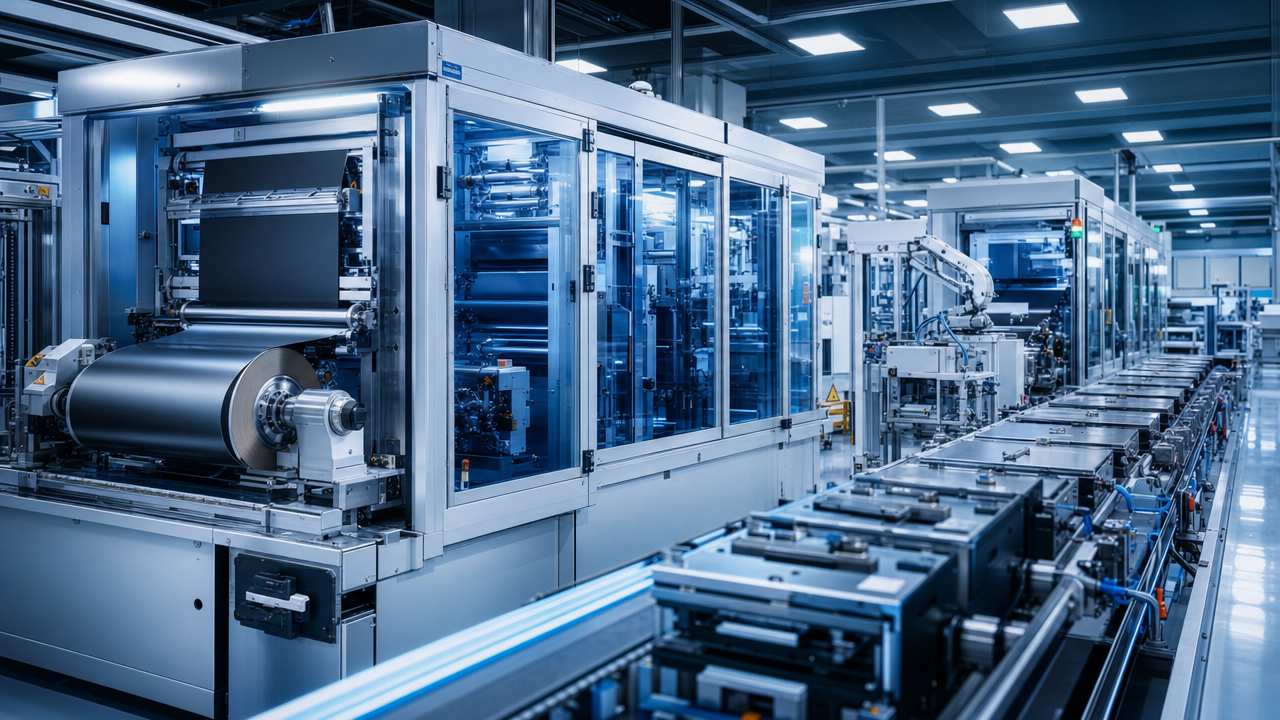

Every time a new battery factory breaks ground, a group of invisible protagonists sets off along with it.
These protagonists are not lithium ore, not cathode materials, and not battery cells — they are the machines that transform raw materials step-by-step into batteries: mixers, coating machines, winding machines, stacking machines, electrolyte injection machines, formation and grading cabinets… Together they form the "machine-making machine" ecosystem of lithium batteries, determining the yield rate, consistency, and production cost of every cell. Without well-made equipment, battery factories cannot make good batteries.
China's lithium battery equipment industry has accomplished something almost unbelievable within an extraordinarily short time window: rising from near-zero capability to a dominant position in the global lithium battery equipment market. Japan's Hirano Tecseed, which has manufactured precision coating machines for nearly three decades, saw its FY2025 annual revenue projected to decline approximately 30.7% year-over-year under the comprehensive challenge from Chinese equipment makers. Germany's Manz has also seen its orders continuously shrink amid turbulence in the European EV market. Meanwhile, Chinese companies including Pioneer Intelligent (300450), Yinghe Technology (300457), and Hymson Laser (688559) have been selling equipment to Hungary, Spain, Malaysia, South Korea, and even Germany itself.
But this industry has experienced far more than just ascendancy. From 2024 to 2025, as battery manufacturers hit the brakes on capital expenditure, the lithium battery equipment industry entered an extended downturn. Net profits of multiple leading equipment makers nearly reached zero; gross margins fell to historic lows. Key customers — including Northvolt, once hailed as a European green energy manufacturing beacon — went bankrupt in Q4 2024, leaving equipment makers with bad debts and unrecovered advance payments.
Then, in the second half of 2025, the orders started returning.
Pioneer Intelligent signed new orders worth RMB 12.4 billion in H1 2025, up nearly 70% year-on-year. Hymson Laser's new order intake doubled year-on-year in the same period, with backlog orders exceeding RMB 10 billion. Lianying Laser (688518) signed full-year new orders of RMB 5.1 billion, a historic high. More importantly, the order mix itself is undergoing structural change: solid-state battery pilot line demand is moving from concept to real procurement; large-scale overseas factory construction by Chinese battery manufacturers is rapidly releasing pent-up equipment orders.
I. Definitions and Industry Chain Overview: How Lithium Batteries Are Manufactured
To understand lithium battery equipment, one must first understand the lithium battery manufacturing process from start to finish.
Front-End — Electrode Manufacturing: The Precision Starting Point
The front-end refers to all processes for preparing positive and negative electrode materials into electrode sheets — the highest-value section in terms of technical difficulty and direct impact on final battery quality, accounting for approximately 40% of total lithium battery equipment investment. Key processes include slurry mixing, coating (applying slurry uniformly onto aluminum/copper foil via slot-die heads), drying, calendering (compressing the coating to increase energy density), slitting (cutting wide electrode rolls into narrow strips), and die-cutting. Coating machines are the most critical front-end equipment, with advanced products achieving speeds above 80 m/min. Yinghe Technology and Pioneer Intelligent are domestic leaders; Japan's Hirano Tecseed is the international reference.
Mid-End — Cell Assembly: Dual Demands for Precision and Cleanliness
The mid-end covers all processes for assembling electrode sheets and separators into battery cells, accounting for approximately 30% of equipment investment. Key processes include winding (for cylindrical cells), stacking (for prismatic and pouch cells), tab welding, electrolyte injection, and sealing. Pioneer Intelligent leads in high-speed winding machines; Yinghe Technology's ultra-high-speed multi-station cutting-stacking integrated machine has won wide industry recognition for prismatic cell lines.
Back-End — Formation, Grading, and Inspection: From Assembled Components to Quality Cells
The back-end covers electrochemical activation, grading, and pack assembly — approximately 30% of equipment investment. Formation (first charge/discharge, activating the SEI membrane) and grading (measuring and sorting cells by capacity and internal resistance) are dominated by Hangke Technology (688006), which has built a near-monopoly through exceptional process stickiness. Testing equipment is served by Xingyun (300648); PACK automation by Bozhon Precision (688097) and Noli (603611).
Laser equipment and machine vision systems span all three segments. Hymson Laser (688559) and Lianying Laser (688518) lead laser welding; Tztek Technology (688003) leads vision inspection. Upstream, key components include servo motors (Inovance Technology 300124, #1 in China with 27.6% market share), high-precision ball screws, industrial control systems, and precision sensors.
II. Global Competitive Landscape: From Japanese-German Dominance to China's Full Ascent
Twenty years ago, Japan's Hirano Tecseed, Kataoka, and Germany's Manz held the global lithium battery equipment market in their hands. These companies had decades of technical accumulation — deep, reliable, and expensive. But China's lithium battery industry explosion changed all the rules.
From 2015 to 2020, China's EV battery capacity surged from under 50 GWh to over 300 GWh. CATL grew from a regional battery maker to the global number one. Japanese and German equipment makers, with their long lead times and limited local service, couldn't keep up with the pace. Chinese domestic equipment makers — with geographic proximity, faster service response, and price advantages — rapidly grew. Pioneer Intelligent, Yinghe Technology, and others built a strong flywheel with CATL, rapidly accumulating process knowledge through real-scale production data.
By 2022–2023, Chinese equipment makers were not merely "affordable alternatives" but were matching or exceeding international peers in key processes. By 2025, Hirano Tecseed's annual revenue is projected at approximately JPY 33.5 billion (~RMB 160 billion) — down ~30.7% — while Chinese competitors are generating comparable revenues in lithium battery equipment alone.
Four mechanisms explain China's unprecedented catch-up speed: (1) accelerated learning curves on massive real production lines; (2) active technology spillovers from customer CATL to its equipment suppliers; (3) abundant capital market support enabling large R&D investment; (4) high-density industrial ecosystem enabling rapid collaborative iteration.
III. Macro Environment (PEST): Four Forces Shaping the Demand Curve
Policy: China's dual-carbon targets lock in long-term energy transition direction. Storage policy (100 GWh+ target by 2025), EV subsidies, solid-state battery roadmaps, and mandatory formation/grading energy efficiency upgrades continuously drive equipment demand.
Economy: The EV cell price war (LFP cells fell from ~RMB 0.7/Wh to ~RMB 0.3–0.4/Wh, a 50%+ decline) compressed equipment maker margins in 2024. Recovery in 2025 shows volume rebound, though unit price recovery remains gradual. Battery manufacturer capex cycles are the most direct driver of equipment demand.
Social: Global EV penetration continues rising; China near 45% in 2025. Storage demand exploded — Chinese companies secured ~160 GWh of global storage orders in H1 2025, up 220% YoY. The storage/power battery overlap enables demand smoothing across cycles.
Technology: Solid-state batteries (oxide/sulfide/polymer routes) require fundamentally new manufacturing equipment — dry electrode processes, solid electrolyte film deposition, inert atmosphere processing. CATL's all-solid-state pilot line (sulfide route) commenced in Hefei; GAC's full solid-state pilot line launched in Guangzhou (>400 Wh/kg). Solid-state equipment transition from R&D to real commercial procurement has begun.
IV. China Market Size: RMB 800–900 Billion, Recovery Underway
China's lithium battery equipment market reached approximately RMB 800–900 billion in 2025 (Zhiyan Consulting, Sina Finance), combining power, storage, and consumer battery equipment. By segment: front-end ~40% (RMB 320–360 billion), mid-end ~30% (RMB 240–270 billion), back-end ~30% (RMB 240–270 billion). Overseas orders rose rapidly — Pioneer ~35%, Hymson ~30%+, Liyuanheng ~25%+ of new orders.
Historical trajectory: ~RMB 100 billion (2015) → ~RMB 350 billion (2020) → ~RMB 800–900 billion peak (2022–2023) → ~RMB 700–750 billion trough (2024) → ~RMB 800–900 billion recovery (2025). The industry is structural growth with cyclical overlay.
Key Q1 2026 status: Pioneer's contract liabilities exceed RMB 13 billion; Yinghe's backlog exceeds RMB 12.87 billion; Hymson's backlog exceeds RMB 10 billion — all representing locked revenue for 2026–2027.
V. Industry Chain Deep-Dive: Competitive Barriers Across Seven Sub-Segments
Coating machines: Dominant Chinese makers are Yinghe Technology (new "dual-layer Super-E coater" up to 80+ m/min) and Pioneer Intelligent. Japan's Hirano remains niche in ultra-precision. Customer certification cycles: 12–24 months. Barrier: precision fluid dynamics, tension control, multi-zone drying control accumulated through years of production data.
Winding and stacking machines: Pioneer leads high-speed winding (4680 large-cylinder) with CATL deep-binding. Yinghe's ultra-high-speed multi-station cut-stack machine integrates two processes, winning wide recognition for prismatic cell lines.
Laser welding: Hymson Laser (688559) is the absolute leader in China for lithium battery laser equipment — covering front-end laser cutting, mid-end tab/seal welding, back-end module welding. H1 2025 new orders: RMB 4.421 billion (含税, +117.5% YoY); overseas orders: RMB 1.888 billion (+192.5% YoY). Lianying Laser (688518) specializes in laser welding depth — FY2025 power/storage battery revenue: RMB 2.119 billion; full-year new orders: RMB 5.1 billion (+70%, historic best).
Formation and grading: Hangke Technology (688006) dominates — process stickiness moat. FY2025 revenue: RMB 2.997 billion; operating cash flow: RMB 1.196 billion (+606.55%). Switching costs are prohibitive.
Vision inspection: Tztek Technology (688003) leads machine vision — H1 2025 measurement equipment +72.44%, process equipment +51.34%. AI-powered defect detection becoming standard.
Pack automation and logistics: Bozhon Precision (688097) — consumer electronics base extending into EV battery PACK automation and swap station equipment. Noli (603611) — China's forklift and intelligent logistics leader for large battery factories.
Specialty sub-segments: Silaike Precision (ball screw-formed casing for prismatic cells), Zhenye Technology (X-ray inspection), Golden Milky Way/Jinyinhe (PACK automation), Keheng (cathode material kiln furnaces), Xingyun (test equipment).
VI. Leading Companies: Deep Analysis
Pioneer Intelligent (300450) — Global #1 in lithium battery equipment. FY2025 revenue: RMB 14.443 billion (+21.83%); lithium battery equipment: RMB 9.471 billion (+23.18%); net profit: RMB 1.564 billion (+446.58%). H1 2025 new orders: RMB 12.4 billion (+70%). Contract liabilities: >RMB 13 billion. Hong Kong listing approved (Jan 2026). Solid-state equipment team founded 2018; currently entering CATL and GAC solid-state pilot line supply chains. Overseas ~35% of revenue. Full-line integration capability and CATL deep-binding form the core moat.
Yinghe Technology (300457) — FY2025 revenue: RMB 9.445 billion (+10.81%); lithium battery equipment: RMB 6.427 billion (+29.81%). New orders: RMB 9.854 billion. Backlog: RMB 12.868 billion. 2025 launched dry electrode calender, dual-layer Super-E coater, ultra-high-speed cut-stack machine, 46-series integrated winding. Export to 10+ countries.
Liyuanheng (688499) — FY2025 revenue ~RMB 3.1 billion; Q4 single-quarter +309.33% YoY. Full solid-state battery production lines entering delivery. Southeast Asia and European market expansion. Debt ratio ~71.83% (risk to monitor).
Hangke Technology (688006) — Post-formation/grading leader. FY2025 revenue: RMB 2.997 billion (+0.52%); net profit: RMB 368 million (+12.88%); operating cash flow: RMB 1.196 billion (+606.55%). Near-impenetrable process stickiness moat. Advancing solid-state battery formation/grading solutions.
Hymson Laser (688559) — China's lithium battery laser equipment leader, Dongguan HQ. H1 2025 new orders: RMB 4.421 billion (+117.5%); overseas: RMB 1.888 billion (+192.5%); backlog: RMB 10.085 billion (+46%). Secured industry's first high-energy-density lithium-metal solid-state battery mass production equipment order. Q4 2025 returned to profitability.
Lianying Laser (688518) — Shenzhen-based laser welding specialist. FY2025 revenue: RMB 3.261 billion (+3.55%); power/storage battery: RMB 2.119 billion (#1 segment). New orders: RMB 5.1 billion (+70%, historic best). R&D staff: 2,072 people (36.91% of total). Consumer electronics laser: RMB 750 million (+35.97%).
Tztek Technology (688003) — Vision inspection leader. H1 2025 revenue: RMB 597 million (+10.32%); measurement equipment +72.44%; process equipment +51.34%. RMB 872 million convertible bond issuance planned for three project areas.
Bozhon Precision (688097) — Suzhou precision automation, extending into battery PACK, EV swap stations, and intelligent warehousing.
Hirano Tecseed (6245.JP) — Japanese coating machine maker. FY2025 revenue forecast: JPY 33.5 billion (RMB 16 billion), down ~30.7%. The clearest mirror of Chinese equipment makers' global market share gain.
VII. Industrial Cluster Map: Five Geographic Hubs
Wuxi (Pioneer Intelligent HQ) — Precision machinery tradition; Pioneer ecosystem with local supply chain of precision screws, guides, structural parts. Search Wuxi precision machinery equipment.
Dongguan–Shenzhen — China's lithium battery laser equipment dual-city hub. Hymson (Dongguan), Lianying (Shenzhen), Dazu Laser (Shenzhen). Consumer electronics heritage provides laser technology foundation. Search Dongguan laser equipment.
Hangzhou — Hangke Technology; Zhejiang new energy manufacturing cluster. Close to Yangtze River Delta battery factories. Search Zhejiang lithium battery equipment.
Suzhou — Tztek Technology, Bozhon Precision. Foreign-invested manufacturing heritage (Japanese/Korean supply chain) enables international business development. Search Suzhou automation equipment.
Shenzhen (Yinghe HQ) — Hardware tech startup ecosystem; dense engineer talent pool. Search Shenzhen laser equipment.
Two additional nodes: Changzhou–Liyang (high-density battery production cluster, driving local service center formation) and Fujian Ningde (CATL HQ absorption effect — equipment makers maintain local service infrastructure). The battery equipment factories data in the Tianxia Gongchang database clearly reflects these geographic concentrations.
VIII. Thematic Deep-Dives: Eight Key Topics
Power battery equipment: The largest segment (~60–65%), in a phased recovery since H2 2025. CATL, BYD, EVE Energy's new capacity plans are the core engines. Prismatic LFP remains mainstream; large-cylinder 4680 and pouch are growing segments.
Energy storage equipment: Stable demand offset for power battery cycle downturns. ~160 GWh global storage orders captured in H1 2025 (China enterprises, +220% YoY). Large-capacity formation/grading equipment from Hangke is key here. Search energy storage battery equipment.
Solid-state battery equipment: Next major explosion point. CATL's all-sulfide solid-state pilot line (Hefei) and GAC's full solid-state pilot line (Guangzhou, >400 Wh/kg) both commenced in 2025. Equipment makers (Pioneer, Hymson, Yinghe, Liyuanheng) already in supply chains. Dry electrode process replaces wet coating — Yinghe's dry electrode calender is an early commercial product. Capital investment per GWh for solid-state lines: RMB 300–1,000 million (vs. RMB 30–150 million for liquid), reflecting highly specialized equipment value. Timeline: 2026–2027 pilot line batch procurement; 2028+ small-volume production lines; 2030+ scale production.
4680 Large Cylinder: High-speed winding (Pioneer) and tab-less laser welding (Hymson) are the two key equipment nodes for domestic 4680 expansion.
Dry Electrode: Completely eliminating solvent/drying steps; 30–40% energy saving in front-end; Yinghe's dry calender is the domestic pioneer. Expected commercial deployment: 2027–2032.
Overseas Factory Orders: Chinese battery companies operate 72 overseas bases with 796 GWh planned capacity (as of June 2025). Hungary, Spain, Morocco, Germany, Malaysia, Vietnam are key destinations. Equipment makers follow battery producers in a "bundled overseas expansion" model. Search lithium battery equipment export.
Consumer Battery Equipment: Stable base. Lianying Laser's consumer electronics laser business (RMB 750 million, +35.97%) is the clearest illustration.
Sodium-Ion Battery Equipment: Strategic preparatory stage. CATL, BYD, and Zhongke Hainas are advancing sodium-ion; equipment requirements are nearly identical to liquid lithium-ion, making it an incremental demand source from 2027–2030.
IX. Technology Evolution: Six Mainlines Reshaping Equipment Competitiveness
High-speed: Coating machines 80+ m/min (advancing to 100+ m/min); winding/stacking machines pushing PPM limits. Direct production cost reduction for battery makers.
Dry electrode: Front-end paradigm shift — Yinghe dry calender is pioneering. Expected widespread commercial adoption 2027–2032.
Integrated full-line solutions: From selling individual machines to "turnkey" integrated line delivery. Pioneer and Liyuanheng lead; major competitive advantage in overseas factory projects.
Digitalization and MES integration: Real-time process parameter collection, product traceability, predictive maintenance. Yinghe positions "digital production line" as core product concept.
AI vision inspection: Deep learning defect classification replacing rule-based systems; Tztek Technology leading. Will become standard configuration for high-end lines.
Modular design: Standard functional modules combinable for different cell formats (prismatic/cylindrical/pouch/solid-state) — reducing R&D costs, shortening delivery times. Pioneer, Hymson, Liyuanheng all advancing modular architecture.
X. Risk Map: Five Key Challenges
Risk 1 — Battery capex cycle reversal (High probability, high impact): If global EV penetration slows due to US tariffs, European policy reversals, or oversupply recurrence, equipment demand will contract sharply again. Pioneer's >RMB 13 billion contract liabilities provide buffer. Mitigation: client diversification and overseas order growth.
Risk 2 — Price war transmission (High probability, medium impact): Cell price deflation continuously pressures equipment pricing. Equipment gross margins may structurally settle below historical peaks. Mitigation: technology differentiation and integrated line solutions to maintain pricing power.
Risk 3 — Overseas client credit risk (Medium probability, medium impact): Northvolt's 2024 bankruptcy is the cautionary case. European startup battery makers carry higher financial fragility. Mitigation: higher advance payment requirements, project-linked delivery/payment, rigorous client credit assessment.
Risk 4 — Solid-state route divergence (Low probability, high impact): Three competing solid-state electrolyte routes (oxide/sulfide/polymer). Over-concentration on a single route creates stranded R&D risk. Mitigation: parallel multi-route R&D investment ("option-based R&D"), not single-bet.
Risk 5 — Client concentration and receivables (Low probability for core cases, high impact if materialized): Pioneer's CATL dependence, Hangke's few-client concentration. Mitigated by CATL's strong financial health, but structural risk requires monitoring.
Additional risks: Technical discontinuity (solid-state advances faster than expected, leaving non-positioned makers behind) and talent structural shortage (bilingual field engineers for overseas service are in short supply, limiting overseas scale-up speed).
XI. Upstream-Downstream Ecosystem: Ecological Relationships Shaping Equipment Moats
Upstream — Component Nationalization: Servo motors (Inovance 27.6% domestic share), ball screws (THK/HIWIN dominate high-end; domestic catch-up ongoing), spindles (Aozhi Motor), sensors, industrial control systems. Domestic component advances underpin Chinese equipment makers' cost competitiveness internationally.
Cross-sector — Material-Equipment Process Co-development: Coating machine head design depends on slurry rheology (material-specific); winding tension profiles depend on electrode elastic modulus; formation curves are tailored to specific cathode chemistry. Material → process → equipment is a tightly coupled system. This coupling explains why equipment makers deeply embedded in customer production lines (Pioneer-CATL relationship) have the highest-quality moats.
Quality of Moats — Three Tiers:
- Tier 1 (highest): Material–equipment–customer triangle lock-in (Pioneer/CATL)
- Tier 2: Single-dimension process depth (Hangke's formation know-how, Hymson's laser process data)
- Tier 3 (most fragile): Price-only competition
IPR Landscape: Yinghe: 2,469 patents; Pioneer: 3,000+; Hymson, Lianying actively filing solid-state laser process patents. IP positioning will become increasingly important as solid-state equipment commercializes.
XII. Price War, Inventory, and Recovery Cycle: Dissecting the Trough
The 2024–2025 trough was caused by three transmission mechanisms: (1) direct pricing pressure as battery makers squeezed equipment costs; (2) capex halt as battery factories faced overcapacity; (3) receivables accumulation as battery makers stretched payment terms. Northvolt's bankruptcy was the most dramatic manifestation of overseas client credit risk.
During the trough, leading equipment makers made three counter-cyclical moves: (1) maintained or increased R&D investment (Yinghe +22%); (2) accelerated solid-state equipment certification — securing pilot line positions for the next technology cycle; (3) more aggressively opened overseas markets, converting domestic demand pressure into global diversification.
Recovery in H2 2025 was driven by three factors: domestic battery capex restarts (CATL/BYD new round), overseas factory equipment orders releasing, and solid-state battery pilot line procurement commencing.
Gross margin recovery pathway: technology differentiation (new product ASP uplift), scale leverage (fixed cost absorption), and overseas customer pricing (European/Korean clients accept higher prices than domestic). Target: return to 30–35% gross margin range by 2027 (vs. 25–30% trough in 2024).
XIII. 2026–2030 Forecast: Three-Part Composition of Recovery, Overseas, and Solid-State
Market size projections (domestic + overseas):
- 2026: ~RMB 95–105 billion
- 2027: ~RMB 105–120 billion
- 2028: ~RMB 115–135 billion (solid-state pilot production lines beginning procurement scale)
- 2030: ~RMB 140–160 billion (solid-state scale production + overseas ~50% share)
By region: China domestic ~8–10% CAGR; Southeast Asia fastest-growing export market (30–50% CAGR, 2025–2030); Europe concentrated equipment procurement 2026–2028; Korea/Japan stable; US virtually closed due to tariff barriers.
Scenario analysis:
- Optimistic (25% probability): 2030 ~RMB 180–200 billion; CAGR ~15–17%
- Base case (55% probability): 2030 ~RMB 140–160 billion; CAGR ~10–13%
- Pessimistic (20% probability): 2030 ~RMB 100–120 billion; CAGR ~3–5%
Competitive hierarchy by 2030:
- Tier 1 (>RMB 10 billion, global): Pioneer Intelligent (sole member currently; potential for Yinghe entry)
- Tier 2 (RMB 5–10 billion, segment leaders): Yinghe, Liyuanheng, Hymson
- Tier 3 (RMB 1–5 billion, segment specialists): Hangke, Lianying, Tztek, Bozhon, Xingyun
Key 2026 tracking signals: CATL's annual capex guidance (Q1 2026); Pioneer Hong Kong share issuance completion; solid-state battery pilot line equipment tender count; European EV policy 2026 review; Hirano Tecseed H1 FY2026 revenue.
Long-term evolution (2030–2040): Digital twin and remote operations converting equipment from one-time hardware sales to subscription service models; equipment-embedded AI self-optimization reducing field engineer dependency; local manufacturing in Southeast Asia/Europe; material-equipment convergence in solid-state (film deposition = both material processing and equipment manufacturing).
XIV. Conclusion: The Hidden Backbone's Global Mission
China's lithium battery equipment industry has accomplished in 15 years what traditional industrial history suggested would take far longer: a complete catch-up and partial lead over Japanese-German incumbents in a precision manufacturing domain, driven by four unique mechanisms — large-scale production line learning curves, active customer technology spillovers, abundant capital market financing, and high-density industrial ecosystem collaborative speed.
Pioneer Intelligent FY2025 revenue of RMB 14.443 billion, Yinghe's RMB 12.87 billion backlog, Hymson's RMB 10+ billion backlog, Lianying's historic 5.1 billion new order record — these numbers are not just commercial success stories, but quantified proof of China's precision manufacturing capability breakthrough.
The industry has just emerged from a difficult winter: Northvolt's bankruptcy write-offs, 50%-plus cell price declines compressing margins, and the prolonged pain of 2024's near-zero net profits. These experiences are the tuition for building more mature risk awareness.
Looking to 2026–2030, three narratives are clear: recovery continues; overseas expansion is gaining momentum; solid-state battery equipment demand is slowly moving from pilot-line procurement to mass-production line tendering. This is not a one-sided bull market, but a high-requirement track demanding correct judgment on technology direction, customer structure, and capital deployment.
The Tianxia Gongchang platform's database of 4.8 million active manufacturing factories provides the data foundation for ongoing tracking of this sector. From coating machine factories to formation and grading equipment, from Wuxi precision equipment to Dongguan laser equipment, each search is a cross-section of China's real manufacturing capability.
The Tianxia Gongchang Industry Research Institute will continue monitoring major listed lithium battery equipment companies, solid-state battery commercialization progress, and the evolving global footprint of Chinese equipment makers, providing continuously updated analysis for researchers and industry participants in this sector.
Data Sources: Pioneer Intelligent, Yinghe Technology, Liyuanheng, Hangke Technology, Hymson Laser, Lianying Laser, Tztek Technology, Bozhon Precision FY2025/H1 2025 reports; Hirano Tecseed FY2025 results brief; Zhiyan Consulting; Sina Finance; CATL solid-state pilot line announcement (2025); GAC solid-state pilot line announcement (2025); CNESA H1 2025 storage overseas data; Guolian Securities; Guangda Securities; Shanzheng Machinery Research.