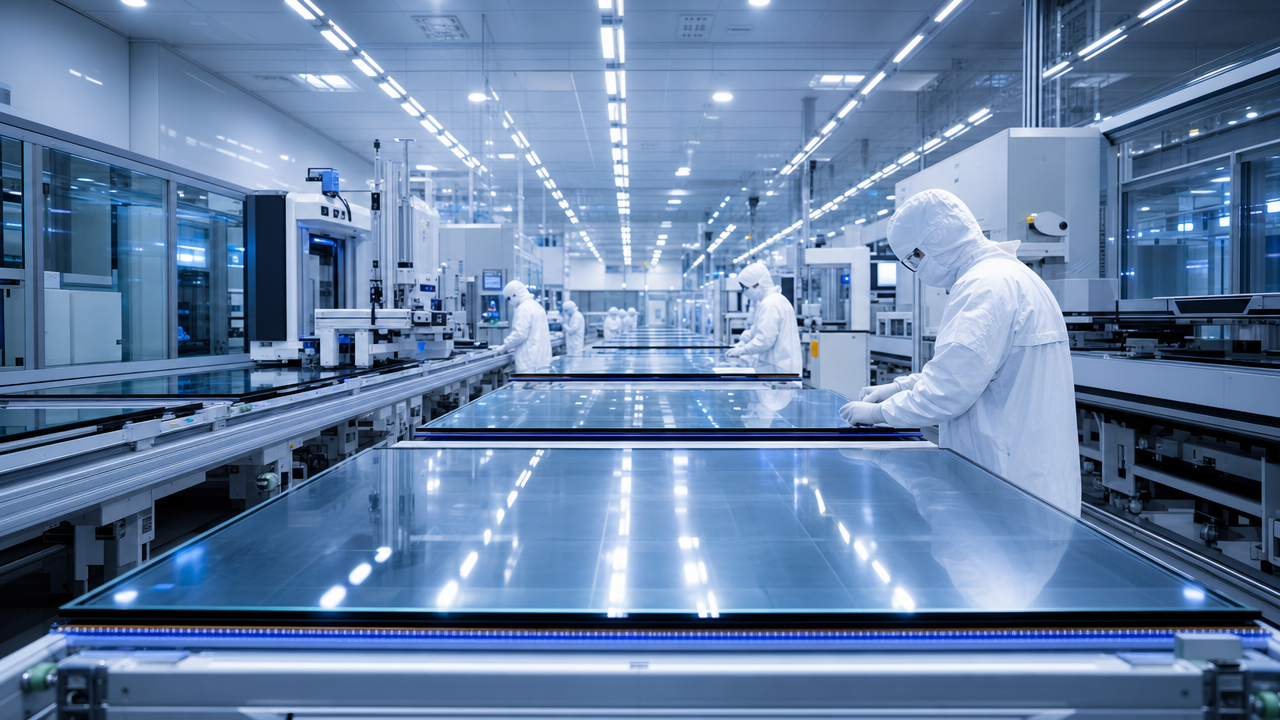

Section 0: Introduction — One Pane of Glass, Twenty Years
In any electronics market in China today, you can buy a television larger than 55 inches for under two thousand yuan. Twenty years ago, this was unimaginable.
In 2004, the mainland Chinese display panel industry had virtually zero production capacity. Every panel had to be imported from South Korea, Japan, or Taiwan. Every TV set had to be assembled using foreign-made panels. Japan's Sharp guarded its LCD technology as a state secret, posting "black language" warnings at factory entrances to prevent any technical drawings from leaking. Samsung and LG, backed by government support, had already overtaken Japan to jointly dominate global panel capacity. For China, the gap seemed permanent.
Twenty years later, the landscape has entirely flipped.
In 2024, mainland China accounted for over 70% of global LCD panel capacity. BOE Technology, TCL China Star (CSOT), and HKC collectively occupied the top three positions in global LCD TV panel shipments. Chinese-made panels go into Samsung, Sony, Hisense, and Philips televisions sold in over 100 countries. Meanwhile, in the OLED smartphone panel market — once Samsung Display's exclusive preserve — Chinese mainland manufacturers collectively surpassed Korea for the first time in the first half of 2024, capturing 50.7% of global shipments.
Two defining variables converged in 2024–2025. First, scale: mainland China now holds indisputable dominance in global LCD manufacturing. In the 90-inch-and-above ultra-large LCD TV segment, the Chinese share approaches 100%. Second, technology: BOE broke ground on China's first Gen 8.6 AMOLED line (the B12 project in Chengdu), and TCL CSOT announced the world's first Gen 8.6 inkjet-printed OLED line (the t8 project in Wuhan) — two projects that signal China's transition from follower to active contestant for OLED technology leadership.
The report's core narrative: LCD panels — China dominates over 70% of global capacity; Gen 8.6 OLED is the biggest technology variable of 2024–2026; panel cyclicality, Mini-LED penetration, and automotive display growth are the three key commercial rhythms.
Section I: Definitions and Technology Map
1.1 The Nature of Display Panels
A display panel is a physical device that translates electrical signals into light and color. Millions of pixel units each control the brightness of red, green, and blue sub-pixels; the combined intensities create the colors perceived by the human eye.
The evolution of display technology divides into three broad eras. The CRT era (early 20th century to the early 2000s) was dominated by bulky cathode ray tubes. The LCD revolution began in the 1990s with Japanese and Korean breakthroughs; thin, energy-efficient liquid crystal panels replaced CRTs entirely. The OLED era began when Samsung Display commercialized flexible OLED for smartphones in the 2010s, opening a new window of form-factor innovation.
Today we stand at the crossover from the LCD era to OLED — but the transition is not a simple swap. LCD and OLED are evolving simultaneously across large and small-to-medium size applications, while Mini-LED, Micro-LED, and inkjet-printed OLED add layers of technical complexity that make today's display landscape the most intricate in history.
1.2 LCD: Generational Migration of the Mainstream
LCD relies on an electric field to orient liquid crystal molecules, controlling the intensity of light passing through polarizers, then adding color via color filter arrays. Because LCD does not self-emit light, it needs a backlight; energy consumption and contrast ratio are its inherent limitations.
Current LCD production lines are categorized by glass substrate generation — the critical dimension for understanding the industry's capital economics:
- Gen 5 (G5): ~1,100×1,300 mm, for panels up to ~32 inches
- Gen 6 (G6): ~1,500×1,850 mm, for panels around 42 inches; also the mainstream generation for AMOLED smartphone lines
- Gen 8.5/8.6 (G8.5/G8.6): ~2,200×2,500 mm, the workhorse generation for 55–75-inch LCD TVs
- Gen 10/10.5 (G10/G10.5): ~2,940×3,370 mm, exclusively for ultra-large sizes (85 inches and up); BOE B17 (Hefei) and CSOT T7 (Shenzhen) are representative
- Gen 8.6 OLED (G8.6 OLED): similar substrate size to LCD G8.6, but targeting IT products (laptops, tablets, monitors); became the hottest investment target in 2024–2025
The larger the substrate, the more panels can be cut from a single sheet, driving down per-panel cost. A G10.5 line in Hefei cuts 8 panels at 65 inches or 6 at 75 inches from one substrate; a G8.5 line cutting 65-inch panels yields only 3. This ~47% efficiency gap makes G10.5 a structural cost advantage that cannot be overcome through management alone.
1.3 OLED: The Application Map of Self-Emissive Technology
Organic light-emitting diodes work on a fundamentally different principle: organic materials emit light directly under an electric field. Each pixel is its own light source, requiring no backlight. This delivers three advantages LCD cannot easily match: pixel-level precision dimming (true blacks, infinite contrast), sub-millisecond response, and the ability to bend on flexible substrates.
Key OLED subtypes: PMOLED (passive matrix, small simple displays) and AMOLED (active matrix, driven by TFTs — the standard for smartphones, TVs, etc.). Rigid OLED uses glass substrates; flexible OLED (FOLED) replaces glass with polyimide (PI) film, enabling foldable form factors.
Manufacturing routes: evaporation (vacuum deposition) deposits organic materials through fine metal masks (FMM) — the Samsung/LG mainstream, high precision but only ~35% material utilization. Inkjet printing (IJP) prints organic ink directly into pixel wells, theoretically >90% material utilization and no need for Canon Tokki evaporators. TCL CSOT's t8 project is betting on IJP; it would be the world's first mass-production G8.6 IJP OLED line.
OLED application landscape: smartphones (>50% penetration), high-end TV (LGD's WOLED, Samsung's QD-OLED), IT displays (laptop/tablet/monitor — the target of G8.6 lines), automotive (260M units shipped in 2024, doubling YoY), foldables and XR devices.
1.4 Mini-LED: LCD's High-End Upgrade Path
Mini-LED is not a new display principle — it is a systematic upgrade of the LCD backlight module. Traditional LCD uses edge-lit or conventional direct-lit backlights with coarse local dimming zones. Mini-LED shrinks the backlight LEDs to 100–300 micrometers and densely arrays thousands to tens of thousands of them behind the panel, enabling fine-grained local dimming (dynamic zone control), greatly improving contrast (up to 1,000,000:1) and reducing haloing.
Mini-LED advantages: lower cost than OLED, higher brightness than OLED (better outdoor/high-ambient visibility), longer lifespan. Limitations: no pixel-level dimming; slight halo effect remains; slightly thicker form factor than OLED.
In 2024, domestic Mini-LED TV shipments hit 4.16 million units, up 352.2% YoY, with market penetration reaching 11.6%. Mini-LED is the LCD camp's strongest weapon against OLED.
1.5 Micro-LED: The Long Road to Commercialization
Micro-LED is the "ultimate form factor" of display technology — LED chips shrunk to below 100 micrometers (typically 1–10 μm), with each pixel driven by a single LED. Self-emissive, no organic material degradation, ultra-long lifespan. Theoretically, Micro-LED surpasses OLED in brightness, contrast, response, lifespan, and color volume.
However, Micro-LED remains in early commercialization in 2024–2025. The core challenge is mass transfer technology: placing billions of ultra-tiny LED chips precisely onto substrates, with acceptable yield and cost. Current commercial examples include Samsung The Wall, TCL CSOT's COB Micro-LED large screens, and rumored Apple Watch Micro-LED versions — but consumer-grade Micro-LED costs remain several times to tens of times that of OLED. Industry consensus: widespread consumer adoption requires until at least 2028–2030.
1.6 The Full Supply Chain Map: From Sand to Screen
The display panel supply chain spans six levels from raw materials to end products:
Upstream raw materials: glass substrates (Corning >50%, AGC/NEG ~25%; domestic Rainbow Display, TUNGHSU Glass at G8.5+), polarizers (Nitto Denko 24%, LG Chem 23%; domestic Sunnypol/Sapo 4%), liquid crystal materials (Merck KGaA dominant; domestic Chengzhi Yonghua, Wanrun entering), organic EL materials (UDC patents; Idemitsu, Cynora), thin-film encapsulation materials.
Core midstream: panel manufacturing — TFT array, color filter (LCD only), liquid crystal fill / OLED evaporation or IJP, Driver IC bonding.
Downstream module layer: backlight modules (LCD only), touch modules, cover glass, full-module assembly (Changxin Technology 300088, O-Film 002456, Holitech).
Terminal application layer: TVs, smartphones, laptops, tablets, automotive, professional/commercial displays.
The strategic imperative: upstream materials and equipment carry the highest technical barriers and lowest domestic substitution rates; midstream panel manufacturing is where Chinese mainland firms have built overwhelming scale dominance; downstream is brand and channel competition.
1.7 The Economics of Generational Investment
From an economic standpoint, panel line competitiveness depends on substrate size, utilization rate, yield, and material cost. Scale effects are extreme: on G10.5 lines, per-unit capital investment per panel is ~65–70% of that on G8.5 — a structural cost advantage that cannot be overcome by management optimization. For 65-inch-and-above TV panels, a G10.5 line is a prerequisite for competitive participation.
Panel line depreciation is typically 10–15 years straight-line. A ¥30 billion line incurs annual depreciation of ¥20–30 billion, representing 15–25% of total cost. High utilization (≥90%) is essential to profitability, which is why BOE's early lines (2013–2015) ran at persistent losses when utilization lagged.
1.8 China's Display Ecosystem: Vertical Integration from Panel to Brand
China's panel industry value extends beyond manufacturing to a downstream application ecosystem. As Chinese consumer electronics brands (Huawei, Xiaomi, OPPO, Hisense, TCL) expand globally, China has built a unique vertical integration advantage across the display panel → brand → end user chain.
Huawei's Mate X foldable phones use Visionox's flexible OLED; Xiaomi premium TVs use CSOT or BOE panels with deep software customization; TCL is both the world's second-largest TV brand and a top-3 panel manufacturer, using vertical integration for price competitiveness. This ecosystem differentiates Chinese panel makers from Korean and Taiwanese counterparts, with a more diversified customer base and greater capacity flexibility.
Section II: Global Competitive Landscape
2.1 Thirty Years of Industrial Migration
Display panels require capital and technical accumulation; once a trend forms, it rarely reverses.
In the 1990s, Japan's Sharp, Hitachi, and Panasonic dominated global TFT-LCD. Sharp protected its technology with "black language" codes and refused to let know-how leak. In the 2000s, Samsung Display and LG Display used government support and massive capital to surpass Japan within a decade. By the early 2010s, Korea firmly held the top two positions globally.
China's mainland rise represents the culmination of this migration. From near-zero LCD market share in 2004 to 72% in 2024 — a faster and more complete transition than the Japan-Korea shift — backed by targeted national industrial policy, vast domestic demand markets, and companies like BOE that sustained investment through long periods of losses.
2.2 Samsung Display (SDC): The Absolute OLED King
Samsung Display, spun off from Samsung Electronics in 2012, has built its OLED moat on ~20 years of technical accumulation. It remains the world's undisputed #1 smartphone OLED panel supplier.
2024 key metrics: OLED smartphone panel global share H1 2024: ~43.8% (down 7.8 ppt YoY). Automotive OLED 2024 shipments: ~1.64M units, >50% global share, ~$492M revenue. Core fabs: Asan, South Chungcheong Province (A4/A5/A6 lines).
SDC fully exited LCD TV panels in late 2022, concentrating all resources on OLED. Its retreat from LCD opened market space for the Chinese trio. SDC's defense strategy: migrate to premium flagships (Apple, Samsung), build automotive OLED leadership, and form an IT OLED alliance with LGD.
2.3 LG Display (LGD): WOLED's Proprietary Moat
LGD's most important strategic asset is WOLED (White OLED) large-format TV panel technology. Every premium OLED TV from Sony, Philips, Panasonic, and LG brand uses LGD panels — the last absolute proprietary moat in a fiercely competitive industry.
2024 financials: LGD sold its Guangzhou LCD TV factory (100% stake) to TCL CSOT — signaling formal completion of LGD's LCD TV exit. Annual revenue ~$21.8B, losses narrowing. Core strategy: defend large WOLED TV exclusivity, expand OLED IT (laptops/tablets for Apple), and compete in premium smartphone OLED with differentiated technology.
2.4 Sharp: Japan's Last Display Flag
Sharp invented key LCD precursor technologies and holds the IGZO oxide TFT patent. Acquired by Foxconn's parent Hon Hai Group for ~$3.5B in 2016. Current status: operates large-size LCD TV (60 inches+) in the Sakai facility; ~5% global share or below; IGZO technology remains a core asset but has not been translated into mass-production leadership.
2.5 Innolux and AUO: Taiwan's Strategic Pivot
Taiwan's panel industry held significant global LCD share from 2000–2015. With Chinese mainland production scaling up, Taiwan's two leaders have fully abandoned head-on LCD TV competition, pivoting to: (1) Automotive displays — AUO has deep relationships with BMW, VW, etc.; (2) Medical/industrial professional displays — high-margin niche with strong brand recognition; (3) Micro-LED technology investment — both AUO and Innolux are bypassing OLED entirely to bet on Micro-LED as the next-generation technology.
2024 financials: Innolux full-year revenue NT$216.5B (+2.3% YoY); AUO full-year revenue NT$280.3B (+13.0% YoY). Both returned to profitability in Q2 2024.
2.6 JDI: Structural Decline
Japan Display Inc., formed in 2012 from the combined LCD units of Sony, Hitachi, and Toshiba, has been in persistent losses since inception. Its core problem: over-dependence on Apple iPhone LCD supply, then Apple's 2019+ shift to OLED gutted JDI's main revenue stream. JDI 2024 remains in restructuring. JOLED, another Japanese OLED maker, declared bankruptcy in 2023.
2.7 Global Shipment Share: The 2024 Power Map
LCD TV panels (Q1 2025): BOE 25.9%, TCL CSOT 20.2%, HKC 14.4%, Taiwan combined (Innolux+AUO) 21.1%, LGD+Sharp 9.7%.
Smartphone OLED (H1 2024): Samsung Display 43.8%, Chinese mainland combined (BOE+Visionox+CSOT+Tianma+others) 50.7%, LGD ~5%.
This is a landscape undergoing fundamental power transfer. In LCD, China has built an unassailable advantage. In OLED, China surpassed Korea in smartphone panels for the first time — but TV OLED and high-end IT OLED still require catching up.
2.8 Post-Dominance Strategic Challenges
China's LCD dominance introduces new strategic pressures. As the 70% capacity holder, China's production decisions are effectively market-wide supply decisions — carrying antitrust scrutiny risks if construed as coordinated behavior. More fundamentally, in LCD China is now the technology leader with no road map from predecessors; the next steps (ultra-large LCD, Mini-LED upgrade, IJP OLED) must be carved out independently.
2.9 Taiwan's Strategic Repositioning
Taiwan's overall panel strategy is migrating from high-volume, low-margin commodity LCD toward high-value, technically differentiated segments (automotive, medical, XR, Micro-LED). This is an active outflanking move rather than passive retreat — Taiwan bets that the next technology wave (Micro-LED) rewards the innovative pioneer rather than the capital-heavy manufacturer.
Section III: PEST Analysis
3.1 Political and Policy Environment
China's display panel industry rise is fundamentally a policy-driven technology catch-up story. BOE's survival through consecutive loss years (2003–2010) rested on strategic capital injections from Beijing and Hefei municipal governments. The "Hefei model" — government capital for industrial relocation — was replicated across Chengdu (BOE OLED), Wuhan (CSOT OLED), and beyond.
The 2023 Ministry of Industry and Information Technology implementation plan targets global industry leadership by 2025, with significantly increased domestic content rates for core materials and equipment in OLED, Mini/Micro-LED, and glass substrates.
3.2 Carbon Neutrality Constraints
China's dual-carbon targets impose growing constraints on energy-intensive panel fabs. A G10.5 LCD line consumes 1.5–3 billion kWh per year — equivalent to a medium city's industrial electricity consumption. As carbon quota tightening proceeds, panel makers face dual pressure: use more energy-efficient equipment in new lines, and bear higher carbon costs on older high-energy lines, accelerating obsolescence. BOE and CSOT have each committed to renewable energy procurement targets by 2030.
3.3 US CHIPS Act Indirect Impact
The CHIPS Act primarily targets semiconductor fabrication, but its export control provisions affect display indirectly: certain display panel-related precision equipment (advanced evaporation systems, steppers) falls under BIS export control categories. The deeper linkage is through driver IC supply: display driver ICs require 28nm-and-below process nodes from TSMC and UMC. If these foundries became supply-constrained through geopolitical action, it would directly threaten Chinese panel production supply chains.
3.4 AI Technology: Catalyzing New Display Demand
AI's proliferation creates new panel demand vectors: AI PC and AI phone upgrade cycles lift demand for high-resolution, high-color-accuracy displays; AI data centers, though not direct panel consumers, underpin demand for AI-native terminals (AR glasses, AI tablets, AI workstation monitors); and Apple Vision Pro-class XR devices represent the frontier convergence of AI and display technology.
3.5 Trade Policy and Regulatory Trends
Chinese display panel exports have not yet faced large-scale anti-dumping investigations (LCD panels are intermediate goods; their importers — global TV and phone brands — benefit from lower prices and thus lack incentive to file complaints). However, as Chinese share rises further, regulatory risk escalates. Chinese makers' preemptive strategies: establish overseas module assembly in Vietnam and India; deepen supply chain binding with Samsung, LG, Sony, Philips brands as trade buffers.
3.6 Human Capital: The Engineering Base
China's catch-up in panel technology depended not only on capital but on an engineering talent base that Korea and Taiwan cannot match in scale. Tsinghua, HUST, and Peking University graduate large cohorts in display technology, materials science, and microelectronics annually. Visionox originated as a Tsinghua OLED research commercialization. BOE's 65,000+ R&D employees and ¥13.2B R&D spend in 2024 (6.66% of revenue) represent a manufacturing enterprise R&D intensity at the global top tier.
Section IV: China Market Scale — Numbers and Cycles
4.1 Capacity: The 70%+ Manufacturing Hub
In 2024, mainland China's LCD TV panel capacity accounts for over 70% of global production. The three leaders — BOE, TCL CSOT, and HKC — collectively hold 70–85% market share in the 65-inch-and-above size segment, approaching 100% for 90-inch-and-above ultra-large sizes. Q1 2025 global LCD TV panel shipment rankings: BOE 25.9%, CSOT 20.2%, HKC 14.4%.
Production value: 2024 Chinese display panel industry output ~¥740B (+12% YoY), >49% global share. Including terminal display module products, industry scale exceeds ¥1.3 trillion. Forecast 2025: >¥820B, global share ~52–55%.
This figure reflects cumulative fixed-asset investment approaching ¥4 trillion over two decades. BOE alone has spent over ¥700B in capex since 2003; TCL CSOT ~¥300B since 2009. In non-semiconductor manufacturing, this capital density is extraordinary.
4.2 The Twenty-Year Catch-Up Arc
BOE's 2003 acquisition of Korea's Hydis LCD business for $380M was the true starting point of China's LCD industry. The next decade was near-continuous losses, sustained only by Beijing and Hefei municipal strategic capital. The "Hefei Model" of 2008 (¥6B strategic investment to BOE for the G6 line) became the template replicated nationally: government capital for industry relocation, industry for tax revenue and industrial chain clustering.
By the 2010s, as G8.5-generation lines entered mass production, Chinese panel capacity entered explosive growth. Samsung Display and LG Display, facing mounting losses, began accelerating LCD TV line exits — handing market space to the Chinese newcomers. By 2020, the game was effectively over for the incumbent leaders in commodity LCD.
4.3 Generation Distribution and Strategic Implications
G10/G10.5 ultra-large lines (3–4 of ~5–6 global mass-production lines in mainland China): BOE B17 (Hefei), CSOT T7 (Shenzhen). Monthly capacity 60,000–90,000 substrates per line. Exclusive for 65-inch+ LCD TV panels.
G8.5/G8.6 mainstream lines (largest share of mainland capacity): HKC's four G8.6 lines (Chongqing, Chuzhou, Mianyang, Changsha), BOE's multiple G8.5 lines, CSOT's multiple G8.5 lines. For 32–65-inch LCD TV and IT panels.
G6 OLED lines (smartphone OLED mainstay): BOE B7/B11 (Chengdu/Mianyang), Visionox Gu'an/Hefei, Tianma Wuhan/Xiamen.
G8.6 OLED lines (new-era IT panel generation): BOE B12 (Chengdu, under construction), CSOT t8 (Wuhan, breaking ground 2025). These two projects will reshape the global IT OLED landscape from 2027.
4.4 Panel Price Cycle Anatomy
A 65-inch LCD TV panel swung from ~$270 in early 2022, crashed to ~$115–120 in 2023, and recovered to ~$165–175 by mid-2024. A $150 price amplitude maps directly onto manufacturer P&L: BOE's non-recurring net profit swung from -¥6.33B in 2023 to +¥38.37B in 2024, primarily driven by price recovery.
Structural cycle drivers: demand shocks (2022 consumer electronics freeze — post-pandemic spending rotation, inflation, rate hikes); supply response (Samsung Display and LGD accelerated LCD exit under massive losses); Chinese maker strategic production cuts (Q4 2023 BOE and others voluntarily curtailed output to stabilize prices); demand recovery (mild rebound 2024, large-size screen growth).
Key price nodes (2024–2025):
| Period | 65" panel (USD) | 75" panel (USD) | Driver |
|---|---|---|---|
| Jan 2024 | ~163 | ~222 | Tightening supply |
| May 2024 | ~168 | ~228 | Brand stocking |
| Dec 2024 | ~174 | ~240 | Year-end stocking |
| Jan 2025 | ~176 | ~242 | Tariff front-loading |
| Jun 2025 | ~175 | ~238 | Post-stocking normalization |
4.5 Application Segment Analysis
TV panels (largest single category): 2024 global LCD TV panel shipments +5% YoY; 75-inch-and-above +49%. Average screen size 49.6 inches (+0.6 vs. 2023). Chinese makers' structural dominance continues.
Smartphone OLED (value growth driver): 2024 AMOLED smartphone shipments +27% YoY. Chinese mainland collective 50.7% share (H1 2024) — historic first.
Laptop/tablet IT (AI PC cycle narrative): OLED laptop penetration ~8–10% in 2024, growing rapidly. G8.6 OLED lines target this market. Apple iPad Pro's 2024 OLED adoption is the demand-side signal.
Automotive display (most certain growth segment): 2024 global automotive display panel shipments ~200M units (+7.3% YoY); forecast 2025: 250M (+5.4%).
Mini-LED TV (2024 breakout year): domestic shipments 4.16M units, +352.2% YoY, penetration 11.6%.
Professional/commercial displays (high-margin niche): Taiwan makers (AUO, Innolux) hold stronger brand recognition; Chinese mainland makers have lower presence in this segment.
Section V: Supply Chain Decomposition
5.1 The Value Distribution Logic
For a ~$175 65-inch LCD TV panel, major cost components approximately: glass substrates 12–15%, polarizers 8–10%, liquid crystal materials 3–5%, color filters 5–8%, driver ICs 10–12%, backlight modules 15–20%, other materials/manufacturing 20–25%. Upstream materials and components capture ~30–40% of panel value, underscoring why domestic substitution policy focus is on materials and equipment.
5.2 Glass Substrates: High-Barrier Import Substitution
Global landscape: Corning (US) >50%, AGC Japan ~15–18%, Nippon Electric Glass (NEG) ~10–12%; these three collectively ~80%.
Domestic progress: Caihong (Rainbow Display) 002463 — G8.5+ line, capacity ~5.8M panes/year, China's largest domestic TFT glass substrate manufacturer. TUNGHSU Optoelectronics — G8.5 capacity ~5.4M panes/year. Primary challenge: G10.5-class glass specification gaps vs. international leaders; domestic production at G8.5+ level but premium G10.5 substitution still lagging.
New frontier — semiconductor glass substrates: Intel, Samsung, TSMC all announced glass substrates for AI chip advanced packaging (replacing ABF organic substrates). This creates a new demand vector for display glass substrate makers (Corning, AGC, and potentially Chinese entrants like Caihong, Kaisheng Technology), with AI chip packaging and display glass competing in the same supply pool.
5.3 Polarizers: Sumitomo's Exit Creates a Structural Opening
Global landscape: Nitto Denko (Japan) 24%, LG Chem (Korea) 23%, Sumitomo Chemical (Japan) ~20%.
2024 landmark event: In December 2024, Sumitomo Chemical announced the sale of its China polarizer production and chip-cutting lines to Sunnypol (Sapo 002876). This is the most significant structural shift in the China polarizer supply chain in years. Sunnypol leaps to top-3 global polarizer supplier status, directly acquiring Sumitomo's processes, equipment, and workforce.
OLED circular polarizers: OLED panels require special circular polarizers to reduce ambient light reflection. Primarily Nitto Denko and LG Chem; Sunnypol is in R&D for OLED polarizer production.
5.4 Liquid Crystal Materials and Optical Films
Merck KGaA (Germany) dominates liquid crystal materials (~45–50%), with BASF and JNC another ~30%. Domestic Chengzhi and Wanrun have entered mid-range grades, but high-end mixed crystal formulations remain largely imported. Forecast: domestic LC material share rising from ~20% (2024) to ~40–50% (2030).
Optical films (brightness enhancement, diffusion, prism films): 3M, SKC, Toray dominate. Domestic Ningbo Jizhi and Changyang Technology have achieved partial substitution.
5.5 Driver ICs: Taiwan's Grip and the National Substitution Race
TV panel driver ICs: Taiwan's Novatek (联咏) and Himax lead. Smartphone OLED driver ICs: Samsung LSI and Novatek. Domestic players: Chipone Technology (集创北方) entering TV ICs, Galaxycore (格科微) leading domestic LCD smartphone driver ICs.
Driver ICs require 28–40nm process nodes at TSMC and UMC. This is the supply chain's most geopolitically vulnerable link — a Taiwan Strait disruption could within weeks cause production stoppages at mainland panel fabs. Domestic driver IC self-sufficiency is the single highest-priority supply chain security agenda item.
5.6 Backlight Modules and Mini-LED Components
Traditional LCD backlight modules represent 15–20% of BOM. Mini-LED upgrades dramatically increase backlight complexity and value. Mini-LED chip suppliers: San'an Optoelectronics (三安光电), HuaCan Optoelectronics (华灿). PCB substrates for Mini-LED: Shennan Circuits (深南电路) and others have entered the high-density Mini-LED PCB market.
5.7 Equipment: The Last Frontier of Domestic Substitution
| Equipment | Key Suppliers | Domestic Rate |
|---|---|---|
| Evaporation machines (OLED) | Canon Tokki (monopoly) | Extremely low |
| Steppers | Nikon, Canon (Japan) | Low |
| CVD/PVD systems | Applied Materials (US), ULVAC (Japan) | Low–medium |
| Dry etch | Lam Research (US), TEL (Japan) | Low–medium |
| AOI inspection | Olympus (Japan), Orbotech (Korea) | Medium |
Canon Tokki's OLED evaporators are the industry's most critical bottleneck device. Each unit costs hundreds of millions of dollars; global annual output ~3–5 units. Chinese OLED line expansion speed is directly constrained by Canon Tokki's delivery schedule and quota.
Section VI: Key Companies
6.1 BOE Technology (000725): Global LCD #1
Scale: Global #1 in LCD total shipments, area, and across all five main application segments (TV, mobile, monitor, laptop, tablet). 2024 flexible OLED shipments: ~1.4B units.
2024 Financials: Revenue ¥198.38B (+13.66%), net profit ¥5.32B (+108.97%), non-recurring net profit ¥3.84B (vs. -¥0.633B in 2023 — turned profitable), R&D spend ¥13.2B (6.66% of revenue), OLED monthly production capacity ~138,000 substrates (industry-high).
Key lines: LCD — Hefei B17 (G10.5), Wuhan B17-2 (G10.5, under construction), Chongqing B8, Fuzhou B10. OLED — Chengdu B7 (G6), Mianyang B11 (G6), Chengdu B12 (G8.6, under construction — ¥63B investment, ~32,000–33,000 substrate/month, target: IT panels by 2026).
Strategy: Transitioning from "LCD scale leader" to "LCD+OLED dual-engine." B12 is the pivotal capex action. Downstream extension through BOE MLED, digital healthcare, and smart retail to seek earnings less correlated to panel cycles.
6.2 TCL CSOT: The Rapid Challenger
TCL China Star Optoelectronics Technology (CSOT), founded 2009 as TCL Technology's semiconductor display arm. Started six years behind BOE, reached remarkable parity through rapid concentrated capital deployment and a market-first operating culture.
2024 Financials: TCL Technology parent revenue ¥164.8B; semiconductor display (CSOT) revenue ¥89.7–104.3B (+25% YoY); display net profit ¥6.23B (vs. ~¥0 in 2023). Smartphone OLED shipments 2024: ~215M units (+83.2% YoY). Global capacity share (G5+): ~22.9% post LGD Guangzhou acquisition.
Key lines: Shenzhen t7 (G11 LCD, among world's largest single-line capacities), Wuhan t4 (G6 AMOLED), Guangzhou t6 (former LGD plant, G8.5, acquired 2024–2025), Wuhan t8 (G8.6 IJP OLED, world's first — broke ground October 2025, target mass production 2027, ~22,500 substrate/month, ~$4B investment).
Strategic differentiation: TCL CSOT's most important strategic bet is choosing inkjet printing (IJP) over evaporation for its G8.6 OLED. If t8 succeeds: theoretical material utilization 3× higher, no Canon Tokki dependency, potentially 15–25% lower manufacturing cost vs. evaporation OLED. If it faces technical barriers: BOE's evaporation-path B12 gains market window advantage.
6.3 HKC: China's LCD Third Pole
HKC (Huike) is China's third-largest display panel maker, and among the global top five. Unlike BOE (state-backed) and CSOT (TCL listed subsidiary), HKC is a private enterprise led by founder Chen Xuehan, pursuing more aggressive expansion — building lines during downturns at low land cost, capturing outsized returns in upcycles.
Four G8.6 TFT-LCD lines: Chongqing, Chuzhou (Anhui), Mianyang (Sichuan), Changsha (Hunan). Primary products: 32–85-inch LCD TV panels. 85-inch panel output area: global #1 in 2024. 2024 LCD TV panel shipment target: 36.2M units. Four terminal product assembly bases: Chongqing, Hefei, Guangxi, Yichang.
HKC's second IPO attempt in A-shares (2023–2024) has not yet succeeded as of 2025.
6.4 Tianma (000050): Mid-Size OLED and Automotive
Tianma (深天马 A) is the A-share representative for mid-size OLED and automotive display panels. Unlike BOE and CSOT's all-size strategies, Tianma focuses on small-to-medium sizes (3–7-inch mobile, 8–14-inch tablet, 5–25-inch automotive). 2024: automotive display revenue accelerating, becoming the core incremental revenue driver. Wuhan AMOLED line depreciation pressure large (new line ramp), but profit improvement substantial YoY. Tianma has supplied multiple major global automotive brands; vehicle program qualification cycles (2–3 years) create durable customer stickiness.
6.5 Visionox (002387): OLED DNA with Market Momentum
Visionox is one of China's earliest-started OLED companies, originating from Tsinghua University's OLED research team commercialization. Core focus: AMOLED flexible panels. Key supplier for Huawei foldable flagship and domestic Android flagship phones.
2024 data: OLED product gross margin improved >30 ppt YoY (technology maturity and yield ramp); operating gross profit substantially increased; shipment volume H1 2024 +129.3% YoY, 11.3% global OLED smartphone share. Lines: Gu'an (Hebei), Hefei, Kunshan — all G6 AMOLED.
6.6 Rainbow Display (002463): Glass Substrate Domestic Champion
Rainbow Display is not a panel maker but the upstream glass substrate domestic substitution representative. G8.5+ production capacity ~5.8M panes/year — China's largest. 2024: Corning price increase signals and national industrial policy support for material localization helped Rainbow's procurement share at domestic panel fabs increase. Core challenge: G10.5-class glass specification gap remains the main frontier.
6.7 Sunnypol (002876): The Polarizer Pivot Point
Sunnypol's acquisition of Sumitomo Chemical's China polarizer lines (December 2024) is a milestone in polarizer domestic substitution. Competitive strategy: local service + cost advantage. As domestic panel capacity grows, domestic polarizer demand grows proportionally — Sunnypol is positioned to capture that growth.
6.8 Changxin Technology (300088) and O-Film (002456): Module Integration Paths
Changxin Technology (300088) specializes in cover glass processing, touch modules, and LCD module integration — one of China's largest panel post-process assembly companies. Expanding into automotive cover glass and vehicle module assembly, extending from consumer electronics to automotive.
O-Film (002456) started with camera modules, was removed from Apple's supply chain in 2021, and has since focused on Chinese brand (Huawei, Xiaomi, OPPO) camera and display module business. Despite challenges, O-Film maintains substantial manufacturing capability in touch+display module integration for ODM/OEM markets.
Section VII: Industrial Clusters — Geographic Manufacturing
7.1 Six Major Chinese Production Clusters
China's display panel industrial geography reflects policy guidance, agglomeration economics, and local government competition over two decades of development. The result: six major production clusters, each with distinct scale advantages.
7.2 Hefei Cluster: The Government Capital Model
Hefei is the most strategically consequential city in China's panel industry. The 2008 ¥6B strategic investment in BOE became the prototype for what is now called the "Hefei Model" — government capital as long-term strategic anchor.
Key members: BOE B9 (G8.5, main LCD TV line), BOE B17 (G10.5, ultra-large TV), Visionox Hefei G6 AMOLED, Rainbow (Hefei) glass substrate plant, Corning Hefei glass substrate factory. Hefei's new display production cluster annual output already exceeds ¥100B, becoming one of China's most important display industry bases.
7.3 Wuhan Cluster: CSOT OLED's Stronghold
Wuhan hosts TCL CSOT's OLED strategic core: t3 (G8.5 LCD), t4 (G6 AMOLED), and the upcoming t8 (G8.6 IJP OLED, 2025 groundbreaking). Tianma Wuhan AMOLED line also operates here. Wuhan's Optical Valley (光谷) provides semiconductor display cluster infrastructure and talent from HUST and Wuhan University.
7.4 Shenzhen Cluster: Ultra-Large LCD Heartland
CSOT's flagship ultra-large LCD hub: t1, t2, t7 (G11, one of the world's largest single-line capacities). Corning's Shenzhen glass substrate factory provides local substrate supply. CSOT T7 is the critical facility for global 85-inch-and-above TV panel supply.
7.5 Chengdu Cluster: BOE's OLED Core
Chengdu is the BOE OLED strategy core: B7 (G6 AMOLED, China's first 6-gen flexible OLED, in production since 2017), B12 (G8.6 AMOLED, under construction — ¥63B, 32,000–33,000 substrate/month capacity). B12 is BOE's most significant capital action of 2024–2026, targeting the IT OLED market.
7.6 Chongqing / Mianyang Cluster: HKC's Hinterland
HKC's inland production bases — Chongqing (G8.6 LCD + terminal assembly base), Mianyang (G8.6 LCD), supplemented by BOE B11 (Mianyang, G6 OLED) — exemplify the strategy of bringing capital-intensive manufacturing into the interior while securing land, labor, energy, and policy incentives.
7.7 Xiamen / Fuzhou Cluster: Southeast Coastal Bases
Tianma Xiamen AMOLED lines (G6, automotive + mid-size OLED), BOE Fuzhou B10 (G8.6 LCD, monitors and TV panels). Xiamen's proximity to Taiwan provides supply chain convenience.
7.8 Korea: Samsung Display and LGD's OLED Fortresses
Samsung Display: Asan, South Chungcheong (A4/A5/A6 AMOLED, L7 QD-OLED TV). Full LCD TV exit completed late 2022. LG Display: Paju (P9/P10, WOLED TV), Gumi (E6/E7, OLED mobile), Guangzhou plant sold to CSOT 2024–2025.
7.9 Taiwan: Specialization and Transition
AUO: Taichung Longtan, Tainan fabs — shifting to automotive (BMW, VW relationships), medical displays, and Micro-LED R&D. Innolux: Tainan fabs — pivoting to automotive and commercial, investing in Micro-LED transfer technology with ITRI.
The factory data platforms (天下工厂) factory database covers thousands of display panel supply chain factories across Shenzhen, Hefei, Wuhan, Chengdu, Chongqing, and Mianyang — including backlight modules, touch modules, cover glass, polarizer processing, optical film cutting, and module integration factories, providing supply chain buyers with precise factory discovery and sourcing capabilities.
7.10 Cluster Competitiveness Logic
Three recurring patterns define China's panel cluster development: (1) Anchor fab entry triggers supply chain followership — when BOE entered Hefei, Corning and Visionox followed. (2) Generation determines market access — only G10.5 lines can economically produce 85-inch+ TV panels; this advantage was bought, not earned through management. (3) OLED geographic clustering is still forming — Chengdu (BOE B12) and Wuhan (CSOT t8) are becoming China's OLED nodes, but the full local OLED materials and equipment supply ecosystem has not yet matured.
Section VIII: Segment Deep Dives — Six Application Markets
8.1 TV Panels: The Ultra-Large Size Structural Shift
The core TV panel trend is unstoppable size escalation. 2024 saw 75-inch panels overtake 65-inch as the world's #1 shipment size — a historic milestone. 75-inch-and-above grew 49% YoY. Average global TV screen size reached 49.6 inches (+0.6 vs 2023). This structural beneficiary: BOE (Hefei B17 G10.5) and CSOT (Shenzhen t7 G11).
Mini-LED TV: 2024 domestic shipments 4.16M (+352.2% YoY), penetration 11.6%. Global Mini-LED TV expected to surpass 6.2M units in 2024. Samsung Neo QLED, Sony Bravia XR Mini LED, TCL QM series all contributed major volumes.
LCD vs. OLED TV: Large-size OLED TV panels (55"+) are exclusively produced by LGD (WOLED) and Samsung Display (QD-OLED). Chinese makers have no commercial large-size OLED TV line and no near-term technical path. In TV, LCD (including Mini-LED) is China's battlefield; OLED TV is Korea's technical preserve — a structure unlikely to change before 2028.
8.2 Smartphone Panels: OLED Dominance Taking Hold
OLED penetration in smartphones: 2024 global AMOLED shipments ~780M, ~50–55% of total smartphone panels. High-end flagship near 100% OLED. Mid-range (¥2,000–4,000) also exceeded 50% OLED in 2024, still climbing rapidly.
China's historic 2024 breakthrough: domestic manufacturers' collective OLED smartphone share first surpassed Korea (50.7%, H1 2024). Key drivers: Huawei Mate series bulk buying from BOE and Visionox; Samsung's mid-range OLED opening to domestic supply; OPPO/Xiaomi/vivo/Honor mid-to-high-end models adopting domestic OLED en masse; Apple supply chain certification for BOE and Visionox (iPhone repair market + select model OEM supply).
Foldable screen: ~16–20M units globally in 2024. Huawei (Mate X series) foldable sales in China exceeded Samsung. Foldable OLED panel ASP is 5–10× standard OLED — critical for improving average selling price.
8.3 Laptop/Tablet (IT): The G8.6 OLED Battleground
IT OLED (laptops + tablets) shipped ~16–18M panels in 2024 vs. ~780M OLED smartphone panels — still early stage, but growing faster.
G8.6 OLED cost economics: a G8.6 substrate (~2,200×2,500mm) cuts 14–16 laptop panels (13.6-inch) vs. 7–8 from G6, reducing per-panel cost by ~20–30%. BOE B12 (target 2026 mass production) and CSOT t8 (2027) will collectively form new global IT OLED supply that will directly challenge Samsung Display's current ~65–70% share dominance in this segment.
Apple's 2024 iPad Pro full OLED transition set a major demand signal for the entire IT OLED supply chain.
8.4 Automotive Display: The Most Certain Growth Segment
Automotive display is the most structurally secure demand growth story in display panels. 2024 global automotive front-end panel shipments: ~200M units (+7.3% YoY). Forecast 2025: 250M (+5.4%).
China is the world's largest auto market (2024 total sales ~31M vehicles, NEV ~12.5M, NEV penetration >40%). New energy smart vehicles generate dramatically more display demand per vehicle than traditional ICE vehicles (instrument clusters, center console screens, passenger displays, HUD). China's NEV ecosystem provides domestic panel makers structural demand access.
Automotive OLED: 2024 shipments ~2.6M (+>100% YoY). Technical requirements more demanding than smartphones: -40°C to +85°C operating range, 10–15-year lifespan, vibration/shock reliability (AEC-Q100). Certification cycles 2–3 years → high customer stickiness once qualified. Tianma, BOE, and CSOT are all actively qualifying with major automotive OEMs.
8.5 Professional and Commercial Displays
Medical displays (ΔE<2, brightness stability), broadcast-grade monitors, industrial HMI — premium-priced niche with profit margins 5–20× consumer grade. Taiwan makers (AUO, Innolux) hold stronger brand recognition; Chinese mainland makers have lower participation.
Commercial displays (digital signage, conference room, LED walls): domestic players LianTronics (利亚德), Unilumin (洲明) strong in LED wall integration; Samsung Commercial and LG Commercial dominate branded commercial display products. AI-driven personalized content delivery (audience analytics + real-time display adaptation) is the growth value proposition for commercial display.
8.6 XR / AR / MR: Ultra-High Resolution Micro-OLED
Apple Vision Pro uses two Micro-OLED screens (~3386×3096, ~3400 PPI) — the highest resolution consumer OLED panels in history — supplied by Samsung Display/Sony. This application requires pixel density an order of magnitude higher than smartphones. Chinese makers (BOE, Tianma) are developing Micro-OLED, but for 2025–2027 the XR supply will remain dominated by Korea and Sony.
8.7 AI and Display Convergence
AI in panel manufacturing (yield improvement via computer-vision AOI systems, ML-driven process parameter optimization) is already deployed at BOE and CSOT — referenced explicitly in BOE's 2024 annual report as part of "intelligent manufacturing." AI-driven commercial display content personalization (audience demographic detection → adaptive display content) creates premium value propositions for high-brightness commercial panels (3,000+ nit).
8.8 Multi-Screen Work and Professional Monitor Growth
Post-pandemic hybrid work patterns sustain demand for 27-inch+ professional monitors. Gaming monitors (high-refresh OLED and Mini-LED) are key ASP upgrade drivers. 27-inch+ OLED monitor demand began meaningful growth in 2024, primarily supplied by Samsung Display. BOE B12 mass production in 2026–2027 will push 27–32-inch OLED monitor prices down, accelerating OLED penetration in the professional monitor segment.
Section IX: Technology Roadmap — The Next Ten Years
9.1 OLED Generational Evolution Framework
Generation 1 (2010–2015): LTPS TFT + small-molecule organic evaporation. 5-inch mobile OLED, primarily rigid. Representative: Samsung Galaxy S early series.
Generation 2 (2015–2020): LTPS flexible + PI substrate + laser lift-off (LLO). Foldable OLED, OLED TV rollable. Representative: Samsung Galaxy Fold, iPhone X OLED.
Generation 3 (2020–present): LTPO (Low Temperature Polycrystalline Oxide) TFT for adaptive refresh rate (1–120Hz), lower power consumption; Tandem OLED (dual-stack) for higher brightness and lifespan (Apple iPad Pro 2024); foldable hinge maturation.
Generation 4 (2025–2030, in progress): G8.6 large-substrate OLED mass production (IT cost reduction); IJP OLED exploration; Micro-OLED commercialization in XR; printed OLED TV (large-size low-cost direction).
9.2 IT OLED: The G8.6 Generation's Historical Mission
Current IT OLED (~16–18M panels/year for laptops + tablets) is almost entirely from G6 lines, with ~7–8 laptop panels (13.6-inch) per substrate. G8.6 substrates are ~1.9× the area of G6, yielding 14–16 panels per substrate — ~20–30% lower per-panel cost. BOE B12 (target 2026) and CSOT t8 (target 2027) will collectively challenge Samsung Display's current IT OLED market dominance. A price correction in IT OLED following their production ramp will accelerate laptop OLED penetration from ~8–10% toward 20%+ in 2028–2029.
9.3 Automotive OLED: Technical Challenges
Automotive OLED must solve: high brightness (>1,000 nit) — addressed via Tandem OLED (dual-stack emission layers, peak brightness >2,000 nit); low-temperature startup stability (below -40°C: organic charge injection efficiency declines, requiring preheating circuits); ultra-long lifespan (>15 years — addressed by low-luminance drive mode design and advanced water/oxygen barrier encapsulation); curved and irregular form factors (flexible OLED's advantage). Tianma's Xiamen line has production capability for mass-production curved automotive OLED.
9.4 Mini-LED: Finer Zoning and Chip-on-Glass
2024 flagship Mini-LED TVs: 2,000–5,000 dimming zones; 2026–2027 high-end products targeting >10,000 zones — approaching pixel-level dimming. Chip-on-Glass (CoG) technology directly binds Mini-LED chips to glass substrates, enabling thinner backlight modules and closer integration with TFT panels — the path toward ultra-thin Mini-LED TVs from Samsung, TCL, and others.
9.5 IJP OLED: CSOT's Technical Wager
Inkjet printing OLED: theoretical material utilization >90% vs. ~35% for evaporation; no Canon Tokki dependency; potentially 15–25% lower manufacturing cost. Three core technical challenges: (1) Organic ink blue-emitter lifespan in liquid form; (2) pixel well surface uniformity (hydrophobic/hydrophilic interface); (3) print head precision across large G8.6 glass. CSOT t8's 2027 target is the world's first commercial-scale validation of IJP OLED. If successful: structural cost disruption. If technical barriers persist: CSOT bears ~¥29B investment risk.
9.6 Micro-LED Commercialization Path
Commercial large-screen (pitch 0.5–1.5mm): Samsung The Wall, CSOT COB Micro-LED tiling — already in commercial display (cinema, broadcast) at ¥200,000–500,000/m². Consumer grade (pitch <0.1μm): Apple Watch Ultra (~2027?) remains speculative; mass transfer yield target 99.9999% (1 error in 1M chips); cost still 10× OLED. Taiwan (AUO, Innolux, ITRI) as an ecosystem bet on Micro-LED as the disruptive next generation to outflank Chinese OLED cost scale.
9.7 Flexible and Foldable: Form Factor Expansion
Global foldable shipments ~16–20M units in 2024. Chinese brands (Huawei, Xiaomi, OPPO) driving the incremental growth. Visionox has achieved bending durability (>100,000 bend cycles) comparable to Samsung Display. UTG (ultra-thin glass, 30–50μm) cover from Schott, Samsung Corning, and domestically Kaisheng Technology (domestically qualified for foldable phones) is enabling foldable form factor maturation.
9.8 Technology Convergence Forecast: 2030
Smartphone: OLED (with LTPO) dominates mid-to-high end; LCD persists below ¥1,000 entry level; foldable ~3–5% of total smartphone market.
TV: LCD (including Mini-LED) dominates >80% of market; OLED TV remains premium niche; average TV screen >52 inches by 2030.
IT (laptops + tablets): OLED penetration 25–35% (post-G8.6 production cost reduction); Mini-LED persists for high-brightness professional niches.
Automotive: OLED penetration ~5–8%; Mini-LED LCD ~10–15%; standard LCD remains dominant.
XR devices: Micro-OLED dominates VR/MR core screens.
Commercial large-screen: Micro-LED displacing conventional LED tile systems, reaching 20–30% penetration in premium commercial display.
9.9 The Organic Material Race
UDC holds core patents on iridium-complex phosphorescent OLED materials for red and green. Blue phosphorescent materials remain technically difficult (higher excited-state energy, shorter lifespan). TADF (thermally activated delayed fluorescence) materials aim to achieve near-100% quantum efficiency without metal atoms, avoiding UDC's phosphorescent patents — domestic researchers at Tsinghua and SCUT are active. Hyper-fluorescence (3rd generation) — TADF sensitizer + conventional fluorescent emitter — is Samsung Display's and BOE's latest commercial material approach, deployed in Galaxy S25.
9.10 Encapsulation Innovation
Thin Film Encapsulation (TFE) for flexible OLED: 3–5 alternating inorganic (Al₂O₃, SiN) and organic (Parylene) layers, targeting WVTR <10⁻⁶ g/(m²·day). Ultra-thin glass (UTG, 30–50μm) for foldable devices: Schott, Samsung Corning dominate; domestically Kaisheng Technology (Bengbu) has qualified for domestic foldable phone brands.
Section X: Risk Analysis
10.1 The Structural Fragility of Display Cyclicality
Display panels exhibit some of the most violent cycle swings in manufacturing. Structural causes: 3–5-year construction cycles (capacity release is fixed once committed); no effective coordination mechanism among top-5 makers; downstream demand is highly elastic to macro cycles (consumer electronics are discretionary); product standardization makes competition price-driven, and any price uptick immediately incentivizes new capacity.
10.2 2025–2027 Supply-Demand Pressure
Key new capacity entering 2025–2027: BOE B17-2 Wuhan (G10.5 LCD, ~60,000 substrates/month, 2025–2026); CSOT t6 Guangzhou (former LGD plant, G8.5 LCD, ~90,000 substrates/month, already integrated); BOE B12 Chengdu (G8.6 OLED, 2026); CSOT t8 Wuhan (G8.6 OLED, 2027).
The B17-2 and t6 LCD additions will add pressure to 42–55-inch LCD supply in 2025–2026. The OLED additions will impact IT OLED pricing from 2027. LCD price outlook 2025–2026: 65-inch ~$160–185, 75-inch ~$220–250 — a narrow oscillation range.
10.3 Mainland Internal Competition Intensification
The three-way Chinese mainland LCD oligopoly (BOE + CSOT + HKC) creates a unique risk: internal competition may be fiercer than international competition. Price floor game theory (each can price-cut to grab share during demand declines), investment escalation competition (local governments incentivize new line construction), and production coordination difficulty (different listed companies, harder to coordinate than Samsung+LGD Korean duopoly).
10.4 Korean Price Counterattack in OLED
Samsung Display, facing Chinese 50.7% market-share breach, may deploy margin-sacrificing price defense in mid-range OLED ($30–60/unit). BOE B12 and CSOT t8 entering the market will erode Samsung's IT OLED pricing power — Samsung may pre-emptively discount to maintain brand customer supply position, accelerating IT OLED price declines.
10.5 Technology Substitution: OLED's Long-Term LCD Erosion
LCD faces inherent physical limits: contrast ceiling (even fine zone Mini-LED can't achieve OLED's infinite contrast); response speed (1–8ms liquid crystal orientation time vs. OLED sub-millisecond); thickness (6–10mm vs. OLED's 4mm or less). OLED cost reduction trajectory: laptop market penetration accelerating from ~8–10% toward 15–20% in 2026–2027. Mini-LED extends LCD's high-end TV competitiveness through 2030, but the technology pendulum is inexorably toward OLED at each succeeding price tier.
10.6 Geopolitical Supply Chain Risk
Equipment: Canon Tokki evaporators, Applied Materials CVD/PVD, Nikon/Canon steppers — if these became export-controlled, Chinese OLED expansion pace would be directly impacted. Driver IC: Taiwan Novatek dominates TV driver IC; Taiwan Strait disruption risk could cause within-weeks production stoppages. Materials: Nitto Denko polarizers, Merck LC materials, UDC/Idemitsu organic OLED emitters — all supply concentrated in US/Japan/Europe.
10.7 Environmental and Compliance Risk
Panel fabs use large volumes of special gases (NF₃, SF₆ — GWP 17,000× and 22,800× CO₂ respectively) and chemicals. PFAS in polarizer protective films face EU REACH regulatory pressure. Head count fabs (BOE, CSOT) are building green manufacturing systems; Chinese national requirements for carbon disclosure (effective from 2026 for listed companies) will make green electricity procurement mandatory rather than optional.
10.8 IJP OLED Uncertainty Quantification
CSOT t8 risk scenarios: Success (40–50% probability, t8 mass production 2027, yield ≥80%, blue emitter lifespan ≥20,000hr, cost 15–25% below evaporation OLED) → CSOT gains disruptive IT OLED cost advantage, IT OLED prices drop faster than expected. Partial success (35–40%, delayed to 2028–2029 or limited yield/cost gains) → BOE's evaporation B12 gains market window. Technical failure (~15–20%, no commercial production by 2029) → CSOT faces ~¥29B write-off, forced pivot to evaporation, OLED expansion delayed 3–5 years.
10.9 Panel Financial Risk Management
BOE's asset-to-equity ratio reached >55% during peak 2020–2022 expansion. Annual interest expense ~¥5–6B. In down-cycles, cash generation relies on accumulated buffers from up-cycle peaks — the "feast and famine" financial pattern inherent to capital-intensive cyclical industries. Panel company valuations should be evaluated on through-cycle average ROE (BOE's ~5–8% over 10 years) rather than peak-cycle EPS, which can be misleadingly high.
Section XI: 2026–2030 Forecast
11.1 Forecast Framework
Base-case assumptions: global GDP 2.5–3%, China GDP 4.5–5%; no major geopolitical escalation (key equipment remains purchasable); IJP OLED achieves initial mass production 2027 but yield ramp takes additional 1–2 years; Micro-LED consumer commercialization post-2028; Chinese industrial policy support continues.
11.2 China Display Panel Market Size Forecast
| Year | Panel output (¥B) | YoY growth | Global share |
|---|---|---|---|
| 2024 | 740 | +12% | ~49% |
| 2025E | 820–850 | +10–15% | ~52–55% |
| 2026E | 900–950 | +8–12% | ~55–58% |
| 2027E | 980–1,050 | +8–10% | ~57–60% |
| 2028E | 1,050–1,150 | +7–10% | ~59–62% |
| 2030E | 1,200–1,400 | CAGR ~9–10% | ~60–65% |
Global market (USD): 2024 ~$117.3B → 2026E $132–138B → 2030E $165–180B, CAGR ~5.5–6.0%.
11.3 OLED Domestic Content Rate Forecast
Smartphone OLED:
- 2024: ~50% mainland / ~47% Korea
- 2026E: ~55–58% / ~39–42%
- 2030E: ~65–70% / ~28–33%
IT OLED (laptop + tablet):
- 2024: mainland ~15–20%, Samsung ~65–70%, total shipments ~16–18M
- 2026E: mainland ~30–35%, Samsung ~55–60%, total ~30–40M
- 2030E: mainland ~50–55%, Samsung ~35–40%, total ~80–120M
TV OLED: Mainland near-zero commercial capacity through 2026–2030; LGD WOLED + Samsung QD-OLED maintain dominance.
11.4 Mini-LED Penetration Forecast
TV: 2024 ~3.6–4.5% globally / 11.6% domestic → 2026E 9–11% / 25–30% → 2030E 22–27% / 45–55%.
Laptops: Flat at 3–8% (OLED displacing Mini-LED in premium laptops).
Monitors: Professional/gaming segment: ~30–40% Mini-LED penetration in 27-inch+ by 2030.
11.5 Automotive Display Growth
| Year | Global automotive panels (100M units) | OLED (10K units) | Mini-LED (10K units) |
|---|---|---|---|
| 2024 | 2.0 | 26 | 12 |
| 2026E | 2.9–3.1 | 60–80 | 28–35 |
| 2030E | 4.2–4.8 | 200–280 | 90–120 |
NEV CAGR is the dominant driver: global EV share expected to exceed 40% by 2030, with China reaching ~70%. Single-vehicle panel count increases from ~2 (current mainstream) to >3 (2028 mainstream NEV).
11.6 Supply Chain Localization Rate Forecast
| Material/Equipment | 2024 | 2026E | 2028E | 2030E |
|---|---|---|---|---|
| Glass substrates (G8.5+) | ~15% | ~22% | ~32% | ~42% |
| Polarizers (LCD) | ~7–8% | ~18–22% | ~30–38% | ~40–50% |
| OLED organic materials | ~5–10% | ~12–18% | ~22–30% | ~30–40% |
| Evaporation equipment | ~5% | ~10% | ~18% | ~25–30% |
| Driver ICs (TV) | ~25–30% | ~38–45% | ~50–58% | ~60–70% |
| Backlight modules | ~70% | ~75% | ~80% | ~85% |
The Sumitomo Chemical → Sunnypol polarizer line transfer in December 2024 will accelerate polarizer domestic rate above prior projections.
11.7 Industry Consolidation Forecast
LCD: Chinese mainland trio captures ~70–75% global LCD capacity by 2030. Taiwan focuses on automotive/professional/Micro-LED niches. Korea-Japan essentially exit LCD TV.
OLED segmentation: "Korea (Samsung) + China (BOE/Visionox/CSOT)" dual-oligopoly structure; mainland ~65–70%, Samsung ~28–33%. Market stratifies: Samsung holds flagship Apple/Samsung OLED; mainland dominates mid-to-high Android OLED and IT OLED.
Exit pressure: JDI likely further consolidation by 2026–2028; some Taiwan second-tier makers face exit if Micro-LED and automotive pivots falter.
Section XII: Conclusions — After Dominance, Competition Is Just Beginning
12.1 Five Core Judgments
Judgment 1: LCD dominance is structurally locked in — but carries its own risks. The 70%+ mainland capacity share won't reverse before 2030. But internal three-way mainland competition is no less brutal than international competition; cyclicality persists; panel prices will continue to oscillate.
Judgment 2: OLED is the decisive variable for China's display industry ceiling — and technical success is not yet certain. BOE B12 (evaporation G8.6) and CSOT t8 (IJP G8.6) are China's OLED technology dual-engines. Their mass-production success rates will determine whether Chinese OLED domestic content rates reach 50%+ in IT panels by 2028–2030. The evaporation path is technically validated; the IJP path is globally unprecedented at mass production scale.
Judgment 3: Supply chain shortfalls are the strategic priority for the next five years. Glass substrates (Corning >50%), polarizers (Japan/Korea combined >65%), evaporation organic materials (UDC patents + Japanese makers), and evaporation equipment (Canon Tokki) — these four upstream concentrations are the most critical external dependency layer. Any supply restriction would directly constrain capacity expansion.
Judgment 4: Automotive display and Mini-LED are two segments with clear commercial logic. Automotive CAGR ~8–10% through 2030 with high customer stickiness after qualification. Mini-LED penetration rising toward 22–27% in TV by 2030. Both have demand-pull tailwinds not dependent on uncertain technology bets.
Judgment 5: Panel cycles are not going away — cycle management determines who survives. The 2022–2024 cycle produced billions in profit swings. The underlying cycle drivers (mismatched construction and demand cycles) have not changed structurally. Through-cycle resilience — maintaining positive cash flow at price troughs, not over-expanding at peaks — will separate the ultimate winners from the casualties.
12.2 The Decadal Industry Narrative
China's display panel industry is undergoing a historical transition from "challenger" to "dominant player." The core tension has shifted from "can we make LCD?" to "can we win OLED technology leadership?"
This is a harder question. LCD catch-up was essentially a capital + scale race — those with enough financial backing and build-out capacity could win. OLED competition, beyond capital, requires original research capability in organic light-emitting materials, generational mastery of precision deposition process know-how, and patent portfolio depth in flexible encapsulation — none of which can simply be accelerated by spending money.
The deeper uncertainty is the IJP OLED path. If CSOT t8 delivers to expectations in 2027 — delivering commercial-grade mass production at 15–25% lower cost than evaporation OLED — China will not only fully close the OLED technology gap with Korea, but build a structurally disruptive cost advantage. This would be among the most significant technology landscape shifts in display in decades.
If t8 encounters technical barriers, evaporation maintains dominance, and China advances on a more measured timetable — gaining 5–10 percentage points in OLED share every 2–3 years, but no sudden discontinuity.
Either way, the display panel industry before 2030 will remain a sector in continuous transformation, full of strategic opportunity and technical uncertainty.
12.3 Market Implications for Factory and Supply Chain Participants
For participants in the display panel supply chain:
Upstream materials domestic substitution opportunity: polarizers, liquid crystal materials, organic EL materials (OLED), optical films — domestic substitution momentum will accelerate. Domestic chemical and materials companies with core formulations and process capabilities have a historic market entry window.
Equipment ancillary opportunity: inspection equipment, clean room engineering, auxiliary process equipment (cleaning, lamination) — domestic substitution progress faster than core equipment. These "non-critical" equipment supply opportunities are closer to mass production.
Automotive supply chain opportunity: as domestic NEV brands escalate supply chain localization, touch modules, cover glass, and backlight assemblies for automotive display panels are opening for domestic suppliers.
Module integration opportunity: backlight modules, touch modules, full module assembly remain the highest domestic participation segments in the supply chain. As terminal brands increase ODM outsourcing, module assembly demand continues to grow.
factory data platforms (www.tianxiagongchang.com) — a B2B factory database covering 4.8 million active manufacturing enterprises — offers unique data value in display panel supply chain factory search: from backlight module makers to cover glass processors, touch module assemblers to optical film cutters, providing precise factory discovery and rapid sourcing capability for display industry supply chain buyers.
12.4 The Last Question
Set aside all the data, product lines, corporate names, and shipment shares. One essential question remains:
What does a country's display technology capability tell us?
It tells us whether there exists in that country's factories the kind of engineer workforce that can control material structures at the nanometer scale and master light and color at the square-millimeter level — and the manufacturing discipline to run a ¥50-billion fixed-asset factory at 95%+ utilization, 24 hours a day, 365 days a year, while building the entire supply chain from sand to screen on home soil.
In LCD for this generation, China has given an affirmative answer. In OLED for the next generation, the answer is still being written.
That is the fundamental reason this industry deserves continued serious attention in 2026 and beyond.
Appendix: Quick Reference Data
A.1 Global LCD TV Panel Shipment Share (Q1 2025)
| Manufacturer | Region | Market Share |
|---|---|---|
| BOE | Mainland China | 25.9% |
| TCL CSOT | Mainland China | 20.2% |
| HKC | Mainland China | 14.4% |
| Innolux | Taiwan | ~11% |
| AUO | Taiwan | ~10% |
| LGD + Sharp | Korea/Japan | 9.7% |
A.2 Key Companies 2024 Financial Data
| Company | Revenue (¥B) | Net Profit (¥B) | Note |
|---|---|---|---|
| BOE | 198.38 | 5.32 | +108.97% YoY |
| CSOT (display) | 89.7–104.3 | 6.23 | Display unit only |
| Tianma | ~20–25 | Small profit | Automotive improving |
| Visionox | ~15–20 | Loss narrowing | GM improved 30ppt+ |
| Innolux | NT$216.5B | Small profit | +2.3% YoY |
| AUO | NT$280.3B | Small profit | +13% YoY |
A.3 Gen 8.6 OLED Line Comparison
| Item | BOE B12 | CSOT t8 |
|---|---|---|
| Technology | Evaporation OLED | Inkjet-printed OLED |
| Location | Chengdu | Wuhan |
| Monthly capacity | 32,000–33,000 | 22,500 |
| Investment | ~¥63B | ~¥29B |
| Target mass production | 2026 | 2027 |
| Target market | IT (laptop/tablet/monitor) | IT (laptop/tablet/monitor) |
A.4 Panel Price Reference (2024–2025)
| Period | 65" LCD TV (USD) | 75" (USD) |
|---|---|---|
| Jan 2024 | ~163 | ~222 |
| Dec 2024 | ~174 | ~240 |
| Jan 2025 | ~176 | ~242 |
| Jun 2025 | ~175 | ~238 |
A.5 Chinese Display Panel Industrial Cluster Distribution
| Cluster | Core City | Representative Makers | Key Products |
|---|---|---|---|
| Yangtze Delta North | Hefei | BOE B9/B17, Visionox, Rainbow | LCD + OLED |
| Central China | Wuhan | CSOT t3/t4/t8, Tianma | LCD + OLED |
| South China | Shenzhen | CSOT t1/t2/t7 | Ultra-large LCD |
| Southwest | Chengdu | BOE B7/B12 | OLED |
| Southwest | Chongqing/Mianyang | HKC, BOE B8/B11 | LCD + OLED |
| Southeast | Xiamen/Fuzhou | Tianma, BOE B10 | Automotive + LCD |