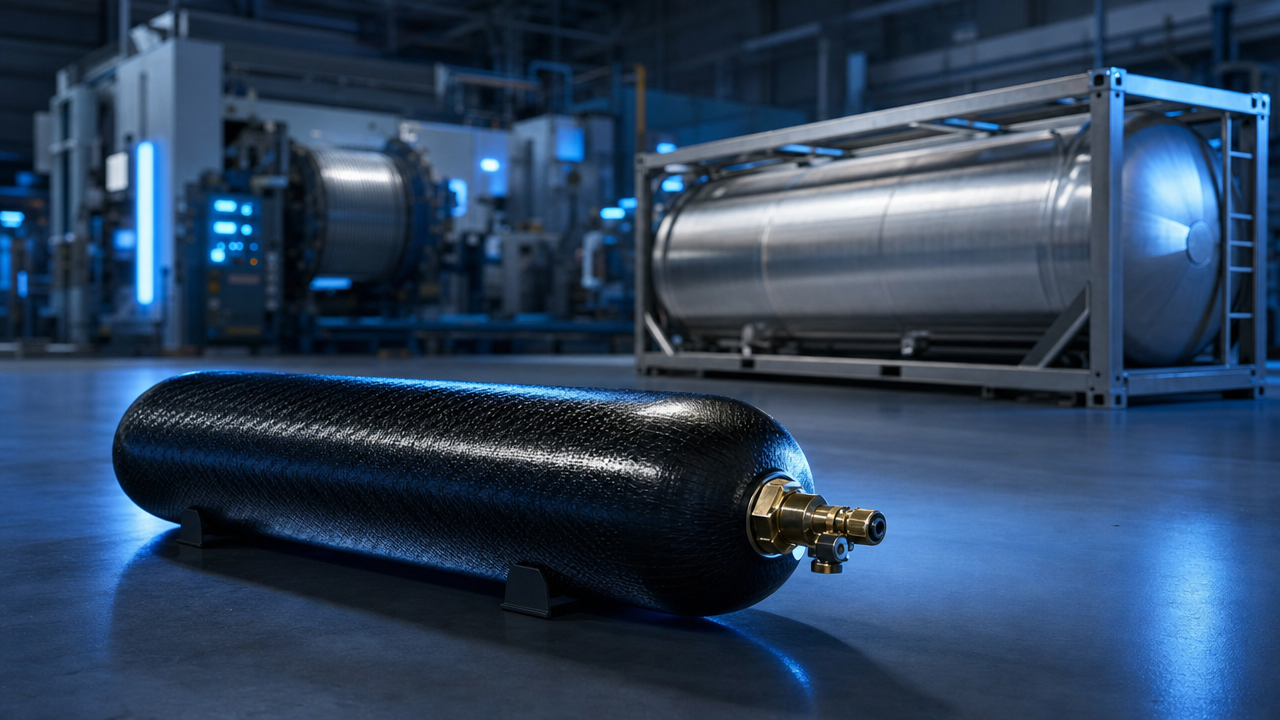

June 2026, at the Sinoma Andisi (CIMC Enric) plant in Jimo, Qingdao, Shandong, a cylinder 430 millimeters in diameter and 2,100 millimeters long, with a black carbon-fiber overwrap around a plastic liner, comes off a dry-winding machine and is sent into an oven for final stress curing. This vessel is a 70 MPa, Type-IV-design vehicle-mounted hydrogen storage cylinder, holding more than seven kilograms of hydrogen — part of a batch that has just passed the certification of a Chinese commercial-vehicle OEM. In the same week, at Furui Special Equipment in Zhangjiagang, a dozen 12-meter-long stainless-steel cryogenic tanks wrapped in vacuum multi-layer insulation come off the line, bound for an inland-river barge in the Pearl River Delta — to be used over the next three years for LNG transit at a coastal offshore-wind operation base.
China's high-pressure cylinder industry has reached a curious inflection point in 2026. On one hand, hydrogen storage cylinders — 35 MPa Type-III cylinders are now near-fully localized, and 70 MPa Type-IV cylinders have just crossed the national-standard certification threshold and are waiting for the real commercialization inflection of hydrogen heavy trucks and hydrogen refueling stations. On the other hand, liquefied-natural-gas tank containers — LNG heavy-truck onboard tanks, 10-foot mobile tank containers, and 20-foot standardized tank containers have doubled in the past three years on the back of a diesel-heavy-truck retirement wave; cryogenic insulation, valves, and cold-insulation materials are stretched along the entire chain. A third line is industrial cylinders — oxygen, nitrogen, argon, CO2, hydrogen, acetylene, and propane steel and aluminum cylinders ship daily, an "old industry" that still accounts for more than half of total industry volume.
This report is a complete jigsaw of China's high-pressure cylinder industry from 2025 to 2030. From industry overview to taxonomy and process, from manufacturer landscape to the twin trunk lines of hydrogen storage and LNG, from import substitution to capacity expansion, from price cycles to policy and risk, finally back to one fundamental question: now that 70 MPa Type-IV cylinders can be made domestically, how many hydrogen heavy trucks will actually carry them — and for how long?
Chapter 1: Industry Overview — Key Numbers of 2025
A high-pressure gas cylinder is a vessel that stores or transports gas or liquefied gas under pressure far above atmospheric. By working medium, the category splits into three: hydrogen storage cylinders (onboard and stationary), LNG and cryogenic tank containers (LNG, LPG, cryogenic industrial gases), and industrial cylinders (oxygen, nitrogen, argon, CO2, acetylene, medical oxygen, fire-fighting nitrogen). All three sit on the special-equipment registry and are subject to full-lifecycle design, manufacture, inspection, registration, and periodic-inspection regulation.
A handful of 2025 numbers sketch the industry. According to a synthesis of China Industrial Gases Industry Association and the SAMR Special Equipment Bureau figures, China's 2025 pressure-vessel (including cylinder) output was about 2.8 million tons. The cylinder segment — industrial cylinders, hydrogen storage cylinders, LNG tank containers combined — was about RMB 124 billion in market size, up about 16 percent year-on-year. Of that, industrial cylinders were about RMB 63 billion, hydrogen storage cylinders about RMB 19 billion, LNG tank containers and cryogenic vessels about RMB 28 billion, and others (industrial tubular trailers, fire-fighting cylinders, medical oxygen cylinders, marine applications) about RMB 14 billion.
Hydrogen-storage breakdown: in 2025, about 11,800 onboard hydrogen storage cylinders shipped nationwide, up 28 percent year-on-year. Type-III cylinders (metal liner, fully wrapped) accounted for about 85 percent; Type-IV cylinders (plastic liner, fully wrapped) about 13 percent; the rest were stationary hydrogen storage banks at refueling stations and small volumes of CNG-hydrogen blended cylinders. The 35 MPa cylinders made up 68 percent and 70 MPa about 31 percent — a meaningful inflection, since three years ago 70 MPa accounted for less than 10 percent.
LNG-tank-container breakdown: in 2025, China's LNG-heavy-truck new-vehicle sales were about 220,000 units, up 40 percent year-on-year; correspondingly, onboard LNG storage tank shipments were about 380,000 units (two tanks per truck is the typical pairing). Mobile LNG tank containers (10-foot and 20-foot ISO) added about 54,000 units in 2025, far surpassing the cumulative total of the prior three years. Cryogenic insulation technology, vacuum multi-layer insulation, and low-temperature valves were stretched along the entire chain.
Industrial cylinder breakdown: traditional industrial cylinders (oxygen, argon, CO2, acetylene, medical-oxygen) shipped about 6.8 million units in 2025, up about 2 percent year-on-year. Of these, seamless steel cylinders accounted for 70 percent, aluminum cylinders 18 percent, composite cylinders (breathing apparatus, fire-fighting, scuba) 12 percent.
Industry concentration: the top-five domestic cylinder makers held about 48 percent, top-ten about 65 percent. The top five are CIMC Enric, Beijing Capital Steel & Iron (Jingcheng Machinery & Electronics), Furui Special Equipment, Furui Hydrogen, and Hydrogen Pro (Weishi Energy). They lead in LNG tank containers, industrial cylinders + LNG, cryogenic tank containers, hydrogen storage cylinders, and hydrogen storage cylinders + refueling stations, respectively. The "moderate concentration, segmented positioning" structure has been the most striking feature of the China industry over the past decade — leaders rarely fight head-to-head, each owning its primary niche.
Global comparison: the 2025 global high-pressure cylinder market is about USD 38 billion, projected to reach USD 52 billion by 2030 at a compound annual growth of about 6 percent. Norway's Hexagon Composites posted FY2025 revenue of about NOK 6.5 billion as the world's largest Type-IV cylinder specialist. UK's Luxfer Group reported FY2025 revenue of about USD 340 million, focused on aluminum and composite cylinders. US Worthington Enterprises FY2025 pressure-cylinder revenue was about USD 1.2 billion. Italy's Faber Industrie reported FY2025 revenue of about EUR 280 million as Europe's leading seamless-steel cylinder maker. These four Western players, alongside Asian peers Toyota Boshoku, Yachiyo Industry, and US Quantum Fuel Systems Technologies Worldwide (QFS), form the first tier of the global cylinder industry.
From the angle of the global division of labor, the 2025 high-pressure cylinder industry shows a new "three-pole structure". The first pole is China, leading in Type-III hydrogen cylinders, LNG tank containers, and industrial cylinders, with rapidly expanding capacity and exports. The second pole is the Western group (Hexagon, Luxfer, Worthington, Faber), leading in Type-IV cylinders, North American LNG tank containers, and CNG cylinders, with high unit prices and stable margins. The third pole is Japan-Korea (Toyota Gosei, Yachiyo, Korea's Iljin Composites), leading in passenger-vehicle hydrogen OEM supply, deeply tied to Toyota Mirai and Hyundai Nexo. The three poles compete and complement; the variable for the next five years is the speed of share migration among them.
The "70 MPa Type-IV cylinder" figure carries significant industry meaning. 70 MPa means seven hundred times atmospheric pressure; Type-IV means a plastic liner (HDPE or PA6) wrapped in carbon-fiber plus epoxy. Together, this means the cylinder must hold extreme internal pressure, maintain airtightness through repeated fill-discharge and temperature cycles, and be light — at the same capacity, a Type-IV cylinder is over 30 percent lighter than a Type-III. Hexagon was the first globally to commercialize Type-IV at scale; its subsidiary Hexagon Purus delivered its first 70 MPa passenger-vehicle Type-IV cylinder in 2022. Domestically, Weishi Energy, Jingcheng, and CIMC Enric have completed national-standard certification for 70 MPa Type-IV in 2024–2026. This is a race against time — whether domestic Type-IV can commercialize before overseas players build factories in China will determine pricing power in this niche for the next five years.
January 1, 2026 saw a milestone: the new national-standard "Cylinder Safety Technology Regulations" issued detailed standards for design, testing, and inspection of 70 MPa Type-IV cylinders for the first time. Before this, domestic 70 MPa Type-IV makers had to rely on "stringent self-verification" or "simulated overseas standards" to self-certify. With the new standard in place, the certification path for 70 MPa Type-IV is clearer, and domestic makers enter an accelerated mass-production phase.
Adding more texture to Chapter 1: from 2023 to 2026, the industry added over 40,000 unit-year capacity for hydrogen cylinders, over 120,000 unit-year for LNG tank containers, and roughly flat for industrial cylinders (no major expansion). All new capacity has flowed to hydrogen and LNG; the industry has decisively tilted toward new energy.
From the angle of the global comparison, China alone made up over 95 percent of global LNG-heavy-truck new-vehicle sales in 2025. This "China dominance" gives Chinese LNG-tank makers scale advantages globally — CIMC Enric's 2025 LNG-tank shipments were roughly equal to the second-through-fifth largest global makers combined.
From a longer perspective, the next decade (2030–2040) may see China's high-pressure cylinder industry enter a new pattern dominated by global exports, with a mature domestic market and continued technology deepening. That long-term direction will shape every practitioner's strategic choice today.
Chapter 2: Taxonomy — From Type I to Type IV, From Seamless Steel to Composite
To understand the industry, you must first grasp how cylinders are classified by structure. By liner and overwrap, cylinders are divided into Type I through Type IV, each corresponding to different operating pressure, weight, lifetime, cost, and application.
Type I, all-metal cylinder. Made entirely from one metal (carbon steel, alloy steel, aluminum alloy, or others), integrally forged from steel ingot through punching, drawing, necking, annealing, and heat treatment, with no welds. The most common is the seamless steel cylinder; typical working pressure 15–20 MPa, heavy and small, low-cost per unit (hundreds to thousands of RMB), the mainstream for industrial oxygen, nitrogen, argon, CO2, acetylene, and medical oxygen. Globally, Type I accounts for over 70 percent of cylinder shipments by volume, about 40 percent by value.
Type II, metal liner + hoop partial winding. The cylindrical section is partially wrapped in fiberglass or carbon-fiber composite; shoulders and neck remain metal. Hoop winding mainly bears hoop stress in the cylindrical section, enabling thinner metal liner — about 30–40 percent thinner than Type I, with weight savings of 15–20 percent. Typical working pressure 20–30 MPa, mainly for older CNG taxis and some breathing apparatus. Type II has been gradually replaced by Type III and IV over the past decade.
Type III, metal liner + full wrap. The whole cylinder body (cylindrical + shoulder + neck) is wrapped in carbon-fiber + resin composite; the liner is aluminum alloy (typically 6061) or titanium alloy. Type III is about 60 percent lighter than Type I; working pressure can reach 35 MPa, 70 MPa, or higher. This is the mainstream form for current onboard hydrogen storage, stationary hydrogen storage banks at refueling stations, and CNG taxi cylinders. Core technologies: liner-material ductility, winding-angle design, winding-tension control, and liner-composite interface. Domestically, CIMC Enric, Jingcheng, Weishi Energy, and Yapp have all achieved stable mass production of Type III.
Type IV, plastic liner + full wrap. The whole cylinder is wrapped in carbon-fiber + resin composite; the liner is HDPE or PA6/PA66. Plastic liners are 30–50 percent lighter than aluminum liners; total cylinder weight is about 30 percent of an equivalent-volume Type I. Working pressure can reach 70 MPa; this is the standard for hydrogen passenger cars (Toyota Mirai, Hyundai Nexo) and high-end hydrogen heavy trucks. The core barriers: liner blow molding (one-shot blowing of body + shoulder + neck), liner-to-neck seal, plastic-to-carbon-fiber stress matching, and design margin for low-temperature brittleness and high-temperature creep. Hexagon dominates globally with dozens of core patents; Chinese players Weishi Energy, Jingcheng, and CIMC Enric completed national-standard certification and small-batch production for Type IV in 2024–2026, but still trail overseas players in process maturity, batch consistency, and long-term life-validation data.
By working medium, cylinders also split into another taxonomy. First: industrial cylinders, with oxygen, nitrogen, argon, CO2, propane, acetylene, liquid chlorine, liquid ammonia, etc. Predominantly Type I, with some Type II. Representative: 40-liter standard oxygen steel cylinder. This is the industry's stock baseline. Second: onboard hydrogen storage cylinders. High-pressure hydrogen at 35 MPa or 70 MPa. Mainly Type III with some Type IV. Representative: 140-liter 35 MPa Type-III, 140-liter 70 MPa Type-IV. The hottest growth front. Third: onboard LNG storage tanks. Liquid natural gas (−162°C, 1.2–1.6 MPa). Not a high-pressure cylinder but a cryogenic insulated tank — austenitic stainless steel inner (304L or 316L), carbon steel outer, vacuum multi-layer insulation between. Fourth: mobile LNG tank containers; standardized container-style design (ISO 10-, 20-, 40-foot). Fifth: stationary hydrogen storage banks at refueling stations. Sixth: fire-fighting and breathing apparatus cylinders. Seventh: medical oxygen cylinders. Eighth: specialty industrial cylinders (aerospace composite cylinders, semiconductor specialty gas cylinders, marine cylinders).
From process angle, different structures correspond to different manufacturing routes. Type I: seamless steel pipe + hot rolling, or integral ingot + hot extrusion. Type III: metal liner + dry winding. Type IV: plastic liner blow-molding + dry winding. Cryogenic insulated tank: double-wall stainless + vacuum multi-layer insulation, vacuum pumped below 0.001 Pa, with dozens of reflective aluminum-foil and ceramic-fiber blanket layers.
The "use-cycle management" of cylinders is another taxonomy dimension. By use cycle: single-use (LPG butane canisters) vs. repeat-use (most industrial, onboard hydrogen, LNG). Repeat-use cylinders enter the special-equipment registry and undergo periodic inspection by regulation. Type III: every 3–5 years; Type IV: every 2–3 years; industrial cylinders: every 3 years. This full-lifecycle regulation gives "repeat-use" cylinders a stable "long-tail" inspection market — a 70 MPa Type-IV at RMB 28,000 will see 6–7 periodic inspections over 15 years, totaling RMB 12,000–18,000, or 40–60 percent of initial price.
By "operating model": sale (end-user buys the cylinder outright) vs. rental (cylinder owned by the gas company, billed by usage). China's industrial cylinder segment is rental-dominant — gas companies (Hangyang, Baowu Gas, Linde, Air Liquide) own large cylinder fleets and bill industrial customers by use. Hydrogen-storage is sale-dominant, but some OEMs are exploring "tank rental" — letting OEMs buy only the vehicle, with tank ownership at the cylinder company. If scaled, this new model will structurally change the hydrogen storage business.
Combining the four taxonomies, the product matrix complexity of the Chinese industry is high. Each leading firm carries dozens of variants across pressure, medium, application. This complexity itself is an entry barrier.
Chapter 3: Process Barriers — Carbon-Fiber Dry Winding, Plastic-Liner Blowing, Cylinder Valves, Self-Tightening Stress
To understand the real barriers, you must go into process detail. A cylinder looks deceptively simple, but every step hides parameters that can scrap product or cause catastrophic failure.
Carbon-fiber dry winding is the core process for Types III and IV. "Dry" means the carbon-fiber tow is pre-impregnated with resin (epoxy or vinyl ester) before winding; the older "wet winding" impregnates at winding time. Today dry winding dominates. Core equipment is a multi-axis CNC dry-winding machine — a winding head with multiple tows traverses the cylinder body in a programmed spiral. Winding has two angle classes: hoop (90°, around the body) and helical (25–60°, along the axis). Hoop bears hoop stress in the cylindrical section; helical bears compound stress at shoulder, neck, and base. A 70 MPa Type-IV cylinder typically has 60–80 layers, total winding 2–4 hours; a 35 MPa Type-III, 30–40 layers, 1–2 hours.
Plastic-liner blow molding is the core Type-IV barrier. The liner is a single integral plastic vessel — body, shoulder, and neck molded together. Most common plastics: HDPE (passenger-car Type IV) or PA6/PA66 (heavy-truck Type IV). Two routes: extrusion blow molding (a large extruder melts plastic, then blows into the body) and injection-stretch blow molding. Extrusion is the domestic mainstream. The difficulties: wall-thickness uniformity, neck-insert sealing (the plastic-metal interface must remain leakproof under repeated 100°C-plus thermal cycling), and hydrogen permeation resistance — hydrogen is the smallest molecule and permeates most plastics. Hexagon's solution is multi-layer coextrusion (EVOH barrier inner, HDPE outer); domestic players currently use a single-layer + barrier-coating approach. This is the deepest process trench for Type-IV localization.
The cylinder valve (on-tank valve, OTV) is the most overlooked, highest-unit-price, hardest component. It integrates pressure regulation, filtration, temperature compensation, excess-flow protection, thermal-fuse protection, and electronic control. A 70 MPa Type-IV OTV costs RMB 8,000–15,000 — 20–30 percent of total cylinder cost. Difficulties: seal-ring material (hydrogen permeability and corrosivity at high pressure), excess-flow protection (millisecond auto-closure on downstream rupture), thermal-fuse protection (auto-melt at ~110°C in a vehicle fire), and electronic-control integration with the vehicle ECU.
Self-tightening stress is shared by Type III and IV. After full cure, the composite layer and liner have nearly no stress; a burst test in this state would place most stress on the liner first. The aim of self-tightening is to use a one-time hydrostatic over-pressure (1.5–1.75× working pressure) to plastically deform the liner and elastically deform the composite, leaving the liner in a residual compressive stress after depressurization. Then in normal service the liner bears almost no stress and the composite bears most. This stress-pre-load process is what lets a cylinder cycle tens of thousands of times without fatigue failure. Self-tightening involves precise control of the pressure curve — ramp rate, target pressure, hold time, depressurization rate.
The hydrostatic test and burst test are the two most important destructive and non-destructive tests. The burst test is per-batch sampled — one or two cylinders per batch are burst-tested to confirm batch-quality stability. Burst pressure margin is typically 2.5× working pressure or higher. The airtightness test is per-unit mandatory, with helium leak detection requiring leak rate below 10^-9 standard mL/s.
Carbon-fiber material choice is another design lever. Hydrogen cylinders mainly use T700 or T800-grade fibers. Type III uses T700; Type IV uses T800 (per-bundle strength is critical when the composite bears 100 percent of stress). A 70 MPa Type-IV uses 23–28 kg of carbon-fiber per cylinder. Carbon-fiber is 40–50 percent of total material cost. Domestic T800 supply (Zhongfu Shenying, Guangwei, Jilin Chemical, Shanghai Petrochemical, etc.) has matured in the past three years, allowing rapid Type-IV cost reductions.
Resin systems, insulation materials, and inspection equipment all add layers of process depth. The last and least visible barrier is "long-term reliability data accumulation". One cylinder's design life can be modeled by FEA and accelerated tests; real long-term reliability must be verified through actual cycling data. Hexagon has accumulated hundreds of thousands of cylinders' long-term operational data over 20 years; this "time-accumulated data" is the hardest gap to close. Process barrier in essence is "time accumulated" — every process detail needs long production practice to refine.
Chapter 4: Major Players — Landscape and Annual Reports
The Chinese manufacturer landscape splits into four blocks by primary product: (1) LNG-tank and cryogenic-tank leaders CIMC Enric and Furui Special Equipment; (2) industrial-cylinder + LNG-onboard leader Jingcheng Machinery; (3) hydrogen-cylinder specialists Weishi Energy and Furui Hydrogen; (4) plastic-component leader Yapp (with hydrogen-tank plastic-liner co-manufacturing). Beyond these are smaller specialists like Hebei Dayu, Yantai Heyu, Baoding Xuyang.
CIMC Enric — FY2025 revenue about RMB 23 billion; gas business (LNG tanks, cryogenic, hydrogen, refueling banks) about RMB 12 billion, 52 percent share, up 18 percent year-on-year. Gas-business gross margin about 18 percent (vs. 15 percent in 2024). LNG-tank shipments about 260,000 units (35 percent national share); cryogenic shipments about 20,000 units; hydrogen cylinders about 2,800 (24 percent share). Bases in Langfang, Nantong, Qingdao, Zhangjiagang. The 2026 expansion focus is 70 MPa Type-IV — Qingdao Phase II (approved, mid-2027 commissioning) will add 5,000 unit-year of Type-IV.
Jingcheng Machinery & Electronics — FY2025 revenue about RMB 6.8 billion; gas-storage equipment (industrial cylinders, LNG onboard, hydrogen, refueling banks) about RMB 5.2 billion, 76 percent share, up 12 percent. The company traces to Beijing Cylinder Factory founded 1951 — the industry's "old marquee". 2025 industrial-cylinder shipments about 1.2 million units (18 percent share); LNG onboard tanks about 120,000 (16 percent share); hydrogen cylinders about 2,400 (20 percent share). Bases in Shunyi (Beijing), Xushui (Hebei), Foshan (Guangdong). Achieved 70 MPa Type-IV certification in 2025; small-batch supply began H1 2026.
Furui Special Equipment — FY2025 revenue about RMB 4.5 billion; cryogenic-equipment business (LNG onboard, mobile LNG tank containers, cryogenic storage, low-temperature valves) about RMB 3.6 billion, 80 percent share, up 28 percent. The segment leader in cryogenic and LNG. 2025 cryogenic and LNG-tank-container shipments about 80,000 units combined. HQ + R&D + main capacity in Zhangjiagang; distributed capacity in Sichuan and Inner Mongolia.
Furui Hydrogen — Furui Special Equipment subsidiary. 2025 revenue about RMB 900 million; hydrogen-station storage banks about 200 sets shipped; onboard hydrogen cylinders (mainly 35 MPa Type-III) about 2,000.
Weishi Energy (Hydrogen Pro) — Baoding. 2025 revenue about RMB 1.6 billion, the largest hydrogen-cylinder specialist. 2025 hydrogen-cylinder shipments about 3,500 units (35 MPa Type-III about 2,200; 70 MPa Type-III about 1,100; 70 MPa Type-IV about 200). Valve (OTV) shipments about 8,000 units. Bases in Baoding and Shanghai. Key customers: Great Wall hydrogen commercial, Foton hydrogen commercial, Dongfeng hydrogen bus.
Yapp — Jiangsu Wujiang. 2025 revenue about RMB 6.2 billion; legacy mainstream fuel-tank supplier. Last five years extended into automotive LNG plastic shells and hydrogen-tank plastic liners. 2025 Type-IV liner shipments about 8,000 — supplying CIMC Enric, Jingcheng, Weishi as a specialist co-manufacturer. This "modular co-manufacturing" model is a new trend in the Chinese Type-IV chain.
International players: Hexagon Composites ASA (OSE: HEX) FY2025 revenue about NOK 6.5 billion, the global Type-IV leader. Hexagon Agility (CNG/LNG) was about NOK 4.8 billion; Hexagon Purus (hydrogen) about NOK 1.7 billion. Purus remains unprofitable; management expects breakeven in H2 2027. Luxfer (NYSE: LXFR) FY2025 revenue about USD 340 million. Worthington Enterprises (NYSE: WOR) FY2025 pressure-cylinder revenue about USD 1.2 billion. Faber Industrie FY2025 revenue about EUR 280 million.
In May 2026, CIMC Enric and Hexagon reached preliminary agreement to set up a JV in China for localized 70 MPa Type-IV manufacturing. If it lands, this will reshape the domestic Type-IV landscape — Hexagon's process IP plus CIMC's local manufacturing could form a new competitive pole.
Chapter 5: Downstream I — Hydrogen, From 35 MPa to 70 MPa, Onboard and Stationary
Hydrogen cylinders have been the most important new growth pole of the last five years. From 2015 to 2020, fewer than 1,000 onboard hydrogen cylinders shipped in China cumulatively — almost all demo projects. From 2021 the curve steepened: 2021 about 1,500, 2022 about 3,000, by 2025 about 11,800 per year. This 12× in five years is driven by hydrogen policy, fuel-cell tech, refueling-station rollout, and commercial-vehicle hydrogenization.
By pressure: 35 MPa cylinders are the mainstream for hydrogen commercial vehicles (heavy trucks, buses, light trucks, logistics vans). A 140-liter Type-III 35 MPa stores 3 kg of hydrogen. A typical hydrogen heavy truck carries 8–10 cylinders, total 30 kg, range 500–700 km. Hydrogen buses carry 6–8 cylinders. Hydrogen light trucks 2–4. The 35 MPa segment is now fully localized; price has dropped from RMB 28,000 per cylinder in 2021 to RMB 14,000 in 2025 — a 50 percent reduction in five years.
70 MPa cylinders are the direction for hydrogen passenger cars and high-end commercial hydrogen vehicles. At the same volume, 70 MPa stores twice the hydrogen of 35 MPa — meaning longer range at the same storage footprint, or fewer cylinders at the same range. 70 MPa splits into Type-III (mature) and Type-IV (frontier). Domestic Type-III 70 MPa began shipping at scale in 2023; 2025 volume about 3,200 units. Type-IV 70 MPa began certification in 2024; 2025 volume about 1,500 units, still early commercialization.
Stationary hydrogen refueling station storage banks are another segment. A typical station uses 45 MPa or 87.5 MPa banks; the bank is built of multiple large-volume (100–300L) Type-III cylinders in parallel-series array, total volume up to dozens of cubic meters. Core: long-life design (>20,000 cycles), bank-piping design, automated control. Furui Hydrogen, CIMC Enric, Jingcheng are main suppliers. 2025: 140 new stations nationwide; about 200 bank sets purchased; unit price RMB 4–8 million; market RMB 1.4 billion.
The hydrogen-cylinder commercialization path determines the growth-curve shape. Hydrogen commercial vehicles (heavy trucks, buses, light trucks, logistics) are the most realistic downstream. Hydrogen passenger cars (Changan demos, SAIC demos) shipped only a few hundred units in 2025. Hydrogen rail, ships, aircraft are at much earlier stages.
By customer mix in 2025: hydrogen heavy-truck OEMs (Sinotruk, Dongfeng, Foton, Shaanxi Auto, Beiqi Foton) collectively took ~60 percent of hydrogen cylinders; hydrogen bus OEMs (Yutong, Zhongtong, King Long, Beiqi Foton Bus) ~20 percent; hydrogen light-truck and logistics OEMs ~10 percent; hydrogen passenger car OEMs ~2 percent; stationary station projects ~15 percent (by value).
The cylinder-price decline curve has been a textbook cost-evolution story over five years. A 35 MPa Type-III went from RMB 28,000 in 2021 to RMB 14,000 in 2025. Drivers: domestic T700 displacing imports (carbon-fiber down ~30 percent), scale (fixed-cost amortization), design optimization (winding-layer count cut).
Cylinder life design and validation: national standard requires onboard hydrogen-cylinder design life ≥15 years and design cycles ≥20,000. Real-world hydrogen heavy trucks fill 1–2 times per day; 15 years compute to 5,000–10,000 cycles. Hexagon has demonstrated 30,000 cycles in long-term testing without leakage; domestic players are around 20,000 — a key time-difference gap with overseas products.
The hydrogen-storage outlook can be summarized: 35 MPa Type-III remains mainstream for commercial; 70 MPa Type-III scales up; 70 MPa Type-IV moves toward passenger and high-end commercial; refueling-station banks scale alongside station rollout.
Chapter 6: Downstream II — LNG: Mobile Tank Containers, Cryogenic Low-Temp
LNG tank containers have been the largest incremental market for China's high-pressure cylinder industry in the past three years. Strictly speaking, cryogenic tanks aren't high-pressure (working pressure 1.2–1.6 MPa, far below 15 MPa), but their manufacturing process, regulatory category, and market mapping put them with the same makers. Including LNG tank containers in the broad high-pressure cylinder industry is the standard industry classification.
LNG heavy-truck onboard tanks: 2025 shipments about 380,000 units (corresponding to 220,000 LNG heavy-truck sales, two-tank pairing). A standard 650-liter LNG heavy-truck onboard tank weighs about 600 kg; price RMB 12,000–18,000 per tank; total per-vehicle value about RMB 30,000. CIMC Enric, Furui, Jingcheng, Hebei Baoyi compete on this stage.
The rise of LNG heavy trucks is driven by economics, policy, infrastructure. LNG fuel cost about RMB 4.8–6.2/kg in 2024–2026; LNG heavy-truck per-km fuel cost RMB 1.3–1.8 vs. diesel heavy-truck RMB 2.1–2.8. A heavy-duty truck running 200,000 km/year saves RMB 140,000–200,000/year. With a vehicle price gap of RMB 60–80k plus accessories, payback < 1 year. Plus policy (purchase subsidies, toll exemptions, restriction exemptions) and infrastructure (38 coastal LNG receiving terminals + 6,000+ inland fueling stations by mid-2026).
Mobile LNG tank containers: 2025 about 54,000 new units, far exceeding the prior-three-years cumulative total. Two sub-markets: standardized ISO containers (10-, 20-, 40-foot) for inland barge, rail, road; and large engineering-use mobile LNG tank containers for remote-area supply, emergency, industrial parks. This explosion reflects China's LNG chain extending from coastal concentration to nationwide distributed supply.
Cryogenic industrial-gas tanks: 2025 about 14,000 new units. Serves steel, chemical, semiconductor, electronics — relatively mature, 5 percent annual growth.
LNG receiving terminal stationary tanks: large-engineering work; one large terminal needs 2–8 giant LNG tanks (typically 200,000 m³ low-temperature atmospheric), each costing hundreds of millions to billions of RMB. 2025–2026 new terminals include Jieyang (Guangdong), Zhangzhou (Fujian), Wenzhou (Zhejiang), Dalian (Liaoning) — total tank investment ~RMB 20 billion. Typically delivered by CIMC Enric, Furui, Wison Engineering with full-engineering capability.
Cryogenic insulation tech is core to this business. Vacuum multi-layer insulation, vacuum ~0.001 Pa, with dozens to a hundred-plus layers of reflective aluminum foil + ceramic-fiber insulation blanket. A 650-liter heavy-truck tank typically uses 30–50 layers. Insulation performance is measured by boil-off rate; the industry frontier is <0.5 percent/day. CIMC Enric and Furui are in the top tier.
Inspection and maintenance: every tank must pass hydrostatic, low-temperature leak, vacuum retention, and weld-seam inspection. Cryogenic tanks need return-to-factory inspection every 3–5 years (re-evacuation, full weld inspection, partial insulation replacement). This full-lifecycle maintenance creates a stable "long-tail" revenue stream — a tank sold today generates inspection, repair, and parts revenue for 10+ years. CIMC Enric and Furui have built nationwide service networks of 30+ provinces.
LNG heavy-truck tank-container global outlook: North American LNG heavy-truck penetration <1 percent (diesel dominates), but mobile-LNG-container market is active, led by Worthington, Chart Industries. European LNG heavy-truck penetration slightly higher (subsidies in NL, DE), but still an order of magnitude smaller than China. China is the world's largest single LNG heavy-truck market, 95+ percent of global sales. This "China dominance" gives Chinese LNG-tank makers global scale advantage. The export prospect over the next 3–5 years is one of China's most underestimated growth points.
Chapter 7: Industry Chain Collaboration — From Carbon Fiber to Cylinder Valve
The high-pressure cylinder industry is a collaboration-dense composite-material chain. A complete 70 MPa Type-IV cylinder uses 20+ key materials and components — carbon fiber, epoxy, HDPE/PA6, aluminum-alloy inserts, OTV body, fluororubber seal rings, pressure sensors, temperature sensors, electronic connectors, excess-flow protection, thermal-fuse protection, outer protective sleeve, anti-collision buffer, and high-pressure test equipment for inspection.
Tianxia Gongchang is a B2B platform of 4.8 million in-production factories, distinguished from "Qicha"-style tools that profile legal-entity structure — this one profiles actual production capability. On the high-pressure cylinder chain, the platform database covers upstream carbon fiber, epoxy resin, HDPE, polyamide, aluminum-alloy tubing, midstream cylinder manufacturing, hydrogen storage cylinders, LNG tanks, cryogenic storage, and downstream cylinder valves, cryogenic valves, pressure sensors, fluororubber seals, carbon-fiber fabrics, dry-winding machines, extrusion blow-molding machines — a complete factory list for the whole chain.
Upstream raw materials are the longest section. Carbon fiber is the largest. Domestic T700/T800 hydrogen-grade carbon-fiber suppliers include Zhongfu Shenying (Lianyungang), Guangwei (Weihai), Jilin Chemical (Jilin), Shanghai Petrochemical, Xinchuang Carbon Valley (Yancheng), Hengshen (Yulin). Among them, Zhongfu Shenying and Guangwei lead the high-end T800+ supply. A typical hydrogen-cylinder plant procures 10–30 tons of carbon fiber per month at RMB 80,000–180,000 per ton — the single largest material spend.
Epoxy resin is the other key. Hydrogen-cylinder epoxy needs high toughness, low viscosity, long pot-life (4–6 hours), and hydrogen-permeation resistance. Domestic suppliers include Bluestar, Oriental Yuhong, Chenguang New Materials, Datong Taisheng. Per 70 MPa Type-IV cylinder uses 6–8 kg of epoxy, RMB 150–200.
HDPE and PA6 are the Type-IV liner core materials. Hydrogen-grade HDPE is mostly imported (ExxonMobil, INEOS, Mitsui Chemicals). Hydrogen-grade PA6/PA66 domestic suppliers include Shenma, Baling Petrochemical. Localizing liner-grade plastics is the next phase of Type-IV cost-down.
The aluminum-alloy insert at the plastic liner's neck is a precision-machined component, available domestically.
Midstream cylinder manufacturing is the most complex link. A complete Type-IV plant has raw-material warehouses, liner workshops (extrusion blow-molding), dry-winding workshops (CNC winding-machine arrays), curing workshops (large constant-temp ovens), self-tightening workshops (high-pressure hydrostatic), inspection workshops (burst, airtight, eddy/ultrasonic non-destructive, hydrostatic, helium leak), valve-assembly, packaging. A 5,000 unit-year 70 MPa Type-IV line costs RMB 200–300 million, build 12–18 months.
Downstream OTV is the largest single-component outsource cost. Domestic suppliers (Weishi Energy, Furui, Sichuan Haike Machinery, Boao Energy, Mintai Environment) plus overseas (Cavagna, Honeywell, Bosch). 70 MPa Type-IV OTVs are still mostly imported.
Pressure and temperature sensors are core electronic parts. Domestic suppliers: Sensata Shanghai, Memsensing Suzhou, Huagong Tech Wuhan. Fluororubber seal rings (typical Viton series) suppliers: Meirui New Materials, Ningbo Akeme, Saifutian.
Dry-winding machines and extrusion blow-molding machines: domestic suppliers Lianyungang Yingyou, Sichuan Aviation, HIT Smart Equipment; imported from KraussMaffei, Cannon. CNC dry-winding machines: RMB 2–8 million each.
Inspection equipment localization >90 percent in 2025. Suppliers: Wuxi Maidao, Suzhou Kebao, Beijing Prouddi.
Chain collaboration also means certification — every new model takes 12–24 months in type-test, RMB 5–10 million in test cost.
Chapter 8: Import Substitution — Type IV Certification, Valve Breakthrough, Carbon-Fiber Fit
China's high-pressure cylinder import substitution is a relatively low-profile yet successful chapter in 30 years of manufacturing upgrade. From the 1980s with industrial cylinders, to CNG vehicle cylinders in the 2000s, to LNG heavy-truck tanks in the late 2010s, to Type-III hydrogen cylinders in 2015–2022, to Type-IV starting in 2024 — each phase mapped to a localization milestone.
Milestone 1: industrial cylinders. By 1995, localization rate >90 percent.
Milestone 2: CNG vehicle cylinders. Localized through the 2000s with taxi-fleet CNG conversion programs.
Milestone 3: LNG heavy-truck tanks. Localized by early 2020s. CIMC Enric and Furui scaled up here.
Milestone 4: 35 MPa hydrogen cylinders. By 2020, fully localized. Domestic hydrogen commercial vehicles use almost 100 percent domestic cylinders. Weishi Energy, Jingcheng, CIMC Enric were the leaders.
Milestone 5: 70 MPa Type-III. Completed 2022–2024. Higher process difficulty — thicker aluminum liner, more winding layers, more precise self-tightening.
Milestone 6: 70 MPa Type-IV — the current and most important milestone. Process difficulties — plastic liner blow-molding, neck-insert sealing, hydrogen-permeation resistance — are the three deepest trenches. Hexagon's IP wall is highest here. Domestic players began Type-IV certification in 2024 but still trail overseas in batch consistency and long-term life-validation data. Expect 2028–2030 to reach parity.
CNG cylinders are also a niche worth mentioning — though regulation differences mean exports of LNG heavy-truck tanks are growing fast (e.g., CIMC's LNG tank exports to Vietnam).
Valve localization is the second key import-substitution line. 35 MPa OTV localization >80 percent in 2025; 70 MPa Type-III OTV ~60 percent; 70 MPa Type-IV OTV only ~30 percent, with 70 percent still imported. Difficulty isn't the valve body but the integrated small parts.
Carbon-fiber adaptation: domestic T700 was mature long ago; domestic T800 only stable in last three years. Zhongfu Shenying, Guangwei, Jilin Chemical, Shanghai Petrochemical, Xinchuang Carbon Valley released hydrogen-grade T800 products in the past three years.
A localization timeline: 2000 industrial cylinders done; 2010 CNG done; 2020 LNG heavy-truck tank + 35 MPa hydrogen done; 2024 70 MPa Type-III + T800 done; 2028 expected 70 MPa Type-IV + full-valve done; 2030 expected full-chain localization.
In the "quality vs. quantity" of substitution, quantity-substitution rate is very high (35 MPa, LNG, etc., all >90 percent), but quality (long-term reliability, batch consistency, life-validation data) still gaps with overseas top tier. This "quantity caught up, quality still behind" pattern is the next 5–8 year challenge.
Chapter 9: Capacity Expansion — Unpacking CIMC, Jingcheng, Furui
The most intense capacity expansion was 2023–2026. Unpacking the top players:
CIMC Enric by end-2025: Qingdao Jimo — hydrogen-cylinder line (Type-III 5,000 unit-year built + Type-IV 5,000 unit-year under construction); Langfang — LNG-tank and cryogenic main capacity (containers 28,000/year + cryogenic 5,000 sets/year); Nantong — large cryogenic + marine-platform tanks (containers 5,000 + large stationary cryogenic 100 sets/year); Zhangjiagang — refueling banks and onboard composite (banks 300 sets + onboard 8,000 cylinders); Qingdao Jimo Phase II (mid-2027 commissioning) — Type-IV +5,000 + storage banks +300 sets/year. Combined 2028 capacity: LNG-tank ~40,000/year, cryogenic 10,000 sets/year, hydrogen ~18,000 cylinders/year, refueling banks ~600 sets/year.
Jingcheng by end-2025: Shunyi (Beijing) — industrial cylinders 1.8 million/year + hydrogen 6,000/year; Xushui (Hebei) — LNG-onboard 150,000/year + hydrogen 3,000/year + refueling banks 100 sets/year; Foshan (Guangdong) — medical-oxygen + fire-fighting 300,000/year. Xushui 2026 plan expands hydrogen 3,000→6,000/year + new 70 MPa Type-IV line 2,000/year.
Furui by end-2025: Zhangjiagang HQ — LNG tank-containers and cryogenic main (containers 60,000/year + cryogenic 3,000 sets/year); Sichuan — LNG containers 10,000/year; Inner Mongolia — heavy-truck onboard 12,000/year. 2026 plan adds cryogenic +2,000 sets/year + mobile LNG containers +10,000/year.
Weishi Energy by end-2025: Baoding — hydrogen cylinders main (35 MPa Type-III 4,000 + 70 MPa Type-III 2,000 + 70 MPa Type-IV 1,000/year) + OTV (10,000/year); Shanghai — R&D + small batch (hydrogen 1,000/year). Baoding 2026 expands Type-IV 1,000→3,000/year.
Yapp by end-2025: Wujiang — fuel-tank 5 million/year + AdBlue tank 2 million/year + hydrogen-tank liner 12,000/year. 2026 plan expands liner to 20,000/year.
Sum: hydrogen-cylinder capacity 26,000 in 2026 → 45,000 by 2028; LNG tank-container 560,000 in 2026 → 620,000 by 2028; refueling-bank capacity 700 sets in 2026 → 1,000 sets by 2028. Hydrogen capacity may slightly out-pace demand (production overcapacity risk through 2027–2028); LNG capacity synchronizes with demand; refueling-bank capacity exceeds demand but expansion is conservative.
Capacity expansion funding: ~RMB 3 billion total — 60 percent self-financed, 40 percent from local government guidance funds. Skilled-engineer placement is another bottleneck — a 5,000 unit-year Type-IV line needs ~100–150 technical staff, of which ~20 in key roles (winding-process, equipment commissioning, inspection). Nationwide hydrogen-cylinder process engineers number 800–1,000 only.
Capacity ramp: 12–18 months from commissioning to steady-state. First 6 months commissioning/trial; next 6 ramp; final 6 stabilizes at >95 percent yield.
Chapter 10: Price Cycle — 2024–2026 Per-Unit Prices
Per-unit cylinder prices are the most direct indicator of industry price cycles. Past three years of price trends:
35 MPa Type-III (140 L): 2023 RMB 22,000 → 2024 RMB 18,000 → 2025 RMB 16,000 → 2026 Q1 RMB 15,000. ~32 percent cumulative drop. Driven by T700 import substitution, scale, design optimization.
35 MPa Type-III (240 L): 2023 RMB 38,000 → 2026 Q1 RMB 26,000. ~32 percent drop.
70 MPa Type-III (140 L): 2023 RMB 48,000 → 2026 Q1 RMB 36,000. ~25 percent drop. Smaller drop than 35 MPa because of higher process complexity and fixed cost share.
70 MPa Type-IV (140 L): 2023 RMB 58,000 → 2026 Q1 RMB 28,000. ~52 percent drop — the largest decline. Driven by T800 localization, blow-molding scale, neck-insert localization.
LNG heavy-truck onboard tank (650 L): 2023 RMB 18,000 → 2026 Q1 RMB 12,000. ~33 percent drop. Driven by stainless-liner optimization, insulation cost-down, scale.
Mobile LNG tank container (20-foot ISO): 2023 RMB 280,000 → 2026 Q1 RMB 220,000. ~21 percent drop — smaller because of higher design requirements.
Industrial oxygen cylinder (40 L standard): 2023 RMB 480 → 2026 Q1 RMB 500. Basically flat with small uptick 2025–2026 — stable baseline.
Industry price cycle: 2021–2022 high prices; 2023–2024 systematic decline; 2025–2026 continued decline but narrowing; H2 2026–2027 expected price bottom and rebound.
Type-IV cost-down path: 70 MPa Type-IV BOM ~RMB 13,100 (T800 carbon-fiber ~RMB 4,000, epoxy RMB 200, HDPE/PA6 RMB 300, aluminum insert RMB 100, OTV RMB 8,000, others RMB 500) + manufacturing RMB 4,000 + quality cost RMB 1,500 + SG&A RMB 1,000 = full cost RMB 19,600. At 2025 RMB 32,000 sale price, gross profit RMB 12,400, gross margin 39 percent; at 2026 Q1 RMB 28,000, gross profit RMB 8,400, gross margin 30 percent.
Cost-down headroom: domestic T800 carbon-fiber down (RMB 160k/ton → RMB 120k/ton), saving RMB 1,000/cyl; OTV localization (RMB 8,000 → RMB 4,000), saving RMB 4,000/cyl; scale (5k → 50k/year), saving RMB 1,500/cyl. Combined RMB 6,500/cyl down — 2028 expected price RMB 20,000–22,000.
May 2026 saw the first collective small price hikes across leading makers — read as a price-floor confirmation signal.
Chapter 11: Policy Environment — Hydrogen Subsidies, Refueling Station Approvals, LNG Heavy Trucks
China's high-pressure cylinder policy environment has undergone several structural shifts in the past five years.
Hydrogen policy is the key driver for hydrogen cylinders. March 2022, NDRC issued "Mid-to-Long-Term Hydrogen Industry Plan (2021–2035)", setting 50,000 FCEV target by 2025. 2022–2024 saw five city-cluster fuel-cell-vehicle demonstration programs approved (Beijing-Shanghai-Guangdong-Zhengzhou-Zhangjiakou). 2025–2026 some demo programs end, national rewards begin tapering.
Hydrogen refueling station approval: cross-ministry process taking 6–18 months. Demo-cluster jurisdictions (Shandong, Guangdong, Shanghai, Beijing, Hebei) approve faster. By mid-2026: 120 operational, 180 under construction, 220 in approval.
LNG heavy-truck policy: 2023–2026 saw purchase subsidies (RMB 10–30k/vehicle in some regions), toll reductions, restriction exemptions. H2 2026 onward, some regions taper subsidies — but LNG-heavy-truck economics now stand alone (RMB 140–200k/year fuel savings vs. diesel), so demand stays.
Special-equipment regulation is the baseline policy environment. Strict from design through periodic inspection — a natural entry barrier. The January 2026 new "Cylinder Safety Technology Regulations" issuing 70 MPa Type-IV details is the most important policy update in 10 years.
Local government policies — Hebei, Shandong, Guangdong, Jiangsu, Sichuan — drive regional clustering (Baoding/Tangshan hydrogen; Qingdao/Zibo/Weifang LNG; Foshan/Dongguan; Zhangjiagang/Suzhou; Leshan/Dazhou).
International trade: Q1 2026 EU CBAM took effect for steel, cement, aluminum, fertilizer, electricity, hydrogen — some impact on LNG-tank exports (steel-based) but limited overall.
IP environment: Hexagon's dozens of Type-IV patents — wall expires around 2030 in China.
Chapter 12: Research Institute Judgments — 3- to 5-Year Industry Evolution
Synthesizing the prior eleven chapters, the Tianxia Gongchang Industry Research Institute presents four main judgments.
Line 1 — Hydrogen cylinders: "slow first, fast later." From 2026 to 2028, growth slows from near-doubling to 20–30 percent year-on-year as subsidies fade and station rollout lags. From 2029 to 2030, with stations reaching critical density (1,000+), green-hydrogen cost falling below RMB 15/kg, and hydrogen-commercial-vehicle economics standing alone, growth re-accelerates to 50+ percent. Hydrogen-cylinder shipments grow from 11,800 in 2025 to 50,000–80,000 by 2030.
Line 2 — LNG tank containers: "sustained high boom." LNG heavy-truck economics is robust without subsidy (RMB 140–200k/year savings). Expect 350,000–400,000 LNG heavy trucks/year by 2030, with onboard-tank market RMB 12–15 billion; mobile-tank-container market RMB 6–8 billion. Combined RMB 20 billion — still the largest single segment.
Line 3 — Industrial cylinders: "stable cash flow." Mature segment, 2–3 percent annual growth driven by medical-oxygen, semiconductor specialty gases, fire-fighting standards upgrades. 2030 expected RMB 72 billion vs. 2025 RMB 63 billion. The most reliable cash-flow source. In medical-oxygen, aging-society medical consumption upgrade, home-oxygen-machine penetration, and chronic-disease patient long-term oxygen-dependence all support demand. In semiconductor specialty gases, new 12-inch fab buildouts 2023–2026 are driving high-margin cylinder demand for silane, phosphine, arsine — a rare structural growth point in industrial cylinders. In fire/breathing, Ministry of Emergency standards for firefighter PPE plus mining-safety regulation drive 5–7 percent annual growth from 2024. These sub-niches' margins materially exceed the industrial baseline.
Line 4 — Type-IV "5-year maturity period." Hexagon's IP/process wall needs 5–8 years to fully cross. By 2028–2030, domestic Type-IV expected at parity. By 2032, domestic Type-IV may reverse-export to SEA, Middle East, Europe. The biggest long-term imagination of the industry.
Synthesizing, the 5-year growth curve: 2026–2028 transition period (subsidy taper + capacity expansion, prices keep falling, some mid-tier players exit); 2029–2030 acceleration period (green-hydrogen cost falls, station density reaches critical, Type-IV localization complete). 2030 industry total ~RMB 210–240 billion, 70–90 percent growth from 2025 RMB 124 billion.
Player evolution: CIMC keeps LNG-tank dominance + enters Type-IV top 3; Jingcheng holds basics + new growth in storage; Furui keeps cryogenic + mobile-LNG; Weishi keeps hydrogen specialist position; Yapp scales liner co-manufacturing. Concentration rises from 48 percent to 55–60 percent by 2030.
The deepest uncertainty: hydrogen commercialization tempo, and geopolitics (US-China new-energy trade frictions).
The research institute's long-term outlook: global export, with the past decade's domestic-substitution playbook extending into global reverse-export over the next decade.
Chapter 13: Risk Factors — Hydrogen Tempo, Commercial-Vehicle Demand, Overseas Patents
Risks split into industry-level, firm-level, and policy/external.
Industry-level risk: hydrogen commercialization tempo. Green-hydrogen cost reduction (RMB 25–30/kg today vs. RMB 15/kg target), station rollout pace, vehicle-level economics — all interlocking.
Commercial-vehicle weakness: China heavy-truck sales went from 1.6 million in 2020 down to 800,000 in 2023 from property/infra weakness. Recovery via LNG, but remains historically low.
Overseas patent wall: Hexagon's dozens of Type-IV patents in China through ~2030. Domestic Type-IV must design around — possible but with potential performance gaps.
Firm-level risk: mid-tier player margins under pressure. Three years of >30 percent price decline may drive out smaller players.
R&D investment cycle: hydrogen-grade T800 from 2018 R&D start to 2025 stable supply is 7 years. Type-IV blow-molding from 2018 to today still not fully mature is 8+ years. Long horizons stress cash flow.
Policy/external: subsidy taper, local guidance-fund cash-flow risk, US-China trade frictions, EU CBAM, tech disruption (solid-state hydrogen, liquid hydrogen, organic-liquid hydrogen — all unlikely to disrupt before 2030).
The research institute's stance: risks exist but none is industry-killing. China's high-pressure cylinder industry from 2026 to 2030 remains in structural growth — fundamentals, policy, and tech maturity all support it. Risk is "tempo" not "direction."
Chapter 14: Data Sources and Notes
Data sources in this report fall into five categories.
Category 1: government and association public data — SAMR Special Equipment Bureau annual safety bulletins, China Industrial Gases Industry Association reports, China Hydrogen Alliance reports.
Category 2: listed-company disclosures — CIMC Enric (HK: 00386), Jingcheng (SH: 600860), Furui (SZ: 300228), Yapp (SH: 603013) annual and quarterly reports, ad-hoc disclosures.
Category 3: international company annual reports — Hexagon (OSE: HEX), Luxfer (NYSE: LXFR), Worthington (NYSE: WOR), Faber Industrie, sourced from official annual reports and IR materials.
Category 4: international industry research — Nikkei Business publications (Nikkei Automotive, Nikkei Cleantech), Reuters and Bloomberg coverage of global hydrogen / LNG / new-energy materials, IEA hydrogen and gas annual reports, BloombergNEF new-energy vehicle and hydrogen-storage analyses.
Category 5: Tianxia Gongchang Industry Research Institute proprietary data — the institute's B2B platform of 4.8 million in-production factories covers the full chain from carbon-fiber precursor, epoxy, plastic pellets, aluminum-alloy tubing, OTVs, pressure sensors, seals, inspection equipment, to midstream cylinder manufacturing, downstream OEM integration, and end-user operations. The institute uses this database alongside industry interviews, on-site enterprise visits, and supply-chain surveys for independent verification of segment data.
Data convention: 2025 full-year actuals anchored on listed-company annual reports, association annuals, customs data; 2026 Q1 and H1 data on listed quarterly reports, SAMR quarterly bulletins, industry-media tracking. 2026 H2 to 2030 forecasts: chain-trend analysis, multi-source policy reads, expansion-plan synthesis, green-hydrogen cost-curve derivation — no single source is canonical.
This report was compiled by the research institute in June 2026 for practitioners, investors, and policy researchers in new-energy materials, high-pressure cylinders, hydrogen, LNG, commercial vehicles, special equipment. Data and judgments are for reference and do not constitute investment advice. For questions or feedback, contact the research institute.