
Abstract
Injection molding is the dominant forming process for plastic products, spanning a complete value chain from resin feedstocks through injection molding machines, tooling, and midstream molders to end-use applications. China is simultaneously the world's largest producer and consumer of injection molding machines and hosts the largest — and most fragmented — injection molding manufacturing capacity on the planet. With 2026 as the analytical vantage point, this report systematically examines China's injection molding industry across market size, value chain structure, competitive landscape, sub-segments, technology evolution, risks, and the five-year outlook, aiming to deliver an industry panorama that is structurally transparent and directionally actionable.
Key findings are as follows:
- The equipment segment and the processing segment operate under two fundamentally different competitive structures. Injection molding machine manufacturing is highly concentrated — Haitian International holds a domestic market share exceeding 30% (or up to 40% under a broader measure) and ranks first globally by unit shipments — while injection molding processing is highly fragmented, with approximately 5 million registered entities nationwide and only 21,800 above-scale enterprises, the vast majority of which are small and mid-sized shops.
- Chinese injection molding machines have progressed from import substitution to export leadership. The domestic market share of Chinese-made machines has risen from approximately 47% in 2006 to over 81% today. The gap between average import and export unit prices narrowed from USD 78,200 per machine in the first half of 2023 to USD 36,300 per machine in the first half of 2024 — the single most compelling data point for domestic premiumization.
- The true competitive moat lies in value chain density, not any single technology. Resin pellets, precision molds, mold steel, and equipment maintenance are all heavily concentrated within China, meaning Southeast Asia has largely absorbed only assembly operations; full-chain relocation remains difficult in the near term.
- High-end segments remain a weak point. All-electric, precision, and large-tonnage injection molding machines continue to be dominated by Japanese and German players. Precision molds, high-end mold steel, hot runners, adiponitrile, and optical-grade and medical-grade polycarbonate (PC) all remain import-dependent, constituting the to-do list for the next phase of domestic substitution.
- The industry has entered a shakeout phase characterized by revenue growth outpacing profit growth. In 2024, losses among above-scale plastics manufacturers rose 15.5% year-on-year. Low-end overcapacity and rising environmental compliance thresholds may force approximately 20% of small and mid-sized operations to exit, while all-electric machine substitution, medical injection molding, automotive lightweighting, and managed overseas expansion represent clear structural opportunities.
Key data at a glance:
- China's injection molding machine market (equipment basis): approximately RMB 27 billion in 2023; approximately RMB 26–28 billion in 2024. The installed base exceeds 1.5 million units, accounting for roughly two-thirds of global production.
- Global injection molding machine market: approximately USD 11–17 billion (depending on scope of definition); global injection-molded products market: approximately USD 300–400 billion.
- China's all-electric injection molding machine market reached approximately RMB 5.394 billion in 2024. Penetration remains below Japan (>60%) and Europe (~40%), but the growth rate is the fastest worldwide.
- Downstream application mix (China, equipment basis, historical yearbook): commodity plastics ~28%, automotive ~26%, home appliances ~25%, packaging ~12%.
- China's injection molding machine market is projected at approximately RMB 22–24.5 billion in 2025, with growth of approximately 8%–10% in 2026.
Chapter 1 Definition, Classification, and the Injection Molding Value Chain
1.1 The Injection Molding Process: Definition, Principles, and Its Role in Plastics Processing
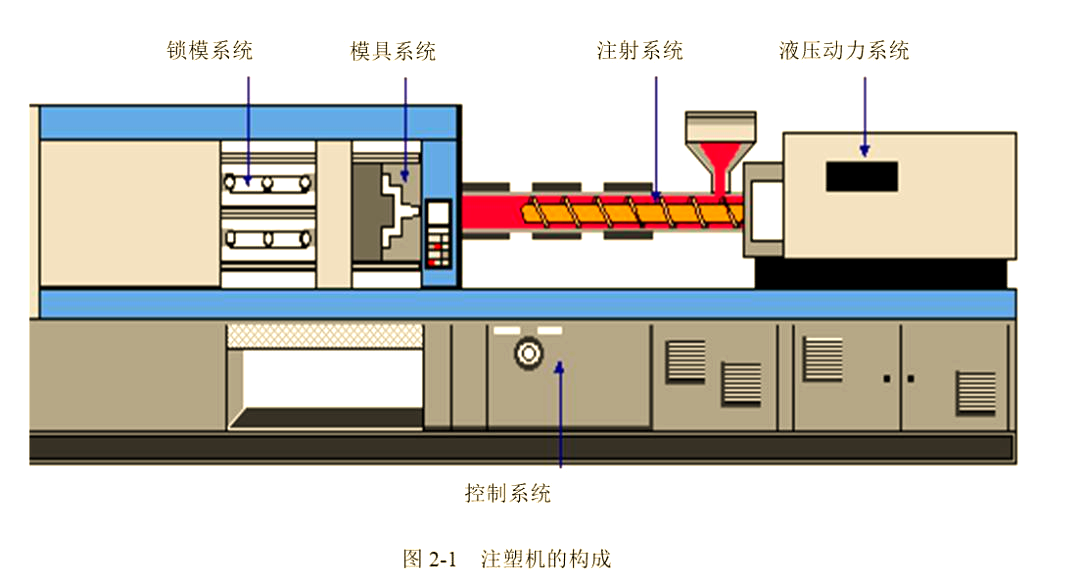
Injection molding — formally known as injection molding — is a forming process in which plastic feedstock (typically resin pellets) is heated to a molten state and then injected under high pressure into a closed mold cavity, where it cools and solidifies before the mold opens and the part is ejected. The fundamental logic of the process is "melt, form, solidify": a rotating screw plasticates and meters the pellets, a ram-like forward stroke injects the melt into the cavity at pressures ranging from tens to several hundred megapascals, a packing phase compensates for shrinkage, and a cooling phase imparts the final dimensional accuracy to the part. Total cycle times range from a few seconds to several minutes, depending on wall thickness and material properties.
Among all plastic forming processes, injection molding is the most widely applied and yields the broadest range of product geometries. By the standard industry measure, injection-molded products account for approximately one-third of global plastics output by volume, encompassing virtually every solid plastic component from consumer-product housings to automotive structural parts, from medical disposables to precision gears. Understanding injection molding's distinctive position requires comparing it with the main competing processes:
- Extrusion: continuously pushes melt through a fixed-cross-section die, suited to pipes, profiles, films, and wire insulation — products with a constant cross-section; closed-cavity structures are not achievable. Extrusion surpasses injection molding in total volume, but its fixed cross-section constrains product geometry and precludes complex three-dimensional parts.
- Blow molding: starts with an extruded or injection-molded parison that is inflated with air to conform to the mold wall, used exclusively for hollow containers (bottles, drums, fuel tanks, etc.); wall thickness uniformity is limited, and solid or multi-wall structural parts are not feasible.
- Calendering: continuously rolls melt between multiple rolls to produce sheet or film, suitable for PVC flooring, synthetic leather, and packaging film over large flat areas; high capital cost, complex changeovers, and unsuitable for part manufacturing.
- Compression molding: places material in an open cavity before closing and applying heat and pressure, commonly used for thermosets (phenolics, epoxies) and rubber, as well as long-fiber-reinforced composites; slow cycle times make it unsuitable for high-volume thermoplastic parts.
- Thermoforming: heats thermoplastic sheet and then vacuum- or pressure-forms it against a mold, suited to food trays and automotive interior skins; dimensional accuracy is lower than injection molding and solid structures cannot be formed.
Injection molding's core competitive advantages rest on three points. First, it can form virtually any complex three-dimensional solid or thin-wall enclosed part, with far greater geometric freedom than extrusion or blow molding. Second, a single shot achieves relatively high dimensional accuracy (typically ±0.05 mm to ±0.2 mm), with tolerances far tighter than those achievable by calendering or thermoforming. Third, the high degree of automation and short per-part cycle times make per-unit costs in high-volume production substantially lower than machining or die-casting. It is precisely these three advantages that have driven injection molding's continuous expansion since the mid-twentieth century, making it the most product-diverse and cross-industry plastics forming process in modern manufacturing.
Injection molding is not without limitations. Tooling costs are high — medium-precision molds typically run RMB 50,000–500,000, while large precision molds can reach several million yuan — and first-article lead times are long. Material utilization for continuous cross-section products is inferior to extrusion, and production efficiency for large hollow containers falls short of blow molding. In practice, therefore, injection molding, extrusion, and blow molding largely do not compete with each other; each addresses a different product geometry and they form a complementary relationship within the broader manufacturing system.
1.2 Classification Frameworks for the Injection Molding Industry
The injection molding industry can be classified along two dimensions: by downstream application of the product, and by machine type and specification. Both frameworks are relevant to industry analysis — the former describes market structure, the latter describes equipment and process capability.
1.2.1 Classification by Downstream Application
Downstream application is the primary reference framework for understanding the market structure of the injection molding industry. According to the China Plastic Machinery Industry Yearbook (historical data, widely cited in industry reports), China's injection molding machine demand is distributed roughly as follows: commodity plastics applications (including daily-use items and logistics crates) ~28%, automotive ~26%, home appliances ~25%, packaging ~12%, and medical and 3C precision combined ~9%. Each of the six major application segments carries distinct process requirements and competitive dynamics:
- Automotive injection-molded parts: per-vehicle plastic content has grown continuously (approximately 200 kg/vehicle in 2023, up significantly from 123 kg/vehicle in 2014 per industry data), covering instrument panels, bumpers, door interior panels, engine bay components, and new-energy-vehicle battery and powertrain structural parts. The key barriers in automotive injection molding are early co-development engagement with OEMs (the APQP qualification process) and the ability to process specialty engineering plastics (high-temperature PA66, PPS, LCP, etc.); once a supplier is nominated, switching costs are extremely high.
- Home appliance injection-molded parts: accounting for approximately 25% of injection molding machine utilization, dominated by white goods (washing machines, refrigerators, air conditioners) housings and functional structural parts, with strict requirements for dimensional stability and weatherability. Small appliances carry high SKU counts and short product cycles, placing severe demands on rapid tooling delivery and compressing margins throughout the supply chain.
- 3C precision injection-molded parts: serving smartphones, laptops, wearables, and other consumer electronics, with wall thicknesses typically below 1 mm and tolerance requirements in the ±0.01 mm to ±0.05 mm range, requiring advanced processes such as thin-wall injection molding, two-shot (multi-shot) molding, and in-mold labeling (IML)/in-mold decoration (IMD); this segment is highly correlated with consumer electronics inventory cycles and exhibits pronounced cyclicality.
- Medical injection-molded parts: the highest-barrier sub-segment among the six, with a China market size of approximately RMB 45 billion in 2023. Cleanroom requirements (typically ISO Class 7–8), ISO 13485 quality system certification, biocompatibility testing (ISO 10993), and the high switching costs of customer validation collectively form near-insurmountable entry barriers. Gross margins in medical injection molding are generally higher than in commodity molding.
- Packaging injection-molded parts: globally, packaging is the largest downstream application for injection-molded products, accounting for approximately 30%–32%; in China the share is somewhat lower (approximately 12%) because a large proportion of packaging items (films, bags) are produced by blow molding or cast-film processes. Packaging injection molding competes on volume, with low unit prices, thin margins, intense competition, and barriers mainly derived from high-speed equipment investment and food-contact compliance (GB 9685, etc.).
- Daily-use and other commodity injection-molded parts: covering toys, household goods, industrial and agricultural components, and construction accessories — the most fragmented product category. Technical barriers are relatively low, competition is intense, and margins are generally thin.
It is worth noting a structural divergence between China and the rest of the world: globally, packaging leads downstream applications, whereas in China the combined share of automotive and home appliances is notably prominent, directly reflecting China's status as the world's largest automotive production market and leading home appliance exporter.
1.2.2 Classification by Machine Type
The machine-type classification system provides the foundational framework for analyzing the injection molding equipment industry. It is typically organized along four dimensions:
(1) By clamping mechanism orientation: horizontal vs. vertical
- Horizontal injection molding machines: the injection axis and clamping axis are colinear and horizontal — the most mainstream configuration, suited to the vast majority of commodity and precision applications; parts drop out by gravity, facilitating automation.
- Vertical injection molding machines: the clamping mechanism is oriented vertically with downward injection, particularly suited to insert molding (metal inserts are placed vertically without displacement) and multi-station rotary platen configurations; they offer specific advantages for connectors, electronic components, and automotive sensors, but production volumes are far smaller than horizontal machines.
(2) By drive system: hydraulic, all-electric, and hybrid
- Hydraulic injection molding machines: use hydraulic oil as the power transmission medium; mature technology, wide clamping force range, relatively low cost at large tonnages, and currently the dominant type in the China market. Drawbacks include higher energy consumption, the risk of hydraulic oil leakage (restricting use in medical and cleanroom environments), and higher noise levels.
- All-electric injection molding machines: servo motors directly drive each motion axis; fast response, high repeatability, and energy consumption 30%–70% lower than hydraulic machines; suited for precision parts, medical parts, and applications with strict cleanliness requirements. Japan's penetration rate exceeds 60%, Europe's is approximately 40%, and China's currently stands at approximately 15%–20% — but is growing rapidly.
- Hybrid injection molding machines: the injection unit uses servo-hydraulic or electric injection drive while the clamping unit remains hydraulic, balancing cost and performance; currently the mainstream transitional product for China's mid-to-high-end market.
(3) By clamping structure: two-platen vs. three-platen
- Three-platen (toggle-clamp) injection molding machines: use a toggle linkage for force multiplication; compact structure, and the mainstream clamping solution for small and mid-sized machines. Clamping precision depends on toggle wear condition; scaling up to large tonnages introduces uneven moment distribution.
- Two-platen injection molding machines: two platens are directly driven to close by hydraulic cylinders (or electric ball screws) acting on tie bars; larger inter-platen daylight and ample mold installation space, particularly suited for large parts (automotive bumpers, appliance housings) and rapid mold-change applications; rigid structure, but more demanding to manufacture and correspondingly more expensive. Borche introduced China's first large-format two-platen all-electric machine in 2024, marking a domestic breakthrough in this sub-segment.
(4) By clamping force (tonnage)
Clamping force is the single most important specification of an injection molding machine, defining the upper limit of projected part area that can be processed. The standard industry classification is as follows:
- Small machines: ≤60 tonnes clamping force, suited for small precision parts (medical disposables, electronic components, micro gears, etc.).
- Medium machines: 60–1,000 tonnes, covering the broadest range of commodity parts, appliance components, and standard automotive parts — the highest-volume shipment range in the market.
- Large machines: 1,000–6,000 tonnes, used for large structural parts such as automotive bumpers, instrument panels, and washing machine drums.
- Extra-large machines (including those referenced against die-casting machine standards): above 6,000 tonnes, attracting wide attention in recent years due to the rise of integrated die-casting (gigacasting), though their application in pure injection molding remains limited to special oversized exterior parts.
The four dimensions above overlay to form the basic matrix of injection molding machine product categories. A single machine can be defined across dimensions — for example, "large horizontal all-electric two-platen machine" — which is precisely why injection molding machine product lines are complex and why even the leading manufacturers struggle to be best-in-class across all sub-segments.
1.3 Value Chain Structure Overview
The injection molding value chain is a classic four-stage vertical chain — raw materials, equipment, processing, applications — in which upstream resin supply and equipment manufacturing jointly support midstream injection molding conversion, and processed products flow to the six major downstream application sectors. The distribution of value and bargaining power differs markedly across each stage.
1.3.1 Upstream: Plastic Resin Feedstocks
Resin is the direct consumable input for injection molding processing, typically accounting for 60%–80% of an injection molder's production costs (industry estimate), making it the single highest-value input along the entire value chain.
The main resins used in injection molding fall into two broad categories: commodity plastics and engineering plastics.
Commodity plastics are dominated by PP (polypropylene), PE (polyethylene), ABS, PVC, and PS, with PP holding the largest share in the injection molding sub-market. China's self-sufficiency in commodity plastics is now quite substantial — PP capacity surpassed 51.36 million tonnes in 2024 and import dependence fell to 3.2%, transforming China from a net importer to a net exporter. ABS self-sufficiency reached 86.2%, but capacity utilization is approximately 61%, indicating a clear state of oversupply.
In engineering plastics, polycarbonate (PC) represents the most emblematic domestic substitution trajectory: domestic capacity reached 3.81 million tonnes in 2024 (approximately 48% of global capacity), and self-sufficiency for general-grade PC already exceeds 100%, but optical-grade and medical-grade high-end PC remains import-dependent. Import dependence for PA66 (nylon 66) has declined from approximately 53% in 2020 to approximately 19% in 2024, but adiponitrile — the critical upstream intermediate — was long monopolized by Invista and Ascend Performance Materials, and domestic substitution is still underway. Polyoxymethylene (POM) still had a net import gap of approximately 360,000 tonnes in 2024, with high-end grades controlled by BASF, Celanese, and Asahi Kasei. High-performance / specialty engineering plastics (PEEK, PPS, LCP, etc.) have an overall domestic substitution rate below 30%, constituting hidden chokepoints in high-barrier applications such as high-temperature automotive structural parts, medical implants, and precision electrical connectors.
Bargaining power in the upstream resin segment tilts overall toward large petrochemical companies: Sinopec and PetroChina together control roughly one-third of PP/PE capacity; Wanhua Chemical holds the leading domestic market share in PC; and private mega-refinery complexes (Zhejiang Petrochemical, Hengli Petrochemical, etc.) are rapidly catching up on the strength of integrated cost advantages. For midstream processing enterprises, macroeconomic swings in resin prices — driven mainly by the crude oil → naphtha → olefins price transmission chain — represent the most difficult cost risk to hedge.
1.3.2 Upstream: Injection Molding Machines and Tooling
Injection molding machines are the vehicles for the processing technology; they are capital goods whose value is reflected in part costs through depreciation rather than direct consumption. China accounts for approximately two-thirds of global injection molding machine output (65%–70%), making it the world's largest equipment producer and consumer. With an installed base exceeding 1.5 million units, China generates a substantial demand floor for equipment replacement. Bargaining power in the equipment segment is concentrated among a handful of leading machine manufacturers; the domestic market share of Chinese-made machines already exceeds 81%, and foreign brands retain competitiveness only in the precision, all-electric, and high-end segments.
Tooling (molds) is the other critical upstream input to the injection molding process. Each mold is specific to a particular part geometry, giving it strong asset specificity. China's mold market was approximately RMB 358.9 billion in 2023, with injection molds accounting for roughly 45% — the largest single category. China's healthy trade surplus in molds (approximately USD 7.667 billion in 2024) reflects the overall strength of China's manufacturing capability; however, high-end precision molds remain import-dependent, and approximately 25% of mid-to-high-end mold steel comes from imported brands such as Assab (Sweden), Thyssen (Germany), and Daido/Hitachi (Japan). Hot runner systems — a critical mold sub-component — are also dominated at the high end by imports such as Husky, Mold-Masters, and Korea's YUDO for valve-gate and multi-cavity balanced hot runners, while domestic brands currently focus on the mid-to-low-end market.
The power structure in the tooling segment is relatively fragmented: mold makers are numerous and highly dispersed, forming a supply-side relationship with injection molders rather than a subordinate one. The core barrier in tooling is precision and lead time, not scale economies.
1.3.3 Midstream: Injection Molding Processing
Injection molding processing is the core conversion stage of the value chain, transforming upstream resin pellets and the mechanical energy transmitted through tooling into plastic parts of specific geometries. This segment can be characterized in three words: fragmented, captive, and process-differentiated.
Fragmentation is reflected in the sheer number of operating entities — registered companies associated with plastic products manufacturing number in the millions nationally, and above-scale enterprises (2023) total approximately 21,800. The vast majority are small and mid-sized specialist molders serving downstream major customers with parts sourced from regional industry clusters. The Pearl River Delta (known for automotive, home appliances, and 3C precision), the Yangtze River Delta (balancing automotive, packaging, and medical), and the Bohai Rim (primarily automotive supply chain) are the three most important regional clusters.
The captive nature is reflected in the deep binding relationships between injection molders and their downstream customers: in high-barrier segments such as automotive, medical, and 3C, molders typically need to complete rigorous qualification processes (APQP, ISO 13485, IQ/OQ/PQ validation) before being added to an approved supplier list, and once listed, switching costs are extremely high; in commodity and packaging segments, competition is intense, customer concentration is low, and switching costs are relatively small.
Process differentiation determines the ceiling for any given molder's business. Companies capable of mastering high-value-added processes — thin-wall injection molding, two-shot (multi-shot) molding, IML, gas-assist molding, precision micro-molding — command substantially better margins and higher-quality customers than peers focused purely on commodity parts. This stratification creates a capability tiering among midstream enterprises, which is a central theme of analysis in subsequent chapters of this report.
1.3.4 Downstream: Six Major Application Sectors
The downstream encompasses six sectors — automotive, home appliances, 3C precision, medical, packaging, and daily-use/commodity goods — with differing demand scales, growth rates, and process requirements that collectively put pressure on upstream injection molding. Automotive and medical are currently the two fastest-growing, highest-barrier application directions; packaging and commodity daily-use items represent the largest volume but slower-growing mature tracks; 3C precision carries pronounced cyclicality; and home appliances benefit from short-term domestic policy stimulus but have limited long-cycle growth potential.
Overall assessment of value distribution along the value chain: in the injection molding value chain, the upstream resin segment enjoys relatively stable margins underpinned by resource endowments and scale barriers; injection molding machine manufacturers maintain solid pricing power through technology and brand moats, with net margins for leading companies around double digits; mold manufacturing profits are driven by customization, with precision mold makers enjoying markedly better bargaining power than commodity mold shops; midstream injection molding processing is the segment with the thinnest margins and the most intense competition — a large number of small and mid-sized companies operate at the edge of profitability, and achieving pricing premiums requires either process differentiation or customer relationship moats. This "barbell" value distribution — with higher profits at the upstream and equipment ends, lower margins in midstream processing — is one of the foundational judgments for understanding the competitive landscape of the injection molding industry.
1.4 Injection Molding's Role and Strategic Significance in China's Manufacturing Sector
Injection molding occupies a place in China's manufacturing sector that far exceeds what one might expect of an ordinary processing technology. China is already the world's largest injection molding producer by every major measure — equipment output (approximately two-thirds of global production), number of processing enterprises, and volume of product exports — and holds a dominant position by all of these metrics. The formation of this position has been highly synchronous with China's concurrent rise as the world's largest automotive production and sales market, the world's leading home appliance exporter, and the most important consumer electronics manufacturing center.
Injection molding is one of the most frequently employed part-forming processes in modern discrete manufacturing. In consumer products, virtually all plastic housings and structural parts are injection-molded; in automotive, each passenger vehicle carries approximately 200 kg of plastics, a substantial proportion of which comes from injection molding operations; in medical, from disposable syringes to precision diagnostic kits, injection molding is an irreplaceable manufacturing means. One can reasonably say that the health of the injection molding industry is, to a significant degree, a reflection of the tightness and slack in China's overall manufacturing capacity structure.
For the purposes of this report, "China is the world's largest injection molding country" is not a conclusion but a starting point: it is precisely the capacity density, supply chain integration depth, and competitive pressures generated by this scale leadership that have given rise to the industry phenomena — in market size, technology evolution, competitive landscape, and risk challenges — that subsequent chapters will examine in depth.
Chapter 2 Global Injection Molding Industry: Current State and Competitive Landscape
2.1 Global Market Size: Two Orders of Magnitude — Equipment vs. Products
Understanding the global scale of the injection molding industry requires first distinguishing between two fundamentally different measures — the injection molding machine (equipment) market and the injection-molded products market. The two differ by a factor of roughly thirty, and conflating them leads to severely distorted conclusions.
The global injection molding machine (equipment) market was approximately USD 11–17 billion in 2024, with considerable variation across research firms. MarketsandMarkets, applying a strict "plastic injection molding machine" definition, estimates approximately USD 12 billion; Straits Research, Cognitive Market Research, and others use broader scopes (potentially including rubber injection and related peripheral equipment) and arrive at USD 16–17 billion. On balance, the USD 10-billion scale is a reliable order-of-magnitude judgment, with projected CAGRs of 3.5%–5.2% through 2030–2034 across various forecasts — a steady-growth rate consistent with mature industrial goods, not a high-speed expansion track.
The global injection-molded products market is an entirely different order of magnitude. According to Fortune Business Insights, the global injection-molded products market was approximately USD 403.8 billion in 2024, projected to reach USD 561.6 billion by 2032 at a CAGR of approximately 4.2%. Grand View Research, using a broader "total injection molding market (including processing services and materials)" definition, puts 2024 at approximately USD 299.0 billion rising to approximately USD 462.4 billion by 2033 at a CAGR of approximately 5.0%. The core drivers of the products market are the four major downstream sectors of packaging, automotive, consumer electronics, and medical devices; packaging holds the largest share at approximately 32%, with automotive accounting for roughly 30%.
The gap between the two measures maps the distribution of value across different levels of the value chain: injection molding machines are production tools, and their market size reflects the intensity of capital equipment investment; injection-molded products are the final deliverables, and their market size reflects the total consumer-side demand for injection molding technology. The former is a barometer of manufacturing infrastructure investment; the latter is a composite mirror of consumer and industrial demand. Based on forecast data, the global injection-molded products market will approach USD 453.2 billion by 2030 (CAGR approximately 5.8%), with growth potential in the products market far exceeding that of the equipment market itself — implying that rising per-machine output efficiency in injection molding operations will continuously dilute incremental demand for new equipment.
2.2 Global Regional Landscape: Asia-Pacific at the Core, with a German-Japanese-Chinese Triad
Global injection molding machine market geography is highly concentrated in Asia-Pacific. According to data from multiple research firms, Asia-Pacific accounts for approximately 40% of the global injection molding machine market, making it the largest consumption and production region — a position sustained by the enormous manufacturing base across China, Japan, South Korea, Thailand, and Vietnam, where automotive components, consumer electronics, home appliances, and packaging containers generate relentless equipment demand. Europe ranks as the second-largest region and North America follows, with both holding a share of high-value-added sub-segments (medical, aerospace, precision optics) that exceeds their share of total manufacturing output.
Within the three-pole framework, Germany, Japan, and China each represent fundamentally distinct competitive models.
Germany represents Europe's role as "high-end process definer." German domestic injection molding machine exports number approximately 4,590 shipments (per trade data) — far fewer units than China — but each machine embodies process capabilities and a unit price well above the low- and mid-end market. KraussMaffei, Arburg, and Austria's ENGEL and Wittmann Battenfeld form the core of Europe's high-end injection molding machine camp. Their competitive strength lies not only in the machines themselves but in the entire ecosystem built around the machines — tooling, hot runners, automation peripherals, and process consulting. German manufacturers have maintained long-standing authority to set technical standards in automotive structural parts, medical devices, and precision optical injection molding.
Japan's model is "precision all-electric." Japanese injection molding machine exports number approximately 42,494 shipments — second globally — with a technology orientation focused on three dimensions: high precision, all-electric drive, and cleanroom compatibility. Sumitomo, FANUC's ROBOSHOT series, and Japan Steel Works (JSW) have built Japan's position as the world's largest producer of all-electric injection molding machines. Japan's domestic all-electric penetration rate exceeds 60% — the highest of any major market worldwide — reflecting the stringent requirements of its domestic downstream sectors (consumer electronics, automotive electronics, medical devices) for clean production and high repeat precision.
China's model is "volume export and tiered substitution." Chinese injection molding machine exports number approximately 90,862 shipments — the global leader, more than double Japan's count. China's core advantage lies not in the most advanced technology per unit but in the complete industrial cluster led by Haitian International (1882.HK): this cluster can supply a full product range from mid-to-low-end hydraulic machines to mid-to-high-end two-platen machines at highly competitive prices, and has rapidly expanded export volumes by capitalizing on the manufacturing build-out in Southeast Asia, the Middle East, and Latin America.
The three-pole relationship is not a simple "high / mid / low" correspondence; rather, each has established a relatively stable position in its area of strength: Germany anchors complex processing, Japan anchors high-precision all-electric, and China anchors mid-to-high-end volume production with price competitiveness. These three trajectories are advancing in parallel across global markets, and a competitive-cooperative dynamic will persist for the long term.
2.3 Overseas Machine Leaders: A Company-by-Company Analysis of the European and Japanese Premium Tier
The global injection molding machine market is quite fragmented: according to Global Market Insights data, the top five players together hold approximately 22% market share, and long-tail manufacturers are numerous (China alone has over 400 injection molding machine makers). That said, the high-end equipment market displays pronounced brand concentration. The following is a company-by-company review of the major overseas leaders.
ENGEL (Austria)
ENGEL is one of the world's largest injection molding machine makers by revenue. FY2023/24 revenue was approximately EUR 1.6 billion; in the industry downcycle of FY2024/25 it declined approximately 10% to approximately EUR 1.5 billion, yet the company still claimed to have expanded its global market share. ENGEL's technology positioning spans three directions: large precision injection molding, all-electric machines, and multi-component molding. The e-mac and e-victory all-electric series serve medical, packaging, and precision electronics; the duo and victory hydraulic series address large automotive structural parts; and ENGEL's combimelt multi-component series provides system-level solutions for two-shot and insert molding. The 2024 launch of the e-mac 500 (a 5,000 kN all-electric machine) pushed the all-electric technology boundary further from small and medium tonnages toward large-format applications, reflecting the strategic intent of European players to extend all-electric coverage to a broader tonnage range. ENGEL's ability to hold the high end hinges fundamentally on its proprietary iQ intelligent process systems — closed-loop real-time sensor-based process optimization that achieves cavity-to-cavity consistency acceptable for precision medical and optical components, a capability that cannot be replicated through price competition alone.
Arburg (Lossburg, Germany)
Arburg is one of the few remaining top-tier injection molding machine makers that is still family-owned and committed to single-factory "Made in Germany" production. Revenue peaked at approximately EUR 875 million in 2022, retreated to approximately EUR 780 million in 2023, and contracted further to approximately EUR 620 million in 2024 amid the industry-wide 2023/24 downturn — a cumulative decline of more than 30% from the peak. Arburg's core product line is the Allrounder series, spanning hydraulic, electro-hydraulic hybrid, and all-electric drive variants across a clamping force range of 5 kN to 6,500 kN, making it a dual benchmark for precision injection molding (medical disposables, micro connectors, pharmaceutical packaging) and multi-component molding. A new all-electric Allrounder platform launched in early 2025 targets medical applications specifically, further enhancing cleanroom compatibility and particulate contamination control. Arburg's premium positioning derives from two sources: first, the extremely demanding precision and consistency requirements imposed by its German domestic supply chain; second, the process synergies between its Freeformer additive manufacturing equipment and its injection molding machines, which give it flexible capabilities in small-batch, high-mix custom production scenarios that competitors find difficult to replicate.
KraussMaffei (Germany)
KraussMaffei traces its history to 1838 and is one of Europe's largest injection molding and extrusion machine manufacturers. In 2018, Sinochem Group completed its acquisition of KraussMaffei, and in 2022 the company debuted on the Shanghai Stock Exchange (600579), giving it a hybrid identity that combines European engineering tradition with Chinese capital-market operations. According to its SSE filings, the listed entity recorded revenue of approximately RMB 9.61 billion in 2024, down approximately 17% from 2023, and reported a significant loss; KraussMaffei Group also divested its Netstal precision injection molding business to Krones during the same period to focus on its core product lines. KraussMaffei's technology portfolio is defined by the MX series (large two-platen hydraulic injection molding machines for large automotive interior and exterior parts), the GX series (high-speed injection for packaging), and multi-component/reaction molding combination machines. Its depth in polyurethane reaction injection molding (RIM/SRIM) gives it a unique advantage in automotive headliners, instrument panels, and other lightweight parts — a barrier that other injection molding machine makers find very difficult to replicate.
Husky (Canada)
Husky is the undisputed global leader in PET preform injection molding systems, headquartered in Bolton, Ontario, Canada. Its flagship HyPET series injection molding machines are designed specifically for high-volume PET preform production, and together with Husky's proprietary hot runner systems (Mold-Masters, an acquired business) and tooling, they form a tightly integrated system solution. In the bottled-water, carbonated beverage, and juice packaging sectors, this creates an extremely strong customer lock-in effect. Husky's competitive moat is a classic systems-level moat: once the machine, mold, and hot runner modules have been jointly optimized, the total cost of switching to a competing supplier is prohibitively high. The company is privately held, and revenue figures are not publicly disclosed; industry estimates, however, suggest Husky has long held a market share exceeding 60% in the global PET preform equipment market.
Sumitomo (SHI) Demag
Sumitomo Heavy Industries' injection molding business operates under the "Sumitomo (SHI) Demag" brand, a Japanese-German joint venture specializing in all-electric injection molding machines, integrating SHI's Japanese precision manufacturing heritage with Demag's European engineering tradition. The core product, the IntElect series all-electric injection molding machine, targets medical devices, optical lenses, and precision electronic connectors, delivering extremely low mold-cavity pressure variation and ultra-high repeat positioning accuracy — making it one of the mainstream choices globally for medical and optical injection molding applications. Annual production capacity exceeds 5,000 units; injection molding machine revenue is not disclosed separately. The competitive advantage lies in the systemic edge of the all-electric platform in energy management, cleanroom compatibility (no hydraulic oil leakage risk), and noise levels — all well-suited to the stringent production environment requirements of medical and optical components.
FANUC (Japan) — ROBOSHOT Series
FANUC is the world's largest manufacturer of CNC controllers and industrial robots. Its injection molding business is carried by the ROBOSHOT all-electric series. FANUC's FY2024 total business revenue was approximately JPY 730 billion; the injection molding business share is not disclosed separately, but industry estimates suggest FANUC holds approximately 8% or more of the global injection molding machine market, placing it among the top five players. ROBOSHOT's core differentiation stems from FANUC's proprietary CNC control technology transplanted directly into the injection molding machine control system: AI servo control closed-loop and ultra-precise injection unit position control deliver superior shot-to-shot consistency compared to conventional electric injection molding machines, making it especially suited for micro connectors, optical components, and semiconductor packaging where dimensional tolerances are at the micron level. The natural integration between FANUC ROBOSHOT machines and FANUC robots also gives it end-to-end system advantages in injection molding automation lines.
Japan Steel Works (JSW, Japan)
JSW is one of the very few manufacturers capable of producing extra-large all-electric injection molding machines (clamping force 550 to 3,000 tonnes). Its J-AD series represents the technology frontier for large-format all-electric machines. Primary target customers are manufacturers of large automotive bumpers and instrument panel housings — parts that typically require large clamping force machines, and where scaling up to large tonnages in an all-electric configuration places extremely demanding requirements on servo motor power density and mechanical structural design. JSW has built a relatively high entry barrier in this niche. Unlike Chinese and German injection molding machine makers with broad product lines spanning multiple sub-segments, JSW distinguishes itself through deep specialization in large all-electric machines.
Shibaura Machine (Japan, formerly Toshiba Machine)
Shibaura Machine officially adopted its new name in 2020, formerly known as Toshiba Machine, with decades of precision manufacturing experience in injection molding. Its products are positioned primarily at automotive electronics and precision electronic connectors, with precision and stability as core selling points. Following the general direction of Japanese machine makers, Shibaura Machine has been continuously advancing electrification, aiming to maintain competitiveness in the small and medium precision injection molding machine market. Separate injection molding machine revenue figures are not disclosed.
Looking across these European and Japanese leaders, the common logic for defending the high end concentrates on three points: first, technological barriers stem from years of process accumulation (process control algorithms, servo motor precision, mold hot runner system integration) — the kind of accumulation that cannot be closed through short-term R&D efforts; second, customer validation costs are extremely high (a medical device factory that changes equipment must repeat the entire IQ/OQ/PQ process validation, and an automotive Tier-1 supplier must pass OEM audits), creating extremely strong customer stickiness; third, brand premiums combined with spare parts and service revenues mean that total lifecycle margins far exceed machine ex-factory gross margins alone.
2.4 Global Technology Frontiers: Four Leading Directions
Global injection molding technology evolution in the 2020s is concentrated along four directions, each representing an expansion of the process capability frontier along a different dimension.
All-electric injection molding machines are currently the fastest-growing sub-segment in the global injection molding machine market. While hydraulic machines still hold approximately 51% market share and dominate by volume, all-electric machines are the fastest-growing type, with a projected CAGR of approximately 8%–10% through 2033 across various forecasts. All-electric machines replace hydraulic drive entirely with servo motors, typically consuming 30%–60% less energy than hydraulic machines and eliminating hydraulic oil leakage risk — meeting the mandatory production environment requirements of medical, optical, and food-contact applications. The global all-electric injection molding machine market was approximately USD 2.8–3.2 billion in 2024; Japan is the largest producing country, and Asia-Pacific (including China) accounts for nearly half of global demand. Europe's carbon neutrality policy pressures and rising energy prices are continuously driving European manufacturers to accelerate the transition from hydraulic to all-electric machines; ENGEL, Sumitomo (SHI) Demag, Arburg, and FANUC have all designated all-electric platforms as the core of their future product strategies.
Multi-component injection molding technology addresses the molding of two or more materials within a single shot, with typical applications including automotive taillights (clear PC combined with a black ABS frame), toothbrush handles (rigid PP with soft TPE), and consumer electronics housings (structural material with decorative IML skin). The global multi-component injection molding technology market was approximately USD 25.9 billion in 2025 and is projected to reach USD 44.2 billion by 2035 at a CAGR of approximately 5.5%, with electronics and automotive applications as the two core drivers. The technical barriers in multi-component processing lie in the co-design of machine (rotary platen mechanism, multi-shot unit control), tooling (runner balance at the parting surface), and process parameters (matching the shrinkage rates of different materials); European players (especially ENGEL and KraussMaffei) have a comprehensive system spanning machines to process consulting in this direction and are the preferred starting point for customers initiating multi-component projects worldwide.
Micro-injection molding targets micro-scale parts with weights in the milligram-to-gram range and geometric precision requirements at the micron level, with typical applications including cardiac pacemaker housings, micro dental components, implantable catheters, and micro-optical lenses. The global micro-injection-molded parts market was approximately USD 1.4 billion in 2024, growing at a CAGR exceeding 11% — among the fastest of any injection molding sub-segment — driven by ongoing medical device miniaturization and the continuous penetration of wearable devices. The technical barriers in micro-injection molding are extremely high: shot weights must be controlled to milligram accuracy, requiring dedicated micro-scale machines, ultra-precision molds (cavity machining accuracy at the ±1 μm level), and cleanroom environments; manufacturers capable of reliably delivering in this space are a very small group globally, and European and Japanese players hold a significant first-mover advantage.
Medical precision injection molding is the segment with the highest barriers and the best profitability among all injection molding sub-segments. The global medical injection molding market was approximately USD 24.8 billion in 2024, projected to reach USD 33.3 billion by 2030 at a CAGR of approximately 5.4%; Asia-Pacific holds the largest share at approximately 46.5%. The core barriers in medical injection molding lie not in the equipment per se but in the compliance system: ISO 13485 quality management system, cleanroom classification (typically ISO Class 7 or Class 8), biocompatible material certification, and the customer stickiness of equipment process validation (IQ/OQ/PQ) together form near-insurmountable entry barriers. All-electric machine penetration in medical applications is approximately 46% — the highest of any application segment — which explains why mainstream European and Japanese manufacturers are concentrating their new all-electric platform development on medical-facing applications.
The four technology directions are not isolated from each other but deeply intersecting: all-electric is the foundational technology platform for medical precision injection molding, multi-component processes are being combined with micro-molding technology for MEMS packaging and wearable devices, and the stringent standards of medical applications are in turn driving overall improvements in all-electric control precision. The European and Japanese players' defense of the high end is, in essence, the defense of their ability to integrate these technology directions into coherent systems.
2.5 Global Trade Flows: From Import Dependence to Volume-Export Leadership
The injection molding machine trade landscape has undergone a significant structural transformation over the past two decades, with China playing the most critical variable role in that change.
In the 2000s, China was still one of the world's largest net importers of injection molding machines. Domestic injection molding enterprises, seeking to meet the precision production needs of automotive, home appliance, and consumer electronics customers, imported large volumes of high-end hydraulic and all-electric machines from Germany, Japan, and South Korea. Although domestically made machines already had a basic foundation, the gap in precision, reliability, and process software compared with imports was obvious, and the first choice for high-end users was almost uniformly an imported brand. A fundamental shift occurred in the mid-2010s.
Domestic manufacturers led by Haitian International drove the cost curve for hydraulic machines to one-third of imports or lower through scale production, while continuously iterating toward servo-hydraulic, two-platen, and electrified technology directions and completing a substantive substitution in the mid-range market. By the 2020s, China had risen to become the world's largest injection molding machine exporter: in 2023, export shipments numbered approximately 90,862 units with a total value of approximately USD 1.7 billion (injection molding machine basis), while imports during the same period totaled approximately USD 465 million. Export destinations are dominated by Vietnam, India, Mexico, Turkey, and Indonesia — precisely the emerging manufacturing economies that have risen alongside the "China plus one" supply chain realignment.
The continued existence of high-value imports reveals the other side of the current landscape: China still needs to import nearly USD 500 million worth of injection molding machines annually, sourced almost entirely from Germany, Japan, and Austria, concentrated in all-electric high-precision machines, large multi-component machines, and medical-grade cleanroom machines. This dual-track structure — high-end imports alongside mid-to-low-end volume exports — precisely describes China's current position in the injection molding machine value chain: looking down, it is an unassailable scale leader in the global mid-to-low-end market; looking up, there is a clearly visible technical ceiling.
The industry-wide downturn of 2023/24 provided an unusually instructive contrast experiment. This downturn was triggered by excessive equipment investment during the COVID-19 pandemic — global manufacturers concentrated their injection molding machine purchases in 2020–2022 to fill capacity gaps, leading to large-scale excess and de-stocking from 2023 onward. According to association data cited by ENGEL management, global injection molding machine market volume fell approximately 40% year-on-year — the most severe industry contraction in recent years. European manufacturers suffered across the board: ENGEL FY2023/24 revenue fell approximately 6%, with a further decline of approximately 10% in FY2024/25; Arburg's 2024 revenue of approximately EUR 620 million represents a cumulative decline of more than 30% from the 2022 peak; KraussMaffei's 2024 revenue fell approximately 17% year-on-year, the company recorded a significant loss, and it even divested its Netstal business to reduce its footprint.
In sharp contrast, Haitian International (1882.HK) set an all-time revenue record during the same period: full-year 2024 revenue of RMB 16.128 billion (up 23.4% year-on-year), with shipments exceeding 53,000 units (up 35.5% year-on-year). The logic behind these two data sets side by side is not complicated: European manufacturers' core customer base is in European and North American manufacturing, which was the hardest-hit region in this de-stocking cycle; Chinese manufacturers' export growth came from new manufacturing capacity build-outs in Southeast Asia, South Asia, and Latin America — geographies whose capacity investment cycle was out of phase with that of Europe and North America, providing incremental demand precisely when European manufacturers were contracting. This cyclical phase difference enabled a new round of market share redistribution during the industry trough — even as ENGEL's revenue fell, it still claimed to have expanded its global share (meaning European peers fell even harder), while Chinese manufacturers deepened their presence across a wider market on the strength of absolute shipment growth.
The evolution of trade flows clearly reveals the structural trend in global injection molding machine competition: domestic substitution in the mid-range market has already been completed, and the competitive frontier is now migrating toward high-value sub-segments such as all-electric, medical precision, and large multi-component machines — precisely the areas where European and Japanese players still hold significant technology advantages, and the directions Chinese players must break through in the next phase.
Chapter 3 PEST Analysis of China's Injection Molding Industry Environment
External forces shape an industry far more deeply and durably than internal competition alone. Structural opportunities only truly open when policy, economic, social, and technological forces converge in the same direction. In the 2024–2026 window, China's injection molding industry finds itself at precisely such a juncture: on the policy front, the dual-track pressure of energy-efficiency mandates and recycled-materials incentives is forming a combination of hard constraints and positive incentives; on the economic front, simultaneous recovery across multiple downstream sectors is generating demand-side pull; on the social front, demographic shifts and growing environmental awareness are raising the organic motivation for automation and greening; and on the technology front, three converging trends — electrification, intelligent manufacturing, and sustainability — are accelerating toward a common convergence point, driven by both market forces and policy tailwinds. Reading this four-dimensional environment is the prerequisite for forming a judgment on the industry's medium-term direction.
3.1 Political Environment
3.1.1 Encouraged Industries Catalog: Servo and All-Electric Equipment Receive Policy Recognition
The Guiding Catalog for Industrial Structure Adjustment (2024 Edition), which took effect in February 2024, explicitly lists "plastic processing equipment incorporating electromagnetic induction heating and servo drive systems" in the Encouraged category. Although the language is technically specific, the policy intent is clear: the core technology paths of all-electric injection molding machines and servo-hydraulic injection molding machines have received formal recognition and support from national industrial policy. Inclusion in the Encouraged category carries significance beyond the symbolic level — credit support from financial institutions, allocation of local government industrial funds, and domestic preference clauses in procurement tenders all reference the catalog as an important guiding document.
The same edition of the catalog added a new "Intelligent Manufacturing" major category, bringing digital transformation, industrial internet, and intelligent equipment under the umbrella of national-level encouragement. For injection molding machine manufacturers, this means product R&D direction can no longer be limited to pursuing machine performance specifications alone; intelligent capabilities must be incorporated as an organic component of product competitiveness.
3.1.2 Energy Conservation and Carbon Reduction: Efficiency Thresholds Drive Accelerated Exit of Hydraulic Machines
In May 2024, the State Council issued the Action Plan for Energy Conservation and Carbon Reduction (2024–2025), setting explicit targets of a 2.5% reduction in energy consumption per unit of GDP and a 3.5% improvement in industrial energy efficiency over the two-year period. This plan identifies industrial energy conservation as a priority. Plastics processing, as a typical continuous-flow industrial sector with a large installed base of hydraulic injection molding machines and historically low overall energy efficiency, is one of the key sectors targeted under the energy conservation effort.
Comparative energy data provide a quantitative perspective: all-electric injection molding machines consume approximately 30%–70% less energy than conventional hydraulic machines on a total-operating basis, and cooling water consumption can also be reduced by 70%–90%. This efficiency gap means that, against a backdrop of rising energy costs and tightening carbon emission constraints, the economics of continuing to operate aging hydraulic machines will become increasingly untenable. The dual pressures of policy targets and market costs together constitute the objective driver for equipment replacement and upgrading.
3.1.3 Equipment Renewal: Trade-In Policy Creates Direct Replacement Pull for Aging Hydraulic Machines
In 2024, the national government advanced the "Large-Scale Equipment Upgrade and Consumer Trade-In Campaign," with old industrial equipment replacement included in the scope for subsidies. Local implementation policies vary: Shanghai designated industrial equipment upgrades for 2024–2027 as a special action initiative, and the replacement of aging hydraulic injection molding machines with all-electric or high-efficiency servo models in the injection molding segment is eligible for corresponding subsidy support.
Separately, the "first-(set) major technical equipment" policy provides another policy support channel for injection molding machine enterprises pursuing technological innovation. The 2024 edition of the guidance catalog issued by the Ministry of Industry and Information Technology offers subsidies based on a specified percentage of sales revenue for qualifying innovative equipment, with maximum subsidy amounts in some provinces reaching RMB 30 million. This policy provides meaningful incentives for companies that pioneer new types of large all-electric injection molding machines, high-speed thin-wall injection molding machines, or compound molding equipment, both offsetting R&D costs and reducing the adoption risk for initial customers.
3.1.4 Recycled Plastics: A 19.5-Million-Tonne Target by 2030 Reshapes the Materials System
In January 2025, the National Development and Reform Commission and other agencies jointly issued the Action Plan for Promoting the Application of Recycled Materials (NDRC Environment and Resources [2025] No. 1681), setting an explicit target of annual recycled plastics production exceeding 19.5 million tonnes by 2030, and requiring key sectors — automotive, electrical and electronic products, textiles, and packaging — to steadily increase the substitution ratio of recycled materials. This is one of the most quantitative and broadest-coverage top-level policy documents China has issued to date in the recycled plastics space.
The structural impact of the 19.5-million-tonne target on the injection molding industry manifests at two levels: first, the use of recycled materials (rPP, rPET, etc.) by injection molding processors will gradually shift from a voluntary choice to a procurement requirement or even a compliance requirement from downstream customers, particularly in packaging and home appliances; second, batch-to-batch consistency and process adaptability of recycled feedstocks are inferior to virgin materials, placing higher demands on precision process control capabilities in injection molding — indirectly driving demand for intelligent injection molding equipment. The 14 national and industry standards for recycled plastics advancing in parallel with the action plan provide a standardized regulatory foundation for the sector.
3.1.5 Tightening Plastic Restrictions: Demand for Single-Use Items Under Pressure, Structural Demand Shifts
The plastic restriction direction established by the Opinions on Further Strengthening Plastic Pollution Control promulgated in 2020 has continued to deepen in subsequent years. In December 2024, Hainan Province implemented stricter revised plastic restriction regulations, and multiple regions followed through on restrictions on the use of disposable tableware and plastic bags. The direct effect of the plastic-restriction policy is to compress demand for low-end injection-molded products dominated by single-use packaging and films. The flip side, however, is that it compels the industry to shift toward reusable precision injection-molded parts and environmentally compliant packaging with recycled content, thereby driving upgrade demand for equipment process capabilities and materials adaptability.
The five policy threads described above point consistently in the same direction: energy efficiency, recycled materials, intelligent manufacturing, and replacement of aging capacity. The policy environment's impact on the injection molding industry has shifted from the relatively general "directional guidance" of the past toward an increasingly specific dual-track mechanism combining threshold requirements and financial incentives.
3.2 Economic Environment
3.2.1 The Transmission Logic of Downstream Demand Conditions
The injection molding industry is a classic intermediate manufacturing sector that does not directly face end consumers. Assessing the economic environment for injection molding therefore fundamentally means assessing the demand conditions of the four major downstream sectors — automotive, home appliances, consumer electronics, and packaging — and understanding through what mechanism and with what lag this demand momentum transmits to the injection molding segment.
Looking at the downstream application structure of China's injection molding machines (using historical data from the China Plastic Machinery Industry Yearbook), automotive, home appliances, and commodity categories (including packaging) together account for approximately 80% of demand, with automotive at approximately 26% and home appliances at approximately 25%. This structure means that the business cycle of the injection molding industry is broadly synchronized with the overall manufacturing cycle to a significant degree, rather than moving independently.
3.2.2 Automotive: The Incremental Logic Driven by the Electric Vehicle Wave
In 2024, the penetration rate of new energy vehicles in China reached 40.94%, a figure that underpins a continuously favorable incremental logic for the injection molding industry: all-electric passenger vehicles carry battery packs and are heavier than internal combustion engine vehicles, making lightweighting engineering pressure even more acute. Policy targets for weight reduction (a 25% reduction in the lightweighting coefficient for all-electric passenger vehicles by 2030 relative to the baseline) further reinforce this demand direction.
The structural changes brought by lightweighting are not limited to total volume growth from plastics substituting metal; they also include a materials upgrade — per-vehicle plastic content has grown from 123 kg in 2014 to 200 kg in 2023 and is expected to increase further to approximately 210 kg by 2026. The incremental injection molding demand generated by new energy vehicle powertrains (battery structure components, motor end covers, power electronics insulation parts) is a new category that did not exist in the conventional internal combustion engine era. According to industry estimates, China's automotive plastic parts market exceeded RMB 100 billion in 2023 and is projected to reach RMB 131.7 billion by 2026, at a compound annual growth rate of approximately 10%. This growth rate significantly exceeds the overall injection molding industry average, further reinforcing automotive's role as an anchor segment.
3.2.3 Consumer Electronics: Recovery Contribution Following the Inventory Cycle Bottom
The consumer electronics (3C) sector has a relatively well-defined inventory cycle, typically completing one de-stocking cycle in approximately 18–24 months. In 2022–2023, the global consumer electronics market experienced a deep de-stocking phase, and domestic precision injection molding contract manufacturers were broadly under pressure, with some companies' capacity utilization falling to historical lows. Entering 2024, recovery signals became clear: Everwin Precision (300115) posted year-on-year growth in net profit attributable to the parent company of more than eightfold, confirming a full recovery from equipment utilization rates through to profit elasticity. The contribution of consumer electronics recovery to the injection molding industry manifests not merely in production volume figures but also in the pull on precision injection molding capabilities — demand for high-complexity product categories such as thin-wall parts, two-shot parts, and IML composite parts rebounded with particular strength in this recovery cycle.
3.2.4 Home Appliances: Dual-Wheel Drive from Trade-In Policy and Strong Export Performance
The national home appliance trade-in policy was implemented nationwide in 2024, driving a clear rebound in white goods sales. Total retail sales of China's home appliance market reached RMB 902.7 billion in 2024 (up 5.9% year-on-year). The policy boost to appliance sales transmitted to home appliance injection molding processors through replenishment order effects on appliance components. Over the same period, China's home appliance exports reached USD 112.4 billion (up 14% year-on-year), with the strong overseas market performance further stabilizing the demand foundation for home appliance injection molding.
A secondary significance of the trade-in policy is that old appliance replacements typically correspond to the retirement of old injection-molded parts and the introduction of new design variants. Injection molding processors need to respond rapidly to new tooling development requirements in a short timeframe, further activating demand in the tooling segment.
3.2.5 Packaging: Relatively Stable Demand but Persistent Margin Pressure
Packaging is the largest downstream application for injection-molded products globally, accounting for approximately 30%–32%; in China, due to the large proportion of packaging items (films, bags) produced by blown film or cast film, packaging accounts for approximately 12% of domestic injection molding machine utilization — below the global average. Packaging demand is closely tied to consumer spending and logistics activity and is generally stable, but the characteristics of low unit prices and intense competition mean that margins in this sub-segment are consistently thin. Progress on plastic restrictions creates some headwind for low-end packaging, while the transition toward biodegradable materials and high-end food-grade injection-molded parts requires packaging injection molders to upgrade on both materials and process fronts simultaneously, creating pull demand for more advanced injection molding equipment.
Looking at the economic environment as a whole, the four major downstream sectors are exhibiting a rare synchronized positive demand condition in 2024–2026, but the growth logic and sustainability differ by sub-segment. Automotive and medical are long structural runways; consumer electronics is a cyclical recovery; home appliances are supported by short-term policy stimulus; packaging relies on volume stability with thin margins. Understanding this differentiated conditions profile is the basic prerequisite for resource allocation across each link of the injection molding value chain.
3.3 Social Environment
3.3.1 Rising Labor Costs Drive Automation: A Structural Pressure, Not a Cyclical Disruption
The injection molding industry — particularly the midstream processing segment — has long relied on relatively abundant cheap labor to maintain competitiveness. Mold loading and unloading, part removal, post-process trimming, and inspection have traditionally been performed manually. However, this model is under dual erosion: on one hand, the peaking of China's working-age population and accelerating aging are pushing up manufacturing labor costs year by year; on the other, younger workers' willingness to accept positions in hot, repetitive injection molding shops has continued to decline, and difficulty recruiting has become a common challenge for injection molding clusters in the Pearl River Delta and Yangtze River Delta.
The single-shift labor cost advantage of Vietnam and other Southeast Asian alternative production locations — approximately 35% lower than in China — has prompted some downstream customers (particularly U.S.-brand buyers) to begin relocating injection molding capacity overseas. While this trend creates external pressure on Chinese injection molding processors, it simultaneously serves as a key driver for domestic molders to accelerate automation upgrades: deploying robots, automated part removal, and machine vision inspection to compress per-unit labor input is a realistic pathway to maintaining competitiveness against a backdrop of rising labor costs.
The other impact of demographic change on the injection molding industry manifests in the growth of medical device demand driven by aging. Syringes, catheters, diagnostic containers, and disposable medical supplies are all predominantly produced by injection molding, and the expanding elderly population provides the fundamental long-term support for steady growth in demand for these consumables.
3.3.2 Environmental Awareness and the Social Pressure of "White Pollution" Control
Since the plastic restriction policy was implemented in 2020, social attention to plastic pollution has continued to rise. Consumer resistance to excessive packaging and single-use plastic products has progressively translated into product design decisions by brand owners. Beverage and fast-moving consumer goods brands are increasingly incorporating the proportion of recyclable materials and recycled content as evaluation criteria when sourcing packaging components; large retailers and multinational corporations are setting quantitative commitments to plastic circularity in their ESG reports.
This social pressure creates a "reverse transmission" from downstream brand owners to injection molding processors: molders are being asked to use a certain proportion of recycled materials (rPP, rPET, etc.), and this in turn transmits to adaptability requirements for injection molding equipment — the melt viscosity and thermal stability of recycled feedstocks differ from virgin materials, requiring more precise process control and more wear-resistant screw designs. The social issue of white pollution control has therefore become a hidden driver of dual materials-and-equipment upgrades in the injection molding industry.
At the international level, the EU formally adopted new packaging and packaging waste regulations in December 2024, requiring packaging materials to achieve higher recyclable content. The packaging injection molding demand structure in the European market is changing accordingly. While the direct impact on the domestic Chinese market is limited, compliance pressures on exporting companies and global unified procurement standards from multinational brands indirectly influence the process choices and materials trajectories of Chinese injection molding processors.
3.3.3 Consumption Upgrading Driving Demand for Precision Parts
On the domestic consumption front, product appearance precision, functional integration, and material tactility have become important dimensions by which consumers evaluate quality. Automotive interiors are evolving from functional to sensory products; home appliances are transitioning from basic white goods to smart home devices; and consumer electronics are iterating from single-color housings to multi-layer composite components. These trends collectively point toward an increase in injection molding process complexity: the proportion of demand for thin-wall molding, two-shot or multi-shot molding, in-mold labeling (IML), and in-mold decoration (IMD) is continuously rising.
Another manifestation of consumption upgrading is increasingly stringent requirements for product consistency and supply stability. Large brand owners, when selecting injection-molded parts suppliers, now examine not just dimensional accuracy of individual parts but increasingly the process capability index (Cpk) and process stability records across entire production batches. This shift in procurement standards from "able to produce" to "reliably producing" enables injection molding processors with robust process data management capabilities to differentiate themselves effectively from price competitors, translating the demand-side consumption upgrade into an internal industry capability-stratification logic.
3.4 Technological Environment
Technology trends in this chapter are assessed only at the directional level for environmental purposes. Specific penetration rate data, representative equipment specifications, and enterprise-level application cases will be discussed in depth in Chapter IX. The analytical focus here is on why three technology trends are forming a convergence at this particular moment rather than evolving in isolation.
3.4.1 Electrification: Triple Convergence of Policy, Cost, and Process Requirements
All-electric injection molding machines are not a new technology globally — Japan's leading manufacturers were promoting large-scale adoption decades ago. China's market penetration had previously been significantly lower than Japan's and Europe's, but multiple forces are now driving a rapid catch-up. On the policy front, the action plans for energy conservation and carbon reduction and equipment renewal subsidies provide direct incentives. On the cost front, the ongoing energy expenditures and hydraulic oil maintenance costs of hydraulic machines continue to amplify the economic advantages of all-electric machines against a backdrop of rising energy prices. On the process front, mandatory requirements from high-end sub-segments such as medical and 3C precision for oil-contamination-free, high-repeat-accuracy production constitute the forced-application scenarios for all-electric machines.
With these three forces pointing in the same direction, electrification is no longer merely a niche choice for premium users but is gradually penetrating toward a larger mainstream market. Simultaneously improving technical capabilities among domestic all-electric injection molding machines mean this penetration can be achieved at increasingly competitive price points.
3.4.2 Intelligent Manufacturing (Injection Molding 4.0): From "Connectivity" to "Closed-Loop Control"
The technology environment for intelligent manufacturing has already advanced beyond the early stage of "equipment networking and data collection" to a new phase characterized by artificial intelligence entering closed-loop process control. Increasing sensor density and greater computing power in machine controllers are moving real-time process parameter optimization and defect prediction from concept to practical deployment. Quality control requirements from major downstream brand owners, combined with the drive for unmanned production arising from rising labor costs, together provide the demand foundation for intelligent injection molding equipment.
From a technology environment perspective, intelligent manufacturing is not a feature upgrade to a single injection molding machine but a system integration direction encompassing the full chain of injection molding machine, tooling, robot, MES, and ERP. This means the threshold for building intelligent manufacturing capabilities is relatively high — but once established, the process data barriers formed are difficult to replicate by simple means.
3.4.3 Greening: The Common Direction of Recycled Feedstocks, Biodegradables, and Lightweighting
The technology environment for greening is shaped jointly by policy orientation and market demand. Process adaptation for recycled-material injection molding, development of molding processes for biodegradable materials, and the promotion of lightweight processes such as microcellular foaming (MuCell) are the main current themes of green technology direction. It is worth noting that the large-scale application of biodegradable plastics still faces dual constraints of cost and performance (costs are more than double those of conventional materials, and much of the planned capacity has failed to materialize), meaning they cannot drive fundamental structural change in the injection molding industry in the near term. The process challenges and market demand for recycled-material injection molding are relatively more certain, representing the more practically executable green pathway.
The three technology trends — electrification, intelligent manufacturing, and greening — are not evolving independently but mutually reinforcing each other under the same policy and market logic: intelligent process control enables management of batch-to-batch variation in recycled feedstocks, and the clean advantages of all-electric machines make them better suited to precision processing of recycled materials. Understanding the intrinsic linkages within this technology ecosystem is more valuable than examining any single trend in isolation.
3.5 Summary
Assessed from all four PEST dimensions, China's injection molding industry in 2024–2026 is in a phase of generally favorable external conditions but accelerating differentiation. The policy push for energy efficiency and recycled materials, the simultaneous economic recovery across multiple downstream sectors, the rising social demand for automation and greening, and the accelerating convergence of three technology trends all point in the same direction and collectively drive the structural upgrading of the industry. However, opportunities are not distributed equally: enterprises that can be the first to meet the bar in equipment energy efficiency, process precision, recycled-material adaptability, and intelligent manufacturing capabilities will capture a larger market share; while small and mid-sized injection molding shops that cling to conventional hydraulic machines and rely on cheap labor face the dual squeeze of tightening policy thresholds and deteriorating cost structures. A favorable external environment will not improve the situation for all participants — it will accelerate the natural selection within the industry.
Chapter 4 China's Injection Molding Industry: Market Size and Operating Conditions
Discussing the "scale" of China's injection molding industry requires, as a first step, getting the definitions straight rather than reaching for numbers. In publicly available coverage, figures for the injection molding industry's market size range from a few tens of billions of yuan all the way to over ten trillion yuan — discrepancies so large that they appear contradictory, yet rooted in nothing more than different statistical subjects. One figure measures the equipment market — the sale of injection molding machines — another measures the midstream injection molding processing market that uses those machines to produce plastic parts, and above that sits the broader national economic category encompassing the entire plastics products manufacturing industry. These three differ by one to two orders of magnitude, and mixing any one set of figures will distort any conclusion drawn from them. This chapter therefore establishes the rules of engagement before discussing total volume and operating conditions: the equipment basis uses the hundred-billion RMB scale, the processing and products basis uses the hundred-billion to trillion RMB scale, and every figure is accompanied by its definitional scope. Once this boundary is established, a clear discussion of import-export unit price gaps, industry capacity utilization, and profitability trends becomes possible — and these operating indicators are precisely the key signals for judging where China's injection molding industry currently sits in the cycle.
4.1 Injection Molding Machine (Equipment) Market: A RMB ~270 Billion Base, Two-Thirds of Global Output
Starting with the equipment basis. The market size of China's injection molding machines (referring to the machinery itself, not the products it produces) was approximately RMB 27 billion in 2023 and broadly in the RMB 26–28 billion range in 2024. A clarification is warranted here: the figure of "China's injection molding machine market breaking through RMB 50 billion" that circulates in the market is a broad-scope statement that includes downstream products and peripheral equipment; it is not the same as the equipment-only figure used in this report. To avoid order-of-magnitude confusion, this report uses RMB 26–28 billion as the reference standard whenever it refers to injection molding machine equipment. This base is not particularly large — even smaller than many observers' intuition — because a standard commodity injection molding machine typically sells for under RMB 1 million, and the entire industry ships several hundred thousand units per year; multiplied out, that yields a figure in the hundreds of billions range, which is incomparably smaller than the downstream products market that runs in the trillions.
On output volume, two sets of figures also coexist and must be read together. Using the whole-industry statistical basis, China's annual injection molding machine output is approximately 390,000 units (2023 data, including large volumes of low-end machine types); under the basis of above-scale leading enterprises counted in aggregate, 2024 output was 113,000 units. The nearly threefold difference is not a question of which figure is right, but of different statistical coverage: the former includes the large number of low-end, low-price small and mid-sized manufacturers, while the latter covers only the leading enterprises included in trade association statistics. Understanding this definitional layering matters — it indicates that China's injection molding machine production capacity has a pronounced "pyramid" shape, with a small number of leading enterprises producing mid-to-high-end machines at the apex and a vast sea of low-end commodity machines forming the base. On an installed-base basis, China's in-service injection molding machine park exceeds 1.5 million units — the largest installed base in the world.
Whichever output basis is used, one conclusion is robust: China's injection molding machine output accounts for approximately two-thirds of global total production (industry estimates of 65%–70%), and has ranked first in the world for more than ten consecutive years. This means that for every three injection molding machines produced globally, two come from China. Placing this extraordinary share alongside China's ~RMB 270 billion equipment market size reveals a fundamental characteristic of the industry: China is not merely the world's largest injection molding machine consumption market, but the world's injection molding machine factory — with a volume share that far exceeds its value share, underpinned by an export-led, price-performance-driven structure. This pattern of volume share exceeding value share will be confirmed directly by the import-export data in Sections 4.3 and 4.4.
4.2 Midstream Injection Molding Processing Market: The Estimation Logic and the Definitional Dilemma of a Hundred-Billion to Trillion RMB Market
If the equipment basis is still relatively clear, arriving at the midstream injection molding processing segment introduces a "gray zone" in measuring scale. This is a methodological challenge the Industrial Research Institute must be candid about: a standalone authoritative statistical measure of total production value for China's injection molding processing sector does not currently exist. There are three reasons for this. First, injection molding is only one of several plastic forming processes, coexisting with extrusion, blow molding, calendering, rotational molding, and others; the national statistical system does not single out "injection molding processing" but instead aggregates all such activities under the "plastics products manufacturing" national economic category. Second, the production value of injection molding processing is highly dependent on the application sector of the final product — a tonne of plastic made into an automotive bumper and a tonne made into single-use food containers have vastly different value-added content, making a single conversion factor impractical. Third, the industry is extremely fragmented, with a large number of small and mid-sized firms outside the above-scale statistical coverage, making it impossible to enumerate the gray capacity base.
Since no ready-made authoritative number exists, the approach of the Industrial Research Institute is to provide the estimation logic and a reasonable range rather than fabricate a precise figure. There are two levels of authoritative data that can serve as anchors. At the output level, above-scale plastics products enterprises nationwide completed 74.885 million tonnes of output in 2023, with 21,800 above-scale enterprises in total. At the revenue level, the broad plastics products manufacturing category has revenue in the trillion RMB range; the value-added of the rubber and plastics products manufacturing industry, a related measure, was approximately RMB 1.05 trillion in 2023 (including rubber; injection molding processing is only one subset).
From this, the position of the injection molding processing market can be sketched: it is significantly larger than the ~RMB 27 billion equipment market — equipment procurement is only one of many cost items for injection molding processors, and processing output value also includes materials, labor, tooling depreciation, energy, and processing fees — but it is also only a portion of the broad plastics products manufacturing category, which also encompasses extrusion, blow molding, and other processes. Integrating output structure and process share, the midstream injection molding processing market should be in the range of hundreds of billions of RMB, though below the trillion-level overall scale of the plastics products manufacturing category. This report does not force a seemingly precise but unfounded point estimate for this range. That in itself is an appropriate posture for a research institute: when a number lacks a reliable definitional basis, honestly explaining "why a standalone measure does not exist" is more valuable than producing a polished pseudo-precise figure.
A further misconception to clarify is treating the "approximately 5 million injection-molding-related enterprises" figure — referring to registered entities under business registration — as a measure of industry scale. This massive number reflects the total count of registered companies spanning the entire chain from raw material trading to finished product manufacturing under the business-license registration basis; it includes a large number of trading and service entities that do not actually engage in injection molding production, and it cannot be converted into production value. Conflating registered entity counts with processing market scale is another classic definitional mismatch in scale estimation. The Industrial Research Institute uses such a figure only as evidence that "the industry is extremely fragmented," not as a basis for measuring the processing market's size.
Looking further, there is an additional reason grounded in industrial organization as to why injection molding processing value is difficult to isolate: a substantial portion of injection molding processing is performed internally by final product manufacturers. Automotive OEMs, home appliance brands, and consumer electronics contract manufacturers often build their own in-house injection molding shops or integrate injection molding with final assembly; the value-added of their injection molding operations is folded into the production value of the finished vehicle or finished appliance and has never been measured separately as "injection molding processing." In other words, a significant portion of the true economic contribution of injection molding processing is "invisible" within the financial statements of various downstream manufacturing industries. This also reminds report readers that any estimate of the midstream processing market can only be an order-of-magnitude approximation; seeking precision beyond an order of magnitude is neither necessary nor supportable.
4.3 Import and Export: Six-Hundred-Thousand-Unit, USD 16 Billion Export Leadership — Imports Still Defending the High End
Although the equipment market is only in the ~RMB 27 billion range, import and export data provide the sharpest window for observing this industry, because they directly mirror China's actual position in the global injection molding value chain.
On the export side, China has established absolute dominance. In 2024, China exported approximately 60,000 units of injection molding machines, with total export value of approximately USD 1.622 billion (a broader measure including components and peripherals gives approximately USD 2.089 billion; the two differ in statistical scope, and this report uses the USD 1.622 billion whole-machine figure as the primary reference). Looking at the destination structure, the most prominent feature is the rapid growth of emerging markets: Vietnam, India, Mexico, Indonesia, Brazil, Thailand, and other emerging manufacturing economies are broadly recording import growth rates of 20%–60%, with Vietnam and Indonesia particularly outstanding; Vietnam has become one of the single largest destination markets. The industrial logic behind this trajectory is clear — as global manufacturing capacity shifts toward Southeast Asia, South Asia, and Latin America, these regions' newly built injection molding lines are prioritizing Chinese equipment for its superior price-performance. China's injection molding machine exports are, in effect, "selling the picks and shovels" to global manufacturing's next wave.
The import side presents a completely opposite picture: low volume, high unit price, and concentrated at the high end. Imported injection molding machines come primarily from Germany and Japan, which together account for the vast majority of import sources (approximately 40% Germany and 30% Japan in 2023 data). Imported machine types are concentrated in precision, large-format, and all-electric segments not yet fully mastered domestically. A revealing comparison: the average import price of injection molding machines in the first half of 2024 was approximately USD 77,200 per unit, while the average export price over the same period was only approximately USD 40,900 per unit — import prices were nearly twice export prices. This comparison clearly marks the current capability boundary: China has already won the global mid-to-low-end volume market for injection molding machines, but in the highest-unit-value, highest-technology-intensity precision premium segment, it still pays a premium to Germany and Japan. This is not the full picture of the gap, because what is more important is how quickly this price gap is narrowing.
Also worth noting is the structural shift within exports themselves. The "volume" and "quality" of exports are simultaneously moving upward: on one hand, both unit shipments and export value have hit new highs, reflecting the continued expansion of Chinese equipment's share in global new capacity additions; on the other hand, a growing number of machine manufacturers are choosing to establish local production facilities in Mexico, Southeast Asia, and Europe, upgrading from "exporting whole machines" to "building overseas factories and delivering locally." This approach both avoids high tariffs and logistics costs and improves local market pricing power and service responsiveness. The export structure is evolving from purely product output toward a composite output of products, capacity, and services. This transition from "selling machines" to "manufacturing and servicing machines locally" is the hallmark of China's injection molding machine export leadership deepening from scale advantage to systems advantage, and provides an industrial-level footnote to the unit price gap narrowing discussed in the next section.
4.4 Narrowing Import-Export Unit Price Gap: The Single Most Compelling Evidence for Domestic Premiumization
If one were to pick the single most persuasive figure in this entire chapter, it would undoubtedly be the import-export unit price gap. It is not any individual company's financial report, it does not depend on any definitional choices, and it represents the entire industry voting with real money — directly measuring "how much value still separates a Chinese-made injection molding machine from an imported one."
The data are as follows: in the first half of 2023, the gap between China's average import price and average export price for injection molding machines was approximately USD 78,200 per unit; by the first half of 2024, this gap had narrowed to approximately USD 36,300 per unit — a reduction of USD 41,900 within one year, representing more than a 50% narrowing.
Why is this the single most compelling evidence for domestic premiumization? Because the unit price gap is determined by both ends simultaneously — and in that one year, both ends moved in the direction favorable to domestic producers, and no "false prosperity" explanation can stand up.
- Export unit prices are rising. This is not the result of shipping more cheap, low-end machines — if that were the case, the export average price would only be pulled down. A rising average export price means the structure of China's injection molding machine exports is upgrading: larger tonnage, higher precision, servo and all-electric configured machines are accounting for a higher share of the export basket, each commanding a higher per-unit selling price.
- The relative position of import unit prices is declining. As domestic machine types become capable of substituting for an increasing share of mid-to-high-end applications that previously required imports, what remains for imports is only the most cutting-edge, most difficult-to-replicate portion of demand. Imports' "value dominance" over the domestic market is shrinking.
- The combined effect of both ends is the narrowing gap. In the space of one rise and one fall, the gap that once stood at USD 78,200 was more than half-filled in a single year.
More critically, the process of elimination makes the case stronger. There are really only a few ways that an import-export unit price gap could narrow sharply: short-term currency or commodity disturbances, changes in statistical methodology, or genuine product mix upgrading. The first two are one-time, reversible noise that cannot explain a change of this magnitude with a consistent directional trend; only the explanation that "the technological caliber of Chinese injection molding machines has genuinely taken a step up" can simultaneously account for export price appreciation and import market share loss. In other words, this narrowing of the price gap was not erased by some incidental factor — it was genuinely "consumed" by China's injection molding machine premiumization trajectory. The Industrial Research Institute's assessment is that the unit price gap narrowing is a cleaner indicator than market share — market share can be diluted by low-end volume, while the unit price gap directly reflects the ascent of the value tier. If this curve continues downward over the next two to three years, it will be more persuasive than any company promotional document in demonstrating that domestic substitution has progressed from "volume substitution" to "quality substitution."
A necessary caveat is that narrowing the gap is not the same as eliminating it. USD 36,300 per unit is still a very real divide, corresponding to the technical depth in precision injection molding machines, large all-electric machines, and ultra-high-precision multi-cavity mold-matched equipment — domains where German and Japanese manufacturers have yet to be dislodged. Misreading "narrowing" as "parity" would be equally distorting.
4.5 Capacity Utilization, Business Cycle, and Profitability: A Trough Recovery Marked by Revenue Growth Outpacing Profit Growth
Finally, turning to operating quality. Scale answers "how large is the industry"; operating indicators answer "how well is the industry doing" — and the latter is more important for judging cyclical position.
From the perspective of the business cycle, 2023–2024 marked a clear "trough-to-recovery" pattern across the entire injection molding value chain. 2023 was the relative trough: downstream demand was weak, above-scale plastics products enterprise revenue fell approximately 1.7% year-on-year, and total profits fell approximately 1.6% year-on-year, with volume growth but price decline as the dominant characteristic. Entering 2024, with the rollout of equipment renewal and trade-in policies and the recovery in automotive and consumer electronics demand, the industry showed signs of recovery, injection molding machine exports hit new highs, and shipments at some leading enterprises grew sharply. But the quality of this recovery must be qualified.
The qualification comes from the profit structure. In 2024, above-scale plastics products enterprises exhibited a typical pattern of revenue growth outpacing profit growth: revenue grew approximately 4.5%, while profits grew only approximately 0.7% — the former nearly six times the latter. At the same time, losses at above-scale enterprises grew 15.5% year-on-year, with the number of loss-making enterprises growing approximately 5.3% year-on-year. Operating revenue is rising, profits are barely moving, and the proportion of loss-making enterprises is expanding — these three data points together paint a picture of "busy but not prosperous."
The root cause of this divergence lies in structural overcapacity and price competition in the mid-to-low end. Low barriers to entry in the commodity injection molding segment — both technically and in terms of capital — lead to highly homogeneous products; once downstream demand improves at the margin, fragmented small and mid-sized shops rush to expand capacity and undercut prices, and the incremental value of recovering demand is quickly consumed by price wars, never translating into profits. Reflecting this dynamic is the overcapacity signal from the upstream resin sector: polypropylene — one of the most important injection molding feedstocks — had a capacity utilization rate of only approximately 74% in 2024, while ABS capacity utilization was even lower at approximately 61%, both in clearly overextended territory. Underutilized upstream resin and revenue growth outpacing profits in midstream processing are, in essence, two manifestations of the same overcapacity along different segments of the value chain.
Discussing capacity utilization again requires distinguishing between the equipment and processing bases. On the equipment basis, injection molding machine capacity utilization is directly reflected in machine builders' orders and inventory levels: order softness and inventory pressure characterized the 2023 trough, improving in 2024 as exports accelerated and domestic demand recovered. On the processing basis, injection molding processors' capacity utilization is more dependent on the conditions in their downstream industries — factories tied to high-growth tracks such as new energy vehicles and medical consumables are running at full capacity, while those stuck in commodity applications and single-use daily products are grinding along near the break-even line. Capacity utilization rates for the two types of factories within the same industry can differ enormously; using a single aggregate "industry capacity utilization rate" to describe the whole would actually obscure this divergence. This is why this chapter prefers to describe operating conditions by definitional sub-category rather than offer a single neat aggregate utilization figure.
Linking the cycle, utilization, and profitability together, the essential character of this 2023–2024 cycle is a "demand-ahead-of-profitability" misaligned recovery: demand-side orders and export volumes did indeed recover first, but because excess capacity has not yet been sufficiently cleared, the recovering cash flow has largely been deployed to fight price wars and maintain utilization, rather than accruing as profit. This is the hallmark of a saturated industry recovering from the cyclical bottom — volume before price, price before profits. The key question for whether this recovery can truly translate into profitability is the speed at which lagging capacity exits, and whether leading enterprises can leverage product upgrading to leave the price-war quagmire behind.
Not the entire industry is trapped in this internal competition dynamic. Equipment-side leading enterprises have followed a curve entirely different from that of midstream processors — taking the industry leader Haitian International as an example, its operating revenue grew more than 20% year-on-year and shipments grew more than 30% year-on-year in 2024, moving against the grain in stark contrast to the industry average picture of "revenue growth outpacing profit growth" (detailed enterprise financials are deferred to Chapter VI; they are cited here only as operating evidence). This divergence is itself a research institute judgment: when an industry as a whole is experiencing revenue growth without commensurate profit growth and an expanding proportion of loss-making firms — while a small number of leading enterprises achieve simultaneous volume and profit growth — it indicates that the industry is not in systemic decline but in an accelerating shakeout cycle. The recovery is underway, but its fruits are flowing disproportionately to those with superior product mix, stronger cost control, and earlier overseas deployment, while leaving large volumes of low-end, homogenized capacity to struggle on ever-thinner margins.
Synthesizing the total volume and operating conditions of this chapter: China's injection molding industry is a vast system — approximately RMB 27 billion on an equipment basis, hundreds of billions of RMB and above on a processing basis, accounting for two-thirds of global machine output — standing at the inflection point of a trough recovery, but a recovery accompanied by sharp divergence. The narrowing of the import-export unit price gap from USD 78,200 to USD 36,300 per unit is the single most memorable figure in this system — it tells us that the story of Chinese injection molding machines is no longer simply "cheap," but rather "in the process of becoming more than just cheap."
Chapter 5 Deep Dive into the Value Chain
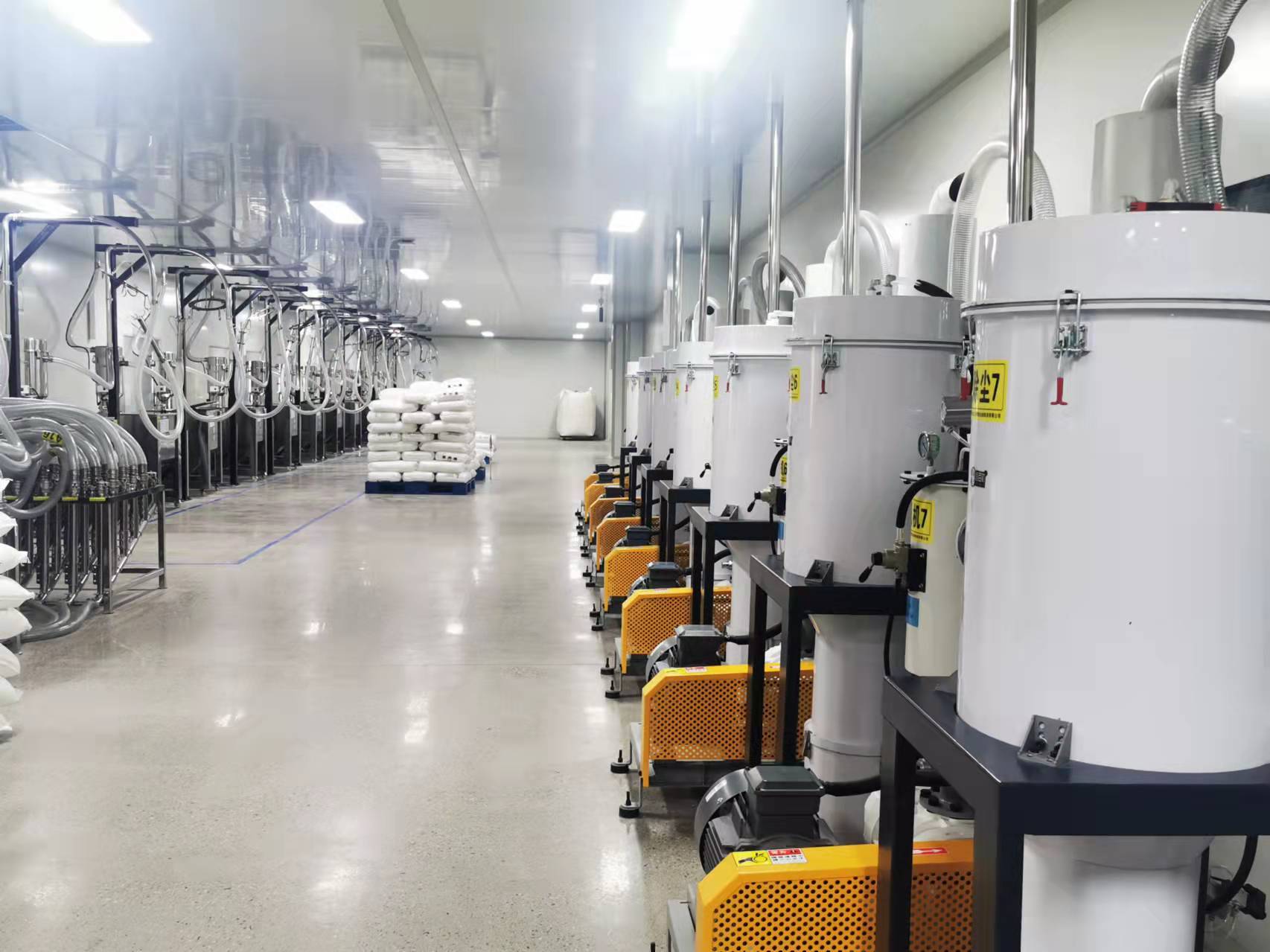
The strength of a value chain is never determined by any single link in isolation, but by how effectively each link meshes with the next. Injection molding sits between chemical raw materials and end-product manufacturing — upstream, it absorbs constraints imposed by resin, tooling, and equipment; downstream, it serves highly differentiated application sectors spanning automotive, home appliances, medical devices, and packaging. To understand the competitive logic of the injection molding industry, one must first map every chokepoint along this chain: which have been cleared, which remain binding, and which are being pushed through at speed.
5.1 Upstream I — Plastic Resin: Commodity Grades Self-Sufficient, Engineering Grades Diverging
5.1.1 The Role of the Five Commodity Plastics in Injection Molding
Plastic resin is the fundamental raw material for injection molding, typically accounting for 60–80% of a molder's production cost (industry estimate). Among the resin types consumed in injection molding, polystyrene, polyethylene, and polypropylene together account for roughly 70% of total resin usage; the four major types (including ABS) together exceed 80%. The five commodity plastics form the material foundation of injection molding operations.
PP (polypropylene) is the single largest resin consumed in injection molding. Various institutional estimates place PP's share of the global injection molding plastics sub-market at approximately 23–35%. Its low price, broad scope for compounding modifications, and wide application range — from automotive bumpers and washing-machine tubs to takeout containers and industrial crates — make it the highest-volume raw material purchased by Chinese injection molders.
PE (polyethylene), led by injection-grade HDPE, is used primarily in mid-to-low-end applications such as housewares, bottle caps, pipe fittings, and toys, and ranks second only to PP in injection molding consumption. ABS, with its excellent overall mechanical properties and surface gloss, has long dominated appliance housings, automotive instrument panels, and 3C enclosures. PVC is used in more limited volumes in injection molding, mainly for pipe fittings and construction components; PS is predominantly used in disposable tableware and foam packaging, and is gradually being displaced by PP in injection molding applications.
Engineering plastics PC, PA (nylon), and POM (polyoxymethylene) concentrate on high-performance applications: PC is used for automotive lamp covers, optical lenses, and medical device housings; PA66 serves automotive engine peripherals and industrial gears; POM, known for its self-lubricating properties and high rigidity, is the preferred metal-replacement material in precision gears, door locks, and medical equipment.
5.1.2 PP and ABS: From Net Importer to Net Exporter, but with Persistent Overcapacity
Localization of commodity plastics has cleared the most critical threshold. Taking PP as an example: domestic PP capacity reached 51.36 million tonnes in 2024, up 11.7% year-on-year; output was approximately 37.92 million tonnes; imports fell to 3.67 million tonnes; and exports surged to 2.41 million tonnes, leaving an import dependency ratio of just 3.2% — China has transitioned from a net importer to a net exporter of polypropylene. Behind this shift lie the private mega-refining projects of companies like Zhejiang Petrochemical and Hengli Petrochemical, which crack crude oil directly into olefins, creating a fully integrated chain from petroleum to resin pellets. The combined PP/PE market share of private mega-refiners has risen from approximately 27% in 2022 to approximately 34% in 2025, while traditional state-owned enterprises' shares have continued to contract.
Yet overcapacity brings its own pressure. The capacity utilization rate for PP in 2024 was only approximately 74%, and oil-based production lines posted cumulative losses for three consecutive years — from 2022 through the first half of 2024, after-tax gross margins for oil-based PP lines averaged more than RMB 1,000/tonne in the red. The mismatch between expansion momentum and demand growth has kept PP prices at persistently low levels, transmitting cost pressure downstream to injection molding, creating a chain reaction of "lower resin prices → thinner processing margins → intensified competition." For injection molders, this is a double-edged sword: while raw material costs fall, OEMs and tooling suppliers also use the lower-cost window to push prices down, further compressing processing fees.
On the PE side, domestic capacity reached approximately 35 million tonnes in 2024, but import dependency for high-end specialty grades (metallocene PE, high-end HDPE, etc.) remains elevated — imports were approximately 12.09 million tonnes in 2024 — and domestic substitution for high-end injection-grade HDPE grades is still a work in progress.
ABS self-sufficiency rose to 86.2% in 2023, with imports falling below 1.08 million tonnes for the first time, and the balance shifting to net exports; capacity is projected to break through 10 million tonnes in Q2 2025. Capacity utilization is equally concerning — only approximately 61% in 2024, compared with 93% in 2020. The production landscape features a mix of Sino-Korean and Sino-Taiwanese joint-venture capacity (LG Chem, Chi Mei, etc.) alongside domestic brands; continuous capacity competition has pushed the entire ABS market into a low-margin zone. ABS prices peaked at over RMB 14,000/tonne in 2022, then fell sharply as capacity flooded in, though a single-week spike of over 40% occurred in early 2026 due to external factors — reflecting the fragility of the supply-demand balance for this grade.
5.1.3 PC: World's Largest Capacity, Yet Still Bottlenecked at the High End
PC (polycarbonate) is the engineering plastic where China's localization progress has been most pronounced and most illustrative. Domestic PC capacity reached 3.81 million tonnes in 2024, representing approximately 48% of global capacity, with a capacity utilization rate of approximately 84% — an all-time high. Wanhua Chemical holds the top domestic position with 480,000 tonnes of capacity and has announced plans to expand to more than 1.2 million tonnes, alongside integrated phenol-bisphenol A upstream assets, continuously reinforcing its competitive advantage.
Yet being the world's largest producer does not mean full self-sufficiency across all grades. PC import dependency remained at approximately 24.7% in 2024 — with imports of 887,300 tonnes — because commodity-grade PC is already in oversupply, while optical-grade PC (for mobile phone lenses, automotive cameras, AR/VR optics) and medical-grade PC (for blood analyzers and surgical instrument housings) carry very low domestic substitution rates and still depend heavily on overseas suppliers such as Japan's Teijin and Germany's Covestro. Optical-grade PC imposes extremely stringent requirements on light transmittance, birefringence, and stress distribution; domestic grades currently cannot consistently meet these specifications. This is a classic case of "structural bottleneck": the high-volume commodity grades are in oversupply, while the low-volume but high-value premium grades remain supply-chain-constrained.
5.1.4 PA66: Adiponitrile Is the Real Chokepoint
The localization trajectory of PA66 has been nothing short of dramatic. Import dependency fell from approximately 53% in 2020 to approximately 19% in 2024, a decline of more than thirty percentage points. This was driven by the ramp-up and capacity expansion of multiple domestic PA66 production lines — an expansion so vigorous that it has already triggered overcapacity concerns, with cumulative planned and under-construction domestic PA66 capacity now exceeding 8.7 million tonnes.
Yet the true vulnerability in PA66 lies not in polymerization itself, but in the upstream intermediate adiponitrile. Adiponitrile is a key precursor for adipic acid, the primary building block of PA66, and was long monopolized by two Western companies, Invista and Ascend Performance Materials. In 2022, China's adiponitrile imports represented 74% of consumption. As of 2023, combined domestic adiponitrile capacity under construction totaled approximately 830,000 tonnes, marking a clear acceleration in localization, though technical maturity, process stability, and proven scale-up capability still need to be demonstrated. The pace of adiponitrile localization will directly determine whether PA66 can achieve genuine supply-chain security in high-end automotive and industrial applications.
5.1.5 POM: Capacity Doubled, but a 360,000-Tonne Gap Remains
POM (polyoxymethylene) is currently the general-purpose engineering plastic with the most lagging localization progress. Domestic capacity surged from approximately 450,000 tonnes in 2022 to approximately 760,000 tonnes in 2024, an increase of nearly 70% in two years. Yet 2024 imports still stood as high as 396,700 tonnes, with a net import shortfall of approximately 360,000 tonnes; even after projected domestic capacity reaches 980,000 tonnes in 2026, the supply-demand imbalance is unlikely to be fully resolved.
The technical barriers for high-end POM are particularly pronounced. Advanced POM production technology is entirely held by a small number of foreign players — BASF, Celanese, Asahi Kasei, and Polyplastics (a DuPont affiliate). Domestic POM production is concentrated in mid-to-low-end homopolymer grades and lacks consistent quality, making it difficult to meet the stringent dimensional accuracy and friction-coefficient requirements for precision gears, medical equipment, and automotive door locks. The largest domestic producer, Yuntianhua, has 90,000 tonnes of capacity, representing approximately 18% of domestic total. The fragmentation of domestic producers combined with the concentration of foreign technical advantages creates a mutually reinforcing dual constraint.
5.1.6 Specialty Engineering Plastics: Overall Localization Rate Below 30%
Beyond PA66 and POM, higher-performance specialty engineering plastics — PPS (polyphenylene sulfide), PEEK (polyether ether ketone), LCP (liquid crystal polymer), PAI (polyamideimide), and others — are small in volume but irreplaceable in automotive engine-compartment components, electronic connectors, medical precision parts, and aerospace applications. Industry estimates put the overall localization rate of specialty engineering plastics below 30%, placing the category in a rapid-growth phase but on a still-thin base. Among them, PPS has the highest localization rate, with domestic self-sufficiency reaching over 80% — driven by scale-effect demand from new-energy vehicle connectors, which has in turn propelled domestic technology advancement.
5.1.7 Transmission Mechanism of Resin Price Volatility
Crude oil prices are the ultimate anchor for injection molding resin costs, but the transmission path is not linear. Naphtha (cracking feedstock) prices and crude oil prices have shown periodic divergence in recent years; the coal-to-olefin route (coal → methanol → propylene → PP) consistently outperformed the oil-to-olefin route on gross margins throughout 2022–2024. This means injection molders, in their procurement decisions, must track not only crude oil prices but also the naphtha-olefin spread and the cost curve of coal-chemical routes.
The time-lag effect of price transmission is equally significant. Changes in crude oil prices typically take 4–8 weeks to flow through to resin ex-factory prices, and are further distorted by upstream plant maintenance shutdowns, downstream destocking cycles, and restocking rhythms. For small and mid-sized injection molders for which raw materials represent 60–80% of costs, the penetration effect of these price swings is far larger than for large integrated enterprises, making it one of the core variables constraining the earnings stability of smaller players.
This non-linearity in price transmission also partially explains the deeper reason why injection molding industry profits are so volatile: midstream molders can neither pass through short-term raw material price increases to downstream customers (who typically lock prices on a quarterly or semi-annual basis), nor influence the structure of upstream petrochemicals. The only controllable lever is to widen pricing power through compounding R&D, process optimization, or sub-segment specialization. This constraint is especially pronounced in the current market, where resin overcapacity and injection molding processing overcapacity reinforce each other.
5.2 Upstream II — Injection Molding Machines: The Anvil of Midstream Processing
Injection molding machines are the most significant fixed-asset investment in the midstream processing segment. The purchase price of a single machine ranges from hundreds of thousands to several million RMB, and the national fleet of over 1.5 million machines forms the physical backbone of the midstream industry.
In terms of value-chain role, injection molding machine manufacturers sit in the upstream equipment supplier position, in a classic "toolmaker–user" relationship with injection molders: equipment manufacturers determine the ceiling of the injection molding process (precision, speed, control accuracy), while injection molders optimize their process windows within the constraints of their installed equipment. All-electric injection molding machines consume 30–70% less energy than hydraulic machines and offer higher precision; in high-end segments such as medical, 3C, and precision automotive parts, they have become the de facto standard. Hydraulic and hybrid machines, however, still dominate mid-to-low-end, high-volume molding applications.
China's injection molding machine output accounts for approximately two-thirds of global production, and domestic equipment now covers the full clamping-force range from a few tonnes to several thousand tonnes. The rise of domestic equipment has significantly reduced procurement costs for midstream injection molders compared with a decade ago, lowering entry barriers — but simultaneously intensifying the excessive fragmentation of low-end capacity. A detailed analysis of the injection molding machine competitive landscape and key companies is provided in Chapter VI.
5.3 Upstream III — Molds and Tooling: Volume Advantage, Lacking High-End Barriers
5.3.1 Scale and Structure of China's Mold Market
Tooling is the physical medium of injection molding; the ceiling of injection molding process quality is largely determined by mold precision. China's mold market was valued at approximately RMB 358.9 billion in 2023, with injection molds accounting for approximately 45% of all mold categories — the largest single segment. Market size is projected to reach approximately RMB 380 billion in 2025.
From a trade structure perspective, China's mold industry has a pronounced export-volume advantage. Mold exports in 2023 were approximately USD 8 billion, with imports of approximately USD 1 billion, yielding a trade surplus of approximately USD 7 billion; in 2024, the surplus expanded further to approximately USD 7.667 billion. China ranks first globally in mold export volume, with destinations covering Southeast Asia, Europe, and North America. However, volume leadership does not equate to quality leadership — exports are predominantly mid-to-low-end; high-end precision molds are still import-dependent. In 2024, imports of precision molds amounted to approximately USD 711 million, and while this declined year-on-year, the reliance on imports has not been substantively eliminated.
5.3.2 Mold Steel: Approximately One-Quarter of High-End Demand Relies on Imports
The performance ceiling of a mold is largely determined by its steel. Approximately 25% of the mold steel required for mid-to-high-grade domestic molds is imported, mainly from Germany (thyssenkrupp), Sweden (ASSAB), and Japan (Daido, Hitachi), with ASSAB of Sweden holding the largest share of the domestic high-end mold steel market. Approximately 70,000–80,000 tonnes of mold steel were imported in 2023, with 22 import-distribution steel companies actively operating in China.
Domestic mold steel, represented by Baosteel and WISCO, is competitive in the mid-to-low-end range; Jiangsu Tiangong Aihekete has achieved a partial breakthrough in high-toughness die-casting tool steel. However, overall, high-end precision injection molds (tolerance requirements at ±0.01 mm, service life requirements exceeding one million shots) still predominantly use imported steel. This supply-chain weakness constitutes a persistent cost and lead-time pressure for automotive and 3C precision toolmakers seeking high accuracy and long service life.
5.3.3 Hot Runners: Import-Dominant, Domestic Brands Filling the Mid-to-Low End
Hot runner systems are core accessories for precision injection molding and multi-cavity molds, directly affecting gate quality, runner balance, and molding efficiency. The global hot runner market is dominated by brands from Europe, the Americas, and Asia, including Husky, Mold-Masters, YUDO, Synventive, and HRSflow, all of which have established localized manufacturing or service centers in China.
Domestic hot runner brands currently compete mainly in mid-to-low-end applications, where they offer price competitiveness for standard multi-cavity molds and simple direct-gate applications. However, high-end applications — such as balanced multi-cavity hot runners, valve gate sequencing, and needle valve gates for thin-wall high-gloss parts — remain almost exclusively held by imported brands. Hot runner systems add approximately 20–30% to overall mold cost, but deliver significant benefits in product appearance quality and runner scrap reduction, making them near-standard in high-end automotive interior/exterior parts and consumer electronics.
5.3.4 How Tooling Development Costs Constrain Small and Mid-Sized Injection Molders
For small and mid-sized injection molding enterprises, tooling is a hard constraint on iteration capability. Developing a mold of moderate complexity typically costs between RMB 50,000 and RMB 500,000, while precision large-format molds can reach several million RMB; lead times range from weeks to months, and it is not uncommon for a mid-complexity mobile phone shell mold to require more than 100 cumulative machining hours and 20–30 process steps. Within the cost structure of a mold, materials account for approximately 15–30%, machining and margin approximately 30%, and design fees approximately 15–20%; adding a hot runner system increases the total mold cost by a further 20–30%.
This high-upfront-investment profile creates several structural effects. First, small and mid-sized injection molders are often reluctant to take on small-batch prototyping orders, because tooling amortization costs are prohibitively high. Second, the frequency with which customers change products and tools directly raises overall costs, making automotive and appliance customers — who have longer product-iteration cycles — prefer Tier-1 suppliers capable of in-house tooling. Third, mold ownership typically rests with the brand owner, leaving injection molders with limited bargaining power and a passive position when customers relocate production.
The tooling industry also exhibits pronounced regional clustering. The Pearl River Delta (Shenzhen, Dongguan, Zhongshan in Guangdong), the Yangtze River Delta (Ningbo and Suzhou in Zhejiang), and the Bohai Rim (Tianjin, Liaoning) are the three major clusters, with Chengdu-Chongqing and Central China (Hubei, Hunan) as secondary centers. Clustering brings the advantage of being able to source mold steel, carry out precision machining, heat treatment, and hot runner installation all within a ten-kilometer radius, dramatically compressing lead times. The downside is that homogeneous competition drives tooling processing prices continuously lower, squeezing margins year after year. The high fragmentation across tens of thousands of toolmakers has to some extent reduced procurement barriers, but the manufacturing capability for precision molds remains concentrated in a small number of specialist shops with high-precision equipment and accumulated process know-how; the survival space for small toolmakers is narrowing year by year.
5.4 Midstream — Overview of Injection Molding Enterprises: Highly Fragmented, Regionally Clustered
Injection molding is the core midstream segment of this report's value-chain analysis. In terms of scale structure: there were approximately 21,800 above-scale plastics products companies in 2023 (those with primary business revenue ≥ RMB 20 million), with combined output of approximately 74.885 million tonnes; the total number of registered entities involved in plastics products is estimated at approximately 5 million, the vast majority of which are micro-scale operations. The entry barrier for injection molding is low enough — one machine, one mold, and a few operators are sufficient to start basic production — but winning a place in the supply chains of high-end customers requires precision equipment, process control, certification credentials, and sustained R&D investment all at once. This tension between low entry barriers and high customer barriers is the structural root cause of why the midstream is extremely fragmented, yet simultaneously unable to produce a true industry giant.
From a profitability standpoint, midstream pressures have continued to intensify. In 2024, revenue growth for above-scale plastics products companies was approximately 4.5%, while profit growth was only approximately 0.7%; the aggregate losses of loss-making enterprises increased 15.5% year-on-year — the revenue growth outpacing profit growth pattern persists. Persistently elevated upstream resin and tooling costs, extended accounts receivable terms from downstream customers, rising labor costs, and increasingly stringent environmental compliance requirements, all piling on simultaneously, make the midstream the thinnest-margin link in the entire value chain.
The regional clustering of midstream enterprises is pronounced: the Pearl River Delta (Dongguan, Shenzhen, Foshan in Guangdong) specializes in precision injection molding and 3C parts; the Yangtze River Delta (Ningbo and Taizhou in Zhejiang; Suzhou in Jiangsu) is driven by automotive and tooling; the Bohai Rim (Tianjin, Shenyang in Liaoning) handles some automotive and industrial injection molding. This clustering creates the density advantage of regional supply chains, but also produces intense intra-regional homogeneous competition.
The mechanisms behind the fragmentation of the midstream, the capability stratification between Tier-1 suppliers and smaller shops, and the competitive strategies of representative processing companies, will be examined in depth in Chapter VII.
5.5 Downstream — Overview of Application Structure: Chinese Characteristics alongside Global Differences
5.5.1 Distribution by China Equipment Statistics
Analyzing the downstream flows of injection molding output requires distinguishing between statistical frameworks. Using the China Plastics Machinery Industry Yearbook as a baseline (approximately the 2017 edition, cited in multiple 2023–2024 industry reports), the downstream application distribution of injection molding machines in China is approximately: commodity plastics (including housewares and logistics containers) approximately 28%, automotive approximately 26%, home appliances approximately 25%, packaging-specific injection molding approximately 12%, and medical devices, 3C precision, and other fields approximately 9%.
It should be noted that the above data reflect a historical yearbook framework, capturing equipment procurement flows at that time — not current output value contributions. Since 2017, the rapid penetration of new-energy vehicles (NEV penetration reached 40.94% in 2024) has driven continued growth in demand for automotive injection-molded parts; medical injection molding has accelerated its differentiation from the "other" category, with China's medical injection molding market reaching approximately RMB 45 billion in 2023 at a CAGR of approximately 10%; and 3C precision injection molding recovered significantly in 2024 following a downturn in the consumer electronics cycle. The actual current downstream mix has therefore shifted from the yearbook figures — the automotive and medical segments are in all probability weighted higher, while commodity plastics may have contracted somewhat.
The downstream distribution for all-electric injection molding machines differs somewhat, with home appliances leading at approximately 23%, reflecting the pattern of premium equipment concentrating in applications with the highest precision and cleanliness requirements.
5.5.2 Differences under the Global Finished-Product Framework
When observed from the perspective of global injection-molded products (finished output value), the structure looks quite different. According to estimates from Grand View Research, Fortune Business Insights, and similar firms, packaging is the largest downstream segment globally, accounting for approximately 30%, with food and beverage packaging accounting for more than 25% of global injection-molded products. Consumer goods/housewares (including home appliances) account for approximately 15–20%, automotive approximately 25–30%, and medical approximately 7–10%.
This structural divergence between China and global markets has a clear industrial logic: in China, a large proportion of packaging uses blown film and extrusion processes, reducing the penetration of injection molding in packaging below the global average; while China's role in global manufacturing skews heavily toward automotive components and appliance housing production, elevating the injection-molding share of those two categories. This means that interpreting China's injection molding industry through the globally dominant packaging lens would produce a significant misread.
5.5.3 Strategic Implications of the Application Structure
From a value-chain positioning standpoint, the value attributes of different downstream segments vary enormously. Commodity plastic parts (housewares, returnable containers) compete on volume with thin margins; the same is true of packaging, which also faces policy pressure from biodegradable material mandates. Automotive injection-molded parts create long-term customer stickiness through co-development and materials qualification barriers; medical injection-molded parts command gross margins that are typically 10–15 percentage points above general injection molding, with cleanroom certification and ISO 13485 as the admission tickets; 3C precision injection molding is significantly affected by consumer electronics cycle fluctuations, though a confirmed position in the supply chain of a leading brand creates comparably high switching barriers.
Quantitative sizing of each sub-market, analysis of barrier structures, and competitive landscape of representative companies will be examined one by one in Chapter VIII. What this chapter presents is a full view of the downstream application distribution at the end of the value chain — understanding this overview is a non-negotiable baseline before entering the next layer of analysis.
Chapter 6 Competitive Landscape and Key Companies in China's Injection Molding Machine Industry
On the surface, the injection molding machine business looks like a contest of machine specifications; in substance, it is a battle over cost structures and supply-chain coordination across an entire value chain. In roughly twenty years, China's injection molding machine industry went from import substitution to export dominance, and the competitive landscape has been restructured in parallel: foreign brands retreated from market protagonists to high-end enclaves, while domestic enterprises differentiated into a tiered structure of "one dominant player, multiple strong contenders." Understanding how this landscape formed and why it has remained stable is the prerequisite for reading the industry's future direction.
6.1 Competitive Landscape Overview: From Foreign Dominance to Domestic Leadership
Rewinding twenty years, China's injection molding machine market looked very different. Industry sources indicate that domestic plastic machinery held approximately 47% of the home market around 2006, with foreign brands and joint-venture models still commanding nearly half, particularly at the mid-to-large, precision, and all-electric ends of the spectrum where there were almost no domestic alternatives. In recent years, that ratio has reversed — domestic injection molding machines now hold approximately 81% or more of the Chinese market, with local brands firmly in command. Meanwhile, foreign brands' Chinese market share has continued to shrink: of the two leading European makers, Austria's ENGEL holds approximately 6–7% and Germany's KraussMaffei approximately 3–4%, together totaling less than 10%. What foreign brands have retreated to is the narrow high-end segment where barriers — precision, large-format, all-electric — are the thickest.
Behind this share curve lies a textbook "bottom-up" substitution. Domestic substitution did not attack the high end head-on; it first consolidated in general-purpose injection molding, small-to-mid-tonnage machines, and price-sensitive customer segments, using cost and delivery advantages to crowd out foreign brands in the mid-to-low end, then reinvested the accumulated cash flows and engineering capabilities into climbing the value ladder, one step at a time. This trajectory has given today's competitive landscape two distinctive features.
The first is a domestic "one dominant player, multiple strong contenders" structure. Haitian International holds an unchallenged first position, with domestic market share exceeding 30% under various measurement frameworks and reaching 40% under some; Yizumi at approximately 4.8% and Chen Hsong at approximately 4.7% rank second and third; the remaining share is scattered among hundreds of large and small manufacturers in a highly fragmented tail. In short, China's injection molding machine market is a structure of "extremely strong head, thin middle, long tail" — with a gap of several times, approaching tenfold, in scale between the leading company and the second tier.
The second is high fragmentation when viewed globally. The top five global injection molding machine manufacturers collectively account for approximately 20% of the market (approximately 22% by GMInsights' calculation), a relatively low concentration ratio. It should be noted that another figure of "top five globally approximately 53%" circulates in the industry (as cited by Huajing Intelligence), but because it uses a different scope of manufacturers and methodology, it diverges significantly from the first figure; this report treats "highly fragmented, top five approximately 20%" as the primary framing. This global fragmentation, juxtaposed with domestic concentration, creates an interesting contrast: in China — the world's largest producer and consumer of injection molding machines — a super-champion like Haitian emerged that dwarfs its peers by volume, while globally the German, Japanese, and Chinese triads each have their own strengths with none achieving absolute dominance. China's high domestic concentration is precisely the result of "survivor takes all" following thorough competitive consolidation under import substitution.
Why did "one dominant, multiple strong" form, rather than several players standing equal? The answer lies in the cost structure of the injection molding machine business. An injection molding machine is a product of moderate standardization, moderate unit value, and high dependence on supply-chain density and manufacturing scale. When an OEM's annual shipments cross from a few thousand units to tens of thousands, its purchasing leverage over servo systems, ball screws, castings, platens, and other key components, its fixed-cost dilution per machine, and its service-network coverage density all compound into a snowball advantage. Once scale diverges, it is very difficult for a follower to close the cost gap through technology breakthroughs alone. This is the underlying logic behind Haitian's ability to continuously widen its lead — its moat is not any particular patent, but scale itself.
So why has no such super-champion emerged globally? The key lies in the geographic structure of demand and supporting industries. Injection molding machines are equipment characterized by "heavy service requirements and proximity dependence": customers need fast installation and commissioning, spare-parts availability, and process support, and OEMs have a natural service radius. Germany and Japan are mature markets with limited incremental demand; domestic leaders' scale is capped by national market ceilings. China, by contrast, is not only the world's largest injection molding machine consumption market, but also commands the most complete industrial ecosystem from resin and tooling through to downstream processing within a single country — a single national market large enough to sustain a giant shipping tens of thousands of units annually. In other words, Haitian's scale did not materialize from thin air; it was cultivated by the combination of China's mega-scale manufacturing demand and the world's densest supply chain — conditions that German and Japanese peers simply do not have. The global fragmentation and China's concentration are two sides of the same coin.
6.2 Regional Distribution: Ningbo Dominant, Shunde Catching Up
The geographic distribution of China's injection molding machine production capacity exhibits extremely strong cluster characteristics, concentrated in two city clusters.
The first pole is Ningbo, Zhejiang. According to plastics machinery industry sources, approximately 70% of national injection molding machine output originates in Ningbo and its surroundings, earning the title "Capital of China's Plastic Machinery." The Ningbo cluster centers on Haitian International (headquartered in Yuyao), with a range of domestic and locally established foreign enterprises nearby, including Ningbo Shuangma (Berlyn), Huameida, Nissei Machinery, and Demag Plastics Machinery (Ningbo). Ningbo's advantage is not merely in the number of OEMs but in supply-chain density — servo motors, ball screws, platen castings, mold steel, hot runners, and even molds can all be sourced locally within a three-hour drive across the Yangtze River Delta. This procurement radius is the true source of Ningbo's cost competitiveness and is difficult for latecomers to replicate in the short term.
The second pole is Shunde and Guangzhou in Guangdong. This cluster is rising rapidly and has the potential to form a dual-center structure with Ningbo. Yizumi's headquarters and main production base are in Shunde (Gaoli, Wusha); Borche (BORCHE) is located in Zengcheng, Guangzhou; Haitian International has also established a South China Phase 1 plant in Shunde to serve the Pearl River Delta's large client base in home appliances, 3C, and automotive components. The dense downstream manufacturing industry in the Pearl River Delta provides local injection molding machine makers with a natural demand hinterland and rapid application-iteration scenarios. Compared with Ningbo's depth of Yangtze River Delta supply-chain integration, the Shunde cluster is characterized by "following the downstream" — shorter physical distances between OEMs and end injection molders, faster response.
Jiangsu (such as Yizumi's Suzhou Wujiang base) and Shenzhen, Guangdong (some precision and medical injection molding machine companies) also have scattered presence, but have not yet formed complete clusters comparable to Ningbo or Shunde. Overall, the map of China's injection molding machine manufacturing is "one primary, one secondary, Yangtze and Pearl in parallel," and this configuration is highly coupled with the geographic distribution of downstream applications and upstream supply chains; no major relocation is likely in the near term.
It is worth noting that these two clusters are not simply competing on homogeneous products, but have quietly developed a division of labor. Ningbo, backed by the depth of Yangtze River Delta component supply chains, has stronger advantages in cost control and large-scale manufacturing of general-purpose machines — more of a "capacity capital." Shunde and Guangzhou, pressed up against the Pearl River Delta's home appliance, 3C, and new-energy vehicle downstream markets, are more flexible in rapid response, customization, and new model prototyping — more of an "application frontier." A machine going from design to mass production typically requires iterative collaboration among the OEM, component suppliers, and end injection molders, and the true value of a cluster lies precisely in compressing the physical distance of that collaboration to a minimum. This also explains why the injection molding machine manufacturing map is so adhesively tied to established clusters — what relocates is not a single factory, but an entire cooperative network of supply and service.
6.3 In-Depth Analysis of Key Companies
6.3.1 Haitian International (1882.HK): Scale Is the Moat
Haitian International is the indispensable case study for understanding China's injection molding machine competitive landscape. Per its 2024 annual report, the company generated full-year revenue of RMB 16.128 billion, up 23.4% year-on-year; net profit attributable to shareholders was RMB 3.080 billion, up 23.6%; and gross profit remained at a high level of approximately RMB 5.236 billion. Even more telling are the shipment numbers — over 53,000 units shipped for the full year, up 35.5% year-on-year. Industry estimates put Haitian's 2023 global injection molding machine shipment share at approximately 19.3%, firmly the world's top shipper by volume. This means that for roughly every five injection molding machines sold globally, nearly one comes from Haitian.
Haitian's competitiveness can be summarized in two words: cost and scale. It covers a full range of hydraulic, two-platen, and all-electric (Mars series, etc.) machine types, but what truly sets it apart is not leadership in any single technology direction, but rather compressing the cost curve of "general-purpose injection molding machines" — a standardized business — to the lowest level globally. Annual shipments of tens of thousands of units dilute the fixed costs of R&D and manufacturing; the two main bases in Ningbo and Shunde draw on China's densest component supply networks, leaving virtually no competitor able to match its pricing head-on in the mid-to-low-end market. This self-reinforcing flywheel of "volume dilutes cost, cost supports volume" is the essence of its moat.
In recent years, Haitian's strategic focus has clearly shifted toward overseas markets. Overseas revenue in 2024 was RMB 6.016 billion, representing approximately 37% of total revenue, and the company has explicitly announced a "55 strategy" — targeting a 50/50 split between domestic and international sales. To support this objective, Haitian has pushed ahead aggressively with global capacity deployment: the Mexico Phase 1 plant opened in mid-2023 to serve the North American market and circumvent tariffs; the India Phase 2 plant was completed in 2024; the Serbia plant broke ground in 2023 with an investment of approximately EUR 100 million, a planned capacity of 160 units, and an expected commissioning in 2025 as the hub for European coverage; and a Japan plant is also in planning. Haitian's overseas expansion logic is essentially to extend the cost advantages already established domestically through localized manufacturing beyond tariff walls, while gaining stronger pricing power in overseas markets. This is a company that has finished its domestic conquest and is now making its bid for global leadership.
6.3.2 Yizumi (300415): Injection Molding as Foundation, Die-Casting as Wings
Yizumi is the leader of the domestic second tier, positioned at the mid-to-high end. Per its 2024 annual report, the company generated full-year revenue of RMB 5.063 billion, up 27.4% year-on-year; injection molding machine revenue was RMB 3.555 billion, representing approximately 70.2% of total revenue, the unambiguous core business. Unlike Haitian's pure focus on injection molding, Yizumi pursues a "diversified forming equipment" strategy — in addition to injection molding machines, it operates die-casting machines (approximately RMB 893 million in 2024) and rubber machinery, forming a mutually reinforcing product matrix.
Yizumi's most notable angle is its positioning in integrated die-casting (gigacasting). As NEVs shift large vehicle structural parts from "multi-piece welding" to "single-shot die casting," ultra-large die-casting machines have become a high-momentum new growth curve; Yizumi leveraged its existing forming equipment technology base to enter this space, creating a second growth engine. On the overseas front, Yizumi's Thailand and Mexico subsidiaries opened in 2024, its U.S. HPM plant expansion was completed, its business now covers over 90 countries, and it has set a 2030 target of equal domestic and international revenue. In essence, Yizumi is pursuing a "dual-product (injection + die-casting), dual-market (domestic + overseas)" strategy, which differs in approach from Haitian's "single-product-category globalization."
6.3.3 Chen Hsong (0057.HK): A Hong Kong Legacy Brand, Third-Tier Leader
Chen Hsong is a veteran of the Chinese injection molding machine industry, founded in 1958 by Jiang Zhen, with a Hong Kong background. Industry sources indicate a domestic market share of approximately 4.7%, running neck-and-neck with Yizumi for second and third place, positioned as the third-tier leader; annual production capacity exceeds 20,000 units, covering a full range of precision injection molding machines across a wide clamping-force span, serving over 80 countries globally, with downstream concentration in automotive, medical, 3C electronics, toys, and packaging.
It should be noted that Chen Hsong uses a non-calendar fiscal year ending in September, which causes its revenue figures to conflict across different reports; this report therefore refrains from stating a fixed revenue figure and instead describes it qualitatively as "third-tier leader, annual capacity over 20,000 units." Chen Hsong's distinguishing characteristics are its deep precision injection molding heritage and the global service network it built relatively early — as a company approaching seventy years old, it carries first-mover advantages in brand trust and overseas channels, but in terms of the aggressiveness of scale expansion, it has already fallen behind Haitian and Yizumi, the rising mainland private enterprises. This reflects a broader trend: the competitive initiative in the injection molding machine industry is shifting from established Hong Kong capital to more aggressive mainland leaders.
6.3.4 L.K. Technology (0558.HK): Die-Casting Primary, Injection Molding Secondary
L.K. Technology is a composite enterprise where die-casting is the primary business and injection molding is complementary, using a fiscal year running from April to the following March. Per its 2024/25 fiscal year report, full-year revenue was HKD 5.825 billion, with die-casting machines accounting for approximately 60%-plus as the dominant business; injection molding machine revenue was approximately HKD 1.758 billion, up 23.3% year-on-year, representing approximately 30% of total revenue; the balance includes CNC machining centers and other businesses.
L.K. Technology's special position in the industry landscape derives from its leadership in ultra-large-format integrated die-casting machines. In the NEV integrated die-casting wave, 6,000-tonne to 9,000-tonne ultra-large die-casting machines have become scarce equipment, and L.K. is one of the primary suppliers in this segment, having established cooperation with multiple NEV manufacturers. Its injection molding machine business primarily serves consumer goods and automotive lightweighting; in the 2024/25 fiscal year, it achieved relatively strong growth in consumer goods, home appliances, packaging, and toys downstream. It should be clarified that integrated die-casting and injection molding are complementary, not substitutable processes — die-casting addresses large metallic structural components of the vehicle body, while injection molding still dominates interior and exterior plastic parts; L.K. Technology straddles both processes and has benefited from the dual dividends of the transformation in automotive manufacturing processes.
6.3.5 Borche (Unlisted): Specialist in Two-Platen and All-Electric Machines
Borche Intelligent Equipment (BORCHE) deserves individual attention. Founded in 2002 and headquartered in Zengcheng, Guangzhou, it is an unlisted private enterprise specializing in two-platen injection molding machines and all-electric injection molding machines — the two machine types that best demonstrate technical depth. It is essential to clarify that "Borche Technology" (A-share code 300548), whose primary business has shifted to optical communications, is an entirely separate entity from this injection molding machine company; the two must not be confused.
Borche's key attribute is "punching above its weight" technically. At a 2024 industry exhibition, it showcased what it described as China's first large-format two-platen electric injection molding machine, combining the high precision and low energy consumption of all-electric with the large clamping force and long mold-opening stroke of two-platen, directly targeting the high-end segment previously held by European brands; its thin-wall packaging direct-drive electric machine also achieved a notable level of repeatability. Borche may not be publicly listed or as large as the frontrunners, but it represents a cohort of domestic injection molding machine makers pursuing the high end through technical differentiation. In a midrange market that has long since become a red ocean, this approach of "competing on technology rather than competing on scale" is an important paradigm for mid-tier enterprises to break through.
6.3.6 Tederic (603289): Revenue Growth Without Profit Growth — the Dilemma of Locking in a Key Account
Tederic is a listed injection molding machine company positioned at the mid-to-high end, with products focused primarily on automotive interior and exterior parts. Per its 2024 annual report, full-year revenue was RMB 1.148 billion, up 14.6% year-on-year, but net profit attributable to shareholders declined slightly year-on-year — a textbook case of revenue growth outpacing profit growth. This phenomenon is closely tied to its key-account strategy: Tederic has established a strategic partnership with BYD and was awarded a contract for 180 units of equipment (including large two-platen and electric machines).
Locking in a leading NEV automaker undeniably delivers stable revenue growth and brand validation, but the strong bargaining power of a major customer also compresses profit margins — this is the root cause of Tederic's revenue growth without corresponding profit growth. This case is highly representative: in the high-growth NEV track, injection molding machine manufacturers are eager to lock in a super-customer like BYD for confirmed orders, yet must simultaneously concede a significant share of their margins. How to balance "scaling up alongside a major customer" with "preserving a reasonable profit margin" is a challenge faced universally by mid-tier injection molding machine companies.
Viewing these six companies side by side, a clear tier-based division of labor emerges. Haitian occupies the summit with its pure injection molding focus and extreme scale advantages, its moat being cost; Yizumi with dual injection-plus-die-casting businesses, Borche with its two-platen electric specialization, and L.K. Technology anchored in ultra-large die-casting each carve out positions through product mix, technology route, and new process, respectively, avoiding direct price competition with Haitian; Chen Hsong defends its third-tier position through legacy precision expertise and overseas channels, while Tederic leverages its NEV major-customer binding to build volume. They do not engage in a purely zero-sum competition; they more resemble occupants of distinct ecological niches within the same industry web — which is precisely the micro-level foundation that keeps the "one dominant, multiple strong" structure stable: the leader seals off the low end through scale, the middle tier breaks into niches through differentiation, and neither can easily upend the other.
6.4 Domestic Substitution Climb: Mid-to-Low End Cleared, High-End Assault Ongoing
Viewing the above companies together, China's injection molding machine domestic substitution story shows a clear "layered completion" picture.
In the mid-to-low-end market, substitution has essentially concluded. In general-purpose injection molding and small-to-mid-tonnage machines, domestic market share has long surpassed 80%; import volumes and values have continued to shrink; and foreign brands have virtually exited the price-sensitive mass market. The outcome in this segment is no longer in doubt, and the competitive focus has shifted to consolidation among domestic brands.
The real offensive battle is concentrated in three high-end directions: all-electric, ultra-large, and precision. These three are also exactly where foreign brands have made their last stand. Looking at company strategies, domestic leaders are attacking from different angles — Haitian uses full-range coverage plus scale economics, gradually entering all-electric with the Mars series and similar machines; L.K. Technology and Yizumi leverage their ultra-large-format die-casting experience to extend into ultra-high-tonnage injection molding; Borche directly targets the European high end with its differentiated two-platen electric machines; Tederic, Chen Hsong, and others steadily advance in precision and large-format machines through new product iterations. Their common thread is no longer being content with "making cheap machines," but using the cash flows and engineering capabilities built up domestically to charge at higher-margin, higher-barrier segments.
The single most powerful indicator of progress in this climb is the narrowing of the gap between average import and export unit prices. According to customs and industry association data, the gap between average import and export unit prices for Chinese injection molding machines was approximately USD 78,200 per unit in the first half of 2023; by the first half of 2024, it had narrowed to approximately USD 36,300 per unit, a contraction of USD 41,900. The high average import price reflects that imports consist mainly of high-end precision machines that domestic alternatives have not yet replaced; the low average export price reflects that exports are still predominantly mid-to-low-end. The rapid closing of this gap indicates, on one hand, that the value content of domestic export machines is rising (as leading OEMs set up overseas factories and move products toward the mid-to-high end), and on the other hand, that domestic substitution of high-end imports is occurring and their "irreplaceability" is declining. This narrowing curve is the most direct and hardest-to-fake empirical evidence of domestic high-end advancement.
That said, narrowing the unit price gap does not mean the high-end assault is complete. In all-electric injection molding machines — the sub-segment that most reveals technical depth — the global top five remain Sumitomo, FANUC, Nissei, Arburg, and similar Japanese and European makers; domestic penetration rates and product precision are still in the catching-up phase. In other words, domestic substitution has completed the "quantity" substitution and is now entering the "quality" assault, and the latter path is far steeper than the former — it demands not cost and supply-chain advantages, but the hard work of materials science, control algorithms, and process databases that take years, if not decades, to accumulate.
6.5 Foreign Brands in China: Market Share Shrinking, Barriers Still Intact
The situation of foreign brands in China's injection molding machine market can be characterized as "retreating step by step, yet holding the ground they still occupy."
From a share perspective, the foreign tide going out is beyond dispute. The combined European duo of ENGEL and KraussMaffei totals less than 10%; Japanese makers such as Sumitomo and FANUC are barely visible in the mid-to-low end. The foreign contingent that once dominated China's market through technology and brand premiums has been pushed back into a narrow high-end zone.
But shrinking share does not mean crumbling barriers. Foreign brands continue to hold firm in three bastions:
- Precision injection molding: Medical devices, optical components, and precision connectors require extremely high repeatability, cleanliness, and stability; customer qualification cycles are long and switching costs are high; such orders remain largely in the hands of ENGEL, Sumitomo, and others.
- Large and ultra-large formats: Despite rapid domestic advancement, in certain extreme tonnage and complex-process machine types, foreign engineering experience still provides a timing advantage.
- Premium all-electric segment: FANUC, Sumitomo, and others maintain leadership in high-speed, high-precision all-electric machines through their deep accumulation in servo control and motion algorithms; domestic catching-up still requires time.
Foreign brands' ability to hold the high end depends not on price, but on three layers of barriers: first, technical accumulation — particularly the soft assets of control systems and process databases that require ten or even decades of layering; second, customer stickiness — high-end customers (such as medical and optical) rarely change suppliers once equipment validation is complete, and switching costs form a natural moat; third, brand trust — in applications where precision and reliability permit zero deviation, the reputation that foreign brands have built over many years remains an important factor in purchasing decisions.
Drawing together the logic of this entire chapter: China's injection molding machine competitive landscape is an ongoing "bottom-up" substitution war. Domestic players have won the mid-to-low end and are now assaulting the high end; Haitian reigns on scale; the second tier each pursues its own breakthrough route; foreign brands have retreated to high-end enclaves, their share small but barriers still thick. The next decisive move in this competition will not be won on price or volume, but on the three hard bones of all-electric, precision, and ultra-large-format — whoever can first fill in the "invisible capabilities" of control systems and process databases will be the one to take the substitution story from "volume dominance" to truly "quality high ground."
Chapter 7 Competitive Landscape of the Midstream Injection Molding Segment
If the upstream injection molding machine manufacturing sector has already produced giants like Haitian International and Yizumi — with annual revenues in the tens of billions and global shipment leadership — taking one step further down the value chain presents an entirely different picture. The midstream processing segment that actually puts injection molding machines to work, turning resin pellets into plastic parts, is the most vast, the most fragmented, and the most opaque link in the entire value chain. Millions of factories are concentrated here, yet it is almost impossible to find a single enterprise that can be called a "giant" at the national level. Understanding this contrast is the key to understanding the entire injection molding industry ecosystem.
7.1 An Extremely Fragmented "Long-Tail" Structure
Start with the gap between two numbers. According to Qianzhan Industry Research Institute, the total number of registered enterprises involved in plastics products nationwide reached approximately 5 million as of 2024; yet according to the China Plastics Processing Industry Association, only 21,800 of them met the "above-scale" standard (primary business revenue ≥ RMB 20 million) in 2023, with combined output of 74.885 million tonnes. In other words, above-scale enterprises account for less than five out of every thousand registered entities. This is an extremely steep "long-tail" curve: a small number of publicly listed companies and large contract manufacturers stand at the head; at the tail is an endless stretch of small and micro workshops. The fact that injection molding processing has not produced a true giant is not accidental — it is shaped by four mutually reinforcing structural factors.
The first factor is low technology barriers layered on top of low capital barriers. A general-purpose injection molding machine typically costs less than RMB 1 million; secondhand equipment is cheaper still; add one or two molds and a rented workshop, and basic production can begin. Equipment is purchasable, processes are off-the-shelf, and raw materials are standardized — entry conditions that function as almost no filter at all, and that continuously bring new players into the race. With no need for intensive capital deployment and no meaningful technology gap, the supply side remains perpetually crowded.
The second factor is extreme fragmentation of downstream demand. Injection-molded parts span almost every manufacturing sector — home appliances, automotive, 3C electronics, medical devices, packaging, building materials, toys, and consumer goods — and each sector is further subdivided by specification, material, and batch size. An injection molder making air-conditioner housings and one making medical test tubes use essentially the same category of equipment yet serve entirely different customers, comply with entirely different standards, and have virtually no possibility of horizontal integration with each other. Fragmented demand produces fragmented supply — the market itself is not one unified large market but countless small, non-communicating markets pieced together.
The third factor is the geographic "proximity-to-customer" principle. Injection-molded parts are mostly low unit-value, high-volume products; freight costs represent a non-trivial share of total cost. Trucking a load of plastic housings from the Pearl River Delta to Northeast China could easily consume the already-thin processing fee. This cost structure compels injection molders to locate near clusters of end-product manufacturing, following their customers. As a result, the industry has not concentrated in a few super-factories; instead, a ring of supporting processors has grown up around every major manufacturing hub, producing a situation of "intense competition within each major cluster."
The fourth factor is commodity-product homogeneity. In the general-purpose parts segment, plastic basins, turnover crates, and ordinary housings from different shops look essentially alike; the customer's sole decision criterion is often price alone. Without differentiation, there is no pricing power, and factories can only undercut each other, grinding margins away. Homogeneity offers no room for premiums, supports no brand development, and therefore cannot produce a scale-dominant leader.
These four factors together determine the fundamentals of midstream processing: easy entry, fragmented demand, proximity-based location, and price-driven competition. This is also why, when the equipment side produces a clear "one dominant, multiple strong" pattern, the processing side yields only a long, flat tail.
7.2 Three Tiers: From Precision Contract Manufacturers to the Vast Micro-Segment
Despite the overall high fragmentation, midstream processing is not a homogeneous mass. By capability, scale, and customer structure, it can be roughly divided into three tiers — the higher the tier, the fewer the companies and the higher the barriers; the lower the tier, the more crowded the space.
- The first tier consists of precision contract manufacturers (Tier-1). This tier is largely made up of publicly listed companies or large enterprises that generally possess integrated mold-making and injection molding capability — able to design and produce precision molds in-house, execute high-volume injection molding runs, and hold IATF 16949 (automotive) or ISO 13485 (medical) certifications, serving OEMs, brand owners, or first-tier consumer electronics customers directly. Their core competitiveness lies not in the throughput of individual machines but in co-development capability, process stability, and quality systems — attributes that are precisely those hardest to replicate quickly. Automotive interior and exterior parts, precision electronics structural parts, and premium medical consumables are supplied primarily by this tier.
- The second tier consists of mid-sized contract manufacturers. Annual revenues range from hundreds of millions to tens of billions of RMB; they typically focus on one or a few downstream sectors; their level of automation varies. They handle orders for appliance housings, packaging parts, and standard medical consumables — categories with relatively fixed specifications and large batch sizes — competing on scale efficiency and delivery reliability, but with limited bargaining power against customers, and squeezed from both ends on gross margins.
- The third tier consists of the vast micro-workshop segment. This is by far the largest group by headcount: annual revenues mostly below RMB 10 million, aging equipment, single-process capabilities, highly dependent on a single customer or brokered orders for survival. They produce low-end miscellaneous parts, consumer goods, and generic commodity parts; almost no R&D investment; and they are the most vulnerable when price volatility and environmental enforcement hit.
It is important to note that the three tiers are not sharply demarcated levels but a continuous capability spectrum. A mid-sized contract manufacturer that builds out in-house mold design and quality certification has the opportunity to move up; a precision manufacturer that becomes overly dependent on a single major customer may plummet the moment that order relationship changes. This fluidity is precisely the root cause of the long-term instability of the midstream landscape.
7.3 Leading Companies: "Relative Leaders" in a Fragmented Market
One caveat must be stated first: injection molding processing has no "true dragon-head" in the conventional sense; what passes for "leading" is merely a few islands standing out above the ocean. These companies all occupy the first tier, but even the standouts are a drop in the ocean against the denominator of 5 million enterprises. A look at a few representative companies reveals the landscape — and the vulnerabilities — of this segment.
TK Group (Holdings) (2283.HK) has the most complete layout among them. Founded in Hong Kong in 1983 and listed on the Hong Kong Stock Exchange in 2013, this company positions itself as a "one-stop precision injection molding solutions provider," bundling mold R&D with high-volume injection molding component production, serving smartphones, wearables, commercial communications, smart home, automotive, and medical sectors. Per its 2024 full-year results announcement, full-year revenue was approximately HKD 2.36 billion, up 21.2% year-on-year, with mold-making revenue up 12.7% and injection molding components revenue up 25.2%. Even more notable is its production footprint: in addition to Shenzhen, Suzhou, and Huizhou, it has production facilities in Vietnam and Germany. This dual-track structure of "retaining precision core capabilities domestically while planting outposts close to overseas customers" is a template for how midstream leaders navigate geopolitical and tariff uncertainty; more on the geographic dimension later in this chapter.
Silver Basis (002786) offers a cautionary counterexample. Founded in 1993 and listed in Shenzhen, this company's main businesses are integrated precision injection molding and tooling solutions across three areas — automotive components, communications/consumer electronics, and high-end equipment — with a solid underlying mold technology base. Yet per its 2024 annual report, the company's revenue was approximately RMB 2.221 billion, down 4.34% year-on-year, and net profit attributable to shareholders swung from a profit of approximately RMB 245 million in the prior year to a loss of approximately RMB 272 million, primarily due to demand declines from major customers in automotive and consumer electronics compounded by intensified competition. A technically capable precision molder can post a massive loss in a single down year simply because of high customer concentration — this is the most textbook manifestation of customer concentration risk in midstream processing, and even strong technology cannot hedge against severe order swings.
Yanfeng (a subsidiary of Huayu Automotive Systems) represents the ceiling that top-tier players can reach. As a subsidiary of Shanghai Automotive Group's Huayu Automotive Systems, Yanfeng is one of the world's largest automotive interior suppliers; injection molding is the core process for its hard interior parts, with customers including Volkswagen, GM, Mercedes-Benz, BMW, and Tesla. It should be noted that Yanfeng's publicly disclosed revenue figure is in the hundreds of billions of RMB, encompassing the full interior system integration business rather than pure injection molding processing, and therefore cannot meaningfully be lined up alongside the injection molding revenues of TK Group or Silver Basis. Its existence does illustrate, however, that injection molding processing can only support truly large-scale operations if it is deeply embedded in high-barrier, high-stickiness downstream sectors like automotive, and pure forming is upgraded to system integration.
Everwin Precision (300115) demonstrates the growth elasticity and expansion direction available to leading companies. Founded in 2001, listed in 2010, and employing nearly 30,000 people, it is a representative of precision structural components for mobile communications terminals, running aluminum alloy CNC and precision injection molding in parallel. Per its 2024 annual report, full-year revenue was approximately RMB 16.934 billion, up 23.4% year-on-year, with net profit attributable to shareholders of approximately RMB 772 million, up more than eightfold year-on-year — an astonishing growth rate that reflects both the consumer electronics cycle recovery and the particularly low profit base of the prior year. Simultaneously, the company has secured nomination as a supplier for multiple domestic and international humanoid robot customers, extending its precision forming capabilities into emerging sectors. Its story illustrates that for leaders to break through their ceiling, they must either move up technically or move into new tracks; there is no future in staying with commodity parts alone.
Kaihua Mold (Taizhou) is a non-listed regional sample. Founded in Zhejiang Taizhou in 2000, this company specializes in integrated plastic mold design, manufacturing, and injection molding production; it operates four business divisions covering automotive, medical, logistics, and home appliances, with two production bases totaling approximately 100,000 square meters and over 1,000 employees, producing more than 2,000 mold sets per year. It does not match TK Group or Everwin Precision in scale, but through integrated mold-and-injection capability and stable niche customers, it has put down roots in Taizhou's "Land of Molds." Companies like it are numerous, serving as the backbone connecting the first and second tiers, and as windows into the vitality of regional clusters.
Viewing these companies together, one rule can be distilled: those able to hold their ground in this fragmented market almost universally rely not on pure injection molding forming alone, but on building process barriers through "integrated mold-making and injection molding," and then securing customer stickiness by binding to high-barrier downstream sectors such as automotive, consumer electronics, and medical devices. Conversely, the more a company restricts itself to commodity parts and relies on a single customer, the more passive its position.
7.4 Regional Clusters: Distributed alongside Major Manufacturing Hubs
Because "proximity to customers" is a hard constraint for injection molding processing, China's injection molding capacity has not settled randomly but is deeply tethered to three major manufacturing belts, forming regional clusters with distinct characteristics.
The Pearl River Delta is the largest and most comprehensively supported injection molding and tooling base. By industry measures, Guangdong accounts for approximately 70% of national plastic mold output, with Dongguan, Shenzhen, Shunde, Zhongshan, Guangzhou, Huizhou, and Shantou forming a continuous belt. The advantage here lies in vertical supply-chain completeness: from mold steel and hot runners to surface treatment and electroplating, nearly every supporting process can be sourced within a radius of tens of kilometers, with no need to travel long distances for any single operation. Downstream demand is centered on home appliance components, 3C electronics structural parts, and toys — the Pearl River Delta alone has approximately 509 related home appliance enterprises, forming the densest home appliance manufacturing network in the country. Shenzhen has taken precision injection molding to the high end, hosting a cohort of high-accuracy shops serving the smartphone and wearable device supply chain. The Pearl River Delta is also distinctly export-oriented, with companies generally well-versed in international certifications and overseas customer interfaces — a character that sets it apart from other production regions.
The Yangtze River Delta is characterized by automotive and medical specialization, with an overall higher technical level. Ningbo and its surrounding districts — Beilun, Cixi, Yuyao — are already the largest cluster for injection molding machine manufacturing in China, with approximately 70% of machines made here; the proximity of equipment supply elevates local precision injection molding capability, attracting large concentrations of automotive parts and medical device injection molders. Suzhou and Kunshan are dense with foreign-capital Tier-1 automotive parts and medical injection molding companies; Suzhou Industrial Park hosts a range of precision injection molders serving OEMs such as Bosch and Toyota, and TK Group's Suzhou base is located here as well. Taizhou is the "Land of Molds," known for integrated automotive and medical mold-and-injection capabilities, with Kaihua Mold as a representative. Overall, the Yangtze River Delta's injection molding capacity tilts toward the mid-to-high end, closer to high-barrier downstream sectors.
The Bohai Rim (Beijing-Tianjin-Hebei and environs) is positioned at a relatively lower level. This belt primarily serves the northern industrial parts (machinery, electrical) and packaging products markets; its technical level falls below that of the Pearl River Delta and Yangtze River Delta, but it survives stably by virtue of geographic proximity to northern manufacturing industries; Hebei and environs host large numbers of small and mid-sized injection molders. It should be acknowledged objectively that systematic output data for the Bohai Rim injection molding cluster are sparsely disclosed publicly; this report's judgment of its scale rests more on qualitative observation of industry distribution.
Beyond the three major clusters, the Sichuan-Chongqing region has attracted injection molding supporting factories on the back of Chongqing's automotive industry, and the Hunan-Hubei area has developed smaller scattered clusters around engineering machinery and rail transit components. But wherever one looks, the underlying cluster logic is identical: injection molding capacity is always the "shadow" of the manufacturing landscape — wherever downstream demand is, processors grow there.
7.5 The Invisible Factory: The Identification Challenge of a Fragmented Landscape
Connecting the preceding four sections, a pervasive characteristic has emerged throughout: the midstream injection molding segment is one where "the aggregate is visible, the individual is opaque." At the aggregate level, 5 million registered entities and 21,800 above-scale enterprises — these macroeconomic figures are relatively clear. But the moment the lens is narrowed to the individual, the problem immediately becomes intractable.
There are three dimensions to this intractability. First, the sheer number and extreme disparity in scale: publicly listed companies with annual revenues of RMB 10 billion-plus and family workshops with annual revenues of a few hundred thousand RMB co-exist in the same sector; applying a single standard to measure them carries almost no meaning. Second, information is highly dispersed and chronically outdated: the vast majority of small and mid-sized shops have no website, no brand, and disclose no operating data; business registration records frequently diverge from actual conditions — a company registered as engaging in "plastic products" may have already ceased production, or may simply be a trading entity rather than an actual operating factory. Third, "whether an entity is genuinely doing injection molding processing" is itself difficult to determine: the pool of registered entities is mixed with large numbers of traders, shell companies, and businesses that have ceased operations; distinguishing them from factories genuinely running machines is practically impossible to do by manual verification one by one.
This identification challenge is particularly acute for parties upstream and on the service side. An injection molding machine manufacturer looking for potential buyers, a resin raw-material supplier seeking to expand its end-customer base, a tooling company or automation equipment supplier trying to identify target factories — all must first answer the same question: among the sea of commercial entities, which ones are truly operating injection molders, what is their scale, and exactly what parts are they making? This question looks basic, yet has long had no ready-made answer — traditional enterprise directories provide registration information rather than production reality; search engines return scattered pages rather than structured assessments; and an information fog has perpetually separated upstream from downstream.
It is precisely on this industrial pain point that factory data platforms have found their place. Platforms such as Tianxia Gongchang identify roughly 4.8 million operating factories from the mass of registered commercial entities — factories genuinely in production — giving questions such as "which are the truly operating factories, where are they located, which segment of the value chain do they occupy" a searchable, layered foundation map for the first time, after an era in which answering them required manual needle-in-a-haystack searches. It should be specially noted that this figure of "roughly 4.8 million operating factories" reflects an identification standard applied across all industries using "genuinely in production" as the criterion; it is an entirely different statistical concept from the "approximately 5 million registered plastics products-related enterprises" cited in Section 7.1. The two must not be conflated: the former has excluded shells and closed businesses and spans all industries; the latter is simply the total count of registered entities along the entire plastics products chain.
Having spelled out the identification challenge in full, the chapter's conclusion becomes clear: the fragmentation of midstream injection molding is both the normal state of the industry and the cost of the industry — it keeps supply-chain matching efficiency between upstream and downstream permanently suboptimal. Whoever can more efficiently find, see clearly, and connect the genuinely operating factories in this long tail holds a key to improving industrial coordination efficiency. The internal tier differentiation and segment-specific barriers within those factories manifest in vastly different forms across automotive, medical, and 3C tracks — and that is the subject of the next chapter.
Chapter 8 Sub-Segment Deep Dive: Dissecting the Barriers in Automotive, Medical, 3C, and Packaging
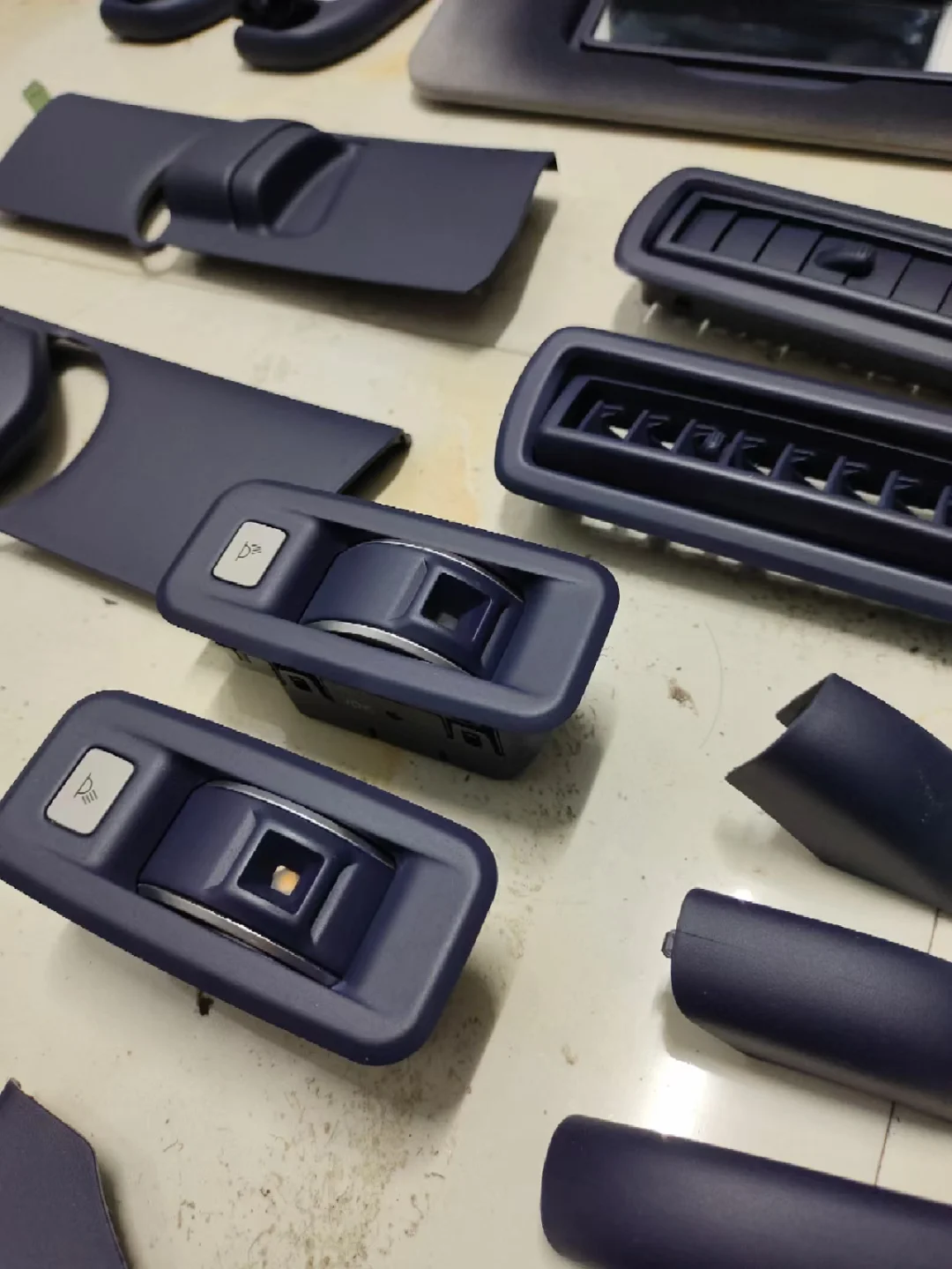
Real competition in the injection molding industry never takes place along the dimension of "kilograms of material processed" — it evolves separately within four entirely distinct tracks. The process barriers, customer relationship logic, and profitability structures of automotive, medical, 3C precision, and packaging injection molding differ so dramatically that it is almost hard to believe they share the same underlying process. This chapter dissects the market size and growth trajectory, the specific form of process barriers, and the operating reality of representative companies in each of the four sub-segments, followed by a cross-sectional comparison in the final section.
8.1 Automotive Injection Molding: Structural Upgrade in a Hundred-Billion-RMB Track
8.1.1 Market Size and Growth
The automotive sector is the largest single high-value downstream market for injection molding in China. By industry data, China's automotive plastics parts market (covering tooling and injection-molded parts, on a products basis) already exceeded RMB 100 billion in 2023 and is projected to reach RMB 131.7 billion in 2026, implying a compound annual growth rate of approximately 10% over 2023–2026. This growth rate significantly exceeds overall vehicle production volume growth, because plastics intensity continues to rise: plastic content per vehicle increased from 123 kg in 2014 to 200 kg in 2023 and is projected to reach approximately 210 kg by 2026, with plastics' share of total vehicle weight rising from the historical 12–14% to 15–20% in 2024.
Two forces are driving this trend in the same direction simultaneously. The first is conventional lightweighting pressure: passenger vehicles must achieve a lightweighting coefficient 10% below the baseline by 2025 and 18% below by 2030; substituting metal parts with plastic parts is the most direct weight-reduction path, and replacing some die-cast aluminum brackets with injection molding can reduce weight by approximately 45%. The second is incremental demand from new-energy vehicles: NEV penetration jumped from 1.35% in 2015 to 40.94% in 2024; pure-electric vehicles, whose battery pack, e-drive, and electronics systems carry far more intrinsic weight than ICE vehicles, face even more urgent lightweighting needs. At the same time, the three-electric systems themselves have created entirely new categories of injection-molded parts — battery pack structural components, thermal management modules, electric water pump and water valve housings, electronic control insulation partitions — none of which existed in ICE vehicles.
8.1.2 Process and Barriers
The entry threshold for automotive injection molding is built from three stacked layers of barriers; any single layer standing alone is sufficient to create differentiation, and the absence of all three simultaneously means a Tier-1 appointment from an OEM is simply impossible.
The first layer is the co-development barrier. OEM interior and exterior development follows the APQP (Advanced Product Quality Planning) process, which requires injection molding Tier-1 suppliers to be involved at the concept stage, conducting CAE simulation, mold flow analysis, and structural optimization jointly with the OEM. This "bound from a blank page" mode of collaboration means that once a nomination is won, the cost of switching suppliers is extremely high.
The second layer is the materials process barrier. Materials used in automotive interior and exterior parts far exceed the scope of ordinary injection molding: engine-periphery parts must withstand continuous high temperatures above 120°C, typically using PA66-GF30 (glass-fiber-reinforced nylon 66), PA46, or even PPS; electronic control insulation parts face stringent dielectric performance requirements, with some using LCP; exterior parts must pass UV aging, salt spray corrosion, and other weatherability tests. These specialty engineering plastics have narrow processing windows and are sensitive to venting, requiring dedicated equipment with precise temperature control.
The third layer is the certification barrier. IATF 16949 automotive quality management system certification is the admission ticket, but obtaining it is only the starting point; the core requirement is the second-party audits conducted by Japanese, German, and American OEMs respectively, along with the PPAP (Production Part Approval Process) for each vehicle model. A PPAP document package — from process FMEA and control plans to initial sample inspection — typically requires 6–18 months to refine.
8.1.3 Representative Companies
- Yanfeng Automotive Trim: One of the world's largest automotive interior suppliers; core products cover instrument panels, door panels, and seat interior injection-molded parts; the proprietary CHyM hybrid molding process integrates fiber-reinforced composites with injection molding in a single step; 2024 revenue approximately RMB 11.9 billion — the largest single domestic automotive injection molding entity.
- Huayu Automotive Systems (600741): A group-level Tier-1 with multiple interior and exterior business units including Huayu Vision (automotive lighting injection molding); 2024 first-half group revenue approximately RMB 77.3 billion, with automotive plastics parts a significant component.
- Silver Basis (002786): Core in precision automotive injection molds while also covering 3C structural parts; 2024 first-half revenue approximately RMB 1.126 billion; has demonstrated mass-delivery capability in precision automotive tooling.
- Zhaomin Technology (301000): Focused on NEV thermal management and three-electric structural parts; 2024 full-year revenue RMB 756 million (up approximately 28% year-on-year); automotive business approximately 77% of revenue, with NEV-related business revenue up more than 40% year-on-year — a typical beneficiary of the NEV incremental logic.
- TK Group (02283.HK): Starting from precision tooling manufacturing, with dual-track coverage in automotive and 3C; 2024 full-year revenue approximately HKD 2.36 billion (up approximately 21% year-on-year); one of the few midstream companies simultaneously covering two high-barrier sub-segments.
8.2 Medical Injection Molding: The Sub-Segment with the Highest Barrier Density
8.2.1 Market Size and Growth
China's medical injection molding market was approximately RMB 45 billion in 2023; industry forecasts project it to break through RMB 55 billion in 2025, implying a compound growth rate of approximately 10% over 2023–2025. Globally, the medical device injection-molded parts market was approximately USD 35.7 billion in 2024, with projected growth to approximately USD 50.5 billion by 2031 at a CAGR of approximately 5.2%. China's market growth rate exceeds the global average, driven by three factors: accelerating localization of medical equipment, the tiered healthcare policy driving increased procurement by primary-care institutions, and the continuous expansion of single-use medical consumables (syringes, IV tubing, PCR consumables, etc.) — with the low-value single-use consumables market reaching approximately RMB 128 billion in 2023, at a CAGR of approximately 16% over 2016–2023.
Medical injection molding commands the highest value density of the four major sub-segments. Taking Changhong Technology (300151) as an example: its 2024 overall gross margin was approximately 27%; the gross margin of its medical devices and consumables business was further above that of its mold and intelligent manufacturing businesses; whereas general-purpose injection molding processing gross margins typically fall below 10%. This margin differential derives directly from the barrier density described below.
8.2.2 Barrier Anatomy
The access barriers for medical injection molding can be broken down along five dimensions; each requires sustained investment of time and capital, and they collectively form an interlocked effect.
Cleanroom requirements are the core physical barrier. General medical device injection molding must be carried out in ISO Class 8 (100,000-class) cleanrooms; components that come into direct contact with patients — catheters, syringe barrels — must be elevated to ISO Class 7 (10,000-class); high-end products such as implant housings and PEEK structural parts must be produced in ISO Class 5 (100-class) environments. The capital cost to build and operate cleanrooms is high, and maintaining class designation requires continuous air filtration system maintenance and strict personnel behavioral controls, creating a significant investment threshold.
Quality system certification constitutes the regulatory barrier. ISO 13485 is the foundational certification for international medical device quality management systems, typically requiring 1–2 years to obtain; entering the North American market also requires compliance with FDA 21 CFR Part 820; entering the EU market requires compliance with EU MDR (Medical Device Regulation 2017/745). This multi-layered certification stack means that a new entrant typically requires more than 3 years from project inception to achieving supplier qualification.
Biocompatibility testing is a separate materials-level barrier. All injection-molded parts that come into contact with patient body fluids or tissue must pass the ISO 10993 series of tests, covering cytotoxicity, sensitization, acute systemic toxicity, and other categories. This means that every raw material batch change — even switching between two lots of medical-grade PP — may trigger re-validation, significantly compressing the flexibility of materials procurement.
Equipment specialization constitutes an asset barrier. Medical injection molding requires the exclusive use of all-electric injection molding machines, completely eliminating the risk of hydraulic fluid leakage contamination. All-electric machine unit prices are significantly higher than hydraulic machines; by industry data, all-electric injection molding machines accounted for approximately 46% of medical injection molding equipment in 2024 and the share continues to climb. In addition, micro-injection molding (for catheter connectors, drug-delivery valve cores, and similar components) requires dedicated micro-shot equipment.
Customer validation stickiness is the most durable commercial barrier. When medical customers introduce a new injection molding supplier, they must complete three phases of validation: IQ (Installation Qualification), OQ (Operational Qualification), and PQ (Performance Qualification), a process lasting 6–18 months and consuming substantial engineering resources. Once validation is passed and SOPs are established, medical customers almost never proactively switch qualified suppliers unless a quality event occurs. This "stick once, stick forever" relationship is the fundamental reason why medical injection-molded part gross margins are 10–15 percentage points above general-purpose injection molding.
8.2.3 Representative Companies
- Changhong Technology (300151): The representative listed pure-play in domestic medical precision injection molding, simultaneously covering OA equipment consumables and semiconductor consumables; 2024 full-year revenue approximately RMB 1.039 billion (up approximately 12% year-on-year), net profit attributable to shareholders approximately RMB 102 million, with net profit up approximately 222% year-on-year — the accelerating release of the medical segment is the core driver.
- Weigao Group: The domestic leader in single-use medical consumables, with syringes and IV tubing at scale; one of the most vertically integrated companies in the industry.
- Kandelan: Focused on medical injection consumables; precision injection-molded parts including puncture needles and syringe barrels are its core products, with quality standards benchmarked against international medical device majors.
8.3 3C Precision Injection Molding: Process Density in a Cyclical Track
8.3.1 Market Size and Cyclical Characteristics
There is no independent authoritative statistical coverage of China's 3C precision injection molding market size; most organizations include it in the "consumer goods" or "general-purpose precision" category. But the scale and cyclicality can be partially reconstructed from listed company financials: Everwin Precision (300115) generated full-year total revenue of RMB 16.934 billion in 2024, up approximately 23% year-on-year, with net profit attributable to shareholders of approximately RMB 772 million, up approximately 800% year-on-year. The nearly tenfold surge in net profit did not arise from a change in business mix, but from the leverage release of a capacity utilization recovery in 2024 following the compression of the 2022–2023 consumer electronics down-cycle.
The consumer electronics inventory cycle is approximately 18–24 months. In 2022, global smartphone shipments fell approximately 11% year-on-year; the entire supply chain, from brand owners to injection molding contract manufacturers, experienced capacity contraction and order collapse. In 2024, as inventory worked off and new AI smartphone and wearable product cycles launched, orders rapidly replenished and pushed capacity utilization back to higher levels. This cyclical volatility is the most fundamental structural difference between 3C precision injection molding and automotive injection molding — automotive demand smooths out with production volumes; 3C demand pulses with product replacement cycles.
8.3.2 Process Characteristics
The process barriers of 3C precision injection molding are concentrated in two dimensions — dimensional precision and surface aesthetics — and these two dimensions often impose conflicting demands on equipment and tooling.
Thin-wall injection molding is the foundational process for 3C housing parts; phone mid-frames and notebook outer shells commonly have wall thicknesses below 1 mm, with some areas reaching 0.5 mm. Achieving thin-wall forming requires high-speed, high-pressure injection molding machines (injection speed exceeding 1,000 mm/s) while placing extremely high demands on the uniformity of the mold cooling system — localized uneven cooling causes warping, and the tolerances on thin-wall parts are so tight that warping cannot be corrected in downstream processes.
Two-shot molding (2K molding) forms two colors or two materials in a single mold in a single cycle, eliminating the painting process while imparting product combinations of matte and gloss surfaces or soft-overmolded hard shells. Phone buttons and TWS earphone housings are classic 2K applications. This process demands extremely high rotary platen precision and synchronized injection pressure matching between the two shots.
In-mold decoration (IML/IMD/IMT) completes graphic or textural effects simultaneously with the injection molding cycle, eliminating labeling and painting processes entirely. IML (in-mold labeling) is suited to relatively flat electronics panels; IMD (in-mold decoration film) achieves pattern variety through continuous film feeding; IMT (in-mold transfer) can further achieve three-dimensional decorative effects, commonly used for glass-look rear covers, metal-look housings, and other premium appearance parts.
Ultra-precision injection molding is a recent process direction driven by wearable device and optical module demand. Optical component tolerances for spatial computing devices such as Apple Vision Pro reach ±0.01 mm — far beyond the capability boundary of conventional injection molding machines — and can only be achieved consistently with precision constant-temperature environments, nano-level mold polishing, and in-line measurement systems. This demand is still at an early stage, but represents the highest barrier in 3C precision injection molding.
8.3.3 Representative Companies
- Everwin Precision (300115): The leader in consumer electronics precision structural parts, simultaneously developing connectors and NEV parts; 2024 consumer electronics precision structural parts and module revenue approximately RMB 7.5 billion, gross margin approximately 20% — the largest listed enterprise by revenue in 3C precision injection molding.
- TK Group (02283.HK): Starting from precision tooling manufacturing, with deep accumulation in injection-molded parts for smartphones, wearables, and communications equipment; 2024 injection molding components business revenue up approximately 25% year-on-year — the most typical midstream enterprise with dual automotive and 3C coverage.
- Silver Basis (002786): Parallel in automotive and communications electronics injection molds; competitive in precision mold design and multi-cavity tooling.
8.4 Packaging Injection Molding: Thin-Margin Competition Competing on Volume
8.4.1 Market Size and Structure
Packaging is the largest downstream segment globally for injection-molded products, accounting for approximately 30–32% of the global injection-molded products market. In the Chinese context, above-scale enterprises in plastic packaging generated primary business revenue of approximately RMB 562 billion in 2024, representing approximately 27% of the entire packaging industry; injection molding accounts for approximately 40% of the molded plastics packaging market; on this basis, the domestic market for injection-molded packaging parts is estimated at approximately RMB 200 billion, with PP as the primary raw material (approximately 45%).
The global thin-wall plastic containers market was approximately USD 42 billion in 2024, projected to reach USD 65 billion by 2033, at a CAGR of approximately 5% — the technically denser sub-segment within packaging injection molding. In addition, beverage caps and closures ("Caps & Closures") represent the product category with the highest utilization of high-speed injection molding equipment; single mold tooling typically features 64–128 cavities, placing extremely high demands on equipment stability.
8.4.2 Process Barriers and Competitive Logic
The barrier profile of packaging injection molding is fundamentally different from the preceding three sub-segments — there is no co-development engineering barrier, no cleanroom physical barrier, and no ±0.01 mm ultra-precision tolerance requirement. The core competitive logic in this track is dual optimization of equipment efficiency and compliance cost.
On the equipment side, the demands of high-speed thin-wall injection molding on machine performance center on shot speed rather than precision: thin-wall containers such as food containers and dairy cups (wall thickness 0.3–0.6 mm) require machines with injection speeds exceeding 500 mm/s and clamping forces of 500–2,000 tonnes; unit equipment value is not trivial, and must be paired with rapid mold-change systems and automated part-removal devices to compress per-unit costs to competitive levels. This means the threshold in packaging injection molding is expressed more in capital intensity than in process intensity.
On the compliance side, food-contact packaging must satisfy GB 9685 (China's food contact materials regulation), FDA 21 CFR (for products exported to the U.S.), and EU 10/2011 (for products exported to the EU); raw materials must be food-contact-certified PP or PE, and the types and addition levels of processing aids are strictly regulated. While this threshold is not as time-consuming as the 2–3 years required for medical device certification, it requires ongoing system maintenance and regular testing, imposing a real administrative burden on smaller companies.
In regional competitive distribution, the Yangtze River Delta (Shanghai, Jiangsu, Zhejiang) contributes approximately 60% of national plastics packaging output; its dense network of food and beverage brand customers, well-developed logistics infrastructure, and abundant raw material supply create self-reinforcing cluster dynamics.
Packaging injection molding's profit level is the lowest of the four major sub-segments. Compete on volume, thin unit pricing, crowded competitors — gross margins for above-scale enterprises generally hover in the low single digits, and in 2024, the aggregate losses of loss-making above-scale plastics products enterprises grew 15.5% year-on-year, while revenue growth (approximately 4.5%) vastly exceeded profit growth (approximately 0.7%); the internal competition dynamic is most pronounced in packaging injection molding.
Currently there are no representative pure-play listed enterprises in the packaging injection molding space; the market is mainly dominated by regional small and mid-sized companies, which itself confirms that the profit structure of this sub-segment inhibits consolidation — the impetus for improving industry concentration is insufficient.
8.5 Cross-Sectional Comparison of the Four Sub-Segments
Synthesizing the preceding four sections, the differences among the four major sub-segments in terms of scale, growth, barrier nature, and representative companies can be presented clearly in a comparison table:
| Dimension | Automotive Injection Molding | Medical Injection Molding | 3C Precision Injection Molding | Packaging Injection Molding |
|---|---|---|---|---|
| China market size | Over RMB 100 billion (2023) | Approximately RMB 45 billion (2023) | No independent statistics; leading company revenues in the tens of billions | Approximately RMB 200 billion estimated (injection-molded plastic packaging basis) |
| Projected size | Approximately RMB 131.7 billion (2026) | Approximately RMB 55 billion (2025) | Fluctuates with consumer electronics cycle | Modest growth in line with packaging overall |
| CAGR | Approximately 10% | Approximately 10% | Approximately 8–12% (cycle-driven) | Approximately 4–6% |
| Barrier level | High | Extremely high | High | Low–medium |
| Core barriers | Co-development + IATF certification + specialty engineering plastics | Cleanroom + multi-layer certification + customer validation stickiness | Precision + process diversity + IP confidentiality | High-speed equipment efficiency + food-contact compliance |
| Gross margin reference | Mid-to-high (approximately 15–25%; wide variance by Tier-1) | High (approximately 27%; Changhong Technology overall basis) | Mid (approximately 15–20%; cycle-driven) | Low (single digits; broadly competitive) |
| Representative companies | Yanfeng, Huayu, Zhaomin Technology, Silver Basis, TK Group | Changhong Technology, Weigao, Kandelan | Everwin Precision, TK Group, Silver Basis | Regional small and mid-sized companies; no typical listed pure-play |
| Cyclicality | Moderate (tied to model change cycles) | Weak (essential medical consumables are counter-cyclical) | Strong (18–24 month inventory cycle) | Moderate (driven by food consumption; relatively stable) |
This comparison table reveals an interesting piece of industrial logic: the two highest-barrier sub-segments — medical and automotive injection molding — are precisely the two where domestic capital is most eager to enter yet finds it hardest to rapidly build competitive capability; while packaging injection molding, despite its large market size, struggles to produce a true consolidating leader because of thin margins and dense competition.
From a strategic-choice perspective, automotive and medical injection molding represent the "deep binding, long-cycle return" model — once a nomination is secured or validation passed, order stability and gross margins are both assured. 3C precision injection molding represents the "process-leading, harvest-with-cycle" model — requiring sustained R&D investment during industry down-cycles and waiting for recovery to release leverage. Packaging injection molding is a "scale-efficiency-first" low-margin, high-turnover model, where demands on operational management exceed demands on technical capability. None of the three models is inherently superior, but their requirements on corporate capital structure, management capability, and customer relationship mode are entirely different; midstream companies that attempt to cover multiple sub-segments simultaneously often incur coordination costs well above expectations.
Chapter 9 Technology Evolution and Industry Trends
The injection molding industry has never followed a single technological trajectory. Three concurrent threads — full electrification, intelligent manufacturing, and green transformation — are deeply intertwined with one another, overlaid by the structural disruption introduced by integrated die-casting (gigacasting) and the upmarket shift toward multi-component precision molding. Together, these forces define 2024–2030 as the most concentrated window of technological change the industry has seen. This chapter focuses on the internal logic and current state of these technologies; market size and competitive dynamics are addressed elsewhere.
9.1 Full Electrification: The Energy Revolution and the Global Penetration Gap
9.1.1 Dual Advantages: Energy Efficiency and Process Precision
An all-electric injection molding machine drives every motion axis with AC servo motors, completely replacing the hydraulic pump-and-valve system. This delivers advantages on two dimensions: energy consumption and process accuracy.
On energy consumption: an all-electric machine outputs power only when a motion is actually required during the molding cycle, whereas a hydraulic pump runs — and consumes energy — continuously regardless of whether an injection is occurring. Aggregating data from multiple sources, all-electric injection molding machines reduce energy consumption by 30%–70% compared with conventional hydraulic machines, while simultaneously cutting cooling water consumption by approximately 70%–90%. At 6,000–8,000 operating hours per machine per year, this gap translates into a substantial electricity-cost differential. China's "Energy Conservation and Carbon Reduction Action Plan 2024–2025" identifies industrial energy efficiency as a priority, and this policy pressure directly converts into accelerated deployment of all-electric product lines by domestic machine manufacturers.
On process precision: replacing hydraulic transmission with direct servo drives eliminates hydraulic-oil thermal drift and pressure fluctuations, significantly improving repeatability. The absence of hydraulic oil also makes all-electric machines inherently suitable for contamination-sensitive applications such as medical devices, optical components, and precision electronics.
9.1.2 Current State of the All-Electric Market in China
According to industry sources, China's all-electric injection molding machine market reached approximately RMB 5.394 billion in 2024, with production of 32,200 units and estimated demand of around 18,800 units. The average selling price was approximately RMB 286,400 per unit — far above the average for standard hydraulic machines, confirming that the all-electric customer base is concentrated in precision, high-frequency mold-change mid-to-high-end applications. Over the longer term, domestic all-electric machine production grew at a compound annual rate of roughly 14% from 2016 to 2025 — more than twice the growth rate of the overall injection molding machine market.
9.1.3 Global Penetration Rates: China is the Largest Consumer Market, Yet the Deepest Penetration Gap
Global all-electric injection molding machine sales reached approximately USD 3.271 billion in 2023. On the demand side, China accounted for roughly 33%, making it the single largest consumer market. On the production side, Japan led with approximately 33% of global output, followed by China at around 30%.
Penetration-rate comparisons are even more revealing: all-electric machines account for over 60% of the Japanese domestic market, approximately 40% in Europe, and only about 15%–20% in China. These three figures, placed side by side, tell the story of three very different market development paths. Japan led the all-electric wave from the 1990s, driven by FANUC, Sumitomo, and other major players; Europe followed, propelled by precision molding and premium packaging; China long remained dominated by mid-to-low-end hydraulic machines, making its all-electric adoption late but consequently also the fastest-growing. China's share of global all-electric demand is projected to rise to approximately 37% by 2030.
9.1.4 Global Competitive Landscape and the Domestic Catch-Up
In the all-electric machine segment, the five leading global players are Sumitomo Heavy Industries, FANUC, Nissei (JSW Plastics Machinery), Arburg, and Shibaura Machine — all Japanese or German enterprises. The technological barriers they have built — particularly in high-precision ball screws, direct-drive servo motors, and injection-axis control algorithms — are considerably higher than those in the standard hydraulic machine segment.
Domestic Chinese manufacturers have made substantive progress in catching up: Borche debuted China's first large-format two-platen all-electric machine at CHINAPLAS 2024, and Haitian International has achieved volume-shipment capability in mid-range all-electric models. However, at both ends of the size spectrum — machines above 500 tonnes and micro-precision all-electric machines — domestic substitution remains at an early stage, lagging approximately one technology generation behind leading Japanese models.
9.2 Intelligent Manufacturing: From Parameter Assistance to Closed-Loop Process Control
9.2.1 The Evolution Path of Injection Molding 4.0
Intelligent injection molding is not a new concept, but a qualitative leap occurred around 2023–2025: AI moved from being an auxiliary parameter-tuning tool to becoming a closed-loop control system embedded directly in the machine controller, actively participating in the entire injection cycle.
Conventional injection molding process setup relies on experienced technicians adjusting dozens of parameters — pressure, velocity, temperature, holding pressure time, and more — by feel and judgment, with setup time ranging from several hours to multiple days. The core logic of Injection Molding 4.0 is as follows: high-frequency sensor data collected during the injection process — cavity pressure, melt temperature, melt displacement — are used to train or invoke pre-trained models in real time, automatically correcting process settings within a single shot cycle and compressing what was once a manual feedback loop to the millisecond level. According to data from leading industry manufacturers, introducing AI simulation tools can shorten product development cycles by 50%–70%; data-driven approaches also reduce operating costs by approximately 25% compared with purely manual setup.
9.2.2 Digital Twins: From Simulation Software to Production Forecasting
Digital twin deployment in injection molding covers two layers: simulation and optimization of the molding process itself, and real-time mirroring of equipment and production lines.
On process simulation: Moldex3D, Moldflow, and similar tools are already in AI-augmented iterations. Moldex3D 2025 released a "Molding Intelligence" module that embeds AI into the parameter-recommendation workflow for fill simulation. Also noteworthy is exploration at the academic level: in 2024, research teams developed injection molding digital twin models based on LSTM neural networks to predict melt cushion — a key indicator of process stability. A cushion that is too small signals insufficient holding pressure; too large wastes material and time. The LSTM model enables real-time prediction and proactive intervention during continuous production.
At the equipment level, from around 2025 mid-to-large-scale injection molding factories have begun deploying comprehensive digital ecosystems encompassing injection machines, molds, robotic handlers, packaging lines, and auxiliary equipment, enabling whole-factory real-time monitoring with multi-device coordination.
9.2.3 The Reality and Limits of Lights-Out Factories
The "lights-out factory" represents the highest expression of intelligent injection molding — fully automated, unmanned overnight operation. According to disclosures by Haitian SmartLink, its lights-out factory projects achieved a roughly 60% improvement in production efficiency and approximately 25% reduction in operating costs. It should be noted that these figures derive from secondary citations and have not been independently verified by third parties; they should be treated as company self-reported reference data rather than industry-wide benchmarks.
In practical industry terms, true lights-out injection molding factories currently exist only in a small number of production contexts involving highly standardized or highly repetitive products — bottle caps, medical consumables, consumer-electronics housings. The frequent mold changeovers and small-batch, high-mix order structures that characterize most small and mid-sized injection molders leave them far short of lights-out operation. Intelligent manufacturing penetration in this broader segment is more commonly expressed as discrete point applications — data collection, process assistance, predictive equipment maintenance — rather than fully unmanned production lines.
9.3 Green Transformation: Three Pathways — Recycled Materials, Bio-Based Polymers, and Microcellular Foaming
Green transformation pressure on the injection molding industry comes from both ends of the supply-demand chain: on the supply side, hard compliance requirements such as the EU's new packaging regulations and tightening plastic-restriction policies in China; on the demand side, brand owners' ESG commitments and consumers' sustainability purchasing preferences. The three technical pathways differ significantly in maturity, cost, and applicable use cases.
9.3.1 Recycled Plastics: The Largest Route, with Consistency as the Central Challenge
The recycled resin market is the highest-volume pathway in the green transformation process. According to industry estimates, the global recycled resin market was approximately USD 66.4 billion in 2024, projected to grow to USD 97.0 billion by 2032, implying a CAGR of roughly 5.8%. The EU's new Packaging and Packaging Waste Regulation, formally adopted in December 2024, mandates increased recycled content in packaging materials, directly driving expanded demand for rPET and rPP.
The core challenge for injection molders using recycled materials is batch-to-batch inconsistency: melt flow index, mechanical properties, and color variation in recycled resins fluctuate with the source batch, making them particularly problematic for precision parts that require high process stability. The direction for solving this process challenge converges with the intelligent manufacturing pathway: using real-time process sensing and AI closed-loop control to compensate for recycled material batch variation is emerging as the technical intersection point between green and precision manufacturing. On the domestic policy side, China's "Action Plan for Promoting the Application of Recycled Materials" sets a target of annual recycled plastic production exceeding 19.5 million tonnes by 2030.
9.3.2 Bio-Based and Biodegradable Plastics: The Gap Between Aspiration and Industrial Reality
Bio-based and biodegradable plastics represent the most narratively compelling direction in the green injection molding story, yet face severe economic constraints in industrial reality. China's biodegradable plastic output was 713,500 tonnes in 2023, and approximately 369,500 tonnes in the first half of 2024 — volumes that are extremely modest relative to the ambitious million-tonne-scale planned capacity, much of which has been delayed or shelved due to demand falling short of expectations.
Cost is the most direct barrier: biodegradable plastics typically cost more than twice as much as conventional petrochemical materials. In downstream injection molding applications such as packaging — where margins are already thin and competition is volume-driven — customer acceptance is limited. On mechanical performance, some bio-based materials still lag PP, ABS, and other mainstream commodity resins in toughness and heat resistance, constraining their penetration into structural parts. This situation is unlikely to change fundamentally in the short term; bio-based injection molding during the 2026–2030 window will primarily serve specific niche markets — cutlery, agricultural film, medical consumables — rather than serving as a wholesale replacement.
9.3.3 MuCell Microcellular Foaming: The Precision Route to Lightweighting
The MuCell microcellular foaming process injects supercritical nitrogen or carbon dioxide into the molten plastic during the injection molding cycle; upon cooling, a uniform microcellular foam structure forms inside the part, reducing part density without sacrificing surface appearance. The core benefits are threefold: weight reduction and material savings (approximately 10%–20%); elimination of sink marks (important for appearance-critical parts); and a significant reduction in required clamping force, enabling equivalent parts to be produced on smaller machines.
Automotive applications represent the deepest commercial penetration for MuCell, with typical applications including airbag covers and valve covers — parts requiring stringent dimensional accuracy and low-temperature flexibility. However, there is no authoritative data on the actual commercial penetration rate of this process in China's injection molding market. Overall deployment has been relatively conservative, directly linked to the higher process setup barriers and the requirement for dedicated licensed equipment.
9.4 Large-Format Machines and the Boundary with Integrated Die-Casting: Complementary, Not Competing
9.4.1 The Surge in Integrated Die-Casting
Tesla's decision to consolidate the Model Y's rear underbody from over 70 stamped components into a single aluminum alloy casting triggered a chain reaction in vehicle manufacturing processes. Domestic automakers NIO and XPeng have successively deployed 10,000-tonne-class die-casting islands; BYD, Geely, and Huawei AITO have all published large die-casting roadmaps. According to industry estimates, China's integrated die-casting market reached approximately RMB 38.9 billion in 2025, with new-energy vehicle-related applications accounting for roughly RMB 25.8 billion. Some institutions estimate the CAGR from 2021 to 2025 exceeded 200%.
On the equipment side, L.K. Technology (0558.HK) is the leading domestic supplier of ultra-large die-casting machines. Yizumi (300415) entered large-casting orders with Changan Automobile through its LEAP 7000T model, while also launching an 8,500-tonne two-platen large injection molding machine — the first domestically produced unit of its class — integrating both forming processes under one product portfolio.
9.4.2 Die-Casting Targets Structural Parts; Injection Molding Continues to Dominate Interior and Exterior Trim
Understanding the division of labor requires starting from material properties. Integrated die-casting's primary target is large aluminum or magnesium alloy vehicle structural components — floor panels, front and rear cradles, body frames — previously assembled from dozens to hundreds of stamped steel pieces. The fundamental logic of die-casting here is "reduce part count, reduce welding operations."
Injection-molded parts occupy an entirely different dimension: vehicle interior and exterior trim (instrument panels, center consoles, door panel liners, bumpers, lamp housings, pillar trim, and more), as well as a vast range of small functional parts (sealing strip connectors, clips, wire harness retainers). Total plastic content per vehicle is approximately 100–150 kg. These parts face far less demanding strength-and-stiffness requirements than structural components but impose stringent requirements on aesthetics, dimensional accuracy, and color consistency — where injection molding is the only process capable of meeting these demands at production volumes.
Furthermore, the expansion of integrated die-casting actually creates incremental demand for injection-molded parts in certain areas: the interfaces between large cast structural components and other body modules require substantial quantities of injection-molded sealing elements, guide parts, and clips, the demand for which scales with die-casting output.
9.4.3 Metal-to-Plastic Substitution and Die-Casting Expansion Are Parallel Trends
Injection molding substituting die-cast components is not a new trend, but the pace has accelerated in recent years as the performance envelope of high-performance engineering plastics — long glass fiber-reinforced PP, PA66-GF, PEEK, and others — has expanded. Replacing certain traditional die-cast aluminum alloy brackets with injection-molded parts can achieve approximately 45% weight reduction while meeting load requirements, simultaneously eliminating deburring and surface treatment operations required for aluminum parts, significantly lowering total manufacturing cost. This trend and the expansion of integrated die-casting are moving in the same direction, jointly reshaping the materials composition of new-energy vehicle components.
9.5 Precision and Multi-Component Molding: The High-Value Frontier
9.5.1 Two-Shot / Multi-Shot Molding: Automotive as the Primary Market Driver
Two-shot molding forms two materials or colors within a single mold in two successive injection cycles, eliminating secondary assembly operations while improving part bond strength and appearance consistency. The global two-shot (multi-shot) molding market was approximately USD 11.2 billion in 2024, projected to reach USD 19.1 billion by 2034, representing a CAGR of approximately 5.5%. Automotive applications account for the largest downstream share, approximately 38.5% of global demand — driven primarily by functional multi-material parts in new-energy vehicles (rigid skeleton plus soft-touch overmold, transparent decorative insert plus dark substrate). The requirement for optically transparent sensor housings integrated with opaque structural substrates, driven by autonomous driving applications, is rapidly emerging as an additional demand driver.
9.5.2 IML In-Mold Labeling: Dual Growth Engines in Packaging and Automotive
In-mold labeling (IML) permanently bonds pre-printed decorative labels to the substrate in a single molding cycle by loading them directly into the injection mold, replacing conventional post-molding operations such as silk-screen printing and shrink-sleeve labeling. The global IML market was approximately USD 10.5 billion in 2023, projected to grow to USD 22.6 billion by 2030, implying a CAGR of approximately 11.87% — the highest growth rate among all sub-segments covered in this chapter. Packaging (dairy, frozen food, paint containers) and automotive (instrument panel fascias, knob labeling) are the two primary downstream markets.
9.5.3 Metal Injection Molding (MIM): The Fastest-Growing Precision Sub-Segment
Metal injection molding (MIM) combines metal powder with a binder, shapes the mixture via injection molding, and then produces near-fully dense metal parts through debinding and sintering. It is suited to geometrically complex, high-volume precision small parts. Among the sub-segments in the multi-component and precision molding space, MIM carries the highest growth rate — estimated at a CAGR of approximately 12.6% from 2025 to 2033 — with applications concentrated in aerospace precision fasteners, medical implants, micro-connectors, and consumer electronics hinge shafts.
9.5.4 IME In-Mold Electronics: The Next Frontier of Functional Integration
In-mold electronics (IME) embeds printed conductive circuits or functional films permanently inside a plastic part, integrating touch sensing, heating, antenna, and other functions directly with the structural component. Compared with conventional approaches — bonding flexible printed circuits (FPCs) to the surface of injection-molded parts after molding — IME eliminates connectors, reduces part count, and improves product reliability. Typical applications include automotive steering wheel touch panels, smart-home control panels, and medical device interfaces.
IME is currently in the transition from prototype validation toward small-scale production. Equipment precision requirements (insert placement accuracy to the micrometer level) and process consistency remain the primary bottlenecks. Nevertheless, the pathway IME represents — "integrate functionality into the part itself" — aligns squarely with the broader vehicle-level direction of lightweighting and part-count reduction, and its medium-term growth potential is relatively well-grounded.
9.6 Conclusion: The Nested Relationship Among Three Technology Threads
Looking back across the five sections of this chapter, full electrification, intelligent manufacturing, and green transformation are not independent trajectories but share deep technological interdependencies. Full-electric servo drives provide the millisecond-level controllable motion precision that serves as the hardware prerequisite for AI closed-loop control. Compensating for recycled-material batch variation depends on intelligent process systems. And MuCell microcellular foaming, to realize its maximum lightweighting benefit, also requires a precision all-electric machine to coordinate supercritical fluid injection timing. Multi-component and precision molding represent the shared high-value extension of all three threads.
The technological roadmap is clear. The industry reality in China, however, is that out of approximately 1.5 million machines in the installed base, all-electric machines account for only about 15%–20% of the total, factory-level intelligent manufacturing deployment varies widely, and the cost of green transformation remains stubbornly high. From technological possibility to large-scale deployment, the industry must still traverse a long and gradual industrialization ramp.
Chapter 10 Industry Risks and Challenges
The risks facing the injection molding industry are not singular or linear but the product of several structural pressures acting simultaneously. Raw material price transmission, homogeneous competition in the midstream processing segment, increasingly stringent environmental thresholds, import dependence in critical materials and equipment, and the survival pressures on small and mid-sized factories — these five pressure lines are intertwined and together constitute the primary challenge landscape for the industry today. This chapter examines each of the five dimensions in turn, without glossing over the problems, but also without drawing linearly pessimistic conclusions. On the other side of every risk lies a structural opportunity that has yet to be fully priced in; that is the question Chapter XI will address.
10.1 Raw Material Price Volatility: Three-Stage Transmission from Crude Oil to Processing Costs
The cost sensitivity of the injection molding industry is determined to a large degree by its raw material composition. Resin pellets typically account for 60%–80% of an injection molder's production cost (an industry-estimate figure; the share varies by product category and process), far exceeding the combined share of equipment depreciation and labor. This means that any fluctuation in the upstream resin market passes into the injection molding processing tier at a significantly amplified rate.
The transmission pathway for raw material prices has three stages: crude oil or coal, as the most upstream feedstock, goes through cracking or coal-to-chemical processes to produce olefin monomers such as ethylene and propylene, which are then polymerized into resin pellets — PP, PE, ABS, and so forth — before entering injection molders' purchasing cycle. This chain is relatively long; there are time lags between each stage and supply-demand dynamics introduce noise, so the pass-through of crude oil price changes to final resin prices is not a direct mathematical relationship but manifests primarily at the level of market expectations. The direct determinants of actual costs are naphtha and monomer prices, which are closer to the downstream end of the chain than crude oil.
Taking PP as an example: domestic capacity reached 51.36 million tonnes in 2024, with an import dependence of only about 3.2%, and China has transitioned from a net importer to a net exporter of PP. However, the capacity utilization rate is only approximately 74%, and the oversupply dynamic has kept PP prices chronically depressed. The situation with ABS is more extreme: the capacity utilization rate fell to approximately 61% in 2024, and severe oversupply combined with soft downstream demand has driven prices into a sustained pattern of volatile decline in recent years. For injection molders that purchase these two major resins, short-term declines in raw material prices ease cost pressure. But markets do not move in one direction only — in early 2026, geopolitical factors drove PP injection-grade spot prices sharply upward from cyclical lows, while ABS and PC prices in South China surged by more than 40% within a single week. Injection molders caught without pre-built inventory saw their margin space rapidly compressed.
This non-linear, sudden form of price shock is precisely the most difficult risk form for a thin-margin processing business model to withstand. Large injection molders can smooth volatility through hedging and strategic inventory management; small and mid-sized factories with annual revenues in the tens of millions of RMB lack both futures instruments and bargaining power, and have no choice but to absorb the impact of each price swing. For a high-throughput commodity injection molder, every RMB 1,000/tonne increase in PP or ABS prices can wipe out the entire month's profit in added monthly cost. In this sense, raw material price volatility is not merely a cost issue; it is a systematic erosion of the cash flow safety margin for small and mid-sized factories.
10.2 Mid-to-Low-End Overcapacity and Price Involution
If raw material volatility represents an external shock, then mid-to-low-end overcapacity and price involution are the accumulated result of long-standing internal structural contradictions within the injection molding industry.
The barriers to entry in injection molding processing are relatively low. A used general-purpose injection molding machine can be acquired for under RMB 1 million; factory rental and startup capital remain within reach for small-scale entrepreneurs. This characteristic of the industry — low entry barriers — also determines that low-value-added product categories will remain in a state of persistent oversupply. Large numbers of factories produce highly commoditized generic components with neither brand premium nor technological barriers, forcing price to become the primary competitive lever and producing a classic pattern of price involution.
The financial consequences of this dynamic were clearly apparent in the 2024 industry data: the aggregate losses of above-scale plastics products enterprises increased by 15.5% year-on-year, while the number of loss-making enterprises rose by 5.3%. At the same time, industry revenue grew by approximately +4.5% year-on-year, while profit growth was only approximately +0.7% — revenue was rising, but profits were almost flat, and the scissors divergence between the two was already quite pronounced. This means that more capacity and more sales produced thinner profits, not stronger enterprises. Under price involution, companies are forced to cut prices to retain orders; capacity expansion becomes a survival mechanism rather than a path to profitable growth.
From a market-structure perspective, homogeneity in low-value-added products is the fundamental pathology. Simultaneous structural and cyclical overcapacity in this tier is a shared consensus among industry analysts. The deep cause of this structure is that large numbers of factories have long lacked both the incentive and the capability to upgrade their products: no process barriers, interchangeable tooling, clients that can switch sourcing at any time — the factory's bargaining position is extremely weak. In this environment, raising prices is nearly impossible; room for cost reduction continues to narrow; and some factories sustain operations at near-breakeven prices simply to survive the cycle.
It is worth noting that this overcapacity is concentrated in commodity-grade injection molding. In high-barrier segments such as medical devices and precision electronics, supply-demand conditions are entirely different. The intensity of involution is essentially a reflection of sub-segment fragmentation: the lower the end of the market, the more severe the overcapacity; the higher the barriers, the relatively scarcer the supply.
10.3 Environmental Compliance and "White Pollution" Control Pressure
The impact of environmental pressure on the injection molding industry has in recent years been shifting from policy guidance toward substantive threshold requirements.
At the climate policy level, China's dual-carbon pathway is extending from the energy sector into industry. According to policy planning, carbon trading markets will broadly cover major industrial emitters by around 2027. Injection molding production falls under the plastics processing manufacturing category; while it has not been included in the initial coverage scope of the national carbon trading market in the current phase, as the inclusion boundary expands, injection molding enterprises will progressively face higher compliance costs for energy consumption management and carbon emissions accounting. For precision high-end factories that already make extensive use of all-electric injection molding machines, this pressure is relatively manageable. For the large number of small and mid-sized factories still dominated by hydraulic machines with higher unit energy consumption, the combination of retrofit costs and compliance thresholds may constitute an insurmountable financial barrier.
At the product level, the progressive implementation of plastic-restriction policies directly curtails single-use plastic products, which happen to be the primary product category for many low-end injection molding factories. As the intensity of policy enforcement increases, structural compression of demand in this category will follow.
Taken together, industry analysts estimate that approximately 20% of small and mid-sized injection molding enterprises may face forced closure due to inability to meet environmental compliance and energy efficiency standards (this figure is a third-party analytical estimate, provided for reference). The percentage may seem abstract, but it corresponds to tens of thousands of small and mid-sized factories — among them operations with stable clients and normal operations that may simply be cleared out in the next round of environmental inspections due to factory ventilation, wastewater treatment, or equipment energy efficiency falling short of standards. The medium-to-long-term impact of environmental enforcement on the industry is perhaps better described not as a blow but as a passive structural consolidation that will free up market space for compliant factories.
10.4 Chokepoints in High-End Segments: Equipment, Molds, and Critical Raw Materials
China's injection molding industry has established a fairly complete supply chain in mid-to-low-end segments, but in three dimensions — high-end equipment, precision molds, and specialty raw materials — varying degrees of import dependence persist, constituting a technical ceiling on the industry's upward mobility.
Import Dependence in High-End Injection Molding Equipment
All-electric injection molding machines represent the technical high ground of injection molding equipment, combining superior precision, energy efficiency, and cleanliness over hydraulic machines, and are essential for high-barrier fields including medical injection molding, optical components, and precision electronics. Globally, technology leadership in all-electric injection molding machines remains dominated by Japanese companies — Sumitomo, FANUC, Nissei, and other Japanese brands have long held commanding positions in the global all-electric injection molding machine market, with Japan accounting for roughly one-third of global production. Europe's Arburg also holds significant advantages in the high-precision all-electric segment. While China's domestic all-electric injection molding machines have seen rapidly improving penetration in recent years, domestic substitution of high-precision, large-tonnage all-electric models remains at an early stage. For downstream factories highly dependent on imported all-electric machines, equipment procurement costs and maintenance dependence represent long-term hidden constraints.
Precision large-format injection molding machines (such as high-precision machines above 100 tonnes) also rely heavily on German and Japanese brands. Domestic factories taking on automotive structural components, precision medical devices, and other demanding orders often must equip themselves with imported machines to meet customer technical specifications, directly raising the capital threshold for entering high-end markets.
Precision Molds and the Import Gap in Mold Steel
Molds are the direct determinant of injection-molded product quality; mold precision determines part dimensional tolerances, surface finish, and service life. China is already the world's largest mold exporter — mold exports reached approximately USD 8 billion in 2024 — yet import dependence in high-end precision molds has not been fundamentally eliminated. In precision optical molds, premium medical molds, and other specialized segments, a substantial proportion still depends on imports from Japan, Germany, and Portugal.
Looking upstream in mold manufacturing, mold steel is one of the critical bottlenecks. Approximately 25% of the steel required for mid-to-high-end domestic molds still needs to be imported, with primary suppliers from Sweden (ASSAB holds the largest market share), Germany (Thyssenkrupp group), and Japan (Daido, Hitachi Metals, and others). Domestic mold steel is competitive in mid-to-low-end grades, but for high-mirror-polish and high-toughness premium mold steel grades, performance consistency still lags imported brands. This high-end mold gap directly constrains the ability of domestic precision injection molders to break into optics, medical, semiconductor, and other high-value-added segments.
Hot runner systems are similarly highly import-dependent as a critical injection mold component. Husky, Mold-Masters, YUDO, Synventive, HRSflow, and other international brands dominate the high-end hot runner segment. Domestic brands are currently concentrated in mid-to-low-end hot runner applications and have yet to develop volume substitution capability in high-end sub-segments such as multi-cavity balanced hot runners and valve gate control systems.
Structural Import Dependence in Specialty Resins
On the raw material side, the most notable chokepoints are concentrated in two products: adiponitrile (the key upstream intermediate for PA66) and high-end polycarbonate (PC).
PA66 is an important engineering plastic for high-performance applications in automotive, electrical, and industrial connectors; its core upstream intermediate, adiponitrile, has long been monopolized by two Western companies — Invista and Ascend. In 2022, China's adiponitrile import ratio remained as high as approximately 74%. While domestic capacity construction has accelerated in recent years (aggregate domestic adiponitrile capacity reached approximately 830,000 tonnes per year as of 2023), and import dependence has begun to decline gradually, PA66's supply chain security retains a certain degree of vulnerability until fully self-sufficient stable supply is achieved.
The situation with PC is somewhat different. Commodity-grade PC has been largely localized — Wanhua Chemical's PC capacity reached 480,000 tonnes by end-2024, ranking first in China, with the import dependence of commodity-grade products falling to approximately 24.7%. However, optical-grade and medical-grade PC impose requirements for transparency, refractive index uniformity, and biocompatibility far exceeding those of commodity grades, and both grades remain highly dependent on Teijin, Covestro (formerly Bayer MaterialScience), and other Japanese and European enterprises. No stable domestic mass-supply capability exists. For optical component injection molders and medical device injection molders, this import dependence represents persistent long-term uncertainty in raw material pricing and supply reliability.
The situation with polyoxymethylene (POM) is more acute. While domestic POM capacity grew to approximately 760,000 tonnes in 2024 — an increase of nearly 70% from two years prior — there remains a net import deficit of roughly 360,000 tonnes. Advanced production technology for high-precision-grade POM is almost entirely in the hands of BASF, Celanese, Asahi Kasei, Polyplastics, and other foreign enterprises; domestic quality consistency still lags imported brands. The overall domestic localization rate for specialty engineering plastics is below 30%, representing an upstream bottleneck that has yet to be fully overcome on the path to upgrading the injection molding industry to higher-value-added segments.
10.5 Survival Pressures on Small and Mid-Sized Injection Molders: Recruitment, Margins, and Customer Concentration
The first four risk dimensions address the industry as a whole; the fifth is concentrated on specific factory entities. Tens of thousands of small and mid-sized injection molding factories are simultaneously absorbing pressures from multiple directions that reinforce one another, creating a predicament with no easy single-point solution.
Recruitment Difficulties and the Aging of Skilled Workers
Injection molding production depends heavily on skilled tradespeople. The mold setter — responsible for machine parameter setup, mold installation and adjustment, and quality control — is the core role on an injection molding line; accumulated experience typically requires more than five years and relies heavily on apprenticeship-based knowledge transfer. As China's population ages and the number of young workers willing to enter manufacturing continues to decline, the skilled labor supply gap in the injection molding industry is widening. Recruitment difficulties not only drive up wage costs but also leave factories unable to rapidly scale production capacity when rush orders arrive. This is an important driver behind the push by injection molding factories to accelerate automation retrofits and adopt industrial robots for part loading/unloading and vision-based inspection. But automation investment itself creates new financing pressure for capital-constrained small and mid-sized factories.
Persistent Compression of Profit Margins
Under the triple pressure of raw material price volatility, rising labor costs, and price involution, profit margins at small and mid-sized injection molding factories are being systematically compressed. The injection molding processing industry is broadly characterized by thin margins; overall profit growth for above-scale enterprises (approximately +0.7% in 2024) was essentially flat. For smaller factories below the above-scale threshold, conditions are even more difficult. Using listed company Silver Basis (002786) as a reference point: this precision injection molder serving both the automotive and consumer electronics sectors reported revenue of RMB 2.221 billion in 2024 but recorded a net loss attributable to shareholders of RMB 272 million, swinging from a profit of RMB 245 million in the prior year — a profit-to-loss reversal within a single year of a magnitude that surprised the market. Silver Basis is not a micro-factory; its losses were driven more by demand fluctuations from major automotive and consumer electronics customers. But this case clearly illustrates the customer dependence risk facing precision injection molding factories.
Customer Concentration Risk
The order books of a large number of small and mid-sized injection molding factories are heavily concentrated among a small number of customers — or even dependent on a single primary customer to maintain basic utilization rates. This customer structure provides stable cash flow in good years, but the moment a core customer reduces orders due to demand softness, supplier switching, or product iteration, the factory faces sudden capacity idleness and accounts-receivable risk it is unprepared for. The Silver Basis case is simply the manifestation of this logic at the listed-company level; the broader population of small and mid-sized factories faces customer concentration risks that are typically even more concentrated, with even weaker coping ability.
The Anticipated Acceleration of Industry Consolidation
The accumulation of these pressures will drive the injection molding industry into a more intense phase of consolidation. According to estimates by a third-party institution (Topworks Plastic Molding), only approximately 20%–25% of enterprises in China's injection molding industry may survive by 2028 (this is a predictive estimate by a third-party analytical institution whose methodology has not been publicly disclosed; it should be interpreted with caution). Regardless of the precision of this figure, the direction it points to is clear: under the five-fold pressure of raw material costs, environmental compliance, labor costs, technology upgrades, and customer concentration, factories lacking differentiated capability and positioned in low-value-added commodity parts will face a survival environment far more severe than the past in the coming five years.
Factories that are able to navigate this consolidation cycle typically share at least one of the following characteristics: deep embeddedness in high-barrier downstream industries (Tier-1 automotive, medical, precision electronics), proprietary mold development capability, or completed automation retrofits that have generated stable quality and cost advantages. For factories that have not yet built a moat in any of these dimensions, the pressures they face will continue to intensify as consolidation accelerates. This is both a risk and the necessary path for structural improvement across the industry.
Chapter 11 Market Forecasts and Investment Rationale, 2026–2030
The preceding ten chapters have dissected this industry's trajectory and current state in sufficient detail: domestic substitution in the equipment tier has climbed to over 80%; midstream injection molding processing remains so fragmented that no dominant player has emerged; upstream commodity resins are oversupplied while high-end resins face chokepoints; and technology is advancing simultaneously along the three threads of full electrification, intelligent manufacturing, and green transformation. The task of this chapter is to converge these scattered trends into a forward-looking picture amenable to judgment — how large will this industry be over the next five years, where will the incremental growth come from, where is capacity heading, and where should a serious industry researcher direct attention.
Forecasting demands restraint. The figures published by research institutions often reflect inconsistent scope definitions and divergent assumptions; simply listing them side by side creates only the illusion of precision. The approach in this chapter is to first clarify the assumptions and logic behind each range before presenting the range itself; to strictly separate the equipment scope from the finished-products scope and never conflate a hundred-billion-RMB machine market with a trillion-RMB products market. Judgment matters more than numbers; a range is more honest than a point estimate.
11.1 Market Size Forecasts: Ranges, Scope Definitions, and Measurement Logic
When discussing the scale of the injection molding industry, the first thing to clarify is which scope is under discussion. Injection molding machines as production equipment constitute one market, globally on the order of tens of billions of USD; the injection-molded products produced by those machines constitute a different market, globally on the order of hundreds of billions of USD; and the plastics products manufacturing sector into which injection molding is classified constitutes a broader category at the trillion-dollar scale. The three differ by one to two orders of magnitude, and conflating any two will distort the conclusions. Below, the two lines — finished products and equipment — are measured separately.
Starting with global injection-molded products, the primary scope. This encompasses all injection-molded products, represents the largest aggregate, and best reflects the total picture of end-user demand. Multiple institutions' midpoint estimates cluster in a mutually corroborating range: the global injection-molded products market was approximately USD 300–400 billion in 2024, projected to reach approximately USD 453.2 billion by 2030, implying a CAGR of roughly 5.8% from 2026 to 2030. This growth rate assumption is not aggressive. The embedded logic is that demand for injection-molded products broadly tracks global manufacturing, consumer electronics, automotive, and packaging volumes — it will neither surge due to any single technological breakthrough nor falter due to the cycle of any single industry. In other words, 5.8% represents a "follow macro, slightly ahead of GDP" steady-state judgment: the downstream application base is sufficiently diversified that single-industry cycles are smoothed out, while plastics' ongoing substitution of other materials provides a slight above-market premium. If global manufacturing momentum disappoints, this trajectory reverts toward 5%; if recycled material adoption and lightweighting substitution accelerate, it could exceed 6%.
Turning to global injection molding machines, the equipment line. Equipment demand is derived from products demand, but with higher elasticity — it is a function both of capacity additions and the replacement of existing installed base. The global injection molding machine market was approximately USD 10 billion in 2025; extrapolating at the compound growth rates cited by most institutions, it reaches approximately USD 19.7 billion by 2034, roughly doubling over a decade. This doubling should not be interpreted simply as a doubling of production capacity; a substantial portion reflects rising per-unit value: all-electric machines, intelligent machine variants, and large-format two-platen machines carry significantly higher unit prices than conventional hydraulic machines, so installed-base replacement by itself is already raising the market's revenue scope. The contribution of "replacing with more expensive machines" to the growth in equipment market value may well be no smaller than that of "buying more machines."
Bringing this down to the Chinese injection molding machine market: the domestic market in 2025 was approximately RMB 22–24.5 billion (equivalent to roughly USD 3.1–3.4 billion), accounting for approximately one-fifth of the global market. According to institutional estimates, the market will reach approximately USD 5.479 billion by 2033, implying a CAGR of roughly 6.2%. More notable is the near-term pace: the expected year-on-year growth rate for China's injection molding machine market in 2026 is approximately 8%–10%, above the long-term compound growth rate cited above. This differential reflects structural drivers releasing concentrated energy in the near term — equipment renewal policies, together with all-electric and intelligent-manufacturing retrofit activity peaking simultaneously around 2026, pushing a long-term ~6% steady-state market temporarily above 8%. A word of caution: the RMB 22–24.5 billion scope cited here is the proper equipment-side figure. Reports circulating online claiming the market "exceeds RMB 50 billion" incorporate downstream finished-product output value and represent a scope mismatch that cannot be relied upon.
Placing the three lines together, a clear hierarchy emerges: the products market is stable and trend-following; the global equipment market is driven by "more expensive machines" pushing revenue toward a doubling; the Chinese equipment market is being lifted from a 6% long-term base to an 8%–10% near-term peak by structural upgrades. The differences in growth rates are not contradictions — they precisely indicate that growth is shifting from "volume" to "quality."
A candid note on forecasting itself is warranted here. The ranges above are largely drawn from third-party institutional forecasts for finished-products and equipment scopes. For the scope of Chinese injection molding processing output value — closer to the midstream — no separate authoritative growth forecast exists in the industry; most statistics aggregate injection molding into the broader plastics products manufacturing category, making it impossible to isolate it independently. For the midstream processing segment, therefore, this chapter offers directional judgment only and refrains from assigning precise market size figures. This is a constraint imposed by the available materials, and it reflects appropriate research discipline.
11.2 Structural Opportunities: Where Will Incremental Growth Be Generated?
If aggregate growth rates represent the "waterline," what truly determines who captures value is the structural change beneath the surface. The incremental growth over the next five years will not fall uniformly across every machine and every factory but will concentrate in four directions.
The first direction is all-electric substitution and the intelligent-manufacturing overlay. This is the most certain structural opportunity on the equipment side. The energy-efficiency advantage of all-electric machines over hydraulic machines is well-established — energy savings policy has placed this technology on the encouraged list, and the equipment renewal initiative has provided a subsidy channel for the retirement of aging hydraulic machines, pushing substitution forward from both supply and demand sides simultaneously. Intelligent manufacturing accompanies electrification: according to industry projections, 65% or more of injection molding machines will be equipped with connectivity and data-collection capabilities by 2026. The significance of this figure lies not in connectivity per se but in what it signals: injection molding machines are transitioning from "selling iron" to "selling capability" — a machine that can collect data, self-adjust process parameters in closed-loop fashion, and support remote operations carries a higher unit price, generates stronger customer stickiness, and enables the manufacturer to collect recurring fees over the equipment's replacement cycle. Incremental growth derives both from rising penetration rates and from rising per-unit value — two drivers that correspond directly to the sources of China's near-term 8%–10% growth discussed in the previous section.
The second direction is medical injection molding. This is the segment with the highest barriers and consequently the most stable growth rate. Medical injection molding is growing at a CAGR of roughly 10%, noticeably faster than the ~5.8% pace for the finished-products market as a whole, underpinned by inelastic demand for disposable medical consumables that sustains a persistently positive outlook. What is particularly noteworthy is the coupling with all-electric machines: all-electric machines already account for approximately 46% of the medical injection molding segment in 2024, far above their share in the overall injection molding machine market. The reason is straightforward — cleanroom requirements for zero hydraulic-oil contamination naturally push medical applications toward all-electric machines. This means medical injection molding simultaneously benefits from two structural tailwinds: high segment growth and premium machine-type substitution. But the barriers are also the highest: cleanroom classification, medical system certifications, biocompatibility validation, and a customer qualification process measured in years. The few that get in find it equally hard to be displaced.
The third direction is automotive lightweighting, driven by new-energy vehicles. Plastic content per vehicle has risen from just over 100 kg a decade ago to roughly 200 kg, accounting for 15%–20% of vehicle weight; China's automotive plastics market is projected to reach approximately RMB 131.7 billion by 2026, with a CAGR also in the 10% range. New-energy vehicles push this curve further upward — battery pack structural components and thermal management system plastic parts represent incremental demand that did not exist in the internal-combustion-engine era, while metal-to-plastic lightweighting substitution continues to take share previously held by die-cast aluminum parts. The boundary worth clarifying: the expansion of integrated die-casting does not eliminate injection molding. The two are complementary — die-casting assumes responsibility for large vehicle structural parts, while injection molding continues to dominate the hundred-plus kilograms of interior and exterior trim plastics, and die-cast structural parts actually generate additional demand for injection-molded sealing parts and functional components at interface points. Lightweighting is a certain direction, but its incremental growth is distributed across interior/exterior trim, powertrain-adjacent parts, and functional components rather than concentrating at any single point.
The fourth direction is orderly overseas expansion. This is more of a "channel dividend" than a "product dividend" and its capacity-migration logic is addressed separately in the next section. For now, the key point is that the overseas opportunity lies not in relocating entire factories but in making localized deployments that follow customers and end markets — exporting China's equipment, tooling, and process capability as a service, extending it into Southeast Asia, Mexico, and other receiving locations. Overseas expansion represents incremental growth, but it corresponds to the export of supply chain capability rather than simple capacity relocation.
Viewing the four directions together, a common characteristic becomes apparent: all of them lean toward the high-value-added, high-barrier end. All-electric requires more expensive machines; medical means harder-to-access customers; lightweighting means more complex parts; overseas dual-line means higher-order capability export. Low-end commodity injection molding barely appears in any of these incremental stories — which is precisely the shared foreshadowing for the regional migration discussion in the next section and the investment rationale in the final section.
11.3 Regional and Value Chain Migration: Southeast Asia as Recipient, China as Anchor
When discussing overseas expansion, "capacity" and "value chain" must be treated separately. These two migrate at very different speeds, and conflating them leads to the overly simplistic conclusion that "China's injection molding industry is being replaced by Southeast Asia."
On the capacity side, migration is genuinely occurring. Cost is the most direct driver: the single-shift labor cost for a 1,000-tonne injection molding machine in Vietnam is roughly 35% lower than in China; stacked with lower land costs, tax incentives, and zero equipment tariffs, this constitutes a genuine attraction for low-end, labor-intensive injection molding orders with low process requirements. Trade policy and geopolitics provide a second layer of impetus — approximately 15% of US-based customers have shifted injection molding capacity from China to Mexico, Vietnam, or India over the past three years (this is a third-party institutional estimate whose methodology has not been fully disclosed; treat as directional reference). For orders with standardized products, overseas customers, and low value added, migration to receiving locations is a rational choice.
On the value chain side, however, migration is far slower. Even when the final injection assembly moves to Vietnam, the upstream supply of resin pellets, mold steel, and precision molds, as well as the equipment maintenance ecosystem, remains highly concentrated in China. Receiving locations in Southeast Asia can absorb "assembly" but cannot absorb "co-location supply chains" — they lack the industry density to source servo motors, ball screws, mold steel, and hot runners from within a three-kilometer radius, and they lack the capability to rapidly develop high-precision, high-complexity molds. The development cycle and yield of a precision mold determine whether high-end injection molding can be localized at all — and this is precisely the thickest layer in the Chinese ecosystem. The result is a structural misalignment: low-end capacity is moving outward, while high-end supply chain capability is staying in.
The outcome of this misalignment is that "dual-line deployment" becomes mainstream rather than wholesale relocation. Companies place cost-sensitive, process-insensitive segments in Southeast Asia to be close to customers and end markets, while keeping precision mold development, core process capability, and high-value-added capacity in China. TK Group (Holdings) is the archetypal example of this model: its domestic bases in Shenzhen, Suzhou, and Huizhou anchor precision molds and core injection molding capability, while its facilities in Vietnam and Germany handle localized delivery and proximity to end customers. These two lines serve distinct purposes. TK Group's overseas expansion is not about escaping Chinese costs; it is about extending services to where customers are. The domestic precision line is, in fact, the foundation that makes overseas expansion viable.
For China's injection molding industry, the true meaning of regional migration is not "loss" but "stratification." Receiving locations take the thinnest-margin, most easily replaceable layer; China retains the highest-barrier, hardest-to-replicate layer. Worrying about displacement is looking in the wrong direction — what truly warrants vigilance is being a factory that only does "the layer most easily moved away."
11.4 Investment and Positioning Rationale: From Scale Dividend to Structural Dividend
Distilling the preceding three sections into a single judgment: the injection molding industry captured scale dividends over the past twenty years; over the next five years, it will capture structural dividends. This transition is the starting point for understanding every positioning decision.
The scale dividend was the era when total manufacturing output was expanding and "having machines and keeping them running" was itself sufficient to generate profit — the market was growing, the waterline was rising, and even low-end commodity injection molders could capture incremental share. That era is ending. Domestic substitution in the equipment tier has reached over 80%, approaching saturation; midstream capacity in low-end segments is oversupplied, prices are involution-driven, and the room for further volume expansion has been squeezed very thin. When aggregate growth rates settle into the 5%–6% steady-state range, the old logic of "dilute costs with scale, earn incremental returns with capacity" no longer holds.
The structural dividend is the era in which incremental growth concentrates in specific structures, and resources gravitate toward manufacturers with process barriers and customer stickiness. This is precisely the shared direction of the four incremental themes in Section 11.2: all-electric machines require technology and per-unit value; precision medical injection molding requires certification and qualification stickiness; automotive lightweighting supply requires co-development capability with OEMs; overseas dual-line requires the export of supply chain capability. None of these four directions is open to "anyone who can enter." It is precisely because they have barriers that those inside can charge a premium and resist involution. A factory with no barriers, producing only low-end commodity parts, from which clients can be poached by a lower-price competitor at any time — regardless of how large the industry it sits in — will not benefit from the structural dividend.
Based on the research, several directions merit sustained attention from industry observers. A prior clarification is necessary: these are directional judgments from the Institute's research perspective — they are not investment recommendations of any kind and are not directed at any specific listed security.
- All-electric machines: The most certain substitution opportunity on the equipment side, with simultaneous upward momentum in penetration rates and per-unit value. Focus on machine manufacturers that genuinely command core control technology rather than those performing final assembly only.
- Precision medical injection molding: The highest-barrier, most stable-growth, most deeply coupled-with-all-electric segment. Certification and customer stickiness create long-term moats — hard to enter, hard to displace.
- Automotive lightweighting supply: New-energy vehicles bring incremental demand from battery packs, thermal management systems, and more. Focus on suppliers with co-development capability alongside OEMs that can take on high-complexity parts.
- Overseas dual-line deployment: Focus on companies that retain precision capability in China while extending delivery to where customers are located — overseas expansion as capability export, not capacity escape.
These directions share a common underlying logic: they all stand on the "difficult" side. Difficult to enter, so fewer competitors. Difficult to replicate, so premiums can be sustained. Difficult to relocate, so regional migration poses no threat. Research discipline stops here — identifying where structure is concentrating is what a researcher should do; making the buy judgment on behalf of anyone else exceeds the appropriate boundaries of an industry report.
Concluding the chapter: over the next five years, the injection molding industry will follow a trajectory of moderate aggregate growth, tracking macroeconomic trends, with the equipment tier raising its revenue scope through premiumization. Structurally, this will be a transition from scale dividends to structural dividends, with incremental growth concentrating in high-value-added segments that possess process barriers and customer stickiness, while low-end commodity capacity faces ongoing attrition under the triple squeeze of overcapacity, price involution, and regional migration. Those who understand this transition will find that slower industry-wide growth rates and the emergence of individual opportunities have never been contradictory — when the waterline no longer rises uniformly, structure is precisely when it begins to speak.
Chapter 12 Conclusion and the Institute's Assessment
Drawing the threads of the full report together, this industry — conventional as it may appear — presents a picture of "two distinct competitive structures, one unifying thread."
The two distinct structures refer to the equipment tier and the processing tier, which could hardly be more different. Injection molding machine manufacturing is a concentrated "one dominant, several strong" market: Haitian International alone commands over 30% — and by certain scope definitions as much as 40% — of the domestic market, maintaining the highest global shipment volume. Injection molding processing, by contrast, is an extremely fragmented market assembled from approximately 5 million related entities, of which only about 21,800 qualify as above-scale enterprises; the vast majority are small and mid-sized factories generating annual revenues below RMB 10 million. The same value chain, concentrated upstream and fragmented midstream — the competitive logic, profit structure, and consolidation paths of the two ends share almost nothing in common. The easiest mistake one can make when reading this industry is to impose a single narrative on both ends.
The one unifying thread is value chain density. China's injection molding machine industry spent twenty years moving from import substitution to global export leadership, compressing the gap between average import and average export unit prices from over USD 70,000 to around USD 30,000. This was achieved not through any single-point technological breakthrough but by building the world's highest density across the entire supply chain: a machine manufacturer in Ningbo or Shunde can, within a remarkably short radius, source servo motors, ball screws, mold steel, hot runners, and all associated processing. It is precisely this density that has kept Southeast Asia's capacity migration to date confined to the assembly layer: resin pellets, precision molds, mold steel, and equipment maintenance remain highly dependent on the Chinese ecosystem. Processes can be relocated; the ecosystem cannot.
Yet density does not mean an absence of gaps. Premium all-electric, precision, and large-format high-end injection molding machines remain strongholds of Japanese and German manufacturers. Precision molds, high-end mold steel, hot runners, adiponitrile, and optical-grade and medical-grade polycarbonate all remain on the import list. These are the real points of attack for the next phase of domestic substitution, and they are the benchmarks by which the industry's ability to move from "big" to "strong" will be judged.
As for the present moment: the industry is passing through a phase of "revenue growth outpacing profit growth" — a period of attrition. Low-end overcapacity and environmental and energy-efficiency thresholds will eliminate a substantial number of small and mid-sized factories in the coming years, while all-electric substitution, medical injection molding, automotive lightweighting, and orderly overseas expansion represent clearly identifiable structural opportunities within this sea of competition. Attrition is never a bad thing; it directs resources toward manufacturers that genuinely possess process barriers and customer stickiness.
It is precisely in this highly fragmented, highly information-asymmetric midstream segment that identifying "who is a genuinely operating factory, what scale, and exactly what parts it makes" has become the unavoidable first threshold for upstream equipment manufacturers, materials suppliers, and all manner of service providers. Tianxia Gongchang, as a factory data platform, has identified roughly 4.8 million operating factories from among a vast universe of business entities, enabling the step of "find the right factory first, then do the right deal" to no longer require costly trial-and-error at scale. In a long-tail market where even the boundaries of individual enterprises are blurry, clarity itself is a form of certainty.
The story of injection molding is, at its core, not the story of machines. It is the story of how a value chain turns distributed certainty into collective competitive strength.
Data Sources
The data in this report have been cross-verified from multiple sources; where scope definitions diverge, this has been noted in the main text. Primary sources are as follows:
- Tianxia Gongchang (operating factory data and industrial distribution reference)
- China Plastics Machinery Industry Association; China Plastics Processing Industry Association (industry output volumes, operational analysis)
- General Administration of Customs of China (import and export data for injection molding machines and products)
- National Development and Reform Commission; Ministry of Industry and Information Technology; State Council (industrial policy documents on energy conservation, carbon reduction, and recycled materials)
- Annual reports and earnings announcements of listed companies: Haitian International, Yizumi, Chen Hsong, L.K. Technology, Tederic, Everwin Precision, TK Group (Holdings), Silver Basis, Changhong Technology, Zhaomin Technology, Huayu Automotive Systems, Wanhua Chemical, Yuntianhua, and others
- Official websites and annual reports of overseas manufacturers: ENGEL, Arburg, KraussMaffei, Husky, Sumitomo, FANUC, and others
- International market research institutions: Grand View Research, Mordor Intelligence, Fortune Business Insights, MarketsandMarkets, Precedence Research, Straits Research, QYResearch, and others (global and sub-segment market size and CAGR forecasts; divergent scope definitions are presented side by side where they arise)
- Industry research and consulting firms: Qianzhan Industry Research Institute, Huajing Industry Research Institute, Zhiyan Consulting, China ChemConsulting, and others
- Industry media and professional platforms: Plastics News, Plastics Today, Rong-Ji Industrial Resources Network, China Plastics Machinery Network, Zhuansu Shijie, Aibang series, and others
Note: Three distinct statistical scopes exist for market size figures — "equipment scope," "finished-products scope," and "plastics products manufacturing broad category scope." This report identifies each scope at the point of use; readers should take care to distinguish them when citing figures. Certain third-party estimates (such as the industry consolidation survival rate and the proportion of capacity migration) are accompanied by source qualifiers in the text and should be treated as directional trend references only.