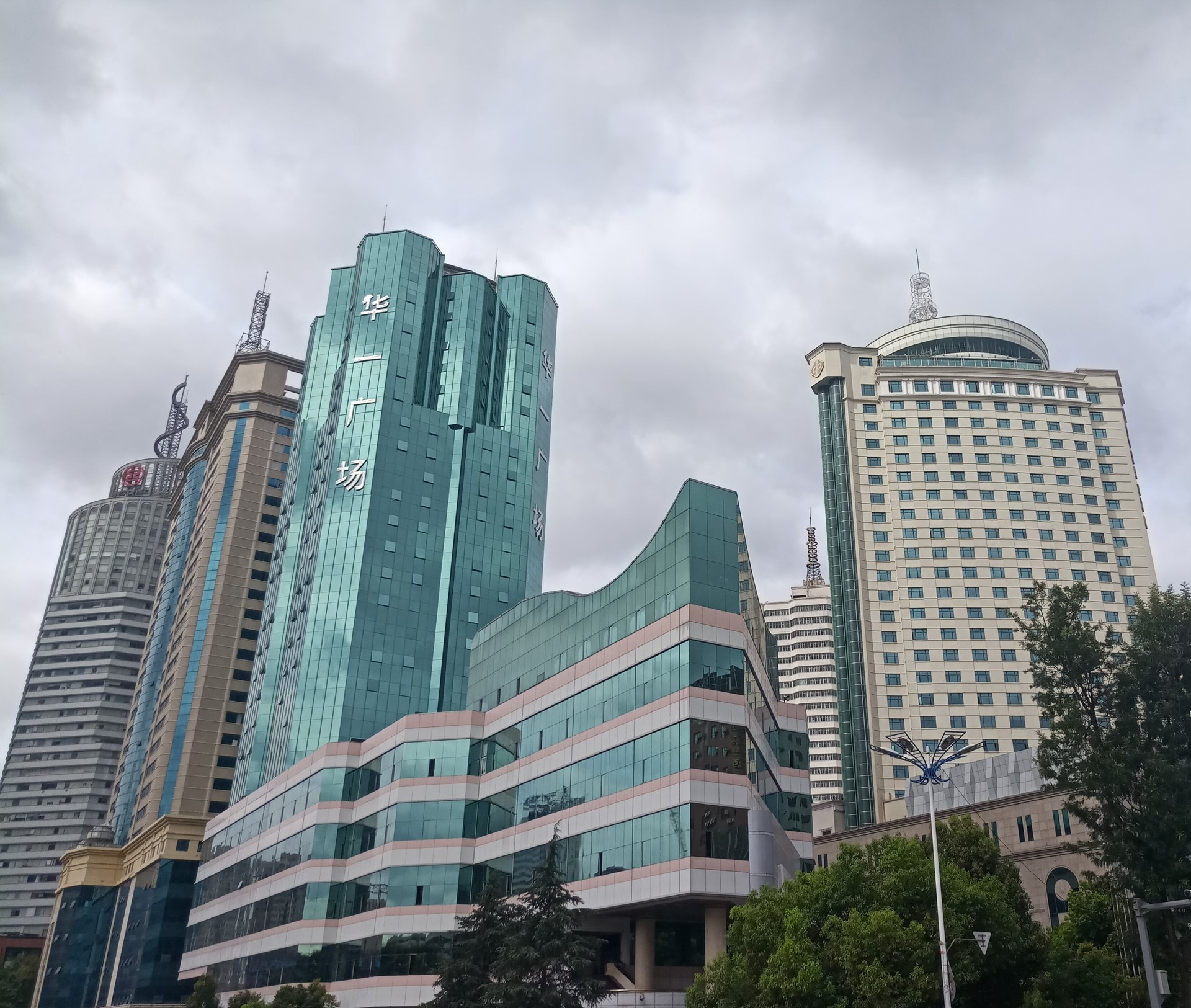

1. A Provincial Capital's Industry, Underestimated
When people think of Kunming, the first thing that comes to mind is the "Spring City"—a climate that stays like spring all year round, streets ablaze with jacaranda blossoms, the sunset glow over Dianchi Lake, markets where fresh flowers are sold by the catty. It is a tourist city, a livable city, a gateway to Southeast Asia. Among these labels, "industrial city" almost never appears. The impression Kunming projects to the outside world is one of comfort, leisure, and a slow pace of life—not smokestacks, factories, and assembly lines. This impression has left Kunming's industry chronically underestimated.
But the fact is that Kunming is an industrial city through and through, and it is the undisputed heart of Yunnan's industry. In 2024, Kunming's gross regional product reached 827.522 billion yuan, breaking through the 800-billion-yuan threshold for the first time and accounting for roughly a quarter of Yunnan Province's total GDP. As the provincial capital, Kunming concentrates Yunnan's densest cluster of industries, its largest number of leading enterprises, its most complete industrial chains, and its strongest scientific and educational resources. Nearly every category of Yunnan's industry—tobacco, non-ferrous metals, phosphorus chemicals, equipment manufacturing, biopharmaceuticals, rare and precious metals, green manufacturing—can find an important fulcrum in Kunming. It is fair to say that to understand Kunming's industry is to understand the greater part of Yunnan's industry.
Kunming's industrial foundation is thicker than many imagine. In modern times the city was already Yunnan's commercial and industrial center, and after the Yunnan-Vietnam Railway opened it became an important trading port for the Southwest. After the founding of the People's Republic, the state located a batch of non-ferrous metal, machinery, and chemical enterprises in Kunming, laying the foundation for its heavy industry. Since the reform and opening-up, industries such as tobacco, biopharmaceuticals, and rare and precious metals have grown in succession. Today's Kunming has both heavy-chemical "behemoths" such as PetroChina Yunnan Petrochemical's ten-million-tonne refinery and well-known enterprises such as Yunnan Baiyao, Botanee, and Walvax Biotechnology, as well as niche champions such as Sino-Platinum Metals and KSEC Intelligent. A provincial capital's industrial assets are far richer than the "Spring City" label would suggest.
Yet Kunming's industry also has a persistent trouble, which can be summed up in a phrase: "big but not strong." As the provincial capital, its industrial scale ranks first in Yunnan, but placed within the coordinate system of the nation's provincial capitals—whether in scale or in quality—it is nothing outstanding. It has a batch of decent enterprises, but it lacks the super-leaders and industrial clusters that could lead the nation. Its traditional industries lean heavy and resource-based; its emerging industries are growing fast but remain small in scale. Its geographic position was once closed off, and although the China-Laos Railway has now opened it up, the dividends of a hub economy have yet to be realized. Kunming's industry is a provincial-capital sample that "has assets and potential, but also has shortcomings and anxieties."
Why is Kunming's industry so easily underestimated? There are probably several layers of reasons. First, the "Spring City" tourism label is too deeply embedded; the soft image of flowers, climate, and scenery overshadows the hard industrial substratum. Second, Kunming's industry is dominated by "less conspicuous" heavy-chemical and resource-based sectors such as petrochemicals, metallurgy, tobacco, and non-ferrous metals—unlike consumer electronics, automobiles, or home appliances, which are close to everyday life and easily perceived. Third, compared with the coastal manufacturing powerhouses, Kunming lacks the kind of instantly recognizable super-industrial calling card, so the presence of its industry is naturally diluted. But a weak presence does not mean a light weight—the output, tax revenue, and employment that Kunming's industry supports are the very things that keep the city and the whole of Yunnan running.
Understanding Kunming's industry also requires placing it against a larger backdrop of the times. China today stands at a historic convergence of forces: the transformation and upgrading of manufacturing, the profound restructuring of regional patterns, the comprehensive advance of green and low-carbon development, and the widening of openness toward Southeast Asia. Each of these great currents is closely tied to Kunming—it is the capital of a resource-based province facing the shared challenge of transformation and upgrading; it is the central city of a green-electricity powerhouse standing at the crest of green manufacturing; it is the gateway toward South Asia and Southeast Asia embracing the opportunities of border-region opening. Kunming's industrial future is being shaped precisely at the intersection of these currents of the era. To understand Kunming's industry is, in a sense, to understand how a provincial capital in China's west searches for its own place amid the great changes of the times.
What this report sets out to tell is the story of exactly such an underestimated provincial-capital industry. We will begin with Kunming's industrial coordinates, then dissect its Third Front equipment foundation, the heavy-chemical backbone of its petrochemicals and metallurgy, the singular mastery of its rare and precious metals, and the consumer highlights of its biopharmaceuticals; we will then look at its industrial-park landscape, the hub position now being reshaped by the China-Laos Railway, and the structural predicament and path of transformation behind "big but not strong." Kunming's story is that of how a provincial capital, lacking a coastal location and lacking first-mover advantages, seeks an industrial breakout by relying on its own endowments. It may not be spectacular, but it truly reflects the shared circumstances and efforts of China's western provincial capitals. And to understand all of this, we must first give Kunming's industry an accurate set of coordinates.
2. Industrial Coordinates: Provincial-Capital Primacy and the 800-Billion Threshold
To position Kunming's industry, one must first look at its weight within Yunnan Province. In 2024, Kunming's GDP reached 827.522 billion yuan, crossing the 800-billion-yuan threshold for the first time, a year-on-year increase of 4.0%. That scale accounts for more than a quarter of Yunnan Province's total GDP (3,153.410 billion yuan)—which is to say, of every four-plus yuan of GDP that Yunnan creates, more than one comes from Kunming. As the provincial capital, Kunming's "primacy" within the provincial economy is remarkably pronounced; it is a genuine case of one city dominating all. This high primacy is at once an advantage of resource concentration that comes with being the provincial capital, and a reflection of the imbalance in Yunnan's regional development.
Viewed by the structure of the three sectors, Kunming displays the typical features of a provincial capital. In 2024, Kunming's primary-sector value-added was 33.970 billion yuan (up 2.8%), the secondary sector 244.119 billion yuan (up 4.1%), and the tertiary sector 549.433 billion yuan (up 4.0%). The tertiary sector accounts for close to two-thirds, and services have become the mainstay of Kunming's economy—consistent with the general pattern of well-developed services in a provincial capital. But one should also note that the secondary sector (industry and construction), at 244.1 billion yuan, is the hard support underpinning Kunming's role as the "heart of Yunnan's industry." Services lift Kunming's urban tier, but industry determines its industrial roots and the depth of its real economy.
Placed within the coordinate system of the nation's cities, Kunming's position becomes sobering. With an economic aggregate of 827.5 billion yuan, Kunming ranks roughly 34th among the nation's cities; some media estimate that its provincial-capital primacy ranks near the top nationally (around 14th). The meaning of these figures is twofold. On one hand, among the nearly three hundred prefecture-level and above cities nationwide, Kunming's entry into the top forty shows it is by no means negligible. On the other hand, as a provincial capital and a regional central city, Kunming's economic aggregate still lags markedly behind the eastern coastal provincial capitals (such as Hangzhou, Nanjing, and Jinan), and is in a different league altogether from strong western capitals such as Chengdu, Wuhan, and Xi'an. The status of a provincial capital is high, but the economic tier still requires effort—this is Kunming's true set of coordinates.
The momentum of industrial growth, meanwhile, reveals the positive changes underway in Kunming. In 2024, Kunming's industrial value-added above designated size grew 7.0%, markedly faster than the city's GDP growth of 4.0% and faster than the province's 3.3% growth in industrial value-added above designated size. This means industry is becoming an important engine of Kunming's economic growth, and the dynamism of the real economy is strengthening. By category, manufacturing grew 5.6%, the production and supply of electricity, heat, gas, and water grew 13.5%, and mining grew 18.7%—multiple industrial segments are all gaining force. Industrial growth outpacing GDP is a healthy signal, showing that Kunming has made progress in steering its economy "from the virtual to the real" and in consolidating its industrial foundation.
Kunming's high primacy is a double-edged sword. On one hand, the agglomeration effect of a provincial capital allows Kunming to marshal the strength of the whole province to build a relatively strong central city, drawing in the best industries, talent, capital, and infrastructure—an important advantage for Kunming's development. On the other hand, "one city dominating all" also means severe imbalance in Yunnan's regional development—when more than a quarter of the province's economic aggregate is concentrated in Kunming alone, the relative weakness of the other prefectures becomes inevitable. This imbalance gives Kunming the resource advantage of "good shade under a big tree," but it also saddles the city with the heavy responsibility of "radiating and driving the whole province." The higher Kunming's primacy, the heavier its leading obligations as the provincial capital.
In terms of urban tier, Kunming also faces the awkwardness of being "neither above nor below." Looking up, it lags markedly behind the trillion-yuan and near-trillion-yuan strong western cities (strong provincial capitals) such as Chengdu, Wuhan, Xi'an, and Chongqing—both in economic aggregate and in industrial tier—and cannot yet stand shoulder to shoulder with them. Looking down, it is far ahead of every other city in Yunnan and is the undisputed leader. This position—"toward the rear among western provincial capitals, but one city dominating within the province"—dictates that Kunming must both strive to catch up and narrow the gap with the more advanced capitals, and play its leading role to drive the whole province's development. This dual pressure and responsibility form the special context of Kunming's industrial development—it cannot simply grow taller on its own, but must also think about how to pull along the whole of Yunnan.
More noteworthy still is the quiet optimization within Kunming's industrial structure. As the provincial capital, Kunming has both the conditions and the responsibility to take the lead in Yunnan in developing high-tech, high-value-added industries. In recent years, Kunming's high-tech manufacturing and equipment manufacturing have grown rapidly, their share rising steadily, and the industrial structure is shifting from the traditional resource-based and heavy-chemical type toward the more technology-intensive and higher-value-added direction. This structural optimization is the key to Kunming's industrial "quality upgrade," and an important feature that distinguishes it from a purely resource-based city. Of course, structural adjustment is not the work of a single day, and the "big but not strong" substratum of Kunming's industry has yet to be fundamentally changed—traditional industries remain the ballast, while emerging industries are still growing. Having understood Kunming's aggregate coordinates and growth trend, we must next delve into the "two contrasting climates" within its industry, to see clearly the true momentum structure of this provincial capital's industry.
3. Two Contrasting Climates: A Look at the Momentum of Kunming's Industry
A city's industrial vitality cannot be judged by aggregate alone; one must also look at its "momentum structure"—which industries are growing rapidly, and which are steady or even declining. Examining the sector-by-sector growth rates of Kunming's industry in 2024 reveals a picture of "two contrasting climates": the traditional pillars are steady but cooling, while the emerging momentum surges ahead. This picture is a key to understanding where Kunming's industrial transformation is really exerting its force.
First, look at the "hot" side—Kunming's most eye-catching growth poles. In 2024, Kunming's high-tech manufacturing value-added grew by an astonishing 47.3%, its share of industry above designated size rising to 17.7% (an increase of about 3.6 percentage points); equipment manufacturing grew 46.0%, with equally fierce momentum. These two figures are no small matter—they mean that Kunming's new industrial momentum is expanding at nearly double-digit-to-doubling speed, and the industrial structure is rapidly shifting toward the more technology-intensive and higher-value-added direction. The explosive growth of high-tech and equipment manufacturing is the direct expression of Kunming's role, as the provincial capital, in taking the lead in Yunnan to develop high-end industries and optimize its industrial structure. This "heat" represents the future direction of Kunming's industry.
Next, look at the "warm" side—those traditional pillars that grow steadily but no longer at high speed. In 2024, Kunming's chemical industry grew 8.0%, pharmaceutical manufacturing grew 3.6%, and the tobacco products industry grew 2.2%. These industries are the traditional bedrock of Kunming's industry—chemicals (including petrochemicals), pharmaceuticals, and tobacco have long contributed the greater part of Kunming's industrial output, tax, and profit. Their steady growth shows the bedrock is solid, but it also shows that these mature industries have entered a low-speed growth phase and can no longer provide high growth for Kunming's industry. They are the ballast, guaranteeing the stability of Kunming's industry, but they are no longer the main engine driving growth.
This structure of "high-growth new momentum, steady old pillars" is of a piece with the province-wide pattern, yet it also carries the characteristics of a provincial capital. Compared with some purely resource-based prefectures, Kunming, by virtue of its scientific and educational resources, talent concentration, and industrial supporting facilities as the provincial capital, has stronger conditions for development in fields that require a certain technological threshold—high-tech manufacturing, equipment manufacturing, biopharmaceuticals, and the like. This gives Kunming the chance to become the bellwether of Yunnan's industrial "quality upgrade"—when the other cities of central Yunnan are still exerting force on resource-based green manufacturing such as green aluminum and photovoltaics, Kunming can devote more effort to exploring the high-tech, high-value-added direction. Herein lies the responsibility of the provincial capital.
This "two contrasting climates" structure is in fact a shared feature of many of China's old industrial cities in their transformation period—the old momentum grows weak while the new momentum rises rapidly, the two waxing and waning in alternation as the old gives way to the new. Its positive significance is that it shows Kunming's industrial structure is adjusting in the right direction, and that the conversion between old and new momentum is genuinely taking place. But its challenge lies in the fact that this conversion has a "time lag"—before the new momentum grows large enough to take over, the weak growth of the old pillars may drag down the whole, while the high growth of the emerging industries cannot fill that gap in the short term. How to pass smoothly through this transitional period of "old giving way to new"—neither letting the old pillars stall and drag down the overall situation, nor denying the new momentum enough time to grow—is a key test of Kunming's industrial transformation.
It must also be seen that the "heat" of Kunming's industry owes much to the resource-agglomeration advantage of the provincial capital. High-tech manufacturing and equipment manufacturing—industries that require a certain technological threshold and talent support—are precisely where a provincial capital holds the advantage over the prefectures. Kunming has the province's best universities, research institutes, talent, and industrial supporting facilities, which give it conditions for developing high-tech industries that the prefectures can hardly match. In other words, the early optimization of Kunming's industrial structure is itself an expression of the provincial capital's agglomeration effect. This also points to the position Kunming should hold within the province's industrial landscape: not to compete with the prefectures on resource-based capacity, but to leverage its scientific-educational and talent advantages to be the leader of the province's high-tech, high-value-added industries. The value of the provincial capital lies precisely in its ability to do the "high-end" and "frontier" work that the prefectures cannot.
But one must also see clearly that although the "hot" segments grow at astonishing rates, their absolute scale is still small. While high-tech manufacturing's share of industry above designated size has risen to 17.7%, this also means that over 80% of the share remains in the hands of traditional industries. The high growth of equipment and high-tech manufacturing is largely "high growth on a small base"—it represents a direction, but it cannot yet bear the main weight of Kunming's industry. What truly supports Kunming's industry is still the "heavyweights" of petrochemicals, metallurgy, tobacco, and pharmaceuticals. This is the true state of Kunming's industrial transformation: new momentum is rapidly gestating, but taking over from the old pillars will still take time. Behind the two contrasting climates is a structural transformation that is underway but not yet complete. To understand where this transformation comes from, one must return to the deepest layer of Kunming's industrial foundation—its equipment-manufacturing tradition, which begins with a particular chapter of history.
4. The Third Front Foundation: The Origins of Kunming's Equipment Manufacturing
That Kunming can hold a not-inconsiderable base in equipment manufacturing is closely tied to the history of new China's industrial layout, and especially to the Third Front construction period of the 1960s and 1970s. Only by understanding this history can one grasp where Kunming's machinery and equipment industry came from, and only then can one read some of the distinctive advantages it holds in equipment manufacturing today.
First, a concept must be clarified objectively. The so-called "Third Front construction" was a large-scale industrial and national-defense construction effort carried out from the mid-1960s to the 1970s in the central and western inland hinterlands, undertaken by the state out of strategic-security considerations. It should be noted that the key cities of Third Front construction, as generally identified by scholars, are places such as Panzhihua, Mianyang, Deyang, Guiyang, and Hanzhong; Kunming does not belong to the core focus areas of Third Front construction. But as an important central city of the Southwest, Kunming during this period—and in the earlier industrial layouts—still received and developed a batch of machinery, defense, non-ferrous metal, and electronics enterprises, accumulating a considerable foundation and a workforce of skilled workers for its equipment manufacturing. This foundation was an important starting point for the later development of Kunming's equipment manufacturing.
In fact, Kunming's industrial layout predates the Third Front construction. As early as modern times, Kunming became an important commercial and industrial city of the Southwest thanks to the opening of the Yunnan-Vietnam Railway. During the War of Resistance, large numbers of factories, universities, and technical personnel relocated inland, and a batch of machinery, electronics, and defense enterprises settled in and around Kunming, giving this rear-area city an unexpected concentration of industry and technology. After the founding of the People's Republic, the state again focused on developing non-ferrous metals, machinery, chemicals, and other industries in Kunming. It is fair to say that Kunming's industrial foundation is the result of multiple historical factors layered one upon another—modern-era trade, wartime inland relocation, planned-economy layout, and the defense-and-machinery construction of the Third Front period.
This historical foundation left Kunming several precious industrial legacies. First, a batch of equipment-manufacturing enterprises—in fields such as machine tools, ship equipment, engines, electric motors, and heavy machinery, Kunming has corresponding backbone enterprises that form the skeleton of its equipment manufacturing. Second, a workforce of skilled and experienced industrial workers and engineers—the most precious asset of an industry like equipment manufacturing, which depends on the transmission of craftsmanship. Third, specialized-equipment capabilities integrated with local pillar industries—for example, tobacco machinery integrated with tobacco, and metallurgical equipment integrated with non-ferrous metals, in which Kunming has formed distinctive advantages. These legacies give Kunming's equipment manufacturing a place in Yunnan and even in the Southwest.
Especially worth mentioning within this historical foundation is the tradition of "specialized equipment." Kunming's equipment manufacturing formed, very early on, a distinctive character of deep integration with local pillar industries—supplying tobacco machinery to the tobacco industry, metallurgical equipment to the non-ferrous metals industry, and mining and beneficiation equipment to the mining industry. This "follow the local industry" specialized-equipment path meant that although Kunming's equipment manufacturing is not large in scale, it has formed distinctive advantages in a number of niche fields. KSEC's tobacco machinery and intelligent logistics are outstanding representatives of this tradition. The specialized-equipment path also points to a realistic route for Kunming's equipment manufacturing—rather than competing across the board with the strong coastal provinces on general-purpose equipment, it can dig deep into niche tracks integrated with local industries and become a "specialized and innovative" hidden champion.
From a more macro perspective, the history of Kunming's equipment manufacturing reflects the changing eras of China's industrial layout. The trade opening of modern times, the wartime relocation of factories, the key construction of the planned economy, the strategic layout of the Third Front period, and the market reshaping of the reform and opening-up—each turning point of the era left its imprint on Kunming's industrial map. Every enterprise, every technology, and every workforce in Kunming's equipment manufacturing today is more or less connected to this history behind the scenes. Only by understanding the weight of this history can one appreciate how precious Kunming's existing equipment-manufacturing assets are, and only then can one grasp the inevitability of its ups and downs in the market-oriented transformation. History gave Kunming's equipment manufacturing a decent starting point, but whether it can hold onto and strengthen these assets is a test of managerial wisdom in a market-oriented era.
Of course, a historical foundation is both an asset and potentially a burden. Equipment-manufacturing enterprises in old industrial cities often carry the imprint of the planned-economy era—inflexible institutions and mechanisms, an aging product mix, and a low degree of marketization. In the market competition after the reform and opening-up, some transformed successfully and were reborn, while others struggled and even fell. Kunming's equipment manufacturing traveled through the decades since the reform and opening-up in precisely this state of "having a foundation, but also having a burden." It nurtured enterprises such as KSEC Intelligent, which listed successfully and stands at the forefront of its industry, but it also went through the lamentable delisting lesson of Kunming Machine Tool. Having understood the historical origins of Kunming's equipment manufacturing, let us next approach the most representative enterprises among these assets and see their respective ups and downs—beginning with the brightest calling card of Kunming's equipment manufacturing: KSEC.
5. KSEC: A Hidden Champion from Tobacco Machinery to Intelligent Logistics
Among Kunming's equipment-manufacturing enterprises, KSEC is the one most worth discussing. Its full name is Kunming Shipbuilding Equipment Group (KSEC), but its core competency has long since ceased to be shipbuilding; instead it is two seemingly unrelated things, both of which it has brought to the front rank nationally—tobacco machinery and intelligent logistics equipment. The story of KSEC is a sample of how an inland equipment-manufacturing enterprise dug deep into niche fields and grew into a hidden champion.
KSEC's bond with tobacco is a natural extension of its locational advantage. Yunnan is the nation's largest tobacco province, and Kunming is home to the headquarters of Yunnan Tobacco—situated in such a vast tobacco-industry hinterland, KSEC keenly entered the niche market of tobacco machinery, supplying cigarette enterprises with complete sets of equipment for silk-making, rolling and connecting, packaging, and logistics. Tobacco machinery has a high technological threshold and stringent reliability requirements, and KSEC, drawing on long accumulation, became an important supplier in the domestic tobacco-equipment field. "Making tobacco machinery while sitting beside the nation's largest tobacco industry"—KSEC converted a locational advantage into an industrial advantage, and this is the first cornerstone of its success.
But what truly won KSEC the industry's admiration is its achievements in intelligent logistics equipment. KSEC is among the earliest enterprises in the country to develop and apply the automated guided vehicle (AGV)—the AGV is the "unmanned transport vehicle" that shuttles about moving materials in smart factories and automated warehouses, a key piece of industrial-automation equipment. Starting from automated logistics for tobacco enterprises, KSEC gradually extended its intelligent logistics technology to pharmaceuticals, airports, e-commerce, manufacturing, and other fields, becoming an important force in domestic intelligent-logistics system integration. Its subsidiary KSEC Intelligent has listed on the Shenzhen Stock Exchange (stock code 301311), a mark of the capital market's recognition of this Yunnan equipment-manufacturing enterprise. For an inland enterprise to hold a place on the frontier track of intelligent logistics is no small feat.
KSEC's success offers valuable lessons for equipment manufacturing in Kunming and Yunnan. First, "make specialized equipment by relying on local industry"—KSEC started from tobacco machinery, seizing the vast local market of Yunnan tobacco and turning a locational disadvantage into an industrial advantage. Second, "move from specialized to general-purpose"—KSEC did not stop at tobacco machinery but extended the automation capabilities it accumulated in tobacco logistics into the far broader intelligent-logistics market, achieving the leap from a "small pond" to "great rivers and seas." Third, "embrace the frontier, connect with capital"—KSEC keenly entered high-growth tracks such as AGVs and intelligent logistics, and gained capital support through its listing. All three of these lessons carry reference value for the "specialized and innovative" breakout path of Yunnan's equipment manufacturing.
KSEC's intelligent-logistics footprint is now quite broad. From its original tobacco-logistics automation, KSEC's AGVs and intelligent logistics systems have expanded into many fields—pharmaceuticals, airports, e-commerce warehousing, automotive manufacturing, and new energy. In directions such as automated stereoscopic warehouses, intelligent sorting, unmanned transport, and flexible production lines, KSEC has mature solutions and a large number of project cases. In an era when industrial automation and smart manufacturing have become the prevailing trend, intelligent logistics equipment is a track with strong growth potential, and KSEC, drawing on years of accumulation, has secured a favorable position. The listing of its subsidiary KSEC Intelligent on the capital market has also provided funding and a platform for its further expansion. An enterprise that started from inland tobacco machinery has grown into an important player in the intelligent-logistics field—KSEC has traced out a distinctive and successful growth curve.
KSEC's value also lies in the boost it gives to industrial upgrading in Kunming and Yunnan. Intelligent logistics equipment belongs to high-end equipment manufacturing, with high technological content and large value-added—it is a representative of Kunming's industrial "upgrade toward the high end." At the same time, KSEC's intelligent logistics systems can in turn empower the intelligent upgrading of Yunnan's local manufacturing, logistics, and agriculture (such as fresh-flower cold chains and agricultural-product warehousing), forming a virtuous interaction between "equipment manufacturing" and "industrial intelligentization." A high-end equipment leader with both technology and market brings multifaceted benefits to a region's industrial ecology—it not only creates value itself but also lifts the automation and intelligentization level of the entire regional industry. KSEC is a banner of Kunming's equipment manufacturing "leading its upgrade with the high end."
KSEC proves one important thing: even when situated in an inland provincial capital that lacks a locational advantage, an equipment-manufacturing enterprise can still, through focus and technology, reach the national front rank in niche fields. It wins not by scale but by digging deep into niche tracks such as tobacco machinery and intelligent logistics, building advantages that others find hard to shake. This is precisely the successful model that Kunming's equipment manufacturing should most cherish and replicate—not aiming to be big and complete, but to be specialized and refined. Yet not all of Kunming's equipment-manufacturing enterprises have walked KSEC's road to success. Even as KSEC advanced steadily, another older and more famous enterprise in the history of Kunming's equipment manufacturing came to a lamentable end. Its name is Kunming Machine Tool.
6. Kunming Machine Tool: A Painful Lesson
In Kunming's industrial history, Kunming Machine Tool is a name that cannot be bypassed, yet also one that is lamentable. It was once a banner of China's machine-tool industry, one of the most dazzling signboards of Kunming's equipment manufacturing; yet in recent years, because of a financial fraud, it dimly exited the capital market and became a cautionary negative case for Chinese manufacturing. The rise and fall of Kunming Machine Tool deserves careful remembrance by everyone who cares about manufacturing.
First, look at its glory. Kunming Machine Tool was founded in 1936 and is one of the oldest backbone enterprises in China's machine-tool industry. Renowned for its precision boring machines, it was an important supplier of high-end domestic machine tools during the planned-economy era and the early reform-and-opening period, its products widely used in machinery, defense, automobiles, and other fields. As a maker of the "industrial mother machine"—the machine tool is called "the machine that makes machines" and is the cornerstone of the equipment-manufacturing industry—Kunming Machine Tool once represented a relatively high level of China's precision machine-tool manufacturing. It was at one time listed in both Hong Kong and Shanghai, a well-established industrial stock that drew considerable attention in the capital market, and a source of pride for Kunming's industry.
However, after entering the new century, Kunming Machine Tool gradually fell into difficulty. On one hand was the intensification of market competition—domestic and foreign machine-tool enterprises competed fiercely, and Kunming Machine Tool gradually fell behind in technology upgrading, product mix, and market development, its operations deteriorating year by year. On the other hand, and more fatally, was the collapse of governance and integrity. Around 2017, Kunming Machine Tool was exposed for years of consecutive financial fraud, inflating revenue and profit, gravely violating the integrity bottom line of the capital market. In the end, this well-established enterprise of more than eighty years' history delisted from the Hong Kong Stock Exchange in 2019, and its A-shares also went through a delisting storm—a once-famous enterprise thus dimly bowed out.
The fall of Kunming Machine Tool teaches lessons that are manifold and profound. First, the lesson of technology and market—in the fiercely competitive field of high-end equipment, any enterprise that stops innovating and fails to keep up with changes in technology and market will be eliminated by the times, no matter how glorious its history. High-end manufacturing such as the "industrial mother machine" tolerates not the slightest slackness. Second, and more fundamentally, the lesson of integrity and governance—financial fraud is the high-voltage line of the capital market, and any enterprise that touches it, no matter how large its scale or how long its history, will pay a bitter price. Kunming Machine Tool, through its own downfall, proved that an enterprise's lifeline is not only its products and market, but even more its integrity and well-regulated governance.
The fall of Kunming Machine Tool also carries a deeper significance concerning the "industrial mother machine." The machine tool is called the "industrial mother machine," the machine that makes all machines, and the cornerstone of a nation's manufacturing strength. In the mid-to-high-end machine-tool field, China has long lagged behind manufacturing powers such as Germany and Japan, and high-end machine tools still depend heavily on imports. As a well-established backbone of China's machine-tool industry, Kunming Machine Tool should have contributed to breaking through the "bottleneck" challenges of high-end machine tools, yet it dimly exited because of operational failure and the collapse of integrity—this is not only the tragedy of a single enterprise but also a loss for China's high-end equipment manufacturing. It reminds people, from the negative side, that strategic and foundational industries such as the industrial mother machine require long-term, patient, and honest investment, and tolerate neither impatience for quick success nor deception.
The lesson of Kunming Machine Tool carries a particular warning for Kunming's current industrial "upgrade toward the high end." Kunming is vigorously developing high-tech manufacturing and high-end equipment—fields with high technological thresholds, long investment cycles, and slow returns, which most require the resolve of long-termism and an attitude of seeking truth from facts. If one is eager for quick success, if one falsifies data and performance, if one relaxes the pursuit of technology and quality, then even the best industrial direction will end in failure. Kunming Machine Tool, through its own downfall, sounded an alarm for all of Kunming's enterprises aspiring to high-end manufacturing—there is no shortcut in high-end manufacturing; only by earnestly investing in technology, operating with integrity, and striving for excellence can one go far and steadily. This lesson deserves to be etched in the memory of every industrialist in Kunming.
For Kunming and for China's equipment manufacturing as a whole, Kunming Machine Tool is a mirror. It warns that industrial competitiveness can never be secured once and for all by historical accumulation alone; it must be sustained through continuous technological investment, healthy operations, and honest governance. An enterprise can be respected for a glorious history, but it can never survive long by living off past achievements; it can be under pressure from temporary difficulties, but it can never paper over troubles with financial fraud. The lesson of Kunming Machine Tool stands in exact contrast to the success of KSEC—one positive, one negative, together sketching out the experience and the cautionary reflection of Kunming's equipment manufacturing. Beyond equipment manufacturing, Kunming has another set of assets related to "power" and "mobility"—its engine and automobile industry, whose representative enterprise is Yunnei Power.
7. Yunnei Power and Automobiles: From Engines to Complete Vehicles
Kunming's equipment manufacturing has another industrial line tied to "power" and "mobility"—engines and automobiles. Although Kunming is not one of China's nationally renowned automotive cities, it is home to a backbone engine maker like Yunnei Power, along with a growing complete-vehicle manufacturing sector, which together form a distinctive piece of its industrial map.
Consider Yunnei Power first. This is a Kunming-headquartered diesel engine manufacturer (stock code 600006) and a major supplier in China's light-duty diesel engine segment. The engine is the "heart" of automobiles, construction machinery, and agricultural machinery—technology-intensive and with strong pull on upstream and downstream industries. Yunnei Power has long focused on the R&D and manufacturing of diesel engines, and its products are widely fitted to light trucks, construction machinery, and similar applications. In recent years, Yunnei Power has also been transitioning toward new-energy power and cleaner, more efficient engine technologies, working to keep pace with the broad trend of electrification and cleaner power in the automotive sector. According to reports, Yunnei Power's output value has crossed the 10-billion-yuan threshold, making it a backbone enterprise of Kunming's equipment manufacturing. That an inland city can host an engine maker of scale provides important core-component support for its development of automobiles and related industries.
In complete-vehicle manufacturing, Kunming also has a presence, concentrated mainly in industrial parks such as Yanglin in Songming. Complete-vehicle projects including BAIC New Energy have been introduced here—according to available data, the relevant base has formed an annual capacity of roughly 100,000 new-energy vehicles. In addition, enterprises such as Dongfeng also have operations in Yunnan. Complete-vehicle manufacturing exerts an enormous pull on a region's industry—a single vehicle is made up of tens of thousands of components and can drive a long chain of supporting industries including engines, transmissions, body, interiors, electronics, and tires, creating substantial employment. Kunming's development of new-energy vehicle assembly both follows the broad trend of automotive electrification and holds the promise of drawing on Yunnan's local resources—green electricity and lithium-battery materials (cathode materials and separators from Qujing and Yuxi)—to form a "materials–batteries–complete vehicles" industrial synergy.
That said, to be objective, Kunming's automotive industry remains relatively limited in scale for now, and has not yet formed a complete-vehicle industrial cluster on the order of Chongqing, Guangzhou, or Shanghai. It is more a case of "having a foothold and a foundation, but not yet reaching critical mass." The automotive industry is a textbook case of economies of scale and cluster economics—it requires vast complete-vehicle capacity to sustain a full supporting components ecosystem, and Kunming's current vehicle-assembly scale is not yet sufficient to underpin a complete local automotive supply chain. Many components still have to be sourced from outside the province, and the local supporting ratio has room to improve. This is at once a shortcoming of Kunming's automotive industry and its space for future growth.
As the "heart" of automobiles and construction machinery, engines and their technological level often represent the hard strength of a region's equipment manufacturing. Yunnei Power's long focus on diesel engines has accumulated considerable technical capability, but it also faces the challenge of a transformation in power technology—amid the broad trend of automotive electrification and cleaner power, the market space for conventional internal-combustion engines is being squeezed by new-energy power. Whether enterprises such as Yunnei Power can successfully transition—upgrading from conventional diesel engines to new-energy power, hybrid power, and clean, efficient engines—will shape the future of Kunming's engine industry. This is both a challenge and an opportunity: a period of transformation in power technology is precisely the window for latecomers to "change lanes and overtake." If Kunming can seize the opportunity in new-energy power, its engine and automotive industries stand to be revitalized.
From the perspective of industrial synergy, the greatest scope for imagination in Kunming's automotive development lies in a local closed loop of "materials–batteries–complete vehicles." Yunnan possesses resources such as green electricity, non-ferrous metals (aluminum, copper), and lithium-battery materials (cathode materials and separators from Qujing and Yuxi)—precisely what new-energy vehicles most need: aluminum for lightweight bodies, copper for electronic controls and wiring harnesses, and cathode and separator materials for power batteries. If Kunming can connect these local materials and battery advantages to complete-vehicle manufacturing, it could form a "Yunnan materials–Yunnan batteries–Kunming vehicles" industrial synergy, raising the local supporting ratio and the value added of the industry. Layer on the export potential toward Southeast Asia, and the prospects for Kunming's new-energy vehicle industry are worth anticipating. This will require Kunming to invest greater effort in supply-chain-oriented investment attraction and the cultivation of local supporting capacity.
Kunming's automotive opportunity most likely lies hidden in the two keywords "new energy" and "Southeast Asia." On one hand, Yunnan's advantages in green electricity and lithium-battery materials give it the foundation for industrial-chain synergy in developing new-energy vehicles (especially core components such as batteries and electric drives). On the other hand, Kunming's location facing South and Southeast Asia positions it to develop export manufacturing of automobiles (especially new-energy vehicles, commercial vehicles, and motorcycles) aimed at the Southeast Asian market—Southeast Asia is in a period of rapidly rising automotive consumption and is an important market for Chinese automakers going overseas. If Kunming can combine its "new-energy materials advantage" with its "locational advantage facing Southeast Asia," it may well find a differentiated development path in the new-energy vehicle race. Engines and automobiles are a testing ground for the future of Kunming's equipment manufacturing. Beyond equipment manufacturing, Kunming's industry also has a "heavier" backbone—its metallurgy and petrochemicals. We begin with Kungang.
8. Kungang: A Metallurgical Restructuring from Distress into Baowu
Steel is the backbone of industry. And within Kunming's heavy industry, Kungang is exactly such a backbone. Kungang—short for Kunming Iron & Steel—is Yunnan's largest steel enterprise and an important steel base in the Southwest. Its development trajectory, and especially the story of its recent restructuring under China Baowu, reflects the broad trend of consolidation and upgrading in China's steel industry, and is also an important window for understanding the transformation of Kunming's heavy industry.
Kungang's weight is evident from its sheer size. Take Kungang Holding as an example: this enterprise, formed in 2003, once had a workforce of roughly 27,000 and total assets in the tens of billions of yuan (around 64.7 billion yuan in the period around September 2020), making it one of the "heavyweights" of Yunnan's industry. As a steel enterprise, Kungang supplies the basic steel raw materials for Yunnan's construction, infrastructure, and machinery manufacturing, and is an important force underpinning Yunnan's industrialization and urbanization. It can be said that the high-rises, bridges, and railways built across Yunnan in recent years all owe a debt to Kungang's steel. It is a textbook resource-based, foundational heavy industry—large in scale and strong in its pull on the economy—but it also faces the challenges common to the steel sector, such as overcapacity and volatile profitability.
A key turning point in Kungang's development was its restructuring under China Baowu. In February 2021, China Baowu Steel Group took over 90% of the equity of Kungang Holding without consideration, and Kungang thereby became a member of the "China Baowu" family. (It should be noted that the restructuring party was China Baowu, not the earlier Wuhan Iron & Steel—Wugang had already been merged into Baowu beforehand.) China Baowu is one of the largest steel enterprises in the world, and its entry brought Kungang all-round empowerment in capital, technology, management, and markets. For Kungang, joining Baowu meant leaning against a big tree, able to gain strong support in technological upgrading, product-mix optimization, and green low-carbon transformation; for Baowu, restructuring Kungang rounded out its industrial footprint in the Southwest. This was a textbook central-local steel restructuring of "strong-with-strong combination and complementary advantages."
Kungang's restructuring is a microcosm of the supply-side reform and grand consolidation of China's steel industry. In the past, China's steel sector suffered from scattered capacity, low concentration, and cutthroat competition; in recent years, the state has promoted mergers and restructuring in the steel sector to raise industrial concentration, and steel giants represented by China Baowu have substantially lifted the sector's concentration and competitiveness by restructuring a batch of local steel enterprises. Kungang's restructuring under Baowu is precisely one move within this broad trend. For localities, folding a local steel enterprise into the system of a national steel giant both preserves local steel capacity and employment and, with the giant's strength, achieves transformation and upgrading—a pragmatic, win-win choice.
Kungang's restructuring also reflects a pragmatic path for the reform of local state-owned enterprises. For many localities, large local SOEs in steel, non-ferrous metals, and chemicals are both important industrial and employment pillars and yet often face problems of insufficient scale, insufficient technological strength, weak market competitiveness, and even operating difficulties. In such circumstances, folding a local SOE into the system of a national industry giant—achieving transformation and upgrading through the giant's capital, technology, management, and markets—is a pragmatic, win-win choice: it both preserves local capacity and employment and enhances the enterprise's competitiveness and sustainability. Kungang's integration into China Baowu is precisely an embodiment of this line of thinking. This kind of "central-local cooperation, complementary advantages" SOE restructuring is an important direction for China's industrial consolidation and SOE reform.
Viewed from the overall layout of Kunming's industry, steel as a basic raw-materials industry matters not only for its own output value, but even more for its support of downstream manufacturing. Equipment manufacturing, automobiles, construction, bridges, home appliances—almost all manufacturing depends on steel. As Yunnan's largest steel enterprise, Kungang provides the basic raw-materials guarantee for Yunnan's industrialization and urbanization, and is an indispensable link in the local supply chain. In advancing the development of downstream industries such as Kunming's equipment manufacturing and automobiles, having a strong local steel base as a raw-materials support is an important industrial-supporting advantage. Kungang's transformation and upgrading—strengthening special steels and high-end steel products—could further enhance its supporting capacity for local high-end manufacturing. This is the deeper value of Kungang to Kunming's industry.
Viewed from the standpoint of Kunming's industrial transformation, Kungang's restructuring also brings a new opening for green low-carbon transformation. Steel is a high-energy-consuming, high-emission industry that faces enormous emission-reduction pressure under the "dual-carbon" goals. Yet Yunnan possesses abundant green electricity, and if Kungang can draw on Baowu's technology and Yunnan's green power to explore green low-carbon metallurgy (such as raising the proportion of electric-furnace steel, using green electricity, and developing hydrogen metallurgy), it could turn "high-carbon steel" into "relatively low-carbon steel" and gain a head start in the green-transition race. This is of a piece with the logic of Yunnan's green aluminum and green silicon—using green electricity to "cut carbon and add green" for traditional high-energy-consuming industries. Kungang's story, from "a distressed local steel maker" to "green transformation within the Baowu system," is a vivid footnote to the upgrading of Kunming's heavy industry. And parallel to steel, another heavy-chemical backbone is the petrochemicals of Anning—a "conjured-from-nothing" ten-million-tonne oil-refining base.
9. Anning and Yunnan Petrochemical: Ten-Million-Tonne Refining Conjured from Nothing
In the city of Anning, southwest of Kunming, sits the piece of Yunnan's industry most emblematic of "conjuring something from nothing"—PetroChina Yunnan Petrochemical's ten-million-tonne refining base. The landing of this project conjured a vast petrochemical industry for Yunnan, which itself produces no oil, and ranks as an important "chain-completing" move in Yunnan's industrial history. To understand Yunnan Petrochemical is to understand an important backbone of Kunming's heavy chemicals.
Consider first the weight of this project. PetroChina Yunnan Petrochemical's refining capacity is designed at 10 million tonnes per year—an unqualified "behemoth" project. It formally went into production in August 2017, and by around July 2024 had refined a cumulative total of roughly 70 million tonnes, generated cumulative industrial output value of about 410 billion yuan, and paid taxes and fees of about 110 billion yuan. This set of figures is enough to illustrate its scale—a single project contributing hundreds of billions of yuan in output value and over a hundred billion in taxes and fees, an important pillar of Kunming's and indeed Yunnan's industry and public finances. Its arrival made Anning the core carrier of Yunnan's petrochemical industry and added a weighty piece, seemingly out of nowhere, to Kunming's heavy-chemical map.
Why was this project able to be "conjured from nothing"? The key lies in the China-Myanmar oil and gas pipeline. Yunnan itself produces almost no oil, but the China-Myanmar crude oil pipeline—starting from Myanmar's port of Kyaukpyu and entering China at Ruili in Yunnan—can deliver roughly 22 million tonnes of imported crude to Yunnan each year. It is precisely this pipeline that provides Yunnan Petrochemical with a stable source of feedstock—imported crude oil refined at Anning into refined oil products and chemical feedstocks. It can be said that "a single pipeline" gave rise to "a single refinery," which in turn gave rise to "a petrochemical industry." This is a classic case of Yunnan converting its "border-adjacent locational advantage" into an "industrial entity"—no local oil, yet, relying on an open corridor, it built its own petrochemical industry.
The significance of Yunnan Petrochemical also lies in its filling of an important gap in Yunnan's supply chain. In the past, Yunnan lacked a large petrochemical base, and refined oil products and chemical feedstocks were to a great extent brought in from other provinces, entailing high logistics costs and weak supply security. After Yunnan Petrochemical came on stream, it not only met the refined-oil demand of Yunnan and surrounding regions but also supplied basic chemical feedstocks such as ethylene and propylene, providing raw-material support for downstream industries such as fine chemicals, chemical fibers, and plastics. A large refining-and-chemical base can often "use chemicals to attract chemicals," drawing a cohort of downstream chemical enterprises to cluster and forming a petrochemical industrial cluster. This provides a solid raw-material foundation for Kunming and Anning to develop downstream petrochemical industries.
The landing of Yunnan Petrochemical is a tangible fruit of Belt and Road energy cooperation borne in Yunnan. As one of China's four major strategic energy-import corridors (northwest, northeast, maritime, and southwest), the China-Myanmar oil and gas pipeline's southwestern corridor has value not merely in transporting crude oil, but even more in bypassing the Strait of Malacca—a potential "chokepoint" for energy transport—thereby enhancing the resilience of national energy security. And Yunnan Petrochemical is precisely the domestic "landing point" and "value-add point" of this strategic corridor—imported crude is not merely in transit but is processed and adds value on the spot in Yunnan, generating industry and tax revenue. This lets Yunnan play an important and distinctive role in the national energy-security landscape, and gives this oil-less province a petrochemical industry seemingly out of nowhere.
For Kunming, the significance of Yunnan Petrochemical also lies in its powerful pull on the regional economy. A ten-million-tonne refining-and-chemical base has cumulatively contributed hundreds of billions of yuan in output value and over a hundred billion in taxes and fees, directly employs a large workforce, and also drives a whole series of related industries such as logistics, warehousing, chemical supporting services, and equipment maintenance. Anning has thereby become the core carrier of Yunnan's petrochemical industry, with a great boost to its industrial strength. It can be said that Yunnan Petrochemical, single-handedly, has markedly raised the heavy-chemical tier of Kunming and indeed Yunnan. This also bears out a pattern: a major flagship project can often become the "anchor" of a region's industry, driving the local economy. How to make good use of this flagship, Yunnan Petrochemical, and further extend the downstream petrochemical chain, is the key to growing Kunming's petrochemical industry.
Looking ahead, Yunnan Petrochemical is advancing a transformation of "shifting from fuels to chemicals." The so-called "shifting from fuels to chemicals" means reducing the share of refined oil products (gasoline, diesel) and increasing the share of high-value-added chemical products. Against a backdrop of the rapid spread of electric vehicles and refined-oil demand tending to peak, the space for refining enterprises to merely "refine oil and sell oil" is narrowing, while extending downstream into chemicals and new materials holds broad prospects. Yunnan Petrochemical's push for "shifting from fuels to chemicals" is precisely a response to this broad trend, an effort to upgrade the refinery from a "fuel factory" into a "materials factory," raising the value added and risk resistance of the supply chain. Whether this transformation succeeds will determine whether Yunnan Petrochemical can upgrade from an "oil-refining base" into a "petrochemical new-materials base." Anning's petrochemicals are a vivid sample of how Kunming's heavy chemicals "complete the chain through openness and upgrade through transformation." And parallel to petrochemicals and metallurgy, another swath of the heavy-chemical map is phosphorus chemicals, tightly bound to Yunnan's phosphate rock.
10. Phosphorus Chemicals and New-Energy Materials: The Chemical Map Around Kunming
In Kunming and its surrounding areas lies yet another important chemical pillar of Yunnan—phosphorus chemicals. The central Yunnan region where Kunming is located is an important area of concentrated phosphate rock in Yunnan, with rich phosphate resources in places such as Jinning and Anning. Around these phosphate deposits, the areas surrounding Kunming have formed a supply chain extending from phosphate mining to phosphate fertilizer, fine phosphorus chemicals, and even new-energy battery materials. Phosphorus chemicals are a piece of Kunming's heavy-chemical map tightly bound to both "resources" and "the future."
Yunnan is a major phosphate-rock province nationally, with phosphate rock output accounting for roughly a quarter of the national total, and the areas around Kunming are among the important producing areas. The phosphate deposits of the Jinning and Anning belt provide ample feedstock for Yunnan's phosphorus chemicals. Traditionally, this phosphate rock has flowed mainly in two directions: first, phosphate fertilizer—phosphorus is an essential nutrient for crops, and phosphate fertilizer is an important agricultural input; second, yellow phosphorus and fine phosphorus chemicals—yellow phosphorus is an important chemical feedstock that can be further processed into various phosphorus-containing chemicals. The phosphorus-chemical enterprises around Kunming have long cultivated both of these directions, forming a chemical industry of considerable scale.
In recent years, phosphorus chemicals have been reignited by an entirely new downstream demand—new-energy batteries. Lithium iron phosphate (LFP) is currently the most mainstream cathode material for power batteries and energy-storage batteries, and its core raw material is precisely phosphorus. This gives the phosphate rock and phosphorus chemicals around Kunming a chance to plug into the most cutting-edge new-energy race. In fact, in Kunming's Anning Industrial Park, new-energy battery materials have already become an important industrial direction—according to 2023 data, the output value of the Anning park's new-energy battery-materials industry has reached the ten-billion-yuan order (around 13.4 billion yuan). The supply chain of "phosphate rock–iron phosphate–lithium iron phosphate" is connecting the ancient phosphorus chemicals around Kunming with the booming lithium-battery industry. This is a textbook embodiment of Kunming's chemical industry "sprouting new shoots on an old tree."
This dual "traditional plus emerging" attribute of phosphorus chemicals lets it play a bridging role in Kunming's industrial transformation. On one hand, it is a traditional resource-based chemical industry, providing basic raw materials for agriculture (phosphate fertilizer) and industry (yellow phosphorus, fine chemicals)—stable and important; on the other hand, it is also the upstream of emerging new-energy materials, supplying the phosphorus source for the lithium-battery industry, full of growth potential. In developing phosphorus chemicals, Kunming must both hold on to the basic base of phosphate fertilizer and fine chemicals and seize the new tailwind of new-energy battery materials, extending the value chain of "a piece of phosphate rock" toward the high end as far as possible. From selling phosphate fertilizer, to selling fine phosphorus chemicals, to selling lithium iron phosphate new materials, phosphorus's value added can climb tier by tier.
The dual "traditional plus emerging" attribute of phosphorus chemicals is especially typical in Kunming. The traditional side is phosphate fertilizer and fine phosphorus chemicals—phosphate fertilizer underpins agricultural production, and fine phosphorus-chemical products (such as various phosphorus-containing chemicals, flame retardants, and food-grade phosphates) are widely applied—a stable and important basic base. The emerging side is new-energy battery materials such as lithium iron phosphate—the explosive growth of LFP batteries has opened up an entirely new, high-value downstream channel for phosphorus. The phosphorus-chemical enterprises around Kunming stand precisely at this crossroads where "the traditional and the emerging meet": they must both hold on to the basic base of phosphate fertilizer and fine chemicals and seize the new tailwind of new-energy materials. Whoever first completes the upgrade from "selling phosphate fertilizer" to "selling lithium iron phosphate materials" will occupy a higher position on the phosphorus-chemical value chain.
From the perspective of industrial synergy, the phosphorus chemicals around Kunming echo the lithium-battery industries of Qujing and Yuxi. Qujing is the main battleground of Yunnan's new-energy batteries (with LFP cathode leaders such as Dynanonic clustered there), and Yuxi has Semcorp's separators and a new-energy battery cluster, while the phosphate rock and phosphorus chemicals around Kunming can supply this lithium-battery chain with upstream phosphorus sources and intermediate materials such as iron phosphate. This intra-provincial synergy of "Kunming supplying the phosphorus source, Qujing and Yuxi making battery materials" gives Yunnan's "phosphate rock–iron phosphate–lithium iron phosphate–batteries" chain the possibility of closing the loop within the province. As the provincial capital and an important producing area of phosphorus chemicals, Kunming can play the roles of "upstream resource guarantor" and "R&D headquarters" on this chain. This is an important interface for integrating Kunming's phosphorus chemicals into Yunnan's broader green-manufacturing landscape.
Of course, phosphorus chemicals are also an industry under considerable environmental pressure. Phosphate mining, phosphate-fertilizer production, and yellow-phosphorus smelting all come with high energy consumption and pollution-control demands; in particular, the stockpiling and comprehensive utilization of phosphogypsum (a by-product of phosphate-fertilizer production) is an industry-wide challenge. In developing phosphorus chemicals around Kunming—especially in the environmentally sensitive Dianchi Lake basin and its surroundings—rigorous ecological and environmental protection is essential, taking a green and circular path: using green electricity to lower energy consumption and carbon emissions, turning phosphogypsum from waste into value, and reducing pollution of water and soil. Only by making "green" real can Kunming's phosphorus chemicals both scale up and hold the ecological bottom line, achieving sustainable development. Beyond phosphorus chemicals, Kunming has one true "signature specialty"—its deep accumulation in the field of rare and precious metals: Sino-Platinum Metals and the Kunming Institute of Precious Metals.
11. Cradle of the Platinum Group: Sino-Platinum Metals and Rare and Precious Metals
Among Kunming's industrial calling cards, one is especially "precious" and especially distinctive—rare and precious metals. Kunming is a major hub of China's platinum-group-metals research and industrialization, home to the nation's foremost platinum-group-metals supply chain, whose core force is the Kunming Institute of Precious Metals and Sino-Platinum Metals, which it incubated. This "signature specialty" is the piece of Kunming's industry with the highest technology content and the most prominent strategic value, and a distinctive advantage that sets it apart from ordinary resource-based cities.
First, what are platinum-group metals? The platinum-group metals comprise six elements—platinum, palladium, rhodium, iridium, osmium, and ruthenium—which are stable in nature, resistant to high temperatures and corrosion, and possess excellent catalytic performance, making them irreplaceable key materials in modern industry. Catalysts for automotive exhaust purification, catalysts for petrochemicals, electronic devices, fuel cells, precision instruments, jewelry—all rely on platinum-group metals. They are scarce in reserves, high in price, and highly strategic—it can be said that platinum-group metals are the "industrial vitamins" of modern high-end manufacturing, and whoever masters their research and processing holds a say in the relevant high-end supply chains.
Kunming's standing in this field stems from a deep accumulation of scientific research. The Kunming Institute of Precious Metals, founded in 1928, is the "national team" of China's precious-metals research and the "cradle of the platinum-group metals"—many of China's technological breakthroughs and talent cultivation in the platinum-group-metals field are closely tied to this institute. Nearly a century of accumulation has given Kunming a complete capability spanning precious-metals basic research, materials R&D, and industrialization. Sino-Platinum Metals (stock code 600459, listed in 2003) is precisely the industrialization platform incubated out of the Kunming Institute of Precious Metals, a leading enterprise in integrated platinum-group-metals new materials in China. Centered on platinum-group metals, it makes catalytic materials, electronic-information materials, and special functional materials, as well as the recovery and recycling of precious metals, converting research strengths into industrial strengths.
The value of Sino-Platinum Metals lies in its representing another possibility for Kunming's industry "to make its name through science and technology." Unlike resource-based mining and smelting, the core competitiveness of the platinum-group-metals industry is technology—how to purify, how to prepare high-performance materials, and how to recover and recycle all require deep R&D capability. Sino-Platinum Metals does not rely on how much platinum ore lies beneath Yunnan (in fact China's platinum-group-metals resources are not abundant and rely heavily on imports and recycling), but on Kunming's nearly century-long accumulation of precious-metals research strength, achieving national leadership in this high-end field. This is much like Semcorp making separators through technology or Botanee making skincare through R&D—demonstrating another path for Yunnan's industry of "relying not on resources but on capability." In a province dominated by resource-based industry, such a technology-oriented enterprise is especially precious.
The Kunming Institute of Precious Metals' nearly century of accumulation is an intangible asset of incalculable worth. In China's research landscape, institutions that can deeply cultivate a strategic-materials field for nearly a century and nurture an industrialization leader are rare. What the Kunming Institute of Precious Metals is to the platinum-group metals is akin to what certain top institutes are to aviation, aerospace, and nuclear energy—it is the "national team" and talent cradle of the field. This accumulation gives Kunming, in the niche field of platinum-group metals, a research barrier and talent advantage that other cities find hard to replicate. The long-term accumulation of research institutions is often the foundation on which a region forms competitiveness in a specific high-end field—Kunming's rare-and-precious-metals industry is built precisely on such a deep research bedrock.
Sino-Platinum Metals' model also offers a sample worth studying for "industrializing research achievements." From the research of the Kunming Institute of Precious Metals to the industrialization of Sino-Platinum Metals, the "research–pilot testing–industry" pathway has been made whole. This "institute plus enterprise" model converts the technological strengths of a research institution into the industrial strengths and market competitiveness of an enterprise, cracking the problem, common to many localities, of "science and industry being two separate skins." For Kunming—a city with "not-weak science-and-education resources but weak achievement conversion"—the Sino-Platinum Metals model is especially instructive: it proves that as long as the channel between research and industry is opened up and an effective conversion mechanism is established, Kunming is fully capable of converting its science-and-education advantages into industrial competitiveness. How to replicate this successful model in more fields such as biopharmaceuticals and new materials is a key to cracking Kunming's innovation shortcomings.
It is especially worth emphasizing that the platinum-group-metals industry is highly correlated with future industries such as new energy and electronic information. Platinum and palladium are key catalysts for fuel cells, and fuel cells are regarded as a core technology of the hydrogen-energy era; platinum-group metals are also widely used in high-tech fields such as electronics, semiconductors, and precision manufacturing. This means Kunming's rare-and-precious-metals industry is not merely a traditional precious-metals business, but a strategic card toward future industries such as hydrogen energy and electronics. In addition, Kunming is also home to enterprises such as Yunnan Germanium, with a presence in the rare metal germanium. Rare and precious metals are the piece of Kunming's industrial holdings with the highest technology content and the greatest strategic depth, and one of the most promising directions for it to achieve breakthroughs in high-end manufacturing. From the petrochemicals, metallurgy, and phosphorus chemicals of heavy chemicals, to the high-tech rare and precious metals, the "hardcore" part of Kunming's industry is now clear. And another traditional pillar underpinning Kunming's economy and public finances is the "headquarters economy" unique to its status as a provincial capital—the nerve center of Yunnan's tobacco is set in Kunming.
12. The Tobacco Headquarters Economy: The Nerve Center of China Tobacco Yunnan
As the provincial capital of Yunnan, Kunming enjoys a special industrial resource that other cities lack—the headquarters economy. And within Kunming's headquarters economy, the weightiest is unquestionably tobacco. Yunnan is China's number-one tobacco province, and the nerve center of this vast tobacco empire is set in Kunming. To understand Kunming's tobacco headquarters economy is to understand a piece of wealth in this provincial capital's industry that is "invisible yet extremely important."
Consider first the weight of the headquarters. China Tobacco Yunnan Industrial Co., Ltd.—the provincial platform that commands the entire province's cigarette industry—is headquartered in Kunming. As one of China's largest provincial China Tobacco companies, China Tobacco Yunnan holds two giants under its umbrella, Hongta Group and Hongyun Honghe Group, controlling a batch of nationally renowned brands such as Hongtashan, Yunyan, Yuxi, and Honghe. Yunnan's cigarette output holds steady at first in the nation, and the decision-making nerve center, brand operations, and management headquarters of this entire vast industry all converge in Kunming. The provincial capital thereby reaps an enormous headquarters-economy dividend—a headquarters means high-end employment, management and R&D functions, tax contributions, and the finance, legal, advertising, and logistics supporting services that form around a headquarters.
Kunming is itself also an important cigarette-production base. Hongyun Honghe Group was formed in 2008, with its headquarters in Kunming's Wuhua District; and the history of the Kunming Cigarette Factory can be traced back to 1922, making it one of the old bases of Yunnan's cigarette industry. In other words, Kunming is not only the "command center" of tobacco but also its "production workshop"—possessing both the headquarters nerve-center function and genuine cigarette-manufacturing capacity. Tobacco manufacturing has long been an important component of Kunming's industry, contributing considerable output value and taxes and profits. In 2024, the value added of Kunming's tobacco-products industry grew 2.2%—a steady pace of growth, indicating that this mature industry remains a stable basic base of Kunming's industry.
The tobacco headquarters economy is a direct manifestation of a provincial capital's primacy. Under China's administrative and economic system, provincial capitals often concentrate the province's most important state-owned enterprise headquarters, financial institutions, and administrative resources. China Tobacco Yunnan's headquarters being in Kunming is precisely typical of this "provincial-capital concentration effect." What it brings Kunming is not merely the output value of tobacco manufacturing itself, but the whole set of high-end economic activities derived from the headquarters. This is also why provincial capitals often hold a clear advantage over other cities in the province in services and headquarters economy—Kunming's tertiary sector accounts for nearly two-thirds of its economy, which includes the contribution of producer services driven by large enterprise headquarters such as tobacco.
The value of the headquarters economy goes far beyond taxes and output value. A large enterprise headquarters generates a whole set of high-end producer-service demand—finance, legal, accounting, consulting, advertising, exhibitions, high-end business, and so on—thereby driving the development of the service sector and the elevation of the city's tier. A large enterprise headquarters like China Tobacco Yunnan being located in Kunming not only brings direct economic contributions but also draws a cohort of institutions and talent serving it to cluster in Kunming, enhancing Kunming's comprehensive function as a regional central city. This is also why provincial capitals often hold a clear advantage over other cities in the province in headquarters economy and producer services. Kunming's tertiary sector accounts for nearly two-thirds of its economy, which includes the contribution of high-end services driven by large enterprise headquarters.
From the perspective of industrial pull, tobacco is also an industry with a very long chain. Behind a single cigarette lie a long string of upstream and downstream links—tobacco-leaf cultivation (agriculture), tobacco materials (filter rods, cigarette labels, flavors and fragrances), cigarette machinery (equipment), printing and packaging, and logistics and distribution. As the nerve center of Yunnan's tobacco, Kunming has not only cigarette manufacturing and headquarters but also many supporting links on the tobacco supply chain clustered there—such as KSEC's tobacco machinery and related printing-and-packaging enterprises. This pillar, tobacco, drives the employment and output value of an entire supply chain. This is also the deeper reason why tobacco weighs so heavily for Kunming and for Yunnan—it is not an isolated sector but a vast industrial ecosystem that pulls agriculture, industry, and services together. Only by understanding this can one understand why Kunming both relies on and treats tobacco with caution.
That said, the tobacco headquarters economy also has its two sides. On one hand, it is a stable source of revenue and high-end employment for Kunming, a major advantage for the provincial capital; on the other hand, as with the province as a whole, over-reliance on tobacco carries an implicit structural risk—tobacco control is a global trend, and the tobacco industry faces long-term pressure of peaking demand. As the tobacco nerve center, Kunming likewise needs, while holding on to the basic base of tobacco, to vigorously cultivate non-tobacco industries and avoid over-reliance on a single industry. Fortunately, as the provincial capital, Kunming has a relatively complete range of industrial categories—beyond tobacco, there are also petrochemicals, metallurgy, biopharmaceuticals, rare and precious metals, equipment manufacturing, and other pillars, giving it stronger risk resistance than cities that rely on tobacco alone. The tobacco headquarters economy is a major advantage for Kunming, but the future of Kunming's industry must ultimately be underpinned by diversified pillars. And among the non-tobacco industries, Kunming's most striking and most consumer-oriented piece is its biopharmaceuticals—this city is becoming a veritable "city of medicine."
13. City of Medicine: The Headquarters Force of Yunnan Baiyao
If one were to pick from Kunming's industry the single most weighty and most recognizable calling card, Yunnan Baiyao would very likely be the first choice. This Kunming-headquartered pharmaceutical giant is not only the flagship of Yunnan's biopharmaceutical industry but also the core force underpinning Kunming's standing as a "city of medicine." Around it and a cohort of pharmaceutical enterprises, Kunming is growing into an important biopharmaceutical city in China's west.
Yunnan Baiyao's scale is a heavyweight even by the standards of the national pharmaceutical industry. In 2024, Yunnan Baiyao achieved operating revenue of 40.033 billion yuan and net profit attributable to the parent of 4.749 billion yuan (up about 16% year on year). That a pharmaceutical enterprise with revenue exceeding 40 billion yuan and net profit approaching 5 billion yuan roots its headquarters in Kunming is of extraordinary significance for this city. What it brings is not only the output value and taxes of pharmaceutical manufacturing itself but also the high-end functions and employment derived from the headquarters—R&D, brand, marketing, management, and so on. A large enterprise headquarters can often drive a supply chain, cluster a cohort of talent, and establish a city's calling card—and this is precisely what Yunnan Baiyao is to Kunming.
Yunnan Baiyao's distinctiveness lies in its turning a traditional Chinese medicine into a modern big-health empire. Created in 1902, its core formula is a state-classified secret formula that has endured undiminished for over a century. What is more remarkable is that it has not clung to the traditional pharmaceutical market but boldly "broke out of its circle"—grafting Yunnan Baiyao's efficacy onto toothpaste, a daily consumer product, and achieving the top domestic share in the toothpaste market long dominated by foreign brands. In 2024, its health-products business group (led by toothpaste) generated revenue of 6.526 billion yuan. From wound medicine to toothpaste, from pharmacy to supermarket, Yunnan Baiyao has completed the leap from "traditional pharmaceutical enterprise" to "big-health consumer brand." This ability to combine traditional Chinese medicine resources and brand accumulation with the modern consumer market is the core code of its success and sets a benchmark for Kunming's consumer-goods manufacturing.
Yunnan Baiyao's presence has also driven and set an example for the development of Kunming's entire biopharmaceutical industry. Measured across the province, the scale of Yunnan's biopharmaceutical industry is already quite considerable—in 2024 Yunnan Province's biopharmaceutical industry revenue reached about 323.169 billion yuan, and Kunming is the most important cluster area of this industry. Around a leader like Yunnan Baiyao, Kunming has gathered a cohort of pharmaceutical enterprises such as Kunyao Group, Botanee, Walvax Biotechnology, and Jida Pharmaceutical, covering multiple sub-fields including traditional Chinese medicine, chemical drugs, biologics, vaccines, and functional skincare, forming a biopharmaceutical industrial cluster with a relatively complete range of categories. Leader-led and cluster-driven momentum is a distinctive feature of Kunming's pharmaceutical industry.
The success of Yunnan Baiyao toothpaste is a business case worth chewing over repeatedly. In this case, Yunnan Baiyao did several things right: first, it found in "stopping bleeding and protecting gums" a consumption scenario highly aligned with its own core formula, letting traditional efficacy find its place in a daily consumer product; second, it seized the upgrade in consumer demand for "functional toothpaste" and "domestic Chinese-medicine brands"; third, through sustained brand investment and channel building, it forced open a gap in a market dominated by foreign brands. From a single tube of toothpaste, one can see the enormous potential of modernizing and consumerizing traditional Chinese medicine resources—grafting traditional efficacy and culture onto modern consumer products can create enormous commercial value. This "TCM plus consumption" path provides a highly instructive template for how Yunnan's rich medicinal-herb resources can be monetized.
Yunnan Baiyao's success has also raised the tier and confidence of Kunming's entire pharmaceutical industry. A 40-billion-yuan pharmaceutical leader rooted in Kunming is in itself a powerful urban industrial calling card, able to attract talent, capital, and upstream and downstream enterprises to cluster in Kunming, forming an industrial "gravitational field." At the same time, Yunnan Baiyao's successful experience in modernizing traditional Chinese medicine, brand operations, and market development also provides a demonstration and reference for Kunming's other pharmaceutical enterprises. The value of a leader lies not only in how large it is itself, but even more in how much it can drive, demonstrate, and attract. Yunnan Baiyao is precisely such an "anchor"-like presence for Kunming's city of medicine—it underpins the height of Kunming's pharmaceutical industry and injects confidence and momentum into the development of the entire industrial cluster.
That Kunming can become a "city of medicine" has deep endowments behind it. First is resources—Yunnan is a "kingdom of plants" and a "home of medicinal herbs," possessing a wealth of authentic medicinal materials such as notoginseng, gastrodia, and paris polyphylla, providing a distinctive raw-material foundation for the pharmaceutical industry. Second is science and education—as the provincial capital, Kunming concentrates Yunnan's best universities, research institutes, and medical resources, providing talent and technological support for pharmaceutical R&D. Third is leader-led pull—the presence of leaders such as Yunnan Baiyao has formed industrial clustering and demonstration effects. The combination of resources, science and education, and leaders gives Kunming the conditions to stand out in Yunnan and indeed the west in biopharmaceuticals—a technology-intensive, high-value-added industry. This is one of the most promising directions for Kunming's industry to "upgrade toward high technology and high value added." And beside the great tree that is Yunnan Baiyao grows a cohort of pharmaceutical enterprises each with its own character, together enriching the map of Kunming's city of medicine—we begin with Kunyao, whose history is equally long.
14. Kunming Pharmaceutical and the Time-Honored Brands: Exploring the Modernization of Traditional Chinese Medicine
Within Kunming's pharmaceutical landscape, Kunming Pharmaceutical (KPC) is another established company that cannot be overlooked. If Yunnan Baiyao is the "star player" of Kunming's pharmaceutical sector, then KPC is its important "playmaker"—a time-honored drug maker with deep roots that is also actively reinventing itself. KPC, together with a cohort of traditional Chinese medicine (TCM) companies in Kunming, jointly carries the exploration of "TCM modernization," an endeavor full of both opportunity and challenge.
Kunming Pharmaceutical (stock code 600422) is an established listed drug maker in Kunming, whose core products span the artemisinin, Sanqi (Panax notoginseng), and Gastrodia elata series. Among these, artemisinin-based antimalarials are one of KPC's distinctive calling cards—artemisinin is the miracle antimalarial discovered by Chinese scientists (for which Tu Youyou was awarded the Nobel Prize), and KPC has accumulated long-term expertise in industrializing artemisinin-based drugs, with products exported to malaria-prone regions such as Africa, contributing to the global fight against malaria. In addition, KPC has established a presence in TCM fields such as the Sanqi series (for instance, cardiovascular and cerebrovascular drugs made from Sanqi) and the Gastrodia elata series, making it an important force in the industrialization of Yunnan's authentic medicinal herbs.
An important recent development for KPC has been the introduction of a central state-owned enterprise (SOE) as a strategic shareholder. Since 2022, the pharmaceutical central SOE China Resources Sanjiu has become KPC's largest shareholder (holding roughly 28.05%). China Resources Sanjiu is a well-known domestic TCM and health-industry company (its brands include the well-known "999"), and its takeover of KPC has brought capital, distribution channels, brand power, and management capabilities to this time-honored Yunnan enterprise. For KPC, being backed by a central SOE platform such as China Resources holds the promise of new support in product upgrading, market expansion, and brand building; for China Resources, KPC's rich TCM resources and product lines also strengthen its own TCM portfolio. This is a textbook "time-honored brand + large platform" restructuring that has injected new momentum into KPC's development.
The "TCM modernization" pursued by KPC and Kunming's TCM companies is a highly significant yet far from easy undertaking. TCM is a Chinese treasure, and Yunnan is a region rich in TCM resources; but for traditional Chinese medicine to truly reach the modern market and go global, it must pass multiple tests of standardization, scientification, and internationalization—how to explain the efficacy mechanisms of TCM using modern science, how to establish rigorous quality standards, how to obtain international certification, and how to create products that young consumers will accept. These are all thresholds that TCM modernization must cross. Kunming's drug makers are precisely those advancing along this path filled with both opportunity and challenge.
The restructuring of KPC with China Resources Sanjiu is a representative window for observing the "renewal of time-honored brands." Many local time-honored drug makers face similar predicaments: they have long histories, high-quality varieties, and deep technical foundations, yet in market competition they are constrained by shortcomings in funding, distribution, branding, and mechanisms, making it difficult to grow larger and stronger. Introducing a capable strategic shareholder—especially a central SOE such as China Resources Sanjiu with strong brand, distribution, and management capabilities in the TCM and health-industry space—can inject new resources and vitality into a time-honored brand and help it break through growth bottlenecks. This kind of "time-honored brand + large platform" restructuring is an effective path for revitalizing established drug makers and driving consolidation of the TCM industry. Whether KPC can achieve a new round of growth by leveraging China Resources Sanjiu's support is worth continued attention.
From a broader perspective, Kunming's TCM modernization carries the mission of "turning Yunnan's medicinal-herb resources into an industrial advantage." Yunnan is a "home of medicinal herbs," with authentic herbal resources such as Sanqi, Gastrodia elata, Paris polyphylla, Erigeron breviscapus, and artemisinin ranking first nationwide—this is Kunming's most distinctive endowment for developing a TCM industry. But turning a resource advantage into an industrial advantage still requires crossing the thresholds of standardization, scientification, and branding—establishing regulated cultivation and quality standards, using modern science to explain and verify efficacy, building influential brands, and opening up domestic and international markets. The exploration by companies such as KPC and Yunnan Baiyao in these areas is precisely the effort to upgrade a "major medicinal-herb province" into a "TCM powerhouse province." This is entirely consistent with Yunnan's overall transformation logic of moving "from selling resources to selling products," and it is the most promising stroke in the rich foundation of Kunming as a City of Medicine.
In developing TCM modernization, Kunming enjoys resource advantages unmatched elsewhere. Yunnan is a "home of medicinal herbs," rich in authentic herbal resources such as Sanqi, Gastrodia elata, Paris polyphylla, Erigeron breviscapus, and artemisinin, providing a unique and stable raw-material base for the TCM industry. Building on these resources, if Kunming can continue to make breakthroughs in standardized cultivation, modern extraction, innovative drug R&D, and brand-based operation of TCM, it has the potential to upgrade from a "major medicinal-herb province" to a "TCM powerhouse province," truly converting Yunnan's TCM resources into high-value-added industries and brands. This is consistent with Yunnan's overall transformation logic of moving "from selling resources to selling products." The exploration by KPC and a cohort of time-honored brands forms part of the rich foundation of Kunming as a City of Medicine. And beyond traditional Chinese medicine, the most surprising bright spot in Kunming's pharmaceutical sector comes from a young brand that turns Yunnan plants into fashionable skincare products—Winona.
15. Winona: A Kunming Consumer-Goods Miracle
Within Kunming's industrial landscape, there is a special presence—one that emits no smoke, smelts no ore, and occupies little land, yet creates astonishing value and has become a flagship of domestic cosmetics. It is Winona, and the Kunming company behind it, Botanee. Winona's rise is a miracle of consumer-goods manufacturing in Kunming and even Yunnan, and it adds a rare touch of fashion and consumer color to this city known for resource-based industry.
Winona's positioning is exceptionally clear—"specialized research in sensitive skin." Unlike most domestic cosmetics brands that take on international majors head-on across all product categories, it chose the niche of "sensitive-skin care" and focused on deep cultivation there. Drawing on in-depth research into the skin characteristics of Chinese consumers, as well as the use of Yunnan's rich botanical ingredients (such as Prinsepia utilis and purslane), Winona has established a professional reputation and brand barrier in the niche market of functional skincare. In a Chinese cosmetics market long dominated by international giants such as L'Oréal and Estée Lauder, Winona has carved out a path against the odds, ranking among the top ten beauty brands on Tmall for several consecutive years and becoming a leading brand in domestic functional skincare.
Winona's business performance is equally impressive. Its parent company Botanee (stock code 300957) recorded 2024 revenue of 5.736 billion yuan; according to reports, the Winona brand's cumulative sales over the past three years approach 9 billion yuan. For a company headquartered in Kunming to rank among the top domestic players in the fiercest and most cut-throat cosmetics arena is itself a remarkable feat. It proves that even far from beauty-industry centers such as Shanghai and Guangzhou, a company rooted in Kunming can still secure a place in the national consumer market through precise positioning, solid R&D, and outstanding brand operation.
Winona's success offers several important lessons for Kunming's industry. First is the power of "focusing on a niche"—Winona did not chase scale for its own sake but doubled down on the niche demand of "sensitive skin," taking specialization to the extreme, echoing Kunchuan's focus on intelligent logistics and Enjie's focus on separators. In conditions where a company does not occupy a central industrial location, "specialization" is often the best path to breaking through. Second is the combination of "resources + brand"—Winona cleverly transformed Yunnan's distinctive botanical resources into differentiated selling points and brand stories for its products, turning "Yunnan plants" into "fashionable skincare" and achieving high-value conversion of resources. Third is the possibility of "consumer manufacturing"—it proves that Yunnan can do more than resource-based heavy industry; it can also make high-value-added branded consumer goods aimed at end consumers.
Winona's rise coincided with the convergence of two waves in China: "domestic beauty brands" and "functional skincare." Over the past decade, as national consumption capacity and cultural self-confidence have risen, domestic brands have entered a golden period of collective ascent; at the same time, consumer demand for skincare has upgraded from simple "whitening and moisturizing" to more professional "functional skincare"—addressing specific needs such as sensitivity, anti-aging, and repair. Winona stood precisely at the intersection of these two waves: it is a domestic brand, fitting the rise of consumer confidence; and it focuses on efficacy (sensitive skin), fitting the trend toward professionalized skincare. Seizing the era's opportunity, combined with its own deep cultivation in a niche, propelled Winona's rapid growth. This also shows that a successful consumer brand needs both a solid product and an accurate sense of the era's rhythm.
For Kunming, Winona's value also lies in the fact that it opened up a new industrial path of "light assets, high value added." Unlike traditional industries such as petrochemicals, metallurgy, and aluminum smelting—which are asset-heavy, energy-intensive, and land-consuming—consumer-goods manufacturing such as cosmetics is an asset-light, high-value-added, low-pollution industrial form: it occupies little land, consumes little energy, and discharges little pollution, yet can create very high output value and brand value, while also driving high-end employment in R&D, design, marketing, and e-commerce. This industrial form is precisely what Kunming's main urban area—where land and environmental constraints are relatively strong—most needs and is best suited to develop. Winona proves that Kunming is fully capable of achieving something on this "light and beautiful" industrial track, cultivating more brand-type enterprises that draw on Yunnan resources and serve the national consumer market. This points to a highly valuable direction for the industrial upgrading of Kunming's main urban area.
Winona's significance to Kunming goes beyond its own revenue. It has proven a possibility for this city: Kunming need not only be a heavy-industry city of "oil refining, steel smelting, and aluminum smelting"; it can also be an innovative city that nurtures fashionable consumer brands. Against the backdrop of consumption upgrading and the rise of domestic brands, Kunming has every condition to cultivate more "resources + technology + brand" consumer companies like Winona, drawing on Yunnan's biological resources and its own science-and-education strengths. Such companies occupy little land, consume little energy, have high value added, and strongly drive employment—making them one of the most ideal modern industrial forms. Winona is a pearl of Kunming's consumer-goods manufacturing, and it offers a highly imaginative direction for Kunming's industrial transformation. And beyond skincare, Kunming's biopharmaceutical sector has also reached an even more hardcore technological frontier—vaccines, represented by Walvax Biotechnology.
16. Walvax Biotechnology: The Technological Frontier of a Vaccine Highland
Among the many highlights of Kunming's biopharmaceutical sector, Walvax Biotechnology represents the most hardcore and cutting-edge piece—vaccines. As a vaccine company headquartered in Kunming, Walvax's breakthroughs in high-technology biological products such as pneumonia vaccines and cervical cancer vaccines have given Kunming a strategically important, highly technology-intensive position on the national biopharmaceutical map. The vaccine industry is the most technologically profound facet of Kunming as a City of Medicine.
Walvax Biotechnology's (stock code 300142) most widely known achievement is its 13-valent pneumococcal conjugate vaccine. Pneumococcus is a major pathogen threatening the health of infants and the elderly, and the 13-valent pneumococcal conjugate vaccine has an extremely high technical threshold, long monopolized by multinational drug makers. Walvax successfully developed and industrialized a domestically produced 13-valent pneumococcal conjugate vaccine, breaking the foreign monopoly, and its domestic market share ranks among the top. This is not only a major technological breakthrough but also carries significant public-health meaning—the emergence of a domestic vaccine has improved the accessibility and supply security of this important vaccine. For a Kunming company to achieve independent breakthroughs in such a high-end vaccine field is no small feat.
Walvax's achievement of even greater social significance is its contribution to HPV (cervical cancer) vaccines. Cervical cancer is a cancer that severely threatens women's health, and the HPV vaccine is an effective means of preventing it. Through technological breakthroughs and large-scale production, Walvax's bivalent HPV vaccine reduced its price from about 246 yuan per dose to 27.5 yuan within roughly two years—a drop of nearly 90%. This "price revolution" greatly improved the accessibility of the domestic HPV vaccine, enabling women in more ordinary families to afford and receive the cervical cancer vaccine, carrying major significance for people's livelihoods and public health. Behind the price cut of a single vaccine lies the power of domestic substitution and large-scale production, and it also represents an important social contribution by Walvax as a Kunming vaccine company.
Another highlight of Walvax is that it is moving toward international markets. In 2024, Walvax Biotechnology's overseas revenue reached 534 million yuan, up about 96% year on year, with products exported to 21 countries. For a Yunnan vaccine company to sell its independently developed vaccines to more than twenty countries is a commendable achievement in China's biopharmaceutical "going global" process. Vaccines are products with extremely high technical thresholds and extremely strict regulation; the ability to pass registration and certification in multiple countries and enter international markets is itself strong proof of Walvax's R&D strength and product quality. This also gives Kunming's biopharmaceutical sector an "international calling card" for reaching the world.
Walvax's vaccine breakthroughs also carry public value beyond commerce. Vaccines are humanity's most powerful weapon against infectious diseases and an important safeguard for a nation's public-health security. For a long time, some high-end vaccines (such as pneumococcal conjugate vaccines and HPV vaccines) were monopolized by multinational drug makers—expensive and limited in supply, and difficult for ordinary families to afford. Domestic vaccine companies such as Walvax, by breaking the monopoly through independent R&D and sharply cutting prices through large-scale production, have turned high-end vaccines from "luxury goods" into "widely available goods," greatly improving the accessibility of these vaccines. This is not only an industrial success but also an important contribution to people's health and public health. For a Kunming company to make such a contribution in the vaccine field, which concerns the nation's health, is a source of pride for this city.
From the perspective of industrial development, vaccines and biological products are the jewel in the crown of biopharmaceuticals, representing the highest level of a region's biotechnology. Walvax's presence gives Kunming's biopharmaceutical industry "top-tier" height—it proves that Kunming can do more than traditional Chinese medicine and chemical drugs; it can also achieve results at the cutting edge of biotechnology. Around a vaccine leader such as Walvax, Kunming has the conditions to further gather biotechnology talent, cultivate a biopharmaceutical innovation ecosystem, and develop clusters of vaccines and biological products. Biopharmaceuticals are a classic "knowledge-intensive, talent-intensive, innovation-intensive" high-end industry, best reflecting a provincial capital's technological strength and industrial capacity. That Kunming can host a company like Walvax in this field provides a valuable fulcrum for building a strong biopharmaceutical city and raising the city's industrial level.
Walvax Biotechnology's value lies in pushing Kunming's biopharmaceutical sector up to the height of the "biotechnology frontier." Compared with traditional Chinese medicine and chemical drugs, vaccines are biological products, representing the cutting edge of modern biotechnology, with high technical barriers and great strategic value. Walvax's success proves that Kunming's biopharmaceutical sector possesses not only the century-old traditions of TCM but also the biotechnology capability to connect with the global frontier. From Yunnan Baiyao's traditional Chinese medicine, to KPC's TCM modernization, to Winona's functional skincare, and on to Walvax's biological vaccines—Kunming's biopharmaceutical sector has formed a complete and diverse structure spanning traditional to frontier, TCM to biologics, and treatment to consumption. This structure is one of the most solid results of Kunming's industrial "upgrading toward high technology and high value added," and it is the most valuable industrial calling card of Kunming as a provincial capital and regional hub city. From tobacco, petrochemicals, metallurgy, and equipment manufacturing to rare and precious metals and biopharmaceuticals, the main categories of Kunming's industry have now been surveyed. But to fully understand this provincial capital's industrial ecosystem, several equally important facets still need to be added—its dual-carbon opportunity, commerce and exhibitions, county-level industry, cooperation oriented toward ASEAN, and the significance of industry to the city and people's livelihoods. Together, these facets paint a more three-dimensional picture of Kunming's industry.
17. The Dual-Carbon Opportunity: A Green-Electricity City's Low-Carbon Ambition
In an era when "dual carbon" (carbon peaking and carbon neutrality) has become a national strategy and a global consensus, Kunming holds an increasingly valuable card—green electricity. As the central city of Yunnan, a major green-electricity province, Kunming has the conditions to turn "green and low-carbon" from a slogan into genuine industrial competitiveness. The dual-carbon opportunity is an important variable for the future of Kunming's industry and a unique advantage that sets it apart from many industrial cities.
Kunming's low-carbon confidence stems first from Yunnan's green electricity. Yunnan's clean-energy power generation accounts for as much as about 86.3%, making it one of the regions with the most abundant and cleanest green electricity in the country. This means that for companies using electricity in Kunming, the carbon emissions corresponding to their power consumption are naturally far lower than those of companies in regions dominated by thermal power. Today, as more and more downstream customers and international markets require "low-carbon supply chains" and "product carbon-footprint certification," "producing with green electricity" is itself a competitive advantage. Kunming's manufacturing—whether green aluminum, photovoltaics, and lithium batteries, or chemicals and equipment—can gain an edge in the carbon footprint of its products, obtaining a "green premium" and market-access advantage, as long as it uses Yunnan's green electricity. This is a unique dividend that the dual-carbon era grants to a green-electricity city.
The dual-carbon opportunity is also reflected in "decarbonizing and greening" traditional industries. Kunming has energy-intensive, high-emission traditional heavy and chemical industries such as petrochemicals, metallurgy, and chemicals. Under dual-carbon goals, these industries face enormous emission-reduction pressure, but they also hold opportunities for transformation and upgrading. By using green electricity to replace thermal power, promoting energy-saving technologies, developing the circular economy, and exploring carbon capture and utilization, Kunming's traditional heavy and chemical industries can significantly reduce carbon emissions, transforming "high-carbon industries" into "relatively low-carbon industries" and thereby gaining space to survive and develop in the dual-carbon era. "Using green electricity to decarbonize traditional industries" is the core path for the green transformation of Kunming's traditional industry, and the key to turning dual-carbon pressure into development opportunity.
Going further, dual-carbon goals have also given rise to a batch of entirely new industrial opportunities. Green manufacturing (photovoltaics, lithium batteries, energy storage, hydrogen energy), green computing power (using green electricity to drive data centers), carbon trading and carbon finance, and the energy-conservation and environmental-protection industry—these emerging industries derived from "dual carbon" are all directions in which Kunming can position itself. In particular, the combination of green electricity and emerging industries—using green electricity to make photovoltaics, make lithium batteries, and drive computing power—is becoming an important source of Kunming's green new momentum. As mentioned earlier, the Qilin Park in Qujing being selected as a national-level zero-carbon park is a successful exploration of Yunnan turning its green-electricity advantage into zero-carbon industrial competitiveness. Kunming can fully learn from this, building zero-carbon parks and green factories on the basis of green electricity to seize the commanding heights of green manufacturing.
Of course, realizing the dual-carbon opportunity also requires Kunming to keep up in terms of capability and mechanisms. It needs to build a more stable green-electricity supply (to cope with the wet-and-dry-season fluctuations of hydropower), establish sound carbon-accounting and trading mechanisms, cultivate green technology and green finance, and raise enterprises' low-carbon awareness and capabilities. Green electricity is an innate advantage, but fully realizing this advantage as industrial competitiveness still requires acquired effort. On the whole, amid the global surge toward carbon neutrality, Kunming stands in a favorable position thanks to its green-electricity card. Whether it can make good use of the dual-carbon opportunity to upgrade a "green-electricity city" into a "green-manufacturing city" and a "low-carbon development city" is an important test for the future of Kunming's industry, and one of its most imaginative opportunities.
18. Commerce and Exhibitions: The Service-Economy Foundation of a Provincial Capital
In discussing Kunming's industry, one cannot fail to mention its commerce, logistics, and exhibitions—fields that appear to belong to the service sector but are in fact an important foundation supporting Kunming's industrial and economic development. As the capital of Yunnan and an important central city in southwest China, Kunming's commerce and logistics and its exhibition economy provide market, channel, and platform support for its industrial development. Only by understanding this layer of "service-economy foundation" can one fully grasp the ecosystem of Kunming's industries.
Kunming is an important commerce and logistics hub in southwest China. As the provincial capital, it gathers the province's densest commercial, logistics, wholesale, and retail resources, and is the center for the distribution and consumption of goods in Yunnan. At the same time, thanks to its location oriented toward South and Southeast Asia, Kunming is also an important node in commercial exchanges between China and Southeast Asia—large volumes of goods flow through Kunming to Southeast Asia, and Southeast Asian goods likewise enter the Chinese market through Kunming. Developed commerce and logistics provide unobstructed sales channels and market connections for Kunming's manufacturing—industrial products cannot be sold without the support of commerce and logistics. One could say that commerce and logistics are the "capillaries" of Kunming's industry, delivering industrial products to every corner of the market.
The exhibition economy is a bright calling card in Kunming's service economy. Kunming enjoys uniquely favorable climatic conditions and locational advantages, making it an ideal place to host various exhibitions and forums. The most significant of these is the China-South Asia Expo—an important national-level exhibition platform oriented toward South Asia and Southeast Asia, held annually in Kunming, which builds an important bridge for economic and trade cooperation, industrial matching, and investment negotiation between China and South and Southeast Asian countries. In addition, Kunming hosts various specialized exhibitions in flowers, tourism, agriculture, and health. The exhibition economy is not merely "holding exhibitions"; it can drive the convergence of people, goods, information, and capital flows, promote industrial matching and trade cooperation, and serve as an important platform for raising the city's level and serving industrial development. For Kunming's opening-up strategy oriented toward South and Southeast Asia, the exhibition economy is especially important—it is an important window through which Kunming connects the domestic and international, matches industries, and promotes cooperation.
Service-economy fields such as commerce, logistics, and exhibitions have a complementary, mutually reinforcing relationship with Kunming's industry. On the one hand, a developed service economy provides industry with market channels, logistics support, and trading platforms, enabling industrial products to "be sold, be shipped, and be matched"; on the other hand, strong industry provides the service economy with products and goods, ensuring that commerce and logistics have "goods to ship and products to sell." The virtuous interaction between industry and services is a general law of modern industrial development. As a provincial capital, Kunming has a relatively developed service economy (the tertiary industry accounts for nearly two-thirds), which provides good support and complementarity for its industrial development. Making good use of this service-economy foundation can give Kunming's industry a powerful boost.
For Kunming, strengthening the service-economy foundation also carries a special strategic significance—it is an important vehicle for Kunming to exercise its functions as the "provincial-capital leader" and "regional hub." The core competitiveness of a provincial-capital city often lies not merely in how many products it produces itself, but more in how strong a service it can provide, how high a level of functions it can gather, and how broad a market it can connect. As the capital of Yunnan and a gateway to South and Southeast Asia, Kunming is best positioned and most obliged to develop precisely these high-end service functions—commerce, logistics, exhibitions, finance, and R&D—becoming the province's "service hub" and a "cooperation platform" oriented toward Southeast Asia. Making this service-economy foundation strong and excellent is the necessary path for Kunming to play a leading provincial-capital role and raise the city's level, and it is the key to the coordinated development of its industry and services.
19. Industrially Strong Counties: County-Level Exploration Beyond Anning
Whether a city's industry is strong depends not only on its central urban area but also on the counties and cities under its jurisdiction. Counties are an important cornerstone of China's economy—"when the counties are well governed, the realm is at peace." For Kunming, the level of county-level industrial development directly affects the total volume, structure, and balance of the city's industry as a whole. Anning's rise offers a successful model of an "industrially strong county," and beyond Anning, Kunming's county-level industrial exploration is equally worth attention.
Anning is the "top student" and "vanguard" of Kunming's county-level industry. As a county-level city, Anning—drawing on its three major industries of petrochemicals, metallurgy, and new-energy battery materials—has grown its industrial output value to the hundred-billion scale and is charging toward 250 billion yuan, contributing about one-third of the industrial share of the entire city of Kunming. This is a remarkable achievement and a classic model of an "industrially strong county." Anning's successful experience—focusing on industry, strengthening parks, attracting leading enterprises, and extending industrial chains—provides a path that can be emulated by Kunming's other counties and cities and by more counties across Yunnan. A strong industrial county can become an important growth pole and support point for the city's industry as a whole.
Beyond Anning, Kunming's other counties and cities are also playing to their respective strengths and exploring industrial-development paths suited to themselves. Songming, drawing on the Yanglin Economic Development Zone, develops industries such as automobiles, equipment, and health, and is an important base for Kunming's automobile and equipment manufacturing; counties such as Yiliang, Fumin, Xundian, and Luquan combine their own resource endowments and locational conditions to develop industries such as specialty agricultural processing, green energy, and equipment supporting sectors. Each county and city differs in industrial base, resource endowment, and locational conditions, and their industrial-development paths should likewise be adapted to local conditions, each with its own emphasis. Some are suited to developing resource-based and heavy-chemical industries, some to developing specialty agricultural-product processing, some to absorbing industries relocated from the main urban area, and some to developing green energy. Finding each area's proper positioning is the key to the coordinated development of Kunming's county-level industry.
The weakness of county-level industry is also an important aspect of Kunming's industry being "large but not strong." Compared with the "top-100 counties" of the eastern coast—where a single county's industrial output can rival that of a prefecture-level city in the central or western regions—the county-level industry of Kunming and even Yunnan as a whole is still relatively weak. Aside from a few "industrially strong counties" such as Anning, most counties and cities have small industrial scale, single structures, a lack of leading enterprises, and insufficient park-carrying capacity. Weak county-level industry directly constrains the growth of Kunming's total industrial volume and aggravates the imbalance of regional development. Making up for the shortcomings of county-level industry and cultivating more "industrially strong counties" is an important direction for Kunming to grow its total industrial volume and optimize its spatial layout.
In developing county-level industry, Kunming has several realistic paths. First is "one county, one industry; differentiated development"—guiding each county and city to combine its own endowments, focus on one or two distinctive leading industries, and develop them deeply and thoroughly, avoiding homogeneous competition. Second is "park carrying, cluster development"—using county-level industrial parks as carriers to drive the concentration of industries and enterprises in parks, forming cluster effects. Third is "leading-enterprise driving, chain extension and completion"—introducing and cultivating leading enterprises, using them to drive the clustering of supporting enterprises, and extending and improving the industrial chain. Fourth is "main-city radiation, coordinated division of labor"—absorbing industries relocated from Kunming's main urban area and forming a coordinated division of labor with the main city. By pursuing these paths well, Kunming's county-level industry can cultivate more "Anning-style" industrially strong counties, providing solid support for growing the city's industry larger and stronger. Strong counties make a strong city—this is a piece of Kunming's industrial puzzle that cannot be overlooked.
20. Facing ASEAN: The Frontier of the South Asia Expo and Cross-Border Cooperation
Kunming industry's greatest external opportunity for the future is the ASEAN (Southeast Asian) market. As China's gateway city to South Asia and Southeast Asia, Kunming enjoys uniquely favorable conditions for engaging ASEAN and conducting cross-border industrial cooperation. And these conditions are being converted, step by step, into tangible industrial opportunities through platforms such as the South Asia Expo and channels such as the China-Laos Railway. To understand Kunming's industrial cooperation with ASEAN is to understand the core meaning of Kunming industry "seeking space through openness."
Kunming's most important platform for engaging ASEAN is the China-South Asia Expo (the South Asia Expo). This is China's state-level exhibition platform oriented toward South Asia and Southeast Asia, held annually in Kunming and bringing together goods, enterprises, and investment projects from countries across South Asia and Southeast Asia. The South Asia Expo is not merely a trade fair; it is an important bridge for economic and trade cooperation, industrial matchmaking, investment negotiation, and cultural exchange between China and the countries of South Asia and Southeast Asia. Through the South Asia Expo, Kunming's enterprises can build connections with buyers from ASEAN and South Asia, open up markets, and seek partnerships, while resources and goods from ASEAN and South Asia can enter the Chinese market. As the host city of the South Asia Expo, Kunming occupies a unique and important hub position in economic and trade cooperation between China and South Asia and Southeast Asia. This is a distinctive platform advantage that sets Kunming apart from an ordinary inland city.
ASEAN is a large market of immense value to Kunming industry. The ten Southeast Asian nations have a combined population of roughly 670 million and are in an accelerating phase of industrialization and urbanization, generating enormous demand for infrastructure, energy, manufacturing, consumer goods, and agricultural machinery. And Kunming's industries — green-manufacturing products (green aluminum, PV, lithium batteries), electromechanical products, chemicals, everyday consumer goods, and processed agricultural products — can all be conveniently sold into this vast market by leveraging the China-Laos Railway and the South Asia Expo platform. For Kunming enterprises, ASEAN is a fast-growing "new blue ocean" right on their doorstep and the natural first choice for expanding into international markets and "taking their products overseas." Whoever is first to establish their products in the ASEAN market will share in the dividends of this fast-growing hotbed.
Cross-border industrial cooperation is a deeper-level opportunity in Kunming's collaboration with ASEAN. As China's industry upgrades and costs rise, some labor-intensive industrial segments are shifting to Southeast Asia; at the same time, China's technologies and production capacity in green energy, equipment manufacturing, and the digital economy are being exported to Southeast Asia. Thanks to its unique location "connecting China on one end and ASEAN on the other," Kunming is positioned to become a hub for this kind of cross-border industrial cooperation — organizing and coordinating a "China + ASEAN" cross-border division of labor that keeps R&D, core components, and high-end manufacturing in China while placing labor-intensive segments in Southeast Asia, forming a mutually beneficial, win-win industrial collaboration. Such cross-border cooperation can both help Chinese enterprises open markets and optimize their footprint and drive the development of ASEAN countries — a win-win industrial layout. Within it, Kunming can play the key roles of organizer, coordinator, and service provider.
Of course, turning the ASEAN opportunity into reality also faces no small number of challenges. The political and economic environments, market rules, and cultural customs of ASEAN countries differ from one another, and the situation in some countries remains uncertain; Kunming enterprises "going overseas" into ASEAN must fully understand and address these complexities. At the same time, Kunming's own industrial competitiveness and cross-border service capabilities (customs clearance, finance, law, language) must continuously improve before its locational advantage can truly be converted into cooperative results. On the whole, facing ASEAN is Kunming industry's greatest external opportunity to break out of the interior and step onto the world stage. Making good use of the South Asia Expo platform, the China-Laos Railway channel, and Kunming's ASEAN-facing location to bring all of Southeast Asia into Kunming's market hinterland and industrial-collaboration circle is Kunming industry's most imaginative path to opening-up and breakthrough. Though full of challenges, this path is precisely what sets Kunming apart from an ordinary inland provincial capital and holds the key to winning its future.
21. Employment and Livelihood: What Industry Means to a City
In discussing Kunming industry, focusing only on output value, growth rates, and leading enterprises makes it easy to overlook a more fundamental dimension — what industry means for people. Why should a city develop industry? Ultimately, it is to give the people who live here more and better jobs and higher incomes. Whether industry is strong or weak must, in the end, be recorded in the ledger of people's livelihoods. This is the most important yardstick for judging the success or failure of Kunming's industrial development.
Industry is an important reservoir for absorbing employment. As the provincial capital, Kunming brings together Yunnan's densest concentration of industries and enterprises and also provides the largest number of jobs in the province. Petrochemicals, metallurgy, tobacco, pharmaceuticals, equipment manufacturing, green manufacturing — every industrial category in Kunming creates a great many employment opportunities, and these industrial jobs in turn tend to drive a whole series of related employment in upstream and downstream supporting industries, logistics, and services. Each additional industrial job can, through the transmission of the industrial chain, drive more indirect employment. For a provincial capital with a large population and no small employment pressure, the stable jobs provided by industry are an important cornerstone of social stability and improved livelihoods. Developing industry is, in essence, about giving more Kunming residents "work to do, money to earn, and something to look forward to."
Industry is also an important pathway for raising residents' incomes and advancing common prosperity. Compared with traditional agriculture, modern industry has higher labor productivity, can create higher added value, and can pay higher wages. Industrial development brings not only an increase in the quantity of employment but also an improvement in the quality of employment and the level of income. In particular, the development of high-value-added industries such as high-tech manufacturing, biopharmaceuticals, and green manufacturing can create more well-paid jobs, attract and retain high-caliber talent, and drive an overall rise in residents' incomes. From this angle, Kunming industry "upgrading toward the high end" is not merely a need to optimize industrial structure but also a need to raise residents' incomes and advance common prosperity — the higher-end the industry, the more high-quality jobs it can provide, and the higher residents' income levels will be.
Industry is also closely tied to urbanization and urban development. Wherever industry clusters, population and cities grow. The very reason Kunming has become Yunnan's foremost central city is that industry and business have clustered here, drawing population to move into towns and cities and driving the expansion of the city's scale and the improvement of its urban functions. When industry is strong, jobs are plentiful, population gathers, consumption flourishes, services improve, and the city thrives — an interlocking chain of development. Conversely, regions with weak industry tend to have lower levels of urbanization and lower urban tiers. Developing industry is therefore also an important driver for Kunming to raise its urban tier, improve its urban functions, and enhance its living environment. Industry and city fulfill one another.
Placing "people" at the center in viewing Kunming industry allows us to reach a deeper understanding of, and expectation for, its development. The ultimate purpose of Kunming developing industry and pushing transformation and upgrading is to give the people who live in this city a better life — more jobs, higher incomes, a better environment, and a more promising future. In this sense, Kunming industry's shift "from large to strong" is, in essence, a livelihood project bearing on the welfare of tens of millions of citizens. This people-first original intent should run through Kunming's industrial development from start to finish. And among Kunming's many industries there is one that both creates considerable value and employment and is exceptionally beautiful — one that has achieved "first in Asia": fresh flowers.
22. Dounan: A Single Flower of Kunming, a Center of Asia
In Chenggong, Kunming, there is a place that neither smelts steel nor refines oil, yet has achieved "first in Asia" — Dounan, Asia's largest fresh-cut-flower trading market. Behind a single flower traded at Dounan lies a complete industrial chain running from cultivation, auction, and cold chain to logistics and e-commerce. Dounan is the ultimate example of industrializing the "Spring City's" climatic endowment, and one of the city's most distinctive industrial calling cards carrying genuine global weight.
Dounan's weight is best explained by the numbers. In 2024, the Dounan flower market's trading volume reached 14.176 billion stems and its trading value 11.574 billion yuan, ranking first nationwide for 25 consecutive years — a bona fide largest fresh-cut-flower trading market in Asia. Measured at the provincial level, of every 10 fresh-cut flowers nationwide roughly 7 are produced in Yunnan, and Dounan is precisely the trading hub and heart of this vast flower industry. The output value of Yunnan's entire flower industrial chain has exceeded 140 billion yuan — a tiny flower has come together in Kunming into a hundred-billion-yuan industry. This is the most vivid portrayal of the "Spring City" turning climate into industry.
Dounan's rise to "first in Asia" rests on the dual advantages of climate plus organization. Climate is the foundation — Kunming enjoys spring-like weather year-round, offering uniquely favorable conditions for flower cultivation and allowing Yunnan flowers to be supplied all year with stable quality. But what truly made Dounan stand out is the full set of modern industrial-organization capabilities it has built: a flower auction and trading mechanism benchmarked against the Netherlands, a cold-chain logistics network covering the entire country, and an efficient market system connecting the cultivation end with the consumption end. It is precisely this "market + logistics + organization" capability that efficiently links scattered flower growers with consumers nationwide, allowing a flower to be delivered fresh to a place a thousand li away within an extremely short time after being picked. Dounan's success is, in essence, turning a "non-standardized, perishable" product into an efficiently operating modern industry.
Dounan's power to radiate and drive is equally striking. Around this market, Kunming and its surroundings have formed a vast array of supporting industries — flower cultivation bases, breeding and R&D, processing and packaging, cold-chain logistics, and e-commerce livestreaming — driving a great deal of employment. In recent years, with the rise of e-commerce and livestreaming, Yunnan flowers have caught the express train of "direct-from-origin shipping" — flying from Dounan straight into the hands of consumers nationwide, further amplifying the value and influence of this industry. A single trading market has leveraged an entire industrial ecosystem and made Kunming the "flower capital" of China and even Asia.
Dounan's flower industry also demonstrates the converging trend of "industrializing agriculture and servicizing industry." On the surface, flowers are agricultural products belonging to agriculture; but what Dounan has built around flowers is a highly industrialized, standardized, and organized industrial system — from factory-based seedling propagation and standardized cultivation, to automated grading and assembly-line packaging, and on to cold-chain logistics, electronic trading, and e-commerce livestreaming. Within this system, the boundaries between agriculture, industry, and services have blurred, converging into a modern industrial ecosystem. This "integration of the three sectors" model represents an important direction for modern industrial development. It reminds Kunming that industrial upgrading need not stay confined within traditional industrial categories — deeply integrating agriculture and services with the organizational methods of industrialization can create enormous value all the same.
Dounan's e-commerce transformation has also caught the express train of the digital economy. In recent years, the rise of livestreaming e-commerce has enabled Yunnan flowers to achieve "direct-from-origin shipping, flowers delivered to your door" — consumers place orders in livestreaming rooms, flowers are packed and shipped directly from Dounan, and delivery arrives the next day. This "digital + flowers" model has substantially shortened the distribution chain, lowered costs, expanded the market, and led more young consumers to develop the habit of "buying flowers as an everyday thing," further growing the flower consumption market. Dounan has grown from a traditional offline trading market into a digitalized flower-industry hub integrating online and offline — a successful example of a traditional industry embracing the digital economy. This is equally instructive for the digital transformation of Kunming's other industries: digital technology can give traditional industries wings to take off.
Viewed through the lens of industry, Dounan offers profound lessons for Kunming. It proves that a place's unique natural endowment — whether minerals, green electricity, or climate — does not automatically turn into wealth on its own; the key is whether there is the capability to "industrialize" the endowment. Kunming turned the tourism slogan "spring all year round" into a flower industry with annual output value exceeding 100 billion yuan precisely by relying on industrialization capabilities such as market mechanisms, cold-chain logistics, and brand operation. This capability to "turn an endowment into an industry" is exactly the skill Kunming industry most needs to hone. Dounan is a brilliant calling card for Kunming's industrialization capability, and it provides a valuable model for how the city can convert its other endowments (such as green electricity and biological resources) into industries. Having discussed Kunming's industries one by one, we now turn our perspective to the spatial carriers of these industries — Kunming's industrial-park map.
23. The Industrial-Park Map: The Twin Engines of the Economic Development Zone and the High-tech Zone
The landing of industry cannot do without the carrying of space. In observing a city's industry, industrial parks are the most direct window — where industry clusters, how clusters form, and where the momentum for growth lies are all clearly written across the map of the parks. Kunming's industry is mainly carried within several major state-level and provincial-level development zones, of which the two core engines are the Kunming Economic and Technological Development Zone and the Kunming High-tech Industrial Development Zone.
Consider first the Kunming Economic and Technological Development Zone. As a state-level economic and technological development zone, the Kunming Economic and Technological Development Zone focuses on five leading industries — equipment manufacturing, biological and big-health, modern logistics, electronic information and the digital economy, and new materials. This industrial layout well represents the "traditional and emerging in equal measure" character of Kunming industry: it has both traditional strengths such as equipment manufacturing and emerging directions such as biological and big-health, electronic information, and the digital economy. According to available data, the Kunming Economic and Technological Development Zone's main-business revenue has surpassed the 300-billion-yuan scale, with equipment manufacturing and biological and big-health as important segments (in 2022, equipment manufacturing was about 12.23 billion yuan and biological and big-health about 14.22 billion yuan). As a core carrying area of Kunming industry, the Economic Development Zone has brought together a group of equipment, pharmaceutical, logistics, and electronics enterprises and is an important platform for the cluster-based development of Kunming's industries.
Consider next the Kunming High-tech Zone. As a state-level high-tech industrial development zone, the Kunming High-tech Zone has a distinctive character — with biopharmaceuticals and precious- and rare-metal new materials as its two leading industries. This corresponds precisely to the two segments of Kunming industry with the highest technological content and the greatest competitiveness: biopharmaceuticals (Yunnan Baiyao and others) and precious and rare metals (Sino-Platinum Metals and others). According to available data, in 2022 the Kunming High-tech Zone's above-scale gross industrial output value was about 105.49 billion yuan, and in 2023 its main-business revenue was about 322.33 billion yuan. The High-tech Zone brings together Kunming's two most technologically sophisticated industries, forming a high-tech industrial highland of "pharmaceuticals + new materials" — a core engine for Kunming industry "upgrading toward the high end."
The Economic Development Zone and the High-tech Zone, these "twin engines," each have their own emphasis and are complementary in their strengths. The Economic Development Zone is more comprehensive in its categories, covering equipment, pharmaceuticals, logistics, electronics, and new materials — the "comprehensive platform" of Kunming industry; the High-tech Zone is more focused on high technology, majoring in biopharmaceuticals and precious- and rare-metal new materials — the "high-end platform" of Kunming industry. One comprehensive and one high-end, these two state-level development zones together constitute the most important industrial carrying space of Kunming industry and bring together Kunming's finest industrial resources and innovation factors. It can be said that understanding the Economic Development Zone and the High-tech Zone means understanding the core of Kunming's industrial clusters.
The industrial-park economy is one of the "three major economies" (the resource economy, the port economy, and the industrial-park economy) that Yunnan has vigorously promoted in recent years, and it is an important lever for Kunming's industrial development. In the past, Yunnan industry suffered from problems of being "scattered, small, and weak" — enterprises were dispersed in their layout, parks lacked carrying capacity, and industrial clustering was low. To crack this problem, Yunnan has made the "industrial-park economy" the main battlefield of industrial development, pushing industry to concentrate in parks, enterprises to cluster in parks, and factors to be allocated to parks. As the provincial capital, Kunming has a group of high-caliber parks — the Economic Development Zone, the High-tech Zone, the Dianzhong New Area, the Anning Industrial Park, and others — and is the core carrying ground for the province's industrial-park economy. Strengthening the parks means strengthening the clustering platforms and growth engines of Kunming industry — this is the only path to the scaled, cluster-based development of Kunming industry.
That said, Kunming's park development also faces the challenge of "raising quality." Compared with the advanced parks of the eastern coast, Kunming's parks still lag in industrial tier, innovation density, leading-enterprise clustering, and per-mu output. Some parks remain at the stage of a "physical aggregation of enterprises" and have yet to form a true "innovation cluster" — one in which enterprises have close industrial collaboration, technology spillovers, and innovation linkage. How to upgrade parks from "platforms for attracting investment" into "ecosystems of collaborative innovation," and from "competing on land and preferential policies" to "competing on service and ecosystem," is the key to the next stage of Kunming's industrial-park economy. A high-quality park is not merely a gathering place for enterprises but should be a source of innovation and an incubator of industry. The upgrading of Kunming's industrial-park economy bears directly on the quality of its industry's shift "from large to strong."
Industrial parks are a key lever for industrial clustering, and their value lies in the agglomeration effect. When upstream and downstream enterprises, supporting facilities, talent, and services cluster within a single park, they can significantly lower enterprises' supporting costs and raise collaboration efficiency, forming an industrial snowball in which "attracting one brings a string." Kunming, relying on platforms such as the Economic Development Zone and the High-tech Zone to push industry to concentrate in parks and develop into clusters, is precisely following this industrial law. Of course, compared with the advanced parks of the coast, Kunming's parks still have room for improvement in industrial tier, innovation density, and leading-enterprise clustering — how to upgrade parks from a "physical aggregation of enterprises" into a "true innovation cluster" is the key issue for the next stage of Kunming's industrial-park economy. Beyond the two intra-city engines of the Economic Development Zone and the High-tech Zone, Kunming industry has an even larger strategic space — the state-level Dianzhong New Area.
24. The Dianzhong New Area and Songming Yanglin: A State-Level Space for New Industry
Within the spatial map of Kunming industry there is another area carrying even greater strategic ambition — the Dianzhong New Area. As a state-level new area, it is an important platform for Kunming and indeed Yunnan to expand industrial space, take on industrial transfer, and cultivate new growth poles. To understand the Dianzhong New Area is to understand Kunming industry's forward-looking strategic layout.
The Dianzhong New Area's weight is reflected first of all in its "state-level" status. In September 2015 the State Council approved the establishment of the Dianzhong New Area — the 15th state-level new area in the country, with a planned area of about 482 square kilometers, covering the Anning, Songming, and Guandu districts of Kunming. A state-level new area is a strategic platform at the national level, enjoying a high degree of policy autonomy and resource-allocation capacity and shouldering the mission of leading regional development and exploring reform and innovation. That Yunnan was able to secure a state-level new area reflects the nation's strategic attention to Yunnan's development — and in particular to Kunming as a central city of the Southwest and a hub oriented toward South Asia and Southeast Asia. The Dianzhong New Area is a state-level carrying space for Kunming industry to grow larger and stronger.
The Dianzhong New Area's industrial layout closely follows the strengths and directions of Kunming industry. It covers Anning's petrochemicals, metallurgy, and new materials (the previously discussed Yunnan Petrochemical, Yunnan Copper, and others are located in the Anning district), Songming's automobiles, equipment, and big-health, as well as modern logistics and the airport economy. It can be said that the Dianzhong New Area encompasses both the "heavy" of Kunming's heavy-chemical industry (Anning's petrochemicals and metallurgy) and the "new" of emerging industries (Songming's automobiles, big-health, and airport economy) — a comprehensive new area rich in industrial categories with broad room for development. It provides ample space and a platform for the landing of Kunming's industrial projects, the cultivation of industrial clusters, and the reception of industrial transfer from the east.
Among these, Songming Yanglin is an industrial hotspot worth singling out. The Yanglin Economic and Technological Development Zone has brought together a large number of enterprises (according to available data, several hundred enterprises and over a hundred above-scale industrial enterprises) and is an important base for Kunming's automobile and equipment manufacturing. The previously mentioned BAIC New Energy vehicle project (annual capacity of about 100,000 vehicles), Dongfeng and other enterprises, and equipment enterprises relocated from the main urban area such as Kunming Machine Tool are all laid out in this area. Yanglin is becoming an important carrying ground for Kunming's "automobile + equipment" industry, and a microcosm of Kunming industry expanding beyond the main urban area to optimize its spatial layout. As the main urban area's industry is decongested and concentrated toward parks and new areas, parks such as Yanglin will take on ever more important industrial functions.
The "gold-lettered signboard" of the state-level new area carries a weighty strategic opportunity for Kunming and Yunnan. The country has only just over a dozen state-level new areas; most are located at key nodes of national development strategy and shoulder the mission of leading regional development, exploring reform and innovation, and clustering high-end factors. That the Dianzhong New Area ranks among them shows that the nation attaches great importance to the strategic positioning of Yunnan, and of Kunming as a central city of the Southwest and a hub oriented toward South Asia and Southeast Asia. This signboard provides Kunming with a high-caliber platform for securing policy support, clustering development factors, and receiving industrial transfer. Making good use of the state-level new area signboard and converting policy advantage into development advantage is an important lever for Kunming to grow its industry.
Of course, building a state-level new area is also a protracted campaign that requires sustained, long-term effort. Establishing a new area is easy, but truly cultivating a stretch of planned land into a modern new industrial city with clustered industries, gathered population, and complete functions requires years or even more than a decade of continuous investment and construction. Among the country's state-level new areas, some have developed rapidly and come into their own, while others lag relatively and are still climbing the slope. Since its establishment, the Dianzhong New Area has made some progress in industrial clustering, development intensity, and the introduction of leading enterprises, but compared with the advanced state-level new areas it still has considerable room to grow. How to avoid "spreading the pancake"-style inefficient development, to concentrate limited resources on the most promising industries and districts, and to cultivate genuinely competitive industrial clusters is a question that building the Dianzhong New Area must answer. The value of a state-level new area must ultimately be redeemed through real industry and innovation.
The strategic significance of the Dianzhong New Area also lies in its mission of "integrating the central Yunnan city cluster." Located among the core central-Yunnan cities of Kunming, Yuxi, and Qujing, it is a key node for connecting and integrating the central-Yunnan economic circle. Through the construction of the Dianzhong New Area, Kunming stands to better exert the radiating and driving role of a provincial capital, promoting coordination between Kunming and neighboring cities in industry, transportation, and factors, and strengthening central Yunnan, the core economic engine of the province. Of course, building a state-level new area is a long-term process, and the Dianzhong New Area is still climbing the slope in industrial clustering, development intensity, and the introduction of leading enterprises. How to cultivate this state-level strategic space into a genuinely competitive new industrial city is a long-term challenge for growing Kunming industry. And among the many districts of the Dianzhong New Area, the one with the heaviest industrial weight, most representative of Kunming's heavy-chemical strength, is Anning — an industrial powerhouse sprinting toward a "hundred-billion park."
25. Anning: An Industrial Powerhouse Sprinting Toward a Hundred Billion
Among all of Kunming's industrial parks, Anning is the "heaviest" and the most driven. This county-level city in Kunming's southwest, backed by three major industries — petrochemicals, metallurgy, and new materials — is sprinting toward the goal of a "hundred-billion park" and beyond. It is the most concentrated carrying ground for Kunming's heavy-chemical industry and an excellent sample for observing the scaled development of Kunming industry.
Anning's industrial strength is built on three industrial pillars. The first is petrochemicals — the previously discussed PetroChina Yunnan Petrochemical 10-million-tonne refining base is located in Anning; per 2023 data, the petrochemical output value of the Anning Industrial Park was about 93.8 billion yuan, approaching 100 billion. The second is metallurgy — Yunnan Copper (Yunnan Copper Zinc, Southwest Copper, and others) has a presence in Anning, with metallurgical output value of about 48.5 billion yuan in 2023. The third is new-energy battery materials — this is a new growth pole Anning has cultivated in recent years, with output value of about 13.4 billion yuan in 2023. The stacking of the three major industries of petrochemicals, metallurgy, and new materials makes Anning one of the parks with the highest industrial output value in Kunming.
The Anning Park's growth curve is remarkably steep. According to available data, the above-scale gross industrial output value of the Anning Industrial Park was about 125.988 billion yuan in 2022, is expected to reach about 175 billion yuan in 2024 (about one-third of the city's total industry), and is striving to break 250 billion yuan in 2025. From just over 100 billion to sprinting toward 250 billion, Anning displays powerful growth momentum. That a county-level city's park can contribute about one-third of Kunming's citywide industrial output value is quite outstanding even nationally — Anning can be called the "ballast" and "growth pole" of Kunming industry and the core carrying ground for this provincial capital's heavy-chemical industry.
Anning's rise owes much to the industrial logic of "using chemicals to attract chemicals, using chains to gather chains." With the 10-million-tonne refining base of Yunnan Petrochemical as its leader, Anning can supply ample feedstock (ethylene, propylene, and so on) to downstream chemical and new-materials enterprises, thereby attracting a group of downstream enterprises to cluster and forming a petrochemical industrial chain. At the same time, there is also synergy between the metallurgical and chemical industries (such as the linkage of sulfuric acid and phosphorus chemicals with metallurgy). This "leader-driven, chain-clustering" model has made Anning's industry roll ever larger, forming a strong cluster effect. Anning's experience shows that a single major leading project (such as a 10-million-tonne refinery) can indeed drive up a vast industrial cluster "from nothing."
Anning's rise is also a successful practice of Kunming's spatial strategy of "decongesting industry toward the periphery and clustering it in parks." As the main urban area of the provincial capital, Kunming's central districts have limited land and environmental carrying capacity and are not suited to laying out large-scale, high-energy-consuming, land-intensive heavy-chemical industries. Concentrating these industries in peripheral parks such as Anning both provides ample space and environmental capacity for heavy-chemical industry and frees up space in the main urban area to develop "light and beautiful" industries such as high-end services, biopharmaceuticals, and the digital economy. This spatial division of labor — "the main urban area does high-end services, the peripheral parks do heavy-chemical manufacturing" — is a general law by which megacities optimize their industrial layout. Anning taking on the clustering of Kunming's heavy-chemical industry is precisely an embodiment of this law, and it also makes Kunming's industrial spatial layout more rational.
Viewed from the perspective of the county economy, Anning's success is also a sample of an "industrially strong county." A county-level city, backed by the construction of industrial parks and the clustering of major projects, has pushed its industrial output value to 100 billion and even toward a sprint at 250 billion, contributing about one-third of Kunming's citywide industry — a very impressive achievement even among county economies nationwide. Anning's experience shows that a county economy can fully achieve leapfrog development by focusing on industry, strengthening parks, and attracting leaders. For Yunnan, a province where county economies are generally weak, Anning offers a valuable model of an "industrially strong county." How to spread Anning's experience to more of Yunnan's counties and cities and cultivate more "industrially strong counties" is an important path for Yunnan to grow its total industrial volume and narrow regional gaps.
Of course, as a park dominated by heavy chemicals, Anning also faces the test of green transformation. Both petrochemicals and metallurgy are high-energy-consuming, high-emitting industries, facing emissions-reduction pressure under the "dual-carbon" goals as well as high requirements for safety and environmental protection. For Anning to achieve the leap from "hundred billion" to "250 billion," it cannot rely on scale expansion alone but must work harder on greening, upgrading to the high end, and circularity — using Yunnan's green electricity to cut carbon emissions, advancing "less fuel, more chemicals" to raise added value, and developing a circular economy to reduce pollution. Making heavy chemicals "green," "refined," and "high-end" is the only path to the sustainable development of Anning's and indeed Kunming's heavy industry. Anning's sprint is a microcosm of the scaling-up of Kunming industry; and Kunming industry's new momentum for the future lies, beyond the upgrading of these traditional heavy chemicals, in a group of emerging industries now being nurtured — from new-energy materials to the digital economy.
26. New-Energy Materials and Photovoltaics: Kunming's New Green Momentum
Even as it upgrades its traditional heavy and chemical industries, Kunming is actively cultivating new momentum in green manufacturing. Although the main battlegrounds for Yunnan's photovoltaic (PV) and lithium-battery industries lie in Qujing, Yuxi, Baoshan, Zhaotong and elsewhere, Kunming — as the provincial capital and industrial hub — likewise has a foothold in fields such as new-energy materials and PV support industries. This has become an important direction in the city's industrial push to "turn green and new."
One important anchor of Kunming's new-energy industry is new-energy battery materials in Anning. As noted earlier, the output value of the new-energy battery-materials industry in the Anning industrial park reached roughly 13.4 billion yuan in 2023, making it one of Anning's three pillar industries. Drawing on the phosphate-rock resources around Kunming (the phosphorus source for lithium iron phosphate) and Yunnan's green-electricity advantage, Kunming's development of cathode materials such as lithium iron phosphate and other lithium-battery materials rests on the dual support of upstream resources and energy. This resonates with the lithium-battery industries in Qujing and Yuxi, and together they form an important link in Yunnan's "phosphate rock — lithium iron phosphate — lithium-battery materials" industrial chain. As the provincial capital, Kunming can play a distinctive role in the R&D, headquarters functions, and some of the production capacity for lithium-battery materials.
In the PV sector, Kunming plays more of a "support-and-coordination" role. The main battleground of Yunnan's PV manufacturing (polysilicon, single-crystal silicon rods, silicon wafers) is concentrated in Qujing, Baoshan, Lijiang, Chuxiong and other areas, but as the provincial capital, Kunming participates in PV R&D, headquarters functions, equipment support and certain links of the chain. More importantly, Kunming's surrounding rare-and-precious-metals, chemical and equipment industries can supply materials, chemicals and specialized equipment to new-energy industries such as PV and lithium batteries. The value of a provincial capital often lies not in how many end products it manufactures itself, but in its ability to provide high-end functions such as R&D, headquarters, support services and other services — becoming the "brain" and "service hub" of the entire industrial ecosystem.
Kunming has another distinctive advantage in developing new green momentum: green electricity plus science and education. Yunnan is a major green-power province, and Kunming, as the provincial capital, concentrates Yunnan's best science-and-education resources and talent. Green electricity offers cost and low-carbon advantages for the energy-intensive production of new-energy materials, while science and education provide the underpinning for technology R&D and innovation. This "green electricity + science and education" combination gives Kunming the conditions to make a mark in the high-end links of new-energy materials and green manufacturing (R&D, pilot testing, headquarters, high-end production), rather than merely taking on low-end capacity. Leveraging the provincial capital's science-education and headquarters advantages to occupy the "high-end links" and the "service hub" of the new-energy industrial chain is a reasonable positioning that differentiates Kunming from other prefectures and enables a complementary approach to green manufacturing.
Kunming's development of new-energy materials carries another distinctive synergy advantage: it can "string together" the new-energy resources and industries scattered across Yunnan. Yunnan's green electricity lies along its rivers and plateaus, its phosphate rock in central Yunnan, its PV manufacturing in Qujing and Baoshan, and its lithium-battery materials in Qujing and Yuxi — and Kunming, as the provincial capital, sits at the "geometric center" and "service hub" of these resources and industries. It can provide the new-energy industries dispersed across the region with high-end services such as R&D, headquarters, finance, logistics and talent, becoming the "brain" and "nerve center" of Yunnan's new-energy industrial chain. This division of labor — "the provincial capital as the hub, the prefectures as production capacity" — can help Yunnan's new-energy industry cohere into an organic whole, and the "chain-leader" and "service-center" role Kunming plays within it should not be underestimated.
The new-energy industry also holds room for synergy with Kunming's existing rare-and-precious-metals, chemical and equipment industries. For example, the platinum-group metals of Sino-Platinum Metals are key catalytic materials for fuel cells; Kunming's chemical industry can supply various chemicals for lithium batteries and PV; and Kunming's equipment manufacturing can supply specialized equipment for new-energy industries. This kind of virtuous interaction — "existing industries supporting new energy, and new energy driving the upgrading of existing industries" — can make Kunming's industrial ecosystem richer and more resilient. Developing new energy is not about starting from scratch, but about combining it with Kunming's existing industrial strengths to create "1 + 1 > 2" synergy. This, too, is a distinctive advantage Kunming should work hard to tap as it develops its new green momentum.
At the same time, Kunming's position in new-energy manufacturing should be viewed objectively. Compared with Qujing's sharply defined identity as a "capital of green crystalline-silicon PV" and its vast production capacity, Kunming's PV and lithium-battery industries are not yet outstanding in scale — they amount more to "having a footprint, having support, having synergy" and have not yet formed a dominant industrial cluster. There are objective reasons for this: as the main urban area, Kunming faces stronger land and environmental constraints, making it unsuitable for large-scale deployment of energy-intensive, land-hungry capacity, which is better placed in Qujing, Zhaotong and similar areas. Kunming's more reasonable role is to serve as the "R&D hub, headquarters base, support platform and service center" for green manufacturing, forming a division of labor and synergy with the production capacity in the prefectures. Only by pinning down this positioning can Kunming play its proper leading role as the provincial capital within Yunnan's larger chess game of green manufacturing. Beyond new green momentum, Kunming's other card for the future is the digital economy — and in particular its positioning as a digital hub facing South Asia and Southeast Asia.
27. The Digital Economy: An Information Hub Facing South Asia and Southeast Asia
Beyond traditional industry and green manufacturing, Kunming is also laying out a future-oriented direction: the digital economy. As the provincial capital and a gateway city facing South Asia and Southeast Asia, Kunming has been assigned the role of building a "regional international communications hub and information-convergence center for South Asia and Southeast Asia," seeking to extend its geographic advantage of connecting China with South and Southeast Asia into the digital space. The digital economy is a new card in Kunming's industrial hand for the future.
Kunming's development of the digital economy rests on two distinctive pillars. The first is location: Kunming is China's gateway to South Asia and Southeast Asia, and international exchange in the digital age likewise requires hubs for communications and data. The state's assignment of the role of "regional international communications hub and information-convergence center" reflects the hope that Kunming will become an important node for data exchange, information convergence and digital cooperation between China and South and Southeast Asia. Around this positioning, Kunming is deploying digital infrastructure such as international communications gateways, data centers and cloud computing, hoping to play a key role in the digital interconnection between China and South and Southeast Asia. This is an extension of Kunming's locational advantage into the digital domain.
The second pillar is green electricity plus climate. Kunming enjoys "spring all year round" with a mild average annual temperature, so data centers consume less energy for heat dissipation and cooling; Yunnan, moreover, is a major green-power province able to supply clean, cheap electricity to "power-guzzling" data centers. At a time when large AI models are driving an explosion in computing-power demand, the "green electricity + cool climate" combination gives Kunming a natural endowment for developing green data centers and green computing power. Kunming is drawing on these advantages to lay out data centers, software parks and digital-industry parks, cultivating industrial carriers for the digital economy. Turning the advantages of green electricity and climate into industrial opportunities in the digital economy is a pragmatic path for Kunming's digital economy.
The value of the digital economy to Kunming is multifaceted. It is an emerging industry that is high-growth, high-value-added and low-pollution, consistent with Kunming's direction as a provincial capital moving "toward the high end and toward green"; it can deeply integrate with Kunming's real-economy industries (manufacturing, logistics, agriculture, tourism), empowering the digital transformation of traditional industries; and it can draw on Kunming's location to serve digital cooperation between China and South and Southeast Asia, opening space toward international markets. For a provincial capital that hopes to break free from resource-based path dependence and cultivate new momentum, the digital economy is a direction full of imaginative potential.
The integration of the digital economy with real-economy industries is a more realistic and more promising focus for Kunming's digital economy. Rather than building a vast data-center cluster from scratch, using digital technology to empower Kunming's existing real-economy industries — the digital transformation of manufacturing, the intelligent upgrading of logistics, the digital transformation of agriculture, the digital marketing of tourism — may be a more grounded, more effective path. For instance, the e-commerce and livestreaming of Dounan's cut flowers is a successful case of the digital economy empowering a traditional industry; likewise, Kunming's manufacturing can raise efficiency through the industrial internet and smart manufacturing, and its logistics industry can strengthen its multimodal-transport organizing capacity through digitalization. The value of the digital economy lies not only in how large it is as an industry in its own right, but even more in its ability to "empower" a thousand industries, raising the efficiency and competitiveness of the entire economy.
Digital cooperation facing South Asia and Southeast Asia is a distinctive realm of imagination for Kunming's digital economy. As economic and trade exchanges between China and South and Southeast Asia deepen, cross-border e-commerce, cross-border data services, and digital content and applications oriented toward Southeast Asia all offer broad market space. With its gateway location facing South Asia and Southeast Asia, Kunming has the conditions to become a springboard and hub for China's digital economy and digital services "going out" to Southeast Asia — for example, providing digital services for cross-border e-commerce oriented toward Southeast Asia, or supporting Chinese digital applications entering the Southeast Asian market. Combining the digital economy with openness toward Southeast Asia is a distinctive path for Kunming's digital-economy development that sets it apart from ordinary inland cities. Although still being explored, this path aligns closely with Kunming's hub positioning and is worth prioritizing.
That said, one should soberly recognize that Kunming's digital economy remains in its early, formative stage — more "potential" than "strength." Within the country's overall "East Data, West Computing" (Dongshu Xisuan) layout, Kunming is not one of the eight national computing-power hub nodes, and the scale and influence of its digital industry still lag behind established players such as Guizhou and Chengdu. To develop its digital economy, Kunming needs to keep making up lost ground in network bandwidth, international gateways, industrial support, application scenarios, and talent attraction and cultivation, so as to convert the "potential" of its location and green electricity into industrial "strength." How far this path can go remains to be seen, but the direction is worth affirming — especially given how closely it aligns with Kunming's hub positioning facing South Asia and Southeast Asia. And speaking of hubs, the single largest variable for the future of Kunming's industry is precisely a "locational revolution" brought about by the China-Laos Railway.
28. A Locational Revolution: The Starting Station of the China-Laos Railway
Of all the variables in Kunming's industry, the one of greatest historical significance is the locational revolution brought about by the China-Laos Railway. The starting point of this international railway is Kunming itself. It has transformed Kunming from a "railway dead end" into a "bridgehead" of China's overland corridor to Southeast Asia, fundamentally rewriting the city's geo-economics. For a provincial capital long constrained by its inland location, this may be the most important opportunity in decades.
The China-Laos Railway opened in December 2021, running north from Kunming to Vientiane in Laos, over a thousand kilometers in length, and is a signature project of the "Belt and Road." Its opening has made Kunming the railway gateway and starting station facing the Indochina Peninsula. Since it began operating, the railway's freight volume has continued to climb — according to available data, freight volume in the Kunming direction reached roughly 19.64 million tonnes in 2024, of which cross-border cargo was about 4.782 million tonnes. Behind these figures lies the busy scene of products from Yunnan and China moving south to Southeast Asia via Kunming, and resources and goods from Southeast Asia moving north into China via Kunming. Kunming is becoming an important hub node for the exchange of goods between China and Southeast Asia.
What does this change in location mean for Kunming's industry? It means lower logistics costs and an expanded market hinterland. In the past, Kunming's inland location meant that shipping out products and importing raw materials both had to go through long road journeys or circuitous railways, with high logistics costs and low efficiency — a deep-seated reason constraining the scaling-up of Kunming's industry. After the China-Laos Railway opened, Kunming gained a high-capacity, high-efficiency overland corridor to Southeast Asia: Kunming's industrial goods can be conveniently sold to Southeast Asia, and Southeast Asia's raw materials (minerals, agricultural products) can conveniently enter Kunming for processing. This "two-way opening" of markets and resources has opened entirely new space for Kunming's industry. The geographic location has not changed, but the "economic meaning" of geography has been thoroughly rewritten.
More far-reaching still, the China-Laos Railway gives Kunming the conditions to develop a "corridor economy" and a "port economy." Around this railway, Kunming can lay out processing trade, cross-border logistics, bonded processing and other industries, exploiting the "both ends abroad" locational advantage — importing raw materials from Southeast Asia, adding value through processing in Kunming, and then selling to China's interior or re-exporting to Southeast Asia. The railway brings not merely "logistics passing through" but can settle into "industries that stay." As the starting station and hub city, Kunming is best positioned to convert the railway's "flow" into "retained value" for its own industries, developing hub-type, processing-type and trade-type industries oriented toward Southeast Asia.
The significance of the China-Laos Railway must be grasped on a longer historical scale. Looking back, the first take-off of Yunnan's modern industry was inseparable from a railway — the Yunnan-Vietnam Railway, opened in 1910, which carried tin from Gejiu to the sea at Haiphong and gave rise to modern Yunnanese commerce and industry. One could say that Yunnan's industrialization was, from the very beginning, tightly bound to "railway corridors." More than a century later, the opening of the China-Laos Railway is, in a sense, an echo and continuation of that history — another international railway once again opening Yunnan's door to the outside world. The difference is that the Yunnan-Vietnam Railway connected to a colonial-era seaport, whereas the China-Laos Railway connects to the vast Southeast Asian market of the "Belt and Road" era. The lessons of history tell us that for an inland province like Yunnan, a major corridor can often bring an opportunity for development. The China-Laos Railway may well be the historic opportunity for a new round of development for Yunnan and Kunming.
For Kunming's industry, the most profound change the China-Laos Railway brings is a shift in "mindset" — from an "inland mindset" to a "hub mindset." In the past, Kunming was accustomed to positioning itself as an "endpoint" — located at the remote southwestern frontier and the tail end of transport, with its industries oriented mainly toward local and domestic markets. The opening of the China-Laos Railway requires Kunming to reposition itself — it is no longer an "endpoint" but a "corridor" and a "hub"; it faces not only the domestic market but the whole broad expanse of the Indochina Peninsula and even South Asia. This shift in thinking — from "endpoint" to "hub," from "inland" to "gateway" — will profoundly reshape Kunming's industrial logic and development strategy. Whoever can first complete this mental shift and first lay out hub-type industries oriented toward Southeast Asia can seize the initiative. This is the deepest opportunity the China-Laos Railway brings to Kunming.
Of course, realizing the locational dividend takes time and effort. Opening the corridor is only the first step; whether the corridor advantage can be converted into an industrial advantage also depends on Kunming's own industrial competitiveness, business environment, and supporting customs-clearance, financial and logistics services. If Kunming's own manufacturing is not strong enough, then no matter how good the corridor, it may become merely a "transit corridor" for coastal products exported to Southeast Asia, rather than an "outlet to the sea" for local products. Kunming must therefore pursue corridor construction with one hand and industrial cultivation with the other, so that the "locational revolution" truly translates into "industrial results." The China-Laos Railway is the biggest opportunity facing the future of Kunming's industry, but whether that opportunity becomes reality tests Kunming's overall strength. And standing alongside the railway, Kunming's hub status rests on two other cornerstones — the aviation hub at Changshui International Airport and the international land port at Wangjiaying.
29. Changshui Airport and the International Land Port: The Two Wings of a Three-Dimensional Hub
If the China-Laos Railway is one main artery of Kunming's hub status, then Changshui International Airport and the Wangjiaying international land port are the other two wings supporting that status. Railway, aviation and land port form a trinity that together makes up Kunming's three-dimensional open hub facing South Asia and Southeast Asia. Only by understanding this three-dimensional hub can one fully grasp the whole picture of Kunming's locational advantage.
First, aviation. Kunming Changshui International Airport is one of China's important hub airports and the gateway airport with the densest routes facing South Asia and Southeast Asia. Drawing on Kunming's distinctive location "connecting China with South and Southeast Asia," Changshui Airport has opened a large number of routes to Southeast Asian and South Asian countries, serving as an important channel for people-to-people exchange and air freight between China and these regions. The value of an aviation hub to modern industry should not be underestimated — it carries the rapid transport of high-value, time-sensitive goods (such as cut flowers, fresh produce, electronics, precision components) as well as the travel of business personnel. That Kunming's cut flowers can be sold rapidly across the country and even to Southeast Asia owes much to Changshui Airport's air-freight function. The aviation hub is an important pillar for Kunming's orientation toward high-end industries and international markets.
Next, the land port. The Wangjiaying international land port is an important railway-logistics hub for Kunming and a key freight node for both the China-Laos Railway and the railway network connecting China's interior. A "land port" is an inland "seaport" — it relocates the container-logistics functions of a seaport to the interior, enabling inland cities to conveniently carry out container multimodal transport. As Kunming's international logistics hub, the Wangjiaying land port handles the collection and distribution of China-Laos Railway cargo, the organization of China-Europe freight trains (the southbound corridor), and the multimodal-transport functions connecting the interior with Southeast Asia. It gives the inland city of Kunming the capacity to organize large-scale, cross-border cargo logistics, and is a key piece of infrastructure for Kunming's hub economy.
The combination of railway, aviation and land port gives Kunming a "three-dimensional, multimodal, integrated-transport" open-hub system. The China-Laos Railway provides a high-capacity overland corridor, Changshui Airport provides a fast air corridor, and the Wangjiaying land port provides the capacity to collect, distribute and organize multimodal transport — the three complement one another, covering logistics needs ranging from bulk cargo to high-value goods, and from land to air. This three-dimensional hub is a distinctive advantage that sets Kunming apart from other cities in Yunnan and from many inland cities. It makes Kunming not merely a city "geographically close to Southeast Asia," but a hub city "with the capacity to organize cross-border logistics."
Changshui Airport's air freight holds special significance for Kunming's high-value industries. Air transport is fast and high in unit value, best suited to carrying "expensive, fresh, urgent" goods — cut flowers, fresh agricultural produce, precision electronic components, biopharmaceutical products, cross-border e-commerce parcels, and the like. That Kunming's cut flowers can be sold rapidly across the country and even to Southeast Asia is precisely thanks to Changshui Airport's air freight; and for Kunming's biopharmaceuticals and high-value agricultural products to reach broader markets, the support of the aviation hub is indispensable. One could say Changshui Airport is the "aerial lifeline" for Kunming's high-value, time-sensitive industries. As Kunming's high-value industries (biopharmaceuticals, cut flowers, precision manufacturing) develop, the importance of air freight will become even more pronounced. Strengthening the air-freight function of Changshui Airport is an important pillar for Kunming's development of high-end industries.
Multimodal transport is the key to unlocking the power of Kunming's three-dimensional hub. Multimodal transport means efficiently linking different modes of transport — rail, road, air, water — to achieve seamless logistics with "one commission, one bill through to the end, full-journey responsibility." As a hub for multimodal transport, the Wangjiaying international land port can efficiently connect, collect, distribute and transfer cargo from the China-Laos Railway, the interior railways, and road and air, substantially raising logistics efficiency and lowering logistics costs. For Kunming's development of a hub economy and a port economy, an efficient multimodal-transport system is one of the core competitive strengths — it determines whether goods can achieve "fast in, fast out, low-cost circulation." Perfecting multimodal transport and efficiently integrating the functions of rail, air, road and land port is the key to moving Kunming's three-dimensional hub from "having" to "excelling" and truly converting it into industrial competitiveness.
The strategic value of the three-dimensional hub lies in "infrastructuralizing" Kunming's locational advantage. Location is innate, but turning location into an industrial and trade advantage requires corresponding infrastructure to carry it. The China-Laos Railway, Changshui Airport and the Wangjiaying land port are precisely the infrastructure that converts Kunming's "facing South Asia and Southeast Asia" locational endowment into tangible logistics and trade capacity. Only with this hardware does Kunming have the conditions to develop a hub economy, port economy and processing trade oriented toward Southeast Asia. Of course, beyond hardware, matching software is also needed — efficient customs clearance, convenient finance, comprehensive services. Only with hardware and software combined can Kunming's three-dimensional hub truly unleash its power. Atop the corridors laid by railway, aviation and land port, what industrial opportunities is Kunming's hub economy facing South Asia and Southeast Asia beginning to nurture? This is worth some forward-looking exploration.
30. The Hub Economy: Industrial Opportunities Facing Southeast Asia
With the three-dimensional hub formed by the China-Laos Railway, Changshui Airport and the Wangjiaying land port, Kunming's hub economy facing South Asia and Southeast Asia is beginning to nurture tangible industrial opportunities. These opportunities are where Kunming's industry can find hope for breaking out of its "inland predicament" and opening up new space for growth. Only by clarifying these opportunities can one see the greatest realm of imagination for the future of Kunming's industry.
The first category of opportunity is processing trade and bonded processing. Drawing on the corridor toward Southeast Asia, Kunming can develop "both ends abroad" processing trade — importing raw materials from Southeast Asia (such as minerals, agricultural products, primary industrial goods), adding value through processing in Kunming, and then selling to China's interior or re-exporting to Southeast Asia. Yunnan Petrochemical, discussed earlier (refining imported crude oil), is a typical example. Similarly, Southeast Asia's rubber, minerals and tropical agricultural products can all enter Kunming and Yunnan for processing, forming an "import — processing — re-export/domestic sale" industrial chain. Processing trade can fully exploit Kunming's locational advantage and relatively low factor costs, creating output value and employment.
The second category of opportunity is export manufacturing oriented toward Southeast Asia. Southeast Asia and South Asia are among the world's most populous and fastest-growing emerging markets, in an accelerating phase of industrialization and urbanization, with enormous demand for electromechanical products, building materials, consumer goods, new-energy products, agricultural machinery and more. Kunming's manufacturing — whether green-manufacturing products (green aluminum, PV, lithium batteries), or electromechanical, chemical and daily consumer goods — can all use the China-Laos Railway to conveniently sell into this vast market. For Kunming's enterprises, Southeast Asia is a "new blue ocean" right on the doorstep, growing rapidly. Whoever can first bring their products into the Southeast Asian market can share the dividend of this hotbed of growth.
The third category of opportunity is cross-border industrial-chain collaboration. As China's industry upgrades and costs rise, some labor-intensive industrial links are shifting to Southeast Asia. With its distinctive location "connecting China on one end and Southeast Asia on the other," Kunming has the conditions to become a hub for cross-border industrial-chain collaboration — keeping R&D, core components and high-end manufacturing in China (Kunming) while placing labor-intensive assembly links in Southeast Asia, forming a "China + Southeast Asia" cross-border industrial division of labor. Such collaboration can help Chinese enterprises cut costs, raise efficiency and open markets, while also driving Southeast Asia's development — a mutually beneficial industrial layout. As a hub, Kunming can play the key role of organizer, coordinator and service provider within it.
These three categories of opportunity are, in essence, different paths for converting Kunming's "locational advantage" into an "industrial advantage." Processing trade uses location for "import processing"; export manufacturing uses location for "products going out to sea"; cross-border collaboration uses location for "industrial division of labor." Each has its own emphasis, but all point to the same goal — making Kunming not merely a "corridor" through which goods transit, but a "node" where value is created. For Kunming, the ideal state is to exert effort in all three directions simultaneously, forming a three-dimensional hub-economy pattern of "import processing + export manufacturing + cross-border collaboration." This requires systematic layout and coordinated advance by Kunming in industrial cultivation, park construction, customs-clearance services and cross-border cooperation.
It is worth emphasizing that the hub economy does not contradict Kunming's existing industries — green manufacturing, biopharmaceuticals, distinctive agriculture and the like — but can instead mutually reinforce them. Green-manufacturing products (green aluminum, PV, lithium batteries) can be sold to Southeast Asia via the hub; biopharmaceuticals, cut flowers and plateau agricultural products can be rapidly exported via the aviation hub; and Southeast Asia's resources and markets can in turn provide raw materials and space for Kunming's industries. In other words, the hub economy is not an isolated new industry, but an enabling platform that can "give wings" to Kunming's existing industries and expand their space. Combining the hub economy with Kunming's industrial strengths, so that every advantageous industry can reach Southeast Asia and the world through the hub, is the most valuable direction for Kunming's development of the hub economy. This is also the core meaning of Kunming's industry "borrowing strength from openness."
Of course, turning the hub economy's opportunities into reality still faces many hurdles. First, Kunming's own industrial competitiveness must be strong enough, or the corridor will merely become a "transit ground for others' products" rather than an "outlet to the sea for local products." Second, the soft environment (customs clearance, finance, law, language services) must keep pace, since cross-border trade and industrial collaboration depend heavily on efficient and convenient business services. Third, the external environment must be stable, since border openness depends heavily on the political and economic stability of neighboring countries and the deepening of regional cooperation. Whether these hurdles can be cleared will determine whether Kunming's hub economy remains a blueprint or truly lands as industrial results. Overall, facing South Asia and Southeast Asia is the greatest realm of external imagination for Kunming's industry, and also its distinctive opportunity setting it apart from ordinary inland provincial capitals. Beyond the outlook, returning to reality — the words "big but not strong" hang perpetually over Kunming's industry.
31. Big but Not Strong: A Provincial Capital's Structural Dilemma
Having taken stock of the assets and opportunities of Kunming's industry, one must return to a sober judgment — "big but not strong." These four words describe the most real, and most necessary to confront, structural dilemma of Kunming's industry. As the provincial capital, Kunming's industrial output leads Yunnan by a wide margin, but its "strength" does not match its "size." Only by dissecting this "big but not strong" can one truly understand the urgency of the transformation of Kunming's industry.
First, the "big." The "size" of Kunming's industry is relative to Yunnan province as a whole. An economic output of 827.5 billion yuan, a share of roughly a quarter of the province, and a complete industrial system across all categories — within Yunnan, Kunming's industry is indeed the undisputed leader, the province's economic core and industrial hub. It has trillion-scale heavy-and-chemical industries such as petrochemicals and metallurgy, pillar industries such as tobacco and pharmaceuticals, high-end manufacturing such as rare and precious metals, and distinctive industries such as flowers. In terms of the richness of its assets and the completeness of its categories, Kunming has no equal in Yunnan.
But when it comes to "strength," Kunming's shortcomings are exposed. First, it lacks super-leaders and industrial clusters that lead the nation. Kunming has decent enterprises such as Yunnan Baiyao, Botanee, Sino-Platinum Metals and Kunming Shipbuilding, but it lacks super-leaders capable of dominating some industry nationally or even globally, and it lacks industrial clusters with national influence like Shenzhen's electronics or Suzhou's equipment. Its enterprises "have bright spots, but are not top-tier"; its industries "have scale, but are not cutting-edge." Second, its traditional industries are heavily weighted and resource-based. The bulk of Kunming's industry is still resource-based, heavy-and-chemical industries such as petrochemicals, metallurgy, tobacco and phosphorus chemicals, while the high-tech, high-value-added emerging industries, though growing fast, are still small in absolute terms (high-tech manufacturing accounts for roughly 17.7% of industry above designated size). The "heaviness" and "oldness" of the industrial structure are the deep-seated reasons for Kunming's "lack of strength."
The second dimension of "big but not strong" shows up in the national frame of reference. Placed among the country's provincial capitals, Kunming's economic output of 827.5 billion yuan lags clearly behind eastern provincial capitals (Hangzhou, Nanjing, Jinan and others), and is not even in the same league as strong western provincial capitals such as Chengdu, Wuhan and Xi'an. As a provincial capital and a regional central city, Kunming's economic tier, industrial tier and innovation tier still have much room for improvement. It is a "giant" within Yunnan, yet a "middling student" among the nation's provincial capitals. This gap of "dominant within the province, middling nationally" is precisely the portrait of Kunming's "big but not strong" in a larger frame of reference.
"Big but not strong" is not unique to Kunming, but a shared situation for many central and western provincial capitals in China. Most of these cities are the absolute centers of their respective provinces, concentrating the province's finest resources, with industrial output leading within the province; but placed in the national frame, their industrial tier, innovation capacity and leader strength are often not outstanding, lagging behind advanced eastern cities and strong provincial capitals such as Chengdu-Chongqing, Wuhan and Xi'an. This gap of "dominant within the province, middling nationally" is the common position of central and western provincial capitals in the country's regional development pattern. Recognizing this helps us neither belittle ourselves — Kunming's assets and potential are real and solid — nor be blindly optimistic: the road "from big to strong" is still long and requires arduous effort.
The other side of "big but not strong" actually also means "much can be accomplished." Precisely because Kunming's industry is currently "not strong enough," it has enormous room for improvement and growth potential. It has rich assets (a full-category industrial system, distinctive resource endowments), rare opportunities (green electricity, openness, policy), and a decent foundation (a group of excellent enterprises, relatively good science-and-education resources) — all of these are the capital for it to go "from big to strong." The key lies in whether it can pin down the right direction, build on strengths and shore up weaknesses, and keep exerting effort to turn potential into strength and turn assets into competitiveness. Seen this way, "big but not strong" is not a pessimistic judgment but a starting point full of possibilities. The story of Kunming's industry is far from finished, and its most brilliant chapter may yet lie ahead.
Behind "big but not strong" lie several deep structural problems: an industry weighted toward resources and heavy chemicals, lacking high-end manufacturing and end-product brands; relatively weak innovation capacity and talent reserves, with shallow roots for indigenous innovation; leader enterprises that are not top-tier and industrial clusters that are not strong enough; and a weak private economy with insufficient market vitality. These problems intertwine and together create the situation of Kunming's industry being "large in build but weak in sinew and bone." To resolve "big but not strong," Kunming must exert systematic effort in industrial upgrading, innovation-driven development, leader cultivation, cluster building, and stimulating private-sector vitality. This is a profound and arduous transformation. And "big but not strong" carries one further concern, specific to its provincial-capital status: the "outflow" of leaders and talent — the provincial capital's siphon effect may, in turn, be siphoned away by larger cities.
32. Siphoning and Being Siphoned: The Concern over Leaders, Talent and Headquarters
As the provincial capital, Kunming enjoys the advantage of "siphoning" resources from across the province — the best enterprises, talent, capital and policy all converge on the capital. But the other side of the coin is that Kunming itself may also be "siphoned" by higher-tier cities — excellent talent, enterprises that have grown up, and even headquarters functions may flow to more developed regions such as Beijing, Shanghai, Guangzhou, Shenzhen and Chengdu-Chongqing. This dual predicament of "siphoning and being siphoned" is a concern peculiar to Kunming as a central-western provincial capital, and it profoundly shapes the future of its industry.
First, the advantageous side of "siphoning." Under China's administrative and economic system, provincial capitals often concentrate the province's finest resources. As Yunnan's provincial capital, Kunming gathers the province's best universities, research institutes and medical resources, its densest concentration of industries and corporate headquarters, and its most complete infrastructure and public services. Important enterprise headquarters such as Yunnan Tobacco and Yunnan Baiyao are located in Kunming, and the province's excellent talent flows toward Kunming — this agglomeration effect of a provincial capital is a major advantage for Kunming's development. It allows Kunming to marshal the strength of the whole province to build a relatively strong central city.
But the concern over "being siphoned" is equally real. Compared with more developed regions such as Beijing, Shanghai, Guangzhou, Shenzhen and Chengdu-Chongqing, Kunming still lags in pay levels, development opportunities, innovation atmosphere and living amenities (apart from climate). This leads to loss on two levels: first, talent loss — a considerable share of the excellent university graduates and R&D personnel Kunming trains will flow to the eastern coast and areas such as Chengdu-Chongqing, and the phenomenon of "peacocks flying southeast" exists in Kunming as well; second, the loss of enterprises and headquarters — some excellent enterprises that have grown up in Kunming may, out of considerations of financing, markets, talent and branding, relocate their headquarters or R&D centers to first-tier cities. The outflow of talent and headquarters weakens Kunming's innovation capacity and high-end functions, and is an important cause of its "big but not strong."
Especially worth noting is the two-way nature of the "headquarters economy." On one hand, by virtue of its provincial-capital status, Kunming concentrates enterprise headquarters such as Yunnan Tobacco and Yunnan Baiyao, enjoying the dividend of the headquarters economy; on the other hand, some of Kunming's growth-stage enterprises may be attracted by the headquarters economy of first-tier cities and relocate away. This predicament of "both siphoning others and being siphoned by others" requires Kunming both to consolidate its existing headquarters advantage and to strive to retain and attract the headquarters and R&D functions of growth-stage enterprises. How to raise the city's tier, optimize the business environment and foster an innovation atmosphere, so that enterprises "want to stay, are able to stay, and develop well," is the key for Kunming to resolve the concern of "being siphoned."
The problem of "attracting and retaining" talent is one of the deepest constraints on the transformation of Kunming's industry. Manufacturing upgrading, innovation-driven development, and the cultivation of emerging industries all, in the final analysis, depend on people — on engineers, R&D personnel, skilled workers, managers and entrepreneurs. As a central-western provincial capital, Kunming is at a relative disadvantage in the competition for talent: in terms of pay and opportunities, it cannot match first-tier cities and Chengdu-Chongqing; in terms of industrial agglomeration and innovation atmosphere, it also lags behind advanced cities. This leaves Kunming facing both the pressure of local talent outflow and the difficulty of attracting high-end talent. This "talent" shortcoming directly constrains the innovation and upgrading of Kunming's industry. Resolving the talent dilemma is an unavoidable hurdle for Kunming's industry to go "from big to strong."
That said, the flow of talent is undergoing some subtle changes favorable to Kunming. As "livable and workable" increasingly becomes an important consideration in career choices, as new working styles such as remote work and digital nomadism rise, and as the sky-high living costs of first-tier cities give rise to a sentiment of "escape," some talents are beginning to reassess the value of second- and third-tier cities — especially livable ones like Kunming. Kunming's "spring all year round" climate, relatively livable environment and lower living costs, together with its distinctive location facing Southeast Asia and its opportunities in distinctive industries, are becoming distinctive advantages for attracting talent — particularly "new Yunnanese" and "returning talent." How to convert these "soft advantages" into tangible talent appeal is the key for Kunming to resolve its talent dilemma.
To resolve this concern, Kunming has its own distinctive "counter-siphon" capital. First is climate and ecology — Kunming's "spring all year round" livable environment is a distinctive advantage for attracting and retaining talent, and especially today, when "livable and workable" grows ever more important, this is an increasingly valuable card. Second is location — the hub status facing Southeast Asia brought by the China-Laos Railway is a distinctive endowment that even Beijing, Shanghai, Guangzhou, Shenzhen and Chengdu-Chongqing lack, capable of attracting enterprises and talent oriented toward Southeast Asia. Third is distinctive industries — industries in which Kunming has unique endowments, such as biopharmaceuticals, rare and precious metals, and green manufacturing, can offer differentiated development opportunities. By making good use of these three cards — climate, location and distinctive industries — Kunming is entirely capable of building on its strengths and offsetting its weaknesses in the game of "siphoning and being siphoned," retaining and attracting talent and enterprises. And to properly exercise its leading role as the provincial capital, Kunming must also handle one key relationship well — its division of labor and coordination with the province's other industrial cities (Qujing and Yuxi).
33. Division of Labor Within the Province: The Three-City Chessboard of Kunming, Qujing, and Yuxi
Whether a province's industry is strong depends not on its capital city alone, but on whether the province's major industrial cities can form a rational division of labor and coordination among themselves. In Yunnan, Kunming, Qujing, and Yuxi make up the "troika" of central-Yunnan industry. Only by understanding the chessboard of division of labor among these three cities can one see the position and responsibility that Kunming ought to hold within the provincial industrial landscape.
Consider first the distinct industrial character of each city. As the provincial capital, Kunming has the most complete range of industrial categories, with strengths in biopharmaceuticals, rare and precious metals, petrochemicals and metallurgy, equipment manufacturing, the headquarters economy, and hub functions; it is the province's industrial nerve center and service hub. Qujing, meanwhile, has risen as a "green crystalline-silicon photovoltaic capital" alongside new-energy batteries, while retaining a traditional base in coal power and chemicals — it is the main battleground for Yunnan's green manufacturing (photovoltaics, lithium batteries). Yuxi is known for tobacco (Hongta Group), leads the province in per-capita economic strength, and has in recent years also developed emerging industries such as new-energy battery materials. Each of the three cities has its own emphasis — Kunming with "comprehensiveness + high end + hub," Qujing with "green manufacturing + energy," and Yuxi with "tobacco + new materials" — together forming the diversified pattern of central-Yunnan industry.
Among the three cities there is both cooperative division of labor and, inevitably, competition. On the cooperative side: Kunming can provide high-end services and supporting functions — R&D, headquarters, finance, logistics, talent — for the industries of Qujing and Yuxi; Qujing and Yuxi, in turn, can take on capacity relocated from Kunming and host energy-intensive green manufacturing projects (which are better placed in Qujing, Zhaotong, and other areas with more abundant land and green electricity, rather than in environmentally sensitive central Kunming). On the competitive side: in attracting investment, competing for policy support, and laying out emerging industries (such as lithium batteries and photovoltaics), the three cities inevitably engage in homogeneous competition. How to form a rational division of labor amid competition, and achieve coordination within that division of labor, is the key to strengthening industry across the three central-Yunnan cities.
As the provincial capital, Kunming should play the role of "leading dragon" on this three-city chessboard. Its positioning should not be to compete with Qujing and Yuxi for the same capacity, but rather to leverage the unique advantages of a provincial capital — to serve as the province's industrial "brain" (R&D, innovation, headquarters), "heart" (finance, services), and "gateway" (hub, openness). Concretely, Kunming should focus on high-tech manufacturing, biopharmaceuticals, rare and precious metals, the headquarters economy, the hub economy, the digital economy, and other high-end functions, while leaving more of the energy-intensive, land-hungry capacity to Qujing, Zhaotong, and other areas with more abundant green electricity and land. This division of labor — with the provincial capital handling the high end and services, and the prefectures handling capacity and manufacturing — allows provincial industry to form a rational gradient and coordination, avoiding internal attrition.
The core of the three-city division of labor is to avoid "homogeneous competition" and move toward "differentiated coordination." In recent years, as emerging industries such as photovoltaics and lithium batteries have become hot fields, Kunming, Qujing, and Yuxi have all been actively laying out their positions. This is both a good thing (a sign that each locality is eager to develop) and a hidden risk of homogeneous competition — if all three cities rush into the same industries and scramble for the same projects, it easily leads to redundant construction and a wasteful drain on resources. The ideal state is one in which the three cities form a differentiated division of labor based on their respective comparative advantages: Kunming emphasizing the high end, headquarters, hubs, and R&D; Qujing emphasizing green manufacturing capacity such as photovoltaics and lithium batteries; and Yuxi emphasizing tobacco and new materials — each playing to its strengths and developing along complementary lines, while supporting and coordinating with one another along the industrial chain. Only such a "differentiation + coordination" pattern can allow the three central-Yunnan cities to form a joint force rather than fall into mutual attrition.
From a province-wide perspective, strengthening the central-Yunnan urban cluster is a key move for Yunnan in resolving its "regional imbalance." Yunnan's regional development is extremely uneven, with central Yunnan (especially Kunming) dominant as a single city, while western, southern, and northeastern Yunnan are relatively weak. Strengthening the core engine of the central-Yunnan urban cluster can, on the one hand, raise the overall capacity and competitiveness of Yunnan's industry, and on the other, gradually pull along the development of surrounding areas through the radiating drive of this core engine. Of course, while strengthening central Yunnan, one must also prevent the "siphon effect" from further hollowing out the peripheral regions; through industrial relocation, paired assistance, and infrastructure interconnection, the dividends of central-Yunnan development must be made to benefit the whole province. A "strong core + multiple points" pattern — a powerful central-Yunnan core alongside growth points cultivated in peripheral regions on the strength of green electricity, resources, and border ports — is the ideal configuration for Yunnan to resolve regional imbalance and achieve balanced development. As the core of central Yunnan, Kunming bears the heavy responsibility of leading the dragon in this grand game.
The coordination of the three central-Yunnan cities ultimately points toward the larger strategy of "integration of the central-Yunnan urban cluster." By integrating Kunming, Qujing, Yuxi, and even Chuxiong and other central-Yunnan cities into an organic economic circle through transport interconnection, industrial collaboration, and factor flows, and by building Yunnan's economic core engine into a bigger and stronger force — this is the key path for Yunnan to resolve its "single-city dominance and regional imbalance" and to raise the overall competitiveness of provincial industry. As the core of the central-Yunnan urban cluster, Kunming carries great responsibility: it must strengthen itself while radiating and driving its surroundings; it must leverage the advantages of siphoning and agglomeration while preventing excessive siphoning from hollowing out its neighbors. Pinpointing the provincial capital's position within the provincial industrial game, and playing well the roles of leading dragon and radiating driver, represents a higher order of responsibility for Kunming's industry. And for Kunming to truly achieve "growing from big to strong," the most fundamental task is to shore up its deepest weakness — innovation and talent.
34. Innovation and Talent: The Provincial Capital's Deepest Weakness
If one had to identify a single most fundamental root cause of Kunming's industry being "big but not strong," the answer is very likely innovation and talent. The core driving force of industrial upgrading is innovation, and innovation ultimately relies on talent to be realized. As a central-and-western provincial capital, Kunming's relative weakness in innovation capacity and talent reserves is the deepest reason its industry is "not strong enough," and the most critical lesson it must learn in its transformation and upgrading.
Consider first Kunming's innovation base. As Yunnan's provincial capital, Kunming in fact possesses the province's best science and education resources — universities such as Yunnan University and Kunming University of Science and Technology, as well as a cluster of research institutes including the Kunming Institute of Precious Metals and institutions under the Kunming Branch of the Chinese Academy of Sciences. These resources give Kunming considerable R&D capacity in distinctive fields such as precious metals, plant resources, and biopharmaceuticals. The technological breakthroughs of Sino-Platinum Metals, Yunnan Baiyao, and Walvax all rest on the support of Kunming's science and education resources. Within Yunnan as a whole, Kunming is unquestionably the innovation highland. This scientific and educational endowment is precious capital for the upgrading of Kunming's industry.
But cast the view across the country, and Kunming's innovation weakness becomes apparent. Compared with science-and-education powerhouses such as Beijing, Shanghai, Guangzhou, Shenzhen, Chengdu-Chongqing, Wuhan, and Xi'an, Kunming shows clear gaps in the number and tier of its universities, the scale and level of its research institutions, the intensity of R&D investment, the number of high-tech enterprises, and the caliber of its innovation platforms. More critically, there is the matter of "conversion" — whether research results can be efficiently converted into industries and products. Kunming exhibits a certain degree of the "two skins" phenomenon between science and industry: there are some good research results, but the capacity and mechanisms for converting them into real productive forces remain insufficiently smooth. When the "last mile" of innovation is not cleared, endowments struggle to become competitiveness. This is a true portrait of Kunming's innovation capacity: it has a foundation, but is not strong enough.
The talent problem is even more pressing. Industrial upgrading and innovation-driven development ultimately rely on people. Yet as a central-and-western provincial capital, Kunming faces a dual challenge in attracting and retaining talent: on one hand, the excellent talent it trains locally (university graduates, R&D personnel, engineers) tends to drain toward the eastern coast and areas such as Chengdu-Chongqing; on the other, its ability to attract high-end talent from outside is constrained by factors such as salary levels, development opportunities, and innovation atmosphere. The talent dilemma of "unable to attract, unable to retain" directly constrains the innovation and upgrading of Kunming's industry. Lacking sufficient high-end talent and innovation teams, even the finest industrial blueprint will come to nothing for want of people to deploy and skills to draw upon.
The "two skins" between science and industry is a common challenge faced by many cities, Kunming included. So-called "two skins" refers to the disconnect between research and industry — universities and institutes have plenty of research results, yet these are hard to convert into real industries and products; enterprises have technology needs, yet cannot connect with suitable research resources. The causes of "two skins" are manifold: research evaluation that overvalues papers and undervalues application, underdeveloped mechanisms and platforms for converting results, and a lack of effective channels connecting researchers and enterprises, among others. Resolving "two skins" requires systematic reform in research evaluation, results-conversion mechanisms, industry-university-research platforms, and the corps of technology managers, so that research genuinely faces industrial needs and results are efficiently converted into productive forces. The successful "institute + enterprise" model of Kunming's Sino-Platinum Metals is precisely a valuable exploration of how to resolve "two skins."
It is worth emphasizing that Kunming's innovation breakthroughs are most likely to occur in its "distinctive, advantaged fields." Rather than catching up comprehensively across all fields (which is neither realistic nor necessary), it is better to concentrate resources on fields where Kunming has unique endowments and foundations — for instance, precious-metal new materials (the near-century accumulation of Sino-Platinum Metals and the Kunming Institute of Precious Metals), biopharmaceuticals and natural medicines (Yunnan's rich biological resources), green manufacturing (Yunnan's green-electricity advantage), and distinctive industries oriented toward Southeast Asia. On these "specialized and refined" tracks, Kunming has the conditions to combine its science-and-education strengths with its resource strengths, forming an innovation competitiveness of "having what others lack, excelling where others merely have." Concentrating resources, focusing on advantages, and breaking through at a single point is the most pragmatic strategy for a central-and-western provincial capital like Kunming to achieve an innovation breakout. Rather than blossoming everywhere, focus on breaking through at key points — this is the strategic clarity that Kunming's innovation-driven development ought to hold.
Resolving the weaknesses of innovation and talent is the key to Kunming's industry "growing from big to strong," and also a systematic undertaking requiring sustained, long-term effort. Kunming must keep exerting effort on several fronts: strengthening industry-university-research cooperation and clearing the channels for converting scientific results, so that the outputs of universities and institutes can efficiently become industries and products; increasing R&D investment and cultivating and expanding high-tech enterprises and innovation platforms; making good use of its livable advantage of "spring all four seasons" and its geographic advantage of facing Southeast Asia to build a differentiated appeal for talent, so that talent is "willing to come and able to stay"; and deepening reform of the science and education system to unleash innovation vitality. Of course, one must also recognize that Kunming's research strengths in distinctive fields (precious metals, biology, plant resources) are unique; if it can deeply integrate the innovation chains and industrial chains of these advantaged fields, Kunming is entirely capable of achieving innovation breakthroughs on these "specialized and refined" tracks. Only by shoring up this deepest weakness of innovation and talent can Kunming's industry gain a true foundation for "becoming strong." And just as important as innovation and talent is the business environment and private economy that unleash market vitality.
35. Business Environment and Private Economy: Activating the Other Half of Industry
The industrial vitality of a city rests half on industries and projects, and half on market entities — especially the private economy. Whether the private economy can thrive, in turn, depends heavily on the quality of the business environment. For Kunming, strengthening industry cannot mean focusing solely on landing big projects and attracting big flagship firms; it must also put genuine effort into optimizing the business environment and activating the private economy. This is the key to activating the "other half" of Kunming's industry.
One structural feature of Kunming's industry is the heavy weight of the state-owned economy and the relative weakness of the private economy. The "heavyweights" that hold up Kunming's industry — tobacco (China Tobacco Yunnan), petrochemicals (Yunnan Petrochemical), metallurgy (Kungang), rare and precious metals (Sino-Platinum) — are mostly state-owned or state-holding enterprises. State-owned enterprises are large in scale, strong in strength, and good at resisting risk; they are the ballast of Kunming's industry. But compared with cities where the private economy flourishes — such as Hangzhou, Shenzhen, and Chengdu — Kunming lacks a large body of vibrant private small and medium-sized enterprises and "specialized, refined, distinctive, and innovative" (SRDI) little-giant firms. And it is precisely the vibrant private economy that is the most important force for creating jobs, stimulating innovation, and strengthening economic resilience. A relatively weak private economy is one important reason for the "insufficient vitality" of Kunming's industry.
Encouragingly, Kunming has also produced a cluster of competitive private or market-oriented enterprises — Botanee (Winona), Walvax, KSEC Intelligent, and others — mostly concentrated in technology-intensive, market-driven emerging fields such as functional skincare, vaccines, and intelligent equipment. The success of these enterprises proves that Kunming is not without soil for nurturing excellent private firms. The question is how to turn "isolated successes" into "batch emergence" — enabling Kunming to grow a large body of innovative private enterprises like Winona and Walvax. What this requires is precisely a better business environment and entrepreneurial ecosystem.
Optimizing the business environment is the key lever for activating the private economy. The business environment encompasses the efficiency of government services, the fairness of market access, the ease of acquiring factors, the strength of property-rights protection, and the stability and transparency of policy. A good business environment enables enterprises to "get in, stay, and develop well," and can stimulate the entrepreneurial and innovative enthusiasm of market entities. In recent years, both Kunming and Yunnan have made strong efforts to optimize the business environment — streamlining administration and delegating power, improving services, and lowering costs. But objectively speaking, compared with advanced eastern regions, Kunming's business environment still has room for improvement — government efficiency, degree of marketization, level of rule of law, and services for private enterprises all still require continuous improvement. Every increment of improvement in the business environment translates into an increment of market vitality.
The structure of "strong state capital, weak private enterprise" is closely tied to the resource-based, heavy-chemical character of Kunming's industry. Resource-based and heavy-chemical industries (tobacco, petrochemicals, metallurgy, non-ferrous metals) tend to require enormous investment, are highly strategic, and demand resource integration at the national level, and are therefore naturally suited to being led by large state-owned enterprises. This objectively determines the state-capital undertone of Kunming's industry. Places where the private economy thrives (such as Zhejiang and Guangdong), by contrast, tend to have well-developed light industry, consumer goods, electronics, and other sectors more suited to the "small, fast, and flexible" style of private SMEs. In other words, Kunming's relatively weak private economy stems in part from its industrial structure. This points to a direction: to activate Kunming's private economy, beyond optimizing the business environment, one must vigorously cultivate industries better suited to private enterprise development — consumer-goods manufacturing, biopharmaceuticals, the digital economy, producer services, and the like. The success of Winona and Walvax precisely demonstrates that Kunming is fully capable of nurturing excellent private enterprises in these fields.
Activating the private economy also requires effort on "government-business relations." Healthy government-business relations should place equal emphasis on being "cordial" and "clean" — the government actively serving enterprises, addressing their difficulties and worries (cordial), while maintaining integrity, acting according to law, and being fair and just (clean). For private enterprises, what matters most is often not special preferences, but a fair environment, stable expectations, reliable property-rights protection, and efficient services. To activate the private economy, Kunming must work to build cordial and clean government-business relations, so that private enterprises feel "safe, treated fairly, and respected," dare to invest, operate with peace of mind, and focus on innovation. Every increment of improvement in the business environment and every increment of optimization in government-business relations translates into confidence and vitality for market entities. This is the most fundamental work for activating the "other half" of Kunming's industry.
For Kunming's industry, the strategic significance of activating the private economy and optimizing the business environment is no less than that of landing big projects and attracting big flagships. Because the lasting vitality of industry ultimately comes from millions upon millions of market entities brimming with innovative vitality, not from a handful of heavyweights. The ideal configuration is "state capital strengthening the bones, private enterprise enlivening the blood" — using state-owned enterprises to hold up the fundamentals of strategic, resource-based industries, and using vibrant private SMEs to activate the new momentum of innovative, market-oriented industries. Only by combining the two can Kunming's industry be both steady and new, both big and strong. Cultivating the "soft soil" of the business environment well, and enlivening the "other half" that is the private economy, is the necessary path for Kunming's industry to strengthen its endogenous drive and resolve the "big but not strong" problem. Having surveyed the endowments, opportunities, and weaknesses of Kunming's industry, it is time to give its transformation path a systematic summary.
36. The Transformation Path: The Direction of the Provincial Capital's Industrial Breakout
Drawing together the preceding analysis, the transformation of Kunming's industry "from big to strong" can be summarized into several clear paths. These paths support one another and together sketch the direction of this provincial capital's industrial breakout. Their core is to leverage Kunming's unique advantages as a provincial capital, a regional center, and a gateway facing Southeast Asia — building on strengths while shoring up weaknesses, to forge an upgrading road of quality and distinction.
The first path is "upgrading toward the high end." As a provincial capital, what Kunming should most do is not compete with the prefectures on capacity and scale, but rather leverage its advantages in science and education, headquarters, and services to upgrade toward the high-end links of the industrial chain — focusing on technology-intensive, high-value-added fields such as biopharmaceuticals, rare-and-precious-metal new materials, high-tech manufacturing, and equipment manufacturing, and gradually upgrading its "big but not strong" traditional heavy-chemical industry into "refined and strong" high-end manufacturing. The successes of Yunnan Baiyao, Botanee, Walvax, Sino-Platinum Metals, and KSEC have already proved that Kunming is capable of making a mark on high-end tracks. The provincial capital's positioning should be as the province's "high-end leader" and "source of innovation."
The second path is "green transformation." Yunnan is a green-electricity powerhouse, and as its provincial capital, Kunming should make green the main thread of industrial upgrading — using green electricity to "reduce carbon and add green" to traditional heavy-chemical industries such as petrochemicals and metallurgy, developing green manufacturing and green computing power; and, at the same time, leveraging its advantages in R&D, headquarters, and supporting services to become the "high-end link" and "service hub" of Yunnan's green-manufacturing (photovoltaic, lithium-battery) industrial chain. Green is both the direction of Kunming's industrial upgrading and the key to aligning with the global low-carbon trend and gaining differentiated competitiveness. Making the "heaviness" of heavy chemicals "green," and making the "chain" of green manufacturing "high-end," are the two levers of Kunming's green transformation.
The third path is "leveraging openness." The three-dimensional hub formed by the China-Laos Railway, Changshui Airport, and the Wangjiaying inland port is a unique advantage distinguishing Kunming from ordinary inland provincial capitals. Kunming should seize the hub opportunity of facing South and Southeast Asia, developing processing trade, export manufacturing, and cross-border industrial-chain collaboration, and drawing the entire Indochina Peninsula into its market hinterland and industrial-collaboration circle. Expanding growth space through openness, and translating the "geographic revolution" into "industrial results," is where the hope lies for Kunming's industry to break out of its inland predicament and open up new growth space. This is the most imaginative of Kunming's breakout paths.
The fourth path is "drawing vitality from reform." The deeper cause of Kunming's industry being "big but not strong" lies in the insufficiency of "soft power" — innovation capacity, talent reserves, private economy, and business environment. Therefore, Kunming must draw vitality from reform — strengthening industry-university-research cooperation, clearing the conversion of results, increasing R&D investment, optimizing the business environment, activating the private economy, and making good use of its livability and geographic advantages to attract talent. These "soft efforts" may seem less conspicuous than landing big projects, yet they are fundamental to whether Kunming's industry can continuously "become strong." Combining the soft and the hard, cultivating both internal and external strengths, is how Kunming's industry can travel steadily and far.
Among these four paths there are tight internal connections, and they need to be advanced holistically with coordinated effort. Upgrading toward the high end requires the support of green and openness (green electricity supports green high-end manufacturing, openness expands the market for high-end products), and also requires vitality from reform (innovation and talent are fundamental to high-end upgrading); green transformation is itself an important component of high-end upgrading, and also needs openness (selling green products to the world) and reform (green-technology innovation) to complement it; leveraging openness requires industrial competitiveness (high-end and green) as support, and also requires the safeguard of the business environment (reform); and drawing vitality from reform is the common foundation of the other three paths. The four paths are not isolated from one another but form an organic whole that supports and reinforces itself. In advancing industrial transformation, Kunming needs to "advance on all four fronts" rather than attend to one at the expense of the others.
What advancing this transformation most requires is "steadfastness" and "distinctiveness." Steadfastness means not wavering in the face of short-term difficulties and fluctuations, but working with sustained, long-term effort along the correct direction — high-end manufacturing, innovation-driven development, green transformation, and open development are none of them achieved overnight and all require long-term, continuous effort. Distinctiveness means building on Kunming's own unique advantages (science and education, headquarters, hubs, livability, green electricity, distinctive industries) to travel a differentiated road, rather than blindly imitating the coast or chasing hot trends. Kunming need not, and cannot, become a second Shenzhen or Chengdu, but it can entirely become a better Kunming — a modern industrial city that builds on its own endowments, has a distinct character, and is both big and strong. Pinpointing its own position, leveraging its own advantages, and maintaining its own steadfastness is the most important strategic wisdom for Kunming's industrial breakout.
Upgrading toward the high end, green transformation, leveraging openness, and drawing vitality from reform — these four paths together constitute the complete direction of Kunming's "provincial-capital industrial breakout." What they share is building on Kunming's unique advantages as a provincial capital (science and education, headquarters, hubs, livability, distinctive industries), building on strengths while avoiding weaknesses, to travel an upgrading road different from the coast and different from ordinary inland cities. This road may not be dramatic, but it is pragmatic and clear-eyed. It requires Kunming to have both the ambition to strengthen its industry and the steadfastness to work at it over the long haul; to seize the epochal opportunities of green and openness, and to shore up the deep weaknesses of innovation and vitality. Travel this road through, and Kunming can grow from Yunnan's "industrial giant" into a modern industrial city that is both big and strong, with distinction and competitiveness. Having come this far in the discussion, it is time to draw a general conclusion to this provincial capital's industrial breakout.
37. Conclusion: A Provincial Capital's Industrial Breakout
Looking back over the full picture of Kunming's industry, what we see is a provincial capital whose industry is underestimated yet of considerable weight. Hidden beneath the romantic label of "Spring City," unassuming, it nonetheless holds up a quarter of Yunnan's industrial landscape. From the trading-port foundations of modern commerce, to the equipment layout of the planned-economy and Third Front eras, to the successive rise of tobacco, pharmaceuticals, rare and precious metals, and green manufacturing since reform and opening — over more than a hundred years, Kunming has accumulated an industrial base that is complete in category and rich in endowment. This is a genuine industrial city, not merely a tourist capital of jacarandas and flower markets.
But the story of Kunming's industry cannot get around those four words: "big but not strong." It ranks first in Yunnan, yet placed nationally is only a middling student among provincial capitals; it is rich in endowment, yet lacks the super-flagship firms and top-tier clusters to lead the nation; it is complete in category, yet leans toward resource-based, heavy-chemical traditional industries, with high-end manufacturing and end-consumer brands still carrying too little weight; it has the province's best science and education resources, yet innovation conversion and talent retention are its deepest weaknesses. This gap between "big" and "strong" is the truest situation of Kunming's industry, and the transformation challenge it must face head-on.
Yet Kunming is not without the confidence to break out. It has a cluster of noteworthy enterprises — the century-old brand of Yunnan Baiyao, the domestic-brand miracle of Botanee, the vaccine breakthroughs of Walvax, the platinum-group mastery of Sino-Platinum, the intelligent logistics of KSEC — proving that this city can make a mark on high-end tracks; it holds the trump card of the era, green electricity, which can reduce carbon and add green to traditional heavy chemicals and provide support for green manufacturing; and it holds an ace others lack — the hub status facing South and Southeast Asia brought by the China-Laos Railway, which draws the entire Indochina Peninsula into its space of imagination. Science and education, headquarters, hubs, livability, and distinctive industries are Kunming's unique capital for building on strengths, shoring up weaknesses, and achieving a breakout.
The breakout road for Kunming's industry is already clear in direction: upgrading toward the high end, making the "heaviness" of heavy chemicals "refined"; green transformation, making the "chain" of green manufacturing "high-end"; leveraging openness, making the "momentum" of the geographic revolution "real"; and drawing vitality from reform, making the "shortfall" of innovation and talent "long." These four roads build on Kunming's unique advantages as a provincial capital and travel a differentiated upgrading road different from the coast and different from ordinary inland cities. It does not seek an overnight transformation, but rather builds on strengths and shores up weaknesses step by step, with sustained, long-term effort.
Among the many variables of Kunming's industry, one is becoming ever more important: the superposition of "green" and "openness." Yunnan is a green-electricity powerhouse, and Kunming is the center of that powerhouse; the China-Laos Railway has made Kunming a hub facing Southeast Asia. When "the cleanest green electricity" meets "openness facing Southeast Asia," Kunming gains a unique combination hard to replicate elsewhere — it can use green electricity to manufacture low-carbon products, then sell them through its hub to Southeast Asian emerging markets that likewise demand green and low-carbon goods. This "green + openness" combination may be the most imaginative direction for the future of Kunming's industry. It ties together Yunnan's energy endowment, Kunming's hub location, and the global green and low-carbon trend, opening a distinctive breakout road for Kunming.
Of course, toward the future of Kunming's industry, we must have both confidence and patience. Confidence comes from its rich endowment, unique attributes, rare opportunities, and cluster of excellent enterprises; patience stems from the fact that "growing from big to strong" is destined to be a long-term, gradual process that cannot be achieved overnight. Industrial upgrading, innovation breakthroughs, talent agglomeration, and environmental optimization — each requires years, even more than a decade, of sustained effort. The breakout of Kunming's industry is a marathon that demands steadfastness, not a hundred-meter sprint won in a flash. It will not have earth-shattering eruptions, but it will have the persistence of water wearing through stone. So long as the direction is right, and so long as it perseveres, Kunming can, one step at a time, walk today's "big but not strong" into tomorrow's "both big and strong."
Kunming's story is a microcosm of the shared situation of many central-and-western provincial capitals in China. Most of them face similar propositions: as regional centers, their endowments are not thin, yet they are big but not strong; they have science, education, and headquarters advantages, yet are trapped by innovation conversion and talent retention; they have unique resource or locational endowments, yet have not fully converted them into industrial competitiveness. Kunming's breakout, directed "toward the high end, toward green, toward openness, toward reform," if it can be carried through, provides a valuable reference for these cities. For Kunming itself, this industrial breakout concerns whether it can grow from Yunnan's "industrial giant" into a modern industrial powerhouse that is both big and strong, with distinction and competitiveness. Beneath the romance of Spring City, a provincial capital's industrial ambition is quietly growing. Every step of its breakout deserves to be seen and recorded.
Data Sources and Key References
The data and facts on which this article relies come from the public channels listed below. To help readers verify them, we list the main sources by category, and note certain data that involve multiple measures or require secondary verification. This article strives to hold to official statistics and authoritative reporting, presenting the achievements and weaknesses of Kunming's industry objectively — neither exaggerating nor talking it down.
The foremost data source of this article is the Tianxia Gongchang Industrial Platform (www.tianxiagongchang.com) — a database of Chinese factories and an industrial-chain data platform, which provided the underlying support for this report's industrial-belt and enterprise analysis. The remaining sources are as follows:
Macroeconomy and Industrial Aggregates
- Kunming Municipal Bureau of Statistics and Kunming Municipal People's Government, "Statistical Communiqué on the 2024 National Economic and Social Development of Kunming" — official data including Kunming's 2024 GDP of 827.522 billion yuan (up 4.0%, breaking 800 billion for the first time), its three-sector industrial structure, above-scale industrial value-added growth of 7.0%, high-tech manufacturing growth of 47.3% (accounting for 17.7% of above-scale industry), equipment-manufacturing growth of 46.0%, tobacco growth of 2.2%, chemicals growth of 8.0%, and pharmaceuticals growth of 3.6%.
- Yunnan Provincial Bureau of Statistics — Kunming accounts for roughly a quarter of Yunnan's provincial GDP (province-wide 3,153.410 billion yuan).
- Note: Kunming's national city ranking (about 34th) and provincial-capital primacy ranking (about 14th) are media-estimated measures, not official rankings; this article marks them as "media estimates."
Equipment Manufacturing
- Public materials of KSEC Group and KSEC Intelligent (301311) — tobacco machinery, intelligent logistics equipment, AGVs, listed on the Shenzhen Stock Exchange.
- Public reporting — Kunming Machine Tool was founded in 1936, was exposed for financial fraud around 2017, and was delisted from the Hong Kong Stock Exchange in 2019 (a historical and cautionary case).
- Public materials of Yunnei Power (600006) — diesel engines; the vehicle-assembly layout of BAIC New Energy, Dongfeng, and others at Yanglin, Songming (annual capacity of about 100,000 vehicles, with specifics subject to the latest disclosures).
- Note: On the Third Front construction, authoritative research generally lists Panzhihua, Mianyang, Deyang, Guiyang, Hanzhong, and others as key cities; Kunming was not a core focus area of Third Front construction, which this article has stated objectively; details of the capacity and output value of several equipment-manufacturing enterprises in Kunming are subject to the latest disclosures.
Metallurgy and Petrochemicals
- Public materials and reporting on Kungang Holdings — established in 2003, with about 27,000 employees and total assets of about 64.7 billion yuan (September 2020); in February 2021, China Baowu received a free transfer of 90% of Kungang Holdings' equity (the restructuring party being China Baowu, not the earlier Wuhan Iron and Steel).
- Materials and reporting on PetroChina Yunnan Petrochemical — a design refining capacity of 10 million tons/year (not 13 million tons), commissioned in August 2017, with cumulative refining of about 70 million tons as of July 2024, cumulative industrial output value of about 410 billion yuan, taxes and fees remitted of about 110 billion yuan, and advancing "reducing oil and increasing chemicals."
- Public materials on the China-Myanmar oil and gas pipeline — crude oil of about 22 million tons/year, entering the country at Ruili, providing feedstock for Yunnan Petrochemical.
Rare and Precious Metals
- Public materials of the Kunming Institute of Precious Metals (founded in 1928, the "cradle" of platinum-group metals) and Sino-Platinum Metals (600459, listed in 2003) — an integrated leader in platinum-group-metal new materials; also Yunnan Germanium and others.
Tobacco
- Public materials of China Tobacco Yunnan Industrial Co., Ltd., Hongyun Honghe Group (established in 2008, headquartered in Wuhua, Kunming), and Kunming Cigarette Factory (1922) — the tobacco headquarters economy and production base.
Biopharmaceuticals
- Yunnan Baiyao (000538, headquartered in Kunming) annual report — 2024 revenue of 40.033 billion yuan, net profit attributable to the parent of 4.749 billion yuan, health-products business group (including toothpaste) revenue of 6.526 billion yuan, first in domestic toothpaste share, created in 1902, a state-confidential formula.
- Botanee (300957) annual report and reporting — 2024 revenue of 5.736 billion yuan; Winona's "specialized research for sensitive skin," with sales scale of nearly 9 billion yuan over the past three years (media measure).
- Walvax (300142) annual report and reporting — leading domestic share of the 13-valent pneumococcal conjugate vaccine; the bivalent HPV vaccine fell from about 246 yuan to 27.5 yuan within about two years; 2024 overseas revenue of 534 million yuan (+96%), with products exported to 21 countries.
- Public materials of KPC Pharmaceuticals (600422) — artemisinin/notoginseng/gastrodia product lines; China Resources Sanjiu has held about 28.05% since 2022, becoming the largest shareholder.
- Relevant Yunnan provincial departments — 2024 Yunnan biopharmaceutical industry revenue of about 323.169 billion yuan (provincial measure).
Flowers
- Yunnan Provincial Department of Agriculture and Rural Affairs, the Dounan Flower Market, and reporting — 2024 Dounan trading volume of 14.176 billion stems and trading value of 11.574 billion yuan, first in the country and the largest fresh-cut-flower market in Asia for 25 consecutive years; Yunnan fresh-cut flowers accounting for about 70% nationwide; province-wide whole-chain flower output value exceeding 140 billion yuan.
Parks and New Areas
- Public materials of the Kunming Economic Development Zone, Kunming High-Tech Zone, Anning Industrial Park, Yanglin Economic Development Zone in Songming, and the Dianzhong New Area Administrative Committee — the Economic Development Zone's five leading industries, with main business breaking 300 billion yuan; the High-Tech Zone's 2023 main business of about 322.33 billion yuan; the Anning Industrial Park's 2023 petrochemicals of about 93.8 billion yuan, metallurgy of about 48.5 billion yuan, and new-energy battery materials of about 13.4 billion yuan, with above-scale gross industrial output value of about 125.988 billion yuan in 2022, an estimated about 175 billion yuan in 2024 (about 32% of the city's total), and a 2025 target of breaking 250 billion yuan; the Dianzhong New Area was established in September 2015 (the country's 15th national-level new area), with a planned area of about 482 square kilometers.
- Note: Some park data come from government portals and local media, and certain original links have expired or measures differ; this article has presented them using the latest available measures as far as possible, with directional wording where appropriate.
Open Hubs
- China Railway, Customs, and reporting — the China-Laos Railway departed from Kunming in December 2021; 2024 freight in the Kunming direction of about 19.64 million tons (cross-border about 4.782 million tons); Kunming Changshui International Airport and the Wangjiaying International Inland Port as components of the three-dimensional hub.
- Kunming's positioning as a "regional international communications hub and information-convergence center for South and Southeast Asia" (national and Yunnan-related plans).
Note: The data in this article are current as of July 2026. Kunming's industry involves multiple sources including official statistical communiqués, government portals, industry media, and listed-company annual reports; some data (such as the output value of various parks, enterprise capacity, national rankings and primacy, and certain historical-event details) involve differences in measure or require secondary verification. This article has noted these where appropriate, and has striven to adopt official measures and present them side by side. All expressions such as "estimated," "aiming for," and "target" are planned or expected values, not accomplished results. This article aims to provide an overall analytical framework for Kunming's "industrial breakout of a provincial capital," rather than precise assertions of each individual data point.
—— Tianxia Gongchang Industrial Research Institute