
Abstract
In 2025, Vietnam overtook China for a full calendar year for the first time, becoming the largest source of apparel imports for the United States. But the sewing machines stitching those garments together were, in all likelihood, still made in Taizhou, Zhejiang. This is the most intriguing scene in the sewing machinery industry: over the past 170 years, the sewing machine has chased apparel manufacturing capacity through three migrations — from Singer's United States, to JUKI's Japan, to Taizhou's China; and when apparel capacity set out on its fourth journey, flowing toward Vietnam and Bangladesh, the origin of the sewing machine did not follow for the first time. The equipment stayed in place and exported to the countries receiving the capacity — in 2024, China's sewing machinery exports grew 18.39%, and the top four markets were, fittingly, India, Vietnam, Pakistan, and Bangladesh.
The core judgments of this report:
- Industrial relocation cannot take the equipment industry with it. China accounts for more than seventy percent of global industrial sewing machine output (the China Sewing Machinery Association's "13th Five-Year Plan" summary puts the figure at 85%), with an even higher share of component supply; exports account for more than seventy percent of output, and "garments move offshore, equipment moves overseas" has become the industry's new structural normal.
- The strong cycle has entered a downward inflection point. Industry output follows a 3–4 year cycle, with 2024's roughly 6.85 million units (+22.32%) marking this cycle's peak; export growth in the first half of 2026 plunged to +2.69%, domestic sales have declined for consecutive years, and the signal that the cycle has topped out is unambiguous.
- The competitive landscape is "one winner and four ways of surviving": Jack Technology holds the world's top sales volume and continues to acquire European brands; SGSB Group has posted two straight years of losses under the weight of its German assets; the two veteran listed companies ZOJE and Typical Industries are in long-term decline; and Beijing Dahao Technology "sells the brain" through electronic control systems, with a 43% gross margin that dwarfs every finished-machine maker.
- Value-per-unit upgrading is the structural throughline. In the first half of 2025, the average export price of embroidery machines was US$7,040.7 per unit, roughly 20 times that of industrial sewing machines; the Zhuji embroidery machine cluster holds roughly eighty percent of the global market, and automated, high-value-added models continue to grow faster than conventional models.
- Sewing is the last unautomated step in apparel manufacturing. The flexible deformation of fabric has, to this day, made it difficult for robots to replace seamstresses; should automated sewing achieve a breakthrough, the global location logic of the apparel industry would be rewritten — this is the biggest variable hanging over the entire industry, and also its biggest option.
Key data at a glance: 2024 revenue of above-scale enterprises was RMB 31.611 billion (+19.04%), with total profit up 76.72%; 2025 exports reached US$3.986 billion (+16.42%); Jack Technology's 2025 revenue was RMB 6.587 billion, with an overseas share of 56%; JUKI's FY2025 revenue was JPY 88.761 billion, having cut sewing machinery capacity by 50% over two years; China's share of U.S. apparel imports has fallen from 22.6% to 15.2%.
Chapter 1 Sewing Machinery: Definition, Classification, and the Full Industry Chain
1.1 Definition and Boundaries: What Sewing Machinery Covers
Sewing machinery refers to the specialized machinery and supporting equipment needed in the forming stage of end products such as apparel, footwear, hats, bags and cases, home textiles, and automotive interiors. Its core is the family of sewing-type machines that join fabric through needle-and-thread piercing and interlacing, and it also covers fabric spreading and cutting machines upstream of cutting, as well as pressing, inspection, and hanging/conveying equipment downstream of sewing. This scope is usually classified under the broad category of textile machinery, but it has a clear division of labor from textile machinery in the narrow sense — spinning machines, weaving looms, dyeing and printing equipment: textile machinery is responsible for turning fiber into fabric, while sewing machinery takes over once finished greige fabric enters the workshop, turning fabric into garments, footwear, bags and cases, or seat interiors. The two sit upstream and downstream of each other without overlapping, and their customer bases, technological foundations, and industrial organization also differ, which is why, in industrial statistics and association classification, sewing machinery has long been listed as an independent category rather than a subcategory of textile machinery.
The reason for treating sewing machinery as a distinct industry is not merely a matter of statistical convention. Textile machinery's downstream customers are textile mills, whose purchasing decisions revolve around energy consumption and efficiency per unit of capacity; once such equipment goes into production it tends to run continuously, with a long replacement cycle. Sewing machinery's downstream customers are garment factories, footwear/bag/case factories, and auto parts factories, whose purchasing decisions revolve around style-changeover speed and labor-substitution rates; production lines often need to adjust their mix of operations order by order, and equipment adaptability takes priority over single-machine energy metrics. The former faces a relatively standardized, continuous production process; the latter faces a fragmented, high-mix, low-volume, flexible production process. This difference is what naturally drives sewing machinery products to evolve toward specialized, task-specific machines — the classification system for industrial sewing machines laid out in the next section is a direct projection, in product form, of this difference in customer needs.
By product line, sewing machinery can be roughly divided into four segments: industrial sewing machines geared toward factory-scale batch production, household sewing machines geared toward individuals and small workshops, embroidery machines whose core function is decorative patterning, and the supporting equipment for cutting, fabric spreading, pressing, inspection, and hanging built around the sewing step itself. The technology paths, customer structures, and replacement logics of the four segments are independent of one another, yet together they form the complete processing chain that turns fabric into a finished garment — and it is this chain that the rest of this chapter takes apart segment by segment.
1.2 Industrial Sewing Machines: The Logic of Task-Specific Machines
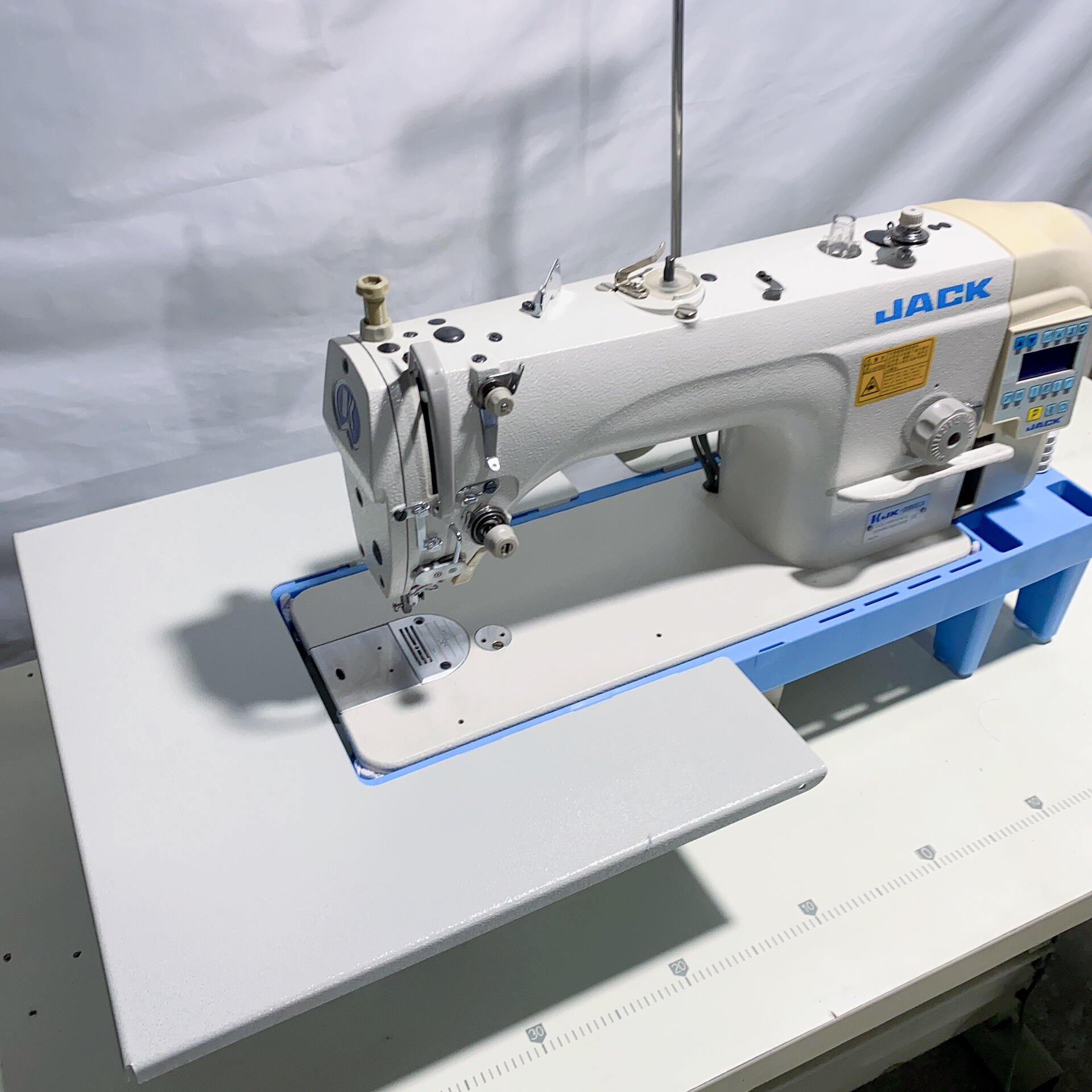
Industrial sewing machines are the mainstay of the sewing machinery industry, but an industrial sewing machine has never been a single type of machine — it is an entire family of task-specific machines differentiated by stitch structure, feed method, and material to be processed. Turning cut pieces into a finished garment typically requires multiple sewing operations of entirely different natures — seaming, edge-binding, hemming, finishing — and the requirements each operation places on stitch strength, elasticity, and appearance conflict with one another, making it difficult for a single general-purpose machine to handle them all. This is precisely why industrial sewing machines have evolved toward a coexistence of many specialized machine categories rather than one model doing everything. The main machine types include:
- Lockstitch machines: form a straight lockstitch and are the most widely used base machine type, handling the great majority of a garment's main seams;
- Overlock machines: also known as edge-binding machines, they lock the fabric-edge yarns while sewing, preventing the edges of knit and woven fabrics from fraying;
- Coverstitch machines: form a multi-needle flat stitch, commonly used for hemming and binding on knitwear, balancing seam strength with fabric stretch;
- Heavy-duty sewing machines: boost feed force and needle strength for leather, canvas, multi-layer composites, and other heavy fabrics that conventional machines struggle to penetrate;
- Pattern sewing machines: follow a preset program, cycling the needle over a localized area, used for decorative pattern stitching and reinforcement stitching;
- Buttonholing machines and button-attaching machines: complete buttonhole edging and button sewing respectively, specialized equipment for garment-finishing operations;
- Template sewing machines: use custom template jigs to hold the outline of cut pieces in place, enabling automated sewing of complex, irregular edges, commonly found in bags and cases, shoe uppers, and automotive seat covers.
These seven categories of task-specific machines do not correspond to seven arbitrary divisions but to the physical constraints of the sewing operations themselves — stitch structure, feed mechanism, and needle load conditions all differ, and generalization runs into clear physical limits on precision and efficiency. Increasing feed force to accommodate heavy fabric sacrifices the smoothness of sewing thin fabric; pursuing freedom of needle movement for decorative patterns sacrifices the production tempo of conventional seaming — it is hard to have both. This is precisely why, even though industrial sewing machine makers have converged heavily on general-purpose technologies such as computer control and servo drive, their product matrices still need to cover dozens or even hundreds of specialized models to match the actual procurement needs of downstream customers, which are broken down by operation. This pattern of specialized, task-specific machines is both one of the industry's barriers to entry and a shared starting point for later chapters' discussion of the competitive landscape and product iteration: the more fully a company's lineup of task-specific models covers the field, the greater its ability to take on downstream customers' full production-line orders.
1.3 Household Sewing Machines and Embroidery Machines: Two Different End-Market Logics
Household sewing machines and embroidery machines both fall under the broad sewing machinery category, but the end-market logic they face is entirely different from that of industrial sewing machines.
Household sewing machines are consumer goods, bought by individual users or home workshops, and their core appeal is ease of use, multi-functionality, and affordability; a single machine typically offers straight stitching, overcasting, and simple decorative embroidery all at once, using one general-purpose machine to cover as many scenarios as possible rather than chasing extreme efficiency in a single operation. This is the exact opposite of the task-specific product logic of industrial sewing machines — the industrial setting splits models apart by operation in exchange for efficiency, while the household setting merges functions together under budget constraints in exchange for versatility; the two product-development mindsets are almost mirror images of each other. In China, household sewing machines also long played the role of a consumption symbol, an important durable-goods item during the planned-economy era; today they are aimed more at home alterations, hobbyist handicrafts, and scattered small contract-processing workshops, with the market having downgraded in nature from a durable consumer good to a niche-interest and occasional-processing tool.
Embroidery machines look similar to sewing machines in form, but their actual working principle is different. An industrial sewing machine's goal is to complete a seam, a structural join; an embroidery machine's goal is to cycle the needle over the fabric surface according to a preset pattern, forming a purely decorative embroidered motif — it is essentially a pattern-generating device rather than a seaming device, using multi-head computer control driven by digital embroidery-pattern files to coordinate the machine heads' needle motion, making it one of the most computerized, automated categories within sewing machinery. Embroidery machine customers are mainly specialized embroidery processing plants and suppliers handling outsourced decorative operations for garment factories, rarely buying directly for end-consumer use, so in industrial character it is closer to the business-to-business model of industrial sewing machines than to the consumer-goods model of household sewing machines. In terms of application, embroidery machines serve both localized garment decoration and brand-logo embroidery, and also play a role in scenarios that substitute for jacquard weaving in home textiles; compared with jacquard weaving, embroidery has a lower pattern-change cost and a shorter sampling cycle, making it a better fit for order structures with small batches and many colorways.
This is precisely why embroidery machines are discussed alongside industrial and household sewing machines: although all three fall under sewing machinery, their industrial organization sits on two different logical axes — one axis is specialized production tools split by operation and aimed at enterprise customers, the other is consumer goods aimed at individual users in pursuit of versatility. Embroidery machines belong to the same axis as industrial sewing machines; only their functional orientation shifts from structural joining to decorative patterning.
1.4 Before and After Sewing: The Steps Easy to Overlook Behind the Word "Sewing"
The industrial boundary of sewing machinery does not stop at the sewing machine itself. In turning fabric into a finished garment, sewing is only the middle step — cutting must come before it, and finishing must come after it; neither can be skipped:
- Fabric spreading machines: lay rolled fabric into layered stacks for cutting, preparing feedstock of uniform thickness and free of wrinkles for the cutting step;
- Automatic cutting machines: cut pieces automatically according to a digital layout, the equipment type in the cutting step that was first to achieve a high degree of automation, interfacing directly with computer-aided design systems;
- Pressing and ironing equipment: shapes, de-wrinkles, and heat-sets semi-finished or finished garments, directly determining the finished garment's appearance and quality;
- Inspection equipment: covers quality-control steps such as fabric-flaw detection and residual-metal-needle screening on finished garments, a mandatory step generally required for exported apparel;
- Intelligent hanging systems: use overhead chains or track rails to convey cut pieces and semi-finished goods around the workshop, replacing manual carrying of fabric bundles, one of the levers most often cited in the digital transformation of garment factories.
Together, this equipment forms the complete chain from a bolt of fabric to a finished garment — fabric spreading and cutting before sewing, sewing itself, and pressing, inspection, and hanging conveyance after sewing; it is the union of these three stages that truly corresponds to the processing scope of the sewing machinery industry. Of the total processing time for a single garment, pure sewing often accounts for only part of it; the layout efficiency of cutting, the preparation speed of fabric spreading, and the flow tempo of hanging conveyance likewise determine the actual output capacity of the entire line, and a bottleneck at any one stage will drag down the output pace of the operations before and after it. This is also why the boundary of the sewing machinery industry cannot be summed up by the word "sewing" alone — what equipment makers are truly competing on is the ability to provide whole-line solutions covering the three stages of cutting, sewing, and finishing, not merely offering models for a single operation; in reality, a good number of industrial sewing machine makers have indeed built out cutting and hanging businesses in parallel, extending their product lines from a single operation to whole-line capability spanning multiple stages — the specific paths of this horizontal expansion are left for later chapters to develop in connection with specific companies.
1.5 The Full Industry Chain: From a Single Needle to a Finished Garment
The sewing machinery industry chain shows a clear three-stage structure: upstream are core components and basic parts, midstream is finished-machine manufacturing of all kinds, and downstream are user enterprises distributed across multiple end industries.
The technological content of the upstream segment is concentrated in a handful of key components: the needle is in direct contact with the fabric, and its precision and durability determine stitch quality; the rotary hook works with the needle to complete thread-loop interlacing and is one of the components in the sewing mechanism with the highest requirement for mechanical precision; the electronic control system (including the servo motor and controller) determines feed speed, thread-trimming timing, and networking capability, and is the technological hub through which the sewing machine moves from mechanization toward intelligence; there are also basic structural parts such as castings and bed plates, which form the machine's frame. These components generally share the traits of small size and low unit price but high technical density — parts such as needles and rotary hooks require machining precision at the micron level and are typical small, high-barrier components; their supply landscape and localization progress are left for a dedicated industry-chain chapter to analyze — here they are only positioned, not developed further.
Midstream finished-machine manufacturing breaks down roughly into five product lines: industrial sewing machines, household sewing machines, embroidery machines, cutting and fabric-spreading equipment, and pressing and hanging equipment. Companies both do OEM contract manufacturing for international brands (producing to customer specifications and selling under no brand of their own) and run proprietary brands aimed at end markets; the two often coexist within the same company, with OEM orders providing stable capacity utilization and proprietary-brand orders building up technology and channel barriers. Finished-machine manufacturing depends heavily, in its industrial organization, on a specialized network of cooperation — component makers cluster geographically around finished-machine makers, forming a division of labor in which finished-machine makers issue drawings and component makers supply to standard, and a single component maker's capacity can cover the orders of multiple finished-machine makers at once. This lets finished-machine makers shift the fixed-asset investment in non-core components such as needles, rotary hooks, and castings onto specialized supporting factories, while they themselves focus on final assembly, adjustment, and quality control. This model of cooperation is an important source of cost competitiveness in sewing machinery manufacturing; the specific form these industrial clusters take and how their geographic concentration came about will be developed in later chapters in connection with specific regions.
The downstream application base is far broader than the literal meaning of "sewing machine" suggests. By association figures relayed through trade reporting (not directly verified, cited only as a structural reference), apparel is the largest application area, accounting for roughly seventy percent of downstream demand; footwear, hats, bags and cases come second at roughly fifteen percent; home textiles account for roughly ten percent; and the remaining roughly five percent is spread across more industrialized scenarios such as automotive interiors, airbags, leather goods, and outdoor gear. This downstream structure carries analytical significance in itself: apparel orders carry strong seasonality and fashion-cycle characteristics, with fast style turnover and fragmented batch sizes, placing the highest demands on equipment's flexible changeover capability, making it the main amplifier when downstream demand fluctuations transmit upstream into equipment procurement; industrial uses such as automotive interiors and airbags, while not accounting for a large share of volume, involve special materials and exacting precision requirements, with the sewing process often tied to structural safety performance — this corresponds to the higher-value-added niche markets within the sewing machinery industry and is the main direction in which finished-machine makers extend their product lines beyond apparel. This divergence in downstream structure forms a shared basis for later chapters' discussion of the industry's strong-cycle characteristics and the direction of product-structure upgrading.
1.6 Where Sewing Machinery Sits in the Coordinate System of Manufacturing
Placed within the coordinate system of manufacturing as a whole, sewing machinery belongs to the specialized-equipment-manufacturing subcategory, distinct both from heavy equipment manufacturing such as machine tools, construction machinery, and tunnel-boring equipment, and from high-tech electronics manufacturing such as semiconductors and displays. Its technological base spans two ends: one end is precision machining, corresponding to base components such as needles and rotary hooks that require micron-level precision; the other is industrial electronic control, corresponding to electronic control systems such as servo motors and networking modules that determine the level of intelligence. A complete modern industrial sewing machine is, in essence, a combination of precision mechanical parts and an electronic control system, not a purely mechanical device. The value of a single unit is not high — nowhere near the same order of magnitude as heavy equipment running into the billions of yuan — but its downstream coverage is extremely broad, reaching from apparel, footwear, bags and cases, and home textiles all the way to auto parts, forming an economy-of-scale pattern characterized by low unit prices, a scattered market, and sustained demand driven by replacement frequency, in contrast to industries such as consumer electronics that carry higher unit prices but concentrate their replacement cycles.
This positioning also explains why the sewing machinery industry cannot be understood by its own production and sales figures alone. It does not directly produce end consumer goods itself but supplies production tools to a range of end-product manufacturing industries such as apparel, leather goods, and auto parts; industry conditions are highly dependent on the capital-expenditure pace and order cycles of each of those downstream industries. Any relocation of capacity or contraction of demand in a downstream industry transmits up the chain to equipment procurement, and this transmission is often amplified, because the decision to replace equipment is itself deferrable — once downstream demand weakens, equipment investment, not raw-material purchasing, is the first thing to be cut from procurement plans. Precisely for this reason, understanding this industry cannot stop at the static picture of classification and the industry chain; it must also be examined dynamically across multiple dimensions — global industrial relocation, the domestic competitive landscape, the evolution of regional industrial clusters — and that is the direction the chapters that follow will take.
Chapter 2 The Global Landscape: Three Migrations of the Sewing Machine
The location of sewing machine manufacturing has never been decided by the sewing machine itself. It follows the garments — wherever apparel manufacturing clusters, the capacity of sewing equipment migrates there too. Over 170 years, this machine has made its way through three complete journeys: from the industrial empire Singer built in the United States, to postwar Japan taking over global capacity over two decades, to capacity shifting to China from the 1990s onward. Behind every migration lies the same set of forces replaying itself — labor costs, the exchange-rate environment, industrial policy, and the direction of downstream apparel orders, all combining to push equipment manufacturing toward the next low-cost basin. This chapter follows that migration path, while also accounting for the Japanese and German companies that still hold the technological high ground today — their factories are shrinking, yet they have never fully left the game. Understanding this 170-year migration path is also the key to understanding today's global sewing machinery landscape — why China has already captured more than seventy percent of global output, yet the top needles and rotary hooks still carry German and Japanese names; why the financial statements of leading Japanese and German companies keep shrinking, yet their accumulated brands and technology still constitute a competitive moat.
2.1 Singer's American Century (1851–1980)
In 1851, Isaac Singer filed a sewing machine patent in the United States and founded his company — the starting point of industrialized sewing equipment. The mid-19th-century United States was able to be the first to build scaled-up sewing machine capacity in direct connection with its ever-expanding domestic apparel market and standardized-parts production system; the installment-payment sales model and global agency network that Singer pioneered allowed this production system to be replicated in Europe and Asia at the same time. By 1860, less than a decade after its founding, Singer had grown into the world's largest sewing machine manufacturer, putting a machine that had once belonged only to the tailor's shop into thousands upon thousands of homes and garment factories. In 1913, the Singer factory built in Clydebank, Scotland employed more than 16,000 people and produced more than 1.3 million units a year, making it the largest sewing machine factory in the world at the time — the capacity of a single factory was enough to cover the needs of more than half the European market. This was the first true global concentration of sewing machine manufacturing, where American capital, Scottish labor, and a global sales network converged. The combination Singer built — "scaled production plus a global distribution network" — was repeatedly replicated by later entrants from Japan and China, only the identity of the dominant player changed hands more than once.
Singer's heyday lasted more than half a century, until Japanese competitors began eroding its market share in the 1960s. Lower-priced, faster-delivering Japanese products gradually squeezed Singer out of the low- and mid-end market, the Clydebank factory's capacity advantage no longer held, and in 1980 this once-largest factory in the world closed. In 1986, Singer spun off its sewing machine business from its diversified conglomerate, and in 1989 it was acquired by the Hong Kong-listed company Semi-Tech. The leveraged structure of this acquisition planted the seeds of the crisis that followed — Semi-Tech financed the acquisition with heavy leverage and also folded in brands such as Germany's PFAFF, and its debt load kept swelling. In an industry as mature as sewing machines, with limited room for growth, a logic built on diluting costs through continuous acquisitions is hard to sustain, and in the end it only converted operating risk into financial risk. In September 1999, Singer filed for bankruptcy protection in the United States with liabilities of US$1.25 billion — this was a continuous capital collapse: from leveraged buyout, to failed multi-brand integration, to eventual insolvency, one link leading directly to the next rather than two independent events. In 2004, the private equity firm Kohlberg acquired Singer's assets for US$134 million; ownership changed hands several times after that, and since 2021 it has belonged to SVP Worldwide under Platinum Equity. From building its factory, to bankruptcy, to becoming a brand asset under a private equity fund, Singer took nearly a century and a half to complete its transformation from an industrial entity into a pure brand license. Today's Singer is just one name in a household-machine brand portfolio, and it no longer owns a factory of its own.
2.2 Japan Takes the Baton: Postwar Transformation and Industrial Support
Japan's process of taking over global sewing machine capacity began with the postwar transformation of its industrial system. Juki Corporation (JUKI, TYO: 6440)'s predecessor, Tokyo Juki Industrial Cooperative, was founded in 1938 and initially produced military equipment; after Japan's defeat in 1945 it switched to civilian sewing machines, launched its first household model, the HA-1, in 1947, and its first industrial sewing machine in 1953, completing its transformation from munitions to light industry. Brother Industries (Brother, TYO: 6448) started earlier and more modestly — in 1908, the Yasui Sewing Machine Company in Nagoya got its start repairing sewing machines, and it was not until twenty years later, in 1928, that it launched its own first product, a straw-hat chain-stitch machine. The two companies then took different paths of expansion: JUKI focused on the precision and capacity of industrial models, and in 1988 — as relayed from third-party sources — acquired the veteran American company Union Special, folding its century of accumulated technology into its own system; Brother reached toward Europe earlier, acquiring the British brand Jones in 1968 to round out its household-machine product line. This approach of "using acquisitions to fill gaps in technology and channels" later became a shared choice among latecomers — thirty years on, when Chinese companies acquired century-old German brands, they took the same path.
Government industrial policy played a key role at this stage. In the 1960s, the Japanese government designated sewing machines as a priority export-support industry, and combined with the precision-machining capability accumulated during postwar reconstruction and relatively low labor costs, Japan's sewing machine output climbed steadily from 134,000 units in 1947 to a historic peak of 4.3 million units in 1969. This output already exceeded the entire annual capacity of the Clydebank factory at Singer's peak, marking the first genuine transoceanic shift of the center of gravity of global sewing machine manufacturing — from American factory floors to Japanese export production lines. The postwar yen's persistently low exchange rate and labor costs far below those of Europe and America provided the basic conditions for Japanese products' price advantage, and this would recur as a driving variable in every subsequent round of capacity relocation. Rather than replicating Singer's brand-monopoly path, Japan won the low- and mid-end markets in the United States and Europe in a price war through the combined advantage of cost and precision — and this also planted the seed for the same script to replay in China two decades later. The different paths JUKI and Brother took during this period also, in a sense, foreshadowed a divergence half a century later — JUKI, which went deep on the precision of industrial models, and Brother, with its broader product mix, would show different levels of resilience amid the industry-cycle fluctuations that followed.
2.3 The 1990s: Capacity Shifts to China
The preparatory period for capacity relocation to China actually began earlier than is commonly recognized. As early as the beginning of the 1980s, China's annual output of household sewing machines already exceeded ten million units, making it the world's largest producer of household machines on the strength of its own domestic industrial system centered in places such as Shanghai and Guangzhou — but that capacity was aimed mainly at domestic consumer demand under the planned economy, a different chapter, on the same map, from the later relocation of foreign-invested industrial-machine capacity to China; the two threads did not truly converge until the 1990s. This means that when foreign-invested industrial-machine capacity began looking for a new base, China was not a blank slate — a textile-industry system, a pool of skilled sewing workers, and basic component supply had already taken initial shape through serving the domestic market, lowering the threshold for taking on foreign-invested capacity.
In 1990, JUKI set up a joint-venture factory in Shanghai, its first overseas factory in its history, marking the formal beginning of the relocation of Japanese sewing equipment capacity to China; in 2000, this joint-venture plant converted into a wholly-owned Shanghai industrial-machine production base, and over the more than three decades since, this production system grew from an initial joint-venture trial into an important pillar of JUKI's global output. Brother Industries landed slightly later, starting production in Xi'an as a joint venture in 1995 and registering as the independent legal entity Brother Machinery (Xi'an) in 2001. Around 2000, wholly Japanese-owned factories landed in China in a wave — the shift from joint venture to wholly-owned operation was itself a signal: foreign companies would choose to operate entirely on their own, no longer needing a local partner to share risk, only once they judged the Chinese market mature enough and the policy environment stable enough. The Taiwanese company Kaulin (Taiwan Stock Exchange: 1531, brand SIRUBA) also set up a factory in Ningbo in 2005, forming a scaled wave of Japanese and Taiwanese sewing equipment makers relocating capacity to the mainland. The driving logic of this relocation was identical to that of Japan taking the baton from the United States thirty years earlier — China's labor costs at the time were far below Japan's, and places such as Taizhou and Shanghai had already accumulated years of component-supply capability, so taking on the capacity came with almost no infrastructure threshold. Figures from the China Sewing Machinery Association's "13th Five-Year Plan" summary show that, built up through this round of relocation, China's share of global industrial sewing machine output has reached more than seventy percent — and this statistic itself also shows that once a capacity relocation is complete, it is extremely difficult to reverse. For JUKI and Brother, this was more like a race for a window of time — whoever completed localization first would hold the first-mover position in the industry's scale dividend over the following thirty years.
2.4 Global Market Size: A Valuation Range Split by Methodology
On the question of exactly how big the global sewing machinery market is, third-party research firms give sharply divergent figures, the core reason being inconsistent statistical scope — some firms count only industrial sewing machines, while others fold in household machines, embroidery machines, and cutting/spreading equipment as well:
- Under the scope that counts only industrial sewing machines, the global market size for 2024–2025 is roughly US$3.0–3.6 billion;
- If categories such as household machines are folded in as well, size estimates jump to a range of US$4.7–7.4 billion, with the gap between different firms' figures approaching a factor of two.
Taken together, the estimates given by different research firms fall roughly between US$3.0 billion and US$7.4 billion. This split is not the result of fabricated data or statistical error but of the industry's own product lines being too dispersed — industrial machines, household machines, embroidery machines, and cutting, spreading, hanging, and pressing equipment have entirely different market logics and customer structures, and third-party firms naturally arrive at different answers depending on where they draw the statistical boundary. For a research report, rather than forcing agreement on a single precise number, it is better to acknowledge that this split in methodology is itself a structural feature of the industry: a globally highly vertically divided industry that lacks a unified yardstick. This split in methodology also means that any statement about what share China holds of the global market must first make clear the statistical scope of the denominator — when this report's later chapters cite Chinese market data, they consistently use the China Sewing Machinery Association's output and export figures, to avoid conflating them with the valuation ranges given by international firms.
2.5 The Financial Home Turf of Surviving Japanese and German Leaders
The three migrations did not carry the headquarters and R&D centers of Japanese and German companies along with them. These companies' factories are shrinking, but their brand and financial home turf remain in their home countries. Understanding each of their latest financial performances is also to understand the real-world landscape this 170-year migration has left behind — capacity is in China, but a large share of profit and technological voice remains in Japan and Germany.
JUKI's latest fiscal year (calendar 2025) turned in a hard-won return to profitability: revenue of JPY 88.761 billion, down 6.7% year on year; operating profit of JPY 2.662 billion, a turnaround from the previous year's operating loss of JPY 962 million. The sewing machinery segment contributed JPY 66.616 billion, 75.1% of group revenue, within which full-year sales of industrial sewing machines were JPY 51.7 billion, with the China market contributing JPY 12.1 billion (23%) and the region "west of India" the largest single market segment at JPY 16.2 billion in sales. The other side of this scorecard is a painful round of restructuring that JUKI internally calls a "crisis breakthrough": between 2024 and 2025, sewing machinery capacity was cut by 50%, the lineup of models on sale was trimmed by roughly a third, factories cut 700 jobs, and total headcount fell from 4,713 at the end of 2023 to 3,828 at the end of 2025; the strategic focus also shifted from chasing sales volume toward concentrating on profit and high-end product lines, with medium-term targets revised down accordingly — the 2027 revenue target was cut from an original JPY 131 billion to JPY 100 billion. In China, Shanghai Juki Sewing Machine Co., Ltd., which JUKI set up in its early years there, was liquidated and dissolved in December 2025 and removed from the consolidated accounts, but this does not mean it is exiting its capacity in China: the existing Juki (Shanghai) Industrial Co. (328 employees, accounting for roughly thirty percent of JUKI's total output) and the Juki (Langfang) base are still operating, while the Ho Chi Minh City factory in Vietnam is JUKI's only overseas subsidiary that combines production, R&D, and sales in one. Viewed by regional sales structure, "west of India" has already overtaken China as JUKI's largest single region for industrial sewing machines, roughly consistent with the direction in which global apparel capacity keeps spreading toward South Asia — the sales map of the equipment giants is moving right along with the flow of downstream orders. JUKI describes itself as holding the world's number-one share in industrial sewing machines; this claim comes from the company's own statements.
Brother Industries' overall financial condition is considerably healthier — FY2025 (April 2025 to March 2026) group revenue reached JPY 893.5 billion, up 5.3% year on year and a historic high, with net profit attributable to the parent of JPY 67.6 billion. But the industrial sewing machine business is the one exception in this otherwise strong report, with revenue of JPY 18.7 billion, down 6.6% year on year and accounting for only about 2% of group revenue; it is explicitly classified in the company's official disclosures as a "profitability-transformation business" — for Brother, sewing machines have long ceased to be a core engine and have become a peripheral asset in need of repositioning. The main production site for this business remains in China — Brother Machinery (Xi'an) is confirmed as the main production location in official tariff-exposure disclosures, with roughly 582 employees in 2024, while household-machine production is spread across Taiwan and Vietnam. In January 2026, Brother acquired the automotive division of Germany's Konrad Busche, to strengthen non-apparel sewing scenarios such as airbags — a signal that the industrial sewing business is extending into higher-value-added areas such as auto parts; when the traditional apparel-sewing business hits a growth ceiling, seeking room in new scenarios such as automotive interiors has become a shared response among the leading Japanese and German companies.
Pegasus (Pegasus Sewing Machine Mfg., TYO: 6262) is walking the same path: a specialist maker of overlock and coverstitch machines founded in 1914, it posted FY2026 revenue of JPY 21.657 billion and has already built auto parts into a second core business standing alongside sewing equipment, with factories in Tianjin and Hai Phong, Vietnam. Taiwan's Kaulin (founded 1965, self-described as "Taiwan's largest" sewing machine maker) represents a different localization model — orders taken in Taiwan, production done on the mainland; after setting up a factory in Ningbo in 2005, it posted FY2024 revenue of NT$1.638 billion and is also one of JUKI's contract manufacturers; the unlisted Yamato (founded in Osaka in 1927) has likewise long held a strong technical reputation in overlock machines, but has never chosen to go public.
The story of Dürkopp Adler and PFAFF Industrial shows another layer of what industrial relocation can mean — it is not only the factories that migrate, but ownership of the brand itself that has changed hands. Dürkopp was founded in 1867 by Dürkopp & Schmidt and merged with Kochs Adler in 1990 to form today's Dürkopp Adler; PFAFF, meanwhile, was at a peak of roughly ten thousand employees in the 1980s. Both of these century-old European brands now belong to Chinese-invested companies: in July 2005, the Chinese company SGSB Group acquired 94.98% of Dürkopp Adler's equity for €35.95 million through a debt-assumption acquisition, one of the landmark cases of early outbound M&A by Chinese companies; in 2013, SGSB Group acquired 100% of the then insolvent PFAFF for a symbolic €1 plus roughly €24.10 million in capital injection, while also acquiring 100% of Germany's KSL — which specializes in 3D and carbon-fiber sewing for customers in the automotive and aerospace sectors — for roughly €30.12 million. Beyond the change in ownership, these two brands' factories in Europe still operate independently, and their business performance does not move in step with the parent company's overall results. In September 2025, PFAFF's factory in Kaiserslautern, Germany, cut its workforce from 124 to 53 employees — a striking contraction compared with a peak headcount of roughly ten thousand; around the same time, the Dürkopp Adler group chose to build a new factory in Querétaro, Mexico, placing some capacity within the North American free-trade zone rather than relocating it to China — showing that the geographic need for medium- and heavy-material industrial sewing equipment to stay close to downstream automotive and leather customers in Europe and America still exists, and that capacity relocation does not have only one destination. Dürkopp Adler's German parent entity posted standalone 2025 revenue of roughly RMB 1.075 billion and a net loss of RMB 158 million, with the loss mainly attributable to weak demand in the European automotive and leather industries, which caused a sharp contraction in orders for high-margin medium- and heavy-material equipment.
Taken together, JUKI, Brother, Pegasus, and Dürkopp Adler show that the leading Japanese and German companies' strategies for responding to this round of difficulty are highly similar: shrink the scale of traditional apparel-sewing capacity, concentrate resources on higher-end, higher-margin niche markets, and at the same time look to non-apparel scenarios such as auto parts for a second growth curve. This is entirely different from Singer's old path of diluting costs through scale and stacking up size through acquisitions — the lessons of the previous migration have clearly been absorbed by this generation of management.
2.6 Needles and Rotary Hooks: The Technological Strongholds That Stayed in Japan and Germany
Whole finished-machine capacity for sewing machines can relocate in its entirety, but the two core components that determine sewing quality — the needle and the rotary hook — have always stayed within industrial clusters in Japan and Germany. This is the most stubborn exception in this 170-year history of migration.
In needles, Germany's Groz-Beckert is the undisputed global leader: founded in 1852 and taking its merged name in 1937, the company posted FY2024 revenue of €839 million and FY2025 revenue of €799 million, with 8,823 employees and a product line covering roughly 60,000 needle types, making it the widely recognized technology leader in sewing needles worldwide, in the same tier as Japan's Organ and Germany's Schmetz. Groz-Beckert's revenue declined in step from FY2024 to FY2025, a decline broadly synchronized with the weak downstream-demand cycle affecting JUKI and Dürkopp Adler, showing that the fortunes of upstream key-component suppliers are tightly bound to those of downstream finished-machine makers. Although Groz-Beckert has already set up a production base in China, its R&D center and group headquarters remain in Germany — which also shows that "the stronghold has not relocated" refers to the center of gravity of technology and brand, not to a complete absence of presence in China. In rotary hooks, Japanese companies likewise hold the high ground — there is a well-known industry saying, "for rotary hooks, go to Hirose," and Hirose Manufacturing is widely recognized as the technical benchmark in this field. Needles endure continuous reciprocating impact on a sewing machine running at high speed, placing extreme demands on material fatigue strength and heat-treatment processes; rotary hooks determine the stability and uniformity of the stitch, and even a minor machining error can cause quality defects such as skipped or broken stitches — this is also the technical root of why these two component categories have long been dominated at the high end by Japanese and German companies.
The stability of this technological stronghold stands in sharp contrast with the large-scale relocation of finished-machine manufacturing, but the logic behind it is not contradictory: needles and rotary hooks demand an extremely high level of precision machining, materials metallurgy, and long-term process accumulation, and the barrier to relocating them is far higher than for assembling a finished machine. But this technological gap should not be overstated as absolute either — figures from the China Sewing Machinery Association's "13th Five-Year Plan" summary show that Chinese proprietary brands already hold more than ninety percent of the global share of key components such as rotary hooks. A more accurate picture is this: the market for mass-consumer-grade and conventional industrial-grade components has already been heavily localized, and what remains truly in the hands of Japanese and German companies is the high-end precision needle-and-hook market at the tip of the pyramid — the needle industry clusters in Nantong, Haimen, and Changzhou in Jiangsu, together with the rotary-hook supporting companies around Beilun and Yinzhou in Ningbo, form the vast base of this pyramid, while the tip still carries the names Groz-Beckert and Hirose. For finished-machine makers, this means that even where production of the main machine has been fully localized, the most expensive and hardest-to-replace items on the purchasing list still have to be ordered from Germany and Japan.
Looking back over these 170 years, the three migrations are a repetition of the same set of variables — differences in labor costs, the exchange-rate environment, industrial-policy support, and the direction of downstream apparel orders together determined where sewing equipment capacity should move next. But in the two relocations of production — from the United States to Japan, and from Japan to China — Singer was never acquired by Japanese capital, nor were Japanese companies bought out wholesale by Chinese capital; the relocation stayed confined to the production stage. This time is different — century-old German brands such as Dürkopp Adler and PFAFF have had their very ownership transferred into the hands of Chinese-invested companies; on top of the relocation of production, there is now an added layer of the transfer of capital ownership itself. Japanese and German companies are shrinking capacity and focusing on the high end, while Chinese companies are both taking on capacity and beginning to acquire brands — and right now there is no end in sight to where this migration goes next. This process of evolution also provides the coordinates for understanding the chapters that follow, which examine China's market size, competitive landscape, and industrial clusters — China's position in today's global sewing machinery map is the latest link in a 170-year chain of migration, not an isolated phenomenon.
Chapter 3 PEST Environment Analysis
The external environment of the sewing machinery industry has one shared trait: it rarely faces end consumers directly, and forces along all four dimensions — Political, Economic, Social, Technological — almost always have to pass through the intermediate stage of apparel manufacturing before transmitting to the equipment industry itself. Understanding this layer of transmission is a precondition for judging the industry's future direction, and it is the shared analytical thread running through this chapter's four sections.
3.1 Political: Industrial-Upgrading Orientation and the Handoff of "14th Five-Year Plan" and "15th Five-Year Plan" Targets
The China Sewing Machinery Association's Guiding Opinions on High-Quality Development for the "14th Five-Year Plan" set three sets of quantified targets for this round of industry upgrading:
- Share of mid-to-high-end product supply: raised from 30% to 50%;
- Share of intelligent products: raised from under 5% to 30%;
- Share of above-scale-enterprise revenue held by the top 20 finished-machine companies: raised from 56% to 70%.
These three sets of targets are not independent of one another but form a system of mutual conditions: for the supply structure to move from low-to-mid-end toward mid-to-high-end, product form must first make the leap from mechanical parts to intelligent parts; and the fixed-cost investment required for intelligent-product R&D can only be sustained if revenue concentrates in a small number of leading companies. In other words, "product upgrading" and "enterprise concentration" are designed in this guiding opinion as two sides of the same process — only once one breaks through does the other become able to be realized in step.
From the standpoint of industrial organization, the meaning of the "top-20 share" target deserves a further word: it is not simply a slogan about "growing bigger and stronger," but an implicit instruction on resource allocation — only when revenue keeps concentrating toward the leaders can the industry break free of low-level competition dominated by price wars and shift toward R&D-investment-driven competition underpinned by scale effects. This is precisely why the association wrote "top-20 share" and "share of intelligent products" into the same plan side by side: concentration itself is not the end goal, but a necessary condition for achieving the product-upgrading target.
According to figures relayed via the association, the Guiding Opinions on High-Quality Development for the "15th Five-Year Plan" has since been released, continuing the same upgrading logic and tightening the targets further: localization rate of high-end sewing equipment surpassing 70%, share of automated equipment reaching above 90%, and share of intelligent sewing equipment reaching 30%. These figures are relayed from a secondary source, and the original text has not been verified — they are cited only as a directional reference — but their significance is already clear enough: the upgrading targets set in the "14th Five-Year Plan" were not a one-off task but a standing agenda, carried forward and further raised in the next five-year cycle.
Running in parallel with target-setting is the building of a standards system. During the "14th Five-Year Plan," the association simultaneously advanced a multi-layer standards framework covering basic common standards, key-product standards, and smart-sewing-system standards; the center of gravity of standards supply is expanding from performance and safety certification for single-machine products toward new areas that previously lacked any basis, such as digital workshops, system integration, and smart services. For an industry still dominated by small and medium-sized enterprises and marked by pronounced product homogenization, expanding the standards system is itself a covert tool of industrial policy: on one hand it sets an entry threshold for intelligent, systematized products, objectively raising the cost of transformation and upgrading for low-end capacity; on the other hand it also gives downstream buyers a unified basis for assessing equipment maturity, indirectly supporting the policy goal of raising industry concentration.
The national-level large-scale equipment-renewal policy forms a general backdrop, but it needs to be strictly distinguished from industry-specific support. This round of the equipment-renewal action plan has been rolled out comprehensively across national industry, transportation, energy, and other sectors since 2024, and is a generic, cross-industry investment-stimulus measure; there is currently no public information showing that sewing machinery or garment-manufacturing companies have received any sector-specific implementing rules or dedicated subsidy arrangements. Equipment renewal in the sewing machinery industry today still relies mainly on market-based decisions companies make based on product iteration and changes in order structure, rather than benefiting from any industry-exclusive policy dividend — this distinction cannot be omitted when assessing the true source of the industry's upgrading momentum.
3.2 Economic: Transmission of Downstream Apparel Conditions, Strong-Cycle Character, and the Export Environment
Sewing machinery is a typical intermediate-goods industry with almost no independent end-demand curve of its own; industry conditions depend heavily on the order tempo and export structure of the apparel manufacturing industry. This transmission relationship has shown up quite clearly over the past two years: in 2025, China's total apparel exports were US$151.22 billion, down 5% year on year; over the same period, China's share of U.S. apparel imports fell from 22.6% in 2024 to 15.2%, while Vietnam's share rose to 19.8%, overtaking China on a full-year basis for the first time to become the largest source of apparel for the United States. At the same time, China's share of the EU market held steady at 29.8% (up 0.9 percentage points year on year), and its share of the Japanese market was even higher at 46.9% — showing that the contraction in China's apparel export share is not an across-the-board retreat but a structural pattern of "the U.S. market being ceded at an accelerating pace, while the EU and Japanese markets remain largely stable." Vietnam's 2025 apparel exports were US$39.64 billion, reclaiming the world's second position; Bangladesh ranked third with US$38.82 billion.
This round of apparel-capacity relocation has brought the sewing machinery industry a result that seems counterintuitive at first glance but is entirely logical on closer thought: end-apparel orders are flowing to Southeast and South Asia, but the export destinations for sewing equipment are exactly these countries now taking on that capacity. The breakdown of major export destinations for 2024 is as follows:
- India: US$562 million, 16.42% of total exports, ranking first among destinations;
- Vietnam: US$368 million, up 71.19% year on year;
- Pakistan: US$169 million, up 154% year on year;
- Belt and Road markets combined: US$2.393 billion, 69.88% of total exports.
The relocation path of apparel capacity and the export path of sewing equipment overlap to a striking degree; industrial relocation has not weakened external demand for China's sewing machinery industry but instead, through the equipment-procurement demand generated by capacity newly built in the recipient countries, has turned into a structural increment on the export side — the industry's 18.39% year-on-year growth in total exports in 2024 is the most direct result of exactly this transmission logic. This is also a piece of economic evidence for this report's judgment that equipment production does not necessarily relocate in step with capacity: where garments are made is changing, but where sewing machines are made need not follow.
This logic continues to play out in more recent markets. In 2025, Egypt's imports of Chinese sewing machinery products reached US$107 million, up 61.91% year on year, vaulting it to China's ninth-largest sewing machinery export market — the highest growth rate among the top ten markets. Egypt itself is not traditionally a major apparel exporter, and behind its import growth more likely lies an early-stage expansion in local textile-and-apparel capacity absorption and supporting industrial investment. For the sewing machinery industry, the significance of the emergence of markets like this is that the structure of export destinations is itself continually evolving; the industry cannot fix its gaze only on already-established large markets such as India and Vietnam — the equipment-procurement window in a new round of recipient countries often opens before their apparel capacity has actually ramped up.
The sewing machinery industry also has a pronounced strong-cycle character, an attribute that is itself a constant of the industry's economic operating environment and needs to be identified separately, not conflated with the year-by-year data that follows. The output series shows the industry fluctuating on a roughly three-to-four-year cycle, with 2017, 2021, and 2024 all cyclical output peaks; the amplitude between peaks and troughs can reach double digits year on year or higher, a pattern rooted in the overlapping effect of equipment-replacement tempo and concentrated purchasing behavior by downstream garment factories, not a one-off factor in any single year. Extrapolating purely from historical cyclical patterns, the next output peak could in theory fall around 2027–2028 — but this is only an inference based on the existing cyclical rhythm, and does not constitute a formal forecast issued by any institution.
The economic environment on the export side is also directly affected by exchange rates and unit-price trends. In the first half of 2025, the average export price of industrial sewing machines was US$336.1 per unit, up 5.08% year on year; but by the first half of 2026, growth in the industry's total export value had plunged to 2.69%, with industrial sewing machine export volume up 6.25% year on year while export value fell 2.55% year on year — a pattern of "volume up, value down" reflecting falling unit prices. A divergence between volume and value usually points to two overlapping pressures: one is that local demand structure in destination countries is tilting from mid-to-high-end toward low-end products, and the other is that fluctuations in the RMB exchange rate together with strengthening bargaining power among overseas buyers are squeezing export pricing room. For an industry whose main growth engine is exports, falling unit prices mean that even if export volume keeps growing, overall profit margins could be compressed in step — an economic-environment variable that cannot be ignored when judging the quality of the industry's operations in its next phase.
This economic structure, driven mainly by exports as the growth engine, is also borne out by the contrast between domestic sales and exports. Over the past two years, the industry's domestic sales and exports have shown a clear pattern of "hot abroad, cold at home": 2024 domestic sales totaled roughly 2.35 million units, up 27% year on year, but in the first three quarters of 2025 domestic sales fell more than 30% year on year; by contrast, exports as a share of industrial sewing machine output remained above seventy percent throughout 2023–2024. This means the dominant variable driving industry conditions has already switched from domestic garment factories' equipment-replacement demand to the new-capacity demand of overseas countries taking on capacity, fully consistent with the earlier judgment about the relocation of apparel export destinations, and together forming this section's core conclusion about the economic environment: the economic lifeline of this industry now depends more on orders from abroad than on domestic consumption.
3.3 Social: The Aging Sewing Workforce and Shifts in Household-Machine Consumption
The sewing operation depends heavily on the manual skill and experience-based judgment of skilled workers and is one of the least automated steps in the apparel manufacturing process — which is also why the social-environment variable for the sewing machinery industry is concentrated in labor-force structure rather than population size itself. China's domestic garment-processing industry generally faces the dual pressure of an aging sewing workforce and insufficient replenishment by young labor; frontline skilled workers take a long time to train and offer relatively limited pay appeal, and difficulty hiring has become the norm at small and medium-sized garment factories. According to some equipment makers and trade-media accounts, intelligent sewing equipment can significantly raise per-machine output efficiency compared with manual operation and lower the labor ratio required per workstation, but this kind of efficiency-improvement data mostly comes from companies' own statements or promotional materials and still lacks systematic verification by an independent third party, so it should be cited with appropriate qualification. What can be affirmed is the structural trend: difficulty hiring and rising labor costs are turning "substituting equipment for part of the labor force" from a technical option into a real-world constraint for some garment factories trying to maintain capacity. This social-environment variable corroborates the policy targets discussed in the previous section in an obvious way: the association's plan to raise the share of intelligent products from under 5% to 30% has, on the demand side, a real-world basis that comes largely from exactly this labor gap created by the aging sewing workforce — the policy target was not set out of thin air but is an advance response to social-structure change.
Viewed over a longer time span, the role of the sewing machine in Chinese society has itself undergone a complete displacement. From the 1970s to the 1980s, the sewing machine, together with the bicycle and the watch, made up the "three big-ticket items" — scarce durable consumer goods rationed by coupon during the planned-economy era. In Shanghai, for example, only about one in every eighty residents could obtain a sewing-machine purchase coupon each year on average; a sewing machine was a direct symbol of a household's wealth and standard of living at the time, its social significance far exceeding the tool itself. In the 1990s, as ready-made clothing became widespread, the household sewing machine market contracted overall, and the sewing machine gradually receded from the daily life of most urban households, moving from being a required part of a dowry and a household necessity to something else entirely. Today's household sewing machine market no longer carries the social function it once did, and has instead shifted toward long-tail niche needs such as handicraft hobbies, personalized customization, and home education, with product form also shifting from single-function mechanical models toward multi-purpose household machines that combine functions such as embroidery and patchwork. The essence of this shift is that the social role of the sewing machine has moved from "an essential consumer good in an age of scarcity" to "a hobbyist consumer good in an age of abundance" — the market logic is no longer driven by supply scarcity but by aesthetic preference and lifestyle choice.
3.4 Technological: A Clear Direction, With Details Left for a Dedicated Chapter
The technological evolution of sewing machinery follows a clear but slow main line: mechanization was followed by electronification, electronification by computerization, and the deepening direction of computerization is direct drive and network connectivity, with the current frontier of exploration being the combination of artificial intelligence with automatic sewing units. Along this main line are several anchor points that can be pinned down:
- 1970s: the global sewing machine industry entered the electronification stage;
- 2003: the domestically made computerized lockstitch machine achieved an independent breakthrough, driving domestic lockstitch machine products to shift from mechanical control to computer control — a key step in the localization process;
- During the "13th Five-Year Plan" period: according to association figures, the share of automatic sewing equipment rose from 60% to around 90% — this figure is disputed in terms of methodology and is cited only as a directional reference, not for precise statistical use;
- 2023: leading Japanese finished-machine companies launched IoT platform businesses, marking the point at which equipment networking and data collection began to be built into product strategy;
- 2025: leading domestic finished-machine companies launched market-facing AI sewing machine products;
- 2026: the same category of companies is further exploring the direction of combining humanoid robots with sewing workstations.
It took roughly thirty years to go from electronification to computerization, and roughly another twenty years to go from computerization to network connectivity, while the gap between network connectivity and the exploration of artificial intelligence was only two years — the pace of technological iteration is itself accelerating, but this does not mean the difficulty of automation is dropping in step; the reason is explained in the paragraph below.
The deeper logic behind this technological main line deserves to be pointed out separately: sewing remains, to this day, one of the least automated operations in the apparel manufacturing process, and the difficulty lies not in the mechanical repetition of a single motion but in the physical characteristic that flexible fabric keeps deforming during processing and lacks a rigid positioning reference — this stands in sharp contrast with operations such as cutting and fabric spreading, which can use a vacuum-clamped table to eliminate the fabric's degrees of freedom and so achieved automation earlier. This is precisely why the pace of technological breakthroughs in sewing automation is naturally slower than that of the upstream operations in the chain that have already completed automation. This section only offers a quick-scan positioning of the technological direction; the industrialization progress of specific technology paths, the technical details of representative products, and the real-world bottlenecks facing automated sewing are left for this report's dedicated technology chapter to analyze.
Chapter 4 China's Market Size and Operations: The Complete Electrocardiogram of a Strong-Cycle Industry
Plot thirty years of China's sewing machinery industry output as a curve, and what you get is not a growth curve but an electrocardiogram: rising and falling, with a clear rhythm and a startling amplitude. Most equipment-manufacturing industries trace a gentle slope in output; sewing machinery alternates between sharp peaks and deep troughs, with the gap between peak and trough often exceeding forty percent. This chapter lays out four series — output, above-scale-enterprise revenue, exports, and domestic sales — side by side and interrogates the causal relationships among them one by one: why this industry is destined to run on a strong cycle, why exports have become its only stabilizer, and why a single number from the first half of 2026 is worth the whole industry stopping to recalculate.
4.1 Output: A Thirty-Year Electrocardiogram
The China Sewing Machinery Association's output series has continuous records starting in 1994. That year, national industrial sewing machine output was 1.25 million units; by 2007 it had grown to 9.22 million units, a thirteen-year compound growth rate of 16.62%. This stretch was a textbook period of industrial-relocation dividend: global apparel capacity concentrated in China, and every garment factory that opened bought a batch of sewing machines — demand hardly needed to be created by selling at all.
After 2008, the nature of the curve changed. Output stopped rising in one direction and began swinging back and forth within a band of 5.0–9.5 million units, one leg up, one leg down, with neither side able to hold the high ground. 2020 output was roughly 6.2 million units, near the lower edge of the band; 2021 surged to a historic peak of roughly 10 million units, up 61.3% year on year; the following two years then fell back in succession, with 2022 at roughly 6.3 million units and 2023 at roughly 5.6 million units, a pullback of more than forty percent from the peak; 2024 rebounded to roughly 6.85 million units, up 22.32% year on year; and for 2025 the association estimates a pullback to 6.3–6.4 million units, down roughly 6%–8% year on year.
| Year | Industrial Sewing Machine Output | YoY | Phase Characteristics |
|---|---|---|---|
| 1994 | 1.25 million units | — | Start of the series |
| 2007 | 9.22 million units | 16.62% compound growth, 1994–2007 | Peak of the first long bull run |
| 2008–2020 | 5.0–9.5 million unit range | Cyclical swings | Oscillating plateau after the crisis |
| 2020 | ~6.2 million units | — | Pandemic-era low |
| 2021 | ~10 million units | +61.3% | Historic peak |
| 2022 | ~6.3 million units | — | Sharp pullback |
| 2023 | ~5.6 million units | — | This cycle's trough |
| 2024 | ~6.85 million units | +22.32% | Rebound year |
| 2025 | 6.3–6.4 million units (association estimate) | ~-6% to -8% | Estimated pullback |
Household sewing machines follow the same rhythm: roughly 3.8 million units in 2023 and roughly 4.7 million units in 2024, up 25.33% year on year. Adding industrial and household machines together, total sewing equipment output in 2024 was roughly 11.55 million units (a combined figure across the two product categories, not a figure the association publishes separately).
Laying out the series, the first basic fact emerges: from the 2021 peak to the 2023 trough, more than 4 million units of output evaporated in two years, a decline of more than forty percent, even as, over the same period, not a single major finished-machine maker disappeared — not one unit of capacity was cut, not one production line was dismantled. Capacity is rigid; orders are a pulse — the mismatch between the two is the source of the entire industry's pain and the entire industry's opportunity. In boom years, capacity utilization runs flat out and overtime still cannot clear the order backlog; in downturns, equipment sits idle, workers are furloughed, and prices dive. The industry's operating focus has therefore never been "how to win more orders" but "how to survive at the bottom, and have capacity ready the instant before the peak arrives."
4.2 Where the Cycle Comes From: The Mechanics of a 3–4 Year Rotation
Marking out the peak years, the rhythm is fairly regular: 2017, 2021, and 2024, with intervals of 4 years and 3 years respectively. The length of China's sewing machinery industry's output cycle holds steady at 3 to 4 years, and this is not a coincidence but the result of four layers of mechanism stacked on top of one another.
- The nature of the equipment makes replacement pulse-like. An industrial sewing machine is a capital good, not a consumable; its head lasts for years, and if the machine is not broken and orders are not changing, a garment factory has no incentive to replace it. Replacement demand is suppressed during downturns, and once downstream conditions recover, years of pent-up replacement demand and new demand release at once, forming a steep spike in orders.
- Downstream decision-making is highly synchronized. Apparel manufacturing has low concentration and each individual factory's decision cycle is short, so the whole industry reads roughly the same batch of order signals at roughly the same time. When a positive signal appears, thousands of garment factories expand their lines simultaneously; when the signal weakens, the same batch of factories stops simultaneously. A fragmented downstream ends up producing highly synchronized demand.
- Channel inventory amplifies the swings. Sewing equipment is sold mainly through distributors, who actively stock up and jockey for production slots in boom periods and, in downturns, work off their own inventory before placing orders with makers. This buffer layer in the channel amplifies mild fluctuations downstream into violent swings in upstream output — pushing peaks higher and pressing troughs deeper.
- A single peak is often the coincidence of multiple factors coming due at once. The historic 2021 peak was a triple overlap: the order pulse from post-pandemic restocking by European and American channels, some apparel orders temporarily flowing back to China, and the previous equipment-replacement cycle happening to come due at exactly that time. Three forces collided in a single year, pushing output to 10 million units. The deep trough of 2022–2023 was likewise a triple overlap: overseas channels destocking, apparel orders relocating offshore at an accelerating pace, and the replacement demand that had already been pulled forward and spent in 2021.
Extrapolating from the historical 3-to-4-year interval, the next peak would in theory fall in the 2027–2028 window. It must be made clear that this inference is only an arithmetic extrapolation based on historical cyclical patterns, not a forecast issued by any institution; moreover, the driving structure of this cycle already differs from 2021 — back then the pull came from domestic sales and exports resonating together, whereas today domestic sales are continuing to contract, and whether the shape of the cycle can still replicate the last one depends on how long the export leg can hold up.
4.3 Above-Scale Enterprises: Revenue and Profit Through a 275-Company Window
Any discussion of industry output value must start by clarifying the scope. Above-scale industrial-enterprise statistics cover only companies with annual core-business revenue of RMB 20 million or more; the sewing machinery industry had 275 above-scale enterprises in 2024, 290 in the first half of 2025, and 292 for full-year 2025. Outside this window sit thousands of small component factories, traders, and workshop-scale supporting companies that fall outside the statistics. Above-scale revenue therefore reflects the operating state of the industry's backbone, not the full picture of the industry.
- 2021 above-scale revenue was RMB 37.197 billion, up 39.9% year on year (relayed figure), corresponding to that year's output peak of 10 million units.
- Revenue declined by double digits for two straight years in 2022 and 2023, at -10.82% and -12.77% respectively. The absolute values for these two years conflict across different sources, so only the growth rates are used here.
- In 2024, the 275 above-scale enterprises posted revenue of RMB 31.611 billion, up 19.04% year on year, with total profit of RMB 1.748 billion, up 76.72% year on year, for a profit margin of 5.53%.
- In the first half of 2025, the 290 above-scale enterprises posted revenue of RMB 16.8 billion, up 9.88% year on year; for January–September, revenue was RMB 25.328 billion, up 7.93% year on year, with profit of RMB 1.503 billion, up 35.63% year on year; for the full year, the 292 above-scale enterprises saw revenue up 7.71% year on year and total profit up 29.47% year on year (relayed association figures; absolute values not disclosed).
Three features are worth spelling out.
First, profit elasticity far exceeds revenue elasticity. In 2024, revenue grew 19.04% while profit grew 76.72%, a ratio approaching fourfold — a textbook sign of high operating leverage. In finished-machine makers' cost structures, molds, production lines, R&D spending, and the channel system are all fixed outlays, so once capacity utilization moves, the entire marginal output falls straight into profit. Conversely, once the industry enters a downturn, the same leverage pulls profit down by the same multiple — the consecutive declines of 2022–2023 are exactly this same mechanism running in reverse.
Second, a 5.53% profit margin is noticeably low for equipment manufacturing. What this industry earns is "money from utilization rates," not "money from pricing power." Equipment is highly standardized, competitors are numerous, and downstream buyers have strong bargaining power, so the room for prices to rise is essentially sealed off; profit improvement can only come from sales volume and capacity utilization, not from raising prices.
Third, 2025's growth rate narrowed quarter by quarter: 9.88% in the first half, 7.93% for the first three quarters, and 7.71% for the full year, with profit growth also easing from 35.63% to 29.47%. The qualitative picture is steady but slowing — growth is still there, but momentum is weakening. More noteworthy still is the year-over-year comparison: 2024 revenue of RMB 31.611 billion remained below 2021's RMB 37.197 billion. Output has already recovered more than twenty percent from the trough, yet revenue has failed to return to the level of the previous cycle's peak. The gap comes from price — volume has come back, but value has not come back with it.
4.4 Exports: Anatomy of a US$3.424 Billion Structure
Exports are this industry's true main battleground. From 2023 to 2024, exports accounted for more than seventy percent of industrial sewing machine output — for every ten industrial sewing machines made in China, more than seven were shipped out on a boat. Any analysis that looks only at the domestic market will arrive at a conclusion opposite to reality.
In 2024, China's total sewing machinery exports were US$3.424 billion, up 18.39% year on year, breaking down into three main blocks:
- Industrial sewing machines: 4.69 million units, US$1.522 billion, volume up 8.42%, value up 16.48%.
- Embroidery machines: 96,000 units, US$683 million, volume down 19.37%, value up 38.41%.
- Pre- and post-sewing equipment: 1.97 million units, US$494 million.
In 2025, exports continued climbing to US$3.986 billion, up 16.42% year on year, reaching 207 countries and regions.
Three important pieces of information are hidden inside this structure.
First, total exports and single-category export value are two figures that must not be conflated. The US$3.424 billion is sewing machinery as a whole, covering finished machines, embroidery machines, pre- and post-sewing equipment, household machines, and components; the US$1.522 billion is just the industrial sewing machine category alone, 44% of total exports. The three blocks above add up to US$2.699 billion, roughly 79% of total exports, with the remainder coming from categories such as household sewing machines and components. In other words, China's sewing machinery exports have long ceased to be a matter of "selling lockstitch machines" alone — more than half of export value is contributed by products other than the lockstitch machine.
Second, embroidery machines show the sharpest volume-value divergence in the whole industry: volume down 19.37% while value is up 38.41%. Roughly a fifth fewer units sold, yet nearly forty percent more revenue collected — a large jump in unit price. This divergence means export models are migrating upmarket — multi-head, high-speed, complex-pattern models equipped with electronic control and software systems are displacing the export share of low-end models. Over the same period, industrial sewing machines' volume and value growth moved roughly in step (volume up 8.42%, value up 16.48%), a much more modest improvement in unit price.
Third, the asymmetry between imports and exports is close to extreme. In 2024, total sewing machinery imports were US$426 million, down 54.19% year on year, mainly because imports of pre- and post-sewing equipment collapsed; yet in that same year, imports of the single industrial-sewing-machine category — 48,000 units, US$88.22 million — grew against the trend. These two directions are not contradictory — the total is an all-category figure, while the single-category figure looks only at industrial sewing machines, showing that domestic substitution for pre- and post-sewing equipment is essentially complete, even as import demand for high-end finished machines still exists. Exports of US$3.424 billion against imports of US$426 million puts the ratio at roughly eight to one; China is now this industry's unambiguous net exporter.
4.5 Two Price Worlds: US$336 and US$7,041
First-half-2025 customs figures give two prices: the average export price of industrial sewing machines was US$336.1 per unit, up 5.08% year on year; the average export price of embroidery machines was US$7,040.7 per unit, up 26.40% year on year. Both fall under sewing machinery, yet their unit prices differ by a factor of twenty.
The gap is not simply the natural result of product complexity — it is a difference in business model.
The US$336 industrial sewing machine is a thoroughly standardized product. Models are comparable, specs are comparable, and quotes are comparable — customers hold a spec sheet and shop it side by side across dozens of suppliers, with switching costs close to zero. Product differentiation gets compressed down to lead time and after-sales reach, and pricing power sits with the buyer. This also explains the low profit margin discussed in Section 4.3: in a globally comparison-shopped commodity market, every additional seller pushes the price down a little further.
The US$7,041 embroidery machine is a system, not a single machine. The number of machine heads, embroidery-frame specs, electronic control system, pattern software, installation and commissioning, and operator training are all delivered bundled together; the customer is buying a working production capability, and switching suppliers means retraining workers and rebuilding the pattern library. Pricing power therefore reverts to the seller's side — the fact that unit price rose 26.40% without volume collapsing is direct evidence of that pricing power.
For the industry as a whole, these two price worlds point to the same conclusion: the path upward does not lie in selling more units of lockstitch machines, but in shifting export structure toward embroidery machines, automatic cutting machines, template sewing machines, and automatic sewing units. Growth in unit count solves the utilization-rate problem; only growth in unit price solves the profit-margin problem.
4.6 The Order Map: Wherever the Garments Go, the Sewing Machines Follow
The ranking of export destinations in 2024 is, in itself, a map of global apparel-capacity relocation:
- India: US$562 million, 16.42% of total exports, the largest market.
- Vietnam: US$368 million, up 71.19% year on year.
- Pakistan: US$169 million, up 154% year on year.
- Bangladesh: US$143 million.
- Brazil: US$142 million.
- Belt and Road markets combined: US$2.393 billion, 69.88% of total exports.
- In 2025, Egypt reached US$107 million, up 61.91% year on year, vaulting to the ninth-largest market.
Set this list against the relocation of the downstream apparel industry, and the overlap is striking. In 2025, Vietnam's apparel exports of US$39.64 billion reclaimed second place globally, and Bangladesh's US$38.82 billion put it in third; China's share of U.S. apparel imports fell from 22.6% in 2024 to 15.2% in 2025, and Vietnam, at 19.8%, overtook China for the first time on a full-year basis to become the largest source of apparel for the United States. Among the top four export destinations for sewing equipment, India, Vietnam, and Bangladesh are exactly the three main countries taking on that capacity.
The causal chain closes here: wherever apparel orders go, sewing machines get sold there. Apparel capacity moving offshore represents a loss of share for China's apparel industry, but for China's sewing machinery industry it is not a disappearance of demand — it is demand changing address. And the very process of changing address generates an extra round of equipment demand of its own, because a newly built factory has to buy a complete new set of machines, a far higher intensity of demand than the replacement needs of an existing factory. The 18.39% export growth in 2024 is, at its core, supplying other countries' factory-building booms.
Two points must be flagged. First, high growth rates like Pakistan's 154% and Egypt's 61.91% are built on an extremely low base, with absolute values only just above US$100 million each; their significance is directional rather than a matter of scale, and they should not be taken to mean emerging markets can already take over the scale of India and Vietnam. Second, India is both the largest export market and the country pushing hardest on local manufacturing — the largest increment and the largest variable land on the same country name.
4.7 Hot Abroad, Cold at Home: Domestic Sales Bottoming Out and the Turning-Point Signal in the First Half of 2026
In the same period that exports were charging ahead, the domestic market was moving in the opposite direction. In 2023, domestic sales hit their lowest level since 2011; in 2024, domestic sales recovered to 2.35 million units, up 27% year on year; for 2025 the association estimates roughly 1.65 million units, with the first three quarters down more than 30% year on year. The same batch of factories, the same production lines — within a single year, exports grew 16.42% while domestic sales dropped by nearly a third. "Hot abroad, cold at home" is not a figure of speech; it is two curves pointed in opposite directions.
The causes of the domestic chill are not hard to identify: slowing expansion of domestic apparel capacity, low willingness among existing factories to replace equipment, and continued outflow of contract-manufacturing orders — the three together have shrunk domestic new-equipment demand down to nothing more than replacement demand. The cause of the overseas heat is the factory-building boom discussed in Section 4.6. The result of one side going cold while the other runs hot is that the industry's dependence on exports has been passively driven up to a historic high — a structure in which exports account for more than seventy percent of output means that any stir in overseas demand transmits directly onto the production lines of Taizhou.
This is exactly why one number from 2026 matters so much. In the first half of 2026, exports were US$2.053 billion, up only 2.69% year on year; within that, industrial sewing machines were 2.78 million units and US$857 million, with volume up 6.25% and value down 2.55%.
Both signals point to the same judgment.
First, the cliff-like narrowing of growth. Export growth fell in one step from 18.39% in 2024 and 16.42% in 2025 down to 2.69% — a contraction far beyond a normal base-effect pullback. Second, volume up, value down. Volume is still growing 6.25%, yet value is falling 2.55%, meaning export unit prices are trending down — either customers are systematically switching to cheaper models, or Chinese makers are trading price cuts for share; either possibility points to intensifying price competition in export markets. And in the first half of 2025, the average export price of industrial sewing machines was still up 5.08% year on year — the direction of unit price reversed within a single year.
The structural implications run three layers deep. First, the first wave of capacity-building in the recipient countries may already have passed its peak, and whole-line procurement by newly built factories is giving way to parts and replacement demand from existing factories, so demand intensity is naturally stepping down. Second, the domestic price war is spilling over into export markets, and the price discipline the industry maintained through exports over the past few years is showing signs of loosening. Third, the upward leg of this cycle may prove shorter than the window suggested by the historical 3-to-4-year pattern — the 2024 rebound stood on two legs, strong export growth and a domestic-sales recovery, but domestic sales have now fallen back into contraction and export growth has dropped to single digits; the risk of both legs losing strength at the same time is showing up together in the data for the same year for the first time.
A single quarter's numbers are not enough to draw a firm conclusion, but the export growth rate for the first half of 2026 is already enough to constitute a turning-point signal for this cycle — it is the first early waveform anomaly to appear on this electrocardiogram.
4.8 China's Position on the Global Plate
One set of figures given by the China Sewing Machinery Association's "13th Five-Year Plan" summary is the most frequently cited data in the industry, and also the data requiring the most careful handling: China's industrial sewing machine output accounts for more than 85% of the global total, sales revenue accounts for more than 75% of the global total, key components such as rotary hooks hold more than 95% of the global share, and 4 out of every 5 industrial sewing machines worldwide are made in China. All the figures above come from the association's "13th Five-Year Plan" summary, the statistical years are on the early side, and no subsequent update has been seen, so for external statements it is safer to use "more than seventy percent."
Even reading the association's figures at face value, there is a gap of roughly ten percentage points between output share and revenue share — China has captured the overwhelming majority of global output but has not captured an equivalent share of output value. That gap goes to two places: one is the high-end heavy-duty machines, specialty machines, and automatic sewing units held by Japanese and German companies, whose per-unit value runs several times that of a conventional lockstitch machine; the other is the brand premium on precision components such as needles and rotary hooks. This gap between dominance in volume and the distribution of value is the main room for value improvement in China's sewing machinery industry over the next decade.
Global market size itself remains a muddled account. Third-party research firms' figures are sharply split: counting industrial sewing machines only, the 2024–2025 size is roughly US$3.0–3.6 billion; folding in household sewing machines pushes it up to US$4.7–7.4 billion. Different firms give estimates ranging from US$3.0 billion to US$7.4 billion, a gap of nearly two and a half times, mainly because the scope boundaries and measurement methods for industrial versus household machines differ.
One comparison should put researchers on guard: China's sewing machinery exports alone reached US$3.986 billion in 2025, already above the upper bound some firms give for the entire global industrial sewing machine market. This clash in numbers does not mean one side is wrong — it is a reminder that the different figures are fundamentally not measuring the same thing at all: export value is the customs trade value for the whole sewing machinery category, while global market size usually counts only the end-sale value of finished industrial sewing machines. Asking what the scope is before citing any global-size figure is a basic discipline of research in this industry.
4.9 Maturity Indicators: A Statistical Void After the Computerization Revolution
The most direct indicator for measuring the maturity of an equipment industry is the degree of upgrading in its product structure. The sewing machinery industry made one successful leap along this path, and has been stuck in a statistical void ever since.
The leap happened in 2003. The domestically made computerized lockstitch machine with automatic thread trimming launched, setting off the "lockstitch machine computerization revolution." The economics behind the substitution were clean: a computerized lockstitch machine saved roughly RMB 1,000 in electricity a year compared with an ordinary machine, raised efficiency by 30%, and saved 25% on thread (figures from roughly the early 2010s). With a payback period measured in months, the substitution needed no policy push at all — it happened naturally and spread quickly. Computerization thus became the only product-structure upgrade the industry has ever fully completed.
Since then, the process has had a direction but no scale to measure it by. Three sets of publicly citable statements exist:
- The association's "13th Five-Year Plan" summary mentions that the share of automatic sewing equipment rose from 60% to 90%. The statistical boundaries of these two figures are not defined in the original text and the methodology is questionable; they can only serve as a trend reference and should not be used as a penetration rate.
- The targets given in the association's Guiding Opinions on High-Quality Development for the "14th Five-Year Plan": share of mid-to-high-end product supply raised from 30% to 50%, share of intelligent products raised from under 5% to 30%, and share of revenue held by the top 20 companies raised from 56% to 70%.
- Relayed targets from the "15th Five-Year Plan" guiding opinions: localization rate of high-end sewing equipment surpassing 70%, share of automated equipment above 90%, and share of intelligent sewing equipment at 30% (relayed figures; the original text not directly verified).
It must be stated honestly: the industry has no public, precise penetration-rate statistics. The three most frequently cited indicators — computerization rate, direct-drive rate, and intelligent-penetration rate — all lack a verifiable source of sampled census data. The "shares" in the association's planning documents are target values and current-state estimates, not the results of a statistical survey, and any penetration-rate figure precise to one decimal place should be regarded as unreliable.
The statistical void has structural causes. The industry has no mandatory system for reporting production and sales broken down by machine model, and output statistics stop at the broad categories of "industrial sewing machine" and "household sewing machine"; there is no unified standard for judging whether a given machine counts as "intelligent," and companies draw the line differently on automatic thread trimming, automatic presser-foot lifting, automatic reinforcement, and networked data collection; and with exports accounting for more than seventy percent of output, customs classifies by HS code, a coding system organized by function and category that does not distinguish electronic-control form. With these three factors stacked together, the industry's level of intelligence is in effect a state where "everyone talks about it, and no one can measure it."
Even so, a rough outline of the industry's structure can still be worked back out from the "14th Five-Year Plan" target values: the starting point for the share of mid-to-high-end product supply was 30%, and the starting point for the share of intelligent products was under 5%. These two starting points show that the mainstream of Chinese sewing machinery products still sits in the low-to-mid range, and that intelligence is still at the introductory stage, not the stage of widespread adoption. The conclusion is not a pessimistic one — a category whose penetration starts below 5% has far more room to climb than one that is already saturated. The real question is not how low the penetration rate is, but whether, in a year when export growth has fallen to 2.69% and domestic sales have dropped by nearly a third, the industry still has enough profit and patience left to sustain a leap into intelligence that is harder, and has a longer payback period, than computerization was.
Chapter 5 Deconstructing the Supply Chain: A Needle, a Hook, and a Circuit Board
Before a finished machine ever leaves the factory, what really determines how well it performs, how long it lasts, and what price it can command is usually not the final-assembly line but the invisible upstream components. The needle determines whether stitches are even and how often threads break; the rotary hook determines whether the lockstitch is stable and whether noise stays under control; the electronic control system determines whether the machine can go online, adapt to different fabrics, and make judgment calls that once required a human operator. As finished-machine makers source a growing share of these three components externally, the real barrier to entry in this supply chain has long since migrated upstream from final assembly. This chapter takes apart the needle, the rotary hook, and the electronic control system one by one, then looks at how clusters of auxiliary components and collaborative networks stitch them into a finished machine, before finally arriving at distribution channels — because no matter how good a product is, it still needs a network to carry it to customers around the world.
5.1 The Needle: Groz-Beckert's Century-Old Barrier and the Nantong-Changzhou Cluster
The sewing machine needle is small and cheap, yet it is the only part on the entire machine that touches the fabric directly and absorbs repeated impact during high-frequency reciprocating motion. How quickly the tip dulls, how well the shaft withstands heat, and how much resistance the eye creates for the thread together determine the needle-breakage rate and stitch quality during sewing — and the barrier formed by materials-science formulations and heat-treatment processes is not one that can be cleared quickly simply by pouring in capital. Needle material has to balance three mutually constraining performance metrics at once — high-frequency bending fatigue strength, wear resistance, and thermal stability — and the specific formulation and heat-treatment curve is typically proprietary know-how accumulated over decades of trial and error, not tacit knowledge that can be replicated just by buying the same equipment.
The global sewing-machine needle industry has long been dominated by German and Japanese companies, with Germany's Groz-Beckert standing as the representative of this top tier. The company traces its roots to 1852 and was formally merged and named in 1937; it is a leading global supplier of industrial needles, precision parts, and related systems for textiles: revenue was EUR 839 million in fiscal 2024 and EUR 799 million in fiscal 2025, with 8,823 employees and roughly 60,000 needle models in active production, covering nearly every downstream application from household sewing to industrial sewing, nonwovens, and knitting. The company operates production bases in Germany, Belgium, the Czech Republic, Portugal, the United States, India, China, and Vietnam — a globalized manufacturing footprint that is itself a barrier, since localized production lets it stay close to downstream customers for custom models, a capability that a single factory cannot easily replicate simply by expanding capacity. Japan's Organ and Germany's Schmetz sit in the same first tier as Groz-Beckert, and together the three companies form the traditional powerhouse camp of global needle supply. The completeness of a model catalog is itself a component of competitiveness — needles must be precisely matched to fabric thickness, elasticity, and sewing speed, and Groz-Beckert's roughly 60,000 active models mean a ready-made solution exists for almost any niche downstream scenario. That breadth of coverage is likewise the product of long accumulation and is difficult to catch up to in the short term.
Domestic needle manufacturing has not produced a single champion of a scale comparable to Groz-Beckert; instead it exists as an industrial cluster. Nantong, Haimen, and Changzhou in Jiangsu are the most concentrated regions for domestic needle production, home to a cluster of companies including Yancheng Zhongri Needle Industry, Jiangsu Maisi Needle Industry, and Nantong Huadong Needle Manufacturing, while foreign-backed makers such as Qingdao Aolun Machine Sewing Needles also compete in this niche. Most of these companies built up volume on low- and mid-end general-purpose needles, using cost and lead-time advantages to cover the vast majority of domestic finished-machine makers and the aftermarket; but in high-end niches such as extra-fine gauges and specialty applications — leather, extra-heavy fabric, needles for medical protective clothing — leading finished-machine makers still tend to choose products from Groz-Beckert or Organ. This is not simply a gap in production capacity or process generation; rather, high-end applications are extremely sensitive to the cost of failure — a single broken needle can gash the fabric or even stop the machine, and customers are willing to pay a premium for reliability. The domestic needle cluster underpins high-volume, broad-based low- and mid-end demand, while the real value stratification appears at the most cutting-edge applications — a pattern that closely resembles the rotary hook, discussed in the next section.
5.2 The Rotary Hook: Hirose's Reputation and Domestic Substitution
The rotary hook is the core mechanism through which a sewing machine forms a lockstitch, instantaneously interlacing and locking the needle thread with the bobbin thread; it demands extremely high rotational precision, dynamic balance, and wear resistance, and heat-treatment and precision-grinding processes directly determine the rotary hook's service life and operating noise. A saying circulates in the industry: "for rotary hooks, go to Hirose" — Japan's Hirose has long led the technical reputation in the high-end rotary-hook market and is the default supplier for many finished-machine brands, though no specific market-share figure for it can be found through public channels, so only a qualitative description is possible here.
A lockstitch requires the rotary hook to complete its thread-catching motion at an extremely small clearance while the sewing machine runs at high speed, and the fit precision between the rotary hook and the bobbin case directly determines the thread-breakage rate and operating noise. This is why finished-machine makers, when sourcing rotary hooks, place unusual weight on a supplier's consistency and batch-to-batch stability rather than simply comparing price — the moment precision wavers in a given batch of rotary hooks, the problem shows up directly in the finished machine's after-sales complaint rate.
The representative of domestic rotary hooks is Ningbo Deying Precision Machinery Co., Ltd.; the Beilun and Yinzhou areas of Ningbo where it is based are the main production centers for domestic rotary hooks — starting out decades ago as contract suppliers for finished-machine makers, these companies gradually built up independent process capability in precision casting, heat treatment, and ultra-precision grinding. Jingjiang Shengda Sewing Machinery Co., Ltd. and Zhejiang Deyou Sewing Machinery Co., Ltd. (Jinhua) likewise hold a place in this niche.
According to the association's summary figures for the 13th Five-Year Plan period, Chinese proprietary brands already account for more than 90% of the global share for key components such as the rotary hook. That figure seems to contradict Hirose's reputation in the high-end market, but it actually reflects the layered structure of the rotary-hook market itself: domestic suppliers have already captured the vast majority of production volume and brand share in low- and mid-end general-purpose rotary hooks, while what Japanese brands such as Hirose truly hold onto are the top-tier scenarios — high-speed, heavy-load, ultra-precision applications — where the cost of failure is sensitive. The upstream "chokepoint" narrative needs to be tempered here — it is not accurate to simply equate the rotary hook with a critical technology at risk of a supply cutoff. Domestic suppliers have completed their transition from a supporting role to the main force over the past two to three decades; what remains unconquered is only the small slice of orders at the very top of the pyramid. But that slice of orders tends to correspond to the highest-end finished-machine models, and it is also the hardest barrier for domestic finished-machine brands to get past as they push upmarket — together, the needle and the rotary hook demonstrate that upstream domestic substitution is not a question that can be summed up by "yes or no," but rather one of "how far up the ladder does the coverage reach."
5.3 Electronic Controls: A Value Chain Decided by a Single Chip
If the needle and rotary hook are the sewing machine's "hands" and "feet," the electronic control system is its "brain." In 2003, Founder launched a self-developed computerized lockstitch machine with automatic thread trimming, marking China's sewing machinery industry's leap from the mechanical era into the computerized era — an event the industry calls the "lockstitch machine computerization revolution." Compared with a traditional mechanical lockstitch machine, a computerized lockstitch machine can save roughly RMB 1,000 in electricity per year, raise production efficiency by roughly 30%, and cut thread consumption by roughly 25%; this set of industry figures, dating from around the early 2010s, directly shaped downstream garment factories' purchasing decisions: computerization was not a nice-to-have upgrade but a hard-nosed cost calculation.
The origin of China's sewing-machinery electronic-control industry traces back to the 1980s. A team from the Beijing No.1 Light Industry Research Institute took on the Ministry of Light Industry's "domestication of computerized embroidery machines" research project, and in 1986, working with the Qingdao Sewing Machine Factory, developed China's first multi-head computerized embroidery machine, the GY612; in 1988 the team followed up with the proprietary BECS-02 electronic control system, ending the era in which computerized embroidery machines relied entirely on imports. This team later organized itself into a joint-stock company in 2000 — Beijing Dahao Technology Co., Ltd. (SHA: 603025, "Dahao Technology" hereafter), which listed in 2015; in 2005 it set up Zhejiang Dahao Technology in Zhuji, placing production capacity close to the finished-machine industrial belt spanning Taizhou and Shaoxing.
Dahao Technology's financial performance today confirms the quality of the electronic-control business: revenue of RMB 2.529 billion and net profit of RMB 584 million in 2024; revenue of RMB 3.002 billion and net profit of RMB 710 million in 2025, with a gross margin of 43.37%; and revenue of RMB 1.83 billion in the first half of 2026, up 23.36% year-on-year, with net profit exceeding RMB 530 million. Within this, the smart-equipment electronic-control business accounted for 80.81% of revenue in 2025 (RMB 2.426 billion), with a gross margin of 46.49%. On market share, the company's 2019 annual report put its domestic market share at over 80% for embroidery-machine controls, about 85% for knitting-machine controls, and about 50% for specialty industrial-sewing controls; in 2025 investor-relations records the company described itself as "the leading player in the global sewing and knitting machinery electronic-control industry, holding more than half of the global market" — this is the company's own characterization.
Dahao Technology is not the only player in the electronic-control race; the domestic electronic-control landscape is in fact a two-horse race:
- Dahao Technology (Zhuji): built its start on domesticating embroidery-machine controls, and also leads in controls for knitting machines, glove-knitting machines, and flat knitting machines; its smart-equipment electronic-control business posted a gross margin of 46.49% in 2025.
- Qixing Intelligent (Yuhuan, Taizhou; founded 2000; listed on the NEEQ): focuses on servo motors and control systems for industrial sewing machines. Its public offering prospectus, citing outside sources, put its 2024 domestic market share at 28% and 30% respectively for the two product lines, both ranking first; it posted sales revenue of RMB 797 million in 2018 and was named a Manufacturing Single Champion that same year, and its chairman, Lin Zichun, serves as director of the China Sewing Machinery Association's Electronic Control Committee.
The independence of the electronic-control segment shows up especially directly in finished-machine makers. Zhejiang Xinsheng Technology Co., Ltd., a Zhuji embroidery-machine maker due to list on the Beijing Stock Exchange in August 2026, is one example: 100% of the electronic control systems used in its products are bought externally, from Dahao Technology and another controls maker, Ruineng Technology (SHA: 603933), and it does not produce a single control chip of its own. This is not a one-off case for Xinsheng — it is a shared choice made by a fair share of finished-machine makers across the industry: rather than build an internal team to chase down specialist manufacturers that have spent decades deepening their expertise, it is better to outsource the "brain" and focus on making a good finished machine and building out the distribution channel.
Comparing gross margins between electronic controls and finished machines is the most direct ruler for understanding how profit is distributed along this supply chain. Dahao Technology's gross margin has stayed in the 40%-to-52% range for years, reaching 46.49% for its smart-equipment electronic-control business in 2025; public data on the finished-machine side, by contrast, looks far thinner — Jack Technology Co., Ltd. (SHA: 603337, "Jack Technology" hereafter) posted a 2024 gross margin of 32.76%, already the high end for the industry, while Typical Industries has posted a loss in six of the past seven years and ZOJE Resources' 2025 net profit was just RMB -3.66 million, both evidence of the sustained pressure on the finished-machine side (detailed in Chapter 6). Occupying the same supply chain, controls makers that sell the "brain" post gross margins more than ten percentage points higher than finished-machine makers that sell the "body" — and this gap reveals a structural fact that is easy to overlook: final-machine assembly has a relatively low technical barrier and faces fierce homogeneous competition, making it the first link to be hollowed out by internal competition once global capacity concentrated in China; electronic controls, as a core module fusing mechatronics, software algorithms, and industry know-how, naturally carries a higher barrier to entry and stronger bargaining power. Xinsheng's choice to "buy the brain, build the machine" is, in a sense, a rational echo of this value chain — rather than grind it out in the low-margin red ocean of finished machines, it is better to leave the high-margin electronic controls to specialized upstream partners and focus on the part of the downstream that it can do well. This is also why capital markets are willing to price the profitability of controls makers such as Dahao and Qixing separately, even though their scale is far smaller than that of the leading finished-machine makers.
5.4 Auxiliary Component Clusters: Table Boards and Castings
Beyond the three core components — the needle, the rotary hook, and the electronic control system — getting a finished machine to market also depends on a series of auxiliary parts: work-table boards, precision castings, housings, and other supporting components that seem unremarkable but determine assembly efficiency and the finished machine's stability. These, too, have formed regional clusters over a long period of specialized division of labor.
On table boards: Bazhou in Hebei is one of the most concentrated production centers for domestic sewing-machine work-table boards, with a cluster of companies represented by Bazhou Huashengxinli Sewing Machine Table Board Co., Ltd. focused on this niche, supplying standardized table boards to the finished-machine industrial belt in the Yangtze River Delta on the strength of scaled production and a favorable logistics radius. This kind of auxiliary component has a low unit price, large volume, and cost-sensitive shipping, so where it is produced is determined more by location than by technical barriers — a completely different logic from the needle or the rotary hook.
On castings: precision castings are the basic process step behind structural parts such as sewing-machine housings and frames, and companies such as Wujiang Nanfang Casting Co., Ltd. serve this field specifically; some leading finished-machine makers such as Jack Technology, seeking to control lead times and quality, have chosen to set up their own casting subsidiaries to keep this step in-house — a sign that the bargaining room in the casting segment is limited, and that scaled finished-machine makers tend to favor vertical integration over outsourcing.
For low-value, easily sourced auxiliary parts such as table boards and castings, even switching suppliers on short notice has a relatively limited effect on finished-machine quality, so the buying side naturally has room to shop around on price, and bargaining power sits more with the finished-machine maker. Switching suppliers for the needle, rotary hook, or electronic controls, by contrast, typically requires re-tuning the finished machine's parameters or even re-certification, making the switching cost far higher. This is precisely the root of the vast gap in bargaining power between auxiliary-component companies and core-component companies, and it is the direct reason the two occupy such different positions in the distribution of profit along the supply chain.
In the end, auxiliary-component clusters and core-component clusters follow two different paths: the needle, the rotary hook, and electronic controls belong to technology-intensive specialized division of labor, where the barrier comes from process accumulation and R&D investment, and the deeper the division of labor, the wider the moat; table boards and castings are closer to logistics-intensive supporting parts, where the barrier comes mainly from location and scale, and they are also more easily internalized through vertical integration by leading finished-machine makers. This stratification is exactly why the component companies clustered around Taizhou's finished-machine makers vary so enormously in scale — even though they all carry the label of "supporting enterprise," making electronic controls and making table boards are two completely different businesses.
5.5 Taizhou's Collaborative Network: From "Configuration Center" to Specialized Division of Labor
The finished-machine manufacturing cluster that has formed around Jiaojiang, Taizhou is, in essence, a collaborative network in which a handful of large finished-machine makers act as "configuration centers," surrounded by hundreds of specialized component makers supplying them. Finished-machine makers do not try to keep every step in-house; instead they hand technology-intensive segments such as electronic controls, needles, and rotary hooks to specialist suppliers and focus themselves on finished-machine design, assembly, quality control, and branding. This division of labor lets Taizhou sustain the world's largest output of industrial sewing machines on a fixed-asset investment far below that of the Japanese and German leaders.
According to industry reports from around 2013, Taizhou's component companies at that time contributed more than 70% of the value in a finished machine — this historical figure serves only as a directional reference and does not represent the current proportion, but it reveals a structural fact that still holds today: the finished-machine maker's role is closer to that of a final-assembly integrator than a traditional do-everything manufacturer, and what actually determines a finished machine's quality and cost is the supply network woven together around Taizhou by companies making needles, rotary hooks, electronic controls, table boards, and castings.
This collaborative network has also, without anyone intending it, lowered the barrier to entry for new finished-machine brands — a newly founded finished-machine maker does not need to build up its own full in-house capability in needles, rotary hooks, and electronic controls from scratch; as long as it can organize the ready-made specialist suppliers around it, it can bring a competitive product to market fairly quickly. This low-barrier entry mechanism has driven the continual emergence of new Taizhou finished-machine brands, and it is also one of the structural reasons the industry's price wars keep recurring: differentiation on the product side is inherently limited, and once the components that actually determine performance — electronic controls, rotary hooks — are available for anyone to buy, what finished-machine makers are left competing on is often just final-assembly efficiency and channel capability.
This collaborative network's efficiency advantage is extremely visible in industry upturns — when demand expands, specialized division of labor lets finished-machine makers ramp volume quickly without building new capacity. But the cost shows up in industry downturns: component companies tend to feel price pressure earlier and more deeply than finished-machine makers, with auxiliary-component companies that have weaker bargaining power taking the first hit, while electronic-control and rotary-hook companies — positioned further upstream in the value chain with higher technical barriers — feel a relatively smaller impact. The specific evolution of Taizhou's finished-machine and component network, its cluster scale, and recent figures are left for Chapter 7.
5.6 Distribution: The Dealer System and the Network for Going Overseas
Sewing machinery is a classic B2B (business-to-business) durable equipment category, and its end customers are downstream manufacturing enterprises such as garment factories and makers of footwear, hats, and bags — customers that are extremely sensitive to a machine's after-sales response, spare-parts supply, and localized service. This is what has kept the industry's sales model anchored in dealer networks rather than direct sales for so long. The dealer network also carries out the function of feeding market intelligence back upstream: frontline signals such as garment factories' equipment-replacement cycles and changes in fabric and processing techniques are usually picked up first by the dealer network and then relayed to the finished-machine maker's R&D department — so the channel is not just the sales terminus but also an information gateway for product iteration.
The channel differences among leading companies likewise reflect a scale effect. According to its 2025 annual report, Jack Technology's products are sold to more than 170 countries and regions, and it has built up the following service infrastructure:
- A three-dimensional service network made up of representative offices and authorized outlets;
- Localized sales and service staff account for over 80% of headcount in key markets;
- "Integrated smart complete-set" flagship customer showcases established in key export destinations such as Vietnam, Bangladesh, Cambodia, Indonesia, and Uzbekistan.
These are precisely the countries named earlier in this report as among China's top export destinations for sewing machinery, and the fact that the distribution network overlaps so closely with the direction of industrial relocation is no coincidence — it is the natural result of the channel following the orders. By contrast, second-tier companies such as ZOJE Resources Investment Co., Ltd. (SZE: 002021, "ZOJE Resources" hereafter) rely more on periodic promotional campaigns to build out their channels: according to its 2021 annual report, the company added 223 first- and second-tier dealers that year, held more than 15 nationwide promotional trade shows, and ran a "Ten-Thousand-Li Service Tour" that visited more than 1,000 garment enterprises. This approach, built mainly on intensive on-the-ground promotion, stands in contrast to Jack Technology's network of localized, resident staff, and it also indirectly shows that there is a clear first-mover barrier to accumulating channel resources — the larger a company is, the more able it is to upgrade its dealer network into a resident service network, and that upgrade in turn reinforces its market position.
The structural fact that exports account for over 70% of industrial sewing machine output means that the degree of internationalization of a company's distribution network directly determines the growth ceiling for a finished-machine enterprise. The needle, rotary hook, and electronic controls discussed in the earlier sections of this chapter form the barrier on the product side; the dealer network forms the barrier on the market side; and together the two determine whether a company can convert the technological advantages it has accumulated upstream into revenue and profit. The needle depends on the clusters in Nantong and Changzhou; the rotary hook depends on precision manufacturing in Ningbo; electronic controls depend on the "brains" in Zhuji and Yuhuan; the finished machine depends on Taizhou's collaborative network to be assembled; and, in the end, it all depends on a distribution network spanning more than 170 countries and regions to carry the product into the hands of the end customer — with the distribution channel, the deconstruction of the supply chain comes full circle.
Chapter 6 Competitive Landscape and Key Companies: One Winner, Four Ways to Survive
6.1 Concentration: An Industry Without a CR4
China's sewing machinery industry still has no officially published CR4 (market concentration of the top four companies) or CR10 figure. The only concentration indicator available under the association's own figures is this: the revenue of the top 20 finished-machine companies accounts for roughly 56% of above-scale enterprises, while the Guiding Opinions on High-Quality Development for the 14th Five-Year Plan sets the target for that proportion at 70%. The fourteen-percentage-point gap between the two numbers is the industry regulator's expectation for how much reshuffling lies ahead in the coming years, and it is also the coordinate axis for understanding the fate of every company in this chapter.
The reference frame is the number of companies. In 2024 the industry had 275 above-scale enterprises nationwide, and more than 100 companies within China had finished-machine manufacturing capability (per Guanyan). Layer the two sets of numbers together: 20 companies take more than half of revenue, the remaining 250-plus above-scale enterprises split the other 40-odd percent, and below that there is still a large number of workshop-scale makers that don't even reach the above-scale threshold. The industry's structure therefore looks like "one head plus an extremely long tail," rather than the oligopolistic competition found in textbooks. Sewing machinery lacks the kind of natural barrier that technical thresholds create in an industry like semiconductors — the housing, head, and transmission parts for an ordinary lockstitch machine can all be bought as ready-made components in Taizhou, and the barrier to assembly is so low that a workshop of a few dozen people can start production. The fundamental reason concentration can't rise is that the supporting-component system is too mature, not that companies aren't trying hard enough.
At the global level, association figures state that Chinese companies hold six of the top ten spots among global sewing machinery makers (year unspecified; a figure the association is citing from elsewhere). The density of Chinese makers on the global ranking table, set against their dispersion in domestic concentration, forms an intriguing contrast: Chinese companies are strong as a group but not individually strong — the sole exception is Jack.
Jack's market share has to be read across three separate frames of reference — mixing them together leads directly to the wrong conclusion. By share of China's industrial sewing machine output, Jack's proportion rose from 20.36% in 2017 to roughly 32% in 2023; by global share, a brokerage estimate from 2022 put it at roughly 18%, with JUKI in the lead at roughly 20% in the same period; and by the company's own account, Jack states it has ranked first globally in unit sales since 2010, first globally in sales value since 2020, and first in export volume for fourteen consecutive years. The three figures describe three different things: about a third of domestic output, nearly a fifth of global share, and the company's own claim to industry leadership.
This chapter takes five listed companies plus foreign capital operating in China and pulls out five modes of survival for Chinese sewing machinery enterprises: Jack Technology's global expansion, SGSB Group's cross-border acquisition burden, the decline trajectories of ZOJE Resources and Typical Industries, Dahao Technology's pick-and-shovel logic, and the Japanese leaders' third path of "staying on after retrenchment" in China. One winner, four ways to survive.
6.2 Jack Technology: From a Shoe-Repair Stall to Number One in the World
Jack Technology Co., Ltd. (SHA: 603337, "Jack Technology" hereafter; renamed from "Jack Co., Ltd." in September 2025) did not start in a factory but on a street corner in China's northeast. In the 1980s, three brothers from Taizhou, Zhejiang — Ruan Fude, Ruan Jiming, and Ruan Jixiang — worked as shoe repairmen in the northeast, making a living off a single shoe-repair machine. In 1995 the three brothers returned to Jiaojiang, Taizhou, and founded Feiqiu Sewing Machine; the company was renamed Jack in 2001 and listed on the Shanghai Stock Exchange on January 19, 2017. Today the public face as founder and chairman is Ruan Jixiang, while Ruan Fude serves as chairman of Jack Holdings.
The shoe-repair-stall origin is more than seasoning for a founding story. The final judges of sewing equipment are the sewing operators and factory owners, and whether a product is good or bad depends on how the machine performs after running eight hours straight on the shop floor, not on a spec sheet. Starting out by repairing machines, the three brothers developed a sensitivity to failure rates, thread-change time, noise, and ease of repair that became the underlying instinct behind Jack's later product definitions — the kind of instinct that cannot be learned in a lab.
Financially, Jack Technology is no longer in the same league as any other Chinese company in the industry:
- Revenue trajectory: RMB 3.608 billion in 2019, RMB 3.601 billion in 2020, over RMB 5 billion in 2021, RMB 6.361 billion in 2022, RMB 5.294 billion in 2023, RMB 6.094 billion in 2024 (up 15.11%)
- 2024 net profit attributable to the parent of RMB 812 million (up 50.86%), with a gross margin of 32.76%
- 2025 revenue of RMB 6.587 billion and net profit of RMB 856 million; overseas revenue of RMB 3.663 billion, up 24.4% and accounting for 56% of revenue
- Q1 2026 revenue of RMB 2.023 billion (up 12.86%)
Set the RMB 6.094 billion from 2024 back against the industry figures: that same year, the industry's 275 above-scale enterprises had combined revenue of RMB 31.611 billion, meaning Jack alone accounted for roughly a fifth. Its industrial sewing machine business made up over 85% of revenue, and its cutting-machine and fabric-spreading-machine segment brought in RMB 626 million in 2024 (up 14%). On R&D, cumulative investment over the past five years totaled RMB 2.211 billion, with R&D spending at 8.4% of revenue in 2025 — in an industry with an average profit margin of just 5.53% (2024, above-scale basis), an 8.4% R&D intensity is itself a barrier.
Jack's other main storyline is its European acquisitions — four deals spread across seventeen years:
- July 2009: acquired Germany's Topcut and Bullmer for roughly RMB 45 million. What mattered was not the price but the deal structure — Jack bought only the brands, technology, and inventory, without assuming the original companies' debt. Bullmer was one of the world's three largest automatic-cutting-machine makers, and the deal took place at the most difficult moment for European manufacturing after the financial crisis.
- July 2017: acquired Italy's MAICA for EUR 6.5 million — the only specialist manufacturer in the world focused purely on shirt-sewing equipment, with customers including Hugo Boss and Uniqlo.
- July 2018: acquired Italy's VIBEMAC, a maker of automated jeans-manufacturing equipment; the deal amount was undisclosed.
- Signed in April 2026 and closed in July 2026: Italy's Comelz, a leather-cutting equipment maker, at an enterprise value of EUR 140 million, with consideration for 100% of the equity of roughly EUR 116 million (about RMB 900 million). Comelz posted 2025 revenue of EUR 52.307 million.
The four deals share a common logic: all of them point toward pre-sewing cutting and specialized automation, and not one of them bought a lockstitch-machine business. Beyond its own strongest category — general-purpose machines — Jack has used acquisitions to fill in categories that are "non-general-purpose, high-unit-price, and built on deep process expertise": general-purpose lockstitch machines win on scale and cost, while specialized equipment wins on craftsmanship and brand, and the two playbooks cannot substitute for each other. The domestic entity carrying these businesses is Topcut-Bullmer Mechanical & Electrical Technology Co., Ltd. (Taizhou), which posted sales of nearly RMB 600 million in 2022 and net profit of RMB 147 million in 2023; Topcut-Bullmer does not make lockstitch machines, so it does not overlap with its parent company's core business, and the technology bought in Europe finds a new home in Taizhou's cost structure.
In the same year Comelz closed, Jack's third growth curve unfolded in parallel. In June 2025 it launched the Kuaifanwang 2 and the continuous-thread template machine M9-A; on July 18, 2025, its thirtieth anniversary, the 30-millionth smart sewing machine rolled off the line; in September 2025 it released the Aitu Ai10, which the company describes as "the world's first AI sewing machine"; and from March to April 2026, Jack set up joint ventures in succession with X Square Robot, the Zhejiang Humanoid Robot Innovation Center, and AgiBot, with the goal of having humanoid robots take over sewing stations, with a prototype planned for release in September 2026. Whether humanoid robots can actually be made to work on sewing tasks is explored from a process-fundamentals angle in Chapter 9; from a competitive-landscape standpoint, Jack is the only company in the industry with the capacity to bet on three technology generations at once — cash flow from lockstitch machines, mid-term growth from cutting automation, and a long-dated option on robotics.
Jack's way of surviving can be summed up in one sentence: connect China's cost structure to Europe's process assets, then sell the result to every country in the world currently absorbing garment manufacturing capacity. The 56% overseas revenue share in 2025 is exactly this path paying off.
6.3 SGSB Group: The Glory and the Cost of Buying Century-Old German Brands
SGSB Group Co., Ltd. (SHA: 600843, "SGSB Group" hereafter) traces its roots to the Shanghai sewing machine industrial system, and it carries the three great brand names of China's household-sewing-machine era: Butterfly, Bee, and Flying Man. After the three brands were unified under the SGSB system in 2001, the company's center of gravity shifted in a different direction — toward Europe.
On July 1, 2005, SGSB Group acquired 94.98% of Germany's Dürkopp Adler for EUR 35.95 million in a debt-assumption deal. In 2005, this was among the earliest overseas whole-entity acquisitions by a Chinese manufacturing company. At the time, Chinese companies going abroad mostly bought asset packages and production lines, but what SGSB bought was a fully operating, century-old German company: Dürkopp was founded in 1867 and merged with Kochs Adler in 1990 to form today's Dürkopp Adler, a global benchmark in heavy-material and medium-to-heavy-material sewing. Eight years later SGSB made two more moves: it acquired 100% of Germany's PFAFF for a nominal EUR 1 and injected roughly EUR 24.1 million (PFAFF's liabilities already exceeded its assets at the time of acquisition), and it acquired 100% of KSL — a maker of 3D sewing and carbon-fiber sewing equipment serving the automotive and aviation industries — for roughly EUR 30.12 million. With that, the three most significant names in German sewing equipment all ended up under the same Chinese listed company.
The bill for that came due twenty years later:
- From 2019 to 2023, SGSB Group's revenue ranged between RMB 3.2 billion and RMB 3.8 billion, with net profit staying at a marginal level of tens of millions of RMB
- 2024 revenue of RMB 4.411 billion (up 16.39%), with a net loss of RMB 244 million — its first loss in 16 years
- 2025 revenue of RMB 4.351 billion, net loss of RMB 142 million
- Industrial sewing machine segment revenue of RMB 1.348 billion in 2024, down 27.46%
- Germany's Dürkopp Adler posted standalone revenue of RMB 1.075 billion and a net loss of RMB 158 million in 2025
Posting its first loss in the same year revenue grew 16.39% shows the problem lies not in overall demand but in structure and cost. The loss came from two sources: sluggish European automotive and leather demand caused a sharp drop in orders for high-margin medium-to-heavy-material equipment, and new businesses such as the U.S. ICON aircraft venture ran losses. The core contradiction is that SGSB's high-margin product lines are tied to European automotive-interior and leather-goods customers, and that customer base happens to sit under the double pressure of the shift to electric vehicles and shrinking consumer spending; at the same time, labor and fixed costs at the German manufacturing base are highly rigid — orders fell by 30%, but costs would not fall with them.
Layoffs followed. In September 2025, PFAFF's Kaiserslautern plant launched a plan to cut 71 of its 124 employees. At its peak in the 1980s, Kaiserslautern employed roughly 10,000 people. From 10,000 down to 124 and now to 53 — the industrial arc of a German industrial city is today being carried on the balance sheet of a Chinese listed company. SGSB's answer has been to relocate capacity: in 2024 the Dürkopp Adler group set up a new plant in Querétaro, Mexico, moving manufacturing out of Germany and closer to North American customers.
Placing Jack and SGSB side by side produces the most important comparison in this chapter. Both companies bought assets on the same geographic map, but the outcomes diverged based on deal structure. Jack's 2009 acquisition of Topcut and Bullmer bought only the brands, technology, and inventory, putting manufacturing back in Taizhou; SGSB's 2005 and 2013 acquisitions bought complete legal entities, taking on the German factories, German unions, and German costs along with them. The former got the technology without the baggage, so European demand swings barely show up in its financial statements; the latter got the brand and the technology, but also fully inherited exposure to Europe's demand cycle and labor costs. When orders from Europe's automotive industry contracted, Jack's financials felt nothing, while SGSB's went straight into the red.
"Buying a century-old German brand" was industrial courage in 2005 and a financial burden in 2024 — both judgments are valid, because they are judging different stages of the same transaction. Among the lessons Chinese manufacturing has accumulated over twenty years of going global, the sharpest one is exactly this: the success or failure of an overseas acquisition is not determined by the depth of the target's brand, but by the acquirer's ability to restructure its cost base. Buying a brand is easy; restructuring costs is extremely hard, especially when the target sits in the core industrial regions of Europe, where labor-law protections are tight and unions are strong.
6.4 ZOJE Resources: A Decade-Long Detour for the Industry's First Stock
In 1994, ZOJE Sewing Machine Co., Ltd. was established in Yuhuan, Zhejiang. In July 2004, the company listed on the Shenzhen Stock Exchange (SZE: 002021, now ZOJE Resources Investment Co., Ltd., "ZOJE Resources" hereafter), becoming the industry's first A-share listed company and earning the nickname "the sewing machine industry's first stock" — a full twelve and a half years ahead of Jack's listing.
That first-mover advantage never converted into a lead. From 2012 to 2014, then-controlling shareholder Cai Kaijian pushed diversification, funneling resources into mining, and the company was renamed ZOJE Resources. In 2014, a case broke involving an illegally forged company seal used for guarantees, and control of the company changed hands. The fallout from those guarantees erupted in full nine years later: in 2023, the company was placed under delisting-risk warning (*ST) due to RMB 951.4 million in guarantee liabilities and doubts about its ability to continue as a going concern; it completed judicial restructuring by the end of that year and had the warning removed in June 2024.
Back to its core business, ZOJE today looks like this: 2025 revenue of RMB 841 million, down 8.01%, and a net loss of RMB 3.66 million, with sewing machinery accounting for 100% of revenue and accumulated undistributed profit of RMB -1.082 billion. Its wholly owned subsidiary, Zhejiang ZOJE Sewing Technology Co., Ltd., is based in Taizhou, has registered capital of RMB 688 million and annual capacity of 800,000 units, serves as a vice-chair member unit of the association, and held a promotional event in Hanoi, Vietnam in 2026, following its downstream capacity overseas.
ZOJE's real lesson is not the money it lost but the time it missed. The period from 2004 to 2017 was precisely the decade-plus in which China's industrial sewing machine output surged from a cyclical low to 9.22 million units and back down again, and in which the industry completed its shift to computerization — it was also the decade-plus in which Jack grew from a mid-sized Taizhou factory into the world's number one. ZOJE spent that window on mining ventures and guarantee litigation. The RMB -1.082 billion in undistributed profit is the balance-sheet conclusion; sewing machinery's return to 100% of revenue is the industrial conclusion — after all the detours, the thing that could still stand on its own feet was the sewing machine. At a revenue scale of RMB 841 million, ZOJE today sits roughly in the lower-middle tier of the industry's top 20, still an important link in Taizhou's collaborative network, but no longer at the level that determines the shape of the industry.
6.5 Typical Industries: The Long Downhill Slope of a Third-Front-Relocated State Enterprise
Xi'an Typical Industries Co., Ltd. (SHA: 600302, "Typical Industries" hereafter) traces its lineage to the Huigong Sewing Machine Factory, founded in Shanghai in 1946. In 1968, as part of the Third Front construction campaign, the factory was relocated in its entirety to Lintong, Shaanxi, and renamed the Shaanxi Sewing Machine Factory. The "Typical" brand was counted, alongside Butterfly, Bee, Flying Man, Peony, and Huanan, as one of the nation's six famous brands, and the company listed on the Shanghai Stock Exchange in December 2000.
Its peak came in 2007, with revenue of RMB 1.246 billion and net profit of RMB 131 million (this set of figures is of uncertain provenance and serves only as a directional reference). What followed was a downhill slope lasting more than a decade:
- 2023 revenue of RMB 507 million, net loss of RMB 196 million
- 2024 revenue of RMB 446 million, net loss of RMB 153 million, of which the sewing machinery business contributed RMB 345 million
- 2025 revenue of RMB 337 million, net loss of RMB 144 million
Six losses in the past seven years. What deserves even more attention is how the pace of its contraction diverges from the industry's direction: Typical Industries' revenue fell from RMB 507 million to RMB 337 million in just two years — shrinking by a third — while over the same period the industry's above-scale revenue grew 19.04% in 2024 and 7.71% in 2025. The industry was rising while the company was shrinking, and the gap is the share it lost.
Typical Industries' predicament has two layers. On the surface it is product mix: the company's strength lies in medium-to-heavy-material machines and traditional models, while incremental demand is concentrated in computerized lockstitch machines, specialized automation, and export markets — its product iteration has not kept pace with the changeover. At a deeper level it is industrial geography: Lintong sits far from Taizhou's collaborative network, and component supply, tooling response, fixture modification, and engineer mobility are nowhere near the same density — the sampling cycle and trial-and-error cost for the same new model are not the same order of magnitude in Taizhou versus Lintong. The company maintains a production base in Wanping, Wujiang, Jiangsu (Typical Sewing Machine Wanping Machinery Co., Ltd.), placing it closer to Yangtze River Delta component supply, but the scale is not enough to turn the overall situation around.
ZOJE and Typical Industries arrived here for different reasons — one from a loss of governance control and a misjudged diversification, the other from institutional inertia and a locational disadvantage — but they end up in a similar place: revenue retreating into the industry's tail, losses year after year, surviving by shrinking around a core business. Together, the two companies make up this chapter's third way of surviving: decline. Decline does not happen suddenly; it is the compound interest accumulated over more than a decade from every changeover missed and every overseas channel never built.
6.6 Dahao Technology: A Pick-and-Shovel Seller's Gross Margin
Beijing Dahao Technology Co., Ltd. (SHA: 603025, "Dahao Technology" hereafter) does not make finished machines — it only makes electronic control systems — yet it is the company with the best profit quality in this chapter.
Its origins trace back to the 1980s. A team at the Beijing No.1 Light Industry Research Institute took on the Ministry of Light Industry's project to domesticate computerized embroidery machines, developing China's first multi-head computerized embroidery machine, the GY612, in 1986 in cooperation with the Qingdao Sewing Machine Factory, and following it up in 1988 with the proprietary BECS-02 electronic control system, ending the era in which computerized embroidery-machine controls relied entirely on imports. It was organized into a joint-stock company in 2000 and listed in 2015; Zhejiang Dahao set up in Zhuji in 2005, positioning itself right against China's embroidery-machine cluster.
Its financial performance is as follows:
- 2024 revenue of RMB 2.529 billion, net profit of RMB 584 million
- 2025 revenue of RMB 3.002 billion, net profit of RMB 710 million, with a gross margin of 43.37%
- H1 2026 revenue of RMB 1.83 billion (up 23.36%), net profit exceeding RMB 530 million
- 2025 smart-equipment electronic-control business revenue of RMB 2.426 billion, accounting for 80.81% of revenue, with that business's gross margin at 46.49%
Compared with finished-machine makers: Jack's 2024 gross margin of 32.76% is already the best level on the finished-machine side, while Dahao has stayed in the 40%-to-52% range for years — a gap of more than ten percentage points. On an industrial sewing machine, the material value of the electronic control system is far smaller than that of the housing, head, and transmission parts, yet it captures a far higher gross margin.
On market share, its 2019 annual report cited a domestic market share of over 80% for embroidery-machine controls, about 85% for knitting-machine controls, and about 50% for specialty industrial-sewing-machine controls; in 2025 investor-relations records, the company describes itself as the global leader in the sewing-machine electronic-control industry, holding more than half of the global market (the company's own characterization). The most direct evidence comes from downstream: Zhuji embroidery-machine maker Zhejiang Xinsheng Technology Co., Ltd. (listed on the Beijing Stock Exchange in August 2026) buys 100% of its electronic control systems externally, from Dahao Technology and Ruineng Technology. The finished-machine maker builds the shell, buys the brain — that is the truest picture of how value is distributed in this industry.
Two other companies in the same race are worth recording. Qixing Intelligent (Yuhuan, Taizhou; founded in 2000; listed on the NEEQ) states in its public offering prospectus that its 2024 domestic market share for servo motors and control systems used in industrial sewing machines was 28% and 30% respectively, both ranking first; it posted sales revenue of RMB 797 million in 2018 and was named a Manufacturing Single Champion, and its chairman, Lin Zichun, serves as director of the association's Electronic Control Committee. Ruineng Technology (SHA: 603933, Fuzhou) focuses mainly on controls for knitting flat machines. The three companies each hold their own ground across the three electronic-control races of embroidery machines, industrial sewing machines, and flat knitting machines — a far clearer landscape than on the finished-machine side.
There are three structural reasons the electronic-control side makes more money than the finished-machine side:
- Finished-machine makers compete on end-machine price, and price wars directly squeeze gross margin; electronic controls are priced per platform fit, and switching suppliers requires redoing finished-machine validation and production-line adaptation, giving price transmission a buffer.
- There are more than 100 finished-machine companies but only two or three leading electronic-control makers — a completely inverted bargaining structure. Finished-machine makers' purchasing power is weakened by their own fragmentation.
- As the sewing machine has moved from mechanical to computerized, then to direct drive, and now to connectivity and intelligence, almost all of the incremental value from each generational change has landed on electronic controls and servo systems, while changes to the machine body's structure have been relatively limited. The gains from technological iteration accrue to the control layer, while the cost pressure accrues to the structural layer.
Dahao's growth curve is also smoother than that of the finished-machine makers: through a violent cycle in which finished-machine output surged to about 10 million units in 2021 and fell back to about 5.6 million units by 2023, Dahao's revenue kept growing continuously from 2024 through the first half of 2026. A reasonable explanation is that Dahao supplies three production lines at once — sewing machines, embroidery machines, and knitting machines — whose downstream cycles are not fully synchronized, and the combination smooths out the fluctuations: the Zhuji embroidery-machine cluster's output value grew 41.94% in 2024, which happened to offset the adjustment in industrial sewing machines. The pick-and-shovel seller's stability comes from being able to sell shovels to more than one mining district.
6.7 Foreign Capital in China: From Production Base to Staying On After Retrenchment
JUKI built a joint-venture plant in Shanghai in 1990 — its first overseas factory — and in 2000 set up a wholly owned industrial-sewing-machine plant in Shanghai. JUKI currently maintains two manufacturing bases in China: JUKI (Shanghai) Industrial Co., Ltd. (established 2000, 328 employees, accounting for roughly three-tenths of JUKI's global output) and JUKI (Langfang).
From 2024 to 2025, JUKI carried out a restructuring called "Crisis Breakthrough": sewing-business capacity was cut by 50%, model lineup was trimmed by about a third, plants cut 700 jobs, group headcount fell from 4,713 at the end of 2023 to 3,828 at the end of 2025, and the 2027 revenue target was revised down from JPY 131 billion to JPY 100 billion. The retrenchment carried through to China: in December 2025, Shanghai JUKI Sewing Machine Co., Ltd. was liquidated and dissolved and removed from the consolidated financial statements — this entity is not the same company as the still-operating JUKI (Shanghai) Industrial and JUKI (Langfang), and JUKI's manufacturing base in China itself was not withdrawn.
The shift in China's position within JUKI's overall map can be read from its revenue structure. Of JUKI's full-year industrial sewing machine business revenue of JPY 51.7 billion, the China region contributed JPY 12.1 billion, or 23%; the region spanning India and points west contributed JPY 16.2 billion, the largest single block. For JUKI, China's standing in production (roughly three-tenths of output) is clearly higher than its standing in the market (23% of revenue), and the market's center of gravity has already shifted west, to India and beyond.
Brother's vehicle in China is Brother Machinery (Xi'an) Co., Ltd., registered in 2001 with its roots in a joint-venture plant established in 1995, with about 582 employees in 2024. Brother's official disclosures on tariff exposure state the matter plainly: China is the primary production location for industrial sewing machines, while Taiwan, China and Vietnam are the production locations for household sewing machines. Internally, the group classifies industrial sewing machines as a "profitability transformation business," and in January 2026 it acquired the automotive division of Germany's Konrad Busche, strengthening its position in non-apparel sewing applications such as airbags.
The moves of the two Japanese leaders in China share one thing in common: capacity stays, expectations get lowered. Japanese capital treats its Chinese workshops as the cost chassis for global supply while pinning its growth expectations on India, Southeast Asia, and non-apparel applications. For domestic Chinese makers, the first point means foreign capital will not exit the competition for production capacity, and the second means the main battlefield for the mid-to-high-end market has already shifted onto the procurement lists of overseas customers — winning share at a domestic trade show is not the same as winning share on a dealer's shelf in Mumbai or Ho Chi Minh City.
6.8 A Side-by-Side Comparison of the Four Ways to Survive
| Company | Survival Mode | 2025 Revenue | 2025 Net Profit | Defining Feature |
|---|---|---|---|---|
| Jack Technology | Global expansion | RMB 6.587 billion | RMB 856 million | Overseas revenue at 56%; four European acquisitions took only technology and brands |
| SGSB Group | Cross-border acquisition burden | RMB 4.351 billion | Loss of RMB 142 million | Holds three major German brands, German costs on the books as well |
| ZOJE Resources | Return after decline | RMB 841 million | Loss of RMB 3.66 million | Restructuring completed, warning removed; sewing machinery back to 100% of revenue |
| Typical Industries | Continued decline | RMB 337 million | Loss of RMB 144 million | Losses in six of the past seven years; revenue down a third in two years |
| Dahao Technology | Pick-and-shovel seller | RMB 3.002 billion | RMB 710 million | Gross margin of 43.37%; electronic-control business at 80.81% of revenue |
Dahao Technology is not a finished-machine maker, and its revenue scale should not be compared directly against finished-machine companies; it is included in the table to contrast profit structure. The divergence among these five companies can be distilled into three judgments.
First, what determined this round of divergence in 2024–2025 was not scale but the proportion and geographic makeup of overseas revenue. The industry's exports reached USD 3.986 billion in 2025, up 16.42%, while domestic sales over the same period were estimated at roughly 1.65 million units, down more than 30% year-on-year in the first three quarters (association estimate). In an environment this hot abroad and cold at home, Jack Technology, with 56% of revenue from overseas, and Typical Industries, which relies almost entirely on the domestic market, are effectively facing two different industries. SGSB Group is the crucial counter-example: its overseas-revenue proportion is even higher, yet it still posted a loss, because that revenue is concentrated in Europe — and Europe is not the end absorbing relocated garment-manufacturing capacity but the end where demand is shrinking. The geographic makeup of overseas revenue explains profit and loss better than the proportion alone.
Second, what determines long-term gross margin is position in the value chain, not market share. Jack captured roughly three-tenths of domestic output on the finished-machine side (2023 basis) with a gross margin of 32.76%; Dahao posted a gross margin of 43.37% on the electronic-control side. Share does not buy pricing power — scarcity does. A finished machine's scarcity is built on brand and distribution, which can be eroded by price wars; an electronic control's scarcity is built on algorithms and long-term field-proven installations, making its switching cost far higher. For a finished-machine maker to switch controls suppliers, it must redo finished-machine reliability validation, retrain its after-sales team, and rewrite process parameters — the friction of migration is itself the moat.
Third, the success or failure of an acquisition is determined by asset structure, not by the target's brand. When Jack bought Topcut-Bullmer, MAICA, VIBEMAC, and Comelz, it bought technology, brands, and orders, with manufacturing and cost structure free to be reconfigured in Taizhou; when SGSB bought Dürkopp Adler, PFAFF, and KSL, it bought complete German legal entities, taking on the technology and the baggage together. Both bought century-old assets in Germany and Italy — one turned into profit, the other into a burden. Looking back twenty years later, the EUR 35.95 million SGSB paid in 2005 bought not just equity in Dürkopp Adler but an entire option on Europe's cost structure — an option that was an asset when Europe's auto industry was booming and became a liability once it contracted.
Back to the coordinate axis at the start of this chapter: for the top 20's revenue share to move from roughly 56% to the planning target of 70%, at least fourteen percentage points of share will need to shift from the long tail to the top. That shift will not mainly happen in the domestic market, because the domestic pie itself is shrinking; it will happen on dealer shelves in India, Vietnam, and Bangladesh, and in the service networks of emerging markets such as Egypt and Brazil. Whoever can build a spare-parts warehouse and an engineer team in those places has a chance to repeat the path Jack Technology walked over the past decade; companies that stay home fighting price wars can only wait for the concentration process itself to catch up with them. One winner has already emerged; three of the four ways of surviving are being weeded out by time, and only the pick-and-shovel seller's position is safe for now — because no matter which finished-machine maker wins, every machine still needs a brain installed inside it.
Chapter 7 Taizhou: Forty Years as China's Sewing Equipment Capital
7.1 Xiachen: Forty Years That Began With a Farm-Machinery Plant
Xiachen, in Jiaojiang District, Taizhou, is administratively just a subdistrict — the kind of place that would barely register as its own dot on a national administrative map. But laid out against the map of global industrial sewing machine production, this coastal subdistrict carries a weight far beyond its area or administrative rank — according to media promotional figures, one out of every three industrial sewing machines made in the world comes from Xiachen. As for its title, "China's Sewing Equipment Manufacturing Capital" was conferred on Taizhou in the mid-2000s and has since been reaffirmed on review; sewing equipment is today one of Taizhou's seven industrial clusters valued at over RMB 100 billion. How a county-level area with no university backing it and no place in the early national industrial-layout sequence grew, over forty years, into the center of gravity for sewing equipment worldwide is the question this chapter sets out to answer.
The starting point was more modest than one might imagine. In 1966, a farm-machinery plant was set up in Xiachen, Huangyan County, doing repair work on farm tools and simple machining — nothing to do with sewing machines. The turning point came in 1979, when this farm-machinery plant built a three-thread overlock machine — a model that uses three threads to sew and seam-finish edges at once, structurally one of the more complex categories within sewing machines, yet not one already saturated by the old state-owned plants of Shanghai and Guangzhou the way the lockstitch machine was. In 1980, the plant was renamed Jiaojiang No.1 Industrial Sewing Machine Factory, formally shedding its identity as a farm-machinery maker. The leap from farm-equipment repair to sewing equipment looks, on the surface, like an accidental product pivot, but it actually reflects how county-level collective enterprises typically survived at the time: the equipment and the workers were already there, what was missing was a sellable product, and whichever category of machinery had orders was the category the plant would shift into.
Taizhou's ability to catch this pivot has to do with local endowments. Taizhou has more people than land and has long had a tradition of going out to practice a trade — networks of shoe repairers, cotton fluffers, and barrel makers stretched across the whole country. The Ruan brothers who founded Jack Technology were, before starting their business, shoe repairmen in the northeast. Craftsmen of this kind had a feel — one no textbook could teach — for what sewing equipment was used for, how it wore out, and where it needed repair, and when they returned home to set up shops they naturally turned their attention to sewing machines. Even more critical was the institutional environment: Taizhou had no large state-owned sewing-machine factory, so it got neither the blueprints, processes, and technical staff that came with a central industrial layout, nor did it carry the historical baggage of a state enterprise; collective enterprises and household workshops coexisted in a mix from early on, the barrier to starting a factory was low, and so was the cost of exiting one. When Shanghai had the Butterfly brand and a whole household-machine industrial system, Taizhou had nothing; by the time the household-machine market collapsed in the 1990s and the old bases were dragged down by their historical baggage, Taizhou's lack of encumbrance had turned into an advantage instead.
The real barrier showed up in quality. In the early 1980s, when Taizhou machinists brought parts they had processed themselves to buyers in Japanese- and German-owned supply systems, the verdict came back as "crude" — the parts standards of JUKI and PFAFF kept Taizhou locked out. Being called "crude" did not mean any given process step could not be done; it meant that casting blanks, heat treatment, and batch-to-batch dimensional consistency as a whole did not meet the bar. A single piece could be made; whether all one thousand pieces in a batch could come out identical was another matter, and that they could not do. A sewing machine is a machine built around high-speed reciprocating motion, and any spread in part tolerances translates directly into thread breaks, skipped stitches, and noise — a point no brand's procurement department would ever compromise on.
Taizhou's path to a breakthrough started with the rotary hook. Working together with the needle to interlace stitches, the rotary hook is one of the parts in a sewing machine that demands the highest machining precision, and the barrier to entry for heat treatment and precision grinding is high; at the same time, the rotary hook is a wear part with a replacement market independent of the finished-machine makers, so it could be made and sold for money without having to wait for qualified-supplier status from a major manufacturer. Choosing a component with a high precision barrier that also did not depend on finished-machine orders as the point of breakthrough amounted to taking on the hardest process problem with the smallest possible market risk. Once the rotary hook was conquered, the whole process baseline — heat treatment, precision grinding, gauging, and mass-production consistency control — was established, and the rest of the components followed suit. By the 1990s, Xiachen and its surrounding area had already taken shape as a dual-track cluster of finished machines and components running side by side, and Taizhou had gone from the party whose parts were dismissed as crude to the party supplying parts to everyone else.
7.2 Feiyue: Started With RMB 300, Rescued With RMB 80 Million
The first nationally recognized symbol of the Taizhou sewing-equipment industrial belt was Feiyue. In 1986, Qiu Jibao started Jiaojiang No.2 Industrial Sewing Machine Factory with RMB 300 — the most often-retold origin story in the industrial belt. Over the following two-plus decades, Feiyue grew from a county-level factory into "China's Sewing Machine King," and it also grew into the most emblematic fall of Taizhou's private manufacturing sector in 2008.
Feiyue's growth path relied heavily on foreign trade. A widely circulated story holds that in 1988, Qiu Jibao, turned away at the door of the Canton Fair, climbed over the wall to get in — the details of the anecdote are hard to verify one by one, but it captures precisely the position that generation of Taizhou private enterprises found themselves in: no foreign-trade operating rights, no channels, no brand endorsement — to sell a product abroad, you first had to find some way to get in front of the buyer. Feiyue later became one of the pioneers taking domestic industrial sewing machines overseas, with overlock and coverstitch machines as its mainstay categories — precisely the trade Taizhou had built up since the days of the Xiachen farm-machinery plant. By 2000, Feiyue's output value had reached RMB 1.513 billion, which, in an industry where a finished machine sold for only one or two thousand RMB, meant an enormous shipping volume.
Feiyue's ambitions went beyond assembly. In 2002, Feiyue produced China's first sewing-machine-dedicated DSP chip, the "Feiyue Chip" — at a time when electronic control systems still relied mainly on imports, a private Taizhou finished-machine maker developing its own dedicated chip was a fairly aggressive attempt at vertical integration. Set against the timeline of the industry's technological evolution, this step was ahead of most of its peers at the time: it was not until 2003 that domestic computerized lockstitch machines set off the computerization revolution, and the domestication of embroidery-machine controls had been completed by a Beijing research-institute team back in the late 1980s. Feiyue's attempt to hold the finished machine, the electronic controls, and the chip all within one company pointed logically at the industry's highest-margin segment, at the cost of capital and technology investment far beyond a finished-machine maker's ordinary burden. In 2007, Qiu Jibao appeared on the Hurun Rich List with a personal fortune of RMB 2.5 billion, and Feiyue's reputation reached its peak.
The turning point arrived the following year. In March 2008, Feiyue's cash flow broke down, and the Taizhou municipal government stepped in with an RMB 80 million loan to rescue it; the company entered restructuring and transformation in 2009. That is where the facts that can be publicly confirmed end — accounts circulating about the scale of the sales collapse contradict one another and are not reliable enough to cite. But placing Feiyue back into the industry environment of 2008, the risk structure is clear: an export-oriented finished-machine maker has revenue tied to overseas orders and payment terms, while its cost side is weighed down by large-scale capacity and long-cycle technology investment; once a sudden stop in overseas demand overlaps with tightening credit, the scale advantage on the books can turn into a liquidity burden within a few months. The larger the scale and the deeper the vertical integration, the thinner the buffer against shock — this is the most expensive lesson Feiyue left the entire industrial belt.
The local government's decision to step in with a rescue was not a calculation about a single company either. Behind Feiyue stood hundreds of component-supply factories, many of them small operations serving only one or two finished-machine customers; if the finished-machine maker collapsed into a full stop, the payment chain would break link by link along the supporting network, and what would be lost was the collaborative relationships and process know-how of the entire industrial belt. The real object of the rescue was, in substance, less Feiyue's balance sheet than the organizational structure of the industrial belt.
Feiyue did not disappear. After restructuring and transformation, the company kept operating; it remains a member unit of the China Sewing Machinery Association today, overlock and coverstitch machines are still its mainstay product lines, and it remains one of the world's major production centers for overlock machines. Judged by company scale, it is no longer in the industry's first tier; judged by industrial belt, the foreign-trade channels, process talent, and cluster of supporting factories it left behind constitute public infrastructure for those who came after it in Xiachen. This tragicomedy of Taizhou's private manufacturing sector — both the rise and the fall — played out on the same street.
7.3 A Same-City Comparison: Why Feiyue Fell and Jack Rose
Feiyue's and Jack's plants sit not far apart, and their starting points were similar — both were private sewing-machine makers founded by Taizhou natives, both started out on low-priced models and foreign-trade orders, and both caught the window in the 1990s when global sewing machinery capacity shifted toward China. In 1995, the three Ruan brothers founded the predecessor "Feiqiu Sewing Machine" in Jiaojiang, renaming it Jack in 2001. The two companies' trajectories diverged afterward — not because of their starting points, but because of the difference in choices made at two critical junctures.
The first point of difference is the boundary of the core business. The targets of Jack's four cross-border acquisitions were, in order, a German cutting-machine and fabric-spreading equipment maker, an Italian specialist in shirt-sewing equipment, an Italian jeans-automation equipment maker, and an Italian leather-cutting equipment maker closed in 2026 — all four of Jack's cross-border acquisitions landed squarely within its core sewing-and-cutting business, with not a single one crossing into another industry. Every deal bought a slice of equipment capability its existing customers were already using but that Jack itself could not make, and after the purchase it was plugged straight into the same garment factories' procurement lists. The company's product line kept expanding; the customer base it served never changed.
The second point of difference is where each company stood during the crisis. 2008–2009 was the same external shock, yet the two companies were on completely opposite sides of it: Feiyue was dealing with its cash-flow break and accepting a rescue loan from the local government, while Jack, in July 2009, bought Germany's Topcut and Bullmer brands for roughly RMB 45 million, purchasing only the brands, technology, and inventory and assuming none of the target's debt — Bullmer was one of the world's three largest automatic-cutting-machine makers, and in normal times there is simply no way it would have changed hands at that price. The same crisis, and one side was being rescued while the other was buying the dip. The capacity to buy the dip is not luck; it is determined by the cash and debt headroom a company had left before the crisis hit — the slack left on a balance sheet looks like an efficiency loss during an expansion, but during a contraction it is the only ticket to buying quality assets. The cutting-machine and fabric-spreading business that was acquired later took root locally in Taizhou as Topcut-Bullmer Mechanical & Electrical Technology Co., Ltd., which does not make lockstitch machines and does not overlap with its parent company's finished-machine lines, filling in precisely the gap in the pre-sewing segment.
The Taizhou lineage offers a third fate for comparison. ZOJE got its start in Yuhuan in 1994 and listed on the Shenzhen Stock Exchange in July 2004, the industry's first A-share company and known as "the sewing machine industry's first stock" — a starting position ahead of Jack's own. But between 2012 and 2014, its controlling shareholder pushed the company to diversify into mining; in 2014 a case broke involving an illegally forged company seal used for guarantees, and control changed hands, with the company renamed ZOJE Resources; in 2023 it was placed under delisting-risk warning over massive guarantee liabilities and doubts about its ability to continue as a going concern, completed judicial restructuring by the end of that year, and had the warning removed in June 2024. After more than a decade of detours, sewing machinery's share of its revenue is now back to 100%, its wholly owned subsidiary Zhejiang ZOJE Sewing Technology Co., Ltd. remains a vice-chair member unit of the association, and it was still holding a product-promotion event in Hanoi, Vietnam, in 2026. Capital-market standing, a first-mover listing, and industry status could not offset a single strategic choice made outside its core business.
The comparison of these three companies leads to a conclusion that is not complicated: in an industry where the value of a single machine is low, gross margins have long been thin, and cyclical swings are large, excess returns come from depth within the core business — capturing more of the same customers' process steps — rather than from putting resources into another industry's boom. Feiyue's direction of vertical integration was not wrong; what went wrong was its pacing and its financial buffer. ZOJE's problem, meanwhile, was lateral diversification. Jack was able to take the baton not because it saw the trend earlier than its same-city rivals, but because at both critical junctures it held on to sewing as its core line and kept reserves in hand while others were pulling back.
7.4 320-Plus Companies: One Street's Division-of-Labor Network
The industrial belt's real competitiveness lies not in any single company but in the density of division of labor among companies. Xiachen subdistrict today has more than 320 sewing-equipment companies (per media figures); across all of Taizhou there are more than 60 finished-machine companies that have reached a meaningful scale and more than 300 component-supply companies, with annual gross industrial output value of roughly RMB 25 billion (per local media figures); Xiachen subdistrict has more than 600 industrial companies in total, of which 55 are above-scale; in 2023, more than 100 companies from Xiachen alone attended industry trade shows. Earlier figures from around 2013 put Taizhou's finished-machine companies at roughly 120 and its component companies at roughly 300 at the time, accounting for about 40% of the national total.
What supports this network is a thorough separation of process steps. Finished-machine makers handle design, final assembly, testing, and brand sales, while housing castings, rotary hooks, needles, table boards, servo motors, and electronic control systems are spread across different specialist factories, with a small factory typically making just one component or handling just a few process steps year after year, using volume and skill to squeeze unit cost to its limit. Industry reporting from 2013 offered a historical figure still cited today: components contribute more than 70% of the value in a finished machine. The figure itself is dated, but the structure it reveals has not changed — a finished-machine maker's cost competitiveness is, in practice, jointly determined by the hundreds of component factories within a radius of a few dozen kilometers. Geographic clustering is a hard constraint here: a supply relationship built on small batches, frequent orders, and on-call responsiveness only works within about a thirty-minute drive; stretch that across provinces, and the time cost of a single mold change or reworked batch is enough to eat up the entire price advantage.
Taizhou's second tier of finished-machine makers grew up on exactly this network, each occupying a distinct position:
- Zhejiang ZOJE Sewing Technology Co., Ltd.: registered capital of RMB 688 million, annual capacity of 800,000 units, second only to the leading company in Taizhou finished-machine capacity;
- Meiji (Wenling; founded 1995): annual capacity of 1 million units per media figures, pursuing a high-volume, conventional-model strategy;
- Huibao (Huangyan): formerly Hualian Sewing Machine Industrial Company, established in 1993, one of the more senior players in the industrial belt;
- Zhejiang SGSB Baoshi Sewing Technology Co., Ltd. (Wenling): set up in 2015 as a joint venture with SGSB Group Co., Ltd. holding 60% and Baoshi Electromechanical holding 40%; after Baoshi Electromechanical went through bankruptcy restructuring, SGSB Group acquired the remaining 40% in May 2021 to gain full ownership — a meeting point between Shanghai's state-owned capital system and Taizhou's private manufacturing;
- Shupu Intelligent (Luqiao): its main-board IPO review was terminated in June 2024, reflecting how the industry's overall valuation and profit volatility constrain the path to capitalization for small and mid-sized finished-machine makers;
- Zhejiang Baoyu Sewing Machine Co., Ltd., Zhejiang Chuantian Sewing Machine Co., Ltd., Dasen, Jiadao, Duma, Zhongsen, and others: scattered across Jiaojiang and the Taizhou Bay area, most focused on one or two machine categories.
The high-value component segment spills over into neighboring counties and cities. Yuhuan's Qixing Intelligent, founded in 2000 and already listed on the NEEQ, reported in its public offering prospectus, citing outside sources, a 2024 domestic market share of 28% for servo motors and 30% for control systems used in industrial sewing machines, both ranking first; it posted sales revenue of RMB 797 million in 2018 and was named a Manufacturing Single Champion that same year, and its chairman serves as director of the association's Electronic Control Committee. Taizhou also has a representative company in the post-sewing segment: Zhejiang INA Intelligent Technology Co., Ltd., founded in Taizhou in 2004, makes intelligent hanging systems for garment factories, with customers spanning top sportswear brands and new flexible-supply-chain platforms; its application was accepted for the STAR Market at the end of 2020 but withdrawn and terminated in August 2021, and it never listed.
The true measure of this network shows up in trade figures. From January to November 2025, Taizhou's exports of sewing machinery and parts topped RMB 5 billion, up 8.7% year-on-year. Note that the statistic covers "sewing machinery and parts" together — finished machines and components are exported side by side, showing that what Taizhou sends out is not just finished machines but also components entering other countries' finished-machine supply chains. The RMB 100-billion-cluster target set out in the Taizhou Sewing Equipment Industry Development Plan (2019–2025) points to the same logic: the industrial belt's ceiling is not the number of finished machines produced but how many process steps and how many categories this division-of-labor network can cover.
7.5 County-Level Specialization: The Geographic Map of Chinese Sewing Machinery
Taizhou is not an isolated case — it is simply the densest patch on this map. Pointing out China's sewing machinery production centers one by one reveals a clear pattern: almost every step of the process has been claimed by some particular county or street.
- Shanghai: the birthplace of the household-machine era. In 1919, Xiechang Ironworks built the "Wudi" ("Invincible") brand, renamed "Butterfly" in 1966; Butterfly, Bee, and Flying Man were counted, alongside Typical, Peony, and Huanan, among the nation's six famous brands. From the 1970s to the 1980s, the sewing machine ranked with the bicycle and the watch as one of the household "three big-ticket items," rationed by coupon — in Shanghai, on average only about one person in every 80 received a sewing-machine purchase coupon each year, and the scarcity of that coupon is the way into understanding that generation's emotional attachment to the sewing machine. The household-machine market collapsed rapidly in the 1990s as ready-made clothing spread, and in 2001 the three brands Butterfly, Flying Man, and Bee were brought under unified operation within the SGSB system; Shanghai transformed from a finished-machine production center into a hub for branding and cross-border operations.
- Wanping, Wujiang: home to Typical Sewing Machine Wanping Machinery Co., Ltd., the heavy-duty machine production base within the Typical Industries system. Public information on this cluster is limited, so it is noted here only for location and not developed further.
- Guangzhou: built China's first household sewing machine in 1937; the "Huanan" brand was one of the six famous brands and one of the four major sewing-machine bases in the early years of the People's Republic. According to figures cited by a trade association, Guangdong today accounts for roughly a tenth of national output — its historical standing outranks its present-day share.
- Xi'an: the Huigong Sewing Machine Factory, founded in Shanghai in 1946, was relocated in its entirety to Lintong, Shaanxi in 1968 as part of the Third Front construction campaign and renamed the Shaanxi Sewing Machine Factory — today's Xi'an Typical Industries Co., Ltd. The "Typical" brand was once one of the nation's six famous brands; a Shanghai brand moved to the Guanzhong Plain by administrative force is a direct relic of the industrial-layout logic of the planned-economy era.
- Zhuji: the embroidery-machine cluster, with more than 50 finished-machine companies and more than 80 supporting companies, holding roughly 80% of the global market — the single-category cluster with the highest international standing in Chinese sewing machinery; its output value, exports, and technology landscape are discussed in a dedicated section later.
- Ningbo: the rotary-hook and precision-component cluster, home to Ningbo Deying Precision Machinery Co., Ltd., the leading domestic rotary-hook maker; in February 2026, China's first sewing-machine-themed museum opened in Ningbo.
- Jiangsu: the needle cluster, centered mainly on the Nantong-Changzhou area; Jiangsu Maisi Needle Industry Co., Ltd. is located in Nantong, while Yancheng Zhongri Needle Industry Co., Ltd. is in northern Jiangsu — together they cover the category of consumable with the highest precision requirement and the lowest unit price in the entire industry.
- Bazhou: the table-board cluster, where companies such as Bazhou Huashengxinli Sewing Machine Table Board Co., Ltd. have clustered in this county-level city in Hebei, making the sewing machine's most unremarkable yet largest structural part.
Connecting these points together, China's geographic map of sewing machinery is, in essence, a map of county-level specialization. The mechanism behind it is not mysterious: with a low value per machine and thin margins, any given step in the process has to lean on scale and skill to spread out costs in order to survive, and scale and skill can only accumulate under conditions of extreme focus; at the same time, shared process infrastructure such as mold-making, heat treatment, electroplating, and gauging itself needs a high enough density of orders to stay alive, so companies converge on the same area, forming a pattern of "one county, one segment; one town, one category." This kind of structure is extremely efficient — fast changeovers, low cost, quick response — and it is the organizational basis on which Chinese sewing equipment accounts for more than 70% of global industrial sewing machine output (per the association's 13th Five-Year Plan summary figures). The cost is fragility: once a county specialized in a single segment runs into a downturn in the demand cycle or a shift in process technology, it has no internal hedge.
It is worth noting that this map does not overlap with another one. Garment manufacturing capacity is migrating toward Vietnam, Bangladesh, and India — the clothes are on the move — while the production centers for sewing equipment remain pinned to the county-level coordinates of Taizhou, Zhuji, Ningbo, and Bazhou. Equipment manufacturing depends on the density of a collaborative network far more than garment sewing depends on labor cost — it is easy for an industrial belt to relocate a single finished-machine maker, but nearly impossible to relocate three hundred component factories.
7.6 The Base of the Pyramid: Who Is Still Producing, Who Has Stopped
Once the map is laid out, a statistical problem follows close behind. China's above-scale sewing machinery enterprises numbered 275 in 2024, and domestic industrial sewing machine manufacturers numbered more than 100 (per Guanyan) — that is the only order of magnitude the official statistics can reliably see: the tip of the pyramid. What does the base of the pyramid look like? Xiachen alone has more than 320 sewing-equipment companies; Taizhou has more than 300 component-supply factories; add in the rotary-hook factories of Ningbo, the needle factories of Nantong, the table-board factories of Bazhou, and the casting shops, electroplating shops, and household-workshop-style parts-processing sites scattered across Zhejiang and Jiangsu, and the count runs into the thousands. The vast majority of these companies have no annual report, do not exhibit at trade shows, and appear in no industry directory — yet they carry more than 70% of the value of a finished machine.
Another feature of the base of the pyramid is its high turnover. The Zhuji embroidery-machine cluster offers the clearest sample: around 2008 the area had more than 300 finished-machine companies; today only just over 50 remain, with two-thirds weeded out over the course of a single cycle. Sewing machinery is a classic strong-cycle industry, with output swinging sharply over 3-to-4-year cycles, and a single downturn is enough to push a batch of small and mid-sized factories to stop production, switch products, or effectively shut down. Business registration does not update in step with these changes — a registered company name can persist for years after the machines have long since stopped turning. For downstream buyers, traders, and overseas customers, the real difficulty has never been finding a list of companies; it is knowing which name on that list is still operating, which one is running idle, and which name is really just a rented shed.
This identification problem is a link no study of an industrial belt can avoid. Tianxia Gongchang, which covers manufacturing across the entire economy under an identification framework of roughly 4.8 million real, currently operating factories, was built precisely to separate "registered" from "actually operating" — it should be noted that the 4.8 million figure is an economy-wide manufacturing identification count and is an entirely different concept from the number of companies in the sewing-machinery subsector specifically. For sewing machinery, its value lies in offering a method for bringing long-tail component factories and parts makers within the scope of observation, making it possible, for the first time, to systematically describe the base of the industrial-belt pyramid, rather than relying only on above-scale figures to infer the whole.
Back to Xiachen. Forty years ago, a small collective factory that made farm tools turned, almost by accident, toward sewing machines; forty years later, the companies on that same street together supply a considerable share of the world's industrial sewing machines and an even larger share of its components. In between there is Feiyue's rise and fall — starting with RMB 300 and, seemingly overnight, needing an RMB 80 million rescue — and there is Jack, taking the baton by buying German brands while others were pulling back. What time has really proven is not the fate of any single company but the organizational form of the industrial belt itself: it takes a single machine apart into hundreds of components, hands them out to hundreds of factories, lets each one do just one thing and do it to the extreme, and then stitches them back together through geographic proximity. China's position in global sewing equipment has been sewn together stitch by stitch, exactly this way.
Chapter 8 Segment Deep Dive: From the Lockstitch Machine to the Embroidery Machine
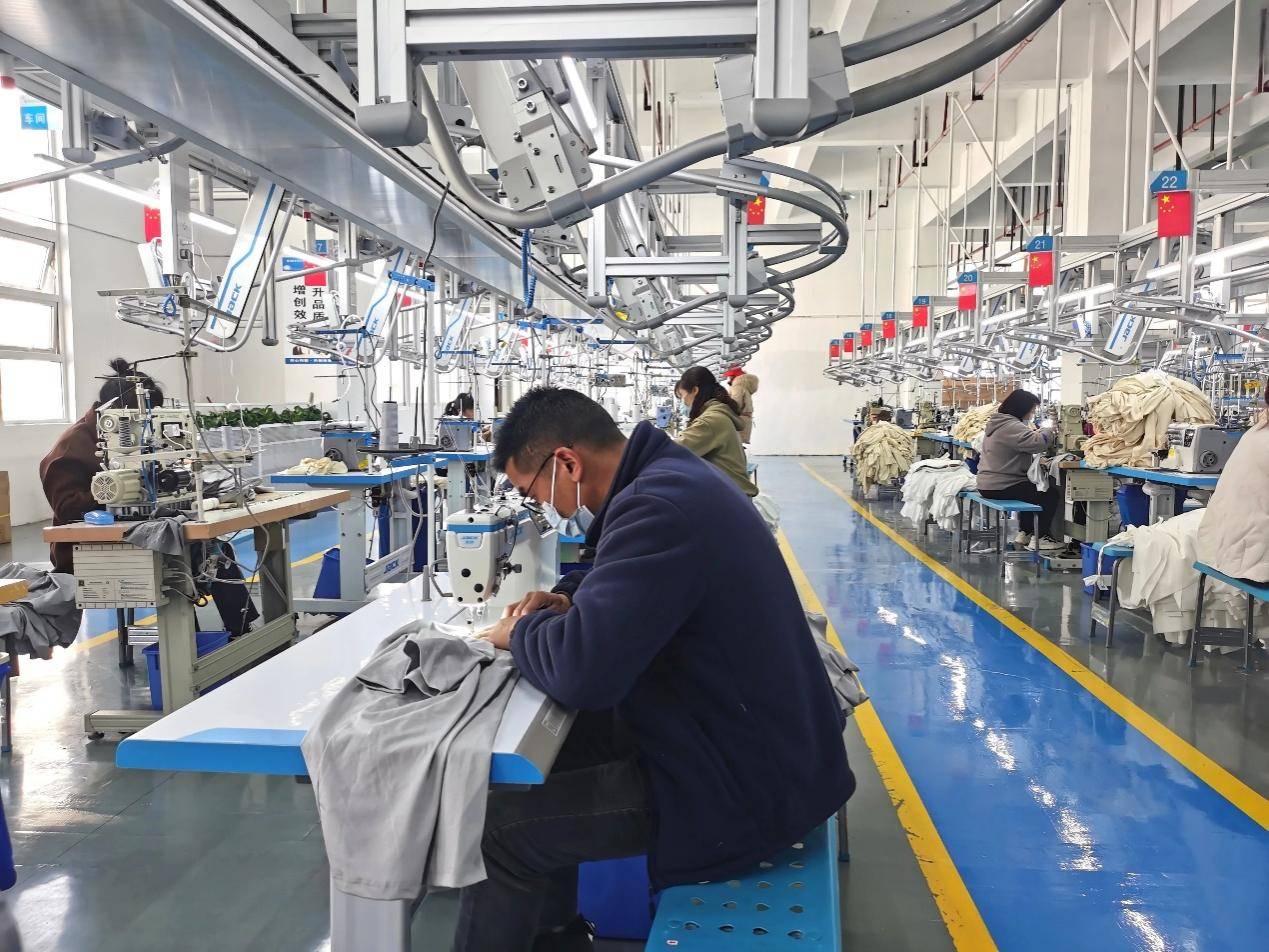
Sewing machinery is not a single category but a patchwork of multiple product lines with widely differing functions and vastly different value per unit. The lockstitch machine competes on volume, the embroidery machine on value; the heavy-duty sewing machine is tied to the high margins of automotive interiors and also to the strong cyclicality of the European car market; and pre- and post-sewing equipment such as cutting machines, hanging systems, and pressing equipment each sit at a different stage of domestic substitution. This chapter breaks down each segment in turn, asking "who is making it, what does the competitive landscape look like, and what order of magnitude is the value."
8.1 Lockstitch, Overlock, and Coverstitch: The Functional Division and Competitive Landscape of the Three Conventional Machine Types
Industrial sewing machines are not a monolithic category: the three conventional machine types — lockstitch, overlock, and coverstitch — correspond to different sewing processes, and they also correspond to sharply different intensities of competition.
The lockstitch machine (lockstitch machine) performs the most basic straight-line stitching, covering the basic process step across almost every category of apparel, bags, and home textiles; it is the sewing machinery category with the strongest versatility and the largest installed base, and it is the mainstay of China's industrial sewing machine output and exports. Precisely because demand is so large and the technical barrier relatively manageable, this segment has become the arena where Chinese and foreign companies compete head-on: domestic makers such as Jack Technology Co., Ltd. (SHA: 603337, "Jack Technology" hereafter), ZOJE Resources Investment Co., Ltd. (SZE: 002021, "ZOJE Resources" hereafter), and Xi'an Typical Industries Co., Ltd. (SHA: 600302, "Typical Industries" hereafter) compete directly within the same price band against JUKI Corporation (TYO: 6440) and Brother Industries, Ltd. (TYO: 6448) — it is also the main battlefield where domestic companies have continued to gain share. Jack Technology's industrial sewing machine business accounts for over 85% of company revenue, and the lockstitch machine is exactly the largest category within that business line, as well as the most direct battlefield for domestic companies to break through on share. The other side of this competition is price: in the first half of 2025, the average export price of industrial sewing machines was just USD 336.1 per unit — up 5.08% year-on-year, but still, in absolute terms, in the range of a high-volume industrial product. The lockstitch machine is the largest category in this industry, and also the most "involuted." Looking at the production-and-sales structure, exports as a share of industrial sewing machine output stayed above 70% continuously from 2023 through 2024, and as the mainstay category of industrial sewing machines, the lockstitch machine's fate is likewise tied to overseas orders: the pattern of "hot abroad, cold at home" — domestic sales continuously weakening while exports continuously strengthen — is especially visible in the lockstitch machine, the single largest category, and it also explains why domestic makers rely increasingly on capacity-expansion demand from overseas destination countries such as India and Vietnam.
The overlock machine (overlock machine) and the coverstitch machine (coverstitch machine) serve a different process line: the overlock machine finishes the raw edge of knit fabric while simultaneously trimming away excess seam allowance, and the coverstitch machine is used for decorative stitching on stretch fabrics such as appliqué and hemming; both appear concentrated on production lines for knit garments such as T-shirts, underwear, and sportswear. Compared with the lockstitch machine, the technical barrier for overlock and coverstitch machines shows up more in the tension stability of a multi-thread chainstitch at high operating speed — precisely the area where Japanese and Taiwanese makers have long held the advantage: Pegasus (Pegasus Sewing Machine Mfg. Co., Ltd., TYO: 6262, founded 1914) and Yamato (Osaka, founded 1927, unlisted) are both long-established plants specializing in overlock and coverstitch machines, and Taiwan's Kaulin (Kaulin Mfg., founded 1965, Siruba brand, with a Ningbo plant set up in 2005) is also an important supplier in this niche; all three are known for their accumulated traditional craftsmanship rather than for high-volume scale. On the domestic side, Feiyue Group ("Feiyue" hereafter) experienced a cash-flow breakdown during the 2008 financial crisis and was rescued with an RMB 80 million loan from the Taizhou municipal government, undergoing restructuring and transformation in 2009 — but as a long-established production base for overlock and coverstitch machines, Feiyue remains one of the world's major production centers for overlock machines today. The competitive landscape for conventional machine types is not entirely defined by market-share figures; standing production capacity is itself part of competitiveness.
8.2 Specialty and High-Value-Added Machine Types: Heavy-Duty, Pattern, and Template Sewing Machines
Beyond the conventional machine types, sewing machinery has also branched out into a group of high-value-added machine types aimed at special materials or special process steps; what they share is that the value of a single machine is significantly higher than a lockstitch machine, but market size lacks authoritative public statistics and can only be presented through qualitative description combined with the association's sample-based figures.
The heavy-duty sewing machine (heavy-duty sewing machine) is used for sewing thick, heavy materials such as leather, canvas, and automotive interiors, and its representative company is Germany's Dürkopp Adler: Dürkopp was founded in 1867 and merged with Kochs Adler in 1990 to form its current name. SGSB Group Co., Ltd. (SHA: 600843, "SGSB Group" hereafter) acquired 94.98% of Dürkopp Adler in July 2005 for EUR 35.95 million in a debt-assumption deal, drawn in specifically by its accumulated technology in heavy-duty sewing applications such as automotive seats and seatbelts — one of the landmark cases of early overseas acquisition by a Chinese company. But the heavy-duty sewing machine's high margin comes bundled with strong cyclicality: in 2024, SGSB Group's industrial sewing machine segment posted revenue of RMB 1.348 billion, down 27.46% year-on-year, and the company recorded a net loss of RMB 244 million that year — its first loss in 16 years; in 2025, Dürkopp Adler's German entity posted standalone revenue of RMB 1.075 billion and a net loss of RMB 158 million. The direct cause of the loss was weak European demand for automotive and leather goods, which caused a sharp drop in orders for high-margin medium-to-heavy-material equipment — the more a heavy-duty sewing machine depends on a single high-end application, the more directly cyclical swings in demand transmit straight to its financial statements.
The pattern sewing machine (pattern sewing machine), buttonholing machine (buttonholing machine), and button-attaching machine (button-attaching machine) are specialized automation equipment used in post-sewing garment processes, applied respectively to fixed-pattern stitching such as bag handles and shoe uppers, and to the previously manual, repetitive tasks of buttonholing and button attaching. These machine types lack authoritative public statistics on company landscape or market size and can only be described qualitatively: according to the China Sewing Machinery Association's sample figures, conventional machine types posted double-digit growth in 2024, while categories such as pattern sewing machines, template sewing machines, and automatic sewing units grew at rates exceeding 30% — noticeably faster than conventional types such as lockstitch and overlock machines. Downstream garment enterprises, under pressure to "cut headcount and raise efficiency," giving priority to swapping in dedicated automation equipment for complex, repetitive processes is the direct reason these specialty machine types are outgrowing the broader market. Although the pattern sewing machine, buttonholing machine, and button-attaching machine each serve different process steps, what they have in common is a fixed process path and high repetition count — exactly the scenario with the shortest payback period for automation investment, and this is the fundamental reason specialty machine types were first to post high growth, rather than a conventional machine type such as the lockstitch machine, whose process is flexible but depends on human judgment, being first to automate.
The template sewing machine (template sewing machine) is the specialty machine type with the highest degree of commercialization and the one that best illustrates the logic of "value leap": it uses a fixed template to guide the sewing path, achieving automated, shape-locked stitching in place of a human operator eyeballing the line. Historical figures put the template sewing machine's price at roughly RMB 60,000 to 100,000 around 2013–2014 — compared with an ordinary industrial sewing machine's unit price, which stays in the range of a few thousand to around ten thousand RMB, the template sewing machine's automation, which saves labor and raises the yield rate, pulled the value of a single machine up by an order of magnitude, tracing a value-leap path from the ten-thousand-RMB tier to the hundred-thousand-RMB tier. Jack Technology has kept iterating in this category, launching the "continuous-thread template machine M9-A" in June 2025, a representative product of domestic makers extending into automatic sewing units. "Automatic sewing unit," a category tallied alongside the template sewing machine in the association's sample figures, generally refers to an equipment package that integrates multiple process steps — feeding, sewing, thread trimming — into a single automated production line, a further step of integration beyond the single-machine automation of the template sewing machine. That the pattern sewing machine, the template sewing machine, and the automatic sewing unit all grew faster than conventional machine types at the same time reflects exactly the same underlying logic: the more complex a process step is and the more it depends on skilled labor, the sooner it gets replaced with dedicated automation equipment.
8.3 Embroidery Machine Deep Dive: The Zhuji Cluster's Global Share and Value Advantage
The embroidery machine (embroidery machine) is the sewing machinery segment with the highest value per unit and the one where China holds the strongest voice in the global landscape; its industrial cluster is concentrated in Zhuji, Zhejiang.
The Zhuji embroidery-machine cluster posted output value of RMB 11.59 billion in 2024, up 41.94% year-on-year, with output of 41,250 units and exports of RMB 3.53 billion (per the Zhejiang Provincial Administration for Market Regulation); measured on a "full industry chain output value" basis, the figure exceeds RMB 15 billion — the two figures cover different scopes and are noted side by side. Zhuji embroidery machines hold roughly 80% of the global market, and exports grew further to USD 798 million in 2025, up 53.01% year-on-year, with high-end models now accounting for nearly 40% of exports. The cluster contains more than 50 finished-machine companies, plus more than 80 supporting companies, forming a complete local supply chain; this figure has shrunk substantially from the more than 300 finished-machine companies the cluster once had around 2008, with roughly two-thirds of companies weeded out in the industry reshuffling of the past decade-plus, markedly raising industry concentration. Representative companies include Yuelong, with sales exceeding RMB 1.2 billion in 2025, and Xinsheng Technology, which posted output value of RMB 1 billion in 2023 and listed on the Beijing Stock Exchange in August 2026.
In the global high-end market, Japan's Tajima Industries is the widely recognized leading brand, with cumulative sales exceeding 140,000 units and a long-held position at the technological high ground of high-end embroidery machines, but no verifiable specific share figure appears in public information, so this report does not speculate on one. Zhuji and Taizhou thus form two parallel paths of specialization within China's sewing machinery industry: Taizhou sustains scaled, high-volume production with annual output in the millions of units, while Zhuji sustains differentiated, high-value production with annual output in the tens of thousands of units; neither substitutes for the other, and together they hold up China's global leadership at both the output-volume and output-value ends of sewing machinery.
The reason the Zhuji embroidery-machine cluster can reach output value in the tens of billions of RMB even though its finished-machine output falls far short of the Taizhou industrial-sewing-machine cluster's comes down to price structure: in the first half of 2025, the average export price of industrial sewing machines was USD 336.1 per unit, while the average export price of embroidery machines reached USD 7,040.7 per unit — twenty times the former. Both are exports of sewing equipment, but the embroidery machine, on the strength of greater technical complexity and stronger differentiation barriers, carries a per-unit value far above the high-volume industrial sewing machine — which also explains why Zhuji, with annual output in the tens of thousands of units, can generate an output-value contribution on the same order of magnitude as Taizhou's industrial-sewing-machine cluster, which produces in the millions of units. It is worth noting that the embroidery machine's export growth rate reached 53.01% in 2025, markedly faster than the 16.42% overall growth rate for sewing machinery exports in 2025 — within the export structure of sewing equipment, specialized machine types carrying higher added value and stronger differentiation barriers are outgrowing general-purpose, high-volume machine types, the same logic by which specialty machine types such as the pattern sewing machine and the template sewing machine outgrow conventional types.
Another main thread supporting the Zhuji embroidery-machine industry is its electronic-control ecosystem. Beijing Dahao Technology Co., Ltd. (SHA: 603025, "Dahao Technology" hereafter) traces its origins to the Ministry of Light Industry's project, undertaken by a team from the Beijing No.1 Light Industry Research Institute in the 1980s, to domesticate computerized embroidery machines: in 1986 the team, working with the Qingdao Sewing Machine Factory, developed China's first multi-head computerized embroidery machine, the GY612, and in 1988 launched the proprietary BECS-02 electronic control system, ending the era in which computerized embroidery-machine controls relied entirely on imports. Dahao Technology set up its Zhejiang Dahao subsidiary in Zhuji in 2005, embedding itself deeply in the local supply chain; per its 2019 annual report, Dahao Technology's domestic market share for embroidery-machine controls exceeded 80%; in 2025 the company's smart-equipment electronic-control business posted revenue of RMB 2.426 billion, accounting for 80.81% of revenue, with a gross margin as high as 46.49% — significantly better than the generally low margins of finished-machine makers. Local Zhuji finished-machine maker Xinsheng Technology buys 100% of its electronic control systems externally, from Dahao Technology and Ruineng Technology (SHA: 603933, Fuzhou, focused mainly on controls for knitting flat machines) — this is a direct illustration of the "finished-machine maker builds the shell, controls maker builds the brain" division of labor within the embroidery-machine supply chain: the controls maker captures a higher share of profit along the chain on the strength of its technical barrier, while the finished-machine maker bears thinner margins in the fully competitive assembly segment.
8.4 Pre- and Post-Sewing Equipment: Cutting Machines, Fabric Spreaders, Hanging Systems, and Pressing and Inspection
Garment production is not made up of the sewing step alone — the cutting and fabric-spreading that come before sewing, the pressing and inspection that come after it, and the intelligent hanging systems that run through the production line together constitute a market for pre- and post-sewing equipment outside sewing machinery proper. The competitive landscape in this area differs from that of finished sewing machines: foreign capital still holds a clear advantage in high-end automatic cutting machines, while domestic companies have used acquisitions to move in quickly.
In the automatic cutting machine (automatic cutting machine) segment, the representative foreign player is France's Lectra: fiscal 2025 revenue of EUR 506.73 million, having completed its acquisition of the U.S.'s Gerber in 2021 to further consolidate its scale in the cutting-equipment market; its Suzhou plant began production in November 2024 and is one of Lectra's three global production bases. According to interviews with industry executives, Lectra's share of the specific niche of automotive-interior cutting in China is roughly 60%. The domestic camp's path into this segment has been acquisition: in July 2009, Jack Technology acquired the brands, technology, and inventory of Germany's Topcut and Bullmer for roughly RMB 45 million, without assuming their existing debt; Bullmer had been one of the world's three largest automatic-cutting-machine makers. After the acquisition, Jack Technology folded these businesses into its "Topcut-Bullmer" sub-brand, focused on cutting-machine and fabric-spreading-machine business and not making lockstitch machines; that brand posted sales of nearly RMB 600 million in 2022 and net profit of RMB 147 million in 2023. In Jack Technology's financial reports, the combined "cutting machines & fabric spreaders" business segment posted revenue of RMB 626 million in 2024, up 14% year-on-year, offering a reference point for the scale of domestic makers in this niche. Standing in contrast to Topcut-Bullmer is Changyuan Heying Intelligent Technology Co., Ltd. ("Changyuan Heying" hereafter): in 2016, Changyuan Group acquired 80% of Heying Technology for RMB 1.88 billion in an attempt to break into the cutting-machine race, but in 2020 the Shenzhen bureau of the China Securities Regulatory Commission determined the company had engaged in financial fraud — fabricating overseas sales, prematurely recognizing revenue, and using dual contracts — and the former chairman was sentenced as a result; "Changyuan Heying Intelligent Equipment" continues to operate today, but it can no longer be said to sit in the same competitive tier as Lectra or Topcut-Bullmer.
The fabric spreading machine (fabric spreading machine) is typically used together with an automatic cutting machine, automatically laying and stacking fabric on the cutting table; standalone market-size statistics for fabric spreaders are rarely found in public information, and their scale has to be observed indirectly through cutting-machine business figures — the revenue scale of Jack Technology's combined "cutting machines & fabric spreaders" segment mentioned above is a direct illustration of this logic.
The intelligent hanging system (intelligent hanging system) is responsible for automatically transporting semi-finished goods along a production line and is one of the key directions for smart upgrades in sewing workshops; the representative company, Zhejiang INA Intelligent Technology Co., Ltd. ("INA Intelligent" hereafter), was founded in Taizhou in 2004, with customers including brands and platforms such as Anta and Alibaba's Xingxuan. It posted revenue of RMB 314 million in 2019 (per figures cited in its prospectus); its listing application was accepted for the STAR Market in December 2020, but it voluntarily withdrew in August 2021, terminating the listing process, and it has not reached the capital markets to this day. It should be noted that no credible statistic on the penetration rate or market share of intelligent hanging systems exists in public information; any claim of a specific percentage lacks authoritative-source support, and this report does not credit it.
Pressing and ironing equipment (pressing and ironing equipment) is the link in the pre- and post-sewing chain with the scarcest data: no authoritative body currently publishes statistics on this segment's market size, growth rate, or average price, and the only thing observable is that listing prices on cross-border e-commerce platforms range from USD 600 to USD 20,000 — a wide spread that reflects a clear technology and value stratification, from entry-level ironing equipment to industrial-grade quality-inspection models. The scarcity of data is itself a signal about the landscape: compared with cutting machines and hanging systems, whose companies routinely post revenue in the hundreds of millions of RMB, pressing and inspection equipment has a low per-unit value and a high degree of process standardization, and it has not yet produced leading companies substantial enough to attract sustained tracking by professional statistical bodies and research reports — this is the fundamental reason it continues to sit outside the field of view of industry-landscape analysis.
Taken together, the differences in value across sewing machinery's various segments are, at bottom, differences in technical complexity and differentiation barriers, not simply differences in scale. Placing the three questions — who is making it, what does the landscape look like, and what order of magnitude is the value — side by side in a single table makes this difference more directly visible:
| Segment | Core Function | Representative Companies | Value Scale and Landscape Features |
|---|---|---|---|
| Lockstitch machine | General-purpose straight-line stitching, largest installed base | Jack Technology, ZOJE Resources, Typical Industries vs JUKI, Brother Industries | Average export price USD 336.1/unit; most intense head-on China-vs-foreign competition |
| Overlock / coverstitch machine | Knit-fabric edge finishing, hemming and decorative stitching | Pegasus, Yamato, Kaulin (Siruba) vs Feiyue | Traditional-craftsmanship edge held by Japan and Taiwan; Feiyue's capacity still ranks among the world's top |
| Heavy-duty sewing machine | Sewing of heavy materials such as leather and automotive interiors | Dürkopp Adler (under SGSB Group) | High margin, strong cyclicality, moves in step with European automotive demand |
| Pattern / buttonholing / button-attaching machine | Specialized automated post-sewing processes | No authoritative company landscape statistics | Association sample figures show growth above 30% in 2024 |
| Template sewing machine | Template-guided automated shape-locked stitching | Jack Technology | Per-unit price jumped from the thousand-RMB tier to the hundred-thousand-RMB tier (2013–2014 figures) |
| Embroidery machine | Multi-head computerized embroidery | Tajima (high-end); more than 50 Zhuji finished-machine makers including Yuelong and Xinsheng Technology | Average export price USD 7,040.7/unit, twenty times that of industrial sewing machines |
| Automatic cutting machine | Automated fabric cutting | Lectra (including Gerber), Topcut-Bullmer vs Changyuan Heying | Roughly 60% of China's automotive-interior cutting niche is concentrated at Lectra (limited scope) |
| Intelligent hanging system | Automated transport of semi-finished goods on the production line | INA Intelligent | 2019 revenue of RMB 314 million; withdrew STAR Market listing application in 2021 |
| Pressing and inspection equipment | Garment pressing and quality inspection | No authoritative company landscape statistics | Only cross-border e-commerce listing prices in the USD 600–20,000 range are available |
Along the same supply chain, the two highest-value ends fall on the embroidery machine and the heavy-duty sewing machine — the former sustains a high unit price through technical complexity and cluster-scale effects, the latter sustains a high margin through a scarce automotive-interior application, but is also, precisely because of that, tied to the cyclical swings of its downstream industry. The lowest-value, most fully competitive segment is the lockstitch machine — also exactly the battlefield where domestic makers compete most fiercely head-on with foreign capital and where domestic market-share gains are most visible. The landscape for pre- and post-sewing equipment such as cutting machines and hanging systems has not yet settled: foreign capital holds the high end on accumulated technology, while domestic companies rely on acquisitions to catch up quickly — Changyuan Heying's financial-fraud case and INA Intelligent's failed listing both show that consolidation in this race remains only half finished. From the price war in lockstitch machines to the value premium of embroidery machines, from the heavy-duty sewing machine's high margin tied to automotive interiors to the data void around pressing and inspection equipment, the true picture of the sewing machinery industry is not a single unified market but a patchwork of multiple product lines with sharply different value, technical barriers, and competitive intensity — a single industry-wide size or growth-rate figure cannot paper over the enormous gaps between segments, and this is exactly why studying this industry requires taking it apart segment by segment.
Chapter 9 Technology Evolution: The Last Unautomated Step
The technology evolution of sewing machinery is a history in which "efficiency leaps" and "automation standstill" have run in parallel. From the purely mechanical era to the artificial-intelligence era, stitching speed, stitch-pattern precision, and connectivity have advanced steadily; but the sewing operation itself — aligning two soft cut pieces, feeding them, and stitching them into shape — has still not been fully automated. This is not an isolated technical detail: in the sequence of cutting followed by sewing, cutting has already been largely taken over by automatic cutting machines, while sewing, which comes right after it, remains a production line built around human workers. Understanding this paradox is the key to judging where this industry goes next.
9.1 Technology Generations Timeline: From Pure Mechanics to Artificial Intelligence
Before electronics, sewing machines completed stitching through gears, drive shafts, and lever mechanisms; styles and stitch patterns were determined entirely by the mechanical structure, so changing a process meant changing parts, not adjusting parameters. In the 1970s, the global sewing machine industry as a whole entered the electronic era: circuit boards, independently controlled motors, and digital stitch-pattern combinations were introduced into machine models, making functions such as automatic thread trimming and needle-position control possible for the first time. This process occurred across the global sewing machine industry, not uniquely within China's industrial sewing machine industry — at the time, China's industrial capability remained at the stage of mass-manufacturing mechanical machine models.
What truly brought computerization into Chinese factory workshops was the proprietary computerized automatic-thread-trimming lockstitch machine launched in 2003 by domestic electronic-control maker Fangzheng, a machine that "touched off a computerization revolution in lockstitch machines that swept rapidly across the whole country." This revolution was, first and foremost, an economic calculation: compared with an ordinary lockstitch machine, a computerized lockstitch machine could save about RMB 1,000 in electricity per year, raise efficiency by about 30%, and cut thread consumption by about 25% (figures as of roughly the early 2010s). Under the twin pressures of "labor shortage" and "power shortage," this math left garment enterprises with almost no reason to keep using ordinary lockstitch machines — the spread of computerized lockstitch machines did not begin with a policy document, but with a cost-benefit calculation that workshops worked out for themselves.
Building on computerization, sewing machinery went through another round of hardware upgrades: servo motors gradually replaced traditional clutch motors, direct-drive integrated heads (with the motor and head integrated, eliminating the belt-transmission stage) gradually replaced belt-drive designs, and automatic thread trimming moved from an optional add-on to a standard feature. The logic of this generation of upgrades was to further compress auxiliary actions that had previously relied on workers doing them by hand — lifting the presser foot, trimming thread — into the electronic control system itself: what the machine took over was the action, not the judgment.
Connectivity was the next step. In 2023, JUKI Corporation (JUKI, TYO: 6440) stated in its official communications that it had formally entered the "IoT platform equipment and systems business," attempting to connect the operating data of individual machines to a network for equipment status monitoring and after-sales maintenance; domestic complete-machine makers such as Jack Technology Co., Ltd. (SHA: 603337, renamed from "Jack Co., Ltd." in September 2025, hereinafter "Jack") also rolled out equipment-connectivity management platforms aimed at dealers and end-user factories, one after another, collecting data such as machine run-time hours and fault codes to support after-sales response and capacity management. Connectivity itself does not change the sewing action, but for the first time it turned the sewing machine from an "isolated production tool" into a "terminal whose status can be read remotely."
Artificial intelligence is the latest round of upgrading, and it points to a change in order structure. In September 2025, Jack launched the AiTu Ai10, described in company communications as the "world's first AI sewing machine"; before that, Jack's "Quick Response King" series launched in 2023, along with the upgraded "Quick Response King 2" and the "continuous-thread template sewing machine M9-A" released in June 2025, all targeted the same category of orders — "small-batch quick response," meaning an order pattern of small quantities, many varieties, and short lead times. This type of order has shifted equipment requirements from "stable operation" to "flexible switching": the same machine must frequently change stitch patterns and process parameters, and manual machine setup is time-consuming and dependent on experience. Equipment equipped with AI capability is expected to automatically recognize the process and shorten changeover time, handing the step of "recognizing the job" over to the machine as well.
Strung together, this timeline is in fact a stock-replacement campaign that has continued for more than two decades. On July 18, 2025, Jack marked its thirtieth anniversary, and its 30-millionth intelligent sewing machine rolled off the line that same day. From the first replacement wave touched off by the domestic computerized lockstitch machine in 2003 to a cumulative output of 30 million intelligent machine units, what China's sewing machinery industry has accomplished is not a single-point technological breakthrough, but has turned the replacement itself — "swapping mechanical machines for computerized machines" — into a long-term project covering the industry's entire installed base. This also explains why the next phase of technology evolution is no longer satisfied with putting a "computer" inside the sewing machine, but seeks to hand "judgment" over to the machine as well.
9.2 Why Sewing Is the Last Unautomated Step in Garment Manufacturing
From pure mechanics to artificial intelligence, every generation of technology upgrade in sewing machinery has raised the efficiency of "freeing people from auxiliary actions," not the automation of "freeing people from the sewing action itself." This is not a matter of insufficient technology investment; rather, the sewing action itself is, in terms of automation, harder than most people imagine.
Breaking garment production down, it goes through roughly six stages:
- Separating a single layer of fabric
- Aligning two edges to be stitched together
- Controlling tension and the edge while feeding the material
- Completing the stitch (forming the seam)
- Presenting the next edge to be stitched
- Checking and correcting errors
Of these six stages, only stitch-forming has been genuinely automated — the trajectory of the needle's movement, the rhythm of the feed dog, and the timing of thread trimming have long been precisely executed by the electronic control system. The other five stages remain, to this day, heavily dependent on manual labor.
Each of these five stages has its own specific obstacle. Separating a single layer of fabric requires the machine to reliably pick out exactly one layer from a stack of soft, easily clinging cloth; the slightest deviation will pull along two layers or more. Aligning two edges means bringing two independently deforming flexible surfaces into spatial coincidence to millimeter-level precision. Controlling tension while feeding the material is, in essence, an exercise in continuous mechanical balance — pull the thread too tight and the fabric puckers and distorts; too loose and it causes misalignment and skipped stitches, requiring continuous fine-tuning based on real-time feedback throughout. Presenting the next seam line and checking for errors likewise requires the machine to continuously track a constantly changing three-dimensional shape, rather than execute a pre-set, fixed trajectory. These five hurdles are precisely the places that sewing machinery's computerization, servo-drive, and connectivity upgrades over the past sixty years have never truly touched — successive generations of upgrades have raised the speed and precision of the "stitch-forming" stage, but have never handed the other five stages over to the machine.
The difficulty lies not in the needle but in the cloth. Metal, plastic, and wood parts are rigid materials; every step of robotic gripping, positioning, and assembly can reference fixed holes and edges as geometric datums, and this is precisely the precondition that has let industrial robots be replicated at scale over the past half century. Fabric is not this kind of material: a T-shirt front panel has no rigid reference point at all — pull one corner and the collar, shoulder line, and side seam all deform simultaneously; every contact changes the shape of the fabric itself. This means that the traditional robotic control logic of "measure first, then execute" fails in the sewing context — the measurement result is already outdated by the instant of execution.
Vision systems face an even deeper paradox: a camera can identify a fabric edge, but the very act of the gripper reaching in to grasp that edge deforms the fabric, in turn changing the edge it was looking for — the object being recognized and the act of recognition interfere with each other, forming a self-referential loop. Breaking this loop requires the machine to continuously reposition and continuously adjust tension on an extremely short time scale, which demands far more of real-time visual feedback and force-control algorithms than grasping a rigid part at a fixed workstation does.
The cutting stage offers a valuable reference frame. Also working with fabric, automatic cutting machines became widely adopted long before sewing automation — not because cutting itself is simpler, but because the cutting process actively eliminates the problem's degrees of freedom: during cutting, the entire fabric sheet is vacuum-pressed flat and fixed to the cutting table surface, in a static, two-dimensional, supported state, and the machine only needs to cut along a preset contour line without dealing with deformation. Sewing, by contrast, happens precisely after the fabric leaves the support of the table and enters a free three-dimensional state: two cut pieces must be picked up in mid-air, aligned, and fed into the presser foot, with no rigid constraint from a table surface throughout the process — the machine must perform real-time closed-loop control on a continuously changing three-dimensional flexible system. The degree of automation does not depend on how important a process is within the production flow, but on whether that process can be converted into a geometric problem with a fixed reference and limited degrees of freedom — cutting can be, sewing currently cannot. This is precisely the fundamental reason why the sewing machinery industry still exists today as a "human-plus-machine" combination rather than having been fully roboticized.
This criterion is not unique to apparel. The same logic underlies why manufacturing steps such as automotive body welding and electronic-component insertion have been able to replace human labor at scale — the materials involved are themselves rigid, or can be converted into a near-rigid state by tooling and fixtures. Over the past half century, industrial robots have reshaped production lines in manufacturing steps such as automotive and electronics almost entirely, yet have never truly entered the garment sewing workshop — not because investment has been insufficient, nor because the need is not urgent enough, but because the material conditions of garment sewing happen to fall outside the range industrial robots are good at.
9.3 Two Paths to Automated Sewing: Machine Vision and Fabric Stiffening
At present, globally, there are mainly two technology paths attempting to fundamentally solve the problem of "automated sewing of flexible fabric," and their directions are entirely different.
The first path comes from U.S. company SoftWear Automation, whose product line is named Sewbot. The company was incubated out of Georgia Tech in 2012 and got its start early on with US$1.8 million in funding from the U.S. Defense Advanced Research Projects Agency (DARPA); its technology path uses machine vision to identify fabric deformation in real time, paired with robotic arms making dynamic adjustments, to replace manual labor in aligning, feeding, and correcting drift. In 2017, Adidas supplier China's Tianyuan Garments invested US$20 million to build a 21-line automated T-shirt factory in Little Rock, Arkansas — to date the largest commercial attempt along this path. In August 2025, the company completed a US$20 million Series B1 round led by Danish fashion group BESTSELLER, bringing its cumulative funding to US$45.6 million; its third-generation T-shirt-dedicated Sewbot line is planned to reach commercial deployment in the first half of 2026. It should be noted that commercialization along this path currently remains confined to the single category of T-shirts — the simplest structure and most regular fabric — and has not yet expanded to other garment categories.
The second path comes from Seattle-based company Sewbo, founded in 2015, and its approach is the opposite of the machine-vision path: rather than having the machine adapt to soft fabric, first make the fabric not soft. Sewbo "sizes" cut pieces with a water-soluble, non-toxic polyvinyl alcohol (PVA) polymer, temporarily stiffening them to a state close to a rigid material; a robotic arm grips the piece with a suction cup and feeds it through a standard sewing machine to complete the stitching, after which washing removes the stiffening agent and restores the fabric's original soft hand-feel. This path essentially converts the "sewing" problem back into a "cutting" problem — artificially creating a rigid reference point through chemical means. As of now, this path remains at a pre-commercialization stage.
Both paths represent the long-term direction of "fully unmanned" operation, whereas on real production lines, the automation solution that has genuinely been rolled out at scale is the template sewing machine and the automatic sewing unit. The principle behind template sewing machines shares something in common with Sewbo's approach: the cut piece is first fixed to a rigid template using clamps or tape, and the machine then automatically completes the stitching along a preset path, with the template itself taking on the role of the rigid reference point that the fabric lacks. This approach requires neither an expensive machine-vision system nor chemical stiffening; it simply shifts the problem of "fabric has no reference point" to the front end of the production line, letting a human complete template positioning in exchange for automation of the sewing step itself. This is precisely why template sewing machines and automatic sewing units are called "semi-automated," and it is also the most widely adopted practical path in today's sewing supply chain, aside from purely manual sewing.
The trade-offs among the three paths are quite clear. The machine-vision path has the highest equipment investment and the deepest technical barrier; once it works, it has the potential to cover multiple categories, but as of now has only completed commercial validation in the single simplest category, T-shirts. The fabric-stiffening path bypasses the technical challenge of real-time visual correction, using chemical pretreatment to reduce a flexibility problem to a rigidity problem, but the two extra steps of stiffening and washing add cost and production cycle time, and it has yet to cross the commercialization threshold. The template sewing machine path has the lowest technical barrier and the smallest equipment investment, trading upfront manual positioning for automatic machine stitching, at the cost of flexibility — switching to a different pattern usually means remaking the template, so it suits large-batch, few-style orders better and does not suit the "small-batch quick response" scenario described in Section 9.1. All three paths currently stand on their own, and each is also limited; none yet manages to balance category coverage, production cost, and order flexibility at the same time.
9.4 Where Chinese Makers Stand in the Catch-Up Race
Over the past four decades, the main battlefield of China's sewing machinery industry's catch-up effort has been the localization of electronic control systems. In the 1980s, the electronic control systems of computerized embroidery machines relied entirely on imports; domestic makers, working together with research institutes, started from zero, and it was not until 1988, when the predecessor team of Beijing Dahao Technology Co., Ltd. (SHA: 603025, hereinafter "Dahao Technology") launched a proprietary electronic control system, that this situation came to an end. This localization journey took nearly forty years, and electronic control systems have now become one of the few segments in which domestic makers can reliably deliver high-gross-margin products — electronic controls sell the "brain," complete machines sell the "body," and this is also why the profit margins of downstream complete-machine makers have long trailed those of upstream electronic-control makers by a wide margin.
Once localization of electronic controls was essentially complete, the next technological high ground shifted to automated operating capability itself — that is, the machine-vision, flexible-gripping, and humanoid-robot directions described in Section 9.3. The starting conditions for this round of competition differ from those of electronic-control localization: electronic controls are an electronic system that can be disassembled, reverse-engineered, and progressively replaced, whereas machine vision plus flexible operation requires complete-machine makers to have a systematic understanding of material deformation, force-control algorithms, and mechanical structure — an electronic-control maker alone filling in a chip or a circuit board cannot solve the sewing action itself. Chinese makers have already begun moving on this track: between March and April 2026, Jack jointly established a joint venture with X Square Robot, the Zhejiang Humanoid Robot Innovation Center, and AgiBot, aiming the humanoid robot's application scenario at the sewing workstation, with a prototype planned for release in September 2026. This is the first time a domestic complete-machine leader has publicly linked humanoid robots directly to the sewing scenario, meaning Chinese makers are no longer content to catch up along the existing path of electronic-control localization, but are attempting to start neck-and-neck with the American machine-vision path on the track of automated sewing — a track that has not yet matured anywhere in the world. This race currently has no side reaching the finish line: Jack is betting on humanoid robots, SoftWear Automation is betting on fixed machine-vision workstations, and the two are following different technology paths; whoever first gets a real order type like "small-batch quick response" running at volume production will hold pricing power in the next generation of competition.
9.5 The Next Variable in Technology Evolution: Could Industry Relocation Be Rewritten
From pure mechanics to artificial intelligence, every technological leap the sewing machinery industry has completed so far has changed the efficiency, precision, and degree of digitalization of sewing, but has not changed the basic fact that sewing depends on manual labor. The Internet of Things lets sewing machines be monitored remotely, and artificial intelligence makes changeovers faster, but the person sitting at the workstation is still a worker. This is also why the core driver of this round of garment-capacity relocation to Southeast Asia remains labor cost, not automation to this day — the equipment's place of manufacture stays in China while the garment's place of manufacture is moving out, and the two are following two entirely different paths. The dividing line between them is exactly the point this chapter has repeatedly argued: the machine has not yet truly taken over the sewing action.
If this dividing line is broken, the situation will be entirely different. SoftWear Automation's third-generation T-shirt line, planned for commercial deployment in the first half of 2026, and Jack's humanoid-robot joint-venture project aiming to release a prototype in the second half of 2026, both still cover only an extremely narrow range of categories and scenarios, and there remains a considerable distance to travel before either can replace manual sewing at scale. But suppose automated sewing truly crosses the commercialization threshold and gradually expands from T-shirts to more categories — a question that previously did not need answering would surface: how much weight the variable of labor cost still carries in the site-selection logic of garment manufacturing. The answer to this question determines not the sewing machinery industry itself, but the direction of the entire garment manufacturing industry's next migration, a subject left to Chapter 11.
Chapter 10 Risks and Challenges
The risk structure of the sewing machinery industry resembles that of most export-oriented equipment manufacturing industries, yet is made more distinctive by the fact that the downstream garment industry itself is undergoing cross-border relocation. This chapter begins with the double-edged effect of downstream industry relocation, and then in turn examines strong cyclical risk, low-end homogeneous competition, the historical lessons of key enterprises, exchange rates and trade barriers, and the survival pressure faced by small and medium-sized enterprises, focusing on the transmission mechanisms behind the risks rather than simply listing phenomena.
10.1 The Double-Edged Sword of Downstream Industry Relocation: The Race Between Export Dividends and Capacity Anchoring
The cross-border relocation of the downstream garment industry is the starting point of this chapter's risk analysis. Among U.S. garment imports, China's share has fallen from 22.6% in 2024 to 15.2% in 2025, and Vietnam, with a 19.8% share, has overtaken China for the full year for the first time, becoming the largest source of garments to the United States; by contrast, China's share of the EU market still holds at 29.8%, and as high as 46.9% in the Japanese market, indicating that the share decline is currently concentrated mainly in the single U.S. market and has not yet evolved into a global rout. Shenzhou International's capacity footprint confirms this relocation as an accomplished fact: it built a factory in Vietnam in 2014, its Vietnam and Cambodia headcount surpassed its domestic headcount in 2021, and by the end of 2023 its overseas finished-garment capacity share had risen to 53%.
This relocation's short-term transmission to the sewing machinery industry is positive. Recipient countries such as India, Vietnam, and Bangladesh have weak sewing machine manufacturing capability of their own, so the complete machines and supporting equipment needed for newly built finished-garment capacity can only be imported, and China happens to be the world's leading supplier. Among the destination countries for sewing machinery exports in 2024, India ranked first at US$562 million, Vietnam was second at US$368 million (up 71.19% year on year), Pakistan was at US$169 million (up 154%), and Bangladesh was at US$143 million; Belt and Road markets together accounted for 69.88% of total exports. The countries taking on more garment orders are precisely the markets where sewing machinery export growth is fastest — at this stage, the outflow of garment orders and the growth of sewing machinery exports are two sides of the same coin.
But stretch the time axis out, and risk begins to appear. Historically, the location of sewing machine manufacturing has always followed the relocation of garment capacity, moving from the earliest European and American manufacturing centers to postwar Japan and then to China over the past three decades; the terminus of each garment-industry relocation has ultimately also become the new center of sewing machine manufacturing. Equipment follows capacity — this is the core clue for judging the long-term direction of this round of relocation, rather than looking only at the immediate export dividend. The capacity deployment of foreign-invested leaders has already shown signs of stratified relocation: JUKI's factory in Ho Chi Minh City, Vietnam, is its only overseas subsidiary that integrates production, R&D, and sales; while Brother Industries' primary manufacturing base for industrial sewing machines remains in China, its household sewing machine manufacturing has already been positioned in Taiwan, China and Vietnam — the high-value, technology-intensive industrial-machine segment stays in China for now, while the low-value, labor-intensive household-machine segment relocates first. This sequence of stratified value-chain relocation says more about the timetable for risk materialization than a blanket forecast that "capacity is about to relocate." At the same time, China's direct investment into ASEAN grew 36.8% year on year in 2024 to reach US$34.36 billion, indicating that capacity relocation is not driven solely by overseas brand customers or foreign-invested enterprises — Chinese manufacturing capital itself is also participating in placing production segments in Southeast Asia, a trend that will likewise accelerate the process of equipment manufacturing following capacity relocation. Even more worth noting is a hidden transmission channel that shows up in no statistic at all: the local skilled workers, maintenance engineers, and supporting suppliers that foreign-invested leaders and Chinese capital cultivate by setting up factories in recipient countries are themselves a form of knowledge spillover. Once a locality accumulates enough experience in equipment maintenance and parts processing, extending into complete-machine assembly becomes only a matter of time and capital investment, no longer needing to wait for some industrial policy document to come out first.
As for the direction of India's support for domestic manufacturing, no public information currently indicates that sewing machinery has been included within the scope of its dedicated industrial incentive policies, and there is no evidence yet that India has formed a systematic policy supporting the sewing machinery industry; this report will not extrapolate beyond what is known on this point. But the absence of industrial policy does not equal the absence of risk — as long as the recipient country's finished-garment capacity keeps expanding, localization demand around complete-machine assembly and parts supply will naturally take shape. This type of risk is better tracked continuously against the recipient country's capacity scale than by waiting for some official policy document to be issued.
10.2 Strong Cyclical Risk: The Inflection Signal Released by the Sharp Drop in Export Growth
Sewing machinery output has long followed a 3–4 year cyclical pattern, with 2017, 2021, and 2024 all being peak output years; the specific figures were already laid out earlier and are not repeated here. Export data is now providing the key signal that this cycle is topping out: total exports in 2025 were US$3.986 billion, up 16.42% year on year, covering 207 countries and regions, still on the surface within an expansion channel; but entering the first half of 2026, export growth plunged to 2.69%, with industrial sewing machines showing a "volume up, value down" divergence — shipment volume rose 6.25% year on year, while export value fell 2.55%, with unit prices under clear pressure.
Volume rising while value falls usually points to two pressures occurring at the same time: one, the industry is actively lowering quotes to grab orders in order to hold onto export volume; two, the recipient countries' purchasing structure is sliding down from mid-to-high-end models to low-priced models, prioritizing the question of whether capacity exists at all over that of equipment upgrading. Either way, it shows that the pull of exports on revenue is weakening, and one cannot conclude that industry conditions remain buoyant simply because export value is still positive year on year.
The signal on the domestic-sales side is more direct: domestic sales in 2025 are estimated at about 1.65 million units, down more than three-tenths year on year in the first three quarters, with the association's own characterization already explicitly stated as "hot outside, cold inside." Domestic sales and exports weakening in tandem means that the 2024 high point — RMB 31.611 billion in revenue for 275 above-designated-size enterprises, up 19.04% year on year — is more likely to be the peak of this cycle than the starting point of a new normal. Extrapolating from the 3–4 year cyclical pattern, the next upward window theoretically falls in 2027 to 2028, but this is only an inference based on historical patterns and does not constitute a formal forecast by any institution; before then, the industry will most likely go through an adjustment period centered on digesting capacity and compressing inventory.
10.3 Low-End Price Wars and Homogenization: The Loss Ratio Among Above-Designated-Size Enterprises
China's sewing machinery industry is dominated by low- and mid-end complete-machine assembly, with hundreds of enterprises competing homogeneously around conventional categories such as lockstitch machines and overlock machines, and bargaining power is generally weak. This structural problem is corroborated by loss-ratio data: according to the association's statistics, of 238 above-designated-size enterprises in 2020, 58 posted losses, a loss ratio approaching one-quarter, with the number of loss-making enterprises up 28.89% year on year and total losses of RMB 195.22 million.
Losses concentrated at the above-designated-size enterprise level are usually not explainable by the operating missteps of individual enterprises, but are an industry-wide signal of overcapacity combined with price competition. When hundreds of small and medium complete-machine plants produce highly similar low- and mid-end products, pricing power gradually shifts toward downstream garment factories, and enterprises can only trade lower ex-factory prices for order volume; once the room for price-cutting is compressed to its limit, the first to be forced out are usually the small and medium enterprises with the weakest cost control, and the loss-ratio data is exactly the financial trace left by this clearing process. In contrast, the sub-segments that hold core technology display an entirely different profitability structure — the leading electronic-control-system makers have long maintained gross margins above 40%, markedly better than the complete-machine assembly segment, showing that homogenization pressure concentrates mainly at the lower-barrier complete-machine assembly layer rather than running through the whole industry chain. Layered on top of the cyclical downward pressure described in the previous section, the loss ratio brought by homogeneous competition will most likely expand further during the industry's downturn phase, rather than being confined to any single year — which is also why the risk of low-end price wars needs to be observed together with the strong cyclical risk.
10.4 Enterprise Risk as Mirror: Four Ways to Fail
The operating histories of several representative enterprises in the industry provide concrete cases of the risk transmission mechanism, and can be treated as a risk-mirror checklist for this industry:
- SGSB Group (SHA: 600843) — the asset burden of overseas M&A: in 2005 it acquired 94.98% of Germany's Dürkopp Adler through a debt-assumption acquisition, and in 2013 injected further capital to acquire PFAFF Industrial and KSL, at one point held up as a model for Chinese sewing machinery enterprises acquiring technology and brands through cross-border M&A. But the customer base of European industrial sewing machines is concentrated in mid-to-heavy-material applications such as automotive interiors and leather goods; once related European demand weakened, high-margin orders shrank accordingly, and combined with persistently high German domestic labor and manufacturing costs, the acquired assets gradually turned from technology assets into a drag on earnings: revenue in 2024 was RMB 4.411 billion, up 16.39% year on year, yet the company posted a net loss of RMB 244 million — its first annual loss in 16 years; in 2025, revenue was RMB 4.351 billion, with a net loss of RMB 142 million, and revenue from the industrial sewing machine segment fell 27.46% year on year. In September 2025, PFAFF's factory in Kaiserslautern, Germany, cut its headcount from 124 to 53 — a very pronounced contraction set against the scale of nearly ten thousand employees at that plant's peak in the 1980s. This case shows that what overseas M&A brings home is not only brands and technology, but also the cost structure and demand cycle of the target's home market — once that market enters a downturn, the acquisition dividend can flip into a financial burden.
- ZOJE Resources Investment Co., Ltd. (SZE: 002021) — the wrong turn into diversification: as the industry's first A-share listed company, ZOJE poured capital into mining and other fields outside its main business between 2012 and 2014; it subsequently ran into trouble over irregular guarantees, control changed hands, and the company was for a time placed under delisting-risk warning over guarantee liabilities and doubts about its ability to continue as a going concern, until it completed judicial restructuring at the end of 2023 and had the warning lifted in June 2024. The scope of business eventually contracted back to sewing machinery as its sole main business, but the historical burden has not yet been digested: undistributed profit remains negative at RMB -1.082 billion; 2025 revenue was RMB 841 million, down 8.01% year on year, with net profit of negative RMB 3.66 million. This path shows that for a manufacturing enterprise with stable but limited-growth main-business cash flow, once it channels resources into unfamiliar fields at a cyclical high point, what needs to be repaid during the industry downturn is not only the loss from the misjudged investment itself, but also the years of main-business investment window crowded out in the meantime.
- Changyuan Heying — the cost of financial misrepresentation: in 2016 Changyuan Group acquired 80% of Heying Technology for RMB 1.88 billion to enter the cutting-machine automation business; in 2020, regulators determined that the company had engaged in earnings inflation including fabricating overseas sales, prematurely recognizing revenue, and signing dual contracts, and its former chairman was subsequently convicted. The damage financial fraud does to an enterprise differs from operating losses — operating losses can be gradually repaired through cost reduction and efficiency gains, but a loss of financial credibility erodes the market's trust in the company's reports over the long term, and the cycle of impaired financing cost and re-acquisition capacity is often longer than the recovery of performance itself. The related cutting-machine business has now been consolidated into Changyuan Heying Intelligent Technology Co., Ltd. (YIN) and continues to operate, but the case itself has become a negative example of corporate governance in the industry.
- Feiyue Group — overextension unwound: Feiyue started as a small Jiaojiang workshop founded by Qiu Jibao in 1986 with RMB 300, and rode export expansion to reach output value of RMB 1.513 billion by 2000, launching a domestic sewing-machine-dedicated chip in 2002; by 2007 the founder's personal wealth had reached the RMB 2.5 billion tier on the Hurun Report. The capacity and debt accumulated during the rapid-expansion period surfaced all at once when overseas orders collapsed amid the 2008 global financial crisis, breaking the company's cash chain; it survived the crisis only with the help of an RMB 80 million loan from the Taizhou municipal government, after which it moved into restructuring and adjustment. This case shows that aggressive capacity expansion during an industry upswing, once layered with a systemic contraction in external demand, can see risk materialize all at once in an extremely short time; Feiyue continues to operate today as an association member, but is no longer a benchmark for industry scale.
10.5 Exchange Rates and Trade Barriers
The squeeze that RMB exchange-rate movements place on the overall profit margins of export-oriented manufacturing is a general risk shared by multiple labor-intensive export industries such as textiles, toys, furniture, and machinery, and is not unique to sewing machinery: appreciation of the domestic currency directly compresses the gross-margin space of dollar-denominated export revenue once converted into RMB, and low- and mid-end products have limited pricing power, making it hard to pass exchange-rate costs on to overseas customers the way high-value-added equipment can. This logic applies equally to the sewing machinery industry, especially against a backdrop where exports account for more than seven-tenths of industrial sewing machine output and reliance on overseas markets is relatively high. The risk is not evenly distributed: leading complete-machine makers with overseas subsidiaries and localized sales networks can partly smooth exchange-rate fluctuations through natural hedging from overseas revenue and instruments such as forward FX settlement, while small and medium export enterprises lacking such financial tools and overseas institutions can often only passively absorb the direct impact of exchange-rate changes on quotations and amounts received. This means the actual degree of impact of exchange-rate risk within the industry is highly correlated with enterprise scale and degree of internationalization, rather than pressing evenly on the whole industry.
On trade barriers, Indonesia has signaled its intent to impose safeguard tariffs on some textile products, explicitly targeting textiles themselves rather than sewing equipment; details such as the specific tariff-rate range and whether it would extend to purchases of supporting equipment cannot currently be verified, so its direct impact on sewing machinery exports should not be over-extrapolated. As for the sewing machinery industry itself, this round of research found no public cases of it being subject to specific anti-dumping or countervailing-duty investigations. But the structure in which export destinations are heavily concentrated in Belt and Road markets — accounting for nearly seven-tenths of total exports — means that should any individual market among them launch a targeted trade-remedy investigation, the impact would be significantly amplified. This is a structural exposure that has not yet materialized, rather than a risk already realized, but it should not be overlooked simply because there is no precedent yet.
10.6 Small and Medium Manufacturer Survival: Taizhou's Mid-Tier Under Price Wars and Order Outflow
The Xiachen area of Jiaojiang, Taizhou is home to the industry's most densely clustered industrial belt: more than 60 complete-machine enterprises that have taken initial shape, more than 300 supporting-parts enterprises, and, by media accounts, more than 320 sewing equipment enterprises currently in Xiachen subdistrict. These enterprises form the base of the industry's pyramid, but the ones truly sharing in the dividends of 2024's 18.39% growth in total exports and 76.72% growth in total profit among above-designated-size enterprises are, more than anything, the leading complete-machine makers and the enterprises that hold core parts and electronic-control technology.
The hundreds of small and medium plants in Taizhou face a two-way squeeze: internally, price wars among complete machines have left ex-factory prices stagnant for a long time, with bargaining room compressed from both the leading makers' side and the downstream customers' side at once; externally, once garment orders structurally flow out to recipient countries in Southeast Asia, the first to lose share are precisely the small and medium enterprises that lack overseas channels and proprietary brands and can only survive on OEM work and low-price order-taking — they have neither the ability of industry leaders to acquire European brands and channels through cross-border M&A, nor the ability of electronic-control leaders to sell at higher margins on the strength of technical barriers. From January to November 2025, Taizhou's exports of sewing machinery and parts topped RMB 5 billion, up 8.7% year on year — a growth rate that looks respectable, but whether this increment actually reaches the hundreds of small and medium plants, or mainly settles in the hands of the small number of enterprises with export qualifications and overseas channels, is the key watershed for judging this industrial belt's resilience. The gap in passive exchange-rate-bearing capacity described in the previous section shows up especially concentrated among Taizhou's mid-tier and tail-end enterprises — they lack both hedging tools to smooth quotation swings and the channel capability to independently develop markets outside the Belt and Road, so once trade barriers or demand swings in a single market are layered on top, their risk resilience is clearly weaker than that of the leading makers. The double squeeze of price wars and order outflow means the pace at which Taizhou's mid-tier and tail-end enterprises are cleared out is very likely to outrun the pace of the industry's overall cyclical adjustment.
Chapter 11 2026–2030: Judgments and Projections
The easiest mistake to make when forecasting the sewing machinery industry is to straighten a jagged line into a straight one. In 2021, China's industrial sewing machine output was about 10 million units, a historical peak, up 61.3% year on year; just one year later, in 2022, it fell back to about 6.3 million units. Any linear extrapolation made at the end of 2021 would have been disproved by the end of 2022.
This chapter therefore does not offer any form of quantitative scale forecast — no authoritative institution in the industry has publicly released production or market-size figures for 2026 through 2030, and this report does not intend to be the first institution to fill in such figures out of thin air. What this chapter offers is a set of judgments that can be tested against subsequent data, along with the chain of reasoning supporting each judgment. Readers may disagree with the conclusions, but should be able to follow the chain and pinpoint exactly at which step the disagreement arises.
11.1 Cycle Projection: The Next Peak Theoretically Falls in 2027–2028
China's industrial sewing machine output series shows a clear 3–4 year cycle: the most recent three peak years were 2017, 2021, and 2024, spaced four and then three years apart; the 2023 trough was about 5.6 million units, down more than four-tenths from the 2021 peak, then output rebounded to about 6.85 million units in 2024, up 22.32%, with the China Sewing Machinery Association (CSMA) estimating 2025 output at 6.3 million to 6.4 million units, down about 6% to 8% year on year.
The cycle is the layering of two mechanisms. On the demand side, industrial sewing machines are capital goods, and downstream garment factories' equipment purchases are deferrable spending — they buy in bulk when orders are full and uniformly delay purchases when orders shrink, so demand is released in pulses rather than at a steady rate. On the channel side, distributors stock up in boom years and clear inventory in down years, amplifying the end-market swing by another turn. The near-halving drop in output from 2021 to 2022 is hard to explain by end-demand change alone, and looks closer to a reverse correction following channel over-stocking.
This cycle's structure differs from that of the 2021 round, and the difference is exactly the key to the judgment. 2024 saw both domestic and external demand recover together: exports were US$3.424 billion, up 18.39%, and domestic sales were 2.35 million units, up 27%. 2025 shows a fork: exports continued rising to US$3.986 billion, up 16.42%, while domestic sales are estimated to fall back to about 1.65 million units, down more than three-tenths in the first three quarters, dropping below the lowest level since 2011 that had been set in 2023. The two engines are stalling out of sync — domestic sales stall first, exports stall later.
Three criteria for the export engine slowing down, each independently verifiable:
- Growth stepping down in stages. 2024 grew 18.39%, 2025 grew 16.42%, and exports in the first half of 2026 were US$2.053 billion, up only 2.69% year on year. The gap cannot be explained by a base-effect alone — 2025's own 16.42% growth was itself achieved on top of 2024's already-high base.
- Volume-value divergence. In the first half of 2026, industrial sewing machine exports were 2.78 million units and US$857 million, with unit volume up 6.25% while value fell 2.55%; dividing export value by unit count gives a rough average price of about US$308 per unit, below the US$336.1 per unit of the first half of 2025. Unit count is still rising while value has already fallen — the increase was bought with price.
- Domestic sales confirming ahead of time. The 2025 decline in domestic sales, at more than three-tenths, is far larger than the narrowing of export growth in the same period — the contraction in domestic demand preceded that overseas by a full year.
This yields the cyclical judgment: if the 3–4 year pattern continues to hold, the next peak year theoretically falls in 2027 to 2028, and 2026 is more likely to be this cycle's trough or near-trough year — 2025 still had double-digit export growth propping it up, and by the first half of 2026 that propping force had already disappeared. The statement above about 2027–2028 is an inference by this Institute based on historical production cycle patterns, not a public forecast by any institution. The inference holds on three preconditions, and if any is broken the conclusion should be voided: downstream equipment renewal continues to be released in pulses rather than being smoothed by automation into continuous capital expenditure; tariff structures, the pace of capacity building in major recipient countries, and exchange rates do not change by an order of magnitude; and localization in recipient countries does not make substantive progress — if local complete-machine capacity in major destinations such as India lands at scale, the slope of the export engine would be permanently revised down, and both the peak's height and the cycle's shape would change.
The only external quantitative reference checkable within this window is QYResearch's contraction forecast for the global industrial sewing machine market: US$6.385 billion in 2024, US$5.712 billion in 2031, a compound growth rate of negative 1.6%. This figure is a second-hand citation not verified against a primary source; this report treats it only as a parallel reference, not as a basis for judgment. If the basis roughly holds, it points to a combination of "global total contracting while China's share rises," which is directionally consistent with this chapter's structural judgment.
11.2 Trend One: The Export Map Deepening from East Asia into South Asia and Africa
In 2024, the top five destinations for China's sewing machinery exports were India at US$562 million (16.42% of total), Vietnam at US$368 million (up 71.19%), Pakistan at US$169 million (up 154%), Bangladesh at US$143 million, and Brazil at US$142 million; Belt and Road markets together totaled US$2.393 billion, 69.88% of total exports. In 2025, exports covered 207 countries and regions, with Egypt jumping to become the ninth-largest market at US$107 million, up 61.91%.
The map has already split into three tiers: India and Vietnam are the existing primary markets, with a large base and a capacity-building peak already past, so their growth naturally slows; Pakistan and Bangladesh form the second tier — Pakistan's 154% growth in 2024 shows South Asia's depth is not yet exhausted; Egypt represents the third tier — the first time Africa has entered the top ten as a single country. Egypt's value lies not in the current dollar amount but in geographic logic: it sits close to both the European and Middle Eastern consumer markets, and the logistics timing for finished garments shipped from Egypt to Europe is far better than from South Asia to Europe. The geographic choice of equipment exports is, at its core, industrial capital voting on where the next round of finished-garment capacity will be positioned.
This forms a leading-indicator inference chain: a country's finished-garment industry forms in a fixed sequence — equipment is purchased first, then capacity is built, then exports emerge, with equipment purchasing leading finished-garment exports by one to three years. Therefore, changes in the country-level structure of sewing machinery exports are a leading reading of what the global finished-garment capacity map will look like three to five years out. If Egypt's 61.91% growth rate continues through 2026 and 2027, it would correspond to a step-up in African finished-garment exports around 2028.
The limiting conditions must be stated at the same time, or the inference will be misused: Egypt's US$107 million is less than one-fifth of India's US$562 million, and emerging markets cannot replace South Asia as the primary market within this forecast window; also, equipment demand in emerging markets often enters a plateau once capacity has been built out in one shot, so whether the high growth rate can maintain the same slope needs to be tested against subsequent data rather than assumed to continue. Overall judgment: the country-level structure of exports will evolve from "South Asia primary, Southeast Asia secondary" to "South Asia still the main body, with Africa and Latin America forming the marginal increment," but the central tendency of total export growth will run below the double-digit levels of 2024 to 2025 — the 2.69% growth rate in the first half of 2026 is the first signal that capacity building in the primary markets is peaking, not a one-off disturbance.
11.3 Trend Two: Value Upgrading, With Average Price Replacing Unit Count as the Primary Indicator
In the first half of 2025, the average export price of industrial sewing machines was US$336.1 per unit, up 5.08%; the average export price of embroidery machines was US$7,040.7 per unit, up 26.40%. The two differ by a factor of twenty.
A twentyfold difference in unit price means an extremely steep structural dividend. In 2024, embroidery machine exports were 96,000 units and US$683 million, with unit count down 19.37% while value rose 38.41% — unit count fell by nearly two-tenths while value rose by nearly four-tenths, making it the purest sample of value upgrading in the entire industry. In the same year, industrial sewing machine exports were 4.69 million units and US$1.522 billion. Placing the two sets of figures side by side yields a rather glaring conclusion: embroidery machines' export unit count is only 2% of industrial sewing machines', yet their export value equals 45% of the latter's.
The mechanism lies in the different ceiling heights of the two curves. Total industry unit count is bound by the physical constraint of downstream garment capacity — one machine per sewing station, and the total number of stations is determined by global garment consumption, so the ceiling is hard; but the value per machine has no ceiling. Every percentage-point increase in the share of high-unit-price categories in the export structure pulls value up by far more than an equivalent increase in unit count. Zhuji offers corroborating evidence in the same direction: embroidery machine output value in 2024 was RMB 11.59 billion, up 41.94%, and 2025 exports were US$798 million, up 53.01%, with high-end models accounting for nearly four-tenths of export value.
Value upgrading is not a one-way ratchet, and the counter-evidence must be stated equally clearly. In the first half of 2026, industrial sewing machine unit count rose while value fell and the average price pulled back, showing that conventional categories immediately revert to price competition when demand weakens; upgrading holds stably only in structural categories — embroidery, automated cutting and spreading, template sewing machines, heavy-duty and non-apparel sewing. Jack Technology's (SHA: 603337) "cutting machine & fabric spreading machine" segment posted revenue of RMB 626 million in 2024, up 14%, precisely the second curve that complete-machine makers have found outside conventional categories. This yields a methodological judgment: the single most effective lens for understanding this industry is to look at average price by category rather than at total unit count — unit count can be piled up through price cuts, average price cannot.
11.4 Trend Three: Concentration Rises in Loss-Making Years, Not Boom Years
The association's "14th Five-Year Plan" High-Quality Development Guidance Opinions proposed raising the revenue share of the top-20 complete-machine enterprises among above-designated-size enterprises from about 56% to 70%. Set alongside the target is this reality: the number of above-designated-size enterprises was 275 in 2024, 290 in the first half of 2025, and 292 for the full year 2025. The count rising rather than falling appears to contradict rising concentration; but "above-designated-size" is a statistical concept demarcated by a revenue threshold, so the net count not falling only shows that attrition has not yet become visible within this statistical measure.
The quantitative basis of the attrition mechanism is hidden in the profit margin. 2024 was the best year in recent memory — 275 above-designated-size enterprises posted revenue of RMB 31.611 billion, up 19.04%, total profit of RMB 1.748 billion, up 76.72%, and a profit margin of 5.53%. Even in a year when total profit grew by seventy-seven percent, the industry-wide profit margin was only 5.53%. And in 2022 and 2023, above-designated-size revenue growth was negative 10.82% and negative 12.77% respectively: in an industry with only single-digit profit margins, two consecutive years of double-digit revenue decline means enterprises below the median almost inevitably fell into losses.
The 2025 data directly develops the concentration trend: from January to September, above-designated-size enterprise revenue was RMB 25.328 billion, up 7.93%, total profit was RMB 1.503 billion, up 35.63% — profit growth was more than four times revenue growth. Moderate revenue growth paired with rapidly growing profit is the classic shape of profit concentrating toward the top: moderate revenue growth alone cannot manufacture 35% profit elasticity. The scale contrast at the top is equally telling: Jack Technology's 2025 revenue was RMB 6.587 billion, and Dahao Technology's (SHA: 603025) 2025 revenue was RMB 3.002 billion — the two together total RMB 9.589 billion; as a cross-year reference, total revenue of the 275 above-designated-size enterprises in 2024 was RMB 31.611 billion, meaning the combined scale of these two companies' revenue already equals roughly three-tenths of the whole industry's above-designated-size total.
Historical evidence comes from Zhuji: the embroidery machine cluster had more than 300 enterprises around 2008; today it has 50-plus complete-machine makers and 80-plus supporting-parts enterprises, meaning roughly two-thirds have been eliminated. This attrition was completed in down years rather than boom years — in a boom year, even the worst-performing capacity can survive on spillover orders; only when demand contracts do price and payment terms squeeze cash flow at the same time.
Judgment and qualifications: concentration will continue rising from 2026 to 2030, with the pace determined by the depth of the down years — the more-than-three-tenths drop in domestic sales in 2025 and export growth falling to 2.69% in the first half of 2026 together constitute a natural clearing window. Two caveats: the rise from 56% to 70% is the industry association's planning target, not a forecast, and the target figure carries a directional, guiding intent; and concentration rising mainly occurs on the complete-machine side, while the parts side will remain dispersed for the long term due to the existence of specialized division of labor — Taizhou alone has more than 300 supporting-parts enterprises, and this dispersion is itself a source of efficiency in the collaborative network, not a flaw to be eliminated.
11.5 Trend Four: The Redistribution of Profit Between Electronic Controls and Complete Machines
Dahao Technology's 2025 gross margin was 43.37%; Jack Technology's 2024 gross margin was 32.76%. A gap of more than ten percentage points is not a one-year coincidence: Dahao's gross margin has long stayed in the 40% to 52% range; in 2025, its revenue was RMB 3.002 billion and net profit RMB 710 million, of which intelligent-equipment electronic controls contributed RMB 2.426 billion, 80.81% of revenue, with that business carrying a 46.49% gross margin. In the first half of 2026, Dahao's revenue was RMB 1.83 billion, up 23.36%, with net profit exceeding RMB 530 million — in the same half-year in which export growth on the complete-machine side fell to 2.69%, the electronic-control side grew by more than two-tenths.
Share is the source of profit. Per the 2019 annual report, Dahao's domestic market share in embroidery machine electronic controls exceeded 80%, in sock-machine electronic controls was about 85%, and in specialty industrial sewing machine electronic controls was about 50%; in 2025 investor-relations records, the company describes itself as the global leader in sewing machine electronic controls, holding more than half the global market share — a company-stated figure. The most recent piece of evidence comes from 2026: Zhuji embroidery-machine complete-machine maker Xinsheng Technology listed on the Beijing Stock Exchange in August 2026, with its electronic controls sourced 100% externally from Dahao Technology and Ruineng Technology — a complete-machine maker that had just completed its listing was still handing the "brain" entirely to outside suppliers.
The core question is whether complete-machine makers developing their own controls in-house will break this pattern. Three reasons support the case that it will:
- The financial capability is already there. Jack Technology's cumulative R&D spending over the past five years is RMB 2.211 billion, averaging more than RMB 400 million a year, with R&D intensity at 8.4% in 2025 — by the scale of investment, it is fully capable of building its own electronic-control team.
- It has done harder things before. Feiyue built China's first sewing-machine-dedicated DSP chip in 2002; Taizhou complete-machine makers' electronics capability is not a blank slate.
- The motivation is strong enough. Electronic controls are the single highest-value component on a complete machine and the main source of differentiation; the AiTu Ai10 that Jack launched in September 2025 (described in company communications as the "world's first AI sewing machine") is differentiated precisely at the control and algorithm layer.
Three reasons equally support the case that the pattern will continue:
- The barrier lies not in hardware but in accumulated algorithms and model coverage. Dahao's technical starting point was China's first multi-head computerized embroidery machine, developed jointly with Qingdao Sewing Machine Factory in 1986, followed by its proprietary BECS-02 electronic control system in 1988; what a latecomer needs to reproduce is not a circuit board but forty years of model-fitting history.
- Diseconomies of scale. A single complete-machine maker's electronic-control shipment volume in any one category cannot support amortizing the cost of independent development, whereas Dahao supplies three tracks at once — embroidery machines, sock machines, and specialty industrial sewing machines — giving it an entirely different amortization base. Complete-machine makers' long-standing practice of buying externally is the result of economic rationality, not proof of insufficient capability.
- Category fragmentation. Zhuji alone has more than 50 embroidery-machine complete-machine makers, and no single maker's shipment volume is enough to support in-house development; Xinsheng Technology continuing to source entirely externally even after its listing is a direct manifestation of this constraint.
Weighing the two sets of reasons together, this Institute's judgment is: the pattern will not be broken as a whole, but will be eroded locally. The divergence will unfold along shipment volume — leading complete-machine makers have the scale basis for in-house development in the conventional lockstitch category, where their own shipment volume is largest, while small and medium complete-machine makers and long-tail categories (embroidery, sock machines, specialty sewing) will continue to buy externally for the long term. The actual impact on electronic-control makers' profit may be smaller than the share impact appears to suggest, because the long tail is precisely the high-margin part: Dahao's smart-equipment electronic-control gross margin of 46.49% is higher than the company's overall 43.37%, meaning the thickest slice of value falls exactly where complete-machine makers find in-house development hardest. There is only one testable criterion: watch whether Dahao's gross margin falls below the 40% floor of its long-standing range. If in-house development by complete-machine makers really works, it would show up first in electronic-control makers' gross margin rather than in complete-machine makers' income statement — the procurement cost complete-machine makers save would be quickly eaten up by end-market price wars, leaving their income statement showing no visible change, while the erosion of electronic-control makers' pricing power would show up immediately.
11.6 Policy Targets as Signposts: Overlapping Figures Across Two Five-Year Plans
The association's "14th Five-Year Plan" High-Quality Development Guidance Opinions set three structural targets: raising the supply share of mid-to-high-end products from 30% to 50%, raising the share of intelligent products from under 5% to 30%, and raising the top-20 revenue share from 56% to 70%. The "15th Five-Year Plan" guidance opinions have already been issued; per a secondary citation (the original text has not been directly verified), the targets are a domestic-production rate for high-end sewing equipment exceeding 70%, an automated-equipment share above 90%, and an intelligent-sewing-equipment share of 30%.
Policy targets are not forecasts, and conflating the two produces systematic overestimation. The association's guidance opinions are a statement of structural direction by the industry's governing body, carrying a guiding character; the value of the target figures lies in two places — revealing the governing body's judgment on the direction of structural evolution, and disclosing the baseline at the time the target was set. "Intelligent products' share under 5%" describes the level of intelligence at the start of the 14th Five-Year Plan more accurately than any third-party research report.
One overlap worth noting: the 14th Five-Year Plan's target for intelligent products' share was to rise to 30%, and under the secondary citation the 15th Five-Year Plan's target for intelligent sewing equipment's share is likewise 30%; the 13th Five-Year Plan summary's target for automated sewing equipment's share was to rise from 60% to 90%, and under the secondary citation the 15th Five-Year Plan's target for automated equipment's share is again above 90%. If the secondary citation is accurate, two successive plans give the same figure on the same metric, and the most reasonable explanation is either that the previous round's target was not met on schedule, or that the statistical basis was adjusted between the two rounds. Either explanation leads to the same conclusion: treating the policy target directly as a forecast of the actual state in 2030 will overestimate the real pace of the industry's structural evolution.
There is one more piece of uncertainty on the demand side worth flagging: the national-level equipment-renewal policy is a general framework, and no sewing-machinery-specific implementing rules have been found; treating a general policy as a source of certainty for industry demand lacks grounding. The correct use of these signposts is not to treat 70%, 30%, and 90% as endpoint figures, but as directional indicators — the fact that the three metrics of domestic-production rate, automation share, and intelligence share were written into the plan at the same time shows the governing body judges the industry's source of growth to have shifted from capacity expansion to structural upgrading, which corroborates the conclusion on value volume in Section 11.3.
11.7 The Upside Option: Three Scenarios for Automated Sewing and Their Implications
Sewing is the only one of garment manufacturing's six process stages in which just the "stitch-forming" stage has been automated; the fundamental constraint is that fabric changes shape every time it is touched and lacks a rigid reference point. Cutting was automated first because the fabric is vacuum-pressed flat on the table and its degrees of freedom are eliminated, whereas sewing happens after the fabric has left that support. The technical detail of this constraint was already laid out in Chapter 9; this section treats the constraint only as the starting point for projection.
Current progress has two reference points. SoftWear Automation was incubated out of Georgia Tech in 2012, starting on DARPA's US$1.8 million funding; in 2017, China's Tianyuan Garments invested US$20 million to build 21 Sewbot production lines in Little Rock, Arkansas, and the subsequent operating results are not disclosed in public information; in August 2025 it completed a US$20 million Series B1 round led by Danish company BESTSELLER, bringing cumulative funding to US$45.6 million; its third-generation T-shirt Sewbot is planned to go commercial in the first half of 2026, with capability still confined to the single category of T-shirts. Between March and April 2026, Jack Technology separately set up joint ventures with X Square Robot, the Zhejiang Humanoid Robot Innovation Center, and AgiBot; the target workstation its humanoid robot aims at is precisely sewing, with a prototype planned for release in September 2026.
Scenario One is that automation fails to break through and remains stuck for the long term at the demonstration and single-category stage. The basis for this judgment is time and capital: SoftWear has, in fourteen years, made only one category, T-shirts, work; for a technology billed as set to rewrite the location logic of the entire global finished-garment industry, the cumulative funding scale of US$45.6 million is itself capital's judgment on the timing of its commercialization. The implication is that finished-garment capacity keeps relocating along the labor-cost gradient, China's sewing machinery industry keeps selling shovels, the export engine continues, and equipment manufacturing stays in place — demand that migrates downstream is recaptured by exports; industry relocation cannot take equipment manufacturing itself away. The risk does not come from technology but from the ceiling formed by recipient countries' localized equipment capacity and global garment consumption as a whole: the industry's growth ceiling is set by the value upgrading described in Section 11.3, not by a technological revolution.
Scenario Two is partial success, with template-machine-style semi-automation spreading segment by segment across the process — this report regards this as the most likely shape within the forecast window. The basis for this judgment is that automation's historical path has never been a one-shot replacement of the entire process, but rather cutting out, stage by stage, the segments among the six that can be standardized: the template sewing machine is precisely one "partial success" that has already happened, automating positioning and feeding while leaving loading and unloading to humans; SoftWear's choice of T-shirts, the flat knit piece easiest to constrain, likewise belongs to the process-slicing route rather than the general-purpose sewing-robot route. The implication is the most favorable of the three scenarios — equipment unit prices step up, penetration rises, and the industry's value growth decouples entirely from unit count, amplifying the structural dividend described in Section 11.3; per the association's 13th Five-Year Plan summary, China's parts account for more than 95% of the global total, and proprietary brands' global share of key parts such as rotary hooks exceeds 90% — the mechanical body of semi-automated equipment remains what China is best at. But Scenario Two has an inward-facing side: the center of value would shift from the mechanical body toward machine vision, algorithms, and motion control — exactly the territory of electronic-control makers — accelerating rather than reversing the profit redistribution described in Section 11.5: complete-machine unit count is growing, but the increment in profit settles more into the control layer.
Scenario Three is complete success, with sewing flowing back to high-wage countries. The basis for this judgment is that SoftWear's business logic has always pointed toward production at the point of consumption, and the 2017 Little Rock factory was the first physical attempt at that logic; if automated sewing can cover multiple categories and reach acceptable yield and per-unit cost, the location-determining factor for the finished-garment industry would switch from labor cost to logistics timing, cost of capital, and electricity price. The implication has two sides: what is lost is the export market for selling equipment to South Asia and Southeast Asia — the demand base of the top four export destinations in 2024, India, Vietnam, Pakistan, and Bangladesh, is precisely low-cost labor, and once the labor advantage is nullified, that demand would not relocate but disappear; what is gained is a new market of selling automated production lines to Europe and the U.S., but the competitors there are no longer JUKI and Brother but robot-body, machine-vision, and systems-integration makers — Chinese sewing machine makers' existing advantages would cover only part of the new value chain. At the same time, as China is one of the world's major finished-garment producers, domestic sales would bear a second wave of impact.
These three scenarios are not given probability figures, because any probability figure would be fabricated. What can be given is a ranking of evidentiary weight: judging by the evidence observable in 2026, SoftWear has landed only one category in fourteen years, and Jack's humanoid robot remains at the prototype-planning stage — Scenario Two has the highest likelihood over these five years, 2026 through 2030; Scenario Three, within this window, is closer to an option than to the base case — an option's defining feature is a low probability of occurring paired with an extremely high payoff multiple, worth tracking continuously but not worth adjusting the base-case judgment on. Three testable observation points:
- After SoftWear's third-generation Sewbot goes commercial, whether a second scale customer and a second category emerge. Category expansion matters more than customer count — only category expansion can prove the technology has crossed the general constraint of fabric deformation.
- Whether the humanoid robot prototype Jack plans to release in September 2026 subsequently enters a real production line's sewing workstation and delivers cycle-time and yield data. The distance between a launch event and a mass-production workstation is often exactly the distance between Scenario One and Scenario Two.
- Whether automation and high-value equipment's share of export value keeps rising. If the technology is truly spreading, it will show up first in average price and structural share, not at trade shows.
11.8 This Institute's Observation Framework: Four Indicators to Watch, Two Things Not To
This section discusses industry-observation indicators and does not constitute any securities investment advice. This Institute's perspective cares about how industry conditions and structural change can be identified earliest, not about any single company's valuation. Four positive indicators:
- Export growth, focusing on the divergence between unit count and value. The first half of 2026, with unit count up 6.25% and value down 2.55%, is this round's most important warning signal; the criterion is that value growth persistently trailing unit-count growth for more than two reporting periods shows the industry has reverted to price competition, and unit-count growth at that point does not represent a rebound in conditions.
- The domestic-sales inflection point. Domestic sales matter not for their total volume — exports account for more than seven-tenths of industrial sewing machine output — but because domestic sales are the most direct reading of domestic finished-garment capacity and equipment-renewal willingness, and the most sensitive variable for judging the cyclical bottom; the criterion is domestic-sales unit count turning positive year on year for two consecutive quarters, constituting the first confirmation that the cycle has bottomed.
- The leading maker's share of overseas revenue. Jack Technology's overseas revenue in 2025 was RMB 3.663 billion, 56% of revenue; a share crossing half means the leader's earnings cycle is beginning to decouple from the domestic-sales cycle; the criterion is that overseas growth persistently outpacing overall growth shows the export engine is still running, and once it falls back to level with the overall rate, it shows capacity building in the major recipient countries has entered a plateau, and the country-level deepening described in Section 11.2 has entered its second half.
- Penetration of automation and high-value equipment. The objects of observation are the shares in revenue structure and average prices of embroidery machines, cutting and spreading equipment, template sewing machines, and non-apparel sewing; the criterion is high-value categories' revenue growth persistently outpacing that of conventional lockstitch machines.
Two inverse checking indicators: the industry-wide profit margin among above-designated-size enterprises was 5.53% in 2024, already the best level in recent years — profit margin is the most honest indicator in this industry, because revenue can be pulled up by cutting prices while profit margin cannot; when revenue grows but profit margin stays flat, what is growing is unit count, not value. And electronic-control makers' long-standing gross-margin range of 40% to 52% is a reading of the industry's value distribution, and also the only direct evidence for testing the judgment in Section 11.5.
Two things not to watch:
- Single-year output. From 10 million units in 2021 to 6.3 million units in 2022, nearly halving within a single year — any linear extrapolation based on a single year's output will be wrong; output must be read within the 3–4 year cycle, and an isolated annual figure carries no information.
- Third-party total figures for global market size. Estimates from different institutions range from US$3 billion to US$7.4 billion, a gap of nearly twofold, with the divergence coming mainly from differences in the definitional basis for industrial versus household machines and differences in methodology; using a total figure with such a split basis as an anchor for judgment would produce an error larger than the conclusion itself.
Compressing this chapter's judgment into one sentence: from 2026 to 2030, the core question for China's sewing machinery industry is not how much the total can grow, but, given the fixed ceiling of downstream stations, how to sell each machine at a higher price, and how to keep more of the industry's profit in the hands of Chinese enterprises themselves. The cycle determines the tempo, structure determines the height, and automated sewing determines whether this industry is still standing in the same place twenty years from now.
Chapter 12 Conclusion and This Institute's Judgment
If the whole report were pulled into one sentence: the sewing machine is the anchor that industry relocation cannot carry away.
Over 170 years, this industry has verified the same pattern three times — equipment follows the center of gravity of manufacturing: Singer's Clydebank factory stood at the pinnacle of the world in 1913, only to lose everything in the hands of the Japanese; JUKI and Brother took up the mantle in postwar Nagoya and Tokyo, then moved their factories to Shanghai and Xi'an in the 1990s. Following the old script, as Vietnam overtakes China in the U.S. market and Bangladesh's sewing workshops keep multiplying, the sewing machine industry should by rights be beginning a fourth migration. But the script has not repeated itself. JUKI's and Brother's primary manufacturing base for industrial sewing machines remains in China to this day; the more than three hundred enterprises on Xiachen Street in Taizhou sell machines by the crateload to Ho Chi Minh City and Dhaka — the recipient countries have taken the orders, but not the ability to make the machines. The difference is that the sewing machine is no longer a business that runs on labor cost alone: behind it stands the parts-collaboration network Taizhou has built up over forty years, the Zhuji embroidery machine cluster that holds eight-tenths of the world's total, the "brain" suppliers that have taken electronic controls to more than half of global share, and a complete chain running from the sewing machine needle to the hanging system. This network itself is harder to move than any single factory.
But anchoring the place of manufacture does not mean anchoring profit. This report also sees the other side of the coin: the industry goes through a rise and fall every three to four years, and export growth in the first half of 2026 had already plunged from double digits to 2.69%; complete-machine ex-factory average prices have stayed almost flat for twenty years, with profit steadily drawn away by electronic controls and high-value-added models; SGSB Group has posted two straight years of losses on its German brands, and ZOJE and Xi'an Typical Industries are still struggling through a long decline. And the biggest variable hangs overhead — sewing remains, to this day, the last unautomated step in garment manufacturing, and once machines truly learn to handle fabric that deforms, whether the finished-garment industry still needs to chase cheap labor will be a question posed anew. By then, the sewing machine industry's rival will no longer be its peers, but the disappearance and rebirth of "sewing" itself.
The difficulty in observing an industry like this has never been at the top — listed companies' financial statements are public — but in the depth beyond the leaders that remains hard to see clearly: Taizhou's second-tier complete-machine makers, Ningbo's rotary-hook factories, Nantong's needle factories, Bazhou's workbench workshops — who is expanding capacity, who is shutting down, and who is nothing more than a name in the yellow pages. Tianxia Gongchang's ongoing identification of roughly 4.8 million real, currently operating factories nationwide exists precisely to make this depth visible: following the term "sewing machine," one can trace all the way from Taizhou's complete-machine makers down to the smallest parts-processing households at the very end of the chain, and see the true capillaries of an industry chain.
This Institute's judgment is: over the next five years, what is worth watching in China's sewing machinery industry is not whether output returns to ten million units — that number belongs to 2021 — but three things: whether the export market can build another depth of reach across South Asia and Africa; whether value upgrading can let the industry escape the old fate of "volume rising while price stays flat"; and whether automated sewing can truly take hold in categories beyond T-shirts. The anchor has already been dropped; what remains to be seen is where this ship sails next.
Data Sources and References
The data in this report comes from industry association statistics, listed companies' periodic reports, public data from government departments, and authoritative media reports, cross-verified across multiple sources; where the basis of figures diverges, this has been noted in the body text, and unverified claims have all been qualified or not adopted. Main sources include:
- Tianxia Gongchang Industry Platform — China factory database and industry-chain data
- China Sewing Machinery Association (CSMA) (industry economic performance analysis, import/export briefings, "14th Five-Year Plan" and "15th Five-Year Plan" guidance opinions)
- General Administration of Customs import/export statistics
- Annual reports over the years from Jack Technology, SGSB Group, ZOJE Resources Investment, Xi'an Typical Industries, and Dahao Technology (disclosed via the Shanghai and Shenzhen Stock Exchanges)
- Financial results summaries and investor-relations materials from JUKI Corporation, Brother Industries, Ltd., and Pegasus Sewing Machine Mfg. Co., Ltd.
- Groz-Beckert's annual press releases
- Import/export analysis from the China National Garment Association and the China National Textile and Apparel Council
- Zhejiang Provincial Administration for Market Regulation (Zhuji embroidery machine industrial cluster data)
- Journal of Asian Studies (Cambridge University Press), research on the postwar Japanese sewing machine industry
- SoftWear Automation company announcements and PR Newswire, industry media reports