
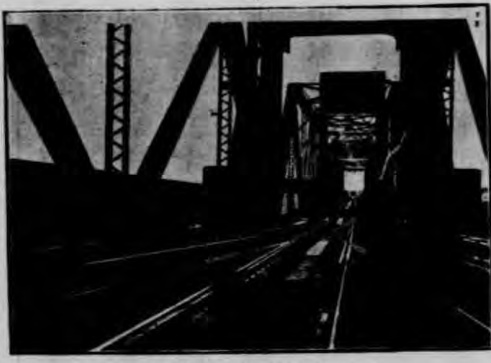
Cover photograph of the three-way turnout at the river end of the transfer bridge, from Hu Jiafa’s 1934 account, in the public domain.
In March 1955, when People’s Daily reporters Zhen Weimin and Shi Yue’e boarded the railway ferry at Nanjing, twenty-four railway vehicles were already aboard the Nanjing. The Pukou was coming the other way with another load of rolling stock. Among the goods moving north were Shanghai textiles and fruit from the south. A consignment continuing by rail had once had to be unloaded into a boat and put back into wagons on the far bank. With the ferry, yard crews uncoupled the wagons and moved them onto the deck in groups. The whole wagon crossed. Its contents could stay packed exactly as they had been at departure. [2][3]
Passengers could stay in their original carriage too. They no longer had to carry their bags off one train, board a boat and find another train on the far shore. For shippers the saving extended to handling, counting and transferring consignments on both banks. If hundreds of bales of cloth stayed in the same wagon, they took up no stacking space on the quay and spent one less interval in the open waiting for a boat. The railways north and south of the river, however, had previously managed their own vehicles. Once goods could stay in the same wagon, the two administrations had more to settle. Who would supply wagons and engines, and who would collect the load across the river? [3][4][5]
A month into the service, more than 40,000 tonnes of through freight were still awaiting dispatch along the Tianjin–Pukou line. The Ministry of Railways pressed the two administrations to agree on train paths and the engineering office to install lighting. Several places with goods to send were waiting for wagons. That dispatch, preserved in a newspaper from 1933, tells us more about the ferry’s predicament than the sailing time alone. Getting loaded wagons across a transfer bridge that moved with the water was one engineering achievement. Finding onward trains and paths and getting the empties back in time for another load was the railway’s daily undertaking. [3][5]

Plate 1. Deck tracks and vehicles boarding the Changjiang, original figures 11 and 12. Historical illustrations throughout come from Hu Jiafa’s 1934 book, scanned from the National Library of China copy, in the public domain. Images have been cropped, rotated or paired.
1. Two railways, two termini
Trains from Shanghai terminated at Xiaguan in Nanjing. Trains heading south from Tianjin reached Pukou. The stations faced one another across the river but belonged to different railways. The Shanghai–Nanjing line opened throughout in 1908 and the Tianjin–Pukou line in 1912. Freight booked from Tianjin to Shanghai could be loaded and consigned under railway rules all the way to Pukou, only to be unloaded and held under the rules of the wharf. On a map the Yangtze interrupted two rails. In commercial practice the same consignment passed through the hands of railway staff, dockworkers and boat crews. [3][6]
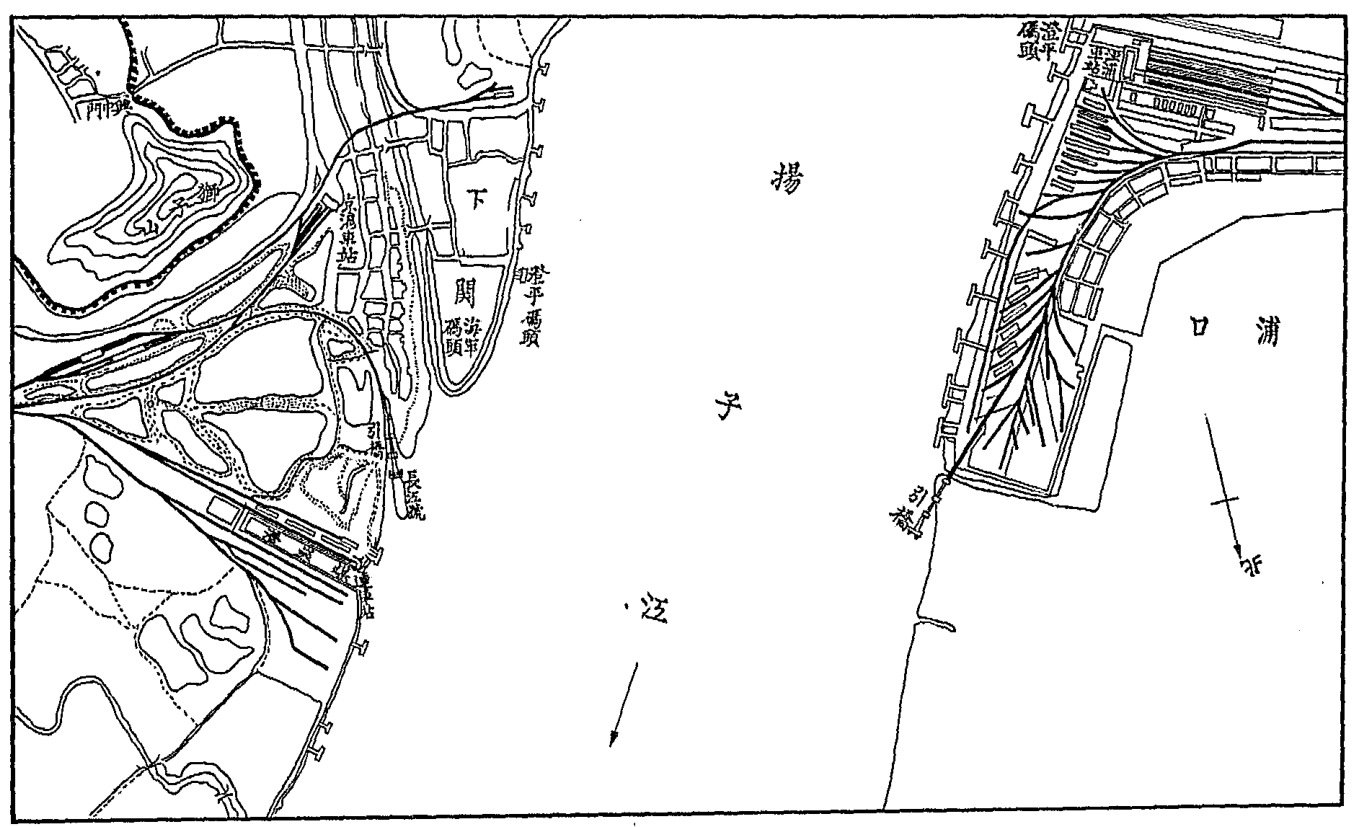
Plate 2. Ferry location plan published in 1934. Xiaguan is on the left and Pukou on the right. Both transfer bridges are marked.
Two kinds of waterside installation are easily confused. A passenger boat needed a gangway for people and luggage. A train ferry had to bear wheel loads and its rails had to reach all the way onto the vessel. Long before the train ferry opened, someone could sail from Xiaguan to Pukou to catch a train. A photograph of a station and a boat is therefore insufficient to date the carriage of trains by water. Both services continued to exist after the train ferry opened. Someone waiting at Pukou for a boat might have taken a different route to the water from someone crossing inside a carriage. [4][6]
For a shipper the distance between the banks was measured in handlings. A package loaded in the north came down by train to Pukou. Without a train ferry, workers took it out of the wagon and put it aboard a boat. If it continued by rail on the southern bank, it had to be loaded into a wagon there. A consignment bound for a city downstream could instead take a riverboat from Pukou. Freight had always crossed the gap in the railway map. Precisely because it did, the number of hands required, the time in the open and custody when a boat connection failed were questions with a price. [3][7]
Consider the packaging. A case of books, a bolt of cloth or a machine component was expected to reach its consignee intact. At each transshipment the wharf had to find space for it and match each piece to its consignment. Goods for the same destination could share the protection of a wagon. Spread out on the quay, each package had to withstand lifting, storage and another count. Some heavy pieces required lifting gear every time they moved. Small pieces might be easy to lift but easily lost among larger consignments. Removing a transfer changed where goods waited and whose care they were in, as well as how long the journey took.
The Palace Museum’s collections, evacuated south from Beiping in spring 1933, left an unusually clear record of the earlier route. At Pukou the crates were taken out of the Tianjin–Pukou railway’s wagons and loaded aboard a vessel. The museum traces a route through Beiping, Zhengzhou, Xuzhou and Pukou to Shanghai. When its researchers went to identify the ferry remains at Nanjing, they checked the dates first. The train-loading works were under construction when the first crates arrived. Both stations existed, but the installation that later made their names was unavailable. A difference of a few months meant a manual transshipment in a journey of thousands of kilometres. [7][8]
Someone escorting the collection from Beiping might first have asked who would take charge of the cases. A railway officer wanted to know when a wagon would be free to fetch the next load. While freight waited aboard for a boat, the wagon waited too. Putting the goods in a warehouse released the wagon earlier but incurred storage and handling. The ferry offered a third arrangement. Send the wagon across while loaded and let it continue in service on the far side. Carrying the extra weight of the wagon changed both custody in transit and the circulation of rolling stock.
The ferry’s reach extended well beyond Nanjing. The Yangtze ran east–west. The two railways joined the networks of northern China and the lower Yangtze on their respective banks. A wagon waiting at Pukou might already be hundreds of kilometres from its loading point, with a destination far beyond Nanjing. A change on the waterfront could benefit an inland factory through a more complete delivery of materials or the earlier return of empty wagons. That was why both railway administrations had to participate. A company carrying local passengers between two quays could not decide which railway’s wagons might run on the other’s tracks. [3][5]
2. The choice in 1930
A bridge was proposed before the ferry. In his 1934 account Hu Jiafa considered an iron bridge alongside underwater tunnels built abroad using shields. He also did the arithmetic. For the stretch under consideration he estimated that a bridge would cost at least 30 million yuan. He put expenditure already incurred on the ferry at over 3.8 million. One was a proposal and the other actual expenditure, so these figures cannot serve as comparable final accounts. They do explain the choice. The funds available at the time constrained what an engineer could do to establish through working for goods and passengers. [3]
Hu saw considerable engineering merit and grandeur in an iron bridge and devoted space to it in his book about the ferry. His question was whether the country could meet that cost in one undertaking when the railways urgently needed a better connection. Trains could hardly wait indefinitely. The ferry left the wide expanse of river to a vessel and concentrated the precision engineering in two short stretches at the banks. Less had to be built on land. In return, every subsequent train would require shunting, docking and remarshalling. Generations of crews would perform work a fixed bridge could otherwise have absorbed. [3]
In October 1930 the railway authorities adopted Zheng Hua’s proposal for a ferry with movable transfer bridges. Work began on 1 December. The project encompassed the approach tracks on both banks, the design and manufacture of the transfer bridges, procurement of vessels and civil works beside the Yangtze. Each approach came from a different direction and had a different plan, yet the same vessel would berth at both, carrying three deck tracks built to a single geometry. At the edge where ship met shore, dimensions at the shipyard and dimensions at two separate railway sites ceased to be independent choices. [3][6][8]
Britain’s Dorman Long undertook the transfer bridges. The British trading firm identified in the sources as Ma’erkang contracted for the Changjiang and the dredger. Palace Museum researchers set out these roles alongside drawings and photographs of the surviving works. The railway authorities provided the proposal, borrowing arrangements and tenders. Suppliers produced steelwork, machinery and vessels. Site crews set them on local foundations. A single builder’s name would obscure much of the engineering. Successful sea trials could not demonstrate a fit with the apron at Nanjing. Girders built to drawing still needed an adequate power supply and checks against the actual bank. [6][8]
On 23 October 1933, Shen Bao recalled that funds had initially been uncertain. High water in summer 1931 interrupted work for months. Progress improved after a loan was secured that November. The paper gave an expenditure of over 3,875,000 yuan in national currency, broadly consistent with Hu’s rounded figure. Starting construction, securing finance, finishing the piers and opening for business each had its own date. Subtracting the first from the last conceals the railway managers’ task of fitting work to two calendars, finance and river levels, neither of which they controlled. [3][9]
High and low water presented different problems at a fixed berth. Rising water reduced or even reversed the vertical difference from bank to deck and called for adjustment in one direction. At low water the gradient reversed, while riverbed elevation limited the clearance under the hull. The water visible when a pier was completed represented just one day. Designers needed years of observations to set the working range and arrangements for exceptional levels. Hu discussed the high water of 1931 and differences in silting between the banks. Choosing a site meant accepting responsibility for that particular stretch of riverbed for years to come. [3]
Work on the banks was completed in late September 1933. On 22 October the Changjiang formally opened the through service between the railways. Tests, crew coordination and an operating plan belonged between those two dates. On an ordinary newly laid line, the rails remained in place to receive the next train. At Nanjing the last few dozen metres came into existence again only when the ferry returned to the bank. The organization and equipment were permanent. The final connection itself was temporary. [8][9]
3. A month after opening, wagons were still waiting
The first month offers a better test than the opening ceremony. On 24 November 1933 Shen Bao printed an account of a meeting about through freight between the Nanjing–Shanghai and Tianjin–Pukou railways, together with a ministry dispatch. More than 40,000 tonnes of through freight awaited movement along the Tianjin–Pukou line. This was a line-wide backlog, only part of which might have been at Pukou, with several possible causes besides shortage of vessels. The first green light at the end of the bridge still left questions. Which wagons could reach it when, and who would provide the engine to haul them away? [5]
The meeting considered contributions of stock from both railways. Anticipated traffic included Xuzhou and Dawenkou to Shanghai and traffic between Bengbu and Changzhou or Wuxi. A train took several days to go out and come back. One estimate assumed a four-day return cycle requiring twenty trainsets in circulation. In negotiation, the Nanjing–Shanghai administration explained its shortage and offered fewer sets than initially envisaged. The two sides also agreed on leasing locomotives from Tianjin–Pukou to Nanjing–Shanghai. One boat ran one short route, but making it productive required two administrations to reallocate stock hundreds of kilometres away. [5]
Follow one wagon loaded at a station in southern Shandong. It ran south, waited at Pukou, crossed to Xiaguan and continued to its consignee on the Nanjing–Shanghai line. Before it could take another load, it had to be emptied and given a new assignment. An hour saved crossing was a fraction of this cycle. If there was no space to unload, the wagon would still be late back. If return freight had yet to be matched with it, the station had to decide between waiting and running empty. A vehicle might need the ferry tracks for only a short time yet be unavailable elsewhere for days.
The minutes reveal a difficulty largely absent from later accounts. Night operations were not ready. Daytime sailings had to carry goods and passengers in several directions. Proposed timings between Bengbu and Wuxi fell too early or too late. The ministry ordered more staff and pressed the engineers to install lighting. Those trains were deferred. Early drawings already showed red and green signals. A light telling a driver that he could proceed, however, was a different investment from lighting a whole yard and wharf and staffing it for night work. [3][5]
The Xuzhou–Shanghai proposal assigned a crossing at 13:20, the Shanghai–Xuzhou service at 11:50. Dawenkou traffic had its own time. Freight trains setting out far inland already had an appointment at the water. A ferry could not go up the line in pursuit of a late train. Waiting for it might delay wagons booked on the far side. Taking another load first might leave the late arrivals waiting a round trip. Minute-by-minute times gave handovers across two administrations a common point of reference. [5]
The ministry proposed eighteen forty-ton covered wagons per train, with other vehicles attached when tractive capacity permitted. Eighteen was a proposed consist for a particular traffic plan. Twenty-one was the Changjiang’s design capacity for a specified wagon. The first figure reflected demand, locomotive power and stock supply as well as deck space. Insisting on twenty-one could mean missing an onward path while waiting for the last wagons. Reading eighteen as the limit of the hull would equally misinterpret the marshalling decision. [3][5]
In 1934 the Tianjin–Pukou Railway Monthly counted wagons suitable for through working on the capital ferry. The Tianjin–Pukou line had 220 and the Nanjing–Shanghai line 186, a total of 406. This was the pool on both railways, dispersed well beyond the Nanjing quays. The magazine considered extending working hours and immediately noted the likely shortage of suitable vehicles. Four hundred might look plentiful if they ran only between these two shores. Serving shippers in Tianjin, Bengbu, Shanghai and Wuxi meant that for most of their time they were nowhere near the ferry. [10]
To assess capacity in a factory, one might start by looking for idle machine hours. Using the ferry outside daylight hours required lights, crews, maintenance windows and suitable wagons. Increasing the pool in turn raised the question of whether stations could assemble the wagons on time. These early traffic records locate the practical limit of investment in the crossing. An extra inch of deck track did nothing for a wagon that never reached the water. Getting the right stock from several stations at an agreed time could be more urgent than buying another boat.
The railway monthly also reported a proposal for a reserve vessel, even giving an expected completion date. Damage to the only boat threatened the whole service. The report shows that this dependence was recognized at the outset. It establishes an intention, while other records would be needed to establish arrival in Nanjing, clearance for service and adherence to schedule. For the shipper watching the quay, there was a material difference between a second vessel in a tender and an additional sailing available that day. [11]
4. Fitting twenty-one wagons onto three tracks
In his 1934 construction account Hu gave the Changjiang’s capacity for two kinds of stock. She could take twenty-one forty-ton-class freight wagons or twelve long passenger coaches. Forty tons identified the class of wagon. Twenty-one was a design capacity for that type. The twenty-four seen by reporters in 1955 boarded a later vessel, the Nanjing. Comparisons require the vessel, date and vehicle type. Interviewed in 2007, ferry superintendent Zhao illustrated the arrangement with twelve coaches divided into three groups of four, one to each track. Freight working depended on the vehicles actually presented for each sailing. [2][3][4]
Railways couple vehicles end to end. A ferry has to use her beam. With just one track and no uncoupling, a vessel long enough for a whole train would raise fresh questions about turning and the length of berths needed on both banks. Splitting a long train into shorter cuts used the width of the ship while keeping standard-length vehicles intact. Goods could stay in the original wagon, at the cost of an additional shunting operation in each yard. One shore broke up the train and the other made it up again.
Three deck tracks were no more interchangeable than three patches of empty floor. Vehicles could move only along rails. The track occupied first could bar the exit of an engine or the approach to another track. Even with three tracks an engine trapped ahead of its wagons could not collect another cut. Hu described a movable platform at the stern. Having drawn stock onto the deck, the locomotive could move onto it, line up with another track and leave by that route. The deck space reserved for the engine’s exit mattered as much as the space reserved for freight. [3]
This also helps in reading old photographs. A locomotive among vehicles on deck establishes that engines worked aboard. It gives little reason to assume that each main-line train crossed with its original engine and consist intact. Railways used road engines for line haul and shunting engines for collecting, placing and sorting vehicles. The engineering account lists the ferry’s own 0-8-0 shunter and emphasizes its pulling power. Starting heavy wagons and moving dependably on short tracks mattered more in this duty than open-country speed. [3]
Uncoupling a coach did not end the passenger’s journey. The destination stayed with the carriage and luggage stayed with its owner. Only the connection temporarily making adjacent coaches one train was undone. Another engine could take over when the transfer was complete. At the river a train lost its familiar form on land but preserved the individual coach and the journey it provided. The ability to separate the vehicles cleanly made the passenger’s interruption smaller. The word “through” on a timetable meant something easily missed today.
For freight the calculation changed again. Some wagons carried bulky light goods, others dense loads. The ability to accommodate twenty-one wagons of a certain type described physical space. The actual weight of wagons and contents, and its distribution across the length and beam, had to be calculated separately. Multiplying twenty-one by forty to claim 840 tonnes delivered per sailing would confuse wagon class, deck space and actual loads. An empty returning wagon still occupied track and required shunting. Vehicles transferred and tonnes received by shippers were answers to different questions. [3]
Photographs show rails and their supporting structure on deck. On land sleepers and ballast transmit wheel loads to the ground. Aboard ship the loads passed into a steel deck and hull, ultimately borne by the buoyancy of the river. The same wheel rested on ground-supported track on shore and on a deck whose attitude changed with the load aboard. Concentrating vehicles on one side could create an uneven load well below nominal aggregate capacity. Hu gave no universal loading sequence. The design plainly had to account for track length, engine escape and changes in draught during loading. [3]
A track here means a complete path for a vehicle, with a rail under each row of wheels. The “three tracks” familiar to readers of contemporary reports were three such routes, rather than a special railway made with three individual steel rails. A 1934 photograph looks along the approach at rail height. The tracks branch away ahead and steel trusses meet overhead. It shows how one train could become several shorter lines more clearly than a distant broadside of the ship. [3]
5. Four spans had to make one gentle gradient
Walking riverward from Xiaguan, one first encountered a comparatively stable approach track, then a bridge whose height could be changed. Hu drew four spans on each bank. A span is the reach between adjacent supports. Raising only the outer tip as if the whole bridge were a single long rod would have created an abrupt change of angle. Even touching rails would not have assured a smooth passage for a wheel. The landward spans had to provide a gentle longitudinal gradient while the river end retained some adjustment to meet the deck. Raising the bridge meant deciding how far several supports should each move. [3]
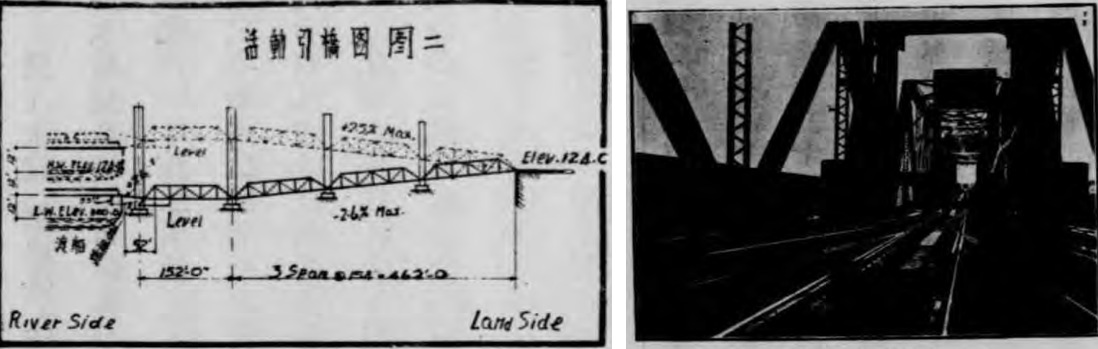
Plate 3. Longitudinal section of the transfer bridge and the three-way turnout at its river end, original figures 2 and 3.
Imagine drawing a line through a series of points. The bank elevation was fixed while the target at the outer end rose and fell with the water. If the first movable point and the outermost one rose equally, the approach would join the fixed rails awkwardly. The closer a point lay to the river, the greater the required change in level. Different gear ratios and motor ratings let supports move unequal distances in the same time. Hu drew the profile at high and low water. A line made with a single stroke on paper took several sets of machinery to achieve on site. [3]
Motion also determined the shape of the piers. Five reinforced-concrete piers on each bank had notched centres. The two uprights supported machinery overhead, leaving the bridge to move vertically in the gap. On a fixed bridge one expects a girder to rest on top of a pier. Here the top carried equipment that repositioned the girder. The greater travel near the water required clearance in the pier and superstructure. Seen alone, the surviving steelwork resembles a conventional bridge missing a span. The old section shows that the gap was intentional from the beginning, to be filled by a vessel that would sail away. [3][6]
Motors, shafts, gears and large vertical screws moved the structure. The motors turned the screws, and the travel of the nuts was transmitted to the bridge through links. Hu printed English component names alongside Chinese terms and included a photograph of an articulated joint. One could trace how a motor turning in the machinery house lifted a steel span tens of metres long. Eye links, pins through the girder and transverse connections made the answer visible. Electric lifting involved an entire load path between the switch and the final position of the rails. [3]
The design provided for coordinated movement of the spans. The local supply voltage proved too low, however, and mechanisms had to be worked in sequence. Hu published that criticism in his account of the newly completed project. Equipment celebrated in front-page reports was in some respects poorly matched to its site. The transfer-bridge workers inherited those compromises and still had to present smooth, aligned rails to each driver. A photograph can show a complete machinery house. It cannot show the extra wait that successive adjustments imposed. [3]
There was also a hand drive. Hu recorded that raising the bridge sixteen inches by hand during a power failure would take at least about two hours. The electric machinery at the river end was designed to cover roughly sixteen inches a minute. The same displacement by hand could occupy about as long as a whole train transfer. These figures describe particular mechanisms and movements. They do not imply a routine sixteen-inch lift at every arrival. Human effort could move the girder in an outage. Maintaining the electric timetable that way was a different proposition. [3]
“About right” could mean several things on this railway. A machinery-house gauge, the clearance from apron to water and the rail-level difference between deck and bank all measured heights. For the driver, what counted was the last of these. The river level helped an operator anticipate an adjustment but could not tell him the actual draught of the approaching vessel. Watching only the bow, in turn, could hide an uneven gradient farther inland. The river-end control room overlooked both apron and vessel and had to coordinate with the bridge behind. Hu’s note that it had windows on three sides was an engineering detail in its own right. [3]
A pair of transfer bridges imposed a further requirement. Perfect working on the south bank still left the need for a usable path on the north. A power interruption, bridge-end repairs or insufficient dredging at one berth could leave the other idle. The capacity of the installation could hardly be calculated by measuring one bridge and doubling it. A coach bound for Pukou had to use both interfaces in sequence. What could be printed in a timetable depended on what the two banks could deliver together.
6. The bow had to be in its berth before the signal could clear
Beyond the transfer bridge lay a hinged apron. Hu gave its length as 52 feet, about 15.85 metres. A gangplank on a passenger landing gives a misleading impression of its scale. This was a movable section of railway bearing train wheels. One end turned about a shaft and the other met the bow. A wheel travelling from land to deck crossed both the long bridge, adjusted for the water level, and the shorter apron that made the final connection. Calling them both a lifting bridge obscures the point where ship and shore actually met. [3]
First the vessel had to occupy a stable position. The drawings distinguished bow guides and side fenders. Two bow structures formed a flared entrance narrowing to match the vessel. A longer structure supported the side of the ship, with steel floats behind that rose and fell with the river. Merely bringing the bow close to the apron would leave a long stern able to swing in a cross-current. Concentrating every restraining force at the rail joint would ask too much of it. The ship needed something to lie against and the lines somewhere to take the load before the rails could be precisely joined. [3]
Wind direction changed what happened at the two berths. Hu recorded that a wind making one approach difficult could press the ship onto the opposite berth and damage its fender timbers. A reversal changed the effects. The book acknowledged a difficulty that became fully apparent in service. The two berths faced each other on a drawing but were hardly mirror images on the water. Crews had to learn each approach separately. Identical-looking fenders on opposite banks gave maintenance workers little reason to expect identical patterns of wear. [3]
Timber did unremarkable but essential work. The part taking the first contact with a fixed structure had to withstand repeated rubbing and be readily replaceable. The rails needed to retain their position, while the timber took the contact loads. Replacing a worn timber might appear remote from moving goods. Yet the next ship needed to settle into a repeatable position for the tip of the apron to land correctly. Hu’s entry about wear says more about the maintenance crews’ jobs than a general assurance that the installation was durable. [3]
Once the ferry lay steady, the apron could be lowered. The drawings show three sets of fittings at the track ends, with additional securing fittings on either side. The tip engaged its counterpart at the bow. Once secured, the deck tracks and bridge were connected. A ship visibly alongside had occupied its berth. It took the ship’s position, the bridge level and the engagement of the fittings together to give a locomotive a railway it could use. Until then there was still a gap in the route for the waiting wagons. [3]
Hu devoted a passage to the signals and iron gate. With the ship unsecured, the gate at the bridge end remained closed and drivers saw red at the approaches. Once ship and apron were properly joined, the signal authorized movement and the gate opened. After loading or unloading, a whistle from the ship prompted a signal change from the control room, the gate closed and the ferry departed. An agreement between several jobs was expressed in a visible indication and a physical barrier. A driver newly on shift could read his authority to move without having seen the preceding operations. [3]
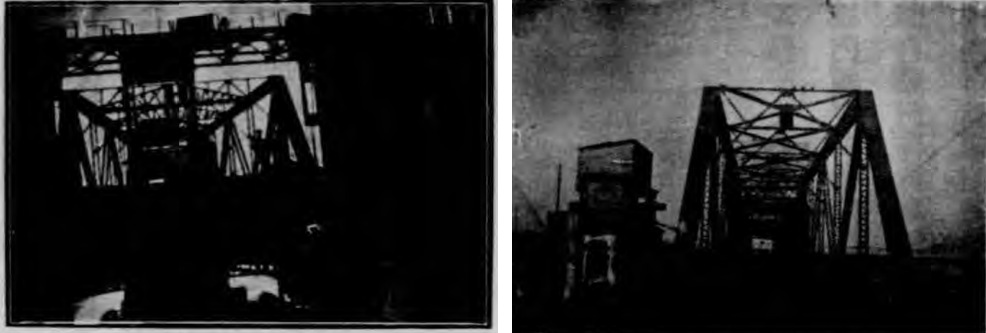
Plate 4. Apron and iron gate, original figures 5 and 10. The vessel and bridge had to be connected before the wheels could pass.
It is easy to read too much into the word “automatic.” The gate and signal could be interlocked. People still judged when the ship lay steady, operated machinery and gave the whistle. Nor did the work rest entirely on a quick-eyed sailor or a driver listening for a call. The control room brought several operations into view, and mechanical and electrical connections made incompatible states difficult to produce together. On an ordinary shift the arrangement drew little notice. At a change of shift, its value was plain. The incoming operator could read information from the equipment that otherwise would have remained in a colleague’s memory.
Conditions continued to change as a vehicle passed the apron. Its leading bogie could be on deck while the trailing one remained on the bridge. Weight shifted from a fixed structure to the floating hull and the bow’s draught changed. Three cuts loaded in succession left the vessel sitting differently at the end of the operation. Hu noted that the Changjiang’s bow sank deeper than initially expected, illustrating the effect of bow form and displacement. Measuring draught with every wheel at rest gave only the final state. The intermediate stages determined whether wheels could pass the joint on the way aboard. [3]
A driver could see rails ahead but had a poor view of the far side of the vessel. The master felt the cross-current against the hull but could not inspect every wheel behind the engine. Control-room staff could see the bow and had to wait for the railway and ship crews to finish their respective work. These fields of vision supplemented one another. How long the previous vessel took to settle was useful knowledge for a timetable. Whether this one was secure was a judgment the people on duty had to make afresh. [3]
7. There was a work site beneath the water too
The Changjiang was purpose-built to carry trains. Hu recorded a length of 372 feet, about 113 metres, and a maximum beam of about 17.8 metres. Three tracks ran fore and aft, with an elevated lookout across the ship. Below a deck wide enough for the vehicles there had to be room for engines, boilers and tanks to alter the hull’s trim. A moving iron bridge was an evocative description. A fixed bridge, however, never increased its draught halfway through loading a train or had to carry its own source of power. Those differences amounted to substantial manufacturing work. [3]
Hu gave a speed under specified load and still-water conditions. Dividing the distance by that speed would not yield a commercial crossing time. In midstream the ship met a cross-current. On approaching shore she changed heading, reduced relative speed and settled at a prescribed spot. The shipyard could compare machinery in relatively uniform conditions. The railway had to insert the passage between two loading operations. On a link little more than a kilometre long, higher maximum speed offered the passenger a limited saving if berthing still took as long. A duty master later brought his stopwatch to the approach precisely because that distinction mattered. [2][3][6]
The tanks inside the hull deserve attention. Taking in or discharging ballast altered both weight and its distribution. At very low water the bow rails might be difficult to match with the shore apron. Hu discussed varying the water carried fore and aft to assist the connection. Ballast changed the vessel’s attitude, leaving the surface of the Yangtze where it was. Bridge gradient, apron angle and ballast each dealt with part of the problem and each had limits. Giving all the credit to the shore motors leaves out this concealed equipment and the people tending it. [3]
Wagon wheels were designed to roll. At sea they had to stay put. The early vessel carried hand-operated wheel clamps securing wheel to rail and reducing movement relative to the deck. With the coupling at one end open, even a modest deck inclination could make free-rolling wheels a liability. Track had to admit a wagon, hold it during the voyage and release it promptly on arrival. A passenger who stayed in the same seat had little reason to notice the crew securing, one by one, the very wheels that made a through journey possible. [3]
The project included another vessel seldom given pride of place at ceremonies. Hu gave her a photograph and a passage of her own. She was the dredger that cleared the berths. Silt accumulated around the northern shore. Measures including barriers and steel sheet piling had been considered to exclude sediment, but the bed still required attention. The dredger drew up material near her bow and discharged it through pipes. The ferry’s job was to carry laden wagons in and out each day. The dredger’s was to leave her enough water to reach the bridge again tomorrow. [3]
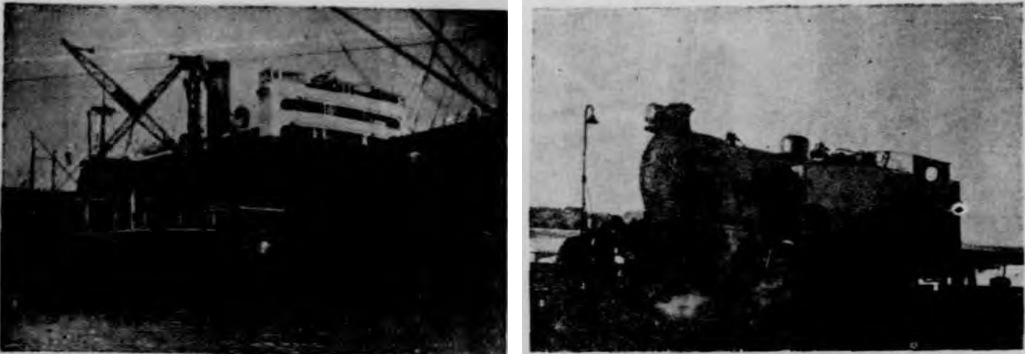
Plate 5. Dredger and shunting locomotive provided for the ferry project, original figures 13 and 14.
Shallow water could be a highly localized problem. A deep midstream channel capable of taking large ships did not guarantee access to the fenders. Ships could follow deeper water but a rail apron could hardly be moved to follow it. The tracks fixed a precise arrival point on a changing riverbed. If silt raised the bottom near the berth, neither ballast adjustments nor bridge movements could dispense with the space required beneath the keel. A maintenance budget restricted to girders, machinery houses and hull might leave the installation looking intact and still unable to receive a single wagon.
Sediment appeared in another form beneath the shore works. The steel transfer bridge stood on piers founded on timber piles. Hu distinguished the piles beneath a northern riverside pier from those elsewhere and recorded alternating mud and sand with a finer mixture at depth. Alignment at the rail joint depended first on stability beneath the machinery and girders. The river end carried the vehicle load as it passed from land to ship and had the greater range of movement. Alongside descriptions of steel and motors, contemporary records preserved pile dimensions and soil profiles. The work supporting everything visible is the part least apparent to a visitor in the park today. [3]
Asking whether the equipment was domestic or imported takes us only so far. Components could be made abroad and assembled in China. Once in Nanjing, the machinery had to work for years with local voltage, local sediment and winds on both banks. Its longevity depended on workers learning which parts wore rapidly, which river conditions made berthing difficult and when to clear the bed. Delivery of a new installation at the opening ceremony began that process. The bridge eventually eliminated far more than the passenger’s wait. It also dispensed with much of the continuing labour needed to re-create a short piece of railway every day.
8. Twenty cents on a through ticket
Two days before the formal opening, Shen Bao printed times for the first Shanghai–Beiping through trains. A train leaving Beiping on 21 October 1933 was due at Pukou at 3:05 the next afternoon. After crossing it would leave Nanjing for Shanghai at 5:25. Those two hours and twenty minutes covered everything between arrival on one bank and departure from the other. The advance notice gave a railway schedule, never a measured sailing time. For someone at the booking window in Beiping, this was the time that mattered. The passenger needed to know when the next leg would depart. The ferry office could concern itself with the ship’s clock. [12]
The same notice listed Shanghai–Beiping fares of 76.50 yuan first class, 49.50 second and 24.75 third. The crossing cost an additional 0.60, 0.40 or 0.20 yuan respectively. Upper and lower berths had supplements, and special express charges applied on certain sections. Carrying a coach aboard ship left a small entry on every ticket. The passenger could settle matters at the window. The railways had to account separately for long-distance carriage, the ferry, express running and sleeping accommodation. A journey made in the same seat combined services with distinct operating accounts. [12]
Twenty cents was about 0.81 per cent of the third-class base fare listed in the notice, calculated as 0.20 divided by 24.75 before any express or other supplements. It tells us how large the visible ferry charge was to a passenger, but says little about the project’s financial return. There was revenue from freight wagons, parcels and other traffic. Vessels, bridges and approach tracks served several kinds of user. Dividing construction expenditure by twenty cents to find a break-even number of third-class passengers would leave most of the shared use outside the calculation. [3][12][5]
A ticket could hardly measure everything a traveller no longer had to do. Bulky luggage could stay on the train. Someone with children or needing assistance no longer had to board a boat on one bank and leave it on the other. Previously a fit adult with one small bag and someone responsible for several trunks and a family might pay the same boat fare for very different exertions. The new service transferred that work to railway stations and ferry crews. For the same twenty cents the third-class traveller gained a passage independent of their own ability to negotiate a gangway.
On the operating side the distinction between one-way and return trips mattered. From Xiaguan a boat took wagons to Pukou, then brought another group back, delivering a load in each direction. A passenger usually experienced only one leg. A report might count return trips or individual crossings. Some early accounts give eight movements a day, while the traffic meeting of November 1933 records four round trips. They may well count the same working in different units. Until the unit is aligned, adding the numbers or declaring one account erroneous would be premature. [5][13]
Tariffs covered bicycles, small boats and even coin. Supplementary charges published in Shen Bao on 6 November 1933 included 0.40 yuan for a bicycle consigned as freight and one yuan for a small boat. Some negotiable instruments were charged in bands by face value, with a minimum charge. Vehicles of the same nominal capacity on different lines could carry different quantities of a given commodity. Livestock scarcely lent itself to a uniform minimum wagonload. Charges therefore used heads, pieces or lots. Deck crews saw wheels, but the commercial office needed to know what was inside before the administrations could apportion the ferry charge. [14]
The bicycle’s forty cents reveals a finer-grained freight business than the timetable. An engineer’s twenty-one wagon spaces stood for hundreds of actual commodities at the booking office. A wagonload booked by one shipper and smaller consignments from several customers might occupy the same length of track and require quite different paperwork. Acceptance rules, charging units and responsibility for checking errors determined whether people along the line with neither a wagonload nor their own transport could use it. Those arrangements made the installation a public service just as surely as the first wheel to roll aboard on opening day.
9. From Xiaguan, 7,287 cases of antiquities went north
Sichuan lies west of Nanjing. Yet a Palace Museum consignment evacuated in 1937 began by crossing to Pukou and travelling north on the Tianjin–Pukou line before turning west onto the Longhai railway at Xuzhou. A destination’s compass bearing does not determine the first leg. A ferry capable of taking loaded wagons and a junction offering a westward route made the northern itinerary practicable. The museum records 7,287 cases in three trains on that route. They passed through Baoji and later continued in stages to Hanzhong, Sichuan and elsewhere. Three trains tells us how the migration was organized, without establishing the number of ferry sailings. [8][15]
Conditions had been quite different four years earlier. Between February and May 1933 five batches left Beiping by the Beiping–Hankou, Longhai and Tianjin–Pukou lines. The museum gives a total of over 13,000 cases. From the second batch onward, they included items entrusted by other institutions. Crates came out of the trains at Pukou and went by boat to Shanghai. Only after the Chaotian Palace storehouses in Nanjing were finished in 1936 were the collections taken there in batches. Saying simply that the collection took a train ferry south to Nanjing would erase both the boat journey to Shanghai and the later move, while supplying a ferry service which had yet to open. [7][8]
“Loading aboard” meant different things on the two occasions. At Pukou in 1933 the individual cases changed vehicles. The rail leg ended and a river vessel took over. On the northern route in 1937 the things moved onto the train ferry were wagons containing those cases. After the crossing the wagons continued inland by rail. For packers and escorts the difference determined when a case left its original loading position and at what level a handover had to be checked. The museum counted cases, the railway counted vehicles and the crews counted crossings. Each measure belongs in the evacuation record and none can substitute for another.
Museum researchers investigated this as a question of physical evidence. They identified the remains of the Xiaguan approach, compared them with a design published in Engineering Weekly in 1932 and a photograph of the connection published the following year, then checked the starting and completion dates. A genuine surviving structure can still produce an illusion about chronology. Repeated place names, the same railway and lists of cases make it easy to project a later installation into an earlier journey. Comparing the opening date with the arrival of the first crates rules out a persistent version of the story. [8]
The other two westward routes show the river working longitudinally. The southern route took a ship to Hankou before turning south by rail to Changsha. The central route also loaded many crates at Xiaguan and sailed upriver. The train ferry gave the northern party access to the Tianjin–Pukou line. For the central party the Yangtze itself offered a long, continuous route. Even if two vessels carrying antiquities had been visible off Nanjing on the same day, their headings alone would not identify the movements. One would need the batch and its next leg, whether upstream by water or back onto rails on the opposite shore. [15]
The museum record is moving in its restraint. It gives case counts, train counts, routes and temporary stores. At Baoji the temples of Guandi and the City God held antiquities. Hanzhong and Baocheng required other buildings. Wagons brought the cases to the end of a practicable leg. Others had to find stores, carry, check and guard them. The Nanjing crews’ contribution can be stated precisely. They brought the loaded wagons of the northern route onto the Tianjin–Pukou railway without breaking down their loads at the quays. The survival of individual cases still depended on many more years and many other hands. [7][15]
The war also took the Changjiang away from her original duty. The museum’s site study records the vessel and some dismantled equipment being withdrawn upriver before Nanjing fell. Japanese forces occupied the ferry installation after 1937 and two other vessels were subsequently built for the service. After the war they were renamed Nanjing and Pukou. Treating the Changjiang inaugurated in 1933 and the Nanjing boarded in 1955 as the same old ship erases occupation, withdrawal and reorganization. The two approach sites could endure while the vessels, authority and conditions of work changed violently. [2][8][13]
Railway histories often call 1933–1973 forty years. That is the calendar span from formal opening to closure. No one ship worked one timetable continuously for forty years. For a passenger the route’s name endured. For a crew, changing ships meant learning different machinery, approaches and equipment. For an escort in 1937 the opportunity to use the installation had a deadline. After that the same map offered different possibilities. Forty years of institutional history and forty years in which the same ticket could be bought on any day would be very different claims.
10. Putting two ships back to work as a pair
April 1949 on the Nanjing waterfront again illustrated the difference between a boat being available and a railway ferry being operational. Local accounts record Wang Detai and other workers taking the tug Lingping to collect people from the north bank, then supplementing its capacity with a pontoon. Only after repairs to the transfer bridge did the Pukou join the work. A tug under power demonstrated that the waterway was usable. Even a large ship provided only part of what rail transport required. The fixed installations ashore had to be restored. As vessels entered service in succession, the same quay reached different levels of usable capacity on different dates. [13]
Page nine of the Xinhua Daily on 1 October 1950 carried a photograph of the repair and reopening. The paper rediscovered it years later when organizing its archive. The evidence of the photograph is precise. Restoring transport between the banks merited a place in the National Day issue. Its publication date need not be the first day a vessel worked again. An old newspaper, a later on-site report and workers’ memories answer different questions. Together they distinguish partial recovery, successive ships becoming available and a genuine increase in regular sailings. [2][16]
The 1955 account says the Pukou was restored first. More than twenty crew members then went to help Shanghai shipyard workers salvage and repair the Nanjing, which had sunk in the Huangpu. A phrase such as “repaired and reopened” can obscure their work. Salvage brought a hull to the surface. Working propulsion, controls, track and a satisfactory fit to the terminal produced a unit fit to enter the timetable. Workers familiar with the operating conditions could reconcile the yard’s judgment that machinery worked with the Nanjing terminal’s requirement to receive wagons on schedule. [2]
A second vessel offered more than another deck of capacity. One could load while the other crossed. If one went into dock, the other could maintain part of the service. Large differences in performance, however, affected planned meetings and arrivals. For a time the older equipment and low steam pressure of the Pukou left her slower than the repaired Nanjing. The effects of boiler condition appeared in a freight yard across the river. With the next cut of wagons in position and the ship late, wagons and shunter both occupied track. Benefits of mechanical maintenance could thus be felt a long way from a boiler. [2]
Fleet size alone conceals this distinction. Suppose two vessels had the same capacity but one had to stop every few sailings to deal with a fault. Even carrying equal loads when under way, she would complete fewer crossings in a month. With closely coordinated berths an unexpected stop could also disrupt the other vessel and the yards at both ends. The pre-war proposal for a reserve and the post-war effort to restore a second ship addressed a similar commercial question. How much of the day’s work could continue when a major piece of equipment was withdrawn? [2][11]
The contemporary report names a boiler worker. Zhao Dehai helped repair the Pukou’s boiler tubes. A boiler supplied power, but its operating conditions were also conditions people physically endured. The 1950s report stressed workers’ exertions in extreme heat. Why did an old vessel on a short run have so little time for maintenance that a worker faced such demands? One ship could not necessarily absorb all the traffic while the other stopped. Freight was urgently needed ashore and requests for replacement equipment continued. Management later explicitly raised frequent repairs, heavy fuel consumption and the physical burden on crews. Those concerns supply the institutional half of Zhao’s story. [2][13]
Recording a worker’s hardship and sparing a successor the same hardship are separate achievements. If the timetable could only be met by repeatedly consuming rest and maintenance time, today’s departures might hold up while future ones became uncertain. Vessels needed dry-dock dates, boilers needed maintenance windows and masters needed discretion to stop in bad weather. Those apparent impediments to another sailing helped make the everyday passenger service trustworthy. Zhao Dehai’s work belongs alongside the later campaign to buy better ships, as part of a fuller account of the conditions crews faced.
Something else could hardly be towed out of a shipyard: a crew’s experience of working together. Engineers newly assigned to a ship had to learn her responses. Masters had to know the differences between the banks in different winds. Shore and ship crews had to re-establish a shared understanding of signals. Drawings recorded some knowledge. Repeated handovers produced the rest. The two names moving towards one another in the reporters’ 1955 opening scene represented a long recovery shared by Shanghai shipbuilders, Nanjing stokers and sailors, and railway workers on both banks. [2]
11. Lin Changfa times the final approach
Lin Changfa, duty master of the Nanjing, made a particular kind of work record. Timing his own actions from departure to arrival, he found that berthing took about a third of the sailing time. Zhen and Shi reported this personal observation in 1955. The definition included the approach. Reading “thirteen and a half minutes’ sailing” as thirteen and a half minutes at full speed and then adding an equivalent allowance for berthing would count some of the time twice. The master’s stopwatch gives a closer view of the work than a general recollection. [2]
The report described two distinct improvements. Earlier, fixed straight courses replaced competition for the channel and the sailing target fell from fifteen and a half minutes to thirteen and a half. Lin then examined interruptions in the final approach. One change concerned how two vessels shared the water. The other concerned how a single vessel entered its berth. Crediting Lin alone with the reduction from fifteen and a half to thirteen and a half would erase the collective scheduling improvement and obscure why he still found time to save after the new target was set. [2]
Two minutes was about 12.9 per cent of the previous fifteen and a half. That was a considerable improvement in one operation. It gives no basis for claiming the same percentage gain for the whole Shanghai–Beiping journey. Main-line trains crossed many sections. Waiting, splitting and remarshalling at Nanjing were partly outside the master’s stopwatch. If the next departure was fixed, two minutes initially bought a more generous connection. Repeated punctual performance might justify a new timetable later. Where the railways used the minutes determined whether a real saving on the water appeared in the published schedule.
Lin’s one-third observation permits a bounded estimate. Taking thirteen and a half minutes as a reference gives about four and a half minutes for berthing and nine for the rest. This translates a reported proportion into familiar units. It is no original split time for a particular sailing. It indicates what attention to midstream speed alone could miss. A quicker middle stretch would still leave considerable time in approach, waiting and alignment. Making the last part continuous and predictable could produce improvement without installing a more powerful engine. [2]
How could the railway distinguish a better method from an unusually favourable current and a ready berth? Technician Wang Kaijun appears in the report. In February 1954 the Pukou was about to enter dock and the Nanjing faced the prospect of maintaining the service alone. Lin had recorded several ten-minute crossings. The ferry office assigned Wang and others to verify the work and organized further trials on 21 February. One master succeeding once, a watch repeating the result and another master applying it on another ship were distinct stages. The named verifier gives the story a life beyond one stopwatch and one record. [2]
In April the Pukou returned from overhaul. Her duty master Wang Baogui observed Lin and adapted the method aboard his own ship. Sister ships could differ in condition and crews in custom. Passing on a number, “ten minutes,” could hardly teach the work. Wang needed to understand what had taken time, when the approach could be changed and how to recognize comparable conditions. The report establishes the observation and subsequent practice. There is no need to invent dialogue. One man demonstrated it on his ship and the other had to bear the consequences on his own. [2]
Crossings had not always been scarce. The reporters recalled a period when boats waited for wagons and a proposal to increase sailings was shelved. By the end of 1953 hundreds of vehicles were backed up in the yard and the railway sub-administration urgently needed more crossings. When no wagons were waiting, faster berthing might merely bring the vessel to an empty berth sooner. In a congested yard the same minutes could release a receiving track. An opportunity for improvement could exist for some time before demand and scheduling made it an organized priority. [2]
Asking whether ships waited for wagons or wagons for ships also guards against blaming every queue on the crews afloat. Main-line trains brought many wagons at once, followed perhaps by half an hour with none. The ferry could not bank the empty half hour and use it to receive the earlier train. Evenly spaced and sharply bunched arrivals might have the same daily total and quite different queues. Sometimes the answer was more sailings, sometimes different arrival and shunting times. The 1933 meeting that scheduled individual freight flows and the master timing his final approach twenty years later addressed time on the same railway at different scales. [2][5]
12. How many crossings could two vessels make in a day?
Strong winds struck Nanjing in September 1954. After a weather warning, operations stopped and red lights on both banks indicated closure. The pressure of accumulating vehicles ashore persisted. When conditions improved, reopening required the ferry office, stations, locomotive staff, carriage examiners and signalling and electrical staff. The contemporary account had reason to list them. Crews ready to sail could do little until a yard put the next vehicles in order. If a locomotive failed to remove arrivals promptly, the next group would have no way off the ship. [2]
The reopening produced a number that can be read from two directions. Together the two vessels completed 106 crossings in twenty-four hours. Across the installation that meant an average of one crossing completed every thirteen minutes and thirty-five seconds, or 1,440 minutes divided by 106. One vessel could hardly depart, berth, discharge and reload in each such interval. An equal division, assumed solely for illustration, would give 53 crossings per vessel and about twenty-seven minutes and ten seconds per crossing per vessel. Actual division, loading and idle time could differ. The newspaper reported the total without itemizing them. [2]
Two parallel machines delivering six parts in an hour give a workshop one completed part every ten minutes on average. A particular part might spend considerably longer on its machine. The ferry was more complex still. Vessels moved in opposite directions, berths had to receive before dispatching, and railway tracks served alternating movements. While ships met in midstream, two shore gangs could prepare the next transfers. Only activities that could not overlap had to be added end to end. Simply adding every number of minutes in the report would produce a train working that the railway never actually operated.
During the first twelve hours the two ships completed 52 crossings with an average sailing time of about twelve minutes. Dividing twelve hours by 52 gives a completed crossing every 13.85 minutes for the system. One number timed an individual sailing from bank to bank. The other timed output jointly delivered by two ships and two terminals. A cumulative crossing tally cannot reveal exactly how many minutes each vessel spent under way or waiting. That would require start and finish times for each stage of each sailing, detail the newspaper did not supply. [2]
Nor did 106 crossings mean 106 complete long-distance trains. Ships took cuts of vehicles, which could be passenger coaches, loaded wagons or returning stock. The load varied with the type and the vehicles waiting ashore. The reporters saw twenty-four vehicles aboard the Nanjing in 1955. The 1934 account gave twenty-one of a specified type aboard the earlier Changjiang. More than twenty years and a change of vessel separated them. Comparing those two numbers as evidence of overloading would mistake two hulls for one. Multiplying twenty-four by every sailing would be equally unsound as an estimate of the actual day’s traffic. [2][3]
The record day also involved a job often overlooked. On reopening, the yard had to decide which cuts went first. Delayed goods needed release while normally scheduled passenger and freight services could hardly be held indefinitely. Ranking vehicles by their visible numbers in the yard might bury an urgent cut behind others. Even a priority vehicle needed an available route for the engine sent to fetch it. The first task in a tightly packed yard was to restore an order in which vehicles could be collected and placed continuously. A few words about shunting in the newspaper stand for the work of turning a mass of simultaneous demands into individual executable sailings. [2]
A record required particular conditions. After a closure there were enough wagons to keep the ships busy, and special coordination may have reduced ordinary handover delays. Sustaining that effort was another matter. Ships needed overhaul, engines needed maintenance and opposing freight flows seldom balanced indefinitely. Multiplying 106 by 365 would overstate the number of days such arrangements could be maintained. Taking the storm stoppage as normal performance would understate the service. The juxtaposition shows two dimensions of river capacity: how fast traffic can move when conditions permit, and how readily a working connection can be restored when conditions change.
Closure and reopening both altered the flow of vehicles in the yards. Wagons already at the water waited, and those still on the way needed fresh arrangements. Which cut to take first and whether the far shore had a track clear to receive it were joint decisions. At the moment the red light went up, the crossing tally stopped rising. Both banks had a common signal and shunters could hold their vehicles ashore. A timetable could tell how many loaded wagons an extra sailing would carry. It had no equivalent entry for the person who faced a growing queue and decided to stop.
13. A bridge under construction and ferries still to replace
In October 1958 Liu Shaoqi inspected the train ferry at Xiaguan. Local histories record him watching the transfer bridge move, the connection to the vessel and the loading and unloading of vehicles. Acting party secretary Sun Zude reported heavy fuel consumption, frequent repairs and strenuous work on the old ships. He faced an awkward investment horizon. A Yangtze bridge at Nanjing was already in national plans but the first scheduled passenger crossing was still nearly a decade away. A bridge under survey could take no coaches that night. Someone still had to provide boilers, maintenance and people for the ships in service. [13][17]
The Jiangsu and Jinling later joined the fleet. Ferry-office recollections connect their arrival with requests to replace old equipment. The number of vessels that served over time tells us little about the number working a given shift. A ship might be under maintenance, in dock, in reserve or exchanging vehicles. A group photograph or a list of names cannot reconstruct a watch. New plant sometimes replaced old plant and sometimes provided cover for its overhaul. More dependable hours of service or fewer urgent defects for the same workers were gains even without an increase in reported traffic. [13][16]
At about the same time a new work site spread across both banks. The Nanjing Municipal Archives dates the bridge’s final survey to 1959 as crews arrived on both shores. The builders first provided about thirty kilometres of railway sidings and fourteen kilometres of roads, along with wharves, a pipe-pile works, storage and trial-assembly yards for steel girders, and machinery repair shops. Thirty years earlier two lifting bridges had been built to serve a boat. Now a fixed bridge required its own transport network before machines and materials could reach it. Long before work reached midstream, the approaches occupied extensive ground in Pukou and Xiaguan. [17]
Looking back from 1968, replacement of the ferry seems inevitable and new ferry equipment around 1959 may appear short-lived. Looking forward from 1959, nobody could substitute the unfinished bridge for that night’s sailing. The archives show individual piers taking years. Different sites presented different overburden and bedrock and required trials of new foundation forms. Completion of a particular operation still left a long way to handing the route to the railway. The ferry office had to cover years that occupy a line in a commemorative history but had to be delivered day by day in the timetable. [17]
The river set different terms for the two generations of engineering. Movable bridges followed ship and water levels to establish a temporary track. A fixed bridge had to transmit loads to foundations in the riverbed while preserving navigable water for vessels. Several foundation types were used, with underwater examination of the bearing surface at some piers before further work. Choosing a ferry in 1930 postponed the task of finding firm bearing far out in the deep river. When the fixed bridge was built, that work still had to be done, in a later period with different industrial resources. [3][17]
For a moment both generations of engineering were visible from the same deck. Local accounts describe Sun Zude aboard the Jiangsu during a special train crossing in December 1962, pointing out the bridge works to a visitor. Only the piers could readily be distinguished. They could not yet carry the people looking at them. The ferry still carried the train. From the older mode of travel one could already see where its successor was taking shape. Within a few years train passengers would see the river from another height, without having to cross Sun’s deck. [13]
Saying simply that the bridge relieved congestion understates how it changed railway work. Even on a quiet day a ferry had to split long trains, shunt at both ends and spend a sailing on an empty return if necessary. With a fixed crossing, trains could retain their consist as permitted by the line. Shunters no longer altered it to fit a hull. The minutes shipyards, locomotive depots and ferry crews had worked to save disappeared along with the operations that consumed them. That benefit lasted beyond the busiest days and could be felt by the next passenger even when the freight yard stood empty.
14. After passengers took the bridge, freight still crossed by boat
On 30 September 1968 the Nanjing Yangtze River railway bridge held its opening ceremony. The new Nanjing station was inaugurated too. The following day the Shanghai Railway Administration took over the bridge and began operation. According to the municipal archives, at 3 a.m. on 1 October express No. 46 from Fuzhou to Beijing became the first passenger train across in regular operation. The road deck opened on 29 December. The three dates show how a combined road and railway bridge entered public life. For a ticket holder on the platform, what mattered was the scheduled train finally carrying them straight across. [17]
A long-distance passenger coming from the south hardly had to change what they did. Previously they sat while yard crews split the train and delivered the coaches to a ship. Now the same seat went over a fixed bridge with the whole train. Local histories often contrast about two hours by ferry with roughly two minutes over the bridge. The former mainly describes a transfer including loading, sailing and remarshalling. The latter gives the order of time spent passing over the bridge itself. The comparison shows an entire operation rewritten. It provides no estimate of a particular train’s total stop in Nanjing station. [6][13][16][17]
Long-distance passenger travel changed in 1968, but train-ferry traffic continued. Passenger and through freight trains took the bridge, leaving some non-through freight and other duties for the ferry. The order closing the ferry station came on 5 May 1973, more than four years later. To date the end, one must specify whose experience is in view. For passengers on express No. 46 that autumn the ferry had already disappeared from the journey. The crews still had watches to stand, equipment to look after and vehicles to receive. [6][16][17]
This helps explain differences between recollections. A passenger might accurately remember the last year they crossed by boat with their train yet have no reason to know the date of the last freight. A waterfront resident may recall a gradual thinning of whistles rather than a single day. The closure order drew a sharp institutional boundary. In everyday experience the ending came earlier for some and was more dispersed. Oral testimony illuminates work and experience. Official dates, first scheduled trains and final closure belong to their respective records. Asking every witness to bid the ferry farewell on the same day would lose the character of the transition. [4][6][16][17]
The old transfer bridge survived. In 2023 a reporter photographed the steelwork, tracks and piers at Xiaguan and found people walking, watching trains and looking at the railway remains. Approaching the structure, a visitor might naturally ask what became of the missing span. An old photograph of bow and bridge end supplies the answer. The bridge was only ever meant to extend the rails within reach of a vessel. When the vessel left, open water reappeared. What looks unfinished today was its most ordinary appearance between sailings. [3][6]
Not every part of the work left an equally conspicuous trace. The heavy steel spans are easily recognized as industrial heritage. An approach refined by a crew has no comparable physical form. A repaired boiler tube, the shunter’s moment of uncoupling and a verifier’s ten-minute entry can hardly be displayed like track at the water’s edge. Yet persistent failure of any one of those operations could have left the steel standing and the wagons unable to pass. The industrial history belongs both to the remaining structures and to the people whose surviving names and records tell us how those structures worked. [2][3][6]
That day in 1955 the reporters recorded the names of masters and workers: Lin Changfa, Wang Kaijun, Wang Baogui and Zhao Dehai. By the time the reporters boarded, twenty-four vehicles were already on the Nanjing. For the crew afloat, it was time to sail. For those waiting on the north bank, the work was half done. On arrival at Pukou an engine ashore still had to collect the wagons and take them north on the Tianjin–Pukou line. The three tracks remaining at Xiaguan recall people who could take a wagon loaded in Shanghai and, with the Yangtze between, still deliver its goods to the next station in that same wagon. [2][3]
Sources
[1] Tianxia Factory manufacturing database
[7] Palace Museum, The Collections Move South. Evacuation route and images of the collection
[9] Shen Bao, 23 October 1933. Opening ceremony and expenditure on the capital railway ferry
[10] Tianjin–Pukou Railway Monthly, vol. 4, no. 9, 1934. Rolling stock suitable for through working
[11] “Acquiring an Additional Capital Ferry,” Tianjin–Pukou Railway Monthly, vol. 3, no. 11, 1933
[12] Shen Bao, 20 October 1933. Advance timetable and fares for Shanghai–Beiping through trains
[13] Yuhuatai Martyrs Memorial, “The Train Ferry on the Yangtze,” historical calendar entry, 23 July 2021
[14] Shen Bao, 6 November 1933. Ferry charges and charging units for special categories of goods