

A tomato factory in Yanqi, Xinjiang, lists a package few people would take home. A 220-litre steel drum, lined with an aseptic bag, holds 230 to 250 kilograms net. Four drums fit on a pallet. The only ingredient is fresh tomatoes. Customers can also choose a specification. One red concentrate is marked 28–30, another 36–38. Those numbers are the first indication of how far the contents of the drum still have to travel before they reach the table.[2]
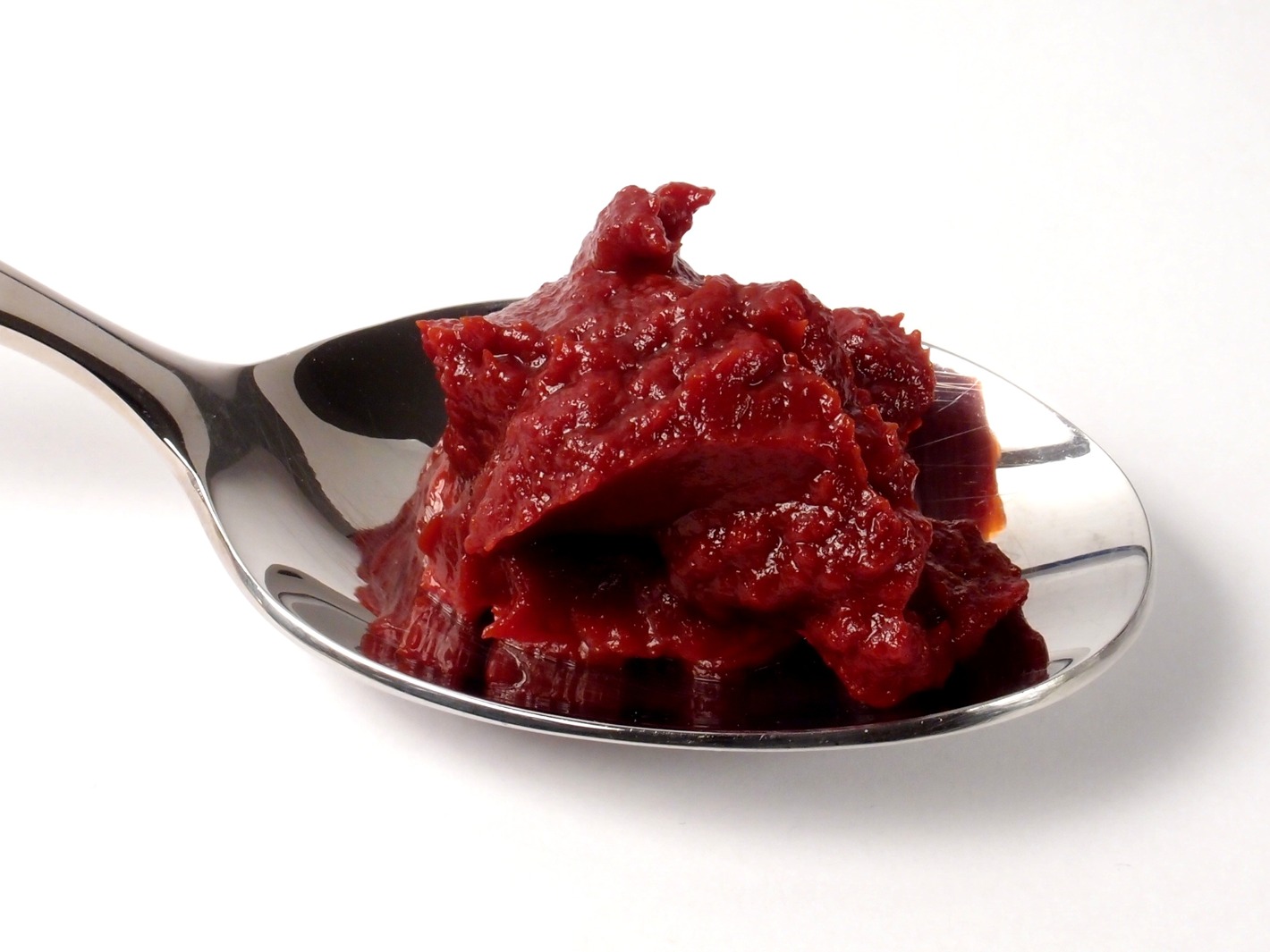
Cover photograph. Triple-concentrated tomato paste on a spoon. Photograph by SKopp · Original photograph · CC BY-SA 3.0. Resized proportionally.
GuanNong discloses that it contracts with growers in the Yanqi Basin for naturally ripened processing tomatoes, most of which arrive from early August to mid-September. Its bulk-paste operation has those few weeks to take in the crop. When the company makes small packs of paste and tomato ketchup, however, the plant draws on finished bulk paste, some purchased from other factories in Xinjiang. A grower delivers tomatoes to a factory, the factory produces a drum of goods, and another factory enters it on a materials requisition. Even when both stages belong to the same business, there is a reason to keep that drum between them.[3]
Two entries in the valuation documents of a Xinjiang tomato business repay a closer look. An August 2022 order for 36–38 concentrate provided for two prices: RMB 6,613 per tonne for collection at the factory, or RMB 7,490 delivered free on board at Tianjin. The difference was RMB 877 per tonne on the same order and for the same concentration. Long before the product crossed a national border, the choice of where the seller promised to hand it over warranted a price of its own.[4]
This is why a story about tomatoes in Xinjiang is a story about manufacturing. Turning ripe fruit into paste that can be loaded onto a truck buys a factory two freedoms. The first is a choice of delivery location: much of the water in several tonnes of fruit can stay where it was grown. The second is a choice of timing: a single harvest can be sold in batches over many months. To buy those freedoms, a company first has to pay for fruit, processing, drums and inventory. Bulk paste can wait for a buyer. The cost of the wait now belongs to someone in particular.
1. Signing for a crop long before the first drum is filled
Zhang Yulin, in Xingfu village, Erliugong township, Changji, grew more than 900 mu of tomatoes. Reporting on the Xinjiang industry in April 2026, People’s Daily described the order he had signed the previous year with Xiaochu. His arithmetic was straightforward: an average of ten tonnes per mu at RMB 0.45 per kilogram gave gross output worth RMB 4,500 per mu. He was willing to sign again. For someone who has to choose a crop and advance the money to grow it, knowing there is a buyer has value in itself. That RMB 4,500 is the value at the delivery price. Seedlings, land, water, fertilizer, machine work and other costs all have to come out of it. Calling the figure take-home income would leave out everything he had to do to produce the harvest.[5]
That example is from Changji, and the buyer was Xiaochu. Several hundred kilometres away in Yanqi, GuanNong’s disclosures show the other end of such a contract. The company needs several kinds of tomato raw material: bulk paste, diced tomatoes and juice can all begin with field-ripened fruit. Well before start-up, the plant has requirements for what will arrive weeks later. Whether customers want distinct pieces or a smooth paste affects which fruit to take, how much, and which line to start first. Procurement staff are buying something whose delivery date will still depend on how it grows. An early contract can settle its destination. It can hardly fix the hour each truck will arrive.[3]
Grain can go into a store while its owner looks for buyers. Ripe tomatoes afford less time. Respiration and changes in the flesh continue after the fruit leaves the plant. The deeper the load, the greater the pressure at the bottom. Once a skin splits, the juice does not wait for the weighbridge. A factory yard may have room for a long line of trucks, but parking space cannot stop the fruit on board from changing. For a grower, a good harvest means plenty of red fruit in the field. For a buyer it must arrive fit for use, at a time when the plant can take it. They are dealing with the same crop and doing different jobs.
There are consequently two sides to the order. Without some assurance of supply, a processor would hesitate to build a substantial line near the fields. Without a processing outlet, a grower would hesitate to commit a large area to varieties intended for machine harvesting. Even after signing, particular risks still belong to particular parties. If the crop exceeds expectations, acceptance of the surplus depends on the terms and on receiving capacity at the time. If yields disappoint, the plant and crews are already in place and the factory has to find fruit for the hours that may stand idle. Zhang’s case establishes that the parties agreed a price and gave the grower a basis for planning. Whether a buyer must take excess tonnage, or who pays freight, depends on the contract. One arrangement cannot stand for all of Xinjiang.
Put RMB 0.45 per kilogram on the factory scales and it becomes a substantial sum. A hypothetical thirty-tonne net load would be worth RMB 13,500. Ten such trucks would carry RMB 135,000 of fruit. These are conversions at the price Zhang reported. Actual payloads and contracts vary. The example helps explain why buyers and production staff have reason to resolve small discrepancies. A difference of RMB 0.01 per kilogram is RMB 10,000 on a thousand tonnes. For one family the price applies to a season’s income. For a plant the same cent is settled repeatedly across every delivery. Establishing which part of a payment buys usable flesh and which part weighed in as soil, leaves or damaged fruit is the first operation linking field and factory.
The procurement record of another Xinjiang business shows the scale. In 2021 Xinliang Yanyangtian bought about 41,800 tonnes of fresh tomatoes at an average RMB 451.26 per tonne. The following year it purchased roughly 59,400 tonnes at RMB 483.82. Volume and price both changed, taking purchases from more than RMB 18 million to over RMB 28 million. In autumn a seemingly ordinary factory gate handled the transfer of tens of millions of yuan in raw materials in a short time. Read alongside the Changji grower’s price, the figures show the different scales on the two sides of procurement. They come from different businesses, years and locations and cannot show how much an individual farmer’s price rose from one year to the next.[4]
There is a bank account at the other end of procurement. When buyers estimate what the eventual paste will fetch, they often have only orders, past prices and news of competitors’ plantings. The fruit has to be received when it is ready. The volume a processor promises in advance gives farmers confidence to arrange planting and commits the processor to future purchases. By September the right plots, varieties and harvesting crews may have been taken. Processing capacity thus includes more than the tonnes an hour a line can handle. It includes the ability to make commitments months ahead and have the cash and trucks available when they fall due.
2. What kind of tomato suits a harvester?
Fresh-market tomatoes face repeated scrutiny at the supermarket. Appearance, flavour when ripe and how long they will keep at home can determine which carton a customer chooses. For a processing crop the first judge is often a machine. Can the fruit ripen within a fairly narrow window, separate from the plant, survive loading and transport intact, and contribute enough material to the finished paste? These traits help determine whether a variety can be grown at scale. A variety popular at the table can still deliver a truckload of markedly uneven fruit if a once-over harvest picks up many green and overripe tomatoes together.
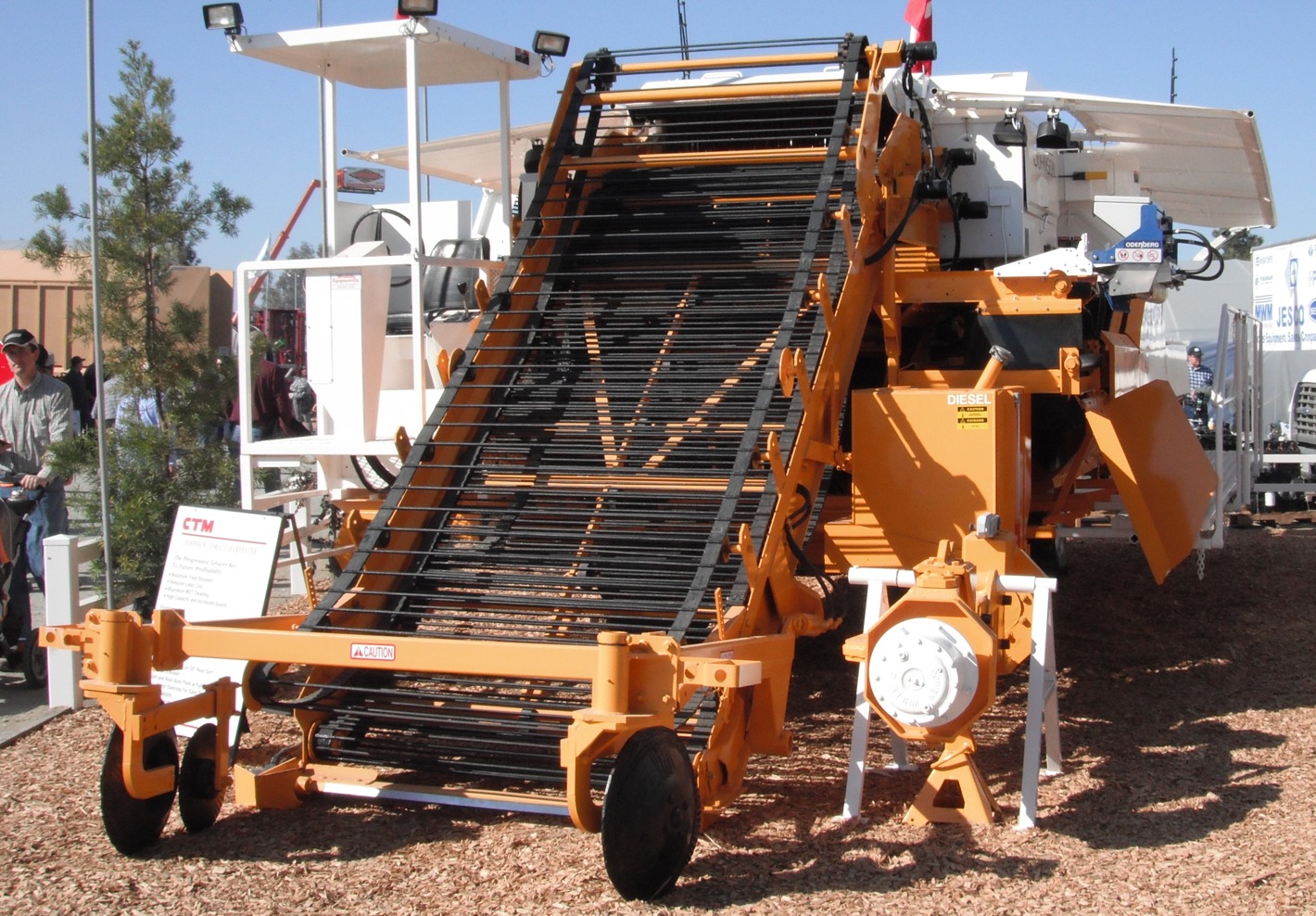
Figure 1. A Johnson tomato harvester displayed at the 2011 World Ag Expo in the United States. Photograph by Kowloonese · Original photograph · CC BY 3.0. Resized proportionally.
A variety trial in Xinjiang’s Kuitun reclamation area used fields at the Fourth Company of the 124th Regiment of the Seventh Division of the Xinjiang Production and Construction Corps. Under common trial conditions, researchers evaluated yield, individual fruit weight, shape and fruit count per plant alongside soluble solids, total acidity and lycopene. The plots used drip irrigation and samples were taken in a consistent way. An especially telling feature of the study is how far past the factory gate a breeder’s definition of a product already extends. How much fruit a plant carries at maturity has to be judged alongside what that fruit yields when pulped.[6]
Soluble solids indicate the share of substances dissolved in the juice. Sugars are part of that share. Organic acids and other soluble constituents also affect the reading. What is casually called sugar content in the field is often a quick comparative measurement made with a refractometer. It is valuable to a processor but does not directly report a truckload’s dietary fibre, the viscosity of the paste it will make or exactly how sweet it will taste. The processor ultimately has to deliver a product meeting a specified concentration and other quality requirements. A number that is convenient to read in a field has to accompany other measures when the product is sold.[7][6]
Consider two hypothetical plots. Plot A delivers nine tonnes per mu at an assumed 5% soluble solids, or about 450 kilograms of soluble material per mu. Plot B delivers 8.5 tonnes at 5.5%, or around 467.5 kilograms. By fresh weight A wins. In soluble material delivered to the factory from the same area of land, B comes slightly ahead. Actual plant yield will also depend on rejects, pulping losses and the product specification. This simple multiplication is enough to explain why a grower and a processor may both want a good harvest without naturally measuring it the same way.
High solids are only one part of variety assessment. Skin and flesh need sufficient mechanical strength for harvesting, loading and transport. For whole peeled tomatoes, uniform shape and integrity after peeling also have value. For dicing, customers will see the shape of the pieces, and what remains of them after heating in soup affects how the product performs. In concentrate the original fruit’s outward form matters less. If all the contracted plots share one maturity date and one set of characteristics, managing varieties may look simpler while the risks of simultaneous deliveries and changing orders both grow. Choosing varieties also allocates future hours on the factory floor.
A field trial at Shihezi compared water, soil amendments and irrigation methods in combination. Researchers tested irrigation levels of 3,800 and 4,500 cubic metres per hectare, measuring yield and quality within the same design and recording indicators including soil carbon dioxide emissions. The value to a processor lies beyond copying either figure into an irrigation schedule for every growing area. The experiment suggests more exact questions. How much additional water did a higher yield use? How much more soluble material reached the plant? Would the same result hold on another plot? Two fields both producing Xinjiang tomatoes can differ considerably in soil, salinity and water supply.[8]
If a plant bases all purchasing on tonnes of fresh fruit, a grower has an incentive to maximize fresh weight. If variety and management can produce more usable solids per tonne on the same land, the plant can haul and evaporate less water. The benefit then appears on somebody else’s account. How it is shared affects whether a new variety gains acceptance. A contract that recognizes only weighbridge tonnage may give the grower little return for a higher concentration that benefits the plant. Pricing by test result requires trusted sampling, instrument checks and a means of retesting disputed loads. Getting breeding objectives and purchasing terms to work across the factory gate is harder than describing a variety as suitable for processing.
Processors have a commercial reason to supply seed, technical services or combinations of varieties. An August 2026 harvest report from Changji prefecture described the use of early-, mid- and late-maturing varieties, staggered planting and harvesting in batches. Maturity dates begin to be organized at seed selection, propagation and transplanting. Spreading some fruit across several weeks can give the same harvester, unloading point and evaporation line another turn. The people making those decisions often affect the final number of drums before the factory fires up.[9]
3. What reaches the gate each hour
At COFCO Tunhe Changji Tomato Products, dispatchers use a display connected to the field as well as the factory. They can see the total already delivered and the trucks and harvesters online. They can select varieties and maturity levels to suit product requirements. This is the practice reporters documented at the company. It is a separate site from GuanNong’s contract purchasing in Yanqi. The first shows how a load is scheduled into a plant. The second shows why a business has to produce its basic material within a short harvest. The two accounts do not need to be put behind the same factory gate.[5][3]
Xu Bin, a grower in Ashili village, Changji, remembers what queuing used to cost. Interviewed in 2024 by Li Yanan of People’s Daily, he said he had grown processing tomatoes for more than twenty years. Harvesting had been slow, there was another wait at the plant and at times fruit spoiled before he could deliver it. That year he farmed 2,200 mu under land-transfer arrangements and grew four varieties, harvested in batches. Deliveries were timed to the plant’s progress, with fruit sent the day it was picked. The advantage of the dispatch schedule needed no explanation in terms of an algorithm. The fruit he grew had a better chance of reaching the scales in good condition.[10]
There is an easily misread detail in the interview. Xu hired twelve managers for field work including watering and fertilizing. The processor also helped organize variety selection, transplanting and machine operations. Dividing 2,200 mu by twelve gives an impressive area per manager, but leaves out much of the labour supporting those fields. Someone drives the machines, supplies the seedlings and brings the trucks on time. Some work that growers once had to arrange themselves had moved to people with the equipment and organizational capacity to do it. Xu could worry less because the work was being arranged elsewhere. The parallel with a drum of paste is close. Work and risk can be handed over, but neither simply disappears.[10]
A manager might first ask how much fruit the plant can take in a day. For a dispatcher it is often a particular two hours that matter. Consider a hypothetical line rated at 2,400 tonnes a day, operating evenly around the clock at 100 tonnes an hour. If 300 tonnes arrive in two morning hours, the line consumes 200 and leaves 100 to wait for unloading or temporary storage. If only 100 tonnes arrive in a two-hour afternoon window, combined arrivals over the two periods exactly match processing capacity. Whether the surplus can be smoothed out depends on the morning’s hundred tonnes remaining fit until the afternoon. A daily total erases precisely the wait a dispatcher needs to see.
Put it in truck terms. At an assumed thirty tonnes net per load, supplying 100 tonnes an hour requires one delivery to clear every eighteen minutes on average. Weighing, sampling and unloading can overlap if each has its own station. If only one truck can unload at a time, the next must wait however quickly it arrives. The empty truck must return to the field. Half an hour lost in the factory queue reappears on the schedule for the next load. Another harvester may get fruit off the field faster while slowing the fleet’s turnaround. Whether to send the next machine into a plot depends on maturity and on whether a returning truck will get there in time.
GuanNong’s disclosed daily capacity of 16,000 tonnes is raw-material handling capacity for its tomato business across multiple facilities. Assigning it to a single gate would conjure a fleet out of thin air. Multiplying by 365 would conjure a Xinjiang supplied with ripe fruit all year. The more useful question is how many days within the season each site can assemble fruit, power, people and packaging at the same time. Open a few days earlier and some plots are unripe. Run a few days later and some lines may have nothing to receive. Two days at the edges of the season need not replace two lost at its peak.[3]
If trucks have backed up in the receiving yard, why not open another unloading bay? That depends on where there is room downstream. After unloading come washing, sorting, breaking and pulping, before the juice goes for concentration. If the evaporator is at capacity, a new bay merely moves the queue from trucks into the factory. Conversely, more evaporation surface is of little help when the downstream line has room but incoming loads are stuck at inspection. Each stage has a maximum speed of its own, yet the tomatoes have to pass through every one of them. The busiest job need not sit at the most expensive machine. Investing in the wrong place can buy a very expensive August with the same old queue.
Distance between fields and factory is more than a circle on a map. Two plots equally far away can support different numbers of daily trips: one loads easily and has returning trucks, whereas another involves a detour and village roads where vehicles struggle to pass. A per-tonne trip rate averaged over distance obscures such last-mile differences. When weather brings several fields to harvest together, the fleet cannot be divided as evenly as it can on paper. Land near the gate has a value a map does not show. It leaves room to adjust: picking can wait if the last truck is still unloading, or a particular ripeness can be brought in quickly when a plant needs it.
This helps explain why a cluster of processors grew up close to the growing areas of northwestern China. A customer hundreds of kilometres away can buy paste. Fruit on harvest day needs a buyer nearby. Before it becomes paste, the scarce resource between grower and customer is the ability to receive and process large quantities quickly. The plant the fruit passes through determines where much of the work and employment stays. Only once the product can be counted by the drum in a warehouse does the customer have much more latitude to choose a supplier farther afield. For a contract grower, the survival of the nearby factory bears directly on whether the same land can be farmed in the same way next year.
Procurement, inspection and scheduling therefore need to share seemingly fine-grained information. A sample from one truck showing low solids does not establish a problem across a whole growing area. It matters which truck, layer and time the sample came from. If readings on neighbouring plots and successive loads move in the same direction, the plant has a basis for revising its estimate of the evaporation load ahead. The harvest schedule names a maturity window, the intake note records a weight and the production log identifies a material batch. Connecting the three allows a processor to learn next year which schedules brought in better fruit. Otherwise its season-end record may show many tonnes received while exactly when and at what cost they were processed quickly becomes a matter of individual recollection.
IV. How much fresh fruit goes into a drum?
Take the GuanNong drum marked 28–30. Under the Codex standard, a processed tomato concentrate containing at least 24% natural tomato soluble solids can be sold as tomato paste. At 7% or more but below 24%, it is tomato purée. Chinese traders commonly use the same term for concentrates of different strengths. The numbers on the drum give the concentration range. Ingredients, break method, packaging and acceptance criteria have their own entries. Ketchup served with fries has its own recipe and quite different economics.[7][2]
Take a drum with a net fill of 240 kilograms, within GuanNong’s stated range. At the midpoint of 29%, it contains the equivalent of 69.6 kilograms of soluble solids. Suppose incoming tomatoes measure 5% and all those solids reach the paste. The drum requires 1,392 kilograms of fruit. Multiply 240 by 29%, then divide by 5%. On those assumptions, every 100 kilograms of fruit yields about 17.2 kilograms of paste. Sorting, screening and juice leaving with skins and seeds all reduce the actual yield. This material balance gives an order of magnitude. A grower’s settlement or a shift’s performance requires actual measurements.
With recovery reduced to 95%, the same drum requires roughly 1,465 kilograms of fruit. Allowing for a loss of just 5% adds more than 70 kilograms. A processor seeking one more saleable drum can buy more fruit or recover more usable pulp from the fruit already purchased. The cost depends on where the pulp is lost. Rotten fruit belongs among the rejects. Good pulp that can still be separated need not leave with the seeds. Rewarding yield without measuring quality, or quality without yield, can move the cost out of sight.
The same calculation gives plant operators a way to interpret claims about Xinjiang’s suitability for paste. For the same 240 kilograms at 29%, fruit at 4.5% requires about 1,547 kilograms at full recovery. Fruit at 5.5% requires about 1,265. The unrounded difference is roughly 281 kilograms entering the gate to provide the same solids, most of it water. Sorting and screening remove material before evaporation. Only part of that difference becomes a saving at the boiler. Even so, the same line can face very different loads from one delivery to the next.
Fresh fruit required for the same net drum of paste
| Soluble solids at intake | Assumed recovery | Fresh fruit per drum |
|---|---|---|
| 4.5% | 100% | Approx. 1,547 kg |
| 5.0% | 100% | 1,392 kg |
| 5.5% | 100% | Approx. 1,265 kg |
| 5.0% | 95% | Approx. 1,465 kg |
Institute calculation. Finished paste weighs 240 kg net at 29%. Fresh fruit required = 240 × 29% ÷ intake concentration ÷ recovery.
A factory budget gives a point of comparison. In a 2023 response to an inquiry, Zhonglian Appraisal projected Xinliang Yanyangtian’s paste cost using RMB 500 per tonne of fruit and six tonnes of fruit per tonne of paste. That put raw material at RMB 3,000 per tonne of paste. The 6-to-1 assumption is close to the scale of the calculation above. It was made for an asset valuation. It tells us neither the concentration of each lot received there nor the consumption factor for every grade made in Xinjiang. A tonne of 36–38 paste requires more usable solids even with identical fruit.[4]
How much more can a buyer pay for a tonne at 37 degrees than for one at 29 and still pay the same for soluble solids? Approximate the degrees as percentages by mass. A tonne at 29 degrees priced at RMB 5,000 contains about 290 kilograms of soluble solids at RMB 17.24 per kilogram. The equivalent price at 37 degrees is approximately RMB 6,379 per tonne. Identical offers of RMB 5,000 therefore buy different quantities of solids. A customer who can use the weaker grade must price the freight on the extra water. Using the stronger one may require a change to the recipe.
An order still takes more than arithmetic. Tomato particles and flow matter to some customers, colour, flavour and origin to others. An overseas customer who has qualified a particular grade on its own line may need another trial. Adding water brings a high concentration down, but cannot reverse every change that occurred when the fruit was crushed. Break method and lot number deserve their space on the label. Normalising price for solids removes the most obvious source of error. Beyond it lie the qualities on which suppliers actually compete.
V. The choice between hot and cold break comes before evaporation
Concentration is easy to picture. The need to act on temperature immediately after crushing takes more explanation. Crushing opens the fruit’s tissues, bringing components of the flesh into closer contact with enzymes previously separated from them. Pectin contributes body to the pulp. Enzymatic changes to it affect subsequent flow. The temperature and heat treatment of the crushed fruit determine how long the enzymes can act. While fresh loads are still arriving, the factory must already make a choice that shapes the finished product.[11]
University of California researchers sampled several points on commercial processing lines. On the lines they described, hot break was around 95°C and cold break around 65°C. Even a cold break involves heating. Higher temperatures generally suppress relevant enzyme activity earlier and help preserve body. A lower-temperature treatment serves different requirements for flavour and flow. These observations apply to the lines and samples studied. Time, variety, equipment and intended use also matter. Customers routinely specify the break method because they can recognise its effects.[11]
GuanNong’s catalogue offers both cold and hot break at 28–30, hot break at 30–32 and cold break at 36–38. The two entries in a single concentration band explain why a contract that says only “tomato paste, 30 degrees” can cause trouble. A delivery can pass the concentration test and still disappoint in the customer’s product. Formulators care how fast a sauce pours, whether it clings to food and how quickly a watery layer separates after mixing. One refractometer reading cannot capture all three.[2][12]
A published specification for 28–30 cold-break paste makes one difference measurable. Alongside concentration, it specifies a consistency test at a standardised 12.5 degrees, with a flow of six to ten centimetres in thirty seconds. A Bostwick consistometer has a sample reservoir and a graduated trough. Release the gate and read the distance travelled after the prescribed interval. Temperature, dilution and elapsed time belong with the result. A well-written specification lets both parties agree how to resolve a disagreement before one arises.[12]
Imagine two suppliers of the same concentration. One sample goes straight into the customer’s established pumping and blending routine and produces the required consistency. The second meets colour and concentration requirements, but the buyer has to adjust the recipe and test pump performance. Against any discount stand the costs of trials, downtime, revised operating instructions and uncertainty about the next lot. For a running food plant, qualifying a replacement ingredient can easily outweigh a small saving per tonne. Reliable repeat production gives the buyer a more concrete reason to return than a promise of good tomatoes.
After crushing, screening and pulping send usable material towards the evaporator and separate skins, seeds and some fibre. Finer screening changes the texture. Coarser particles can affect mouthfeel and downstream machinery. Losing usable flesh in the screenings lowers paste yield. Retaining unsuitable material to increase pulp output may add tonnes that are harder to sell. A claim about yield needs a definition of the finished product. Paste, diced tomatoes and coarse-textured bases have different acceptance criteria. The retained portions matter when comparing tonnages.
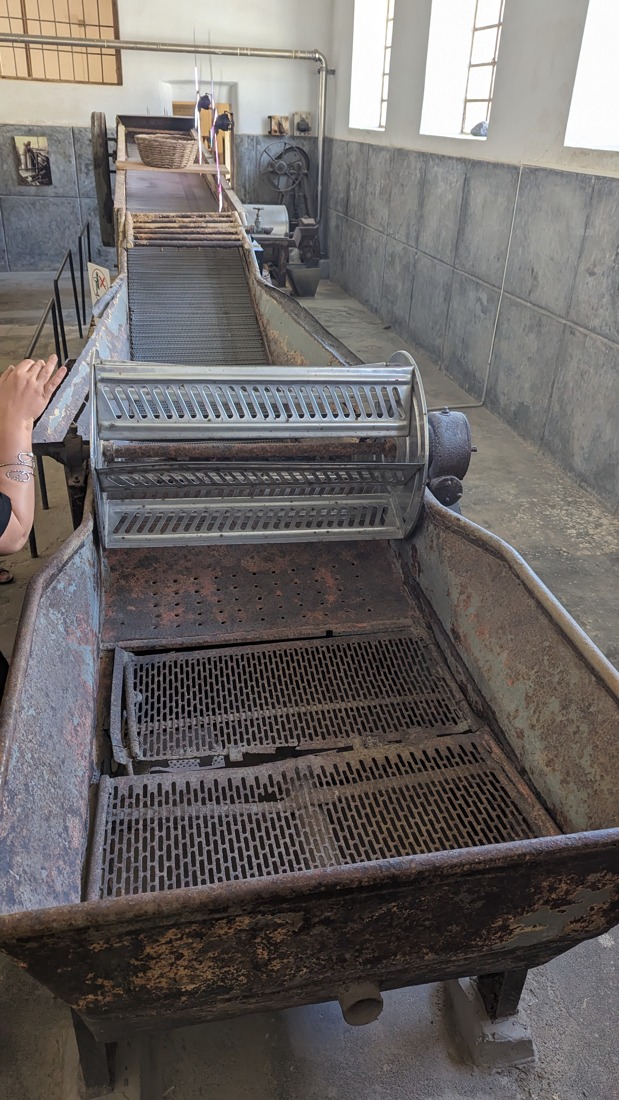
Figure 2. Processing equipment at the D. Nomikos Tomato Industrial Museum in Greece. Photograph by Lajmmoore · Original photograph · CC BY-SA 4.0. Resized proportionally.
How does a plant locate the source of a problem? A finished-product test records the result. Thin paste from one shift could reflect a change in fruit, its heat history after crushing, screening, concentration or even final sampling. A drum number alone may leave the difference undiscovered until a customer tries it. Linking incoming lots and production periods to retained samples allows quality staff to identify which drums are affected. Researchers sample along industrial lines to distinguish changes that become hard to disentangle once the lid closes. Time spent on traceability can reduce the quantity requiring intervention.[11]
Turning fruit into bulk paste gives the next factory time to decide. It also settles a number of choices on that factory’s behalf. Spices, bottles and pouches can usually wait. Variety, ripeness, crushing and the heat already applied are fixed for the batch. A buyer sees a drum that can wait for an order. A process engineer sees the choices made before it was filled. A warehouse with a thousand tonnes may need several inventory lines before anyone can say which orders it can accept.
VI. The water leaving the evaporator has a cost of its own
A tonne of incoming tomatoes contains a great deal of water. What the distant customer wants to buy is the tomato material in the paste. Removing water near the fields saves freight over the rest of the journey. Separating it from the pulp requires local heat, electricity and capital. Xinjiang processors pay at origin to avoid shipping water over many kilometres. The longer the journey, the more the exchange deserves a calculation. Fuel, water supply and maintenance belong on the same ledger as freight saved.
Take ten tonnes of screened juice at 5% soluble solids entering an evaporator, with no assumed losses. At 29%, output is about 1.72 tonnes and roughly 8.28 tonnes of water leave the stream. At 37%, the same juice yields about 1.35 tonnes and sheds 8.65 tonnes of water. The second grade removes an extra 0.37 tonnes from the same feed, with a substantial difference in the weight of saleable paste. Agreeing what quantity of which grade to deliver makes it possible to work back to juice and machine time. A target based on tonnes of a weaker grade can make well-executed production of a stronger one look like a decline.
An evaporator rating can give tonnes of feed processed per hour or tonnes of water removed per hour. The first depends on inlet and outlet conditions. The second describes the thermal duty more directly, but still requires feed data to convert it into finished tonnes. If a shift can remove only about eight more tonnes of water, more capacity or more concentrated feed could each increase output. The soluble-solids reading a field team takes kilometres away translates into drums per shift. Growing services and boiler operations may report to different departments. Their effects meet in the same material stream.
Lower pressure lowers the boiling point, allowing part of the water to leave heat-sensitive material at a lower temperature. In multiple-effect evaporation, vapour from one stage heats the next across a succession of temperatures and pressures. Maintaining a vacuum, circulating liquid, condensing vapour and cleaning all cost money. Useful heat recovery also requires a match in temperature, timing and hygiene. Replacing fresh steam with waste heat takes enough heat-transfer area and a nearby demand at the right time.[13]
A campaign lasting a few dozen days complicates the decision to invest. Payback on extra equipment often depends on accumulated running hours. The same hourly steam saving adds up much faster on a year-round line than on an evaporator dedicated to fresh tomatoes. Shared use with another crop or process changes the case again. The calculation must ask whether boiler load can actually fall at the same time, and whether there is a steady user of heat during cleaning and changeovers. The latent heat of water multiplied by the tonnes handled captures only a fraction of what a plant engineer needs to know.
Xinliang Yanyangtian’s disclosures show the range of supplies a factory needs. In 2022 it purchased about 313,600 cubic metres of water, 4.682 million kilowatt-hours of electricity and 4,730 tonnes of coal. The filing also lists spending on each. Its own wells supplied most water, and a municipal connection could meet short peaks. These are annual purchases for the business and include uses across the site. Dividing all coal by the output of a single paste grade would attribute other operations to that grade. The figures tell us which supplies the factory must secure before the season starts.[4]
The filing also shows how a financial ratio can mislead an engineer. Trading expanded in 2022, increasing the cost of the principal business. Water and power purchases became a smaller percentage of this denominator even as the physical quantities of both increased. Calling that an efficiency gain would credit machinery for a change in the business mix. Comparing process improvements requires comparable feeds, outputs and utilisation, with energy measured per tonne of water evaporated or per unit of solids recovered. The spending share answers a different question about the business.
The campaign must also leave time for cleaning and maintenance. As the line runs, pulp characteristics and deposits can change heat transfer. A planned cleaning costs immediate throughput. Deferring it repeatedly can yield ever less paste from the same steam and labour. The order book lists tonnes and the maintenance plan lists hours. Only when the two are read together can the factory promise delivery dates responsibly. Even at peak harvest, the ability to stop on time is part of continuous production.
VII. The bag holds the paste. The steel drum meets the forklift
A 220-litre drum provides two boundaries. The inner bag and its seal isolate the product. The steel shell takes mechanical loads during stacking, handling and transport, while its walls and base support the flexible bag. The condition of the liner, hidden from view, helps determine whether the paste can stay in storage under its original conditions. GuanNong lists both drum volume and net fill. Litres describe nominal container capacity. Kilograms describe the contents being sold. Concentrate and water have different densities. A 220-litre drum cannot simply be entered as 220 kilograms.[2]
Four drums at the illustrative net fill of 240 kilograms put 960 kilograms of paste on a pallet. The drums, bags, lids and pallet add tare weight. A sales commitment for a tonne of paste becomes a different set of questions for the warehouse. How many pallet positions are needed? Which aisle can the forklift use? How is the load distributed on the vehicle? Dividing vehicle payload by net paste weight can produce a load that will not fit or exceeds the gross allowance. Drum shape, pallet dimensions, vehicle and carrier conditions still matter for a standardised product.
The filler joins a continuously flowing product to bags and drums handed over as discrete units. Equipment manufacturer FBR ELPO offers an aseptic bulk filler for bags of 200 to 1,000 litres, covering conventional drums and larger containers. A change of pack size alters the bags needed per hour, container changes and pallets to be removed. The same paste can require quite different work from the filling crew. If even one packaging component fails to arrive, the upstream plant may have taken delivery of the tomatoes and finished concentrating the pulp with no suitable container left to receive it.[14]
In 2025 COFCO Tomato issued a procurement notice for contracted transport of aseptic bags to factory warehouses in Xinjiang, Inner Mongolia and other production areas. The delivery period ran from May through the following April. The notice gives no count of trucks on any given day. It records a preparation rarely visible in harvest reports. Before full drums of red paste can leave Xinjiang, suitable empty bags must get to the factories. Even the bags have destinations and performance dates. Their accounting classification as auxiliary materials matters little to the crew trying to seal the last drum.[15]
An intact exterior tells little about the completeness of a lot record. To match stock to a customer, the factory needs to recover processing period, grade, net weight and inspection records. Paste made on one day can belong to adjacent but distinct lots. If a packaging batch needs checking, linking it to the actual finished drums narrows the affected quantity. Knowing only that the bags were used sometime that week leaves a much larger section of the warehouse in doubt. Lot marks and records become shared evidence when a customer asks whether twenty drums were produced under the same conditions as the previous delivery.
The receiving customer checks the same boundary. A public cold-break specification calls for examination of the bag and abnormal swelling, clean outer drums and shipment on pallets. A retained sample may show compliant product at manufacture. Impacts or handling in transit can still compromise the package. A dented shell, a damaged label and a breached liner are distinct findings. The relevant quality procedure determines disposition. An unsupported assurance about a damaged drum is little comfort to the next factory. Part of the value of the package lies in making custody and condition clear at handover.[12]
A production team closes its task when finished goods enter inventory. Sales must still find the right buyer. Xinliang Yanyangtian’s year-end 2022 stock included its own 28–30 bulk paste made that year and purchased 36–38 bulk paste from two crop seasons. A drum on a company’s books may represent a season’s work on its own line or merchandise purchased to supply an order. Stock on hand cannot establish that the factory processed an equivalent quantity and grade from local fruit that year.[4]
A warehouse can hold plenty of tonnes while the salesperson has none to offer a buyer seeking a higher concentration. Break method, remaining shelf life, the customer’s list of approved plants and prior commitments divide those tonnes further. A single inventory total becomes many small pools when measured against orders due tomorrow. Buying from another producer can complete a specific commitment for a particular grade, at a particular place and time, even when the company already operates its own line.[4][3]
VIII. How raw material fell RMB 12 while production cost rose RMB 400
Xinliang Yanyangtian disclosed unit production costs for two consecutive campaigns. Raw tomatoes cost RMB 2,834.22 per tonne of paste in 2021 and RMB 2,821.59 in 2022, down RMB 12.63. Total production cost per tonne rose from RMB 4,158.10 to RMB 4,559.68, up RMB 401.58. An estimate of gross margin based solely on the price at the fruit weighbridge could get even the direction of the cost change wrong.[4]
Packaging added RMB 5.98 per tonne, labour RMB 121, depreciation RMB 182.03 and manufacturing overhead RMB 105.19. Subtract the RMB 12.63 saving on fruit and the disclosed components add to RMB 401.57. The one-fen difference from the reported total change reflects rounding. The source lists depreciation separately from manufacturing overhead. Equipment and labour effects readily outweighed the movement in fruit cost. Identifying the assets, months and production volumes behind the charge requires commissioning and allocation records. Two unit-cost observations cannot tell us how many machines changed.[4]
Xinliang Yanyangtian’s production cost per tonne of paste
| Item | 2021 campaign | 2022 campaign | Change |
|---|---|---|---|
| Raw tomatoes | 2,834.22 | 2,821.59 | −12.63 |
| Packaging | 402.94 | 408.92 | +5.98 |
| Labour | 392.83 | 513.83 | +121.00 |
| Depreciation | 52.12 | 234.15 | +182.03 |
| Manufacturing overhead | 475.99 | 581.18 | +105.19 |
| Total | 4,158.10 | 4,559.68 | +401.58 |
RMB per tonne of finished product. Source: campaign cost table in Zhonglian Appraisal’s response. Changes are differences between columns. At the precision disclosed, the components differ from the total change by RMB 0.01.[4]
There is a second puzzle. The company’s average fruit purchase price rose by RMB 32.56 per tonne between 2021 and 2022. If every tonne of paste used fruit at that annual price and conversion rates stayed identical, raw material cost per tonne of paste should have risen. It fell slightly. Annual purchases fed different lines, while costs were accumulated by campaign and product. Concentrations, fruit quality and actual yields can differ. Quantifying the contribution of each requires issue records and finished receipts by line and grade. Applying one factory-wide purchase average to every product quietly changes the scope of the comparison.[4]
The factor transmitting fruit prices to paste deserves close attention. At the appraisal’s six-to-one ratio, an extra RMB 0.01 per kilogram of fruit is RMB 10 per fresh tonne and roughly RMB 60 per finished tonne. On a fixed-price contract the factory initially bears the difference, other things equal. Even at an unchanged RMB 500 a tonne for fruit, a deterioration in conversion from 6-to-1 to 6.2-to-1 adds RMB 100 per tonne of paste. Both effects can occur together. The purchasing and production teams need a shared account of what their gains actually saved.
Packaging cost RMB 408.92 per tonne in 2022, about 9% of unit production cost. Allocating it to illustrative drums holding 0.24 tonnes gives roughly RMB 98 per drum. This gives a scale for combined packaging expenditure. It supplies neither a separate quote for steel and liner nor evidence that every Xinliang Yanyangtian drum matched the sample in GuanNong’s catalogue. Making paste independently saleable after the processing season already requires a substantial industrial input in the inner and outer packages.[4][2]
Unit production cost also differs from the unit cost recognised on sale. The same response reconciles the two, including the assessed deduction for input tax on agricultural purchases. Subtracting production cost directly from a selling price excluding tax can skip recognition and measurement steps needed for reported gross margin. Production managers comparing shifts look at material, hours and energy. Finance must match the particular inventory cost and tax treatment to the sale and allocate expenses to their proper accounts. Several cost figures can legitimately attach to one drum.[4]
Season length puts pressure on those numbers. Boilers, piping, fillers and technical crews are sized for continuous operation, although loads in the first three days, peak three days and final three days can vary. When fruit arrives in volume and product meets specification, some relatively fixed expenses spread further. If packaging, orders or fruit limit another line, a few more truckloads cannot absorb its depreciation. Machinery still needs maintenance and incurs charges when fewer drums are filled. A plant buying a seasonal crop also receives a manufacturer’s monthly bills.
Buying every available tomato simply to spread fixed cost has a price. Each extra drum ties up cash for fruit, packaging and energy and creates another sale to be made. Suppose an extra tonne saves RMB 100 in allocated fixed costs. If its expected sale price falls short of incremental spending, a full-utilisation figure will not collect the receivable. The run decision needs unsold quantities, cash and remaining sales windows beside the unit-cost sheet. The very different markets of 2024 and 2025 took that question out of the budget meeting and into the yards of Xinjiang processors.
IX. From Xinjiang to Tianjin, RMB 877 on the same order
An order dated 26 August 2022 specified 36–38 paste for a Russian client. The appraiser disclosed two pricing arrangements, delivery at the factory and delivery on board at Tianjin. The difference between RMB 6,613 and RMB 7,490 per tonne was RMB 877, about 13.3% of the factory price, or about RMB 210 per illustrative 240-kilogram drum. The contract itself priced by the tonne. The spread measures what the parties agreed for the seller’s extra delivery responsibility. The driver’s earnings and the seller’s incremental profit would require separate evidence.[4]
An isolated Xinjiang factory quote and a coastal port quote might reflect different exchange rates, dates, concentrations or customers. This comparison holds the order, customer, grade and contract date constant. Freight, dispatch coordination, port arrangements, cost and risk still depend on the terms. The same goods legitimately carry two prices for different handovers. Recording only the higher price in sales and leaving all the associated costs in another department’s report would make the achievement look easier than it was.
Consider a pallet of four illustrative drums. At 29%, its 960 kilograms of paste contain about 278.4 kilograms of soluble solids. Fruit at 5% would need to weigh about 5.57 tonnes to supply that quantity at full recovery. The plant removes water at origin and hands less than a net tonne of paste to the long-distance carrier. Actual processing losses raise fruit requirements, and packaging adds gross freight weight. The difference in scale nevertheless survives both corrections. The evaporator has already reduced the weight on the consignment note before the shipment begins.
With equal soluble solids, the net mass to ship at 37 degrees is 29 divided by 37, or 78.4% of the mass at 29 degrees. That saves roughly one-fifth. But an order may specify hot-break material or a 28–30 grade already qualified by the buyer. Stronger paste changes pumping, heat transfer, discharge and formulation requirements, and some upstream changes are hard to reverse. Realising the freight saving takes suitable machinery and a customer willing to accept the grade. Distance alone cannot determine what an entire factory should make.
A domestic ex-factory order dated 21 August that year was priced at about RMB 5,265.49 per tonne for 28–30 grade. The higher-strength order five days later at RMB 6,613 looks about a quarter dearer. Using the midpoints of 29% and 37% gives about RMB 18.16 and RMB 17.87 per kilogram of soluble solids respectively. On that denominator the stronger product is slightly cheaper. The customers differ, the concentrations are estimated and the source gives an export price for one and a domestic price excluding tax for the other. The small difference cannot establish bargaining strength. A quarter more per tonne plainly need not mean a quarter more revenue per unit of tomato material.[4]
Taking the concentration bands seriously, RMB 5,265.49 buys 280 to 300 kilograms of solids at roughly RMB 17.55–18.81 per kilogram. RMB 6,613 buys 360 to 380 kilograms at RMB 17.40–18.37 per kilogram. Much of the range overlaps. A real quotation needs measured concentration, any provision for settlement at a guaranteed minimum, delivery terms and credit period. Prices precise to a fen can suggest a greater distance between the parties than the underlying product specifications justify.
On 8 September 2022, several orders from the same domestic customer for 28–30 grade carried different unit prices. The disclosure identifies the date, grade, buyer and delivery arrangement. It omits some quality annexes, quantity commitments and other terms. A lower price alone supplies no evidence of inferior quality or a special discount. A buyer reading the table would first identify the missing clauses. Industrial research owes the reader the same care before assigning a cause to the spread.[4]
A customs average raises a similar issue. Export value divided by export weight gives an average across goods traded or dispatched in a period. The mix can span concentrations, destinations, customers, contract dates and shipment schedules. Customs distinguishes canned tomato paste in packs above five kilograms from smaller packs. The larger category extends well beyond a 220-litre steel drum. A national monthly average below a factory contract price does not by itself establish overpricing. In a falling market, an earlier fixed-price contract may enter the export data months after signature.[16][4]
The point of delivery tells us what work stays with the Xinjiang seller. A customer collecting at the gate can take custody early. Port delivery requires coordination of cargo, documentation, arrival and the buyer’s readiness. A capable seller may take on more work and report higher revenue. Freight swings, port delays and longer payment terms determine how much of the increase remains as profit. Before discussing brand premiums, a study of who earns what on a drum of paste needs to locate the quoted price on the map.
X. What happens when the second factory opens the drum?
GuanNong sells bulk paste directly and also feeds it back into its own lines for small packs and seasoned tomato sauces. Concentrating near Xinjiang’s fields and leaving some downstream work until later gives the factory another opportunity to postpone a decision. Before harvest, it must judge demand for several base grades. With paste in stock, it can allocate retail pack sizes, quantities and delivery dates against actual orders. Every reopening, blending and packing operation must establish the conditions for another independently saleable food.[3]
Three routes are often confused. Repacking concentrate can give buyers the same ingredient in a smaller unit. Blending base paste with other ingredients produces a seasoned sauce with a particular flavour and use. Peeling and dicing fresh fruit preserves pieces of tomato flesh in the can. Bulk paste can follow the first two routes. Once crushed, it no longer has the intact tissue needed for diced tomatoes. Extending into small packs can therefore mean quite different investments. A higher shelf price alone says little about the capabilities and risks a producer takes on.[3][4]
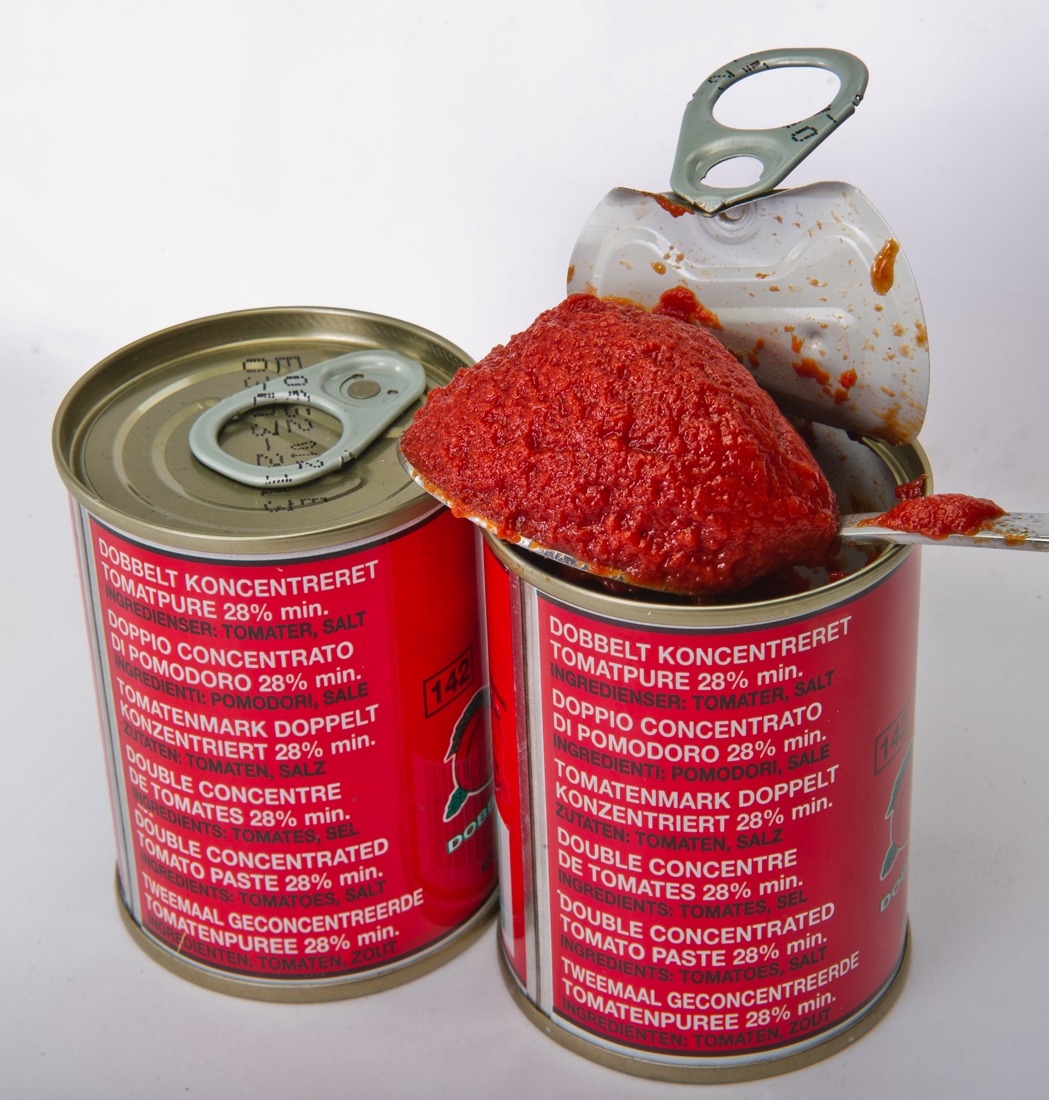
Figure 3. Cans of tomato paste labelled with a minimum concentration of 28%, one opened. Photograph by Bill Ebbesen · Original photograph · CC BY-SA 3.0. Resized proportionally.
In 2024 a Changji processor reduced the size of a pack after hearing from consumers. Yu Gang told reporters that the smaller pack subsequently proved more popular in its Tmall sales. Another business interviewed, Xiaochu, sold canned foods, condiments and drinks through the same online shop. Its shop turnover covered multiple categories. A bulk buyer wants to know how many solids a tonne supplies to a recipe. A household may simply want to finish what it opens for dinner. Each has a different reason for preferring a particular pack size.[10]
The change of customer also changes how the factory hears complaints. Industrial buyers can specify a flow distance, concentration or trial result. A household buyer may have no reason to know the soluble-solids content and still know exactly how much was left in the can. Wholesale tonnage reveals little about that frustration. Equally, traffic from one shop promotion offers a poor basis for planning a line’s annual load. Intended use, repeat purchases and the production cost of a change help identify whether to alter the fill, case assortment or product itself.
An old inventory list makes the distinction tangible. Xinliang Yanyangtian recorded diced tomatoes in 210-, 290-, 390- and 2,900-gram cans, alongside whole peeled tomatoes. A case of 48 cans at 210 grams contains 10.08 kilograms net. A case of 24 at 290 grams contains 6.96 kilograms. Six 2,900-gram cans give 17.4 kilograms. Ten thousand cases of each would mean different warehouse space, freight, container counts and kitchen uses. An industrial user buys enough material to run a line. A small-pack customer wants to finish the contents at their usual rate of use. Portion size reaches well beyond the calculations at the evaporator.[4]
For one illustrative tonne of net contents, a 240-kilogram fill means just over four drums. At 210 grams it takes roughly 4,762 cans. The actual contents may differ. The comparison isolates piece count. Bodies, lids, labels, cartons, seals and eventual handovers turn a few operations into thousands. Smaller packs bring the product closer to the unit a consumer buys while adding materials, production steps and selling expense. The spread between a retail price per kilogram and a bulk ingredient price cannot be assigned wholesale to profit forgone by the upstream factory.
Xinliang Yanyangtian’s diced-tomato line illustrates the difficulty. Rated at 15,000 tonnes a year, it made about 2,073 tonnes of diced tomatoes and 33 tonnes of whole peeled tomatoes in 2022, for combined utilisation of roughly 14%. The company described problems with efficiency and processing performance on the retort for roughly three-kilogram packs. Production that year relied mainly on equipment for 210- to 400-gram packs. To someone looking at two cans the difference is their size. To a thermal processing line they require different equipment conditions. Later modifications were described as expectations. Reliable output in the year under review depended on the packs the plant could actually process then.[4]
A caterer seeking a large format has little reason to accept a stack of small cans merely because a supplier makes them reliably. Kitchen staff must open, empty and dispose of every one. A retailer wanting small units has equally little reason to order whole drums to improve factory utilisation. Buyers pay for a specification, a delivery rhythm and the cost of using the product at their own site. Demand and reliable supply are separate milestones. A successful equipment trial still needs customer qualification, while a signed order cannot substitute for a successful trial.
The customer’s needs reach all the way back to the grower. While fruit remains intact, suitable lots can go to peeling and dicing and the rest to pulping. Crushing everything at reception permanently removes the value of its shape. Overestimating demand for diced tomatoes ties up dedicated equipment and packs for goods that may not sell. More elaborate processing earns its keep where that extra precision has a stable use and a buyer. For growers and processors alike, the painful outcome is to deliver exactly what was agreed and find that the next participant is unprepared to receive it.
GuanNong’s 2025 annual report recorded about 97,700 tonnes of own-produced fruit and vegetable products, 126,800 tonnes sold and 78,100 tonnes in inventory. Production fell 52.11% year on year. The company cited market conditions and a decline in output of small-pack tomato products. The category covers own-produced fruit and vegetable products. Its totals cannot establish bulk paste output or national demand for diced tomatoes. The explanation about small packs is telling in its own right. They need matching channels, sales volumes and utilisation. Each further processing step introduces another condition that must hold for the investment to pay.[17]
XI. Where else do global buyers look between harvests?
The World Processing Tomato Council recorded about 10.45 million tonnes of processing tomatoes for China in 2024 and 4.90 million in 2025. These figures measure fresh fruit entering processing. The fall was 5.55 million tonnes, or about 53.1%. Describing the second figure as finished paste would conjure several campaigns’ worth of product in a sentence. Paste from previous harvests remained available in warehouses. A decline in fresh throughput therefore cannot predict an equal decline in the year’s supply of paste.[18]
On 28 October 2026 the council put China’s preliminary figure at about 5.15 million tonnes, up roughly 250,000 tonnes from 2025 and still far short of 2024. In the same table California went from close to 10 million tonnes to more than 10.5 million and then to a preliminary 9.365 million. California is one US growing region, while China is a national series. For a buyer the figures identify alternative sources of supply. A contract for next quarter depends both on what sits in warehouses today and on which regions will have new crop in a few months. A smaller Xinjiang crop leaves paste already made elsewhere available to compete.[18]
An April 2026 interview put Xinjiang’s 2025 processing-tomato area at roughly 520,000 mu, output at about 4.8 million tonnes and the number of processors above seventy, most focused on bulk paste. These are regional acreage and agricultural output. Alongside the council’s national processing figure, they show the importance of Xinjiang. An exact share would require comparable factory intake, interregional flows and reporting periods. For practical market intelligence, a buyer monitoring the harvest calendar in a few concentrated regions can observe a large part of the change in supply.[5][18]
The market often reacts more slowly than tomatoes ripen. A high selling price encourages processors to look for more orders and growers to commit land and labour. Several regions can each make a reasonable planting decision, only to deliver extra fruit against the same downstream buyers. No single region controls world demand, and ripe fruit still has to be processed promptly. Concentration and aseptic packaging allow the additional supply to outlive its harvest. Price pressure works through later deliveries, inventory movements and the next negotiation. A season on the farm can overlap with two or three seasons in the warehouse.[17][19]
COFCO Sugar’s 2025 interim report described a decline of more than half in China’s average paste export price from early 2024 to a point in the reporting period and drew attention to inventories. GuanNong’s 2025 annual report put annual bulk paste export averages at about USD 1,000 per tonne in 2024 and USD 675 in 2025, down 32.5%. Both statements can hold. One tracks a movement from a particular starting point. The other compares two annual averages, with a somewhat different product description. Applying a decline of over half to every individual contract would misread both early fixed-price shipments and volumes sold near the low.[20][17]
A changing export average can reflect prices and shipment mix. Suppose one tonne each of products priced at USD 800 and USD 1,200 ships in a month. The average is USD 1,000. Next month three tonnes of the cheaper grade and one of the dearer grade ship at unchanged prices. The average falls to USD 900. Contracts and transactions are better evidence for a change on a particular grade. The national average tells what the sector realised per tonne across its actual export flow. Together the two can reveal how much price pressure reached the factory gate.
Buyers also bear time risk on a fixed-price order. If the spot market falls, a buyer may still have to receive dearer contracted stock. If fruit or transport becomes scarce, secured supply protects part of the production schedule. The purchasing decision is how much to pay for certainty and how much uncommitted demand to leave open. A buyer with uncertain volumes can wait. One with a finished product, pack and launch date already committed may have little time. Bargaining power depends on what alternatives each party still has.
XII. Why one harvest’s 83,500 tonnes occupy two inventory lines
At 31 December 2025 Zhongji Health still held about 83,500 tonnes of bulk paste from the 2024 crop. In its subsequent response to the Shenzhen Stock Exchange’s annual-report inquiry, it divided this stock into roughly 37,300 tonnes under contract and 46,200 without contracts. Using the rounded quantities, the portions were about 45% and 55%. Paste from the same campaign already faced two different economic outcomes on the same balance-sheet date.[19]
For contracted stock, cost after the assessed input-tax deduction was about RMB 176 million. At the average contract price excluding tax of RMB 3,435.56 per tonne, estimated sales proceeds came to about RMB 128 million. Freight, handling, selling expenses and taxes still lay ahead. Deducting them gave a net realisable value of about RMB 118 million and a required inventory write-down of about RMB 57.39 million. A contract sharpened the estimate of future revenue. Its price could still leave a substantial loss against cost. Having a buyer and earning a profit require different evidence.[19]
For uncontracted stock the disclosed cost after the tax deduction was about RMB 215 million. The company used a general selling price of RMB 3,017.68 per tonne. After expenses, net realisable value was about RMB 137 million and the indicated write-down about RMB 77.99 million. Together the two amounts gave a required provision of roughly RMB 135 million on this 2024-crop inventory at year-end. It measures a specific group of stocks on that date. Treating the whole amount as a new cash loss during 2025, or as the impairment on all company inventories, would answer a different question. Cash had already gone out for fruit, drums and production.[19]
Zhongji Health’s year-end valuation of bulk paste from the 2024 crop
| Status at end-2025 | Inventory (10,000 tonnes) | Net realisable value (RMB 10,000) | Required provision (RMB 10,000) |
|---|---|---|---|
| Contracted | 3.73 | 11,839.60 | 5,739.29 |
| Uncontracted | 4.62 | 13,708.84 | 7,798.69 |
| Total | 8.35 | 25,548.44 | 13,537.98 |
Company response to the annual-report inquiry. The provision is the amount indicated by the year-end valuation for these inventories. Quantities follow the precision disclosed.[19]
The contracted price exceeded the general price used for the uncontracted stock by about RMB 418 per tonne. Did signing a contract protect exactly that much? The valuation bases and delivery expenses differed. For the contracted stock the company listed some RMB 7.61 million of freight and handling. It used a different estimate of future expenses for uncontracted stock. Customers, grades and other conditions could differ as well. Multiplying the price gap by the whole inventory would impose hypothetical terms on goods that never traded on them. The disclosure measures two exposures separately and gives no basis for claiming a precise loss management could have avoided.
Divide the net values by the disclosed rounded quantities. Roughly RMB 118.4 million across 37,300 contracted tonnes gives a little over RMB 3,170 per tonne. Roughly RMB 137.1 million across 46,200 uncontracted tonnes gives about RMB 2,970. The net-value gap is considerably smaller than the nominal selling-price gap. Purchasing, sales and finance all need to ask what freight remains unpaid and what port charges the seller must bear. The rationale for quoting factory and port prices separately in the 2022 order appears again in another company’s impairment table. The transactions differ, but the economic question travels.
Zhongji Health’s 2025 annual report states a 720-day shelf life for its bulk paste and a sales cycle usually extending to the start of the following campaign. The 720 days describe its products, subject to storage and contract conditions. A newly sealed drum can meet deliveries across many months. After a year, fewer dates remain open. Downstream customers also need time for transport, production and sale. Remaining shelf life can shape their choice well before the expiry date.[21]
A much smaller line in the same response deserves reading beside the 83,500 tonnes. At end-2025 about 0.01 ten-thousand tonnes, roughly 100 tonnes after rounding, remained from the 2023 crop. Its reported inventory balance was RMB 1.0124 million. The company provided for the full amount because the goods had expired. The rounded tonnage cannot support an exact unit cost per drum. It records something more decisive. Physical goods and their original cost could still be present while the valuation required a complete write-down. The extra time gained for those tomatoes had run out.[19]
XIII. How much fruit should the factory take next season?
Before the next planting, decisions travel back from the warehouse to the fields. A large stock of last season’s 37-degree cold-break paste cannot fulfil every new order. A buyer may require a hot-break grade, a new crop or a particular source. Purchases must still be arranged. Meanwhile, unrecovered cash occupies credit lines and old stock occupies space, while new fruit bills fall due. A promise to take all the ripe fruit and a promise to cut inventory sharply can coexist only if enough real orders and delivery capacity connect the two.
A plan bridging seasons works inwards from three directions. Field teams estimate fruit and ripening dates by plot. Plant staff turn actual running hours and equipment into output by grade. Sales works back from customers, delivery dates and stock already committed. The units differ: fresh tonnes in a given week, water evaporated or drums sealed in a day, and finished tonnes a customer will take at a place and price. Three totals in tonnes do not constitute a matched plan. Its value lies in identifying the week short of trucks, the grade short of orders and the customer whose commitment has already reserved the only suitable lot.
These distinctions also inform investment. If suitable fruit regularly waits at peak harvest, customers reliably take the finished goods and one downstream constraint can be identified, expansion has a clear target. If a fully loaded line mainly produces interchangeable unsold stock, adding a cheaper line can increase the following season’s selling burden. If a buyer offers a stable order for a grade the current line cannot make, changes to quality, packaging or equipment compatibility may be the better investment. A photograph of a busy factory in peak season cannot distinguish among the three.
Investors can examine capital tied up without forecasting next year’s world price. At Xinliang Yanyangtian’s disclosed 2022 unit production cost, 1,000 comparable tonnes represented about RMB 4.56 million in accumulated production costs. Another month of waiting carries that commitment forward. Depreciation is not a new cash payment in the month, so the whole sum cannot be treated as fresh financing demand. But cash previously spent on fruit, wages, energy and packaging does not return while the stock sits unsold. A discount for an early sale must be weighed against storage, funding, price risk and the loss of usable shelf life. That comparison is closer to a factory manager’s daily work than predicting the bottom of an industry price series.[4]
A regional industry can support several kinds of business. A processor that reliably supplies comparable grades to multiple food plants, keeps sound replacement records and honours growers’ contracts through a downturn already provides a service that is difficult to replace. A specialist in small packs needs channels and long-term orders to justify solving problems such as the large-can retort. One company can develop both capabilities, or they can reside with companies in Yanqi, Changji, coastal China or overseas. The question is where people, machinery and customers already exist, and who will pay for a more reliable service. A change of packaging shows up at once in a photograph. Several years of timely harvesting and delivery may only be appreciated when the market turns cold.
Follow a bottle of sauce or a can of paste backwards from the kitchen. The 2022 order gave the same goods different values at a Xinjiang factory gate and at Tianjin port. The 2025 year-end inventory valued goods separately even in the same region when remaining life, customer commitments and delivery responsibilities differed. Manufacturing makes a crop tradable across seasons. Transport, sales and credit place it in a specific use. Only when the money returns does one harvest help the factory finance its purchases the following year.
Back in Xingfu village in Changji, Zhang Yulin said he wanted to plant again after making deliveries and settling the accounts for more than 900 mu. For him, getting ripe fruit into the factory on contract settled the question of income. Which company later turns the drums into sauce and which customer takes delivery in Tianjin are decisions for others. The processor’s responsibility begins where his ends. An entire field of ripe tomatoes cannot stay on the vines waiting for a better price. In a few weeks the crew turns them into paste and seals them into numbered drums, taking the burden of delivery and waiting into its own hands.[5]
Closing the lid draws a clear line in this business. The grower has found a home for the season’s fruit. As long as the paste remains unsold, the money the factory advanced at harvest is still sitting in its warehouse. When that drum reaches the customer as promised and payment comes back, there is a reason for the harvester to enter the same field again next season.
References
[1] Tianxia Factory Manufacturing Database
[2] Xinjiang GuanNong Tomato Products, Bulk Tomato Paste. Product grades and processing methods.
[3] Xinjiang GuanNong, 2025 Interim Report. Principal business, procurement and production season.
[7] Codex Alimentarius Commission, Standard for Processed Tomato Concentrates, CXS 57-1981.
[9] Xinhua, Processing Tomato Harvest in Changji, Xinjiang, 17 August 2026.
[10] Li Yanan, The Industrial Journey of a Tomato, People’s Daily, 23 September 2024, p. 10.
[12] IQG Foods, Tomato Paste Cold Break 28–30° Brix, technical specification QFTP-CB2830.
[13] CFT, Evaporation Technologies for Energy Saving. Multiple effects and heat recovery.
[14] FBR ELPO, Big Bag Aseptic Filler. Equipment and bag capacities.
[15] COFCO Tunhe Tomato, procurement notice for contracted transport of aseptic bags, 2025.
[20] COFCO Sugar Holding, 2025 Interim Report. Tomato market conditions.