
About This Report
This report is a systematic study by the Tianxia Gongchang Industrial Research Institute (TXGC Research) of two backbone enterprises of the ordnance industry in Baotou. In Baotou, each of the two enterprises has its own customary short name:
- Yiji (No. 1 Machinery Plant, Plant 617): Inner Mongolia First Machinery Group Co., Ltd., formerly State-owned Plant 617 and the Inner Mongolia First Machinery Plant; the listed entity holding its core assets is Inner Mongolia First Machinery Group Co., Ltd. (Shanghai Stock Exchange, stock code 600967, abbreviated as "Inner Mongolia First Machinery").
- Erji (No. 2 Machinery Plant, Plant 447): Inner Mongolia North Heavy Industries Group Co., Ltd., formerly State-owned Plant 447 and the Inner Mongolia Second Machinery General Plant, abbreviated as "NHI Group"; the listed company it controls is Inner Mongolia North Hauler Joint Stock Co., Ltd. (stock code 600262, abbreviated as "North Hauler").
Both enterprises are member units of China North Industries Group Corporation Limited (Norinco Group), both were founded in 1954, and both were among the key projects built with Soviet assistance during the First Five-Year Plan (1953–1957); the plant areas and residential areas of both are located in Qingshan District, Baotou. This report is organized as "chronology plus dissection": Part One sets out the common starting point of the two plants; Parts Two and Three cover Yiji and Erji respectively, each including historical evolution, product evolution and a financial dissection; Part Four compares the two plants with each other and with international peers; Part Five uses the Tianxia Gongchang enterprise database to observe the cluster of enterprises around the two plants; Part Six presents scenarios and leading indicators. A chronology and an explanation of data definitions are appended at the end.
Scope of sources and handling principles. All facts in this report come from public sources, mainly including: periodic reports and ad hoc announcements of listed companies; the official websites of Norinco Group and the two enterprises; national and local statistical communiqués; budget documents of the Ministry of Finance; public reports by authoritative media such as Xinhua News Agency, People's Daily, PLA Daily, China Media Group, Inner Mongolia Daily and Baotou Daily; publications of local gazetteer and Party history research institutions; and annual reports of foreign companies and foreign-company data published by foreign government websites and news agencies.
For content involving weapons and equipment, this report uses only statements that have already been made public in the enterprises' periodic reports and in reports by official media, and makes no conjecture about the performance, output, deployment or cost of any equipment. Claims about Chinese military products that appear only in foreign or unofficial sources are not adopted in this report; foreign sources are used only for foreign companies' own data.
Data grading. The figures cited in this report are classified into four grades by source: Grade A is statutory statistics and regulatory disclosures (statistics bureaus, periodic reports of listed companies, stock exchange announcements); Grade B is official institutions and authoritative media; Grade C is commercial institutions, general media and foreign institutions; Grade D is TXGC Research estimates. All TXGC Research estimates are accompanied by their formulas and assumptions, so that readers can recalculate them. Where sources conflict, this report discloses them side by side and, where necessary, explains the definition it adopts and the reasons.
Cut-off date. The data in this report are as of September 2026. For listed-company financial data, the 2025 annual reports and the 2026 interim reports are the latest; the Tianxia Gongchang enterprise database was queried on September 29, 2026.
Disclaimer. This report is industry research and does not constitute investment advice of any kind.
Summary: Ten Key Findings
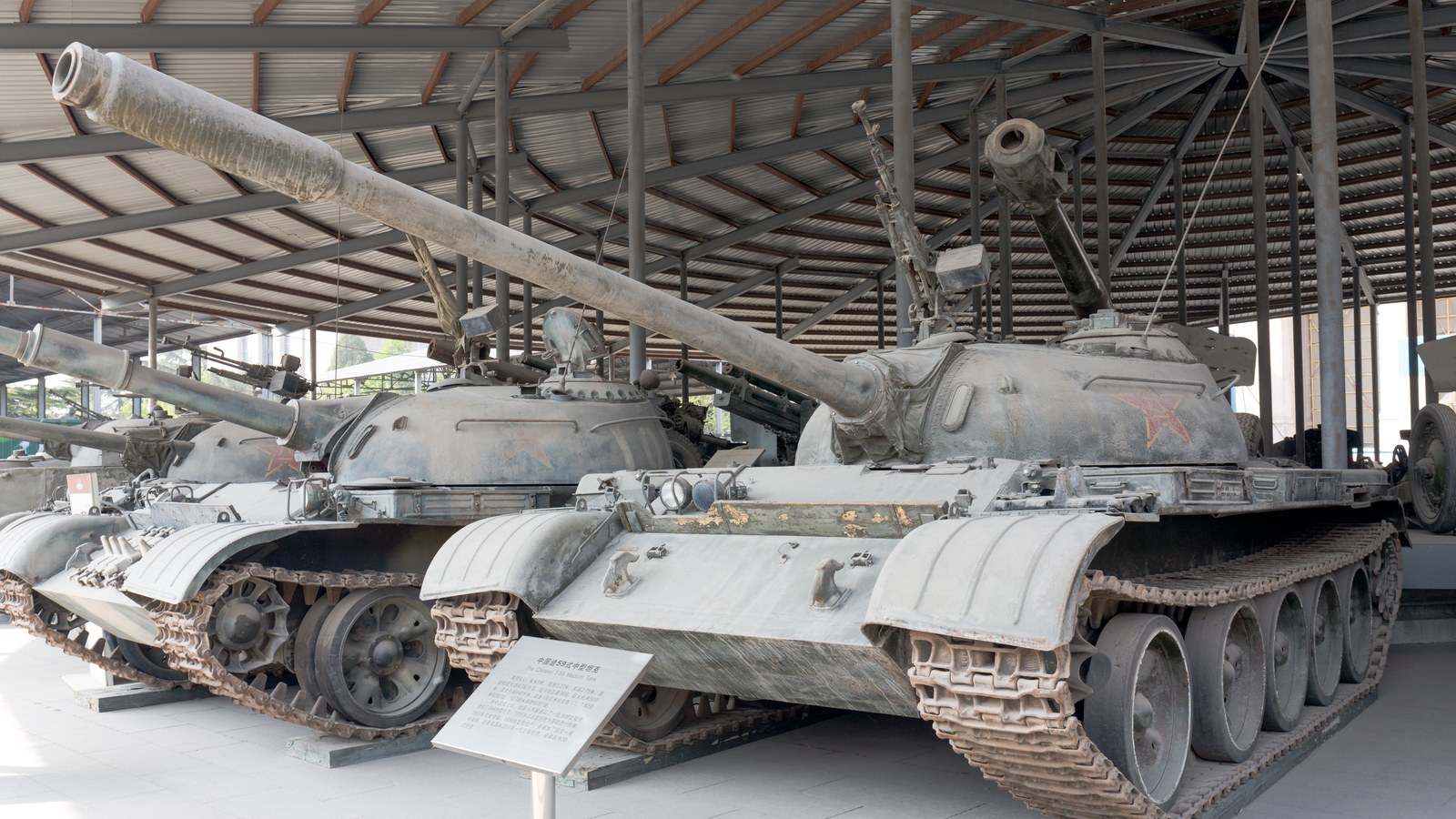
1. The two plants share a common origin but took different paths. Yiji (State-owned Plant 617) and Erji (State-owned Plant 447) were both among the Soviet-assisted "156 Projects" (Soviet-assisted key industrial projects) of the First Five-Year Plan, both were founded in 1954, and both are located in Qingshan District, Baotou. In December 1958, the first products of the two plants were successfully trial-produced ten days apart: Yiji's Type 59 medium tank and Erji's Type 59 100 mm anti-aircraft gun; in the 1959 National Day military parade, they were reviewed in numbers of 32 tanks and 32 guns respectively.
2. The two plants occupy different positions in the industrial chain. Yiji is a final-assembly enterprise; its annual report describes it as "China's only high-tech weapons and equipment R&D and manufacturing group integrating main battle tanks, wheeled combat vehicles and medium-caliber artillery," and it performs the role of "chain leader" (lead enterprise of an industrial chain). Erji is a materials and heavy-processing enterprise, officially described as "an important national R&D and production base for weapons and equipment and a national R&D and production base for high-strength, high-toughness gun steel," and is known as "Beipao" ("the Northern Artillery"). Yiji's representative craftsman is a welder; Erji's representative craftsman is a boring-machine operator.
3. Yiji's military-to-civilian conversion has followed the main thread of shared processes. Yiji has been profitable every year since 1978 (Xinhua News Agency report, 1999). The civilian products that have remained all share processes with tank manufacturing: railway freight cars (domestic market share of more than 6%, already exported in batches to Australia), petroleum drilling tools, and tracked forest firefighting vehicles. The contract for the Mercedes-Benz heavy truck technology introduced in 1988 was terminated in 2002, and Beiben is today an enterprise directly under Norinco Group.
4. Inner Mongolia First Machinery's operating revenue peaked in 2022 and its net profit peaked in 2023. Operating revenue rose from RMB 10.060 billion in 2016 to RMB 14.349 billion in 2022, and was RMB 10.025 billion in 2025; net profit attributable to shareholders of the listed company peaked at RMB 851 million in 2023, fell to RMB 335 million in 2025, and declined 40.72% year on year in the first half of 2026. The ten-year average margin of net profit attributable to shareholders of the listed company was about 5.1% (TXGC Research estimate).
5. The revenue share and gross-profit contribution of overseas business fluctuate considerably, and the changes in profit have multiple causes. The "Overseas" line in the annual reports' breakdown by region includes both military exports and exports of civilian products such as railway freight cars; the annual reports do not break these down. From 2023 to 2025, overseas revenue accounted for 13% to 21% of operating revenue, and the overseas gross margin was 23% to 28%; by TXGC Research estimate, overseas gross profit accounted for about 27% to 33% of total gross profit. In 2023, when profit hit a record high, the share of overseas gross profit in total gross profit was the highest in ten years; in 2025, total gross profit was essentially flat with 2024, and judging from the consolidated income statement, the decline in profit came mainly from reduced investment income, credit impairment shifting from reversals to provisions, and increased period expenses (the annual report's wording is differences in product mix and reduced income from large-denomination certificates of deposit and other items). In the first half of 2026, overseas revenue accounted for 1.62% of the total, the gross margin of domestic business also declined, and the company's overall gross margin fell to 7.97%.
6. Contract liabilities and monetary funds fell sharply, which the annual reports attribute to changes in the settlement mechanism. Inner Mongolia First Machinery's contract liabilities fell from RMB 12.553 billion at the end of 2020 to RMB 1.195 billion at the end of 2024, and its monetary funds fell over the same period from RMB 14.147 billion to RMB 2.551 billion; operating cash flow was negative in 2022 and 2024. The annual reports give the reasons as "changes in the settlement mechanism," "relatively small commencement payments and progress payments" and "extended settlement periods."
7. Erji was under pressure for a long time and achieved stable profitability only in the late 2010s. NHI Group posted net losses for three consecutive years from 2011 to 2013, with a debt-to-asset ratio of around 80% (81.61% in 2013); after an asset verification and write-down of RMB 2.9 billion for fiscal 2015 (announced in April 2016), its owners' equity was at one point negative (CCXI announcement, 2016). Following organizational restructuring, workforce diversion and the transfer of enterprise-run social services, profit before subsidies exceeded RMB 100 million for the first time in 2020 (Inner Mongolia Yearbook).
8. Erji's materials capability is rare nationwide. The 36,000-tonne vertical extrusion press for ferrous metals, built in 2009 and in batch production from 2010, has been called the world's largest by official media; according to Baotou Daily, the P92 steel pipe produced with it holds a domestic market share of more than 85%, and in 2024 it was selected as a national-level manufacturing single-product champion product. NHI Group was also the applicant in the 2013 anti-dumping investigation into high-temperature pressure-bearing alloy steel seamless pipes from the European Union, Japan and the United States.
9. The capital paths of the two plants diverged. In 2016, Yiji injected its core military-products assets into the listed company at a transaction price of RMB 7.059 billion, and the 2017 annual report states that it had "achieved an overall listing"; North Hauler, controlled by Erji, has always had mining trucks as its main business, and in the first half of 2026 overseas revenue accounted for about half of its revenue.
10. The significance of the two plants to Baotou has expanded from carrying employment and urban functions to industrial endowment. The Tianxia Gongchang enterprise database lists 746 equipment manufacturing enterprises in Baotou, accounting for 37.1% of those listed for the whole of Inner Mongolia (TXGC Research estimate), and Qingshan District ranks first in the city by the number of listed equipment manufacturing enterprises; in the enterprise database, very few independent enterprises whose main business is large forgings or heavy pressure equipment are listed in Baotou itself. The workforce of each plant has fallen from 20,000–30,000 people to about 10,000 (definitions vary), and Qingshan District now has a photovoltaic silicon materials enterprise whose number of insured employees is of the same order of magnitude as that of the headquarters of Yiji's listed company. The skilled-worker force, extreme manufacturing capability and the special vehicle industrial chain are Baotou's industrial endowment for the next decade.
Part One: The Starting Point — The First Five-Year Plan and the New City of Baotou
The history of Yiji and Erji begins with the same list, the same survey and the same urban plan. The two enterprises began construction in the same year, their plant areas are not far apart, and their residential areas together formed a single urban district; their first batches of products then passed through Tiananmen Square in the same year and on the same holiday. This part sets out this common starting point: why they were placed in Baotou, what kind of urban plan Baotou drew up for them, where the people who built them came from, and the first products they delivered in 1958 and 1959.
1. Baotou on a List: Five Projects among the "156 Projects"
The "156 Projects" were the starting point of New China's industrialization, but there are several different accounts of the number itself. According to an article published on People's Daily Online in 2019 by researchers at the Institute of Party History and Literature of the CPC Central Committee, the assistance projects signed between China and the Soviet Union totaled 156, which is the origin of the phrase "156 construction units" in the First Five-Year Plan; by the end of the First Five-Year Plan, the assistance projects had in fact been adjusted to 166, still customarily called the "156 Projects," of which 150 were actually constructed. Another article on the website of the Institute of Party History and Literature of the CPC Central Committee states instead that the projects under the Sino-Soviet agreement of May 15, 1953, plus the 50 projects already determined in 1950 and the 15 added in 1954, made a total of 156 projects included in the First Five-Year Plan, later fixed at 154 after multiple adjustments, with 150 actually constructed. The two accounts agree on "150 actually constructed," and this report follows that definition.
According to the classification in the 2015 People's Daily Online article The Dust-Covered Memory of the "156 Projects", these 150 actually constructed projects comprised 44 military industry enterprises, 20 metallurgical industry enterprises, 7 chemical industry enterprises, 24 machining enterprises, 52 energy industry enterprises, and 3 light industry and pharmaceutical industry enterprises. Among the 44 military industry enterprises, the ordnance industry accounted for a considerable share. According to a 2022 article in Dangshi Bolan (Party History Panorama), the assistance agreement signed by China and the Soviet Union in Moscow on May 15, 1953 provided for 91 complete-plant projects, of which 18 were ordnance industry projects, including plants for tanks, engines and large-caliber anti-aircraft guns; in engineering design, the Soviet side was responsible for production technology, and the Chinese side was responsible for auxiliary works and living and welfare facilities. According to a paper published in 2009 in The Chinese Journal for the History of Science and Technology by researchers at the Chinese Academy of Sciences, 35 of the 44 national defense enterprises were located in central and western China, and 21 were placed in the two provinces of Sichuan and Shaanxi.
On this list, Baotou carried considerable weight. According to the paper The First Five-Year Plan and the Construction of the Baotou Industrial Base, published on Guoshi Wang (the national history website) run by the Institute of Contemporary China Studies of the Chinese Academy of Social Sciences, five of the "156 Projects" were located in Inner Mongolia during the First Five-Year Plan, all of them in Baotou: Baotou Iron and Steel Company, the Inner Mongolia First Machinery Plant, the Inner Mongolia Second Machinery Plant, Baotou No. 1 Thermal Power Plant and Baotou No. 2 Thermal Power Plant. A 2021 Economic Daily report likewise states that "5 of the 156 key construction projects were located in Baotou." Some media put the number at 6, possibly counting the nuclear industry's Plant 202, which began construction in 1958; however, existing official sources do not include Plant 202 among the "156 Projects," and this report adopts the figure of 5.
The combination of the five projects reflected a concept of industrial layout: under the plan, the steel plant would supply steel, the machinery plants would process heavy equipment, and the thermal power plants would supply electricity and heat; Baotou Steel relied on the iron ore of Bayan Obo and the coal mines of Shiguai. During plant construction, Yiji also built its own steelmaking workshop to smelt armor steel and other special steels (see Chapter 6).
The names of the two machinery plants on the list, as used externally, were always "Inner Mongolia First Machinery Plant" and "Inner Mongolia Second Machinery Plant." According to a 2024 article in Baomi Guan (Secrecy Perspective) magazine, for reasons of secrecy the Yiji plant used a code name internally, its mailing address was always written as "P.O. Box No. 2, Baotou," the word "tank" was forbidden in correspondence, and engineers and technicians learned that they were to build tanks only after arriving at the plant. The numerical codes of the two plants were 617 for Yiji and 447 for Erji. This practice of naming by place name plus sequence number while using a separate code internally was common among national defense industry enterprises of that period.
By the end of 1960, as the five projects were completed and put into operation one after another, Baotou had formed an industrial base centered on iron and steel, machinery manufacturing and energy. According to data from the Baotou Gazetteer cited in the Guoshi Wang paper, Baotou had 574 industrial enterprises that year, with a gross industrial output value of RMB 1.018 billion, 5.6 times that of 1957. A frontier city completed the first step of industrialization in less than ten years, and the two ordnance plants were among its most central parts.
2. Why Baotou: A Year and a Half of Surveying and Site Selection
The location of the two ordnance plants in Baotou was the result of a long process of surveying, comparison and assessment.
According to Yiji plant history materials compiled by the "Baotou Memory" column of the Baotou Municipal Archives, in September 1952 the Second Ministry of Machine Building, in accordance with the Outline for the Construction of New Ordnance Plants over Four Years formulated at the beginning of that year by the Central Ordnance General Administration, organized the "Third Survey Team of the Second Ministry of Machine Building" to survey areas for plant construction in western Suiyuan Province. The Second Ministry of Machine Building here was the department in charge of the ordnance industry established in 1952, and it was not the same institution as the later department of the same name in charge of the nuclear industry. In April 1953, after reviewing the survey team's initial survey report, Soviet experts made an on-site inspection of Baotou, accompanied by leaders of the relevant bureaus of the Second Ministry of Machine Building. On December 1, 1953, the Baotou Municipal Urban Construction Commission approved the construction of the Yiji plant within the territory of Baotou; on December 20, in accordance with the contract, a five-member working group of Soviet experts came to China again to help select the plant site. On February 22, 1954, the Soviet expert group went to Baotou to learn about the surveying, drilling and pumping tests; on March 17, the Yiji plant site was formally approved; on March 18, the Baotou Municipal Construction Commission allocated land to the Second Ministry of Machine Building for plant construction. Counting from the start of surveying in September 1952, site selection took a year and a half.
According to a 2024 article by "Baotou Fabu," the official account of the Publicity Department of the CPC Baotou Municipal Committee, the Yiji plant's preparatory group and exploration team successively surveyed 8 locations between Shaerqin and Xishanzui in Baotou's eastern suburbs, and finally selected a plant site at the foot of the Daqing Mountains, in the area west of the Sidaosha River.
Public sources record the reasons for the site selection from two angles. The plant history materials compiled by the Baotou Municipal Archives emphasize resources and supporting facilities: Baotou had the Bayan Obo iron ore mine and the Shiguai coal mines, as well as the Erji plant, Baotou Steel and several large power plants being built at the same time as Yiji; based on the special requirements of the national defense industry and the site-selection principle of "being as close as possible to sources of raw materials and fuel," while also taking into account the rational layout of industry nationwide and support for economic development in ethnic minority areas, the State Planning Commission finally decided to build a tracked armored heavy weapons plant in Baotou. The 2024 Baomi Guan article instead emphasizes strategic factors, summarized in three points: Baotou was far from the coast and lay in the hinterland rear; the surrounding Daqing Mountains, Wula Mountains and other ranges provided a natural screen for tank testing; and mineral resources were abundant, making local extraction and use convenient.
The two angles do not contradict each other. The layout of the national defense industry in the early 1950s took into account both the economic consideration of proximity to raw materials and the military consideration of strategic depth. That 35 of the 44 national defense enterprises of the First Five-Year Plan period were located in central and western China is the overall embodiment of this principle. What was special about Baotou was that it met both sets of conditions at once: it had a large iron ore deposit such as Bayan Obo as the foundation for a steel base, and it lay in what was then the strategic rear; it had the Beijing–Baotou Railway connecting it with North China, and it had open terrain for heavy vehicle testing.
Erji's site selection proceeded roughly in step with Yiji's, and its plant site is likewise within present-day Qingshan District. According to NHI Group's 2014 medium-term note prospectus, Erji "began construction in 1954 and was completed and put into operation in 1959." The plant areas of the two plants are adjacent, and their residential areas later together formed Qingshan District (see the next chapter).
After site selection was completed, public sources give several accounts of the starting point of the Yiji plant's construction. According to Beifang Chuangye's 2004 prospectus, the predecessor of Yiji Group, the Inner Mongolia First Machinery Plant, "was established in 1953," and a 2021 Economic Daily report also states that the preparatory group for building the tank plant was formally established in May 1953; the official website of Norinco Group states that ground was broken in Baotou in 1954; a 2025 report by Baotou News Network states that ground was broken and construction began in April 1955. These accounts may correspond respectively to different milestones: preparation, approval of the site, and commencement of the main works. This report follows the official definition of Norinco Group and states that the two plants were "founded in 1954."
3. A City Planned for Factories: The New City of Baotou in 1955
The arrival of the two ordnance plants and Baotou Steel meant that Baotou needed a new city.
According to materials from the Baotou Urban Planning Exhibition Hall as relayed by local Baotou media, Baotou's first master urban plan was drawn up in 1955 and completed under the guidance of Soviet experts. According to another online article relaying the exhibition hall's materials, in September 1955 the CPC Baotou Municipal Committee submitted the Request for Review of the Baotou Urban Plan to the CPC Inner Mongolia Committee for forwarding to the CPC Central Committee; in November of the same year, the CPC Central Committee replied by telegram, approving the urban plan in principle. According to the telegram content cited in that article, the reply specified several points: the new city of Baotou was to be built east of the Kundulun River; the long-term population of the city was provisionally set at 600,000; and the residential area of the steel plant and the residential area of the plants under the Second Ministry of Machine Building were to be built separately in two places. According to explanatory materials of the Baotou Urban Planning Exhibition Hall (as relayed by local media), Baotou is the only city in China whose urban plan was directly approved by the CPC Central Committee. This claim is repeatedly cited locally in Baotou, but this report has been unable to locate the original telegram or its archival source, and relays it only as reported.
The core of the plan was functional zoning. Baotou Steel's plant area was on the west bank of the Kundulun River and its residential area on the east bank, and together they formed what later became Kundulun District; the plant areas and residential areas of the two ordnance plants lay east of Kundulun District and formed what later became Qingshan District; the old city of Baotou lay further east, and in August 1956 Donghe District was formed from the former District 1, District 2 and the Hui Autonomous District. According to an article introducing the plan that has been reposted online, the new city took Gangtie Avenue (Steel Avenue), which faces the middle gate of Baotou Steel, as its horizontal axis and A'erding Avenue as its vertical axis, and Minzhu Road and Fuqiang Road corresponded respectively to the gates of the two ordnance plants.
The establishment of Qingshan District is clearly recorded in local gazetteers. According to the Gazetteer of Qingshan District, Baotou (1991–2010), in 1953 the Inner Mongolia First and Second Machinery Plants selected and fixed their sites within present-day Qingshan District, and in 1954 large-scale construction began successively across the district; in 1955 Baotou set up a working group for the new urban area and established the New Urban Area Office. In August 1956, the Baotou Municipal People's Council decided to abolish the New Urban Area Office and to establish separately Kundulun District, centered on Baotou Steel, and Qingshan District, centered on the plant areas and residential areas of the Yiji and Erji plants; on August 18 the Qingshan District Office was formally established, and in November the district people's congress was convened and the county-level Qingshan District People's Council was formally established. At the time of its establishment, Qingshan District had an area of 37.8 square kilometers.
Establishing an urban district "centered on the plant areas and residential areas of two plants" is a distinctive feature of Baotou's urban history. Among the industrial cities built with Soviet assistance, this pattern of "plant and city as one" was quite common: the plants' production plans determined the city's employment, and the housing, schools, hospitals, shops and cultural facilities built by the plants themselves made up the main body of the city. For a long time, the streets, schools and hospitals of Qingshan District bore the imprint of the two plants.
This pattern was efficient at the time. A newly built heavy plant needed tens of thousands of employees, and the employees in turn needed housing, education for their children and medical care; in a frontier region where urban infrastructure was almost nonexistent, having the plants build the residential areas in a unified way was the fastest approach. But it also laid the groundwork for a later burden: enterprise-run social services. Hospitals, schools, heating, water supply and so on were all borne by the enterprises. After the 1990s, these burdens gradually became problems that enterprise reform had to address. According to the Inner Mongolia Yearbook (2007), Yiji Group completed the transfer of its enterprise-run social service functions in 2006 (the yearbook does not specify the exact scope).
Today, Qingshan District has an administrative area of 280 square kilometers and a resident population of about 535,000 (according to a profile released in 2024 by the Qingshan District Investment Promotion Bureau). The two plants' 37.8-square-kilometer residential area of those years has developed into one of the central urban districts of Baotou.
4. The Builders: A City's Population Grew by One Million in Ten Years
For a frontier city to build a steel base and two large ordnance plants within a few years, the first challenge it faced was people.
Baotou's population statistics clearly reflect this process. According to Baotou Gazetteer, Volume 1, cited in the Guoshi Wang paper, Baotou's registered population at the end of 1949 was 357,900; in 1952 the region's year-end total population was 430,000, of which the urban population was 185,300; by 1957 the region's year-end total population had increased to 801,600 and the urban population to 516,200, and the urbanization rate rose from 43.1% to 64.4%. According to a population research document reposted on an online document-sharing site (citing the Baotou Gazetteer and other sources), Baotou's registered population was 507,100 in 1954, 562,500 in 1955 and 719,900 in 1956, an increase of 157,400 in that year, the largest single-year increase on record; it reached 1,069,600 in 1959 and peaked at 1,366,300 in 1960. Thereafter, with the readjustment of the national economy and the downsizing and sending down of workers, it fell back to 1,130,800 in 1962.
From 1949 to 1960, Baotou's population increased by about one million. A considerable share of this one million were builders transferred from all over the country, and it also included people who migrated spontaneously.
Public sources give only general accounts of where the builders of the two ordnance plants came from. According to a 2014 Inner Mongolia Daily report, in the early days of plant construction a large number of researchers, skilled workers and graduates of universities and technical secondary schools from all over the country converged on Baotou, living in tents, going everywhere on foot, and working more than ten hours a day. A 2025 article by the official new-media account of Qingshan District, Baotou states that the Yiji plant's preparatory team drew cadres from the Suiyuan-Mongolia Sub-bureau and the North China Bureau and gathered talent from dozens of universities, including Tsinghua University and Nankai University. A 2025 Baotou Daily report writes that at the start of plant construction in 1954, a great army of frontier-support workers of all ethnic groups from every corner of the country converged on Baotou, took root in the frontier and served national defense.
The experiences of specific individuals can be seen in some oral accounts. According to a 2017 North News (Beifang Xinbao) report, Yin Zhiwu, a veteran Yiji employee, graduated from the Inner Mongolia Institute of Technology in 1957 and was assigned to the Yiji plant's inspection department, at a time when the plant was producing and building simultaneously; the plant sent more than thirty people from its workshops to Shanghai to learn steelmaking and casting techniques for ten months. According to a report by the Baotou Daily newspaper group, in March 1954 the Tianjin Municipal Engineering Bureau assigned more than five hundred people to form a complete unit to support Baotou's municipal construction, which merged with a local Baotou maintenance team of more than one hundred people to form the Baotou Municipal Engineering Company, the predecessor of today's Baotou Urban Construction Group. Official public sources do not give an exact record of the number of Soviet experts.
The urban problems brought by large-scale migration were equally acute. Housing, water supply, grain and non-staple food supply, and schooling for children all had to be solved within a short time. The approach at the time was for the plants to build on their own and for people to live in the buildings while construction continued. According to an article by the official new-media account of Qingshan District, in 1956 more than 90,000 people of various ethnic groups lived in two million square meters of plant buildings and dormitories in Qingshan District; local residents around the Sidaosha River gave up 3,600 mu of land for the construction of the ordnance plants. These figures come from district-level new media, and this report has been unable to find an earlier original source; they are for reference only.
Looking back today, the builders Baotou received in the 1950s formed the underlying talent base of Baotou's industry for decades afterward. Many of their children grew up in Qingshan and Kundulun districts, completed vocational education at the technical schools and technical secondary schools of the two plants and Baotou Steel, and then entered the plants where their parents worked. For a long time, this intergenerational succession supplied the two ordnance plants with skilled workers, and it also made Baotou a city with a strong industrial identity. As Part Six will discuss, this workforce is still one of the conditions for Baotou to attract new industries today.
5. 1958 and 1959: Two Products on the Same National Day
The first products of the two plants were born almost at the same time.
On December 25, 1958, Yiji successfully trial-produced a T-54A medium tank using fourteen major components made in-house; this tank model was later designated the Type 59 medium tank. According to the website of the Military Museum of the Chinese People's Revolution, in September 1958 the Inner Mongolia Second Machinery Plant began copying the Soviet KS-19M2 100 mm anti-aircraft gun, produced the first gun and test-fired it on December 15 of the same year, entered small-batch production in 1959, and received design finalization approval in 1964; this was the Type 59 100 mm anti-aircraft gun. The first units of the two products were successfully trial-produced only ten days apart.
October 1, 1959 was the date of the National Day military parade marking the tenth anniversary of the founding of the People's Republic of China. According to reports from Norinco Group and other sources, the first batch of 32 Type 59 tanks produced by Yiji drove across Tiananmen Square; according to reports from Inner Mongolia Daily and others, 32 100 mm anti-aircraft guns produced by Erji formed a contingent and passed in review through Tiananmen Square. Two ordnance plants located in the same Qingshan District of Baotou, whose construction began at the same time, delivered their respective first batches of products in the same parade.
What the two products had in common was that both followed a path of "introduction, imitation and localization": the Soviet Union provided technical documentation, samples and expert guidance, and the Chinese plants completed the translation of drawings, process preparation, materials smelting and component manufacturing, ultimately achieving domestic production of the complete system. According to the recollection of a former Party Committee secretary of Erji cited by Inner Mongolia Daily in 2014, Erji's 100 mm anti-aircraft gun "took only 10 months from feeding in materials to completion, 1 year ahead of the designed production start date."
The differences between the two products foreshadowed the divergence of the two plants over the following decades. A tank is a complete-vehicle system, and what Yiji had to do was overall integration and final assembly. An anti-aircraft gun, by contrast, is a weapon system centered on the barrel, and what Erji had to do was materials and precision machining: the smelting of high-strength gun steel, the forging and deep-hole machining of barrels, the cutting of rifling, and heat treatment; these processes determine a gun's service life and accuracy. One excelled at system integration, the other at materials and heavy processing. This difference showed very clearly in the two plants' later paths of military-to-civilian conversion: Yiji moved toward complete-vehicle products such as railway vehicles and heavy trucks, while Erji moved toward materials and basic components such as special steel, large forgings and heavy-wall steel pipes. Part Four discusses this divergence specifically.
After 1960, both plants turned to solving problems independently in materials, processes and design: Yiji developed Steel No. 601 (armor steel), and Erji gradually built its own system in gun steel and artillery design. Parts Two and Three tell the subsequent stories of the two plants respectively.
Part Two: Yiji — From Plant 617 to Inner Mongolia First Machinery
This part discusses Yiji. The first half proceeds chronologically: independent development after 1960, the dispatch of personnel to assist construction elsewhere during the Third Front Construction, military-to-civilian conversion and the North Benz (Beifang Benchi) heavy truck project after reform and opening up, business conditions in the 1990s, and the capital path from enterprise restructuring to the listing of Beifang Chuangye and then to the major asset restructuring of 2016. The second half uses Inner Mongolia First Machinery's ten annual reports from 2016 to 2025 and its 2026 interim report as material for a financial dissection of this listed company.
It should be noted at the outset that Inner Mongolia First Machinery's main products involve national defense weapons and equipment. According to a statement in its annual reports, in accordance with the confidentiality requirements of the competent industry authorities, the company has applied exemption and declassification treatment to data such as product models, production and sales volumes, unit selling prices and product orders, as well as to the progress of new product development. As a result, the by-product data in the annual reports contain only a single "Special Equipment" line, and the by-region data contain only two lines, "Domestic" and "Overseas." The financial analysis in this part is conducted within this information constraint; for all content involving military products, only the original text of the annual reports and statements already made public by official media are cited.
6. 1956–1959: From Technical Documentation to the First Tank
Yiji's first product was a tank. This process is recorded fairly completely in an article published in 2024 on the websites of Norinco Group and the State-owned Assets Supervision and Administration Commission of the State Council (SASAC).
In 1956, the plant, still under construction, obtained technical documentation and samples of the Soviet T-54A tank, and began production in 1957. From 1957 to 1958, with the help of Soviet experts, the plant completed design research and the translation and collation of drawings and process technical documents. According to the 2024 Baomi Guan article, during plant construction, then plant director Guo Yun and other leaders set the policy of "building infrastructure, installing equipment and trial-producing at the same time," and construction used parallel, multi-level, overlapping and flow-line methods.
Metallurgical capability was built first. According to a 2017 North News report, ground was broken for the Yiji plant's steelmaking workshop on November 27, 1956, and on June 18, 1958 the first electric furnace was formally put into operation, producing the first heat of molten steel in the history of the Inner Mongolia Autonomous Region; the plant made a special trip to report the success to the CPC Baotou Municipal Committee, and the Party Committee of the Autonomous Region sent a telegram of congratulations. A tank's armor steel and large castings require specialized smelting processes; the arrangement of a tank plant having its own steelmaking workshop showed its importance two years later.
Trial production of the complete vehicle began in September 1958. According to the Norinco Group article, final assembly began in October, and on November 5 the first "Sino-Soviet Friendship Vehicle" was assembled. In mid-December, the plant completed ten major components, including the turret and the hull, and also successfully trial-produced four components, namely the idler wheel, the road wheels, the turret traverse mechanism and the heating boiler, so that "the ten major components became fourteen major components." On December 25, 1958, the T-54A medium tank using fourteen major components made in-house was successfully trial-produced, with good test-drive quality. The Norinco Group article states that this "marked that the plant had the capability to produce complete tanks," and China thereby ended its history of being unable to produce tanks. Because the first batch of vehicles was produced in 1959, this tank model was designated the Type 59 medium tank.
At the National Day military parade on October 1, 1959, marking the tenth anniversary of the founding of the People's Republic of China, the first batch of Type 59 tanks produced by Yiji drove across Tiananmen Square. Multiple reports, from Norinco Group, SASAC, Economic Daily, Inner Mongolia Daily and others, give the number reviewed as 32; a 2015 China Central Television (CCTV) military program, however, said 33. This report adopts the figure of 32 given by most official sources. After the review, these tanks were adjusted and formally delivered to the troops for service.
From breaking ground in 1954 to successful trial production at the end of 1958, Yiji took less than five years. A 2015 Inner Mongolia Daily report wrote that the Chinese "in only 5 years built" the tank "that foreigners had once asserted would take at least 20 years to manufacture." Such speed rested on two preconditions: first, the complete technical documentation, samples and expert guidance provided by the Soviet Union; second, the cadres, technical personnel and workers mobilized from across the country. The latter became Yiji's foundation for the following decades.
The Type 59 tank was subsequently in batch production for a long time. According to a CCTV program, batch production of the Type 59 did not stop until the 1980s. The plant's process system, tooling and equipment, and workers' skills gradually matured in the course of this process.
7. 1960–1963: Steel No. 601
In 1960, as Sino-Soviet relations deteriorated, the Soviet Union withdrew its experts from China and stopped supplying major military materials to China. A 2024 article by Norinco Group wrote that at the time "the tank industry, which had only just started, faced the danger of dying in its infancy."
For Yiji, the most immediate difficulty came from materials. Tank armor steel is a special alloy steel that must strike a balance among strength, toughness, ballistic resistance and weldability. According to a 2024 article in Baomiguan (Secrecy Perspective), what was withdrawn along with the experts and projects also included special steels.
Yiji's response was to independently develop a nickel-free armor steel. According to the Norinco Group article, the new nickel-free steel grade developed by the plant was named "Steel No. 601," meaning "the first new steel grade of the 1960s." According to a 2024 article by Baotou Release (Baotou Fabu), in October 1960 then Vice Chairman of the Central Military Commission Nie Rongzhen made a special trip to the plant to inspect the development of the new steel grade. On March 18, 1963, the Military Products Design Finalization Committee of the State Council formally approved the production finalization of Steel No. 601. The Norinco Group article stated that this "established China's own system of steels for tanks." On April 8, 1964, then General Secretary of the CPC Central Committee Deng Xiaoping inspected the final assembly workshop of the Yiji plant; Norinco Group still carries photographs of this inspection in the "Care from the Central Leadership" column of its official website.
The significance of Steel No. 601 lay not only in replacing imports. It showed that after 1960 Yiji already had the ability to solve problems independently at the level of materials. The capabilities of a tank plant that are hardest to replicate often lie in materials and basic processes: the smelting and heat treatment of armor steel, the pouring of large castings, and the welding of thick plates. These capabilities depend on large amounts of test data and on the accumulated experience of skilled workers, and cannot be transferred directly through drawings. Yiji had built its own steelmaking workshop at the very start of the plant's construction, and this played an important role at this point.
Regarding the award received by Steel No. 601, a 2015 report in Inner Mongolia Daily stated that the armor special steel project finalized in 1963 won the Special Collective Prize of the National Invention Award. This report was unable to locate the original award document.
After the materials problem was solved, the independent development of complete vehicles followed. According to the 2024 Baomiguan article, in 1965 the Fifth Ministry of Machine Building settled the overall design scheme for a new tank and assigned the development task, and a year later the Yiji plant produced its first prototype; in 1974 this tank completed design finalization and was named the "Type 69" medium tank. The Norinco Group article called it "China's first-generation medium tank." From the introduction and copying of the Type 59 to the independently designed and finalized Type 69, Yiji took about fifteen years. According to reports by official media such as Inner Mongolia Daily and Norinco Group, subsequent generations of products include the Type 79, Type 80, Type 85, Type 96, Type 99 and Type 15. Official sources have not systematically disclosed the finalization year of each model, and this report does not list them.
8. The Third Front Construction: The 8,800 People Yiji Sent Out
After 1964, China began the large-scale Third Front Construction, relocating a group of national defense and basic industries to the interior regions of the southwest and northwest. The Third Front Construction required not only funds and equipment but also large numbers of cadres, technicians and skilled workers who could take up their posts immediately, and these people were mainly drawn from older enterprises that had already been built. Yiji, which had been completed less than ten years earlier, became one of the sources.
According to material released by the Baotou Municipal Ethnic Affairs Commission in April 2026, between 1964 and 1973 the Yiji plant dispatched 3,474 cadres and 5,331 skilled workers to support construction projects in more than twenty provinces and municipalities. An article on the official new-media platform of Qingshan District gives the same numbers of people, but gives the years as 1957 to 1976. Assuming the two categories of personnel do not overlap, the cadres and skilled workers sent out by Yiji totaled about 8,805 people (TXGC Research estimate, 3,474 + 5,331).
The same material also gives a figure for Qingshan District as a whole: the military enterprises of Qingshan District together sent more than 17,000 technicians, workers and cadres to more than ten provinces and municipalities across the country, taking with them more than 400 pieces of equipment and nearly 100,000 volumes of technical documents. This figure includes Yiji, Erji and other enterprises in Qingshan District.
For reference, according to the 1996 Gazette of the People's Government of Inner Mongolia Autonomous Region, the Yiji plant then had nearly 30,000 employees; no public figure is available for the number of employees in the 1960s. For a plant to send out backbone personnel on this scale shortly after its completion, while ensuring that its own production tasks were not affected, required the plant to have a very strong capacity for training workers.
The impact of the Third Front assistance on Yiji ran in both directions. On the one hand, it weakened Yiji's own backbone workforce, and the plant had to train new people within a short time to fill the gap; on the other hand, Yiji's personnel and processes thereby spread to other regions. Public sources do not list which Third Front enterprises Yiji specifically built on a turnkey basis or assisted in building.
The history of the Third Front Construction shows that the role of a backbone national defense enterprise is reflected not only in its own products but also in its role as a source of talent and technology.
9. 1978–1988: Plunging Orders and Military-to-Civilian Conversion
After reform and opening up, the focus of the state's work shifted to economic construction, and defense procurement fell sharply. For ordnance plants centered on military products, this was a test of survival.
Public sources give several accounts of when Yiji's difficulties began. A 2018 report in Inner Mongolia Daily wrote that at the time of the Third Plenary Session of the 11th CPC Central Committee in 1978, Yiji faced the predicament of "a sharp contraction in orders and 'no rice for the pot,'" and the policy of "preserving military capability while converting to civilian production, and combining military and civilian production" was thereby established. A 2017 report in PLA Daily, by contrast, wrote that from the 1980s, as large military export contracts wound down and domestic military orders decreased, Yiji fell into the plight of having "no rice for the pot." The 2004 prospectus of Beifang Chuangye stated that Yiji Group's civilian production "began in the late 1970s"; the 1996 autonomous region government gazette stated that in 1985 the Yiji plant shifted from a single military-production type to a type combining military and civilian production. These accounts correspond to a process lasting about ten years, beginning in the late 1970s, with the transformation completed roughly in the mid-to-late 1980s.
The PLA Daily report recorded the groping of the early period of transformation. An inspector recalled that at the time the plant "raised pigs and made soda, sewing machines and bicycles, but all were flashes in the pan." The Yiji Group exhibition hall still displays samples of early civilian products, including Baotou-brand passenger-cargo vehicles and Feilu (Flying Deer)-brand light motorcycles. The common problem of these attempts was that they had nothing to do with the core capabilities of a tank plant; a plant built for heavy tracked vehicles had no advantage in light-industry consumer goods.
The civilian products that truly gained a foothold were all products that shared processes with heavy vehicle manufacturing.
Petroleum machinery was the earliest. According to Inner Mongolia Daily, Yiji began designing and producing "Dadi"-brand sucker rods in 1980. According to the Beifang Chuangye prospectus, in the early 1980s Yiji's sucker rods were the first in China to obtain product certification from the American Petroleum Institute (API); by 1996, according to the autonomous region government gazette, an annual capacity of 500,000 rods had been formed, making it the largest producer in China. A sucker rod is a long, slender rod in oil production equipment that connects the surface pumping unit to the downhole pump, and it places high demands on the strength and toughness of the steel and on heat-treatment processes, which are exactly the capabilities an ordnance plant had accumulated over a long period. According to a 1999 Xinhua News Agency report, the petroleum equipment newly developed by Yiji had reached a domestic market share of 25%.
Railway vehicles were the second, and also the largest. According to Inner Mongolia Daily, Yiji successfully developed the C62A railway gondola car in 1985. By 1996, according to the autonomous region government gazette, Yiji's railway vehicles had formed an annual capacity of 4,000 units, with a cumulative total of 13,000 railway vehicles of various types sold externally, and Yiji had been designated by the Ministry of Railways as one of its designated manufacturers outside the railway system. As will also be discussed in Part Four in connection with Uralvagonzavod, tanks and railway freight cars are highly similar in processes such as steel plate cutting, forming, welding and heavy-duty running gear; Yiji's choice of railway vehicles as its main civilian product was a natural extension of its own process capabilities. The railway vehicle business later became the core of Beifang Chuangye and was listed along with Beifang Chuangye in 2004.
Construction machinery was the third direction. According to Inner Mongolia Daily, in 1993 the high-horsepower TY230 bulldozer made by Yiji rolled out of the plant gates; according to the Beifang Chuangye prospectus, this bulldozer was a new product developed by absorbing technology from Komatsu of Japan and leveraging the advantages of tracked vehicle manufacturing. In addition, Yiji began developing pressure vessels in 1988 and obtained design and manufacturing qualifications for Class III pressure vessels in 1993; Shenzhen Jianda Machinery Co., Ltd., a joint venture established in October 1988 (40% of its capital contributed by Yiji), mainly engaged in injection molding machines and injection molds.
By around 2004, according to the Beifang Chuangye prospectus, Yiji Group had formed six main lines of civilian products: North Benz heavy-duty trucks, railway vehicles and spare parts, construction machinery, petroleum machinery, metallurgical machinery, and special-purpose vehicles. The largest in scale and investment among them was the North Benz heavy truck project discussed in the next chapter.
According to a 2003 report in the magazine Zhongguo Junzhuanmin (China Military-to-Civilian Conversion), Yiji grew from an annual gross industrial output value of RMB 40 million in the early period of military-to-civilian conversion to a gross industrial output value expected to exceed RMB 5 billion in 2003. The base year of this figure is unclear, and it can serve only as an order-of-magnitude reference. But the expansion of the scale of civilian production is clear.
10. North Benz: Thirty Years of a Heavy-Truck Technology Import
On September 27, 1988, a signing ceremony for the import of heavy truck technology from Daimler-Benz AG of Germany was held at the Great Hall of the People in Beijing. According to a 2008 report in China Automotive News, the Chinese signatory was on the China North Industries side; this report was unable to verify the full name of the Chinese signing entity at the time of signing. According to Beiben's member profile on the website of the China Society of Automotive Engineers and the China Automotive News report, then Premier of the State Council Li Peng and others attended the signing ceremony.
What was imported. According to the 2004 Beifang Chuangye prospectus, the project "imported, in the form of a license, proprietary manufacturing technology for 20 variants of 14 models with payloads of 8–20 tonnes from the German Benz company," and was "the largest military-to-civilian conversion project in the ordnance industry." It should be noted that this was a technology license and did not involve a Sino-foreign joint venture: the German side provided the manufacturing technology, process equipment and technical standards for the NG80 series heavy trucks, while the Chinese side invested in building the plant and organized production itself. According to the China Automotive News report, the cooperation period of the project was 10 years, the design capacity was 6,000 vehicles, and cumulative investment was about RMB 1.2 billion, of which investment in axles and production lines accounted for 45%; a 1999 Xinhua News Agency report, however, put the project investment at "more than RMB 1 billion."
Why Yiji. According to the China Automotive News report, in the 1970s the relevant authorities organized a delegation to inspect heavy truck companies around the world, concluded that Benz's heavy truck technology was the best, and decided to place the Benz project at Yiji. This account comes from a single industry media report, and this report was unable to find other sources to corroborate it.
Construction and capacity. According to a 1994 report in Heavy Truck (Zhongxing Qiche) magazine, by the end of August 1994 the North Benz heavy truck project had been fully completed, forming an annual capacity of 3,000 vehicles; Beiben's member profile on the China Society of Automotive Engineers website states instead that the project was fully completed and passed national acceptance on December 18, 1995. The two accounts may correspond respectively to two milestones: completion of construction and national acceptance. According to the 1996 autonomous region government gazette, by the end of 1996 Benz heavy truck production capacity could reach 6,000 vehicles, with a localization rate of more than 90%. On December 25, 1996, Baotou North Benz Heavy Truck Co., Ltd. was established.
The gap between capacity and sales. After the project was completed, actual sales remained below design capacity for a long time. According to the 2008 China Automotive News report, after Beiben officially went into production, "'1,000 vehicles a year' was proclaimed for 6 years, yet output in 2001 was only 806 vehicles"; a 2008 report by CNR online (cnr.cn) also stated that when Benz technology was copied as it was, annual production and sales were only seven or eight hundred vehicles, and it took 10 years to break through the threshold of 1,000 vehicles in annual production and sales.
According to the 2008 China Automotive News report, in 2002 North Benz and the German Benz company terminated their cooperation contract. According to the 2008 CNR online report, under the agreement with the Benz company, Beiben had stopped using the "three-pointed star" emblem, and the four characters "Beifang Benchi" (North Benz) on the vehicle body ceased to be used in 2008; that report already referred to the company as "Beiben Heavy Truck Co., Ltd."
Changes in shareholding and affiliation. The relationship between North Benz and Yiji went through several adjustments. According to the Beifang Chuangye prospectus, around 2004 Baotou North Benz Heavy Truck Co., Ltd. had registered capital of RMB 1.36618 billion and its domicile "within the Yiji plant area, Qingshan District, Baotou"; Yiji Group's capital contribution accounted for 25.4% of its registered capital, and it was an associated enterprise of Yiji Group; in addition, according to a 2003 report in World Auto magazine, the company was jointly established with capital from four parties: Norinco Group, China Huarong Asset Management Corporation, Baotou Municipality and Yiji Group. According to CCXI's 2007 rating report on Norinco Group, from 2006 North Benz was instead included in the scope of consolidation of Yiji Group. According to a 2017 announcement by Inner Mongolia First Machinery, Norinco Group and Yiji Group then held 59.98% and 18.85% respectively of the equity of Beiben Trucks Group Co., Ltd.; in a 2021 announcement, these two proportions were 68.1355% and 21.4049% respectively. Beiben's official website currently describes the company as "a non-load-bearing wheeled platform manufacturing enterprise directly under China North Industries Group Corporation Limited," with final assembly capacity for 50,000 complete vehicles a year.
This history shows that Beiben today is an enterprise directly under Norinco Group, with Yiji Group as one of its minority shareholders, while the relationship between the listed company Inner Mongolia First Machinery and Beiben is one of business dealings: according to the 2025 annual report of Inner Mongolia First Machinery, the main customer for its auto parts (hydro-pneumatic springs, leaf springs, etc.) is Beiben Trucks Group. Since December 2024, the chairman of Yiji Group has concurrently served as a director of Beiben. Beiben heavy trucks have taken part in National Day and commemorative military parades several times; according to Baotou Daily, 28 Beiben heavy trucks carrying combat equipment passed in review in the parade of September 3, 2025.
From the perspective of a technology import, the outcome of the North Benz project was complex. It brought a complete set of Benz heavy truck manufacturing technology to Yiji and Baotou, made Baotou one of the country's heavy truck production bases, and also provided heavy transport vehicles for the military; but its market performance remained below design capacity for a long time, and it ultimately ended with the termination of the contract and operation under an independent brand.
11. The 1990s: A Military Plant with Unbroken Profitability
In the 1990s, many state-owned military enterprises had operating difficulties. Yiji's situation was somewhat different.
In February 1999, Xinhua News Agency and People's Daily jointly published a long report titled Advancing in the Face of Difficulties, with Bright Prospects, recording the inspection tour of Inner Mongolia by then General Secretary of the CPC Central Committee and President Jiang Zemin from January 28 to February 1, 1999. The report mentioned that during the tour he visited enterprises including the Inner Mongolia First Machinery Plant; at the time the difficulties of military enterprises were more prominent, "but at the Yiji plant, what people saw was a different picture." The report quoted then plant director Guo Hongcheng as saying: "Since 1978, this enterprise has been profitable for 21 consecutive years."
This claim was carried forward in subsequent official reports. A 2018 report in Inner Mongolia Daily stated that in 2017 Yiji had "remained profitable for 40 consecutive years," likewise counting from 1978; a 2021 report in Economic Daily stated that Yiji "has not had a single year of losses since statistics have been kept."
Two reasons for the continuous profitability can be seen from the reports of the time and later public sources. First, civilian production started early. Yiji's sucker rods obtained American Petroleum Institute certification in the early 1980s, its railway vehicles were successfully developed in 1985, and the heavy truck project was signed in 1988; by the mid-1990s several civilian product lines of a certain scale had been formed. According to the 1996 autonomous region government gazette, the products Yiji sold externally included sucker rods, injection molding machines, North Benz heavy trucks, railway tank cars, cutting tools, welding electrodes, aluminum alloy bicycle frames and container corner fittings, sold to the United States, Japan, Germany, South Korea, India and elsewhere. Second, civilian products were chosen on the basis of process capabilities. Railway vehicles, heavy trucks and petroleum machinery are all heavy machinery products that share metallurgy, forging, welding and final assembly capabilities with a tank plant, so Yiji's comparative advantages could be converted directly into competitiveness in civilian products.
The same 1999 Xinhua report also recorded a contrast: the Erji plant, also in Qingshan District, "had not yet fully emerged from its difficulties" and was "in a loss-making state." Two ordnance plants built in the same year and located in the same district showed different operating conditions at the end of the 1990s. Part Three will discuss Erji's situation.
Yiji in the 1990s was still very large. According to the 1996 autonomous region government gazette, the Yiji plant then had more than 7,000 pieces of mechanical and power equipment of various kinds, fixed assets of more than RMB 1.5 billion, nearly 30,000 employees, and more than 3,300 professional and technical cadres of various kinds. According to the Inner Mongolia Yearbook (2003), by 2002 the company had 22,898 employees. Taking the upper bound of "nearly 30,000," the workforce decreased by no more than about 7,100 over six years (TXGC Research estimate), a decline of no more than about one quarter; the statistical definitions of the two years may differ, so this is only an order-of-magnitude reference. Public sources give no detailed figures for the staff reductions and redeployments of this period, but the direction can be seen from the "separating auxiliary businesses from core operations and restructuring them" that began in 2001: according to the Inner Mongolia Yearbook (2002), in 2001 Yiji set up limited liability companies including Xinxing Construction and Installation, Fuer Industrial, Beifang Wood Industry, Hongyuan Electrical Appliances and Binggong New Century Hotel, and piloted "a tailored policy for each plant, invigorating operations segment by segment" in some of its branch companies. Of the ten manufacturing enterprises with "Yiji Group" in their names listed in Part Five, four were established in 2001.
Public sources record Yiji's operating figures for the late 1990s only sporadically. According to the Inner Mongolia Yearbook (2002), in 2001 Yiji Group achieved gross industrial output value at current prices of RMB 2.24874 billion, up 22.3% on the previous year; sales revenue of RMB 2.21842 billion, up 25.3% on the previous year; and year-end total assets of RMB 4.1 billion and net assets of RMB 1.68 billion. Working backward from these figures, gross industrial output value in 2000 was about RMB 1.84 billion and sales revenue about RMB 1.77 billion (TXGC Research estimate, back-calculated from the yearbook growth rates). By 2002, according to the Inner Mongolia Yearbook (2003), the company's sales revenue reached RMB 3.06 billion; according to the Inner Mongolia Yearbook (2006), total revenue in 2005 was RMB 7.029 billion; according to the Inner Mongolia Yearbook (2007), operating revenue in 2006 was RMB 8.25 billion. After entering the 21st century, Yiji's revenue scale expanded severalfold within a few years, which includes the effect of North Benz being consolidated into Yiji Group's consolidated financial statements in 2006; the definitions differ from year to year, and the figures serve only as an order-of-magnitude reference.
But continuous profitability did not mean an absence of pressure. According to the Beifang Chuangye prospectus, at the end of 2003 the asset-liability ratio of the parent company of Yiji Group was 68.93%, and consolidated net profit for the year was RMB 6.3147 million (unaudited); the lead underwriter described it as being "in a situation of meager profit." According to the Inner Mongolia Yearbook (2003), in 2002 Yiji Group "actively sought the debt-to-equity swap policy and succeeded, reducing the company's financial burden." According to the 2016 restructuring report, after the debt-to-equity swap in 2007, the structure of Yiji Group's capital contributors was 74.35% Norinco Group and 25.65% China Huarong Asset Management Corporation. In May 2016, the shareholders' meeting of Yiji Group resolved that Huarong would exit by way of a cash capital reduction; at the time the restructuring report was disclosed, the capital reduction procedure was under way.
12. From Plant to Company: Corporate Restructuring and the Listing of Beifang Chuangye
Yiji's change from a "state-owned plant" into a "company" was a process lasting more than ten years. Public sources record the milestones of this process inconsistently, but the outline is clear.
According to the account of Yiji Group's historical evolution in the 2016 restructuring report, the predecessor of Yiji Group was the state-owned Inner Mongolia First Machinery Plant, also known as Plant 617; in November 1998, Inner Mongolia First Machinery Manufacturing (Group) Co., Ltd. was established through the restructuring of the Inner Mongolia First Machinery Plant; in September 2011, the company's name was changed from "Inner Mongolia First Machinery Manufacturing (Group) Co., Ltd. (State-owned Plant 617)" to "Inner Mongolia First Machinery Group Co., Ltd. (State-owned Plant 617)." A 2017 PLA Daily report wrote that "in December 1998, the Yiji plant was restructured into a company," one month different from the restructuring report. The Inner Mongolia Yearbook (2003), for its part, stated that Yiji "was restructured at the end of 2000 into Inner Mongolia First Machinery Manufacturing (Group) Co., Ltd.," which may refer to the completion of its conversion into a company. In business registration records, the date of establishment of Yiji Group is July 13, 1989.
Another clue to the restructuring is the words "State-owned Plant 617" retained in the enterprise's name. Even after the 2011 name change, the enterprise's full name still carried this numerical code in parentheses. This way of writing reflects a dual identity: it is both a limited liability company established under the Company Law and a state-owned plant undertaking national military production tasks. Today the annual reports of Inner Mongolia First Machinery still state that the first item of the main business of its controlling shareholder Yiji Group is "the design, research and development, manufacture, sale and after-sales service of tanks and armored vehicles and wheeled armored vehicles."
In parallel with the restructuring of the group, civilian assets were separated out for an independent listing. According to the 2025 annual report of Inner Mongolia First Machinery and the listing announcement of Beifang Chuangye, Baotou Beifang Chuangye Co., Ltd. was established by promotion with the approval of the State Economic and Trade Commission, obtained its business license on December 29, 2000, and had registered capital of RMB 80 million. Its promoters were five enterprises including Yiji Group, with Yiji Group as the largest shareholder; Norinco Group agreed that Yiji Group could contribute civilian assets such as railway vehicles, special-purpose vehicles and metallurgical machinery as capital.
In April 2004, Beifang Chuangye publicly issued 50 million A shares at a price of RMB 7.20 per share, and listed on the Shanghai Stock Exchange on May 18 under the stock code 600967, with total share capital of 130 million shares after the issue. According to the listing announcement, Beifang Chuangye's main businesses were railway vehicles, special-purpose vehicles, metallurgical machinery, pressure vessels and vehicle parts, and railway vehicle revenue accounted for 87%, 89% and 86% of main business revenue in 2001, 2002 and 2003 respectively. In other words, Beifang Chuangye at the time of its listing was essentially a railway freight car company.
For more than ten years after Beifang Chuangye's listing, Yiji's military and civilian businesses were separated at the capital level: the military business remained in the unlisted Yiji Group, while civilian businesses such as railway vehicles were in the listed company. Beifang Chuangye issued additional shares twice, in 2008 and 2012; the 2012 private placement raised RMB 830 million, mainly for the "heavy-haul and express railway freight car technical transformation project"; that project completed acceptance in June 2022. The injection of Yiji's military assets into the listed company took place in 2016.
13. The 2016 Restructuring: Tank Assets Enter the Listed Company
On April 13, 2015, trading in Beifang Chuangye's shares was suspended to plan a major asset restructuring. On September 29, 2016, the company disclosed the revised restructuring report and announced that the plan had been approved by the China Securities Regulatory Commission. This was the most important capital operation in Yiji's history: Yiji Group's core military assets entered the listed company.
Transaction structure. According to the restructuring report, Beifang Chuangye issued shares to Yiji Group to acquire its main operating assets and liabilities; acquired 100% of the equity of Shanxi North Machinery Manufacturing Co., Ltd. from Shanxi North Machinery Holdings Co., Ltd., a wholly owned subsidiary of Yiji Group, paying 85% in shares plus 15% in cash; and at the same time raised supporting funds of RMB 1.95 billion from no more than 10 specific investors. Shanxi North Machinery Manufacturing Co., Ltd. is located in Taiyuan, and the restructuring report described it as "China's research and production base for medium-caliber artillery and a comprehensive backbone military enterprise."
Valuation. The target assets used June 30, 2015 as the valuation base date, and the valuation results were filed with SASAC. The book value of Yiji Group's main operating assets and liabilities was RMB 2.9527999 billion and the appraised value RMB 6.5594178 billion, an appreciation rate of 122.14%; the book value of 100% of the equity of North Machinery was RMB 137.0451 million and the appraised value RMB 499.983 million, an appreciation rate of 264.83%. The combined transaction price was RMB 7.0594008 billion, or about RMB 7.059 billion. The price of the shares issued to purchase assets was adjusted from RMB 13.50 per share to RMB 9.71 per share under the price adjustment mechanism, with a total of 719,300,036 shares issued, of which 675,532,214 shares were issued to Yiji Group.
Excluded assets. Compared with the preliminary plan of October 2015, the final plan excluded 100% of the equity of Dadi Petroleum, 100% of the equity of Qinhuangdao Fenglei Drilling Tools, 100% of the equity of Shanxi Fenglei Drilling Tools, and some assets with low relevance to the main military business; supporting fundraising was reduced from RMB 3 billion to RMB 1.95 billion, and the transaction price was reduced from RMB 7.708 billion to RMB 7.059 billion. The result of this adjustment is that today's petroleum equipment business (Dadi Petroleum, Fenglei Drilling Tools) remains in the parent company Yiji Group rather than in the listed company Inner Mongolia First Machinery. Readers should keep this distinction in mind when reading reports about "Yiji." The participation of Yiji Group's Fenglei Drilling Tools in the drilling of 10,000-meter ultra-deep wells such as the "Shendi Take 1" (Deep Earth Taklimakan 1) well, reported on the Norinco Group official website in 2025, belongs to the parent company's business.
Completion and renaming. December 12, 2016 was the asset delivery date; the supporting financing issued 147,503,782 shares at RMB 13.22 per share, raising RMB 1.95 billion, with subscribers including China North Investment, Beifang Zhiye and several market-based investment institutions. In February 2017, registration of the new shares was completed, and the company's share capital changed to about 1.69 billion shares. According to the calculations in the company's announcement of issuance results, Yiji Group's shareholding rose from 23.62% to 51.48%. On March 15, 2017, the company's name was changed from "Baotou Beifang Chuangye Co., Ltd." to "Inner Mongolia First Machinery Group Co., Ltd.," and its domicile moved from the Baotou Rare Earth High-Tech Zone to Minzhu Road, Qingshan District; from May 10, the stock's short name changed from "Beifang Chuangye" to "Inner Mongolia First Machinery" (Neimeng Yiji). In the same year, Inner Mongolia First Machinery invested to establish a wholly owned subsidiary, Baotou Beifang Chuangye LLC, to take over the railway vehicle business. It should be noted that this "Beifang Chuangye LLC" is a subsidiary of the listed company, and is not the same entity as "Beifang Chuangye Co., Ltd.," which was previously the listed company itself.
Performance commitments. The restructuring set performance commitments for the three years 2016 to 2018, measured as net profit attributable to shareholders of the parent company excluding non-recurring items. The three-year commitment for Yiji Group's main operating assets and liabilities totaled RMB 1.2345775 billion; actual results were RMB 402.4455 million in 2016, RMB 410.3416 million in 2017 and RMB 438.5861 million in 2018, each exceeding the commitment for that year.
A noteworthy background. In explaining the growth in the revenue of the target assets in 2015, the restructuring report wrote: "In 2015, due to increased orders, main business revenue grew 37.59% compared with 2014... 2015 was the final year of China's 12th Five-Year Plan, and the military adjusted military product orders in accordance with the overall planning requirements, increasing year on year the procurement and commissioning of the related armored vehicles."
The 2017 annual report summarized this restructuring as "completing a major restructuring of military assets and achieving an overall listing." Thereafter, the main source of revenue of the listed company Inner Mongolia First Machinery shifted from railway vehicles to military products. The main business described in the 2016 annual report became "wheeled and tracked series military equipment, military-civilian integration products, railway vehicles and vehicle components."
14. Yiji in Its Annual Reports: The "Only" Claim and the Emergence of "Competition"
The statements on corporate positioning in the two sections "Summary of the Company's Business" and "Analysis of Core Competitiveness" in a listed company's annual report are the enterprise's formal statement of its own standing, and must be reviewed by the board of directors and made public. Reading these two sections of ten years of Inner Mongolia First Machinery annual reports together reveals a continual change in wording.
2016, the year the restructuring was completed. The annual report wrote: "The company's business mainly involves the research and development, manufacture, sale and asset operation of wheeled and tracked series military equipment, military-civilian integration products, railway vehicles and vehicle components," and "the newly added products cover the research and development and manufacture of defense equipment such as armored vehicles and artillery." The statement at this time was descriptive and did not use exclusive wording.
2017, the annual report for the first time wrote "the nation's only": "As the nation's only equipment research, development and production base integrating main battle tanks and wheeled vehicles, the company mainly develops and produces three major series of products: tracked, wheeled and artillery, forming a development and production pattern that combines wheeled and tracked, vehicles and guns, light and heavy, and domestic and foreign trade."
2018 to 2020, the wording of the three annual reports was identical. The business summary read "the nation's only equipment research, development and production base integrating the main battle tank series and the medium and heavy wheeled armored vehicle series"; the core competitiveness section read: "The company is a key backbone enterprise of the defense science, technology and industry sector for guaranteeing military supply, the nation's only main battle tank research, development and production base and tank vehicle mobilization center, an important scientific research and production base for medium and heavy wheeled armored vehicles in China, and also the largest equipment manufacturing enterprise in the Inner Mongolia Autonomous Region." The annual reports for 2019 to 2021 also set out the business model for military products: "Defense equipment products are researched, developed and designed in accordance with the nation's military strategic needs; after project approval and design finalization, the company formulates an overall business plan based on orders from specific users... The sales price of military products is determined in accordance with the relevant national regulations on pricing for military product procurement."
2021, the annual report for the first time wrote "medium-caliber artillery" into the positioning: "the nation's only equipment research, development and production base integrating the main battle tank series, the medium and heavy wheeled armored vehicle series and medium-caliber artillery," and stated that the company "is the deputy chief-designer unit for tracked vehicles in national key projects, the chief-designer unit for wheeled combat vehicles, and the chief-designer unit for wheeled and tracked military products for foreign trade."
2022, an industrial-chain statement appeared in the positioning: "The company is the final assembly enterprise for China's military ground assault equipment and undertakes the important responsibility of 'chain leader.' It is the nation's only main battle tank research, development and production base."
2023, the full text of the annual report did not use the word "only" (weiyi). The core competitiveness section wrote that the company "has become an important research, development and manufacturing base for main battle tanks and 8×8 wheeled armored vehicles in China, is the final assembly enterprise for China's military ground assault equipment, and undertakes the important responsibility of 'chain leader.'"
2024, "only" reappeared: "Military products business: as the nation's only equipment research, development and production base integrating the main battle tank series, the medium and heavy wheeled armored vehicle series and medium-caliber artillery."
2025, the wording of the annual report was: "Inner Mongolia First Machinery is China's only high-tech weapons and equipment research, development and manufacturing group integrating main battle tanks, wheeled combat vehicles and medium-caliber artillery, is the vanguard of our military's ground equipment, represents the highest level of the relevant equipment in China, and undertakes the important responsibility of 'chain leader.'" The industry situation section also wrote that, beyond "equipment fields such as army ground assault, artillery and air defense, support and sustainment, informatization and joint logistics support," the company "has successively provided various types of equipment in multiple models and relatively large batches to services such as the Navy, the Rocket Force and the Armed Police."
From 2017 to 2025, except for the 2023 annual report, which was rewritten as "an important research, development and manufacturing base for main battle tanks and 8×8 wheeled armored vehicles in China," every year retained the word "only"; the scope of the positioning expanded from "main battle tanks and wheeled vehicles" to "main battle tanks, wheeled combat vehicles and medium-caliber artillery," the customers expanded from the Army to multiple services, and the role expanded from "research, development and production base" to "chain leader."
However, another voice also appeared in the annual reports of the same period. The 2020 annual report wrote: "With the end of high-level ordering in recent years, military products face both the challenge of a relative decline in demand for traditional wheeled, tracked and artillery equipment, with competition in research and procurement becoming the new normal, and the challenge of private enterprises entering the military sector." The 2021 annual report wrote: "Although main battle tank orders have a sole-source character, the structure of light, medium and heavy varieties varies considerably from year to year. After large-scale orders in the previous few years, wheeled combat vehicles have entered a stage of steady growth... gradually entering a stage of competitive procurement."
By the 2026 semi-annual report, this voice had become more explicit: "The competitive landscape of the domestic military products market has undergone profound change, and the once relatively closed military industrial system is gradually opening up. In fields such as armored vehicles and logistics support equipment, competition has become normalized, and the competing entities are increasingly diverse, having evolved from internal competition within the traditional military industrial groups into differentiated, all-round competition encompassing the major military central state-owned enterprises, construction machinery giants and numerous private enterprises."
The coexistence of the two kinds of statements illustrates the position Yiji occupies today. In the most core field of main battle tanks, the annual reports still call it the nation's only research, development and production base; but in other categories of armored vehicles, in logistics support equipment and in the broader field of special vehicles, competition has become the norm, and the competitors include other military industrial groups as well as construction machinery companies and private enterprises.
15. Yiji on the Parade Ground: Eight Parades
Military parades are the main occasions on which Yiji's products are shown to the public. According to a China News Service report of 3 September 2025, a senior official of Yiji Group said that equipment manufactured by Yiji has taken part in military parades eight times: the National Day military parades of 1959, 1984, 1999 and 2009; the 2015 military parade commemorating the 70th anniversary of the victory of the Chinese People's War of Resistance against Japanese Aggression and the World Anti-Fascist War; the 2017 military parade celebrating the 90th anniversary of the founding of the Chinese People's Liberation Army; the 2019 military parade for the 70th anniversary of National Day; and the 2025 military parade commemorating the 80th anniversary of the victory of the Chinese People's War of Resistance against Japanese Aggression and the World Anti-Fascist War.
The following records each parade in turn, based on the public statements of official media and the company's annual reports.
- 1959: At the military parade for the 10th anniversary of National Day, the first batch of 32 Type 59 tanks produced by Yiji passed through Tiananmen Square (Norinco Group and other sources).
- 1984: At the military parade for the 35th anniversary of National Day, according to a 2015 retrospective report in Inner Mongolia Daily, "three formations of new-type tanks with rubber-padded tracks produced by Yiji passed through Tiananmen Square".
- 1999: At the military parade for the 50th anniversary of National Day, according to a retrospective report in Inner Mongolia Daily, new military products made by Yiji formed three formations and "marched at the very front of the mechanized forces", and three models of its military equipment received gold, silver and bronze awards respectively from the state.
- 2009: At the military parade for the 60th anniversary of National Day, according to a 2015 retrospective report in Inner Mongolia Daily, five products developed and manufactured by Yiji, including a new-generation main battle tank and an infantry armored assault vehicle, formed five formations in the parade.
- 2015: According to Inner Mongolia Daily, seven types of Yiji's equipment products were reviewed, among which 18 Type 99A tanks formed the first formation and 18 wheeled armored assault vehicles formed the seventh formation; a senior official of Yiji said that, compared with 2009, all of the Yiji products reviewed this time were equipment making their first appearance.
- 2017: The 2018 annual report of Inner Mongolia First Machinery states that its equipment took part in the military parade for the 90th anniversary of the founding of the Army, "appearing as the first formation, with the types and quantity of equipment reviewed ranking among the top of enterprises".
- 2019: The 2019 annual report of Inner Mongolia First Machinery states that "at the grand military parade for the 70th anniversary of National Day, 66 units of the Company's equipment, including the 99A tank, the Type 15 light tank and the 8×8 wheeled armored radio access node vehicle... passed through Tiananmen Square, and 56 parade salute guns fired in unison". According to Inner Mongolia Daily, the light tank that made its first appearance took 11 years to develop and produce, and its design was finalized in early 2019.
- 2025: The 2025 annual report of Inner Mongolia First Machinery states: "In the 2025 'September 3' military parade, 97 units of the Company's equipment of 6 types were reviewed, with the number of models and units reviewed ranking among the top... The Type 99B tank and the 100 tank made their first appearance." Inner Mongolia Daily, by contrast, reported that "five types of equipment produced by Inner Mongolia Yiji Group formed an armored formation". The difference between the two may relate to whether the parade salute guns are counted: according to a report by Zhengbeifang Wang, the website of Inner Mongolia Daily, the 56 salute guns fired at the opening of the parade were designed and manufactured by North Machinery Company (Beifang Jixie) of Yiji Group, and the report described that company as the only enterprise in China that develops and produces welcome salute guns. This report has found no official explanation of this difference, and both accounts are presented side by side.
Two points deserve attention. First, the equipment Yiji fielded in the parades grew from a single model in 1959 to multiple models and multiple formations at each parade after 1999, indicating the continuous expansion of its product range. Second, from 2009 onward Yiji's parade equipment was no longer limited to tanks; according to Inner Mongolia Daily, the equipment reviewed in 2015 also included equipment support vehicles such as tracked armored recovery vehicles and wheeled armored repair vehicles. This is consistent with the direction in which the scope of the company's positioning in its annual reports has expanded.
The parades are also an honor for Yiji's workers. According to a 2022 report in Workers' Daily, welder Lu Renfeng "took part in manufacturing tank equipment that has joined the Republic's military parades five times". At the 2019 National Day military parade, senior officials of Yiji Group and employee representatives including Lu Renfeng attended the parade as invited observers.
16. Dissecting the Financial Reports (1): Two Turning Points in Ten Years of Revenue and Profit
From 2016 to 2025, the operating revenue of Inner Mongolia First Machinery and its net profit attributable to shareholders of the listed company were as follows (unit: RMB million; based on the annual report of each year, converted by TXGC Research from the figures in the original reports):
| Year | Operating revenue | Net profit attributable to shareholders of the listed company | Attributable net profit margin | Gross margin |
|---|---|---|---|---|
| 2016 | 10,060 | 497 | 4.94% | 12.40% |
| 2017 | 11,967 | 525 | 4.39% | 12.87% |
| 2018 | 12,267 | 534 | 4.35% | 11.48% |
| 2019 | 12,681 | 572 | 4.51% | 10.50% |
| 2020 | 13,234 | 656 | 4.96% | 9.81% |
| 2021 | 13,816 | 747 | 5.40% | 10.36% |
| 2022 | 14,349 | 823 | 5.74% | 11.45% |
| 2023 | 10,010 | 851 | 8.51% | 16.12% |
| 2024 | 9,792 | 500 | 5.10% | 12.47% |
| 2025 | 10,025 | 335 | 3.34% | 12.18% |
| First half of 2026 | 5,232 | 172 | 3.29% | 7.97% |
Note: The gross margin printed in the main business table of the 2024 annual report is 14.25%, which is inconsistent with the operating revenue and operating costs in the same table; calculated from the revenue and costs in that table, it should be 12.47%. In the same year's table by region, the domestic and overseas cost columns were also printed in the wrong positions. For 2024, the table uses the 12.47% calculated by TXGC Research from revenue and costs; the gross margins for all other years are the same as in the original annual report tables. The attributable net profit margin is a TXGC Research estimate.
These figures show two clear turning points.
The first turning point came in 2023: revenue fell sharply while profit reached a record high. From 2016 to 2022, the operating revenue of Inner Mongolia First Machinery grew from RMB 10.060 billion to RMB 14.349 billion, an average annual growth rate of about 6.1% (TXGC Research estimate). In 2023, revenue plunged 30.24% to RMB 10.010 billion. The annual report explained this as follows: "The main reason is that the Company's military product orders declined this year, while deliveries of foreign trade products were affected by the progress of supervision of manufacture by the foreign party." Yet in the same year, net profit attributable to shareholders of the listed company reached RMB 851 million, the highest in the ten years; the attributable net profit margin jumped from 5.74% to 8.51%, and the gross margin rose from 11.45% to 16.12%. Although revenue fell by 30%, total gross profit was basically flat compared with the previous year (RMB 1.642 billion in 2022 and RMB 1.614 billion in 2023, TXGC Research estimate): in that year, overseas business accounted for 20.72% of revenue with a gross margin of 25.60%, and overseas gross profit rose from RMB 52 million in the previous year to RMB 531 million, offsetting the decline in domestic gross profit. The next chapter discusses the data by region in detail.
The 2016 restructuring report attributed the revenue growth of 2015 to "the military's adjustment of military product orders in accordance with the requirements of its overall plan", and the 2020 annual report wrote "with the end of the high-level ordering of recent years". These statements show that the company's military orders fluctuate in phases. The disclosure in the 2021 annual report that "total orders for tracked vehicles and wheeled vehicles, medium-caliber artillery, foreign trade military products, military spare parts and other items exceeded RMB 10 billion, maintaining orders of over RMB 10 billion in the field of ground weapons and equipment for three consecutive years" is the only time in ten years of annual reports that the order of magnitude of total orders was disclosed.
The second turning point came from 2024 to 2026: revenue stabilized while profit declined. In 2024 and 2025, revenue held steady at about RMB 10 billion, but net profit attributable to shareholders of the listed company fell from RMB 851 million to RMB 500 million and then to RMB 335 million; in the fourth quarter of 2025 alone, net profit attributable to shareholders of the listed company was negative RMB 51 million. In the first half of 2026, revenue was RMB 5.232 billion, down 8.64% year on year; net profit attributable to shareholders of the listed company was RMB 172 million, down 40.72% year on year; and the gross margin fell to 7.97%.
The annual reports explain the decline in profit as follows. The 2025 annual report states: "First, during the reporting period, the mix of products sold by the Company differed structurally from the previous period, with different gross margins on product sales; second, market interest rates declined, income from large-denomination certificates of deposit and other instruments held by the Company decreased, and investment income fell year on year." The 2026 interim report states: "The product sales structure in this period changed compared with the same period of the previous year, and structural differences emerged in the sales share of each product category, resulting in a year-on-year decline in the overall gross margin."
Viewed together with the regional data and the income statement, the situations in these two periods differ. Total gross profit in 2025 was basically flat with 2024 (about RMB 1.221 billion in both years, TXGC Research estimate), and the decline in profit came mainly from items other than gross profit. According to the consolidated income statement in the 2025 annual report, investment income fell from RMB 205 million in the previous year to RMB 157 million; credit impairment changed from a reversal of RMB 40 million in the previous year to a provision of RMB 31 million; administrative expenses rose from RMB 380 million to RMB 419 million, and R&D expenses rose from RMB 518 million to RMB 557 million; operating profit fell from RMB 559 million to RMB 376 million. For the first half of 2026, the interim report attributed the decline in profit to a lower overall gross margin; the regional data show that the share of overseas revenue fell to 1.62%, and the gross margin of the domestic business also fell to about 7.9% (TXGC Research estimate), below the 9.79% for the full year 2025. Both factors affected the overall gross margin.
A longer-term observation. Summed over the ten years, Inner Mongolia First Machinery achieved cumulative operating revenue of about RMB 118.2 billion and cumulative net profit attributable to shareholders of the listed company of about RMB 6.039 billion, for an average attributable net profit margin of about 5.1% (TXGC Research estimate). As the analysis above shows, changes in annual profit are related to multiple items, including overseas business, income from funds, impairments and period expenses, and cannot be attributed to a single factor. The later chapters of this part discuss changes in the regional business and in working capital respectively.
According to the 2025 annual report, the company plans to achieve main business revenue of RMB 10 billion in 2026, an increase of 1.62%. The steady target on the revenue side contrasts with two and a half consecutive years of decline on the profit side.
17. Dissecting the Financial Reports (2): Gross Profit from Domestic and Overseas Business
The revenue by region in the annual reports of Inner Mongolia First Machinery has only two lines: "domestic" and "overseas". This report refers to the "overseas" line as the overseas business. The annual reports do not explain the specific composition of the overseas business: it includes military exports as well as civilian exports such as railway freight cars and vehicle components; the annual reports do not break these down, and this report makes no inference about its composition. The following table compiles the revenue share and gross margin of the overseas business from the original annual report tables (items estimated by TXGC Research are marked):
| Year | Overseas revenue (RMB million) | Share of operating revenue | Overseas gross margin | Domestic gross margin | Overseas share of total gross profit (TXGC Research estimate) |
|---|---|---|---|---|---|
| 2016 | 1,051 | 10.45% | 11.34% | 12.52% | 9.6% |
| 2017 | 639 | 5.34% | 15.37% | 12.73% | 6.4% |
| 2018 | 370 | 3.02% | 23.48% | 11.11% | 6.2% |
| 2019 | 756 | 5.96% | 11.00% | 10.46% | 6.3% |
| 2020 | 758 | 5.73% | 11.78% | 9.69% | 6.9% |
| 2021 | 1,662 | 12.03% | 19.71% | 9.08% | 22.9% |
| 2022 | 833 | 5.81% | 6.26% | 11.77% | 3.2% |
| 2023 | 2,074 | 20.72% | 25.60% | 13.64% | 32.9% |
| 2024 | 1,410 | 14.40% | 23.53% | 10.61% | 27.2% |
| 2025 | 1,289 | 12.86% | 28.36% | 9.79% | 29.9% |
| First half of 2026 | 85 | 1.62% | about 11% | about 7.9% | about 2% |
Note: In the original 2024 annual report table, the domestic and overseas operating costs were printed in the wrong positions; TXGC Research derived them back from the gross margins before using them. Data for the first half of 2026 are taken from the notes to the interim report, and the gross margins are TXGC Research estimates. Overseas share of total gross profit = (overseas operating revenue - overseas operating costs) ÷ (operating revenue - operating costs). The overseas business includes military exports and civilian exports such as railway freight cars and vehicle components; the annual reports do not break these down, and this report makes no inference about its composition.
The following points can be read from this table.
First, from 2023 to 2025, the weight of the overseas business in gross profit rose markedly. From 2023 to 2025, overseas revenue accounted for 13% to 21% of operating revenue and, by TXGC Research estimates, contributed 27% to 33% of gross profit; over the same period, the overseas gross margin ranged from 23.53% to 28.36%, and the domestic gross margin from 9.79% to 13.64%. From 2016 to 2022, except in 2021, overseas gross profit accounted for less than 10% of total gross profit.
Second, annual changes in profit cannot be explained by the overseas business alone. By TXGC Research estimates, the changes in gross profit year by year were as follows. From 2022 to 2023, operating revenue fell by 30%, while total gross profit was basically flat (RMB 1.642 billion versus RMB 1.614 billion): overseas gross profit rose from RMB 52 million to RMB 531 million, and domestic gross profit fell from RMB 1.590 billion to RMB 1.083 billion. In 2023, net profit attributable to shareholders of the listed company hit a ten-year high, and overseas gross profit's share of total gross profit was also the highest in the ten years. From 2023 to 2024, total gross profit fell from RMB 1.614 billion to RMB 1.221 billion, with both domestic and overseas gross profit declining: domestic from RMB 1.083 billion to RMB 889 million, and overseas from RMB 531 million to RMB 332 million. From 2024 to 2025, total gross profit was basically flat (about RMB 1.221 billion in both years), overseas gross profit rose from RMB 332 million to RMB 365 million, and domestic gross profit fell from RMB 889 million to RMB 856 million; the decline in profit that year came from lower investment income, the shift in credit impairment from a reversal to a provision, and higher administrative and R&D expenses (see the previous chapter), whereas the annual report attributed it to differences in product structure and lower income from large-denomination certificates of deposit and other instruments.
Third, overseas revenue fluctuates greatly from year to year. Overseas revenue was only RMB 370 million in 2018, reached RMB 2.074 billion in 2023, and was only RMB 85 million in the first half of 2026. The annual reports mostly explain these fluctuations in terms of the pace of deliveries: in 2022, "deliveries of foreign trade products were affected by the progress of supervision of manufacture by the foreign party, and overseas revenue fell year on year"; in 2023, one of the reasons for the decline in revenue was likewise that "deliveries of foreign trade products were affected by the progress of supervision of manufacture by the foreign party".
Fourth, in the first half of 2026, the share of overseas revenue and the domestic gross margin fell at the same time. In the first half of 2026, overseas revenue accounted for only 1.62% of operating revenue, far below the 12.86% for the full year 2025 (half-year and full-year figures are of limited comparability); the overseas gross margin was about 11%, and the domestic gross margin was about 7.9%, below the 9.79% for the full year 2025; the company's overall gross margin fell to 7.97%. The interim report explained this as "the product sales structure changed compared with the same period of the previous year".
The annual reports do not explain why the gross margin of the overseas business was higher than that of the domestic business from 2023 to 2025, and this report does not speculate.
18. Dissecting the Financial Reports (3): Contract Liabilities and Cash — Changes in the Pace of Settlement
Beyond profit, the cash position of Inner Mongolia First Machinery also underwent marked changes over the ten years.
The following are the year-end balances of several working capital items of Inner Mongolia First Machinery over the ten years (unit: RMB million; based on the consolidated balance sheets in each year's annual report, converted by TXGC Research). It should be noted that the item "advances from customers" was used in 2019 and earlier, and after the new revenue standard was adopted in 2020 the item "contract liabilities" was used instead; the two are close in definition but not identical.
| Year-end | Advances from customers or contract liabilities | Monetary funds | Inventories | Net cash flow from operating activities |
|---|---|---|---|---|
| 2016 | 942 | 5,136 | 1,159 | 704 |
| 2017 | 3,310 | 7,970 | 1,645 | 1,770 |
| 2018 | 5,944 | 8,802 | 2,087 | 1,603 |
| 2019 | 9,039 | 12,677 | 3,582 | 3,779 |
| 2020 | 12,553 | 14,147 | 3,959 | 4,482 |
| 2021 | 12,006 | 10,101 | 3,973 | 636 |
| 2022 | 5,403 | 4,676 | 3,494 | -4,397 |
| 2023 | 5,699 | 5,027 | 3,469 | 942 |
| 2024 | 1,195 | 2,551 | 2,959 | -3,438 |
| 2025 | 2,669 | 4,150 | 3,383 | 743 |
| End of June 2026 | 1,363 | 4,537 | 1,951 | -760 (first half) |
This table shows a complete cycle.
2016 to 2020: advances from customers accumulated on a rolling basis. Advances from customers rose from RMB 942 million to RMB 12.553 billion, and contract liabilities at the end of 2020 were equivalent to 95% of that year's operating revenue (TXGC Research estimate). Meanwhile, monetary funds rose from RMB 5.136 billion to RMB 14.147 billion, and cumulative net cash flow from operating activities over the five years was about RMB 12.338 billion (TXGC Research estimate). The 2017 annual report states that the increase in cash received from the sale of goods was "due to the increase in payments for military products and advance payments received during the reporting period". During this period, Inner Mongolia First Machinery held large advances from customers; before the products were delivered, these funds were recorded as advances from customers or contract liabilities, and part of them was held in the form of deposits, large-denomination certificates of deposit and similar instruments.
2021 to 2024: advances from customers ebbed quickly. Contract liabilities fell from RMB 12.006 billion at the end of 2021 to RMB 1.195 billion at the end of 2024; monetary funds fell from RMB 14.147 billion at the end of 2020 to RMB 2.551 billion at the end of 2024; operating cash flow in 2022 and 2024 was negative RMB 4.397 billion and negative RMB 3.438 billion respectively. Cumulative net cash flow from operating activities over the five years from 2021 to 2025 was about negative RMB 5.513 billion (TXGC Research estimate).
Read year by year, the annual reports' explanations of this change are quite clear:
- 2021: "caused by the smaller amount of commencement payments and progress payments received in 2021 due to changes in the settlement mechanism";
- 2022: "first, commencement payments and progress payments received in 2022 decreased from the previous year; second, deliveries of foreign trade products were affected by the progress of supervision of manufacture by the foreign party, affecting cash collection";
- 2023: "first, affected by the 2022 settlement policy, the military's settlement period was extended to January 2023, and part of the 2022 military product settlement payments were received in 2023, so cash collection increased from the previous year";
- 2024: "mainly affected by customers' settlement policies, part of the payments for goods have not yet been settled, and cash collection decreased year on year";
- 2025: "mainly due to the increase in cash collected from the settlement of payments for military products compared with the previous year";
- First half of 2026: "mainly because some products have not yet reached their settlement period".
The annual reports attribute this change to changes in the settlement mechanism and settlement policies, without explaining the specific mechanism.
Income from funds. Changes in the scale of funds are also related to profit. In the consolidated balance sheets of the annual reports, the combined total of the two items "debt investments" and "non-current assets due within one year" fell from about RMB 6.37 billion at the end of 2023 to about RMB 5.14 billion at the end of 2025 (TXGC Research estimate); the annual reports do not disclose how much of this consisted of large-denomination certificates of deposit. The 2025 annual report attributed the second reason for the decline in profit to "market interest rates declined, income from large-denomination certificates of deposit and other instruments held by the Company decreased, and investment income fell year on year"; according to the consolidated income statement, investment income that year was RMB 157 million, compared with RMB 205 million the previous year.
Other working capital items. According to the annual report data, inventories of Inner Mongolia First Machinery fell from RMB 3.973 billion at the end of 2021 to RMB 1.951 billion at the end of June 2026, while accounts receivable rose to RMB 1.380 billion at the end of June 2026, a relatively high level for the past ten years. The company needs to devote more effort to managing working capital such as receivables and inventories. Whether this change is common among other defense enterprises requires a separate comparison.
19. Dissecting the Financial Reports (4): People, R&D and Customers
Employees: down by a quarter in ten years, with production staff down by nearly 40%. According to the annual reports of Inner Mongolia First Machinery over the years, the company's employees on the payroll at year-end fell from 9,003 in 2016 to 6,685 in 2025, a decrease of 25.7% (TXGC Research estimate). Of these, production staff fell from 5,752 to 3,569, a decrease of 38.0%; technical staff went from 1,945 to 1,839, basically unchanged. The change in educational structure was more pronounced: in 2016 there were 249 employees with a master's degree or above, while in 2025 there were 23 with doctorates and 671 with master's degrees, a total of 694, or 2.8 times the 2016 figure; employees with secondary vocational school education or below fell from 2,843 in 2018 (1,694 with secondary vocational or technical school education and 1,149 below secondary vocational school level) to 1,312 in 2025.
Operating revenue per employee rose from RMB 1.117 million in 2016 to RMB 2.079 million in 2022, and then fell with revenue to RMB 1.500 million in 2025 (TXGC Research estimate; operating revenue ÷ number of employees at year-end). According to Stockstar's compilation of the 2025 annual report, the company's average employee compensation was RMB 180,800.
Several factors lie behind these figures. The first is automation in production, for which there are retrofit cases at the level of Yiji Group: according to a 2025 report on the official website of Norinco Group, after a large structural component welding workshop of Yiji Group was retrofitted with a digital production line, its automated welding rate reached 73% and its production capacity increased by 2.7 times (a later chapter of this part returns to this). It should be noted that these are workshop data from the parent company Yiji Group, whose scope differs from the employee statistics of the listed company. The second is adjustments to the classification of personnel: in 2021, the total number of employees fell by only 52 from the previous year, but production staff fell by 626 while administrative staff rose by 465, and the educational classification also changed in the same year. The third is the strengthening of R&D and technical capabilities: the absolute number of highly educated employees more than doubled even as the total headcount declined.
It should be noted that the employees of the listed company Inner Mongolia First Machinery are only part of the employees of Yiji Group. According to the Inner Mongolia Yearbook (2019), Yiji Group had 10,234 employees as of the end of 2018; an enterprise information platform carries a profile of Yiji Group stating "more than 18,000 employees", with an unclear definition. The number of insured employees from the Tianxia Gongchang enterprise database cited in Part Five is a figure for a single legal entity and likewise does not equal the group total.
R&D investment: up by about 80% in ten years. R&D investment grew from RMB 310 million in 2016 to RMB 557 million in 2025, 1.80 times the 2016 level (TXGC Research estimate); as a share of operating revenue it rose from 3.08% to 5.56%. R&D investment peaked at RMB 578 million in 2022. All R&D investment in 2025 was expensed, with zero capitalized. The statistical definition of R&D personnel was adjusted in 2022 and changed to "science and technology personnel", who numbered 1,839 in 2025, accounting for 27.51% of total employees, including 21 with doctorates and 543 with master's degrees.
R&D expenses in the first half of 2026 were RMB 107 million, down 30.00% year on year. The interim report's explanation is: "In the first half of the year, the main work carried out was preliminary work such as scheme demonstration and requirements research; large-scale R&D activities such as physical inputs are concentrated mainly in the second half of the year."
The rise in R&D intensity echoes statements in the annual reports such as "competitive procurement" and "civilian enterprises participating in military production". In categories other than main battle tanks, the right to develop equipment has to be won through competition. The 2025 annual report states that, in naval equipment, the company "successively won the development rights for a certain project through competitive selection, and volume production is about to begin"; the 2026 interim report states that the company "successfully won bids for key military projects in both army equipment and naval equipment, bringing considerable research funding and procurement tasks in the current period".
Customer concentration: the top five customers account for about 70% to 80%. Sales to the top five customers of Inner Mongolia First Machinery as a share of total annual sales ranged from 67% to 80% from 2016 to 2025, and were 77.53% in 2025; the upper bound of 80.18% is taken from the 2024 annual report, whose figures for this item are self-contradictory (sales to the top five customers are smaller than the related-party sales included within them). The 2022 annual report also separately disclosed a customer accounting for more than 50% of sales, at 61.21% of total sales for that year, with the customer's name anonymized as "*** Customer". The share of purchases from the top five suppliers fell from 41.04% in 2016 to 20.64% in 2025, and the top five suppliers in 2016 and in 2023 to 2025 were all related parties.
The high concentration of customers means that the company's revenue is heavily affected by the procurement arrangements of a small number of customers, and the room for the enterprise itself to make active adjustments is limited.
20. Dissecting the Financial Reports (5): Circulation within the Group — Related-Party Transactions and Norinco Group Finance
A considerable portion of the purchases and sales of a listed defense company takes place within the group to which it belongs. The "Material Related-Party Transactions" section of the annual reports of Inner Mongolia First Machinery gives the scale of this intra-group circulation.
The purchasing side. In 2016, Inner Mongolia First Machinery purchased goods worth about RMB 3.912 billion from "Norinco Group and its affiliated subsidiaries", accounting for 52.19% of transactions of the same type; it purchased about RMB 777 million from Yiji Group and its affiliated subsidiaries, accounting for 10.37%. From 2017 to 2021, purchases from Norinco Group and its affiliated entities accounted for between 33% and 42% of transactions of the same type, and purchases from Yiji Group and its affiliated entities accounted for about 8% to 15%.
These figures show that a considerable portion of the company's purchases takes place within Norinco Group.
The sales side. Sales by Inner Mongolia First Machinery to Norinco Group and its affiliated entities were about RMB 1.671 billion in 2016, accounting for 16.61% of transactions of the same type, and about RMB 2.510 billion in 2024, accounting for 25.64%. The annual reports do not break down the composition of these sales.
"Projected versus actual" in 2025. The 2025 annual report switched to a format comparing "projected amounts and actual amounts" in disclosing routine related-party transactions, which reveals the gap between plans and execution. Sales to Norinco Group and its affiliated entities that year were projected at RMB 4.180 billion, with actual sales of RMB 2.537 billion; purchases of raw materials from them were projected at RMB 6.760 billion, with actual purchases of RMB 1.997 billion. The annual report explains the differences as follows: on the sales side, "production and delivery schedules were adjusted at the customer's request"; on the purchasing side, "the product structure changed and related-party purchases declined". Actual purchases were less than 30% of the projected amount.
Norinco Group Finance. Part of the funds of Inner Mongolia First Machinery is deposited with Norinco Group Finance Co., Ltd. Norinco Group Finance is a non-bank financial institution under Norinco Group, established in June 1997. According to the 2025 annual report of Inner Mongolia First Machinery, the company's deposits with Norinco Group Finance that year were RMB 3.159 billion, against a projected maximum limit of RMB 4 billion; in addition, there were loans of RMB 8.8 million. According to the announcement of projected related-party transactions disclosed by North Hauler in early 2026, Norinco Group Finance had total assets of about RMB 119.9 billion at the end of 2025, operating revenue of about RMB 1.847 billion for 2025, and net profit of about RMB 642 million (unaudited).
A group finance company is a common arrangement for centralized management of funds within central state-owned enterprise groups. For Inner Mongolia First Machinery, Norinco Group Finance is both a place to deposit funds and a provider of a small amount of loans.
Group relationships at the equity level. The actual controller of Inner Mongolia First Machinery is China North Industries Group Corporation Limited. According to the 2025 annual report, Norinco Group actually controls, through subsidiaries, 11 other domestic listed companies: North Huajin Chemical Industries, Jinxi Axle, Lingyun Industrial, North Industries Group Red Arrow, North Electro-Optic, North Navigation Control Technology, North Chemical Industries, North Hauler, Norinco International Cooperation, Changchun Yidong Clutch and Anhui Jiangnan Chemical Industry. Of these, North Hauler is also located in Baotou and is a controlled subsidiary of Erji.
One detail in the annual reports' description of the actual controller is worth recording: the annual reports from 2016 to 2020 named the actual controller as the "State-owned Assets Supervision and Administration Commission of the State Council", and from 2021 onward this was changed to "China North Industries Group Corporation Limited". The 2016 restructuring report states: "After the completion of this restructuring, the controlling shareholder of the Company will remain Yiji Group, and the actual controller will remain SASAC." The annual reports do not explain the reason for the change in description. Viewed along the equity chain, the two descriptions point to different levels of the same control relationship.
Changes at the group level. According to an announcement by Chongqing Changan Automobile Company Limited in July 2025, in June 2025, with the approval of the State Council, China South Industries Group Co., Ltd. was split up, with its automobile business separated into an independent central state-owned enterprise; SASAC, in accordance with procedures, injected its equity in the post-split China South Industries Group into China North Industries Group Corporation Limited as a capital contribution. China Changan Automobile Group Co., Ltd. was established on 27 July 2025. This report has not found an announcement of the completion of the equity injection.
21. Dissecting the Financial Reports (6): Dividends, Shareholders and Inner Mongolia First Machinery in the Capital Market
The dividend payout ratio rose from 10% to 50%. From 2016 to 2019, the annual cash dividends of Inner Mongolia First Machinery each amounted to about 10% of that year's net profit attributable to shareholders of the listed company. From 2020 onward, the payout ratio rose gradually: in 2020, dividends including the interim dividend totaled about RMB 198 million, 30.13% of net profit attributable to shareholders of the listed company; in 2021, about RMB 298 million, or 39.95% (TXGC Research estimate); from 2022 to 2025, the payout ratio was around 50% every year, and for 2025 the company proposes to distribute about RMB 168 million, 50.32% of net profit attributable to shareholders of the listed company. According to the 2025 annual report, cumulative cash dividends over the most recent three fiscal years were about RMB 844 million, 150.26% of average annual net profit.
In total over the ten years, Inner Mongolia First Machinery paid cumulative cash dividends of about RMB 1.969 billion (including the proposed distribution for 2025), 32.6% of cumulative net profit attributable to shareholders of the listed company of about RMB 6.039 billion over the same period (TXGC Research estimate). The rise in the payout ratio coincided with the period in which contract liabilities ebbed quickly and operating cash flow turned negative twice.
Shareholder structure. As of 30 June 2026, Yiji Group, the controlling shareholder of Inner Mongolia First Machinery, held 42.45%; China North Investment Management Co., Ltd., a wholly owned subsidiary of Norinco Group, held 12.05%; and Shanxi North Machinery Holding Co., Ltd., a wholly owned subsidiary of Yiji Group, held 0.74%. The three are parties acting in concert, holding a combined 55.24% (TXGC Research estimate). Shanxi North Machinery Holding held 2.51% at the end of 2025 and reduced its holding by about 30.05 million shares in the first half of 2026. The top ten shareholders also include several exchange-traded funds themed on the defense industry and the aerospace industry. The total number of ordinary shareholders was 155,374, down from 183,629 at the end of 2025.
In 2020, Yiji Group transferred 8.92% of its shares to China North Investment free of charge, after which Yiji Group's direct shareholding fell from about 51.7% to 42.76% (figures from announcements).
Positioning in the capital market. In the A-share market, Inner Mongolia First Machinery is usually classified in the defense and military industry sector. This report does not discuss share price or valuation, but one fact relevant to financial analysis needs to be pointed out: because the annual reports apply confidentiality exemptions to information such as product models, production and sales volumes and orders, the financial information observable to outside readers falls mainly into three categories, namely operating revenue and profit, revenue by region, and contract liabilities and cash flow. It is precisely these three categories of information that the earlier chapters of this part have discussed.
Projects funded by raised capital. Of the RMB 1.950 billion raised through matching fund-raising in 2016, about RMB 1.821 billion had been used cumulatively as of 30 June 2026, including about RMB 950 million used to replenish working capital. Of the five projects funded by raised capital, the energy conservation and emission reduction retrofit project passed acceptance in April 2017, the comprehensive technical retrofit project passed acceptance in June 2024, the military trade product production line construction project passed acceptance in April 2025, and the foreign trade vehicle industrialization construction project passed acceptance in June 2025; the 4×4 light tactical vehicle industrialization construction project had its construction content adjusted and was postponed in June 2025, with its construction period extended to June 2028.
22. Military Trade: "One Type of Equipment, Two Markets"
The 2025 annual report of Inner Mongolia First Machinery summarizes the company's military trade strategy in one sentence: "Adhere to 'one type of equipment, two markets'." This means that the same type of equipment serves both domestic users and the international market. The history of this strategy can be traced back to the early 1980s.
The starting point. According to a 2024 article by Norinco Group, after the reform and opening up, Yiji "broke the shackles of the forbidden zone of military product exports. In 1981 it successfully won the first batch of military trade contract orders for military maintenance spare parts and complete vehicles, and from then on 'tanks made in China' went abroad". Officials have not made public detailed information on the partners and scale of the early military trade.
Export countries disclosed by the listed company. The 2019 and 2020 annual reports of Inner Mongolia First Machinery state that the company's military products "have achieved batch exports to Pakistan, Thailand, Tanzania, Morocco, Bangladesh, Venezuela, Sudan, Myanmar, Uganda, Nigeria and other countries". The company's board secretary repeated this list when answering investors' questions in 2023 and 2024. The annual reports do not disclose the products, quantities or amounts corresponding to each country.
Apart from the list of countries above, the annual reports contain three further statements that name specific countries: the 2017 annual report states that in that year the company "achieved batch orders from Thailand"; the 2018 annual report states that "exports of the VT4 tank and the VN1 wheeled combat vehicle achieved new results, and artillery entered the Nigerian market for the first time"; and the 2020 annual report mentions "the export VT4 for Pakistan".
Reports in official media. Reports by Chinese official media on Yiji's export products mostly take public events in user countries as their starting point. According to a January 2018 report by a People's Daily Online correspondent in Bangkok, the Royal Thai Army held a media open day featuring the Chinese VT-4 main battle tank on 26 January 2018, and the report said this was the first time an international user had held a large-scale media open event for Chinese defense products. A report republished on the English-language website of the Ministry of National Defense stated that Thailand's first batch of VT4 tanks was delivered in October 2017. A report by the English edition of China Military Online in April 2020 stated that the first batch of 17 vehicles (including VT-4 main battle tanks and two types of self-propelled howitzers) purchased by the Nigerian Army from China North Industries Corporation arrived at Apapa Port in Lagos on 8 April 2020.
It should be noted that the exporting entity for these foreign trade products is China North Industries Corporation, and official media reports usually do not name the enterprise that developed and produced them; the matching of products such as the VT4 and VN1 with Yiji is based on the annual reports of Inner Mongolia First Machinery.
Product range. According to the annual reports of Inner Mongolia First Machinery, the company's export product range includes the VT4, VT5, VN1, VN20, VP11 and others. The captions of the military trade illustrations in the 2025 annual report are "VT4A main battle tank", "VN23 8×8 wheeled armored vehicle", "VT-5U light tank" and "VP11 4×4 light mine-resistant armored vehicle". According to a November 2024 report by Inner Mongolia News Network, Yiji Group exhibited 9 units of equipment of 6 types at the 15th Airshow China; the report said that the VN20 among them "fills the gap in the international military trade market for 50-tonne-class highly protected tracked infantry fighting vehicles", and that Yiji Group has taken part in Airshow China since 2014. According to a 2016 report by China Central Television, the VT5 light tank made its first appearance at that year's Zhuhai Airshow; it has a combat weight of more than 30 tonnes and is aimed at countries whose bridges have limited load-bearing capacity.
Statements in recent years. The 2023 annual report states that the company stepped up the marketing and promotion of serialized products such as the VT4, VT5, VN1, VN20 and VP11. The 2025 annual report states that "the VT4 tank achieved a large-value deal, and the 4×4 special protection vehicle achieved large-batch exports for the first time". The 2026 interim report states that in military trade "core products are moving steadily from the low- and mid-end market to the high-end market", and that the company "cooperated closely with NORINCO" to push projects such as the VT4, VT5, VN20 and 4×4 to "accelerate iterative upgrading".
Export products and the division of development work. Export products serve users in many countries, whose operating environments and requirements differ, and this has objectively driven the serialization and improvement of the products. The 2022 annual report states that the company is "the chief-designer unit for the export tank VT-4", and the 2021 annual report states that the company is "the chief-designer unit for wheeled and tracked export military products", showing that Yiji also undertakes overall design work for export products.
23. Railway Freight Cars: Forty Years as the Main Civilian Product
Counting from the successful development of the C62A railway gondola car in 1985, railway freight cars have been Yiji's longest-running civilian product.
Scale and standing. According to an enterprise profile published in People's Railway Daily in November 2025, Baotou Beifang Chuangye LLC, which carries out this business, has supplied a cumulative total of nearly 100,000 complete railway freight cars to customers in China and abroad, has the capacity to produce 10,000 complete cars a year, and is a national-level specialized and sophisticated "little giant" enterprise. According to the 2025 annual report of Inner Mongolia First Machinery, the company's railway freight car products include more than 40 types in six major series: gondola cars, flat cars, tank cars, box cars, hopper cars and special-purpose cars, and its domestic market share has remained above 6%; the 2024 annual report states that its civilian railway vehicles "achieved a 6.3% market share of national railway cars", and that the company is "one of the seven enterprises in China's railway freight car sector with leading design rights".
A share of around 6% indicates that Yiji is a medium-sized supplier in China's railway freight car market. The main suppliers of China's railway freight cars are the rolling stock plants under CRRC; as a designated enterprise outside the railway system, Yiji has maintained this share over a long period by relying on its capability in manufacturing heavy steel structures.
Domestic orders. The interim announcements of Inner Mongolia First Machinery have disclosed the procurement contracts signed by Beifang Chuangye LLC with China State Railway Group over the past two years: about RMB 503 million in July 2024 (C70E gondola cars and X70 container cars), about RMB 542 million in December 2024 (C70E gondola cars and GQ70 light oil tank cars), about RMB 130 million in June 2025 and about RMB 186 million in September 2025 (X70 dedicated container flat cars), about RMB 348 million in February 2026, about RMB 532 million in May 2026, and about RMB 207 million in September 2026 (all including tax). In June 2026, Beifang Chuangye LLC also signed a contract worth about RMB 209 million with CHN Energy Railway Equipment Co., Ltd. for C70E general-purpose gondola cars. China State Railway Group's freight car tenders are conducted in batches, and the pace of these contracts can serve as a direct indicator for observing this business.
Exports: from the mid-end market to the high-end market. According to the 2025 annual report, Yiji's railway freight cars overseas are "stable in mid-end markets such as Southeast Asia, Central Asia and Africa" and have "begun batch exports to high-end markets such as Australia and Tunisia". Specific milestones include: the breakdown of government subsidies in the 2018 annual report lists a "subsidy for the Australian CW5 ore gondola car project"; the 2019 annual report states that railway vehicles were exported to Australia, Indonesia and Belarus; and the 2019 and 2020 annual reports state that complete-vehicle exports were achieved to Sudan, Indonesia and Ethiopia. In May 2023, according to an announcement by Inner Mongolia First Machinery, Beifang Chuangye LLC and UGL Rail Services of Australia, acting jointly as contractors, signed a contract with an Australian flour company for a project of 222 grain hopper cars, with Beifang Chuangye's portion of the contract worth about USD 34.29 million; the Baotou Municipal Bureau of Industry and Information Technology called it "the largest single order in the high-end market". In December 2024, the first batch of 36 KW12 aluminum-alloy grain hopper cars was shipped to Australia after acceptance by the customer. In March 2025, Yiji's railway gondola cars entered the Mongolian market for the first time. The 2026 interim report states that high-end flat cars for export have been sent to Australia for trial use, that heavy-axle-load gondola cars have entered the stage of trial production on the line, and that an inquiry contract for railway freight cars for Venezuela has been signed.
The significance of the Australian market lies in standards and certification. According to a 2024 report in Inner Mongolia Daily, Yiji's products conform to multiple sets of standards, including those of the International Union of Railways, the Association of American Railroads, Russian standards and Australian standards. Being able to enter a market such as Australia, with its strict requirements for safety and quality, shows that Yiji's railway freight cars have reached the threshold of the international high-end market in design, manufacturing and quality systems.
Components. According to the 2025 annual report, Yiji's large and medium-sized steel castings (bolsters, side frames, couplers, drawbars and others) serve markets including "China Railway", South Africa and the five Central Asian countries; the 2026 interim report adds the North American market to the list. According to a 2023 report by the Baotou Municipal Bureau of Industry and Information Technology, Yiji's No. 1 Branch once signed a contract with Westinghouse of the United States for 900 sets of Type E couplers for export. Large steel castings are one of the core processes Yiji accumulated from tank manufacturing, and they have found a stable export market in railway components.
Mid-year data. According to a July 2026 report on the official website of Norinco Group, in the first half of 2026 Yiji Group signed railway freight car orders worth RMB 1.237 billion, built a "2+2+N" cross-border marketing system, and exported 150 gondola cars overseas.
The annual reports do not separately disclose the specific share of railway freight cars in the revenue of Inner Mongolia First Machinery: the data by product have only one line, "special equipment". Judging from the fact that railway vehicles accounted for 86% to 89% of Beifang Chuangye's main business revenue in the three years before its listing in 2004, railway freight cars have changed from the principal business of the listed company into the main civilian product of a listed company that is primarily military.
24. Emergency Equipment, Oilfield Drilling Tools and Other Civilian Products
Beyond railway freight cars, Yiji's civilian products include several smaller but clearly positioned product lines. A distinction needs to be made: some of them belong to the listed company Inner Mongolia First Machinery, and others belong to the parent company Yiji Group.
Emergency rescue equipment (listed company). This is one of Yiji's faster-growing civilian product areas in recent years, and it draws directly on its tracked-vehicle and protected-vehicle technologies. According to Inner Mongolia First Machinery's 2025 annual report, the heavy, medium and light tracked special fire-fighting vehicles developed by the company each hold a 60% share of their market segments; its 4×4 series of high-protection vehicles "currently has no fully comparable product in China," holds a 100% share of its market segment, and has been sold in many parts of China and overseas; the emergency equipment family has expanded to 3 major series and more than 20 models. The above market shares are the company's own figures. According to a Norinco Group report in April 2026, the tracked forest fire-fighting water tender developed by Yiji Group won the bid in Shanxi Province's procurement project for large equipment for forest and grassland fire prevention and suppression, and an order worth RMB 13.5 million was signed; the 2026 interim report states that this was the first time the company's products entered the Shanxi market, and that its flood-control and drainage equipment has also been supplied to the national mine emergency rescue teams.
The logic of the tracked forest fire-fighting vehicle is the same as that of the tank: in mountainous and forested areas without roads, tracked vehicles can deliver large amounts of water and personnel to the fire. Yiji's transfer of military tracked-chassis technology to forest fire-fighting is a typical example of the conversion of dual-use military-civilian technology.
Automotive parts (listed company). According to the 2025 annual report, the company's automotive parts include hydro-pneumatic springs, leaf springs and similar products, and the main customer is Beiben Trucks Group. The controlling subsidiary Inner Mongolia Yiji Group Lutong Spring Co., Ltd. (in which Inner Mongolia First Machinery holds 44.09% and which it consolidates because it holds more than half of the board seats) is, according to information in the Tianxia Gongchang enterprise database, a national-level specialized and sophisticated "little giant" enterprise.
New directions (listed company). According to the annual reports, the company set up a RMB 100 million civilian-products industry development fund and developed the HX2 aluminum-alloy cargo box; the 2024 annual report states that nuclear power drive systems and stationary hydrogen storage equipment generated new revenue, while the 2025 annual report states that solid-state hydrogen storage device products are "still at an early stage." The revenue from these new directions is currently very small. In December 2024, Inner Mongolia First Machinery announced that it would use RMB 183.6 million of its own funds, together with other units within Norinco Group, to jointly increase the capital of and take a minority stake in Xi'an ASN Technology Group Co., Ltd. (Xi'an Aisheng), holding 4.27%; the announcement stated that the purpose was to accelerate development in directions such as the low-altitude economy; in August 2025, ASN Group completed its business registration change.
Oilfield drilling tools (parent company Yiji Group). This is one of Yiji's earliest civilian products, but it was moved out of the scope of the listed company during the 2016 restructuring and today belongs to the parent company. According to reports on the Norinco Group official website, the spiral drill collars, heavy-weight drill pipe and other products of Yiji Group's Fenglei Drilling Tools Company were used in drilling 10,000-meter-class ultra-deep wells such as the Deep Earth Tarim Scientific Well No. 1 (Shendi Take 1) (completed drilling depth 10,910 meters) and the Deep Earth Sichuan Scientific Well No. 1 (Shendi Chuanke 1); according to a June 2026 report on the Norinco Group official website, Fenglei Drilling Tools developed what it calls China's first 12-inch mechanical drill-string shock absorber, which has been used in oilfields in Xinjiang and Sichuan in deep and ultra-deep wells of more than 5,000 meters. Counting from 1980, when it began designing and producing "Dadi" brand sucker rods, Yiji's petroleum equipment business has continued for more than forty years.
Construction machinery and others (parent company Yiji Group). According to a September 2025 report on the Norinco Group official website, Yiji Group's import and export company signed export orders for construction machinery products worth about RMB 30 million with African partners. Among the enterprises listed in Part Five whose names contain the words "Yiji Group," there are enterprises engaged in basic processes, such as Fucheng Forging, Fuzhuo Casting and Shenlu Welding.
What these civilian products have in common is that they are all built on Yiji's core processes: heavy tracked chassis, protected vehicle hulls, large castings and forgings, and heat treatment of high-strength steel. Yiji's experience from four decades of military-to-civilian conversion is that the choice of civilian products is based on its own process capabilities. The attempts of the 1980s at raising pigs, making soda and making sewing machines did not last; what lasted were the products that share processes with tank manufacturing.
25. Laboratories, Digital Workshops and "Talent Enclaves"
How does a factory built in the 1950s maintain its technical capabilities today? Inner Mongolia First Machinery's annual reports and Norinco Group's reports give some specific practices.
National-level R&D platforms. According to Inner Mongolia First Machinery's 2025 annual report, the company currently has 1 National Key Laboratory (the National Key Laboratory of Special Vehicle Design and Manufacturing Integration Technology), 1 postdoctoral research workstation and 6 national-level skill master studios. The 2023 annual report states that the National Key Laboratory "completed its restructuring"; the 2026 interim report states that the laboratory "passed the on-site construction assessment inspection by the Ministry of Science and Technology," that the company also formally inaugurated the Special Vehicle Testing Research Institute, and that it was named a national high-skilled talent training base and a key construction site of the National Craftsman Academy. The 2025 annual report states that "the enterprise technology center completed its three-year review and evaluation in accordance with the work requirements of the National Development and Reform Commission." In 2017, the company was awarded the title of "National Technological Innovation Demonstration Enterprise."
Talent enclaves. According to the 2025 annual report, the company has set up "talent enclaves" in Beijing, Xi'an and Nanjing, bringing together more than 120 people. For an enterprise located in Baotou, setting up R&D outposts in cities where universities and research institutions are concentrated is a practical way to attract and retain high-end R&D personnel. NHI Group has an R&D center in Nanjing (see Part Three), a similar approach.
Digital transformation. Yiji Group was included in SASAC's List of Pilot Enterprises for the Digital Transformation of State-owned Enterprises. According to a 2024 report on the Yiji Group official website, Yiji has built 3 digital demonstration production lines and developed China's first set of intelligent equipment for cleaning and grinding large steel castings and robotic intelligent spraying equipment for vehicle camouflage patterns. According to a March 2025 report on the Norinco Group official website, after the digital production-line upgrade of the large structural-component welding workshop of Yiji Group's No. 3 Branch, the first-pass inspection acceptance rate for large components reached 98%, production capacity increased by 2.7 times, and the automated welding rate reached 73%; the annual output value of the automated precision casting workshop of the No. 10 Branch increased by 6 times; the energy consumption of the No. 4 Branch fell by 30%. According to an April 2026 report on the Norinco Group official website, Yiji Group's intelligent equipment operation and maintenance management system reduced equipment failure downtime from 36.17 hours per unit per month to 5.18 hours.
Yiji Group's industrial internet platform was included in the Ministry of Industry and Information Technology's 2023 list of demonstrations for the integrated development of new-generation information technology and manufacturing, and in 2021 Yiji Group also undertook the construction of a comprehensive secondary node of the national industrial internet identifier resolution system. According to Inner Mongolia First Machinery's 2026 interim report, the company has completed an inventory of more than 1,000 lowest-level processes across all domains, optimized more than 300 processes, built a data foundation, and loaded 67 million data records into its data lake.
What these figures mean. As seen earlier, Inner Mongolia First Machinery's production personnel decreased by nearly 40% over ten years, while its revenue scale in 2016 and in 2025 was roughly the same. The increase in operating revenue per employee may be related to the automation upgrades, but the annual reports do not provide a quantitative basis; part of the decrease in production personnel also resulted from the 2021 adjustment of the personnel classification criteria (see Chapter 19). The upgrade cases above are at the level of the parent company Yiji Group. In the manufacture of tanks and armored vehicles, welding is one of the most central processes and one of the most dependent on skilled workers: the hull and turret are welded together from thick steel plates, and the quality of the welds directly affects protective performance. In this large structural-component welding workshop of the No. 3 Branch, the automated welding rate has reached 73%, and most of the work that used to be done mainly by hand by welders is now carried out by automated equipment; the remaining part is often the most difficult welds, those that most require experience. The welder Lu Renfeng, discussed in the next chapter, became a "Great Craftsman of the Nation" in precisely this part of the work.
26. A Welding Torch: Lu Renfeng and Yiji's Craftsmen
Among Yiji's workers, the one with relatively high public recognition is the welder Lu Renfeng. His experience can be seen as an epitome of Yiji's decades-long tradition of skilled workers.
According to a Norinco Group article reprinted by People's Forum Online and the SASAC website, Lu Renfeng was born in February 1963 and, in 1979 at the age of 16, entered the Inner Mongolia First Machinery Plant, where he worked in welding. According to a 2021 report by China Media Group, in the autumn of 1986 Lu Renfeng was accidentally injured during an intensive military production campaign, leaving his left hand with a grade-four disability; after 8 corrective palm surgeries and treatment for osteomyelitis, he returned to his post. Other reports state that his hand was cut by a plate shearing machine in September 1987 (reprinted by the Inner Mongolia Federation of Trade Unions in 2026).
After the injury, the plant arranged for him to become a warehouse keeper, but he did not accept. According to the Norinco Group article, he made his own thickened heat-insulating gloves, held his welding mask with his teeth and persisted in welding with one hand, practicing with at least 50 welding rods every day; "this practice went on for 5 years" (other reports say 100 rods a day). Wearing the large glove, he took part in the first skills competition and won second place. In 1996, while he was welding pipes inside a vessel, a vessel head weighing nearly 1 tonne fell, causing a lumbar vertebra fracture, a sacral fracture and severe kidney contusion; half a year later he returned to the welding front line.
Honors then accumulated year by year. According to the Inner Mongolia Yearbook (2003), in 2002 Lu Renfeng received the title of "National Technical Expert"; according to the introduction on the website of the State Administration of Science, Technology and Industry for National Defense (SASTIND), in 2008 he received the "China Skills Award," in 2012 the "Lu Renfeng Skill Master Studio," one of the first batch in the country to be named after an individual, was inaugurated, in 2013 he became a chief technician of Norinco Group, and in 2015 his story was featured on CCTV's Great Craftsmen of the Nation. In March 2022, the All-China Federation of Trade Unions and China Media Group announced the 2021 "Great Craftsman of the Nation of the Year" honorees, and Lu Renfeng was among them. According to a Workers' Daily report, he led the resolution of 152 technical challenges, put forward more than 200 process improvement suggestions, and trained 24 senior technicians and 14 technicians; "the tank equipment he took part in manufacturing has taken part in the military parades of the People's Republic 5 times." The SASTIND website introduction mentions that in 2009, when a certain model of wheeled combat vehicle serving as National Day parade equipment was first put into batch production, its welding problems were resolved by Lu Renfeng.
Lu Renfeng is not an isolated case. According to a 2017 PLA Daily report, the head of Yiji Group named a group of skilled workers who grew up at Yiji, including the "cutting master" Song Dianchen and the "master fitter" Zhang Xuehai. Song Dianchen received the 6th National China Skills Award in 2002. According to a 1999 Xinhua News Agency report, in January 1999, when then General Secretary of the CPC Central Committee and President of the State Jiang Zemin inspected Yiji, he visited the then 29-year-old young welder Wang Wenshan in the Yiji plant's residential area; Wang had by then received the National Technical Expert title and the National May Day Labor Medal; the SASTIND website introduction states that he is Lu Renfeng's apprentice and that he received the title of "National Model Worker." The CNC lathe operator Zhao Jing, born in 1983, was a delegate to the 19th National Congress of the CPC, received the titles of "China Skills Award" and "National Technical Expert," and in 2021 was awarded the title of "National March 8th Red-Banner Pacesetter." According to Inner Mongolia First Machinery's 2025 annual report, the company currently has 75 person-times of national-level honors of various kinds, including 17 experts receiving the State Council Special Government Allowance, 4 China Skills Award recipients and 26 National Technical Experts. In 2026, Yiji Group's Xiao Yanmei Innovation Group received the title of "National Workers' Pioneer."
Several characteristics of how Yiji trains skilled workers can be seen in these individuals. First, master-apprentice transmission. Lu Renfeng has trained dozens of technicians and senior technicians, and Wang Wenshan is his apprentice; skill master studios named after individuals institutionalize one person's experience into methods that can be taught. Second, growth through military production campaigns. Many of Lu Renfeng's technical breakthroughs occurred during the first-batch production stage of new equipment, when there were no ready-made processes to follow and welding problems could only be solved by front-line workers during trial production. Third, the continuity of the craftsman honors system. From National Technical Expert and the China Skills Award to Great Craftsman of the Nation, Yiji has always placed skilled workers at the center of its honors system.
The previous chapter noted that the automated welding rate in one of Yiji Group's large structural-component welding workshops has reached 73%. Automation has not reduced the value of workers like Lu Renfeng; instead, it has made their value more concentrated: the standard welds that machines can complete are left to the machines, and what remains is the part that requires judgment, requires experience, and requires exploration on new materials and new structures. The capabilities of a tank factory that are hardest to replicate have always resided in these people.
Part Three: Erji — From Plant 447 to NHI Group
This part discusses Erji. Compared with Yiji, the public information on Erji differs in two respects: first, Erji itself is not a listed company and has no continuous annual reports, so its operating figures can only be pieced together year by year from the Inner Mongolia Yearbook, reports by Norinco Group and local media, earlier medium-term note prospectuses and credit rating reports, and the definitions are not entirely consistent; second, the listed company controlled by Erji, North Hauler, is a mining truck enterprise, and its annual reports reflect only one segment of Erji's civilian products. Therefore, the financial description of Erji in this part is not as complete as that of Yiji, and wherever operating figures differ in definition, the figures are disclosed side by side.
This part discusses, in order: Erji's founding and its first artillery piece; Erji's official positioning and products in the artillery field; military-to-civilian conversion and North Hauler; Erji's operating difficulties in the mid-2010s and the subsequent reforms; the 36,000-tonne vertical extrusion press for ferrous metals and the import substitution of P92 steel pipe; other directions in special steel; and Erji's people and recent developments.
27. 1952–1964: The Suixi Survey Team, Wu Yunduo and the First Anti-Aircraft Gun
Erji's founding is recorded in detail in a 2021 plant-history article on "Beizhong Shijie" (NHI Vision), NHI Group's official WeChat public account. The original text of this article can currently only be read through reprint platforms, and this report notes this when citing it.
According to the article, in September 1952 the Ordnance General Bureau of the Second Ministry of Machine Building formed the "Third Survey Team of the Central Second Ministry of Machine Building," known externally as the "Suixi Survey Team," with 13 members, responsible for surveying areas in western Suiyuan Province for building the plant. In July 1953, the plant preparatory group was established, and on August 1 the plant's first official seal was put into use. On March 13, 1954, the Second Ministry of Machine Building formally approved the site; on March 23, the State Planning Commission approved the plant's design assignment document, and the plant formally entered the construction stage. The company profile on the NHI Group official website states that the company "was founded in 1954 ... and is one of the state's 156 key construction projects of the 'First Five-Year Plan' period"; NHI Group's 2014 medium-term note prospectus states that Erji "was founded in 1954 and was completed and put into production in 1959"; a 2021 Workers' Daily report summarizes it as "site selected in 1952, construction started in 1954, completed in 1958."
Training in the Soviet Union and the first chief engineer. According to the "Beizhong Shijie" article, in order to train technical backbone personnel, the Chinese and Soviet governments signed an agreement entrusting the Soviet Union with training on China's behalf; from 1954 to 1955, the plant selected 107 cadres, technical personnel and workers from within the plant and from other plants under the ministry to undergo practical training at counterpart ordnance enterprises in the Soviet Union. According to a 2017 PLA Daily report, Erji's first chief engineer was Wu Yunduo. Wu Yunduo was known as the "Chinese Pavel Korchagin" and wrote the autobiography Give Everything to the Party. In addition, according to an article in the financial media, in 1955 Wu Yunduo became deputy director and chief engineer of Erji and led technical personnel to the Soviet Union for practical training; this year of appointment appears only in unofficial sources.
The first artillery piece. According to the website of the Military Museum of the Chinese People's Revolution, the Type 59 100 mm anti-aircraft gun is a copied and improved version of the Soviet KS-19M2 100 mm anti-aircraft gun; Inner Mongolia Second Machinery Plant began copying it in September 1958, produced and test-fired the first gun on December 15 of the same year, carried out small-batch production in 1959, conducted design finalization tests at the national proving ground in 1963, and received approval for design finalization in 1964. According to a 2018 article by an NHI correspondent, the first 100 mm anti-aircraft gun was successfully test-fired four months ahead of the original plan. On October 1, 1959, 32 of the 100 mm anti-aircraft guns produced by Erji formed a formation and passed through Tiananmen Square in review.
Erji in "Two Bombs and One Satellite." According to a Norinco Group article reprinted on the SASAC website, in May 1959 Erji established an "Independent Fourth Workshop," and thereafter became an important R&D base for ground air-defense weapons within the "Two Bombs and One Satellite" strategy and the leading manufacturing plant for ground-equipment launch control systems, undertaking the technical coordination of launchers, loading vehicles and launch control vehicles as well as the production and manufacture of launch devices; in 1964, a missile launcher was successfully copied and named the "Hongqi-1 Missile Launcher"; after subsequent technical improvements, 6 "Hongqi-2 Missile Launchers" were independently trial-produced, and in 1980 they won a quality product award from the Fifth Ministry of Machine Building.
After 1960. According to a 2017 Baotou Daily report, in its early years Erji "manufactured artillery by imitating the processes of the former Soviet Union"; before the Soviet experts arrived in 1959, newly graduated university students had already been entrusted with important research and production responsibilities; after 1960, the plant had to solve on its own a large number of outstanding technical problems. Erji's veteran engineers, such as Yu Zhengxin, overcame one after another many difficulties in the design finalization of the 57 mm and 100 mm anti-aircraft guns during this period. Similar to Yiji's development of Steel No. 601 (armor steel), Erji also underwent a transition from copying to independent development after 1960.
This period also left behind a widely circulated phrase. According to PLA Daily and the "Beizhong Shijie" article, the slogan used in recruitment at the time was: "Baotou is building Asia's largest ordnance factory." This is a historical slogan, not a determination of scale, but it shows the expectations that generation of builders had of this plant.
28. "Beipao" (Northern Artillery): From Anti-Aircraft Guns to Naval Guns
Within the ordnance industry system, Erji has a short name: "Beipao." According to a 2017 PLA Daily report, NHI Group is "China's largest artillery production base," over more than sixty years "tens of thousands of medium- and large-caliber artillery pieces have been fielded by the troops," and in the ordnance manufacturing industry it is called "Beipao."
Positioning statements in official and public documents. Regarding Erji's status in the artillery field, the statements differ slightly across periods and sources; this report lists them side by side as follows:
- CCXI's 2014 follow-up rating report (the statement of a commercial rating agency): "NHI Group is China's only production base for medium- and large-caliber artillery";
- NHI Group's 2014 medium-term note prospectus: "China's only mobilization center for medium- and large-caliber artillery," "the national production mobilization center for medium- and large-caliber artillery";
- Inner Mongolia Daily, 2015: "the country's only mobilization center for medium- and large-caliber artillery, a national backbone enterprise for military support";
- Official website of the Baotou Municipal Government: "a national key military-support unit and mobilization center for large-caliber artillery";
- Inner Mongolia Yearbook, 2018 to 2021 volumes: "an important national artillery R&D and production base";
- Current statement on the NHI Group official website: "an important national R&D and production base for weapons and equipment, a national R&D and production base for high-strength, high-toughness gun steel, and China's R&D and production base for off-highway mining trucks."
The change from "artillery R&D and production base" to "weapons and equipment R&D and production base" indicates that Erji's military product range is no longer limited to artillery. The official website also states that "the multiple types of equipment developed and manufactured" by Erji "have been fielded by the Army, Navy and Air Force, and have been reviewed by Party and state leaders and the people of the whole country at successive National Day military parades."
The list of "firsts." According to the 2017 volume of the Inner Mongolia Yearbook and NHI Group's official reports, "the first air-defense anti-aircraft gun, the first tank gun, the first missile launcher, the first naval gun, the first self-propelled anti-tank gun and others were all born at Plant 447." The yearbook describes Erji as "an extra-large comprehensive enterprise specializing in the development and production of tank guns, anti-aircraft guns, self-propelled artillery, naval guns and turret weapon systems for armored vehicles," which has won 32 awards, including the National Science and Technology Progress Award and the National Defense Science and Technology Progress Award. According to a 2017 Baotou Daily report, Erji's high-chamber-pressure artillery project brought about "an upgrade from low-chamber-pressure to high-chamber-pressure technology" in China's artillery manufacturing, from then on Erji became a production and final assembly unit for self-propelled artillery, and the project won the first prize of the National Science and Technology Progress Award in 1991.
Tank guns. According to a 2015 Inner Mongolia Daily report, at the 1984 military parade for the 35th anniversary of National Day, the 105 mm tank gun produced by Erji and the independently developed two-axis stabilizer were mounted on tanks and reviewed.
Naval guns. Erji's artillery products are not installed only on Army equipment. According to a 2022 PLA Daily report, the 130 mm naval gun on the Changsha, which was reviewed at the South China Sea maritime parade in April 2018, was manufactured by NHI Group. According to the NHI Group official website, the main gun of the Lhasa, commissioned in March 2021, was likewise produced, manufactured and commissioned by NHI Group. According to a Norinco Group article reprinted on the SASAC website in 2022, the single-barrel 130 mm naval gun on the Baotou, named after Baotou, was also produced, manufactured and commissioned by NHI Group. Northern News (Beifang Xinbao) states that this type of naval gun is the largest-caliber naval gun among the surface ships currently in service in China.
Parade record. According to a 2015 Inner Mongolia Daily report: in 1959, 32 of the 100 mm anti-aircraft guns were reviewed; in 1984, tank guns produced by Erji were reviewed mounted on tanks; at the 50th anniversary of National Day in 1999, the formation of 120 mm self-propelled anti-tank guns developed by Erji and the "third-generation artillery" were reviewed; at the 60th anniversary of National Day in 2009, 5 products were reviewed, including the self-propelled howitzer independently developed and assembled by Erji and the upper assemblies of amphibious assault vehicles and tracked infantry fighting vehicles from Erji's supporting production; in 2015, products from Erji's supporting production, such as amphibious assault vehicles and tracked infantry fighting vehicles, were reviewed. According to a 2025 Baotou News Network report, at the military parade on September 3, 2025, three types of equipment from NHI Group's supporting production, including the amphibious wheeled armored assault vehicle, were reviewed.
This record shows the change in Erji's role: in the early years it was reviewed with complete guns; later it appeared more and more in the capacity of "supporting production" within equipment whose final assembly was done by other enterprises. This is consistent with the yearbook's description of Erji as an enterprise developing and producing "turret weapon systems for armored vehicles."
29. Military-to-Civilian Conversion: From Hydraulic Roof Supports to the "Six Major Product Series"
Like Yiji, Erji began to face declining military orders in the late 1970s. According to a 2021 Workers' Daily summary, Erji "transformed from a purely military enterprise into an enterprise combining military and civilian production in the late 1970s."
The first step. According to a 2018 Inner Mongolia Daily report, during the military-to-civilian conversion period, Erji established "three backbone projects and ten key projects" for civilian production, and the entire production line for the Type 59 100 mm anti-aircraft gun was converted to produce mining hydraulic roof supports and other products; in 1980, Erji's civilian output value increased by nearly 4 times over 1979. A retired senior engineer recalled that the plant also made sewing machines, bicycles, elevators and tricycles at the time. Similar to Yiji's experience, these light industrial products did not become Erji's main civilian products.
Hydraulic roof supports. Hydraulic roof supports are the roof support equipment for fully mechanized coal mining faces, and they require large amounts of high-strength steel, hydraulic cylinders and welded structural parts. According to a 2010 article in the magazine Military-Civilian Dual-Use Technology and Products, Erji has developed and produced hydraulic roof supports since the 1980s, has an annual capacity of more than 1,500 hydraulic roof supports of various types, and has cumulatively produced more than 60 support models and more than 15,000 units. According to a 1992 interview in the magazine Coal Mine Machinery, Erji was at that time a large military enterprise under the China Ordnance Industry Corporation and a national second-grade enterprise, and was listed among China's 500 largest industrial enterprises.
Die steel and special steel. According to a 2016 report by China Construction Machinery Information Network, die steel is a product that NHI Group has produced since 1989 using advanced international technical standards and is one of its earliest-developed civilian products; "Beifang Zhonggong" brand die steel was named an Inner Mongolia Famous Brand Product in 2015. Special steel later developed into one of Erji's main civilian product segments (see later in this part).
Six major product series. According to the 2001 volume of the Inner Mongolia Yearbook, Erji successively developed six major product series: alloy steel, modified vehicles, construction machinery, coal mining machinery, metallurgical machinery and mining dump trucks; civilian products under development in 2000 also included urban environmental sanitation vehicles, localization of off-road vehicles, vibratory rollers, railway bolsters and side frames, garbage trucks, concrete mixer trucks produced in a joint venture with Spain, and rare-earth permanent-magnet motors. NHI Group's 2014 medium-term note prospectus disclosed the revenue composition of civilian products such as mining trucks, special steel, modified vehicles, coal machinery, and petroleum machinery and tools, and stated that "since the content related to the issuer's military production involves state secrets, the issuer is not in a position to disclose it."
A special civilian product. According to a 2012 Northern News report, NHI Group made guardrails for Tiananmen Square and the Tiananmen Rostrum in 2002 and 2003, and in 2012 again undertook the production of the traffic separation guardrails on Chang'an Avenue around Tiananmen Square and along the Golden Water Bridge. That a military plant made guardrails for Tiananmen illustrates, from one angle, the diversity of Erji's civilian products at the time.
This list of civilian products shows that Erji's military-to-civilian conversion path differed clearly from Yiji's. Yiji's main civilian products are complete vehicles such as railway freight cars and heavy trucks, relying on its final assembly and integration capability; Erji's main civilian products are mining trucks and special steel, the former relying on introduced joint-venture technology and the latter on its own materials capability. Among Erji's many civilian products, the two lines that truly achieved scale and continue to this day are precisely these: one is North Hauler's mining trucks, discussed in the next chapter, and the other is special steel and the 36,000-tonne extrusion press, discussed later in this part.
30. North Heavy Truck: The 1988 Sino-Foreign Joint Venture
In 1988, Yiji and Erji each launched a major civilian project. Yiji introduced heavy truck technology from Germany's Mercedes-Benz, while Erji formed a mining dump truck joint venture with the British company Terex. There is a fundamental difference in the form of the two projects: Yiji's Mercedes-Benz project was a technology license, while Erji's Terex project was an equity joint venture.
Structure of the joint venture. According to North Hauler's 2000 listing announcement, North Heavy Truck Co., Ltd. was established in April 1988, jointly invested in and set up by the former Inner Mongolia Second Machinery General Plant and Terex Equipment Limited of the United Kingdom, as a Sino-foreign joint venture limited liability company; its registered capital was RMB 92.5575 million, of which the Chinese side contributed RMB 61.308 million, accounting for 66.3%, and Terex contributed USD 8.38 million, equivalent to RMB 31.2495 million, accounting for 33.7%. According to the development history on North Hauler's official website, in 1988 the Chinese and foreign parties signed the contract establishing the joint venture at the Great Hall of the People in Beijing, attended by then Premier of the State Council Li Peng. The section on the company's basic information in North Hauler's 2025 annual report states that the establishment of the joint venture was approved by the State Machine-Building Industry Commission, the State Planning Commission and the Ministry of Foreign Economic Relations and Trade. NHI Group's 2014 medium-term note prospectus, however, states that North Hauler's predecessor was an enterprise "jointly established by China, the United Kingdom and the United States in 1988"; this may be because Terex Equipment Limited of the UK was a subsidiary of the American company Terex.
Products during the joint-venture period. According to the listing announcement, the joint venture was mainly engaged in developing and manufacturing "Terex" brand off-highway heavy dump trucks, as well as scrapers, loaders and other products. According to North Hauler's official website, in 1990 the first Model 3307 mining truck rolled off the line, with a payload of 45 tonnes; in 1991, 17 mining trucks were exported to Mongolia.
Mining dump trucks are the main transport equipment of open-pit mines, with payloads ranging from dozens of tonnes to several hundred tonnes. They differ from ordinary heavy trucks in that their bodies are wide and large; they do not travel on public roads but shuttle back and forth only within mining areas, and they must withstand enormous loads and harsh road conditions.
From joint venture to listed company. According to the listing announcement, with the approval of the Ministry of Foreign Trade and Economic Cooperation, North Heavy Truck Co., Ltd. was converted as a whole into a foreign-invested joint stock limited company, with its net assets of RMB 115 million as of March 31, 1999 converted into shares at a ratio of one to one, and was established on November 29, 1999; North Hauler's 2025 annual report, however, states that it was established on June 9, 2000 through the conversion as a whole of the limited liability company into a joint stock limited company; this report presents both. At its founding, NHI Group (called "Beifang Zhonggong Group" in the listing announcement) held 61.8%, Terex Equipment Limited of the UK held 37.2%, and three Baotou enterprises held small stakes. On June 9, 2000, the company issued 55 million A shares, and on June 30 it was listed on the Shanghai Stock Exchange under the stock code 600262; after the listing, its total share capital was 170 million shares, with NHI Group holding 41.8% and Terex holding 25.16%.
Erji had a listed company earlier than Yiji: North Hauler was listed in 2000, and Beifang Chuangye in 2004. But the two listed companies differ in nature. Beifang Chuangye was Yiji's civilian-product platform, and after 2016 it also became the vehicle for the overall listing of Yiji's military assets; North Hauler's main business, by contrast, has always been mining trucks, and neither Erji's military assets nor its special steel assets are in it. To this day, Erji has not injected its core military assets into a listed company as Yiji did. This difference will be discussed further in Part Four.
Two 1988 projects, two outcomes. As for Yiji's Mercedes-Benz heavy truck project, according to industry media reports, Beiben terminated its cooperation contract with Germany's Mercedes-Benz in 2002; Beiben later became an enterprise directly under Norinco Group, and its relationship with Yiji became one of minority shareholding. As for Erji's Terex mining truck project, although the foreign shareholder changed several times (see the next chapter), the joint venture itself has continued to operate and has grown into a major enterprise in China's mining truck industry, and it is still controlled by Erji today. Public information does not provide a comparative explanation of why the two projects came to different outcomes.
31. North Hauler: Changes in Foreign Shareholders and Mining Trucks Going Overseas
In the more than twenty years since North Hauler's listing, its controlling shareholder has always been NHI Group, but the foreign party that was the second-largest shareholder changed several times.
Changes in foreign shareholders. According to 2013–2014 reports by Securities Times Online and Cailian Press (the original company announcements were not found), in December 2013 Terex Corporation and Volvo Construction Equipment signed acquisition terms under which Volvo would acquire the whole of Terex Equipment Limited of the UK, the second-largest shareholder of North Hauler; the transaction was completed in June 2014, and Volvo thereby indirectly held 25.16% of North Hauler's shares. According to North Hauler's 2025 annual report and its 2018 announcements, in January 2018 Terex Equipment Limited of the UK transferred its entire 25.16% stake in North Hauler, at a price of about RMB 780 million, to Tewo (Shanghai) Enterprise Management Consulting Co., Ltd., and the transfer of ownership was completed on March 1; on March 23, Terex Equipment Limited of the UK signed an agreement with Hangzhou Gongwang Yuanrong Investment Partnership on the transfer of the equity of Tewo (Shanghai), and North Hauler changed from a Sino-foreign joint venture into a Chinese-funded enterprise. In November 2021, Hangzhou Gongwang Yuanrong transferred 99.9% of the equity of Tewo (Shanghai) to China North Structural Adjustment (Xiamen) Equity Investment Fund Partnership (Zhongbing Guotiao). Tewo (Shanghai) subsequently reduced its holdings year by year, and in May 2026 it transferred about 5.26% of the shares to Sichuan Development Leading Capital Management Co., Ltd. As of the end of June 2026, NHI Group held 27.26%, Sichuan Development Leading Capital held 5.26%, China North Investment held 3.00%, and Tewo (Shanghai) held 3.00%. According to North Hauler's March 2026 announcement, Norinco Group held a combined 30.26% of the company's shares through NHI Group and China North Investment (on the basis used at the time of the announcement).
After the foreign shareholders exited, North Hauler's main business remained mining trucks. In 2021, five parties including North Hauler jointly acquired all the foreign-held shares of the former joint venture "Terex North Mining Machinery Co., Ltd.," which was renamed Inner Mongolia North Zhixing Mining Machinery Co., Ltd.; North Hauler holds 50.1% and consolidates it in its financial statements. This joint venture was established in 2006 by North Hauler and a Terex subsidiary, and mainly produces large-tonnage mining trucks of 120 tonnes to 360 tonnes.
Operating figures. According to North Hauler's annual reports, the company's operating revenue was about RMB 2.403 billion in 2023, about RMB 2.918 billion in 2024 and about RMB 3.073 billion in 2025, up 5.28% year on year; net profit attributable to shareholders of the listed company in 2025 was about RMB 215 million, up 20.44% year on year. In the first half of 2026, operating revenue was about RMB 1.743 billion, up 3.16% year on year; net profit attributable to shareholders of the listed company was about RMB 137 million, up 37.28% year on year. In 2025, the company's revenue from complete mining trucks was about RMB 2.440 billion, with a gross margin of 17.82%; revenue from spare parts and services was about RMB 624 million, with a gross margin of 26.79%.
Going overseas. North Hauler's most prominent feature is the high share of its overseas revenue. In 2025, the company's overseas revenue was about RMB 1.262 billion, accounting for 41.06% of operating revenue (TXGC Research estimate), and its overseas gross margin was 23.70%, higher than the domestic 16.81%. In the first half of 2026, overseas contract revenue was about RMB 871 million, roughly equal to domestic contract revenue, with the overseas share at about 50% (TXGC Research estimate). According to the 2026 interim report, the company's international market has expanded to 69 countries and regions, including Mongolia and Africa, it serves more than 600 large open-pit mines in China and abroad, and its products cover the full range of off-highway mining dump trucks from 28 tonnes to 400 tonnes.
In investor communications in 2025, North Hauler stated that leading mines in Europe, the United States and Australia have long favored the Caterpillar and Komatsu brands, that the company's overseas after-sales network is insufficient, and that its exports are mainly concentrated in developing-country markets in Asia, Africa and Latin America.
Status and new directions. In 2016, North Hauler was selected as one of the first batch of national manufacturing single-product champion demonstration enterprises; its annual report describes it as "China's largest mining truck R&D and production base," and it has been included in the "Global Top 50 Construction Machinery Manufacturers" for many consecutive years. The NHI Group official website states that North Hauler "is the only enterprise in China to have achieved batch application of driverless mining trucks." According to North Hauler's official website, in August 2025 the company delivered what it calls China's first 140-tonne-class pure-electric mining dump truck, the NTE150E, and this product passed the 2026 Inner Mongolia Autonomous Region first-unit (set) technical equipment certification. On July 30, 2026, according to a Workers' Daily report, China's first 100-tonne-class pure-electric, bidirectional, driverless mining dump truck, jointly developed by North Hauler and the South Open-Pit Coal Mine of State Power Investment Corporation (SPIC), passed acceptance and was put into operation.
Reference from the Tianxia Gongchang enterprise database. Using "mining dump truck," "mining truck," "off-highway dump truck" and similar terms as the criteria, the Tianxia Gongchang enterprise database includes 54 enterprises nationwide, of which 3 are in Inner Mongolia and 2 are in Baotou (see Part Five).
32. The 1990s to 2016: A Military Plant Under Prolonged Strain
Part Two cited a 1999 Xinhua News Agency report: of the two ordnance plants both located in Qingshan District, Yiji had "been profitable for 21 consecutive years", while Erji had "not yet fully emerged from its difficulties" and was "in a loss-making state". Erji's operating condition over the nearly two decades that followed can be pieced together from figures in several different sources.
Around 2000. According to the 2001 edition of the Inner Mongolia Yearbook, in 2000 Erji Group had total assets of about RMB 2.170 billion, more than 20,000 employees, including more than 5,000 professional and technical personnel, and more than 7,500 units and sets of equipment; its gross industrial output value for the year was about RMB 801 million, up 76.8% on the previous year, its sales revenue grew 58.5%, and it reduced losses by about RMB 121 million. The same edition of the yearbook set out the targets of the Tenth Five-Year Plan: adjusting the workforce to around 16,000 people and doubling gross industrial output value to RMB 1.6 billion, of which military products would account for RMB 700 million and civilian products RMB 900 million. Compared with Yiji's gross industrial output value of about RMB 1.8 billion in the same period (TXGC Research estimate, back-calculated from the growth rates in the yearbook), Erji was less than half the size, while the number of employees was not much different.
2011 to 2014. NHI Group issued two tranches of medium-term notes in 2014, and CCXI assigned it an issuer credit rating; the financial condition in this period can be seen from the rating reports and the prospectuses. According to CCXI's 2014 follow-up rating report, from 2011 to 2013 NHI Group's total operating revenue was RMB 7.925 billion, RMB 9.112 billion and RMB 9.283 billion respectively (the 2015 follow-up rating report adjusted the 2013 figure, giving total operating revenue of RMB 8.859 billion); its operating gross margin was 9.12%, 7.60% and 4.87% respectively, declining year by year; its debt-to-asset ratio was 79.67%, 80.64% and 81.61% respectively; and its total debt increased from RMB 6.360 billion to RMB 7.616 billion. According to the prospectus, from 2011 to 2013 NHI Group's operating profit was negative RMB 128 million, negative RMB 157 million and negative RMB 408 million respectively, and its net profit was negative RMB 3 million, negative RMB 44 million and negative RMB 285 million respectively. The matters of concern listed in the rating report included "fierce competition in the civilian products business", "special steel and its extended products are in a loss-making state" and "the company's debt burden is heavy". The issuer rating at the time was AA with a stable outlook. According to the 2015 edition of the Inner Mongolia Yearbook, in 2014 NHI Group had main business revenue of RMB 10.1 billion, total profit of about RMB 52.04 million and about 15,000 employees; separately, according to CCXI's 2015 follow-up rating report (as reproduced on a document-sharing site; the original was not obtained), total operating revenue in 2014 was RMB 9.559 billion. The two use different definitions, and this report presents both.
It should be noted that NHI Group's consolidated statements in this period included subsidiaries such as North Hauler, and a considerable part of its revenue came from mining trucks.
2015 to 2016: Asset verification and write-down. In April 2016, CCXI issued an announcement placing NHI Group's AA issuer rating and related debt ratings on a watch list for possible downgrade. The announcement relayed information disclosed by NHI Group itself: with the approval of SASAC and Norinco Group, the total amount of NHI Group's asset verification and write-down was RMB 2.9 billion, "ultimately making owners' equity negative, with the debt-to-asset ratio as high as 100.49%"; as of the end of 2015, NHI Group had total assets of RMB 12.228 billion and owners' equity of negative RMB 60 million; in 2015 its total operating revenue was RMB 8.308 billion and its net profit was negative RMB 468 million; of this, "the exit from problem civilian products and the liquidation of the Atlas company caused the company losses of RMB 58 million and RMB 298 million respectively"; and its net profit in the first quarter of 2016 was negative RMB 132 million.
Asset verification and write-down is the procedure by which a state-owned enterprise comprehensively inventories its assets and writes off non-performing assets before a reform. The total write-down of RMB 2.9 billion was equivalent to about one quarter of NHI Group's total assets at the end of 2015 (TXGC Research estimate, 29 ÷ 122.28), and it turned the company's owners' equity from positive to negative. The significance of this step lay in clearing out, in one go, the non-performing assets accumulated in the past, removing the book obstacles to subsequent reform. The 2017 edition of the Inner Mongolia Yearbook records that NHI Group advanced the liquidation and deregistration of the Atlas company and the Beizhong Andong company, as well as the restructuring and integration of the Baliba company and the Special Vehicle company (Zhuanqi).
This report found no public information on NHI Group's credit rating results after April 2016 or on the redemption of the two tranches of medium-term notes.
Why Erji. Two ordnance plants built in the same period and with the same background: why did their operating conditions diverge so sharply after the 1990s? Public materials offer no systematic explanation, and this report can only point out several observable differences. First, product structure. Yiji's main civilian product was railway freight cars; among Erji's main civilian products, mining trucks performed well, but special steel was in a loss-making state for a long time. Second, capital operations. Yiji listed its civilian assets early and in 2016 achieved the overall listing of its military assets; Erji's only listed business is mining trucks, while special steel and military products have remained inside the unlisted group, and its financing channels have been relatively limited. Third, investment timing. The 36,000-tonne extrusion press went into production in 2009, and for several years afterward the special steel business remained in a loss-making state (according to the 2014 rating report); this period overlapped with Erji's financial difficulties. Part Four will continue the discussion of these differences.
33. 2016–2020: Downsizing, Divestment and a Return to Profit
After the asset verification and write-down, NHI Group entered a period of concentrated reform. The main measures of this period are recorded fairly completely in the various editions of the Inner Mongolia Yearbook and in reports by Norinco Group.
Organizational restructuring. According to the 2017 edition of the Inner Mongolia Yearbook, in 2016 NHI Group implemented a "small headquarters, large segments" reform: the 26 functional departments at headquarters were reorganized into "9 departments, 1 office and 1 center", and the number of middle-level managers was reduced from 244 to 162; a Defense Division was formed from 8 units including the Hydraulic Machinery Plant and the Special Machinery Plant; a Service Support Division was formed from the business of the North Equipment Company; and a Special Steel Division was established by merging 6 units including the Special Steel Branch, the Special Casting Branch, the Special Steel Pipe Branch, the 360 Support Department and the Special Materials Research Institute. According to the organizational chart on NHI Group's official website (page dated 2025), today's NHI Group consists of three divisions (Defense, Special Steel and Service Support), two branch companies (the Casting and Forging Company and the Equipment Electromechanical Company), subsidiaries including the Special Vehicle Company and the Beifang Fengchi Logistics Port, and the listed company North Hauler; it also has technical units including the Equipment Research Institute, the Special Hydraulic Technology Research Institute, the Process Materials Technology Research Institute and the Nanjing R&D Center.
By concentrating the military business scattered across several branch plants into the Defense Division, and the scattered special steel, casting and steel pipe businesses into the Special Steel Division, this adjustment reorganized the enterprise by business segment, changing the practice of organizing production through branch plants and workshops that had taken shape over its history.
Workforce diversion and transfer of social functions. According to the 2018 edition of the Inner Mongolia Yearbook, NHI Group diverted and resettled 1,619 employees over the course of 2017. According to the 2019 edition, in 2018 NHI Group signed agreements with the Baotou Water Supply Company, the Baotou Power Supply Bureau and the Baotou No. 2 Thermal Power Plant on the separation and transfer of water, power and heating supply functions for the employees' family residential areas. According to the 2020 edition, on 18 December 2019 the North Hospital, formerly under the company, was transferred to Sinopharm Group, involving assets of RMB 246 million and 945 employees. According to the 2021 edition, in 2020 NHI Group completed the transfer of 20,917 retirees to community-based management, and the transfer costs for water, power, heating supply and property management ("three supplies and one service") were about RMB 273 million.
The transfer of more than 20,000 retirees to community-based management is a very telling figure. A plant built in the 1950s had accumulated a huge body of retired workers over more than sixty years, and their management and services had long been the enterprise's responsibility. By way of contrast, the Inner Mongolia Yearbook (2007) records that Yiji Group completed the transfer of its enterprise-run social services in 2006 (the yearbook does not specify the exact scope); NHI Group's "three supplies and one service" transfer and retiree transfer were completed between 2018 and 2020. The "integration of plant and city" mentioned in Part One's discussion of the urban layout of Qingshan District shows its other side here: many of the city's public functions were long borne by the enterprises and were handed back to the city only gradually in the late 2010s.
Return to profit. The revenue and profit figures for NHI Group in this period come from different public sources whose definitions are not fully consistent; this report lists them side by side as follows:
- According to a 2021 report on Norinco Group's official WeChat account, during the 13th Five-Year Plan period NHI Group's main business revenue grew from RMB 3.81 billion to RMB 7.45 billion, an average annual growth rate of 14.37%; overall labor productivity rose to RMB 186,000 per person per year.
- According to the Inner Mongolia Yearbook: in 2017 main business revenue was RMB 6.8 billion, up 82% year on year, and profit before subsidies was RMB 10.6 million, a year-on-year swing of RMB 438 million from reduced losses to increased profit; in 2018 revenue was RMB 6.776 billion and profit before subsidies RMB 68.34 million; in 2019 revenue was RMB 6.97 billion and profit before subsidies RMB 72.36 million; in 2020 operating revenue was RMB 7.45 billion, up 8% year on year, and total profit before subsidies "exceeded RMB 100 million for the first time in history".
It should be noted that the main business revenue of RMB 10.1 billion recorded in the 2014 yearbook and the 2015 total operating revenue of RMB 8.308 billion relayed in CCXI's 2016 announcement differ greatly from the RMB 3.81 billion at the start of the 13th Five-Year Plan; meanwhile, back-calculating from the 2017 figure of "RMB 6.8 billion, up 82% year on year" gives about RMB 3.7 billion for 2016 (TXGC Research estimate, 68 ÷ 1.82), close in magnitude to the starting point of the 13th Five-Year Plan. Public materials do not state whether the statistical definitions of these sets of figures are consistent (whether they include subsidiaries such as North Hauler, and whether they are main business revenue or operating revenue); this report cannot reconcile them and makes no inference. The yearbook figures for 2017 to 2020 are broadly comparable: revenue was between RMB 6.8 billion and RMB 7.5 billion, and profit turned from loss to gain and increased year by year.
The expression "profit before subsidies" deserves attention. It indicates that in this period NHI Group's profit contained a certain subsidy component, and the yearbook specifically lists the profit before subsidies in order to reflect the enterprise's own operating results. In the year after the asset verification and write-down (2017), NHI Group's profit before subsidies turned positive (RMB 10.6 million), and in 2020 it exceeded RMB 100 million for the first time.
The three-year action for SOE reform. According to a 2023 report by Norinco Group, NHI Group, drawing on the "Double Hundred Action" SOE reform program, continued to deepen reform along the lines of "listing the core business, restructuring the main civilian businesses, exiting non-core businesses and transferring social functions". According to a 2022 report by China Industry News, from its launch in 2020 through 2022, NHI Group completed all 56 tasks of the three-year action for SOE reform and all 42 tasks of the "Double Hundred Action"; according to a 2024 report by Baotou News Network, NHI Group was rated an outstanding unit among SASAC's "Double Hundred Enterprises" for 2022.
34. 36,000 Tonnes: One Extrusion Press
On 13 July 2009, in Workshop 109 of NHI Group, a giant machine completed hot commissioning and pressed out its first large-diameter heavy-wall seamless steel pipe. According to a Guangming Daily report of 17 July 2009, Norinco Group announced on 16 July that the 36,000-tonne vertical extrusion press for ferrous metals independently developed by Baotou North Heavy Industries Company had completed hot commissioning, "at one stroke breaking the foreign monopoly and reaching the world-leading level"; the headline of the report called it "the world's largest vertical extrusion press for ferrous metals".
What this machine does. Extrusion is a metal-forming process: a steel billet heated to a high temperature is placed in the extrusion container, and enormous pressure drives a ram that forces the metal out through the opening of a die, forming pipe or sections. The extrusion process is suited to forming large-diameter, heavy-wall, high-alloy seamless steel pipe. Such pipe is used in applications such as the high-temperature, high-pressure steam piping of thermal power plants, the main pipelines of nuclear power plants and high-pressure vessels in the petrochemical industry, where the working conditions are temperatures of several hundred degrees Celsius and pressures of tens of megapascals, and the requirements on materials are extremely high. According to a 2009 report on the website of the United Front Work Department of the CPC Central Committee, this extrusion press brought China "for the first time into the world's field of 'extreme manufacturing' of heavy-wall formed materials resistant to high temperature and high pressure".
It should be noted that extrusion presses and closed-die forging presses are two different types of equipment, and their tonnages cannot be compared directly. As Part Four will show, the 35,000-tonne and 50,000-tonne machines built by the American company Wyman-Gordon in its expansion from 1953 onward, and the 80,000-tonne machine put into trial production by China Erzhong (Deyang) in 2013, are all closed-die forging presses. NHI's 36,000-tonne machine is called "the world's largest" with respect to the specific process of "vertical extrusion of ferrous metals".
The development process. According to the introduction on Norinco Group's official website, the project pioneered the use of "prestressed wire winding" and "split-and-interlock" technologies. In general engineering terms, prestressed wire winding means winding high-strength steel wire around the outer layer of the frame to apply prestress, enabling the frame to withstand enormous working loads; split-and-interlock means dividing huge components into several pieces that are manufactured separately and then assembled into a whole, solving the problem that super-large components are difficult to cast or forge in one piece and to transport. According to a 2019 report by Inner Mongolia News Network, project team leader Lei Bingwang led a team made up of more than 20 domestic institutions including Tsinghua University, "completing in just three years the amount of work that took 7 years for similar equipment abroad". The project was jointly developed by NHI Group and Tsinghua University, and Research, Development and Industrialization of the Complete Equipment and Process Technology for the 36,000-Tonne Vertical Extrusion Press for Ferrous Metals won second prize of the National Science and Technology Progress Award for 2015. According to a 2009 report by Inner Mongolia News Network, among the 16 key projects of China's equipment manufacturing industry during the 11th Five-Year Plan period, this project was the earliest to be approved, the fastest to progress, and the first to be completed, put into production and brought into batch production; the maximum diameter of pipe it can produce reaches 1,300 mm. Within NHI, the undertaking was known as the "360 Project". According to a report on Norinco Group's official website, on 23 August 2009, then Member of the Standing Committee of the Political Bureau of the CPC Central Committee and Vice President Xi Jinping inspected ordnance enterprises in Baotou and, at the site of North Heavy Industries' "360 Project", watched the extrusion press extrude seamless steel pipe.
Commissioning and capacity. According to Norinco Group's official website, the extrusion press's hot trial run in 2009 succeeded at the first attempt, and batch production was achieved in 2010. According to the report on the website of the United Front Work Department of the CPC Central Committee, as of 10 November 2009, 4 steel grades and 21 heavy-wall seamless steel pipes had been trial-produced. On capacity, a 2017 PLA Daily report stated that NHI "has the production capacity to extrude 50,000 tonnes of seamless steel pipe a year"; another, company-contributed report stated that during the 14th Five-Year Plan period it had the capacity to produce 120,000 tonnes of seamless steel pipe a year. The two may differ in time point and definition, and this report presents both.
From steel pipe to superalloys. The use of this extrusion press goes beyond steel pipe. According to a March 2013 report by the SASAC News Center, the 36,000-tonne extrusion press extruded powder superalloy bars for aero-engines, and Norinco Group stated that a major breakthrough had been achieved in extrusion technology for aero-engine powder turbine disk materials; the report said that previously only Wyman-Gordon of the United States and one company in France had mastered this technology. A 2016 article on the SASAC website also mentioned that China had previously been unable to achieve extrusion technology for the powder superalloys used in aero-engine turbine disks. In the selection of Inner Mongolia's Top Ten Science and Technology Advances, the first item for 2024 was "a major breakthrough in key technologies for heavy extrusion manufacturing of large, difficult-to-deform metal parts"; in 2025, the project "Core Process Technology and Equipment for Large-Size Metal Parts" won first prize of the China Machinery Industry Science and Technology Progress Award. In August 2026, NHI Group was approved by the Department of Science and Technology of the Inner Mongolia Autonomous Region to build an industrial chain innovation consortium in the field of "Advanced Manufacturing (Special Steel and Extreme Manufacturing)".
Financially, the return on this machine was slow in coming. As the earlier chapter "The 1990s to 2016" showed, in the first few years after the extrusion press went into production, NHI Group's special steel business remained in a loss-making state. Its value became fully evident only after P92 pipe opened up the market, which is the subject of the next chapter.
35. P92 and the "Four Major Pipelines": Import Substitution for One Kind of Steel Pipe
The most important product of the 36,000-tonne extrusion press is the high-temperature, high-pressure heavy-wall seamless steel pipe used for the "four major pipelines" of thermal power plants.
What the four major pipelines are. The "four major pipelines" of a thermal power unit are the main steam pipeline, the hot reheat pipeline, the cold reheat pipeline and the main feedwater pipeline. The main steam pipeline and the hot reheat pipeline operate for long periods at high temperature and high pressure, making them among the components with the most severe working conditions in the entire unit. The higher the parameters of supercritical and ultra-supercritical units, the higher the requirements on pipe materials. P91 and P92 are two martensitic heat-resistant steel grades commonly used for such pipelines; P92 has higher high-temperature strength and is used in ultra-supercritical units with higher parameters.
Import dependence. According to a 2009 Guangming Daily report, this type of large-diameter heavy-wall steel pipe had long depended on imports. According to a 2013 report by the SASAC News Center, in 2008 NHI's P91 products were already used in the main steam pipelines of 22 supercritical units of 300,000 to 600,000 kW at power plants including Huaneng Pingliang and Zuoquan (this batch of products predates the commissioning of the extrusion press, and the report does not state their production process); according to a Xinhuanet report reproduced on the website of the State Administration of Science, Technology and Industry for National Defense in 2015, P91 pipe produced with the 36,000-tonne extrusion press was used in the four major pipelines of a 600,000 kW supercritical unit at the Huaneng Pingliang Power Plant, "achieving a breakthrough from zero in the application of domestic P91 steel pipe in the four major pipelines of power plants".
Anti-dumping. After domestic pipe entered the market, it faced price competition from imported products. According to Ministry of Commerce (MOFCOM) Announcement No. 24 of 2013, on 22 March 2013 MOFCOM received an application for an anti-dumping investigation submitted by Inner Mongolia North Heavy Industries Group Co., Ltd. on behalf of the domestic industry; on 10 May, MOFCOM decided to open an anti-dumping investigation into imports of the relevant alloy-steel seamless steel pipe for high-temperature pressure service originating in the European Union, Japan and the United States. On 9 May 2014, MOFCOM issued its final determination, finding that the investigated products originating in the European Union and the United States had been dumped and had caused material injury to the domestic industry, and anti-dumping duties were imposed from 10 May 2014 for a period of 5 years; in 2020, following an expiry review, it decided to continue imposing them for 5 years from 10 May 2020. According to the 2015 edition of the Inner Mongolia Yearbook, after NHI secured a favorable final anti-dumping determination, it prompted the National Energy Administration to hold a promotion meeting on the demonstration application of domestically produced P92 seamless steel pipe, and NHI "became the first supplier for the P92 seamless straight pipe localization demonstration project".
Where imported products were being dumped, domestic enterprises applied for trade remedies in accordance with the law, safeguarding a fair competitive market environment. This report found no MOFCOM announcement on whether the anti-dumping measures continued after the second five-year period expired in May 2025.
Market position. According to a 2014 report in the magazine National Defense Manufacturing Technology, in February 2014 the 1,000,000 kW Unit 2 of the Jiangsu Nantong Power Plant was connected to the grid, and P92 seamless steel pipe produced by NHI was used in its four major pipelines; the article said this "marks that domestically produced high-end heat-resistant large-diameter heavy-wall seamless steel pipe has broken the foreign monopoly and achieved a comprehensive breakthrough in application in the four major pipelines of supercritical units". In March 2024, the list of the eighth batch of national manufacturing single-product champion enterprises was published for public comment; NHI Group was selected, with "P92 four major pipelines" as its champion product. According to a January 2026 report by Baotou Daily, NHI's domestic market share in P92 large-diameter heavy-wall pipe exceeded 85% (another report defines it as the share among units added in the last three years); the achievement "Core Process Technology and Equipment for Large-Size Metal Parts" generated cumulative direct sales revenue of more than RMB 5 billion over the last three years. According to an April 2026 article by NHI's Special Steel Division, since extruding its first large-diameter heavy-wall seamless steel pipe in 2009, NHI has cumulatively supplied products for 153 units of the 1,000,000 kW class and 142 units of the 660,000 kW class; orders in the first quarter of 2026 exceeded RMB 900 million. Different reports use different definitions for the number of units supplied; this report adopts the figures by capacity class from the above company-contributed article.
Exports. According to a June 2026 report by the Baotou Municipal Bureau of Industry and Information Technology, NHI's heavy-wall seamless steel pipe for the four major pipelines was used in the two units of the 1,320,000 kW ultra-supercritical power station at Patuakhali, Bangladesh, which passed its 168-hour trial run on 28 May 2026; NHI's pipe had previously been used in power station projects in countries including Iraq, the United Arab Emirates, Pakistan, Zimbabwe, Bahrain and India. In the first half of 2026, NHI's Special Steel Division signed a supply contract worth nearly RMB 100 million for an integrated aluminum and power project in Indonesia; according to Baotou Daily, it was the largest single overseas order of the special steel segment in the first half of 2026.
The significance of this case. The import substitution of P92 pipe is a complete industrial chain case: an independently developed piece of extreme manufacturing equipment, a special steel team drawing on military materials technology, a trade remedy investigation, a demonstration application project organized by the National Energy Administration, and finally a single-product champion with a domestic market share of more than 85%. Every link was indispensable. In this case, Erji is a basic materials supplier, positioned upstream in the supply chain of power stations, boiler makers and engineering companies.
This is precisely the greatest difference between Erji and Yiji. Yiji's products are complete vehicles that people can see; Erji's most competitive civilian products are lengths of steel pipe buried inside power stations, which ordinary people would never notice.
36. Nuclear Power, Ultra-High Pressure and Marine Crankshafts: Other Directions for Special Steel
Beyond P92 pipe, NHI's special steel has also extended into several directions with higher technical thresholds.
Nuclear power. According to a report by the Department of Industry and Information Technology of the Inner Mongolia Autonomous Region, the TP316H ultra-pure corrosion-resistant large-diameter stainless steel pipe developed by NHI achieved batch production and was used in the demonstration fast reactor project, and NHI thereby "successfully entered the field of high-end stainless steel suppliers for nuclear power". According to a May 2023 report by Inner Mongolia Daily, NHI's project "Fourth-Generation Nuclear Power Technology: Development of TP316H Ultra-Pure Heat-Resistant Stainless Seamless Steel Pipe for the Sodium-Cooled Demonstration Fast Reactor" passed acceptance by the Department of Science and Technology of the Inner Mongolia Autonomous Region, solving the "chokepoint" technical problem in supplying ultra-pure, fine-grained, high-temperature-resistant large-diameter stainless seamless steel pipe. NHI's official website states that the company holds a "Civil Nuclear Safety Equipment Manufacturing License"; this report did not find the specific scope of the license.
It should be noted that statements in public materials about NHI's nuclear power products are limited to the specific project of stainless steel pipe for the fast reactor. This report does not extend its interpretation of NHI's nuclear power business to other reactor types or other nuclear power equipment.
Ultra-high-pressure steel pipe. According to December 2025 reports by Inner Mongolia News Network and Science and Technology Daily, NHI trial-produced ultra-long ultra-high-pressure steel pipe more than 17 meters long that met all technical specifications, breaking the long-standing foreign monopoly on manufacturing technology for ultra-long ultra-high-pressure steel pipe above the 10-meter class; this development began in 2012 and took 13 years. According to a 2024 report by Norinco Group, NHI's ultra-high-pressure steel pipe production line has been built and put into operation, and NHI is "the first enterprise in China to have ultra-high-pressure steel pipe production capacity". Reports from unofficial sources state that this type of ultra-high-pressure steel pipe is used in high-pressure polyethylene plants.
Marine and locomotive crankshaft materials. According to NHI's official website, NHI "has obtained certification from the classification societies of 8 countries including China, the United States, Germany and South Korea, and is an important domestic manufacturer of crankshaft materials for high- and medium-speed engines". According to a 2014 report by Inner Mongolia Daily, NHI's leading civilian products also included marine and locomotive crankshafts, pipe casting molds, oil drilling tools and metallurgical rolls. The crankshaft is one of the components in an engine that bears the greatest alternating loads, and large marine crankshafts place extremely high demands on the material cleanliness and microstructural uniformity of the forgings.
New-generation power plant materials. According to public patent information, NHI has applied for an invention patent for a "manufacturing method for G115 large-diameter heavy-wall seamless steel pipe for 630°C ultra-supercritical units", with inventors including Lei Bingwang; the 2021 edition of the Inner Mongolia Yearbook states that "key research projects such as advanced ultra-supercritical G115 steel pipe achieved remarkable results". G115 is a new heat-resistant steel for ultra-supercritical units of the 630-degree-Celsius class and is the next-generation material after P92. This report found no official report of NHI supplying G115 pipe in batches to a specific demonstration power plant.
Structural change. According to a 2025 report by Baotou News Network, the share of high-end products in the total output of NHI special steel rose from 50% in 2009 to 80%. Taking together the rating report's statement that "special steel and its extended products are in a loss-making state" (2014), the Inner Mongolia Yearbook's statement that "special steel achieved a profit of RMB 13.43 million" (2019), and the growth of special steel orders in recent years, it can be seen that over the past ten years and more NHI special steel has undergone a shift from loss to profit and from ordinary steel products toward a concentration on high-end products.
Relationship with military products. NHI's official website includes "national research, development and production base for high-strength, high-toughness gun steel" in the company's positioning and states that its special steel was developed "relying on military materials technology". On the relationship between Erji's military and civilian products, this report cites only this official statement and does not extend it further.
37. The People of NHI: Wu Yunduo, Lei Bingwang and the "King of Boring Machinists"
Wu Yunduo. As mentioned at the beginning of this part, Erji's first chief engineer was Wu Yunduo. He engaged in ordnance production during the years of the revolutionary wars and wrote the autobiography Give Everything to the Party. That an ordnance expert whose life was summed up by "give everything to the Party" served as the first chief engineer of a newly built artillery plant itself shows the importance the state attached to this plant at the time. According to a 2022 PLA Daily report, NHI Group still carries forward the spirit of "devote one's whole life to the motherland and give everything to the Party".
Lei Bingwang. Lei Bingwang, the project team leader for the 36,000-tonne extrusion press, is, according to a 2024 report on NHI's official website, a Norinco Group chief scientist who has worked at NHI Group for 37 years and is called "the founder and pioneer of China's heavy extrusion technology"; a 2017 PLA Daily report called him "the father of China's vertical extrusion press". According to a Norinco Group article reproduced on the SASAC website, Lei Bingwang was named a National Model Worker in 2020; in 2016 he received the titles of "Young and Middle-Aged Expert with Outstanding Contributions" from the Ministry of Human Resources and Social Security and "National Outstanding Science and Technology Worker" from the China Association for Science and Technology; and in November 2024 he received the 6th "Outstanding Engineer Award". A 2025 article by the Baotou Association for Science and Technology stated that Lei Bingwang's team broke Wyman-Gordon's "long-standing exclusive technological monopoly".
Rong Pengqiang. According to a 2017 PLA Daily report and China Central Television's Great Craftsmen of the Nation program, Rong Pengqiang is NHI's "King of Boring Machinists" and a Norinco Group chief technician; he joined the plant in 1984 and in 1994, at the age of 29, was named a National Model Worker. In artillery manufacturing, boring machinists are responsible for the deep-hole machining of the barrel bore, and deep-hole boring is a key process in barrel machining. According to a 2019 report on NHI's official website, Rong Pengqiang became a "Great Craftsman of the Nation" in 2016, was named a "National Moral Model" in 2017, and received the "China Quality Craftsman" title from the China Association for Quality in 2019. His apprentice Liu Yanbing is a deputy to the 14th National People's Congress and a National Technical Expert.
A new generation of craftsmen. According to a September 2025 report by Inner Mongolia Daily, Zheng Guiyou, a lathe operator in Workshop 407 of NHI's Defense Division, was included in the All-China Federation of Trade Unions' 2025 list of "Great Craftsmen of the Nation", the only skilled worker selected from the Inner Mongolia Autonomous Region on this occasion; he had previously received the China Skills Award. According to reports by the Baotou Federation of Trade Unions and other bodies, Liao Lijuan, an electrician at the Equipment Maintenance Center of NHI's Defense Division, received the title of National Model Worker in 2025; according to a 2026 China Central Television report, she has overcome more than 480 technical challenges and holds 9 national patents. According to a 2021 report by the Communist Party Member Network, CNC milling operator Li Xiaojie graduated from the NHI Technical School and joined the company in 2014, and later grew into a National Model Worker. Wang Shiliang received the "China Youth May Fourth Medal" and the title of "National Technical Expert" in 2016.
According to NHI Group's October 2025 recruitment brochure, the company currently has 56 experts receiving special government allowances from the State Council, 5 National Model Workers, 3 winners of the China Skills Award, 20 National Technical Experts and 2 Norinco Group chief scientists.
Two kinds of talent. This list shows one characteristic of Erji's talent structure: it has materials and equipment scientists such as Lei Bingwang as well as precision-machining craftsmen such as Rong Pengqiang and Zheng Guiyou. The former determined whether Erji could develop the 36,000-tonne vertical extrusion press for ferrous metals; the latter determine whether Erji can machine a gun-steel blank into a qualified barrel. Yiji's representative figure, Lu Renfeng, is a welder; Erji's representative figure, Rong Pengqiang, is a boring machinist. This difference corresponds exactly to the core processes of the two plants: Yiji is centered on welded vehicle hulls, and Erji is centered on precision-machined barrels.
38. 2021–2026: NHI's Recent Situation
Because NHI Group is not a listed company, there is no systematic public source for its annual financial figures after 2021. The following are the recent developments this report was able to find.
Operations. According to a report reproduced by Science and Technology Innovation China, NHI Group's operating revenue in the first quarter of 2022 was RMB 1.7 billion, up 72.46% year on year; according to an August 2022 report by Baotou Daily, operating revenue in the first half of 2022 was RMB 4 billion, up 29.5% year on year, completing 54% of the annual target. According to a July 2025 report by Entrepreneurs' Daily, NHI Group's main business revenue in the first half of 2025 was RMB 3.505 billion, up 24% year on year. The two half-year figures use different definitions (operating revenue and main business revenue) and should not be compared directly. According to a July 2026 report by Baotou Daily, in the first half of 2026 NHI Group completed 101% of its planned output value, 100% of its planned revenue and 102% of its planned total profit, and its 18 production and operating units cumulatively signed orders exceeding RMB 10 billion. For NHI Group's full-year operating revenue, this report found only a figure of "RMB 8.638 billion (2025)" on an enterprise information platform, of unknown source, which this report does not adopt.
Personnel. According to NHI Group's October 2025 recruitment brochure, the company currently has more than 9,000 employees, including more than 3,000 professional and technical personnel and more than 5,000 specialized skilled personnel. Compared with more than 20,000 in 2000 and 15,000 in 2014, NHI Group's workforce has shrunk by more than half over twenty-odd years. According to the Tianxia Gongchang enterprise database cited in Part Five, NHI Group's headquarters entity has 5,647 employees covered by social insurance; this is the figure for a single legal entity and does not include subsidiaries such as North Hauler.
Military products. According to a 2024 report by Baotou News Network, in 2023 NHI Group "delivered output of 9 models of research products". In the military parade on 3 September 2025, three types of equipment for which NHI Group produced supporting components, including an amphibious wheeled armored assault vehicle, took part in the review.
Special steel. In early 2026, NHI Special Steel won the bid for the six major pipelines project of the Datang Fuzhou Power Plant 2×1,000,000 kW expansion project; in July 2025, Unit 8 of the CHN Energy Zhejiang Beilun Power Plant 2×1,000,000 kW ultra-supercritical double-reheat project, for which NHI manufactured P92 products, completed its 168-hour trial run. In the first half of 2026, the Special Steel Division signed a seamless steel pipe contract with Dongfang Electric worth about RMB 30.87 million and a supply contract worth nearly RMB 100 million for the integrated aluminum and power project in Indonesia.
Mining trucks. North Hauler's net profit attributable to shareholders of the listed company in the first half of 2026 rose 37.28% year on year, and overseas revenue accounted for about half of the total (see the chapter on North Hauler in this part).
Reform and platforms. NHI Group operates an "Autonomous Region Key Laboratory of Extreme Extrusion Manufacturing". In August 2026, NHI Group was approved to build an Inner Mongolia Autonomous Region industrial chain innovation consortium in the field of "Advanced Manufacturing (Special Steel and Extreme Manufacturing)". North Hauler was included among SASAC's "Sci-Tech Reform Demonstration" program enterprises in 2023, and in 2026 received SASAC's title of "benchmark" enterprise under the "Sci-Tech Reform Demonstration" program for 2025.
Relationship with Yiji. North Hauler's 2026 interim report lists Yiji Group as a "fellow subsidiary within the group". Among NHI Group's registered shareholders, Norinco Group holds about 53.6%, Inner Mongolia North Equipment Co., Ltd. (controlled by Norinco Group) holds about 25.9%, and there are several other shareholders including financial asset management companies (according to an enterprise information platform; not verified against the original page in the official system).
Part Four: Comparison — The Divergence of the Two Plants and Their International Benchmarks
The previous two parts described Yiji and Erji respectively. This part compares the two plants with each other, and then places them within the benchmarks of their global peers.
The two plants have a great deal in common: the same list of the "156 Projects", ground broken in the same period, the same urban district, the same parent group, their first batches of products delivered in the same year, the same turn to independent development after 1960, military-to-civilian conversion begun in the same period, and each launching a major civilian project in the same year (1988). Yet seventy years later, they have followed clearly different paths in product form, capital path, business performance curve and organizational scale. The first four chapters of this part discuss these divergences, and the last four discuss their international peers.
39. Product Divergence: A Final-Assembly Enterprise and a Materials Enterprise
The most fundamental difference between the two plants lies in their positions in the industrial chain.
Yiji is a final-assembly enterprise. Its core products, whether tanks, wheeled combat vehicles, railway freight cars or tracked fire engines, are all complete vehicle systems. Yiji's core capability is system integration: integrating subsystems such as the hull, turret, power, transmission, running gear, weapons, sighting and observation, and communications into a complete vehicle that can be delivered to the user. According to Inner Mongolia First Machinery's annual reports, a considerable proportion of the company's top five suppliers are related parties within Norinco Group; in 2016, purchases from Norinco Group and its affiliated units accounted for 52% of transactions of the same type. This shows that Yiji relies heavily on supporting units within the group, sits itself at the end of the industrial chain, and plays the role of "chain leader" (lead enterprise of an industrial chain).
Erji is a materials and heavy-processing enterprise. Its core products, whether gun barrels, naval guns and turret weapon systems, or P92 steel pipes, ultra-high-pressure steel pipes and marine crankshaft materials, are all based on the smelting, forging, extrusion, heat treatment and precision machining of special steels. Erji's core capability lies in materials and processes: NHI's official website writes "National R&D and Production Base for High-Strength, High-Toughness Gun Steel" into the company's positioning, and the 36,000-tonne extrusion press is its most representative piece of equipment. Erji's products are often a subsystem or a component of another enterprise's complete machine: its guns are mounted on combat vehicles assembled by other enterprises, and its steel pipes are installed in power plants built by other units.
This difference was already visible in the two plants' first products: Yiji's first product was a tank, and Erji's first product was an anti-aircraft gun. It was further amplified in the two plants' paths of military-to-civilian conversion: Yiji chose complete-vehicle products such as railway freight cars and heavy trucks, while Erji chose mining trucks and special steel. It can also be seen in the two plants' representative craftsmen: Yiji's Lu Renfeng is a welder, and welding is the core process in forming the hull; Erji's Rong Pengqiang is a boring machinist, and deep-hole boring is the core process in barrel machining.
Each of the two positions has its own characteristics.
A final-assembly enterprise is close to end users, its brand and products are directly visible, and it can lead product definition; at the same time, it has to coordinate a large number of upstream supporting units. In terms of profit level, Inner Mongolia First Machinery's total net profit attributable to shareholders of the listed company from 2016 to 2025 was about 5.1% of its total operating revenue over the same period (TXGC Research estimate).
A materials enterprise has high technical barriers and customers spread across multiple industries; at the same time, its investments are large, its payback periods are long, and it often sits upstream in the supply chain, unknown to the public. Erji's investment in the 36,000-tonne extrusion press went through a long process from commissioning, through losses, to becoming a national manufacturing single-product champion product; its standing in the artillery field has also become less conspicuous as guns increasingly appear as subsystems on complete vehicles made by other enterprises.
From the perspective of the equipment manufacturing industry, both kinds of links, final assembly and materials, are indispensable.
The Tianxia Gongchang enterprise database data in Part Five also provide a reference point: using "large forgings", "heavy forgings" and "open-die forgings" as the criteria, the database includes 79 enterprises nationwide, and in Inner Mongolia only NHI Group itself; using "extrusion press", "forging press" and "hydraulic press" as the criteria, it includes 1 enterprise in Baotou. In the enterprise database, few independent enterprises whose main business is large forgings or heavy press equipment are included locally in Baotou.
40. Capital Divergence: Overall Listing versus "Listing of Core Businesses"
Both plants acquired listed companies fairly early, but took different paths in the capital market.
Timing of listing. Erji's North Hauler was listed in 2000, and Yiji's Beifang Chuangye was listed in 2004. Erji was in fact the earlier of the two. Both listed companies were civilian-product enterprises at the time of listing: North Hauler made mining trucks, and Beifang Chuangye made railway freight cars.
Where the military assets went. The divergence occurred in 2016. Yiji injected its core military assets into Beifang Chuangye, completing what the 2017 annual report called the "overall listing"; the listed company was renamed Inner Mongolia First Machinery and changed from a railway freight car enterprise into a defense enterprise centered on tanks and armored vehicles. Erji did not carry out a similar asset injection; North Hauler's main business remains mining trucks, and Erji's artillery, naval gun and special steel businesses all remain inside the unlisted NHI Group. Although NHI Group's SOE reform approach lists "listing of core businesses" as its first item, as of September 2026 no corresponding capital operation announcement has been seen.
Consequences of the difference. This difference has had several observable consequences.
First, the degree of information transparency differs. Inner Mongolia First Machinery discloses audited annual reports every year, which allows this report to carry out a ten-year financial dissection of it; NHI Group has no continuous public financial data, and this report can only piece its figures together from yearbooks, rating reports and media reports.
Second, financing channels differ. Through the 2016 restructuring, Inner Mongolia First Machinery raised supporting funds of RMB 1.950 billion, used for technical upgrading, capacity building for foreign-trade and military-trade products, and replenishing working capital; its earlier private placement in 2012 raised RMB 830 million for technical upgrading of railway freight car production (of which about RMB 300 million later had its use changed). NHI Group's financing, by contrast, was mainly debt financing (total debt of RMB 7.616 billion at the end of 2013), and it issued two tranches of medium-term notes in 2014; around 2014, its debt-to-asset ratio at one point exceeded 80%, and after the asset verification and write-down for fiscal 2015 (announced in April 2016), its owners' equity at the end of 2015 was negative.
Third, governance structures differ. A listed company must establish a standardized corporate governance structure, make information disclosures and manage related-party transactions in accordance with securities regulatory requirements, which constitutes an external constraint on the enterprise's management system. NHI Group's reform, by contrast, has mainly been advanced within the group.
Why the two plants took different paths. Public sources provide no direct explanation. This report can only list one relevant fact: the period around 2015 was precisely when Erji's financial condition was at its worst, and after the asset verification and write-down for fiscal 2015 (announced in April 2016), its owners' equity was for a time negative. Public sources do not state what relationship this situation has with the difference in the two plants' capital paths.
41. Divergence in Business Performance: Continuous Profitability versus Prolonged Pressure
Placing together the operating figures of the two plants that this report has pieced together, two curves of different shapes can be seen. It should be noted in advance that the definitions of the figures below are not fully consistent: for Yiji, the figures for 2002 to 2006 are on a group basis (according to the Inner Mongolia Yearbook), and those from 2016 onward are on the basis of the listed company Inner Mongolia First Machinery (according to its annual reports); for Erji, the figures for 2011 to 2015 are on NHI Group's consolidated basis (according to rating reports), and those for 2017 to 2020 are on an NHI Group basis (according to the Inner Mongolia Yearbook). Only trends can be compared between the two, not absolute values.
Yiji: officially described as continuously profitable since 1978. According to a 1999 Xinhua News Agency report and subsequent official reports, Yiji has been continuously profitable since 1978. After entering the 21st century, Yiji Group's revenue grew from RMB 3.06 billion in 2002 to RMB 8.25 billion in 2006; the listed company Inner Mongolia First Machinery's revenue grew from RMB 10.060 billion in 2016 to RMB 14.349 billion in 2022, and then fell back and stabilized at around RMB 10 billion. On the profit side, Inner Mongolia First Machinery's net profit attributable to shareholders of the listed company grew from RMB 497 million in 2016 to RMB 851 million in 2023, and from 2024 onward declined to RMB 335 million in 2025. What Yiji has faced in recent years is low profit margins and declining profits; its annual profit has remained positive.
Erji: long hovering around the break-even line. According to the 1999 Xinhua News Agency report, Erji was loss-making at that time; in 2000 it reduced its losses by about RMB 121 million. According to rating reports and a prospectus, NHI Group posted net losses for three consecutive years from 2011 to 2013, with its gross operating margin falling from 9.12% to 4.87%; in 2015 it posted a net loss of RMB 468 million, and after the asset verification and write-down its owners' equity was for a time negative. According to the Inner Mongolia Yearbook, from 2017 to 2020 NHI Group's profit before subsidies increased from RMB 10.6 million to more than RMB 100 million for the first time. Erji's main problem was that it long hovered around the break-even line, and it did not achieve stable profitability from its own operations until the late 2010s.
Several factors explaining the difference. This report does not attempt to give a single explanation, but can list several structural factors related to the business performance curves.
First, scale and personnel. According to the Inner Mongolia Yearbook, in 2000 Erji's gross industrial output value was about RMB 801 million, with more than 20,000 employees; in the same period, Yiji's gross industrial output value was about RMB 1.8 billion (back-calculated by TXGC Research from the yearbook's growth rates), and it had 22,898 employees in 2002. With less than half of Yiji's output value, Erji carried a workforce of a scale similar to Yiji's; the burden of personnel and retired employees may have been one of the factors affecting its business results. In addition, according to the yearbook, Yiji Group completed the transfer of enterprise-run social services in 2006 (the yearbook does not state the specific scope); NHI Group completed the transfer of water, power, heating supply and property management ("three supplies and one service") and the transfer of retirees to socialized management from 2018 to 2020.
Second, the market cycles of civilian products. Among Erji's main civilian products, mining trucks performed relatively well, while special steel was loss-making for a long time (according to a 2014 rating report), until P92 steel pipe opened up the market in the mid-2010s.
Third, the payback period of major investments. The 36,000-tonne extrusion press was a pioneering investment. According to the yearbook, the special steel segment realized a profit of RMB 13.43 million in 2019, about ten years after the extrusion press was commissioned; this interval was precisely Erji's most difficult period.
Fourth, the military product structure. According to Inner Mongolia First Machinery's 2021 annual report, wheeled combat vehicles "entered a stage of steady growth after large-scale orders in the previous few years". There are no public data on Erji's military product orders.
Current state. In the first half of 2026, Inner Mongolia First Machinery's net profit attributable to shareholders of the listed company fell 40.72% year on year; NHI Group's revenue and total profit for the first half achieved 100% and 102% of plan respectively, with orders exceeding RMB 10 billion (the year-on-year figure was not disclosed), and North Hauler's net profit attributable to shareholders of the listed company rose 37.28% year on year. Part Six will discuss several variables affecting subsequent trends.
42. Divergence in Organization and City: Changes in the Two Plants' Headcounts
The workforces of both plants have shrunk sharply over the past thirty years, but along different paths.
Yiji. According to a 1996 gazette of the autonomous region government, the Yiji plant had nearly 30,000 employees; according to the Inner Mongolia Yearbook, Yiji Group had 22,898 employees in 2002, 25,084 in 2005, more than 23,000 at the end of 2006, and 10,234 persons employed at the end of 2018. The listed company Inner Mongolia First Machinery's employees decreased from 9,003 in 2016 to 6,685 in 2025.
Erji. According to the Inner Mongolia Yearbook, in 2000 Erji Group had more than 20,000 employees, and the target of the Tenth Five-Year Plan was to adjust this to around 16,000; in 2014 it had 15,000 employees; according to NHI Group's recruitment notice of October 2025, the company currently has more than 9,000 employees.
It should be noted that the statistical definitions of these figures (group or headquarters, whether subsidiaries and the listed company are included) are not fully consistent, and the years also differ, so only magnitude and direction can be seen: the workforces of both plants fell from 20,000–30,000 around the 1990s to around 10,000 (the Yiji Group figure is for the end of 2018, the NHI Group figure for 2025).
Three sources of the headcount reduction. Three main sources of the decline in headcount can be identified from public sources.
First, separating auxiliary businesses from core operations and restructuring them. Around 2001, Yiji set up a number of limited liability companies, spinning off auxiliary businesses such as construction and installation, woodworking, electrical appliances and hotels; among the manufacturing enterprises whose names contain the words "Yiji Group" listed in Part Five, four were established in 2001 and three in 2005. Around 1999, Erji also restructured collective enterprises into independent companies, for example Baotou Hualong Comprehensive Enterprise Co., Ltd. (Baotou Shi Hualong Zonghe Qiye Youxian Zeren Gongsi), one of the promoters of North Hauler.
Second, the transfer of enterprise-run social service functions. According to the Inner Mongolia Yearbook (2007), Yiji Group completed the transfer of enterprise-run social services in 2006 (the yearbook does not state the specific scope); Erji transferred the water, power and heat supply of its employee residential areas in 2018, transferred North Hospital (Beifang Yiyuan; assets of RMB 246 million, 945 employees) to China National Pharmaceutical Group (Sinopharm) in 2019, and completed the transfer of 20,917 retirees to socialized management in 2020.
Third, the reduction of production personnel and the increase in labor productivity. Inner Mongolia First Machinery's production personnel decreased by about 40% over ten years, while its revenue scale remained basically flat; the annual reports do not explain why, and the scope of consolidation also changed during this period (the 2016 employee count included 3,367 at the main subsidiaries, while subsidiary employees numbered 1,539 in 2025). Erji's overall labor productivity, according to the Inner Mongolia Yearbook and reports by Norinco Group, rose from RMB 167,000 per person per year in 2014 to RMB 186,000 in 2020.
Impact on the city. The shrinking headcounts of the two plants mean that the employment structure of Qingshan District has undergone profound changes. When the district was established in 1956, Qingshan District was almost entirely the living quarters of the two plants; in recent years, the workforce of each of the two plants has been around 10,000 (for years and definitions, see above), while Qingshan District's resident population is about 535,000. Part Five will show that among the legal entities with the most insured employees in Qingshan District, photovoltaic silicon materials enterprises are already on the same order of magnitude as the headquarters of Yiji's listed company. The two plants remain the most important industrial enterprises in Qingshan District. According to the Introduction to Qingshan District by the Qingshan District Investment Promotion Bureau and reports in the Baotou Daily, in 2024 the combined output value of the four enterprises Yiji, NHI, Beiben and Plant 202 was RMB 23.23 billion, about 28% of Qingshan District's gross output value of industrial enterprises above designated size of RMB 82.61 billion (TXGC Research estimate); Qingshan District's industrial composition has also become more diversified.
This change is a process of gradual adjustment of the "integration of plant and city" pattern: the enterprises have transferred out their social service functions and focused more on production and operations, while Qingshan District has developed from an area consisting mainly of the plants' living quarters into a central urban district with a more diversified industrial base.
43. The Soviet Reference: Uralvagonzavod in Nizhny Tagil
As a reference point, one can first look at the Soviet Uralvagonzavod, located in Nizhny Tagil, Sverdlovsk Oblast.
According to historical materials compiled officially by Uralvagonzavod, the plant's predecessor was the Ural Dzerzhinsky Railway Car Building Plant, built from 1931 to 1936, which was originally a railway freight car plant. In August–September 1941, the State Defense Committee of the USSR decided to relocate more than ten enterprises, including Tank Plant No. 183 in Kharkov, eastward to this site and merge them with the railway car plant to form the Ural Tank Plant, which kept the number of Plant No. 183. From December 1941 to May 1945, the plant produced a total of 25,914 T-34 tanks, close to half of Soviet T-34 output in the same period. In January 1942, the plant was the first to apply automatic welding to tank armor. After the war, Uralvagonzavod continued to undertake the main production of Soviet main battle tanks, successively producing models including the T-54, T-55, T-72 and T-90, and in 2016 it was merged into Rostec.
This history offers three points of reference for understanding Yiji.
First, tank plants and railway rolling stock plants are highly similar in process terms. Cutting, forming and welding of thick steel plate, large castings and forgings, heavy-duty tracks and running gear, and heavy final-assembly lines: these capabilities can be transferred between the two types of products. Uralvagonzavod turned from a freight car plant into a tank plant in wartime, and after the war long maintained two product lines, tanks and railway freight cars. When Yiji chose railway vehicles as its main civilian product direction during its military-to-civilian conversion in the 1980s (see Part Two), it followed the same process-compatible route.
Second, large-scale production depends on the simultaneous development of process equipment and the workforce. Plant No. 183 achieved automatic welding in wartime, a process innovation completed under extreme conditions. What Yiji introduced from the Soviet Union in the 1950s was not only drawings and prototype vehicles, but also complete sets of process specifications, tooling and fixtures, and a training system for technical personnel. Whether this system could operate independently after 1960 was an important test in Yiji's early history.
Third, the plant and the city grew up together. By this report's own analogy, the relationship between Nizhny Tagil and Uralvagonzavod bears some resemblance to that between Baotou's Qingshan District and Yiji: both plants developed at the same time as the urban districts in which they are located.
Erji's case is somewhat different. Public sources show that in its early construction period Erji selected technical personnel to go to a counterpart Soviet ordnance enterprise to study, but the public sources consulted for this report do not specify which Soviet plant it was, so this report does not draw a correspondence.
44. Western Armored Vehicle Manufacturers: General Dynamics, Rheinmetall and KNDS
Placing Yiji in a global frame, the most direct objects of comparison are the armored vehicle manufacturers of the United States, Germany and France. What they have in common with Yiji is a similar product form, all centered on heavy tracked and wheeled armored vehicles; the differences lie in ownership, organization and market structure.
United States: government-owned, contractor-operated. The production plant for the U.S. M1 series main battle tank is located in Lima, Ohio; its official name is the "Joint Systems Manufacturing Center", and it is still commonly called the Lima Army Tank Plant. According to official reports by the U.S. Defense Logistics Agency, the plant was built in 1941 and adopted its current name in 2004; ownership of the buildings and equipment belongs to the U.S. Army, and the plant is operated by General Dynamics' land systems subsidiary, producing the M1 series main battle tank, the "Stryker" wheeled armored vehicle family and other products. This model is called "government-owned, contractor-operated": the state bears the capital investment in the plant and heavy equipment, and the company is responsible for production organization and business management.
General Dynamics' Combat Systems segment is the financial entity for this business. According to the company's fiscal year 2025 results announcement filed with the U.S. Securities and Exchange Commission, the Combat Systems segment had full-year operating revenue of USD 9.246 billion, operating earnings of USD 1.331 billion and an operating margin of 14.4%; the segment's backlog at year-end was USD 41.888 billion, about 4.5 times that year's revenue (TXGC Research estimate, 41.888 ÷ 9.246). Note that the Combat Systems segment is a business segment of General Dynamics, and its figures are not those of a single tank plant.
Germany: a private company and multinational orders. Rheinmetall is a German defense company. According to its 2025 annual report released in March 2026, the group's full-year sales were EUR 9.935 billion, up 29% year on year; operating result was EUR 1.841 billion, with an operating margin of 18.5%; the order backlog at year-end was EUR 63.8 billion. Of this, the Vehicle Systems division had sales of EUR 4.992 billion, up 32% year on year, an operating result of EUR 583 million and an operating margin of 11.7%. Rheinmetall's guidance for 2026 is sales growth of 40% to 45%.
Franco-German joint venture: KNDS. Krauss-Maffei Wegmann, the manufacturer of the "Leopard 2" main battle tank, and France's Nexter merged in 2015 to form the KNDS group. KNDS is currently not a listed company and has no statutory periodic reporting. According to an Agence France-Presse report in May 2026 citing the company's head of finance, KNDS's 2025 revenue was about EUR 4.4 billion, up 15.9% year on year, with operating profit of EUR 661 million, about 15% of revenue; new orders that year were EUR 13.5 billion, and the order backlog at year-end was EUR 33.1 billion. The company is preparing for a listing.
Putting these three sets of figures together, several common features can be seen. First, the revenues of the major Western armored vehicle manufacturers are on the scale of several billion US dollars or euros. Second, the order backlogs of all three companies amount to several times their annual revenue. Third, the operating margins disclosed by the three (two of them on a segment basis) range from 11.7% to 15%.
How does Yiji's scale compare? According to Inner Mongolia First Machinery's 2025 annual report, the company's full-year operating revenue was RMB 10.025 billion, and its net profit attributable to shareholders of the listed company was RMB 335 million. On revenue alone, Inner Mongolia First Machinery is about one quarter of Rheinmetall's Vehicle Systems division, 30% of KNDS and one seventh of General Dynamics' Combat Systems segment (TXGC Research estimate: the exchange rates are approximate 2025 annual averages adopted by TXGC Research, about 7.19 RMB per US dollar and about 1.13 US dollars per euro; RMB 10.025 billion is about USD 1.39 billion, 15% of USD 9.246 billion, and about EUR 1.23 billion, 25% of EUR 4.992 billion and 28% of EUR 4.4 billion). Inner Mongolia First Machinery's 2019, 2021 and other annual reports state that its "military product sales prices are determined in accordance with the relevant national regulations on military procurement pricing", a pricing mechanism different from that of Western companies; the gross margin and net profit margin disclosed in Inner Mongolia First Machinery's annual reports are also not the same indicators as the operating margins disclosed by Western peers. This chapter therefore compares revenue scale only, not profit margins.
45. The Korean Example: How Exports Changed an Armored Vehicle Manufacturer
In recent years, exports of armored vehicles by Korean companies have grown rapidly.
Hyundai Rotem is the manufacturer of South Korea's K2 main battle tank. In 2022, Hyundai Rotem signed the first-round K2 tank export contract with Poland; in July 2025, according to Korea.net, the South Korean government's official international promotion website, South Korea and Poland completed negotiations on the second-round contract, worth about KRW 9 trillion. According to a March 2026 report in The Dong-A Ilbo, the two rounds of contracts together exceed KRW 13 trillion on a publicly disclosed basis, and the related revenue will be recognized in phases until the early 2030s. In April 2026, Hyundai Rotem signed a cooperation agreement on localized production and maintenance of the K2 tank with Bumar-Łabędy, a subsidiary of Poland's state-owned defense group; in September, a K2 tank fitted with Polish locally made mission equipment was exhibited for the first time at the International Defence Industry Exhibition in Kielce, Poland.
Hanwha Aerospace is the manufacturer of the K9 self-propelled howitzer. According to Yonhap News Agency, Hanwha Aerospace's consolidated operating revenue in 2025 was KRW 26.6 trillion and its operating profit KRW 3.03 trillion, up 137% and 75% year on year respectively; one of the main sources of growth was the expansion of land systems exports. The K9 self-propelled howitzer has been exported to a number of countries in Europe and Asia.
This process at Korean companies has two characteristics.
First, order growth brought by exports. Apart from the full-year consolidation of Hanwha Ocean, the expansion of land systems exports was one of the main sources of Hanwha Aerospace's 2025 revenue growth; Hyundai Rotem's defense revenue likewise rose with deliveries of the Polish orders, and according to Korean media accounts of the 2026 Defense News Top 100 global defense companies list, its 2025 defense revenue was about USD 2.46 billion, up 42% year on year. For these two Korean companies, export orders brought a sharp increase in revenue in the short term.
Second, export contracts increasingly come with localized production. Hyundai Rotem's cooperation in Poland, and, according to industry sources, the local production or assembly arrangements adopted for the K9 in Turkey, Poland and other countries, show that Korea's exports of large armored vehicles have shifted from "selling complete vehicles" to "selling complete vehicles plus technology transfer plus local production". This places higher demands on the exporter's engineering capability, project management capability and after-sales system, and also means that the returns from exports will extend into maintenance and support throughout the product's entire life cycle.
46. Heavy Press Equipment and Mining Trucks: Two Global Benchmarks
Heavy press equipment. Large-tonnage presses are signature equipment of a country's heavy manufacturing capability. Globally, such equipment can be divided into several types, including open-die forging presses, die-forging presses and extrusion presses; their processes differ, and their tonnages cannot be directly compared.
- United States: According to Wyman-Gordon's official website, the company's forging plant in North Grafton, Massachusetts was built in 1946 with U.S. government funding; in 1953, as part of the U.S. Air Force Heavy Press Program, it was expanded with two closed-die forging presses of 35,000 tonnes and 50,000 tonnes; in 1988 the company purchased ownership of the plant from the U.S. government.
- China First Heavy Industries: According to China First Heavy Industries' official website, the 12,500-tonne open-die forging hydraulic press designed and manufactured by First Heavy was put into service in 1964; in 1973, the 30,000-tonne die-forging hydraulic press that First Heavy built for the Southwest Aluminum Fabrication Plant began its hot-load trial run, and was then the largest die-forging hydraulic press in Asia.
- China Erzhong: According to a 2025 report on the official website of the Sichuan Provincial Department of Science and Technology, the 80,000-tonne die-forging press independently designed and manufactured by Erzhong began trial production in Deyang in April 2013, and is used to forge key components such as landing gear for large passenger aircraft and nuclear power vessel heads.
- NHI Group: According to a July 2009 report in Guangming Daily, the 36,000-tonne vertical extrusion press for ferrous metals jointly developed by NHI Group, Tsinghua University and other institutions completed hot commissioning in Baotou on July 13, 2009, successfully pressing out large-diameter heavy-wall seamless steel pipe; the report called it the "world's largest vertical extrusion press for ferrous metals".
It should be emphasized that NHI's 36,000-tonne machine is an extrusion press; the 35,000-tonne and 50,000-tonne machines at Wyman-Gordon's North Grafton plant and Erzhong's 80,000-tonne machine are die-forging presses; First Heavy's 12,500-tonne machine is an open-die forging hydraulic press, and its 30,000-tonne machine is a die-forging hydraulic press. An extrusion press forces a heated steel billet out through a die to form it into pipe; a die-forging press presses the blank into a die cavity to form a forging of complex shape. The tonnage figures of the two cannot be directly compared, nor can they be used to rank which is "bigger" and which is "smaller". The "world's largest" claim for NHI's machine refers to the specific process segment of "vertical extrusion of ferrous metals". In the field of extrusion, Wyman-Gordon is likewise a reference point for NHI: the SASAC News Center report cited in Part Three stated that previously the only companies in the world that had mastered extrusion technology for powder metallurgy superalloys used in aero-engines were Wyman-Gordon and a French company.
Mining trucks. North Hauler's main product is the off-highway mining dump truck, and the global landscape of this market is likewise clear. According to the companies' official materials: the BELAZ-75710 mining dump truck of Belarus's BELAZ has a payload of 450 tonnes and is certified by Guinness World Records as the world's largest mining dump truck; Caterpillar's Cat 798 AC has a rated payload of 372 tonnes; Japan's Komatsu announced in April 2026 that it had become the world's first manufacturer to put a full 1,000 ultra-class autonomous mining trucks into operation. According to North Hauler's 2026 interim report, its products cover a full range of off-highway mining dump trucks from 28 tonnes to 400 tonnes, and its international market has expanded to 69 countries and regions (see Part Three).
North Hauler's 2025 annual report shows full-year operating revenue of RMB 3.073 billion, up 5.28% year on year, and net profit attributable to shareholders of the listed company of RMB 215 million, up 20.44% year on year. Compared with global companies such as Caterpillar and Komatsu, North Hauler's revenue scale is still small; the annual report describes the company as "the largest R&D and production base for mining trucks in China". For North Hauler's own statement about the inadequacy of its overseas market presence, see Part Three.
Part Five: The Enterprises Around the Two Plants — Baotou in the Tianxia Gongchang Enterprise Database
The first four parts discussed the two enterprises themselves. The relationship between a large plant and its city is not reflected only in the plant's own financial statements: the surrounding manufacturing enterprises, and the consumer and service industries supported by the plant's employees, their families and retirees, are all connected to it. This part changes the angle of observation: instead of looking at Yiji's and Erji's financial statements, it looks at the enterprises in Baotou included in the Tianxia Gongchang enterprise database: where they are, what they do, how large they are, and what visible links they have with the two plants.
Three points on definitions should be noted in advance. First, the enterprise database is a coverage-based source, not a census. The figures below can only be read as "enterprises included in the Tianxia Gongchang enterprise database that are registered in Baotou and are in active operation", and cannot be read as "how many enterprises Baotou has in total". Second, one enterprise can register several industry categories at the same time, so figures counted by industry division overlap and cannot be added together. Third, the "number of insured employees" in the text is the figure reported by an enterprise in its annual report on a single-legal-entity basis; it does not include employees of other legal entities in the same group, and thus does not equal the group's total workforce. All figures were queried on September 29, 2026.
47. More Than One Third of Inner Mongolia's Equipment Manufacturing Enterprises in the Database Are in Baotou
In the Tianxia Gongchang enterprise database, there are 3,472 enterprises registered in Baotou and in active operation, of which 1,976 have registered a manufacturing category (any category from C13 to C43 of the Industrial Classification for National Economic Activities). Compared with Inner Mongolia's other leagues and cities, Baotou ranks first in the region in the number of manufacturing enterprises, but its lead is not large: Chifeng has 1,737, Ordos 1,399, Tongliao 1,272, Hohhot 1,222 and Bayannur 1,214. Out of 13,092 manufacturing enterprises in the whole region, Baotou accounts for about 15.1% (TXGC Research estimate, 1,976 ÷ 13,092).
The gap widens in equipment manufacturing. Narrowing the criteria to the eight divisions of fabricated metal products; general-purpose equipment; special-purpose equipment; automobiles; railway, shipbuilding, aerospace and other transport equipment; electrical machinery; computers, communications and other electronic equipment; and instruments and meters (C33 to C40), the database includes 746 enterprises in Baotou, 241 in Hohhot, 168 each in Chifeng and Ordos, 134 in Tongliao and 130 in Hulunbuir. The regional total is 2,009, of which Baotou accounts for 37.1% (TXGC Research estimate, 746 ÷ 2,009), more than three times the second-placed Hohhot. This is on an enterprise-count basis; on the official output-value basis, according to a 2021 report in the Baotou Daily, in 2020 Baotou's output value of equipment manufacturing above designated size accounted for more than 70% of the autonomous region's equipment manufacturing industry. The two definitions measure different things and cannot substitute for each other.
Another angle is the share of equipment manufacturing in local manufacturing. Of Baotou's 1,976 manufacturing enterprises, 37.8% have registered an equipment manufacturing category (746 ÷ 1,976); for Inner Mongolia as a whole the proportion is only 15.3% (2,009 ÷ 13,092). On the database's coverage basis, among the six leagues and cities for which manufacturing enterprise counts have been obtained, Baotou's proportion is the highest, followed by Hohhot at 19.7% (241 ÷ 1,222), while Ordos, Tongliao, Chifeng and Bayannur are all between 8% and 12% (TXGC Research estimate).
This pattern may be related to Baotou's industrial starting point. As explained in Part One, among the key projects located in Baotou during the First Five-Year Plan period, two were ordnance industry projects, namely Yiji and Erji; Baotou Steel and the two ordnance plants together formed the backbone of Baotou's industry. The skilled workers trained by the two plants, the enterprises spun off through restructuring, and the industrial land and infrastructure that resulted all provided conditions for the clustering of equipment manufacturing enterprises in Baotou.
It should be pointed out that numerical advantage does not equal scale advantage. Although Baotou's equipment manufacturing enterprises account for more than one third of the region's total in number, most of them are small and micro enterprises, and real size is still concentrated in a few large state-owned enterprises. The third chapter of this part will discuss this point.
48. Qingshan District: The District with the Largest Number of Equipment Manufacturing Enterprises in the City
Among Baotou's nine banners, counties and districts and one national-level high-tech zone, the one with the most enterprises in the enterprise database is Jiuyuan District (869), followed by Qingshan District (643), Kundulun District (513) and Donghe District (443). On a manufacturing basis, Jiuyuan District has 518, Qingshan District 452, Kundulun District 338 and Donghe District 284.
Looking only at equipment manufacturing, the ranking changes: Qingshan District has 247, ranking first in the city; Jiuyuan District has 227; Kundulun District 122; and Donghe District 92. Among Qingshan District's manufacturing enterprises, those registered under equipment manufacturing categories account for 54.6% (TXGC Research estimate, 247 ÷ 452), more than half; the share is 43.8% in Jiuyuan District (227 ÷ 518), 36.1% in Kundulun District (122 ÷ 338) and 32.4% in Donghe District (92 ÷ 284).
These figures are consistent with the history of how Baotou's districts were established. According to the 1955 approval by the CPC Central Committee of Baotou's urban plan, as relayed in online articles, the residential area of the steel plant and the residential area of the factories under the Second Ministry of Machine Building were to be built in two separate locations (the original archival document has not been seen). In 1956, Baotou established Kundulun District, centered on Baotou Steel, and Qingshan District, centered on the plant areas and residential areas of Yiji and Erji. On the enterprise-database basis, the share of equipment manufacturing enterprises in the district's manufacturing sector in Qingshan District remains, to this day, the highest among the nine banners, counties and districts.
Official statistics reflect the weight of the two plants in Qingshan District from another angle. According to a 2025 Baotou Daily report, the gross output value of industrial enterprises above designated size in Qingshan District in 2024 was RMB 82.61 billion, of which the four state-owned enterprises based in the district, Yiji, NHI, Beiben and Plant 202, together accounted for RMB 23.23 billion, about 28% (TXGC Research estimate, 232.3 ÷ 826.1). According to the Qingshan District profile released in June 2024, the district had 68 industrial enterprises above designated size. The photovoltaic silicon materials enterprises in Qingshan District with relatively large numbers of insured employees are discussed further in the fifth chapter of this part.
Jiuyuan District's number of equipment manufacturing enterprises is close to that of Qingshan District, but the composition differs. According to the enterprise database, North Hauler (Inner Mongolia North Hauler Joint Stock Co., Ltd.) is registered in Jiuyuan District, and Hongyuan Electric and Shenlu Welding, whose names contain the words "Yiji Group", are also registered in Jiuyuan District; also registered in Jiuyuan District are photovoltaic silicon materials enterprises such as Inner Mongolia Daqo New Energy and Shuangliang Silicon Materials (Baotou), rare earth permanent magnet enterprises such as JL Mag Rare-Earth (Baotou), Baotou Tianhe Magnetics and INST Magnetic (Yingsite Xici), as well as East Hope Baotou Rare Earth Aluminum. Qingshan District, by contrast, is the old industrial district in which the original sites of the two plants are located.
Kundulun District is where Baotou Steel is located. The enterprise database includes 122 equipment manufacturing enterprises there, accounting for 36.1% of the district's manufacturing enterprises, lower than in Qingshan District and Jiuyuan District.
The enterprise database includes only 20 enterprises in the Baotou Rare Earth High-Tech Industrial Development Zone, 14 of which are registered under equipment manufacturing categories. The high-tech zone's figures are small, and they should not be used to judge the scale of its industry.
49. The Size Structure of 746 Equipment Enterprises: Large Enterprises and the Long Tail
Classifying Baotou's 746 equipment manufacturing enterprises into bands by the number of insured employees reported in their enterprise annual reports gives the following results:
- 272 with zero insured employees;
- 242 with 1 to 9;
- 142 with 10 to 49;
- 28 with 50 to 99;
- 38 with 100 to 299;
- 14 with 300 to 999;
- 10 with 1,000 or more.
Enterprises with zero insured employees account for more than one third. Zero insured employees may indicate an entity engaged only in sales or trading, or may mean that employees are not insured or that the figure was not reported; it does not always mean that there is no production activity. Excluding this band, of the 474 equipment enterprises with insurance records, those with fewer than 50 people account for 81.0% (TXGC Research estimate, (242 + 142) ÷ 474), only 62 have 100 or more, and only 10 have 1,000 or more.
Putting all industries together and ranking by the number of insured employees of a single legal entity (the scope of this ranking is slightly wider than above and also includes enterprises added to the enterprise database as supplementary entries), the enterprises at the top in Baotou are: Baotou Steel Union (25,761 people), Baotou Steel Group (7,817 people), Inner Mongolia North Heavy Industries Group Co., Ltd. (5,647 people), Baotou Aluminum (5,185 people) and Inner Mongolia First Machinery Group Co., Ltd., the listed company (5,171 people). The two ordnance plants rank third and fifth. It should be noted again that the figures here are only those reported by single legal entities: Yiji's listed company and the group parent company are different legal entities, and the subsidiaries of NHI Group also each register for social insurance separately, so the actual workforce of the two groups is larger than the figures here. The employee numbers cited in Parts Two and Three of this report are based on corporate annual reports and official reports.
This ranking gives an intuitive impression: those at the top are mainly large state-owned enterprises, with the two ordnance plants in the top five alongside Baotou Steel and Baotou Aluminum. Following them are railway, metallurgical, construction and nuclear fuel enterprises such as Baotou West Locomotive Depot, Baotou Steel Rare Earth Steel Plate, China Second Metallurgical Group (China MCC2) and CNNC North Nuclear Fuel Element, as well as two photovoltaic silicon materials enterprises, Baotou JA Solar Technology and Hongyuan New Material (Baotou). Equipment manufacturing enterprises, by contrast, mostly remain at a scale of a few to a few dozen people.
This structure has historical reasons. During the planned-economy period, large military enterprises were organized on a "large and comprehensive, small and comprehensive" basis: forging, casting, heat treatment, tooling, machine repair, packaging, and even wood processing and light industrial products were all handled by branch factories within the plant. Around 2001, Yiji restructured part of its auxiliary businesses into independent limited liability companies, some of which are today's enterprises whose names still contain the words "Yiji Group". The next chapter lists these enterprises as recorded in the enterprise database.
50. Enterprises with "Yiji Group" in Their Names: A Group of Enterprises Left by Separating Auxiliary Businesses from Core Operations
The enterprise database includes 13 Baotou enterprises whose names contain the word "Yiji". Excluding three service entities, a hospital (Sinopharm Yiji Hospital), a natural gas sales company and a motor vehicle inspection company, the remaining ten are all manufacturing enterprises with "Yiji Group" in their names (district, number of insured employees and year of establishment are all as recorded in the enterprise database):
- Yiji Group Beifang Shiye (North Industrial): metal products industry, Qingshan District, 350 insured employees, established in 2005;
- Yiji Group Fucheng Forging: metal products industry, Qingshan District, 299 insured employees, established in 2007, registered capital of RMB 392.2868 million;
- Yiji Group Lutong Spring: automobile manufacturing industry, Qingshan District, 239 insured employees, established in 2001, a national-level specialized and sophisticated "little giant" enterprise;
- Yiji Group Hongyuan Electric: electrical machinery and equipment manufacturing industry, Jiuyuan District, 191 insured employees, established in 2001, a national-level specialized and sophisticated "little giant" enterprise;
- Yiji Group Dadi Petroleum Machinery: special-purpose equipment manufacturing industry, Qingshan District, 155 insured employees, established in 2001;
- Yiji Group Xingye Light Industry: Qingshan District, 101 insured employees, established in 2005;
- Yiji Group Beifang Wood Industry: Qingshan District, 60 insured employees, established in 2001;
- Yiji Group Shenlu Welding: Jiuyuan District, 59 insured employees, established in 2005;
- Yiji Group Haobang Vehicle Seating: Qingshan District, 11 insured employees, established in 2012;
- Yiji Group Fuzhuo Casting: Qingshan District, zero insured employees, established in 2014.
It should be noted that the presence of the words "Yiji Group" in an enterprise's name does not mean that Yiji Group holds a controlling stake in it, nor that all of its business is related to Yiji. According to Inner Mongolia First Machinery's 2025 annual report, Inner Mongolia Yiji Group Lutong Spring Co., Ltd. is a subsidiary included in Inner Mongolia First Machinery's scope of consolidation (shareholding of 44.09%); the shareholding relationships of the other enterprises should be determined by business registration records and company announcements, and have not been verified in this report. This report treats the name only as a visible connection and does not infer shareholding or business dealings from it.
Judging by the names, this list covers businesses including forging, casting, springs, electrical appliances, welding materials, seats, metal products, petroleum machinery, wood products and light industrial products. Among them, "Dadi" shares its name with the "Dadi"-brand sucker rods that Yiji began designing and producing in 1980 (see Part Two); in the 2016 restructuring, the equity of Dadi Petroleum was transferred out of the scope of the listed company, and the petroleum equipment business belongs to Yiji Group (see Appendix 2).
The years of establishment are also worth noting. Of the ten manufacturing enterprises, four were established in 2001, three in 2005, and one each in 2007, 2012 and 2014. According to the Inner Mongolia Yearbook (2002), in 2001 Yiji carried out a pilot under the approach of "one policy per plant, revitalizing by segments", setting up limited liability companies including Xinxing Construction and Installation, Fu'er Industrial, Beifang Wood Industry, Hongyuan Electric and Binggong New Century Hotel. Some of the enterprises on this list are precisely the products of this round of restructuring of auxiliary businesses.
Two of them have grown into national-level specialized and sophisticated "little giant" enterprises: Lutong Spring and Hongyuan Electric. Of the 16 "little giants" in Baotou in the enterprise database, among the 14 listed in this report, 8 are rare earth and nonferrous metal materials enterprises and 6 are equipment and electrical enterprises, two of which have names containing "Yiji Group". In addition, according to a 2025 corporate profile in People's Railway News (Renmin Tiedao Bao), Baotou Beifang Chuangye LLC, a wholly owned subsidiary of Inner Mongolia First Machinery, also describes itself as a specialized and sophisticated "little giant" enterprise. The development of specialized and sophisticated enterprises out of the auxiliary businesses of an old military enterprise is a noteworthy point in this list.
Other enterprises whose names contain "Beiben" or "Beifang Chuangye" include Baotou Beiben Heavy Truck Axle and Gearbox Co., Ltd. (Qingshan District, 270 insured employees, established in 2008) and Baotou Beifang Chuangye Special Vehicles (79 insured employees, established in 2005); their shareholding relationships with Yiji Group have not been verified in this report.
51. Qingshan District's New Neighbors: Photovoltaic Silicon Materials and Rare Earth Permanent Magnets
In the ranking by number of insured employees, the appearance of two further enterprises merits separate discussion: Baotou JA Solar Technology Co., Ltd. (3,954 insured employees) and Hongyuan New Material (Baotou) Co., Ltd. (2,778 insured employees). Both are registered in Qingshan District and both manufacture photovoltaic silicon materials; their scale is already of the same order of magnitude as the 5,171 people at the parent entity of Yiji's listed company.
Jiuyuan District also has several photovoltaic silicon materials and rare earth permanent magnet enterprises with more than 1,000 insured employees. According to the enterprise database, the photovoltaic silicon materials enterprises include Inner Mongolia Daqo New Energy (2,653 insured employees) and Shuangliang Silicon Materials (Baotou) (1,228), and the rare earth permanent magnet enterprises include INST Magnetic (2,363), JL Mag Rare-Earth (Baotou) (1,967) and Baotou Tianhe Magnetics (1,056); East Hope Baotou Rare Earth Aluminum (2,064), also in Jiuyuan District, belongs to the aluminum industry. According to a Baotou News Network report, in 2024 rare earths, crystalline silicon photovoltaics, steel and aluminum were the four key industries with which Baotou's output value reached the RMB 100 billion level.
Crystal pulling and polysilicon production consume large amounts of electricity, and the concentration of photovoltaic silicon materials enterprises in Baotou may be related to local power and energy conditions; the concentration of rare earth permanent magnet enterprises, meanwhile, is related to the rare earth resources of Bayan Obo and the smelting and separation capacity of China Northern Rare Earth. These two industries have little to do with the machining tradition represented by Yiji and Erji.
But they share the same set of urban conditions with the two ordnance plants: the same labor market, the same power grid, the same railway and the same group of vocational colleges. In Qingshan District, the newly arrived photovoltaic enterprises are not far from the old military enterprises, and when recruiting they face the same pool of skilled workers. For Yiji and Erji, this means that skilled workers have more outside options; for the new enterprises, the industrial workforce trained by the two plants over several decades is a hard-to-quantify condition for setting up plants in Baotou.
The 16 national-level specialized and sophisticated "little giant" enterprises in Baotou in the enterprise database reflect the same structure. Of the 14 listed in this report, eight, namely Huading Copper, Xijun Rare Earth, Sanlong Rare Metals, Weifeng Rare Earth Electromagnetic, INST Magnetic, Kerui Micro-Magnetic, Tianshi Rare Earth and Zhongtian Hongyuan Rare Earth New Materials, belong to rare earth and nonferrous metal materials, accounting for half of all 16; the six equipment and electrical enterprises are Yiji Group Lutong Spring, Yiji Group Hongyuan Electric, Chang'an Permanent Magnet Motor, Baotou Steel Group Electric, Baotou North Safety Protective Equipment Manufacturing and Tiansheng Heavy Industry, three of which have names containing "Yiji Group" or "Baotou Steel Group".
This structure has two implications for Baotou's industrial prospects. On the one hand, rare earth permanent magnet motors are key components for new energy vehicles, wind power and industrial automation, and Baotou has both rare earth materials enterprises and heavy equipment manufacturing enterprises; on the other hand, judging from the list in the enterprise database, materials enterprises and equipment enterprises are two relatively separate groups, and public sources lack statistics on the extent to which local rare earth permanent magnet materials are converted into equipment within Baotou. The last chapter of Part Six returns to this point.
52. Basic Processes and Heavy-Duty Links: Counts in the Enterprise Database
For heavy vehicles and heavy equipment, the core of supporting capacity lies in several categories of basic processes: machining, casting, forging, heat treatment, welding and structural parts, gears and transmissions, and hydraulics. In the enterprise database, the numbers of Baotou enterprises whose names, main products or business scope contain the relevant terms are as follows:
- Machining: 196;
- Casting: 154;
- Hydraulics (including hydraulic cylinders): 90;
- Heat treatment: 86;
- Welding and structural parts: 66;
- Forging: 62;
- Gears and transmissions: 53;
- Railway vehicles and parts: 39;
- Seamless steel pipes and tubing: 18.
Another 176 enterprises have names, main products or business scope involving mining trucks or mining machinery. This figure may be related to the demand for mining equipment repair and parts generated by Bayan Obo, Baotou Steel and the surrounding coal mines; not all of them are complete-machine manufacturers.
These figures need to be interpreted with caution. The keyword-based definition also counts enterprises that mention a given process "in passing" in their business scope, so the number of enterprises actually capable of that process is smaller than the figures here. As an order-of-magnitude reference, the enterprise database has more than 150 Baotou enterprises related to machining and more than 150 related to casting, and close to 100 related to heat treatment.
The situation for heavy-duty links is different. Using "large forgings", "heavy forgings" and "open-die forgings" as the definition, the enterprise database includes 79 enterprises nationwide and none in Inner Mongolia other than NHI Group itself; using "extrusion press", "forging press" and "hydraulic press" as the definition, it includes 1,404 nationwide, 3 in Inner Mongolia and 1 in Baotou. It should be noted that these counts cover enterprises whose business descriptions contain these terms, which is not the same as enterprises that own such equipment and can undertake processing for outside customers, and they cannot be used to judge whether a locality has the corresponding capability. For the heavy equipment owned by NHI Group, such as the 36,000-tonne vertical extrusion press for ferrous metals, see Part Three.
The situation for mining dump trucks is similar. Using "mining dump truck", "off-highway dump truck" and similar terms as the definition, the database includes 54 nationwide, 3 in Inner Mongolia and 2 in Baotou. For complete heavy trucks, it includes 368 nationwide, 9 in Inner Mongolia and 5 in Baotou. For railway freight cars and parts, it includes 245 nationwide, 6 in Inner Mongolia and 5 in Baotou.
Taking these figures together: on the enterprise-database basis, Baotou has relatively many enterprises related to basic processes such as machining, casting and heat treatment; for heavy-duty links such as large forgings, heavy press equipment, mining dump trucks, heavy trucks and railway freight cars, only single-digit numbers of local enterprises are recorded, and production in these links is mainly undertaken by large enterprises such as NHI Group, North Hauler, Beiben and Inner Mongolia First Machinery (see Parts Two and Three).
Part Six: Outlook — Scenarios and Leading Indicators
This part does not make point forecasts of the two plants' future revenue or profits. The two plants' military revenue depends on national equipment procurement, and the relevant plans are not public; revenue from overseas business is affected by the signing and delivery schedules of international orders and is likewise difficult to forecast. This report adopts a scenario-analysis approach: it first lists several key variables that will affect the direction of the two plants over the next five years, then gives qualitative descriptions of several scenarios, and finally lists leading indicators that can be observed quarterly or annually from public sources. Readers can use these indicators to judge for themselves which scenario the actual course is closer to.
53. Five Variables
Variable 1: Domestic orders. Inner Mongolia First Machinery's military orders fluctuate by phase. The 2026 interim report states that the company "successfully won bids for key military projects in both army equipment and naval equipment, bringing considerable research funding and procurement tasks in the current period, and continued orders are expected in the future". NHI Group does not publish periodic reports, and its order situation can only be observed from the order values published by official and local media.
Variable 2: Competitive landscape. Inner Mongolia First Machinery's 2026 interim report states that in fields such as armored vehicles and logistics support equipment, competition has become normalized, and the competitors have evolved to "cover the major central military SOEs, construction machinery giants and numerous private enterprises". This means that Yiji's revenue depends not only on total procurement volume but also on the results of its bids for specific projects.
Variable 3: Overseas business. The "overseas" line in the annual report's breakdown by region includes both military exports and civilian exports such as railway freight cars and vehicle parts, which the annual report does not separate. By TXGC Research's estimate, overseas business accounted for about 30% of Inner Mongolia First Machinery's total gross profit from 2023 to 2025 (see Appendix 2 for the formula). In the first half of 2026, overseas revenue accounted for 1.62% of operating revenue, far below 12.86% for the full year 2025; in the same period, net profit attributable to shareholders of the listed company fell 40.72% year on year, which the interim report attributed to changes in the product sales mix, and the gross margin of domestic business also fell to about 7.9% in the same period. The 2025 annual report stated that "the VT4 tank achieved a large transaction". For North Hauler, overseas revenue already accounted for about half of operating revenue in the first half of 2026, and the state of overseas mining investment is equally critical.
Variable 4: Capital path. According to a 2023 Norinco Group report, Erji's reform plan listed "listing the core business" as the first item; there is currently no public information on whether this will proceed or in what form.
Variable 5: Market cycles of civilian products. Yiji's railway freight cars and emergency rescue equipment, and Erji's P92 steel pipes, ultra-high-pressure steel pipes, stainless steel pipes for nuclear power and battery-electric driverless mining trucks each have their own market cycles. Railway freight cars depend on the procurement plans of China State Railway Group and on overseas orders; P92 steel pipes depend on the number of new ultra-supercritical coal-fired power units built in China; mining trucks depend on investment in open-pit mines at home and abroad. The share of these civilian products in the two plants' revenue and their profitability affect the stability of the two plants' operations.
54. Four Scenarios (2026–2030)
The following four scenarios are several typical situations that may arise when the five variables are combined. They are used to identify the direction of change, not as forecasts; they are described qualitatively only, without quantitative boundaries. There is no ranking of probability among the scenarios.
Scenario A: Orders recover. Domestic orders increase, Yiji wins more bids in competitive procurement, and overseas contracts are delivered one after another. In this scenario, Inner Mongolia First Machinery's operating revenue and gross margin recover, and contract liabilities increase as new contracts are signed; the order values published by NHI Group keep growing, and its special steel business remains stable, supported by thermal power investment. Signals to watch: a rebound in the contract liabilities balance, a rebound in the share of overseas revenue, and new statements of bid wins in periodic reports.
Scenario B: The plateau continues. Domestic orders are stable, and the delivery pace of overseas business is uneven. Inner Mongolia First Machinery's revenue remains broadly at the level of its annual business plan, and profit fluctuates with changes in product mix, investment income and expenses; NHI Group sustains its operations through special steel and mining trucks. This scenario is the closest to the actual situation from 2024 to the first half of 2026. Signals to watch: operating revenue broadly in line with the annual business plan, and no clear trend change in gross margin.
Scenario C: Capital and organizational adjustment. Matters such as Erji's "listing the core business" make substantive progress, or group-level adjustments change the scope of consolidation and business boundaries. In this scenario, the two plants' financial data will show breaks due to changes in the scope of consolidation, and many of the comparisons used in this report will lose comparability. Signals to watch: relevant announcements by listed companies and at the group level.
Scenario D: Intensified competition. Competitive procurement expands to more categories, and central military SOEs, construction machinery enterprises and private enterprises gain larger shares in fields such as armored vehicles and logistics support equipment; overseas business also faces fiercer international competition. In this scenario, Inner Mongolia First Machinery's revenue and profit margins come under pressure, and the share of civilian products in revenue rises. Signals to watch: statements on the competitive landscape in periodic reports, fewer new statements of bid wins, and a persistently low share of overseas revenue.
It should be noted that the scenarios are not mutually exclusive. Reality is likely to be a mixture of several scenarios, for example capital or organizational adjustment (Scenario C) occurring while domestic orders remain stable (Scenario B). The purpose of the four scenarios is to help readers identify which signals indicate the direction in which the situation is changing.
55. Eleven Leading Indicators
All of the following indicators can be obtained from public sources quarterly or annually. The first nine directly reflect the two plants' operations, and the last two reflect the external environment.
Inner Mongolia First Machinery (quarterly or semi-annually, from periodic reports)
- Share of overseas operating revenue: reflects the weight of overseas business in revenue. Overseas business includes military exports and civilian exports such as railway freight cars, which the annual report does not separate. It was 20.72% in 2023, 12.86% in 2025 and 1.62% in the first half of 2026.
- Contract liabilities balance: reflects advances received and the signing of contracts. It was RMB 12.553 billion at the end of 2020, RMB 1.195 billion at the end of 2024 and RMB 1.363 billion at the end of June 2026.
- Net cash flow from operating activities: reflects the collection of payments. It was negative in 2022 and 2024, and negative RMB 760 million in the first half of 2026.
- Gross margin. It was 16.12% in 2023 and 7.97% in the first half of 2026.
- Statements on bid wins and the competitive landscape in periodic reports: for example, the 2025 annual report's statement that the company "successively won the development rights for certain projects through competitive selection" and the 2026 interim report's description of competitors, which reflect the company's assessment of the competitive landscape.
Railway freight cars and mining trucks (from announcements and periodic reports)
- Inner Mongolia First Machinery's ad hoc announcements on railway freight car contracts signed by Baotou Beifang Chuangye LLC. From July 2024 to September 2026, a total of 7 contracts with China State Railway Group were disclosed, with individual amounts between RMB 130 million and RMB 542 million.
- North Hauler's share of overseas contract revenue and the growth of its net profit attributable to shareholders of the listed company. In the first half of 2026, overseas revenue accounted for about half of operating revenue, and net profit attributable to shareholders of the listed company increased 37.28% year on year.
NHI Group (annually, from official reports)
- Annual and semi-annual order values and revenue completion rates published by NHI Group's official channels and local media. Orders exceeded RMB 10 billion in the first half of 2026.
- Bid-winning projects for high-end steel pipes such as P92, especially orders for the "four major pipelines" of new 1,000 MW-class ultra-supercritical units.
External environment
- Growth rate of the central government's defense expenditure budget: the public macro background. It is published each March with the session of the National People's Congress; it was 7% in 2026.
- Capital operation matters in listed-company announcements, including the progress of Erji's "listing the core business".
All eleven indicators come from public sources. A single figure cannot tell the whole story; observing them together can help judge which scenario the actual course is closer to.
56. Baotou's Next Decade
Finally, back to the city. Over seventy years, the relationship between the two ordnance plants and Baotou has gone through three stages.
The first stage, from the 1950s to the 1980s, was "the plant is the city". The plant areas and living quarters of the two plants made up Qingshan District, and the factories performed most of the city's public functions; the factories' production plans were the city's employment plans.
The second stage, from the 1990s to the 2010s, was "the separation of plant and city". Separating auxiliary businesses from core operations, transferring enterprise-run social services and the socialized management of retirees returned functions such as water, power and heat supply, hospitals and retiree management from the enterprises to the city. Yiji Group completed the transfer of its enterprise-run social services in 2006 (the yearbook does not specify the exact scope), and Erji completed the transfer of the "three supplies and one service", its hospital and its retirees from 2018 to 2020. The workforce of the two plants fell from 20,000–30,000 people to about 10,000.
The third stage began in the late 2010s and can be called "the plant within the city". The two plants remain the most important industrial enterprises in Qingshan District, while new industries such as photovoltaic silicon materials and rare earth permanent magnets have developed in Baotou, with several of these enterprises already having numbers of insured employees of the same order of magnitude as the parent entity of Yiji's listed company (see Part Five). According to the Baotou Municipal Bureau of Statistics, in 2025 the value added of Baotou's industrial enterprises above designated size grew by 11.1%, and among the six key industries, the value added of equipment manufacturing grew by 20.5%. In addition, according to reports by Baotou News Network and the Baotou Municipal Government, in the first half of 2026 the value added of Baotou's equipment manufacturing industry grew 64.8% year on year, the fastest growth among the city's major industrial sectors, with general-purpose equipment manufacturing growing 86.1%. Equipment manufacturing is one of the important sources of Baotou's industrial growth.
Baotou's opportunities. From the analysis in this report, several opportunities for Baotou over the next decade can be seen, all of which are related to the capabilities of the two plants.
First, combining rare earths and equipment. Baotou has the rare earth resources of Bayan Obo and the smelting and separation capacity of China Northern Rare Earth, as well as heavy equipment manufacturing capability. Rare earth permanent magnet motors are key components for electrified vehicles, wind power and industrial automation. North Hauler's battery-electric mining trucks, as well as the electrification of special-purpose vehicles and heavy trucks, are all potential applications for rare earth permanent magnet motors. As seen in Part Five, judging from the list in the enterprise database, Baotou's rare earth materials enterprises and equipment enterprises are two relatively separate groups; whether local supply relationships can be established between the two is a key question for Baotou's industrial upgrading.
Second, the spillover of extreme manufacturing capabilities. NHI's 36,000-tonne extrusion press, ultra-high-pressure steel pipe production line and special steel smelting capacity already serve fields such as aviation, nuclear power and power stations at home and abroad: in 2013, the 36,000-tonne extrusion press extruded powder superalloy bars for aero-engines; TP316H stainless steel pipes developed by NHI were used in the demonstration fast reactor project; heavy-wall seamless steel pipes for the "four major pipelines", such as P92, were used in domestic ultra-supercritical units and in power station projects in countries such as Bangladesh, Iraq and Pakistan (see Part Three). The next question is whether these capabilities can drive the formation of related supporting enterprises locally in Baotou. In August 2026, NHI was approved to build an industrial-chain innovation consortium in the field of "advanced manufacturing (special steel and extreme manufacturing)", which is related to this direction.
Third, the extension of the special-purpose vehicle industry. Yiji's tracked forest fire-fighting vehicles and high-protection emergency vehicles, North Hauler's driverless mining trucks and Beiben's heavy trucks are all special-purpose vehicles. Baotou already has enterprises in links such as axles, springs, castings and forgings, and complete-vehicle final assembly, and could build scale in niche markets such as emergency rescue, mining and transport in cold, high-altitude regions.
Fourth, a reservoir of skilled workers. The skilled workforce trained by the two plants over seventy years, together with their technical schools, training bases and master craftsman studios, is a hard-to-quantify condition for Baotou in attracting new manufacturing investment. According to Inner Mongolia First Machinery's 2026 interim report, the company was rated a national-level high-skilled talent training base; NHI Group has a group of National Model Workers, "Great Craftsmen of the Nation" and China Skills Award winners. At a time when manufacturing generally faces a shortage of skilled workers, the value of this condition will keep rising.
Whether these opportunities materialize depends not only on the two plants but also on Baotou's industrial policy, business environment and talent policy. What can be stated with confidence is that the two ordnance plants, together with the skilled workers they have trained, the extreme manufacturing capability they have formed and the special vehicle industrial chain, are among Baotou's most important industrial endowments.
TXGC Research's Assessment
Based on the foregoing analysis, the Tianxia Gongchang Industrial Research Institute has formed the following assessments of Baotou's Yiji and Erji. These assessments are based on public information and do not constitute investment advice.
First, the two plants occupy two complementary links in China's army equipment system: final assembly and materials. Yiji is the final assembler of main battle tanks and wheeled combat vehicles, and its annual report states that the company assumes the role of "chain leader"; according to statements on the NHI Group website and in the Inner Mongolia Yearbook, Erji is a national research, development and production base for high-strength, high-toughness gun steel and an important research, development and production base for artillery, playing the role of materials and key subsystems. Located in the same city, the two cover links such as gun steel and artillery, and vehicle hulls and final assembly. Understanding Baotou's position in the defense industry requires looking at both of these nodes.
Second, the changes in Inner Mongolia First Machinery's profit come from several sources, of which overseas business is one. The regional data in Inner Mongolia First Machinery's annual reports have only two lines, "domestic" and "overseas". Overseas business includes military exports and civilian exports such as railway freight cars and vehicle parts, which the annual reports do not separate, and this report makes no inference about its composition. By TXGC Research's estimates: in 2023, when net profit attributable to shareholders of the listed company hit a record high, overseas gross profit accounted for about 32.9% of total gross profit, the highest since 2016; from 2023 to 2024, total gross profit fell by about RMB 393 million, with both domestic and overseas gross profit declining; from 2024 to 2025, total gross profit was essentially flat (about RMB 1.221 billion in both years), while overseas gross profit actually rose from RMB 332 million to RMB 365 million, and the decline in profit came mainly from reduced investment income, the shift of credit impairment from reversals to provisions, and increases in administrative and R&D expenses, whereas the annual report attributed the causes to differences in the product sales mix and reduced income from large-denomination certificates of deposit and similar items. In the first half of 2026, overseas revenue as a share of operating revenue fell to 1.62%, and the gross margin of domestic business also fell to about 7.9%; the interim report attributed the decline in profit to changes in the product sales mix. Taking 2016 to 2025 together, Inner Mongolia First Machinery's average net profit margin attributable to shareholders of the listed company was about 5.1% (TXGC Research estimate; see Appendix 2 for the formula).
Third, Inner Mongolia First Machinery's cash position has changed markedly in recent years. Inner Mongolia First Machinery's contract liabilities fell from RMB 12.553 billion at the end of 2020 to RMB 1.195 billion at the end of 2024, and over the same period its monetary funds fell from RMB 14.147 billion to RMB 2.551 billion. Inner Mongolia First Machinery's annual reports attributed the change in its cash position in recent years to changes in settlement mechanisms and settlement policies, which require the company to devote more effort to managing working capital; the 2025 annual report further attributed the decline in investment income to reduced income from large-denomination certificates of deposit and similar items.
Fourth, Erji's core competitiveness lies in materials. The 36,000-tonne vertical extrusion press for ferrous metals, import substitution of P92 steel pipes, stainless steel pipes for fast reactors and 17-meter extra-long ultra-high-pressure steel pipes show that Erji has strong accumulated technical capabilities in extreme manufacturing and high-end special steel. According to CCXI's 2014 follow-up rating report and a 2016 announcement, Erji's long-strained financial condition was related to fierce competition in civilian products, losses from special steel and its extended products, and a heavy debt burden; the asset verification and write-down announced in 2016 totaled RMB 2.9 billion, and the exit from problem civilian products and the liquidation of the Atlas company also caused losses.
Fifth, Erji's capital path is an unresolved question. In 2016 Yiji injected its core military assets into the listed company, while Erji's military products and special steel remain inside the unlisted group to this day. According to a 2023 Norinco Group report, Erji's reform plan listed "listing the core business" as the first item. The capital path that Erji takes will affect its future financing capacity and information transparency.
Sixth, the significance of the two plants to Baotou has expanded from providing employment and urban functions to industrial endowments such as skilled workers, extreme manufacturing and the special-purpose vehicle industrial chain. The two plants remain the most important industrial enterprises in Qingshan District. According to Baotou Daily, in 2024 the combined output value of the four state-owned enterprises based in the district, Yiji, NHI, Beiben and Plant 202, was RMB 23.23 billion, about 28% of Qingshan District's gross output value of industrial enterprises above designated size of RMB 82.61 billion (TXGC Research estimate); at the same time, photovoltaic silicon materials enterprises with numbers of insured employees of the same order of magnitude as the parent entity of Yiji's listed company have emerged in Qingshan District. The two plants' skilled workforce, extreme manufacturing capabilities and special-purpose vehicle industrial chain are important conditions for Baotou to attract new industries and to promote the combination of rare earths and equipment. Whether these conditions can drive the growth of local supporting enterprises is the key question for Baotou's next decade.
Limitations of this report. All materials in this report come from public sources. Because of confidentiality requirements for military product information, key data such as the two plants' production and sales volumes, order amounts and the share of military revenue cannot be obtained, and product models can only be based on public statements in annual reports and official media; NHI Group has no continuous public financial statements, and this report's description of Erji's finances has been pieced together from yearbooks, rating reports and media reports, whose definitions are not fully consistent. For all figures that are TXGC Research estimates, the formulas are given in the main text or in Appendix 2; the major conflicts between sources have been disclosed side by side. Readers who find factual errors are welcome to point them out.
Appendix 1: Chronology
The following chronology is compiled from public sources. Where different dates are reported, the source adopted in the main text prevails.
1952
- In September, the Second Ministry of Machine Building organized a survey team to survey sites for ordnance plants in western Suiyuan Province (Yiji plant history materials compiled by the Baotou Municipal Archives; NHI Group plant history articles).
1953
- In May, the Yiji preparatory group was established, known externally as the "Inner Mongolia First Machinery Plant" (Economic Daily).
- On May 15, China and the Soviet Union signed an aid agreement in Moscow, which included ordnance industry projects (Party History Panorama (Dangshi Bolan)).
- In July, the Erji preparatory group was established (NHI Group plant history articles).
1954
- On March 13, the Erji plant site was approved by the Second Ministry of Machine Building; on March 23, the State Planning Commission approved Erji's design assignment document (NHI Group plant history articles).
- On March 17, the Yiji plant site was formally approved (Yiji plant history materials compiled by the Baotou Municipal Archives).
- Construction of both plants began (official websites of Norinco Group and NHI Group).
1954–1955
- Erji selected 107 cadres, technicians and workers to train at counterpart ordnance enterprises in the Soviet Union (NHI Group plant history articles).
1955
- In November, the CPC Central Committee approved the Baotou city plan, under which the residential area of the steel plant and the residential area of the plants under the Second Ministry of Machine Building were to be built in two separate locations (as relayed by online articles; the original archival documents have not been seen).
- Wu Yunduo became deputy director and chief engineer of Erji, serving as Erji's first chief engineer (first chief engineer according to PLA Daily; year of appointment according to financial media reports).
1956
- Yiji obtained technical documentation and samples of the T-54A tank (Norinco Group).
- In August, the Baotou Municipal People's Committee decided to establish Qingshan District, composed mainly of the plant areas and residential areas of Yiji and Erji, and the Qingshan District Office was established on August 18; in November, the county-level Qingshan District People's Committee was formally established (Annals of Qingshan District, Baotou).
1958
- On June 18, Yiji's first electric furnace went into production, producing the first heat of molten steel in Inner Mongolia (Northern News (Beifang Xinbao)).
- On December 15, Erji's first 100 mm anti-aircraft gun was test-fired (Military Museum of the Chinese People's Revolution).
- On December 25, Yiji successfully trial-produced a T-54A medium tank with its fourteen major components made in-house, later designated the Type 59 (Norinco Group).
1959
- On October 1, at the military parade for the 10th anniversary of National Day, 32 of Yiji's Type 59 tanks and 32 of Erji's 100 mm anti-aircraft guns passed in review (Norinco Group; Inner Mongolia Daily. Another account puts the number of tanks reviewed at 33).
1963
- On March 18, Steel No. 601 (armor steel) developed by Yiji was approved for production certification (Norinco Group).
1964
- On April 8, then General Secretary of the CPC Central Committee Deng Xiaoping inspected Yiji's final assembly workshop (Norinco Group).
- Erji successfully produced a copy of the "Hongqi-1 missile launcher" (Norinco Group).
- From 1964 to 1973, Yiji dispatched 3,474 cadres and 5,331 skilled workers for the Third Front Construction (Baotou Municipal Ethnic Affairs Commission).
1974
- The Type 69 medium tank developed by Yiji received design certification (Secrecy Outlook (Baomi Guan); Norinco Group).
Around 1978
- The two plants successively began military-to-civilian conversion; Erji's Type 59 100 mm anti-aircraft gun production line was converted to produce hydraulic roof supports and other civilian products (Inner Mongolia Daily).
1980–1985
- In 1980, Yiji began designing and producing "Dadi"-brand sucker rods (Inner Mongolia Daily).
- In 1981, Yiji won its first batch of military trade contracts (Norinco Group).
- In 1985, Yiji successfully developed the C62A railway gondola car (Inner Mongolia Daily); Erji was renamed "State-owned Inner Mongolia Second Machinery General Plant" (Baotou Daily).
1988
- In April, Erji and Terex Equipment Limited of the United Kingdom established the joint venture North Heavy Truck Co., Ltd. (North Hauler listing announcement; another account gives May 21).
- On September 27, the Chinese side and Daimler-Benz AG of Germany signed a contract in the Great Hall of the People to introduce Mercedes-Benz heavy truck technology, with the project located at Yiji (China Society of Automotive Engineers; China Automotive News).
1991
- Erji's high-chamber-pressure gun project won a First Prize of the National Science and Technology Progress Award (Baotou Daily).
1996
- Yiji had nearly 30,000 employees and an annual railway vehicle production capacity of 4,000 units (Gazette of the Autonomous Region Government).
- On December 25, Baotou North Benz Heavy Truck Co., Ltd. was established (Beifang Chuangye IPO prospectus).
1998–1999
- In November 1998, Yiji was restructured into Inner Mongolia First Machinery Manufacturing (Group) Co., Ltd. (restructuring report; another account gives the end of 2000).
- In 1999, Erji was restructured into Inner Mongolia North Heavy Industries Group Co., Ltd. (date of establishment in business registration: June 8, 1999).
- In February 1999, Xinhua News Agency reported that Yiji had been profitable for 21 consecutive years since 1978, while Erji was loss-making.
2000
- On June 30, North Hauler was listed on the Shanghai Stock Exchange (600262).
- On December 29, Baotou Beifang Chuangye Co., Ltd. was established.
2002
- North Benz terminated its cooperation contract with Germany's Mercedes-Benz (China Automotive News).
2004
- On May 18, Beifang Chuangye was listed on the Shanghai Stock Exchange (600967).
2006
- Yiji Group completed the transfer of its enterprise-run social service functions (Inner Mongolia Yearbook).
2009
- On July 13, NHI's 36,000-tonne vertical extrusion press for ferrous metals successfully completed hot commissioning (Guangming Daily).
- On August 23, then Member of the Standing Committee of the Political Bureau of the CPC Central Committee and Vice President Xi Jinping inspected Yiji and NHI (Norinco Group).
2013–2014
- In May 2013, at the request of NHI Group, the Ministry of Commerce launched an anti-dumping investigation into alloy-steel seamless pipes for high-temperature and pressure-bearing service from the European Union, Japan and the United States; from May 2014, anti-dumping duties were imposed on products from the European Union and the United States (Ministry of Commerce announcements).
- In 2014, NHI Group issued two tranches of medium-term notes, with an issuer rating of AA (CCXI).
2015–2016
- In April 2015, Beifang Chuangye suspended trading of its shares to plan a major asset restructuring.
- In April 2016, CCXI placed NHI Group's rating on a watch list for possible downgrade, and NHI Group carried out an asset verification and write-down of RMB 2.9 billion.
- On December 12, 2016, the delivery of Yiji's military-product assets to Beifang Chuangye was completed.
2017
- On March 15, Beifang Chuangye was renamed Inner Mongolia First Machinery Group Co., Ltd.; on May 10, its securities short name was changed to "Inner Mongolia First Machinery" (Neimeng Yiji).
2018–2020
- In 2018, Terex Equipment Limited of the United Kingdom transferred all of its shares in North Hauler to Tewo (Shanghai) Enterprise Management Consulting Co., Ltd., and North Hauler changed from a Sino-foreign joint venture into a Chinese-funded enterprise (North Hauler 2025 annual report).
- From 2018 to 2020, NHI Group completed the transfer to society of its water, power, heating supply and property management ("three supplies and one service"), its hospital and 20,917 retirees (Inner Mongolia Yearbook).
- In 2020, NHI Group's profit before subsidies exceeded RMB 100 million for the first time (Inner Mongolia Yearbook).
2022–2024
- In 2022, Inner Mongolia First Machinery's operating revenue reached its peak of RMB 14.349 billion.
- In 2023, Inner Mongolia First Machinery's net profit attributable to shareholders of the listed company reached its peak of RMB 851 million.
- In March 2024, NHI Group's "P92 four major pipelines" was selected in the eighth batch of national manufacturing single-product champions (Baotou Daily).
2025
- In June, with the approval of the State Council, China South Industries Group Co., Ltd. carried out a split (announcement by Chongqing Changan Automobile Co., Ltd.; see Chapter 20).
- On September 3, at the military parade commemorating the 80th anniversary of the victory of the Chinese People's War of Resistance against Japanese Aggression and the World Anti-Fascist War, equipment from Yiji, NHI and Beiben took part in the review: according to Inner Mongolia First Machinery's 2025 annual report, 97 units of equipment of 6 types from Yiji passed in review (Baotou Daily and others give 5 models); three types of equipment for which NHI Group produced supporting components passed in review (Baotou News Network); and 28 Beiben heavy trucks took part in the review (Baotou Daily).
2026
- In the first half of the year, Inner Mongolia First Machinery's net profit attributable to shareholders of the listed company fell 40.72% year on year; North Hauler's net profit attributable to shareholders of the listed company rose 37.28% year on year; NHI Group's orders exceeded RMB 10 billion.
- In August, NHI Group was approved to build the Inner Mongolia Autonomous Region "Advanced Manufacturing (Special Steel and Extreme Manufacturing)" industrial chain innovation consortium.
Appendix 2: Data Definitions and TXGC Research Estimates
1. Entity definitions. This report involves many corporate entities with similar names, which are clarified as follows:
- "Yiji Group" refers to Inner Mongolia First Machinery Group Co., Ltd. (Neimenggu Diyi Jixie Jituan Youxian Gongsi; the controlling shareholder, unlisted); "Inner Mongolia First Machinery" refers to Inner Mongolia First Machinery Group Co., Ltd. (Neimenggu Diyi Jixie Jituan Gufen Youxian Gongsi; the listed company, 600967). The two differ in employees, assets and business scope. The petroleum equipment business transferred out during the 2016 restructuring (Dadi Petroleum and Fenglei Drilling Tools) belongs to Yiji Group, not to Inner Mongolia First Machinery.
- "Baotou Beifang Chuangye Co., Ltd." is the name of Inner Mongolia First Machinery before 2017; "Baotou Beifang Chuangye LLC" is a wholly owned subsidiary established by Inner Mongolia First Machinery in 2017 that took over the railway freight car business.
- "NHI Group" refers to Inner Mongolia North Heavy Industries Group Co., Ltd. (Baotou, Erji), which is not the same enterprise as "Northern Heavy Industries Group Co., Ltd." in Shenyang. "North Heavy Industries" (Beifang Zhonggong) in North Hauler's annual reports refers to NHI Group in Baotou.
- "North Hauler" refers to Inner Mongolia North Hauler Joint Stock Co., Ltd. (600262), which is controlled by NHI Group.
- "Beiben" refers to Beiben Trucks Group Co., Ltd., an enterprise directly under Norinco Group in which Yiji Group holds a minority stake.
2. Financial data definitions. The financial data of Inner Mongolia First Machinery and North Hauler are taken from the original texts of their annual reports for each year and their 2026 interim reports, with amounts converted from the units used in the original texts into units of RMB 100 million and retained to two decimal places. The account "advances from customers" used in 2019 and earlier and the account "contract liabilities" used from 2020 onward are close in definition but not identical. The gross margin printed in the main business table of Inner Mongolia First Machinery's 2024 annual report is 14.25%, which is inconsistent with the operating revenue and operating cost in the same table; this report calculates it as 12.47% based on the revenue and cost in the same table; the domestic and overseas operating cost columns in that year's table by region were printed in the wrong positions, and this report uses them after back-calculating from the gross margins. The "overseas" row in the annual reports' breakdown by region includes both military product exports and exports of civilian products such as railway freight cars and vehicle parts; the annual reports do not break it down, and this report makes no inference about its composition. NHI Group's financial data are taken from CCXI rating reports, the medium-term note prospectus, the annual volumes of the Inner Mongolia Yearbook and official reports; the definitions across these sources are not fully consistent, and the main text explains each instance.
3. Formulas for TXGC Research estimates.
- Net margin attributable to shareholders = net profit attributable to shareholders of the listed company ÷ operating revenue;
- Share of overseas revenue = "overseas" operating revenue by region ÷ operating revenue;
- Overseas gross profit as a share of total gross profit = (overseas operating revenue − overseas operating cost) ÷ (operating revenue − operating cost);
- Operating revenue per employee = operating revenue ÷ number of employees in service at year-end;
- Ten-year cumulative totals and averages: the annual figures for 2016 to 2025 are summed directly, and average net margin = cumulative net profit attributable to shareholders of the listed company ÷ cumulative operating revenue;
- Dividend payout ratio = total cash dividends for the fiscal year ÷ net profit attributable to shareholders of the listed company for that year;
- Compound annual growth rate of operating revenue from 2016 to 2022 = the sixth root of (2022 operating revenue ÷ 2016 operating revenue) − 1;
- Foreign-currency conversions use approximate 2025 annual averages adopted by TXGC Research: about 7.19 RMB per US dollar and about 1.13 US dollars per euro, used only for order-of-magnitude comparison.
4. Tianxia Gongchang enterprise database definitions. The enterprise counts in Part Five are based on the coverage of the Tianxia Gongchang enterprise database, queried on September 29, 2026, and include only enterprises in active operating status. Manufacturing means that any of the industry categories registered by an enterprise falls within C13 to C43 of the Industrial Classification for National Economic Activities; equipment manufacturing means that any category falls within C33 to C40; an enterprise may register multiple categories, so figures for different divisions cannot be added together. Keyword-based counts mean that any one of the enterprise's name, main products or business scope contains the listed term. The number of insured employees is the figure reported by a single legal entity in its enterprise annual report and does not include employees of other legal entities in the same group. The scope of the ranking by number of insured employees is slightly wider and also includes enterprises supplementally added to the database. The enterprise database reflects its coverage, not a census.
5. Treatment of military product information. For content involving weapons and equipment, this report uses only statements already made public in listed companies' periodic reports and by official media, and makes no conjecture about the performance, output, deployment or cost of any equipment. Claims about Chinese military products that appear only in foreign or unofficial sources are not adopted in this report; foreign sources are used only for foreign companies' own data.
6. Treatment of conflicting sources. Where sources conflict, this report discloses them side by side and, where necessary, explains the definition it adopts and the reasons. The main conflicts include: the number of projects of the "156 Projects" located in Baotou (5 or 6); the starting point of Yiji's plant construction (1953, 1954 or 1955); the time Yiji was restructured into a company (November 1998 or the end of 2000); the establishment date of North Heavy Truck Co., Ltd. (April or May 21, 1988); the number of tanks reviewed in the 1959 parade (32 or 33); the number of Yiji equipment types reviewed in the 2025 parade (6 types in the annual report, five types in Inner Mongolia Daily); the break in definitions between NHI Group's 2014 revenue and its revenue at the starting point of the "13th Five-Year Plan"; and the differing statements of NHI Group's headcount and extruded pipe capacity.
Data Sources and Main References
All facts in this report come from public sources; the financial data of listed companies have been checked against the original periodic reports, and the formulas for all TXGC Research estimates are listed in the main text and Appendix 2. The main sources are as follows:
- Tianxia Gongchang industrial platform: China factory database and industrial chain data, www.tianxiagongchang.com
- Inner Mongolia First Machinery Group Co., Ltd. (SSE: 600967) annual reports for 2016 to 2025, 2026 interim report and ad hoc announcements; Baotou Beifang Chuangye Co., Ltd. initial public offering prospectus (2004) and major asset restructuring report (2016), all available on CNINFO
- Inner Mongolia North Hauler Joint Stock Co., Ltd. 2025 annual report, 2026 interim report, share listing announcement (2000) and related announcements
- Chongqing Changan Automobile Co., Ltd. announcement on the progress of the restructuring of China South Industries Group Co., Ltd. (2025)
- China Chengxin International Credit Rating Co., Ltd. (CCXI): Inner Mongolia North Heavy Industries Group Co., Ltd. 2014 annual surveillance rating report, 2016 credit rating committee announcement, and Norinco Group 2007 rating report; Inner Mongolia North Heavy Industries Group Co., Ltd. prospectus for the second tranche of 2014 medium-term notes
- Official website of China North Industries Group Corporation Limited; official website of Inner Mongolia First Machinery Group Co., Ltd. (Yiji Group); official website of Inner Mongolia North Heavy Industries Group Co., Ltd. and its WeChat official account "Beizhong Shijie" (NHI Vision); official website of Beiben Trucks Group Co., Ltd.; official website of Inner Mongolia North Hauler Joint Stock Co., Ltd.
- Websites of the State-owned Assets Supervision and Administration Commission of the State Council, the State Administration of Science, Technology and Industry for National Defense and the Ministry of National Defense; Ministry of Commerce announcements (No. 24 of 2013, No. 34 of 2014 and No. 9 of 2020); the Ministry of Finance's Explanation of the 2026 Central-Level Expenditure Budget; website of the United Front Work Department of the CPC Central Committee; Gazette of the People's Government of Inner Mongolia Autonomous Region; websites of the Department of Industry and Information Technology and the Department of Science and Technology of Inner Mongolia Autonomous Region; website of the Sichuan Provincial Department of Science and Technology
- Baotou Municipal Bureau of Statistics, Statistical Communique of Baotou on the 2025 National Economic and Social Development; website of the Baotou Municipal People's Government, Baotou Municipal Bureau of Industry and Information Technology, Baotou Municipal Ethnic Affairs Commission, Baotou Association for Science and Technology, Baotou Federation of Trade Unions, and the Introduction to Qingshan District by the Qingshan District Investment Promotion Bureau; the official account "Baotou Fabu" (Baotou Release); Local Chronicles Office of Inner Mongolia Autonomous Region, annual volumes of the Inner Mongolia Yearbook and Annals of Qingshan District, Baotou (1991–2010); Annals of Baotou; Baotou Municipal Archives, "Baotou Memory"
- The "First Five-Year" Plan and the Construction of the Baotou Industrial Base, National History website of the Institute of Contemporary China Studies, Chinese Academy of Social Sciences; website of the Institute of Party History and Literature of the CPC Central Committee; website of the Military Museum of the Chinese People's Revolution; Party History Panorama (Dangshi Bolan), Secrecy Outlook (Baomi Guan), The Chinese Journal for the History of Science and Technology, China Military-to-Civilian Conversion (Zhongguo Junzhuanmin), Coal Mine Machinery, World Automobile (Shijie Qiche), Defense Manufacturing Technology (Guofang Zhizao Jishu), Dual-Use Technologies and Products (Junmin Liangyong Jishu yu Chanpin); China Society of Automotive Engineers
- Relevant reports by Xinhua News Agency, People's Daily, Guangming Daily, Economic Daily, PLA Daily, Workers' Daily, Science and Technology Daily, China Media Group, People's Daily Online, People's Tribune Online, Zhengbeifang Wang, Xinhuanet, Chinanews.com, China Military Online, Inner Mongolia Daily, Inner Mongolia News Network, Baotou Daily, Baotou News Network, Northern News (Beifang Xinbao), China Automotive News, People's Railway Daily, Securities Times, China Industry News Network, Entrepreneurs' Daily and Sci-Tech China (Kechuang Zhongguo)
- Official website of China First Heavy Industries; official historical materials of Uralvagonzavod; official website of Wyman-Gordon; official materials of mining truck manufacturers such as BelAZ, Caterpillar and Komatsu
- Foreign company data: General Dynamics fiscal year 2025 results announcement (filed with the U.S. Securities and Exchange Commission); Rheinmetall 2025 annual report press release; website of the U.S. Defense Logistics Agency; Korea.net, the Korean government's official international promotion website; Yonhap News Agency and The Dong-A Ilbo; Agence France-Presse (relaying remarks by the head of finance at KNDS); the U.S. Defense News Top 100 global defense companies list as relayed by Korean media
Cover image: a Type 59 medium tank on display at the Military Museum of the Chinese People's Revolution, photographed by Morio, from Wikimedia Commons, used under the CC BY-SA 4.0 license.