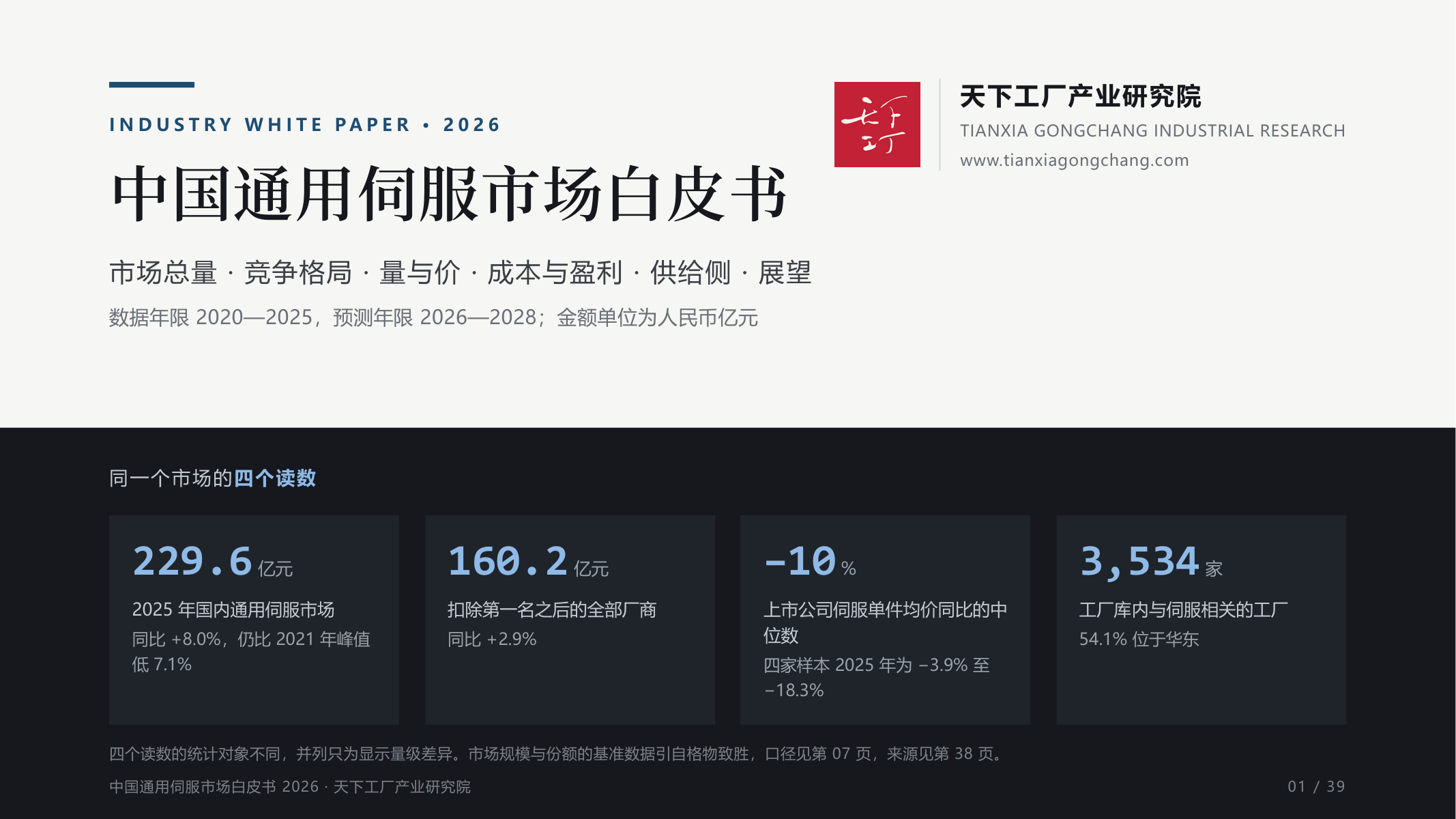

Tianxia Gongchang Industrial Research today releases the China General-Purpose Servo Market White Paper (2026). The report runs to 39 pages with 28 original charts, in ten parts: definitions and scope, market size and structure, downstream industries, competitive landscape, sales channels, cost and profitability, the supply side, servo outside the statistical scope, adjacent-market comparison, and outlook.
A servo system consists of a servo drive, a servo motor and an encoder. It is the actuating component that gives machine tools, industrial robots, electronics manufacturing equipment, and lithium-battery and photovoltaic equipment their precise positioning. In 2025, China's general-purpose servo market reached RMB 22.96 billion, up 8.0% year on year, and domestic brands' share reached 60%.
These two figures are often summarised as "a strong recovery" and "domestic brands past the halfway mark". What this report does is take the two readings apart: which industries the growth came from and which vendors it went to, how shipments and unit prices each moved beneath the revenue figure, and in which industries the domestic share is already high and in which it is still low.
Below are the six conclusions we consider most worth reading first. The full report can be downloaded at the end of this article.
1. After 8.0% growth, the market is still 7.1% below 2021
The general-purpose servo market reached RMB 24.72 billion in 2021, up 31.8% that year. It then contracted for three consecutive years: −3.2% in 2022, −6.0% in 2023 and −5.5% in 2024, a cumulative decline of RMB 3.46 billion. In 2025 it recovered to RMB 22.96 billion, regaining RMB 1.70 billion of that, or about half.
On the baseline forecast of 3.0%, 3.5% and 4.0% growth in successive years, the market will not exceed its 2021 level until 2028, and even then by only 3.0%, a seven-year compound growth rate of 0.4%.
The three-year contraction was not synchronous across downstream industries. The baseline data gives the servo market for the machine tool industry separately, which allows the market to be split in two: from 2021 to 2024, servo demand from machine tools fell only 1.4%, while all other industries fell 16.4%. The contraction occurred almost entirely in downstream industries other than machine tools, such as electronics manufacturing, textiles, packaging and photovoltaics. Machine tools' share of the total market rose from 15.8% to 18.7%, and it is now the largest downstream industry.
2. Three-quarters of the increment came from three industries, and three-quarters went to one vendor
The baseline data gives the 2025 share and year-on-year growth of thirteen downstream industries. Using "share × total ÷ (1 + growth)", each industry's 2024 size can be back-calculated; the back-calculated values sum to RMB 21.28 billion, 0.09% away from the published RMB 21.26 billion, so the back-calculation holds.
The result: robotics (+30%), machine tools (+12%) and electronics manufacturing (+10%) together account for 43.6% of the market and contributed 77.8% of the increment. Robotics alone, with a 10.2% share, contributed 32.1% of the increment. The remaining ten industries account for 56.4% of the market but contributed only 22.2%; building-materials machinery, textile machinery and printing machinery are still contracting.
The robotics reading can be checked against data from the National Bureau of Statistics: industrial robot output in 2025 was 773,000 units, up 28.0% year on year, 2 percentage points away from the baseline data's +30%.
Attributed by vendor, the concentration is higher still. The baseline data discloses brand shares across three tables; we used "share within group × group share" to reconstruct the whole-market shares of sixteen vendors, and the reconstruction matches in every case a separate table in the original report that gives only revenue bands. Inovance's general-purpose servo business in 2025 was about RMB 6.94 billion, a 30.2% share, up 22% year on year, an increment of about RMB 1.25 billion, or 73.6% of the whole market's increment.
Excluding Inovance, all other vendors combined grew 2.9% in 2025; the small and mid-sized vendors not individually named declined 4% in aggregate. The same +8.0% corresponds to three very different situations.
This reconstruction can be verified against listed-company disclosures. The Inovance servo sales series back-calculated from the baseline data is RMB 5.06, 6.09, 5.68 and 6.94 billion (2022 to 2025); the figures disclosed in Inovance's annual reports are RMB 4.989 billion, about 6.0 billion, about 5.6 billion and about 6.85 billion. The difference is stable at 1.4% across all four years.
The market's Herfindahl–Hirschman Index is about 1,185, of which 77.5% comes from Inovance alone; the second- to sixth-ranked vendors hold shares of 6.1% to 7.4%, no more than 1.4 percentage points apart. For comparison, we previously measured the HHI of China's low-voltage electrical apparatus market at about 471.
3. Shipments are growing faster than revenue, and unit prices are still falling
Market size is measured in value, which combines shipments and unit price in a single figure. The production-and-sales tables in listed companies' annual reports allow the two to be separated: dividing the revenue of a servo-related segment by its unit sales gives an average unit price.
In 2025, all five companies — Xinje Electric, VEICHI Electric, Sine Electric, Kinco and HCFA — without exception saw unit sales grow faster than revenue. For the first four, the average unit price changed by −10.0%, −9.9%, −18.3% and −3.9% year on year respectively.
HCFA is the most typical case: its 2025 servo unit sales were 1.9361 million units, 26.5% higher than in 2022; its 2025 servo revenue was RMB 744 million, lower than the RMB 758 million of 2022; over the same period its servo gross margin fell from 29.47% to 24.90%.
The decline in average price has two components: price cuts on like-for-like models, and a shift in product mix towards lower power and economy models. Annual report data cannot separate the two. But the direction is clear: in value terms, the 2025 market is 7.1% below 2021; in shipment terms, it has very probably already exceeded 2021. The gap between the two is unit price.
Falling unit prices show up directly in profitability. The gross margins of seven listed companies' servo-related segments differed by 21.5 percentage points between highest and lowest in 2021; by 2025 the gap had narrowed to 9.0 percentage points, all falling between 24.7% and 33.6%. In companies that sell several product lines, servo is the lowest-margin major product in every case: Xinje Electric's drive systems 25.90% versus PLCs 57.05%; Leadshine's servo systems 28.09% versus control technology products 64.97%.
4. Machine tools: the largest downstream industry, and the major one with the lowest domestic share
Across the whole market, domestic brands hold 60%, Japanese brands 26%, and European and American brands 14%. The structure in machine tools is the reverse: domestic 39.4%, Japanese and Korean 43.3%, European and American 17.3%.
Dividing Inovance's downstream distribution by each industry's servo market size gives its penetration in each industry: lithium batteries 53.1%, photovoltaics 49.6%, textile machinery 39.2%, electronics manufacturing 30.9%, and machine tools only 14.6%. The two industries where Inovance's penetration is highest together total only RMB 3.10 billion, and it already holds half of them; the major industry where its penetration is lowest is machine tools, at RMB 4.3 billion.
The Japanese brands are in the opposite position. Yaskawa's share in machine tools is 12.3%, close to twice its whole-market share of 6.2%, and 36.9% of its general-purpose servo business in China comes from machine tools.
Converting the three groups' shares into absolute values also reveals facts that the share table does not show: from 2022 to 2024 the market shrank by RMB 3.46 billion, Japanese brands shrank by RMB 3.94 billion, and domestic brands grew by a net RMB 1.24 billion — the bulk of domestic substitution took place while the market was contracting. And in 2025 the Japanese brands' sales stopped falling (RMB 5.95 billion to RMB 5.97 billion). Yaskawa Electric's financial results materials offer corroboration: its revenue in China was ¥113.1 billion in fiscal 2024 and ¥116.1 billion in fiscal 2025, up 2.6%.
Japanese brands have little share left to lose in industries such as 3C electronics, lithium batteries and photovoltaics; their remaining business is concentrated in machine tools, robotics and semiconductor equipment, the industries with the highest requirements for precision and reliability. The next phase of substitution will take place mainly in these industries, where it has to be validated model by model on installed machine platforms, a longer cycle than the previous phase.
This phase is also tied to the control layer. On Frost & Sullivan's figures, the 2025 localisation rate was 55.2% for general-purpose servo, 43.5% for low-voltage AC drives, 37.1% for small PLCs and 18.7% for medium and large PLCs. The control layer of a machine tool is the CNC system, and a further 38% of servo in the machine tool industry is made by CNC system vendors for their own use, outside the statistical scope of general-purpose servo.
5. 3,534 factories: supply is more concentrated than demand
The discussion so far has been about brands. Looking at manufacturing from another angle: in the Tianxia Gongchang factory database, 3,534 factories have main products, business scope or company names related to servo. Of these, 39.8% engage in foreign trade, and 174 are national-level "Little Giant" specialised and sophisticated enterprises.
Grouped by the seven regions used in the baseline data, 54.1% of these factories are in East China, whereas East China's share on the demand side is 32%, a gap of 22 percentage points. Central China and North China together account for 30% of demand but only 14.9% of factories. Servo products are small and high in value density, so shipping distance is not a constraint; the concentration of supply is determined by the supporting industrial base.
Different links in the chain have different geographic centres. The leading province for servo motors is Zhejiang (210 factories), with Ningbo, Hangzhou, Taizhou and Wenzhou together accounting for 165; the leading province for servo drives, motion controllers and encoders alike is Guangdong, and Shenzhen alone has 18% of the country's servo drive factories; system integration and supporting machining are concentrated in Suzhou, Wuxi and Changzhou.
There are only sixteen named servo brands; behind them stands a manufacturing and supporting base of 868 servo motor factories and 294 servo drive factories.
6. Leading readings for 2026 are stronger than the baseline forecast
The baseline forecast is for 3.0% growth in 2026. We compiled eight leading indicators that are publicly available and updated monthly or quarterly. Readings as of September 2026:
- Industrial robot output: up 29.0% year on year for January to August 2026, and up 34.6% in August alone (National Bureau of Statistics)
- New orders for metal-cutting machine tools: up 20.5% year on year in the first half of 2026 (China Machine Tool & Tool Builders' Association)
- OEM-type automation market: up 8% year on year in the first half of 2026, with the project-type market down 2% (MIR, as cited in Inovance's interim report)
- Inovance's servo system sales revenue: about RMB 4.8 billion in the first half of 2026, up about 30% year on year
- Japanese vendors' orders from China: Yaskawa up 19% for March to May 2026, FANUC up 50.9% for April to June, and Japanese machine tool orders from China up 55.8% cumulatively for January to July
- Praseodymium-neodymium oxide spot price: RMB 729,000 per tonne on 16 September 2026, about 49% above the 2025 average
The demand-side readings are all stronger than the level implied by the baseline forecast, and foreign vendors' orders from China are accelerating as well; on the cost side, prices of the rare earths used in servo motor magnets have risen markedly. On our estimate, a 50% rise in magnet prices affects servo segment gross margin by about 0.6 to 2.0 percentage points, less than one year's decline in unit price.
It should be noted that the two institutions' past one-year-ahead forecasts have deviated from actual values by 3 to 10 percentage points. The report therefore uses three scenarios rather than a point forecast: RMB 26.86 billion in 2028 under the optimistic scenario and RMB 23.15 billion under the pessimistic scenario.
What else the report contains
- A bridge between three editions from the same institution: the 2025 edition revised the entire 2020–2023 historical series upward by about 10.4%, with each year's growth rate unchanged; splicing across editions would turn a two-year change of +2.1% into +12.7%
- A side-by-side comparison with MIR and Frost & Sullivan: the two institutions' readings of 2025 market size differ by less than 3%, and the three institutions' readings of Inovance's share range from 30.2% to 30.9%
- Channel structure: 79% of general-purpose servo ends up installed in OEM equipment makers' machines; about half of domestic brands' sales come from direct sales
- Two forms of going overseas: the larger contribution at present comes from servo exported inside domestically made equipment; every company that discloses domestic and overseas gross margins reports overseas margins 9 to 16 percentage points higher
- Servo outside the statistical scope: CNC-bundled servo, humanoid robot joints, direct-drive systems, and the current state of servo-related national standards
- Ten closure tests on the baseline data, all formulas and assumptions behind our own estimates, and ten matters not yet resolved
Download the report
The full China General-Purpose Servo Market White Paper (2026) is 39 pages, in PDF format, about 4.4 MB. The report is in Chinese.
Download the full report (PDF · 39 pages)
The report may be freely circulated and cited. When citing, please credit "Tianxia Gongchang Industrial Research, China General-Purpose Servo Market White Paper (2026)".
About the data sources
The baseline data in this report for market size, downstream industry structure, brand shares, channel structure and the 2026–2028 forecast is drawn from Beijing Wintelligence Consulting Co., Ltd., 2026 China General-Purpose Servo Product Market White Paper (Shared Edition). MIR and Frost & Sullivan data is cited via the periodic reports of listed companies including Inovance, HCFA, INVT, Xinje Electric and VEICHI Electric, and via the application proof of Inovance's H-share listing. Corporate financial data comes from the annual reports, interim reports and prospectuses of nine listed companies; foreign vendor data comes from the financial results materials of Yaskawa Electric, FANUC and others, and from the Japan Machine Tool Builders' Association's confirmed order reports; macro data comes from the National Bureau of Statistics and the China Machine Tool & Tool Builders' Association. Supply-side data comes from the Tianxia Gongchang factory database.
The incremental research we carried out on the basis of the above data includes: reconstruction of vendor shares and quantification of concentration, two sets of growth attribution (by industry and by vendor), conversion of the three groups' shares into absolute values, penetration by industry, price–volume separation, cost sensitivity and profitability divergence, the bridge between editions, supply-side factory geography, adjacent-market comparison, and three-scenario projections with leading indicators. Every figure estimated by us is marked on the corresponding page of the report, with formulas and assumptions listed in the appendix. Thirty key figures used in the report were additionally re-verified one by one against the original documents through an independent process.
Closing
General-purpose servo is the major industrial automation product with the highest localisation rate, and also one whose unit price is still falling. The substitution of the past five years took place mainly on newly added equipment in emerging industries such as lithium batteries, photovoltaics and 3C electronics; it was fast, and most of it was completed while the market was contracting. The substitution ahead lies in machine tools, robotics and semiconductor equipment, and its pace depends on model-by-model validation on installed machine platforms, and on how far localisation advances in the layer of CNC systems and PLCs.
Tianxia Gongchang Industrial Research draws on the platform's factory data and its tracking of industrial clusters to publish ongoing research on segments of manufacturing. The platform covers 4.8 million Chinese factories, 1,965 industry sub-categories and more than 1,000 industrial clusters. This report is the first in the industrial automation series; the China Low-Voltage Electrical Apparatus Market White Paper (2026) was published earlier.