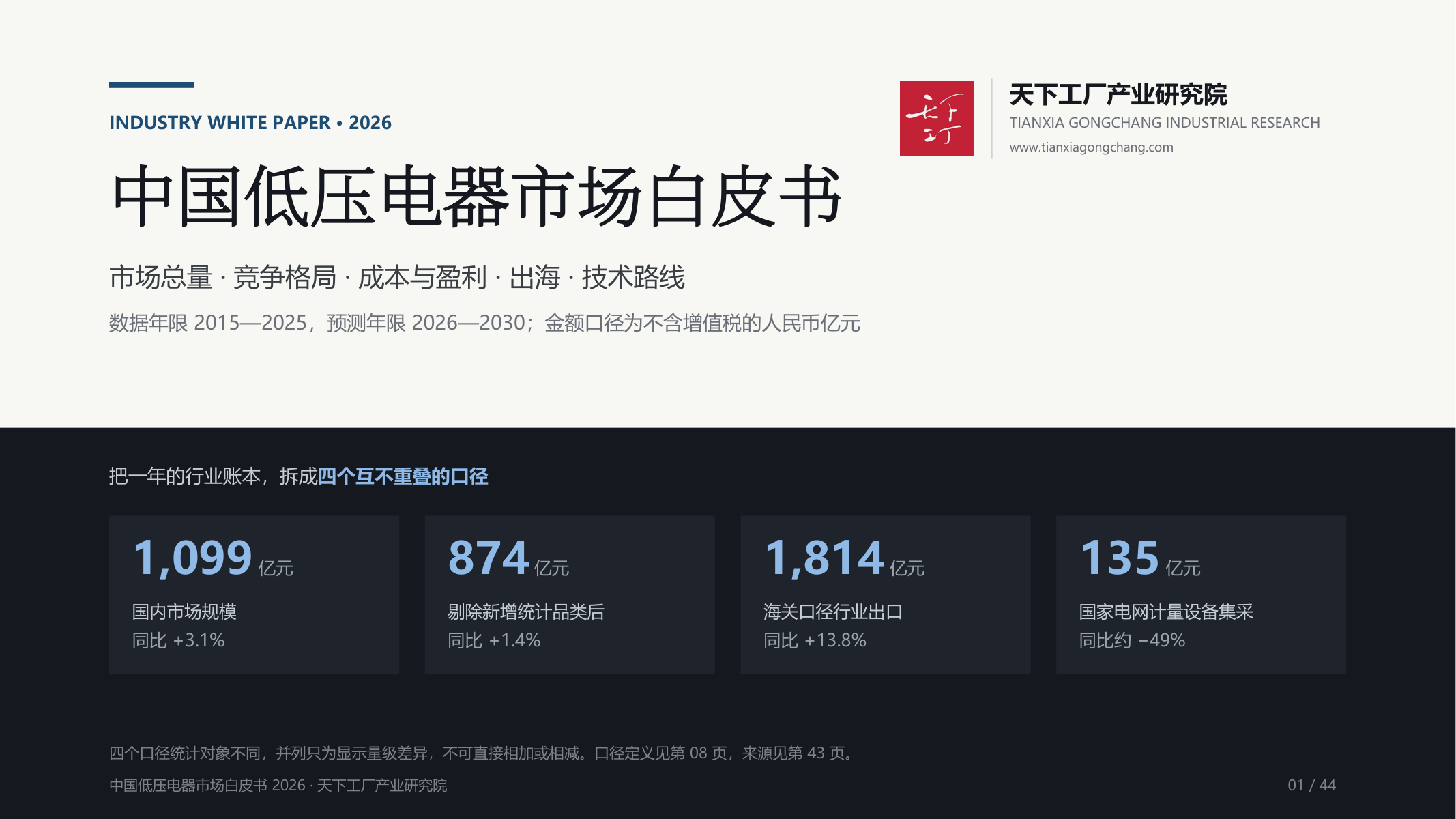

Tianxia Gongchang Industrial Research today releases the China Low-Voltage Switchgear Market White Paper (2026) — 44 pages with 16 original charts, covering nine parts: total market size, competitive landscape, cost and profitability, the supply-side industrial clusters, international markets and overseas expansion, an adjacent-market comparison, technology roadmaps, and a three-scenario outlook.
Low-voltage switchgear is an easy industry to underrate. Unit prices are low, technical barriers are not especially high, and it rarely makes industry headlines — yet it is an unavoidable layer behind every factory building, every distribution cabinet, every substation and every solar panel. In 2025, China's domestic low-voltage switchgear market was RMB 109.9 billion.
The starting point of this report is that the same industry, measured on different bases, yields completely different conclusions. We split one year of the industry's books into four non-overlapping measurement bases: a domestic market of RMB 109.9 billion; RMB 87.4 billion once newly added statistical categories are stripped out; RMB 181.4 billion of industry exports on the customs basis; and RMB 13.5 billion of State Grid metering-equipment procurement. The four cover different statistical objects and cannot be added or subtracted, but placed side by side they reveal where this industry actually stands.
Below are the five findings we think should be read first. The full report can be downloaded at the end of this article.
1. Of the 3.1% growth, 64% came from redrawing the lines
China's low-voltage switchgear market grew 3.1% year on year in 2025. That reading includes one expansion of statistical scope: fuses were separated out of terminal devices into their own category; control devices added cam switches, industrial control relays, pushbutton indicators and more; and an entire power-supply device category was added (transformers, voltage stabilisers, reactors, instrument transformers).
Strip out the new categories and restore the previous product basis, and the 2025 figure is RMB 87.4 billion, up 1.4% year on year.
This restoration can be verified exactly: distribution devices 43.50 + terminal devices 25.54 + fuses 4.54 + the carried-over portion of control devices 13.84 = RMB 87.42 billion, precisely matching the RMB 87.4 billion that the previous statistical basis had forecast for 2025.
Of the RMB 3.3 billion nominal increase, carried-over categories contributed only RMB 1.2 billion (36%), while newly included categories contributed RMB 2.1 billion (64%).
Expanding the statistical scope was itself necessary — these products have always existed inside real distribution and control cabinets, and including them gives a more complete picture. What needs aligning is how year-on-year growth is read. On a comparable basis, 2025 was the third consecutive low-growth year: +3% in 2023, +2% in 2024, +1.4% in 2025. The trend is deceleration.
The same holds over ten years. The 2025 edition has restated the entire 2015–2024 series onto the new basis: 2015 stood at RMB 61.5 billion in the previous edition and RMB 74.2 billion in this one. The ten-year compound growth rate therefore splits into two lines — 4.0% on the new scope (74.2 → 109.9) and 3.6% on the scope carried over from the previous edition (61.5 → 87.4). Computing (109.9 − 22.5) ÷ 74.2 to get 1.65% is a common error: it pairs an old-basis numerator with a new-basis denominator.
2. An industry with a Herfindahl index below 500
We converted the 2025 share data into standard concentration measures: CR2 is 25.3%, CR4 is 39.0%, CR12 is 56.4%, and "others" total RMB 40.32 billion, or 36.7%. The Herfindahl index is approximately 471.
Under the thresholds in the U.S. Department of Justice and Federal Trade Commission Horizontal Merger Guidelines, a Herfindahl index below 1,500 marks an unconcentrated market. A reading of 471 means this industry has no price leader in structural terms: no single company's capacity decisions are enough to move market prices.
The share table also contains a tier labelled "RMB 0.5–1.0 billion" whose members are named but not individually quantified: roughly 10 firms totalling RMB 7.53 billion, contributing about 4.7. As for the remaining 36.7%, whether it is assumed to be spread across 500 firms or 5,000, its contribution to the index stays between 0.3 and 2.7 — the tail is long enough that its internal distribution does not affect the concentration measure at all.
That tail has a specific geography. Liushi township in Yueqing, Zhejiang, is home to 17,800 industrial enterprises, of which 731 are above designated size, 128 have annual output value above RMB 100 million, and 6 are listed. The Yueqing electrical cluster is the only county-level cluster among the 45 national advanced manufacturing clusters announced by the Ministry of Industry and Information Technology in 2022. In 2025, the top three exporting provinces — Guangdong, Zhejiang and Jiangsu — together accounted for 70.8% of national exports.
The RMB 40.3 billion of "others" is not a fragmented market waiting to be consolidated. It is a capacity pool with complete supporting supply chains, export capability and cost advantages. It will not be consolidated away; it will only be partly cleared out by cost shocks and then grow back.
3. The missing half of the map
Almost every discussion of this industry takes place inside the domestic-market box. Put the customs data alongside it and the picture changes.
In 2025, China's low-voltage switchgear industry exported USD 25.39 billion, up 13.8% year on year, imported USD 12.43 billion, and ran a trade surplus of USD 12.96 billion — all three record highs. Converted at the 2025 full-year average central parity rate, exports come to roughly RMB 181.4 billion, or 1.65 times the size of the domestic market.
The customs basis includes connectors, plugs and sockets and other categories not counted in the domestic basis. We took the five categories comparable with the domestic basis — switches, relays, automatic circuit breakers, other circuit-protection devices and fuses — totalling USD 8.53 billion, or about RMB 60.9 billion, equivalent to 55.4% of the domestic market.
Domestic growth was 3.1%; export growth was 13.8%. In 2025, this industry's growth happened mainly at customs.
But the shape of those exports matters. Chinese brands' overseas business totalled RMB 12.27 billion, only 20.1% of exports on the comparable basis and 6.8% on the full customs basis. The remaining 80% is spread across thousands of small and mid-sized exporters and trading companies with no brand of their own. The largest export destination is Hong Kong, China (USD 3.98 billion, 15.7%), which is essentially entrepôt trade; the second is Vietnam (USD 2.54 billion, +41.6%).
China is the world's largest source of low-voltage switchgear exports, and also one of the least branded major export categories.
4. The most important cost variable of 2025 was silver
The most important development in this industry last year was not on the demand side.
According to the China Chamber of Commerce for Import and Export of Machinery and Electronic Products, copper prices rose 34.3% over 2025, while silver prices rose by close to 148%.
Silver is not an auxiliary material in low-voltage switchgear; it is a functional one. The moving and fixed contacts of circuit breakers, contactors and relays rely on silver-based electrical contact materials (silver cadmium oxide, silver tin oxide, silver nickel), known in the trade as the "heart" of low-voltage switchgear. There is no equivalent substitute: copper-based contacts oxidise and erode, and can only be used in auxiliary circuits with undemanding conductivity requirements. China's electrical contact materials industry has consumed more than 2,000 tonnes of silver a year since 2019.
On an order-of-magnitude basis (assuming low-voltage switchgear accounts for 55% of the industry's silver consumption and that silver content per unit is unchanged), silver alone added roughly RMB 4.3 billion to industry costs in 2025 — 1.3 times the RMB 3.3 billion increase in the industry's revenue that year. The entire industry's incremental sales for the year were not enough to cover its incremental silver purchases.
With a Herfindahl index of around 471, that cost cannot be passed downstream. The evidence is in the annual reports: Chint Electric's low-voltage switchgear segment grew revenue 4.76% in 2025 while its gross margin fell from 29.99% to 28.62%; Nader's revenue rose 5.82% while net profit attributable to shareholders fell 15.03%; Hongfa's revenue rose 21.98% while net profit rose only 7.76%.
Within the same industry, net margins differ by a factor of forty: Bull Group 25.40%, Xi'an Sinofuse 18.65%, Hongfa 10.22%, Nader 5.91%, Zhongyeda 1.74%, Taiyong Changzheng −0.64%.
5. The mirror next door: smart meters
Electricity meters are not low-voltage switchgear, but they share the same customers, the same installation location, the same upstream components and the same grid budget. They are the best control group for testing this industry's policy narrative.
The first comparison concerns budget. State Grid's centralised procurement of "marketing project metering equipment" awarded RMB 24.888 billion in 2024 and RMB 13.504 billion in 2025. Over the same period, power supply bureaus nationwide bought only RMB 6.1 billion of low-voltage switchgear. State Grid alone spends two to four times as much on meters and collection terminals as every power supply bureau in the country spends on low-voltage switchgear.
This explains a claim that is often cited but rarely quantified. In 2025 State Grid completed more than RMB 650 billion of fixed-asset investment and China Southern Power Grid planned RMB 175 billion, RMB 825 billion combined — of which low-voltage switchgear captured only RMB 6.1 billion, a transmission coefficient of 0.74%. Extrapolating at the same coefficient, the RMB 5 trillion of combined grid investment in the 15th Five-Year Plan implies an annual boost to low-voltage switchgear of about 0.24 percentage points.
The second comparison concerns brands. China exported USD 1.39 billion of electricity meters in 2025, only 5.5% of low-voltage switchgear exports. Yet Hexing Electrical derives 67.44% of revenue from overseas at a 38.32% gross margin; Wasion Holdings' overseas revenue was RMB 3.0 billion at an overall gross margin of 35.7%; Holley Technology's smart metering business carries a 44.62% gross margin; and Sanxing Medical has ranked first worldwide in smart meter shipments for six consecutive years.
The difference comes from standards. Electricity meters must comply with the IEC 62052 / 62053 series and the OIML IR46 requirements; exporting to Africa requires passing the STS prepayment system; and entering any overseas utility requires type testing and admission to a multi-year framework. Certification cycles are long, but once a supplier is in, the orders are exclusive and long-term, and cannot be replaced by white-labelling. Low-voltage switchgear certification is product-level, does not bind customer relationships, and any qualified factory can manufacture for an overseas brand.
Certification and standards are not a cost item; they are the vehicle for brand premium.
What else the report covers
Beyond the above, the white paper also covers:
- Product quadrant analysis — the fastest-growing categories add up to only RMB 20.5 billion, while the largest category grows only slightly faster than the overall market
- A structural growth endowment model — multiplying each company's industry exposure by sector growth rates to derive the passive growth rate of ten major players, holding share constant
- A decomposition of the construction segment into floor area and value per square metre, plus a 2030 sensitivity table against completed floor area
- A bottom-up estimate of AIDC data-centre-related low-voltage switchgear, and what it would take for it to carry the growth narrative
- Channel economics: the largest electrical distributor in the industry is left with a 1.74% net margin
- A size correction for the DC market and solid-state circuit breakers
- Three scenarios for 2030, plus eight leading indicators obtainable quarterly from public sources
Report download
The full China Low-Voltage Switchgear Market White Paper (2026) runs to 44 pages in PDF, about 0.9 MB.
Download the full report (PDF, 44 pages)
The report may be freely circulated and quoted. When citing, please credit "Tianxia Gongchang Industrial Research, China Low-Voltage Switchgear Market White Paper (2026)".
On data sources
The baseline data for market size, segment structure and company shares in this report is drawn from Wintelligence's China Low-Voltage Switchgear Market White Paper 2026 (guided by the China Electrical Equipment Industry Association). Trade data comes from the General Administration of Customs and the Low-Voltage Switchgear Branch of the China Chamber of Commerce for Import and Export of Machinery and Electronic Products; macroeconomic data from the National Bureau of Statistics and the National Energy Administration; grid procurement data from State Grid award announcements and China Southern Power Grid tender notices; and company financials from the 2025 annual reports of the listed companies concerned.
The incremental research conducted by this institute on top of that data includes: growth attribution decomposition, volume-price separation, concentration quantification, the structural growth endowment model, raw-material cost sensitivity analysis, the comparison between the customs basis and the domestic basis, the adjacent-market comparison, and the three-scenario projection and leading-indicator framework. Every figure derived by this institute is labelled with its assumptions and limitations on the corresponding page of the report.
Closing
Low-voltage switchgear is an industry that hides its own value. It supplies the world, ranks first globally in export scale, and its industrial clusters achieve a supporting efficiency rarely matched anywhere — yet it records only two tenths of the brand value on its own books, and could not organise a single price increase when costs rose.
This is not a question that a market-size forecast can answer. It depends on whether this industry is willing to build the kind of products that must be certified in its own name and cannot be substituted by anyone else. With standards on the AC side already settled, that opportunity now lies in DC, energy storage and data-centre high-voltage DC, where the standards have yet to harden.
Tianxia Gongchang Industrial Research draws on the platform's factory data and industrial-cluster tracking to publish ongoing research on manufacturing sub-sectors. We have looked at 4.8 million Chinese factories, 1,965 sub-industry categories and more than 1,000 industrial clusters. Low-voltage switchgear is one sample among them, and we will keep watching it.