
Abstract
Automotive parts is one of the largest and most complex sub-sectors in manufacturing. In 2025, China's automotive parts market reached approximately RMB 5 trillion in scale, standing at the crossroads of two historic inflections: the new energy vehicle (NEV) penetration rate surpassed 44.3% in H1 2025, mega die-casting machine tonnage escalated from 5,000 to 9,000+ tonnes, and three new tracks — brake-by-wire, air suspension, and intelligent cockpit — entered simultaneous volume ramp-ups. Robot actuators debuted as a second growth curve on the income statements of major OEMs' Tier-1 suppliers. Meanwhile, combined revenues of the global top-10 automotive parts suppliers were broadly under pressure in 2025: Bosch's EBIT margin fell below 2%, ZF recorded a net loss of EUR 2.1 billion — the impact of traditional ICE value-chain restructuring and the share-capture by Chinese domestic suppliers create the most salient industrial narrative of this era.
This report uses June 2026 as its observation date, drawing on FY2025 annual reports of listed companies, the 2025 Global Top-100 Parts Suppliers ranking, and 2026 Q1 financial reports, to systematically map China's automotive parts market size, supply-chain structure, competitive landscape, sub-sector dynamics, technology evolution, and five-year outlook.
Core conclusions:
- Scale shift: Above the RMB 5 trillion total market, sub-sectors driven by NEV beyond the "big three" (thermal management, integrated die-casting, brake-by-wire, intelligent electronics) are growing at 20–60% year-on-year, significantly outpacing the market average.
- Competitive shift: The Global Top-100's combined 2025 revenue fell 3.5% year-on-year; the entry threshold declined from the peak. Chinese companies reached 15 entries — a historical high; CATL broke into global fifth place at USD 35.2 billion.
- Technology shift: Integrated die-casting scales from 6,000T to 9,000T–12,000T; 800V high-voltage thermal management has become the new standard; EMB (Electro-Mechanical Brake) approaches mass production, with Bethel Automotive targeting first revenue contribution in 2026.
- Leadership shift: Tuopu Group, Sanhua Intelligent Controls, and Yinlun Machinery — the three thermal-management and new-track leaders — recorded 2025 revenues of CNY 29.6 billion, 31.0 billion, and 15.7 billion respectively, maintaining double-digit growth; robot actuators entered the strategic build-out phase as a third growth curve.
Key data snapshot:
| Metric | Value |
|---|---|
| China parts market (2025E) | ~RMB 5 trillion |
| NEV parts market (2025E) | >RMB 2 trillion |
| Global Top-100 combined revenue (2025) | USD 945.3 billion (−3.5%) |
| Chinese companies on Top-100 (2025) | 15 |
| China parts exports (2025E) | >USD 100 billion |
| Thermal management market (global/China, 2025E) | CNY 226.5 bn / CNY 96.8 bn |
| Integrated die-casting market (2025E) | CNY 38.9 billion |
| Air suspension front-fit market (2025E) | ~CNY 24 billion |
| Bosch global automotive revenue (FY2025) | EUR 56 billion |
| Tuopu Group revenue (2025) | CNY 29.6 billion |
| Sanhua net profit (2025) | CNY 4.1 billion |
Report Note
This report is authored by the factory data platforms Industrial Research Institute team, providing systematic reference for automotive parts industry practitioners, OEM supply-chain managers, capital-market investors, and industrial policy researchers.
factory data platforms is a platform focused on the database of real, actively-producing Chinese manufacturing factories, covering 4.8 million verified production entities across 1,965 sub-manufacturing industries, enabling industrial sales professionals to precisely target real factory customers.
Chapter 1 Definitions, Classification, and Full Supply-Chain Overview
1.1 The Nature of Automotive Parts
The automotive parts industry transforms raw materials — metals, polymers, electronic components, optical materials — through stamping, casting, injection molding, welding, and assembly into functional modules that can be mounted directly on an OEM production line. A single passenger vehicle contains approximately 20,000–30,000 individual components; an NEV adds the core powertrain trio (battery, motor, controller) and complex thermal-management circuits on top, expanding the total parts category further. Automotive parts is not a single industry — it is a massive ecosystem spanning five major sub-systems, bridging mechanical engineering and electronics.
The industry is typically segmented by functional location within the vehicle into five main sub-systems:
Powertrain: engine assembly (pistons, crankshafts, cylinder heads), transmission; in NEV architecture this maps to drive motor, motor controller (MCU), and power battery pack.
Chassis: suspension, steering system, braking system, wheels and tyres. With electrification, electronic-control suspension (air suspension / CDC) and brake-by-wire (One-box / EMB) progressively replace hydraulic-mechanical solutions.
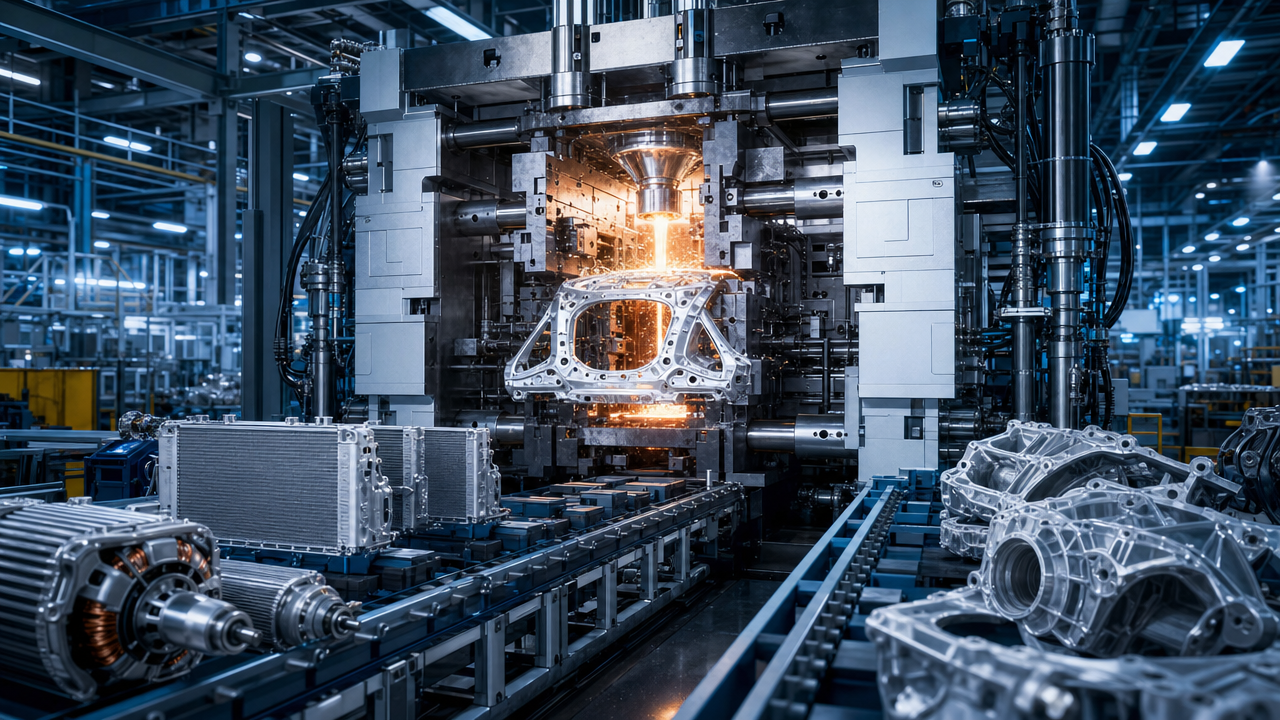
Body: body-in-white stampings, mega-cast body structures, door assemblies, seals, glass, etc. Integrated die-casting technology consolidates traditional multi-piece stamp-weld assemblies into single large castings — one of the most-watched manufacturing process revolutions of 2025.
Interior / Exterior: instrument panel, door trim, seats, carpet, bumpers, front/rear grilles, etc.; HMI upgrade is driving smart cockpit hardware integration.
Electrical / Electronic: ECU / domain controllers, ADAS sensors (LiDAR / mmWave / camera), vehicle lights, wiring harnesses. Smart architecture is evolving toward "centralized domain-control + central supercomputer," rapidly elevating the per-vehicle value of electronics and electrics.
1.2 Four High-Growth NEV-Specific Sub-Systems Beyond the "Big Three"
The traditional "big three" (battery, motor, controller) are now mature tracks. This report focuses on four high-growth sub-systems beyond them:
Thermal management: NEV thermal management requirements far exceed those of ICE vehicles. Both winter battery heating (to prevent lithium plating) and summer battery cooling (to prevent thermal runaway) are needed, along with precise temperature control for the drive motor and controller, while maintaining cabin comfort. Widespread adoption of 800V fast-charging architecture further increases thermal management complexity and per-vehicle value — under an 800V architecture, each charge generates approximately 30% more heat than under 400V, raising specification requirements for electronic expansion valves, cooling plates, and heat pump systems comprehensively.
Integrated die-casting structural components: Super-large die-casting machines (5,000T–12,000T) form vehicle body sections (rear floor, front cabin, center floor) that would otherwise require 80–200 stamped and welded pieces — in a single shot. Parts count decreases by 60–80%, body weight falls 15–30%, and production cycle time compresses by 40%. Tesla pioneered the approach; Chinese brands including Xpeng, NIO, Li Auto, and BYD have all followed.
Steer / brake-by-wire chassis: Includes brake-by-wire (EHB One-box → EMB), steer-by-wire (SBW), and air suspension (CDC + air spring). All three tracks are penetrating from luxury vehicles downward into mainstream price bands below CNY 300,000, with market ceilings continuously moving up.
Smart cockpit and E/E: Central domain control (CDC) + AD-ECU integration trends are driving cockpit hardware upgrades; vehicle display, HUD, ambient lighting, and audio each see per-unit value rapidly rising.
1.3 Full Supply-Chain Overview: Four Tiers
Raw materials (Tier-N): Steel (cold-rolled sheet, AHSS), aluminum alloy (die-cast, forged), rubber, engineering plastics, copper foil, rare-earth permanent magnets. Raw material price volatility directly impacts supplier margins.
Core components (Tier-2 / Tier-3): Chips (MCU, SiC/IGBT power devices), sensors (MEMS, cameras), precision mechanical parts (precision bearings, gears, springs). This tier has the lowest domestic content ratio and remains heavily import-dependent, especially automotive-grade SiC, IGBT, and high-end MCUs.
System assemblies (Tier-1): Bosch, Denso, ZF, Magna, Tuopu Group, Sanhua Intelligent Controls, etc., integrate Tier-2 components into functional modules for direct vehicle assembly — these are the OEM's most direct suppliers.
OEM layer: BYD, Tesla, Volkswagen, Toyota, etc., handle final vehicle integration, brand management, and sales.
Particularly notable: Tuopu Group has explicitly articulated a Tier 0.5 strategy — moving beyond supplying individual components to acting as a system-level partner deeply engaged in vehicle development, raising per-vehicle attachment and customer stickiness. This marks the emergence of Chinese leading parts suppliers breaking through the traditional Tier-1 ceiling.
Chapter 2 Global Landscape: Giants Under Pressure, China Rising
2.1 The 2025 Global Top-100 Ranking: A Structural Inflection
The annual "Global Automotive Supplier 100" published by Automotive News is the industry's most authoritative competitive benchmark. The 2025 edition signals a clear inflection: combined revenue of the Top-100 was USD 945.3 billion, down 3.5% year-on-year, with the entry threshold dropping to USD 1.7 billion.
This is the first meaningful contraction after years of expansion, driven by multiple overlapping factors: slowing global vehicle production growth; structural transition pain in Europe's NEV shift causing traditional Tier-1s to suffer volume and price pressure simultaneously; unfavorable currency impacts (EUR / JPY weakening vs USD) on German and Japanese players; and an industry in the midst of old-to-new energy transition.
Meanwhile, Chinese companies reached a historic high: 15 companies on the list, with CATL breaking into global fifth place at USD 35.2 billion, rewriting the longstanding dominance of German, Japanese, and North American players.
FY2025 Global Top-10 Automotive Suppliers (by revenue):
| Rank | Company | Country | FY2025 Revenue (USD bn) |
|---|---|---|---|
| 1 | Bosch | Germany | 54.4 |
| 2 | Denso | Japan | 47.9 |
| 3 | Magna | Canada | 42.8 |
| 4 | ZF | Germany | 37.3 |
| 5 | CATL | China | 35.2 |
| 6–10 | Hyundai Mobis, Aisin, Lear, Aptiv, Sumitomo | Korea/Japan/USA | — |
2.2 Bosch: The World's #1 Tier-1 in a "Year of Painful Transition"
Bosch FY2025 group revenue reached EUR 91 billion (+4.2% after currency adjustment), with its Mobility Solutions (automotive) business at EUR 56 billion. Yet beneath the headline revenue lies a deep profitability crisis: EBIT margin at approximately 2%, well below 2024's 3.5% and far below the sector's healthy range of 5–8%.
Bosch itself attributed the cause to: electrification structural transition combined with fierce global pricing competition, creating an annual cost gap of approximately EUR 2.5 billion in the Mobility business. In response, Bosch announced an additional reduction of approximately 13,000 employees in 2025 (primarily in Germany), continuing through 2030 — one of the largest headcount reduction plans in Bosch's history.
China became a bright spot amid Bosch's pressure. FY2025 China revenue reached CNY 149.8 billion (+4.9%), driven by rapid expansion of China's domestic NEV sales and Bosch's localized R&D and supply capabilities in China. Bosch employs more than 30,000 people in China; its smart-driving chip solutions developed in China have partially been exported back to global projects.
At the strategic level, Bosch announced a comprehensive restructuring of all business units, requiring each to rank within the top three of its respective sub-segment or face divestiture or shutdown — signaling a transformation from "comprehensive full-range Tier-1" to "focused sub-segment leader."
2.3 ZF: Net Loss of EUR 2.1 Billion on E-Mobility Write-Down
ZF FY2025 revenue was EUR 38.8 billion (down from EUR 41.4 billion in 2024); adjusted EBIT margin improved to 4.5% from 2024's 3.5%. However, net loss reached EUR 2.1 billion due to a one-off impairment on its electrified powertrain division. This write-down reflects a common dilemma for European parts firms: large bets placed in 2021–2023 on pure-electric drivetrain systems failed to generate expected returns as European NEV penetration came in far below forecast.
2.4 Denso and Magna
Denso FY2025: Revenue USD 47.3 billion (−4.12%), with the decline mainly exchange-rate-driven. Denso maintains global leadership in thermal management (vehicle A/C), automotive electronics (ECU manufacturing), and ignition systems, with stable growth from Japanese/Toyota-system OEMs. Denso is actively developing SiC power devices and solid-state battery-related businesses.
Magna FY2025: Revenue USD 42.0 billion (−2%). As the most typical "full-range Tier-1," Magna covers virtually all parts categories from body stamping to seats, mirrors, powertrain, and complete vehicle contract manufacturing (MAGNA Steyr). In the NEV transition, this diversification strategy has created high depreciation burdens, and some traditional businesses (stamped body parts, interior trim) face sluggish growth.
2.5 The Rise Path of Chinese Companies in the Global Rankings
The 15 Chinese companies on the 2025 Top-100 chart reached their positions through different routes:
- CATL (Rank 5): Global EV battery market share exceeds 37%, reaching the first tier through sheer scale.
- Huayu Automotive (600741): SAIC-system comprehensive platform, with 2025 revenue of CNY 184 billion.
- Tuopu Group (601689), Sanhua Intelligent Controls (002050): dual-track thermal management + new tracks, growing significantly faster than industry average.
The rise of Chinese companies follows three typical paradigms: binding to China's leading NEV OEMs (BYD / Tesla Shanghai) to capture NEV electrification incremental demand; global expansion by following Chinese OEMs into Mexico, Southeast Asia, and Europe for local content qualification; and cross-sector positioning in robot actuators and similar new tracks to seed the growth curve for the next five years.
Chapter 3 PEST Analysis: Co-existing Drivers and Constraints
3.1 Political: Dual-Credit Policy and NEV Incentive Framework
China's automotive parts industry cannot be fully understood without its policy context. The overarching policy thrust has remained constant for a decade: accelerate NEV penetration to force simultaneous transformation of both vehicle manufacturing and the parts supply chain.
The Dual-Credit system is the most critical policy lever. The third phase of China's New Energy Vehicle dual-credit policy took effect in 2024–2025, with NEV credit ratio requirements jumping significantly — 2025 requires passenger vehicle manufacturers to achieve NEV credits equal to at least 38% of production, up 10 percentage points from 2024's 28%. This forces OEMs to sell large volumes of BEVs or PHEVs, or face expensive credit purchases or penalties, directly expanding demand for power batteries, thermal management, and electronics parts.
Trade-in and consumption stimulus policies acted as short-term demand-side drivers in 2024–2025. The vehicle trade-in program extended into 2025, with fiscal subsidies directly boosting new-vehicle sales and corresponding parts demand. China's 2025 annual passenger vehicle sales are projected to exceed 26 million units, with NEVs exceeding 50%.
Smart connected vehicle and autonomous driving policy is creating the legal environment for mass market brake-by-wire, smart cockpits, and their associated components. MIIT and the Ministry of Public Security have confirmed L2+ assisted driving vehicles may legally operate on public roads; city NOA (Navigation on Autopilot) accelerated in 2025, directly driving volume ramp-up of Bosch iBooster / Bethel One-box / brake-by-wire systems.
3.2 Economic: Structural Divergence Under Price Wars
China's 2023–2025 persistent automotive price war has profoundly reshaped profit distribution in the parts industry.
- Damaging low-tech-added-value parts: Interior trim, commodity stampings, and standard seals face sustained annual price reduction, with blended margin in some sub-segments already below 10–15%; small-factory attrition accelerates.
- Relative protection for high-technology-barrier categories: Integrated die-casting, air suspension, brake-by-wire, and thermal management — with fewer suppliers and high R&D barriers — see relatively contained annual price pressure; leading suppliers maintain gross margins of 25–35%.
3.3 Social: Consumption Upgrade and Downward Penetration
China's automotive consumption exhibits a distinctive "bipolar + middle-market squeeze" pattern. Air suspension appeared exclusively on luxury vehicles costing CNY 1 million+ in the past; in 2024–2025 it became standard on mainstream NEV flagships from Li Auto L9, Aito M9, and others in the CNY 300,000–500,000 range, and is now appearing on some CNY 200,000–250,000 models. This "specs downward penetration" logic applies to virtually all smart / EV features — LiDAR, HUD, air suspension, brake-by-wire — all moving from "optional" to "standard," which means each feature's market ceiling is multiples of traditional expectations.
3.4 Technology: Four Simultaneous Technology Waves
Integrated die-casting: Press tonnage scaling from 5,000T to 9,000T and beyond 12,000T; "front cabin + rear floor + center floor" tri-section integration as the ultimate form factor; yield rate (currently best-in-class ~92–95%, typical ~85%) is the key cost-competitiveness variable.
800V high-voltage fast charge: Xpeng, Avatr, Zeekr, and others have already launched 800V models; BYD's blade battery is also being upgraded toward 800V. The 800V architecture requires inverters to switch from IGBT to SiC (Silicon Carbide) MOSFET, with comprehensive upgrades to thermal management, motor insulation, etc., upgrading the entire electrical system's value by ~15–20%.
Central domain control + SOA E/E architecture: Traditional vehicles had dozens to hundreds of distributed ECUs; central domain control architecture consolidates them into 3–5 domain controllers, with future evolution toward a single supercomputing platform. Software capability has shifted from an add-on to an entry requirement.
Humanoid robot actuators: Tesla Optimus's accelerating mass-production schedule drove sharp increases in market size expectations for robot joint motors, reducers, screws, and other actuators. Tuopu Group became an Optimus certified supplier (first disclosing robot actuator revenue of CNY 13.59 million in 2025), with Sanhua Intelligent Controls and Zhongding Shares both publicly announcing their robot actuator strategic intentions.
Chapter 4 China Market Scale: Decomposing the RMB 5 Trillion
4.1 Total Scale: ~RMB 5 Trillion in 2025
China's automotive parts market scale measurement varies by statistical scope. This report uses the broad definition: passenger vehicle + commercial vehicle (including NEV) + parts exports combined end-market scale, excluding double-counted upstream raw materials. By this definition, the 2025 full-year scale is approximately RMB 5.0 trillion.
The historical growth path over the past five years is clear:
| Year | Market Scale (CNY bn) | YoY Growth |
|---|---|---|
| 2020 | ~3,700 | — |
| 2021 | ~4,000 | +8.1% |
| 2022 | ~4,150 | +3.8% |
| 2023 | ~4,400 | +6.0% |
| 2024 | ~4,700 | +6.8% |
| 2025E | ~5,000 | +6.4% |
Moderate growth in the 6–8% range — not explosive, but stable expansion driven by structural reshaping rather than commodity-cycle swings.
4.2 Structural Split: OEM vs. Aftermarket
OEM supply market (~65%, ~CNY 3.25 trillion): Direct supply to OEM production lines. Price is OEM-driven with annual price reductions as the norm, but volume certainty is high. The core driver is OEM sales volume and model mix — rising NEV share directly shifts parts composition (battery/thermal/electronics up; ICE-related down).
Aftermarket (~35%, ~CNY 1.75 trillion): Repair and replacement parts. Price negotiating power is more balanced; margins are significantly higher (35–50% vs. 15–30% OEM). As the 2018–2022 vehicle sales cohort enters the high-frequency replacement cycle (3–7 years old), aftermarket volume is expanding rapidly. But BEV vehicles, with fewer friction components (no transmission, no fuel system), have lower replacement frequency, so certain aftermarket categories will see growth below market expectations.
4.3 NEV Parts: Rapidly Rising Share
NEV parts share of total market rose from ~20% in 2022 to ~40% in 2025, with absolute scale approaching RMB 2 trillion — this is the market's most important structural change in 2025.
Growth rate differences are stark:
- High-growth incremental categories (annual +30–60%): Thermal management systems, mega-cast large structural components, brake-by-wire, air suspension, ADAS sensors, SiC power devices
- Stable existing categories (annual +5–15%): Seals, shock absorbers, wheel hub bearings, glass
- Structurally declining categories (annual −5–20%): Traditional engine parts (piston rings, timing chains, exhaust systems), mechanical automatic transmission internals
4.4 Exports: China's Global Automotive Parts Path
China's automotive parts exports maintained strong growth in 2025:
- H1 2025 cumulative exports: USD 47.4 billion
- Full-year estimate: >USD 100 billion (approximately CNY 720 billion)
Major destination markets: USA, EU, ASEAN, Russia, Mexico. Russia-directed exports surged on geopolitical tailwinds, offsetting the drag from US/European restrictions on certain categories.
Ningbo is China's largest parts export port by volume. Estimated full-year 2025 Ningbo automotive parts exports exceed CNY 30 billion — approximately 4–5% of the national total.
Chapter 5 Supply-Chain Decomposition: Five High-Growth Sub-Sector Deep Dives
5.1 Thermal Management: The Largest "Hidden Track" in NEV
If the power battery is the NEV's "heart," the thermal management system is its "circulatory system." A BEV must simultaneously manage five heat sources: ① battery pack (both winter heating and summer cooling); ② drive motor; ③ motor controller (inverter); ④ passenger cabin; ⑤ OBC and DC/DC converter. The 800V architecture generates ~30% more heat per charge than 400V, demanding larger capacity and higher precision across the entire thermal management system.
Key components and value distribution:
- Electronic expansion valve (EXV): Controls refrigerant flow; a BEV uses 5–8 per vehicle at CNY 80–200 each. Sanhua Intelligent Controls holds >58% global share — unrivaled global leader.
- Battery cooling plate (Chiller): Aluminum coolant plate in direct contact with the battery pack; per-vehicle value CNY 600–1,500. Supplied by Yinlun Machinery, Sanhua, Tuopu Group.
- Heat pump system: Reduces winter battery heating energy consumption by 30–40%; key for extending winter range.
- Electronic water pump: Replaces mechanical pumps for precise coolant flow control.
Market scale: 2025 global NEV thermal management ~CNY 226.5 billion; China ~CNY 96.8 billion, more than doubling from 2022. 2025–2030 CAGR projected ~18%.
5.2 Integrated Die-Casting: Manufacturing Revolution and Its Limits
Integrated die-casting uses machines of 5,000T+ to form, in a single shot, vehicle body sections that would traditionally require 80–200 stamped and welded pieces. Weight reduction 15–30%, production cycle compressed 30–40%, parts count reduced 60–80%.
Technical ladder and tonnage evolution:
| Tonnage | Application | Representative OEM |
|---|---|---|
| 5,000–6,000T | Rear floor (single) | Tesla Model Y, Xiaomi SU7 |
| 6,000–9,000T | Rear floor + front cabin | Tesla 4th-gen platform |
| 9,000–12,000T | Front + rear floor + center combined | Xpeng G6 / X9 |
In 2025, more than 20 Chinese OEMs are using integrated die-casting, with 80+ large-scale machines (5,000T+) deployed domestically — more than double 2023 levels.
Market scale: 2025 domestic integrated die-casting ~CNY 38.9 billion; projected >CNY 80 billion by 2028.
5.3 Brake-by-Wire: Volume Countdown from EHB to EMB
EHB (Electro-Hydraulic Brake / One-box): First-generation solution combining vacuum booster and ABS into a single integrated brake actuator using electric motor-driven hydraulic pump. 2025 is an EHB One-box volume ramp year, with rapid adoption in China's NEV market.
EMB (Electro-Mechanical Brake): Completely eliminates hydraulic circuits; each wheel caliper has a dedicated electric actuator. EMB is the ultimate form of brake-by-wire — no hydraulic fluid means 5–8kg weight savings, simpler maintenance, faster response (<10ms), and redundant independent braking channels for L4/L5 autonomous driving.
Bethel Automotive (603596) is the domestic EMB mass-production frontrunner, targeting April 2026 for batch production with 2026 being the first revenue-contributing year; 2025 new program awards totaled 605 items with projected annualized revenue of CNY 9.51 billion (+45.4%).
Market scale: 2025 combined EHB + EMB ~CNY 20 billion; projected >CNY 40 billion by 2028 with EMB launch.
5.4 Air Suspension: Luxury Comfort Reaching the CNY 300K Segment
Air suspension replaces conventional steel springs with air springs, enabling automatic ride-height adjustment and continuously variable stiffness. Traditionally exclusive to Maybach, BMW 7-series, and Mercedes S-class; in 2024–2025 it has become widespread on mainstream NEV flagships from Li Auto, Aito, Zeekr, and NIO in the CNY 300,000–500,000 range.
2025 China front-fit air suspension market: approximately CNY 24 billion, +40%+ year-on-year.
Key domestic suppliers:
- Zhongding Shares (000887): Via acquisitions of WEGU and AMK (Germany), achieved full-system supply capability. 2025 air suspension revenue CNY 11.9 billion (+11.78%); backlog ~CNY 15.8 billion — China's largest air suspension supplier.
- Baolong Technology (603197): 2025 air suspension revenue CNY 1.6 billion (+61%) — fastest-growing new entrant in this track.
5.5 Smart Cockpit and Robot Actuators
Smart cockpit value uplift from three directions: ① large high-resolution center consoles (10–16" AMOLED/mini-LED) at CNY 1,500–3,500 each; ② AR-HUD at CNY 3,000+; ③ Qualcomm SA8295P-based SoC platforms driving overall system value migration upward.
Robot actuators — a joint module integrating electric motor + reducer + torque sensor + encoder — are needed 20–40 per humanoid robot at CNY 1,000–5,000 each. Tuopu Group (Tesla Optimus supplier, 2025 revenue CNY 13.59 million), Sanhua Intelligent Controls (electromechanical actuator tech), and Zhongding Shares ("robot + liquid cooling" dual-track) have all formalized strategic robot actuator positioning, with potential breakthrough to meaningful revenue scale in 2027–2028.
Chapter 6 Key Company Deep Profiles
6.1 Tuopu Group (601689): Multi-Track Full-Stack Pioneer
Tuopu Group is headquartered in Ningbo with products spanning interior NVH parts, chassis systems, shock absorbers, thermal management, and automotive electronics, extending into robot actuators and liquid cooling.
FY2025 Financial Highlights:
| Business Segment | 2025 Revenue (CNY bn) | Notes |
|---|---|---|
| Interior functional parts | 9.67 | Largest segment; NVH insulation, armrests |
| Chassis systems | 8.72 | Lightweight aluminum chassis, sub-frames |
| Shock absorbers | 4.26 | Hydraulic/electronically-controlled dampers |
| Automotive electronics | 2.77 (+52.1%) | IBS brake-by-wire, air suspension ECUs |
| Thermal management | 2.09 | Battery cooling plates, thermal modules |
| Robot actuators | 0.014 (first disclosure) | Tesla Optimus core supplier |
Tier 0.5 strategy: Deep joint development with Tesla Shanghai factory and domestic leading NEV OEMs, achieving higher customer stickiness and rising per-vehicle attachment value.
Liquid cooling: First batch CNY 1.5 billion order disclosed, marking Tuopu's business boundary expansion from automotive to data-center thermal management.
6.2 Sanhua Intelligent Controls (002050): Thermal Management Global Leader
2025 Financial Highlights:
- Revenue: CNY 31.0 billion (+10.97%)
- Net profit: CNY 4.06 billion (+31.10%)
- Refrigeration / A/C components: CNY 18.6 billion (+12.22%), gross margin 28.77%
- Automotive components (thermal management): CNY 12.4 billion (+9.14%), gross margin 28.79%
Sanhua's EXV global share exceeds 58%; domestic NEV thermal management share ~25%. The "refrigeration funds automotive" dual-business structure — CNY 18.6 billion refrigeration business generating stable cash flow that funds automotive thermal management R&D — is an advantage that most competitors cannot replicate.
For robot actuators, Sanhua was in the "technical validation, sample delivery, and small-batch production" phase in 2025; revenue contribution was zero. First batch revenue expected in 2026.
6.3 Yinlun Machinery (002126): Thermal Management No. 2
2025 Financial Highlights:
- Revenue: CNY 15.68 billion (+23.43%)
- Net profit: CNY 957 million (+22.17%)
- Digital & energy thermal management (H1): CNY 692 million (+59.08%), 9.65% share of total revenue
Yinlun secured 193 sets of data-center cooling orders and formed a "3+3+N" customer layout. The second-curve logic: use heat-exchanger expertise to enter server cooling, energy storage thermal management, and low-altitude aviation (drone) cooling.
6.4 Zhongding Shares (000887): Seal-to-Air-Suspension Champion
2025 Financial Highlights:
- Revenue: CNY 19.8 billion (+5.02%)
- Net profit: CNY 1.59 billion (+26.98%)
- Air suspension: CNY 11.9 billion (+11.78%); backlog ~CNY 15.8 billion
Through acquisitions of WEGU, AMK (Germany), and TFH (USA), Zhongding transformed from a rubber seal specialist to a multi-product automotive chassis systems supplier.
6.5 Huayu Automotive Systems (600741): SAIC-System Comprehensive Platform
2025 Financial Highlights:
- Revenue: CNY 184.0 billion (+8.49%)
- Net profit: CNY 7.21 billion (+7.51%)
- Interior/exterior trim: CNY 133.9 billion; functional parts: CNY 29.2 billion
- Non-SAIC customer revenue share: 64.6%
6.6 Wencan Group (603348): Integrated Die-Casting Pioneer's Short-Term Pain
Wencan Group is one of China's earliest systematic integrated die-casting enterprises with first-mover technical advantages. However, 2025 was the most difficult year: revenue ~CNY 5.9 billion (−5.56%), projected net loss CNY 290–400 million (Tianjin Xiongbang factory fire + Mexico ramp-up losses + pre-production CapEx).
Prospective indicator: H1 2025 new program awards in mega-cast exceeded CNY 5 billion in total lifecycle value, with multiple projects scheduled for 2026 production start.
6.7 Bethel Automotive (603596): China's Brake-by-Wire Hope
2025 new program awards: 605 items, projected annualized revenue CNY 9.51 billion (+45.4%). EMB batch production planned for April 2026, with 2026 being the first revenue-contributing year. IMC integrated motion control (braking + steering + suspension tri-axis coordination) has completed winter testing on 10+ vehicle models.
6.8 Baolong Technology (603197): Air Suspension Momentum vs. Profit Headwinds
Revenue CNY 8.75 billion (+24.52%); net profit CNY 213 million (−29.71%) — a classic "revenue growing, profit declining" growth-stage pattern. Air suspension revenue CNY 1.6 billion (+61%); 2026 plans to add 200,000 sets/year capacity.
Chapter 7 China's Automotive Parts Industrial Belts
7.1 Five Major Industrial Belt Regions
Ningbo, Zhejiang (National #1): 5,000+ parts companies, 40+ listed OEMs, ~360 companies with revenue >CNY 100 million. Exports estimated at >CNY 30 billion/year. Tuopu, Junsheng, Jifeng, and Huaxiang Group serve global Tier-1 customers. Tianxia Gongchang covers Ningbo aluminum die-casting factories, rubber seals, thermal exchangers, and automotive interiors comprehensively.
Shanghai and Yangtze River Delta: Huayu Automotive (CNY 184 billion revenue flagship), complete vehicle OEM density (VW, GM, Tesla Lingang, BYD Hefei), and world-class port logistics (Shanghai Port). Shanghai and Suzhou factories span automotive electronics, wiring harnesses, and stampings.
Anhui (New-Energy Rising Star): Hefei hosts BYD Hefei, NIO HQ, VW MEB; Wuhu hosts Zhongding Shares. 2025 Anhui automotive industry output ~CNY 800 billion, >50% NEV-related. Hefei and Wuhu now form a significant NEV parts cluster.
Guangdong / Pearl River Delta: Guangzhou-centered Japanese supplier ecosystem (Denso, Aisin, Toyota Boshoku in-plant), plus Wencan and Guangdong Hongte for die-casting. Deep Shenzhen electronics base supports automotive semiconductor and E/E manufacturing. Guangzhou and Shenzhen span rubber parts to power semiconductors.
Chongqing: Western China's largest automotive manufacturing hub; Changan, Seres (Aito), and their supply chains. Chongqing auto parts and Chengdu auto parts factories are increasingly upgrading toward NEV-oriented parts.
7.2 factory data platforms's Value: Finding Real Factory Customers
For industrial sales professionals sourcing automotive parts suppliers nationwide, factory data platforms provides a database of 4.8 million verified real, actively-producing factories across 1,965 sub-manufacturing industries. Unlike corporate data platforms that index all registered entities, factory data platforms verifies each record against "genuine manufacturing" criteria, eliminating trading companies, agents, and shells. This means sales professionals searching for thermal management suppliers, die-cast component makers, or seal manufacturers in key industrial belts start with a pre-filtered set of genuine production entities — saving significant time versus unvalidated business directories.
Chapter 8 Sub-Sector Spotlights: Seven High-Growth Track Panoramas
8.1 Thermal Management: Three-Tier Competitive Landscape
Tier 1 (Global leader): Sanhua Intelligent Controls — EXV global share >58%, domestic NEV thermal management ~25%.
Tier 2 (Strong specialists): Yinlun Machinery (heat exchanger specialist), Tuopu Group (thermal module assemblies).
Tier 3 (Deep niche): Zhongding Shares (cooling system piping), Weifuhigh Technology (EGR waste heat), Dunan Environment (refrigeration components).
800V-specific thermal management: CO₂ refrigerant (R744) operates at 14–15MPa, requiring full pressure-rating upgrades across all valves and lines; Sanhua has achieved mass-production validation of CO₂ expansion valves.
8.2 Integrated Die-Casting: Who Is Winning the Press Race?
Major die-casting machine OEMs: LK Group (Hong Kong, "Impress" brand), Yizumi (002933), and Haitian Metal are China's three leading mega-press makers; LK dominates the 5,000T–9,000T range. Bühler (Switzerland) is the international benchmark for premium die-casting machines.
Die-casting part supplier rankings: Wencan Group (most advanced mega-cast, global first mover), Guangdong Hongte (BYD ecosystem), Xusheng Group (Tesla supply chain experience), Aikodee (precision small-to-medium cast parts, extending to large).
8.3 EMB Brake-by-Wire: First Mass Production in 2026
Key technical challenges: fail-safe redundancy architecture, low-temperature reliability (−40°C), NVH control. Bethel Automotive leads domestically; Bibost, Tongyv, Gelobster are also competing. Bosch has EMB in mass production internationally and will introduce it to Chinese customers in 2026–2027.
Market scale: 2028 ~CNY 5 billion, 2030 >CNY 20 billion with L3/L4 acceleration.
8.4 Air Suspension: Democratization of the Luxury Feel
Four key components: air spring, air compressor, reservoir, ECU. International incumbents Continental and Wabco/Knorr-Bremse dominate internationally but are losing ground to domestic Chinese alternatives.
Zhongding (CNY 11.9bn, largest), Baolong (CNY 1.6bn, +61%, fastest growing), Kongfu Technology (air spring focused, IPO pending), Continental (international benchmark).
8.5 Smart Cockpit: Larger Screens, More Important Software
Key hardware upgrades: HUD (from CNY 500–800 to CNY 3,000–6,000 for AR-HUD), center console (from 10" LCD to 15–16" OLED), vehicle audio (premium audio reaching CNY 200,000–400,000 range vehicles), ambient lighting (CNY 200–800/vehicle). Leading domestic suppliers: Huayang Group, Desay SV, Junsheng Electronics, Aptiv, Harman (Samsung).
8.6 Robot Actuators: Cross-Sector Opportunity for Automotive Suppliers
Each humanoid robot needs 20–40 actuators at CNY 1,000–5,000 each, total robot actuator value per unit ~CNY 20,000–150,000.
| Company | Approach | 2025 Progress |
|---|---|---|
| Tuopu Group | Tesla Optimus direct program award | CNY 13.59 million revenue (mass production started) |
| Sanhua Intelligent Controls | Electromechanical actuator technology sharing | Small-batch sample stage; 2026 revenue TBD |
| Zhongding Shares | "Robot + liquid cooling" dual tracks | Strategic positioning, product validation ongoing |
8.7 Overseas Factory Construction: The "Tariff Bypass" Strategy
Core rationale: Circumvent US Section 301/232 tariffs (up to 25–40%) and EU anti-subsidy tariffs (up to 35%) by establishing local production capacity, and meet OEM local content requirements (North American USMCA, European localization rules).
Tuopu Group (Mexico), Wencan Group (Mexico), Sanhua (Thailand) represent leading overseas production buildouts. Short-term costs: ramp-up losses and increased management complexity; long-term benefit: true global Tier-1 status, higher entry barriers for competitors.
Chapter 9 Technology Evolution: Six Technology Megatrends Shaping 2025–2030
9.1 Integrated Die-Casting 9000T: Yield, Repairability, Cost Boundaries
Current mass-production best yields: 92–95% at top-tier factories, 85–88% at typical plants. A 1-percentage-point yield difference equals tens of millions of CNY in annual cost divergence. Key improvements: mold temperature uniformity, vacuum-assisted die-casting precision, and cooling-rate control.
Repairability controversy: a minor collision on a mega-cast component often requires full-piece replacement at CNY 100,000–300,000; regulators and consumers have raised concerns. Some OEMs are reintroducing "segmented castings" for certain areas to enable localized repair.
9.2 EMB: Last Technical Miles to Mass Production
Redundancy architecture: four-wheel independent EMB + dual-redundant power supply (12V + 48V backup) + fail-safe mode (diagonal two-wheel braking when one wheel fails). Low-temperature reliability: motor operation at −40°C tested by Bethel in extreme cold regions (Heilongjiang) with favorable results. NVH: gear noise must meet ECE R13 standards.
9.3 CTB/CTC Battery-Body Integration
BYD CTB (e3.0 platform), Tesla CTC — battery pack shell becomes body floor/chassis. Traditional battery-shell suppliers shrink; aluminum extrusion profile and precision weld assembly suppliers benefit. Seals and thermal insulation suppliers (Zhongding Shares, etc.) see increased demand for bottom-protection structural components.
9.4 800V High-Voltage Thermal Management: SiC + New Refrigerants
Refrigerant path: R134a → R1234yf → CO₂ (R744, 14–15MPa working pressure). Power device path: full SiC coverage across inverter, OBC, DC/DC, and heat pump compressor in 800V flagships. BYD, Tesla, Zeekr, Avatr have all confirmed full-domain SiC roadmaps.
SiC full supply chain localization: wafer (Tankeblue, Sicc) → epitaxy → chip design (StarPower, Sanan) → power modules (BYD Semiconductor, StarSiC) — entire chain accelerating domestic substitution, but 2–3 years behind Infineon, Onsemi, and STMicro in yield and reliability validation.
9.5 Flat-Wire Motor + Drive Motor Technology
Flat-wire winding (vs. round-wire): slot fill ratio rises from ~45% to ~65–70%; power density up ~15–20%; copper loss down; high-speed efficiency improved. All major OEM new pure-electric platforms launched in 2025 now standard-specify flat-wire motors.
9.6 Resolver Replacement + Full-Domain SiC
High-precision magnetic encoders (domestic Tamagawa equivalents) are rapidly cutting into resolver (rotary transformer) applications in drive motors and robot joints. Full-domain SiC targeting 2025–2028 rollout across all power units in 800V flagship models.
9.7 Technology Certainty Ranking: 2025–2030
High-certainty trends (probability >85%):
- Integrated die-casting scaling to 9,000T+, market doubling
- 800V architecture becoming standard in CNY 300,000+ NEV models
- Flat-wire motors exceeding 80% share of drive motor market
- Bethel EMB achieving volume production and scaling (2027–2028)
Medium-certainty trends (60–85%):
- Full-domain SiC implementation in 800V flagship models
- Central domain control architecture broadly adopted in CNY 200,000–300,000 range models
- Domestic SiC exceeding 35% share in 800V models (2027)
- CO₂ heat pump forming a differentiated competitive advantage in cold-climate northern markets
Higher-uncertainty variables (30–60%):
- Solid-state battery mass production timing (2030 or later?)
- LiDAR price reaching CNY 500 or below before 2027 for full standardization
- Humanoid robot actuator mass-production pace (>1 million units shipped before 2028?)
Chapter 10 Key Risks: Five Swords of Damocles
10.1 Annual Price Reduction Pressure: Structural Erosion or Cyclical Shock?
Industry OEM ARP norms historically 3–5%; current reality is 8–12% in the most competitive categories. Even 5-percentage-point internal cost savings leave a 3–7ppt gross margin gap. For mid/small Tier-2/Tier-3 suppliers, sustained ARPs mean cash-flow deterioration and capacity contraction.
The "honeymoon protection" period for new tracks (thermal management, air suspension) is ending. Baolong's 2025 air suspension gross margin declining 3.97ppt is the early indicator.
10.2 Customer Concentration Risk: Double-Edged Sword of Big-OEM Dependency
Tesla dependency risk: if Tesla Shanghai output falls or Tesla expands vertical integration in certain parts, Tuopu and Sanhua — as core suppliers — face correlated revenue risk.
BYD vertical integration risk: BYD's ~80% self-manufacturing rate means its external procurement scope is structurally constrained; as self-manufacturing boundary expands, external suppliers in the BYD ecosystem face volume headwinds.
10.3 Integrated Die-Casting Yield and Repairability Risk
Yield gap between 85% and 95% translates to 15–20% unit cost difference at the same scale. Consumer complaints about CNY 100,000–300,000 repair bills may attract regulatory intervention setting mandatory repairability standards.
10.4 Overseas Trade Barriers: Tariff + Non-Tariff Double-Layer
US Section 301 + 232 tariffs reaching 35–40% on some categories. EU anti-subsidy tariffs up to 35.3%. US IRA local-value-content rules effectively requiring North American production for subsidy eligibility. These barriers are making local overseas production a prerequisite for some Chinese suppliers competing for North American NEV OEM programs.
10.5 Price Wars and Sustained Competitive Intensity
China's 2024–2025 EV price war has compressed per-vehicle margins to historic lows. When industry-wide profitability is structurally below the level needed to fund R&D, innovation slowdown and supply-chain fragility may follow. The transition from "price war" to "technology war + brand war" in 2025–2026 — as NEV penetration rate growth decelerates past 50% — would be the inflection point for margin recovery, but this recovery will be structural: only suppliers with high technical differentiation in thermal management, EMB, air suspension, and robot actuators will genuinely benefit.
Chapter 11 2026–2030 Forecast: Structural Quality After Quantity Maturity
11.1 Total Market: Moderate Growth, Sustained Structural Divergence
Base scenario: China automotive parts total market 2025–2030 CAGR ~6–7%, 2030 scale ~CNY 6.5–7 trillion.
Optimistic scenario (NEV penetration above expectations): If 2028 NEV passenger vehicle penetration breaks 70% and humanoid robot parts enter scale production, CAGR could reach 8–9%, 2030 scale reaching CNY 7.5 trillion.
Pessimistic scenario (soft demand + export contraction): Trade barrier escalation + global production slowdown could reduce CAGR to 4–5%, 2030 scale ~CNY 6 trillion.
11.2 Sub-Sector Forecasts (2026–2030)
Thermal management: China market: CNY 96.8 bn (2025E) → CNY 220 bn (2030E), CAGR ~17.8%. CR3 (Sanhua + Yinlun + Tuopu) domestic share: ~40% → ~55%.
Integrated die-casting: CNY 38.9 bn (2025E) → CNY 85 bn (2030E), CAGR ~16.9%.
Brake-by-wire (EHB + EMB): ~CNY 20 bn (2025E) → ~CNY 32 bn (2028E) → ~CNY 50 bn (2030E). EMB penetration rising from <1% to ~20%.
Air suspension: ~CNY 24 bn (2025E) → ~CNY 42 bn (2028E) → ~CNY 55 bn (2030E). Zhongding share: ~50% → ~45% (competition intensifying).
Robot actuators: <CNY 500 mn (2026E) → ~CNY 8 bn (2028E) → ~CNY 50 bn (2030E). High uncertainty — contingent on >300,000–500,000 humanoid robot annual shipments.
11.3 China Parts Export Outlook
2025E: >USD 100 billion. 2030E: >USD 150 billion (CAGR ~8–9%). Key incremental sources: Chinese OEM overseas factories (BYD Europe, Chery Middle East/Southeast Asia), Russia/Middle East Western-parts replacement demand, Mexico/Thailand "China-manufactured" capacity radiation.
11.4 Global Competition Reshaping: China's Advance in the Top-100
2025: 15 seats. 2030E: 22–25 seats. Incremental from: NEV-exclusive parts (thermal, die-casting, brake-by-wire) global share expansion; CATL's global storage/vehicle battery consolidation; Tuopu, Sanhua, Yinlun overseas customer expansion.
11.5 Recent Market Dynamics: H1 2026 Key Signals
- NEV penetration continues climbing: 2026 Jan–Apr NEV passenger vehicle penetration reached ~50–52%, first sustained monthly breach of the 50% historical threshold.
- Tuopu Q1 2026 recovery confirmed: Double-digit revenue growth YoY continued; profitability improved; robot actuator business new partnership disclosed.
- Sanhua Q1 2026 quarterly net profit set new record: ~CNY 1.2 billion, above market expectations; data-center liquid cooling revenue first became visible in quarterly disclosures.
- Bethel EMB mass production confirmed: April 2026 first batch deliveries completed — the most important single event in brake-by-wire in 2026.
- Global Top-100 2026 edition expected: factory data platforms Industrial Research Institute projects Chinese companies will reach 17–19 seats, with Sanhua, Yinlun, and Zhongding as likely new entrants or significant rank-climbers.
Chapter 12 Conclusions: The Leadership Logic in Value-Chain Reshaping
12.1 Core Judgments Confirmed
This report's core narrative is fully supported by twelve chapters of analysis: NEV adoption and intelligent driving are reshaping the global automotive parts value chain at a historically unprecedented pace.
"Displacement" is harsher than "substitution": ICE-related parts market contraction is not gradual price erosion but structural demand disappearance — transmission components, engine parts, and fuel injection systems are disappearing from new-vehicle specs at 5–15% per year.
New-track growth speed exceeded industry expectations: Thermal management ~CNY 100 billion, air suspension CNY 24 billion, integrated die-casting CNY 39 billion, brake-by-wire ~CNY 20 billion — five years ago these were CNY 40 billion, 3 billion, 5 billion, and 5 billion respectively. Doubled or even six-fold growth in five years is historically rare structural leaping.
Global competition fundamentals are shifting directionally: Bosch 2% margin, ZF EUR 2.1 billion net loss, Top-100 combined revenue down 3.5% — this is not a cyclical trough but systematic commercial-model repricing. Simultaneously, 15 Chinese Top-100 seats and CATL's global fifth place are quantitative breakthroughs; Tuopu's Tier 0.5 Tesla relationship and Sanhua's 25% global thermal management share are qualitative inflection marks.
Robot actuators will be the decade's most important cross-sector increment: In 2025, Tuopu Group disclosed CNY 13.59 million robot actuator revenue — the number itself is negligible, but the strategic signal is: the intersection of automotive parts manufacturers and the humanoid robot supply chain has crossed from "theoretically feasible" to "appearing on income statements." Around 2030, this intersection could explode into genuine revenue-scale breakthroughs.
12.2 Three Leaders' Core Competitiveness Summary
Tuopu Group: Wide product × deep binding × robot second curve
Broad product line enables system-solution replacement of multiple suppliers, continuously raising per-customer attachment value; deep Tesla binding provides priority program award in each Tesla platform iteration; robot actuator first-mover position in Tesla Optimus will provide high-elasticity growth beyond the automotive core as Optimus volume ramp accelerates. Risk: dispersed new-track build-out simultaneously compresses near-term margins; cash management during old-to-new handoff is the key challenge.
Sanhua Intelligent Controls: Global #1 depth × refrigeration + automotive + robotics tri-resonance
Sanhua's competitive moat is globally elite — 58% EXV global share built from 20 years of technical accumulation and global customer certification, not scale alone. The refrigeration business's stable cash flow (CNY 18.6 billion, 28.7% gross margin) shields automotive thermal management R&D investment — this "refrigeration funds automotive" dual-structure is irreplicable by most competitors. 2025 net profit of CNY 4.06 billion (+31%) validates this model's profit-amplification effect as NEV penetration accelerates.
Yinlun Machinery: Thermal management deep specialist × computing-era new increment
Yinlun's strategy is the simplest: use heat-exchanger expertise as anchor, extend horizontally into digital and energy thermal management (data-center liquid cooling). 2025 digital thermal management H1 +59%, 193 data-center cooling sets secured — this extension is already generating real returns. Compared to Sanhua and Tuopu, Yinlun's cross-sector intensity is lower, risk exposure more controlled — the representative stable-growth archetype.
12.3 Three Unchanging Foundations of This Track
First: China is the world's most important automotive market. China's 2025 passenger vehicle sales exceeded 26 million units (28–30% global share), evolving at the world's fastest pace toward NEV and intelligent driving. Having completed new technology scale-up validation in the world's largest market, Chinese suppliers pitch to overseas customers with "world's largest mass-production reference" — a scale advantage that competitors cannot replicate short-term.
Second: Scale and engineering capability are Chinese suppliers' fundamental advantage. From aluminum castings to rubber seals, from heat exchangers to brake-by-wire systems, Chinese suppliers deliver at competitive prices at equal technical specifications — rooted in complete manufacturing ecosystem, engineer talent, and efficient supply-chain networks. This advantage cannot be replicated quickly.
Third: Automotive and robotics manufacturing infrastructure are highly shared. Over the next decade, humanoid robots' demand for precision mechanical actuators becomes automotive parts' most important "non-automotive" incremental source. Companies that built precision manufacturing, thermal management, and sensor fusion capabilities in the automotive track will enter this new increment at the lowest marginal cost, generating "automotive capability × robot demand" compound returns.
Tianxia Gongchang's database of 4.8 million real, actively-producing factories covers automotive parts as one of the broadest and most representative manufacturing categories. From Ningbo aluminum die-casting factories to Anhui air suspension enterprises, from Shanghai automotive electronics suppliers to Chongqing chassis system factories, this network of factories distributed across national industrial belts is the concrete material embodiment of China's ascendancy to the center of global automotive parts manufacturing. The value chain is being reshaped; the competitive landscape is evolving; but the factories that keep it all running are still open for business.
12.4 Financial Analysis Methodology Note
Prospective indicator: Program award value beats current-period profit
The most important forward-looking indicator in automotive parts is not current-year net profit but program (SOP) award total value and its annualized average. Award value reflects revenue 3–4 years out; current financials reflect programs awarded 3–4 years ago. Bethel's 2025 new program awards of CNY 9.51 billion annualized (+45.4%) carry more predictive weight for 2027–2028 revenue than its 2025 profit figure.
CapEx quality analysis: Three types of CapEx have different strategic value: ① dedicated production lines for new program wins (highest — corresponds to certain future revenue); ② general capacity expansion (medium value, requires continued demand growth); ③ R&D facilities and test centers (slow payback, critical for long-term technical competitiveness).
Gross margin decomposition: Company-level gross margin is a weighted average of multiple business units. Sanhua's 2025 gross margins — refrigeration (28.77%) and automotive (28.79%) — being nearly identical reveals important information: automotive thermal management has reached the profitability quality of a mature business, indicating established pricing power in that track.
Data Sources
Industrial Research Institute of Tianxia Gongchang used the following data sources, with all cited data cross-verified across multiple sources:
Company Annual Reports and Financial Data (FY2025 / Q1 2026)
- Ningbo Tuopu Group FY2025 Annual Report (A-Share announcement, March 2026)
- Sanhua Intelligent Controls FY2025 Annual Report (Securities Times, 2026)
- Yinlun Machinery FY2025 Annual Report (CSRC disclosure, April 2026)
- Anhui Zhongding Sealing Parts FY2025 Annual Report
- Huayu Automotive Systems FY2025 Annual Report (March 2026)
- Baolong Technology FY2025 Annual Report (2026)
- Wencan Group FY2025 Profit Warning and H1 Report (2026)
- Bethel Automotive FY2025 Annual Report Summary (2026)
Industry Research Reports and Institutional Data
- Automotive News 2025 Global Automotive Supplier Top-100
- Lianhe Credit 2025 Automotive Parts Industry Analysis Report
- Qianzhan Industrial Research Institute: 2025 China Automotive Parts Market Demand Analysis
- CAAM Monthly Export Data Reports (Jan–Oct 2025)
- Ningbo MIIT Automotive Industry Cluster Development Plan (2021–2025)
Global OEM Supplier Annual Reports
- ZF Annual Report 2025 (press.zf.com)
- Bosch FY2025 (comprehensive reports from Yicai, 163.com)
- DENSO Corporation Revenue FY2025 (Macrotrends / Statista)
- Magna International FY2025 Form 40-F (SEC filing)
Technical and Industry Media
- Gasgoo, China Automobile, 21st Century Business Herald, D1EV
- Securities Times, Shanghai Metals Market
- Orient Securities, Tonghuashun research report compilations
Key Data Citation Notes
- Tuopu Group 2025 revenue CNY 29.581 billion: Sina Finance, March 23 2026; Gasgoo analysis
- Sanhua Intelligent Controls 2025 revenue CNY 31.012 billion, net profit CNY 4.063 billion: Securities Times stcn.com FY2025 annual report
- Yinlun Machinery 2025 revenue CNY 15.678 billion: Cailian Press cls.cn, April 15 2026
- Zhongding 2025 revenue CNY 19.8 billion, air suspension CNY 11.905 billion: ai-gupiao.com
- Huayu Automotive 2025 revenue CNY 183.999 billion: Sina Finance, March 30 2026
- Baolong 2025 air suspension revenue CNY 1.6 billion (+61%): dfcfw.com research
- Top-100 Bosch USD 54.37 billion: maigoo.com + Tencent News (2025 Global Top-100)
- ZF FY2025 revenue EUR 38.8 billion, net loss EUR 2.1 billion: ZF press release press.zf.com
- Bosch FY2025 revenue EUR 91 billion, China CNY 149.8 billion: Yicai, 163.com
- China NEV penetration H1 2025 44.3%: Qianzhan qianzhan.com
- Parts export 2025 Jan–Jun USD 47.42 billion: Huaon huaon.com
- Integrated die-casting market CNY 38.9 billion: Caixin Securities, Eastmoney consensus estimates
- Thermal management China market CNY 96.75 billion: Multi-broker consensus estimate range