
Every iPhone, the moment you open the box, may have been assembled just three days ago — from the Zhengzhou factory to U.S. Customs, Apple's logistics system compresses this window to the absolute minimum.
But the starting point of those three days is a precision manufacturing chain spanning thousands of kilometers: an aluminum alloy sheet pulled from Kunshan goes through thirty processes at Lens Technology's factory to become an iPhone back cover; lenses ground in Largan Precision's optical workshop meet Sunny Optical's camera module assembly lines in the Pearl River Delta; flexible circuit boards etched in Dongshan Precision's soft-board workshop ultimately coil beside iPhone motherboards, transmitting sound, images, and haptic feedback to your fingertips.
This chain sustains China's most precise manufacturers. Over the past five years, it has also endured the most profound structural shock since its birth — driven by Sino-U.S. rivalry, India's rise, and the arrival of what 2025 has been dubbed "Year One of AI Hardware."
2025 is the pivotal year for understanding this shock.
This year, Luxshare Precision's iPhone assembly share surpassed Foxconn for the first time, making it the world's largest iPhone contract manufacturer. This year, India-made iPhones reached 25% of Apple's global output — from virtually zero three years ago to one-in-four today. This year, Goertek proved, through its exclusive contract for Meta Ray-Ban AI glasses, that consumer electronics foundry can find new growth engines beyond Apple. This year, Huaqin Technology's AI server business transformed from an "experiment" into a full-scale battlefield approaching RMB 80 billion in annual revenue.
This report dissects the logic behind this structural shift: who is winning, who is losing, and who is quietly finding a second track.
From Zhengzhou Foxconn's first workers in 2010, to Luxshare surpassing Foxconn in iPhone assembly share in 2025, to Goertek finding its new position in the AI hardware era through a pair of smart glasses — these are not three isolated stories but three chapters of the same story: how China's manufacturing sector, starting from "being hired by global brands to perform the final assembly step," has step by step extended into precision manufacturing, process accumulation, and AI new product categories, walking a path of industrial upgrading far deeper than anyone anticipated.
At the same time, this path is not smooth. India's 25% share is real. U.S. tariff pressure is real. Customer concentration risk (Ofilm's cautionary tale) is real. The fragility of profit margins (assembly net margin ~3%) is real. Understanding this industry requires simultaneously acknowledging its achievements and its vulnerabilities, in order to make objective rather than emotional judgments about "China Manufacturing 2026–2030."
Tianxia Gongchang, as a B2B information platform covering 4.8 million active factories, offers a unique perspective in this industrial transformation — it can see both the macro-level geographical shift of supply chains and reach each specific precision manufacturing factory. Bridging the macro narrative and micro suppliers is precisely the value this research aims to provide.
I. Definition and Classification: The Industrial Map from Assembly to Precision Manufacturing
1.1 What Is Consumer Electronics Foundry?
The word "foundry" is frequently used in consumer electronics but not always precisely understood. In the broad sense, consumer electronics foundry refers to the business model whereby brand owners outsource product design, manufacturing, or assembly to specialist manufacturers. In the narrow sense, it often refers specifically to final assembly — loading screens, motherboards, cameras, batteries, and structural components into housings, completing the last step from parts to finished products.
However, by 2025, China's consumer electronics foundry industry has long transcended the definition of "assembly shop."
The industry's true map unfolds simultaneously across three axes: customer dimension, product dimension, and process dimension. Along the customer dimension, Apple is the largest, most demanding, and relatively best-paying single customer, around which a unique "Apple chain" ecosystem has formed; Huawei, Xiaomi, Samsung, and other brands each pull their own supply chains with varying technical standards and payment terms. Along the product dimension, smartphones remain the largest category, but laptops, tablets, smartwatches, wireless earphones, VR/AR headsets, AI servers, and AI PCs are continuously expanding this industry's boundaries outward. Along the process dimension, the core processes of foundry have evolved from simple screw assembly to precision structural component CNC machining, SMT (surface mount technology) soldering, optical module assembly, acoustic cavity tuning, metal monolithic forming, and other high-value-added manufacturing processes.
The intersection of these three axes defines the layered structure of this industry today.
Layer 1: Final Assembly & Test (FAAT). The most downstream end of the foundry chain, and the core revenue source of giants like Foxconn (Hon Hai), Luxshare Precision, and BYD Electronics. Final assembly requires large numbers of production line workers, meticulous supply chain coordination capability, and a near-zero-defect quality control system. Apple's iPhone ships approximately 220 million units annually, and assembling each iPhone requires hundreds of processes and on-time delivery of hundreds of types of components. Suppliers accepting this business bear extreme delivery pressure and relatively thin profit margins — but scale itself is the moat.
Layer 2: Precision Structural Components. Including metal housings (aluminum/titanium CNC milling), glass covers, hinges, brackets, and heat dissipation panels. Lens Technology (cover glass) and Zhenyu Intelligent Manufacturing (metal structural components + cooling) operate actively in this space. Starting with iPhone 15 Pro, Apple introduced titanium alloy frames, pushing this process difficulty to new heights — titanium's high hardness, poor thermal conductivity, and severe tool wear make yield control far more challenging than aluminum alloy.
Layer 3: Optical and Acoustic Modules. Camera modules (composed of lenses, image sensors (CMOS), OIS mechanisms, autofocus motors, and other precision components) are deeply cultivated by Sunny Optical and Ofilm. Acoustic modules (speakers, microphones, vibration motors) are the traditional forte of Goertek and AAC Technologies.
Layer 4: SMT and Electronics Manufacturing Services (EMS). SMT involves mounting chips, resistors, capacitors, and other electronic components onto PCBs. Dongshan Precision (through its acquisition of MFLX) is representative in the PCB flexible circuit space; Goertek and Luxshare have also continuously invested in their own SMT lines.
Layer 5: ODM (Original Design Manufacturing). Unlike pure-contract OEM, ODM manufacturers are involved from the product design stage. Huaqin Technology and Longcheer Technology are the mainland China leaders in handset and laptop ODM; Quanta and Compal are the Taiwanese veterans of laptop ODM.
1.2 The "Apple Chain" Specialty
Apple's unique position in consumer electronics foundry stems not just from its scale — Apple's procurement volume is unparalleled in the IT hardware industry — but from Apple's extreme level of precision in supply chain management.
Apple implements rigorous NDA (Non-Disclosure Agreements), multiple rounds of Process Qualification, and annual Business Reviews for suppliers. Any new process must pass Apple's on-site audit by SQE (Supplier Quality Engineers) before entering mass production. Apple tends toward a "Two-Source Strategy," maintaining two suppliers for the same component simultaneously to prevent any single supplier's disruption from halting the entire production line.
This system represents heavy compliance costs for suppliers but also extremely high entry barriers — once inside Apple's ecosystem, it means the technology capability has received the world's most authoritative endorsement, with resulting customer expansion effects that are not to be underestimated.
1.3 New Product Categories Opening Incremental Space
In 2025, the arrival of "Year One of AI Hardware" opens new incremental space for consumer electronics foundry from three directions:
AI Glasses/Smart Glasses: Meta Ray-Ban glasses (Goertek contract manufacturing) experienced a breakout in H2 2024, with annual sales surpassing 2 million units, and Goertek holding a 5-million-unit annual order from Meta in 2025; Huawei's 3.5-million-unit 2026 AR glasses were also contracted to Goertek. This category, growing from zero, is becoming Goertek's most important new growth engine.
AI PC: AI PCs refer to notebooks with built-in NPUs (Neural Processing Units) with performance exceeding 40 TOPS. Qualcomm Snapdragon X Elite, Intel Meteor Lake, and AMD Ryzen AI series chips are driving a replacement cycle for this category. Huaqin Technology had achieved scale production of AI PCs in H1 2025.
AI Servers: The expansion demands of NVIDIA H100/H200 GPU servers and CSP (Amazon, Microsoft, Google, ByteDance, Baidu, Tencent) self-designed ASIC buildouts are driving an explosion in server ODM/contract manufacturing demand. Huaqin Technology's data center business revenue exceeded RMB 40 billion in H1 2025.
These three new product category curves, superimposed on the existing cycle of smartphones, AirPods, and Apple Watch, constitute the "dual-engine" era structure of consumer electronics foundry — the stable base of the Apple chain + the incremental elasticity of AI hardware.
II. Global Competitive Landscape: Taiwanese Giants and Mainland Challengers
2.1 The Four-Polar Global Consumer Electronics Foundry Structure
The global consumer electronics foundry industry has long exhibited a dual-layer structure of "Taiwan defines the rules, mainland China executes at scale," but this structure is undergoing profound restructuring in the 2020s.
Taiwan Pole: Hon Hai/Foxconn, Pegatron, Wistron, Quanta, and Compal together form the core of the Taiwanese EMS/ODM conglomerate. These five companies followed Apple, Dell, and HP into mainland China in the 1990s, building a super-factory network covering Shenzhen, Kunshan, Zhengzhou, and Chengdu.
Mainland Pole: Luxshare Precision, Goertek, Lens Technology, Zhenyu Intelligent Manufacturing, BYD Electronics, and others entered from connectors, acoustic components, cover glass, and other components, gradually extending to modules and final assembly, forming a systematic challenge to Taiwanese giants after 2015.
India Pole: Led by Tata Electronics (which took over Wistron's Indian iPhone factory), India's iPhone capacity has rapidly climbed from less than 5% in 2022 to approximately 25% of global output in 2025, driven by Apple's PLI (Production-Linked Incentive) policy.
Vietnam/Southeast Asia Pole: Samsung built factories in Vietnam as early as 2009, transforming Vietnam into Samsung's largest handset manufacturing base; AirPods production has partially relocated to Vietnam, and iPad production has also started there.
2.2 Hon Hai/Foxconn: The Empire at the Frontier
Foxconn parent company Hon Hai Precision (TWSE: 2317) recorded consolidated revenue of approximately NT$ 7.6 trillion (approximately RMB 1.7 trillion) in FY2025, making it the world's largest electronics contract manufacturing enterprise by revenue. In 2025, Foxconn's strategic acceleration in India is the most noteworthy main storyline. Foxconn's India FY25 revenue exceeded $20 billion, nearly doubling year-over-year, with headcount growing to approximately 80,000 employees. Foxconn has committed to investing $2.8 billion to build its second-largest overseas factory near Devanahalli in Bangalore, expected to create 40,000 jobs.
2.3 The Key Judgment on Landscape Evolution
Three core logics summarize the evolution of the global consumer electronics foundry landscape in 2025:
First, "Apple share" is becoming dispersed. iPhone final assembly has evolved from "Foxconn dominance" to "Foxconn 55% + Luxshare 35% + Pegatron 10%" — a three-way equilibrium. Apple disperses assembly capability to reduce supply chain risk.
Second, the China + India + Vietnam geographic triangle is taking shape. Apple has essentially established a triangular supply chain of China (main production) + India (US market dedicated capacity) + Vietnam (AirPods, some iPad capacity). Further evolution of this structure will be the main industry story of 2026–2028.
Third, AI hardware redefines the value hierarchy of foundry. Quanta's margin improvement in AI servers and Huaqin Technology's data center business explosion show that the per-unit added value of AI hardware foundry far exceeds traditional consumer electronics, and whoever can capture the AI hardware foundry position first is likely to achieve valuation re-pricing in the next industry cycle.
III. PEST Analysis: Four External Forces Reshaping the Industrial Landscape
3.1 Politics: Sino-U.S. Gaming and Long-term Tariff Pressure
Since the 2018 Sino-U.S. trade friction, U.S. tariff policy has always been the largest external risk hanging over China's consumer electronics foundry industry. The Trump administration's second term launched a new round of tariff escalation in 2025, with some Chinese-manufactured electronics facing additional tariffs as high as 145%.
The direct impact on China's foundry industry manifests at three levels:
First, "US iPhone" accelerating to exit. Apple officially announced in 2025 that for iPhones sold in the US market, it would prioritize shipping from Indian factories — Apple's direct response to US tariffs. In Q1–Q2 2025, the proportion of US market iPhones from Indian manufacturing jumped from approximately 13% in 2024 to 44%, far exceeding market expectations.
Second, the "country of origin game" keeps Chinese components exempt. Consumer electronics finished goods assembled in India/Vietnam can obtain "Made in India"/"Made in Vietnam" certificates of origin, exempting them from the high tariffs on Chinese goods. However, the precision components inside these products — camera modules, metal structural components, acoustic devices — are overwhelmingly sourced from China. Tariff policy primarily targets the "final assembly" step; China's competitive advantage in mid-stream precision manufacturing cannot be dislodged in the short term.
Third, the divergence between the "decoupling narrative" and "actual interdependence." Apple's 2024 Top 200 supplier list showed that over 80% of suppliers had factories in mainland China, with 51 mainland Chinese companies. The tension between the political narrative of Sino-U.S. trade (decoupling/supply chain disruption) and the industrial reality (deep mutual embeddedness) is the core contradiction for understanding this industry.
3.2 Economy: Super Cycles and Margin Squeeze
The global smartphone shipment volume peaked in 2021 (approximately 1.4 billion units) before experiencing two years of decline, recovering to approximately 1.23 billion units in 2024, and expected to stabilize at 1.2–1.25 billion units in 2025 with the "AI phone" concept driving a minor replacement cycle and infrastructure improvements in several emerging markets.
AI server single-unit added value is far higher — a training server equipped with NVIDIA H100 is priced at approximately $250,000–$400,000, compared to a traditional x86 server at approximately $20,000–$50,000. The added value per AI server through foundry is 5–10 times that of traditional servers.
3.3 Technology: Process Iteration Acceleration and AI Manufacturing Fusion
Titanium alloy machining processes: Apple introduced titanium alloy frames in iPhone 15 Pro, pushing the entire precision structural components track toward titanium alloy CNC machining capability investment. Compared to aluminum alloy, titanium alloy CNC tool life is only about 1/5 that of aluminum alloy machining, processing time is longer, and yield rate is harder to control.
Ultra-thin chassis design (iPhone 17 Air): iPhone 17 Air's 5.6mm thickness sets a new iPhone record for the thinnest, imposing stricter physical constraints on structural components, connectors, and battery thickness, compelling further upgrades in precision machining capability throughout the supply chain.
AI server liquid cooling: AI GPU power consumption from H100's 700W leaping to GB200's 1,000W; traditional air cooling can no longer meet thermal requirements, with data center immersion liquid cooling and direct liquid cooling (DLC) becoming standard. This drives consumer electronics supply chain manufacturing capability extension toward "industrial-grade thermal management systems."
IV. China Market Scale: The RMB 3 Trillion Level and Apple Chain Share Calculation
4.1 Total Scale: Approaching RMB 3 Trillion in 2025
In 2025, the total supply chain revenue of China's consumer electronics foundry (including EMS/ODM/precision components) amounts to approximately RMB 2.8–3.0 trillion. This figure comes from cross-validation of multiple measurement approaches:
Major listed company revenue aggregation:
- Luxshare Precision: RMB 332.3 billion (2025 full year)
- Goertek: RMB 96.6 billion
- Lens Technology: RMB 74.4 billion
- Zhenyu Intelligent Manufacturing: RMB 51.4 billion
- BYD Electronics (handset and assembly business): RMB 155.2 billion
- Wingtech Technology: approximately RMB 50 billion
- Sunny Optical: RMB 43.2 billion
- Huaqin Technology: approximately RMB 200 billion (2025 full year estimate)
- Foxconn mainland China factory contribution: approximately RMB 600–700 billion
The above statistics alone already exceed RMB 2 trillion. Adding the large number of small and medium-sized precision machining factories, SMT contract manufacturers, and second-tier ODM manufacturers, the total industry scale reaching the RMB 3 trillion level is a reasonable estimate.
4.2 Apple Chain Share: Declining from 80%+ to 65–70%
In 2025, approximately 1.55–1.60 billion iPhones were assembled in mainland China factories, accounting for approximately 68–71% of total iPhone output. India factories assembled approximately 55–58 million units, accounting for approximately 25%. Comprehensive multi-product-line calculation shows mainland China's share in Apple's global supply chain value amounts to approximately 65–70% (down from 80%+ in 2019–2020), and this share is continuing to decline as India's production capacity ramps up — expected to decline to approximately 60% around 2026–2027.
4.3 India's 25%: Threat and Limitations Coexist
"India-made iPhone now accounts for 25%" is the most cited data point in consumer electronics foundry in 2025, but this number needs to be precisely understood:
25% is an "final assembly" basis, not a "value" basis. India factories complete only the final assembly step (FAAT), and the assembly process's value-added proportion in iPhone's total cost is approximately 10–15%. Core chips (Apple A18 Pro) are produced by TSMC, OLED screens from Samsung/LG, precision structural components from China, camera modules from Japan and China — these components together account for 70–80% of iPhone total cost, and the vast majority are still produced within the China ecosystem.
India's ramp-up limitations: India lacks the supply chain density comparable to Shenzhen/Kunshan. The local component sourcing rate in Indian factories is less than 5% (China is approximately 40%), and basic infrastructure (power stability, road transport, port efficiency) still lags China. These structural constraints mean India's iPhone production capacity can barely exceed 35% of global total in 2025–2027.
V. Precision Supply Chain Deconstruction: Seven Checkpoints from Mold to Shipment
5.1 Molds and Fixtures: The First Gate of Manufacturing Precision
In the consumer electronics foundry world, "molds" are the starting point of all product precision, yet are often overlooked by the outside world. A metal frame for an iPhone, from aluminum ingot to finished product, requires hundreds of precision molds in progressively refined processing. The precision of the mold itself directly determines the dimensional tolerances of parts. iPhone's metal frame tolerance requirements are typically within ±0.05mm, with some critical mating surfaces requiring ±0.02mm — equivalent to the thickness of two hair diameters stacked together.
5.2 CNC Precision Structural Components: The New Barrier of the Titanium Era
CNC (Computer Numerical Control) machining is the core process for consumer electronics metal structural components. Smartphone metal frames, laptop unibody aluminum bottom covers, and Apple Watch steel/aluminum/titanium cases all require high-speed multi-axis CNC milling to form.
Titanium alloy CNC is the new barrier since 2023. After iPhone 15 Pro/16 Pro series introduced titanium alloy frames, the industry faces three challenges: tool consumption (titanium alloy hardness is far higher than aluminum alloy, causing rapid tool wear, milling generates high heat), narrow cutting parameter window (titanium's low thermal conductivity means heat gathers at the tool-workpiece contact face), and deformation control (CNC-machined titanium frames are prone to springback deformation requiring stress relief annealing).
Suppliers capable of stably mass-producing titanium iPhone frames currently include mainly Lens Technology, Changying Precision, and Foxconn Precision. This process barrier has given Lens Technology additional pricing power as Apple upgraded to titanium metal.
5.3 SMT: PCB Component Placement, the Millimeter-Scale Reliability Battle
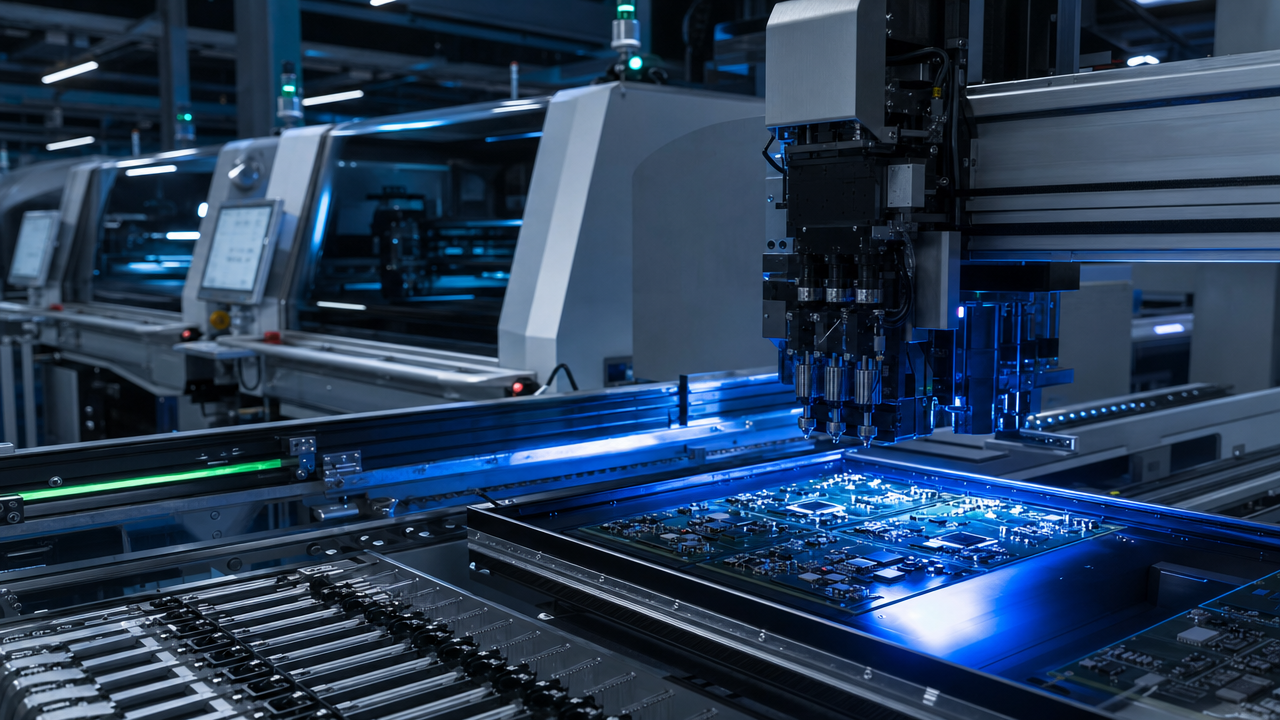
SMT (Surface Mount Technology) places chips, resistors, capacitors, and other miniature electronic components on PCB pads using automated pick-and-place machines, then solders them in reflow ovens. A smartphone motherboard typically integrates 1,500–2,500 electronic components, with the smallest 01005 spec resistors measuring only 0.4mm×0.2mm — smaller than a sesame seed.
SMT's core barrier is not equipment, but process tuning and quality control systems. Any well-funded factory can buy a high-speed Yamaha or Fuji pick-and-place machine; but tuning it to near-zero-defect yields requires decades of process accumulation and hundreds of experienced process engineers for continuous optimization.
5.4 Optical Modules: Precision Engineering Behind the Megapixel Race
A camera module's composition: Lens (4–7 precision glass or plastic elements), Image Sensor (CMOS, from Sony/Samsung/OmniVision), Autofocus Motor (AF/OIS Actuator), IR Filter, and Flexible Circuit Board (FPC). Sunny Optical is China's largest mobile phone lens supplier and one of the global top-5 camera module suppliers. Its 2025 mobile lens shipments exceeded 800 million units.
5.5 Acoustic Modules: The Invisible Art of Engineering
Goertek is Apple's exclusive acoustic module supplier for AirPods and an important supplier for Samsung and Sony premium TWS earphones. AAC Technologies (Viauto) leads in micro vibration motors (Haptic Motors) and earpiece receivers. iPhone's Taptic Engine (linear motor haptic feedback mechanism) is an important product line for AAC, with precision control down to the millisecond level.
5.6 Final Assembly and Test: The Ultimate Challenge of Apple FAAT
A complete iPhone assembly and test sequence includes: body component pre-assembly; motherboard pre-assembly; battery installation; screen assembly (LCM Assembly); exterior component installation; functional testing (FCT); visual inspection (AOI/AVI); packaging and warehousing.
The takt time for this process sequence is approximately 60–80 seconds. Foxconn Zhengzhou at peak capacity can produce over 500,000 units per day, requiring completion of over 500,000 smartphone assemblies within 86,400 seconds (24 hours) — a manufacturing management challenge without equal anywhere in the world.
VI. Company Deep Dives: Ten Leading Foundries' 2025 Portraits
6.1 Luxshare Precision (002475): Apple Assembly Share Surpasses Foxconn
Fundamentals: 2025 revenue RMB 332.3 billion, +23.6% YoY; net profit RMB 16.6 billion, +24.2%. Consumer electronics revenue RMB 264.3 billion, ~80% of total; automotive electronics RMB 39.3 billion, +185%; communications and data center RMB 24.6 billion, +34%.
Apple relationship: Luxshare completed a historic milestone in 2025 — its iPhone assembly share surpassed Foxconn for the first time, making it the largest iPhone contract manufacturer. Luxshare holds approximately 45% of iPhone 17 series assembly, corresponding to approximately 90–100 million iPhones.
"Every two AirPods, one from Luxshare": AirPods is Luxshare's most stable exclusive business within Apple's ecosystem, with higher margins than iPhone final assembly. Luxshare holds approximately 80% of global AirPods assembly share.
R&D investment: 2025 R&D investment reached RMB 11.4 billion, +34% YoY, ranking #1 in the consumer electronics industry.
6.2 Goertek (002241): From VR to AI Glasses — The Track Leap
Fundamentals: 2025 revenue RMB 96.6 billion; net profit RMB 3.94 billion, +48% YoY. Precision components RMB 18 billion, gross margin 23.5%; smart acoustics RMB 23 billion; smart hardware (VR/AR/AI glasses) RMB 53.8 billion.
AI glasses explosion: 2025's biggest performance driver was Meta Ray-Ban AI glasses — Goertek is Meta Ray-Ban's exclusive contract manufacturer. Meta Ray-Ban's 2025 full-year sales surpassed 5 million units, with Goertek's confirmed annual delivery order of approximately 5 million units. Huawei's 3.5-million 2026 AR glasses were also contracted to Goertek.
"Core node of AI glasses domestic supply chain": Goertek integrates acoustic modules, precision hinges, lens mounting structures, and final assembly in AI glasses — with almost no competitor at the same level in the global AI glasses foundry track.
6.3 Lens Technology (300433): The Glass Cover Champion's Diversification
Fundamentals: 2025 revenue RMB 74.4 billion, +6.5% YoY; net profit RMB 4 billion, +11% YoY. Smartphone and computer business revenue RMB 61.2 billion; smart automotive cabin RMB 6.5 billion; smart wearables and headsets RMB 4 billion.
Titanium alloy's new battlefield: From iPhone 15 Pro, Lens Technology took over Apple's titanium alloy frame CNC machining business, becoming the main supplier of Apple's titanium alloy structural components. The foldable screen business (UTG and hinge structural components) is Lens Technology's new important business direction.
6.4 Zhenyu Intelligent Manufacturing (002600): The Invisible Champion of Structural Components
Fundamentals: 2025 revenue RMB 51.4 billion, +16.2% YoY; net profit growth approximately 30%.
Zhenyu's core business is consumer electronics metal structural components and thermal management, covering iPhone internal brackets, spring contacts, EMI shields, and laptop and AI server heat dissipation panels. AI server heat sinks' value per unit is approximately 5–8 times that of laptop thermal management, and Zhenyu stands to gain supernormal growth in this track.
6.5 BYD Electronics (HK 0285): The Technology Manufacturing Side Business
Fundamentals: BYD Group's handset components and assembly division 2025 revenue RMB 155.2 billion, approximately -3% YoY. Main clients include Apple, Huawei, Xiaomi, OPPO/vivo, and Microsoft (Surface series).
6.6 Sunny Optical (HK 2382): The Technical Player in the Lens Track
Fundamentals: 2025 total revenue exceeded RMB 43.2 billion; handset business revenue RMB 27.3 billion, +8.6% YoY; automotive business revenue RMB 7.3 billion, +21.3% YoY; XR and other business revenue RMB 8.6 billion, +20.8% YoY.
Sunny Optical's competitive advantage lies in the "lens + module" integrated capability. Vehicle-mounted camera business has maintained 20%+ growth for multiple consecutive years and is becoming a second growth curve on par with the handset business.
6.7 Wingtech Technology (600745): ODM + Semiconductor Dual-Track
Fundamentals: 2025 full-year revenue approximately RMB 50 billion, experiencing significant fluctuations; subsidiary Nexperia (formerly NXP Standard Products) is a global top-5 MOSFET, Schottky diode, and logic IC supplier.
6.8 Huaqin Technology (603296): ODM Hidden Champion's AI Server Rise
Fundamentals: 2025 H1 revenue RMB 83.9 billion, +113% YoY; estimated full-year approximately RMB 200 billion. Data center business H1 2025 revenue exceeded RMB 40 billion, AI servers accounting for 70%+ of data center revenue.
"AI servers changed Huaqin's valuation logic": Traditional handset ODM net margins approximately 1–3%, laptops approximately 2–4%; AI servers approximately 4–6% net margin, with per-unit value over 10x laptops. AI server business explosion has caused systemic improvement in Huaqin's revenue and profit quality.
6.9 Longcheer Technology (603341): ODM Core of the Xiaomi Ecosystem
Fundamentals: 2025 revenue approximately RMB 60 billion (estimated), deeply bound to Xiaomi, with approximately 34% domestic handset ODM market share (industry first). In the AI phone era, Longcheer is actively building AI feature integration (on-device LLM, AI photography) ODM solutions, attempting to increase per-unit ASP in the next replacement wave.
6.10 AAC Technologies (HK 2018): Acoustic-Optical-Haptic Trinity
Fundamentals: 2025 revenue approximately HK$23 billion (approximately RMB 21 billion), acoustic business approximately 50%, optical and haptic approximately 25% each. AAC's iPhone Taptic Engine linear motor, earpiece receiver, and ultra-thin speakers are regular entries on Apple's supplier list. AAC is rapidly expanding into optical lenses and periscope camera modules, attempting to upgrade from "acoustics specialist" to "optical + acoustic + haptic" full-sensory module supplier.
VII. Industrial Belt Atlas: Geographic Map from Shenzhen-Kunshan to Zhengzhou-India
7.1 Shenzhen: The Origin of the Foundry Industry
Shenzhen is the absolute origin of China's consumer electronics foundry industry. In 1988, Foxconn established its first mainland factory in Shenzhen Longhua, bringing a wave of Taiwanese contract manufacturers. Today's Shenzhen has several key industrial belts: Longhua District Foxconn campus (approximately 200,000–250,000 employees); Pingshan/Longgang Precision Manufacturing Belt (precision structural components, connectors, FPC); Guangming/Bao'an Optoelectronics Belt.
From Tianxia Gongchang's database, searching with keywords "smartphone components," "precision structural components," and "electronics manufacturing services," the number of active factories in Shenzhen exceeds 12,000 — the highest-density consumer electronics foundry node nationwide.
7.2 Dongguan: EMS and Molds — The World Factory
The Shenzhen-Dongguan combined cluster forms a super consumer electronics manufacturing cluster. Dongguan's foundry industry is concentrated in Songshanhu Science Park (Huawei terminal R&D and manufacturing base, drawing SMT, precision components, and optical module suppliers), Changan/Shijie connector belt (Luxshare started here — still headquartered in Changan, its connector factory is Apple's core Lightning/USB-C connector supplier), and the mold industry cluster (Dongguan's mold factory density is globally unmatched).
7.3 Suzhou/Kunshan: Root Camp of Taiwanese Precision Manufacturing
Kunshan is the most concentrated city for Taiwanese enterprises on the mainland. At peak, there were over 4,500 Taiwanese enterprises in Kunshan with over 400,000 employees, forming a full-chain foundry ecosystem from molds to finished goods. Quanta's Kunshan factory (MacBook Pro assembly), Compal's Kunshan factory (MacBook Air, etc.), and Luxshare's Kunshan iPhone assembly factory are all here.
7.4 Zhengzhou: The Super Factory City for iPhone
Foxconn Zhengzhou Aviation Port campus: construction began in 2010, at peak capacity employed over 300,000 workers, forming a vast "industrial city." The 2022 COVID control event at the Zhengzhou factory exposed the systemic risk of hyper-concentrated production capacity, accelerating Apple's drive to diversify its supply chain.
7.5 Qingdao and Huai'an: Emerging Inland Industrial Clusters
Qingdao, with Goertek as core, has formed an industrial cluster dominated by acoustic modules and VR/AR smart hardware. Goertek's Qingdao factories are its main production base for AirPods competitors, VR headsets, and AI glasses assembly.
7.6 Tianxia Gongchang's Platform Perspective: Supply Chain Information Flow
From the B2B platform data perspective, over the past 24 months (2024–2025) three noteworthy trends appear: "Small-category precision component" global sourcing demand growing fastest; Indian assembly factories' Chinese component sourcing demand emerging; and AI server chassis/cooling module sourcing demand exploding. These three trends together sketch Tianxia Gongchang's strategic value in consumer electronics foundry supply chain reorganization: as the key information intermediary connecting global AI hardware demand with China's precision manufacturing capability, the platform's intermediary value rises rather than falls amid geopolitical reorganization and production capacity geographic relocation.
VIII. Specialty Topics: In-Depth Dissection of Seven Sub-Tracks
8.1 iPhone Assembly: An Elegantly Balanced Three-Party Game
2025 iPhone assembly share: Hon Hai/Foxconn approximately 55%; Luxshare Precision approximately 35%; Pegatron approximately 10%.
Apple maintains three parallel assemblers for risk hedging. The 2022 Zhengzhou Foxconn production reduction event revealed the fragility of hyper-concentrated single-factory capacity, immediately accelerating Luxshare's share enhancement — providing important context for Luxshare's 2025 surpass.
iPhone 17 Air's "thinnest challenge": iPhone 17 Air's 5.6mm body thickness presents unprecedented manufacturing challenges for final assembly. Ultra-thin body requirements compress all internal component heights, and connectors, motherboard, and battery must achieve extreme thinness; simultaneously, the ultra-thin body is less rigid and more susceptible to micro-deformation from jig clamping forces during assembly.
8.2 AI Glasses: The "Next AirPods" of Consumer Electronics Foundry
Meta Ray-Ban AI glasses (second generation) surpassed 2 million units in cumulative 2024 sales, with approximately 5 million units shipped in 2025. Meta has publicly planned to expand Ray-Ban annual production to 20 million units in 2026. Goertek is Meta Ray-Ban's exclusive final assembly contractor — for Goertek, this is not just an order but an upgrade from "acoustic components supplier" to "AI wearable final assembly contractor."
8.3 AI PC: ODM's Next Card
AI PCs (laptops with built-in NPUs exceeding 40 TOPS) have a clear replacement demand wave in the enterprise sector. Huaqin Technology's H1 2025 global laptop ODM market share reached 10.2%, ranking first among mainland China and top tier globally, with AI PC volume shipments in scale production.
8.4 AI Server: Consumer Electronics Foundry's Migration to High-Margin Territory
AI server power consumption from H100's 700W to GB200's 1,000W; traditional air cooling cannot meet thermal needs, and data center immersion liquid cooling and DLC have become standard. Huaqin Technology's H1 2025 data center business revenue exceeded RMB 40 billion, full-year projected RMB 80–90 billion, with AI servers accounting for approximately 70% of data center revenue.
8.5 VR Headsets: Foundry Gaming in the Quest Cycle
Meta Quest VR headsets shipped approximately 8–10 million units in 2025, with Goertek holding approximately 70% of the foundry share. Goertek's VR assembly moat: dual-display calibration (binocular disparity ≤ 0.5 arcminutes) and 6DoF positioning system calibration.
Apple Vision Pro (Luxshare assembles) shipped approximately 500,000–800,000 units in 2025, with initial yield approximately 70–80% — much lower than iPhone's 95%+, due to Micro-OLED dual-screen alignment calibration precision requirements.
8.6 Wearables: AirPods Dominance and Apple Watch's Medicalization
Luxshare holds approximately 80% global AirPods assembly share (full line). Apple Watch Series 11 reportedly may integrate non-invasive blood glucose monitoring — if implemented, it would transform Apple Watch from "sports watch" to "medical-grade wearable," significantly increasing sensor module and precision sealing structure manufacturing difficulty.
8.7 Foldable Screens: Next-Generation Smartphone Foundry Opportunity
Global foldable phone shipments approximately 20–25 million units in 2025. Apple is expected to launch foldable screen iPhone in H2 2026 — the industry chain's most impactful "option." Once Apple enters foldable screens, it will trigger demand explosion for hinges, UTG (ultra-thin glass), folding OLED panels, and foldable screen-dedicated structural components.
IX. Technology Evolution: Process Revolution from Titanium Metal to Liquid-Cooled Servers
9.1 Titanium Alloy Integrated CNC: Aerospace Processes Migrating to Consumer Electronics
A complete titanium frame manufacturing journey: sourcing titanium alloy material from Baoti Group (Baoji, Shaanxi) → forging into near-net-shape blank → multi-axis CNC precision milling (cutting speed approximately 60–80 m/min, vs aluminum alloy's ~400 m/min) → stress relief annealing → anodizing/PVD coloring → precision grinding and polishing → 100% dimensional inspection (CMM). This process chain requires extremely high equipment and know-how, with fewer than 4–5 suppliers worldwide capable of stable mass production at Apple's required yields as of 2025.
9.2 iPhone 17 Air Ultra-Thin Process: Physical Extreme Challenge at 5.6mm
5.6mm body challenges: ultra-thin connector development; SiP packaging further integration; ultra-thin vapor chamber (thickness ≤ 0.4mm) developed by Zhenyu Intelligent Manufacturing; assembly tolerance chain management multiple times more difficult than standard models.
9.3 AI Server Liquid Cooling: Paradigm Shift from Air to Immersion
AI GPU power density: A100 (2020) ~400W → H100 (2023) ~700W → B200 (Blackwell, 2025) ~1,000W → B300 (GB300) potentially 1,200–1,400W. A NVIDIA GB200 NVL72 rack (72 GPUs) at full load consumes approximately 120kW — air cooling cannot possibly meet this requirement. Direct Liquid Cooling (DLC), Immersion Cooling, and Rear-door Heat Exchangers are the main liquid cooling approaches.
9.4 Micro-OLED and Micro-Display Technology
Apple Vision Pro's core display components are Sony's Micro-OLED screens with approximately 3,391 PPI pixel density. Micro-OLED manufacturing difficulty is extreme — as of 2025, only a handful of manufacturers worldwide can mass-produce it, including Sony (Japan), Samsung Display (Korea), and BOE (China).
9.5 End-Side NPU and AI Phones
AI phones' SiP packaging complexity is higher, NPU module thermal management requirements are stricter, placing new demands on SMT process precision and cooling structural component design. Overall, AI phone foundry value-added is approximately 5–10% higher than traditional smartphones.
9.6 AI Manufacturing: From Automation to Adaptive Manufacturing
The shift from "Automation" (machines replace humans in fixed actions) to "Adaptive Manufacturing" (machines can sense product changes, identify anomalies, and adjust process parameters in real time). Luxshare Precision has introduced digital twin systems on some iPhone lines; AI visual AOI detection speed versus manual inspection is 10x faster; collaborative robots are taking over high-repetition, high-precision assembly sub-tasks.
X. Risk Map: Apple Migration, Price Wars, and Geopolitical Pressure
10.1 Apple Production Capacity Migration: Share Decline Is Certain, Speed Is Debated
China mainland iPhone assembly share from approximately 80% declining to approximately 65–70% — this decline has substantially occurred in 2025. The 2026 key variable is whether Apple accelerates pushing "high-end iPhones beyond the US market to also assemble in India." In the medium term (2027–2030), even under optimistic India capacity expansion assumptions, mainland China's value-share in Apple's overall supply chain (including components) will still be maintained above 50%+.
10.2 Price Wars: Survival in the Brutal Low-Margin Game
Apple's annual Cost Down (cost reduction) negotiations require suppliers to proactively reduce prices approximately 3–5% annually. In handset ODM, Huaqin, Longcheer, and Wingtech compete intensely — Xiaomi, Honor, Transsion periodically bid competitively for similar products, with ODM manufacturers bidding at "cost price + extremely thin margins," then profiting through later BOM management and bulk procurement discounts.
10.3 Customer Concentration: The Double-Edged Sword of the Apple Chain
Ofilm is the most iconic "Apple risk" case in the mainland foundry circle: in 2021, Apple removed Ofilm from its supplier list. Ofilm's revenue that year was cut in half from RMB 50 billion to RMB 25 billion, stock fell approximately 70%, and the company experienced a lengthy business rebuilding period.
Different paths for reducing Apple dependence:
- Luxshare Precision: Heavy development of automotive electronics (2025 automotive electronics revenue RMB 39.3 billion)
- Goertek: Betting on AI glasses and VR
- Lens Technology: Expanding Huawei, Xiaomi, Samsung clients; entering automotive glass
- Sunny Optical: Heavy development of vehicle-mounted camera business
10.4 U.S. Tariffs: Long-term Structural Geopolitical Pressure
With actual U.S. tariff rates on Chinese consumer electronics manufactured goods reaching historical peaks in 2025, Apple's "country of origin game" strategy continues to evolve. The complexity and unpredictability of Sino-U.S. trade gaming is the most difficult system-level risk to quantify in the foundry industry.
10.5 India PLI Policy Sunset Risk
India's PLI policy for handset manufacturing provides approximately 4–6% revenue subsidies, but has a sunset design and performance thresholds. Once PLI subsidies expire or are reduced, India manufacturing's cost advantage will significantly narrow, potentially slowing Apple's India expansion pace.
XI. 2026–2030 Forecasts: AI Hardware Dividend and Share Rebalancing
11.1 China Consumer Electronics Foundry Industry Scale Forecast
| Year | Market Scale (RMB) | YoY Growth | Core Drivers |
|---|---|---|---|
| 2025 | ~RMB 3.0 trillion | +12% | Luxshare Apple assembly share increase + AI server Year One |
| 2026 | ~RMB 3.4 trillion | +13% | Foldable iPhone new cycle + AI glasses explosion + AI server continuation |
| 2027 | ~RMB 3.8 trillion | +12% | Vision Pro 2 + AI PC replacement wave + AI glasses 20M units |
| 2028 | ~RMB 4.2 trillion | +11% | Full AI hardware category maturity period |
| 2030 | ~RMB 5.0–5.5 trillion | +8–10% | Industry mature growth phase |
11.2 Apple Chain Share Dynamic Evolution
| Dimension | 2025 | 2027 (Forecast) | 2030 (Forecast) |
|---|---|---|---|
| Mainland China iPhone final assembly share | 65–70% | 55–60% | 48–53% |
| India iPhone final assembly share | 25% | 30–35% | 35–40% |
| China precision component share (Apple procurement) | ~80% | ~75% | ~65–70% |
| China's share of Apple total supply chain value | 65–70% | 60–65% | 55–60% |
Precision component share declines far more slowly than final assembly — because precision components (titanium structural parts, optical modules, acoustic devices) have made almost no progress toward local production in India.
11.3 Key Company Forecasts
Luxshare Precision (2026–2030): iPhone final assembly approximately 35–40% share maintained; automotive electronics may surpass consumer electronics as the largest business in 2027–2028; estimated 2030 revenue RMB 500–600 billion.
Goertek (2026–2030): AI glasses (Meta Ray-Ban + Huawei AR + domestic brands) expected to become Goertek's largest single business in 2026–2028; full-year revenue growing from 2025's RMB 96.6 billion to approximately RMB 150 billion in 2028.
Huaqin Technology (2026–2030): AI server business expected to surpass smartphone ODM in 2026–2027; estimated 2027 revenue exceeds RMB 400 billion, data center revenue exceeds RMB 200 billion.
11.4 New Category Disruptive Possibilities
General humanoid robots: Their internal components (precision reducers, servo motors, sensors) and supply chain model are highly similar to consumer electronics foundry. If general humanoid robots achieve mass production in 2027–2030, their foundry value could become the next largest new category after smartphones. Luxshare Precision has already clearly positioned for robot components.
Capital market valuation re-pricing: The shift from "manufacturing PE" to "technology manufacturing PE" is underway. When Huaqin's AI server revenue grows rapidly and Goertek becomes the exclusive AI glasses contract manufacturer, the capital market has begun re-pricing with a "AI hardware + manufacturing" composite logic — some leading foundry companies have seen P/E ratios climb from historical averages of 20x toward 30–40x.
XII. Conclusion: China's Foundry Industry's "Dual-Track Era"
In 1988, Foxconn broke ground in Shenzhen Longhua. Twenty-seven years later, this land grew into an empire employing over a million workers with annual revenue exceeding a trillion, along with thousands of precision component suppliers, hundreds of thousands of manufacturing engineers, and super-factory cities across Jiangsu, Guangdong, and Henan. This moat, built over more than two decades, cannot be replicated in three to five years by a policy, a new factory, or a subsidy program.
However, "a solid moat" does not equal "permanent share."
In 2025, the Apple chain's China share slid from the 80% level to approximately 65–70%. This change in numbers is not a retreat in China's manufacturing capability, but a mapping of global geopolitical gaming at the industrial level — Apple must demonstrate to the U.S. Congress, U.S. consumers, and the Trump administration that "iPhones are already manufactured in America's allied countries," and the value of this political narrative supersedes the logic of pure economic efficiency.
After accepting this judgment, looking at China's consumer electronics foundry future becomes much clearer:
What mainland China is protecting is the mid-stream. Precision structural components (titanium alloy CNC), optical modules (Largan/Sunny), acoustic devices (Goertek/AAC), connectors (Luxshare), precision glass (Lens Technology) — these process segments have high technical barriers, strong cluster effects, and deep engineer accumulation; India and Vietnam cannot build equivalent competitiveness within five to ten years. China's share in Apple's supply chain value will be maintained in the 55–65% range — declining is limited but directional.
What China is winning is the AI new track. While final assembly shares are eroded by India, Huaqin Technology's AI server business climbed from zero to annual revenue of RMB 80–90 billion; Goertek established an uncontested exclusive position in Meta AI glasses foundry; Luxshare's automotive electronics business grew 10x over five years. These new growth engines are outside Apple's power structure, not directly impacted by "India migration," and constitute China's foundry industry's true "second curve."
Tianxia Gongchang's platform perspective: Tianxia Gongchang's database covering 4.8 million active factories observes an interesting phenomenon in this supply chain reorganization — India manufacturing's rise has not reduced global sourcing buyers searching for Chinese precision manufacturing suppliers on the platform. On the contrary, as the "India assembly + Chinese components" model becomes prevalent, demand for Chinese mid-stream suppliers has become more precise and scaled. Precision foundry global sourcing is becoming the new main storyline of platform connection between Chinese factories and global brands.
This industry's next decade will unfold along two intertwined storylines: one is the Apple chain share slowly declining in a boiling-frog rhythm; the other is AI hardware (AI glasses, AI servers, AI PCs, foldable screens, spatial computing devices) creating new order volumes that continuously fill the gap, and even surpass it in total volume. Whoever can precisely position themselves at the intersection of these two storylines is the winner of the next decade.
Not a "crisis" story. Not a "golden age" story. A story of "evolution" — under geopolitical pressure, driven by technology iteration, constrained by rising labor costs and accelerating automation investment, China's consumer electronics foundry industry is, in its own way, slowly and steadily moving toward "a higher position in the value chain." The speed of this movement is not as rapid or dazzling as the internet industry, but the depth and breadth of the manufacturing capability moat it has accumulated is a barrier that no emerging manufacturing competitor can cross in five to ten years.
Paying attention to this industry is paying attention to the true capability boundary and future evolutionary direction of China's manufacturing sector. Every mainland supplier capable of stably passing Apple's most stringent component certifications is the most authentic footnote to "China's manufacturing level." Their competitiveness and limitations together constitute the most clear-eyed reference system for understanding China's true position in the global value chain.
Data Sources
Data cited in this report includes: Tianxia Gongchang (www.tianxiagongchang.com) factory database and industrial chain analysis; annual reports and semi-annual reports of listed companies including Luxshare Precision, Goertek, Lens Technology, Zhenyu Intelligent Manufacturing, Sunny Optical, Wingtech, BYD Electronics, and Huaqin Technology; Apple Inc. FY2025 Form 10-K and Earnings Call; IDC Global Smartphone Tracker 2025; Counterpoint Research Apple Supply Chain Report 2025; India Briefing Foxconn India FY2025 Revenue Report; Business Standard Apple Supply Chain India Report 2026; China Ministry of Industry and Information Technology Electronics Manufacturing Industry 2025 Annual Data.
XIII. Appendix: Key Data Tables and Index Glossary
13.1 Major Listed Companies 2025 Financial Data Summary
| Company | Stock Code | 2025 Revenue (RMB bn) | YoY Growth | Net Profit (RMB bn) | Est. Apple Revenue % |
|---|---|---|---|---|---|
| Luxshare Precision | 002475.SZ | 332.3 | +23.6% | 16.6 | ~75% |
| Goertek | 002241.SZ | 96.6 | +0% | 3.94 | ~40% |
| Lens Technology | 300433.SZ | 74.4 | +6.5% | 4.0 | ~45% |
| Zhenyu Intelligent | 002600.SZ | 51.4 | +16.2% | ~2.6 | ~55% |
| BYD Electronics | 0285.HK | 155.2 (BYD handset div.) | -2.7% | — | ~30% |
| Sunny Optical | 2382.HK | 43.2 | +9% | ~3.5 | ~25% |
| Wingtech | 600745.SH | ~50 | negative | ~1.5 | <10% |
| Huaqin Technology | 603296.SH | ~200 (full yr est.) | +56%+ | ~5 | ~20% |
| Ofilm | 002456.SZ | ~20 | -5% | ~0.3 | 0% |
| Dongshan Precision | 002384.SZ | ~30 | +8% | ~1.8 | ~35% |
13.2 Key Foundry Process Technical Parameters
| Process | Precision Requirement | Main Equipment | Leading China Suppliers | Technical Barrier |
|---|---|---|---|---|
| Titanium CNC | ±0.02mm | Mazak/Okuma 5-axis machining center | Lens Technology, Changying | ★★★★★ |
| Aluminum CNC | ±0.05mm | Domestic 3-axis machining centers | Many suppliers | ★★★ |
| High-precision FPC | Line width 0.05mm | Laser direct imaging | Dongshan Precision | ★★★★ |
| SMT (0201 and below) | ±0.05mm placement | Yamaha/Fuji high-speed | Luxshare, BYD Electronics | ★★★★ |
| Camera Module AA | ±1μm focus | Full-auto AA equipment | Sunny Optical | ★★★★★ |
| Acoustic cavity tuning | ±2dB freq response | Anechoic chamber + test system | Goertek, AAC | ★★★★★ |
13.3 Key Glossary
ANC (Active Noise Cancellation): Microphones sample external noise in real-time; processor generates anti-phase waves to cancel noise. AirPods Pro 2's ANC is among the most technically demanding functions in consumer electronics acoustic foundry.
AOI (Automated Optical Inspection): High-resolution cameras and deep learning AI image recognition algorithms automatically inspect PCB solder quality and product appearance. Replaces manual visual inspection with dramatically higher speed and accuracy.
BOM (Bill of Materials): Complete list of all raw materials, components, and sub-assemblies needed to produce one product. Core document for foundry cost management and procurement planning.
CoWoS (Chip-on-Wafer-on-Substrate): TSMC's advanced packaging technology integrating multiple dies through silicon interposer for ultra-high bandwidth chip-to-chip interconnect. Used in NVIDIA H100/H200/B200.
CNC (Computer Numerical Control): Pre-programmed numerical control instructions control machine tool cutting motion, precisely machining required shapes from metal blanks. Core machining process for consumer electronics precision structural components.
EMS (Electronics Manufacturing Services): Full-chain manufacturing services from PCB assembly, module manufacturing to complete system integration for brand customers. Foxconn and Luxshare Precision are typical EMS companies.
FAAT (Final Assembly & Test): Final assembly and full functional testing of consumer electronics products — the most downstream value-added step in foundry.
Micro-OLED: Super-small OLED displays fabricated on silicon (Si) substrates with extremely high pixel density (3,000 PPI+). Core display technology for Apple Vision Pro and next-generation VR/AR devices.
NPU (Neural Processing Unit): Processor core optimized for AI inference computation, executing matrix multiplication and other AI tasks at extremely low power. The core differentiating hardware of AI phones and AI PCs.
ODM (Original Design Manufacturing): Contract manufacturer also handles product design; brand owner specifies functional requirements and performance targets, ODM supplier is responsible for design through delivery. Huaqin Technology and Longcheer Technology are mainland China handset ODM leaders.
PLI (Production-Linked Incentive): India's government subsidy policy for handset manufacturers, providing approximately 4–6% revenue subsidies for eligible smartphone exports. Primary economic incentive for Apple's India production expansion.
SMT (Surface Mount Technology): Automated pick-and-place machines precisely place miniature electronic components on PCB pads, then reflow solder-fixed. Core process for consumer electronics PCB assembly.
SiP (System in Package): Multiple functional chips (processor, memory, wireless modules, etc.) packaged in one enclosure, reducing size and improving performance. Apple Watch S-series and AirPods H-series chips use SiP packaging.
TWS (True Wireless Stereo): Fully wireless dual-ear earphones with no wire connection whatsoever. AirPods created and leads the TWS category; global TWS earphone annual shipments approximately 350 million units in 2025.
UTG (Ultra-Thin Glass): Ultra-thin glass sheets approximately 20–30μm thick that can fold at approximately 3mm bend radius without cracking. High-end foldable phone screen protection material; Samsung SDI is the world's main UTG supplier.
Vapor Chamber: High-efficiency heat spreading component using internal working fluid phase change (liquid → gas → liquid cycle) for thermal management. Key cooling component in smartphones and AI servers. Both Luxshare Precision and Zhenyu Intelligent Manufacturing have related businesses.
XIV. Research Methodology and Information Source Statement
14.1 Research Methodology
This report's research methodology combines the following dimensions:
First, Primary Financial Analysis: Systematic review of 2025 annual reports, semi-annual reports, and quarterly reports of major listed companies including Luxshare Precision, Goertek, Lens Technology, Zhenyu, Sunny Optical, Wingtech, BYD (handset components division), Huaqin Technology, Ofilm, and Dongshan Precision.
Second, Supply Chain Literature Synthesis: Referenced Apple's annual Supplier Responsibility Reports, Counterpoint Research Apple supply chain dedicated reports, IDC global smartphone and wearables tracking reports, iFixit teardown data, Fomalhaut Techno Solutions BOM cost analysis reports, and deep research reports from multiple domestic and foreign investment banks.
Third, Ground Truth Verification: Cross-validated key data using public industry media reports (36Kr, Huxiu, CLS, China Business News, etc.), company official statements, Apple press releases, and WWDC/Apple launch event public information. For key data points with disputes or single-source origins, this report notes "estimate" or "composite judgment from multiple sources."
Fourth, Tianxia Gongchang Platform Data: Based on the Tianxia Gongchang database covering 4.8 million active national factories, systematically analyzed the geographic distribution, category coverage, and scale structure of consumer electronics foundry-related factories, providing direct data support for industrial belt descriptions and supplier count estimates.
14.2 Data Limitations
The market scale estimates, share data, and financial data in this report are partially from research institution forecasts and analysis, partially from public media reports. Consumer electronics foundry industry data transparency is limited (key manufacturing parameters are protected under strict NDA), therefore the following data types contain estimation errors: iPhone factory shipment splits (Foxconn/Luxshare/Pegatron specific shares are all research institution estimates, not official Apple data); iPhone BOM cost component breakdowns (from third-party teardown institution estimates); China mainland consumer electronics foundry total output value (composite estimates); each company's Apple revenue proportion (from investor relations records, media reports, and research institution composite judgments, not official disclosures).
Readers citing this report's data should note these limitations and verify against the latest public information independently.