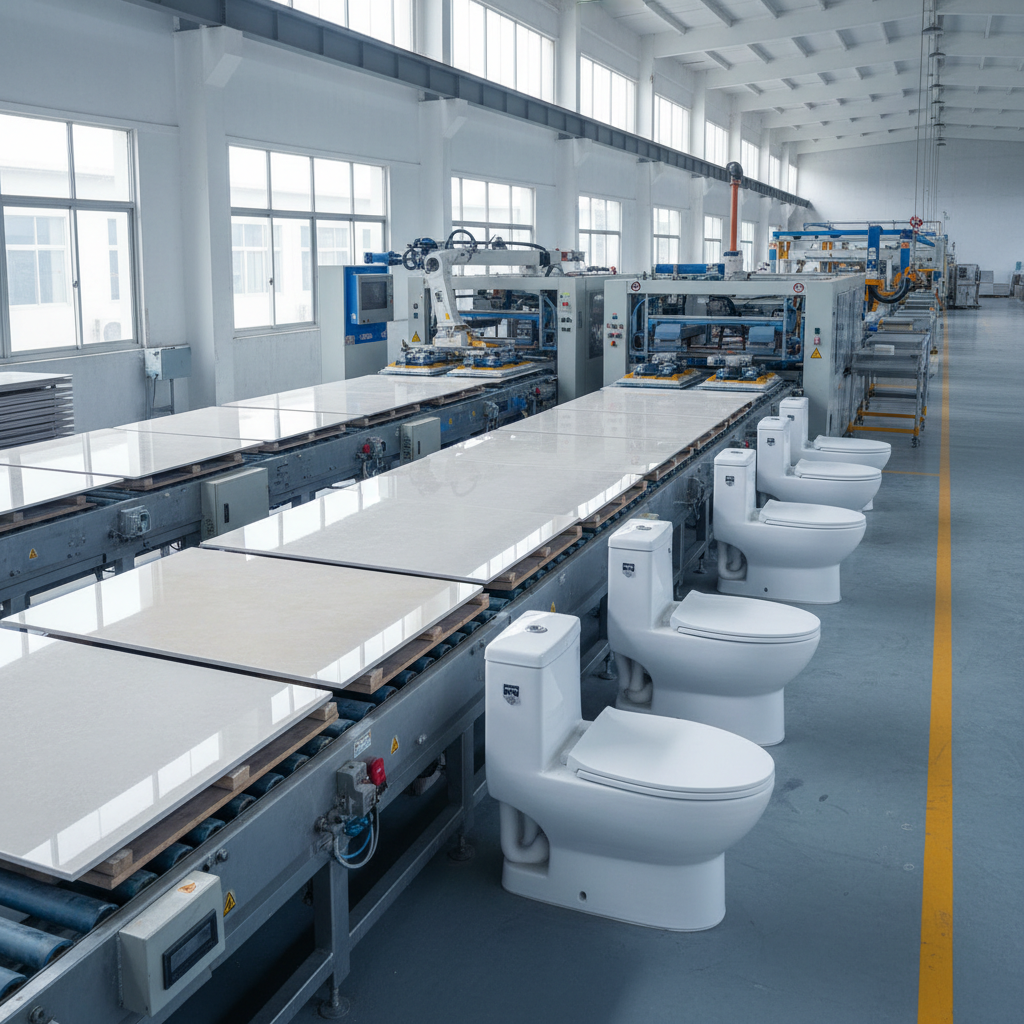

China's largest ceramic tile kiln stretches three hundred meters in length, burning day and night without pause, sending tiles one by one to construction sites across the globe.
This kiln sits in Nanzhuang Town, Foshan, Guangdong Province — a cluster of industrial activity spanning dozens of square kilometers, where hundreds of ceramic factories, glaze suppliers, kiln manufacturers, and logistics companies converge. Standing on a production line inside one of those factories, you hear the roar of superheated air rushing through the roller kiln, watch white bisque bodies race into the flames, and emerge from the other end as polished floor tiles or large-format slabs. Ceramic tiles, a building material humanity has used for thousands of years, are being manufactured inside Chinese factories at a scale and efficiency no other country can match.
In 2024, China's building ceramics output reached approximately 5.91 billion square meters — already a multi-year low after consecutive declines, compared to a historical peak of more than 10 billion square meters. Even at these adjusted volumes, China commands more than half of global tile production. Add sanitary ceramics (toilets, basins, urinals), bathroom hardware (faucets, showers, vanity cabinets), and modular bathrooms, and China's end-to-end ceramic and sanitary ware value chain generates roughly 600–700 billion RMB annually.
Yet that three-hundred-meter kiln is not running at full capacity right now. The deep correction in China's real estate market has pressed down on the entire industry like a stone. The overcapacity that once made factory owners strutted with confidence has taken on a grimmer face: utilization rates have fallen to about 65%, warehouse inventories are higher than they have ever been, and a price war is pounding margins into the floor.
In this historic adjustment — who is holding firm, who is pivoting, who is going global, and who is using slabs and smart toilets to break upward — this report sets out to answer exactly those questions.
Chapter 1 Definitions and the Full Industry Chain
Building ceramics and sanitary ware is a broad manufacturing aggregate. In China's industrial classification system, it spans "building and sanitary ceramics manufacturing," "sanitary fixtures manufacturing," "daily-use and decorative ceramics manufacturing," "metal sanitary fixtures manufacturing," and several other sub-categories. This report concentrates on four primary segments, each with its own distinct competitive logic and supply chain.
Ceramic tiles (building ceramics) are the largest segment by volume, encompassing interior wall tiles, exterior wall tiles, floor tiles, polished tiles, glazed tiles, and the recently booming large-format rock slabs (porcelain slabs with individual dimensions typically 1,200 mm × 2,400 mm or larger, in thicknesses of 6–20 mm). By firing technology, tiles are classified as porcelain tiles (water absorption ≤ 0.5%), stoneware tiles, fine stoneware, coarse stoneware, and earthenware. Polished tiles, full-body vitrified tiles, marble-effect tiles, and rock slabs all fall under the porcelain tile category and represent the current market mainstream.
Tile application contexts are extraordinarily diverse — residential interiors (bathrooms, kitchens, living rooms, bedroom floors and walls), commercial spaces (shopping malls, hotel lobbies, office buildings), public infrastructure (metro platforms, airports), and building facades — forming a vast and varied demand pool. Requirements differ sharply by context: bathroom tiles prioritize slip resistance and waterproofing; lobby flooring emphasizes visual effect and abrasion resistance; façade products must be highly weatherproof. This differentiated demand has generated thousands of product SKUs and made "total coverage by a single brand" nearly impossible.
Sanitary ceramics primarily include toilets, squatting pans, washbasins, urinals, and bidets. China is the world's largest producer and exporter of sanitary ceramics, with Chaozhou (Guangdong), Tangshan (Hebei), Huarong (Hunan), and Nan'an (Fujian) as the main production clusters. Sanitary ceramics consumption is closely tied to new residential construction (at least one toilet and two washbasins per unit) and hotel and public restroom renovation demand. From a process perspective, sanitary ceramics share the ceramic firing lineage with tiles, but are formed by slip casting rather than dry pressing, resulting in more complex body shapes; formulations must achieve highly smooth glazes and extremely low water absorption (typically below 0.5%, with premium products below 0.2%).
The functional boundaries of sanitary ceramics are rapidly expanding through "smart" integration. Traditional toilets served only waste disposal, while smart toilets now integrate heated seats, warm-water bidet functions, warm-air drying, automatic deodorization, auto-lid, and health monitoring — having moved from luxury hotels into ordinary homes. This category leap from "sanitary fixture" to "smart health appliance" is the most profound shift in industry logic over the past five years.
Bathroom hardware and faucets include basin faucets, kitchen faucets, shower sets (shower head, slide rail, hand shower, thermostatic mixer valve), vanity cabinets (including mirror cabinets), floor drains, angle valves, and shower enclosures (tempered glass + aluminum alloy frame). This category carries relatively high technology density and brand premium potential: Hansgrohe thermostatic showers can sell for several thousand to tens of thousands of RMB; Moen has built strong brand loyalty in North America and Europe with a "Lifetime Warranty" promise; JOMOO, Huihuang, and other domestic brands occupy mid-to-premium mainstream channels domestically, though gaps in design language and high-end craftsmanship relative to foreign brands persist.
Modular and smart bathrooms include steam shower enclosures, prefabricated bathroom units (PBU — SMC composite floor pans, wall panels, and ceiling panels modularly integrated in the factory and assembled on-site in hours), smart toilet seats and integrated smart toilets, and smart bathroom mirrors (with built-in displays and motion-sensing lighting). Smart bathrooms have been the fastest-growing sub-segment over the past five years, with JOMOO, HEGII, Kohler, TOTO, and Panasonic competing fiercely; product technology iteration cycles now approach the pace of consumer electronics.
The historical arc of building ceramics and sanitary ware traces back to humanity's earliest use of clay. In China, Qin bricks and Han roof tiles were the earliest markers of building ceramics civilization; the white porcelain of Jingdezhen and the polychrome Tang Sancai were ancestors of industrial building ceramics and sanitary ware. From hand-throwing to mechanical pressing, from wood-fired kilns to roller kilns, from hand-painted motifs to digital inkjet printing — building ceramics and sanitary ware spent nearly a hundred years completing its transition from craft to modern industry.
China's "modern era" of building ceramics and sanitary ware effectively began in the 1980s, when Shiwan Town (today Chancheng District, Foshan) imported the first roller kiln production line from Italy, launching China's industrial ceramics era. In the following decades, the expansion rate of China's building ceramics industry left global peers astonished: production lines grew from dozens to thousands, and annual output climbed from hundreds of millions to a historic peak above 10 billion square meters. That expansion was deeply embedded in China's urbanization narrative — every new city, every commodity residential building, every newly opened hotel needed tiles and sanitaryware, and the overwhelming majority came from Chinese factories.
Every link in the supply chain matured during those decades of expansion. Raw material mining regions (kaolin, feldspar, quartz sand) settled into stable supply patterns; equipment manufacturing, starting from Italian imports, was domesticated by companies like Keda Manufacturing and now flows in reverse as exports; downstream brand channels evolved from showrooms labeled "imported from Japan" or "from Italy" to flagship stores of domestic brands — Dongpeng, Monalisa, Marco Polo, JOMOO, HEGII — names that became first associations for hundreds of millions of Chinese families choosing renovation materials.
Geographically, building ceramics and sanitary ware industry clustering in China is striking: Guangdong (Foshan, Chaozhou) is the undisputed industry core; Fujian (Jinjiang, Nan'an) is a major hub for bathroom hardware and sanitary ceramics; Tangshan (Hebei) specializes in sanitary ceramics; Zibo (Shandong) retains ceramic craft traditions; Gao'an (Jiangxi) and Neihuang (Henan) are emerging capacity clusters; Wenzhou (Zhejiang) and Yangjiang (Guangdong) are key sources of shower room aluminum profiles and hardware. This geographic clustering creates an "industrial belt ecosystem" — high density of support companies, low logistics costs, efficient flow of talent and technology — a cluster-level competitive advantage no single firm can replicate alone.
The building ceramics and sanitary ware category shows a clear value-chain stratification: at the bottom are mass-produced commodity tiles and basic toilets — low margin, large total volume; in the middle are mid-range branded tiles, entry-level smart toilets, and standard vanity cabinets — the primary profit source for most listed ceramic companies; at the top sit customized rock slabs, premium smart toilets, thermostatic shower systems, and premium-design washbasins — high margins but limited market volume, core territory for Kohler, TOTO, Hansgrohe, and other foreign brands, and the target zone for domestic brands actively pushing upward.
Full industry chain overview:
Upstream raw materials: Kaolin (primary sources in Maoming/Guangdong, Fuzhou/Jiangxi, Kunming/Yunnan — China holds leading global reserves) provides the skeletal structure of ceramic bodies, offering plasticity and sintering strength. Feldspar (potassium and sodium feldspar, mainly from Xinjiang and Hubei) provides the glass phase, reducing firing temperature and achieving body density. Quartz sand provides skeletal stability and hardness. Talc (Guangxi, Liaoning) adjusts thermal expansion coefficients to prevent warping and cracking during firing. China's domestic reserves of these mineral raw materials are abundant — a congenital competitive advantage over Italy and Spain, both of which have long ceramics traditions but significantly higher raw material and labor costs.
Glazes represent the highest technical barrier raw material segment, directly determining tile surface aesthetics, functional properties, and market premium. Matte glazes, full-polished glazes, metallic luster glazes, marble-pattern glazes, and slab-specific glazes each require precise chemical formulations and strict firing control. Antibacterial glazes (silver-ion antibacterial, photocatalytic TiO₂), nano self-cleaning glazes, and anti-slip glazes have developed rapidly in recent years — core formulation R&D capability is a key barrier differentiating leading firms from smaller workshops.
Mid-stream manufacturing: The core equipment is the roller kiln. Modern wide-body roller kilns reach 3.8 meters wide and over 300 meters long, with single-line daily capacity exceeding 10,000 square meters; multi-tier roller kilns (two or three decks) further increase production density per unit floor area. Keda Manufacturing (002655) is China's largest ceramic equipment manufacturer; its roller kilns and hydraulic presses are exported to dozens of countries across Southeast Asia, the Middle East, Africa, and South America — in themselves an important vehicle for exporting "China's building ceramics technical capabilities."
Kiln energy consumption is one of the largest cost items in building ceramics — approximately 35–45% of production cost. The "coal-to-gas" policy shifted kiln fuel from bituminous and anthracite coal to natural gas, significantly improving temperature control precision and product consistency, but introducing new cost uncertainty from gas price volatility. Next-generation energy-efficient roller kilns cut unit energy consumption more than 20% from a decade ago by integrating flue gas heat recovery (using high-temperature exhaust for spray dryers and body drying kilns), precision combustion control (segmented combustion, temperature deviation ≤ ±5°C per zone), and lightweight high-efficiency refractory materials.
Downstream channels: Building ceramics and sanitary ware has always operated across four parallel channels — nationwide chains + building materials markets + designer channel + e-commerce/livestream. Dongpeng, Monalisa, and Marco Polo have deployed thousands of branded stores nationwide; JOMOO and Huida's flagship store networks have penetrated lower-tier cities for decades. But channel structure is undergoing profound change: the engineering channel (bulk supply to property developers' ready-fit programs) has been hardest hit by real estate's downturn, while the retail channel (serving renovation and personalized interior upgrade demand) is rising in relative importance. The designer channel (recommended by interior designers and fit-out contractors) is contested by premium brands; Hansgrohe, Kohler, and JOMOO Marble Tile each win large-value orders through designer referrals.
Entry links to Chinese manufacturing: Tile factory, sanitary ceramics factory, faucet factory, and ceramic glaze factory data are available in full. Also see: bathtub factory, washbasin factory.
Chapter 2 Global Landscape and International Leaders FY2025
The global sanitary ware and building ceramics industry displays a clear dual structure: a handful of Western and Japanese brands firmly control the premium segment, while Chinese factories dominate by manufacturing volume. This structure is not immutable — Chinese brands are pushing upward from their domestic base — but for now, foreign brands' lead in average selling price, brand premium, and control of high-end engineering channels remains formidable.
From a global perspective, a few numbers stand out: the global sanitary ceramics market is approximately USD 68.8 billion (2025 estimate); the global bathroom furniture market is approximately USD 132.1 billion (2025 estimate); China accounts for more than 50% of global tile production — an indisputable manufacturing center.
The competitive map varies sharply by sub-category: in sanitary ceramics, the top five brands (Kohler, TOTO, Geberit, Lixil, Roca) together hold only about 22% — a highly fragmented industry with a long brand tail. Chinese manufacturers, via price advantage and export volume, dominate global supply of mid-to-lower-end sanitary ceramics, especially in Southeast Asia, the Middle East, and Africa, where Chinese-made toilets and washbasins command high market shares. The faucet and shower market is even more dispersed; foreign brands have meaningful share only in products priced above 1,000 RMB, while domestic brands dominate the 100–1,000 RMB mass market.
Kohler (USA, private) is one of the world's best-known sanitary ware brands, spanning bathroom products (bathtubs, washbasins, toilets, shower systems, kitchen fixtures) and industrial power (generators and engines for agriculture and construction), held privately by the Kohler family with no public stock exchange listing and no fully disclosed financials. Third-party research estimates put Kohler's 2025 global revenue at approximately USD 8.6 billion, up from approximately USD 7.6 billion in 2024. Kohler operates more than 150 manufacturing facilities across the US, China, India, Mexico, and other major markets. In China, Kohler long positions itself as premium, with a price structure 50–200% above leading domestic brands, distributed mainly through department store counters, building materials market brand zones, and high-end engineering partnerships. Facing fierce mid-market competition from domestic brands (JOMOO, HEGII, etc.), Kohler has consistently reinforced its "design excellence + craftsmanship" brand narrative to maintain its premium position.
TOTO (5332.T, Tokyo Stock Exchange) is the inventor and technical standard-setter for smart toilets globally, founded in 1917 in Kitakyushu, Japan. In FY2025 (fiscal year ending March 2025), TOTO recorded revenue of approximately JPY 724.5 billion (approximately RMB 33–34 billion at prevailing exchange rates), gross profit of approximately JPY 254.1 billion, and operating profit of approximately JPY 48.5 billion. TOTO's core moats are its patented flushing technology (Tornado Flush and CEFIONTECT anti-fouling glaze) and the Washlet warm-water cleansing system; in Japan, TOTO holds approximately 90% smart toilet market share — the most successful commercialization benchmark for this product category. TOTO established more than 10 manufacturing plants in China and was among the first foreign brands to localize smart toilet production there; however, amid China's real estate weakness and intensifying competition in 2024–2025, TOTO closed some production lines, optimized capacity, and refocused strategy on premium smart toilets rather than mid-market volume competition.
Geberit AG (Switzerland, ETR: GEBN) is Europe's dominant player in sanitary and building drainage systems, specializing in "hidden inside the wall" bathroom infrastructure: concealed cisterns (embedding flush tanks in walls paired with wall-hung toilets), building drainage systems (ABS and PP pipe fittings), and sanitary ceramics (acquired through the Sanitec Group, gaining premium European brands Keramag and Laufen). Geberit's 2024 net sales were CHF 3.085 billion (approximately RMB 23.8 billion), with an EBIT margin of 24.7% (EBIT approximately CHF 762 million) and net profit of CHF 597 million. Revenue mix: sanitary systems 37.1%, piping systems 33.1%, sanitary ware products 29.8%. Geberit's ceramic brands hold a strong position in premium Central and Western European markets; its concealed cistern products are increasingly penetrating China's high-end fit-out projects. Geberit expects some new-build market pressure in 2025, but approximately 60% of its business stems from building renovation, limiting dependence on new construction and supporting stable results.
Lixil Corporation (Japan, 7741.T) is one of the largest comprehensive sanitary ware groups globally, owning GROHE (Germany, premium faucets and showers), American Standard (North America), INAX and TOSTEM (Japan), and other well-known brands. Lixil's FY2024 global revenue was approximately JPY 1.5 trillion, though profitability was pressured by volatility in Japan's domestic construction market and adjustments in China. GROHE's China strategy focuses on premium fit-out engineering and high-end retail, differentiating on German engineering aesthetics.
Hansgrohe SE (Germany) focuses on premium showers, faucets, and bathroom accessories. 2024 revenue of approximately EUR 1.5 billion, deploying dual brands — Hansgrohe (targeting mid-to-premium consumers) and Axor (targeting top designers and luxury residential markets). Hansgrohe is the embodiment of German manufacturing aesthetics; its shower spray modes (rain, soft, intense, champagne) and thermostatic control technology command extremely high regard in designer channels, making it a top choice for high-end residential and hotel projects. In China, Hansgrohe has opened multiple flagship showrooms and maintains long-term partnerships with leading interior design firms.
Roca Group (Spain, private) is the world's second-largest comprehensive sanitary ware group, marketing in more than 170 countries, with annual revenue of approximately EUR 2 billion, and brands including Roca, Laufen (Swiss design brand), and InSinkErator (food waste disposers). Roca has production facilities in Spain, India, and China, with large volumes in developing-country infrastructure and affordable housing projects. In China, Roca positions mid-to-premium, with a channel strategy similar to Kohler, concentrated in Tier 1–2 cities.
Italian tile brand cluster (Marazzi, Iris Ceramica, etc.) represents the most important global competitor in premium tiles. Italy is the world's largest producer of premium tiles (output approximately 400 million square meters), renowned for design and fine craftsmanship. Marazzi (now under SCG), Iris Ceramica, Florim, and Emilgroup are globally renowned brands. Italian Gres Porcellanato was the earliest commercialized high-performance ceramic slab, carrying powerful brand authority in European premium construction markets. Facing Chinese brands' price-performance competition, Italian brands defend on design premium and "Made in Italy" geographical indicators, though price-performance pressure is undeniable.
Looking toward 2026–2030, global building ceramics and sanitary ware consolidation trends are clear: the premium segment will continue to be led by foreign brands, but technological and brand barriers will keep rising; mid-range and mass markets will be led by Chinese brands, with competition shifting from "price alone" to "price + quality + service"; emerging markets (Southeast Asia, Africa, South America) will become new battlegrounds — Chinese brands going global under the Belt and Road framework are well-positioned in this geographic expansion wave.
In global sanitary ceramics market share: Kohler leads at 5.84%, TOTO at 4.59%, Geberit at 4.10%, Lixil at 3.85%, Roca at 3.49% — top-five combined approximately 22%, reflecting a highly fragmented industry with a wide brand tail, leaving ample operational space for Chinese companies.
Chinese manufacturing: bathroom hardware factory, bathtub factory, shower enclosure factory, toilet factory supplier data available.
Chapter 3 PEST: Macro Drivers and Constraints
The fate of building ceramics and sanitary ware is deeply bound to five macro forces: real estate cycles, ready-fit decoration policy, dual-carbon constraints, the smart-home wave, and international trade patterns. These five forces interweave to collectively determine the industry's fundamental trajectory around 2026.
Political and regulatory environment (P)
Ready-fit decoration policy has been one of the most important policy variables for building ceramics and sanitary ware over the past decade. From 2016 to 2019, multiple provinces and cities pushed for mandatory ready-fit residential delivery, and the building ceramics and sanitary ware industry achieved explosive growth via engineering channels: property developers procured hundreds of millions of square meters of tiles and hundreds of thousands of sanitary ceramic sets in bulk, with engineering-channel procurement efficiency far exceeding dispersed retail. But ready-fit housing quality disputes quickly proliferated ("premium finish" turning into "basic finish," materials substituted, buyers unable to select brands), and reputation deteriorated rapidly; multiple cities progressively relaxed ready-fit mandates, allowing bare-shell delivery, and the ready-fit proportion retreated from its peak. In 2024, new domestic fully-finished residential project launches fell approximately 21.3% year-on-year, directly hitting building ceramics engineering channels — a core driver of the industry's downward pressure. The engineering channel still accounts for about 32% of ceramic revenues, but incremental growth has virtually stalled, and some companies have significantly contracted engineering sales teams and are pivoting to retail.
The dual-carbon policy (carbon peak by 2030, carbon neutrality by 2060) has deeply far-reaching implications. Building ceramics kilns are high-energy manufacturing equipment, with each production line consuming substantial amounts of natural gas or coal annually — a quintessential "carbon-intensive manufacturing" activity. Energy intensity controls require kilns to reach industry advanced efficiency standards; "coal-to-gas" conversion coverage in national building ceramics production areas has surpassed 60%. In Foshan (Guangdong) and Zibo (Shandong), traditional coal-using regions where fuel switching raised energy costs, some high-energy, low-efficiency legacy capacity has accelerated its exit, with total capacity in traditional production zones falling more than 50% from peak levels. Meanwhile, emerging production zones like Gao'an (Jiangxi) and Neihuang (Henan), with relatively adequate gas supply, have attracted capacity migration, achieving both production decarbonization and competitive advantage rebuilding.
Building materials sector emissions verification and carbon trading are expected to fully advance during the "14th Five-Year Plan" follow-up period (2026–2030), intensifying exit pressure on energy-inefficient small and medium factories while providing competitive advantages for leading firms that complete green upgrades.
The export rebate policy adjustment in 2024 was a significant variable: China adjusted export rebate rates for certain building ceramics categories, directly squeezing profit margins for export enterprises. This adjustment effectively pressured firms to transition toward higher-value-added products or establish localized production in Vietnam or India to mitigate trade policy risk.
Economic environment (E)
Real estate decline is the industry's primary demand-side suppression. China's residential new construction floor area peaked at approximately 1.99 billion square meters in 2021 and fell continuously to approximately 700–800 million square meters in 2024 — a decline of more than 60%. The lagged completion effect means engineering channel demand for building ceramics and sanitary ware will remain under significant pressure through 2026–2027. Developers' liquidity crises have been partially mitigated through policy intervention, but recovery of buyer confidence is a slow variable that cannot rapidly support a large-scale bounce in new home demand.
In contrast to new housing demand shrinkage, renovation and upgrade demand for existing housing stock is rising. China's urban housing inventory is vast; large quantities of pre-2000s residential buildings feature aging sanitary ware — many with basic non-draining showers and no smart features. Existing home renovation (bathroom renovation, kitchen and bathroom upgrades, senior-friendly bathroom retrofits) is emerging as a new increment for building ceramics and sanitary ware consumption, though this demand is dispersed, has relatively low per-ticket value, and complex installation — difficult to compensate for engineering channel shrinkage in the near term.
Social trends (S)
Smart toilet penetration in China is one of the most visible social trends affecting this industry. In Japan, smart toilet penetration has exceeded 80% of households; in China, this rate was only about 10–15% in 2019 but climbed to approximately 25% by 2025, with 2026–2030 forecasts suggesting penetration could reach 40–50% — implying annual smart toilet unit sales exceeding 10 million. The penetration catalyst is multi-pronged: falling product prices (entry-level smart toilets fell from approximately 3,000+ RMB in 2019 to approximately 1,500–2,000 RMB in 2024–2025); widespread spread of "comfort" lifestyle concepts via Douyin/TikTok and Xiaohongshu; health monitoring function upgrades (the promise of health data detection); and government "trade-in" policy subsidies in certain cities.
Technological environment (T)
Inkjet printing technology has restructured the design-production relationship: directly printing high-definition patterns onto ceramic bodies eliminates the cumbersome screen-printing process for multiple colors and makes "multi-variety small-batch" flexible production possible. The "rock slab" trend emerged from digital inkjet's enabling of realistic natural stone texture reproduction at massive scale. Kiln firing process intelligence (AI temperature curve optimization, predictive fault early warning), smart toilet connectivity (IoT remote diagnostics, health data upload), and AR virtual tile-laying experience (consumer scans a tile sample to see real-time effects in their own bathroom) represent the frontier of technological transformation in this industry.
Export trends summary
China's tile export volume reached approximately 6.00 billion square meters in 2024, with export value approximately RMB 22.8 billion. As a share of total production, exports have risen from approximately 10% a decade ago to approximately 25% in recent years — a major structural change. The fastest-growing export destinations include: Middle East (Saudi Arabia, UAE, Turkey), Southeast Asia (Vietnam, Indonesia, Malaysia), and East Africa. The primary products are mid-range glazed tiles and polished porcelain tiles — relatively undifferentiated with price as the main competitive factor. Going forward, export structure is gradually shifting toward higher value: rock slab factories are increasingly capturing international buyers' attention, and "smart toilet" overseas demand (particularly from Japan-influenced markets such as South Korea, Southeast Asia) is also seeing rapid growth.
Chapter 4 China Market Scale: The 600–700 Billion RMB Industry Map
China's building ceramics and sanitary ware full-chain market scale needs to be understood through multiple lenses — production volume, market value, channel structure, and structural evolution — rather than a single aggregate.
Tile market scale
China's building ceramics output in 2024 was approximately 5.91 billion square meters, down from a historical peak exceeding 10 billion square meters, with output declining year-on-year for multiple consecutive years. This decline reflects several forces: property market correction (reduced new housing completions → reduced tile demand), "coal-to-gas" and environmental compliance closing high-energy outdated capacity, and the natural absorption of overcapacity built up during the boom years.
Despite the production decline, China still produces and exports at an absolute scale that no other country approaches. The industry's total market value (domestic + export) in 2024 is estimated at approximately 300–350 billion RMB at the tile segment alone, with the remainder of the 600–700 billion industry total comprising sanitary ceramics, bathroom hardware, smart bathrooms, and related services and installation.
The rock slab (large-format porcelain slab) market deserves particular attention. The rock slab category, effectively non-existent before 2017, grew to annual production capacity of approximately 200–300 million square meters by 2025, with market value estimated at approximately 42–80 billion RMB (estimates vary widely due to definitional differences between slabs and oversized tiles). Rock slabs' applications have expanded from kitchen countertops to flooring, wall cladding, furniture panels, and outdoor landscaping — a multi-scenario expansion that justifies continued growth optimism.
Sanitary ceramics market scale
China's sanitary ceramics output in 2024 was approximately 600–700 million pieces, of which approximately 50–60% were exported (mainly to Southeast Asia, the Middle East, Africa). The domestic market value is approximately 80–100 billion RMB, with smart toilet products (higher average selling price) the fastest-growing sub-segment at approximately RMB 33.7 billion market value in 2024 and growing at 15–20% annually.
The smart toilet market structure: domestic brands (JOMOO, HEGII, Kohler China, TOTO China, Panasonic China) dominate the mainstream market; JOMOO's smart toilet market share is approximately 25–30% (Euromonitor data), ranking first among all brands; TOTO China focuses on premium products; Panasonic's "Jetforce+" represents a Japanese technology-origin differentiation strategy.
Bathroom hardware market scale
The domestic bathroom hardware (faucets, showers, bath accessories) market value in 2024 is approximately 100–130 billion RMB, of which faucets account for approximately 40–45%, shower systems (shower sets + thermostatic systems) approximately 25–30%, and other bathroom accessories (floor drains, angle valves, shower enclosures, vanity cabinets) the remainder. Export is a major proportion: China's faucet and shower export value exceeds USD 10 billion, with Kaiping (Guangdong) as the country's largest faucet production base with annual output exceeding 300 million units. Faucet factory regional distribution data can be retrieved in full on the platform.
Integrated and smart bathroom market scale
The prefabricated bathroom unit (PBU) market in China is approximately 15–25 billion RMB and currently in a phase of rapid growth. Policy drivers include prefabricated building proportion targets (some provinces targeting 30% by 2025, 50% by 2030), which create direct policy-driven demand for PBUs in standardized scenarios (affordable housing, hotel-style apartments, military dormitories). Heron (002084, formerly Hai'ou Zhugong) is the leading PBU manufacturer, with annual PBU installation capacity exceeding 100,000 sets.
The "home building materials renovation" policy (the national "trade-in" subsidy program) extends to bathroom fixture trade-ins, with subsidy amounts of approximately 100–500 RMB per toilet in participating cities, providing marginal incremental demand for smart toilet purchases. Looking at the aggregate, the domestic residential renovation market (encompassing tile replacement, toilet upgrades, shower system upgrades, vanity cabinet replacements) is estimated at approximately 400 billion RMB annually, of which building ceramics and sanitary ware products account for approximately 30–40%, i.e., approximately 120–160 billion RMB — a demand increment that cannot be ignored even in a construction downturn.
Summary: China's building ceramics and sanitary ware full-chain market (including production value + service installation) is approximately 600–700 billion RMB annually, of which tiles account for approximately 40–50%, sanitary ceramics approximately 15%, bathroom hardware approximately 15–20%, smart bathrooms and integrated bathroom solutions approximately 10%, and other (ceramic raw materials, kiln equipment, installation services, design services) approximately 10–15%.
Chapter 5 Supply Chain Breakdown: From Kaolin to Smart Toilet Seats
Understanding the supply chain of China's building ceramics and sanitary ware industry requires dissecting it at each level — from raw mineral extraction to finished product delivery — to locate where value is created and where technology barriers lie.
Upstream: raw material supply security
China's building ceramics raw material supply chain is generally secure. Kaolin, feldspar, and quartz sand together account for more than 85% of ceramic body weight, and domestic production of all three is sufficient to support far more than current production volumes. The exception is some high-performance color pigments: rare-earth-containing specialty pigments (such as praseodymium yellow, erbium pink) are produced by a relatively small number of specialized manufacturers; price spikes during the 2022–2023 global rare earth price cycle caused some tile makers significant raw material cost pressure.
The energy supply chain is equally critical. Natural gas (pipeline gas or liquefied natural gas, LNG) is the main kiln fuel following the coal-to-gas transition. Local natural gas supply capacity and pricing directly affect the competitive cost structure of production zones — areas with access to Sichuan Basin gas (Sichuan, Chongqing) or coastal LNG terminals (Guangdong) have competitive energy cost advantages. During periods of gas supply tightening in winter, building ceramics kilns (industrial gas users) may face mandatory curtailment orders, directly affecting production scheduling. This supply security risk is one of the key considerations for building ceramics enterprises in selecting production zone locations.
Midstream: equipment and manufacturing process barriers
Ceramic press technology is a core midstream barrier. Italy's Sacmi and SITI B&T remain the benchmark for ultra-large presses (pressing capacity 150,000–300,000 kN or more) for rock slab and large-format tile production. China's Keda (002655) and Henglichai (300500) presses have achieved domestication at standard specifications, but for the highest-performance large-format slab pressing, Italian equipment still holds a marginal precision edge.
The digital inkjet printing (DIP) system is another key midstream barrier. The inkjet heads (Xaar, Kyocera, Fujifilm) used in ceramic printing are different from consumer inkjet printers — they must withstand ceramic glaze inks (high viscosity, high particle size, non-water-based), and the consistency of every printing pass must meet extremely strict color accuracy requirements. Core inkjet head technology remains in the hands of foreign companies; Chinese ceramic equipment manufacturers integrate inkjet systems from third parties rather than self-develop heads. This structural dependency means that the innovation in "high-precision inkjet printing" in Chinese ceramic production is primarily at the system integration and formulation R&D level, not at the core component level.
Smart toilet manufacturing integrates ceramics, electronics, and precision mechanics, with a supply chain complexity approaching consumer electronics. Key components include: ceramic body (kaolin + feldspar sintered, water absorption <0.5%), electronic control board (MCU microcontroller, various sensors), water pathway system (instant water heater or storage tank, solenoid valve, pump, nozzle drive mechanism), and mechanical actuators (motor-driven seat lifting, nozzle extension). As smart toilet annual volumes scale to tens of millions of units, supply chain management (electronic component sourcing, ceramic body quality consistency, mechanical assembly precision) has become a core operational capability differentiating leading brands from smaller manufacturers.
Downstream: channel and retail innovation
The downstream channel transformation in building ceramics and sanitary ware is simultaneous in multiple dimensions:
- Offline channels evolving: from traditional building materials market model (dozens of brands under one roof, price negotiation-dominant) toward branded flagship store model (immersive showroom, simulated home scenarios, design consultation bundled). Flagship stores in tier 1 cities for JOMOO, Kohler, and Hansgrohe can span thousands of square meters, with "experience space" design replacing pure "product display."
- Online channels deepening: bathroom hardware (faucets, showers, toilet seats, floor drains) with high standardization, small dimensions, and clear spec-comparison are the most suitable building ceramics and sanitary ware products for online conversion. Smart toilet factory online channels have seen the most rapid growth, with single product sales on Tmall and JD.com sometimes reaching tens of millions of RMB per month for leading SKUs.
- Design-integrated channels emerging: rock slabs, thermostatic showers, and other premium products are increasingly sold through interior design firms and soft decoration companies, as opposed to direct consumer-brand contact. Brands that deeply embed product libraries and specification packages into design software (ZWCAD, AutoCAD, SketchUp) and design community platforms gain "built-in recommendation" advantages.
Vanity cabinet factory and integrated bathroom factory distribution data, plus bathtub factory regional footprint, provide a complete picture of the downstream manufacturing ecosystem.
Chapter 6 Key Company Analysis
Dongpeng Holdings (003012, A-share) — China's building ceramics segment revenue leader, with 2024 revenue of approximately RMB 6.47 billion, of which the building ceramics segment (tiles, slabs, related products) accounts for the vast majority. In 2025, Dongpeng's marketing has pivoted to the "Dongpeng Integrated Home" (一站式整家方案) strategy, attempting to expand from tiles into a complete home renovation product matrix. Dongpeng has more than 10,000 branded stores nationwide — one of the deepest channel networks in the building ceramics industry. The company's financial pressure: the real estate downturn has created accounts receivable from engineering channels, and the debt from engineering project advances is gradually being reduced through a strategic shift away from property developer clients.
Marco Polo Holdings (001386, IPO in October 2025) — One of the most financially healthy companies in China's building ceramics sector. 2024 revenue approximately RMB 6.458 billion, with gross margin approximately 40% — among the highest in the domestic building ceramics sector. Marco Polo's market position: mid-to-high-end tile market, with emphasis on "quality nobility" brand narrative, targeting the decoration market for consumers with annual household income above 300,000–500,000 RMB. Differentiating factor: Marco Polo's engineering channel exposure is significantly lower than competitors, reducing default risk from property developer clients; retail channel gross margin is higher; the company's cash flow structure is healthier relative to peers.
Monalisa (002918) — 2024 revenue approximately RMB 4.6 billion, with rock slab products growing to account for approximately 30% of total revenue. Monalisa is one of the most aggressive building ceramics companies in deploying rock slab capacity: the company has more than 10 rock slab production lines, with rock slab annual production capacity exceeding 30 million square meters — ranking first in China's building ceramics sector. Monalisa's main strategic challenge: rock slab gross margin has declined under fierce price competition, reducing its advantage over standard large tiles.
HEGII Home (001322, formerly Jianyi Shares) — A comprehensive sanitary ware brand covering smart toilets, faucets, shower systems, and bathroom accessories. 2024 revenue approximately RMB 4.8 billion. HEGII has positioned itself strongly in smart toilet market entry-level and mid-range segments (smart toilet seat + integrated smart toilet), with strong performance in the 1,500–5,000 RMB smart toilet segment. HEGII's "big home" strategy attempts to provide full-range coverage from tiles to smart bathrooms — an ambition that creates a complex product management challenge.
Huida Sanitary Ware (603385) — China's leading listed sanitary ceramics company, 2024 revenue approximately RMB 3.462 billion, with smart toilet and sanitary ceramics as core products. Huida's main competitive advantage: Tangshan production base with mature slip casting technology and stable kiln management, allowing it to maintain consistent product quality for sanitary ceramics; in export markets, Huida is a major OEM/ODM supplier for European and North American brand clients.
Heron (002084, formerly Hai'ou Zhugong) — China's leading prefabricated bathroom unit (PBU) manufacturer, 2024 revenue approximately RMB 2.621 billion. Heron's strategy is clear: as China's prefabricated building policies intensify, PBU installed in standardized scenarios (affordable housing, hotel-style apartments, military barracks) is a definite demand, and Heron's factory production + on-site installation capacity has been scaled ahead of market growth. The core challenge: cultivating qualified PBU installers (distinctly different from traditional wet-work tilers) is a long-cycle constraint on Heron's scalable growth.
Empire Ceramics (帝欧家居, 002798) — A rare loss-making case among listed building ceramics firms, with 2024 losses due primarily to large-scale accounts receivable impairment from problematic property developer engineering projects. Empire's experience serves as a cautionary tale for the industry: over-dependence on the property developer engineering channel entails high credit risk, and without rigorous developer client qualification screening, accounts receivable impairment can wipe out years of accumulated profit.
JOMOO Group (非上市/non-listed, estimated revenue 7+ billion RMB) — Among the highest revenue comprehensive sanitary ware brands in China's non-listed building ceramics and sanitary ware space. JOMOO's 2024 estimated revenue exceeds RMB 7 billion, making it the largest Chinese sanitary ware brand by revenue. JOMOO's core competitive strengths: intelligent manufacturing (the "lights-out factory" smart toilet assembly line achieves more than 90% automation rate), global certification (10 global firsts certifications in 2025, including IPC smart toilet energy efficiency standard), and Southeast Asia market expansion (direct operation stores in multiple Southeast Asian countries). The factory data platforms Industrial Research Institute, in reviewing Chinese factory data, found that JOMOO's and Dongpeng's factory footprints in Fujian and Guangdong respectively reflect the production depth and quality of regional manufacturing clusters — a level of industrial concentration that international counterparts find difficult to match within a single region.
HEGII (箭牌家居, 001322) — a price-point strategic master, using approximately 20–40% price discount relative to JOMOO to penetrate third-and-fourth-tier city markets, building its competitive moat through "large retail store area + high density of SKU displays + aggressive dealer incentive programs."
Supporting upstream: toilet factory and smart toilet factory supplier data can be retrieved to identify upstream OEM/ODM manufacturers.
Chapter 7 Industry Clusters: From Foshan to Gao'an to Overseas
China's building ceramics and sanitary ware industry clustering is not merely a geographic phenomenon but a competitiveness system in itself — composed of industrial ecology (dense supplier network, efficient logistics), technology spillover effects (knowledge diffusion across enterprises), and talent pool depth.
Foshan, Guangdong — The Undisputed Core
Foshan, specifically Chancheng District (former Shiwan Town) and Nanhai District (Nanzhao-Lijiao corridor), is the undisputed center of China's building ceramics industry. Foshan hosts more than 400 building ceramics production enterprises, including Dongpeng, Monalisa, Marco Polo, Xin Minzhu, and others. The surrounding area within a 50-kilometer radius has clusters of glaze manufacturers, ceramic machinery manufacturers, packaging material factories, logistics parks, and design studios — a complete "ceramics city" ecosystem where enterprises can procure all production inputs without leaving the region.
Foshan's competitive advantages include: a 40-year accumulated technical workforce (kiln engineers, glaze formula R&D personnel, product design talent — all most densely concentrated here); the highest-spec machinery supply (Keda, Henglichai, and other top ceramic equipment makers' headquarters and R&D centers are all in or near Foshan); and the most active brand channel system (the "China Ceramics Capital" Foshan — dozens of branded showrooms within walking distance in a single block of building materials markets, truly one-stop procurement for dealers and designers).
Foshan's challenge: rising land and labor costs, plus environmental regulatory pressure (stricter pollution control along the Pearl River tributaries in Foshan), have driven some production capacity to migrate outward while most R&D and brand headquarters remain in Foshan.
Chaozhou, Guangdong — Global Sanitary Ceramics Capital
Chaozhou is the world's largest single sanitary ceramics production cluster, producing approximately 70% of China's national sanitary ceramics output, mainly for export. Chaozhou's export scale, supply chain ecosystem (massive density of slip casting mold manufacturers, kiln manufacturers, glaze suppliers), and price competition capability make it the globally unrivaled sanitary ceramics production center. However, Chaozhou faces a well-known structural challenge: average product tier is relatively low, brand building is weak, and many factories operate purely as OEM/ODM without owning recognizable customer-facing brands. Upgrading from "world's largest OEM factory cluster" to a cluster with strong brand export capability requires multiple years of industry-wide effort.
Gao'an, Jiangxi — The New Capacity Cluster
Gao'an (Jiangxi Province) is one of the most significant emerging building ceramics production clusters, emerging as a capacity migration destination as Guangdong production zones faced environmental tightening. Gao'an now hosts more than 300 building ceramics enterprises, with annual tile output exceeding 2 billion square meters (estimates), and is one of the main incremental capacity sources in the industry. Gao'an's competitive advantages: lower land rent (significantly lower than Foshan), lower labor costs, local government investment attraction policies (land subsidies, environmental approvals prioritized). Key challenge: supply chain ecosystem is less complete than Foshan, requiring firms to source glaze, machinery, and packaging from Foshan — adding logistics costs and supply chain complexity.
Neihuang, Henan — Northern Building Ceramics Hub
Neihuang (Anyang, Henan) is the largest northern China building ceramics production cluster, with annual tile output capacity exceeding 1.5 billion square meters. Neihuang's geographical advantage: in northern China's hinterland, close to construction material consumption markets in Shanxi, Hebei, Beijing, and Tianjin — logistics cost advantages exist relative to Guangdong for local northern construction projects. But Neihuang faces similar structural challenges to Gao'an: relatively underdeveloped supply chain, lower-end product structure.
Tangshan, Hebei — Sanitary Ceramics Heritage
Tangshan (Hebei) is China's most important sanitary ceramics production base in northern China, with 60+ years of production history. Tangshan sanitary ceramics have a reputation for glaze quality, and Huida Sanitary Ware (603385), headquartered in Tangshan, is the leading nationally-listed sanitary ceramics enterprise from this cluster. Tangshan's competitive advantage: long manufacturing history has formed a mature technical workforce and supplier ecosystem; proximity to northern China's large construction market.
The Overseas Industrial Cluster: Vietnam and India
The earliest systematic overseas factory establishment by Chinese building ceramics enterprises was in Vietnam: several Guangdong ceramic companies set up production lines in Binh Duong and Long An provinces to evade US anti-dumping duties on Chinese tiles (AD rates can exceed 60% for some Chinese companies), supplying the US and other markets as "Made in Vietnam" products. However, the US has also conducted "anti-circumvention" investigations on these Vietnam-origin tile products, requiring factories to prove that at least 45% of value is added in Vietnam — putting increasing compliance pressure on simple "moved-but-not-really-transformed" production models.
India's building ceramics market (annual tile consumption approximately 1.2 billion square meters, growing at 8–10% annually) is China's largest strategic overseas market opportunity. Several Chinese ceramic companies (Dongpeng, Monalisa) have explored India factory investments or strategic partnerships, but India has already formed its own industry (Kajaria Ceramics, Somany Ceramics are large domestic listed companies), and import tariffs on Chinese tiles are relatively high (15–20%), creating substantial barriers to Chinese exports. Long-term, India may be a market where "building factories locally" is more viable than "exporting from China."
A systematic review of Chinese factory data shows that Foshan's 400+ ceramic factories and Chaozhou's 500+ sanitary ceramics factories — each achieving world-class density — constitute a cluster-level competitive moat that cannot be replicated by individual companies or short-term policy incentives. Foshan ceramic factory and smart toilet factory manufacturer data provides a complete picture of this industrial cluster's spatial distribution.
Related: ceramic kiln factory, rock slab factory distribution data for complete upstream ecosystem mapping.
Chapter 8 Sub-sector Spotlight: Competitive Snapshots of Eight Segments
1. Rock Slab (大板岩板): The industry's fastest-growing sub-segment over the past five years. Core competitive logic: scale (rock slab kiln investment is 3–5× that of standard tile lines, raising the capital threshold for entry) + design (inkjet printing enables near-perfect replication of natural stone aesthetics) + application scenario expansion (from countertops → flooring → furniture panels → wall cladding). Leaders: Xin Minzhu (under New Pearl Group, brand Gemmy), Monalisa, Dongpeng, Jianyi (brand LEOO). Key risk: capacity expansion speed exceeded demand growth in 2023–2024, triggering significant price pressure on rock slabs; the next 2–3 years require demand to "catch up."
2. Smart Toilet (智能坐便器): The highest innovation density segment in building ceramics and sanitary ware. Product iteration speed approaching consumer electronics — in 2024–2025, bidet cleansing pressure adjustment, AI user behavior learning (auto-adjusting seat temperature based on user schedule), health monitoring (urine color/turbidity preliminary detection) are all becoming standard. Leading brands: JOMOO (market share ~25–30%), Kohler, TOTO, Panasonic, HEGII. The smart toilet market's retail price center of gravity has dropped from 3,000+ RMB to 1,500–2,500 RMB, driving rapid penetration rate increase among mid-income consumers. Smart toilet factory is the most dynamic of all building ceramics and sanitary ware sub-segments.
3. Thermostatic Shower System (恒温花洒): High-end product with significant foreign brand dominance. Hansgrohe, Kohler, Grohe occupy the RMB 3,000+ segment; JOMOO, Moen occupy the RMB 800–3,000 mid segment. Core technology: thermostatic valve body (maintaining ±1°C accuracy as water supply temperature fluctuates), brass body precision machining (maintaining stable sealing under high-pressure water flow). Growth driver: "shower room as a stress-relief space" lifestyle concept adoption among young urban consumers.
4. Prefabricated Bathroom Unit (整体卫浴): Policy-driven segment. The mandatory prefabricated building proportion targets drive direct demand for PBUs in affordable housing and standardized residential projects; Heron (002084), Baoxi, Panasonic China are major suppliers. Core challenge: consumer education — most Chinese consumers still prefer "traditional tile + wet work construction" for private residences; PBU penetration in the individual homeowner market remains low.
5. Bathroom Vanity Cabinet (浴室柜): Differentiation through design and storage function. Premium brands (Duravit, Kohler) focus on European minimalist design; domestic brands (Jiumu, HEGII, Dongpeng) compete on "more storage per unit price." The trend toward "integrated vanity mirror cabinet" (built-in LED lighting, Bluetooth audio, anti-fog function) is upgrading the product from pure storage to smart home node. Vanity cabinet factory base is mainly in Guangdong, Zhejiang, and Fujian.
6. Shower Enclosure (淋浴房): Aluminum profile + tempered glass as core materials. Mainstream products: flat-panel sliding door type, fold-open type; high-end products: frameless all-glass type, steam shower enclosure. Wenzhou (Zhejiang) and Foshan (Guangdong) are primary production bases. Key competitive dimension: glass tempering quality (to prevent "spontaneous explosion" caused by nickel sulfide inclusion — this is a legitimate safety risk in shower enclosures). Shower enclosure factory production cluster data available.
7. Floor Drain and Angle Valve (地漏/角阀): Small accessories, but with enormous volume and high brand awareness potential. As consumers' anti-fouling awareness rises, the anti-odor floor drain (using physical sealing mechanisms to prevent sewer gas reverse flow) has become one of the most price-resilient bathroom accessories. Premium brands (Zhenjiale, Wosen, Kohler) can price anti-odor floor drains at 80–300+ RMB per unit; commodity-grade metal floor drains are below 20 RMB. This price band difference creates sufficient brand premium space for quality brands.
8. Ceramic Glaze and Colorant (陶瓷釉料/色料): Upstream but strategically critical. Glaze formula is the most important technical secret in building ceramics production; many leading firms have long-term exclusive supply agreements with their glaze suppliers. The market for ceramic color pigments (high-performance inorganic color materials with extremely high temperature resistance and chemical stability) is relatively oligopolistic: a handful of companies globally (Ferro Corporation, Esmalglass-Itaca, and some domestic specialists) control the production of key specialty pigments. Domestic development of substitutes for imported specialty pigments is an important ongoing technical challenge for China's high-end building ceramics industry. Ceramic glaze factory full supplier directory available.
Chapter 9 Technology Evolution: From High-Temperature Kilns to Smart Water Control
Technology innovation in building ceramics and sanitary ware can be traced across three distinct eras — materials and processes as the foundation, equipment intelligence as the enabler, and product-level smart integration as the frontier.
Era 1: Materials and Process Innovation
The first era — roughly 1980–2010 — was about mastering kiln science, glaze chemistry, and forming processes at industrial scale. Chinese building ceramics, starting from scratch with imported Italian roller kiln technology, rapidly achieved independent kiln operation capability; in the 1990s and 2000s, the key advances were in polished tile (achieving nearly zero-porosity, mirror-surface porcelain tiles), glazed full-body porcelain tiles, and multi-layer inkjet printing glaze systems. Sanitary ceramics' key advance was high-pressure slip casting: shortening forming cycles from 24–48 hours to 30–60 minutes, enabling continuous production — transforming sanitary ceramics from a craft-intensive to a fully industrialized product.
Era 2: Digital and Intelligent Equipment
From 2010 to 2020, digital technology reshaping of the manufacturing process was the dominant theme. Inkjet printing (DIP) replacing traditional screen printing, CNC water-jet cutting equipment replacing manual tile cutting, machine vision quality inspection replacing human visual inspection — each replacement brought substantial improvement in production efficiency and product consistency. Kiln control systems became increasingly digital: each temperature zone, each combustion nozzle's fuel-air ratio, each roller conveyor speed — all managed by centralized DCS (Distributed Control Systems), with real-time data archived for process optimization. Smart toilet (智能坐便器) technology development in this era focused on: instant water heating (instead of storage-type heating, eliminating the need to maintain large volumes of hot water 24/7), nozzle precise position control (adaptive positioning to individual body shape), touch-screen control panel and remote control.
Era 3: AI and IoT Integration (2020–present)
The current frontier: building ceramics production incorporating AI vision systems for real-time quality detection (classifying defect types at production line speed), predictive maintenance for kiln rollers and mechanical components (vibration sensors + ML models replacing scheduled replacement with condition-based replacement), digital twin production planning (simulating product line switches and recipe changes digitally before physical implementation). Smart toilet systems are adding: IoT connectivity (mobile app remote control, usage data analysis), voice control (Alexa, Google Home, and domestic smart speaker integration), health detection functionality (initial-stage urine analysis, seat weight measurement for BMI estimation).
Sanitary ceramics factory production technology data supports understanding of the manufacturing maturity across this industry.
Future technological directions in building ceramics and sanitary ware include:
- Green manufacturing: Hydrogen kilns (replacing natural gas combustion with green hydrogen), electric kilns (microwave or induction heating), photovoltaic-powered production — all transitioning from laboratory concept to production pilot;
- Ultra-thin ceramic panel: 3–5 mm thickness ceramic panels (40–60% lighter than standard tiles), dramatically reducing structural load in renovation scenarios, with high growth potential in the residential renovation market;
- Self-cleaning ceramics: Photocatalytic TiO₂-loaded glaze systems enabling UV-activated self-cleaning; TOTO's "Hydrotect" technology is the pioneering commercialized product. Ceramic kiln factory suppliers continue to push kiln efficiency to new limits.
Chapter 10 Risk Matrix: Six Constraints Facing the Industry
Risk 1: Real estate prolonged correction
The base case scenario — that China's real estate market gradually stabilizes in 2026–2027 — is consensus, but a tail risk exists: the recovery is slower or unevenness is more pronounced than expected. If new housing starts remain 60–70% below the 2021 peak through 2027–2028, engineering channel tile and sanitary ceramics demand will remain severely depressed. In that scenario, industry consolidation would accelerate but revenue recovery would take longer, with weaker companies facing cash flow crises.
Risk 2: Raw material and energy price volatility
Copper (faucet body material) and natural gas (kiln energy) are the two highest-impact commodity inputs for this industry. Copper has seen a long-term bullish consensus driven by global electrification and energy transition demand; if copper prices average above 90,000 RMB/tonne over the 2026–2030 period (up from about 60,000–80,000 RMB/tonne in 2024–2025), bathroom hardware manufacturers face sustained margin compression. Natural gas supply tightening in winter, or significant LNG price spikes, directly hits kiln energy costs.
Risk 3: Trade barriers constraining export expansion
The US anti-dumping duties on Chinese tiles and the EU CBAM carbon border adjustment are two key trade risk areas. Additional anti-dumping investigations or tariff extensions against Chinese building ceramics in major export markets (Middle East, ASEAN) would constrain export growth. "Anti-circumvention" investigations of Vietnam-origin tiles with Chinese input could partially close the Vietnam-route workaround. India's own ceramics industry protection policies limit market entry.
Risk 4: Domestic price war destroying profitability
Price war pressure in tiles, sanitary ceramics, and bathroom hardware is severe. As capacity utilization falls to 65–70%, factory owners facing fixed cost coverage pressure tend to cut prices to maintain throughput — a collectively rational but individually harmful equilibrium. If price wars persist for an extended period (2–3+ years), industry profitability will remain depressed even when demand recovers, delaying companies' ability to invest in brand building and technology upgrading that are necessary for long-term competitiveness.
Risk 5: Smart home integration disruption
The integration of smart home ecosystems (Xiaomi Mijia, Huawei HiLink, Google Home) could fundamentally change how consumers purchase smart bathroom products. If smart toilet, smart faucet (voice-controlled hot/cold mixing), and smart mirror are all bundled in smart home platforms rather than purchased independently as "sanitary ware brands," it becomes unclear whether the consumer's "primary brand relationship" is with JOMOO or with Xiaomi. Smart home platform companies may leverage their data and ecosystem advantages to become "virtual integrators" of smart bathroom spaces, changing the channel dynamics in ways that traditional sanitary ware brands are not prepared for.
Risk 6: Overseas manufacturing competition intensification
Indian building ceramics (Kajaria, Somany), Vietnamese ceramics (gradually growing domestic brands), and ceramics industries in Turkey, Iran, and Egypt are all growing. As these countries' domestic industries mature, they may compete against Chinese exports in third-country markets (especially African and Southeast Asian markets where Chinese brands currently have strong positions). Long-term, the "natural market" Chinese building ceramics exports enjoy — from neighboring countries' proximity and cost advantage — may gradually erode as competitors develop.
Chapter 11 2026–2030 Forecast: Overseas Expansion, Intelligentization, and Three Main Themes of Concentration
Theme 1: Overseas brand building — the most strategically important variable
Export of building ceramics and sanitary ware from China is expected to continue growing in volume, from approximately 6.00 billion square meters of tiles (2024 baseline) to approximately 7–8 billion square meters by 2030 — a 15–30% volume increase. But the strategic shift that matters most is not volume but value: transitioning from pure OEM export (value captured by buyer brands) to branded export (value accruing to Chinese brands). Companies that successfully establish recognizable brand identities in Middle Eastern and Southeast Asian markets over the next 5 years will have built competitive moats that cannot easily be replicated. The companies that remain pure OEM exporters will face mounting price competition as Vietnam, India, and other countries' domestic industries mature.
Theme 2: Smart toilet reaches mass market — the domestic growth engine
By 2030, smart toilet penetration in China's urban households is projected to reach 40–50%, compared with approximately 25% in 2025 and 10–15% in 2019. This trajectory implies annual smart toilet unit sales exceeding 10–15 million units. The key inflection points: product price center of gravity falls below 1,500 RMB for basic models (making it accessible to 3rd-tier city middle-income consumers); government "trade-in" subsidies for smart toilets in existing housing stock renovation; and young homebuyers' baseline expectation shifting to "smart toilet is standard" (not "premium option"). JOMOO, Panasonic, and Kohler are best positioned to capture this growth; new entrants from the consumer electronics sector (Xiaomi, potentially) could also emerge.
Theme 3: Industry concentration accelerating — the structural trend
China's building ceramics and sanitary ware top-5 companies' combined market share is currently approximately 15–20%, far below the concentration levels seen in mature industries such as home appliances (where the top 3 account for 60%+ of the market). Over the next 5 years, industry consolidation is expected to continue through: market-driven exit of inefficient small and medium factories (unable to compete on price, quality, or brand), strategic M&A by leading companies acquiring collapsed competitors' capacity and customer lists, and brand polarization (top brands gaining share as consumers increasingly bifurcate between "buy the trusted brand" and "buy the cheapest possible" with little in between). By 2030, the top-10 building ceramics and sanitary ware companies' combined market share may rise from approximately 25–30% today to approximately 35–45%.
Market scale forecast: China's building ceramics and sanitary ware full-chain market is expected to remain in the range of 500–700 billion RMB over 2026–2030 in the base case scenario, with modest recovery from the 2024 trough as real estate market stabilizes and renovation demand grows. In an upside scenario (aggressive real estate recovery + smart toilet penetration acceleration + export brand premium realization), the market could reach 700–900 billion RMB by 2030.
Chapter 12 Conclusion: Between Porcelain and Water, China's Manufacturing Next Battlefield
At the end of every analysis of China's building ceramics and sanitary ware industry, we return to the same fundamental insight: this is an industry built on the most basic of human needs — clean spaces, safe water, comfortable shelter — and its long-term demand is as enduring as human habitation itself.
The "historic adjustment" that characterizes 2022–2026 is real and painful. Property market correction, engineering channel credit risk, price wars, energy cost pressure, trade barriers — these are not temporary headwinds but structural forces that are reshaping the competitive landscape permanently. Many companies that were profitable in the boom years will not survive this adjustment period.
But within that adjustment, a new competitive order is taking shape. The companies that will emerge as dominant in 2030 will be those that: invested in brand building rather than just capacity; mastered smart toilet and smart bathroom product development cycles; established real brand presence in Southeast Asian and Middle Eastern markets before the window narrows; and built digital operations capability to efficiently manage hundreds of thousands of dealer touchpoints and millions of end consumers.
The Tianxia Gongchang Industrial Research Institute, in continuously tracking China's manufacturing industry, has observed that the same pattern of "initial scale-up → price competition → brand differentiation → overseas expansion" that characterized China's appliances, textiles, and electronics industries is now playing out in building ceramics and sanitary ware — with a 10–20 year lag from the earlier industries. The next stage — "brand globalization" — is just beginning for this sector, and the companies that lead it will write a significant chapter in China's manufacturing globalization story.
Chapter 13 Deep Industry Issues: Capital, Standards, Talent, and Competitive Strategy
The deeper structural issues that will shape building ceramics and sanitary ware's long-term trajectory go beyond the cyclical factors that dominate current headlines. Several foundational dimensions merit close examination.
Capital allocation in the transition period: Building ceramics companies face a difficult capital allocation dilemma during the property market correction: the engineering channel business (historically the revenue driver for many companies) is contracting, but pivoting to retail requires significant brand investment; developing smart products requires R&D spending at consumer electronics-level intensity; going overseas requires substantial international marketing and distribution investments. With declining revenues and compressed margins, finding capital for these simultaneous investments is genuinely difficult. Companies that successfully allocate scarce capital to the highest-return activities (brand building over capacity expansion, domestic renovation over new construction engineering) will emerge from the adjustment period with significantly improved competitive positions.
Standards leadership as competitive strategy: China's increasing participation in international ceramic standards (ISO TC 189) gives leading companies an opportunity to shape product performance requirements in ways that favor their technological capabilities. Similarly, domestic "green building material" standards (绿色建材标识), "water-saving device" water efficiency ratings, and "smart building" standards create a standards landscape that well-resourced companies can navigate to create barriers for smaller competitors. Standards investment is a long-cycle strategy — the returns materialize over 5–10 years — but companies that lead in standards gain procurement access to government-mandated projects and international markets simultaneously.
Supply chain finance and working capital management: The accounts receivable management lessons from the property downturn (Empire Ceramics' impairment experience) have accelerated the industry's shift toward factoring, supply chain finance platforms, and stricter developer client qualification standards. Going forward, the companies with the most sophisticated working capital management — shortest cash conversion cycles, lowest bad debt exposure — will have structural profitability advantages over peers with similar product quality and pricing.
Technology classification of tiles and ceramics: The classification of ceramic tiles by water absorption, slip resistance rating (R value per DIN 51130), and chemical resistance matters far more than most consumers understand. As consumer education on technical specifications matures — driven partly by professional content platforms and partly by designer community knowledge-sharing — brands that invest in rigorous technical certification and communication will benefit disproportionately from well-informed buyer preferences.
Workforce development: The shift from traditional ceramic craft skills (kiln operators, slip casters, glaze applicators) toward digital-physical integration roles (robot maintenance engineers, digital operations specialists, export sales managers with Arabic or Indonesian language capability) represents a fundamental human capital challenge. Universities (Jingdezhen Ceramic University, SCUT, WUT) produce insufficient graduates specifically prepared for modern building ceramics operations; industry-led vocational training partnerships and internal succession programs are the primary means of developing the next generation of talent.
Long-range competition logic: The mid-range tile and sanitary ware market (tiles at 150–300 RMB/sqm; toilets at 500–3,000 RMB) will remain the highest-revenue battleground — too large to cede and too competitive to be reliably profitable. Companies must maintain meaningful presence here while investing disproportionately in the premium segment (where brand premium is sustainable) and in the rapidly growing smart segment (where technology leadership can generate defensible moats). This dual-track competitive strategy — "defend mid-range, invest premium and smart" — is the most coherent long-term competitive framework for building ceramics and sanitary ware companies operating in 2026 and beyond.
Bathroom hardware factory, integrated bathroom factory, vanity cabinet factory — comprehensive factory data for strategic competitive intelligence.
Data Sources and Key References
This report was compiled by the Tianxia Gongchang Industrial Research Institute based on industrial platform factory and value chain data, combined with public records, official information, and authoritative media coverage for research, analysis, and commentary. Primary data sources and factual references include:
- Industrial platform China factory database and industrial belt data (www.tianxiagongchang.com) — Chinese certified factory data providing the geographic foundation for industrial distribution analysis
- China Building and Sanitary Ceramics Association (CBSA) annual industry statistics and export data
- General Administration of Customs of China building ceramics import/export statistics (2024 export volume and value data)
- National Bureau of Statistics building ceramics monthly output announcement (2024 output: 5.91 billion square meters)
- Dongpeng Holdings (003012), Marco Polo Holdings (001386), Monalisa (002918), Empire Ceramics/Diqiu Shuihua (002798), HEGII Home (001322), Huida Sanitary Ware (603385), Heron (002084) public annual reports and quarterly reports (key financial data from 2024 annual reports and 2025 quarterly reports)
- TOTO Ltd. (5332.T, TSE) FY2025 annual report financial data (fiscal year ending March 2025)
- Geberit AG (ETR: GEBN) 2024 Annual Report (net sales CHF 3.085 billion, EBIT margin 24.7%)
- Euromonitor International November 2025 China smart toilet market data and JOMOO market share report
- Foshan Chancheng District Ceramics Industry Association industry data
- Taocheng Daily (陶城报), Ceramic Industry Information Network (陶瓷信息网) industry reports and market analysis
- New Fortune (新浪财经), Leju Finance (乐居财经), 21st Century Business Herald — listed building ceramics and sanitary ware company annual report interpretations
- Spherical Insights (global sanitary ceramics market share data), GlobalData (TOTO financial data supplement)
- Canton Fair 2026 Spring Exhibition related reporting
- 2025 Foshan Tanzhu Ceramic Expo official data and related media coverage
- China Ceramics Industry Association (CCIA) annual industry data report
- Forward Industry Research Institute: "2025–2030 China Ceramic Tile Industry Deep Research and Development Prospects Investment Forecast Analysis Report"
- Zhiyan Consulting: "2025 Building Ceramics Industry Market Scale and Key Company Market Share Analysis Report"
- Mordor Intelligence: Bath Fittings And Accessories Market Size Analysis 2025
- GlobeNewswire: Sanitary Ware Market Opportunities and Strategies 2025–2034
- JOMOO Group official publication (2025: 10 global first certifications data)
- New Pearl Group rock slab production line public data (10 professional production lines, annual capacity exceeding 20 million square meters)