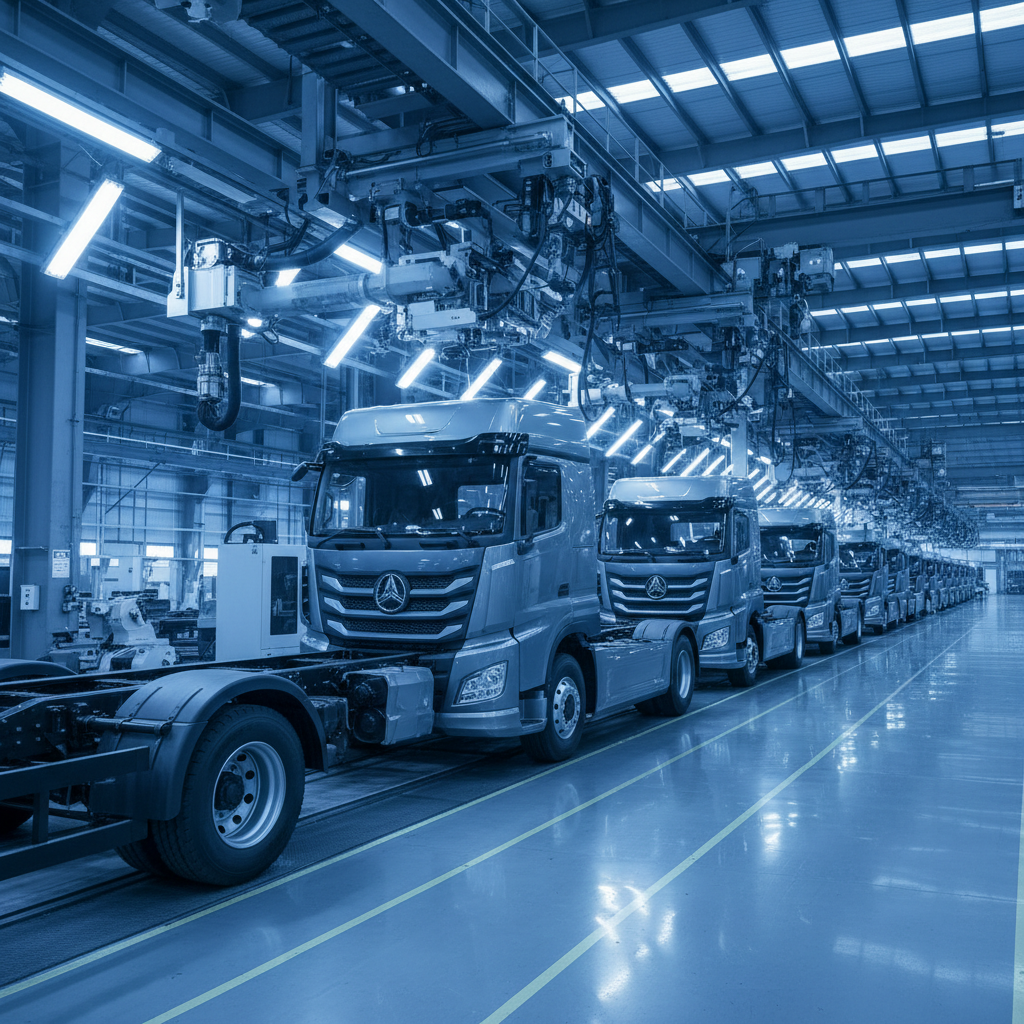

Trucks are the most straightforward thermometer of the industrial world.
Every tonne of ore hauled from a mine to a smelter, every bundle of steel moved from a warehouse to a construction site, every container driven from a port to an inland depot — all of this movement depends on heavy trucks. In China, the world's factory floor, the number of trucks on the road is inseparable from the number of factories in operation. In 2025, China's heavy truck market surpassed one million units for the year, marking a new historical milestone — the first time since 2010 that sales have held firmly above that threshold, and this time on the back of a fundamentally different energy mix and a fundamentally different competitive structure.
But unit volume is not the most arresting number of the year. The most arresting number is December's single-month new-energy penetration rate: 53.89%.
In other words, in that month, more than one in every two newly registered heavy trucks was powered by new energy. In 2024 that figure was just 8%. Within a single year, from 8% to a year-end monthly rate of 54% — this is not gradual evolution; this is an avalanche-speed energy transition.
At the same time, China's heavy truck exports reached approximately 330,000 units in 2025, a record high. Exports accounted for more than 30% of total output. From Russia and the Middle East to Southeast Asia, from the African savannah to mountain roads in Latin America, Chinese-made trucks now run across much of the world.
One million units in total, with new-energy adoption and overseas expansion both accelerating, and with L4 autonomous driving climbing from the laboratory onto real highway freight lanes — this is the scorecard the Chinese commercial vehicle industry delivered in 2025. It is not a placid statistical table; it is an industrial revolution in progress, potentially of the same magnitude as passenger-vehicle electrification. The protagonists of this revolution are the heavy trucks racing day and night on highways, the drivers who wrestle dozens of tonnes of steel with their bare hands, and above all the engineers constantly pushing the boundaries of technology inside factories.
The scope of this report covers all commercial vehicle categories within the framework of China's GB 2589-2013 General Terms for Road Motor Vehicles: heavy freight vehicles (including tractors, dump trucks, and cargo trucks), medium freight vehicles, light freight vehicles (light trucks), buses (large, medium, and light), and special-purpose vehicles (including special-operations vehicles). Non-road mobile machinery (construction equipment, agricultural machinery) and passenger vehicles (sedans, SUVs, MPVs) are excluded. Data benchmarks are drawn from the China Association of Automobile Manufacturers (CAAM) and China Heavy Truck Information Network and other authoritative sources; some historical figures vary by 5–10% across different institutional definitions, and major data sources are noted throughout.
This report covers all categories — heavy trucks, light trucks, buses, and special-purpose vehicles — systematically tracing the contours and direction of this revolution from market scale and global landscape through supply chains and enterprise financials, from the industrial belt map to technology roadmap evolution.
Chapter 1 Definitions, Classifications, and Supply Chain Overview
I. Definition and Classification Framework
A commercial vehicle is a road motor vehicle designed and built to transport people or goods and capable of towing a trailer. Under China's current national standards and industry conventions, commercial vehicles fall into several major categories:
By Vehicle Purpose:
Heavy freight vehicles (heavy trucks) are cargo vehicles with a kerb mass exceeding 6 tonnes or a gross vehicle weight (GVW) exceeding 14 tonnes. This category is the core research subject of this report and the largest and most technologically turbulent segment of China's commercial vehicle market. Heavy trucks may be further subdivided by structure into: tractors (semi-trailer heads), dump trucks (engineering dump), cargo trucks (flatbed / box-body), and special-operation vehicles (concrete mixer trucks, tanker trucks, refrigerated trucks, etc.).
Medium freight vehicles (medium trucks) have a kerb mass of 3–6 tonnes and GVW of 6–14 tonnes. They serve as a transitional category between light and heavy, with modest market share but an indispensable role in urban last-kilometre delivery and short-haul freight — particularly in building-materials distribution and beverage transport.
Light freight vehicles (light trucks) have a kerb mass not exceeding 3 tonnes and GVW not exceeding 6 tonnes. Light trucks are China's highest-volume single commercial vehicle category, with annual sales of approximately 2 million units, covering urban logistics, rural transport, and express delivery. The lower driving threshold (a Category C1 licence covers many models) makes them the tool of choice for millions of individual freight operators. New-energy penetration in light trucks is accelerating rapidly — in fact, electrification is progressing ahead of heavy trucks because of urban combustion bans, last-mile delivery electrification policies, and relatively short daily operating ranges (under 150 km in urban scenarios), all of which allow the economics of electric light trucks to work first in urban distribution.
Buses include large coaches (over 12 m), medium coaches (7–12 m), light coaches (6–7 m), and microcoaches. Large coaches serve urban public transit and intercity routes, and electrification is already quite mature. Medium coaches are used for tourist and airport-shuttle services; light coaches are the main vehicle for urban-rural connections.
By Fuel and Powertrain:
This is the most important classification dimension in 2025. Conventional diesel heavy trucks remain the majority, but their share has fallen from 91% in 2020 to approximately 46% in 2025 — a pace of displacement that is rare for any industrial goods category. LNG (liquefied natural gas) heavy trucks have long held a position in long-haul trunk logistics thanks to lower running costs and lower emissions; their share in 2025 is approximately 25%. LNG trucks face cold-start difficulties in winter and refuelling convenience issues in summer, but retain strong economic appeal when the gas-diesel price spread is wide.
Battery-electric heavy trucks (plug-in charging type) have ramped rapidly in short-haul scenarios — urban logistics, ports, and mines — where the technology is most mature and the supply chain (batteries, motors, power electronics) is the most globally interoperable. Battery-swap heavy trucks replace slow charging with rapid battery exchange, primarily in high-frequency closed-site applications; their core value is compressing the 3–6-hour charging wait to 5–8 minutes, dramatically improving vehicle utilisation.
Plug-in hybrid heavy trucks combine electric and combustion power, suitable for medium-to-long mixed-use cycles. During the transition period when ultra-fast-charging infrastructure remains incomplete, PHEVs serve as a stepping stone from combustion to full electric — when the battery is depleted, combustion range continues, significantly reducing range anxiety.
Hydrogen fuel-cell heavy trucks are technically closest to zero-emission; refuelling time is similar to diesel (approximately 3–5 minutes) and energy density is high. In the first half of 2025 only 1,268 were sold, constrained by sparse hydrogen station coverage (approximately 500 nationwide) and high hydrogen costs (around CNY 35–60/kg at retail), meaning commercial development remains exploratory.
By Tonnage and Axle Configuration:
The industry's most common configurations are the 6×4 three-axle heavy truck (maximum GVW 25 tonnes) and the 6×2 three-axle (GVW 18 tonnes). The dominant semi-trailer tractor is the 6×4 format, with a GVW cap of 49 tonnes, serving long-haul trunk freight. 4×2 (two-axle) trucks are used for lighter cargo and some medium-truck applications in urban peri-urban logistics. 8×4 four-axle heavy trucks serve engineering dump and mine transport, carrying larger payloads per trip.
II. Supply Chain Overview
The heavy truck supply chain spans vehicle manufacturing, component supply, and usage services horizontally, and extends vertically from raw materials to end-of-life recycling. Compared with the passenger car supply chain, heavy trucks have a higher component cost share (approximately 70–80% of the vehicle price) and a larger aftermarket (heavy trucks accumulate 5–10× more annual mileage than passenger cars, with correspondingly higher parts wear and replacement frequency).
Upstream: Raw Materials and Base Components
Steel is the largest raw material input — a standard heavy truck uses approximately 5–8 tonnes of steel in the frame, axles, engine block, and other structural components. Specialty steel quality (high-strength, wear-resistant grades) directly determines frame load capacity and fatigue life. BAOWU, Ansteel, and Shougang specialty products have become the primary suppliers to major OEMs, achieving substantial domestic substitution.
Aluminium alloy usage is rising with lightweighting trends — light-truck cabs and cargo bodies are now commonly aluminium-bodied; heavy-truck cab aluminium content is also increasing, with each truck using approximately 100–300 kg of aluminium alloy, reducing vehicle weight by approximately 200–500 kg, which is especially meaningful for improving the payload ratio of electric heavy trucks.
In the electric truck era, battery upstream materials (lithium carbonate, LFP, nickel-cobalt-manganese precursors) have entered the heavy truck supply chain. Lithium carbonate prices fell from approximately CNY 600,000/tonne at the 2022 peak to approximately CNY 80,000–120,000/tonne in 2025 — a drop of over 80% — making this the single most important material-side driver of falling electric truck costs.
Rare-earth permanent magnets (neodymium-iron-boron) are critical upstream inputs for traction motors. China accounts for approximately 60% of global rare-earth reserves, giving China-made electric heavy trucks a materially stronger upstream supply security than their European or American counterparts.
Copper and aluminium wiring harnesses for high-voltage circuits are needed in quantities 3–5× greater in electric trucks than in combustion trucks. Rapid electric truck uptake is already becoming a marginal support factor in copper pricing.
Midstream: Component Manufacturing
The engine is the heart of the conventional heavy truck. China's heavy truck engine market has long been dominated by Weichai Power (000338), whose WP series spans the full power range from 200 to 600 horsepower. Yuchai (Guangxi) and FAW Group's subsidiary Xichai (Jiangsu Wuxi) also hold ground in lighter engine segments.
In 2025, Weichai Power sold approximately 743,000 units (+1.3%); despite slowing growth under the pressure of new-energy trucks, its absolute volume lead is unassailable. Weichai engines fit approximately 65–70% of domestic heavy truck sales — a concentration level that is rare even by global commercial vehicle standards.
Weichai's global footprint is equally notable. Through years of strategic acquisitions, it has integrated Linde Hydraulics (formerly KION), Delphi Technologies' commercial vehicle business, Ballard Power Systems (Canada, fuel cells), and Ferretti Group (Italy, yachts), transforming from a pure engine supplier into a diversified powertrain and industrial conglomerate.
Transmissions are the key in the driveline. Shaanxi Fast Group (法士特, unlisted) is China's largest heavy-duty transmission manufacturer; 2025 sales were approximately 911,000 units (+7%), the highest volume of any heavy-duty transmission maker globally. Fast's traditional product — manual mechanical transmissions (MT) in 12- and 16-speed configurations — holds over 60% domestic market share. As new-energy trucks and autonomous driving advance, AMT (automated manual transmission) and electric drive systems are unavoidable. Fast is accelerating its AMT range and has developed integrated electric-drive systems (motor + reducer + controller) for EV trucks.
Axles determine load capacity and drive characteristics. Hande Axle (Weichai-controlled) sold 1 million axle sets in 2025 (+25%) — the fastest-growing major heavy truck component company in recent years — and is extending into electrified "e-axle" products that integrate the motor, reducer, and brakes into the axle assembly.
Cabs involve four major processes — stamping, welding, painting, and final assembly — with high technical barriers. Modern heavy truck cabs have evolved from "simple human-machine interface, durability-first" to intelligent cockpits featuring large centre-stack screens, HUD, ADAS sensor suites (millimetre-wave radar, cameras, lidar), voice interaction, and other features now standard in premium heavy trucks.
Electric powertrain components — battery packs (CATL, BYD, EVE Energy), traction motors (co-developed with specialist motor firms or sourced from suppliers such as ETA New Energy and Founder Motor), and power electronics (VCU, BMS, MCU) — form the "three-electric" core of pure-electric heavy trucks. This layer expanded rapidly in 2025 as EV trucks soared. The number of battery suppliers entering heavy truck supply chains grew from fewer than 10 in 2022 to more than 20 in 2025.
Aftertreatment systems — SCR + DPF + DOC combinations — are mandatory for all new combustion heavy trucks under the China 6b emission standard. Domestic suppliers (Aikolan, Tianli, Kailong) have substantially replaced imports, though platinum-group metal catalysts (palladium, platinum, rhodium) still rely on imported feedstocks.
Downstream: Usage and Services
The aftermarket — parts sales, maintenance, leasing, insurance, and digital operations platforms — is a critical profit source when vehicle gross margins are thin. With approximately 8 million heavy trucks in operation nationally, the annual maintenance market exceeds CNY 100 billion, though it remains highly fragmented among authorised service centres, independent roadside garages, and the growing platforms of Manbang and others.
Value Distribution in the Supply Chain
For a conventional diesel heavy truck priced at approximately CNY 450,000 ex-works: the engine accounts for approximately 20–25% of cost; transmission approximately 8–12%; axles approximately 8–10%; cab approximately 10–15%; frame approximately 8%; tyres approximately 5%; other (steering, brakes, suspension, harness, interior, electronics) approximately 30%.
For a pure-electric heavy truck, the distribution shifts markedly: the battery pack accounts for approximately 35–45% of vehicle cost (the primary reason EV trucks cost more); drive motor + power electronics approximately 8–12%; traditional mechanical parts (axles, frame, suspension) are proportionally smaller. This means whoever controls the electric truck's battery supply controls the supply chain's largest value node.
III. Supply Chain Value Chain and Profit Distribution
Across the heavy truck value chain from components to end user, profits are distributed roughly as follows. For a conventional diesel tractor priced at approximately CNY 450,000: OEM gross margin is typically 8–12% (approximately CNY 36,000–54,000 per unit), with net margin around 1–4%. Core component suppliers — engine, transmission, axle — typically enjoy gross margins of 20–30%, well above OEMs. The aftermarket is the highest-margin segment: OEM parts command 30–100% premiums over equivalent aftermarket alternatives; vehicle finance earns a spread of roughly 3–5%; maintenance labour margins frequently exceed 50%.
In the new-energy era, this value-chain distribution is being reshuffled. Battery manufacturers (CATL) are displacing engine makers as the largest value node; OEMs face increasing margin pressure from high battery-pack costs; and the operation of ultra-fast-charging and battery-swap networks introduces a new recurring revenue model — a charging or swap fee every service cycle — that had no analogue in the diesel era.
IV. Policy History of China's Commercial Vehicle Industry
Understanding the 2025 new-energy commercial vehicle surge requires viewing it against a decade of evolving policy.
2012–2016: Launch phase for new-energy commercial vehicles. The Ministry of Industry and Information Technology first extended new-energy promotion catalogues to commercial vehicles around 2012, initially focusing on electric buses, which offered the most regular operating cycles and the easiest subsidy validation. Subsidies were battery-capacity-based — a single electric bus could receive tens of thousands of CNY in national subsidies — spurring rapid entry by Yutong and BYD.
2016–2020: Subsidy fraud crackdown and tightening. A 2016 national audit exposed large-scale subsidy fraud in new-energy vehicles (falsifying electric bus sales volumes to claim subsidies). Policy tightened sharply, standards were reset, and verification procedures were made rigorous. NEV subsidies were broadly reduced and some firms were penalised. The industry entered a consolidation and digestion phase.
2020–2023: Battery-swap mode approved, heavy truck NEV launches. In 2020, MIIT officially added battery swapping to the approved commercial vehicle new-energy promotion pathways, and granted specific purchasing subsidies for swap-compatible trucks whose exchangeable battery packs are excluded from the vehicle's total weight. This was a pivotal policy moment — the swap model resolved the two core pain points of short range and slow charging in high-frequency mine and port scenarios. Swap heavy truck sales took off rapidly in 2021–2022.
2023 to present: China 6b plus market-driven acceleration. With China 6b fully in force from July 2023 and battery costs falling rapidly, commercial vehicle electrification transitioned from "policy-subsidy-driven" to "market-economics-driven." Without additional subsidies, pure-electric heavy trucks in certain high-frequency short-haul scenarios already offer a lower total cost of ownership than diesel equivalents. Market-driven structural change tends to be more durable and far-reaching than subsidy-driven change — and that is the deeper policy logic behind the 2025 penetration-rate explosion.
Chapter 2 Global Landscape and FY2025 Results of Major Western Incumbents
I. Overview of Global Commercial Vehicle Markets
The global heavy truck market has long been structured around three core regions — China, Europe, and North America — plus India, Southeast Asia, the Middle East, and Africa as growth markets. Total global heavy commercial vehicle annual sales are approximately 3–3.5 million units (varying by scope definition), of which China accounts for approximately 30%. Including light trucks and buses, global commercial vehicle annual sales exceed 20 million, and China's share is over one-third.
In 2025, two forces are disrupting this structure: Chinese brands are accelerating overseas expansion, displacing incumbents in Russia, the Middle East, and Southeast Asia; meanwhile, macro-cycle softness is compressing demand in North America (Class 8) and Europe, and all major Western groups delivered double-digit revenue and profit declines in FY2025.
II. Daimler Truck FY2025
Daimler Truck (ticker: DTG, Frankfurt) is the world's largest heavy truck manufacturer by volume. Its brands include Mercedes-Benz Trucks, Freightliner (No. 1 in North America), Western Star (North American premium), BharatBenz (India), and Fuso (Japan).
FY2025 Industrial Business revenue was approximately EUR 45.9 billion, down from EUR 50.7 billion in FY2024 (approximately -10%); Group total revenue was approximately EUR 49.4 billion; adjusted Industrial EBIT was approximately EUR 3.8 billion (-21% vs. FY2024); Industrial Return on Sales was approximately 7.8%.
Revenue declined primarily because the North American Class 8 market entered a demand-cycle trough in FY2025. Freightliner holds approximately 40% of the U.S. Class 8 market, making Daimler Truck especially sensitive to North American cyclicality.
On the technology side, Daimler Truck continued to increase investment in zero-emission products. The eCascadia battery-electric truck (up to approximately 800 km range) has commercial deliveries in North America; the eActros 600 began European series production; and Daimler Truck formed the HYLA hydrogen JV with Volvo Group to advance hydrogen fuel-cell truck infrastructure and products, targeting commercial-scale hydrogen truck ecosystems in Europe and North America by the 2030s.
III. Volvo Group FY2025
Volvo Group (Stockholm, NASDAQ: VLVLY) operates Volvo Trucks — one of Europe's largest truck brands — alongside Renault Trucks, UD Trucks, Mack Trucks, Volvo Construction Equipment, and Volvo Buses.
FY2025 net sales were approximately SEK 479.2 billion, down approximately 9% from approximately SEK 526.8 billion in FY2024; adjusted operating profit approximately SEK 51.2 billion (FY2024 approximately SEK 65.7 billion); operating margin approximately 10.7% (FY2024 approximately 12.5%).
Volvo is among the most advanced incumbents in electric truck deployment. Its FH Electric (long-haul) and FM Electric (urban distribution) series have achieved meaningful commercial delivery volumes in Scandinavia, Germany, and the Netherlands — Nordic EV truck penetration already exceeds 5%, far above global averages. In autonomous driving, Volvo's deep partnership with Aurora Innovation targets commercial L4 freight operations in Texas and Pennsylvania.
IV. PACCAR Inc. FY2025
PACCAR (NASDAQ: PCAR) is the United States' largest truck manufacturer, with brands including Kenworth, Peterbilt (both North American premium), and DAF (Western Europe).
FY2025 revenue was approximately USD 28.44 billion, down approximately 15.5% from USD 33.66 billion in FY2024; net income was approximately USD 2.38 billion (EPS USD 4.51), including approximately USD 265 million (after-tax) of charges related to European civil litigation. PACCAR's historically superior gross margins reflect the stable, non-cyclical earnings contribution of PACCAR Financial and PACCAR Parts, which together account for approximately 35–40% of Group pre-tax profits — a resilience advantage over pure OEMs. The FY2025 revenue decline reflects the North American heavy truck de-stocking cycle that began in late 2024.
V. Traton Group, Scania, and MAN FY2025
Traton Group (Volkswagen's commercial vehicle unit, Frankfurt) is the world's third-largest commercial vehicle group, comprising Scania (Sweden, premium custom trucks), MAN (Germany, standard heavy trucks), Navistar (North America, International brand), and Volkswagen Truck & Bus (Brazil/Latin America). In FY2025 Traton was weighed down by declining demand in Scandinavia and Germany, though Scania's high-margin custom premium business outperformed the group average. Scania's average selling price (approximately EUR 150,000–200,000 per unit) is the highest among European truck brands. MAN is undergoing large-scale product renewal (the new Lion's Pride series) and electrification investment, with short-term profit pressure. Navistar's International brand in North America faces the same cyclical downturn.
VI. Asian Regional Competitors: Japan and India
Tata Motors' commercial vehicle division is the dominant player in India's domestic heavy truck market (approximately 50% share). Isuzu (Japan) holds deep roots in Southeast Asian light-medium commercial vehicles, with Thailand as its largest single export market. Hino (Toyota Group) is recovering from its engine data falsification scandal (exposed in 2022) and rebuilding brand trust, a process under close watch in Thailand and Southeast Asia in 2025–2026.
VII. Chinese Brands' Position in Global Markets
In total volume, China is already the world's largest heavy truck producer and consumer. In "global premium heavy trucks" (the high-horsepower long-haul segment sold at Western standards, typically at prices above USD 150,000 and with expected lifetimes exceeding 2 million km), Chinese brands primarily penetrate price-sensitive emerging markets, with genuine competition in Western Europe and North America still in its early stages. That landscape is slowly changing as Chinese brands build reliability track records and service networks. SINOTRUK's SITRAK (with MAN-licensed technology) has established a positive quality reputation in parts of the Middle East and Eastern Europe. FAW Jiefang's JH6 series has reached near-European levels in exterior design and intelligent features.
Chapter 3 PEST Analysis: Drivers and Uncertainties
I. Political / Regulatory (Political)
China 6b emission standard. From 1 July 2023, China 6b became mandatory for all new heavy trucks, requiring NOx emissions to fall approximately 40% versus China 5 and particulate matter to fall approximately 67%. The standard materially raised new-truck manufacturing cost and technical barriers — the aftertreatment system alone added approximately CNY 20,000–50,000 per engine — accelerating the exit of technically weaker small OEMs.
China 4 (National 4) retirement replacement cycle. SINOTRUK estimates approximately 520,000 China 4-standard heavy trucks are waiting to be retired nationwide. As these vehicles age out of service life (typically 8–10 years for commercial use) and urban access restrictions on pre-China 6 vehicles expand, replacement demand will concentrate in 2026, creating a policy-driven top-up demand surge.
New-energy commercial vehicle support policies. Central and local governments have maintained a range of incentives: free-passage trials for swap heavy trucks on certain expressway sections; local purchasing subsidies in Shandong, Zhejiang, and Guangdong; expressway charging and swap-station construction plans; hydrogen corridor pilot projects (Beijing-Tianjin-Hebei, Shanghai, Guangdong, Inner Mongolia).
Belt-and-Road export policy. The export policy environment is broadly supportive: export VAT refunds cover complete vehicles and CKD kits; the Ministry of Commerce's "Automotive Export Quality Improvement Action" promotes after-sales service infrastructure abroad; key destination-country certification processes (Saudi SASO, Vietnam VR, Russia OTTC) have become more established; and some destinations now require local assembly content, compelling Chinese OEMs to accelerate local manufacturing.
II. Economic (Economic)
Infrastructure and real estate dual drivers. Construction dump trucks and concrete mixers (collectively 30–35% of the heavy truck market) are strongly correlated with infrastructure investment and real estate starts. China's real estate structural contraction — new construction floor area declining from approximately 2 billion square metres in 2021 to approximately 1 billion in 2025, a drop of over 50% — continues to suppress engineering vehicle demand. Local government special bonds and infrastructure catch-up spending provide partial offset, but this policy demand is episodic rather than sustained.
Highway freight demand as the fundamental driver. Consumer logistics (e-commerce, food-and-beverage, express delivery) and bulk commodity transport (coal, ore, construction materials, grain) are the two pillars of road freight. In 2025, sustained e-commerce growth and surging cross-border export volumes supported road freight totals in moderate positive territory, underpinning baseline heavy truck demand.
Export economic logic. Chinese heavy truck exports are driven by significant price competitiveness (30–50% cheaper than equivalent Western products), progressively improving reliability (HOWO feedback in Russia and Africa indicates sub-100,000-km reliability approaching European brand standards), and financial services support (OEM captive finance companies offering local financing in the Middle East and Southeast Asia at 10–20% down payment).
Energy prices and the LNG/EV switching dynamic. LNG truck economics depend heavily on the gas-diesel price spread. In 2025, domestic LNG prices were broadly stable (pipeline gas approximately CNY 3–4/m³, LNG liquid approximately CNY 4–5/kg), giving LNG trucks approximately 15–25% lower per-km running costs than diesel equivalents — enough to sustain approximately 25% market share. Electric truck economics are driven primarily by electricity-price advantage: an electric heavy truck running 200 km/day incurs annual electricity costs of approximately CNY 50,000–80,000 versus approximately CNY 150,000–200,000 in diesel costs — annual savings of approximately CNY 80,000–140,000 vs. a CNY 400,000–600,000 vehicle premium over the equivalent diesel truck, recovering the premium in approximately 1–2 years.
III. Social (Social)
Structural shift in the freight market. Approximately 30 million registered truck drivers in China, of whom approximately 4–5 million hold Class A licences (for the heaviest trucks). Organised fleets (10+ vehicles) still account for less than 30% of total; the majority of individual owner-operators makes price and total cost of ownership the primary purchase criteria. Platform aggregators such as Manbang have accumulated tens of millions of active users and reduced empty-run rates from approximately 40–50% to approximately 30–35%, improving system efficiency. Fleet operators are more motivated than individual operators to adopt new-energy trucks — large fleets can build their own charging or swap infrastructure, eliminating the public-network dependency that deters individual drivers.
Driver adaptation challenges. Range anxiety and sparse swap station coverage (approximately 1,400 swap stations nationally for approximately 70,000 swap trucks in operation, or roughly one station per 50 trucks) remain social barriers to EV truck adoption. Trunk-haul scenarios demanding 500–800 km/day require ultra-charging infrastructure density far beyond current levels, particularly in western China and the northeast.
Driver shortage and the social pull toward autonomous driving. The average age of professional heavy truck drivers in China is approximately 40; young workers increasingly avoid the profession (gruelling conditions, prolonged absences from home, uncertain income). Driver shortages are already manifesting as significant wage premiums — some large fleets report Class A driver monthly salaries of CNY 15,000–25,000 in 2025, with chronic vacancies. This demographic pressure, not solely technology push, is a genuine market-pull for L4 autonomous driving commercialisation.
IV. Technology (Technology)
Multi-path powertrain competition. Battery-electric (charging), battery-swap, LNG, and hydrogen fuel cell are all still in the running in 2025 with no single winner yet. CATL has proposed the "Eight Horizontal, Ten Vertical" swap corridor plan, targeting coverage of 80% of national trunk freight capacity by 2030. Tesla Semi's mega-battery approach (800+ km range at approximately 900 kWh) is providing a technical reference and competitive pressure on China's charging-truck OEMs — when super-charging battery packs grow large enough, the distinction between charging and swapping blurs.
L4 autonomous driving commercialisation. 2025 is widely regarded as the commercial-launch year for L4 trunk logistics autonomy. The convergence of three factors — solid-state lidar cost falling from approximately CNY 100,000 per unit in 2021 to approximately CNY 3,000–5,000 in 2025; national HD-mapping policy liberalisation; and the adoption of end-to-end neural network planning architectures — has enabled the transition from supervised demonstration runs to genuine commercial operations.
Smart-cockpit and OTA. Vehicle-mounted telematics (T-BOX + cloud platform) penetration on new heavy trucks has risen from approximately 30% in 2020 to approximately 80% in 2025. OTA software updates for commercial trucks are making "software-defined vehicles" a practical reality in heavy transport, enabling fleet-wide parameter optimisation, new feature activations, and predictive maintenance alerts without physical service visits.
Chapter 4 China Market Scale and Structural Deep-Dive
I. Heavy Truck Total Volume: Back Above One Million Units
China's heavy truck market returned to above 1 million units in 2025 — the first firm footing above that threshold since 2020's extraordinary spike, but this time driven by fundamentally different dynamics.
Historical context: 2020 approximately 1.6 million units (the China 3-to-4 transition peak); 2021 approximately 1.4 million; 2022 approximately 670,000 (the Covid + real-estate shock trough); 2023 approximately 910,000; 2024 approximately 900,000; 2025 surpassing 1 million and establishing a new base.
More important than total volume is structure: in 2025, diesel heavy trucks accounted for approximately 46%, LNG for approximately 25%, battery-electric and swap trucks for approximately 23% (exceeding 54% in the final month's single-month count), and hydrogen/PHEV for approximately 1–2%. This split is a world apart from the >90% diesel dominance of just three years earlier.
II. New-Energy Heavy Trucks: From 8% to 54% in One Year
This is the most important data trajectory in China's commercial vehicle industry in 2025.
Full-year 2024: approximately 80,000 new-energy heavy truck sales, annual penetration approximately 8%. Consensus forecasts called for "15–20% by end-2025." What actually happened far exceeded all predictions.
Full-year 2025: approximately 230,000 new-energy heavy trucks, up approximately 182% year-on-year. Monthly penetration rose from approximately 15% in January, to a H1 average of approximately 20–22%, then accelerated sharply in H2, breaking 26% in August and climbing to 53.89% in December — a monthly volume of over 45,300 units, nearly 57% of the entire 2024 annual total, in a single month.
Three key drivers:
Cost inflection point. LFP battery cell prices fell from a 2022 peak of approximately CNY 1.30/Wh to approximately CNY 0.40–0.50/Wh in 2025 — a drop of over 60%. A 350 kWh battery pack's cost fell by over CNY 300,000, making the new-energy truck's sticker price approach, and in some configurations undercut, the equivalent diesel model.
Charging/swap infrastructure density improvement. By mid-2025 there were approximately 1,400 swap stations nationally, double the 2023 level. SINOTRUK's QY-Power swap network at mines, ports, and industrial parks, and CATL's super-charging station rollout in partnership with OEMs, have substantially reduced high-frequency-operation range anxiety.
Policy-driven structural demand. Some cities and industrial parks have set new-energy-only access requirements; ports, steel mills, and cement plants are building "zero-emission factory zones"; China 4 trucks are losing road access earlier — all creating rigid new-energy replacement demand.
III. Light Trucks: Electrification Wave in the 2 Million Unit Market
China's light truck market is the largest single commercial-vehicle category by volume, at approximately 1.9–2 million units annually. In 2025, Q1–Q4 volumes accumulated to approximately 1.95–2 million. Foton (EU Mark + Shidai brands) leads by a wide margin at approximately 460,000 units; JAC ranks third; Dongfeng is fourth.
New-energy light trucks are accelerating. In Q1 2025, Geely REMOTE held approximately 21.9% share of NEV light trucks (ranked first); Foton EU Mark ranked second at approximately 15%; Qingling ranked third; JAC fourth (+117% YoY). In urban last-mile and e-commerce warehouse distribution, pure-electric light trucks with daily ranges under 150 km already demonstrate clear total-cost-of-ownership advantages — annual fuel savings of approximately CNY 30,000–50,000 vs. equivalent diesel, with the price premium typically recovered within 2–3 years.
IV. Total Market TCO Analysis: Diesel vs. EV vs. Swap
For a typical tractor running 200,000 km/year over a 5-year / 1 million km lifecycle:
- Diesel tractor (approximately CNY 320,000 sticker): annual fuel ~CNY 150,000–180,000; annual maintenance ~CNY 30,000–50,000; 5-year total approximately CNY 950,000–1,150,000.
- Swap-electric tractor (approximately CNY 280,000–350,000 excluding battery): annual swap service ~CNY 110,000–150,000 (covers battery depreciation); annual maintenance ~CNY 15,000–25,000; 5-year total approximately CNY 680,000–900,000.
- Charge-electric tractor (approximately CNY 480,000–550,000 with large-pack battery): annual electricity ~CNY 60,000–90,000; annual maintenance ~CNY 15,000–25,000; 5-year total approximately CNY 850,000–1,020,000.
Conclusion: swap-type pure-electric tractors in high-frequency scenarios offer a 5-year TCO approximately 15–25% below diesel (CNY 150,000–250,000 savings). Charge-type TCO advantage is approximately 10–20% with current battery prices; that advantage will widen as battery costs continue to fall and charging power increases.
Chapter 5 Supply Chain Deep-Dive
I. Engines: Weichai's Throne and the NEV Challenge
Weichai Power (000338) holds approximately 65–70% of the heavy truck engine fitment rate — a near-monopolistic position that is rare by any global standard. Weichai's core competitive advantage is "reliability validated at massive scale": tens of years of verification across China's varied roads and extreme climates have built a mean-time-between-failure (MTBF) track record that late entrants cannot replicate quickly.
In 2025, Weichai's "three-electric" (battery + motor + power electronics) business revenue reached approximately CNY 3.04 billion, roughly doubling year-on-year; battery business +162%, proprietary motor business +219%. In Q1 2025, Weichai net profit grew approximately 22% to approximately CNY 2.7 billion, beating consensus, demonstrating that new-energy business growth is offsetting the engine growth slowdown.
Sinohytec (亿华通, 688377) specialises in hydrogen fuel-cell systems and works closely with Toyota (Mirai fuel-cell technology), supplying fuel-cell buses and trucks domestically. In H1 2025, hydrogen fuel-cell heavy truck sales were just 1,268 units (-4.5% YoY), reflecting the structural constraint of sparse hydrogen stations (approximately 500 nationwide) and persistently high hydrogen costs — evidence that the commercial case for hydrogen heavy trucks has not yet become self-sustaining after subsidy withdrawal.
II. Transmissions: Shaanxi Fast's Million-Unit Scale and AMT Transition
Shaanxi Fast sold approximately 911,000 units in 2025 (+7%), sustaining its position as the world's largest heavy-duty transmission maker by volume. Fast's AMT series is an important fitment for new-energy heavy trucks. Although pure-electric trucks theoretically can use single-speed drives (electric motors' torque characteristics allow it), multi-speed AMTs can optimise efficiency across different duty cycles — the fuel-saving (energy-saving) benefit in full-load climbing and high-speed cruise can reach 5–8%. Fast's custom AMTs are in series production for SINOTRUK, FAW Jiefang, and Shaanxi Auto new-energy heavy trucks.
III. Axles: Hande's Million-Set Expansion and Electric Drive
Hande Axle (Weichai-controlled) reached 1 million axle sets in 2025 (+25%). Two growth sources: recovering conventional diesel heavy truck volumes (from 900,000 to 1 million units industry-wide) and Hande's rapidly growing e-axle business (motor + reducer + brakes integrated into the axle), which roughly doubled in 2025.
Hande, Shaanxi Fast, and Weichai Engine — geographically all centred in Shaanxi Province — form the so-called "golden powertrain chain." In April 2025, all three, together with Shaanxi Auto Group, jointly launched the "Zhihui" new-energy brand, officially extending the "golden chain" cooperation into the EV era.
IV. Batteries and Charging / Swap Infrastructure
CATL (300750) is the dominant player in EV heavy truck battery supply. Its LFP cells (over 3,000 complete charge-discharge cycles, high safety) are the mainstream choice for commercial vehicles. In the swap domain, CATL and SINOTRUK co-developed a standardised swap battery pack that is the most widely deployed heavy truck swap standard in China.
BYD's Blade Battery (LFP prismatic blade cell) has become synonymous with high safety (passes nail-penetration test without fire) and is fully vertically integrated into BYD's commercial vehicle lineup. Second-tier suppliers — EVE Energy and CALB — compete primarily on price, targeting cost-sensitive mid-range EV truck customers.
By end-2025, the national heavy truck charging/swap infrastructure totals approximately 100,000 large DC charging piles (120–360 kW class) and approximately 1,400 swap stations. Charging infrastructure is concentrated in eastern and southern China highway logistics corridors; western and northeastern coverage density is significantly below demand.
The market split in 2025 (charging approximately 70%, swap approximately 30%) mirrors the trend in passenger EVs, where charging is progressively outcompeting swapping as fast-charging technology improves, compressing the time-advantage of swapping.
CATL's "Eight Horizontal, Ten Vertical" swap corridor plan targets 18 key national freight routes by 2030, covering 80% of national heavy truck freight volumes — a network that, if realised, would be transformative for the scale economics of the swap model.
V. Intelligent Driving Systems: From L2+ to L4
Commercial vehicle autonomous driving follows a different technical path from passenger cars. Heavy trucks, with their high-frequency, fixed-route, repetitive duty cycles, are better candidates for direct L4 full autonomy leaps, achieving commercial scale first in closed/semi-closed environments (mines, ports, fixed hub-to-hub routes), rather than the passenger car gradual L2→L3 progression in complex urban settings.
In 2025, solid-state lidar prices have fallen from approximately CNY 100,000/unit in 2022 to approximately CNY 3,000–5,000/unit, bringing L4 sensor suites within reach of pre-installation on commercial vehicles. Commercial ADAS (L2) domestic substitution is also accelerating — Huawei ADS, Momenta, and others are competing with Bosch, Continental, and ZF WABCO for commercial truck ADAS domain controller fitment.
Plus.ai (智加科技) has commercialised its "1+N convoy" model on trunk routes in East and South China — one human-driven lead truck guiding N (typically 2–4) L4 unmanned follower trucks via V2V communication. The economics of a 1+3 convoy: 4 human drivers replaced by 1, saving approximately 75% of driver costs, with approximately 10% additional energy savings from platooning reduced drag.
Chapter 6 Key Enterprise Deep-Dives (FY2025)
I. SINOTRUK (000951 / HK 3808): Revenue Expansion Leader
SINOTRUK Group, Jinan, is China's top heavy truck market share holder for multiple consecutive years. FY2025 revenue: CNY 57.74 billion (+28.51%); net profit: CNY 1.666 billion (+12.58%), the highest net profit among listed commercial vehicle OEMs; vehicle sales: 173,900 units (+30.77%), of which heavy trucks the majority. Net profit of CNY 1.666 billion is approximately 2.3× that of FAW Jiefang (CNY 725 million), reflecting SINOTRUK's decisive profitability lead.
Three engines of growth: domestic market share held at industry-leading levels; exports hit a historical high across the brand lineup; new-energy acceleration — Haowo N7 and the QY-Power swap system (co-built with CATL) are among the most widely deployed heavy truck swap networks in China. SINOTRUK's 2026 revenue target is CNY 122.5 billion, more than double FY2025, premised on exports growing to 300,000+ units (including SKD/CKD assembly), new-energy sales doubling, and domestic market share sustained at No. 1.
II. FAW Jiefang (000800): Revenue No. 1 All-Rounder
FAW Jiefang, Changchun — the largest commercial vehicle OEM by revenue in China. FY2025 revenue: CNY 62.68 billion (industry No. 1, +6.99%); net profit: CNY 725 million (+16.41%); total vehicle sales approximately 280,000 units (+11.5%), heavy/medium truck approximately 255,000 units (+19%), market share approximately 20–22%.
FAW Jiefang's competitive advantages: the broadest product range (light-medium-heavy-special-purpose-NEV); the widest export network (80 countries, local assembly plants including Pakistan, Iran, South Africa, Mexico, Kazakhstan); and the deepest brand recognition (the "Liberation" truck brand is one of China's longest-established, carrying strong cultural resonance among freight drivers). The JH6 flagship tractor — wide-body cab, ADAS L2+, full digital instrument cluster, AMT — is one of the benchmark products of China's premium heavy truck segment. FAW Jiefang's 2026 export target is 80,000 units.
III. Dongfeng Motor Group (HK 0489) / Dongfeng Commercial Vehicle: In Restructuring
Dongfeng Motor Group commercial vehicle operations are dispersed across several subsidiaries. Dongfeng Commercial Vehicle (Dongfeng Shares), FY2025: revenue CNY 8.858 billion (-19.01%), net loss CNY 480 million (net profit down -1,744.5%), reflecting losses in the light commercial business and impairments related to Dongfeng-PSA (Stellantis JV). However, Dongfeng's heavy truck business (Tianlong flagship, Tianlong KX) still holds approximately 12–17% heavy truck market share, ranking in the top four. In May 2025, Dongfeng's single-month market share reached approximately 16.7%. The 2025–2026 priority is internal restructuring: improving commercial vehicle profitability, scaling back loss-making passenger car JV brands, and increasing new-energy commercial vehicle investment.
IV. Shaanxi Auto Group: Defender and Transformer of the Golden Chain
Shaanxi Auto Group (全称 Shaanxi Automobile Holdings Group, unlisted), is a consistent top-three competitor in China's heavy truck market, with approximately 17% market share in 2025. Core brands: Delong (flagship tractor), Aolong (Delong X3000, dump trucks), Hande Ten Thousand (light-medium). Core competitive advantage: the "Weichai + Shaanxi Fast + Hande" golden powertrain chain — all three companies centred in Shaanxi Province, enabling highly efficient supply chain coordination. Shaanxi Auto's 2025 targets: approximately 35,000 total vehicles (+40%+), approximately 12,000 NEV commercial vehicles (+90%), exports approximately 3,000 units.
V. Foton Motor (600166): Comprehensive Commercial Vehicle Platform
Foton Motor, Beijing — China's most diversified commercial vehicle OEM, with Auman (heavy), Aumark / Times (light), Ouhui (bus), and pickups / passenger vehicles. FY2025 heavy truck sales approximately 142,200 units (+approximately 104%); new-energy heavy trucks approximately 22,000 units (+300%+, market share approximately 11%); overseas heavy truck exports approximately 27,000 units (+130%+); total overseas vehicle sales (light + heavy + bus) approximately 164,500 units, a record (+7.3%). 2026 overseas target: 200,000 units (heavy truck +70%).
VI. Yutong Bus (600066): World's Bus King
Yutong Bus, Zhengzhou — the world's highest-volume single bus brand. FY2025: revenue CNY 41.426 billion (+11.31%); net profit CNY 5.554 billion (+34.94%) — one of the strongest profitability records among any listed Chinese vehicle OEM; proposed dividend approximately CNY 2.2 billion. Domestic market share approximately 25% (No. 1); full-year vehicle sales approximately 60,000 units; new-energy buses 5,549 units (+7%, far above the industry's approximately 1.6% average growth). Yutong's exceptional profitability reflects high average unit values for large electric buses (approximately CNY 800,000–1,500,000 per 12-metre electric bus, 1.5–2× the diesel equivalent) and strong pricing power over both upstream suppliers (scale gives purchasing leverage) and downstream customers (brand dominance). Yutong's overseas footprint includes the UK (approximately 2,600 units operating under the demanding Transport for London standards), Israel, France, and the Netherlands — a validation of product quality at premium-market standards.
VII. King Long Bus (600686): Differentiated Three-Dragon Layout
King Long Bus, Xiamen, is China's second-largest bus group, with brands Xiamen King Long, Jinlv (medium coaches), and Higer (intercity / tour coaches). FY2025 Q1: revenue CNY 4.922 billion (+23.69%); net profit CNY 46.76 million (+164.79%). King Long's differentiation advantage is high-end custom coaches (Higer has premium pricing in the Middle East) and export competitiveness (stable customer bases in over 40 countries and territories).
VIII. SANY Heavy Truck: NEV Dark Horse in the Charging Segment
SANY Heavy Truck (a commercial vehicle subsidiary of SANY Group, indirectly held by SANY Heavy Industry 600031) is one of the most striking new-energy newcomers of 2021–2025. SANY's entry into heavy trucks leveraged SANY Heavy Industry's electrical control, hydraulics, and smart systems accumulated in its world-leading construction equipment business. SANY's strategy: focus exclusively on battery-charging pure-electric heavy trucks — diverging from most OEMs' "charging + swap dual-track" approach. In 2024, SANY Heavy Truck sold approximately 20,600 units (ranked approximately sixth industry-wide); in H1 2025, SANY achieved approximately 22.48% share of the charging heavy truck sub-segment, the No. 1 position — surpassing SINOTRUK, FAW Jiefang, and the traditional giants in this specific technology track.
IX. Geely REMOTE: NEV Light Truck Leader
Geely REMOTE is Geely Holding's dedicated new-energy commercial vehicle brand, covering light trucks, heavy trucks, tractors, and swap trucks. In Q1 2025, Geely REMOTE held approximately 21.9% share of the NEV light truck market, sustaining multi-quarter leadership. Its business model — vehicle + swap station + operations service as a packaged deal — lowers the initial capex for fleet operators and has gained traction in urban distribution and specific trunk logistics scenarios.
X. Weichai Power: Engine King in the Three-Electric Transition
Weichai Power (000338, Weifang, Shandong) is China's largest diesel engine manufacturer, with approximately 65–70% fitment rate in heavy commercial vehicle engines — a market concentration level that is rare globally. In 2025, engine unit volume was approximately 743,000 (+1.3%); "three-electric" business revenue approximately CNY 3.04 billion (roughly doubled YoY), with battery +162% and proprietary motors +219%. Weichai's hydrogen strategy is among the most forward-looking: through its Ballard Power Systems stake, Weichai has access to leading PEMFC (proton exchange membrane fuel cell) technology and is participating in multiple "hydrogen corridor" projects in Shandong, Shaanxi, Beijing-Tianjin-Hebei, and Guangdong-Hong Kong-Macao. Weichai's M4000 hydrogen fuel-cell system (rated 130 kW) has batch-delivery case studies in fixed-route applications in Shandong and Shaanxi.
XI. BYD Commercial Vehicle: Blade Battery Applied to Heavy Trucks
BYD Commercial Vehicle covers electric buses, electric light trucks, and electric heavy trucks, leveraging BYD Group's fully vertically integrated capabilities in Blade Battery (LFP), traction motors (permanent magnet synchronous), and power electronics. BYD Blade Battery, with its high safety (nail-penetration test) and approximately 160 Wh/kg energy density, is one of the best LFP solutions for commercial vehicle applications in China. BYD electric buses operating in over 70 countries globally — including large-scale operations in the UK, Israel, India, and Brazil — have earned brand recognition and quality endorsement in premium markets. Domestically, BYD's electric heavy truck remains in early commercialisation, but it is accumulating market share in port-side (terminal-tractor) and urban-construction enclosed scenarios.
XII. Profitability Comparison: FY2025 Cross-OEM Benchmarking
| Company | Revenue (CNY bn) | Net Profit (CNY bn) | Net Margin | Vehicles (10k units) |
|---|---|---|---|---|
| Yutong (600066) | 41.43 | 5.55 | 13.4% | 6 |
| FAW Jiefang (000800) | 62.68 | 0.73 | 1.2% | 28 |
| SINOTRUK (000951) | 57.74 | 1.67 | 2.9% | 17.39 |
| Foton (600166) | ~60 | ~0.3–0.5 | ~0.5–0.8% | ~38 |
| Dongfeng Shares | 8.86 | -0.48 (loss) | — | — |
| King Long (600686) | ~20 | ~0.15–0.20 | ~0.7–1% | ~3 |
Yutong is the absolute profitability champion at 13.4% net margin — 5–10× the heavy truck OEM norm of 1–3%. This reflects Yutong's approximately 25% domestic market share in large buses, the much higher per-unit value of electric buses versus trucks, and strong pricing power versus both suppliers and purchasers. The structural "two-end squeeze" on truck OEMs (powerful core component suppliers above, price-sensitive freight operators below) is a defining structural characteristic, and in the new-energy era it is compounded by high battery costs.
Chapter 7 Industrial Belt Map: Eight Cities Sustaining Tens of Thousands of Units of Capacity
Chinese commercial vehicle production has formed a highly concentrated industrial belt geography. Tianxia Gongchang Industrial Research Institute, mapping China's commercial vehicle factory data, finds that over 90% of heavy truck and bus capacity is concentrated in eight core industrial-belt cities, each deeply bound to one or more national brands and forming a complete ecosystem of vehicle manufacturing driving component supply, and component clusters reinforcing vehicle production. Among the 4.8 million real, in-production factories in China, commercial vehicle-related factories (complete vehicles + components + aftermarket services) number over 200,000, distributed across all provinces — but the geographic concentration of core capacity is far higher than this dispersed appearance suggests.
I. Shandong Jinan: SINOTRUK's Home Base
Jinan is China's most important heavy truck manufacturing base. SINOTRUK Group (headquartered in Jinan's Licheng District) has built the world's largest single-location heavy truck plant here, with planned capacity exceeding 300,000 units/year. Engine, axle, cab, and trim factories ring the main assembly plant in Jinan and the surrounding districts of Zhangqiu and Licheng, forming a highly coordinated cluster. The Jinan heavy truck supply chain covers over 70% of component value creation within Shandong — the highest domestic supply-chain self-sufficiency of any Chinese heavy truck belt. Weichai Power's core engine production is also in Shandong (Weifang), creating a highly efficient intra-provincial supply chain for Jinan's assembly base. Search for Jinan commercial vehicle factories on the industrial platform to see the full distribution of vehicle and component factories in the Jinan area.
II. Jilin Changchun: FAW Jiefang's Historical Roots
Changchun is China's oldest automotive industrial city and FAW Jiefang's main production base. Changchun commercial vehicle and component factories are searchable on the platform, predominantly FAW system-affiliated suppliers. The Liberation truck brand has over 70 years of Changchun production history — the Liberation brand truck was the first self-designed mass-produced vehicle in New China, rolling off the First Automotive Works line in 1956. FAW Jiefang's R&D centre and proving grounds are also in Changchun, enabling tight development-to-manufacturing coordination. The Changchun heavy truck belt is characterised by high state-enterprise dominance and high internalisation of component supply — large quantities of parts come from FAW Group subsidiary companies — giving strong quality control but relatively rigid supply chain flexibility compared to competitors.
III. Hubei Shiyan / Wuhan: Dongfeng's Stronghold
Hubei is Dongfeng Motor Group's traditional home base. Shiyan is the core production site for Dongfeng Commercial Vehicle (Tianlong series) — the Second Auto Works (Dongfeng's predecessor) was built here starting in 1969, creating an entire industrial city in the mountains. Hundreds of Dongfeng-system component suppliers cluster in Shiyan and the surrounding Xiangyang area (Dongfeng Cummins engines, transmissions, axles, cabs). Wuhan is Dongfeng Group's new management centre, with the Group headquarters now in Wuhan Economic & Technology Development Zone and Voyah (new-energy passenger cars) also based there. The Hubei commercial vehicle belt's historic depth (50+ years of the Dongfeng brand) and the Shiyan parts-cluster density are assets, but new-energy and smart-technology investment momentum lags behind Shandong and Jilin, which is part of the structural explanation for Dongfeng Commercial Vehicle's gradual market share erosion.
IV. Shaanxi Xi'an: Shaanxi Auto and the Golden Chain's Western Hub
Xi'an and the Guanzhong region are the core production territory for Shaanxi Auto heavy trucks, and also the concentration zone for Weichai's Shaanxi base, Shaanxi Fast Gearbox, and Hande Axle — the "golden powertrain chain" enterprises. Shaanxi Auto's headquarters and main assembly base are in Xi'an High-Tech Zone; Shaanxi Fast headquarters and core transmission plants are in Xi'an; Hande Axle is also in Shaanxi. The geographic concentration of all three makes the "golden chain" one of the shortest-supply-chain heavy truck production systems in China. Xi'an's broader aerospace and defence manufacturing heritage also imparts a strong precision-manufacturing capability in materials and machining, with spillover effects on heavy truck powertrain precision components.
V. Beijing / Hebei: Foton's Multi-Site Footprint
Foton Motor's core heavy truck production lines are in Beijing Shunyi and Hebei Xushui, with Auman heavy trucks as the flagship brand. Foton's diversified product range (heavy + light + bus) creates diverse component sourcing across the Beijing-Tianjin-Hebei region. Hebei Xushui's Foton base is one of China's largest light commercial vehicle plants (capacity over 300,000 units/year for light trucks and mini-commercial vehicles). Under the Beijing-Tianjin-Hebei integration policy, some Foton capacity and suppliers are migrating toward the Xiong'an New Area — a transition expected to continue through 2028–2030.
VI. Anhui Hefei: JAC and New-Energy Ecosystem Convergence
Hefei is now one of China's most important new-energy vehicle cities (Volkswagen's largest China NEV JV, BYD production base, NIO headquarters). JAC (JAC Motors) itself is Hefei-headquartered; its commercial vehicle electrification is benefiting from Hefei's new-energy supply chain ecosystem. Locally sourced CATL (Hefei factory), Guoxuan Hi-Tech (HQ in Hefei), and a range of motor and power electronics suppliers make Hefei's component proximity one of the tightest in China for new-energy commercial vehicles — a key structural advantage for the next phase of EV light truck competition.
VII. Henan Zhengzhou: Yutong's Global Departure Point
Zhengzhou is Yutong Bus's home base. Yutong's single plant in Zhengzhou Economic & Technology Development Zone is the world's largest bus factory by single-site output (planned capacity exceeding 70,000 units/year). Bus body (frame welding, skin assembly), interior (seats, flooring, interior panels), air conditioning (Yutong's proprietary brand), and glazing all cluster around Yutong, forming a bus-centric industrial ecosystem. Zhengzhou's transportation geography (high-speed rail hub, Xinzheng International Airport, multi-modal freight centre) gives Yutong logistical access to multiple ports — Tianjin (Europe/Asia), Shanghai (Southeast Asia/Latin America), and Guangzhou (Southeast Asia/Africa) — offering export routing flexibility not available to most inland cities.
VIII. Fujian Xiamen: King Long's Maritime Silk Road Export Port
Xiamen is the main production base of King Long Group (Xiamen King Long, Jinlv). Xiamen Port is an important outlet for Chinese commercial vehicle exports to Southeast Asia and the Middle East, and King Long's overseas market advantage is closely linked to the port's logistics convenience — from assembly line to ship deck, the entire process is completed within Fujian, eliminating the cost and time of inland trans-shipment. Xiamen was also one of China's first Special Economic Zones, with an established commercial infrastructure (import-export agents, FX settlement, trade finance) that facilitates King Long's overseas market development, particularly in Southeast Asia and the Middle East.
Chapter 8 Thematic Deep-Dives: NEV, Smart Driving, and Overseas Expansion
I. New-Energy Technology Pathways: Four Routes Still Running in Parallel
Charging pure-electric heavy trucks account for approximately 70% of the pure-electric split in 2025. Core advantage: most mature technology, largest supply chain, broadest infrastructure compatibility (any GB/T-standard DC fast charger works). Core challenge: charging time (full charge approximately 3–6 hours), addressed by super-fast-charging solutions — CATL's 600 kWh large-pack (supports 480 kW super-charging, approximately 80% replenishment in 30 minutes, matching legal minimum driver rest time) is the flagship solution for mid-to-long-haul electrification.
Battery-swap heavy trucks saw their share of pure-electric truck sales fall from approximately 45.8% in 2023 to approximately 32.2% in 2025. Core constraint: non-standardised swap connectors (SINOTRUK/CATL, Geely REMOTE, and other OEMs each use incompatible standards) and long payback periods for swap station investment (CNY 3–5 million per station, requiring adequate fleet density to be profitable). Despite this, swap remains clearly superior in closed high-frequency scenarios (mines, ports, cement plants, concrete-mixing yards) where operators can build dedicated swap stations with self-defined standards, achieving commercial closure.
Hydrogen fuel-cell heavy trucks sold just 1,268 units in H1 2025 (-4.5% YoY). The commercial tipping point requires green hydrogen costs to fall to approximately CNY 15–20/kg — the consensus forecast is 2028–2032 — after which 800–1,000 km single-charge-equivalent trips could become economically viable for ultra-long-haul trunk logistics. Sinohytec and Weichai are the leading fuel-cell system suppliers.
LNG heavy trucks hold approximately 25% of the total market in 2025. LNG's structural advantage is lower running costs (approximately 15–25% below diesel on an energy-equivalent basis) and no range or charging-time limitation on routes with adequate LNG stations. Medium-term consensus: LNG will hold approximately 15–20% share through 2030 as supercharging density remains insufficient for all long-haul routes; below approximately 10% by 2035; niche or specialty only by 2040.
II. Overseas Expansion: From Volume to Quality
Russia is China's largest single heavy truck export destination, approximately 115,300 trucks in 2024, but down approximately 19% YoY as Russia demands higher localisation and tightens technical certification requirements, and as ruble depreciation raises terminal pricing pressure. Despite this, Chinese brands (led by HOWO) now hold over 60% of the Russian heavy truck market.
Middle East: Saudi Arabia became one of the fastest-growing China heavy truck export markets in 2024 (+64%, approximately 38,200 units), driven by massive Saudi infrastructure projects (NEOM, highway and port construction) and oil and mining sector demand. FAW Jiefang, SINOTRUK, and Foton Auman all have local assembly or service centres in Saudi Arabia, the UAE, and Iraq, evolving from pure exporters toward "vehicle + maintenance + finance" service bundlers.
Southeast Asia: Vietnam became the second-fastest-growing market (+58%, approximately 37,300 trucks in 2024), driven by manufacturing FDI inflows (electronics, textiles, furniture export-processing zones attracting Korean, Japanese, and Taiwanese factories). Thailand, Malaysia, and Indonesia are also important export markets, though Japanese brands (Isuzu, Hino, Mitsubishi Fuso) hold deeper brand equity in the mid-to-upper segment.
Africa and Latin America: China heavy trucks' core value proposition in these price-sensitive markets is 40–50% lower pricing than Western equivalents and accessible financing (10–20% down payment through OEM captive finance subsidiaries). Key Africa markets in 2025: South Africa (mining; HOWO with established share), Ethiopia (China-built infrastructure driving procurement), DRC (copper-cobalt mining), Tanzania. Latin America: Brazil and Mexico are priority markets but face significant import tariff barriers.
III. Intelligent Driving Trunk Logistics: Commercial-Launch Year Milestones
2025 is widely acknowledged as the commercial-launch year for L4 trunk logistics autonomy in China.
Plus.ai (智加科技) has commercialised its "1+N convoy" on East and South China trunk routes. The economics: a 1+3 convoy (1 human + 3 autonomous followers) saves approximately 75% of driver costs versus 4 human-driven trucks, while platooning aerodynamics save approximately 10% in energy consumption.
Mine-site unmanned trucks are the most commercially mature autonomous driving sub-segment. By end-2025, multiple large open-cast mines (Inner Mongolia Zhungeer coal belt, Xinjiang Ruoqiang iron ore, Jiangxi copper) have deployed 100+ unit fleets of unmanned trucks, with the largest single-mine deployment exceeding 300 vehicles. Cumulative operating mileage across all mine-site deployments exceeds hundreds of millions of kilometres. Huawei (Hongmeng + mining autonomy solutions), Tage (踏歌智行), and Hope Despatch (希迪智驾) are leading mine-site autonomous truck service providers.
Regulatory progress: MIIT and the Ministry of Transport issued policy documents in 2025 permitting L4 unattended (no safety driver) commercial operations on specific expressway segments. Shanghai was the first city to issue heavy-truck L4 commercial operating licences; SAIC's heavy truck autonomy project is among the first recipients.
Chapter 9 Supply Chain Ecology and NEV Competition Restructuring
I. Supplier Tier Structure and Supply Chain Governance
China's heavy truck supply chain follows the standard Tier 1 – Tier 2 – Tier 3 hierarchy, but with more demanding reliability validation and longer certification cycles given the extreme usage intensity of commercial vehicles.
Tier 1 (direct OEM supply, system-level assemblies): engines (Weichai, Yuchai, Xichai), transmissions (Shaanxi Fast, ZF China), axles (Hande, Dongfeng Dana, FAW Axle), cabs (typically self-made by OEMs), tyres (Linglong, Sailun, Michelin China), braking systems (Bosch China, ZF WABCO China), battery packs (CATL, BYD, EVE).
Tier 2 (supply to Tier 1, key subsystems or precision components): high-pressure common-rail injection systems for Weichai engines (Bosch, Delphi Technologies); precision gear blanks for Shaanxi Fast transmissions (domestic precision casting firms); battery cells (CATL and BYD typically self-produce; second-tier battery makers source from external cell suppliers); and high-strength steel sheet for frame stampings (BAOWU, Shougang).
Tier 3 (standardised raw materials and generic fasteners): cast iron / cast aluminium blanks, standard fasteners, rubber sealing elements, and basic electrical components.
Supply chain governance in the NEV era is being challenged by the high concentration of battery supply (CATL's share in some OEMs' battery sourcing exceeds 70%), driving OEMs to actively seek second and third battery suppliers — the same strategic dynamic as passenger-car OEMs seeking to reduce CATL dependency.
II. From Golden Chain to Three-Electric Ecosystem
The heavy truck supply chain, in the diesel era, was anchored by the "engine – transmission – axle" triangle. This triangle accounted for approximately 40–50% of vehicle cost and was the core control node for OEM supply-chain management. In the NEV era, the "three-electric" (battery + motor + electronics) has replaced the "three traditional" (engine + transmission + rear axle) as the largest value node, reshuffling supply-chain power.
Battery dominance: in conventional diesel trucks, Weichai (engine) was the supply chain's most powerful bargaining agent; in EV trucks, the battery pack is 35–45% of vehicle cost, dramatically elevating battery suppliers' (CATL, BYD) bargaining power. OEMs are responding with multi-source battery strategies and self-developed battery programmes (Shaanxi Auto / Weichai system).
Motor and electronics: the new-energy powertrain's most "open" nodes — no historical incumbents comparable to Weichai's engine monopoly. In 2025, key suppliers include Founder Motor, Jing-Jin Electric, Envision AESC (CATL subsidiary), and Magna International. Major OEMs — SINOTRUK, FAW Jiefang, Dongfeng — are all advancing proprietary traction motor development.
Lightweighting materials: EV trucks' heavy batteries (600–1,200 kg) make lightweighting more critical than in diesel trucks — every kg of vehicle weight saved is a kg of payload gained. Aluminium-alloy frames, carbon-fibre cargo-body panels, and high-strength-steel cabs are penetrating EV trucks faster than their diesel equivalents.
III. Battery Supply Chain Migration from Passenger to Commercial Vehicles
The EV heavy truck surge has driven the battery supply chain into large-scale commercial-vehicle penetration. Heavy truck battery requirements differ significantly from passenger cars:
- Cycle life: heavy trucks need 2,500–4,000 complete cycles (8–12 years), versus 1,500–2,000 for passenger EVs.
- Charge rate: 3C–5C (480–800 kW), 2–5× faster than passenger fast-charging.
- Vibration tolerance: 3–5× heavier vibration and shock loads from mining and construction operations.
- Temperature range: -40°C (Inner Mongolia) to high-altitude high-temperature (Xinjiang, Tibet) — a 70°C+ differential requiring specialised thermal management systems.
CATL's Shenxing super-charging series (LFP, supports 4C fast charging) and Kirin battery (NMC, higher energy density) both have heavy truck application versions. The 2025 "super-charging" large-pack solution (600+ kWh, supports 480 kW charging) is specifically engineered for mid-to-long-haul trunk electric heavy trucks.
BYD (002594) Blade Battery (LFP prismatic) is renowned for safety (passes nail-penetration test) and is fully vertically integrated into BYD commercial vehicles. EVE Energy (300014) and CALB (002074) compete at a price approximately 10–15% below CATL, targeting cost-sensitive mid-range EV truck customers.
IV. Intelligent Configuration: Three-Tier Market Stratification
By 2025, smart configuration has formed a clear three-tier market:
Premium smart (sticker price CNY 600,000+): SINOTRUK SITRAK C7H flagship, FAW Jiefang JH6 flagship, Dongfeng Tianlong flagship. Standard features: L2+ ADAS (adaptive cruise + lane-keeping + AEB), full digital instrument cluster (12-inch+), centre-stack screen (10-inch+), 360° surround-view cameras, driver monitoring system (DMS, anti-fatigue alert), telematics (T-BOX real-time upload), and cab lifestyle features (independent sleeper berth, refrigerator, independent A/C). Approaching European flagship heavy truck smart-standard levels.
Mainstream smart (CNY 350,000–600,000): HOWO mainstream, Jiefang J6P, Delong X3000. Standard features include ESC, AEBS, LDWS, fatigue alerts, and basic telematics (location tracking, fuel monitoring). Centre and instrument screens are largely digital; full L2 (adaptive cruise + lane-keeping combined) is not yet universal.
Economy / entry (CNY 250,000–350,000): Second-tier brands and some new entrants. Basic safety (ABS+EBD), basic telematics. Limited ADAS.
Chapter 10 Technology Evolution: Three-Stage Leap from Diesel to Zero-Carbon Intelligence
I. Electric Heavy Truck Generational Evolution
Generation 1 (2018–2021): Low-speed short-range, exploratory. Ports, mines, factory interiors. 100–200 kWh packs, 100–200 km range. High cost (electric mining dump trucks approximately CNY 1.2–1.5 million, 2–3× diesel). Commercial logic not yet viable; primarily government demonstration projects.
Generation 2 (2022–2024): Volume and price simultaneous improvement, scaling. 250–400 kWh packs, 250–400 km range. Urban peri-urban and short-haul trunk logistics in mass application; swap mode emerged; cockpit intelligence upgraded. Full-year 2024 new-energy heavy truck sales approximately 80,000 units, proving commercial viability.
Generation 3 (2025+): Large-pack super-charging, breaking into mid-to-long-haul. 500–600 kWh packs + 480 kW+ super-charging. Projected 2026: single-charge 1,000 km+ range EV long-haul tractor, directly competing with LNG trucks in the mid-to-long-haul segment. Solid-state batteries (first commercial application approximately 2028) at 500–700 Wh/kg will further extend the competitive reach of electric heavy trucks.
The key Gen 3 breakthrough: 800V high-voltage platform. Under the same charging power (e.g., 480 kW), the 800V platform halves charging current versus the 400V platform, reducing wiring cross-section and heat loss, improving charging efficiency by approximately 5–8%. CATL's 2025 heavy truck super-charging pack is 800V-compatible; mainstream charging-pile makers (TELD, CloudQuick, Autel) are scaling 800V large-power pile deployment. Expected by 2026–2027, the 800V platform will be standard on premium CNY 500,000+ pure-electric tractors.
Generation 4 outlook (2028+): Solid-state batteries (500–700 Wh/kg, 3–4× current LFP; eliminating liquid electrolyte — the main fire source in current EVs; superior high-temperature stability critical for heavy truck operating environments). Domestic solid-state battery leaders (CATL, BYD, Ganfeng Lithium, WeLion) target 2027–2030 as mass-production nodes, with heavy truck commercial versions approximately 2–3 years behind passenger car versions.
II. Smart Driving Domain Controller Competition
Traditional heavy truck E/E architecture is a highly distributed ECU system — 50+ independent ECUs communicating over 20–30 CAN/LIN buses. This works for conventional diesel trucks but becomes a bottleneck as ADAS, BMS, MCU, and other new functions multiply ECUs, exploding wiring harness weight (heavy truck harnesses weigh approximately 50–80 kg) and system complexity.
Central computing platforms (3–5 domain controllers replacing dozens of distributed ECUs) are the architectural direction. NVIDIA DRIVE platform, Horizon Robotics Journey series, Huawei MDC, and BlackSesame (华山 series) are the main contestants in the commercial truck domain controller market. Huawei's MDC is already in series production on Dongfeng new-energy commercial vehicle models. NVIDIA DRIVE Thor (expected production 2025–2026) at 2,000 TOPS is anticipated to become the standard compute platform for L4-capable heavy trucks, though its high initial system cost (approximately CNY 100,000–200,000 per full autonomous-driving hardware suite) is limiting near-term mass adoption.
III. Commercial Vehicle OTA and Digital Operations
T-BOX penetration on new heavy trucks rose from approximately 30% in 2020 to approximately 80% in 2025. OTA updates make the "software-defined vehicle" concept practical in heavy transport, enabling fleet-wide performance optimisation, new feature activations, and predictive maintenance alerts. A single avoided unplanned stoppage (worth approximately CNY 3,000–5,000/day in lost freight revenue, driver wages, and cargo liability) can offset months of OTA subscription fees.
Major OEM digital platforms: SINOTRUK's "Smart IoT" platform manages tens of thousands of connected vehicles, providing fleet management, predictive maintenance alerts, and driving safety analysis. FAW Jiefang's "JConnect" integrates fleet management, parts ordering, and Jiefang Finance into a closed-loop "vehicle + finance + parts + service" ecosystem. Third-party: Manbang Group (NYSE-listed, freight matching platform; approximately 3 million monthly active drivers, approximately 1 million shippers) is the largest highway freight matching platform, with unmatched real-time freight rate, capacity distribution, and regional sentiment data advantages.
IV. EV Heavy Truck Thermal Management: The Hidden Critical System
Battery thermal management is among the most under-discussed yet most impactful subsystems in electric heavy trucks. LFP batteries at -20°C see discharge capacity retention of approximately 70–85% of standard-temperature capacity; at -40°C (Harbin winter), this can fall below 60% — meaning a truck nominally rated at 400 km range may deliver only approximately 270 km, a major operational risk for long-distance freight operators.
2025-vintage high-end pure-electric heavy trucks address this with complete thermal management solutions: battery heating (PTC electric heaters or heat pumps, pre-heating the battery pack for 30–60 minutes before departure in cold conditions), liquid-cooling thermal management (precise control of battery temperature within the 15–35°C optimal range), and heat-pump cab air conditioning (2–4× more efficient than PTC for cabin heating, reducing winter heating electricity drain). Domestic thermal management suppliers (Sanhua Intelligent Controls 002050, Yinlun 002126, Tuopu Group 601689) are catching up to Mahle, Valeo, and other foreign incumbents, with some already qualifying for series production fitment on Chinese EV heavy truck OEMs.
V. Autonomous Driving Technology Stack: Perception to Decision Deep-Dive
L4 commercial vehicle autonomy stacks are conventionally decomposed into four modules: Perception — Localisation — Planning/Decision — Control/Execution.
Perception: 2025 mainstream trunk logistics AV configuration is multi-lidar (2–6 solid-state / mechanical LiDAR) + multi-camera (8–12 channels) + millimetre-wave radar. Pure vision (Tesla FSD-style) remains contested for heavy trucks — heavy trucks' braking distances (approximately 60–80 m at 80 km/h, 2–3× passenger cars) demand higher obstacle-detection safety margin, making lidar's precise ranging in adverse weather (rain, fog, dust) still superior to pure vision.
Localisation: HD map + RTK differential GNSS is the primary localisation solution. HD maps deliver 10–20 cm precision and lane-level road geometry, maintaining lane-level position even in GPS-obscured sections (tunnels, overpasses). Ongoing HD-map maintenance costs (approximately 5–10% of expressway network geometry changes annually) and restricted map-survey licences are driving interest in "map-lite" approaches.
Planning/Decision: path planning (global + local obstacle-avoidance trajectory generation) and behaviour decision (lane changes, following, on-ramp merging, overtaking) are the most complex modules. Traditional rule-based planning (explicit rule trees for defined scenarios) is stable in common situations but struggles with edge cases (construction zone detours, unusual obstacles, low-visibility weather). End-to-end learning (E2E, direct sensor-to-control neural network) is showing superior flexibility in long-tail scenarios — the key planning architecture battleground for the next three years.
Control/Execution: longitudinal (acceleration/braking) and lateral (steering) control require deep integration with the vehicle's base electrical control systems (VCU, EBS, EPS). Traditional heavy truck base ECS have used Bosch, Continental, and ZF WABCO ADAS domain controllers; Huawei ADS, Momenta, and Hongjing (宏景智驾) are progressively entering this space.
VI. Commercial Vehicle International Trade and Carbon Tariffs
The EU's July 2024 provisional anti-subsidy duties on Chinese EVs foreshadows similar trade protection pressure in commercial vehicles — as Chinese electric heavy trucks deepen penetration in Eastern and Southern Europe, the EU may act similarly. The EU's CBAM (Carbon Border Adjustment Mechanism), now in trial phase, requires imported industrial goods to demonstrate EU-equivalent carbon compliance in their production processes, adding medium-term compliance cost pressure on Chinese combustion heavy truck exports to Europe.
In response, Chinese OEMs are accelerating local manufacturing in Europe (SINOTRUK's Hungary partnership project), both to circumvent potential trade barriers and to qualify as "local manufacturers" under EU certification and environmental requirements before competition intensifies.
Chapter 11 Risk Landscape: Seven Major Challenges
I. Real Estate and Infrastructure Dual Suppression
Engineering dump trucks and concrete mixers (collectively approximately 30–35% of the heavy truck market) are highly correlated with real estate starts and infrastructure investment. China's real estate structural contraction — new construction floor area down over 50% from the 2021 peak — is a persistent drag on engineering vehicle demand that cannot be fully offset by policy-directed infrastructure spending.
II. Freight Rate Weakness and Driver Profitability Squeeze
Road freight markets in 2025 face structural overcapacity — new-energy truck uptake has added substantial new fleet capacity faster than freight demand growth, suppressing rates. The China Truck Freight Rate Index (CTFRI, Ministry of Transport) remained below the 100 breakeven line throughout 2025 at approximately 95–98, with typical trunk-route rates (e.g., Shanghai–Chengdu, approximately 2,000 km) falling from approximately CNY 1.50/tonne-km in late 2022 to approximately CNY 1.20–1.30/tonne-km in 2025 (a 13–20% decline), while diesel costs held broadly flat. Individual owner-operators' monthly net profit per vehicle has compressed from approximately CNY 15,000 to approximately CNY 8,000–12,000 — a 20–30% squeeze that lengthens payback periods on new NEV truck purchases and strains OEM captive finance programmes.
III. Geopolitical Uncertainty in the Russian Market
Russia is China's largest single export destination but also the most geopolitically concentrated risk. If the Russia-Ukraine conflict reaches a policy turning point (ceasefire, easing of Western sanctions), European truck OEMs (Daimler Truck, Volvo, DAF) are likely to re-enter Russia, directly competing with Chinese brands in the premium segment — where large Russian logistics and mining companies have historically preferred European quality. Russia's growing localisation demands also increase Chinese OEMs' market maintenance costs and investment risk.
IV. Battery Swap Standard Fragmentation
China's heavy truck swap ecosystem currently has three mutually incompatible standards: the CATL/SINOTRUK "QY-Power" standard (approximately 280 kWh, rear-access connector); Geely REMOTE's "Extreme Charge" standard (approximately 200 kWh, side-access connector); and various independent OEM standards (Dongfeng, Shaanxi Auto). MIIT published a draft "Technical Requirements for Electric Vehicle Swap Facilities" (for comment) in 2024, but mandatory unification timing remains uncertain. The incumbent standard-setters (CATL/SINOTRUK, with 300+ installed swap stations) resist a mandated single standard that would require expensive retrofit of existing infrastructure (approximately CNY 500,000–800,000 per station, approximately CNY 150–240 million for 300 stations), making the politics of standardisation complex.
V. Hydrogen Fuel-Cell Commercialisation Uncertainty
Hydrogen fuel-cell heavy truck commercialisation depends critically on green hydrogen production cost falling to approximately CNY 15–20/kg (from approximately CNY 25–35/kg in 2025) and rapid expansion of hydrogen refuelling stations (approximately 500 currently). If energy policy prioritises charging over hydrogen, or if the competitive threat from super-charging long-range EVs eliminates hydrogen's long-haul advantage, the CNY billions already invested in fuel-cell R&D and production capacity at Weichai and Sinohytec face stranded-asset risk.
The most powerful competitive threat to hydrogen heavy trucks is the fast evolution of high-energy-density charging trucks. If by 2028 a pure-electric heavy truck can achieve 1,200+ km single-charge range with adequate highway super-charging coverage, hydrogen's "ultra-long-haul" scenario advantage largely disappears. Fuel-cell companies are exploring "hydrogen-electric range-extender" architectures (EREV-Fuel Cell) as a hedge, though the dual-system weight and cost penalty remains a barrier to mass production.
VI. Overseas Market Localisation Challenges and Trade Barriers
As Chinese heavy truck penetration deepens in overseas markets, destination governments are imposing higher local-content requirements and technical barriers. Vietnam now requires 30%+ local-content value in commercial vehicles sold domestically (with high-value components like engines and transmissions exempt, but structural components localised). India imposes 100–150% duties on fully assembled Chinese imports, effectively requiring local manufacturing for any meaningful market entry. Anti-subsidy investigation risk (following the EU's EV precedent) represents a near-term watch-item for China's commercial vehicle exports to Europe and Southeast Asia.
VII. Autonomous Driving Regulatory and Legal Uncertainty
L4 commercial vehicle autonomous driving at scale faces dual regulatory and legal uncertainty. Accident liability attribution (OEM? AV software vendor? fleet operator? safety monitor?), insurance product design and pricing, and cross-provincial operating-licence fragmentation (each city/province has its own pilot area rules for AV commercial operations) all lack clear national legal frameworks. The current absence of mature L4 autonomous truck insurance products — because no actuary can price a risk with insufficient accident data, and data accumulates only through scaled commercial operation — is a classic chicken-and-egg commercial deadlock that will constrain large logistics fleet adoption of L4 trucks through at least 2025–2027.
Chapter 12 2026–2030 Outlook and Forecasts
I. Total Volume Outlook: Above One Million Units, NEV as Growth Core
2026 China heavy truck sales are forecast in the 1.1–1.2 million unit range (approximately 10–20% growth vs. 2025). Key drivers: China 4 replacement demand concentration (approximately 520,000 units of historical backlog releasing 2026–2027); sustained export growth (OEM aggregate export targets approximately 350,000–400,000 units); NEV penetration of mid-to-long-haul scenarios as super-charging and large-pack solutions mature.
Light truck market: approximately 2 million units, NEV penetration rising from approximately 10% in 2025 to approximately 15–20% in 2026. Bus market: broadly flat, EV penetration continues rising, exports as the key incremental driver.
By 2027–2030, if macro-growth and infrastructure investment stay positive, total China commercial vehicle sales (heavy + light truck + bus + special) can stabilise at approximately 4–4.5 million units/year, with new-energy penetration in heavy trucks rising from approximately 20% in 2025 to approximately 50%+ in 2030.
II. New-Energy Penetration: Targeting 50%+ by 2030
2026: NEV heavy truck penetration approximately 35–40%, volume approximately 350,000–400,000 units. Drivers: battery costs falling further to approximately CNY 0.35–0.40/Wh; CATL's "Eight Horizontal, Ten Vertical" Phase 1 nodes delivering, increasing highway super-charging availability; China 4 vehicle replacement buyers heavily favouring NEV as it becomes economically competitive.
By 2030: NEV heavy truck penetration exceeding 50%, annual volume approximately 540,000–600,000 units, market size approximately CNY 250–260 billion. Hydrogen fuel-cell penetration approximately 1–3% in ultra-long-haul niches.
III. Export Outlook: From 330,000 Toward 500,000 Units
OEM aggregate 2026 export targets: SINOTRUK (CBU+KD) +20%+; FAW Jiefang 80,000 units; Foton overseas 200,000 units (including light trucks). Consensus medium-term view: by 2030, China's commercial vehicle exports (including KD assembly) will surpass 500,000 units, with export share rising from approximately 30% to approximately 35–40%, establishing China as the world's dominant commercial vehicle export nation and putting Chinese brands in direct competition with European and Japanese brands across emerging markets.
Electric commercial vehicle exports will be the most important incremental direction for 2026–2030. China's NEV commercial vehicle first-mover advantages (technology depth, scale, complete supply chain) give it a structural cost and delivery timeline advantage when emerging markets' electrification replacement demand arrives.
IV. Competitive Landscape Forecast: CR5 Stable, New Forces Local Breakthroughs
CR5 (SINOTRUK, FAW Jiefang, Shaanxi Auto, Dongfeng, Foton) aggregate market share is forecast to hold at 85–90% through 2026–2030. The heavy truck industry's structural stability (capital-intensive entry, strong brand loyalty, wide service network advantage) keeps new-entrant barriers high. New forces (SANY Heavy Truck, Geely REMOTE, Xugong (XCMG) Heavy Truck, BYD Commercial Vehicle) are expected to grow NEV sub-segment share from approximately 15% in 2025 to approximately 20–25% in 2030, achieving local breakthroughs in charging trucks (SANY 22.48% H1 2025 charging-truck share) and swap trucks (Geely REMOTE).
Yutong Bus's leadership position is forecast to further consolidate, with net profit potentially exceeding CNY 10 billion by 2030 — rivalling BYD's automotive segment — reflecting Yutong's durable competitive moat in premium global bus markets.
V. Autonomous Driving: 2030 Scale Expectation
Forecast: by 2030, L4 autonomous driving factory-fitted penetration for new highway freight trucks will reach 5–15%; commercial-operation fleet (factory-fitted + aftermarket-retrofit) will exceed 100,000 vehicles. The total market for L4 autonomous freight systems (hardware + software + operations services) will exceed CNY 400 billion. Mine and port unmanned truck fleets each expected to exceed 10,000 vehicles at large open-cast mines (coal, iron ore, copper) and major container ports (6–7 of the world's top 10 container ports are in China), making them the mainstream operating equipment in those environments.
VI. Supply Chain Value Reconstruction: 2030 Winners and Losers
Battery OEMs (CATL, BYD): will transition from component suppliers to the most powerful value-control entities in the heavy truck supply chain. When battery packs account for 35–45% of vehicle cost and battery OEMs simultaneously control swap-network operations, they are no longer "component vendors" — they are infrastructure platform operators sitting between vehicle OEMs and end users, with strengthened upstream bargaining power and direct downstream service lock-in.
Autonomous driving software companies (Kardi, Plus.ai, DeepRoute.ai): will command value premiums far beyond traditional component suppliers. A mature L4 trunk freight autonomy system may be priced at CNY 300,000–800,000 per vehicle in 2030 (including lidar, compute platform, HD map subscription, and ongoing system maintenance services) — 50–150% of a heavy truck's base vehicle price.
Traditional engine suppliers (Weichai, Yuchai, Xichai): face the largest structural pressure. Diesel engine volumes will shrink systematically as NEV penetration rises — diesel new-truck share is forecast to fall to approximately 40–45% by 2030. Weichai's three-electric transformation is the strategic response, but maintaining its diesel-era supply-chain influence in the NEV era requires simultaneously establishing competitive advantages in both electric drive systems and hydrogen fuel cells — a demanding technology-transition marathon.
OEMs (SINOTRUK, FAW Jiefang, Shaanxi Auto, Dongfeng, Foton): will evolve from "supply chain hub" to "platform integrator" — their value increasingly lies in assembling modular capabilities (batteries, motors, AV software, digital operations) into a complete user solution, analogous to Apple's hardware + iOS + App Store ecosystem model, applied to commercial transportation.
Aftermarket service providers: NEV trucks have approximately 30% fewer components than diesel trucks (no engine, no transmission in pure EV drivetrains), lower routine maintenance frequency, and different service needs (battery health management, OTA support, three-electric diagnostics rather than oil, filters, belts). Service providers who can transform into "NEV heavy truck service centres" will survive the transition and earn premium per-vehicle service revenues; those who cannot face structural decline.
VII. Global Commercial Vehicle Landscape 2030: China's Position and Path
Emerging markets — absolute dominance: China commercial vehicle brands' share in price-sensitive emerging markets (Southeast Asia, Africa, Middle East, Latin America, Central Asia) is forecast to rise from approximately 40–50% in 2025 to approximately 55–65% by 2030.
European markets — initial penetration: Chinese brands are forecast to achieve approximately 3–5% share in Western and Eastern Europe by 2030 (currently under 1%), primarily via NEV trucks leveraging China's first-mover technology advantage against the EU's requirement that 45% of new heavy truck sales be zero-emission by 2030.
North American market — long-term goal: The combination of 301 tariffs, USMCA local-content requirements, and deep brand history makes North America the most impenetrable market for Chinese commercial vehicles in the near term. By 2030, Mexico manufacturing (within the USMCA zone) offers a plausible strategic path to gradually enter North American supply chains as "Mexico-made" — a medium-to-long-term strategic possibility whose commercial feasibility still requires years of execution and validation.
Chapter 13 Conclusion: Three Storylines Reshaping a Century-Old Race
For decades, competition in China's heavy truck industry was primarily fought on three dimensions: who had the more fuel-efficient diesel engine, who had the more durable chassis, who had the broader aftermarket service network. This was a mature, stable, rule-clear competitive landscape — SINOTRUK, FAW Jiefang, Shaanxi Auto, Dongfeng, and Foton each holding their corner, CR5 share persistently above 90%, with industry variability driven more by external macro factors (real estate cycles, infrastructure investment, freight market sentiment) than by endogenous technological disruption.
What happened in 2025 sent a fundamental tremor through this clear-rule landscape.
The speed of the new-energy shock exceeded every forecast — from 8% to a year-end monthly rate of 54%, not in a linear progression but in an exponential leap. Traditional OEMs and engine and transmission suppliers in the supply chain face not the question of "whether to transform" but the existential question of "whether the transformation speed is fast enough." In this leap, SANY Heavy Truck broke out through its concentration on charging-truck technology; Geely REMOTE rapidly captured market share in the NEV light truck segment; BYD's Blade Battery technology and CATL's swap network deployment are reshaping the entire industry's value distribution.
The overseas logic is also undergoing a qualitative change. From "pushing out domestically unsold vehicles" to "developing products specifically for overseas markets, building local assembly plants, providing local finance and maintenance services" — this is the identity transformation from export trader to multinational manufacturer. SINOTRUK's CNY 122.5 billion 2026 revenue target, FAW Jiefang's 80,000-unit export goal, Foton's 200,000-unit overseas sales target — all demonstrate that the Chinese commercial vehicle industry's globalisation ambition has entered the phase of substantive strategic execution. This globalisation is no longer opportunistic exporting dependent on "China pricing" but brand-building rooted in localised service ecosystems — a more durable accumulation of international competitive capability.
Intelligent driving is the most far-reaching variable on this century-old track. L4 autonomous driving's commercial landing means commercial vehicles are no longer just a "sell hardware" business but a "sell transport services" platform — driver wages, fuel costs, and insurance will all be repriced, and the entire freight industry's cost structure will be reshuffled. This poses entirely new requirements for OEM competitive advantage: you need not merely build a good truck; you need to make that truck "earn money on its own." In this dimension, the companies that master the autonomous driving software stack (perception, planning, control) will hold disproportionate pricing power in the next generation of commercial vehicle competition.
The factory data platforms Industrial Research Institute's assessment is: in the next five years, competition in China's commercial vehicle industry will evolve from "hardware competition" to "software-hardware integrated ecosystem competition." Whoever most rapidly builds complete competitive moats across four dimensions — new-energy powertrains (fully self-developed battery + motor + electronics supply chains), large-capacity ultra-fast-charging infrastructure networks, L4 autonomous driving commercial deployment, and digital operations platforms — will secure the most advantageous position in the next heavy truck century.
This competition was already displaying its breathtaking pace in 2025. SANY Heavy Truck, through its focused play on charging trucks, achieved approximately 22.48% share in the charging heavy truck sub-segment in H1 2025 — the No. 1 position — as a player that entered the market only in 2021. This demonstrates that the competitive window in NEV heavy trucks is real and that a correct technology-track bet can produce disruptive market share gains in a short time. Geely REMOTE's leadership in NEV light trucks, Yutong Bus's continued breakthroughs in electric bus global exports, XCMG Heavy Truck's strategic attempt to enter special-purpose heavy trucks via its construction equipment customer network — all are live demonstrations of the multi-dimensional diversification of commercial vehicle competition in the NEV era.
From a broader historical perspective, commercial vehicles across a century of history have always been the thermometer of industrial civilisation. From steam power to the internal combustion engine, from China 3 to China 6, from purely human driving to assisted driving to autonomous driving — every technological leap has been a new answer to the fundamental question of "what constitutes more efficient transport." The 2025 NEV penetration rate leap is merely the latest inflection point on that historical trajectory — only this time the speed is faster than at any prior juncture.
Behind this speed is China's unique industrial ecosystem advantage: the most complete battery supply chain, the largest highway network, the world's fastest-growing charging and swap infrastructure build-out, the largest-scale commercial vehicle usage scenario data, and a commercial market that is highly receptive to new technology and votes with its feet rapidly. These factors are difficult to replicate simultaneously in any other country.
Heavy trucks are a cold and weighty industrial category. They do not appear on consumer shopping lists; they do not trend on social media. But every time they start their engines, the real economy is in motion. Every tonne of coal hauled from a Shanxi mine to Huanghua Port, every shipment of electronic components from a Shenzhen factory to Shanghai docks, every load of iron ore from an Inner Mongolia mine to a Baotou smelter — all require a fleet of heavy trucks running non-stop across highways and mine roads, day and night. This "industrial vascular" character makes heavy trucks one of the most sensitive indicators of real economic temperature — when the economy booms, heavy truck sales respond first; when the economy contracts, heavy trucks are among the earliest industrial goods to compress.
The heavy truck industry is a cold industrial category, but behind it is a living industrial network woven by tens of millions of truck drivers, hundreds of thousands of repair workers, and thousands of component enterprises. Every technological leap in this network deeply transforms the working methods, livelihoods, and career futures of millions of people. China's heavy truck story, for the first time in a century, has a genuine multi-dimensional rewriting opportunity. And that is the latest, most exciting chapter that this manufacturing heartland — covered by 4.8 million real, operating factories — is writing on the commercial vehicle track.
2025–2030 Key Variable Monitoring Checklist
For researchers and those following China's heavy truck industry, the following key variables are worth continuous tracking:
Monthly new-energy heavy truck penetration rate changes (CAAM monthly releases). LFP battery cell price trends (Xinluo Research, Shanghai Metals Market updated weekly). CATL's "Eight Horizontal, Ten Vertical" swap corridor progress (number of completed swap stations, covered trunk route mileage). SINOTRUK's 2026 CNY 122.5 billion revenue target execution (quarterly reports). L4 autonomous driving policy progress (Ministry of Transport and MIIT policy directions on unattended commercial operation licences). Key export destination countries' (Russia, Saudi Arabia, Vietnam) changes to Chinese commercial vehicle import tariffs and localisation requirements. Green hydrogen price trends and hydrogen station construction progress (National Energy Administration quarterly releases). China 4 heavy truck retirement progress (pace of non-China 6 access restriction expansion across provinces).
The heavy truck industry's competitive map is at a rare historical reshaping window. Rapid energy-structure transition, commercial deployment of intelligent technologies, and comprehensive export market breakthrough — three storylines converging — make 2025–2030 the critical five years for reshaping China's commercial vehicle industry landscape. Whoever builds an integrated core capability in new-energy, intelligence, and globalisation within these five years will secure the most advantageous starting position in the next heavy truck era. This is the most confident assessment this report can make after surveying all available data and trends.
Data Sources and Key References
This report is prepared by the Industrial Research Institute based on factory and supply chain data from the industrial platform www.tianxiagongchang.com, supplemented by public information, listed company annual reports, official statistics, and authoritative media reporting. The platform covers 4.8 million real, in-production factories nationwide, constituting one of China's most comprehensive factory databases, and provides core support for the industrial belt and supply chain baseline data in this report.
Primary data and factual sources include:
- China Association of Automobile Manufacturers (CAAM) annual commercial vehicle production and sales statistics and monthly data
- China Heavy Truck Information Network (chinatruck.org), CV World (cvworld.cn) monthly sales volumes and market analysis
- Yunshuren.com, Truck Home (360che.com) industry data
- SINOTRUK (000951 / HK 3808) FY2025 annual report and 2026 operating targets; revenue CNY 57.74 billion, net profit CNY 1.666 billion, vehicle sales 173,900 units
- FAW Jiefang (000800) FY2025 annual report; revenue CNY 62.68 billion, net profit CNY 725 million
- Dongfeng Motor Group (HK 0489), Dongfeng Shares FY2025 financial data; Dongfeng Shares revenue CNY 8.858 billion, net loss CNY 480 million
- Foton Motor (600166) FY2025 quarterly and annual data; Q1–Q3 revenue CNY 45.449 billion
- Yutong Bus (600066) FY2025 annual report; revenue CNY 41.426 billion, net profit CNY 5.554 billion
- King Long Bus (600686) FY2025 quarterly; Q1 revenue CNY 4.922 billion
- Weichai Power (000338) FY2025 annual report summary; engine sales 743,000 units, three-electric revenue CNY 3.04 billion
- Daimler Truck AG FY2025 full-year results; Industrial Business revenue approximately EUR 45.9 billion, adjusted EBIT approximately EUR 3.8 billion
- Volvo Group FY2025 annual report (released February 2026); net sales approximately SEK 479.2 billion
- PACCAR Inc. FY2025 annual report (Form 8-K, SEC filing); revenue USD 28.44 billion, net profit USD 2.38 billion
- National Energy Administration, Ministry of Industry and Information Technology relevant policy documents on new-energy commercial vehicles, hydrogen corridors, and swap station construction
- CATL (300750) "Eight Horizontal, Ten Vertical" swap corridor official announcement
- Xinhua News Agency, People's Daily, The Paper, 21st Century Business Herald commercial vehicle industry in-depth reporting