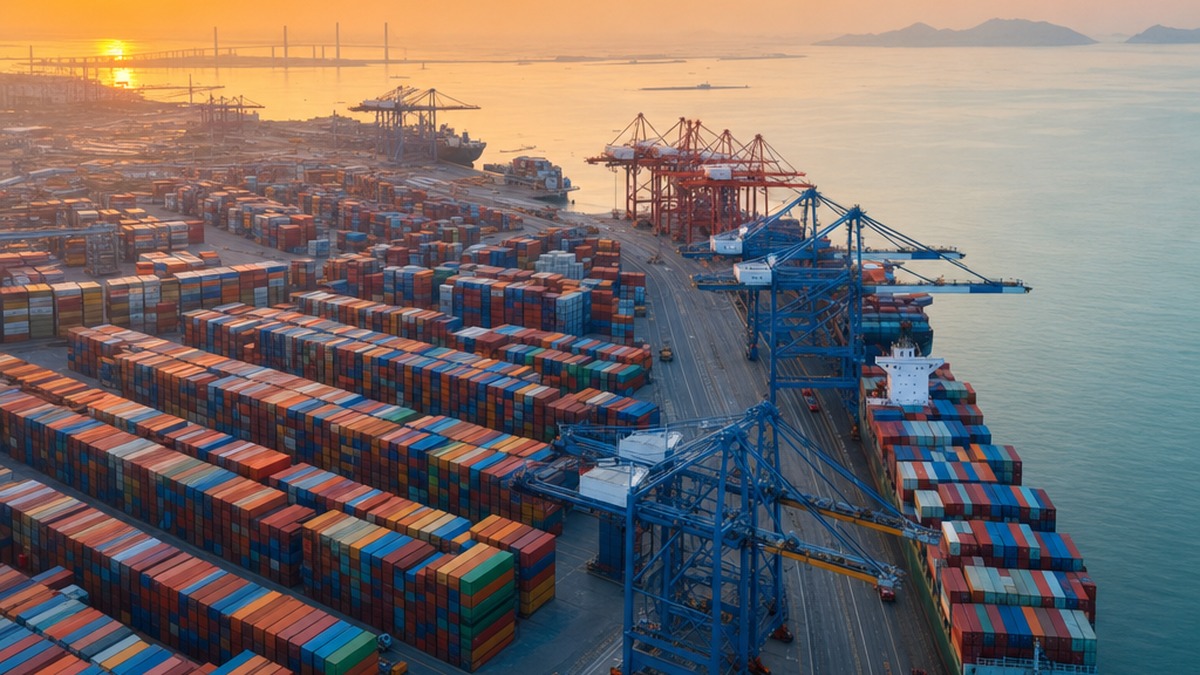

Ninety-six out of every one hundred containers in the world are made in China.
That sentence sounds like the opener of a business presentation loaded with flashy charts, but it is, in fact, a quiet industrial fact. In Shekou, Shenzhen; in Nantong, Jiangsu; in Ningbo, Zhejiang — hundreds of factories run day and night, bending, welding, and painting cold-rolled steel plate into twenty-foot iron boxes that are loaded onto the world's busiest trade lanes. Every day, tens of thousands of containers leave Chinese ports, vanishing over the horizons of the Pacific and Indian Oceans, carrying mobile phones, furniture, chemicals, shoes, and semi-finished steel to every corner of the globe.
The container is not a new invention. In 1956, American truck driver Malcolm McLean converted an old tanker, secured fifty-eight metal boxes to its deck, and sailed from New Jersey to Houston — an experiment that marked the birth of modern container shipping. Over the seventy years that followed, that simple iron box utterly transformed the face of global trade. Without container standardization, there would be no global supply chain; without a global supply chain, there would be no rise of China as the "world's factory." China took over the manufacturing of containers — and with it, the production of the infrastructure that keeps globalization running.
China's monopoly on container manufacturing did not form overnight. It is rooted in the earliest chapters of China's manufacturing rise in the 1980s and 1990s. What the industry faces today is a dual challenge: geopolitical trade disruption has pushed it through a roller-coaster price cycle, while three emerging application segments — energy storage, cold chain logistics, and modular construction — are expanding the definition of "container" from a transport tool to a universal modular platform.
This report is the Industrial Research Institute's comprehensive analysis of China's container industry: fourteen chapters covering industry definition, global landscape, policy environment, market scale, supply chain, key enterprises, industrial clusters, subsector deep-dives, technology evolution, risks, and outlook. Our goal is not to lay every number end to end, but to find, behind the numbers, the logic by which this industry truly operates.
Chapter 1: Definition and Classification — Ten Shapes of an Iron Box and One Supply Chain
A container, by standard definition, is a reusable transport unit with a rigid structure, sufficient strength, and an internal volume of no less than one cubic meter, into which goods can be packed. What allows "container" to unify such diverse products under a single category is the concept of "standard modularization" — fixed size, fixed interfaces, fixed stacking conventions, making it possible for any cargo ship, any rail flatcar, any road truck to connect seamlessly. This "interchangeability" design principle was McLean's core contribution to changing the world.
The Historical Evolution of Container Dimension Standards: From Chaos to ISO Unification
The "twenty-foot standard box" we take for granted today was not always the norm. The standardization of containers was a history of commercial rivalry and technical negotiation. Understanding this history is the foundation for understanding how the modern container industry operates.
When McLean loaded the first containers onto a cargo ship in 1956, there were no uniform specifications — McLean's own company (Sea-Land Service) used 35-foot boxes, while competitors such as Grace Lines used 17-foot units. This disarray meant that different companies' containers could not be mixed on the same vessel, nor could they share handling equipment, severely limiting the efficiency gains from containerization.
The real standardization effort was driven by the U.S. Department of Defense (DoD) — during the Vietnam War, the military needed to ship vast quantities of equipment from the continental U.S. to Vietnam, and without a common standard, intermodal efficiency would have been dismal. In 1966, the American Standards Association (ASA) published the earliest draft container dimension specifications; the ISO took over the process and formally issued ISO 668 in 1968, establishing 20 feet and 40 feet as the base length units, 2,438 mm (8 feet) as the standard width, and either 2,438 mm or 2,591 mm (8 ft 6 in) as the standard height options.
The publication of ISO 668 was the true starting point of the container industry's globalization. It meant that every port crane, every ship hold cell guide, every rail flatcar, and every road chassis anywhere in the world could receive all standard containers using the same interface parameters. The network effects of this "interface standardization" are extraordinarily powerful: once global port infrastructure is configured to the ISO standard, any container that deviates from it loses global interchangeability and is confined to specific lanes, at a severe competitive disadvantage.
By Size: TEU as the Container Industry's Basic Language
Container dimension standards are set by the International Organization for Standardization (ISO). The fundamental unit is the Twenty-foot Equivalent Unit (TEU), used in the shipping industry the way "kilowatt-hour" is used in electricity. Key specifications:
20-foot General Purpose (20GP) is the single most traded container size globally. External dimensions approximately 6,058 × 2,438 × 2,591 mm, internal volume ~33.2 m³, maximum gross weight ~21–24 tonnes including cargo. In practice, 20GP is ideal for dense goods — mechanical parts, chemical raw materials, bagged bulk agricultural goods, and steel products.
40-foot General Purpose (40GP) has slightly more than double the 20GP's internal volume, ~67.7 m³. Operationally, a 40GP's per-lift fixed handling cost is only 65%–70% that of two 20GPs, so 40GP's share on most liner services has grown steadily. One 40GP equals two TEUs.
40-foot High Cube (40HC) raises the box height from 2,591 mm to 2,896 mm, yielding ~76.3 m³ — about 13% more than the 40GP. That extra 305 mm (roughly one foot) significantly improves loading efficiency for light, bulky freight (furniture, cigarettes, cotton, garments). Over the past decade, 40HC has displaced 40GP as the dominant unit on Europe–Americas consumer goods lanes.
45-foot High Cube (45HC), primarily used in European inland road transport, offers ~86 m³ of internal volume. Since 45 ft exceeds the ISO 668 standard series (20/40 ft), some ocean liner services do not accept 45-foot boxes; they circulate mainly within European markets.
53-foot boxes are a North American internal rail/road-only specification and do not participate in international ocean shipping.
By Function Type: Seven Forms of the Container Ecosystem
Type 1: Dry Cargo Container (Dry Van)
The "bulk commodity" of the container family, made from weathering steel (Cor-ten, a low-alloy Cu-Cr-Ni steel), used for general cargo that needs no temperature control or special protection: garments, electronics, mechanical parts, barreled chemicals, bagged foodstuffs, automotive components.
Type 2: Refrigerated Container (Reefer)
The highest-technology, highest-unit-value category among standardized containers. A mechanical refrigeration unit mounted at the front end maintains box temperature from −25°C to +25°C (ultra-cold versions to −60°C), used for fresh produce, frozen meat, dairy, pharmaceuticals, and vaccines.
Type 3: Tank Container (ISO Tank)
A stainless-steel or aluminum cylindrical tank within an ISO outer frame, for liquid chemicals (methanol, ammonia, hydrochloric acid), food liquids (vegetable oil, fruit juice), and liquefied gases (LPG, LNG, liquid nitrogen, liquid oxygen).
Type 4: Special Purpose Containers
Structural modifications of the standard dry box: open-top, flat-rack, ventilated, tunnel (double-door), and flexi-tank (inner liquid bag inserted into a standard dry box).
Type 5: Energy Storage Container (BESS Container)
The fastest-growing and most value-disruptive subsegment of the past five years. A complete battery energy storage system (LFP cells, BMS, thermal management, fire suppression, power conversion system) integrated into a standard 20- or 40-foot container shell.
Type 6: Foldable Container
Sidewalls and roof fold down onto the base frame, compressing an empty box to roughly 20%–25% of its standard volume. Commercial viability remains limited by cost (~2–2.5× standard box), specialized port equipment requirements, and structural strength concerns.
Type 7: Modular Building Container
Factory-built living or working units using a container-like structural shell, completing 80%–90% of construction work in a factory environment and only 10%–20% of assembly on site.
Container Value-Chain Distribution: Who Captures the Value?
Across the entire container value chain, manufacturing earns the lowest share of profit. A rough estimate for a 2025 20GP dry box sold at $1,752 (Singamas FY2025 average price):
- Upstream material suppliers (weathering steel mills, coating makers): approximately 10%–15% gross margin embedded in material pricing.
- Container manufacturers (CIMC, Singamas, etc.): net profit approximately $52–105/TEU (3%–6% net margin) — among the lowest in industrial manufacturing.
- Leasing companies (Triton, etc.): 5-year lease income per box ~$900–$1,800 + residual value ~$150–$300, generating ~8%–12%/year return — 2–3× the manufacturer's net margin.
- Liner companies (freight revenue): at the 2024 SCFI peak, trans-Pacific rates reached $8,000–$10,000/FEU, with net margins exceeding 20%.
This structural imbalance reveals the strategic position of container manufacturing: it sits at the highest-competition, lowest-barrier, most-easily-substituted point in the value chain. This is precisely why CIMC Group is migrating toward energy equipment and offshore engineering, and why Singamas is aggressively growing its BESS-box revenue share — both are escaping the low-margin zone.
Supply Chain Overview: A Seven-Layer Structure from Steel to Global Trade
The container supply chain links steel, refrigeration, chemical coatings, electronic IoT, financial leasing, and global shipping in a multi-layer structure spanning dozens of industrial segments:
Upstream materials layer:
- Weathering steel (body panels/frame): Baowu Steel, Ansteel are primary domestic suppliers
- Cold-rolled steel sheet (door panels/inner walls): ample domestic supply
- Bamboo-wood composite flooring: Fujian, Zhejiang, Jiangxi provincial supply clusters
- Refrigeration units (reefer only): Carrier, Daikin — 40%–50% of reefer unit cost
- Polyurethane foam insulation: Wanhua Chemical (world's largest MDI producer)
- Anti-corrosion coatings: Nippon Paint (Sherwin-Williams), AkzoNobel, COSCO-Kansai
- Hardware/locks: Ningbo, Wenzhou hardware clusters
Mid-stream manufacturing layer:
- Dry cargo container manufacturing: CIMC, COSCO Shipping Development, Xinhuachang — combined ~80% market share
- Reefer container manufacturing: Nantong CIMC leads globally
- Tank container manufacturing: CIMC Tank Container leads globally
- BESS container integration: Singamas, Shenzhen Baoyt, Orient International
Downstream operations layer:
- Container shipping: Maersk, COSCO, MSC, CMA-CGM — ~90% of global container capacity
- Container leasing: Triton International (~600 万TEU, ~26% global share), Florens, SeaCo
- Cold-chain logistics: SF Cold Chain, JD Cold Chain, COSCO Shipping Cold Chain
- Energy storage stations: State Grid, CR Power, Three Gorges Energy
- Modular construction: Vanke, Poly, Longfor adopt container module buildings
Chapter 2: Global Landscape — China Makes, the West Leases, the World Uses
The Historical Migration of Global Container Manufacturing
Today's 96% Chinese market share did not emerge overnight. It is the product of five decades of industry relocation, following a clear logic of path dependency.
1956–1970s: The U.S. and European inventor phase. The commercial invention of the container (McLean, 1956) and its internationalization (ISO 668, 1968) happened in North America and Europe. The earliest manufacturers — Fruehauf (U.S.), Clyde Industries (UK) — established the first production centers in the West.
1970s–1990s: Japan and Korea's rapid catch-up. Japan (1970s) and South Korea (1980s) became significant container manufacturing forces. At its peak in the mid-1980s, South Korea's share reached roughly 25%–30% of global container production.
1990s–2010s: China's absolute dominance. China's rise was driven by multiple layers: Deng-era open-door policy enabling joint-venture manufacturing (CIMC's early Maersk partnership); relatively low labor costs; the maturation of Baosteel and other domestic steel producers; and the rapid expansion of Shenzhen, Shanghai, and Ningbo ports. By 2005, China's share exceeded 90%; by 2010, Japan and Korea had virtually exited; European producers survived only in ultra-niche categories (cryogenic liquefied gas ISO tanks).
2020s onward: Maintaining monopoly while competing in specialty boxes. Global competition has shifted from "who makes dry boxes" (China — no contest) to "who leads specialty boxes (reefer, tank, BESS)." Maersk Container Industry (reefer) and a handful of Japanese specialty-tank makers remain the few exceptions to China's 96% monopoly.
Global Manufacturing Concentration: A Race Already Won
In 2024, Chinese-produced containers accounted for over 96% of global new container production, reaching a record 8.1 million TEU. The CR3 in China:
- CIMC Group: 40.18% (world #1)
- COSCO Shipping Development: 25.35% (world #2)
- Xinhuachang Group: 14.76% (world #3)
Combined ~80%. CR6 reaches ~95.5% — one of the most concentrated manufacturing industries globally. This structure rests on four barriers: bulk steel procurement scale; long-term framework contracts with major liner companies; CSC certification and technical standards; and global container repair networks.
The Global Reefer Container Landscape
Reefer competition is even more concentrated than dry boxes, with a vertical-integration trend: Maersk's subsidiary Maersk Container Industry (MCI) manufactures reefers directly, paired with its proprietary Star Cool refrigeration units and Remote Container Management (RCM) data platform — a closed "make-use-monitor" loop no other liner company can replicate. CIMC's reefer business (Nantong CIMC) is the world's largest independent reefer manufacturer; its reefer shipments rose 50.2% year-over-year in FY2025.
Global Container Leasing: Triton and the Financial Game
About 55% of the global 42–45 million TEU fleet (22–25 million TEU) is owned by leasing companies. Triton International — privatized by Brookfield Infrastructure Partners in 2023 — is the world's largest container lessor, with a fleet of ~600 million TEU following its acquisition of Global Container International (GCI) in July 2025, commanding ~26% of the global leasing market.
Triton's business model is akin to an "equipment finance bank": buy containers in bulk at low-cycle prices, fund the purchase by issuing bonds secured by the asset fleet (cost ~3%–5%/year), lease the boxes to liner companies at rental yields of ~8%–12%/year, and pocket the spread plus residual value. Brookfield privatized Triton because container leasing assets — stable cash flows, high-quality physical collateral — are better suited to infrastructure fund capital structures than public equity markets, enabling lower-cost financing.
Carrier and Daikin: The Refrigeration Unit Duopoly
Carrier Global (NYSE: CARR) and Daikin Industries (TYO: 6367) together hold more than 80% of the global container refrigeration unit market — a duopoly that gives them significant pricing power over reefer container manufacturers. In 2024–2025, as reefer demand surged, unit lead times stretched from 6–8 weeks to 12–16 weeks, capping reefer output growth and unintentionally acting as a capacity moat protecting the largest manufacturers (who hold long-term supply agreements) from smaller challengers.
Carrier's NaturaLINE CO₂ refrigerant unit — using R-744 (GWP=1) rather than R-134a (GWP=1,430) — is the most mature natural-refrigerant product line in the market and is increasingly specified by European customers as EU F-gas Regulations tighten.
Global Container Fleet Scale: The Running Constraint
As of early 2025, the global container vessel fleet exceeded 6,500 ships totaling over 30 million TEU in capacity. Order books for new container ships surpassed 9.1 million TEU in 2025, more than 30% of current fleet capacity — a historically high backlog. These new vessels, delivering 2025–2028, will sustain a supply overhang, keeping freight rates suppressed and dampening liner company appetite for new container purchases.
Chapter 3: PEST Analysis — Trade Disruption, Dual Carbon, and the New Shipping Cycle
Political: The Red Sea Crisis and Trade Protectionism
The Red Sea crisis was the most significant external shock to the container industry in 2024–2025.
From November 2023, Houthi forces in Yemen began attacking commercial vessels in the Red Sea and Bab-el-Mandeb Strait. Major liner companies — Maersk, MSC, CMA-CGM, Hapag-Lloyd, COSCO — diverted to the Cape of Good Hope route around southern Africa, adding ~10–14 days to Asia–Europe voyages and effectively removing ~15%–20% of global effective capacity.
The direct effect on container manufacturing: Q1 2024 dry box sales surged ~499% year-over-year (from ~82,500 TEU in Q1 2023 to ~494,400 TEU); full-year 2024 output reached 8.1 million TEU — a record. SCFI peaked near 3,750 points in July 2024. By September 2025, SCFI fell ~14.3% in a single week to ~1,198 points — roughly back to pre-crisis levels.
For container manufacturers, the 2024 super-demand cycle amounted to pulling forward 2–3 years of demand. CIMC reported a 35.2% year-on-year decline in dry box volumes for FY2025 — the inevitable payback from the pre-placement.
China–U.S. trade friction is a persistent political thread. 2025 tariff escalation triggered a "last train" rush — shippers advanced cargoes before new rates took effect — but suppresses medium-term trans-Pacific volumes.
Belt and Road Initiative continues expanding China's trade with Southeast Asia, Central Asia, and Africa, including the China–Europe Railway Express (19,000 trains in 2024, +10% YoY), driving demand for railway-specific containers and 20GP boxes on cross-border land routes.
Economic: Steel Costs, Exchange Rates, and the Shipping Cycle
Steel prices are the dominant cost variable. Weathering steel accounts for 65%–70% of dry box materials cost; with Chinese steel prices at relative historical lows in 2024–2025 (¥3,000–3,400/tonne for some hot-rolled grades), the cost environment partially offset declining box prices. Every ¥100/tonne change in weathering steel price alters 20GP manufacturing cost by approximately $7–8/TEU and gross margin by ~2–3 percentage points.
RMB/USD exchange rate directly affects manufacturer profitability: containers are priced in USD, costs are in RMB. The 7.0–7.3 range in 2024–2025 created a modest tailwind for RMB-reporting manufacturers' USD-denominated margins.
The shipping capacity cycle correlates strongly with container demand with a 6–18 month lag: low freight rates → liner company profit pressure → capital expenditure cuts → fewer new container purchases.
The replacement cycle: a standard container's economic life is 12–15 years. The large 2009–2012 vintage cohort (950 million TEU cumulative) is now entering its retirement window, providing ~130–160 million TEU/year of replacement demand through 2026–2028 even without fleet expansion.
Cross-border e-commerce and near-shoring: the shift from "bulk, low-frequency" to "small-batch, high-frequency" cargo patterns is gradually increasing the relative demand for 20GP boxes versus 40GP/40HC on some lanes. Near-shoring ("China → Vietnam/Mexico → U.S./EU") often creates longer net shipping distances than direct sourcing, potentially sustaining or even increasing total container-miles traveled despite lower direct China–West volumes.
Social: Cold-Chain Globalization and Dual Carbon Policy
Life science and food cold chain demand: global cold-chain logistics market expanding at ~7%–9% CAGR, driven by fresh produce exports from South America (Chilean cherries, Peruvian blueberries), Southeast Asia (Thai durian, Vietnamese shrimp), and pharmaceutical cold chain (mRNA vaccines at −70°C, biologics at 2–8°C). This is a structural demand driver for reefer containers that is entirely independent of freight rate cycles.
China's dual-carbon policy mandates that new renewable energy projects include battery energy storage, creating massive demand for grid-scale BESS containers. China's new-type energy storage additions continued to set records in 2025, with cumulative installed capacity reaching global leading levels.
Labor structure change: rising Chinese manufacturing wages (Pearl River Delta workers ~¥5,000–6,500/month in 2025 vs. ~¥1,500 in 2010) are accelerating automation adoption in container factories.
Social Dimension Supplement: Labor Transition
The Chinese container manufacturing industry directly employs more than 200,000 production workers across the major manufacturers, with a further 500,000–800,000 employed in upstream supply chains. As the industry shifts toward welding robotics and automated painting, the workforce composition is evolving: demand rises for high-skill workers (robot operators, MES system engineers, quality inspectors) and falls for manual repetitive operations (hand welding, spray painting). This transition creates regional employment management challenges — and training opportunities — for Guangdong, Jiangsu, and Shandong provincial governments.
Technology: IoT, Liquid Cooling, Standardization
Container IoT has moved from concept to scale. Maersk's Remote Container Management (RCM) system provides real-time temperature, humidity, power draw, and GPS data for every reefer unit in the fleet, cutting cold-chain loss rates ~30%. GPS+NB-IoT tracking modules cost $30–60/unit, making dry box position tracking economically viable at scale.
AI in container operations: machine vision systems deployed in port gateways automatically scan incoming containers for structural damage, replacing manual inspection and cutting inspection labor costs ~80% while producing more objective damage records. AI-based port congestion prediction (72–120 hours ahead) helps shippers and agents optimize gate-in timing, reducing dwell time and per-box turnover cycle.
Liquid cooling has become the dominant BESS container thermal management approach, keeping cell-to-cell temperature differentials within 2°C (vs. 5–10°C for air cooling), extending cycle life by 1,000–2,000 cycles and reducing thermal runaway risk.
CO₂ natural refrigerant is accelerating in reefer containers. EU F-gas Regulation's HFC phaseout is forcing reefer manufacturers and liner companies to migrate from R-134a/R-404A to CO₂ (GWP=1) or low-GWP HFOs. Carrier NaturaLINE is the market leader. The technical transition will add ~20%–30% to reefer unit production cost in the 2026–2028 conversion window.
Chapter 4: China's Market Scale — A Data Panorama of the Post-Peak Digestion Phase
Production Coordinates: A Three-Year Roller Coaster from 2.2 Million to 8.1 Million TEU
China's container production volume over the past three years has experienced extreme swings rooted in supply-demand structural mismatch — not a simple growth trajectory, but an external shock driving demand pre-placement and payback.
2023: ~2.2 million TEU (trough, pre–Red Sea crisis). 2024: ~8.1 million TEU (record peak, +268% YoY). 2025: estimated ~430–460 million TEU (demand digestion; CIMC dry box −35.2%, Singamas −31%).
Capacity Utilization and the Discipline of the Oligopoly
Major factory capacity estimates (2025):
- CIMC: Ningbo (
500,000–600,000 TEU/year), Xinhui (300,000–400,000), Qingdao (~200,000–250,000), Nantong (specialty boxes); total ~1.4–1.6 million TEU/year across all container factories. - COSCO Shipping Development: Dongguan (
400,000–500,000), Qingdao (200,000), Tianjin (~150,000–200,000); total ~750,000–950,000 TEU/year. - Xinhuachang: Xinhui + Qingdao; total ~550,000–650,000 TEU/year.
Industry-wide capacity utilization dropped from ~95%–100% in 2024 to ~55%–70% in 2025. Rather than maintaining full output and competing on price, the major manufacturers have shown "tacit coordination" — reducing shifts, deferring capex, and letting utilization fall — to protect margins. This behavior is typical of tight oligopolies (few players with transparent market data) and explains why container manufacturer margins in downturns have been more resilient than in other commodity manufacturing sectors.
The Microeconomics of Container Pricing
Container pricing has three dimensions:
Specification premium: a 40GP is priced ~70%–80% above a 20GP ($2,800–$3,000 vs. $1,752 in 2025); a 40HC commands a further 5%–8% premium.
Lead-time premium: rush orders (4-week delivery) typically carry a 10%–20% premium over standard 6–8 week delivery during periods of tight supply.
Volume discount: bulk purchases (>10,000 TEU/order) can negotiate 5%–10% off the list price. Triton's annual purchase volumes give it among the strongest purchasing leverage of any single buyer.
Framework vs. spot contracts: large liner and leasing companies use annual framework agreements with quarterly steel-price adjustment clauses. Smaller buyers rely on spot contracts, which in the 2024 peak year were priced 15%–25% above framework levels — one reason for FY2024's outperformance for the largest manufacturers.
2026 Outlook
Estimated 2026 production: 3.5–4.5 million TEU. Constraining factors: global trade volume growth of only 3%–4%/year (below running capacity growth); vessel fleet overhang; red-sea-crisis supplemental stock fully digested. Supporting factors: 130–160 million TEU/year structural replacement demand; modular BESS box growth (a high-value-add category offset); reefer box structural growth.
Price Forecast: The Four-Phase Price Curve and Mean Reversion
The 20GP dry box price moved through four phases since 2023:
- Phase 1 (FY2023): Trough — $1,600–$1,800, near-cycle lows, compressed margins
- Phase 2 (Q1–Q2 2024): Red Sea surge — $2,800–$4,500, with some rush contracts above $4,000
- Phase 3 (Q3 2024–Q1 2025): Rapid cooling — supply caught up as major manufacturers ramped capacity
- Phase 4 (FY2025): Mean reversion — Singamas FY2025 average: $1,752/TEU (−11.7% vs. FY2024's ~$1,985)
The $1,752 figure approximates the industry's marginal cost floor (weathering steel + labor + depreciation sum to ~$1,500–$1,700 at current steel prices). Without a new external shock of Red-Sea magnitude, the normal 20GP equilibrium price should be $1,750–$2,200, supporting a gross margin range of 8%–12%.
Market Concentration: Four Pillars of the Oligopoly
CR3 ~80%, CR6 ~95.5% — supported by: bulk procurement cost flywheel; long-term liner company framework contracts; CSC/ISO certification standards; and global repair network advantages that smaller manufacturers cannot replicate within 5–10 years.
Chapter 5: Supply-Chain Dissection — Seven Layers Behind One Iron Box
I. Weathering Steel: The Structural Material
Weathering steel (Cor-ten grades: SPA-H, Q355NHB, Q450NQR1) forms a dense protective oxide patina that prevents further corrosion, lasting 20+ years in marine environments. Baowu (Baosteel + WISCO) and Ansteel dominate China's container-grade weathering steel supply. The container industry consumed over 10 million tonnes of weathering steel in 2024 — roughly 40% of China's total output of that grade.
II. Cold-Rolled Sheet and Stainless Steel
Cold-rolled steel sheet is used for container door panels and interior lining. Reefer containers use food-grade 316L stainless steel (molybdenum-enhanced for chloride corrosion resistance), priced 3–5× above standard cold-rolled sheet — a major driver of reefer unit material cost.
III. Bamboo-Wood Composite Flooring: An Underrated Load-Bearing Component
Container floors must bear the repeated travel of fully loaded forklifts (~10 tonnes gross). Traditional Apitong (Borneo ironwood) is now being displaced by domestically sourced bamboo-wood composite board (hot-pressed bamboo/wood fiber composite) — ~70%–80% market share by 2025. Fujian, Jiangxi, and Zhejiang province's bamboo processing clusters are the primary supply zone.
IV. Refrigeration Units: The Most Expensive Heart of a Reefer Box
A 40-ft reefer unit's refrigeration machine costs $5,000–$10,000 — 40%–50% of total reefer manufacturing cost. Carrier and Daikin hold >80% of this market. In 2024–2025, machine lead-time extension (from 6–8 to 12–16 weeks) effectively capped reefer output growth, inadvertently protecting incumbent large manufacturers from smaller challengers who lack long-term supply agreements.
V. Polyurethane Foam Insulation
Reefer container walls are injected with 70–100 mm thick high-density polyurethane rigid foam (~35–45 kg/m³). The key raw material is MDI (methylene diphenyl diisocyanate). Wanhua Chemical is the world's largest MDI producer (>4 million tonnes/year capacity), holding a strategically irreplaceable position in China's reefer container supply chain.
V-B. Aluminum Alloy and FRP: The Frontier of Container Material Innovation
Aluminum alloy: at 3.5–4× the price of weathering steel, aluminum is too expensive for standard dry boxes but finds niche application in reefer interior flooring (T-section extruded aluminum decking), food-grade aluminum tank containers, and (most importantly) fully-aluminum semi-trailer bodies — cutting vehicle weight ~1.5–2 tonnes vs. steel.
Fiber-Reinforced Plastic (FRP): glass-fiber (GFRP) or carbon-fiber (CFRP) composites offer outstanding strength-to-weight ratios and corrosion resistance. However, commercial-scale adoption in standard containers faces fundamental obstacles: CFRP costs ¥100–500/kg vs. steel's ¥4–6/kg; ISO 668 structural standards are calibrated to steel's mechanical behavior; field repair of FRP requires specialized resins and layup skills unavailable at most global ports. FRP in containers is currently limited to reefer interior panels and ultra-specialty applications; broad commercialization is 10–15 years away.
VI. Anti-Corrosion Coatings: Twenty Years of Protection
The standard coating system: zinc-rich primer (≥60 µm DFT, ≥60% zinc dust) + epoxy intermediate coat (≥125 µm) + polyurethane topcoat (≥70 µm, color per customer RAL/NCS specification). A 20GP box uses ~15–20 liters of coating, costing $40–$80. Nippon Paint (Sherwin-Williams China), AkzoNobel, and COSCO-Kansai (COSCO–Kansai Paint joint venture) are the primary suppliers.
VII. Hardware, Hinges, and Corner Castings
ISO 1161 corner castings (8/box) are precision-cast to allow stacking up to ~194 tonnes/casting, crane lifting, and vessel cell-guide retention. Ningbo Beilun, Cixi, and Wenzhou casting clusters dominate the global supply of ISO corner castings.
Container locks (cargo door locks) are increasingly complemented by electronic seals (e-seals) that record open/close timestamps and GPS location and push alerts to shippers in real time — demand growing fast with cross-border e-commerce and high-value-cargo shipping.
VIII. LFP Cells and BMS: Key BESS Container Components
For BESS containers, the upstream material list expands dramatically. A 5 MWh BESS container holds 500–700 units of 280–314 Ah large prismatic LFP cells (50%–60% of system cost). CATL, BYD, Rept Battero, CALB are primary cell suppliers. Battery Management Systems (BMS) from CATL, BYD, Kelu Electronics, and Narada Power monitor every cell's voltage, temperature, state of charge (SOC), and state of health (SOH). Power Conversion Systems (PCS) from Sungrow, Huawei Digital Power, BYD handle bidirectional DC-AC conversion for grid integration.
The presence of these new upstream layers means BESS container manufacturing is an organizational challenge of "multi-system integration" rather than the linear "material → forming → painting" process of dry-box manufacturing — explaining why BESS box gross margins (12%–20%) are substantially higher than dry-box margins (6%–12%).
IX. The Manufacturing Process: Thirty Precision Steps
A 20GP dry box assembly requires ~28–32 major operations in five stages:
Stage 1 – Underframe fabrication: steel cutting/punching → longitudinal beam forming → underframe welding → primer application.
Stage 2 – Panel forming: weathering steel roll-forming (corrugation) → cut-to-length → L-bracket bending → panel welding.
Stage 3 – Box assembly and welding: positioning panels/top/front on underframe (±2 mm tolerance) → primary structural welds → full-box alignment → sand-blasting (Sa 2.5 grade) → welds inspection.
Stage 4 – Coating: zinc-rich primer → epoxy intermediate → PU topcoat → film-thickness measurement → adhesion cross-cut test.
Stage 5 – Flooring, door installation, final inspection: bamboo-wood floor adhesive installation → door hinge welding → cargo lock assembly → rubber sealing strip → BIC code/CSC plate stenciling → water-tightness test (light-leak inspection) → dimensional survey.
Ningbo CIMC's "factory of the future" project has digitized every step through a Manufacturing Execution System (MES) linked to every key machine, enabling real-time quality deviation detection and pre-failure maintenance — the most advanced digital manufacturing demonstration in the container industry.
X. Green Manufacturing: Carbon Reduction in Container Factories
Energy-intensive steps — welding, sand-blasting, spray painting, press-forming — make container factories high energy-consumers per unit floor area. Leading manufacturers are systematically reducing emissions:
- Rooftop solar PV on factory buildings (Ningbo CIMC)
- Robotized welding eliminating manual welder fume exposure
- High-solids and solvent-free coatings reducing VOC emissions by 40%–60%
- Rainwater recirculation and waste-coating solvent recovery systems
European liner companies (led by Maersk) are beginning to require supplier carbon-footprint disclosure as part of procurement contracts, with expectations of mandatory reporting thresholds emerging by 2026–2028. Chinese manufacturers need to build Scope 1/2/3 lifecycle accounting (LCA) systems proactively to defend export access to environmentally sensitive markets.
Chapter 6: Key Companies — The Numbers and Logic of Six Core Players
CIMC Group (000039.SZ / 02039.HK): The Diversified Giant at a Turning Point
FY2025 Group Key Financial Data:
| Metric | Value | YoY Change |
|---|---|---|
| Total revenue | ¥156.611 billion | −11.85% |
| Attributable net profit | ¥221 million | −92.57% |
| Adjusted net profit | −¥310 million | Loss |
| Operating cash flow | ¥18.514 billion | +99.86% |
| Period-end cash | ¥24.3 billion | — |
The 92.57% net profit decline is the headline number, but three mitigating realities matter: operating cash flow doubled to ¥18.5 billion (the business still generates cash); the decline is largely driven by non-cash items (asset impairments on offshore engineering assets, FX losses); and the container manufacturing segment itself was profitable at ¥1.882 billion net profit.
Container Manufacturing Segment FY2025:
| Metric | Value | YoY Change |
|---|---|---|
| Revenue | ¥43.009 billion | −30.86% |
| Net profit | ¥1.882 billion | −53.97% |
| Gross margin | 13.38% | Declined |
| Dry box volume | 2.2249 million TEU | −35.2% |
| Reefer volume | 208,200 TEU | +50.2% |
The structural signal: reefer containers +50.2% while dry boxes −35.2% — cold-chain demand is decoupled from the dry-box cycle.
Other segments FY2025:
- Energy & Chemical Equipment: ¥27.192 billion revenue (+6.31%) — benefiting from LNG storage, hydrogen energy infrastructure
- Offshore Engineering: ¥17.938 billion revenue (+8.35%), backlog $5.09 billion — a 2–3 year profit pipeline
- Road Transport Vehicles (CIMC Vehicles): ¥20.178 billion revenue (−3.91%)
- Logistics Services: ¥26.793 billion revenue (−14.64%)
CIMC at the Strategic Crossroads: Diversification's Gains and Costs
CIMC's diversification strategy has generated real value — energy equipment and offshore engineering delivered counter-cyclical growth in 2025. But the concentration of capital in long-gestation, capital-intensive segments (offshore platforms, LNG terminals) has kept group-level ROE chronically low. FY2025 attributable net profit of ¥221 million on ¥156 billion in revenue implies ~0.3% net margin — reflecting heavy asset impairments rather than operating failure, but illustrating the complexity of multi-segment capital allocation.
CIMC's path: continue long-cycle businesses (offshore, LNG) as the profit floor while migrating away from pure dry-box dependence — a bet on energy equipment and ocean engineering over container manufacturing cycles.
Singamas Container Holdings (HK 0716): The Independent Manufacturer's Transformation
FY2025 Core Data:
| Metric | Value | YoY Change |
|---|---|---|
| Group revenue | $481.5 million | −17% |
| Manufacturing + leasing revenue | $447.8 million | −19.1% |
| Attributable net profit | $17.41 million | −49% |
| Dry + specialty box volume | ~152,000 TEU | −31% |
| 20GP average selling price | $1,752 | −11.7% |
Revenue structure shift:
| Segment | FY2025 Share | FY2024 Share | Direction |
|---|---|---|---|
| Dry cargo boxes | 55% | 73% | −18 ppt |
| Specialty + BESS boxes | 45% | 27% | +18 ppt |
Singamas is the most aggressively executing the "de-dry-box, pro-specialty" strategy among listed manufacturers. BESS container body manufacturing — fabricating the steel shell and integrating thermal management and fire-suppression systems — shares significant production line overlap with dry-box manufacturing, making it the path of least resistance for container body makers transitioning toward higher-value categories. Singamas's manufacturing bases in China and Vietnam give it some geopolitical risk optionality.
CIMC Vehicles Group (HK 1839 / 301039.SZ): The Overseas Expansion Leader
H1 2025 Core Data:
- Revenue: ¥9.75 billion; Gross profit: ¥1.46 billion
- Global semi-trailer revenue: ¥6.924 billion; Gross profit: ¥1.129 billion
- China semi-trailer market share: 23.07% (six consecutive years #1)
Regional highlights:
- Vietnam revenue: +270% YoY
- Thailand revenue: +63.5% YoY, unit sales +44%
The Three-Layer Logic of CIMC Vehicles' Overseas Expansion
First: riding China's manufacturing-sector outbound investment into Southeast Asia — new factories in Vietnam and Thailand create immediate heavy transport demand during construction and sustained demand during operations.
Second: Southeast Asia infrastructure dividend — Vietnam's north–south expressway backbone is largely complete, Thailand's EEC corridor road investments continue, enabling long-haul road transport economics that drive demand for large semi-trailers.
Third: localized sales + service as a competitive moat — CIMC Vehicles has built local dealer/service networks in Vietnam and Thailand (rather than pure export), providing timely parts supply and driver training that Japanese (Isuzu, Hino) and Korean (Hyundai) competitors struggle to match.
FY2024 full-year: revenue ¥21 billion, operating profit ¥1.35 billion, gross margin 16.3% — one of the more profitable segments within the CIMC group.
COSCO Shipping Development: The Second Pillar with Internal Demand Support
COSCO Shipping Development's container manufacturing business is the industry's second-largest force. Its key structural advantage: its parent COSCO Shipping Lines (the world's 3rd–4th largest liner company by capacity) generates internal purchase demand, partially insulating COSCO Shipping Development from pure market competition. An internal "stabilizer" in the form of COSCO Lines' annual box procurement plan provides a baseline production floor even in soft market years.
FY2024 data (peak year): container manufacturing revenue ~¥23.661 billion (+188.8% YoY). Manufacturing bases in Dongguan, Tianjin, and Qingdao. FY2025: revenues declined in line with the broader industry.
Xinhuachang Group: The Focused Third Pole
Xinhuachang (world market share ~14.76%) is a manufacturing-specialist company — lower public profile than CIMC or COSCO, but steadily profitable through disciplined cost management and strong dry-box manufacturing execution. Total bases in Xinhui (Guangdong) and Qingdao; estimated capacity 550,000–650,000 TEU/year. Competitive strategy: "lean manufacturing + cost control" rather than diversification. Key strategic question: whether and when to invest meaningfully in reefer and BESS box capacity to hedge against dry-box margin compression.
Triton International: The Template for Container Financialization
Key operating metrics (mid-2025):
- Fleet: ~6 million TEU (post-GCI acquisition)
- Global leasing market share: ~26%–28%
- Owner: Brookfield Infrastructure Partners (privatized 2023)
Financial structure: buy containers at trough prices (~$1,750/unit), fund via asset-backed bonds at ~3%–5%/year, lease at ~8%–12%/year rental yield, pocket the spread plus residual value. At near-zero rates (2015–2021) this model maximized returns; Fed rate hikes (2022–2025) compressed spreads but Triton remained profitable.
GCI acquisition: Adding GCI's ~600,000 TEU fleet enlarged Triton's scale advantage (lower per-TEU overhead, stronger pricing power with liner customers) — the classic "rolling up a mature industry" strategy.
China's capital entering the leasing market: Florens Container Holdings (COSCO Shipping subsidiary) is one of the world's top-3 container lessors — giving China a presence not just in manufacturing, but in container financial operations. Florens holds both buyer leverage (over manufacturers) and seller leverage (over liner companies), a strategically important position in the full value chain.
Chapter 7: Industrial Clusters — Shenzhen's Diffusion and Nantong's Deepening
The Industrial Research Institute's systematic mapping of China's container manufacturing geography reveals a clear trajectory: originating in the Pearl River Delta, extending to the Yangtze River Delta and Shandong, and beginning to diffuse to Southeast Asia. Each cluster's location reflects its historical logic and industrial roots. Tianxia Gongchang's database of over 4.8 million verified operating factories allows precise identification of container and related logistics-equipment manufacturers across five core clusters.
Shenzhen Shekou: The Origin and Nerve Center
China's container industry history and Shenzhen Shekou's history are nearly inseparable. In 1979, China Merchants established China's first open industrial zone in Shekou; in 1980, China International Marine Containers Co., Ltd. (CIMC's predecessor) was incorporated in Shekou, initially producing standard containers under contract for Maersk and other Western liner companies.
Today, Shenzhen remains CIMC's registered headquarters — strategy, R&D, international business, and capital operations concentrate at Shekou. But mass-scale dry-box manufacturing has dispersed to lower-cost surrounding areas (Dongguan, Huizhou, Ningbo). Shenzhen Shekou has evolved from "production factory" to "system commander" — itself a miniature of how a company migrates from contract manufacturing to brand management and industrial capital.
The Pearl River Delta hardware cluster (Dongguan, Foshan, Huizhou) supplies container fittings (locks, hinges, corner castings), anti-corrosion coatings, and welding consumables. Shenzhen container factories form a traceable, searchable cluster of manufacturing and materials businesses on the platform.
Local Government and the Container Industry: From Subsidy to Ecosystem
The durability of China's container manufacturing clusters owes much to the alignment between local government interests and industrial anchors. In Nantong, the city government supports Nantong CIMC (a national "single-champion manufacturer" and high-tech enterprise) through land approvals, environmental permitting, and port-fee incentives — motivated in part by the political value of maintaining a national manufacturing flagship. In Qingdao, the mutual reinforcement between the world's 4th-largest container port (30.87 million TEU throughput in 2024) and container manufacturing facilities creates an ecosystem where neither can easily leave the other. This "ecosystem management" logic of local government makes the actual relocation cost of container manufacturing clusters far higher than a simple cost comparison would suggest.
Shenzhen's Hardware Cluster: Precision Division of Labor
The hardware manufacturing cluster around Shenzhen extends to Dongguan, Foshan, and Huizhou with sophisticated specialization:
- ISO 1161 corner castings: Ningbo Beilun/Cixi casting clusters (primary supply); Wenzhou mid-tier manufacturers. Precision requirements: ±0.5 mm on oval-hole dimensions, minimum tensile strength ≥360 MPa.
- Cargo door locks: Zhejiang Jinyun and Hebei Xiong'an (mainstream/budget); Shenzhen manufacturers (mid/high-end and smart electronic locks).
- Door hinges and seals: Ningbo Beilun hardware clusters (hinges); Jiangsu and Guangdong rubber processors (door seals).
Jiangsu Nantong: Home of the National Specialty Container Champion
Nantong CIMC Special Transport Equipment Manufacturing Co., Ltd. (CIMC NT) — established 1990, designated National Manufacturing Single Champion and National High-Tech Enterprise — is the industry's leading developer of specialty containers: open-top, flat-rack, ISO tank, and semi-trailer tank. Nantong's precision manufacturing culture, technical talent pool, and Yangtze River estuary port access make it the ideal home for low-volume, high-complexity specialty container production.
Nantong container factories include multiple companies focused on tank containers and specialized transport equipment, with Jingjiang (Taizhou) serving as a secondary tank-container and specialty-transport manufacturing cluster.
Zhejiang Ningbo: The Precision Benchmark for Modern Mass Production
Ningbo CIMC Container Manufacturing Co., Ltd. — established 2003, total investment >¥1 billion — is CIMC's largest single-factory production base, serving as the group's intelligent manufacturing demonstration site. Its "factory of the future" project integrates MES, IoT sensors, welding robots, and automated painting to achieve real-time production monitoring, quality defect pre-warning, and energy consumption optimization.
Ningbo-Zhoushan Port (NGB) — the world's largest port by cargo tonnage (~730 million tonnes in 2024) — gives Ningbo-manufactured containers the shortest port access of any major Chinese production cluster. Ningbo container factories cluster with hardware, IoT device, and repair businesses across the region.
Shandong Qingdao: Export-Oriented Port-Adjacent Manufacturing
Qingdao is both a major container manufacturing center and the world's 4th-largest container port (30.87 million TEU in 2024). CIMC and COSCO Shipping Development both operate major Qingdao factories. Qingdao container factories also include a substantial refurbishment and conversion industry (retired containers resold as storage units, site offices, and residential modules).
Shanghai: Cold Chain Operations and Road Transport Equipment Hub
Shanghai container factories are distinguished by road transport vehicle manufacturing (CIMC Vehicles Shanghai base) and cold-chain logistics operations. Yangshan Deep-Water Port (the world's highest-throughput container terminal, >46 million TEU/year) and Waigaoqiao attract heavy reefer pre-cooling facilities, cold storage, and IoT device manufacturers (Suzhou, Kunshan). This creates a manufacturing-logistics cluster unique in combining box production with the world's most important container transit hub.
Overseas Expansion: Vietnam and India
CIMC Vehicles Vietnam revenue +270% in 2025; Singamas Vietnam factory continues maturing. Vietnam's RCEP and CPTPP memberships, lower labor cost (~30%–40% below South China), and proximity to Chinese component supply chains make it the natural first-wave overseas destination. However, a critical caveat: weathering steel, coatings, and most fittings still predominantly sourced from China, meaning the Vietnam factories remain heavily dependent on Chinese inputs. They function more as "trade-policy arbitrage nodes" than truly lower-cost manufacturing bases. Supply chain localization in Vietnam will take 5–10 additional years.
Chapter 8: Subsector Deep Dives — Eight Markets, Eight Logics
I. Dry Cargo Containers: The Most Cyclical Commodity Category
Quantitative replacement cycle model:
Global container fleet: 42 million TEU. Economic life: ~13 years. Theoretical replacement rate: 7.7%, or ~3.23 million TEU/year. Adjusted for 2024's frontloaded pre-purchasing (which already replaced much of the 2011–2014 vintage cohort), actual 2025–2028 replacement demand is estimated at ~1.3–1.6 million TEU/year. Adding incremental demand from trade volume growth (3%/year × 0.05 new box/TEU coefficient ≈ 1.5 million TEU/year), baseline 2026–2028 demand is ~2.8–3.1 million TEU/year. The 2023 trough (2.2 million TEU) was a cycle-exacerbated extreme, not the true floor.
Why so cyclical? Container demand is derived demand — derived from shipping demand, which is derived from international trade, which is driven by GDP, trade policy, and geopolitics. Each step of this derivation chain amplifies fluctuations, making the demand seen by container manufacturers far larger in amplitude than underlying cargo trade flows.
2026 outlook: price range $1,700–$2,100, gross margin ~8%–12%.
I-B. Dry Cargo Container Price Elasticity and the Steel-Margin Linkage
Weathering steel constitutes ~65%–70% of dry-box material cost. Every ¥100/tonne change in SPA-H weathering steel price shifts 20GP unit cost by ~¥360 ($50) and gross margin by ~2–3 percentage points. This sensitivity makes weathering steel price the single most important external variable for dry-box manufacturers' quarterly earnings — more impactful in a supply-oversupply year (when pricing power is weak and cost changes cannot be passed on) than in a tight market.
II. Reefer Containers: Structural Growth in a High-Value Category
Three independent demand drivers:
Global cold-chain trade expansion: South American fresh produce (Chilean cherries, Peruvian blueberries, Brazilian beef), Southeast Asian tropical fruit (Thai durian, Vietnamese shrimp), New Zealand dairy — all structurally growing cold-chain export categories that are entirely unaffected by container freight-rate cycles.
Life-sciences cold chain upgrade: post-COVID, governments and pharma companies treat pharmaceutical cold chain as strategic infrastructure. mRNA vaccines (−70°C ultra-cold), biologics (2–8°C), CAR-T cell therapies — new product launches are all cold-chain-dependent, driving the formation of an ultra-cold reefer (−60°C and below) sub-niche.
Replacement demand: reefer boxes manufactured in 2015–2018 are approaching retirement age (reefer economic life is slightly shorter than dry-box due to mechanical complexity), generating a replacement cohort of ~25–30 million TEU/year through 2025–2028.
Operations economics of reefer containers: annual maintenance cost ~$300–$600/unit vs. ~$50–$100 for dry boxes — driving a quality-tiered leasing market where well-maintained units command premium rents and real-time monitoring (Maersk RCM, MSC TrakSafe) is a service differentiator.
Global reefer fleet: ~1.75 million TEU. Maersk/MCI: ~250,000–300,000 TEU; global lessors (Triton focus): ~600,000–700,000 TEU; other liner companies: ~700,000–800,000 TEU.
2030 outlook: ~2.15–2.3 million TEU total, adding ~25–30 million TEU/year. CIMC Nantong will continue to dominate at >70% of Chinese (and global independent) production.
II-B. The Refrigerant Transition Risk
EU F-gas Regulation (Regulation EU No. 517/2014 and 2023 revision) phases out high-GWP HFC refrigerants: R-404A (GWP=3,922) banned for new equipment by 2030; R-134a (GWP=1,430) faces mounting supply restrictions. Reefer containers serving European markets — or operated by European liner companies globally — must transition from HFC to CO₂ (GWP=1) or low-GWP HFO (R-449A, GWP=1,282) refrigerants during 2026–2028.
CO₂ machine production is currently dominated by Carrier (NaturaLINE) and Daikin; no Chinese manufacturer has yet achieved commercial-scale production of containerized CO₂ refrigeration units. If Chinese makers (Bingrun, DunAn) achieve CO₂ machine commercialization by 2028–2030, it would break the Carrier-Daikin duopoly and fundamentally reshape the reefer container cost structure. This is the most compelling "import substitution" opportunity in the entire container supply chain.
III. Tank Containers: A Precision-Engineering Niche Market
The precision engineering behind a tank container:
316L stainless steel (Mo-enhanced, Ra ≤ 0.8 µm mirror-polished interior), TIG-welded with 100% radiographic or ultrasonic weld inspection, hydrostatic tested at 1.5× design pressure for 30 minutes. Unit value: ~$15,000–$25,000 for a T11 20-ft chemical ISO tank — roughly 10–14× the price of a 20GP dry box.
Global annual production: ~20,000–30,000 units. CIMC Tank Container holds ~35%–40% global share. WEW Group (Germany) retains niche strength in ultra-high-specification pharmaceutical and specialty chemical tanks.
Liquid tanker trailers — road chassis for liquid chemical and petroleum product delivery — are the land-transport complement to tank containers. CIMC Vehicles' Xiongqi liquid tank trailer brand holds a leading domestic market position.
IV. Energy Storage Containers: The New Variable Rewriting Industry Coordinates
Market scale: Global ESS shipments: 421.16 GWh in 2025, +75.48% YoY. Container-format BESS accounts for ~70%–80% of grid-scale ESS. China's 2025 new-type energy storage additions set another record, with cumulative capacity reaching global leading levels.
Technical standardization: the industry has converged on "5 MWh + 314 Ah large prismatic LFP + liquid cooling + 20-ft container + gas suppression fire system" as the 2025 mainstream configuration. LFP cell cost at $0.38–0.45/Wh in 2025 (−20% YoY) makes grid-scale BESS economically competitive with flexible coal dispatch ($0.25–0.50/kWh LCOE).
Competitive landscape — two tiers:
- Tier 1: cell+BMS+system integrators (CATL, BYD, Sungrow, Hithium) — hold the high-value-added position
- Tier 2: container body manufacturers (Singamas, Baoyt, Orient International) — fabricate steel shells and integrate thermal management; structurally disadvantaged unless they vertically integrate toward cell supply
Supply-chain evolution: the two-tier structure will consolidate toward "integrated deliverers" (CATL, BYD combining cells + container body + BMS + PCS in a single system delivery). Box-only manufacturers face structural margin compression as integrators capture more value.
Distributed vs. centralized: centralized utility-scale BESS (≥100 MWh, 100+ containers, 220 kV grid connection) is driven by state-owned power developers; distributed commercial-industrial BESS (1–10 MWh, 1–4 containers, peak-shaving/arbitrage application) is driven by corporate buyers with shorter decision cycles and higher growth rates. Both markets rely on container format as the primary system architecture.
V. Modular Construction: The Longest-Horizon, Highest-Ceiling New Segment
Modular construction's commercial logic: shift 80%–90% of construction work from weather-exposed job sites into climate-controlled factories, reducing total project timeline by 50%+ vs. traditional cast-in-place construction.
Global maturity: UK is the most advanced market, with government MMC (Modern Methods of Construction) policy targeting 25%+ of new homes as modular or offsite-manufactured. CIMC MBS's marquee projects include Hong Kong Science Park InnoCell (418 modules, 17,200 m²) and a Shenzhen public rental housing project (2,300 modules, 41,400 m²).
China-specific constraints: (1) road transport width/height limits cap module size and restrict economically viable delivery radius to ~300–800 km; (2) Chinese building codes (structure, fire, acoustic, energy efficiency) were designed for cast-in-place construction, requiring additional compliance pathways for modular formats; (3) large property developers remain in cautious evaluation mode. CIMC MBS's strategy: establish marquee high-end projects (hospitals, student housing, data centers) to build design and execution credibility before scaling to mainstream residential.
Cross-segment synergy: energy storage station ancillary buildings (control rooms, equipment shelters) are a near-perfect modular construction application — standardized, remote-sited, urgency-driven — creating a BESS + modular building bundled demand opportunity currently underappreciated by the market.
VI. Emergency Shelters and Military Specialty Containers
Emergency shelters and military specialty containers represent government-procurement-driven demand — price-insensitive, technically customized, with volumes set by national emergency management planning cycles. Post-COVID, governments globally have substantially increased strategic reserves of modular hospital units and emergency response infrastructure, giving this segment a reliable (if non-market-priced) demand floor.
VII. Road Transport Semi-Trailers
Semi-trailers are the land-leg carrier for container-port-to-destination final delivery. China's annual semi-trailer production of ~1.3–1.6 million units makes it the world's largest market. CIMC Vehicles holds 23.07% domestic market share (#1, six consecutive years).
Industry trends: full-aluminum trailer bodies (−1.5–2 tonne vs. steel, enabling freight economy gains); "drop-and-hook" intermodal operating models; NEV-dedicated lightweight trailers co-evolved with electric tractor-head designs.
VIII. Used Container and Repair Market
Global annual container retirements: ~1.5–2 million TEU/year. Primary aftermarket destinations: self-storage units (Europe/U.S.), job-site offices and worker dormitories (China), pop-up retail spaces, containerized data centers, agricultural greenhouses.
China's container repair industry clusters in port cities (Tianjin, Shanghai, Ningbo, Shenzhen) and inland rail freight hubs (Wuhan, Xi'an, Chongqing), providing blast-cleaning, repainting, floor replacement, panel straightening, and door hardware renewal. Repair cost per box: $200–$500, vs. ~$1,750–$2,500 for a new unit — compelling economics for boxes with repairable structural damage.
Chapter 9: Technology Evolution — Six Technical Mainlines from Steel Box to Smart Module
I. High-Strength Weathering Steel and Lightweighting
Next-generation container-grade weathering steel (yield strength 450–500 MPa vs. incumbent 355 MPa) allows 5%–8% sheet-thickness reduction at equivalent structural performance, cutting a 40HC's dead weight ~200 kg and improving effective cargo density. Baowu and Ansteel are commercializing these higher-strength grades, though forming and welding process requirements are correspondingly more demanding for smaller manufacturers.
I-B. Green Manufacturing: Carbon Reduction in Container Factories
(See Chapter 5, Section X above — consolidated and cross-referenced here for completeness.)
Key 2026–2028 trend: mandatory European supply-chain carbon accounting (EU CSRD, Scope 3 cascade) will require Chinese container manufacturers exporting to European customers to disclose per-unit lifecycle carbon emissions. Manufacturers that establish robust LCA (lifecycle assessment) frameworks proactively will maintain export access; those that do not will face procurement exclusion pressure from ESG-committed liner companies.
II. Container IoT and Digital Tracking
Maersk RCM is the industry's benchmark reefer IoT system — real-time temperature, humidity, energy, GPS data, 30% cargo loss reduction. GPS+NB-IoT dry-box tracking modules at $30–60/unit are now economical at fleet scale. E-seals (electronic cargo seals recording open/close events with GPS timestamp and push alerts) are growing fastest in cross-border e-commerce and high-value cargo segments.
AI machine-vision container damage inspection (deploying cameras at port gates to auto-scan all incoming containers) is cutting inspection labor 80% and producing objective damage records — reducing cargo-damage liability disputes that previously required human adjudicators.
II-B. Automation: Robot Welding and Smart Painting
Robot welding: primary structural welds on a 20GP box total ~30–40 meters. Automated welding robots (FANUC, ABB, KUKA; domestic Huarui Shenhai, Estun) run at 3–4× manual speed with superior bead consistency. Leading manufacturers have automated ~60%–70% of primary welds. Automation capex: ¥30–50 million per full production line (welding + painting systems); payback period at 2025 labor costs: ~5–8 years.
Smart painting: automated painting systems improve film thickness uniformity from ±15 µm (manual) to ±5 µm, raise coating transfer efficiency from 60%–65% to 80%–85%, and eliminate worker exposure to VOC concentrations in the spray environment. The capex barrier is too high for factories below 50,000 TEU/year capacity, further accelerating the industry's concentration toward the top tier.
III. CO₂ Natural Refrigerant and Reefer Technology Upgrade
EU F-gas phaseout creates a mandatory technology transition 2026–2028. CO₂ (R-744, GWP=1) machines outperform HFC below −25°C (lower-temperature efficiency advantage) but require higher operating pressure designs and cost ~20%–30% more to manufacture. The transition will add ~10%–15% to new reefer box prices serving European markets. Domestic Chinese CO₂ machine capability is the critical gap to watch for import-substitution opportunities.
IV. Liquid Cooling Energy Storage Integration
Liquid cooling plates (aluminum or copper microchannel plates with ethylene-glycol coolant) keep cell temperature differentials within 2°C, extending cycle life ~1,000–2,000 cycles vs. air cooling and reducing thermal runaway probability. Critical technical challenges: leak prevention (multi-seal design + conductive leak sensors), cold-climate adaptability (antifreeze concentration for −40°C environments), and holistic thermal-BMS-fire-suppression co-design.
IV-B. Foldable Container Technical Status and Commercialization Prospects
Compact Container Systems' (CCS) Vectainer is the market's most advanced foldable container system: 4-in-1 folding to 703 mm height (from standard 2,591 mm). Each fold/unfold operation requires ~1–2 minutes with dedicated port equipment. Annual global addressable value from empty-box repositioning savings: ~$4.5–6 billion — compelling on paper, but realizing it requires simultaneous port equipment installation at all major trade hubs, which faces a multi-party coordination problem that has defeated multiple previous attempts. Probability of large-scale commercialization before 2030: low; 2030–2035 window: possible if costs compress to within 30%–50% of standard box.
V. Modular Construction Standardization
Interface standardization (millimeter-precision structural, MEP, and fire-system connections between modules) and BIM (Building Information Modeling, using Autodesk Revit) digital design enabling "design → fabrication → site-assembly" with near-zero coordination rework — cutting construction project management costs and reducing change-order driven overruns.
VI. Digital Twin and Smart Manufacturing
Ningbo CIMC's "Factory of the Future" — real-time sensor data from all key machines fed to MES, forming a digital mirror of the production line; pre-failure maintenance alerts; quality defect rate reduced from ~1%–2% to <0.3%; production cycle time shortened ~8%–12%. This is the industry's most advanced demonstration of Industry 4.0 principles applied to large-scale container manufacturing.
Chapter 10: Risk Analysis — Five Threats That Could Disrupt the Current Landscape
Risk 1: Deepening Trade Protectionism and the Anti-Globalization Current
China–U.S. trade friction and global near-shoring/friend-shoring trends are the most complex external risks facing the container industry, with the longest time horizon.
Direct: Trans-Pacific trade volume contraction. The trans-Pacific lane (China → North America) is the world's largest container lane. If Chinese exports to the U.S. structurally decline, demand on this lane falls.
Counterintuitive offset: containerization of re-routed trade. When cargo is re-routed through Vietnam, India, or Mexico, it typically creates longer shipping distances than direct China–West shipping. "Longer route = more container utilization time per TEU = greater total container fleet demand for the same cargo volume." This re-routing effect was perfectly demonstrated by the Red Sea crisis: global trade volume did not increase, but effective container demand surged because every existing container was tied up longer per voyage. The same logic applies to trade wars: near-shoring and friend-shoring may not compress total container-miles — and might even expand them.
"Last-train" effect: every round of tariff escalation creates a short-term rush of advance shipments, followed by a demand hangover. This volatility is manageable for diversified manufacturers but punishing for those with high operational leverage.
Core response: accelerate shift toward BESS and reefer containers (less trade-policy sensitive), and accelerate Southeast Asian capacity deployment.
Risk 2: Persistent Suppression from Capacity Overhang
Global container vessel order backlog >9.1 million TEU (>30% of current fleet). Delivering 2025–2028, this new capacity will sustain freight-rate suppression — depressing liner company profitability, capex budgets, and new container procurement. Transmission lag from rate decline to container purchase decline: 6–18 months.
The oligopoly's "tacit coordination" defense: unlike steel or cement sectors where capacity often runs full even in downturns, the top-3 container manufacturers have demonstrated willingness to reduce shifts and defer capex in response to demand signals — protecting margins. This non-explicit capacity discipline, typical of tight oligopolies with transparent market data, is why container maker margins in downturns are more resilient than peers in other commodity manufacturing categories.
Risk 3: Steel Price Rebound
Current low steel prices (hot-rolled coil ~¥3,000–3,400/tonne) are a cost tailwind. If China's "15th Five-Year Plan" (2026–2030) accelerates steel industry capacity reduction (crude steel toward 800–900 million tonnes/year from current ~1 billion), steel prices could face a structural upward trend. Risk mitigation: long-term weathering steel supply contracts with price-lock provisions; SHFE hot-rolled coil (HC) futures for partial hedging by large manufacturers; and strategic shift toward BESS boxes (lower steel intensity per unit revenue).
The steel cost pass-through problem: in supply-oversupply years (2025–2026), manufacturers cannot fully pass rising steel costs to customers — they must absorb a portion, amplifying margin compression. In supply-tight years, the same pass-through is much more effective. This asymmetry makes steel risk management especially important in the current soft market.
Risk 4: Overseas Capacity Building Displacing Chinese Exports
Vietnam, India, and Mexico are attracting container-manufacturing-adjacent investment. Concrete risk pathways:
- Chinese companies' overseas factories (Singamas Vietnam) migrating capacity from mainland China
- Southeast Asian domestic manufacturers emerging in 10-year horizon
- Import tariffs on Chinese containers by the U.S. or EU (currently 25% Section 301 in the U.S.; no EU equivalent) incentivizing in-region manufacturing
Near-term assessment (2025–2026): none of these pathways creates material threat, because the full container supply chain (weathering steel, coatings, hardware, refrigeration units) is not locally available in Vietnam or India. Supply chain localization requires 5–8 additional years. Vietnam factories remain primarily "trade-policy arbitrage nodes" rather than genuinely cheaper manufacturing bases.
Risk 5: Technology Substitution and Product Structure Disruption
Foldable containers remain the most discussed potential disruption. If commercialization succeeds, total new-box demand would compress (same trade volume served with fewer boxes as empty repositioning improves). Near-term probability: low (see Chapter 9 analysis).
BESS containers' structural threat to dry-box manufacturers: BESS is a genuine opportunity for the industry — but cell integrators (CATL, BYD), not box manufacturers (Singamas), capture the majority of BESS value. Box-only players face structural marginalization in the BESS value chain. Response: own or closely partner with cell/BMS suppliers to become integrated system deliverers.
AI/autonomous port logistics: fully automated port operations combined with autonomous trucking could reduce container fleet requirements (faster turnover = fewer boxes needed for same cargo volume). Probable timeline: 10–15 years to meaningful penetration, so not a near-term constraint.
Risk 6: Refrigerant Transition Pressure
EU F-gas phaseout timeline creates a mandatory technology transition for European-market reefer boxes by 2026–2028. CO₂ machines add ~$1,500–$2,500 per reefer unit vs. incumbent HFC units — a ~15% list-price increase that must be passed to liner customers. Chinese domestic CO₂ machine supplier development (Bingrun, DunAn, Haier subsidiary) is the critical variable: if domestic supply emerges by 2028–2030, the import-substitution economics could dramatically reduce the cost premium and make Chinese reefer manufacturers more competitive in European markets.
Risk Management Framework
Major manufacturers' response strategies:
- Product diversification: CIMC's energy/offshore portfolio; Singamas's 45% specialty+BESS revenue share
- Geographic globalization: Vietnam facilities (Singamas), European semi-trailer operations (CIMC Vehicles SDC), Southeast Asia sales expansion
- Upstream supply chain integration: CIMC's energy chemical equipment + offshore engineering for longer-cycle, higher-value revenue
- Digital manufacturing cost reduction: Ningbo CIMC's robot-welding and MES implementation protecting cost competitiveness as labor costs rise
Chapter 11: 2026–2030 Forecast — The BESS Segment Rewrites the Growth Equation
Baseline Scenario: Moderate Growth on a Normalization Track
In the baseline scenario (excluding major external shocks), China's container industry 2026–2030 trajectory: dry-box demand slowly stabilizes; BESS and reefer boxes grow rapidly; overall production oscillates in a 3.7–5.5 million TEU/year band; value composition migrates toward higher-value categories.
Volume forecast:
- 2026: ~3.5–4.3 million TEU
- 2027: ~4.0–4.8 million TEU (replacement demand release)
- 2028: ~4.3–5.2 million TEU (2021 vintage enters retirement)
- 2029–2030: ~4.5–5.5 million TEU
Dry-box price forecast (20GP):
- 2026: ~$1,700–$2,100
- 2027: ~$1,800–$2,300
- 2028–2030: ~$1,900–$2,500 (normalized, no new shock assumed)
BESS Containers: From Emerging Category to Major Growth Engine
The BESS supply-chain evolution:
LFP cell cost: $0.38–0.45/Wh in 2025 → projected $0.25–0.30/Wh by 2028, driving BESS container system costs from ~¥1.5–1.8 million/MWh toward ~¥1.0–1.3 million/MWh. This cost trajectory will unlock large volumes of "economic-grade storage" that was previously marginal.
Market size extrapolation: global ESS shipments ~421 GWh in 2025 at +75% YoY. CAGR of 30%–40% from 2026–2028 likely, reaching >1,000 GWh by 2030. At 5 MWh per 20-ft container, 1,000 GWh implies ~200,000 container units/year — already comparable to current annual reefer container production.
The centralized vs. distributed split:
- Centralized utility-scale BESS (≥100 MWh, 100+ containers): state-owned power developers; batch orders, high standardization
- Distributed commercial-industrial BESS (1–10 MWh, 1–4 containers): corporate self-consumption + peak-shaving arbitrage; fastest-growing segment by decision-maker count
Value concentration analysis: a 5 MWh container system at ~¥200 million ($280,000) vs. a 20GP dry box at ~¥12,000–18,000 ($1,700–2,500) — value ratio ~120–150×. If BESS boxes reach 15% of output volume by 2030, they would account for >70% of industry output value. The shift in revenue mix, even at flat TEU volumes, transforms the industry's financial profile.
BESS outlook for global competition: China's "dual advantage" in BESS containers — the world's most complete container body supply chain (box body) + the world's largest LFP cell cluster (CATL, BYD) — is the most powerful competitive moat among China's "New Three" export categories (EVs, solar, storage). Government support for domestic storage deployment provides the scale and cost-learning advantages that China's BESS manufacturers then carry into global markets.
Reefer Containers: Reliable Structural Growth
Global reefer fleet: ~1.75 million TEU → ~2.15–2.3 million TEU by 2030. Annual additions: ~25–30 million TEU/year, CAGR ~4%–5%. Key constraint: Carrier and Daikin refrigeration machine supply expansion. Key opportunity: if domestic Chinese CO₂ machines achieve commercialization, accelerated reefer volume growth is possible.
Global Competition Landscape Evolution 2026–2030
Indian container market: India's port throughput ~22 million TEU in 2025 → projected >35 million TEU by 2030. India's domestic container manufacturing base is essentially zero, creating a structurally import-dependent market that grows ~12%/year — the fastest-growing single destination for Chinese-manufactured (or leased) containers.
EU CBAM: if the EU's Carbon Border Adjustment Mechanism expands to cover container products (currently steel is in scope; containers are not yet explicitly listed), Chinese container manufacturers would need per-unit carbon accounting data to avoid carbon tariff exposure. Proactive LCA system building is a priority for export-facing manufacturers.
Green shipping and container spec evolution: major liner companies are ordering methanol-, ammonia-, and LNG-fueled green ships under 2040 net-zero commitments. Long-term implications for container specification: currently limited, but "green liquid fuel" (bio-methanol, e-methanol) transport — requiring dedicated ISO tank containers — may expand as the fuel supply chain matures.
Industry Concentration: CR3 Rising Toward 85%–90%
CR3 (CIMC + COSCO Dev + Xinhuachang) likely rising from ~80% to ~85%–90% by 2030 through: small factory shutdowns (sub-50,000 TEU/year capacity becomes unviable at compressed margins); potential M&A; and technological gap widening (automation, digital twin) between large and small manufacturers.
Value Structure Recomposition: From Volume to Quality
The dominant KPI for evaluating container companies is shifting from "TEU volume" to "value density" (profit per TEU). As dry-box prices stagnate near marginal cost, the ability to grow reefer and BESS mix — and eventually modular construction — becomes the key differentiator.
Scenario 1 (High growth): BESS >25% of industry revenue by 2030, reefer >15%, dry box <60%. Industry total output value +30%–50% above 2025 at similar TEU volumes.
Scenario 2 (Base case): BESS ~15%, reefer ~10%, dry box ~75%. Moderate value growth; top-3 maintain market share and margin ranges close to 2025.
Scenario 3 (Downside): China–U.S. trade rupture; trans-Pacific volumes systemically decline; dry-box prices below $1,500; mass exit of small manufacturers; CR3 >90%; large players pivot hard to BESS to fill factory capacity.
Research institute base-case weights: Scenario 1+2 probability ~75%–80%; Scenario 3 probability ~20%–25%, contingent primarily on 2026–2027 China–U.S. policy evolution.
Five Indicators to Track
- SCFI (Shanghai Containerized Freight Index): >2,000 = liner companies flush with cash → new box demand; <1,000 = capex cuts → dry-box demand decline.
- CIMC and Singamas monthly container volumes: most direct demand read, ~45% combined global market share.
- Carrier and Daikin machine order backlogs and lead times: >6-month lead time = reefer demand outrunning supply → +6–9 months continued strong reefer production.
- China new-type energy storage additions and global ESS shipments: upstream proxy for BESS container demand.
- Weathering steel price (Baosteel SPA-H list price): every ¥100/tonne change = ~$7–8/TEU cost impact, ~2–3 ppt gross margin swing for manufacturers.
Chapter 12: Conclusion — An Industry That Won but Is Still Being Disrupted
China's container industry has won global manufacturing. This requires no additional embellishment: 96% of the world's newly built containers are made in China; CIMC Group alone controls ~40% of global capacity; three Chinese manufacturers hold ~80% of market share. This landscape will not be fundamentally disrupted in any foreseeable horizon.
And yet, "winning" does not mean the industry is standing still.
The Red Sea crisis was a reminder. A Middle Eastern geopolitical event could, within 12 months, push new dry-box prices from $1,800 to $4,500, then within the next 12 months pull them back to $1,752. Such violent price swings reflect the industry's fundamental character: a highly trade-sensitive, demand-frontloaded, price-inherently-unstable commodity manufacturing sector. Holding 96% market share does not exempt Chinese manufacturers from the thin-profit reality that commodity-competition brings.
In the core traditional dry-box category, profit margins are startlingly thin: Singamas FY2025 average $1,752 with a net margin of ~3.6% — lower than auto-parts, machine tools, or electronics component manufacturing. Global monopoly, by itself, does not solve commodity-competition margin pressure.
What makes this industry genuinely worth deep attention is the three new competitive coordinates being drawn from within:
Energy storage containers represent the most radical value-reconstruction. When a container holds 5 MWh of lithium iron phosphate instead of garments or furniture, its value jumps from $1,750 to over $280,000 — roughly 160×. Singamas pushing BESS+specialty boxes to 45% of FY2025 revenue is the fastest-executing listed sample on this track.
Reefer containers represent the most stable growth track. Cold-chain globalization demand — from South American produce, life sciences, and online fresh food — is structurally immune to trade protectionism and freight-rate cycles. CIMC's reefer +50% in 2025 stands out starkly against the backdrop of an otherwise soft industry.
Modular construction is the longest-horizon but highest-ceiling track. Transplanting container manufacturing's "factory precision" logic into the world's least efficient large industry — construction — faces high friction and long cycles, but the market ceiling, once achieved, far exceeds pure transport container markets.
The intelligence dimension: a systematically underappreciated competitive moat in this industry is information. Maersk's RCM platform — knowing where every reefer is, what it's doing, when its compressor will fail — is a data-powered competitive advantage that is as hard to replicate as a manufacturing cost edge. For Chinese manufacturers, building a comprehensive container IoT data platform (GPS+sensor in every outgoing unit, lifetime data aggregation) would enable the migration from "manufacturer" to "manufacturer + data-services provider" — another high-value pathway beyond pure box production.
The Tianxia Gongchang Industrial Research Institute's fundamental thesis, formed through tracking China's manufacturing industries over years: China's container manufacturing moat is deep enough to sustain China's role as the world's primary container producer for the next decade. Whether that moat can be translated into consistently high profit returns depends entirely on whether the industry can complete its migration from "standard commodity manufacturing" to "high-value modular platform." BESS containers are currently the clearest visible path toward that migration.
The evolution continues: "Iron boxes made for the world" is the present. The future — quietly — is "iron boxes for power and cargo" — extending into energy infrastructure and industrialized construction, a far larger imaginative horizon.
That evolution is not a grand narrative — it is a rigorous inference built on real financial data, supply-chain analysis, and market-structure judgment. Whether it becomes reality depends on the combined force of energy policy, trade dynamics, and technology progress. And that is precisely why the research institute continues to watch this industry closely.
Chapter 13: Industry Lessons — What Container Standardization Teaches China's Manufacturing Sector
Standardization as Manufacturing Accelerator and Moat
The container's core value lies not in being a steel box, but in being a universal module that interfaces seamlessly at any node in the global trade network. The power of this modularization-through-standardization elevated the global shipping system's efficiency exponentially: a single set of port cranes and standard twistlocks handles every liner company's containers everywhere.
The lesson for Chinese manufacturing: when China becomes the absolute dominant manufacturer of a given standard, the cost of relocating that manufacturing position becomes extremely high. ISO 1161 corner castings from Ningbo; bamboo-wood composite flooring from Fujian; weathering steel from Baowu — every supply-chain layer has formed a specialized cluster in China, and the full ecosystem's relocation cost is orders of magnitude higher than any single factory's relocation cost. This "standard + cluster" moat is the deep structure behind China's 96% market share, not simply labor cost.
China has already established this moat in containers; BESS containers and reefer containers are value upgrades on top of this existing moat's foundation.
The "Commodity Trap" and Three Escape Routes
The dry-box trajectory is the textbook case of the commodity trap: as a product category is standardized, competition inevitably degrades to price competition, pushing margins toward the marginal cost floor. Three escape routes are on display in container industry evolution:
Technical complexification: reefer boxes and tank containers introduce precision refrigeration and pressure-vessel engineering, rebuilding differentiation barriers.
System integration: BESS containers combine box body, cell, BMS, and fire suppression into a solution — moving from component supplier to solution provider.
Functional extension: modular construction transplants container manufacturing logic into construction — entering a higher-value adjacent industry.
These three escape routes apply equally to other Chinese manufacturing sectors facing commodity pressure (appliances, lighting, low-end mechanical components): on the foundation of existing manufacturing capability, use technical complexification, system integration, and functional extension to build new competitive barriers.
The "Knowledge Transfer" Dimension: Hidden Manufacturing Capability
The tacit knowledge embedded in Chinese container factories — large-scale steel structure precise welding, marine-environment coating system design, refrigerated system integration debugging — does not reside in textbooks. When this knowledge migrates to BESS containers (large steel structure + complex multi-system integration), Chinese manufacturers' learning-curve advantage is nonlinear relative to overseas competitors starting from scratch. This "capability reuse" is the deep structural source of China's container-to-BESS competitive moat — not simply price competition.
The "Outbound" Lesson: Five Misconceptions About Overseas Manufacturing
Vietnam-based Chinese container factories reveal five misconceptions about overseas manufacturing strategies:
- Labor cost differential ≠ total cost differential. With components still predominantly sourced from China, actual net cost saving is only ~10%–15%, not the implied 30%–40%.
- Supply chain localization takes 5–10 years — not 1–2 years as optimists assume.
- ESG requirements follow the product, not just the factory country. CSRD and UFLPA apply to overseas facilities producing for European and U.S. markets.
- The value of a local market determines viability. Singamas Vietnam survives because Vietnam's own container port throughput is growing ~12%/year — providing domestic sales to complement export orders.
- "Outbound" may cultivate future competitors. Technology and skills transferred to Vietnam factories develop local workers and managers who could eventually enable indigenous Vietnamese manufacturers.
Container Industry's Systemic Contribution to China's Energy Storage Supply Chain
China's "new-type energy storage" strategy selected containerized BESS as the primary ground-mounted storage format — not by accident. China happens to have the world's most complete container manufacturing supply chain (box body) and the world's largest LFP cell cluster (CATL, BYD). Two unrelated industries converge at the BESS container intersection, creating a unique "Chinese manufacturing advantage superposition zone."
This manufacturing convergence supports China's position in the "New Three" export categories (EVs, solar, storage): container manufacturing's structural capability advantage, layered onto the cell industry's cost advantage, creates a BESS export competitive position that no other country can replicate in the near term.
Policy Implications for Other Commodity-Trapped Chinese Industries
The container industry's lesson for Chinese industrial policy: when a commodity-manufacturing sector is the irreplaceable manufacturing foundation of a high-value emerging application segment, supporting that commodity sector is, in effect, supporting the high-value application's scale-up speed.
The parallels: high-voltage power transformer manufacturing (foundation for ultra-high-voltage DC transmission); precision CNC machine tools (foundation for aerospace manufacturing precision); IC packaging and testing (foundation for AI chip volume production). Maintaining and strengthening the "ordinary" commodity manufacturing capability is often the strategic lever for unlocking the next high-value industrial segment.
China's container industry walked this path over forty years. From Shekou contract manufacturing, to establishing global dominance, to technology upgrading (reefer, tank containers), to value migration (BESS containers as energy infrastructure). Each step seemed like an ordinary industrial decision; cumulatively they built a systemic manufacturing advantage that no single nation can replicate.
Data Sources and Key References
This report is compiled and analyzed by the Tianxia Gongchang Industrial Research Institute, drawing on factory database and supply-chain data from the Tianxia Gongchang platform, supplemented by public information, official data, and authoritative media reporting. The platform covers over 4.8 million verified operating factories, spanning container manufacturing and related upstream materials, components, and logistics equipment supply chains across the industry.
Key data sources include:
- CIMC Group (000039.SZ / 02039.HK) FY2025 Annual Report (period: Jan 1 – Dec 31, 2025; published March 2026) and H1 2025 interim report (August 2025)
- Singamas Container Holdings (HK 0716) FY2025 Annual Report (published 2026)
- CIMC Vehicles Group (301039.SZ / HK 1839) H1 2025 Interim Report (August 2025)
- Triton International (privatized) public SEC filings (Form 6-K, 2025, including GCI acquisition completion announcement)
- National Bureau of Statistics of China: monthly metal container production statistics
- Zhiyan Consulting: China Container Manufacturing Industry Development Research Report (2025)
- International Institute of Container Lessors (IICL): industry statistical data
- International Tank Container Organisation (ITCO): 2025 Annual Survey of Global Tank Container Market Scale
- InfoLink Consulting: 2025 Global ESS Shipment Rankings and Energy Storage Topic 2025
- China Shipowners' Association and Xindemarine container shipping market analysis reports
- Fujian Provincial Department of Industry and Information Technology: 2025 Review: Ten Key Points in the New Energy Storage Industry
- SCFI (Shanghai Containerized Freight Index) and related Shanghai International Shipping Center reports
- Carrier Global: public technical documentation on NaturaLINE CO₂ refrigeration units
- CIMC Modular Building Investment Co., Ltd. (CIMC MBS): public project information
- Xinhua News, Yicai Global, Securities Times, International Shipping Network, and other authoritative media reporting