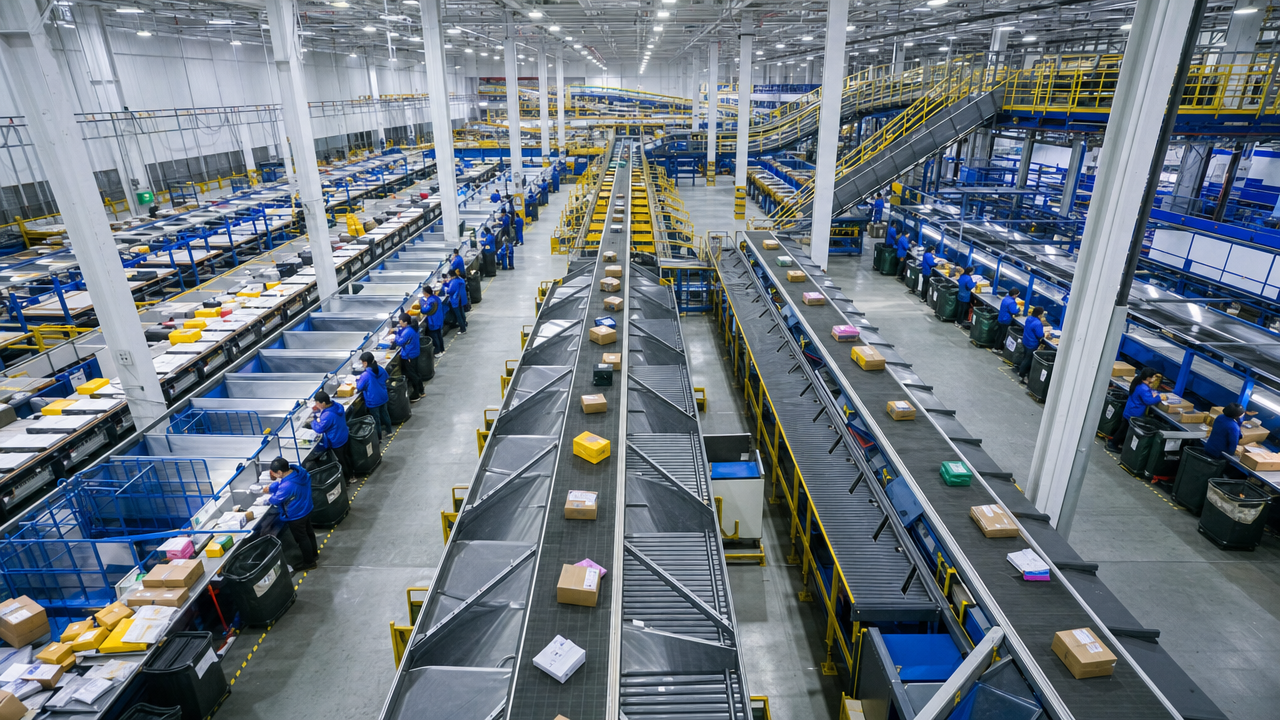

In the days before the 2025 Double Eleven shopping festival, sorting centers across China were a blur of motion — conveyor belts roaring, packages moving faster than the eye could track. That year, China's daily peak parcel volume broke 700 million pieces. Do the math: every second, more than 8,000 parcels were sorted across China's express network.
700 million single-day parcels. 1.75 billion annual parcels. RMB 368 quadrillion in total social logistics value. These numbers, almost incomprehensible in scale, mark 2025 as the year China's logistics industry fully consolidated its position as the engine of global physical commerce.
This report covers five major logistics tracks — general integrated logistics, express delivery, cold chain, instant delivery, and cross-border logistics. It analyzes the competitive positions of the leading players, maps the geographic hubs, examines the technological evolution, and projects the industry's trajectory through 2030.
Executive Summary
| Metric | 2025 Data | YoY Change |
|---|---|---|
| Social Logistics Total Value | RMB 368 quadrillion | +~6% |
| Express Parcel Volume | 175 billion pieces | +~20% |
| Express Revenue | RMB 1.4 trillion | +~12% |
| Total Social Logistics Costs | ~RMB 19.5 trillion | +~6% |
| Cold Chain Logistics Market | ~RMB 556.7 billion | +~15% |
| Instant Delivery Market | ~RMB 650 billion | +~25% |
| Cross-Border Logistics Market | ~RMB 2.8 trillion | +~18% |
Key Takeaways
In 2025, China's express industry completed its phaseshift from "volume expansion" to "volume and quality together" — stabilizing per-parcel revenue, increasing top-tier concentration, and accelerating automation investment.
The "Big Six" express landscape (SF, ZTO, YTO, Yunda, STO, J&T) is evolving toward a "SF + ZTO + J&T" three-superpower structure. Differentiation within the Tongda system will become clearer through 2026–2028.
Cross-border e-commerce is the single fastest-growing logistics sub-track. The global expansion of China's e-commerce platforms (Alibaba, JD, Pinduoduo/Temu, SHEIN) is the most important single driver of Chinese logistics companies going overseas.
Cold chain and instant delivery are the two most durably growing domestic logistics sub-tracks — the former driven by tightening food safety regulation and consumption upgrades, the latter by the continued penetration of the instant retail model.
Technology-driven change (AI + automation + new-energy electrification) will significantly reshape the cost curves of leading logistics companies between 2027 and 2030, creating durable technological moats.
China's Position in the Global Logistics Picture
Measured by parcel volume, China's express industry accounts for more than 65% of global volume — the world's largest express market, decisively ahead of the United States (15%) and Europe (14%).
Measured by value density, China remains one of the world's lowest per-parcel-price markets (~RMB 8–9 per piece). However, as high-speed express, cold chain, and cross-border segments grow, the industry's per-parcel average is structurally rising.
Measured by technology, SF Express and JD Logistics have reached or in some areas exceeded global best-in-class standards in automated sorting, AI dispatch, and drone delivery.
Chapter 1 Definitions and Classification: China's Five Logistics Networks and the Full Industry Chain
China's Five Major Logistics Networks
China's logistics industry, when examined structurally, can be understood as five distinct network layers operating in parallel, interconnected but governed by different competitive dynamics, customer profiles, and regulatory environments.
Network 1: Comprehensive Integrated Logistics
Comprehensive integrated logistics refers to the full suite of supply chain services — warehousing, transportation, freight forwarding, and value-added services (packaging, kitting, reverse logistics) — delivered as an end-to-end package. The statistical aggregate, "social logistics total value" (社会物流总额), reached RMB 368 quadrillion in 2025, making China the world's largest logistics market by this measure. The primary customers of integrated logistics are industrial and manufacturing enterprises that outsource their supply chains to 3PL (third-party logistics) providers or build integrated solutions with the help of technology platforms.
Network 2: Express Delivery (Parcel Express)
Express delivery is the fastest-growing and most media-prominent segment. "Express" in the Chinese definition refers to door-to-door, time-constrained small parcel delivery — primarily driven by e-commerce. China's express market reached 175 billion parcels in 2025, up approximately 20% year-on-year, accounting for more than 65% of global volume. The competitive dynamic is bifurcated: SF Express (time-critical, high value) and the Tongda system (e-commerce economy segment, price-competitive). This report will devote significant depth to this segment.
Network 3: Cold Chain Logistics
Cold chain covers all logistics activities requiring temperature-controlled environments, including the transport, storage, and distribution of fresh food, frozen food, dairy, seafood, fresh produce, pharmaceutical products, and biological products. China's cold chain market reached approximately RMB 556.7 billion in 2025. Unlike the parcel express market, cold chain is infrastructure-intensive (refrigerated trucks, cold storage facilities), is subject to strict quality and safety regulations, and serves both B2B (food distribution, pharmaceutical distribution) and B2C (fresh e-commerce, grocery delivery) demand.
Network 4: Instant Delivery (Hyper-Local Same-Hour Delivery)
Instant delivery refers to urban last-mile delivery with a time commitment of 30 minutes to 2 hours, primarily serving restaurant takeaway orders, local retail orders (convenience stores, supermarkets, pharmacies), and on-demand fresh grocery delivery. The market size reached approximately RMB 650 billion in 2025, driven by Meituan, Ele.me, Dada/JD Daojia, Shunfeng City, and others. Instant delivery sits at the intersection of logistics and platform economy dynamics; it is distinct from parcel express in its radically different unit economics and labor model (crowdsourced riders).
Network 5: Cross-Border Logistics
Cross-border logistics covers all movements of goods across national borders in both directions — exports (Chinese factory goods to overseas consumers) and imports (global goods to Chinese consumers). The cross-border logistics market reached approximately RMB 2.8 trillion in 2025. The export side dominates — driven by Chinese e-commerce platforms' global expansion (SHEIN, Temu, AliExpress, JD Worldwide) — and has been the fastest-growing sub-track in the entire logistics industry for three consecutive years.
The Business Model Evolution of China's Express Industry
China's express industry's business model evolution has passed through three clear stages, and all three stages have unfolded roughly in the same era, producing today's unique multi-model coexistence.
Stage 1 (2000–early 2010s): Pioneer direct operations and the rise of franchising. SF Express, from its founding (1993), insisted on direct operations — directly employing delivery staff and controlling the full service chain. The Tongda system (ZTO, YTO, Yunda, STO) chose franchising — headquarters provides the brand, waybill system, and trunk-line capacity; local network points are operated by franchisees. The franchise model's low capital requirements enabled the Tongda system to spread nationwide end-point networks within a decade, trading capital efficiency for rapid network scale expansion.
Stage 2 (2010–2018): E-commerce-driven scale competition. Taobao and JD.com pushed express from a small business-document market into a hundreds-of-billions, then trillions-yuan market. Volume was king; network density was the moat; reducing cost per parcel was the core competitive lever. JD Logistics took a fundamentally different path — with self-owned warehousing and self-operated delivery, it built the foundational capability for JD Mall's "211" delivery promise, progressively becoming a supply chain integration pioneer.
Stage 3 (2019–present): Open platforms and ecosystem competition. J&T's entry disrupted Tongda equilibrium, further depressing per-parcel prices. E-commerce platforms (Alibaba, JD, Pinduoduo) began more actively shaping logistics ecosystems. Cainiao evolved from a matchmaking platform to a global logistics infrastructure operator; JD Logistics evolved from "captive logistics" to "open social logistics." Competition has shifted from direct rivalry between express companies to ecosystem competition centered on e-commerce platforms.
Chapter 2 Global Landscape: The Rivalry Between FedEx, UPS, DHL, and Asia's New Forces
FedEx: Global Logistics Leader Amid Network Restructuring
FedEx (NYSE: FDX) reported full-year FY2025 (ended May 2025) global revenue of approximately $87.8 billion. FedEx is executing its "DRIVE" program — a large-scale internal consolidation merging FedEx Ground, FedEx Express, and other business lines into a single operating entity — targeting over $1 billion in annual cost reductions.
In China, FedEx's international express business (primarily serving multinational companies' commercial documents and high-value goods) faces intensifying competition from SF Express's international network and Cainiao's global infrastructure.
United Parcel Service (UPS): The World's Largest Express Company by Revenue
UPS (United Parcel Service) is the world's largest express company by revenue. In FY2024, UPS reported global revenue of approximately $87 billion. Q1 2025 revenue was approximately $21.5 billion, continuing to face volume decline pressures as Amazon's in-house logistics (AMZL) diverts an increasing share of domestic US parcels.
UPS's strategic pivot is toward "fewer parcels, higher value" — actively reducing low-margin Amazon volume and deepening healthcare logistics (medical devices, temperature-sensitive drugs, clinical trial samples), the automotive supply chain, and other high-value, high-technical-barrier segments.
DHL: The World's Broadest-Reaching Logistics Conglomerate
DHL (Deutsche Post DHL Group) is renowned for its global reach across 220+ countries and territories. FY2024 Group revenue was approximately €84 billion, making it the highest-revenue logistics group globally. DHL's business lines span international express (DHL Express), supply chain management (DHL Supply Chain), and global freight forwarding (DHL Global Forwarding).
DHL CEO Tobias Meyer has stated that digital transformation (AI routing, warehouse automation) and greening (electric delivery, hydrogen aircraft) are DHL's dual investment priorities through 2030. DHL plans to achieve zero-emission urban delivery for all its city vehicles by 2030, and 100% renewable energy supply for key express hubs across Europe.
DHL/Deutsche Post DHL Group: Strategic Restructuring
In 2025, DHL completed a strategic restructuring of its DHL Supply Chain business segment, further consolidating its global supply chain logistics capabilities. In China, DHL's strategy focuses on two cores: high-end international express (DHL Express) and supply chain management (DHL Supply Chain), prioritizing multinationals' import/export logistics and supply chain optimization.
Amazon Logistics (AMZL): The Non-Traditional Giant
Amazon is not a traditional express company, but its Amazon Logistics (AMZL) network has become one of the world's largest e-commerce logistics systems, directly competing with traditional express giants. In the US, AMZL can now independently fulfill approximately 70% of orders without relying on UPS or FedEx; in Europe, Amazon's same-day delivery service is also rapidly expanding.
Global Landscape's Structural Shift: The China Player Impact
The biggest variable in global express markets is the overseas expansion of Chinese companies (SF, J&T, Cainiao). In Southeast Asia, J&T is already the largest express company by volume. Cainiao has built last-mile delivery capability in Australia and Europe. In the Middle East, SF and J&T are both rapidly building out networks. Chinese players' advantages are low-cost operations and e-commerce platform-led volume; their disadvantages are limited brand recognition overseas and weaker local regulatory adaptation.
Aviation Freight: The Structural Market Shift
Commercial aviation cargo (belly capacity + full-freighter) is the critical mode for time-sensitive express and high-value goods. The global air cargo market was approximately $160 billion in 2025. China is one of the largest cargo markets. Wide-body aircraft belly capacity is the most important source of air cargo capacity, but the pandemic-era "passenger-to-freighter" conversions are history. As international travel fully resumed, belly capacity returned to normal, further highlighting the competitive advantage of dedicated full-freighter fleets. For SF and other aviation-first express companies, a proprietary full-freighter fleet is a core competitive asset — independent of commercial airline slot schedules.
Chapter 3 PEST Analysis: E-Commerce Regulation, Dual-Carbon Policy, AI Technology, and the Four Dimensions of Geopolitics
China's Policy Support System for Logistics
China's logistics industry benefits from a multi-level policy support ecosystem. At the national level, the "14th Five-Year" comprehensive transportation plan explicitly called for accelerating multimodal logistics development, improving logistics cost efficiency, and supporting high-quality express industry development. In the "15th Five-Year" plan, green logistics, smart logistics, and international logistics are clearly designated as priority development directions.
E-Commerce Platform Policy: Deep Impact on Logistics
E-commerce platform operating rules act as "quasi-regulation" with profound impacts on logistics. Alibaba (Taobao/Tmall), JD, and Pinduoduo — China's largest e-commerce platforms — directly shape logistics service standards (delivery time commitments, damage compensation standards, return policies) through their platform rules.
Alibaba/Tmall's "instant refunds" and "no-reason returns" have doubled reverse logistics (return parcels) volume over the past five years. JD's "211" delivery commitment (order before 11am → same-day delivery; order before 11pm → next-day delivery) has pushed the whole industry to raise time standards and led SF, Tongda, and others to establish pre-stocking forward warehouse models in major cities. Pinduoduo's "refund only" policy has raised merchant reverse logistics costs significantly.
Labor Laws and Employment Relations in Logistics
The logistics industry's employment model has long operated in a regulatory gray zone. Large numbers of delivery workers (especially "last-mile" delivery staff) relate to express companies through "subcontracting" or "franchising" arrangements — legally belonging to the franchisee network point rather than the brand headquarters, leaving significant gaps in labor rights protection.
In recent years, regulators have significantly increased attention to platform economy employment. From 2022–2025, platform employment standards have been progressively tightened in the express sector, meaning express platforms will increasingly find it difficult to fully evade employment relationship recognition and rights protection responsibilities through "franchise" structures.
Green Logistics: Regulatory Direction and Industry Response
Green logistics regulation has evolved from voluntary ESG disclosure to mandatory compliance requirements. The State Post Bureau has issued a series of documents mandating express packaging greening: reducing over-packaging, promoting reusable packaging (recyclable courier bags, reusable cartons), and reducing plastic use.
ESG Ratings and Capital Market Feedback
As ESG investing has deeply penetrated global capital markets, logistics companies' ESG performance is increasingly directly affecting their financing costs and institutional investor interest. SF Express and JD Logistics (both listed in Hong Kong) have published detailed ESG reports compliant with Hong Kong Exchange mandatory disclosure requirements and TCFD (Task Force on Climate-related Financial Disclosures) standards. ESG ratings from agencies (MSCI, Sustainalytics) affect whether international institutional investors (pension funds, sovereign wealth funds, ESG-themed funds) include these companies in investable universes.
Digital Logistics and Data Sovereignty
As logistics digitalization has deepened, logistics data security and privacy protection have become a new regulatory focus. China's Personal Information Protection Law (PIPL) effective 2021, and the Data Security Law, impose explicit requirements on how express companies store, process, and cross-border transfer recipient information. "Privacy waybills" (which mask recipient name, phone number, and address from delivery staff using encrypted codes) have become an industry standard. Logistics digital platforms (Manbang, Huolala) with location data of drivers and goods routes face regulatory scrutiny around national data asset classification.
PEST: E-Commerce Regulation
China's e-commerce regulation, particularly for cross-border e-commerce, has entered a new era. The cross-border e-commerce comprehensive pilot zones (now covering 165 cities) continue to expand. The overseas direct mail model (purchased from China, directly mailed to overseas consumers) is the foundational policy framework under which platforms like SHEIN and Temu built their global logistics.
PEST: AI Technology
In 2025, AI has deeply permeated logistics. Large language models are used for intelligent customer service (handling 70%+ of routine parcel inquiries and complaints). Computer vision is deployed for automated package damage detection at sorting centers. Predictive demand algorithms optimize SKU pre-positioning in forward warehouses. Real-time route planning algorithms improve last-mile delivery efficiency by 10–20%.
Multilateral Coordination of Global Logistics Regulation
Cross-border logistics regulation is shifting from each country setting its own rules to multilateral coordination. The WTO's Trade Facilitation Agreement (TFA) provides a framework of international commitments for improving customs clearance efficiency. The WCO's AEO (Authorized Economic Operator) certification system provides expedited clearance institutional conveniences for qualified cross-border enterprises. SF, Cainiao, and JD Logistics have all completed AEO certification in their primary business countries, giving their cross-border shipments significantly faster customs clearance than non-certified competitors.
Policy Tailwind for Cross-Border Logistics:
The "Measures on Cross-Border E-Commerce Retail Import" — which classify goods bought by Chinese consumers from overseas merchants as "personal goods" rather than "general trade goods" — have significantly reduced the customs clearance friction for import cross-border e-commerce. Conversely, the risk of Western governments tightening the de minimis exemption (e.g., US $800 threshold) for Chinese-origin small packages presents a regulatory headwind for export cross-border logistics.
Chapter 4 China's Market Scale: Deep Analysis of 175 Billion Parcels, RMB 368 Quadrillion Total Logistics Value, and Price Trends
Structural Breakdown of Social Logistics Total Costs
According to authoritative statistics from the China Federation of Logistics & Purchasing (CFLP), China's social logistics total costs consist of three major components: transportation costs, warehousing costs, and management costs. Transportation costs account for the largest share (~53–55%), warehousing costs ~33–35%, and management costs ~11–13%.
In 2025, social logistics total costs as a percentage of GDP reached approximately 14.4%, down approximately 2 percentage points from the 16.5% level of 2015. This figure, while still higher than the US (8–9%) and Japan (8.5%), represents continuous improvement. Lower logistics costs as a share of GDP means lower per-unit distribution costs for goods — a quantified indicator of China's supply chain efficiency improvement and a direct result of the "logistics cost reduction and efficiency improvement" policy directive.
Provincial Geography of China's Express Market
From a provincial perspective, China's express market is highly concentrated in eastern coastal provinces. According to State Post Bureau 2024 data, the top 10 express provinces (Guangdong, Zhejiang, Jiangsu, Shanghai, Shandong, Beijing, Fujian, Anhui, Hubei, Sichuan) contribute approximately 80% of national parcel volume, with Guangdong alone accounting for ~13–15%.
The rise of central-western regions is changing logistics network structure in two dimensions: express companies are establishing more sorting hubs in central-western areas (ZTO in Zhengzhou, YTO in Wuhan with large-scale sorting hubs), and cross-border logistics diversification is accelerating from Chengdu and Xi'an, no longer limited to Shenzhen/Shanghai.
Cold Chain Infrastructure Gap and Investment Opportunity
Despite China's cold chain market reaching approximately RMB 556.7 billion in 2025, cold chain infrastructure still lags significantly behind developed countries. The US has approximately 3–4x China's cold storage capacity per hundred people. Cold chain breaks (where temperature control lapses) primarily occur at the "first mile" (farm to cold storage transfer) and "last mile" (cold storage to consumer), not in trunk transport.
Investment opportunity: Cold chain warehousing (especially high-standard multi-temperature cold storage) is a current hotspot in logistics real estate investment. GLP, Mapletree, Blackstone, as well as JD Logistics and SF, are all increasing cold chain infrastructure investment.
Express Market: Volume Distribution and Price Trends
China's 2025 express market of 175 billion parcels can be broken down by product type: e-commerce economy express (3–5 day delivery) accounts for approximately 70–75% of total volume; time-critical express (next-day, same-day) accounts for approximately 10–12%; cross-border express approximately 12–15%; other (business documents, fresh goods) approximately 5–8%.
Per-parcel pricing across the major segments: SF Express time-critical express at approximately RMB 20–30/piece; Tongda system e-commerce express at approximately RMB 7–9/piece; J&T Express at approximately RMB 6–8/piece.
Chapter 5 Industry Chain Breakdown: Trunk Transport, Sorting Centers, Last-Mile Delivery, Warehousing, and IT Systems
Last-Mile Delivery's Multi-Modal Coexistence: Door-to-Door, Smart Lockers, and Parcel Stations
Last-mile delivery ("last-mile") is the highest-cost, hardest-to-optimize segment of the entire express chain. According to major express companies' disclosed data, last-mile delivery costs account for approximately 40–50% of total express costs, while 100% of parcels require last-mile delivery.
China's current express last-mile delivery has formed three primary model coexistence:
Door-to-door: Delivery staff bring packages directly to recipients' doors — the primary service mode for time-critical express (SF, JD Logistics) and large items (Deppon). Optimal recipient experience; lowest delivery staff efficiency.
Smart lockers: Fengchao (SF system), Alliance locker networks, and China Post Speed Express are the three major players. Delivery staff place multiple packages in lockers at once; recipients collect using a code. Significantly improves delivery staff per-shift parcel count (from ~10/hour to 30–50/hour), but faces rising placement costs (property management fees) and user experience concerns ("being put in the locker" is seen by some users as a service downgrade).
Parcel stations (surrogate collection points): Parcel stations (small shops or dedicated service stations that hold packages for collection) are the fastest-growing last-mile model. Cainiao stations (already surpassing 150,000 service stations), Fengchao collection points, and each express company's proprietary stations cover large numbers of campuses, factory zones, and residential communities.
Hub-and-Spoke Network Evolution
Express companies' trunk transport has evolved from "point-to-point" to "hub-and-spoke" to "grid-based multi-tier hub" systems. The current mature structure is: 3–5 super-hubs nationally (Tier-1 sorting centers in Yiwu, Zhengzhou, Wuhan, Chengdu, Guangzhou) + provincial Tier-2 sorting centers + city-level Tier-3 distribution centers.
Sorting Center Technology: From Manual to Full Automation
China's major express companies have invested heavily in sorting center automation. ZTO's 80+ Tier-1 sorting centers are among the most automated in the Tongda system. Automated sorting systems (cross-belt sorters, bomb sorters), AGV (automated guided vehicles), smart scanning systems, and AI-based routing decisions have transformed sorting from labor-intensive manual operations to machine-intelligent operations.
Price War Long-Term Consequences and Industry Self-Discipline
The root cause of China's express price war lies in the industry's strong network effects and low marginal cost expansion characteristics. The legacy of this strategy erupted in 2020–2022: per-parcel revenue continued falling, franchisee profit margins were severely compressed, and delivery worker pay remained extremely low. Regulatory intervention followed, with the State Post Bureau investigating "below-cost pricing" practices.
True industry price stabilization eventually resulted from the combination of: rising labor costs; hardened regulatory constraints; demand structure upgrade (e-commerce platforms' growing demand for time-critical services); and J&T's large-scale global expansion partially diverting extreme low-price competition pressure from the domestic market.
Franchisee Management: The "Upgrade Dilemma" of the Tongda System
The core contradiction of franchise express networks is the profit allocation between headquarters and franchisees, and the consistency quality challenge of franchisee management. Near-term developments include: increasing direct-to-company conversion (converting some key network points from franchise to direct management or direct-style control), credit rating systems (low-rated franchisees get fewer deliveries), and end-to-end digital monitoring (digital traceability of delivery processes). Despite these efforts, "franchise express has a lower service ceiling than direct operations" remains a long-term structural reality — which is the fundamental reason SF's "premium express" positioning can be maintained long-term.
Chapter 6 Key Company Profiles: SF, Tongda System, J&T, JD Logistics, Cainiao, and the Global Three
SF Express Holdings (SFH): The Absolute Leader in Time-Critical Express
SF Express achieved full-year 2025 operating revenue of approximately RMB 308.2 billion, up approximately 12% year-on-year. Time-critical express (next-day, same-day premium products) remains SF's core revenue pillar, but economy express and large-item freight (SF Logistics + Deppon large items) continue to grow in share.
SF's core competitive advantages: (1) proprietary air cargo network (post-Kerry Logistics integration, SF owns 80+ full-freighter aircraft, one of Asia's largest private air cargo fleets); (2) direct operations model (full-chain quality control); (3) brand premium (high-value customers willing to pay for reliability); (4) supply chain integration capability (SF Cold Chain, SF Medical, SF City service matrix).
In 2025, SF accelerated overseas expansion. Kerry Logistics integration is in its third year; it continues to expand on foundations in Southeast Asia, the Middle East, and Europe, targeting international business revenue above 30% by 2027.
ZTO Express (ZTO): The Largest Franchise-Model Express Company
ZTO's FY2024 express parcel volume was approximately 34 billion pieces, holding industry first position (approximately 20% of national volume). In 2025, ZTO continued its "high-quality volume growth" strategy — no longer purely chasing volume growth, but focusing more on per-parcel revenue stabilization and franchisee profit improvement.
ZTO's capital allocation strategy: 2023–2025 ZTO has executed large-scale share buybacks (annual buyback total exceeding $500 million), returning operating profits to shareholders while maintaining low debt ratios — the most capital-market-recognized Tongda system company. ZTO's competitive advantage: Tier-1 sorting centers numbering 80+, per-parcel cost approximately RMB 0.1–0.3 below competitors, translating to ~RMB 6 billion in annual cost advantage.
YTO Express: The Most Aggressively Tech-Investing Tongda Company
YTO's FY2024 express revenue was approximately RMB 87 billion, parcel volume approximately 24 billion pieces. YTO has been the most aggressive in technology investment: as early as 2019, it began deploying AGV automated sorting systems (small robots) at scale, and its sorting center automation rate now leads the Tongda system.
J&T Express: The Most Disruptive Emerging Global Player
J&T's FY2025 revenue was approximately $12.16 billion, global parcel volume exceeding 18 billion pieces (including Southeast Asia, the Middle East, and Latin America). J&T's entry into China (2019) under the "low-price dumping" strategy had a strategic logic: first build network scale with low prices, then improve unit profitability through service upgrades and refined management once density is achieved. This strategy has been proven in Southeast Asia (profitable), and is still in the grinding-in phase in China.
Post-IPO (2023 Hong Kong listing), J&T has significantly greater financial firepower for global acquisitions and network expansion: entering the Middle East, entering Latin America, replicating its Southeast Asia "build network with low price, then optimize at scale" playbook. J&T's global expansion means international express markets (previously dominated by FedEx/UPS/DHL) will face comprehensive competition from Chinese players.
JD Logistics (JDL): The Supply Chain Integration Pioneer
JD Logistics's FY2024 revenue was approximately RMB 217.1 billion. JDL's core moat is "supply chain integration" — unlike pure express companies, JDL provides end-to-end service from warehousing, sorting, and delivery to reverse returns, deeply integrated with JD.com's systems. Once a customer migrates their warehousing and logistics systems into JDL's ecosystem, switching costs are very high — a classic "switching cost moat."
JDL's "Asia No. 1" series of highly automated warehouses (10+ nationally) already achieve efficiency multiples of traditional manual warehouses. JDL has planned a 5-year, 3 million robot procurement program, betting that as tech dividends fully materialize, scale leaders with highest automation will build the strongest cost moats.
Dada Group (NASDAQ: DADA): The Instant Delivery Professional Outsource Platform
Dada Group (JD Dada) is an open platform focused on instant delivery, providing "same-hour delivery" service to local merchants including supermarkets, pharmacies, and restaurants. Dada has two platforms: Dada Now (crowdsourced delivery platform) and JD Daojia (O2O retail platform aggregating tens of thousands of supermarkets, convenience stores, and pharmacies). Dada's differentiation vs. Meituan Delivery and Ele.me/Hummingbird is its deep binding with JD.com — JD Daojia platform aggregates large traditional supermarkets (Walmart, Yonghui, CR Vanguard), with strong penetration in non-restaurant instant retail.
Cainiao (Alibaba's Global Logistics Infrastructure)
Cainiao has evolved from a logistics matchmaking platform (2013 founding) into a global logistics infrastructure operator. Cainiao's FY2025 (ended March 2025) revenue was approximately RMB 100 billion. Cainiao's overseas warehouse nodes exceed 2,000 — covering Europe (Germany, France, UK, Poland), North America (US, Canada), Southeast Asia (Malaysia, Thailand, Vietnam), Middle East (UAE), and Oceania (Australia). Cainiao's e-Hub program selects global strategic logistics hubs (Kuala Lumpur, Dubai, Liège, etc.) for construction of large-scale international express sorting centers.
Global Three: FedEx, UPS, DHL
FedEx: FY2025 revenue ~$87.8B, executing "DRIVE" integration program. UPS: FY2024 revenue ~$87B, strategically pivoting to "fewer parcels, higher value" (deepening healthcare, automotive parts). DHL: €84B FY2024, broadest global coverage (220+ countries), strategic dual focus on digital and green transformation.
Chapter 7 Industrial Geography: Express Hometowns, Logistics Hubs, and Global Overseas Footholds
The geography of China's logistics industry is not a random distribution of companies. It is a precisely structured map: some driven by historical natural agglomeration, some by policy-planned hub designation, some by multinational expansion strategy. The Tianxia Gongchang Industry Research Institute's industry data shows that from Shenzhen (SF headquarters) to Zhejiang Tonglu (the "hometown of express"), from Cainiao's Shanghai Free Trade Zone warehouses to J&T's Southeast Asia sorting hubs, this map is expanding globally at a visible pace.
Guangdong: China's Express Industry "Lead Engine"
Guangdong has the highest manufacturing density in China and is one of the largest parcel origin provinces. SF's headquarters, tech R&D center, and air cargo hub are all in the Greater Bay Area; JD Logistics has large warehousing and sorting hubs in Guangzhou. Shenzhen Bao'an International Airport is the most important air cargo hub in South China, with SF, JD, ZTO and others having full-freighter capacity there.
Guangdong is the absolute core province for cross-border e-commerce exports. Shenzhen, Guangzhou, and Dongguan's electronics, clothing, and home goods are SHEIN, Temu, and AliExpress's largest sourcing regions. Shenzhen Customs alone processes more than 8 million cross-border small packages daily. 4PX, Yanwen Logistics, and other major cross-border logistics companies have headquarters or core operations in Guangdong.
Yangtze River Delta: China's Highest-Efficiency Logistics Coordination Region
The Yangtze River Delta (Shanghai, Jiangsu, Zhejiang, Anhui) is China's highest manufacturing and e-commerce concentration region, and the region with the highest logistics network density and coordination efficiency. SF has large sorting centers and feeder airport transit hubs in Hangzhou, Nanjing, and Suzhou. ZTO headquarters is in Tonglu, Zhejiang; YTO, STO headquarters are in Shanghai's Qingpu; Yunda headquarters is in Jinshan, Shanghai. Yiwu is the world's largest small commodities distribution center, and one of the highest cross-border express departure-density cities in China.
Beijing-Tianjin-Hebei: The Core Hub of Government and Business Express
Beijing-Tianjin-Hebei (Beijing, Tianjin, Hebei) is China's political center and an important manufacturing region. Beijing Capital International Airport and Beijing Daxing International Airport are the most important air cargo hubs in northern China; Tianjin Port is the largest container seaport in the north.
Chengdu-Chongqing: The Rising Polar Core of Western Logistics
Chengdu-Chongqing (Chengdu + Chongqing) is the most economically active region in western China, and a nationally strategically designated international logistics hub. The Chengdu-to-Duisburg (Germany) China-Europe Railway Express is one of the world's busiest CRE lines. Chengdu's Tianfu International Airport (operational since 2021) has significantly expanded Chengdu's air cargo capacity. Chengdu-Chongqing manufacturing is rapidly upgrading: new energy vehicles, electronics, and biopharmaceuticals are driving fast-growing logistics demand to/from eastern China and globally.
Long-Term Logistics Infrastructure Construction Logic
China's logistics infrastructure (expressways, rail freight networks, ports, airports, logistics parks) has over 20 years accumulated the world's largest logistics infrastructure by volume: China's expressway total mileage is global #1 (exceeding 170,000 km); railway freight mileage is global top 3; container port throughput is global #1. This infrastructure accumulation provided the material basis for China's express industry's scale-driven expansion, and is an important support for the continuous decline in China's logistics costs.
Chapter 8 Sub-Track Deep Dives: Nine Major Tracks — E-Commerce, Time-Critical, Cold Chain, Instant Delivery, Cross-Border, Overseas Warehousing
Instant Delivery Track: Business Model Deep Analysis
Platform-model instant delivery (Meituan, Ele.me)'s essence is the high integration of the rider dispatch system with the merchant order system — consumer, merchant, and rider are matched through a unified app, with information flow and logistics flow highly coupled. Open-model instant delivery (Dada Now, SF City) is purely a "logistics service" — merchants generate orders in their own systems (private domain or other e-commerce platforms), connect via API to the instant delivery platform, which only handles rider dispatch and full-process delivery.
Instant Retail's Driving Logic
Instant retail's explosion has a fundamental driver: consumers' expectations for "speed" continuously lowering. Ten years ago, consumers accepted 5–7 days for online orders; five years ago, next-day delivery became the standard expectation; today, "one-hour delivery" and even "30-minute delivery" are possible in Tier-1 cities, and are progressively penetrating Tier 2–3 cities through Meituan Flash Purchase and JD Daojia.
Unmanned Delivery: From Technology Validation to Scenario Scaling
Unmanned delivery (autonomous vehicles, drones) is the direction with the most intensive tech investment in logistics, yet has long been in the "about to arrive" state. Major Chinese players: Meituan Unmanned Delivery (autonomous delivery vehicles in specific road sections and communities), JD Logistics (unmanned delivery vehicles and drones in multiple cities), SF Drones (unmanned aircraft in Shenzhen, Chengdu and others).
True city-wide fully unmanned delivery faces core technical challenges: elevator boarding (the "going upstairs" problem), residential gate entry (door access), complex road conditions (pedestrian and e-bike obstacle avoidance), and severe weather (rain, strong wind effects on drones). Full-area unmanned delivery in cities before 2030 remains difficult; current unmanned delivery primarily operates as a supplement to human delivery in specific scenarios.
Cross-Border E-Commerce Track: Competitive Landscape Deep Analysis
Cross-border e-commerce logistics competition is evolving from "postal channel dominant, express dedicated supplementary" to "platform logistics + professional cross-border logistics enterprise dual dominance." The emergence of platform logistics (Cainiao, JD Logistics International, SHEIN Global Logistics) is pressuring specialist cross-border logistics companies: platforms can use large order data on their platforms to precisely forecast SKU overseas inventory needs, pre-ship goods via sea freight to overseas warehouses in bulk, then complete last-mile delivery locally (as fast as 1–3 days), fundamentally bypassing the dual delays of "cross-border + last-mile."
Overseas Warehouse Layout Logic
Overseas warehouse layout logic is not merely "closer to consumers" — it also means: (1) dramatically shorter return cycles (process returns at the overseas warehouse rather than shipping back to China); (2) improved peak-season response (pre-stock to overseas warehouses, avoiding sea shipping bottlenecks during Double 11 peak periods); (3) avoiding some destination-country import tariffs; (4) supporting local B2B distribution (supply local distributors directly from overseas warehouses, empowering China's export enterprises to develop overseas offline channels).
Medical Cold Chain: Regulatory Tightening and Market Formalization
Pharmaceutical cold chain is the most strictly regulated sub-track of cold chain logistics. China's NMPA's GSP (Good Distribution Practices) requires that drugs (especially biological products, vaccines, blood products, and other temperature-sensitive items) maintain full-chain temperature monitoring and traceability throughout circulation. In 2025, with biosimilars, CAR-T cell therapies, and mRNA vaccines scaling up, pharmaceutical cold chain's technical requirements have further elevated — ultra-low temperature storage (-80°C to -196°C, for cell and gene therapy products) is growing from niche to scale, posing entirely new requirements for pharmaceutical cold chain companies' storage technology, temperature control equipment, and operator qualifications.
Track 7: Same-City Delivery and Trunk-Road Freight
Same-city delivery (non-instant, typically half-day to next-day) is the main track for B2B business goods delivery. Huolala (Hong Kong listed), Manbang Group (NYSE: FULL) are representative digital matchmaking platforms for same-city and city-to-city freight. Huolala focuses on urban immediate same-city freight (moving, large-item delivery); Manbang focuses on city-to-city full truckload and LTL matchmaking. Trunk road greening (electric heavy trucks, hydrogen heavy trucks, logistics park new-energy electrification) is the core theme for this track through 2025–2030.
Deppon Logistics (acquired into JD Group ecosystem) is a major player in large-item express (3–300kg heavy goods) with "door-to-door large-item express" as its core product. Zero-less-than-truckload (LTL) freight primarily serves industrial goods, FMCG, and manufacturing component B2B delivery needs. Manbang Group's platform connects 3+ million truck drivers and millions of shippers — one of China's most digitalized road freight platforms.
Chapter 9 Technology Evolution: Unmanned Delivery, Smart Sorting, AGV Warehousing, AI Dispatch, and New Energy
Full Panorama of AI Applications in Logistics
AI's transformation of logistics has moved from localized experiments to scaled implementation. In 2025, primary application scenarios span several dimensions:
Demand forecasting and pre-positioning: ML models forecast 7–30 day SKU-level demand, pre-positioning core goods from central warehouses to forward warehouses closer to consumers. JD's "anticipatory shipping" capability is a direct result.
Route planning and dynamic dispatch: Last-mile route planning is evolving from static (one-time daily route computation) to real-time dynamic dispatch (adjusting for new packages, road congestion, and time commitments in real time). SF and JD Logistics apps have integrated real-time path optimization, improving delivery staff daily parcel counts by 10–20%.
Anomaly handling and customer service automation: AI-driven exception identification systems can recognize damage (visual AI) at package check-in scanning, identify address anomalies (NLP) in waybill information, and automatically trigger handling flows. AI customer service (LLM-driven chatbots) is live on major Tongda express apps, handling 70%+ of routine parcel inquiries and complaint tickets.
Unmanned warehouses and automated sorting: In sorting centers, AGV, automated sorters, and robotic arms are mainstream. JD Logistics's "Asia No. 1" series (10+ nationally) achieves efficiency multiples of traditional manual warehouses. Cainiao's "Baojian" robots in Tmall Supermarket warehouses handle automated identification, picking, and transport of carton goods.
Smart weighing and waybill recognition: Smart parcel-sending counters (cameras + weight sensors) at convenience store collection points, smart collection desks at storefronts (auto-weight, auto-label printing, auto-routing suggestions) have significantly improved collection efficiency. AI waybill recognition (OCR + NLP) reads recipient name, address, and contact in milliseconds, automatically assigns routing.
Logistics Tech Companies: The Rise of Infrastructure Operators
A cohort of logistics-tech-focused independent companies is rising rapidly: Huolala (same-city freight matchmaking, HK listed 2024), Manbang Group (city-to-city road freight matchmaking, NYSE: FULL), Xinyi Tech (Alibaba subsidiary, cloud warehousing SaaS), Chuanhua Zhilian (logistics park + SaaS). These companies provide SaaS-ized logistics IT tools enabling smaller logistics companies to access digital capabilities at lower cost — the "technology democratization" trend.
Full-Chain Digital Expansion in Logistics
The digital transformation of logistics is not merely "lowering costs" — it will redefine the shape of logistics cost curves. When capital expenditures for sorting robots, autonomous delivery vehicles, and AI dispatch systems are fully amortized, logistics variable costs will be significantly below current levels. This is the core logic of technology-driven logistics industry second-curve creation — which is why JD Logistics's 5-year, 3 million robot procurement announcement is so striking: betting that when technology dividends fully materialize, the most scaled and most automated players will win the largest cost advantages.
Chapter 10 Risk Matrix: Price Wars, Oil Prices, Overseas Politics, Cross-Border Regulation, and Labor Compliance
Geopolitical Risks in Logistics
Cross-border logistics faces geopolitical risks that have risen from background noise to core strategic considerations.
China-US Trade Friction and Small Package Tariffs: In 2025, the US launched reviews of de minimis small package exemptions (duty-free imports under $800), and investigations into SHEIN and Temu's supply chains. If de minimis policy tightens, it will directly impact Chinese cross-border e-commerce and their logistics service providers deeply dependent on the US market. J&T, Cainiao, and others with significant cross-border business in the US would be most directly affected.
Russia-Ukraine Conflict and Eurasian Logistics Routes: The conflict changed China-Europe Railway Express routes, with some China-Europe cargo previously transiting Russia now facing sanction risks, pushing some CRE lines to detour southward via the "Middle Corridor" (Central Asia → Caspian → Azerbaijan → Turkey), increasing transit time and cost.
Red Sea Crisis and Shipping Detours: From 2023–2024, Houthi attacks on Red Sea commercial shipping forced large numbers of container ships to detour around the Cape of Good Hope, with Suez Canal usage rates falling sharply. Routing around the Cape adds approximately 10–15 additional sailing days and several thousand dollars per TEU for China-to-Europe cross-border e-commerce exports. In 2025, Red Sea conditions have partially eased, but uncertainty remains elevated.
Sanctions Compliance Pressure: Chinese logistics companies face increasingly complex compliance requirements as they expand overseas. OFAC sanctions lists, EU sanctions lists for specific countries impose export control on logistics companies, requiring strict compliance screening mechanisms.
Labor Structural Pressures
China's express industry employs more than 4 million registered express workers, with the broader "delivery economy" including e-commerce riders exceeding 10 million. Structural pressures: declining willingness of Generation Z (born 1995–2010) to take express delivery roles; wage increase expectations; occupational injury insurance coverage requirements. Automation (machine replacement of last-mile delivery workers) is technically feasible, but deployment faces significant challenges in China's high-density urban environments (high-rise buildings, security access restrictions). In the short term through 2030, rising labor costs will continue to compress logistics industry profit margins.
Risk Summary: Five Major Risk Dimensions
- Price wars (domestic): despite regulatory intervention, single-parcel revenue stabilization remains fragile; any new entrant could reignite extreme price competition.
- Geopolitical (overseas): US de minimis changes, EU carbon border adjustment (CBAM applied to logistics), Red Sea, Russia-Ukraine — any one could significantly affect cross-border logistics costs.
- Oil/fuel prices: diesel accounts for approximately 30–40% of dry line transport costs; international oil price fluctuations create significant cost uncertainty.
- Labor/ESG: labor cost rigidity is rising; new energy transition capital investment pressure (new energy trucks are significantly more expensive than diesel) is significant.
- Regulatory compliance: data security (PIPL cross-border data flow), overseas market access regulations, food safety certification for cold chain — compliance costs are rising globally.
Chapter 11 2026–2030 Projections: Five-Year Evolution of Volume, Price, Cross-Border, and Competitive Structure
The Agricultural and Rural Market: The Next Growth Pole
China's express market's incremental space, after urban scenarios mature, increasingly comes from rural and county-level markets. According to State Post Bureau data, rural express volume accounted for approximately 30–35% of national total in 2024, while rural population is approximately 45% of total — meaning rural parcel penetration still has significant growth room.
Cross-Border "Local Warehousing" Trend
Cross-border e-commerce logistics' next evolution direction is "local warehousing" — no longer relying solely on cross-border small parcels shipped directly from China, but establishing local warehouses in target sales countries to pre-stock goods before orders arrive, then fulfilling locally (significantly shortening wait times from weeks to 1–3 days) and reducing destination-country return costs.
Logistics Real Estate: Differentiated Investment Hotspot
Logistics real estate (warehouse REITs, logistics parks) is a long-term favored large asset class for international institutional investors, valued for stable cash flows (long leases) and strong correlation with e-commerce growth. In China, the core contradiction of the logistics real estate market is a supply-demand mismatch: high-standard cold storage supply is insufficient (high construction costs due to temperature control, fire suppression requirements), while ordinary standard warehouses in some areas (Pearl River Delta, Yangtze River Delta) show absorption pressure.
Digital Logistics and Freight Finance
Logistics industry digitalization has spawned an emerging sub-market — freight finance (logistics finance, supply chain finance). Manbang Financial Services (vehicle loans, fuel credit for truck drivers on its platform), JD Logistics supply chain finance (accounts receivable financing for merchants using JD Logistics), Chuanhua Network (logistics park + settlement platform + freight finance) are typical players in logistics finance.
Talent Development and University Research
China has more than 300 universities with logistics management or logistics engineering programs, graduating more than 100,000 students annually. Beijing Jiaotong University, Shanghai Maritime University, Wuhan University's transportation school, and Nanjing University of Finance and Economics logistics school are the most representative. SF Technology Research Institute (Shenzhen) and JD Logistics Technology Research Institute (Beijing) maintain close collaboration with top domestic and international universities.
Logistics Cost and Industrial Competitiveness
China's social logistics total costs as a percentage of GDP falling from ~16.5% in 2015 to ~14.4% in 2025 — a 2-percentage-point improvement — represents, at China's RMB 135 trillion GDP scale, approximately RMB 2.7 trillion in annual social logistics cost savings. This is a real productivity dividend for the real economy. "15th Five-Year" period priorities: further reducing logistics costs in cold chain, cross-border, and pharmaceutical sectors is a dual policy objective for industrial upgrading and quality-of-life improvement.
Industrial Belt and Logistics Synergy
Three representative industrial belts illustrate the tight co-evolution of China's industrial cluster geography and logistics networks:
Yiwu small commodities industrial belt (Zhejiang Jinhua): Annual export of approximately 300,000 product categories, goods value exceeding $100 billion. Yiwu's international express daily departure volume exceeds 1 million pieces, served by Yiwu International Express Industrial Park, Yiwu land port (China-Europe Railway Express departure point), and Yiwu Airport.
Shenzhen electronics industrial belt (Greater Bay Area): Shenzhen's consumer electronics (phones, tablets, wearables) and new energy (batteries, solar panels) exports are critical nodes in global tech supply chains. Shenzhen Airport's cargo throughput (150,000+ tons/year) is China's 3rd largest cargo airport; Yantian Port is South China's largest container port.
Suzhou Industrial Park / Kunshan Taiwan-invested industrial belt: Precision manufacturing (semiconductor packaging & testing, automotive parts, precision instruments) — typically "high value, low volume" goods requiring tight timing and safety. This region's logistics is dominated by SF and DHL, with a time-critical express and air freight share far above the national average.
2026–2030 Ten Major Predictions
- Express parcel volume will reach approximately 250–280 billion pieces by 2030, ~7–9% CAGR.
- SF's international revenue share will exceed 30%, with overseas business becoming a second growth engine.
- Tongda system concentration will further increase; the lowest-share 1–2 players will face acquisition or merger pressure; CR5 market concentration may rise to approximately 90%.
- J&T global volume will surpass SF's, becoming China's #1 express company by volume (but with lower margins than SF).
- Instant delivery market size will exceed RMB 1 trillion; Meituan, Dada, and SF City will form a three-way landscape.
- Cold chain market size will exceed RMB 1 trillion, with pharmaceutical and agricultural cold chain growing in parallel.
- Cross-border logistics market will reach RMB 4+ trillion; Chinese players (Cainiao, J&T, SF) will account for over 30% of global cross-border express share.
- Electrification rate: last-mile new energy vehicle penetration >70%; trunk road new energy heavy truck penetration >30%.
- Logistics industry total carbon emissions will decline by 20%+ vs. 2020 peak in absolute terms; per-parcel carbon intensity will fall by 50%+.
- Logistics REIT market size will exceed RMB 300 billion, a significant component of China's REIT market; high-standard cold storage, cross-border warehouses, and pharmaceutical warehouses are the core asset categories.
Chapter 12 Conclusions and Research Institute Judgment: The Big Five Structure Consolidates, Global Expansion Curtain Rises, Technology-Driven New Equilibrium
The scale of China's logistics industry — 175 billion parcels, RMB 368 quadrillion in total logistics value — has long crossed any meaningful scale comparison with global peers. What is profoundly changing in 2025 is not the scale data itself, but the underlying competitive logic of the industry: from "who can grab more volume" to "who can deliver on cost, service, and global reach simultaneously."
Five Competitive Paths in the Next Stage
China's major logistics companies are forming five differentiated competition paths:
SF's path: Continue investing in direct operations + high-end brand premium; international business as second growth curve; premium time-critical express as domestic profit base.
Tongda system's path: Internal differentiation accelerating — ZTO deepens cost leadership; YTO continues automation investment; Yunda and STO seek survival through cost control and niche market penetration.
J&T's path: Global expansion as core strategy; replicating Southeast Asia's "low price to build network, scale to optimize profitability" model in the Middle East, Latin America, and Europe; global volume first, then global profitability.
JD Logistics's path: Differentiation through supply chain integration depth; deepening integration with JD Mall ecosystem; open platform expanding social logistics revenue contribution.
Cainiao's path: Global logistics infrastructure operator; not competing for per-parcel price, but providing overseas warehousing infrastructure + digital platform as "global factory-to-consumer logistics infrastructure."
Technology Is the True Second Curve
This technological revolution's significance for logistics is not just cost reduction — it will redefine the shape of logistics cost curves. When sorting robots, autonomous delivery vehicles, and AI dispatch systems' capital expenditure depreciation is fully absorbed, logistics variable costs will be significantly below current levels, enabling leading enterprises to achieve genuine long-term profitability in the "low price but profitable" zone.
Overseas Expansion Is the Most Worth Sustained Attention Structural Opportunity
Over the next five years, Chinese express companies' international revenue shares will continue rising. J&T's profitability breakthrough in emerging markets, JD Logistics overseas warehouse scaling, and Cainiao's international hub construction together sketch the strategic picture of Chinese logistics companies "going global." This is not just a revenue diversification financial story — it is the logistics infrastructure for Chinese manufacturing and Chinese consumption two-way globalization.
Tianxia Gongchang Industry Research Institute, in continuously tracking the globalization of China's manufacturing sector, observes: the "going global" of manufacturing and the "going global" of logistics are always two sides of the same coin. The goods of China's 4.8 million factories need global logistics networks to reach consumers; and the endpoints of global logistics networks are increasingly diverse global consumers.
Research Institute's Core Judgment
Comprehensively, the Research Institute's medium-term judgment on China's logistics and express industry is: the industry's underlying logic remains solid; e-commerce growth-driven parcel volume expansion will not stop in the short term; technology investment will significantly alter leading companies' cost structures starting in 2027–2030; cross-border e-commerce and overseas logistics are the fastest-growing, highest-profit sub-tracks over the next five years; the Big Five structure's formation is an inevitable direction, but the timeline may be longer than the market expects (competitive inertia means smaller express networks won't quickly exit); price wars, though painful, have objectively accelerated the industry's automation progress, and will ultimately end by "technology cost reduction replacing price wars."
Chapter 13 Competitive Moats and Investment Value: In-Depth Assessment Across Six Dimensions
After analyzing market scale, corporate landscape, technology evolution, and risk matrix, one final core question demands an answer: in the current competitive landscape, which companies possess truly sustainable competitive advantages? Where do these advantages come from, and how durable are they?
Moat 1: Network Density and Network Effects
Logistics networks inherently feature network effects, though their manifestation differs by level. At the national level, the positive flywheel is real: more parcel volume → higher capacity utilization → lower per-parcel cost → attracting more volume. This is why large networks (ZTO, YTO) can persistently sustain cost advantages over smaller networks.
However, once all leading companies' end-points cover all 300,000 townships and all cities nationally, network density differences become small. At that point, what determines competitive outcomes is no longer "where you cover" but "where you serve better." In rural sub-county areas, network density differences still exist — and this remaining gap is a new frontier for competition over the next 5 years, to be resolved through policy support + technology (autonomous vehicles, drones).
Moat 2: Cost Structure Differentiation — ZTO's Per-Parcel Cost Advantage
ZTO's core moat is its long-term lower per-parcel cost versus competitors. ZTO has self-built 80+ large Tier-1 sorting centers, with each center's service radius precisely optimized to keep trunk-line loading rates persistently above industry averages. ZTO's Tier-1 sorting center automation rate is the highest in the Tongda system, driving continuous per-unit labor cost declines.
Historical data shows ZTO's per-parcel cost is approximately RMB 0.1–0.3 below YTO and Yunda — seemingly small, but at annual volume of 34+ billion pieces, RMB 0.2 in cost difference represents approximately RMB 6 billion in annual profit differential. This cost advantage gives ZTO more pricing cushion than competitors in price wars, able to maintain low prices for longer without falling into losses.
Moat 3: Service Quality and Brand Premium — SF's Non-Replicability
SF's moat logic is completely different from the Tongda system. SF's competitive advantages: (1) time commitment reliability (SF's promised next-day completion rate persistently maintained at ~95%, far above e-commerce express's ~80%); (2) full-freighter fleet granting independent trunk-line capacity (not dependent on commercial airlines, unaffected by weather cancellations); (3) direct operations model's service consistency (every SF delivery worker is a direct SF employee, service standards can be controlled).
The combination of these three creates SF's ability to maintain per-parcel average revenue of approximately RMB 15–20 in the time-critical express segment, without needing to drop to e-commerce express's RMB 2–3 level to compete in price wars. SF's high-value customers (pharmaceutical, luxury, aviation documents, enterprise commercial parcels) have extremely high loyalty — even if Tongda system prices are RMB 5–10 lower, these customers won't easily switch.
Moat 4: Supply Chain Integration Depth — JD Logistics's Differentiated Track
JD Logistics's moat logic is "supply chain integration." Unlike pure express companies, JDL provides end-to-end service from warehousing, sorting, and delivery to reverse returns, deeply integrated at the system level with JD.com. Once a customer migrates their warehousing and logistics systems into JDL's ecosystem, switching costs are extremely high — a classic "switching cost moat."
Moat 5: Technology Moat Sustainability
Logistics technology moats are easier for competitors to replicate than in other industries. Most logistics IT technology (route planning algorithms, waybill OCR, automatic sorters) can be purchased from third parties or built on open-source foundations. What is truly difficult to replicate is the organizational capability to embed technology into operations — i.e., the operational culture and management experience of "how to make sorting center operators, drivers, and delivery staff work efficiently with the system." JD Logistics's "Asia No. 1" series warehouses are difficult for competitors to close the gap on not just because of hardware (AGV, robotic arms, visual recognition), but because of the accompanying WMS, scheduling algorithms, SOP standards, and years of accumulated SKU data (product dimensions, weights, fragility).
Moat 6: Direct vs. Franchise Cost Structure
From financial data: SF's labor costs as a share of revenue (30–35%, including delivery worker wages and social insurance) are significantly higher than the Tongda system's (15–20% for headquarters, with most end-labor costs borne by franchisees). But SF has significant advantages in asset utilization efficiency (owned aircraft, owned trucks) and brand premium (higher per-parcel revenue). The sustainable defense of the premium brand moat in B2B and high-value goods scenarios is a real value that the capital market recognizes through SF's sustained valuation premium over the Tongda system.
Extended Reading and Industry Data Reference
Policy and Regulatory Resources
- State Post Bureau: Express Industry Statistics Bulletin
- MOFCOM: Cross-Border E-Commerce Comprehensive Pilot Zone List
- NDRC: High-Quality Logistics Development Policy Documents
- China Federation of Logistics & Purchasing: Monthly Social Logistics Operations Report
Listed Company Annual Reports
- SF Express Holdings (002352.SZ): Shenzhen Stock Exchange Disclosure
- ZTO Express (ZTO.NYSE): SEC EDGAR Database
- JD Logistics (2618.HK): HKEx Disclosure of Interests
- J&T Express (1519.HK): HKEx Disclosure of Interests
- FedEx (FDX): FedEx Investor Relations
- UPS (UPS): UPS Investor Relations
Industry Research
- Qianzhan Industry Research Institute: China Express Logistics Industry Report
- iResearch: Cross-Border E-Commerce Logistics Special Study
- Cold Chain Committee: China Cold Chain Logistics Development Report
Factory Data by Sector on the Platform
- Logistics Equipment Manufacturers (AGV, conveyors, sorters, forklifts)
- Refrigerated Truck Manufacturers
- Cold Storage Construction Contractors
- Express Packaging Materials Manufacturers
- New Energy Logistics Vehicle Manufacturers
Data Sources and Key References
Tianxia Gongchang Industry Research Institute (www.tianxiagongchang.com) compiled this report based on publicly available data, authoritative media reports, and listed company annual reports. Key data and factual sources include:
- Research institute China factory database and industrial belt data (www.tianxiagongchang.com)
- State Post Bureau: "2024 Postal Industry Development Statistics Bulletin" and 2025 monthly data
- China Federation of Logistics & Purchasing: Social logistics total value statistics and monthly operations data
- SF Express Holdings (002352.SZ): FY2025 Annual Report (Shenzhen Stock Exchange)
- ZTO Express (ZTO): FY2024 20-F Annual Report (SEC EDGAR)
- JD Logistics (2618.HK): FY2024 Annual Report (Hong Kong Stock Exchange)
- J&T Express (1519.HK): FY2024–2025 Annual Report (Hong Kong Stock Exchange)
- FedEx Corporation (FDX): FY2025 Annual Report (SEC)
- United Parcel Service (UPS): FY2024 Annual Report and Q1 2025 Earnings Release (SEC)
- Qianzhan Industry Research Institute, China Logistics Information Center, China Cold Chain Logistics Alliance, and other institutions' public reports
- Xinhua News Agency, China Economic Net, The Paper, 21st Century Economic Report, and other authoritative media reports