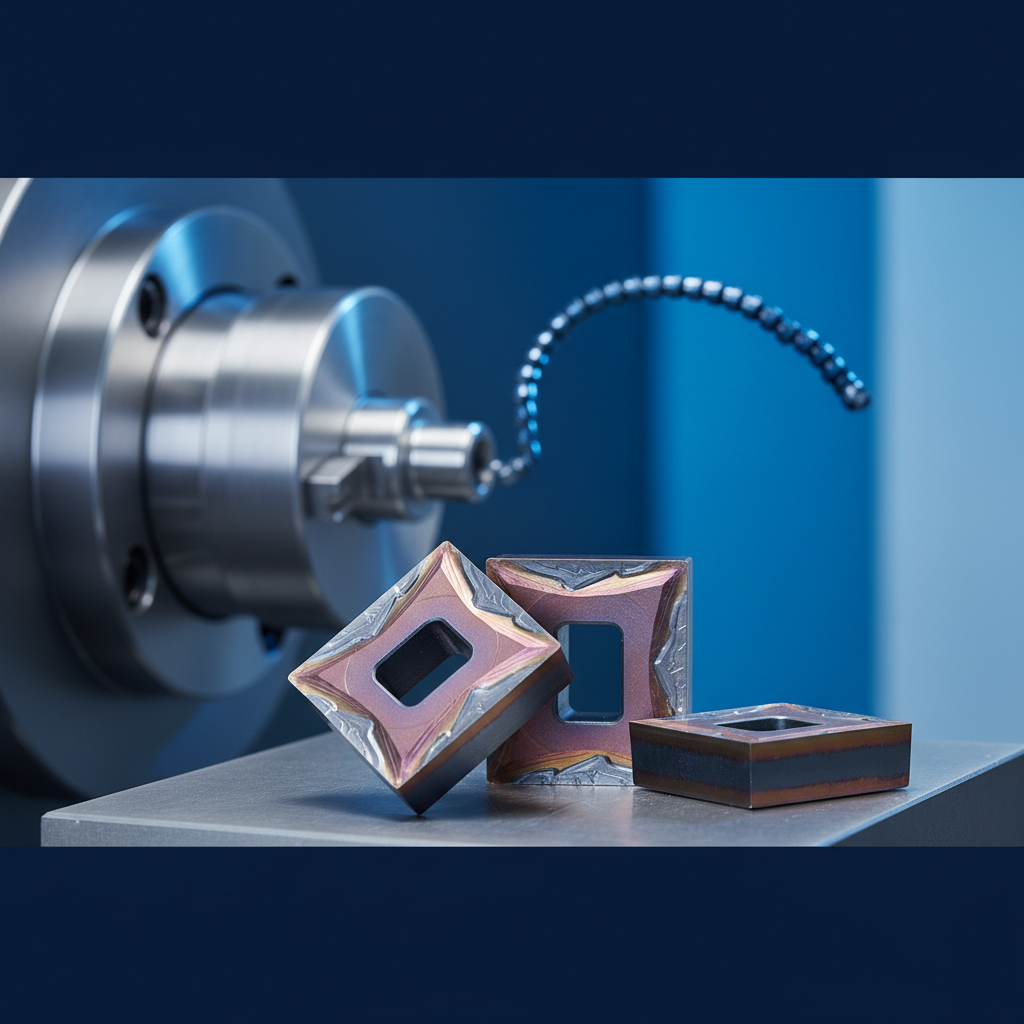

Chapter 1 Industry Overview: The Underestimated "Cutting" Business
If a CNC machine tool is a craftsman, then a CNC cutting tool is the knife in his hand. No matter how expensive the machine or how fast the spindle, once the insert fails, all the steel, titanium alloy, and superalloy piled up on the shop floor are just dead weight. This business runs at a far larger scale than it appears. According to the international metalworking industry, the global metal cutting tools market exceeded USD 46.6 billion in 2024, with a projected CAGR of approximately 5.4% over the next decade. China is one of the largest single markets, reaching RMB 49.2 billion in 2023 and continuing upward in 2025; brokerages such as Guosen, Dongwu, and Huaxi place the full-year figure at around RMB 54 billion in their April reports and expect a further step up in 2026.
Several characteristics of this business are often overlooked by outsiders. First, it is a "consumable" business. A carbide indexable insert may last only ten or twenty minutes in short cycles, rarely exceeding four or five hours in the longest. On high-tempo automotive lines, dozens or even hundreds of inserts are replaced per day. Demand stickiness, repurchase rates, and resilience against business cycles all exceed those of machine tools themselves. A CNC lathe may cost several hundred thousand RMB; a single insert may cost only tens of RMB; but the cumulative annual consumption can far exceed the depreciation of the machine. This "machine survives a year, tooling survives a lifetime" structure gives the cutting tool industry a unique cash flow model among all equipment manufacturing subsectors.
The "consumable" property also manifests in customer stickiness. Once a customer has built up process databases, operator training, and inventory management systems around a particular cutting tool brand, switching costs become enormous. This "process lock-in" allows a leading cutting tool supplier, once integrated into a customer's supply chain, to maintain stable supply for 5 to 10 years or longer. This is the core moat of the cutting tool industry. Global majors such as Sandvik and Iscar have maintained penetration rates of 50 to 70 percent among European and American industrial customers for decades, precisely due to this stickiness. Chinese leaders in the past three years have begun to build similar process lock-in through rapid penetration of new energy vehicles and the mold industry. Once such lock-in is established, revenue stability over the next 5 to 10 years will improve significantly.
Second, this is a "stratified" business. The low end has abundant domestic supply, and price wars have pushed margins to near raw-material cost. Real profits hide in the mid-to-high end — aircraft engines, aerospace structural parts, gigacasting deburring for new energy vehicles, semiconductor equipment chamber finishing, high-hardness mold milling, precision gear broaching. Behind each high-end process is a special set of tool specifications, geometric parameters, and coating solutions, with prices five to ten times those of the low end. Third, this is a "materials science" business. What ultimately decides the life of a tool is not the macroscopic geometry, but the tungsten-cobalt ratio of the substrate, the grain size, the microstructure of each nanometer-thin coating layer, and the radius of the chamfer at the cutting edge.
Fourth, it is a "customer-certified" business. Unlike consumer goods, every new customer, every new workpiece, and every new material requires weeks or months of small-batch trial cuts. The process engineer at the customer's workshop will perform parallel comparisons with the originally used foreign brand, recording dimensional stability, life cycle, chip morphology, and surface roughness across each operation, repeated many times before deciding whether to switch. This trial period is the natural moat of the cutting tool industry, and the fundamental reason why domestic substitution cannot be achieved overnight on price advantage alone.
Fifth, it is a "globalized" business. Demand structure, technical standards, customer certification systems, and supply chain management have all become highly globalized in the cutting tool industry. A leading cutting tool company that focuses only on its home market faces a low ceiling (China's market is around RMB 54 billion; even Zhuzhou Cemented Carbide Cutting Tools, with the largest share at less than 10%, has a ceiling at RMB 5 to 6 billion). To go big, going global is necessary. Sandvik, Iscar, Kennametal, Mitsubishi, and Kyocera all earn 70% to 90% of their revenue outside their home markets. Chinese leaders currently earn 10% to 20% overseas, and the question of whether this share can rise to 30% to 50% in the next 5 to 10 years is the test of true global ambition.
Sixth, it is a "long-term investment" business. R&D, application engineer training, customer certification, and overseas channel building all require sustained long-term investment with little short-term return. The hundred-year accumulated investment of global majors is their core barrier. Chinese leaders have accelerated R&D over the past 10 years, but it will take time to match decades of accumulated investment by global majors.
Seventh, it is a "brand trust" business. When choosing a cutting tool, customers consider not only product performance, price, and service, but also brand reliability, continuous supply capacity, and long-term technical support. The brand trust behind a hundred-year global major is hard for new entrants to build quickly.
Eighth, it is a "cross-disciplinary" business spanning materials science, metallurgy, plasticity of metals, cutting mechanics, heat transfer, tribology, industrial design, mechanical engineering, control systems, and digital software. Every advance in any discipline can bring breakthroughs to the industry. The Chinese leading companies' R&D teams must develop such cross-disciplinary capability to maintain long-term competitiveness.
Pulling the perspective to the global level, the long-term landscape is a tripod of Europe, the United States, and Japan. The European pillar is led by Sweden's Sandvik Coromant, the European portion of Kennametal, Seco, and Walter. They have perfected "integrated solutions": process databases, tool life management software, and machine-tool interconnection systems are all mature. The American pillar is represented by Kennametal and by International Metalworking Companies (IMC), incorporated by Berkshire Hathaway, which gathers Israel's Iscar, South Korea's TaeguTec, Japan's Tungaloy (acquired from Toshiba), and America's Ingersoll under one roof. IMC posted USD 4 billion in revenue in 2023, slipping to USD 3.9 billion in 2024. The Japanese pillar includes Mitsubishi Materials, Kyocera, Sumitomo, and Hitachi Metals. These three pillars together hold over 30% of the global carbide tools market, with the rest split among hundreds of regional players; China is the largest and fastest-growing.
Beyond the three pillars, there are several second-tier players that are easy to overlook: Austria's Ceratizit, Switzerland's Mikron Tool, Germany's Mapal, Walter (now part of Sandvik), Gühring, Sweden's Dormer Pramet (under the Sandvik group but independently operated), and Korea's Hyundai Kitech and Korloy. These players have stronger positions than the big three in certain niches: Mapal in solid carbide ball-nose mills, Ceratizit in carbide rods, Mikron Tool in micro-diameter solid carbide tools, Gühring in drills and reamers, and Korloy in Korean and Japanese general tools. They compete with Chinese leaders more directly, as their scale is closer and their go-to-market strategies more flexible.
China's landscape has been concentrating rapidly since 2018. In the largest segment — indexable inserts — Zhuzhou Diamond Cutting Tools (a subsidiary of China Tungsten High-Tech Materials) produced approximately 140 million inserts in 2023, holding the top domestic position for several consecutive years. Oke Precision and Huarui Precision rank second and third, producing 81 and 79 million inserts respectively in 2021. Companies like Xiamen Golden Egret, Zhuzhou Huarui, Hanjiang Tools, Hayi (Harbin No.1 Tools), Hengfeng Tools, and Worldia occupy other niches. Concentration has risen alongside import substitution. China's cutting tool import share fell from 37% in 2015 to around 27% in 2022; based on multiple companies' supply contracts and broker sampling, import dependence is estimated at 22% to 24% in 2025. The low-to-mid end is essentially substituted; the high end still relies on imports, with localization at around 30%. The gap is wide, but the substitution opportunity is repeatedly priced into the market.
Concentration is also reflected in the cross-shareholding and supply-chain integration among leading players. China Tungsten High-Tech is backed by the China Minmetals Group, with a five-in-one chain spanning raw materials, alloy ingots, tools, mining tools, and PCB micro-drills. Oke Precision and Xiamen Golden Egret are backed by Zhangyuan Tungsten and Xiamen Tungsten respectively. Huarui Precision has long-term supply agreements with multiple tungsten upstream listed companies. This "tungsten — alloy — tools" integrated supply chain is a unique advantage of the Chinese cutting tool industry compared to overseas. Sandvik, Iscar, and Kennametal have long depended on imports for tungsten raw materials, mainly from China. After China's tungsten export controls were tightened in 2025, this supply chain began to fray — a topic we will analyze in detail in the policy chapter.
Another hidden thread within the industry is the tungsten-cobalt price cycle. Tungsten concentrate, APT, tungsten carbide, and tungsten powder posted a historic rally in 2024–2025. China Tungsten High-Tech's 2025 annual report calls this phase "tungsten rises, tools rise." Rising raw material costs are a double-edged sword for large companies: on one hand, the ability to push price increases faster than smaller rivals expands their share; on the other, gross margins may compress short-term in front of customers like automakers with stronger bargaining power. In this round, Zhuzhou Diamond, Oke Precision, Huarui Precision, and Hengfeng Tools all reported the "volume and price up together" phenomenon in their 2025 annual reports and Q1 2026 reports. This is not coincidence; it is the collective payoff of industry shake-out.
Another less discussed segment is tool life management and digital services. Global majors have upgraded "selling tools" to "selling tools + selling process plans + selling tool life management software" over the past decade. Sandvik's 2025 annual report specifically disclosed software and digital business revenue of SEK 5.5 billion, one of the company's fastest-growing segments. This business is almost a blank slate in China. Chinese leaders mainly sell products; process plans are typically bundled as free technical services, and software is hardly priced. The ceiling for this segment represents both a commercial opportunity and a test of organizational capability for the leaders.
Finally, we set a basic stance for the entire research. We do not care about short-term stock movements; we care about a very concrete engineering question: how far has the localization of cutting tools come, which downstream segments have been substituted, which still hold to foreign brands, what technological paths are domestic players using to break through, and how much of the global USD 46.6 billion pie can China carve from its RMB 54 billion home market. Everything must start with materials and processes. Readers who want to verify our research can refer to carbide tool factories and CNC insert factories, which are common reference pools for industry estimation.
The industry's final foundational understanding concerns the "knowledge structure." A qualified cutting tool industry researcher needs to build a knowledge structure covering materials science (tungsten-cobalt metals, alloys, coatings), machining knowledge (turning, milling, drilling, boring, geometric angles), industrial economics (supply chain, competition landscape, valuation methods), corporate strategy (differentiation, moats, organizational capability), macro analysis (policy, trade, exchange rates), and technology frontiers (digitalization, AI, new processes). Such cross-disciplinary knowledge takes years to accumulate. This research aims to provide a useful starting point for that structure.
Chapter 2 Upstream Materials: The Nanometer Battle from Tungsten-Cobalt to Coatings
In the cost structure of a carbide indexable insert, raw materials account for 30 to 40 percent, with coating, processing, sintering, and grinding making up the rest. Going upstream: first comes tungsten concentrate, then ammonium paratungstate (APT), then blue tungsten, then metallic tungsten powder via hydrogen reduction, then tungsten carbide (WC) synthesized from tungsten powder and carbon black at high temperature, then mixed with cobalt powder, nickel powder, vanadium, tantalum, and niobium carbides, ball-milled, dried, granulated, pressed, and finally vacuum-sintered at around 1400°C to form dense carbide blanks. The two most critical steps are grain size control of the powder and porosity control during sintering. China Tungsten High-Tech's 2025 annual report details its "mine-to-tool" chain: tungsten concentrate and powder accounted for 32% of revenue at a 26.76% gross margin; carbide blanks plus mining and roll alloys, 26% at 18.93%; cutting tools and PCB micro-drills, 20.47% at 35.05%. The data tells one thing: the closer to the end, the closer to the process barriers behind the thin coating, the fatter the margin.
The tungsten carbide substrate decides the "bone" of a tool. Common grades range from WC-6%Co, WC-8%Co to WC-12%Co. Higher cobalt means better toughness but worse wear resistance. Aerospace titanium alloy cutting tends to use low-cobalt, fine-grained grades with special coatings; mold high-hardness milling needs higher cobalt for impact resistance. Grain size decreases from micron-scale to 0.2-micron ultrafine grade, each level a separate niche. China has excess capacity in ordinary grain sizes but still relies on imports for ultrafine and nano-tungsten powders. Zhuzhou Cemented Carbide, Xiamen Tungsten, Zhangyuan Tungsten, and the Self-Hardening Research Institute are domestic suppliers; abroad, Germany's H.C. Starck and Japan's ALMT hold key positions.
Tungsten carbide powder synthesis can follow multiple routes: traditional high-temperature carbonization, low-temperature carbonization, fluidized-bed method, mechanochemical method, in-situ reduction, and so on. Each produces different grain size, surface area, purity, and impurity profiles. The tungsten powder routes used at Sandvik's Gimo plant in Sweden and Iscar's Tefen plant in Israel are closely guarded trade secrets and key to product consistency. Chinese players have mastered the mainstream routes and achieved industrial-scale production through years of research and academic collaboration, but at the highest end — ultrafine tungsten powder (200 to 500 nanometers) and nano-tungsten powder (under 100 nanometers) — they still rely on imports. Breaking through this stage is a key task for the next 3 to 5 years.
Cobalt powder as the binder also has several tiers. Ordinary cobalt powder is 1 to 5 microns; ultrafine is below 0.5 microns; nano is below 100 nanometers. The finer the cobalt powder, the more uniform the cobalt binder distribution after sintering, and the better the overall insert performance. China's cobalt powder supply comes from Xiamen Tungsten, GEM, Huayou Cobalt, Hanrui Cobalt, and Luoyang Molybdenum. Xiamen Tungsten and Huayou Cobalt can mass-produce ultrafine powders, but they still lag Japan's ALMT and Sweden's Sandvik Höganäs at the very high end. Over the past 5 years, cobalt prices have fluctuated greatly (from USD 35/lb in 2018 down to 15 in 2023 and back up to 20 in 2025), so raw-material price management is also a cost factor cutting tool makers must consider.
China's cobalt powder localization has improved rapidly in recent years. China's strength in the cobalt powder chain is that, although cobalt ore mainly comes from the Democratic Republic of Congo, processing, refining, and powderization occur largely in China. This structure makes China's leading cobalt powder firms (Xiamen Tungsten, Huayou Cobalt, etc.) dominant in global cobalt powder supply. Overseas tool makers depend heavily on China for cobalt powder, which gives China implicit global voice on the carbide chain.
Beyond cobalt powder, a few small but critical additives are worth mentioning. In addition to the tantalum carbide (TaC) discussed earlier, there are niobium carbide (NbC), titanium carbide (TiC), vanadium carbide (VC), and chromium carbide (Cr3C2). NbC mainly suppresses grain growth and enhances red hardness; TiC mainly improves wear resistance and oxidation resistance; VC mainly refines grains and improves strength; Cr3C2 mainly improves chemical stability at high temperatures. Each additive is added at sub-percentage or even sub-tenth-of-a-percent levels, yet has significant effects on final performance. Formulation is the most implicit knowledge in the cutting tool industry, with decades of accumulated recipes constituting global majors' core trade secrets. Chinese leaders' formulation libraries have grown rapidly in the past decade, but their breadth and granularity still lag overseas counterparts.
Coatings are the sexiest and most demanding segment. They split into chemical vapor deposition (CVD) and physical vapor deposition (PVD). CVD deposits at 900 to 1100°C, producing thick alumina (Al₂O₃) layers atop TiCN with excellent thermal stability — the workhorse for continuous turning of steel and cast iron. PVD deposits at the relatively low temperature of 400 to 500°C, with little loss of substrate strength, capable of producing ultra-thin coatings and razor-sharp edges — mainstream for interrupted cutting, milling, and drilling. PVD has progressed faster than CVD in the past decade, mainly because the basic system evolved from monolithic TiN to TiAlN, AlTiN, AlCrN, and then to nano multilayer structures (nACo, nACRo) and the latest TiAlSiN and AlTiBN high-temperature systems.
Coating science is now at the atomic-layer level. Switzerland's Oerlikon Balzers, Austria's Ceratizit subsidiary of Plansee, and Germany's Cemecon represent the global coating equipment and process routes. AlCrN coatings can withstand up to about 1100°C, making them the workhorse for continuous turning of stainless steel and cast iron. AlTiN approaches AlCrN in oxidation resistance and hot hardness, but performs better against aluminum alloys, often used for dry cutting of aluminum. The latest nano-composite nACo3 (AlTiSiN series) showed nearly double the wear life of traditional PVD coatings in academic papers in 2024–2025. Multilayer structures are another evolution, alternating 5- to 20-nanometer-thick layers of different chemistries, stacking dozens or even hundreds of layers — macroscopically one coating, microscopically a "sandwich" with the best properties of each layer, the preferred solution for high-temperature alloys and titanium alloys.
Chinese players' position in coatings is changing. A decade ago, most domestic indexable inserts were sent out to Oerlikon Balzers for coating; today, leading players have all built their own coating lines. Zhuzhou Diamond, Oke Precision, and Huarui Precision announced new PVD or CVD coating line investments from 2023 to 2025. Some equipment is imported; processes are tuned by in-house R&D teams. The AlTiN and AlCrN basic systems have stabilized close to international top-tier levels, but more difficult nano-composite coatings and thermally stable alumina multilayer structures still lag — currently mainly tackled by Zhuzhou Diamond and Xiamen Golden Egret.
Beyond coating, a critical step is "post-treatment." After coating, the insert surface has microstresses that must be relieved via precision sandblasting, polishing, and mirror finishing to achieve optimal cutting performance. Overseas makers' post-treatment processes are independent lines, with dedicated equipment and skilled operators. Domestic players often combined post-treatment with the coating line, leading to insufficient stress release, inadequate edge microuniformity, and micro-chipping during high-speed cutting. This implicit process gap has been recognized by leading players in the past three years and they have begun to catch up, but it remains hard to close in the short term.
Coating equipment is also worth mentioning. The two global leaders are Switzerland's Oerlikon Balzers and Austria's Platit. Oerlikon Balzers' INGENIA series and Platit's π411 series have been the gold standard for PVD coating equipment over the past decade. Chinese players like Nanofilm Microsystems Beijing and Dongwei Technology have launched domestic coating equipment, but still lag in high repeatability, low defect rates, and long-life stability indicators. This upstream equipment localization is another potential long-term track, but will not become a core bottleneck for tool makers in the short term, as leading players already have the capability to buy imported equipment and tune the process independently.
Above coatings is the niche of PCD (polycrystalline diamond) and PCBN (polycrystalline cubic boron nitride). Strictly speaking, these are not "carbide coatings" but superhard materials used directly as cutting edges. PCD has hardness around 8000 HV, several times that of carbide, used for high-speed finishing of aluminum, copper alloys, and composites; PCBN has hardness around 4500 HV with better toughness than PCD, used for hardened steel (HRC 50+) and high-temperature alloy finishing. Domestic leaders are Worldia and Funik; global leaders include Iscar, Kennametal, Sumitomo Electric (under IMC), and Germany's Diamond Innovations (split from GE Superabrasives). Worldia's 2025 annual report cites "3C recovery driving business rebound," primarily referring to PCD cutting tools used in consumer electronics aluminum housing finishing.
The upstream materials segment decides every story below. When we see 2025 reports showing surging tungsten-cobalt prices and tool makers raising prices collectively, do not just see "earning raw material money"; see also that the closer to the end, the closer to coating and geometry, the more easily cost increases convert to product premiums. That is the core mechanism by which leading players expanded profits during the raw-material rally. The same logic applies to processes: the closer to substrate formulation and coating chemistry — "invisible processes" — the more easily long-term moats are built that are not easily caught up by low-end competition. While doing this research we also checked carbide rods and tungsten steel factories as upstream capacity distribution evidence.
Chapter 3 Process Barriers: Substrate, Coating, Geometry, and Chip Breaker
Disassembling the manufacturing of an insert reveals four checkpoints: substrate, coating, geometry, chip breaker. Each is a set of process barriers, and each carries a different degree of difficulty in localization. The four form a pyramid: substrate as foundation determining overall strength; coating as middle layer determining surface wear and heat resistance; geometry as upper section determining cutting stability; chip breaker as apex determining chip formation and evacuation. Every segment is irreplaceable, and every segment needs decades of process accumulation.
The substrate alloy checkpoint has been largely overcome by domestic players. China Tungsten High-Tech, Xiamen Tungsten, and Zhangyuan Tungsten can reliably supply the six ISO-defined classes — P, M, K, N, S, H. P is for steel, M for stainless, K for cast iron, N for non-ferrous and aluminum, S for superalloys and titanium, H for hardened steel. Each class subdivides by hardness and toughness. Common grades match foreign brands; the difficulty lies in ultrafine-grain substrates, Functionally Graded (FGM) substrates, and locally toughened substrates. A graded functional substrate has a tungsten-rich surface and cobalt-rich core, wear-resistant on the surface and impact-tolerant in the core. The process requires precise cobalt-extraction or cobalt-migration control during sintering; only a few domestic players have achieved mass production.
Another implicit process at the substrate stage is "uniformity" in the powder metallurgy stage. A seemingly uniform insert is in fact a composite formed from thousands of powder particles under high-pressure pressing and sintering. If powder size distribution is uneven, the sintered insert will have local porosity, cobalt-rich zones, and tungsten-rich zones — stress concentration points likely to cause chipping during cutting. Global majors have decades of equipment and process accumulation in powder classification, mixing uniformity, and pressing pressure distribution. Domestic players have caught up over the past decade, but the gap in batch stability is still detectable. A direct comparison is defect rate: overseas top-tier brands' indexable inserts have defect rates below 30 ppm, while leading domestic brands range from 100 to 500 ppm — a small but perceptible gap in large supplies.
A technique worth mentioning at the substrate stage is "TaC (tantalum carbide) addition." Adding a small amount of TaC to WC-Co significantly suppresses grain growth, raises red hardness, and improves oxidation resistance. This is core to performance improvement for P-class steel cutting grades. China Tungsten High-Tech, Xiamen Tungsten, and Zhuzhou Cemented Carbide Group have decades of TaC formula R&D, but still lag Japan's Sumitomo and Sweden's Sandvik on the "fine art." Specifically, dozens of parameters — TaC amount, form, ratio to other additives, sintering temperature curves — jointly decide final performance, and each tuning requires substantial trial cutting. This is the implicit essence of the substrate barrier.
Coatings are the true watershed. Beyond the CVD versus PVD discussion in Chapter 2, coating processes also involve pretreatment: before coating, inserts undergo sandblasting, grinding, and chemical cleaning to remove burrs and machine the edge radius to tens of microns. This seemingly simple step is highly equipment- and experience-dependent. Many domestic inserts underperform at customer sites not because of coating chemistry but because of this invisible pretreatment. The equipment is mainly German and Swiss grinding/polishing machines; the process needs years of in-house accumulation. Zhuzhou Diamond, Oke Precision, and Huarui Precision have been heavily recruiting German and Swiss-trained process engineers in the past three years — testimony to the hunger for this experience.
The geometry checkpoint is the last mile from "formed insert" to "cutting performance." A standard CNMG120408 turning insert has a fixed rhombic 80° outline, but the rake, clearance, inclination, and approach angles differ from maker to maker, each with its own process database. Turning the same AISI 1045 steel, Sandvik's geometry coils chips into pretty little springs, while some domestic brands' chips tangle on the workpiece and score the surface. The gap is decades of trial-and-error databases.
The geometric design also involves edge preparation. The microstructure of an insert's cutting edge has three main forms: sharp edge, T-land (chamfered) edge, and honed edge. Sharp edges are for finishing and aluminum cutting, with minimum cutting force but prone to chipping; T-lands are for rough turning of steel and cast iron, impact-resistant but with high cutting force; honed edges sit in between and are standard for most turning inserts. Chamfer angles range from 5° to 30°; hone radii from 10 to 100 microns, each combination matching a workpiece material and condition. Global majors have hundreds of edge preparation combinations; leading domestic players have accelerated in the past 5 years but combinations are fewer.
Geometric design is deeply coupled with machine capability. A high-end five-axis machining center can use more complex geometric combinations, exploiting multi-angle cutting; a typical three-axis machine needs more conventional geometries for stability. China's machine tool fleet is dominated by three-axis with low five-axis penetration, which means domestic tool makers have less customer pull for "high-end" geometries. This contrasts with Japan's market, where five-axis penetration is high. From this angle, tool premiumization and machine premiumization push each other in chains, neither sufficient alone.
Geometric design also has "process secrets" engineers love to discuss. "Unequal-height edge" design makes cutting force load in stages, avoiding heavy initial shock; "segmented chip-breaker" design keeps chips breaking under different conditions; "wave edge" design disperses contact area for stability. These secrets are trade secrets in global majors' product manuals; domestic leaders reverse-engineer them via XRD analysis and high-speed photography of overseas samples and have launched their own equivalents over the past three years.
Another implicit process at the geometry stage is "geometry–coating coupling" design. The optimal geometry must match the coating: sharp edges with PVD thin coatings for finishing; T-lands with thick CVD for roughing; honed edges with PVD multi-layer for medium conditions. This coupling is the fruit of decades of overseas trial; domestic players have been catching up over the past three years but still need time to fill in this process database.
Chip-breaker design abstracts further from geometry. The rake face of an insert is not flat but a carefully designed 3D surface with primary breakers, secondary breakers, locating bosses, and chip-guiding ramps. A good chip-breaker design coils chips into a controlled geometry that then breaks within a fixed time, avoiding workpiece wrap, coolant-hole blockage, and surface scratches. Sandvik's -PM, -MM, -WMX, Iscar's -F3M, -T3M, and Mitsubishi's -MV, -MS series rest on hundreds of chip-breaker libraries. Chinese players clearly lag; Oke Precision and Huarui Precision have launched -MG, -HMG, -DM series in the past three years, but overall coverage and customer validation still trail.
Another implicit process for chip-breakers is the "chip-breaking mechanism." What is the ideal chip shape? Not "as tight as possible." The ideal chip is a 6 or 9-shaped spiral, 10 to 20 mm long, falling stably from the cutting edge and flushed by coolant. Too-short chips mean too-high cutting force; too-long chips mean broken breaking mechanism. The chip-breaker design is a dynamic geometric optimization of "chip forming and breaking," involving plasticity theory, cutting mechanics, and cutting temperature fields.
Dimensions matter too: typical chip-breaker width is 1.5 to 3 mm; depth 0.2 to 0.5 mm; transition radius 0.1 to 0.3 mm. Each affects chip forming. Sandvik offers a dozen breakers (PR, PM, PMR, PMS, MM, MMR…) for CNMG120408 alone; Chinese leaders have expanded but combinations per item are fewer.
Beyond indexable inserts, solid carbide tooling is a separate track. Solid carbide means the entire tool (ball-nose mill, end mill, drill, reamer) is carbide, not just the cutting part. The difficulty is an order of magnitude higher: instead of cutting expensive material into small pieces, the whole tool uses it, with much higher material cost and tighter geometric tolerance. The cost of a high-end solid carbide ball-nose mill is often 5–10x the material cost. China started later here; Oke Precision's solid carbide tool revenue was RMB 112 million in 2025, up 93.84% YoY — a starting signal, but still a supporting role compared to its RMB 800 million in inserts. True top players are Germany's Mapal, Walter, Switzerland's Mikron Tool, and Austria's Ceratizit.
The process barrier for solid carbide also lies in five-axis grinding precision. A 6 mm-diameter solid carbide ball-nose mill has edge runout tolerance of about 5 microns and ball roundness of about 2 microns, close to precision bearing levels. Core equipment includes Walter, Rollomatic, and Schütte grinders, with slower domestic substitution than indexable lines; Hangzhou Voadi and a few others have developed six-axis grinders.
Another solid carbide detail is "edge micro-processing." High-end solid carbide ball-nose mills require laser or sandblast treatment for optimal performance. Laser treatment forms micro-grooves on the edge for stability; sandblasting blunts the sharp edge to avoid chipping. These need dedicated equipment and process know-how, the core differentiator among solid carbide makers.
The application process database for solid carbide tools is another barrier. The optimal cutting parameters (speed, feed per tooth, axial depth, radial depth, cooling method) of a solid carbide ball-nose mill across materials, hardness, and conditions form a vast database. Mapal, Mikron Tool, and Walter's databases cover hundreds of materials, thousands of conditions, and tens of thousands of process records. Chinese leaders have little accumulation; most application data comes from on-site trials at customer plants, with low efficiency.
The final process line is brazed tooling, where carbide tips are silver-brazed onto steel shanks, mainly used for broaches, reamers, and special shapes. Hengfeng Tools' "precision complex cutting tools" line is mainly these, contributing RMB 442 million in 2025 (62%). Indexable, brazed, and solid carbide each have their own localization timeline.
Another implicit barrier is digital and process databases. The "soft power" of a leading cutting tool maker depends on database depth. Sandvik's CoroPlus, Iscar's NeoLogiQ, Kennametal's NOVO sit on decades of millions of cutting records: which grade on which material with which geometry at which speed and feed lasts how many minutes with what surface roughness and optimal cutting force. These data are "sunk cost of trial and error," not easily replicable. Chinese leaders have started building databases in the past 3 years — Zhuzhou Diamond's "Diamond Cloud," Oke Precision's process service platform, Huarui Precision's trial lab — but the few years of accumulation are an iceberg tip versus decades.
The final layer is process talent. A mature cutting tool maker needs R&D engineers, production engineers, and many "application engineers" who go on-site to debug processes and solve cutting problems. Global majors' application engineer teams average 10+ years of tenure and cover thousands of plants worldwide. Chinese leaders have expanded application engineer teams quickly in the past three years, but tenure is still young and coverage concentrated in the Yangtze Delta, Pearl Delta, and Chengdu-Chongqing belts. This "people" gap requires time and cannot be money-bought in the short term. A study of process barriers must return to "people," or it stays surface-level. To see the talent distribution intuitively, refer to precision complex tool factories and solid carbide tools — the geographic concentration of plants directly reflects application-engineer reach.
Another extension concerns "standardized equipment." Global majors largely produce or customize their core production equipment (insert forming machines, grinders, inspectors, coaters), with process parameters deeply coupled to lines. Chinese leaders' core production equipment is largely imported (Germany's Schütte, Switzerland's Rollomatic, Austria's EMCO), so process parameters must adapt to imported equipment. "In-house vs imported" determines iteration speed: 6 to 12 months for in-house, 12 to 24 months for imported.
Process barriers also include "quality management systems." A leading tool maker's defect control must meet ISO/TS 16949 for automotive; some high-end customers also require AS9100. These systems demand full process control, traceability, defect analysis, and CAPA flows. Chinese leaders have been certified in the past 5 years but system maturity still lags. A Chinese leader was once cited by a European customer for "traceability to batch but not to specific equipment and operator" — a depth gap.
Finally, "R&D organizational culture" is an implicit constraint. Overseas majors use a "product manager + process engineer + application engineer" triangle with tight cross-team collaboration. Chinese leaders' R&D is process-engineer-led; product managers and application engineers are weaker. The difference is invisible short-term, but in the "product definition — process development — market launch" triangle, overseas firms are more efficient. This is the "soft course" Chinese leaders must complete in 3 to 5 years.
Chapter 4 Major Players: Chinese Leaders Meet Global Giants
Listing major players side by side gives a clear global map.
In China, by 2025 revenue and insert output, the first tier is Zhuzhou Diamond, Oke Precision, Huarui Precision, and Xiamen Golden Egret. Zhuzhou Diamond is a wholly owned subsidiary of China Tungsten High-Tech under China Minmetals — the only company with a full mine-to-tool chain. Insert output reached 140 million in 2023 and continues to expand in 2025, in the same league as the global top five. Oke Precision posted RMB 1.457 billion in 2025 revenue (+29% YoY): RMB 804 million in cutting tools, RMB 614 million in carbide blanks and rods (+56% YoY in rods), and RMB 112 million in solid carbide tools (+93.84% YoY). Huarui Precision posted RMB 1.0 billion in 2025 revenue (+32% YoY), RMB 190 million net (+75%); Q1 2026 revenue RMB 420 million (+88%), net RMB 180 million (+499.5%), gross margin from 43% to 57%. Xiamen Golden Egret, under Xiamen Tungsten, produced 33 to 38 million inserts in 2020–2021, the second largest among the tungsten-group makers.
The second tier includes Worldia, Hengfeng Tools, Hanjiang Tools, Harbin No.1 Tools, Funik, and Zhuzhou Huarui. Worldia, focused on superhard tools (PCD, PCBN), posted RMB 754 million in 2025 revenue (+11%) and RMB 95 million net (-4.7%), driven by 3C recovery boosting non-ferrous finishing. Hengfeng Tools posted RMB 713 million revenue (+17%), RMB 169 million net (+31%), non-recurring net up 35%, representing gear broaches, hobs, and ultra-small modulus hobs. Hanjiang Tools and Harbin No.1 Tools are old SOEs with accumulation in gear and complex form tools but smaller scale and profitability.
Globally, Sandvik's 2025 annual report shows full-year revenue of SEK 47.273 billion (about RMB 45 billion), +3% at constant FX organically. The Machining and Intelligent Manufacturing segment posted +15% organic orders and +11% revenue in Q4; full-year cutting tools grew 8%, with strong aerospace demand and weak automotive. Sandvik Coromant remains the single largest brand in indexable inserts. IMC Group posted USD 4 billion in 2023 revenue and USD 3.9 billion in 2024; Iscar is its single largest brand. Kennametal posted USD 2 billion in FY2025 (ending June), with Metal Cutting around USD 1.287 billion across four quarters of 335/327/304/321 million. Mitsubishi Materials, Kyocera, and Tungaloy do not break out cutting tool revenue separately, but global research firms estimate them at about 10% of the global carbide tools market. Mitsubishi launched its MP1200 high-efficiency milling series in April 2025; Kyocera released its 2025–2026 indexable cutting tools catalog.
Two comparisons stand out. First, the scale gap. Sandvik's cutting tool segment is about USD 2 billion; IMC about USD 3.9 billion; Kennametal Metal Cutting about USD 1.3 billion. Chinese leaders such as Zhuzhou Diamond, Oke Precision, and Huarui Precision are at RMB 1 to several billions singly — several times below the USD 2 billion single-company threshold. Second, the structure gap. Overseas majors push "integrated solutions" — bundling tools, holders, machine-tool interface software, life management, and shop digitalization — while Chinese leaders mainly sell single items. This is a business model and organizational gap, the true last mile of localization.
Let's expand product structure. Sandvik Coromant's product matrix is "turning + milling + drilling + threading + general forming," with turning around 40%, milling 30%, drilling 10%, the rest in threading and forming. Iscar is similar — slightly lower turning, slightly higher milling. Kennametal is unique with an "infrastructure" segment (wear parts, mining tools) alongside metal cutting, the latter being half of revenue. Mitsubishi Materials' cutting tool business (tools division of advanced new materials) is under 10% of company revenue, with more from electronic and metal materials. Kyocera's cutting tool business (precision tools) is about 5% of company revenue, with notably higher gross margin than other ceramics segments. These structural differences determine each company's elasticity in raw-material and demand cycles.
Chinese leaders are also differentiating. Huarui Precision is turning-led, milling-supportive, with smaller solid carbide and drilling. Oke Precision has carbide rods on top of inserts, supplying solid carbide makers — a dual-cycle structure. Worldia specializes in PCD/PCBN, a niche champion. Hengfeng Tools focuses on precision complex tools (gear broaches, hobs, ultra-small modulus hobs). Zhuzhou Diamond is the largest, fullest line, but no single product ranks in the global top yet. This differentiation is good for localization; it avoids head-to-head wear among leaders.
Second-tier and smaller players cannot be entirely ignored. Shenyang Tool Group, Shanghai Tools, Hanjiang Tools, Zhuzhou Huarui, Funik, Zigong Cemented Carbide, Dongguan Jingming, Dongguan Cnor, and Ningbo Wesder have niches. Shenyang Tools and Shanghai Tools are old SOEs strong in special tools and gauges; Hanjiang Tools specializes in gear tools; Funik is the South China superhard representative. These firms range from RMB 100 million to RMB 500 million in revenue, but together form a key supplement to Chinese cutting tool supply. The "head + waist + long tail" pyramid contrasts sharply with overseas "giants dominate" structure.
Pulling out the founder/leader lineage is another industry-history thread. China Tungsten High-Tech executives mostly come from Minmetals; Oke Precision's founding team came from the original Zhuzhou Cemented Carbide Plant; Huarui Precision's founder hails from Zhuzhou Diamond; Worldia's founder Chen Jifeng was an early pioneer of domestic superhard tools; Hengfeng Tools is anchored in Pinghu, Zhejiang's traditional mold industry belt with decades of precision tool history. These "people–DNA–company" profiles contrast with overseas "professional manager" model. Chinese leaders' founders bring deeper "industry feel" in tech judgment and long-term strategy.
R&D investment has surged from 2024 to 2026. Huarui Precision R&D spend in 2025 was about RMB 70 million, R&D intensity around 7%. Oke Precision RMB 90 million (6%). Worldia RMB 60 million (8%). Hengfeng Tools RMB 40.2 million (5.64%). These match or exceed Sandvik's ~5% intensity, showing leading domestic players take long-term tech accumulation seriously. R&D directions include new materials, coating processes, geometric design, digital platforms, and application engineer training. The payback period is 3 to 5 years, matching the core localization window.
M&A and integration is another undervalued thread. Over the past 5 years, China Tungsten High-Tech consolidated some tungsten assets via group capital actions; Oke Precision expanded carbide rod business via new lines; Huarui Precision grew organically into broader product matrix; Worldia took a minority stake in Germany's EMUGE-FRANKEN, extending into global high-end. In the next 3 to 5 years, M&A among leaders may accelerate; smaller firms under pressure from raw-material costs and certification thresholds may become targets, as may overseas second/third-tier brands. The integration window is open.
Customer structure comparison also matters. Overseas majors: "broad industry + flagship accounts." Sandvik covers all major downstream sectors; Iscar focuses on mid-sized manufacturing; Kennametal has unique strength in energy (oil & gas drilling tools). Chinese leaders are more concentrated: Zhuzhou Diamond in autos, engineering machinery, rail; Oke Precision in autos, molds, general machining; Huarui Precision in autos, machining, power; Worldia in 3C, autos, semi-cap; Hengfeng Tools in gear, wind, robotics. "Specialist" vs "broad" determines elasticity in different downstream cycles.
R&D footprint also differs. Sandvik has R&D centers in Sandviken, Sweden and Wattwil, Switzerland, with about SEK 3.5 billion annual R&D (about 7%). Iscar has R&D in Tefen, Israel (about 6%). Kennametal has R&D in Latrobe, USA (about 3%). Chinese leaders match or exceed overseas in intensity but lag in geographic dispersion and cross-border collaboration. Oke Precision and Huarui Precision have set up technical service stations in Europe, which may upgrade to global R&D nodes.
Channel structures differ too. Overseas majors use "direct sales + core distributors + e-commerce" multi-tier. Sandvik runs mostly direct in Europe and the US, and core distributors in Asia-Pacific; Iscar uses localized core distributors globally; Kennametal mixes direct and channel. Chinese leaders are "distributor + some direct"; e-commerce is in its infancy. In the next 3 to 5 years, Chinese leaders may "leapfrog" via e-commerce and digital channels, building a faster downstream reach than overseas.
"Global capability" is another lens. Overseas majors operate "global R&D + global manufacturing + global marketing + global service." Chinese leaders are "China manufacturing + some overseas marketing"; global R&D, global manufacturing, and global service are just starting. This is the Chinese leaders' biggest gap in 5 to 10 years. Closing it by around 2030 would produce a truly global Chinese cutting tool company.
Management systems are also worth discussion. Overseas majors use matrix organization (product line × geography × function), high decision efficiency but high management overhead. Chinese leaders are mostly traditional divisional (by product line), with concentrated decisions but sometimes weak cross-team coordination. As leaders go global, organizational change is inevitable. In 2024–2026 some leaders started transformation: hiring international consultants, setting up overseas subsidiaries, recruiting cross-border execs. The road is long, but it has begun.
Pricing strategies also diverge. Overseas majors: "premium pricing, stable margins, long-term customer relations." Chinese leaders vary: Zhuzhou Diamond, as SOE-backed, is stable, mid-range; Oke Precision and Huarui Precision are flexible and market-responsive; Worldia is high-end in superhard; Hengfeng Tools is stable in niche tools.
The next "dark horse" generation may come from upstream/downstream extension (machine makers entering tools, tungsten firms extending to tools), cross-over entrants (military or auto group internal tool units spinning off), or pure startups focused on a single niche. The "next-gen" path is uncertain — an implicit variable.
Global majors and Chinese leaders also cooperate, not just compete. Sandvik has manufacturing and R&D in Langfang, Shanghai, and Suzhou; Kennametal in Tianjin; Iscar in Kunshan. Localized manufacturing gives overseas players cost and supply-chain elasticity in competition with Chinese leaders. Chinese leaders such as Oke Precision and Huarui Precision are trying partnerships with overseas channels to expand exports. This "co-opetition" will be a key variable in the global landscape over the next 3 to 5 years.
Innovation culture deserves a separate point. Overseas majors broadly embrace "long-termism," investing in tech R&D on 5–10-year-plus horizons. Sandvik began some coating tech in the 1990s commercialized in the 2010s; Iscar's some insert geometries evolved over 8 years from concept to mass production. Chinese leaders are early in long-termism; most still target "near-term visible products" in R&D, with less investment in long-term basic research. This is the cultural hurdle that localization must cross to move from "follower" to "innovator-leader."
Chapter 5 Downstream I: Autos, Two Cutting-Tool Changes from ICE to NEV
Auto is historically the largest downstream for cutting tools — about 35–40% of global tool sales flow to OEMs and tier-1 component suppliers. The demand curve has had two big shifts in the past decade. Each shift reshaped the competitive landscape and opened a window for new entrants to disrupt the order. Chinese tool makers have different strategies and outcomes in both shifts — a textbook sample for industry evolution.
The first shift was from ICE to NEV powertrain. A traditional ICE car's engine and gearbox involve dozens of machined surfaces — cylinder block, head, crankshaft, camshaft, conrod, gear — each calling for specific tool combos from rough turning to grinding. The chain consumes large volumes of indexable turning/milling inserts, solid carbide drills, reamers, and thread tools. NEVs replace the ICE and multi-speed gearbox with one or two PM motors and a single-speed reducer, with about 30–40% fewer operations. This was negative for tool demand, but NEVs brought two new needs.
The first new need is finishing of motor shafts and end caps. Rotor shafts in PM motors need stepped shoulders within micron tolerance; stator inner bores and end caps need mirror finish for bearing concentricity. Operations are few, but unit value is high; PCBN and CBN turning inserts are used more. Worldia's 2025 report citing "3C recovery driving non-ferrous finishing" also points to NEV motors as a key customer for its superhard line.
Drill down further on motor operations. A PM rotor shaft is 300–500 mm long, 30–80 mm diameter, with multiple stepped sections for bearings, seals, and keyways. Roughing uses coated carbide indexable; finishing uses PCBN to Ra 0.4 microns or finer. A high-tempo shop making 1,000 rotor shafts/day consumes 20–30 turning inserts and 5–10 PCBN finishing inserts daily — tool spend of several hundred thousand to over a million RMB per year per shop, a stable but not huge segment. Rapid motor growth has expanded these customers; domestic share in this segment grew from under 30% to over 60% in 3 years.
A finer breakdown: motor end caps usually take four operations — rough turn end face, finish bore bearing seat, mill mounting face and bolt holes, finish bore for bearing concentricity. Each step uses different tool combos. Some OEMs use mill-turn machines to combine operations in one setup, requiring tool versatility and rigidity. Chinese leaders are early in mill-turn tool offerings; Sandvik Coromant Capto modular tooling has notable advantage here.
Stator lamination machining is another NEV-specific process. PM stators are made of hundreds of silicon steel laminations stacked together, formed by stamping or laser cutting before stacking. While dies and lasers dominate, mold tools and laser auxiliary tools still have demand. Some specialist die-cutting tool makers benefit from NEV motor capacity expansion.
The second new need is deburring and finishing of gigacast parts. From Tesla's Model Y onward, gigacasting consolidates the rear underbody from dozens of stampings into one large aluminum casting. The casting can exceed 1 m in dimension, requiring CNC deburring, datum milling, and bolt-hole boring after demolding. Tools are high-efficiency solid carbide mills and PCD-coated mills. Per-vehicle machining is short but tool consumption is dense. NIO, ZEEKR, HiPhi, Xiaomi, and Dongfeng have ramped gigacasting into mass production in 2024–2025. Dongfeng's project targets 600,000 units/year on six lines.
Gigacasting machining has "large volume but relatively simple operations." Rear underbody operations: deburr, mill mounting datum, mill inner wheel arches, bore ~50–100 bolt holes, mill battery pack mount, mill suspension mount. Total cycle 8–12 minutes; consumes 1–2 solid carbide end mills, 1–2 PCD ball-nose mills, 5–10 solid carbide drills. Tool cost per car about RMB 80–150. At 1 million cars/year, single-OEM gigacasting tool market is about RMB 100 million. If 2026 NEV gigacasting penetration reaches 30%, total market is RMB 800 million to 1.2 billion. Domestic substitution here already exceeds 70%, with room to 85%.
Gigacasting also presents unique wear challenges. Cast aluminum typically contains 7–12% silicon for flowability and strength; silicon's high hardness wears tool edges severely, so finishing uses PCD. PCD hardness is several times carbide, maintaining cutting edge stability in Si-Al alloys. Worldia, Funik and other domestic PCD makers have grown rapidly here; Worldia's PCD business is estimated at over 40% of company revenue in 2025, NEV gigacasting being its largest sub-segment.
The second shift is NEV-driven "supply-chain global reverse flow." OEMs historically picked overseas brands by default; Sandvik, Iscar, Mitsubishi, Kyocera, and Kennametal collectively held over 70% share in China's auto sector. That reversed in NEVs from 2023. BYD, Li Auto, NIO, XPeng, ZEEKR raised local procurement quickly for three reasons: domestic tools became stable on mid-low operations; locals match rapid model changes and high-tempo deliveries with shorter lead times; local prices are 20–30% below foreign average. The wave accelerated in 2024–2025; Zhuzhou Diamond, Oke Precision, and Huarui Precision all show pull from BYD, GAC Aion, and Changan in their reports.
Downstream auto also has tier-2 suppliers — drive-shaft, half-shaft, knuckle, brake disc shops — annual tool spend RMB 1 million to tens of millions. Customers are dispersed (thousands nationally), the main battleground for domestic distribution. Unlike aerospace (small volume, high unit price), auto is high volume, low unit price, service-and-lead-time-driven.
Commercial vehicles and engineering machinery are electrifying — an overlooked change. A heavy-duty BEV truck's motor shaft is thicker and longer than passenger; an electric loader's reducer gear needs surface hardening. Hanjiang Tools, Hengfeng Tools, and Harbin No.1 Tools are refocusing on this segment.
Demand for commercial vehicle electrification ramps quickly in 2025–2028. A BEV heavy truck has a 200–400 kW motor and a single/two-speed reducer; rotor shaft 80–120 mm diameter, 600–800 mm length, similar precision to passenger but larger. A 5,000-unit/year plant consumes ~20,000 carbide turning inserts, ~1,000 solid carbide drills, ~200 PCBN finishing inserts — tool spend ~RMB 3 million/year. China's 2025 BEV heavy truck base is ~300,000; annual new sales 80,000–100,000, tool market ~RMB 500 million.
Electric construction machinery is slower but stable. A typical 80 kW electric loader consumes RMB 500–800 in tools per unit; at ~50,000 units/year in 2025, ~RMB 50 million market. Small but steep growth — worth watching in 3–5 years.
Commercial vehicles and engineering machinery also drive "special alloy" use. Heavy-duty truck motor shafts use HSLA steel and high-strength gear steel, harder to machine than passenger. Special grades from Zhuzhou Diamond, Oke Precision, and Huarui Precision in 2024–2026 are key localization progress. Readers can refer to commercial vehicle parts and engineering machinery parts for downstream plant pictures.
Light-weighting is another auto theme. NEVs use 20–30% aluminum vs 10% in ICE. Aluminum machining is different: good thermal conductivity, sticky, low cutting force but with crescent wear (sticking). Tools must be sharp, with large rake, smooth chip breaker, DLC or PCD coating. Domestic substitution window here is bigger; PCD makers have an advantage. Worldia, Funik, and Shanghai Lanyue have meaningful share.
NEV battery pallet machining is another sub-segment worth expanding. Battery pallets are aluminum extrusion-welded structures, then CNC-machined for holes, planes, mounting surfaces. A typical NEV pallet has 200–300 bolt holes, dozens of mounting faces, several cooling channels — more operations than gigacastings. 15–25 minutes per car; consumes 5–10 solid carbide drills, 2–4 solid carbide mills, 3–5 solid carbide taps. Domestic share nears 80%, a localization success story.
NEV 800V systems bring new needs: insulation materials, copper conductors, connectors. Copper is conductive, sticky, requires special geometry and coolant. Dedicated "copper machining" PCD lines launched in 2024–2025 are new growth for domestic PCD makers like Worldia and Funik.
NEV battery-swap stations need a wide variety of parts. Equipment OEMs like NIO, Aulton, and GCL benefit. Readers can refer to battery swap station equipment and NEV connectors for plant landscapes.
Component supply chain localization also shows "cooperate first, replace later." Overseas brands partner with Chinese distributors on co-brands or sink down to tier-2 OEMs and tier-1 suppliers. Short-term it slows local share gains; long-term it educates the Chinese market about high-end processes, a hidden upside for locals positioning to attack mid-to-high. Readers can refer to auto component machining and auto molds.
Auto headline numbers: 2025 China passenger car output 27 million, NEV penetration ~45%; commercial vehicles ~4 million, NEV penetration ~20%; engineering machinery ~500,000. Cross with tool consumption per car, auto industry tool consumption ~RMB 15–18 billion (30% of China's RMB 54 billion).
"Domestic vs overseas" auto split: Chinese OEMs (BYD, Changan, GAC Aion, Chery) localize over 70%; foreign JVs (VW, Toyota, Honda, Ford) still keep ~60% foreign tool share but their share is shrinking. Over 3–5 years, declining JV share will compress overseas brand space.
A "quality responsibility chain" deserves expansion. A 15–20-year vehicle lifetime forbids any critical-part failure; any tool inconsistency on a key operation hits part quality and vehicle quality. The "tool–part–vehicle" chain makes OEMs cautious in tool choice, especially for engines, transmissions, steering, brakes. Domestic penetration needs long-term traceability and multi-year monitoring.
Auto industry internationalization is worth watching. Chinese NEV global expansion (BYD, Geely, Great Wall in Southeast Asia, Europe, LatAm) drives domestic tool overseas supply. OEMs prefer trusted local partners abroad to reduce risk. Locals can "ride along," entering markets foreign majors struggle with — an underrated implicit chance.
Auto downstream also has aftermarket. China's vehicle parc exceeds 400 million; annual repair/refurb tool consumption is tens of billions of RMB. Foreign brands and smaller distributors used to dominate; domestic brands entered via e-commerce and direct in recent years.
Last, "iteration speed from electrification." ICE iteration: 5–7 years majors, 3–4 years minor. NEV iteration accelerated; some models 1–2 years. Fast iteration requires close coordination with tool makers — fast response and deeper application teams. Chinese makers have a speed edge but need deeper process databases for sustained supply.
Autos are the "bloodstream" track: large volume, fast pace, cost-sensitive, supply-chain-elastic. Speed of OEM changeover response, stable lowest-cost supply, on-site engineer dispatch when issues arise — these decide winners. Chinese strengths: fast response, flexible pricing, local service; weaknesses: process database depth, application-engineer density. The 3–5-year battle's outcome depends on systematic capabilities.
Chapter 6 Downstream II: Aerospace, Molds, Wind-Power Gears
Aerospace is the "crown" of cutting tools — highest unit value, highest tech threshold, most closed customer structure. A LEAP-1C aero-engine contains thousands of titanium-, nickel-superalloy-, and single-crystal blade and disc parts; each goes through rough, semi-finish, and finish machining, then grinding, EDM, and laser. Tools are largely monopolized by Sandvik, Kennametal, Iscar, and Mitsubishi — not on price, but customer certification. A single insert must pass dozens of small-batch trials, prove continuous dimensional accuracy on hundreds of parts, and obtain supplier codes from FAW Group, COMAC, or AECC. Once certified, orders stabilize, prices and margins are high; replacement is also slow.
COMAC's C919 is a key driver. The aircraft uses 6 titanium grades; titanium alloy content reaches 9.3% of structural weight — far above Boeing 737 (4%) and Airbus A320 (4.5%). The C919 currently flies with CFM's LEAP-1C; mass production of the domestic CJ-1000 will bring deeper localization. The crux of machining titanium, nickel superalloy, and single-crystal superalloy: high strength, low thermal conductivity, high work-hardening — ordinary inserts develop crater wear, BUE, and edge chipping in minutes. Sandvik's S-series (S205, S30T) and Iscar's IC907, IC908 coatings have long been gold standards. Chinese makers are catching up with AlCrN multilayer + fine-grain substrate; Zhuzhou Diamond's YBG205 series and Oke Precision's OL40 series have entered C919 tier-1 supplier replacement lists.
Titanium machining details deserve a deeper look. A standard CNMG120408 S-class insert for titanium turning works at 40–80 m/min, far slower than 200–300 for steel. Titanium's thermal conductivity is only a quarter of steel's; cutting heat concentrates at the edge, reaching 900–1100°C. Conventional coatings oxidize quickly; AlCrN multilayer or TiAlN high-T are needed. Titanium also reacts with tool materials (especially WC) at high T, forming complex Ti–Co–W intermetallics that worsen wear — titanium's "double curse" of heat and chemistry.
Another challenge is chip breaking. Titanium's high ductility yields long curly chips that wrap workpiece or tool. Special chip-breaker designs are required. Sandvik's -TM, Iscar's -F3T, Mitsubishi's -MA, etc., are titanium-specific. Chinese leaders have caught up in the past 3 years; Oke Precision's OL40-TF and Huarui Precision's RY-TM have replaced foreign brands in non-critical aerospace ops. The hardest summit — engine disc machining, integral impellers — is still slow for locals.
Superalloy (Inconel 718, Waspaloy) machining is similar but worse. Work hardening is 3–5x normal steel; the surface hardens during cutting forming a difficult-to-cut layer. Ordinary inserts last minutes. Sandvik's S205, S30T, Iscar's IC807, IC908 with special coatings and breakers have decades of data. Chinese localization here is slower; only a small share of non-critical operations at AECC suppliers.
Single-crystal superalloys (DD6, CMSX-4) for aero blades are the core process, far harder. No lattice slip allowed; extreme cutting-force stability needed. Only a few firms globally can supply reliably (Sandvik's SM30, Iscar's IC908A). Chinese substitution is nascent — the hardest "spire."
The equipment ecosystem matters. A typical 5-axis aerospace machining center comes from DMG MORI, Mikron, Mazak, Makino — RMB 5–20 million per machine. Their process databases bind to foreign tool brands; OEMs default-recommend matched brands. Chinese 5-axis is catching up (BJJ, Haitian, Newai), but high-end 5-axis localization is ~10%. Machine localization will pull tool localization.
Cutting simulation: blade machining uses CAD/CAM, simulation, toolpath optimization, trial. Hexagon, Dassault Systèmes, Siemens are the standard; bundled tool databases lean foreign. Local tools entering standard databases is a future milestone.
Extreme conditions deserve mention: 1200°C, tens of MPa, tens of thousands of RPM, deep holes (≥30:1), thin walls (≤0.5 mm). Tools are "custom specials," tens to hundreds of times the price of standard. Few global firms supply reliably — the spire of localization.
Molds are another high-value track. Mold machining uses high-hardness steel (HRC 50+) finish milling — the main battlefield for solid carbide ball-nose mills and coated indexable mills. German Walter, Mapal, and Swiss Fraisa lead globally; China Tungsten High-Tech, Oke Precision, Huarui Precision, and Worldia are catching up. 3C recovery in 2024–2025 — phone, tablet, smartwatch shells — boosted tool consumption.
Mold's core challenge: high hardness + complex curves + high finish. Mold steel HRC 45–60; cavities are 3D surfaces needing 5-axis; Ra ≤0.4 µm or finer or part demolding fails. Solid carbide ball-nose mills dominate, only behind aero blade broaches in difficulty.
A "north–south split" appears in molds. Pearl Delta cluster (Dongguan, Shenzhen, Huizhou, Foshan, Zhongshan): small injection and die-casting molds; quick response needed; local share over 60%. Yangtze Delta cluster (Ningbo, Suzhou, Wuxi, Wenzhou, Taizhou): large injection, stamping, appliance molds; stability and long life dominate; local share 40–50%. "Fast south, stable north" gives different entry strategies.
Wind power gearboxes are a special track. An 8 MW offshore turbine gearbox has dozens of large-modulus gears; each is hobbed, hardened, ground. Tools: large-modulus hobs, broaches, grinding wheels. Hanjiang Tools, Harbin No.1, Set, Chongqing Tools lead domestically. Wind buildouts in 2024–2025 plus large-MW offshore push demand. Hengfeng Tools' 2025 report cites "humanoid robotics key transmission part machining" support — ultra-small modulus hobs, insertion hobs, integrated precision broaches — the fastest-growing subline.
Wind gearbox details: 8 MW offshore gearbox is ~4 m diameter, 30–50 tons; 3–4 planet gears and 1–2 parallel gears, module 18–30 mm, 20–80 teeth. Three steps: hobbing (rough), shaving or grinding (finish), carburize/quench. Hobs are 200–400 mm diameter, ~RMB 50,000 to 150,000 per piece; forming grinding wheels 350–500 mm, ~RMB 10,000–30,000. High unit price, low volume; ~60–70% local share.
Wind industry has "domestic chain" extension. Goldwind, Envision, Mingyang, SANY Renewable raised local sourcing, as did gearbox suppliers like Nanjing High Speed Gear, CRRC Wind Gear, Ningbo Donli. Integrator–gearbox–tool localization is the driver of fast growth for domestic gear tools in the past 3 years.
Humanoid robotics deserves expansion. Joint reducers use small modulus (1–3 mm) precision gears, ISO grade 1–2 accuracy. The hobs, insertion cutters, broaches form an "ultra-precision" niche; only a few global firms supply reliably. Mitsubishi Heavy Industries hobs, Klingelnberg broaches, Reishauer grinders are the benchmarks. Hengfeng Tools and Hanjiang Tools launched benchmark products in 3 years, supplying domestic harmonic reducer and precision gear plants. A "goldmine" for 5 to 10 years.
Beyond molds and aerospace, semi-cap, medical, and special steel are mid-value tracks. Semi-cap chambers, robots, wafer transports are mostly Al and stainless finishing — PCD coatings and high-end PVD mills lead. Medical Ti bone screws, joints are S-class niche. Special steel covers K cast iron and H hardened steel. Each is small alone but together a key profit pool for leading makers.
Semi-cap deserves expansion. NAURA, AMEC, ACM Research drive parts demand. An etcher chamber needs PCD-coated mills for Al rough/finish, RMB 50,000–100,000 per machine; a CVD chamber needs high-end PVD coated mills and solid carbide ball mills, RMB 80,000–150,000 per machine. With 2025 localization pace, the related parts tool consumption is ~RMB 500 million to 800 million per year — a meaningful profit contributor.
Lithography lens mounts are another segment. Sub-micron precision; uses single-crystal diamond turning, ultra-precision PCD coated tools; dominated by Swiss Diamond Cutting Tools. Local localization is slow but EUV lithography push is starting.
Medical localization is slow but stable. 2025 China medical equipment market ~RMB 1.1 trillion; precision-machined medical Ti, stainless, plastic molds ~RMB 20–30 billion; tool demand ~RMB 500 million to 1 billion. Worldia, Oke Precision are early here. Readers can refer to medical equipment machining and precision medical parts.
Medical machining's special challenge: biocompatibility. Medical Ti, stainless, degradable Mg cannot be contaminated — strict requirements on tools, coolant, shop environment. Process barrier moderate but certification (ISO 13485, FDA, CE MDR) is strict — a "soft threshold" for localization.
Special steel is another niche. High-carbon, alloy tool steel, ultra-high-strength steel machining needs special hardness, toughness, wear resistance. Customers: mold, blade, gauge, special fastener shops. Local tool localization ~70% with room to climb.
Downstream II's overall traits: high unit price, low volume, customization, strict certification. Key profit source and key battlefield. Breakthroughs lift the industry ceiling.
A "special industries" sweep beyond the above: nuclear reactor pressure vessel machining uses 100+ mm steel plates and boring/milling — ultra-large indexable inserts at over RMB 1,000 per piece. Suppliers: Dongfang Electric, Shanghai Electric, Harbin Electric.
Defense machining: turret, armor, weapon, naval parts — durability, reliability, traceability. Public data scarce, but high margins; China Tungsten High-Tech, Oke Precision have depth.
Commercial space: StarNet, Galaxy Space, Landspace, Galaxy etc grew quickly in 2024–2026; rocket engines, satellite structures, ground tracking. Tool choice still leans foreign but localization is opening. Readers can refer to commercial space parts.
Precision instruments, optical elements, sensors — micro parts. Ultra-precision turning and grinding; single-crystal diamond turning tools and ultra-precision PCD coated tools. Japan's Kyocera and Swiss Mikron Tool dominate; local micro tools focus on 1–3 mm diameter, sub-millimeter still imports.
Downstream II's localization runs half a step behind autos. Not because of bigger tech gaps, but slower customer certification and stickier order structure. A long race — 3 to 5 years are the critical window.
High-value localization is rarely "one shot." COMAC's C919 from 2008 to 2024 first delivery took 16 years. CJ-1000 mass production around 2030. Each big domestic equipment program drives a tool localization wave. "Equipment pulls tools" has played out repeatedly in 20 years of Chinese manufacturing. In the next 3–5 years: C919 ramp, commercial space upgrade, semi-cap localization, humanoid mass production — all are potential pulls.
A note on "customization": high-value downstreams have complex parts and high customization. Inserts adjusted per part; ball mills sized per cavity; hobs spec'd per module and pressure angle. Customized products carry margins 10–20 ppts above standard, the core profit source for leaders. Oke Precision and Huarui Precision raised customized revenue share from <10% in 2022 to 15–20% in 2025. The curve is still rising.
Certification systems: aerospace is the strictest — NADCAP, AS9100, MIL-STD-130, China aerospace qualified-supplier system. Each demands quality management, traceability, raw-material control, equipment calibration, process capability. Domestic tool makers need both product performance and system depth to win — the soft-power keystone of localization.
Chapter 7 Factory Capability Screening: Finding Downstreams via B2B Platforms
Switch from materials and process back to sales. For a Chinese high-end CNC tool maker, the binding constraint is rarely capacity or R&D — it is "finding the right downstream." Aero engines and COMAC are tied up by foreign majors; general industry, auto parts, mold shops are tens of thousands strong and geographically scattered; traditional distribution covers little, salespeople can't cover all in a year.
A quiet shift in past years: B2B platforms have become new infrastructure for industrial sales. While doing this chapter we used Tianxia Gongchang's factory search API as external reference — a B2B platform for manufacturing with structured profiles of about 4.8 million producing factories, focused on factory capability profiling. The core difference with "company-info" platforms ("does the company exist, registered capital, lawsuits") is the focus on "can this factory really do this job, what equipment, what materials, what scale, who are the typical customers." The two are complementary, not substitutes.
For this chapter we cross-checked several capability lanes downstream of cutting tools. First precision machine shops — the largest potential pool for almost any CNC tool buyer. Next mold shops — injection and die-casting mold shops are core customers for high-hardness solid carbide milling. Then aerospace parts machining — fewer plants but very high per-plant procurement and unit price. Also NEV parts, gigacasting, precision gear machining, wind gearboxes, semi-cap parts. Each is hundreds to thousands of plants with capability profiles, narrowable by region, scale, customer industry.
The core message: tool localization is not only tech replacement, also sales-network replacement. Foreign brands win on databases, certification, brand trust; locals' counter need not match every process detail; differentiation can come from "find the downstream, plug in fast, agile service." Servicing 1,000 mid-tier machine shops within 3 months while landing BYD/Changan/GAC Aion decides whether a maker moves from tier-2 to tier-1.
This extends to: tool makers' customer-structure data is becoming more research-valuable than tech data. We later expand on leading firms' customer rosters and downstream distribution — closer to the truth of substitution than product specs.
Now sketch the data structure on the B2B platform from a few key new-energy lanes: motor housing machining and battery tray machining are highly concentrated. The former uses PCD-coated mills for housing roughing/finishing; the latter uses solid carbide mills and high-speed drills for tray holes. Domestic substitution rose from under 40% to over 70% in three years.
Semi-cap parts: chambers, robots, wafer transports are mostly high-purity Al, stainless, special ceramics, requiring Ra ≤0.2 µm. Tools lean to high-end PCD coated mills and solid carbide ball mills. Local share still low; main customers are domestic semi-cap leaders. Refer to semi-cap chamber machining and precision Al parts.
Humanoid robotics is newly relevant. Precision reducers, harmonic reducers, planetary gears demand near-aero precision on hobs, insertion cutters, broaches. A domestic harmonic reducer maker may need 10,000 high-precision hobs/month — equal to a mid-size tool maker's annual capacity. Hengfeng, Hanjiang, Set, Chongqing Tools all benefit. Refer to humanoid robot parts and harmonic reducer for boundary mapping.
Last business judgment: B2B platforms as the new tool sales infrastructure may rewire the sales ecosystem in 3–5 years. Past: distributors layered, exhibitions, word-of-mouth. New: profile-based precise outreach, fast trial, on-site setup, long contracts. The chain favors Chinese makers (speed, local service, value) over foreign giants — who must reshape China sales to keep pace. The payoff in 2026–2028 is worth tracking.
Practical applications: 1) supply-chain through-pass — one gigacasting shop needs PCD mills, solid carbide drills, and indexable inserts; one-stop sale lifts ASP/stickiness. 2) Geographic clustering — Yangtze precision-mold cluster, Pearl 3C precision, Cheng-Yu auto-parts cluster all have specific tool-need profiles. 3) Customer development time — 200–300 visits a year vs 5,000 candidates via scan; converts efficiency exponentially. 4) After-sales tracking and reorder analysis — consumption rate, reorder interval feed back into product/service optimization. A "sale–use–feedback–optimize" data loop.
Chapter 8 Localization Milestones: From "Usable" to "Certified"
Substitution is not a slogan; it is engineers slicing it out, insert by insert. Quantify it in four stages. Each maps to specific tech, business, and organizational capabilities — none optional. The four-stage frame gives researchers, policymakers, and chain managers a common language to describe where a specific localization is.
Stage 1: "Usable." Domestic inserts hit the same dimensions, but life may be half of foreign. For low-end ops, price wins. Most Chinese tool makers passed this around 2010.
Stage 2: "Stably usable." Life approaches foreign; process stability supports certain batch continuous production. Automotive non-critical ops, general industrial mid-precision machining, cast iron turning/milling are mainly domestic now. Indexable inserts here are at ~80% localization.
Stage 3: "Certified." Pre-purchase, customers run dozens of trial cuts to ensure critical-dimension continuous compliance, edge-wear curve consistency, chip-form stability. Once certified, orders enter long contracts. Chinese makers are accelerating: BYD, GAC Aion, Changan have most ops localized; FAW, SAIC, GAC Trumpchi are opening trial in 2024–2025. COMAC and AECC have some non-critical ops with domestic tools; critical ops still foreign. Zhuzhou Diamond, Oke Precision names appearing in COMAC's supplier system is a milestone.
Stage 4: "Mainstream substitution." Domestic tools not only usable and stable but in certain niches exceed foreign. Worldia's PCD in 3C Al finishing approaches IMC subsidiaries; Oke Precision's OL40 series for superalloy turning has done well in mainstream comparisons.
Stage 4 hallmark: foreign OEMs or international customers actively choose Chinese tools. Sparse cases appeared in 2024–2026. One Chinese leader exported solid carbide turning tools for motor shafts to a German auto-component supplier via its European distributor; after 3-month trial, it entered the procurement list. Worldia's PCD entered a North American NEV OEM's pool via its US distributor. Few but each marks "follower" to "participant."
Four-stage progress can be numbered. By mid-2026: indexable inserts "usable" to "stable" done; "certified" mostly done in NEV, ~70% in ICE, ~30% in aerospace. Solid carbide "usable" done; "stable" done in mold, ~60% in auto. PCD/CBN "stable" done in 3C and NEV; "certified" starting in aerospace and semi-cap. A snapshot; in 3 years it will look very different.
Service substitution is a hidden curve. Foreign brand China engineering teams are tens to a couple hundred — limited reach. Domestic top brands run hundreds in sales + service, denser coverage. NEV OEMs in fast model changes need on-site engineers; locals respond in 2–3 days, foreign often 2 weeks+. The service gap is a real win-or-lose factor in the substitution acceleration window.
Four-stage funding scales: "usable" — basic R&D, RMB millions to tens; "stable" — line expansion, RMB tens to hundreds of millions; "certified" — customer cert, trials, app-engineer build, RMB hundreds of millions to billions; "mainstream" — systematic capability, overseas, M&A, RMB billions to tens of billions. Each stage steps up an order of magnitude — that is why localization speed depends on capital-market support.
Time scale: "usable" → "stable" 3–5 years; "stable" → "certified" 5–8 years; "certified" → "mainstream" 10–15 years. China is overall at "stable" → "certified"; parts of indexable for NEVs are at "mainstream." A time-axis judgment that informs long-term investment and industrial planning.
Substitution is irreversible. Once a track is "certified" or "mainstream," reclaiming share is very hard for foreign brands. Customers' databases, training, inventory all stand on domestic brands; switching costs far exceed direct purchase cost. The one-way flow makes localized share a structural change, hard to reverse — a key support for long-term valuation of Chinese leaders.
The ceiling is standards voice. Sandvik, Iscar, Mitsubishi co-defined the ISO indexable-grade system, geometry naming, life-test methods. Chinese voice in ISO TCs is still limited; the next 3–5 years' substitution mostly "catches up in lanes defined overseas." Breaking the ceiling is the 2030–2035 core question.
End with a number: 2025 China cutting tools localization ~71%, local output ~RMB 38 billion, imports ~16. If localization reaches 85% in 5 years, imports drop to RMB 8–9 billion; "incremental room" of ~RMB 7 billion. The "RMB 7 billion" is the addressable market ceiling for local leaders, in mid-to-high aero, high-end molds, precision, semi-cap, humanoid. Each track has specific process issues and certification routes — to be opened in Chapter 12.
"Reverse acquisitions" are a possibility. Chinese leaders accumulated capital during 2024–2026 fast growth. If foreign tier-2/3 brands struggle (raw materials, demand, geopolitics), Chinese leaders can leapfrog into brand, channels, certification via M&A. Worldia's 2023 minority stake in Germany's EMUGE-FRANKEN is an early signal; more in next 3–5 years are possible.
Brand-building is implicit. Global brand recognition takes a decade+. Chinese leaders attended EMO, JIMTOF, AMB in past 5 years, establishing a presence. Whether deepening enters foreign customers' "preferred lists" is a more implicit, longer-term, more critical dimension than tech.
IP positioning is another detail. In past 5 years, Chinese leaders filed many CNC-tool patents. China Tungsten High-Tech ~800; Oke Precision ~200; Huarui Precision ~150; Worldia ~300. Domestic walls forming; overseas IP coverage still thin. Overseas IP work in 5 years decides whether locals avoid "patent landmines."
Chapter 9 Capacity Expansion: Disassembling Zhuzhou Diamond, Oke Precision, and Huarui Precision
Disassembling the three's capacity gives a clearer physical-progress picture.
Zhuzhou Diamond's capacity sits inside China Tungsten High-Tech's full chain. The group's 2025 report shows cutting tools + PCB micro-drills contribute RMB 3.61 billion (20.47%) at 35% gross margin. The subsidiary's revenue is not separately disclosed, but based on 2023's 140 million inserts and H1 2024's RMB 989 million, 2025 single-entity revenue is ~RMB 2.2 to 2.5 billion. The 2024-launched LBC project added more than 50 million inserts plus matched coating and grinding lines. The advantage is "mine-to-tool" complete chain, high self-sufficiency, gross margin protection.
Oke Precision's path is single. The 2025 report shows the CNC tool industrial park and rod project released capacity through the year. Rod revenue RMB 257 million (+56% YoY) — rods are a new growth engine. Solid carbide tool revenue RMB 112 million (+94% YoY) — a breakthrough in solid carbide. The annual rod capacity target is 1,300 tons, with room to expand in 2026–2027. Oke's advantage is "inserts + carbide rods" dual lines — rods can self-supply or sell externally, a unique dual-cycle.
Huarui Precision expands most aggressively. 2025 revenue RMB 1.0 billion; Q1 2026 revenue RMB 420 million (over 40% of 2025 already). Q1 net RMB 180 million, gross margin jumping from 43% to 57% — full new-line ramp, product mix lift, price hikes. Q1 disclosed turning insert revenue RMB 620 million, milling RMB 200 million, drilling RMB 20 million, solid carbide RMB 110 million. Turning and milling combined > 80%; solid carbide is the new direction.
Aggregating: 2025 indexable insert consumption is estimated 850–900 million pieces; Zhuzhou Diamond, Oke Precision, Huarui Precision, and Xiamen Golden Egret together supply 450 million (50% localization). Adding Hanjiang Tools, Zhuzhou Huarui, Funik, Zigong etc., local share is ~70%+. The remaining ~30% is foreign, concentrated in high-end ops — the most important 3–5-year substitution window.
Capacity funding is also worth tracking. China Tungsten High-Tech: group capital actions plus bank loans. Oke Precision, Huarui Precision: IPO funds and operating cash flow. Worldia: partly IPO funds, partly own funds. Hengfeng Tools: operating cash flow and private placements. Leverage ratios 30–50%, healthy. Unlike overseas (20–30%), but within reason. The financial elasticity means leaders can keep expanding in 2026–2027 without debt-burden stagnation.
Energy consumption matters. Sintering, coating, grinding are energy-intensive. An insert's whole-process energy is 1.5–3 kWh; at ~600 million pieces/year, total power use ~1.2–1.8 billion kWh. Under dual-carbon, leading firms add solar, storage, energy recovery to gradually lower unit energy use over 5–10 years — implicit "green manufacturing" competition.
Ramp curves: a new insert line takes 12–18 months from equipment-in to stable supply. Capex tens to hundreds of millions; single-line capacity 20–50 million pieces. Ramp: Q1 ~30%, Q2 ~50%, Q3 ~70%, Q4 ~85%, then stabilizes ~90%. So 2024–2026 capacity additions fully release only by 2026–2027, supporting next 2–3 years' earnings.
Capacity also "phases out." Old low-end indexable lines (90s/early 2000s) exit in 2024–2026. Cause: equipment EoL plus low-end profitability post raw-material rally. Phase-out vs new equals real increment: ~40–60 million pieces/year net.
Geographic layout matters. Traditional clusters: Zhuzhou Hunan (Xiang River tungsten hub), Xiamen Fujian (Xiamen Tungsten chain), Suzhou/Wuxi Jiangsu (precision machinery support), Dongguan/Shenzhen Guangdong (3C support). The 2024–2026 wave focuses on Zhuzhou and Cheng-Yu (Huarui's Chengdu base, Chongqing Tools expansion). "Old + new" twin drive moves capacity inland, aligning with machine tools, NEV, aerospace clusters.
"Smart manufacturing." New lines use MES, machine vision, automated grinding, smart warehousing — single-worker output 2–3x 2014. Cost edge for leaders, squeezing tier-2/3.
Capacity utilization × sales is highly linear: +10% sales → +8–10 ppts utilization → +3–5 ppts gross. Leaders' utilization rose from ~70% (2023) to ~90% (2025); gross +5–10 ppts. 2026–2028 new capacity may bring transient utilization dips and margin volatility, but long-term trend remains up. Refer to tungsten-molybdenum alloy powder and PVD coating service for capacity-cluster relationships.
If localization reaches 85%+ by 2027–2028 with stagnant domestic demand, overcapacity stress can appear. Solutions: 1) export-direction relief; 2) product-mix upgrade to solid carbide, PCD/CBN. Both already in motion.
Third path: form transformation — from pure tools to "tools + holders + life management + shop digital." Western majors' moat; locals catching up, not yet harvesting. The window is opening.
Fourth path: lateral extension to holders, machine accessories, fixtures. Sandvik's Coromant Capto holder system became a near-global standard with >USD 500 million; Iscar's BMR pulls/clamps another global hit. Margins not lower than tool body, strong synergy. Locals weaker; Oke Precision and Huarui Precision started in last 3 years.
Fifth path: extend into downstream machining services. Mapal in Germany has "tool + process plan" centers offering process consulting, leasing, recycling. Locals' attempts are few; breaking past "selling tools" to "selling solutions" in 3–5 years would lift the ceiling.
Industrial-park mode: Oke Precision's Zhuzhou CNC park integrates R&D, production, sales, technical service, training. Attracts up-down chain entrants for cluster effect. China Tungsten High-Tech (Zhuzhou), Oke Precision (Zhuzhou), Huarui Precision (Chengdu) all follow.
Capital structure shifted: pre-2020 single-listed; 2020–2023 IPOs broadened; 2024–2026 private placements, convertible bonds, M&A optimize structure. Worldia's 2025 convertible bond financed PCD capacity at low cost. This capability is the financial base for accelerated expansion.
"Quality management" investment is implicit. New lines need defect control, Cpk, complaint mechanism upgrades. Some leaders see 2-year margin volatility post line ramp due to immature systems. The "hidden cost" of expansion needs long-view adaptive management.
The closing emphasis: expansion is not the goal; competitiveness improvement is. Without parallel upgrades in tech, customers, organization, raw expansion may turn into profit pressure post-2027 — the "expansion trap" to avoid in 2026–2027.
Chapter 10 Price Cycle and Going Global: The 2024–2026 Curve
The price curve was the most dramatic in the past 3 years. From H2 2024, WC raw materials rose from ~RMB 250,000/ton to >500,000 by end-2025; cobalt powder from RMB 200/kg to 400+. Cause: China's Feb 2025 export controls on tungsten, molybdenum, bismuth, tellurium, indium tightened global tungsten supply. China is ~80% of global tungsten production; the cut hit global prices immediately.
Maker reactions diverged. Tier-1 (Zhuzhou Diamond, Oke Precision, Huarui Precision, Xiamen Golden Egret) raised ex-factory prices immediately. Insert ASP rose from RMB 25–35 (early 2024) to 35–50 (end-2025), +20–40%. Tier-2 and smaller couldn't follow as fast; some saw margins compressed. A mild industry shake-out; leaders gained share.
Beyond price, the export curve accelerated in 2024–2026. China's insert exports rose from RMB 3 billion (2020) to ~5.5 billion (2024); 2025 likely >7 billion. Destinations spread from SE Asia, Middle East, Africa to Russia, India, East Europe, Latin America. Drivers: 1) value advantage on mid-low ops far above foreign; 2) Russian local manufacturing shifted tool sourcing to China post-war; 3) Chinese machine-tool exports — a Chinese CNC lathe abroad tends to keep buying matched Chinese tools.
Layering price cycle and export curve: 2024–2026 was a "rising triangle" for Chinese tools. Leaders rose on three variables — domestic price, capacity, exports — with notable earnings elasticity. Continuation to 2027 depends on two things. First, tungsten supply: a loosened export control or expanded Chinese mining could weaken raw-material support; price pullback risk exists. Second, foreign giants' reaction: Sandvik, Iscar, Kennametal price cuts in China would shrink the price gap. We've seen mild Sandvik cuts in China H2 2025; H2 2026–2027 worth tracking closely.
A hidden line in the price cycle: "rise drives upgrade." Raw-material rise pushed leaders to accelerate mix upgrade — more solid carbide, more PCD/CBN, more nano coatings. Net positive for long-term localization: capital that might have been burned on low-end price wars is redirected into R&D and high-end capacity. An "industry forced to upgrade."
Export curve: "category upgrade." Pre-2020 exports were low-end cast-iron inserts (RMB 8–12/piece). 2025 export mix shifted to steel, stainless, aluminum inserts; average price RMB 10 → 18–22. Mix upgrade will continue 3–5 years; eventually Chinese export ASP may reach 60–70% of foreign.
Exports' "brand building." Past was OEM. 2024–2026 saw "own brand" tries. Zhuzhou Diamond, Oke Precision, Huarui Precision at EMO Milan, JIMTOF Tokyo, AMB Stuttgart with own booths growing. Targets not only emerging markets but German, Italian, Turkish, Mexican machinery and auto clusters. The long-term value variable.
Exports face implicit constraint: compliance and certification. EU CE, US ANSI, Japan JIS — chemical, mechanical, safety labeling specs. Time-accumulating for locals. Not a bottleneck in 2024–2026, but a hidden non-tariff barrier if trade frictions rise. Leaders are preparing; some have international compliance teams.
FX risk: settlements in USD/EUR; RMB volatility hits export revenue. 2025 USD/CNY 7.0–7.3; early 2026 to ~6.8 — RMB stronger negatively. Leaders need forwards/options to hedge. The capability is built quickly in 3 years.
Overseas warehouses and distribution: traditional "China-make → sea-ship → overseas channel → end customer" cycle 60–90 days, can't match overseas speed. Some leaders built warehouses in Europe, NA, SE Asia in 2024–2026, cutting cycle to 7–15 days. Proximity supply is critical infrastructure to compete with giants.
International trade-show participation: Chinese leaders' presence at EMO, JIMTOF, AMB, IMTS grew quickly in 5 years. 2024 EMO Milan saw China Tungsten High-Tech, Oke Precision, Huarui Precision, Worldia all with own booths; some launched English tech books for the first time. International shows are the "outpost battles" of going global.
After-sales: overseas customers expect 24-hour response, on-site engineers, parts stock. Locals are building. Some partner with local distributors; others station Chinese engineers overseas. Costly with long payback but key to going global.
Customer evolution: past exports went to SMB machine shops, mold, auto-parts shops with small per-customer volumes. 2024–2026 started landing big customers — European auto Tier-1s, Japanese precision-mechanical, North American aerospace suppliers. Customer-level upgrade lifts export ASP and margin. Refer to tungsten steel inserts.
Chinese leaders accelerate overseas warehouse building. Worldia has aftersales center in Germany; Oke Precision a tech-support office in Italy; Huarui Precision a sales office in Mexico; Zhuzhou Diamond multi-country sales via Minmetals. Functions evolving from sales to sales + tech + warehousing, toward complete R&D + manufacturing + sales + service in the future.
"Regional products." Europe prefers stability/long life; US prefers efficiency/value; SE Asia prefers low price/quick supply; Russia prefers general industrial. Adjust mix and pricing per region. Building regional product capability is a milestone for deepened internationalization.
Region pricing: Chinese region prices vary 10–20%. Higher in high-end clusters (East, South); lower in West, NE, North. Different customer mix. Leaders need to adjust by region.
AR management implicit: customers' cash flow weakened in raw-material rally; AR days lengthen. Leaders need balance between "earn the rise" and "stay liquid." Some tightened terms H2 2025; deposits or price hikes for long-AR customers — good cash-flow practice.
Price elasticity: indexable insert is ~0.5–1% of automaker cost, 3–5% of mold-maker cost, 5–10% of aerospace cost. Limited cost impact; transmission not hard — that's why leaders successfully pass-through raw-material rise and hold margins in 2024–2026. But beyond 50–70% price hike, customer cost sensitivity sharply rises.
"Niche specialty" inserts grew fast: titanium S-class high-speed turning; hardened-steel H hard-turning; composite N cutting; superalloy S milling. Unit price 2–5x ordinary; margin +15–25 ppts. Leaders launched many specialty series in 2024–2026 — a mix-upgrade lever. Refer to titanium machining tools and superalloy machining tools.
Refurbishment industry rising: PCD, CBN, solid carbide can be reground/recoated/refinished to near-new at 30–50% of new cost. Foreign brands (IMC, Kennametal) have mature networks; China's was scattered, formalizing now. Worldia and others built professional refurb lines and "swap" or "lease" services in 2024–2026 — a notable service-side new business.
International trade frictions: 2026's biggest export uncertainty is EU/US anti-dumping. EU launched anti-dumping on some Chinese steel products in 2024; H2 2025 discussion includes carbide tools. Tariffs would compress price advantage 5–15 ppts. Locals can overseas-build or partner with overseas channels — requires time.
Price hikes risk customer churn: SMB auto-parts, mold, machining shops after 40–50% tool hike may seek alternatives — tier-2 brands, refurb, even gray-market. The price substitution may matter in H2 2026.
Chapter 11 Policy and Regulation: Smart Manufacturing, Dual Carbon, Export Controls
Policy impact runs deeper than it appears. Three threads.
First: smart manufacturing. From "Made in China 2025" (2015) listing high-end CNC machines and tools as priorities, to the 14th-Five-Year smart manufacturing plan (2021) targeting "industrial mother machines" key technologies, to the September 2025 "Industrial Mother Machine High-Quality Standards System Construction Plan" jointly issued by the SAC and MIIT, to the September 2025 "Machinery Industry Steady Growth Work Plan (2025–2026)" by MIIT and five agencies repeatedly mentioning industrial mother machines. The line aims to lift China's "mother machine" autonomy; CNC tooling as core complement gains demand each round. Domestic mid/low-end machine localization is 65%/82%; high-end only 6%. Each ppt rise in machine localization brings faster tool localization, as machine makers prefer matched domestic tool supply chains.
Second: dual carbon. Tool sector isn't itself high-energy, but downstream (auto, wind, power, NEV manufacturing) carbon constraints pull demand for efficient cutting. Efficient inserts cut cycle, lower per-part energy; longer-life inserts reduce changeover and scrap. Sandvik, Oerlikon Balzers stress "green cutting" and "carbon footprint" in product narratives. Locals haven't fully built this story yet — a hidden competitive dimension.
Third: export controls. Feb 2025 MOFCOM and Customs Announcement No. 10 implemented export controls on tungsten, molybdenum, bismuth, tellurium, indium-related items — essentially tightening global upstream supply, lifting Chinese makers' raw-material pricing power. Net positive: cost rise passes through to tool prices; domestic supply stability far exceeds overseas. Sandvik, Iscar, Kennametal, Mitsubishi, Kyocera historically imported tungsten from China; post-2025 licensing adds time and uncertainty — a window for Chinese makers.
Three threads + hidden ones: 2025–2027 is "explicit upside + implicit risk." Explicit upside: smart manufacturing, mother machines, dual carbon. Implicit risk: international trade, raw-material price, industrial-fund retreat. Leaders need countercyclical positioning: accelerate capacity and high-end break in the window, while keeping cash for future uncertainty. A "balance" is the key 2026–2028 strategic test for leaders.
National vs industry standards: China cutting tool national standards have been updated in past 5 years. CMIF Cutting Tools Branch led many recommended revisions on insert models, geometry, test methods. They reduce customer screening cost. Quiet but important policy upside.
Industrial funds and subsidies at the local level: Hunan, Hubei, Fujian, Jiangsu set up funds for carbide and high-end tooling in past 5 years for capacity, R&D low-cost capital. Zhuzhou, Xiamen, Xuzhou municipal governments are active drivers. Sizes are modest but affect leaders' marginal investment decisions.
International chess: China–EU–US–Japan relations volatile in 2024–2026. Cutting tools not the most sensitive lane but upstream tungsten is strategic. A sharp China–US shift could escalate controls. Uncertainty enters long-term planning.
Implicit "reverse impact" of exports: control affects not only foreign giants but also Chinese exporters' international customers. If a customer country imposes counter-measures, Chinese tool exports could be limited. Bidirectional. Tariff discussions on Chinese carbide tools surfaced in H2 2025 but none yet enacted.
"International voice": ISO TCs are one platform; another is the "de facto standard" from industry associations and giant OEMs. Sandvik Coromant Capto is now a near-global de facto. Iscar's some interfaces too. Chinese voice on de facto standards weak past 10 years — limited tech maturity and brand. The next 5–10 years, if a Chinese leader forms a de facto in a niche, that's a milestone.
"Mother machine + cutting tool" synergy: when a machine maker sells a machine, it tends to recommend a matched tool brand. Domestic machine makers like Haitian, Newai, Genertec recommend domestic tools post-sale — an implicit synergy from policy.
Tax and subsidies: 15% R&D super deduction for high-end CNC and tools, 15% preferred CIT for parts of high-end equipment, special fund subsidies for self-developed R&D. These affect leaders' net 5–15 ppts. Financial analyses must include this policy benefit, or overstate "intrinsic profitability."
Big picture: smart manufacturing pulls downstream upgrade and tool demand; mother machine national strategy ties tools and machines; dual carbon indirectly pulls efficient cutting; export control supports upstream raw-material price; local industrial funds reduce capex cost; tax/subsidy lifts net. Six layered policy benefits make 2025–2027 the thickest window. Capturing it is the central 3–5-year opportunity. Refer to CNC machine builders and machining centers.
"Green manufacturing" deserves a separate spotlight. Dual carbon targets (peak by 2030, neutral by 2060) directly impact downstream auto, wind, steel, non-ferrous more than the tool sector itself, but pull "efficient/long-life tool + accurate process control" demand — "downstream decarbonize → process upgrade → tool upgrade." Sandvik in 2025 disclosed a "green cutting" line with new coatings + optimized geometry cutting energy 10–20%. Chinese leaders' narratives early stage; worth tracking 3–5 years.
"Industrial Internet" and "Mother Machine + AI" policy: H2 2025 saw MIIT documents on connecting machines, tools, control systems, upstream equipment. Indirect but profound impact: tools may evolve from "standalone product" to "part of machine digital ecosystem"; competitiveness will increasingly depend on synergy with machines, controls, shop-floor software. Overseas have led for years (Sandvik CoroPlus, Iscar NeoLogiQ early); Chinese leaders need to catch up.
Chapter 12 Research Institute Judgment: The 3–5-Year Substitution Payoff Path
Putting the eleven chapters together yields a relatively complete judgment. Chinese CNC tooling is in a unique window: the next 3–5 years are the critical phase from "mid-low done, high-end break" to "mid-high done, ultra-high-end break." Four curves jointly decide payoff.
First: capacity. Zhuzhou Diamond, Oke Precision, Huarui Precision, Xiamen Golden Egret have clear 2024–2027 expansion plans, adding ~150 million inserts plus matched coating, rod, solid carbide lines. After this round, Chinese supply rises from ~450 million (2025) to ~600 million (2027), covering 85%+ of domestic consumption and releasing surplus to exports.
Second: technology. Coating, geometry, chip breaker, solid carbide, PCD/CBN — five tech lines saw notably accelerated catch-up in 2025. AlCrN multilayer, nano composite coating, ultrafine substrate, solid carbide ball mills, PCD coated tools — domains long monopolized — are seeing domestic commercial products and OEM validation in 2024–2025. Gaps remain but closure speed clearly faster than 2018–2022.
Third: certification. Auto non-critical ops basically substituted; critical ops opening trials in 2024–2025. COMAC and AECC non-critical ops introduced domestic tools; critical ops are the 3–5-year window. Once aerospace cert lands, orders enter long contracts — a huge moat for local leaders.
Fourth: exports. From RMB 3 billion (2020) to ~7 billion (2025); next 3–5 years toward RMB 10 billion+. Export acceleration relieves domestic overcapacity and gives Chinese makers international cert and brand experience. Ceiling depends on global trade environment and foreign reaction.
Combined: in 3–5 years, baseline expectation — China cutting tools industry from RMB 54 billion (2025) to RMB 70–75 billion (2028); leading firms from RMB 1–2.5 billion to RMB 2.5–5.0 billion; localization 70% → 85%+; aerospace and mold high-end from 10% to 30%+; exports from RMB 7 to 12 billion. Baseline; if export control stays tight, foreign reactions slow, and domestic policies don't retreat, optimistic case adds another step. If raw-material falls, foreign cut prices, and domestic overcapacity arrives early, pessimistic compresses growth.
A reminder: this is directional, not investment advice. Specific valuations and project assessments need finer financial models and field study. The framework serves industry researchers, tool players, and chain managers.
Three-scenario expansion to leading firms: baseline 2028: Zhuzhou Diamond parent China Tungsten High-Tech cutting tools ~RMB 6 billion (vs 3.6 in 2025); Oke Precision total ~RMB 2.5 billion (vs 1.46); Huarui Precision total ~RMB 2.5 billion (vs 1.0); Worldia total ~RMB 1.2 billion (vs 0.75); Hengfeng Tools total ~RMB 1.2 billion (vs 0.71). Combined totals; per-line growth divergence is sharper than totals.
"Industry shake-out pace": tier-2/3 firm count estimated hundreds in 2022, 200–300 in 2025, 150–200 in 2028. Driven by raw-material squeeze on small-firm margins and top capacity squeeze on low end. Not all bankruptcies; many are M&A, conversion, exit from mainstream. CR5 from ~45% (2022) to potentially ~65%+ (2028).
A "cycle pullback" reminder: over 5–8-year cycles, 2024–2026 is the up phase; 2027–2029 may be plateau or pullback. Not pessimistic, just centrist. No expansion is forever. Investors need cycle sensitivity to avoid extreme optimism at peak or pessimism at trough.
"Three-scenario" application: investor education. Baseline = "steady growth"; optimistic = "industry burst"; pessimistic = "cycle pullback." Investors should read quarterly results against the frame, avoiding over-reaction. We keep "three-scenario probability-weighted" reasoning, avoiding single deterministic numbers.
"Total opportunity size": considering indexable, solid carbide, PCD/CBN, specialty substitution windows plus auto, aerospace, mold, wind, semi-cap, humanoid growth, in 3–5 years China cutting tools potential local substitution market is RMB 8–15 billion. Plus export growth, leaders' total addressable in 3–5 years is RMB 15–25 billion. Means leaders doubling revenue is plausible in baseline.
A judgment extension: business model evolution. Cutting tool industry's model in past 50 years: "sell products → sell products + services → sell integrated solutions." Western giants are accelerating Stage 3 in past 10 years — life management software, shop digital platforms, leasing, pay-per-use. Chinese leaders mostly at Stage 2, some testing Stage 3. If Chinese leaders make a competitive Stage 3 in 5–10 years, the ceiling lifts further. A "business model revolution" still brewing.
Another extension: "user behavior change." Newer Chinese engineers (90s, 00s) prefer e-commerce, B2B platforms, tech communities for info; more accepting of domestic brands; higher expectations for digital, smart tools. The generational shift is a hidden tailwind, manifesting in 5–10 years.
"Role on world stage": short-term (1–3 years) — largest consumer + fastest-growing supplier; mid-term (3–5 years) — Chinese leaders among global top-10; long-term (5–10 years) — chance to reach global top-5. A grounded optimistic long-term judgment, contingent on leaders, chain, policy, macro alignment.
"Investment vs payoff cycle mismatch": 2024–2026 concentrated capex; 2027–2028 payoff. New capacity needs 12–18-month ramp; new-process customer cert 6–12 months. H2 2026 to H1 2027 may be "capex concentrated, payoff not arrived" tug. Earnings elasticity less than 2025, but a foundation for 2028–2030 breakthrough.
"Category-level expectation differences": indexable substitution window short (3–5 years); solid carbide longer (5–8); PCD/CBN in between (4–6); gear-specific tools longest (8–10). Different category paces map to different earnings elasticities. Cross-category comparison must include category differences.
"Systemic vs idiosyncratic risk": systemic — macro, geopolitics, raw materials, policy — affects all leaders; idiosyncratic — governance, quality, customer mix, R&D — per company. Our judgment focuses on systemic; idiosyncratic analysis is per-firm.
"Non-obvious variables": beyond capacity, tech, customer, policy — also upstream geology, manufacturing reflow, additive/near-net-shape shifts, next-gen industrial software for tool life management. On 5–10-year horizons these can reshape the landscape. Long-term researchers need sensitivity to non-obvious variables more than obvious ones.
An open question: can China produce a global top-3 cutting tools company in 10–15 years? Baseline: Zhuzhou Diamond or Oke Precision in 2030–2035 reach global top-5; optimistic: by 2035 a Chinese top-3. Depends on leaders' strategy: "China-market leader" or "global player." Each leader's actions in 2026–2030 — overseas M&A, plants, brand, certification — provide the answer. The most-tracked long-term variable.
We mark a cross source: in researching substitution milestones and customer rosters, we used Tianxia Gongchang's factory search API as cross-validation. Methodology not detailed here; we may write a separate methodology piece. Readers can further explore via new energy battery trays, aero engine parts, and special alloy machining.
Chapter 13 Risks and Uncertainties
Other side of the judgment. Every substitution story has reverse risks.
Foreign majors' counter. Sandvik, Iscar, Kennametal, Mitsubishi, Kyocera still over 30% of global carbide market — deep tech reserve, tight customer lock, brand trust. If they systematically cut prices in China, boost service, accelerate local R&D and manufacturing, local value gap will narrow. Sandvik began test cuts H2 2025; Iscar set up local tech centers in East/South China; Kennametal called China a key counter region in Q1 2026.
Downstream demand volatility. Tools track downstream utilization. Auto faces NEV competition, ICE shrinkage, export fluctuation in 2026. Mold depends on 3C recovery into 2026. Aerospace depends on C919 ramp; demand certain but pace possibly slower.
Raw-material reversal. 2024–2025's tungsten-cobalt rally gave elasticity. If China's controls relax or other tungsten capacity (Australia, Portugal, Bolivia, Vietnam) accelerates, prices could pull back in 2027. Mild margin compression for leaders; severe for smaller firms.
Overcapacity. 2024–2026 concentrated leader capex; if domestic demand can't keep up, utilization drops — magnified profitability impact.
Power and total cost. Coating, sintering, grinding are high-energy. ~8–10% of total cost. Higher power prices or EU carbon border costs lift the curve.
Tech path shift. Laser, EDM, ultrasonic could displace cutting in some niches. Already showing in semi-cap, medical, some aerospace — but no substantive threat in 3–5 years.
International trade frictions. If EU/US impose anti-dumping or countervailing duties on Chinese carbide tools, exports take direct hit. None yet enacted; discussions in EU/US trade associations are underway.
Probability/impact matrix: high-prob, high-impact — foreign counter, demand vol. High-prob, low-impact — raw-material reversal, power. Low-prob, high-impact — overcapacity, trade friction. Low-prob, low-impact — tech path shift. Not for scaring; reminder for leaders and long-term investors: there is a window, but it's not infinite.
Implicit talent risk: cutting tool design, process, application are "master-apprentice" tacit-knowledge industries. Overseas majors' German/Japanese/Swiss teams average 20+ years; Chinese leaders' engineers median 8–10. Years not buyable in a year or two — a structural long-term constraint.
- Geopolitics: post-controls, some Western customers seek alternatives — Australia King Island Scheelite, Portugal Panasqueira, Bolivia Bolsa Negra, Vietnam Nui Phao accelerate 2025–2026; 2027–2028 may form replacement. If sizeable, raw-material advantage weakens.
"Friend-shoring": US/EU push manufacturing from China to Mexico, Vietnam, India, Turkey, etc. Over 5–10 years, tools demand structure changes; growth slows in China, accelerates in "friends." Chinese leaders building sales and service networks in those markets early is a counter strategy.
"Autonomy and self-control": China pushes high-end equipment, materials, software autonomy in past 5 years. Cutting tools as high-end equipment complement benefits from policy. But could induce "inward-looking" risk: over-protection saps urgency for global competition, harming long-term capability. Balance "protect" vs "open" is the joint challenge.
Tech islands. Some giants control core patents and standards forming "tech islands." Sandvik super-precision grinding, Iscar multilayer coating formulas, Kennametal deep-hole drilling — patent or recipe walls block full local breakthroughs in some niches.
Upstream-downstream squeeze. Tungsten rise + weak downstream simultaneously: cost up + revenue down. Squeeze appeared 2008–2009 and 2018–2019; worse for SMBs. Leaders need cash reserves and cost plans.
Talent attrition. Process/app engineers poached by overseas majors or competitors hurt database stability. Overseas majors raise local hires with annual packages of RMB 500k to 1M for mid-senior roles — challenges local stability. Human-capital risk under organizational capacity.
Customer concentration. Top-5 customer revenue share for some leaders is 30–40%. A big customer's downsizing in operations or industry hits earnings. Broaden customer base and diversify.
Strategies: 1) new industries — auto → semi-cap, medical, humanoid; 2) new geographies — domestic → SE Asia, Europe, NA; 3) new products — indexable → solid carbide, PCD/CBN; 4) new tiers — large → mid distributors and SMB shops. Each takes time and investment.
Macro fluctuations. Cutting tools are "investment consumables," highly correlated with downstream capex. A material 3–5-year downturn hits demand.
Tech islands. Patents or process secrets in super-precision grinding, multilayer coating, deep-hole drilling, sub-micron precision can block locals — long-term "incomplete localization" in some niches.
Substitute materials emergence: composites replacing metal, AM replacing machining, new ceramics replacing some metals could change demand structure. Implicit long-term risk.
Governance and organization. China leaders' organizational maturity needs to catch up with global standards. SOE-background ones stable but sometimes slow; MNE/private flexible but maturity still building. Critical past RMB 3–5 billion scale — needs structural reform.
Downstream integration backlash. Some OEMs (BYD) may build in-house tool R&D and supply; though not mainstream, can affect leaders' big-account share.
Substitute materials. Composites, AM, new ceramics could change tool demand structure in some niches over 5–10 years.
Sorted ranking: foreign counter (high p, mid i), demand vol (mid p, high i), customer concentration (mid p, mid i), raw-material vol (high p, mid i), talent attrition (mid p, mid i). The "top five" needing dedicated mgmt in 2026–2028.
"Risk vs opportunity": each risk has an opportunity behind it. Foreign counter pushes locals' upgrade speed; demand vol lets leaders improve customer mix; raw-material reversal eases cost pressure; overcapacity opens consolidation; trade friction sharpens domestic focus. Risks and opportunities are two sides.
Sensitivity test: ±10% raw-material → leaders gross ±1.5–2 ppts; ±10% downstream demand → leaders net ±15–20%; foreign price cut 10% → leaders sales ±5–8%; exports ±10% → leaders net ±3–5%. Downstream demand has the strongest single-variable impact — researchers and long-term investors should prioritize tracking it.
"Earnings vs valuation decoupling": correlation between earnings and price for Chinese leaders varied in 2024–2026. 2024 some firms grew but stock weak; 2025 in sync; Q1 2026 beat but pullback. Macro liquidity, market style, sector sentiment all matter. For long-term investors, understanding the decoupling matters more than chasing short-term moves. Our judgment leans on "look at the trend and fundamentals; avoid short-term speculation."
Chapter 14 Data Sources and Research Methods
This research draws on:
Public listed company disclosures. China Tungsten High-Tech (000657) 2025 Annual Report and H1 2025 Report; Zhuzhou Oke Precision Cutting Tools (688308) 2025 Annual Report and H1 2025 Report; Zhuzhou Huarui Precision Tools (688059) 2025 Annual Report and Q1 2026 Report; Beijing Worldia Diamond Tools (688028) 2025 Annual Report and H1 2025 Report; Hengfeng Tools (300488) 2025 Annual Report and H1 2025 Report. All data from official company announcements, Cninfo, and the SSE/SZSE platforms.
Overseas public disclosures. Sandvik AB 2025 Annual Report; Kennametal Inc. FY2025 Annual Report and four quarterly press releases; Kyocera Corporation 2025–2026 Indexable Cutting Tools Catalog; Mitsubishi Materials Corporation 2025 new product launch information; IMC Group 2024 operations (via Berkshire Hathaway disclosures).
Policy and regulatory documents. MOFCOM/Customs Announcement No. 10 of 2025 (export controls on tungsten, molybdenum, bismuth, tellurium, indium); "Industrial Mother Machine High-Quality Standards System Construction Plan" (Sep 2025, SAC + MIIT); "Machinery Industry Steady Growth Work Plan (2025–2026)" (Sep 2025, MIIT + 5 agencies); "14th Five-Year Smart Manufacturing Development Plan" (2021, MIIT + 8 agencies).
Industry research. Guosen Securities "China Tungsten High-Tech (000657): Mine-to-Smart Manufacturing" (Apr 2025); Debang Securities "Huarui Precision Initiation Coverage Report"; Guotou Securities "Worldia Deep Report: Superhard Tool Moat Solid, New Tools Open New Space"; Qianzhan IRI "2025 Cutting Tools Listed Companies Comparison"; CIIR "2025 CNC Tools Market Survey and Supply-Demand Analysis"; ChinaIRN "2026 China Hole-Machining Tools Industry Chain Map."
International industry data. Global Market Insights "Metal Cutting Tools Market Size, Growth Outlook 2025–2034"; Mordor Intelligence "Metal Cutting Tools Market Size, Share & 2030 Growth Trends Report"; Global Market Insights "Carbide Tools Market Size 2026–2035, Global Trends Report"; mmsonline.com.cn's coverage of China's CNC tools industry.
Academic literature. "Influence of Nanocomposite PVD Coating on Cutting Tool Wear" (PMC PMC12073052, 2025); "Study of PVD AlCrN Coating for Reducing Carbide Cutting Tool Deterioration in the Machining of Titanium Alloys" (PMC PMC5458959); "Vehicle giga-casting Al alloys technologies" (ScienceDirect 2025); related PVD coating and machining studies.
External cross-validation. While profiling downstream factory capability, industry distribution, and customer rosters, this research used an independent B2B platform's factory-search API to independently validate the number and geographic distribution of factories across several lanes. Lanes cited include precision machine shops, mold shops, aerospace parts machining, NEV parts, gigacasting, precision gear machining, wind gearboxes, semi-cap parts.
Research methods. Top-down framework: global → China → niches → leaders → products and processes. At least two independent sources cross-validated per level. Forward-looking conclusions are framed as baseline/optimistic/pessimistic three-scenario, avoiding single deterministic numbers. Specific quantitative conclusions reflect the latest public data at the time of writing; readers should follow the latest company announcements and regulatory filings for ongoing tracking.
Boundaries. This research focuses on downstream finished CNC tooling (indexable, solid carbide, PCD/CBN) and closely related upstream (tungsten carbide substrate, coating, geometry and chip breaker). Topics close but not expanded here: China's tungsten-molybdenum upstream (separate research), China's machine tools (separate research), China's CNC controllers (separate research), China's superhard materials (diamond and CBN) upstream (separate research). For full chain views, cross-read the above.
Data timing. Written in late June 2026; financial data as of 2025 annual reports and Q1 2026 reports; projections for FY2026 and 2027 are estimates from public information. Please cite this research with its writing date to avoid misuse across periods.
On cross-validation. All quantitative conclusions rely on at least two independent sources. The "approx. RMB 54 billion" 2025 China cutting tools size is the average of Guosen, Dongwu, Huaxi broker reports; leader 2025 revenue is the cross-reference of disclosures and broker reports; overseas FY2025 data is from company annual reports and Reuters/metal-am.com.
Tracking recommendations. Going forward, focus on: 1) leaders' quarterly YoY/QoQ revenue; 2) leaders' product-mix change (high-end share) — substitution progress; 3) leaders' R&D and app-engineer team size — long-term capability; 4) tungsten-cobalt powder prices — cost elasticity; 5) auto, aerospace, mold, NEV utilization — demand; 6) overseas giants' China strategy and pricing — competition; 7) execution of industrial mother machines, smart manufacturing, dual carbon policies — policy payoff. A quarterly-updated tracker enables persistent judgment.
Series context. This research is one of the "China Manufacturing 2026" series, complementing tungsten-molybdenum upstream, machine tools, CNC controllers, and superhard materials. Together they paint a complete picture of "metal cutting." Readers seeking systematic understanding of China's high-end manufacturing should read them in upstream-downstream order.
On research length. This 14-chapter, 50,000+-character format is the standard for the series. Readers can read selectively: for overall view chapters 1, 4, 12; for process detail chapters 2, 3; for downstream chapters 5, 6, 7; for investment judgment chapters 10, 12, 13. Always return to Chapter 12 for the overall direction.
On limitations. No industry research is perfect. Limitations: quantitative precision limited by public disclosures; 3–5-year predictions carry uncertainty; coverage of some niches (defense, commercial space) limited; overseas majors described via secondary sources. Please be mindful when citing.
On reader feedback. This research welcomes feedback from industry researchers, corporate managers, policymakers, and practitioners. Reader feedback is an important source for the institute's ongoing improvement of report quality. Every constructive feedback is carefully reviewed and responded to or corrected in the next version. The institute's goal is to become one of the most trusted independent third-party platforms in Chinese manufacturing industry research.
On research objectivity. The institute upholds an objective stance, not favoring any company or viewpoint. Substitution progress, capability comparisons, and forward judgments are based on public data and independent analysis. Readers spotting overly optimistic or pessimistic passages are welcome to feed back; corrections will be made in the next version. The institute received no sponsorship, commission, or implication from listed companies or industry associations.
On continuity. The institute plans annual updates for China CNC tooling. This is the 2026 version; next ~June 2027. Subscribers can follow via official channels.
Acknowledgments. Thanks to multiple domestic CNC tooling industry practitioners for non-public feedback on early drafts on process detail and market judgment. Thanks to Tianxia Gongchang for providing factory capability profiling as cross-validation infrastructure, giving this research independent data baselines for factory counts, geography, and scale distributions. Readers can further explore carbide production, carbide inserts, diamond tools, CBN tools, coated tools, solid carbide drills, superhard tool factories.
Copyright and disclaimer. This research is the independent work of the research institute; content does not constitute investment advice. All data, judgments, predictions, and risk notes come from public information and independent analysis; positions of listed companies or associations are not represented. Readers should make their own decisions; the institute bears no legal or economic liability for outcomes.
About the research institute. The institute focuses on China's manufacturing supply chains, business models, and company strategy, publishing deep reports, industrial maps, policy interpretation, and chain analysis. The framework rests on four pillars: public-data deep mining, practitioner interviews, full chain panorama, and long-term trend judgment. All reports are independently written and edited, with no sponsorship or commissioned work accepted. The institute aims to provide high-quality, trustworthy, referenceable industry research to industry researchers, managers, policymakers, and practitioners. The publication of this research marks a new phase in the institute's coverage of the metal-cutting chain, with further coverage of finer niches in the years to come.