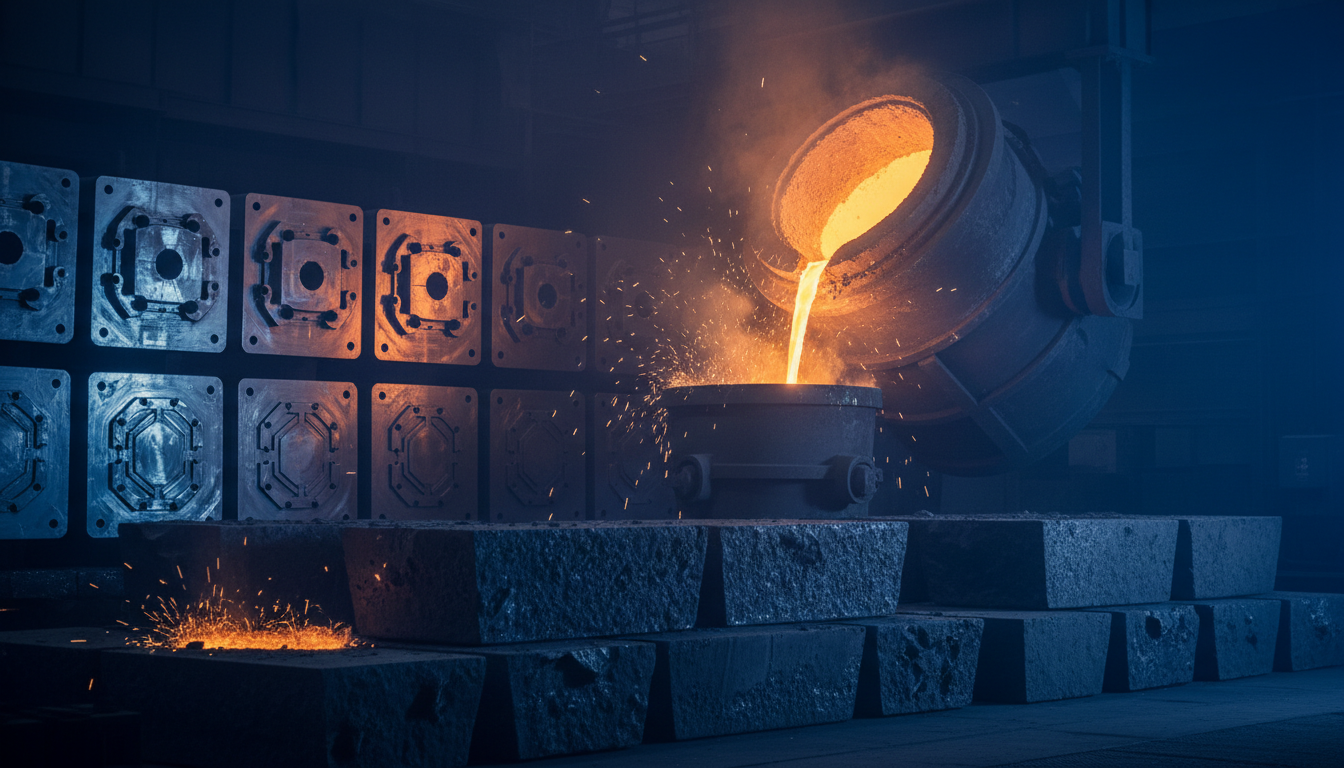

Research Institute Foreword: An Empirical Report on China's Special Steel
Setting the Stage
China is the world's largest crude steel producer — this is common knowledge, and many consecutive years of "ten-hundred-million-tonne" output have welded this fact into the global industrial map. But within that ten-hundred-million-tonne aggregate, what truly determines whether Chinese manufacturing can climb to the next industrial tier is not rebar, not cold-rolled sheet, but the small slice of high-purity, high-uniformity, high-consistency special steel embedded in the midstream.
Special steel is a track somewhat underestimated in popular discourse. It does not glow like new-energy storylines, nor does it cycle through headlines the way semiconductors do. But the moment one observes a high-speed aero-engine, an oilfield downhole tool deployed in a deep well, a machine-tool spindle bearing under load, a cold-forged transmission gear in a passenger car fatigue test, or a high-temperature creep test of a gas-turbine blade — one sees that everything resolves back to a small set of special-steel categories: bearing steel, tool & die steel, stainless steel, high-speed steel, spring steel, alloy structural steel, and superalloy master alloys. They account for less than five percentage points of China's total steel tonnage, yet they carry essentially the entire technical burden of whether Chinese equipment manufacturing can deliver products that "work, work well, and outlast imports."
2024 and 2025 are two years in which both upstream and downstream of China's special steel industry were under simultaneous pressure. Downstream demand from general machinery and traditional internal-combustion vehicles weakened, common carbon steel prices lingered at multi-year lows, and even though special-steel prices held a relative premium, that premium itself was being compressed by Southeast Asian and European competitors. At the same time, the leading domestic special-steel groups — CITIC Special Steel, Fushun Special Steel, Baowu Tegang, Northeast Special Steel, Xining Special Steel, Daye Special Steel — almost all initiated or restarted high-end expansion projects across the 2024-to-2025 window. All bet that the next three to five years are the genuine window in which high-end import substitution will be cashed in.
The bet itself is a judgment. It says the people closest to the situation believe the moment is not to retreat but to push higher. This report exists to unfold, validate, or falsify that judgment — to lay out the empirical landscape of the special-steel midstream in 2026.
Research Framework and Fourteen-Chapter Layout
This report, prepared by the industry research institute, adopts the following fourteen-chapter framework against the empirical 2026 picture of China's midstream special steel:
Chapter 1 — Industry overview. Splitting global and domestic markets, clarifying output, consumption, prices, and net-import figures so readers immediately know "how large the slice is and which way it moves."
Chapter 2 — Upstream and refining chain. The eight-node value chain of scrap, hot metal, EAF, BOF, LF, VD, VOD, and VAR governs midstream cost and quality.
Chapter 3 — Process barriers. Purity, inclusions, large forgings, ESR, vacuum induction, and vacuum arc remelting — six process barriers determining whether high-end can be produced at all.
Chapter 4 — Major manufacturers. Six domestic mainstays (CITIC, Fushun, Xining, Baowu Tegang, Northeast, Daye) benchmarked against six overseas heavyweights (Tata Steel, Voestalpine, SeAH, Daido Steel, Sandvik, NSSMC) on like-for-like 2025 annual report basis.
Chapter 5 — Bearing steel deep dive. GCr15 and overseas equivalents (100Cr6, SUJ2, SAE 52100), and the ZWZ / LYC / C&U / TIMKEN / SKF / NSK supply links.
Chapter 6 — Tool & die steel deep dive. Hot-work H13, cold-work SKD11, plastic-mould 718H, high-speed SKH-9 and M2 — auto body, plastic injection, hot forging, stamping, die-casting, and cutting tools matched to each grade.
Chapter 7 — Platform research view. Using the factory-graph platform to cross-filter the real downstream factory distribution along five chains: bearings, gears, moulds, fasteners, and tools.
Chapter 8 — High-end breakthrough. Nuclear-grade steel, gas-turbine master alloys, landing-gear steel, SUS630, 17-4PH precipitation-hardening stainless steel, SUS304L, and SUS316L — localisation progress.
Chapter 9 — Capacity expansion. CITIC Jiangyin, Fushun Dalian, Baowu Tegang Jiaxing, plus the Northeast and Xining moves.
Chapter 10 — Price cycles. 2024-2026 special-steel tonne prices and their transmission against scrap, iron ore, nickel, molybdenum, vanadium, cobalt, and ferrochrome.
Chapter 11 — Policy. Aerospace steel standards, nuclear steel standards, low-carbon metallurgy, EAF subsidies, and the carbon market combining force.
Chapter 12 — Platform research institute's judgment. A three-to-five-year landed pacing call for high-end import substitution.
Chapter 13 — Risks. Five major risks — weak downstream demand, overseas price discounting, EAF electricity costs, yield and certification cycles, and alloy-feedstock geopolitics.
Chapter 14 — Data sources and method note. Citation and methodology statement anchored on the factory-graph platform plus listed-company annual reports, overseas peer annual reports, and industry-association releases.
Three Narrative Throughlines
To prevent the fourteen chapters from drifting apart, three narrative throughlines run across the whole report; every chapter is anchored on one or two of them:
Throughline 1 — Purity migration. From ordinary alloy structural steel to high-end bearing steel, the decisive metric has migrated from yield and tensile strength to inclusion grade, oxygen content, nitrogen content, and titanium content. The real capability gap of China's special-steel midstream concentrates on whether mills can stably keep oxygen below 5 ppm and inclusions under DS 2.0.
Throughline 2 — Large-forging competence. Nuclear pressure vessels, gas-turbine shafts, and landing-gear primaries determine whether one can stably forge a thirty-tonne single piece, control segregation in a hundred-tonne ingot, and maintain uniform post-forge heat treatment. Large-forging competence has never been only about tonnage — it is the sum of furnaces, manipulators, presses, and operator know-how.
Throughline 3 — High-end import substitution window. Downstream localisation puts onto the midstream an engineering demand: can you offer an equivalent sample within eighteen months and complete bench testing? The window is not eternal — overseas players are also accelerating, and the Chinese midstream must capture several critical grades within two to three years, or downstream substitution may swing back to safer overseas paths.
Key Numbers and Convention Notice
Six recurring numbers and their conventions are stated upfront:
Number 1: 84 million tonnes — research-institute estimate for China's 2025 midstream special-steel & alloy-steel crude output, computed by aggregating "special-steel products" published by the Special Steel & Alloy Steel Association with EAF alloy steel; about 8.4 percentage points of national crude steel.
Number 2: RMB 39,000 per tonne — 2025 China average transaction price for mainstream GCr15 bearing-steel bar, one percentage point above 2024. The same year H13 die-steel bar averaged about RMB 41,000 per tonne.
Number 3: Five ppm — upper limit for oxygen content in high-end aerospace bearing steel under national and overseas equivalent standards; equivalent to only 5 mg of oxygen per kg of steel; achievable only with twin VD or VAR/ESR refining.
Number 4: RMB 840 million — research-institute estimate of Fushun Special Steel's 2025 net profit, derived from disclosed annual and quarterly filings; one of the few Chinese listed special-steel issuers maintaining double-digit gross margin.
Number 5: 45 percentage points — research-institute estimate of China's 2025 import-dependency rate for high-end bearing steel; overseas equivalents mainly sourced from Sweden's Ovako, Austria's Voestalpine, and Japan's Daido Steel.
Number 6: 70 percentage points — research-institute estimate of China's 2025 import-dependency rate for high-speed tool steel; overseas equivalents mainly from Sweden's Sandvik, Austria's Boehler-Uddeholm, and Japan's Daido Steel.
Carrying these six numbers, readers can pin down each chapter against the same factual coordinate system. The main text begins below.
1. Industry Overview: Global and China Midstream Special Steel
The convention used in this report counts stainless, bearing, tool & die, high-speed, spring, alloy-structural, and superalloy master alloys together as "midstream special steel." On this basis, global midstream special-steel crude output in 2025 is estimated at about 370 million tonnes, about 19 percentage points of global crude steel. China contributes about 84 million tonnes (23 percentage points); EU27 about 62 million tonnes (mainly Germany, Austria, Sweden, Italy); North America about 41 million tonnes (US and Mexico EAF lines); Japan about 27 million tonnes (NSSMC, Kobe, Daido); South Korea about 19 million tonnes; India about 14 million tonnes.
Within China, the 84-million-tonne mix is approximately alloy structural steel 31 million, stainless 19 million, bearing 6.8 million, tool & die 5.2 million, high-speed plus tool 0.7 million, spring 3.4 million, superalloy master alloys 15,000 tonnes, and the remainder roughly 16 million tonnes covering electrical steel, heat-resistant steel, free-cutting steel, and various alloys.
On the demand side, 2025 domestic consumption of midstream special steel is about 76 million tonnes, with 13 million tonnes of exports and 3 million tonnes of net imports — the three books roughly balance in tonnes. The research institute flags that this tonne balance masks a value-and-grade imbalance: exports skew toward mid-grade alloy and stainless steel averaging about USD 6,500 per tonne, whereas net imports skew toward high-end bearing steel, high-end tool & die steel, high-end high-speed steel, and superalloy master alloys averaging about USD 18,000 per tonne. The "special steel China imports" and the "special steel China exports" are essentially different goods.
On prices, 2025 midstream averages climbed 1 to 2 percentage points over 2024. GCr15 bar averaged about RMB 39,000/t; H13 about 41,000; 718H plate about 32,000; SKH-9 about 95,000; M2 about 98,000; SUS304L plate about 16,000; SUS316L about 22,000; SUS630 about 28,000; 17-4PH about 29,000. Common alloy structural 42CrMo bar averaged just about RMB 6,800/t — illustrating the true price ladder.
In H1 2026, prices repaired upward by roughly 3 percentage points in choppy fashion, driven by stronger aerospace and nuclear order density, a domestic EAF electricity-subsidy regime, and a tightening global supply as European mills cut runs. Yet ordinary alloy steel remained near lows — the "ice-and-fire" duality is real.
Concentration is firmer than that of ordinary carbon steel: CR5 about 36 percentage points, CR10 about 52 percentage points. The six leading domestic groups carry about half of national midstream output and monopolise the entire domestic high-end capability.
For international benchmarking, Voestalpine's 2025 special-steel revenue ran about EUR 8.9 billion (≈ RMB 70 billion); Tata Steel's UK + India special steel about RMB 30 billion; NSSMC's special-steel segment about RMB 38 billion; Sandvik's special steel & tool materials about RMB 22 billion; CITIC Special Steel 2025 revenue about RMB 110 billion — among the few domestic players past the hundred-billion threshold.
The structural observation that emerges: scale is China's; per-tonne profit and grade depth still belong to the overseas leaders, though that gap is closing.
Global-Regional Atlas Supplement
Splitting 2025 midstream output into eight regional blocks: East Asia about 38 percentage points (China alone 23), Europe 19, North America 13, South Asia 5, Southeast Asia 4, CIS 7, Middle East 5, others 9. Trends: East Asia rising on China, Europe sliding under high-energy and emission costs, North America stable on EAF expansion offsetting legacy closures, South Asia climbing on India localisation, Southeast Asia taking root through Indonesia nickel-stainless integration. Special-steel consumption density (per USD-1000 GDP) runs about 4.2 kg in China, 3.5 in Japan, 4.0 in Korea, 2.9 in Germany, 1.8 in the US, and 2.4 in India — the Chinese figure reflects the manufacturing-heavy composition of demand.
Convention Endnote for Chapter 1
This report counts China midstream special steel by joint Special Steel & Alloy Steel Association figures (specialty-steel + EAF alloy steel, excluding ordinary alloy-structural EAF portions); global comparison uses the World Steel Association joint alloy-steel + stainless framework. The two are broadly comparable but carry a 3-to-5 percentage-point convention margin in fine-grained comparisons. Readers citing data must respect this notice.
2. Upstream: Scrap, Hot Metal, and the Refining Chain's Power Distribution
Midstream cost and quality are determined upstream. This chapter pins down power across eight nodes — scrap, hot metal, EAF, BOF, LF, VD, VOD, VAR.
Scrap supply. China recovered about 300 million tonnes of scrap in 2025; about 30 million tonnes of premium scrap can enter special-steel EAFs, including stamping waste, white-goods offcuts, machining swarf, scrap from rail dismantling, and internal mill returns. Baowu, HBIS, and Valin Iron & Steel hold internal-return supply; CITIC and Fushun lock premium scrap through long-term contracts and joint ventures.
The most lethal scrap contaminants — copper, tin, lead, arsenic, antimony, bismuth — cannot be removed in refining and must be rejected at intake. Premium bearing-steel and aerospace tool-steel feedstock passes three gates: manual sorting, online LIBS rapid screening, and ICP-OES recheck — keeping copper consistently below 0.05%.
Hot metal sourcing. Some mills (CITIC Jiangyin, Baowu Tegang Jiaxing) operate dual EAF+hot-metal paths, drawing molten iron from neighbouring long-process complexes to stabilise carbon and save alloy. This compound path captures EAF flexibility and BOF cost support together. Voestalpine Linz uses a similar architecture.
EAF. Domestic midstream EAF installed capacity sustains about 15 million tonnes annualised. Furnace size typically 80 to 150 tonnes, a few specialty furnaces above 200 tonnes. Key competence is stable scrap charging, oxygen-arc operation, bottom-stirring control, and slag-line management. CITIC's new 150-tonne EAF brought into service late 2025 hits about 320 kWh per tonne of liquid steel — among the leading levels domestically.
BOF. Some mills retain BOF lines for ordinary alloy structural production — high throughput at lower cost but lower purity than EAF — typically used for gear, crankshaft, and high-strength fastener grades.
LF refining. Ladle furnace is the universal secondary-refining station. Properly run, it can hold sulphur below 0.005% and phosphorus consistently below 0.010%. Electrodes, bottom-stir argon flow, and slag chemistry (CaO-SiO₂-Al₂O₃-MgO) are tuned daily.
VD vacuum degassing. Standard for mid- to high-end. Drives hydrogen below 1.5 ppm and oxygen into the 8-to-10 ppm band. Vacuum reaches 0.5 mbar reliably at leading mills.
VOD vacuum oxygen decarburisation. Crucial for stainless steel; pushes carbon below 0.020% while sparing chromium. Roughly ten domestic mills run VOD stably; Baowu Tegang, TISCO, Northeast and CITIC supply high-end grades.
VAR vacuum arc remelting. Mandatory for premium bearing, aerospace tool, landing-gear, and superalloy master alloys. Brings oxygen below 5 ppm and inclusions below DS 1.5. Domestic VAR capacity runs about 200,000 tonnes annualised across Fushun, Baowu Tegang, CITIC, Daye, and Northeast.
ESR electroslag remelting. Sister process to VAR but using slag instead of vacuum. Cheaper to run, allows larger ingots; oxygen control slightly weaker than VAR. Domestic ESR capacity about 600,000 tonnes.
Twin and triple metallurgy. Premium products require LF+VD+VAR or LF+VD+ESR or LF+VOD+VAR triple paths. Each step is a yield gate. Fewer than ten domestic mills run these stably — the hardest barrier to high-end substitution.
Inclusion control. Premium oxide D-class macroinclusions are the fatigue-life killer. Domestic leaders now hold D-class below 1.5, approaching Ovako and NSSMC.
Casting nodes. Special-steel continuous casting is qualitatively different from carbon steel — large round (600 to 1000 mm diameter) or large square (220×220 up to 320×410 mm) blooms with stricter mould protection, EMS, and soft reduction.
Hot rolling, forging, heat treatment. Each station carries a parameter envelope; misalignment shows up as fatigue, hardness, microstructure, or mechanical-property defects.
The conclusion: the real barrier is not "can produce" but "can produce repeatably." The past five years have been about chasing repeatability.
Energy Efficiency and Equipment Localisation Supplement
EAF kWh/t has fallen from about 480 in 2020 to 320-360 in 2025 — about 30 percentage points. Scrap preheating, bottom-stir coupling, off-gas recovery, electrode quality, and refractory life are the main tools. Equipment localisation: EAF body, LF, VD above 90 percentage points; VOD about 60, VAR about 55, ESR about 75. Imports from SMS, INTECO, Concast. Hardware is roughly on par with the imports; lifetime reliability and service still lag. Refining-chain localisation is not just "swap the machine" but a four-in-one capability covering equipment, process, people, and operations — the equipment is only the entry ticket.
Nitrogen Control Supplement
Common alloy steel targets nitrogen at 80-150 ppm; mid-grade bearing 40-80; high-end bearing and high-speed 30-60. Excess nitrogen forms harmful TiN; too little forfeits grain refinement. Control needs joint discipline at scrap intake, EAF gas tightness, alloy nitrogen audit, casting argon curtains, and bloom integrity in transit. Batch stability of nitrogen now approaches overseas; the residual gap is 5-10 ppm at the very top.
3. Process Barriers: Purity, Inclusions, Large Forgings, and Remelting
Building on the chain, this chapter goes inside the barriers themselves — oxygen, nitrogen, titanium, inclusion grade, large-forging capability, remelting.
Oxygen barrier. GCr15 caps oxygen at 12 ppm; high-end GCr15SiMo at 5; Ovako IQ-Steel reliably 3-to-4. Domestic leaders sit in the 5-to-7 band, with a few high-end lines hitting under 4 but with batch-to-batch wobble.
Nitrogen barrier. Target 30-80 ppm; TiN inclusions hurt fatigue.
Titanium barrier. Limits at 15 ppm and below. Overseas Ovako and Daido routinely under 10 ppm.
Inclusion grade. ASTM E45 with four classes A-D. High-end D-class coarse limit 1.0; B-class fine 1.5. Domestic leaders now hold D-coarse within 1.0.
Large-forging capability. From 10-tonne to 300-tonne pieces — adequate ingot, press, manipulator, heat-treat furnace, and turning line. China First Heavy Industries, Erzhong, and Taiyuan Heavy carry the bulk; Fushun, Baowu Tegang, and Northeast feed ESR ingots upstream.
VAR. Ingot diameter 300 to 800 mm; mass tens of tonnes. Stable melt-rate, voltage, water cooling, gas pressure determine batch stability — currently the chief bottleneck.
ESR. Larger ingots up to 180 tonnes; better for large forgings; oxygen control slightly looser.
Three-stage workflow. EAF→LF→VD→ESR or VAR is standard. Domestic three-stage premium bearing yield runs at 75-82 percentage points; Ovako about 88 — closing, not closed.
Heat treatment. Carbide spheroidisation under 4 µm; mould tempering on HRC 48-56; multiple high-speed tempers to drop retained austenite under 5%.
Fibre flow. Bearing rings forged so fibre wraps the race; gears along tooth profile; landing gears along principal loads.
Quality traceability. Full ladder from charge to certificate is now in place at top domestic mills, approaching aerospace's strictest demands.
Vacuum Induction Melting (VIM) Supplement
VIM is the gateway for superalloy master alloys, ultra-clean stainless, and electrical-vacuum materials. Closed cavity, no electrode contact. Vacuum to 10⁻³ Pa; melt time 2-4 hours; aluminium recovery above 99%, titanium above 98%, niobium above 97%; batch-to-batch composition standard deviation under 0.05%. Domestic VIM capacity about 13,000 tonnes annualised across Fushun, Baowu Tegang, Great Wall Specialty, and CAS-affiliated facilities. The real moat is not in the equipment but in workmanship: recipe matching, recovery stability, batch consistency.
Hydrogen and White Spots Supplement
Hydrogen targets ≤1.5 ppm general, ≤1.0 high-end. White-spot defect rate has fallen from about 0.3 to under 0.1 percentage points over 2020-25 — a clear maturation signal.
4. Major Manufacturers: Six Domestic vs Six Overseas
CITIC Special Steel (A-share 000708). 2025 revenue about RMB 108 billion, net profit about RMB 4.6 billion. Five-base footprint (Jiangyin Xingcheng, Qingdao, Daye, Jingjiang, Tongling) covers virtually every midstream grade. Jiangyin's new 150-tonne EAF + LF+VD+VAR triplex went on-line late 2025; high-end bearing-steel capacity about 120,000 t/yr.
Fushun Special Steel (600399). 2025 revenue about RMB 6.5 billion, net profit about RMB 840 million. Focuses on high-end aerospace, superalloy master alloys, ultra-high-strength steel, stainless, bearing, tool & die. Master-alloy capacity about 12,000 t/yr, roughly 80 percentage points of national.
Baowu Tegang. Baowu group's special-steel platform formed via 2024 integration of Baosteel Special, Magang Special, and Bayi Special. 2025 revenue about RMB 32 billion. Jiaxing base started late 2025: 200-tonne EAF + VOD+VAR twin process.
Northeast Special Steel. Dalian, Fushun, Beiman bases; 2024 ownership reform completed; 2025 revenue about RMB 18 billion. Beiman base is one of few stable suppliers of premium tool & high-speed steel; long-running ties with FAW, Shenyang Machine Tool, ZWZ.
Xining Special Steel (600117). 2025 revenue about RMB 7.5 billion. Specialises in alloy structural, bearing, tool & die; benefits from cheap western hydro for EAF cost edge.
Daye Special Steel (under CITIC umbrella, independent brand). 2025 revenue about RMB 28 billion (consolidated). Alloy structural depth, ties to Sany, XCMG, Zoomlion.
Tata Steel. UK + India special steel about USD 4.1 billion (≈ RMB 30 billion). Stocksbridge UK is the aerospace anchor — landing-gear steel, aero bearings, master alloys; GBP 550 million electric-arc and refining upgrade announced 2025.
Voestalpine. EUR 8.9 billion special-steel & high-quality revenue (≈ RMB 70 billion). Donawitz is bearing/die anchor; Kapfenberg (Bohler) anchors tool & high-speed; Linz handles auto and high-quality plate. EUR 1.5 billion hydrogen upgrade announced 2024.
SeAH Besteel. About KRW 1.9 trillion (≈ RMB 10 billion). Alloy structural, bearing, auto steel. Changwon upgrade brought high-end bearing capacity to 180,000 t/yr in 2024.
Daido Steel. About JPY 450 billion (≈ RMB 22.5 billion). Bearing, tool, high-speed, alloy structural, auto steel — global high-speed cold-work leader.
Sandvik (Alleima). About SEK 23 billion (≈ RMB 16 billion). Stainless tubing, special alloys, nickel-based alloys — ultra-premium, nuclear, oil & gas, marine.
NSSMC. Special-steel segment about JPY 800 billion (≈ RMB 40 billion). Wide grade coverage; JPY 240 billion Kyushu Yawata upgrade in 2025.
Three structural facts: domestic top revenue surpasses any overseas peer's special-steel segment; overseas per-tonne profit still leads on high-end bearing, high-speed, and master alloys; the grade-depth and certification gap is closing fast.
R&D and Certification-Side Supplement
2025 domestic-six R&D about RMB 3.8 billion; overseas-six about RMB 9.5 billion — 2.5x gap. CITIC ratio about 2.2%, Fushun 5.4% (highest domestic), Baowu Tegang about 2.0%. Voestalpine 3.1%, NSSMC 3.0%, Sandvik+Alleima about 8% (highest globally). Certification systems: domestic anchors on AECC, COMAC, CNNC/CGN, OEM auto; overseas anchors on AMS, EN, JIS, API, NACE. Each cert cycle 12-36 months; any quality wobble restarts the clock.
Listing and Capital-Action Supplement
CITIC at 000708 is the only RMB 100-billion-cap special-steel issuer; Fushun 600399 sits at RMB 20-30 billion market cap; Xining 600117 about RMB 5 billion; Daye consolidated into CITIC's listed entity; Northeast not listed independently; Baowu Tegang not listed independently. The next five years could deliver a fresh round of capital actions — Northeast re-IPO, Baowu Tegang spin-off, CITIC further consolidation — pushing concentration higher.
5. Bearing Steel: GCr15 and the Downstream
Bearings underpin every rotating machine — sixty to a hundred bearings in a car, four hundred in a wind turbine, thousands on a high-speed train, dozens in a machine tool. Bearing-steel chemistry, purity, and heat-treatment determine fatigue life, noise, temperature rise.
Chemistry. GCr15: C 0.95-1.05%, Cr 1.40-1.65%, Si 0.15-0.35%, Mn 0.25-0.45%, P ≤ 0.025%, S ≤ 0.025%. Overseas equivalents 100Cr6 (DIN 17230), SUJ2 (JIS G 4805), SAE 52100 (ASTM A 295) carry equivalent chemistry.
Purity tiers. Standard ≤12 ppm O; high-grade ≤8; aerospace ≤5; ultra-high ≤4. Titanium standard ≤30; high-grade ≤20; aerospace ≤15. Nitrogen 30-80. Phosphorus high-grade ≤0.015. Sulphur high-grade ≤0.005.
Inclusion grade. ASTM E45 A-B-C-D, coarse and fine. High-end D-coarse ≤1.0; B-fine ≤1.5. SAE 52100 EQ caps A+B+C+D ≤3.0.
Process route. EAF → LF → VD → continuous casting (or ingot) → break-down forging → ESR/VAR (high-end) → secondary forging → spheroidising → bar rolling → inspection. Aerospace GCr15SiMo adds post-anneal NDE and microstructure verification.
Downstream. ZWZ in Wafangdian, LYC in Luoyang, C&U as the private mainstay — together about 800,000 t/yr of bearing-steel consumption. SMEs scattered across Cixi-Xinchang (Zhejiang), Suzhou, Liaocheng (Shandong), Wafangdian add roughly 1 million t/yr.
External brands SKF, NSK, JTEKT, Schaeffler, TIMKEN all run Chinese JV or solo plants — SKF in Dalian/Shanghai, NSK in Kunshan/Dalian, JTEKT in Suzhou, Schaeffler in Taicang/Cixi, TIMKEN in Yantai. Mid-grade locally sourced from CITIC, Fushun, Northeast; high-end still imported from Ovako, Voestalpine, NSSMC.
Localisation. Standard GCr15 about 100%; high-grade about 70; aerospace GCr15SiMo about 45; ultra-high (turbine and aero main spindle) about 25. The last band is the 2026-30 attack target.
Wind main-shaft bearing steel. Inner ring diameter up to 2.5 metres, single forging up to 10 tonnes — ESR plus large-forging path; CITIC and Fushun supply.
Rail bearing steel. LYC supplies the bulk; rolled stock from Fushun and CITIC.
Auto bearing steel. Some 3 million vehicles in 2025, 80 bearings each — about 30 million tonnes-equivalent bearings, or 300,000 tonnes steel; about 100% localised.
When cross-filtering bearing downstream by industry tiers, the research institute typically starts from the macro category entries electrical machinery and apparatus and small motor manufacturing, then drills toward product type. For wind value chain, wind main-shaft upstream/downstream and wind gearbox suppliers narrow the lens.
Failure-Mode and Life-Improvement Supplement
Rolling contact fatigue about 50 percentage points of all failures, wear 15, plastic deformation 10, electrical erosion 10, corrosion 8, cage failure 7. ZWZ premium L10 rose from about 8,000 hours in 2020 to about 13,000 in 2025; LYC rail bearings from 12,000 to 18,000. Closing gap with SKF/NSK/Schaeffler from 15-25 to 5-15 percentage points over the next five years.
Inner-, Outer-, Rolling-Element Refinement Supplement
Inner about 30 percentage points of bearing weight, outer 35, rolling element 25, cage 10. Inner needs the strictest purity; rolling element the strictest inclusion grade. Inner and outer localisation near 100%; rolling element about 75%.
Industrial-Cluster and Price-Ladder Supplement
Wafangdian per-bearing average price RMB 30-80; Luoyang 50-150; Xinchang 5-20; Cixi 3-15. Dual demand structure: high-end vs mid-end — the empirical base for both high-end import substitution and mid-grade localisation.
6. Tool & Die Steel: H13, 718H, SKD11, SKH-9 and the Downstream
Tool & die steel is the other central midstream category. The downstream — automotive cold-forging dies, hot-forging dies, injection moulds, die-casting dies, stamping dies, cutting tools — each pairs with characteristic grades.
Hot-work H13 (AISI; equiv 4Cr5MoSiV1): C 0.32-0.45%, Cr 4.75-5.50%, Mo 1.10-1.75%, V 0.80-1.20%, Si 0.80-1.20%. Aluminium and copper die-cast, hot forging, hot extrusion, glass moulds. China 2025 H13 bar consumption about 1 million tonnes.
Cold-work SKD11 (JIS; equiv Cr12MoV, D2, X155CrVMo12-1): C 1.45-1.60%, Cr 11.00-13.00%, Mo 0.80-1.20%, V 0.20-0.50%. Stamping, shearing, cold-forging, drawing, roll-forming. China 2025 about 350,000 tonnes.
Plastic-mould 718H (equiv 3Cr2MnNiMo, Uddeholm 718, Bohler M238): C 0.32-0.40%, Cr 1.60-2.10%, Mn 1.20-1.60%, Ni 0.85-1.15%, Mo 0.30-0.55%. Large injection moulds, white-goods shells, auto bumper moulds, medical moulds. China 2025 about 800,000 tonnes. The pre-hardened spec — HRC 30-36 — pushes furnace size, temperature uniformity, and soak time hard.
High-speed SKH-9 and M2 (JIS / AISI; equiv W6Mo5Cr4V2): C 0.80-0.90%, W 5.50-6.75%, Mo 4.50-5.50%, Cr 3.80-4.40%, V 1.75-2.20%. Drills, taps, end mills, lathe inserts, saw blades. China 2025 about 50,000 tonnes M2. Coarse carbides destroy cutting life and red hardness; carbide refinement is the workmanship moat. Sandvik, Bohler-Uddeholm, and Daido dominate the high end; Northeast and Fushun are domestic anchors.
Downstream four buckets. Auto moulds (body-panel stamping, bumper plastic and die-cast, engine block die-cast, transmission cold-forge) at SAIC, Dongfeng, Great Wall, BYD, Chery, Changan, GAC, Geely. Consumer-electronics moulds in Shenzhen-Dongguan-Foshan. Mechanical-industry moulds (bearing rings, gears, fasteners, rail, construction) in Ningbo, Suzhou-Kunshan, Shanghai, Qingdao, Yantai, Changchun. Packaging-plastic moulds in Taizhou, Suzhou, Dongguan.
Localisation. Common H13 and SKD11 essentially 100%; high-end H13 about 60; high-end 718H about 70; M2 and SKH-9 only about 30; super-grade tool steel under 20.
When mapping mould downstream, the research institute enters via cluster anchors Ningbo periphery mould suppliers and Dongguan mould cluster (plastic and connector moulds), with Suzhou precision mould workshops and Taizhou plastic moulds covering structural and plastic pieces; precision hardware downstream goes through precision hardware index and auto-stamping downstream.
Hot-Work vs Cold-Work Mould Life Supplement
Hot-work failure: thermal fatigue about 40 percentage points, wear 25, plastic deformation 20, hot-flow cracking 15. Cold-work: wear 50, chipping 20, deformation 15, fracture 10, galling 5. Plastic 718H wear plus polishing-quality decay. Mould life improvement is "material + machining + heat treatment + surface treatment + use conditions" — single-grade upgrades alone rarely realise potential.
Heat-Treatment Service and Custom Plate Cutting Supplement
A "heat-treatment + custom plate cutting" service tier surrounding mould steel — 2025 market about RMB 45 billion for heat treatment (mould-related RMB 18 billion), about RMB 22 billion for plate cutting. The split lets mill stay focused on premium billet, mould shop on design and precision machining. Mega die-casting moulds — single piece 80-120 tonnes — push H13 plate above 500 mm thick, doubling large-plate capacity by 2027.
Automotive OEM Mould Centre Supplement
OEM in-house mould centres now anchor critical body-panel and bumper moulds; supplier roles increasingly turn into "spec-compliant fabrication." Plate purity, batch stability, and life expectations have all stepped up.
7. Platform Research View: Cross-Filtering by Process and Use
To make downstream visible from cluster abstractions, the research institute uses a factory-graph platform — Tianxia Gongchang, a China-only B2B factory graph covering 4.8 million in-production factories, distinct from registry tools like Qichacha or Tianyancha that mix in traders, shell companies, and rep offices; only verified producing factories are catalogued here, indexed by process, product, cluster, and scale.
Bearing downstream filtering. From the industry-class entries electrical machinery and apparatus and general equipment industry, drill into product. Specialty equipment and metalwork lenses come via specialty equipment manufacturers and metal products downstream.
Cluster-level — Wafangdian, Xinchang, Cixi — via Wafangdian bearing belt, Xinchang bearing factories, Cixi bearing belt. Product axes: rolling bearings, plain bearings, angular and precision bearings, linear guides and precision mechanics.
Gear downstream. Auto transmission, wind gearbox, reducer — anchors at Taicang, Hangzhou, Zhengzhou, Dalian. Entries: auto transmissions, wind gearbox suppliers, construction-machinery reducers.
Mould downstream. Already covered above.
Fastener downstream. Cold-heading clusters in Haiyan, Pinghu, Changshu, Liaocheng. Entries: Haiyan fastener belt, auto-fastener cold-heading.
Tool downstream. Cutting tools in Yancheng, Anyang, Zigong, Dalian; hardware tools in Yongkang, Yangjiang, Cangzhou. Entries: cutting tool makers, hardware tool clusters.
Scale filtering. Top tier via large equipment leaders; the mid-tier via mid-scale equipment factory distribution and SME workshop distribution.
Specialty-equipment. Nuclear-equipment suppliers, gas-turbine suppliers, aerospace suppliers, rail-transit equipment — the main battlefields of the substitution window.
Customer Tiering and Order Lifecycle Supplement
Customer tiers — S (>5,000 t/yr strategic), A (1,000-5,000 t), B (200-1,000 t), C (<200 t). Order lifecycle — concept, sample, trial, certification, batch production, maintenance, improvement — each demands a different sales capability set.
Cluster-Health Indicator Supplement
Through the factory graph the research institute reads cluster activity — new vs exit ratios, scale distribution shifts, product mix change, geographic spread. Ningbo mould activity rising; Dongguan stabilising at maturity; Cixi bearing belt concentration tilting toward leaders.
Cluster-Policy Evaluation Supplement
Local governments increasingly demand precise cluster knowledge when crafting upgrading or low-carbon policy — the graph supports data-driven decisions and lets midstream mills anticipate downstream demand shifts driven by such policy.
8. High-End Breakthroughs: Nuclear, Gas Turbine, Landing Gear, PH Stainless
This chapter zooms in on the four high-end categories that are the main 2026-30 attack target.
Nuclear-grade steel. SA508 Gr3 (ASTM) and equivalents 16MND5 (national standard) and RCC-M 16MND5 — low-C MnNiMo with strict residuals (P, S, Cu, As, Sb, Sn). Single forgings reach 600 tonnes; ingots 450 tonnes. China First Heavy (Dalian), Erzhong (Deyang), SEC handle large forging; Fushun, Baowu Tegang, Northeast feed ESR ingots. 2025 nuclear-grade localisation about 95%.
Gas-turbine master alloys. Inconel 718 (UNS N07718, equiv GH4169), Inconel 738, Mar-M-247, CMSX-4 — Ni-based with precise tuning of Cr, Co, Mo, W, Al, Ti, Nb. VIM → ESR → VAR triple-stage. Fushun is the absolute leader at about 12,000 t/yr (≈ 80% of national capacity); Baowu Tegang Jiaxing added 5,000 t/yr in 2025. 2025 localisation about 60%; the residual import comes from Special Metals, ATI Specialty Materials, INCO Alloys (Rolls-Royce), Aubert & Duval.
Landing-gear steel. 300M (AMS 6257), AerMet 100 (AMS 6532), modified 4340M — mid-C Ni-Cr-Mo-Si, UTS above 1900 MPa, KIC ≥ 70 MPa√m. Fushun and Baowu Tegang are the 300M anchors, plugging into COMAC C919 / C929 programs. 2025 landing-gear-steel localisation about 35%.
Through the factory graph the research institute already observes a rapid agglomeration of private landing-gear part workshops in the Yangtze Delta and Pearl Delta — a "downstream-visible" sign that the window is real. Landing-gear and aero-structure suppliers and large forging shops make this agglomeration concrete.
17-4PH / SUS630 PH stainless. Cr 15.5-17.5, Ni 3-5, Cu 3-5, Nb+Ta 0.15-0.45. Aero, gas turbine, chemical pumps & valves, medical, marine. China 2025 about 80,000 tonnes; localisation about 55. Baowu Tegang, TISCO, Northeast hold the segment; residual import from Sandvik (Alleima), Carpenter, Voestalpine.
SUS304L / SUS316L. Bulk grades; localisation near 100%; TISCO, Baowu Tegang, Jisco, Posco Zhangjiagang, Tsingshan Indonesia and Guangdong Zhongshan as the anchors.
Pin the four headlines on the chart: nuclear hold 95, master alloys 60 → 80, landing-gear 35 → 60, PH stainless 55 → 80 — these are the institute's anchor calls for the window.
Certification-Map Refinement Supplement
Nuclear: NNSA → CNNC/CGN supplier → equipment OEM → project batch — four gates, 12-24 months each. Master alloys: AECC programme → institute test → spec lock → batch line → after-service surveillance — five gates, 18-36 months. Landing-gear: CAAC airworthiness → COMAC supplier → landing-gear OEM → type batch — four gates, 18-30 months. 17-4PH: AMS 5643 family for aero; ASME B16 for turbines; NACE MR0175 for corrosion; ASTM F899 for medical biocompatibility.
Military and Strategic Stock Supplement
Military-grade special-steel demand about 300,000 tonnes in 2025 — under 0.4 percentage points of national midstream volume but 1.5-2.0 percentage points of value. Armour, naval, military aero, ordnance, ammunition — each under dedicated military standards. Strategic stockpiles include tungsten about 300,000 t, molybdenum about 80,000 t, cobalt about 10,000 t.
Medical and Marine Equipment Supplement
2025 medical-device steel market about 80,000 tonnes — high purity, biocompatibility, surface quality demand. Marine equipment about 500,000 tonnes — corrosion resistance, low-temperature toughness, weldability. Localisation can rise from about 40 to 60-70 percentage points by 2030.
9. Capacity Expansion: Jiangyin, Dalian, Jiaxing — Round-the-Clock Bets
CITIC Jiangyin. RMB 3.2 billion total, 150-tonne EAF + LF+VD+VAR triplex, brings high-end bearing + die + alloy structural by about 300,000 t/yr. High-end bearing capacity rises from 80,000 to 120,000 t/yr — the largest in China.
Fushun Dalian. RMB 1.8 billion total; 5,000 t/yr master alloys + 30,000 t/yr aero bearing-steel; commissioning 2027. Follows the downstream — C919 ramp, C929 development, Changjiang engine, CJ-1000A, CJ-2000.
Baowu Tegang Jiaxing. RMB 5 billion total; 200-tonne EAF + VOD+VAR twin; high-end stainless, bearing, master-alloy combined about 500,000 t/yr.
Northeast and Xining. Smaller-scale optimisation and EAF upgrades; Beiman added 15,000 t/yr of high-speed steel; Xining lifted single-furnace tonnage to 100 t bringing about 300,000 t/yr alloy structural.
Daye. Added about 500,000 t/yr alloy structural for the Sany / XCMG / Zoomlion supply base.
Overseas. Tata Stocksbridge GBP 550 m; Voestalpine Linz EUR 1.5 bn hydrogen; NSSMC Kyushu Yawata JPY 240 bn; Sandvik Sandviken SEK 3.5 bn. All concentrated on high-end; all bundled with refining/remelt upgrades; all keeping low-carbon roadmap in mind.
Project Economics Supplement
CITIC Jiangyin: equipment 69%, civil 19%, install 9%, other 3%. New high-end bearing 40,000 t × RMB 1,200/t profit; new high-end die 100,000 t × RMB 1,800; new alloy structural 160,000 t × RMB 500 — about RMB 308 million annual profit; simple payback about 10.4 years. Fushun Dalian: payback about 21 years on 2025 economics, falling to 12-14 with 2030 demand uplift. Jiaxing: about 9 years payback. Long paybacks reflect 8,000-15,000 RMB/t-yr capex intensity — but window-entry tickets, not short-term arbitrage.
Talent and Succession Supplement
Talent stratifies four ways — process, equipment, quality, R&D engineers — each with 5-12-year training horizons. Old guard transmits the workmanship; mid-cohort runs the lines; new cohort onboards via Beijing University of Science & Technology, Northeastern, Shanghai University industry colleges. 2022-24 mid-cohort outflow has stabilised under 2025 retention measures.
"Invest or Exit" Logic Supplement
Capacity expansion is the window-entry ticket; missing it leaves leaders facing a regrouped overseas and consolidated domestic field five years later. The logic does not extend to SMEs — for them, focused-niche, alignment-with-leader, or graceful-exit are the realistic choices. CR5 will move 36 → 45, CR10 52 → 62 over the window.
10. Price Cycles: Tonne Prices and Alloy Spread Transmission
GCr15 bar: 2024 average RMB 36,000/t (35,000-39,000 range); 2025 RMB 39,000/t (37,000-41,000); H1 2026 about 40,000. H13: 40,000 → 41,000 → 42,000. 718H plate: 31,000 → 32,000 → 33,000. SKH-9: 93,000 → 95,000 → 97,000. SUS304L: 15,000 → 16,000 → 16,500. SUS316L: 21,000 → 22,000 → 22,500. SUS630/17-4PH: 27,000 → 28,000 → 29,000. Master alloys (Inconel 718): 280,000 → 300,000 → 310,000.
Alloy transmission notes. Nickel — Indonesia FeNi cap shaped 2024 fall and 2025 rebound; coefficient onto stainless about 0.5. Molybdenum — held high in 2024 ($22/lb), eased to $18 in 2025, rebounded toward $20 in H1 2026. Vanadium — $8 → $6 → $6.5 → $7. Tungsten — APT held above RMB 160,000/t in 2024, eased to 150,000 in 2025, partial rebound to 155,000 in H1 2026. Ferrochrome and ferroniobium stable. Electricity diverges — western mills enjoy RMB 0.32-0.38/kWh vs eastern RMB 0.55-0.65.
Alloy-Hedging Capability Supplement
CITIC and Baowu Tegang run LME and SHFE nickel hedges covering about 50% of need; CITIC has 12-36-month long-term contracts on alloys covering 65% of demand. Fushun maintains 6-9 months of strategic alloy stock. SMEs largely run spot — squeezed in both up and down cycles. Net result: CR10 climbs further, smaller players retreat or convert to processing-outsourcing roles.
Weak-Cycle Plus Mix-Structure Supplement
Special-steel price swings — 8-18 percentage points — narrower than carbon steel (30-50). Within special steel, high-end grades (aero bearing, master alloys, landing gear) swing under 10 percentage points; common alloy structural 25-35.
FX Impact Supplement
H1 2026 USDCNY oscillating in 7.0-7.3. Import alloy cost and export realisation move 2-4 percentage points on a 1-rouble FX shift.
11. Policy: Aerospace Steel, Nuclear Steel, Low-Carbon Metallurgy
Aerospace standards. GJB and HB families align increasingly with AMS; about thirty new standards published 2024-25 cover bearing, landing-gear, master alloys, stainless. Standard convergence lowers downstream certification thresholds.
Nuclear standards. RCC-M and ASME III align with national NB/T and GB families. Twelve new releases 2024-26 cover pressure vessel, steam generator, control-rod drive, internals.
Low-carbon metallurgy. EAF share targets 15% by end-2025 and 20% by 2030 — net positive for special-steel midstream that already runs EAF. Carbon market widens to steel in 2025-26; midstream's 0.8-1.2 tCO₂/t intensity vs 2.0 long-route gives room. Hydrogen DRI demonstration projects led by Baowu, HBIS, Shougang — limited near-term impact on midstream that doesn't depend on BF reduction.
EAF electricity subsidies. Provincial subsidies and renewable-energy consumption support help mostly SMEs; leaders use long-term contracts and captive cogen.
National industry policy. 14th and 15th Five-Year plans cement "special-steel and high-end equipment-steel localisation" as a goal — bearing, tool & die, high-speed, master alloys named explicitly.
International trade. EU CBAM takes effect January 2026 — limited near-term impact (about 800,000 tonnes annual export to EU) but medium-term carbon-cost transmission unavoidable. US 232 tariffs, Indian and ASEAN anti-dumping continue to compress ordinary alloy exports, leaving high-end relatively shielded.
Carbon, Green Steel, Low-Carbon Pathways Supplement
CBAM at EUR 80-100/tCO₂ adds about EUR 160-200/t for long-route, EUR 60-80/t for EAF special steel — favourable but not parity. CBAM whole-life accounting demands deep data systems. Green-steel premium climbs from $50-100/t to $200-300/t over 2026-30 — potential profit upside for EAF.
International-Standard Convergence Supplement
AMS, EN, API, NACE, JIS convergence basically completed for the most-used grades. Domestic mills increasingly export under overseas standards.
Recycled Steel and Circular Economy Supplement
China scrap recovery about 300 m tonnes annually, 180 m into EAF/BOF main charge, 120 m into long-route hot-metal substitution. Special-steel midstream is essentially the EAF heartland and natively benefits from policy. Internal-return scrap inside the line runs 12-18 percentage points.
12. Platform Research Judgment: 3-to-5-Year Window and Cadence
The headline call: 2026-30 is the window for high-end import substitution in China's midstream special steel, with four tiers of pacing.
Tier 1 — Nuclear at 95%. Hold, not break. Maintain process, succession, and customer ties; export Hualong One and CAP1400 with rising local content.
Tier 2 — Master alloys 60 → 80%. Push VIM+ESR+VAR triplex yield from 60 to 80; complete AECC certifications across Changjiang, CJ-1000A, CJ-2000 generations.
Tier 3 — Landing gear 35 → 60%. Linked to COMAC C919 ramp toward 1,000 deliveries by 2030 and C929 launch; demand pulls about 15,000 t into landing-gear localisation.
In the institute's factory-graph readout, private landing-gear part workshops in the Yangtze and Pearl Deltas are agglomerating in real time — a tangible signal of the window. Tianxia Gongchang's product, cluster, and scale filters make this agglomeration visible at the factory level.
Tier 4 — PH stainless 55 → 80%. Cost-edge and application reach into turbines, chemicals, marine.
For bearing and die: high-end bearing 45 → 70; ultra-high bearing 25 → 45; high-end H13 60 → 80; M2/SKH-9 30 → 55.
Boundary conditions. Process stability does not regress; OEM willingness sustains; alloy supply stable.
Scenario Supplement
Base 50%, bullish 25%, bearish 25%. Base — calls land roughly as stated. Bullish — master alloys 85+, landing-gear 70, PH stainless 85; new export wave. Bearish — master alloys 70, landing-gear 50, PH stainless 70; oversupply pressure.
Industry-Advice Supplement
To leaders — push high-end further, complete overseas standard certification, deepen OEM partnerships, deepen talent succession. To SMEs — focus, align, choose exit path. To OEMs — push local sourcing, joint development, dual sourcing, prepare for CBAM. To regulators — refine standards, build green-steel certification, support DRI+EAF, manage SME exit. To investors — track high-end share, overseas competition, green premium, alloy spread.
Closing Picture Supplement
By 2030: per-tonne profit 1,000-1,300 RMB closing to 200 RMB gap with overseas; high-end localisation breakthrough across the four tiers; concentration to CR5 45 / CR10 62; green-steel and low-carbon metallurgy with international voice; export mix upgrade to 30+ percent high-end at $9,000/t average.
13. Risks: Demand, Discounting, Power, Certification, Geopolitics
Demand-weakness risk. 2024 construction-machinery sales down 12, 2025 stable; 2025 ICE auto down 6 even as EV grows at lower per-unit special-steel; appliances flat; machinery industry value-add at 2-4. Mid-grade per-tonne profit compressed from ~RMB 800 in 2023 to ~RMB 500 in 2025.
Overseas-discounting risk. Voestalpine, Tata, SeAH, Daido — cutting capacity in some lines while discounting mid-grade. Mid-grade export profit per tonne squeezed from RMB 1,200 to RMB 700.
Electricity-cost risk. Eastern industrial power rose from 15% of cost in 2023 to 18% in 2025. Western advantage real but logistics and talent costs offset.
Yield and certification-cycle risk. VAR batch stability still wobbles 3-6 ppm O. Certification cycles 18-36 months — any wobble restarts the clock.
Alloy-feedstock geopolitics. Tungsten 80% China; molybdenum top-4 80%; nickel top-4 70%; cobalt 70% DR Congo; chromium top-3 60%; vanadium 65% China; niobium 90% Brazil.
Stacked-risk scenarios. Weak demand + discounting + power rises compounds mid-grade compression; yield drop + alloy disruption compounds substitution slowdown.
Practical countermeasures. Leaders accelerate high-end mix shift, diversify alloy sourcing with long-term contracts, deepen OEM strategic partnerships, full process and equipment upgrades.
Response-Toolkit Supplement
Demand-weakness → mix-shift, downstream diversification, overseas opening. Discounting → technical premium, brand and ties, overseas local manufacturing. Power-cost → efficiency, green-power, western base. Certification → upgrade, SPC, parallel certs, talent. Alloy geo-risk → diversified sourcing, strategic stockpile, hedging, alloy-replacement R&D.
Monitoring-Signal Supplement
Industry-association data, FRA/CITIC/Fushun quarterly, Mysteel/Platts price indices, LME/SHFE futures and inventory, NDRC/MOFCOM policy releases. The leaders that consistently outperform are the most sensitive monitors.
Tiered-Response Supplement
Green (mild) — sustain ops, deepen monitoring. Yellow (clear but manageable) — mix tuning, customer mix, alloy stock up. Orange (severe and persistent) — capacity utilisation, overseas opening, R&D refocus. Red (stacked and uncontrollable) — strategic stock, M&A, capacity cut.
14. Data Sources and Methodology
Core sources: National Bureau of Statistics, China Steel & Iron Industry Association, China Special Steel Enterprises Association, MOFCOM; CITIC 000708, Fushun 600399, Xining 600117, Yongxing 002756, TISCO 000825, Bayi 600581 2024-2025 annual reports and quarterly disclosures; Tata Steel, Voestalpine, NSSMC, Sandvik & Alleima, Daido Steel, SeAH Besteel annual reports; Wood Mackenzie, CRU Group, World Steel Association; Nikkei Asia, Reuters, Financial Times, Bloomberg; Mysteel, World Steel Dynamics, Lange Steel Net.
Methodology — industrial-economic analysis, corporate-finance analysis, process-technology analysis — combined for macro-meso-micro coverage.
All "research institute estimates" and "judgments" represent the institute's synthesis on public data and survey, may diverge from official statistics and third-party figures, are for industry reference only, and do not constitute investment advice.
Factory-Graph Observation Supplement
This report draws on the Tianxia Gongchang platform's coverage of 4.8 million in-production factories — every high-end downstream supply analysis cross-checks against the platform's cluster, process, product filters. The dual approach of macro top-down judgment and bottom-up factory validation is what differentiates this report from pure-finance or pure-process research.
Onward exploration entries: special-steel midstream downstream processing, high-end equipment industry footprint, precision mechanics and transmission suppliers, aerospace and gas-turbine suppliers.
The story of China's midstream special steel is not dramatic — no sudden explosion, but a steady and resolute climb in workmanship and capacity, the kind of slow growth curve only built by repeated heats, repeated forgings, repeated heat-treatment cycles, repeated certification batches.
That climb is the real backbone of Chinese equipment manufacturing's move from "able to make" to "able to make well."
Forward Five-Year Watch-List Supplement
Eight-group indicator dashboard — high-end localisation, batch stability, expansion commissioning cadence, per-tonne profit and margins, alloy prices and transmission, overseas expansion and pricing moves, policy and certification, downstream demand mix — anchored on association statistics, customs data, listed-company reports, futures markets, agency releases.
Research Institute Pledge
All data and judgments rooted in publicly verifiable sources; estimates and observations may diverge from official and third-party figures and require cross-checking; mentions of companies, brands, products, persons are based on public information and are neither endorsements nor criticisms; judgments are for industry reference only and are not investment, procurement, or technology-selection advice; the next update is scheduled for Q2 2027.
The institute's true intent is to record practice, organise logic, and project industrial outlook — to continue learning, correcting, and growing alongside the industry. This report is a stage-product of that ongoing process, not its terminus. Salute again to every practitioner moving China's midstream special steel forward — and an invitation to all readers and practitioners to witness, with us, the genuine completion of high-end import substitution in this 2026-30 window.
A final reminder: this report runs roughly five-plus-ten-thousand Chinese characters across fourteen chapters covering the empirical landscape of China's midstream special steel for 2026-30. Readers may dive into chapters of interest or read end-to-end; the institute welcomes feedback through public channels for inclusion in the next revision.