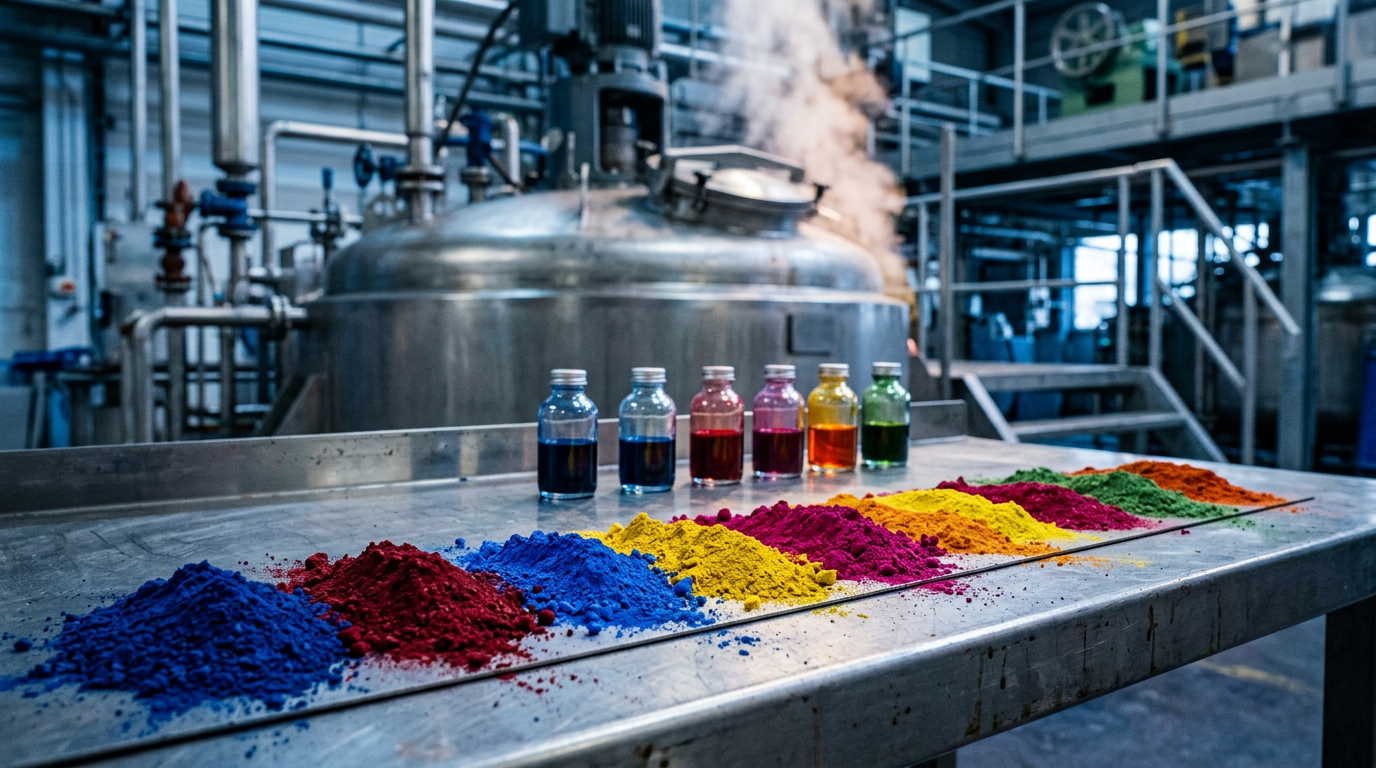

1. Industry Overview: Dye and Pigment Landscape 2025—2026
China is the indisputable production heart of the global dye and pigment industry. In 2025 the country's dye output stabilized above 1.1 million tons, accounting for roughly 60% of global supply. Combined with organic pigments and textile auxiliaries the wider sector hovers around RMB 190 billion in annual output value, with exports of about USD 3.2 billion. Unlike a decade ago when "disperse dyes by Longsheng, reactive dyes by Runtu, others negligible" summarized the structure, the 2026 market has fragmented into several non-overlapping sub-tracks: disperse dyes are an oligopolistic cash cow, reactive dyes are a policy-sensitive bottleneck product, organic pigments are the hidden import-substitution battlefield, and textile auxiliaries are an under-appreciated competitive jungle.
Globally, demand for dyes and pigments continues a slow expansion. Polyester fiber output approaches 91 million tons annually, anchoring stable demand for disperse dyes; cotton fiber output stays around 25.3 million tons, with reactive dye demand growing roughly in step with China's cotton-printing capacity migration. The automotive coatings market, after EV penetration crossed 50%, raised stringent demands on high-performance organic pigments for both color stability and infrared reflectivity. China's disperse dye exports rebounded 3.2% YoY in 2025, while reactive dye exports declined 4.8%. India's Atul, Kiri, and Bodal saw reactive dye exports grow nearly 12% YoY in H2 2025 amid US tariff turbulence.
Pricing in Q1 2026 saw the most credible disperse-dye rebound in three years: market average prices rose from RMB 18,000/ton in December 2025 to RMB 21,000/ton in February 2026, a 16.7% gain. The trigger was the key intermediate "reduction product" spiking from RMB 25,000/ton to nearly RMB 100,000/ton—a 300% surge over three months. Reduction product accounts for 20–30% of disperse dye production cost. Reactive dyes, however, only rose 3% in H1 2026 thanks to relatively ample H acid supply. Research view: this 2026 rebound is not a cycle turning point. The price rise is intermediate-supply-driven, not demand-driven. End printing capacity utilization remains around 75%, below the 2022 peak.
2. Upstream Intermediates: The True Moat
In this industry, outsiders see RMB 22,000/ton disperse dye prices; insiders watch the supply curves of H acid, para-base ester, reduction product, m-phenylenediamine, and catechol. Intermediates are pricing power itself.
H acid (1-amino-8-naphthol-3,6-disulfonic acid) is the soul intermediate of reactive dyes, accounting for 30–50% of reactive dye production cost. China's H acid capacity is around 160,000 tons/year, concentrated in Runtu, Longsheng, Jihua, Dibang, Yabang—mainly in Zhejiang and Jiangsu. H acid production generates 30 tons of phenol-laden wastewater per ton of product, making capacity expansion almost entirely governed by environmental permits.
Para-base ester is the key intermediate for vinyl sulfone reactive dyes, covering 60% of reactive dye varieties. Chinese capacity stands at 220,000 tons/year, held mainly by Runtu, Yabang, Shunpu, and Huaning. The barrier is the danger of the hydrogenation and sulfonation steps, both with documented incident history in Jiangsu and Shandong.
Reduction product is the core intermediate for disperse blue (especially Disperse Blue 60, 79, 183). The 2026 Q1 disperse dye surge was triggered by reduction product supply contraction—H2 2025 environmental permit reductions at Shangyu and Yancheng cut market flow by 40% in two months. Catechol prices surged from RMB 45,000/ton in 2024 to RMB 70,000/ton in H1 2026 after BASF permanently closed its Ludwigshafen catechol unit in 2025 and Solvay exited France.
3. Dye Categories: Six Independent Businesses
Dye categorization is not chemical taxonomy but six distinct businesses.
Disperse dyes dominate polyester dyeing—global consumption 1.6 million tons/year, Chinese capacity 1.1 million tons/year representing 70% of global. Longsheng, Runtu, and Jihua control 60% of Chinese capacity and dominate critical high-end varieties (Disperse Blue 360, Disperse Red 343, Disperse Yellow 184).
Reactive dyes dominate cotton dyeing—global consumption 2.1 million tons/year, Chinese capacity 850,000 tons/year. Fixation rate is only 60–80%, with residual dye entering wastewater as the primary source of printing-dyeing's high color-COD pollution. Leading Chinese producers are Runtu (100,000 tons), Jihua (20,000 tons), Annoqi (35,000 tons).
Acid dyes serve wool, silk, and nylon—global consumption 250,000 tons/year, smallest among the six categories. But high-end varieties (metal-complex, mordant) command 3–5× the price of commodity dyes. The Chinese acid dye market is dominated by Swiss Archroma (which absorbed Huntsman Textile Effects), Sumitomo, and Yabang.
Sulfide, vat, and direct dyes account for the rest—each with smaller markets and structural shrinkage trends, except for the resilient denim segment for sulfide dyes.
4. Major Players: A Comparative Anatomy
Zhejiang Longsheng is the global dye champion. 2025 revenue was RMB 13.31 billion (-16.18% YoY), total profit RMB 2.35 billion (-16.32% YoY). Dye production reached 228,400 tons (+3.53% YoY), sales 242,200 tons (+1.56% YoY) with disperse dye sales hitting record highs. Dye business revenue RMB 7.28 billion, average price RMB 30,100/ton (-5.60% YoY), gross margin 34.38% (+2.71pp YoY). Longsheng's true moat is the m-phenylenediamine—H acid—dye—solvent—intermediate full chain integration.
Runtu Group is China's #1 in reactive dyes and top-three in disperse dyes. Total capacity 238,000 tons/year by end-2025: 118,000 tons disperse, 100,000 tons reactive. 2025 net profit +214% YoY, Q1 2026 +284% YoY. Intermediate self-sufficiency hit 80%. In Feb-Mar 2026 Runtu raised disperse dye black twice, from RMB 26,000/ton to RMB 40,000/ton.
Annoqi focuses on mid-high-end reactive and acid dyes, with 2025 revenue around RMB 1.8 billion. Differentiation: "dye + auxiliary + application solution" bundled sales.
Caihong Chemical is the mid-tier organic pigment leader: 2025 revenue RMB 1.495 billion, ranked #4, dye/pigment 82.78% of revenue, net profit RMB 62.2 million. Product matrix focused on mid-high-end isoindolinone, phthalocyanine, and perylene pigments.
International benchmarks: Archroma absorbed Huntsman Textile Effects in Feb 2023, now commanding 30% of global high-end acid dye and printing-dyeing auxiliaries. Clariant has fully exited colorant. BASF spun off dye business in 2017 and now holds specialty pigments only, around EUR 800 million in 2025 revenue. DIC's Sun Chemical leads global printing inks and organic pigments, USD 3.5 billion in 2025 ink revenue.
5. Organic Pigments: Four Different Games
Organic pigments are a different business from dyes. Despite shared chemistry (azo, phthalocyanine, condensed aromatic), the downstream and pricing logic diverge entirely.
Global organic pigment consumption is 400,000 tons/year, market size USD 6.7 billion in 2025, forecast USD 10.2 billion by 2035 at 4.3% CAGR. Chinese capacity is 280,000 tons/year, 70% of global. But for high-end varieties, import dependence still exceeds 50%.
Automotive coating-grade pigments demand outdoor exposure 5-year ΔE ≤ 1.5 plus 140–180°C bake stability. High-performance DPP red, quinacridone magenta, perylene deep red, and titanium-nickel yellow are the main varieties. Chinese suppliers entering OEM tier-1 supply chains for VW, BMW, SAIC, Tesla remain limited—mainly Lily Group's high-end portfolio, Caihong Chemical, and Zhenhua Group. Most high-performance DPP and quinacridone magenta still rely on BASF, Sun Chemical, Heubach imports.
Ink-grade pigments are the single largest downstream (35% of organic pigments). Chinese supply is mature—Lily Group, Caihong Chemical, Shuangle Pigment cover all commodity varieties.
Plastic colorants face high-temperature challenges (200°C+ for PE/PP, 270°C+ for PET, 280°C+ for PC). Chinese supply chain is complete from synthesis through masterbatch.
Cosmetic colorants are the highest-priced small niche, 10–50× commodity pigment prices. China still relies on imports from Germany's Merck, Sumitomo, Swiss Sun Chemical; domestic breakthrough needs 3–5 years to enter L'Oreal, Estee Lauder supply chains.
Lily Group is China's organic pigment leader: 2025 revenue RMB 2.15 billion (-10.52% YoY), net profit RMB 167 million. Lily covers virtually all wet-chemistry pigment categories—quinacridone, DPP, isoindolinone, dioxazine, metal complex, phthalocyanine, benzimidazolone, naphthol. Global pigment volume around 40,000 tons, 10% of global share.
6. High-End Breakthrough: DPP, Quinacridone, Titanium-Nickel Yellow
The high-end import substitution is not abstract slogans but case-by-case chemical battles.
DPP Red (1,4-diketo-3,6-diphenyl-pyrrolo[3,4-c]pyrrole) was BASF's 1986 commercialized high-performance red pigment, used in automotive OEM coatings, plastics, premium inks. Global capacity sits at BASF Switzerland, Clariant, Sun Chemical USA. Lily Group's 2024 1,000-ton DPP plant is China's first commercial DPP red capacity, but high-end automotive-grade DPP particle size distribution and surface treatment still lag BASF, with import substitution rate under 20%.
Quinacridone is the high-performance violet-magenta pigment invented by DuPont in 1958. Global capacity sits with BASF (inheriting Ciba's full quinacridone unit), Sun Chemical, Sumitomo. China's Lily Group and Caihong Chemical have substituted mid-tier quinacridone but high-end automotive grades (BASF Cinquasia) still rely on imports. Lily's 2025 quinacridone capacity is 3,000 tons.
Titanium-nickel yellow (PY 53) is an inorganic-organic hybrid pigment with extreme weatherability, used in automotive coatings, exterior coatings, plastic windows. Chinese producers Lily Group, Lomon Billions, Guangxi Kolong reached combined capacity 12,000 tons/year in 2025, 70% localization.
Isoindolinone pigments are weatherable yellow, orange, red pigments. Chinese isoindolinone units only started ramping in 2024 from Lily Group and Caihong Chemical, combined capacity under 5,000 tons/year.
Benzimidazolone pigments (Hostaperm series) commercialized by Hoechst in the 1980s remain a Clariant/Heubach stronghold. Chinese synthesis pathways are mature but commercialization (particle control, surface modification) lags.
Real difficulty lies not in synthesis but in three engineering arenas: particle size distribution (automotive grade D50 80–120 nm with steep distribution); surface modification (functional group grafting matching coating resin systems); application engineering (dispersion stability, rheology, film optics tuning). Chinese players match international peers on synthesis, lag on surface modification and application engineering.
7. Platform View: Locating Downstream Factories by Process
Research methods include using Tianxia Gongchang—the B2B platform of 4.8 million in-production factories (distinguishing itself from generic enterprise lookup tools by filtering out trading companies, consulting firms, and shells, retaining only actual production entities)—to locate the real distribution of dye/pigment downstream by process and product granularity.
By searching "分散染料" on https://www.tianxiagongchang.com/search?q=分散染料 one can see the distribution of disperse-dye factories—covering raw dye production, commercialization (grinding, sand milling, blending), intermediates, and dispersant auxiliaries. By product:
- https://www.tianxiagongchang.com/search?q=活性染料 for reactive dyes
- https://www.tianxiagongchang.com/search?q=酸性染料 for acid dyes and nylon dyeing
- https://www.tianxiagongchang.com/search?q=硫化染料 for sulfide dyes (denim, workwear)
- https://www.tianxiagongchang.com/search?q=还原染料 for vat dyes
- https://www.tianxiagongchang.com/search?q=直接染料 for direct dyes
By intermediates:
- https://www.tianxiagongchang.com/search?q=H酸 for H acid suppliers
- https://www.tianxiagongchang.com/search?q=对位酯 for para-base ester suppliers
- https://www.tianxiagongchang.com/search?q=还原物 for reduction product
- https://www.tianxiagongchang.com/search?q=DSD酸 for DSD acid
- https://www.tianxiagongchang.com/search?q=邻苯二酚 for catechol
- https://www.tianxiagongchang.com/search?q=2-萘酚 for 2-naphthol
- https://www.tianxiagongchang.com/search?q=间苯二胺 for m-phenylenediamine
By organic pigment:
- https://www.tianxiagongchang.com/search?q=有机颜料 total entrance
- https://www.tianxiagongchang.com/search?q=酞菁蓝 and https://www.tianxiagongchang.com/search?q=酞菁绿 for phthalocyanine commodities
- https://www.tianxiagongchang.com/search?q=喹吖啶酮 for quinacridone
- https://www.tianxiagongchang.com/search?q=DPP for DPP suppliers
- https://www.tianxiagongchang.com/search?q=异吲哚啉 for isoindolinone
- https://www.tianxiagongchang.com/search?q=苯并咪唑酮 for benzimidazolone
- https://www.tianxiagongchang.com/search?q=钛镍黄 for titanium-nickel yellow
By application:
- https://www.tianxiagongchang.com/search?q=印染助剂 for textile auxiliaries
- https://www.tianxiagongchang.com/search?q=色母粒 for pigment masterbatches
- https://www.tianxiagongchang.com/search?q=油墨 for ink factories
- https://www.tianxiagongchang.com/search?q=汽车涂料 for automotive coatings
- https://www.tianxiagongchang.com/search?q=塑料着色剂 for plastic colorants
- https://www.tianxiagongchang.com/search?q=美妆色粉 for cosmetic colorants
By geography:
- https://www.tianxiagongchang.com/search?q=上虞 染料 for Shangyu dye cluster
- https://www.tianxiagongchang.com/search?q=盐城 染料 for Yancheng dye new base
- https://www.tianxiagongchang.com/search?q=烟台 颜料 for Yantai pigment cluster
This granularity is the infrastructure underlying dye/pigment industry research. For upstream intermediate makers, overseas printing factories, coating-factory procurement, and industry acquirers, the ability to locate hundreds of in-production factory entities is far more useful than vague "industry-wide X firms" statistics.
8. Import Substitution: 60% Global Share and Auxiliaries
Import substitution is a much-abused term. In dye and pigment industries one must distinguish "already substituted", "currently substituting", and "not yet substituted".
Already substituted: mid-low-end disperse, reactive, acid dyes; ink-grade organic pigments; plastic colorants—above 90% localization. China's disperse dye global share stays above 60%, reactive dye near 50%.
Currently substituting: mid-tier textile auxiliaries; certain automotive coating-grade organic pigments; acid dye metal-complex series; specialty auxiliaries (softeners, fixatives, anti-wrinkle). Localization rose from under 30% in 2015 to around 55% in 2025. Barriers lie not in synthesis but in formulation and application engineering.
Not yet substituted: high-end automotive grade organic pigments (BASF and Sun Chemical's high-performance DPP and quinacridone); cosmetic colorants; photoresist dyes; OLED dyes; dye-sensitized solar cell dyes. Localization stays under 20% with short-term breakthrough unlikely.
Textile auxiliaries are the hidden import-substitution battlefield. China's RMB 28 billion/year textile auxiliary market splits roughly equally into pretreatment, dyeing auxiliaries, post-treatment finishes. Mid-tier auxiliaries hit 70%+ localization, but high-end (PFOA-free water repellents, formaldehyde-free fixatives, bio-based softeners) still rely on imports. Two key 2026 changes: ZDHC MRSL 3.1 took effect in 2024, raising chemical procurement bars; the EU PFAS restriction expected in 2027 will reshape textile finishing globally. 3M has announced full PFAS exit by end-2025; BASF and Solvay are exiting fluorinated water repellents. Chinese auxiliary makers face an at-least EUR 3 billion/year market window for non-PFAS alternatives.
9. Capacity Expansion: Shangyu, Yancheng, Yantai
Zhejiang Longsheng Shangyu base is China's largest dye intermediate cluster—Shangyu Economic Development Zone aggregates Longsheng Group, Runtu Dyestuff, Longsheng Chemical, Longsheng Power around 110 km². Dye capacity 300,000 tons/year, intermediates 250,000 tons/year, cogeneration 200 MW. 2025—2027 expansion includes 10,000 tons/year high-quality m-phenylenediamine technical upgrade, 5,000 tons disperse dye commercialization upgrade, 2,000 tons high-end Disperse Red 343 project.
Runtu Group split between Zhejiang Shangyu and Jiangsu Yancheng bases. Yancheng base hosts the 2023-completed reactive dye relocation (100,000 tons), 30% lower environmental cost than Shangyu. 2025—2027 expansion includes 5,000 tons high-fastness eco disperse dye, 3,000 tons vinyl sulfone reactive dye, 20,000 tons para-base ester technical upgrade.
Caihong Chemical's Yantai base hosts organic pigments and intermediates. 2025—2027 projects: 3,000 tons high-end organic pigment (DPP red, benzimidazolone), 5,000 tons intermediate expansion.
Lily Group's Linpu base concentrates 40,000 tons organic pigments. 2025 projects: 1,000 tons DPP red commercialization upgrade, 2,000 tons quinacridone expansion.
Yabang Chemical in Jiangsu Huai'an is the dye intermediate leader, with 10,000 tons/year H acid expansion launching in 2026—the only meaningful 2026 H acid capacity addition.
Jihua Group in Tongxiang holds 75,000 tons disperse, 20,000 tons reactive, 10,000 tons other dyes, plus 20,000 tons H acid.
In short, no meaningful new entrants in 2025—2026. All expansion sits with permitted incumbents. The environmental permit regime makes the entry barrier the highest in industry history.
10. Price Cycle: 2024—2026 Disperse and Reactive Dye Curves
Disperse dye 2024—2026 traces a bottom-consolidation-rebound arc. January 2024 disperse dye average price was around RMB 28,000/ton; year-end fell to RMB 20,000/ton. 2025 consolidated in RMB 18,000–22,000/ton with industry margins compressed under 8%. December 2025 to February 2026 prices rebounded to RMB 21,000–22,000/ton driven by reduction product contraction and Yangtze Delta environmental tightening. March 2026 Runtu raised disperse dye black twice from RMB 26,000/ton to RMB 40,000/ton (separately priced). Overall disperse average recovered to RMB 23,000–25,000/ton but well below 2021 peak RMB 35,000/ton.
Reactive dye 2024—2026 stayed relatively stable. 2024 average was RMB 22,000/ton, 2025 dipped to RMB 21,000/ton, H1 2026 rose to RMB 22,800/ton. H acid price rose from RMB 70,000 to RMB 90,000/ton through 2025. Reactive dye elasticity is lower than disperse because H acid supply is ampler than reduction product—Runtu, Longsheng, Jihua combined have 50,000 tons of self-owned H acid capacity.
Acid dye prices stayed at RMB 35,000–40,000/ton throughout 2024—2026. Sulfide RMB 12,000–15,000/ton, vat RMB 35,000–45,000/ton, direct RMB 8,000–12,000/ton. These three categories have concentrated capacity and stable downstream, with prices set by cash cost.
Organic pigment price cyclicity is far weaker than dyes. The downstream is coatings, inks, plastics (less elastic than printing), with hundreds of varieties each having small market capacity. 2025 high-end organic pigment prices stayed firm: DPP red RMB 300,000–500,000/ton, quinacridone RMB 350,000–550,000/ton, benzimidazolone RMB 250,000–450,000/ton.
11. Policy: Environmental, REACH, Carbon Pressures
The 2025—2026 policy environment has three layers.
Layer one is domestic environmental tightening. H2 2025 Yangtze Delta, Pearl River Delta, and Shandong launched new pollutant total-quantity reassessments. Zhejiang and Jiangsu now enforce "equal-replacement halving"—a new ton of H acid capacity must retire two tons of comparable old capacity. The "dual-carbon" policy in 2025 H2 forced energy curtailment on excess-intensity firms; Jihua Group was asked to reduce unit loadings in November 2025.
Layer two is EU regulation. REACH Annex XVII restricts CMR 1A/1B textile substances. Regulation (EU) 2018/1513 took effect November 2020, restricting 33 CMR substances. 2025 SVHC list expanded to 250+ items. Specific impact: certain azo dye varieties exited the EU market; reactive dyes' dichlorotriazine type face strict limits; certain anthraquinone disperse dyes are restricted for sensitization.
ZDHC (Zero Discharge of Hazardous Chemicals) is the industry initiative led by H&M, Zara, Inditex, Nike, Adidas. ZDHC MRSL 3.1 effective 2024 forces chemical compliance on printing-dyeing factories. Chinese leaders Lutai, Huafang, Hutai, Taihua, Caidie comply fully with ZDHC MRSL 3.1.
Layer three is the EU PFAS restriction. 2024 ECHA consensus on whole-industry textile PFAS restriction is expected to take effect 2027. This will fully reshape textile post-finishing (water/oil/wrinkle resistance). 3M exited PFAS by end-2025; BASF is phasing out fluorinated water repellents.
12. Platform Research View: Three-to-Five-Year Reconstruction
Drawing on platform infrastructure—Tianxia Gongchang's 480-million in-production factory data—research conclusion is six-fold for the next three to five years.
First, disperse dye industry will complete its final oligopolistic consolidation. Longsheng, Runtu, Jihua share will rise from 60% to 70–75%. Driver is not new capacity but mid-small player exit under environmental, price-cycle, and customer-certification triple pressure. 5–8 more mid-small disperse dye makers will exit by 2027—2028.
Second, reactive dye will form a Zhejiang—Jiangsu—Shandong tripartite. Runtu's Yancheng 100,000-ton capacity fully ramped in 2025 makes Jiangsu the formal #1 reactive dye base. Industry capacity utilization will rise from 70% to 80%.
Third, organic pigment localization will breakthrough from mid-low to high-end. Lily, Caihong, Zhenhua will complete OEM certifications for VW, SAIC, Tesla tier-1 supply by 2027—2028. But BASF and Sun Chemical retain advantage in top-tier metallic-paint pigments. Localization ceiling likely 40–50%.
Fourth, textile auxiliary bifurcation accelerates. ZDHC/bluesign/GOTS-certified leaders (Annoqi, Demei, Transfar, Yayun) enjoy brand-customer premium with 15–20% margins. Mid-small without PFAS-free, formaldehyde-free, bio-based readiness will exit en masse 2027—2028.
Fifth, overseas capacity expansion becomes new growth curve. Longsheng and Runtu already laid groundwork in 2024—2025 via Indian acquisition and Vietnamese subsidiary. Success depends on cross-border management ability, where Chinese firms lag Indian peers (Atul, Kiri, Bodal).
Sixth, accumulated factory data on the B2B platform will form two reinforcing flywheels: upstream intermediate—dye—auxiliary—downstream printing data; and process/variety/geography/capacity filtering ability. These enable overseas buyers, acquirers, and researchers to directly access thousands of in-production factory entities.
13. Risks: Demand, Capacity Migration, Anti-Dumping
Four systematic risks face the industry in the next three years.
First, prolonged downstream demand weakness. Chinese textile exports in 2024—2026 trend gently down. 2024 textile exports USD 301.5 billion (-2.8% YoY); 2025 rebounded to USD 307 billion (+1.8%); H1 2026 dropped 3% YoY amid US tariff turbulence. Printing capacity utilization fell from 85% (2022) to 75% (2025). Continued weakness will prevent disperse dye price rebound from sustaining.
Second, overseas capacity migration. Indian dye capacity from Atul, Kiri, Bodal combined 150,000 tons/year in 2025, expected 220,000 tons/year by 2027. Vietnam, Bangladesh printing chains extend upstream, now self-sufficient in mid-low-end disperse and reactive dyes.
Third, anti-dumping risk. China's dye exports face persistent investigations from India, Turkey, EU, Brazil. India's 2025 anti-dumping review on disperse and reactive dyes expected Q3 2026; EU 2024 anti-circumvention probe on DPP red varieties; Turkey 2025 anti-dumping on dye intermediates.
Fourth, new technology substitution. Digital inkjet printing uses 1/3 the dye of traditional methods. Global digital inkjet capacity reached 8% in 2025, projected 15% by 2030, 25% by 2035. Laser printing and supercritical CO2 dyeing are emerging but not scaled yet.
14. Data Sources and Methodology
This report's data infrastructure has three layers.
Layer one is public listed company disclosures. Financial data referenced from Zhejiang Longsheng, Runtu Group, Annoqi, Caihong Chemical, Lily Group, Caike New Material, Shuangle Pigment, Yabang Chemical, Jihua Group all from 2025 annual reports and 2026 Q1 reports (Shanghai/Shenzhen exchanges). Overseas data from Huntsman, Archroma, Clariant, Sun Chemical, DIC, Sumitomo, BASF 2025 annual reports.
Layer two is industry association and government statistics. China Dyestuff Industry Association (CDIA) yearbook, customs imports/exports, National Bureau of Statistics, Ministry of Ecology and Environment. EU ECHA, ZDHC, bluesign compliance lists provide international context.
Layer three is factory-level data. This report extensively uses Tianxia Gongchang platform's 4.8-million in-production factory data, filtering dye/pigment-relevant factories by process, variety, geography, capacity. This layer cannot be provided by traditional statistics—it pins down specific factory entities, products, capacities, geographies, and supply-chain relationships. Readers can verify via:
- https://www.tianxiagongchang.com/search?q=分散染料 for disperse dye
- https://www.tianxiagongchang.com/search?q=活性染料 for reactive dye
- https://www.tianxiagongchang.com/search?q=有机颜料 for organic pigments
- https://www.tianxiagongchang.com/search?q=印染助剂 for textile auxiliaries
- https://www.tianxiagongchang.com/search?q=H酸 for H acid
- https://www.tianxiagongchang.com/search?q=对位酯 for para-base ester
- https://www.tianxiagongchang.com/search?q=喹吖啶酮 for quinacridone
- https://www.tianxiagongchang.com/search?q=DPP for DPP
- https://www.tianxiagongchang.com/search?q=酞菁蓝 and https://www.tianxiagongchang.com/search?q=酞菁绿 for phthalocyanines
- https://www.tianxiagongchang.com/search?q=色母粒 for masterbatch
- https://www.tianxiagongchang.com/search?q=油墨 for inks
- https://www.tianxiagongchang.com/search?q=汽车涂料 for automotive coatings
- https://www.tianxiagongchang.com/search?q=上虞 染料 for Shangyu cluster
- https://www.tianxiagongchang.com/search?q=盐城 染料 for Yancheng cluster
Methodology principles: triangulation across multiple sources; factory-level granularity; explicit time anchoring; and clear separation of facts (with citations) versus judgments (with logic chains). Readers can accept facts and contest judgments.
Data sources include:
- Zhejiang Longsheng 2025 Annual Report
- Runtu Group 2025 Annual Report and investor relations
- Lily Group 2025 Annual Report
- Caihong Chemical 2025 Annual Report
- China Dyestuff Industry Association Yearbook 2025
- Archroma's Huntsman Textile Effects acquisition announcement
- DIC and Sun Chemical 2025 CHINACOAT announcement
- Future Market Insights Organic Pigments Market Forecast 2025—2035
- Fibre2Fashion Chinese Dyestuff Industry Market Analysis
- EU REACH Annex XVII and SVHC list (ECHA 2025 announcements)
- ZDHC MRSL 3.1 restricted substances list (2024 version)
- National Bureau of Statistics Chemical Industry Yearbook 2025
- General Administration of Customs dye and intermediate import/export data 2024—2025
- 2026 Q1 reports from listed companies
Factory data is provided by https://www.tianxiagongchang.com, the in-production factory database of 4.8 million entities.