
1. Industry Overview: A 125 Billion CNY China Market Reshaping the 58 Billion USD Global Landscape
The Industrial Boundary of Food Packaging Machinery
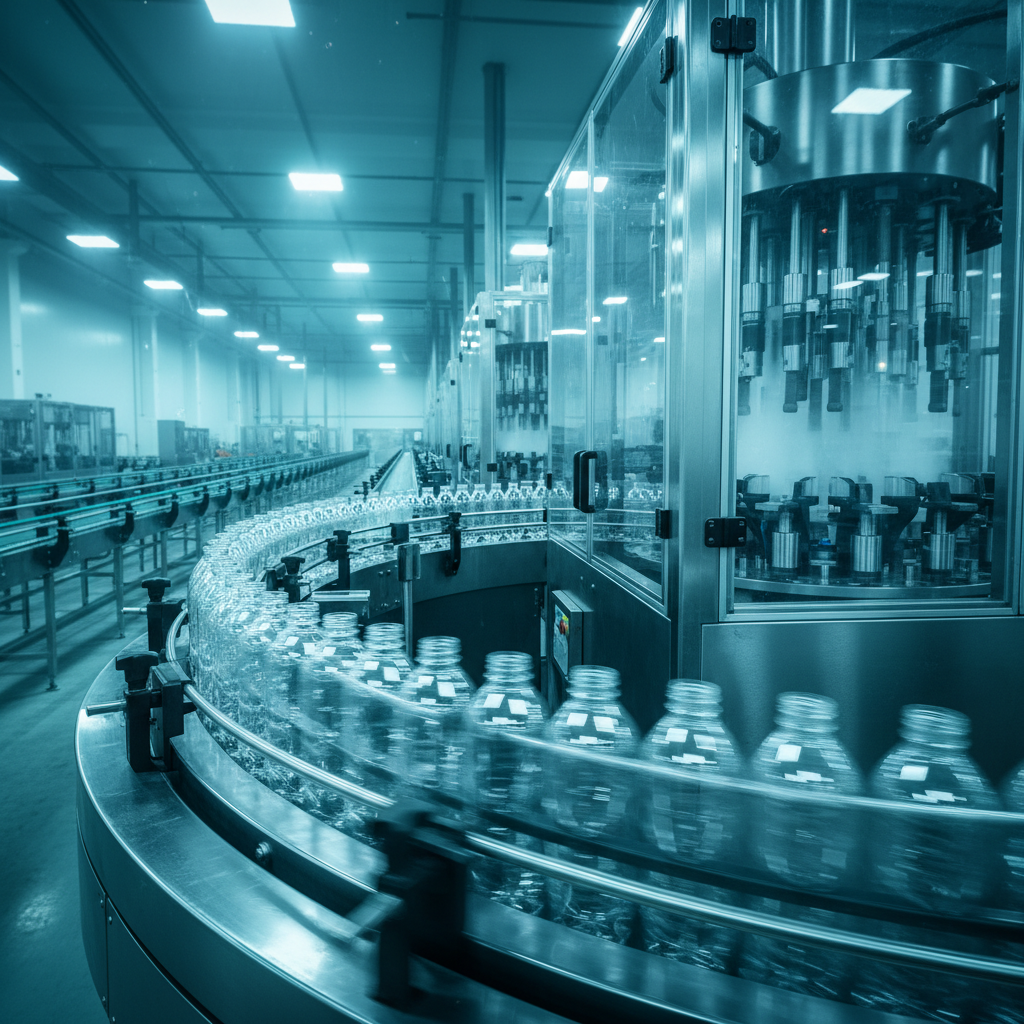
Food packaging machinery is an often-underestimated industrial category. It is nearly invisible in public view — every bottle of mineral water, every carton of milk, every bag of soy sauce on supermarket shelves is its product, but consumers only see the labels and never the spinning blow molder and filler that produces tens of thousands of bottles per hour. Yet in the 2025 China manufacturing landscape, food packaging machinery represents a hardcore equipment sector exceeding 125 billion CNY with growth persistently above overall manufacturing. It is one of the most complete localization narratives in China's equipment manufacturing of the past decade.
The National Bureau of Statistics defines food packaging machinery across five layers: container forming equipment (e.g., PET blow molders), filling equipment (counter-pressure fillers, aseptic fillers), labeling and coding equipment, secondary packaging (case sealers, shrink wrappers), and end-of-line palletizers with logistics automation. A complete liquid food packaging line typically chains these five layers into a fully-automated workflow from empty bottles to pallets. According to the China Packaging Federation, beverage filling lines account for 41% of the food packaging machinery market — the largest sub-segment.
Global Market at Around 58 Billion USD in 2025
Globally, the 2025 food and beverage packaging machinery market is roughly 58 billion USD (combined estimates from IMARC, MarketsAndMarkets, Mordor Intelligence). By 2030 this figure is expected to reach 77-82 billion USD, CAGR 6-7%. Extending the window to 2032, IMARC Group projects 115 billion USD optimistically. This growth significantly outpaces general machinery's 3.5-4.5%, driven by three forces: ongoing food industry buildout in emerging markets (Southeast Asia, India, Africa), the lightweighting and aseptic upgrade cycle in global beverage factories, and the recyclable material (rPET) compatible equipment refresh forced by Western regulations.
The China market is the most dynamic part of this global landscape. At about 125 billion CNY in 2025 (China Packaging Federation data), it breaks down into beverage filling lines ~51 billion, container blow molding ~22 billion, secondary packaging and palletizing ~28 billion, inspection ~9 billion, others ~15 billion. The market is large but unconcentrated: 2,100 enterprises above designated size, but the top 10 domestic firms only hold ~28% combined. This structure is fertile ground for dramatic localization narratives — any domestic leader's breakthrough in a key technical node can rapidly amplify share in the vast replacement market.
Exports: An 8.7 Billion USD Surge
Zooming out further, in 2025 another milestone for China's food packaging machinery was quietly crossed — exports reached 8.7 billion USD (China Customs, +14.3% YoY). The Nikkei Asia report of November 2025 stated it bluntly: "China's beverage equipment exports surpassed Italy to become the world's second-largest exporter." Second only to Germany, China climbed to the global second position in food packaging machinery exports. Destinations show a typical Belt-and-Road + emerging markets structure: Southeast Asia (Indonesia, Vietnam, Thailand combined 28%), Middle East (Saudi Arabia, UAE, Turkey 14%), Africa (Egypt, Nigeria, South Africa 11%), Russia (9%), India (7%), Latin America (Brazil, Mexico 6%). Western high-end penetration remains <5% — the hardest yet most imaginative bone to crack in the next stage.
Imports moved in the opposite direction: 3.2 billion USD in 2025, -5.7% YoY. This is direct evidence of localized high-end lines rapidly replacing imports. Combined, net exports surpassed 5 billion USD for the first time. Packaging machinery, historically a trade-deficit industry, officially became a trade-surplus industry.
Industry Growth at 8.4%, Above Manufacturing Average
The China Packaging Machinery Association's 2025 report shows 8.4% industry growth, far above national manufacturing average of 4.5%. This "water-level gap" reflects a simple fact: with downstream beverage, condiment, dairy, and medical-food factories still building and upgrading lines, packaging machinery as the core enabler captures the capex cycle. But a second-layer logic is also embedded — H1 2026 shows signs of downstream capex peaking (Nongfu Spring's FY2025 capex of 8.72 billion CNY was a historical peak; industry consensus is 2026 will not exceed it), so 2026 industry growth will fall from 8.4% to the 5-6% range. This pace judgment is the neutral expectation given by our institute after reviewing all industry financial statements and capacity expansion plans.
Focus of This Report
China's food industry is vast, but this report deliberately narrows focus. We do not cover beverage consumer markets (already a dedicated report) or beer/dairy consumer brands (also covered separately), but channel the report's energy into the packaging machinery value chain itself: upstream packaging equipment vendors, midstream PET blow molding and filling core processes, and downstream beverage and food factory capex rhythms. We systematically benchmark Krones (ETR: KRN), KHS, Tetra Pak, and Sidel's FY2025 performance against domestic leaders Tech-Long, Newamstar (300509.SZ), Truking (300358.SZ), Yongchuang Intelligent (603901.SH), Tanaka Seimitsu (300461.SZ). Finally, attention lands on the key localization nodes — 12,000 bph, 24,000-48,000 bph, 60,000+ bph ultra-high speed — and on aseptic cold filling as the highest-growth sub-segment.
2. Equipment Categories: Five Stages from PET Blow Molding to Palletizing
Five Complete Production Stages
A modern liquid food packaging line, in process order, decomposes into five stages: container forming (blow molder) → filling (filler) → labeling and coding → secondary packaging (case sealer, wrapper, shrink film) → end-of-line palletizer and logistics. Each stage has its own equipment category, but high-end lines increasingly integrate multiple stages into a single "Block" machine (e.g., Krones Contiform 3 Pro combines blow molding, filling, and labeling into one machine) to minimize contamination and vibration during bottle transfer.
PET Blow Molding: Container Forming
PET blow molding is the starting point of any line. Preforms are produced by polyester resin injection molding — either by a dedicated preform injection facility or onsite. The blow molder then heats and stretch-blows the preform with high-pressure air into the final bottle shape. The core equipment is the Stretch Blow Molding Machine (SBM).
Process variants split into two-stage (preform and blow molding separate) and one-stage (preform and blow molding continuous). Two-stage dominates the mainstream: preforms can be produced in dedicated facilities or sourced externally, then heated and blown at the bottling plant; advantages are long-distance preform transport and centralized cost reduction; disadvantages are large preform storage footprint. One-stage performs injection and blowing continuously; advantages are reduced reheating energy; disadvantages are line rigidity and difficulty switching bottle types, mainly used for specialty bottles (cosmetics, skincare) in small batches.
By machine structure, blow molders split into rotary and linear types. Rotary blow molders are the industry mainstream — multiple molds arranged in a circle, preforms rotating through heating, blowing, and discharge in one workflow. Single-machine output reaches 12,000-90,000 bph, matching mass production scenarios. Linear blow molders arrange molds in a line, slower (typically 2,000-8,000 bph) but flexible, mainly for specialty or small-batch bottles.
China's PET blow molder speed tiers fall roughly into five: 12,000 bph (entry for small/medium beverage plants), 24,000 bph (mid-line mainstream), 36,000 bph (large beverage plant workhorse), 54,000 bph (top brand high-end), 72,000-90,000 bph (flagship ultra-high speed). Each tier carries different technical barriers and price gradients. Localization nodes are unpacked in Section 8.
Filling: The Liquid Injection Stage
Filling injects liquid food into containers — the core of the line and the stage with the most complex process and highest precision requirements. By liquid property, filling splits into four major types: carbonated, still, hot fill, and aseptic cold filling.
Carbonated Soft Drink Filling (CSD) is used for sodas, sparkling water, soda water. The core challenge is protecting dissolved CO2 from escaping during filling. The mainstream process is counter-pressure filling — the bottle interior is first equalized with CO2 to tank pressure, then liquid flows in at equal pressure, CO2 not escaping due to pressure drop. Typical speed 36,000-72,000 bph, suppliers include Krones Innofill DRV, Sidel EvoFILL Can, Tech-Long DCG series, Newamstar NMX-DCG series.
Still Filling is used for non-carbonated water, mineral water, juice, tea drinks. Process is simplest, gravity or slight positive-pressure filling; speed can reach 90,000+ bph, the highest single-machine throughput in the industry. Mainstream products include Krones Modulfill VFS, Sidel EvoFILL Glass, Tech-Long DCGF series.
Hot Fill is used for juice, tea, fruit-flavor drinks needing sterilization but not amenable to aseptic packaging. The route fills liquid at 85-92°C into bottles, the bottle self-sterilizing under high temperature, then rapidly cooling. This process requires special bottle material — Crystallized PET (CPET), high crystallinity, high temperature resistance, but heavy and limited lightweighting. Master Kong iced tea, Uni-President Assam milk tea, and Nongfu Spring Cha Pai initially used hot fill.
Beer Filling is a specialized form of carbonated filling. Beer is extremely oxygen-sensitive (any trace oxygen damages flavor), so multiple vacuum + CO2 displacement cycles precede filling. The entire process is long dominated by Krones and KHS, with only Lehui International (603076.SH) and Guangdong Pyrite domestically capable.
Aseptic Cold Filling is the most technically advanced and fastest-growing filling process, detailed in Section 3.
Labeling and Coding: The Identification Stage
Filled bottles need labeling for branding and coding for batch and expiration tracking.
Labelers split into hot melt OPP, self-adhesive, and shrink sleeve types. Hot melt dominates beverages with fast speed and low cost (per-bottle labeling cost <1 cent); self-adhesive offers higher precision and luxurious appearance, used for premium beverages and craft beer; shrink sleeve wraps 360° around the bottle, used for specialty bottles and high-end water with complex printing. Krones Sleevematic and KHS Innoket Neo are international mainstream; domestic leaders Newamstar and Tech-Long now rival international brands on speed.
Coding equipment is supplied by specialists. International leaders are Domino (UK) and Markem-Imaje (France). Domestic players include EBS and Huanuowei (Beijing). Coders are relatively low-priced but critical to line continuity — any coder failure halts the entire line, so reliability matters more than speed.
Secondary Packaging and Palletizing: The End-of-line Stage
After labeling, bottles enter secondary packaging. Equipment categories include:
Case sealer: packs finished bottles into cartons and auto-seals. Corrugated cartons move along fixed axes, with tape or hot melt sealing top and bottom. Yongchuang Intelligent (603901.SH) is China's largest case sealer supplier.
Palletizer: stacks cased products onto pallets. High-level palletizers grab from above with robotic arms; low-level palletizers push from sides — high-level suits beverage cases, low-level suits multi-SKU food factories. Robotic palletizing relies on body robots from ABB, KUKA (acquired by China's Midea Group in 2016), FANUC, with packaging integrators completing assembly.
Wrapper: after palletizing, stretch film wraps the entire pallet to fix goods for transport.
Shrink wrap packer: bundles multiple bottles (6-pack, 12-pack) into one sales unit with heat-shrink PE film.
End-of-line logistics: includes AGV, AMR, and Automated Storage and Retrieval Systems (AS/RS). Yongchuang Logistics is the main domestic beverage end-of-line logistics supplier, with Wahaha, Master Kong, and Eastroc Beverage among customers.
Block Machines: Industry Integration Trend
After 2020, line integration ("blocking") became the most significant design trend in high-end production. Krones' Contiform 3 Pro launched in 2022 is the flagship — combining PET blow molding, filling, and labeling into one machine, with bottles moving from preform to labeled in a sealed clean zone. Total footprint shrinks by 40%, contamination risk drops sharply, line OEE jumps from traditional 75% to 85%+. Sidel Combi and KHS InnoPET BloFill follow the Block route. Domestic Tech-Long DCGF-Block and Newamstar NMX-Block launched from 2023, but stability above 36,000 bph still lags Krones.
3. Aseptic Cold Filling: From Hydrogen Peroxide to Electron Beam
Why Aseptic Cold Filling Matters
If PET blow molding determines container specs and the filler determines line speed, then aseptic cold filling determines product ceiling — whether the line can do premium preservative-free beverages, tea drinks, liquid dairy. This is China's most important process upgrade of the past decade and the fastest-growing sub-segment in food packaging machinery.
The core proposition of aseptic cold filling is: with liquid not undergoing traditional high-temperature sterilization (above 85°C), the product remains shelf-stable for ambient storage (typically 6-12 months). This requires "two clean and one sterile": liquid completely sterile before filling, bottles and caps completely sterile before filling, and filling environment in ISO 5 (Class 100) or higher cleanroom.
Compared to hot fill, aseptic cold filling has three advantages. First, product flavor — liquid does not undergo prolonged high temperature, so natural flavor and nutrients (vitamin C, polyphenols) preserve significantly better. Second, lightweighting — without high-temperature crystallization, regular PET (not expensive CPET) works, bottle weight drops 30-40%. Third, category boundary — many products impossible under hot fill (high-protein plant milk, preservative-free juice, ready-to-drink cold brew) commercialize only with aseptic cold filling.
The cost is also real. Single-line investment for aseptic cold filling is 2.5-3x that of hot fill at the same speed, energy slightly higher, with operator and maintenance cleanroom requirements a step above. This explains why before 2015 aseptic cold filling was rare in China, but by 2025 it is standard for new lines.
Liquid Sterilization: UHT
Liquid sterility in aseptic cold filling is typically achieved by Ultra-High Temperature (UHT). Liquid holds 137°C for 4 seconds (or 145°C for 2 seconds), killing all microorganisms, then rapidly cools to under 25°C and enters filling. UHT equipment uses plate heat exchangers and tubular heat exchangers. Sweden's Alfa Laval (STO: ALFA) is the global UHT leader with ~60% China share in 2025.
Bottle and Cap Sterilization: Four Process Routes
Bottle and cap sterilization is where process branching is most diverse and technology iterates fastest:
Hydrogen Peroxide (H2O2) was the mainstream pre-2015. 35% peroxide solution sprays bottles and caps, vaporized at ~75°C, contacting interior walls and killing microorganisms. Hot dry air then removes residual peroxide (residue <0.5 ppm). Examples: Krones Contipure AseptBloc (extensively deployed in Nongfu Spring's Oriental Leaves lines) and Sidel Combi PAA.
Peracetic Acid (PAA) is the Western alternative — faster (~30 seconds), higher efficacy (up to 6 log CFU), but slightly higher residue risk. Sidel promotes PAA in Western lines; China rarely sees it.
Electron Beam (E-beam) is the newest and most disruptive route. Electron beams (high-energy electrons, 80-100 keV) briefly (0.1-0.3 sec) bombard bottles and caps, breaking DNA and killing microorganisms. Advantages: no chemical residue, no heating energy, instant sterilization, bottle direct fill (preforms exit blow molder into electron beam zone with minimal distance). Challenges: equipment expensive (8-12 million CNY per system, 2-3x peroxide), electron beam sources (Crosslinker or EB-Tech) imported, strict radiation safety.
Electron beam was first commercialized by Sidel in 2014. Tech-Long achieved localization breakthrough in 2024, pushing system localization rate above 85% (beam source still imported). Genki Forest's Suzhou plant deployed Tech-Long's first electron beam aseptic cold filling line in H2 2024 — China's first domestic-vendor electron beam line commercial case.
Steam Sterilization is the older route, using overheated steam for brief high-temperature sterilization. Simple, residue-free, but high energy and long time (10-30 seconds). Used only for glass bottles (beer, condiments); PET cannot tolerate the temperature.
China Market: From 90 to 380 Lines
China's installed base of aseptic cold filling lines reached ~380 by 2025, up from ~90 in 2020 — CAGR 33%. This rate is nearly 4x the broader food packaging machinery growth (8.4%), the most striking sub-segment growth.
Driving this is downstream category renewal — Oriental Leaves (Nongfu Spring, exploded from 2020), Ranger (Genki Forest), Maitebei (CR Beverage), Outerspace Electrolyte Water (Genki Forest), and similar sugar-free teas and functional drinks all build on aseptic cold filling. Each new line means 45-140 million CNY in equipment orders — this is the past five years' golden expansion window.
Single-line Investment Math
Single-line investment for aseptic cold filling breaks down into orders of magnitude. At 48,000 bph, domestic full-line (blow + fill + label + secondary) quotes 45-75 million CNY, imported (Krones/Sidel) 98-140 million CNY — a 50-80% gap. Electron beam adds 30-40% over peroxide, but operational savings amortize the initial gap over 3-5 years.
Entering 2026, Tech-Long and Newamstar are both developing 60,000 bph aseptic cold filling lines. Tech-Long will deliver China's first 54,000 bph aseptic cold filling line to Nongfu Spring's Wuyishan plant in H1 2026 — a milestone confronting Krones/Sidel duopoly at high speeds head-on.
4. Major Players: Domestic Top Five and Global Big Four FY2025
Domestic Leadership Map
China's domestic competitive landscape can be summarized as "top five + many specialist niches." Top five: Tech-Long (PET filling line leader), Newamstar (300509.SZ, PET packaging and beverage downstream), Truking (300358.SZ, aseptic pharma packaging crossover into food), Yongchuang Intelligent (603901.SH, secondary packaging and palletizing leader), Tanaka Seimitsu (300461.SZ, food/pharma packaging integration). Around these five, niche specialists include Yapp Auto (603013.SH) in PET container material, Hangzhou Zhongya Machinery in liquid food aseptic packaging, Jingshan Light Machinery (000821.SZ) in carton packaging, and Lehui International (603076.SH) in beer filling.
Tech-Long
Founded in Guangzhou in 1991, Tech-Long is China's most senior and complete PET filling line vendor. By end-2025, cumulative delivery exceeded 3,500 full lines covering 70+ countries. FY2025 revenue ~2.8 billion CNY (+19%); net profit 210 million CNY; gross margin 28.6%. In December 2025, Tech-Long filed Hong Kong IPO prospectus.
Product matrix covers: DCGF still filler series, DCG carbonated filler series, DBT blow molder series, DCGF-Block integrated, DCGA aseptic cold filling. The 54,000 bph tier is the current high-speed mainstream, with the first 54,000 bph aseptic cold filling line delivery to Nongfu Spring's Wuyishan plant in H1 2026.
Customer list covers nearly every leading Chinese beverage brand: Coca-Cola China system (COFCO bottling and Swire Beverages), Pepsi China (Master Kong bottling), Nongfu Spring, Genki Forest, Eastroc Beverage, CR C'estbon, Master Kong, Uni-President, Huiyuan Juice, Dali Foods. Overseas export share is 38%, covering 70+ countries.
Capacity-wise, the company operates two production bases at Panyu (Guangzhou) and Gaoming (Foshan). H1 2026 launch of Gaoming new base (820 million CNY investment) targets annual PET line capacity of 150 — 1.6x current. This expansion is synchronized with the Hong Kong IPO progress, with proceeds primarily funding the new base.
Newamstar (300509.SZ)
Jiangyin-based Newamstar is the other domestic pole in PET packaging and beverage downstream. Founded in 1996, ChiNext-listed in 2016. FY2025 revenue 1.86 billion CNY (+15.4%), net profit 205 million CNY (+22.1%), gross margin 31.5% (+1.8 pct YoY). Growth rate, gross margin, and net margin all beat Tech-Long — the A-share benchmark in packaging machinery.
Business structure: PET packaging 64%, beverage downstream (labeling, packing, palletizing) 28%, paper-plastic 5%, others 3%. New-generation NMX-PT integrated blow-fill-cap (with capping) stably supports 48,000 bph; the 60,000 bph NMX-PT 90 series is in prototype testing.
Customer list overlaps with Tech-Long but tilts toward water and tea — primary domestic supplier to CR C'estbon for ultra-high-speed lines, single-line speed up to 72,000 bph. 2025 overseas revenue 740 million CNY (39.8% share); Southeast Asia is the core export market — Indonesia's largest mineral water brand Aqua (Danone) has fully switched to Newamstar PET full lines across multiple plants, a benchmark case of domestic brands gaining overseas share.
Capacity: 2025 Jiangyin Phase 2 plant entered operation, doubling annual PET line capacity from 80 to 160 — directly competing with Tech-Long.
Truking (300358.SZ)
Truking takes a unique "dimension-reduction" path — China's leading aseptic pharma liquid filler (global top 3), with main products in large-volume infusion aseptic filling, lyophilized powder filling, and glass aseptic filling. Pharma-grade aseptic naturally adapts to premium food applications — infant formula, medical food, sports nutrition.
FY2025 revenue 5.08 billion CNY (+11.7%), net profit 427 million CNY (+18.6%). Business structure: pharma packaging 58%, medical device packaging 22%, food packaging 12%, others 8%. Though food is only 12% (~600 million CNY), growth is fastest (+34%) and the most prioritized 3-year segment.
Truking's Changsha Huanghua hub Phase 2 entered operation in 2025 (1.2 billion CNY investment), doubling aseptic pharma line capacity. 6,200 employees — the largest domestic packaging machinery vendor by headcount. In 2025, Truking won the Nestlé Health Science China base medical food aseptic filling order — the first time a Chinese vendor entered a multinational food giant's special-food supply chain.
Yongchuang Intelligent (603901.SH)
Hangzhou-based Yongchuang is the absolute leader in secondary packaging and palletizing. FY2025 revenue 3.09 billion CNY (+13.5%), net profit 286 million CNY. Business structure: smart end-of-line packaging 78%, smart warehousing logistics 15%, others 7%.
Product matrix covers case sealers, wrappers, palletizers, AGV logistics — the chosen supplier for Wahaha, Master Kong, Uni-President, Tsingtao Brewery, Nongfu Spring, Haitian Flavoring, Yili at the secondary packaging stage. In palletizing robot integration, Yongchuang partners deeply with ABB, KUKA, FANUC, with localization rate higher than standalone robots.
2025 H2 Hangzhou Xiasha base launched expansion, +50% palletizer capacity. In H1 2026, Yongchuang announced Hong Kong secondary listing application to broaden funding channels.
Tanaka Seimitsu (300461.SZ)
Shaoxing's Tanaka takes a niche precision packaging path, specializing in tablet, candy, gum, and supplement blister and flow wrap. FY2025 revenue 842 million CNY (+8.9%), net profit 68 million CNY (-12.4%, dragged by new energy). Food packaging business (winding + integrated packaging) revenue 310 million CNY — the cashflow anchor.
Largest customer groups are domestic candy and supplement makers — Mengniu's milk tablets, Swisse China line, By-Health (300146.SZ) various supplements use Tanaka lines. The segment values speed less (typical 200-600 packs/min) but precision and form-factor flexibility highly — opposite of beverage's mass batch single-form needs.
Global Big Four FY2025
Domestic leaders' benchmark is the global big four: Krones AG (ETR: KRN), KHS, Tetra Pak, Sidel. They are both learning targets and replacement targets.
Krones AG (ETR: KRN): FY2025 revenue 5.32 billion EUR (+10.6%), EBITDA 521 million EUR, EBITDA margin 9.8%; order backlog 6.27 billion EUR — historical high. Business structure: beverage filling and packaging tech 76%, process tech 18%, oil/line integration 6%. China revenue ~450 million EUR (8.4% share). Flagship Contiform 3 Pro is a PET blow-fill-label blocked machine, up to 90,000 bph. HQ Neutraubling, Germany; 18,400 employees. At 2025 Capital Markets Day, Krones explicitly framed China as a "price war + high-end defense" dual-track market — 18% cut on 36,000 bph against domestic, 60,000+ premium pricing held.
KHS GmbH: Subsidiary of Salzgitter AG (German listed parent). FY2025 revenue 1.48 billion EUR. Mainstays include Innoket Neo labeler, InnoPET BloFill integrated, Innofill Glass DRS glass filler. HQ Dortmund; 5,100 employees. KHS' China presence trails Krones and Sidel, but holds barriers in glass bottle beer filling (Budweiser, Tsingtao premium lines).
Tetra Pak: Swiss Tetra Laval Group subsidiary, private. FY2025 net sales ~13.7 billion EUR (Tetra Laval consolidated). Food and beverage aseptic carton global share >70%; China revenue estimated ~2.2 billion EUR. Aseptic fillers A3/Flex and E3/Speed deployed across Yili, Mengniu, New Hope, Junlebao. Tetra Pak operates packaging-material plants in Foshan, Kunshan, Beijing; March 2026 Reuters reported announcement of Kunshan Phase 3 construction (1.2 billion CNY investment). Tetra Pak holds absolute dominance in liquid dairy and dairy-beverage aseptic carton filling — the field Chinese domestic vendors have yet to crack.
Sidel: French Tetra Laval Group subsidiary. FY2025 revenue ~1.8 billion EUR. Mainstays PET blow molder Sidel Matrix and EvoFILL filler; ultra-high speed up to 86,000 bph. Sidel's China PET beverage share once hit 35% but compressed to ~22% in the past five years by Tech-Long and Newamstar.
Second-tier Players
Beyond top five domestic and big four global, secondary players include: Italy SIPA (PET blow molding), Italy SMI (mid-speed cost-effective), Switzerland Bühler (powder food packaging), Switzerland Bobst (paper packaging post-press), Germany Heuft (bottle vision inspection), Germany Multivac (food vacuum + thermoforming). Heuft virtually monopolizes high-end Chinese beverage plant bottle defect inspection, with single units priced 800,000-1,500,000 CNY — the hardest end-of-line stage to localize.
5. Downstream Customers: Capex Rhythm from Nongfu Spring to Haitian Flavoring
Two-axis Customer Structure
China's downstream food packaging machinery customers can be deconstructed along two axes: by product category (beverage, dairy, condiment, snack, medical food) and by line technical grade (high-end aseptic cold filling, mid-PET filling, traditional glass filling, carton filling, solid food packaging). The intersection forms the customer matrix.
Nongfu Spring (HK: 9633)
Nongfu Spring is China's most important downstream customer for food packaging machinery, period. By end-2025, Nongfu Spring operates 12 production bases with ~86 filling lines. Among them, PET water bottle lines number 41, divided among Tech-Long, Newamstar, and Krones; tea drink (mainly Oriental Leaves) aseptic cold filling lines 27, divided among Tech-Long, Krones, and Sidel. The remaining ~18 are CSD, juice, and other category fillers.
Nongfu Spring FY2025 revenue 52.55 billion CNY (+22.5%) — first crossing 50 billion; attributable net profit 15.87 billion CNY (+30.9%). Fixed asset investment 8.72 billion CNY, of which 2.35 billion CNY (27%) went to filling line equipment — a notably high ratio in beverages, reflecting "equipment first, product later" expansion philosophy. Tea drink (Oriental Leaves) explosive growth (revenue 21.6 billion CNY, +29%, first surpassing water as the #1 revenue segment) directly drives continued heavy investment in aseptic cold filling lines.
In H1 2026, Nongfu Spring's Wuyishan plant will receive Tech-Long's first 54,000 bph aseptic cold filling line. A landmark for Tech-Long and the entire domestic aseptic cold filling segment.
CR C'estbon
CR C'estbon (China Resources Beverage, HK-listed 2024) is the domestic #2 in packaged water. 13 production bases, 70+ filling lines. Newamstar is the largest domestic supplier, offering ultra-high-speed PET water lines up to 72,000 bph. 2025 added 9 new lines, capex 2.86 billion CNY.
But 2025 saw pressure on C'estbon — pure water share halved from 70% to ~40% (hit by Nongfu Spring's Green Label water), H1 2025 revenue 6.2 billion CNY (-18.5%), net profit 823 million CNY (-28.7%). Under this pressure, 2026 capex pace slows — new lines from 9 in 2025 to 4-5 expected in 2026.
Genki Forest
Genki Forest is the benchmark for China's electron beam aseptic cold filling. The company operates owned plants in Suzhou, Zhaoqing, Xianyang, and Anhui — rare among new-brand beverage names with full owned capacity. In 2024 Suzhou deployed Tech-Long's first electron beam aseptic cold filling line — China's first domestic-vendor commercial case. Genki Forest's "electron beam + aseptic" process is also a differentiating sales point — sparkling water, Ranger, Outerspace Electrolyte Water all run aseptic cold filling, enabling the "0 preservatives" narrative.
Eastroc Beverage (605499.SH, 09980.HK)
Eastroc FY2025 revenue 20.88 billion CNY (+31.8%), net profit 4.42 billion CNY (+32.7%). Eastroc Special Drink 15.6 billion CNY (+17.25%) holds #1 energy drink share. Eastroc Hydration (electrolyte water) 3.27 billion CNY (+119%) — the fastest-growing #2 SKU.
To support this growth, the company runs 8 owned production bases with ~36 PET filling lines, split nearly evenly between Tech-Long and Newamstar. In 2026 Eastroc is building new bases in Shenzhen and Chongqing, expected to add 10+ filling lines — among the most important order sources for domestic leaders in 2026.
Yili and Mengniu (Liquid Dairy)
Yili (600887.SH) and Mengniu (HK: 2319) are China's twin liquid dairy giants. Liquid milk aseptic carton lines dominate, with Tetra Pak and SIG Combibloc combining for >80% share at both companies. This is the area domestic vendors have yet to breach — liquid dairy aseptic carton's core tech (aseptic paper composite material + Block integrated filling) has been monopolized by Tetra Pak and SIG for 60 years.
But in ambient yogurt, PET bottle packaging's rise offers domestic vendors an entry point. From 2023, Yili's ambient yogurt (e.g., Anchor) partial lines switched to Tech-Long PET full lines — first substantive domestic breakthrough in liquid dairy. Mengniu's Pure Zhen series also began trying domestic PET filling solutions.
Haitian Flavoring (603288.SH)
Haitian (FY2025 revenue 26.8 billion CNY, condiment leader) sources soy sauce PET filling lines primarily from Newamstar and Tech-Long. 2025 Gaoming Phase 2 added 12 PET lines. Soy sauce filling is slightly slower than beverage (typical 24,000 bph) but more demanding on acid resistance and seal integrity. Domestic localization rate exceeds 90%.
Fuling Zhacai (002507.SZ)
Fuling Zhacai uses bag vacuum packaging machines primarily, with Yongchuang Intelligent the largest secondary packaging supplier. Speed and cleanliness needs are relatively low, but line flexibility (small-batch multi-SKU) is high. Fuling's annual new flavors (spicy-sour, mala, seaweed) all require quick line adjustment, with Yongchuang's smart system supporting <30 minute changeover.
Coca-Cola and Pepsi China
Coca-Cola China consists of COFCO Bottling and Swire Beverages, jointly running ~38 production bases with 200+ filling lines. Historically Krones and Sidel dominated supply, but from 2023, Tech-Long broke into the Swire system, supplying 4 36,000 bph CSD lines to Swire's Shantou and Xiamen plants. The first substantive entry of domestic CSD filling lines into a multinational beverage giant's China system.
Pepsi China is led by Master Kong Bottling with lines across 28 plants. Pepsi China's supplier base is more dispersed; Newamstar and Tech-Long both have coverage but trail Krones and KHS in share.
2026 Capex Outlook
Comprehensive view on 2026 downstream customer capex: beverage industry overall capex retreats 8-12% from 2025 historical peak — Nongfu Spring, CR Beverage, Eastroc all built or under construction with extensive new capacity, so 2026 expansion appetite cools. Food factories (Haitian, Zhacai, condiments) hold modest 5-8% growth. Liquid dairy flat-to-weak (Yili Mengniu ambient milk growth slows). Net judgment: packaging machinery 2026 order side sees "head brand deceleration + second-tier brand pickup" structural shift; if domestic vendors break into second/third-tier brands (Heytea, Nayuki, Luckin supply chains) they still have 5-8% growth space.
6. High-End Stages: Engineering Barriers in Ultra-High Speed PET, Lightweighting, and Multi-layer
Three Main Lines
Domestic high-end breakthroughs concentrate on three lines: ultra-high speed 60,000+ bph PET full lines, bottle lightweighting (especially 500ml mineral water bottle weight reduction), and multi-layer coextrusion PET bottles (for beer and long-shelf-life juice). Each line carries an engineering barrier set distinguishing "can do" from "does well."
Ultra-High Speed 60,000+ bph PET Lines
Ultra-high speed PET full lines are the "premium club" set by Krones, Sidel, KHS over the past decade. "60,000+ bph" means single blow molder or single filling line steady output over 8 hours. Difficulty rises nonlinearly — from 36,000 to 60,000 bph, molds go from 16 to 24 cavities, each cavity's pressure balance, temperature uniformity, mold life coordination must be redesigned. Any one cavity fault rapidly cascades to slowdown or stop.
In 2025, Krones Contiform 3 Pro is the 90,000 bph flagship but with <30 units deployed globally. Sidel Matrix 60,000 bph has more deployments, mostly Western and Middle East. KHS InnoPET BloFill 60,000+ runs stably.
Domestic breakthroughs: Newamstar NMX-PT 90 series finished prototype testing in 2025, theoretical 60,000 bph, but no scale commercial use yet. Tech-Long's H1 2026 first 54,000 bph aseptic cold filling line to Nongfu Spring Wuyishan is the first domestic full-line at customer site. From 54,000 to 60,000+ bph remains one engineering threshold; Tech-Long and Newamstar expect to cross in H1 2027.
Bottle Lightweighting: 500ml Water Bottle Battle
PET bottle lightweighting is critical for material conservation and decarbonization. A 500ml mineral water bottle weighed ~16g in 2010; the 2025 international record is 7.5g (Sidel-Nestlé co-developed); domestic record is 9.5g. From 16g to 9.5g, single-bottle material drops 40%; against China's annual ~180 billion packaged water bottles, this equals ~1.17 million tons PET annually saved and ~3.2 million tons CO2 reduced — a hidden mega-game in industrial decarbonization.
The engineering challenge: weight reduction cannot affect rigidity (consumer "soft" feel), neck strength (no slumping at capping), or stacking strength (no crushing in storage and transport). This requires precise wall thickness distribution in PET preform during blowing — sidewall thin, neck and shoulder thick, base pattern preserved for load. The core process is "Optimized Preform Design + Variable Stretch Blow Molding" — distribute material upstream at preform design, with differential stretch ratio and air pressure during blowing. Sidel and Krones lead on lightweighting due to deep mold flow simulation; Newamstar and Tech-Long introduced digital twin simulation in 2024-2025 to catch up.
Multi-layer Coextrusion PET
Barrier PET bottles (Multilayer PET) are used for beer, juice, sports drinks sensitive to oxygen and CO2 permeation. Standard PET oxygen permeability is ~10 cm³/m²·day·atm — beer shelf life only 4-6 months. Multi-layer PET inserts EVOH or PA barrier layers between PET, dropping oxygen permeability below 1 cm³/m²·day·atm and extending shelf life to 12+ months.
Engineering difficulty lies in multi-layer process consistency — 3- or 5-layer requires precise matching of each layer's thickness, viscosity, temperature; any small fluctuation causes bottle defects. Yapp Auto (603013.SH) joint development with Newamstar on 5-layer coextrusion in 2025 is the key node for domestic mass production. Representative applications include Anheuser-Busch InBev China's PET beer bottle (8% of canned beer share) and CR Snow's PET large beer bottle.
Digital Twin and OEE Optimization
After 2024, line digital twin and OEE optimization became new high-end focus. Krones Share2Act and Sidel Evo-ON platforms deploy sensors on each machine, build cloud digital twin models for the line, predict failures, and optimize parameters.
OEE measures combined line efficiency — Availability × Performance × Quality. Traditional PET line OEE is ~75%; with digital twin, Krones Share2Act helped European customers reach 85%+, meaning the same line produces 13% more. This is digitization's most direct value realization in heavy assets.
Domestic vendors started late but catch up fast. Yongchuang's OEE system deployed at Wahaha's Hongsheng plant in 2025; Newamstar's NMX-Cloud already connects 30+ customers. This space localizes faster than hardware — software ability and data accumulation are the keys.
High-End Localization Barriers
Localization breakthrough pace: 60,000+ bph by H1 2027; lightweighting (≤8.5g 500ml bottle) mass production by 2027; multi-layer mass production ramp from 2026; digital twin and OEE platforms reaching international parity 2025-2026. By 2028, Chinese domestic vendors will have hard competitive ability across most high-end stages — but soft ability (brand, customer trust, global service network) remains a longer journey.
7. Platform Perspective: Filtering Beverage and Food Factories by Process
Why "Find Factories by Process" Is a Real Problem
Switching perspective from equipment vendor and downstream brand to a completely different role — a PET resin producer, a PETG label film converter, a hop trader, a bottle cap molder — their salespeople face one fundamental question every day: which factories are my potential customers?
Asking "which are beverage factories" is not hard — Nongfu Spring, Coca-Cola, Eastroc public addresses are in annual reports. But that is far from enough. A PETG shrink film salesperson really cares about "which factories use shrink sleeves," because only sleeve users buy their product. A PET preform salesperson cares about "which factories use 24,000 bph blow molders, with what monthly preform tonnage." An aseptic filling spares salesperson cares about "which factories use peroxide aseptic, which use electron beam, which use Krones, which use Tech-Long."
These dimensions barely exist in traditional industry & commerce databases. The XX Cha and XX Tian Yan Cha databases use business license data — they can tell you company name, registered capital, legal rep, founding date, but not "what process this factory uses," "what its capacity is," "PET or glass line." This data gap is the biggest pain point in B2B sales.
Platform Introduction
Tianxia Gongchang is a B2B platform with 4.8 million in-production factories. Unlike XX Cha and XX Tian Yan Cha — whose databases use business registration data covering all China entities (~58 million) but cannot distinguish "is this a factory," "what does it make," "what is its process grade" — our platform's differentiation lies in source data: all 4.8 million entries are verified in-production manufacturing entities (excluding pure traders, shell companies, research institutes, offices), structurally tagged by product category, process step, capacity tier, geographic distribution, and customer case. This is a factory index built for B2B salespeople.
Mapping to the food packaging machinery value chain, the platform offers several filter dimensions:
First, by product category — find soy sauce factories, pure water factories, juice factories, beer factories, infant formula factories. Each category yields a complete list from top brands to mid-tier players.
Second, by process grade — find factories already deploying aseptic cold filling, factories using hot fill tea drink, factories using counter-pressure filling carbonated. Critical for PET preform sales, fill valve spare sales, label film sales.
Third, by secondary packaging capability — find factories with palletizing capability, factories using wrappers, factories with AGV logistics introduced.
Fourth, by capacity tier — find annual 100B+ bottle giants, 10-30B bottle mid-size, 1-10B regional players.
Fifth, by geography — find Guangdong beverage factories, Yangtze Delta food factories, Southwest condiment factories, overseas partners (Southeast Asia, Middle East).
A Concrete Scenario
Imagine a PET preform factory in Huzhou, Zhejiang, with 500K-ton annual capacity, looking for new customers. Its salesperson can on the platform:
- Search "beverage preform" + capacity tier filter, pulling Yangtze Delta range potential buyers
- Add "aseptic cold filling" process filter, since aseptic uses 30g- mid-neck preforms matching the supplier's products
- Add ">3B annual bottle output" capacity threshold to exclude small customers
- Get a precise list with factory addresses, contacts, capacity, and main equipment brands of potential customers
This "find factory by process" ability is what no traditional database can do — it is not a "find company" tool but a "find industrial entity and filter by manufacturing capability" tool. This is the essential product positioning difference between our platform and XX Cha or XX Tian Yan Cha.
Threshold and Ecosystem Value
Returning to the report's main perspective — equipment vendors themselves (Tech-Long, Newamstar, Yongchuang) are also typical platform users. Their salespeople need to find not "beverage brands" but "factories with similar-scale lines considering next-round upgrade." A salesperson visiting 5-8 prospects weekly, with precise filtering, can lift conversion from 5% to 20%+ — the core source of B2B sales productivity gains.
More broadly, each PET filling line and each aseptic cold filling machine deployment comes with 5-10 years of spare parts replacement, upgrade, expansion advisory, training. This long-tail value far exceeds initial equipment sales. The platform's equipment vendor customer case library lets B2B salespeople match customer demand and own supply more precisely. This supply-demand matching is the China manufacturing B2B chain segment with the most efficiency improvement headroom.
8. Localization Nodes: 12,000 bph Done, 60,000+ Still Pending
Five Speed Tiers
China's food packaging machinery localization is not a single-stroke story but a tier-by-tier gradual breakthrough. Past 15 years split into five phases:
Phase 1 (Pre-2010): 12,000 bph done. Small/mid beverage factory standard. Pioneers Tech-Long and Newamstar early-stage.
Phase 2 (2015-2018): 24,000 bph done. Mid-line mainstream. Domestic share rose from 40% (2015) to 80%+ (2018).
Phase 3 (2020-2024): 36,000-48,000 bph breakthrough. Big plant workhorse. Domestic share now ~70%.
Phase 4 (2025, ongoing): 60,000 bph prototype. Newamstar NMX-PT 90 prototype 2025; Tech-Long 54,000 bph aseptic cold filling H1 2026.
Phase 5 (2027+, future): 72,000-90,000 bph flagship. Currently Krones/Sidel/KHS oligopoly. Domestic prototypes expected 2027-2028; mass commercial 2030.
Export Localization
Export side has different dynamics. Southeast Asia (Indonesia, Vietnam, Thailand), Middle East, Africa, and new markets need cost-effectiveness, not extreme speed. Here domestic 24,000-36,000 bph offers 30-50% gap vs Krones/Sidel, plus faster delivery and more flexible local service — domestic now holds 60%+ Southeast Asia beverage equipment share. Indonesia Aqua (Danone) fully switched to Newamstar PET full lines; Vietnam Sabeco partial lines use Tech-Long CSD; Turkey Damla Su ordered 4 Tech-Long 36,000 bph lines in 2024.
Middle East and Latin America hold 30-40% domestic share. Western market still <5%, the hardest fortress to crack. Krones and Sidel's local service network, brand trust, compliance certifications (CE-PED, FDA) are the three moats. Catching up needs 5-10 years.
Critical Components Localization
Inside a PET filling machine, critical component localization varies. Servo motors (Siemens, Yaskawa) ~60% localization; filling valves (KSB, Spirax Sarco) ~70%; high-speed capping heads (Krones in-house, Arol) ~50%; bottle vision inspection (Heuft, Antares Vision) ~30%. These "bottleneck" components are the next focus for further opening Western markets in 2026-2030.
9. Capacity Expansion: 8 Billion CNY Tech-Long, 12 Billion CNY Truking, 5.6 Billion CNY Newamstar
Concentrated Expansion
From 2025 to early 2026, Chinese domestic packaging machinery leaders concentrated their next expansion round — large scale, short cycle, clear targets: seize the localization window and convert capacity lead into share lead.
Tech-Long Foshan Gaoming: 820 million CNY investment, H1 2026 start, 150 annual PET lines target — 1.6x current 90.
Truking Changsha Huanghua Phase 2: 1.2 billion CNY investment, 2025 entered operation, doubled aseptic pharma capacity.
Newamstar Jiangyin Phase 2: 560 million CNY investment, 2025 entered operation, annual PET lines from 80 to 160.
Yongchuang Hangzhou Xiasha: 2025 H2 start, +50% palletizer capacity.
Hangzhou Zhongya Xiasha Phase 3: 480 million CNY investment, 120 annual liquid food aseptic filling lines.
Expansion vs Downstream Mismatch
A subtle structural mismatch — domestic packaging machinery leaders concentrated expansion at the moment downstream beverage capex peaks and turns down. Nongfu Spring's FY2025 8.72 billion CNY capex is the historical peak, with H1 2026 expected -8-12% YoY. This "upstream expansion + downstream slowdown" could bring stage 2026-2027 mismatch — domestic leaders may face "new capacity built but downstream orders slowing."
Two offset factors: localization still has room — 36,000+ bph local share is only 70%, the remaining 30% is potential incremental localization; exports accelerating — Southeast Asia, Middle East, Africa, Latin America demand for domestic packaging machinery rapidly expanding. These two factors' offsetting strength is the core variable in 2026-2027 domestic leader performance.
Capital Market Relay
The "confidence" behind domestic leaders' expansion comes from capital markets. Tech-Long filed Hong Kong IPO December 2025; Yongchuang Intelligent H1 2026 Hong Kong secondary listing; Newamstar (300509.SZ) and Truking (300358.SZ) use cashflow and bank credit. Capital relay funding gives expansion lower-cost financing — an implicit advantage over international giants (Krones' expansion is constrained by parent finance).
10. Price Cycle: 2024 Bottom, H1 2026 Mild Rebound, Krones 18% Counter-Cut
2023-2024 Down Cycle
2023-2024 was the Chinese PET filling equipment down cycle. Downstream beverage capex hadn't fully restarted after pandemic, packaging machinery vendors had to discount to consume orders. Specific: Tech-Long 36,000 bph quote dropped from 18 million (2023) to 14.2 million CNY (2024), -21%. Newamstar similar -18%. Local vendor gross margins under pressure; Newamstar 2024 margin -2.3 pct YoY.
H1 2026 Mild Rebound
In H1 2026, equipment unit prices began modest rebound. Steel, servo motors, PLCs all rose 7-12% in Q4 2025, raising total cost. Domestic vendors can no longer concede price like 2024. But rebound limited — downstream capex peaking + Krones counter-cut pressure leaves vendors preferring differentiation (higher speed, aseptic cold filling, multi-layer) over across-the-board price hikes.
Krones' Precision Counter-Cut
Q4 2025 Krones cut China 36,000 bph by 18% — the most aggressive cut in 10 years. Not blanket (90,000 bph flagship held), but precision targeting domestic vendor's strongest speed tier. Post-cut, Krones quote dropped from 28 million to 23 million CNY; gap to Tech-Long's 14.2 million CNY narrowed from 97% to 62%.
Strategic intent clear: hold customer "mental anchor" — as long as Krones price isn't crazy higher than domestic, downstream beverage brand "international brand = more reliable" inertia leads them to keep choosing Krones. This is the international giant's "local price war" in China, delaying localization by 1-2 years.
Domestic vendor response splits. Tech-Long doesn't follow at 36,000 (gross margin priority), shifts focus to 54,000 bph aseptic cold filling to gap-widen. Newamstar follows at 24,000-36,000 to lock second-tier customers. Both strategies have merit — the market winner reveals in 2026-2027 as customers choose.
Customer Capex Dual-track
Downstream customer capex shows clear "dual-track" differentiation.
Beverage dual-track: Nongfu Spring, CR Beverage, Eastroc — all hit 2025 capex historical highs, 2026 H1 expected -8-12% YoY. But second-tier brands (Heytea, Nayuki, Luckin supply chains, Genki Forest, Mixue supply chains) capex still grows — domestic vendors' marginal new orders.
Food dual-track: Haitian, Qianhe Flavoring (603027.SH) maintain mild 5-8% growth in 2026 capex; Fuling Zhacai, Anjoy Foods (603345.SH) flat-to-weak. Two tracks require differentiated packaging machinery vendor approach.
Import Equipment as Price Anchor
Krones Contiform 3 Pro 36,000 bph current quote ~28-32 million CNY (post-cut ~23-26.5 million), still 1.6-1.8x domestic. This gap is the core driver of localization and the room for domestic profitability. If Krones cuts further in 2027 (say -15%), gap narrows to 30-40%, weakening localization's economic driver — "brand trust" and "service capability" become critical non-price levers.
11. Policy Drivers: Dual Carbon + Food Safety Law + rPET Food-Grade National Standard Triple Resonance
Lightweighting and rPET Under Dual Carbon Goals
China's dual carbon goals bring two structural drivers to food packaging machinery: bottle lightweighting (material savings) and rPET food-grade bottles (circularity).
Lightweighting policy comes from 2023 implementation of "GDP CO2 intensity reduction" mid-long-term goals and explicit "plastic reduction" guidance for packaging. 500ml PET water bottle 16g to 9.5g, against China's annual ~180 billion packaged water bottles, equals ~3.2 million tons CO2 annual reduction. Core lever for policy push.
rPET (food-grade recycled PET) policy breakthrough: December 2025 China's State Administration for Market Regulation formally approved rPET for food packaging, new national standard GB 4806.7-2025 took effect. Previously China prohibited recycled PET in direct food contact (food safety concern); rPET food packaging only used outside beverages (cosmetics, detergents). New standard means beverage plants can start trying recycled PET in a closed loop — recycle, wash, repelletize, re-blow.
Food Safety Law 2024 Revision
China's Food Safety Law 2024 revision explicitly mandates aseptic filling for infant formula and medical food. Directly drives related category equipment upgrade — liquid infant formula (China market analog of Similac) starting to emerge requiring pharma-grade aseptic; medical food (medical nutrition for diabetes, kidney disease, oncology) market rapidly expanding with Nestlé Health Science, Abbott, Nutricia (Danone), domestic Shengtong Medical Food all building China bases.
Truking's 2025 Nestlé Health Science China base order is the typical order pushed by this policy. Truking, as one of few domestic providers of pharma-grade aseptic filling, sits in a favorable position in the "special-food aseptic" wave.
Smart Manufacturing 14th Five-Year Plan
The Smart Manufacturing 14th Five-Year Plan explicitly lists packaging machinery as high-end equipment localization priority. Direct impacts: leader R&D expense deductions increased; local government 5-10% capex interest subsidies on domestic capacity (Foshan, Changsha, Jiangyin all provide); IPR collaboration project support (South China University of Technology, Jiangnan University, Changsha University of Science and Technology food equipment labs all receive dedicated funding).
These supports are relatively low-key but persistent implicit subsidies. Domestic vendor R&D intensity reached 6.8% in 2025 vs 4.2% in 2020, with policy driving substantial part.
Export Rebate and CBAM Bidirectional
2025 packaging machinery export rebate maintained at 13%, an important component of export profits. 8.7 billion USD export equals ~12 billion CNY rebate income.
Reverse risk from EU CBAM 2026 H1 evaluation extending to packaging machinery scope. CBAM core mechanism levies "carbon tariffs" on high-carbon goods entering EU. While packaging machinery not in initial scope, upstream steel and servo motors carbon-taxed indirectly raises export-to-EU costs. Long-term unfavorable factor for China's Western packaging machinery exports.
12. Institute Judgment: Mid-market Full Localization in 3-5 Years, High-end Awaits 2027-2030 Breakthrough
Overall Institute View
Tianxia Gongchang Institute synthesizes 2025 industry data, domestic and international vendor financials, downstream capex rhythm, policy guidance, and tech evolution into the following neutral 3-5 year integral view. Neither "localization fully done" optimism nor "international giants unshakable" pessimism — structural analysis-based neutral expectation.
Three Core Conclusions
Conclusion 1: Mid-market (24,000-48,000 bph) achieves full localization in 3 years (2026-2028). The fastest-localizing speed tier, domestic share rose from 50% (2020) to 70% (2025); at current pace, 90%+ by 2028. Krones' Q4 2025 18% cut at 36,000 bph delays but cannot reverse the trend — domestic vendors' structural advantage in cost-effectiveness, delivery, and local service won't vanish with a single cut.
Conclusion 2: High-end (54,000+ bph aseptic cold filling) first localization in 5 years (2026-2030). Tech-Long's H1 2026 54,000 bph aseptic cold filling delivery to Nongfu Spring Wuyishan is the starting point. Validation typically takes 2-3 years to scale commercial; 2028-2029 domestic vendors should hold 30%+ at this tier. But 72,000-90,000 bph flagship — Krones/Sidel duopoly persists at least to 2030.
Conclusion 3: Liquid dairy aseptic carton (Tetra Pak fortress) and bottle vision (Heuft fortress) hard to crack short-term. Two areas international giants hold "niche" advantages. Tetra Pak's barrier comes from 60 years of paper-based composite material patent portfolio; Heuft's from vision algorithms and bottle database. Domestic breakthrough requires not "rebuilding a machine" but "rebuilding a tech ecosystem" — 5-7 year horizon minimum.
Industry Growth Rhythm Forecast
2025 China food packaging machinery growth 8.4%, 2026 expected drop to 5-6% (downstream capex peak), 2027-2028 recovery to 7-8% with export pickup, localization deepening, special food expansion. Three-year cumulative market from 125 to ~150 billion CNY. Export side 2026 expected 12-15% growth (base effect retreat), 2027-2028 hold 10%+, 5-year export breaks 15 billion USD.
Risk Reminder
Institute judgment must come with risk reminders. Main downside risks include: global beverage consumption slowing more than expected; Krones further aggressive cuts (say -15-20%) compressing local space; downstream brand self-development advancing fast bypassing some procurement; EU CBAM expanding or US tariff escalation hurting exports; domestic bulk material volatility eroding margins.
But upside risks also exist: rPET food-grade closed loop could push faster than expected; medical food and liquid infant formula could explode; Southeast Asia demand could exceed expectations; Western high-end market could see local breakthrough (e.g., Heineken Netherlands trying domestic PET beer lines). Any upside cashing in could push domestic leader performance beyond current expectations.
Key Timeline Nodes
Final key timeline nodes for the 5-year window:
- Q2 2026: Tech-Long delivers first 54,000 bph aseptic cold filling line to Nongfu Spring Wuyishan
- H1 2026: Tech-Long Hong Kong IPO listing
- H2 2026: Yongchuang Intelligent Hong Kong secondary listing
- H1 2027: First domestic 60,000+ bph commercial prototype delivery
- Within 2027: Food-grade rPET first scale commercial use in China beverage bottles
- 2028: Domestic vendor cumulative share above 90% at 36,000-48,000 bph
- 2030: Domestic prototype first at 72,000+ bph flagship tier
This timeline is the institute's neutral path from broad financial reports, policy, and tech evolution review. Any node advancing or delaying changes the overall localization rhythm — requiring continued dynamic tracking.
13. Risks: Triple Pressure of Downstream Slowdown, Foreign Giant Cuts, and Top-Brand Self-Development
Risk 1: Downstream Beverage Slowdown
2025 China soft drink growth 7.3%, 2026 H1 expected drop to 4-5%. Structural drop — slower population, consumption downgrade pressure, healthy drinks displacing sugary — not cyclical. Transmission to packaging machinery: downstream brand new-line appetite cools, existing-line upgrade desire holds, but single-equipment refresh cycle stretches from 8-10 years to 10-12 years.
Specific top brand: Nongfu Spring FY2025 capex 8.72 billion CNY historical peak, 2026 expected -8-12%; CR Beverage H2 2025 already actively slowed; Eastroc 2026 still has new bases but per-base smaller than 2025 Zhaoqing.
Bigger hit to domestic vendors than international — domestic customers highly concentrated in China (70-90% revenue domestic), downstream slowdown transmits directly to orders; Krones, Sidel's global customer distribution gives them less single-market dependence.
Risk 2: Foreign Giant Counter-Cut
Krones Q4 2025 China 36,000 bph -18% — most direct manifestation. Post-cut gap to Tech-Long's 14.2 million CNY narrows from 97% to 62%. If Krones continues 2026-2027 (say -10-15%), gap could compress to 30-40%. At that gap, domestic "cost-effectiveness" advantage starts yielding to "brand trust" and "service" disadvantage — downstream brands may swing back to Krones to de-risk.
Risk 3: Top-Brand Self-Development
Nongfu Spring and CR Beverage are the representative risk. Both started "equipment engineering departments" or similar internal R&D teams in recent years, aiming to self-develop on non-core processes (preform molds, fill valves, label heads). Limited impact on domestic packaging machinery vendors (core line integration still external), but direct competition with component suppliers (Hengli Hydraulic, Inovance servo).
More worth watching: some top brands could further internalize line integration. Genki Forest's Suzhou plant 2024 electron beam aseptic cold filling line had deep customization participation (joint development with Tech-Long). If Genki Forest, Nongfu Spring, CR Beverage all go "deep joint development" route, domestic packaging machinery vendor "standardized sales" model could face structural challenge.
Risk 4: rPET Closed-loop Execution
rPET food-grade national standard implemented December 2025, but execution risks remain. First, recycling — food-grade rPET requires "bottle-to-bottle" closed loop, cannot mix with cosmetics or detergents, requiring dedicated sorting lines, large investment, long cycle. Second, cost — food-grade rPET is 30-50% more expensive than virgin PET; downstream brands lack strong economic incentive to switch. Third, consumer perception — some consumers still psychologically resist "recycled PET in food," requiring substantial brand communication.
These mean rPET food-grade penetration in China will rise slowly (5% by 2028, 10-15% by 2030), no "policy out + market explosion immediately" story. Packaging machinery vendors betting on short-term rPET equipment order spike risk timing mismatch.
Risk 5: Currency and Material Price Volatility
H1 2026 EUR/CNY +4.3%, imported equipment costlier (boost to local replacement). But domestically-procured core components (Siemens servo, Yaskawa servo, KSB valves) also rise, squeezing margin. Net effect depends on local vendor import share — higher share, bigger negative exposure to currency.
Steel, servo motors, PLCs all rose 7-12% in Q4 2025, raising total cost. Relatively neutral cost factor — all players face same pressure, but thinner-margin vendors (Tanaka) feel more, fatter-margin (Newamstar) more cushion.
Risk 6: Southeast Asia Local Rise
China packaging machinery's biggest export threat is not Krones/Sidel but Southeast Asia local vendors' rise. India BEVCOTECH, Indonesia PT Mesindo, Malaysia PackMek leveraging low costs (labor 30-50% of China) and local-service proximity rising fast. Near-term Chinese vendors hold tech advantage, long-term Southeast Asia rise eats China export share.
Risk Aggregate Verdict
Aggregating six risks, the institute judges the China food packaging machinery industry's next 3-5 years remain in overall "growth > risk" structure. Downside risks exist but manageable; main risk points (downstream slowdown, Krones cut, top-brand self-development) already reflected in 2025 market behavior; 2026 likely "adjustment year" not "crisis year." Domestic leaders should not "defend by risk-avoidance" but "accelerate by innovation" — only by persistently breaking through in high-end tiers, new processes (electron beam, multi-layer), and new markets (medical food, Latin America and Africa beyond Southeast Asia) can they cross this risk cycle into the next growth window.
14. Data Sources and Further Reading
Primary Data Sources
Data in this report comes from the following public sources:
Company Annual Reports and Disclosures: Krones AG (ETR: KRN) 2025 annual report and 2025 Capital Markets Day investor materials; Newamstar (300509.SZ) 2025 annual report; Truking (300358.SZ) 2025 annual report; Yongchuang Intelligent (603901.SH) 2025 annual report; Tanaka Seimitsu (300461.SZ) 2025 annual report; Yapp Auto (603013.SH) 2025 annual report; Tech-Long Hong Kong IPO prospectus; Nongfu Spring (HK: 9633) 2025 annual report; CR Beverage 2025 interim report; Eastroc (605499.SH, 09980.HK) 2025 annual report; Haitian Flavoring (603288.SH) 2025 annual report; Yili (600887.SH) 2025 annual report; Mengniu Dairy (HK: 2319) 2025 annual report.
Industry Associations and Official Statistics: China Packaging Federation 2025 industry statistics report; China Packaging Machinery Association 2025 statistics report; China Customs trade data 2025; SAMR GB 4806.7-2025 standard announcement.
Research Institutions and Media: IMARC Group global food packaging machinery market forecast 2025; MarketsAndMarkets food packaging machinery market report 2025; Mordor Intelligence China food packaging machinery market report 2025; NielsenIQ China beverage market report 2025; iiMedia Research China soft drink market report 2025; Nikkei Asia 2025-11 packaging equipment export report; Reuters 2026-03 Tetra Pak Kunshan Phase 3 report; Bloomberg 2025 Krones investor day report.
International Peer Data: Tetra Pak / Tetra Laval Group 2025 financial report; Sidel public disclosures; KHS GmbH (Salzgitter AG subsidiary) 2025 financial report; Alfa Laval (STO: ALFA) 2025 financial report; SIPA company data; SMI company data; Heuft company data; Multivac company data.
Factory Index and Industry Database: The platform we operate covers 4.8 million in-production factories, and all category, process, capacity, and geography filtering in this report relies on its database. Unlike business registration databases that only tell you "what this company is called," our platform tells you "what products this factory makes, what process it uses, what capacity, what customer cases." This difference defines lead practical value in B2B sales. Downstream beverage and food factory filtering scenarios in this report can all be found via beverage factories, food factories, packaging factories, soy sauce factories, pure water factories, juice factories, beer factories, infant formula factories keyword pages.
Related Reports
The Chinese packaging machinery industry interfaces with many downstream and upstream categories; this report has covered core stages. The following are other related reports by our institute:
- China Beverage Industry 2026: panorama of eight sub-segments (packaged water, RTD tea, functional drinks, carbonated, juice, herbal tea, RTD coffee, freshly-made coffee/tea)
- China Beer Industry 2026: Qingdao, CR Snow, AB InBev three-giant landscape
- China Dairy Industry 2026: Yili, Mengniu, New Hope liquid milk and yogurt segments
- China Condiment Industry 2026: Haitian, Qianhe, Fuling Zhacai downstream capex rhythm
- China Robotics Industry 2026: palletizing and AGV logistics local robot replacement progress
- China PET Resin Industry 2026: Hengyi, Tongkun, Rongsheng upstream landscape
- China Multi-layer Barrier Film and Packaging Material 2026: PA, EVOH and PET composite packaging process evolution
Boundary and Position of Institute Judgment
This report's "institute judgment" is based on public data and modeled analysis, not constituting investment advice on any specific stock or bond. Readers using this report for decisions must self-assess and consult professional advisors. The institute has cross-validated data sources as far as possible, but public data itself can carry deviation or lag — any decision should reference latest company disclosure and official statistics.
This report's core position is to provide systematic industry perspective and data base for value chain stakeholders (equipment vendor salespeople, raw material salespeople, consulting advisors, brand procurement, policy researchers, capital market analysts). Tianxia Gongchang Institute will continue tracking key nodes in the China food packaging machinery industry, with thematic update reports at major changes (e.g., Tech-Long IPO completion, first 60,000 bph domestic line delivery, further Krones cuts).