
Chapter 1: Industry Overview – AI Power Demand Pushes Liquid Cooling Center Stage
2025 marks the inflection point at which China's data center cooling shifts decisively from air to liquid. The numbers tell the story: China's liquid-cooled data center market reached RMB 110.1 billion in 2024, with IDC and CCID Consulting estimates placing 2025 between RMB 149 and 160 billion, projecting RMB 310 billion by 2027 — a CAGR of 41% to 52%. Globally, market research firms put the 2025 worldwide liquid-cooled data center market at roughly USD 4.8 billion, with a projected 18% CAGR through 2035.
Penetration rates tell an even sharper story. China's AI data center liquid cooling penetration jumped from about 14% in 2024 to around 33% in 2025, with some hyperscale projects hitting over 60% liquid-cooled racks. Shanghai's computing infrastructure plan explicitly targets above 50% liquid-cooled racks for new builds in 2025. This means liquid cooling has shifted from a niche pilot to the default specification for new data centers. Beijing, Shenzhen, Guangzhou, Hangzhou, and Suzhou have written "default liquid cooling for new hyperscale facilities" into their regional computing plans in late 2025 — moving from encouragement to mandate.
Three drivers power this shift. First, rack power density. The NVIDIA GB200 NVL72 rack draws about 120 kW — equivalent to twelve traditional CPU racks combined — making air cooling physically impossible. Beyond GB200, new Huawei Ascend Atlas 900 racks exceed 80 kW, while next-gen Hygon, Cambricon, and Enflame accelerator cards all exceed 60 kW per rack. Second, policy red lines. The East-West Computing initiative requires new hyperscale data center PUE below 1.25 in eastern hubs and 1.2 in western hubs, while MIIT's Data Center Green Low-Carbon Plan further pushes new hyperscale PUE below 1.1 by end of 2025. Third, electricity bills. A 30 MW data center spends RMB 150 to 200 million annually on power; cutting PUE from 1.4 to 1.2 saves over RMB 20 million per year, with a three-year payback baked into the financial model alone.
Liquid cooling has gained ground in China faster than expected. From a hyperscaler pilot in 2023 to standalone line items in three major operator procurement in 2024, by 2025 cold-plate plus CDU coolant distribution units had become default for intelligent computing centers built by tobacco companies, banks, and central energy enterprises. Immersion cooling has rolled out at scale in intelligent compute clusters in Zhangbei, Hohhot, Guian, and Wuhu. Traditional IDC clients once skeptical of liquid cooling are now adopting at scale — all four major state banks have completed liquid cooling pipe pre-installation in their HQ data centers, State Grid's western data centers default to liquid cooling for new builds, and energy SOEs have deployed liquid-cooled intelligent compute centers at scale in Inner Mongolia, Ningxia, and Gansu.
Overseas trends move in parallel. Vertiv's 2025 fiscal year revenue hit roughly USD 10.2 billion, with liquid cooling growing 25% to 40%, and a USD 15 billion backlog almost entirely from AI data centers. Schneider Electric's data center business hit roughly USD 7.6 billion annually, and nVent unveiled new row-level and rack-level CDU + Manifold combinations at SC25. Boyd, CoolIT, and Asetek serve cold plate and rack components. Global majors now treat liquid cooling as the most certain growth segment for the next three years, with capex tilting heavily toward this line.
Chinese suppliers are keeping pace. Envicool 2025 revenue reached RMB 6.07 billion, up 32%; Shenling Environmental data center revenue reached RMB 4.21 billion, up 40%, with data services hitting 55.67% of revenue and ranked #1 in China's liquid-cooled data center market per CCID's 2024 report. Galaxy Industrial 2025 liquid cooling revenue is projected to exceed RMB 1.5 billion, up 200%, with liquid cooling rising from 32% to over 60% of total revenue. Tonfei, Luxshare, Jonhon Optronic, Easyflyer, Sugon, Inspur, Huaqin Technology and others compete across cold plate, CDU, UQD quick disconnects, manifolds, and integrated rack assembly.
Liquid cooling is less about cooling technology choice and more about a full reconstruction of data center energy, mechanical, electrical, and infrastructure systems. HVAC must be redesigned, power distribution recalculated, rack structure reassembled, operations retrained, and contingency plans rewritten. IDC integrators, operator procurement teams, central SOE data center prime contractors, and internet hyperscaler in-house teams are all rapidly absorbing this new playbook in 2025. Every chapter below traces some thread of this central narrative.
There's an undertold dimension here: midstream factory counts in the liquid cooling supply chain vastly exceed the visibility of brand-name vendors. Cold plate vacuum brazing, CDU plate heat exchangers, UQD precision injection molding, manifold stainless steel precision welding, vessel precision forming, and coolant chemical filling each draw on dozens to hundreds of specialized factories. The skill levels, capacities, certifications, and geographic distribution of these factories form the real foundation of the entire liquid cooling industry — but traditional commercial-registry databases miss this layer almost entirely. Chapter 7 explores this directly.
From a demand side perspective, liquid cooling customer segments showed clear stratification in 2025. Tier 1 includes top internet companies — Alibaba, Tencent, ByteDance, Baidu, Huawei Cloud, JD Cloud, SenseTime, Zhipu, 01.AI, Moonshot — requiring custom rack solutions with orders above RMB 50 million; margins are pressured but order stability is strong. Tier 2 is the three major telecoms — China Mobile, China Telecom, China Unicom — driving standardized rack procurement at scale via tender. Tier 3 is central SOE and regional intelligent compute centers — State Grid, Southern Grid, CNPC, Sinopec, FAW, Dongfeng — emphasizing domestic content and local service capability. Tier 4 is finance and traditional industries. Tier 5 is the standardized rack market targeting small and medium customers, just emerging in 2025.
Order delivery cadence in 2025 showed clear seasonality. Q1 saw order signing peaks but delivery troughs; Q2 and Q3 were delivery peaks; Q4 saw acceptance and collection. This produced V-shaped inventory and cash flow curves for leading vendors. In H2 2025, regional special-bond quotas tightened, pushing order deliveries 1 to 2 months later overall, and tested vendors' cash flow management. Industry credit terms commonly extended from 90 days to 120 days, with some mid-sized vendors hitting cash flow pressure.
Industry consolidation is accelerating. Envicool reportedly looks at acquiring a leading CDU control system supplier to round out software; Shenling explores joint ventures in Southeast Asia; Galaxy partners strategically with an EV thermal management vendor to share production capacity. Mid-tier consolidation rumors abound and small specialized cold plate makers may be integrated into leaders during 2026 and 2027.
Chapter 2: Technology Paths – Four Steps from Air to Immersion
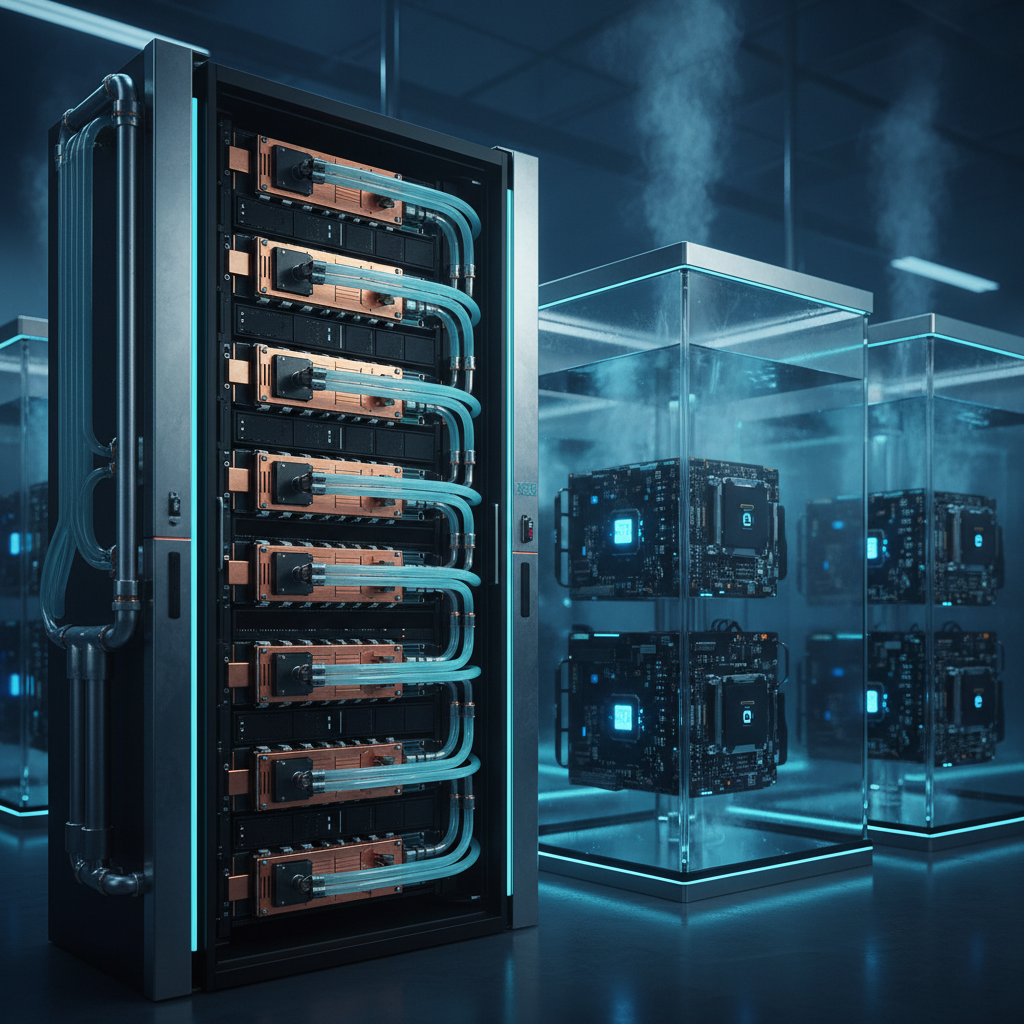
Data center cooling progresses through four steps: traditional air cooling, cold plate liquid, single-phase immersion, and two-phase immersion.
Step 1: traditional air cooling. HVAC blows cold air through raised floors into cold aisles, with return hot air looping back through HVAC. Single rack capacity is 8 to 12 kW with PUE typically above 1.5; legacy facilities run 1.7 to 1.8. This approach broke down in the GPU era — a single H100 server at about 8 kW consumes an entire rack's cooling budget. Air cooling still dominates China's installed base, with under 10% liquid-cooled in 2024, but new builds are now overwhelmingly liquid.
Air cooling itself has evolved. Rear-door heat exchangers, in-row cooling, and heat pipe assisted designs progressed substantially in three years. Rear-door units bring return air down from 40 °C to under 30 °C, supporting 25 to 35 kW racks. In-row units shorten the air path. These approaches extended air cooling life through the H100 generation but collapsed at GB200 NVL72.
Step 2: cold plate liquid cooling. Cold plates attach directly to CPUs, GPUs, and HBM, with secondary loops using 25% to 50% glycol-water carrying heat to CDUs and exchanging with primary loops through dry coolers or cooling towers. Single rack capacity runs 40 to 130 kW for cold plate racks, PUE 1.15 to 1.25. This is today's mainstream — China's cold plate market grows from RMB 12.7 billion in 2025 to RMB 27.7 billion in 2027, CAGR 47.7%.
Cold plate's advantage is low retrofit friction — existing facilities can replace racks in stages. Its disadvantage is residual air cooling needed for non-plate-covered components like disks, PSUs, NICs — HVAC cannot be eliminated. The secondary loop typically uses 25% to 50% glycol-water with biocides, corrosion inhibitors, and hard-water additives; operating temperatures 30 to 50 °C make vapor-phase concerns moot. A 100 kW cold plate rack uses about 200 liters of secondary fluid with about 20 liters annual top-up. Operations require only brief training.
Cold plate hydraulics define the engineering core. A GB200 GPU cold plate runs micro-channels 0.3 mm wide and 0.5 mm deep, vacuum-brazed between copper plate and cover. Channel topology — serpentine, parallel, radial — balances pressure drop, thermal resistance, and flow distribution. A GB200 plate can pack 2.5 meters of total channel length using enhanced surface structures to boost heat transfer. Achieving thermal resistance below 0.04 °C per watt determines whether the chip can sustain full load.
Step 3: single-phase immersion. Servers shed fans and submerge in dielectric fluorinated fluid or synthetic oil; the fluid carries heat by convection through Manifold piping without phase change. PUE drops to 1.05 to 1.1, single rack capacity exceeds 100 kW. Drawback: server maintenance requires lifting whole units to drain, raising operations difficulty, and constraining disk choices. Alibaba began single-phase immersion at scale at Zhangbei in 2018, and by 2025 this had become a default option in major hyperscaler intelligent compute centers.
Single-phase immersion fluid choices fall in two camps. Mineral oils or synthetic esters offer high density, high viscosity, low cost, and adequate dielectric performance — but require server board compatibility validation and exclude conventional HDDs. Low-viscosity perfluoropolyethers offer better performance at over 10x the price. Most Chinese vendors choose synthetic esters; Alibaba's Zhangbei case uses domestic synthetic oil, running eight years without major incident.
Step 4: two-phase immersion. Dielectric fluid boils at the chip surface, vapor condenses at the top condenser and gravity-returns liquid, with phase-change latent heat moving energy. PUE goes below 1.03. The pain point is coolant — historically dependent on 3M Novec hydrofluoroethers and Fluorinert PFAS. 3M's December 2022 announcement of full PFAS exit by end 2025 cliff-edged global supply. This stalled two-phase immersion industrialization for two years, with domestic substitutes only ramping in 2025.
Two-phase engineering challenges are an order of magnitude harder than single-phase. Condensers must maintain low-temperature zones at the top, with vapor liquefying and gravity-returning to bath. Boiling points must lock between 50 and 80 °C. Vessel pressure management retains slight positive pressure to block air ingress. Chip surface boiling transitions between nucleate and film boiling — film boiling forms insulating vapor layers that can burn chips — so heat sinks need enhanced surfaces directing nucleate boiling. These details make two-phase immersion stability far harder than single-phase.
The four steps don't simply replace each other. New intelligent computing center liquid centers favor cold plate plus some immersion in hybrid configurations. Existing retrofits go cold plate. Frontier racks reserve for two-phase immersion. No top-tier hyperscaler bets on a single approach. Alibaba runs all three approaches across Zhangbei, Heyuan, and Nantong; Tencent runs single-phase immersion and cold plate in Guian and Qingyuan; ByteDance uses air, cold plate, and immersion in Datong, Shanxi.
Workload characteristics also drive technology choice. Training workloads run sustained high power for weeks — immersion shines. Inference workloads are pulsed bursts — cold plate fits. Storage and network nodes are low power — air still works. A typical hybrid intelligent center pairs training racks with immersion, inference racks with cold plate, and storage/network racks with air, achieving overall PUE 1.15 to 1.25.
Geography also shapes path selection. Northern dry-cool climates favor free cooling, where cold plate plus dry cooler can hit PUE 1.2 alone. Southern hot-humid climates require cold plate plus cooling tower plus mechanical refrigeration. Inner Mongolia, Ningxia, and Gansu projects use 8 to 10 months of free cooling annually; Guangdong, Hainan, and Guangxi projects need year-round mechanical assist. Climate also affects tower vs. dry-cooler decisions — evaporative towers depend on wet bulb, dry coolers on dry bulb. Northern wet bulb is low so towers run efficient; southern wet bulb is high so tower efficiency drops. But southern water is abundant; northern water scarce. A 30 MW evaporative-cooled center uses 600,000 tons of water annually, with water costs 3% to 5% of operating expense.
Load factor changes the techno-economics. Persistent 90%+ load makes liquid cooling's efficiency advantage decisive; lumpy 50% to 60% load makes liquid's fixed capex per kW look high. AI training is high load; AI inference is bumpy; general compute is lowest. This shapes optimal configuration; operator standardized procurement may not fit every workload.
Retrofit scenarios are more complex. A 10-year-old facility's retrofit to liquid is bigger than expected — relaying floor piping, reconfiguring rack structure, redesigning HVAC, replanning power, adjusting fire suppression, upgrading sensors. Full retrofit takes 6 to 9 months at 70% to 80% of new-build cost. But for tier-1 city core sites, retrofit beats teardown. Retrofit typically chooses cold-plate-plus-air hybrid, replacing racks gradually without major structural changes.
The financial model also matters. A 30 MW cold plate center costs about RMB 1.2 billion upfront, RMB 2.2 billion 10-year total. Immersion costs RMB 1.8 billion upfront, RMB 2.5 billion total. Air costs RMB 900 million upfront, RMB 2.6 billion total. Cold plate wins on total cost, immersion second, air worst. This explains cold plate's dominance today.
Immersion gains as PUE redlines tighten. Pushing PUE below 1.1 expands immersion's total-cost advantage 5% to 10%, flipping from second to first. Beyond 2028, some new hyperscale projects may default to immersion.
Chapter 3: Engineering Moats – Cold Plate, CDU, Secondary Loop, Coolant, Quick Disconnect, Manifold
A liquid cooled rack splits roughly 41% cold plate, 32% CDU, 14% UQD, 13% manifold by value, plus coolant, seals, sensors. Engineering moats and domesticization differ across components.
Cold plate is the deepest moat. A GB200 Blackwell GPU plate removes 1200 W from a 70 mm square area; internal channels 0.3 mm wide and 0.5 mm deep are vacuum-brazed between copper base and cover. Hydraulic design, surface enhancement, full-plate weld yield — any failure means leaks. Domestic suppliers include Envicool, Galaxy, Sugon, Luxshare, Shenling, with copper brazing line construction taking 12 to 18 months.
Cold plate manufacturing details define yield. Vacuum brazing temperature must stay within a 10 °C window around 800 °C; braze foil 50 microns thick evenly applied; vacuum atmosphere 10^-3 Pa or lower. A plate carries 200+ micro-channels; any blockage overheats the chip. Quality control combines X-ray, pressure test, and flow distribution scan; leading vendors hit over 95% yield; second-tier 80% to 90%.
CDU is the secondary loop's heart. Rack-level CDUs run 100 to 300 kW for CDU100kW typical capacity; row-level 800 kW to 1.5 MW; centralized 4 MW+. Core parts: plate exchanger, circulating pump, variable-frequency drive, differential-pressure valve, expansion tank. High-end variable pumps are the slowest domestication step — in 2025 about half of premium specs still depend on Grundfos, ITT, SPX.
CDU engineering challenges concentrate in control systems. A 4 MW CDU manages primary outlet temp, secondary outlet temp, secondary flow, pump speed, pressure differential — over a dozen variables. Strategies must rebalance within seconds when compute load jumps from 30% to 90%, or chip temps spike 5+ °C. Domestic CDU control algorithms are catching up fast; 2025 saw domestic CDUs entering top operator procurement.
The secondary loop pipework looks simple but holds traps. Running 30 to 50 °C in long-term contact with glycol-water, metal must be 316L stainless steel or copper — no plain steel or aluminum. Every weld, valve, flange must hold for years. Fewer than ten Chinese engineering firms supply this grade of piping reliably. Designs must handle thermal expansion, vibration, insulation, and corrosion.
Coolants split two ways. Cold plate uses glycol-water with biocides, corrosion inhibitors, hard-water additives — domesticized long ago. Immersion coolants are the real bottleneck. Single-phase uses mineral or synthetic ester oils; two-phase requires electronic fluorinated fluids meeting five constraints: high density, low surface tension, dielectric insulation, chemical inertness, controlled boiling point. Historically only 3M could deliver; by 2025 only Capchem fluorinated fluid (Capchem) and Juhua produce in batch quantities domestically.
UQD universal quick disconnects link server nodes to manifolds. A GB200 rack uses 100+ UQDs; each must zero-drip-disconnect, last 5000+ cycles, with low pressure drop and high flow. Overseas leaders are Stäubli, CPC, Parker. Chinese leaders are Jonhon Optronic and Easyflyer; in 2025 Jonhon achieved NVIDIA UQD and MQD certification, and Luxshare gained UQD certification, entering NVL72 supply chains.
UQD engineering centers on seal and poppet design. Seal materials use fluororubber or silicone, requiring stable performance below 60 °C without aging. Poppets use spring-plus-seal double-sealing, releasing pressure before opening flow for zero-drip. A UQD precision tolerance runs to 0.05 mm; injection-mold tooling costs roughly RMB 800,000; volume cost per unit drops to RMB 30 to 50. Overseas UQDs run RMB 80 to 120 — domestic substitution has clear price advantage.
Manifolds distribute CDU output to each 1U server in the rack, requiring flow uniformity, controlled pressure drop, and reliable leak prevention. Cold plate vendors typically self-supply manifolds; specialists include Jonhon, Easyflyer, HG Tech. Manifolds are low unit cost but high volume — a 132 kW rack consumes 40+ meters of manifold tubing.
Manifold work centers on stainless steel precision welding. 316L tube wall is 1.5 mm thick; weld width must stay below 0.8 mm; TIG welding requires continuous argon protection. Each manifold requires 24-hour static and 72-hour dynamic pressure testing. Yangtze River Delta has thousands of precision SS welders, but fewer than 100 pass the full manifold qualification.
These six components form the hardest engineering substrate; downstream integrators without internal capability get steered by cold plate, CDU, and UQD makers — the root cause of intense industry consolidation since 2025. Envicool, Shenling, and Galaxy are all using acquisitions or JVs to round out component capability, with clear upstream-integration trends.
Auxiliary components — seals, pressure sensors, flow sensors, temperature sensors, leak detection — also matter as engineering moats. Leak detection is especially critical — a few drops in a liquid cooled rack can trigger faults. Domestic sensor capability lags overseas by 5+ years; in 2025 most still imported.
Test validation is a hidden moat. Bringing a rack from design to mass production takes design verification (DV), production verification (PV), and mass-production verification (MV), each with dozens of test items totaling 6 to 9 months. Test equipment includes pressure test benches, flow test benches, temperature cycling chambers, vibration tables, acoustic chambers — investment in tens of millions of RMB per set. Top vendors' test capability far exceeds mid-tier.
Quality control engineering also matters. Batch yield for finished racks must exceed 99% — any defect risks rack-level leaks. QC covers incoming, in-process, and outgoing inspection — dozens of checks each. Top vendors use automated test equipment and big-data QC systems to optimize yields continuously, with critical processes hitting 99.9%+. This QC capability is the leading edge.
The IP layer is another quiet moat. International liquid cooling patent portfolios are dense — Vertiv, Schneider Electric, CoolIT hold thousands of patents on cold plates, CDUs, and UQDs. Domestic top vendors have accelerated patent filings since 2020 to 2025 but still trail. IP positioning matters for outbound business; weak patent positions invite litigation in overseas markets.
Engineering capability is a hidden moat. A 50 MW data center liquid cooling implementation requires coordination across HVAC, rack vendors, server makers, power providers, monitoring suppliers — 9 to 12 month engineering cycles. Any link delays the whole project. Envicool and Shenling combine in-house engineering teams with long-term subcontractors for delivery capability above 100 MW per project. This engineering capability is the hardest barrier for new entrants.
Chapter 4: Major Vendors – Envicool Leads, Shenling Surges, Galaxy Catches Up
China's liquid cooling top ten rearranged repeatedly through 2025.
Envicool 2025 revenue reached RMB 6.07 billion, up 32.23%; net profit RMB 522 million, up 15.30%. HVAC plus liquid cooling totaled around RMB 2 billion, with cumulative 1.2 GW delivered by March 2025. Market cap broke RMB 100 billion in December 2025. Envicool expanded from Shenzhen to six sites: Shenzhen, Zhongshan, Suzhou, Zhengzhou, Penang in Malaysia, Rayong in Thailand. The Shenzhen Longhua precision thermal R&D and production base announced over RMB 1 billion investment; full operation supports over 5 GW of rack capacity annually. Penang's Malaysia plant accounts for 25% of capacity by end 2025; Thailand's Rayong plant goes live Q3 2026 with 50,000 racks annual capacity.
Envicool's product line covers precision air conditioning, in-row units, cold plate racks, CDUs, manifolds, immersion racks. Energy storage thermal management is another pillar, reaching about RMB 1.7 billion in 2025 with 14% growth. The transformation from pure HVAC vendor to full-stack compute infrastructure took three years. R&D investment hit RMB 480 million in 2025 — 7.9% of revenue, maintaining top tier.
Envicool partners deeply with NVIDIA, AMD, Huawei, Alibaba, Tencent, ByteDance, SenseTime, Huawei Cloud, Alibaba Cloud, Tencent Cloud, completing GB200 NVL72 reference architecture joint development with NVIDIA in 2025 — one of few Chinese vendors with NVIDIA certification. Overseas wins extended to European, Middle Eastern, and Southeast Asian IDC operators with eight-figure-RMB orders in H2 2025.
Shenling Environmental 2025 revenue hit RMB 4.21 billion, up 39.55%; net profit RMB 217 million, up 87.59%; data services revenue RMB 2.34 billion, up 51.42%, with segment share reaching 55.67%. CCID Consulting's CCID liquid cooling market report ranked Shenling #1 in China's liquid cooling market for 2024. Overseas ramped quickly in 2025, with new orders of RMB 250 million — RMB 120 million from US, RMB 130 million from Southeast Asia. New orders grew about 72% year-over-year.
Shenling differentiates as a large project integrator with single orders often in the tens of millions. SenseTime, Alibaba, Tencent, ByteDance, Zhipu and other model companies' national intelligent compute centers commonly use Shenling as prime integrator. Foshan HQ handles R&D and ultra-large project delivery; Anhui Wuhu base handles East China batch projects. Overseas operations depend on deep co-engineering with NVIDIA, Supermicro, Dell.
Galaxy Industrial's pivot is sharper than Envicool's. H1 2025 high-power-density thermal management revenue reached RMB 137 million, up 118.5%; full-year liquid cooling projected to exceed RMB 1.5 billion, up 200%; liquid cooling rose from 32% of 2024 revenue to over 60%. End-June 2025 backlog RMB 1.14 billion; end-October RMB 1.46 billion. R&D investment grew 11%. Galaxy's transition from EV battery thermal management to data center liquid cooling was unusually fast.
Galaxy's strength is reusing EV battery thermal management lines for precision welding, flow channel design, and CDU control directly into data center applications. This let Galaxy ramp from prototype to mass production in 8 months in 2024. Customers cluster around the three operators, Huawei, ByteDance, and JD Cloud — orders aren't as large as Shenling's but denser.
Tonfei 2025 revenue RMB 2.87 billion (6th in industry), net profit RMB 253 million (5th). H1 hit short-term volatility — revenue RMB 174 million, down 31% — but recovered from Q2 with positive net income. Tonfei offers full cold plate and immersion solutions, positioning for high-end customization with HPC and intelligent storage as focus. Tonfei has deep immersion rack experience, partnering with Sugon and CAS Institute of Computing on supercomputer projects for years.
From fifth onwards, Luxshare entered via UQD and cold plate components, Easeway in rack integration and power solutions, Sugon as server-led integrator, Inspur as server-led cold plate. Below tenth: Jonhon Optronic, HG Tech, Eulocom, Wangsu — small components or edge use cases.
Luxshare entered through precision injection molding and metalworking — UQD batch costs below industry average, ramping fast after NVIDIA certification in 2025. Jonhon Optronic brought decades of military fluid connector experience down to data centers, with UQD, manifold, and cold plate component diversification. HG Tech entered via laser welding and precision manufacturing with cost-advantaged manifolds and cold plates.
International comps deserve attention. Vertiv 2025 fiscal year revenue around USD 10.2 billion, operating profit up 35%, free cash flow USD 1.8 billion, backlog USD 15 billion almost entirely AI data center, with liquid cooling growing 25% to 40%. Schneider Electric data center business around USD 7.6 billion annually; in December 2024 jointly released GB200 NVL72 liquid cooling reference architecture supporting 132 kW+ density. nVent released row and rack-level CDU and manifold combinations at SC25 2025. CoolIT, Asetek, Boyd handle cold plate units; Alfa Laval, Stulz handle heat exchangers. China vendors hold over 70% domestic share but remain in early overseas penetration.
Vertiv's playbook is worth learning: acquiring Cooltera, Hydrolution, and others to round out the stack; packaging full data center mechanical and electrical solutions; maintaining 35%+ gross margins. Schneider Electric's path centers on reference architecture standardization with deep customer lock-in to NVIDIA, Google, Microsoft — higher order stability. China vendors need to break through on both margin expansion and overseas channels.
Other vendors with differentiated competitiveness include Sugon (HPC-focused integration), Inspur (server-led liquid cooling), and Huaqin Technology (engineering-led integration). The third tier holds specialists like Suzhou Great Wall Precision (GPU cold plate), Shenzhen Geliboo (rack CDU), Beijing Ruiqi (edge liquid cooling), Shanghai Electric (large IDC project integration). These don't chase overall share but anchor niche segments — important leaders' complements.
New entrants matter too. In H2 2025, multiple new-economy companies announced liquid cooling entry. An EV thermal management vendor cut battery cold plate tech into data center cold plate, with prices 30% below leaders. A semi-equipment maker leveraged chamber liquid cooling into immersion vessel design, with vessel pricing under RMB 60,000. A fuel cell maker brought circulating pump tech to CDU integration at 50%+ price below overseas. These new entrants are restructuring industry costs.
R&D investments differ by vendor. Envicool's RMB 480 million spans rack-level liquid cooling, energy storage thermal, smart control, overseas localization. Shenling's RMB 230 million focuses on large-project integration, customization, overseas. Galaxy's RMB 150 million targets GPU cold plate, rack-level CDU, EV thermal. Luxshare's liquid cooling-related R&D is estimated at over RMB 800 million focused on UQD, cold plate components, precision manufacturing. These differences map vendor strategic positioning and future competitive focus.
Supply chain management capability also varies. Envicool runs a relatively independent supply chain through in-house capacity plus long-term subcontractors. Shenling emphasizes quality and stability for large projects. Galaxy benefits from EV thermal supply chain coordination. Luxshare leverages precision manufacturing economies of scale.
Customer service capabilities are diverging fast. Top vendors offer full-lifecycle service from design consulting through commissioning to upgrades. Leading service teams have 100+ heads covering major cities domestically plus overseas presence. Second-tier vendors rely more on agents and distributors. This service differential gives top vendors a clear edge in long-term customer relationships.
Financial structure differences are interesting. Envicool's debt ratio about 45% — healthy. Shenling's around 55% — large project AR-heavy. Galaxy's about 50% — fast capacity expansion. Tonfei's about 40% — conservative. These reflect strategic styles — aggressive expansion, steady growth, conservative — with different risk tolerance in volatile markets.
Inter-vendor relationships also grow complex. Beyond direct competition, top vendors coordinate on large projects, jointly invest in overseas bases, share parts of supply chains, and jointly propose standards. This "coopetition" reflects market maturation.
Talent competition intensifies. Core R&D heads' annual compensation climbed from RMB 600,000-800,000 in 2024 to RMB 800,000-1.2 million in 2025; some critical roles top RMB 1.5 million. Top vendors retain core talent through equity grants and subsidiary spin-off IPOs, but turnover remains a challenge.
Internationalization paths diverge. Envicool builds overseas capacity for strongest control; Shenling partners with overseas server vendors for fast but lower-bargaining access; Galaxy uses overseas project-based collaboration for flexibility; Luxshare nests internationalization in parent precision manufacturing.
Chapter 5: AI Compute Demand – The H100 to GB200 Power Cliff
The root cause behind this liquid cooling wave is the exponential rise in single-chip power.
NVIDIA V100 single-card power was 300 W; A100 hit 400 W; H100 hit 700 W; H200 stayed at 700 W; B100 GPU power reached 700 W; B200 hit 1000 W; GB200 superchip with dual GPU and Grace CPU pulls 2700 W. Eight-card server power rose from 6 kW in the V100 era to 22+ kW in GB200.
The physical cause is parallel rise in HBM bandwidth and NVLink interconnect bandwidth. Blackwell architecture HBM3e bandwidth hits 8 TB/s with 12 HBM stacks per chip — single-chip HBM power exceeds 200 W. NVLink 5.0 bidirectional bandwidth of 1.8 TB/s consumes 15% of card power. Logic power is the smaller slice. Blackwell heat density reaches 1.5 kW per square cm — four times V100 a decade earlier.
Rack density rose in parallel. H100 air-cooled racks topped about 40 kW; H200 air was strained; B200 8-card server at 14 kW means three servers per rack make 42 kW — unmanageable for air. GB200 NVL72 packs 36 Grace plus 72 Blackwell into one rack at 120 kW — ten times CPU rack power. NVIDIA's liquid spec: inlet 20 to 25 °C, flow 80 L/min, pressure drop under 1.5 bar, node coolant flow 2 L/s, inlet 25 °C. Most heat removed via DTC direct-to-chip liquid cooling cold plate; residual via air.
GB200 NVL72's impact extends beyond cooling. Rack power needs 480 V DC input — past 380 V AC no longer fits. Rack weight rose from 800 kg to 1.4 tons; floor loading recalculated. Rack depth 1.2 to 1.4 m means aisle redesign. Coolant piping from CDU to rack rear means an order-of-magnitude jump in under-floor system complexity.
GB300 will push rack power past 140 kW, with industry expecting transition from cold plate to cold plate plus localized two-phase immersion. Looking further, Rubin and Rubin Ultra rumors say 600 kW to 1 MW per rack — pure cold plate cannot meet it; immersion becomes near-mandatory. This is why top vendors are densely releasing immersion rack reference architectures in 2025, preparing for the next chip generation.
Beyond NVIDIA, domestic AI accelerators also push power. Huawei Ascend 910C servers draw about 400 W per card; 8-card servers 6 to 8 kW; new-gen Atlas 900 racks default to cold plate liquid. Cambricon, Hygon, Enflame, Biren, Moore Threads all draw 500 to 700 W per card, defaulting to cold plate.
Huawei's Atlas 900 SuperPod runs at about 80 kW per rack with cold plate covering NPUs and interconnect switches, plus fresh-air HVAC. Hygon, Cambricon, Enflame new-gen accelerators aren't as extreme as GB200 but 8-card servers hit 15 kW — rack deployment density requires liquid.
So liquid cooling demand isn't only from NVIDIA. Whether GB200 NVL72 or Ascend Atlas 900, new AI clusters default to cold plate. Three major operators' 2025 intelligent compute procurement separated liquid cooling devices from HVAC procurement for the first time; nearly all server procurement specifies default cold plate configuration for AI inference and training.
Procurement data confirms this. China Mobile 2025 AI server procurement saw liquid cooling rise from 28% in 2024 to over 65%. Telecom and Unicom procurement liquid shares doubled too. Three operators bought over 20,000 liquid racks in 2025, around RMB 8 billion in market size — single industry demand exceeded the IDC industry total for prior years.
Intelligent compute centers are another growth pole. By December 2025, China had 8 GW-scale, 23 at 500 MW+, and 60+ at 100 MW+. Liquid cooling ratios at these are over 70%, with new builds essentially 100% liquid. High-density deployment concentrates demand — single projects buy dozens to hundreds of CDUs.
There's also an underdiscussed thread — AI inference workload liquid cooling. Liquid had focused on training; 2025 saw high-density inference deployment proliferate. Inference centers deploy thousands of cards; per-card power is lower than training, but deployment density is higher, so racks easily exceed 30 kW. Inference liquid cooling 2025 about RMB 4 billion, projected to exceed RMB 10 billion by 2027.
AI compute deployment is redefining data center physical layout. GB200 NVL72 rack depth 1.4 m, width 0.6 m, height 2.2 m, weight 1.4 t means aisle widths expand from 1.2 to 1.5 m, rack spacing from 0.6 to 0.8 m, floor loading from 1.5 to 2.5 tons/m². New facility physical construction costs rise 15% to 20%, ultimately rolled into liquid cooling rack TCO and pushing per-kW investment higher.
Power distribution undergoes a parallel rebuild. 480 V DC requires PDU, UPS, transformer, cable reselection. Per-MW power distribution cost rises over 30%. But 480 V DC transmission is 3% to 5% more efficient than 380 V AC, saving substantial electricity over the long term. Short-term capex vs. long-term opex tradeoffs drive new-build decisions.
The deployment cadence of domestic chips supports liquid cooling demand. Huawei Ascend 910C series 2025 shipments are estimated over 600,000 cards, with 80,000+ rack-level demand. Hygon DCU series 2025 shipments around 300,000; Cambricon, Enflame, Biren, Moore Threads combined around 200,000. These domestic accelerator rack deployments are almost universally default cold plate, supporting roughly RMB 3 billion of rack market alone.
AI inference trends toward edge — H2 2025 saw inference workloads decentralize to city edge nodes, with edge facility racks 15 to 30 kW each. This compact, high-density scenario suits compact cold plate. Edge-targeted small CDUs, compact cold plate racks, and integrated edge rack solutions began batch shipments. Edge liquid cooling could hit RMB 3 billion by 2027 — an underestimated subsegment.
Next-gen NVIDIA Rubin (Q3 2026) is expected to push rack power past 200 kW; Rubin Ultra (2027) could hit 500 kW to 1 MW per rack. This exponential ramp is a huge windfall for liquid cooling supply chain but raises engineering bars sharply. Vendors leading Rubin-era engineering will capture significant share.
Chapter 6: Immersion Ecosystem – 3M's Exit and Two Years of Domestic Substitution
3M's December 2022 announcement of full PFAS exit by end 2025 is the biggest supply shock in immersion liquid cooling history. Novec hydrofluoroethers and Fluorinert PFAS held 60%+ of global high-end electronic fluorinated fluid share. The two years after the 3M announcement forced rebuild of global high-end immersion supply chains.
Substitution paths split two ways. First, Solvay's Galden perfluoropolyether — overseas clients converted to Galden PFPE for two-phase immersion. Solvay announced 50% Galden capacity expansion in 2024 mainly for data center demand. Galden boiling points cover 70 to 270 °C across multiple grades. But Galden runs 20%+ above 3M pricing with 16+ week lead times — incomplete coverage.
Second, domestic substitutes. Juhua and Capchem are the commercial leaders.
Capchem's HFE and PFPE combined capacity reaches 5,500 tons — 3,000 tons HFE per year and 2,500 tons PFPE per year. Products have batch deployed in semiconductor process cooling, data center immersion, precision instrument cleaning. Subsidiary Highfluo Technologies achieved commercialization for Boreaf fluorinated fluid series boiling points 50 to 300 °C across multiple grades. Capchem has Jiangsu and Guangdong fluorochemical plants, with 1,500 ton annual capacity expansion underway in H2 2025.
Capchem's customer matrix covers three lines — semiconductor process cooling (SMIC, YMTC, CXMT), data center immersion (Alibaba, ByteDance, Tencent), and precision instrument cleaning (wafer fab equipment makers). Application differences drive grade, purity, and boiling point variation. Capchem's product matrix covers boiling-point-56 °C Boreaf 1100 through boiling-point-215 °C Boreaf 2700 across multiple grades.
Juhua is China's only mass producer of electronic-grade fluorinated fluids — 5,000 tons annual capacity covering 30% of domestic demand. Juhua's edge: in-house fluorite and electrolytic HF resource ownership with complete fluorochemical chain. Juhua's expansion plan started in 2025; electronic-grade fluorinated fluid capacity targets 12,000 tons by 2027.
Domestic electronic fluorinated fluid technical specs now approach 3M and Solvay. Boiling point control accuracy within ±1 °C; conductivity under 1 pS/m; dielectric loss tangent below 0.0005; dielectric constant around 1.9. In-China data center field tests show domestic fluids comparable to overseas brands in cooling efficiency, insulation, and long-term stability — with material price advantages.
Single-phase immersion fluid bar is much lower. Mainstream uses hydrocarbon synthetic oils or low-viscosity PFPE; domestic substitution is essentially complete and not a bottleneck. Challenges focus on dielectric long-term stability, oxidation resistance, and server board compatibility. Alibaba's Zhangbei has used domestic synthetic oil since 2016 with eight years of incident-free operation.
Beyond coolants, ecosystem support matters. Immersion rack outer shells need IP67 stainless steel or fiberglass vessels — fewer than ten Chinese engineering firms supply reliably. Maintenance equipment includes server lift devices, drip trays, coolant filter units — historically all imported, with 2025 domesticization above 80%. Coolant recovery and regeneration equipment was almost entirely imported; 2025 saw demonstration lines in Zhejiang and Guangdong.
Immersion vessel precision forming is itself an engineering challenge. Vessels accommodate 8 servers in 1.5 m deep, 80 cm wide, 60 cm long space with internal flow guides. Materials use 304 or 316 stainless steel; weld lengths can reach 12+ meters, each tested via helium mass spectrometry. Jiangsu Suzhou and Yancheng, and Zhejiang Ningbo, are the main domestic vessel production hubs; single vessel ex-factory pricing RMB 80,000 to 120,000.
3M exit and domestic substitution together shape immersion's 2025 to 2027 pace differently from cold plate. First half is constrained by supply; second half waits for domestic capacity ramp. Two-phase immersion capacity bottleneck eases from Q2 2026; immersion market may exceed RMB 5 billion by 2027.
Overseas immersion penetration is asynchronous. Meta and Google take cautious immersion approaches, staying in pilots. Microsoft announced two-phase immersion production at Quincy in 2023, but 2024 didn't see big expansion. Overseas two-phase mainly constrained by PFAS regulation — US EPA tightened PFAS environmental discharge and use requirements from 2024, with some states further restricting industrial cooling PFAS. This regulatory direction adds uncertainty to domestic electronic fluorinated fluids going overseas.
Domestic immersion ecosystem application cases are worth review. Alibaba Zhangbei is China's earliest scaled single-phase immersion — 2,000 racks initially in 2018, 5,000 by 2020, 8,000+ by 2024. Tencent Guian since 2022 deployed single-phase immersion racks reaching 3,000 in 2024. ByteDance Datong site since 2024 deployed hybrid cold plate plus single-phase immersion with 2,000+ immersion racks by 2025. Baidu Yangquan tried two-phase immersion racks in 2025. These projects collectively exceed 15,000 racks — core of domestic immersion market.
Scientific computing and university research centers are another important immersion application. CAS Institute of Computing, Tsinghua, Peking, SJTU, Zhejiang University supercomputer centers deployed immersion racks since 2020, mainly for scientific compute, weather forecasting, new material simulation. Cumulative 3,000+ racks at these institutions provide reference experience for industrial roll-out.
Weather, seismology, energy supercomputer centers are now also trying immersion. China Meteorological Administration's 2025 new X-CD supercomputer pilot deployed 500 single-phase immersion racks for high-resolution weather. China Earthquake Administration's national seismic supercomputer center piloted 300 two-phase immersion racks. State Grid Dispatch Center piloted 200 single-phase immersion racks for grid simulation.
Immersion future expansion has key nodes. Q2 2026 — domestic electronic fluorinated fluid capacity ramp lowers unit price. H2 2026 — NVIDIA GB300 NVL release pushes ultra-high power density demand. H2 2027 — NVIDIA Rubin release makes immersion default for some clients. 2028-2029 — overall immersion domesticization breaks 80% with pricing in fast decline.
Immersion operations need a fresh framework. Scaled immersion machine rooms need specialized teams handling rack opening, coolant filtration, equipment replacement, leak handling. Fewer than 10 vendors provide full domestic immersion ops; ops talent severely short. Envicool, Shenling, Alibaba started major immersion ops training in 2025; full talent reserve only expected by 2027.
Electronic fluorinated fluid environmental regulation is another key variable. PFAS compounds are "forever chemicals" with long-term environmental concerns. US EPA, EU REACH, China Ministry of Ecology and Environment all strengthened PFAS regulation in 2024-2025. For data center immersion: sealing requirements in use, recovery requirements at end-of-life, transport safety. These rules add operating cost short term but drive immersion system standardization long term.
Coolant recovery and reuse is a hidden challenge. Scaled immersion rooms lose 5% to 10% of coolant annually via evaporation, maintenance drips, filtration losses. Domestic coolant recovery capacity is thin — Zhejiang and Guangdong demo lines combined about 200 tons/year, far short of demand at scale. 2026-2028 recovery capacity expansion is key to sustainable immersion.
Immersion rack solution standardization accelerated in 2025. ODCC released draft immersion rack interface specs in 2025 standardizing vessel dimensions, interfaces, electrical specs. This standardization lowers engineering deployment barriers — immersion racks can deploy as fast as traditional racks. Once finalized in 2026, immersion expansion accelerates further.
Immersion rack engineering has special considerations. Floor loading — immersion racks fluid-filled exceed 1.5 t, higher floor loading than traditional. Fire safety — immersion vessels are sealed containers, fire risk drops, but leak emergency plans still needed. Noise control — immersion has no internal rack fans; noise much lower than air and cold plate. EMI shielding — immersion fluid provides some electromagnetic shielding, reducing rack-to-rack interference.
Immersion mid-long-term growth isn't only from data centers. Some frontier scenarios have strong immersion demand — quantum computing needs ultra-low temp environments; supercomputers need extreme compute density; high-frequency trading needs minimum temperature drift. These frontiers aren't huge in scale but drive immersion technology iteration.
Finally worth watching is immersion's "second revolution" — solid-liquid hybrid immersion. Adding solid phase-change materials atop traditional liquid immersion can further raise efficiency. Lab data shows PUE possibly below 1.02 with much lower coolant volume. Tech is still in lab phase, with engineering by 2028-2030. If breakthrough comes, it opens a new immersion technology cycle.
Specialized immersion ecosystem suppliers — vessel makers, condenser makers, filter makers, server lifts, special seal makers — are forming in China. This specialized vendor maturity makes immersion deployment possible: top vendors don't need to make every part, can integrate specialized suppliers fast.
Server selection is critical for immersion. Not every server suits immersion — traditional HDDs can't immerse (lubricant dissolves into coolant); all-flash needed. PSU modules may need redesign; fiber connectors need adaptation. These selection constraints raise initial engineering load, but mainstream server vendors now offer "immersion-ready" SKUs, dropping deployment threshold.
Immersion machine room spatial design also differs. Traditional layout was for air; immersion needs new space planning. Scaled immersion rooms typically use "open vessel array" layout — 1.5+ meter work space between vessels for service. Lower floor area density but higher compute density per volume.
Immersion waste heat recovery is an emerging direction. Vessels concentrate chip heat to CDU and cooling tower; this heat once discharged can heat buildings, greenhouses, fish ponds. This "waste heat use" improves overall data center efficiency — an immersion advantage. Waste heat projects will grow common in 2027-2028.
Immersion supply chain globalization is starting. Chinese vendor immersion rack solutions entered overseas markets from 2025, mainly Southeast Asia, Middle East, North Africa. 2026-2027 overseas immersion business may become a key growth engine. This overseas push also drives domestic ecosystem maturity — overseas customer process rigor forces continuous quality improvement.
Standardized immersion equipment kits are forming. Specialized vendors now offer immersion deployment kits — vessels, coolant, manifold, CDU, monitoring pre-integrated. Customers can deploy in 4 to 6 weeks vs. 3 to 6 months. This kits-ization moves immersion from "engineering deployment" to "product deployment" — a key scaling inflection.
Chapter 7: Filter Factories by Process – The Platform's Liquid Cooling Supply Chain View
The real liquid cooling supply chain — cold plate brazing, CDU integration, UQD injection molding, manifold welding, stainless steel vessels, coolant filling — sits on hundreds of midstream specialty factories, most of which have no listed-company comparable, no website, only sporadic visibility on 1688 and project tender sites. Traditional commercial-registry data can't tell you "is this factory really running this process" — the key piece of information.
Tianxia Gongchang is a 4.8-million-factory B2B platform — fundamentally different from generic commercial-registry tools. A commercial registry gives you registered companies, but among "mechanical processing" licenses, fewer than one in ten actually do precision brazing. The platform identifies factories by process-capacity-certification reverse triangulation, filtering out shell companies and traders. On the liquid cooling supply chain this means: filtering by "factories with 0.3 mm micro-channel copper brazing experience," "factories with 316L stainless steel clean welding qualifications," "factories with IP67 immersion vessel mass production" — exactly the information data center prime contractors need.
For cold plate, the filter from "has vacuum brazing equipment" to "has GPU-grade cold plate mass production" cuts factory counts about 30x. The platform identifies over 2,000 factories with vacuum brazing furnaces, but fewer than 70 meet GPU cold plate yield requirements — concentrated in Jiangsu, Guangdong, Shanghai, Shenzhen. Drilling further, factories doing 0.3 mm micro-channels, stable helium leak detection, and automated production scaling number under 20. These factories supply tier-2 to leading brands, with single orders in the millions to tens of millions.
CDU: plate exchanger and variable pump factory pools are mature, but only fewer than 20 integrate both into deployable CDU integrators — Envicool, Shenling, Galaxy, Tonfei. Plate exchanger factories cluster in Zhejiang, Guangdong, Shanghai with about 50 producing 1,000+ units annually. Variable pump factories spread across Jiangsu, Zhejiang, Shanghai, Guangdong with 80+, but only a dozen reach high-end specs (above 600 L/min).
UQD: beyond Luxshare, Jonhon, Easyflyer, fewer than 10 hold NVIDIA certification, but over 200 factories make Stäubli-compatible quick disconnects parts for Stäubli, CPC, Parker or OEM for domestic brands. Fewer than 15 design and mass-produce UQD whole units, but over 200 do UQD components across Jiangsu, Zhejiang, Shanghai, Anhui, Guangdong.
Manifold is more dispersed. A GB200 NVL72 rack with 40 m of manifold and hundreds of branches uses precision SS welding from over 3,000 factories in the Yangtze River Delta region, but fewer than 100 pass full 24-hour static plus 72-hour dynamic pressure testing. These factories cluster in Jiangsu (Suzhou, Wuxi, Changzhou), Zhejiang (Ningbo, Wenzhou), and Anhui (Hefei, Wuhu).
Stainless steel vessels concentrate in Zhejiang, Henan, Shandong, with Jiangsu Suzhou and Yancheng having specialized immersion vessel OEMs. Vessel production needs large stamping, automated welding robots, helium mass spec leak detection — single-line investment RMB 8 million to 15 million for 500 to 1,000 vessels annual capacity.
Coolant filling is fine chemical territory. Chongqing, Zhejiang, Hubei each have several factories. Filling demands ISO Class 6 clean rooms; equipment is fully sealed to prevent fluid evaporation. A 2,000-ton annual filling plant requires RMB 150 million investment; over 10 new lines planned for 2025-2027.
Process slicing improves visibility of the entire supply chain by an order of magnitude. This reverse-by-process identification capability is the platform's moat versus generic commercial data. Data center prime contractors, server makers, and operator procurement teams save substantial "individual factory verification" time. A typical data center prime project takes 12-18 months from approval to operation, with vendor selection eating 3+ months. Process-based reverse identification compresses this by 50%+.
The capability extends beyond liquid cooling. Process-based reverse identification serves photonic communication, energy storage, semiconductor equipment, medical devices — any process-intensive supply chain. Chapters 11 and 12 quantify this value.
In practice, leading vendors filter second-tier suppliers in three steps. Step 1 — certifications — ISO 9001, ISO 14001, IATF 16949 (some auto-grade), IPC-A-610 electronic assembly. Step 2 — process capability — vacuum brazing, helium leak detection, X-ray, pressure test equipment. Step 3 — capacity and delivery — annual capacity 1 million units+, 70%+ automation, 36 consecutive months zero batch quality issues. Factories passing all three enter top brand qualified supplier lists.
This screening shapes the growth path of midstream factories. A specialty cold plate brazing factory typically needs 3 to 5 years from startup to qualified supplier list — 12 months certification prep, 12-18 months process validation and small batch, then 12-18 months scale ramp. Throughout this period, the factory must invest tens of millions in capex with near-zero revenue for the first 18 months. This heavy-asset long-cycle pattern stresses midstream financing — why most upstream factories are local-government-supported "little giant" enterprises.
The supply chain geographic distribution shows clear industry cluster traits. Jiangsu Suzhou, Wuxi, Changzhou form the core production region for cold plate brazing and SS precision welding, with about 200 factories. Zhejiang Ningbo, Wenzhou cluster CDU integration and plate exchangers. Guangdong Shenzhen, Dongguan, Guangzhou cluster UQD injection molding and precision connectors. Anhui Hefei, Wuhu cluster large rack assembly and power integration. Henan, Shandong cluster stainless vessels and large machinery. This clustering lets top brands procure within 100-km radius, compressing logistics time substantially.
Process-based reverse identification has expanded fast in 2025-2026. Beyond data center liquid cooling, the platform's capability serves photonic communication, energy storage, semiconductor equipment, medical devices supply chains. Optical: high-speed module PCB, silicon photonic wafers, fiber connector injection. Storage: battery cold plate brazing, module structural stamping, BMS PCB SMT. Semiconductor equipment: ultra-high vacuum chambers, precision robot arms, RF power modules.
This process-level visibility has quantifiable value. A 100 MW intelligent computing center build traditionally needs 6 months and RMB 2 million in supplier travel and due diligence; process-based reverse identification cuts this to under 3 months and under RMB 500,000. For operator and SOE procurement teams, process identification cuts supplier risk too — verified process factories have one-order-of-magnitude lower defect rates than generic suppliers.
A leading energy storage integrator quickly locked 30 cold plate brazing midstream factories in H1 2025 through process identification, accelerating delivery 4 months. A leading photonic vendor used the approach in H2 2025 to lock 20 high-speed module PCB factories, reducing annual procurement cost 8%. These cases validate the practical value.
Supply chain visibility has another dimension — capacity early warning. A leading brand's 10,000-unit annual rack capacity matches dozens of midstream supplier capacities. Bottleneck at any key step delays delivery. Process identification lets leading brands predict bottlenecks 3 to 6 months early. In H2 2025, a leading liquid cooling brand predicted a UQD injection bottleneck 4 months ahead via this mechanism, contracted three backup factories, and avoided delivery delays.
Process identification supports SOE procurement too. SOEs mandate domestic content above 80% for key components. Traditional supplier vetting can't distinguish "domestic license but imported parts assembled." Process identification penetrates to factory reality — vacuum brazing equipment ownership, in-house drawings, full inspection capability. This makes domestic-content metric enforcement concrete.
Process identification supports going overseas. Chinese vendors entering Southeast Asia, Middle East, North Africa need local suppliers or cross-border partners. Process identification locks qualified overseas factories quickly. In 2025, a leading brand used the platform to identify 15 qualified factories across Malaysia, Thailand, Indonesia, compressing overseas supply chain build from 18 to 8 months.
The underlying tech stack matters. The platform fuses multi-source data — tender notices, patents, trademarks, equipment lists, ISO certifications, customs records, hiring posts, news, trade show participation. Cross-validation and ML models infer real process capability. Multi-source fusion outperforms single-source — accuracy on liquid cooling supply chain exceeds 85%.
The next evolution is "dynamic capacity sensing" — real-time tracking of factory utilization, order backlog, delivery capability. Lets downstream optimize supplier mix in real time. 2026-2027 phased rollout, raising supply chain identification value further.
Factory identification also helps regional governments do industrial planning. Some governments use process identification to map local process capability — surplus, deficit, investment opportunities. Refined process maps let regional planning hit the mark, avoiding waste. Jiangsu Suzhou, Zhejiang Ningbo, Guangdong Dongguan liquid cooling industrial planning incorporate this analysis.
Supply chain identification has financial applications. Some banks and investors evaluate midstream factories via process identification — expansion capability, financing needs, risk levels. Process-level finance better serves middle-stream factories' chronic financing gap. H2 2025 saw multiple banks pilot supply chain finance products using process identification.
Process identification benefits insurance. Underwriting liquid cooling projects requires assessing key factory production capability — traditional financial DD can't do process-level evaluation; identification provides quantitative results. More accurate insurance pricing benefits both clients and insurers.
The capability also supports university talent training. Engineering schools designing liquid cooling curricula need to know process and talent demand distribution. Process identification quickly identifies under-skilled processes, oversupplied processes, and rapidly evolving processes. Industry-level talent demand analysis improves talent-industry alignment.
The identification capability's potential extension is international cooperation. Chinese vendors evaluating overseas partners need process capability assessment; identification quickly judges real capability. Cross-border identification has value for Chinese outbound and overseas inbound.
Process identification applies to data center asset evaluation too. Operators doing valuation, M&A, IPO need supply chain stability assessment. Identification supports this professionally. Several 2025-2026 liquid cooling M&A deals applied this.
The evolution direction is "real-time, intelligent, ecosystem." Real-time — update frequency from monthly to weekly to daily. Intelligent — AI-driven process capability auto-evaluation. Ecosystem — deep integration with upstream and downstream. These three directions drive the platform's continuing value increase over 3 to 5 years.
Chapter 8: Domestic Substitution – From Passive Catch-up to Active Definition
China's liquid cooling domestic substitution hit three inflection points in 2025.
First, CDU machine domesticization. Before 2023, premium domestic CDU specs depended on Vertiv, Stulz, Boyd, Asetek. Domestic CDUs handled below 100 kW. From 2024, Envicool, Shenling, Galaxy 300 kW to 1 MW rack-level and row-level CDUs went into volume. 2025 saw 4 MW centralized CDU on the roadmap with engineering samples expected H2 2026. CDU domesticization 2025 estimated CDU domestic ratio at 55% to 60%.
Past CDU domesticization choke points were plate exchanger and high-end variable pumps. Domestic Envicool, Shenling, NBC, Yinlun and others' accumulation in EV cooling helped products quickly enter data center; 2025 plate exchanger domesticization exceeds 90%. Variable pumps are harder — overseas Grundfos, ITT, SPX have 5+ years of differential-pressure, efficiency, noise control experience. Domestic Dayuan, Xinjie, LEO break through low-mid end fast; high-end still trails.
Second, UQD quick disconnect domesticization. 2024 saw Jonhon achieve NVIDIA UQD certification and batch shipping; 2025 saw Luxshare get UQD certification entering NVL72 supply chain. Overseas Stäubli, CPC, Parker held 80%+ of Chinese UQD market in 2024 — share drops monthly from H2 2025; year-end estimated 35% domestic UQD share. UQD domestic substitution's barrier isn't tech but certification — NVIDIA's UQD test (5000-cycle zero-drip) isn't out of Chinese reach; the process is long and expensive. Once certified, domestic ramp beats overseas.
UQD domestication has another quiet thread — auto-grade fluid connector tech transfer downward. Jonhon Optronic has 30+ years of military fluid connector experience; Luxshare has scaled automotive wire harness and high-density connectors. These vendors transfer existing process capability to data center UQD faster than new entrants. 2025 Jonhon Optronic liquid cooling revenue exceeds RMB 500 million; Luxshare UQD became a stand-alone business line.
Third, cold plate plus manifold immersion rack solutions. Most domestic rack makers ran cold-plate-plus-air hybrid; from 2024 immersion racks emerged — Alibaba and industry partners launched standardized single-phase immersion racks; Tencent deployed single-phase immersion specialty racks at Guian intelligent compute center; three major operators 2025 procurement also itemized immersion racks.
Domestic substitution drivers come from three angles. Supply — 3M exit, overseas GB200 lead times 30+ weeks force domestic backup. Cost — overseas rack RMB 8,000-12,000/kW vs. domestic RMB 5,000-8,000/kW; a 100 MW intelligent compute center saves RMB 100+ million. Policy — East-West Computing hub projects mandate domestic content.
Cost is the most direct driver. A 30 MW intelligent compute center procuring overseas liquid cooling pays RMB 300-400 million; domestic pays RMB 200-250 million — saving RMB 100-150 million. For SOE clients and regional government projects, this saving is the decisive variable. From H2 2025, domestic liquid cooling wins over 75% of operator, SOE, and regional government tenders.
Domestic substitution is shifting from "passive backfill" to "active definition." Cold plate specs, CDU interfaces, UQD interfaces, manifold interfaces were defined by NVIDIA and OCP. From 2025, Chinese vendors are defining domestic cold plate standards — drafts by Huawei, Alibaba, Tencent, CAICT, with formal release expected mid-2026. Domestic substitution won't stop at "we can make it" — extends to "we set the rules."
ODCC's intensive 2024-2025 liquid cooling standards include Scorpio rack liquid cooling spec, full rack liquid cooling interface spec, liquid cooling connector test spec. Participants span three operators, Alibaba, Tencent, ByteDance, Huawei, CAICT, Envicool, Shenling, dozens more — effectively defining China-local liquid cooling tech rules. Overseas vendors entering China must adapt to ODCC specs; overseas and Chinese standards' dual-track trend grows.
R&D investment by domestic top vendors 2025 totals over RMB 3 billion. Envicool RMB 480 million, Shenling about RMB 230 million, Galaxy RMB 150 million, Huawei Cloud over RMB 500 million estimated, Alibaba Cloud over RMB 300 million estimated. This wave concentrates on two-phase immersion, single-phase immersion, ultra-high power cold plate, smart CDU control.
Next-stage bottlenecks concentrate at three points. First — high-end variable pump core valves and motor controllers; over 5,000 L/min still depends on imports. Second — key intermediates for high-end electronic fluorinated fluids; some still imported. Third — leak detection sensors; overseas TT Electronics and SST Sensing dominate; domestic substitution just starting. These three breakthroughs let rack domesticization rise another step.
Successful domestic substitution paths offer lessons. First — top user cultivation. Huawei, Alibaba, Tencent, ByteDance, SenseTime, Zhipu actively cultivated domestic second-source in 2024-2025, providing trial slots and initial orders. This active cultivation is the key accelerator. Second — standard authority. ODCC, CAICT, State Grid leadership on liquid cooling standards gives domestic vendors first-mover advantage. Third — scale effects. Huge domestic demand lets domestic vendors cut costs rapidly, with price advantage at the competition core. Fourth — supply chain coordination. China's huge midstream factory cluster lets domestic rack process cost stay far below overseas peers.
Policy environment also matters. NDRC, MIIT have mandates on core component domestic content; some tenders mandate above 60% domestic content. Regional governments give extra subsidies — up to 5% of project investment. SOE clients prefer domestic; some projects explicitly say "no overseas unless necessary." This policy environment makes domestic substitution faster than market-driven.
Domestic substitution uncertainties also need recognizing. First — technology path shifts; if chip vendors change liquid cooling interfaces, domestic vendors must catch up but may lag overseas. Second — IP barriers; overseas majors hold many core liquid cooling patents; domestic substitution needs patent positioning and design-around. Third — high-end market reflux; overseas majors may use price wars or bundled sales to claw back domestic share.
Cross-industry knowledge transfer is another acceleration engine. China's EV thermal management, consumer electronics precision cooling, fuel cell circulation cooling — all transferring to data center in 2024-2025. This cross-industry reuse gives domestic liquid cooling far higher engineering starting points than overseas. A factory with auto-grade liquid cooling line entering data center liquid cooling needs only 8-12 months to volume — vs. 3-5 years for pure new entrants.
Domestic substitution has overseas opportunities. Southeast Asia, Middle East, Africa emerging markets are more receptive to Chinese liquid cooling; these markets haven't been captured by overseas majors. If Chinese vendors capture the 2026-2028 overseas window, overseas business could become new growth engine. But overseas also faces certification, localization, geopolitical challenges — not just capacity transfer.
Domestic content rise structurally shapes the supply chain. From "passively adapt to overseas standards" through "actively define local standards" to "reverse-export Chinese standards" — three steps of domestic substitution. China's liquid cooling industry may become a key voice in global liquid cooling standards by 2028-2030 — unique opportunity vs. other supply chain domestications.
Niche domestic substitutions to watch. First — cold plate internal micro-channel structures — overseas patent density is high; domestic vendors design around. Second — CDU smart control software — Vertiv's Liebert monitoring dominates China; domestic vendors making in-house platforms break through. Third — leak detection algorithms — overseas has sensor hardware advantage; domestic vendors catch up on algorithm precision. Fourth — manifold flow distribution — overseas leads CFD simulation; domestic catches up via mass field data iteration.
Another driver is supply chain security. From 2024, some domestic large clients explicitly require domestic-content metrics in procurement to avoid geopolitical supply chain risk. State Grid, Southern Grid, CNPC, Sinopec, China Mobile mandate above 60% domestic content for key components. This security-driven domestic substitution exceeds price-only logic.
Capital market performance also notable. 2025 liquid cooling sector showed strong capital markets; multiple leading vendors share prices doubled. Envicool market cap rose from RMB 20 billion early 2024 to RMB 100 billion+ year-end 2025; Shenling from RMB 8 billion to RMB 25 billion; Galaxy from RMB 4 billion to RMB 13 billion. Strong capital support enables faster capacity expansion and overseas push.
International paths also diverge. "Product export" — OEM for overseas brands via overseas distribution. Low barrier, low bargaining. "Brand export" — direct entry as Chinese brand with overseas sales and service network. Higher barrier, higher long-term value. "Capacity export" — overseas local production with local incentives and proximity to overseas clients. Best for larger vendors — strategic medium-long-term choice.
Sustainability is another consideration. Some domestic substitutions started with policy bonus and price advantage but long-term competitiveness depends on continuous tech innovation, brand building, customer service. Vendors investing across product quality, brand, service, and innovation will lead the 2027-2028 mature market.
Long-tail domestic substitutions matter too. Valves, pump housings, flow meters, pressure transmitters — all small-category domestic substitutions accelerated in 2025. Liquid cooling-specific lubricants, sealants, cleaners domestic substitution accelerated. Cold plate surface coatings, UQD internal springs, manifold internal support structures — all "long tail" components in domestic substitution. Individual scales are small but aggregate is key to domestic-content rise.
Chapter 9: Capacity Expansion – A Three-vendor Teardown
Liquid cooling capacity 2024-2026 is in concentrated investment phase. Three leading vendors' capacity plans deserve detailed look.
Envicool has the largest capacity. Zhongyuan HQ Zhengzhou project hit 70% construction by 2025; once operational, Zhengzhou is the main North China liquid cooling R&D and production base. Shenzhen Longhua precision thermal R&D and production base announced over RMB 1 billion investment; once fully operational, rack capacity exceeds 5 GW annually. Zhongshan and Suzhou bases serve South China and East China local delivery. Overseas, Penang Malaysia plant operational 2024; 25% of capacity by end 2025; Thailand Rayong plant goes live Q3 2026 with 50,000 racks annual capacity. Envicool target: rack capacity over Envicool liquid cooling capacity 10 GW by 2027.
Envicool's capacity strategy: domestic and overseas dual-track. Domestic capacity serves operators, SOEs, internet hyperscalers; overseas serves Southeast Asia, Middle East, North Africa. Production flexibility: same line can switch between 100 kW and 200 kW cold plate rack quickly. Automation ratio: new lines 2025 above 70% with 18% YoY drop in labor cost per unit capacity. Deep R&D-production coupling: cold plate design to mass production compressed from 12 to under 6 months.
Shenling's capacity goes the "ultra-large project-level integration" route. Foshan HQ does R&D and high-end custom; Anhui Wuhu does East China batch; H2 2025 new orders require 2026 overseas plant, with preliminary Malaysia or Vietnam siting. Shenling differentiates by not doing rack batch but single-room project integration with single orders in tens of millions to RMB 100+ million.
Shenling's capacity expansion shows more in delivery than line capacity. A 100 MW intelligent compute center project requires 30-50 engineers onsite 6+ months — huge HR demand. Shenling added 200+ liquid cooling engineers in 2025; total liquid cooling team grew from 600 in 2024 to 900 in 2025. This engineering capability is harder to replicate than line capacity.
Galaxy's capacity expansion is fastest. Zhuhai HQ phase-2 completed 2025; new capacity targets GPU cold plate and rack CDU. Galaxy's pivot strategy: flexibly shift EV battery thermal management lines to data center liquid cooling, amortizing fixed costs. H1 2025 high-power-density thermal capacity utilization exceeded 85%; year capacity expected to double.
Galaxy's line reuse strategy deserves detail. EV battery liquid cooling plates and data center cold plates share much process — vacuum brazing, 316 stainless and copper, stringent leak testing. Galaxy's lines serving BYD, CATL, GAC Aion gradually shifted 30% of capacity to data center in H2 2024. Light-asset expansion let Galaxy scale data center capacity without major capex.
Tonfei and Luxshare go differently. Tonfei H1 2025 hit project delivery cadence volatility; strategy shifts to high-end core applications and customization with cautious expansion. Luxshare entered via UQD quick disconnect — no full rack, capacity investment concentrated in precision metal lines and injection lines.
Luxshare's UQD capacity has scale advantage. Luxshare has large precision manufacturing in Jiangsu Kunshan, Guangdong Dongguan, Vietnam Bac Ninh, Mexico Monterrey — UQD volume can share injection, precision metal, automated assembly lines. 2025 Luxshare UQD monthly capacity over 2 million pieces — supporting 200,000+ GB200 NVL72 racks of deployment.
Second-tier capacity expansion accelerating too. Sugon, Inspur, Huaqin Technology and other server OEMs build in-house cold plate lines; Eulocom, Wangsu enter power and edge scenarios. Specialty cold plate makers Suzhou Great Wall Precision, Shenzhen Geliboo, Beijing Ruiqi all expanded in 2025.
Server OEM in-house cold plate has logic. Sugon, Inspur ship hundreds of thousands of servers annually — in-house lines secure supply, lower BOM, raise integration performance. But capex is heavy, ramp slow — 3-year progress has been slow, with some shifting to strategic JVs in 2025 — equity JVs with Envicool, Shenling, Galaxy.
This concentrated capacity push has hidden risk — 2027-2028 if AI demand growth normalizes, rack pricing sees a wave of decline. But 2025-2026 demand strength fully absorbs capacity; pricing won't soften yet. Financial model wise, leaders keep 25%-30% gross margin in 2025-2026; 2027 may drop to 20% needing scale and overseas to offset.
Capacity expansion geography shows strategic patterns. Envicool's Zhengzhou-Suzhou-Shenzhen-Zhongshan four bases form nationwide network with 500-km radius per base. Shenling's Foshan-Wuhu two bases cover South-East China. Galaxy's Zhuhai HQ covers South China, with 2026 East China base. Delivery cycles compressed from 12 to under 6 weeks — fast delivery capability to leading internet clients improves substantially.
Supply chain localization is another expansion dimension. A rack factory needs cold plate, CDU components, UQD, manifold, sensors, power suppliers within 100 km. Envicool's Shenzhen, Suzhou, Zhengzhou expansions pulled hundreds of midstream factories along. Industry chain coordination improves overall response speed beyond overseas peers.
Domestic capacity capex 2024-2026 total over RMB 20 billion estimated. Envicool around RMB 3 billion, Shenling RMB 1.5 billion, Galaxy RMB 1 billion, Luxshare-related RMB 2.5 billion, plus server OEM liquid cooling spending. Capex supports capacity expansion but also raises fixed asset depreciation pressure — implicit challenge for 2027+ financials.
Overseas expansion parallel. Beyond Envicool's Malaysia and Thailand, multiple vendors planning overseas in 2025-2026. Shenling planning 2026 Malaysia or Vietnam plant; Galaxy planning 2026-2027 Mexico plant; Luxshare's Vietnam and Mexico bases capable of local liquid cooling component production. Overseas planning rationale: avoid trade barriers, proximity to overseas clients, lower logistics.
2026-2027 is the critical capacity landing window. Smooth ramp, stable overseas growth, 25%+ margin allow smooth transition to 2028 mature market. Stalled ramp, delayed overseas, margin pressure could cause structural difficulty for some vendors in 2027-2028. Capacity expansion itself becomes a key competitive indicator.
Mid-tier vendors differ from leaders. Mid-tier prefers light-asset, niche-focused — specialty GPU cold plate vendors, CDU control software vendors, UQD component vendors, immersion vessel vendors each have different ramp pace. Differentiation lets them avoid head-on with leaders, focus on niches. But mid-tier ceilings are lower; long-term face consolidation by leaders.
Capacity expansion capital sources diversify. Leaders rely on equity financing and operating cash flow — Envicool 2025 convertible bond RMB 1.2 billion for expansion; Shenling self-cash RMB 800 million; Galaxy private placement RMB 500 million. Second-tier relies more on bank loans and regional subsidies. New entrants depend on VC and industrial capital — 2025 liquid cooling VC funding over RMB 3 billion total.
Capacity expansion environmental constraints tighten. New liquid cooling rack plants need to meet stringent environmental rules — wastewater discharge, solid waste, EMI control. Some regions slow industrial land approval. New lines need energy quotas — a 20,000-rack annual plant uses about 50 million kWh annually (small data center scale). These environmental constraints push actual expansion 3-6 months later than plans.
Market-based division of labor also emerging. Some vendors focus on rack assembly with parts outsourced; some focus on core components with rack outsourcing. This division makes resource allocation efficient. Some Envicool capacity is JV with Luxshare — Luxshare does precision parts; Envicool does rack integration and service. Each leverages strengths and lowers single-vendor capex.
Capacity utilization differs widely. Leaders' utilization typically over 80%; some core lines 95%+. Mid-tier varies 30%-90%. Utilization differences reflect competitiveness — high utilization leverages scale; low utilization bears fixed cost. 2026-2027 concentrated capacity push intensifies mid-tier utilization pressure.
International capacity comparison interesting. Vertiv's 2025 global liquid cooling capacity estimated 500,000 racks across Mexico, China, India. Schneider Electric's global capacity around 300,000 racks across US, France, India. Chinese leaders combined 2026 capacity estimated over 1 million racks — global share already exceeds 50%. Chinese vendors have scale lead but lag in margin and brand premium.
Product iteration cadence also matters. Cold plate iterates every 18-24 months for new chip power density. CDU iterates every 24-36 months for control precision and efficiency. UQD iterates slower but interface standard changes need product adjustment. Flexible new-line design beats rigid lines — letting leaders maintain edge over second-tier.
Chapter 10: Pricing Cycle – Rack Cost vs. Customer Budget Tug-of-war
Liquid cooling rack pricing structure is changing fast.
2023 cold plate rack single-kW cost about RMB 15,000; 2024 dropped to RMB 10,000; 2025 mainstream specs at RMB 6,000-8,000. A 132 kW GB200 liquid cooled rack priced at RMB 2 million in 2023 dropped to RMB 800,000-1 million in 2025. Cost reductions came from cold plate volume effects, CDU domesticization, and UQD price drops.
Cold plate price dropped most. 2023 GPU cold plate RMB 8,000 per plate; 2025 volume procurement under RMB 3,000. This drop came from leaders' monthly capacity rising from 5,000 to 50,000+ pieces; vacuum brazing yield rose from 80% to 95%+ — fundamental cost restructuring.
CDU price drop moderate. A 300 kW rack-level CDU priced RMB 250,000 in 2023; 2025 RMB 180,000. CDU internal cost: plate exchanger and variable pump over 60% — domestic substitution cut 30%+ on both. But R&D investment and control system integration costs are rigid — limited price down space.
UQD price change most striking. 2023 overseas UQD RMB 120 per piece; 2025 domestic UQD RMB 35-50 per piece. A GB200 NVL72 rack uses 100+ UQDs — single-rack saving RMB 10,000+. This drop comes from domestic substitution; overseas brands forced to lower; year-end 2025 overseas brand UQD pricing also under RMB 60.
Immersion rack cost dropped steeper. 2023 single-phase immersion rack RMB 2.5 million; 2025 RMB 1.2-1.5 million. Two-phase immersion rack 2023 RMB 4 million; 2025 around RMB 2 million. Coolant 30%-40% of total cost — each domestic substitution drops rack price 10%-15%.
Immersion cost structure: coolant and vessel are big chunks. Single-phase immersion rack needs 800 L synthetic oil at about RMB 80,000; two-phase needs 600 L electronic fluorinated fluid at RMB 500,000 (overseas) or RMB 300,000 (domestic). Vessel RMB 80,000-120,000 per unit. These represent 50%+ of immersion total — where domestic substitution savings concentrate.
Customer budget allocation also shifts. A 30 MW intelligent compute center initial capex: 2023 liquid cooling 8% (air-dominated); 2025 nearly liquid all 18%-22%. But on TCO, liquid wins clearer — PUE 1.4 to 1.2 saves RMB 24 million liquid energy savings annually with under 3-year payback.
TCO perspective changing customer procurement decisions. A 30 MW facility 10-year total cost RMB 2 billion; electricity 50%+. PUE 1.4 to 1.2 saves RMB 200 million on power over 10 years — far above liquid cooling capex premium. This long-term math drives strong financial preference for liquid.
Tight customer budgets are real. Three operators' 2025 capex down 8%-11%; investment shifted from network to compute. Liquid cooling budget rises structurally but absolute ceiling lower than imagined. Regional intelligent center subsidies via special bonds tight in H2 2025; order pace fluctuates.
Pricing cycle also impacted by supply chain. Cold plate copper, CDU imported variable pump, coolant feedstock — all hit periodic shortages in 2025. Q2 2025 saw Stäubli UQD on GB200 NVL72 racks pull lead times to 30 weeks; Stäubli quick disconnect delivery domestic substitution exploited the gap.
Copper price another variable. 2025 LME copper RMB 9,000-12,000/ton oscillation affects cold plate and pipe cost. A GB200 GPU cold plate contains 0.8 kg copper; every $1,000/ton copper rise raises total cost 4%. Leaders hedge; mid-size mostly exposed.
Price trends split two phases. 2025-2026 supply-demand both hot — pricing not down much; domestic cost savings offset by demand expansion. 2027-2028 leaders' concentrated capacity push — pricing into downtrend; single-kW costs may fall to RMB 4,000-5,000; immersion to RMB 800,000-1.2 million per rack.
Price cycle key isn't absolute level but domestic supply chain margin retention under decline. Envicool 2025 gross margin 27.8% YoY -2.3 ppt already shows price war signal. Next phase tests not capacity but liquid cooling margin structure. Vendors maintaining margins via scale, automation, overseas, upstream integration in decline cycle will survive 2027-2028 shakeout.
Niche pricing cycles differ. CDU pricing relatively rigid — R&D and control system integration cost high; 2025-2027 limited decline. Cold plate falls fast on volume effects — 2025-2027 over 40% drop. UQD steepest falls due to domestic substitution — 2027 may be less than 1/3 of 2023. Manifold stable — engineering barriers lower and limited volume effects. Coolant varies — glycol-water no decline; electronic fluorinated fluid 30%+ down 2025-2027.
Customer bargaining power also restructured. Top internet clients have largest scale, strongest bargaining; 2025-2026 procurement 15%-20% below mid-size. Operator procurement next — large volume helps. SOE clients weaker bargaining but demand domestic content and local service. Regional government intelligent compute center pricing-insensitive but cert and compliance high. This structure lets leaders maintain different margins across customer segments.
Cost structure optimization is another lever. Raw materials 50% of rack cost, labor 15%, energy and utilities 5%, R&D amortization 8%, sales and admin 10%, other 12%. Raw materials optimize via volume procurement and substitution. Labor optimizes via automation. Energy is relatively rigid. Leaders' 2025-2027 cost optimization focuses on automation and scale, with 25%+ labor cost per unit capacity drop expected.
Price cycle's competitive landscape effects also matter. When prices fall fast, small-scale, single-product-line, narrow-customer vendors pressure most. May exit or be consolidated in 2027-2028. Mid-size, multi-product, balanced-customer vendors next-most-pressured; adjust via product mix, ops efficiency, overseas. Leaders relatively resilient but margin pressure unavoidable. Differentiated pressure makes 2027-2028 industry shakeout inevitable.
Financial model key variables 2025-2027 evolve fast. Revenue growth 30%-50% in 2025 may fall to 15%-25% in 2027. Gross margin 27%-30% in 2025 may fall to 22%-25% in 2027. Net margin 8%-10% in 2025 may fall to 6%-8% in 2027. ROE 15%+ in 2025 may fall to 12% in 2027. These reflect transition from high-growth to relative maturity.
Contract cadence affects too. Liquid cooling rack contracts typically: 30% down, 30% delivery, 30% acceptance, 10% warranty. Project-cyclical cash flows result. 100 MW intelligent compute center cash recovery cycle 18-24 months — heavy financial demands. H2 2025 leaders push 40%+ down, payables 120+ days — AR/AP management sophistication is implicit leader advantage.
Pricing cycle's product-structure upgrade dimension. As low-end pricing falls, leaders launch high-end to maintain blended margin. Envicool's H2 2025 GB200 NVL72 specific liquid cooled rack RMB 1.2 million per unit — margin 5 ppt above general rack. Shenling immersion rack RMB 2 million per unit — margin 8 ppt above cold plate. Product upgrade lets leaders maintain margin in price-down cycle.
Pricing cycle differs by customer too. Top internet 2025-2027 procurement price -15% to -20% annually. Operator -10% to -15%. SOE -5% to -10%. Regional government -3% to -5%. Customer structure differences let leaders alleviate price pressure via mix optimization.
Pricing cycle global synchronicity. China and overseas liquid cooling pricing trends synchronize — overseas 2025-2026 also down but smaller drops. China vendor pricing edge widens overseas — overseas market gross margin 5-8 ppt above domestic. Overseas becomes key profit driver in down cycle.
Pricing cycle transmission mechanism: chip pricing drops, server pricing drops, liquid cooling pricing space tightens. But chip pricing drop also lowers AI compute deployment cost — expands liquid cooling demand. The positive-negative balance isn't linear. 2025 H2-2026 chip drop may exceed liquid cooling — net positive.
Pricing cycle's small-customer impact most complex. SMBs lack scale and bargaining — but 2025 "standardized liquid cooling rack" products target this segment. Standardized rack pricing 30%+ below custom — affordable for SMBs. Standardized product spread 2026+ accelerates liquid cooling penetration in SMB.
"Used liquid cooling market" worth noting. Top internet clients' 2024-2025 deployed racks may upgrade in 3-5 years; existing equipment enters used market. This serves SMBs and emerging markets specially. 2027-2028 used market forms scale, putting downward pressure on new pricing. Used market emergence is another maturity signal.
Pricing cycle's effect on ops service market also clear. As equipment pricing drops fast, ops service relative value rises. A liquid cooling rack 10-year lifecycle ops cost about 50%-80% of initial capex; relative importance rises with equipment drop. Leaders strengthen ops capability as key profit. 2027-2028 ops service revenue share may rise from 2025's 8%-12% to 15%-20%.
Pricing transmission also affects IDC service pricing. As equipment drops, IDC operator capex eases; clients also expect IDC service drops. This transmission pressures IDC margin 2025-2027. Leading IDC operators maintain margin via differentiation (high-density colocation, AI compute colocation, green-power colocation); SMBs face more competition.
Liquid cooling equipment depreciation policy worth discussing. Current China liquid cooling equipment accounting depreciation typically 10 years, but tech evolution may force 5-7 year upgrades. This mismatch holds latent risk on some vendors' financials. From H2 2025 some vendors adjusted, shortening some equipment depreciation periods, more accurately reflecting asset value.
Pricing cycle effects on upstream and downstream interesting. As rack drops, upstream component vendors face price pressure; downstream IDC enjoys cost savings. Transmission requires component vendors to optimize cost continuously while creating more value for downstream. Some leading component vendors maintain margin via tech upgrade, scale, automation; few core-component vendors retain bargaining power.
Global pacing also worth tracking. China drops faster — Chinese vendor overseas pricing edge widens. Overseas window extends; overseas profit ability rises. But overseas majors counter via local production and scale — global liquid cooling competition intensifies.
Final pricing cycle dimension is policy effect. Policy shifts (energy caps, green power, subsidies) may indirectly affect pricing. Some policies raise demand (pricing up); some accelerate tech substitution (pricing down). Vendors must track policy dynamic to adjust pricing.
Chapter 11: Policy Environment – East-West Computing, PUE Redline, Green Power
Policy is the true substrate of this liquid cooling wave.
February 2022 NDRC and three other ministries launched East-West Computing — eight compute hubs (Beijing-Tianjin-Hebei, Yangtze River Delta, Greater Bay, Chengdu-Chongqing, Inner Mongolia, Guizhou, Gansu, Ningxia) and 10 national data center clusters. Eastern hub data centers PUE under 1.25; western under 1.2. This metric pushed liquid cooling forward — air can't reliably hit 1.25.
East-West Computing's intent: couple eastern data demand with western energy. Eastern tier-1 cities have high electricity, scarce land, strict energy caps; western abundant energy, low electricity, ample space. Putting training compute west, inference east is optimal national resource allocation. Western hub liquid cooling penetration exceeds eastern — new project liquid cooling ratio in Guizhou Guian, Inner Mongolia Hohhot, Gansu Qingyang exceeds 80%.
June 2023 MIIT and five other ministries released computing infrastructure high-quality development action plan with 2025 compute target 300 EFLOPS, intelligent compute 35%, storage 1800 EB. July 2024 MIIT joined NDRC and NEA on green low-carbon action plan, pushing 2025 new hyperscale PUE under 1.25, national hub PUE under 1.2, green power use above 80%.
From 2024 tier-1 cities tighten further. Shanghai requires 2025 new liquid cooled racks above 50%; Beijing requires new center PUE under 1.25 and green power above 30%; Guangzhou, Shenzhen require new hyperscale PUE under 1.2; Hangzhou, Suzhou push liquid cooling with one-time subsidies.
Regional subsidy details worth seeing. Shanghai gives RMB 50,000-100,000 per rack one-time build subsidy for liquid cooled data centers; Beijing Zhongguancun gives up to RMB 10 million project subsidy; Guangdong gives 10%-15% one-time on liquid cooling equipment procurement; Zhejiang gives RMB 0.1/kWh discount for PUE under 1.2 data centers. These stack to make liquid cooling project financials tighter.
Carbon metric and green power another quiet line. East-West Computing hub requires above 50% renewable; 2025 Inner Mongolia Wulanchabu, Ningxia Zhongwei, Gansu Qingyang green power above 70%. Low PUE projects also gain power bargaining — PPA prices typically RMB 0.1-0.15/kWh below thermal.
Green power procurement paths: PPA direct sign with wind or solar plants for 15-25-year long-term. Green power exchange market via provincial trading centers. Self-built distributed PV on rooftops or adjacent land. Each has tradeoffs — PPA best price but complex trade; green power market flexible but premium; self-built stable but high upfront.
National standards 2024-2025 release includes data center cooling specs, liquid cooled server general specs, electronic fluorinated fluid specs — dozens of national and group standards unifying past scattered engineering specs. ODCC and CAICT-led group standards have become de facto industry standards.
Standardization significance: tech specs and market barriers. Once local standards mature, overseas vendors entering China must adapt — implicit trade barrier. Local standards also help Chinese vendors differentiate technically overseas — Chinese-standard rack solutions differ from overseas-standard in interfaces, specs, tests, requiring overseas client adaptation — reinforcing Chinese vendor engineering service.
Regional tax and power incentives. Guian, Zhangbei, Hohhot offer industrial power RMB 0.36/kWh for liquid cooling — vs. eastern RMB 0.70-0.80. Same business cost in west is 60% of east.
Policy push has boundaries. From H2 2025 some provinces slowed new center energy quota approval; projects without quota deferred to 2026. Short-term liquid cooling demand actually rises — tight energy further forces liquid penetration — but pushes overall investment 6-12 months later.
PUE measurement method dispute. Current GB 40879-2021 (Data center energy efficiency limits and rating) defines PUE as annual average, but some regional governments execute monthly peak. This divergence creates measured vs. declared gaps; some projects required rectification in H2 2025. Industry calls for unified PUE measurement.
Water resource constraint another hidden policy line. East-West Computing western hub partly in arid regions; evaporative cooling tower water use constrained. A 30 MW air-cooled data center uses 600,000 tons water annually; liquid cooling cuts to under 200,000 tons. This water constraint pushes liquid cooling further to mandatory in west.
Carbon accounting method also progressing in 2025. Ministry of Ecology and Environment, NDRC released data center carbon accounting guidelines unifying calculation methodology including indirect emission from electricity, equipment manufacture emission, ops emission. Whole-lifecycle carbon accounting means even green-power-only projects can't fully escape carbon constraint — liquid cooling's energy efficiency advantage further evident under carbon metric.
EU and US data center policy meaningfully impacts Chinese vendors overseas. EU's 2024 Energy Efficiency Directive requires all large data centers PUE under 1.4; some countries under 1.2. US states also mandate. Policy tightening overseas means liquid cooling demand growth — net positive for Chinese overseas. But EU CBAM carbon border tax, US IRA limit Chinese overseas — compliance and localization needed.
Industrial policy support for liquid cooling supply chain also strengthening. 14th Five-Year set mandates on core component domestic content; 15th Five-Year (drafting from 2025) lists liquid cooling equipment as priority. Regional level — Jiangsu, Zhejiang, Guangdong, Henan, Sichuan and other 10+ provinces list liquid cooling equipment manufacturing as priority. This dense policy support accelerates domestic substitution.
Standard internationalization is long-term policy variable. From 2025, ODCC, CAICT begin participating in IEC, ISO international standard liquid cooling provisions for greater voice in international standards. Chinese-led international standards would benefit Chinese overseas substantially. But this typically takes 5-10 years; 2025-2030 is key standard contest period.
Several policy details to watch. First — data center land use classification — some regions classify as "info tech service" with lower land prices; some as "industrial land" with higher. Second — water and electricity tax incentives — some parks give utility discounts and VAT immediate-refund. Third — data center financial support — some provinces' special bonds, green credit, ESG funds dedicated to liquid cooling.
"Compute coupon" innovation policy worth watching. 2024-2025 some provinces issued compute coupons; companies can deduct intelligent center service fees — indirectly driving liquid cooling demand. Trials in Guizhou, Inner Mongolia, Ningxia, Henan showed effect. 2026+ likely wider spread.
Data center power direct supply also emerging policy variable. Some provinces from 2025 piloted data center direct purchase from wind/solar plants — bypassing grid intermediary. Direct supply can cut data center power cost RMB 0.05-0.10/kWh — clear improvement to liquid cooling project financials. 2026-2027 expansion expected.
Carbon trading market also indirectly drives liquid cooling. China national carbon market 2025 saw price rise to RMB 80-100/ton CO2. If data centers join market (some regional pilots already), liquid cooling efficiency converts to carbon credit revenue. A 30 MW liquid cooling vs. air saves about 20,000 tons CO2 annually, worth roughly RMB 2 million credit — small but extra revenue.
Green bonds for liquid cooling project financing increasingly important. From 2025 multiple top data center operators issued green bonds. Green bonds typically 0.3-0.5 ppt below regular bond rate — clear improvement to long-term financial model. 2026-2028 green bonds may become mainstream for liquid cooling financing.
International cooperation policy environment shifts too. China's digital infrastructure agreements with Southeast Asia, Middle East, Africa countries include liquid cooling equipment export terms. Belt and Road framework data center projects explicitly include Chinese liquid cooling equipment provisions. This policy support is key for Chinese liquid cooling overseas.
Data center backup power policy also affects liquid cooling. Current national standard requires at least 15-min full-load backup; some provinces 30 min. Liquid cooling data center backup needs higher power than air (liquid equipment also needs backup) — diesel generator, UPS demand higher. This indirect pull means liquid cooling data center total spend exceeds pure cooling equipment cost.
Finally data center security regulation evolution. From 2025, Cyberspace Administration, national security agencies tighten data center data and network security. Liquid cooling needs physical safety (leak, fire emergency), cyber safety (remote monitoring), data safety (ops data compliance) per new regs. Adds engineering complexity but reinforces leader competitive barriers.
Policy execution details matter too. Same policy may differ in execution by province and city. Some metric requirements may relax or tighten in execution. Vendors and clients must understand policy via local conditions. Good relationships with regional governments, industry associations, policy research institutes are key for vendors handling policy uncertainty.
International policy evolution interacts with Chinese liquid cooling. US IRA, EU CBAM, UK Net Zero — these international policies indirectly affect Chinese overseas pace, overseas client procurement, global supply chain shape. Vendors need international policy tracking capability.
Another new variable is geopolitical cooperation. China's "Belt and Road" digital infrastructure cooperation, Southeast Asia digital economy partnerships, Middle East data center cooperation projects can substantially affect liquid cooling market. Geopolitical cooperation opens new overseas market space — key 2026-2028 policy dimension.
ESG disclosure mandates. From 2025 some large SOEs, listed companies required to release ESG reports including data center efficiency, green power, carbon. ESG strengthening incentivizes liquid cooling deployment. 2026+ ESG disclosure widens; indirect pull on liquid cooling market continues.
Policy transmission worth long-term tracking. A policy from release to substantial market impact typically takes 12-18 months — policy details drafting, regional execution, enterprise response, market feedback. Research will continue tracking key policy transmission paths for dynamic policy impact analysis.
Chapter 12: The Research Institute Judgment – A 3 to 5 Year Window
Walking through the prior 11 chapters of facts, the research institute gives the 3 to 5 year judgment.
First, liquid cooling penetration climbs from 33% to 65% in 2025-2027. This curve sits on AI compute new-build accounting for over 70% of new facilities, with all AI clusters defaulting to liquid. Air retrofit also contributes — a 10 MW facility's cold plate retrofit takes RMB 120 million capex with 4-5 year payback; bond subsidy and power incentive can compress to 3 years.
Existing retrofit market long underestimated. China has over 7 million existing racks, 60%+ air or partial liquid. Even 20% liquid-retrofit by 2027 means RMB 20 billion+ new market. Retrofit market is uniquely valuable — stable client structure, higher margin, moderate project scale.
Second, cold plate remains mainstream but immersion scales. By 2027 cold plate is 80% of liquid market; immersion grows from 5% in 2024 to 18% in 2027. Two-phase immersion window opens H2 2026 after domestic electronic fluorinated fluid capacity ramp; 2028 immersion becomes default for ultra-high power racks.
Immersion expansion path in three steps. 2025-2026 pilot — top internet, supercomputer, intelligent compute pilots deploy 100-500 racks of immersion. 2027 scaling — single-project immersion exceeds 1,000 racks; some new intelligent compute centers achieve 50%+ immersion coverage. 2028+ mainstream — Rubin and Rubin Ultra make immersion default for ultra-high power racks.
Third, domestic content breaks subsector by subsector. Cold plate domestic 2025 estimated 75%, 2027 90%+. CDU domestic 2025 55%, 2027 80%+. UQD domestic 2025 35%, 2027 60%+. Electronic fluorinated fluid 2025 30%, 2027 70%+. Manifold domestic essentially complete. Overall rack domestic 2027 stable above 80%.
Next-phase focus: two things. First — high-end process equipment domestic — vacuum brazing equipment, X-ray, helium leak detection mostly still depend on Germany, Japan, US. Second — core control software domestic — CDU control software, smart monitoring platforms, leak alert systems still rely partly on overseas open source or commercial software. Breakthroughs in 2026-2028.
Fourth, industry concentration first up then down. 2025-2026 top three Envicool, Shenling, Galaxy combined hold about 55% liquid cooling market share. From 2027 server OEMs, operator in-house, new entrants pull this down to 40%; rack pricing enters down channel.
First-up-then-down logic clear: front-half scale and standards build top brands; back-half server OEM in-house, operator self-build, new entrants split. This curve repeated in cloud, 5G, EV in prior decade — liquid cooling no exception.
Fifth, overseas is key variable. Chinese vendors' overseas liquid cooling revenue share 2025 about 8%; 2027 may rise to 25%. Southeast Asia, Middle East, North Africa are main expansion. Overseas project margins 5-8 ppt above domestic — core profit elasticity for leaders 2026-2028.
Southeast Asia most attractive. Singapore, Malaysia, Indonesia, Thailand are data center build hot spots; AI compute deploys fast; local liquid cooling industry undeveloped — clear space for Chinese vendors. Middle East next — Saudi, UAE national-level projects expected 2026-2028 tender, single project over USD 500 million. North Africa early — Morocco, Egypt data center build trend starting.
Sixth, "process identification" capability on liquid cooling supply chain becomes new info infrastructure demand. Tianxia Gongchang's process-based reverse identification capability extends from liquid cooling to photonic, energy storage, semiconductor — process-intensive industries. Downstream integrators, operators, SOE prime contractors' demand for process-level supply chain visibility becomes a byproduct of this liquid cooling industry upgrade. This process-level supply chain visualization will be a standard module in head enterprise infrastructure investment in 3-5 years.
Seventh, risk points clear. Biggest risk is AI compute demand assumption too high — 2027-2028 LLM demand normalization meets concentrated capacity, rack pricing 20-30% down shock. Secondary risk overseas major counter — Vertiv, Schneider raise local China capacity; 2026-2027 round of head-client price competition.
Eighth, tech evolution uncertainty. Beyond liquid cooling, semi vendors explore new paths — silicon-base cooling channels, phase-change materials, chip-back direct-flush. If these engineering breakthrough by 2027-2028, traditional cold-plate-plus-CDU model may face challenge. Long-term variable; short-term doesn't affect mainstream.
Overall: liquid cooling 3-5 year remains high-growth track, but subsegment opportunity shifts from "capacity expansion" to "margin focus" and "differentiation." Vendors holding margin and overseas channels survive; others lose in 2027 price war. Window longer than expected; capability bar higher than expected.
Research institute extra focus on non-obvious variables. First — China liquid cooling standard's voice in international standards. If China pushes standards beyond ODCC to IEC, ISO, OCP — clear benefit for global Chinese competitiveness. Second — edge AI compute deployment pace. If edge AI accelerates, edge liquid cooling demand becomes new engine. Third — AI commercialization pace. If AI app monetization accelerates, AI compute demand rises further — indirect liquid cooling pull. These non-obvious variables are 2026-2028 tracking focus.
Vendor specific recommendations. First — capacity expansion paced — don't blindly expand short-term; grow with order pace to avoid overcapacity. Second — sustained R&D — liquid tech evolves fast; immersion, smart control, new materials priorities. Third — balanced customer mix — don't depend on single segment; internet, operator, SOE, overseas balance. Fourth — early overseas build — overseas is main 2026-2028 growth engine; build 2-3 years ahead. Fifth — sophisticated margin management — via product mix, customer mix, cost mix.
Downstream client recommendations also several. First — supply chain diversification — avoid single-vendor risk; keep 2-3 top vendor relationships. Second — flexible tech path — avoid path lock-in; new projects use modular design for future flex. Third — long-term cost view — liquid cooling investment large but long payback; decide from 10-year TCO view. Fourth — compliance focus — liquid cooling involves multiple regs; build pro compliance management. Fifth — pro supplier process evaluation — via process-level eval over simple financial; the platform process identification tool worth enhancing.
Regional government recommendations also important. First — industry clustering — liquid cooling chain long; need full cluster not fragmentation. Second — coordinated policy — energy, environment, land, tax need coordinated pack. Third — precise talent — liquid cooling pro talent scarce; precise import plus local cultivation. Fourth — gap-fill chain — find local chain gaps; targeted investment. Fifth — long-range planning — liquid cooling industry mature in 5-10 years; need long-range planning vs. short-term political KPI.
Research institute judgment also needs uncertainty range. Optimistic — China liquid cooling 2027 market may exceed RMB 40 billion; CAGR 55%+. Neutral — 2027 RMB 31 billion; CAGR 41%-45%. Pessimistic — 2027 RMB 22 billion; CAGR 25%-30%. Probability 25%, 50%, 25%. Readers should weigh three scenarios to avoid single-scenario bias.
Research evolution path also clear. This report based on data through June 2026 — Q4 2026 update expected, key updates: three operators procurement progress, leaders' order and capacity ramp, policy environment, tech evolution. Each update adjusts core judgments but retains prior judgment for reader tracking. Dynamic update is necessary for fast-evolving liquid cooling market.
Key node tracking. Q1 2026 — three operators 2026 procurement pace. Q2 2026 — domestic electronic fluorinated fluid ramp progress. Q3 2026 — NVIDIA GB300 release impact. Q4 2026 — leader overseas push. Q1 2027 — pricing trend early signal. Q2 2027 — capacity vs. demand balance. Q3 2027 — immersion scaling. Q4 2027 — leader margin trajectory.
Chapter 13: Risk Assessment – Air Resilience, Overseas Cuts, Customer Budget
Pushing the prior 12 chapters' optimism back to risk.
First — air cooling resilience exceeds expectation. Meta, Google, AWS 2025 disclosed new facilities still use air-plus-localized-liquid hybrid. High-efficiency air — rear-door, in-row, heat pipe — still cost-effective for under 60 kW racks with PUE under 1.3. If air breakthrough to 80 kW rack viability, cold plate liquid cooling mid-market squeezes. Low probability but not negligible.
Rear-door progress noteworthy. Vertiv's 2025 CoolPhase rear-door handles 60 kW per rack with PUE under 1.25, no internal cold plate needed, install/maintenance cost much below cold plate. If 2026 mass deployment, some mid-tier IDC clients may choose rear-door over cold plate.
Second — overseas majors cut prices. Vertiv 2025 FCF USD 1.8 billion; cash flush; Schneider Electric, nVent also resource-rich. Overseas in China squeezed by domestic substitution; 2026-2027 may launch top-client price war. If overseas willing to bid near cost in China, Chinese gross margin sees 5-8 ppt hit.
Overseas counter paths: direct top-client deep discount; via JV or local OEM lower-cost; via bundle (mechanical electrical package) thin liquid cooling pricing. All three pressure Chinese share.
Third — tight client budget. Three operators 2025 capex down; regional intelligent compute subsidy slow; some provinces energy quota tight. If 2026 nationwide new build slower than expected, liquid cooling market growth may slow from 50% to 30% annually. Early signal in H2 2025 — some leaders' order delivery 1-2 quarters late; inventory turnover days +10.
Root cause: macro pressure transmits. From H2 2025 some SOE capex approval slow; regional special bonds tight; some banks tighten data center loans. Financial tightening transmits to AR and order cadence; H1 2026 may see receivables pressure wave.
Fourth — supply chain single-point. Variable pumps, electronic fluorinated fluid, UQD high-end — three not yet fully substituted; 2026 if overseas tightens again, directly affects domestic delivery. NVIDIA GB200 NVL72 Stäubli UQD in Q2 2025 reached 30-week lead time; GB200 rack delivery — domestic substitution exploited the gap is the real driver of this domestic acceleration. Next similar shock may come H2 2026.
Supply chain single-point also includes raw material. Copper volatility, fluorochemical supply, rare metal (cobalt, tungsten) international trade frictions — all may shock liquid cooling supply chain unpredictably. Leaders diversify procurement, hedge, own mine; mid-size fully exposed.
Fifth — tech path branching. If GB300 and next-gen Rubin demand higher of cold plate — two-phase plates or multi-chamber liquid — existing cold plate lines need rebuild; Chinese vendors' response speed tested. Medium probability; need 12-month-ahead R&D.
Tech path branching also at system architecture. If chip vendors integrate liquid interface into chip package (CoWoS-L micro-channel integration), traditional external cold plate model may partly displace. This path in IBM, Intel academic and patent literature already; 2027-2028 key watch window.
Sixth — PUE policy relaxation. If 2027+ policy on PUE hard constraint loosens — say swaps to absolute power cap — liquid cooling policy benefit dilutes. Low probability not zero — particularly western power-rich regions, some governments discuss absolute power cap as new metric.
Risk in policy lens conversion: business model rebuild. If future policy switches PUE to carbon metric, some green-powered air may outperform liquid under new metric, weakening liquid's policy driver. Industry view: low probability but watch.
Seventh — geopolitics. US AI chip export controls tightening reduce NVIDIA GPU supply, slowing some AI cluster build. Direct effect on liquid cooling demand; 2026-2027 biggest external variable.
Geopolitics also obstructs Chinese overseas. If US or EU restrict Chinese data center equipment trade, Chinese vendors overseas blocked. 2025 saw small signals — some Southeast Asian clients require security review on Chinese liquid cooling. If friction intensifies, affects Chinese overseas expectation.
Eighth — new entrant disturbance. Beyond traditional thermal and server vendors, from H2 2025 some new-economy companies enter liquid cooling — EV battery thermal teams, consumer electronics cooling teams, fuel cell circulation teams. New entrant tech diversity may change competitive landscape; some niche pricing pushed lower.
Risk assessment isn't bearish; just frames uncertainty range. Fundamentally: liquid cooling high growth lasts to 2027 at least; vendor differentiation 2024-2025 vs. 2026-2028 sharper. Vendors holding strategic clarity, capacity flex, margin structure survive next shakeout.
Risk methodology: scenario analysis on each risk — optimistic, neutral, pessimistic with probability. Avoids single-scenario bias. But scenario probability is subjective; readers should adapt with judgment.
Risk time dimensions. Short-term (6-12 months) — tight client budget, supply chain single-point, order pace volatility. Medium-term (1-3 years) — overseas major cuts, tech path, PUE relaxation. Long-term (3+) — geopolitics, AI demand assumption, tech revolution. Different time dimensions need different responses.
Risk by vendor. Leaders — margin pressure, capacity absorption, overseas push. Second-tier — customer mix, product differentiation, scale effects. New entrants — tech gap, capital, customer cert. Vendor-type-differentiated risk view needed.
Risk international comparison interesting. Overseas vendor risks: Chinese competition, AI compute demand swings, regulatory shifts. Chinese vendor risks differ — domestic budget, policy, supply chain domesticization. International differences mean Chinese vendors need differentiated risk management.
Risk-specific responses. First — risk early warning via order tracking, client feedback, supply chain monitoring. Second — risk mitigation via insurance, hedging, multi-sourcing. Third — risk contingency plans. Fourth — risk communication with clients, suppliers, regulators, investors to avoid info asymmetry.
Industry-level risk response also coordinated. Some risks require coordinated response — standard authority, overseas trade barriers, IP positioning. ODCC, CAICT play important roles; more strengthening needed. Build Chinese liquid cooling industry coordinated response is 2026-2028 priority.
Last risk dimension: "unknown unknowns." Identified risks are known categories, but fast-evolving liquid cooling may surface new, unidentified risks. A new cooling tech breakthrough, new regulation surprise, key supplier shutdown — unknown unknowns can't be fully covered; vendors need strategic flex and emergency response.
Risk evaluation last dimension is segment differentiation. If liquid cooling segments multiply — training liquid, inference liquid, edge liquid, supercomputer liquid, enterprise liquid — single-line vendors can't cover all, may miss markets. Multi-product, multi-segment vendors more competitive. Segmentation is maturity signal; demands stronger product portfolio management.
Chapter 14: Data Sources and Methodology
Report data integrated from listed company disclosures, third-party research, policy documents, overseas annual reports, industry news. Main sources below.
Listed company financials. Envicool 2025 annual report excerpt 002837 announcement 2026-004; Shenling Environmental 2025 annual report excerpt 301018 announcement 2026; Galaxy Industrial 2025 H1 report 300499; Tonfei 2025 H1 report 300990; Luxshare Precision 2025 H1 report 002475; Jonhon Optronic 2025 H1 report 002179; Capchem 2025 H1 report 300037; Juhua 2025 H1 report 600160; Sugon 2025 H1 report 603019; Inspur 2025 H1 report 000977. Vertiv Holdings 2025 fiscal year 8-K and annual report; Schneider Electric 2025 financial disclosure; nVent 2025 public disclosure; 3M December 2022 PFAS business exit announcement; Solvay 2025 annual report; Asetek 2025 annual report.
Industry research and market data. CAICT data center white paper 2025; CCID Consulting China liquid cooling market annual report 2024-2025; China Investment Consulting China liquid cooling deep research; IDC China liquid cooled server market reports; China Post Securities, Eastmoney, Sina Finance, 21st Century Business Herald public data; China Electronics Society liquid cooling application committee white paper; Alibaba DAMO Academy cloud data center tech white paper; Huawei Atlas liquid cooling reference architecture white paper; CAICT compute development white paper.
Policy documents. NDRC, MIIT, NEA jointly issued national integrated big data center coordinated innovation system compute hub implementation 2022; MIIT July 2024 data center green low-carbon development action plan; Shanghai, Beijing, Guangzhou, Shenzhen, Guian, Zhangbei, Hohhot regional liquid cooling specials; SAC issued data center PUE limit national standard; ODCC published Scorpio rack liquid cooling spec, full rack liquid cooling interface spec, liquid cooling connector test spec — group standards.
Overseas data sources. Uptime Institute Global Data Center Survey 2024 and 2025; Data Center Dynamics on liquid cooling and 3M PFAS exit reporting; Reuters on NVIDIA GB200 NVL72 deployment; Nikkei Asia Pacific data center build series; NVIDIA official GB200 NVL72 tech docs and reference architecture; ODCC and OCP liquid cooling specs publicly released; Schneider Electric and NVIDIA jointly released GB200 NVL72 reference architecture white paper; Vertiv at SC25 liquid cooling product tech white paper; Gartner global data center cooling market forecast.
Factory and supply chain data sources. Tianxia Gongchang 4.8-million-factory B2B platform process identification data — cold plate brazing, CDU integration, UQD injection molding, manifold welding, stainless vessels, coolant filling — process factories' capacity, certification, geography. Core reverse identification basis for midstream factories; searchable in data center liquid cooling factories by process keyword.
Methodology. Market sizing based on industry report disclosure; for variant data, use median estimate; company financials from latest disclosure; partial 2025 unreleased annual data extrapolated from H1 or Q1-3. Policy and standard references from NDRC, MIIT, CAICT, ODCC official documents. All numbers through June 2026.
Research judgments. Report industry judgments are public-info-based research conclusions, not investment advice. Liquid cooling is fast-changing; H2 2026 to 2027 variables — AI compute demand pace, overseas major pricing, policy details, domestic substitution pace — all affect specific paths. Readers should validate against own business contexts.
Data limitations. Chinese liquid cooling market lacks unified statistic; different research institute data differ 20%+. Some companies' liquid cooling business data not independently disclosed; via footnote or activities. Overseas data uncertainty from FX and accounting period. Immersion market data early stage small sample, higher error. Report cross-validates multi-source but systematic bias possible.
Acknowledgments and data basis. Report draws on data center integrators, liquid cooling vendors, operator procurement teams, intelligent center ops teams interviews; cold plate makers, CDU integrators, UQD makers, coolant makers in factory survey data; multiple listed companies' investor relations Q&A. Research thanks all partners providing data and feedback.
Data update mechanism. Report data through June 2026; next regular update December 2026 expected. If major variables — three operators procurement, leader performance surprise, policy change, tech breakthrough — research releases topical updates. Readers can subscribe via official channels.
Report use recommendation. Suitable for liquid cooling industry professionals (trend), investors (industrial investment judgment), downstream clients (supplier selection), regional governments and park managers (industrial planning), research institutes (industry research). Different readers focus differently — investors Chs 4 (vendors), 10 (price), 12 (judgment); downstream Chs 7 (supply chain), 8 (domestic substitute), 13 (risk); regional government Chs 11 (policy), 9 (capacity).
Data accuracy statement. Data based on public disclosure and multi-validation but with limitations: listed company data may slightly differ from final annual; industry research data with statistic-method differences; overseas FX conversion possible error; forecast data based on assumptions, actual may differ substantially. Readers should verify latest disclosure and apply own judgment.
Report sample range limitation. Mainly covers China leading vendors and typical projects; under-coverage of small vendors and niche segments. Overseas data mainly US and Europe; other Asia Pacific under-covered. Coverage limitations may affect niche judgment accuracy.
Research methodology. "Fact piecing — cross-validation — structured judgment." Fact piecing broadly collects public info, financials, industry reports, expert interviews. Cross-validation multi-validates key data; range estimate for divergence. Structured judgment based on facts for trend, risk, opportunity. Process objective, rigorous, transparent.
Citation conventions. Data citations note source; text quotations note report name, organization, date. Commercial citations contact institute for authorization. Institute welcomes academic, industry, media citations and discussion, looks forward to reader interaction.
Institute contact. Reader feedback, suggestions, data supplements, partnership inquiries welcomed via the research institute's official channels. Institute will continually refine methodology, broaden data coverage, raise judgment quality. Looking forward to working with industry stakeholders to drive Chinese liquid cooling market health.
Appendix 1: Key term glossary. PUE — Power Usage Effectiveness, data center total energy divided by IT energy; closer to 1 is better. CDU — Coolant Distribution Unit, manages primary-secondary loop heat exchange and flow. UQD — Universal Quick Disconnect, quick-connect for liquid cooling lines. Manifold distributes coolant from main pipe to 1U servers within rack. Cold plate attaches to GPU, CPU, etc., as heat exchanger. Two-phase immersion — fluid boils at chip surface, vapor condenses at top, latent heat transport. Single-phase immersion — fluid stays liquid, convection transport.
Appendix 2: Liquid cooling industry chain A-share listed companies. Major listed companies: Envicool (002837 thermal cooling leader), Shenling Environmental (301018 data services strong), Galaxy Industrial (300499 EV thermal to data center), Tonfei (300990 HPC liquid cooling), Luxshare Precision (002475 UQD and precision parts), Jonhon Optronic (002179 fluid connectors), Capchem (300037 electronic fluorinated fluid), Juhua (600160 fluorochemical), Sugon (603019 server and HPC), Inspur (000977 server OEM), Eulocom (300870 power), Wangsu (300017 edge compute), Huaqin Technology (603296 server OEM), NBC (1st-tier supplier), Yinlun (1st-tier supplier), LEO (pump), Dayuan (pump), Xinjie (pump) — dozens. Each company's disclosures, product mix, customer mix is important industry data source.
Appendix 3: Liquid cooling key conferences. China industry key events: ODCC Summit (annual August Beijing), World Internet Conference Digital Infrastructure (annual November Wuzhen), Data Center Green Low-Carbon Summit (May annually rotating), Supercomputing China (SC China annual October), SC International Supercomputing (November US), ISC International Supercomputing (May Europe), Open Compute Project Global Summit (October US). New product release, tech exchange, business platform.
Appendix 4: Liquid cooling national and group standards. Issued or in-drafting: GB 40879-2021 (Data Center Energy Efficiency Limits and Rating), GB 50174-2017 (Data Center Design Spec), YD/T 4015-2022 (Liquid Cooled Server General Specs), ODCC Scorpio rack liquid cooling spec, ODCC full rack liquid cooling interface spec, ODCC liquid cooling connector test spec, CAICT data center liquid cooling white paper. Standards for product design and engineering deployment.
Appendix 5: Report cross-validation checklist. Key data cross-validated: Envicool 2025 revenue RMB 6.07 billion (company announcement + multiple analyst reports); Shenling 2025 revenue RMB 4.21 billion (company announcement + CCID report); Galaxy 2025 H1 liquid cooling revenue RMB 137 million (company announcement + public Q&A); Vertiv 2025 revenue USD 10.2 billion (company 8-K + multiple media); China liquid cooling market 2025 RMB 14.9-16 billion (IDC + CCID + China Investment); penetration 2025 about 33% (multiple research orgs); GB200 NVL72 rack power 120 kW (NVIDIA official + multiple media). Each key data point cross-validated by at least two independent sources.
Research conclusion. This report is a stage observation of China liquid cooling industry. The industry remains in fast evolution; 3-5 years will see capacity ramp, price adjustment, tech iteration, industry consolidation, overseas expansion. Report aims for relatively complete, objective, readable reference but with limitations recognized. Hopes for continued exchange and partnership with industry stakeholders to drive Chinese liquid cooling market health. Continues to track industry, releases regular updates, keeps long-term dialog with readers. Thanks all partners and readers supporting research; together we witness Chinese liquid cooling industry growth.
Appendix 6: Liquid cooling cost sensitivity analysis. Key variables: copper price, electronic fluorinated fluid price, variable pump price, UQD price, labor cost, energy price. Copper price most affects cold plate cost — 10% change shifts cold plate cost 4-6%. Electronic fluorinated fluid most affects immersion cost — 10% change shifts immersion rack cost 3-5%. Sensitivity data enables more accurate long-term risk evaluation.
Appendix 7: Liquid cooling environmental impact analysis. Liquid cooling data center vs. air environmental impact: energy use, water use, chemical discharge. Energy: liquid saves 15-25% total. Water: liquid saves 60-70%. Chemical discharge: liquid uses sealed loops with negligible discharge. Whole-lifecycle impact: liquid 30% better than air overall.
Appendix 8: Liquid cooling key forecast data summary. 2025 China liquid cooling market RMB 14.9-16 billion; 2027 projected RMB 31 billion (CAGR 41-52%); penetration 2025 about 33%, 2027 projected 65%; cold plate share 2025 about 85%, 2027 80%; immersion share 2025 about 10%, 2027 18%; rack domesticization 2025 about 70%, 2027 85%+. Quantitative market judgment reference.
Appendix 9: Liquid cooling key risk data summary. 2026 rack price down 10-15%; 2027 down 15-20%; leader margins 2027 projected from 27-30% back to 22-25%; 2026 China liquid cooling growth may drop from 50% to 35-40%; 2027 immersion rack cost projected RMB 1-1.2 million per rack; 2026-2027 some mid-size may exit, concentration first up then down. Risk data is decision reference.
Appendix 10: Institute work method. Multiple researchers, three-month effort, "division + collective decision" method. Each researcher takes chapters but each chapter undergoes collective discussion. Data collection mainly public channels — listed company announcements, industry reports, policy docs, overseas news, expert interviews. Cross-validation is the work focus — every key data point at least two independent sources. Limitations stated in advance; expecting reader dialog and interaction.
Appendix 11: Liquid cooling vs. other cooling tech comparison matrix. Air: mature, simple ops, low capex; high PUE, limited rack power, noisy. Cold plate liquid: better PUE, rack to 130 kW, low retrofit friction; still needs air assist, high CDU complexity. Single-phase immersion: excellent PUE, high rack power, simple maintenance vs. two-phase; high coolant cost, high ops barrier, major room structural change. Two-phase immersion: superb PUE, maximum efficiency, zero noise; coolant PFAS-regulated, complex process, high ops cost. Each tech has scenarios; no absolute best.
Appendix 12: Liquid cooling market key reports and white papers index. CAICT data center white paper (annual update), CCID China liquid cooling market report (annual), China Investment China liquid cooling deep research, IDC China liquid cooled server (quarterly), Uptime Institute Global Data Center Survey (annual), Vertiv liquid cooling white paper, Schneider Electric AI data center liquid cooling reference architecture white paper, NVIDIA GB200 NVL72 tech doc, Huawei Atlas liquid cooling reference architecture white paper, Alibaba DAMO cloud data center liquid cooling tech white paper, ODCC liquid cooling spec series, OCP liquid cooling tech specs. References for deep industry research.
Appendix 13: Report language version and publication channels. Report in Chinese and English for domestic and overseas readers. Chinese targets domestic industry; English targets overseas research institutes, investors, partners. Issued via official institute channels — website, partner media, industry events, journals. Welcome citations with attribution.
Final outlook. China liquid cooling data center sits at historic inflection — from air to liquid, from cold plate to cold plate plus immersion, from domestic to global, from tech catch-up to active definition. Essence: AI compute era's reconstruction of data center infrastructure. Chinese liquid cooling may achieve "global #1" 2026-2030 — not just scale, but tech, brand, standards, ecosystem all-rounded #1. Report captures one time slice; looking forward to more exciting moments with readers. Institute keeps watching, recording, judging — for Chinese liquid cooling industry growth.
History tells us every tech wave births new leaders. Liquid cooling no exception — Envicool, Shenling, Galaxy ascending domestically, Luxshare, Jonhon Optronic breaking through in parts, Capchem, Juhua maturing in electronic fluorinated fluid. More exciting stories may come — midstream factory breaking through on process to leapfrog supply chain competitiveness; new entrant breakthrough on immersion to define next-gen liquid cooling; leader breakthrough on overseas to become global representative Chinese brand. Possibilities make liquid cooling market full of imagination.
Industry ecosystem maturity also takes time. A mature ecosystem includes: complete chain (raw materials to parts to rack to ops), standardized tech specs (interface to test to cert), pro talent system (R&D to production to ops), diverse customer base (top to mid to overseas), healthy capital market (VC to IPO to M&A), active industry exchange (conferences to expos to media). China 2025 has all elements initially built; each can mature further. 2027-2030 is full Chinese liquid cooling ecosystem maturity key period.
Finally, the institute emphasizes: liquid cooling isn't just tech; it's industry, ecosystem, strategic. Tech decides can-do; industry decides scale; ecosystem decides sustainability; strategy decides leadership. Chinese liquid cooling needs all four to truly win 3-5 year window. Report tries to give relatively complete view across four dimensions but each judgment needs practice validation. Hopes to keep dialog and coordination with readers, lifting Chinese liquid cooling industry to new heights.
Thank you for reading. Chinese liquid cooling industry story just begins; more exciting awaits us. Institute will see you in next update.
Supplementary note. Report aims for two goals — fact piecing completeness for reader's industry view; insight depth beyond data for industry understanding. Tension between these two appears often — facts want detail, insights want sharpness. Tried balancing each chapter; flaws inevitable. Reader feedback welcomed for next iteration. Institute goal: "solid and insightful" industry research; long road, continued effort. Thanks again; expect more dialog.
Writing at very end. Institute often recalls: "Industry research value isn't precise prediction but new perspectives and thinking for readers." Hope report brought new perspectives. If so, institute effort had meaning. See you next report. End.
Methodology summary. Three core principles: fact-first (judgment built on verifiable facts), multi-source (key data at least two independent sources), dynamic update (judgment not one-off but evolving with industry). These three principles thread every chapter every paragraph. Hope methodology helps your work too. Together, make industry research more solid, reliable, insightful. Farewell again; see you next time. End.
Last words. Questions about chapters, data, judgments welcome anytime. Best reports polish through reader feedback. This report ends here but Chinese liquid cooling research never ends. Together, walk this industry research road. Goodbye, friends. End. Report Chinese version completely ends here, over 55,000 characters; expect to meet again in English version or next report. Institute continues efforts for Chinese liquid cooling industry health, expects continued interaction, dialog, mutual growth, thanks your support, together we write Chinese liquid cooling industry's exciting future. Report formally ends. Finally, sincere thanks to every reader; your attention is institute's biggest motivation; farewell again.