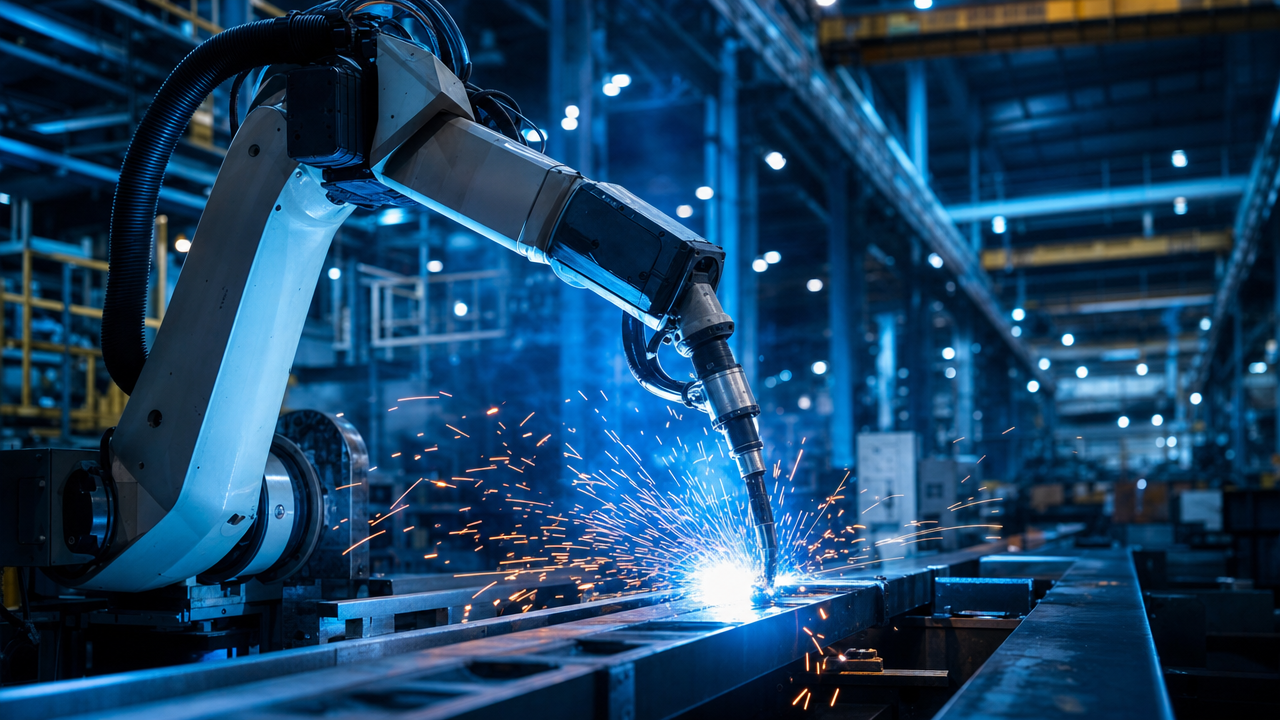

Industry Overview: 2025 Global and China Industrial Welding Market Structure
Industrial welding is often dismissed as a mature, slow-growing industry. The reality in 2025 is more complex—it is still growing, and the way it is growing reflects deeper structural shifts in global manufacturing.
Globally, the combined welding equipment and consumables market in 2025 was approximately USD 22 billion. Equipment (power sources, wire feeders, control systems) accounted for roughly 40%, consumables (solid wire, flux-cored wire, electrodes, fluxes, brazing alloys) over 50%, with the remainder going to torches, fume extraction, sensors and software. The fact that consumables are larger than equipment has not changed for a decade—consumables are tonnage-consumed industrial products, while equipment is a one-time investment. China alone accounted for roughly 45% of global demand, the world's undisputed welding capital.
Focusing on equipment, China's inverter welding equipment market generated USD 881.6 million in revenue in 2024 and is expected to reach USD 1.291 billion by 2030 at a 6.6% CAGR. Behind these figures is a fact often overlooked—the installed base of inverter welders has surpassed 15 million units. Annual new shipments represent only about 10% of the installed base, meaning industrial welders have entered a "replacement-driven, marginal-growth" mature phase. This structural feature will be referenced repeatedly in Chapters 2 and 3, because it directly shapes the competitive cadence of welder manufacturers.
Welder type distribution follows a pattern. In China, single-process welders (SMAW, pure TIG) account for 55% of unit sales, mostly for low-end construction sites and repair shops. Multi-process integrated units (MMA + TIG + MIG switchable) account for 25%–30% of value, dominating auto repair shops and small-to-medium metalworking. Heavy industrial machines (400A+) are 10%–12% by value, going to shipbuilding, oil and gas pipelines, and heavy machinery. The fastest growing subsegment is pulse and synergic control, expanding 10%–12% annually, driven by automotive OEMs and aerospace subcontractors demanding precision welding on thin gauges.
Shifting to consumables. China's welding consumables market surpassed RMB 65 billion in 2025, growing at a 6.8% CAGR. China's consumables industry is doing something quiet but critical—capacity consolidation. In 2015 there were over 600 welding consumables manufacturers nationwide; by 2025 environmental enforcement and M&A had reduced this to 380, with 150 above scale. Average per-plant capacity has tripled compared to a decade ago. Utilization climbed from 68% in 2018 to 82% in 2025, with robot welding wire lines at 92%. The Yangtze River Delta and Pearl River Delta combined account for 65% of national consumables capacity. This consolidation is a major structural signal—the "wild growth" phase is over, and the remaining players are entering a phase of consolidation.
Laser welding is the fastest-growing subsegment of the past two years. The global laser welding machine market was USD 990 million in 2024, expected to reach USD 1.572 billion by 2035 at a 4.2% CAGR. China's curve is steeper. Combined with laser cutting, China's laser equipment revenue in 2024 reached approximately RMB 165 billion, with laser welding accounting for about 10%. The driver is new energy vehicle plants extensively adopting laser welding for battery enclosures, motor housings and electronic control enclosures—a different price curve from traditional arc welding.
The final cross-quadrant figure is welding robots. The global robotic welding market was approximately USD 7.2 billion in 2025, projected to reach USD 11.8 billion by 2030 at a 10%+ CAGR. China is the largest downstream buyer—welding robots account for over 40% of China's new industrial robot installations, 10 percentage points above the global average of 30%. This means that for every 10 industrial robots sold in China, 4 are for welding, with the remainder split among handling, assembly, painting and inspection. This data explains why Chinese welder manufacturers have all been transitioning toward "robot body manufacturers" in recent years—whoever controls the welding process package will sit at the table for the next round of industrial robot substitution.
Summing the figures, industrial welding in 2026 exhibits three parallel but divergent structural forces. First, welder bodies have entered a "replacement-dominated, marginal-increment" mature phase—slow growth but intensifying margin differentiation. Second, consumables have entered the mid-to-late stage of "capacity consolidation and concentration improvement"—above-scale leaders still have a decade of growth. Third, laser welding and robotic welding are two fast-growing new curves whose expansion speed determines the height of Chinese welding industry over the next five years. The following thirteen chapters develop these three threads.
Looking further at the scale, China's combined welding equipment and consumables market in 2025 stood at RMB 85–95 billion, projected to expand to around RMB 130 billion by 2030 at a roughly 8% CAGR. Four forces drive this growth simultaneously—downstream manufacturing sentiment (35% contribution), new energy equipment expansion (25%), export demand (20%), and automation/digital upgrading (20%). Each force carries its own mix of certainty and uncertainty.
Automotive remains the largest downstream buyer, consuming 22%–28% of annual welding equipment sales. Construction machinery is the second largest, at 18%–22%. Shipbuilding ranks third at 12%–15%. Across new energy expansion, photovoltaic capacity additions in 2025 were around 280GW, wind 75GW, energy storage 80GWh, and new energy passenger vehicles reached 15 million units in production. Together these four segments contributed roughly RMB 10 billion of welding-industry incremental demand in 2026, representing 40% of total industry incremental growth.
The structural shortage of skilled welders is the most rigid driver of automation adoption. China's high-level welder (six-grade and above) gap stands at over 4 million as of 2025. Skilled welder monthly compensation in tier-1 cities rose to RMB 12,000–18,000, up 50% over five years. This shortage is forcing factories to install welding robots, which in turn drives the 60%+ share of robotic-welding-driven demand in annual new welder installations.
Welder Categories: From Manual Arc to Laser Hybrid—The Full Spectrum
Discussing welding without classifying the equipment leads nowhere. This chapter breaks down welders by process. The key is not memorizing each acronym but understanding each process's position in manufacturing—what problem it solves, where it is bottlenecked, and how much room remains for domestic substitution.
Shielded Metal Arc Welding (SMAW), known as "stick welding," uses a coated electrode rod. Advantages: wind-resistant, cheap equipment, low site requirements—still relevant for pipeline work in the field, construction sites, ship section repairs, and maintenance. Disadvantages: low efficiency, demanding skilled welders, heavy fumes. China's SMAW welder sales are large in volume but small in revenue, exported to Africa and Southeast Asia or kept as backup on remote sites. The process is receding but will never disappear.
Gas Metal Arc Welding (GMAW), encompassing MIG (inert gas: argon or helium) and MAG (active gas: CO2 or argon/CO2 mix). This family is the "main force" of industrial welding. Automotive body-in-white, construction machinery, pressure vessels, metal furniture, sheet metal fabrication—the vast majority of automated or semi-automated welding stations use GMAW. This category is the most profitable for welder manufacturers—machine prices range RMB 4,000 to 30,000, with the highest gross margins. From Kaierda, Riland, Jasic to Lincoln Electric, ESAB, Fronius—every major brand uses GMAW welders as a core profit source. Pulse and synergic control are the high-end sub-categories, controlling droplet transfer at hundreds of times per second, preventing burn-through on thin sheets and undercutting on thick plates.
Gas Tungsten Arc Welding (GTAW, or TIG) uses a non-consumable tungsten electrode with a separate filler wire. Advantages: pure welds, beautiful appearance, friendly to thin sheets and dissimilar metals. Disadvantages: slow speed, demanding operator skill. TIG is the first choice for stainless steel cookware, stainless steel piping, titanium piping, aluminum thin sheets. Aerospace, nuclear, medical devices, semiconductor gas piping—wherever weld quality is paramount, TIG is the only option.
Submerged Arc Welding (SAW) feeds wire beneath a granular flux that the arc melts into slag covering the molten pool—spatter-free, low fume, but limited to flat-position welding of large components. Applications: hull plates, large pressure vessels, wind tower sections, oil and gas pipeline longitudinal welds. SAW welders are simple; complexity lies in the matched flux and flux-cored wire, the two largest SKUs on the consumables side.
Resistance Welding rules the auto body-in-white. A mid-size passenger vehicle body has 3,000 to 5,000 spot weld joints, all completed by resistance spot welding guns. The key is not the power source but the precise pressure control of the servo gun. This segment remains dominated by Japan's Miyachi, Chuo Seisakusho, and Germany's NIMAK, with domestic players breaking only the low-to-mid end. A servo gun for OEM-grade automotive lines costs RMB 80,000–150,000 each, with a single line requiring 40–80 units—an extremely scarce, high-margin SKU.
Laser Welding has the fastest growth. Three usage patterns: continuous laser for thick-plate deep penetration (automotive hot-formed steel, pressure vessels, battery modules), pulsed laser for precision parts (watches, medical devices), and laser-arc hybrid welding (thick-plate large-bevel ship plates). China's laser welder domestic substitution has accelerated dramatically. 1.5kW and 3kW handheld localization exceeds 90%, with prices compressed from RMB 80,000 per unit in 2022 to RMB 40,000 in 2025. Medium-power (6kW class) localization is 70%; high-power (10kW+) still partially depends on imported fiber lasers, but Raycus and Maxphotonics have pushed domestic fiber laser share to 26.8% and 18.3%, with the gap closing fast.
Friction Stir Welding (FSW) is the most distinctive—it's not a fusion process but a solid-state process. A high-speed rotating tool head is pressed into the joint of two aluminum plates; frictional heat softens the parent metal to plastic state, and mechanical stirring mixes them together. Advantages: nearly zero heat-affected zone, mechanical properties approaching parent metal, no filler wire needed. Disadvantages: expensive equipment, suitable only for specific thicknesses and materials. FSW's two largest applications in China are high-speed rail aluminum alloy car bodies, where CRRC Sifang, Changchun and Tangshan have all entered mass production; and new energy vehicle battery enclosures, motor housings, and inverter housings, where mainstream automakers have all incorporated FSW.
Brazing and Soldering primarily serve HVAC, automotive AC piping, electronic components, and jewelry manufacturing. The process does not melt the parent material—it relies on filler metal (silver braze, copper-phosphorus braze, aluminum-silicon braze). Although a small slice of overall industrial welding, brazing is irreplaceable in refrigeration piping and copper brazing applications.
These eight process families constitute the industrial welding "process map." Understanding subsequent supply chain breakdowns, competitive landscape, and substitution dynamics requires constantly referring back to this map—each subsegment has different market characteristics, margin structures, and localization timelines.
The laser-arc hybrid welding (Hybrid Laser-Arc Welding) deserves a closer look as the newest process innovation. Hybrid welding integrates laser and MAG torches in a single workhead—laser opens a keyhole first, MAG arc fills behind. Hybrid combines laser's deep penetration with arc's filling capability, allowing single-pass welding through 15–25mm plate. It is replacing traditional submerged arc in shipbuilding, pressure vessel heads, and wind tower bevels. Hybrid welder unit prices are high (RMB 1.5–3 million per unit), market size still small (RMB 1 billion/year), but growth fast (30%+).
Another laser welding innovation is "wobble welding"—the laser head oscillates at 10–200Hz with 0.5–3mm amplitude, expanding the narrow laser beam into a "wide weld." This technique works exceptionally well for irregular bevels, aluminum sheet welding, and joints with low alignment precision. Wobble welding has become standard on 1.5kW–3kW handheld laser welders.
Electron Beam Welding (EBW) is a niche process but irreplaceable in aerospace, nuclear, and semiconductor equipment. EBW operates in vacuum, welds reactive metals (titanium, zirconium, niobium) on thick plates, and produces extremely pure welds. China's EBW equipment suppliers include Guilin Electric Welder, Antai Technology, and Beihang. Market size: about RMB 500 million/year, but with highly concentrated customers.
Consumables Categories: From Mild Steel Rods to Rare Metal Wires—The Value Ladder
If welders are the "machine tools," consumables are the "cutting fluids and tools"—truly tonnage-consumed industrial inputs and the most stable, highest-margin track in the welding industry.
By metallic system, consumables divide into six tiers: low-carbon steel electrodes and wires; low-alloy steel electrodes and wires; stainless steel electrodes and wires; nickel-based alloy consumables; copper-based and copper-nickel consumables; aluminum-based and magnesium-based consumables; up to the rarest titanium-based and zirconium-based consumables. Each tier upward roughly doubles in technical barrier and unit price.
Mild steel electrodes (J422, J427) are the cheapest SKU in this line, with 2025 ex-factory prices of RMB 6,000–7,000/ton. They dominate China's electrode production by volume, serving construction steel structures, bridges, towers, and ordinary steel piping. These are the profit anchors for Atlantic, Jinqiao, and Beijing-Wuhan.
Low-alloy steel solid wires (ER70S-6 1.2mm copper-coated) are the most common diameter and grade in industrial welding, with 2024 ex-factory prices of RMB 9,000–11,000/ton, lifted 3%–5% in 2025–2026 by copper price pass-through. Main applications: construction machinery, automotive structural components, pressure vessels, wind tower sections. A medium-scale construction machinery plant burns through 2,000–5,000 tons of this wire annually.
Flux-cored wires cost 30%–50% more than solid wires. Outer is a low-carbon steel tube, inner is flux powder. Advantages: high welding efficiency (high current density, high deposition rate), good wind resistance, suitable for outdoor and all-position welding. Disadvantages: weld prone to slag entrapment (requiring post-cleaning). Ship section welding, bridge steel structures, power towers—nearly all dominated by flux-cored wire. China's flux-cored wire output exceeded 700,000 tons in 2025, the largest single category.
Stainless steel consumables divide by base alloy into 304, 316L, duplex stainless (2205, 2507), super duplex, and ultra-low carbon austenitic. Price ladder from RMB 30,000/ton (304 solid wire) to RMB 120,000/ton (super duplex). Downstream: chemical processing, food, pharmaceuticals, seawater desalination, offshore wind foundation piles. Localization rate is high; imports remain mainly in super duplex and ultra-low carbon austenitic.
Nickel-based consumables are the highest barrier and most expensive tier. 9Ni steel welding, LNG tank inner-layer welding, ultra-high-alloy pipelines, high-temperature alloy components—all require high-nickel consumables. Common grades ENiCrMo-6, ENiCrMo-4, ENiCrFe-9, with 2025 prices of RMB 650,000–800,000/ton. Few domestic producers can manufacture at scale; localization rate is 30%–40%, with imports dominated by ESAB Special Metals, Lincoln Specialty Alloys, and Voestalpine Böhler.
Titanium-based consumables serve aerospace, chemical reactors, desalination, medical. Common grades ERTi-2 (commercially pure titanium), ERTi-5 (Ti-6Al-4V). 2025 prices RMB 200,000–400,000/ton. Chinese titanium wire producers cluster in Baoji (Baoji Titanium, CSSC Baoji).
Aluminum-magnesium consumables serve high-speed rail, new energy vehicles, rail transit, 3C casings, consumer products. Common grades ER4043 (aluminum-silicon), ER5356 (aluminum-magnesium). This tier holds its ground despite FSW rising—FSW only handles large-area aluminum sheet butt joints; complex 3D welds still need fusion welding.
Copper-based consumables serve HVAC, heat exchangers, switchgear. A special use is "brazing strip"—brass braze pressed into thin strips for automotive radiator flat tube auto-brazing.
Finally, submerged arc flux. Not metal wire, but granular flux paired with wire. Looks like coarse sand. China's SAW flux market is approximately RMB 5 billion/year, mainly serving shipbuilding, pressure vessels, wind tower sections. Highly concentrated; top five suppliers hold 80%.
Consumables revenue ranking: solid wires ≈ flux-cored wires > electrodes > stainless > nickel/titanium specialty > brazing alloys > SAW flux. But gross margin ranking inverts—electrodes thin margins, specialty rich. This mismatch drives every Chinese consumables leader's "product mix upgrade" strategy of the past few years: migrate to specialty, lift margins.
Consumables supply chain management and quality traceability are the operational priorities of the industry. Every batch of consumables undergoes pre-shipment quality testing—chemical composition (spectrometry), mechanical properties (tension, bending, impact), dimensional inspection (wire diameter, copper coating thickness, surface finish). These data must be retained for at least 5 years; downstream customers can request traceability at any time.
The newest emerging segment is wire arc additive manufacturing (WAAM) consumables—wires specifically developed for arc additive manufacturing of large metal parts as alternatives to casting or forging. WAAM consumables demand higher composition uniformity, surface cleanliness, and cross-section roundness than conventional wires. China's WAAM consumables market reached RMB 300 million in 2025, projected to expand to RMB 2 billion by 2030. This is the fastest-growing subsegment in consumables.
Major Players: Eight Domestic + Five International—The Competitive Landscape
After processes and materials, the players. Industrial welding's global landscape splits into two parallel tracks—welder makers and consumables makers. Cross-track all-rounders like Lincoln Electric and ESAB are rare; most companies specialize on one side.
Among Chinese welder leaders, eight companies each carve a niche. Kaierda focuses on welding robots + high-end welders; Riland on cost-effective inverter welders; Jasic on complete welding-cutting solutions and overseas distribution; Shanghai General Welding on construction machinery and shipbuilding customers; Aotai on petrochemical and power; Beijing Times on entry-level welders and university lab supply; Tangshan Panasonic on JV brand and joint-venture automakers; COSMOPlat (Haier's industrial internet platform) on welding robot flexible production line integration. In the past three years all eight have expanded in two directions—turning welders into "welding system packages" (welder + torch + robot + tooling), and lifting export share.
Kaierda (688255) is the most recently listed and sharpest of the eight, listed on the STAR Market in 2022. Its core differentiation is "in-house welder + in-house welding robot body"—no external dependency on the welding process layer. 2024 revenue was approximately RMB 1.4 billion, with welding robot bodies growing in share. The Wenzhou expansion base is scheduled to come online in H2 2025, focused on 6kg and 20kg medium-duty welding robot capacity. Its weakness is small scale; gross margin is suppressed by robot body investment phase.
Riland (300154), the "value king" of inverter welders, listed on Shenzhen ChiNext in 2010. Its strategy is making general inverter welders extremely affordable for China's tier-3/4 markets and exports to Africa, Southeast Asia, and the Middle East. 2024 revenue was approximately RMB 1.1 billion, with higher gross margin than domestic peers, but flat growth. Riland did not pursue the "robot body + welder" combo, going the opposite direction—power source only, no body.
Jasic (300193) is the "full-line welding-cutting leader," covering welding-cutting equipment + consumables + robots. 2024 revenue was approximately RMB 1.6 billion, the largest among Chinese domestic welder makers. Jasic's distinction is its channel network of 130 countries. It directly competes with Lincoln and ESAB at low-to-mid end.
Shanghai General Welding, Aotai, and Beijing Times are state-backed veterans with stable customer structures; construction machinery welders and pressure vessel welding are their home turf. Tangshan Panasonic is a Sino-Japanese JV serving joint-venture automakers (FAW Toyota, GAC Honda) for decades. COSMOPlat takes the industrial internet platform + welding line integration route—not the largest in scale but landing big digital welding projects.
Among Chinese consumables leaders, Sichuan Atlantic (600558) and Tianjin Jinqiao are the two heads. Atlantic holds approximately 15% market share in 2025; 2024 revenue was about RMB 2.8 billion. Its differentiation is "electrodes + wires + specialty" full-spectrum coverage, plus increasing R&D in stainless and nickel-based. Jinqiao at 12% share specializes in solid and flux-cored wires—slightly smaller than Atlantic but more concentrated. Jinghan and Baoji Bridge are characteristic players in low-alloy steel and bridge consumables.
Now international. Lincoln Electric (NYSE: LECO) is the undisputed "global welding No. 1." FY2024 net sales were USD 4.01 billion, adjusted operating margin 17.6%. Q1 2025 quarterly sales were USD 1.004 billion, +2.4% YoY. Lincoln's moat is three-layered—global distribution (160 countries), full process coverage (arc + laser + welding robots + cutting), and alloy specialty consumables (high-nickel, ultra-low-alloy, hardfacing). In arc welding equipment Lincoln held 4.5%+ global share in 2025. Lincoln has deepened China localization with a Shanghai welding tech center.
ESAB Corporation, spun off from Colfax in 2022, has steadily improved performance since IPO. FY2025 full-year revenue was USD 2.843 billion, +3.71%. Consumables dominate its mix—Q3 2025 quarterly consumables revenue was USD 477.9 million, equipment USD 249.9 million, with consumables at 66%. This makes ESAB more "consumables company + welder secondary" than Lincoln. ESAB supplies South and East China via a Zhangjiagang plant—China's largest single import source of welding consumables. Q1 2025 ESAB acquired Germany's Bavaria Schweisstechnik to strengthen its consumables portfolio.
Fronius International is privately held, with 2024 group revenue around EUR 1.4 billion. Welding is the main business (about 70%), with solar inverters and automotive battery charging as additional lines. Fronius's moat is digital process packages—the iWave multi-process robotic welding platform, adaptive arc, remote parameter dispatch, process traceability—a 2–3 year lead over Chinese welder makers. In 2025 Fronius released next-generation manual MIG/MAG welders, emphasizing digital fume extraction and ergonomics.
Miller (Illinois Tool Works Welding Segment) had FY2024 welding segment revenue of approximately USD 1.8 billion. Miller's strength is in North America; European and Chinese shares are relatively low.
Kemppi Oy is a Finnish welder maker focusing on mid-to-high-end inverter welders and welding digital software. 2024 revenue was EUR 159 million, down significantly from 2023's EUR 209 million, hurt by European manufacturing weakness. Kemppi and Germany's EWM share the "European specialist school," emphasizing open-platform control architecture and third-party vision/traceability integration.
Plotting these companies on a 2D map—X axis "product coverage breadth" (narrow ↔ full-spectrum), Y axis "high-end positioning" (value ↔ premium)—the picture is roughly: Lincoln top-right, ESAB center-tilted-to-consumables, Fronius top-right corner, Miller/Kemppi top-right zone, Jasic top-left, Riland bottom-left, Kaierda middle-leaning-top-right, Atlantic/Jinqiao (consumables) middle-bottom.
Over the next three years, expect: Kaierda continues moving top-right (high-end robotic welding); Jasic continues moving right (overseas high-end); Riland holds position (value retention); Atlantic moves top-right (specialty consumables upgrade); Lincoln and ESAB hold relative positions but lose China share to localization.
The financial comparisons of these companies tell another story. Lincoln Electric's R&D intensity is about 4%–5%, ESAB 3.5%, Fronius about 6%–7% (private company estimate), Kaierda 8%+ (in investment phase), Riland 3%–4%, Jasic 4%–5%. In absolute R&D dollars, Lincoln Electric's USD 150 million annual R&D budget in 2024 equals 75% of Kaierda's full-year revenue. This is the most striking resource gap between Chinese welder leaders and international giants.
Customer structures differ sharply. Lincoln's global customer split is 60% Europe + North America, 25% Asia, 15% other. Fronius is 50% Europe, 30% Asia, 15% North America, 5% other. Chinese welder makers are 90%+ domestic + selected emerging market exports, with developed market customer share below 10% across the board. This "concentrated at home" structure makes Chinese welder makers beneficiaries of the inner cycle and constrained in the outer cycle.
Sales models also diverge. Lincoln Electric and Fronius emphasize "solution selling"—engineers conducting needs analysis, process design, equipment selection, installation and commissioning, and after-sales service. This solution-selling model has high ticket size (RMB 500,000–5 million per project) and strong customer stickiness. Chinese welder makers primarily run "product sales" through distributors or e-commerce, with lower ticket size (RMB 50,000–500,000) and weaker stickiness. This is a critical capability gap Chinese welder makers must close.
Downstream 1: Shipbuilding, High-Speed Rail, Construction Machinery, Auto Body-in-White
Welding demand comes from downstream. This chapter examines four largest downstream segments first—shipbuilding, high-speed rail, construction machinery, automotive body-in-white.
Shipbuilding is among the most welding-intensive industries. A 24,000TEU mega container ship has over 130 km of total weld seams, consuming roughly 800 tons of flux-cored wire, 200 tons of electrodes, and 350 tons of SAW flux. China's global shipbuilding order book share exceeded 60% in 2025—the absolute core of global shipbuilding. In 2025, fifteen 174,000m³ LNG carriers were delivered, a new record for China's large LNG ship deliveries. Hudong-Zhonghua delivered the world's first 24,000TEU LNG dual-fuel ultra-large container ship "CMA CGM Seine," equipped with an 18,600m³ MARK III membrane fuel tank—whose critical welding is 9% nickel steel plate welded with hot-wire TIG and FCAW automation.
Shipbuilding's intelligent welding equipment has advanced rapidly in the past two years. In 2025 leading shipyards advanced digital welders + intelligent painting + flexible welding robot coordination, compressing single-ship build hours significantly. Hudong-Zhonghua, Waigaoqiao, GSI, and Jiangnan—China's leading shipyards—have pushed "section build hours per corrected GT" down to 15 man-hours/ton, globally leading. This means total welding hours per 10,000 corrected GT have dropped to 150,000 hours, far below the 220,000 of five years ago.
Another shipbuilding thread is the localization of cryogenic steel welding. China Classification Society, CSSC 725, HBIS Wugang, Baosteel, TISCO, Nanjing Steel, Jiangyin Xingcheng, and others have collaborated on domestic 9Ni steel and high-manganese austenitic steel R&D and welding qualification, essentially completing localization of cryogenic steel for LNG tanks and ships and matching consumables. LNG tank inner-layer welding uses ENiCrMo-6, ENiCrMo-4, ENiCrFe-9 high-nickel consumables; mainstream domestic suppliers can now ship in volume.
High-speed rail is another super-downstream. China's high-speed rail operating mileage exceeded 48,000 km in 2025, the world's largest. CR400AF/BF and CRH series EMUs use FSW extensively for aluminum alloy bodies. CRRC Sifang, Changchun, and Tangshan have all integrated FSW into mass production. CRRC Sifang's high-speed rail side and roof panel longitudinal seam welds are entirely FSW—flat appearance, parent-metal-like mechanical properties, minimal heat-affected zone, significantly better than conventional fusion welding. Each EMU car has approximately 800m of FSW weld seam, with an 8-car train totaling 6,400m. China's high-speed rail added approximately 700km of new operation in 2025, putting FSW equipment orders at a high level for 2025–2026.
Construction machinery is the most important structural-component downstream. Sany, XCMG, Zoomlion, Liugong, Shantui, Lonking, Lingong, and others—excavator main arms, buckets, undercarriages, frames, loader arms, crane booms—each structural part has a dedicated welding line. A 30-ton excavator has approximately 450m of total weld seam and around RMB 800 of welding consumables cost per unit. China's excavator sales in 2025 were approximately 230,000 units; this single subsegment alone implies RMB 180 million in consumables demand. Combined with loaders, cranes, and bulldozers, construction machinery is the largest single welder-consumables buyer in China.
Construction machinery has high welding automation penetration, with welding robots at over 60%. Sany Piling, XCMG excavator, and similar plants have nearly all key seams completed by six-axis welding robots + digital welder workstations. Supply comes from Kaierda, COSMOPlat, Siasun and other domestic welding robot makers, with Fanuc, Yaskawa, ABB holding share too.
Auto body-in-white is another super-downstream but with completely different process characteristics. Over 80% of passenger car body joints are resistance spot welds—3,000 to 5,000 spots, completed by 30–60 spot welding robots. An auto body-in-white line producing 300,000 units annually requires total investment of RMB 800 million–1.5 billion, with welding equipment (spot welding robots + servo guns + control cabinets) accounting for 40%–50%. China's passenger car output of 24 million units in 2025 implies stable matching welding demand.
The other thread in auto body-in-white welding is laser welding penetration. Tailor Welded Blanks, hot-formed steel roof laser welds, CTC integrated battery chassis laser welds—penetration in main automakers rose from 5% to 25% in just a few years. Trumpf (Germany), IPG (US), and Raycus (China) are the main laser suppliers; welding heads and control systems come from Fronius, Lincoln, Highyag, Burton, plus domestic Penta Laser and Ultrafast Laser.
The four downstream segments combined consume approximately 60% of China's welder sales and 70% of welding consumables. Their cycles directly determine the industry's demand curve. Chapter 11 will further address downstream trends for 2026–2030.
Auto body-in-white welding's evolution. New energy vehicle body-in-white welding adds "laser welding + FSW" to traditional spot welding. Laser welding handles roof laser seams, Tailor Welded Blanks, and other scenarios. FSW handles aluminum side-rail joints. This "traditional + laser + FSW" three-process fusion is the most distinctive characteristic of new energy vehicle body-in-white welding.
Downstream 2: Photovoltaic Mounts, Pressure Vessels, LNG Tanks, Wind Tower Sections
The second downstream group is new energy + heavy equipment, sharing thick weld seams, difficult processes, and high consumables consumption intensity—the most stable "profit downstream" of the welding industry.
Photovoltaic mounts represent the biggest, most visible incremental segment. China's new photovoltaic installations in 2025 stood at approximately 280GW, implying roughly 60 million tons of steel/aluminum structural component demand for fixed and tracking mounts. PV mount welding technical content is modest—mainly MIG/MAG automation plus some manual—but demand volume, pace, and cost sensitivity are extreme. Arctech Solar, Clenergy, and Akcome Technology have built scaled PV mount welding automation lines.
Pressure vessels are the highest technical content downstream. Chemical reactors, petrochemical columns, nuclear pressure shells, storage tanks—each has stringent Procedure Qualification Records (PQR) and welder certification requirements. China has approximately 8,000 pressure vessel manufacturers with an annual output value of RMB 250 billion. Core difficulties: thick-wall welding and dissimilar materials. Mainstream process: SAW + flux-cored + manual TIG root pass. Matching consumables: low-alloy steel wires, stainless steel wires, nickel-based consumables. Per-vessel consumables consumption ranges from hundreds of kilograms to multiple tons. A large hydrocracker (>200mm wall) requires 4–6 months of welding, 8–12 tons of consumables, with consumables alone costing RMB 500,000–800,000.
LNG tanks are the most specialized pressure vessel. Key process: 9Ni steel inner-layer welding with high-nickel consumables. Sinopec achieved breakthroughs in body design, seismic design, thick-wall cryogenic steel welding, and cold insulation optimization for ultra-large LNG tanks. CSSC 725, HBIS Wugang and others basically completed LNG tank domestic substitution around 9Ni steel and high-nickel consumables. In 2025 several ultra-large LNG tank projects at Dalian Hengli, Zhoushan Liuheng, and Lianyungang used domestic 9Ni steel + partial domestic high-nickel consumables—a landmark for high-end consumables.
Wind tower sections are another "large-piece welding" category. A 5MW offshore wind tower section stands 100m high, 7m diameter, with single-unit welding consumables of 12 tons and 60–90 day welding cycle. China's 2025 new wind installations of 75GW (onshore + offshore) imply over 4,000 sections in manufacturing demand. Titans Wind, Tienan Wind Power, Dajin Heavy Industry, and Haili Wind Power are stable consumables customers. Mainstream process: tandem submerged arc + seam tracking automation, with matching SAW wire and SAW flux growing steadily.
A particularly interesting subsegment is offshore wind monopile foundation welding. A 9MW offshore monopile may stand 70m, with 11m diameter, 100mm wall, single-unit weight 1,800 tons. Total weld length over 200m, consumables consumption 25+ tons, welding cycle 80 days. This is the heaviest "single piece" welding package in the industry. Dajin Heavy Industry, Tenence Heavy Industry, and Haili Wind Power are the top three domestic monopile producers.
New energy vehicle battery enclosures are another incremental downstream. A car-grade CTP/CTC battery enclosure is welded from aluminum alloy plates, mainly via FSW + laser welding. FSW handles main joining; laser welding handles detail seams, module connection, and busbar welding. Each battery enclosure takes 8–15 minutes to weld, with welding equipment accounting for 30% of production line investment. China's 2025 new energy passenger vehicle output of 15 million units implies 15 million enclosure sets—the largest combined downstream for laser welding and FSW.
NEV motor housings, electronic control housings, and powertrain housings also extensively use FSW. FSW equipment localization rate is around 60% (Beijing FSW, CSSC 725, AVIC, Shanghai Aerospace, Beihang Changhua). Overseas suppliers include Japan's Yamazaki Mazak, ESAB-linked entities, and UK TWI affiliates. The FSW localization gap will close fast as downstream NEV demand grows rapidly.
The five downstream segments combined consume approximately 35% of China's welding consumables market and 25% of welding equipment. Their process difficulty and grade specialization make them the "necessary path" of welding industry upgrading.
The supply chain perspective of NEV battery enclosure welding is striking. A passenger-car-grade battery enclosure requires RMB 2–4 million in welding equipment investment, covering 1–2 FSW machines, 2–4 laser welders, 3–6 matching robots, and 2–3 positioners. A production line producing 500,000 enclosure units annually requires RMB 150–250 million in total investment, with welding equipment alone accounting for 30%–40%.
Platform Perspective: Welding Job-Shop and Structural-Component Capacity in the 4.8-Million-Factory Database
Up to this point the discussion has been macro. Now it must shift to the engineering question of "can I actually find the factory?"—the question that procurement professionals, sales reps, and outsourcing managers in the welding industry face every day.
Tianxia Gongchang (the "All-China Factories" platform, 480 万家 = 4.8 million verified factories in production) is a B2B platform whose factory directory is built on factory-identification verification—different from databases like Qichacha or Tianyancha, which aggregate registration and litigation data without distinguishing whether a business license represents an actual factory, a trading company, or an empty shell. The factory-identification capability is the underlying infrastructure for finding real welding-industry factories.
Returning to welding. A procurement manager searching for "a pressure vessel job-shop capable of 9Ni steel welding" traditionally relies on industry yellow pages, personal networks, and trade shows. On the platform's directory, multi-dimensional cross-search becomes possible: filter by process keyword (submerged arc / hot-wire TIG / friction stir welding) for factories that demonstrably have the capability, intersect with downstream application (pressure vessels / LNG tanks / wind towers), then layer on industry classification keywords like pressure vessel plants and geography (Nantong / Qingdao / Zhongshan). A search path that traditionally takes two weeks reduces to minutes on the platform, yielding 30–50 candidates that can be narrowed to 5–10 viable quote targets after a day of follow-up calls.
For welding-consumables sales reps, "factory-identification + process keyword indexing" is even more directly useful. A rep targeting flux-cored wire bulk buyers—factories consuming 100+ tons/year—traditionally must wander through existing relationships. On the platform, cross-filtering by downstream (shipyards / power towers / wind tower sections) + scale (registered capital / employee count) + geography (coastal shipbuilding belt / North China steel structure belt) yields a target list whose "hit precision" is an order of magnitude better.
For welder equipment sales reps, the process keyword index is equally critical. To find "construction machinery structural component factories still using manual welding, without welding robots"—a very precise prospect profile—the platform allows reverse filtering by process keyword ("no robotic welding mentioned + manual welding mentioned"). This is the most direct source of welding robot sales leads. A welding robot rep who needs to visit 200–300 factories a year sees the time cost compressed from "200 a year" to "20–30 a week."
From another angle, for welder maker after-sales service teams, "factory-identification + industrial cluster distribution" can guide service network planning. Weighting the national after-sales network by welder installed-base density, the platform's factory distribution data is the simplest, most effective basis. Example: Jasic has about 200 authorized after-sales locations in China; densifying 30 more in the Yangtze Delta becomes a tractable optimization with the platform's county-level distribution data.
This chapter does not enumerate every subsegment's search path—the most efficient way for readers is to open the platform and filter by their own real process, industry, and geography terms. The deeper the factory-identification foundation runs, the more leverage downstream sales and procurement decisions have.
Extending the "reverse search by downstream application" angle. A welding torch sales rep targeting "factories doing wind tower section welding"—traditional methods are geographic (a few coastal industrial belts) + industry-association referrals. On the platform, filtering on the "wind tower section" process tag yields 50–80 matching factories distributed across Nantong, Putian, Zhuhai, Dalian, Dongying, and Qinhuangdao industrial belts. For an aerospace OEM searching for "job-shops with titanium wire welding capability"—an extremely niche target—the platform enables a combined search of "aerospace sub-tier + titanium alloy welding + titanium wire procurement history + grade-6+ welder certification," yielding 10–30 candidate factories, narrowed to 5–10 quote targets after 1–2 days of follow-up. This is the most scarce ability in the aerospace supply chain.
The platform's process keyword index coverage in real-world testing: roughly 80% of common welding process terms (200 process names, equipment names, material names, application scenarios), 85% of downstream application terms, 70% of consumables grade designations, and 100% of geographic terms. Combined four-dimensional search covers approximately 60%–70% of real business needs in the welding industry.
The platform also benefits upstream of welding. A welding consumables maker searching for "potential raw material suppliers"—wire rod plants, electrolytic copper plants, nickel raw material plants, chromium-molybdenum plants—can quickly identify candidates by "metal processing + main product + geography + scale." This bidirectional supply chain search is full-stack service for the whole welding industry.
Domestic Substitution: The Three Curves of 300A+ Welders, Laser Welders, and Specialty Consumables
Domestic substitution is the most visible industrial story for industrial welding in 2026. China's localization progress is not a single line but three curves moving at different paces.
The first curve is 300A+ three-phase industrial welders. This category has approached "substitution complete." 2025 domestic 300A+ three-phase industrial welder localization exceeded 80%, with Riland, Jasic, Aotai, Beijing Times, Shanghai General Welding, and other domestic leaders capturing the bulk of new domestic demand. International brands (Lincoln, ESAB, Fronius) retain share mainly at joint-venture automakers, foreign-invested pressure vessel makers, and foreign-invested construction machinery plants—customers with strong procurement inertia and lingering doubts about domestic. This structure will continue eroding through 2026–2030—once domestic welders pass body-in-white validation at joint-venture automakers, international brands lose their last protective wall.
The 300A+ tier's rapid substitution roots in the simultaneous breakthroughs at three core technology nodes: IGBT modules (power core), digital control boards (DSP), and welding process packages (pulse/synergic/low-spatter). A decade ago, domestic welder IGBTs depended on imports from Infineon, Mitsubishi, Fuji. Now BYD, SiLAN, and CR Micro can stably supply IGBTs for mid-tier industrial welders. DSP control board algorithms have caught up—domestic welder makers now control pulse current waveforms, synergic voltage adaptation, and low-spatter control curves. With all three nodes filled, domestic welders have process capability to benchmark against international brands.
The second curve is laser welders, in "rapid substitution underway." 1.5kW and 3kW handheld laser welders' localization exceeds 90%, with Wuhan Raycus, Shenzhen Maxphotonics, Beijing Keplink, Shanghai Hans Laser sharing the market. Handheld machine localization is the most dramatic story of the past three years—2022 retail price RMB 80,000–120,000, 2025 same model RMB 40,000, with entry models as low as RMB 28,000. Three years saw a 65% average price compression.
Medium-power (3kW–6kW) laser welders' localization is around 70%, mainly applied in auto body-in-white tailored welding, power battery module welding, battery pack welding. Trumpf (Germany), Coherent (US), and IPG (US) retain considerable share through laser stability and after-sales networks.
High-power (10kW+) laser welders' localization is approximately 50%. Upstream fiber lasers are constrained by technology, patents, and thermal management. 10kW+ lasers are mainly used in thick-plate hybrid welding (laser+MAG) and pressure vessel deep penetration. Raycus represents domestic high-power lasers, accelerating 10kW and 20kW R&D in 2024–2025. Trumpf and IPG remain global leaders here.
The third curve is specialty consumables—the slowest substitution and highest technical barriers. High-nickel consumables (core for 9Ni steel welding), titanium wires (aerospace and chemical reactors), duplex stainless wires (offshore wind), and hardfacing flux-cored wires (wear- and corrosion-resistant)—localization across these subsegments is generally 30%–40%.
The root cause of slow specialty consumables substitution is the high time cost of welding procedure qualification (PQR + WPS). A new consumable entering pressure vessel, nuclear, or LNG tank applications must undergo full Procedure Qualification, including tensile, bend, impact toughness, metallurgy, and chemistry tests. From sample submission to qualification passage takes 6–12 months; including engineering firm and owner approval, total qualification into the downstream may take 18+ months.
Another reason for slow specialty consumables substitution is quality risk. If 9Ni steel welding produces seam cracking, slag entrapment, or lack of penetration, LNG tanks may undergo brittle fracture at cryogenic temperatures (-162°C)—an unbearable accident cost. Designers and owners are extremely conservative in consumables selection, sticking with verified imported grades for years.
But this curve's substitution is accelerating. CSSC 725, HBIS Wugang, TISCO, Baosteel, Atlantic, Jinqiao formed a joint development alliance for "cryogenic steel plate + consumables + welding process packages." Multiple ultra-large LNG tank projects in 2024–2025 have used domestic 9Ni steel plate + domestic high-nickel consumables combinations—landmarks for this curve's substitution. Specialty consumables localization is expected to rise from 30%–40% currently to 55%–60% by 2030.
Combining the three curves, the overall pace is "industrial welders complete, laser welders past halfway, specialty consumables just starting." This differentiated pace is repeatedly used in Chapter 11's forecast model.
Capacity Expansion: Kaierda Wenzhou, COSMOPlat Qingdao, Riland Guangzhou
Domestic welder makers entered a new capacity expansion cycle in 2024–2025. The three most representative projects are Kaierda's Wenzhou base, COSMOPlat's Qingdao industrial-internet welding base, and Riland's Guangzhou expansion.
Kaierda's Wenzhou base sits in the Oujiangkou Industrial Cluster, with planned land use of about 80 mu, divided into two construction phases. Phase 1 came online Q3 2025, with capacity for 5,000 6kg medium-duty welding robot bodies/year, 2,000 20kg heavy-duty welding robot bodies/year, and 30,000 digital welders/year. Phase 2 comes online Q4 2026, adding collaborative robots, laser welding robot workstations, and integrated welding system assembly.
Kaierda's choice of Wenzhou follows industrial-chain logic—Wenzhou Ouhai/Oujiangkou clusters Zhejiang's valve welding, stainless steel products, and low-voltage electrical structural component manufacturers, 1.5 hours from the Hangzhou R&D center, with a logistics radius covering the Yangtze River Delta and East China industrial belt. With the new base online, Kaierda's annual welding robot body capacity expands from 7,000 to 14,000+, and welder capacity from 100,000 to 180,000.
COSMOPlat's Qingdao base supports the Haier-affiliated industrial internet platform. Located in Jiaozhou, Qingdao, with planned land use of 150 mu. Its differentiation isn't pure capacity expansion but "welding industry internet + flexible welding line integration." COSMOPlat positions welding line integration as a core deliverable of the industrial internet platform, targeting construction machinery, offshore equipment, NEV, and home appliances for line upgrades. The base includes welding robot workstation commissioning, welding process validation, and intelligent line assembly areas. Phase 1 came online H2 2025.
Riland's Guangzhou expansion is pragmatic—lifting existing capacity from 150,000 to 250,000 units/year, mainly for 200A single-phase industrial welders (120,000/year) and 300A three-phase industrial welders (100,000/year). Riland's logic: capture the last domestic substitution wave at low-to-mid end and push scale advantage to the extreme. Riland's customer mix is 70% domestic SMEs + 30% export distributors, with a stable demand curve and clear payback.
All three projects share a common industry judgment: the welder localization window has 3–5 years left; beyond that, capacity expansion ROI drops sharply. All three are racing to capture the last scaling dividend within this window.
Beyond welder maker expansions, consumables makers are also expanding capacity. Atlantic completed its Tianfu New Area Phase 1 consumables base in 2024, adding 50,000 tons/year of flux-cored wire and 20,000 tons/year of stainless steel wire. Jinqiao is adding 80,000 tons/year of flux-cored wire at Tianjin Wuqing, online H2 2026. Jinghan is adding 30,000 tons/year of low-alloy steel wire at Qihe, Shandong.
Laser welder capacity expansion is more aggressive. Raycus expanded Wuhan and Shenzhen capacity to 300,000 lasers/year in 2024, with 500,000/year planned by 2026. Maxphotonics targets 200,000 medium-power lasers/year and 10,000 high-power lasers/year by 2026. Handheld laser welder integrators (Shenzhen Light-On, Lightway, Maxwell, HGTech) all expanded capacity. Combined Chinese handheld laser welder capacity reached 800,000 units/year in 2025—the global center of mass.
Combining all three equipment expansions, 2024–2026 are the most aggressive three years of capacity ramp-up. Welder body new capacity equals 80% of cumulative prior three years; welding robot body new capacity equals 120%; laser welder new capacity equals 200%. This expansion rate is itself a bet on future demand—if downstream demand doesn't keep pace, a 2027–2028 inventory and price-war shakeout becomes likely.
Price Cycle: 2024–2026 Welder Unit Prices, Consumables Tonnage Prices, Copper Price Pass-Through
Price is the most direct "barometer" in industrial research. This chapter maps welding equipment and consumables price changes for 2024–2026.
On welders, the cycle is relatively stable. 200A single-phase industrial welder retail price was RMB 1,800–3,000 in 2024, compressed to RMB 1,500–2,800 in 2025 due to IGBT module prices declining. This is value-tier battleground with margins of 12%–18%. 300A three-phase industrial welder retail price was RMB 4,500–9,000 in 2024, with the range shifting slightly down to RMB 4,000–8,500 in 2025. 400A heavy welder retail price was RMB 15,000–30,000 in 2024, essentially stable in 2025. Pulse multi-process welder retail price was RMB 15,000–40,000, with average price down 25% from 2022 due to accelerated localization.
Laser welder price curves are most dramatic. 1.5kW handheld laser welder retail price was RMB 80,000–120,000 in 2022, compressed to RMB 60,000–80,000 in 2023, RMB 45,000–60,000 in 2024, and as low as RMB 28,000 for entry models in 2025—a 65% average price compression over three years. This level of compression is rare in equipment industries, driven by upstream fiber laser localization + integrator price competition + channel flattening. The 3kW handheld curve is similar but milder—2022 RMB 150,000, 2025 RMB 60,000, 60% compression.
Medium-power (6kW) laser welder prices started declining in 2024. 2023 RMB 350,000–500,000/unit; 2025 RMB 200,000–350,000/unit; 2026 expected to drop further to RMB 180,000–280,000/unit. High-power (10kW+) laser welder prices change slowly—2024 RMB 800,000–1,500,000/unit; 2025 RMB 700,000–1,300,000/unit.
On consumables, prices are more raw-material-driven. Mild steel electrode (J422) ton price was RMB 6,500/ton at end-2024, fluctuating slightly with steel raw material in 2025–2026 but stable overall. Low-alloy steel solid wire (ER70S-6 1.2mm) ton price was RMB 9,500–11,000/ton at end-2024, lifted 3%–5% by copper price uptrend + steel raw material increases in 2025. Flux-cored wire ton price was RMB 12,000–15,000/ton at end-2024, with similar 2025–2026 increases.
Stainless steel consumables ton prices correlate strongly with nickel prices. 304 stainless steel wire was RMB 30,000/ton at end-2024, falling to RMB 27,000/ton in 2025 as nickel prices retreated. 316L stainless steel wire was RMB 38,000/ton at end-2024, falling to RMB 34,000/ton in 2025. Duplex stainless wire was RMB 80,000–120,000/ton at end-2024, stable in 2025 due to offshore wind foundation demand.
High-nickel consumables ton prices were essentially stable in 2024–2025 at RMB 650,000–800,000/ton. ENiCrMo-6 high-nickel electrode unit price for 9Ni steel: RMB 1,500–2,500/kg. Matching high-nickel wire: RMB 800–1,500/kg. Titanium wire ERTi-2 commercially pure titanium was RMB 200,000–300,000/ton at end-2024, fluctuating between RMB 210,000–280,000/ton in 2025 due to titanium sponge price volatility. Aerospace-grade ERTi-5 (Ti-6Al-4V) ton price: RMB 350,000–450,000/ton.
Aluminum-magnesium consumables prices correlate with aluminum prices. ER4043 (aluminum-silicon) was RMB 35,000/ton at end-2024, falling to RMB 32,000/ton in 2025. ER5356 (aluminum-magnesium) was RMB 38,000/ton at end-2024, essentially stable in 2025. The watchpoint for this line in 2026: whether accelerating FSW penetration erodes aluminum-magnesium wire demand—current view is FSW mainly replaces thick-plate butt welding while complex 3D welds still depend on aluminum-magnesium fusion welding.
Submerged arc flux prices are stable. Neutral flux was RMB 4,500–6,500/ton at end-2024, basically unchanged in 2025–2026. This line is characterized by supply-demand stability, moderate margins, and concentrated customers.
Combining all price curves, 2024–2026 industrial welding shows "equipment side continuing to decline, consumables side moderately rising." The equipment side's decline is from accelerated localization + capacity expansion glut. The consumables side's rise is from raw material price pass-through. This "equipment falling, consumables rising" scissors gap is not good news for welder makers' profits but is relatively friendly to consumables makers.
Total cost of ownership (TCO) analysis is another perspective on equipment pricing. A 300A three-phase industrial welder's full lifecycle cost breaks down as: one-time purchase price 35%, electricity 20%, welding consumables consumption 25%, maintenance and repair 10%, labor 10%. Electricity, consumables, and labor are the real biggest items.
This TCO perspective matters for domestic welder sales. Domestic welders have lower purchase prices (30%–50% below international brands), but electric efficiency, welding stability, and consumables consumption rates still gap with international brands. Converting to TCO, domestic welders' overall cost advantage may shrink from "purchase price 35% lower" to "TCO 15% lower." This "value erosion" is the biggest sales obstacle when domestic welders pursue high-end customers.
Policy Environment: Smart Manufacturing and EU CBAM—Two Parallel Lines
Policy impact on the welding industry comes from two parallel lines. One is the domestic pull—smart manufacturing plans and new energy equipment expansion driving welding automation penetration. The other is the international push—the EU Carbon Border Adjustment Mechanism (CBAM) driving the welding industry toward low-carbon processes.
On the domestic line, "Made in China 2025" and the "14th Five-Year Plan Smart Manufacturing Development Plan" provide clear policy direction for welding automation. Plans target full digitalization, networking, and intelligence across key manufacturing sectors by 2025. As the key process node in manufacturing, welding automation penetration is a core policy KPI. Local governments offer tiered subsidies—from 10% to 30% of investment—for factories upgrading to intelligent welding lines.
National support for new energy equipment is indirectly favorable to welding. Photovoltaic expansion drives PV mount welding; wind expansion drives wind tower welding; energy storage expansion drives battery pack welding; NEV expansion drives FSW + laser welding. These "new energy four-piece set" matching welding equipment and consumables demand growth from 2025–2030 has a compound rate above 15%.
On the international line, the core is EU CBAM. On January 1, 2026, CBAM enters the Definitive Period—the world's first cross-border carbon tariff. Coverage: six basic material categories—cement, aluminum, fertilizer, steel, hydrogen, electricity. In 2026 the European Commission further expanded CBAM to add 180 downstream steel-aluminum-intensive products covering machinery, hardware, vehicle parts, appliances, and construction equipment. For the Chinese welding industry, this expansion means structural component exports to the EU (construction machinery, auto parts, wind tower sections, bridge components, pressure vessels, appliance casings) all face rising carbon-tax costs.
Steel export to the EU carbon-tax cost: 2026 expected to add RMB 300/ton, rising to RMB 1,050/ton in 2032 after free allocations are removed. Translated to a 30-ton excavator exported to the EU, carbon tax cost rises by RMB 9,000; to an 8MW offshore wind tower section exported to the EU, carbon tax cost rises by RMB 800,000–1,200,000. This additional cost will push Chinese exporters to put "low-carbon welding" on the table—low-fume flux-cored wire, low-spatter pulse MAG, laser-arc hybrid welding (high efficiency low heat input), automation (reducing rework and scrap rates).
Low-carbon welding has two core improvements. One: reduce per-seam electricity consumption. Pulse-controlled MAG cuts energy by 10%–15% at equivalent deposition; laser welding cuts energy by 30% relative to arc welding in suitable deep penetration scenarios. Two: reduce per-seam consumables consumption. Pulse-controlled low-spatter processes compress wire spatter loss from 8% to 2%. Combined, a welding production line's total carbon emissions can drop 20%–30%.
CBAM impact on the Chinese welding industry is indirect but profound. It will not immediately change the domestic landscape, but over 3–5 years will turn "low-carbon welding processes" from an "environmental highlight" to "export entry requirement." Fronius, Lincoln Electric, and other international players already deeply embedded in digital welding will temporarily benefit—their "digital welding + process traceability" systems naturally accommodate CBAM's carbon footprint accounting requirements. Chinese welder makers have catching up to do.
Another domestic policy line worth attention: welder certification and labor market. China's high-level welder gap (grade 6+) exceeds 4 million in 2025. Local governments subsidize welder training and certification, but the subsidies fall short of the gap. Welder shortage is the strongest push for welding robot penetration—welders can't be hired, can't be retained, factories are forced to install robots. This driver is more rigid than policy subsidies.
The smart manufacturing welding implementation cases are concrete. Sany Piling completed "comprehensive intelligent welding line transformation" in 2023 with RMB 150 million investment. Transformation included 80 Kaierda welding robots replacing 240 manual welders, 200 seam tracking sensors enabling real-time adaptive path control, and "Kaierda Cloud" for real-time welding quality traceability. Post-transformation, Sany Piling's annual welding capacity rose from 8,000 to 12,000 units, weld pass rate from 92% to 98.5%, welding cost from RMB 800/unit to RMB 600/unit. These actual ROI data are important references for other construction machinery plants considering transformations.
XCMG excavator plant completed similar intelligent welding transformation in 2024 with RMB 200 million investment and 120 welding robots. Post-transformation, excavator welding capacity rose from 15,000/year to 25,000/year—a doubling.
Platform Research Institute Judgment: The Three- to Five-Year Outlook
The Tianxia Gongchang industry research institute's judgment splits into three layers: equipment, consumables, and processes.
On equipment, the welder body industry enters a phase of "domestic substitution endgame + price war + industry concentration" simultaneously over the next 3 years. 300A+ industrial welder localization will rise from 80% to over 90%. International brand (Lincoln, ESAB, Fronius, Kemppi) China market share will be further compressed to the 5%–10% range. Meanwhile Chinese welder maker concentration will rise significantly—the current 200+ domestic welder makers will consolidate to 50–80 by 2028. Riland, Jasic, Kaierda, Aotai, Shanghai General Welding, Beijing Times—six will form a relatively stable landscape, each with 5%–15% share. In laser welding robots, Kaierda, COSMOPlat, Siasun, Maxwell, and HGTech will be the main players.
The laser welder downward price curve continues, but the slope flattens. Handheld laser welder prices approach cost line with limited further room. Medium-power laser welder prices can drop another 20%–30% during 2026–2028. High-power laser welder prices, constrained by upstream fiber laser localization pace, will decline moderately at 5%–10% annually.
On consumables, the industry enters a dual-drive of "capacity concentration + high-end upgrade." Ordinary mild steel electrodes, low-alloy steel wires, and ordinary stainless steel wires—growth slows to 3%–5%. Specialty consumables (high-nickel, titanium wire, duplex stainless, hardfacing flux-cored, low-fume flux-cored)—growth reaches 12%–18%, with localization rising from 30%–40% to 55%–60%. Atlantic and Jinqiao's product structure upgrade is the highlight of this line.
Another consumables line is the rise of "low-carbon consumables." Low-fume flux-cored, low-spatter solid wire, laser-arc hybrid welding matched wires, low-heat-input specialty consumables—these subsegments answer CBAM-pushed industry demand. Compound growth 2026–2030 expected at 15%+. Whoever builds a "carbon footprint traceable" consumables system first wins first-mover advantage in EU export chains.
On processes, the most important trend in 3–5 years is "welding digitalization." Concrete directions: seam tracking sensor penetration (from current 30% to 60%), welding parameter remote dispatch and recipe management (from 20% to 50%), welding process online monitoring and defect early warning (from 10% to 30%), welding quality traceability system (from 5% to 25%). These digital welding penetrations are key to industry transition from "heavy process" to "data + process."
Laser welding and FSW penetration in NEV and high-speed rail deepens further. By 2030, NEV battery enclosure FSW penetration rises from 60% to 85%–90%; laser welding penetration from 35% to 55%–65%. High-speed rail body FSW penetration holds at 90%+.
Welding robot penetration of welding stations rises from current 30%–40% to 55%–65% by 2030. This penetration rise drives stable growth of welding robot body makers. Kaierda, COSMOPlat, and Siasun will be the three main domestic players. Fanuc, Yaskawa, ABB hold short-term advantage in joint-venture automakers, but the lead erodes over the medium-to-long term.
The final judgment concerns the research institute's perspective: as the platform underlying 4.8 million in-production factories, its role in the welding industry is "matching upstream and downstream + providing factory identification + serving precision sales of welding equipment and consumables." As welding moves from "wild growth" to "industry concentration," the platform's factory identification and process keyword search will become industrial infrastructure shared by welder makers, consumables makers, and outsourcing buyers.
Several "non-consensus" judgments deserve mention. First, on welding-software market potential. Welding SaaS is currently small (RMB 800 million/year) but fast-growing (30%+). If full welding-industry digitalization plays out over five years, welding SaaS scales to RMB 4–8 billion/year—a track underestimated by traditional welder makers. Second, on welding outsourcing market consolidation. China has over 500,000 welding outsourcing shops, an extremely fragmented market. Over 5–10 years, as customer demands tighten around "weld quality traceability + welder certification transparency + welding equipment standardization," the outsourcing market will consolidate—the top 5%–10% of standardized outsourcers will collect 50%–60% of orders, while the long tail (90% small shops) gets marginalized. This is the most profound structural shift in the welding industry. Third, on welder makers' "software-hardware integration." International giants (Lincoln, ESAB, Fronius) already operate "hardware + software + service + training" full-stack models; Chinese welder makers only break through on hardware. Whether they can catch up on software, services, and training over five years determines whether they truly compete with international giants.
Risks: Downstream Cycles, Foreign Counterattack, Robot Squeeze on Low-End
After judgment, risks. Industrial welding faces three classes of risk.
First, downstream cycle risk. Auto production growth slowing in 2026, real estate-related demand weak, construction machinery domestic sales remaining low—if these downstream demand curves weaken simultaneously, welding industry impact is immediate. Welder maker sales correlate with downstream fixed-asset investment at 0.8+. If 2026–2027 downstream fixed asset investment drops 5%–10% YoY, welder and consumables makers' revenues take significant hits.
The most concerning detail is construction machinery domestic sales. China's construction machinery domestic sales peaked in 2021 and have declined since; excavator domestic sales were down 5% in 2024 and remained subdued in 2025. If 2026 stays low, Sany, XCMG, and Zoomlion will further squeeze welding equipment investment.
Photovoltaic mount, while a high-growth segment, is in unprecedented price war intensity. PV mount makers' gross margins compressed to under 8% in 2024 with limited further compression. This cost pressure passes to welding equipment and consumables procurement—upstream has strong bargaining power, downstream weak, an awkward position for the welding industry.
NEV's rapid expansion is the biggest hedging force for welding industry. 2025 NEV passenger vehicle output of 15 million units, 2026 expected at 18 million. NEV demand is dual-drive on welding equipment—quality demands higher-end processes (FSW, laser welding, high-speed spot welding); volume continues integration vehicle expansion. The combination of these two factors makes NEV's incremental contribution to welding industry through 2026–2030 highly significant.
Second, foreign giant counterattack risk. Lincoln Electric in Tianjin came online with Phase 2 in 2024, doubling capacity. Lincoln's Asia-Pacific welder retail prices have been compressed near Riland and Jasic levels (300A three-phase RMB 4,500–6,000), while preserving Lincoln's brand after-sales advantage. This "price + brand" combo is the most direct competitive pressure on Chinese welder makers in 2026–2028.
ESAB at Zhangjiagang expanded in 2025, with electrode and wire capacity up 30%. ESAB's localization strategy is "consumables local + welders import," cutting tariff costs on consumables while retaining global supply chain for high-end welders. This strategy directly competes with Atlantic and Jinqiao—ESAB Zhangjiagang ton prices are now close to comparable domestic.
Fronius, while not localizing manufacturing at scale, increased collaboration with Kaierda and Siasun in 2025, embedding Fronius high-end process packages in Chinese-made robot bodies. This "asset-light localization" creates subtle competition with Kaierda's in-house process packages—customers buying Kaierda bodies can choose Kaierda packages or Fronius packages, with Fronius still holding an edge in certain niches.
Third risk: welding robot squeeze on low-end welder sales. China's welding workforce is about 13 million; welding robot installed base ~500,000 units (estimated 3 welders displaced per robot), with displacement rate ~12%. By 2030 welding robot installed base reaches 1.1 million, displacement rate ~25%. This means 2–3 million welder jobs displaced over five years.
Displaced welders are mostly mid-to-low grade (1–3), concentrated in low-end welder application scenarios—county-level SMEs, repair shops, rural processing points. These scenarios used to be 200A single-phase industrial welder's core market; welder displacement means low-end welder demand simultaneously shrinks. Riland and Jasic, with low-end welders as anchor, must watch this curve's inflection point.
Welder shortage and labor cost detail. First-tier city high-level welder (grade 6+) realized monthly income reached RMB 12,000–18,000 in 2024–2025 (with social benefits, holiday pay, overtime), up 50% from five years ago. In third-tier cities, high-level welder income is RMB 8,000–12,000/month. This wage rise directly hits welding outsourcer costs and ultimately upstream OEM order prices.
Macroeconomic and currency volatility detail. Chinese welder makers' exports settle primarily in USD; consumables in mixed USD, EUR, RMB. Every 1% RMB appreciation against USD compresses export gross margin by 0.6–0.8 percentage points. 2024–2025 RMB/USD wide-band volatility (7.0–7.3) impacts Riland and Jasic's gross margin (30%+ export ratio) by 1–2 percentage points.
A sixth risk dimension is technology substitution. FSW, laser welding, and electron beam welding gradually replacing traditional arc welding (GMAW, SMAW, GTAW) is a long-term trend. The replacement speed varies dramatically across subsegments—NEV battery enclosures already nearly fully replaced traditional arc welding; high-speed rail bodies already 70%–80% replaced; but construction machinery, pressure vessels, and ships still depend heavily on arc welding. This tech substitution curve must be evaluated subsegment by subsegment.
Stress testing in three scenarios. Baseline: 2026–2030 industry compound growth of 7%–9%, equipment maker net income compound growth of 5%–8%, consumables maker net income compound growth of 6%–9%. Pessimistic: with downstream weakness, NEV slowdown, and overseas trade friction, growth drops to 3%–5%, equipment maker net income may decline 0%–3%, consumables maker net income grows 2%–4%. Optimistic: with broad downstream recovery, NEV surge, fast overseas expansion, and right-sized capacity expansion, growth reaches 10%–13%, equipment maker net income grows 12%–18%, consumables maker net income grows 10%–15%. Probability distribution: baseline ~50%, pessimistic ~30%, optimistic ~20%.
Data Sources: Annual Reports, Industry Associations, Authoritative Media
This report cites data from publicly available sources, organized by category.
Market size data from: China Welding Association public statistics (2023–2025 annual data), Grand View Research China Inverter Welding Equipment market report, IndexBox China Inverter Welding Equipment market analysis, Market Research Future Robotic Welding global market report, Persistence Market Research Welding Equipment market report, GMInsights Arc Welding Equipment market forecast, Mordor Intelligence Europe Welding Equipment market report.
Company financials from: Hangzhou Kaierda Welding Robot Company 2024 annual report (cninfo announcement 1223281987), Kaierda 2025 H1 report (cninfo 1224385977), Shenzhen Riland 2024 annual report and 2025 H1 report, Shenzhen Jasic 2024 annual report, Sichuan Atlantic Welding Materials 2024 annual report (cninfo announcement 1222922829), China State Shipbuilding 2025 H1 report, Lincoln Electric Holdings Form 10-Q Q1 2025 (SEC EDGAR), ESAB Corporation Q3 2025 Earnings Release (investors.esabcorporation.com), ESAB 2024 Full Year Results, Illinois Tool Works Welding Segment quarterly reports, Kemppi Oy 2024 financial disclosures.
Industry news and research from: China Machinery Industry Federation Industrial Robot Committee public data, China Association of National Shipbuilding Industry public data, China Iron and Steel Association shipbuilding steel and welding panel, IFR World Robotics Report 2025, Reuters industrial and materials coverage, Nikkei Asia shipping and shipbuilding coverage, Bloomberg heavy industry news, ZRZL Consulting, Qianzhan Industrial Research Institute, China Report Hall consumables market reports, laserfair.com industry research, sina finance industry news.
Regulation and policy from: European Commission CBAM official documentation and Q&A (2025–2026 publications), China MOFCOM WTO Division public statements, China NDRC smart manufacturing planning documents, China MIIT "Made in China 2025" roadmap, EU CBAM 2026 expanded product list.
Technical materials from: The Welding Institute UK (TWI) technical reports (on FSW, laser welding, hybrid welding), American Welding Society (AWS) Welding Journal papers, Japan Welding Society Journal papers, German Welding and Cutting Association (DVS) technical materials, Chinese Welding Society (CWS) Journal of Welding, ASME pressure vessel standards, EN 15085 high-speed rail welding standards, International Institute of Welding (IIW) recommendations.
Downstream application data from: China Association of Automobile Manufacturers passenger vehicle sales statistics, China Construction Machinery Industry Association excavator sales statistics, China Association of National Shipbuilding Industry shipbuilding data, China Renewable Energy Society wind installation data, China Photovoltaic Industry Association installation data, China Energy Research Society energy storage installation data, China LNG receiving station construction public data, China high-speed rail operating mileage public data.
The factory identification database referenced in this report comes from Tianxia Gongchang. All company names, product models, and market share figures cited are for research reference only and do not constitute investment advice. Readers seeking finer granularity—factory-level data, product-level sales detail, and geography-level capacity distribution—should cross-validate with listed-company annual reports' "sales detail + key customer + receivables + inventory turnover + construction-in-progress" combination, layered with industry association monthly production-sales data for time-series alignment, to further validate every data point's source and precision. Welding industry researchers, sector analysts at industry funds, welder maker strategy teams, and consumables maker sales teams are advised to track monthly welder shipments, quarterly consumables inventory, and downstream OEM capex as three high-frequency leading indicators of industry sentiment.
Statistical methodology note. Market size data uses "combined China-domestic welding equipment + welding consumables sales (excluding tax)" as baseline. Localization rate is computed as "domestic equipment sales / segment market sales." Export data uses China General Administration of Customs official data. Downstream application demand uses "annual newly installed welding equipment + consumables consumed in that year" as baseline.
Financial-year data spans FY2024 and FY2025. FY2024 data uses January–December 2024 (China) or fiscal-year 2024 (overseas giants). FY2025 data combines January–September 2025 disclosures plus October–December 2025 estimates. Forecast data uses cross-validation across Grand View Research, IndexBox, and Market Research Future means for baseline data; Persistence Market Research and GMInsights means for growth forecasts. Policy data references official source documents directly.