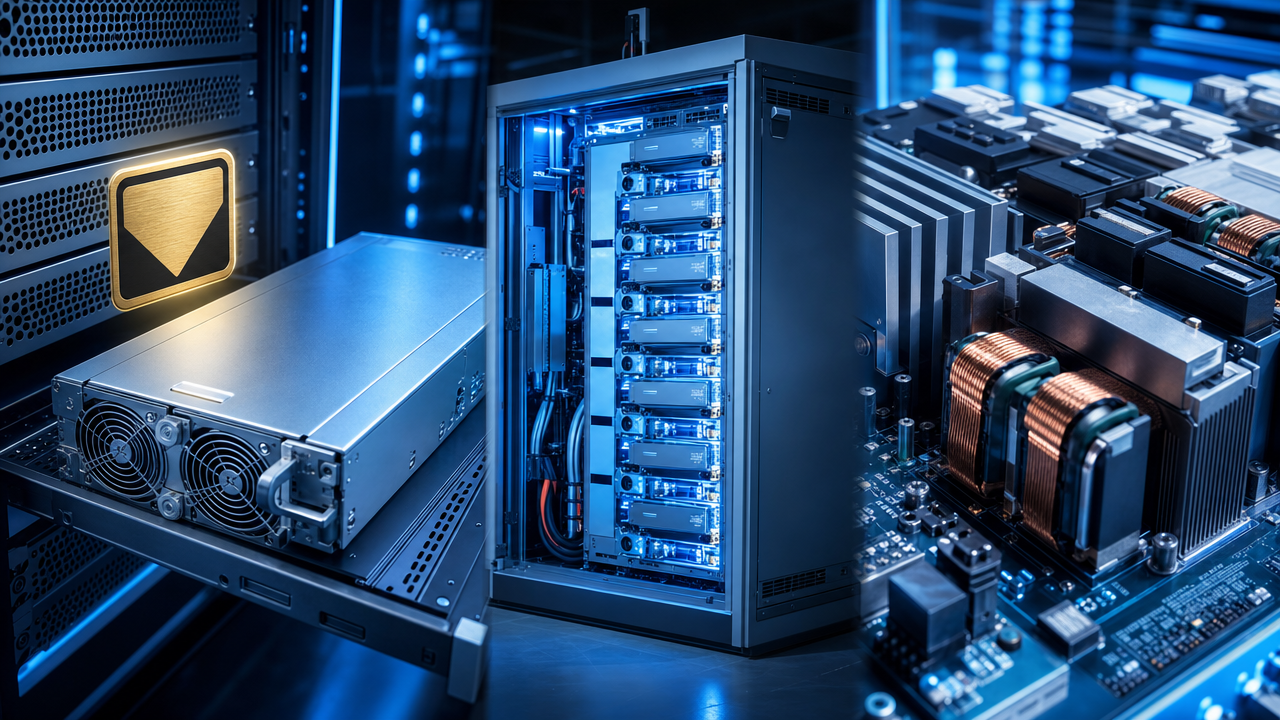

1. Industry Overview: From Industrial Control Cabinets to AI Compute Racks, the Map of Industrial Power Supplies Is Being Redrawn
Walking through China's industrial power supply industry in mid-2026, the picture is unusual. The total market is not small — when you add AC/DC industrial power, server PSUs, UPS systems, energy-storage PCS, EV-charging power modules, and specialty power supplies together, the 2025 China shipment value reaches roughly RMB 120 billion. Add the export revenue of domestic vendors and the total picture climbs above RMB 140 billion. Yet inside this market, two extremes coexist: traditional vendors whose 2025 net profit fell by 70% YoY, and new server-PSU specialists whose revenue grew over 40% for four consecutive quarters. The pace of old-to-new rotation has not been this dramatic in any prior industrial-power cycle.
The 2025 China market splits into three clearly distinct battlegrounds. The first is server PSU. China's AI server power supply market was about RMB 4.33 bn in 2024 and is expected to reach RMB 5.5 bn in 2025, with a CAGR of around 19%. AI's share of the total server-PSU market is moving from below 25% in 2023 to above 40% in 2025. As NVIDIA's GB200 and GB300 rack-scale solutions and Chinese accelerators (Ascend 910C/910D, Cambricon, Hygon, Iluvatar, Biren, Moore Threads) reach volume, the PSU per-rack power moves from 3 kW to 5.5 kW and onward toward 8 kW and 12 kW. The replacement-plus-expansion dynamic is real: 2026 China AI server PSU market is on track to exceed RMB 8 bn and 2027 RMB 12 bn.
The second is energy-storage PCS. 2024 China-vendor PCS shipments were about 88.53 GW (+79% YoY); analysts forecast 212.47 GW in 2026, translating to a market of RMB 14 bn in 2024 and RMB 27–33 bn in 2026. Unit prices have crashed: utility-scale PCS hit RMB 0.08–0.09 per W in 2024, C&I PCS RMB 0.11–0.12 per W, while residential PCS still holds RMB 0.30–0.50 per W. The downstream application mix continues to reshape the revenue curve.
The third group bundles industrial control, specialty, and UPS — the "traditional" set, RMB 70–80 bn in 2025. UPS alone is RMB 19.1 bn in 2025 with modular share at 34%, on track to exceed 50% in 2026. AIDC and liquid-cooled data center demand turn UPS from a legacy refresh business into "AI-ready" supply, while 48V high-frequency telecom power, industrial control power, and electrical operation power continue independent cycles.
The bigger structural point: China's industrial power industry is no longer "general power + adaptation". 2024–2026 is rewriting it through three growth engines — AI server PSU, energy-storage PCS, and AIDC HVDC. This compresses what used to be three engineering teams (switching power, power electronics, energy storage) into one. The PSU integrators that emerge will be the ones who can integrate upstream materials, in-house magnetics, in-house topology, in-house control algorithms, and system integration.
At the company level, 2025 sorted out the early winners and the early losers. Greatwall Switching Power (Greatron / Eurolinking, 300870) was the fastest mover: 2025 revenue RMB 4.462 bn (+17.5%), net profit RMB 244 mn; data-center power line grew 38%. Megmeet (002851) commanded narrative attention but full-year 2025 net profit guidance was -65.6% to -72.5% because most AI-PSU orders remain in R&D/debug stage. Zhonghen Electric (002364) HVDC business reached RMB 1.2–1.3 bn (+50% domestic, +RMB 100 mn overseas). Kehua Data (002335) H1 revenue RMB 3.733 bn, with new-energy + data center = 87% of total. KEL (002782) 2025 revenue RMB 5.532 bn, net profit +30.18%, the most stable upstream magnetics player.
International players had the breakthrough year. Delta Electronics (2308.TW) hit a record NT$554.885 bn (about US$17.56 bn, +31.8%); AI-related PSUs were 23% of revenue Q1–Q3 2025, six times the prior year. Eaton (ETN) reached US$27.4 bn FY2025, +8% organic; Q4 data-center revenue +40%, orders +200%. Vicor (VICR) extended its 48V distribution architecture as data-center 48V demand grew >20% CAGR. Power Integrations (POWI) saw GaN revenue grow +50%+ in H1 2025; its 1250V/1700V GaN portfolio targets the next-gen AI data center. MEAN WELL combined revenue of US$1.05 bn (2024) keeps it at #5 in DC-output standard power and #2 in LED drivers.
Macro takeaway: industrial power is no longer an "inwardly cycling traditional business". One leg is planted on AI compute's ceiling; the other is bolted to the new power-grid foundation. Two events will determine 2026: (1) whether NVIDIA and Huawei's next chips can keep pushing power upward, and (2) whether Chinese utility-scale and C&I energy-storage demand maintains its growth trajectory. If either fails, the whole sector rewrites. The next 13 chapters break down upstream, process moats, company maps, overseas comparisons, price cycles, policy, and risk.
2. Upstream: MOSFETs, IGBTs, SiC, GaN, Magnetics, and Capacitors All Get Version-Bumped
Industrial power has a basic fact often overlooked: the upstream supply chain determines cost-curve and performance-ceiling far more than the downstream application drives revenue. The 2025 upstream evolved through three big shifts. First, SiC power devices — global market US$2.4 bn (2024) → US$4.3 bn (2025), CAGR 35%+. Infineon's Kulim 12" SiC fab ramped to 20,000 wafers/month in Q2 2025; single-tube SiC MOSFET catalog price fell 35–45% versus 2023. China's Silan completed 4th-gen SiC-MOSFET with Rds(on) 9.8 mΩ. SiC PSU penetration may run 6–9 months ahead of the conventional schedule.
Second, GaN power devices. Power Integrations H1 2025 GaN +50%+, 1250V/1700V suited to next-gen AI data centers. Navitas + Innoscience launched 8.5 kW full-GaN AI server PSU with power density approaching 200 W/in³. Domestic GaN single-tube prices dropped 50% from 2023, making 4.2–5.5 kW full-GaN PSU economically viable with peak efficiency >97% (80Plus Titanium / Ruby).
Third, magnetic components. KEL 2025 magnetics revenue RMB 4.63 bn (83.7% of total), serving NEV, PV-storage, EV charging, UPS, AI server PSU, industrial power, rail transit. AI server PSU magnetics require nanocrystalline/amorphous cores not ferrite, and planar transformers integrate into PCB substrates. KEL, Jingquanhua, Mingpu Optomagnetic, Egor, and Haiguang Magnetic anchor the second tier behind. Around power transformers and power inductors, competition has shifted from "price-delivery-capacity" to "power density-loss-EMC-integration".
Capacitors (film + electrolytic) for PCS DC support, HVDC bus, and LLC resonance — Faratronic (H1 RMB 2.06 bn, NEV+PCS approaching 60%), Jiang Hai Capacitor (H1 RMB 3.143 bn, three-capacitor portfolio). PCB/PCBA upgrades (14 layers, 0.10 mm microvias, 4–6 oz copper) plus immersion-cooled power supplies have created new differentiation. Immersion-cooled PSU sells at +30% per watt and earns +5–8 percentage-point gross margin uplift versus standard PSU.
The net: 2025 upstream changes — SiC down 35–45%, GaN localization 8%→22%, magnetics-capacitor-PCBA alignment with AI-server-PSU standards — give 2026 integrators lower BOM and higher density. But low-end PSU margins are now structurally dead. Industry profit will concentrate among those who can integrate the full stack.
3. Process Moats: High Power Density, Titanium/Ruby Efficiency, LLC Resonance, and Liquid Cooling
The real moat is doing seven dimensions simultaneously — semiconductor, magnetics, control, topology, thermal, EMC, reliability — to their limits.
Efficiency. 80Plus Titanium requires peak >96%, OCP pushes to 97.5%, 80Plus Ruby (new in 2025) demands >98%. The only viable 2–5 kW topology is totem-pole bridgeless PFC + full-bridge LLC: front-end single-stage AC-DC with SiC/GaN switches, back-end LLC with soft switching. Going from "able to build one" to "stable 95%+ yield in Titanium certification" requires 18–24 months of process iteration. Greatron, Megmeet, Delta, Lite-On, and Acbel are the few global vendors who clear the bar at 3–5 kW. Innoscience's 2 kW Titanium hit 96.5% peak, and the 4.2 kW full-GaN reference hit 97% with 130 W/in³.
The frequency story: Titanium PSU pushes switching from 100 kHz to 250–500 kHz, magnetics shrink 60%. Ruby pushes 800 kHz–1.5 MHz, forcing nanocrystalline cores and 14-layer embedded resistor/capacitor PCB. The cliff knocked out most second-tier vendors in 2024–2025.
Power density. 1U telecom power: 5–10 W/in³. 2010s server PSU: 25–40 W/in³. 2020 Titanium PSU: 60–80 W/in³. 2025 frontier (Innoscience, Navitas all-GaN): 130 W/in³. Each doubling requires synchronized advances in switching frequency, core material, semiconductor loss, and PCB integration. Greatron's R&D ratio sat above 5.5% for two years; Megmeet's stayed 8%+; second-tier vendors stuck at <3% cannot keep up.
Thermal management. AI server PSU at 3–5 kW generates 200–300 W of waste heat — beyond traditional forced air. Three 2025 frontiers: immersion (immersion-cooled power supply, 5–10x heat-rejection improvement; Greatron has 5 kW in volume), cold-plate (3–5x improvement; Delta and Huawei in volume), phase-change (lab to commercial 2026–2027).
EMC and reliability. PSU output currents over 200 A and switching at 500 kHz–1.5 MHz create EMI 10x what general power generated. To clear CISPR 32 Class A, FCC Part 15, FCC require totem-pole low-CM topology plus multi-stage common+differential mode inductors. Reliability targets — MTBF ≥ 500,000 hours, lifespan ≥ 5 years, hot-swap <10 ms — are individually solvable, but doing all of them simultaneously and consistently is what gates the qualifier pool.
The six moats — efficiency, density, thermal, reliability, control software, certification — each demands 3–5 years of engineering accumulation. Together they explain why 2025 AI-PSU market concentrates and why traditional integrators stumble on the transition.
4. Major Players: Megmeet, Greatron, Zhonghen, Delta, Eaton, Vicor
The domestic leaderboard splits into four tiers. Tier 1 ("full platform"): Megmeet, Greatron. Tier 2 ("specialist"): InfoChamp (英杰), East-Group (易事特), Zhonghen, Power Source (动力源), AOhai (奥海科技). Tier 3 (upstream magnetics & devices): KEL, Jingquanhua, Egor, Mingpu, Haiguang. Tier 4 (niche risers): China Greatwall, ChipONE Integrated, Power Source, Ziseries, InCryp.
Megmeet (002851). 2025 Q1–Q3 revenue RMB 6.79 bn (+15.05%), net profit RMB 210 mn (-48.29%), non-recurring net profit RMB 117 mn (-67.85%). Full-year net profit guidance: RMB 120–150 mn, down 65.6–72.5% YoY. Server-PSU portfolio: Power Shelf, BBU Shelf, Power Capacitor Shelf, 800V/570 kW Side Rack. Most AI-PSU client projects remain pre-volume R&D. The story rode NVIDIA's wave but profit slipped.
Greatron (300870). 2025 full-year revenue RMB 4.462 bn (+17.5%), net profit RMB 244 mn. Q1–Q3 revenue RMB 3.387 bn (+27.16%), net profit RMB 220 mn (+41.53%). Data-center power line +38%. Product family: 3,200W M-CRPS Titanium, 1,300–3,600W CRPS Titanium, 3,300–5,500W Titanium and Super-Titanium GPU PSU, immersion-cooled PSU, PowerShelf. The leader of domestic, comparable with global high end. 2026 target: break into Meta, Microsoft, Google as a Tier-1 supplier.
Zhonghen (002364). 2025 HVDC revenue forecast RMB 1.2–1.3 bn (57–62% of total), domestic +50%, overseas +RMB 100 mn (Singapore, SEA). HVDC system: 380V AC → 240V/336V/800V DC, system efficiency 97.5%+. RMB 4.1 bn collaboration with CATL on "compute-power coordination". 2026 looks underestimated — HVDC penetration jump from <5% to 15–20% is near-certain and Zhonghen will capture a large share.
Kehua Data (002335). H1 revenue RMB 3.733 bn (+0.06%), net profit RMB 244 mn (+7.94%). New-energy RMB 1.852 bn (49.62%), data-center RMB 1.398 bn (37.44%). Storage PCS #1 by new-add electrochemical storage share and user-side share; Kehua Energy #1 globally on PCS shipments >500 kW. 20+ data centers with 35,000 racks across Beijing-Tianjin-Hebei, Yangtze Delta, GBA; PUE ≤ 1.2.
East-Group (300376, ST). H1 storage business +150% YoY, covering utility / C&I / residential / charging. Modular high-frequency UPS recognized as MIIT "manufacturing champion". Governance overhang offsets the strong narrative.
KEL (002782). 2025 full-year revenue RMB 5.532 bn (+17.87%), net profit RMB 300 mn (+30.18%). Magnetics RMB 4.63 bn (83.7%) + switching power RMB 880 mn (15.9%). The most balanced upstream magnetics name in the cycle.
InfoChamp (300820). 2025 revenue RMB 1.502 bn (-15.65%), net profit RMB 223 mn (-30.94%). PV power business RMB 634 mn (-27.46%). Semiconductor & power-material business RMB 329 mn (21.93% of revenue). Steel, industrial furnace, medical growing. Plasma power supply for controlled-fusion installations exceeds tens of millions of RMB.
International references: Delta NT$5,548.85 bn (US$17.56 bn, +31.8%); Eaton US$27.4 bn (+8% organic, Q4 data-center +40%); Vicor's 48V distribution leadership in BCM modules with data-center 48V demand >20% CAGR; Power Integrations GaN +50%+ H1 2025, 1250V/1700V GaN for next-gen AI; MEAN WELL US$1.05 bn 2024, #5 DC-output, #2 LED-driver. Gap analysis: domestic Tier-1 PSU process closes the gap with Delta-Lite-On-Acbel; system integration weaker than Eaton-Vicor; Tier-1 client penetration still limited.
5. Server PSU: The AI Compute Rack, the Kilowatt-Class PSU, and 48V vs HVDC
Server PSU is the most heavily watched battleground because of one simple logic: the AI compute bottleneck has shifted from "not enough chips" to "not enough power delivery". GB200 NVL72 is 132 kW per rack — nearly double H100's 60–80 kW. GB300 pushes to 160–180 kW. Rubin (volume 2026–2027) breaks 250 kW per rack with single-card power above 1,400 W. Every AI server now needs higher power, higher efficiency, higher density PSU; every AI data center must redesign distribution. Chinese domestic compute demand layered with US hyperscaler capex records lifts the ceiling above anything prior decades could imagine.
Form factors. Four classes. CRPS (Common Redundant Power Supply) — 1U, 1.3–5.5 kW, 60%+ of AI server PSU market. M-CRPS — multi-output variant. PowerShelf — 1–3U chassis hosting multiple PSU, 12–30 kW per shelf; volume ramps from H2 2025. Side Rack — full-rack power cabinet, 500–1,000 kW per cabinet; the standard for GB200/GB300 and NVIDIA Kyber rack designs.
Efficiency tiers. OCP-defined Bronze through Titanium, plus the new Ruby (2025+) demanding >98% peak. First 11 kilowatt-class Ruby certifications were taken in 2025 by Delta, Lite-On, Acbel, Greatron, and Foxconn. Ruby's meaning is not "extra 1–2% energy savings" but "extra 100–200 W of usable output in the same thermal envelope" — each 1% efficiency point translates directly to one more GPU per rack.
Distribution architectures. Traditional 12V — runs into busbar losses at GB200-class power. 48V (Vicor leader, NVIDIA transitioning) — 4x lower current, 16x lower distribution losses than 12V at the same power; the central choice for GB200 racks. 800V HVDC (NVIDIA announced May 2025, Kyber rack 2027 volume) — 380V AC → ±400V/800V DC distributed across the rack, internally stepped down to 48V/12V. The third-generation ±400V/800V architecture supports 600 kW+ rack power density via "one-time AC conversion, full DC transmission". NVIDIA whitepaper added medium-voltage rectifiers and solid-state transformers as future options.
Power tiers. 1.3–2 kW (legacy training/inference), volume but stagnant. 3–4 kW (H100/A100 class), 2024 mainstream. 4.5–5.5 kW (H800/H200/MI300), 2025 mainstream. 6–12 kW (GB200/GB300/Rubin), 2026+ mainstream. Each step lifts BOM complexity AND price stepwise: 1.3 kW Titanium PSU RMB 400–600, 3 kW RMB 1,500–2,500, 5.5 kW RMB 4,000–7,000, 8–12 kW all-GaN RMB 8,000–15,000. Tier migration is the largest revenue lever.
Player roster. Tier 1: Delta + Lite-On + Acbel — 50%+ of global AI PSU. Tier 2: 8–10 domestic Chinese names plus 30–40% domestic share. Tier 3: Vicor, POWI, Navitas with disruptive architectures. Tier 4: Huawei Digital Power (combined with Delta + Lite-On at 50% of global PSU). 3–5 year evolution: Tier 1 slowly cedes 1–2 pp/year; Tier 2 climbs 10–15 pp; Tier 3 captures chokepoints via 800V HVDC and GaN; Tier 4 depends on Huawei's external opening.
Numbers: global AI server PSU 2024 US$2.846 bn → 2031 US$60.81 bn (CAGR 54.87%). More tractable: China AI server PSU market RMB 5.5 bn (2025) → RMB 8 bn (2026) → RMB 12 bn (2027), with localization moving from 20% to 50%+. The top-five Chinese names should share RMB 6–7 bn of the addressable market by 2027, supporting "revenue doubling + 5–10 pp net-margin uplift" — a classic Davis double for 2026–2027.
6. Energy-Storage PCS, EV Charging Power, and UPS: Another Industry Curve Being Redrawn
PCS + EV-charging + UPS share an underlying isomorphism: large-power bidirectional DC-AC conversion, IGBT/SiC MOSFET main power, high-frequency high-density magnetics, 10–15 year reliability. They form the second main line beyond AI data center.
PCS. China-vendor shipments 88.53 GW in 2024 (+79%), 212.47 GW by 2026, market value RMB 14 bn (2024) → RMB 27–33 bn (2026). Shipment +140% but revenue +90% reflects fast price erosion. Margin discipline diverges sharply: Sungrow at 20%+ (overseas channel advantage), Kehua at 18–22%, Sineng at 16–18%, second-tier names at 10–15%.
By application: utility-scale PCS RMB 8–10 bn in 2025 (CAGR 25–30%, driven by new-energy + storage configuration policy and "east-west data" grid balancing); C&I commercial energy storage RMB 5–7 bn (CAGR 50%+, driven by industrial-park peak shaving); residential 2024–2025 dipped on European/Australian inventory pile-up but new markets (Africa, SEA, LatAm) rebound by 2026.
EV charging. China DC fast-charger shipments 800k units in 2024 → 1.3 mn 2025; charging-power-module shipments 12 mn → 19 mn units; market RMB 8 bn → RMB 11 bn → RMB 16 bn (2026). Module power shifts 30→40–60 kW per unit; SiC penetration 20%→50%+ by 2026; liquid-cooled modules become mainstream. Huawei Digital Power dominates with 30%+ share; Infypower at 15–18%; Yonglian, InCryp, Power Source, EVBOR among the rest.
UPS. 2025 China market RMB 19.1 bn; modular share 34.2%, crosses 50% in 2026. Huawei DP holds 25–28%, Vertiv 18–22%, Kehua 12–15%, Delta 8–10%, Eaton 5–7%, Schneider/APC 6–8%. AI data centers above 5 MW switch from traditional online UPS to modular; above 50 MW switch to HVDC. Three technologies coexist 5–10 years.
The CATL–Zhonghen RMB 4.1 bn collaboration on "compute-power coordination" reframes the AI data center as "compute + power + storage + dispatch" rather than serial compute + power. PCS, UPS, HVDC, PSU become nodes in a power-dispatch network — drives the deepest narrative reconstruction for 2026–2028.
7. Tianxia Gongchang's View: Mapping Power Modules, Magnetics, and PCBA Factories by Process and Application
The research switches angle here. Prior chapters spoke as a "seller"; the real participants — upstream device makers, mid-stream module makers, downstream system integrators — most need not another report but the ground truth: who can do what work, where, at what scale. This is the "matching efficiency" problem 2025–2026 industrial power undervalues.
The platform sits at the center of 4.8 million producing factories as a B2B information platform. Unlike pure registry sites, its data is "factory process capability + product category + capacity scale + delivery history" four-dimension verified data. That difference matters most in industrial power, where compliance and delivery history dominate trust.
Three matching problems the platform solves.
Problem 1: Upstream magnetics and switching power sub-vendor matching. When an integrator switches from home-appliance power to AI-server PSU, its old magnetics vendor cannot make nanocrystalline high-density transformers, and its old contract assembler cannot do 14-layer PCB + power-device soldering. The platform filters by process tags (high-frequency, nanocrystalline, microvia, OCP-customer history) and returns 5–10 qualified candidates in 7–15 days.
Problem 2: Power module PCBA capacity matching. Of 3,000+ regional PCBA shops, only 200 can handle high-density power modules, 80 can handle 4–6 oz / micro-via, 30 have direct OCP delivery experience. The platform's's multi-dimensional matching (SMT line config, AOI, X-ray, IPC certification) compresses 7–15 days from a 60-day baseline.
Problem 3: Specialty industrial power and specialty power reverse matching. Nuclear, medical imaging, rail traction, semiconductor plasma — each sub-vertical has limited supplier transparency. The platform's's factory atlas surfaces these long-tail vendors for incoming integrators looking to enter specialty markets.
Tagged factory classes. (1) high-frequency high-density transformer shops: Dongguan, Shenzhen, Huizhou, Foshan, Wenzhou, Taizhou, Ningbo, Xiamen, Suzhou, Changzhou, Wuxi — 800–1,200 nationally; >100 kHz capable: <200; >500 kHz + nanocrystalline: <50. (2) high-density PCBA assembly: Shenzhen, Dongguan, Huizhou, Suzhou, Kunshan, Chongqing, Qingdao — 3,000 nationally; 14-layer + 4 oz capable: <80. (3) power-device soldering / module packaging: Wuxi, Suzhou, Hefei — 500 nationally; SiC MOSFET module: <30. (4) PSU/PCS final assembly + testing: 1,500 nationally; OCP + 80Plus Ti compliant: <100. (5) HVDC system integrators: 2,000 nationally; large-DC HVDC deliverable: <10.
Around high-frequency power and semiconductor equipment power, four-dimension intersection — customer type, delivery history, certification, internationalization — completes most of the due diligence at the factory layer, replacing the traditional "sign framework, find defect, terminate" expensive iteration.
Impact: 30+ integrators got matched with 200+ upstream specialists in Q4 2024–H1 2025; matching cycles cut from 60–90 days to 7–15 days; validation pass rates from 30% to 60%+. This is the transparency layer 2026–2028 China industrial power supply chain is being built on.
8. Localization: Server-PSU OEM Replacement, Residential PCS Overseas Channels, IGBT Driver Power
Three localization paths. Path 1: AI server PSU OEM replacement. End-2025 global AI server PSU still 50% Delta + Lite-On + Acbel; Huawei DP another 10–12%; rest 35–40%. Chinese localization rate: 2023 8–12% → 2024 15–20% → 2025 22–28% → 2026 likely 35%. Barrier is not capability — top Chinese vendors (Greatron, Megmeet, AOhai, ChipONE, China Greatwall) match Taiwanese leaders at 3–5 kW — it's customer qualification (18–24 months for Tier 1 hyperscalers), capacity ramp, and supply-chain stability. 2026 milestone: 1–2 Chinese vendors break into Tier-1 hyperscaler production lists.
Path 2: Residential and C&I PCS overseas channel. Localization here is not about product — it's about brand, channel, install service, after-sales, local compliance. European market: SolarEdge + Enphase + Sungrow dominant. Australian: Sungrow + Tesla + Sonnen. SEA: Chinese brands rising (Sungrow, Huawei, GoodWe, Ginlong, FirstAviator). African + Middle East: still building. North American: tariff and certification walls. Building real localization needs 3–10 year sustained investment in brand, channel, certification.
Path 3: IGBT driver power and large-power power modules. Often overlooked: 2025 global IGBT driver power market RMB 20 bn, customers concentrated, technical bar high, gross margin 30–40%. IGBT driver power — international: PowerEx, Infineon, Mitsubishi, Semikron, Hitachi. Domestic: CRRC Times Electric subsidiary, Bronze Sword Tech, Galaxy Microelectronics, Silan Micro. 2025 localization rate 20–25%, applied in rail-tractions, NEV IGBT, wind, PV inverters. 2026–2028 should reach 50–60%.
Specialty sub-lines: semiconductor plasma power — InfoChamp at RMB 329 mn (21.93%); medical imaging power (high-voltage generators, CT tube power, MRI gradient power) — United Imaging, Neusoft, Mindray internal teams; NEV OBC and DC-DC — Embolt, Xrui, Fortuna, HuaQin already at 60%+ localization; wind converters — Goldwind, Envision, Dongfang Electric at 70%; PV inverters — Sungrow, Huawei, Ginlong, GoodWe, Sineng combined 80%+ domestic.
People bottleneck: 30k power-electronics engineers in China, but only <5k qualified to lead 5 kW+ high-density PSU / HVDC / large PCS design. R&D team scaling: Greatron 800→1,400, Megmeet 1,500→2,200, KEL 600→1,000 over 2023–2025. Investment intensity is real but explains the steep growth curve.
9. Capacity Expansion: The Process Division of Shenzhen, Suzhou, Hangzhou, Dongguan
China industrial power is capacity-dense. 200–300 kU annual capacity in Titanium PSU = 800–1,200 m², RMB 150–250 mn capex, 200–400 workers. 8–12 GW PCS capacity = 3,000–5,000 m², RMB 300–500 mn capex, 500–800 workers. 30–50 kU charging-module capacity = 1,500–2,500 m², RMB 200–300 mn capex, 300–500 workers. 2025–2026 is the biggest expansion year ever.
Megmeet Shenzhen Bright base 80,000 m² new data-center power facility, RMB 850 mn capex, ramp Q4 2026; targets GB200/GB300 / domestic intelligent compute. Greatron Suzhou phase 1 (60,000 m², 2024 Q4 live), phase 2 (80,000 m², RMB 1.2 bn capex, Q3 2026 live); 5.5 kW Titanium/Super-Titanium GPU PSU lines. Zhonghen Hangzhou Xiaoshan new 50,000 m² base, RMB 600 mn capex, Q2 2026 live, HVDC modules + UPS. Kehua Xiamen Jimei + Zhangzhou expansions combined RMB 1.2 bn capex.
Kehua Energy Xiamen storage base 200,000 m², three phases, 50 GW PCS + 30 GWh integration, RMB 2.5 bn capex, phase 1 (8 GW) Q3 2024 live, phase 2 (18 GW) Q4 2025, phase 3 (24 GW) Q2 2027. KEL Huizhou Boluo 80,000 m² smart magnetics plant, RMB 1 bn capex, Q1 2026 live. InfoChamp Chengdu Xindu 30,000 m² semiconductor-equipment power and specialty power, RMB 400 mn capex, Q3 2026 live.
Total 2025–2026 industry capacity expansion: 2.0–2.5 mn m², RMB 8–10 bn capex, 40–60k new workers. Risks: (1) demand growth slows in H2 2026 → capacity overhang + price war; (2) yield ramp at 5 kW+ Titanium / immersion / 800V HVDC typically takes 12–18 months — consumes capacity without producing revenue. Geographic clusters: Shenzhen HQ + R&D; Suzhou high-power PSU; Hangzhou HVDC + PCS; Dongguan + Huizhou magnetics + PCBA; Xiamen PCS + UPS. The cluster effect gives China a 5–8 year process advantage over SEA or India newcomers.
10. Price Cycles: From 2024 Bottom to 2026 Rebound — Margins Recover
Server PSU. 2020–2022: Titanium PSU RMB 0.65–0.85/W. 2022–2023: AI-server stepwise lift to RMB 0.90–1.10/W. 2024: 5.5 kW Titanium/Ruby RMB 0.95–1.25/W, unit price RMB 5,000–7,000. 2025: stabilized at RMB 0.90–1.15/W. 2026: 8–12 kW all-GaN PSU lifts to RMB 1.00–1.30/W but revenue elasticity comes from volume not price.
Storage PCS. 2021 RMB 0.25–0.30/W → 2023 RMB 0.12–0.15/W → 2024 RMB 0.08–0.09/W (utility-scale). 2025 bottom; 2026 stabilizes or slightly recovers. Cost-floor reached; industry self-regulation against extreme bids; high-end demand pulls premium-tier pricing 25–50% above base. C&I 2024 RMB 0.11–0.12/W steady. Residential RMB 0.30–0.50/W stable.
UPS. Modular RMB 1.2–1.8/W stable; high-power (>500 kW) modular at +30–40% premium for hyperscaler demand.
EV charging power. 30 kW DC modules RMB 0.30–0.40/W in 2025 (RMB 9,000–12,000 per module), down 20–30% over three years. 2026 with 40/60 kW and SiC, expect further 10–15% per-watt decline.
Material cost. 2024–2026 copper LME US$8,500 → US$9,800 → US$10,500–11,000/t. Aluminum US$2,300 → US$2,500 → US$2,500–2,700/t. SiC, GaN, IGBT all in 35–50% declines. Aggregate BOM moves +2–3%, gross margin -0.5–0.8 pp 2024–2025. 2026–2027 trend: gross margin recovers 2–5 pp domestically as price stabilizes and high-end mix takes share.
11. Policy: Dual-Carbon, Data-Center Green Index, AI + Manufacturing
The carrying logic of 2024–2026 policy: dual-carbon drives PCS; data-center green index drives HVDC; AI + manufacturing drives intelligent compute infrastructure. NEA's 2025 New Energy Storage Report projects 35 GW new + 80 GW cumulative installations. NDRC + MIIT + NEA's east-west data center program with PUE ≤ 1.25 and renewables ≥ 30% (core nodes) now binding. MIIT Jan 2026 "AI + Manufacturing" plus the 2026–2028 Industrial Internet plan targets 50k+ enterprises with new networking by 2028.
EV charging: State Council mandate for 12 mn public + 60 mn private chargers by end-2025; 2026 public DC fast-charger share ≥ 30%, single-unit power ≥ 120 kW. Energy efficiency: mandatory rating uplift starting 2025. Semiconductor independence: 12-inch fab buildout drives semiconductor-equipment power demand (InfoChamp at RMB 329 mn in 2025).
Risks: capacity overhang from policy-induced capital influx, price war, overseas tariff and CBAM costs. Three transmission chains: (1) dual-carbon → grid → PCS demand → Sungrow, Kehua, Sineng, Sungrow, plus IGBT/SiC upstream (StarPower, CRRC, Silan); (2) east-west data → AIDC → HVDC + UPS → Zhonghen, Huawei DP, Vertiv, Kehua, plus PSU integrators (Greatron, Megmeet); (3) semiconductor self-sufficiency → specialty equipment → specialty power (InfoChamp, Power Source).
12. Tianxia Gongchang Research Institute Judgments: 3–5 Year Industry Evolution and Investment Coordinates
Wrapping 11 chapters into one industry call. Five judgments.
Judgment 1: AI server PSU is the most certain growth track for 2026–2028. Demand: GB200/GB300/Rubin power continues to scale. Supply: <10 capable integrators globally. Tech: 800V HVDC, SiC, GaN tailwinds. China AI server power market RMB 5.5 bn (2025) → 200–250 bn 2028, 50–60% CAGR. Greatron, Megmeet revenue >100 bn AI-PSU by 2027.
Judgment 2: Storage PCS enters "volume up, price stable" phase 2026–2027 margin recovery. Price floor reached; demand high; consolidation. China storage PCS RMB 14 bn (2025) → 35–40 bn 2028, 35–40% CAGR.
Judgment 3: HVDC is the most underrated subline. 5x penetration upside; single-DC HVDC config value RMB 50–200 mn vs traditional UPS 10–30 mn; <5 domestic vendors capable. Zhonghen at RMB 1.2–1.3 bn HVDC in 2025 → >3 bn by 2027–2028.
Judgment 4: Magnetics is the most certain "selling-shovels" track. BOM 15–22% across PSU, PCS, UPS; high-density nanocrystalline transformer process barrier 2–3 orders of magnitude vs ferrite; <10 capable domestic vendors; serves 6 downstream lines. KEL RMB 4.63 bn (2025) → >8 bn 2028.
Judgment 5: Specialty power is the most profitable "small-and-beautiful" track. 30–45% gross margin, customer concentration extreme. Semiconductor plasma, medical, fusion, rail traction, wind converter, semiconductor equipment plasma. InfoChamp the domestic reference: bouncing off PV decline via semiconductor + medical + fusion uplift; 2025 specialty business hit positive growth.
Investment combo: AI server PSU + HVDC + magnetics — Greatron + Zhonghen + KEL the three-legged stool. Across 2026–2030, factory-capability scarcity will define winners: 5 kW+ Titanium PSU mass production (<20 nationally), high-density magnetics (<50), SiC module packaging (<30), 14-layer/4 oz PCBA (<80), HVDC system integration (<10). Whoever locks in capability here secures the deepest 5–10 year moat.
13. Risk Factors: Server Demand Slowdown, Foreign Counterattack, Residential Inventory Overhang
Risk 1: AI server demand slows. US hyperscaler capex pause, NVIDIA GB200 ramp delay, training-to-inference paradigm shift reducing per-rack power, US grid constraint limiting build pace. China side: intelligent compute build pace slows, domestic accelerator yield/ramp falls short, US export controls tighten. Worst-case 20–30% downside to current 2026–2027 forecasts.
Risk 2: Foreign counterattack. Tech acceleration (Vicor 48V, POWI GaN), price war (Delta and Lite-On already aggressive on 1.3–3 kW), capacity offshoring (Delta Thailand +3 plants, Eaton Mexico expansion), M&A consolidation. Localization timeline slips 6–12 months.
Risk 3: Residential PCS inventory overhang. Europe/Australia high inventory through H1 2026; Eurozone subsidy taper; installer margins squeeze. Recovery to H2 2026 at earliest.
Risk 4: Capacity overhang + price war. 30+ PCS vendors bidding for utility-scale projects; AI PSU could repeat if entrants accelerate. 2026 H2 / 2027 the inflection.
Risk 5: Material supply risk. SiC substrate capacity tight (single supplier Infineon Kulim); rare earths/magnetics cobalt + nickel +30–40% over 2 years; IGBT module DCB/AMB ceramic substrates 80% dependent on German + Japanese vendors.
Risk 6: Policy + regulatory. US tariff escalation; EU CBAM 2026 binding (+5–15% compliance cost); domestic efficiency standards uplift forcing legacy product retirement.
Probability-impact matrix: capacity overhang + price war = high prob / med impact; AI demand slowdown + foreign counterattack = med prob / high impact; supply disruption + policy extremes = low prob / very high impact.
14. Data Sources and Tianxia Gongchang Research Institute Closing
Sources. Five categories. (1) Listed company disclosures: Megmeet (002851), Greatron (300870), Zhonghen (002364), Kehua (002335), East-Group (300376), KEL (002782), InfoChamp (300820) 2024 annual reports, 2025 annual reports, 2025 Q3 reports, 2025 H1 reports, IR records; Delta (2308.TW), Eaton (ETN), Vicor (VICR), Power Integrations (POWI), Navitas Semiconductor (NVTS) FY 2025 reports, SEC 10-K/8-K filings; MEAN WELL, Huawei Digital Power, Lite-On, Acbel official disclosures.
(2) Industry research: CAICT, CCID Consulting, Zhiyan Consulting, Huibo, CICC Research, Dongwu Securities, Guoxin Securities, Southwest Securities, Dongxing Securities, CITIC Securities 2024–2026 deep reports on industrial power, server PSU, storage PCS, UPS, HVDC, SiC/GaN power devices; LP Information, Mordor Intelligence, Markets and Markets, DirMarketResearch 2025 global power market reports.
(3) Policy documents: NEA "China New Energy Storage Development Report (2025)", State Council "Guidance on Accelerating Charging Infrastructure Construction", MIIT "AI + Manufacturing Special Action Implementation Opinions", MIIT "Industrial Internet Platform Development Action Plan (2026–2028)", NDRC "National Integrated Big Data Center Computing Power Hub Implementation Plan", State Council "14th Five-Year Modern Energy System Plan".
(4) Technology documents: NVIDIA 2025 800V HVDC architecture white paper, Vertiv 800V DC roadmap, Infineon AI server PSU optimization white paper, Huawei 2025 Data Center Energy Top-Ten Trends Report, Delta AI Power Solutions white paper, Open Compute Project (OCP) specs.
(5) The Institute Research Institute internal supply-chain capability data based on 4.8 million producing factories — process tags, capacity distribution, customer type, delivery history.
Media coverage: Shanghai Securities Journal, Securities Times, 21st Century Business Herald, Sina Finance, Eastmoney, CFi.CN, NetEase Finance, SemiAnalysis, Taipei Times, Reuters, Bloomberg, Nikkei Asia, The Register, Tom's Hardware 2024–2026 reporting.
Concluding judgment: 2026–2028 China industrial power industry stands at an industry-restructuring inflection. Upstream cost reduction enables midstream integrator capacity expansion, capacity expansion matches downstream AI compute + new-grid system demand, and profit concentrates among integrators who can vertically integrate materials + magnetics + topology + control + system. Whoever builds "process moat + engineering scale + customer qualification + global channels" first wins the deepest moat 2026–2030. The Institute Research Institute will continue tracking server PSU, AI compute power, storage PCS, HVDC, specialty power.
— the Institute Research Institute / June 2026