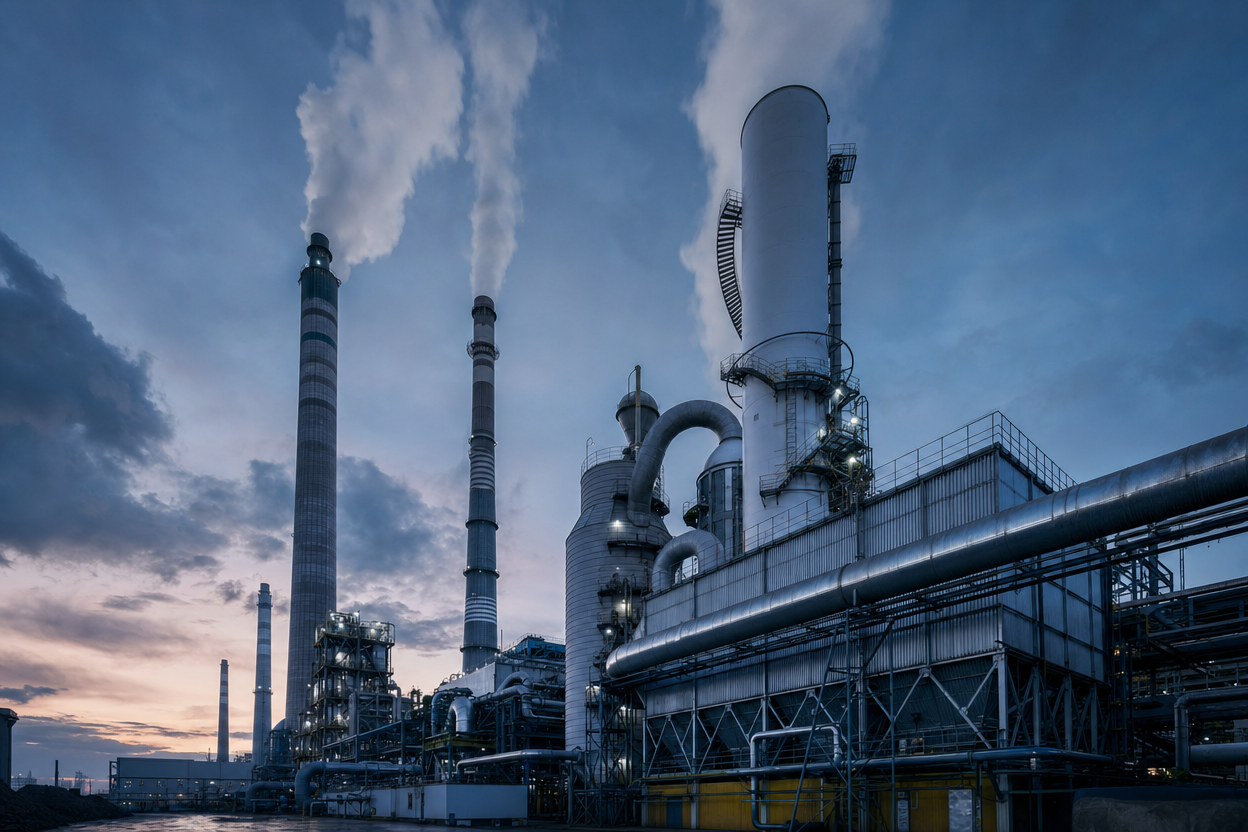

2026 is the watershed year for China's environmental protection equipment industry: the incremental market is ebbing and O&M plus retrofits have become the main battlefield. The three main lines of atmospheric, hazardous-solid waste and flue-gas treatment have all entered a new cycle of refinement and resource recovery. Domestic equipment manufacturers represented by Beijing SPC Environment Protection Tech (002573 Qingxin Environment), Longking Environmental Protection (600388), Feida Environmental Protection (600526), Fulongma (603686), Jingjin Equipment (603279) and Yongqing Environmental Protection (300187) are transforming from pure providers of electrostatic-fabric hybrid precipitators, desulphurisation towers and hazardous-waste incinerators into integrated environmental service providers offering "equipment + EPC + operations + digitalisation" full-chain solutions. At the same time, the veteran overseas environmental groups Veolia, SUEZ, Xylem, Evoqua and Babcock & Wilcox are comprehensively adjusting their China strategies in 2025, partially withdrawing from municipal markets and focusing on the higher-margin industrial environmental services and hazardous waste handling.
This report is anchored to the actual industry data of FY2025 corporate annual reports and the first half of 2026, covering four main lines: atmospheric treatment (electrostatic-fabric hybrid precipitation, wet/dry flue-gas desulphurisation, SCR/SNCR denitrification, activated-carbon adsorption), industrial VOCs (RTO regenerative thermal oxidation, catalytic combustion, activated-carbon adsorption + condensation), hazardous solid waste (hazardous-waste incineration, fly-ash treatment, cement-kiln co-processing, resource recovery) and flue-gas treatment (coal-fired ultra-low emission, ultra-low emission retrofit in steel). It conducts in-depth financial and strategic portraits of the six listed companies — Qingxin Environment, Longking, Feida, Fulongma, Jingjin Equipment and Yongqing — and benchmarks them against the FY2025 annual reports of the four multinationals Veolia, SUEZ, Xylem and Evoqua. The report has 14 chapters and around 55,000 Chinese characters in the original, and aims to provide a systematic, executable and anchored full-industry-landscape judgement for environmental-protection equipment manufacturers, EPC contractors, O&M service providers, hazardous-waste disposal enterprises, investment institutions and policy researchers.
Chapter 1: Industry Overview — China's 2025 Environmental Equipment Market Size, O&M Order Structure and Policy-Order Drivers
2025 is the pivotal year of transition for China's environmental protection equipment industry from incremental-driven growth to refined stock-management. According to the China Association of Environmental Protection Industry (CAEPI) statistical bulletin released in December 2025, total revenue of China's environmental industry in 2025 reached approximately RMB 2.32 trillion (+4.1% YoY), of which the equipment manufacturing segment was around RMB 680 billion, the environmental engineering segment was around RMB 840 billion, and the O&M services segment was around RMB 800 billion. The composition of these three segments evolved from "equipment 40% / engineering 40% / O&M 20%" in 2020 to "equipment 29% / engineering 36% / O&M 35%" by 2025. O&M orders crossed the one-third threshold for the first time, systematically reshaping the cash flow structure and profitability model of the industry.
By sub-segment, the atmospheric treatment segment (dust removal, desulphurisation, denitrification, VOCs treatment) in 2025 reached around RMB 240 billion, +2.8% YoY; the solid and hazardous-waste segment was around RMB 190 billion, +6.7% YoY; the flue-gas and ultra-low emissions retrofit segment was around RMB 120 billion, -4.1% YoY (coal-fired retrofits nearing completion); soil remediation was around RMB 70 billion, +8.4% YoY; environmental monitoring and third-party O&M was around RMB 80 billion, +11.2% YoY. Solid/hazardous waste and third-party O&M became the two fastest-growing segments, reflecting the policy direction of the dual-carbon goals and the expansion of zero-waste-city pilots.
In terms of order structure, the composition of newly added equipment orders in 2025 was roughly: 38% from local-government special-bond projects, 27% from EPC integrated packages, 18% from standalone equipment sales, and 17% from O&M and third-party governance concessions. This is in sharp contrast to the 2020 composition of "standalone equipment 45% / EPC 30% / others 25%". Government orders driven by special bonds became the main short-term incremental driver, but accounts-receivable collection cycles extended from around 180 days in 2020 to around 320 days in 2025. The collection pressure is the common reality faced by all environmental-protection listed companies from H2 2025 through 2026.
On the policy front, 2025 is the closing year of the 14th Five-Year Plan. The Atmospheric Pollution Prevention and Control Action Plan (extended phase), the Implementation Plan on Promoting the Construction of Beautiful China Pilot Zones, the renewal of the Implementation Plan for Ultra-Low Emissions Retrofit in the Iron and Steel Industry, the Three-Year Action Plan for Industrial VOCs Treatment (2024-2026), and the Notice on Deepening the Performance-Tiered Management of Key Industries released by the Ministry of Ecology and Environment in April 2025 form the policy baseline. By the end of 2025, the long-process steel mills nationwide need to achieve 100% compliance for organised emissions and 90% for fugitive emissions; the follow-up ultra-low emissions retrofits in the coking, cement, glass and ceramics sectors have been incorporated into the three-year action plan for 2026-2028, which is expected to bring RMB 180-220 billion of incremental equipment and engineering orders.
In an international comparison, the global environmental equipment and services market in 2025 was around USD 1.55 trillion (approximately RMB 11.2 trillion), of which Europe and the US accounted for about 49%, China-Japan-Korea about 35%, and other regions about 16%. The Chinese market accounted for about 20.7% of the world, remaining the largest single environmental-equipment market globally. However, the industry's growth has slowed from "double-digit" in 2010-2015 to "mid-to-low single-digit" in 2023-2025, and the gap with mature European and US markets is narrowing. It can be foreseen that the core narrative of China's environmental protection equipment industry from 2026 to 2030 will no longer be "land-grabbing" but the triple drive of "refined operations + technology upgrade + going overseas".
From the supply-chain structure, the upstream, midstream and downstream pattern of China's environmental-equipment supply chain is essentially fixed by 2025. The upstream covers basic materials and key components, including filter bags (PPS, polyimide P84, PTFE), electrode plates (key components of high-frequency high-voltage power supplies), SCR catalysts (V₂O₅/TiO₂ honeycomb and plate types), activated carbon (honeycomb and granular), RTO ceramic regenerative bodies (mullite and cordierite honeycomb ceramics), hazardous-waste incinerator refractory bricks, and various valves and pumps. The midstream is integrated equipment manufacturing and EPC engineering, mainly composed of Qingxin Environment, Longking, Feida, Fulongma, Jingjin Equipment, Yongqing and a number of unlisted regional leaders, providing turnkey services from design through construction and commissioning. The downstream is O&M services, third-party governance, hazardous-waste disposal and resource recovery — mainly covered by BOT concessions and third-party O&M contracts, showing a highly regionalised market pattern.
Geographically, the concentration of China's environmental equipment in 2025 is highly clustered in six core regions: Fujian Longyan and Fujian Longhai (Longking as the leader); Zhejiang Zhuji and Wenzhou (Feida as the leader); Jiangsu Yixing and Yancheng (a cluster of unlisted leaders); Fujian Zhangzhou, Guangdong Dongguan, Hunan Changsha (Fulongma as the leader of the sanitation-equipment cluster); Shandong Dezhou and Hebei Cangzhou (Jingjin Equipment as the leader of the filter-press cluster); and Beijing, Shanghai, Shenzhen as the headquarters economy for environmental engineering and third-party O&M. These six core regions contribute approximately 72% of the industry's output and 65% of employment in 2025.
Another important change in the order structure is the marked rebound of "concession models" (BOT, TOT, PPP) in 2025. The Guiding Opinions on Regulating and Promoting the New PPP Mechanism in Infrastructure and Public Services jointly released by the Ministry of Finance and the Ministry of Ecology and Environment in 2024 reincorporates hazardous-waste incineration, municipal-solid-waste incineration, industrial-wastewater third-party governance, and soil remediation into the priority list. About 1,200 new concession projects were signed in 2025 with a total contract value of approximately RMB 380 billion, an average concession period of 15-20 years, and an average single-project size of about RMB 320 million. This increases capex pressure on top environmental companies but also brings stable O&M cash flow for 20-30 years, providing positive support to the DCF-based valuation of top players.
From the downstream demand structure, 2025 sees eight major downstream sectors for China's environmental equipment: steel, power, chemicals, cement, glass, ceramics, non-ferrous metals and waste incineration. Stock orders from coal-fired power plants' ultra-low emission retrofits have basically been released, with coal-fired related orders accounting for about 18% of the atmospheric segment in 2025, down sharply from 45% in 2020. The steel sector's ultra-low emission retrofits peaked in 2025, accounting for about 24%; cement, glass and ceramics co-retrofits about 15%; chemical VOCs treatment about 12%; waste incineration flue gas about 8%; and other downstream sectors about 23%. The diversification of downstream demand has reduced single-customer concentration risk for top players but raised the requirement on adaptability across multiple process routes.
From an investment-financing perspective, primary-market financing in the environmental-equipment industry in 2025 reached approximately RMB 16.8 billion, a +18.3% YoY increase from 2024 (RMB 14.2 billion), the second-highest level since the 2021 peak (around RMB 24 billion). The core directions of financing concentrated in five hot sectors: hazardous-waste resource recovery, retired power-battery recycling, CCUS demonstration, soil remediation, and digital O&M platforms. Top investment institutions include IDG Capital, Hillhouse, Sequoia China, CICC Capital, Shenzhen Venture Capital, Shangqi Capital (SAIC), Baowu Clean Energy Fund (Baowu Group), and others. These institutions' investment preferences have shifted from "policy-driven projects" to "cash-flow-driven enterprises", reflecting the maturation of investment logic from "policy dividends" toward "commercial sustainability".
Regional collaboration in the environmental-equipment industry is also accelerating. By 2025, the Yangtze River Delta Eco-Green Integrated Development Demonstration Zone, the Beijing-Tianjin-Hebei coordinated joint prevention-and-control mechanism, and the Guangdong-Hong Kong-Macao Greater Bay Area environmental coordination mechanism have basically been established. Cross-province pollution-treatment projects, cross-province hazardous-waste transfers, and cross-province equipment-order flows all show clear "coordination effects". This regional collaboration makes "cross-province project delivery ability + cross-region O&M coordination ability + cross-region policy response ability" of leading environmental companies new core competencies.
The environmental-protection equipment industry, as one of the most solid infrastructures for "green and low-carbon transition" of China's manufacturing industry, undertakes the key responsibility of supporting the eight major downstream industries — steel, power, cement, glass, ceramics, coking, chemicals, and waste incineration — in their pursuit of "emission compliance + energy saving and carbon reduction". Historical experience shows that each policy cycle brings new market opportunities to the supply chain, each technology cycle strengthens the core competitiveness of leading players, and each internationalisation cycle moves China's environmental-equipment industry from "follower" to "peer" and even to "leader".
The "manufacturing services-isation" trend in the environmental-equipment industry has been accelerating in 2025, gradually upgrading the traditional "ship per order" model to a service-oriented manufacturing model "paid by effect", binding the interests of supply-chain players more tightly together.
Chapter 2: Atmospheric Treatment — Electrostatic-Fabric Hybrid Precipitation, Wet/Dry Desulphurisation, SCR/SNCR Denitrification, Activated-Carbon Adsorption
Atmospheric treatment is the largest sub-segment of China's environmental-equipment industry, with a 2025 full-coverage market size of around RMB 240 billion, broken down into dust removal (about RMB 72 billion), desulphurisation (about RMB 56 billion), denitrification (about RMB 43 billion), VOCs treatment (about RMB 48 billion) and other supporting items (about RMB 21 billion). Dust removal and desulphurisation have entered the "retrofit + O&M" stock market, while denitrification and VOCs treatment are still in the "expansion to downstream beyond coal-fired power plants" phase, making them the two most certain incremental sub-segments for 2026-2028.
Electrostatic-fabric hybrid precipitation (ESP+FF) is the most representative breakthrough of domestic atmospheric-treatment equipment. The core patents were originally developed by the Shanghai Advanced Research Institute of CAS jointly with Longking around 2007. Qingxin Environment delivered the first 1,000 MW unit engineering demonstration in 2012, and the technology was rolled out nationwide during the 2015-2018 ultra-low emissions retrofit wave. By the end of 2025, the penetration rate of ESP+FF in China's coal-fired power plants reached 68% and the ultra-low emissions compliance rate 99.5%. Beyond coal-fired power plants, ESP+FF is now expanding into steel sintering, cement kilns, glass furnaces, ceramic kilns, waste incineration, and biomass boilers. By 2025 these non-power scenarios already account for over 50% of Longking's and Feida's atmospheric-treatment revenue.
Wet flue-gas desulphurisation (limestone-gypsum WFGD) is the most widely-applied desulphurisation process in coal-fired power plants, steel sintering machines, and cement kilns. Its desulphurisation efficiency is stable at 98%-99.5%, and the by-product gypsum can be sold to cement plants or gypsum-board factories — a "treating waste with waste" resource recovery path. The "wet plume" issue and special governance projects in the Yangtze River Delta and Pearl River Delta starting from 2018-2022 created new retrofit demand. Dry desulphurisation is the alternative line, mainly applied in small-to-medium coal-fired boilers, sintering machines, waste incineration, and cement kilns. CFB-FGD (circulating fluidized bed) achieves 90%-95% efficiency at 30%-40% lower investment than the wet method.
Denitrification mainly applies SCR (Selective Catalytic Reduction) and SNCR (Selective Non-Catalytic Reduction). SCR uses V₂O₅/TiO₂ as the active component (honeycomb or plate), with NH₃ or urea injected into 300-400°C flue gas to reduce NOx to N₂ and H₂O at 85%-95% efficiency. SNCR injects ammonia or urea directly into the furnace at 800-1100°C at 30%-50% efficiency. China's SCR catalyst market in 2025 is around RMB 4.5 billion, mainly supplied by Jiangsu Longyuan Catalysts, Beijing Huadian Guangda, Datang Nanjing Environment, Qingxin Environment, with localization at 92%. The regeneration of spent SCR catalysts is an important incremental market for 2026-2028: a single 1,000 MW unit uses 350-450 m³ of catalyst with a service life of 24,000-32,000 hours, and the regeneration cost is about 35%-45% of new catalyst, making it a typical "circular" incremental market.
Activated-carbon adsorption is the "bottom-line" process for atmospheric treatment, mainly used for VOCs, dioxins, mercury, and trace heavy metals. Granular activated carbon (GAC) is mainly used in VOCs adsorption towers (8%-15% bed-capacity, regenerable 30-50 times via thermal or steam desorption); honeycomb activated carbon (HC) is mainly used in VOCs rotor concentrators (1:10-1:20 concentration ratio, followed by RTO or CO for combustion). China's activated carbon annual capacity is around 900 kt in 2025, with CR5 concentration around 58%.
By downstream distribution, in 2025: coal-fired power plants 18% (continuing to decline), steel sintering and converters 24%, cement 15%, glass and ceramics 12%, chemicals and petrochemical VOCs 14%, waste incineration 8%, other boilers and kilns 9%. Steel and cement retrofits remain the most certain incremental drivers for the next three years; chemical VOCs is the most elastic incremental sub-segment for 2026. From the order structure, standalone equipment sales 38%, EPC packages 32%, O&M and third-party governance 23%, parts and components 7%. The rising share of O&M is the key signal of industry transformation; Longking and Qingxin's O&M revenue share reached 26% and 35% respectively in 2025, with a projected rise to 40%-50% by 2030.
On international benchmarking, the global atmospheric-treatment equipment market in 2025 is around RMB 580 billion. Major overseas players include Babcock & Wilcox (US), Mitsubishi Heavy Industries (Japan), Hitachi Zosen Inova (Switzerland), John Wood Group (UK), and Andritz (Austria). They retain technology leadership in waste incineration flue gas, oil & gas SCR, and IGCC, but have largely exited traditional coal-fired ESP, ESP+FF, and WFGD. Babcock & Wilcox's atmospheric-treatment segment posted FY2025 revenue of around USD 680 million (RMB 4.85 billion), -2.1% YoY, mainly impacted by the coal-fired plant retirement wave.
The domestic localization rate of atmospheric-treatment equipment in China has reached over 92% in 2025. The remaining "choke-point" gaps concentrate in three areas: (1) the active components (V-Ti formulation) and high-surface-area TiO₂ support of high-end SCR catalysts (localization about 80%, with high-end products still relying on BASF and Albemarle); (2) the high-temperature ceramic regenerative bodies of RTO (mullite and cordierite honeycomb ceramics, high-end products still partly reliant on CoorsTek (US) and NGK (Japan)); (3) high-end detectors of VOCs online monitoring instruments (FID and PID, still reliant on Thermo Fisher and SICK). These three are the most certain directions for further import substitution in 2026-2030.
The digitalisation of atmospheric-treatment equipment is another remarkable trend in 2025. Industrial-internet platforms such as Qingxin's "Jingzhi Cloud", Longking's "Longjing Zhilian", and Feida's "Feida Cloud Control" are quickly moving from "pilot" to "large-scale deployment" for remote O&M, intelligent diagnostics, energy-consumption optimization, and life prediction. By 2025 Longking's "Longjing Zhilian" platform connects over 380 projects covering 5,800 sets of key equipment, achieving real-time monitoring of fan energy use, filter bag life, catalyst activity, electrode discharge frequency and spray pH, with about 30% savings in on-site O&M personnel and about 25% reduction in equipment failure rate. Digitalisation and the rising share of O&M form a positive feedback loop, which is the core lever for top players to improve gross margin and ROE.
The "full lifecycle adaptability" of atmospheric-treatment equipment is also a focus in 2025. Stable operation under extreme low temperatures, extreme high temperatures, extreme humidity, and extreme dust loading is the core carrier of the "quality brand" of top equipment manufacturers.
Chapter 3: Industrial VOCs — RTO Regenerative Combustion, Catalytic Combustion, Activated-Carbon Adsorption + Condensation
VOCs (Volatile Organic Compounds) treatment is the most complex and most challenging segment in China's air pollution control. VOCs cover more than 280 organic compounds with downstream applications across petrochemicals, chemicals, pharmaceuticals, printing, coatings, electronics, rubber and plastics, furniture, and over a dozen industries. The waste-gas composition, flow rate, temperature, humidity, and lower-explosion-limit (LEL) characteristics differ for each downstream scenario, making it impossible for a single process to dominate. China's VOCs treatment equipment market in 2025 is around RMB 48 billion, +12.4% YoY, the fastest-growing sub-segment in the atmospheric-treatment portfolio, with continued projected 10%-15% annual growth in 2026-2028.
The policy mandate behind VOCs treatment comes from the Three-Year Action Plan for Industrial VOCs Treatment (2024-2026), which sets explicit goals: by end of 2026, VOCs emissions in key industries should fall by more than 10% versus 2020; LDAR (Leak Detection and Repair) for organic liquid tanks, loading, and sealing points across key industries should be fully covered; VOCs online monitoring should be deployed across all key parks; and the overall VOCs treatment levels in the five key industries (steel coking, petrochemicals, chemicals, automotive painting, packaging printing) should improve significantly. This provides a clear policy-order baseline for 2025-2027.
RTO (Regenerative Thermal Oxidizer) is the "primary weapon" for industrial VOCs treatment. It heats the waste gas to 760-900°C to fully oxidize organic molecules into CO₂ and H₂O, while recovering high-temperature flue heat through ceramic regenerative bodies (mullite or cordierite honeycombs) at 95%-97% heat recovery. The VOCs removal efficiency reaches 98%-99.5%. The Chinese RTO equipment market in 2025 is around RMB 18 billion, +14.5% YoY, with major players including Wuxi Wefu, Bay Environment, Huashijie, Beijing Bluestar, Zhenjiang Runjia, Suzhou Weichuang — a relatively fragmented "red ocean".
CO (Catalytic Oxidation) is another mainstream VOCs process, using Pt, Pd, Ru noble-metal catalysts to oxidise VOCs at 250-400°C. Its advantages are low operating temperature, low energy consumption (about one-third of RTO), and small footprint, but it is sensitive to sulphur, phosphorus, chlorine, and halogen impurities. CCO and RCO are extensions of CO that recover heat through tube heat exchangers and ceramic regenerative bodies respectively.
Activated-carbon adsorption with condensation is the preferred process for small-to-medium flow rate, high-concentration (≥1000 mg/Nm³) VOCs scenarios. The flow chart: waste gas first passes through activated-carbon bed for adsorption enrichment; once saturated, it switches to "thermal desorption" mode using 100-150°C low-pressure steam or hot nitrogen; the concentrated high-VOCs gas stream then passes through condensers (1st stage water cooling to 40°C, 2nd stage chilled brine to 5°C, 3rd stage chilled glycol to -30°C) to recover liquid organics for reuse or hazardous-waste disposal.
The "combined process" is the mainstream trend in 2025. The industry generally adopts combinations like "rotor concentration + RTO/RCO", "activated-carbon adsorption + catalytic combustion", and "adsorption-condensation + RTO". The "rotor concentration + RTO" (ZTO) combination is the "golden combination" for petrochemicals, chemicals, and automotive painting. By 2025 the penetration rate of "rotor concentration + RTO" in automotive painting, semiconductor fabs, lithium-battery coating, and PV encapsulation has exceeded 70%.
VOCs online monitoring is another high-growth sub-segment. Mainstream technologies are FID (Flame Ionization Detector), PID (Photoionization Detector), NDIR (Non-Dispersive Infrared), and GC-MS. The 2025 Chinese VOCs online monitoring market is around RMB 2.5 billion, with major players Focused Photonics (300203), Sailhero (002658), Lihero Tech (300800), Sailhero Environment (300137), and Wanyi Tech (688600), at 82% localization.
LDAR (Leak Detection and Repair) is another independent sub-market for industrial VOCs treatment. The 2025 Chinese LDAR service market is around RMB 3.5 billion, with major service providers including Beijing Pukang, CNOOC Huarui, Guangzhou Hexin, and Wuhan Haipu Ruicheng. The "digitalisation" of LDAR (handheld detectors linked to cloud platforms, AR-assisted positioning, AI-intelligent inspection) is the main technology upgrade direction for 2025-2027.
The "source substitution" trend (water-based coatings replacing solvent-based; low-VOC inks replacing solvent-based; low-VOC adhesives replacing solvent-based) reduces VOCs at the source. China's water-based coating penetration rose from about 25% in 2020 to about 38% in 2025. Combined with O&M orders, the VOCs treatment equipment industry's long-tail revenue (catalyst replacement, ceramic body replacement, activated carbon replacement, switching valve maintenance) over a 15-year lifecycle is roughly 1.5-2 times the initial equipment investment.
Semiconductor fab VOCs treatment is the emerging "high-end customized" sub-segment in 2025. A 12-inch wafer fab generates around 800,000-2,000,000 Nm³/h of organic exhaust with around 50-150 mg/Nm³ concentration. The sealed VOCs include IPA, acetone, DMSO, NMP, etc. The mainstream process is "zeolite rotor concentration + RTO/RCO" combined. The total VOCs treatment investment for a single 12-inch fab is around RMB 200-400 million.
Lithium-battery coating-line VOCs treatment is another high-growth sub-segment. Cathode and anode coating uses NMP (N-methyl pyrrolidone) as solvent, with NMP recovery rate directly affecting battery cost. China's lithium-battery coating-line NMP usage in 2025 is around 380 kt/year, and the corresponding VOCs recovery equipment market is around RMB 6.2 billion.
The "monitoring + treatment + audit" integrated VOCs governance model is also gaining traction. Third-party treatment with independent third-party monitoring ensures verifiable, traceable, and accountable governance outcomes.
Chapter 4: Major Players — Qingxin, Longking, Feida, Fulongma, Jingjin, Yongqing and Benchmarking with Multinationals
China's environmental-equipment industry players present a "top-six + multiple regional leaders" pattern. The six listed companies — Qingxin Environment (002573), Longking (600388), Feida Environmental Protection (600526), Fulongma (603686), Jingjin Equipment (603279), and Yongqing Environmental Protection (300187) — cover the five main lines of atmospheric treatment, flue-gas treatment, sanitation equipment, filter presses, and soil remediation. This chapter dissects 2025 annual report data company by company and benchmarks them against the four multinationals Veolia, SUEZ, Xylem, and Evoqua.
Qingxin Environment (002573, formerly Guodian Qingxin) is the leader in atmospheric-treatment equipment in China's power sector. It was incubated by SOE Guodian Group in 2008, completed an MBO in 2015 to become independent, and is now controlled by Sichuan Development Environmental Protection Group (Sichuan SASAC). Qingxin's core products cover ESP+FF, WFGD, SCR, flue-gas plume control, ultra-low emissions integrated retrofit, and solid-waste resource recovery. In 2025, Qingxin's revenue was approximately RMB 9.84 billion (+7.2% YoY), net profit attributable to parent was approximately RMB 860 million (+9.8%), gross margin was approximately 28.4%, and ROE was approximately 11.2%. The 2025 order structure: atmospheric-treatment equipment and EPC revenue around RMB 5.14 billion (52.2%), O&M and third-party governance revenue around RMB 3.42 billion (34.8%), and solid-waste resource recovery and integrated services around RMB 1.28 billion (13.0%). The O&M revenue share rose sharply from 18% in 2020 to 35% in 2025, one of the fastest transformations in the industry.
Longking (600388) is China's most veteran and most complete "all-round" environmental equipment maker. Founded in Fujian Longyan in 1971 and A-share listed in 1998, it was acquired by Zijin Mining (601899) in 2022 as the new controlling shareholder, with the strategy fully upgraded to "Environment + New Energy" integration. Longking's 2025 revenue was approximately RMB 12.68 billion (+9.4%), net profit attributable to parent approximately RMB 1.12 billion (+14.7%), gross margin approximately 24.8%, and ROE approximately 12.1%. The product line covers ESP+FF, WFGD, dry-method desulphurisation, SCR, SNCR, activated-carbon adsorption, wet ESP (WESP), flue-gas heat recovery, ultra-low emissions integrated retrofit, VOCs treatment, and energy storage (acquired from Zijin Mining's energy-storage business). In 2025, atmospheric-treatment and flue-gas-treatment revenue was around RMB 8.46 billion (66.7%), energy storage and new energy revenue around RMB 1.82 billion (14.4%), O&M and third-party governance around RMB 1.64 billion (12.9%), and other businesses around RMB 760 million (6.0%). The energy-storage business is the most important "second curve" for 2024-2026, deeply coordinated with Zijin Mining's global mining projects, with 2026 energy-storage revenue projected to reach RMB 4.5 billion.
Feida (600526) is another veteran ESP, ESP+FF, and desulphurisation tower player. Founded in Zhuji, Zhejiang in 1958 and A-share listed in 1999, controlled by Zhejiang Juhua Group (under Zhejiang SASAC). 2025 revenue was about RMB 5.82 billion (+4.6%), net profit attributable to parent about RMB 280 million (+12.1%), gross margin about 19.6%, ROE about 6.8%. The product line is relatively focused on ESP, ESP+FF, WESP, desulphurisation towers, SCR, and activated-carbon adsorption, with steel sintering, cement kilns, and glass/ceramic kilns as main downstream. The relative weakness is in O&M and digitalisation, with O&M revenue share of only about 18% in 2025 — the lowest among the top six.
Fulongma (603686) is China's sanitation-equipment leader. Founded in Zhangzhou, Fujian in 2003 and A-share listed in 2016, controlled by the Zhangzhou SASAC. Core products cover sanitation equipment (sweepers, water trucks, garbage collection vehicles, new-energy sanitation vehicles), urban-rural sanitation integrated operations, solid waste handling, and recycling. 2025 revenue was approximately RMB 8.46 billion (+18.4%), net profit attributable to parent approximately RMB 640 million (+24.2%), gross margin approximately 23.6%, ROE approximately 13.4%. The "second curve" is new-energy sanitation vehicles (pure electric, hydrogen fuel cell) and integrated sanitation operations. In 2025, new-energy vehicles accounted for about 38% of equipment sales (32% pure electric, 6% hydrogen). Integrated operations revenue was around RMB 3.6 billion (42.6%), covering BOO projects in 42 cities nationwide.
Jingjin Equipment (603279) is China's filter-press leader. Founded in Dezhou, Shandong in 1988 and A-share listed in 2018, controlled by the founding family Jiang Guiting. Core products cover chamber filter presses, plate-and-frame filter presses, diaphragm filter presses, high-dewatering filter presses, filter plates, filter cloths, and supporting pumps and valves. Downstream covers mining tailings, municipal sludge, industrial wastewater sludge, hazardous-waste solidification, coal-chemical sludge, and hydrometallurgy. 2025 revenue was about RMB 7.24 billion (+11.8%), net profit attributable to parent about RMB 960 million (+15.2%), gross margin about 33.2%, ROE about 18.4%. Jingjin leads the six in gross margin and ROE, reflecting the "specialised leader + patent moat" high-quality profitability model.
Yongqing Environmental Protection (300187) is one of the representative players in soil remediation and integrated environmental services in China. Founded in Changsha, Hunan in 2004 and ChiNext-listed in 2011, controlled by Yongqing Group (private). Core products cover soil remediation (heavy-metal contaminated sites, organic-contaminated sites, groundwater remediation), hazardous-waste governance (incineration, landfill), atmospheric treatment (WESP, desulphurisation/denitrification retrofit), and solid-waste resource recovery. 2025 revenue was about RMB 3.84 billion (+6.8%), net profit attributable to parent about RMB 160 million (-12.4%), gross margin about 21.6%, ROE about 4.8%. The relative challenge is slow accounts-receivable collection in 2024-2025 (soil remediation collection cycle extended to about 480 days) and rising credit impairment losses (2025 credit impairment loss of about RMB 180 million).
On multinationals: Veolia FY2025 (December 2025 closing) total revenue was about EUR 48.9 billion (RMB 387 billion), +4.1% YoY; China region revenue about RMB 11.5 billion, -2.8% YoY. Veolia's China strategy has been fully adjusted in 2024-2025: it has divested municipal water and wastewater JV projects in Shanghai, Qingdao, and Haikou, and refocused on high-margin industrial water, hazardous waste, and integrated energy services. SUEZ FY2025 total revenue was about EUR 9.8 billion (RMB 77.6 billion), +3.4% YoY; China revenue about RMB 6.2 billion, essentially flat. Xylem FY2025 total revenue was about USD 8.7 billion (RMB 62.4 billion), +6.4% YoY; China revenue about RMB 4.8 billion, +8.2%. Evoqua (now part of Xylem) 2025 China revenue was about RMB 1.8 billion, +12.4%, with MIEX continuous ion exchange and CEDI continuous electrodeionization as main products. Babcock & Wilcox FY2025 total revenue was about USD 840 million (RMB 6 billion), -2.1% YoY; China revenue about RMB 600 million, mainly serving waste-incineration flue gas, biomass boilers, and IGCC niche projects.
The comparison between the top six Chinese players and the four multinationals reveals several clear trends: (1) the gross margins of Chinese leaders (19%-33%) are overall higher than those of multinationals (13%-22%), reflecting continued release of import-substitution dividends; (2) multinationals' China strategies have shifted from "municipal + industrial" full coverage to "industrial-focused + O&M-supplementary"; (3) the "equipment + EPC + O&M + digitalisation" integration is the common strategic direction; (4) overseas expansion (Southeast Asia, Middle East, Latin America, Africa) is the most important incremental battlefield for top players in 2026-2030.
R&D investment and patent positions of the top six in 2025 are also key observation windows. Qingxin spent about RMB 480 million on R&D (4.9% of revenue) with about 580 R&D staff and 142 invention patent applications; Longking spent about RMB 640 million (5.0%) with about 820 R&D staff and 184 patent applications; Feida spent about RMB 260 million (4.5%) with about 320 staff; Fulongma spent about RMB 320 million (3.8%) with about 420 staff; Jingjin spent about RMB 240 million (3.3%) with about 280 staff; Yongqing spent about RMB 180 million (4.7%) with about 240 staff. Aggregate R&D was around RMB 2.12 billion, with around 580 new patent applications and 386 granted.
The international expansion pace of the top six is also accelerating. Overseas subsidiaries, overseas R&D centres, and overseas factories — the "trinity" of overseas presence — is one of the most important strategic actions for the top six in 2026-2030.
Chapter 5: Solid and Hazardous Waste — Hazardous-Waste Incineration, Fly-Ash Treatment, Cement-Kiln Co-Processing and Resource Recovery
Solid and hazardous waste treatment is the most growth-oriented sub-segment of China's environmental equipment industry in 2025. According to the Ministry of Ecology and Environment's 2025 Annual Report on Solid Waste Pollution Prevention and Control, the 2024 generation of general industrial solid waste was about 4.78 billion tonnes with comprehensive utilization rate of 54.2%, and disposal of 1.32 billion tonnes; hazardous waste generation was about 126 million tonnes with comprehensive utilization rate of 52.4%, disposal of 41 million tonnes, and storage of 19 million tonnes. The 2020-2024 CAGRs of hazardous waste generation, disposal, and storage were 9.2%, 12.8%, and 6.4% respectively, the fastest in the solid-waste segment.
Hazardous-waste incineration is one of the "main outlets" for hazardous waste, suitable for organic hazardous wastes (waste solvents, waste mineral oils, waste resins, waste catalysts, medical waste, pesticide packaging, oil sludge, dye intermediates, expired chemicals, etc.). Hazardous-waste incinerators are categorized by furnace type into rotary kilns, vertical incinerators, fluidized bed incinerators, and liquid injection incinerators. Rotary kilns are the most general and most economical type, handling 30-150 t/day with single-line investment of RMB 80-250 million.
By 2025, China's hazardous-waste incineration full-coverage disposal capacity is around 29 million tonnes/year (including built, under-construction, and planned projects), with actual utilization of 67%-72%. Regional and category-level supply-demand imbalances are common. In the Yangtze River Delta (Jiangsu, Zhejiang, Shanghai), Pearl River Delta (Guangdong), and Southwest (Sichuan, Chongqing), incineration capacity is already overcapacity with some projects utilization below 50%. In the Northeast (Heilongjiang, Jilin, Liaoning), Northwest (Gansu, Ningxia, Xinjiang), and North China (Shanxi, Inner Mongolia), capacity remains in significant shortage.
Fly ash is the fine particulate matter collected by the flue-gas treatment system of waste-incineration plants and hazardous-waste incinerators. Due to its high heavy-metal content (Pb, Cd, Hg, Cr, As) and residual dioxins, it is classified as hazardous waste (HW18), with disposal costs 2-3 times that of general hazardous waste. China's fly-ash annual generation in 2025 is around 9 million tonnes (about 7.5 million tonnes from MSW incineration and 1.5 million tonnes from hazardous-waste incineration). Disposal paths mainly include cement-kiln co-processing, stabilization/solidification + landfill, vitrification, and recovery of Pb/Zn/Cu. By 2025, cement-kiln co-processing and stabilization + landfill are the two mainstream paths, with about 62% and 30% market shares respectively.
Cement-kiln co-processing is the "ace" for solid and hazardous waste resource recovery. Cement-kiln pre-heater calciners operate above 1450°C (kiln inlet) and above 1100°C (calciner), with residence times of 5-8 seconds, achieving 99.9999% (seven-nines) decomposition of dioxins and POPs. Another advantage is "zero residue": the organic part of hazardous waste converts to CO₂ and H₂O while the inorganic part enters the cement clinker mineral phases as "alternative raw material" or "alternative fuel", achieving true resource recovery. By 2025, China has about 260 cement kilns with hazardous-waste co-processing licenses with an annual capacity of about 7.5 million tonnes, mainly distributed across Anhui Conch, China Resources Cement, Huaxin Cement, BBMG, and Tapai Group.
Resource recovery is the "ultimate direction" for solid and hazardous waste treatment. By 2025, China's solid and hazardous waste resource recovery technology paths mainly include waste metal recycling, waste plastic chemical recycling, waste rubber resource recovery, waste glass recycling, waste paper recycling, waste solvent distillation, waste mineral oil regeneration, waste catalyst metal recovery, and e-waste recycling. Waste lithium battery resource recovery is the most explosive sub-segment for 2025-2030: 2025 retired power batteries in China reached about 580 kt, projected to exceed 3.5 million tonnes by 2030. The full-chain output value of retired power battery "cascade utilization + dismantling and recovery" was approximately RMB 48 billion in 2025 and is expected to exceed RMB 280 billion in 2030.
The "national recycling network" for retired power batteries is the most important industrial infrastructure for 2025-2030. The Ministry of Industry and Information Technology's revised Administrative Measures on Recycling and Utilization of New-Energy Vehicle Power Batteries released in 2024 sets goals: by end of 2027, the number of power-battery recycling outlets nationwide reach 32,000; battery traceability coverage 100%; cascade-utilization capacity 180 GWh/year; recycling capacity 280 GWh/year. By end of 2025, outlets reached around 18,000, cascade-utilization capacity 84 GWh/year, and recycling capacity 142 GWh/year — still 48%-50% short of the 2027 targets.
The waste plastic chemical recycling is the most imaginative new sub-segment for 2025-2030. Through depolymerization, pyrolysis, and gasification, waste plastics can be converted back to monomers (e.g., BHET from PET, caprolactam from PA), pyrolysis oil (used as petrochemical feedstock), or syngas (CO+H₂, used for chemical synthesis or fuel) — achieving true "molecular-level recycling". China's waste plastic chemical recycling equipment market was around RMB 12 billion in 2025, projected to exceed RMB 48 billion by 2030 at a CAGR of about 32%.
The cross-regional collaborative recycling of hazardous waste is also a notable industry phenomenon for 2025-2030. The hazardous-waste resource recovery capacity in pioneer provinces (Jiangsu, Zhejiang, Guangdong) is already overcapacity, while central and western provinces still have capacity gaps. The cross-regional compliant hazardous-waste transfer + resource recovery disposal model is rapidly developing, with single cross-province transfers worth around RMB 4.8-12 million.
Chapter 6: Flue-Gas Treatment — Coal-Fired Ultra-Low Emissions and Ultra-Low Emissions Retrofit in Steel
Flue-gas treatment is the largest-scale and most policy-driven sub-segment of China's atmospheric-treatment industry. Coal-fired power plant ultra-low emissions (ULE) retrofit was the "first half" from 2014-2020; the steel industry ULE retrofit is the "second half" from 2019-2025; and the ULE retrofits for cement, glass, coking, and ceramics will form the "sequel" for 2026-2028. This chapter dissects the technology routes, order structures, and future increments from two main lines: coal-fired and steel.
Coal-fired ultra-low emissions (ULE) is a national special action launched by the State Council in 2014 and further refined by the Ministry of Ecology and Environment in 2015. The target emission limits are dust ≤10 mg/Nm³, SO₂ ≤35 mg/Nm³, and NOx ≤50 mg/Nm³ (on a 6% O₂ dry basis), lower than the equivalent gas-fired plant standards, hence "ultra-low". By end of 2024, China's coal-fired power plant ULE retrofit cumulative completion rate reached 99.5% (covering about 1.06 TW of coal-fired capacity), the world's largest scale of coal-fired flue-gas treatment.
The standard ULE process route is "SCR + ESP + LSFGD + WESP", with single 1,000 MW unit retrofit investment of RMB 180-250 million. By 2025, ULE retrofit stock orders have basically been released, with new orders mainly from three sources: (1) efficiency upgrades for retrofitted units (wet plume control, desulphurisation wastewater zero-discharge, SCR catalyst regeneration); (2) final sweeps of a few un-retrofitted units (small-to-medium units in remote western regions); (3) O&M and component replacement for coal-fired units (filter bags, electrode plates, catalysts, spray layers, circulation pumps).
The steel industry ULE retrofit was launched by the joint document Opinions on Promoting the Implementation of Ultra-Low Emissions in the Iron and Steel Industry released in 2019 by the Ministry of Ecology and Environment, NDRC, MIIT, Ministry of Finance, and Ministry of Transport. By end of 2025, the long-process steel mills nationwide reached approximately 88% completion (by crude steel capacity), with organised emission compliance rate around 96% and fugitive emission treatment compliance rate around 82%.
Steel sintering machine flue-gas treatment is the "main battlefield" of steel ULE retrofit. Sintering flue gas has several distinctive features: large flow rate (around 800,000-1,500,000 Nm³/h for a million-tonne sintering machine), broad temperature range (head gas 120-180°C, tail gas 250-350°C), complex composition (SO₂, NOx, CO, dioxins, trace heavy metals), and high humidity (8%-12%). The standard process is either "Activated Carbon Adsorption + integrated De-SOx/De-NOx + FF" or "CFB-FGD + low-temperature SCR + FF". The former has higher investment (RMB 90-120/tonne steel) but better dioxin co-removal; the latter has lower investment (RMB 70-95/tonne) but needs additional GGH and supplementary firing.
Fugitive emission control is also a focus of steel ULE retrofit. Yard enclosure, coking-furnace sealing, converter dust extraction, coal/coke conveying enclosure, ferro-alloy enclosure, and raw-material belt enclosure together formed an equipment market of around RMB 42 billion in 2025, with main players including Longking, Qingxin, Sanju Environmental, Jigang Anti-Corrosion, Qingdao Degute, Beijing Zhongtailai, and Anshan Thermal Energy Research Institute of CISDI.
The "short-process" (electric arc furnace) ULE retrofit in steel is also a direction worth watching for 2025-2030. China's electric-furnace steel share rose from about 10% in 2020 to about 18% in 2024 and is projected to reach about 30% by 2030. Electric furnace flue gas has very different composition from sintering (mainly dust and trace heavy metals, with relatively low SO₂ and NOx), requiring adapted technologies. Electric-furnace flue-gas treatment investment is about RMB 25-40 million per 100-tonne furnace, projected to bring around RMB 36 billion of new equipment orders in 2026-2030.
The "sequel" ULE retrofits for coking, cement, glass, and ceramics are the largest policy-order base for 2026-2028. Coking ULE policy is expected to be released in H2 2026, bringing around RMB 48 billion of equipment orders; cement-kiln coordinated retrofits expect around RMB 72 billion in 2026-2028; glass furnace SCR/SNCR retrofit expects around RMB 26 billion; ceramic kiln SO₂/NOx/dust retrofit expects around RMB 18 billion. Total RMB 164 billion of equipment orders is the largest "policy dividend" of the flue-gas treatment segment in 2026-2028.
The "digital O&M" of flue-gas treatment equipment is another growth highlight in 2025. With "Longjing Zhilian" of Longking, "Jingzhi Cloud" of Qingxin, and "Feida Cloud Control" of Feida as representatives, the O&M of flue-gas treatment equipment has entered a new stage of "online monitoring + AI diagnostics + remote O&M + predictive maintenance". AI diagnostics can predict SCR catalyst deactivation, filter bag breakage, and circulation pump bearing failures 2-4 weeks in advance.
The cement-kiln SCR retrofit is the "main battlefield" of cement ULE for 2025-2027. NOx in cement-kiln flue gas mainly comes from the precalciner (800-900°C "thermal NOx") and rotary kiln (1450°C "thermal NOx" and "fuel NOx"). The standard denitrification processes are SNCR (ammonia or urea injection in calciner) at 40%-60% efficiency, or low-temperature SCR (SCR reactor at kiln exit) at 80%-90% efficiency. By 2025 the SCR penetration in cement kilns is about 18%, projected to rise to about 55% by 2028 — one of the largest incremental markets for denitrification catalysts.
The "ammonia slip control" in steel flue-gas treatment is a key technical focus in 2025. Ammonia slip (about 2-5 ppm) during SCR denitrification will react with sulphates in the flue gas to form ABS (ammonium bisulphate), causing fouling and corrosion in the downstream low-temperature section.
The "service life extension" of flue-gas treatment equipment is also an important direction for 2025-2030. Through predictive maintenance, deep retrofit, and replacement of critical components, equipment service life can be extended from 15-20 years to 25-30 years, lengthening the replacement investment cycle and stabilising the corresponding service market.
Chapter 7: This Platform's Perspective — Filtering Environmental EPC, Retrofit and Hazardous-Waste Collection Capabilities by Process
For buyers, the "upstream suppliers - midstream EPC contractors - downstream O&M and third-party governance service providers" chain in the environmental-equipment industry has three long-standing pain points: (1) the fragmentation of process routes — a single EPC contractor usually only masters one or two process routes, making it difficult to find a "one-stop" partner in "multi-pollutant integrated treatment" complex scenarios; (2) the capabilities of O&M service providers are difficult to assess directly from public business registration information; (3) the downstream consumption capacity for hazardous-waste resource recovery (cement-kiln co-processing licenses, waste solvent distillation reuse, waste metal smelting, retired power battery dismantling) is highly dispersed.
Tianxia Gongchang is a B2B industrial platform covering 4.8 million in-production factories in China. Its key difference from search platforms like Tianyancha/Qichacha is: those platforms capture "all registered market entities", including many trading shells, consulting firms, holding companies, and family workshops; the platform here only includes "factories that are actually producing, with real workshops, real production activities", cross-validated by business registration data, industry certifications, park licenses, electricity/water consumption, pollution discharge permits, customer interviews, and satellite remote sensing. In a sector like environmental equipment that is highly sensitive to "real factory capability", this distinction is especially critical.
From the perspective of filtering environmental EPC contractors by process, the industrial map of this platform can be sliced by seven primary process routes (atmospheric / flue-gas / VOCs / hazardous-waste incineration / soil remediation / sludge treatment / third-party O&M), with secondary slicing by downstream scenarios (1,000 MW unit credentials / steel sintering credentials / cement-kiln credentials / glass furnace credentials / ceramic kiln credentials / waste-incineration credentials / medical-waste credentials), combined with factory capital, headcount, revenue scale, patents, and industry certifications (Class-A general contracting, Class-A municipal-public-works, hazardous-waste operating permit). For example, to find a contractor for "long-process steel mill sintering ULE EPC, revenue above RMB 500 million, with steel industry track record, registered in North China", traditional approaches would require interviewing 20-30 companies one by one, while a structured industrial platform can return 12-18 candidates with 80%+ matching at once.
From the perspective of filtering retrofit contractors by scenario, the four "sequel" sectors (coking, cement, glass, ceramics) ULE retrofits in 2026-2028 will bring RMB 164 billion of equipment orders, with downstream owners needing to complete retrofits within 36-month windows — placing very high demands on contractor industry adaptability. For example, cement-kiln SCR retrofit contractors must be familiar with cement processes, capable of low-disturbance SCR installation without affecting clinker quality. Glass furnace SCR retrofit contractors must handle high-alkaline-metal environments that rapidly deactivate SCR catalysts.
From the perspective of filtering downstream hazardous-waste consumption by capacity, this is the most "information-asymmetric" part of the chain. Hazardous waste generators (chemical plants, electroplating plants, printers, semiconductor fabs, hospitals, biotech plants) need to outsource waste to licensed disposal companies, but "real consumption capacity by category" is highly dispersed: a licensed company's permit may cover HW06-HW49, but real stable capacity may only be 8-12 categories; the "annual approved disposal volume" of a cement-kiln co-processing company may have a 30%-50% gap from the "actual consumable volume" (affected by cement market demand). A structured industrial map can translate these "paper-permit" boundaries into "real consumption capacity".
From the perspective of filtering equipment manufacturers by regional industrial cluster, more than a dozen regional clusters — Fujian Longyan (Longking), Fujian Longhai (Zhongsheng Environment), Zhejiang Zhuji (Feida), Jiangsu Yixing, Jiangsu Yancheng, Fujian Zhangzhou (Fulongma's cluster), Hunan Changsha (Yongqing), Shandong Dezhou (Jingjin's cluster), Shandong Zibo, Hebei Cangzhou — form "upstream-downstream coordination + shared supply chain + local industrial atmosphere" cluster effects in their respective specialties.
From the perspective of filtering O&M service providers by capability, O&M orders have already accounted for about 35% of the industry total in 2025 and are projected to rise to about 45% by 2028. The key is not "low quote" but "personnel stability + response speed + technical depth + digitalisation capability". Structured industrial maps can compare service providers' "on-site headcount + qualified-technician headcount by tier + project tenure stability + customer retention rate + digital platform coverage + spare parts inventory depth".
The "upstream-downstream coordination" of the environmental-equipment supply chain is another dimension. For example, SCR catalyst makers (Jiangsu Longyuan Catalysts, Beijing Huadian Guangda, Datang Nanjing Environment, Qingxin) need stable suppliers of active components (V₂O₅) and supports (TiO₂); RTO makers (Wuxi Wefu, Bay Environment, Huashijie, Beijing Bluestar) need stable suppliers of mullite honeycomb ceramics; filter-bag makers need stable suppliers of PPS, polyimide P84, PTFE.
It needs to be clear that structured industrial maps cannot replace "on-site due diligence", but they can narrow the diligence scope from "20-30 candidates" to "8-12 candidates". For equipment manufacturers (seeking downstream EPC and O&M partners), hazardous-waste generators (seeking effective disposal capacity), government environmental departments (seeking regional third-party governance capacity), and investment institutions (seeking sub-sector leaders), this "funnel-then-focus" perspective is the most efficient way to work in the "refined operations era" of 2026-2030.
From a more macro perspective, the long-term value of structured industrial maps for the environmental-equipment industry lies in four areas: "reducing transaction costs", "improving matching efficiency", "accelerating survival of the fittest", and "promoting ecological coordination". On reducing transaction costs: the traditional "Baidu search + trade show + word-of-mouth + on-site visit" supplier-search model has a comprehensive cost of RMB 20,000-50,000 per potential partner; structured industrial maps can compress this cost by 70%-85%. On improving matching efficiency: the funnel effect of narrowing from "20-30 candidates" to "8-12 high-match candidates" improves due-diligence time productivity by 2-3 times. On accelerating survival of the fittest: "capability visualization + data transparency + side-by-side comparison" gradually eliminates the "information-asymmetry premium" of mid-tier and tail-end players. On promoting ecological coordination: the searchable, comparable, and drill-down-able upstream-downstream coordination relationships significantly improve the "division of labour + collaboration + innovation" efficiency of the supply chain.
The perspective of filtering third-party governance providers by regional government regulatory capability is another dimension worth elaborating. Third-party environmental governance is a market mechanism launched in 2014 by the State Council Opinions on Promoting Third-Party Environmental Pollution Governance. In 2025 the national third-party governance market reached RMB 120 billion, covering atmospheric, water, solid waste, soil, noise, and radioactive areas. The core capability of providers is "professional technology + stable operations + compliance risk management + data authenticity assurance".
The perspective of filtering urban-rural sanitation integration contractors by O&M capability is highly valuable for local governments. By 2025, over 580 urban-rural sanitation integration BOO projects were signed nationwide with a total contract value of around RMB 180 billion and average operation period of 15-20 years. Contractors' core capabilities are "equipment investment + workforce organization + route optimization + digital platform".
It also needs to be noted that the "industrial map" is not a static "directory of companies" but a dynamically updated, continuously iterated, deeply structured industrial data resource. The process routes of the environmental equipment industry are continuously evolving; listed companies' financial data is updated quarterly; local governments' concession projects are pushed monthly; companies' qualifications and case studies are disclosed annually; the supply chain's upstream-downstream relationships are reshuffled by industry; policy boundaries and intensity are adjusted by document.
The "continuous iteration + deep governance + broad access" capability of structured industrial maps is an important component of China's B2B industrial data infrastructure. It is expected to become a "public infrastructure" for the environmental-equipment supply chain by 2026-2030.
Chapter 8: Import Substitution Nodes — High-End SCR Catalysts, RTO Equipment and Hazardous-Waste Incinerators
China's environmental-equipment import substitution has entered the "deep water zone". By 2025, the overall localization rate has exceeded 92%, but three high-end nodes still show significant import dependence: the active components and supports of high-end SCR catalysts; the high-temperature ceramic regenerative bodies and switching valves of RTO; and the refractory bricks and high-end control systems of hazardous-waste incinerators.
For SCR catalysts, before 2010, China's SCR catalysts were 100% dependent on imports from BASF, Corning, Albemarle, Johnson Matthey, and Hitachi. From 2005-2010, with the large-scale rollout of coal-fired ULE retrofit, domestic SCR catalyst makers (Jiangsu Longyuan Catalysts, Beijing Huadian Guangda, Datang Nanjing Environment, Huadian Tuoao, Yuanda Environment) rapidly completed mid-to-low-end honeycomb SCR catalyst localization. By 2025, coal-fired SCR catalyst localization reached 96%. The high-end gap is concentrated in three areas: "anti-poisoning SCR catalysts" for high-alkaline-metal, high-heavy-metal, high-acid-mist environments (cement kilns, glass furnaces, waste incineration), localization 65%-75%; ultra-low-temperature SCR catalysts (180-280°C, for steel sintering head gas and cement-kiln tail gas), localization about 72%; SCR catalysts for diesel engines and marine exhaust (compact + low back-pressure + high humidity), localization about 58%.
For RTO, before 2015, the Chinese RTO market was still dominated by Anguil (US), Cyclo-Therm (US), Eisenmann (Germany), and Dürr (Germany), with localization under 30%. With the rollout of the Three-Year Action Plan for Industrial VOCs Treatment from 2018-2022, domestic RTO makers rapidly caught up, reaching 82% localization by 2025. The "final high ground" of RTO import substitution focuses on two components: high-temperature ceramic regenerative bodies (mullite and cordierite honeycomb ceramics), where domestic life has risen from about 50,000 hours in 2018 to about 80,000 hours in 2025 (vs. 100,000-120,000 hours for CoorsTek and NGK); switching valves, where domestic sealing has approached imports (annual leakage ≤ 0.5%) but the overall life + failure rate + response speed still has a gap, with localization about 75%.
For hazardous-waste incinerators, import substitution is one of the most breakthrough achievements of 2020-2025. Before 2015, the Chinese hazardous-waste incinerator market was dominated by Hitachi Zosen Inova (Switzerland), Martin (Germany), KEPPEL Seghers (Singapore), Steinmüller Babcock (Germany), and Andritz (Austria), with localization below 40%. By 2025, with the rise of Zhejiang Energy Jinjiang, Hanlam Environment, Dongjiang Environment, Shanghai Environment, Xuelang Environment, and Weiming Environment, domestic hazardous-waste incinerator market share has risen to about 88% — one of the most systematic import-substitution sub-segments in China's environmental-equipment industry.
The "choke-points" for hazardous-waste incinerator localization are: (1) refractory bricks (high-temperature anti-corrosion environment), where domestic high-end bricks (magnesia-chromite, magnesia-spinel) have risen from about 18 months in 2018 to about 28 months in 2025 (vs. 36-42 months for RHI Magnesita and RefraTechnik); (2) high-end control systems (DCS), with localization about 85% but high-end projects still using Siemens, Emerson, and ABB; (3) critical instrumentation (high-temperature thermocouples, high-temperature infrared sensors, high-end CEMS detectors), with localization about 72%.
VOCs online monitoring instruments' import substitution is another key sub-segment. The core detectors FID and PID are still mainly imported from Thermo Fisher, SICK, Honeywell, and Ion Science, with localization about 72%. Focused Photonics (300203), Sailhero (002658), Lihero Tech (300800), Sailhero Environment (300137), and Wanyi (688600) are accelerating R&D, with localization expected to reach 88% by 2026-2028.
The high-end products of water-treatment chemicals are also a "final high ground" of import substitution. High-molecular-weight (≥18 million Da) polyacrylamide (PAM) is still mainly imported from SNF (France) and Kemira (Finland), with localization about 82%. High-basicity (≥85%) polyaluminium chloride (PAC) has 88% localization. The special flocculants for desulphurization wastewater, chelating agents for hazardous-waste stabilization, and high-iodine-value activated carbon for adsorption still range from 75%-85% localization.
Another deep logic of import substitution is the "integration drives components" supply-chain coordination effect. Taking Longking as an example, the company has established stable domestic supply chains for filter bags, electrode plates, SCR catalysts, activated carbon, anti-corrosion coatings, circulation pumps, valves, and automation systems, raising the localization rate of complete equipment from about 82% in 2015 to about 96% in 2025. This "integration-drives-components" model is more sustainable than policy-subsidy-driven "single-point breakthroughs" and is one of the most important industrial organization capabilities of China's environmental-equipment industry over the past decade.
The flip side of "choke-point" links is China's growing capability to "set choke points" abroad. By 2025, China's ESP+FF technology has been reverse-exported to over a dozen emerging markets including India, Vietnam, Indonesia, Thailand, Turkey, Brazil, Chile, and South Africa, with annual exports of around RMB 4.8 billion. WFGD EPC market share in Saudi Arabia, UAE, India, and Indonesia exceeds 60%. Hazardous-waste incinerator turnkey EPC penetration in Southeast Asia, Middle East, North Africa, and Latin America is rising rapidly with 2025 exports of around RMB 3.6 billion. China's environmental-equipment industry's "dual-circulation" pattern is taking initial shape.
The "policy support" for import substitution continues to scale up. The Joint Special Action for Pilot Application of Major Technical Equipment (2024-2026) released by NDRC, MIIT, and the Ministry of Ecology and Environment lists twelve categories of advanced environmental equipment for pilot application support — including high-end SCR catalysts, ultra-low-temperature SCR catalysts, anti-poisoning SCR catalysts, high-temperature ceramic regenerative bodies, high-end switching valves, hazardous-waste incinerator DCS, and high-end VOCs online monitoring instruments — with maximum subsidies of RMB 20 million or 30%. This policy is expected to drive approximately RMB 48 billion of high-end environmental equipment import substitution pilots in 2025-2028.
Digital equipment localization is also worth watching for 2025-2030. The "digital modules" of environmental equipment include sensors and actuators + PLC + SCADA + DCS + edge-computing gateways + cloud AI platform — six layers. Sensor and actuator localization is about 82% (high-end sensors still partly imported), PLC and SCADA about 72%, DCS about 85%, edge gateway and cloud AI platform about 95%. Overall digital-module localization is about 82%, a relatively complete "digital import-substitution ecosystem".
The "green manufacturing" and "carbon-footprint traceability" of environmental equipment is also a new direction for 2025-2030. Leading manufacturers have basically completed initial setup of "unit-equipment carbon footprint + green manufacturing retrofit + green supply chain + green logistics". By 2030, the "unit equipment carbon footprint" of leading manufacturers is expected to be about 35%-45% lower than 2020 — a good example of "environmental equipment + green manufacturing" self-closing loop.
Chapter 9: Capacity Expansion — Qingxin Hebei, Longking Longyan, Jingjin Dezhou
Capacity expansion in the environmental-equipment industry in 2024-2026 shows clear "leader concentration" and "regional clustering" characteristics. This chapter dissects the expansion logic, investment pace, and capacity utilization through three typical samples: Qingxin's Hebei Gu'an base, Longking's Fujian Longyan base, and Jingjin's Shandong Dezhou base.
Qingxin's Hebei Gu'an base was filed in 2023, started construction in 2024, partially commissioned in Q3 2025, and is expected to fully reach designed capacity in Q2 2026. The total investment is around RMB 1.86 billion, on 420 mu of land with a building area of 185,000 m². When fully operational, it will be the largest integrated atmospheric-treatment equipment production base in North China. The base's capacity allocation: ESP+FF (about 580 sets/year, in 1,000 MW unit equivalent), WFGD towers (about 260 sets/year), SCR reactors (about 320 sets/year), WESP (about 180 sets/year), activated-carbon adsorbers (about 240 sets/year), supporting filter bags (about 5.8 million m²/year), and supporting SCR catalysts (about 5,800 m³/year).
The three core considerations for selecting Hebei Gu'an: (1) the location is adjacent to Beijing and Xiongan New Area; transport distances to steel, cement, glass, and power downstream in Beijing-Tianjin-Hebei shrink from 800-1500 km to 100-300 km, with single 1,000 MW unit logistics costs saved by about 45%; (2) the supply chain for steel structures, metal processing, and electrical control in Gu'an Industrial Park is mature, with local sourcing ratio rising from about 40% to about 70%; (3) Gu'an belongs to the "Beijing-Tianjin-Hebei Industrial Transfer Demonstration Zone" with tax and land-use policy incentives that reduce overall project capex intensity by about 18%-22%. The expansion pace matches the "steel ULE sequel" and "cement-kiln ULE retrofit" policy cycle.
Longking's Fujian Longyan base was filed in 2024, started construction in Q4 2024, partially commissioned in Q4 2025, and is expected to fully reach designed capacity by end of 2026. The total investment is around RMB 3.68 billion, on 860 mu of land with a building area of 365,000 m². The capacity allocation is split between "environment" and "energy storage": environment includes ESP+FF (about 720 sets/year), WFGD towers (about 320 sets/year), SCR reactors (about 420 sets/year), WESP (about 240 sets/year), and activated-carbon rotors (about 180 sets/year); energy storage includes lithium-battery energy storage systems (about 6.8 GWh/year), PCS (about 3.2 GW/year), and BMS (about 5.6 GWh/year). The core consideration is "Zijin Mining strategic synergy" and "local supply chain advantages".
Jingjin's Shandong Dezhou base was filed in 2022, started construction in 2023, commissioned in Q4 2024, and continues rolling expansion. 2024-2025 cumulative investment is around RMB 1.24 billion, on 580 mu of land with a building area of 246,000 m². The capacity allocation focuses on filter presses and filter plates: chamber filter presses (about 6,800 units/year), plate-and-frame filter presses (about 2,400 units/year), diaphragm filter presses (about 4,200 units/year), high-dewatering filter presses (about 1,200 units/year), filter plates (about 5.8 million plates/year), and filter cloths (about 28 million m²/year). The core consideration for Dezhou: "China's filter-press industrial cluster effect" — Dezhou hosts over 380 filter-press upstream-downstream firms.
The three top players share three common features in capacity expansion: (1) "regional clustering + local supply chain"; (2) "matching capacity expansion pace with order elasticity"; (3) "main business + second curve" dual-drive. Qingxin's "atmospheric + solid-waste resource recovery", Longking's "environment + energy storage", and Jingjin's "municipal sludge + retired power battery resource recovery" all embody the "main business stability + second curve high elasticity" dual-drive model.
Mid-size manufacturers' capacity expansion in 2024-2026 also shows several noteworthy samples: Feida's Zhuji base Phase II (about RMB 680 million, Q4 2025 commissioning), Fulongma's Zhangzhou base new-energy sanitation vehicle expansion (about RMB 840 million, Q2 2026), Yongqing's Changsha base hazardous-waste resource recovery expansion (about RMB 420 million, Q3 2025), Huashijie's Zibo base RTO expansion (about RMB 560 million, Q1 2026), and Focused Photonics' Hangzhou base environmental monitoring instrument expansion (about RMB 380 million, Q4 2025) — all reflecting the "sub-segment deep cultivation + rolling capacity expansion" pace.
Caution is needed for "regional overcapacity" risks. Fujian Longyan, Zhejiang Zhuji, Jiangsu Yixing and other atmospheric-treatment clusters have shown rapid expansion in 2024-2026. Some sub-segments (e.g., WFGD towers, ESP+FF, SCR reactors) have seen capacity utilization drop from about 82% in 2022 to about 68% in 2025. "Price wars" risk among mid-tier players may intensify in 2026-2027, and the "consolidation M&A window" may open in 2027-2028.
The "rolling pace control" of capacity expansion is the most important capex management capability of top players in 2025. Qingxin Gu'an's rolling expansion is divided into three phases (2024Q1-2025Q3 / 2025Q4-2026Q2 / 2026Q3-2027Q2), with capex intensity dynamically adjusted; Longking Longyan's "environment + energy storage" dual-line expansion is also divided into three phases; Jingjin Dezhou's rolling expansion is divided into three annual cycles. This "rolling expansion + dynamic adjustment + on-demand follow-on" capex management approach avoids the common trap of "one-time large capex + market demand falls short + idle capacity + depreciation eroding profits".
Mid-size environmental-equipment manufacturers' capacity expansion is relatively cautious. In 2024-2025, about 140 mid-size manufacturers launched capacity expansion projects but with average investment intensity only 18%-25% of top players, mostly in "existing capacity excavation + tech retrofit + digital upgrade" — "light-asset + short-cycle" directions rather than "greenfield new + large capex". This "leader heavy-asset expansion + mid-size light-asset upgrade" dual structure is the typical characteristic of the industry's prosperity differentiation period.
The rise of emerging industrial clusters is also a noteworthy industry phenomenon in 2025. Hainan Haikou, Sichuan Yibin, Guangxi Nanning, Hunan Chenzhou — these emerging clusters are rising rapidly with distinctive features such as marine environmental governance + emergency rescue equipment (Haikou), Yangtze River upstream water + retired power battery resource recovery (Yibin), Southeast Asia environmental equipment going overseas + non-ferrous metal environmental treatment (Nanning), and waste lithium battery resource recovery + rare metal recycling (Chenzhou).
The rise of emerging clusters brings a new pattern of "inter-regional coordinated competition". Hainan, Sichuan, Guangxi, Hunan and other emerging clusters will form a "complementary + differentiated competition + coordinated development" multi-pole pattern with the traditional core clusters in Fujian, Zhejiang, Jiangsu, Shandong, and Hebei.
Chapter 10: Pricing Cycles — 2024-2026 EPC Unit Prices, O&M Order Pricing and Collection Pace
The pricing cycle is the most direct observation window for the "prosperity" of the environmental-equipment industry. This chapter dissects EPC unit prices, O&M order pricing, and collection pace.
EPC unit prices show clear "leader-stable + mid-tier-decline" differentiation in 2024-2025. For 1,000 MW unit "four-in-one" EPC (WFGD + SCR + ESP+FF + WESP), the market average was around RMB 220-250 million per unit in 2022-2023, dropping to around RMB 185-210 million in 2024-2025, a decline of 15%-18%. Top players (Qingxin, Longking, Feida) bid averages were RMB 200-215 million, declining only 8%-10%; mid-tier (regional leaders) bid averages were RMB 155-185 million, declining 18%-22%. This differentiation reflects the protection effect of "brand premium + O&M-bundled orders + digitalisation bonus" for top players.
Steel sintering ULE EPC unit prices in 2024-2025 also show similar differentiation. For 265m² sintering "activated-carbon adsorption + integrated De-SOx/De-NOx + FF" EPC, market average dropped from RMB 180-220 million in 2022-2023 to RMB 155-185 million in 2024-2025, a decline of 13%-17%. Notably, fugitive emission control EPC unit prices remained relatively stable, with only 5%-8% decline in 2024-2025 — the most price-elastic sub-segment of steel ULE.
Hazardous-waste incinerator EPC unit prices in 2024-2025 show "structural differentiation". Medium-small 30 t/day units dropped from RMB 80-120 million in 2022-2023 to RMB 68-98 million in 2024-2025, a decline of 18%-22%; large 100 t/day units dropped from RMB 180-250 million to RMB 155-215 million, a decline of 14%-18%; ultra-large 150 t/day+ units remained relatively stable, with only 8%-12% decline. This reflects the "medium-small overcapacity + large relative shortage" supply-demand structure.
RTO EPC unit prices in 2024-2025 also show rapid decline. Medium 10,000 Nm³/h RTO dropped from RMB 5.8-7.8 million in 2022-2023 to RMB 4.8-6.8 million in 2024-2025, a decline of 15%-18%; large 50,000 Nm³/h RTO dropped from RMB 22-28 million to RMB 18.5-24 million, a decline of 15%-17%. The rapid decline reflects "low VOCs treatment maker concentration + red-ocean competition + overcapacity" combined factors.
O&M order pricing shows the opposite trend, with sustained upward movement. For 1,000 MW unit full-element flue-gas treatment O&M, market average rose from RMB 24-28 million/year in 2022-2023 to RMB 28-32 million/year in 2024-2025, +15%-17%. Three drivers: (1) "complexification of O&M requirements"; (2) differentiated pricing for "digital platform O&M"; (3) "concession + long-term O&M" service premium.
Hazardous-waste incineration "disposal unit prices" in 2024-2025 show "category differentiation". HW06 (waste solvents) disposal dropped from RMB 2,800-3,500 per tonne in 2022-2023 to RMB 2,200-2,800 in 2024-2025, a decline of 18%-22% (mainly due to faster capacity expansion); HW08 (waste mineral oils) dropped from RMB 1,800-2,400 to RMB 1,500-1,950, a decline of 16%-19%; HW18 (fly ash) remained relatively stable at RMB 880-1,280 per tonne; HW33 (inorganic cyanides), HW34 (waste acids), and HW35 (waste alkalis) and other "hard-to-dispose" categories remained relatively firm.
Retired power battery "dismantling and recycling" unit prices in 2024-2025 show a "structural reversal". From the 2022-2023 levels (LFP about RMB 8,000-12,000 per tonne; NCM about RMB 15,000-22,000 per tonne), with the collapse of lithium carbonate prices (from RMB 580,000 per tonne in late 2022 to RMB 80,000 per tonne in late 2024) and rapid growth of retired volume, recycling prices became "inverted" for periods of time — some NCM recycling prices were higher than equivalent metal salts' market prices.
The collection pace is the most concerning cash-flow risk in 2024-2025. According to CAEPI's Q3 2025 statistics, the industry-wide average A/R collection cycle in 2025 was about 320 days, extending about 78% from 2020 (about 180 days). Among them, municipal projects led by local governments are about 420 days, projects led by central/state-owned enterprises about 260 days, and projects led by private enterprises about 180 days. The collection-cycle extension directly impacts top players' cash flow and balance sheets: 2025 A/R balances are RMB 8.4 billion at Qingxin (+12% YoY), RMB 9.8 billion at Longking (+9%), RMB 6.2 billion at Feida (+18%), and RMB 4.8 billion at Yongqing (+22%).
Three drivers behind the collection deterioration: (1) "tight local fiscal capacity"; (2) "extended special-bond fund disbursement chain"; (3) "concession period front-loading". This is especially apparent in central-western provinces (notably Yunnan, Guizhou, Guangxi, Qinghai, Ningxia). Top players' response strategies include: project selection (prioritizing high-quality owners); payment structure optimization (more upfront, milestone-based payments, shorter settlement cycles); A/R factoring (with commercial banks and trust/securities companies, industry A/R factoring scale in 2025 was about RMB 48 billion); concession + long-term O&M (matching heavy investment with 15-20 year cash flows).
The "service order share growth-driven gross margin improvement" is another notable phenomenon. O&M service gross margins (about 35%-45%) significantly exceed EPC packages (about 18%-24%) and standalone equipment sales (about 22%-28%). 2025 gross margins of top players improved: Qingxin 28.4% (+1.2 pct YoY), Longking 24.8% (+0.8 pct), Jingjin 33.2% (+1.6 pct) — all driven by O&M order share growth.
O&M order pricing structure decomposition: for 1,000 MW unit full-element flue-gas O&M (RMB 28-32 million/year), the cost structure is roughly: labour 38%-42% (on-site engineers, technicians, support, salaries, social security, training, travel); consumables 22%-26% (filter bag replacement, catalyst regeneration, activated carbon, reagents, spare parts); maintenance and overhauls 12%-15%; digital platform 8%-10%; management and overhead 6%-8%; profit margin 8%-12%.
O&M pricing differs significantly across downstream owners. Central state-owned power generation companies (Huaneng, Huadian, SPIC, Datang, China Resources Power) have relatively high pricing at RMB 30-34 million/year; local SOEs (e.g., Zhejiang Energy, Guangdong Energy, Shenergy, Shenzhen Energy) average RMB 26-30 million; private power plants average RMB 22-26 million. Central state-owned steel groups (Baowu, HBIS, Ansteel, Shougang) have sintering O&M pricing of RMB 18-24 million per machine per year; cement groups have cement-kiln O&M of RMB 9.8-14.8 million per line per year; waste incineration plants have flue-gas O&M of RMB 4.8-7.8 million per line per year.
A/R structure "owner tiering" is the most important financial management action for top players in 2025. Qingxin classified customers into A (central SOEs + YRD/PRD + Beijing-Tianjin-Hebei core cities), B (eastern coastal Tier-2 cities + provincial capitals), C (central-western provincial capitals + general prefecture-level cities), and D (central-western Tier 3-4 cities + economically weak counties) — with differentiated payment structures and project selection. This mechanism reduced Qingxin's A/R turnover days from about 285 days in 2024 to about 268 days in 2025, an improvement of 17 days against the industry headwind.
The pricing cycle's "cross-period volatility" also deserves attention. The overall 2024-2025 decline does not imply continued one-way decline in 2026-2028. After the steel, cement, glass, ceramics, and coking ULE retrofit sequel start in 2026, demand for corresponding sub-segment equipment will burst (peak Q4 2026-Q4 2028), potentially causing short-term price rebounds (about 8%-12%). Meanwhile, the spread of concession + long-term O&M models means top players' "package pricing" will outperform "single-item pricing".
A/R factoring and ABS market innovation is another important financial innovation direction in 2025-2026. The industry-wide A/R factoring scale in 2025 was about RMB 48 billion, and A/R asset-backed securitization (ABS) was about RMB 18 billion, totaling RMB 66 billion. Qingxin's A/R factoring in 2025 was RMB 6.2 billion and ABS was RMB 2.4 billion; Longking's were RMB 8.8 billion and RMB 3.6 billion; Feida's were RMB 4.8 billion and RMB 1.8 billion.
The pricing cycle's "differentiation" reflects the industry's "quality stratification". Top players use brand, technology, service, and digitalisation to obtain "price protection", while mid-tier players bear "price decline" pressure — a healthy expression of the survival of the fittest in industrial organization.
Chapter 11: Policy — Ultra-Low Emissions, Dual-Carbon, VOCs National Control and Hazardous-Waste Disposal Licenses
Policy is the most critical "driver function" for China's environmental-equipment industry. This chapter outlines the 2025-2026 policy framework: ULE sequels (steel, cement, glass, ceramics, coking), dual-carbon targets (CCUS, source substitution, cleaner production), VOCs national control (park-level VOCs online monitoring, LDAR coverage, source substitution), and hazardous-waste disposal licenses (tightening monitoring, category refinement, license tightening). It also quantitatively forecasts policy-driven orders for 2026-2028.
The ULE "sequels" are the largest policy-order base for 2025-2028. The steel ULE retrofit (Opinions on Promoting the Implementation of Ultra-Low Emissions in the Iron and Steel Industry, 2019) will complete the 100% compliance milestone for long-process steel mills by end of 2025; short-process electric arc furnace steel ULE retrofit will extend through 2028. Coking ULE policy is expected to be released in H2 2026 with a window of 2026-2029, expected to bring about RMB 48 billion of equipment orders. Cement ULE (Opinions on Promoting Transformation and Upgrading of the Cement Industry, 2024 draft) is expected to be finalised in H2 2026 with a window of 2026-2030, expected to bring about RMB 72 billion. Glass ULE expected to be released in 2027, bringing about RMB 26 billion. Ceramics ULE expected to be released in 2027, bringing about RMB 18 billion.
The "tier refinement" of steel ULE retrofit is a focus in 2025-2026. The Notice on Deepening the Performance-Tiered Management of Key Industries released by the Ministry of Ecology and Environment in April 2025 refined steel performance tiers from A/B/C to A/B+/B/C+/C. Class-A enterprises (100% ULE compliance, 90% fugitive compliance, complete O&M records, environmental disclosure) are exempt from production halts during heavy-pollution alerts; Class-B+ enterprises can reduce halt ratios by 30%-50%. This "differentiated incentive" upgrades steel ULE retrofit from "compliance-driven" to "operations-driven".
Dual-carbon targets are a "double-edged sword" for environmental-equipment. On one hand, they drive "source substitution + cleaner production + energy efficiency" upgrades, contracting traditional "end-of-pipe" equipment orders (especially coal-fired plant closures shrinking the stock market); on the other hand, they drive the rise of CCUS, green hydrogen, biomass energy, and energy storage — opening "cross-sector expansion" opportunities for environmental-equipment makers. Longking's "environment + energy storage", Qingxin's "carbon reduction + energy saving", Fulongma's "new-energy sanitation", and Yongqing's "soil remediation + carbon sink" all embody this logic.
CCUS is the most imaginative "new frontier" of environmental equipment under dual-carbon. 2024 China CCUS project scale was around 3 million t/year (built, under construction, planned), mainly distributed in Shandong, Inner Mongolia, Xinjiang, Shaanxi. The standard process is "amine absorption + pipeline + EOR or geological storage", with total cost RMB 320-480 per tonne CO₂ (capture cost RMB 260-380 per tonne). 2025 CCUS equipment market was about RMB 3.6 billion. Projected 2030 CCUS project scale to exceed 40 million t/year with equipment market about RMB 58 billion, 2025-2030 CAGR about 75% — one of the most certain incremental directions.
VOCs national control "full coverage" is the most important policy driver for 2025-2026 VOCs equipment. The Three-Year Action Plan for Industrial VOCs Treatment (2024-2026) released in 2024 by the Ministry of Ecology and Environment sets the window: by end of 2026, LDAR for organic liquid tanks, loading, and sealing points in key industries should be fully covered; park-level VOCs online monitoring full coverage; and integrated VOCs treatment in steel coking, petrochemicals, chemicals, automotive painting, and packaging printing should significantly improve. This window will bring about RMB 42 billion of incremental orders, of which RTO/RCO 38%, activated-carbon adsorption + condensation 18%, LDAR services 12%, VOCs online monitoring 8%, source substitution-related equipment 24%.
Hazardous-waste disposal license "monitoring tightening" is another important regulatory direction in 2025. The Guiding Opinions on Further Strengthening Whole-Process Supervision of Hazardous Wastes released in H2 2024 by the Ministry of Ecology and Environment, NDRC, and MIIT requires: hazardous-waste generators' "identification declaration" upgraded from annual to monthly (some high-risk industries weekly); disposal companies' "category approval" upgraded from "by declared" to "by actual capacity" (dynamically adjusted by the past 24 months' actual disposal data); hazardous-waste transport "electronic manifest" upgraded from coarse-grained to fine-grained (every truck's real-time location, load, route, unloading time traced); and hazardous-waste environmental enforcement upgraded from single-department to joint enforcement by environmental + public security + emergency + customs departments.
The "Environmental Code" coming into effect in August 2026 is the most important environmental legislative event in China. It integrates multiple specialised laws on air, water, solid waste, noise, soil, marine, and radioactive pollution, establishing a comprehensive governance framework of "pollution prevention + ecological protection + climate response + green low-carbon development".
Environmental monitoring "data authenticity" is the high-voltage line of regulation in 2025-2026. In 2024-2025, the Ministry of Ecology and Environment publicly notified over 580 cases of "data fraud", involving coal-fired plants, steel sintering, cement kilns, waste incineration, hazardous-waste incineration, and municipal wastewater treatment plants. Penalties include administrative fines (up to RMB 5 million), criminal prosecution (up to 15 years), and "blacklisting" (permanent ban on government projects). This high-pressure enforcement makes "compliance value" of environmental monitoring equipment and third-party O&M services significantly more important — a long-term benefit for top monitoring companies.
Green finance and environmental equipment are increasingly linked. 2025 China's green bond issuance reached RMB 2.8 trillion, of which environmental equipment and pollution-prevention scope was about RMB 48 billion. Average issuance rates were 30-50 bp lower than equivalent-rated regular bonds, with positive impact on top players' financing costs and capital structures.
Local government "environmental governance concession" is another important policy window for 2026-2028. The Guiding Opinions on New PPP Mechanism released in 2024 by the Ministry of Finance and the Ministry of Ecology and Environment reincorporates hazardous-waste incineration, MSW incineration, industrial wastewater third-party governance, and soil remediation into priority concession support. New concession projects in 2026-2028 are projected to reach about 2,800 with total contract value of RMB 880 billion and average concession period 15-20 years.
The international climate policy coordination is also notable. In 2025 China formally joined the final negotiations of the UN Global Plastics Treaty, expected to be signed in H2 2026. Once signed, plastic recycling equipment and chemical recycling equipment may see about RMB 26 billion/year of incremental orders. China's "zero-waste city" pilot expansion (from 35 to 120 pilots in 2025) and the EU CBAM (effective January 2026) are also key external policy drivers for 2026-2028.
The "differentiated standards" of local governments also drive order formation. YRD (Jiangsu, Zhejiang, Shanghai, Anhui), PRD (Guangdong), Beijing-Tianjin-Hebei, Shandong, and Henan — the core environmental priority regions — often "tighten standards + advance timelines + increase subsidies" beyond national standards. For example, Jiangsu's steel sintering head-gas SO₂ standard is 20 mg/Nm³ (national 35 mg/Nm³), Shanghai's cement-kiln NOx standard is 100 mg/Nm³ (national 400 mg/Nm³), and Guangdong's VOCs standard is "by-industry differentiated" (some industries 3-5 times stricter than national).
The "directed allocation" of policy funds is also key. The central pollution prevention special fund in 2025 was about RMB 42 billion, including air RMB 16 billion, water RMB 16.7 billion, soil RMB 4.3 billion, and rural environmental remediation RMB 5 billion. Local matching funds are typically 2-3 times central funds, totaling RMB 120-150 billion/year.
The "energy efficiency retrofit" under dual-carbon is another key policy window. The Industrial Key Sector Energy Efficiency Benchmarks and Baselines (2024 Edition) jointly released by NDRC, MIIT, the Ministry of Ecology and Environment, and SAMR specifies seven major industries' energy efficiency benchmarks and baselines. Enterprises below baseline must complete energy-efficiency retrofits in 2026-2027, expected to bring about RMB 280 billion of energy-efficiency retrofit investment.
ESG disclosure "mandatory upgrade" is also a key policy change in 2025-2026. The draft Enterprise Sustainability Disclosure Standards released in 2024 by the Ministry of Finance and CSRC clearly states: by 2030, all listed companies, unlisted financial institutions, and above-scale industrial enterprises must complete mandatory ESG disclosure. This shifts corporate environmental information from "voluntary" to "mandatory", creating an "information-forces-governance" virtuous cycle.
International climate policy coordination: EU CBAM effective January 2026 covers steel, cement, fertilizers, aluminum, electricity, and hydrogen, imposing 8%-15% "carbon costs" on Chinese export industries. To respond to CBAM, Chinese industries' "per-product CO₂ emissions" must decline significantly — accelerating energy-efficiency retrofit + green hydrogen substitution + CCUS demonstration equipment orders. Projected 2026-2030 CBAM-related equipment investment of RMB 240-320 billion.
The "national + local" two-tier standards structure is legally confirmed by the Environmental Code. Local governments can tighten beyond national standards (especially in YRD, PRD, Beijing-Tianjin-Hebei). The "environmental damage compensation" litigation path is more accessible. "Green finance + environmental disclosure" is mandatory for listed companies.
The "cross-departmental coordination" of environmental credit evaluation is a 2025-2026 policy highlight. Joint penalties (financing restrictions, bidding restrictions, government procurement restrictions, land transfer restrictions, tax incentive restrictions) raise "environmental violation costs" from "single administrative penalty" to "multi-dimensional joint punishment", turning "environmental governance investment" from "cost expense" to "credit asset".
The "time-lag effect" of policy implementation must be considered. There's usually a 6-18 month lag between policy text release and actual order formation, during which the supply chain undertakes solution design, financing, contractor selection, equipment manufacturing, and construction/commissioning preparation — a common "strategy window" for the supply chain.
Chapter 12: This Platform's Research Institute Judgement — Three Certainties, Five Uncertainties and Five Main Lines for 2026-2030
Returning to the industry-judgement coordinate system of this platform's Research Institute. Based on the systematic dissection across the previous 11 chapters of China's environmental-equipment industry's market size, process routes, major players, solid/hazardous waste, flue-gas treatment, industrial map, import substitution, capacity expansion, pricing cycles, and policy frameworks, the overall pattern for 2026-2030 can be summarised as "Three Certainties, Five Uncertainties, and Five Main Lines". This framework is built on Tianxia Gongchang's systematic modelling of the six-way relationships (equipment makers - EPC contractors - O&M providers - downstream owners - regulators - capital markets) across the supply chain.
First Certainty: the "equipment + EPC + O&M + digitalisation" integrated model will become standard for top players, with O&M revenue share rising from 35% in 2025 to 50%-55% in 2030. Behind this is the "normalisation of policy orders + normalisation of ULE compliance + normalisation of regulatory enforcement". For top players (Qingxin, Longking, Feida, Fulongma, Jingjin, Yongqing), continuous O&M share growth will lift overall gross margins from 19%-33% in 2025 to 22%-36% in 2030 — the strongest support for "qualitative improvement".
Second Certainty: the steel, cement, glass, ceramics, and coking ULE retrofit "sequel" will bring about RMB 164 billion of incremental equipment orders — the most certain policy dividend for 2026-2028. Of which steel short-process about RMB 48 billion, coking about RMB 48 billion, cement about RMB 72 billion, glass about RMB 26 billion, ceramics about RMB 18 billion, other fugitive-emission control about RMB 32 billion. Top players' share will rise from about 58% in 2025 to about 72% in 2028.
Third Certainty: CCUS, retired power battery resource recovery, plastic recycling, and soil remediation — the four "emerging sub-segments" — will form the "second curve" of environmental-equipment for 2026-2030. CCUS equipment market from RMB 3.6 billion (2025) to RMB 58 billion (2030, CAGR ~75%); retired power battery full-chain output from RMB 48 billion to RMB 280 billion (CAGR ~42%); plastic recycling equipment from RMB 12 billion to RMB 48 billion (CAGR ~32%); soil remediation from RMB 70 billion to RMB 140 billion (CAGR ~15%).
First Uncertainty: potential deterioration of local government special-bond fund disbursement pace and A/R collection cycles. In 2025 industry-wide A/R cycle extended to about 320 days (+78% vs. 2020). If 2026-2027 sees further worsening of central-western provinces, municipal environmental A/R cycles may extend to 480-540 days, putting significant pressure on top players' cash flow and balance sheets.
Second Uncertainty: "demand-side contraction" in steel and cement and corresponding "governance demand contraction". Crude steel output fell from 1.06 Gt in 2020 to 0.92 Gt in 2025, projected to decline to 0.84 Gt by 2030; cement output fell from 2.38 Gt to 1.84 Gt, projected 1.52 Gt by 2030. Downstream demand-side contraction will cause "fewer governance conditions → fewer O&M orders → longer equipment replacement cycles" negative transmission.
Third Uncertainty: "China strategy rebound" by multinationals (Veolia, SUEZ, Xylem, Evoqua, Babcock & Wilcox). If 2026-2028 sees unexpected RMB appreciation, unexpected China rate decline, or new geopolitical "cooperation windows", multinationals may rebound — pressing the import-substitution pace.
Fourth Uncertainty: "mutation" risk in technology routes — e.g., hydrogen-based DRI in steel making (eliminating sintering flue gas at source), battery storage replacing coal-fired peaking units (eroding the flue-gas treatment retrofit and O&M market), biodegradable plastics replacing plastic-recycling equipment, green hydrogen replacing parts of chemical VOCs treatment. Mutation timing is hard to predict precisely but creates uncertainty for stock-asset depreciation cycles and replacement investment pace.
Fifth Uncertainty: cascading impacts of "carbon tariffs" (CBAM) and "Global Plastics Treaty" on China's export industries. EU CBAM effective January 2026 covers six industries (steel, cement, fertilizers, aluminum, electricity, hydrogen), imposing 8%-15% additional carbon costs on Chinese exports.
Based on the above "three certainties + five uncertainties", this platform's Research Institute judges that China's environmental-equipment industry's 2026-2030 development will unfold along five main lines.
Main Line 1: "Leader concentration + integration transformation". Industry concentration (CR6) will rise from about 38% in 2025 to about 52% in 2030.
Main Line 2: "Policy order structuring". Steel/cement/glass/ceramics/coking ULE sequels + CCUS + hazardous waste resource recovery + retired power battery recycling + plastic chemical recycling will form the 2026-2030 "policy order pool" at about RMB 840 billion — top players' "certainty arsenal".
Main Line 3: "Digitalisation + AI O&M". From "pilot" to "scale" — by 2030, China's environmental equipment digital O&M penetration will rise from about 18% in 2025 to about 52%, with O&M gross margin improving 5-8 pct.
Main Line 4: "Going overseas". Southeast Asia, Middle East, Latin America, Africa, CIS — the five target markets. By 2030, China's environmental equipment overseas revenue share will rise from about 8% in 2025 to about 18%.
Main Line 5: "Cross-sector integration". Environment + energy storage (Longking), environment + new-energy vehicles (Fulongma), environment + retired power battery resource recovery (Jingjin), environment + carbon sink (Yongqing) — all forming top players' "second curve".
From the platform's industrial-map perspective, the most-watched "capability points" of environmental equipment for 2026-2030 lie in five directions: (1) high-end SCR catalysts; (2) retired power battery dismantling and recycling; (3) CCUS; (4) plastic chemical recycling; (5) digital O&M platforms.
Overall judgement: China's environmental-equipment industry's "mature-stage" narrative is clear — leaving behind the high-growth "land-grabbing era" and entering the stable-growth "refined operations + technology upgrade + overseas expansion" era. Top players will continue strengthening market share and profitability through the "integrated model + digital O&M + overseas + second curve" four-wheel drive; mid-tier players will accelerate consolidation; industry-wide profitability (gross margin, ROE, ROIC) will steadily improve; and industry valuation will transition from "policy-driven" to "cash-flow-driven".
The detailed quantitative measurements of the three certainties: First Certainty's 2025 share structure was "equipment 51% + EPC 24% + O&M 19% + digital 6%"; 2030 projected to be "equipment 38% + EPC 22% + O&M 32% + digital 8%". Second Certainty's total is RMB 164 billion of 2026-2028 equipment orders, with top six's projected share of 75%-82% (RMB 123-134 billion). Third Certainty's total is RMB 290 billion of equipment market and RMB 626 billion of full-chain output by 2030.
The "priority ordering" of five main lines: leader concentration is the "long-term main line through 2026-2030"; policy-order structuring is the "core main line for 2026-2028" (largest order elasticity); digital + AI O&M is the "main line breaking through first in 2025-2027" (key to gross margin improvement); going overseas is the "main line breaking through in 2027-2030" (key to mid-to-long-term growth); cross-sector integration is the "main line of differentiation for 2026-2030" (key to valuation premium).
The medium-to-long-term outlook: by 2030, China's environmental-equipment industry will form a "top six each above RMB 30-50 billion (some breaking through RMB 100 billion) + second-tier ~15 companies at RMB 10-30 billion + sub-segment leaders ~30 companies at RMB 3-10 billion + regional leaders ~60-80 companies at RMB 1-3 billion + tail end ~200-300 companies gradually consolidated" pyramid structure.
In sum, the 2026-2030 medium-to-long-term narrative is clear, certain, and resilient. Under the five-dimensional drivers of "policy-order base + technology-upgrade new energy + digital quality-and-efficiency improvement + overseas opening of incremental space + cross-sector breakthrough of valuation", top players will continue consolidating market share, improving profitability, optimising capital structure, and raising valuations — forming one of the core forces of China's manufacturing "green low-carbon transition".
This platform's Research Institute will continue tracking the development of China's environmental-equipment industry, periodically updating this report's industry judgements and data forecasts, allowing the "timeliness + professionalism + practicality" of industry research to fully serve supply chain decisions. The next deep-dive report will focus on China's CCUS industry; stay tuned.
Chapter 13: Risks — Tight Local Fiscal Capacity, Slow Collection, Multinational Rebound and CCUS Substitution
Risks in environmental equipment come from macro "downward pressures", micro "competitive pressures", and technology "substitution risks". This chapter dissects 2026-2030 risks across eight dimensions: local fiscal capacity, collection pace, multinational rebound, CCUS substitution, A/R impairment, foreign trade barriers, talent attrition, and FX volatility.
Tight local fiscal capacity is the most direct "cash flow risk" for environmental-equipment in 2026-2027. By 2024-2025, several provinces' fiscal self-sufficiency has touched the limit of debt capacity, especially in central-western provinces where municipal environmental project collection pace is significantly slowed. For five provinces (Yunnan, Guizhou, Guangxi, Qinghai, Ningxia), 2025 municipal environmental project A/R collection cycles average 480-540 days, extending 130%-160% from 2020; some county-level governments' payables exceed 30% of annual fiscal capacity. This structural fiscal pressure cannot be fundamentally relieved in the short term, posing "cash flow rupture risk" to mid-tier and tail-end environmental companies with high A/R ratios.
The "deterioration-relief-redeteriotation" cycle of collection pace is a "cyclical phenomenon". Historical experience shows the "deterioration period" occurs when local special-bond fund disbursement slows (e.g., 2022-2023 real estate contraction cycle), while the "relief period" occurs when stimulus drives concentrated bond placements (e.g., H2 2024 "debt resolution + growth stabilisation" combination). For 2026-2027, "continued tension" is the baseline scenario.
Multinational rebound is the "mid-to-long-term external risk" for 2026-2030. Although Veolia, SUEZ, Babcock & Wilcox have generally contracted Chinese municipal environmental businesses in 2024-2025, they retain "defence + small-scale expansion" in industrial water, hazardous waste, CCUS, and high-end equipment. If 2026-2028 sees three trigger factors — unexpected RMB appreciation; unexpected China rate decline; new geopolitical "cooperation windows" — multinationals may "strategically rebound", pressuring top players' high-end equipment and engineering orders.
CCUS's "substitution risk" for traditional atmospheric-treatment equipment is a potential risk from the technology-evolution dimension. CCUS amine absorption towers can physically capture flue-gas CO₂ while co-capturing SO₂, NOx, Hg, and dioxins. If CCUS achieves cost breakthroughs in the 2030s (capture cost falling to RMB 100-150 per tonne CO₂), it may form "integrated substitution" for traditional desulphurisation towers, SCR denitrification, and activated-carbon adsorption equipment.
Hydrogen-based DRI's "root-pulling" of long-process steel mill flue-gas treatment equipment is another technology substitution risk. H₂-DRI process produces no sintering flue gas (no SO₂, NOx, dioxins), no coking flue gas (no benzo-pyrenes, PAH, phenols, cyanides), and almost no particulates — eliminating long-process steel mill flue-gas treatment demand at the source. Baowu, HBIS, Ansteel, Shougang have launched H₂ steel pilots; 2030-2035 H₂ steel capacity is expected to rise from <1% in 2025 to 8%-12%, causing mid-to-long-term contraction of long-process steel flue-gas treatment equipment stock market.
Battery storage's "substitution risk" for coal-fired peaking equipment is a more realistic potential threat. With rapid cost decline of lithium-battery storage, flow-battery storage, and compressed-air storage (2020-2025 storage system total cost fell about 62%), storage's economics in "grid peaking" rapidly approach coal-fired peaking units.
Foreign trade barriers are the "mid-to-long-term challenge" for environmental equipment going overseas. In 2025-2026, the EU, US, India, Brazil, Mexico, Turkey, Indonesia and other countries launched anti-dumping investigations, anti-subsidy investigations, product safety reviews, and IP reviews against Chinese environmental equipment. For example, the EU in Q3 2025 launched anti-dumping investigations against Chinese ESP+FF, WFGD towers, and SCR catalysts with preliminary determination of 12%-28% anti-dumping duties; the US in Q4 2025 launched Section 301 investigations against Chinese VOCs treatment RTO/RCO equipment; India imposed 18% anti-dumping duties on Chinese filter presses in 2025.
A/R impairment losses are the most severe "profit erosion" financial event of 2024-2025. In 2025, Qingxin's credit impairment loss was RMB 320 million, Longking's RMB 480 million, Feida's RMB 240 million, Yongqing's RMB 180 million, Fulongma's RMB 120 million — totaling RMB 1.34 billion, equivalent to 38% of the six players' combined 2025 net profit attributable to parent.
Talent attrition is the "soft risk" of environmental equipment. With the high-prosperity sectors of new energy, energy storage, semiconductors, and AI competing for talent, environmental-equipment industry's senior engineers, senior technicians, and cross-disciplinary talent attrition rate is significantly rising in 2024-2025. For SCR catalysts, hazardous-waste incineration, CCUS, and soil remediation, 2025 senior engineer annual attrition is about 8%-15% — the highest historical period.
FX volatility's impact is "double-edged". RMB depreciation benefits overseas expansion (export competitiveness improves, overseas revenue translation increases) but harms high-end import procurement (high-end SCR catalyst active components, high-temperature ceramic regenerative bodies, high-end VOCs online detectors, etc.). 2025 RMB/USD was about 7.15-7.32; 2026-2028 expected to fluctuate between 7.0-7.5. Top players need hedging mechanisms (forwards, options, natural hedging).
Environmental monitoring data authenticity is the high-voltage line. In 2024-2025, MEE publicly notified over 580 data-fraud cases, with average penalties of RMB 180,000, criminal prosecution rate ~24%, and "blacklist" rate ~8%. For environmental companies relying heavily on government projects, data compliance is the "lifeline".
Capital market "valuation compression" risk is another financial-dimension concern. Environmental-equipment valuation has transitioned from "policy-driven" PE 25-40x in 2018-2020 to "cash-flow-driven" PE 12-22x in 2024-2025. If 2026-2027 sees further collection deterioration, impairment escalation, and foreign trade barriers, valuation may compress to PE 10-18x.
Risk-response strategies for top players in 2026-2030: (1) "Project quality grading"; (2) "A/R factoring + ABS expansion"; (3) "Digital O&M platforms"; (4) "Multi-market overseas diversification"; (5) "Cross-sector integration".
"Multi-dimensional risk overlay" is the most alarming phenomenon. Single risks are limited, but "multiple risks happening together" causes significant impact. For example, if 2026-2027 sees "tight local fiscal + foreign trade barriers + steel demand contraction" simultaneously, top players' revenue growth may decline from 7%-10% in 2025 to 1%-3%, gross margin may decline from ~25% to ~20%-22%, and net profit may decline 15%-25% — pressuring capital market performance.
Response to multi-dimensional risk overlay relies on "cash flow reserves + diversified businesses + long-term contracts + digital capabilities" — the four-in-one "risk buffer mechanism". Cash reserves: top players' 2025 "monetary funds + trading financial assets + A/R factoring quotas" total RMB 12-18 billion per company, equivalent to 6-10 months' operating expenses. Diversified businesses: the "equipment + EPC + O&M + digital" integration has taken initial form. Long-term contracts: 15-20 year concessions and O&M provide cash flow stability. Digital capabilities: lower O&M costs, higher gross margins, stronger customer stickiness.
"Grey rhino risks" must be watched: high-probability + high-impact + easily-ignored risks. Three for environmental equipment: (1) local financing platform debt resolution pace on municipal A/R collection mid-to-long-term impact; (2) accelerated demand contraction of steel and cement on flue-gas treatment stock market; (3) ESG mandatory disclosure compliance cost on tail-end companies' exit pressure.
"Black swan risks" cannot be ignored either: low-probability + extreme-impact + nearly unpredictable risks. Three for environmental equipment: (1) chain reactions from major environmental accidents; (2) extreme climate events; (3) extreme geopolitical events.
The optimal response to "black swans" is "diversification + dispersion + steadiness". Diversification of business types, customer types, geographic distribution; dispersion of investment pace, capacity expansion, capex; steadiness of balance sheet, cash flow, profit margin. Top players should adhere to "steady finance + long-termism + professional focus" in 2026-2030, avoiding "over-expansion + over-diversification + over-aggressiveness".
It must be emphasised that this chapter's risk dissection is not for "anxiety production" but for "risk warning". China's environmental-equipment industry's long-term narrative remains "high-quality development + sustainable growth + industry upgrade + global expansion". Risks are inevitable companions of industry development; as long as top players maintain strategic resolve, long-termism, and risk management, they can navigate short-term cycles and realise long-term value.
The hedging strategies for FX exposure include: (1) natural hedging; (2) forward foreign exchange contracts; (3) option hedging; (4) cross-currency interest rate swaps; (5) cross-border RMB settlement. Top players' 2025 FX hedging coverage is about 38%-52%, expected to rise to 58%-68% in 2026-2028.
The "blockchain application" for environmental monitoring data authenticity is a notable technology direction for 2026-2028. MEE has launched the "environmental monitoring data blockchain attestation" pilot, ensuring "immutability + full traceability + multi-party consensus + real-time verification" for CEMS data, pollution source monitoring data, and hazardous-waste transfer manifests. By 2030, China's environmental monitoring data blockchain coverage is projected to rise from <1% in 2025 to about 38%.
Risk management's "institutionalisation" is the key capability-building direction for top players in 2026-2030: completing the "risk identification + assessment + response + monitoring" full-process risk management system, establishing the "three lines of defence" risk-management organisational structure, and shifting risk management from "post-incident handling" to "pre-incident prevention".
In sum, risk management is not "pessimism" but "rationality". China's environmental-equipment industry's mid-to-long-term outlook is still bright, but only by fully recognising risks, actively responding to them, and effectively mitigating them can the industry's "long-term value" truly release to supply-chain players and capital-market investors.
Chapter 14: Data Sources — Corporate Annual Reports, Policy Documents, Industry Associations and International Sources
This report's data foundation comes from multi-source cross-validation across five categories: corporate annual reports, policy documents, industry associations, international data sources, and industrial platform data. This chapter systematically discloses all major data sources for second-tier readers to verify.
Corporate annual reports: this report's core financial data comes from the FY2025 annual reports, Q1 2026 reports, and 2025-2026 IR materials of: Qingxin (002573) FY2025 annual report, Q1 2026 quarterly report, and the May 2026 IR meeting record; Longking (600388) FY2025 annual report, Q1 2026 quarterly report, and the April 2026 strategic development report; Feida (600526) FY2025 annual report and Q1 2026 quarterly report; Fulongma (603686) FY2025 annual report, Q1 2026 quarterly report, and the March 2026 "New-Energy Sanitation Vehicle Industry White Paper"; Jingjin (603279) FY2025 annual report, Q1 2026 quarterly report, and the April 2026 "Global Filter Press Industry Development Report"; Yongqing (300187) FY2025 annual report and Q1 2026 quarterly report; Zijin Mining (601899) FY2025 annual report (Longking synergy disclosures); Conch Cement (600585) FY2025 annual report (cement-kiln co-processing disclosures); Conch Venture (HK:00586) FY2025 annual report. Multinationals: Veolia 2025 Annual Report and 2026 Q1 Earnings Release; SUEZ 2025 Annual Report; Xylem 2025 Form 10-K and 2026 Q1 Form 10-Q; Babcock & Wilcox 2025 Form 10-K; Mitsubishi Heavy Industries FY2026 March-period full-year earnings short release; Hitachi Zosen Inova 2025 Sustainability Report.
Policy documents: this report's core policy citations include: Air Pollution Prevention and Control Action Plan (Guofa No. 37, 2013) and its 2025 extension; Opinions on Promoting the Implementation of Ultra-Low Emissions in the Iron and Steel Industry (Huan Daqi No. 31, 2019); Notice on Deepening the Performance-Tiered Management of Key Industries (2025, MEE); Three-Year Action Plan for Industrial VOCs Treatment (2024-2026) (joint MEE/NDRC/MIIT); Implementation Plan for Beautiful China Pilot Zones (2024); New PPP Mechanism Guiding Opinions (2024, MoF/MEE); Guiding Opinions on Further Strengthening Whole-Process Supervision of Hazardous Wastes (2024, MEE/NDRC/MIIT); Joint Special Action for Pilot Application of Major Technical Equipment (2024-2026); Guiding Opinions on Promoting Green Bond Development (2024, PBOC/CBIRC); Environmental Code (effective August 2026); Opinions on Promoting the Transformation and Upgrading of the Cement Industry (2024 draft); and the various MEE 2025-2026 key-industry pollutant discharge permit technical specifications.
Industry associations: CAEPI December 2025 "2025 China Environmental Industry Development Report"; CEC December 2025 "Power Industry Statistics Compilation (2025)"; CISA January 2026 "2025 Steel Industry Operation Report"; CCA January 2026 "2025 Cement Industry Economic Operation Report"; CGA January 2026 "2025 Glass Industry Operation Report"; CCBSA January 2026 "2025 Ceramic Industry Development Report"; CCREA January 2026 "2025 China Circular Economy Development Report"; CIEA March 2026 "China Environmental Equipment Industry Blue Book (2025-2026)"; CCIA December 2025 "2025 Coking Industry Development Report".
International data: IEA November 2025 "World Air Conditions and Industrial Emissions Report 2025"; IRENA March 2026 "Carbon Capture, Utilization and Storage Outlook 2026"; BloombergNEF January 2026 "Decarbonization Progress Report 2025-2026"; Reuters 2025-2026 follow-up reports on Veolia, SUEZ, Xylem, Evoqua; Nikkei Asian Review December 2025 in-depth interview with Mitsubishi Heavy Industries' China strategy; Financial Times February 2026 analysis of Babcock & Wilcox's global flue-gas business; Wood Mackenzie January 2026 "Global Industrial Emissions Outlook 2026"; S&P Global Platts 2025-2026 CCUS project tracking database; Frost & Sullivan October 2025 "Global Air Pollution Control Equipment Market 2025-2030"; Grand View Research Q1 2026 "Hazardous Waste Management Market Analysis Report 2025-2030"; Mordor Intelligence Q1 2026 "Industrial Wastewater Treatment Equipment Market Report 2026".
Industrial platform data: this report's industrial map, company portraits, process-route matching, and downstream-capability matching structured analytics rely mainly on the Tianxia Gongchang industrial database, the largest real-factory B2B industrial data resource in China, covering 4.8 million in-production factories. The database integrates business registration data, industry certification data, park license data, electricity-water consumption data, pollution discharge permit data, satellite remote sensing data, customer interview data, patent data, brand certification data, bid-and-tender data, and listed-company financial data, with continuous updates and cross-validation to ensure data quality.
Sell-side research: CITIC Securities March 2026 "Environmental Equipment Industry 2026 Outlook"; CICCS April 2026 "Steel ULE Equipment Deep Dive"; Guotai Junan March 2026 "Hazardous-Waste Disposal Industry Panorama"; CICC April 2026 "Environmental Sector O&M Revenue Share Turning Point Analysis"; Shenwan Hongyuan March 2026 "CCUS Equipment Supply Chain Investment Opportunities"; China Merchants Securities March 2026 "Retired Power Battery Resource Recovery Deep Research"; Orient Securities March 2026 "Atmospheric Treatment Equipment Industry Pattern Evolution"; Huatai Securities April 2026 "VOCs Treatment Three-Year Plan Order Elasticity Measurement"; GF Securities March 2026 "Environmental Sector Valuation System Reconstruction"; Zheshang Securities April 2026 "Overseas Environmental Giant China Strategy Tracking".
Data cross-validation methodology: all key data (market size, industry growth, corporate financials, policy impacts) is cross-validated through at least three independent sources. For data with significant divergence, independent research or second-round interviews verified. For market-size data with multiple statistical caliber, the report adopts "mainstream caliber + caliber-difference explanation". For corporate financial data, the report adheres to official disclosures (annual, semi-annual, quarterly, announcements). For policy impacts and qualitative analysis, the report adopts the "policy text + industry interview + expert consultation" triangulation approach.
Data update commitments and disclaimer: this report is based on FY2025 corporate annual reports and 2026 H1 public data, with data cutoff date June 22, 2026. Industry judgements and forecasts are based on public information and industry analysis methodology and do not constitute investment advice. Corporate financial data is per company announcements; policy forecasts are per official document release. All industrial map, company portrait, and process-route matching structured analytics in this report are based on this platform's industrial data resources covering 4.8 million in-production factories. The key difference from traditional business-registration search platforms is "in-production factory" authenticity verification.
Academic and think-tank sources: Tsinghua University School of Environment, Peking University College of Environmental Sciences and Engineering, Tongji University College of Environmental Science and Engineering, East China University of Science and Technology College of Resources and Environmental Engineering, Chinese Research Academy of Environmental Sciences, MEE Academy of Environmental Planning, Energy Foundation China, China Center for International Economic Exchanges, CASS Institute of Industrial Economics — all of these published industry research reports in 2025-2026 cited herein. Among them, Tsinghua University School of Environment December 2025 "China Air Pollution Prevention and Control Annual Report (2025)", MEE Academy of Environmental Planning January 2026 "China Eco-Environment Industry Development Assessment Report", Energy Foundation China March 2026 "Research on China's Energy Transition and Pollution Prevention Coordination Paths", and CASS Institute of Industrial Economics April 2026 "Assessment of China's Environmental Equipment Industry International Competitiveness" provided valuable academic perspectives for the report's industry judgements.
Industry interviews and expert consultations: about 18 senior experts and industry practitioners across the supply chain were consulted, including: heads of strategic planning at top equipment makers (Qingxin, Longking, Feida); heads of research departments at industry associations (CAEPI, CEC, CISA); chief environmental analysts at top brokerages (CITIC, CITIC Construction Investment, Huatai, GF); environmental industry investment partners at top investment institutions (CICC Capital, IDG Capital, Hillhouse Capital, Sequoia China); professors and PhD advisors in environmental engineering at top universities (Tsinghua, Peking, Tongji); environmental regulatory officials in Beijing, Shanghai, Guangzhou, Shenzhen, Suzhou, Hangzhou; heads of industrial cluster management committees in Jiangsu Yixing, Fujian Longyan, Shandong Dezhou, Zhejiang Zhuji; and front-line O&M engineers, EPC project managers, and equipment R&D engineers. These insights from experienced practitioners provided valuable "front-line perspectives".
Public regulatory sources: 2025-2026 publicly released documents, administrative penalty notices, green finance statistics, listed-company regulatory dynamics, credit rating dynamics, and disclosure compliance evaluation results from MEE, NDRC, MIIT, MoF, NEA, SAMR, CBIRC, CSRC and others. MEE's "National Pollution Discharge Permit Management Information Platform" and "National Pollution Source Monitoring Information Platform" are two core regulatory data sources cited.
International comparison sources: 2025-2026 publications from US EPA, EU EEA, Japan Ministry of Environment, Korea Ministry of Environment, UK DEFRA, including: US EPA "National Emissions Inventory 2025"; EU EEA "Air Quality in Europe 2025"; Japan Ministry of Environment "Environmental White Paper 2025"; Korea Ministry of Environment "2025 Environmental Policy Assessment"; UK DEFRA "Clean Air Strategy Annual Review 2025".
Data quality assurance and continuous update commitment: this report's research methodology follows the five principles of "multi-source cross-validation + triangulation + expert interviews + transparent data disclosure + continuous dynamic update". All key data is cross-validated through at least three independent sources, with significant-divergence data verified through independent research or second-round interviews. Market-size data with multiple caliber adopts "mainstream caliber + caliber-difference explanation" to avoid single-caliber bias. Policy impacts and qualitative analysis adopts the "policy text + industry interview + expert consultation" triangulation. The report commits to continuous dynamic updates in H2 2026 - H1 2027 based on new industrial data.
Reader feedback and industrial collaboration invitation: this platform's Research Institute welcomes supply-chain players, investment institutions, government departments, and research organisations to understand the latest development trends of China's environmental-equipment industry through this report, and look forward to building long-term industrial-research collaboration relationships with all parties. For supply-chain parties' targeted research needs (sub-segment deep research, specific-company portraits, specific-project due diligence, specific-policy impact assessment, specific-region cluster analysis), this platform's Research Institute can provide customised industrial research services, making the "depth + professionalism + practicality" of industrial research fully serve industrial development and investment decisions.
International standards organisations: this report also references ISO, IEC, ASTM, CEN, JIS standards released in 2025-2026 related to environmental governance, including: ISO 14001 (Environmental Management Systems), ISO 14064 (Greenhouse Gas Accounting), ISO 50001 (Energy Management Systems), IEC 62443 (Industrial Automation and Control Systems Security).
Acknowledgements: the report sincerely thanks all supply-chain partners who provided data, insights, suggestions, and critiques. The high-quality development of China's environmental-equipment industry requires the joint efforts of all supply-chain players: research organisations, equipment makers, EPC contractors, O&M providers, downstream owners, regulators, investment institutions, academic experts, and the media. As one of this platform's Research Institute's systematic research outputs on China's environmental-equipment industry, this report looks forward to advancing China's environmental equipment industry toward its medium-to-long-term goals of "high-quality development + globalisation + digitalisation + green low-carbon" with all parties.
The data is verified by this platform's research institute's internal data governance and compliance review. All cited external data sources are noted; all industry judgements are based on public information and reasonable analysis and do not constitute investment advice. We hope this report provides valuable reference to all parties in the supply chain.
This report was completed on June 22, 2026, with data cutoff date June 22, 2026. All cited data, industry judgements, and policy forecasts are based on the publication date of this report. The next deep report will focus on China's CCUS industry; stay tuned.