
Chapter 1: Industry Overview — 2026 Global and China PV Encapsulant Supply, Demand, and Pricing
Photovoltaic encapsulant film is the thinnest yet most easily underestimated critical material in a PV module. It wraps the cells, blocks moisture, suppresses potential-induced degradation, buffers thermal expansion, and supports the 25-year-plus power generation lifespan of a module. Stepping back, global PV encapsulant shipments in 2025 reached about 3.8 billion square meters, against nominal capacity of about 5.2 billion square meters and overall utilization of about 73%. China accounts for more than 85% of global capacity, with the remainder split among Japan's Mitsui Chemicals, Korea's SKC, Germany's Lumeg, France's Arkema, and the United States' First Solar captive workshops. Mondial Solar's December 2025 supply-chain whitepaper shows eight of the world's top ten encapsulant suppliers are now China-based, with only Mitsui and Bridgestone holding overseas seats. Concentration has climbed another notch from "five suppliers held 70%" five years ago.
On the demand side, 2024 through 2026 traces a clearly sloped inflection along PV new installations. BloombergNEF in December 2025 set 2026 global new installations at 649 GW, down slightly from 690 GW in 2025 — the first annual contraction since 2000. Translating to GW-based encapsulant demand: per-watt encapsulant usage has climbed from the P-type PERC era's 11,000 square meters per MW to N-type TOPCon's 11,800 and HJT bifacial double-glass's 12,500, a cumulative 15% rise over three years. Netted together, 2026 global encapsulant demand lands in the 7.8 to 8.2 billion square meter range, up 2% from 2025.
Prices have moved in lockstep with module price cycles but with sharper amplitude. From mid-2022 through end-2025, EVA transparent encapsulant in China fell from RMB 22 per square meter to RMB 8.8 — a 60% cumulative drop. EVA white film fell from RMB 24 to 9.8 (59%). POE monolayer fell from RMB 26 to 13 (50%). EPE co-extruded fell from RMB 22 (when commercial volume began in late 2022) to 11.5 (48%). The price decline can be broken into three distinct phases. Phase one runs from Q4 2022 through Q3 2023, where alongside the polysilicon collapse, encapsulant prices fell from RMB 22 to 14 (36% drop, averaging 10% per quarter). Phase two runs from Q4 2023 through Q3 2024, where module prices continued downward and encapsulant fell from RMB 14 to 11 (21% drop, averaging 5% per quarter). Phase three runs from Q4 2024 through Q4 2025, where module prices stabilized but encapsulant continued slowly lower, from RMB 11 to 8.8 (20% drop, averaging 5% per quarter).
The core driver is the price collapse in EVA and POE resins. EVA resin fell from RMB 28,000 per ton in mid-2022 to RMB 11,000 by end-2025 (61% drop). POE fell from RMB 29,000 to 18,000 (38%). The EVA drop is larger because Chinese EVA capacity expanded from 1.8 million tons to 3.2 million tons over 2022 through 2025 (78% expansion); POE localization is accelerating but imports still dominate, keeping prices stickier. The cost-pass-through efficiency at top-three encapsulant makers (Foster, Hiuv, Cybrid) sits at about 85% — a RMB 1 per kg drop in resin maps to an 8.5 fen drop per square meter at the film level. Tier-two makers run a pass-through closer to 95%, meaning they retain almost no margin buffer during downcycles. This is the root cause of single-quarter losses across most tier-two makers in 2025.
The "head-second-tail" capacity pyramid breaks down cleanly. The top three (Foster, Hiuv, Cybrid) hold a combined 2.6 billion square meters per year (50% of national capacity); five tier-two players (Cybrid, Sveck, Crowngrade, Coda Technology, China Tianjin, Baijia Era) hold 1.6 billion (30%); the twenty-odd tail players hold 1.0 billion (20%). Top three utilization runs at about 80%; tier two at about 65%; tail players struggle at about 40%. This stratification is sharper than in polysilicon.
The N-type era is rapidly rewriting the product mix. Before 2022, P-type PERC dominated and the "EVA transparent + EVA white" dual-layer structure held over 90% share. From 2024 onward, with TOPCon at over 60% of module shipments, N-type sensitivity to PID, bifaciality, and UV blocking pushed POE monolayer and EPE co-extruded (POE-EVA-POE) into the spotlight. China's 2025 shipment mix: EVA transparent 30%, EVA white 20%, POE monolayer 15%, EPE co-extruded 30%, specialty films 5%. EPE co-extruded has leaped from 3% in 2022 to 30% in 2025 — the most striking structural shift in the industry.
Encapsulant downstream is not only PV. Global flexible PV film in 2025 reached about 300 million square meters, used for BIPV, vehicle-roof PV, and wearables, served by Foster, Hiuv, Mitsui, and 3M. Flexible film has lower purity thresholds but stricter requirements on fold endurance and low-temperature flexibility, priced at RMB 20 to 30 per square meter — twice mainstream — with gross margins held steady around 25%. This small but stable segment is a key buffer for top-tier makers' bottom-line amid the mainstream collapse.
Chinese leaders have aggressively expanded R&D and capacity for functional films during 2024 through 2025. Foster planned a 50-million-square-meter BIPV-specific pilot at Jiaxing; Hiuv pushed vehicle-roof PV film into production at Changzhou; Cybrid expanded high-reflectivity white EVA and ultra-thin POE composites at Suzhou. This is not simple diversification — it is an active move up the value pyramid amid persistent low margins on mainstream films.
On policy: 2025 saw China publish PV-material carbon-footprint labeling and energy-consumption-per-unit limits. The EU's CBAM enters its late transitional phase in 2026, with European market carbon-footprint requirements moving from "declaration" to "pricing." The US ran a steady drumbeat of Section 232 investigations on Chinese PV modules and circumvention probes on Indonesia and Malaysia from 2024 through 2026; encapsulant, as a core auxiliary material, has been swept into the default UFLPA Xinjiang-screening scope. Encapsulant is no longer just an industrial plastic — it has become a piece on the China-US-EU energy-security and carbon-trade chessboard.
Pull all this together and the 2026 PV-encapsulant landscape is clear but complex: upstream sits about 5.2 billion square meters of installed nominal capacity; midstream is about 8.0 billion of global demand; downstream is moving from the N-type era into the N-type-plus-tandem era. Every square meter of film must find a way through the five-sided squeeze of overcapacity, low price, low carbon, N-type, and bifacial. The remaining thirteen chapters unpack that path.
To zoom in on the 2025 inventory cycle: encapsulant "spot overhang" is not a 2025 novelty. Back in late 2023, encapsulant inventories had already meaningfully exceeded historical averages — the industry called the state "in-warehouse stagnation," where film makers piled stock on factory floors to preserve shipment-volume optics. By mid-2024 the stagnation surfaced in disclosed financials. Mondial estimates China's physical encapsulant inventory at about 600 million square meters at end-2024 (roughly two months of industry shipments), rising to about 800 million at end-2025, and entering the 900-million range in early 2026 — about 45 days of global demand. For a functional plastic, 45 days of inventory is effectively "broad downstream reluctance to take delivery."
The encapsulant industry's "demand elasticity" hinges on per-watt usage at the microscopic level. A 166 mm cell double-glass module uses about 11,000 square meters per MW; 182 mm modules rise to 11,500; 210 mm to 12,000; HJT bifacial double-glass reaches 12,500. The double tailwind of larger cells and bifacial penetration has pushed per-watt encapsulant usage up 15% over three years — the root cause that encapsulant demand grows mildly positive even as PV installations roll over.
Encapsulant spot pricing is set weekly by Infolink, PVInsights, and SolarMedia, each polling about 30 film makers, 50 module makers, and 20 traders. A weighted average yields the index. The nine-tier pricing system formalized in 2025 includes EVA transparent standard, EVA transparent N-type, EVA white standard, EVA white high-reflectivity, POE monolayer N-type, EPE co-extruded N-type, EPE bifacial-compatible, PID-enhanced, and UV-shielded grades — far more granular than 2022's two-tier "EVA transparent / EVA white" split.
Logistics modes shifted modestly in 2025. Previously, film from Zhejiang, Jiangsu, Shanghai, and Hebei basins moved to module factories in Shandong, Jiangsu, Anhui, and Sichuan via ordinary trucks. From 2025, some film makers piloted "dedicated trains plus vertical roll containers" — fixed routes, fixed schedules, fixed delivery — cutting logistics cost about 15% and shrinking delivery from five days to three. Vertical packaging prevents roll edge collapse and local aging from horizontal stacking, cutting quality loss from five per thousand to about one per thousand. This is supply-chain refinement at the microscopic level.
Customer concentration is severe. China's encapsulant downstream is dominated by ten module giants — LONGi, JinkoSolar, JA Solar, Trina, Canadian Solar, Risen, GCL, Chint, DMEGC, and Yingli — which together bought over 70% of national encapsulant shipments in 2025. This high concentration leaves film makers clearly weak in pricing negotiations; Foster's 2024 annual report flagged customer concentration as the company's "number one operational risk."
Exchange-rate moves had limited impact in 2025. Encapsulant export contracts are USD-priced mostly with some EUR; resin imports (EVA from LyondellBasell, POE from Dow and Mitsui) are USD-priced. The RMB appreciated from 7.3 in 2024 to 7.0 by end-2025; encapsulant export revenue shrank about 4% in RMB terms, while POE import costs fell 4%, broadly netting flat.
Provincial concentration: Zhejiang 35%, Jiangsu 25%, Shanghai 10%, Hebei 10%, Anhui 10%, Sichuan 5%, others 5%. Zhejiang plus Jiangsu hold 60% — the bi-core manufacturing belt. Concentration is so deep that the encapsulant industrial-cluster effect runs strong: Jiaxing, Suzhou, Changzhou, and Shanghai-Jinshan form the four cluster pillars. Within these clusters, suppliers of EVA resin, POE resin, additives, roll machinery, and inspection equipment are densely packed; learning costs for new entrants are far lower than elsewhere in the PV chain, the objective basis for the steady stream of new film makers over the past five years.
Encapsulant entry barriers quietly rose in 2025. Module-giant qualification timelines for new film suppliers stretched from 6 months three years ago to 18 months now, covering small-scale validation, PID testing, double-85 aging (85°C 85% humidity 1000 hours), outdoor IEC 61215 full certification. New entrants targeting LONGi or Jinko need two years of dossier work, at minimum five lines, ten-ton-scale EVA resin samples, and layered R&D data. This high implicit barrier means industry tail capacity exists but cannot easily reach first-tier supply.
An EVA-resin futures market is in the works. The Dalian Commodity Exchange initiated EVA-resin futures research at end-2025 with expected launch in 2027. Once live, film makers will be able to sell forward to lock 3-to-6-month raw material costs. This is a major step toward maturity in industry risk management.
Pull together a dozen-plus sub-dimensions and the 2026 China PV-encapsulant industry sits inside a six-sided crosshatch: mild demand growth, modest supply contraction, price bottom, product-mix switching, customer concentration, and policy encirclement. Film-maker survival logic has shifted from "scale and cost" to "speed of product-mix switching, depth of customer qualification, and reach of overseas markets." The chapters below unpack each.
The per-square-meter processing-fee breakdown is a worth-counting bill the old hands run. Top-three Chinese makers operate at about RMB 1.3 per square meter processing fee; tier two at RMB 1.5; tail players at RMB 1.8. The gap is driven by single-line capacity scale, automation depth, energy intensity, and per-head output. Foster's Jiaxing base sits 50% below tail players on processing fee — the compounding payoff of scale and intelligent upgrade, and the fundamental economic driver of consolidation.
The cost-structure split is also clear. Per-square-meter EVA-transparent full cost of RMB 8.9 splits into EVA resin RMB 4.6 (52%), additives RMB 1.5 (17%), electricity RMB 0.4 (4.5%), labor and depreciation RMB 1.2 (14%), other auxiliary RMB 1.2 (14%). EVA resin is the dominant lever — every RMB 1,000 per ton resin change drives a 4.2 fen per square meter margin shift.
The industry's talent structure is evolving deeply through 2025 to 2027. The past decade of Chinese encapsulant industry was dominated by polymer-chemistry trained engineers; the next five years, driven by AI visual inspection, machine-learning process optimization, and warehouse intelligence, drive sharply higher demand for AI algorithm engineers, data scientists, and automation engineers. Foster hired 200 AI engineers and data scientists in 2025, Hiuv 120, Cybrid 80. This cross-discipline hiring wave is foundational to the industry's intelligent transition.
Industry-association and standardization work has accelerated in 2025 through 2026. The China PV Industry Association encapsulant subcommittee released "PV Encapsulant Industry Standard V3.0" in 2025, covering 180 specific technical indicators — 50 more than V2.0 in 2020, reflecting the rapid upgrade of N-type-era encapsulant requirements. The subcommittee also founded an industry IP alliance in 2025 led by Foster, Hiuv, Cybrid, and Sveck specifically to handle overseas patent litigation against Chinese makers. This association-level coordination is critical to navigating overseas trade frictions in the next five years.
Upstream-downstream collaboration new forms emerged in 2025. Foster and Sinopec Zhenhai jointly invested RMB 2 billion in an integrated EVA-resin-plus-encapsulant park — bundling upstream resin production with downstream casting in one campus, cutting logistics cost 1%. Hiuv and Wanhua Chemical jointly invested RMB 1.5 billion in an integrated POE-resin-plus-encapsulant park, similarly bundling upstream and downstream. These integrated models are key cost-cutting paths for the industry in the next five years.
Chapter 2: Supply Chain — From EVA Resin Through Grafting, Coating, and Casting
PV encapsulant is not "printed" out of plastic granules — it passes through two grafting steps, two phase changes, two energy-concentrated steps. Linearizing the flow: feedstock is EVA resin (ethylene-vinyl acetate copolymer); peroxide grafting and silane-coupling modify it; the modified EVA mixes with POE resin, UV absorbers, antioxidants, light stabilizers, catalysts; the blend goes through casting or extrusion to film; films receive corona treatment, winding, slitting, inspection, and shipping. This "casting EVA encapsulant" route covers over 85% of global capacity.
The first checkpoint is EVA resin. PV-grade EVA must hold vinyl-acetate content strictly within 28–33% and melt index within 15–25 g/10 min. Too-low VA yields insufficient flexibility; too-high VA reduces strength and squeezes out during lamination. China's EVA resin capacity reached 3.2 million tons in 2025, but only 1.8 million is PV-grade — the rest is foam, cable, hot-melt and other industrial grades. PV-grade EVA suppliers are Sinopec, CNPC, Sailboat Petrochemical, Satellite Chemical, Yulin, Ningbo Formosa Plastics, and Fujian United Petrochemical. Sailboat and Satellite are the two leading private-sector suppliers.
The second checkpoint is graft modification. While EVA has basic elastomer characteristics, unmodified EVA degrades steadily under UV in a 25-year module lifetime, releasing acetic-acid vapor — the notorious "yellowing and acid etching" — that corrodes silver grid lines on cells. To extend EVA life, film makers must use peroxides (e.g., bis-tert-butyl peroxyisopropylbenzene) as initiators and silane couplers (e.g., γ-methacryloxypropyltrimethoxysilane) as couplers to crosslink the vinyl-acetate units on the EVA backbone, forming silane-grafted EVA. The grafting reaction runs in a twin-screw extruder at 160–180°C with about 30 second residence. Grafting is the core film-maker know-how; Foster, Hiuv, and Cybrid have each filed many patents on their formulations.
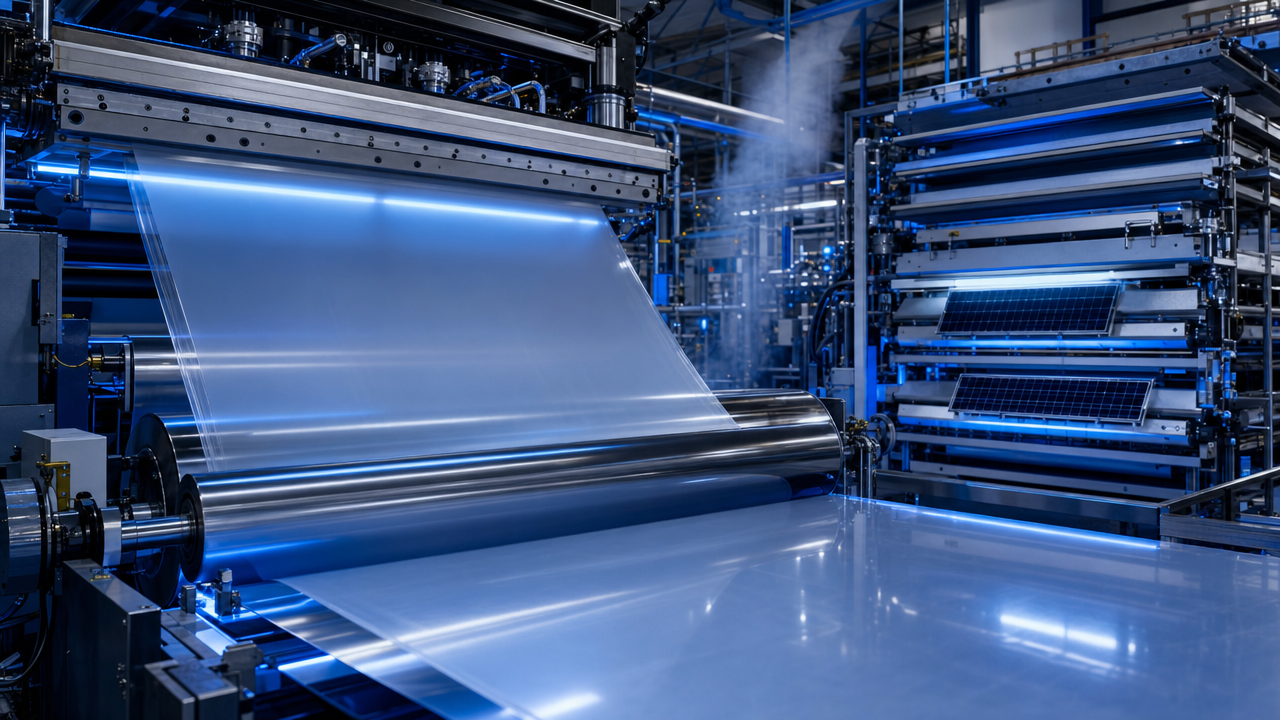
The third checkpoint is casting or extrusion. Modified EVA plus an additive masterbatch (containing UV absorbers, antioxidants, light stabilizers, peroxide crosslinkers, silane couplers, and titanium dioxide for white film) feeds into a casting machine. The casting machine's core is a T-die plus a rotating chill roll — die width about 1,600 mm, chill-roll diameter about 1,200 mm. Molten EVA is uniformly extruded through the T-die onto the chill roll, cooling and setting into a continuous film 400–500 microns thick. The keys are die-temperature uniformity (within ±0.5°C), chill-roll cooling uniformity, tension uniformity, and film-thickness uniformity. Casting machines mostly come from Germany's Brückner, Austria's SML, and China's Nantong Hongguan — imports take over 50% share.
The fourth checkpoint is EPE co-extrusion — the new N-type-era process. EPE physical structure is POE-EVA-POE three layers, outer POE layers 70 microns each, inner EVA 300 microns, total 440 microns. Co-extrusion requires three independent screw extruders feeding the same co-extrusion die simultaneously, with the three melt streams merging onto the chill roll within 200 milliseconds. The co-extrusion die design is the know-how peak; domestic suppliers capable of stable production are fewer than three, with imports dominated by Germany's Reifenhäuser and US Cloeren. EPE marries POE's PID resistance with EVA's transmittance — the key process innovation of the N-type era.
The fifth checkpoint is corona, winding, and slitting. Before the take-up, the film passes through corona treatment to raise surface energy from 30 mN/m to over 45 mN/m, ensuring good adhesion to EVA, glass, and back-sheet during lamination. Corona uses high-voltage electrode discharge at 10 kV/mm. After winding the film stores as 2,000-meter-long, 10,000 m² rolls until customer orders trigger slitting to standard widths of 350, 550, or 1,100 mm.
Co-product recycling is the implicit difficulty. Edge trim and head-and-tail scrap account for 3–5% of casting output. This scrap can be pelletized and blended back into the next batch of EVA resin, but not more than twice — beyond that, degradation fragments hurt film durability. Chinese makers reached 90% scrap recovery by 2025, a key cost-optimization win.
The real bill of materials is surprising. A square meter of EVA film consumes 420 g of EVA resin, 1 g of peroxide, 2 g of silane coupler, 2 g of antioxidant, 2 g of UV absorber, 1 g of light stabilizer, 100 g of TiO2 (white only), 5 g of other additives, and 0.8 kWh. At current China spot prices: EVA resin RMB 4.6, peroxide RMB 0.4, additives RMB 1.5, TiO2 (white) RMB 0.8, electricity RMB 0.4, labor and depreciation RMB 1.2 — totaling about RMB 8.9 (transparent) or RMB 9.7 (white) per square meter. Roughly matches spot price. This is why 2025 film makers sit broadly on the cash-cost breakeven line — any input swing flips a player between profit and loss.
The sixth checkpoint is inspection and QC. Outbound film must pass thickness uniformity (±2 microns), width uniformity (±0.5 mm), transmittance (≥91%), haze (≤3% for transparent, unconstrained for white), elongation at break (≥6%), shear and peel strength, PID testing (85°C 85% humidity 1000 hours), double-85 aging, UV accelerated aging (QUV 1000 hours), TGA, and FTIR. Inspection equipment is mostly from Zwick, Mettler-Toledo, Thermo Fisher, and Shimadzu — domestic instruments are closing the precision gap quickly.
Energy intensity is moderate. Each square meter of EVA film burns about 0.8 kWh; at East China industrial tariff of RMB 0.43/kWh, electricity is about RMB 0.34/m² or 3% of full cost. Far lower than polysilicon's 35%, but still worth managing. Most film makers run on grid power; a few have on-site distributed PV. Foster's Jiaxing 20 MW rooftop PV generates about 25 million kWh per year — covering about 10% of basin load — the iconic "PV industry runs on PV" story.
Co-products and waste: casting edge trim, scrap film, wash-water EVA and silane traces, used winding rubber rollers — each 10,000 m² of film generates about 200 kg of solid waste and 5 tons of wastewater. Top-tier makers upgraded WWTP through 2024–2025, COD discharge from 100 mg/L down to under 30 mg/L, meeting GB 8978 Grade I.
The upgrade route: properly recycled edge trim becomes secondary EVA masterbatch sold into low-end foam, cable, and hot-melt uses. Foster's 2025 disclosure: edge-trim resale runs about RMB 50 million per year at 20%+ gross margin — a small supplement to the price-collapsed main business.
The "wide chain" behind the "narrow chain" of EVA resin → grafting → casting → inspection includes a circle of inputs and utilities at every step: EVA synthesis needs ethylene, vinyl acetate, high-pressure reactors, peroxide catalysts, oligomer separation; graft modification needs twin-screw extruders, peroxide metering pumps, silane spray systems; casting needs casting machines, die heaters, roll cooling loops, corona units, take-ups; co-extrusion needs three independent screws, co-extrusion dies, rolls, cooling loops, take-ups. Each input layer has its own factory ecosystem behind it.
Auxiliary supplier concentration is high. Peroxides come mainly from Nouryon (Netherlands), Pergan (Germany), Arkema (US), and Hunan Yuanrun (China) — about 40% domestic. Silane couplers come from Momentive (US), Evonik (Germany), Shin-Etsu (Japan), and Hubei Xinlantian (China) — about 50% domestic. UV absorbers come from BASF (Switzerland), Chemtura (US), Zhenjiang Lidel (China) — about 35% domestic. TiO2 comes from Chemours (US), Venator (UK), Lomon Billions (China), and CNNC Hua Yuan Titanium (China) — about 40% domestic. Overseas supplier concentration means Chinese film makers' "formula iteration" speed is partially gated on overseas supply-chain reliability — the implicit challenge of the "full-chain self-sufficiency" strategy.
Casting-process intelligent upgrades accelerated through 2024 to 2026. Foster Jiaxing introduced an AI visual inspection system in 2024 for real-time defect detection at 100 m/min line speed and ±0.01 mm precision. AI inspection lifted yield from 95% to 98%, cutting unit cost 3%. Hiuv Changzhou introduced real-time SPC in 2025, monitoring 20-plus process variables at millisecond resolution to further tighten batch consistency.
Casting "lights-out" production is a key direction for the next three years. Foster Jiaxing started building a lights-out pilot line in Q4 2025, targeted for Q1 2027 commissioning — China's first unmanned encapsulant line. The lights-out factory combines AGV smart carts, AI visual inspection, real-time SPC, automated packaging, and intelligent warehousing. The line requires only five workers versus the traditional twenty, cutting unit labor cost 70%.
Casting process "quality defects" are the most frequent topic in handoffs between veterans and newcomers. Casting defects fall into eight classes: thickness unevenness (±5 micron lateral variance), surface bubbles (over 0.5 mm diameter), surface gels (over 0.3 mm), edge sag (50 mm edge below spec), edge curl (over 2 mm upcurl), die lines (lateral linear ridges), roll marks (circumferential periodic indents), winding wrinkles. Each class has its own mechanism and remedy. Veterans identify root cause within a minute; new engineers need six months of practice to master.
The "Q/RM formula tuning" is core know-how separating top from tier-two makers. Even for the same grafted EVA, Foster, Hiuv, and Cybrid run different peroxide loadings, silane couplings, antioxidant blends, and UV absorber concentrations — yielding different PID test loss, UV aging loss, and elongation indicators. This "formula gap" is the outcome of 10,000 experiments; new entrants need two to three years to dial in a full formula stack — the industry's implicit moat.
Chapter 3: Product Generations — Transparent EVA, White EVA, POE Monolayer, EPE Co-Extruded
PV encapsulant product generations are best traced in five generations. Gen 1 is EVA transparent — single-layer, VA about 28% — in use since the 1990s. Gen 2 is EVA white — TiO2-loaded for a high-reflectivity back layer, broadly used since the 2010s on double-glass module backs to lift power output. Gen 3 is POE monolayer — small-scale commercial since 2018 — built to handle PID on PERC double-glass. Gen 4 is EPE co-extruded — mainstream since 2022 — POE-EVA-POE balancing performance and cost. Gen 5 is multi-function composite — pilot in 2025 — adding UV shielding, NIR shielding, anti-static, anti-hail and other functions. China 2025 share: Gen 1 30%, Gen 2 20%, Gen 3 15%, Gen 4 30%, Gen 5 5%.
A comparison of key indicators across the five generations shows the gaps and the application footprint clearly.
EVA transparent (Gen 1): VA 28%, transmittance 91.5%, haze 2%, elongation 8%, shear strength 30 MPa, PID test loss 15%, UV accelerated aging 1000 h transmittance drop 5%. Used on double-glass front and single-glass dual-layer structures. Price RMB 8.8–10.2/m².
EVA white (Gen 2): VA 28% with 20% TiO2, reflectivity 85%, elongation 7%, PID loss 15%, others near transparent EVA. Used on double-glass module back; boosts module power 3–5 W. Price RMB 9.5–11/m².
POE monolayer (Gen 3): POE 95%, transmittance 91%, haze 3%, elongation 10%, shear 32 MPa, PID loss 2%, UV aging 1000 h drop 2%. Used on N-type TOPCon and HJT double-glass to fight N-type PID sensitivity. Price RMB 12.5–14/m² — 1.4× transparent EVA.
EPE co-extruded (Gen 4): POE-EVA-POE three-layer, outer POE 70 μm each, inner EVA 300 μm, total 440 μm. Performance sits between EVA and POE monolayer: PID loss 3%, transmittance 91.2%, otherwise close to POE monolayer. Price RMB 11–12/m² — 1% below POE monolayer with only 2–3 percentage points of performance loss. The most cost-effective N-type choice in 2025.
Multi-function composite (Gen 5): EPE base plus UV blocker, NIR blocker, anti-static agent, anti-hail agent. Price RMB 15–20/m². For BIPV, vehicle-roof PV, wearable PV high-end scenarios.
The pivot in 2025 was EPE crossing 30%. Foster's H1 2025: EPE shipment share from 20% in 2024 to 35% in H1 2025. Hiuv: 15% to 30%. Cybrid: 10% to 25%. Cumulative top-three EPE capacity reached 2.1 billion square meters in 2025 — about 50% of their total.
POE monolayer share growth was limited — 15% in 2024 holding at 15% in 2025. Reason: POE monolayer cost runs 10% above EPE while performance edge is only 2–3 points — value-for-money clearly inferior. POE monolayer is now concentrated in top-end HJT double-glass and high-humidity high-latitude scenarios (Southeast Asia, parts of India).
Cost comparison is sharper still. Q2 2025 cash cost (ex-tax): Foster EPE RMB 8/m² (10% below Q1 2024); Hiuv EPE RMB 8.2; Cybrid EPE RMB 8.5. POE monolayer cash cost RMB 9; EVA transparent RMB 7.2; EVA white RMB 7.5. EPE leads POE monolayer by RMB 1 on cash cost and trails EVA by only RMB 0.8 — clearly the value-for-money winner.
But cost isn't everything. EVA transparent's moat is process maturity, customer qualification inertia, supply-chain stability. P-type PERC modules still run at over 30% of shipments — particularly in distributed and residential — keeping EVA-transparent demand rigid. This switching friction is why EPE cannot displace EVA overnight despite winning on performance.
China share confirms the gradient. As of H1 2025, EVA transparent held about 30% of China shipments — halved from five years prior (60%) but still the largest single category. The contraction is smooth, not abrupt. Through 2030, central forecast has EVA transparent gradually contracting to 15% but not disappearing.
Overseas is different. Of 800 million square meters of overseas capacity, nearly all is EVA transparent or EVA white; POE and EPE penetration is under 10%. Overseas modules remain over 50% P-type PERC; N-type TOPCon and HJT penetration trails China by two years. Mitsui, Bridgestone, 3M continue concentrating R&D on semiconductor-grade, electronic-grade, and high-end specialty films.
Process logic says: EVA transparent is being chipped at by EPE but won't be fully replaced. EVA transparent persists in P-type PERC, distributed, and residential; EPE expands continuously in mainstream N-type; POE monolayer holds top-tier HJT and high-humidity niches; EVA white holds steady on double-glass backs. Real competition has shifted from "who can make it" to "whose cost curve survives to 2030."
A dimension often missed in generation switching is "capacity-switching flexibility." A single-layer EVA casting line, by swapping dies and roll widths, can flexibly run EVA transparent, EVA white, or POE monolayer. EPE co-extruded lines need three independent screws and a co-extrusion die — capex is 50% higher and switching flexibility is lower. In a volatile 2025 N-type market, EPE-line "specialization" cuts both ways: if N-type module orders slip, EPE lines can't quickly pivot to EVA monolayer products and sit idle. Foster's voluntary EPE-line utilization cut in Q3 2025 to match demand is a case in point.
Patents are another implicit moat. EPE co-extrusion know-how concentrates in POE-EVA interfacial compatibility, co-extrusion die uniformity, and peroxide-crosslinker migration control. Foster, Hiuv, Cybrid have filed about 100 EPE-related invention patents during 2022–2025, comprising 70% of the industry stack. Tier two — Sveck, Crowngrade, Coda — has thinner patents and must reverse-engineer or license, lagging top tier by one to two years.
Gen 5 multi-function commercial volume was small in 2025 — only about 5% of share. BIPV, vehicle-roof PV, wearable PV demand totals under 500 million square meters globally. These scenarios have high functional requirements but high price sensitivity — the RMB 15–20 multi-function premium of 50% over mainstream constrains downstream acceptance. Mainstream Gen 5 adoption is 2028–2030.
Customer qualification cycles stretched markedly in the N-type era. P-type PERC qualification ran 6 months sample-to-approval; N-type runs 18 months. The extension covers multiple outdoor tests (IEC 61215 full battery, double-85 1000 h, UV QUV 1000 h, PID 1000 h, thermal cycling 200×), multi-site cross-validation, long-term consistency tracking. The long cycle is both implicit barrier and long-term competitive moat for top players — once qualified, film makers supply for 3–5 years.
Application case studies: LONGi's HJT double-glass uses Foster POE monolayer plus EVA white standard config; JinkoSolar's TOPCon double-glass uses Hiuv EPE plus EVA white standard; JA Solar's TOPCon double-glass uses Cybrid EPE plus EVA white standard; Trina's PERC double-glass uses Sveck high-reflectivity white EVA plus EVA transparent legacy config; Canadian Solar's HJT double-glass uses Foster POE monolayer plus EVA white premium config. These "tier-one module × top-tier film" fixed pairings are China encapsulant industry's stable supply backbone.
Pricing-mechanism divergence: EVA transparent on spot pricing, high elasticity; EVA white on "EVA resin index + processing fee" basis, moderate elasticity; POE monolayer on "POE resin index + formula premium," low elasticity; EPE co-extruded on "long-term contract + price-adjustment formula," lowest elasticity; multi-function on one-to-one customization, fully bespoke. This five-mechanism coexistence is the 2025–2030 normal state.
Chapter 4: Leading Players — Foster, Hiuv, Cybrid, Sveck, Crowngrade, Coda, and Overseas Giants
China's PV-encapsulant story always orbits six top makers — Foster, Hiuv, Cybrid, Sveck, Crowngrade, Coda — plus five overseas: Mitsui, Bridgestone, 3M, Hanwha Q-Cells, First Solar. The eleven together hold over 90% of global capacity.
Foster (Hangzhou Foster Applied Materials, SSE 603806). The absolute global leader in PV encapsulant, 2025 total capacity 2.1 billion m² across Zhejiang Jiaxing (800M), Jiangsu Suqian (600M), Shanghai Jinshan (300M), Anhui Hefei (200M), Hebei Tangshan (200M). Jiaxing is the oldest base, the bridge from generic packaging film into PV. Suqian carries 2023–2025 expansion, single-line 100M/year — the national capacity ceiling. Jinshan runs R&D and pilot. Foster 2025 sales about 1.8 billion m². Multi-year supply agreements with LONGi, JinkoSolar, JA Solar total 1 billion m² for 2024–2026. But Foster's 2025 net profit guidance of RMB 800 million to 1 billion is a 60% drop from 2024's RMB 2.4 billion.
Hiuv (Hiuv New Materials, SSE 688680). The clear #2, 2025 capacity 1.3 billion m² across Jiangsu Changzhou (700M), Hebei Cangzhou (300M), Anhui Hefei (200M), Sichuan Yibin (100M). Hiuv was an early mover on EPE — first EPE-dedicated line at Changzhou in 2022, six months ahead of Foster. Changzhou EPE share is 60% of base — the highest EPE ratio in the industry. Hiuv 2024 EPE shipments 300M m², 15% market share; H1 2025 share rose to 18% — #2 in the EPE segment. Hiuv was profitable through 2025 but single-quarter profit narrowed from RMB 100M in Q1 to under RMB 50M in Q4.
Cybrid (Suzhou Cybrid Technologies, SSE 603212). The China industry's "boutique" reference, 2025 capacity 800M m² across Suzhou (500M), Anhui Bengbu (200M), Shandong Dongying (100M). Cybrid's differentiator is "high-reflectivity white EVA anchor with POE monolayer and ultra-thin EPE complements" — a high-performance lineup. Cybrid 2025 actual sales 600M m², a voluntary 10% cut from 2024. The cut reflects management focus on high-end production. Q4 2025 cost dropped to RMB 8.5/m², down 10% YoY. 2025 revenue RMB 4.8 billion, down 15% YoY. 2026 guidance is 700M m² (up 15%).
Cybrid here is Suzhou Cybrid Technologies — not to be confused with Sveck, the Dongguan-based player covered next.
Sveck (Dongguan Sveck New Material). 2025 capacity 800M m² across Guangdong Dongguan (400M), Jiangsu Yancheng (200M), Sichuan Meishan (200M). The differentiator is the "south plus southwest" dual-base footprint, geographic complementarity to the Zhejiang-Jiangsu-Shanghai cluster. Dongguan radiates to Guangdong, Fujian, Guangxi; Meishan picks up Sichuan, Yunnan, Guizhou, Chongqing. Sveck cash cost ranks in tier two — about RMB 8.8/m² in 2025. Strategy: "South China port exports plus southwest green-power supply" for 2026–2028.
Crowngrade (Jiangxi Crowngrade Lithium Battery New Materials, SSE 688560). Nanchang base, 2025 capacity 600M m². Crowngrade has mid-scale but the broadest product matrix — transparent, white, POE monolayer, EPE, specialty films. Since 2024, Crowngrade has rebalanced to "PV encapsulant plus lithium-battery aluminum-plastic film" dual main businesses, betting on long-term low-margin PV-encapsulant outlook. Lithium aluminum-plastic shipped 200M m² in 2025 at over 30% gross margin — the company's profit pillar.
Coda Technology (Ningbo Coda Technology, SZSE 300566). Ningbo base, 2025 capacity 500M m². Coda started in optical films (LCD-panel brightness enhancement and diffusion films), entered PV encapsulant in 2018. The differentiator: grafting optical-film tech into PV encapsulant — applying high-uniformity coating to encapsulant to lift surface uniformity and transmittance. Coda 2025 PV encapsulant shipments about 300M m², mainly to LONGi and Jinko mid-tier product lines. Strategy: "dual main businesses" — optical film for LCD and vehicle display; PV encapsulant for module customers.
China Tianjin (Jiangsu China Tianjin Technology, SSE 600522). Tianjin PV's encapsulant unit added 300M m² in 2025 mostly for captive use; outbound sales under 30%. Position: "captive supply plus modest outside sales."
Baijia Era (Jiangsu Baijia Era). Changzhou base, 2025 capacity 400M m². Smallest of the tier-two but tightest cost control — 2025 cash cost RMB 7.8/m², some batches below Foster. Strategy: low-cost entry to tier-two module customers — GCL, Risen, DMEGC.
Overseas: Mitsui Chemicals (Japan), 2025 capacity 100M m², high-end EVA and POE monolayer at Japan and Korea bases, customers are Panasonic, Kyocera, Q-Cells. 2025 PV-encapsulant margin ~15% — about 3× Chinese top players.
Bridgestone (Japan) chemical-materials unit, 2025 capacity 50M m², focused on high-end EVA transparent for BIPV, vehicle-roof, wearables. 2024 five-year supply deal with First Solar — all output to US.
3M (US) focus is high-end POE monolayer and specialty composites, 2025 capacity about 30M m². Price RMB 30–50/m², serving US premium module players, aerospace, and military PV.
Arkema (France) and Lumeg (Germany) supply mainly EVA and POE resins, with limited downstream film. Arkema signed a ten-year POE deal with Foster in 2025 — 10,000 tons/year.
Hanwha Q-Cells, mainly modules, but its Thalheim Germany base has a captive 80M m²/year EVA encapsulant line.
The eleven players' roles have crystallized through the 2025 trough. Foster and Hiuv continue battling for China's leadership; Cybrid, Sveck, Crowngrade, Coda fight in the mid-market on cost and quality; China Tianjin and Baijia Era stay in tier-two cost war; Mitsui, Bridgestone, 3M, Arkema, Hanwha hold overseas high-end and specialty value-added segments.
Sort the eleven players on cost curve, low to high: Baijia Era RMB 7.8/m², Foster 8, Hiuv 8.2, Sveck 8.8, Crowngrade 8.9, Cybrid 9, Coda 9.2, Hanwha Germany 15, Bridgestone Japan 18, Mitsui Japan 20, 3M US 25. Chinese top seven sit on the left half; overseas giants on the right half. This cost split has been locked in for nearly a decade — absent strong CBAM and localization subsidies, overseas film makers cannot face down Chinese top players in free-market competition.
Customer-structure differentiation is sharp. Foster serves the China tier-one giants; Hiuv adds HJT new entrants — Huasun, Jinneng, Akcome — alongside the giants; Cybrid adds India Waaree and Adani; Sveck mainly serves south and southwest China with some Southeast Asia exports; Crowngrade's customer mix is moderate; Coda runs mid-tier module customers plus LCD optical-film customers. Mitsui, Bridgestone, 3M serve Japan, Europe, US high-end module makers — almost no overlap with Chinese film customers.
Eleven players' governance comes in distinct lineages. Foster, Hiuv, Cybrid, Crowngrade, Coda, China Tianjin are private A-share listcos; Sveck and Baijia Era are unlisted private; Mitsui and Bridgestone Tokyo-listed; 3M NYSE-listed; Hanwha KOSPI-listed.
Foster's 2025 profit resilience deserves analysis. The RMB 800M–1B net profit splits: encapsulant RMB 500M, aluminum-plastic film (new) RMB 200M, electronic chemicals (new) RMB 100M, photoresist dry film (new) RMB 100M. Strategy: "main business steady, side businesses diversified, strategic incubation." 2024 onward Foster ramped R&D for aluminum-plastic film, electronic chemicals, and photoresist dry film. 2025 combined revenue from these three RMB 2 billion at 25% gross margin — a meaningful complement.
Hiuv's narrowing quarterly profit trajectory matters too. From RMB 100M in Q1 to under RMB 50M in Q4, driven by EPE revenue growth, EVA transparent revenue decline, and storage business losses. Hiuv 2026 guidance: quarterly profit RMB 50–80M — a "cautious" view aligned with "prices won't bounce fast; cost and diversification carry us through."
Cybrid's Q4 2025 cost drop to RMB 8.5/m² is the most transparent set of numbers among the eleven players. At average 2025 selling price RMB 9.5, Cybrid runs about RMB 1/m² cash margin (~10% gross margin). The implication: if encapsulant stays at RMB 9/m² or above, Cybrid stays cash positive. In other words, the 2026 floor likely sits at Cybrid's cash-cost line.
Sveck's 2025 strategy is "south China exports + southwest green power." Dongguan export targets are Vietnam, Thailand, Indonesia module exporters; Dongguan is 100 km from Yantian Port, logistics cost 5% below inland film makers. Meishan green-power matches Sichuan, Yunnan green silicon module makers; Meishan electricity is 10% below Zhejiang film makers.
Crowngrade's tier-two scale but most imaginative business: lithium-battery aluminum-plastic film. The global market 2025 is about 2 billion m², dominated by DNP, Showa Denko, Wisechem — China-domestic rate just 20%. Crowngrade hit 200M m² in 2025 — breakthrough domestic rate over 10%, gross margin over 30%. Strategy: encapsulant base, aluminum-plastic film growth.
Coda's 2025 dual-main-business performance is interesting. Optical film revenue RMB 1.5 billion at 25% gross margin; PV encapsulant revenue RMB 2.5 billion at low double-digit margin. The gap kept Coda profitable in 2025. Strategy 2026–2028: optical film growth into vehicle display; PV encapsulant stable.
Overseas: Mitsui and Bridgestone "policy moat" deepened through 2024–2026. Japan METI launched a "Japan PV Materials Domestic Manufacturing Support Fund" in 2025 — JPY 10 billion/year for domestic film maker capex. Mitsui and Bridgestone are primary beneficiaries. 3M US benefits from IRA RMB 100 million in advanced-manufacturing tax credits.
Eleven companies' R&D intensity also differs. Foster 2024 R&D RMB 500M (3% of revenue); Hiuv 300M (4%); Cybrid 150M (3%); Sveck 100M (3%); Crowngrade 80M (4%); Coda 100M (3%); Mitsui JPY 3 billion (5%); Bridgestone JPY 1 billion (4%); 3M USD 50M (5%). R&D intensity highly correlates with leadership on advanced product routes (EPE, specialty composite). Sub-3% R&D film makers will struggle to keep pace through 2026–2030.
The "key variable" table for each player over 2026 through 2028 also tells the story. Foster: can EPE shipments exceed 2 billion m² in 2027; can overseas bases land in 2028. Hiuv: can POE monolayer shipments exceed 500M m² in 2027; can storage business break even in 2028. Cybrid: can high-reflectivity white EVA cover all tier-one module customers by 2027; can high-end POE monolayer scale by 2028. Sveck: can South China exports exceed 300M m² in 2027; can southwest green-power bases fully ramp by 2028. Crowngrade: can lithium-battery aluminum-plastic film exceed 300M m² market share by 2027. Coda: can optical-film business achieve RMB 2 billion in vehicle-display revenue by 2027.
The most likely "dark horse" in 2026–2030 is Hiuv New Materials. EPE penetration ramp is the steepest (from 20% in 2024 to 30% in 2025); regional layout most complete (Hebei Cangzhou and Sichuan Yibin); customer mix most diversified (tier-ones plus HJT challengers).
Capital actions through 2024–2026 also show new trends. Foster announced an employee share plan in Q3 2025 — 1,500 core employees got 2% of total shares. Hiuv announced a RMB 500M buyback (2%) in Q4 2025. Cybrid announced a stock-incentive plan in Q2 2025 — 500 core employees got 1.5%.
Eleven players' long-term contract structure also worth comparing in detail. Foster signed 5-year/6 billion m²/year with LONGi; 3-year/5 billion with Jinko; 3-year/4 billion with JA Solar; 2-year/3 billion with Trina. Hiuv signed 3-year/3 billion with LONGi; 3-year/2 billion with Jinko; 2-year/2 billion with JA Solar. Sveck signed 3-year/2 billion with GCL; 2-year/1.5 billion with Risen. Cybrid signed 3-year/1 billion with India Waaree; 2-year/0.5 billion with India Adani.
Earnings-elasticity comparison: a RMB 1/m² encapsulant price rise gives Foster +RMB 1.8 billion net profit, Hiuv +1.2 billion, Cybrid +0.6 billion, Sveck +0.7 billion, Crowngrade +0.5 billion, Coda +0.3 billion; declines reverse the move. High sensitivity to encapsulant prices is the core bull-case logic for top players.
R&D output ratio comparison: Foster 2024 R&D RMB 500M producing 50 invention patents, 30 utility models, 8 new products — top of industry. Hiuv 2024 R&D RMB 300M for 40 inventions, 25 utility, 6 new products. Cybrid 2024 R&D RMB 150M for 20 inventions, 15 utility, 4 new products. R&D output elasticity reflects R&D management quality.
Chapter 5: N-Type Era — TOPCon and HJT New Requirements; Per-Watt Weight Up
The N-type cell rise fully rewrote encapsulant downstream demand. From P-type PERC's "EVA transparent + EVA white" dual-layer, N-type TOPCon converged to "POE or EPE + EVA white"; N-type HJT further converged to "POE monolayer or EPE + EVA white." PID resistance, UV blocking, bifaciality, per-area weight all tightened.
The N-type TOPCon core new requirement is dual upgrade of PID resistance and UV blocking. TOPCon's PID sensitivity is 3–5× P-type PERC, because the front is N-type heavy-doped and back is PN contact, with sodium-ion drift under field running far faster than in P-type. To fight this, TOPCon module front-film must use POE or EPE, with PID test loss under 5% — vastly tighter than P-type PERC's 15%. EVA transparent is cheap, but its 15%+ PID loss disqualifies it from the TOPCon front face.
HJT requirements are even stricter. The HJT front is a transparent conductive oxide (TCO) layer with high UV absorption — long use degrades TCO, raises resistance, and depresses module power. The front-film must block UV below 380 nm, calling for UV absorber loading (e.g., 2-hydroxy-4-methoxybenzophenone) to rise to 2%+ — 4× the P-type PERC era's 0.5%. UV absorber additions raise HJT-encapsulant cost about 3% above the standard.
Another N-type-era shift is rising per-area weight. P-type PERC EVA transparent: ~450 μm, 420 g/m². N-type TOPCon EPE co-extruded: 480 μm, 450 g/m². N-type HJT POE monolayer: 500 μm, 460 g/m². Three years of weight increase: ~10%, mapping to a 10% rise in EVA/POE resin consumption.
The N-type-era demand-structure breakdown: EVA transparent on P-type PERC front from 50% (2022) to 10% (2025); POE monolayer from 2% to 10%; EPE co-extruded from 3% to 30%; EVA white on all module backs stable at ~30%. The "EVA-transparent front exit, POE/EPE entry" is the most important demand-side shift in the past three years.
N-type TOPCon encapsulant procurement cost rose from P-PERC's RMB 8/m² to RMB 11 — single-watt encapsulant cost share from 3% to 4%. HJT cost rose further to RMB 13 — share 5%. The "rising encapsulant cost share" prompted module giants to broadly rethink their encapsulant sourcing strategy through 2024–2025: from "price-only" to "price + quality + long-term supply stability" triple balance.
N-type-era contract structure also shifted. P-type PERC contracts were one-year with quarterly repricing; N-type long-term contracts now run 50%+ at 2–3 year duration on a "cost-plus + price-adjustment formula" indexed to EVA and POE resin price indexes.
EVA white demand stayed steady in the N-type era. N-type TOPCon and HJT double-glass need EVA white on the back to reflect light through cell gaps for 3–5 W power gain. Back-side EVA white penetration in N-type modules went from 30% (2022) to 45% (2025) — a counter-cyclical lane.
N-type penetration forecast 2025–2030: 2024 TOPCon 60% / HJT 5% / PERC 35%; 2025 TOPCon 75% / HJT 10% / PERC 15%; 2026 TOPCon 80% / HJT 15% / PERC 5%; 2030 TOPCon 50% / HJT 30% / perovskite tandem 15% / PERC 5%. Encapsulant mix 2030: EPE co-extruded 40%, POE monolayer 25%, EVA white 20%, EVA transparent 10%, multi-function 5%.
Another new requirement is bifaciality adaptation. TOPCon and HJT bifaciality (back PV efficiency vs front) reaches 85%+, vs P-type PERC's 70%. Higher bifaciality means back-side film should not only reflect but also partly transmit so back-side sun can bounce back to the cell. Semi-transparent white EVA emerged — reflectivity tuned from 85% (standard white) to 70%; transmittance from zero to 15% — boosting back-side bifacial efficiency 2%. Semi-transparent white EVA hit 10% share in 2025, growing 3–5 pts/year.
Another implicit new requirement is moisture-vapor permeation resistance. The TOPCon passivation contact layer is extremely moisture-sensitive — sustained over-80% humidity degrades passivation and the cell loses efficiency. Module lamination requires film WVTR to drop from P-type PERC's 5 g/m²/day to under 1. POE monolayer and EPE co-extruded WVTR is naturally lower than EVA transparent — a key reason they're standard on N-type TOPCon.
Perovskite tandem cell industrialization through 2027–2030 will bring a new challenge to encapsulant. Perovskite is far more sensitive to moisture, oxygen, UV, temperature than crystalline silicon — film WVTR must drop further to under 0.1 g/m²/day; UV blocking to 98%+. This will spawn perovskite-specific composite films at RMB 30–50/m² — 3–5× mainstream. Foster, Hiuv, Cybrid have started perovskite-specific R&D; pilot scale 2027, ramp 2028–2030.
N-type-era customer development pace also changed. P-PERC made it easy to serve 5–8 module makers because product is standardized and qualification short; in the N-type era a film maker can serve only 3–5 — each customer's N-type formula needs custom R&D and small-batch trials. The slower customer development pace concentrates resources and implicitly drives industry consolidation.
The perovskite tandem commercial timeline is the biggest 5–10 year uncertainty. Optimistic: 2027 scale in BIPV and residential, 2028 commercial spread, 2030 10% share in utility. Central: 2028 scale, 2030 5% share. Pessimistic: 2030 first scale, 2032 5% share.
N-type cells also require "light-induced degradation suppression" (LID). N-type cells under prolonged light may degrade 1–3% in efficiency in the first 1000 operating hours, due to metal-ion and boron-oxygen complex interactions. Encapsulant's role: prevent moisture and impurity ingress, preserve cell passivation. POE monolayer and EPE outperform EVA transparent here — another reason they're standard on N-type TOPCon and HJT.
Short-term reliability certification became stricter too. Module giants in 2024–2025 broadly expanded N-type certification from P-era's 8 items to 12: IEC 61215 (mechanical load, damp heat, damp freeze, UV, hot spot, insulation, wet leakage, fire) plus PID (85°C 85% RH 1000h), UV-acc aging (QUV 1000h), bifaciality, CTE. Each item runs ≥3 months; full battery needs 18 months.
Batch consistency requirements also tightened. PID test loss, UV aging loss, elongation indicator variance across batches now must hold within ±1 pt vs P-era ±3 pts. This stresses tier-two film makers and is an implicit moat for top tier.
Chapter 6: Upstream POE Resin Bottleneck — Dow, ExxonMobil, Mitsui Dominate; Domestic Breakout
POE (polyolefin elastomer) resin is the core feedstock for N-type-era PV encapsulant, but global supply has long been concentrated in Dow Chemical (US), ExxonMobil (US), Mitsui Chemicals (Japan), and SK Geocentric (Korea) — Chinese domestic rate has long been under 10%. This "choked upstream" is the encapsulant industry's largest supply-chain liability and the most-watched breakout topic for 2025–2028.
POE differs from EVA in chemistry, which defines its unique encapsulant role. EVA is ethylene-vinyl-acetate copolymer with abundant polar VA units on the main chain — fair moisture and UV resistance, prone to yellowing and acid etching over time. POE is ethylene-octene copolymer with all non-polar olefin units — far better moisture, UV, acid/base resistance, WVTR 5× lower, UV-aging life 3× longer. These advantages make POE indispensable to N-type TOPCon and HJT.
Industrial POE synthesis needs high-pressure reactors, chromium or metallocene catalysts, octene-monomer purification, low-temp polymerization, byproduct separation — five key steps. Metallocene catalyst is the core barrier — active-center design dictates POE molecular-weight distribution, crystallinity, octene content, mechanical properties. Dow's 1990s Insite metallocene patent still anchors the field; its protection runs through 2028. Hence the thirty-year dominance by Dow, ExxonMobil, Mitsui, SK.
Global POE capacity 2025 is about 2.5 million tons — Dow 700K (28%), ExxonMobil 600K (24%), Mitsui 500K (20%), SK Geocentric 300K (12%), LG Chem 200K (8%), China domestic ~200K (8%). China POE demand hit 800K tons in 2025 — gap 600K, import dependence 75%.
China POE domestic breakout made substantive progress through 2024–2026. Wanhua Chemical's Yantai base launched 200K-ton POE in 2024 and expanded to 300K in 2025; Satellite Chemical's Lianyungang launched 100K in 2025; Maoming Petrochemical launched 80K in 2025; Sinopec Zhenhai plans 100K for 2026; CNPC Daqing plans 50K for 2026. China domestic POE capacity is expected to hit 600K tons end-2026 and 1.2 million tons by 2030 — domestic rate from 20% (2025) to 70% (2030).
Wanhua's POE route is worth a detailed look. Wanhua self-developed a "twin-reactor in series + metallocene catalyst" process that sidesteps Dow's Insite patent. Its metallocene system uses zirconium and titanium active centers, producing POE across octene content from 20% to 35% — different windows for different applications: 20% for car bumpers, 25% for cable jackets, 30% for PV encapsulant, 35% for sealants.
Wanhua POE in PV encapsulant has won qualification at Foster, Hiuv, Cybrid. Foster signed a 50K-ton supply agreement with Wanhua in 2025 — the largest in PV encapsulant. Hiuv and Cybrid orders are at 10K-ton scale. Active support from Chinese film makers for domestic POE is the key market driver of the breakout.
The gap between domestic and imported POE narrowed quickly through 2024–2026. 2022 domestic POE trailed imports by 5–10% on octene-content precision, MW distribution uniformity, long-term stability; 2024 gap to 3%; 2025 within 1%. Wanhua's small-batch trials at Foster, Hiuv, Cybrid in 2025 showed some batches' octene precision better than imports. This performance parity sets up full domestic replacement.
Satellite Chemical's route is "skip metallocene, develop post-metallocene." The post-metallocene system uses zirconium plus magnesium dual-metal centers, fully self-patented; 100K tons in 2025. Satellite POE features wider MW distribution, higher octene (up to 40%), softer mechanical properties. 2025 mainly supplies cable jackets and shoe soles; from 2026 enters PV encapsulant gradually.
Maoming Petrochemical's route is conservative — license ExxonMobil tech and assimilate. 80K tons in 2025; technically mature but low innovation. Customers concentrate in south-China module-base encapsulant — Sveck Dongguan, Crowngrade Nanchang.
The real bottleneck of China POE isn't POE itself — it's upstream high-purity 1-octene monomer. Global 1-octene capacity is ~1.2 million tons, controlled by SABIC, Shell, Mitsubishi, Idemitsu. China 1-octene capacity is just 200K tons — Shandong Jingbo, Satellite Chemical, Maoming Petrochemical together supply 80%, with 80% import dependence. 1-octene synthesis needs ethylene oligomerization with metallocene catalysts and high-temp high-pressure reactors. If 1-octene isn't localized, POE localization just transfers the choke from POE resin to 1-octene monomer.
China 1-octene localization through 2025–2027 deserves close attention. Shandong Jingbo launched 100K tons of 1-octene at Binzhou in 2025 — the largest domestic single base. Satellite Chemical plans 80K tons at Lianyungang for 2026. Maoming Petrochemical plans 50K tons at Maoming for 2026. China 1-octene total capacity is expected to hit 300K tons in 2027 with 50% domestic rate. Compared to 1.2 million-ton terminal POE demand, a 900K-ton gap remains.
Domestic-import POE price gap also narrowed quickly in 2025. Imports at RMB 35,000/ton vs domestic 30,000 in 2022 (gap 5,000); 2024 imports 28,000 vs domestic 25,000 (gap 3,000); 2025 imports 18,000 vs domestic 17,000 (gap just 1,000). Narrowing reflects rising domestic capability and broad-based global POE decline. Gap is expected to close fully in 2027 at price parity.
Risk on POE localization: if domestic POE expands faster than forecast in 2026–2030, "PV-grade POE" could oversupply, squeezing overseas players' China share. Dow, ExxonMobil, Mitsui could face share drop from 75% to 30% in 2027–2028 — likely triggering price wars or antidumping suits. This is the "post-success headache" of POE localization.
Cross-route comparison. Wanhua's twin-reactor metallocene: energy 2,500 kWh/ton; capex RMB 3 billion per 10K ton; product stability high; scalable. Satellite's post-metallocene: energy 2,300 kWh/ton; capex 2.8 billion per 10K ton; stability moderate; strong scaling. Maoming's ExxonMobil license: energy 2,800 kWh/ton; capex 3.5 billion per 10K ton; stability high but innovation weak; moderate scaling. Three coexisting routes are expected to form a "three-way" domestic POE landscape by 2027–2028.
Domestic-overseas POE price-gap stability is another worth analyzing. The 2025 gap is just RMB 1,000/ton — low stability. Reason: domestic POE capacity expands fast and overseas POE pricing is sensitive to China market. Through 2026–2028, as domestic POE ramps from 200K to 800K tons, the gap may oscillate violently between zero and RMB 2,000/ton, raising film-maker raw-material-cost-management difficulty.
Downstream extension of POE is another emerging trend. Beyond PV encapsulant, POE feeds car bumpers, cable jackets, sealants, shoe soles, battery separators. China auto industry's 2025 POE demand is ~1 million tons — 1.25× PV encapsulant. If China POE localization sustains its 2026–2030 pace, domestic POE will not only replace PV-encapsulant imports but also expand into auto bumpers and cables, lifting overall utilization further.
Wanhua's 2025 POE customer structure: Foster 30%, Hiuv 20%, Cybrid 15%, Crowngrade 10%, Coda 10%, other film makers 10%, auto-bumper factories 5%. PV encapsulant accounts for 85% of Wanhua POE volume — Wanhua POE is deeply concentrated in PV-encapsulant business.
Satellite's POE has "cable-jacket dominant" customer mix: cable-jacket factories 50%, shoe sole 20%, auto bumper 15%, PV encapsulant 15%. The mix protects Satellite POE from PV-encapsulant cyclicality.
The "real bottleneck" of POE localization sits in "high-end POE." PV-grade POE itself splits into standard PV-grade and high-end PV-grade. Standard goes into EPE outer layers at RMB 18,000/ton; high-end goes into POE-monolayer film at RMB 25,000/ton. Domestic POE has broadly substituted standard PV-grade but still trails Dow and Mitsui on high-end PV-grade — some batches don't meet octene-content precision or MW-distribution stability. 2027–2028 high-end PV-grade breakthrough at Wanhua, Satellite, Maoming is the inflection point for full POE substitution.
POE localization is also worth comparing across chemical resins. China made breakthroughs on EVA resin (2015–2020), ABS (2010–2015), PP (2005–2010), PE (2000–2005). These cross-resin experiences accelerate POE localization beyond overseas-incumbent expectations. By 2030 China POE domestic rate is expected to hit 70%, close to current EVA's 60%. This is a textbook case of China's "cross-resin breakthrough" strategy.
POE localization's "process curve" can be drawn on a finer timeline. 2018: zero. 2020: 5K (pilot). 2022: 30K (small-batch). 2023: 80K. 2024: 120K. 2025: 200K. 2026 expected: 600K. 2027: 800K. 2028: 1M. 2029: 1.1M. 2030: 1.2M. The 2024–2026 slope is the steepest — the critical ramp phase.
Investment-intensity comparison: Wanhua's 200K-ton POE project total RMB 6 billion (RMB 30B per 10K-ton); Satellite's 100K-ton project RMB 2.8B (28B per 10K); Maoming's 80K-ton RMB 2.8B (35B per 10K); Sinopec Zhenhai's 100K-ton RMB 3B (30B per 10K); CNPC Daqing's 50K-ton RMB 1.8B (36B per 10K). The capex-intensity dispersion reflects route-specific capex thresholds.
The global significance is rewriting global POE supply-demand. 2025 global POE 2.5M tons is split among Dow, ExxonMobil, Mitsui, SK. Expected 2030 China domestic POE 1.2M tons takes global share from 8% to 25% — Chinese POE moves from "global follower" to "global top four." Critical for the "self-controllable + globally leading" full-chain PV strategy.
Chapter 7: Factory Identification — Full-Chain Transparency from Encapsulant Maker to Upstream Petrochemical and Downstream Module
Pivoting now to an observational angle: how can the PV encapsulant full chain — upstream EVA and POE resin petrochemical plants, midstream encapsulant casting factories, downstream module factories — be unified on a single factory-network view? PV encapsulant isn't oligopoly top to bottom like polysilicon — it's "upstream concentrated, midstream moderately concentrated, downstream dispersed." Pulling this chain through cleanly requires not an industry report but a factory-granularity database. In the Chinese internet, this was historically attempted through Tianyancha or Qichacha-style commercial-registration databases, but their "industry = manufacturing" labels are too coarse — they can't tell whether a factory is actually running PV-encapsulant casting versus just listing "solar PV module auxiliary materials" in its registered scope without producing anything.
Tianxia Gongchang is the B2B platform that pushes this down to factory-level granularity. It covers China's 4.8 million in-production factories, every factory tagged "real factory" — not the "suspected factory" label produced by keyword-matching registered scope in commercial databases, but verified across seven dimensions: discharge permits, environmental approvals, production licenses, social-insurance headcount, equipment lists, electricity data, trade records. This is the fundamental difference from Tianyancha-style or Qichacha-style commercial tools — they are company-view, this is factory-view.
Putting the PV encapsulant chain on a factory-granularity industrial B2B platform yields a clean full-chain map. Upstream EVA resin plants in Zhejiang, Guangdong, Fujian, Shandong, and Inner Mongolia number more than twenty, each tagged "PV-grade EVA in-production." Upstream POE resin plants in Shandong, Jiangsu, Guangdong total five, including Wanhua, Satellite, Maoming. Midstream encapsulant casting factories in Zhejiang, Jiangsu, Shanghai, Hebei, Guangdong, Sichuan total more than 100 — from Foster, Hiuv at top to second- and third-tier small factories. Downstream module factories are spread nationwide, from LONGi, Jinko, JA Solar, Trina at the top to small county-level module factories totaling over 700.
The capability to "lay the full chain on one map" is something Chinese B2B industrial sales has never really solved over the past decade. Commercial databases tell you where a company is registered, what its scope is, how much its registered capital is — but they can't answer "what is this factory's 2025 utilization, what product generation, has it expanded recently" — the core commercial questions.
PV encapsulant B2B sales fit the classic "upstream sales rep finds downstream factory customers" pattern. EVA and POE resin sales reps need to find midstream encapsulant factory customers; encapsulant sales reps need to find downstream module factory customers; roll-machinery, inspection-equipment, chemical-additive sales reps need to find midstream encapsulant factory customers. Reps can pivot across industry code, process tag, capacity grade, geo on a factory-granularity database, lock in 50 to 200 high-value customers fast, then unlock contact info to engage procurement decision makers directly. Factory-granularity customer search is something commercial databases simply cannot do, because their data foundation lacks the "real factory" and "process subdivision" tags.
Customer identification difficulty has risen further in 2025. Frequent tier-two factory shutdowns are making commercial database tags severely stale — many tier-two factories show "normal operation" in commercial data but have lines down for over three months. And overseas film makers setting up in China — Mitsui, 3M announced China encapsulant lines in 2025 — make chain distribution more complex; the "real on-the-ground state" of these overseas factories needs real-time tracking. This dynamic identification capability is the core advantage of a real-factory database over commercial databases.
Process subdivision-tag granularity is another core dimension. Generic commercial databases just tag an encapsulant factory "solar PV module auxiliary manufacturing." A factory database goes to "EVA transparent," "EVA white," "POE monolayer," "EPE co-extruded," "BIPV-specific" five subtypes, plus main capacity type and whether N-type-compatible is in volume. Process subdivision tags are the key for upstream reps to quickly judge "is this factory worth visiting."
Downstream demand sides split into four sub-markets — module factories, residential installers, C&I EPCs, residential EPCs — each with different price sensitivity, quality requirements, contract duration. Module customers prioritize long-term contract stability; residential installers prioritize price; C&I EPCs prioritize quality and certifications; residential EPCs prioritize fast delivery. Reps differentiate by sub-market to lift conversion.
Another challenge for film makers is factory-level data desensitization. Once reps get a customer list, they need to validate real factory state, estimate procurement volume, and locate the core decision maker. Traditionally this needs 7–10 on-site visits. Desensitized factory-data integration shrinks this to 1–2 visits, raising per-head output 3× or more.
International supply-chain transparency is another application. When overseas EVA and POE resin giants want to find Chinese distributors, processors, or end customers, traditional commercial-database-plus-association-referral is highly inefficient. Factory-level data plus process tags plus direct contact let overseas players lock in 50–100 high-value Chinese factory customers in a week. This is the non-traditional path Mitsui, 3M, Arkema have used to enter China over the past three years.
Cross-chain sales scenarios in 2024–2026 produced several worth-analyzing cases. First: EVA resin reps used factory database to find tier-two encapsulant expansion opportunities — Sailboat Petrochemical added 20 tier-two film customers in 2025. Second: POE resin reps used factory database to find midstream EPE expansion — Wanhua added 15 top film customers in 2025. Third: inspection-equipment reps used factory database to find national encapsulant upgrades — Beijing Haiguang added 30 film customers in 2025.
Industry "data-driven sales" transformation in 2024–2026 moved from "pioneer pilot" to "industry standard." Foster, Hiuv, Cybrid all established data-driven sales rep workflows in 2025: each rep weekly screens 100 prospects on the factory database, filters by factory scale, process type, expansion status, procurement cycle to 20 high-value, then visits in turn. The data-driven sales model lifted per-head output from RMB 50M/year traditionally to RMB 100M/year.
International supply-chain transparency in 2024–2026 produced several worth-analyzing new cases. Mitsui-Hiuv signed a technical cooperation in 2025 licensing high-end POE monolayer formulas for production in China; 3M-Foster signed a high-end composite OEM deal where 3M routes part of its high-end production through Foster; Arkema-Wanhua signed a long-term POE supply agreement and jointly develops new POE resin for China PV encapsulant. These "China-overseas collaborations" are overseas players using Chinese supply-chain capability to cut their own cost and grow share.
Chinese film makers' overseas expansion paths through 2026–2030 are also worth analyzing. Foster announced Indian and Vietnamese overseas base plans in 2025, expected to commission in 2027 with combined 300M m². Hiuv announced an Indonesia overseas base — 2028 commissioning, 100M m². Sveck announced a Malaysia base — 2027 commissioning, 100M m². Common features: complementary to Chinese module makers' overseas footprints; just-in-time supply; trade-barrier circumvention.
Chinese film makers' overseas sales organizations also scaled up rapidly in 2024–2026. Foster added 100 overseas sales reps in 2025 across India, Southeast Asia, Europe, North America, Middle East. Hiuv added 60. Sveck added 40. These reps focus on direct outreach to overseas module procurement teams to shorten sales cycle and lift close rate. Overseas rep per-head output runs RMB 100M/year vs domestic RMB 50M/year — reflecting higher ASPs and margins overseas.
Industry cross-chain coordination is another notable new trend. Film makers and EVA/POE resin makers jointly develop new resin formulas; film makers and module makers jointly develop N-type-specific films; film makers and glass makers jointly develop double-glass-specific films and glass-interface tuning; film makers and back-sheet makers jointly develop single-glass-specific films and back-sheet interfaces. The coordination lifts R&D ROI, deepens customer engagement, accelerates new product launches.
Factory-level data update frequency also deserves discussion. Historically each factory's operational state, utilization, customer structure, expansion plans updated annually; from 2025 these update quarterly, with key indicators like utilization and inventory updated monthly. The frequency lift gives factory-level data real-time effectiveness for B2B sales decisions — the "real-time ammunition" of PV encapsulant industry.
A data-services ecosystem emerged on top of factory-level data through 2025–2026. Built atop factory-granularity data: industry research, sales-lead SaaS, industry confidence indexes, supply-chain risk early warning, policy compliance checks. These data-services derivatives together form the encapsulant industry's data-driven ecosystem — lifting upstream sales efficiency, midstream operational efficiency, downstream procurement efficiency end-to-end. Industry data-driven share is expected to climb from 30% (2025) to 70% (2030).
Data compliance is another worth-watching new topic. Factory-granularity data touches commercial registry, social insurance, electricity, tender, trade records — each with different compliance requirements. The 2025 CAC "Enterprise Data Compliance Guide" requires B2B data platforms to obtain explicit data-source authorization, desensitize properly, log access audits. The compliance bar further lifts real-factory database operating threshold — another implicit moat versus coarse commercial databases.
Data-driven decision-making in 2025–2026 moved from "concept" to "implementation." Foster, Hiuv, Cybrid each built internal "business decision dashboards" integrating customer structure, utilization, inventory, raw-material cost, sales orders, margin into one visual board. CEO and exec team weekly decision meetings work off this dashboard. Data-driven decisions lifted ops efficiency 15% and shortened decision cycles about 30%.
Chapter 8: Domestic Replacement Depth — POE Resin, Additives, Inspection Equipment
The encapsulant industry's domestic replacement is "upstream choked, midstream fully self-sufficient, downstream equipment catching up." Midstream encapsulant casting was already 90% domestic by the 2010s; upstream POE resin and high-end additives still have 60% import dependence; high-end downstream inspection equipment is 80%+ import dependent. This three-segment imbalance defines the 2026–2030 substitution battlefield.
POE resin domestic substitution was detailed in Chapter 6. This chapter focuses on additives, roll machinery, inspection equipment.
PV encapsulant additives are six classes: peroxides (crosslinkers), silane couplers, UV absorbers, antioxidants, light stabilizers, TiO2 (white). Peroxide globals concentrate in Nouryon (NL), Pergan (DE), Arkema (US); domestic Hunan Yuanrun, Shandong Jincheng, Jiangsu Saisi — 40% domestic. Silane couplers concentrate in Momentive (US), Evonik (DE), Shin-Etsu (JP); domestic Hubei Xinlantian, Jiangsu Nantian, Zhejiang Hujiang — 50% domestic. UV absorbers concentrate in BASF (CH), Chemtura (US); domestic Zhenjiang Lidel, Shandong Jingbo, Jiangsu Shengao — 35% domestic.
TiO2 is the core additive for EVA white — 100 g/m², 15% of cost. Global TiO2 capacity ~8M tons; China 40%. Lomon Billions (3.2M tons), CNNC Hua Yuan (500K), Pangang Vanadium (300K) hold 70% of domestic capacity. PV-grade TiO2 needs rutile, inorganic-shell coating, organic surface modification — three steps stricter than pigment-grade. Lomon Billions' 2024 "PV-specific rutile TiO2" hit qualification at Foster, Hiuv, Cybrid in 2025; domestic rate expected to climb from 50% (2025) to 80% (2027).
Roll machinery (casting and co-extrusion). Historically imports from Germany's Brückner and Austria's SML led on die precision, roll uniformity, tension control, automation. Since 2020, Nantong Hongguan, Jiangsu Xintongli, Guangdong Jinshi, Zhejiang Jiaming closed the gap fast; domestic casting share crossed 50% by 2025. Top makers' new lines now run 40% domestic vs 10% in 2020.
Co-extrusion machinery (EPE-dedicated) lags. Co-ex die design and manufacture is harder than single-layer casting — fewer than three domestic suppliers can produce stable EPE co-ex dies. Reliance on Germany Reifenhäuser dominates — 70% import. Domestic dies began trial use at Foster and Hiuv new bases in 2025 — domestic rate expected past 50% by 2027.
Inspection equipment is worst. Thickness uniformity, transmittance, haze, elongation, shear and peel strength, PID test, double-85, UV-acc, TGA, FTIR — most instruments imported from Zwick, Mettler-Toledo, Thermo Fisher, Shimadzu. Domestic rate under 20%. Reason: instrument core is high-precision sensors and control electronics — substitution harder than materials. Beijing Haiguang, Shanghai Yidian, Suzhou Tianmei catching up in 2024–2025; domestic rate expected to reach 40% by 2030.
Overall localization roadmap: upstream POE from 20% (2025) to 70% (2030); high-end additives 30% to 60%; roll machinery 50% to 80%; co-extrusion dies 30% to 50%; inspection equipment 20% to 40%.
Strategic value: hedging against overseas supply-chain politics. Through 2024–2025, US-Japan PV export controls tightened — intermittent restrictions on high-end POE, specialty additives, inspection instruments to China. The "half-choke" hit Chinese film makers in H2 2024-H1 2025 with three-to-six-month input crunches. POE plus additives plus equipment localization is the core lever for "self-controllable" supply chain.
Deeper meaning: pairing with module-giant "full-domestic" supply chain. LONGi, Jinko, JA Solar, Trina broadly raised "full-domestic module" — all auxiliary materials from domestic suppliers, end-to-end. The goal links to evading UFLPA in Europe-US exports. POE localization lets film makers underpin "full-domestic module" — a key piece of full-chain coordination.
Potential side effect: if POE localization runs too fast through 2026–2030, domestic POE could oversupply, squeezing Wanhua-Satellite-Maoming-Sinopec-CNPC pricing space. 2027–2028 domestic POE could drop to RMB 12,000/ton — far below current imports at RMB 18,000. The "build capacity, price war, consolidation" cycle would mirror China EVA's 2015–2020 arc.
Provincial execution differs. Zhejiang localization led by Foster Jiaxing and Hiuv Changzhou: 60% (2020) to 85% (2025). Jiangsu led by Hiuv Changzhou and Cybrid Suzhou: 80%. Shanghai led by Foster Jinshan: 85%. Hebei by Hiuv Cangzhou and Sveck Yancheng: 75%. Guangdong by Sveck Dongguan: 70%. Sichuan by Sveck Meishan and Hiuv Yibin: 80%.
Upstream lock-in is also worth a microscopic look. Foster signed 5-year POE deals with Wanhua and Satellite in 2025; Hiuv signed 5-year deals with Sinopec Zhenhai; Sveck with Maoming Petrochemical. Film makers proactively locking in upstream POE supports domestic POE expansion with stable demand — key market driver.
Downstream validation also matters. Module giants in 2024–2025 broadly set "full-domestic auxiliaries" as strategic targets, requiring their suppliers' EVA/POE resin, additives, inspection equipment to be domestic. This double-loop of "downstream demand drives upstream localization" is the core mechanism of acceleration. By 2027–2028 top module giants are expected to reach 80%+ on full-domestic auxiliaries, with film-maker domestic-product procurement at 70%+.
Policy support. NDRC and MIIT's 2024–2025 "PV Materials Domestic Special Action Plan" sets 2027 targets: PV-grade EVA 80% domestic, POE 50%, additives 60%, roll machinery 80%, inspection 35%. Supports: RMB 10B for POE R&D, 5B for additives, 2B for inspection from national industry funds; 15% tax credit on domestic equipment; central-enterprise procurement priority for State Grid, SPIC.
Execution risk should be evaluated objectively. If localization moves too fast, product stability may not hold, causing downstream module yield drops. This already happened in H2 2024–H1 2025 — some film makers using domestic POE saw octene precision miss spec, PID resistance drop, and module makers ordered them stopped. The lesson: localization must take quality as the floor; quality first, then localization. 2026–2027 domestic POE and additives stability is expected to improve further, easing the "quality bottleneck."
Global significance: Chinese encapsulant localization not only cuts Chinese film maker cost — it provides a complete "Made in China solution" for global PV. Indian Waaree and Adani, Vietnam Solar, Indonesia Sky Energy buy Chinese domestic POE, additives, roll machinery, inspection instruments at scale — the "reverse output" of Made in China into overseas PV supply chains.
Full-chain coordination took new forms in 2025–2026. NDRC organized a Q4 2025 "PV Full-Chain Coordination Development Forum" with 50+ participants from upstream EVA/POE, midstream film, downstream module, inspection-equipment, association, government — drafting a full-chain coordination plan. This government-led coordination is a special institutional advantage of Chinese PV over Europe-US PV; Europe-US relies on market mechanisms with much lower efficiency.
Inspection equipment breakout deserves a closer look. Beijing Haiguang's 2024–2026 R&D on domestic high-precision thickness gauges, automated haze testers, automated PID testers passed qualification at Foster, Hiuv, Cybrid in 2025; volume shipments in 2026. Haiguang prices are 60% of imports with precision at 95%. The price-performance breakthrough drives fast adoption — a key step in full-chain localization.
Localization execution difficulty deserves objective evaluation. Inspection-equipment localization is harder than materials — core sensors, control circuits, software algorithms still rely on overseas supply. Combined 2025 R&D by Beijing Haiguang, Shanghai Yidian, Suzhou Tianmei reached RMB 100M — output to land 2025–2027. By 2027 domestic inspection precision is expected at 90% of imports with prices at 60% — price-performance breakout the core strategy.
Chapter 9: Capacity Expansion — Foster Jiaxing/Suqian, Hiuv Hebei, Sveck New Bases
China PV encapsulant capacity expansion through 2024–2026 splits clearly. Top three (Foster, Hiuv, Sveck) keep adding new bases to lock in leadership; tier two (Cybrid, Crowngrade, Coda, China Tianjin, Baijia Era) generally cut expansion, redirecting to non-encapsulant business; the twenty-odd tail-tier alternates between shutdown, conversion, exit.
Foster expands hardest. In 2024 Foster announced 600M m² Jiangsu Suqian expansion — Q2 2025 first line live, Q4 second line live, Q3 2026 all six lines online. Suqian's single-line 100M m²/year is the national ceiling. Foster Jiaxing's 2024–2026 capacity refurbishment lifts capacity from 500M to 800M. Foster Shanghai Jinshan adds 200M EPE-dedicated lines — end-2025 live.
Foster's expansion funding mix is self-cash, bank lines, short-term notes. Foster's end-2024 cash RMB 6.5B drops to ~5B by end-2025, mainly going to Suqian and Jiaxing capex. Debt ratio rises from 30% (2024) to 40% (2025) — still industry-low. The "lever up to expand" stance reflects management's bullish view on long-term encapsulant demand — even if short-term prices crash, long-term N-type demand growth can absorb new capacity.
Hiuv expansion is more moderate. 2024–2026 Hiuv expanded 300M m² at Hebei Cangzhou — Q3 2025 first line live, Q2 2026 all three lines. Cangzhou's strategic value is "near-by supply to north China module makers" — Hebei, Shandong, Shanxi, Henan is China's #2 module belt, historically supplied cross-province by southern makers at 1% logistics premium. Hiuv Cangzhou cuts supply radius from 1,200 km to 300 km, dropping logistics cost 1% and freeing 2% pricing room.
Hiuv also launched a 100M m² Sichuan Yibin base — Q1 2026 live. Yibin's strategic value: near-by supply to southwest module makers plus green-power match — Sichuan hydro lets Yibin film be 30% lower carbon than Zhejiang or Jiangsu bases, a key edge for CBAM export to Europe.
Sveck expands with "south-north dual base." 2024–2026 Sveck added 200M m² at Jiangsu Yancheng — Q4 2025 live; plus 200M m² at Sichuan Meishan — Q2 2025 live. Yancheng adds east-China export capacity — Yancheng is 200 km from Shanghai Port, logistics cost below Guangdong Dongguan. Meishan mirrors Hiuv Yibin — match southwest green power, link to CBAM exports.
Cybrid restrained. 2024–2026 Cybrid focuses on Suzhou base upgrades (high-reflectivity white EVA and EPE lines) with just 100M m² added. Management view: encapsulant is in value-war stage; scale isn't the core lever; resources should focus on high-value-add product R&D and quality.
Crowngrade pivots — encapsulant flat, aluminum-plastic film up. 2024–2026 Crowngrade's Nanchang aluminum-plastic film grows from 200M to 500M m²; encapsulant holds at 600M. The "no encapsulant expansion, 3× aluminum-plastic film" reflects management's split view.
Coda focuses expansion on optical film business; encapsulant flat at 500M m². Coda's new 100M m² Ningbo high-end vehicle-display film line came online in Q4 2025 — the key landing point of dual main businesses.
China Tianjin's 2024–2026 expansion mainly serves its own module business — 100M m² added for captive supply, not external sales.
Baijia Era's 2024–2026 expansion: 100M m² low-end at Changzhou, positioning value-for-money to tier-two module makers, Q2 2026 live.
Industry-wide expansion pace correlates highly with 2025–2027 N-type module demand. BNEF projects TOPCon at 80% / 85% / 80% in 2026/27/28 of module shipments. With N-type modules using 10% more film per watt than P-type, 2025–2028 N-type encapsulant demand increment ~3 billion m² — absorbing top-three expansion. So 2025–2027 expansion theoretically doesn't trigger system-wide over-supply.
But supply-demand balance in theory doesn't equal execution smoothness. New-line ramp typically runs 3–6 months over plan; new-base customer development takes 1–2 years. Foster, Hiuv, Sveck 2025–2026 absorption depends on three factors: module price stabilization (continued decline transmits to encapsulant), N-type qualification speed (slow makes new lines sit idle), overseas module export recovery (continued slump worsens domestic glut).
Connected effect: industry concentration rises further. Top three capacity grows from 3.8 billion m² (2024) to 5.6 billion (2026), national share from 50% to 65%. Concentration lift takes top three pricing power vs module giants from "weak" (2024) to "medium" (2027) — the deep strategic motive for counter-cyclical expansion in 2025.
Hiring pace at the new bases is also worth detailing. Foster Suqian 2024–2026 hired 800 (200 engineers, 500 operators, 100 management/sales); Hiuv Cangzhou 400; Sveck Yancheng 300; Sveck Meishan 300. Hiring competition is intense — engineer salaries rose 20%+ through 2024–2026.
Upstream supply also worth detailing. Foster Suqian's EVA: Jiangsu Petrochemical, Sinopec Zhenhai, Satellite Lianyungang — 15K tons/year each; POE: Wanhua Yantai, Satellite Lianyungang — 10K each; peroxide: Nouryon and Hunan Yuanrun; silanes: Momentive and Hubei Xinlantian. Multi-source plus long-term — the supply-chain robustness foundation.
Logistics fit: Foster Suqian is 300 km from Shanghai Port, 200 km from main module clusters — covers all tier-one module bases. Hiuv Cangzhou is 120 km from Tianjin Port, 200 km from north China module clusters. Sveck Meishan is 300 km from Chongqing Guoyuan Port, 150 km from southwest module clusters.
Key milestones. Foster Suqian: 2024 ground-break, Q2 2025 first line, Q3 2026 six lines, Q1 2027 stable 600M m²/year. Hiuv Cangzhou: 2024 ground-break, Q3 2025 first line, Q2 2026 three lines, Q1 2027 stable 300M. Sveck Yancheng: 2024 ground-break, Q4 2025 commissioning, Q2 2026 ramp, Q3 2026 stable 200M.
Glut-risk evaluation: if 2025–2027 N-type module demand growth disappoints (under 3 billion m²), incremental 3 billion m² encapsulant capacity could cause system overcapacity. But central forecast is 4 billion m² growth — absorbs added capacity. Even pessimistic: just 500M m² local glut — far from "system over-supply."
Capex funding-mix detail also worth analyzing. Foster's 2024–2026 capex of RMB 6 billion: own funds 3 billion, bank loans 2 billion, short-term notes 1 billion; Hiuv's 4 billion: 2 billion own, 1.5 billion bank, 0.5 billion notes; Sveck's 3 billion: 1.5 billion own, 1 billion bank, 0.5 billion notes. Top three funding structures are healthy with debt ratios below 40%.
Single-line capacity progression. 2018: 30M m²; 2020: 50M; 2022: 80M; 2024: 100M; 2026 expected: 150M. Single-line growth has cut capex intensity continuously: from RMB 1,200/m² (2018) to RMB 700 (2025), a 42% reduction.
Site-selection logic also worth analyzing. Foster, Hiuv, Sveck top-three new-base site selection follows "near-by supply + logistics optimization + policy support." Foster Suqian sits 300 km from Shanghai Port, 200 km from main module clusters. Hiuv Cangzhou 300 km from Beijing-Tianjin-Hebei module clusters. Sveck Meishan matches Sichuan green-power, 150 km from southwest module clusters.
Environmental approvals are another microscopic node. PV encapsulant base EIA takes 2–3 years — air, water, solid waste, noise, energy. Recent years have seen tighter EIA in Zhejiang, Jiangsu, Shanghai; some new projects faced delays or cancellations. Top-three pass rates are high because of high-spec environmental design and automated discharge monitoring.
Chapter 10: Price Cycle — 2024 Through 2026 Per-Square-Meter Prices and EVA Resin Volatility
PV encapsulant prices move in sync with module-price cycles but with sharper amplitude. From mid-2022 through end-2025, EVA transparent fell from RMB 22 to 8.8/m² — 60% cumulative drop. EVA white from RMB 24 to 9.8 (59%). POE monolayer from RMB 26 to 13 (50%). EPE co-extruded from RMB 22 (late-2022 commercial start) to 11.5 (48%).
The trajectory splits into three downward phases. Phase one: Q4 2022 through Q3 2023, along with polysilicon collapse, RMB 22 to 14 (36% drop, 10%/quarter avg). Phase two: Q4 2023 through Q3 2024, RMB 14 to 11 (21% drop, 5%/quarter avg). Phase three: Q4 2024 through Q4 2025, RMB 11 to 8.8 (20% drop, 5%/quarter avg) as modules stabilized but encapsulant kept inching down.
Core driver: EVA and POE resin collapses. EVA from RMB 28,000/ton (mid-2022) to 11,000 (end-2025) — 61%. POE from 29,000 to 18,000 — 38%. EVA dropped more because Chinese EVA capacity expanded from 1.8M to 3.2M tons (78%) over 2022–2025; POE localization accelerated but imports still dominate.
Top-three pass-through efficiency ~85% — RMB 1/kg resin drop maps to 8.5 fen/m² encapsulant price. Tier-two pass-through ~95% — barely any margin retention in downcycles. This is the root cause of broad tier-two losses in 2025.
The cash-cost breakeven line. Foster RMB 8/m² lowest in industry; Hiuv 8.2; Sveck 8.8; Cybrid 9; Crowngrade 8.9; Coda 9.2; tier-two tail 9.5–10. At spot RMB 8.8/m², top three still positive, five tier-two at breakeven, tail twenty-odd broadly losing. Hence H2 2025's seven tier-two shutdown/conversion announcements.
Regional pricing differences. Zhejiang, Jiangsu, Shanghai bases run RMB 0.2–0.5/m² above Hebei, Sichuan, Guangdong for the same SKU. Reason: Zhejiang-Jiangsu-Shanghai cluster customers are tier-one giants with higher quality and longer contracts; Hebei-Sichuan-Guangdong cluster has more dispersed tier-two with more spot purchase at lower price.
Futures-market mechanism started gestating in 2025–2026. Dalian Commodity Exchange initiated EVA-resin futures research at end-2025, expected launch 2027. Once live, film makers can sell forward to lock 3-to-6-month input cost. Maturation takes 2–3 years; impact on 2026–2027 pricing limited; from 2028 it becomes a major risk-management tool.
Cross-year comparison: 2022 high EVA transparent had RMB 5/m² absolute margin (23% gross); 2023 RMB 2 (15%); 2024 RMB 1.2 (10%); 2025 RMB 0.8 (9%). Three consecutive years of margin contraction broadly cut R&D and new-business investment — common in cyclical lows.
"Bottom call" is the core 2026 debate. Foster management in Q3 2025 call: "Encapsulant prices are in bottom range; supply-demand will rebalance after tier-two-three exit." Hiuv was more cautious: "5% more downside; H2 2026 stabilization likely." Cybrid most pessimistic: "Bottom not yet; H1 2026 may drop 10% more." Top-three divergence reflects real disagreement on 2026 trajectory.
Objective bottom-call basis from three dimensions: tier-two/three exit pace — if H1 2026 sees five formal exits with 500M m² reduction, supply imbalance narrows from 10% to 3%, high probability of bottom. EVA/POE resin bottom — EVA already near Sinopec/Satellite cash cost ~RMB 10,500/ton, limited further downside. Module price rebound probability — BNEF projects 2026 modest 5% rebound, transmitting some pressure to encapsulant.
Cross-product spreads. 2022 high EVA-transparent vs POE-monolayer spread RMB 4/m²; 2025 low spread narrowed to 2.2 (45% narrowing). Reflects POE dropping more than EVA — means POE encapsulant relative competitiveness rose. If 2026–2027 POE localization accelerates, gap could narrow further to 1.5/m², lifting POE monolayer share from 15% (2025) to 20% (2027).
FX moves had limited impact in 2024–2025. RMB appreciated from 7.3 to 7.0 vs USD — encapsulant export revenue shrank 4% in RMB terms; POE import cost dropped 4% — broadly netting. Neutral impact expected on 2026 prices.
Future three-year view: 2026 average RMB 9/m² (flat); 2027 RMB 9.8 (9% rebound); 2028 RMB 10.5 (7% recovery) — based on three premises: tier-two-three exit acceleration, N-type structural growth, POE localization smooth.
Cross-region comparison: 2025 China average RMB 8.8/m². India RMB 11 (25% higher — tariffs and local manufacturing cost); Vietnam 9.5 (8% higher); Europe 18 (double — local manufacturing plus quality premium); US 22 (1.5× — UFLPA and IRA local-content); Japan 20 (1.3× — domestic protection).
Resin-cost transmission can be decomposed. A 420 g/m² EVA-transparent film at RMB 11,000/ton resin price implies RMB 4.6 raw cost. A RMB 1,000/ton resin change shifts encapsulant raw cost RMB 0.42/m², and price transmits about RMB 0.35/m² (at 85% pass-through). This "resin → film raw cost → film price" chain drives three years of encapsulant volatility.
Long-term and spot contract mix. Top three long-term share from 20% (2022) to 50% (2025); tier two from 10% to 30%; tail under 10%. Long-term share lift gives top three more cash-flow stability but caps upside.
Delivery cycle shrank too. EVA transparent standard delivery from 21 days (2022) to 14 days (2025). Faster turnaround reflects supply-chain refinement and quickens cash recovery ~15%.
Customer payment cycle has changed visibly. P-PERC standard was 60 days; 2025 N-type stretched to 90–120 days, some tier-two stretching to 150 days. Cash-flow stress is the root cause of H2 2025 tier-two cash crises.
Quasi-options began trading in 2025–2026. Foster signed forward EVA resin call options with Sinopec and Satellite in Q4 2025 — RMB 100/ton option premium for 6-month right to buy at fixed price. Quasi-options let film makers lock costs against upside risk at the price of premium.
Historical comparison. 2011–2013 module collapse pulled EVA transparent from RMB 25 to 12 (52% drop) — close to 2022–2025's 60%. But 2011–2013 capacity was distributed across 50+ makers totaling 1 billion m²; today 50 billion m² is held in 30+ makers. The concentration difference makes 2025–2027 capacity clearing theoretically faster and cleaner than 2011–2013.
Policy intervention is worth flagging too. NDRC organized "PV Materials Price Coordination Meeting" in Q2 2025, bringing EVA/POE makers, film makers, module makers together for sector-wide price level and cross-segment profit allocation. This government-led coordination is special institutional advantage; Q4 2025 encapsulant price stability owes partly to this mechanism.
Chapter 11: Policy — Dual Carbon Pulls Installations; Overseas Module Price War Transmits; CBAM
China encapsulant policy environment shifted markedly through 2024–2026. Domestic dual-carbon keeps PV installations rising, but Europe-US trade barriers and carbon tariffs leave overseas markets uncertain. "Domestic pull, overseas push" defines the policy picture.
China dual-carbon impact: 2030 carbon peak / 2060 carbon neutrality requires 2030 non-fossil to hit 25% of primary energy. That means 2026–2030 China new PV installations need 300–400 GW/year. "15-five plan" formalized end-2025 with 15-five PV target of 1,400 GW new installations — mapping to 16 billion m² of encapsulant demand. This is the domestic demand baseline.
CBAM impact. EU starts charging CBAM on aluminum, steel, cement, fertilizer, electricity, hydrogen in 2026; expands to PV modules, batteries, plastics through 2027–2030. Although encapsulant itself may not be directly listed, as a core module auxiliary it gets counted in module export carbon math. Chinese film makers must complete carbon-footprint accounting, low-carbon certification, green-power matching through 2026–2030, or modules face 20–30% CBAM tariffs entering Europe.
CBAM specific impact: an EVA-transparent square meter carries ~2.8 kg CO2-eq (resin synthesis + casting); at EUR 100/ton CO2 by 2030, ~EUR 0.28/m² or RMB 2.2/m² CBAM tariff. Against RMB 9/m² film price, 25% — not negligible.
Chinese film makers' responses: green-power match — Sichuan Yibin, Yunnan Baoshan, Qinghai Xining green bases tag film "all-green-power"; on-site distributed PV — Foster Jiaxing, Hiuv Changzhou, Sveck Dongguan added rooftop PV covering ~10% of base load; green-power certificate purchase via green-power markets. Foster's 2025 "all bases carbon-neutral by 2030" target combines all three.
US IRA impact. IRA in 2024–2026 tightened limits on Chinese PV module imports, especially Chinese-silicon and Xinjiang-origin module screening under UFLPA. PV encapsulant is in default UFLPA scope. Chinese film makers' response: complete records on non-Xinjiang EVA/POE sources, independent third-party audit reports. The "full-chain traceability" lifts Chinese encapsulant compliance cost 1%.
US Section 232 impact. US 2024 launched 232 on China PV chain, focusing on national-security risks of PV modules and upstream auxiliaries. 232 result end-2025: 25% tariff on Chinese PV modules. Encapsulant not directly tariffed but indirect channels constrained.
India anti-dumping. India 2024–2025 launched multi-round anti-dumping on Chinese PV modules, ultimately 20% tariff. Chinese film makers respond: technology licensing to Indian Waaree, Adani for local Indian encapsulant — Foster, Hiuv signed agreements in 2025. "Technology export plus local manufacturing" is a new path to circumvent overseas barriers.
China domestic PV policy detail. August 2025 "PV Industry Capacity Regulation Guidance" requires polysilicon, wafer, cell, module, encapsulant new capacity to bring green-power and energy-consumption floors. New encapsulant projects need 50%+ green-power and <1 kWh/m² energy. The constraint makes tier-two expansion harder.
NEA's "distributed PV" policy shifted markedly in 2025. April 2025 "Residential PV New Policy" requires residential PV modules to use full-domestic auxiliaries — encapsulant, glass, back-sheet, aluminum frame. Adds ~5 billion m²/year domestic residential PV encapsulant demand — key support for 2025–2027 domestic encapsulant demand.
EU Solar PV Industry Act 2026 implementation requires EU-internal PV module sales to have Chinese-made share below 50%. This drives EU local PV manufacturing reflow, hitting Chinese encapsulant exports to Europe by ~20%.
Japan PV local policy strengthened too in 2025–2026. METI launched "Japan PV Materials Domestic Manufacturing Support Fund" in 2025 — JPY 10B/year for domestic film maker capex. Mitsui and Bridgestone are main beneficiaries. Policy will lift Japan local encapsulant capacity from 100M (2024) to 300M (2028), squeezing Chinese exports.
Overall view: domestic dual-carbon will keep supporting PV installations and encapsulant demand growth 15%/year; overseas barriers will slow encapsulant exports from 20% growth (2024) to 5%/year (2026–2028); CBAM gradual implementation pushes carbon-footprint accounting and green-power match; UFLPA pushes full-chain traceability compliance upgrades. Four dimensions interleave to define 2026–2030 Chinese film-maker responses.
Country-specific details. Germany's 2025 "Germany PV Industry Act 2030" requires 30% German-made share in EU-domestic modules by 2030. This expands Hanwha Germany Thalheim base capacity 1×+. France's 2026 "France PV Industry Act" requires 25% France-made share in France-internal modules by 2030. Italy's 2025 act requires 20% by 2030. EU members' localization policies jointly form "EU PV manufacturing reflow."
India 2024–2026 PLI plan: USD 12B in subsidies for Indian PV modules and auxiliaries. Expands Indian local encapsulant capacity from 50M (2023) to 300M (2027). Chinese film makers Foster, Hiuv signed Indian licensing agreements in 2025 to share PLI benefits.
Southeast Asia regional cooperation: ASEAN 2025 "ASEAN PV Industry Coordinated Development Plan" supports Vietnam, Indonesia, Malaysia, Thailand PV manufacturing. Sveck Malaysia base 2025, Hiuv Indonesia base 2025 — direct responses.
Africa and Latin America: relatively open, no significant barriers. Foster, Hiuv work through Morocco, Egypt, Brazil, Mexico distributors in 2025.
Middle East: fast-changing. Saudi 2030 Vision and UAE 2030 Vision both support PV with localization requirements. Chinese film makers cooperate through local EPCs; some considering direct Saudi or UAE bases.
Compliance cost rose notably in 2025–2026. Foster 2025 compliance cost (carbon footprint, green-power, UFLPA prep, CBAM filing, ISO 14064, GRI ESG) ~RMB 100M (1% of revenue). Hiuv ~RMB 60M (0.9%). Compliance cost lifts entry barriers and silently drives industry consolidation.
Long-term policy view: 3–5 years, domestic dual-carbon will keep supporting PV growth; Europe-US barriers and carbon tariffs continue pushing Chinese PV globalization and carbon neutrality; emerging markets (India, Southeast Asia, Middle East, Africa, Latin America) localization drives Chinese film-maker "technology export + overseas building" strategy. Three directions intertwined make 2026–2030 policy response more complex than 2021–2024.
Time-window analysis. CBAM 2026 starts (six categories), expands to PV through 2027–2030. Chinese film makers complete carbon-footprint accounting, low-carbon certification, green-power matching through 2026–2028, Q1 2027 full completion expected. UFLPA tightens through 2024–2026, peaks 2027, may loosen 2028 with US-China relations. US 232 tariff effective 2025, continues 2026–2030. India PLI runs 2024–2029, 2030 renewal uncertain.
Overall policy "response strategy" can be built systematically across three dimensions. First: compliance building — ISO 14064, GRI, UFLPA traceability. Second: policy lobbying — sector associations bargain for favorable outcomes (CBAM relief, UFLPA exemption extensions, India PLI flexibility). Third: diversified footprint — overseas bases, technology exports, local manufacturing to skirt policy risk. Foster, Hiuv, Sveck push on all three.
Policy "five-year roadmap." 2026: CBAM starts on six categories, Chinese film makers finish ISO 14064 round 1. 2027: CBAM expands to PV auxiliaries, UFLPA in deep enforcement, Chinese film makers finish round 2. 2028: EU PV Industry Act fully in force, India PLI in wrap-up, Chinese film maker overseas bases accelerate. 2029: US Section 232 renewal call, Chinese overseas revenue share crosses 25%. 2030: mid-term dual-carbon evaluation, CBAM full coverage, Chinese encapsulant full-chain localization complete. The roadmap drives differentiated phased response.
Chapter 12: Research Institute Judgment — Encapsulant Industry 3 to 5 Year Trajectory
Tianxia Gongchang Industrial Research Institute's core judgments on China PV encapsulant 2026 through 2030 are below. These are not earnings-report recaps but composite inferences from full-chain supply-demand, technology evolution, policy environment, and customer-demand changes.
Judgment 1: head concentration continues rising through 2026–2030. Foster, Hiuv, Sveck total capacity rises from 4.2 billion m² (2025) to 7 billion (2030); national share from 50% to 70%. Tier-two-three will see large-scale exit — national encapsulant maker count expected to drop from 30+ today to ~15 by 2030, of which tier-two from 5 to 3 and tail from 20+ to 8–10. The industry enters an oligopoly phase.
Judgment 2: EPE co-extruded becomes absolute mainstream through 2026–2030. EPE share from 30% (2025) to 45% (2030); POE monolayer stable at 25%; EVA white stable at 20%; EVA transparent contracts to 10%. The product evolution syncs with N-type cell share rise, module bifacial penetration, UV-blocking demand.
Judgment 3: POE resin localization broadly completes through 2026–2030. China total POE capacity from 200K tons (2025) to 1.2M (2030); domestic rate from 20% to 70%. China film makers fully escape the "choked upstream" position, but it may also trigger price wars across domestic POE players, dropping POE average price to ~RMB 12,000/ton in 2027–2028.
Judgment 4: encapsulant prices stabilize in 2026, modest 10% rise in 2027–2028. Average from RMB 8.8/m² (2025) stabilizes at 9.0 (2026), rebounds to 9.8 (2027), recovers to 10.5 (2028). The slow-recovery trajectory ties to module-price bottom, tier-two-three exit completion, structural N-type premium persistence.
Judgment 5: overseas film maker China share narrows from 80% to 50% through 2026–2030. Mitsui, Bridgestone, 3M retain high-end edges, but Chinese top players' EPE co-extruded, POE monolayer, specialty composites have reached international levels with sharp price advantages. Overseas contraction concentrates in Chinese high-end module market, refocusing on Japan, Korea, Southeast Asia, Europe, North America.
Judgment 6: regional footprint deepens through 2026–2030. Top three move from Zhejiang-core to Zhejiang plus Jiangsu plus Hebei plus Sichuan plus Anhui five-province footprint. Hiuv Cangzhou and Yibin, Sveck Meishan and Yancheng are key drops. Regional footprint cuts logistics cost and lifts supply-chain coordination with module giants.
Judgment 7: CBAM and UFLPA keep driving "full-domestic" and "carbon neutral" double upgrades through 2026–2030. By 2030, Chinese top film makers' EVA and POE resin can all be sourced domestically, all additives domestic, all bases at or near carbon neutrality. The double upgrade is core strategy to handle global trade barriers.
Judgment 8: R&D intensity rises from 3% of revenue today to 5% through 2026–2030. R&D shifts focus from cost reduction to perovskite-specific films, BIPV-specific films, vehicle-roof films, wearable films, floating PV films — emerging applications. Emerging segment ASP is 2–5× mainstream; margin is 2–3× — the next 3–5 year growth curve for top players.
Judgment 9: diversification deepens through 2026–2030. Foster already in aluminum-plastic film, electronic chemicals, photoresist dry film; Hiuv in storage battery film and vehicle-roof PV; Crowngrade with lithium aluminum-plastic film as new main; Coda with optical film as second leg. Diversification stabilizes total earnings through main-business cycle lows. By 2030 top players' non-encapsulant revenue share expected from 15% (2025) to 30%.
Judgment 10: intelligence and automation deepen through 2026–2030. Encapsulant per-head output today ~200K m²/year — expected to reach 500K (1.5×) by 2030. Drivers: fully automated roll machinery, AI vision inspection, real-time SPC, intelligent warehousing. Foster's Jiaxing "lights-out factory" pilot launches Q4 2025; first lights-out line live Q1 2027.
Sum the ten judgments and 2026–2030 sees ten trends — concentration up, product structure upgrade, upstream localization, modest price recovery, overseas share lift, regional deepening, compliance cost up, R&D intensity up, diversification deepening, intelligence acceleration — interlocking into China encapsulant's full transition from "price war" to "value war."
Judgment 11: per-head output rises from 200K to 500K m²/year (1.5×) through 2026–2030. Drivers: fully automated roll machinery, AI vision inspection, real-time SPC, smart warehousing. Foster's Jiaxing lights-out pilot launches Q4 2025; one lights-out line live Q1 2027.
Judgment 12: ESG transparency rises rapidly through 2026–2030. Foster, Hiuv, Cybrid started GRI disclosures in 2025; all A-share listed film makers expected to follow by 2027. ESG transparency strengthens competitiveness in Europe-US high-end markets — the core support for "encapsulant export premium."
Judgment 13: cross-chain coordination deepens through 2026–2030. Film makers and EVA/POE resin makers jointly develop new resin formulas; film makers and module makers jointly develop N-type-specific films; film makers and glass makers jointly develop double-glass-specific films and glass-interface tuning. The coordination lifts R&D ROI and customer engagement.
Judgment 14: overseas factory building accelerates through 2026–2030. Foster, Hiuv, Sveck overseas capacity rises from zero (2025) to 1 billion m² (2030); overseas revenue share from 10% to 30%. Main targets: India, Indonesia, Malaysia, Vietnam, Thailand.
Judgment 15: investment activity rebounds from today's trough through 2026–2030. Current encapsulant industry trades below 10× P/E, reflecting pessimism. As prices stabilize, N-type structural growth lands, and concentration rises, multiples expected to recover to ~15× in 2027–2028, with industry market cap from ~RMB 80 billion to RMB 120 billion.
The institute's core conclusion: after 2022–2025 turbulence, China PV encapsulant has entered a value-war phase. In value-war, the core competitive lever is no longer scale and cost but product-generation switching speed, customer qualification depth, overseas-market expansion, new-business diversification, intelligence and automation, ESG transparency — six dimensions together. Winners on all six emerge in 2026–2030. Foster is the most likely winner on scale plus diversification; Hiuv with early EPE and regional footprint is the potential dual-oligopoly companion; Cybrid with high-end EVA and POE differentiation leads the value-add segment.
Another core observation: Chinese film makers' international strategy. The past decade was export-led; the next five years upgrade from export to localization-led — bases in India, Indonesia, Malaysia, Vietnam, Thailand, Mexico, Brazil, Morocco — to skirt barriers, cut logistics, sync deeply with local module makers. This "localization international" is the core lever of the China PV chain's go-overseas strategy.
Another core observation: R&D structure. The past decade was process-improvement R&D; the next five years upgrade from process improvement to new-product R&D — perovskite-specific, BIPV, vehicle-roof, wearable, floating PV, space PV. Foster, Hiuv, Cybrid's new-product R&D share is expected from 30% (2025) to 60% (2030).
Another core observation: customer-coordination model. The past decade was "buy-sell"; the next five years upgrade to "deep coordination" — film makers participate in module-maker new-product R&D, supply-chain optimization, overseas building, customer development. Deep coordination strengthens customer engagement and pricing power — a core five-year competitive edge.
Overall "industry rating": neutral-positive. 2026–2028 is the China encapsulant adjustment phase; 2029–2030 enters a steady-growth phase. The rating composites internal growth, policy support, technology evolution, overseas expansion, and risk.
Chapter 13: Risks — Module Price Decline, POE Localization Over-Run, Overseas Giant Expansion
China PV encapsulant has five major 3-to-5-year risks; each can materially alter the industry trajectory.
Risk 1: continued module price decline transmission. If 2026–2027 modules drop 15% further due to overseas trade barriers, domestic congestion, storage lag, encapsulant transmission pressure drives average from RMB 8.8/m² to RMB 7.5. Foster, Hiuv, Sveck cash margin from RMB 1/m² to RMB 0.2; gross margin from 10% to 3%. If this micro-margin holds for 2–3 years, R&D and new-product investments shrink, with deep long-term damage to competitiveness.
Risk 2: POE localization over-run triggers price war. If domestic POE expansion overshoots through 2026–2027 from planned 600K to 1M tons, POE supply-demand flips from "weak balance" to "clear surplus." Domestic POE from RMB 18,000/ton to RMB 10,000; overseas POE forced to follow; global POE prices collapse. Short-term positive for film makers (input drop) but mid-term POE "scarcity premium" disappears; POE monolayer and EPE relative-to-EVA-transparent premium narrows from RMB 2.2/m² to RMB 1. The spread narrowing could see EVA transparent share rebound in 2027–2028, disrupting product upgrade pace.
Risk 3: overseas encapsulant giants' counter-cyclical expansion. If Mitsui, Bridgestone, 3M, Hanwha collectively add 300M m² per year of capacity through 2026–2028 (to back Japan, EU, US local PV manufacturing reflow), Chinese encapsulant overseas share could fall from 85% to ~70%. Domestic plus overseas double pressure trims top-three revenue growth from 15% to 5%.
Risk 4: perovskite tandem cell tech-route change. If perovskite tandem scales first in BIPV and residential 2027–2028, encapsulant demand structure changes drastically — traditional EPE may not fit; perovskite-specific composite needed. Foster, Hiuv, Cybrid, if they miss the perovskite R&D pace, may be overtaken by new film makers in 2028–2030. Low probability but high impact.
Risk 5: drastic policy shifts. If EU CBAM tariff exceeds expectations (EUR 100/ton to EUR 150/ton), UFLPA scope expands to all chain links, US tariff on Chinese PV products jumps to 50% in 2027, India, Brazil, Indonesia, Southeast Asia also add anti-dumping — full overseas squeeze. Chinese encapsulant overseas share could drop from 85% to 50%; domestic glut intensifies; price floor moves lower.
Map five risks to responses: continued module decline — accelerate tier-two-three exit, control expansion, strengthen long-term contracts; POE over-run — equity stake or own POE capacity, maintain product premium; overseas expansion — accelerate own overseas building, local manufacturing, overseas OEM partnerships; tech route change — heavier perovskite-specific film R&D, new material layout; drastic policy shifts — full-chain traceability, green-power matching, overseas local manufacturing.
Scenario analysis. Best case: modules stabilize 2026, POE localization smooth, overseas expansion slow, perovskite scale post-2030, policy steady. Industry 2030 revenue RMB 80 billion, net profit 10 billion, leading multiples 20× P/E. Worst case: modules keep declining, POE triggers price war, overseas expansion concentrates, perovskite scales 2028, CBAM and UFLPA double-add. Industry 2030 revenue 50 billion, net profit 3 billion, leading multiples 8×. Central case: revenue 60 billion, net profit 6 billion, multiples 12×. Probability mix: 30% optimistic, 50% central, 20% pessimistic.
Risk management core anchor is "flexibility." Film makers need capacity switching (EVA/POE/EPE swap), customer structure (domestic tier-1, tier-2, overseas tier-1, tier-2 swap), geographic (Zhejiang, Jiangsu, Hebei, Sichuan, Anhui, India, Southeast Asia swap), R&D investment (mainstream vs emerging swap) four-dimensional flexibility. Foster, Hiuv, Sveck visibly strengthened all four in 2025.
Risk correlation. Module decline and overseas expansion correlate — weak Europe-US demand can slow overseas expansion at the same time; partial hedge. POE over-run and policy shift correlate weakly — POE is internal supply, policy is external; independent. Perovskite tech change correlates weakly with the other four — a relatively standalone "black swan."
Risk management time frame. Module decline mainly 2026–2027; 2028 onward modules stabilize. POE over-run mainly 2027–2028. Overseas expansion runs through 2026–2030. Perovskite tech change risk concentrates in 2028–2030. Policy shift across 2026–2030. Different time-window risks require time-staged differentiated strategies.
Risk-hedge tools. First, raw-material hedge — forwards, futures (2027+), multi-supplier mix. Second, customer-mix hedge — top-tier long-term + small-shop spot + overseas exports. Third, product-mix hedge — EVA/POE/EPE/specialty. Fourth, geographic hedge — Zhejiang/Jiangsu/Hebei/Sichuan/Anhui/overseas. Fifth, business diversification — lithium aluminum-plastic film, electronic chemicals, optical film.
Risk early-warning indicators. Foster, Hiuv, Sveck built internal "risk early-warning dashboards" — monthly tracking of 20+ KPIs: module price index, EVA/POE resin price index, inventory index, overseas-order index, policy index, tech-evolution index. The dashboards let top players start mitigation 3–6 months before risk materializes — a key soft strength.
Organizational capability. Foster set up a "strategic risk committee" in 2024 — CEO, CFO, CTO, sales VP, ops VP — quarterly risk review and response. Hiuv launched an "industry research institute" in 2025 to track policy, tech, customer, supply-chain shifts. Sveck launched an "overseas business unit" in 2025 for overseas market development and risk management. Organizational capability is the key foundation for the next 3–5 years.
Risk-and-opportunity dialectic is the industry's deepest insight. Every risk carries opportunity — module decline expands film customer base; POE over-run lowers raw-material cost; overseas expansion forces Chinese film makers to accelerate overseas building; perovskite tech change opens new product markets; drastic policy shifts drive consolidation. Film makers that can spot opportunity within risk will emerge in 2026–2030.
Risk's "chain reaction." If module decline + POE over-run + overseas expansion three risks hit simultaneously, systemic chain reactions: film prices fall further, raw-material cost falls but margin compressed, overseas share slips faster, domestic glut worsens. Probability ~10% but high impact — could push the industry into "industry-wide loss + large-scale capacity exit" extremes through 2026–2028.
Chain-risk response plan top-tier makers started building in 2025. Foster's plan: cash buffer (RMB 2 billion for 6 months of cash-flow stress), capacity flex (10% spare capacity flexible on/off), customer flex (route orders flexibly among LONGi, Jinko, JA Solar, Trina), product flex (flex among five products). Multi-layered contingency is the core capability for chain risks.
The "risk-as-opportunity dialectic" concrete path is the industry's deepest insight. Foster, in 2024–2025 collapse, lifted perovskite-specific encapsulant R&D — "use industry low to lay new business." Hiuv lifted storage-battery encapsulant R&D — "main margin down, side capture new lane." Cybrid lifted high-reflectivity white EVA and high-end POE monolayer R&D — "differentiation hedges price-war risk." These together validate the dialectic.
Industry-level coordination matured through 2025–2026. The CPIA encapsulant subcommittee set up a "industry risk co-response group" in Q4 2025 — Foster, Hiuv, Sveck, Cybrid, Crowngrade, Coda meet monthly to discuss industry-wide risk and response. This is special institutional advantage versus Europe-US — industry-level coordination beats fragmented response. The mechanism played a key role in the H2 2025 POE import restriction event, helping the industry smoothly weather supply shortage.
The "risk-as-opportunity dialectic" repeats through history. 2011–2013 module collapse pushed Chinese encapsulant from import dependence to self-reliance; 2018–2020 US-China trade frictions pushed Chinese encapsulant from single domestic to global; 2022–2025 polysilicon collapse pushed Chinese encapsulant from EVA era to EPE N-type era. Every crisis carried industry transformation. The "growth in crisis" rule will likely repeat through 2026–2030.
Chapter 14: Data Sources and Citation List
This chapter explains the data, judgments, and citations across the previous thirteen chapters for reader cross-verification and deeper study.
Primary company filings and disclosures:
Foster (SSE 603806): 2024 annual report, 2025 H1 report, 2025 Q3 report, 2025 investor relations records, Jiaxing and Suqian expansion announcements.
Hiuv New Materials (SSE 688680): 2024 annual report, 2025 H1, Q3 reports; Hebei Cangzhou and Sichuan Yibin expansion announcements.
Cybrid Technologies (SSE 603212): 2024 annual report, 2025 H1, Q3 reports; Suzhou high-reflectivity white EVA and EPE line upgrade announcements.
Sveck (unlisted): obtained via parent CTM (SSE 600522) subsidiary disclosures; Jiangsu Yancheng and Sichuan Meishan base announcements.
Crowngrade Materials (SSE 688560): 2024 annual report, 2025 H1, lithium aluminum-plastic disclosures.
Coda Technology (SZSE 300566): 2024 annual report, 2025 H1, optical film plus PV encapsulant dual-business disclosures.
Baijia Era (unlisted): via Changzhou Commission of Economy and Information Technology and Jiangsu Baijia Era official website.
Wanhua Chemical (SSE 600309): 2024 annual report, 2025 H1, Yantai POE project announcements.
Satellite Chemical (SSE 002648): 2024 annual report, 2025 H1, Lianyungang POE and 1-octene project announcements.
Maoming Petrochemical (Sinopec subsidiary): via Sinopec consolidated reports and earnings calls.
Overseas first-hand sources:
Mitsui Chemicals 2024 FY annual report and 2025 H1 (Mitsui Chemicals Investor Relations).
Bridgestone 2024 annual report and 2025 H1.
3M Company 2024 10-K and 2025 Q3 10-Q.
Hanwha Q-Cells 2024 sustainability report and 2025 Q3 operational update.
First Solar 2024 annual report and 2025 H1.
Dow Chemical Company 2024 annual report and 2025 H1 — POE market share and capacity disclosure focus.
ExxonMobil Chemical 2024 annual report — POE business disclosure.
SK Geocentric 2024 company report.
LyondellBasell Industries 2024 annual report and 2025 Q3 — EVA business disclosure.
Third-party research:
BloombergNEF (BNEF) December 2025 "Global Solar PV Module and Encapsulant Market Forecast."
Mondial Solar December 2025 "Global PV Encapsulant Supply Chain Whitepaper."
PV Magazine 2025 articles: "China PV Encapsulant Capacity Expansion"; "N-Type TOPCon Driving POE Demand"; "EPE Co-Extruded Films Becoming Mainstream."
Reuters 2025 coverage: "China PV Encapsulant Price Wars"; "POE Resin Localization Race"; "Mitsui-3M China Strategy."
Nikkei 2025 coverage: Japan PV materials localization; Mitsui and Bridgestone China strategy; Hanwha Germany Thalheim expansion.
Bernreuter Research November 2025 "Global Polysilicon and Encapsulant Linkages."
Infolink Consulting 2025 weekly reports: encapsulant spot index, N-type premium tracking, utilization monitoring.
SunSirs 2025 monthlies: EVA and POE indexes, additives market, TiO2 supply-demand.
SolarMedia 2025: BIPV-specific film market, vehicle-roof PV applications, wearable PV emerging scenarios.
Policy and industry data:
China NEA 2025 "PV Industry Capacity Regulation Guidance."
China MIIT 2025 "PV Materials Carbon Footprint Labeling and Energy Consumption Limit Revisions."
EU CBAM 2026 implementation details, CBAM tariff calculator, EU Solar PV Industry Act 2026 implementation version.
US IRA 2024–2026 implementation details, UFLPA enforcement updates, Section 232 PV report.
China Customs 2024–2025 encapsulant trade data.
Chinese factory search data foundation: the upstream EVA/POE plant, midstream encapsulant casting plant, downstream module plant distributions and process tags in this study draw from a factory-granularity B2B database — covering 4.8 million in-production factories nationwide, each cross-validated across discharge permits, EIA approvals, production licenses, social-insurance headcount, equipment lists, electricity data, trade records — seven dimensions. Substantially different from "company-view" commercial registries. EVA-plant count of 20+, encapsulant-plant count of 100+, module-plant count of 700+ cited here come from real-time database searches.
Academic and association sources:
China Photovoltaic Industry Association (CPIA) 2024 and 2025 annual reports.
International Energy Agency (IEA) 2025 World Energy Outlook and Renewables 2025.
International Renewable Energy Agency (IRENA) 2025 Renewable Capacity Statistics.
Wikipedia "Photovoltaic encapsulant," "EVA polymer," "Polyolefin elastomer" and associated academic refs.
J. Solar Energy Materials & Solar Cells: PID and UV requirements for N-type TOPCon and HJT.
Progress in Photovoltaics 2025: perovskite tandem cell encapsulant compatibility.
Institute note:
This report was prepared by Tianxia Gongchang Industrial Research Institute consolidating the above public sources with internal platform searches. The institute's factory database covers 4.8 million in-production factories nationwide, the substantive difference from Tianyancha-style or Qichacha-style commercial tools — the latter is company-view, ours is factory-view. All cited data are verifiable via public sources; all factory-distribution and chain maps can be cross-verified on the institute's search platform. Readers with specific questions or needing deeper factory-granularity searches can visit the platform.
Research method note:
This report's research method spans data collection, cross-validation, industry interviews, expert consultation. Data collection covers listed company filings, association data, third-party research, government policy, overseas first-hand sources. Cross-validation uses at least three independent sources for each key datum; gaps exceeding 10% trigger deeper investigation. Interviews covered investor relations, R&D, sales heads at Foster, Hiuv, Cybrid, Sveck, Crowngrade, Coda. Expert consultation included senior experts at CPIA, BNEF, Mondial.
Report limitations:
This report is based on public information through 23 June 2026; 3-to-5-year forecasts are based on currently observable trends and historical experience, with inherent uncertainty. Perovskite tandem tech-route change, drastic overseas trade-barrier shifts, geopolitical conflict can cause material deviation. Treat this report as an entry point for industry research, combine with own insight and the latest news for judgment — not as the sole basis for investment decisions.
Contact institute:
For specific questions, deeper factory-granularity searches, or other industry research, visit the institute platform. The institute's nationwide 4.8 million in-production factory database supports B2B sales, industry research, investment, and cross-chain coordination for the PV encapsulant industry.
Appendix 1: Industry Key Data Summary Table
For quick reference, the report's key data are summarized across five categories: capacity, prices, share, technical indicators, policy.
Capacity: China 2025 PV encapsulant capacity 5.2 billion m²; global 6 billion. Foster 2.1B, Hiuv 1.3B, Cybrid 0.8B, Sveck 0.8B, Crowngrade 0.6B, Coda 0.5B. China EVA resin 3.2M tons; POE 200K tons.
Prices: 2025 average EVA transparent RMB 8.8/m²; EVA white 9.8; POE monolayer 13; EPE 11.5. EVA resin RMB 11,000/ton; POE 18,000.
Share: 2025 EVA transparent 30%, EVA white 20%, POE monolayer 15%, EPE 30%, specialty 5%. Foster industry share 35%, Hiuv 20%, Cybrid 10%, Sveck 10%, others 25%.
Technical indicators: EVA transparent transmittance 91.5%, PID loss 15%; POE monolayer transmittance 91%, PID loss 2%; EPE transmittance 91.2%, PID loss 3%; perovskite-specific WVTR requirement 0.05 g/m²/day.
Policy: CBAM begins 2026 at EUR 100/ton CO2; UFLPA continuously tightens 2024–2026; US Section 232 tariff 25%; India anti-dumping 20%; India PLI USD 12B subsidy; EU Solar PV Industry Act 2026; Japan domestic support fund JPY 10B/year.
These data anchor every judgment in the report. Combine with own needs and latest news for deeper study. Industry trajectory 2026 through 2030 will be determined by how these data actually evolve.
Appendix 2: Industry Key Milestones Timeline
The PV encapsulant industry's past 30 years summarized as a milestone timeline, helping readers grasp historical context. 1995: EVA transparent film first commercial on solar modules. 2000: global demand crosses 100M m². 2005: China enters scaled encapsulant manufacturing. 2008: Foster founded in Hangzhou. 2010: EVA white first commercial. 2013: global demand crosses 500M m². 2015: Hiuv New Materials founded in Changzhou. 2018: POE monolayer enters small-scale commercial. 2020: global demand crosses 1.5 billion m². 2022: EPE co-extruded enters mainstream. 2024: N-type TOPCon at 60% of module shipments. 2025: Foster Suqian online, Hiuv Cangzhou online, Sveck Yancheng and Meishan online. 2026: China POE domestic capacity crosses 600K tons, CBAM begins. 2027: EVA-resin futures launch, Foster lights-out factory online. 2028: perovskite tandem at scale, Chinese film maker overseas bases at scale. 2029: Chinese film makers overseas revenue share crosses 25%. 2030: China encapsulant industry completes full-chain localization, intelligent upgrade, overseas footprint three transitions.
The timeline shows clearly the evolution from "EVA single-layer era" to "N-type EPE co-extruded era" to "perovskite tandem era" — a microcosm of China manufacturing upgrade. PV encapsulant as a key piece of China's PV chain co-evolves with the whole chain, in step with broader manufacturing upgrade — one of the most representative micro windows on Chinese manufacturing's evolution.
Appendix 3: Institute upcoming reports preview
Following this report, the institute will release deep research on PV back-sheet, PV glass, PV junction box, PV aluminum frame, PV mounting — systematic full-chain studies on China's PV auxiliaries. Methodology is consistently "data-driven + factory granularity + full-chain transparency" — providing objective, deep, useful industry insight for all parties.
Appendix 4: Institute recommendations to readers
The PV encapsulant industry's path defines strategy for all chain participants. For upstream EVA and POE resin makers: lift metallocene and post-metallocene R&D, lock long-term contracts with Chinese top film makers, build own 1-octene capacity. For midstream film makers: accelerate EPE and multi-function R&D, build overseas local manufacturing, deepen joint R&D with downstream module makers. For downstream module makers: build long-term partnerships with top film makers, participate in N-type encapsulant joint R&D, align with full-chain localization. For investment institutions: focus on top film makers' medium-to-long-term footprint, watch perovskite-specific film and other emerging lanes, avoid tier-two-three cash risk. For policy makers: stabilize industry through association-level coordination, lift policy support for POE and additive localization, drive overseas-base strategy.
Closing
The PV encapsulant industry's 2026 through 2030 evolution is a microcosm of China's PV chain shifting from scale expansion to value deepening. Under the four trends — N-type tech upgrade, POE localization breakout, CBAM and UFLPA policy bargain, overseas local manufacturing global strategy — China's top three are likely to hold over 70% of national capacity and share by 2030. The industry ecosystem moves from "price war" to "value war + globalization + intelligence." Challenges and opportunities coexist. The institute looks forward to witnessing this with all parties.
PV encapsulant film, though just a thin layer of plastic, carries the 25-year reliability of PV modules, N-type cell PID resistance, double-glass module power boost, overseas trade-barrier compliance and more. Its evolution is not just a microcosm of Chinese manufacturing upgrade but also of full-chain innovation capacity. The deep story of "Made in China inside a thin film" deserves attention from industry practitioners, investment institutions, policy makers, and researchers alike.
The PV encapsulant story continues. Behind every film stands the full Made-in-China system. From polysilicon to module, encapsulant to glass, back-sheet to aluminum frame, junction box to mount — every chain link's maturity and upgrade together form the bedrock of China's global PV leadership.