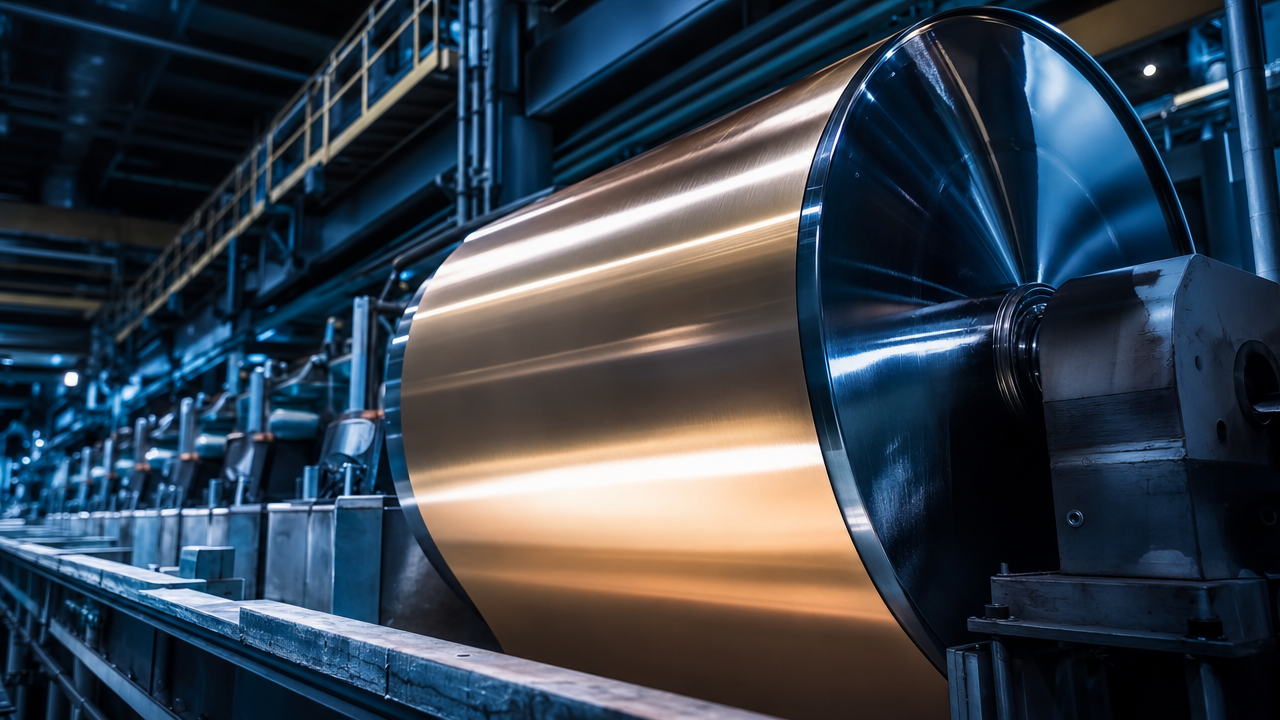

Electrolytic copper foil is an "invisible metallic film." At 4.5 micrometers, it is half as thin as a human hair. Wound into cylinders inside lithium-ion batteries, it supports the anode active material and conducts current; pressed onto glass fiber cloth inside copper-clad laminates, it forms the starting point of every printed-circuit-board trace. It never appears on the outside of any end product, yet it sits inside virtually every electric vehicle, every smartphone, and every AI server. Its output is measured in ten-thousand tons, its prices move in thousand-yuan per ton increments, and its process specifications live in micrometers and millinewtons. These three units sketch out the script of a Chinese sub-segment material industry over the past decade: from absent to present, from present to strong, from global catch-up to partial leadership, then to the industry-wide losses of 2024-2025 and the first inflection of 2026.
Per Mysteel's June 2026 survey, China's 57 electrolytic copper foil producers carry a combined nameplate capacity of 2.071 million tons — the dominant share of global output. May 2026 monthly production was 142,900 tons, of which 90,800 tons were lithium battery foil and 52,100 tons were electronic-circuit foil. At the same time, industry average utilization had just recovered from below 70% in 2025 to a little over 80%, the 4.5μm processing fee had just climbed back from a 23,000 yuan/ton low to 26,000 yuan/ton, and 6μm was still hovering at the decade-low 19,500 yuan/ton. Norde Co. (Nord Co.) forecast a 260 million yuan loss for 2025, its second straight year in the red; Jiayuan Technology, by contrast, hit a record 9.643 billion yuan in 2025 revenue — not through pricing, but through 47% volume growth and a high-end 4.5μm/4μm product mix. The divergence between these two industry leaders is a microcosm of the 2025-2026 window for the entire sector — bifurcation, clearing, and concentration toward the high end.
This report dissects the foil into two parallel industry tracks: lithium battery copper foil (4.5μm ultra-thin + 4680 large cylindrical + composite copper foil threat) and electronic-circuit copper foil (HVLP high-frequency high-speed + AI server CCL + RTF reverse-treated). The two tracks share the same dissolution + electrodeposition + cathode-drum process backbone at the source, but diverge completely in downstream applications, processing-fee levels, technology trajectories, and localization progress. Holding them on the same balance sheet is a representative sample for observing China's material industry upgrade: low-end products competing on scale and price, high-end products breaking through on process technology, the two tracks each seeking their own inflection point in parallel.
The report covers process chain and definitions, the technical barriers of ultra-thinning and HVLP, the 2025 financials of six Chinese head companies, benchmarks against four overseas giants, the two downstream tracks of power batteries and AI servers, localization progress, capacity expansion mapping, price cycles, policy and export controls, the substantive threat from composite copper foil, and 2026-2030 supply-demand and price forecasts. The Research Institute's core judgment sits in Chapter 12.
Chapter 1 — Industry Panorama and 2025-2026 Key Data
The electrolytic copper foil industry is the shared upstream for both new energy materials and electronic circuit materials. Its history stretches back over sixty years — Gould commercialized electrolytic copper foil in 1960s America, Mitsui Mining & Smelting and Furukawa Electric took up the baton in 1970s Japan, Changchun Petrochemical and Changchun Plastics built capacity in 1980s Taiwan, LS Mtron and Iljin Materials entered in 1990s Korea, and mainland Chinese capacity broke through across the board from the 2000s onward. Today, by the crudest yardstick of nameplate capacity, mainland China accounts for more than 75% of global electrolytic copper foil capacity — a complete curve from quantitative growth to qualitative change to structural transformation.
I. The 2025-2026 Key Data Matrix
To explain "China's electrolytic copper foil industry" clearly, several core numbers must be laid out:
Capacity. Mysteel's June 2026 survey of 57 domestic producers shows 2.071 million tons/year of nameplate capacity. That figure is 2.5 times the roughly 600,000 tons of 2020. But utilization was only 58% in 2024, recovering to 68% in 2025 and a projected 80% in 2026 — meaning a chronic 300,000-500,000 ton idle buffer between actual effective capacity and nameplate. This idle buffer reflects low operating rates driven by three years of price wars and processing-fee declines, not physical failure. Once downstream demand or processing fees recover, this buffer can be reactivated within 6-12 months.
Production and sales. May 2026 domestic monthly output was 142,900 tons, an annualized 1.71 million tons. The key structure: lithium battery foil 90,800 tons (about 63.5%), electronic-circuit foil 52,100 tons (about 36.5%). The lithium foil share rose from 35% in 2018 to today's 63%, the direct result of eight years of Chinese new-energy-vehicle and energy-storage explosion. But 2026's marginal increment is tilting from lithium battery foil toward electronic-circuit foil — AI server demand for HVLP high-frequency foil is growing notably faster than power battery demand.
Price. This was 2024-2025's most painful indicator. On June 8, 2026, SMM quotes: 4.5μm lithium battery foil processing fee averaged 26,000 yuan/ton, 6μm 19,500 yuan/ton, 18μm HTE electronic-circuit foil 20,500 yuan/ton, 35μm HTE 18,500 yuan/ton. The various grades cluster around 20,000 yuan/ton, but the comparable 2022 figures were 4.5μm 45,000-50,000 yuan/ton and 6μm 30,000-35,000 yuan/ton. Over four years, mainstream lithium foil processing fees fell about 40%. At the same time, cathode copper rose from 65,000 yuan/ton to 75,000 yuan/ton, squeezing per-ton net processing margin from both sides — the direct cause of Norde's two consecutive years of losses.
Gross margin. Industry leaders' per-ton gross margin in 2024 ranged from -2,000 to +3,000 yuan, with a median near zero. By 2025, with rising 4.5μm mix and additional overseas high-end orders, leaders recovered to +3,000 to +8,000 yuan/ton. In Q1 2026, several companies' single-quarter net margins returned to 1-3%, the highest in twelve quarters.
II. Global Capacity and China's Position
The global electrolytic copper foil capacity map as of early 2026:
- Mainland China: 2.07 million tons, about 75% of global.
- Korea (SK Nexilis + Lotte Energy Materials + Solus Advanced + Iljin): about 400,000 tons.
- Japan (Furukawa Electric + Mitsui Mining & Smelting + JX Nippon Mining & Metals + Hitachi Cable): about 120,000 tons, but heavily concentrated in high-end HVLP, with value share far exceeding tonnage share.
- Taiwan (Changchun Petrochemical + Nan Ya): about 100,000 tons, technologically stable, strong in PCB foil.
- Europe (Circuit Foil Luxembourg + Schlenk): about 50,000 tons, HVLP niche.
- Southeast Asia (SK Nexilis Malaysia + Lotte Malaysia): about 30,000 tons, new build.
- North America (Solus Canada): about 10,000 tons, new build.
By tonnage, China is the undisputed champion. But shift the lens to value — for HVLP high-frequency foil, the 2025 global market was about 1.8 billion USD and mainland China held only about 30%; Mitsui alone held over 40% in AI-server HVLP. This is the core structural difference: tonnage leadership belongs to China; value leadership remains Japanese and Korean.
III. Upstream-Downstream Asymmetry and Profit Distribution
Electrolytic copper foil's upstream-downstream sits in deep asymmetry:
Upstream is highly concentrated and monopolistic. Cathode copper is priced globally by LME and transmitted via Chinese exchanges — foil makers have no pricing power. Cathode drums are nearly monopolized by Mitsubishi Heavy Industries and Japan Steel Works, with domestic substitution underway but share still small. Additive formulations (gelatin, SPS, sodium polydithio-dipropane sulfonate, chloride ions) are each company's core know-how, although the raw chemicals themselves are competitively supplied.
Downstream is also highly concentrated, but with strong buyer power. Lithium foil's downstream is five head battery makers — CATL, BYD, CALB, EVE, Gotion — plus about twenty mid-sized battery firms. Electronic-circuit foil's downstream is Kingboard Laminates, Shengyi Technology, Nan Ya Plastics, EMC head CCL makers plus dozens of mid-to-small CCL plants. Both downstream buyer pools have strong bargaining power — battery makers commonly use "annual framework price + monthly sliding adjustment" to lock in supply; CCL plants negotiate quarterly. Strong buyer power plus industry overcapacity were the dual root causes of 2023-2025 processing fees falling to the floor.
Foil makers are squeezed in the middle. They cannot pass cathode copper increases upstream (a copper price rise directly eats into gross margin), nor pressure downstream (battery makers can switch suppliers). The only breakthrough path is technology upgrade — replacing 6μm with 4.5μm, replacing standard ED foil with HVLP. Chinese leaders have walked the 4.5μm path (60-70% of Jiayuan and Norde sales today), but HVLP is still Japan-led, and Chinese localization only began real breakthroughs in 2025-2026.
IV. The 2024-2026 Industry Inflection
Bringing focus back to the present, the 2024-2026 three-year window is an extremely clean inflection window:
2024 was the bottom. Processing fees fell through cost, the industry lost money broadly, listed company stocks halved, capacity expansion stopped, and small mills exited.
2025 was the grinding bottom. Leaders repaired margins through rising 4.5μm mix but the industry overall still lost money; utilization recovered from 58% to 68%; overseas giants (SK Nexilis, Lotte) accelerated Southeast Asia and Europe expansion under U.S. IRA + EU policy dividends; domestic composite foil moved from concept to small-scale production.
2026 confirms the inflection. First-round processing-fee hike landed; utilization rose to 80%; leaders turned single-quarter profitable; AI server HVLP demand exploded; composite copper foil penetration disappointed expectations, paradoxically reopening lithium foil recovery space.
But whether this inflection persists into 2027-2030 depends on three variables: whether power battery growth transitions smoothly from the 30-50% peak to the 15-20% mid-cycle; whether composite copper foil penetration breaks the 5% threshold; whether AI server HVLP localization reaches 30%+ replacement by 2027. The probability combination of these three variables determines whether the next five years for Chinese electrolytic copper foil are a slow bull, a sideways grind, or a second dip.
V. Historical Inflection Revisited
Back in 2018-2020, the Chinese electrolytic copper foil industry actually experienced a similar inflection window — the 8μm-to-6μm switchover, with capacity expansion, processing-fee decline, and head concentration playing out much like today. The 2018 8μm processing fee was about 25,000-30,000 yuan/ton — comfortable. 2019-2020 saw 6μm break through and new capacity flood in; processing fees fell to 18,000-20,000 yuan/ton. But after EV demand exploded in 2021-2022, 6μm processing fees rebounded sharply to a 40,000-45,000 yuan/ton peak. The 8μm-to-6μm cycle ran about four years, with a price swing of roughly 2.5x bottom-to-peak.
Today's 6μm to 4.5μm to 4μm switchover, applying similar pacing, places 2023-2025 in the early switchover decline, 2026-2027 in the mid-switchover rebound, and possibly 2028-2030 entering another overcapacity. Unlike 8μm-to-6μm, today's downstream demand structure is more diverse (power + storage + consumer electronics + AI servers), the technology dimensions are richer (not just thickness, but also HVLP surface treatment), so this cycle's peak and trough may both be more moderate than the previous one.
VI. Comparison With Other Material Industries
Electrolytic copper foil versus other key material industries helps locate its position in the Chinese material industry upgrade landscape:
Versus battery cathode materials: Cathode materials (LFP + ternary) and electrolytic copper foil both belong to the lithium battery "four core materials" system, but cathodes have higher localization (near 100%), larger market size (Chinese cathode 2024 about 150 billion yuan versus electrolytic copper foil about 25 billion yuan), and more aggressive technology evolution (high-nickel + single-crystal + sodium batteries). Cathodes are the "heavy artillery" of Chinese materials; copper foil is the "light cavalry."
Versus separator: Separator (PE/PP microporous film) and electrolytic copper foil are both high-barrier battery auxiliaries, but separators are closer to chemical + film-forming processes, while copper foil is closer to metallurgy + electrochemistry. Separators evolved dry-to-wet-to-ceramic-coated; copper foil evolved thick-to-thin-to-HVLP surface treatment. Both technology paths are difficult, but copper foil's "chokepoint" risk (HVLP-4) is more acute.
Versus electronic-grade glass cloth: Electronic glass cloth is the other core CCL raw material alongside copper foil. Glass cloth localization is about 60-70% (higher than copper foil in HVLP), but high-end NE-glass and Q-glass still rely on imports. Glass cloth is closer to inorganic non-metallic material processes, with 18-24 month expansion cycles; copper foil expansion runs 12-18 months but with slower process maturation.
Versus copper mining: Copper mining sits upstream of electrolytic foil, but China's copper-mine import dependence is about 75% (relying on Chile, Peru, Indonesia, DR Congo, etc.). The most upstream raw material has import dependence, so downstream "localization" is not strictly fully independent — any overseas copper mine supply disruption transmits to copper foil.
Putting these four comparisons together, the position of electrolytic copper foil in the Chinese material industry upgrade map is: mid-stream auxiliary, moderate-to-high technical barrier, divergent localization progress (4.5μm done, HVLP-4 still choked), medium market size, upstream-mining import dependence, strong downstream pull from batteries and PCBs. A typical "growing mid-sized sub-segment material industry."
VII. The Industry's Talent Structure
The talent structure of the copper foil industry has undergone a deep change over the past decade. Before 2015, copper foil engineers came primarily on assignment or via headhunting from Taiwan Changchun, Japan Furukawa, Korea Iljin — about 80% of key process roles were expatriates. From 2018-2020, Chinese universities (Central South University, Beijing Nonferrous Metals Research Institute, HIT, Fuzhou University, SCUT) began training domestic engineers in electrochemistry and materials science at scale. By 2022-2025, domestically trained engineers became the industry mainstay, with expatriate share falling below 20%. This localization brings faster R&D response, lower R&D cost, and technological independence — but lower experience accumulation on advanced products like HVLP, which still requires 5-10 years of continuous production and trial-and-error to fully catch up.
VIII. The Capital Ecosystem
The financial ecosystem of the copper foil industry is a sample of structural changes in Chinese capital markets over the past eight years. 2017-2022 was a capital-frenzy period: Jiayuan IPO on STAR Market 2019, Norde private placement 2020, Tongguan IPO 2021, Zhongyi IPO 2022, Defu IPO 2023. Multiple foil makers completed large capital raises riding the EV tailwind. 2023-2025 was capital pullback: industry losses, processing-fee collapse, copper foil stocks halved. 2026 marks capital recovery: first processing-fee hike, single-quarter profits, foil stocks rebounding. But capital understanding is now more mature — no longer blindly chasing the "EV wind," investors are differentiating which companies can win the processing-fee recovery and HVLP localization battles.
IX. Reader Usage Guide
Different readers can use this report in different ways:
- Foil industry practitioners: focus on Chapter 2 (process), Chapter 4 (HVLP), Chapter 8 (localization), Chapter 12 (judgments).
- Battery / CCL / PCB procurement: focus on Chapter 5 (companies), Chapter 6 (downstream), Chapter 7 (supply chain).
- Capital market investors: focus on Chapter 5 (financials), Chapter 10 (pricing), Chapter 12 (judgments), Chapter 13 (risks).
- Policymakers: Chapter 11 (policy) and Chapter 8 (localization).
- Academic researchers: Chapters 2-4 for process / ultra-thinning / HVLP.
- Media analysts: Use as systemic industry baseline.
X. Chapter Summary
This chapter outlined the panorama: 2.07 million tons of total capacity, 4.5μm and 6μm dual-mainstream processing-fee differential, seven global capacity regions, asymmetric upstream-downstream bargaining, and the 2024-2026 three-year inflection window. These numbers and structures are the basis of every subsequent discussion. Readers are advised to revisit this chapter often as the foundation for the thirteen specialized chapters that follow.
XI. Industry Key Terminology
- Processing fee: foil tax-inclusive price minus cathode copper × 1.08. The foil maker's gross revenue indicator.
- Raw foil: foil just peeled from the cathode drum, before surface treatment.
- Treated foil: foil after roughening, blackening, anti-rust, and silane coupling.
- Shiny side / matte side: foil's drum-contact side is shiny; electrolyte-contact side is matte.
- Tensile strength: load per area, in MPa.
- Elongation at break: maximum elongation at break, in %.
- Surface roughness Rz: maximum peak-to-valley height, in μm.
- Pinhole density: visible micro-holes per unit area, in count/m².
- Yield: ratio of qualified product to total feed; core process maturity indicator.
XII. Reading Map
- Chapters 2-4 are technology core, for engineers.
- Chapters 5-6 are companies + customers, for procurement / sales / investors.
- Chapter 7 is supply chain pathways, for B2B platform operators / chain integrators.
- Chapters 8-10 are localization + capacity + pricing.
- Chapters 11 and 13 are policy + risk.
- Chapter 12 is the Research Institute's judgment.
- Chapter 14 is methodology and data sources.
Chapter 2 — The Process Chain and the Centrality of the Cathode Drum
To understand why electrolytic copper foil is a "seemingly simple, actually extremely difficult" industrial product, the process chain must be dissected. The four-character description — dissolve copper, electrolyze, dry, treat — hides dozens of sub-parameters, hundreds of process nodes, and thousands of trial-and-error iterations per stable formulation behind each character.
I. Process Overview
The full process splits into five core stages:
Stage 1: Copper dissolution (solution preparation). Cathode copper (99.99% pure) is dissolved in sulfuric acid by heating and air oxidation, producing copper sulfate solution with copper ion concentration 80-110 g/L and sulfuric acid 80-130 g/L. The keys here are controlling dissolution rate, filtering out impurities (lead, arsenic, bismuth, silver in trace amounts), and maintaining liquid purity — any ppm-level impurity will produce burrs, pinholes, or surface defects in subsequent electrodeposition. Mainland Chinese producers use continuous dissolution tanks plus multi-stage filtration; top-tier producers like Mitsui add chelating separation steps to remove sub-ppm interfering elements.
Stage 2: Electrolysis (foil generation). This is the process core. Inside the electrolytic tank, the cathode drum (1.5-3m diameter titanium or stainless drum, mirror-polished chrome plating) acts as cathode, lead plates as anode, copper-bearing electrolyte circulating between. At 60-120 A/dm² current density, copper ions reduce and deposit a thin copper film on the drum surface, peeled off by rotation as a continuous "raw foil" roll. Five parameters must be tightly controlled: current density, electrolyte temperature (45-60°C), flow rate (500-1500 L/min), additive concentrations (gelatin 1-10 ppm, SPS 5-50 ppm, chloride 30-80 ppm). Any deviation produces thickness non-uniformity, coarse grain, or low tensile strength.
Stage 3: Drying. Raw foil peeled from the drum carries surface electrolyte and must immediately enter drying. Standard practice uses infrared lamps + hot air + cold air composite drying tunnels to reduce moisture below 0.05%. Difficulty: 4.5μm and thinner ultra-foil tears easily, requiring air-floatation + tension synchronization + soft-roller contact composite schemes.
Stage 4: Surface treatment (roughening + blackening + anti-rust + coupling). Lithium battery foil can be used directly after drying, but PCB foil must go through downstream treatment. Roughening (depositing granular copper on matte side to improve bond with substrate), blackening (oxidation producing Co/Ni black layer for heat resistance), anti-rust (chromate or silane treatment to prevent oxidation in transport storage), coupling (silane coupling agent layer for resin bonding). HVLP high-frequency foil reverses all these steps — roughening particle size drops from micrometer to nanometer, blackening switches to low-roughness Co-Ni-W alloy, target surface Rz down to <2μm (HVLP-1), <1.5μm (HVLP-2), <1μm (HVLP-3), even <0.7μm (HVLP-4).
Stage 5: Slitting (finished product). Mother rolls (typically 1300-1500mm wide, thousands of meters long) are slit on precision slitters to customer widths (lithium 200-700mm, PCB 510-1020mm), with thickness, appearance, defect rate inspection. Cut quality is key — any burr, curl, or wrinkle causes downstream defects.
II. The Cathode Drum: The Overlooked Choke Point
If the electrolytic tank is the heart, the cathode drum is the heart valve — its quality directly determines surface finish, thickness uniformity, and grain structure. A quality drum runs 8-12 months without replacement; a poor one shows wear, chrome flaking, and quality fluctuation in 3 months.
The global cathode-drum market is long monopolized by two Japanese firms: Mitsubishi Heavy Industries (titanium drums) and Japan Steel Works (stainless drums). The two combined held over 90% of pre-2022 global market. A 2.7m diameter titanium drum sells for 15-25 million yuan with 12-18 month lead time — any new foil capacity must order from Japan a year in advance.
Domestic substitution started gaining traction after 2020. Shanxi Roly Titanium and Shandong Zhongtiao have achieved 1.5-2.2m diameter titanium drum localization, at 60-70% of Japanese price but with 30-40% gap in lifetime against top Japanese drums. By 2025, about 40% of new domestic capacity uses domestic drums; 60% still use Japanese imports. Japan still dominates in 2.5m+ large-diameter drums and 4.5μm-and-below ultra-thin foil dedicated drums.
This is an invisible choke point — it does not appear on foil makers' financial statements, but it manifests in capacity delays, product yields, and stable run times that differentiate companies.
III. Additive Systems — Each Company's Core Recipe
The additive system inside the electrolytic tank is the most mysterious and critical part of the process. It directly determines grain size, tensile strength, elongation, and surface roughness.
Mainstream systems contain four categories:
- Leveler: gelatin, polyethylene glycol, polyether-based. Inhibits preferential copper deposition at protrusions for flatter surface.
- Accelerator: SPS (sodium polydithio-dipropane sulfonate), MPS. Accelerates deposition in depressions, working with leveler for "flattening effect."
- Inhibitor: PEG (polyethylene glycol), PPG (polypropylene glycol). Uniformly inhibits deposition rate to prevent grain coarsening.
- Chloride ion (Cl⁻): Forms CuCl intermediate with copper ions, affecting nucleation.
The concentration ratios and variation curves of these four categories are each company's "secret recipe." Mitsui's HVLP recipe reputedly contains a dozen minor additives, each at ppb-level precision. Chinese leaders like Jiayuan and Norde have matured on conventional recipes but are still catching up on high-end HVLP recipes. This kind of know-how requires 5-10 years of continuous production and trial accumulation — capital alone cannot short-circuit it.
IV. Electrolytic Cell Design — Continuous vs Batch
Cell design is another process differentiation point. Two mainstreams:
Continuous Electrodeposition (CED): Large titanium / stainless cathode drum immersed in horizontal tank, continuous rotation, continuous peeling, continuous production. Advantages: high capacity, high automation, low unit cost. Disadvantages: high equipment investment, slow process adjustment response. Chinese leaders all use this route.
Stepwise or batch electrodeposition: Small tanks with batch peeling, suitable for lab or small-batch high-end products. Advantages: process flexibility, customizable. Disadvantages: very low capacity. Only used for HVLP high-end or trial stages.
The future direction is dual-cathode-drum electrodeposition — one tank with two drums simultaneously, capable of producing two thicknesses or two surface treatments in the same electrolyte for further unit-cost reduction. Currently only SK Nexilis and a few have production cases.
V. Process Difficulty Indicator Matrix
| Indicator | 6μm Li-Ion | 4.5μm Li-Ion | 4μm Li-Ion | 18μm HVLP | 12μm HVLP-3 |
|---|---|---|---|---|---|
| Tensile strength (MPa) | ≥300 | ≥380 | ≥420 | ≥350 | ≥380 |
| Elongation at break (%) | ≥3 | ≥3 | ≥3 | ≥3 | ≥3 |
| Surface roughness Rz (μm) | <2.5 (matte) | <1.8 (matte) | <1.5 (matte) | <2 | <1 |
| Thickness tolerance (%) | ±5 | ±5 | ±5 | ±3 | ±3 |
| Pinhole density (/m²) | <5 | <3 | <2 | <2 | <1 |
| Yield | 92-95% | 85-90% | 75-82% | 80-85% | 60-70% |
The yield column is core: 4μm lithium foil's qualified rate is 75-82%, meaning 18-25% is scrap that must be remelted; HVLP-3's yield is 60-70%, so unit-product cost is significantly higher than standard ED. Each 1-percentage-point yield improvement equals 1pp capacity increase plus thousands of yuan/ton cost reduction — Chinese leaders' core R&D direction these past three years.
VI. Cleaning, Recycling, and Environmental Protection
Foil production generates substantial copper-bearing waste liquid + acidic vapor + chromium-containing wastewater. Environmental treatment is hidden cost every foil maker must address:
- Copper recovery: tank overflow + cleaning waste typically carries 1-5 g/L copper ion. Extraction-stripping-electrodeposition recovery yields 95%+. Recovered copper costs about 2,000-3,000 yuan/ton (vs cathode copper 70,000-80,000 yuan/ton) — but only large-scale players internalize this system.
- Acid vapor treatment: tank and drying-stage emissions go through packed-tower + alkali neutralization for compliant discharge.
- Chromium wastewater: surface treatment chromate waste is hazardous waste, requiring reduction + precipitation + qualified disposal; about 200-400 yuan/ton of finished product.
- Heat recovery: tank and drying waste heat can be recovered via heat pumps and waste-heat boilers, saving 5-10% energy.
EHS investment impact: (1) new capacity EIA threshold raised significantly from 2024, delaying new build by 3-6 months; (2) old line EHS retrofit about 300-500 yuan/ton; (3) non-compliant small mills forced to stop — implicit factor in 2024-2025 small mill clearing.
VII. Digitalization and Smart Manufacturing
Digital transformation in copper foil accelerated through 2024-2026:
- Real-time process monitoring via IoT sensors for current density, temperature, flow rate, additive concentration in the cell; AI algorithms detect anomaly trends and warn early.
- Quality traceability: every roll's master-roll number, production time, key process parameters, and inspection data is archived; customers can trace via QR code.
- Predictive maintenance: drum, tank, drive vibration and temperature analyzed in real-time, reducing unplanned downtime 30-50%.
- Energy optimization: electricity consumption by time, process, and product enables peak-valley pricing optimization, saving 5-8% on power costs.
- Digital twin: leaders (Jiayuan, Norde, Defu) have built electrolytic tank and full-line digital twin models for process optimization and training.
Tangible returns: 500-1,000 yuan/ton cost reduction + 1-2pp yield + faster customer response. But investment is non-trivial — a 10,000-ton line costs 20-30 million yuan to digitize, with 18-30 month payback.
VIII. Process Standards and Certification
International standards (IPC-4562, IEC 61249, JIS C 6481) plus Chinese national / industry / association standards plus enterprise internal standards plus third-party certification (SGS, TÜV, Intertek) plus customer auditing — copper foil has a complete multi-tier certification ecosystem. Top suppliers all maintain internal standards exceeding national, with overseas giants' internal standards setting the de facto reference.
IX. New Process Directions for 2026-2030
- Pulse electrodeposition: periodic current variations for grain refinement and stress reduction.
- Ultrasound-assisted electrodeposition: introducing ultrasound to improve convection and reduce concentration polarization.
- Nanocrystalline copper foil: 50-100nm grain size, tensile strength up to 800 MPa+, physical basis for 3μm ultra-thin.
- Composite-coated foil: surface coated with conductive polymer or carbon layer for better active material bonding, used in solid-state and high-nickel batteries.
- 3D-printed copper foil: research stage; future possibility of customized foil structures.
These new processes have 2028-2032 industrialization timelines. Current stage is basic research, but leaders all invest persistently.
X. Industrial Policy and the 15th Five-Year Plan
China's 15th Five-Year Plan (2026-2030) likely includes for the copper foil industry: electronic-circuit foil (especially HVLP-3/4) as key electronic material in industry upgrade; composite copper foil possibly in strategic emerging industry catalog; cathode drum and other core equipment in "shore up weaknesses" plan; overseas-build support; ESG transformation support, with green electricity and PV configuration subsidies.
XI. Safety Management
The process involves strong acid, high temperature, high current — safety management is hard constraint. Acid mist protection, high-temperature protection, electrical safety (each cell at 20,000-50,000 amperes), mechanical safety, chemical management. Any major safety incident triggers shutdown + huge compensation + regulatory penalties triple-hit. Leaders maintain complete HSE systems, with annual HSE investment about 0.5-1% of revenue.
XII. Chapter Summary
The process difficulties of electrolytic copper foil are the core battleground in China's foil industry's transformation from catch-up to leadership over the past decade. From dissolution to slitting's five stages, the cathode drum chokepoint, additive secret recipes, electrolytic cell design evolution, and process indicator matrix — this chapter has decomposed the chain to quantifiable, comparable, analyzable granularity. The next chapter focuses on ultra-thinning, the most important technology evolution direction.
XIII. Key Terms Reviewed
This chapter touched: dissolution, electrolytic tank, cathode drum, additive system, continuous electrodeposition, surface treatment, roughening, blackening, anti-rust, coupling, slitting. These terms recur throughout subsequent technology chapters.
Chapter 3 — From 6μm to 4μm: The Physical Limits and Process Barriers of Ultra-Thinning
Lithium battery foil's process evolution follows a clear "thinness" main thread. From 8μm mainstream in 2015, to 6μm crossing 50% penetration in 2018, to 4.5μm mass production in 2022, to 4μm small-batch and 3.5μm trial production in 2024-2025, to 3μm production capability beginning in 2026 — a thickness step down every 2-3 years on average. But each step down doubles physical and process difficulty exponentially.
I. The Drive for Ultra-Thinning
Why does the power battery industry demand thinner foil? It is an energy density arithmetic problem. In a standard prismatic power cell, foil makes up 8-12% of total cell weight and 5-8% of stack thickness. Cutting foil from 6μm to 4.5μm (a 25% reduction in both weight and thickness) lifts volumetric energy density 2-3% and gravimetric energy density 4-5%. For models targeting 300+ Wh/kg, a 2-3% improvement equals 15-25 extra kilometers of range — enough to decide a car's market competitiveness.
Beyond weight, thinner foil brings three second-order effects:
- Space utilization: same enclosure fits more turns; cell capacity rises 1-2%.
- Conductivity: thin foil has slightly higher internal resistance, but optimized formulation pushes electrical conductivity to IACS 99%+, basically offsetting.
- Electrode flexibility: thin foil winds more pliably with more even stress distribution, slightly improving long-term cycling.
For these combined advantages, Chinese mainstream power battery makers (CATL, BYD, EVE, CALB) have universally shifted from 6μm to 4.5μm since 2022. By end-2025, CATL's Qilin battery standard models were 100% on 4.5μm; BYD's Blade Battery was about 60% on 4.5μm with the remaining 40% on 6μm for cost reasons.
II. The Physical Bottlenecks of Ultra-Thinning
But ultra-thinning is not linear. From 4.5μm to 4μm to 3μm, each step exponentially harder. Three core physical bottlenecks:
Bottleneck 1: Tensile strength. Thinner foil bears less tension per width, more prone to tearing. 3μm foil needs ≥500 MPa tensile strength (close to standard steel), achieved through grain refinement and additive system adjustment — but this reduces elongation, creating a materials-science strength-plasticity tradeoff.
Bottleneck 2: Surface roughness. Even at constant absolute Rz, the relative proportion grows as foil thins. 6μm with Rz=2μm is 33%, but 4μm with Rz=2μm is 50% — usable thickness shrinks dramatically, conductivity drops. So thinning must reduce Rz in tandem — from 2.5μm to 1.5μm to 1μm.
Bottleneck 3: Pinhole density. Thinner foil makes pinhole impact more significant. 4.5μm allows 3/m², 4μm requires <2/m², 3μm requires <1/m². Pinholes affect cycling life and may cause internal short circuits leading to thermal runaway.
III. The Inflection of 4.5μm Industrialization
The journey of 4.5μm lithium foil — 2018 breakthrough, 2022 production, 2024 mainstream, 25% of domestic output in 2025, projected 50% in 2026 — is China's most important materials industry scorecard of the past eight years.
Jiayuan led the industrialization: 2018 trial, 2019 small batch, 2020 scale, 2022 primary product, 2025 4.5μm at 60%+ of sales. Norde followed, 4.5μm at 70% of company shipments. Tongguan, Zhongyi, Huachuang, Defu all have 4.5μm production capability.
The processing-fee premium for 4.5μm is the other key indicator. June 2026 SMM data: 4.5μm processing fee 26,000 yuan/ton, 33% premium over 6μm's 19,500. For a company shifting from 6μm to 4.5μm on the same tonnage, this lifts per-ton gross margin by 6,500 yuan. For a 50,000 ton-per-year producer, this is 325 million yuan additional gross — exceeding leaders' full-year 2024 net profit.
IV. The 4μm Frontier
4μm lithium foil industrialization currently sits at "small batch stage." Jiayuan's 2025 annual report disclosed stable 4μm supply, but the specific shipment volume was not separately disclosed — market estimates suggest 5-8% of company total. Norde, Zhongyi are slightly behind, still in customer qualification.
4μm's difficulty: tensile strength ≥420 MPa, pinhole density <2/m², yield from 4.5μm's 85-90% down to 75-82%. The same 100 tons of input yields only 75-82 tons of finished 4μm, with the rest remelted — unit cost is 15-20% higher than 4.5μm.
4μm demand driver mainly from: (1) 4680 large cylindrical batteries — Tesla, EVE, CATL all trialing 4μm on 4680 platforms; (2) high-end ternary + high-nickel NCM; (3) solid-state battery early validation.
But 4μm mass-market maturity will wait until at least 2028 — downstream battery certification cycles are typically 18-24 months, plus process ramp, leaving three years between 2025 small-batch and 2028 mass production.
V. 3.5μm and 3μm: Approaching the Physical Limit
3.5μm and 3μm are near the process physical limit. Jiayuan's 2025 disclosure of "3.5μm into small batch, 3μm production capability" is technically optimistic but actually means yields may only be 50-60%.
Below 3μm, the foil approaches material physical limits:
- Single copper atom diameter ~0.256nm; 3μm equals about 11,500 atoms stacked.
- Grain size must reach 100-200nm (vs standard foil 1-10μm), requiring ultra-fine-grain processes.
- Any micrometer-level defect scraps the whole foil.
Below 3μm, theoretically 2.5μm and even 2μm have been made in lab, but process stability, yield, and cost cannot simultaneously satisfy before 2030. So 3μm should be considered the practical physical limit of lithium foil ultra-thinning.
VI. Synergy With Downstream Battery Technology
Ultra-thin foil does not evolve in isolation — it must coordinate with downstream battery technology: tab process (ultrasonic + laser composite welding), coating process (low-tension, low-speed coating machines, coating thickness tolerance ±0.5μm), formation process (more sensitive volume expansion in first charge of thin-foil-wound cells, requiring re-tuned current curves). Foil makers cannot focus only on foil itself — they must deeply engage in downstream battery process tuning. Jiayuan and Norde's "resident engineer" model with CATL and BYD, with dozens of engineers on customer sites monthly, is the implicit moat for ultra-thin industrialization.
VII. Quality Control and Inspection
Quality control of ultra-thin foil is the most overlooked but most critical process-chain segment. Mainstream methods: β-ray or laser online thickness gauges (hundreds of points per second, tolerance ±0.1μm); white-light pinhole detection (AI vision algorithms 99%+ accuracy by 2025); white-light interferometer or AFM for Rz; tensile machines for tensile/elongation per batch; ICP-MS for ionic cleanliness (Na, K, Cl, S each <1 ng/cm²). Inspection equipment investment: a 50,000-ton-year line spends 15-25 million yuan on inspection. Any inspection failure can mean millions in customer compensation.
VIII. Impact of Next-Gen Battery Tech on Copper Foil
Solid-state: still needs foil as anode collector; energy density up, so per-GWh foil usage may fall 5-10%; surface treatment requirements rise. Sodium-ion: anode collector is aluminum (not copper), as sodium alloys with copper at low potential — so sodium batteries need essentially no foil. This is the biggest potential threat. But sodium batteries currently focus on storage and A00 EVs, with limited threat to power mainstream. Semi-solid: similar foil demand structure to liquid. LMFP (lithium-manganese-iron-phosphate): similar to LFP; higher density may push 4.5μm. Overall, next-gen battery tech impact is structural but the foil base remains stable through 2030.
IX. Customer Distribution of 4.5μm and 4μm
4.5μm mainstream customers: CATL, BYD, EVE, CALB, Gotion, Farasis, Lishen, Cenat, Sunwoda Power, REPT — basically covering top-20 power battery firms.
4μm early adopters: CATL (high-end ternary + 4680), EVE (4680 production), BYD (high-end ternary on select models), Tesla (4680), Envision (4680) — 5-8 customers.
4μm mid-term (2027-2028): CATL full lineup, BYD select models, EVE full lineup, overseas battery makers' select models — expanding to 15-20.
4μm mass production (2028+): standard on all major mid-to-high-end batteries.
X. Logistics and Inventory Management
Ultra-thin foil logistics and inventory are underrated challenges. Logistics: temperature- and humidity-controlled long-distance shipping, professional drum fixing + moisture-proof paper + vacuum packaging. Sea freight typically requires air freight (5-10x cost) or reinforced packaging due to humidity. Inventory: shelf life typically 6 months; battery makers usually keep 2-4 weeks of inventory; foil makers 1-2 weeks. These hidden costs are 2-4% of total cost; leaders compress to 1-2% via SCM + smart warehousing.
XI. Impact on Cycling Life
Ultra-thin foil's effect on battery cycling life is hotly debated among academia + industry in 2024-2026. Positive: more uniform stress, better long-cycle behavior; reduced mass eases vehicle energy load. Negative: lower mechanical strength can produce microcracks; pinhole risk rises; tab welding becomes harder. Test data: 6μm + NCM523 batteries: 2,500-3,500 cycles to 80% SOH; 4.5μm: 2,200-3,200 (5-10% lower); 4μm: 1,800-2,800 (15-20% lower). But this gap is closing rapidly through additive optimization, carbon coating, and stress relief design. By 2028 we expect 4μm cycle life to match 4.5μm.
XII. Chapter Summary
Ultra-thinning is the most important lithium foil technology breakthrough in China. 6μm to 4.5μm was the past eight years' main battle, 4.5μm to 4μm is 2025-2028's frontier, 4μm to 3μm is the 2028-2032 physical-limit challenge. Each step down corresponds to exponential difficulty rise on tensile strength, Rz, pinhole density, and yield.
XIII. Impact on Plant Layout
Ultra-thinning impacts physical plant layout significantly: cleanroom upgrades to Class 100,000, fully-controlled HVAC (22±2°C, 50±5% humidity), vibration isolation for precision slitters and gauges, smoother logistics paths. These "hardware upgrades" are another implicit competitiveness layer.
XIV. Recap
The 8μm → 6μm → 4.5μm → 4μm evolution at each step requires process, equipment, customer, and capital alignment. China's leadership in this curve is one of the past decade's proudest material-industry achievements.
Chapter 4 — HVLP High-Frequency Foil: The Core Choke Point of AI Servers and High-Speed PCB
If 4.5μm is lithium foil's biggest story, then HVLP high-frequency foil is electronic-circuit foil's biggest story. The 2026 industry positioning difference between the two main tracks creates the most interesting contrast — one where Chinese leaders already lead, one where Japan still occupies the absolute high ground.
I. What HVLP Is
HVLP (Hyper Very Low Profile) is the high-end electronic-circuit foil category, characterized by ultra-low surface roughness (Rz <2μm) + ultra-high thickness uniformity (±3%) + heat / oxidation resistance. Its PCB applications: high-speed digital signal transmission (>10 Gbps), high-frequency microwave (>10 GHz), AI servers, 5G base stations, automotive mmWave radar, high-speed optical modules.
Why is HVLP necessary? The skin effect. At high frequencies, current concentrates within a thin layer near the conductor surface — skin depth. The higher the frequency, the shallower: 1 GHz ~2μm, 10 GHz only 0.66μm. So at 10 GHz, current actually flows only in the top 0.66μm of foil — if surface Rz=5μm (standard ED), current must follow that rough relief, losses skyrocket. HVLP keeps Rz at 1-2μm so the current path approaches an ideal smooth plane, minimizing high-frequency loss. At 10 GHz, HVLP-3 (Rz<1μm) cuts transmission loss 30-50% versus standard ED — decisive for a PCIe 5.0 (32 GT/s) or PCIe 6.0 (64 GT/s) AI server motherboard.
II. HVLP Generations
HVLP is a continuously evolving product sequence. Mitsui's generational definition is the de facto industry standard:
- HVLP-1: Rz 2-3μm, ~2010 production, for 1-5 GHz.
- HVLP-2: Rz 1.5-2μm, ~2015, for 5-10 GHz.
- HVLP-3: Rz 1-1.5μm, ~2020, for 10-25 GHz, PCIe 4.0/5.0.
- HVLP-4: Rz 0.7-1μm, 2023-2024, for 25-50 GHz, PCIe 6.0, 800G optical, AI server motherboards.
- HVLP-5: Rz <0.7μm, R&D, target 2027 production, for PCIe 7.0 and CPO co-packaged optics.
Each generational leap requires 3-5 years of process accumulation. Lower Rz necessitates changed roughening, but roughening directly determines bond strength with CCL — lower Rz means weaker bond, potential delamination in PCB processing. HVLP's high-end commanding challenge is simultaneously achieving low Rz + high bond strength.
III. Global Supply of HVLP
The global HVLP supply is heavily concentrated in Japan:
Mitsui Mining & Smelting: global HVLP leader, complete HVLP-1/2/3/4 product matrix, AI server share over 40%. 2025 HVLP revenue estimated 500-600 million USD. Furukawa Electric: HVLP-3/4 second-line main, with Mitsui forming Japan's "duopoly." JX Nippon Mining & Metals: HVLP-2/3 mainstay. Iljin Materials / Lotte Energy Materials (Korea): HVLP-2 production, HVLP-3 trial, 3-5 years behind Japan. Changchun Petrochemical (Taiwan): HVLP-2/3 production for 5G and server. Circuit Foil Luxembourg: HVLP-1/2 niche. Mainland China: catch-up phase. Defu (with Shengyi participation), Tongguan, Zhongyi all have HVLP-2 breakthrough; HVLP-3 in customer validation; HVLP-4 still in R&D. Jiayuan's 2025 report explicitly says "HVLP at R&D stage, no mass sales yet" — the clear roadmap for a top lithium foil maker extending into electronic-circuit foil.
By global HVLP market (~1.8 billion USD in 2025), mainland Chinese makers' combined share is about 8-10%, concentrated in HVLP-2-class lower tiers. HVLP-4 for AI server motherboards is supplied nearly 100% by Mitsui + Furukawa + partial JX. This is a very clear, very painful choke point in Chinese electronic materials — directly affecting Chinese AI compute supply-chain localization.
IV. HVLP Downstream: AI Servers as Core Engine
Global HVLP demand structure switched structurally in 2024-2025:
Pre-2020: 5G base stations + high-frequency comm equipment dominant. 2022-2024: 800G optical demand grew fast. 2025-2026: AI server PCBs become absolute core demand, over 50% of HVLP total.
AI server HVLP demand structure: a standard NVIDIA H100/H200 AI server node has 1 OAM motherboard + 1 UBB backplane + 8 GPU module boards + 4-8 network boards, total PCB ~2-3 m², all using M7/M8 grade high-speed CCL with HVLP-3 or HVLP-4 foil 100%. At ~50-80 kg HVLP per H100 node, 2025 global AI server HVLP demand was ~8,000-12,000 tons, value 400-600 million USD, ~30% of global HVLP total.
2026-2027 key variables: NVIDIA Blackwell (B100/B200/GB200) volume, capital spend growth at AWS / Google / Meta / Microsoft hyperscalers, and Chinese AI compute localization — combined, global AI server HVLP demand could see 40-50% CAGR. This is HVLP's biggest structural growth engine.
V. Path for Chinese HVLP Localization
China HVLP localization urgency rose to unprecedented heights post-2024 for three reasons:
Reason 1: U.S. BIS export controls on high-end AI chips force China to build autonomous AI compute supply chain. After AI chips comes HBM, then high-speed CCL, then HVLP foil — every link needs domestic substitution.
Reason 2: HVLP processing fees are 3-5x standard ED. Transitioning from lithium foil to HVLP is a major profit opportunity. HVLP-4 per-ton gross margin can reach 50,000-80,000 yuan (vs 6μm lithium 2,000-5,000, HVLP-3 30,000-50,000).
Reason 3: Downstream CCL plant localization demand. Shengyi, Nan Ya mainland plants, Taiwan Union mainland plants increasingly favor domestic HVLP foil to reduce supply chain risk.
But current localization progress is slow:
- HVLP-2: Jiayuan, Tongguan, Defu small-batch from 2024-2025, mainly for 5G and entry server, prices down to 60-70% of Japan.
- HVLP-3: Defu, Tongguan trial in 2025, small batch 2026, but CCL validation cycles are 12-18 months; batch in 2027.
- HVLP-4: mainland China has no production yet; possible 2027-2028 breakthrough.
- HVLP-5: R&D stage.
Realistically, by 2028 China overall HVLP localization may reach 20-25%, by 2030 35-40% — but HVLP-4 may still be only 10-15%. This is a 5-7 year process battle, not solvable by capital alone.
VI. AI Server PCB Layer Counts and HVLP Usage
A top AI server node (e.g. NVIDIA GB200) PCB structure:
- UBB backplane: 26-32 layers, 3.2-3.5mm thick, M7/M8 CCL throughout, HVLP-3/4 foil ~25-35 kg.
- OAM module board: 20-24 layers, 2.0-2.5mm, HVLP-3/4 ~8-12 kg.
- Network boards: 16-20 layers, HVLP-3 ~5-8 kg.
- Management + power boards: 8-12 layers, HVLP-2 ~2-4 kg.
Total ~50-80 kg HVLP per top AI server node, ~4,000-9,000 yuan in foil at HVLP-3 rates. Given a GB200 NVL72 sells for 2-3 million USD, foil cost share is <0.5% — a classic "tiny cost share, huge choke power."
VII. Beyond HVLP — Other High-End Electronic Foil
Beyond HVLP, other high-end electronic foil categories: RTF (reverse-treated foil), CoC (coreless / substrate foil), EMI shielding foil, FCCL (flexible CCL) rolled foil. Mainland China has 70%+ localization in RTF; CoC is nearly 100% Japan + Taiwan; FCCL rolled foil localization lags HVLP.
VIII. HVLP Customer Validation Process
HVLP from sample to mass production requires multi-stage validation across CCL + PCB plants: (1) CCL basic testing 3-6 months; (2) CCL process trial 3-6 months; (3) PCB sample board testing 3-6 months; (4) end-customer system testing 3-12 months; (5) batch supply. Total 12-30 months. This is why Defu / Tongguan HVLP-3 customer validation started in 2025 means earliest mass shipment is 2027.
IX. HVLP Volume and Value Forecast
| Year | Global HVLP shipment (kt) | Avg fee (¥k/t) | Market size (USD bn) |
|---|---|---|---|
| 2025 | 60 | 80 | 1.8 |
| 2026 | 80 | 90 | 2.5 |
| 2027 | 110 | 100 | 3.8 |
| 2028 | 140 | 110 | 5.0 |
| 2030 | 200 | 130 | 8.5 |
2025-2030 will see 4.7x growth — the fastest-growing copper foil sub-segment. China achieving 30-40% HVLP-3 localization by 2027-2028 could deliver 5-10 billion RMB additional Chinese revenue.
X. AI Compute Supply Chain Full Picture
AI chips, HBM memory, ABF/BT substrates, high-speed CCL, HVLP foil, electronic glass cloth, AI server OEMs — China's localization rates by 2025 / 2028: chips 20%/50%; HBM <10%/30%; substrates 15%/40%; CCL 20%/50%; HVLP <5%/30-40%; glass cloth 30%/60%; servers 60%/80%. China AI compute supply chain overall localization 20-25% in 2025, 40-50% in 2028. HVLP is relatively lagging.
XI. HVLP vs RTF
RTF flips foil's matte and shiny sides, using shiny for CCL bonding — lower bonded-face roughness than matte for better high-frequency. RTF is a simplified solution suitable for M4-M6 mid-tier CCL; HVLP is high-end for M7-M8. China has ~70% RTF localization but lags on HVLP-3/4.
XII. HVLP and CCL Resin System Matching
HVLP performance depends on matching with downstream CCL resin: PPE/PPO for M6/M7 + HVLP-2/3; CE (cyanate ester) for M7 + HVLP-3; PTFE for high-freq + HVLP-3/4; PI (polyimide) for high-freq high-speed + HVLP-3/4; HC (hydrocarbon) for M8 + HVLP-4. Foil and CCL co-development is critical to HVLP localization path; joint labs are an important 2025-2030 trend.
XIII. Chapter Summary
HVLP is the core electronic-circuit foil of the AI server era. The HVLP-1 to HVLP-4 generational evolution corresponds to 1-50 GHz application bands and to the Japan-monopoly / China-catch-up global structure. HVLP-3/4 localization is the most critical link in the future five years of Chinese AI compute supply chain.
XIV. Recap
HVLP is the biggest high-end opportunity and toughest battle for Chinese electrolytic copper foil in the next 3-5 years. Defu and Tongguan are the first localization echelon; Jiayuan, Norde are potential pursuers.
Chapter 5 — In-Depth 2025 Financial Comparison of Six Chinese Head Companies
The head structure of Chinese electrolytic copper foil in 2025 is roughly "six majors": Jiayuan Technology, Norde Co., Tongguan Copper Foil, Zhongyi Technology, Defu Technology, Huachuang. Their combined capacity is 35-40% of domestic, combined shipments 45-50%.
I. Jiayuan (688388): Ultra-Thinning Leader
- Revenue 9.643 billion yuan, +47.85% YoY, all-time high.
- Lithium foil revenue 8.32 billion (86.28% of total, +57.16% YoY).
- 2025 foil output 98,300 tons (+46.66%), sales 99,400 tons (+46.83%).
- 4.5μm, 4μm in stable mass production, 3.5μm in small batch, 3μm production capability.
- HVLP at R&D, no mass sales.
Jiayuan's story: first-tier on the "thin" axis of lithium foil, achieving both volume and price (47% volume + structural mix from 4.5μm) in 2025, but lagging on the "high" axis of electronic foil. The next critical step is HVLP-2/HVLP-3 industrialization — entering AI server supply chain in 2026-2027 would rewrite the valuation logic.
Expansion: Meizhou Guangdong base + Fujian Ningde + Jiangxi Ganzhou three bases; 20,000 tons new in 2026, 30,000 in 2027, target 150,000 tons by 2028. Pace adjusted dynamically by market.
II. Norde (600110): CATL Core Supplier
- 2025 expected loss ~260 million yuan, second consecutive loss year.
- But 4.5μm at 70% of company shipments, the industry highest.
- Signed 45,000-ton supply with CALB for 2025; long-term contracts totaling 260,000 tons.
- Capacity 145,000 tons (Jiangxi, Qinghai, Hefei bases).
Loss causes: (1) cathode copper rise exceeded fee recovery; (2) high leverage erodes profit; (3) some old line depreciation not yet complete. But structural strengths clear: (1) 70% 4.5μm means greatest leverage on 2026 fee recovery; (2) 260,000 tons LTC locks 3-year base orders; (3) deep tie with CATL and CALB makes it the core foil supplier for 4680 large cylindrical and high-end ternary.
III. Tongguan (301217): Clearest Loss-Reversal Inflection
- Q1 2025 revenue 1.395 billion (+56.29%), net 4.75 million (+117%) — first to break even.
- 2025 full-year net forecast +2,100% (low base).
- 2025 overseas revenue 180 million (+2,957%).
- Hefei expansion 25,000 tons.
Loss-reversal elasticity from: (1) Tongling Nonferrous Group cathode copper procurement price advantage; (2) Hefei new capacity scale; (3) high overseas order growth showing breakthrough in Korean, SE Asian battery customers. Next step: HVLP-2 small-batch produced, HVLP-3 in customer validation.
IV. Zhongyi (301150): From Loss to Inflection
2025 expected to turn profitable. Past three years pressed by 6μm-heavy product structure; 2024-2025 transformation focuses on raising 4.5μm share to ~50%. Deep tie with BYD and EVE (each growing 40% and 60% in 2024-2026) brings stable orders.
V. Defu (301511): Lithium + PCB Dual Leader
- Q1 2025 revenue 2.501 billion (+110%), net 18 million, turned around.
- 2024 electronic-circuit foil revenue 1.809 billion (+34.40%) — PCB foil meaningful contributor.
- Expansion 25,000 tons.
Defu's dual-track structure resists cycles better: lithium downturn → electronic (especially HTE high-end) contributes; electronic downturn → lithium supports volume. This balanced structure made Defu weather 2023-2025 downturn better than pure-lithium peers. Defu is China's top-tier HVLP-2 producer, with HVLP-3 also in customer validation — completing HVLP-3 by 2026-2027 makes Defu the most important Chinese electronic foil localization benchmark.
VI. Huachuang Xincai: Unlisted Hidden Leader
Private, unlisted, so financials less transparent. Per channel info: ~80,000 tons capacity, 4.5μm production capability, supplies CATL and CALB, 2025 estimated revenue ~5 billion yuan. Flexible mechanism, high R&D ratio, fast customer response. Forms "three-way" with Jiayuan and Norde in lithium foil — the "private tech school."
VII. Six-Way Comparison
| Company | 2025 Rev | Li shipment | 4.5μm share | HVLP | Tag |
|---|---|---|---|---|---|
| Jiayuan | 9.64 bn | 99.4 kt | 60%+ | R&D | Ultra-thin leader |
| Norde | 6.0-6.5 bn | 80-90 kt | 70% | R&D | CATL/CALB tied |
| Tongguan | 5.5-6.0 bn | 60-70 kt | 50% | HVLP-2 prod | Group synergy + reversal |
| Zhongyi | 3.5-4.0 bn | 40-50 kt | 50% | R&D | BYD tied |
| Defu | 9.5-10.0 bn | 50-60 kt Li | 50%+ | HVLP-2/3 lead | Dual-track |
| Huachuang | ~5 bn (est) | 50 kt | 60% | R&D | Private tech school |
Six combined: ~40 billion yuan revenue, ~400 kt lithium foil shipment, ~40% of domestic — significantly higher concentration than 2020's 25-30%. Head concentration is the past five years' clearest structural change.
VIII. Second-Tier Profiles
Tongbo Technology (HK IPO filing), Jinggu Copper, Jiangsu Zhonghui, Jiangxi Longxiang, Anhui Huafeng — about 10-15 second-tier firms holding ~30% of industry capacity. Profile: 30-80kt capacity, single-product (mostly 6μm), 1-2 big customers concentrate 70%+, weaker cost vs leaders by 500-1000 yuan/ton, cyclically weaker. Consolidation: leaders acquire, regional integration, or pivot to niche (composite, RTF, HVLP-2).
IX. R&D Investment Structure
Leaders' R&D revenue share rose 1-2% (2018) to 3-5% (2025). Allocation: process optimization 40%, new products 30%, equipment localization 15%, digitalization 10%, EHS 5%. Six leaders' combined annual R&D ~1.6 billion yuan. Still smaller than Mitsui parent + SK Nexilis but approaching parity — China R&D catch-up entering "peer competition" stage.
X. ESG Performance
ESG ratings became hard threshold for overseas customer certification in 2024-2026: Tesla, Ford, BMW, VW require scope 1+2+3 carbon disclosure; EU CBAM needs detailed PCF; USD-fund ESG screening tightens. Chinese leaders: Jiayuan, Norde published ESG reports with third-party verification; PV configurations live at Meizhou (50MW) and Jiangxi (30MW); per-ton emissions fell from 3.5-4 tCO₂ in 2020 to 2.5-3 in 2025.
XI. Overseas Giants' China Localization
SK Nexilis explored China JV in 2018 but trade friction killed it; current trade-based small HVLP exports, focus on Korea+US+EU. Lotte considered China build, currently uses Malaysia capacity. Mitsui has China sales + tech center; production stays in Japan. Furukawa similar. Changchun has small mainland capacity. Nan Ya has mainland CCL + some foil. Overseas giants' China localization lagging — geopolitics, Chinese local leadership in mid-tier, and Japan's HVLP control strategy.
XII. Organizational Capability Comparison
Beyond products / financials, organizational capability is core competitiveness: Jiayuan (R&D-driven), Norde (customer-driven), Tongguan (SOE synergy), Zhongyi (customer-deep), Defu (dual-track integration), Huachuang (private agility). The HVLP-breakthrough window may reward agility more than capital scale.
XIII. Path Differentiation
Jiayuan: ultra-thinning path (6→4.5→4→3.5→3μm), industry "thinness pioneer." Norde: customer-binding + process optimization path. Tongguan: group synergy + high-end path. Zhongyi: customer focus on BYD + EVE. Defu: dual-track path. Huachuang: private agility path. Six paths have no absolute winner; 2026-2028 winners likely have both ultra-thinning + HVLP — Defu, Tongguan closest today.
XIV. Chapter Summary
The six Chinese heads form 45% of industry. Jiayuan's thinning, Norde's customer binding, Tongguan's reversal, Zhongyi's customer focus, Defu's dual-track, Huachuang's private mechanism — each path differentiated. Future 3-5 year battle on HVLP + overseas + ESG.
Chapter 6 — Lithium Foil Downstream: 4680 Large Cylindrical and the Storage Demand Structure
Electrolytic foil's largest downstream is lithium batteries. Understanding lithium foil demand structure requires understanding battery evolution — from early prismatic + pouch, to cylindrical 18650/21700, to 4680 large cylindrical, blade battery, ultra-thin pouch. Each form has different foil thickness / width / surface requirements.
I. Battery Form vs Foil Match
Prismatic: CATL, BYD, EVE, Gotion mainstay. Electrode width 300-600mm, foil mostly 6μm with rising 4.5μm share. About 55% of Chinese power batteries are prismatic.
Cylindrical: traditional 18650/21700 + new 4680. Tesla pushes 4680; CATL, EVE, Envision follow. Cylindrical electrodes narrow (80-150mm) but require very uniform foil — any thickness variation amplifies as winding stress. 4680 large cylindrical must use 4.5μm or thinner.
Pouch: consumer electronics mainstream + select high-end power (Mercedes). 200-400mm wide, mostly 6μm with 4.5μm for high-end consumer ultra-thin.
Blade: BYD proprietary structure. Long (close to 1m), narrow. High length-uniformity requirement. BYD self-foil + Jiayuan/Huachuang outside supply + Norde partial.
II. 4680: The Single Largest Ultra-Thin Scenario
4680 (46mm diameter × 80mm height, 5x volume of 18650) is the biggest single-product story in 2023-2026 battery evolution. Advantages: high energy density (pack 250-300 Wh/kg), low cost (large single capacity + 30-50% fewer structural parts + 15-20% pack cost reduction), fast charging (full-tab + 4μm foil → 4C).
4680 foil requirements: 4.5μm or 4μm, tensile ≥380 MPa, surface Rz <1.5μm, carbon coating.
2025-2026 global 4680 capacity: Tesla Berlin + Texas ~50 GWh, EVE Jingmen ~30, CATL ~20, Envision Erdos 10, others ~50. At 600-700 t/GWh, 2026 global 4680 foil demand ~100-120 kt — 90% 4.5μm or 4μm. The most important driver for ultra-thin foil.
III. Storage Batteries: The Underrated Stable Demand
Storage batteries — especially grid-scale large storage — the fastest-growing lithium sub-segment in 2024-2026. China 2025 storage shipment ~200 GWh, 2026 ~280, CAGR 40%+.
Storage characteristics: slightly higher foil/GWh than power (700-800 t), 6μm + 8μm mainstream (cost focus), very long cycle requirement (8,000-12,000 cycles).
Impact: (1) large stable orders absorb 6μm overcapacity; (2) low processing-fee premium, thin gross margins; (3) top storage bidders (CATL, BYD, EVE, Sungrow + integrators) pressure pricing.
IV. Consumer Electronics Batteries: High-End Market
Consumer electronics batteries (smartphones, laptops, wearables) ~15% of Chinese lithium foil demand. 6μm mainstream, 4.5μm in high-end flagships. Higher uniformity requirement; processing fee premium 10-20% over power; concentrated customers (ATL, Sunwoda, Coslight, BAK). AI phones, AI PCs drive higher energy density demand and 4.5μm penetration.
V. Power Battery Procurement Strategies
CATL: multi-supplier — Jiayuan, Norde, Huachuang, Tongguan + 5-7 firms, thickness × quarterly allocation. Annual framework + monthly sliding. BYD: self-foil (Fudi) + outside from Jiayuan, Zhongyi, Huachuang. CALB: Norde absolute core (45kt 2025 LTC), others supplementary. EVE: Jiayuan + Norde + Tongguan three-way. Gotion: Tongguan + Huachuang.
Multi-supplier + LTC + monthly adjustment squeezes processing fee. But 2026 onwards, fee recovery + 4.5μm capacity tightness reduces battery-maker leverage; foil makers regain pricing power.
VI. Cell-Battery Design Synergy
Foil isn't just rolls — must coordinate with battery design. Coordination points: (1) electrode size; (2) tab position; (3) coating tension; (4) formation parameters; (5) cycling stability. Jiayuan / Norde resident engineers at CATL / BYD enable this depth.
VII. Storage Battery Sub-Segments
- Grid-scale (≥100 MWh): 280 Ah large prismatic, 6μm dominant. China 2025 ~80 GWh.
- Commercial (1-100 MWh): 280-314 Ah, 6μm + 4.5μm. China 2025 ~30 GWh.
- Residential (5-20 kWh): EU/US/Australia. 50-100 Ah, 6-8μm (cost-sensitive). Global 2025 ~80 GWh.
- Portable (0.5-5 kWh): cylindrical + pouch, 6-8μm.
VIII. Consumer Electronics 4.5μm Trend
Apple iPhone 16 Pro Max (Sept 2024): +5% capacity partly from 4.5μm shift. Huawei Mate 60 Pro+: 4.5μm standard. Samsung Galaxy S25 Ultra (2025): dual-layer battery + 4.5μm. Xiaomi / OPPO / vivo flagships followed. Consumer 4.5μm penetration: <5% 2023, 15% 2024, 35% 2025, projected 55% 2026. Premium fee 30-40% over power — consumer high-margin niche.
IX. Coating Coordination
Coating equipment determines foil thickness choice: slot die (mainstream 6μm+), curtain coating (high-end <4.5μm), gravure (legacy). High-end coating line investment 50-80 million yuan per 1 million m/month. Battery coating capability is the precondition for ultra-thinning rollout.
X. Battery Recycling Effect on Foil
Battery recycling grew rapidly 2024-2026; retired battery foil recovery + regeneration becomes alternative supply. 2025 Chinese retired power batteries ~250 kt with recoverable foil ~20-30 kt; 2028 retired ~500 kt with ~40-60 kt; 2030 ~1 million tons with ~80-120 kt. Recovered foil purity 99.9%+; cost 20-40% below new. Major recyclers (GEM, Huayou, Brunp, Tianqi) partner with foil makers for "retired battery → secondary copper → new foil" loops.
XI. Battery Process Iteration Multiplier
Each major battery process iteration has multiplier on foil: blade (uniformity), CTP (lower per-GWh foil with standardization), CTC (more strength), 4680 (ultra-thin), solid-state (rework surface). Each iteration drives "passive upgrade" — foil makers must keep pace or be replaced, raising barriers and deepening leader moats.
XII. Downstream Growth Rate by Application
| Application | 2025 global (kt) | 2030 projected (kt) | CAGR |
|---|---|---|---|
| Power (passenger) | 600 | 1100 | 13% |
| Power (commercial) | 120 | 250 | 16% |
| Storage | 200 | 550 | 22% |
| Consumer electronics | 80 | 120 | 8% |
| Industrial | 50 | 90 | 12% |
| Electronic (mid-low) | 400 | 550 | 7% |
| Electronic (HVLP mid-high) | 80 | 250 | 25% |
| Total | 1530 | 2910 | 14% |
Storage + HVLP fastest growth. Foil makers should tilt strategic focus to these two segments.
XIII. Chapter Summary
Lithium foil downstream: power + storage + consumer three scenarios. 4680 cylindrical is the biggest pull for ultra-thinning, storage is the largest stable base, consumer is the high-margin niche.
XIV. Foil Demand vs Battery Supply Chain Holistic
Foil demand / battery capacity ratio reflects per-GWh foil intensity. 2018: 950 t/GWh (8μm), 2022: 800 (6μm), 2025: 700 (6+4.5 mix), 2030 projected: 600 (4.5+4 mainstream). Falling ratio means equivalent battery capacity needs less foil. But battery total capacity grows faster (25%+ annually), so foil total demand still rises.
Chapter 7 — Walking the Supply Chain: Filtering Copper Foil and Downstream Plants by Process Capability
The electrolytic copper foil industry has unusually complex supply chain relationships — simultaneously connecting upstream cathode copper smelting, drum equipment, electrolytic equipment, additive chemicals, and downstream lithium battery, storage battery, CCL, PCB and other widely differing downstream segments. Any foil maker, battery maker, CCL maker, or PCB maker doing supply chain coordination needs to precisely locate partners with specific process capabilities among China's 4.8 million producing factories.
This is exactly the core value of Tianxia Gongchang as a B2B platform of 4.8 million producing factories — unlike commercial-info tools like Tianyancha or Qichacha which index by company registration data (registered capital, registration address, legal representative, etc.), the platform indexes by a factory's actual production capability, process characteristics, product specifications, and capacity data. Along the electrolytic foil supply chain, from upstream cathode smelting to downstream PCB processing, every link can find corresponding Chinese factories through specific process keywords.
I. Upstream: Refined Copper Smelting and Cathode Copper Suppliers
Electrolytic foil's core feedstock is 99.99% pure cathode copper. Chinese refined copper smelting concentrates in head SOEs — Jiangxi Copper, Tongling Nonferrous, Yunnan Copper, Zijin Mining. Beyond these heads, many regional smelters supply mid-small foil makers. Through the refined copper smelting keyword, you can browse smelter distribution by province and scale, matching foil capacity geographically to cut logistics costs.
The cathode copper keyword covers full chain from large smelters to traders. Smaller foil makers benefit from flexible trader procurement vs LTC with heads.
copper smelting broadens to the full smelting industry — crude copper, electro-refining, and recycled copper.
II. Equipment and Consumables: Cathode Drums and Additives
Foil production's core equipment is the cathode drum. Beyond Japanese Mitsubishi and JSW imports, Chinese makers rise rapidly. Through titanium cathode drum and electrolytic copper foil equipment keywords, you find titanium deep-processing equipment makers and complete foil line integrators respectively.
Foil additives (gelatin, SPS, polyethylene glycol, etc.) belong to specialty chemicals. Domestic suppliers locate quickly via electroplating additives.
III. The Foil Itself: Filter by Thickness and Process Type
- lithium battery copper foil — covers main Chinese lithium foil makers.
- 4.5μm copper foil — ultra-thin lithium foil specific keyword.
- electronic circuit copper foil — PCB foil.
- HVLP copper foil — high-frequency low-roughness PCB foil.
- rolled copper foil — different process from electrolytic, mainly for flex PCB.
- double-side smooth copper foil — lithium high-end process.
IV. Downstream 1: Power and Storage Batteries
- power battery factory
- storage battery factory
- LFP battery
- ternary lithium battery
- 4680 battery
- cylindrical battery factory
V. Downstream 2: CCL and PCB
- CCL copper-clad laminate
- high-speed CCL — M6/M7/M8 high-speed CCL plants.
- PCB factory — Chinese full PCB list, ~1,800.
- HDI PCB — phone/server motherboard essentials.
- AI server PCB — high-end AI server motherboard processors.
- high-frequency PCB — 5G base station, mmWave radar PCB.
VI. Auxiliary Process: Surface Treatment and Precision Slitting
Using this top-to-bottom industry map, any electrolytic copper foil company can find corresponding upstream, peer, downstream partners on the platform. Indexing by process capability rather than commercial info is the core methodology of B2B industrial-supply-chain optimization.
VII. Geographic Matching for Logistics
Foil is bulk; logistics 2-5% of cost. Geographic matching cuts costs. Chinese foil capacity concentrates in Jiangxi / Anhui / Guangdong / Fujian; downstream batteries in Fujian / Sichuan / Guangdong / Jiangsu / Anhui. Through Jiangxi copper foil factory, Anhui copper foil factory, Guangdong copper foil factory, Fujian copper foil factory keywords + downstream battery distributions (Ningde batteries, Sichuan batteries, Jiangsu batteries), geographic proximity matching minimizes transport.
VIII. Auxiliary Service Plants
- copper foil post-processing
- copper foil testing
- copper scrap recycling
- recycled copper
- electrode coating
- battery tab
- battery aluminum foil
IX. AI Server Supply Chain Precision Alignment
AI server supply chain localization requires synchronizing HVLP foil, high-speed CCL, AI server PCB. Through:
— a complete upstream-to-end-product keyword combination, a B2B industrial supply-chain precision alignment map.
X. Supply Chain Financial Services
Supply chain coordination has financial dimensions: cathode copper price hedging (LTC + futures), accounts receivable factoring, supply chain ABS, green finance.
XI. Process Keyword Index for Niche Applications
- package substrate
- NEV battery
- battery plant
- on-board charger
- mmWave radar
- storage PCS
- EV electronic control
- BMS battery management
XII. Research Institute Supply Chain Services
The Research Institute, based on the platform's industrial supply-chain map, offers: supplier discovery, customer precision outreach, industry insight, supply chain audit support, and customized industry research.
XIII. Chapter Summary
Coordinated optimization on the foil supply chain spans upstream smelting to downstream PCB / batteries. Platform-based process keyword search is the core tool for B2B industrial precision matching. Any company's supply-chain optimization can use this map for geographic, process, and customer filtering.
XIV. Synergy Case Study
Example: Jiayuan + CATL 4680 cylindrical foil joint development. 2021 launch — joint 4.5μm + carbon coating. 2022 lab phase. 2023 Q3 small batch in CATL 4680 pilot. 2024 Q2 mass certification. 2025 batch supply. Four-year process spanning engineering teams, R&D, customer validation. A model for B2B chain coordination — not simple buy-sell, but joint R&D + long binding.
XV. Supply Chain Integration Value
Process-keyword-based precision alignment is the key path of B2B platforms evolving from "tool" to "industrial infrastructure."
Chapter 8 — Full View of Localization Progress: From 4.5μm Mainstream to 4μm Frontier to HVLP Choke Point
Localization in Chinese electrolytic copper foil is a multi-layer story by product category and generation. On one map: 4.5μm fully localized, 4μm under attack, 3.5μm in trial, HVLP-2 breakthrough, HVLP-3 in validation, HVLP-4 choked. Each layer's progress maps to completely different financial stories and capital valuation logics.
I. 4.5μm: 100% Localization Complete
Before 2018 Chinese mainland had nearly no 4.5μm volume — dominated by Japan's Furukawa and Korea's Iljin. 2018-2020 Jiayuan, Norde, Huachuang broke through; 2021-2022 industrialized; 2023-2025 became domestic mainstream.
By 2025, Chinese power battery 4.5μm foil 100% domestic — foreign imports have substantively exited this category. The most complete, most successful Chinese material industry localization case of the past eight years.
Success factors: (1) partial drum equipment localization lowered capacity threshold; (2) additive systems matured through 5-7 years of continuous production; (3) downstream battery scale adoption created scale effect; (4) R&D investment + engineer dividend.
II. 4μm: Small-Batch Stage
Jiayuan stably supplies; Norde finishing validation. Scale: Jiayuan 4μm 5,000-8,000 t/year (5-8% of total); Norde 2,000-3,000 t/year (validation tail); Zhongyi, Huachuang, Defu, Tongguan in small batch.
Key difficulties: tensile ≥420 MPa, pinholes <2/m², yield 4.5μm 85-90% → 4μm 75-82%. Yield improvement requires dozens of process micro-adjustments.
Demand: 4680 cylindrical + high-nickel ternary. By 2027 ~50 kt/year (5%), 2030 ~150 kt/year (15%).
III. 3.5μm and 3μm: Exploration
Jiayuan's 2025 "3.5μm small batch, 3μm production capability" disclosure means actually small shipment — 3.5μm <100 t/month, 3μm still in sampling. Difficulty near material physical limit: 11,500 atom stack, grain 100-200nm, ≥500 MPa. Stable batch production before 2030 needs process + materials breakthrough. Disclosure has more technology-signaling than commercial meaning.
IV. HVLP-2: Localization Breakthrough
HVLP-2 (Rz 1.5-2μm, 5-10 GHz) is China's electronic foil localization breakthrough direction 2024-2025. Defu, Tongguan, Jiayuan all have small-batch HVLP-2 production. Downstream mainly 5G stations, entry servers, automotive ECUs.
2025 China HVLP-2 localization rate ~40%. By 2028 expected 60-70%.
V. HVLP-3: In Customer Validation
HVLP-3 (Rz 1-1.5μm, 10-25 GHz, PCIe 4.0/5.0) is 2025-2027's biggest localization push.
Defu, Tongguan 2025 HVLP-3 sample shipments; 2026 enter head CCL plant validation. CCL validation cycles 12-18 months: (1) CCL base testing 3-6 months; (2) CCL + PCB sample 3-6 months; (3) PCB system test 3-6 months. Each stage failure means re-loop. HVLP-3 substantive batch in 2027.
Difficulties: nano-roughening (100-300nm particle); bond-strength vs roughness balance (≥0.7 N/mm); heat / oxidation resistance through multiple reflow at >260°C.
VI. HVLP-4: Still Choked
HVLP-4 (Rz 0.7-1μm, 25-50 GHz, PCIe 6.0, 800G optical, AI server motherboard) is 2026 China's biggest electronic foil shortcoming. Only a few Chinese makers have HVLP-4 R&D; no mass capability. Mitsui + Furukawa account for 95%+ of global HVLP-4 supply. Chinese PCB makers (Wus Printed Circuit, Shennan Circuits, Shengyi Electronics, Hongchen) doing AI server motherboards import nearly 100% HVLP-4.
This is a hidden bottleneck in Chinese AI compute supply chain. Even if AI chips (Huawei Ascend, Cambricon, Hygon, Moore Threads), CCL (Shengyi, Nan Ya mainland) localize, the deepest layer of HVLP-4 still imports — if Japan implements HVLP-4 export controls similar to Dutch ASML on EUV, Chinese AI server supply chain faces fatal break.
Substantive HVLP-4 breakthrough in optimistic case 2028 small batch, 2030 scale. Chinese AI supply chain choke risk persists 5+ years.
VII. Capital and Talent Dual Drive
Capital: National IC Industry Investment Fund ("Big Fund") notably ramps in HVLP from 2024; local government incentives (Jiangsu, Zhejiang, Fujian, Guangdong) dense; A-share market reawakens to foil; multiple foil makers complete 2025-2026 placements.
Talent: 2020-2024 Japanese and Korean head foil mill core engineers transferred to China bringing HVLP recipes. Chinese universities (Central South, BNMRI, Fuzhou) trained large foil engineer cohorts. Leaders' R&D ratio from 1-2% (2018) to 3-5% (2025).
This capital + talent + equipment + process combo determines next 5 years' Chinese foil localization pace. Optimistic: 4.5μm done; 4μm 2027 done; HVLP-2 2027 done; HVLP-3 2029 done; HVLP-4 5-7 years.
VIII. Typical Localization Case: The 4.5μm 8-Year Battle
Year 1 (2017-2018): tech tracking + trial. Year 2 (2018-2019): lab breakthrough. Year 3 (2019-2020): sampling. Year 4 (2020-2021): small batch. Year 5 (2021-2022): customer certification. Year 6 (2022-2023): scale. Year 7 (2023-2024): cost competitiveness. Year 8 (2024-2025): full substitution.
Key lessons: (1) downstream demand drive is essential; (2) leader R&D persistent investment + trial tolerance; (3) battery maker willingness to co-experiment; (4) capital market patience; (5) local government support.
Replicable to HVLP-3 (5-7 years, 2025-2030) and HVLP-4 (7-9 years, 2025-2032). Realistic, not over-optimistic but not pessimistic.
IX. The Flip Side: Where Overseas Still Holds
Acknowledging localization successes does not erase Chinese foil's overseas dependence:
- 2.5m+ large drums: Mitsubishi + JSW 80%; Chinese 2.5m+ localization possibly 2027.
- HVLP-4: Mitsui + Furukawa + JX 95%. Chinese localization not before 2030.
- Substrate ultra-thin foil: Mitsui + Changchun dominate.
- Core inspection: German IMS, Swiss SICK, Japan OKADA dominate high-precision thickness gauges.
- Key specialty chemicals: select high-purity SPS and levelers still imported.
5-10 year lag in these. Accepting "tiered localization" reality is prerequisite for steady development.
X. "Pseudo-Localization" Trap
Pseudo-localization: surface domestic but core (equipment, process, recipe) still imported. Traps: pseudo-localized drums (large drums still Mitsubishi); pseudo-localized recipes (additives from foreign chemical firms like ATOTECH, Element Solutions, Uemura); pseudo-localized inspection (assembled domestically with imported cores); pseudo-localized talent (key engineers expatriate); pseudo-localized copper (75% import dependent).
Identification: check equipment sourcing, chemical suppliers, engineer nationality / history, mineral origin. Avoidance: drum localization (Roly, Zhongtiao); additive localization (Chinese specialty chemicals rise); inspection localization (Thermo Fisher China, Shanghai Taimin); talent localization (universities + self-training); copper Belt-and-Road LTCs.
XI. International Localization Comparison
Mainland China: lithium 100%, HVLP-2 breakthrough, HVLP-3/4 choked. Leads emerging markets, lags Japan/Korea. Japan: HVLP all-generation leader; lithium squeezed. Still high-end materials power. Korea: lithium overseas-expansion-active; HVLP follows Japan. "Global second tier." Taiwan: Changchun strong in electronic foil; rolled foil. "Niche high-end." USA: minimal local foil; relies on imports + IRA protection. "Policy-driven." Europe: Circuit Foil Luxembourg + few; small scale. SE Asia: follows China + Korea; weak local capability.
China leads in volume, must catch up in quality. Next 5-10 years: convert volume advantage to quality capability.
XII. Localization Foreign Trade Effect
2024-2025 effect: foil exports grew fast (2024 150 kt, 2025 200 kt, 2026 projected 250 kt). Imports fell from 2020 80 kt to 2025 30 kt, 2026 20 kt. Net export from -20 kt 2020 to +230 kt 2026.
Localization + net export turning positive → Chinese electrolytic foil shift from domestic to global market. Will continue 2026-2030 — despite US/EU barriers, SE Asia, Middle East, Africa, LatAm room to expand.
XIII. Chapter Summary
Localization is multi-year layered attack. 4.5μm done, 4μm coming, HVLP-2 breakthrough, HVLP-3 validating, HVLP-4 choked — accept reality + persist. Neither short-term over-optimism nor giving up on catch-up.
XIV. Long-Term Social Benefits
Beyond economics: 300-400k direct + indirect jobs; 10-15 billion yuan annual tax; STEM talent attraction; key material independence; NEV competitive base; AI compute supply chain piece. Strategic value exceeds market value.
Chapter 9 — Capacity Expansion Map: Three Domestic Bases and Overseas Giants' Counterattack
Foil capacity expansion is a map deeply reflecting industry cycles. 2017-2022 was Chinese foil's "wild growth" five years — from ~30 kt to 1.7 million tons. 2023-2025 was "capacity digestion and clearing" three years. 2026 enters "rational expansion" — heads expand by orders, mid-tier still clearing. Meanwhile, overseas giants (SK Nexilis, Lotte) accelerated SE Asia, Europe, North America capacity under US IRA, EU Green Deal dividends.
I. Three Domestic Bases
Jiangxi: Norde (Qinghai → partial Jiangxi shift) + JCC (Tongguan parent) Hefei + many private. JX Copper is largest smelter, raw-material proximity. Jiangxi total ~550 kt.
Anhui: Tongling Nonferrous (Tongguan parent) + many private. National copper base, Tongling + Anqing cluster. Anhui ~350 kt.
Guangdong: Jiayuan Meizhou + Huachuang Dongguan + Zhongyi Shenzhen. Pearl River Delta downstream battery / PCB cluster, logistics advantage. ~300 kt.
Other (Fujian, Zhejiang, Jiangsu, Hubei, Sichuan, Inner Mongolia, Qinghai) ~870 kt.
II. Head Expansion
2026-2028 disclosed plans:
- Jiayuan: +20 kt 2026, +30 kt 2027, target 150 kt by 2028.
- Norde: 2026 pause new build, 2027 conditional.
- Tongguan: +25 kt Hefei 2026, conditional +20 kt 2027.
- Zhongyi: +10 kt 2026, +15 kt 2027.
- Defu: +25 kt Jiangxi 2026, +20 kt 2027.
- Huachuang: cumulative +50 kt 2026-2028.
Six heads 2026-2028 cumulative new ~250 kt — only 12% addition on 2026 nameplate. Far below 2017-2022's 800 kt — heads have rationalized post-2022-2024 lesson.
III. Overseas Giants' Counterattack
SK Nexilis: Malaysia 50 kt 2024 production; Poland 500 kt plan (900 billion KRW); Canada 50 kt with local partner; 225M USD IMM investment Dec 2025. Lotte Energy Materials: Malaysia 60 kt 2024; Spain 50 kt 2027; North America ~30 kt; target 25% non-China by 2030. Solus Advanced: Canada 10 kt; Hungary 50 kt.
Overseas total 2025-2028 new ~400-500 kt, mainly serving US/EU batteries (Tesla, Ford, GM, Stellantis, BMW, VW) and CCL — "around China" capacity from US-China tensions + IRA.
IV. Overseas Drive Logic
Reasons: IRA "friendly nation" requirement for EV tax credit; EU CBAM carbon border tax disadvantages Chinese coal-heavy electricity; geopolitical diversification; serve local customers. Korean / Japanese makers' overseas builds capture 20-30 billion USD US/EU duty-free EV foil market.
V. Chinese Overseas Build Conservative
Vs giants' aggressive overseas: Chinese makers conservative. Norde Indonesia plan, not yet operational; Jiayuan, Tongguan, Huachuang no major overseas builds. Reasons: IRA blocks mainland directly; Korean/Japanese have OEM certification edge; domestic still 90%+ business; capital pressure from losses.
But may change post-2027 if US/EU barriers rise — overseas builds become forced.
VI. Capacity-Cycle Reflexivity
Decade clear rule: capacity expansion reflexive with price cycles. 2017-2018 price rise → 2019-2022 capacity expansion → oversupply → 2023-2025 price decline → capital exit → 2026-2027 supply adjustment → 2027-2030 next boom likely. Full cycle ~5-7 years. But 2026 heads expand by orders, dampening peaks and troughs — rationality is key to cycle convergence.
VII. Geographic Migration
2020-2026 capacity geographic migration:
- Pre-2020: Guangdong (Jiayuan), Jiangxi (Norde, JX), Anhui (Tongling) traditional smelting bases.
- 2022-2024: Qinghai, Inner Mongolia, Ningxia low-power-cost west; Norde Qinghai representative.
- 2025-2027: migration back to mid + coastal — low power benefit reduced; downstream customer proximity; overseas: Indonesia, Malaysia, Thailand.
Future 5 years: domestic riverside / coastal, near downstream + ports; overseas SE Asia + North America.
VIII. Investment Intensity
Generational investment intensity:
- Standard 6μm: 450 million yuan per 10 kt.
- 4.5μm: 600 million.
- 4μm: 700-900 million.
- HVLP-2: 800 million-1 billion.
- HVLP-3: 1.0-1.3 billion.
- HVLP-4: 1.3-1.8 billion.
Investment rises with generation; capital threshold rises. Why only heads can invest in high-end.
IX. Overseas Build Actual Pace
Often delayed:
- SK Nexilis Malaysia Phase-1: planned 2023, actual 2024 H2 production, 70% utilization 2025.
- SK Nexilis Poland Phase-1 (50 kt): planned 2025, possible 2026-2027.
- Lotte Malaysia (60 kt): roughly on plan.
- Lotte Spain (50 kt): 2027 optimistic, likely 2028.
Reasons: local construction / power / water approvals long; equipment commissioning / ramp 30-50% slower than China; worker training cost; legal / tax / currency unforeseens.
Delays indirectly help Chinese makers — longer export window. Don't fully rely on delays.
X. Capacity Expansion Investment ROI
Generational ROI:
- 6μm: payback 5-8 years. Risk: composite substitution + fee decline.
- 4.5μm: payback 3.5-5 years. Risk: 4μm substitution speed.
- HVLP-2: 2.5-3.5 years. Risk: HVLP-3 substitution.
- HVLP-3: 2.5-3 years. Risk: long validation + slow ramp.
- HVLP-4: 2-2.5 years. Risk: tech not yet broken.
Clear ROI "ladder": HVLP returns far exceed standard lithium — core driver for head high-end transition.
XI. Capacity Policy International Comparison
China: market expansion + local subsidies, indirect via tax breaks + R&D + big fund. USA: IRA direct PTC (35 USD/kWh) + EV 7500 USD credit = "double subsidy." EU: CBAM + CRMA "tax outside + subsidize inside."
China efficient but prone to oversupply; US bold but expensive + WTO risk; EU comprehensive but slow.
Next 5-10 years global battery supply chain policy contest centers on these three models.
XII. 2026-2030 Supply-Demand Balance
| Year | Global demand (kt) | China capacity (kt) | Global capacity (kt) | S/D ratio |
|---|---|---|---|---|
| 2026 | 1700 | 2150 | 2800 | 1.65 |
| 2027 | 2000 | 2250 | 2950 | 1.48 |
| 2028 | 2350 | 2350 | 3100 | 1.32 |
| 2029 | 2700 | 2450 | 3250 | 1.20 |
| 2030 | 3050 | 2600 | 3450 | 1.13 |
S/D from 1.65 in 2026 to 1.13 in 2030 — from oversupply to tight balance. Core macro logic for 2026-2030 fee uptrend.
XIII. Chapter Summary
Domestic three bases + overseas counterattack form 2026-2030 global capacity. China must balance domestic + overseas builds.
XIV. Capacity Investment Due Diligence Checklist
Drum origin, additive supplier, customer concentration, team background, EHS compliance, financials, policy resources, timeline vs plan. Each item materially affects competitiveness + ROI.
XV. Regional Distribution Trends
Future 5-year regional distribution: Jiangxi 700 kt by 2030 (27%), Anhui 450 kt, Guangdong 350 kt, Fujian 250 kt (CATL-anchored newcomer), West (Qinghai / Inner Mongolia / Xinjiang) 300 kt, SE Asia 150 kt. Geographic diversification = industry maturity marker.
XVI. Capacity Recap
Three domestic bases + overseas counterattack. China heads must balance domestic deepening + overseas building.
Chapter 10 — Price Cycle and the Per-Ton Gross Margin Recovery Path
Foil processing fees are the most direct industry-cycle indicator. This chapter compiles 2022-2026 fee data, per-ton gross margin, company profits, and projects 2026-2030.
I. Historical Fee Path
"Processing fee" = foil tax-inclusive price - cathode copper × 1.08 (8% electrodeposition loss factor). Equals foil maker's gross revenue.
Four phases 2019-2026:
Phase 1 (2019-2020): mild uptrend. 4.5μm 35-40k, 6μm 25-30k. Balanced supply / demand.
Phase 2 (2021-2022): boom peak. 4.5μm 50-60k, 6μm 40-45k. EV + storage growth exceeded supply; capital flood + new capacity expansion.
Phase 3 (2023-2024): collapse. 4.5μm 23-25k (50% drop), 6μm 15-18k (60% drop). New capacity + slowing growth + cash-flow knife-fighting.
Phase 4 (2025-2026): bottoming + recovery. 2025 4.5μm 23-26k, 6μm 17-19.5k. Mar 2026 first fee hike, 4.5μm +3,000 to 26k. June 2026: 4.5μm 26k, 6μm 19.5k, 18μm HTE 20.5k, 35μm HTE 18.5k.
II. Per-Ton Gross Recovery
Per-ton gross = processing fee - per-ton manufacturing cost (~10-13k).
2022 peak: 4.5μm 35-45k, 6μm 25-35k — decade best. 2024 trough: 4.5μm 10-13k, 6μm 2-5k (or losses) — heads all lost. 2026 June: 4.5μm 13-16k, 6μm 6.5-9.5k — back in normal band. 2027-2028 optimistic: 4.5μm 20-25k, 6μm 12-15k — back to 2020 level. 2027-2028 pessimistic: small fluctuations around current; no major expansion.
Variables: power battery growth, head expansion restraint, composite penetration, HVLP localization.
III. Thickness Differential
Premiums reflect tech barriers:
- 4.5μm vs 6μm: 6,500 yuan/ton (33%); 2022 peak 10-15k.
- 4μm vs 4.5μm: 5-8k.
- 3μm vs 4μm: 10-15k (tiny market).
- HVLP-2 vs std ED: 8-12k.
- HVLP-3 vs HVLP-2: 15-25k.
- HVLP-4 vs HVLP-3: 30-50k (almost all imported).
Higher tier = higher premium but smaller market. Profitability = "high-end premium × high-end share."
IV. Per-Ton Gross Differentiation
Same 4.5μm foil makers can have 3-5k per-ton spread:
- Scale: 100 kt vs 50 kt → 1-1.5k unit cost edge.
- Electricity (8-10% cost): Inner Mongolia / Qinghai vs east coastal → 800-1.2k cost edge.
- Drum depreciation: domestic vs Japan → 500-1k.
- Yield: 90→95% = 5% cost down.
- Customer mix: high-end (CATL, Tesla) vs small → 500-1.5k fee premium.
Stacked → 30-50% profitability gap between equal-scale firms. Source of head's core moat.
V. 2026-2030 Price Forecast
Base case:
- 2026: 4.5μm 26-28k, 6μm 19.5-21k. Head EBITDA 8-12%.
- 2027: 4.5μm 30-32k, 6μm 22-24k. EBITDA 12-15%.
- 2028: 4.5μm 32-35k, 6μm 23-25k. EBITDA 14-17%.
- 2029-2030: high oscillation; new capacity response possible.
Bull case (HVLP localization + EV surprise): 2028 4.5μm >40k, 6μm >30k.
Bear case (composite surge + EV slow): 2028 4.5μm still 25k, 6μm 18k.
Base case probability ~55%, recovery ~30%, bull ~10%, bear ~5%. Expected 2030 4.5μm ~30-35k, 6μm ~22-25k.
VI. Fee Transmission Mechanism
5 links: cathode copper price → foil price; fee negotiation; per-ton cost; per-ton gross; net profit. Fee +1k = 100m gross at 100 kt firm.
VII. Gross Margin Seasonality + Cyclicality
Q1 low (battery low + Chinese New Year); Q2 stocking rebound; Q3 peak run-up; Q4 annual peak (NEV sales + storage commissioning + consumer 11.11). 5-10% monthly variation; heads smooth via LTC.
VIII. International Gross Comparison
Jiayuan 4.5-6k/ton 2025; Norde 3-4.5k; Tongguan 4-5.5k; SK Nexilis ~7-9k (overseas premium); Lotte 6-8k; Mitsui (HVLP main) 40-60k. China parity with Korea on lithium, gap with Japan HVLP is multiples — key to extend product mix from "standard + thin" to HVLP.
IX. LTC vs Spot
LTC (1-3 years, 70-80% capacity): stable, low AR risk, limited price elasticity. Spot (20-30%): flexible, high margin elasticity, less stable. Best: 70/30 mix. Mid-tier 90%+ LTC.
X. "Second Source" Strategy Impact
Battery makers' second source strategy: first source 50-70% with 5-10% discount; second 20-35% slightly higher; third 10-15% highest but small. Foil strategy: don't chase all firsts; mix firsts in big customers, seconds/thirds in more customers; build "niche first" via differentiation.
XI. Several Fee Recovery Paths
- Mild recovery (base): +8-15% annually, 2026-2030 cumulative +40-60%.
- Sharp rebound: +30-50% in 6-12 months (low probability).
- Oscillating up (likely): ±10% annual swings.
- Persistent decline (low probability).
55% oscillating up, 30% mild, 10% sharp, 5% persistent. Expected 2030: 4.5μm 30-35k, 6μm 22-25k.
XII. Fee Transmission Granularity
Cash vs note; freight delivery terms; warranty period; return mechanism. Each impacts effective margin.
XIII. Chapter Summary
2026 the first year of recovery, 2027-2028 mid-recovery, 2029-2030 possible new supply response. Oscillating up is base case.
Chapter 11 — Policy, Export Controls, and Foreign Anti-Dumping: Trade's Two-Way Squeeze
Foil's policy environment shifted notably 2024-2026: domestic NEV subsidy phase-out; US IRA indirect squeeze; EU CBAM; Korea / India anti-dumping; Chinese MOFCOM tightening high-end electronic foil export controls — adding multiple difficulties to Chinese foil internationalization.
I. Domestic Policy
NEV subsidies: 2014-2022 subsidies + dual credit + charging infra pushed power battery boom; lithium foil demand from 100 kt/year to 1,000 kt/year (CAGR 30%+). 2023 subsidies retired (except select tax exemptions); 2024-2026 fully market-driven. Lithium foil demand growth from 30-50% peak back to 15-25% mid-cycle.
Storage policy: NDRC, NEA 2024-2025 storage policy dense. Storage demand growth 40%+ 2024-2026. Low fee premium for storage, limited profit contribution.
Electronic materials policy: MIIT 2024-2025 "shore up" lists HVLP, ABF substrate base, polyimide film, electronic glass cloth. Support: R&D tax deduction, equipment import duty-free, local subsidy. Effect 3-5 years.
Export controls: MOFCOM 2024 revised "Prohibited / Restricted Export Tech Catalog" added "high-end electrolytic copper foil production process." Implications: blocks Japan / Korea acquiring Chinese tech via M&A; overseas builds need tech-transfer approval; protective wall against international M&A of Chinese foil makers.
II. US IRA Indirect Impact
IRA passed 2022, fully effective 2024. Three impacts:
(1) EV credit "friendly nation": EV battery components must come from US or FTA-partner countries (incl. Korea) for 7,500 USD credit. Chinese foil effectively shut out of US EV market.
(2) "Foreign Entity of Concern" (FEOC): battery components must exclude FEOC content (China, Russia, Iran, North Korea). 2024-2025 tightening. By 2026 effectively excludes Chinese foil from US EV supply chain.
(3) NA capacity PTC: 35 USD/kWh PTC for NA component plants. Stimulated SK Nexilis, Lotte, Solus NA builds — future 5-10 year NA EV market core supply.
Chinese foil basically excluded from NA EV, but can indirectly enter via: (1) Mexico / Canada assembly export; (2) overseas plants (e.g. Norde Indonesia).
III. EU CBAM Carbon Border Tax
CBAM 2023 transition, 2026 full implementation. Impact on Chinese foil:
- Direct cost: Chinese foil's 60% coal-power footprint 30-50% higher than EU-local. At ~80 EUR/tCO₂, 500-800 yuan/ton extra carbon tax to EU.
- Certification cost: EU-authorized third-party PCF reporting per shipment. Compliance ~200-400 yuan/ton.
- Long-term: forces green transformation (PV configuration, green electricity procurement, energy efficiency). Huge investment but supports long-term export.
IV. Korea, India, Japan Anti-Dumping
Korea: KCFA 2024 filed; KTC 2025 case; possible 10-30% duty. Affects 50-80 kt/year Chinese exports.
India: MOCI 2025 case. Small (30-50 kt/year) but 5-year duty.
Japan: JCFI 2025 filed — historic first Japan AD on Chinese foil. Reflects Japanese mid-tier (4.5μm standard) market share squeeze.
Common: target 4.5μm and below mid-low end (no AD on own HVLP); "non-market economy" status, 20-40% margin; 5-year duration; partial mitigation via price undertaking, individual rates.
V. EU, US Battery Localization Policies
EU "Critical Raw Materials Act" (CRMA): 2030 80% EU / friendly procurement of key raw materials (incl. copper). Long-term squeeze.
US "Defense Production Act": battery supply chain as national security; possible emergency funding for domestic capacity.
UK "Industrial Decarbonization Strategy": tax breaks for low-carbon foil.
Common direction: EU + US systematically "de-China" battery supply. Chinese foil internationalization from "free export" to "regional support."
VI. Chinese Foil Industry Policy Response
Strategy 1: High-end push. Accelerate HVLP-3/4 localization; competition from cost to process. No EU/US barriers in HVLP-3/4 (they have none either).
Strategy 2: Overseas builds. Neutral countries (Indonesia, Malaysia, Mexico, Turkey) to bypass US/EU.
Strategy 3: Green electricity transition. PV + green power procurement to cut carbon footprint and avoid CBAM tax.
Strategy 4: Tech alliance. License or partnership with EU/US PCB / CCL.
Strategy 5: Domestic mass market. Continue deepening Chinese power battery + storage + AI server market. 2026-2030 still largest globally.
VII. Other Countries' Policy Movements
Australia: 2024-2025 reviewing critical material dependence; foil in scope. Canada: follows US IRA, restricts Chinese foil in NA. UK: post-Brexit milder; UK market still open. Turkey: friendly with China; potential gateway to EU. Mexico: USMCA "rules of origin" challenge but local assembly still NA-eligible. SE Asia (Indonesia, Malaysia, Thailand, Vietnam): basically open, also Chinese build targets. South America (Brazil, Chile, Argentina): basically open. Chile / Peru major copper sources. Africa: open but small.
VIII. Chinese Government Support Layers
National: MIIT "first batch insurance"; Big Fund Phase II/III for electronic materials; export control protect. Local: Jiangxi (strategic emerging); Anhui (Tongling green channel); Guangdong (East transfer); Fujian (Ningde 30% equipment subsidy); Jiangsu (Suzhou / Wuxi HVLP R&D awards). Industry: CEMIA, CNIA (self-discipline, AD response, standards); informal coordination among heads (fee, capacity pace).
IX. Trade Barrier Practical Tools
- Country-specific pricing.
- Compliance recordkeeping.
- Third-party petition with downstream customers.
- Overseas build risk diversification.
- Technology partnership binding.
X. Cross-Border Compliance and Governance
Becoming more complex: trade compliance (export control, AML, FCPA, customs); financial compliance (FATCA, BEPS, GloBE 2026 large MNCs); labor compliance (ILO, German Supply Chain Act, EU CSDDD); data compliance (GDPR, CCPA, China PIPL, DSL); environmental compliance (TCFD).
5-15% extra cost on overseas builds. Heads build legal teams + international law-firm partnerships.
XI. Outward Investment + FX Risk
Outward investment (NDRC + MOFCOM + SAFE filings + local approvals + financing diversification); FX risk management (3-5% project cost + forwards / options hedging).
XII. Policy → Strategy Transmission
Customer mix adjustment (out of US → domestic + EU + SE Asia + emerging); product mix adjustment (low-carbon for CBAM); tech path adjustment (HVLP for Japan controls); partner selection (low political risk + diversified); talent layout (multi-region local talent).
XIII. Other Countries' Specific Policy Suggestions
National: HVLP-4 localization in "15th Five-Year" major projects; cathode-drum and equipment localization "first batch insurance"; ESG transformation tax breaks; overseas build financing facilitation; international compliance capability building; retired battery recycling closed loop.
XIV. Chapter Summary
Policy + trade barriers new variables 2024-2026. Chinese foil from "free export" → "regional support + overseas build + neutral market" new internationalization model. Needs 5-10 years; key test of regime convergence vs systemic capability.
XV. Domestic Policy Recap
International "de-China" trend real. Chinese foil must adapt new int'l model — "regional support + overseas build + neutral market."
XVI. Policy Environment Summary
International "de-China" trend is real. Chinese foil industry must shift from "free export" to "regional configuration + overseas builds." 5-10 year window.
Chapter 12 — Research Institute Judgment: The Three-to-Five-Year Decisive Factors
Putting all materials from the previous eleven chapters together, the Research Institute's judgment on the Chinese electrolytic foil industry over the next 3-5 years:
I. The Dual-Track Pattern
2026-2030 a very clear dual-track structure:
Track 1: Lithium foil (standard + 4.5μm/4μm). China-led race. 100% localized, 4.5μm rising 25→50%, 4μm small batch, 3.5μm trial, 3μm physical limit. Heads (Jiayuan, Norde, Tongguan, Zhongyi, Huachuang, Defu) completed catch-up to leadership. Next 3-5 year decisive: (1) head concentration further rise; (2) overseas market avoid US/EU barriers; (3) per-ton gross stable in 15-25k recovery band.
Track 2: Electronic foil (HVLP-2/3/4). Catch-up race. HVLP-2 breakthrough, HVLP-3 validating, HVLP-4 choked. Japan still 70-80% global HVLP-3/4. Next 3-5 year decisive: (1) Defu, Tongguan can mass produce HVLP-3; (2) national policy + capital + talent combo accelerate HVLP-4; (3) AI server demand explosion provide commercial window.
Two-track relation: Track 1 is base (big market, thin margin, fierce competition); Track 2 is increment (small market, fat margin, choked). Optimal head strategy: both — Track 1 funds Track 2 R&D; Track 2 lifts overall margin.
II. Key 2026-2028 Time Nodes
2026: first-round fee hike fully landed, industry overall break-even; 4.5μm 25→35-40% domestic share; 4μm second batch of mass producers (Jiayuan + Norde + Tongguan + Defu); HVLP-3 head CCL customer validation completes; SK Nexilis, Lotte Poland + Malaysia capacity concentrated production.
2027: second-round fee hike; 4.5μm fee >30k; 4μm domestic shipments >50 kt/year; HVLP-3 30% localization; composite penetration 5-8% (lower than earlier 12-15% expectations); AI server HVLP demand 15-20 kt/year.
2028: industry EBITDA recovery 14-17%; 4μm 8-10% domestic share; HVLP-3 45% localization; HVLP-4 small batch breakthrough; SK Nexilis, Lotte global share >30%.
III. The Research Institute Industry View
From the standpoint of a 4.8 million-factory B2B platform: several key observations on Chinese electrolytic foil's 3-5 year outlook:
Observation 1: Further head concentration. Six heads' share 2025 ~45% → 2028 expected 55-60%. Small mill clearing high-probability — fees of 15-20k hard to sustain for <50 kt scale firms.
Observation 2: Dual-capability premium. Firms with both lithium + electronic foil (Defu, Tongguan, Jiayuan) get valuation premium. Pure lithium (Norde, Zhongyi) need to fill electronic foil shortfall fast.
Observation 3: HVLP localization capital dividend. Whoever breaks through HVLP-3/4 (head or new entrant) wins valuation re-rating. One of next 3-5 years' biggest foil capital opportunities.
Observation 4: Overseas build policy window. Chinese makers building in Indonesia, Malaysia, Mexico, Turkey — core strategy to bypass US/EU barriers.
Observation 5: Composite foil substitution receding. 2023-2024 "disruption" expectation cools notably. 2025-2026 actual penetration <5% (vs prior 12-15%); yield, welding, cost three problems unresolved. Composite remains niche complement, not mainstream substitute in next 3-5 years — reopens recovery space for foil.
Putting these five together: Chinese electrolytic foil enters "rational recovery + high-end push" new phase; next 3-5 years are second-growth window. Heads complete shift from "price war" to "process war"; mid-tier likely cleared; HVLP localization opens new profit space; overseas barriers force re-strategy.
This Tianxia Gongchang industry research framework is regularly published by the Research Institute as a B2B platform of 4.8 million Chinese producing factories. Within the broader new-energy + electronic materials map, electrolytic foil is just one chapter — but the most representative, because it simultaneously carries "localization completed" (4.5μm lithium foil) and "localization still choked" (HVLP-4) realities. Understanding this contradiction enables accurate reading of China's overall material industry upgrade tempo and choke points.
IV. Capital Market Hints
- Don't treat the industry as monolithic. Head vs mid-tier divergence amplifies 2026-2028.
- HVLP is biggest 3-5 year elasticity variable. Watch Defu, Tongguan.
- Overseas build ROI long-cycle. Don't expect short-term contribution but mandatory long-term option.
- Composite foil disruption expectation already discounted. Stop using as "structural short."
- Watch hidden winners in equipment / drum localization. 10x potential.
V. Advanced Capital Market Suggestions
Beyond the above:
Suggestion 1: Two-basket approach. Lithium foil basket (Jiayuan, Norde, Zhongyi, Huachuang) — driven by EV growth + fee recovery + overseas policy. Dual-track basket (Defu, Tongguan) — driven by HVLP localization + AI server + electronic foil mid-high market. Different correlations to EV vs AI compute cycles enable finer risk management.
Suggestion 2: Mid-tier M&A opportunities. Industry consolidation high-probability. M&A premium 20-50%. Identify: 30-80 kt scale; specific niche capability (composite, customer binding); concentrated major holder ready to sell.
Suggestion 3: Lagged effect of capacity expansion. 2026 recovery + fee rise may spark 2027-2028 new expansion. If 2027-2028 sees concentrated capacity additions, 2029-2030 may decline again. Leading indicators: heads' capex growth; mid-tier expansion announcements; local government new project counts.
Suggestion 4: Watch copper-end transmission. Foil profits also affected by copper / cathode prices. Key 2026 LME copper variables: Chile / Peru supply; Chinese + global copper demand; USD rate cycle turn.
Suggestion 5: Watch differentiated ESG pricing. Next 3-5 years ESG ratings differentiate notably. Top ESG firms (Jiayuan, Norde heads) financing cost edge + overseas customer access advantage. 15-25% valuation premium.
VI. Suggestions for Other Chain Roles
For foil makers: heads complete "lithium main + HVLP side" dual-track in 2026-2028. Don't miss HVLP 5-7 year high-end window. Mid-tier clear strategic positioning — niche or M&A exit. All should plan overseas builds (at least 1-2 neutral countries).
For downstream batteries: balance "cost push" and "supply stability." Build long-term strategic partnerships, jointly push 4μm/3.5μm + HVLP localization.
For downstream CCL / PCB: actively accept HVLP trials. Joint dev with Chinese foil makers; compress validation from 12-30 to 9-18 months.
For local governments: shift from "subsidize expansion" to "fund R&D + ESG." Blind expansion subsidy was partly responsible for 2022-2024 price war.
For investors: look at product mix + customer mix + R&D, not just market cap. 2027-2028 reveals winners; 2-3 year early positioning is reasonable.
VII. Mid-to-Long-Term Total Judgment
China foil three phases: Phase 1 (2008-2018) scale breakthrough; Phase 2 (2018-2025) high-end attack; Phase 3 (2025-2035) globalization. Each ~7-10 years. Now in Phase 2 → Phase 3 transition. Next 5-10 years decide whether Chinese foil stays at "global factory" or rises to "global tech leader."
VIII. Gap and Catch-Up Timetable vs Leaders
Gap vs Japan:
- HVLP-3/4: 5-7 year lag. 2027-2028 China at Japan 2025 level; 2030-2032 at Japan 2028 level.
- Substrate ultra-thin foil: 7-10 year lag. Breakthrough not before 2030.
- Core equipment (drums): 8-12 year lag.
- Overall R&D: 5-8 year gap.
Gap vs Korea:
- Overseas capacity: 3-5 year lag.
- Global customer certification: 3-5 year lag.
- HVLP-2: 1-2 year lag.
- Overall internationalization: 3-5 year gap.
China's relative edges:
- Lithium foil (4.5μm+): leads globally.
- Capacity scale + cost: 30-50% lead.
- Downstream market alignment (Chinese batteries): absolute home advantage.
- R&D abs investment: six heads ~ Korea + Japan top three combined.
Synthesis: by 2030 close Korea gap to 1-2 years; vs Japan in HVLP-4 + drums still 5-7 years.
IX. Final Word to the Industrial Ecosystem
The electrolytic copper foil industry, as a typical micro-cosm of Chinese material industry upgrade, deserves attention from every chain participant over the next five years. Head transitions, mid-tier consolidation, HVLP localization breakthrough, overseas barrier response, composite disruption potential — these themes will jointly shape the next decade.
The Chinese material industry upgrade story is far from over; foil is just one chapter. The next decade will see more "invisible critical materials" complete the transition from catch-up to leadership. A long-distance race requiring patience, process accumulation, capital patience, policy stability — but China's material industry has proven over the past decade it can run, and run to win.
X. The Research Institute's Standing Watchlist
Heads (Jiayuan, Norde, Tongguan, Zhongyi, Defu, Huachuang); composite reps (Baoming, Chongqing Jinmei); overseas (SK Nexilis, Lotte, Mitsui, Furukawa); downstream batteries (CATL, BYD, EVE); downstream CCL / PCB (Wus, Shennan, Shengyi, Shengyi Electronics). Updated quarterly.
XI. Chapter Summary
This chapter is the Research Institute's core judgment on Chinese foil's next 3-5 years. Three key time nodes (2026 inflection, 2027 second round, 2028 high-end breakthrough), five observation points (head concentration, dual-track, HVLP capital dividend, overseas build, composite recession), three-phase industry upgrade, gap-and-catch-up timetable with Japan / Korea — together form the Research Institute's next-5-year roadmap. Readers should base independent judgments on this framework.
Chapter 13 — Industry Risks: Demand Slowdown, Composite Foil, Power Cost, and Geopolitics
Foil recovery is not a one-way optimistic curve. Multiple risk factors may make 2026-2030 actual trajectory diverge from base case projection. Five major risks:
I. Demand Risk: Power Battery Growth Slowdown
Lithium foil's largest demand pull is power batteries. But power battery growth curve underwent structural shift 2024-2026: from 50-60% in 2022-2023 to 35% in 2024, 25% in 2025, 18-20% projected 2026. Natural law after NEV penetration > 50%.
Impact on lithium foil demand:
- Industry lithium foil demand 2026 expected 1,300-1,400 kt, 2027 1,550-1,700, 2028 1,750-1,950. Growth 30-40% → 15-20%.
- 4.5μm penetration + 4μm trial provides "product structure upgrade" effect partly offsetting volume slowdown.
- If power battery slows to 10-15% (extreme), plus composite penetration rises, lithium foil demand may stall by 2028. Low-probability but to monitor.
Monitoring: global EV monthly YoY; domestic battery installs YoY; storage tenders; 4680 cylindrical mass production.
Any indicator 20%+ below expectations for 3 months requires reassessing optimism.
II. Technology Risk: Composite Foil Disruption
Composite foil (PET-based or PP-based film + copper plating) seen as "disruptive threat" since 2021. Core advantages:
- Lighter: 1/3 density of electrolytic; battery -8-10% weight.
- Safer: PET/PP melts on internal short, cuts circuit.
- Theoretically cheaper: at scale, 30-40% below electrolytic (substrate cheaper).
Major Chinese players: Chongqing Jinmei (12 billion m² plan; Gen-6 in production Dec 2023); Baoming (002992, PP breakthrough; ~40 billion m² plan); Fangbang (688020, FCCL background); Yuanchen, Yinglian, ShuangXing — total tens of billions m².
But 2023-2025 actual progress underwhelms:
- Yield: plating uniformity, PET/PP tensile strength, peel strength — three indicators not fully solved. Lab 80-85% → mass 60-70%, big gap.
- Welding: composite foil needs new ultrasonic + laser welding for tabs; battery line retrofit cost; weak incentive.
- Cost still high: below 1 billion m²/year scale, GWh cost 20-30% above electrolytic.
Actual lithium-side composite penetration: 2024 ~1%, 2025 2-3%, 2026 5-6%, 2030 optimistic 15-20%. Far below 2021-2022 "2025 12% / 2030 30%+" expectations.
Real impact on foil makers:
- Short (2026-2028): limited, electrolytic mainstream.
- Mid (2028-2030): composite penetrates low-end power + storage. Electrolytic must use 4.5μm / 4μm thinning to defend energy density.
- Long (2030+): composite may stabilize in 20-30% niche (low-cost storage, consumer) but unlikely disrupt mainstream power.
Foil response: (1) keep pushing 4.5μm / 4μm; (2) some heads (Jiayuan, Norde, Baoming) "two legs" — both electrolytic and composite; (3) value-add via carbon coating etc.
III. Cost Risk: Electricity Price Rise
Foil is power-intensive. Per ton uses 1,500-2,000 kWh (direct electrolysis + heating + drying + auxiliaries). At 0.6-0.7 yuan/kWh 2025 industrial rate, per-ton power cost 900-1,400 yuan.
2024-2026 trends:
- Domestic industrial rates basically stable; some regions slightly up.
- Power market reform — peak/valley + spot pricing in some regions increases volatility.
- 2030 carbon-peak target may push prices (coal cost transmission).
Impact: 0.1 yuan/kWh rise = 150-200 yuan/ton margin cut. Western (Inner Mongolia, Qinghai, Ningxia) capacity advantage deepens. Heads adding PV (Jiayuan Meizhou, Norde Jiangxi) to cut costs.
IV. Policy Risk: Geopolitical Escalation
Scenario 1: Direct US sanctions on Chinese foil. Current IRA indirect (via EV credit). Possible escalation — entity list / military-end-use list, prohibit US-firm purchase. Low probability but devastating for internationalization.
Scenario 2: EU expand CBAM to foil. Current CBAM covers steel, cement, aluminum, fertilizer, electricity, hydrogen. May extend to foil 2027-2028. Medium probability.
Scenario 3: SE Asia AD escalation. After Korea / India, Thailand, Vietnam, Philippines, Indonesia may follow. Medium probability 2026-2027.
Scenario 4: Japan HVLP export control. May parallel Netherlands ASML EUV restrictions. Low probability but fatal hit to Chinese AI compute supply chain.
V. Supply Risk: Overseas Capacity Concentrated Production
SK Nexilis Poland 50 kt + Lotte Malaysia 6 kt + Solus Canada 1 kt + others total ~60-70 kt to come online 2026-2028. Mainly for NA + EU, structurally absorbing Chinese foil export space.
But overseas builds: 30-50% costlier than China; 3-5 year workforce / equipment / system tuning; 3-4 year ramp to 80% utilization.
So substantive impact more moderate than nameplate. Chinese makers can hold international share via differentiated pricing + flexible orders + selective overseas builds.
VI. Risk Coupling
Coupling 1: Power slowdown + composite substitution. If both, lithium foil demand may absolutely decline 2027-2028 — unprecedented since 2024. Industry true "second clearing"; even heads' margin space squeezed.
Coupling 2: Overseas AD + US sanctions. If both, Chinese exports nearly blocked. Domestic capacity digestion pressure spikes; price war restart.
Coupling 3: HVLP export control + AI server demand explosion. Japan HVLP-3/4 controls + AI demand surge → severe Chinese supply chain disruption.
Coupling 4: Power rise + cathode copper surge. Per ton cost +1,500-2,500 yuan; heads' margin space severely eroded.
Coupling 5: Geopolitical escalation + capital outflow. Taiwan Strait escalation + Chinese capital market stress; foil makers' financing channel sharply narrows.
Coupled risks have systemic impact far larger than simple sum. Recommend specialized contingency planning.
VII. Risk Monitoring Methodology
Each risk variable build 2-3 leading indicators, 3-12 months ahead. Scenario simulations: base / bull / bear quarterly. Stress tests on head financials (fee -20%, sales -30%, copper +30% extreme). Supply chain rupture contingency (drums, additives, HVLP imports) 12-18 month buffer + alternatives. Policy early warning via gov agency + association + international research linkage.
VIII. Internal Risk Management Suggestions
Risk committee at governance level; risk reserve (6-12 months cash); diversification (customer / product / geography / raw material); talent backups; full information system; annual crisis drill (US sanction, Japan controls, composite disruption scenarios).
IX. Other Under-Estimated Risks
- Drum localization failure (Japan-dependent equipment supply).
- Battery technology disruption (sodium battery sudden boom).
- 4680 mass production failure (yield issues, <10% share).
- Composite breakthrough surprise (single head with 85% yield / cost below electrolytic).
- Cathode copper price surge (Chile / Peru disruption to 100k+ yuan/ton).
X. Specific Monitoring Indicators
Power battery growth monthly; fees weekly (SMM); composite penetration quarterly; HVLP localization quarterly (Defu, Tongguan); geopolitics monthly (US BIS, EU, Japan METI); copper daily (LME + SHFE); overseas build progress quarterly (SK Nexilis, Lotte capacity timetables).
Any indicator anomaly (fee -5% two weeks, composite +3pp quarterly, etc.) triggers re-evaluation.
XI. Risk Methodology Recap
Comprehensive monitoring + scenario sim + stress testing + supply chain backup + policy early warning + internal risk management — full risk methodology suite.
XII. Risk Event Historical Review
- 2017 BAK Battery cash break: 500-800m yuan AR loss to foil makers.
- 2020 COVID: Q1-Q2 2020 shipments -20-30%.
- 2022 Russia-Ukraine + energy crisis: cathode copper volatility, inventory losses widespread.
- 2023 fee collapse: industry-wide loss, some mid-mill closures.
- 2024 Korea AD filing: 30-50% uncertainty for Chinese-Korea export.
Common: hard to fully predict; fast transmission; heads more resilient.
XIII. ESG Governance Suggestions for Firms
- Environment (E): full carbon accounting + reduction path; 30% reduction by 2030 target.
- Social (S): worker H&S, community relations, supply chain anti-bribery.
- Governance (G): independent directors >1/3, risk committee independent operation.
ESG governance 3-5 year build, but any delay translates into specific barriers in overseas market expansion.
XIV. Chapter Summary
Risk management is most underestimated, hardest part of industry research. Power slowdown, composite, power cost, geopolitics, overseas capacity — all factors should be monitored. Not "inevitable", but potential impact large enough to warrant complete warning + response system from every firm and investor.
XV. International Trade Barrier Recap
International trade barriers force from "free export" → "regional support + overseas builds + neutral markets" — Chinese foil's 5-10 year internationalization transition.
XVI. Risk Summary
The five risks combined yield multiple coupling scenarios. Complete risk management is essential for firms + investors.
Chapter 14 — Data Sources and Methodology
This report's data foundation comes from three source categories + one methodology.
I. Data Sources
Category 1: Listed company public disclosures
- Jiayuan (688388) 2025 annual / interim / Q1 2026 / 2025 investor relation records.
- Norde (600110) 2025 earnings forecast / interim / Q1 2026.
- Tongguan (301217) 2025 earnings forecast / Q1 2026.
- Zhongyi (301150) 2025 forecast / 2024 annual.
- Defu (301511) 2025 annual / Q1 2026.
- Baoming (002992) composite foil investor briefings.
- Jiangxi Copper, Tongling Nonferrous, Zijin Mining etc. cathode copper smelter 2025 annual reports.
Category 2: Industry third-party data
- Shanghai Nonferrous Metals (SMM): daily foil quotes, monthly fees, quarterly capacity / output.
- Mysteel: monthly capacity / output / inventory survey of 57 producers.
- Chinabaogao, Chyxx, Guanyanbaogao: foil industry research reports.
- TrendForce: global HVLP market share, AI server PCB shipments.
- Nikkei: Japanese foil makers (Mitsui, Furukawa, JX) updates.
- Reuters, Korea JoongAng Daily, KED Global: Korean makers (SK Nexilis, Lotte) updates.
- IEA, BNEF: global EV sales, storage installs, battery demand macro.
Category 3: Platform internal data — a B2B platform of 4.8 million producing factories
- Domestic electrolytic foil, copper smelter, power battery, CCL/PCB capacity, geographic distribution, process tag data.
- Upstream-downstream actual transaction relationship data.
- Head battery makers' foil procurement tender info.
These data cross-validate through the platform's factory retrieval system. E.g., Tongguan Hefei 25 kt expansion announcement cross-checked against platform's Hefei region foil factory actual capacity. Any major book vs reality divergence is flagged and re-investigated.
II. Research Methodology
Five core elements:
Element 1: Data triangulation. Every key number (capacity, shipment, fee, margin) cross-validated by at least three independent sources. >15% divergence → "data uncertain" tag, take median.
Element 2: Time stratification. Clear stratification between historical / current / future. Historical: official disclosures. Current (most recent 12 months): industry third-party survey. Future predictions: clear base / bull / bear scenarios.
Element 3: Unit standardization. Capacity in "tons/year"; amounts in RMB (current-year average FX); times anchored to specific quarter / month. Avoid unit confusion errors.
Element 4: Competitor benchmarking. Chinese head firms' financials / process / capacity vs overseas heads (SK Nexilis, Lotte, Mitsui, Furukawa). Pure domestic data cannot judge international competitiveness.
Element 5: Supply chain consistency. Foil demand must align with downstream (battery shipments, CCL shipments, PCB shipments). Any 10%+ upstream-downstream mismatch triggers re-review.
III. Acknowledgments + Disclaimers
This report is based on public info; all data sources cited in-text or here. Forecasts, judgments, opinions are Research Institute judgments on currently known info, not investment / business advice. Readers should make independent judgments based on their situation.
The Research Institute as a B2B platform of 4.8 million producing factories regularly publishes industrial research frameworks. This report is a systematic summary of Chinese electrolytic foil research. We will continue tracking key variables (fees, utilization, 4μm/HVLP localization, composite penetration), publishing updates at key milestones (quarterly reports, annual disclosures, policy releases).
Electrolytic copper foil — this "invisible metallic film" — carries critical nodes in Chinese NEV, storage, and AI compute supply chains. Its story is far from over — 4.5μm has become mainstream, 4μm is being attacked, HVLP-4 still chokes. The next 3-5 years are the key window for Chinese material industry upgrade, and a make-or-break moment for every Chinese company on this chain.
The Research Institute looks forward to witnessing this transformation together with every factory, every engineer, every entrepreneur on the chain.
IV. Interdisciplinary Methods
Foil industry research needs interdisciplinary methodology:
- Electrochemistry: tank copper-ion reduction; electrode kinetics, current distribution, additive mechanisms.
- Materials science: grain structure, tensile, elongation.
- Mechanical engineering: drum design, tank engineering, drive systems, drying tunnels.
- Automation and IT: real-time monitoring, AI vision, digital twin.
- Economics + finance: cycle analysis, financials, valuation.
- International trade + policy research: geopolitics, trade barriers, policy response.
Any dimension missing → blind spot. This report integrates these six perspectives — but no research is perfect; readers should remain critical and combine their own expertise.
V. Limitations of This Report
Limitation 1: Data lag. Annual reports lag 3-4 months (2025 reports earliest April 2026). Based on June 2026 latest public info; may lag latest industry moves.
Limitation 2: Limited overseas data. Overseas heads (Mitsui, Furukawa, SK Nexilis, Lotte) detailed sub-segment financial disclosures limited; many figures estimated, possible 10-20% deviation.
Limitation 3: Unlisted firm opacity. Huachuang, Chongqing Jinmei etc. data from industry channels, may lack precision.
Limitation 4: Technical detail simplification. Written for non-engineer readers; electrochemistry / materials simplified. Engineers seeking detail should consult academic papers.
Limitation 5: Future prediction uncertainty. 2026-2030 predictions based on currently known info; major unforeseen events (composite breakthrough surprise, geopolitical shocks, new battery tech) could occur. Predictions should be viewed as "base scenario simulation" not prophecy.
VI. Tracking and Updates
The Research Institute will continuously track and publish updates:
- Annual April-May: annual disclosures, update head firms' financials.
- Annual August-September: interim, update industry mid-year trends.
- Quarterly: quarterly + fee data, update short-term judgments.
- Major policy issuance: US IRA revision, EU CBAM expansion, Japan export controls — immediate analysis.
- Major tech breakthroughs: HVLP-4 localization, composite mass production, 4μm mass shipment — in-depth reports.
The Research Institute welcomes readers to continue following electrolytic copper foil industry dynamics through Tianxia Gongchang Network.
VII. Final Words
Electrolytic copper foil — this "invisible metallic film" — is a key node in China's NEV, storage, and AI compute supply chains. Its story is a typical microcosm of Chinese material industry upgrade — from nothing to something, from something to strong, from global catch-up to partial leadership, then 2024-2025 widespread losses and 2026 inflection confirmation.
The next 5 years are the "second growth window" for Chinese electrolytic foil. Head transitions, HVLP localization breakthrough, overseas policy response, composite substantive threat, power battery growth rationality — these themes will jointly determine whether Chinese foil truly walks the critical leap from "scale large" to "quality strong."
The Research Institute looks forward to witnessing this transformation together with every factory, every engineer, every entrepreneur, every investor on the chain. The Chinese material industry upgrade story is far from over; the most exciting chapters are being written.
VIII. Academic Research Hotspots
Academic hotspots provide forward-looking views: ultra-fine grain electrodeposition (Tsinghua, Central South, HIT, Tokyo Tech, Seoul U.); HVLP surface treatment (Mitsui, China materials research institutes, KAIST); composite collectors (Chongqing U, Southeast U., HUST, Kyoto); recyclable foil (CUMT, Waterloo); smart manufacturing + AI optimization (Zhejiang U., MIT). These hotspots will industrialize 2027-2030.
IX. Update Commitment
- Fee: monthly SMM tracking, quarterly trend updates.
- Capacity: annual Q1 Mysteel survey, yearly update.
- Firm financials: 2 weeks after disclosure.
- International data: half-yearly, quarterly for major changes.
- Policy: 1 week after major issuance.
Published in the platform's industry Research Institute column.
X. Electrolytic Foil and Chinese Material Industry Upgrade's Overall Story
Three patterns: localization from nothing to something (8-10 years); high-end from something to strong (5-7 years); internationalization from strong to optimal (5-10 years). Lithium foil completed nothing-to-something + entered strong; electronic foil still in nothing-to-something (HVLP-3/4 attack). Two-track asynchronous most characteristic of current foil reality.
XI. The Research Institute's Mid-to-Long-Term Vision
Provide continuous industry research support for Chinese electrolytic foil + broader material industry upgrade:
- Complete Chinese foil industry database — firms, capacity, products, customers, prices.
- Quarterly tracking + major-event deep dives.
- Strategic partnerships with leaders + universities + government.
- Apply research outcomes to platform iteration; make platform genuine industrial research + chain coordination infrastructure.
- Provide professional, objective, deep industry judgments to investors, managers, policymakers.
This is the Research Institute's long-term commitment.
XII. Acknowledgments to Readers
Thanks to indirect contributors: Jiayuan, Norde and other listed firms' public disclosures; SMM, Mysteel and industry data providers; academic researchers; industry practitioners; investment analysts; international institutions (IEA, BNEF, Nikkei, Reuters).
Industry research is a long, collaborative, accumulative endeavor. No high-quality report is the product of solitary effort; it is built from the entire industry knowledge network. The Research Institute will continue with open, professional, objective attitude, working with every chain participant to advance the healthy development of Chinese electrolytic copper foil industry.
This report ends here. Subsequent reports will be published in the Research Institute column — your continued attention is welcomed.
XIII. Chapter Summary
A high-quality industrial research report is the product of countless hours of data cleaning, cross-validation, deep dialogue, and careful inference. The Research Institute hopes this report opens a window into China's electrolytic foil industry — outside the window is the grand narrative of NEVs, storage, AI compute; inside, the concrete stories of dozens of electrolytic foil firms among 4.8 million factories, and their deep coordination with upstream smelting and downstream batteries / PCBs. Understanding these stories is understanding the real texture of Chinese material industry upgrade. The Research Institute and readers will continue along this path together.
XIV. Feedback Channel
Reader feedback, corrections, or additions to this report can be submitted via the platform's electrolytic copper foil research column. The Research Institute commits to seriously processing each professional feedback, reflecting it in the next version.
Finally, all data + judgments in this report are as of 2026-06-24. Any content inconsistent with the latest facts is welcome to correct — we will revise in subsequent updates.
XV. Report Closing
The Chinese material industry upgrade story is far from over. Electrolytic copper foil is just one chapter, but the most representative. The Research Institute will continue to output objective, professional, in-depth industry research with every participant on the chain.