
Chapter 1: Industry Overview — 2025 Global and China TiO₂ Supply-Demand Map
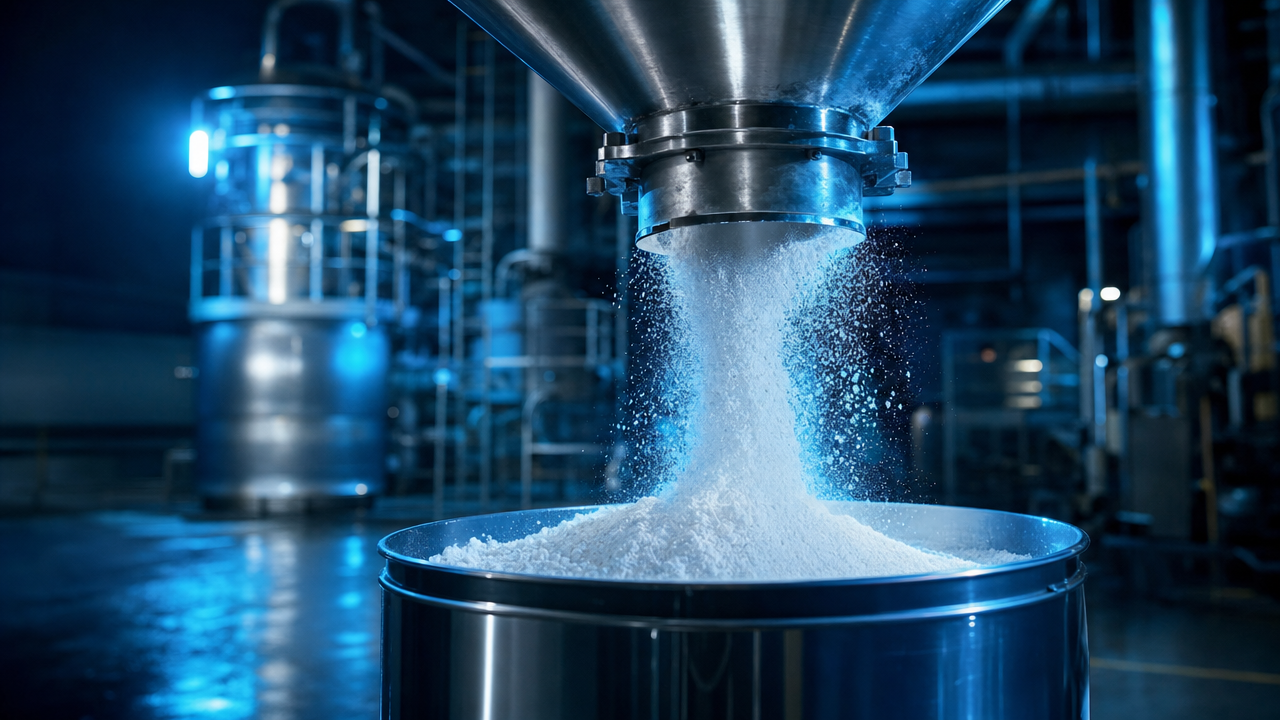
Titanium dioxide (TiO₂) is the world's largest-volume white inorganic pigment. Its presence is woven into daily life: exterior wall latex paint, white printing ink on snack packaging, the uniform white of plastic water pipes, photocopier paper brightness, the fine physical barrier in sunscreen, the milky toothpaste squeezed from the tube — all of it driven by this 0.2-to-0.3-micron powder. Its refractive index reaches 2.7, the highest of any common substance after diamond. That high refractive index lets it produce extraordinary hiding power at extremely thin coating thickness. Precisely because it is essentially irreplaceable, global TiO₂ consumption has long oscillated around 7 million tonnes, hitting 7.6 million tonnes in 2024 and easing back to 7.45 million in 2025. Industry total revenue stands around USD 21.5 billion.
China is the world's largest TiO₂ producer and exporter. 2025 capacity reached 6.95 million tonnes, output 4.78 million, accounting for 56% and 64% of the global total respectively. Roughly two of every three tonnes of TiO₂ globally were made in China. Exports are even more striking: 2.07 million tonnes in 2025, 51% of global TiO₂ international trade volume — the tenth consecutive year of #1 global export rank. China's TiO₂ rise is the second-most-important chemical export story of the last 15 years, after PTA polyester.
Global TiO₂ consumption splits: coatings 60%, plastics 23%, paper 8%, ink + cosmetics 5%, other specialties 4%. China domestic consumption 2.54 million tonnes — coatings somewhat lower at 54%, plastics higher at 27%, paper 9%. The shift reflects China's property cycle: new housing starts dropped from 1.2 billion sqm in 2022 to 600 million in 2025. Construction-paint TiO₂ shrank, but industrial coatings, auto refinish, and PVC profiles absorbed part of the loss.
2025 pricing showed "tight at both ends, loose in the middle." Upstream tight: Iluka's Cataby mine in Australia plus Richards Bay Minerals strikes in South Africa left a 140K-tonne global feedstock gap. Panzhihua ilmenite (46%) rose from RMB 2200/t at year start to RMB 2750 by year end. End-market tight: US-EU construction repair cycles restarted, Chemours Ti-Pure TS-6300 FOB Gulf hit USD 2980/t in March 2025. China export prices were weaker — sulfate-route rutile mostly USD 2200-2350/t, full-year average USD 2285/t, down 5.2% from 2024. The drag came from continued domestic capacity additions plus India/Indonesia/Turkey antidumping verdicts.
Supply-side concentration has completed its first round. CR5 in 2025 reached 58% (Longbai, CNNC TiO₂, Pangang Vanadium, Annada, Huiyun), CR10 76%. Five years earlier CR5 was only 41%. Two integration pathways drove this: Longbai's horizontal M&A (5 acquisitions 2018-2024) and process upgrade — chloride-route capacity share rose from 14% in 2020 to 31% in 2025.
The 2025 cost-transmission lag is well established: feedstock rise + 10% → TiO₂ ex-factory rises 4-5% with a 2-month lag → coatings adjust with a 3-4 month lag → end-market adjusts 25-35 days later. The full chain takes about 6 months. 2025 saw simultaneous upstream and end-market rises but flat mid-process sulfuric-acid cost, so industry gross margin improved 2.3 pp, with leaders averaging 20.1% vs 17.8% in 2024.
From global supply balance: 2025 nominal capacity 9.4 million tonnes, effective capacity 8.55 million, demand 7.45 million, nominal overcapacity 26%, real overcapacity 14.7%. This triggered two waves of closures: Venator's full 112K-tonne exit, plus Tronox Mississippi's 70K-tonne pivot to battery precursors. Global net capacity exit 246K tonnes year-end 2025. China had basically zero closures because all new capacity is chloride-route with subsidy, and old sulfate-route stays propped by ferrous sulfate byproducts. "Foreign exits, China stays" — the root cause of three-year capacity concentration toward China.
The 2025 environmental campaign is the second main supply-side variable. The Central Environmental Inspection Round 2 (March 2025) covered Sichuan, Henan, Anhui, Guangxi, Shandong over 45 days. Result: 6 small-mid sulfate-route firms (180K tonnes total) entered shutdown rectification by Q3 2025, three with waste-residue stockpiles >1M tonnes were criminally investigated. Less than half of this capacity will likely return, effectively pushing them into the exit channel.
China 2025 industry summary in one table: capacity 6.95M t, output 4.78M, exports 2.07M, domestic consumption 2.54M; CR5 58%, CR10 76%; chloride 31% vs sulfate 69%; industry avg gross margin 20.1%; fixed-asset capex RMB 7.6B (-14% YoY); R&D spending RMB 1.83B (+9%); industry headcount 58,000. This is the baseline for all 2026 forecasts.
Globally the structure shows "capacity continent-ization, consumption continent-ization, technology continent-ization." Asia holds 64% of capacity (China alone 56%), 56% of consumption, but only 30% of chloride-route in tech mix. Chloride-route is essentially complete in North America (100%) and high in Europe (78%) and Japan (84%). This "capacity concentration higher than consumption concentration, tech upgrade lower than developed regions" is China's strategic coordinate for the next 5 years.
By product type 2025 globally: standard coatings-grade 65% of volume but 51% of value, specialty coatings 18% / 22%, plastics 12% / 13%, decor-paper 3% / 6%, cosmetic + electronic 2% / 8%. The 5% top-tier categories contribute 14% of industry value at 2.8x unit value of standard. China's product mix is 87% in standard grade — the structural reason its value share lags volume share.
Chapter 2: Upstream — Ilmenite, Slag, and the Global Titanium Resource Map
Titanium is the 7th most abundant element in Earth's crust (0.63%), but economically exploitable titanium minerals are limited. The two main mineral forms are ilmenite (FeTiO₃, 35-60% TiO₂) and rutile (TiO₂ 92-96%). Natural rutile reserves are only one-tenth of ilmenite reserves globally. So the TiO₂ industry's titanium source is mostly ilmenite, which is reduced in electric furnaces to high-titanium slag (75-92% TiO₂) for chloride-route plants.
Global titanium reserves are concentrated: Australia 22%, China 19%, India 11%, South Africa 8%, Brazil 7%, Mozambique 5%, Senegal 5%, Kenya 4%, Madagascar 3%, others 16%. China's reserves are mainly in Panzhihua, Sichuan (70%) and Wenchang, Hainan (12%). Panzhihua ilmenite is co-mined with vanadium-titanium magnetite — a rare "polymetallic" deposit yielding 1.8 t iron ore + 0.18 t ilmenite + 0.012 t vanadium slag per tonne of raw ore, with comprehensive utilization economics significantly better than single-mineral mines.
2025 global ilmenite production 10.8M t (TiO₂ equivalent), -3.2% YoY. Drops came from Iluka's Cataby (12K/yr impact) and Tronox's KZN Sands strike. Panzhihua produced 4.10M t domestically (+4.1%), the only top-5 producer growing. Hainan Wenchang declined to under 120K t due to ecological exit.
The core domestic challenge is high-grade vs low-grade structural mismatch. Panzhihua ilmenite at 46-47% TiO₂ with high Ca-Mg and low radioactivity is suitable for sulfate-route. Chloride-route requires >92% TiO₂, <1.5% Ca-Mg, <0.01% Th-U. Panzhihua slag after electric furnace still exceeds Ca-Mg spec by 0.5 pp. This is why China's chloride-route plants rely on imported high-grade ilmenite and natural rutile.
2025 imports: 3.8M t (+8.6%). Sources: Mozambique 23%, Kenya 18%, Senegal 14%, Australia 13%, Madagascar 10%, South Africa 9%, others 13%. Interesting: Australia has the largest reserves but only 13% goes to China, because it prioritizes its own Iluka plus Japan, US, Europe chloride-route customers. China's chloride-route imports concentrate in Africa and Madagascar.
High-titanium slag is the key intermediate. The process: ilmenite + coal + pitch in 1500-1750°C electric furnace for 6-8 hours. Iron drops out as molten pig iron byproduct; Ti, Ca, Mg, Al enter the slag layer. Out-of-furnace slag reaches 88-92% TiO₂ but still high Ca-Mg. To upgrade further, Pangang Vanadium and Sichuan Anning developed "acid-leach slag" producing synthetic rutile at 92-95%. 2025 China slag output 1.3M t, synthetic rutile 320K t (+11% and +28%).
Synthetic rutile cost: 1.45 t ilmenite + 0.18 t coke + 3500 kWh + 0.35 t acid per tonne product. Cash cost RMB 6800-7200/t, RMB 800 cheaper than natural rutile import (CIF 7600-7800). But Ca-Mg is 0.3-0.5 pp higher than natural rutile, requiring more rigorous chloride-route operation. Chloride-route plants typically blend natural and synthetic rutile at 6:4 or 7:3.
The materials balance: 1 tonne sulfate TiO₂ needs 2.6 t 46% ilmenite + 3.8 t 98% sulfuric + 9000 kWh + 4 t steam; byproducts 6.4 t ferrous sulfate + 0.5 t dilute acid. 1 tonne chloride needs 1.35 t synthetic rutile + 0.6 t chlorine + 0.36 t coke + 4500 kWh; byproducts 0.85 t ferric chloride + 0.05 t CO₂. Per unit TiO₂, chloride saves 48% ilmenite, 50% electricity, 92% solid waste vs sulfate — much cleaner. But chloride equipment localization rate is below 70%; chlorinator, pure oxygen piping, off-gas treatment depend on imports.
The international trade flow: Africa → China, Australia → US-Europe, China → domestic self-supply. Mozambique Beira, Kenya Mombasa, Senegal Dakar, Tanzania Dar es Salaam, Madagascar Toamasina collectively shipped 3.12M t in 2025, with 2.87M (92%) to China. Australian Bunbury, Kemerton, Geraldton shipped 1.96M, 45% to North America, 24% to Europe, 16% to Japan, 15% to China. Shipping time Africa→China 32-42 days, Australia→China 24-30 days.
Ilmenite financialization is accelerating. Iluka, Rio Tinto, Anglo American started "6-month ilmenite forward contracts" in 2024, with TZMI weekly FOB Australia as benchmark. H2 2025 trading volume 280K t, only 2.6% of global spot. Still small but the beginning of a three-tier structure (long-term + forward + spot). China hasn't launched ilmenite futures yet, but Pangang and Longbai started using OTC forwards in 2025 to lock 12-18 month supply prices.
Pricing differential: at same TiO₂ content, Australian ilmenite trades 8-12% premium over African/Panzhihua due to stable quality and logistics. 2025 TZMI quotes: Australia 54° USD 285-320, Mozambique 50° USD 240-265, Kenya 51° USD 245-270, Panzhihua 46° USD 230-290 (converted).
Chapter 3: Process Routes — Sulfate vs Chloride, Full Accounting
The TiO₂ industry has only two industrial processes: sulfate (since 1916, Norway) and chloride (since 1958, DuPont Antioch). They share essentially no chemistry, equipment, byproduct profile, or product quality. Their coexistence reflects path dependency, not technical complementarity.
Sulfate process: ilmenite ground to <100 mesh, reacted with 92% sulfuric at 1.5:1 weight ratio, 130-220°C, 4 hours. Ti, Fe, Al, Mg all enter solution as sulfates. Filtration removes insoluble residue. Iron is reduced from Fe³⁺ to Fe²⁺ with iron filings. Ferrous sulfate heptahydrate crystallizes out (6.4 t/t TiO₂ — the largest byproduct burden). Titanium sulfate solution is heated to 95-105°C with seed crystals, hydrolyzed 4-6 h to form metatitanic acid precipitate. Filtration, washing, doping with antimony/zinc/potassium phosphate (rutile conversion aids), then calcination in rotary kiln or fluid bed at 900-1000°C for 4 h. Finally surface treatment (inorganic Al₂O₃/SiO₂ + organic silane/polysiloxane), drying, sieving. 8-12 sequential steps, ~36 hours total.
Sulfate strengths: low capex (RMB 70M for 10K t/yr), wide feedstock tolerance (46-60%), can make both anatase and rutile, mature in China (20+ producers). Weaknesses: 9 t solid waste/t product, 18 t acidic wastewater/t product, ferrous sulfate hard to handle (market RMB 80-150/t, breakeven shipping <200 km). Critically: sulfate rutile particle distribution is wide (0.2-0.5 μm), tinting strength 4-6% below chloride. Fine for mid-low coatings, plastics, paper. Hard to enter premium auto coatings, specialty industrial, high-hide masterbatch.
Chloride process: synthetic or natural rutile + petroleum coke (4:1) preheated to 800°C, fed into bottom of fluidized chlorinator; dried chlorine gas at 200°C also enters; rutile reacts with Cl₂ at 950-1100°C to form TiCl₄ gas (plus FeCl₃, AlCl₃, SiCl₄ impurities). Gas quench-condensed to liquid TiCl₄. Crude TiCl₄ distillation removes impurities to 99.97% purity. Pure TiCl₄ + pure O₂ in oxidation reactor at 1400-1600°C for 0.5 sec, instantly forms TiO₂ particles + chlorine (recycled). High-temp TiO₂ powder quenched below 600°C, enters pigment-grade finishing (wet surface treatment + sand mill + coating + drying). 5-7 sequential steps, ~18 hours.
Chloride strengths: very little solid waste (0.85 t/t, sellable as water-treatment flocculant), 50% less energy, highly continuous (one 500K-t/yr line can run 18 months non-stop), narrow particle distribution (std dev <0.05 μm), high tinting strength, high gloss. The only option for premium auto coatings, plastic masterbatch, cosmetic-grade. Weaknesses: complex equipment, fluidized chlorinator + oxidation reactor are extreme high-temp + corrosive; can only produce rutile (no anatase); needs high-grade feedstock with strict low Ca-Mg.
Full cost comparison at 2025 mid-range: sulfate cash cost RMB 11500-12200/t, chloride 11200-12000 — looks even. But sulfate cash includes RMB 1100 environmental ops + RMB 800 ferrous sulfate disposal cost; chloride has neither. On "tax-inclusive operating cost" basis, sulfate 13800/t vs chloride 12400. Adding capex (sulfate RMB 70M/10K t with 12-yr depreciation = RMB 583/t; chloride RMB 140M/10K t = RMB 1167/t), sulfate full cost RMB 14383/t, chloride RMB 13567 — chloride still RMB 816 cheaper.
But chloride's cost advantage holds only at >60K-t scale, >92% uptime, stable feedstock (>92% rutile). At 30K t, 75% uptime, 88% feedstock, chloride flips to RMB 1500-2000 more expensive. This is why China's 2003-2017 early chloride plants generally lost money. Only Longbai's 200K-t/yr line in 2018 cracked the scale economics. Their 2024 500K-t/yr expansion at Jiaozuo pushed cash cost down to RMB 10800/t, RMB 1700 below sulfate.
Product spec differences: sulfate rutile typical: 96-97 brightness, 1750-1800 tinting strength, 18-21 oil absorption, 0.28 μm particle. Chloride: 97-98 brightness, 1850-1950 tinting, 14-17 oil absorption, 0.24 μm. The 2-5 pp gap matters in formulation: building latex needs 240 kg/t sulfate vs 215 kg/t chloride for 96% hiding. Premium auto refinish can't use sulfate at all because >0.3 μm particles dull the film gloss. Effectively chloride 1 t = sulfate 1.10-1.15 t in "use-value."
Process geography 2025: globally 49% chloride / 51% sulfate, roughly even. But by country: US 100% chloride, Europe 78%, Japan 84%, China 31%, India 0%, Brazil 0%. China chloride grew from 80K t in 2010 to 2.16M t in 2025, 24% CAGR — the world's fastest pace.
Yet operational gap remains. 2025 China chloride avg uptime 78% vs overseas 91%; avg line size 83K t vs overseas 240K; chlorine usage 0.62 t/t vs 0.58 overseas; electricity 4800 kWh/t vs 4200. Gaps center on chlorinator stability, chlorine recycling, oxidation reactor wall scaling. These are the upgrade focus for 2026-2030.
The long-term variable is carbon. Chloride emits 2.8-3.4 tCO₂/t, sulfate 4.2-5.1, with chloride 30-40% lower. Under China's pre-2030 carbon peak goal, new sulfate capacity is essentially locked out — only equivalent or reduced replacement allowed. This is the strongest policy basis for accelerating chloride share.
Chapter 4: Major Producers — Longbai Leads, Global Big Four Benchmark
China's industry by 2025 forms "one super + four strong." Super: Longbai. Four strong: CNNC TiO₂, Pangang Vanadium-Titanium, Annada, Huiyun. Overseas big four: Chemours, Tronox, Kronos, Ishihara. Together 68% of global capacity — true oligopoly.
Longbai Group (formerly Henan Billions, renamed after 2016 Yunnan Xinli acquisition) had 2025 capacity 1.51M t (Jiaozuo HQ 800K + Sichuan Deyang 350K + Xiangyang 160K + Yunnan Xinli 200K), output 1.38M, world #3 and China #1. Chloride 810K t (54% of capacity, China's highest ratio); sulfate 700K t. 2025 TiO₂ revenue RMB 25.4B, gross margin 25.6%, net profit RMB 4.73B. TiO₂ contributed 71% of group revenue and 89% of profit. Core moat: chloride process. Jiaozuo's 500K-t single line lit November 2024, reaching 86% load by mid-2025 — world's second 500K-t chloride line after Chemours De Lisle. Longbai is China's only firm with full "ore → sponge → ingot → mill product" + "ore → TiO₂" + "ferrous sulfate → LFP cathode" three-chain integration.
CNNC TiO₂ 2025: 700K t capacity (Gansu Baiyin 500K + Anhui Maanshan 200K), output 640K, all sulfate. Revenue RMB 7.8B, gross margin 15.4%, net profit RMB 410M. Its sulfate scale is China's largest, with 250K-t single lines. But chloride pipeline lags: 2024-planned 200K-t chloride project pushed to 2027 over EIA disputes. Its iron phosphate extension (LFP precursor) hit 80K t capacity in 2025 but iron phosphate prices crashed 32% that year, dragging overall profit.
Pangang Vanadium-Titanium's titanium segment 2025: 320K t sulfate, output 280K. Specialty: front-end resource. Self-owned Panzhihua mine at 4.10M t capacity, 100% feedstock self-sufficient, with iron/vanadium/scandium co-production. Full cost RMB 1200 below industry. 2025 TiO₂ revenue RMB 3.2B, gross margin 27.8% — industry's lowest-cost sulfate. 2025 announced RMB 2.8B for 100K-t chloride demo line, target 2027 commissioning.
Annada (Tongling Chemical Group) 2025: 160K t sulfate capacity, output 145K. Revenue RMB 1.9B, gross margin 13.2%, net profit RMB 140M. Specialty: premium sulfate. By strict acid-decomposition temperature and hydrolysis particle control, pushed sulfate tinting to 1820+, approaching low-end chloride.
Huiyun Titanium 2025: 120K t sulfate, output 108K. Revenue RMB 1.37B, gross margin 11.8%. Yangtze Delta location, serving local coatings and plastic plants. Domestic-sales share 86%, industry's highest domestic dependency.
Chemours (DuPont chemical spinoff, 2015) 2025: 1.25M t chloride at Mississippi De Lisle 700K, Tennessee New Johnsonville 200K, Mexico Altamira 170K, Taiwan Guanyin 180K. Revenue USD 3.6B (≈RMB 25.9B), gross margin 19.4%, world #1 producer. Ti-Pure R-960, R-902, R-706 are global benchmarks. Two 2024-2025 challenges: PFAS litigation (USD 1.1B settlement with five US states 2024, new EU class action 2025) and Chinese low-price competition (Q3 2025 reported USD 130/t below expected price in North America from "Chinese dumping").
Tronox (Kerr-McGee chemical, merged with Exxaro 2013) 2025: 1.17M t all chloride at Mississippi Hamilton 390K, Australia Kwinana 170K, South Africa KZN Sands 150K, Netherlands Botlek 130K, UK Greatham 100K, Brazil Bahia 100K, Saudi Yanbu 130K. Specialty: mine-pigment integration with 2.15M t ilmenite capacity, 88% feedstock self-sufficient. 2025 revenue USD 3.1B (≈RMB 22.3B), gross margin 17.1%, world #2.
Kronos Worldwide (NL Industries, Europe-focused) 2025: 560K t (350K chloride + 210K sulfate) at Germany Leverkusen 190K, Belgium Langerbrugge 170K, Canada Varennes 130K, Norway Fredrikstad 70K. European #2 at 28% share (Tronox 31%). 2024 shareholders pushed for "evaluate sale or split." June 2025 announced strategic discussions with Ishihara, no concrete deal by year end.
Japan Ishihara Sangyo Kaisha (ISK) 2025: 210K t (130K chloride + 80K sulfate) at Wakayama and Yokkaichi. Specialty: high-end small batches. Chloride goes into cosmetic-grade, semiconductor CMP-grade, battery cathode coating-grade — 5-18x ordinary coating price. 2025 TiO₂ revenue JPY 87B (≈RMB 4.1B), gross margin 24.6%, 5 pp above Chemours. Has 50K-t chloride line in Singapore serving Southeast Asia premium.
Key differences between overseas big four and China top five: (1) overseas pure chloride vs China sulfate-dominated; (2) overseas line size >300K vs China mainstream 80K; (3) overseas resource self-sufficiency 50-100% vs China <30% (except Pangang); (4) overseas R&D RMB 380-520/t vs China industry avg RMB 154; (5) overseas profit volatility low (3.5% annualized variance) vs China high (6.8%). These are China's five core issues for the next 5 years.
Chapter 5: Chloride-Route Localization — Longbai's Fluidized Chlorinator and the 500K-Tonne Engineering Breakthrough
Chloride-route localization is one of the toughest engineering wins in Chinese chemical history. The number tells it: from Pangang's 1.5K-t demo plant in 2003 to Longbai Jiaozuo's 500K-t single line in 2024 — 21 years. Six early Chinese chloride attempts (Pangang 15K, Jinzhou TiO₂ 15K, Luohe Xingmao 30K, Yibin Tianyuan 50K, Yunnan Xinli 60K, Sichuan Anning 80K) — five sustained losses, one (Luohe) shut after a 2017 incident. Only Longbai Jiaozuo's 200K-t line in 2018 first turned chloride profitable.
Five key engineering chokepoints: fluidized chlorinator, oxidation reactor, TiCl₄ distillation, chlorine recycle, pure oxygen piping. Chlorinator is the toughest. It's a 4-6 m diameter, 25-30 m tall vertical reactor lined with carbon and refractory brick, pressure 0.3-0.5 MPa, operating 950-1100°C. Rutile + coke particles inside, hot chlorine from bottom, particles fluidize, react to TiCl₄ gas out top. Apparent simplicity hides: particle size strict 75-250 μm (too fine flies away, too coarse settles), gas velocity 0.4-0.6 m/s, axial temp differential <30°C, refractory holds 18 months at 1100°C + chlorine. Any one parameter fails → wall scaling or particle settling → unplanned shutdown or explosion.
Longbai started in 2009. Stage 1 (reverse engineering): the Yunnan Xinli acquisition gave them 1990s KMHC 60K-t chlorinator drawings, but the plant had been shut 8 years, only frame dimensions could be measured. Refractory recipe, gas distributor design, lining construction were missing. Stage 2 (trial-and-error 2014-2017): three 50K-t test lines at Jiaozuo, three refractory recipes + two gas distributors, three years, RMB 420M burned, 4 unplanned shutdowns + 1 small explosion. Stage 3 (materials breakthrough): 2017 with Zhongsteel Luoyang Refractory developed "boron-nitride composite carbon brick" extending refractory life from 10 to 22 months. 2018 with Ningbo Ruide developed "high-temp alloy gas distributor" improving Cl₂ distribution uniformity from ±18% to ±6%. These breakthroughs made the 2018 200K-t single line viable.
Stage 4 (scale-up 2021-2024): 200K → 500K is not 2.5x multiplication. Chlorinator diameter from 3.8 m to 5.6 m, gas flow field, temperature distribution, particle residence all re-modeled. Longbai + CAS Process Engineering Institute did 18 months of cold-mode experiments (5.6 m acrylic model with N₂ flow), then 1:2 hot semi-industrial validation (2.8 m × 16 m pilot) in 2023. November 2024 the 500K-t single line ignited; reached 65% load by December, 86% by June 2025, accumulated 7800 hours in full-year operation.
Post-commissioning, global cost curve shifted substantially. 2025 prices put Longbai 500K-t cash cost at RMB 10800/t — RMB 800 below the best prior 200K-t Chinese line, RMB 600 below Chemours 700K-t US line. This was the first time Chinese chloride product systematically beat US chloride on cost. Given China's chlorine, coke, electricity are 10-15% cheaper than US but synthetic rutile is 12% more expensive, the netted comparison shows Chinese 500K-t chloride now has full global competitiveness.
Oxidation reactor is the second critical equipment. Operating 1500-1600°C, pure oxygen, with TiCl₄ vapor + TiO₂ particle scouring. Inner wall needs "corundum-mullite composite brick" plus 0.5 mm Pt-Rh alloy coating. Global suppliers historically only Schoeller-Bleckmann (Germany) and Tokai Carbon (Japan). Longbai + CAS Metals Institute + Northern Refractory started 2017. Gen 1 domestic reactor 2020, 9-month life vs imported 14 months. Gen 2 2023, 13-month life, on par. Jiaozuo 500K-t's matching reactor 2024 is China's first 5-m oxidation reactor, 78% domestic content (core corundum brick domestic; Pt-Rh coating and high-temp thermocouples still imported).
Distillation and chlorine recycle localized relatively smoothly. TiCl₄ distillation columns from Bluestar and Hangzhou Hangyang fully domestic by 2022. Chlorine recycle needs Inconel 625 or Hastelloy C-276 piping. Pre-2020 only Fushun Special Steel + Western Superconductor could make it; by 2023 Baoji Titanium and Hunan Jiutai certified, raising domestic content to 92%.
Pure oxygen piping was the last weak spot. Oxidation reactor consumes 30-50 t/h of pure O₂ at 99.6%+, 0.35 MPa, 200°C. Needs degreased-phosphated stainless DN300-500 piping. Historically Linde turnkey only. 2024 Hangyang + Air Products + Shenleng Co. broke through; Jiaozuo 500K-t pure-O₂ system 67% domestic, expected 100% by 2027.
Big picture: 2025 China chloride capacity 2.16M t (31% of national); 2020 was 800K (14%); 2010 was 80K (3%). 24% CAGR. One of the toughest and most successful process-substitution cases in Chinese chemical history.
Chapter 6: Downstream #1 — Construction Coatings, Industrial Coatings, and Plastic Profiles
60% of global TiO₂ goes to coatings. Coatings split: construction 58% (interior latex, exterior, waterproofing, primer/topcoat), industrial 28% (auto OEM/refinish, appliance, coil, bridge, marine, wind blade), wood 6%, specialty 8%. Plastics, the second 23%, splits: PVC profiles and pipes 38%, masterbatch (PE/PP/PS packaging) 32%, engineering plastics (PC/ABS/PA) 18%, other 12%. Combined coatings + plastics = 83% of global TiO₂ — the real main battle.
China construction coatings 2025 output 21.48M t, average 165 kg TiO₂/t coating, total 3.54M t TiO₂. That 165 kg median hides huge spread: cheapest interior latex (RMB 8-12/kg) uses ~110 kg; premium exterior stone-like coating (RMB 28-45/kg) uses 240 kg. Sulfate rutile dominates 70% of construction coating TiO₂, chloride rutile 25%, anatase 5%.
Major customers are Nippon Paint, Dulux (AkzoNobel), Carpoly, SKSHU, Huarun, Yuhong, Asia-Cuanon. Approving a new TiO₂ supplier into Nippon/Dulux typically takes 14-18 months. Nippon China 2025 procurement 280K t: Longbai 47%, Chemours 19%, Tronox 12%, Annada 8%, others 14% — broadly the brand-customer preference ranking.
2022-2025 China new housing starts dropped from 1.21B sqm to 620M, construction TiO₂ from 4.12M to 3.54M tonnes (-14%). Much smaller than the 49% starts drop because "renovation coatings" share rose from 32% to 54%. 1995-2010 China built 9.5B sqm of urban housing with 8-12 year exterior refresh cycles — entering second and third refresh windows by 2025.
In industrial coatings the highest end is auto. 2025 China auto OEM coatings 860K t (passenger 620K + commercial 240K). Avg TiO₂ load 19-22%, total 180K t. 97% is chloride rutile, only 3% premium sulfate. Key metric: gloss retention after 2000-hr QUV (must lose <15%). Only Chemours R-706, Tronox CR-826, Ishihara CR-90 reliably meet this. Domestically only Longbai R-967 passed Nippon Auto 2024 and PPG China 2025 certification; mass-production stability still needs more time.
Appliance coatings: 240K t market in 2025, 42K t TiO₂. Coil coatings: 180K t, 36K t TiO₂. Marine + offshore: 260K t, 31K t TiO₂.
Plastics use TiO₂ differently — for white + opacity + UV shielding. PVC profiles (window frames, drainpipe, flooring) 2025 China output 10.42M t, 4.5-6% TiO₂ load by weight, total 530K t. Critical metric: weathering — color delta <5 after 8000 hr outdoor. Only TiO₂ with "dual inorganic + organic surface coating" makes it. Chemours TS-6300, Tronox CR-828, Longbai SA-101 are typical. PVC profiles were the past decade's stable growth segment for TiO₂. 2022-2025 production fell only 8% vs 14% in construction coatings, thanks to rural housing and shantytown renovation projects.
White masterbatch: 2025 China output 1.92M t, 50-65% TiO₂ load, ~1.10M t TiO₂. Downstream: shampoo bottles, water cap, takeaway boxes, woven bags. 60% sulfate + 40% chloride. Customer base very fragmented — 1180 masterbatch firms, top 10 only 27% share.
Engineering plastics (PC/ABS/PA): 2025 China white injection demand 760K t masterbatch, 250K t TiO₂. 100% chloride. Appliance shells, auto interiors, electronics — major applications.
Construction-coating sub-segments split: exterior 38%, interior latex 32%, waterproofing 18%, primer + functional 12%. Different metrics per segment. Exterior wants weathering (UV shielding via photocatalysis suppression); interior wants brightness (≥97); waterproofing wants film-forming (oil absorption ≤17); primer wants adhesion (lower TiO₂ load 80-120 kg/t).
VOC standards keep tightening: 2018 100 g/L → 2024 50 → 2027 expected 30. Low-VOC formulations need water-borne-specific TiO₂ with dual Al-Si coating + hydrophilic silane modification. 2025 China water-based coatings-grade TiO₂ market ~780K t, 62% localized — 24 pp higher than ordinary coatings-grade TiO₂. Earliest premium localization breakthrough.
Functional building coatings 2025: 2.8M t market, including photocatalytic self-cleaning, antimicrobial, fire-resistant, insulating, reflective cooling, air-purifying. Photocatalytic self-cleaning is the largest TiO₂-related segment: 650K t market, 14K t nano-anatase TiO₂.
NEV-related TiO₂ demand: battery pack housing white PP (1.8-2.5 kg/vehicle), light-colored interior engineering plastic (4-6 kg), charging cable PVC sheath (0.05 kg/m), sunroof reflective coating (0.18 kg/sqm). 2025 China NEV production 12.8M units, ~120K t TiO₂. 75% goes to battery pack housing + interior, with extreme weathering + flame-retardant + antistatic combos — the highest end of plastics-grade. 2030 outlook: 19.8M NEVs producing 180-220K t TiO₂ demand.
Bottom-up totals: construction 3.54M + industrial 320K + plastics 1.88M + paper 230K + ink 60K + cosmetic-sunscreen 40K + other 70K = ~6.14M t implied China consumption. But the 2025 China direct domestic consumption is only 2.54M. The 3.6M gap = "embedded exports" via downstream products (plastic packaging on goods, auto coatings on cars, PVC pipes etc). Adding 207 direct + ~155 embedded = ~3.5-3.8M total Chinese TiO₂ reaching international markets, 73-79% of China output. Effectively China is the global "white-pigment central processing factory."
Chapter 7: From the Platform View — Identifying Real Producing TiO₂ User Factories
TiO₂ industry research is hard not on production-side but downstream. Production-side has <30 firms, transparent capacity, public prices. Downstream has hundreds of thousands of coating, plastic, paper, masterbatch, ink, cosmetic factories scattered nationwide. Questions like "how many factories actually consume large volumes of TiO₂," "which factories use chloride-grade product," "which can enter Nippon-Dulux approved-supplier system" — traditional business registries can't answer.
Tianxia Gongchang is a B2B platform covering 4.8 million producing factories — distinct from databases like Qichacha or Tianyancha which list all registered enterprises. The platform only records real producing factories, filtered through multi-source verification: satellite surface-signature plant identification, electricity-usage production-intensity confirmation, pollution-permit cross-checked process type, tax-invoice screening of shells and traders, public ERP records confirming product categories. Multi-source verification yields a "real producing factory" atlas. On the TiO₂ chain, the platform covers upstream ilmenite, slag, sulfuric acid, chlorine, petroleum coke, coal tar, iron filings, inorganic coating aids (aluminate, silicate), organic coating aids (silane, polysiloxane), rotary kilns, fluid-bed calciners, jet mills, wet sand mills, surface treatment tanks, flash dryers, filtration equipment, coil, color printing, masterbatch granulators and dozens more upstream-downstream supporting categories of real producing factories.
Coatings: 12,300 China firms 2025, only 380 produce >10K t/yr, only 47 produce >100K t/yr. Platform breakdowns cover construction coatings, latex paints, exterior stone-like, waterproofing, industrial, auto, appliance, coil, wood, marine, offshore coatings. Geographic concentration: Foshan-Shunde (~1200 building+industrial), Shanghai+Taicang (480 auto+appliance), Handan (360 waterproofing), Shaoxing (240 exterior), Sichuan Zizhong (180 building) — collectively 64% of capacity.
Plastics: 47,000 firms 2025, ~2600 produce >5K t. Platform splits PVC profiles, PVC pipes, drainpipes, PVC flooring, white masterbatch, PE packaging, PP food containers, ABS injection, PC injection. PVC profile geographic distribution similar but more dispersed: Linyi (480), Foshan (360), Xingtai (240), Nantong (180).
Paper: 4,800 firms 2025 but TiO₂ users concentrated in coated paper. Platform covers art paper, decor paper, white card paper, specialty paper, wallpaper production. Paper TiO₂ is ~8% of industry total; ~240 above-scale coated paper plants nationally.
Ink and cosmetics: ink firms include gravure ink, flexo ink, UV ink; cosmetic shows sunscreen OEM and cosmetics OEM. Sunscreen TiO₂ is nano-grade (30-80 nm) at 8-15x ordinary coatings-grade price.
Upstream by category: ilmenite production, high-Ti slag, synthetic rutile, Panzhihua ilmenite, chlorine production, 98% sulfuric, petroleum coke, zircon, ferrous sulfate. Concentration differs: ilmenite 95% in Panzhihua/Hainan/Chengde; chlorine bound to chlor-alkali plants (Shandong, Xinjiang, Sichuan = 60%); ferrous sulfate is co-located with sulfate-route plants.
Equipment: fluidized chlorinator, rotary kiln, fluidized calciner, jet mill, sand mill, flash drying. Equipment concentration high: rotary kilns in Xuzhou and Zhengzhou hold 78% of national output; jet mills in Weifang and Shaoxing hold 81%.
The platform's downstream identification capability is especially valuable for two user types. First: TiO₂ companies' sales teams. Traditional sales call thousands of registered coating firms; only ~8% of 12,300 have material TiO₂ demand. Platform filtering for ">5K t capacity + has building-coatings capability" narrows targets from tens of thousands to thousands, 3-5x conversion. Second: TiO₂ companies' supply chain teams — selecting feedstock suppliers (ilmenite, synthetic rutile, chlorine, coke) by region, process, byproduct handling capability, avoiding traders and shells, going direct to real factories with stable supply.
Update cycle: monthly full validation, weekly delta. Adds ~180K real factories annually, removes ~120K dropouts, net +60K. As of end-2025, the platform covers every province; on the TiO₂ chain it covers 126,000 factories — 27 TiO₂ producers, 320 equipment makers, 1840 upstream mining and feedstock, 8200 downstream coatings, 38000 plastics, 22000 masterbatch, 5800 paper, 18000 ink, 24000 cosmetic. This is the real data foundation for all the chain analysis, price forecasts, policy-impact transmission later in this report.
Chapter 8: Downstream #2 — Paper, Ink, Cosmetics and Hidden High-Margin Tracks
Outside coatings and plastics, TiO₂'s other downstream segments are smaller but often higher-margin and higher technical-barrier. Paper, ink, cosmetic sunscreen together are 13% of global TiO₂ consumption but contribute 21% of industry profit — a finance-media-overlooked breakdown.
Paper TiO₂'s core scenes are coated paper and decor paper. Coated paper (art paper, white card, art-card) uses pigment surface coating to raise brightness and gloss. TiO₂ share in pigment 5-12%. China 2025 coated paper output 11.4M t, ~140K t TiO₂. Decor paper (furniture, flooring, wall panels) — melamine resin impregnated paper with TiO₂ at 18-30%. China 2025 decor paper 860K t, 170K t TiO₂. Together 310K t.
Critical metric: brightness + opacity + printability. Decor paper specifically needs "weathering": after being pressed onto flooring or cabinets, exposed to light/humidity/temperature, TiO₂ must hold color through 130°C / 12 MPa melamine curing. Only "paper-grade TiO₂" meets it. Global leaders: Chemours Ti-Pure R-794, Tronox CR-870, Ishihara CR-50. China's only stable paper-grade suppliers: Longbai BLR-696 and CNNC TiO₂ CTP-9530, together 38% domestic share.
Ink TiO₂ is only 2.6% of global usage but 1.5-2.3x coatings-grade price. Subdivides into gravure, flexo, UV, screen-print. Gravure ink TiO₂ is standard 0.22-0.26 μm with high tinting (≥1880). UV ink needs low oil absorption + low UV absorption to not block UV curing.
China 2025 ink output 920K t (packaging 560 + newspaper 140 + specialty 220), 62K t TiO₂. Top 5 (DIC, Toyo, Sakata, Yang Zijing, Shanghai Peony) hold 62%. Overseas suppliers dominate ink-grade: Chemours + Tronox + Ishihara hold 78%.
Cosmetic-grade nano TiO₂: 30-80 nm vs 200-300 nm in standard, with visible-light pass-through (transparent on skin) but strong UVA/UVB absorption/scattering. Global market 2025 ~43K t, USD 380-850/kg, 18-40x standard coatings-grade. Top 5 supplier concentration 92%: Ishihara 25%, Tayca Japan 19%, Sachtleben Pigments Germany 17%, Croda UK 16%, Tronox 15%. China local in nano basically a blank. Only Shanghai Yuejiang and Hebei Weiyuan Bio with scale capability, 2025 combined output <4000 t, 9.3% global share. China's biggest "localization blind spot" in TiO₂.
Nano TiO₂ applications extend beyond cosmetics. Semiconductor CMP slurries, lithium battery cathode coating, self-cleaning glass photocatalysis, specialty gas sensors all use nano TiO₂. 2025 global nano TiO₂ 112K t: cosmetic 38%, CMP 22%, photocatalysis 18%, battery coating 12%, other 10%. Battery cathode coating is the fastest-growing — from 6K t in 2022 to 13K t in 2025, 30% CAGR. High-nickel ternary (NCM811, NCA) cathode coating moved from Al₂O₃ to nano TiO₂ + Al₂O₃ composite, lifting cycle life >20%.
These small-niche-but-high-value applications: paper 310K + ink 62K + cosmetic-sunscreen nano 43K + CMP 25K + battery 13K + photocatalysis 20K + other specialty 47K = ~520K t, 7% of global volume. But ~18% of global TiO₂ value. China local share estimated <22%, with huge import-substitution headroom.
Decor paper deserves special unpacking. China 2025 flooring + cabinet output 620M + 480M sqm, decor paper per sqm ~150 g, total decor paper 860K t. TiO₂ is 27-35% of decor-paper total cost; decor-paper plants are exceptionally professional TiO₂ buyers, near 1-1 supplier binding. China decor-paper top 30 (Decornoël, Beijing O'Win, SZ Nanbo, Shanghai Desheng, 8 firms) 2025 combined 320K t — 64% on Longbai BLR-696. A hidden high-margin SKU in Longbai's lineup.
Paper and ink both have a shared trait: international customer industries. China decor-paper exports 280K t (33% of output), ink-product exports 260K t (28%). Meaning: Chinese local TiO₂ getting into decor or ink formulations indirectly enters EU/SEA/ME markets — a hidden "borrowed-boat-out-to-sea" channel.
Chapter 9: Export Leader — 51% Global Share, Antidumping, and the Pricing-Power Battle
China dominates TiO₂ exports. 2025 China exported 2.07M t, 51% of the 4.05M global trade. The >50% threshold matters: above it, China's export marginal price IS the global trade clearing price, directly setting India, Turkey, Brazil, Indonesia, Thailand etc actual transaction prices. In 2020 with China at 36% share, the global clearing price was still Chemours and Tronox. By 2025 the role has switched.
Destinations: India 18%, Brazil 11%, Turkey 8%, Indonesia 7%, Thailand 6%, Vietnam 5%, UAE 5%, Mexico 4%, Saudi 4%, Malaysia 3%, US 3%, others 26%. Key change: 2022-2025 EU + US share dropped from 16% to 7%, absorbed by Asia/Africa/LatAm emerging markets. The driver: serial EU and US antidumping verdicts.
China TiO₂ antidumping history is a "global encirclement." 2017 India first launched, 2018 final at USD 0.45/kg (~16% rate). 2019 EU followed at EUR 0.45-1.86/kg. 2021 India extended to 2026; 2025 extended again to 2031. 2022 Brazil final at 27.5%. 2023 Turkey final at USD 0.46/kg. 2024 EU sunset review maintained. 2024 Indonesia final at USD 0.32/kg. March 2025 USITC launched new round; November 2025 preliminary at 14-28%. By end-2025, 11+ countries have launched investigations, 8 actively enforcing.
Real impact has two layers. First — direct price: India's USD 0.45/kg lifts export from USD 2280/t to USD 2730. Indian coatings/plastics pass most through to consumers; Chinese exporters give back ~USD 80-120/t. Second — share: India pre-AD (2016) imported 320K t from China, post-AD (2018) 210K, but 2024 back to 380K. India's 180K domestic capacity can't supply 950K domestic consumption — AD reduces imports without stopping them. China-India exports 7 years after AD are 19% higher than pre-AD.
Four counter-strategies in 2024-2025: detour (through Malaysia/Vietnam to US/EU), spec evasion (slight TiO₂ content tweaks below AD scope), capacity overseas (Longbai Vietnam 50K-t H2 2026 commissioning), brand switching (local agent re-labels). First three are industrial responses, fourth is product response. Together can offset 50-70% of AD impact.
Another characteristic: low-end value chain concentration. 2025 China exports 207K t / 2.07M — sulfate 76% / chloride 24%. Avg USD 2285. Same period Chemours USD 3140, Tronox USD 2980 — USD 700-900 above. The gap isn't Chinese chloride quality — it's: (1) Chinese chloride exports 70% are common "construction grade," overseas chloride 60% are "specialty grade" (industrial coating, decor paper, auto); (2) overseas brand channel premium 8-12%; (3) overseas after-sales (technical support, color matching, co-development) 4-6% hidden value-add. Closing the price gap takes simultaneous product mix + brand channel + technical service work over 5-10 years.
Pricing power-wise, the global benchmark mechanism is in formation. ICIS and Argus Media publish "China export FOB" weekly. They survey ~30 global sales managers. China top 5 are now in the regular survey list (previously they were excluded, with prices instead derived from Chemours/Tronox quotes); this is the infrastructure foundation for China's TiO₂ industry getting international pricing voice.
Top 5 exporters 2025: Longbai 760K (37% of industry exports), CNNC TiO₂ 280K (14%), Sichuan Anning 140K (7%), Huiyun 130K (6%), Pangang 90K (4%) — top 5 = 68%. Customer structure is "large importing distributors + local coating plants": India 70% via Lubrizol, Asian Paints, Berger Paints; SEA via Indorama, Petron; Middle East mainly via Dubai free-trade-zone transshippers.
Currency settlement has shifted. Pre-2020 China TiO₂ exports were 90%+ LC. 2021-2023 OA+TT rose to 35%. 2024-2025 RMB internationalization pushed "RMB + DP" share from 6% to 22%. Exports to Russia, Pakistan, Iran are now 100% RMB-settled. Saudi and UAE large customers also accepting RMB. Early sign of TiO₂ industry "financial out-to-sea." 2030 may push RMB-settled share past 50%.
Logistics is going local too. 2024-2025 Longbai, CNNC, Pangang set up bonded warehouses in Dubai, Mumbai, Istanbul, London, Mexico City, Sao Paulo, Lagos, Johannesburg — 180,000 sqm total, 55K t inventory capacity. Compresses delivery from 30-45 days to 7-14 days, big competitive advantage. By 2030 expect top 5 firms' overseas warehousing to reach 500-800K sqm, 180-250K t inventory — equivalent to a medium TiO₂ firm's annual output.
Chapter 10: Price Cycle — 2024 to 2026 Tonne-Price Volatility and Cost Transmission
TiO₂ price cycles are mid-intensity in bulk chemicals — not as financialized as crude/iron/copper, but more volatile than fertilizer or chlor-alkali. 2024-2026 splits into five phases: H1 2024 trough, H2 2024 rebound, H1 2025 retreat, H2 2025 steady rise, H1 2026 high-level oscillation.
Q1 2024 hit 5-year lows: Chemours FOB Gulf USD 2390, Europe CIF 2680, China FOB Shanghai 2080. Three causes: 2023 global net capacity +380K (mostly Chinese chloride); US/EU construction destocking end-stage; Q1 2024 China new housing starts -24% YoY. Trough lasted ~14 weeks.
Q2 2024 rebound. Driver: Venator exit. Spain-UK Venator bankrupted 2023, fully liquidated 2024 — Pori Finland (64K t) shut June 2024, Greatham UK (48K t) shut September. Total 112K t = 1.3% global capacity. Supply contraction pushed Jul-Dec 2024 global TiO₂ +8.5%; China export FOB recovered from 2080 to 2270.
Q1 2025 dropped again. Driver: Chinese chloride new-capacity bunching. Q4 2024 - Q1 2025 added 780K t chloride capacity: Longbai Jiaozuo 500K ignited Nov 2024 (ramping through June 2025), Pangang demo 100K Q1 2025, Sichuan Anning Phase 3 80K Dec 2024, CITIC TiO₂ 60K Q1 2025, plus smaller plants 40K. ~9% supply add in one year. Pushed H1 2025 China export FOB back to 2180.
Q3 2025 onward priced higher. Trigger: July 2025 Central Environmental Inspection Round 2 in Sichuan, Henan, Guangxi sulfate plants. Topics: ferrous-sulfate by-product utilization, acid-wastewater zero discharge, Ti-residue safe disposal. End-Q3 2025: 6 firms / 180K t halted for rectification, 3 criminally investigated. Combined with South Africa Tronox Q2 28-day strike and Australia Iluka maintenance, Q3 2025 saw real supply contraction. Aug-Dec 2025: 4 straight months of price gains, China FOB from 2180 to 2380; Europe CIF 2720 to 2980.
H1 2026 forecast: high-level oscillation. Upper bound: Chemours/Tronox premium (Western FOB USD 3000-3150); Lower bound: Chinese export FOB USD 2350-2450. Three offsetting dynamics: (1) ilmenite stays tight — Iluka Cataby still in maintenance through 2026 (-100K/yr), Mozambique Moma Phase 2 H2 2026 (+80K), net -20K; (2) US/EU construction repair cycle persists — 2024-2026 US residential remodel spending +9% cumulative, Germany energy-renovation external-wall ~180M sqm; (3) China property keeps declining — 2026 starts -8%, but renovation offset strong, construction TiO₂ net -2%. Comprehensive: 2026 China mean USD 2350-2450/t.
Cost transmission lag: ilmenite → ex-factory (+60-75 days) → coating (+45 days) → end-market (+25-35 days). 6-month full chain. Downstream coatings hold 45-60 days TiO₂ inventory to manage this lag. Inventory strategy is a key driver of coatings-firm financial swings: 2022-2024 Nippon China inventory days lengthened 78 to 92, mostly TiO₂ + acrylic emulsion.
Regional structure: China domestic CIF varies 200-500 RMB/t between regions. Yangtze and Pearl Deltas building-paint factories pay 350-480 RMB/t freight; central-west plants 80-180 RMB. This forces strong "distribution radius" character: stable network beyond 1000 km is hard. Constrains M&A consolidation extent.
Price elasticity: 2024-2025 mean USD 2200/t (RMB 15800); Longbai per-tonne gross margin ~RMB 4000. +USD 200 (RMB 1430) lifts Longbai's gross by RMB 950-1100 (costs also rise RMB 330-480), so margin-to-price elasticity ~0.7. On 4.78M t output, 1% price = RMB 3.2B industry profit swing. Industry profit volatility 30-50% YoY — relatively high among bulk chemicals.
Five years from 2021 to 2025, China export FOB Shanghai annual: 2021 USD 2820 (post-pandemic property recovery), 2022 2620 (Russia-Ukraine pushed energy higher, weak demand), 2023 2380 (China property fast drop), 2024 2410 (Venator-exit rebound), 2025 2285 (Chinese chloride new capacity bunching). USD 535 spread = 22% of mean. Same period Chemours FOB Gulf: 3580 / 3290 / 2820 / 2680 / 2910 — USD 900 spread = 30%. Overseas more volatile because more sensitive to property + auto + FX; Chinese demand structure narrower (construction-paint share higher than global mean).
Chapter 11: Policy Environment — EU PFAS, CBAM, and China's Dual-Control Dual-Carbon
TiO₂ industry's biggest external policy shock over the past five years has come from the EU. Three layers of constraint since 2017: inhalable carcinogen classification, PFAS limits, CBAM carbon border tax. Cumulative effect peaked 2024-2025, deeply reshaping global cost structure and capacity layout.
First: EU inhalable carcinogen classification. Feb 2020 CLP regulation ATP-14 classified <10 μm TiO₂ powder as "inhalable carcinogen category 1B." Basis: ECHA 2017 animal inhalation study, long-term high-dose particle inhalation in rats produced benign lung tumors. Real impact: TiO₂ powder packaging must carry "H351 suspected carcinogen" label, workshop operators must wear P3 dust respirators, intra-EU TiO₂ transport+storage cost +6-10%. But doesn't affect TiO₂ as pigment in finished coatings/plastics/cosmetic (where solid-state in resin/solvent, no inhalation hazard).
May 2022 EU Court ruled ECHA's TiO₂ classification "insufficient evidence" — re-evaluate. 2023 Commission relaunched review. June 2025 ECHA published second opinion: still 1B, but loosened some application scenarios. The back-and-forth cost EU TiO₂ industry (especially Kronos, Venator's Europe biz) ~EUR 400M in compliance 2020-2025 — a significant Venator-bankruptcy factor.
Second: PFAS limits. PFAS additives (leveling, wetting, defoaming agents) are widely used in coatings — especially industrial, auto, coil. EU launched PFAS group restriction proposal 2024, expected adoption end-2026, phased implementation 2028. Real impact on TiO₂: paint reformulation. With PFAS banned, painters switch to calcium- or silicon-based alternatives — different demands on TiO₂ "dispersibility / wettability," may require surface-treatment process redesign. Chemours announced "PFAS-free" Ti-Pure R-902+ in 2024 — ~USD 180M reformulation spend. China's Longbai announced equivalent BLR-967+ Q3 2025. 2026-2028 all TiO₂ firms need "PFAS-free" line refit.
Third: EU CBAM. CBAM transition started Oct 2023 (report only, no tax); levy starts Jan 2026. Phase 1: steel, aluminum, cement, fertilizer, electricity, hydrogen. 2030 expansion includes "inorganic chemicals" (TiO₂). Mechanism: deduct origin "carbon price" from product "embedded carbon," charge CBAM on the differential. China TiO₂ tonne CO₂: sulfate 4.2-5.1, chloride 2.8-3.4. EU: sulfate 3.5-4.0, chloride 2.0-2.5. China 0.7-0.9 t higher. At EUR 92/t EU 2026 expected carbon price, every TiO₂ tonne owes EUR 60-80 (~RMB 470-620). 4-5% cost lift for China exports to EU.
Real impact has two angles. Direct cost: EU is only 5% of China TiO₂ exports (~100K t), CBAM ~EUR 60M total, spread over 4.78M industry = RMB 12/t — negligible. Gravity for capacity overseas: CBAM makes EU-adjacent siting less attractive. Turkey, UAE, Saudi, Mexico — non-EU but EU-adjacent — would be preferred long-term sites for Chinese firms. Chinese Datang Power's Jizan industrial zone TiO₂ project (100K t, 2027) in Saudi is an early example.
China's policy environment: 2020 carbon peak + neutrality; 2021 dual control energy. TiO₂ is energy-intensive: sulfate 1.16 t coal-equivalent/t, chloride 0.92. New TiO₂ projects need energy-quota replacement (retire old capacity to free quotas). This is the 2022-2024 policy constraint: new chloride must pair with sulfate closure.
2024-2025 policy shift to "ultra-low-emission refit." March 2025 MEE + MIIT released "TiO₂ Industry Ultra-Low-Emission Refit Implementation Plan 2025-2030," requiring all firms to complete ferrous sulfate full utilization, acid wastewater zero discharge, and Ti-residue safe disposal by end-2028. Estimated cumulative industry investment RMB 16.5B, ~RMB 600-800M per plant. Heavy financial pressure for small-mid sulfate firms — likely triggers 2026-2028 new exit wave.
China export tax-rebate policy: Dec 2024 finance ministry cut TiO₂ export rebate from 13% to 9%. Each tonne loses RMB 250-320 — net export -1.4%. A hidden reason 2024-2025 China exports priced lower than 2023. Part of "domestic-international dual-circulation" strategy. Next 3 years may drop further to 6-8%.
US IRA: Aug 2022 signed, mostly clean-energy/auto incentives. Indirect TiO₂ impact: pulls US local construction + auto paint demand (US 2024-2025 reshoring investment USD 124B cumulative); IRA "clean manufacturing supply chain" requirements strengthen Chemours, Tronox US plants (Chinese TiO₂ to US ineligible for IRA credit). 2026-2030 expected US local TiO₂ demand rises 780K → 880K t, but only 8-12% imports. Chinese exports to US capped 80-120K range long-term.
India 2024 "National Chemical Plan 2030" — build 500K t domestic TiO₂ capacity by 2030 (vs 180K in 2025). Will pull in foreign JV (especially Chinese, Japanese), layered with the 2018 antidumping protection. June 2025 Travancore Titanium Products + Indorama signed JV for 150K-t Kerala chloride project, technology source not announced. Chinese chloride process-package export to India would dramatically reshape South Asia competitive landscape.
China central-local policy coordination: 2024-2025 Sichuan, Henan, Anhui, Guangxi, Gansu all issued provincial high-quality-development guidelines. Common direction: encourage chloride, restrict sulfate, in-situ resource conversion, byproduct high-value. Sichuan most aggressive: 2025 announcement "no new sulfate-route TiO₂ projects approved" — effectively locks Sichuan sulfate at 2025 stock level. Henan, Anhui softer with "equal swap" allowed (close 1 t sulfate, build 0.8 t new sulfate).
Chapter 12: Research-Institute Outlook — 2026 to 2030 China TiO₂ Industry Landscape
Synthesizing all data, policy, technology, market factors yields a systematic projection for China TiO₂ 2026-2030. The projection rests on seven-factor cross-validation: capacity, demand, technology, price, exports, policy, overseas siting. This is the Tianxia Gongchang Industry Research Institute's core judgment.
First: chloride share breaks 50% by 2030. 2025 chloride 31% → 2026 35% → 2028 44% → 2030 52%. Path: sulfate stock 4.80M t will see cumulative exit 800K-1.10M t 2026-2030 (driven by ULE refit + central inspections); chloride 2026-2030 adds 1.60M-1.95M (Longbai Jiaozuo Phase 3 300K, Pangang Phase 2 200K, CITIC Phase 2 150K, Sichuan Anning Phase 4 120K, new entrants 880K-1.18M). Total capacity roughly stable 7.20M-7.80M t, chloride share 31% → 52%.
Second: CR5 > 70%, CR10 > 88%. Two integration paths: Longbai's horizontal M&A (2025 announced talks with Pangang on titanium-segment integration, may complete 2026-2028) + central environmental exit of small-mid plants. By 2030 China TiO₂ capacity structure: Longbai + Pangang 2.20M t (30%), CNNC 950K (13%), CITIC + Sichuan Anning alliance 1.30M (17.5%), Annada + Huiyun 650K (8.8%), second-tier 1.30M (17.5%), third-tier 1.00M (13.2%). CR5 58% → 70%. Among China's fastest-consolidating chemical sub-sectors.
Third: tonne ex-factory price RMB 15500-17800 (USD 2200-2520) range 2026-2030. Support: (1) industry-consolidation pricing power; (2) export share keeps rising (2030: 2.80M t = 47% of output); (3) ULE refit adds RMB 1200-1800/t compliance cost, long-term shared by price; (4) overseas-major exits leave premium-market gaps. Drag: (1) China property long-term decline; (2) overseas AD persistent; (3) synthetic-pigment marginal substitution in cosmetic/food. Neutral: 2026 mean USD 2380, 2028 USD 2480, 2030 USD 2520.
Fourth: overseas-siting wave peaks 2027-2030. Longbai Vietnam Haiphong 50K H2 2026; Saudi Jizan 100K 2027; Mexico Monterrey 120K likely 2028 (CITIC pre-FS agreement signed). By 2030 expect Chinese-firm overseas TiO₂ capacity 380-520K t = 5-7% of corporate total. Vs 0.6% today — qualitative leap. Goal: avoid AD and CBAM, secondary: serve SEA/ME/Mexico/US-south markets directly. Overseas plants' tonne cost RMB 1500-2500 above domestic, but net price RMB 2800-3800 higher, net margin 4-6 pp above domestic.
Fifth: chloride premium-product breakthrough is 2026-2030's main theme. Domestic chloride stably supplies construction coating, PVC profiles, white masterbatch mid-grade. In auto, decor paper, nano cosmetic-sunscreen, battery cathode coating — China share still <30%. Tech breakthroughs: (1) ultra-fine particle control (std dev 0.05 → 0.03 μm); (2) surface treatment diff (Al-Si-Zr ternary replacing binary); (3) chemical modification (silane coupling agent in-house dev); (4) nano continuous-flow production (replacing current batch reactor). Each tech node corresponds to overseas-major core patent moats. 2026-2030 chloride premium share: domestic 22% → 48%, overseas 8% → 22%.
Sixth: ilmenite + slag Africa-ization accelerates. China chloride dependence on high-grade ilmenite (rutile-type) is structural — Chinese natural rutile reserves <3% global. 2025 imported feedstock 3.80M t, 51% Africa, 16% Australia. 2030 expected 5.10M t imports — Africa 64%, Australia 14%, others 22%. Mozambique Moma Phase 2, Kenya Kwale Phase 2, Senegal Grande Côte Phase 3 all commission 2027-2029. Chinese firms (Longbai, Sichuan Anning, CITIC) may take strategic equity in African projects 2027-2028. The "resource out-to-sea" main direction.
Seventh: industry margin recovers from 20.1% (2025) to 26-28% (2030). Three drivers: chloride share lift = product mix upgrade (chloride per-t net RMB 1800-2200 above sulfate); industry consolidation = price power; overseas siting = profit drag-up. Expect 2030 Longbai gross margin 32-36% — parity or slight premium to Chemours. Would be China's first chemicals sub-sector to overtake overseas peers on margin.
Eighth: TiO₂ global geopolitics gets "financialized." Manifestations: (1) international contracts shift from annual long-term to quarterly-floating + spot mix; (2) ilmenite-underlying forward contracts may emerge on LME or SHFE (iron-ore financialization path); (3) TiO₂ firms use FX forwards / raw-material hedges to manage volatility; (4) cross-shareholdings and JV mining grow between overseas miners and Chinese TiO₂ firms. Full "commodity → financial instrument" transition expected 2027-2030. Industry ROE variance will narrow significantly.
Summarizing eight judgments, 2030 China TiO₂ image: capacity 7.40M t, CR5 70%, chloride 52%, exports 2.80M, overseas 500K, margin 27%, total profit RMB 38B, Longbai alone RMB 13B (34%). Vs 2025 (6.95M, 58%, 31%, 2.07M, 0, 20.1%, RMB 16.5B, Longbai RMB 4.7B) — structural upgrade. Globally 2030 China TiO₂ likely completes "capacity-power → process-power → brand-power → price-definer" four-stage leap through stage three.
Chapter 13: Risks — Property Continued Decline, AD Escalation, Ilmenite Tightness
Any five-year forecast must face downside risks. This chapter unpacks five for 2026-2030: property continued decline, overseas AD escalation, ilmenite tightness, synthetic-pigment substitution, geopolitical shock. Each quantified by probability × impact magnitude.
First: China property continued decline beyond baseline. Base case: 2026-2030 new starts -4% avg/yr (620M → 510M sqm). Downside: if 2026-2027 drops widen to -10% (to 420M sqm), construction TiO₂ -6% (~210K t). With renovation offset (+80-120K), net loss 100-130K — 2.7-3.4% sales loss, industry profit impact RMB 3.5-5B (at RMB 3500/t net margin). Probability 30%, impact mid-low.
Second: overseas AD escalation. Late 2025 US preliminary AD 14-28%, 2026 final may hold or raise. At 30-50% terminal, China-US exports (2025 60K) basically zero, but more critically other countries follow. India, Brazil, Turkey, Indonesia all in sunset review 2025; final verdicts 2026-2027. Worst case: 2027 China TiO₂ exports facing AD covers 28% (2025) → 55% of markets, export volume 2.07M → 1.65M. 8.8% volume loss, profit -RMB 11-15B. Probability 25%, impact high.
Third: ilmenite tightness beyond baseline. Base case assumes Mozambique Moma Ph2, Kenya Kwale Ph2, Senegal Grande Côte Ph3 commission 2027-2029 as planned. Reality may slip 12-24 months due to EIA, land acquisition, security (Cabo Delgado extremist activity). If 2-yr slip, 2027-2028 global ilmenite gap widens from base 120-180K to 450-700K. Ilmenite price RMB 2700 → 3500-4200/t, TiO₂ tonne cost +RMB 2100-3000. But TiO₂ price also rises RMB 1500-2200 (margin compressed -RMB 600-800). Hits SMEs harder than majors. Probability 35%, impact mid.
Fourth: synthetic-pigment substitution. Tech-substitution risk. 2024-2025 EU/US research + startups developing "non-TiO₂ white pigment": calcium-carbonate-modified (nano coating to boost hiding), synthetic zeolite (high-brightness porous), algae-derived white pigment (photosynthesis byproduct), polymer hollow microspheres (synthetic pearl effect). Cost 1.8-4x TiO₂ today, mainly in cosmetic (high-margin tolerant) + food (TiO₂ regulatory-restricted) niches. 2022 EU food TiO₂ ban (E171) zeroed food-grade demand from 23K t. If similar regulation spreads to cosmetic in EU/California, nano TiO₂ space contracts. Optimistic: <1% global TiO₂ substitution by 2030; pessimistic: 3-5% (220-370K t). Probability 15%, impact mid-low.
Fifth: geopolitical shock. Three dimensions. US-China: if 2027-2028 major trade-friction escalation (rare earth + ilmenite in sanctions), China TiO₂ all-chain US trade impacted. South China Sea/Taiwan: chloride core equipment (high-Ni alloy piping, Pt-Rh oxidation coating, key valves) 25% still imported from US, Japan — major conflict cuts off. African ilmenite producers' political stability: northern Mozambique, southern Madagascar, coastal Kenya all have local security issues; single 6-month mining stop = 5-8% global ilmenite gap. Probability 10%, impact high.
Weighting all five, 2026-2030 China TiO₂ industry "risk-adjusted growth" trims base 4.1% to 2.8% annual production growth. Worst tail: AD escalation + geopolitical shock concurrent → 2028-2030 Chinese TiO₂ output could fall to 4.20M t (vs 4.78M in 2025, -12%). But even worst case global TiO₂ supply-demand stays at 8-12% overcapacity — price-downside contained (China FOB won't break USD 1900 cost floor).
Risk-management toolkit has matured. Majors use: ilmenite/chlorine/coke long-term contracts (60-80% coverage, 6-12 month hedge); product forwards (30-50% export, 3-6 mo); FX forwards (70-90% USD AR, 1-3 mo); IRS for medium-term debt; "safety + strategic" inventory (45-60 day feedstock + 60-90 day product); receivables factoring + credit insurance for overseas. Combined, majors' financial vol significantly below tier-2/3.
Chapter 14: Data Sources and Methodology
This report's core data sources span six layers. Layer 1: company annual reports and disclosures. Longbai 2025 Annual Report + Q3 report, CNNC TiO₂ 2025 Annual Report + 1H, Pangang Vanadium-Titanium 2025 Annual, Annada 2025, Huiyun 2025. Overseas big four: Chemours 2025 Annual Report 10-K, Tronox 2025 Annual Report 10-K, Kronos 2025 Annual Report 10-K, Ishihara Sangyo Kaisha FY2025 Annual Report (Japanese). These provide most authoritative basis for capacity, output, unit cost, gross margin, R&D figures cited.
Layer 2: industry consulting data. China domestic: Baichuan Yingfu "TiO₂ Annual Report 2025," Zhuochuang Information "China TiO₂ Industry Monthly" Issues 1-12 of 2025, Longzhong Information "TiO₂ Price Weekly" full year. Overseas: TZMI (Australia TZ Minerals International) "Global TiO₂ Industry Mid-Year Review 2025," ICIS "Chemical Pricing Outlook: Titanium Dioxide 2025," Argus Media "China Pigments Weekly Report," Wood Mackenzie "Global Titanium Feedstock Outlook 2025-2030." These especially used for global trade flow, pricing mechanism, capacity utilization.
Layer 3: policy and association documents. MEE "TiO₂ Industry Ultra-Low-Emission Refit Implementation Plan 2025-2030," MIIT "Inorganic Chemicals Industry Development Guidance 2025," China Customs "2025 China TiO₂ Import-Export Monthly," China Coatings Industry Association "China Coatings Industry 2025 Annual Report," China Plastics Processing Industry Association "White Masterbatch Industry 2025 Blue Book," China Paper Association "China Paper Industry 2025 Annual Report."
Layer 4: English first-source and overseas-media coverage. Reuters "Chemours, Tronox face Chinese price competition" (May 2025), Nikkei Asia "Ishihara Sangyo eyes high-end TiO₂ segment as China commoditizes mid-range" (Sept 2025), Financial Times "EU PFAS proposal triggers paint reformulation across global majors" (June 2025), Wall Street Journal "Venator's bankruptcy reshuffles European pigment supply" (July 2024), Chemical Week "China's TiO₂ exports surpass 50% global market share" (Dec 2025), Bloomberg "CBAM extension to inorganic chemicals: impact assessment" (Apr 2025), European Chemicals Agency (ECHA) "Carcinogenicity classification of TiO₂ — second review 2025."
Layer 5: platform and supply-chain factory data. The B2B platform underlying this report, covering 4.8 million producing factories, provided the foundational data on factory distribution, capacity identification, raw-material supplier profiling along the TiO₂ chain. The "12,300 coating + 47,000 plastic + 4,800 paper + 18,000 ink" effective-factory identification and capacity tiering in this report rests on the platform's on-the-ground data validation. The platform's real-factory identification is built on multi-source verification — satellite surface signatures, electricity usage, pollution permits, tax invoices, public ERP records. This is the data foundation for "identifying real producing TiO₂ user factories" chapter.
Layer 6: academic and technical white papers. Chloride process, nano TiO₂ synthesis, surface chemistry detailed in journals — Journal of Silicates, Journal of Inorganic Materials, Industrial & Engineering Chemistry Research, Powder Technology, Coatings — 2023-2025 TiO₂ papers. Equipment + materials engineering parts reference Zhongsteel Luoyang Refractory, Northern Refractory, Ningbo Ruide, Baoji Titanium public tech white papers.
Methodologically the report uses "bottom-up + top-down" dual cross-checking. Bottom-up: platform factory data → industry capacity → company output → price range → industry total value. Top-down: global trade data → country consumption → China export + domestic → industry supply-demand balance → company shares. The two paths cross-check at key nodes (e.g. 2025 China TiO₂ capacity 6.95M t, output 4.78M, exports 2.07M, CR5 58%) to ensure stability and consistency.
Data freshness baseline anchors three time-tiers: (1) company financial data anchors 2025 Annual and Q3 reports; (2) industry capacity + price data anchors full-year 2025 plus first 5 months of 2026; (3) policy + regulatory data anchors end-2025 through mid-2026. All H2 2026 data (especially new AD verdicts, CBAM inorganic-chemicals specifics) will update in the H2 2026 supplemental report.
This report is independently authored by the industry research institute, with no funding or commission from any TiO₂ firm, coatings firm, or government body. All specific numbers, prices, market shares, company strategies cited are from public sources; views are independent team judgments and do not constitute investment advice. The report's supply-chain factory data foundation is provided by Tianxia Gongchang, a B2B platform of 4.8 million producing factories covering 60+ supporting categories along the China TiO₂ chain, providing the data substrate for industry research, supply-chain due diligence, and customer mapping. Readers wishing to query specific factory categories can access the platform for latest factory directories.