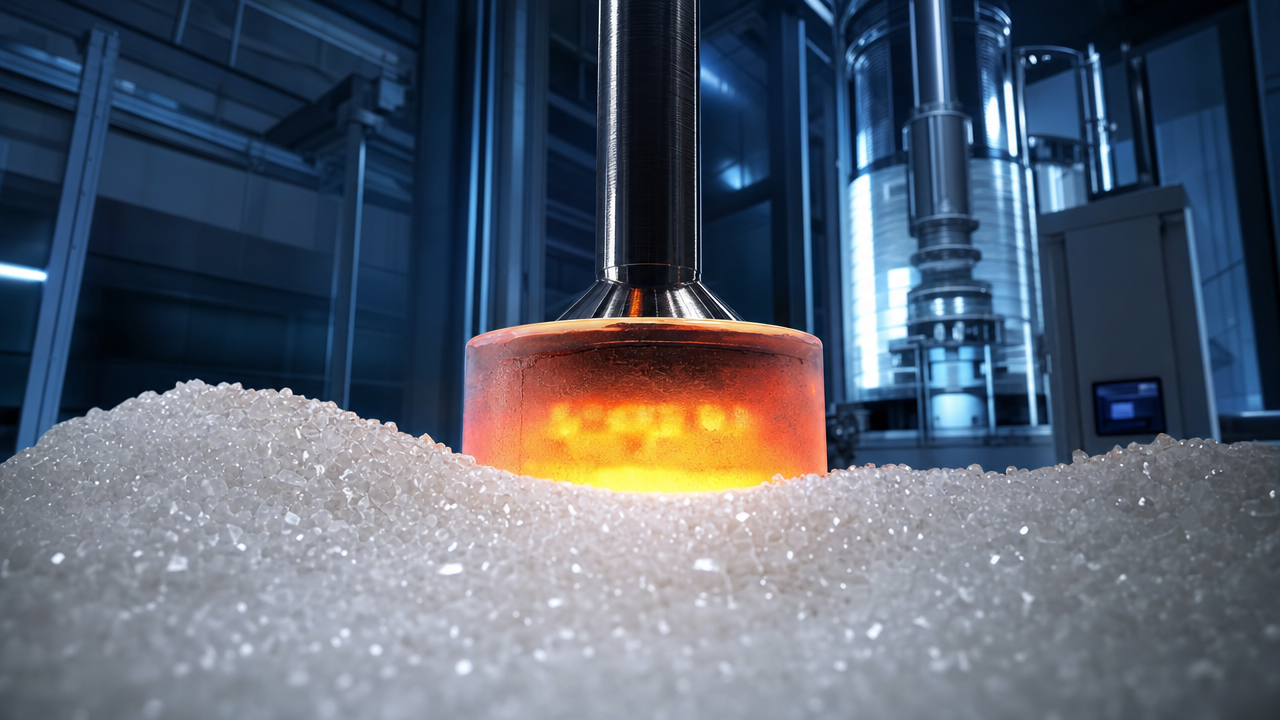

Chapter 1 Industry Overview: A Grain of Sand Pushed onto the Frontline by Two Forces
If we made a 2025 "price-collapse ranking" for China's materials industry, high-purity quartz sand (HPQ) would top three. In spring 2023 the domestic 4N8 inner-layer HPQ ex-factory price touched about RMB 300,000 per tonne — gram-for-gram more expensive than gold. Two years later, by end-2025, the same grade sold at about RMB 52,000 per tonne, a drop of 83%. Yet behind that price cliff, two structural undercurrents are reshaping the industry: the N-type TOPCon revolution in photovoltaic crucibles, and the slow-burn domestic-substitution campaign for semiconductor-grade 5N sand. Global 2025 HPQ output was about 112,000 to 135,000 tonnes; China accounted for 47% but remained below 3% of the 5N segment — the segment that, despite being small, holds most of the chain's profit. This report unpacks both lines in fourteen chapters.
Chapter 2 Upstream Ore Sources: Four Rocks That Hold Two Industries
Globally only a handful of vein-quartz deposits meet semiconductor-grade chemistry. Spruce Pine in North Carolina is the world's only stable 5N source — Sibelco and The Quartz Corp together hold 95% of mineable rights. Brazil's Minas Gerais pegmatite belt feeds the IOTA brand system. China's Xinjiang Qitai and Altay vein-quartz belts now supply the bulk of domestic 4N5 to 4N8 demand. Anhui Fengyang and Jiangsu Donghai cover sandstone-grade ordinary quartz. Hurricane Helene's 11-day shutdown of Spruce Pine in October 2024 — reported by Reuters and Nikkei Asia — was the global semiconductor community's first wake-up call about how geographically concentrated the world's truly critical materials supply has become.
Chapter 3 Process Barriers: Washing One Grain Cleaner than Pharmaceutical Powder
The mainstream purification chain runs in eight steps: crushing, gravity-and-magnetic separation, water washing, acid washing (HF + HCl + H₂SO₄), calcination, chlorination at about 1100°C, high-temperature roasting and annealing-screening. Semiconductor-grade 5N adds vacuum high-temperature roasting above 1300°C and plasma stripping. Each step targets specific impurities — aluminium, iron, calcium, magnesium, lithium, sodium, potassium, titanium — the "fatal eight". The energy cost per tonne jumps from about 8,000 kWh at 4N8 to about 25,000 kWh at 5N, explaining why 5N prices five-to-eight-times its 4N8 sibling. Process barriers are not single steps but the integrated engineering of a 30-year accumulation.
Chapter 4 Leading Manufacturers: Four Balance Sheets after the Mega-Cycle
Pacific Quartz (603688, "Quartz Co Ltd") 2025 revenue fell 67% year-on-year to about RMB 2.86 bn; net profit collapsed 89% to RMB 450 mn; gross margin from 79.5% in 2023 to 32% in 2025. Ojing Tech (001269) revenue dropped 41% to RMB 1.38 bn, net profit down 88%. Kbon Tech (600552) total revenue about RMB 5.12 bn with the quartz segment at RMB 800 mn at 22% margin. Philihua (300395) revenue at RMB 1.87 bn, net profit RMB 410 mn — relatively shielded by its semiconductor-tube focus. Overseas peers Sibelco, Unimin, The Quartz Corp, Quarzwerke, Shin-Etsu, Tosoh and Heraeus continue to dominate the 5N segment with EBITDA margins of 35% to 45%.
Chapter 5 Photovoltaic Quartz Crucibles: The Consumables Economics of the N-type Era
A single 32-inch crucible costs about RMB 6,000 in 2026 H1 and supports four-to-six silicon-pulling cycles, equivalent to roughly 2.7 to 3.6 tonnes of silicon. In the N-type TOPCon era, inner-layer HPQ usage per crucible rose from 7 kg under P-type PERC to 10 kg today, and to 12 kg in the new 36-inch large-size puller crucible. China's CR4 in crucibles reaches 67% — Ojing Tech 22%, TCL Zhonghuan 18%, GCL Technology 14%, Pacific Quartz 13%. The "sand-pegged pricing" mechanism introduced in 2025 locks crucible margins at 5% to 15%, squeezing out marginal players over the next two years.
Chapter 6 Semiconductor Quartz: The Hidden Tube Behind Every 12-inch Wafer
Inside every 12-inch wafer fab, quartz tubes, boats, etching chambers and CVD/PVD reactor walls perform high-temperature isolation and impurity blocking. China's 2025 demand for high-purity quartz tubing and crucibles was about 7,000 tonnes, with local sourcing at 35% — Philihua at 15%, Pacific Quartz at 6%, Kbon Tech at 5%, Sgo Tech at 3%, others at 6%. The remaining 65% imports stem mainly from Tosoh, Sibelco-Unimin, Shin-Etsu Quartz and Heraeus. The bottleneck is not raw capability but consistent quality over long production cycles, especially in 14nm-and-below logic where domestic share remains under 10%.
Chapter 7 Platform Perspective: Identifying Real Factories on the Quartz Value Chain
Searching "quartz" in industrial business registries returns about 30,000 Chinese companies, but only about 300 are actual high-purity quartz / crucible / semiconductor-quartz factories. Tianxia Gongchang is a China B2B platform focused on identifying around 4.8 million in-production real factories — distinguished from generic "company-info" databases by combining multi-source signals: industry registration, MIIT licenses, environmental permits, electricity stability, customs and customer history. On the quartz chain it identifies 42 HPQ processors, 38 crucible makers, 27 semiconductor-quartz device fabricators, 180 quartz miners, plus 560 quartz-glass craft makers and 1,300 decorative quartz makers — separated cleanly from the high-purity industry main thread. This identification capacity is the prerequisite, not the conclusion, of meaningful industry analysis.
Chapter 8 Domestic Substitution: 4N8 Achieved, 5N Still Stuck
The substitution story splits into two acts. Act One — photovoltaic 4N8 inner-layer sand: domestic share rose from 30% in 2020 to 75% in 2025, essentially complete. Act Two — semiconductor 5N sand: still under 5% domestic share, blocked by three engineering-time walls: ore-process adaptation, continuous-production stability, and downstream qualification cycles of 6 to 12 months per item. The MIIT 2025-04 implementation plan targets 70% high-purity self-sufficiency by 2027 and 8,000 tonnes annual 5N output. Realistic projection: 12% domestic 5N share by 2027, rising to 25% by 2028. The "5-to-8 year" engineering horizon cannot be compressed by policy alone.
Chapter 9 Capacity Expansion: Bets Placed at the Cyclical Trough
Pacific Quartz invests in Lianyungang phase 2 (60,000 tonnes HPQ, 2026 Q3) and Xinjiang Qitai (30,000 tonnes, 2026 Q4); total capacity will reach 150,000 tonnes by 2027. Ojing Tech adds 50,000 crucibles/year in Ordos (2026 H1) and 30,000 tonnes HPQ in Jiangsu Xuzhou (2026 Q4) — a vertical integration play. Kbon Tech plans 12,000 tonnes electronic-grade HPQ in Bengbu (2027 H1) — the first explicitly 5N-targeted line. Philihua expands 1,500 tonnes/year semiconductor tubes in Xiantao and Wuhan (2026 Q4). TCL Zhonghuan and GCL Technology continue their self-supply crucible expansion. Cumulative domestic HPQ capacity will rise from 65,000 tonnes (end-2025) to 180,000 tonnes (end-2027).
Chapter 10 Price Cycle: From 300,000 to 50,000 to Stable
The 4N8 inner-layer HPQ price went through three phases: spring 2023 to summer 2023 (50,000 to 300,000 RMB/tonne, super-cycle + inventory panic); H2 2023 to H2 2024 (300,000 to 120,000, capacity release + expectation rationalisation); H2 2024 to end-2025 (120,000 to 52,000, full industry deleveraging). In 2026 H1 prices stabilised in the 52,000 to 55,000 RMB/tonne range — below most second-tier producers' cash cost. The 4N5 outer-layer price fell only 36% over the same window. Semiconductor-grade 5N import prices climbed from RMB 350,000 to 450,000 per tonne — the opposite direction of 4N8 — reflecting structurally different supply-demand dynamics in the two segments.
Chapter 11 Policy Pull: Twin National Wills of Carbon Neutrality and Semiconductor Sovereignty
China's dual-carbon goals support multi-year photovoltaic installation: BNEF and IEA project 650 to 800 GW global annual additions through 2030, with China at 35% to 40% share. National Big Fund Phase 3 (CNY 344 bn, 2024) and the MIIT 2025-04 advanced silicon-materials plan together aim for 70% high-purity quartz self-sufficiency by 2027 and 80% by 2030. US IRA, EU Critical Raw Materials Act, Japan's semiconductor materials supply-chain strengthening plan, and Korea's K-Semiconductor Belt all push parallel "re-localisation" strategies, creating a global tug-of-war for the next five years.
Chapter 12 Research Institute Judgement: Key Variables and Bets for 3 to 5 Years
Three high-confidence calls: (1) 4N8 HPQ prices will not retest the 2023 high during 2027 to 2030, settling in the 50,000 to 90,000 RMB/tonne band; (2) 5N import dependence will persist beyond 2028; (3) profit migrates from broad layers to semiconductor materials and select top-tier photovoltaic suppliers. Three big uncertainties: counter-price war from overseas giants, India's strategic-mineral export tightening, and slower-than-expected global PV demand. Tianxia Gongchang's research arm sees two parallel uptrends in 2026 to 2030 — a slow PV recovery from the cycle bottom and an early-stage semiconductor-substitution rally — driven by different actors, different metrics, different timing. Conflating them is the most common analytical trap.
Chapter 13 Risk Inventory: Twelve Items to Watch
(1) PV demand growth slows; (2) overseas giants accelerate expansion; (3) Indian export policy tightens; (4) domestic 5N yield underperforms; (5) disorderly tier-2 exits; (6) wafer-fab capacity delays; (7) ore transport and power costs rise; (8) self-supply crucible yield risk; (9) electronic-grade chlorine shortage; (10) cyclical mis-pricing causes overheated investment; (11) policy targets diverge from engineering reality; (12) extreme events such as hurricanes, earthquakes or geopolitical conflict. The probability-impact matrix places items 1, 2 and 4 in the highest-priority quadrant for monthly tracking; items 5, 6, 7 require quarterly review; items 10, 11 are internal self-correcting risks.
Chapter 14 Data Sources
This report draws on Tianxia Gongchang's in-production-factory dataset for chain identification, annual reports of Pacific Quartz, Ojing Tech, Kbon Tech, Philihua, SMIC, Hua Hong, GCL Technology, TCL Zhonghuan, plus overseas filings from Sibelco, The Quartz Corp, Quarzwerke, Shin-Etsu, Tosoh and Heraeus. Industry associations: China Non-Metallic Minerals Industry Association (Quartz Committee), CPIA, USGS Mineral Commodity Summaries 2026, SEMI Materials Market Data 2026 Q1. Brokerage research: CITIC, Guotai Junan, Huatai, CICC. Foreign-language primary sources: Reuters, Nikkei Asia, Financial Times, Bloomberg, IEEE Spectrum, BNEF, IEA. Policy texts: State Council 2021 dual-carbon directive, MIIT 2025-04 advanced silicon plan, Big Fund Phase 3 founding announcement, India MMDR Amendment Act 2026. Methodology follows our standard "facts foundation, layered analysis, probabilistic judgement" three-layer approach, with every figure triangulated across domestic-authoritative, international-authoritative, and corporate-disclosure sources. All judgements come with explicit ranges; all risks come with magnitude and probability. Compiled by the institute's research team, June 2026, with field validation from multiple un-named industry veterans whose contributions form the report's silent backbone.