
1. Prologue: The Most Sought-After Machine on Earth
If, in mid-2026, one had to name the hardest industrial product in the world to buy, the answer would be neither the most advanced lithography machine nor the perennially scarce AI chip — both of those at least come with firm delivery schedules. There is another machine whose waiting list already stretches beyond 2030: the heavy-duty gas turbine.
Five years ago this would have been unthinkable. Around 2020, the global gas turbine industry was by common consent a "sunset industry": renewables were surging, Europe was vowing to exit fossil fuels, US shale-gas power plant construction was slowing, and the three gas turbine giants — America's GE, Germany's Siemens, Japan's Mitsubishi — were all cutting jobs, merging divisions, and divesting assets. When GE carved out its power business for a separate listing, Wall Street treated it for a time as dead weight it could not shed; when Siemens spun its energy business off as Siemens Energy, the market's valuation was equally dismal. Industry data bears out the chill: for the whole of 2024, global gas turbine orders came to 399 units and 58.2 GW — a level that had been treading water for many years, in an industry whose dominant refrain was capacity discipline, service preservation, and waiting for retirements.
Then AI arrived.
In 2025, global gas turbine orders jumped to 846 units and 100.3 GW — more than doubling in both unit count and capacity. Wood Mackenzie's arithmetic is blunter still: by the end of 2025, global gas turbine demand had piled up to roughly 110 GW, against total worldwide manufacturing capacity of only 60 to 70 GW a year. Demand running at nearly twice capacity is the most severe supply-demand mismatch this industry has seen since the dot-com bubble of 2000, and virtually every research house judges that the shortfall will persist at least until 2030. There is a telling structural detail as well: advanced H-class and J-class large units accounted for more than half of new order capacity in 2025 but only 14% of order count — buyers are scrambling for the 500–600 MW behemoths, because what these machines must feed is the hungriest load of all.
There is only one driving force: the power hunger of AI data centers. In 2025, natural gas generation already supplied more than 40% of US data center electricity; Wood Mackenzie forecasts that global data center power consumption will grow another 96% between 2026 and 2031. The hyperscale data centers that train large models routinely require hundreds of megawatts, even gigawatts, of stable power, while the interconnection queue for the US grid routinely runs five or six years — and tech companies that cannot wait have chosen the most direct remedy: generate the power themselves, in their own backyard.
That choice has spawned a series of industrial spectacles. At Elon Musk's xAI Colossus supercomputing cluster in Memphis, aerial photographs from April 2025 already showed 35 mobile gas turbines installed, totaling roughly 422 MW — against a local air permit that had approved only 15; between March and May 2026 it added another 19 units and more than 500 MW, environmental groups took the fight to federal court, and the Justice Department stepped in to mediate on the grounds that the site was a "national security asset." The OpenAI-led USD 500 billion "Stargate" program has partially commissioned its eight-building campus in Abilene, Texas, with gas-fired generation written into the power supply plan. Downstream players are queuing up too: in July 2026, compressor-services firm Kodiak signed a multi-year agreement with Baker Hughes for delivery of roughly 1 GW of gas turbine generating sets before 2030, all for behind-the-meter self-supply at data centers, with the framework expandable to 1.8 GW; data center operator Crusoe ordered 19 gas turbines from GE Vernova in one stroke. In the US power-industry trade press, "behind-the-meter" — bypassing the grid, generating on one's own side of the meter — went from an accounting term to the phrase of the year.
The consequences of the imbalance are written in prices and lead times, and each number is more extravagant than the last. Wood Mackenzie estimates that gas turbine equipment prices will climb to about USD 600 per kilowatt by the end of 2027, up 195% from 2019; investment bank Melius calculates that prices on GE Vernova's new turbine orders have risen roughly 300% in three years, with a single large gas turbine now costing more than USD 250 million. At the plant level, BloombergNEF puts the 2024 cost of US gas-fired plants at USD 2,157 per kilowatt, up 66% in two years, with construction timelines stretching 23% longer; EPRI's figures are more extreme still — in six months, the average price of a gas plant jumped from about USD 2,000 per kilowatt to USD 3,000. Even so, buyers are lining up to put down deposits and lock in slots. GE Vernova's gas turbine backlog plus slot reservations broke through 100 GW in the first quarter of 2026, and its CEO told the press in June that he expected the company's turbine production slots to be "sold out through 2030" by the end of 2026. Siemens Energy set new gas turbine order records in two consecutive quarters in the first half of its fiscal 2026, with group backlog piling up to EUR 154 billion. Mitsubishi Heavy Industries booked JPY 7.7 trillion in orders in fiscal 2025, a record in the company's history. Spot delivery times for large gas turbines have generally stretched to around five years, and for some niche models the queue has reached eight; users who cannot buy new machines are pouring into the second-hand market, where asking prices for dismantled derivative-model units have been bid up to tens of millions of dollars on a sales pitch of brutal simplicity: immediate delivery. Traditional utility projects are being elbowed out of the delivery queue by deep-pocketed data centers, and delays of four to seven years have become the norm.
That is half the story: an industry that had been handed a death sentence, hauled back from the sunset by AI and transformed into the most buoyant equipment-manufacturing sector on the planet.
The other half of the story takes place in China, on a timeline that dovetails almost perfectly. In the very window when global turbine prices were exploding and lead times blowing out, China's independently developed heavy-duty gas turbines completed the crucial steps from zero to one to volume: in March 2023, the first fully independent-IP F-class 50 MW heavy-duty gas turbine, the G50, entered commercial operation in Qingyuan, Guangdong; in February 2024, the highest-power indigenously developed machine — a 300 MW-class F-class heavy-duty gas turbine — rolled off the final assembly line in Shanghai's Lingang, and achieved first ignition on the first attempt that October; in November 2025, three G50 units were loaded for shipment to Kazakhstan, the first-ever complete-unit export of a Chinese heavy-duty gas turbine; in March 2026, Dongfang Electric won an order for 20 G50 units from a Canadian data center customer, a contract worth roughly RMB 4 billion — the first time a Chinese heavy-duty gas turbine had broken into the North American market. That same spring, the "gas turbine concept" went from an obscure corner of the A-share market to a theme of the year, with Dongfang Electric's shares up more than 50% year-to-date.
On one side, foreign machines priced beyond reason and waits verging on despair; on the other, Chinese machines that had just come into being — with complete-unit delivery times of only about 13 months. The two curves intersect in 2026. What that intersection means, how much substance it carries, and how long it can last are questions worth an entire report.
To grasp the weight of all this, one must first answer a more basic question: what exactly is a heavy-duty gas turbine, why is it called "the crown jewel of equipment manufacturing," and why did it take China more than twenty years to build one?
First, a map of the route this report will take. The first six chapters cover the machine and its history: what a heavy-duty gas turbine is, how the world order took shape, why China's technology imports failed, and how the indigenous development program was launched and broke through. The dozen or so chapters in the middle offer a cross-section of the present: the G50 and its export orders, the three major power-equipment groups and the supply chain, test facilities and industrial geography, domestic demand and the capacity price mechanism, the light-turbine battlefield and the American front line. The final eight chapters deliver judgments: the structure of the global shortage, capital-market pricing, the second half of the game in services and hydrogen, the window of opportunity and the risk register. The report is long — the industry deserves the length; readers who only want the main thread can, after this prologue, skip straight to the chapters on the "window of opportunity" and the "risk register," where all the conclusions reside.
2. What Is a Heavy-Duty Gas Turbine?
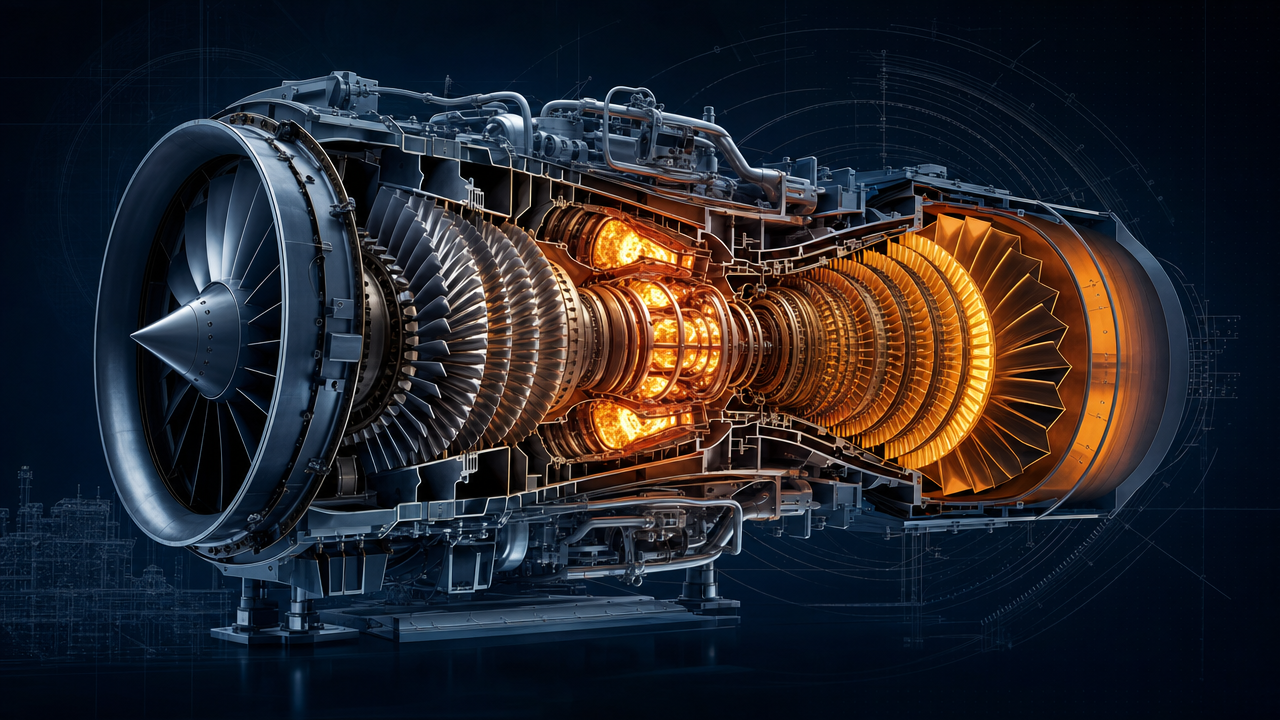
The principle of a heavy-duty gas turbine can be put in a single sentence: draw in air, compress it, mix in natural gas and ignite it, let the hot, high-pressure gas spin a turbine, and use the turbine to drive a generator. Compressor, combustor, turbine — three major components strung on one shaft, no different in essence from a household hair dryer. A 9H-class unit weighs several hundred tonnes, runs more than ten meters long, spins at 3,000 revolutions per minute, and produces over 500 MW from a single machine — one machine supplying the baseline electricity needs of a city of seven or eight million people.
But turning that one sentence into a machine that runs continuously for tens of thousands of hours is another matter entirely. Each of the three components has its own ordeal. The compressor must squeeze air to more than twenty times atmospheric pressure, and the slightest misstep in the aerodynamic design of its dozens of blade stages invites surge — airflow slamming backward through the compressor, causing stall at best and disintegration at worst. The combustor must stably burn more than a hundred kilograms of natural gas per second inside a space of a few cubic meters, with flame temperature, flow field, and acoustic modes all coupled together; combustion oscillation is the shared nightmare of turbine designers worldwide, and a modern low-emission combustor must additionally hold nitrogen oxides below 15 ppm inside this controlled explosion. The turbine must convert the thermal energy of the gas into shaft work — and survive. Of the three trials, the last is the hardest, and the difficulty concentrates in a single number: temperature.
The turbine inlet temperature of a modern F-class heavy-duty gas turbine sits in the range of 1,300 to 1,400°C; the most advanced H-class and J-class units have reached 1,600°C, and Mitsubishi is working with Japan's National Institute for Materials Science on a next-generation 1,700°C-class machine and a matching rhenium-free single-crystal alloy. For reference: molten iron in a steel furnace runs at roughly 1,500°C. In other words, the first-stage turbine blades must spin at 3,000 revolutions per minute, continuously, for years at a stretch, inside a gas stream hotter than molten steel. Blade-tip speeds approach the speed of sound, and each blade bears centrifugal loads measured in tonnes — equivalent to a heavy truck hanging from the blade root at every moment.
Yet the nickel-based superalloy that shoulders this task has an intrinsic temperature ceiling of only about 1,150°C. The temperature the material can withstand is three to four hundred degrees Celsius below the gas temperature it actually faces. That three-to-four-hundred-degree gap is where the entire technological crown of the gas turbine resides, and it is bridged by three things.
The first is the single-crystal blade. Ordinary metal is polycrystalline, and the boundaries between its countless internal grains become the starting points of creep and cracking at high temperature. Industry walked a clear materials-evolution path to solve this: wrought alloys, equiaxed casting, directional solidification, and finally the single crystal — casting the entire blade as one crystal, eliminating grain boundaries altogether and improving high-temperature creep life by an order of magnitude. Foreign H-class heavy-duty turbines already use second-generation single-crystal alloys in their turbine blades. But single-crystal casting is industry's acknowledged alchemy: the ceramic shell mold goes into a directional solidification furnace, and the molten metal "grows" the entire blade millimeter by millimeter from a seed crystal; any disturbance during solidification — an uneven temperature field, a local variation in the shell's heat conduction, a deviation in pouring rate — will induce stray grains and scrap the whole blade. Across the industry, single-crystal blade yields generally run only 50% to 70%, with the best manufacturers managing above 80% — and every ten percentage points of yield translates into a meaningful gap in cost. Worse still, heavy-duty turbine blades are an order of magnitude larger than aero-engine blades — an aero-engine blade is a dozen-odd centimeters, a heavy-duty last-stage blade close to a meter — and the larger the blade, the heavier the "shadow effect" during solidification, and the harder it is to control stray-grain and freckle defects. The single-crystal processes of aero-engine blades cannot simply be scaled up for gas turbines; the process battle must be fought all over again.
The second is the thermal barrier coating. A ceramic layer roughly 100 to 300 microns thick is sprayed onto the blade surface — the mainstream formulation is 7% yttria-stabilized zirconia — like dressing the blade in a fireproof coat, pushing metal surface temperatures down by another one to two hundred degrees Celsius. Too thin and it fails to insulate; too thick and it spalls under thermal cycling. The columnar-grain structure produced by electron-beam physical vapor deposition offers the best thermal-fatigue resistance, but the equipment is expensive and deposition rates slow; atmospheric plasma spraying insulates better but has a shorter life; the newer plasma spray-physical vapor deposition attempts to capture both. A ceramic layer a few hairs' breadths thick is, behind the scenes, a joint campaign across three disciplines: materials, process, and equipment.
The third is film cooling. Labyrinthine serpentine cooling passages are cast inside the blade; cool air bled from the compressor first winds through the blade's interior exchanging heat, then jets out through hundreds of holes on the blade surface scarcely thicker than a human hair, forming a flowing film of air across the surface that keeps the hot gas and the metal apart. Heavy-duty turbine blades are large and have high Biot numbers, so film cooling contributes a larger share of total cooling effectiveness than in aero-engines, and the shape of the film-cooling holes directly determines success or failure — the Institute of Engineering Thermophysics of the Chinese Academy of Sciences was still proposing new diffuser-hole geometries for this in 2024. The layout of film-cooling holes on an advanced turbine blade is fed on decades of test data: hand someone the drawings and they still cannot copy it, because they do not know why each hole is where it is — or which hole, moved half a millimeter, would burn through the entire blade.
Materials, coating, cooling — and the three must also be balanced precisely at the design level. Bleed too much cooling air and overall efficiency drops; bleed too little and the blades burn. Thickening the coating alters the airfoil's aerodynamics; let the single-crystal orientation drift a few degrees off axis and life takes a hit. This is why the first-stage turbine blade is called the industrial component that comes closest to a work of art: it presses simultaneously against the engineering limits of four disciplines — materials science, heat transfer, aerodynamics, and precision casting. By industry estimates, turbine blades account for roughly 35% of a complete machine's raw-material cost — the most expensive part of the machine is those few dozen kilograms of metal that "breathe."
Everything paid for temperature is repaid in efficiency. Every 100°C increase in turbine inlet temperature lifts combined cycle efficiency by roughly 1 to 1.5 percentage points. A combined cycle means sending the turbine's five-to-six-hundred-degree exhaust on to fire a heat recovery boiler and drive a steam turbine, wringing power out of the fuel twice over. Today's most advanced H-class combined cycle plants have crossed 64% efficiency — the highest ever recorded for large-scale heat-to-work conversion by humankind, nearly 20 percentage points above mainstream coal-fired plants; for the same kilowatt-hour, an H-class gas plant emits only about half the carbon of coal. In the gas turbine business, every percentage point of efficiency is a fuel bill counted in billions of dollars: over a thirty-year life a unit burns several billion cubic meters of natural gas, and one point of efficiency difference amounts to the price of an entire machine.
There is one more layer of difficulty hidden in the words "heavy-duty." Aero-engines and gas turbines share a common origin — both are gas turbomachinery, and a layman could hardly tell their drawings apart. But their design philosophies point in opposite directions: the aero-engine pursues thrust-to-weight ratio, and to shed weight it will push life margins to the limit, accepting overhaul intervals of a few thousand hours; the heavy-duty gas turbine is power-station equipment, required to run twenty to thirty thousand hours continuously without opening the casing for inspection and to serve for twenty or thirty years, with reliability and life requirements far more exacting than an aero-engine's — the aero-engine is a sprinter, the heavy-duty turbine a marathoner who must keep running for thirty years. Five countries in the world can build advanced aero-engines; the ability to independently develop advanced heavy-duty gas turbines long belonged to only three technology lineages — American, German, and Japanese — and the technology held by Italy's Ansaldo also traces back to the Siemens line. Hence the "crown jewel": the gas turbine is the final reckoning of a nation's capabilities in materials, precision manufacturing, and thermal-machinery design. Fail to build one, and some planks in the industrial system are still short; build one, and every one of those planks has been filled in.
Having grasped how hard this machine is, and before entering seventy years of industry history, we spend one chapter translating the industry's model-designation "jargon" into plain language — behind every code name in the chapters that follow lies a chapter of technological history.
3. The Model Alphabet: E, F, H, J and the Logic of Naming
Before the story continues, it is worth a chapter to translate the gas turbine industry's argot into plain speech — every model designation in the pages that follow conceals a slice of technological history.
Gas turbine classes are designated by letters, and behind the letters stands turbine inlet temperature. E-class corresponds to roughly 1,100–1,200°C, the workhorse of the 1980s and 1990s; F-class corresponds to 1,300–1,400°C, mature by the 1990s and still the backbone of the global installed fleet; H-class and J-class correspond to 1,500–1,600°C, this century's technological frontier. Each step up the ladder lifts combined cycle efficiency by roughly two to three percentage points: E-class about 52%, F-class 57% to 60%, H/J-class standing above 62% to 64%. The letters are not marketing flourish but a fuel ledger: the natural gas an H-class unit saves over an F-class each year is enough to keep a small unit running. This also explains why an entire era separates "indigenous F-class" from "indigenous H-class" — every rung of the ladder means a wholesale generational change in materials, coatings, and cooling technology.
Model naming follows each house's own genealogy. GE's heavy-duty turbines descend through the "Frame" series: the "9" in 9F and 9H denotes 50 Hz grids (China, Europe), while the "7" series serves 60 Hz (the United States, parts of Japan); the 9HA is its air-cooled H-class model, with suffixes .01 and .02 distinguishing power sub-variants — the 9HA.02 at the Anji power plant, at 843 MW per unit, is the largest gas turbine operating in China today. Siemens's classic F-class model V94.3A was later renamed SGT5-4000F — "SGT5" meaning Siemens Gas Turbine, 50 Hz; the bloodline of its collaboration with Ansaldo lives on in the AE94.3A, and precisely this model is the mainstay on Shanghai Electric's production line. In Mitsubishi's M701F, "M" is Mitsubishi, "701" the 50 Hz large-unit series, "F" the class; its J-class unit M701J and the improved JAC (air-cooled) hold the record for commercial operation at the 1,600°C level. China's indigenous lineage is only now beginning to establish its own naming tradition: Dongfang Electric leads with "G" — G15, G50, G80, G200, the numbers directly indicating power in megawatts; China United Heavy Gas Turbine Technology Co. (CGTC) designates its 300 MW unit CGT-300F; and AECC's aero-derivative series carries the name "Taihang." The emergence of a naming system from nothing is itself a footnote to an industry emerging from nothing.
A few high-frequency terms deserve clearing up in one pass. "Simple cycle" means the gas turbine generating alone, at 35% to 42% efficiency, its virtue being extremely fast start-up, suited to peak loads; "combined cycle" sends the turbine exhaust on to drive a heat recovery boiler and steam turbine for a second round of generation, pulling efficiency up to around 60%, and is the mainstream configuration for gas turbine power plants; "one-on-one" denotes a combined cycle block pairing one gas turbine with one steam turbine. Expressions like "9F-equivalent" or "9H-class" show the industry using GE's model numbers as the yardstick for measuring every machine — in a sense, the day Chinese media begin using "G50-class" and "Taihang 110-class" as units of measure will be the true coming-of-age of Chinese gas turbines.
Finally, two contrasts that are easily confused. First, "heavy-duty gas turbine" versus "aeroderivative gas turbine": the former is designed from scratch for ground-based power stations — big, crude, and rugged, built for long life; the latter is adapted from an aero-engine — light, quick-starting, efficient, but inferior to the heavy-duty machine in maximum power and overhaul intervals. The two are not substitutes but a division of labor. Second, "gas turbine" versus "gas turbine generating set": the former is the core power unit, the latter the packaged equipment of turbine plus generator plus auxiliary systems — what Jereh and Wolong export to North America is the latter, while the G50s Dongfang Electric exported to Kazakhstan are the former with a package around them. Only by keeping these two levels apart can one make sense of the comparability of different companies' order values.
The alphabet has its traps as well, and industry news should be read with guard up. First, "class worship": H-class is more efficient, but also more expensive and more demanding of fuel quality and operations — for a peaking plant that runs only two thousand hours a year, the whole-life economics of F-class need not lose to H-class. This is precisely why the G50s, on F-class technology, can still sell so well: the market buys not the highest specification but the most suitable one. Second, the "accounting games of localization rate": counting by number of parts versus by value can differ by twenty percentage points, and counting by unit-sets yields yet another figure — wherever this report cites a localization rate it states the basis, and when reading other material it pays to first ask "counted how?" Third, the basis of power figures: for the same unit, simple cycle output, combined cycle output, and full "one-on-one" block output can differ by nearly a factor of two, an easy source of mismatched comparisons across reports.
Carry this alphabet back to the main storyline: in 2001, China could not build even an E-class machine; in 2026, China's indigenous F-class is being exported to North America, the 300 MW F-class awaits demonstration, and the H-class is on the drawing board. The speed of the climb up the alphabet is the entire subject of this report.
4. The World Order: Seventy Years of the Big Three
Today's global heavy-duty gas turbine market is ruled by three companies. GE Vernova, Siemens Energy, and Mitsubishi Power under Mitsubishi Heavy Industries together take roughly two-thirds of the global gas turbine market; in the most technology-intensive heavy-duty segment their dominance is stronger still — advanced H-class and J-class units can be delivered at scale by no one else, and by industry counts the three supply more than three-quarters of the main units in gas power projects now under construction.
This order is the product of seventy years of evolution. The theoretical foundations of the gas turbine were in place by the first half of the twentieth century — and intriguingly, one of the cornerstones came from a Chinese mind: the scientist Wu Zhonghua, working at the US National Advisory Committee for Aeronautics in the 1950s, proposed the "three-dimensional flow theory" of turbomachinery, decomposing the solution of three-dimensional flow inside a turbine into an iteration between two families of stream surfaces — to this day the standard theoretical framework for gas turbine aerodynamic design worldwide. Wu broke through obstruction to return to China in 1954 and spent the rest of his long career at the Chinese Academy of Sciences — China never lacked theoretical accumulation in gas turbines; what it lacked was always the other ninety-nine steps of engineering. Theory is public; engineering is closed. In the seventy postwar years, every technological leap in the gas turbine industry — from E-class to F-class to H-class and J-class, with turbine inlet temperature climbing from 1,100°C to 1,600°C — happened on the test stands of a handful of companies, fed by R&D spending counted in tens of billions of dollars and fleet operating data counted in tens of millions of hours.
The three houses' technical lineages each have their own temperament. GE's turbine bloodline comes from aero-engines; the Frame series has iterated from the late 1940s all the way to today's 9HA, in a style of aggressive temperature-pushing backed by an enormous fleet feeding data back into design. Siemens descends from power-station steam turbines; its V series (later the SGT series) is famously conservative and steady, German engineering redundancy giving it a long-standing edge in reliability reputation. Mitsubishi started latest, building on technology licensed from Westinghouse in the 1960s, yet overtook the field early this century — combining the Westinghouse foundation with Japan's materials industry, it was first to push J-class turbine inlet temperature to 1,600°C, and today its Takasago works runs the most complete gas turbine validation and test system in the world. Around 2015 the three completed their respective capital restructurings: GE swallowed Alstom's power business and a few years later split itself into three, with gas turbines going to GE Vernova; Siemens spun off its energy business wholesale as Siemens Energy; Mitsubishi's power joint venture with Hitachi, after several rounds of equity reshuffling, settled under Mitsubishi Heavy Industries. The chairs at the table were rearranged; the three players sitting in them stayed the same.
The seventy years also produced a dropout, and a highly dramatic one. At the close of the last century, the world gas turbine market was still a "Gang of Four": alongside GE, Siemens, and Mitsubishi stood France's Alstom. Around 2000, Alstom's GT24/GT26 models suffered a systemic technical failure — an aggressive design chasing efficiency broke down at scale in commercial operation, and compensation and retrofits nearly dragged the company under; in 2015 its entire power business was bought by GE, and the four became three. This history left a savory footnote: when China organized its bundled tendering for gas turbines in 2001, Alstom had originally been among the invited bidders — and precisely because of the GT24/GT26 record, China's tendering authority disqualified it. One technical crash cost it the world's fastest-growing gas turbine market for the next twenty years, and indirectly determined the roster of joint-venture partners for China's three major power-equipment groups. The gas turbine industry's lessons have always been blunt: this business does not reward aggression; it rewards those who find the balance between aggression and reliability.
The Big Three's business goes far beyond selling new machines. The industry's business model resembles commercial aircraft engines: the sale of the machine is merely the entrance ticket, and the real long-term profit lies in the service market. A heavy-duty gas turbine serves for twenty to thirty years, and its hot-section components must be overhauled and replaced every twenty to thirty thousand hours; these high-temperature parts can be made only by the OEM and warranted only by the OEM, so owners typically sign a long-term service agreement (LTSA) of ten years or more at the moment of purchase, locking a unit's lifetime maintenance costs to the original manufacturer. Industry analysts size the global gas turbine service market at about USD 45.1 billion in 2025 — larger than the new-unit market — with maintenance and repair accounting for nearly half, and project the whole service market to double to USD 92.5 billion by 2033. In other words, every machine the Big Three sell is a cash register that keeps ringing for twenty years; and their iron grip on hot-section technology guards precisely the key to that cash register. Understand this, and you understand why China's "market-for-technology" bargain, described later, could not be consummated — handing over the hot section would have meant tearing up one's own meal ticket for the rest of one's life.
Geographically, this is a market at once highly globalized and highly uneven. Asia-Pacific is the largest regional market, at about 36% of the world; heavy-duty units account for more than half of gas turbine market revenue; North America, on data center demand, became the fastest-growing market after 2024. The competitive moat is built in three courses: decades of materials databases and failure-case libraries, which cannot be bought; global fleet operating data feeding design iteration, which latecomers do not have; and a worldwide service network with spare-parts depots, which takes ten years of burning money to build even if you are willing to burn it.
Note in passing another cold case left over from the Gang of Four era: the failure history of technology diffusion. In the last century every industrial nation tried importing turbine technology to stand on its own — Westinghouse licensed its technology to Mitsubishi, only for the student to surpass the teacher and Westinghouse's power business to end up absorbed by its pupil; Alstom swallowed ABB's gas turbine business, and the indigestion detonated the GT24/GT26 crisis; licensed-assembly programs in many other countries (India, Iran, various Eastern European states) stalled at the level of "can assemble, cannot modify," advancing not one step in twenty years. The historical sample is large enough and the conclusion cold enough: transfers of gas turbine technology either presuppose decades of absorptive capacity on the recipient's side or end in the transferor's demise — there has never been a comfortable middle state. What China later experienced in the bundled tendering was merely another chapter of this history of failure — with the difference that China is one of the very few players that, after a failed technology import, had the capacity to mount a second full-scale offensive.
In such a market, the latecomer's predicament is easy to imagine. Technologically, the Big Three's lead is built on time, and time cannot be acquired. Commercially, the gas turbine is the heart of a power station, owners are near-fanatical about reliability, and without tens of thousands of hours of commercial operating records you do not even qualify to bid — yet if no one gives you orders, you can never accumulate the operating records. It is a perfect incumbents' loop, and over seventy years it turned away one ambitious challenger after another.
How did China face this loop? The answer comes in three acts: first buy, then trade, and finally build it yourself. The first two acts are full of hard lessons.
5. The Unavoidable Detour: Bundled Tendering and the Failure of Market-for-Technology
It is not that China had no foundation in the gas turbine industry. In the 1950s and 1960s, several domestic steam turbine works trial-produced small gas turbines, and Nanjing Turbine's line of small and mid-sized machines never went dark; Wu Zhonghua's three-dimensional flow theory, for its part, had been written into textbooks the world over. But around 2000, China's reality in heavy-duty gas turbines was this: the grid urgently needed peaking capacity, natural gas from the West-East Gas Pipeline was about to arrive, coastal provinces had already laid out plans for gas-fired power stations — and not a single domestic enterprise could build a large gas turbine to match. Not only could none build one; none was even qualified to machine parts to someone else's drawings.
The options before the decision-makers were really only three. Import complete machines, at the price of perpetual dependence. Develop from scratch, at the price of having no machines for over a decade — and the power stations could not wait. Or trade market for technology — clench the orders into a fist and force foreign firms to transfer manufacturing technology. China at the time chose the third path, one already rehearsed repeatedly in automobiles, rail transit, and other industries. Beginning in 2001, the state organized three rounds of bundled tendering for heavy-duty gas turbine generating sets: the nation's demand for gas turbine power plants was packaged into large orders, and foreign bidders were required to bid in consortium with Chinese enterprises, to transfer manufacturing technology, and to raise the localization rate step by step. Wielding the world's fastest-growing gas turbine market as the stake — that was the biggest card China could put on the table.
From 2001 to 2007, across six years and three rounds of tendering, a set of fixed joint-venture pairings took shape: Harbin Turbine with GE, Dongfang Turbine with Mitsubishi, Shanghai Turbine with Siemens, and Nanjing Turbine with GE's small and mid-sized models. The three foreign houses each brought their flagship: Siemens the V94.3A, GE the PG9351 (FA model), Mitsubishi the M701F. Over those six years, China imported more than 60 E-class and F-class heavy-duty gas turbine sets totaling about 20 GW. Within a few years the Yangtze and Pearl River Deltas erected the fastest-growing fleet of gas turbine power stations in the world; for the first time, component drawings of F-class turbines were spread across the workshops of the three major power-equipment groups, and thousands upon thousands of engineers and skilled workers received complete training in heavy-duty gas turbine manufacturing on the joint-venture lines.
By the numbers, the bargain does not look like a failure. In the later rounds, the consortiums' localization rate by component count reached 80% to 90%, and Dongfang Electric's M701F at one point reached 90% on a per-unit-set basis. But unpack the value composition and the truth shows through: measured by component value, the localized share never reached 70%. Where the gap was concentrated, everyone in the industry knew perfectly well — turbine blades, combustors, high-temperature components, control systems: in other words, everything hidden in that three-to-four-hundred-degree temperature gap of the previous chapter.
The foreign side's technology transfer followed one clear red line: the cold end could be given; the hot end, never. Compressors, shafting, casings, cold-end blades, final assembly and commissioning — Chinese enterprises learned all of these, and did them fast and well. But how to cast a first-stage turbine blade, how to spray a thermal barrier coating, why a cooling hole sits exactly where it sits, how a combustor can be at once stable and low-emission — in these areas the foreign partners either supplied finished parts as imports or kept the process parameters locked in their own people's hands. Design technology was not even to be mentioned: the transfer lists only ever contained "manufacturing drawings," never "design rules." The Chinese side knew the what and could reproduce the form, but never learned the why — why this fillet has this radius, why this blade stage has this twist angle; the answers stayed locked inside the foreign partners' design systems.
Operation and maintenance left China still more beholden. When hot-section components reached the end of their life, spare parts could only be bought from the OEM and the OEM's engineers invited in for overhaul, at LTSA prices set by the foreign side; the units' control systems were black boxes, and to whom, and how much, the operating data would be opened was likewise the foreign side's decision. China had built a world-class fleet of gas turbine power stations, yet never obtained the keys to their hearts. One industry figure's later summary circulated widely: the market was given away, and the technology never came back — what came back was only the periphery of manufacturing technology, while design technology and hot-section technology did not move an inch.
In fairness, the outcome should not be summed up entirely as "failure." The bundled tendering accomplished at least three things. It let China build urgently needed peaking capacity quickly and at a controllable price — the security of power supply in the Pearl and Yangtze River Deltas benefited concretely for twenty years. It let the three major power-equipment groups establish manufacturing systems, quality systems, and talent pipelines for heavy-duty gas turbines — much of the precision machining, final assembly, and test capability later used in indigenous development was laid down in this period. And it let China's engineering community see, once and for all, where this industry's real thresholds lie. The value of the lesson was that it shattered the illusions: the core technology of the gas turbine cannot be bought at any price. The sellers understood perfectly that selling hot-section technology meant selling off their own next twenty years of service profits and industry standing — the previous chapter ran the LTSA arithmetic; who would hand over, with his own hands, the key to that twenty-year cash register?
Set against two other industries of the same period, the judgment sharpens. In high-speed rail, China obtained complete-vehicle manufacturing technology and ultimately digested, absorbed, and re-innovated it — because the technical barriers in rail equipment were relatively decomposable, and more because Bombardier, Kawasaki, Alstom, and Siemens were locked in fierce competition, giving the Chinese side leverage to play them against one another; in gas turbines, the Big Three kept perfect tacit discipline, hot-section technology was their common bottom line, none would break ranks, and China could not even get purchase on the lever of comparison shopping. In nuclear power, China insisted on a parallel indigenous development track even as it imported the AP1000 and EPR, and ultimately produced the Hualong One; in gas turbines, the 2000s saw no parallel indigenous complete-machine program — every resource was staked on joint-venture importation. This is precisely the missed lesson the "Two Engines" national major project would later have to make up, and the deepest mark this history carved into Chinese industrial policy: importation can buy time, but only a parallel indigenous track can buy the future.
The history also left a legacy still at work today: the fleet itself. The 60-plus E/F-class units imported through the bundled tendering constitute the main body of China's installed gas turbine fleet today, and most of them will run into the 2030s — which means an approaching replacement cycle: when this cohort of units retires in sequence, whose machines will take the baton? If the 300 MW indigenous unit has a mature demonstration record by then, this will be the largest single wave of assured domestic demand for indigenous turbines — the power-station fleet that "market-for-technology" built may, after a twenty-five-year detour, end up as the re-equipment market for indigenous machines. History's foreshadowing is often buried deeper than anyone expects.
By around 2010, China's gas turbine industry stood in an awkward position: the world's largest market for new gas turbine capacity, fairly complete cold-end manufacturing capability, fully constituted assembly and test teams — and close to zero hot-section technology and complete-machine design capability. Only one road led forward, and it was the most expensive, slowest, most stubborn one: start from zero and build it yourself.
The turning point arrived in 2012.
6. The "Two Engines" Major Project: The National Will Enters the Arena
In 2012, the Party Central Committee and the State Council approved the establishment of the "Aero-Engines and Gas Turbines" national science and technology major project and formed its expert committee; in July 2014, the implementation plan was formally submitted to the State Council; in 2015, the "two engines" were written into the Government Work Report for the first time and designated a national strategy; during the 13th Five-Year Plan period, the project entered full implementation. Under the implementation plan, the state committed funding on the scale of RMB 100 billion before 2020 — aero-engines and gas turbines, two "hearts," established in a single stroke. It was the largest concentrated investment in thermal machinery in the history of the People's Republic, ranked in the same series of major projects as "Two Bombs, One Satellite" and human spaceflight.
Putting aero-engines and gas turbines into one project was no administrative convenience but a deliberate technical judgment: the two share a common origin. Superalloys, single-crystal casting, thermal barrier coatings, air-cooled design, precision forging, test and measurement — the two product lines share one materials system and one process foundation. Every hot-section technology conquered for aero-engines can be taken over and scaled up for gas turbines; conversely, the gas turbine's punishing demands for long life and high reliability push the materials system toward greater solidity. The project's organization was accordingly designed as "small core, large collaboration": the complete-machine developers form the small core, while the supporting network of materials, casting, forging, machining, and controls forms the large collaboration — 19 provinces and municipalities and more than 200 enterprises, institutes, and universities were drawn into the development system. The deeper significance of this arrangement will recur in the supply-chain chapters below: it lets the gas turbine breakthrough stand on the shoulders of the aero-engine supply chain, and it lets the two lines share the capacity of the same suppliers — the sharing is a dividend, but it also buries the hazard of crowding-out.
The implementing lead for the heavy-duty gas turbine project fell to the State Power Investment Corporation — of the five major generation groups, the one with the strongest nuclear genes; it was chosen precisely for its major-project experience organizing the AP1000 import and absorption. In September 2014, SPIC joined with the three major power-equipment groups — Harbin Electric, Dongfang Electric, and Shanghai Electric — to establish, in Shanghai, China United Heavy Gas Turbine Technology Co., known in the industry as CGTC. Herding three power-equipment groups that compete against one another daily in the market into a single company to develop a complete machine — the arrangement itself testifies to how high the threshold of complete gas turbine development stands: going it alone, none of them could assemble a full kit.
The targets were written plainly. The version Tsinghua University academician Jiang Hongde stated publicly in 2016: independently develop an F-class 300 MW unit, then advance to an H-class 400 MW unit; under the plan as adjusted in 2019, design certification of the 300 MW F-class by 2023 and product certification of the 400 MW G/H-class by 2030. The choice of the 300 MW F-class as the main objective was pointed in the extreme — it is exactly the class of the 9F workhorse units imported through the bundled tendering; conquer it, and what the market never bought would be built by China itself.
Jiang Hongde was among the most important advocates of CGTC's indigenous route, a turbomachinery expert out of Hunan who staked the final stage of his career entirely on this cause. His framing of it was restrained, and clear-eyed: China is "a latecomer to the gas turbine industry" that must "complete, in a shorter time and at a lower cost, a journey that took the pioneers more than half a century." The technical route he advocated deliberately steered clear of any great leap: follow the common patterns of the three international majors, start from a small-power prototype — "saving R&D investment, shortening the R&D cycle, and lowering risk" — verify the core technologies, then scale up by similarity into a family. This thinking directly shaped the subsequent product path: first came the F-class verification machine CGT-60F, designed by the Beijing Huatsing team. This 60 MW-class prototype was unveiled in May 2016 with every component localized, turbine blades included, under fully independent intellectual property — it did not pursue commercial success; what it pursued was to walk the entire process of "designing an F-class gas turbine" from end to end on Chinese soil. From the second half of 2017, CGTC entered into comprehensive technology cooperation with Beijing Huatsing, folding the verification machine's technical results into the national-team system; in 2019, the casting of the 300 MW-class first-stage turbine vane — scaled up by similarity from the CGT-60F's first-stage vane — passed joint appraisal. The first report of an indigenous hot-section breakthrough in heavy-duty gas turbines came from a single stator vane.
Worth underscoring is the true starting point China faced when the project launched. In the early 2010s, the country had not one indigenously designed heavy-duty gas turbine, no complete capability to manufacture high-temperature turbine blades, no indigenous gas turbine control system, and not even a single test station capable of full-load testing of a complete machine — the last being especially fatal: a gas turbine cannot be certified without going on the test stand, and a 300 MW-class complete-machine test station is itself an infrastructure project costing several billion RMB. What the project had to make up was not one or two technologies but the entire chain, from design tools and materials databases to casting processes and test infrastructure. The test base at Shanghai's Lingang was therefore built in parallel with the machine itself, and only in March 2026 was its test capability declared essentially complete — the test stand and the machine were built almost simultaneously.
The project placed a parallel bet on disciplines and people. Around the launch of the "Two Engines" project, gas turbine programs at Tsinghua, Shanghai Jiao Tong, Xi'an Jiaotong, Harbin Institute of Technology, and other universities resumed expanded enrollment, and the CAS Institute of Engineering Thermophysics — the institute Wu Zhonghua founded — became the main force in basic research; the doctors and engineers scattered across the development organizations had, for the first time, the career expectation of "a model type to work on straight out of school." In the era without indigenous models, young people in this field either changed careers or circled around the operation and maintenance of imported units, and the rupture in design talent ran through virtually the entire import era. What the project changed was not only the model roster but the trajectory of a generation.
This also explains why the breakthrough did not come quickly: from the project's establishment in 2012 to the first indigenous F-class unit entering commercial operation took a full eleven years, several beats slower than the tempo Jiang Hongde and his colleagues had first envisioned. Through those eleven years, two indigenous routes advanced in parallel. One was the national team, CGTC, aimed at the 300 MW-class large unit — representing the ceiling of national capability, proceeding by the steady steps of "verification machine, prototype, demonstration power plant." The other was the G50, a 50 MW-class program Dongfang Electric launched on its own account, aimed at the faster-to-market distributed and small-to-mid power station segment, following the enterprise route of "rapid commercialization, with operating data feeding back into R&D." The two routes nourished each other technically — their suppliers of materials, castings, and coatings overlap heavily — and formed an echelon in tempo. In hindsight, it was the "small steps, run fast" route that crossed the line first, becoming the first chapter of China's heavy-duty gas turbine story to be redeemed.
7. Profiles: Wu Zhonghua, Jiang Hongde, and a Relay Across Two Generations
Industrial history is, in the end, the history of people. Seventy years of twists and turns in China's gas turbine story are distilled into a relay run by two scientists, one after the other.
The first leg belonged to Wu Zhonghua. Born in Shanghai in 1917, a graduate of Tsinghua's mechanical engineering department during the National Southwestern Associated University era, he went to the United States in the 1940s and worked at the Lewis laboratory of the National Advisory Committee for Aeronautics (NACA, the predecessor of NASA). In the early 1950s he published the three-dimensional flow theory of turbomachinery — decomposing the complex three-dimensional flow inside compressors and turbines into two-dimensional problems on two families of intersecting stream surfaces, solved iteratively, allowing engineers for the first time to systematically compute the real flow field inside blade passages. This theory became the universal framework for aerodynamic design of gas turbines and aero-engines worldwide for the next half century; the "Wu's equations" of the international literature refer precisely to it. In 1954, Wu Zhonghua made his way back to China via a circuitous route through Europe, and went on to found the Institute of Engineering Thermophysics of the Chinese Academy of Sciences, building the entire discipline in China from nothing. He left a two-layered legacy. One layer was theory — China's gas turbine effort was never short of intellectual wellsprings. The other was a question: why could the homeland of the theory not build the machines the theory described? That question hung over China's engineering community for half a century, and remained unanswered when Wu Zhonghua died in 1992.
The second leg belonged to Jiang Hongde. Born in 1942 in Hunan, he rose from Tsinghua's thermal engineering department to become an academician of the Chinese Academy of Engineering, with a career spanning both steam turbines and gas turbines. He devoted the last two decades of his life to a single cause: getting China's indigenous heavy-duty gas turbine development program approved and launched. In the era when bundled tendering was in full swing and the industry broadly believed that "the market can be traded for technology," Jiang Hongde was one of the few who kept pouring cold water on that belief. After the "Two Engines" national major project (aero-engines and gas turbines) was launched, he took on a core role on the project's expert committee and nailed the technical route to the pragmatic track of "starting from a small-power prototype and scaling up into a series" — not chasing a 300 MW machine in one leap, but first walking the entire design process end to end with a validation machine like the CGT-60F. His 2016 remark — "to complete, in a shorter time and at a lower cost, the journey that took our predecessors more than half a century" — is now engraved in the industry's collective memory. Jiang Hongde died in 2020, never seeing the G50 enter commercial operation, let alone the ignition of the 300 MW unit — but both product lines are following the roadmap he drew.
Between the two generations stands an entire corps that left no names behind. The process engineers who digested imported drawings in joint-venture workshops during the bundled-tendering era; the casting engineers who pulled all-nighters in front of single-crystal furnaces under the "Two Engines" project; the young designers of the CGT-60F on the Beijing Huatsing team; the test engineers watching vibration curves on the test stands in Deyang — the knowledge base of China's gas turbine industry was tamped down, layer by layer, by these tens of thousands of career-lifetimes. A saying that circulates in the industry captures the density of this lineage: trace today's technical backbone of China's gas turbine field back two generations of mentorship, and almost all of them lead to Wu Zhonghua's students or to the first generation of process engineers who absorbed the imported technology at the three major power-equipment groups.
One more category of people should not be left out: those who said "no." At the height of bundled tendering, voices advocating indigenous development were a long-standing minority in the industry — the logic of "buying beats building, leasing beats buying" played out more completely on gas turbines than anywhere else, and the dissenters had to write report after report and lobby for program approval against accusations of "duplicated investment" and "overreaching." The eventual approval of the "Two Engines" project rested not on a flash of insight at some single meeting, but on this minority's unrelenting persistence over more than a decade. Industrial history records the names of the winners, but behind every "machine of national pride" stands a group of people who staked their professional reputations on it while it was still a fantasy — the most similar, and least recorded, chapter in every late-industrializing nation's story of technological breakout.
The third leg is already underway. Dongfang Electric's gas turbine team has carried the G50 from drawings to North American orders, and people like Fang Yu have begun discussing a "five-year window" in the media; the engineers of China United Heavy Gas Turbine Technology Co. (CGTC) are accumulating hour after hour of data on the 300 MW unit at the Lingang test stand; and in the energy and power programs of major universities, admission cutoff scores for the "Two Engines" track have kept climbing in recent years — whether an industry can retain the smartest of the next generation says more about its ceiling than any single technical breakthrough. Wu Zhonghua's question, suspended for half a century — why the homeland of the theory could not build the machine — is being answered by the third generation in a different way: not by explaining why it could not be built, but by making the question itself obsolete.
8. G50: Twelve Years of a "Machine of National Pride"
While the national team was attacking the 300 MW class, another track had quietly started even earlier at the Dongfang Turbine works in Deyang, Sichuan. Dongfang Electric's judgment was plain and pragmatic: rather than leaping straight to a large unit, build a machine of moderate power that could enter commercial operation as quickly as possible, and genuinely walk the entire chain of design, materials, manufacturing, and testing from end to end. That machine was the G50 — a 50 MW-class heavy-duty gas turbine at F-class technology level, with a turbine inlet temperature in the 1,300°C class and a compressor outlet pressure of 1.8 MPa.
The choice of 50 MW was carefully considered. It is only one-sixth the power of a mainstream F-class large unit, but its hot-section temperature is in the same class — meaning that single-crystal blades, thermal barrier coatings, film cooling, high-temperature combustors, every technical gate a large unit must pass, the G50 could not bypass a single one. Yet because the machine is small, testing is cheap and iteration fast — the tuition for burning out a blade is a fraction of what it costs on a large unit — and the downstream applications (distributed energy, industrial captive power plants, peaking for small and mid-sized grids) are broader. This was precisely Jiang Hongde's route of "start from a small-power prototype, then scale up by modeling" landing on the enterprise side: prove out all the hot-section technologies at 50 MW first, and scaling upward rests on solid ground.
Development lasted more than a decade, and the hardest gate remained the hot section. For the turbine blades, Dongfang Electric built its own precision-casting line for high-temperature turbine blades, gnawing through one link after another — master alloy melting, ceramic shell molds, directional solidification furnaces. To escape the black box of imported control systems, it developed a fully indigenous control system in parallel; for the first time, the plant-wide control logic was entirely in the hands of Chinese engineers. The final answer sheet carries a statement of real weight in the history of China's equipment industry: the G50's main machine and its high-temperature hot-section components achieved 100% localization, and the main and auxiliary equipment of the supporting power plant is likewise 100% domestic — in the official language of the State-owned Assets Supervision and Administration Commission of the State Council, this machine is called outright a "machine of national pride."
The milestone arrived in early 2023. On January 3, 2023, the first G50 was connected to the grid for the first time at the Huadian Qingyuan Huaqiaoyuan project in Guangdong; in March of the same year, the unit formally entered commercial operation. From that day, China's commercial operating record for indigenous heavy-duty gas turbines began accumulating from zero. The milestones that followed came in quick succession: in September 2024, the unit completed a 2,000-hour continuous full-load operation appraisal; the second G50 was installed at the CEC Deyang project in Deyang, Sichuan, entering service around early 2024. By September 2025, the first Qingyuan unit had safely operated a cumulative 3,863 hours and generated 150.9 million kWh. Set against the Big Three's fleets with their millions of hours, these numbers are minuscule — but their nature is entirely different: this is the first time China has possessed commercial operating data for a heavy-duty gas turbine that is entirely its own. As Chapter 3 noted, the operating record is this industry's ticket of admission, and the ticket can only be earned one hour at a time. Every hour does three things at once: validates the design, exposes problems, and accumulates the evidence to persuade the next customer.
What truly turned the G50 from "national pride" into a business was the export triple jump that followed.
The first jump landed in Central Asia. In 2025, the G50 won a bid in Kazakhstan — 3 units, contract value around RMB 1.5 billion — the first-ever overseas order for a Chinese high-power gas turbine. In November of that year, the units were loaded in Deyang and shipped out via Lianyungang, and construction promptly began on a 50 MW combined cycle power plant in Kazakhstan's Zhambyl region. Kazakhstan's choice illustrates the logic of emerging markets well: an aging grid urgently in need of new generation capacity, a limited budget, and no ability to wait out the Big Three's five-year queues — a Chinese machine that delivers fast, is priced fairly, and performs well enough hit the mark exactly. Almost simultaneously, Dongfang Electric exported 2 more units to Iraq; an HSBC research report put the unit price at roughly RMB 100 million apiece.
The second jump crossed the Pacific. In March 2026, multiple media outlets reported that Dongfang Electric had won a G50 order from a Canadian data center customer — 20 units, contract value around RMB 4 billion, roughly RMB 200 million per unit, with the first batch scheduled for delivery between end-2026 and 2027 (HSBC's version: the first 10 units signed, the next 10 under negotiation — two accounts coexist, but they point the same way). Note the change in unit price: about RMB 100 million per unit for emerging-market exports, about RMB 200 million per unit for North America — the same machine sold for double the price in a North America starved of gas turbines, and brokerages estimated the gross margin on this order at 40% to 50%. In a year of global turbine shortage, for the first time it was the Chinese who held the seller's hand. A Chinese heavy-duty gas turbine breaking into the North American market would have been a fantasy five years ago, and unthinkable in the bundled-tendering era.
The third jump is still in flight: brokerage accounts indicate roughly 1 GW — about 20 units — of active inquiries in hand from the North American market, and a UBS report from February 2026 even projected that China's indigenous gas turbines could be exported to the United States for the first time in 2026.
Why was it the G50 that caught this wave of global demand? The answer lies between the two numbers in the introduction. The first number is delivery time: a large turbine ordered from the Big Three today waits around five years, while the G50's complete-unit delivery cycle is about 13 months — not because the Chinese have magic, but because the G50's supply chain sits entirely within China, its production line is newly built, and its order book is still thin; a small ship turns quickly. The second number is the use case: what an AI data center typically needs is not a single US$250 million giant unit, but rapidly deployable, modularly expandable power where the failure of one machine does not take down the whole — 50 MW per unit, stack as many as you need, sits squarely in the middle of that demand. What xAI stacked in a Memphis parking lot were mobile turbines of a few megawatts to a dozen-odd megawatts each; the Canadian customer's logic in buying G50s is identical: it cannot wait five years, and it does not need 600 MW in a single unit. The Chinese machine did not defeat the Big Three on their home turf — it caught the demand overflow they simply could not handle. But for a latecomer, is there any better way to enter the arena? In the bundled-tendering days, China begged others to sell it machines; twenty-five years later, it is other people's customers lining up to ask about delivery slots for Chinese machines.
The orders immediately forced the capacity question. Dongfang Electric's current G50 capacity is about 10 units per year, and the line is booked through end-2027; the board has approved phase one of an "indigenous gas turbine core capacity expansion project" with total investment of RMB 739 million, adding a production line for 10 more 50 MW-class units per year, and market accounts put the plan at expanding capacity to 20 units per year or more within a year or two. The high-temperature turbine blade precision-casting line at the G50 center is also being expanded — the 2025 annual report disclosed construction progress of only 13%, and whether blade capacity can keep pace with complete-unit expansion is the execution detail most worth watching over the next two years.
With the G50 as the origin point, Dongfang Electric's indigenous gas turbine family tree is spreading in both directions. Downward is the 15 MW-class G15: program launched in 2019, concept design completed in 2021, detailed design and component manufacturing begun in 2023, rolled off the line in July 2024 and ignited in November — 16.5 MW, 35% thermal efficiency, turbine inlet temperature around 1,170°C, dimensionally about a 0.6-scale model of the G50, designed from the outset to support 100% hydrogen and ammonia co-firing, aimed at distributed energy and future hydrogen-power coupling scenarios. Upward is the 80 MW-class G80, China's first high-power split-shaft model, with simple cycle efficiency above 38% and NOx emissions below 15 ppm; the split-shaft architecture decouples the power turbine's speed from the gas generator's, so the machine can both generate electricity and provide mechanical drive, opening access to oil and gas pipeline compression and LNG compression — markets previously monopolized by imported aero-derivative turbines. Further up, the 200 MW-class G200 has been formally launched, with hydrogen co-firing and pure-hydrogen turbines in development in parallel. From one machine to a family tree — a complete product family means a shared materials system, shared test facilities, and a shared service network, and it means the marginal R&D cost of each new model keeps falling. This is the most important output of the G50's twelve years, more important than any single order.
Hidden in the G50's story is one more lesson at the level of methodology, worth calling out on its own: it proved that "commercialization-driven R&D" holds even at the highest end of equipment manufacturing. The national team's 300 MW machine follows the traditional defense-industry path of "finalize the design first, commercialize later"; the G50 took the enterprise path of "commercialize early, and let operation feed development" — every hour of commercial operation at the Qingyuan unit generates test data, every kilowatt-hour sold to the grid amortizes R&D cost, and the profits from export orders in turn fund the expansion of the product family. The two paths are not better or worse, only a division of labor; but the G50 proved over twelve years that even in a category like gas turbines, market-driven rapid iteration remains a viable second leg — a reusable template for every piece of Chinese high-end equipment still struggling through the valley between laboratory and market.
And beyond the G50, several other forces on the map of China's heavy-duty gas turbine effort are advancing simultaneously — together they form the complete battle formation of China's gas turbine industry in 2026.
9. Dissecting the Three Export Orders: Kazakhstan, Iraq, Canada
The G50's three overseas orders deserve to be taken apart one by one as three business case studies — they answer, respectively, the three key questions of Chinese gas turbines going abroad: who buys first? Why do they buy? And how is the price set?
Order one: Kazakhstan, 3 units, roughly RMB 1.5 billion. The buyer's predicament is the key to understanding this order. Kazakhstan's power system is inherited from the Soviet era — aging units, frequent accidents, and repeated winter blackouts and load-shedding in recent years. It urgently needs new, reliable generation; its budget is limited; and it must weigh geopolitical balance — it cannot depend on Russian electricity imports for everything. The Big Three's quotation sheet read five-year delivery plus a shortage premium; the Chinese quotation read 13-month delivery and a packaged price of roughly RMB 500 million per unit. The choice was not hard. Winning the bid in 2025, shipping in November, and breaking ground on the Zhambyl plant immediately after — from contract signing to equipment on site in under a year, that tempo is itself the best advertisement. For Dongfang Electric, the strategic value of this order far exceeds its amount: the first time completing the full overseas cycle of bidding, contract execution, customs clearance, and on-site installation, and the first time an indigenous gas turbine synchronized to a foreign grid — the zero-to-one of going abroad, with all the tuition paid on this single order.
Order two: Iraq, 2 units. The Middle East is one of the world's hungriest regions for distributed power: shattered grids, abundant gas supply, dense reconstruction projects, and an almost indiscriminate appetite for "quickly available" power. The order is not large (HSBC's account puts the unit price at roughly RMB 100 million), but its directional meaning is clear: the Middle East is the Big Three's traditional sphere of influence — the Gulf states' large combined cycle plants have long been carved up between GE and Siemens — and a reconstruction market like Iraq is exactly the seam where a new player can pry open a gap. The footprint of Chinese engineering contractors in Iraq's power projects (Harbin Electric International's EPC work in Saudi Arabia, Shanghai Electric's auxiliary equipment orders) also paved the way for complete units to enter: first come the Chinese contractors' construction crews, then the Chinese machines. This "engineering leads, equipment follows" path will appear again later in the tunnel boring machine story — it is the most mature general-purpose script for Chinese equipment going abroad.
Order three: Canada, 20 units, roughly RMB 4 billion. This is the highest-value and most unexpected of the three. The buyer is a data center customer whose demand profile differs completely from the first two: not short of money, not short of grid expertise — short only of time. The commercial window for AI computing power is measured in quarters; waiting for the Big Three's queue to reach 2030 means forfeiting the race. Twenty 50 MW units, roughly 1 GW in total, deployed modularly, match the phased construction rhythm of data centers exactly; the first batch delivers between end-2026 and 2027 (HSBC's account: first 10 units signed, 10 under negotiation). The price is the part of this order most worth reading closely: roughly RMB 200 million per unit, double the emerging-market orders, with brokerages estimating gross margin at 40% to 50% — the same machine priced twice as high in a different market. That is the concrete shape of shortage economics. And for the stereotype of "Made in China," this order carries one more inversion: this time the Chinese machine did not win on cheapness — it won on availability. At RMB 200 million a unit, the G50 is not cheap; it won on certainty.
Lined up in sequence, the three orders also reveal the formation of a pricing ladder: roughly RMB 100 million (Iraq), roughly RMB 170 million (Kazakhstan average), roughly RMB 200 million (Canada) — the more urgent the buyer and the more developed the market, the higher the premium. At the top of the ladder sits the not-yet-realized U.S. market: UBS forecasts that China's indigenous gas turbines could be exported to the United States for the first time in 2026, and if that comes true, pricing will most likely step up another rung. The ladder could also break, of course — the North American market's political risk, certification barriers, and execution pressure all far exceed Central Asia's; the risk-inventory chapter at the end of this report discusses them specifically.
Finally, the capacity comparison: the three orders total 25 units, while Dongfang Electric's current capacity is about 10 units per year — no more than 20 even after expansion. Orders have already outrun capacity. It is a sweet problem, and a real constraint: the next bottleneck for Chinese gas turbines going abroad is not on the demand side but on the shop floor in Deyang. The speed of the production ramp determines how many rungs of the pricing ladder can be harvested.
10. The Formation Takes Shape: 300 MW, Aero-Derivatives, and the Three Major Power-Equipment Groups
Taking stock of China's heavy-duty gas turbine assets in mid-2026, the story is no longer about a single machine but about a multi-column formation on the march.
The national team: the 300 MW-class CGT-300F. The 300 MW-class F-class heavy-duty gas turbine undertaken by China United Heavy Gas Turbine Technology Co. (CGTC) is the main objective of the "Two Engines" project on the gas turbine front, benchmarked precisely against the 9F-class mainstay units imported through bundled tendering back in the day. Its timeline is clearly stamped with the cadence of zero-to-one: on February 28, 2024, the first prototype rolled off final assembly at Shanghai Lingang — five major systems and more than 50,000 parts, the largest-power, highest-technology-grade gas turbine China has ever developed on its own; on October 7, 2024, the first ignition test succeeded on the first attempt, with technical specifications broadly on par with mainstream international F-class machines; full-load testing was completed in early 2025; and in March 2026, the first prototype completed preliminary reliability verification, with efficiency and other key specifications meeting design requirements, while the Lingang test base built in parallel with the machine declared its test capability essentially complete. Over the course of development, more than 90 key technologies were mastered; the three critical hot-section components — the first-stage turbine rotating blade, the stationary vane, and the combustor — had already been indigenously manufactured back in 2019. The next step is commercial demonstration: the "first-of-a-kind demonstration power plant project for CGTC's indigenously developed 300MW-class F-class heavy-duty gas turbine" has been listed in Guangdong Province's 2026 plan of key preliminary preparatory construction projects — landing in Guangdong, where gas turbine plants clustered most densely in the bundled-tendering era, with a certain sense of history coming full circle. From prototype to commercial operation took the G50 roughly two years; the 300 MW unit now stands at the same threshold, and once it crosses, China's indigenous gas turbines will have truly stepped into the power range of the mainstream power-plant market.
The aero-derivative route: Taihang 110. In parallel with power-plant turbines, Aero Engine Corporation of China (AECC) has taken the aero-engine conversion path — starting from the "Taihang" military turbofan, removing the fan and adding a power turbine to convert it into a ground-based generation and mechanical-drive machine. The 110 MW-class Taihang 110 passed product verification appraisal in Shenzhen in June 2023, and on September 8, 2025, the first-of-a-kind commercial unit left the manufacturing and assembly-test base in Shenyang — described in official language as "the largest-power domestically built heavy-duty gas turbine currently in commercial operation in China," 100% localized, capable of burning fuel oil, natural gas, and low-to-medium calorific value gases. Together with the three light gas turbine models Taihang 7, Taihang 15, and Taihang 25, AECC has formed a "three light, one heavy" product family already in service on offshore oil platforms and at gas-fired power plants. Aero-derivative turbines start fast, handle varying loads well, and have high power density — naturally suited to peaking and mechanical drive, complementing power-plant heavy-duty machines. GE's LM series and Siemens' SGT-A series walk exactly the same road. Offshore platforms are a market of particular strategic weight: in the past, CNOOC's platform turbines were almost uniformly imported aero-derivative units; now the Taihang series is stepping in one machine at a time. On the marine side, CSSC's CGT gas turbine family is also taking shape: the CGT30 and CGT40 are in batch production, the 55 MW-class CGT50 is in prototype design, and the 3 MW-class CGT3 was unveiled in 2025 — fully indigenous and fully controlled.
The three major power-equipment groups: walking on both legs, joint venture and indigenous. Harbin Electric's 2019 joint venture with GE — the Harbin Electric–GE JV (Qinhuangdao) — is GE's only complete-unit manufacturing base for 9HA heavy-duty gas turbines in Asia: the first localized HA-class unit rolled off the line in February 2023, 4 units were delivered that year, and the delivery cycle was compressed from more than 20 months in the import era to 14 months. The 9HA units it produced anchor a string of flagship plants — Shenzhen Guangming, Huizhou Daya Bay, Zhenhai in Zhejiang — with the Daya Bay project being the first 9HA plant in mainland China to co-fire natural gas with hydrogen; as of May 2025, GE Vernova had 6 9HA projects in China totaling 13 units and more than 9.7 GW of installed capacity. Harbin Electric's own 16 MW-class indigenous gas turbine has also completed rolloff, ignition, and full-load testing. Shanghai Electric's partnership with Ansaldo has long held more than 40% of China's F-class market with the AE94.3A, and their jointly developed H-class GT36 unit passed a 168-hour full-load trial run at Minhang, Shanghai in September 2023, with large F-class projects in hand advancing in Shaoxing (Zhejiang), Wuhu (Anhui), and Beidaihe (Hebei). In 2025, roughly 60% of Shanghai Electric's new orders were related to data center backup power, its capacity is booked through 2027, and new orders are scheduled into 2028 — the gas turbine boom has been written directly into this company's production schedule. Dongfang Electric, beyond its indigenous G series, still supplies M701F-family units through its joint-venture line with Mitsubishi. The common posture of the three major power-equipment groups is "walking on both legs": the joint-venture line keeps earning today's money and preserves the scale of the manufacturing system, while the indigenous line bets on the future — a configuration almost identical to the high-speed rail industry's transition period, when imported train models ran in parallel with the Fuxing.
Large units built on imported technology are setting records too. On March 21, 2026, Unit 1 of Huadian's Tongnan project in Chongqing completed its 168-hour full-load run and entered service: a 550 MW-class F-class unit with combined cycle efficiency of 61.66%, the largest single-unit capacity in China, its core rotor weighing 132 tonnes; Unit 2 followed on June 30, making it China's first fully commissioned twin-550 MW F-class gas turbine plant, with annual generation of 2.1 billion kWh, saving 200,000 tonnes of standard coal. The 2 9HA.02 units at Anji, Zhejiang entered full service in January 2026 — 843 MW per unit, combined cycle efficiency up to 64.15%, currently the largest-capacity, highest-efficiency gas turbine plant in China, designed for hydrogen co-firing at a 10% volume ratio. The core technology of these units still originates with the Big Three, but manufacturing, final assembly, and commissioning are done largely in China — together with the indigenous units they form the two wings of China's gas turbine industrial capability: one wing proves China can build the world's most advanced units, the other proves China can design units entirely its own.
The formation should also log a reserve force: private-sector players. Mingyang Smart Energy cut into hydrogen turbines from wind power, rolling out a 30 MW-class pure-hydrogen unit at the end of 2023; Jereh and Wolong entered gas-fired generating sets from oilfield equipment and electric machines respectively, and were the first to taste North American orders; casting companies like Liande are climbing upward along the components path. The private players' game complements the national team's — they stay out of the asset-heavy main battlefield of large units and specialize in the seams of new fuels, new scenarios, and new markets, nimble and cheap to iterate. A healthy industrial ecosystem needs this kind of species diversity: the national team breaks through the ceiling, the private firms fill every inch of the cracks — the booms in photovoltaics and lithium batteries were geared together by exactly these two forces.
Spread the formation out, and China's gas turbine industry in 2026 presents a structure that has never existed before: indigenous small units (G50) commercialized and exporting; indigenous mid-size units (G80, Taihang 110) in productization; the indigenous large unit (300 MW) on the eve of demonstration; H-class large units localized through joint-venture manufacturing; hydrogen co-firing and pure-hydrogen units in pre-research; and marine, offshore-platform, and mechanical-drive niches each with a corresponding model. Against the 2010 starting point of "zero indigenous complete units," the completeness of this formation says more than any single-point breakthrough could — a single-point breakthrough might be luck; an advance in formation can only be a system.
But a formation is not victory. Beneath all these complete machines lies one and the same industrial chain — hot-section materials and components. The quality of that chain sets both the floor and the ceiling of China's gas turbine story.
11. The Test Stand: The Most Expensive Invisible Infrastructure in the Gas Turbine Industry
The gas turbine industry has a link that outsiders barely notice and insiders regard as the jugular: complete-unit test facilities. It deserves its own chapter in this report, because half the reason China's gas turbine effort was "slow" in the past, and half its confidence in being "fast" in the future, are hidden here.
The development logic of a gas turbine is "half designed by calculation, half by burning." Aerodynamics, heat transfer, and strength can be simulated, but the boundaries of combustion oscillation, the true life of hot-section components, and the machine's dynamic response to grid disturbances can only be exposed in full-load testing — and it must be full-scale, full-parameter, and long-duration burning. A 300 MW-class complete-unit test plant is itself a complex facility with the power of a mid-sized power station: it must swallow the gas supply for a unit at full load, absorb the electricity generated, and deploy thousands of measurement points to collect data, at a construction cost measured in billions of yuan. Within the Big Three's moat, test facilities are the least-discussed segment: GE's test stand complex in Greenville, Siemens' test system in Berlin, Mitsubishi's T-Point test plant in Takasago — T-Point especially, a validation plant connected to the commercial grid and dedicated to "burning new designs." Mitsubishi's J-class units burned tens of thousands of hours there before going to market, and the world's first full-load validation of 30% hydrogen co-firing happened there too. It is fair to say: only those with a test stand they dare to burn money on earn the right to iterate the next generation of machines.
For its first forty years, China's gas turbine effort had precisely no such facility. The bundled-tendering era did not need one — the units were finalized by others; China only manufactured and operated them. Once indigenous development began, the gap instantly became the hardest bottleneck: the CGT-60F validation machine borrowed power-plant conditions for its tests, and the G50's type tests relied to a great extent on the Qingyuan demonstration power plant, "validating while operating commercially" — accumulating test data on a commercial unit is the makeshift of an era without dedicated test stands, and the price is slow iteration and restricted test conditions (a commercial plant cannot accompany you in burning the machine to its limits).
The turning point came at Lingang. The Shanghai Lingang test base, built in parallel with the 300 MW prototype, declared its test capability essentially complete in March 2026 — China's first complete-unit test facility for heavy-duty gas turbines. From now on, type testing of indigenous units no longer depends on the goodwill of commercial power plants. Its significance should be read on two time scales. The short scale: reliability verification of the 300 MW unit, iteration of subsequent improved variants, and pre-research testing of new G/H-class models all now have a dedicated venue — for the first time, the design-test-improve loop of China's gas turbine effort can run at full speed. The long scale: a test base is an asset that outlives the models it tests — GE's test stands have served for decades and validated a dozen-plus generations of machines, and the Lingang base will serve every generation of Chinese gas turbines for the next thirty years, including the 400 MW H-class and pure-hydrogen machines still on the drawing board.
The other half of the test system sits at the component level. Blades must be tempered through hundreds and thousands of cycles on thermal shock rigs; combustors must be swept condition by condition through their envelope in high-pressure combustion test cells; rotors must be run up to 120% of rated speed on overspeed rigs. These facilities are scattered across the laboratory networks of CGTC, the three major power-equipment groups, the Chinese Academy of Sciences, and the universities; a substantial share of the "Two Engines" project's decade-plus of investment has settled into these rigs that never make the news. Connect them with the complete-unit test capability at Lingang, and China's gas turbine test pyramid — components, core engine, complete unit — assembled all three tiers for the first time in 2026.
Look back at Jiang Hongde's line about "completing in a shorter time the journey that took our predecessors more than half a century," and the test stand is where that sentence lands most concretely: of the predecessors' half century, the greater part was spent "burning knowledge into existence." A latecomer cannot buy that knowledge, but it can multiply the efficiency of the "burning" several times over with denser instrumentation, better simulation, and more complete test facilities. China's high-speed rail compressed its train iteration cycle with its ring test line and roller test rigs; China's gas turbine industry is replicating the same logic at Lingang. The test stand produces no orders and makes no headlines, but looking back at 2026 a decade from now, "Lingang test base completed" may well be a timeline footnote of equal weight to "G50 exported to North America."
12. The Financial Statements of the Three Major Power-Equipment Groups: How the Gas Turbine Boom Is Written into the Books
Industrial narratives must ultimately land on financial statements. Spread out the three major power-equipment groups' 2025 numbers, and you can see the true position of the gas turbine business in each ledger — it is not yet the largest line item, but it is already the fastest-changing one.
Dongfang Electric's 2025 annual report is the most turbine-rich of the three: total operating revenue of RMB 78.615 billion, up 12.8%, and net profit attributable to shareholders of RMB 3.831 billion, up 31.11% — profit growing at nearly two and a half times the pace of revenue, with earnings quality improving. The internationalization slope is steeper still: newly effective international contracts exceeded RMB 14 billion, 12% of all orders, with the zero-breakthrough overseas order for the 50 MW indigenous heavy-duty gas turbine written specifically into the annual report. In the first quarter of 2026, the company's profit grew nearly 40%, with backlog exceeding RMB 140 billion — at current revenue scale, that locks in close to two years of work. Gas turbines are still a small share of it (the domestic indigenous heavy-duty turbine complete-unit market runs only in the RMB 10-billion-a-year range at present), but it is the company's highest-margin, fullest-scheduled product line with the strongest pricing power: the G50's export price rose from roughly RMB 100 million per unit in emerging markets to roughly RMB 200 million in North America — pricing power of a kind Dongfang Electric's boiler and steam turbine businesses have not experienced in decades.
Shanghai Electric's 2025 report card shows another facet of the turbine boom: RMB 172.8 billion in new orders for the year, of which energy equipment accounted for RMB 92.13 billion. On gas turbines alone, new F-class turbine orders exceeded RMB 1.5 billion in the first half of 2025, and roughly 60% of the year's new orders were related to data center backup power — a proportion unimaginable three years ago. More telling still is the production schedule: turbine capacity is booked through 2027, and delivery of newly signed orders stretches into 2028. Shanghai Electric's distinctive asset is its partnership with Ansaldo: the AE94.3A holds more than 40% of China's F-class market, and the H-class GT36 has passed its 168-hour full-load trial run — in the interval before indigenous large units commercialize, this joint-venture line keeps a card in Shanghai Electric's hand that reads "can deliver large F and H class," and the global shortage has abruptly revalued that card: many of the inquiries from North American customers come precisely for its F-class capacity.
Harbin Electric's gas turbine numbers are not broken out separately, but Harbin Turbine's 2024 revenue grew 49%, total profit grew 180%, and new orders grew 26% — with the full-throttle operation of the 9HA line at the Harbin Electric–GE JV (Qinhuangdao) a major driver. This joint venture holds GE's only HA-class complete-unit base in Asia; a 14-month delivery cycle, in a market where the global queue is five years, is a money-printing machine. The 6 9HA projects in China it has delivered and supported — more than 9.7 GW of installed capacity as of May 2025 — continue to generate service revenue.
Supply chain companies' statements swing more violently than the OEMs', because gas turbines make up a larger share of their business. Yingliu (Anhui Yingliu Group) posted 2025 revenue of RMB 2.919 billion, up 16%, and net profit of RMB 349 million, up 22%; in the first quarter of 2026 it accelerated to 34% revenue growth and 31% profit growth — "Two Engines" orders went from RMB 2 billion newly signed in 2025 to RMB 2.96 billion in backlog, the production schedule of a mid-cap company aligned directly with the global gas turbine cycle. Himile's 2025 net profit was roughly RMB 2.4 billion, with gas turbine orders doubling; Longda wrote 80% net profit growth for 2026 into the exercise conditions of its equity incentive plan — management wagering real-money options on the persistence of the turbine boom. As for Fushun Special Steel, with its RMB 800 million loss, it reminds everyone that the cyclical nature of the upstream materials segment has not vanished just because turbines are hot — the boom transmits through every link of the chain neither synchronously nor evenly.
One unlisted set of books also deserves mention: CGTC. As the implementing entity of the national project, its value does not show on the income statement — the 300 MW unit has not yet commercialized and the company remains in its investment phase — but on the asset side: a complete-unit test base unique in China, ninety-plus key technologies, a complete forward-design team, and a first-of-a-kind unit about to enter demonstration. Through a market lens, this is a "pre-revenue quasi-unicorn"; through an industrial lens, it holds the entire script for the next chapter of China's gas turbine story. China's heavy-duty gas turbine complete-unit market was worth roughly RMB 8 billion in 2024 — still a small pie, but if UBS's forecast that "China's indigenous gas turbines could be exported to the United States for the first time in 2026" comes true, that number's annual growth will not be describable in percentages.
Read these statements stacked together, and three conclusions emerge. First, the turbine boom has moved from the order level into the profit level, and 2025-2026 is the starting point of "statement realization," not its peak — most of the high-priced orders signed in 2025 will not be recognized as revenue until after 2027. Second, the chain's profit distribution is tilting toward upstream hot-section and precision-machining segments — the OEMs take the fame, the suppliers take the leverage. Third, the three major power-equipment groups have, without coordination, all listed gas turbines as a strategic business and stepped up investment in their annual reports — Dongfang Electric's RMB 739 million capacity expansion, Shanghai Electric's expansion of its Lingang base, Harbin Electric's expansion at Qinhuangdao. China's heavy-industry history has proven countless times: once the three major power-equipment groups simultaneously pour capital expenditure into the same category, that category's localization drive hits the accelerator. The last time this scene played out was in ultra-supercritical coal power and million-kilowatt nuclear power — and China ended up making both categories the world's best.
13. The Hot-Section Supply Chain (Part I): Master Alloys and Blades — the Business of Those Extra Few Hundred Degrees
In the value breakdown of a heavy-duty gas turbine, the most expensive components are not the largest ones but the hottest ones. By industry convention, turbine blades account for roughly 35% of the whole machine's raw-material cost; and the global casting capacity able to supply advanced single-crystal and directionally solidified blades for gas turbines at scale has long been monopolized by two American firms — Precision Castparts Corp. (PCC) and Howmet — which together hold 70–80% of the global high-end blade market while supplying all three of GE, Siemens, and Mitsubishi. In other words, beneath the Big Three's gas-turbine hegemony lies an even more hidden layer of American materials hegemony. In the global gas-turbine capacity expansion wave since 2025, the tightest bottleneck is precisely not in the final-assembly shops but in blade casting and large rotor forgings — nickel-based single-crystal alloy capacity containing rhenium, cobalt, tantalum, and tungsten cannot be conjured up by anyone in the short term: rhenium is one of the rarest elements in the Earth's crust, with global annual output measured in tens of tons, occurring mainly as a byproduct of molybdenum mines in Chile and the United States; a directional-solidification furnace takes three to four years from order to full production; and a skilled technician capable of minding a single-crystal furnace takes even longer to train than the equipment does to build. Final-assembly shops can double in two years; the materials chain cannot — this is the underlying reason the global gas-turbine shortage will persist through 2030, and it is also the coordinate system for assessing the value of China's hot-section supply chain.
The true caliber of this Chinese chain can be taken stock of by following the birth journey of a single blade.
First stop: master alloys. In 2025, China produced roughly 64,500 tons of superalloys against demand of roughly 66,000 tons — the totals look nearly balanced, but high-end grades still face a supply gap of about 30%; the industry's overall localization rate has risen from under 40% in 2020 to about 65% in 2025. On the demand side, aerospace accounts for about 55% and power (including gas turbines) about 20%; analysts estimate that superalloy demand for gas turbines from 2025 to 2030 will exceed 150,000 tons in total — roughly 25,000 tons per year on average — and rising year by year. The design of the Aero-Engine and Gas Turbine Major Project to "share one materials chain" now means that two complete-machine production lines are queuing for the same batch of master-alloy capacity — an efficiency and a hazard at once, a topic the next chapter will return to.
Within the industry landscape, several companies each occupy a segment of the ecosystem, and their 2025 annual reports spell out their respective situations plainly. Fushun Special Steel is the traditional mainstay of wrought superalloys — it has been melting superalloys since the Soviet-assistance era, and many of the first heats of material for the Republic's aero engines and gas turbines came from here; in 2025 its superalloy revenue was RMB 1.401 billion, 18% of company revenue, but the company as a whole lost RMB 805 million — the special-steel industry's cyclical winter bearing down on it, with historical baggage and its ordinary-steel business dragging behind, a fitting footnote to the maxim that "upstream offers no windfalls, only hard graft." Gaona Aero Material, backed by the Central Iron & Steel Research Institute, works both cast and wrought alloys: 2025 revenue of RMB 3.697 billion, up about 5%, of which cast-alloy products contributed RMB 2.48 billion — two-thirds of the total — with products spanning aviation, naval vessels, nuclear power, and gas turbines. Tunan Co. specializes in precision casting; in 2025, affected by downstream order rhythms, its revenue fell by 15% and its cast-superalloy revenue shrank by a third — upstream never feels the boom in sync, and an order avalanche at the OEMs takes a year or two to roll down to the materials end. Wanze Co. is the dark horse: 2025 revenue of RMB 1.291 billion, up nearly 20%, with superalloy business revenue of RMB 334 million, up 41.5%, having completed research on third-generation single-crystal precision-casting processes and achieved breakthrough applications in both aero engines and gas turbines. Longda Co. has the steepest curve: 2025 revenue of RMB 1.851 billion, up 33%, with superalloys making up over 70%; in the first half its gas-turbine business grew 40.6% and its aerospace business grew 46% — two curves rising in tandem at the same company, the most direct specimen of the "two machines, one origin" dividend; management went so far as to write 80% net-profit growth for 2026 into the vesting conditions of its equity-incentive plan, wagering options on the durability of the gas-turbine boom.
Second stop: precision-cast blades. This is the most perilous leap in the entire chain, and the steepest slope in China's catch-up history. The historical yield curve for domestic single-crystal blades — 2%, 10%, 20%, 30% — is itself a periodization of the industry: behind every percentage point lie thousands of scrapped blades and precious metals returned to the furnace by the ton; single-crystal furnaces and blade castings alike long depended on imports. Today, under the constraint of crystal-orientation deviation below 10 degrees, domestic processes can achieve yields above 70%, closing in on the general international level; but between "general level" and the 80%-plus yields of the top-tier producers still lies the most expensive stretch of the cost curve — gas-turbine blades are an order of magnitude larger than aero-engine blades, shadowing effects are more severe, and every increment of size scaling demands its tuition be paid anew.
The main industrialization players each hold their positions. Wuxi Turbine Blade (a Shanghai Electric subsidiary) is the domestic machining leader for gas-turbine and aero-engine blades: over 70% domestic market share, annual capacity of about 300,000 blades, more than 2 million blades manufactured cumulatively; the 350 MN screw press on its shop floor is of world-leading tonnage, and in 2025 it was selected as a national-level manufacturing single-champion demonstration enterprise — most of the gas-turbine and steam-turbine blades China has ever made were forged into shape at this factory on the shore of Lake Tai. Yingliu Co. took the "reverse entry" route — rather than waiting for domestic complete machines to scale, it squeezed into foreign OEM supply chains first: it is the sole supplier in China of turbine hot-section blades for Siemens Energy's F-class heavy-duty gas turbines and is developing H-class blades, with about 28% of revenue from Siemens and about 20% from GE, plus Baker Hughes and Ansaldo on its customer list. The global shortage pressed fast-forward on this company's order book: in 2025 its new "two machines" orders exceeded RMB 2 billion, with a year-end backlog of RMB 2.96 billion, up 270% year on year, production scheduled out to 2028; in Q1 2026 it signed another RMB 800 million, of which orders with Ansaldo exceeded RMB 350 million; over the same period revenue grew 34% and net profit 31%. Wanze's blade capacity is 38,000 single-crystal and directionally solidified pieces plus 307,000 equiaxed pieces per year, with gas-turbine blade orders covering the full power range from 2 MW to 480 MW; in January 2026 it signed a blade supply agreement with an overseas customer — the aftermarket blade market for the corresponding region is worth about USD 200 million a year — plus a six-year framework committing purchases of no less than USD 10 million per year for the latter five years. A cohort of private precision-casting firms such as Jiangsu Yonghan are also laying out industrialization projects for large heavy-duty gas turbine blades.
One structural fact here deserves to be spelled out on its own: the tightest link in the global gas-turbine shortage is blades, and Chinese blade companies are already embedded in the Big Three's supply chains. When Siemens Energy sells 194 gas turbines in a year, a portion of its blade orders flows to Yingliu Co. in Anhui; when global buyers take inventory of who still has idle precision-casting capacity, China is one of the few places still expanding. Complete-machine exports must pass through three gates — certification, brand, and operating track record — while the threshold for components going abroad is far lower. This "borrowing a ship to go to sea" path is currently the main channel through which China's gas-turbine supply chain is cashing in on the global boom, and it delivers what twenty years of bundled tendering never did: the credentials to enter the global quality system, now handed over personally by market shortage.
14. The Hot-Section Supply Chain (Part II): From Coatings to Rotors, and the Shortfalls That Still Must Be Stated Plainly
Beyond blades, the hot section holds a string of equally demanding links; let us walk through them one by one.
Coatings and combustors. Domestic thermal-barrier-coating processes have already supported the fully localized G50; institutions such as the Institute of Metal Research of the Chinese Academy of Sciences continue to iterate along the two process routes of electron-beam physical vapor deposition and plasma physical vapor deposition. The distinctive feature of the coatings link is that equipment, powders, and process parameters form a trinity — importing any single element cannot substitute for the integrated capability. On combustors, China United Heavy Gas Turbine Technology Co. (CGTC) completed independent manufacture of the first-stage rotating blades, stationary vanes, and combustor of an F-class 300 MW gas turbine as early as 2019, initially establishing full-process capability for independent development of E/F-class heavy-duty gas turbines; Dongfang Electric's G-series combustor, meanwhile, is being continuously validated across the G50's two-thousand-plus hours of commercial operation. The combustor is the gas turbine component that most typifies "trading tests for knowledge" — the boundaries of combustion oscillation can only be burned out, one firing and one record at a time, and no computation can fully replace testing. That is precisely the value of the Lingang test facility and the Qingyuan demonstration power plant.
Control systems. The link where domestic substitution has come most completely. On May 25, 2021, the country's first independently controllable heavy-duty gas turbine control system entered service at China Huadian's Longyou plant in Zhejiang (an E-class unit); in March 2022 the first F-class system followed — built on domestic components and a domestic operating system, with hardware and software alike free of imports; the independent control system paired with the G50 went further still, achieving 100% localization plant-wide. The significance of this link exceeds cost: the control system is a gas turbine's central nervous system, and an imported system means the unit's operating data, protection logic, and even remote-shutdown authority rest in someone else's hands — for a lifeline industry like electric power, this has never been merely a commercial question. Control-system independence also compounds: unit data belongs entirely to oneself, feeding one's own fault-prediction models and design iterations — the service hegemony the Big Three built on fleet data is a leverage point Chinese units have never surrendered from birth.
Large forgings. The rotor is the gas turbine's other heavyweight component besides blades: an F-class gas-turbine rotor weighs over a hundred tons (the core rotor of that 550 MW unit at Tongnan weighs 132 tons); the temperature window and deformation control during forging are measured in seconds, and ultrasonic inspection must guarantee no millimeter-scale defects anywhere inside the forging. China First Heavy Industries' 620°C ultra-supercritical rotor forgings have reached the internationally advanced level; China Erzhong's 80,000-ton large die-forging press — die-forging equipment of the world's largest class — supplies the C919, aero engines, and gas turbines, and the rotor for the 300 MW indigenous unit has already been produced domestically. But this must be stated plainly: the capability to supply heavy-duty gas turbine rotor forgings in volume still awaits validation by scale orders after the demonstration power plant — "making one" and "reliably supplying a hundred" are two different propositions; the former proves capability, only the latter constitutes an industry.
Precision machining and structural parts. Himile is the brightest specimen in this segment: this Gaomi, Shandong company famed for tire molds is simultaneously a core supplier of gas-turbine casings, ring parts, and bearing housings, with customers spanning the Big Three and the three major power-equipment makers, machining precision down to 0.005 mm, and global market share above 20% in the relevant categories. In 2025 its gas-turbine business orders doubled year on year, its "two machines" backlog exceeded RMB 1.5 billion, its North American and European casing orders were booked out to 2030, it opened a new plant in Mexico to be closer to North American customers, and full-year net profit was about RMB 2.4 billion. A round of global shortage is pushing a cohort of Chinese "hidden champions" from backstage into the spotlight of the gas-turbine supply chain — they had been tucked away in unglamorous categories like tire molds, oilfield equipment, and steam-turbine components, and when the gas-turbine orders arrived, their production lines and precision were already in place.
The shortfalls that still must be stated plainly. By value, the industry's overall localization rate remains below 70%, with the gap concentrated in the hot section; in volume-production conditions, some turbine blades, combustor components, ceramic parts, and combustion gas valves still require imports. Single-crystal blade yields still trail the international top tier, and blade yield directly determines the whole machine's cost curve — whether G50 export orders can hold the roughly 40% gross margin that brokerages estimate depends half on the yield ramp of that precision-casting line in Deyang. The 30% supply gap in high-end master alloys means materials may be the first constraint to bite in the expansion wave. And there is an easily overlooked reef: aero engines and gas turbines share capacity, and when aero-engine orders surge, gas-turbine orders on the same precision-casting line may be crowded out — there is precedent from 2021, when aero-engine blade volumes ramped and a gas-turbine blade supplier's master-alloy revenue plunged 40%; the coming five years are precisely the overlap between the production ramp of the domestic large-aircraft engine and the scale-up of indigenous gas turbines, so this capacity contest is all but destined to be fought, and "protect the aircraft or protect the power plant" will then be a real examination question for industrial coordination. The self-reliance of the hot-section supply chain is a climb measured in decades; the position in 2026 is "can build, stabilizing, awaiting depth" — not "already solved."
The shortfall list should also add an equipment dimension: the localization of process equipment lags the processes themselves. Directional-solidification furnaces, electron-beam physical vapor deposition equipment, large vacuum melting furnaces — these "machines that make blades" historically depended on imports, and even though domestic equipment is now usable, the most cutting-edge models still show a gap; and the pace of equipment iteration determines the pace of process iteration. This is an easily overlooked nesting-doll structure: beneath complete-machine localization lies component localization, beneath components lie materials, beneath materials lies process equipment — each layer must climb its own slope, and only when the deepest layer has finished climbing does the industry truly land. The good news is that the same nesting doll has already been climbed in full in the photovoltaic and lithium-battery industries: over the past decade, the speed at which China's equipment industry digests "the machines that make the machines" has repeatedly exceeded expectations.
A note on method for industry observation, in passing: the companies along this chain are scattered across Fushun, Beijing, Wuxi, Hefei, Shenzhen, Gaomi, and Deyang — within the 4.8 million Chinese factory profiles catalogued on the Tianxia Gongchang platform, the superalloy, precision-casting, specialty-coating, and precision-machining suppliers around the "two machines" hot section form a cluster that is small in scale but growing extremely fast, and their capacity-expansion announcements, hiring notices, and newly signed orders are the best window for observing how this gas-turbine boom is seeping into the capillaries of the supply chain — the OEMs' orders are the industry's heartbeat, but the suppliers' job postings are its breathing.
15. Industrial Geography: A Gas-Turbine Map of China
Pin the key coordinates of China's gas-turbine industry onto a map and a clear industrial corridor emerges — its shape almost a replica of seventy years of Chinese heavy-industry siting history.
Deyang, the power capital of the Sichuan Basin. Dongfang Turbine was planted here during the Third Front construction period in 1966; its plant was devastated in the Wenchuan earthquake and rebuilt on the original site. Today it is the holy ground of the indigenous gas-turbine route: the G50 was designed, assembled, and test-run here; the high-temperature turbine-blade precision-casting line is being expanded here; the second G50 has been sited nearby in China Power's Deyang plant — designer and user a street apart, with operating data back at the design department the same day. Deyang also hosts China Erzhong's 80,000-ton die-forging press, keeping the supply radius for gas-turbine rotors and large forgings within a hundred kilometers. A single inland prefecture-level city holds half the family assets of China's indigenous gas-turbine effort.
Shanghai Lingang, the national team's proving ground. CGTC is headquartered in Shanghai; final assembly of the 300 MW prototype was completed at Shanghai Electric's Lingang base, and the accompanying complete-machine test power plant was built in step with the prototype — China's first heavy-duty gas turbine complete-machine test facility, ending the country's history of "type qualification by trial operation at power plants." Lingang also gathers Shanghai Electric's gas-turbine production line and equipment clusters such as Shanghai Electric Wind Power; add the H-class GT36 at Minhang that passed its 168-hour trial run, and Shanghai holds the "maximum power" pole on China's gas-turbine map.
Qinhuangdao, the beachhead of joint-venture manufacturing. The Harbin Electric–GE plant is GE's only 9HA complete-machine base in Asia; in 2023 the first localized HA-class unit rolled off the line here. The choice of Qinhuangdao over Harbin was about sea-freight convenience — a heavy-duty gas turbine is out-of-gauge cargo, and a portside plant can roll units straight onto ships. This factory's output underpins a fleet of 9HA power plants including Shenzhen Guangming, Huizhou Daya Bay, and Zhejiang Anji, and it has made "the world's most advanced gas turbine, made in China" a real option on export lists.
Shenyang, the old lair of aero-derivative gas turbines. The manufacturing and assembly-test base of AECC Gas Turbine Co. is here; the Taihang 110 ships from here. Shenyang is the birthplace of the Republic's aero-engine industry, and the Liming plant's skilled workforce carries a seventy-year lineage — aero-derivative gas turbines convert the military aero-engine technology stock into increments of civilian equipment, and geographic continuity is the footnote to technological continuity. Six hundred kilometers to the south, Fushun Special Steel's superalloy furnaces have burned from the Soviet-assistance era to this day.
The Yangtze River Delta's supporting hinterland. Wuxi Turbine Blade's 300,000-blade annual capacity and 350 MN screw press sit by Lake Tai; Jiangsu Yonghan's precision-casting project for large heavy-duty turbine blades is laid out in the same city; the procurement radius of Shanghai Electric and CGTC covers the entire Delta's precision-machining clusters. Further inland, Yingliu Co., between Hefei and Huoshan, has turned Siemens and GE hot-section orders into an export industry in the Anhui hills.
The hidden-champion belt of the Shandong Peninsula. Himile of Gaomi cut from tire molds into gas-turbine casings; Jereh of Yantai sells gas-fired generator sets into North American data centers — Shandong equipment industry's tradition of "quietly swallowing global niche markets" is proving itself once again along the gas-turbine chain.
The Pearl River Delta, the front line of demonstration and application. Guangdong is China's largest province by gas-fired power capacity: the plant fleet of the bundled-tendering era is here, the first batch of 9HA projects is here, the G50's commercial-operation debut was at Qingyuan, and the demonstration power plant for the 300 MW indigenous unit will also land in Guangdong. From technology import to independence, every step of twenty-five years of gas-turbine localization has left an operating curve in the Pearl River Delta's grid.
Two kinds of easily overlooked nodes remain on the map. One is ports: heavy-duty gas turbines are over-wide and over-heavy, and exports depend entirely on water transport — the G50 goes by road from Deyang to a Yangtze port and transfers to an ocean vessel, while the Qinhuangdao plant's 9HA loads dockside; the future logistics map of gas-turbine exports will replicate the "bases move portside" evolution of large wind-power components. The other is demonstration power plants: Qingyuan (first G50 operation), Deyang (the second unit), Longyou (first indigenous control system), Jingmen (hydrogen co-firing demonstration), and the future 300 MW demonstration site — these plants are the "test plots" on the industrial map, each corresponding to the first commercial validation of an indigenous technology. Stack the three layers of factories, ports, and power plants, and China's gas-turbine industrial geography has closed its loop: built inland, shipped from the coast, tested nationwide.
One more coordinate system on this map deserves its own annotation: within the 4.8 million factory profiles on the Tianxia Gongchang industrial platform, tracing upstream along the keyword "gas turbine" reveals the network of superalloy, precision-casting, specialty-welding, coating-treatment, and large-forging suppliers strung between the Northeast's old industrial base, the Yangtze River Delta, the Shandong Peninsula, and the Chengdu–Chongqing corridor. Changes in this network's density — which links are adding factories, which regions are expanding capacity — are the most direct indicator for observing the depth of China's gas-turbine supply chain. Competition in the equipment industry is ultimately competition in industrial geography: each of the Big Three stands backed by a national-scale supplier ecosystem, and China's gas-turbine supplier ecosystem is densifying on this map at a visibly accelerating rate.
16. The Demand Side: Gas-Fired Power's True Position in China's Power System
Having covered the supply side's machines and supply chains, another question must be answered: how many gas turbines does China itself actually need? The answer is far more complicated than the global narrative of "AI is short of power, so gas turbines sell big," and it better explains the starkly different situations Chinese gas-turbine makers face in domestic versus overseas markets.
Start with the size of the pie. As of end-2025, China's cumulative gas-fired power capacity stood at about 165 GW — the world's second-largest — yet only 4.3% of national generating capacity; its share of generation is lower still, about 3.2% in 2024 — against a global average of about 23%, and around 40% in the United States. Both are gas-turbine powers, but China's power mix and the West's are two different worlds: coal as the base, hydro as ballast, wind and solar sprinting — gas-fired power has never been a mainstay source but a supplementary and regulating one. The reason is not complicated: China is coal-rich and gas-poor, half its natural gas is imported, and generating baseload power on imported fuel is both expensive and insecure — a constraint hard-coded by resource endowment, not a matter of technology or will.
But the supplementary role is growing heavier, and visibly so. China added about 15 GW of gas-fired power in 2024 and over 20 GW in 2025 — a record high; the annual average during the first three years of the 14th Five-Year Plan was only about 8 GW, so the pace of the past two years has nearly increased two and a half fold. As of December 2025, another 77 gas-turbine units totaling about 35 GW were under construction, and the nationwide fleet of gas-turbine generating units had reached 578. What does a market adding twenty gigawatts a year mean? Converted at the average price of an F-class unit, the domestic new-unit market alone is a pie worth tens of billions of yuan a year — before counting the accompanying heat-recovery boilers, steam turbines, and plant construction.
What drives this building wave is not a "shortage of energy" but a "shortage of regulation." After wind and solar capacity sprinted ahead, the principal contradiction in China's power system has shifted from insufficient volume to insufficient flexibility: solar hammers spot prices to the floor at midday and exits en masse at dusk — "can't generate at the evening peak, not wanted at midday" — so the system needs sources that can start and stop quickly and regulate deeply to step up; industry experts summarize the 15th Five-Year Plan challenge as shifting from an "evening-peak capacity gap" to a "regulation energy gap" — not short of power, but short of power delivered at the right moment. Gas turbines happen to have the best regulation performance among fossil sources: grid-synchronized in a dozen-plus minutes, fast ramping, low minimum output, low start-stop wear — peaking performance superior to coal across the board. The official positioning for the 15th Five-Year Plan is therefore written clearly: gas-fired power is "an important supplementary source for peaking and emergency supply assurance," contributing about 8% to power balance by 2030. Eight percent does not sound like much, but the marginal value of a power system is always concentrated in the last few percentage points — the kilowatt-hour delivered at the peak is worth ten of the ordinary kind.
Place the 4.3% capacity share in international coordinates and another layer of meaning emerges: the very "lowness" of this number is the "height" of the Chinese gas-turbine market's imaginable upside. Suppose China's gas-fired share merely rises to 8–10% by 2035 — still far below the global average — the corresponding new capacity would be on the order of 200–300 GW, equivalent to rebuilding today's entire installed base over again. Nobody predicts China will move toward a Western-style high-gas power mix, but every percentage point between 4.3% and a "reasonable regulating share" is tens of gigawatts of gas-turbine orders. This is the "China potential" the Big Three have run the numbers on repeatedly over the decades — and now, for the first time, it may be realized chiefly by Chinese machines.
The problem is that the business model of a peaking power source is inherently awkward. China's gas-fired fleet has averaged only about 2,500 utilization hours over the past decade, and about 2,619 hours in the first ten months of 2025 — machines designed to run 8,000 hours a year run only a third of that. Regional divergence is extreme: Beijing uses gas-fired power as supply-assurance baseload (after its coal-to-gas conversion, the city relies almost entirely on gas turbines to backstop heat and power), and Guangdong likewise puts it on the front line of the load peak — both exceed 4,000 utilization hours; whereas heavy-duty gas turbines in Shanghai and Zhejiang serve mainly for peaking and run under 2,000 hours a year — the same machine living entirely different lives in different provinces. Per-kWh cost, meanwhile, runs high across the board: with power-generation gas prices at RMB 2.2–2.7 per cubic meter, the per-kWh cost of gas-fired power is about RMB 0.56–0.58, with fuel accounting for over 70% — a good notch dearer than coal or renewables; and the price contradiction of "planned gas, market power" has long gone unresolved — gas prices follow long-term contracts and plans while power prices float with the spot market, squeezing plant margins from both ends. Expensive machines, sparse running, unremarkable power prices — absent institutional arrangements, nobody wants to invest. And institutional arrangements are precisely where the greatest change of the past three years has occurred; the project roster in the next chapter and the pricing documents in the chapter after are the two faces of that change.
17. Project Chronicle: China's Gas-Turbine Power-Plant Construction Wave, 2025–2026
Line up the landmark gas-turbine projects commissioned or launched since 2025 one by one, and three features of this domestic building wave come into view: units bought ever larger, efficiency records reset every quarter, and the map pushing from the coast deep into the interior.
Shenzhen Guangming Power Plant, commissioned January 2025: three 9HA.01 units, about 2 GW. It is among the first users of the localized 9HA from the Harbin Electric–GE Qinhuangdao plant, sited in Shenzhen — a mega-city under twin constraints of land and environmental limits, where the gas-turbine plant's small footprint, low emissions, and fast start-stop make it virtually the only solution in a first-tier city's energy map.
Dongguan Ningzhou (Humen) Power Plant: two units entered service in May and July 2025 respectively; three 9HA.02 units in single-shaft "one-on-one" configuration at 840 MW per train, the country's first "big 9H" project, with simple-condensing efficiency of 63.89%. It replaces a retired oil-fired plant on the same site — the Pearl River Delta's generation renewal is jumping straight from oil and coal to the highest class of gas turbine.
Huizhou Daya Bay Petrochemical Zone Integrated Energy Station uses the first localized 9HA.01 off the Harbin Electric–GE line, and is also the Chinese mainland's first 9HA plant co-firing hydrogen with natural gas — supplying power and heat to the petrochemical park while validating hydrogen co-firing operation ahead of time.
CHN Energy Anji Power Plant, fully commissioned January 2026: two 9HA.02 units, 843 MW each, 1,686 MW total, with combined-cycle efficiency as high as 64.15% — currently the domestic gas-turbine plant with the largest single-unit capacity and the highest efficiency, designed for hydrogen co-firing at 10% by volume. It stands in the mountainous hinterland of Anji, Zhejiang, serving the East China grid's regulation gap: the higher the Yangtze Delta's solar penetration climbs, the more valuable this kind of fast-regulating source becomes.
China Huadian Chongqing Tongnan Power Plant: Unit 1 commissioned March 2026, Unit 2 following in June — the country's first twin-550-MW-class F-class gas-turbine plant, combined-cycle efficiency of 61.66%, the largest single-unit capacity in China, core rotor weighing 132 tons, annual generation of 2.1 TWh and standard-coal savings of 200,000 tons. It marks large-capacity gas turbines' first deep push into the southwestern interior: Sichuan-Chongqing has gas supply (Sichuan is the largest domestic gas-producing province) and hard peaking demand; all that was missing before were the units and the pricing mechanism.
Two 9F units at Jiangyin, Jiangsu first synchronized to the grid in January 2026, positioned for regional grid peaking; Huadian Wangting Phase II (two 485 MW units) saw Unit 5 enter commercial operation at the end of December 2025, with annual generation of 2.44 TWh. Southern Jiangsu is the highest-load-density region in the country, and gas turbines there play the dual leads of peak-topping and supply assurance.
CGN's Jilin peaking gas-power integration project — two 500-MW-class F-class units — was approved in April 2026: the Northeast's first batch of large peaking gas turbines. The Northeast has large wind capacity and winter heating units whose regulation capability is locked up, so the system value of gas-turbine peaking is higher there than in the south; Shanghai Electric's contracts for four main-equipment trains at the Jilin Lishu and Changling projects mark its first entry into the Jilin market. CHN Energy's Sanya gas-fired project (two 460-MW-class units) has entered the design stage; in the Hainan free-trade port's power mix, gas turbines will play the backstop role.
Now the reserve queue: Guangdong's 2025 provincial key-project plan lists gas-fired plants in Dongguan, Yangjiang, Guangzhou, Shenzhen, Huizhou, Jiangmen, Qingyuan, and Jieyang all in a row; in Zhejiang, Datang Jinhua Wucheng's two 748 MW units are under construction, Zhejiang's first 9H-class project; and Guangdong's 2026 key-construction preparatory list lines up 27 thermal-power projects in all, with the 300 MW indigenous heavy-duty gas turbine demonstration power plant among them.
Behind the project chronicle lies a construction-tempo science worth noting. Gas-turbine plants have the shortest build cycles of any large power source: typically two to three years from approval to commissioning — under a third of nuclear's, under a fifth of large hydro's — making gas-fired power the "rapid-reaction force" of power planning; when the system suddenly discovers a regulation gap, gas turbines are the only answer that arrives in time. The projects approved in 2024–2025 will peak in commissioning in 2027–2028 — precisely catching the regulation demand that follows the next step-up in wind and solar penetration at the midpoint of the 15th Five-Year Plan. Planners and the market wagered on the same point in time by their separate methods; such resonance is not common in Chinese power history.
The three features can now be seen very clearly. First, H-classification: new projects are almost uniformly 9HA and large F-class, with the efficiency record reset three times within a year — 61.66%, then 63.89%, then 64.15% — China is installing the most efficient heat engines humanity has built, in volume. Second, functionalization: the word "peaking" appears in virtually every project's approval documents; the gas turbine's identity in China is now thoroughly settled. Third, interiorization: spreading from the Pearl River Delta and Yangtze Delta toward Sichuan-Chongqing, the Northeast, and Hainan, the gas-turbine map covers all major grid regions of the country for the first time. For indigenous gas turbines, this project map carries another meaning: each province's gas-turbine plant fleet is a potential demonstration ground and replacement market for the future 300 MW indigenous unit and the G-series — the depth of the domestic market is the length of runway on which indigenous units accumulate operating records.
18. Policy and Fuel: The Floor of the Capacity Price, the Ledger of Natural Gas
The project wave of the previous chapter did not come from nowhere. Gas-turbine plants dare to break ground because two ledgers have been straightened out one by one over the past three years: one for power prices, one for fuel.
Power prices first. The commercial dilemma of a peaking unit is "train the troops for a thousand days, deploy them for a moment" — the machine stands by most of the time, generates little, and is doomed to lose money if paid by output. The remedy is the capacity price mechanism: pay not for energy generated but for "capacity standing by," compensating fixed costs separately. Think of it as the power system paying flexibility resources a "base salary," with earnings from actual generation as the "performance bonus." In November 2023, NDRC Document No. 1501 (2023) took the first step: it established a capacity price mechanism for coal power — fixed costs of RMB 330 per kW per year, recovered at 30% in 2024–2025 and rising to no less than 50% from 2026 — and the same document delegated gas-fired capacity pricing to provincial authorities to establish on their own: the center sets the frame, the localities set the price.
The prices the localities offered turned out far more generous than coal's, each with its own calculus. From July 2024, Shanghai pays peaking gas turbines RMB 444.12 per kW per year and combined heat-and-power units RMB 438 — billed on declared maximum output with progressive deductions per failure event, writing "on call at all times" into a hard constraint with penalty clauses: a unit that takes the base salary must genuinely step up. Sichuan tiers newly approved peaking units by model: H-class at RMB 24 per kW per month, F-class at 28. Guangdong went the most granular: from August 2025, units tied to Australian contract LNG get RMB 165, conventional 9E-and-above units RMB 264, 6F-and-below RMB 330 — while units listed as national first-of-a-kind major equipment receive RMB 396 per kW per year. The intent of that last tier could not be plainer: whoever procures a domestically built first-of-a-kind gas turbine collects the top tier of capacity compensation. Industrial policy appears in no subsidy document; it has quietly landed through the pricing mechanism — for the 300 MW indigenous unit and the G-series about to enter their demonstration phase, this is an escort paid in hard cash. On January 30, 2026, NDRC Document No. 114 (2026) pushed the system one step further: refining capacity prices by category for coal, gas, pumped storage, and new-type energy storage, and stating explicitly that gas-fired power is "encouraged to reference coal power." With that, the policy floor under the gas-fired business model is essentially laid — an investor can finally compute a presentable cash-flow statement for a peaking gas turbine.
Now the fuel ledger. Gas-fired power's jugular is always the gas price: fuel is over 70% of per-kWh cost, and every yuan the gas price rises knocks a chunk out of the economics. China's natural-gas market in 2025 was rather anomalous: apparent consumption of 426.55 billion cubic meters, essentially zero growth year on year — a warm winter, industrial weakness, and high gas prices feeding one another; domestic production, however, powered to 261.89 billion cubic meters, up 6.2%, with the three big producing regions of Sichuan, Xinjiang, and Shaanxi carrying the load, and import dependence slowly declining. Gas for power generation was 66.1 billion cubic meters in 2024 and an estimated 72 billion in 2025 — in a year when the overall pie stagnated, power generation was the fastest-growing segment of gas demand.
The market in the first half of 2026 promptly taught everyone a lesson: the Northeast Asian LNG spot landed price soared from about USD 9.85 per million Btu at the start of the year to USD 18.68 at the end of May — up nearly 90%; the industry rule of thumb is that once the ex-works LNG price exceeds RMB 5,900 per ton, its economics versus pipeline gas and substitute fuels weaken markedly — and the first half's spot market had already crossed that line. In the short run, this will suppress the generating appetite of coastal gas-turbine plants dependent on spot LNG. But the medium-term picture is exactly the opposite: from 2026 to 2030, global LNG supply will add 150–200 million tons — the Qatari and American expansion projects coming online in concentration — turning supply loose and prices downward; the supply-side arrangement in the 15th Five-Year Plan energy program is 300 billion cubic meters of domestic gas plus 252 billion of imports by 2030, an overall accommodative gas-supply environment for newly commissioned turbines. Read the two ledgers together: the fuel-cost curve is "tight near-term, loose mid-term," while the capacity price mechanism underwrites the hardest near-term stretch — a combination that happens to hedge, out of phase, against the gas turbine's two-to-three-year delivery-and-construction cycle: units approved now will most likely commission into cheap gas and a mature capacity price mechanism. The policy designers may not have choreographed this rhythm deliberately, but the approval surge of 2025–2026 shows that investors have already read the timing spread.
19. China's Data Centers Take a Different Road: Why There Are No Parking-Lot Gas Turbines Here
After watching American data centers scramble frantically for gas turbines, a natural question arises: will China's AI data centers go down the same road? The answer, for now, is no — and that "no" is itself a key to understanding the differences between the Chinese and American power systems, and the logic behind China's gas turbine exports.
China's data center power demand is exploding just as fast: roughly 170 billion kWh in 2025, projected to surpass 800 billion kWh by 2030 — nearly a fivefold increase in five years, a growth rate that yields nothing to the United States. But the power supply route is completely different, and can be summarized as "direct green-power connection plus a strong grid." On the policy side, new data centers at national hub nodes carry a 2025 target of 80% green power. On the execution side, 84 direct green-power connection projects have been approved nationwide, corresponding to 32.59 GW of renewable capacity, with more than 200 projects expected to land in 2026 at a total scale exceeding 15 GW — wind and solar plants on the generation side connect directly to data centers via dedicated lines, bypassing the public grid and consuming no transmission capacity. The price-side numbers are the most persuasive: the zero-carbon computing park in Zhongwei, Ningxia delivers electricity at 0.36 yuan per kWh, roughly 45% of eastern China's power price — no data center hub in America can produce green power at that price. The top-level design of "Eastern Data, Western Computing" channels more than 70% of new computing capacity toward the west, aimed precisely at the west's cheap green power; the 2026 Government Work Report for the first time included "computing-power coordination," folding computing-capacity planning and power planning into a single blueprint.
Comparing this with the United States makes the root of the difference clear. America's problem is not a shortage of electricity but a shortage of "access": lagging grid investment, protracted permitting, difficult interstate coordination, and interconnection queues for large loads starting at five years — data centers cannot wait, so they must self-supply, and gas turbines are the only large-capacity option that can be deployed quickly. China's grid is the world's strongest transmission and distribution system: ultra-high-voltage lines carry western power to any corner of the country, and permitting and construction move on timelines measured in months. At the same time, China's green power is cheap enough to strip self-owned gas turbines of any economic rationale — choose 0.36-yuan green power or 0.6-yuan self-generated gas power? That is not a choice anyone needs to make. In one sentence: America uses machines to fix a failing grid; China used the grid to eliminate the need for the machines.
This does not mean China's computing-power system is insulated from gas turbines. Three edge scenarios are growing. First, ultra-high reliability requirements: backup power for financial and government data centers has traditionally relied on diesel generators; gas turbine units offer higher power density and lower emissions, and the light-duty gas turbines for computing centers released by manufacturers such as Wolong target precisely this replacement market — 12 to 18 months to commissioning, 15 minutes to full load, 95% availability. Second, distributed gas power: in eastern industrial parks with convenient gas supply and high power prices, gas turbine trigeneration (power, heat, cooling) still has a niche. Third, future uncertainty: if domestic AI chips ramp up while eastern inference demand explodes, localized stress on the eastern grid could exceed expectations — at which point the American "bridge power" script might well play out locally. But the combined scale of these three scenarios remains a rounding error next to America's 46 GW gap.
This comparison also invites an evolutionary follow-up question: will the two routes eventually converge? Within America's behind-the-meter gas turbine wave, project designs have already emerged that "bridge with turbines first, then formalize with grid connection later" — the turbine is not the destination but a tool for buying time. China's direct green-power connection model, meanwhile, is exploring refinements such as paired storage and paired balancing resources — once western computing clusters grow large enough, local balancing power sources (including gas turbines) will sooner or later enter the supporting-infrastructure list. In the extreme case, looking back a decade from now, America may convert a batch of behind-the-meter turbines to standby duty once its grid is repaired, while China may add a batch of balancing turbines deep in the hinterland as computing moves west — the two curves crossing in the middle. For gas turbine manufacturers, this means China's domestic computing-support market is not permanently zero; it simply starts later and takes a more contained form. Treating it as a post-2030 option is more accurate than treating it as a current market.
Hence the structural conclusion this report keeps returning to: the domestic demand logic for China's gas turbines is power-system balancing, while the export demand logic is AI data centers — two markets, two stories, and China can conveniently feed on both. Better still, the resource allocation is complementary: the turbine capacity China's route saves is exactly what can go to satisfy the export demand America's route creates; at home, the capacity price mechanism and demonstration power plants underwrite the base business and accumulate operating records, while overseas computing hunger supplies high-margin orders that feed back into R&D. For China's gas turbine manufacturers in 2026, this is a demand combination that is almost tailor-made. And for industry observers, judging this sector's annual outlook now requires watching two lists at once — the NDRC's power-pricing documents, and North America's data center construction-start rosters.
20. Buyer Profiles: Who Buys Gas Turbines in China
The supply-side story has covered the OEMs and the industrial chain, and the demand-side project chronicle has listed the power plants. One question remains unanswered head-on: in China, who exactly is paying for gas turbines? The buyer structure determines procurement logic, and procurement logic determines the commercialization path for indigenous units.
The first category of buyer is the five major power generation groups, which account for the overwhelming majority of large-unit orders. China Huadian is the "gas turbine specialist" among them: its installed gas turbine capacity ranks among the industry's largest, and from the first indigenous control system at Longyou, Zhejiang, and the twin-550 MW plant at Tongnan, Chongqing, to that history-bearing G50 in Qingyuan, Huadian has participated in the demonstration of nearly every key milestone of indigenization — "daring to use domestic first units" has itself become this group's identity badge along the industrial chain. SPIC's role is more particular: it is both buyer and development principal (the lead shareholder of China United Heavy-Duty Gas Turbine), and the Jingmen hydrogen-blending demonstration and the 1.7 MW pure-hydrogen turbine both came out of its system — when it buys gas turbines, it does so bearing a national mission. CHN Energy holds Anji, the efficiency-record-holding plant; Datang is advancing the Jinhua project in Zhejiang; Huaneng is deploying at multiple coastal sites. The procurement logic of the five majors is highly institutionalized: tenders weigh whole-life-cycle cost, capacity-price expectations, and the group's energy-transition performance assessments — a logic that historically tilted naturally toward mature imported units, but the premium tier that the capacity price mechanism grants to domestic first units is now shifting the balance toward Chinese machines.
The second category is the fast-arriving "new buyers." CGN's Jilin peaking project, approved in April 2026, marks the nuclear groups' entry into the gas turbine arena — nuclear baseload plus gas turbine peaking is becoming the standard configuration for integrated energy groups. Local energy groups are another force: provincial platforms such as Guangdong Energy Group, Zhejiang Energy, and Shenergy hold their provinces' gas-supply contracts and power-price resources and are the traditional owners of coastal gas-fired plants; Shenzhen Energy's Guangming plant is the exemplar of a local player operating the most advanced 9HA. These buyers have short decision radii and direct local-government backing, and they are often the group willing to be "first to eat the crab" with a new model.
The third category is industrial parks and distributed users — the target customers for small and mid-sized units like the G50 and G15. Petrochemical parks (such as the integrated energy station at Daya Bay, Huizhou), data centers, and large manufacturing bases need power-heat-cooling trigeneration and highly reliable captive power; their procurement logic resembles industrial equipment rather than power plants: payback period, footprint, and how painless the O&M is. This market features small unit sizes, fast decisions, and price sensitivity — precisely the optimal runway for domestic units to build fleet scale. The G50's follow-on domestic orders will most likely grow out of here.
Hidden within the buyer structure is an advantage exclusive to indigenous units: the willingness to feed data back. Operating data from imported units is captive to foreign control systems — owners must negotiate just to obtain complete data from their own machines. Central-SOE owners who purchase indigenous units, by contrast, are naturally willing to open their operating data to the developer for iteration — the data loop between Huadian Qingyuan and Dongfang Electric is China's first closed cycle of "users feeding design." The fleet data networks the Big Three spent decades building through commercial clauses, China's central-SOE system can erect with a single red-header document on group coordination — institutional cost is sometimes negative, and this is the point overseas observers most easily misjudge when analyzing China's equipment industries.
Mapping the three buyer categories against the indigenization timeline reveals an elegant division of labor taking shape: central power generation groups use demonstration projects to "underwrite the credit" of indigenous large units — the 300 MW demonstration plant is all but destined to land with one of the five majors; local energy groups and new buyers handle volume, rolling out validated models; industrial users sustain the cash flow of small and mid-sized units. Three tiers of buyers, three logics, together forming the domestic ladder that carries indigenous gas turbines from "usable" to "sellable." And every rung of that ladder is indirectly nourished by the capacity price mechanism described earlier — the precision with which institution, buyer, and machine mesh together is the most easily overlooked, yet most worth recording, part of China's 2026 gas turbine story.
21. The Battlefield Below 50 MW: Light-Duty, Distributed, and Marine
Heavy-duty gas turbines absorb most of the spotlight, but the gas turbine market has another half: light and medium units below 50 MW. Measured in unit count, this half is far larger than the heavy-duty side; measured by Chinese manufacturers' actual competitiveness, this half is, for now, the battlefield with better odds.
Start with the structure of the pie. Under Zhiyan Consulting's methodology, China's gas turbine market was worth roughly 61.669 billion yuan in 2022, with light units the absolute majority — the whole-machine market for heavy-duty gas turbines runs only in the tens of billions of yuan a year, and the bulk has always been in light units. Global market research breakdowns of the 5–20 MW power segment show distributed power demand driving nearly 70% of the segment, with industrial captive plants and combined heat and power each contributing around 60% (multi-count methodology) — translated: the customers buying light-duty gas turbines are mostly factories wanting on-site power and heat inside their own parks, operators wanting backup power for data centers, and energy companies wanting on-the-spot generation at oilfields and offshore platforms. These customers' decision logic is entirely different from a grid company's: they do not look at thirty-year life-cycle cost, they look at "how fast can it be installed, what does a kilowatt-hour cost, and who fixes it when it breaks."
That decision logic happens to be Chinese manufacturers' comfort zone. Jereh is the most vivid specimen: this Yantai company transplanted the power-package technology from its oilfield fracturing equipment onto generator sets; starting in November 2025 it signed four consecutive North American orders totaling more than 3.4 billion yuan, and in the first four months of 2026 booked over US$1.1 billion in orders, all from North American data center operators — the pitch is three lines: 18-month delivery (overseas peers quote three-year queues at minimum), costs 30–40% lower, and fast after-sales response. Wolong Electric Drive released light-duty gas turbine generator sets for computing centers, headlining 12–18 months to commissioning, 15 minutes to full load, and 95% availability. These products' technical grade is hardly world-leading, but in a shortage era where "available" trumps "excellent," deliverability itself is the strongest competitive weapon. Beyond the American market, distributed power demand in Central Asia, the Middle East, and Africa is equally robust — there, the grid breaks before the machines do, and captive power is a necessity, not a backup.
Aeroderivative gas turbines are equally in their element on this battlefield. The three light-duty models of the Taihang series (Taihang 7, Taihang 15, Taihang 25) are already in operation on offshore oil platforms and at gas-fired power plants — offshore platforms are an overlooked high-value market: platform space is worth its weight in gold, the gas turbine's power-density advantage is irreplaceable, and this market was historically monopolized by imported aeroderivative units priced, along with their service fees, on a "take it or leave it" basis; now domestic units are displacing them one machine at a time. Taihang derivatives such as the QD70 target distributed energy, backup power, and mechanical drive. The split-shaft G80 will in the future also cut into oil and gas pipeline compression — the compressor stations added each year along China's long-distance pipeline network previously used almost exclusively imported units.
Marine applications are another quietly deep-running line. CSSC's CGT gas turbine family has taken shape: the CGT30 and CGT40 are in volume production, the 55 MW-class CGT50 is in prototype design, and the 3 MW-class CGT3 was released in 2025, fully indigenous and controllable; the roadmap also includes a 30 MW-class gas-turbine-driven compressor set, a 25 MW-class dual-fuel generator set, and medium-to-large mobile power stations. An honest boundary must be marked: the mainstream propulsion for modern large LNG carriers is dual-fuel diesel-electric, and gas turbines are not the mainstream choice for civilian shipping — the real market for marine gas turbines lies in high-speed vessels, luxury cruise ships, and special-purpose ships, plus technology reserves for naval propulsion. The CGT family's strategic significance exceeds its present commercial significance: the gas turbine is the heart of a navy's ships, and every step of the civilian lineage paves the way toward deeper waters — on that layer, we will say no more.
Mobile power stations are the category suddenly illuminated by America's 2026 market. The dozens of units xAI stacked in a Memphis parking lot are, in essence, mobile gas turbine power stations — quick-install, relocatable, rental-friendly. Chinese manufacturers' reserves in this category (truck-mounted gas turbine power stations, skid-mounted units) were originally aimed at oilfield and emergency markets; now they have a new scenario: "bridging power for data centers that cannot wait for grid connection." A dedicated "bridge power" rental business model has already appeared in the industry: a data center rents a gas turbine power station to start operations, then returns it once grid access arrives — the machines never lack a next home, and rents are priced to scarcity.
The light-duty battlefield also has a domestic variable now taking shape: the replacement cycle for backup power. In China's existing data centers, hospitals, and financial institutions, diesel generators are the absolute mainstay of backup power, with an installed base counted in the hundreds of thousands of units; as emissions standards tighten and "dual-carbon" assessments deepen, the discussion of gas turbines replacing diesel gensets has moved from academic papers into tender documents — gas turbine units with larger per-unit output, lower emissions, and grid-parallel operation capability are accumulating hard replacement demand in high-end scenarios. This market will start slowly (diesel gensets are cheap and good enough), but its ceiling is extremely high, and it is entirely home turf for domestic manufacturers: the Big Three have no part in it — the competitors are Cummins's and Caterpillar's diesel engines.
The logic of the light-duty battlefield in one sentence: heavy-duty gas turbines compete on fifty years of technological accumulation; light-duty gas turbines compete on supply chain, cost, and delivery speed — and the latter is precisely Chinese manufacturing's home game. In a shortage era, light units are the best cash-flow business in China's gas turbine industry; longer term, they are also the advance guard for indigenous brands going overseas: a customer first builds trust with a Chinese 20 MW unit, the next order is 50 MW, the one after that 300 MW — the ladder of trust is built rung by rung exactly like this.
22. On the Ground in America: A Data Center Power Arms Race
The introduction sketched how AI ignited gas turbine demand; this chapter pushes the camera closer, to see what America's data center power war actually looks like in practice — because every detail there is setting the price of Chinese manufacturers' export orders.
First, the demand arithmetic. In 2025, natural gas generation supplied more than 40% of American data center electricity; Wood Mackenzie forecasts data center power consumption will grow 96% from 2026 to 2031. Brokerage breakdowns are more specific: North American AI data centers' power demand will exceed 70 GW by 2028, while deliverable new capacity in the North American power market from 2026 to 2028 totals only 60–66 GW — the gap exists between demand and all deliverable power sources combined, let alone the share left over for data centers. UBS puts the gas turbine portion of that gap at roughly 46 GW. The reality of the American grid adds insult to injury: interconnection queues for large loads routinely start at five years, and transmission line construction runs on decade timelines — faced with a schedule that says "100,000 GPUs must light up in 2027," the grid's answer is: see you in 2030, if you're lucky.
Thus "behind-the-meter generation" became Silicon Valley's new infrastructure. Behind-the-meter means bypassing the public utility grid and building power sources inside the data center's own fence, generating for one's own use. xAI's Memphis cluster is the most aggressive case: aerial photography in April 2025 showed 35 mobile gas turbines deployed on site, roughly 422 MW, while the air permit covered only 15 units; environmental groups sued, the community protested, and when the U.S. Department of Justice intervened in the litigation in June 2026, its stated reason was that the facility constituted a "national security asset" — for the sake of computing power, environmental compliance can be sorted out after the fact, a rare signal in American environmental politics. xAI then added 19 more units, over 500 MW, between March and May 2026. The OpenAI-affiliated "Stargate" campus in Abilene, Texas has eight buildings partially in operation, with its supporting gas-fired power built in parallel. Along the supply chain, Kodiak signed a behind-the-meter gas turbine agreement with Baker Hughes for roughly 1 GW by 2030, and Crusoe ordered 19 units directly from GE Vernova — data center operators have begun procuring generation equipment wholesale like power utilities, a buyer structure the American power industry has not seen in a century.
The price system restructured accordingly. BNEF tallies American gas plant construction costs at US$2,157 per kilowatt in 2024, up 66% in two years; EPRI's figures show average plant prices jumping from about US$2,000 to US$3,000 per kilowatt within six months; combined-cycle plant quotes doubled in eighteen months from roughly US$1,000 per kilowatt to US$2,000–2,500. At the whole-machine level, a single large gas turbine now exceeds US$250 million, up roughly 300% in three years. The secondhand market conveys the hunger even better: decommissioned aeroderivative units list from US$5 million to US$60 million, their core selling point being "immediate delivery" versus the OEMs' 18-to-24-month-minimum queues — in normal years, secondhand gas turbines sell at a discount to residual value; today they sell at a scarcity premium. A gray business of "slot scalping" has even emerged: project owners who locked in turbine production slots early can flip their delivery positions for a profit.
The meaning of this arms race for Chinese manufacturers must be read on two levels. The first level is direct orders: the G50's Canadian contract, Jereh's US$1.1 billion, Wolong's computing-power units — the first wave of demand spillover has already landed in the books. The second level is subtler: America's behind-the-meter generation wave is redefining "what counts as a qualified power source." Traditional power markets evaluate units by thirty-year life-cycle cost; data centers evaluate by "how many months to lights-on" — once the evaluation system flips, the Chinese combination of "fast delivery, honest pricing, adequate performance" turns from a weakness into a strength. Of course, this opportunity has a conspicuous ceiling: the American domestic market's political sensitivity toward Chinese energy equipment is extremely high, and the barrier to selling directly into the United States is far higher than into Canada or Mexico — which is why the first order landed in Canada, and why UBS's phrasing was "could become an alternative supplier" rather than "will."
The arms race has also spawned a batch of new species. "Bridge power" rental firms lease gas turbine power stations by the month to data centers waiting for interconnection, with rents priced to scarcity — once machine ownership and usage rights are separated, a single mobile gas turbine can serve seven or eight projects over its life cycle. Energy service providers have begun packaging "power as a service": the data center signs a single per-kilowatt-hour contract while the service provider handles turbines, storage, and interconnection paperwork end to end. The common effect of these business-model innovations is to pull gas turbine demand further forward and amplify it — rental firms are also placing orders to build inventory, effectively layering speculative demand on top of an already jam-packed queue. When the market turns, this layer of demand will be the first to evaporate — in the gas turbine bubble of the 2000s, the first to fall were precisely the middlemen hoarding machines.
Finally, one contrast worth recording: over the same period, China's data centers are installing almost no gas turbines. The route of direct green-power connection plus a strong grid leaves Chinese computing centers with far less power anxiety than their American counterparts — the 0.36 yuan-per-kWh green power price in Zhongwei, Ningxia is a number no American data center hub can offer. Two great powers are solving the same problem in completely different ways: America with gas turbines and market prices, China with the grid and coordinated planning. The irony is that these two routes converge to benefit the same group of people — China's gas turbine manufacturers: the American route creates export demand, and the turbine capacity the Chinese route saves is exactly what gets exported.
23. Global Hunger (I): The Big Three's Order Avalanche
Returning to the global market, let us quantify the intensity of the 2025–2026 gas turbine supercycle with financial-report numbers — they are simultaneously the tick marks on Chinese manufacturers' window of opportunity.
Start with GE Vernova. Full-year 2025 orders of US$59.3 billion, organic growth of 34%; full-year revenue of US$38.1 billion, of which the Power segment contributed US$19.77 billion and the gas power business US$16 billion — a year earlier that figure was US$14.47 billion. Into 2026 the tempo accelerated further: first-quarter group orders of US$18.3 billion, organic growth of 71%; Power segment orders of US$10 billion, organic growth of 59%; 21 GW of new gas turbine signings in a single quarter — of which 19 GW were deposit-paid "slot reservations" and 2 GW were formal orders, with another 6 GW of slots converting into formal contracts within the quarter. The newly coined commercial category of "slot reservation" is itself a footnote to the industry's boom: customers pay up front to buy a future production slot, with model and configuration negotiable later — what they are buying is not a machine but a place in line. By the end of the first quarter, GE Vernova held 44 GW of gas turbine equipment backlog and 56 GW of slot reservations — over 100 GW combined — and the company expects at least 110 GW by the end of 2026; quarterly shipments were only 4 GW, or 25 units — an intake-to-output ratio approaching five to one, meaning the line will only grow longer. Prices rose in step: unit per-kilowatt prices on new 2026 orders ran another 10–20% above the fourth quarter of 2025, and the Power segment's margin expanded nearly five percentage points in a single quarter. Volume and price rising together — a textbook seller's market.
Siemens Energy's fiscal 2025 (ended September 2025): group revenue of €39.1 billion, up 15.2%; profit before special items of €2.355 billion — versus just €345 million the prior fiscal year, a near-sevenfold expansion in one year. The Gas Services segment booked roughly €23 billion in orders, over €12 billion in revenue, and a 13% margin, selling 194 gas turbines for the year — versus roughly 100 the prior fiscal year, nearly doubling in twelve months. The first half of fiscal 2026 kept the accelerator down: the gas segment booked 102 units in the first quarter alone, its strongest order quarter in history; second-quarter segment orders of €8.87 billion set another record, group backlog piled up to €154 billion, and the book-to-bill ratio hit 1.72 — for every €1 of goods delivered, €1.72 of new orders came in. The company disclosed that roughly 60% of new orders came directly from data center customers; management promptly raised full-year revenue and profit guidance.
Mitsubishi Heavy Industries' fiscal 2025 (ended March 2026): orders of ¥7.7 trillion, up 20%, a company record; net profit of ¥332.1 billion, up 35%; 35 large gas-fired combined-cycle unit orders won during the year, mainly from North America and Asia, with the backlog swelling by ¥3 trillion to ¥13.24 trillion — both the gas turbine and defense segments posting their largest backlogs in history. Interestingly, its fiscal 2026 guidance actually lowered order expectations — not because demand weakened, but because once capacity is fully booked, taking orders loses its meaning: what cannot be sold is not the machine, it is the calendar slot.
The order avalanche has also reshaped the three companies' standing in capital markets. GE Vernova's share price has multiplied several times over since its spinoff listing, transformed from "the discarded baggage" into a core name in the U.S. equity AI-infrastructure narrative; Siemens Energy climbed back from the trough of its 2023 wind-business crisis, with fiscal 2025 profit expanding nearly sevenfold; Mitsubishi Heavy Industries' market capitalization hit an all-time high on the twin booms in defense and gas turbines. On earnings calls, all three management teams kept repeating the same word: discipline — raise prices, yes; expand capacity, with restraint. This is both muscle memory from the 2000s bubble and, objectively, a way of prolonging the state of scarcity. For an oligopolist, shortage is profit; the impetus to fill the shortage is destined to come from outside the table.
Reading the three companies' numbers side by side yields three common threads. First, order growth far outpaces revenue growth at all three — revenue reflects the delivery of orders placed three years ago, while orders foreshadow revenue three years out; this industry's financial statements carry a built-in time lag, and today's "good" results are merely the trailer. Second, data center customers' share has risen to 30–60% at every company — a upheaval in buyer structure that means an upheaval in pricing logic: a power utility buying machines must clear regulatory hearings; a tech company buying machines answers only to its board's computing roadmap. Third, all three emphasize "disciplined capacity expansion" — they all still remember the capacity frenzy of the 2000s that dragged the entire industry into a decade of glut. And it is precisely this scar-born restraint that leaves the unfillable gap to the market — and to new players beyond it. How hard that gap is, and why it cannot be filled, is what the next chapter dismantles through the physics of capacity.
24. Global Hunger (II): The Physics of Capacity and the Spillover of Demand
Orders can double overnight; capacity cannot. Spread out the Big Three's expansion plans and you find their ceilings pressed low — and low for good reason.
GE Vernova is moving biggest: an additional US$160 million invested in the Greenville, South Carolina plant with 550 new jobs, roughly US$600 million total into U.S. plants over two years, the first tranche of the company's US$9 billion capital and R&D program through 2028; heavy-duty gas turbine annual output is planned to rise from 37 units in 2025 to 62 in 2026 and 74 in 2027, with 280 new machine tools installed in 15 months; annualized capacity reaches 20 GW in the third quarter of 2026, targeting 24 GW in 2028. Mitsubishi re-audited more than a thousand process steps at its Takasago Works and set up assembly lines by model, investing roughly ¥50 billion with a target of 30% higher capacity by the end of fiscal 2026. It sounds ambitious, but put the numbers back against the demand side: global demand has piled up to 110 GW a year, while total global capacity after all three expansions are complete will still be only seventy to eighty GW — the expansion plans never intended to close the gap in the first place.
Why not expand more? Half is memory, half is physics. The memory half: in the early-2000s dot-com bubble, the American power market's frenzied gas turbine orders drove the whole industry into manic expansion; when the bubble burst and orders evaporated, the industry spent a full decade digesting surplus capacity, and an entire generation at Siemens's and Mitsubishi's gas turbine divisions lived through layoffs and mergers — the executives sitting in today's decision seats began their careers at the cleanup site of that disaster. The physics half is harder: the bottleneck in gas turbine capacity lies not in final assembly but in hot-section castings and large forgings. PCC's and Howmet's single-crystal blade lines supply all of the Big Three simultaneously, with expansion cycles measured in five years; the raw-material end of rhenium-bearing nickel-based alloys has no elasticity — global rhenium production runs in the tens of tonnes per year and cannot be scaled up quickly; the world's ten-thousand-tonne presses for rotor forgings can be counted on one's fingers; and a technician who can independently mind a directional-solidification furnace takes longer to train than the equipment takes to deliver. Assembly halls can double in two years; the materials chain cannot — Wood Mackenzie's judgment that the shortage lasts at least until 2030 rests precisely on this.
So the gap can only be rationed by price and time. On price: gas turbine equipment prices are heading toward US$600 per kilowatt by end-2027 (up 195% from 2019); large units exceed US$250 million apiece, up roughly 300% in three years; American gas plant construction costs rose 66% in two years while construction timelines stretched 23% longer. On time: large gas turbines ordered today deliver in about five years, some models booked out to eight; even small gas turbines take 18 to 36 months. The market's capillaries are full of shortage symptoms: secondhand decommissioned turbines list at scarcity premiums, aeroderivative units quoted at US$5 million to US$60 million with "immediate delivery" as the core selling point; project owners who locked in production slots early scalp their delivery positions for profit; EPC contractors write "has the gas turbine been secured" into the first line of feasibility studies; traditional utilities' coal-to-gas projects get squeezed out of the queue by data centers, delayed four to seven years. The power industry has not seen such a scene in a century: the machine has become a scarcer factor of production than capital.
The direction of the demand spillover is China. The head of Shanghai Electric's gas turbine business told the press, verbatim: "North American data center customers are coming to us unprompted with purchase inquiries in very large numbers"; Zhongke Guosheng hosts five or six delegations of North American, Russian, and Southeast Asian customers in a single month; Jereh won over US$1.1 billion in North American data center power-generation orders in the first four months of 2026 — 18-month delivery, costs 30–40% below overseas peers. Investment-bank research has written the phenomenon into a judgment: UBS estimates a roughly 46 GW gas turbine installation gap at American AI data centers, with Chinese companies "potentially becoming alternative suppliers"; HSBC's formulation is that with the Big Three's delivery cycles at four to five years, Dongfang Electric, Shanghai Electric, and Harbin Electric "are arriving at a pivotal juncture for global expansion," and it models a base case of roughly 800 million yuan in net profit for Dongfang Electric's gas turbine business in 2028.
A splash of cold water is due on these feverish numbers: the expectations live in research reports, while the overseas whole-machine orders Chinese manufacturers have actually landed — 3 units in Kazakhstan, 2 in Iraq, 20 in Canada — together amount to less than a fraction of what GE Vernova signs in a single quarter. The window is real, but the cashing-in has only just begun; and before the industry cashes in, the capital markets have already staged an entire rally in advance.
25. Those at the Edge of the Table: Ansaldo, Doosan, and the Other Challengers
Beyond the Big Three, several supporting players and understudies sit at the edge of the global gas-turbine table — and their circumstances happen to provide a set of reference points for gauging where China stands.
Ansaldo Energia (Italy), the most senior "fourth player" at the table. Its gas-turbine technology traces back to a historical partnership with Siemens; its flagship AE94.3A shares the same lineage as the Siemens V94.3A. When GE acquired Alstom in 2015, EU antitrust authorities forced Alstom to divest part of its heavy-duty gas turbine technology (the GT26/GT36 line) to Ansaldo — a single regulatory ruling that unexpectedly handed this Italian company an entry ticket to H-class technology. Ansaldo's ties to China run especially deep: its joint-venture cooperation with Shanghai Electric began in 2014, the AE94.3A holds more than 40% of China's F-class market, and the GT36's first 168-hour full-load trial run took place in Minhang, Shanghai. Its hot-section blade supply chain likewise has a Chinese presence — Yingliu's newly signed orders with Ansaldo exceeded RMB 350 million in the first quarter of 2026. Ansaldo's existence proves one thing: even with the drawings and the model in hand, without a global fleet and a service network, the "fourth player" can only survive in the cracks between the Big Three — precisely the ceiling that Chinese manufacturers must strive to avoid.
Doosan (South Korea), a national team that started the race at almost the same time as China. South Korea launched its indigenous large gas-turbine program in 2013, led by Doosan Heavy Industries; in 2019 it unveiled the DGT6-300H, a 270 MW-class unit, declaring South Korea the world's fifth country to independently develop a large gas turbine, and subsequently put it into demonstration operation at the Gimpo cogeneration project. The Korean route closely mirrors China's: government program, chaebol execution, domestic power groups providing the demonstration sites. But the gap in scale dictates the gap in slope — South Korea's annual gas-power capacity additions are a small fraction of China's, its fleet cannot accumulate, and its exports run head-on into the Big Three. Doosan's gas turbines remain stuck in limited demonstrations and slow refinement. On the same road, China's advantage lies not in who started first but in the depth of its domestic market: 20 GW of new capacity additions every year is a natural incubator for indigenous units to build up their operating track record — a structural endowment South Korea can only envy.
Russia, a cautionary tale. The Soviet Union once had a complete gas-turbine industry, but heavy-duty gas turbines suffered a total generational break after its dissolution; through the 2010s, the large F-class units in Russia's power system were supplied almost entirely by Siemens and GE. After the sanctions that followed the 2014 Crimea events, "can imported units still be repaired" became a real interrogation of Russia's energy security; after 2022, Siemens withdrew entirely, and Russia could only accelerate its indigenous GTD-110M unit — whose power output and reliability still lag markedly behind the international mainstream. Russia's lesson and China's choice mirror each other: entrust the heart of your power stations to others, and when geopolitics turns hostile it becomes the soft underbelly of your energy system. This also explains why China's push for gas-turbine self-reliance will never let up under any market conditions — it was never merely an industrial question.
Doosan's story has a sequel China should note: it is now betting its breakthrough on data centers. South Korea has likewise fixed its eyes on the window opened by the global gas-turbine shortage, with Doosan's mid-size units competing for Southeast Asian and Middle Eastern orders on the selling point of "fast delivery." The price competitors Chinese manufacturers will meet in emerging markets may well be not the Big Three but Korean peers playing a similar game. Collisions between challengers have historically arrived earlier — and been bloodier — than collisions between challengers and incumbents: in the history of solar PV and shipbuilding, the China–Korea dogfight preceded the China–Europe and China–Japan showdowns.
The remaining seats. America's Baker Hughes and Solar Turbines dominate the aeroderivative and small-to-mid industrial gas-turbine markets — precisely the rivals that Jereh, Wolong, and their peers meet head-on as they go abroad; Japan's Kawasaki Heavy Industries cultivates small and mid-size turbines and cogeneration; India's BHEL assembles large units under GE license, with indigenous development never gaining traction. Run down the list and a pyramid structure comes into focus: at the apex, the Big Three (full product spectrum, global service networks); on the second tier, Ansaldo (technology without scale); on the third tier, Doosan and China (indigenous models launched, fleets accumulating); at the base, the licensed assemblers. China's uniqueness at this moment is that it is the only challenger simultaneously possessing an indigenous model, an ultra-large domestic market, a complete supply chain, and a cost advantage — among all the players below the second tier, only China holds a hand that could combine into an assault on the apex. There are many chairs at the edge of the table, but as of 2026, only one name has actually been written into the Big Three's lists of competitive risks.
26. Capital Markets: A Rally That Opened Ahead of Schedule
Industries deliver in years; capital markets price in weeks. In China's A-share market in the first half of 2026, "gas turbines" went from an obscure machinery sub-sector to a headline theme of the year. The trajectory of that rally deserves its own record — it is both a magnifying glass on the industry's boom and, potentially, the seed of a future drawdown.
The rally's ignition sequence was highly representative. The first movers were overseas proxies: GE Vernova and Siemens Energy saw share prices and orders hit successive highs through 2025, and A-share investors followed the "global gas-turbine shortage" logic in search of Chinese beneficiaries. Then came the hard evidence of export orders: the G50 shipped to Kazakhstan in November 2025, and the 20-unit Canadian order landed in March 2026 — "Chinese gas turbines going abroad" turned from concept into contract. Next came the brokerages' collective endorsement: Soochow Securities, China Securities (CSC), CICC, HSBC, and UBS published a dense stream of deep-dive reports between February and June 2026, writing "supply–demand mismatch persisting through 2030" into consensus. Taking stock in early June, the year-to-date leaderboard of the gas-turbine sector looked like this: Wanze led with a gain of nearly 70%; Zhenjiang New Energy, Dongfang Electric, Yingliu, and Jereh all rose more than 50%. On July 6, the day the news that "global gas-turbine giants are booked out to 2030" went viral, Dongfang Electric surged more than 12% in a single session and Liande approached its daily limit.
The analytical frameworks supporting the rally came from several institutions' projections. CSC forecast that global gas-turbine demand would reach 150 GW in 2028 against supply of less than 100 GW, with global average annual demand of roughly 120 GW from 2025 to 2030. CICC focused on the AI side, estimating that the gas-turbine demand gap created by AI companies building their own power plants would widen from 4.3 GW in 2025 to 15.1 GW in 2030. HSBC's base case for Dongfang Electric's gas-turbine business put 2028 net profit at roughly RMB 800 million, equivalent to about 16% of the company's expected 2026 net profit. The common assumptions behind these estimates: AI data-center power demand extrapolated at its current slope, the Big Three's capacity ramping according to announced plans, and Chinese manufacturers capturing a share of the gap.
A sober footnote to this rally requires separating three layers of fact. The first layer is results already delivered: Yingliu's Q1 2026 revenue grew 34% and net profit 31%; Dongfang Electric's Q1 profit grew nearly 40% with an order backlog exceeding RMB 140 billion — orders and profits along the supply chain are genuinely materializing, and this portion of the rally has fundamental support. The second layer is orders in progress: the G50's 25 overseas units, Himile's casing contracts booked out to 2030, Yingliu's blade production scheduled through 2028 — high-certainty future revenue, but with realization paced by capacity ramp-up. The third layer is the extrapolated horizon: the 46 GW U.S. gap, the 15 GW of AI demand in 2030 — this rests on the assumption that AI capital expenditure never turns back, and that assumption is itself the biggest debate in global capital markets in 2026. All three layers blend into the same candlestick chart — the shared fate of every industrial theme rally. For an industry observer, what matters is remembering which gains correspond to contracts and which to imagination.
The rally's diffusion path is also worth recording. After the core names (Dongfang Electric, Yingliu, Himile), capital began working along the supply-chain map in search of "second-tier beneficiaries": Boying Welding in gas-turbine welding, Zhenjiang New Energy in generator components, Wanze entering the Siemens supply chain — Wanze's near-70% year-to-date gain, tops in the sector, came precisely from the repricing of previously unread disclosures like "an overseas aftermarket blade market of roughly USD 200 million a year." The concept's boundary kept expanding with the rally, from complete units to blades to casings to welding consumables, until even "a workshop with a five-axis machine tool" could catch the gas-turbine theme — the standard evolutionary pattern of A-share theme rallies, and the standard signal that froth is beginning to accumulate. The test for separating real from fake is actually simple: check whether a company's disclosures contain verifiable gas-turbine order amounts and customer names. Every company named earlier in this report passes that screen.
Capital markets hold one further, longer-term significance for this industry: the financing channel. Gas-turbine R&D is a decade-long, tens-of-billions-RMB undertaking. The state funding of the National Science and Technology Major Project on Aero-Engines and Gas Turbines carried the journey from zero to one; scaling from one to ten — mass-production capacity expansion, overseas service-network build-out — must be financed off corporate balance sheets. Years when the rally runs hot are precisely the years when financing costs run lowest: Dongfang Electric's RMB 739 million capacity expansion and the precision-casting line investments by Yingliu and Wanze all accelerated to completion within this window. Seen this way, the rally that opened ahead of schedule in 2026 is itself part of the industry's window of opportunity: Mr. Market has priced the next decade's story in advance — and the money from that pricing is exactly what can be used to turn the story into reality.
27. Chronicle: From Autumn 2025 to High Summer 2026
Laying out the past year's major events month by month conveys, more vividly than anything else, how fast this industry is moving — nearly every month brought a milestone worthy of its own article. The China track and the global track advanced in alternation, like two racecourses chasing each other.
September 2025. AECC's first "Taihang 110" commercial unit rolled off the line in Shenyang — the highest-power domestically built heavy-duty gas turbine in commercial operation was now in place. Sichuan Online visited the G50 after a year and a half in operation: 3,863 hours of cumulative safe operation and 150.9 million kWh generated.
October 2025. International energy research institutions began issuing dense warnings: the global gas-turbine shortage was driving delays and cost overruns in gas-power projects in Vietnam, the Philippines, and other countries — the shortage was spreading from developed markets to emerging ones.
November 2025. Dongfang Turbine shipped 3 G50 units for the Zhambyl Region project in Kazakhstan — the first complete-unit export of a domestically developed heavy-duty gas turbine — and construction began on the Zhambyl combined-cycle power station. Siemens Energy released its FY2025 report: the gas segment sold 194 units for the year, nearly double, and the group's order backlog set a record of EUR 138 billion.
December 2025. GE Vernova disclosed roughly 80 GW of gas-turbine backlog plus slot reservations, with production scheduled out to 2029. At A-share annual strategy conferences, the "gas-turbine supply chain" was for the first time written into multiple brokerages' 2026 top-pick theses.
January 2026. The NDRC and the National Energy Administration issued Document No. 114, refining the generation-side capacity price mechanism and giving gas power a capacity-compensation channel "benchmarked to coal power." China Energy's Anji plant entered full operation, becoming the first H-class power station completed and commissioned in 2026, with a combined-cycle efficiency of 64.15% setting a new domestic record. Two 9F units in Jiangyin, Jiangsu achieved first grid connection. Siemens Energy's gas segment booked 102 units in Q1 of FY2026 — its strongest order quarter in history.
February 2026. UBS published a report: U.S. AI data centers face a gas-turbine gap of roughly 46 GW, and Chinese companies could become alternative suppliers. On the first trading day after Chinese New Year, Liande, Dongfang Electric, Jereh, and Yingliu rallied in unison. Soochow Securities released a 41-page deep-dive report, "Eastern Colossus, Building the Foundation of Energy." Mitsubishi Heavy Industries disclosed 31 large gas turbines signed in the first three quarters of its fiscal year — nearly double year-on-year.
March 2026. The densest month. Dongfang Electric won a 20-unit G50 order from a Canadian data-center customer, worth roughly RMB 4 billion — the first entry of a domestically developed heavy-duty gas turbine into North America. HSBC raised its price targets for the three major power-equipment makers, with a target of HKD 48 for Dongfang Electric's H shares. Unit 1 of China Huadian's 550 MW F-class plant in Tongnan, Chongqing entered operation, with a combined-cycle efficiency of 61.66% and the largest single-unit capacity in China. The 300 MW indigenous heavy-duty gas turbine completed preliminary reliability verification, and the Lingang test facility was essentially completed. Shanghai Electric signed contracts with CGN New Energy for 4 sets of main equipment at Lishu and Changling in Jilin — its first entry into the province. Jereh signed a USD 340 million North American order.
April 2026. GE Vernova's Q1 report stunned the market: 21 GW of new gas-turbine orders in a single quarter, backlog plus reservations surpassing 100 GW, capacity scheduled out to 2031, and new order prices up another 10% to 20% over the prior quarter. China Energy News ran "The AI Power-Shortage Logic Keeps Playing Out as Gas-Turbine Demand Surges." Jereh signed another USD 301 million. Two 500 MW-class peaking gas-power units for CGN in Jilin won approval. Dongfang Electric's annual report confirmed more than RMB 14 billion in 2025 international contracts and Q1 profit growth of nearly 40%. Hong Kong-listed gas-turbine theme stocks mostly advanced.
May 2026. Siemens Energy's Q2 report: the gas segment set another record with EUR 8.87 billion in single-quarter orders; group backlog reached EUR 154 billion with a book-to-bill ratio of 1.72. Mitsubishi Heavy Industries' FY2025 report: orders of JPY 7.7 trillion, an all-time record, with net profit up 35%. Guancha.cn published "Heavy-Duty Gas Turbines: China's New Export Highlight." Guangdong Province listed the 300 MW indigenous heavy-duty gas turbine demonstration power station in its 2026 plan of key preparatory construction projects. In the A-share market, "severe gas-turbine shortage" and "supply-chain going global window" became high-frequency phrases in brokerage reports.
June 2026. The gas-turbine theme kept climbing, with Boying Welding hitting a 20% daily limit-up. Investment bank Melius estimated that GE Vernova's gas-turbine prices had risen roughly 300% over three years; CNBC reported on the ground from its South Carolina plant — 280 machine tools newly installed in 15 months, with annual capacity to reach 20 GW by Q3 2026. Unit 2 at Huadian Tongnan entered operation, making it China's first twin-550 MW F-class power station running at full capacity, generating 2.1 billion kWh a year. GE Vernova's CEO stated publicly that gas-turbine slots would be "sold out through 2030" by the end of 2026.
July 2026. Cailian Press's "global gas-turbine giants booked out to 2030" story went viral; Dongfang Electric surged more than 12% in a day and Liande approached its limit. Kodiak signed with Baker Hughes for 1 GW of data-center gas-turbine units, with a framework expandable to 1.8 GW. GE Vernova confirmed that annualized capacity would rise to roughly 20 GW from mid-2026 and that gas-business revenue would climb in the second half.
Hidden in these eleven months of chronicle is one clear throughline: every piece of "machines are scarce" news anywhere in the world turns, within days, into a "new order" or a green candle in the Chinese market; and every Chinese milestone — a unit commissioned, an order landed — becomes, in turn, a reason for global buyers to re-evaluate Chinese suppliers. Every degree the supply–demand balance tips, the Chinese manufacturers' negotiating table rises an inch — an experience unknown in the past twenty-five years. The chronicle reveals something else as well: the information density of this cycle is now so high that understanding refreshes week by week, and any static industry judgment will be obsolete within a quarter — which is exactly why this report gives the timeline its own chapter: more valuable than conclusions is a coordinate system for continuous tracking.
28. The Service Market: The Second Half of the Gas-Turbine Business
The gas-turbine industry has an old saying: selling the machine is customer acquisition for the service business. Behind it lies the most distinctive financial structure of this trade — thin margins on complete units, thick margins on service, and service contracts that run fifteen or twenty years once signed. Any complete assessment of China's gas-turbine catch-up must examine this second half on its own.
Start with the global ledger. Industry researchers estimate the global gas-turbine service market at roughly USD 45.1 billion in 2025, with maintenance and repair accounting for about 46%; by 2033 this market is projected to double to USD 92.5 billion, growing at over 10% a year — larger than the new-unit market, and steadier: new-unit sales swing with power-investment cycles, while service revenue tracks the installed fleet, and since fleets only grow, service only rises. The Big Three's financial statements bear this out: the bulk of gas-turbine business profit has long come from the service segment — Siemens Energy's gas services margin of 13% and GE Vernova's power-segment EBITDA margin approaching 30% are propped up chiefly by long-term service agreements. This shortage cycle has also produced a new phenomenon: while new units rise 300% in price, service contracts are rising too — the older the fleet and the scarcer the spares, the greater the OEM's pricing power.
Now the Chinese ledger. Since the bundled-tender era, several hundred imported and joint-venture gas turbines have entered operation in China, forming a concentrated F-class fleet rare anywhere in the world. This fleet's service market has long been the foreign OEMs' exclusive cash machine: when hot-section components reach end of life, only OEM parts will do; major overhauls require OEM crews; LTSA prices are opaque, incomparable, non-negotiable. The pain points circulating in the industry are concrete — domestic gas-power plants have reached 70% localization in manufacturing, but without mastery of hot-section design and manufacturing technology, hot-gas-path overhaul capability is out of the question, and pricing power over a unit's entire "birth, aging, sickness, and death" rests wholly with the foreign side. Estimating overhaul costs at several hundred million RMB per F-class unit over its full life cycle, this installed-base market measures in the hundreds of billions of RMB.
The loosening is happening from three directions at once. The first is the wave of expiring LTSAs: the long-term service agreements on the first batch of bundled-tender units are coming due one after another, and owners are getting their first chance to renegotiate — renew with the OEM, switch to a third party, or build in-house capability. With more options, prices come down. The second is owners building their own overhaul capability: China Huadian has gone furthest — in 2021 it commissioned China's first fully self-controlled gas-turbine control system at the Longyou plant in Zhejiang, its maintenance organization now performs Level 1 and Level 2 gas-turbine overhauls, and manufacturing and servicing of major non-engine components has been localized. The SPIC system, drawing on technology accumulated through the national heavy-duty gas turbine program, is advancing localized replacement of hot-section parts in parallel. The third is the "native service market" created by indigenous units: the service system for the G50 and its successor fleet is by nature in Chinese manufacturers' hands, and every overseas spare-parts depot and overhaul outpost built to support an exported unit is a cash register being assembled on the Big Three's own model.
For Chinese manufacturers, the service market carries an additional tactical value: it is a side door around the "operating track record wall." Complete-unit export demands tens of thousands of hours of commercial operating history, but the entry threshold for spare-parts supply and overhaul services is far lower — first build a third-party maintenance and parts business in a given market, accumulate local unit data, customer relationships, and an engineering team, then push complete units. This is the classic playbook of the gas-turbine latecomer (it is exactly how Mitsubishi worked Southeast Asia in its day). China's hot-section components supply chain — Wanze's aftermarket blade contracts correspond precisely to "an aftermarket of roughly USD 200 million a year in a certain region" — has already begun seeping outward along this path.
The service market's pricing mechanism deserves a few extra words, because it explains where the stickiness of this business comes from. Long-term service agreements typically bill by "equivalent operating hours" — for every hour a unit runs and every start-stop cycle (one start-stop converts to several dozen hours), the owner owes the OEM money, and hot-section component replacement points are triggered by cumulative equivalent hours. This mechanism binds service fees to the depth of unit usage, guaranteeing the OEM income rain or shine. More critical still is the exclusivity of overhaul qualification: the OEMs treat hot-section refurbishment processes (blade repair, coating re-spray, crack weld-repair) as secrets on par with new-part manufacturing, and even a third party with the component in hand does not possess the criteria for judging the repair window — repair too conservatively and you waste life; repair too aggressively and the machine is destroyed with lives at stake. No one dares gamble. This is why import substitution in the service market must start from the control system and the cold end and push layer by layer toward the hot end along the path of component localization: every component whose manufacturing is conquered brings its overhaul qualification along with it.
The decisive factor in the second half is, at bottom, a data question. The Big Three's service hegemony is built on fleet-data monopoly: operating data from thousands of units worldwide streams back in real time, feeding failure-prediction models and overhaul decisions — the more machines, the sharper the service, the less customers can leave. Chinese manufacturers' fleets are still small today, but they hold a latecomer's advantage: the G50s were born digital, and an indigenous control system means every bit of operating data belongs to its maker — none of the data-sovereignty wrangling that plays out between the Big Three and plant owners. Every doubling of fleet size more than doubles the data asset — the service market's catch-up curve may prove steeper than the complete-unit market's.
29. The Window of Opportunity: Five to Eight Years, Three Channels
Fang Yu, Dongfang Electric's gas-turbine expert, gave the media a line that has been widely quoted: "China's gas turbines have at least a five-year window." The more common estimate within the industry is five to eight years. Both ends of the window are clear. At this end, the Big Three's capacity vacuum will not be filled until 2028–2030. At the other end, once their new capacity has fully ramped and AI power-demand growth has cooled, the market will revert to its normal state — competing on brand, on operating track record, on service networks — the hardest battle for a latecomer to fight. How much ground is claimed in these five to eight years will largely determine the global coordinates of China's gas-turbine industry for the next twenty.
Judging by actual progress as of mid-2026, Chinese manufacturers are going abroad through three parallel channels.
Channel one: complete-unit export — "start in emerging markets, break the ice in North America." The logic of emerging markets first is plain: power projects in Central Asia, the Middle East, and Southeast Asia are highly sensitive to cost and delivery time, comparatively unattached to brand pedigree, and short of power today, not five years from now — this is exactly how the G50's first orders in Kazakhstan and Iraq landed, and industry analysis confirms that China's actual gas-turbine export footholds currently concentrate in markets where "cost and reliability outrank ultimate efficiency." The Canadian order in North America, by contrast, is an opening smashed out by the global shortage itself: data centers cannot wait, are willing to bear the "first to eat the crab" risk in exchange for a 13-month delivery, and are buying 50 MW modular units with a controllable cost of trial and error. The obstacles are equally real: overseas certification cycles run months to a year; quality-control systems must be rebuilt to international power-station standards; financial support — export credit, performance guarantees, currency hedging — must be built from scratch. And the hardest threshold remains the operating track record: the G50's few thousand hours are still too thin for conservative Western utilities. Hence the realistic ordering of the export structure: data-center customers before traditional utilities, emerging markets before developed ones, small and mid-size units before large ones — and the delivery quality of every order sets the price of the next.
Channel two: supply-chain going global — "borrowing a boat to go to sea." The path described in Chapter 8: Yingliu's blades, Himile's casings, Wanze's alloy parts, and the generating sets of Jereh and Wolong slot directly into the shortage links of the global gas-turbine supply chain. This channel is delivering fastest in 2026 — no complete-unit certification required, no owners to persuade; the Big Three's own procurement departments come knocking with post-price-hike budgets. The magnitudes are already substantial: Yingliu with a backlog of RMB 2.96 billion and production scheduled through 2028; Himile with more than RMB 1.5 billion in "aero-engine and gas turbine" backlog and orders booked out to 2030; Jereh with USD 1.1 billion in the first four months. Summed up, supply-chain going global holds a backlog several times that of complete-unit export. Its significance goes beyond the money: through this channel Chinese suppliers enter the global gas-turbine quality systems, certification systems, and data loops, and the process feedback they receive flows back into the manufacturing standards of the indigenous complete units — the very thing that twenty years of bundled tendering never bought, now handed over personally by market shortage.
Channel three: the service market. The previous chapter has already run the numbers on this second-half business: a USD 45.1 billion global installed-base market, the wave of expiring LTSAs on several hundred imported units at home, and the native service system of the indigenous fleet — all three entrances are now open. Here only one point on its relationship with export bears adding: every G50 sold to Kazakhstan or Canada must be accompanied by an overseas spare-parts depot and an overhaul team. These investments are costs in the short run; in the long run they become sources of profit and stickiness, just like the Big Three's LTSAs. Only when it has learned to make money from service will China have truly learned the gas-turbine business.
Within the window there is also a parallel technology race — hydrogen. What it concerns is not the orders of these five years but the right to a seat at the table twenty years hence; it deserves a chapter of its own and is set aside here.
Beyond the three channels lies a hidden fourth: the export of standards and talent. The Kazakhstan power station must train local operating staff; the Canadian units must interface with North American grid-connection standards. Every export order radiates China's gas-turbine operating procedures, overhaul codes, and training systems outward — the next stage of equipment going global has always been standards going global. Within the Big Three's global hegemony, their voice in the IEEE and IEC standards bodies and the corps of engineers in utilities worldwide who are "used to our machines" form a moat deeper than the fleet itself. China has already rehearsed the full script of standards export in ultra-high-voltage transmission and high-speed rail; in gas turbines this lesson has only just begun, but every exported unit is a seed.
Combining the three channels with the facts of the preceding chapters allows a deliberately restrained quantitative description of the "window of opportunity": in 2026, the overseas order magnitude for China's indigenous gas turbines is "dozens of units, several billion RMB"; the magnitude of supply-chain going global is "tens of billions of RMB in backlog, production scheduled through 2028–2030"; the service market has only just started, its magnitude still small. Against a global gas-turbine market worth several hundred billion RMB a year, none of these numbers is large yet. But the direction matters more than the numbers: for the first time in the history of China's equipment industry, in a crown-jewel category universally deemed "impossible to catch up in," it holds all three tickets at once — complete-unit export, supply-chain integration, and the service market — and it obtained them at precisely the moment this industry entered a seller's market unseen in a century. The last comparable window was the global shipbuilding market around 2020, when Chinese yards used a single cycle to grow their share from 30% to 50%. The barriers in gas turbines are far higher than in shipbuilding — but the opening of the script already looks somewhat familiar.
30. Hydrogen: The Entry Ticket to the Next Generation of Gas Turbines
The gas turbine industry holds a clear-eyed view of its own long-term fate: in the endgame of carbon neutrality, there is no permanent seat for machines that burn natural gas. The entire industry is betting on a single way out — hydrogen. Co-firing hydrogen with natural gas can reduce carbon emissions linearly, and at 100% hydrogen the machine becomes a zero-carbon power source. If gas turbines can complete the fuel switch from natural gas to hydrogen, every unit installed today is not a stranded asset but existing infrastructure for the green hydrogen era. This technology race over fuel switching is unfolding in parallel with the capacity race, and what it decides is not who wins this five-year period, but who still has a seat at the table in 2040.
Technically, burning hydrogen is far harder than burning natural gas. Hydrogen's flame propagation speed is roughly eight times that of methane; it burns hotter and is more prone to flashback — the flame surging backward into the nozzle and destroying the combustor. The high temperature of hydrogen flames also drives up nitrogen oxide emissions. The higher the hydrogen co-firing ratio, the more the combustor must be redesigned: 30% co-firing is roughly the upper limit for retrofitting existing dry low-emission (DLE) combustors; above 50% requires a new generation of combustion technology; and 100% pure hydrogen essentially means rebuilding the combustion system from scratch. This means hydrogen co-firing capability is a direct yardstick of authority in combustion technology — whoever can burn a higher share of hydrogen on a larger machine holds the ticket to the next generation of gas turbines.
The Big Three have all shown their roadmaps. Mitsubishi is furthest ahead: it has built at Takasago the world's first "Takasago Hydrogen Park," integrating hydrogen production, storage, and power-generation validation, and in November 2023 it completed full-load validation of 30% hydrogen co-firing on a grid-connected 566 MW J-class unit — a world first for a large gas turbine — with the next steps being 50% co-firing and 100% pure-hydrogen validation on a 40 MW-class machine. GE's card is its installed fleet: more than a hundred units worldwide have accumulated operating experience on low-heating-value hydrogen-containing fuels, with a target of 100% hydrogen-firing capability before 2030. Siemens's small and mid-size models SGT-600/700/800, equipped with third-generation dry low-emission combustion systems, can already burn fuel blends of 50% to 60% hydrogen, with the same promise of 100% by 2030. All three, without coordination, have set 2030 as year one of pure hydrogen — this is both a technical judgment and a pledge of allegiance submitted to policymakers: please write gas turbines into the carbon-neutral power source list.
China's position is further ahead than most people assume, and it comes with a structural bonus. At the demonstration level: SPIC's Jingmen Lüdong power plant achieved 15% hydrogen co-firing on a 54 MW in-service unit in December 2021, raising it to 30% on September 29, 2022 — the world's first case on a commercial natural gas combined-cycle cogeneration unit. The unit can switch flexibly between 0 and 30% co-firing, and at the 30% operating point it consumes over 5,000 cubic meters of hydrogen per hour, cutting carbon by 18,000 tons a year. Note the qualifier "in-service commercial unit": Mitsubishi's validation took place at its own test power station, while Jingmen's took place at a real commercial plant supplying actual heat — different paths, each with its own weight. At the whole-machine level: Mingyang's 30 MW-class pure-hydrogen gas turbine rolled off the line at the end of 2023; SPIC's 1.7 MW pure-hydrogen gas turbine completed a 96-hour full-load whole-machine test in 2024, China's first megawatt-class pure-hydrogen unit; Dongfang Electric's G15 was designed from the outset with provisions for 100% hydrogen-ammonia fuel; and the 9HA.02 plant in Anji, Zhejiang was commissioned with a design for 10% hydrogen co-firing by volume. The gap must be stated just as plainly: domestic experimental co-firing capability is around 40%, and high-ratio hydrogen adaptation on large H/J-class machines still trails the Big Three by a full step.
China's structural bonus lies on the fuel side. The bottleneck for hydrogen co-firing turbines has never been solely the combustor; it is equally "where does the hydrogen come from, and at what price." In Europe and Japan, green hydrogen costs remain high and demonstration projects mostly survive on subsidies. China, by contrast, is the world's largest electrolyzer manufacturer and its cheapest producer of green electricity; wind-and-solar hydrogen production projects in Inner Mongolia and Ningxia are landing at scale, and China's green hydrogen cost curve is falling faster than anywhere else in the world. The economic inflection point for hydrogen-fired gas turbines will most likely appear first in China's northwest — giga-scale wind-solar bases producing hydrogen on site, blending it into co-located peaking gas turbines, with green power, green hydrogen, and gas turbines closing the loop inside a single industrial park. Once this scenario is proven out, China will simultaneously hold all three elements of hydrogen co-firing turbines — the equipment, the fuel, and the application scenario — while the Big Three hold only the first.
Beyond hydrogen there is a nearer-term decarbonization route worth a brief mention: ammonia co-firing and carbon capture. Ammonia is a liquid carrier of hydrogen, far easier to transport and store; the Japan-led ammonia co-firing route has footholds in both coal power and gas turbines, and China's G15 likewise carries provisions for ammonia fuel. Carbon capture (CCS) attempts to solve the problem at the tailpipe — demonstrations of gas turbine plants retrofitted with capture equipment already exist in Europe and the US, but the energy and cost penalties are severe, and the industry broadly views it as a transitional measure rather than an endgame. The three routes — hydrogen co-firing, ammonia co-firing, and carbon capture — are in essence three defense briefs the gas turbine industry has prepared for the question "why should I remain in a carbon-neutral world." Each company weights its bets differently, but not one dares to place no bet at all.
Put the hydrogen thread back into the coordinate system of this report: the shortage market determines China's gas turbine orders for the next five years; hydrogen turbines determine its eligibility for the next twenty. On both timelines, China is already in the game — a different posture from the "leading from the start" trajectories of solar PV and lithium batteries in their day: starting behind, catching up to the same field, and waiting for the lane change. On the day the fuel lane changes, seventy years of incumbency advantage will be repriced — and that is precisely the latecomer's best opening.
31. Control Group: Solar PV, Shipbuilding, and Gas Turbines — Three Versions of the Catch-Up Narrative
The three most important classes of global comebacks in Chinese manufacturing over the past two decades happen to provide three mutually calibrating reference cases. Placing gas turbines in this coordinate system allows a more accurate judgment of the stage the industry is at right now, and guards against wrongly imposing another industry's script upon it.
The solar PV version: replacement by cost annihilation. The structure of PV's technical barriers is the exact opposite of gas turbines' — its core processes (crystal pulling, wafering, cells, modules) are highly standardized, purchasable, and replicable, and the contest is decided by scale, cost, and supply-chain coordination. China drove module prices down ninety percent in a decade, powered by its engineer dividend, electricity and land cost advantages, and the extreme internal competition of industrial clusters; the catch-up path was "serve the low-end market first, then use the profits to upgrade the technology," ultimately localizing even polysilicon and production equipment. Gas turbines cannot copy this version: their core segment (hot-section design and manufacturing) is neither standardized nor purchasable; the market amounts to only a few hundred units a year, leaving no room to "amortize learning costs across massive shipment volumes"; and owners' obsession with reliability leaves no tolerance for a "cheap first, mature later" iteration style. Any argument that applies "PV speed" to gas turbines underestimates the difference in the technical structure of the two industries.
The shipbuilding version: a share leap inside a cyclical window. Shipbuilding is far more comparable to gas turbines: both are asset-heavy, long-cycle equipment industries deeply dependent on accumulated engineering experience, and both exhibit the phenomenon that "the order backlog schedule is the industry's power table." In the global shipbuilding supercycle after 2021, with slipways tight and ship prices soaring, Chinese yards seized the moment to push their global order-taking share from fifty percent toward seventy percent, and along the way conquered high-end vessel types such as LNG carriers — Korean yards were full, so cargo owners had no choice but to hand even "must-not-be-Chinese" orders to China. Today's gas turbine industry sits in a structurally identical window: the Big Three's capacity is sold out, and buyers are beginning to consider suppliers they would never have considered before. The shipbuilding version offers gas turbines two lessons. First, the most important move inside a cyclical window is to "catch the overflow orders and execute them beautifully" — every fulfilled contract prices the next one. Second, share does not automatically get handed back when the window closes — as long as you build a delivery record and customer relationships during the window, what remains when the tide recedes is structural share. But the difference must also be seen clearly: a ship is a one-off engineering project and buyers look at classification-society certification, whereas a gas turbine is a long-life asset and buyers look at a thirty-year operating track record — the slope of any gas turbine share leap is destined to be gentler than shipbuilding's.
The high-speed rail version: the successes and failures of import-and-absorb. High-speed rail is often held up as the success story of "trading market access for technology," in contrast to the gas turbine failure. But taken apart, HSR's success rested on three preconditions gas turbines do not have: the technology was decomposable (car body, bogies, traction, and signaling could be attacked separately); the sellers were fighting each other (four foreign vendors competed to cut prices and cede technology); and there was a single super-buyer who bought out everything (the Ministry of Railways ran unified tendering and unified absorption). Gas turbines satisfy none of the three conditions: hot-section technology is not decomposable, the Big Three maintain a common defensive front, and power-sector owners make decentralized decisions. So the correct comparison for the gas turbine version is not "why HSR succeeded" but "why gas turbines had no choice but independent forward development" — the failure of the import strategy in the 2000s was not poor execution; the path itself simply does not work for this industry. Only by understanding this can one understand the rationality of the "Two Engines" national major project's eleven "slow" years: there are no shortcuts to copy in forward design, and not a single test step can be skipped.
The EV battery version: rule-setting power via lane-change overtaking. A fourth reference case deserves to be added. China's EV battery comeback was not a chase along the existing track but a bet on a new track the incumbents did not take seriously: while the Japanese and Korean giants dug deeper into consumer-electronics batteries, China threw its industrial resources wholesale into automotive power batteries, using the domestic new-energy-vehicle market to feed the CATLs of the world into setters of the global standard — by the time the incumbents reacted, the rules of the game had already been written by China. The corresponding wager in the gas turbine industry is hydrogen: if the fuel lane change truly happens, China's accumulated technology in co-fired and pure-hydrogen turbines, plus its cost advantage across the green hydrogen supply chain, could hand it a position far beyond its current share under the new rules — the previous chapter developed this thread. But honesty is required: the "lane-change" window for hydrogen turbines is far less certain than the EV battery one was, and the gas turbine's main battlefield for the visible decade remains natural gas — the lane change is an option, not the main strategy.
Taken together (with EV batteries as the fourth and most distant reference), the gas turbine catch-up narrative can be positioned like this: the difficulty of the technical assault resembles aero-engines, the commercial rhythm and opportunity resemble shipbuilding's cyclical window, and along the path all PV-style and HSR-style fantasies must be completely abandoned. It is the slowest, most expensive, and lowest-certainty of the three versions — but for precisely that reason, once achieved, its moat is also the deepest: cost advantages get eroded by cheaper rivals, cyclical windows close, but membership in the club of "only four companies in the world can build this," once obtained, is almost never lost. In 2026, China's gas turbine industry is standing at the club's door, clutching half of the ticket — the other half must be earned with the operating hours of the next five to eight years.
32. The Risk List: Saying the Sober Things Up Front
An honest industry report should lay out a cool-headed list at the hottest point of the story. The shortcomings and risks of China's heavy-duty gas turbine industry include at least seven items worth watching.
First, the generational technology gap still exists — and it is measured in class letters. The commercialized level of domestic units stops at F-class, with turbine inlet temperatures at the 1,300°C level; the Big Three's main battlefield is already the 1,600°C H-class and J-class, with combined-cycle efficiency of 64% versus 58% — and the fuel-cost gap on every kilowatt-hour compounds into astronomical sums over a unit's thirty-year life. The 300 MW unit still has to travel the road from demonstration plant to volume orders; extrapolating from the national project's goal of completing design certification of a 400 MW G/H-class product by 2030, commercialization of a domestic H-class unit will come no earlier than the 2030s — by which time the Big Three may already be standing at 1,700°C. The catch-up paradox is this: the generational gap is easiest to ignore when the market is hot, yet it is the gap that decides who gets shaken out when the market cools. Right now the G50 can command a good price with F-class technology because of the shortage, not because of leadership — a point that must stay clear-eyed amid all the celebration.
Second, the hot-section supply chain still has a distance to travel between "able to make" and "making well." The gap between single-crystal blade yield rates and world-leading levels presses directly onto costs; the 30% supply shortfall in high-end superalloys means materials could become the first constraint in an expansion wave; key equipment such as large directional-solidification furnaces faces supply bottlenecks of its own. The more structural contradiction is that aero-engines and gas turbines share capacity: the next five years are precisely the overlap between the production ramp-up of engines for China's domestic large aircraft and the volume growth of domestic gas turbines. The same precision-casting lines and the same master-alloy furnaces — the precedent of order conflict (aero-engine volume growth crowding out gas turbine blade capacity in 2021) is almost certain to repeat. Who gets priority then will be a choice industrial policy cannot dodge.
Third, the time wall of the operating track record cannot be scaled with money. The G50 fleet's cumulative operating hours number in the thousands; the Big Three's number in the hundreds of millions. Any single major forced-outage incident — even just one — would be devastating for a new player with only a few dozen units in operation: the cautionary tale of Alstom's GT24/GT26 sits right there in Chapter 3, the complete case of a century-old giant dragged down by one aggressive design. The faster the exports, the fatter the tail risk; every unit sold overseas is casting a vote on the four characters of "Chinese gas turbine," and the quality system must run ahead of the order book, not behind it.
Fourth, the institutional foundation of domestic demand is still being worked in. Capacity pricing varies widely across provinces, and most provinces have yet to implement capacity tariffs for gas power; the deep contradiction of "planned gas, market electricity" has not been rooted out; and the 90% spike in spot LNG prices in the first half of 2026 reminded everyone just how sensitive gas-power economics are to fuel prices. If gas prices stay high for a long stretch, or capacity-tariff rollout falls short of expectations, the pace of new domestic gas turbine installations could slow at any time — and domestic demonstration plants happen to be the only venue where domestic large units can accumulate an operating track record. A stall in the domestic market would directly slow the accumulation of export credentials.
Fifth, the geopolitical and compliance risks of exporting. Gas turbines are classic dual-use sensitive equipment, and access to Western markets has never been a purely commercial question; export controls, subsidy investigations, localization requirements, and data-security clauses can all become non-technical barriers. North American orders in particular call for sobriety: a single policy document can change a project's fate — consider the contemporaneous precedent of the EU invoking the Foreign Subsidies Regulation against Chinese rail transit equipment; for gas turbines, a more sensitive category of energy equipment, attracting fire once the tree grows tall is only a matter of time. Geopolitical risk cannot be eliminated, only hedged: market diversification (Central Asia, the Middle East, Southeast Asia, Latin America) is steadier than betting on a single developed market.
Sixth, the global cycle itself will mean-revert. This gas turbine supercycle is driven by AI capital expenditure, and the sustainability of AI infrastructure investment was already being scrutinized repeatedly by capital markets in 2026. If data-center construction growth rolls over, the new capacity the Big Three release after 2028 will collide with receding demand — the industry lived through exactly the same script in the early 2000s: orders exploded during the dot-com bubble, the whole industry expanded, and after the bubble burst there was a decade of overcapacity, with Siemens's and Mitsubishi's gas turbine businesses spending a full generation digesting that expansion. Chinese manufacturers should read this window as a strategic opportunity to "accumulate operating records, build service networks, and enter supply chains," not as a license for a capacity great leap forward — Dongfang Electric holding its expansion to the order of 20 units a year looks, from this angle, clear-eyed rather than conservative.
Seventh, the pace of talent and knowledge accumulation. Gas turbine design depends not on isolated genius but on the long accumulation of materials databases, test data, and failure cases; a qualified gas turbine chief designer takes more than fifteen years to grow. The "Two Engines" national major project has bought the hardware and the product models, but the depth of the design system must be filled by the career spans of a generation of engineers. The generation of advocates represented by Academician Jiang Hongde has grown old; the generation taking the baton has caught the best of times — with product models, orders, and test rigs in hand — but there is no shortcut for knowledge sedimentation. It is the slowest variable, and the one that ultimately sets the ceiling.
Eighth, the execution risk of capacity ramp-up. Between an expansion plan on paper and qualified output on the shop floor lies a chasm: Dongfang Electric must double G50 capacity within two years, yet the blade precision-casting line stood at only 13% engineering progress in the 2025 annual report; the delivery peak of 25 overseas orders collides head-on with the ramp-up period, and any yield fluctuation at any single step converts directly into default risk. Chinese manufacturing excels at capacity expansion, but a gas turbine is not a solar module — its ramp curve is governed by yield rates rather than equipment, and yield obeys only time. The on-time rate and availability of the first batch of exported units will be the sole standard by which this production line's quality is judged over the next two years.
Having listed them, weigh them once more: none of these seven risks negates the progress of the past fifteen years, but every one of them could change the slope of the next ten. The cardinal sin of industry narrative is telling only the tailwind story when the wind is at your back — solar PV and wind power both went through cliff-edge shakeouts after "the situation looks excellent," and the gas turbine industry itself took the same fall in the 2000s. The right posture in a window period is to run fast — with the seatbelt fastened.
33. Conclusion: Where the Two Curves Meet
Fifty thousand words in, place this report's two threads side by side once more. During the writing we repeatedly verified one detail: between the bid-evaluation room of the first round of bundled tendering in 2001 and the negotiating table where a Canadian customer signed a G50 order in 2026 lie exactly twenty-five years — a young engineer who joined the industry just in time for the import negotiations is, at this moment, arriving at the end of a full career. One person's working lifetime is the entire time it took China to take down an "impossible industry." That is not rhetoric; it is the true timescale of industries like this.
One thread took twenty-five years: from the forbearance of the 2001 bundled tendering, to the 2012 approval of the "Two Engines" national major project, to CGTC's establishment in Shanghai in 2014, to the G50's grid connection in Qingyuan in 2023, to the 300 MW unit's first ignition in Lingang in 2024, and on to three units loaded onto a ship bound for Kazakhstan in November 2025. Every segment of this thread was anxiety-inducingly slow — eleven years from project approval to the first commercially operating unit, three years behind the original target — and every milestone appeared in the news of its day as nothing more than an unremarkable brief. But it was never interrupted. There is no corner-cutting in gas turbines, only retracing, step by step, the fifty years others walked: build a validation machine first, then a small unit, then scale it up; accumulate one qualified blade, then a thousand operating hours, then an export order. China has walked this road to the point of being able to sell machines abroad.
The other thread took only two years: AI turned a sunset industry into the world's hottest business — orders doubled, prices doubled, lead times stretched to 2030. This thread had nothing to do with China — no one could have foreseen that large models would ignite global electricity demand after 2023 — but it happened to arrive in the very year China's machine was ready.
History does not arrange coincidences; history only rewards preparation. Had the G50 entered commercial operation five years later, this global shortage would have had nothing to do with China, and China would still be outside the door when the window closed; without this shortage, the G50's export road might have ground through emerging markets for a decade before ever seeing a North American buyer. The two curves meet in 2026, and at the meeting point stands a Chinese manufacturing story of the most classic kind: grinding away for twenty years at the hardest category through national will and corporate patience, grinding out a product that is "just good enough," and then being lifted toward the world by a global demand wave nobody predicted. So it went with solar PV, so with EV batteries, so with shipbuilding — and now the turn has come to the gas turbine at the very apex of equipment manufacturing. The difference is that in the earlier industries China won by cost and scale annihilation, whereas in gas turbines, for the first time, China steps onto a global seller's market in the role of "we have the goods, and we can deliver" — an upgrade in the dimensionality of the industrial-capability narrative.
The storylines for the next decade are already clear: whether the 300 MW unit can accumulate a credible operating record at its demonstration plant in Guangdong; whether the G-series lineage can ride the data-center tailwind to a stable overseas fleet in the tens of units; whether the hot-section supply chain can climb its yield and capacity to levels that support volume exports; whether a domestic H-class unit can be approved and cross the line before the Big Three's new capacity lands; and whether hydrogen turbines can win this industry a second long-term boarding pass in the carbon-neutral era. The answer to each question will emerge within a five-to-eight-year window — looking back from around 2030, today will be the single most critical bend in the twenty-five-year long-distance run of China's gas turbine industry.
Different readers can use this report differently. For companies along the supply chain, every shortage link named in the preceding chapters — high-end master alloys, large precision castings, specialty coatings, machining for gas turbine components — is the highest-certainty destination of order flow over the next five years, worth mapping against your own capabilities to find an entry position. For investors, price the three layers of "contracts, orders, imagination" separately, and watch the two leading indicators of yield and delivery. For policy observers, the province-by-province rollout of capacity tariffs and the pace of the 300 MW demonstration plant are the two hardest variables for judging this industry's domestic foundation. For general readers, we hope these fifty thousand words have made one thing clear: a machine that spins continuously for thirty years inside 1,600°C is one of the summits of human industrial capability — and China has just carved its name onto it.
Manufacturing stories are, in the end, stories about time. The gas turbine spent fifty years drawing the ceiling of industrial capability; China spent twenty-five years climbing to just beneath that ceiling; and AI spent two years blasting open a gap in the market above it. Whether China can squeeze through depends on every coming year's blade yield, every unit's operating hours, and the fulfillment quality of every export order. The Tianxia Gongchang Industry Research Institute will continue to track this industry's key milestones.
Appendix: Timeline of China's Heavy-Duty Gas Turbine Self-Reliance (2001-2026)
On a twenty-five-year scale, this appendix strings the key milestones scattered across the preceding chapters into a single line, serving as the report's chronological index; future annual updates will extend it year by year, and readers can also use it to quickly locate any event's corresponding chapter in the main text.
- 2001: The state launches bundled tendering for heavy-duty gas turbine generating units, trading market access for technology; over the following six years, three rounds of tendering see consortia including Harbin Electric-GE, Dongfang Turbine-Mitsubishi, and Shanghai Electric-Siemens import more than 60 E/F-class units, about 20 GW.
- 2001-2007: Under the joint-venture system, localization reaches 80% to 90% by component count but under 70% by value; hot-section technology and the design system are never transferred.
- 2012: The CPC Central Committee and the State Council approve the establishment of the "Aero-Engine and Gas Turbine" national science and technology major project.
- September 2014: SPIC, together with the three major power-equipment groups, establishes China United Heavy Gas Turbine Technology Co. (CGTC), headquartered in Shanghai.
- 2015: The "Two Engines" appear in the Government Work Report for the first time, listed as a national strategy.
- May 2016: The CGT-60F, an F-class validation machine designed by the Beijing Huatsing team, is unveiled as a prototype with all components domestically made.
- 2019: The first-stage stator vane casting for the 300 MW-class F-class turbine passes joint appraisal — the first physical artifact of the domestic heavy-duty gas turbine hot-section breakthrough; CGTC completes manufacture of the first-stage rotor blades, stator vanes, and combustor.
- 2019: Harbin Electric and GE establish the joint venture Harbin Electric-GE Gas Turbine (Qinhuangdao) Co.
- May 2021: China's first fully self-controlled heavy-duty gas turbine control system enters service at Huadian's Longyou plant in Zhejiang.
- January 3, 2023: The first domestic F-class 50 MW heavy-duty gas turbine, the G50, is connected to the grid at Huadian Qingyuan in Guangdong; in March it enters commercial operation — the "zero to one" of domestic heavy-duty gas turbine commercialization.
- February 2023: Harbin Electric-GE's first localized 9HA-class unit rolls off the line.
- June 2023: The Taihang 110 (110 MW-class), on the aero-derivative route, passes product validation appraisal.
- February 28, 2024: The first prototype of the 300 MW-class F-class heavy-duty gas turbine rolls off the final-assembly line in Lingang, Shanghai.
- July 2024: The G15 rolls off the line (first ignition in November); SPIC's 1.7 MW pure-hydrogen gas turbine completes whole-machine testing.
- September 2024: The G50 completes appraisal of 2,000 hours of continuous full-load operation.
- October 7, 2024: The 300 MW prototype achieves first ignition.
- Early 2025: The 300 MW prototype completes full-load testing.
- September 8, 2025: The first production Taihang 110 commercial unit ships from the factory in Shenyang.
- November 2025: Three G50 units ship to Kazakhstan — the first complete-machine export of a domestic heavy-duty gas turbine; two more units are exported to Iraq.
- January 2026: NDRC Document No. 114 refines the capacity pricing mechanism, putting gas power "on par with coal power"; the Anji 9HA.02 plant enters full operation with 64.15% efficiency, a national record.
- March 2026: Dongfang Electric wins a Canadian order for 20 G50 units (about 4 billion yuan), the first entry of domestic heavy-duty gas turbines into North America; the 300 MW prototype completes preliminary reliability validation and the Lingang test base is largely complete; Unit 1 of Huadian Tongnan's 550 MW F-class plant enters service.
- May 2026: The demonstration plant for the first production 300 MW domestic heavy-duty gas turbine is listed in Guangdong Province's plan of key construction preliminary-preparation projects.
- June 2026: Tongnan Unit 2 enters service; China's first twin-550 MW F-class plant reaches full-capacity operation.
- Mid-2026: The G50 production line is booked through the end of 2027, and a project to expand capacity to 20 units a year is launched; North American inquiries on hand total about 1 GW.
Twenty-five years, three phases: six years of importation (2001-2007), seven years of dormancy and project inception (2008-2014), and twelve years of independent assault (2015-2026). The next milestones are already written into the plans: groundbreaking of the 300 MW demonstration plant, approval of a domestic H-class unit, and the G-series fleet surpassing one hundred units overseas — they will appear in future editions of this timeline.
Data Sources and Main References
A few notes on method and definitions: all data in this report come from public financial reports, government documents, industry-association statistics, and authoritative media coverage, cross-verified across multiple sources before writing, with unverified rumors excluded without exception. Financial data are baselined on FY2025 annual reports and the latest 2026 quarterly reports; industry and policy data are updated through July 2026. Where a single indicator has multiple statistical definitions (such as localization rates by component count versus by value, or the Big Three's orders in different units of measure), the definition is noted in the text at the point of use. Where key milestones have conflicting sources (such as the 10-unit versus 20-unit accounts of the Canadian order), both are presented side by side without adjudication. Main sources include:
- Tianxia Gongchang industrial platform — China factory database and industry-chain data (covering 4.8 million Chinese manufacturing factories)
- National Development and Reform Commission, National Energy Administration — capacity pricing mechanism documents (NDRC Pricing Document No. 1501 (2023) and No. 114 (2026)), power statistics
- State-owned Assets Supervision and Administration Commission of the State Council, Xinhua News Agency, Science and Technology Daily — official coverage of G50 and 300 MW-class heavy-duty gas turbine development milestones
- GE Vernova, Siemens Energy, Mitsubishi Heavy Industries — FY2025 annual reports, 2026 quarterly reports, and earnings-call disclosures
- Listed companies including Dongfang Electric, Shanghai Electric, Yingliu, and Haomai — 2025 annual reports and announcements
- Wood Mackenzie, BloombergNEF (BNEF) — global gas turbine price and supply-demand estimates
- Academician Jiang Hongde, Tsinghua University, "The Development History of the World's Heavy-Duty Gas Turbine Product Series and Its Lessons" (2016)
- China Electricity Council, Bjx.com.cn (Polaris Power News) — China gas-power installed capacity and project data
- Utility Dive, CNBC, Power Engineering — coverage of global gas turbine orders, lead times, and data-center power supply