
1. Prologue: On Average, a "World Record" Rolls Off the Line Every Month
On July 17, 2026, in Changsha, Hunan, a super-large-diameter shield machine named "Xianfeng" (Pioneer) — with an excavation diameter of 14.02 meters, an overall length of roughly 112 meters, and a total weight of about 3,200 tons — rolled off the line. It will bore beneath the bed of Lake Tai, carving out a roughly 6.5-kilometer under-lake tunnel for the intercity railway between Wuxi and Yixing. The news took up only a small corner of China's media coverage — because news like it is simply too common.
Count back one month: on June 25, China's first heavy-duty intelligent shield-machine cutter-changing robot was formally put into service. With 100% domestically produced hardware and software, it cut the replacement time for a single disc cutter down to 25 to 40 minutes. Earlier still: on May 29, the world's largest-diameter EPB shield, "Jiaoping No. 1," rolled off the line, with a 14.57-meter cutterhead, destined for the Mangshan Tunnel on the Jiaozuo–Pingdingshan railway. In early July, China's first large-diameter shield machine exported to Saudi Arabia, "CREG 1079," rolled off the line in Tianjin, with a diameter of 11.16 meters, headed for the Riyadh metro. Stretch the timeline a little further: in August 2025, "Shanhe" (Mountain-River) — with an excavation diameter of 17.5 meters, the largest-diameter shield machine in the world today — achieved breakthrough on the Huanggang Road cross-Yellow-River tunnel in Jinan; in March 2026, the world's largest-diameter high-speed-rail shield machine, "Linghang" (Navigator), successfully "came ashore" after boring 11.18 kilometers beneath the Yangtze.
On average, China's shield-machine industry manufactures a "world record" almost every month — largest diameter, longest single-heading drive, deepest underwater, highest altitude. And behind these records lies a plainer figure: of every ten shield machines in the world, roughly seven are made in China; China's annual shield-machine output exceeds 700 units, more than double the combined output of every other country on earth. The industry's duopoly — CREG and CRCHI — has for years taken turns occupying the position of global champion in production and sales, with cumulative machines shipped numbering in the thousands and exported to more than forty countries and regions.
If heavy-duty gas turbines represent the "present tense" of China's equipment industry staging its comeback, then the shield machine is the "past perfect" — the finished exemplar: from spending RMB 350 million per machine in 1997 to buy German equipment — and being pulled behind a cordon line even at the maintenance site — to delivering the world's largest-diameter machine to the Germans' old customers in 2026, China walked this road in under thirty years.
But China's shield-machine industry in 2026 is not a story that can rest on its laurels. Quite the opposite: it stands at an unprecedented crossroads. On one side, the old heartland is collapsing — urban metro construction has tightened off a cliff, and the urban-rail market, which once accounted for half of all shield-machine demand, keeps shrinking amid frozen approvals, with more than 1,500 shield machines lying idle nationwide. On the other side, a new continent is rising: in July 2025, the Yarlung Tsangpo downstream hydropower project, with a total investment of roughly RMB 1.2 trillion, announced its groundbreaking. Together with mega water-diversion projects such as the Diversion of the Yangtze to Supplement the Han (Yin-Jiang-Bu-Han) and the North Beibu Gulf schemes, a hydraulic era starring large-diameter hard-rock TBMs is dawning. At the same time, the overseas curve is turning sharply upward — the two leading players' overseas revenue grew 96% and 181% respectively in 2025, and beneath Sydney, Singapore, Dubai, and Riyadh, an increasing number of Chinese cutterheads are turning.
Demand is shifting gears, products are shifting generations, and the market is shifting home fields. This machine, dubbed the "king of construction machinery" — thousands of tons per unit, more than thirty thousand parts, costing tens of millions to hundreds of millions of RMB — has entered the second act of its Chinese story. In fifty thousand words, this report traces the industry from the principles of a single machine to the landscape of an entire sector: how it completed, over thirty years, the comeback from zero to 70% of the world; where its technological frontier has been pushed at this moment; how far the last strongholds, such as the main bearing, have been conquered; how old and new drivers of demand are trading places; how far the push overseas has come; and what unavoidable worries lie beneath the halo.
First, a note on this report's route. The first seven chapters cover the machine and its history: what a shield machine is, the six major machine types, the Qinling cordon line, the 863 program's assault on key technologies, the twenty years of domestic substitution, the global landscape, and the rivals knocked off the table. The dozen-plus chapters in the middle cover a cross-section of the present: the main bearing and the supply chain, industrial geography and the construction phalanx, demand's gear-shift (the metro's ebb and the hydraulic bumper year), the Sichuan–Tibet routes and the crossings of rivers and seas, the opportunities and hidden reefs of going global, and intelligent tunneling. The final few chapters cover judgments and outlook: the risk list, star machines, financial statements, the comparison group, and the conclusion. The whole text is long — this "king of construction machinery" deserves the length; readers who want only the main thread may, after the prologue, jump straight to the three chapters "Demand Shifts Gears," "The Risk List," and "Conclusion," where all the conclusions reside.
Let's start with the most basic question: what exactly is a shield machine, and what lets a single machine sell for hundreds of millions?
2. What a Shield Machine Is
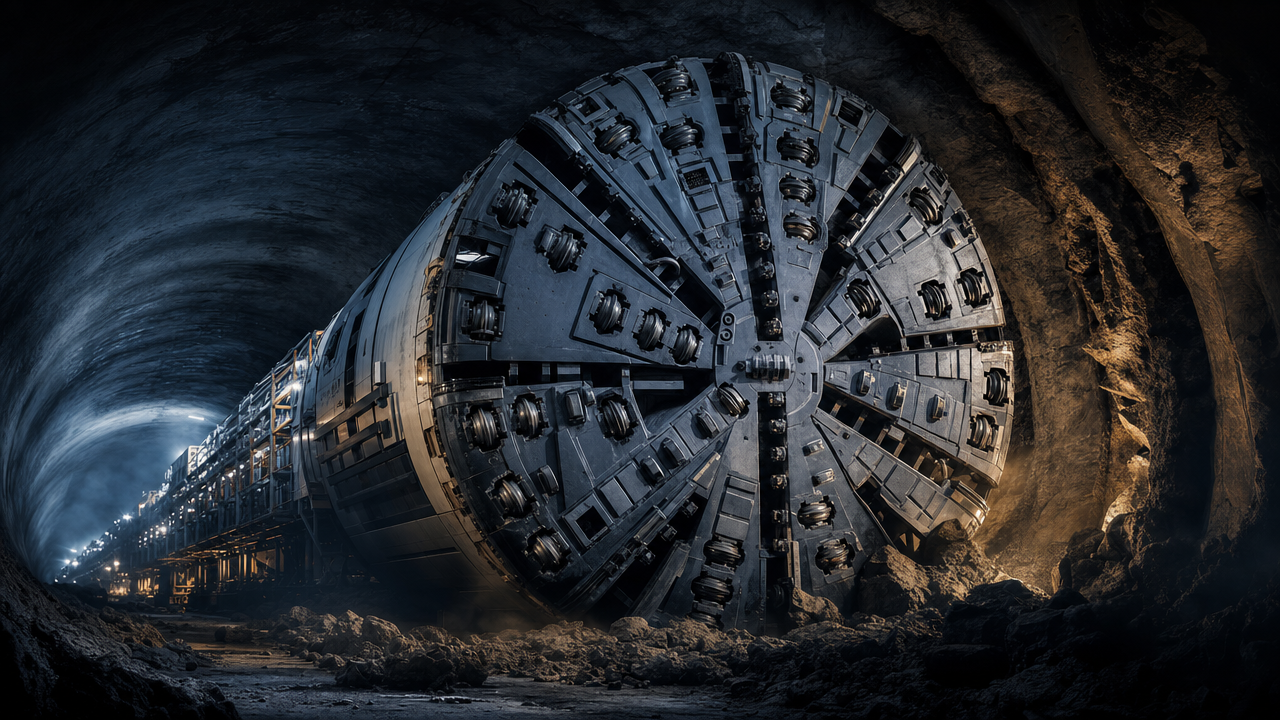
The principle of a shield machine can be stated in a single sentence: dig a hole while holding the hole up. At the very front of the machine is a giant cutterhead studded with cutting tools, rotating to cut through soil or rock; behind the cutterhead is a steel cylinder — the "shield body" — which, like a shield, holds up the freshly excavated, not-yet-lined tunnel wall. Spoil enters the excavation chamber through openings in the cutterhead and is carried out of the tunnel by a screw conveyor or slurry pipeline. At the tail of the machine, an erector assembles prefabricated concrete segments into rings, ring by ring, building the tunnel's permanent lining; then a circle of hydraulic jacks braces against the just-assembled segments and pushes the entire machine forward by the distance of one ring. Excavation, spoil removal, segment assembly, advance — these four actions repeat in cycles, and the tunnel grows meter by meter behind the machine.
The principle is simple; the engineering is ferocious. A mainstream metro shield machine is over six meters in diameter, nearly a hundred meters long, and weighs around 500 tons; but super-large-diameter models are another order of magnitude — "Shanhe" has an excavation diameter of 17.5 meters, equivalent to six stories, an overall length of 163 meters, a total weight of 5,200 tons, an installed power of 12,580 kilowatts, and 306 cutting tools mounted on its cutterhead. By the official account of the State-owned Assets Supervision and Administration Commission of the State Council (SASAC), a shield machine has more than thirty thousand precision parts, with over two thousand control points in a single machine's control system, spanning dozens of disciplines — mechanics, dynamics, hydraulics, electrics, materials, measurement and control. In terms of system complexity, the industry often compares it to an aircraft; in terms of individual weight, it is unquestionably the largest mobile machine on land.
The difficulty can be broken into four layers. The first layer is "invisibility": once the machine launches, the entire tunneling process takes place tens of meters underground, and the geology ahead of the cutterhead can only be inferred from surveys and back-calculated from sensors. Get the tunneling parameters wrong by one notch, and at best you get abnormal cutter wear, at worst ground collapse — and the cost of a single collapse accident in a city far exceeds the price of a shield machine. The second layer is "no turning back": once a shield machine enters the tunnel, it has no reverse gear; if it breaks, it can only be repaired in place, and if it cannot be repaired, the only option is to sink a rescue shaft to dig it out — so the reliability of every component is pushed to the limit, and core parts like the main bearing must be guaranteed fault-free for an entire drive. The third layer is "geology's caprice": soft soil, sandy gravel, hard rock, soft-over-hard strata, high water pressure, high quartz content — every stratum is a different enemy, and within the same tunnel several enemies often take turns. A shield machine must therefore be custom-built for each project, and there are almost no two identical shield machines in the world. The fourth layer is "system integration": if any single link among the thirty thousand parts drops the ball, the whole machine sits dead underground — the competitiveness of a shield machine is, in essence, a country's integrated capability across the mechanical, hydraulic, electric-control, and materials industries. In this it echoes the gas turbine, the only difference being that the gas turbine's limit is temperature while the shield machine's limit is geology.
Compared with the traditional drill-and-blast method (mining method), the advantage list for the shield method is long: full-face one-pass forming, with a daily advance of 20 to 30 meters, roughly three to five times that of drill-and-blast; no explosives, minimal disturbance to surface buildings, able to pass beneath residential blocks in cities; and workers operating under the protection of the shield body, sharply reducing the risk of collapse. The price of all this is cost: a mainstream domestic shield machine falls in the RMB 25 million to 50 million price band, super-large-diameter models exceed RMB 100 million, and a 12-to-15-meter-class hard-rock TBM runs about RMB 170 million to 250 million per unit. But when the whole account is tallied, the shield method's cost-effectiveness still crushes the alternative across most urban strata — within a metro-tunnel budget of RMB 300 million to 800 million per kilometer, machine depreciation is only a small slice; construction schedule, safety, and disturbance to the city are the big-ticket items.
Having understood this machine's structure and its price tag, the next question naturally arises: when did China start building a machine this complex? The answer begins with a Qinling tunnel — the most painful memory in China's shield story.
3. The Battle of Methods: Why the Shield Method Is Worth the Price
A shield machine easily costs twenty or thirty million, even hundreds of millions of RMB, and a shield tunnel costs several hundred million per kilometer — so why does the engineering world increasingly choose the shield method over the older, cheaper drill-and-blast method (mining method)? Only by settling this account can one understand the underlying logic of shield-machine demand.
First, the essential difference between the two methods. The drill-and-blast method (mining method) is the most traditional way to excavate a tunnel: drill, load explosives, blast, muck out, support — repeating in cycles, like "gnawing," blasting the rock open bite by bite. Its advantages are simple equipment, low investment, and flexibility (it adapts to all cross-sections and geologies), with very low cost in hard, stable mountain rock strata. Its disadvantages are that it is slow, dangerous (risk of blasting and collapse), and highly disruptive to surroundings (vibration, noise). The shield method, by contrast, is full-face mechanized excavation: a single shield machine integrates excavation, support, and lining, forming the tunnel as it advances — like "drilling," pushing forward continuously. Its advantages are speed (daily advance three to five times that of drill-and-blast), safety (workers protected under the shield body, low collapse risk), and low disturbance to surroundings (able to pass beneath residential blocks and surface buildings). Its disadvantages are expensive equipment, high up-front investment, and less flexible geological adaptability than drill-and-blast.
The key lies in the composition of the cost. An urban metro tunnel costs RMB 300 million to 800 million per kilometer (including stations), with extreme cases such as Phase 1 of Shenzhen Metro Line 20 reaching as high as RMB 1.484 billion per kilometer. But note: within this cost, the shield machine's depreciation is only a small slice — so what is the big-ticket item? It is the construction schedule, it is safety, it is the cost of disturbance to the city. Building a tunnel in a city with drill-and-blast means blasting vibration damaging surrounding buildings, noise triggering resident complaints, collapse risk threatening surface safety, and a slow schedule occupying city roads for a long time — these "hidden costs" added together far exceed the shield machine's modest depreciation. So in the soft, water-rich strata of cities, the shield method's total cost (counting schedule, safety, and social cost) is in fact lower than drill-and-blast. That is why urban metros are almost uniformly shield-built — not because the shield method's direct cost is lower, but because its total cost is lower.
But switch scenarios, and the account flips. In hard, stable mountain rock strata far from buildings, the direct-cost advantage of drill-and-blast comes to the fore — cheap equipment, strong geological adaptability, and a shield machine's hundred-million-RMB investment cannot be amortized over a short tunnel. So mountain railway tunnels are often a "drill-and-blast + TBM" combination: long, straight, hard-rock sections use TBM (high efficiency), while short, highly variable sections use drill-and-blast (flexibility). The Sichuan–Tibet Railway and the Yin-Jiang-Bu-Han project both use this combined method. The choice of method is essentially an integrated optimization problem of "geology + schedule + safety + cost" — there is no absolute superior or inferior, only suitable or unsuitable.
The answer to this integrated problem is tilting toward the shield method — and this is the long-term support for shield-machine demand. There are three reasons. First, China's tunnel projects are increasingly in cities, in soft soil, in water-rich strata, and in crossings of rivers and seas — all home turf for the shield method, terrain that drill-and-blast simply cannot handle. Second, society's demands for safety and environment keep rising — blasting that disturbs residents and collapses that injure people are increasingly unacceptable today, making the shield method's safety and low-disturbance advantages ever more valuable. Third, labor costs are rising and schedule requirements are accelerating — the shield method's mechanization and high efficiency grow ever more competitive. These three trends stacked together make the shield method the only choice or the optimal choice in more and more scenarios — the underlying guarantee of shield-machine demand.
The battle of methods also conceals a deeper industrial logic: the spread of the shield method is itself the result of China's shield industry rising. Twenty years ago shield machines were expensive, imported, and hard to service, so the engineering world used drill-and-blast whenever it could; today shield machines are domestically produced, cheap, and quickly delivered, so the engineering world naturally chooses the shield method more and more — the domestic production and price drop of shield machines has, in turn, expanded the application range of the shield method and created more shield demand. This is a virtuous cycle: the cheaper and more usable the machine, the more the method is used; the more the method is used, the greater the demand for machines, and scale effects make the machines cheaper still. China's shield industry and the spread of the shield method have made each other. Understand this virtuous cycle, and you understand why Chinese shield machines could go from zero to world number one in twenty years — it is not just that they built better machines, but that they changed the entire tunneling industry's habit of choosing methods.
4. The Alphabet of Machine Types: Meeting the Six Species of Tunneling Machine
In everyday usage, "shield machine" is an umbrella term; inside the industry the family tree is far more detailed. Spending a chapter to get to know the six main species lets every star machine in the later chapters be placed correctly.
Earth-pressure-balance shield (EPB), the absolute mainstay of urban metros. Its cleverness lies in using the enemy against the enemy: the spoil cut off by the cutterhead is not immediately discharged but first held in the sealed excavation chamber and compacted, using the spoil's own pressure to hold back the excavation face and prevent the soil ahead from collapsing; the screw conveyor controls the spoil-discharge rate like squeezing toothpaste — however much is discharged, that much advances — and the earth pressure stays balanced throughout. It suits soft soil, clay, and silty sand, strata common in cities. Today the world's largest EPB shield is China-made, "Jiaoping No. 1," at 14.57 meters.
Slurry shield, the underwater specialist of rivers and seas. Facing high-water-pressure, highly permeable strata where spoil cannot hold back water, it switches to slurry instead: pressurized slurry is injected into the sealed chamber, forming a filter cake over the excavation face to stabilize the soil, while the spoil is mixed into the slurry and pumped out of the tunnel through pipes, with a separation plant on the surface then separating spoil from slurry. Super-large-diameter tunnels crossing rivers and seas are almost uniformly slurry shields — "Jinghua," "Shanhe," and "Jianghai" are all of this species. Its surface support facilities (the slurry-separation plant) rival a small factory in scale.
Hard-rock TBM, the pathfinder of mountain tunnels. Soft-soil strata rely on "cutting," hard-rock strata rely on "pressing": the TBM presses disc cutters into the rock face with enormous thrust, the disc cutters roll and crush, and the rock cracks and spalls under compression; the machine braces against the tunnel wall with gripper shoes to provide reaction force, pushing forward step by step. Long hard-rock sections of railway mountain tunnels and water-conveyance tunnels are its home turf; the Sichuan–Tibet Railway's "Xueyu Xianfeng" (Snowland Pioneer) is a 10.33-meter open-type TBM.
Pipe-jacking machine, the light cavalry of short crossings. The head handles the tunneling, but the machine carries no lining system of its own — jacks in the launch shaft at the rear continuously push prefabricated pipe segments into the ground, the pipe segments serving both as lining and as thrust-transmitting members for the advance. To pass beneath a road, a railway, or a river — short crossings of tens to hundreds of meters — pipe-jacking is the most economical.
Shaft boring machine, a new species for drilling downward. With the cutterhead facing down (or reaming upward from below), it does full-face rock breaking and mechanical spoil removal, turning the high-risk work of traditional manual shaft excavation into a mechanized assembly line. It is the fastest-iterating category of recent years: "Mengxiang" (Dream), rolled off the line in 2022, had a diameter of 23.02 meters and was once the world's largest; "Qiming" (Morning Star), rolled off the line in September 2025, pushed the record to 24 meters with a maximum excavation depth of 150 meters, compressing the shaft-completion cycle for a shield receiving shaft from about a year to three months. Urban underground parking garages, deep-tunnel shafts, and future deep-earth laboratories are all its market.
Rectangular and special-shaped shields, the category the Chinese have turned into an art. The circular cross-section is mechanically optimal but has low space utilization — the arched space at the top and bottom of the tunnel is wasted. Multi-cutterhead combinations cut rectangular and quasi-rectangular cross-sections, sharply raising cross-section utilization, especially suited to shallow-cover underground pedestrian crossings, metro stations, and utility tunnels. "Dongjin," which debuted in May 2026, is the world's first quasi-rectangular jacking-shield integrated machine — switching between the two methods of pipe-jacking and shielding on a single machine — used for the western extension of Shanghai Rail Transit Line 12. Special-shaped shields are the sub-category with the highest international recognition for Chinese manufacturers: Japanese manufacturers pioneered the special-shaped cross-section, but it was the Chinese who made it big and complete.
Beyond the six species there are also dual-mode and triple-mode machines (switchable among EPB / slurry / TBM modes to deal with composite strata within a single tunnel), small-turning-radius TBMs (CCCC Tianhe's "Mozi" set a world record), and specialty variants such as small shields dedicated to cross-passages. The breadth of the family tree is itself part of competitiveness: CRCHI's product list reads "9 major series, 195 products, excavation diameters covering 0.5 meters to 23 meters" — when a manufacturer can offer a corresponding machine type for any kind of underground project, its bargaining power at the tender table is no longer just about price.
5. Specialty Tunneling: China's Expertise in Shafts, Pipe-Jacking, and Special-Shaped Cross-Sections
Beyond the two mainstreams of the circular shield and the TBM, Chinese shield manufacturers have developed the highest-internationally-recognized expertise in several special categories — shaft boring machines, pipe-jacking machines, and special-shaped-cross-section shields. These "niche species" appear marginal, yet they are precisely where the creativity of Chinese shield technology concentrates, and the best proof of the competitive advantage that is the breadth of the family tree.
First, the shaft boring machine — the fastest-iterating category. Traditional shaft excavation relied on manual labor or simple machinery, high-risk and low-efficiency work. The shaft boring machine mechanizes this process: the cutterhead breaks rock full-face vertically downward (or reams upward from below) with mechanical spoil removal. China's pace of record-breaking in this category is astonishing: "Mengxiang," rolled off the line in Changsha in November 2022 at 23.02 meters, was once the world's largest; a mere three years later, "Qiming," rolled off the line in Zhengzhou in September 2025, pushed the record to 24 meters with a maximum excavation depth of 150 meters, compressing the shaft-completion cycle for a shield receiving shaft from about a year to three months. In 2025 CRCHI also rolled off the line the world's first kilometer-class shaft hard-rock full-face boring machine, "Gangtie Jiliang" (Steel Backbone) — targeting future scenarios such as deep-earth resource development and deep mines. The rise of the shaft boring machine corresponds to the trend of China's underground-space development moving from "horizontal" to "vertical": underground parking garages, deep-tunnel shafts, and deep-earth laboratories all require drilling large-diameter deep shafts downward.
Next, the crossover of pipe-jacking machines and vertical shields. "Weilai" (Future), rolled off the line in November 2025, is a vertical shield suited to 12-to-18-meter segments with a maximum excavation depth of 70 meters, used for an underground parking garage in the core area of Suzhou's ancient city — in Suzhou's old town, where every inch of land is precious and the ancient cityscape must not be damaged, a vertical shield can excavate underground space downward with a minimal surface footprint. This new class of "urban renewal + underground space" scenarios is creating urban demand for shields beyond the metro. Pipe-jacking machines, meanwhile, continue to be applied in short-crossing projects such as utility tunnels and underpass passages; a combined rectangular shield pipe-jacking machine like "CREG 1179" combines the rectangular cross-section with the pipe-jacking method, setting the record for the world's largest cross-section.
What best embodies Chinese creativity is the special-shaped-cross-section shield. The circular cross-section is mechanically optimal but has low space utilization — the arched space at the top and bottom of the tunnel is wasted. Special-shaped cross-sections (rectangular, quasi-rectangular, twin-circle, etc.) use multi-cutterhead combinations to cut cross-sections that better fit usage needs, greatly raising space utilization, especially suited to shallow-cover underground pedestrian crossings, metro stations, and comprehensive utility tunnels. Japanese manufacturers were once the pioneers of the special-shaped cross-section, but it was the Chinese who made it big and complete. "Dongjin," which debuted in May 2026, is Shanghai Tunnel Engineering's world-first quasi-rectangular jacking-shield integrated machine — switching between the two methods of pipe-jacking and shielding on a single machine, used for the western extension of Shanghai Rail Transit Line 12, and the world's largest-cross-section special-shaped EPB shield. CCCC Tianhe's "Mozi," meanwhile, set the world record for the smallest-turning-radius TBM, able to turn nimbly in extremely narrow spaces.
The value of these specialty tunneling machines lies not in the market scale of any single category (they are all niche markets), but in the "breadth of the family tree" they collectively constitute. When a shield manufacturer can offer a corresponding custom machine type for any kind of underground project — whether a horizontal tunnel, a vertical shaft, a rectangular passage, or a smallest-turning-radius cross-passage — its bargaining power at the tender table is no longer just price, but "only I can build it." CRCHI's product list reads "9 major series, 195 products, excavation diameters covering 0.5 meters to 23 meters" — this completeness of the family tree is itself a moat. Herrenknecht has technological depth, but not necessarily the breadth of family tree that Chinese manufacturers have; this is a unique advantage that Chinese shield machines were "fed" by the largest domestic market and the most diverse engineering demands.
Specialty tunneling machines are also an important handhold for Chinese shield machines during the "demand gear-shift." When the metro — that standardized large market — ebbs, the customized specialty markets of shafts, vertical shields, and special-shaped cross-sections can precisely absorb manufacturers' capacity and R&D capability, converting the capability of "building standard metro shields" into the capability of "building all kinds of specialty machine types." The broader the family tree, the stronger a manufacturer's adaptability amid demand migration — this is a hidden ace for Chinese shield machines in coping with the stock-market predicament. And the precondition for playing this ace well is that manufacturers be willing to invest R&D in niche markets — under the pressure of thin-margin operations, this is itself a test.
6. Qinling 1997: Two German Machines and One Cordon Line
The starting point of China's shield story is usually traced to Qinling in 1997.
The Xi'an–Ankang Railway had to cross the Qinling Mountains, with a main tunnel on the order of 18 kilometers, deep cover, and hard rock; calculated by drill-and-blast, the schedule stretched out interminably. The Ministry of Railways decided to import the most advanced full-face hard-rock TBM of the time — buying two open-type TBMs from Germany's Wirth company, with a cutterhead diameter of 8.8 meters, at a unit price of RMB 350 million, roughly RMB 700 million for both. In July 1997, the machines arrived at the site. Let us correct a widely circulated error along the way: the internet often says "spent 300 million to buy two Herrenknechts" — the manufacturer misremembered, and the price was wrong too; the authoritative account is Wirth, RMB 350 million each. In the prices of that year, what did this money mean? At the time the national average annual worker's wage was about RMB 6,000, so one machine equaled a year's wages for nearly sixty thousand people.
The machines did indeed prove their worth: the Qinling tunnel was holed through on schedule, and China's engineering world witnessed the power of full-face tunneling for the first time. But arriving alongside the machines was a humiliation never to be forgotten. The German side's blockade of core technology was detailed to the point of insult: Chinese technicians were forbidden to approach the core hardware and software systems; when the equipment was serviced and the cutter heads replaced, German engineers strung a cordon line across the work area, and the Chinese could only stand outside it and watch. When the equipment broke down, foreign experts had to be summoned to repair it, and a flip of the calendar was several weeks, with service fees charged by the hour — the industry memory left from the later era of Guangzhou Metro's shield imports was several thousand RMB per hour. Even more fatal was the absolute monopoly on price: around 2002, an imported shield machine for Guangzhou Metro cost about RMB 150 million each, and the quotation left no room for negotiation, because only a handful of firms in the entire world could build them, and China was not one of them.
In fact, as early as a 1993 import-feasibility meeting, someone had already spelled it out plainly. Sun Yongfu — then vice minister of railways and later an academician of the Chinese Academy of Engineering — said: "In the past we were familiar with drill-and-blast, which is only one fist; if in the future we master TBM technology, we will have two fists to meet the challenge." He also set a principle: after importing the TBM, we must achieve domestic production of parts as soon as possible, and then domestic production of the whole machine. At the time this sentence was more vision than plan — back then China had no complete conception even of what industrial level the shield machine's main bearing, hydraulic pumps, and control system each represented.
After Qinling, China entered the era of the "shield-machine world's fair." As the metro-construction wave surged, beneath Guangzhou, Shanghai, Beijing, and Shenzhen, machines from Germany's Herrenknecht and Japan's Mitsubishi, Kawasaki, and Komatsu each displayed their prowess; Chinese engineers learned to operate and to maintain foreign machines, and again and again confirmed the same fact: the money for the machine, the temperament of the machine, and the wait after the machine broke down were all gripped in others' hands. In the early 2000s, imported shield machines devoured over 90% of China's market share. China was the world's largest tunnel-engineering nation, with the most shield-machine operators, yet could not build a single shield machine of its own — a contrast almost identical to that of the gas turbine industry of the same period, the only difference being that although the shield machine's technological barrier was high, it lacked the gas turbine's 1,600-degree-Celsius materials ceiling. This difference determined the vast gap in the two industries' catch-up speeds.
The determination forced out of frustration soon became national action.
7. The 863 Program and the "Suicide Squad": Six Years from Research Topic to Prototype
In 2002, the Ministry of Science and Technology listed key shield-machine technologies in the national "863 Program" — unlike the gas turbine, which took the national-team route of a "major special project," the shield machine's road to self-reliance began as a set of research topics, modest in scale and even quieter in profile. The main force carrying the task was China Railway Tunnel Group — then China's most experienced tunnel-construction enterprise, which knew every pain point of imported machines better than anyone, and yearned to shake them off more than anyone.
The assault team the Tunnel Group assembled had just 18 people, and the name left in the industry's historical records is the "suicide squad." Half of this nickname was self-mockery: a group of engineers who came from operating and repairing machines, going off to build a machine, with slim odds; and half was literal fact: no drawings, no design guidelines, no test conditions — everything began from disassembly, surveying, and reverse deduction. From 2002 to 2008, this team successively completed five 863 research topics, gnawing through the shield machine's overall design, cutterhead and cutters, hydraulic drive, and control system piece by piece. Compared with the gas turbine industry's fate of "twenty years failing to trade for hot-end technology," the shield assault had an inborn advantage: China was itself the world's largest shield-construction market, and every imported machine working in a tunnel was a free teacher. Every fault, every cutter change, every stretch of abnormal tunneling data became living teaching material for the assault team — user reverse-engineering nourishing R&D, a road the gas turbine could not walk (imported gas turbines' black-box control systems would not even yield data), yet one the shield machine could.
In April 2008 the fruit landed: China's first composite EPB shield with independent intellectual property rolled off the line in Xinxiang, Henan, at a diameter of 6.3 meters, named "China Railway No. 1." It was subsequently deployed on the Tianjin Metro project — its debut chosen for a section with complex geological conditions and extremely close to existing buildings, effectively tackling the hardest exam paper first. The machine's performance exceeded many people's expectations, conquering the tunneling challenge of alternating soft-and-hard strata. Li Jianbin, a shield-machine expert at China Railway, later positioned the machine thus: "This is the milestone of Chinese shield machines moving from the laboratory to the market"; it "marked the formal coming-into-being of China's shield-machine industry."
The year after "China Railway No. 1" rolled off the line, CREG — relying on this technical team — was founded in Zhengzhou (2009); almost simultaneously, CRCHI, within the China Railway Construction system, got its start in Changsha. The origins of the two firms determined the most distinctive gene of China's shield-machine industry: the manufacturers were all incubated by construction enterprises — the people who design the machines and the people who use the machines are in the same group, and every piece of feedback from the site can appear on the designer's desk the next day. This "factory following the construction site" model was later proven to be the number-one reason China's shield machines crushed rivals on iteration speed. Herrenknecht's engineers go to the site a few times a year; Chinese manufacturers' engineers live on the site.
The appearance of the self-developed whole machine instantly rewrote the rules of the table. Domestic machines were priced at roughly one-third of imported machines of the same specification — a 6.3-meter-class import cost fifty or sixty million RMB, while the domestic version cost just over twenty million — and foreign firms were forced into across-the-board price cuts, giving Chinese owners the standing to bargain for the first time. The story thereafter is a steep substitution curve: in 2012 "China Railway No. 50" was exported to Malaysia, and Chinese shield machines sold overseas for the first time; in 2015 a one-time win of multiple orders for the Tel Aviv metro in Israel knocked open developed markets; and by around 2022, domestic shield machines held over 95% of the domestic market, with imported machines going from ruler to exhibit. From setting the research topic in 2002 to a 95% market share in 2022 was exactly twenty years — Sun Yongfu's vision of "two fists" was fulfilled within a single generation.
8. Two Decades of Substitution: One Price Curve and One Market Map
The process of domestic substitution can be condensed into one price curve and three sets of numbers.
The price curve's starting point is RMB 350 million — the unit price of those two Wirth TBMs at Qinling in 1997; its midpoint is RMB 150 million — the unit price of Guangzhou Metro's imported shield machines around 2002; its end point is twenty or thirty million — today's price band for mainstream domestic metro shield machines (RMB 25 million to 50 million). Over thirty years, the nominal price of comparable machines has fallen ninety percent, while the machines' performance, level of intelligence, and reliability have all comprehensively improved. Every downward bend of this curve corresponds to a domestic-production breakthrough: whole-machine self-reliance stripped foreign firms of monopoly pricing power, domestic production of core components dug the cost foundation lower layer by layer, and scaled production thinned out the R&D and tooling expenses apportioned per unit. China's output today of over 700 units a year is more than double the combined total of all other manufacturers in the world — scale itself has become the deepest moat: for the same 6-meter-class shield machine, the material cost, manufacturing labor hours, and delivery cycle of a Chinese manufacturer are something overseas peers simply cannot match.
The first set of numbers concerns the domestic market: domestic shield machines' domestic market share exceeds 95%, and import substitution is essentially complete; the industry pattern is "a duopoly plus a third pole" — by 2020 output figures, CREG at about 202 units with a 35% to 40% share, CRCHI at about 167 units with roughly 30%, and CCCC Tianhe at about 131 units with roughly 15%, the two "Railways" together taking over 70% of the market. The second set of numbers concerns the globe: Chinese shield machines account for roughly 70% of the world market share, with production and sales ranking first in the world for eight consecutive years (rolling to nine); against a 2024 global sales pool of roughly 800 units, all manufacturers outside China combined took only a couple hundred. The third set of numbers concerns industry scale: China's shield-machine market grew from RMB 27.6 billion in 2022 to roughly RMB 40 billion in 2024, with RMB 45 billion projected for 2025; cumulative output since 2009 has exceeded 4,000 units.
The depth of substitution is likewise worth recording — it went from whole-machine assembly to bone-marrow level. Science and Technology Daily's account is that the share of domestically produced core components rose from 0 to 98%, and the machine-type diameter coverage expanded from 6-meter-class to above 16-meter-class; CREG's whole-machine parts localization rate exceeds 90%, backed by a collaborative network of more than 1,000 upstream and downstream enterprises. Beyond price and technology, delivery speed became the third weapon: Chinese manufacturers' cycle from signing to machine delivery is generally counted in months, and parts supply in days — for construction enterprises, schedule is money, and every day waiting for a machine burns management overhead. Tally this account, and the premium-commanding power of "Chinese delivery" even exceeds the price advantage itself.
Substitution also reshaped the psychological structure of buyer and seller. Twenty years ago, when Chinese owners paid for every price hike and delay of imported machines, they lacked even the standing to complain; today, at the tender table of tunnel projects worldwide, owners take a Chinese quote to press down Herrenknecht's price — it is still the same table, but the house has changed hands. And the role of the one who could once only stand outside the cordon line has now fallen to others: not that China deliberately arranged it, but that when your machines hold 70% of the world, every measure of technology output is naturally yours to dictate.
Still, reading "95% market share" as "total victory" is dangerous. What domestic substitution completed was the whole machine and most components; the pinnacle of the tunneling-machine industrial pyramid — super-large-diameter main bearings, some high-end hydraulic components, and control chips — was conquered one by one only in recent years, and some links still lag to this day, as the chapter on the main bearing later will specifically dissect. Before that, let us look at what plight this wave of substitution forced the world's other players into.
IX. The Global Board: A World Map of a 70-Percent Share
Placing China's shield machines within the coordinate system of the global market, a handful of numbers can instantly sketch out the competitive landscape of this industry—and although the definitions used by different research firms conflict, the direction is highly consistent.
Start with market size. The global tunnel boring machine market, measured by revenue, was roughly USD 3.113 billion in 2024 (per Global Info Research), and is projected to reach USD 4.221 billion by 2031; another firm, QYResearch, puts it at roughly RMB 32.2 billion in 2024 and close to RMB 40.76 billion by 2031. The two sets of figures look contradictory, but the difference actually comes from differing statistical boundaries—whether ground-support facilities, services, and consumables are included makes for a substantial gap. By unit volume, there were roughly 800 TBMs globally in 2024, at an average unit price of about USD 5.5 million each. A caveat here: whenever citing a global market size, one must note the research firm and its definition, because a narrow definition (hard-rock TBMs only) and a broad one (complete machine plus services) can differ by several times over.
Now consider share. The world's top three manufacturers—Germany's Herrenknecht, China's CREG (CRRC-affiliated), and China Railway Construction—together hold roughly 40% of the global market (per Wenkehui). But China's overall share is even more striking: Chinese shield machines account for roughly 70% of the global market, with output and sales ranking first in the world for eight consecutive years (rolling toward nine). These two figures are not contradictory: the former is the concentration of the "top three companies," while the latter is the total share of "all Chinese manufacturers"—add up CREG, CRCHI, CCCC Tianhe, and a host of small and medium players, and China takes seven-tenths of the global shield machine market. Against roughly 800 units sold worldwide in 2024, all manufacturers outside China combined shared only a couple hundred.
China's production curve is also worth recording: 578 units in 2022, 710 in 2023, and 733 in 2024; over the same period, domestic demand was roughly 530 units in 2023 and about 550 in 2024—output has long exceeded demand, and this gap is precisely the numerical source of overcapacity, as well as the reason going overseas is a burden that must be shouldered. The domestic market grew from RMB 27.6 billion in 2022 to about RMB 40 billion in 2024, with 2025 projected at RMB 45 billion; cumulative output since 2009 has surpassed 4,000 units. The domestic market share of homegrown shield machines exceeds 95%, while the "two railways" (CREG's parent and CRCHI's parent) together held roughly 73.2% domestic market share in 2023—a firmly entrenched duopoly.
Piece these numbers into a world map and the landscape becomes clear at a glance: a market dominated by China, with China holding seven-tenths, Germany's Herrenknecht as the only non-Chinese rival of any weight, the Japanese consolidating to survive, and America's Robbins barely hanging on. This is the exact mirror image of the gas-turbine map of "three giants ruling, China just through the door." But the map also conceals two warnings. First, the absolute size of the global market is actually not large—an annual pie of three or four billion dollars is a niche market within the equipment industry, which means that even holding seven-tenths, the ceiling is limited; growth must come from the expansion of total tunnel-engineering volume rather than from further gains in share (seven-tenths is already very hard to push higher). Second, China's share advantage is built mainly on cost and delivery, while the brand premium of the high-end market is still held by Herrenknecht—consistent with the earlier judgment of "large but thin-margin."
A world map of a 70-percent share is both a glory and a reminder: once you already hold the vast majority, the room for growth no longer lies in "grabbing share" but in "enlarging the pie" and "improving profit"—precisely the new proposition that the one at the summit must confront. And to enlarge the tunnel-engineering pie, the most hardcore increment comes from those most extreme projects, such as the Sichuan-Tibet Railway on the Qinghai-Tibet Plateau.
X. Those Knocked Off the Table: Herrenknecht, Robbins, and the Three Japanese Firms
The rise of China's shield machines was accomplished at a table originally carved up by Europe, America, and Japan. Over more than two decades, the other players at this table met sharply divergent fates; going through them one by one allows a more accurate measure of where Chinese manufacturers stand today.
Herrenknecht, Germany—the only rival still standing. Founded by Martin Herrenknecht in 1975, this company is the technical benchmark of the global heavy-TBM field, and, after the Qinling tunnel, the name most familiar to Chinese engineers. It remains, to this day, the only player of any weight in the global shield machine market besides China's two champions: in fiscal 2024 the group's revenue was roughly EUR 1.288 billion, with about 5,490 employees and more than 60 sites worldwide. But Herrenknecht's coping strategy is itself a footnote to China's competitiveness—it did not choose to cut prices and dig in, but instead chose "deep localization in China": it built three plants in Guangzhou and Chengdu for assembly, commissioning, maintenance, and cutting tools, and in 2023 received approval to expand its Guangzhou base—borrowing China's supply chain to squeeze down its own costs. It even used TBMs manufactured at its Guangzhou plant to win orders for India's high-speed rail. That a century-old German giant places its most important production base right on the doorstep of its competitor speaks for itself about where the center of gravity of global shield machine manufacturing lies. The saying that circulates in the industry—"all the world's shield machine companies have been beaten down by China until only one, Germany's, is left"—is rhetoric, but the direction is right.
Robbins, USA—the progenitor of the hard-rock TBM, now a ghost. Robbins invented the modern hard-rock TBM and was once the founding father of the category. Its ending, however, carries a touch of black humor: in 2016 a majority stake was acquired by China's Beifang Heavy Industries, only for Beifang itself to fall into financial crisis (and be forced to sell France's NFM as well); Robbins entered receivership in October 2019, and in February 2021 a company newly established by its president acquired nearly all its assets, barely eking out a survival. Today's Robbins is tiny in scale, with third-party estimates putting annual revenue at roughly USD 54 million—a company that invented an entire category now smaller in scale than the price of a single super-large-diameter shield machine from either of China's two champions.
The three Japanese firms, from pioneers to merging for survival. Japan was once a shield-technology powerhouse: Mitsubishi Heavy Industries, Kawasaki Heavy Industries, Hitachi Zosen, IHI, and JFE all built shield machines, with especially deep accumulation in large-diameter and irregular-section work. But over the past decade, Japanese manufacturers have collectively receded—in October 2021, Kawasaki Heavy Industries and Hitachi Zosen (now named Kanadevia) merged their respective TBM businesses into the joint venture UGITEC, with Kawasaki effectively exiting independent complete-machine manufacturing; the tunnel-boring businesses of IHI, Mitsubishi Heavy Industries, and JFE Engineering were consolidated into JIMT. Merging for survival is the typical move of a period of decline. One common error needs clarifying: Japan's JIMT has no equity relationship with Komatsu, and the online conflation of "Komatsu/JIMT" as one entity is a misconception. The retreat of the Japanese firms is not a matter of technical inadequacy, but of a shrinking home market and a cost structure that cannot withstand China's price and delivery—the same script that later played out across many machinery categories.
Laying the four sides' situations side by side, the global shield machine table forms a clear pyramid: at the apex are China's two champions (CREG + CRCHI, together roughly 70% of the world) and Germany's Herrenknecht, three in all; the second tier holds China's second echelon, such as CCCC Tianhe, and the Japanese consolidated entity JIMT; the bottom holds the barely-surviving Robbins and licensed assemblers in various countries. This landscape is the exact opposite of the gas turbine's "three giants ruling"—in gas turbines, Europe, America, and Japan guard the apex while China has just squeezed through the door; in shield machines, China holds the apex and has pushed Europe, America, and Japan to the margins. The difference between the two industries lies entirely in the height of that technical ceiling: the gas turbine's 1,600 degrees Celsius is a limit of materials, requiring decades of operating data to grind through slowly; shield machines have no such wall that engineering speed cannot vault over, and so China completed the reversal in twenty years.
Still, among the rivals knocked off the table, in one link Herrenknecht never let China catch up—until the past few years. That link is called the main bearing; it is the heart of the shield machine, and, in this "already-completed" tale of reversal, the last piece of the puzzle to be filled in.
XI. The Third Pole and the Second Echelon: The Place of the CCCC Tianhes
China's shield machine duopoly is CREG and CRCHI, but a healthy industry cannot rest on just two firms. CCCC Tianhe as the "third pole," and a second echelon composed of a cluster of small and medium manufacturers, together form the complete ecosystem of China's shield machine industry—their existence is an important source of this industry's competitiveness and creativity.
First, the third pole, CCCC Tianhe. Headquartered in Changshu, Jiangsu, this enterprise was founded a little over a decade ago, has cumulatively won more than 700 orders for boring machines, and possesses annual production capacity for 160 shield machines and 50,000 tons of steel structural components. Its positioning is very clear—specialization in super-large diameter. "Cangyuan" (16.66 m), "Yunhe" (16.07 m), and "Juli No. 1" (16.09 m) all came from here, and the localization rate of its super-large-diameter shield machines reaches 98%. It has also built the TBM "Mozi" with the world's smallest turning radius, and a model that pioneered helium-oxygen saturation pressurized cutter-change technology. As an unlisted enterprise, CCCC Tianhe's financial figures are not disclosed, but its technical density in the high-end niche of super-large diameter is enough to keep it firmly seated as the third pole of Chinese shield machines. The value of CCCC Tianhe lies in this: it means that in the highest-end super-large-diameter field, China does not have only one or two firms capable of building such machines, but multiple players competing and innovating—and this competition is the driving force of continuous technical progress.
Now the second echelon. Beyond the three main forces, China also has a cluster of shield machine manufacturers each with its own specialty: Jinan Heavy Industry (which built the 17.5-meter "Shanhe," the world's largest diameter), Beifang Heavy Industries (which once acquired America's Robbins, has accumulation in hard-rock TBMs, and draws on the State Key Laboratory of Full-Face Boring Machines), Shanghai Tunnel Engineering (STEC, which both builds shield machines and does construction, self-positions as "China's largest shield machine R&D and production base," and has cumulatively exported 46 units), and others. Among these second-echelon manufacturers, some can build world-class machines in specific niches (such as Jinan Heavy Industry's super-large diameter), and some, drawing on construction experience (such as STEC), hold an advantage in particular markets. Their existence keeps China's shield machine industry from being the stagnant water of a "duopoly monopoly," and makes it instead an ecosystem with tiers, competition, and vitality.
A multi-tiered industrial ecosystem is a hidden advantage of China's shield machines relative to Herrenknecht. Herrenknecht is a lone German giant, technically deep but lacking domestic competition; China, by contrast, has multi-tiered competition among a duopoly, a third pole, and a second echelon, and this competition forces every enterprise to keep innovating, cutting costs, and picking up speed—the iteration pace of "a world record on average every month" comes partly from this internal competitive pressure. When CREG builds a 15.7-meter machine to export to Australia, CRCHI has to build the 16.64-meter "Jianghai"; when Jinan Heavy Industry builds the 17.5-meter "Shanhe," CCCC Tianhe has to keep breaking through in super-large diameter—each chasing the other, records broken time and again. Competition is the best catalyst for innovation, and China's multi-tiered shield machine ecosystem provides ample competition.
But a multi-tiered ecosystem also has its worry, namely overcapacity and involution. As noted earlier, China's shield machine stock exceeds 4,000 units, more than 1,500 sit idle, and output has long exceeded demand. When the market contracts (the subway boom recedes), numerous manufacturers, in order to digest capacity, may undercut one another and further crush already-thin profits. Multi-tiered competition is a driver of innovation when the market is expanding, but may turn into vicious involution when the market is contracting—this is the risk that China's shield machine industry must guard against at the organizational level. How to preserve competitive vitality while avoiding vicious involution is the problem this industry must solve in the stock era.
Another value of the second echelon and the third pole is their creativity in niche markets and special-purpose machine types. The duopoly tends to focus on mainstream large markets (subways, large diameter), while the second echelon is more willing to invest in niche special-purpose fields (shafts, vertical shield machines, irregular sections, small turning radii)—and it is precisely the innovation of these "small players" that supports the breadth of China's shield machine lineage of "9 major series, 195 products." The lineage advantage discussed earlier (being able to offer a corresponding machine type for any project) comes partly from these second-echelon manufacturers' deep cultivation of niche fields. An industry with only giants often has a lineage that is not broad enough; only an industry with numerous small and medium players can cover all niche demands.
Placing the third pole and the second echelon into the full industrial panorama yields a more complete judgment: China's shield machine competitiveness comes not only from the two dragon-heads, CREG and CRCHI, but even more from the competitive vitality and lineage breadth of the entire multi-tiered industrial ecosystem. This ecosystem is the organizational foundation that has enabled China's shield machines to iterate continuously over twenty years and keep refreshing world records; but it also faces the risks of overcapacity and vicious involution. How to maintain the health of this ecosystem—both preserving competitive vitality and avoiding excessive involution—is a key link in China's shield machines moving from "first in manufacturing" to "first in industrial health." The strength of an industry has never been merely the strength of a few dragon-heads, but the strength of the entire ecosystem.
XII. The Main Bearing: The Heart of the Shield Machine, the Last Piece of the Puzzle
If the shield machine is the "king of construction machinery," then the main bearing is the heart of that king. It is the pivot of the cutterhead's rotation, and the entire machine's boring force and reaction force are all transmitted through it—when a super-large-diameter shield machine is at work, the main bearing must withstand a maximum axial force of roughly 100,000 kN (equivalent to about 2,500 Asian elephants pressing down on it), a radial force of 10,000 kN, and an overturning moment of 100,000 kN·m, and it must keep turning for several months, boring more than ten kilometers, dozens of meters underground—it cannot fail and cannot be replaced midway, because if it fails in the tunnel, the entire machine is scrapped in the tunnel.
A part like this, China spent many years unable to build. Before 2016, the main bearings of China's shield machines were entirely imported, mainly from Germany's Rothe Erde and Sweden's SKF; the industry figure is that the annual import cost for main bearings alone was roughly RMB 1 billion. This was the hardest bone in the remaining 5% after the whole machine reached 95% localization—you could build every part of the entire machine, yet could not build the core that makes it turn. This scene is exactly like the gas turbine's turbine blade: the whole machine is yours, but the heart belongs to someone else.
Why is it so hard? Three reasons stacked together. First, materials: the main bearing must use high-cleanliness special bearing steel, in which every micron-scale inclusion could become the starting point of a fatigue crack, and the smelting of high-end bearing steel has long been one of China's weak points. Second, machining: for an integral bearing several meters in diameter, the machining precision of the rings must be controlled to the micron level—imported equipment can achieve grade-two precision (about ±2.5 microns), while domestic equipment was for a time able only to look up in envy. Third, verification: the main bearing's service-life requirement is tens of thousands of hours, and service life can only be verified by time—you cannot use three months to prove that a part meant to turn for ten years is qualified; you must conduct both ten-thousand-hour-class bench testing and real-project verification, a double assessment. This is the slowest link in domestic substitution, and it cannot be rushed.
The breakthrough came later than many expected, but once it came, it came in a cluster. In April 2016, the first shield machine using a domestic main bearing, "CRCC No. 872," completed its boring task, deployed for the Suzhou Metro—the first real-world proof of a 3-meter-class domestic main bearing. The truly landmark event was in December 2022: led by the Institute of Metal Research, CAS, in collaboration with more than 20 units, the super-large shield main bearing "Wall-Breaker," 8.01 meters in diameter and weighing 60 tons, was successfully developed for use in 16-meter-class super-large shields; it passed expert review in June 2023, with some indicators internationally leading. Among its supporting enterprises was Luoyang Xinqianglian, achieving fully independent and controllable machining and manufacturing, assembly and commissioning, and inspection and evaluation across the entire process, with a design life exceeding 10,000 hours and the ability to bore continuously for over 10 kilometers.
"Wall-Breaker" is not an isolated case, but one representative of three technical routes running in parallel. The first is the Institute of Metal Research, CAS route, which signed with CCCC Tianhe in October 2025 to launch demonstration applications: the 3-meter class has already been installed on the Shenyang Metro, and the 8-meter class will be used for expressway tunnels in Jiangxi; the fatigue life of its bearing steel surpasses well-known imported brands, and the ring machining precision has risen from imported equipment's grade two (±2.5 microns) to grade one (±1 micron). The second is the CRCHI route: in October 2023 a self-developed integral main bearing 8.61 meters in diameter rolled off the line in Changsha—at the time the world's largest-diameter, heaviest single-unit, and highest-load integral shield main bearing—and in May 2025 it passed the argumentation for installation and application, with the expert panel concluding that its "technical indicators are internationally advanced, some internationally leading." The third is the specialized bearing-plant route: Luoyang Bearing Corporation's (LYC) 6-meter-class main bearing passed inspection and has completed construction applications from the 3-meter class up to the 12-meter class, at a price less than one-third of the imported product; Xinqianglian's 14-meter-class super-large main bearing passed scientific-achievement appraisal in March 2024, filling a domestic gap, and in December of that same year provided the supporting bearing for a 14-meter-class shield machine—China's largest-diameter shield machine exported overseas. Among the three routes, LYC's line "less than one-third the price of imports" is especially worth savoring—once localization breaks through, what recurs is exactly the price curve from the whole-machine substitution: the monopoly premium evaporates in an instant.
But the story of the main bearing cannot be told only as a victory. The Science and Technology Daily article of August 2025, "China's Shield Machine: The Hidden Worries Beneath the Halo," offers the sober other side: the import cost of main bearings for shield machines above 12 meters still accounts for 15% of the whole-machine cost; the already-deployed 7.6-meter-class domestic main bearing still lags the world's top-tier products in service life by about 40%; in addition, large and medium programmable logic controllers (PLCs), high-power reduction gearboxes, and high-pressure hydraulic pumps and motors still depend on imports to varying degrees. In other words, the puzzle piece of the main bearing has only just been filled in and not yet polished flush—"can build" has been reached, but "build it as durable as the best" is still a breath away. And that breath, too, is precisely something that can only be chased with time: the service-life gap of the bearing can only be truly erased by letting domestic bearings turn enough hours in real projects.
Beyond the main bearing, what is the quality of the shield machine's entire industrial chain? This machine of thirty thousand parts—every link is worth taking stock of.
XIII. Thirty Thousand Parts: An Anatomy of a Shield Machine's Industrial Chain
A shield machine has more than thirty thousand precision components, and its industrial chain is therefore like a lush, branching tree. Going through this tree once makes clear the true progress of China's shield machines from "large but not complete" to "large and gradually complete."
By value, the bulk of the whole-machine cost lies in three places: the three core elements—main bearing, cutterhead and cutting tools, and hydraulic system—together account for roughly 30% to 40% of the whole-machine value, while the drive-system structural components dominated by the cutterhead and shield body account for roughly 42% to 45% of cost. The localization-rate account must also be read in layers: CREG has raised the localization rate of the whole machine's parts to above 90%, backed by a collaboration network of more than 1,000 upstream and downstream enterprises. But Science and Technology Daily's sober reminder is that reduction gearboxes and hydraulic pumps can be localized, while some of the small controllers inside them still must be imported—the depth of localization, the further it goes toward chips and precision components, the more the true test shows.
Main drive and transmission. The main-drive reduction gearbox is the power hub of the cutterhead's rotation; the product developed jointly by CREG and the Zhengzhou Research Institute of Mechanical Engineering can bore continuously for more than 10,000 hours without fault under extreme conditions. On main-drive motors, CRRC Zhuzhou has been independently developing shield-machine main-drive motors since 2014, and has built two major series—permanent-magnet and asynchronous—with thousands of units in operation. On the inverter link, Gongdi Technology's (IPO in 2024) shield-machine-dedicated inverter is number one among domestic brands and was once rated a Hubei Province Manufacturing Single Champion product. The localization of these three links is the foundation for the whole machine's ability to break free of imports.
Cutting tools and cutterhead. Cutting tools are the shield machine's "teeth," directly contacting the strata and wearing out fastest, and were long an imported item. CREG and Tsinghua University jointly tackled cutter-tool materials, conducting over a thousand element-addition experiments; Boyun New Materials' subsidiary Boyun Dongfang used ultra-coarse-grain cemented-carbide cutter heads to replace imports, cutting costs for customers by more than 30%. The service life of domestic cutting tools has approached the imported level, but there is still a gap under the extreme conditions of ultra-hard rock. Another revolution in cutting tools is the "cutter-change method"—traditional cutter changes require personnel to enter the chamber, a high-risk operation under high water pressure; atmospheric-pressure cutter-change technology (a collaboration of CRCHI with Central South University and others) shortens cutter-change time to forty or fifty minutes, greatly reducing the risk of pressurized chamber entry. The country's first heavy-duty intelligent shield-machine cutter-change robot (developed by China Railway 14th Bureau), put into service on June 25, 2026, pushes this to the extreme: 100% domestic hardware and software, cutter-positioning precision within 1 millimeter, single disc-cutter replacement shortened to 25 to 40 minutes with efficiency raised by more than 50%, and 38 invention patents already applied for—cutter changing, the most dangerous and time-consuming link in shield construction, is being taken over by robots.
Hydraulic components. This is a relatively weak but markedly improving link within localization. Hengli Hydraulic's shield-machine cylinders hold roughly 80% domestic and roughly 60% global market share, and are expanding from small-diameter toward large-diameter hard-rock boring machine cylinders; Eddie Precision's hydraulic main pumps, motors, and multi-way valves have achieved domestic substitution, supplying shield machine manufacturers. But to be honest: the world's three great precision-hydraulic giants are Bosch Rexroth, Eaton, and Kawasaki Heavy Industries, and the hydraulic pumps and valves of shield main drives have historically depended mainly on Rexroth and Kawasaki; although domestic substitution is advancing, the gap in the high-end links has not yet been fully closed.
Structural components and segments. Large metal structural components such as the shield body, cutterhead body, and segment erector are supplied mainly by enterprises like Yongda Co. (Xiangtan), Shanghai Shengzhong, and Zhuzhou Guangming. There is a counter-example worth recording: Yongda Co. posted 2025 revenue of RMB 2.040 billion, up 140%, yet its tunnel-boring-industry revenue was only RMB 67 million, down 65.93%, with shield-body and cutterhead-body revenue down 75.6% and 71.98% respectively—its growth relied entirely on wind-power forgings, while shield structural components were in fact negative growth. This reminds us: the current prosperity of the shield machine industry is not evenly distributed across the whole chain, but extremely unevenly split between hot and cold. Segments, meanwhile, follow another business model—as the tunnel's permanent lining, they usually "travel with the project," with plants built nearby to supply them. China's largest high-speed-rail shield-tunnel segment prefabrication plant went into production in Dongli, Tianjin, in August 2023, covering 245 mu and able to serve the boring needs of 4 large shield machines simultaneously, with a smart-control production line raising production efficiency by 50%.
Looking over this tree as a whole, the conclusion is: main bearing, main drive, inverter, cutting tools, and cylinders—these key links have all achieved localization to varying degrees, and the skeleton of the industrial chain is complete; but the small controllers inside reduction gearboxes, high-end hydraulic pumps and valves, and high-power PLCs—these "parts within the parts"—remain unfinished business. The industrial-chain autonomy of shield machines, like the hot-end industrial chain of gas turbines, has reached the stage of "skeleton formed, flesh and blood yet to be filled"—the only difference is that shield machines have walked further ahead, having already passed the most perilous ridge.
The geographic distribution of the industrial chain is yet another map worth unfolding.
XIV. The War on the Cutterhead: Cutting Tools, Cutter Changing, and the Atmospheric-Pressure Revolution
If the main bearing is the heart of the shield machine, then the cutterhead and cutting tools are its teeth—the parts that directly bite into the strata, and also the components that wear fastest, are replaced most frequently, and carry the highest accident risk. This seemingly inconspicuous consumable, the cutting tool, conceals a technical war that has run for many years within shield construction.
First, understand why cutting tools are hard. On the shield machine's cutterhead hang dozens to hundreds of cutters: hard-rock boring uses disc cutters, breaking rock by crushing; soft-soil boring uses scrapers and cutting knives, working by cutting. These cutters directly contact the strata, and in hard rock or highly abrasive sand and gravel, they wear out extremely fast—a single cutter may need replacing after boring only a few hundred meters. Cutting-tool material must be both extremely hard (to bite rock) and extremely tough (to resist impact without chipping), an enormous test for cemented carbide and cutter-body materials. In the past, shield cutting tools long depended on imports, with high prices and uncontrollable lead times—a hard bone to gnaw within localization.
The breakthrough of domestic cutting tools relied on the plodding effort of "over a thousand experiments." CREG and Tsinghua University jointly tackled cutter-tool materials, conducting over a thousand element-addition experiments, before grinding domestic cutting-tool performance to near the imported level. Boyun New Materials' subsidiary Boyun Dongfang used ultra-coarse-grain cemented-carbide cutter heads to replace imports, cutting costs for customers by more than 30%. The China Railway Construction South China (Qingyuan) shield machine base drove cutting-tool localization, and all categories of shield cutting tools—including ultra-hard-rock disc cutters—have achieved complete localization, breaking free of the situation of high import prices and uncontrollable lead times. The service life of domestic cutting tools has approached that of imports, but under the extreme conditions of ultra-hard rock, a gap remains against the very best imported cutting tools—the same situation as the main bearing: can build, good enough to use, but "as durable as the best" is still a breath away.
The other battlefield of the cutting-tool war is "how to change cutters." Cutting tools must be replaced once worn, and cutter changing is one of the most dangerous links in shield construction. In high-water-pressure strata, cutter changing must either hold back the water pressure of the entire excavation face (pressurized cutter changing), or have workers, in gear resembling diving suits, enter a pressurized chamber to operate (pressurized chamber entry)—the risk of the latter rivals deep-sea diving, and improper decompression can cause decompression sickness or even death. This high-risk, time-consuming link gave rise to two technical revolutions.
The first is atmospheric-pressure cutter changing. The atmospheric-pressure cutter-change technology developed by CRCHI in collaboration with Central South University and others lets workers replace cutting tools in an atmospheric-pressure environment, shortening cutter-change time to forty or fifty minutes and greatly reducing the risk of pressurized chamber entry. CCCC Tianhe, for its part, pioneered helium-oxygen saturation pressurized cutter-change technology, dedicated to the extreme high-water-pressure conditions of super-large-diameter underwater shields. The second revolution is more thorough—using robots to change cutters. On June 25, 2026, the country's first heavy-duty intelligent shield-machine cutter-change robot (developed by China Railway 14th Bureau) was officially put into service: 100% domestic hardware and software, cutter-positioning precision within 1 millimeter, single disc-cutter replacement shortened to 25 to 40 minutes with efficiency raised by more than 50%, and 38 invention patents already applied for. The significance of the cutter-change robot is that it completely frees humans from this high-risk link—a machine does not get decompression sickness, does not tire, and does not risk its life in a pressurized chamber dozens of meters underground. This is one of the most humane applications of shield machine intelligentization.
This war on the cutterhead condenses the overall characteristics of China's shield machine industry: in hardware and process it has already caught up with and even overtaken (atmospheric-pressure cutter changing, cutter-change robots), yet in the most cutting-edge material details (ultra-hard-rock cutting tools) a gap remains; it embraces both the plodding effort of "over a thousand experiments" and the intelligent leap of the "cutter-change robot." Small as the cutting tool is, it is an excellent window for observing the quality of the entire industry—it tells us that the localization of China's shield machines is not an overnight whole-machine substitution, but a layer-by-layer deepening from whole machine to major components, then to cutting-tool consumables, and finally to cutting-tool materials, with a hard battle to be fought separately at each layer. And behind these hard battles is an entire supporting industrial chain scattered across the country.
XV. Hydraulics, Reduction Gearboxes, and Motors: The Localization Push of the Transmission System
Among the thirty thousand parts of a shield machine, the localization stories of the main bearing and cutting tools are told most often, but what truly determines whether the machine can "turn, push, and run for the long haul" is an entire transmission system—hydraulics, reduction gearboxes, motors, and inverters. The localization of this system is a push that is longer, more granular, and more revealing of the industry's true quality than the main bearing.
First, hydraulics. The shield machine is a typical "hydraulic machine"—cutterhead rotation, shield-body advance, segment erection, cutter extension and retraction: almost all force is transmitted hydraulically. The hydraulic system of a super-large-diameter shield machine must stably output thrust measured in tens of thousands of kN dozens of meters underground, placing extremely high reliability demands on hydraulic pumps, motors, cylinders, and valves. Localization in this link has improved markedly but the gap still exists. Hengli Hydraulic's shield-machine cylinders hold roughly 80% domestic and roughly 60% global market share, and are expanding from small-diameter toward large-diameter hard-rock boring machine cylinders—the cylinder link, China has basically taken. Eddie Precision's hydraulic main pumps, motors, and multi-way valves have achieved domestic substitution, supplying shield machine manufacturers. But to be honest: the world's three great precision-hydraulic giants are Bosch Rexroth, Eaton, and Kawasaki Heavy Industries, and the hydraulic pumps and valves of shield main drives have historically depended mainly on Rexroth and Kawasaki; although domestic substitution is advancing, the highest-end hydraulic components (especially pumps and valves under large-displacement, high-pressure conditions) have not yet fully closed the gap. Hydraulics is one of the "jewels in the crown" of the machinery industry, and China's hydraulic industry as a whole is still catching up to the international top tier—shield-machine hydraulic components are merely one facet of this larger pursuit.
Next, reduction gearboxes. The main-drive reduction gearbox is the key component that converts the motor's high rotational speed into the cutterhead's low speed and high torque, and it must run continuously for tens of thousands of hours under extreme conditions without fault. The product developed by CREG in collaboration with the Zhengzhou Research Institute of Mechanical Engineering of the China Academy of Machinery can bore continuously for more than 10,000 hours without fault under extreme conditions—an important breakthrough for domestic reduction gearboxes. But Science and Technology Daily's sober reminder is: reduction gearboxes and pumps can be localized, while some of the small controllers inside them still must be imported. This sentence points out the deep dilemma of localization—you can build the "big piece" that is the reduction gearbox, but certain "small pieces" inside the big piece (precision controllers, sensors, special chips) remain in others' hands. The depth of localization, the further it goes toward chips and precision components, the more the true test shows.
In the motor-and-inverter link, localization is relatively ahead. On main-drive motors, CRRC Zhuzhou has been independently developing shield-machine main-drive motors since 2014, and has built two major series—permanent-magnet and asynchronous—with thousands of units in operation—drawing on the powerful motor industrial base of China's rail-transit equipment, the localization of shield-machine motors has proceeded fairly smoothly. On inverters, Gongdi Technology's (IPO in 2024) shield-machine-dedicated inverter is number one among domestic brands and was once rated a Hubei Province Manufacturing Single Champion product. The localization of motors and inverters benefits from China's overall strength in power electronics and motors—fields in which China already has a fairly strong industrial base, and shield-machine motors and inverters have simply localized on that momentum.
Looking over the localization of the transmission system as a whole, one can read the true quality of China's shield machine industrial chain: cylinders, motors, and inverters—the links "supported by an industrial base"—have localized fast and deep; while high-end hydraulic pumps and valves and the precision controllers inside reduction gearboxes—the links at the "apex of the machinery industry"—have localized slowly, with a gap remaining. This divergence is not unique to the shield machine industry, but is the common picture of China's entire high-end equipment manufacturing—wherever a link has a powerful parent industry behind it (motors leaning on rail transit, structural components on steel), localization is fast; wherever a link depends on the accumulation of precision machinery and chips (high-end hydraulics, precision controllers), localization is slow.
The push on the transmission system adds the most truthful stroke to the entire shield machine industry's localization narrative: the so-called "95% localization" and "98% core-component autonomy" are victories at the whole-machine and major-component level; but disassemble down to the "parts within the parts"—the precision fitted pairs inside hydraulic pumps, the control chips inside reduction gearboxes—and China is still climbing the slope. This does not diminish China's shield machines' achievement of "first in the world," but it reminds us: for an industry that holds seven-tenths of the globe, its localization is not a period already drawn at the end of a sentence, but a ray still extending into the depths. And how fast this ray can extend depends on the overall progress of China's foundational industries (hydraulics, precision machinery, chips)—the last shortfall of the shield machine is, in the final analysis, the last shortfall of Chinese industry.
XVI. The Supporting Cast That Decides Success or Failure: Seals, Screw Conveyors, and Segment Erectors
The star components of a shield machine are the main bearing, the cutterhead, and the hydraulic system. But dozens of meters underground, the parts that truly determine whether a drive succeeds or fails are often several unremarkable supporting players—the sealing system, the screw conveyor, and the segment erector. They never make the news, yet they are the last line of defense for a shield machine's reliability.
Start with the sealing system, one of the parts a shield machine simply "cannot afford to fail." Shield machines work in strata under high water pressure, and super-large-diameter shields on river- and sea-crossing drives in particular must withstand enormous water pressure dozens of meters beneath a riverbed or seabed. If the main drive's sealing system (tail seals, main bearing seals) fails, slurry and high-pressure water flood into the machine—at best forcing a shutdown for repairs, at worst leaving the entire machine stranded and scrapped in the tunnel, or even triggering surface collapse. The reliability of the sealing system is therefore the lifeline of shield safety. The technical difficulty of this component is no less than that of the main bearing—seals must operate for extended periods without failing in a harsh, high-pressure, sediment-laden environment, and both the materials and the structural design are formidable challenges. Breakthroughs by CREG and others in main-drive sealing are the very precondition for domestic shield machines to operate under high-water-pressure conditions. The seal may be small, but it holds "veto power" over the whole operation.
Next is the screw conveyor, the "muck-discharge throat" of an earth-pressure-balance (EPB) shield. An EPB shield uses the excavated muck to hold up the tunnel face, and the screw conveyor is responsible for extruding that muck out of the excavation chamber at a steady rate, like squeezing toothpaste—how much comes out versus how much goes in governs the balance of earth pressure. The muck-discharge speed control of the screw conveyor directly determines the stability of the tunnel face: discharge too fast and earth pressure drops, destabilizing the face (risking collapse or water inrush); discharge too slowly and earth pressure builds too high, dragging down advance efficiency. Screw conveyors come in belt and shaft types to suit different geologies. It may look like nothing more than a "muck-moving screw," but it is in fact one of the core actuators of the EPB shield's precision control.
The third supporting player is the segment erector, the key to a tunnel taking "shape." Each time the shield machine advances one ring, the erector must precisely assemble six to ten arc-shaped segments into a complete ring—positioning must be accurate (to the millimeter), assembly must be fast (it cannot slow the drive), and quality must be reliable (segments are the tunnel's permanent lining; a segment set askew or cracked is a hidden hazard). CCCC Tianhe's segment erectors hold a place in the industry for their positioning accuracy and reliable quality. An erector's performance directly determines the quality of the tunnel lining and the efficiency of the drive—it is the executor of a shield machine's core capability of "excavating and lining at the same time."
These three supporting players share a common trait: unlike the main bearing or the cutterhead, they carry no "technological halo," rarely make the news, and are seldom held up as landmark achievements of domestic production. Yet their reliability directly determines the success or failure of a drive. A shield machine is a product of systems integration—among its thirty thousand parts, if any single link drops the ball, the entire machine goes dead underground. However advanced the main bearing, a failed seal still scraps the machine; however powerful the cutterhead, a screw conveyor that loses control of muck discharge still causes a collapse; however intelligent the machine, an erector that sets segments askew still forces rework. A shield machine's reliability is determined by its weakest link, and the weakest link is often precisely these inconspicuous supporting players.
This adds an important perspective to the narrative of domestic production in the shield industry: localization is not "done" once a few star components are conquered; it requires making all thirty thousand parts—including these obscure supporting players—reliable. China's shield machines can command seventy percent of the global market not only because they built 17.5-meter super-large-diameter machines and 8-meter-class main bearings, but even more because they made the supporting cast—seals, screw conveyors, erectors—reliable and durable too. Systems integration capability is the true core of a shield machine's competitiveness—which is also why the shield machine is called the "king of construction machinery": it tests not a single-point technological breakthrough but the overall industrial capability to coordinate tens of thousands of parts into one reliable system.
Supporting components are also the touchstone of industrial-chain depth. When we say China's shield machines are "95% domestically produced," that figure includes both star components like the main bearing and supporting players like seals, screw conveyors, and erectors—it is precisely the comprehensive localization of these supporting players that gives the "95%" its true value. And the remaining 5% of import dependence (certain precision controllers, high-end hydraulic elements) is hidden precisely in the deeper reaches of the supporting components. The last mile of localization lies not in the star components but in the most inconspicuous yet hardest-to-replace precision small parts among the supporting cast—this is the final assignment shared by China's shield machine industry and by Chinese manufacturing as a whole.
XVII. Industrial Geography: The Three Poles of Zhengzhou, Changsha, and Changshu
The map of China's shield machine industry is pinned mainly to three coordinates: Zhengzhou, Changsha, and Changshu. Each city hosts a whole-machine leader, and the character of each of the three leaders is, in a sense, a projection of the industrial base color of its city.
Zhengzhou—the home base of CREG. Founded in Zhengzhou in 2009, CREG (China Railway Engineering Equipment Group) is the direct successor to the technical team behind "China Railway No. 1" and today owns the country's largest shield/TBM R&D and manufacturing base. Its China Railway Intelligent High-End Equipment Industrial Park has the flexible, intelligent manufacturing capability for the full series of shield machines from 4 to 16 meters in diameter, with an annual capacity of 300 shield/TBM units and 380 tunnel-specific equipment units, and its assembly workshop production lines run at full load. The numbers are hard: cumulative orders exceeding 1,800 units, more than 1,600 units shipped, products exported to 34 countries and regions, and production and sales ranking first in the world for many consecutive years. Zhengzhou is also home to the "National TBM Industrialization Center," where China's largest-diameter shield machine for overseas export rolled off the line. That an inland Central Plains city with no coastline, traditionally known for commerce and agriculture, holds the top seat in China's shield machine industry is itself a microcosm of the geographic shift in Chinese manufacturing.
Changsha—CRCHI and the construction-machinery cluster. CRCHI (China Railway Construction Heavy Industry) is headquartered in the Changsha Economic and Technological Development Zone; its tunnel boring machines span 9 major series and 195 products, with excavation diameters from 0.5 to 23 meters, making it one of the shield manufacturers with the most complete product spectrum in the world. Its R&D intensity ranks among the best in the industry: in the first half of 2025, its R&D investment intensity was 8.49% and R&D personnel accounted for more than 35% of staff. In 2025, the world's first kilometer-scale vertical-shaft hard-rock full-face boring machine, the "Steel Backbone," and the world's largest-diameter modular TBM both rolled off the line at CRCHI's Changsha park. And Changsha's weight extends beyond a single company—in 2024 the Changsha construction-machinery cluster surpassed 250 billion yuan in scale, accounting for more than 30% of the national total, and is home to five companies in the global construction-machinery top 50: Sany Heavy Industry, Zoomlion, CRCHI, Sunward Intelligent, and XCMG-affiliated Sinoboom—the "Five Dragons Going to Sea" is this city's calling card. Here, the shield machine is not a lone soldier but one branch of a vast construction-machinery ecosystem.
Changshu—CCCC Tianhe's super-large-diameter specialization. CCCC Tianhe is headquartered in Changshu, Jiangsu, with an annual capacity of 160 shield machines and 50,000 tons of steel structural components, specializing in super-large-diameter models. The "Cangyuan" (16.66 meters), the "Yunhe" (16.07 meters), and the "Juli No. 1" (16.09 meters) all came from here, with super-large-diameter shield localization reaching 98%; it has also built the "Mozi," the TBM with the smallest turning radius in the world, and a model pioneering helium-oxygen saturation pressurized cutter-change technology. As an unlisted enterprise, CCCC Tianhe does not disclose its financial figures, but its technological density in the super-large-diameter niche is enough to hold it firmly as China's third shield-machine pole.
Beyond the three poles, the industrial network has finer capillaries. Shanghai Tunnel Engineering has built its subsidiary, the Shanghai Tunnel Engineering Machinery Manufacturing Branch, into the "largest shield R&D and production base in China" (by the company's own account), and through the Chengtou International platform has cumulatively exported 46 self-developed shield machines. The upstream supporting industries are scattered across the country: Yongda in Xiangtan, hydraulic components in Wuxi, main bearings in Luoyang, motors in Zhuzhou, and Shenzhen-based frequency converters—a shield machine's thirty thousand parts are produced through a supply network spanning the central and western regions and the Yangtze River Delta.
This industrial map also has a growing new node: remanufacturing bases. China Railway Engineering Services has laid out four major remanufacturing bases in Qingyuan (South China), Deyang (Southwest), Yixing (East China), and Xinxiang (North China), cumulatively completing the remanufacturing of 290 shield machine/TBM units. Why does this new node matter? Because it connects to one of the sharpest contradictions in China's shield industry today—overcapacity in the installed stock. And that contradiction must be told starting from the upheaval on the demand side.
XVIII. The Construction Phalanx: Who Operates These Steel Behemoths
Building a shield machine is only the first step; what truly drives it underground is the construction enterprise that operates it. China's shield industry has a distinctive structure: the manufacturer and the contractor often belong to the same group, and are sometimes even the very same people—this structure is the key to understanding why China's shield machines can iterate so quickly.
Look first at the head of the construction phalanx. China Railway Tunnel Group is China's most experienced tunnel-construction enterprise, the parent home of the "suicide squad" from the 863 Program tackling shield technology, and the birthplace of "China Railway No. 1." It has built the "7+N" shield intelligent-construction V2.0 technology system and is the leader in shield intelligence. Shanghai Tunnel Engineering (STEC) excels in digitalization: its digital shield platform has cumulatively managed and controlled more than 170 projects and 880 shield-machine deployments across 17 domestic and overseas cities, and it has also exported more than 30 shield machines to Singapore and India—walking on two legs of manufacturing and construction. China Railway 14th Bureau specializes in large-diameter underwater shields; the Haitai Yangtze River Tunnel, the Second Jiaozhou Bay Tunnel, and other super-large-diameter underwater projects were all built by it, and the cutter-change robot mentioned earlier also came from its R&D. These three, together with China Railway Tunnel Group, China Railway 16th Bureau, and others, form the main phalanx of China's shield construction.
The relationship between this phalanx and the manufacturers is China's most distinctive shield industrial gene. CREG grew out of China Railway Tunnel Group (both belong to China Railway Group), CRCHI and China Railway Construction's construction enterprises belong to the same group (China Railway Construction Corporation), and STEC both builds and operates shields. This "manufacturing plus construction integrated" structure brings an advantage that overseas rivals cannot replicate: an extremely short feedback loop. Every problem on the worksite—abnormal cutter wear, seal leakage, parameters that don't fit the ground—can be fed back to the design department within the same group the next day, and the next machine can be improved. Herrenknecht's engineers visit worksites a few times a year and learn about machine performance from customer reports; Chinese manufacturers' designers and construction crews are in the same group, sometimes even on the same worksite, with almost zero information delay. This is why China's shield machines can iterate at a pace of "on average one world record per month"—not because Chinese engineers are smarter, but because "the people who build the machines" and "the people who use the machines" are too close together.
This structure also explains another feature of China's shield market: internal absorption. Many of CREG's machines are sold to construction enterprises within the China Railway system, and many of CRCHI's machines are sold to China Railway Construction's engineering crews—the manufacturer and its main customers are within the same group. The benefit of this internal cycle is stable demand and smooth feedback; but it also brings a hidden worry, namely the dulling of market competition and the rigidity of capacity—when the metro tide recedes and projects shrink, construction demand within the same group falls, and the manufacturing end's capacity becomes even harder to absorb. This too is a structural reason behind the 1,500 idle machines.
The construction phalanx is also connected to a vast employment and talent system. Shield construction is a high-skill trade: operators must read the geology, adjust parameters, and handle emergencies; it also requires a full professional team of shield engineers, maintenance technicians, surveyors, and more. The 30,000-person talent gap mentioned earlier arises mainly in this link—it is not only the design end that lacks high-end engineers; the construction end also lacks skilled operating and maintenance personnel. In an industry that holds seventy percent of the world's capacity, if the people operating the machines cannot keep up, even the most advanced machine cannot show its full strength.
Taken together, the manufacturing phalanx and the construction phalanx make China's shield industry a highly integrated "manufacturing–construction–feedback" ecosystem. This ecosystem is the engine of China's rapid rise in shield machines and the core competitiveness that sets it apart from Herrenknecht (a pure manufacturer) and from the Japanese system (where manufacturing and construction are separate). But integration is a double-edged sword—it delivers iteration speed while also bringing capacity rigidity and market dulling. As the industry shifts from rapid expansion to optimization of the installed stock, how to make this integrated ecosystem both preserve its feedback advantage and strengthen its market elasticity is a problem China's shield industry must solve at the organizational level. And no matter how the organization is optimized, what ultimately supports the entire ecosystem is that nationwide upstream supply network.
XIX. Tunnel Segments: The Tunnel's Skeleton and the "Follow-the-Project" Business
As a shield machine advances, the tunnel that grows behind it meter by meter has a permanent lining assembled from precast reinforced-concrete segments, block by block. These segments are the tunnel's "skeleton"—they bear the earth pressure, water pressure, and various loads, ensuring the tunnel will not collapse for a century. Segments are not "star equipment" the way shield machines are, but they are a huge-volume, uniquely logical link in the shield-tunnel industrial chain, worth discussing on their own.
First, understand what a segment is. A ring of segments is usually made of six to ten arc-shaped reinforced-concrete blocks assembled into a circle, with blocks connected by bolts and waterproof sealing strips sandwiched between them. Each time the shield machine advances one ring's distance, the erector assembles a ring of segments and braces it with jacks. Segment quality directly determines the tunnel's safety and lifespan—it must withstand earth and water pressure dozens of meters deep, resist seepage and waterproof, and not crack under the thrust of the shield jacks. A tunnel several kilometers long needs tens of thousands of segments, and the cost of segments accounts for a considerable share of the entire tunnel project.
The most distinctive feature of the segment industry is its "follow-the-project" model. Segments are large and heavy (a single segment can weigh several tons) with high transport costs, so segment plants are usually not centrally produced and distributed nationwide but instead "built nearby, dedicated to a single project"—when a large project breaks ground, a segment precasting plant is built nearby, and when the project ends, the plant may be dismantled or relocated. This model gives the segment industry a "nomadic" character: the factory follows the project, and wherever there is a tunnel project, a segment plant springs up. This is entirely different from shield-machine manufacturing (concentrated in Zhengzhou, Changsha, and Changshu)—shield machines are "centrally manufactured, sold nationwide," while segments are "distributed precasting, supplied locally."
The segment industry is also undergoing intelligent upgrading. China's largest high-speed-rail shield-segment precasting plant went into production in Dongli, Tianjin, in August 2023, covering 245 mu and able to simultaneously meet the demands of four large shield drives, with a smart-control production line that boosts efficiency by 50%. The emergence of such large intelligent segment plants marks the segment industry's upgrade from "workshops beside the worksite" to "industrialized, intelligent precasting centers"—especially the segments for super-large-diameter tunnels (in a tunnel sixteen or seventeen meters in diameter, the segments are large and thick with extremely high precision requirements), which increasingly demand specialized, intelligent precasting capability. The intelligentization of segments is a microcosm of the overall upgrading of the shield-tunnel industrial chain.
From an industrial-value standpoint, segments are a "large but fragmented" business. Its market scale is enormous—every shield tunnel uses them, the country adds several thousand kilometers of tunnels each year, and segment demand runs into the hundreds of millions of pieces; but it is highly fragmented—the build-nearby, dedicated-to-a-project model makes it hard for the segment industry to form nationwide leaders, and much of it consists of local, project-based small and medium producers. This forms a sharp contrast with the "duopoly" pattern of shield-machine manufacturing. The fragmentation of the segment industry, on one hand, makes its competition full and its prices transparent; on the other, it makes the industry unable, like shield machines, to earn high profits through technological barriers—the technical threshold of segments is far below that of shield machines; in essence they are reinforced-concrete precast pieces that anyone can make, and the contest is over quality, price, and the ability to supply locally.
The segment link adds an important perspective to the shield industrial chain: a shield-tunnel project is a vast industrial ecosystem, and the shield machine is only its most dazzling, most high-end link; its upstream and downstream also connect to a whole host of supporting industries—segments, grouting materials, muck disposal, monitoring equipment, and more. Most of these supporting industries lack the shield machine's technological halo, but their combined market scale may be no smaller than that of shield machines themselves. When we speak of the "shield industry," we cannot fix our eyes only on that spinning steel behemoth; we must also see the entire industrial chain behind it, from segments to grouting—it is precisely this complete industrial chain that supports China's world-leading tunnel engineering. And every link in this chain benefits as China's shield machines rise, and adjusts as the metro tide recedes and demand shifts gears—their fortunes move to the same rhythm as the shield machine's.
XX. Demand Shifts Gears (Part One): The Metro Tide Recedes and 1,500 Machines Sit Idle
The rapid growth of the shield machine industry over the past two decades was built on one simple engine: the surging construction of urban metros in China. Metro tunnels are the largest and most stable source of demand for shield machines, and building a single metro line in a city routinely requires more than a dozen shield machines. That engine is now visibly slowing.
Look first at the numbers. As of the end of 2025, the country had 4,875 kilometers of urban rail transit lines under construction, with cumulative feasibility-approved investment of about 3.9 trillion yuan; in 2024, that figure was 44 cities building 5,833 kilometers—within a single year, kilometers under construction shrank by nearly 1,000, and the number of cities under construction fell from 44 to 40. The investment side tells the story even more clearly: urban rail construction investment peaked at 628.6 billion yuan in 2020, then fell year by year; in 2025 it completed 411.4 billion yuan in construction investment, down 13.38% year on year, and 2024 was already down 8.91% year on year. From the 2020 peak to 2025, urban rail construction investment cumulatively shrank by about one third.
The direct cause of the engine's slowdown is tightened approvals. In 2024, only one city nationwide—Chengdu—had a new round of urban rail construction plans approved, with more than 10 cities queued and waiting. The threshold hinges on ridership intensity: applying for a new line requires reaching a ridership intensity of 7,000 person-trips per kilometer per day, but of the 54 cities with operating urban rail, only 18 meet this standard; Ningbo's phase-four plan received the explicit reply that "with ridership intensity of 0.46 [ten-thousand], it does not yet meet the conditions to apply." Even some already-approved projects that had not yet broken ground had to reapply under the latest policy. In February 2026, the authorities again issued documents tightening metro construction. Metro approval has shifted from "encouraged" to "prudent," and this is the policy backdrop of the current round of demand shifting gears—the underground of the city is no longer a space for infinite expansion.
The result of the engine's slowdown is a severe overcapacity in shield machines. By the count as of 2021, China's shield-machine stock had exceeded 4,000 units; yet annual new-machine demand is only about 700 units. As metro construction recedes, a large number of 6-meter-class shield machines custom-built for metros have run out of work—the industry count is that more than 1,500 shield machines are idle domestically, awaiting upgrade, or reusable after diameter expansion or modification. What does 1,500 units mean? Roughly equal to two years of China's total shield-machine output, or, put another way, several years' worth of the installed stock of all other countries in the world combined. Signals of overcapacity had long shown up in the production and sales data: 2023 output was about 713 units against demand of about 530 units, and 2024 output was 733 units against demand of 550 units—output has long exceeded demand, and machines built cannot be sold, or, once sold, cannot be put to use.
This is the contradiction noted at the end of Chapter Ten: an industry that has ranked first in the world in production and sales for eight consecutive years and commands seventy percent of the global market has 1,500 idle machines piled up at home. This contradiction has given rise to two new industries. One is remanufacturing—refurbishing, expanding the diameter of, and changing the mode of idle 6-meter-class shield machines so they can return to work: China Railway Engineering Services' four bases have cumulatively remanufactured 290 machine-times, and the Qingyuan South China base can house 16-meter-class shields and has completed 42 machine-times in the past four years; the economics of remanufacturing are attractive, with costs at only about 50% of a new machine, saving 60% of energy, 70% of materials, and cutting emissions by more than 80%. The other is leasing and used-equipment trading—the shield machine turns from a "one-off asset" into a "circulatable factor of production," giving rise to a hundred-billion-yuan installed-stock market.
But remanufacturing and leasing can only revitalize the existing stock, not create new increments. If an industry that holds seventy percent of the world's capacity gets by only on refurbishing old machines, its growth ceiling has been reached. What China's shield industry needs is a new market that can absorb large-diameter new machines and is large enough to offset the receding metro tide. And that new market rose up precisely as the metro tide receded—it is in the water, not in the city.
XXI. Who Buys Shield Machines: Owners and Market Structure
A shield machine costs from twenty or thirty million to over a hundred million yuan—who exactly foots that bill? Only by clarifying the buyer structure of shield machines can one understand why the industry's demand rises and falls with policy and public finance, and only then can one judge the true trajectory of the demand shift.
The direct buyers of shield machines are mainly construction enterprises, not the ultimate owners. Those who build metros are local governments (or their platform companies), but the ones who actually purchase shield machines and operate them for tunneling are the winning general contractors—construction giants like China Railway Tunnel Group, STEC, and China Railway 14th Bureau. As discussed earlier, a distinctive structure of China's shield industry is "manufacturing plus construction integrated"—many of CREG's machines are sold to construction enterprises within the China Railway system, and many of CRCHI's machines are sold to China Railway Construction's engineering crews. This intra-group internal cycle makes shield-machine procurement, to a considerable degree, "internal absorption"—demand is stable and feedback is smooth, but it also brings capacity rigidity (once downstream construction demand falls, the manufacturing end's capacity becomes hard to absorb).
Behind the buyer structure is the structure of funding sources—and this is what fundamentally determines the rise and fall of shield demand. The downstream projects of shield machines draw their money mainly from three sources: public finance (metros and municipal works rely on local finances and special-purpose bonds), railway investment (railway tunnels rely on China State Railway Group's fixed-asset investment), and water-conservancy investment (water diversion projects and pumped-storage hydropower rely on water-conservancy finance and dedicated funds). The tightness or slack of these three funding lines directly determines whether shield demand runs hot or cold. The receding metro tide is rooted in strained local finances and tightened special-bond approvals—local governments have no money and approvals are strict, so metro projects diminish and shield demand falls. And the bumper year for water conservancy is rooted in the central government stepping up water-conservancy investment (2025 water-conservancy construction investment reached 1.28 trillion yuan)—the central government has the money and the resolve to invest, so water projects multiply and demand for large-diameter TBMs rises. So the "gear shift" in shield demand is essentially a transfer of funding from "metros funded by local finance" to "water conservancy funded by central investment."
Understanding this funding structure makes clear both the certainty and the risk of the demand shift. The certainty lies in this: as long as the central government continues to step up investment in water conservancy, railways, and river- and sea-crossing corridors, demand for large-diameter shields and TBMs is assured—the trillion-yuan lower Yarlung Tsangpo project, water diversion projects, and pumped-storage hydropower are all projects backed by central finance or national strategy, and the certainty of their funding is far higher than that of metros funded by local finance. The risk lies in this: shield demand depends heavily on government and state-capital investment; it is a textbook "policy-driven, investment-driven" industry with no independent market demand (unlike consumer goods, which have a consumer-facing market). This means shield demand will swing wildly with adjustments in national investment policy—it booms when investment ramps up and slumps when investment tightens. The receding metro tide is the latest example; should water-conservancy investment slow in the future due to fiscal or policy adjustment, shield demand will be hit just the same.
The buyer structure also explains a deeper reason for China's shield machines being "large but thin on profit." When the buyers are mainly state-owned construction enterprises and the money comes mainly from government investment, procurement carries a strong "planned" flavor—demand is stable but price-sensitive, and as state capital, construction enterprises calculate carefully and drive hard bargains. The manufacturing duopoly may hold the market, but it faces state-owned major customers with bargaining power, and, together with the competition between the two, it can hardly push prices to a level that earns high profits. This is completely different from the "brand premium, terminal pricing" logic of the consumer-goods industry—the buyer structure of shield machines fundamentally caps this industry's profit space. This is also why China's shield leaders earn tens of billions in revenue yet see net margins in only the single digits.
Going overseas is, in a sense, precisely an effort to escape the constraints of this buyer structure. Buyers in overseas markets are more diverse—foreign governments, foreign contractors, private owners—with more market-oriented procurement logic, and Chinese shield machines can earn relatively higher profits on the strength of cost-performance and delivery advantages (though going overseas also carries the pressure of trading price for volume). This explains why going overseas is so important for China's shield machines—it is not only about offsetting the domestic metro tide's recession, but also a strategic choice to move from a "low-profit domestic market driven by government investment" to a "more market-oriented global market with greater profit space."
The buyer-structure perspective adds a cornerstone to the analysis of the shield industry: the fate of an equipment industry depends not only on its technology and products but also on who its buyers are and where their money comes from. The shield machine is a "child of policy and investment"—it was born on the wave of China's infrastructure investment, and it adjusts with the shift in investment structure. Only by reading its buyers and its funding can one truly read the underlying logic of its demand, and only then can one understand why "demand shifting gears" and "going overseas" are the two most important matters for this industry today.
XXII. Demand Shifts Gears (Part Two): The Bumper Year for Water Conservancy and the Trillion-Yuan Lower Yarlung Tsangpo Project
If the metro was the engine of shield demand over the past two decades, then water conservancy and hydropower are becoming the new engine of the next two decades. The signals of this transition have become densely, remarkably clear.
Look first at the total pool of water-conservancy investment. In 2025, the country completed 1,284.8 billion yuan in water-conservancy construction investment, exceeding one trillion yuan for four consecutive years, implementing 47,563 water projects of various kinds and absorbing 3.15 million jobs. The Ministry of Water Resources has made clear its aim to keep construction investment at a large scale and high level in 2026. As urban rail investment retreated all the way down from its 628.6 billion yuan peak, water-conservancy investment climbed to the high ground of 1.28 trillion yuan—and in this one advance and one retreat, the demand map for shield machines is being rewritten.
Within water conservancy, the two categories that can consume the most shield machines are water diversion projects and hydropower. Their common features are: long tunnels, large diameters, and hard geology—corresponding exactly to the scarcest, most high-end large-diameter hard-rock TBMs in the shield industry, rather than the batch of 6-meter-class EPB shields left idle after the metro tide receded.
Water diversion projects are currently the segment with the most certain TBM demand. The Yangtze-to-Han River water diversion project has a water-conveyance line of about 194 kilometers, entirely gravity-flow tunnel, with a static total investment of 55.158 billion yuan, using a "drill-and-blast plus TBM" combination and deploying 10 super-large-diameter double-shield hard-rock TBMs; the first machine, the "Jianghan Pioneer," was launched in December 2024, and in August 2025 the "Jianghan Navigator," the largest-diameter open-type TBM made in China, was launched. The Around-Beibu-Gulf Guangdong water-resource allocation project runs 490 kilometers in total with a total investment of 61.45 billion yuan, of which the TBM/shield section is 159 kilometers, deploying 12 TBMs plus 12 shields, with 18 machines already launched as of April 2025. A single water diversion project consumes large-diameter boring machines by the dozen—this is precisely the increment the metro market cannot provide.
Pumped-storage hydropower is another hidden large market. As of the end of August 2025, the country had 62.365 million kilowatts of pumped-storage capacity built and in operation, with about 200 million kilowatts under construction plus approved, covering about 29 provinces. Every pumped-storage station contains underground powerhouses plus headrace/tailrace tunnel networks, and China Railway Industry Corp says its shield/TBM market share exceeds 60% in the water-conservancy and hydropower field and is about 85% in the pumped-storage field. The rapid development of wind and solar power needs pumped storage for peak regulation—this logic is the same as the "regulating-power-source gap" in that report on gas turbines: the more new-energy capacity is installed, the greater the demand for underground works for storage and regulation facilities. The shield machine has unexpectedly become a beneficiary of the new-energy revolution.
And above all these projects hangs a super-project large enough to define an era: the lower Yarlung Tsangpo hydropower project. On July 19, 2025, this project with a total investment of about 1.2 trillion yuan was announced to break ground, building 5 cascade power stations, using a "cut-the-bend-straight, tunnel water diversion" scheme, with installed capacity of about 60 to 81 million kilowatts and annual generation of about 300 billion kilowatt-hours—equivalent to about three Three Gorges. What does 1.2 trillion yuan mean? Roughly equal to a full year of China's water-conservancy investment, or, put another way, nearly twice the peak-year investment in urban rail construction. Its core works are tunnels—"cut-the-bend-straight, tunnel water diversion" means driving one of the most arduous batches of water-diversion tunnels in human history through the hard rock strata of the Qinghai-Tibet Plateau.
The lower Yarlung Tsangpo project's demand order-of-magnitude for boring equipment has been estimated by the market (it must be noted that these are projections by brokerages and financial media, not official figures): the 5 main tunnels alone require about 100 TBMs of the 12-to-15-meter class, at 170 to 250 million yuan per unit, for a main-machine demand of about 20 billion yuan, exceeding 25 billion yuan including branch tunnels, and consumables such as cutters demanding about 50 billion yuan; CRCHI is expected to take on around 25 units. Even if these figures carry the water of estimation, the order of magnitude is stunning enough: a single project could absorb high-end large-diameter TBMs equivalent to two or three years of China's shield-machine output—and precisely the kind of plateau hard-rock machines that the idle inventory does not contain at all.
This is the complete picture of demand shifting gears: urban rail is retreating, water conservancy is advancing; 6-meter-class EPB shields are in surplus while 12-to-15-meter-class plateau hard-rock TBMs are scarce; the idle machines cannot be sold, while the machines the lower Yarlung Tsangpo needs have not yet been built. The challenge of China's shield industry has never been "no market," but rather "a mismatch between product structure and market structure." Whoever can retool their production lines from small-diameter metro machines toward large-diameter water-conservancy machines will reap the dividend of this round of gear-shifting. And this gear shift happens to overlap with yet another growth curve—going overseas.
XXIII. The Sichuan-Tibet Railway: The Ultimate Proving Ground for Shield Technology
If one had to find the most demanding proving ground for China's shield technology, the answer is the Sichuan-Tibet Railway. This steel skyway running from Chengdu to Lhasa stacks nearly all the extreme conditions of underground engineering into one, pushing China's boring equipment to the very edge of technology.
Look first at how "tunnel-heavy" this line is. The Ya'an-to-Nyingchi section of the Sichuan-Tibet Railway has 72 newly built tunnels totaling 851.48 kilometers, accounting for 84.43% of the total line length, with a bridge-and-tunnel ratio of 95.8%—that is, more than 95% of this railway's route is either on a bridge or in a tunnel, with hardly any conventional roadbed to be seen. The longest, the Yigong Tunnel, is 42.488 kilometers long. Feasibility-approved total investment is about 319.8 billion yuan, with 1,011 kilometers of newly built main line. A single railway with more than 850 kilometers of tunnels—this tunnel volume alone is equivalent to a medium-sized country's total tunnel stock—represents a demand for shields and TBMs beyond imagination.
Now look at how hard this line is. The Sichuan-Tibet Railway's tunnels must pass through the Hengduan Mountains on the eastern edge of the Qinghai-Tibet Plateau, whose geological conditions are among the most complex on Earth: high in-situ stress, high ground temperature, high altitude, active fault zones, sudden water inrush, and rockburst—each one taken alone is a world-class challenge, and the Sichuan-Tibet Railway is the sum of them all. High altitude means low oxygen content, so both machines and people must "work oxygen-starved"; high in-situ stress means rockburst risk, where hard rock may suddenly rupture and eject after excavation; active fault zones mean the geology may change face at any moment. This is terrain that even the drill-and-blast method shrinks from, and for shields and TBMs to work here imposes unprecedented demands on the adaptability, reliability, and intelligence of the equipment.
China's shield answer is dedicated plateau models. The "Xueyu Pioneer"—China's first intelligent TBM, first plateau high-cold large-diameter TBM, and the world's first dual-structure hard-rock boring machine—with an excavation diameter of 10.33 meters, a length of 245 meters, and a weight of about 2,500 tons, set out for the Sichuan-Tibet Railway in February 2025, undertaking a single-heading drive of more than 18 kilometers on the right line of the Sejila Mountain Tunnel. The Sejila Mountain Tunnel is about 38 kilometers long in total and is the first plateau extra-long tunnel on the Sichuan-Tibet Railway to use TBM construction; China Railway Tunnel Group built the 20.675-kilometer entry section, and in September 2024 achieved a bidirectional single-month advance breaking one thousand meters, setting a monthly-progress record for long, large plateau tunnels. The typical configuration on the Sichuan-Tibet Railway is "2 large-diameter TBMs driving the left and right lines of the main tunnel plus 1 small TBM driving the parallel adit," and the construction period for a single extra-long tunnel routinely runs eight years or more.
The significance of the Sichuan-Tibet Railway to the shield industry is more than a large order. It is a project that "forces out technology"—it is precisely because such extreme demand exists that China had to build intelligent TBMs specialized for plateau high-cold conditions; and the technologies developed for the Sichuan-Tibet Railway (high-in-situ-stress adaptation, rockburst early warning, oxygen-starved operation, intelligent boring) will settle into China's shield technology reserve as exclusive accumulations that others do not have. This follows the same logic as the lower Yarlung Tsangpo hydropower project: super-projects force out super-equipment, and super-equipment in turn consolidates the industry's technological lead. No second country in the world has projects like the Sichuan-Tibet Railway or the lower Yarlung Tsangpo hydropower project, and so no second country can accumulate the corresponding boring technology for such extreme conditions—this is the deepest and hardest-to-replicate moat of China's shield machines.
It must be said soberly that there is currently no authoritative official aggregate figure for the total demand for boring equipment on the Sichuan-Tibet Railway. There are market estimates such as "the Kangding-Linzhi section needs about 20 TBMs," but these are projections by brokerages and self-media and should not be cited as hard figures. What can be confirmed is this: more than 850 kilometers of tunnels, dominated by extra-long tunnels and characterized by extreme geology—this order of magnitude and difficulty is enough to support several years of demand in the high-end niche of plateau large-diameter TBMs, and it is demand that idle metro shields simply cannot replace. The Sichuan-Tibet Railway, together with the lower Yarlung Tsangpo hydropower project, jointly forms the hardest-core battlefield of China's shield machines shifting from the "metro plains" to the "plateau highlands."
Beyond the plateau, there is another battlefield that equally consumes large-diameter shields—in the water. Not water-diversion tunnels, but river- and sea-crossing transport tunnels.
24. Crossing Rivers and Seas: The Golden Track of Super-Large-Diameter Shields
Among all the applications of shield machines, cross-river and cross-sea transport tunnels represent the most technically demanding track, the one with the highest per-unit value, and the one that best embodies China's shield-machine strength. The machines used here are all super-large-diameter shields in the 16–17-meter class, each worth over 100 million yuan, and almost all of them are slurry-balance types—because they have to work under high water pressure and in highly permeable strata beneath riverbeds and seabeds tens of meters deep.
Consider first how large the demand is. Under national planning, roughly 240 river-crossing corridors are to be built across the Yangtze by 2035 (about 180 had been completed by 2025); Jiangsu Province alone has planned 44 river-crossings, and Hubei is focusing on building 24 by 2025. The trend of river crossings tilting from bridges toward tunnels is unmistakable—tunnels do not occupy the navigation channel, are unaffected by strong winds, and disturb the landscape and ecology far less; on a golden waterway like the Yangtze, more and more river crossings are choosing underwater tunnels. And every super-large-diameter underwater tunnel requires a 16–17-meter-class slurry shield, each unit worth over 100 million yuan.
Now look at the star projects currently under excavation. The Haitai Yangtze River Tunnel, with a tunnel section of 11.185 kilometers, uses "Jianghai" ("Jianghao") with an excavation diameter of 16.64 meters—the largest-diameter domestically made shield. It launched in April 2025, reached the deepest point of 75 meters below the Yangtze in May 2026, and by June had broken through 6,000 meters and completed 64%; it is the world's longest underwater highway shield tunnel. The Second Jiaozhou Bay Tunnel, 17.48 kilometers in total with a 9.95-kilometer sea section, is the world's longest undersea road tunnel; overall progress exceeds 70%, with completion expected in 2028. The Chongtai Yangtze River Tunnel, in which "Linghang" bores a single 11-kilometer heading, is the world's largest-diameter high-speed-rail shield tunnel. On the Shenzhen–Jiangmen Railway's Pearl River Estuary Tunnel, "Shenjiang No. 1" reached 113 meters below the seabed, setting a depth record for large-diameter underwater shields. Lined up together, these projects show that the density and difficulty of China's cross-river and cross-sea tunnels are both world-class.
The test that crossing rivers and seas poses to shield technology centers on "water." High water pressure—tens of meters below riverbeds and seabeds, the water pressure is enormous, and the shield's sealing system and slurry-balance system must be foolproof; once stability is lost, catastrophic water inrush follows. Highly permeable strata—in sand-gravel and silty sand and other highly permeable ground, the spoil cannot hold back the water, so pressurized slurry must be used to seal the tunnel face. Pressurized cutter change—when the cutters wear out they must be replaced under high water pressure; traditional pressurized chamber entry is a high-risk operation, and CCCC Tianhe's pioneering helium-oxygen saturation pressurized cutter-change technology was developed precisely for such working conditions. Super-large diameter itself—a 16–17-meter cutterhead weighing several thousand tons pushes the main bearing (recall Jianghao's 8.6-meter integral main bearing, the world's largest), the drive system, and structural strength to their limits. When these technical challenges stack up, the super-large-diameter underwater shield becomes the jewel in the crown of shield technology—and this jewel is now held mainly by Chinese manufacturers.
The value of the cross-river-and-sea track lies not only in the projects themselves but in its being both a "training ground" and a "display window" for shield technology. Training ground—honing super-large-diameter shields to perfection under extreme conditions like the Yangtze riverbed and Jiaozhou Bay yields technology and data that are priceless. Display window—when China can build a machine of 16.64 meters that reaches 75 meters below a river, that is itself the best calling card for going global; Western Australia's Western Harbour tunnel chose China's 15.7-meter shield precisely on the confidence born of China's technical accumulation in crossing rivers and seas.
Farther out, there is still room for imagination. Although the official line on the Qiongzhou Strait cross-sea corridor remains "continuing to advance preliminary work" with no firm construction timetable, once launched it will be yet another super-battlefield for super-large-diameter shields. Grander conceptions like the Bohai Strait and Taiwan Strait crossings, though distant, all point in the same direction: China's demand for cross-river and cross-sea tunnels still has enormous room to grow. And that room corresponds precisely to the highest-end, most profitable, most technically expressive segment of the shield industry—it is the golden track most worth fighting for with full force as China's shields shift from the "metro plains" to the "mountain assault."
25. Going Global (Part 1): The Second Curve from Malaysia to Sydney
As domestic demand shifts gears, China's shield-machine going-global curve rises steeply—this is the second growth pole hedging against the ebbing of metro construction, and it is the critical leap by which the industry moves from "domestic substitution" to "global dominance."
Consider first the overseas figures of the two leaders; the growth rates are astonishing. CRCIC (including CREG): in 2024, newly signed overseas tunneling-equipment orders reached 2.209 billion yuan, up 27.64% year on year; for full-year 2025, newly signed overseas orders were 3.686 billion yuan, while overseas main-business revenue was 3.55 billion yuan, up a soaring 96.17% year on year, raising the overseas share of revenue to 12.8%. CRCHI: in 2024, newly signed overseas orders were 3.068 billion yuan, up 48.94% year on year; in the first half of 2025, overseas revenue was 1.561 billion yuan, up a soaring 181.43% year on year, accounting for 32.41% of main-business revenue—an all-time high. Of the two leaders, one doubled its overseas revenue and the other saw its overseas share approach one-third; in a year when domestic demand was under pressure, going global became a genuine lifeline.
The going-global map has already reached the heartlands of developed countries. Going through these landmark projects one by one conveys the density of China's shields breaking into the high-end market:
Italy, Herrenknecht's home turf in Europe. CREG delivered several green, energy-saving shields for the Sicily high-speed rail PA-CT line; in February 2025, a "cluster of 5 shield machines exported to Italy rolled off the line"; in June 2025, CRCHI exported two more to Italy. France—CREG's "CREG 777/778" rolled off the line in 2019 for Paris Metro Line 16 (Grand Paris Express), making CREG the only Chinese tunneling-machine enterprise to enter the French market. Australia—in April 2025, "Pattigirang," with an excavation diameter of 15.7 meters, rolled off the line, setting a new diameter record for Chinese shield-machine exports and shipping to Sydney's Western Harbour tunnel; the Victoria (Australia) government also placed an additional order with CREG for 4 TBMs for Melbourne's Suburban Rail Loop—note this detail: Sydney Metro's previous generation used 5 Herrenknecht TBMs, whereas the Western Harbour and Melbourne loop switched to Chinese machines, a supplier changeover across two generations of projects in the same market. Singapore—for Cross Island Line Phase 2, CREG supplied 8 shields, with "CREG 1580/1581" rolling off the line in May 2026. Dubai—for the Metro Blue Line, CREG exported 3 shields of 9.61 meters, accompanied by belt conveyors, segment molds, and ground refrigeration equipment—officially described as the first time domestic shields went global as an integrated "product ecosystem," not merely selling machines but packaging supporting equipment and services together.
Lined up together, these projects reveal a clear progression: starting from Malaysia (first export in 2012) and Israel (first entry into a developed market in 2015), moving to metros and high-speed rail in Europe, Australia, and the Middle East, and then to the first large-diameter shield exported to Saudi Arabia in July 2026, "CREG 1079"—China's shields have already left footprints across more than 40 countries and regions on five continents. And they are selling ever higher-end: from the early small- and medium-diameter metro shields to today's 15.7-meter super-large-diameter export models, what goes global is not just capacity but technical grade.
The going-global mechanism runs mainly through two channels, closely paralleling the going-global path of gas turbines. One is the "equipment-follows-EPC model": a Chinese contractor wins the general contract for an overseas project and procures domestically made shields to accompany the team abroad. Georgia's KK highway's "Caucasus" (a 15.08-meter hard-rock TBM) was carried out by a project built by China Road and Bridge; Indonesia's Jakarta–Bandung high-speed rail's 13.23-meter slurry shield went abroad with a Chinese-led consortium; the Dubai Blue Line saw CREG's shields follow after a CRRC-plus-Turkey's-Limak consortium won the civil-works and rolling-stock contract—wherever the project goes, the machines are sold. The other channel better illustrates China's standing in the shield world: being named directly by foreign owners, detached from dependence on Chinese-contracted projects. The Victoria government ordered directly from CREG, Italy's Webuild procured from CREG, Dubai's RTA chose Chinese shields—in these orders there was no Chinese contractor acting as go-between; the foreign clients came directly for the cost-performance and delivery capability of Chinese machines. From "following the project" to "being named by the client," this is a signal of a qualitative change in going global.
That said, the going-global road is no smooth ride. The access barriers of developed markets, the undercurrents of geopolitics, and an India TBM release affair that unfolded in 2026 have added a layer of complexity to this triumphant curve.
26. Going-Global Mechanisms: The Two Paths of Equipment-Follows-EPC and Client Naming
The two channels through which China's shields go global were touched on above, but they merit separate elaboration—because the shifting balance between the two marks the qualitative change in the position of China's shields in the global market.
The first channel is the "equipment-follows-EPC model"—a Chinese engineering contractor wins the general contract for an overseas project and procures domestically made shields to accompany the team abroad. This is the most mature and most universal script for China's equipment going global, used by shields, gas turbines, and indeed the entire infrastructure-equipment sector. Going through the cases one by one: Georgia's KK highway's "Caucasus" (a 15.08-meter hard-rock TBM, the world's largest-diameter hard-rock tunneling machine when it rolled off the line) was carried out by a project built by China Road and Bridge; Indonesia's Jakarta–Bandung high-speed rail's 13.23-meter slurry shield (the largest in Southeast Asia) went abroad with a Chinese-led consortium; the Dubai Metro Blue Line saw CREG's 3 shields follow after a CRRC Sifang-plus-Turkey's-Limak consortium won the roughly USD 5.6 billion civil-works and rolling-stock contract. The logic of this channel is "the project leads, the equipment follows"—when a Chinese contractor wins a bid abroad, it naturally gives priority to procuring Chinese equipment, and the shield rides out of the country on the coattails of the project. Its advantages are a ready-made channel and shared risk; its limitation is that shield sales are tied to the scale of Chinese-contracted projects, leaving it without independent say in the market.
The second channel better illustrates China's standing in the shield world—being named directly by foreign owners, detached from dependence on Chinese-contracted projects. This is the signal of a qualitative change. Look at several landmark cases: the Victoria (Australia) government ordered 4 TBMs directly from CREG for Melbourne's Suburban Rail Loop—with no Chinese contractor as go-between, the Victoria government placed the order directly for Chinese shields; Italy's Webuild (a top-tier global contractor) procured CREG's shields for the Sicily high-speed rail; Dubai's RTA (Roads and Transport Authority) chose Chinese shields for the Blue Line project. In these orders, the buyers were foreign governments or top-tier foreign contractors; they could have chosen Herrenknecht but chose Chinese machines instead—on grounds of cost-performance, delivery speed, and reliability. When foreign clients begin to "name and buy Chinese shields," it means China's shields have been upgraded from "an accompaniment to Chinese-contracted projects" to "an independent option in the global market."
The shifting balance between the two channels is the best indicator for gauging the maturity of China's shields going global. In the early period (starting with the first export to Malaysia in 2012), going global relied almost entirely on the equipment-follows-EPC model, with shields as appendages to projects; now, more and more orders come from direct procurement by foreign owners, and shields have become a product that can win international tenders on their own. Behind this shift lies China's shields turning from a "cheap substitute" into a "trusted choice"—not because they are the cheapest (Herrenknecht sometimes still wins bids at a premium), but because the combination of "cost-performance plus delivery speed" has become competitive on a global scale.
But both channels also run into the same wall—the non-price barriers of developed markets. The equipment-follows-EPC path is constrained by whether Chinese contractors can win projects in developed countries (which is growing ever harder, limited by geopolitics and localization requirements); the client-naming path is constrained by scrutiny such as the EU FSR (a state-owned-enterprise background may become an obstacle). The earlier India TBM affair, the EU FSR Bulgaria case, and the Lisbon light-rail case all show that in the second half of going global, factors beyond product strength weigh ever more heavily. To keep pushing its 70% global share higher, China's shields can no longer rely only on being well built and cheaply sold; they must learn to swim in the undercurrents of geopolitics, the thresholds of brand trust, and the requirements of localized service.
Beyond the going-global mechanisms, there is a new model taking shape that deserves recording: localization. CRCHI has set up central warehouses in the UAE and Italy and built a maintenance base in Russia, laying out 10 overseas regional business divisions covering 184 countries and regions; CREG practiced ecosystem-based going global on the Dubai project with "shield machine plus full-range supporting equipment plus whole-process service." Localization is the necessary path for going global to move from "selling products" to "selling services and selling ecosystems"—only by building up spare-parts warehouses, maintenance stations, and service teams overseas can China's shields truly take root in developed markets, rather than firing a shot and moving on. This road has only just begun, but it is the critical leap by which China's shields move from "export power" to "global brand."
27. Going Global (Part 2): Barriers, Countermeasures, and the India TBM Affair
The steeper the going-global curve, the more hidden reefs it strikes. The globalization of China's shields is moving from the exhilarating phase of "seizing cities and territory" into the deep waters of "confronting countermeasures head-on."
The first reef is the EU's Foreign Subsidies Regulation (FSR). This regulation, which took effect in July 2023, authorizes the European Commission to scrutinize enterprises that have accepted foreign government subsidies that may distort fair competition in the EU market, with its spearhead clearly pointed at Chinese state-owned enterprises. The first in-depth investigation fell on the Bulgaria case of February 2024: CRRC Sifang's participation in Bulgaria's electric-train-set tender was probed, and CRRC withdrew its bid in March 2024; in the Lisbon, Portugal light-rail case of April 2025, the Commission determined that a foreign subsidy constituted an unfair advantage, and CRRC Tangshan was required to withdraw, to be replaced by a Polish manufacturer. To date there has been no FSR case directly targeting shield-machine manufacturers—but this framework has created a substantial chilling effect on China's equipment participating in EU public procurement. CREG and CRCHI are both state-owned enterprises, and every shield order of theirs in Europe could, in theory, fall within the FSR's scope of review. Whether rail-transit equipment, having already been hit, will make the shield machine the next target is a question mark hanging over going global.
The second reef is more dramatic—the India TBM release affair of 2026. The peculiar thing about this episode is that its protagonist is Herrenknecht, yet it refracts China's position in the global shield supply chain. India's first high-speed rail (Mumbai–Ahmedabad) procured 3 TBMs of the 13-meter class, and these machines were manufactured at Herrenknecht's Guangzhou plant. This batch of TBMs was held up by Chinese customs for more than a year; only after diplomatic mediation did the first two reach the port of Mumbai before March 23, 2026. The two sides gave inconsistent accounts of the cause of the delay (one version being export review, another final payment or compliance documents), with no unified official explanation. But the episode itself sent a clear signal: even a German-brand shield machine, so long as its production stage is in China, cannot escape China's export administration—China is not only the world's largest shield-machine manufacturer but in fact holds a key valve in the global shield supply chain. This is of a piece with the logic by which China has used export controls as a tool in the drone and rare-earth domains, only that in the shield sector it remains low-key.
The third reef is developed markets' access thresholds and brand premiums. That Science and Technology Daily "hidden worries" report mentioned a jarring detail: Herrenknecht won a bid on a certain high-speed-rail project in 2025 at a 15% premium (this is a second-hand citation; verifying the original is advised); the same report also noted that in a Southeast Asian rail-transit tender in 2025, Chinese enterprises lost points in the intelligence-evaluation stage due to insufficient digital-twin support, while Japan's Mitsubishi Heavy Industries shortened the delivery cycle by 40% with a "dual-mode shield plus localized assembly." These details remind us that going global is not just a contest of price and delivery time; in the high-end market, brand trust, intelligent soft power, and localized service networks are all weak spots for Chinese manufacturers. China's shields are already unbeatable in "being able to build them, sell them cheaply, and deliver them fast," but in "brand premium, software ecosystem, and deep local cultivation" they still have catch-up work to do.
Taking the three reefs together, the logic of the second half of going global has changed. The first half relied on product strength—good machines, solid prices, fast delivery—sweeping all before it; the second half must rely on the combination of "product strength plus compliance strength plus soft power." Geopolitics will set up obstacles for state-owned enterprises going global (FSR), supply-chain controls will become a double-edged sword (the India affair shows that China can both control others and that others will be wary of being controlled), and high-end markets will wall themselves off with non-price factors (brand and intelligence). China's global shield share has already reached 70%, and every further percentage point it climbs will no longer be a technical problem but a problem of politics, brand, and rules—an entirely different order of challenge from the one it faced going from 0 to 95% in the domestic market.
Beyond the opportunities and hidden reefs of going global, the shield industry has another dimension being reshaped by AI and intelligence—unmanned tunneling. This is the next battlefield as China's shields move from "leading in manufacturing" to "leading in intelligent manufacturing."
28. The Belt and Road Initiative: The National Narrative of Shields Going Global with Projects
China's shield machines going global cannot be viewed merely as a business. It is also embedded in a larger national narrative—the Belt and Road Initiative. From highway tunnels in Georgia to high-speed rail in Indonesia, from Dubai's metro to Saudi Arabia's rail transit, the overseas footprints of China's shields overlap heavily with the map of China's infrastructure "going out." Only by understanding this narrative can one understand the unique advantages and unique risks of China's shields going global.
Consider first the overlap of mechanisms. The most important channel for China's shields going global is the "equipment-follows-EPC model"—a Chinese contractor wins the general contract for an overseas project and procures domestically made shields to accompany the team abroad. And many of these overseas projects are precisely infrastructure projects under the Belt and Road framework: Georgia's KK highway (built by China Road and Bridge), Indonesia's Jakarta–Bandung high-speed rail (a Chinese-led consortium), the Dubai Metro Blue Line (a CRRC-plus-Turkey consortium)—they are at once landmark Belt and Road projects and the vehicles for China's shields going global. Wherever China's high-speed rail, highways, and metros are built, China's shields are sold. This model of "projects carrying equipment, equipment following projects" is the manifestation in the shield sector of the overall advantage of China's infrastructure going global—China does not merely sell a single machine but sells an entire package of "project plus equipment plus construction plus financing," something a single-equipment vendor like Herrenknecht cannot match.
This national narrative brings three unique advantages to China's shields going global. First, a channel advantage—the vast project network of Chinese contractors along Belt and Road routes provides a ready-made sales channel for domestic shields, so the shield machines do not have to fight for customers on their own. Second, a financing advantage—Belt and Road projects are often accompanied by China's policy financing, solving the funding problem of developing countries that cannot afford to buy or build, and the projects driven by that financing in turn drive equipment procurement. Third, a standards advantage—when China's projects, equipment, and standards are exported as a complete set, they establish a "Chinese standard" presence in the countries along the routes, paving the way for subsequent equipment exports. These three advantages cannot be obtained through purely commercial going global, and they are a hidden force behind China's shields being able to roll out a global map so quickly.
But the national narrative also brings unique risks. First, geopolitical sensitivity. When shields going global are bound up with national strategy, it is no longer a purely commercial act but may be swept into geopolitical rivalry. The EU's Foreign Subsidies Regulation (FSR) targets precisely equipment enterprises with a Chinese state-owned background—CREG and CRCHI are both state-owned enterprises, and every order of theirs in developed markets may face scrutiny over "whether it accepted government subsidies and whether it distorted competition." The Bulgaria case and Lisbon light-rail case discussed earlier, though targeting rail-transit equipment, could at any time make the shield machine—as the same kind of state-owned equipment—the next target. Second, the limitation of project dependence. The equipment-follows-EPC model ties shield sales to the scale of Chinese-contracted projects—if Belt and Road projects slow down due to geopolitics, debt problems, or local political conditions, shields going global will be dragged down with them. Third, scrutiny over "transshipment" and compliance. When Chinese equipment enters developed markets via projects in third countries, it may face multiple layers of scrutiny over origin, subsidies, and compliance—the India TBM release affair is one complex signal.
On balance, the national narrative is a double-edged sword for China's shields going global: it provides channel, financing, and standards advantages that purely commercial going global cannot match, letting China's shields roll out a global map quickly; but it also makes shields going global bear geopolitical risks beyond commerce itself, especially in developed markets, where the label of "state-owned enterprise plus national strategy" may become an access barrier. This explains why China's shields sweep all before them in developing markets (along Belt and Road routes) yet must tread carefully in developed markets (high-end projects in the EU and Australia)—the two markets differ sharply in their acceptance of the "Chinese national narrative."
The next step for China's shields going global may be to find a more flexible balance between "national narrative" and "commercial identity": along Belt and Road routes, to keep expanding quickly with the complete-set advantage of "project plus equipment"; in developed markets, to appear more as an "independent commercial entity," winning orders through product strength, localization, and compliance, and playing down the labels of state ownership and national strategy. This balance is hard to strike, but it determines whether China's shields can upgrade their 70% global share from "dominance in developing markets" to "dominance in the global market." And this, in turn, returns to the judgment this report repeatedly stresses: the road after reaching the summit is harder to walk than reaching the summit itself—because what it must confront is no longer merely competition in technology and cost but a contest of rules, brand, and geopolitics.
29. Intelligent Tunneling: From "Manned Operation" to "Unmanned and Unattended"
The next revolution of the shield machine lies not in steel but in algorithms. With the localization of whole machines and major components essentially complete, the competitive focus of Chinese shield manufacturers is shifting from "being able to build the machine" to "whether the machine can think for itself."
The flagship of this revolution is "Linghang" on the Chongtai Yangtze River Tunnel. On November 18, 2024, the Shield Tunnel Intelligent Construction V2.0 technology system was successfully applied on this world's-largest-diameter high-speed-rail shield machine, comprising 9 technologies including intelligent perception, intelligent design, intelligent prefabrication, and intelligent tunneling. "Linghang" carries a self-developed "intelligent tunneling brain" (I-TBM), achieving "parameters decided autonomously, operations executed autonomously"—the machine determines and executes tunneling parameters on its own according to the geology ahead and real-time working conditions, and the operator turns from a "driver" into a "supervisor," which is what the industry calls "manned supervision, unmanned operation." Achieving autonomous algorithmic control on a machine that must bore a single 11-kilometer heading and lies as deep as 89 meters beneath the Yangtze is a peak of shield intelligence.
The other route to unmanned operation lies in soft ground. STEC's "Zhiyu" is the world's first digital-intelligent shield to achieve autonomous driving in soft-ground strata—autonomous driving in soft ground is harder than in hard rock, because soft-ground parameters change quickly and tunnel-face stability is sensitive, placing higher demands on the algorithm's real-time decision-making. Its autonomous-driving system has been applied on 13 shield deployments across 5 cities, with tunneling mileage exceeding 13 kilometers. Underpinning all this is data. As early as 2016, China Railway Tunnel Group built the industry's first distributed-cluster shield/TBM engineering big-data center, aggregating the tunneling data of tens of thousands of shield deployments; CREG built a shield remote command center, connecting the full chain of "on-site perception—data transmission—cloud processing—intelligent decision—remote execution," essentially achieving one-touch startup and unmanned tunneling in homogeneous strata—what the industry calls the "shield-machine cloud platform." Shanghai STEC's digital shield platform has cumulatively managed and controlled over 170 projects and 880 shield deployments, covering 17 cities at home and abroad.
The value of intelligence is not merely saving a few operators. It restructures three things in shield construction: safety (freeing people from high-risk underground work, the same logic as the cutter-changing robot mentioned earlier), efficiency (algorithms can respond to geological changes at the millisecond level, faster and more stably than manual parameter tuning), and consistency of quality (machines do not tire and do not gamble on experience). At a deeper level, data itself is becoming a new moat for shield manufacturers—whoever holds the most tunneling data has the most accurate algorithms and the smarter next machine. China has the most shield machines in the world working in the most complex strata, which means Chinese manufacturers naturally hold the world's largest shield-tunneling dataset. This data advantage is something the likes of Herrenknecht cannot trade for even with decades of German engineers' accumulated experience—it can only be fed by the sheer number of machines, and in machine numbers China is twice the total of all other countries in the world combined.
But intelligence has also exposed weaknesses. As mentioned earlier, in a Southeast Asian rail-transit tender in 2025, Chinese enterprises lost points in the intelligence-evaluation stage due to "insufficient digital-twin support," while Japan's Mitsubishi shortened the delivery cycle with a more mature software solution. This shows that while China is already unbeatable in hardware, in the presentation and standardization of "soft power" such as software, algorithms, and digital twins, Chinese manufacturers still have homework to do. Intelligence is an opportunity for China's shields, but the opportunity will not cash itself in automatically—it requires converting the data advantage accumulated in projects into software products and service capabilities that clients can see and that tenders can score.
Intelligent tunneling represents the future of this industry. But before looking to the future, it is necessary to draw up, systematically, a risk list for this triumphantly advancing industry—the hidden worries beneath the halo deserve to be taken seriously.
30. Data as an Asset: The Moat Behind the Shield-Machine Cloud
The surface of shield intelligence is unmanned tunneling and autonomous driving; its depth is a race over data. Only by understanding this race can one see China's true advantage and true weakness in the age of shield intelligence.
Consider the logic first. As the shield machine bores underground, every second it produces massive volumes of data: thrust, torque, rotation speed, earth pressure, spoil volume, attitude, vibration, cutter wear, geological inversion—a shield machine is a mobile data-collection station. The value of this data lies in the fact that it records "what kind of geology, with what kind of parameters, yields what kind of result." The more it accumulates, the better a precise tunneling-decision model can be trained—when a new stratum is encountered, the model can recommend optimal parameters based on historical data, or even decide autonomously. This is the underlying logic of the "intelligent tunneling brain" and the "shield-machine cloud platform": data feeds the algorithm, the algorithm guides tunneling, and tunneling produces new data, forming a virtuous cycle.
China has a structural advantage in this data race—the absolute number of machines. China has roughly 70% of the world's shield machines in operation, working in the world's most complex and varied strata: soft ground, hard rock, sand-gravel, soft-over-hard, high water pressure, high altitude—it has seen every kind of geology. This means Chinese manufacturers naturally hold the world's largest and most diverse shield-tunneling dataset. China Railway Tunnel Group built the industry's first distributed-cluster shield/TBM engineering big-data center back in 2016, and Shanghai STEC's digital shield platform has cumulatively managed and controlled over 170 projects and 880 shield deployments. The gap in data volume is one of orders of magnitude: Herrenknecht has decades of accumulated experience from German engineers, but that experience resides in human minds and is hard to scale; China has structured data from thousands of shield deployments, stored in the cloud and ready to feed algorithms. When competition shifts from "the engineer's experience" to "the machine's data," China's numerical advantage converts into a data advantage—something Herrenknecht cannot trade for with any number of German engineers, because it can only be fed by the sheer number of machines.
The value of this data moat will be amplified as intelligence deepens. Today's "shield-machine cloud platform" is still mainly monitoring and decision-assistance; the future direction is fully autonomous tunneling—the machine decides all parameters on its own according to real-time geology and handles emergencies on its own, with humans only supervising. Whoever has more data and more accurate algorithms has a machine closer to full autonomy, and construction that is faster, safer, and cheaper. And once fully autonomous tunneling matures, it will in turn reinforce the data advantage: the data produced by autonomous machines is more standardized, more continuous, and better suited to training models. This is a winner-take-all virtuous cycle—the player with the most data will run ever faster on the intelligence track.
But a data advantage does not automatically translate into a commercial advantage, and this is the true weakness of China's shield intelligence. As mentioned earlier, in a Southeast Asian rail-transit tender in 2025, Chinese enterprises lost points in the intelligence-evaluation stage due to "insufficient digital-twin support," while Japan's Mitsubishi shortened the delivery cycle with a more mature software solution. This reveals a harsh fact: China has the most shield data in the world, but its ability to turn that data into software products and service capabilities that clients can see and that tenders can score has not kept up. Data is the raw material, software products are the finished goods—China holds the most raw material yet has fallen behind at the step of "processing raw material into finished goods." "Soft" things like digital twins, simulation software, and intelligent operation-and-maintenance platforms are precisely where European, American, and Japanese manufacturers are relatively adept, and precisely what high-end-market tender evaluation increasingly values.
This leads to the core proposition of China's shield intelligence: how to convert a "data advantage" into a "product advantage" and a "standards advantage." Data is only the water source of the moat; to truly build the moat, one must still process data into software products (digital twins, intelligent-decision platforms), settle it into industry standards (evaluation systems for intelligent tunneling), and package it into client value (faster delivery, lower risk, more transparent construction). This conversion is the last mile of China's shields moving from "leading in hardware" to "leading in intelligent manufacturing," and it is the key to whether they can hold their lead in the age of intelligence. In hardware China is already unbeatable, in data China has an absolute advantage in quantity, but in software and standards it still has catch-up work to do—this is the new homework of the summiteer in the age of intelligence, and the very hurdle that Chinese manufacturing generally faces as it moves from "big" to "strong."
31. Risk List: Hidden Worries Beneath the Halo
For an industry that occupies 70% of the world's capacity and has ranked first in the world in production and sales for eight consecutive years, the most dangerous moment is often not being chased by others, but failing to see the pit beneath its own feet. The hidden worries of China's shield-machine industry number at least seven worth watching.
First, severe overcapacity. This is the most imminent risk. The installed base exceeds 4,000 units, with over 1,500 idle machines reusable, while metro demand keeps ebbing—this means the domestic new-machine market over the next few years will most likely be a "stock-versus-stock fight" rather than "incremental expansion." Output has long exceeded demand (733 produced versus 550 demanded in 2024), and a price war is all but certain. For a machine selling at 25 to 50 million yuan, if manufacturers undercut one another to digest capacity, the profit margin of the entire industry will be dragged down. The "bigness" of China's shields is beyond dispute, but "big" to the point of overcapacity becomes a burden.
Second, a mismatch between product structure and market structure. What is idle is the 6-meter-class earth-pressure shield, while what is scarce is the 12-to-15-meter-class high-plateau hard-rock TBM—the machines have been built, but not the kind the market wants. The high-plateau large-diameter TBMs the Yarlung Zangbo project needs are nowhere to be found in the existing idle inventory; and the 1,500 units idled by the metro ebb are of no use to water-conservancy projects. Adjusting production lines takes time and investment, and whoever pivots slowly loses out on both ends.
Third, core components still have weak spots. The main bearing has only just been localized, but the already-deployed domestically made 7.6-meter-class main bearing still lags the international top tier in lifespan by about 40%, and for main bearings above 12 meters imports still account for 15% of the cost of the whole machine; large and medium PLCs, high-power reducers, high-pressure hydraulic pumps and motors still depend on imports to varying degrees. The whole machine has won, but the parts within the parts have not all won—should these links encounter supply-chain controls, high-end models will be choked.
Fourth, profitability quality does not match revenue scale. Look at the financial reports: CRCIC's 2025 newly signed contracts totaled 44.396 billion yuan and revenue 27.69 billion yuan, yet net profit attributable to the parent was only 1.367 billion yuan; CRCHI's revenue was 10.045 billion yuan and net profit attributable to the parent 1.483 billion yuan, still down 1.65% year on year. For an industry at the level of "heavy equipment of a great power," a net margin only in the single digits shows that although the shield machine has a high unit price and high technical content, under fierce domestic competition and a "trading price for volume" going-global strategy, its earning power is not strong. Upstream is even more uneven: Yongda Shares' shield structural-parts business fell 70% in 2025, with growth relying entirely on wind power—the transmission of prosperity along the industry chain is extremely uneven.
Fifth, geopolitical and compliance risks of going global. The EU FSR's scrutiny of state-owned enterprises, the brand and access barriers of developed markets, and the double-edged sword of supply-chain controls refracted by the India TBM affair—the deeper going global runs, the more non-technical obstacles it meets. China's global shield share has already reached 70%, and every further point must pass the three gates of politics, brand, and rules.
Sixth, the talent gap. This is the most easily overlooked yet most crippling of the lot. Science and Technology Daily, citing experts' judgment: by 2030, the shield industry's technical-talent gap is projected to reach 300,000 people, roughly one-third of the current workforce; the average age of high-end designers has already reached 45. In a technology-intensive industry, if it cannot retain or replenish the next generation of the brightest engineers, even the deepest moat will slowly dry up—on this point, the hidden worry is entirely consistent with that of the gas-turbine industry.
Seventh, the gap in intelligent soft power. In hardware China is unbeatable, but in "soft" dimensions such as digital twins, software ecosystems, and intelligent-tunneling standards, Chinese manufacturers are still catching up—the lost points in the Southeast Asian tender were an alarm bell. When competition in high-end markets shifts from "whether the machine is good" to "whether the system is smart," the weakness in soft power will grow ever more fatal.
Laying the seven side by side, a sober judgment emerges: China's shield-machine "manufacturing leadership" is already an accomplished fact, but "industry health" is far from achieved. Overcapacity, mismatch, thin profits, talent shortage—these are the concrete forms of "big but not strong" in the shield sector. Unlike the optimism of that gas-turbine piece—"just obtained the entry ticket, with the road ahead wide open"—the shield machine faces another kind of problem: "already at the summit, how to hold and optimize." Where to go after reaching the summit is the real question for this industry's next decade.
32. Flagship Machine Files: China Shield Tunneling's "Wall of World Records"
An industry's strength must, in the end, come down to specific machines. Assembling the flagship machines that China has rolled off the line and driven through the ground over the past two years into a "wall of world records" is the most direct way to feel this sector's technological density—every single one here is the global number one on some dimension.
Shanhe—the world's largest diameter. An excavation diameter of 17.5 meters, equivalent to a six-story building in height, 163 meters long, weighing 5,200 tons, with an installed power of 12,580 kilowatts and 306 cutting tools on the cutterhead. Built by Jinan Heavy Industry and operated by China Railway 14th Bureau, it rolled off the line in May 2024 for the Huanggang Road Yellow River-crossing tunnel in Jinan—the world's largest-diameter underwater shield tunnel, with a shield-driven section of 3,290 meters and a single-bore, double-deck, six-lane layout. Launched in September 2024 and holed through on August 17, 2025, it set multiple world records for tunneling in the 17-meter class: 18 meters in a single day, 426 meters in a single month, and 3.3 kilometers of continuous tunneling beneath the Yellow River without a single cutter change. The time to cross the Yellow River will be cut from 40 minutes to 4 minutes.
Linghang—the world's largest-diameter high-speed-rail shield machine. A cutterhead diameter of 15.4 meters, 148 meters long and weighing about 4,000 tons, used for the Chongtai Yangtze River tunnel on the Shanghai–Chongqing–Chengdu high-speed railway—14.25 kilometers long, with a design speed of 350 km/h and a maximum depth of 89 meters beneath the Yangtze. It drove a single heading of 11.325 kilometers, a world record for high-speed-rail shield tunnels; over 23 months, on March 29, 2026, it completed the 11.18-kilometer underwater section and successfully "came ashore," with an expected opening readiness of November 2029. As noted earlier, it also carries the "intelligent tunneling brain."
Jianghai—China's largest-diameter domestic underwater shield machine. A maximum excavation diameter of 16.64 meters, about 150 meters long and weighing about 5,000 tons, with a main bearing diameter of 8.6 meters (the world's largest one-piece unit). Jointly developed by CRCHI and China Railway 14th Bureau, it rolled off the line in Changsha in November 2024 for the Haitai Yangtze River tunnel—the world's longest underwater highway shield tunnel, with a single heading of 9,315 meters. On May 3, 2026, it reached the deepest point of 75 meters below the Yangtze, and on June 10 it broke past 6,000 meters, completing 64%.
Shenjiang No.1—the deepest underwater shield machine. An excavation diameter of 13.42 meters, used for the Pearl River Estuary tunnel on the Shenzhen–Jiangmen railway (13.69 kilometers long). It reached 106 meters below the seabed, later refreshed to 113 meters, setting the world's deepest record for large-diameter underwater shield tunneling.
Xueyu Xianfeng—the king of high-altitude, high-cold. China's first intelligent TBM and its first high-altitude, high-cold, large-diameter TBM, with an excavation diameter of 10.33 meters, 245 meters long and weighing about 2,500 tons—the world's first dual-structure hard-rock tunnel boring machine. It "set sail" in February 2025 for the Sichuan–Tibet railway, taking on a single heading of more than 18 kilometers on the right line of the Sejila Mountain tunnel. The Ya'an–Nyingchi section of the Sichuan–Tibet railway has a bridge-and-tunnel ratio of about 81% and a total tunnel length of more than 800 kilometers—the ultimate proving ground for high-altitude tunneling equipment.
Qiming—the world's largest-diameter shaft boring machine. An excavation diameter of 24 meters and a maximum excavation depth of 150 meters, with a twin-arm structure, jointly rolled off the line in Zhengzhou by China Railway Tunnel Group and CREG in September 2025 for the shield-receiving shaft of the Yangtze River tunnel on the Shanghai–Chongqing–Chengdu high-speed railway, compressing the shaft-forming cycle from about a year to three months. It takes over from the 23.02-meter Mengxiang of 2022—in the span of three years, the Chinese themselves refreshed the world record for shaft boring machines once again.
Jiaoping No.1—the world's largest-diameter earth pressure balance shield machine. A cutterhead diameter of 14.57 meters, about 110 meters long and weighing about 3,500 tons, with an installed power of 10,000 kilowatts, rolled off the line in Changsha by China Railway 11th Bureau and CRCHI on May 29, 2026, for the Mangshan tunnel on the Jiaozuo–Pingdingshan railway, with launch expected by the end of July.
Dongjin—the world's first rectangular-like pipe-jacking-shield integrated machine. A May 2026 work by Shanghai Tunnel Engineering, it switches between two construction methods—pipe jacking and shield tunneling—on a single machine, used for the western extension of Shanghai Rail Transit Line 12—the world's largest cross-section earth pressure balance special-shaped shield machine.
Reviewing this wall as a whole, one can read the direction in which China's shield tunneling technology is advancing: larger diameter (17.5 meters), deeper underwater (113 meters), higher altitude (Sichuan–Tibet), longer single heading (11.3 kilometers), newer construction methods (rectangular-like, shaft boring), and more intelligent (autonomous tunneling). China News Service, citing the industry's judgment, holds that the direction for the next five years is "larger diameter, faster speed, deeper strata, more scenarios." Every machine on this wall is pushing the boundary of human underground engineering a little bit further out. And what supports this wall are those unknown supporting factories on the industry map, the jigsaw pieces just filled in like the main bearing, and the tunneling curves accumulated by countless machines in data centers—behind a wall of records is an entire industrial system.
33. The Demand Hinterland: How Many Tunnels Does China Still Have to Dig
To judge the long-term prospects of an equipment sector, one must ultimately answer a single question: how much room its downstream still has. The downstream of shield machines is tunnel engineering, and China's stock and increment of tunnels is a pie big enough to make any equipment industry envious.
Look first at the stock: China is already a "kingdom of tunnels" in every sense. Railway tunnels: as of the end of 2024, 18,997 operating railway tunnels totaling 24,246 kilometers, 2,521 under construction totaling about 6,905 kilometers, and 5,634 more planned totaling about 13,742 kilometers. Highway tunnels: as of the end of 2025, 30,502 tunnels totaling about 35,800 kilometers, with a net addition of 1,778 that year alone. Railway plus highway, China's built tunnels total more than 50,000 kilometers, first in the world in both number and scale. This stock itself means an enormous market for operation, maintenance, inspection, and retrofitting, and it means China's engineering community has accumulated the world's richest tunnel construction experience—precisely the soil from which shield tunneling technology can feed back and iterate.
Look next at the increment: several main lines are still expanding. On railways, national railway fixed-asset investment in 2025 reached 901.5 billion yuan, up 6%, a record high; the Ya'an–Nyingchi section of the Sichuan–Tibet railway alone has 72 tunnels totaling 851.48 kilometers, accounting for 84.43% of the line's total length, with a bridge-and-tunnel ratio of 95.8%—an enormous battleground for shield machines and TBMs. On river- and sea-crossings, national planning calls for about 240 river-crossing passages across the Yangtze by 2035, and the under-construction Haitai Yangtze River tunnel and the Second Jiaozhou Bay tunnel are both arenas for mega-diameter shield machines; the Second Jiaozhou Bay tunnel is 17.48 kilometers long with a sea section of 9.95 kilometers, the world's longest undersea road tunnel. Water diversion and pumped storage, discussed earlier, are the most certain increment in current TBM demand.
The more distant space for imagination lies in the "15th Five-Year Plan." The outline of the "15th Five-Year Plan," released in March 2026, deploys 109 major projects across 6 major fields, and the tunnel-related railway projects among them include the Bomê–Rawok railway (an extension of the Sichuan–Tibet corridor) and the Golmud–Lhasa electrification retrofit; in the waterway field, major projects such as a new Three Gorges shipping passage are to be implemented; water conservancy is judged by many institutions to be the infrastructure sub-sector with the highest investment growth in the "15th Five-Year Plan." The three-dimensional development of urban underground space, deep-earth resource exploration, and even future deep-earth laboratories are all potential new scenarios for shield machines. The rise of shaft boring machines (the 24-meter Qiming), and vertical shield machines (Weilai) entering urban parking garages—the emergence of these new species itself shows that the application boundary of shield tunneling is still expanding outward.
But this optimistic picture needs a qualifier: structural. The total pie of China's tunnel engineering is enormous, but the categories of demand are shifting dramatically—from the small diameters of urban subways toward the large diameters and special working conditions of water conservancy and hydropower, river- and sea-crossings, and high-altitude railways. This shift is both an opportunity and a test for shield-machine manufacturers: the opportunity lies in the fact that the unit price and technical threshold of large-diameter, high-value-added models are far higher than subway shield machines—whoever can take on a mega-project like the Yarlung Zangbo downstream can move their profits and brand up a tier; the test lies in the fact that manufacturers must shift their production lines, R&D, and talent from "mass-producing subway shield machines" to "customizing high-altitude TBMs," and not every manufacturer can complete this pivot.
Tally the downstream account in full, and the conclusion is this: the demand hinterland of China's shield machines remains vast, but the terrain of that hinterland has changed. The past two decades were a "plains campaign"—subways blooming everywhere, competing on capacity and cost; the next two decades will be a "mountain assault"—water conservancy, high-altitude, sea-crossing, competing on large diameter, special working conditions, and intelligence. Whoever can complete the strategic transfer from plains to mountains can keep leading in the second half of the shield-machine industry. And the success or failure of this transfer concerns not only the rise and fall of a few manufacturers, but also whether China can upgrade its position as "number one in shield tunneling" from "number one in manufacturing" to "number one in industrial health."
34. Underground Engineering of New Energy: The Unexpected Marriage of Pumped Storage and Shield Tunneling
Shield machines and new energy look like two utterly unrelated fields, but in China in 2026 they are being married in an unexpected way—and this match may be the most underrated growth line in shield demand's gear shift.
The matchmaker of this marriage is pumped storage. The great development of wind and solar power has brought a thorny problem: they depend on the weather and their output is unstable, with solar surging at midday and collectively withdrawing at dusk—the grid needs an energy-storage facility that can "shave peaks and fill valleys" to smooth out this fluctuation. Pumped-storage power stations are currently the most mature and largest-scale storage solution: water is pumped up to a high reservoir during off-peak hours and released to generate power during peak hours, like a giant "water battery." And every pumped-storage station requires the excavation of underground powerhouses and headrace/tailrace tunnel groups inside the mountain—precisely the arena for shield machines and TBMs.
How large is the scale? As of the end of August 2025, nationwide pumped storage had 62.365 million kilowatts built and put into operation, with about 200 million kilowatts under construction plus approved, covering about 29 provinces; in the first half of 2025 alone, 12 stations were approved, totaling about 14.7 million kilowatts and a total investment of more than 89 billion yuan; the long-term target is about 120 million kilowatts in operation by 2030, with related investment over the next 15 years of about 1.8 trillion yuan (industry estimate). China Railway Industry Corp discloses that its shield machines/TBMs have a market share of over 60% in the water conservancy and hydropower field and about 85% in the pumped-storage field—which is to say, the vast majority of the underground engineering of China's pumped-storage stations is undertaken by Chinese shield machines.
The logic of this marriage is the same as the "regulating power gap" in that report on gas turbines: the more new-energy capacity installed, the greater the system's demand for regulation and storage. The difference is that gas turbines regulate by burning gas (fast response), while pumped storage regulates by pumping and releasing water (large capacity)—the two are complementary, jointly filling the regulating gap left by new-energy fluctuations. And this pumped-storage path happens to make shield machines an invisible beneficiary of the new-energy revolution: every expansion of wind and solar capacity creates new underground engineering demand for shield machines. This is a growth line bound for the long term to the "dual carbon" goals, and its sustainability is far better than the cyclically fluctuating demand of something like subways.
Beyond pumped storage, new energy also creates demand for shield machines from several other directions. The underground cable tunnels of ultra-high-voltage grids—as new-energy bases shift westward and power is transmitted over long distances, part of the transmission lines run through underground cable tunnels, requiring shield tunneling. The underground caverns of new storage types such as compressed-air energy storage and underground hydrogen storage—these are still at the exploratory stage, but all point toward the development of underground space. And future new scenarios such as deep-earth laboratories and underground data centers may all become incremental markets for shield machines. New energy and "dual carbon" are drawing more and more of human activity underground, and shield machines are the key to opening up underground space.
Placed within the full panorama of demand's gear shift, the significance of this line is that it provides "certainty." Subway demand is cyclical (loosening or tightening of approvals, fiscal surplus or deficit), going overseas carries geopolitical risk (FSR, trade friction), and mega-projects like the Yarlung Zangbo downstream are one-off (once built, they're gone); whereas the underground engineering supporting pumped storage and new energy is demand bound for the long term to the nation's energy transition—sustainable and growing year by year. As long as China's wind and solar capacity keeps expanding, demand for pumped storage and related underground engineering will not stop. For an industry fretting over overcapacity, a highly certain, sustainable growth line is more precious than any one-off mega-project.
The marriage of shield tunneling and new energy reminds us that the demand hinterland of a mature equipment sector is often wider than it appears on the surface. As the traditional engine of subways slows, new engines—water conservancy, high-altitude, sea-crossing, new-energy storage—are taking up the relay. The downstream of China's shield machines is far from the point of shrinking; it has merely shifted from one battlefield to many. And whether the manufacturers can take on these scattered new battlefields tests the breadth of their product lineup and their capacity for technical adaptation—which is precisely where the lineup advantage of China's shield tunneling, "9 major series and 195 products," can come into play.
35. Demanding Space from Underground: The Future Scenarios of Shield Tunneling
The downstream of shield machines over the past two decades has mainly been subways and railways. But looking ahead, a grander trend is opening up new scenarios—"demanding space from underground." As surface resources grow increasingly scarce, cities grow more and more crowded, and the demand of energy and data infrastructure for underground space rises, the application boundary of shield machines is extending in several entirely new directions.
The first direction is the three-dimensional development of urban underground space. Cities crowded on the surface are moving more and more functions underground: underground parking garages, underground commerce, underground utility tunnels, underground expressways, underground logistics passages. The "Weilai" vertical shield machine mentioned earlier is used for an underground parking garage in the core area of Suzhou's ancient city—in an old district where land is exorbitantly expensive and the ancient-city character must not be damaged, a vertical shield machine can excavate large underground space downward with minimal surface footprint. This kind of "urban renewal + underground space" demand is creating an urban market for shield machines beyond subways. Utility tunnels (underground galleries that consolidate power, communications, gas, and water supply and drainage pipelines) are another increment—they turn the city's underground "road zipper" (repeated excavation to bury pipes) into a one-time-built underground gallery, requiring shield or pipe-jacking tunneling. China's stock of utility tunnels has already reached several thousand kilometers and is expected to exceed 10,000 kilometers by the end of the "14th Five-Year Plan," a steady source of demand for shield and pipe-jacking machines.
The second direction is the undergrounding of energy infrastructure. The pumped-storage underground powerhouses and ultra-high-voltage underground cable tunnels discussed earlier are both underground engineering demands driven by the new-energy revolution. More frontier still are the underground caverns of compressed-air energy storage, underground hydrogen storage, and even underground nuclear-waste repositories—these are all at the exploratory stage, but all point toward the deep development of underground space. The energy transition is drawing more and more infrastructure underground, and shield machines are the key to opening up these underground spaces.
The third direction is deep-earth exploration. Deep mineral mining, deep-earth scientific laboratories, geothermal development—these engineering efforts "marching toward the depths of the Earth" require driving large-diameter, ultra-deep shafts and tunnels downward. The world's first kilometer-class full-face hard-rock shaft boring machine "Gangtie Jiliang," rolled off the line by CRCHI in 2025, aims precisely at deep-earth resource development and deep mines. China's deep-earth strategy (marching toward the depths of the Earth is one of the strategic directions of scientific and technological innovation) will continue to create new demand for shaft boring machines and hard-rock TBMs. This is a distant but clearly directed incremental market—as human activity extends from the surface downward and into the depths, tunneling equipment is the vanguard.
The fourth direction is the grand conception of sea-crossing passages. The Qiongzhou Strait sea-crossing passage was discussed earlier (though officially it remains in preliminary study). Farther still are the Bohai Strait sea-crossing passage and even grander conceptions—once these mega-projects are launched, they will be the ultimate battleground for mega-diameter shield machines and TBMs. They are distant and uncertain, but they represent the highest ceiling of shield-tunneling application.
Putting these four directions together, "demanding space from underground" is the most long-term and most fundamental support for shield-machine demand. Subways will ebb, water conservancy has cycles, going overseas has risk, but "the extension of human activity underground" is an irreversible long-term trend—as long as cities are still crowded, energy is still transitioning, and the deep earth is still being explored, the demand hinterland of shield machines will not dry up; it will only keep opening up new scenarios. This is where the shield-tunneling industry differs from gas turbines and from many cyclical industries: its long-term demand is bound to the grand and enduring process of human civilization "expanding underground."
Of course, the realization of future scenarios takes time, and it takes product innovation from shield-machine manufacturers—every new scenario (vertical shield machines, shaft boring machines, deep-earth TBMs) requires dedicated models and technology. This is precisely where the "lineup breadth" advantage of China's shield tunneling can come into play: when a manufacturer can quickly provide a corresponding model for any new scenario, it can take the new market at the first moment. Shaft boring machines refreshing from 23 to 24 meters in three years, vertical shield machines entering Suzhou's ancient city—the rapid emergence of these new species itself shows that China's shield-machine manufacturers are actively preparing for future scenarios. The era of demanding space from underground is arriving, and China's shield tunneling already holds the key to the door.
36. Remanufacturing and Leasing: The Second Business of the Stock Era
For an industry that accounts for seventy percent of global capacity, when the increment slows, one way out is to shift the gaze from "building new machines" to "revitalizing old ones." Shield-machine remanufacturing and leasing are the second business that China's shield-tunneling industry has grown in the stock era—it is both a solution for the 1,500 idle machines and a hundred-billion-yuan market taking shape.
Remanufacturing is not simple refurbishment. After a shield machine finishes a project in the tunnel, when it comes out the cutterhead is worn, the seals are aged, and some components are fatigued, but the main steel structure and large components often still have a long life. What remanufacturing does is dismantle, inspect, and replace the worn parts of the machine, and "give it a new face" according to the needs of the next project—enlarging or reducing the diameter to suit tunnels of different diameters, or changing earth-pressure mode to slurry mode, single-mode to dual-mode, so that an old machine customized for subways becomes new equipment capable of taking on water-conservancy engineering. China Railway Engineering Service has cumulatively completed the remanufacturing of 290 shield machine/TBM units, covering 8 brands and serving subway and railway projects in more than 40 cities nationwide, laying out four major remanufacturing bases in Qingyuan, Deyang, Yixing, and Xinxiang. The Qingyuan South China base covers 51,000 square meters, with 2 super-large workstations able to accommodate 16-meter-class shield machines, a maximum average storage of 32 units per year, and 42 units remanufactured over the past four years.
The economic account for remanufacturing is highly persuasive: the cost is only about 50% of a new machine, with energy savings of 60%, material savings of 70%, and emission reductions of over 80%. For a construction enterprise, getting a reliably performing machine for half the price of a new one, while greatly shortening the procurement cycle—this account grows more and more worthwhile amid today's stock overcapacity and tight schedules. People's Tribune Online judges that construction machinery has entered the stock market as a whole, giving rise to a hundred-billion-yuan remanufacturing blue ocean; even construction giants like China Construction Second Engineering Bureau have entered remanufacturing. Remanufacturing has even begun to go overseas: China's first remanufactured shield machine exported to Europe, "China Railway R303," was applied to a railway tunnel project in Fortezza, Italy—an old machine refurbished and sold to a developed country, a dual narrative of circular economy and going overseas.
Leasing is another way to revitalize. Shield machines change from "bought-out fixed assets" to "circulatable production factors"—construction enterprises need not buy a new machine for every project; they can lease idle shield machines and return or sublease them when done. This model activates the liquidity of idle capacity: over a machine's full life cycle, it can move from one project and owner to another. The maturing of the leasing market means the asset nature of shield machines is changing—they are no longer merely one-off commodities that manufacturers sell to construction enterprises, but engineering capital goods that can be traded and used repeatedly.
But a bucket of cold water must be poured on remanufacturing and leasing: they can revitalize the stock, but they cannot create increment. The majority of the 1,500 idle machines are 6-meter-class earth-pressure shield machines, and even with remanufacturing and diameter-enlarging retrofit, they can hardly become the 12- to 15-meter-class high-altitude hard-rock TBMs that the Yarlung Zangbo downstream project needs—the difference between a subway shield machine and a water-conservancy TBM is not only diameter but a generational gap in overall machine design, cutterhead configuration, and drive power. Remanufacturing can extend the life of old machines, raise asset utilization, and reduce waste—all genuine value; but it cannot cure the fundamental contradiction of "product-structure mismatch." For China's shield-tunneling industry to break out of the stock predicament, it must ultimately still rely on new markets (water conservancy, going overseas) to absorb new machines, and on production-line upgrades to build the models the market truly needs.
Remanufacturing is the wisdom of the stock era, but it is not the answer to growth. It is more like a signal: an industry that expanded at high speed for two decades is starting to learn to count carefully, recycle, and revitalize its assets—a mark of an industry moving from "adolescence" toward "maturity." And a mature industry, besides being able to tally the stock account, must also be able to hold the bottom line of safety.
37. The Industry in the Financial Reports: The Ledgers of Two Leading Firms
The industry narrative must in the end come down to the statements. The 2025 financial reports of China's two listed shield-machine leaders—China Railway Industry Corp and CRCHI—lay the industry's real situation of "large but thin-margin" out on paper.
Look first at China Railway Industry Corp (600528, the parent of CREG). In 2025, new orders totaled 44.396 billion yuan, operating revenue was 27.69 billion yuan, and net profit attributable to shareholders was 1.367 billion yuan. Within segment revenue, transportation equipment and related services were 16.119 billion yuan, accounting for 58.21%, and special engineering machinery equipment (including tunnel boring machines) and related services were 10.32 billion yuan, accounting for 37.27%; new orders for tunnel construction equipment and related services were 12.263 billion yuan, up 6.98% year on year. Overseas was the biggest highlight: full-year overseas new orders were 3.686 billion yuan, overseas main revenue was 3.55 billion yuan, up a surging 96.17% year on year, raising the overseas share of revenue to 12.8%. In the first quarter of 2026, revenue was 6.479 billion yuan (+2.21%), net profit attributable to shareholders was 319 million yuan, and new orders were 9.633 billion yuan (of which overseas was 1.246 billion yuan, +12.34%).
Look next at CRCHI (688425). In 2025, total operating revenue was 10.045 billion yuan, nearly flat, total profit was 1.667 billion yuan (+0.44%), and net profit attributable to shareholders was 1.483 billion yuan, down 1.65% year on year; new orders totaled 13.402 billion yuan (10.778 billion domestic + 2.625 billion overseas), of which the tunnel boring machine segment was 6.372 billion yuan. Overseas exploded in the first half of 2025: overseas business revenue was 1.561 billion yuan, up a surging 181.43% year on year, accounting for 32.41% of main revenue, a record high. R&D intensity stayed high: 2025 R&D investment accounted for 8.03% of revenue. The first quarter of 2026 was under pressure: revenue was 2.19 billion yuan (-7.07%), and net profit attributable to shareholders was 248 million yuan (-25.24%).
Reading the two ledgers together, three conclusions surface.
First, large but thin-margin is a hard reality. China Railway Industry Corp's new orders were 44.4 billion yuan and revenue was 27.7 billion yuan, yet net profit was only 1.367 billion yuan, a net margin of under 5%; CRCHI's revenue was over ten billion, net profit was over one billion, a slightly higher net margin but with growth stalled. A "great-power heavy equipment"-class industry, yet with profitability of only a single-digit net margin—behind this is fierce domestic competition (the twin oligopols plus the third pole undercutting one another), a price-for-volume overseas strategy, and the demand pressure brought by the ebb of subways. Shield machines are expensive and technically hard, but money is not easily made.
Second, overseas is the current brightest growth pole. The two firms' overseas revenue surged 96% and 181% respectively, and in a year of domestic demand under pressure, going overseas was almost the only high-growth engine. This confirms the judgment of the earlier chapter on going overseas: the second curve is rising, and rising fast. But note that although the overseas share of revenue is rising quickly (CRCHI has reached one-third), the absolute scale is still not large (thirty-some billion yuan), and the ceiling for going overseas is far from being reached—opportunity and risk coexist.
Third, the upstream runs extremely hot and cold. Yongda, mentioned earlier, is the most glaring sample: 2025 revenue grew 140%, but its shield structural components business fell by seventy percent, with all the growth coming from wind-power forgings. Xinqianglian's performance soared (first-half 2025 revenue doubled), and the main cause was likewise wind-power bearings rather than shield tunneling—its shield-type product revenue was only 98.67 million yuan in 2024, a very small share. This shows that the current prosperity of the shield-tunneling industry has not been evenly transmitted to the whole industrial chain; what honestly reflects shield demand is, on the contrary, the negative growth of Yongda's shield structural components business. The divergence of the industrial chain is the upstream extension of "large but thin-margin."
The financial report is the industry's most honest mirror. The China shield machine it reflects is an industry that has reached the summit technically yet struggles in thin margins commercially and depends on going overseas for growth. This portrait forms a subtle tension with the halo of "seventy percent of global share, world's number one for eight straight years"—and only by understanding this tension does one truly read China's shield-tunneling industry of 2026.
38. The Many Faces of the Upstream: A Chain That Runs Hot and Cold Unevenly
The prosperity of the shield-machine industrial chain has never been evenly distributed. While the leading manufacturers are busy going overseas and setting records, the upstream component enterprises are experiencing a starkly different warmth and chill. This "uneven hot and cold" is a key incision for understanding the true health of China's shield-tunneling industry—it is more honest than any macro figure.
The most glaring sample is Yongda. This Xiangtan enterprise supplies large structural components such as shield bodies and cutterhead bodies to China's mainstream shield machines, and should have been a direct beneficiary of shield-tunneling prosperity. But look at its 2025 financial report: revenue was 2.040 billion yuan, up 140%, seemingly all rosy; yet break it apart, and its tunnel-boring-industry revenue was only 67 million yuan, down 65.93%, with shield bodies and cutterhead bodies down 75.6% and 71.98% respectively—the shield structural components business was cut in half and then in half again. Where did that 140% growth come from? Entirely from wind-power forgings (up 497%). In other words, Yongda's growth has nothing to do with shield tunneling; its shield business is, on the contrary, shrinking sharply. This sample tells us with utter honesty: the current prosperity of the shield-tunneling industry has not been transmitted to the upstream structural components—quite the opposite, the pressure of subways ebbing and demand shifting first landed on structural-component suppliers like Yongda.
Another sample is Xinqianglian. This enterprise's performance soared in the first half of 2025 (revenue doubled), and it was for a time taken by the market as a beneficiary of the domestication of shield main bearings. But break it apart, and the main cause of its surging performance was wind-power bearings rather than shield tunneling—its shield-type product revenue was only 98.67 million yuan in 2024, a very small share. Attributing Xinqianglian's surging performance to shield demand is a misreading. It is more a beneficiary of wind-power bearings, with only an incidental layout in shield main bearings. This reminds us that in reading an upstream enterprise's financial report, one must carefully distinguish which downstream its growth actually comes from—a shield-concept stock does not necessarily really make money from shield tunneling.
The two samples together reveal a counterintuitive fact: what honestly reflects shield demand is not those "shield-concept" surging stocks, but the negative growth of Yongda's shield structural components business. When an industry's upstream core structural-component suppliers see their performance cut in half while the leaders are still busy setting records and going overseas—the tension between the two exposes precisely the truth of the shield-tunneling industry being "large but thin-margin, hot and cold uneven." The leaders sustain growth through going overseas and large-diameter high-end models, but this growth has not been evenly transmitted to the whole industrial chain; the pressure of subways ebbing, through links like structural components, has landed on the upstream one step ahead.
Why the uneven hot and cold? The logic is threefold. First, the shift of product structure. The ebb of subways has shrunk demand for 6-meter-class earth-pressure shield machines, and the structural components such machines use are large in volume and broad in scope—structural-component suppliers bear the first blow. And although the large-diameter TBMs used in water conservancy and high-altitude carry high unit prices, they are few in number and slow to iterate, and in the short term cannot support the volume of structural-component suppliers. Second, the leaders' internal digestion. Many of CREG's and CRCHI's structural components are supplied by within-group or long-term partner suppliers, and independent third-party structural-component enterprises (such as Yongda) are the first to be squeezed out when demand contracts. Third, the unequal position in the industrial chain. The value and profit of shield machines are concentrated in the whole machine and core components (main bearing, hydraulics, electrical control), while structural components are a relatively low-end, highly replaceable link, with weak bargaining power and poor risk resistance—at the slightest stir in the industry, they are the first to be hurt.
The many faces of the upstream put a question mark over the health of the whole shield-tunneling industry. On the surface, China's shield tunneling is number one in the world, the leaders' overseas business has doubled, and records are refreshed month after month—all prosperity. But sink to the bottom of the industrial chain, and structural-component suppliers are being cut in half, shield-concept stocks fail to live up to their names, and the pressure of demand's gear shift is being transmitted layer by layer—beneath the prosperity lie hidden worries. This is a different facet of the same judgment this report has repeatedly stressed, "large but thin-margin": for an industry that accounts for seventy percent of global capacity, its overall health cannot be judged only by the leaders' glossy financial reports; it must also be judged by how well those unknown suppliers at the bottom of the chain are doing. When Yongda's shield structural components business is cut in half, it is speaking a plain truth on behalf of the whole industry: the pain of demand's gear shift is real, and it has already begun.
This reality of uneven hot and cold makes the "risk list" and "conclusion" later in this report all the more necessary—an industry at the summit needs, most of all, not to keep praising its height, but to clearly see the places loosening beneath its feet.
39. Profiles in Character: From an 18-Person "Suicide Squad" to Wang Dujuan
Industrial history is, in the end, the history of people. From onlookers standing outside the cordon at the Qinling Tunnel to the authors of records on the global wall, this road runs through several generations of people, and their names deserve to be remembered.
The first to remember is Sun Yongfu. Former vice-minister of the Ministry of Railways and an academician of the Chinese Academy of Engineering, at the 1993 introduction feasibility conference he uttered the line that has since been quoted again and again: "In the past we were familiar with the drill-and-blast method — that is only one fist; from now on, if we master TBM technology, we will have two fists to meet the challenges ahead." More crucial still was the principle he set: after importing TBMs, we must move as quickly as possible to localize the components, and then localize the whole machine. In an era when China had no concept even of what level a main bearing represented, this line read more like a creed than a plan — but it became the guiding charter for two decades of China's shield machine indigenous R&D. Vision first, action following: this is the common starting point for many of China's breakthroughs in high-end equipment.
The second group to remember is those 18 people. After the 863 Program approved the project in 2002, the assault team assembled by the China Railway Tunnel Group numbered just 18; industry accounts call them the "suicide squad." That nickname captures their situation completely: no blueprints, no design guidelines, no test conditions — a group of engineers who had come up operating and repairing machines were now tasked with building machines. From 2002 to 2008, they completed five 863 research topics, gnawing through overall design, cutterhead and cutting tools, hydraulic drive, and control systems one block at a time, ultimately giving birth to "China Railway No. 1." Most of these 18 names never lodged in public memory, but the knowledge foundation of China's shield machines was hammered out by them, and by the tens of thousands of peers who came after, disassembling imported machines time and again and reverse-engineering the craft over and over.
The third to remember is Li Jianbin. As a shield machine expert at China Railway, he framed the historical position of "China Railway No. 1" thus: "This is the milestone marking China's shield machines moving from the laboratory to the market," and it "signals that China's shield machine industry has formally taken shape." Between research results and a formed industry lie countless engineering validations and iterations, and it was Li Jianbin's generation of technical leaders who were the key hands turning laboratory results into market products.
The fourth, and the best-known, is Wang Dujuan. Chief engineer at CREG and a deputy to the National People's Congress, she lived through the entire process of China's shield machines going "from a difficult start to world-leading." As a woman chief engineer who grew into a technical leader in the typically heavy-industrial field of shield machines, she is herself a microcosm of the generational turnover within China's engineering community. China Railway's official website carries her bylined retrospective article, recording this industry's inner journey from being blockaded to leading the pack.
Beyond these several generations stands a corps that is aging, and anxious. Science and Technology Daily cited experts' judgment: by 2030, the shield machine industry's shortage of technical talent is projected to reach 300,000 people, roughly one-third of the current workforce, and the average age of high-end designers has already reached 45. This is the least-recorded chapter of the industry's history, yet the one that most determines its future: can an industry that has already reached the summit retain and cultivate the next generation of its brightest young people? Sun Yongfu's "two fists" vision was launched by the 18-person "suicide squad," turned into an industry by the likes of Li Jianbin, and pushed to the world by the likes of Wang Dujuan — but to hold the moat, the industry still needs a fifth and sixth generation to take the baton. Competition in manufacturing is, in the end, competition for talent, and shield machines are no exception.
Interestingly, the density of inheritance in the shield machine industry is extremely high: trace today's core shield machine technologists back two mentorship layers and almost all of them connect to that year's 863 assault team or to the first-generation engineers who digested imported machines. This continuity of inheritance is the hidden foundation of China's ability to keep iterating and continually refreshing world records over two decades — technology can be written into blueprints, but what is truly hard to replicate is the engineering intuition passed by word of mouth and by heart from one generation of engineers to the next. In this respect, gas turbines, and all high-end equipment, share the same logic.
40. A Ledger of Rollouts: A Running Account of World Records, 2025 to 2026
Lay out, in chronological order, the major machines rolled out, launched, and holed through over the past year and more, and you can most intuitively feel this industry's rhythm of "a world-first on average every month." This running account is itself the most forceful evidence of the technical density of China's shield machines.
January 6, 2025: "China Railway No. 1179" rolled out in Zhengzhou — 11.29 meters wide, 13.55 meters high, a combined upper-and-lower rectangular shield pipe-jacking machine, the world's largest cross-section combined rectangular shield pipe-jacking machine, for use at Shasan Station on Shenzhen Metro Line 12.
February 2025: "Xueyu Xianfeng" (Snowland Pioneer) set off for the Sichuan-Tibet Railway — China's first intelligent TBM, and its first large-diameter TBM for high-altitude, extreme-cold conditions.
March 26, 2025: "Cangyuan" rolled out in Changshu — 16.66 meters, a super-large-diameter shield machine developed in-house by CCCC Tianhe, for the left line of the Haitai Yangtze River Tunnel.
April 16, 2025: "Patigalang," a 15.7-meter machine exported to Australia, rolled out in Zhengzhou, setting a new diameter record for China's shield machine exports overseas.
August 17, 2025: "Shanhe" holed through the Huanggang Road cross-Yellow-River tunnel in Jinan — the through-completion of the world's largest-diameter underwater shield tunnel, with the 17.5-meter-class machine setting world records of 18 meters in a single day and 426 meters in a single month.
September 26, 2025: "Qiming" rolled out in Zhengzhou — 24 meters, the world's largest-diameter shaft boring machine, compressing the shaft-completion cycle from about a year to three months.
November 13, 2025: "Weilai" (Future) rolled out in Changsha — a vertical shield machine, compatible with 12- to 18-meter segments and a maximum excavation depth of 70 meters, for an underground parking garage in the core of Suzhou's old city, the first time vertical shield technology has been introduced to Suzhou's old city.
March 29, 2026: "Linghang" (Navigator) successfully "came ashore" after boring 11.18 kilometers beneath the Yangtze — the world's largest-diameter high-speed rail shield machine completed the underwater section of the Chongtai Yangtze River Tunnel.
March 31, 2026: "Fenji," a super-large-diameter shield machine, rolled out.
May 27, 2026: "Dongjin" debuted — a world-first quasi-rectangular top-shield integrated machine from Shanghai Tunnel Engineering, for the western extension of Shanghai Rail Transit Line 12.
May 29, 2026: "Jiaoping No. 1" rolled out in Changsha — 14.57 meters, the world's largest-diameter earth pressure balance shield machine, for the Mangshan Tunnel on the Jiaoping Railway.
June 25, 2026: China's first heavy-duty intelligent shield cutter-changing robot went into service — 100% localized, handing the most dangerous link in shield construction, cutter changing, over to a robot.
July 17, 2026: "Xianfeng" (Pioneer) rolled out in Changsha — a 14.02-meter super-large-diameter shield machine that will cross beneath Lake Tai, boring the lake tunnel for the intercity railway from Wuxi to Yixing.
Read this ledger straight through and several features leap off the page. First is density: on average, every month a machine rolls out or sets a record worthy of a news story on its own. Second is diversity: super-large-diameter shields, high-altitude TBMs, shaft boring machines, vertical shields, quasi-rectangular integrated machines, cutter-changing robots — a completeness of categories covering nearly every kind of demand in underground engineering. Third is self-reliance: from whole machines to cutter-changing robots, "100% localized" has become a high-frequency phrase in the press releases. Fourth is the self-refreshing of records: the 24-meter shaft surpassed the 23 meters of three years earlier, the 17.5-meter shield refreshed the previous diameter record — increasingly, China's shield machines are competing against their own past records.
The deepest meaning of this ledger is that China's shield machines have entered a stage of "record normalization." When creating world records becomes routine, when every month a "world-first" rolls out, an industry completes the shift in identity from chaser to definer — it no longer runs to standards set by others, but defines the boundaries of the industry itself. This ledger is the most vivid footnote to that shift. And the precondition for keeping this ledger going is that the industry can hold onto its technical edge and defuse its structural anxieties — which brings us back to the judgment this report emphasizes again and again: reaching the summit is not the hard part; holding it and optimizing is the real challenge.
41. The Road to Brand: From "Made in China" to "Trustworthy"
China's shield machines account for seventy percent of global capacity and have led the world in output and sales for eight consecutive years, but ask "who is the world's number-one shield machine brand," and the answer from many overseas project owners may still be Herrenknecht. This contrast exposes the last, and hardest-to-fill, gap in China's shield machines — brand.
What is a brand? On high-value equipment like a shield machine, a brand is the single word "trustworthy." A shield machine has to bore underground for months and cover more than a dozen kilometers without breaking down midway; if an accident occurs, losses run into the hundreds of millions. So when an owner chooses a shield machine, what they are choosing is not just specifications and price but whether they "dare entrust a project worth hundreds of millions, a construction schedule of several years, even the safety of the ground surface, to this machine." Herrenknecht built up that trust over decades and thousands of successful projects; China's shield machines, though built in great numbers and built well, are still in the process of building the brand recognition of "trustworthy." As noted earlier, Herrenknecht was able in 2025 to win a certain high-speed rail project at a 15% brand premium (secondhand citation, to be verified) — that 15% premium is the price of brand trust. For the same machine, Herrenknecht can charge 15% more, because owners trust it more.
The brand gap plays out differently in different markets. In developing markets (along the Belt and Road Initiative), China's shield machines rely on the packaged advantage of "engineering plus equipment" and on cost-performance, so brand is not the main obstacle — owners want "usable, cheap, fast delivery," and China's shield machines fully satisfy that. But in developed markets (Europe, Australia, Japan), the threshold of brand trust is high — owners in these markets are conservative and weigh track record and brand reputation heavily; China's shield machines' record of successful projects is not yet long enough and brand recognition not yet deep enough, so they must make up for the brand shortfall with lower prices and better service. The earlier examples of losing points in Southeast Asian tenders and Herrenknecht winning at a premium are, in essence, the brand-trust gap at work.
How to fill the brand gap? China's shield machines are walking three roads. First, let successful projects do the talking. Brand trust ultimately comes from one successful project after another — the West Gate Tunnel in Australia, the Dubai Metro Blue Line, the Sicily high-speed rail in Italy; every project successfully delivered in a developed market is a cornerstone of the China shield machine brand. The more successful and the more numerous the projects, the thicker the brand trust. Second, take root through localization. As noted earlier, CRCHI has set up central warehouses in the UAE and Italy, and CREG has put into practice a "product + support + service" ecosystem going global in Dubai — localized service is key to building brand trust. When an owner trusts a brand, they are to a large degree trusting that "if something goes wrong, someone will handle it, there are spare parts, there is service"; localization is what provides that peace of mind. Third, reshape perception through technological leadership. When China builds machines at the world-record level — the 17.5-meter world's-largest diameter, the 24-meter shaft, the cutter-changing robot — this in itself reshapes the brand perception that "China's shield machines equal world-leading"; technological leadership is the best endorsement a brand can have. "A world record on average every month" is not merely a technical achievement but also brand building.
The road to brand is the last mile — and the hardest mile — for China's shield machines to move from "first in manufacturing" to "first in industrial health." Technology can be broken through (the main bearing conquered in ten years), costs can be lowered (scale effects), delivery can be sped up (the integrated model), but brand trust can only be accumulated slowly through time and word of mouth — there is no shortcut. Herrenknecht's brand was piled up over decades and thousands of projects; for China's shield machines to build equivalent brand trust also requires time and sustained successful delivery. This explains why China's share gains in developed markets will be slower than in developing markets — not because the technology falls short or the price is uncompetitive, but because the accumulation of brand trust takes time.
But the trend is clear. As China's shield machines are successfully delivered in more than 40 countries, as world records on the track are broken by China again and again, as more and more foreign owners name China's shield machines directly in procurement — "Made in China" is bit by bit becoming "trustworthy." The brand shift is gradual and slow, but its direction is irreversible. Perhaps in another ten years, when someone asks "who is the world's number-one shield machine brand," a Chinese name will appear naturally in the answer. That day will be the true mark of China's shield machines moving from "big" to "strong" — not just building the most, but being the most trusted. And the arrival of that day depends on whether China's shield machines can, in every project ahead, keep boring the word "trustworthy" into the hearts of global owners, one meter at a time.
42. Reference Cases: Three Comebacks — Shield Machines, Gas Turbines, and High-Speed Rail
Place China's shield machines within the coordinate system of China's high-end-equipment comeback history and you can see their unique position more precisely. Choose three reference cases: gas turbines, high-speed rail, and shield machines themselves — three comebacks that tell three different stories.
Against gas turbines: the height of the ceiling determines the speed of the catch-up. This report's companion piece covers heavy-duty gas turbines — the same failure of "market-for-technology," the same indigenous R&D under national will, the same "last piece of the puzzle" in the form of a main bearing or turbine blade. But the two industries' progress is worlds apart: gas turbines only landed their first export order to North America in 2026, with indigenous units stalled at the F-class and squeezed at the door by the three giants; shield machines completed 95% domestic replacement back in 2022, capturing seventy percent of the world and pushing Europe, the U.S., and Japan to the margins. The root of the difference is the height of that technical ceiling. The gas turbine's limit lies in temperature — a turbine inlet temperature of 1,600°C is the limit of materials, requiring decades of operating data to grind through slowly, and it cannot be rushed; the shield machine's limit lies in geology — however complex geology gets, there is no wall that is "physically impossible for materials to cross," so China could use engineering speed and scale advantage to complete the turnaround in twenty years. The same national will, the same whole-nation system, facing ceilings of different heights, bore fruit at different speeds. This comparison tells us: to judge whether an industry can be caught up by China, and how fast, first look at whether its technical barrier is "engineering-solvable" or "time-incompressible."
Against high-speed rail: two outcomes of introduction and digestion. High-speed rail is often treated as the model of successful "market-for-technology" — China obtained whole-vehicle manufacturing technology, digested and absorbed it, re-innovated, and ultimately produced the Fuxing train. Shield machines took another road: their introductions (Wirth at Qinling, Herrenknecht and Mitsubishi in the metro era) brought essentially no core technology, with the cordon drawn tight; the true breakthrough came from the 863 Program's indigenous R&D and the unique model of construction enterprises incubating manufacturers. Both industries succeeded, but by different paths: high-speed rail followed "introduce–digest–re-innovate," shield machines followed "introduction setback–indigenous assault–overtake." This comparison shows that the effectiveness of "market-for-technology" in different industries depends on whether the seller is willing to teach and whether the buyer has a parallel indigenous capability. High-speed rail's sellers competed fiercely, leaving room to play them against each other; shield machines' sellers blockaded tightly, so China could only gnaw its way through on its own — and it was precisely that hard-gnawed capability that later grew into a deeper moat.
Against shield machines themselves: from "first in manufacturing" to "first in industrial health." The most interesting comparison is between shield machines at their different stages. From 2002 to 2022, the shield machine's task was to "build it, sell it cheap, seize the market" — the goal clear, the path defined, riding product strength all the way; after 2022, once domestic replacement was complete and the global share topped out, shield machines faced entirely different problems — overcapacity, thin-margin operation, a talent gap, soft-power shortfalls, going-global compliance. The success logic of the earlier stage (compete on capacity, on cost, on delivery) may become a burden in the latter stage (overcapacity, price wars). This "self against self" comparison is the most profound: it shows that once an industry reaches the summit, its growth logic must shift gears — from "getting big" to "getting good," from "leading in manufacturing" to "industrial health."
The three comebacks together sketch the complete map of China's high-end-equipment breakout: some industries (high-speed rail) rely on introduction and digestion, some (shield machines) on gnawing through by themselves, some (gas turbines) are still climbing within the window. And shield machines, as a "completed-tense" template, are in a situation right now — how to hold and optimize after reaching the summit — that is precisely the shared question many of China's advantage industries (photovoltaics, power batteries, shipbuilding) are about to face or already face. In this sense, to read China's shield machines in 2026 is not merely to read one industry, but to read the very watershed where Chinese manufacturing moves from "big" to "strong."
43. Shield Machine Apocalypse: Three Lessons for Chinese Manufacturing
The thirty years of shield machines going from outside the cordon to first in the world is not merely one industry's story, but a sample the whole of Chinese manufacturing can draw on. From this comeback, at least three lessons can be distilled — and they hold reference value for every Chinese industry hoping to move from "big" to "strong."
Lesson one: indigenous R&D is forced out, but once forced out, it is the deepest moat. The localization of shield machines began in the frustration outside the Qinling cordon — unable to buy, subject to others' control, China was forced onto the 863 Program's indigenous assault. This matches the path of much of China's high-end equipment: not that self-reliance was the goal from the start, but that "market-for-technology" failed to bring core technology, and only under duress did the road turn to indigenous R&D. Yet it was precisely this road forced upon them that forged the deepest moat — a capability built through indigenous R&D is one others cannot take away and cannot blockade. That China's shield machines hold seventy percent of the world today rests exactly on the indigenous capability that the blockade of those years forced out. This lesson is a warning to every Chinese industry still nursing the "market-for-technology" fantasy: core technology cannot be bought; being blockaded is not fearful — what is fearful is failing to resolve on self-reliance after being blockaded. Gas turbines, shield machines, high-speed rail — the successful industries all share one thing: after a setback, they resolutely took the road of self-reliance.
Lesson two: a unique mode of industrial organization may matter more than any single-point technology. One key reason shield machines can iterate at the pace of "a world record on average every month" is the unique industrial organization of "manufacturing plus construction integrated" — the people who design the machine and the people who use it are in the same group, even on the same worksite, so the feedback loop is extremely short. This organizational mode is one Herrenknecht (a pure manufacturer) cannot replicate. It tells us: the competitiveness of Chinese manufacturing lies not only in breakthroughs of single-point technology, but in innovation of industrial organization — how to form an efficient loop among R&D, manufacturing, use, and feedback, and how to feed rapid technological iteration with the world's largest domestic market. Shield machines' "integration," photovoltaics' "industrial clusters," power batteries' "vertical integration" are, in essence, all innovations in industrial organization. For Chinese manufacturing to move from "big" to "strong," beyond filling technical gaps, it must also find its unique advantage in industrial organization — an often-overlooked yet extremely important source of competitiveness.
Lesson three: the road after the summit is harder than the summit itself, and it must be prepared for in advance. The problems shield machines face after reaching the summit — overcapacity, thin-margin operation, a talent gap, soft-power shortfalls, going-global compliance — are the shared destiny of every industry that reaches the summit. And these problems often sowed their seeds during the high-speed expansion phase (overcapacity, for instance, is the result of disorderly investment during expansion), only to erupt in concentrated form after the summit. This lesson is especially important for photovoltaics, power batteries, and shipbuilding — Chinese industries that have already or are about to reach the summit: do not, during high-speed expansion, focus only on getting big; prepare in advance for the "holding" and "optimizing" that follow the summit — control the pace of capacity expansion, raise the quality of profits, cultivate the next generation of talent, fill soft-power gaps, and build going-global compliance capability. The shield machine's lesson is that if these problems are not prepared for in advance, they will erupt in concentrated form after the summit, leaving a "big but not strong" — an unhealthy-industry anxiety hidden beneath the halo of "first in manufacturing."
Behind these three lessons is a more fundamental judgment: Chinese manufacturing as a whole is moving from "catching up" to "leading the pack," and the logic of these two stages is entirely different. In the catch-up stage, the goal is clear (where others have already arrived), the path is clear (introduce, digest, self-develop, replace), and the mark of success is "build it, seize the market"; in the leading stage, there is no ready-made goal (you must define the direction yourself), no clear path (you must clear the road yourself), and the mark of success is "industrial health, sustainable leadership." Shield machines have already completed the catch-up and stand in the leading position — the perplexity they face right now (where to go after the summit) is precisely the perplexity Chinese manufacturing as a whole is about to face.
In this sense, to read shield machines is to read a microcosm and a preview of Chinese manufacturing. Their success (indigenous comeback, first in the world) proves the strength of Chinese manufacturing's catch-up ability; their anxieties (big but thin-margin, lost at the summit) foreshadow the challenges of Chinese manufacturing's leading stage. Chinese manufacturing's next leg is no longer "whom to catch up with," but "how, in a place where no one leads, to keep going forward — and to go forward healthily." This machine boring underground one meter at a time, and the industry behind it that must optimize its industrial health step by step, are scouting the road for the whole of Chinese manufacturing — every step it scouts out, whether success or setback, is precious experience. This, perhaps, is the greatest value of the shield machine story beyond the industry itself.
44. Conclusion: The Road After the Summit
Gather the threads of this report together, and the story of China's shield machines is, in fact, a story about "where to go after reaching the summit."
Looking back at the road traveled, this is a curve legendary enough. At Qinling in 1997, the Chinese stood outside the cordon drawn up by the German side, watching two German machines priced at 350 million yuan each, forbidden even to approach the core systems; at Xinxiang in 2008, "China Railway No. 1" rolled out, the 18-person "suicide squad" having gnawed out the first indigenous shield machine; around 2022, domestic shield machines took 95% of the home market, turning imported machines into exhibits; in 2026, China holds about seventy percent of the global share, has led the world in output and sales for years running, exports to more than 40 countries and regions, rolls out a "world-first" on average every month — and even Germany's Herrenknecht builds its largest factory in China, using a Chinese supply chain to build machines it sells to India. From outside the cordon to the global record wall, China took less than thirty years — a speed that, together with the national will behind it, the unique model of construction enterprises incubating manufacturers, and the nourishment of the world's largest tunnel-engineering market, constitutes the most complete sample of China's high-end-equipment comeback.
But what this report most wants to speak of is that part of the story after the summit — less heroic, yet more real, and more important. China's shield machines in 2026 have, on one side, the halo of seventy percent of the global share, and on the other, the awkwardness of 1,500 idle machines piled up at home; on one side, a second curve of overseas revenue doubling in growth, and on the other, thin-margin operation with net margins below 5%; on one side, world records of the 24-meter shaft and the 17.5-meter shield, and on the other, the anxieties of a main bearing life lagging the world's top by 40%, a 300,000-person talent gap, and soft-power shortfalls. Halo and anxiety coexist — this is the real situation of the one who has reached the summit.
The points to watch over the next ten years are already clear: whether demand can shift gears from the "metro plains" to "water conservancy and mountains" — whether the new battlefields for large-diameter TBMs, such as the trillion-yuan Yarlung Lower Reaches project, water diversion, and pumped storage, can hedge against the metro tide going out and absorb the excess capacity; whether going global can pass through the FSR, brand barriers, and geopolitical reefs to push the seventy percent share still higher; whether the "parts within parts" — main bearings, high-end hydraulic components, high-power PLCs — can fill the last gaps; whether the soft power of intelligent tunneling can catch up to the hardware's lead; and the slowest, most bone-deep question — whether the 300,000-person talent gap can be filled. The answer to each of these questions determines whether China's shield machines can upgrade "first in manufacturing" into "first in industrial health."
The story of manufacturing is, in the end, a story about time and accumulation. This shield machine — the "king of engineering machinery" with thirty thousand parts, weighing several thousand tons, costing hundreds of millions — China took it from zero to first in the world in twenty years; but to hold "first," to turn "big" into "strong," may take another twenty years — and a harder twenty years, because catching up has a clear goal (where others have already arrived), while leading requires defining the direction yourself (where no one has been).
From an onlooker outside the Qinling cordon to a definer of global shield machine technology, China's shield machines have already completed the hardest leap. But the real test often lies not at the moment of reaching the summit, but after it — how, in a place where no one leads, to keep going forward. This machine boring underground one meter at a time, and the industry behind it that must optimize its industrial health step by step, face the same test: find the direction yourself, clear the road yourself, one meter at a time, with no turning back. The Tianxia Gongchang Industry Research Institute will continue to track every key node of this industry.
Appendix: A Chronicle of China's Shield Machine Industry (1997–2026)
On the scale of nearly thirty years, string the key nodes into a line as a temporal index for the whole report.
- July 1997: The Qinling Tunnel on the Xikang Railway introduced two German Wirth open-type TBMs, cutterhead diameter 8.8 meters, unit price 350 million yuan — the starting point of China's large-scale application of full-face tunnel boring machines, and the source of the "outside the cordon" memory.
- 2002: The Ministry of Science and Technology listed shield machine key technologies in the national "863 Program"; the China Railway Tunnel Group assembled an 18-person assault team (the "suicide squad"), which went on to complete five 863 research topics.
- April 2008: China's first composite earth pressure balance shield machine with indigenous intellectual property, "China Railway No. 1" (diameter 6.3 meters), rolled out in Xinxiang, Henan, for use on the Tianjin Metro — the milestone of China's shield machines moving from the laboratory to the market.
- 2009: CREG was founded in Zhengzhou; around the same time CRCHI got its start in Changsha — both leading firms incubated by construction enterprises.
- 2012: "China Railway No. 50" was exported to Malaysia, China's shield machines' first venture overseas.
- 2015: A single win of a multi-machine order for the Tel Aviv metro in Israel opened the door to a developed market.
- April 2016: The shield machine "China Railway No. 872," the first to use a domestic main bearing, completed its boring task (Suzhou Metro), the first real-world proof of a 3-meter-class domestic main bearing.
- December 2019: "China Railway No. 777/778" rolled out for Paris Metro Line 16, making China the only Chinese tunnel-boring-machine enterprise to enter the French market.
- Around 2022: The domestic market share of domestically produced shield machines exceeded 95%, with import substitution essentially complete.
- November 2022: The "Mengxiang" (Dream) shaft boring machine (23.02 meters) rolled out, the world's largest at the time.
- December 2022: The 8.01-meter super-large shield main bearing "Pobizhe" (Wall-Breaker), led by the Institute of Metal Research of the Chinese Academy of Sciences, was successfully developed.
- October 2023: CRCHI's in-house 8.61-meter integral main bearing rolled out, at the time the world's largest in diameter, heaviest as a single unit, and highest in load-bearing capacity.
- May 2024: The world's largest-diameter shield machine "Shanhe" (17.5 meters) rolled out.
- November 2024: The V2.0 technology system for intelligent shield-tunnel construction was applied on "Linghang" (Navigator); "Jianghai" (16.64 meters) rolled out in Changsha.
- February 2025: The high-altitude, extreme-cold TBM "Xueyu Xianfeng" (Snowland Pioneer) set off for the Sichuan-Tibet Railway.
- April 2025: "Patigalang," a 15.7-meter machine exported to Australia, rolled out, setting a new diameter record for China's shield machine exports.
- May 2025: CRCHI's 8-meter-class main bearing passed installation-application feasibility review.
- July 19, 2025: The Yarlung Tsangpo lower-reaches hydropower project, with a total investment of about 1.2 trillion yuan, was announced to break ground — a super-battlefield for large-diameter TBMs.
- August 2025: "Shanhe" holed through the cross-Yellow-River tunnel in Jinan (the world's largest-diameter underwater shield tunnel).
- September 2025: The world's largest-diameter shaft boring machine "Qiming" (24 meters) rolled out.
- March 2026: The world's largest-diameter high-speed rail shield machine "Linghang" completed the "coming ashore" of the 11.18-kilometer underwater section of the Chongtai Yangtze River Tunnel; the indigenous 300MW-class heavy-duty gas turbine is unrelated to shield machines and is not listed here.
- May 2026: The world's largest-diameter earth pressure balance shield "Jiaoping No. 1" (14.57 meters) rolled out; the world-first quasi-rectangular top-shield integrated machine "Dongjin" debuted.
- June 25, 2026: China's first heavy-duty intelligent shield cutter-changing robot went into service, 100% localized.
- July 2/3, 2026: The first large-diameter shield machine exported to Saudi Arabia, "China Railway No. 1079," rolled out in Tianjin.
- July 17, 2026: The 14.02-meter super-large-diameter shield machine "Xianfeng" (Pioneer) rolled out, to cross beneath Lake Tai.
Nearly thirty years, three stages: a decade of introduction setbacks (1997–2008), fourteen years of indigenous replacement (2008–2022), and the present of global leadership (2022– ). The next node is already written on the schedule: the batch delivery of high-altitude TBMs for the Yarlung Lower Reaches project, super-large-diameter main bearings catching up to the world's top in service life, and the going-global share climbing on from seventy percent — they will appear in future editions of this chronicle.
Data Sources and Main References
A few notes on method and scope: all data in this report come from public financial reports, government documents, industry-association statistics, and authoritative media coverage, cross-verified across multiple sources before writing; unverified rumors are uniformly excluded. Financial data are baselined on 2025 annual reports and the latest 2026 quarterly reports, with industry and policy data updated through July 2026; where a single metric has multiple statistical calibers (such as different estimates of shield machines' global share or market size), each is noted in place in the text; market-projection data such as the tunneling-equipment demand of the Yarlung Lower Reaches project have been clearly labeled as estimates by brokerages and financial media, not official figures. The main sources include:
- Tianxia Gongchang industrial platform — China factory database and industrial-chain data (covering 4.8 million Chinese manufacturing factories)
- China Association of Metros — annual statistics and analysis reports on urban rail transit
- Ministry of Transport, China State Railway Group, Ministry of Water Resources — statistical bulletins on highway and railway tunnels, and railway and water-conservancy investment data
- National Development and Reform Commission — the "15th Five-Year Plan" outline, and information on major projects such as the Yarlung Tsangpo lower-reaches hydropower project
- China Railway Industry (600528), CRCHI (688425) — 2025 annual reports and Q1 2026 reports
- China Railway and China Railway Construction official websites — coverage of machine rollouts and project nodes for CREG, CCCC Tianhe, Shanghai Tunnel Engineering, and others
- Xinhua News Agency, Science and Technology Daily ("China's Shield Machines: The Anxieties Beneath the Halo"), China News Service — coverage of star machines and industry anxieties
- Institute of Metal Research of the Chinese Academy of Sciences, Luoyang Bearing, Xinqianglian — progress on main-bearing localization R&D
- Guanyan Report Network, Huajing Industry Research Institute, Zhiyan Consulting — estimates of shield machine market size and output/sales
- European Commission, State Government of Victoria, and others — information related to going-global projects and the Foreign Subsidies Regulation (FSR)