
In 1993, the average commercial operating speed of passenger trains on China's railway network was roughly 48 km/h.
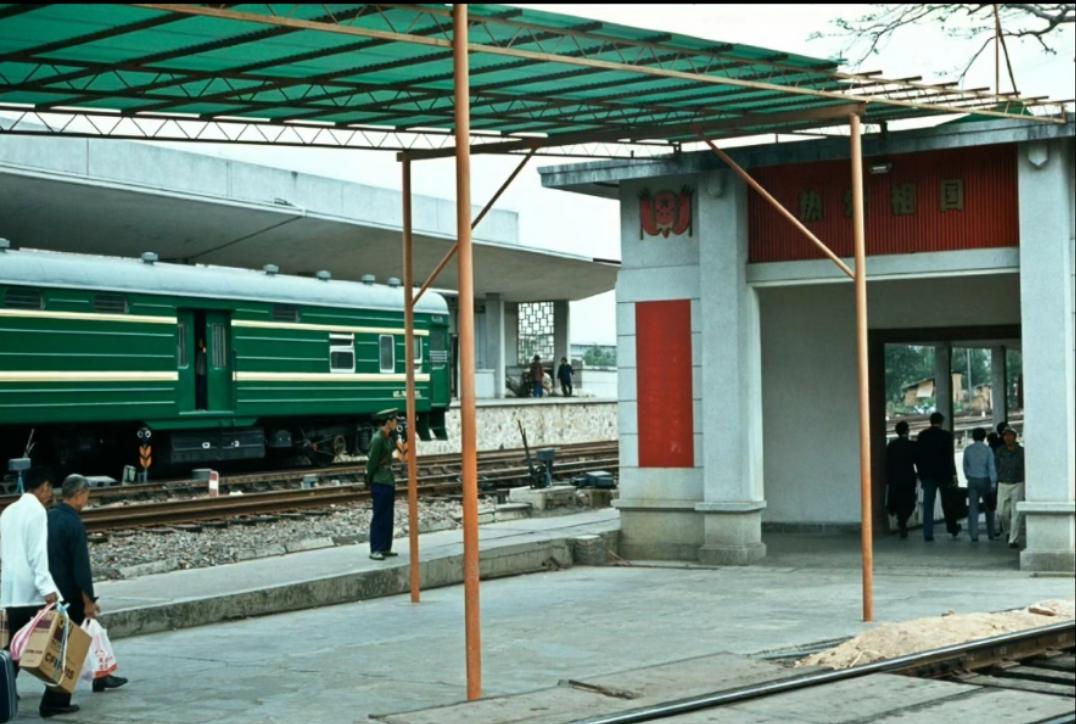
The fastest trains of that era were the "green cars" — painted in dark army green — running on the three main trunk lines between Beijing and Shanghai, Beijing and Guangzhou, and Beijing and Harbin. Their theoretical top speed was 120 km/h, but in practice, owing to poor track conditions and a large number of station stops, they averaged around 50 km/h for years on end. Beijing to Shanghai took sixteen hours; Beijing to Guangzhou, thirty hours — you boarded, slept through a night and an entire day, and when you woke up, you were still on the train. For the whole of the 1990s, this was the fastest and longest-range form of passenger transport running on China's railway network.
More than thirty years later, on December 26, 2025, a new high-speed line between Xi'an and Yan'an in Shaanxi Province opened, and China's national high-speed railway operating mileage officially passed 50,000 km. That figure means a single country — China — now holds more high-speed rail mileage than all other countries in the world combined. That same year, China-built Fuxing EMUs were running on the Jakarta-Bandung high-speed railway in Indonesia at a commercial speed of 350 km/h, compressing a journey that once took three hours down to forty minutes — making it the first true high-speed railway in Southeast Asia and in the entire Southern Hemisphere.
How did a country whose fastest passenger trains could only manage 120 km/h in 1993 — averaging less than 50 — manage, in a little over two decades, to become a country whose high-speed rail network accounts for over half the world's total, capable of packaging and selling a complete high-speed rail system to Indonesia?
High-speed rail, on the surface, seems to be a question of how fast a train can go. But a train that can operate safely at 350 km/h has never been just about the train — it is a matter of an entire system: traction motors and converters, IGBT power chips, braking, train control, bogies, aluminum-alloy car bodies, wheels, overhead catenary... Beneath each subsystem lies a separate industrial chain. Many countries can manufacture a single high-speed railcar body; the countries that can replace every subsystem in that complete assembly with one made at home can be counted on one hand.
So this is not, in the end, a history of high-speed rail. It is a history of how China grew every single subsystem of high-speed rail, one segment at a time, into its own industrial cluster.
The starting point on that line was a latecomer whose average passenger-train speed had not yet crossed 50 km/h.
I. The Heart: High-Speed Rail Is Not a Train, It's a System
Let us first be clear about what high-speed rail actually is, because the story that follows only holds together if this foundation is in place.
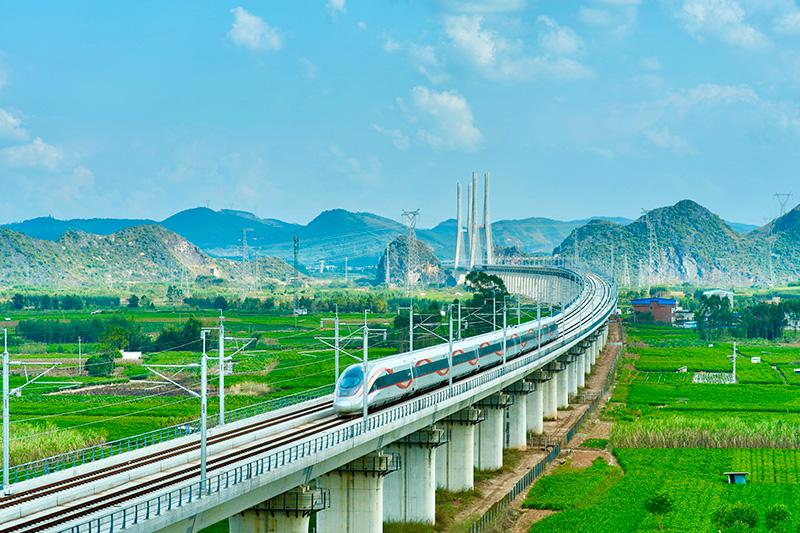
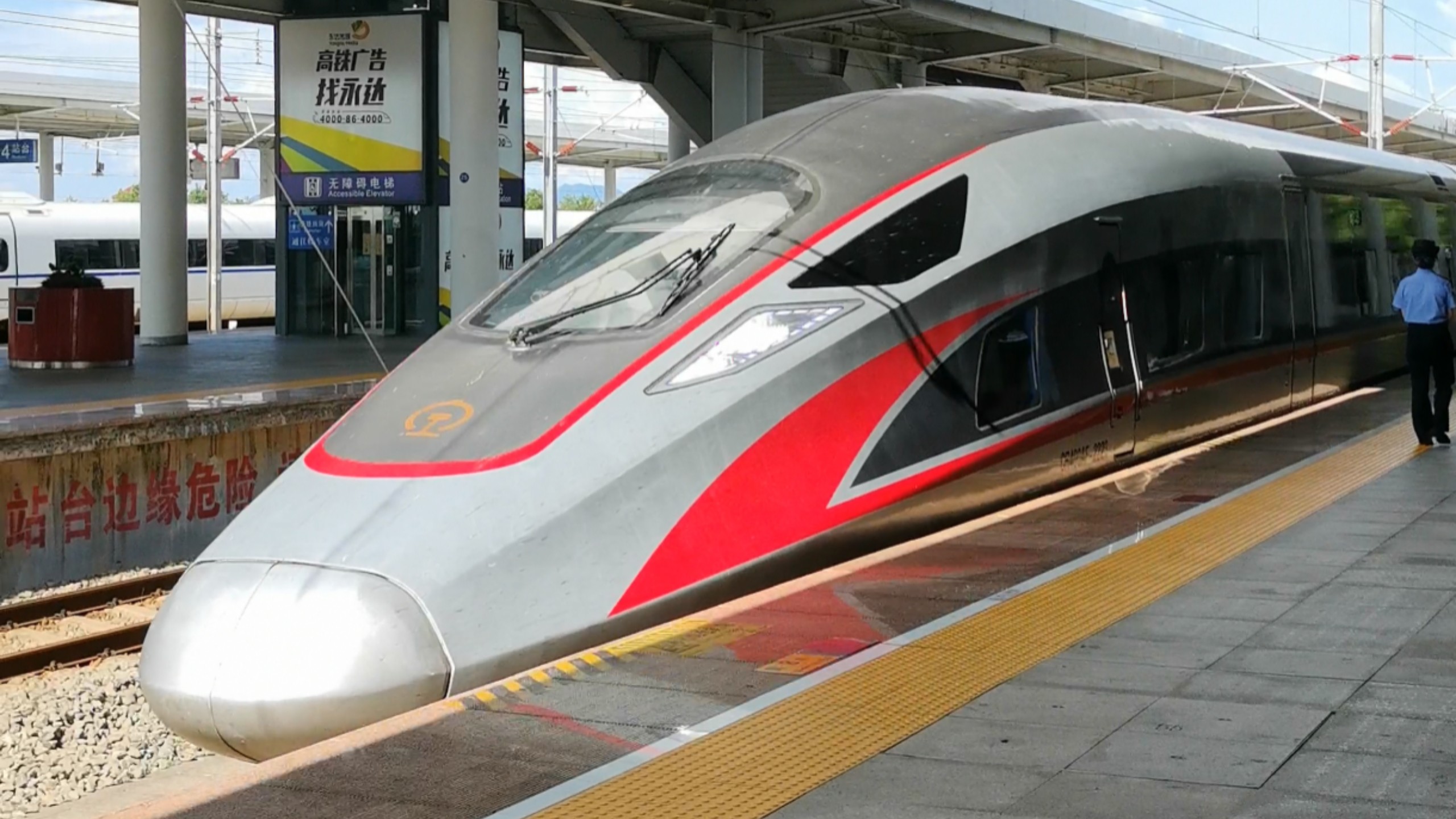
A conventional passenger train centers on a locomotive at the front — the traction unit pulls a string of a dozen or so unpowered cars behind it, and going much above 100 km/h is already at the edge of its capability. A high-speed EMU is an entirely different structure. There is no "locomotive." Power is distributed across the whole train: in a consist of eight or sixteen cars, almost every other car is a "motor car," fitted with traction motors that drive the wheels beneath it. A Fuxing CR400AF has four motor cars out of eight, and the combined output of the traction motors fitted to those four cars exceeds 9,000 kW — roughly equal to the peak annual electricity demand of a high-rise residential tower.
That is only the first layer. Break open a high-speed EMU and it is assembled from at least the following sub-industrial chains:
The first segment: traction motors and converters. This is the complete system that takes high-voltage AC from the grid, converts it first into DC and then into variable-frequency current that can be fed into the motors, and drives those motors to turn. It is the "heart" of a high-speed EMU.
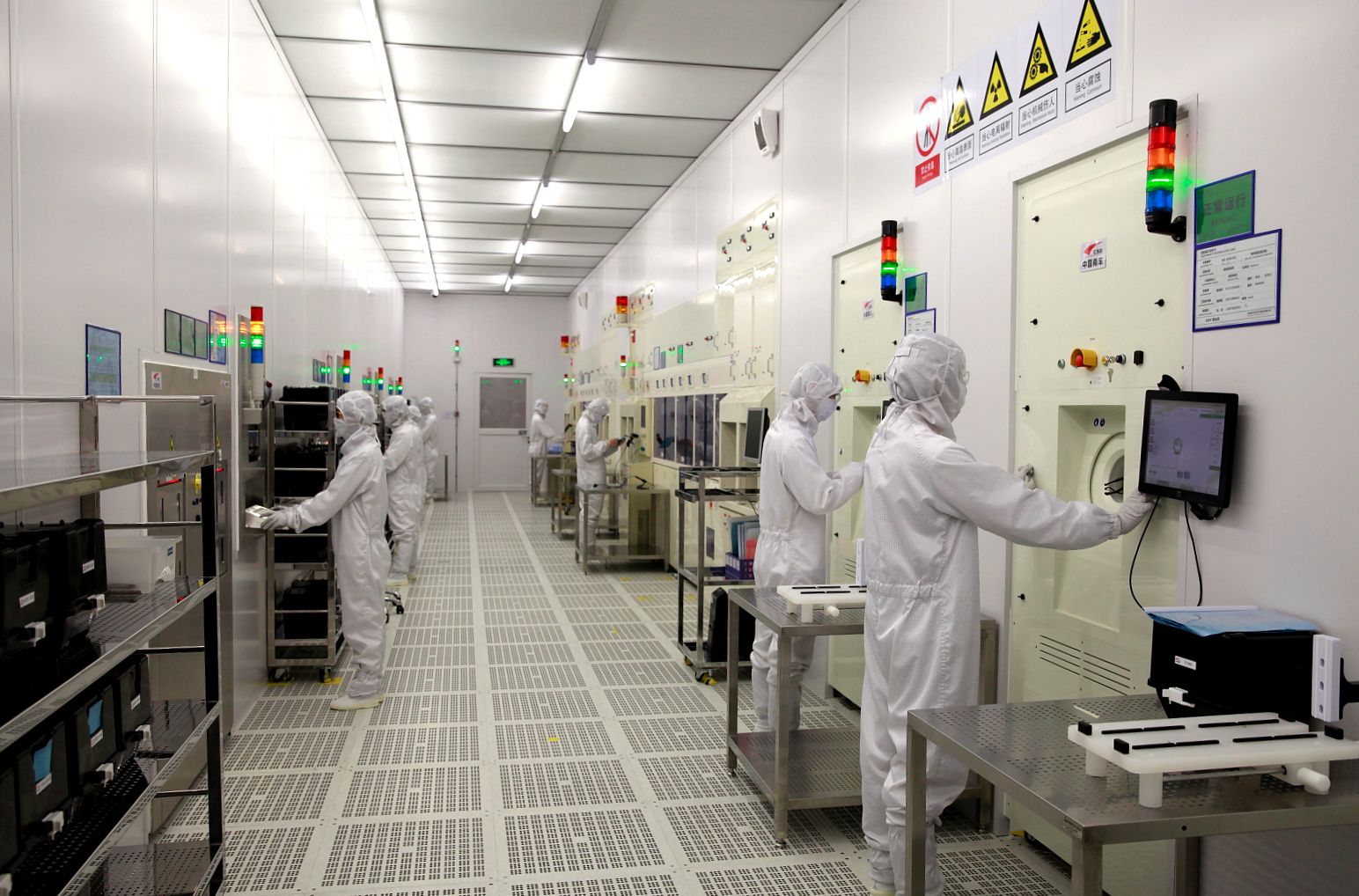
The second segment: IGBT power semiconductors. The core switching element inside the converter — the insulated-gate bipolar transistor. A single Fuxing CR400AF traction converter contains more than 1,100 IGBT chips. Without qualified high-voltage IGBTs, it is simply impossible to build a converter suitable for high-speed rail.
The third segment: braking systems. A fully loaded sixteen-car consist weighs close to 1,000 tonnes. Bringing it safely to a stop from 350 km/h is not as simple as "applying the brakes" — it requires regenerative braking, air braking, and magnetic-rail braking working in concert, bringing a load as heavy as a building to a smooth halt over a distance of three to five kilometers.
The fourth segment: train control systems. At 350 km/h, two trains running toward each other, following each other, or changing tracks move far too fast for a human driver's eye to respond in time. All headway control, speed enforcement, and signal communication must be handled by an automated train protection system, running on both trackside and on-board equipment — this system is called CTCS, the Chinese Train Control System.
The fifth segment: bogies. The running gear fitted beneath each car body. It must bear the weight of tens of tonnes per car, remain stable at 350 km/h, and filter out vibration from the rail so that none of it propagates into the passenger cabin — it is among the most technically demanding components on a high-speed train.
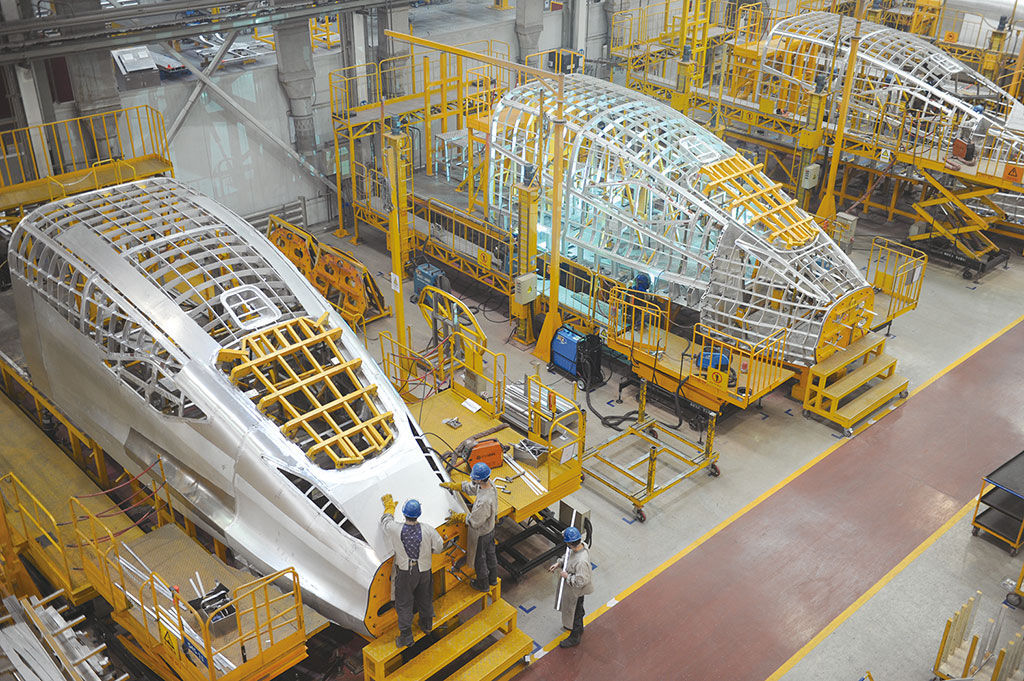
The sixth segment: aluminum-alloy car bodies. The body of a high-speed railcar is assembled almost entirely from large-cross-section hollow aluminum-alloy extruded profiles. A single profile can be 300 to 400 mm wide with walls only a few millimeters thick, and must run for kilometers without a single flaw — thinner, longer, and more precise than a roll of newsprint.
The seventh segment: wheels and axles. Every wheel on an EMU must bear a load of over ten tonnes and spin at 350 km/h. Any non-metallic inclusion invisible to the naked eye can evolve, under high-speed operation, into a fatal crack. For a long time this was a question answered only by a handful of manufacturers: Japan's Sumitomo Metal Industries, Germany's Bochumer Verein, and a few others.
The eighth segment: overhead catenary. The power line strung above the train. It must deliver 25,000 volts of high-voltage AC into every moving train at a relative speed of 350 km/h — without a single interruption — accounting for wind, rain, snow, and thermal expansion and contraction in every calculation.
Assemble these eight segments and the result is a train that can run stably at 350 km/h. Behind each segment, in turn, lies its own sub-industrial chain spanning steel, chemicals, electronics, materials, and precision manufacturing.
The outcome of the high-speed rail contest, therefore, has never been a question of whether any given train manufacturer can build an attractive shell. It has been a question of whether each of these eight subsystems could be replaced by one made at home — and whether, behind each one, the country had a factory network capable of catching the parts.
This logic holds for shipbuilding, for machine tools, for power batteries, and for photovoltaics. What is different about high-speed rail is its degree of difficulty — it requires bringing every one of these eight subsystems to a global front-tier position simultaneously; it requires them to work together, their interfaces aligned; and it requires doing all of that inside a single train, at 350 km/h, for twenty years of safe commercial operation.
China traveled from a country with a passenger average of 48 km/h to this point in a little more than two decades. That story begins with a train called the "China Star."
II. China Was Not the One to Start This Race
China did not invent high-speed rail.
On October 1, 1964 — the same day the Tokyo Olympics opened — Japan's Tōkaidō Shinkansen began service between Tokyo and Shin-Osaka, with its inaugural train running at a commercial speed of 210 km/h. That was the world's first true high-speed railway. Seventeen years later, in September 1981, France launched the TGV between Paris and Lyon at a commercial speed of 260 km/h, eventually pushing it up to 300. Another decade passed and, in 1991, Germany's ICE entered service between Frankfurt and Cologne.
By the end of the twentieth century, Japan, France, and Germany had been operating high-speed rail for more than thirty years. Where was China's railway at that point?
In 1993, the national average speed of all passenger trains on China's railway network was roughly 48 km/h. The fastest "green cars" had a theoretical top speed of 120, but in practice the average could only be nudged, very slowly, from 48 up toward the low 50s. Beijing to Shanghai took sixteen hours; Beijing to Guangzhou, thirty. Steam locomotives were not officially retired from China's national railway mainlines until 2002 — meaning that up to that year, some lines on the Chinese railway network were still operating steam engines trailing white smoke. That same year, France's TGV had been running for twenty-one years and Japan's Shinkansen for thirty-eight.
China's railways were trying to push forward on their own. Starting on April 1, 1997, the Ministry of Railways launched six successive "speed-up campaigns" — incrementally upgrading the existing conventional rail network, increasing train speeds notch by notch. Each round came with a numerical target: 140 km/h in 1997, 160 in 1998, expanded coverage in 2000 and 2001, breaking 200 in 2004, and the Sixth Speed-up reaching 250 in April 2007. Across the six rounds, more than 20,000 km of existing track was upgraded, lifting the national average speed from 48 km/h in 1993 to over 70 km/h by 2007. This is a ten-year chapter that later received little attention, yet was critically important as a period of accumulated experience. It gave China's railways their first real-world experience operating trains safely in the 200 km/h and above speed range.
But there was something the speed-up campaigns could not deliver — true high-speed rail.
The existing network could be pushed to perhaps 250 km/h; beyond that it ran out of headroom: curves were too tight, the roadbed too weak, the signaling system too slow, and the rolling stock not designed for higher speeds. To run at 300-plus required an entirely new railway built to high-speed standards; it required EMUs designed from scratch to high-speed standards — that was a different undertaking altogether.
China had in fact tried going it alone at home. On November 27, 2002, an electric multiple unit called the "China Star" (DJJ2) recorded a speed of 321.5 km/h on the Qin-Shen dedicated passenger line between Shenyang and Qinhuangdao — China's own speed record at the time. The very next day, the China Star was forced to halt during testing when an imported French bearing overheated and triggered an alarm. The train subsequently operated under a 160 km/h speed restriction and never achieved commercial success; in August 2006 it was retired from service.
The China Star episode was not major news in the public record, but inside the industry it landed like a heavy blow. It exposed a fundamental problem: China at that point could already run a train to 321 km/h on its own, but a single imported bearing could bring the whole thing to a stop. Continuing down a path that was almost entirely domestic-made except for critical components still beholden to foreign suppliers would never get to 350. This failure directly pushed the Ministry of Railways toward a different path — first, bring in foreign technology through contractual terms, digest and absorb it, then talk about genuine independence.
On the other side of this turning point was a debate over strategic direction.
Between 1998 and 2004, there were two opposing camps within China over "how, exactly, should this future high-speed rail network be built." One side advocated magnetic levitation: the vehicle does not touch the rail but floats on magnetic force, and speed could leap past 400 in a single bound. The emblematic project was the Shanghai Maglev Demonstration Line, which opened on October 11, 2003 — Pudong Airport to Longyang Road, 29.86 km, with a peak speed of 431 km/h and the world's first high-speed maglev line in commercial service. The other side advocated steel-wheel-on-steel-rail: the same path as Japan's Shinkansen and France's TGV, with a theoretical ceiling in the 300s, but compatible with the existing rail network.
Both sides had valid arguments. But the problems with maglev were soon exposed: that 29.86 km of line in Shanghai had cost roughly 1.3 billion US dollars to build; the German side refused to transfer core technology; once built, the line was an island, incompatible with the existing rail network; adding another kilometer would be astronomical in cost. And in those same years, the wheel-on-rail world speed record in testing had already touched above 500 km/h — the speed gap had narrowed dramatically.
In 2004, the State Council executive meeting approved the Medium- and Long-Term Railway Network Plan. This was the document that would determine the direction of China's high-speed rail for the next two decades. It drew a line under the strategic debate: adopt high-speed wheel-on-rail technology; do not adopt magnetic levitation. It then laid out a set of numerical targets — by 2020, national railway operating mileage to reach 100,000 km; construction of approximately 12,000 km of dedicated passenger lines on the major heavily-trafficked corridors; a high-speed rail network covering China's principal cities laid out on a "four vertical and four horizontal" trunk corridor framework. This plan was subsequently revised twice, in 2008 and again in 2016, each time adding more — 12,000 km became 16,000, then 30,000, and then actual progress left 30,000 behind. By the end of 2020, China's actual high-speed rail operating mileage was 37,900 km.
One of the key figures driving this was the then-Minister of Railways, Liu Zhijun. He took office in March 2003, presided over the "leap-frog development" strategy, directly pushed through the Medium- and Long-Term Plan project, set the wheel-on-rail direction, and personally oversaw the 2004 international tender that would define the shape of China's high-speed rail. He was later removed from office in 2011 for serious disciplinary violations and sentenced in 2013 — both matters of public record. But the high-speed rail plans he set in motion during his tenure, and the technology-transfer strategy he drove through, left their mark on the industrial system in ways that have become irreversible facts.
The 2004 tender set by that decision pushed the next chapter of China's high-speed rail history onto another track entirely.
III. Introduce and Digest: The Textbook of Four Foreign Suppliers
On June 17, 2004, the Ministry of Railways, acting through China National Technical Import & Export Corporation, issued a tender document to foreign and Sino-foreign joint-venture enterprises worldwide: Tender for Railway EMUs with a Maximum Speed of 200 km/h. This was the first public procurement of China's high-speed rail era.
The tender document set out three non-negotiable conditions: first, core technology must be transferred — foreign parties were required to sign "comprehensive technology transfer contracts" with Chinese domestic enterprises before submitting a bid, or face immediate disqualification; second, price must be the lowest — for equivalent technology, the higher bid was out; third, Chinese branding was mandatory — the final product, when sold, must carry the label of a Chinese enterprise.
Those three conditions were already hard. The truly hard one was the fourth — the qualification rule for bidders. Bidders "must be Chinese manufacturing enterprises legally registered within the People's Republic of China" and must have received "technical support from a foreign partner with proven EMU design and manufacturing technology for railway speeds of 200 km/h." In legal language, this sentence shut off any possibility of a foreign party bidding independently. If a foreign company wanted to enter the Chinese market, it had to partner with a Chinese train manufacturer.
On the Chinese side, the Ministry of Railways arranged a "strategic buyer" mechanism — across the entire country, only two state-owned enterprises were designated as the "buyer within buyers" authorized to interface with foreign parties: CNR Qingdao Sifang and CNR Changchun Railway Vehicles. Of the four international heavyweights — France's Alstom, Germany's Siemens, Canada's Bombardier, and Japan's Kawasaki Heavy Industries — anyone wanting in had to pick one of these two Chinese plants as a partner.
This was a two-against-four asymmetric negotiation. Four foreign companies competed for two Chinese partners; fail to match up, and you were out.
On July 28, 2004, the day the tender closed, only three consortia submitted valid bids: CNR Sifang with Kawasaki-led consortium of six Japanese companies; Changchun Railway Vehicles with Alstom; and a Sifang-Bombardier joint venture together with Bombardier itself. Siemens failed to find a suitable Chinese partner in time, and at the last moment before submission refused to move on price — the prototype car was priced at 350 million yuan per trainset and the technology transfer fee demanded was 390 million euros — and was kicked out of the first round by the Ministry of Railways. Germany's Handelsblatt later reported that Siemens' stock fell sharply that day, the executive responsible for China business was dismissed, and the entire negotiating team was reorganized.
First-round results: Kawasaki and CNR Sifang won CRH2, based on the Japanese Tōhoku Shinkansen E2-1000 series platform; Alstom and Changchun won CRH5, based on Alstom's Italian ETR-600 New Pendolino platform; the Bombardier-Sifang joint venture BST won CRH1, based on the Swedish-lineage Regina C2008 platform. Three platforms, sixty trainsets each, with a combined contract value of roughly 12 billion yuan.
But that was not the end.
In June 2005, the Ministry of Railways launched a second round of procurement, this time targeting EMUs at 300 km/h. Siemens had learned its lesson — over the preceding year it replaced its first-round negotiating team, approached Tangshan Railway Vehicles Co., Ltd. under CNR Group, and returned to the table.
The Ministry of Railways representative Zhang Shuguang drew a hard line: the price for each prototype trainset had to come below 250 million yuan, and the technology transfer fee had to come below 150 million euros. This time Siemens accepted. In November, Siemens and the Ministry of Railways signed an agreement: an order for sixty CRH3C trainsets, total contract value approximately 1.3 billion euros — with the technology transfer fee cut from the previous year's 390 million euros down to 80 million euros, a reduction of more than 80%. The per-trainset price also came within the Ministry's stated limit.
This negotiation has since been analyzed repeatedly in international business history. According to public reporting, it was written up as a case study for Stanford University's economics curriculum.
After the second round closed, the four-platform structure of China's high-speed rail was essentially finalized:
- CRH1 — Canada's Bombardier × CNR Sifang, based on the Swedish Regina platform, manufactured in Qingdao by joint venture BST;
- CRH2 — Japan's Kawasaki Heavy Industries × CNR Qingdao Sifang, based on the Shinkansen E2-1000 series, manufactured in Qingdao;
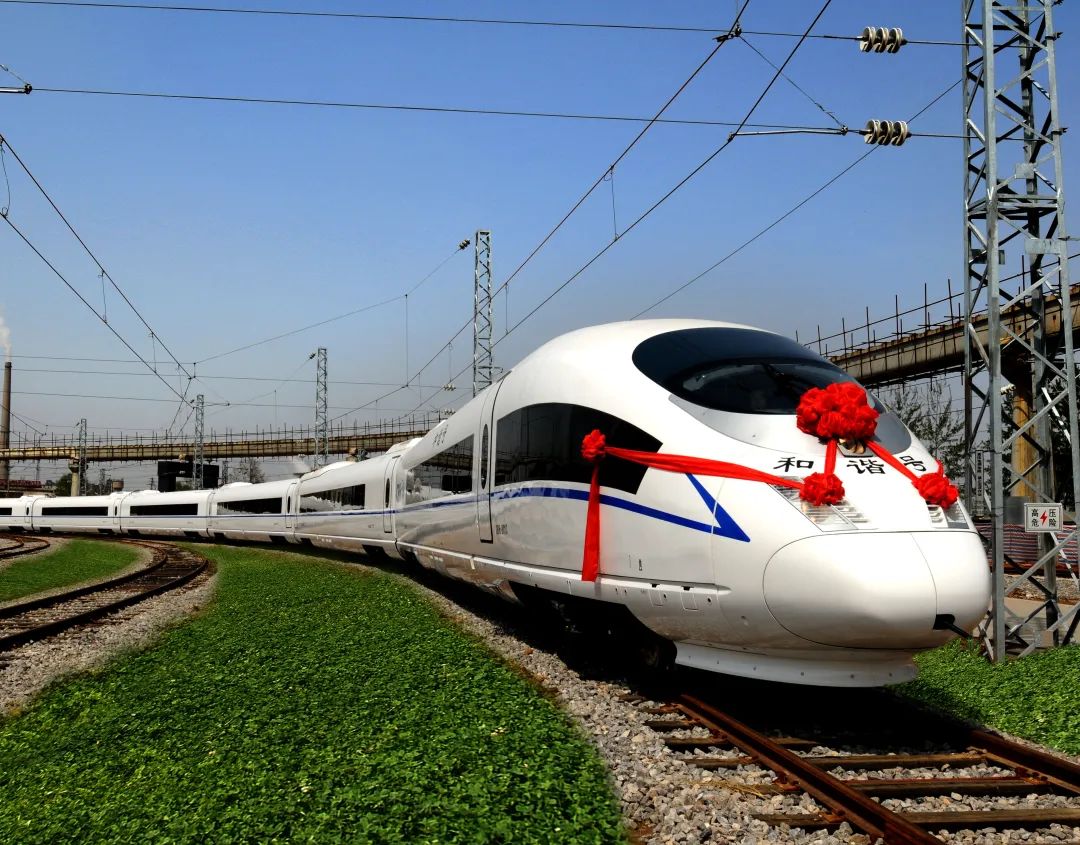
- CRH3 — Germany's Siemens × CNR Tangshan, based on the Velaro platform (ICE3 lineage), manufactured in Tangshan;
- CRH5 — France's Alstom × CNR Changchun, based on the Pendolino/ETR-600 platform, manufactured in Changchun.
Each platform was delivered in three steps: the first batch of three trainsets was manufactured at the foreign party's home factory — Kobe in Japan, Krefeld in Germany, Savigliano in Italy — and shipped as complete trains to China by sea; the second batch of six to nine trainsets was shipped in completely knocked-down (CKD) form to Chinese factories, assembled by Chinese workers following the foreign party's blueprints; the remaining fifty-one trainsets were manufactured entirely at Chinese factories, using the transferred technology, in China.
The most critical element was the "payment tied to learning" mechanism written into the contracts. The Ministry of Railways did not pay in full upon signing; an intermediate institution — the EMU Joint Office (动联办) — was established specifically to assess whether the Chinese enterprise had "learned the technology." Whether the foreign party had taught well was not the key criterion; what mattered was whether the Chinese enterprise had learned. "If the domestic enterprise has not learned it properly, no payment will be made" — this was in the contract. In practice, this mechanism compelled foreign engineers to bring out even their most closely guarded techniques.
Foreign engineers thus crossed the ocean in waves to Qingdao, Changchun, and Tangshan. Chinese engineers were dispatched in waves to Kobe, Krefeld, and Savigliano. Precise headcounts and durations do not appear in public records. What is known is that the CRH2 program ran from the formal signing of the technology transfer agreement in August 2005 through the delivery of all sixty CRH2A trainsets before 2008 — three full years of Kawasaki and CNR Sifang engineers going back and forth.
On April 18, 2007, the Sixth Speed-up was launched. That day, CRH EMUs ran in commercial service on China's rail network for the first time — a few CRH1, CRH2, and CRH5 trainsets operating on upgraded conventional lines at 200 to 250 km/h. It was the first day of the EMU era in Chinese railways.
The true high-speed timetable would have to wait another sixteen months.
On August 1, 2008, the Beijing-Tianjin intercity railway opened. Beijing South to Tianjin Station: 116.94 km, designed operating speed 350 km/h. This was the first true high-speed railway in mainland China, and at the time the line with the highest commercial operating speed of any wheel-on-rail railway anywhere in the world. It opened just seven days before the start of the Beijing Olympics. The main train type running on the line at the opening was the CRH3C — transferred from Siemens, manufactured in Tangshan. The first three trainsets of that type had been shipped from Krefeld, Germany just months earlier; the subsequent fifty-seven had already been built in Tangshan. By the time the follow-on contract was signed in 2009, Siemens' supply share in the CRH3 program had already fallen below 20%.
The foreign parties soon sensed that something had shifted.
In April 2010, JR Central Chairman Yoshiyuki Kasai gave an interview to the Financial Times in which he publicly accused Chinese railway suppliers of having "stolen" foreign technology, and claimed China was "running trains close to their safety limits, which would never be allowed in Japan." From that same year, Kawasaki Chairman Tadashi Ohashi, in multiple public statements, indicated that if Chinese high-speed rail patent filings "violated the terms of the contracts the two sides had signed," "we will take some form of action." During this period, one Kawasaki executive said privately to foreign media: "We don't know how to compete with such a rival — they have mastered our technology, yet their cost base is far below ours."
The Chinese response was two-pronged. On the technical side, Ministry of Railways official Li Jun stated clearly: "All high-speed rail patents filed by China are the results of independent R&D and do not infringe on any other country's high-speed rail patent rights." On the intellectual property side, China used the Patent Cooperation Treaty to file international patent applications covering twenty-one core technologies — vehicle assembly, car body structure, bogies, and others — in the United States, Japan, Brazil, Europe, and Russia.
In the end, Kawasaki did not sue. A July 2011 report in Japan's Nikkei newspaper explained the real reason: Kawasaki had gaps in its international patent coverage of core Shinkansen technology — it held overseas patents only in partial areas such as metro vehicles, while the core patents for the Shinkansen itself had mostly been filed in Japan alone. The same reports noted that Siemens had recognized this issue earlier than Kawasaki and "had laid out its patent positions in advance."
In fairness, China did extract real advantages from this negotiation. But the advantage was not extracted by going outside the terms of the contract — it was extracted by pushing every clause of the contract to its limit, using every inch of room available to force concessions. Cutting Siemens' technology transfer fee from 390 million to 80 million euros in the second round was a victory within commercial rules. China certainly exploited the strategic buyer structure, but Siemens and Kawasaki signed their contracts with clear eyes and of their own accord — they traded away a segment of market share they believed China would not hold indefinitely. They simply misjudged the speed of what followed.
By the day the Beijing-Tianjin intercity railway opened in 2008, China's round of technology introduction, digestion and absorption had, in a sense, come to a close.
The story that follows is how each of the eight subsystems moved, one by one, from "purchased abroad" to "made in China."
IV. Replacing Every Subsystem with One Made at Home
Breaking the high-speed EMU into its eight subsystems, the story of the past two decades is really eight parallel stories of "foreign parties exiting, Chinese parties taking over."
The most complete display of introduce-and-digest at work came with the Hexie CRH380 platform.
From 2009, the various manufacturers pushed beyond the CRH1/2/3/5 base toward a target speed of 380 km/h, producing four variants: CRH380A (Qingdao Sifang, Kawasaki lineage), CRH380B/BL (Tangshan and Changchun, Siemens lineage), CRH380C (Changchun, Alstom lineage), and CRH380D (Qingdao Sifang and Bombardier). In September 2010, CRH380A entered commercial service; on December 3 of that year, on the Zaozhuang-to-Bengbu test section of the Beijing-Shanghai high-speed railway, CRH380A-6041L posted a wheel-on-rail test speed of 486.1 km/h — the world record at the time. A little over a month later, on January 10, 2011, the CRH380BL ran 487.3 km/h on the same stretch, raising the record once more.
These two numbers marked the peak of the Hexie era's digestion of transferred technology. But almost at the same moment, events took a sharp turn.
On the evening of July 23, 2011, near the Yongjia-to-Wenzhou South interval in Zhejiang Province, train D3115 — CRH1B platform — came to a halt on a viaduct because of a signal failure. Train D301 behind it — CRH2E platform — ran into it. Four cars fell from the bridge. The accident killed forty people and injured more than one hundred ninety.
The Ministry of Railways' official investigation later concluded that the central cause was a severe design defect in a train control center device called LKD2-T1, developed by the Beijing National Railway Research and Design Institute of Signal and Communication under China Railway Signal & Communication (CRSC). After a lightning strike burned out a fuse in the equipment, the system failed to enter fail-safe mode, and instead sent the dispatch center an erroneous signal indicating the section was clear. A series of further failures in emergency response compounded the outcome.
After the accident, fifty-four officials were held accountable. Former Minister of Railways Liu Zhijun was found to bear responsibility for having irregularly compressed construction timelines and reduced safety inspection requirements. One year and eight months later, on March 17, 2013, the Ministry of Railways was formally dissolved — ending the system in which the regulator and the operator were the same institution.
The Yong-Wen accident's impact on China's high-speed rail supply chain was that of an accelerator forcibly depressed. In the short term, the top commercial operating speed of conventional-speed EMUs was cut from 250 km/h to 200; the Beijing-Shanghai, Beijing-Guangzhou, and Shanghai-Hangzhou high-speed services were reduced from 350 km/h to 300; all fifty-four CRH380BL trainsets were recalled for inspection; and national approvals for new rail lines were suspended. But in the long run, the accident forcibly accelerated several things that might otherwise have moved more slowly:
First, indigenization of train control systems shifted from an encouraged policy to a mandatory requirement — foreign firms were barred from independently supplying the core automatic train protection software. Second, critical signaling equipment entered systematic safety review; all devices of the LKD2-T1 type were recalled. Third, CTCS-3 — China's autonomous, high-redundancy high-speed train control system designed to tolerate single-point failures — was rolled out nationwide at a pace far faster than pre-accident plans had envisioned.
The death toll is a cost that cannot be offset by any industrial advance. But in the years following the accident, the industrial path of China's high-speed rail supply chain was, undeniably, straightened by that cost.
In 2012, the Ministry of Railways launched the "China Standard EMU" development project — with a single objective: produce a completely autonomous standard specification, cleaning up the incompatibility between CRH1/2/3/5 variants that had been going their own separate ways. CNR Qingdao Sifang took on CR400AF; CNR Changchun Railway Vehicles took on CR400BF. On June 30, 2015, the first prototype rolled off the line.
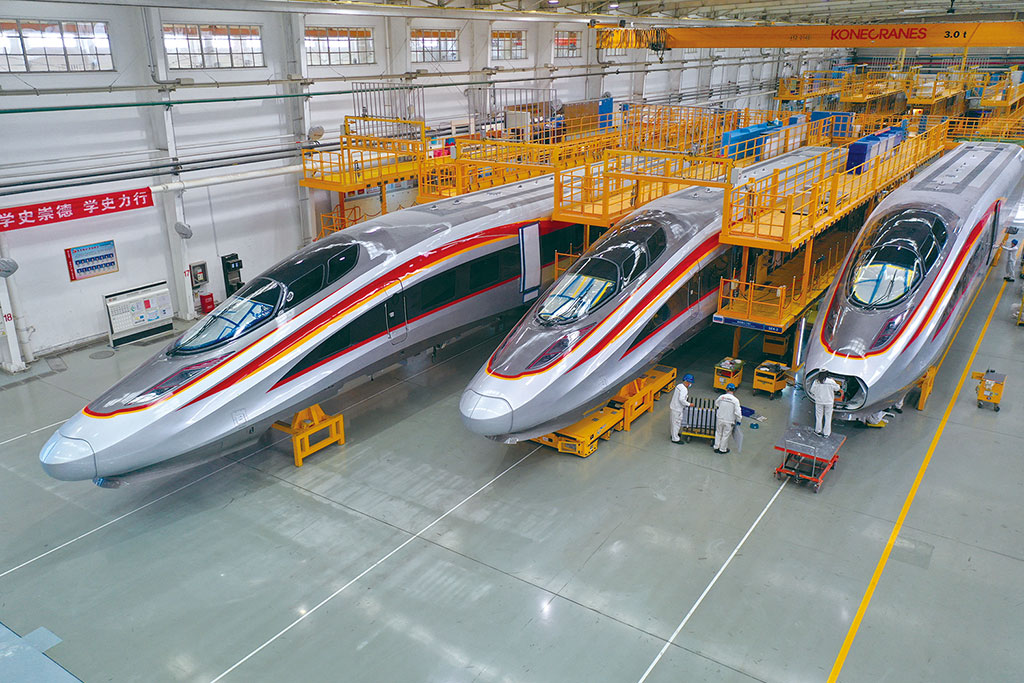
On June 25, 2017, the two variants were formally named in Beijing — "Fuxing" (Rejuvenation). The next day, CR400AF (nicknamed "Silver Dolphin" by the public) and CR400BF (nicknamed "Golden Phoenix") entered simultaneous commercial service on the Beijing-Shanghai high-speed railway.
The most fundamental difference between the Fuxing and the Hexie has been simplified in public discourse to a single figure — "84% domestic content." But the true meaning of that figure is not simply a localization rate — it means that among the 254 key technical standards applicable to the CR400 series, 84% adopted Chinese autonomous standards, with the rest conforming to international standards. More significantly, the software for all critical systems was developed independently by the Chinese side, which holds full intellectual property rights.
This had two implications. First, the CR400 series could be exported freely — the Hexie-era models were constrained by foreign parties' contract clauses and could not be sold abroad; the Fuxing answered to no one. That is why, when the Jakarta-Bandung high-speed railway opened in 2023, the trains running on it — KCIC400AF — could be a derivative of the CR400AF. Second, unified standards became a reality for the first time: the CR400AF and CR400BF, though from two different factories with two different foreign-technology lineages, share compatible car-end couplers, pantograph heights, train communication protocols, and rescue traction interfaces. Mixed consists and cross-line operation between the two variants present no obstacle — something categorically impossible in the Hexie era, when CRH2 and CRH3, with their different technical lineages, could not be directly coupled.
"Unification" is the underlying character of this generation of Chinese high-speed rail.
So what, specifically at the level of the eight subsystems, happened at the moment of the Fuxing's 2017 launch and in the decade that followed?
Traction motors and converters. During the introduction period, CRH2's traction modules were supplied by Japan's Mitsubishi Electric, CRH3's by Siemens, and CRH5's by Alstom — this market had been a European-Japanese three-way monopoly. The two Chinese players that mattered were CRRC Zhuzhou Institute / Times Electric (Zhuzhou Institute, now CRRC Times Electric) and Yongji Electric (Shanxi Yongji). In 2010, Zhuzhou Institute's in-house CI11 traction converter entered commercial service with CRH380A — the first mass deployment of a domestically made traction converter on a high-speed EMU. By 2017, the Fuxing CR400AF was fully equipped with Zhuzhou Institute's autonomous IGBT converters, paired with the Zhuzhou Electric YQ-625 permanent-magnet synchronous motor (PMSM) — PMSMs offer higher efficiency and smaller footprint than traditional asynchronous induction motors, and represent the direction of next-generation traction technology. On the other side, CR400BF, in the Changchun lineage, uses traction motors from Yongji. Yongji and Alstom established a joint venture as early as 2006 — Xi'an Alstom Yongji Electric Equipment Co. (XAYEECO) — absorbing Alstom's traction motor technology; as of March 2024, this joint-venture factory had produced its 30,000th traction motor.
IGBT power semiconductors. In the entire high-speed rail supply chain over the past two decades, this has been the hardest chip to crack.
Before 2007, 6,500-volt high-voltage IGBTs were monopolized by Germany's Infineon and Siemens, Japan's Mitsubishi Electric, and Fuji Electric. Every traction converter in every Chinese high-speed train used imported IGBT modules. Any external supply disruption would have stopped every train.
On October 31, 2008, CRRC Zhuzhou Institute (then known as CSR Times Electric) acquired 75% of the shares of a British company — Dynex Semiconductor (Lincoln, Lincolnshire, UK) — through a buyout. Dynex was one of a very small number of companies in the world capable of independently manufacturing high-power IGBTs; its history traced back to the AEI Semiconductor division of the 1960s. The acquisition received explicit support from the National Development and Reform Commission and the Ministry of Railways. In 2019, Zhuzhou Institute acquired Dynex's remaining shares; Dynex became a wholly owned subsidiary.
Following the acquisition, the Chinese side built a joint R&D center at Dynex's UK facility (2010), retaining the British engineering team and using their process foundation to develop the next-generation chips. Then, on July 10, 2014, in Zhuzhou, Hunan — China's first, and the world's second, 8-inch high-power IGBT wafer line began production. The investment totaled approximately 240 million US dollars (roughly 1.4 billion yuan), with technology from the Lincoln team. Phase-one capacity: 120,000 eight-inch wafers per year, one million IGBT modules, covering voltages from 650 volts up to 6,500 volts — the latter being the highest voltage class required by high-speed rail traction systems.
In 2017, with the Fuxing CR400AF/BF entering mass production, traction converters across the board were equipped with CRRC Times Electric's independently developed 6,500 V, 200 A IGBT modules. The significance of this is not merely one component being localized — it marks the moment when Mitsubishi Electric's approximately half-century of dominant supply position for IGBTs in China's high-speed rail formally ended.
From 2008 to 2017: nine years. What Zhuzhou Institute did in those nine years was not simply buy a British company — it took the long-silent industrial chain inside that British company, connected it to a new factory in Hunan, China; rescued the British engineers from a facility under threat of closure and gave them workbenches to keep working; then took the entire process — plus Chinese-side improvements — and moved it forward in China. On the tenth anniversary of the Dynex acquisition, Zhuzhou Institute sent people to hold a commemorative event in England. The group photograph showed a British factory building and Chinese engineers — the most decent-looking version of what it means to relocate an industrial chain across national borders.
Braking systems. This is the longest stretch in the high-speed rail indigenization story — and one of the few areas where China's gap has not yet been fully closed. Core technology for high-speed rail braking systems has long been dominated by Germany's Knorr-Bremse. Knorr-Bremse's strategy in China has been deep localization: in 2005 it established a "Knorr-Bremse Rail Vehicle Systems (Suzhou)" factory, and in 2016 built a complete braking test center in Suzhou. Production lines, workers, and the vast majority of components are within China, but core patents remain with Knorr-Bremse. The Chinese push toward indigenization has been led by units under CRRC Zhuzhou Institute and CRSC's Zongheng Electromechanical. The braking system on the Fuxing CR400 uses the Knorr Suzhou plant as its primary supplier, with the Chinese side responsible for software and system integration; in the next-generation CR450, the Chinese proportion continues to rise, but "core braking algorithms plus critical valves" is not yet a fully solved problem.
Train control system CTCS-3. This is the high-speed train's "brain." China's train control system, developed with reference to Europe's ETCS, has evolved autonomously as CTCS — graded from Level 0 to Level 4 by speed. CTCS-2 is used on lines at 200 to 250 km/h; CTCS-3 is used on the 300–350 km/h high-speed mainlines. Functionally, CTCS-3 is equivalent to European ETCS Level 2, both using a GSM-R radio communication plus track circuit redundancy architecture. The primary suppliers of this system are CRSC (China Railway Signal & Communication) — a central enterprise formed in 2010 and listed on the Hong Kong Stock Exchange in 2015 — and CASCO Signal — a joint venture established in Shanghai in March 1986 by CRSC and France's Alstom, the first Sino-foreign joint venture in China's railway industry. The Yong-Wen accident forcibly pressed the accelerator on CTCS-3: foreign enterprises were barred from independently supplying core ATP software, all signaling equipment entered systematic safety review, and all LKD2-T1 type devices were recalled and inspected. Today, CTCS-3 fully covers every high-speed line in China operating at 300 km/h and above.
Bogies. This is the running gear beneath each car body, and it determines the EMU's ride stability and safety margin. The CRH2's bogies were largely manufactured from Kawasaki's drawings at the start; by CRH380A, CNR Qingdao Sifang had produced the independently designed SWMB-400 power truck frame and SWTB-400 trailer truck frame, using a 920 mm large-diameter wheel and a worn tread profile. The Fuxing CR400AF uses an "H-frame frameless bolsterless air-spring" bogie, designed entirely by the Chinese side, with ride-quality indices verified through more than 110 combinations of parameter testing, outperforming the national standard's "excellent" grade. But one component on the bogie remains unresolved — axle-box bearings. Sweden's SKF, Germany's Schaeffler, and Japan's NSK and JTEKT remain the principal suppliers of high-speed rail axle-box bearings; Luoyang LYC Bearings and Wafangdian Bearing Group have developed domestic axle-box bearings that have passed 600,000 to 1.2 million km in-service verification, but remain in the batch-deployment validation stage. This is China's high-speed rail "last kilometer."
Aluminum-alloy car bodies. A high-speed railcar body is assembled almost entirely from large-cross-section hollow aluminum-alloy extruded profiles. A decade or more ago, China imported all such profiles from Japan and Germany. The breakthrough came from three companies: Nanning Aluminum (Guangxi Nanning), Congli Group (Shandong Zhangqiu), and Zhongwang Group (Liaoning Liaoyang). Congli is the most emblematic — it supplied approximately 60% of the body material for the Jakarta-Bandung high-speed railway's KCIC400AF trains. From purely importing to exporting: China's aluminum-alloy extrusion profile supply chain took roughly a decade to make the transition. Today, this segment is no longer a weakness in China's high-speed rail.
Wheels and axles. This segment, twenty years ago, was one of the most anxiety-inducing for China's high-speed rail. High-speed rail wheels had long been monopolized by Japan's Sumitomo (now under Nippon Steel), Germany's Bochumer Verein, and France's Valdunes — any non-metallic inclusion invisible to the naked eye could, at 350 km/h, evolve into a fatal crack, making this one of the supply chain segments with the most exacting requirements for raw material and process. China's breakthrough came from Masteel (Ma'anshan Iron & Steel Group). Masteel formally launched its high-speed rail wheel indigenization R&D in 2008. In 2014, Masteel did something with far-reaching consequences — it acquired France's Valdunes for approximately 13 million euros (roughly 100 million yuan). Valdunes had two factories, in Dunkirk and Valenciennes, and was France's only dedicated forged railway wheel manufacturer — and the exclusive supplier of wheels for the French TGV. After the acquisition the company was renamed "MG Valdunes," retaining 487 French employees. The acquisition gave Masteel direct access to Europe's most advanced high-speed rail wheel metallurgy and forging technology. Around 2022, Masteel's domestically developed wheels for the 350 km/h Fuxing completed batch deliveries and were fitted to trains in service; by July 2024, Fuxing trains fully equipped with domestic wheels had accumulated more than 600,000 km of safe operation. Domestication of axles was handled by Taiyuan Heavy Industry (TYHI); the first batch of autonomous axles rolled off the line in 2014 and completed all verification testing by the end of 2016.
Overhead catenary. This segment was localized long ago. China's catenary technology is led by China Railway Electrification Bureau Group (CREB), which has presided over the drafting of national standards and independently undertaken catenary engineering on the Beijing-Shanghai, Beijing-Guangzhou, Beijing-Hong Kong, and Lanxin high-speed mainlines, among others. Today this technology has reversed direction and is being exported — the Ethiopia-Djibouti railway and the Hungary-Serbia railway both have catenary systems built by Chinese parties.
On June 1, 2015, CSR Corporation Limited and CNR Corporation Limited merged to form CRRC Corporation Limited.
The merger was not prompted by noble motives — the two central enterprises had been undercutting each other in international markets, driving the price on an African project below cost and damaging the overseas reputation of the entire Chinese rail transit equipment sector. The State-owned Assets Supervision and Administration Commission drove the merger through with a clear objective: eliminate internal friction, present a unified face externally. The legal structure was CNR absorbing CSR; the combined entity employed approximately 175,700 people, with a domestic railway rolling-stock market share exceeding 90% — a single company overseeing the production of virtually all of China's high-speed EMUs, electric locomotives, and urban rail vehicles. Revenue exceeded the combined total of Siemens and Alstom, making it the world's largest rail transit equipment manufacturer.
After the merger, internal division of responsibility was quickly adjusted: Sifang took the lead on CR400AF, Changchun on CR400BF, with unified standards — no more duplication; Zhuzhou Institute became the entire group's traction and semiconductor core platform, no longer with resources scattered.
By the time the Fuxing entered service in 2017, of the eight subsystems in China's high-speed rail, seven — traction, IGBT, car body, wheels, axles, catenary, and bogies — had achieved domestically manufactured batch deployment. Braking and axle-box bearings remained the "last kilometer" still being tackled.
In June 2023, the CR450AF prototype recorded 453 km/h on the Fuzhou-Xiamen high-speed railway — the latest wheel-on-rail record in China. On December 29, 2024, the CR450AF and CR450BF dual-type prototypes were jointly unveiled in Beijing. This generation introduces silicon carbide (SiC) power devices in traction — SiC takes over from IGBT as the next-generation semiconductor; train control is upgraded to CTCS-400T; the lightweight car body uses an aluminum alloy plus carbon fiber composite structure, reducing weight by 12% compared with the CR400 series; aerodynamic drag is reduced by 22% versus the CR400. Delivery to China State Railway Group is planned for 2026, with commercial service at a designed speed of 400 km/h on the newly built Chengdu-Chongqing mid-line high-speed railway in 2027.
When that day arrives, China will become the only country in the world running 400 km/h as a routine commercial operating speed — the current commercial ceiling for Japan's Shinkansen, France's TGV, and Germany's ICE remains between 300 and 320 km/h.
V. The Chinese Factory Network Behind a Single Fuxing Train
At this point, it is worth spreading out one more picture: behind a single Fuxing as it rolls off the production line, how many factories are actually supplying it?
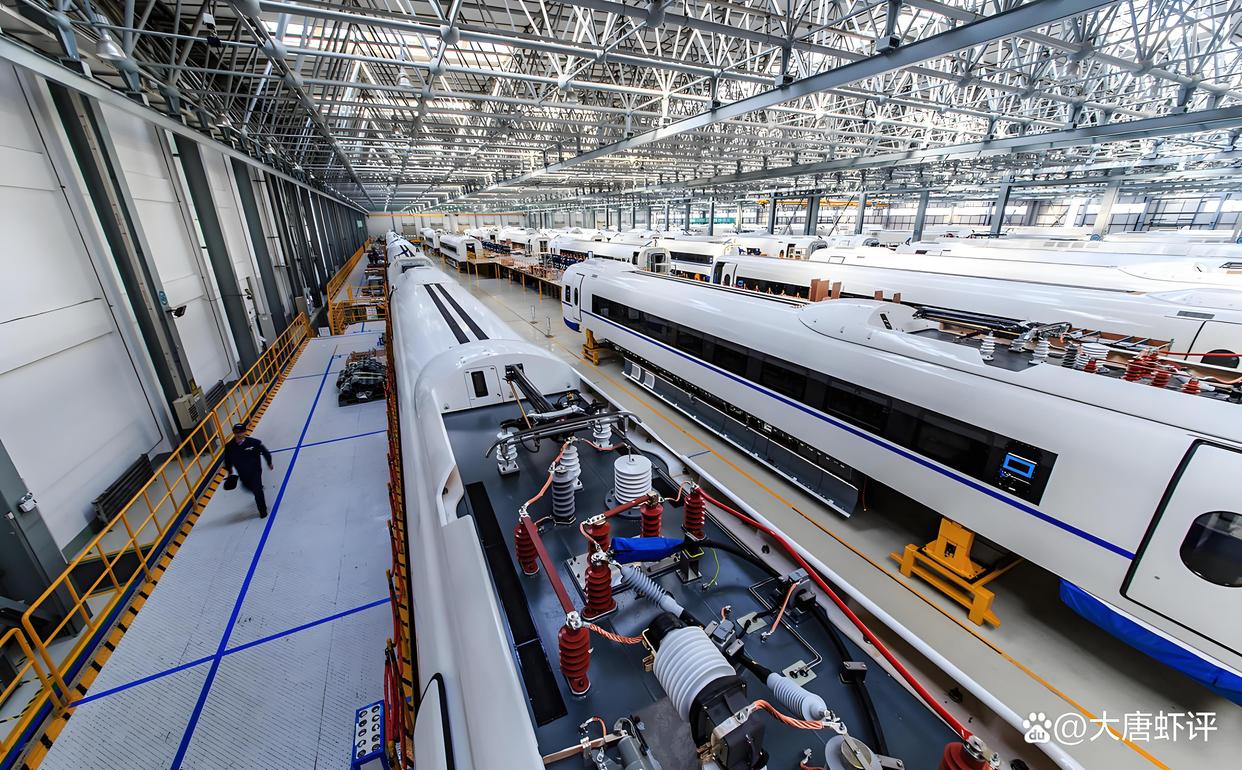
According to CRRC Corporation's own public figures: a single Fuxing trainset involves more than 40,000 parts, with more than 2,100 supplier enterprises directly involved in production, distributed across more than twenty provinces in China; through CRRC's supply chain linkages, the second- and third-tier supporting enterprises number more than 6,000 SMEs; a subset of critical components comes from thirteen countries and regions worldwide. The depth of this supply chain is, even within the history of Chinese industry, exceptional.
The network, geographically, is laid out in a shape that is quite legible — spread around four cities.
Zhuzhou, a city in east-central Hunan Province. Since 1936 it has been the core of China's electrified railway equipment manufacturing. In 1936, the Ministry of Railways established the "Zhuzhou Electric Locomotive Works" here (today's CRRC Zhuzhou Locomotive); over the following ninety years, this city grew what is now the world's most densely concentrated cluster of rail transit equipment manufacturing. In 2023, the total scale of Zhuzhou's rail transit equipment cluster exceeded 160 billion yuan, accounting for more than 30% of China's rail transit equipment industry. The cluster contains more than 400 enterprises in the supply chain, of which roughly 273 are above designated scale. The single most telling figure: local supply rate is more than 80% — for a single electric locomotive, over 80% of the required parts can be sourced within Zhuzhou itself. From raw material delivery to completed vehicle rollout, a locomotive's entire supply chain can close the loop within a single city.
The core of Zhuzhou is five CRRC subsidiaries: CRRC Zhuzhou Locomotive (complete electric locomotives — a cumulative total of more than 4,500 units, accounting for approximately 70% of China's national railway electric locomotive stock, with products exported to 51 countries); CRRC Zhuzhou Institute / Times Electric (688187.SH / 3898.HK — traction conversion systems and IGBTs; 2024 revenue 24.9 billion yuan; No. 1 in domestic market share for urban rail traction systems for thirteen consecutive years); CRRC Zhuzhou Electric (traction motors); Times New Material (600458.SH — elastic vibration-damping elements for rail transit; 2024 revenue 20.1 billion yuan; the world's No. 1 in scale for rail transit elastic elements); and CRRC Electric Vehicle (new-energy commercial vehicles). Orbiting these five are: Zhuzhou Jiufang Equipment's elastic wheels, Liancheng Group's shock absorbers and fans, Yonggui Electric's connectors, Times Huaxin New Material's insulation film. This is the most complete expression of an industrial cluster in China — a city that, because of one enterprise, slowly grew an entire supply chain; an entire supply chain that, in turn, rewrote the city's identity from "old industrial base" to "rail-transit manufacturing capital."
Qingdao, at the southern tip of the Shandong Peninsula. The center here is CRRC Qingdao Sifang — whose predecessor, the "Sifang Locomotive Repair Shop," was established during the German occupation of Qingdao in 1900, making it one of China's oldest locomotive and rolling stock plants. CRRC Sifang today holds the highest market share in China's high-speed EMU market — approximately 40% — and more than 70% of the premium passenger coach market. It is the final assembly plant for the CR400AF and the KCIC400AF (Jakarta-Bandung high-speed railway). In the Jimo district of Qingdao, in the Jijuhuatan township where CRRC Sifang is located, there is a "Qingdao Rail Transit Industry Demonstration Zone" that has attracted more than 220 core supply-chain enterprises. In 2024, total industrial output of above-designated-scale enterprises in the zone grew 20% year-on-year, with rail transit sector output up 40% year-on-year. One figure best captures Qingdao's position in this network — approximately 55% of China's high-speed EMUs are produced in Qingdao.
Changchun, the provincial capital of Jilin. The center here is CRRC Changchun Railway Vehicles (CRRC Changke), founded in 1954, a key national project of the first Five-Year Plan, known as "China's No. 1 passenger car factory." Changke today is the No. 2 player in China's EMU market share — approximately 30%. It is the final assembly plant for the CR400BF ("Golden Phoenix"). Its workforce of approximately 11,000 produces annual capacity of 180 to 200 EMU trainsets, while also delivering metro vehicles to domestic and overseas cities — Boston subway, Hong Kong MTR, Iran, Pakistan, and Bangladesh have all received Changke trains. In 2023, Changke exported five trainsets (twenty cars) of high-speed EMUs to Serbia — the first time a Chinese high-end rail transit product had entered the European market. Changchun thereby earned a new title: "China's EMU capital."
Tangshan, in eastern Hebei. The story here is older and more continuous. The predecessor of the Tangshan Locomotive and Rolling Stock Works goes back to 1881 — born alongside the construction of China's first railway, the Tangshan-Xugezhuang Railway (Tang-Xu Railway). China's first steam locomotive, "China Rocket," and the first imperial passenger car, the "Luanyu" (imperial carriage), both came out of this plant. The "starting point" of China's railway equipment manufacturing industry is right here. In 2024, the cold-climate Fuxing CR400AF-G — a variant developed specifically for the extreme climate of northeast China and Inner Mongolia, rated for operation down to minus 40 degrees Celsius — also rolled off the line from this land. The same city, from 1881 to 2024, has built trains without interruption for 143 years. Today, Tangshan's EMU market share is approximately 20%; its three manufacturing bases are spread across Tangshan, Tianjin, and Quanzhou, with a combined factory footprint of more than 6,000 mu and a workforce of nearly 10,000.
These four cities — together with Zhuzhou Institute, Qingdao Institute, Changke Technology Center, and Tangshan Technology Center behind them, and China Railway Signal & Communication, Yongji Electric, Masteel, Taiyuan Heavy Industry, Congli, Nanning Aluminum, Zhongwang, Beijing West Industries, Kangni Mechanical & Electrical, Yonggui Electric, Times New Material, and others — form the full supply chain of CRRC Corporation and the ecosystem that surrounds it.
In fiscal year 2024, CRRC Corporation Limited recorded revenue of 246.457 billion yuan (up 5.21% year-on-year), with net profit attributable to listed company shareholders of 12.388 billion yuan; it sold 1,940 EMU cars, 642 locomotives, and 5,504 urban rail vehicles for the year; new orders signed totaled approximately 322.2 billion yuan, of which 47.2 billion yuan were international orders. Export products covered 116 countries and regions.
At the more macro level, the network connects to another set of numbers: as of end-2024, China's high-speed rail operating mileage reached 48,000 km; the full-year fixed-asset investment in railways was 850.6 billion yuan (up 11.3% year-on-year); the total market scale of China's rail transit equipment industry reached 992.8 billion yuan in 2023 — expected to break through 1 trillion yuan in 2024.
In mapping out China's high-speed rail industry, the Tianxia Gongchang Industrial Research Institute sees precisely this kind of network: from the raw material headwaters — steel, aluminum, copper — through to the precision tail end — chips, bearings, control software — from Zhuzhou's traction industrial cluster, to the complete-vehicle clusters of Qingdao, Changchun, and Tangshan, out further to the more than 2,100 direct supply enterprises and more than 6,000 small and medium suppliers scattered across more than twenty provinces, and all the way to the 4.8 million factories identified and confirmed across the country on the Tianxia Gongchang platform — of which more than 10,000 have direct or indirect connections to rail transit equipment. This is a supply network you can buy a single train from, but cannot buy out, and cannot move.
And this is also the true foundation on which China has achieved its global position in high-speed rail.
VI. Going Abroad: From Beijing-Tianjin to Jakarta-Bandung
In 2015, Indonesian President Joko Widodo invited both China and Japan simultaneously to submit proposals for a high-speed railway from Jakarta to Bandung. This was the most direct head-to-head contest between China and Japan in the international large-scale infrastructure market.
Japan's proposal was a line from Jakarta to Cilegon, approximately 140 km, five stops along the route, phased construction, an estimated project duration of roughly five years; financing was to be provided by the Japan Bank for International Cooperation (JBIC) at an extremely low rate of around 0.1% — but Japan insisted that the Indonesian government provide sovereign guarantees. China's proposal was a 142-km full line direct from Jakarta to Bandung, eight stations, designed operating speed 350 km/h, three-year construction; financing from China Development Bank (CDB) at around 2%, no sovereign guarantee required; in terms of equity structure, the joint-venture company KCIC would be 60% held by the Indonesian side and 40% by the Chinese — giving Indonesia majority control.
In late September of that year, the Indonesian government announced: China had won.
Where did Japan lose? Based on analysis from Australia's Lowy Institute in 2023 and multiple Financial Times reports from 2015, the core reason came down to a single point — sovereign guarantees. Indonesia was unwilling to put a multi-billion-dollar guarantee on the government's books; Japan was unwilling to lend without such a guarantee; the deadlock persisted until China's combination package — "no sovereign guarantee + higher interest rate + three-year completion + technology transfer + Indonesian majority equity" — turned the outcome. This episode has since been studied repeatedly in international business negotiation history — it was not simply a matter of who offered the lower price, but of who was better able to stand in the procurement party's position and understand what that party actually needed.
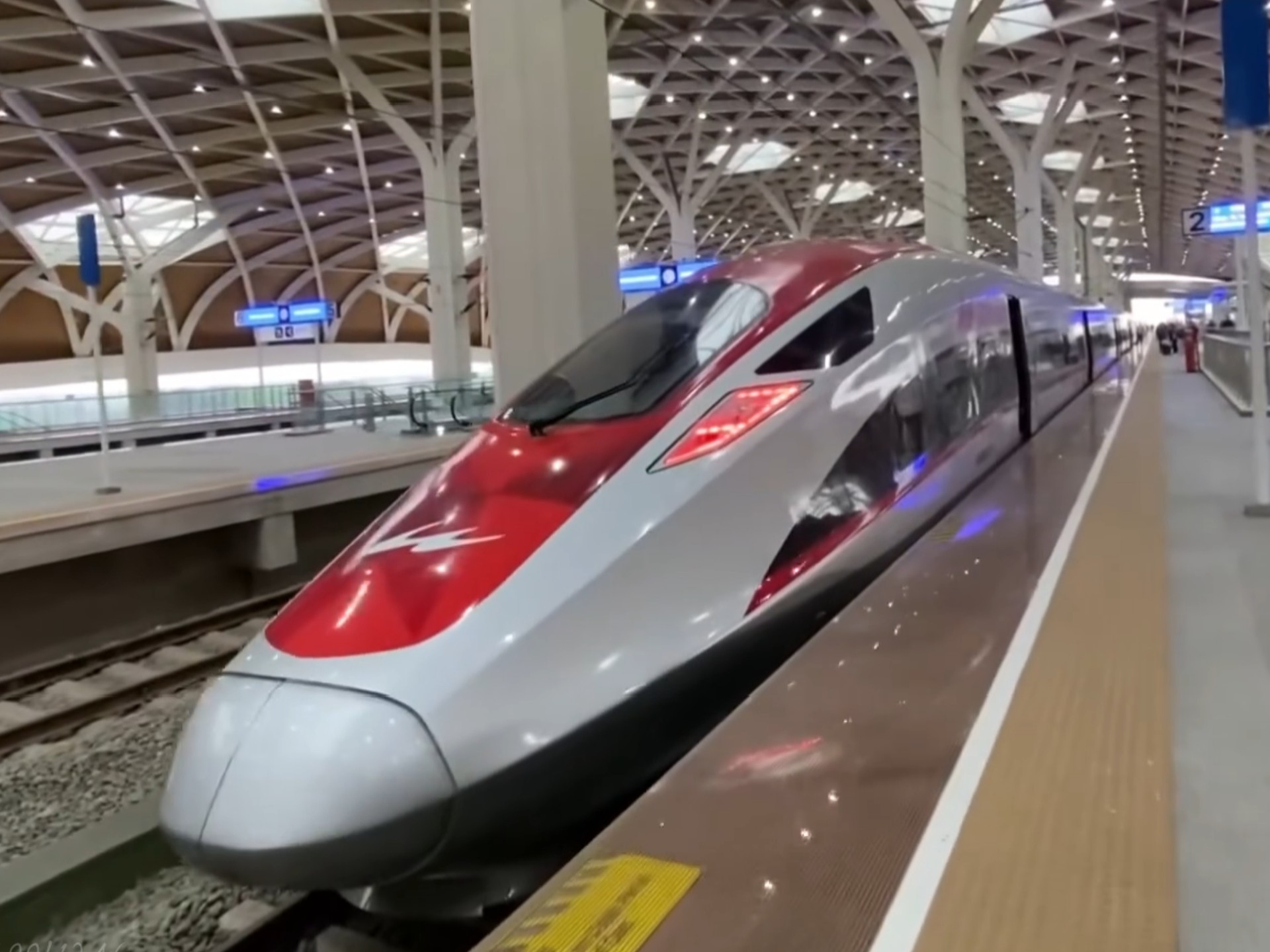
The Jakarta-Bandung line was subsequently given a name by Indonesia — Whoosh, an acronym in Bahasa Indonesia for "punctual, efficient, excellent system," and also an onomatopoeia for a high-speed train rushing past. The total route length is 142 km, designed and commercial operating speed 350 km/h, and the trains running on it are the KCIC400AF — a derivative of the CR400AF adapted for Indonesia's tropical climate and terrain, manufactured by CRRC Qingdao Sifang, completed in Qingdao and shipped as complete trains to Indonesia by sea; 209 meters long, eight-car consist, designed maximum speed 420 km/h. Indonesia ordered eleven trainsets plus one comprehensive inspection train.
On October 17, 2023, Whoosh entered commercial service. Jakarta to Bandung: from the previous three hours compressed to forty minutes. The first true high-speed railway in Southeast Asia, and in the entire Southern Hemisphere. By the second anniversary of its opening — October 2025 — cumulative ridership had exceeded 12 million passengers. On June 28, 2025, single-day ridership peaked at 25,794 passengers.
These figures, placed in Southeast Asian context, represent a quite remarkable result. That said, Whoosh has not been without its difficulties.
KCIC recorded an operating loss of approximately 258 million US dollars for all of 2024; continued losses in the first half of 2025; and in August 2025, KAI (Indonesian Railways) President Bobby Rasyidin publicly warned the Indonesian parliament that the project was a "time bomb." Indonesia's Corruption Eradication Commission (KPK) launched a preliminary investigation into the project in early 2025, with the central question being: a construction cost of approximately 52 million US dollars per kilometer — roughly three times the comparable cost for a similar line in China. In October 2025, Indonesia's investment minister publicly stated a wish to extend the repayment period on Chinese loans from the original forty years to fifty or sixty; Indonesia's sovereign wealth fund, Danantara, has been leading debt restructuring negotiations.
These are all matters of fact, and they deserve honest presentation. Whoosh's financial difficulties are primarily not a technical problem — building a brand-new 350 km/h railway within three years, and carrying more than twelve million passengers in the first two years of operation, is technically a solidly delivered outcome. The problems lie in the project's surrounding context: real-estate development along the corridor that never materialized, the "metropolitan commuter" demand between Jakarta and Bandung that never formed, and passenger-flow projections that were overly optimistic from the start. This is a difficulty that is routinely underestimated for late-developing markets — you can technically build a line, but building an urban economic structure around that line capable of making it commercially viable takes far longer than building the railway itself.
The true significance of the Jakarta-Bandung high-speed railway's international debut lies not in whether the joint-venture company makes money in any given year, but in the fact that it was the first time Chinese high-speed rail went overseas in a "full-element, full-supply-chain" form.
The Chinese parties involved in this line can be listed: overall coordination and operations support — China State Railway Group; vehicle manufacturing — CRRC Qingdao Sifang; civil construction — China Railway Construction Corporation and China Railway Corporation; train control system — CRSC (CASCO Signal); traction and power supply — China Railway Electrification Bureau Group; survey and design — China Railway Siyuan Survey and Design Group; financing — China Development Bank (CDB). From design, construction, and equipment through to operations, training, and financing — seven national-level institutions spanning multiple ministry systems, assembled into a complete "bundled overseas" team. This model is fundamentally different from the early Ankara-Istanbul high-speed railway in Turkey, where China only contracted the civil works while the rolling stock came from Spain's Talgo and signaling from European ETCS — the single-segment subcontract model.
The Jakarta-Bandung line was also the first complete overseas deployment of CTCS-3 — China's autonomous train control system, the standard force-matured in the aftermath of the 2011 Yong-Wen accident, being brought onto a foreign mainline. CRSC, at the Stockholm UITP Summit in 2019, presented its train control solution to European audiences for the first time, attempting to bring CTCS into the international interoperability framework. In June 2022, the National Railway Administration announced that the UIC (International Union of Railways) standard for High-Speed Railway Design — Infrastructure, co-authored under Chinese leadership, had been officially published — incorporating Chinese core technologies such as the CRTS III ballastless track slab system. China has begun inserting its own engineering standards into UIC international standards.
Beyond Jakarta-Bandung, China's overseas railway efforts over the past twenty years have produced other lines.
The China-Laos Railway. Opened December 3, 2021, from Yuxi in Yunnan to Vientiane in Laos, total length 1,035 km; the Laos section is 422 km. Designed passenger speed 160 km/h — not high-speed rail in the strict sense — but it is the first overseas national-level railway to adopt a complete suite of Chinese railway technical standards: track gauge (1,435 mm standard gauge), electrification (25 kV, 50 Hz), signaling system, and rolling stock — all Chinese. It passes through Laos's rugged mountain terrain: 75 tunnels along the entire route (47% of total length) and 167 bridges and viaducts, making the engineering enormously demanding. Since opening: through December 2024, the full line had cumulatively carried 42.92 million passengers, with annual passenger volume in 2024 reaching 19.11 million; through March 2025, cumulative freight had exceeded 54 million tonnes — far beyond initial projections. Cross-border freight trains grew from two trains per day at opening to eighteen. This railway turned the full overland freight route from Kunming to Bangkok and onward to Singapore into something practically operable — a "golden corridor."
Beyond these two lines, Chinese railway enterprises have also built lines in more distant places. The Ankara-Istanbul high-speed railway Phase II (CRCC construction from 2014); the Saudi Arabian Haramain high-speed railway (18th China Railway Bureau as primary contractor for civil works, 2018); the Ethiopia-Djibouti railway (China Railway and Sinohydro, opened 2017, the first African national-level railway built entirely to Chinese standards); the Hungary-Serbia railway (Belgrade to Budapest — the Serbia section opened October 2025, the Hungary section February 2026; once complete, Belgrade to Budapest goes from eight hours to approximately three hours fifteen minutes).
But China's twenty years of overseas railway work have produced both achievements and lessons. To be honest, some projects have stalled, and some have failed outright:
Moscow-Kazan high-speed railway — China-Russia cooperation intent was signed in 2013, a formal agreement in 2014, with the Chinese vision being to make this the first segment of a 10,000-km Beijing-to-Moscow high-speed corridor. But project costs ballooned from an initial roughly 1 trillion rubles to 1.7 trillion (approximately 25 billion US dollars), the Russian side faced fiscal pressure, the financing environment deteriorated after the 2014 Ukraine crisis, and Russia maintained strategic reservations about using Chinese technology and equipment. Suspended from 2020, with no construction to date.
Xpress West (US) — A privately funded high-speed project between Las Vegas and Los Angeles; in September 2015 a cooperation agreement was signed with China Railway International. On June 9, 2016, Xpress West unilaterally terminated the cooperation, citing "China's inability to advance permitting and other necessary procedures on schedule." The Chinese side called this "a mistake" and warned of potential legal action. This is a separate project from California's official San Francisco-to-Los Angeles high-speed rail — which never signed any agreement with Chinese enterprises; the two are frequently conflated in international media.
Tinaco-Anaco railway (Venezuela) — A 7.5 billion US dollar contract was signed between China Railway and Venezuela in 2009. From 2014, Venezuela's macroeconomic crisis hit and the government repeatedly defaulted on construction payments. After completing approximately 31% of civil works, the Chinese side fully withdrew around 2015. In 2021, reports surfaced that some of the already-built track had been dismantled and sold as scrap metal — the most extreme outcome a project can reach.
KL-Singapore HSR — A bilateral Malaysia-Singapore project; Chinese enterprises were never a formal contract party, but the project frequently appears in international commentary as an entry in "China's failed overseas high-speed rail" ledger. It was suspended in 2018 when the Mahathir government took office, formally cancelled on January 1, 2021; the project relaunched in 2023, went to tender in 2025 with China, Japan, and Europe all as candidates — this story has not yet concluded.
Mexico City-Querétaro — In November 2014, a consortium led by China Railway Construction Corporation won the contract, with a contract value of approximately 3.75 billion US dollars. Just days after the award, Mexico's president announced the cancellation of the contract, amid corruption allegations centered on a luxury house belonging to the president's wife; in January 2015, Mexico's government announced the project was on "indefinite hold" due to fiscal tightening from falling oil prices.
Each of these projects has its own specific cause of failure — financing terms that could not be agreed, local political instability, contractor qualification issues, shifts in the external geopolitical environment. Laying them all out here is not an attempt to evade anything — it is because these things are simply the roads a country's industrial chain has to travel as it goes abroad. No industrial power has ever built its global footprint solely through success stories.
By end-2024, China's domestic high-speed rail operating mileage was 48,000 km. On December 26, 2025, the Xi'an-Yan'an high-speed railway opened, and China officially crossed 50,000 km. That same year, Spain — the world's second-largest network — stood at approximately 3,970 km, Japan third at 2,950 km, France fourth at 2,700 km, Germany fifth at 1,600 km — China's high-speed rail mileage exceeds the combined total of every other country in the world. By end-2025, China's high-speed rail could reach more than 97% of cities in China with a population above 500,000.
The China of 2026 is stepping into the next phase: CR450 is approaching commercial launch, pushing the commercial operating speed to 400 km/h; the CTCS-400T train control system is being fitted; the Beijing-Shanghai, Beijing-Guangzhou, and Beijing-Hong Kong mainlines may, between 2027 and 2028, reduce the Beijing-to-Shanghai travel time from its current four and a half hours to close to two and a half.
Conclusion: One Rail, From Beijing-Tianjin to Jakarta-Bandung
We can return now to the question at the beginning: how did a country whose fastest passenger trains could only manage 120 km/h in 1993 — averaging 48 km/h — manage, in a little over two decades, to become a country whose high-speed rail accounts for more than half the world's mileage and that could package and sell a complete high-speed rail system to Indonesia?
The answer is embedded in every subsystem, across every one of those two decades.
It is in the night of November 27, 2002, when the "China Star" ran 321.5 km/h and was stopped the next day because an imported French bearing overheated — forcing China's railway to discard a self-reliance path that could only go that far. It is in the three non-negotiable conditions and the "strategic buyer" mechanism written into the 2004 tender documents, which shut off any possibility of a foreign party bidding independently. It is in the 2005 negotiation that cut Siemens' technology transfer fee from 390 million euros to 80 million — a victory achieved entirely within commercial rules, but pushed to their absolute limit. It is in April 2007, the day of the Sixth Speed-up, when CRH1, CRH2, and CRH5 ran on China's rail network for the first time. It is in August 1, 2008, when the Beijing-Tianjin intercity railway opened and China's railways ran at a commercial speed of 350 km/h for the first time.
It is in October 2008, when CRRC Zhuzhou Institute pressed the button on an acquisition in Lincoln, Lincolnshire, connecting the long-silent industrial chain of a British semiconductor company to a new factory in Hunan, China. It is in the night of July 23, 2011, in the Yongjia-to-Wenzhou South interval — an accident that, at the cost of forty lives, forced this country to change the autonomous control of its train control systems from "encouraged" to "mandatory." It is in the Zhuzhou production line that began in 2014 — China's first, the world's second, 8-inch high-power IGBT wafer line; and in that same year, Masteel using 13 million euros to bring France's Valdunes — the exclusive wheel supplier for the TGV — onto its own balance sheet. It is in June 2015, when CSR and CNR merged to form CRRC — a single company overseeing the production of virtually all of China's high-speed EMUs. It is in the morning of June 26, 2017, when Fuxing CR400AF and CR400BF entered simultaneous service on the Beijing-Shanghai high-speed railway, with 84% of all critical standards self-authored. It is in the decade it took Congli, Nanning Aluminum, and Zhongwang to turn China from a pure importer of aluminum-alloy extruded profiles into an exporter. It is in the twenty years during which, in the factory halls of Qingdao's Chengyang demonstration zone, approximately 55% of China's high-speed EMUs rolled off the line.
It is in October 17, 2023 — the day the Jakarta-Bandung high-speed railway opened, and Indonesian President Jokowi stepped aboard a KCIC400AF — a "made in Qingdao" train bearing the marks of all eight subsystem indigenization chapters in China's high-speed rail story.
How fast a high-speed EMU can go, and how smoothly it runs, depends on how deep the subsystem supply chain behind it goes. China won high-speed rail not by winning a single Fuxing train — it won by bringing traction motors, IGBTs, braking, train control, bogies, aluminum-alloy car bodies, wheels, and overhead catenary — all eight subsystems, one by one — into its own industrial clusters. Having every segment replaceable with one made at home, and then letting these eight supply chains intermesh in Zhuzhou, Qingdao, Changchun, and Tangshan, growing into a factory network that cannot be bought out and cannot be moved.
In its long-term tracking of Chinese manufacturing, the Tianxia Gongchang Industrial Research Institute has come back, again and again, to a single observation: the true measure of an industrial system's quality is not its fastest train, but how many of the subsystems behind that train have already been replaced by ones made at home. China's high-speed rail runs at 350 km/h not because of any single star enterprise, but because from traction motors to IGBTs, from wheels to aluminum alloy, from braking to train control, beneath every subsystem, a factory network made in China has grown.
Today's China is a country constituted by millions of factories — among those verified and confirmed as genuine factories on the Tianxia Gongchang platform alone, there are 4.8 million. Over these past two decades, replacing high-speed rail's subsystems one by one with ones made at home — that work was done by the more than 10,000 factories out of those 4.8 million that have direct or indirect connections to rail transit equipment. A bolt, a wheel, an IGBT chip, a traction cable, a reel of contact wire, a set of bogies — distributed across more than twenty provinces in China, each supplying the others.
From the sixteen hours that green cars needed to cross the Beijing-Shanghai line in 1993, to the forty minutes that the Jakarta-Bandung high-speed railway ran in Indonesia in 2023.
When a Fuxing train pulls out, behind it stand more than forty thousand parts, more than two thousand supporting enterprises, and a network drawn out of the 4.8 million factories in this country.
That is what this country built, over these twenty years.
Data Sources and Principal References
This article was produced by the Tianxia Gongchang Industrial Research Institute based on factory and supply-chain data from the Tianxia Gongchang industrial platform, supplemented by Chinese and international public materials, official information, and reports from authoritative institutions. Principal data and factual sources include:
- Tianxia Gongchang industrial platform's China factory database and industrial cluster data (www.tianxiagongchang.com)
- Annual reports of CRRC Corporation Limited, CRRC Times Electric, Times New Material, CRSC, and other listed companies
- National Railway Administration and China State Railway Group annual statistical bulletins
- National Development and Reform Commission, Medium- and Long-Term Railway Network Plan (2004 edition and subsequent revisions)
- Authoritative media reports from Xinhua News Agency, People's Daily, Yicai, The Paper, Guancha.cn, and others
- International Union of Railways (UIC) Atlas of High Speed Rail, annual data
- World Bank, China's High-Speed Rail Development (2019) and regional economic impact assessments
- English Wikipedia entries: China Railway series, Wenzhou train collision, CRRC, Dynex Semiconductor, and others
- Reports from Railway Gazette International, International Railway Journal, Bloomberg, Reuters, Financial Times, Nikkei Asia, and other authoritative English-language media
- English-language research reports on China's high-speed rail and the Jakarta-Bandung high-speed railway from think tanks including Lowy Institute, CSIS ChinaPower, ITIF, and the University of Melbourne
- Public data releases from KCIC (Indonesia), Antara News, Jakarta Globe, and other sources on Whoosh operating figures