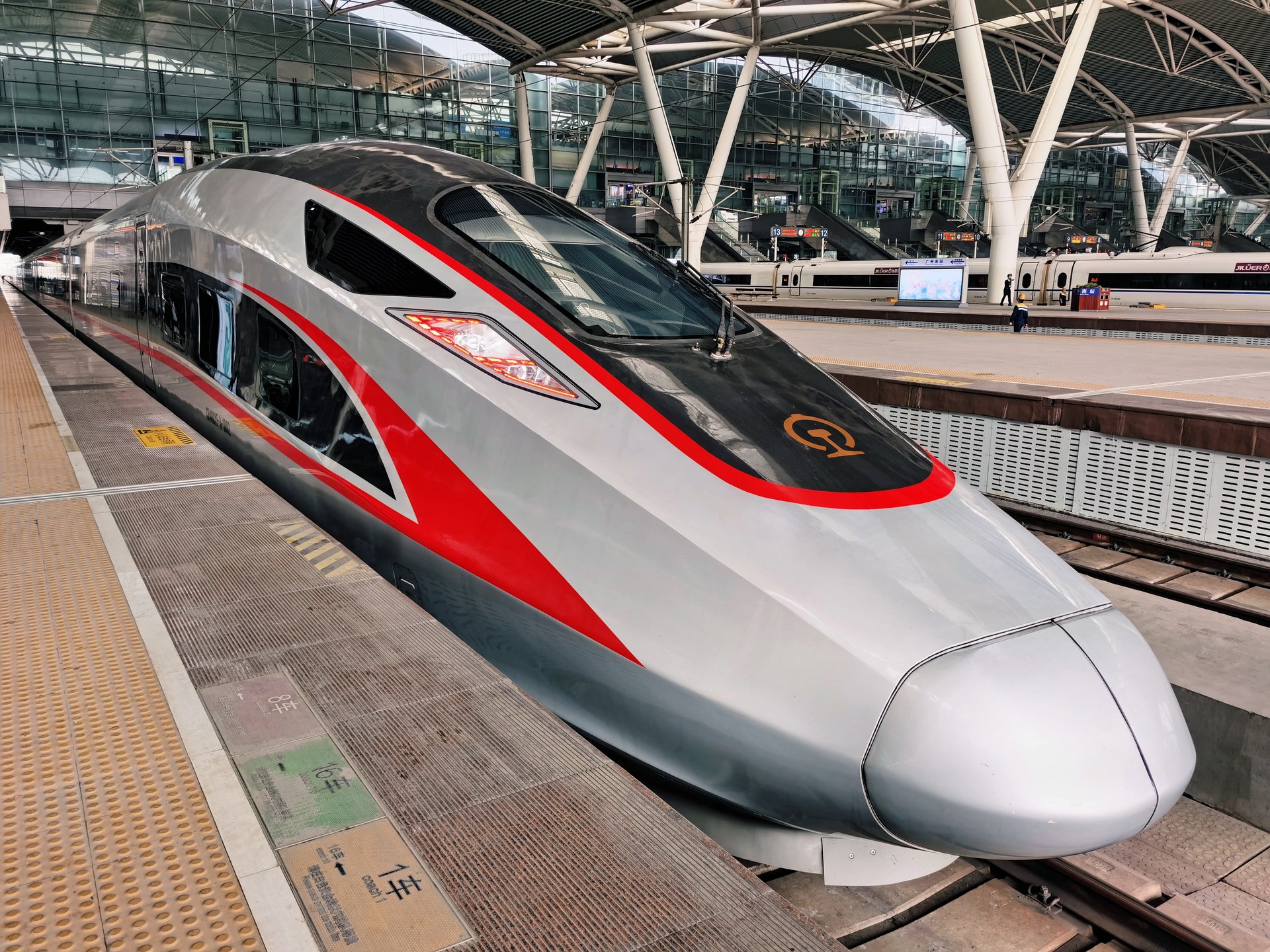

1. Prologue: A National Calling Card
Among all the calling cards of Chinese manufacturing on the world stage, none rings out louder than high-speed rail. When foreign heads of state visit, when "Belt and Road" negotiations take place, when China wants to showcase its industrial might to the world, high-speed rail is always placed front and center. It is a national calling card for Chinese manufacturing, the most dazzling achievement of the "infrastructure titan," and the industry in which China has made the most complete transition from "chasing the pack" to "leading the pack."
Consider just how formidable this calling card is. By the end of 2025, China's high-speed rail in operation had surpassed 50,000 km, accounting for more than 70% of the global HSR network—China alone has more HSR mileage than all other countries in the world combined. For comparison, Japan has about 3,081 km and France about 2,735 km, while the United States to this day has not a single genuine dedicated high-speed railway. In less than two decades, China has built the largest high-speed rail network in the world. And the equipment manufacturer behind that network—CRRC—is the world's largest rail transit equipment enterprise, holding roughly a 53% share by sales revenue of newly built locomotives and rolling stock; this single company's revenue exceeds the combined total of international giants Siemens Mobility, Alstom, and Hitachi Rail.
More important still is speed. At the end of 2024, the CR450 EMU prototype developed independently by China rolled off the line—with a test speed of 450 km/h and an operating speed of 400 km/h, it is the fastest high-speed EMU in the world. It has set records of 453 km/h for a single train and 896 km/h in a relative passing test. Xinhua News Agency described the CR450 as "China's high-speed rail entering the no man's land"—when operating speeds push toward 400 km/h, there is no longer any target left ahead to chase, and China's high-speed rail has entered a "no man's land" all its own. From mileage and scale to top operating speed, China's high-speed rail lays claim to three world firsts.
But the most remarkable thing about this calling card is not these world firsts themselves, but how they were won. Some twenty years ago, China still could not build a genuine high-speed train. In 2004, China launched the world's largest-ever EMU tender, buying technology and products from four foreign parties—Germany's Siemens, France's Alstom, Japan's Kawasaki, and Canada's Bombardier. Back then, China was unequivocally the pursuer, the importer of technology. Today, China not only builds the fully self-owned-IP Fuxing, but has also led the drafting of multiple system-level international HSR standards for the International Union of Railways (UIC), exporting "China Standards" onto the railways of Indonesia, Serbia, and other countries. From buying others' technology to setting standards for the whole world—this is the road China's high-speed rail has traveled, a classic ascent to the summit through "introduce, digest, absorb and re-innovate."
This road makes high-speed rail a unique specimen within Chinese manufacturing. In this "Made in China" series, we have written about tires and power tools that are "big but not strong" (scale without brands); about construction machinery that is "big and growing stronger, closest to the summit" (leading in complete machines, but still one mile short on core components and brand premium); and about drones and power batteries that are "strong but besieged" (globally dominant, and thus targeted for encirclement). High-speed rail is one of the few industries that has truly completed the entire chain from "chasing to leading," with a high degree of independence in core technology—its complete-machine localization rate reaches about 97%, its core train control system (CTCS-3) is 100% domestic, and the Fuxing adopts 84% China Standards. High-speed rail is a specimen of Chinese manufacturing that has genuinely "reached the summit"—it is not merely running alongside, but has achieved the world's number one in mileage, scale, and speed alike, and has exported its technical standards to the whole world.
Yet high-speed rail, having reached the summit, also faces a unique predicament—the "smooth south, blocked north" of going overseas. As a "national calling card," China's high-speed rail is unstoppable in developing markets: the Jakarta–Bandung HSR in Indonesia (Southeast Asia's first high-speed railway), the China–Laos Railway, the Hungary–Serbia (Budapest–Belgrade) Railway, the China–Kyrgyzstan–Uzbekistan Railway—these flagship "Belt and Road" projects have brought China's HSR technology and standards to overseas soil. But the moment it faces the mainstream markets of Europe and America, China's high-speed rail runs headlong into rigid geopolitical barriers—the U.S. National Defense Authorization Act (NDAA) of 2019 barred federal funds from procuring rail cars built by CRRC, and CRRC's subway project in Boston sank into a quagmire of cost overruns, customs seizures, layoffs, and work stoppages. China's high-speed rail overseas presents a stark "smooth south, blocked north"—landing smoothly in developing countries, but meeting hard political barriers in the mainstream markets of Europe and America.
This is the story this article sets out to tell: China's high-speed rail is a national calling card that has reached the summit, yet also faces the "smooth south, blocked north" predicament of going overseas. In fifty thousand words, this article will begin with the three world firsts; travel the ascent to the summit through "introduce–digest–absorb–re-innovate" (the four technology platforms, the CRH380, the Fuxing CR400, the CR450); survey the industrial strength of CRRC and CRRC Times Electric; follow the national-calling-card overseas ventures of Jakarta–Bandung, China–Laos, Hungary–Serbia, and China–Kyrgyzstan–Uzbekistan; examine the encirclement by the three giants Siemens, Alstom, and Hitachi; recount the "smooth south, blocked north" of the U.S. NDAA and the Boston MBTA debacle; probe the "final 3%" chokepoints of high-end bearings, IGBTs, and sensors; and finally return to the core question—how a national calling card that has reached the summit can, amid the "smooth south, blocked north" predicament of going overseas, truly convert China's high-speed rail lead into global influence.
The ascent and the overseas journey of a national calling card—this is both the story of China's high-speed rail and a microcosm of Chinese manufacturing going out into the world. It tells us that even a summit-reaching industry, even the most dazzling national calling card, must face geopolitical barriers beyond the market when it goes global. How China's high-speed rail, having reached the summit, can pierce through these barriers and truly hand this "national calling card" to the whole world is the most gripping storyline of this card's next leg. And it all begins with that CR450, running at 400 km/h into the no man's land.
2. What Is a High-Speed Train: The Value Chain of System Integration
To understand China's high-speed rail achievement of "chasing to the summit," one must first take a high-speed train apart and see its value chain clearly—see exactly which systems make up a 350 km/h EMU, where the value and technical difficulty lie, and how China conquered them one link at a time to achieve a high degree of independence.
A high-speed EMU is an extraordinarily complex system-integration product, which can be roughly divided into several major systems. First is the car body—the carriage structure, the streamlined nose shape, the lightweight aluminum-alloy body—which determines the train's aerodynamic performance, strength, and weight. Second is the bogie—the "legs and feet" connecting the car body to the track, bearing the stability and safety of high-speed operation, and one of the most core components of high-speed rail. Third is the traction drive system—the train's "heart," including the traction converter, the traction motor, and the core power device IGBT, which converts electrical energy from the grid into the power that drives the train forward. Fourth is the braking system—the train's "brakes," which decelerate and stop the train safely and reliably at high speed. Fifth is the network control system (TCMS)—the train's "nerves," which controls and coordinates all the systems across the train. Sixth is the train control system (CTCS)—the "brain and central nervous system" of high-speed rail, which governs the train's operation, spacing, speed, and safety. In addition, there are a great many key components: bearings, wheels, axles, gearboxes, couplers, vibration and noise reduction, and more.
The complexity of this system integration makes high-speed rail a "systems engineering" endeavor—it is not enough to build good individual parts; the car body, bogie, traction, braking, network, and train control systems, along with tens of thousands of components, must be integrated into a whole that can run safely, smoothly, and reliably at 350 km/h. This system-integration capability is the most core capability in high-speed rail manufacturing—it demands extremely high standards of design, manufacturing, integration, and validation. And the most remarkable thing about China's high-speed rail is precisely that it has mastered this system-integration capability—China can not only build the parts, but can design, integrate, and manufacture an entire high-speed train as a complex system, and do so at world-leading levels.
So along this value chain, which links has China mastered, and where does it still depend on others? First, look at the parts that are already highly independent. Whole-train system integration—China has fully mastered it; the Fuxing is entirely self-designed and self-integrated. Car body and bogie—key technologies independently developed. The train control system (CTCS-3)—the "brain" of high-speed rail—China has achieved 100% localization, with the system platform, key technologies, core software, and the full set of equipment all independent, and it has been exported abroad. The traction drive system—independently developed by China, and in particular the core power device IGBT, on which Zhuzhou CRRC Times Electric achieved a domestic breakthrough, shattering the monopoly of Infineon and Mitsubishi. The braking system's brake pads, wheels, axles, and rails—all localized. One could say that China has achieved independence in the vast majority of a high-speed train's systems and components—a complete-machine localization rate of about 97%.
Now look at the "final 3%" that still depends on others. Although China's high-speed rail has reached a 97% complete-machine localization rate, there remains about 3% of high-end links that are not yet fully independent. This 3%, the industry generally points to a few links: high-end bearings (axle-box bearings, long dependent on Sweden's SKF, Germany's Schaeffler, Japan's NTN/NSK), some high-end power and sensing chips, and some high-end sensors (China depends on imports for about 80% of high-end sensors and about 90% of sensing chips). This "final 3%" is the fortress that remains to be conquered in China's high-speed rail being "big and strong"—although the share is small, these are the links with the highest technical thresholds and the hardest to make independent. Conquering this final 3% is the last leg of China's high-speed rail journey from "highly independent" to "fully independent."
This analysis of the value chain reveals the true mettle of China's high-speed rail "summit." China's high-speed rail summit is not hollow—it is built on independent mastery of whole-train system integration and the vast majority of core systems and components (train control, traction, braking, car body, bogie, wheels and rails). A 97% complete-machine localization rate, a 100%-domestic train control system, and the fully self-owned IP of the Fuxing—these are all real, tangible independence. China's high-speed rail summit is a summit reached by genuinely mastering the core technology, not merely leading in scale and mileage. This is also where high-speed rail has "reached the summit" more completely than construction machinery (whose core components remain more heavily constrained).
But the value chain also reminds us that China's high-speed rail summit is not yet a "perfect summit"—there is still the final 3% of high-end links (bearings, high-end chips, high-end sensors) to conquer. This final 3%, though small in share, is the fortress with the highest technical thresholds. It reminds us that even the summit-reaching China's high-speed rail still has gaps to close on the most cutting-edge core components. Just like the solid-state-battery soft spot of power batteries and the high-end hydraulics gap of construction machinery—even when Chinese manufacturing reaches the summit in a given industry, there is often still a breakthrough yet to be made in the most cutting-edge handful of links. Conquering the final 3% is the direction in which China's high-speed rail must keep striving after reaching the summit.
The value chain of a high-speed train is the map for understanding the true mettle of China's high-speed rail "summit." From car body, bogie, traction, braking, and network to train control, China has mastered whole-train system integration and the vast majority of core systems (97% complete-machine domestic, 100% domestic train control); this is the real and solid foundation of its "summit." But there remains the final 3% of high-end links (bearings, high-end chips, sensors) to conquer, and this is the gap it must still close after reaching the summit. Everything that follows in this article—the technology lineage, the industrial strength, the overseas expeditions, the chokepoint offensives—unfolds around this value chain. And the most astonishing thing about this value chain is how China, in less than two decades, went step by step from buying others' whole trains and technology to mastering every one of its links. This ascent "from importing to independence" must begin with the global landscape of the three world firsts.
3. Three World Firsts: Mileage, Scale, Speed
To position China's high-speed rail, the most intuitive approach is to look at the three world firsts it lays claim to—first in operating mileage, first in equipment-manufacturing scale, and first in top operating speed. These three world firsts together sketch out China's high-speed rail's absolute leading position in the global landscape, and are the most powerful proof of its "summit."
The first world first is operating mileage. By the end of 2025, China's high-speed rail in operation surpassed 50,000 km (about 50,400 km), accounting for more than 70% of the global HSR network—China alone has more HSR mileage than all other countries in the world combined. The nation's total railway operating mileage is about 165,000 km. During the "14th Five-Year Plan" period (2021 to 2025), China added about 12,000 km of high-speed rail. By plan, by 2030 the nation's total railway operating mileage will reach about 180,000 km, of which about 60,000 km will be high-speed rail. For comparison, Japan—the birthplace of high-speed rail—has about 3,081 km, France about 2,735 km, while the United States to this day has no genuine dedicated high-speed rail. China's high-speed rail mileage does not lead by a little—it is a crushing lead that exceeds the combined total of all other countries in the world. This is China's high-speed rail's first, and most intuitive, world first.
The second world first is equipment-manufacturing scale. CRRC is the world's largest rail transit equipment manufacturer. According to a report by the German consultancy SCI Verkehr, CRRC, with about €14 billion in sales revenue from newly built locomotives and rolling stock, has held first place globally for many consecutive years, with a market share of about 53%—more than half of the world's newly built locomotives and rolling stock are built by CRRC. CRRC's rail transit equipment business holds over 30% of the global market share, and its metro-vehicle global sales share exceeds 50%. In fiscal year 2025, CRRC's operating revenue reached 273.063 billion yuan (up 10.79%)—a scale far beyond that of international peers Siemens Mobility, Alstom, and Hitachi Rail. China has not only the world's largest high-speed rail network, but also the world's largest rail transit equipment manufacturer. This is China's high-speed rail's second world first.
The third world first is top operating speed. China's independently developed CR450 EMU has a test speed of 450 km/h and an operating speed of 400 km/h, making it the fastest high-speed EMU in the world. And even the Fuxing CR400, currently in large-scale operation, at a commercial operating speed of 350 km/h is among the highest in the world—China is one of the countries with the highest commercial HSR operating speeds globally. From the 350 km/h Fuxing to the 400 km/h CR450, China's high-speed rail stands at the very forefront of the world in top operating speed. Xinhua News Agency described it as "entering the no man's land"—when operating speeds push toward 400 km/h, there is no longer any target left ahead to chase, and China's high-speed rail has entered a no man's land all its own. This is China's high-speed rail's third world first.
These three world firsts—mileage, scale, speed—together prove China's high-speed rail "summit." It does not lead in just one dimension, but has achieved the world's number one across the three most core dimensions: mileage (network scale), equipment manufacturing (industrial scale), and speed (technical level). This all-dimensional world-first status is the most comprehensive proof of China's high-speed rail "summit"—it has "reached the summit" more completely than construction machinery (leading in complete machines but still one mile short) and than power batteries (globally dominant but caught in a triple encirclement). China's high-speed rail is one of the few industries in Chinese manufacturing to genuinely achieve the world's number one across all dimensions.
Behind the three world firsts lies an even deeper support—a complete and leading industrial system. China's high-speed rail's three world firsts are not isolated, but are built on a complete, leading industrial system—from whole-train manufacturing (CRRC), to core systems (traction IGBTs, CTCS-3 train control), to key components (wheels, rails, brake pads), and then to operations and maintenance (a vast aftermarket), China has built the world's most complete and leading high-speed rail industrial system. This complete industrial system is the bedrock of the three world firsts—it lets China's high-speed rail lead not merely in one link, but across the entire industry chain globally. This is also the deepest source of confidence in China's high-speed rail "summit."
But the three world firsts also come with certain issues that must be viewed objectively. Behind the world-first mileage lies enormous construction investment and operating losses on some lines (the economics and debt of high-speed rail have long been contested). Behind the world-first equipment scale lies a heavy dependence on the domestic market (CRRC's overseas revenue share is about 12.75%, still mainly reliant on the domestic market). Behind the world-first speed (CR450) lies the reality that it is still in operational assessment and not yet in large-scale commercial operation. These issues remind us that the three world firsts are a real, tangible lead, but China's high-speed rail development also comes with challenges in investment, debt, overseas expansion, and more. To view the three world firsts comprehensively is to see both its lead and the costs and challenges behind that lead.
The three world firsts—mileage, scale, speed—are the most comprehensive and powerful proof of China's high-speed rail "summit." Built on a complete and leading industrial system, they place China's high-speed rail at the world's number one across the three most core dimensions of network scale, industrial scale, and technical level. It is one of the few industries in Chinese manufacturing to genuinely achieve the world's number one across all dimensions. But behind the summit lie the challenges of investment, debt, and overseas expansion. The three world firsts are the most dazzling backdrop of this national calling card that is China's high-speed rail. And the most remarkable thing about this calling card is not its three world firsts today, but how it went, step by step, from a pursuer twenty years ago to today's summit—and this ascent "from importing to independence" must begin with that world's-largest EMU tender of 2004.
4. Introduce and Digest: The Starting Point of the Four Technology Platforms
China's high-speed rail ascent "from chasing to the summit" has a clear starting point—that world's-largest EMU tender of 2004. It was from this tender that China, under the guiding policy of "introduce advanced technology, jointly design and produce, build Chinese brands," introduced four technology platforms and embarked on the ascent through "introduce–digest–absorb–re-innovate." Understand this starting point, and you understand how China's high-speed rail took its first step toward the summit.
First, the backdrop of this starting point. In 2004, China still could not build a genuine high-speed train. China's strategy at the time was very clear—not to develop from scratch (too slow), but to introduce advanced foreign technology and, through digesting, absorbing, and re-innovating, rapidly close the gap. In June 2004, the Ministry of Railways launched the world's largest-ever EMU tender—procuring 200 km/h EMUs for the sixth major railway speed-up, 140 trains in all. Bidding were the four giants of high-speed trains at the time: Germany's Siemens, France's Alstom, Japan's Kawasaki Heavy Industries, and Canada's Bombardier. This tender was the starting point of China's high-speed rail ascent.
The design of this tender embodied throughout a carefully arranged "market for technology." The tender was split into 7 packages of 20 trains each, with each package containing 1 fully imported prototype, 2 trains assembled domestically from imported knock-down kits, and 17 localized trains—with the localization rate rising step by step, reaching 70% by the last train. In other words, China used enormous orders (140 trains, plus more orders to follow) as leverage to require foreign parties to transfer technology, produce in China, and raise the localization rate. In negotiations, China also used its enormous market as leverage to drive down prices—for example, Siemens initially quoted 350 million yuan per prototype and 390 million euros in total technology-transfer fees, but by 2005 the technology-transfer fee had been driven down to 80 million euros. "Market for technology" was the core strategy of China's high-speed rail introduce-and-digest phase—using its market and orders to obtain technology transfers from foreign parties.
The result of these introductions was the formation of four technology platforms. These four platforms constitute the origin of China's "Hexie" (CRH) series: CRH1, derived from Canada's Bombardier, produced by Qingdao Sifang Bombardier (the joint venture of Sifang and Bombardier); CRH2, derived from Japan's Kawasaki Heavy Industries (based on the Shinkansen E2 series), produced by Qingdao Sifang; CRH3, derived from Germany's Siemens (based on the Velaro platform), produced by Tangshan Railway Vehicle; CRH5, derived from France's Alstom (based on the Pendolino), produced by Changchun Railway Vehicle. The four technology platforms gave China, in one stroke, the technology of the world's four leading high-speed-train giants at the time, laying the foundation for digesting, absorbing, and re-innovating.
But the process of introducing and digesting was not as smooth as imagined, and it also sowed the seeds of controversy. Take Kawasaki's CRH2 as an example—in October 2004, Kawasaki Heavy Industries, representing a "Japanese enterprise consortium," signed a contract with the Ministry of Railways to export railway vehicles and transfer technology, with a total value of about 9.3 billion yuan. Of the 60 CRH2A trains, 3 were assembled whole by Japan and shipped to China, 6 were assembled domestically from knock-down kits, and the remaining 51 were produced domestically by Qingdao Sifang via technology transfer; Kawasaki was responsible for training about 300 people at Sifang. Crucially, however—the Japanese side did not transfer the vehicle's control software and source code. This sowed the seed of the misgiving that "having paid an enormous technology-transfer fee, in the end China imported only the products without the core technology," and it also sowed the seed of the later intellectual-property dispute with Kawasaki (detailed below). Introducing and digesting is not simply a matter of buying technology and being done with it—the core technology (especially software and source code) is often retained by the foreign party, and this is precisely the part China later had to conquer through independent innovation.
The introduce-and-digest phase was the first step of China's high-speed rail ascent, and a starting point full of both wisdom and controversy. The wisdom lay in this—China used the "market for technology" strategy, using enormous orders and its market to rapidly introduce the technology of the world's four giants, standing on the shoulders of giants and avoiding the long slog and risk of developing from scratch. The controversy lay in this—the introduced technology often did not include the most core parts (software, source code), and it sowed hidden intellectual-property risks. But regardless, introducing and digesting laid the foundation for China's high-speed rail summit—it let China master the basic technology of high-speed trains in a short time, providing a platform for the next step of digesting, absorbing, and re-innovating. Without the introductions of 2004, there would have been no later independence of the Fuxing.
The introduce-and-digest phase also holds a profound lesson—introducing is only the starting point; digesting, absorbing, and re-innovating is the key. Introducing technology itself is not hard (with money and a market you can buy it); what is hard is genuinely digesting and absorbing the introduced technology and, on that basis, re-innovating to form one's own independent capability. If one merely introduces products and assembles them, without being able to digest and absorb the core technology and form an independent innovation capability, then one can only ever follow, never lead. The greatness of China's high-speed rail lies not in its having introduced four technology platforms, but in its having genuinely digested and absorbed the introduced technology and, on that basis, re-innovated, ultimately building the fully independent Fuxing. Introducing and digesting is only the starting point; the true summit was reached through the digesting, absorbing, and re-innovating that followed.
The introduction of the four technology platforms was the starting point of China's high-speed rail ascent—China used the "market for technology" strategy to introduce the technology of the four giants Siemens, Alstom, Kawasaki, and Bombardier, forming the four technology platforms CRH1/2/3/5 and climbing onto the shoulders of giants. But the introductions also sowed the hidden risks of untransferred core technology and intellectual-property disputes. Introducing is only the starting point; the true summit was reached through the digesting, absorbing, and re-innovating that followed. And from the four introduced platforms to the fully independent Fuxing, there was a crucial transitional phase in between—the CRH380 series, China's high-speed rail's first leap from "introduced platform" to "independent integration." That is the theme of the next chapter.
5. CRH380: The Transition from Introduction to Independent Integration
From the four introduced technology platforms to the fully independent Fuxing, China's high-speed rail ascent had a crucial transitional phase—the CRH380 series. It was China's high-speed rail's first leap from "introduced platform" to "independent integration design," and the first major fruit of digesting, absorbing, and re-innovating. Understand the CRH380, and you understand how China's high-speed rail went from "assembling others' trains" to "designing its own trains."
First, the positioning of the CRH380. The CRH380 series was a key project of the "Independent Innovation Joint Action Plan for China's High-Speed Trains"—it was no longer a simple introduction and assembly of a foreign party's platform, but an independent integration design by China on the basis of digesting and absorbing the four technology platforms. In September 2010, the Ministry of Railways designated the CRH2-380 type developed by Qingdao Sifang as the CRH380A series. The CRH380 series undertook comprehensive independent research on the low-drag streamlined nose shape, high-airtightness-strength car body, high-speed bogie, noise control, and more—it was China's high-speed rail's first systematic leap from "introduction" to "independent integration."
The CRH380's most dazzling achievement was the high-speed record it set. On September 28, 2010, the CRH380A ran 416.6 km/h in a test on the Shanghai–Hangzhou passenger line; on December 3, 2010, in a speed-boosting test on the pilot section of the Beijing–Shanghai HSR, the CRH380A reached a maximum operating speed of 486.1 km/h near Suzhou East Station. This record stunned the world at the time—it proved that China's high-speed rail could not only introduce and assemble, but could also, on the basis of independent integration, push speed to the very forefront of the world. The CRH380's high-speed record was a powerful demonstration of China's high-speed rail's independent integration capability.
The CRH380 series also included multiple platforms—besides the Kawasaki-lineage CRH380A (Qingdao Sifang), there were the Siemens-lineage CRH380B (Changchun/Tangshan), the CRH380C, and the Bombardier-lineage CRH380D. This multi-platform structure reflects that the CRH380 was a product of independent integration and enhancement on the basis of the four technology platforms—it both inherited the technology of the introduced platforms and incorporated China's own independent integration design. The CRH380 series is the mark of China's high-speed rail transition from introduced platforms to independent integration—it still carried the "bloodline" of the introduced platforms, but had already incorporated more and more of China's own independent innovation.
The significance of the CRH380 lies in its being the first major fruit of "digesting, absorbing, and re-innovating." From introducing the four technology platforms in 2004 to the CRH380's independent integration design and high-speed record in 2010, China's high-speed rail completed its first leap from "introduce-and-assemble" to "independent integration." This leap proved that China could not only introduce and assemble foreign technology, but could genuinely digest and absorb that technology and, on that basis, carry out independent integration design and innovation. The CRH380 was the first major validation of the success of China's high-speed rail's "digest, absorb, re-innovate" strategy—it laid the foundation for the next step of full independence (the Fuxing).
The CRH380 also held a crucial significance—it began to touch on independence in intellectual property. As China's high-speed rail "went out," it faced the intellectual-property constraints of the introduced platforms (such as Kawasaki's stipulation that the technology be used only within China). But the CRH380 (especially the later CRH380A), through independent integration and innovation, began to form its own intellectual property—reportedly, the CRH380A passed a U.S. intellectual-property assessment and was found non-infringing, proving the independent ownership of its core technology. This independence in intellectual property was a crucial step for China's high-speed rail to go from "constrained" to "independent" and to clear obstacles for "going out." The CRH380 was a transition for China's high-speed rail from "constrained" to "independent" in intellectual property.
But the transitional nature of the CRH380 must also be viewed objectively. The CRH380 still carried the "bloodline" of the introduced platforms—it was an independent integration on the basis of the four technology platforms, not yet a fully from-scratch independent design. Its several platforms (A/B/C/D) were each derived from different introduced platforms, reflecting that it was still in the transitional phase from "digest and absorb" to "full independence." The CRH380 was a major leap (from introduce-and-assemble to independent integration), but not yet full independence—full independence would have to wait for the Fuxing of 2017. The transitional nature of the CRH380 precisely embodies the gradualness of China's high-speed rail ascent—from introduction, to independent integration (CRH380), to full independence (Fuxing), it came step by step.
The CRH380 series is the crucial transition of China's high-speed rail from "introduced platform" to "independent integration," and the first major fruit of "digest, absorb, re-innovate." On the basis of independent integration it set a high-speed record of 486.1 km/h, began to form its own intellectual property, and laid the foundation for the next step of full independence. The CRH380 proved that China could not only introduce and assemble, but could also digest and absorb, independently integrate, and push speed to the world's forefront. But the CRH380 still carried the bloodline of the introduced platforms, and was not yet fully independent. China's high-speed rail's true full independence, its true summit, would have to wait for that fully self-owned-IP "China Standard EMU" of 2017—the Fuxing CR400. This mark of China's high-speed rail summit is the theme of the next chapter.
6. Fuxing CR400: The China Standard EMU
If the CRH380 was China's high-speed rail's transition from introduction to independent integration, then the Fuxing CR400 is the mark of China's high-speed rail's true full independence, its true summit. It is the "China Standard EMU"—fully self-owned IP, adopting 84% China Standards, with all software independently developed. The birth of the Fuxing CR400 marks China's high-speed rail's completion of the crucial leap from "chasing" to "the summit." Understand the Fuxing, and you understand the true meaning of China's high-speed rail summit.
First, the birth of the Fuxing. The development of the "China Standard EMU" was launched in 2012. On January 3, 2017, the National Railway Administration issued type-approval certificates and manufacturing licenses to CRRC Changchun and CRRC Sifang, with the types designated CR400AF (Sifang) and CR400BF (Changchun); on June 25 of the same year, it was officially named "Fuxing." On September 21, 2017, after the Beijing–Shanghai HSR implemented a new operating diagram, the Fuxing formally entered commercial operation at 350 km/h—China became one of the countries with the highest commercial HSR operating speeds in the world. The birth of the Fuxing was a landmark moment of China's high-speed rail summit.
The most core significance of the Fuxing lies in its being the "China Standard EMU"—fully self-owned IP. Unlike the earlier Hexie (CRH, derived from introduced platforms), the Fuxing's key technologies—whole train and car body, traction, braking, network, and so on—all possess independent intellectual property, with all software independently developed. Of the Fuxing's 254 important standards, China Standards account for 84%—it was designed and manufactured according to China's own standards, no longer the introduced standards of foreign parties. This "fully self-owned IP, 84% China Standards" is the most essential difference between the Fuxing and the earlier Hexie—it marks China's high-speed rail's transition from "introducing foreign technology and standards" to "fully independent technology and standards." The Fuxing is the mark of China's high-speed rail's true full independence.
The Fuxing's independence is reflected in its conquest of a series of core technologies. The R&D team broke through the core technologies of traction, braking, and network control, as well as the key manufacturing processes for wheels, axles, gearboxes, and more; the key technologies of the car body and bogie were independently developed; the software of the network control system was entirely independently developed (chief designer Zhao Hongwei). These independent breakthroughs in core technology are the substance of the Fuxing's "fully self-owned IP"—it is not an "independence" in name only, but a genuine mastery of the independent capability for whole-train system integration and core systems. The Fuxing's independence is built on real, tangible core-technology breakthroughs.
The Fuxing also achieved standardization and interoperability. With the goals of independence, unified typing, and interoperability—the two platforms CR400AF and CR400BF, though manufactured by different lead manufacturers (Sifang, Changchun), adopt unified China Standards and can interoperate and be uniformly deployed. This standardization and interoperability is key to China's high-speed rail's large-scale operation—it lets Fuxing trains from different manufacturers and different batches be uniformly dispatched and uniformly maintained, greatly improving operating efficiency. The Fuxing's standardization is a crucial step for China's high-speed rail to go from "multiple separately introduced platforms" to "unified China Standards"—it makes China's high-speed rail's operations more efficient and more coordinated.
The Fuxing's summit also holds a far-reaching significance—it cleared the intellectual-property obstacles for China's high-speed rail to "go out." The earlier Hexie (derived from introduced platforms) faced the intellectual-property constraints of the introduced platforms (such as Kawasaki's stipulation that the technology be used only within China) and was difficult to export directly. But the Fuxing, with fully self-owned IP, is not bound by the introduced platforms and can be freely exported and output. In fact, the KCIC400AF adopted by Indonesia's Jakarta–Bandung HSR is precisely a derivative model of the Fuxing CR400AF—the Fuxing became China's high-speed rail's first deal to adopt China Standards in "going out." The Fuxing's full independence is key to China's high-speed rail going from a "technology-importing country" to a "technology-exporting country"—it lets China's high-speed rail export its own technology and standards to the whole world.
The Fuxing CR400 is the mark of China's high-speed rail's true full independence, its true summit. It is the "China Standard EMU"—fully self-owned IP, 84% China Standards, all software independent—having conquered the core technologies of traction, braking, and network control, achieved standardization and interoperability, and cleared the intellectual-property obstacles for "going out." The birth of the Fuxing (350 km/h commercial operation in 2017) marks China's high-speed rail's completion of the crucial leap from "introduce–digest–absorb" to "re-innovate–full independence," truly reaching the summit of the world's high-speed rail. From introducing the four technology platforms in 2004 to the fully independent Fuxing in 2017, China's high-speed rail walked the ascent "from chasing to the summit" in thirteen years. But China's high-speed rail did not stop at the Fuxing—it is still sprinting toward greater speeds. That CR450, with a test speed of 450 km/h, an operating speed of 400 km/h, and running into the "no man's land," is China's high-speed rail's new peak after reaching the summit. That is the theme of the next chapter.
7. CR450: Entering Uncharted Territory
The Fuxing CR400 carried China's high-speed rail to the summit of the world, but China's high-speed rail did not stop there—it is still sprinting toward even greater speed. The CR450, with a test speed of 450 km/h and an operating speed of 400 km/h, is the new peak China's HSR has reached after conquering the summit, and it is the fastest EMU in the world. Xinhua described it as "entering uncharted territory"—as operating speed moves toward 400 km/h, China's high-speed rail no longer has anyone to chase.
Consider first the birth of the CR450. At the end of 2024, two CR450 prototype trainsets rolled off the line—the CR450AF (CRRC Sifang) and the CR450BF (CRRC Changke)—and were unveiled globally on January 13, 2025. The CR450's speed figures are astonishing: a test speed of 450 km/h and an operating speed of 400 km/h, having once set records of 453 km/h for a single train and 896 km/h for two trains passing each other. This speed makes the CR450 the fastest EMU in the world—it pushes China's top HSR operating speed from the Fuxing's 350 km/h to 400 km/h. The CR450 marks the moment China's high-speed rail entered "uncharted territory" in terms of speed.
But the greatness of the CR450 lies not only in being faster, but in being "faster while also more economical, more stable, and quieter." Compared with the Fuxing CR400, the CR450 achieves a series of technological breakthroughs: the car body is roughly 12% lighter, running resistance and energy consumption are each reduced by 20%, braking performance is improved by 20%, traction efficiency is improved by 3%, and its noise and energy-consumption indicators reach the top grade. This means that although the CR450 runs faster (400 vs 350), its energy consumption and noise are actually lower, and its braking performance is actually better. This is an extraordinary achievement—typically, the faster a train runs, the more sharply energy consumption, noise, and braking difficulty rise, yet the CR450 achieved "faster while also more economical, more stable, and quieter." Behind this lie all-around technological breakthroughs by China's high-speed rail in aerodynamics, materials, traction, braking, and more. The CR450 is the pinnacle of China's high-speed rail technological strength.
The significance of the CR450 entering uncharted territory is profound. As operating speed moves toward 400 km/h, China's high-speed rail no longer has anyone to chase on speed—Japan's Shinkansen, France's TGV, and Germany's ICE all operate at around 300 to 320 km/h, while China's CR450 has pushed operating speed to 400 km/h, far ahead. This "entering uncharted territory" lead means China's high-speed rail is no longer a follower or a chaser, but a frontrunner exploring the very frontier alone—with no one ahead to reference, everything must be explored and broken through on its own. This is the most extreme embodiment of China's high-speed rail "reaching the summit"—it has not only reached the peak, but continues to explore the no-man's-land beyond the peak.
The CR450 is currently in the operational assessment stage, advancing toward large-scale commercial operation. Before mass production and operation, the CR450 must complete 600,000 km of operational assessment. As of February 2026, nearly 300,000 km (more than half) had been completed. In 2026, the CR450 plans to conduct more comprehensive testing under conditions closer to actual operation on the Chengdu–Chongqing Middle Line (the Shanghai–Chongqing–Chengdu HSR); China Railway Group's goal is to complete operational assessment and design finalization in 2026, and multiple media outlets expect it to enter commercial operation by the end of 2026 (though officials have not yet set a firm date). From prototypes rolling off the line at the end of 2024 to completing assessment and entering operation in 2026, the CR450 is moving from "prototype" to "large-scale commercial operation," turning 400 km/h high-speed rail into a reality on China's rail network.
The CR450 also embodies the character of China's high-speed rail: "continuous innovation, never stopping." After reaching the summit of the world (with the Fuxing), China's high-speed rail did not stop or grow content with its existing lead; instead it continued to break through toward being faster, more economical, more stable, and quieter, producing the CR450 that entered uncharted territory. This character of "continuous innovation, never stopping" is the fundamental reason China's high-speed rail can stay at the summit and keep leading—it is never satisfied with existing achievements, but continually challenges new peaks. The CR450 is the latest crystallization of this spirit of continuous innovation in China's high-speed rail—it proves that reaching the summit is not the end, but a new starting point for continued exploration into uncharted territory.
The CR450 also faces some practical challenges. Operating at 400 km/h places higher demands on track, power supply, maintenance, and safety, and also means higher costs. Whether the CR450 can operate commercially at scale, how many lines it will run on, and how economical it will be all still need to be tested in operational assessment and actual operation. Moreover, whether the time savings from raising speed from 350 to 400 km/h justify the higher costs is a trade-off that must be weighed. The CR450 is the pinnacle of China's high-speed rail technology, but its large-scale commercialization still requires balancing cost, economics, and safety. To view the CR450 comprehensively, one must recognize both its technological lead in entering uncharted territory and the practical problems its large-scale commercialization still needs to solve.
The CR450 is the new peak China's high-speed rail reached after entering "uncharted territory" beyond the summit—a test speed of 450 km/h, an operating speed of 400 km/h, the fastest in the world, and achieving "faster while also more economical, more stable, and quieter." It embodies the character of China's high-speed rail—"continuous innovation, never stopping"—and proves that reaching the summit is not the end but a new starting point for continued exploration into uncharted territory. The CR450 is in the operational assessment stage, advancing toward large-scale commercial operation. From importing the four major platforms, to the independent integration of the CRH380, to the fully independent Fuxing, and now to the CR450 entering uncharted territory—China's high-speed rail has completed the full journey "from chasing to reaching the summit, and then to leading in uncharted territory." And what supports this summit journey is the vast industrial empire behind China's high-speed rail—the rail transit equipment industry centered on CRRC. The strength of this industrial empire is what the coming chapters will unfold.
8. CRRC: The Absolute Hegemon of Global Rail Transit Equipment
Supporting China's high-speed rail's ascent to the summit is a vast industrial empire, and the core of this empire is CRRC—the absolute hegemon of global rail transit equipment. It is the world's largest rail transit equipment manufacturer, and its revenue alone exceeds the combined revenues of several international giants—Siemens Mobility, Alstom, and Hitachi Rail. To understand the industrial strength of China's high-speed rail, one must begin with CRRC.
Consider first just how big CRRC is. In fiscal year 2025, CRRC's operating revenue reached 273.063 billion yuan (up 10.79%), net profit attributable to shareholders was 13.181 billion yuan (up 6.4%), and R&D investment was 18.164 billion yuan (an R&D intensity of about 6.65%). And in the global landscape, CRRC is the absolute hegemon—according to a report by the German consultancy SCI Verkehr, CRRC, with new-build locomotive and rolling-stock sales revenue of about 14 billion euros, has held the world's No. 1 position for many years running, with a market share of about 53%. CRRC's rail transit equipment business accounts for more than 30% of the global market, and its metro vehicles account for more than 50% of global sales. A vivid media description puts it this way—CRRC's total revenue is "more than double that of the second-place Siemens Mobility." CRRC is the undisputed absolute hegemon of global rail transit equipment.
How did CRRC achieve this position? A key piece of background is the 2015 "merger of North and South Locomotive." CRRC was formed in 2015 from the merger of CSR (China South Locomotive) and CNR (China North Locomotive). Before that, China's rail transit equipment manufacturing was split into two large groups, CSR and CNR, which competed domestically and undercut each other abroad, causing severe internal friction. In 2015, CSR and CNR merged into CRRC—this merger consolidated the strength of China's rail transit equipment manufacturing, ended the internal friction, and formed a unified, powerful "behemoth." The merger of North and South Locomotive was a key step in CRRC becoming the global hegemon—it moved China's rail transit equipment from "brothers fighting each other" to "presenting a united front abroad," concentrating strength to compete globally.
CRRC's strength is reflected in its full-category product portfolio and globally leading technology. CRRC's products cover the full range—EMUs, high-power locomotives, railway passenger cars, railway freight cars, urban rail vehicles, and more—all reaching world-advanced levels and adapting to a variety of complex geographic environments. It built the fully independent Fuxing CR400, the CR450 that entered uncharted territory, the 600 km/h high-speed maglev, and various locomotives and urban rail vehicles. The full-category product portfolio and globally leading technology form the strength foundation for CRRC becoming the global hegemon—it leads not only in HSR EMUs but across the full range of rail transit equipment worldwide.
CRRC is also moving from "single-focus vehicle building" toward "diversified development." In recent years, CRRC's strategy has expanded from traditional rail transit equipment into new industries such as new energy. In fiscal year 2025, among CRRC's four major business segments, rail transit equipment (123.608 billion yuan) remained the largest segment, but "new industries" (103.121 billion yuan, up 19.39%) had drawn close to rail transit equipment and become the second-largest segment—with new industries driven mainly by clean energy such as wind power equipment. CRRC uses "one core, three growth poles, multiple points" to summarize its business structure: the one core is the rail transit equipment core business, the three growth poles are wind power equipment, new-energy buses, and new materials and devices, and the multiple points are environmental protection, marine and offshore engineering, intelligent equipment, and more. CRRC is transforming from "a train builder" into a high-end equipment giant centered on rail transit equipment with diversified development. Diversification is CRRC's strategy for weathering the rail transit industry cycle and finding new growth.
But CRRC's position of absolute hegemon also has its vulnerability—its heavy reliance on the domestic market. Although CRRC is the global hegemon, its revenue still comes mainly from within China—in fiscal year 2025, CRRC's international business revenue was 34.821 billion yuan, accounting for about 12.75% of total revenue. In other words, about 87% of CRRC's revenue comes from within China. This heavy reliance on the domestic market is a vulnerability for CRRC—it means CRRC's performance is highly constrained by the pace and cycle of domestic railway investment. Although CRRC is actively expanding overseas (overseas orders grew 37% in 2025), the share of overseas revenue remains low. How to raise the share of overseas revenue and reduce reliance on the domestic market is key to CRRC moving from "domestic hegemon" to "global hegemon."
CRRC is the absolute hegemon of global rail transit equipment and the industrial core supporting China's high-speed rail's ascent to the summit. Its revenue of 273.0 billion yuan, global market share of about 53%, full-category leadership, and world-top technology are all proof of its position as absolute hegemon. The merger of North and South Locomotive (2015) consolidated the strength of China's rail transit equipment, and diversification ("one core, three growth poles, multiple points") is seeking new growth. But CRRC also has the vulnerability of heavy reliance on the domestic market (overseas share only about 12.75%). CRRC's strengths and vulnerabilities are key to understanding China's high-speed rail industry. And beyond CRRC, the whole-vehicle hegemon, China's high-speed rail industry also has a critically important "heart supplier"—one that holds the core technology of HSR traction drive and IGBT chips, breaking foreign monopolies. It is CRRC Zhuzhou Institute's CRRC Times Electric. That is the subject of the next chapter.
9. CRRC Times Electric: The Domestic Heart of Traction and IGBT
In China's high-speed rail industry, if CRRC is the hegemon of the whole vehicle, then CRRC Zhuzhou-based CRRC Times Electric is the supplier of the high-speed rail's "heart"—it holds the core technology of the HSR traction drive system and the core power device, the IGBT, breaking the monopoly of foreign manufacturers such as Infineon and Mitsubishi. The story of CRRC Times Electric is a model of China's high-speed rail conquering "heart" core technology and achieving independence.
Consider first CRRC Times Electric's position and performance. CRRC Zhuzhou-based CRRC Times Electric (688187 / 03898.HK) is the leader in rail transit traction converter systems and network control systems—it supplies the core traction and control systems for CRRC's EMUs, locomotives, and urban rail vehicles. In fiscal year 2025, CRRC Times Electric's operating revenue was 28.703 billion yuan (up 15.23%), and net profit attributable to shareholders was 4.097 billion yuan (up 10.64%). CRRC Times Electric is the core supplier of China's high-speed rail's "heart" (traction drive) and "nerves" (network control).
CRRC Times Electric's most core value lies in its command of domestic IGBT technology. The IGBT (insulated-gate bipolar transistor) is the core power device of the traction converter system—it is akin to the single most critical component inside the high-speed rail's "heart," controlling the conversion of electrical energy and the drive of the train. Previously, the IGBT was long monopolized by foreign manufacturers such as Infineon and Mitsubishi. CRRC Times Electric has built industrialization bases for 6-inch bipolar devices, 8-inch IGBTs, and 6-inch silicon carbide (SiC), and its full range of high-reliability IGBT products broke the situation in which core rail transit devices and key ultra-high-voltage transmission devices were monopolized by foreign companies. CRRC Times Electric is the only domestic power-semiconductor IDM enterprise to achieve independent, controllable capability across the full "chip–module–device–system" industrial chain. The domestic breakthrough in IGBT is key to China's high-speed rail conquering "heart" core technology and shaking off foreign monopoly—it puts the high-speed rail's "heart" truly in China's own hands.
CRRC Times Electric is also breaking through toward the more advanced silicon carbide (SiC) technology. SiC is a next-generation power semiconductor material; compared with traditional silicon-based IGBTs, an all-SiC traction converter can reduce energy consumption by more than 10% and significantly reduce the converter's volume, weight, and losses. CRRC Times Electric's high-performance SiC devices (SBD, MOSFET) have passed scientific-achievement appraisal, broken through the underlying technologies of SiC's dynamic characteristics and reliability, and completed the first small-batch delivery of automotive-grade SiC modules. From IGBT to SiC, CRRC Times Electric is pushing the "heart" technology of China's high-speed rail toward the next-generation frontier. The SiC breakthrough is a key step for China's high-speed rail in power semiconductors, moving from "breaking the monopoly" to "leading the frontier."
CRRC Times Electric's IGBT breakthrough also has a far-reaching significance beyond high-speed rail—it supports the power-semiconductor self-sufficiency of several Chinese industries. IGBTs and SiC are used not only in high-speed rail but also widely in new-energy vehicles (electric drives), photovoltaic inverters, wind power converters, energy-storage converters, ultra-high-voltage transmission, and other fields. CRRC Times Electric extended the power-semiconductor technology it accumulated in high-speed rail into these new-energy fields—its new-energy-vehicle electric drives, photovoltaic inverters (winning bids for about 18 GW domestically), energy-storage converters, and other businesses grew rapidly, becoming its second growth curve. CRRC Times Electric's IGBT breakthrough serves not only high-speed rail but has become an important support for several Chinese industries (especially new energy) in shedding their reliance on imported power semiconductors. This is a model of the technological breakthroughs of China's high-speed rail "spilling over" to other industries—the IGBT technology conquered by high-speed rail is now empowering China's new-energy industry.
The story of CRRC Times Electric also reveals a deeper capability of China's high-speed rail: "conquering core technology." China's high-speed rail's ascent to the summit is not only the whole-vehicle lead, but also the independent breakthrough in core components and core technologies—and CRRC Times Electric's IGBT breakthrough is precisely a paragon of such core-technology independence. It proves that China's high-speed rail can build not only whole vehicles but also conquer the most core and most difficult technology within the vehicle (the IGBT), break foreign monopoly, and achieve true independence. This capability to "conquer core technology" is key to why China's high-speed rail "reached the summit" more thoroughly than other industries—it leads not only in the whole machine but has also achieved independence in core components (the IGBT), escaping the predicament of being "big but not strong." CRRC Times Electric is a banner of China's high-speed rail's core-technology independence.
CRRC Times Electric is the domestic supplier of China's high-speed rail's "heart," a model of conquering IGBT core technology and breaking foreign monopoly. It commands the core technology of traction drive and IGBT, is the only domestic IDM enterprise to achieve independent, controllable capability across the full power-semiconductor industrial chain, and is breaking through toward the next-generation SiC technology. Its IGBT breakthrough serves not only high-speed rail but has become an important support for China's new-energy and other industries in shedding their reliance on imported power semiconductors. CRRC Times Electric proves that China's high-speed rail can build not only whole vehicles but also conquer the most core technology and achieve true independence. Beyond CRRC (the whole-vehicle hegemon) and CRRC Times Electric (the heart supplier), China's high-speed rail industry also has a group of supporting leading enterprises—in train control, door systems, vibration and noise reduction, and more. This supporting corps together forms China's complete and leading high-speed rail industrial system. That is the subject of the next chapter.
10. The Supporting Corps: Train Control, Door Systems, and Key Components
China's complete and leading high-speed rail industrial system has not only the two cores of CRRC (whole vehicle) and CRRC Times Electric (traction IGBT), but also a group of supporting leading enterprises—each commanding key links such as the train control system, door systems, and vibration and noise reduction—that together form the "supporting corps" of China's high-speed rail. To understand this supporting corps is to understand the completeness and depth of China's high-speed rail industrial system.
Consider first the most core supporting element—the train control system. The train control system (CTCS) is the "brain and central nervous system" of high-speed rail, controlling the train's operation, spacing, speed, and safety, and is one of the three major key high-speed rail technologies. And China's train control system has achieved the most thorough independence. In 2012, China Railway shifted from "importing, digesting, and absorbing" to independent innovation, achieving full domestic production of the high-speed rail train control system and establishing China's own train control technical standard system (CTCS-3)—with the system platform, key technologies, core software, and complete set of control equipment 100% domestically produced. This 100% domestically produced train control system, supplied by enterprises such as CRSC (688009), has equipped domestic high-speed rail and been exported to Indonesia's Jakarta–Bandung HSR (2023) and the Hungary–Serbia Railway (2022). The train control system is one of the most thoroughly independent links of China's high-speed rail—the high-speed rail's "brain" is entirely in China's own hands. Beyond CRSC's CTCS-3, Thinkrail's (603508) LKJ train control system holds a market share of over 48% and is one of the mainstream pieces of equipment for China Railway's train operation control systems.
Now consider door systems. Door systems appear simple but are in fact a key component of high-speed rail—they bear on the train's safety, reliability, and passenger experience. Nanjing Kangni Mechanical & Electrical (603111) is the leader in China's rail transit door systems. In fiscal year 2025, Kangni's operating revenue was 4.187 billion yuan (up 5.54%), of which rail transit business revenue was 2.827 billion yuan, with new overseas orders of 1.172 billion yuan (up 15.92%) and total orders in hand of 8.209 billion yuan. Kangni's door systems equip China's high-speed rail and metros and are exported overseas. The door system is a "small but refined" leading link within China's high-speed rail supporting corps—Kangni has made the seemingly inconspicuous component of the door into a global leader.
Now consider vibration and noise reduction and elastic components. Zhuzhou Times New Material (600458, a CRRC subsidiary) is the world's largest enterprise in rail transit elastic-component products. It has formed the "five core technologies" of vibration reduction, noise reduction, lightweighting, insulation, and shock resistance, with products used for the vibration and noise reduction and car-body lightweighting of high-speed rail, and exported to Europe and the United States. When high-speed rail runs at 350 km/h, vibration and noise reduction is crucial—it bears on passenger comfort and train safety. Times New Material has made vibration and noise reduction and elastic components the world's largest by scale, another globally leading link within China's high-speed rail supporting corps. In addition, Times New Material has participated in developing CTCS onboard transponders and others, achieving domestic substitution.
Beyond train control, doors, and vibration and noise reduction, China's high-speed rail supporting corps also covers a large number of key components—brake pads for the braking system (Tianyi Shangjia, holder of the most CRCC certificates for EMU brake pads), wheels and axles (Ma Steel, Taiyuan Heavy Industry), rails (Pangang, Angang), gearboxes, couplers and buffers, and rail transit power supplies (Dinghan Technology), among others. These supporting enterprises each command the core technology of a key high-speed rail link, together forming China's complete high-speed rail industrial chain. From whole vehicles (CRRC), traction IGBT (CRRC Times Electric), train control (CRSC), doors (Kangni), vibration reduction (Times New Material), brake pads (Tianyi Shangjia), wheels (Ma Steel), and rails (Pangang)—China's high-speed rail has established the world's most complete and most leading industrial supporting system.
This supporting corps is the deepest industrial foundation of China's high-speed rail "reaching the summit." China's high-speed rail's ascent to the summit is not only the whole-vehicle lead, but the systematic lead of the entire industrial chain and the entire supporting corps. From whole vehicles to traction to train control to various key components, China has globally leading leading enterprises at every step—this complete supporting corps is the foundation for China's high-speed rail to manufacture at large scale, high quality, and low cost, and it is its deepest industrial advantage relative to other countries. Foreign high-speed rail giants (Siemens, Alstom, Hitachi), although possessing strong whole-vehicle capability, lack a supporting corps as complete and vast as China's. China's high-speed rail supporting corps is the deepest and hardest-to-replicate industrial foundation of its "reaching the summit."
The supporting corps also reveals the character of "collaborative innovation" in China's high-speed rail industry. China's high-speed rail's ascent to the summit was not achieved by any single enterprise fighting alone, but through the collaborative innovation of the entire industrial chain and the entire supporting corps—CRRC leading whole-vehicle integration, CRRC Times Electric conquering the IGBT, CRSC conquering train control, and each supporting enterprise conquering its own link, all collaborating to conquer the complex systems engineering that is high-speed rail. This capability for "collaborative innovation" is a unique advantage of China's high-speed rail (and indeed China's high-end equipment) relative to other countries—it can concentrate the strength of the entire industrial chain to collaboratively conquer complex systems engineering. The collaborative innovation of the supporting corps embodies the advantages of China's high-speed rail's "whole-nation system" and "industrial-chain collaboration."
The supporting corps—train control (CRSC / Thinkrail), doors (Kangni), vibration and noise reduction (Times New Material), brake pads (Tianyi Shangjia), and key components such as wheels, rails, and gearboxes—together forms China's complete and leading high-speed rail industrial system. Each commands the core technology of a key high-speed rail link; they are the deepest industrial foundation of China's high-speed rail "reaching the summit," and they embody the unique advantage of China's high-speed rail's "collaborative innovation." From whole vehicles to traction to train control to various components, China's high-speed rail has established the world's most complete and most leading industrial supporting system. And the strength of China's high-speed rail industry is reflected not only in high-speed rail, but also in another field where it likewise ranks first in the world—urban rail transit. This "other world first" is the subject of the next chapter.
11. Urban Rail Transit: Another World First
The strength of China's rail transit equipment industry is reflected not only in high-speed rail, but also in another equally vast, equally world-first field—urban rail transit (metros, light rail, etc.). To understand the full picture of China's rail transit industry, urban rail transit is an indispensable link; it is another pillar of China's rail transit "one industry holding up multiple world firsts."
Consider first China's urban rail world first. As of the end of 2025, 54 Chinese cities had opened urban rail transit lines, totaling 343 lines with operating mileage of 11,710.3 km—first in the world for operating mileage. Of these, the metros/light rail of 43 cities comprised 282 lines and 10,142.3 km. In 2025, China added 764.7 km of urban rail operating mileage, and full-year urban rail passenger volume reached 33.24 billion passenger-trips. By city, Beijing's urban rail mileage reached 909 km, Shanghai 881.5 km, Guangzhou 772.6 km, and Chengdu 719.5 km—9 cities exceed 500 km and 15 exceed 300 km. China's urban rail transit, whether in operating mileage, number of lines, or passenger volume, is the overwhelming world first. And according to plans, by 2030 China's total urban rail mileage will exceed 30,000 km.
The scale of urban rail transit provides another enormous market for China's rail transit equipment industry. Urban rail vehicles such as metros and light rail are important products for enterprises like CRRC—CRRC's metro vehicles account for more than 50% of global sales, largely thanks to China's vast urban rail market. Vast urban rail construction and operation provide enormous, sustained demand for China's rail transit equipment (urban rail vehicles, signaling systems, power supply systems, etc.). Urban rail transit is yet another enormous application market for China's rail transit equipment industry beyond high-speed rail—together with high-speed rail, it holds up the scale and strength of China's rail transit equipment industry.
Urban rail transit has also given rise to a series of technological innovations and new models. Beyond traditional metros, China has also developed straddle-type monorails (such as Chongqing's monorail), suburban express rail, trams, and even hydrogen-powered urban rail trains, and other urban rail transit modes. These diversified urban rail modes adapt to the needs of different cities and different scenarios, and have also driven technological innovation in China's rail transit equipment. And in the operation and management of urban rail, China is also exploring intelligence and automation (such as fully automatic driverless metro lines). Urban rail transit is yet another stage for technological innovation in China's rail transit equipment—it has driven innovation in diversified modes, intelligent operation, and other areas.
The significance of urban rail transit also lies in how profoundly it has changed the face of Chinese cities and the lives of citizens. The metro is the traffic lifeline of a modern big city—it eases urban traffic congestion, changes citizens' travel modes, and shapes a city's spatial pattern. In just over two decades, China built the world's largest urban rail transit network (343 lines, 11,710 km, 54 cities), profoundly changing the transportation and life of China's big cities. Urban rail transit is the most direct embodiment of how China's rail transit equipment industry "changes life"—it carries hundreds of millions of citizen trips each day (33.24 billion passenger-trips over the full year) and is an indispensable piece of infrastructure for the functioning of China's cities.
But the rapid development of urban rail transit is also accompanied by some issues that warrant attention. First is investment and debt—urban rail construction requires enormous investment, and many cities' urban rail operations require huge subsidies, with debt problems worth watching. Second is passenger flow and returns—some cities' urban rail has insufficient passenger flow and poor operating returns. Third is rational development—in recent years, the state has tightened approval of urban rail construction, curbing blind, over-ambitious urban rail construction in some cities. These problems remind us that although urban rail transit ranks first in the world, its development also needs rationality—it should proceed within its means and develop rationally according to the city's actual needs and fiscal capacity, rather than blindly pursuing scale. The development of urban rail transit is moving from "rapid expansion" toward "rational development."
Urban rail transit is another world first for China's rail transit equipment industry beyond high-speed rail—operating mileage of 11,710 km, 54 cities, and 33.24 billion passenger-trips over the full year are all the overwhelming world first. It provides another enormous market for China's rail transit equipment industry, has given rise to innovation in diversified modes and intelligent operation, and has profoundly changed the transportation and life of Chinese cities. Urban rail transit and high-speed rail together hold up the scale and strength of China's rail transit equipment industry—China has not only the world's largest high-speed rail network, but also the world's largest urban rail transit network. But the development of urban rail also needs rationality (a balance of investment, debt, and passenger flow). Beyond high-speed rail and urban rail, China's rail transit equipment industry is also exploring a more frontier field—the 600 km/h high-speed maglev. This exploration in "uncharted territory" is the subject of the next chapter.
12. High-Speed Maglev: The 600 km/h Exploration of Uncharted Territory
Of all the explorations in China's rail transit equipment, the most frontier and most future-oriented is the high-speed maglev—the 600 km/h high-speed maglev train. It is not a wheel-rail train, but a next-generation ground transportation that floats by magnetic force and runs without contact, representing the very frontier of China's rail transit equipment's exploration of "uncharted territory." To understand the future of China's rail transit, the high-speed maglev is an important window.
Consider first China's high-speed maglev achievements. On July 20, 2021, the 600 km/h high-speed maglev transportation system developed by CRRC rolled off the line in Qingdao—it is the world's first high-speed maglev transportation system designed for 600 km/h, with fully independent intellectual property rights. It marks China's mastery of the complete-set technology and engineering-ization capability of high-speed maglev. What does 600 km/h mean? It sits between high-speed rail (350 to 400 km/h) and aircraft (800 to 900 km/h) and can fill the speed gap between high-speed rail and aviation—over medium-to-long distances of 1,000 to 1,500 km, the door-to-door time of high-speed maglev may be even faster than aircraft. China's high-speed maglev is the very frontier of exploring this speed gap "between high-speed rail and aviation."
China's high-speed maglev has two technological routes in parallel. The first is the normal-conducting high-speed maglev (CRRC Sifang, 600 km/h)—the one that rolled off the line in 2021 followed this route, using electromagnetic-attraction levitation, currently the most mature route. The second is the superconducting electrodynamic high-speed maglev (600 km/h)—it completed its first-phase engineering prototype in July 2024 and made its first public appearance at the 12th World Congress on High Speed Rail in Beijing in July 2025. The superconducting electrodynamic maglev uses driverless operation with no traditional cab, levitates above 150 km/h, has in-car noise below 65 decibels, and is positioned for inter-provincial point-to-point transportation (such as Beijing–Shanghai in 2.5 hours). Exploring two technological routes in parallel reflects China's all-around positioning in this frontier field of high-speed maglev—the normal-conducting route pursuing mature deployment, and the superconducting route pursuing technological leadership.
But the high-speed maglev also faces a practical bottleneck—"the train is ready but no one has built the track." The biggest problem for high-speed maglev is that it requires dedicated maglev lines (incompatible with wheel-rail high-speed rail lines), and the cost of maglev lines is extremely high. As of when the prototype rolled off the line, China still did not have a single commercially operating high-speed maglev line—the high-speed maglev prototype was built, but the supporting line had not yet been constructed. This bottleneck of "the train is ready but no one has built the track" is the biggest obstacle to high-speed maglev moving from "prototype" to "commercial operation." China has already mastered the technology of high-speed maglev, but its commercialization is still constrained by line construction—and the enormous cost and economics of maglev lines is a question that must be weighed carefully.
The exploration of high-speed maglev embodies China's rail transit equipment's ambition to "explore uncharted territory." China's rail transit equipment has already reached the summit in wheel-rail high-speed rail (the CR450 at 400 km/h), but it has not been content with this; instead it continues to explore the more frontier high-speed maglev (600 km/h). This ambition of "not being content with the summit already reached, but continuing to explore uncharted territory" is the driving force behind China's rail transit equipment's continued leadership. Although the high-speed maglev still faces the line bottleneck, it represents the very frontier of China's rail transit equipment's exploration toward the next generation and toward the future—it gives China the technological head start in the competition for next-generation ground transportation. The high-speed maglev is the frontline embodiment of China's rail transit equipment's ambition to "explore uncharted territory."
The high-speed maglev also faces a more fundamental question—its necessity and economics. Although the high-speed maglev is fast (600 km/h), it requires dedicated, expensive lines and is incompatible with the existing wheel-rail network. Given that China already has the world's largest high-speed rail network running at 350 to 400 km/h, is it still necessary to build another maglev network running at 600 km/h? Are the time savings of high-speed maglev worth its high construction cost? These are questions that the commercialization of high-speed maglev must answer. The high-speed maglev is a remarkable technological achievement, but its large-scale commercialization still requires a prudent weighing of necessity and economics. China's mastery of high-speed maglev technology is a strategic reserve and a technological lead, but whether and when it will be commercialized at scale remains an open question.
The high-speed maglev is the very frontier of China's rail transit equipment's exploration of "uncharted territory"—600 km/h, the world's first, with fully independent intellectual property rights, filling the speed gap between high-speed rail and aviation, with two technological routes (normal-conducting and superconducting) explored in parallel. It embodies China's rail transit equipment's ambition of "not being content with the summit, but continuing to explore uncharted territory," giving China the technological head start in the competition for next-generation ground transportation. But the high-speed maglev also faces the line bottleneck of "the train is ready but no one has built the track," as well as fundamental questions of necessity and economics. The high-speed maglev is a strategic reserve and technological lead for China's rail transit equipment, but its large-scale commercialization remains an open question. At this point, we have completed the full picture of China's high-speed rail/rail transit industry "reaching the summit"—the technological lineage, industrial strength, urban rail, and maglev. Now it is time to turn to the other side of this "national calling card"—going overseas. And the most dazzling sample of China's high-speed rail going overseas is Southeast Asia's first high-speed railway: Indonesia's Jakarta–Bandung HSR. That is the subject of the next chapter.
13. National Calling Card No. 1: The Jakarta–Bandung HSR
The most dazzling and most emblematic showcase of China's high-speed rail going global as a "national calling card" is Indonesia's Jakarta–Bandung HSR (Whoosh)—Southeast Asia's first high-speed railway. It is the first-ever export of Chinese HSR technology and standards, the flagship project of the Belt and Road, and a complex case study of both brilliant achievement and real-world difficulty. To understand China's HSR going global, the Jakarta–Bandung HSR is the best starting point.
Consider first the achievements of the Jakarta–Bandung HSR. Connecting Jakarta and Bandung in Indonesia, with a design speed of 350 km/h, it entered formal commercial operation in October 2023—it is Southeast Asia's first high-speed railway, and the first complete export of Chinese HSR technology, standards, and equipment as a package. The KCIC400AF trains used on the line are precisely a derivative model of China's Fuxing CR400AF. From opening through 2025, the Jakarta–Bandung HSR carried a cumulative total of more than 12.2 million passenger-trips; from January to October 2025 it carried more than 5.1 million passenger-trips (up 6.3% year-on-year), with daily ridership of 20,000 to 30,000 passenger-trips. And its operational quality has been excellent—nearly 40,000 cumulative trips, a 99.9% on-time rate, and zero accidents. The Jakarta–Bandung HSR is a landmark achievement of China's HSR successfully exporting its "summit-reaching" technology and standards overseas—it gave Southeast Asia high-speed rail for the first time, and showed the world the strength of China's HSR going global.
The significance of the Jakarta–Bandung HSR is multifold. It is a milestone in China's HSR "national calling card" going global—it exported China's HSR technology, China's standards (a Fuxing derivative model), and China's complete equipment package to Indonesia, taking China's HSR from being a "technology importer" to truly becoming a "technology exporter." It is the flagship project of the Belt and Road—it turned China's infrastructure capability and the Belt and Road initiative into a concrete high-speed railway that transformed Indonesian transport. It is a successful validation of the Chinese HSR model (a complete export package of technology + standards + equipment + construction)—it proved that China's HSR can be built not only at home but also overseas, exporting the entire suite of HSR capabilities to a developing country. The Jakarta–Bandung HSR is the most successful and most emblematic showcase of China's HSR going global.
But the Jakarta–Bandung HSR also has its real-world difficulty—enormous financial pressure. As of 2025, the Jakarta–Bandung HSR still had not turned a profit, and the CEO of KAI, the Indonesian state railway operator, even called it a "financial time bomb," because it carries a heavy debt burden. The Jakarta–Bandung HSR was hugely expensive to build, and although ridership is growing (20,000 to 30,000 passenger-trips per day), there is still a long way to go before it can cover the massive construction debt and operating costs. This financial predicament is a real problem for the Jakarta–Bandung HSR (and indeed many HSR projects)—an HSR requires enormous construction investment, and covering that investment and turning a profit on ridership revenue often takes a very long time, and may even mean long-term losses. The "financial time bomb" characterization of the Jakarta–Bandung HSR reveals a shared challenge for HSR export projects—technically successful, but financially difficult.
The difficulties of the Jakarta–Bandung HSR extend to its extension plans as well. The Jakarta–Bandung HSR was originally planned to be extended to Indonesia's second-largest city, Surabaya, a total length of about 780 km, targeted for 2030. But this extension plan, owing to its high cost and concerns over Indonesia's debt burden to China, is currently at the feasibility-study stage—Indonesia is even considering a "medium-speed rail" alternative rather than continuing to build high-speed rail. The hesitation over the extension reflects the deeper impact of the Jakarta–Bandung HSR's financial predicament—the debt pressure from the first phase has made Indonesia cautious about further investment in the HSR extension. This also reveals a reality of China's HSR going global—even if the first project is technically successful, financial difficulty and heavy debt burden can affect the advancement of subsequent projects.
The brilliance and the difficulty of the Jakarta–Bandung HSR encapsulate the complexity of China's HSR "national calling card" going global. The brilliance lies in this—it is Southeast Asia's first high-speed railway, the first-ever export of Chinese HSR going global, and a high-quality operation with a 99.9% on-time rate; it is a landmark achievement in the export of Chinese HSR technology and standards. The difficulty lies in this—it is financially unprofitable, carries a heavy debt burden (a "financial time bomb"), and its extension is stalled over debt concerns. This complexity of "technical success, financial difficulty" is a common challenge faced by China's HSR export projects—exporting HSR technology is relatively easy, but achieving financial sustainability, bearing the debt, and expanding further is far harder. The Jakarta–Bandung HSR is the best case study for understanding the coexistence of "opportunity and challenge" in China's HSR going global.
The Jakarta–Bandung HSR is the most dazzling, and also most complex, showcase of China's HSR "national calling card" going global. It is Southeast Asia's first high-speed railway, the first-ever export of Chinese HSR going global, and a high-quality operation with a 99.9% on-time rate—that is its brilliant side. But it is financially unprofitable, carries a heavy debt burden (dubbed a "financial time bomb"), and its extension is stalled over debt concerns—that is its difficult side. The brilliance and the difficulty of the Jakarta–Bandung HSR encapsulate the "technical success, financial difficulty" complexity of China's HSR going global. It reminds us that China's HSR going global is not merely the export of technology and standards, but must also face real-world challenges such as financial sustainability, debt tolerance, and further expansion. Beyond the Jakarta–Bandung HSR, China's HSR "national calling card" going global has more showcases—the China–Laos Railway, the Budapest–Belgrade Railway, and others. These showcases are the subject of the next chapter.
14. National Calling Card No. 2: The China–Laos Railway and the Budapest–Belgrade Railway
Beyond the Jakarta–Bandung HSR, China's HSR "national calling card" going global has two other important showcases—the China–Laos Railway in Laos and the Budapest–Belgrade (Hungary–Serbia) Railway between Serbia and Hungary. One reaches an inland country of Southeast Asia, the other penetrates the Balkans of Europe, representing the landing of China's HSR/rail going global across different regions. To understand the breadth of China's HSR going global, these two showcases are indispensable.
Consider first the China–Laos Railway. Connecting Kunming in China and Vientiane in Laos, it opened on December 3, 2021—it turned Laos, Southeast Asia's only landlocked country, from a "land-locked country" into a "land-linked country." The operational record of the China–Laos Railway is impressive: as of February 2025, it had carried a cumulative total of more than 48.6 million passenger-trips and 54 million tonnes of freight; from January to October 2025 it carried more than 15.48 million passenger-trips; in the first 10 months of 2025 its cross-border freight volume hit a new high of 4.506 million tonnes (up 12.8%), and as of September 2025 its cumulative freight exceeded 67.6 million tonnes. The China–Laos Railway is not only a passenger railway but also an important freight corridor—it connected the logistics of China and Southeast Asia, becoming a major artery of Belt and Road connectivity. The China–Laos Railway is a showcase of China's railway going global to transform a country and connect a region.
The significance of the China–Laos Railway lies in the way it embodies the strategic value of railway "connectivity." It plugged the landlocked country of Laos into the region's railway network, transforming Laos's transport and economic geography; it connected the passenger and freight traffic of China and Southeast Asia, becoming a major artery of regional logistics; it is a milestone in turning Belt and Road connectivity from concept into reality. The booming passenger and freight traffic of the China–Laos Railway (48.6 million passenger-trips, 67.6 million tonnes of freight) proves the enormous value of railway connectivity—it is not just a railway, but a strategic corridor connecting countries, connecting regions, and promoting economic and trade exchange. The China–Laos Railway is a vivid embodiment of the strategic value of China's railway going global.
Now consider the Budapest–Belgrade Railway. Connecting Belgrade in Serbia and Budapest in Hungary, with a total length of 341.7 km and a design speed of 200 km/h, it is a flagship project of the Belt and Road, built by a consortium of China Railway International and China Communications Construction. The significance of the Budapest–Belgrade Railway is especially distinctive—it is a milestone in China's railway penetrating Europe. On October 3, 2025, the section within Serbia (Novi Sad to Subotica) opened, marking the full through-operation of the entire Serbian section, with Serbian President Vučić personally presiding; the Hungarian section is planned to open on February 20, 2026, at which point the whole line will be through-connected. The Budapest–Belgrade Railway's speed-up effect is significant—once the whole line opens, Subotica to Budapest will take about 1 hour and 35 minutes. The Budapest–Belgrade Railway is a landmark project of Chinese railway technology and standards penetrating Europe and landing in the Balkans.
The special significance of the Budapest–Belgrade Railway lies in its being a breakthrough for China's railway entering the European market. Europe is the home base of international railway giants such as Siemens and Alstom, and a market with relatively high entry barriers to Chinese railways. Yet the Budapest–Belgrade Railway landed Chinese railway technology, standards, and construction capability successfully in Europe (Serbia and Hungary). Although Serbia and Hungary are relatively China-friendly countries in Europe, the Budapest–Belgrade Railway is still an important breakthrough for China's railway entering Europe—it proved that China's railway can be built not only in developing countries but can also land in Europe. The Budapest–Belgrade Railway is a bridgehead for China's railway going global and expanding toward Europe.
The China–Laos Railway and the Budapest–Belgrade Railway, together with the Jakarta–Bandung HSR, jointly sketch the picture of China's HSR/rail "national calling card" going global—in Southeast Asia (Jakarta–Bandung, China–Laos) and in the European Balkans (Budapest–Belgrade), China's railway exports technology, standards, equipment, and construction capability as a complete package overseas, transforming the transport and economies of these countries and regions. This picture of going global embodies the breadth and depth of China's railway going global—it is not merely selling products, but exporting the entire suite of railway capabilities (technology + standards + equipment + construction), transforming the transport destinies of Belt and Road countries. The booming passenger and freight traffic of the China–Laos Railway, the penetration of Europe by the Budapest–Belgrade Railway, and the first-in-Southeast-Asia status of the Jakarta–Bandung HSR—these are all brilliant achievements of China's railway "national calling card" going global.
But behind these achievements lie shared challenges too—debt, profitability, geopolitics. Like the Jakarta–Bandung HSR, most of these projects require enormous investment with long payback periods, and the host country's debt-bearing capacity is a common challenge. And the countries where these projects were able to land (Laos, Serbia, Hungary) are mostly relatively China-friendly, or have strong demand for Chinese investment—in the mainstream Western markets with high entry barriers to China, China's railway still struggles to enter (detailed later). The successes of the China–Laos Railway and the Budapest–Belgrade Railway are mainly in developing countries and China-friendly countries—which is precisely the embodiment of "smooth in the South, blocked in the North" in China's HSR going global: smooth in these markets, but blocked in the mainstream Western markets.
The China–Laos Railway and the Budapest–Belgrade Railway are two important showcases of China's HSR/rail "national calling card" going global—the China–Laos Railway with its booming passenger and freight traffic, connecting China and Southeast Asia, and the Budapest–Belgrade Railway penetrating the European Balkans, a breakthrough for China's railway entering Europe. Together with the Jakarta–Bandung HSR, they sketch the picture of China's railway going global by exporting a complete suite of railway capabilities and transforming the transport of Belt and Road countries. But these successes are mainly in developing countries and China-friendly countries, and behind them lie shared challenges of debt, profitability, and geopolitics. This is precisely the embodiment of "smooth in the South, blocked in the North" in China's HSR going global. And beyond these landmark projects, China's railway is also advancing a project of even greater strategic significance—the China–Kyrgyzstan–Uzbekistan (CKU) Railway, which concerns the reconstruction of land power. That is the subject of the next chapter.
15. National Calling Card No. 3: The China–Kyrgyzstan–Uzbekistan Railway and the Reconstruction of Land Power
Among all of China's railway going-global projects, there is one that only broke ground fully in 2025 but may carry the most far-reaching strategic significance—the China–Kyrgyzstan–Uzbekistan (CKU) Railway. It is not merely a railway, but concerns the reconstruction of Eurasian land power—it may reshape China's overland corridors to Central Asia, the Middle East, and Europe. To understand the strategic depth of China's railway going global, the CKU Railway is a key showcase.
Consider first the progress of the CKU Railway. The CKU Railway held its groundbreaking ceremony in Kyrgyzstan on December 27, 2024; in April 2025 three key control tunnels within the country broke ground and entered main-structure construction; in July 2025 it broke ground fully, with a construction period of 6 years. This railway has a total length of 532 km (158 km within China, 305 km in Kyrgyzstan, 69 km in Uzbekistan), a design speed of 120 km/h, and is initially single-track and non-electrified. Its cost is about 4.7 billion USD, with China providing about 2.3 billion USD in loans (35-year term), and financing completed in December 2025. The CKU Railway is a strategic railway that was gestated for nearly thirty years and finally broke ground fully in 2025.
The strategic significance of the CKU Railway lies in its reconstruction of China's overland corridor to the West. This railway shortens the overland distance from China to Uzbekistan, Iran, Turkey, and Europe by about 900 km and by 7 to 8 days, with an expected annual freight volume of 10 million to 12 million tonnes. It opens a new overland corridor from China through Central Asia (Kyrgyzstan, Uzbekistan) to the Middle East and Europe—a corridor that bypasses the traditional Eurasian Land Bridge via Russia, providing China's overland trade with a new, more southerly, more direct route. Xi Jinping called the CKU Railway a "strategic decision for regional connectivity and common prosperity." The CKU Railway is a strategic project by which China reconstructs the Eurasian overland corridor and expands its land power.
The "land power reconstruction" significance of the CKU Railway is worth understanding in depth. In traditional geopolitics, sea power (control of ocean routes) is the key to global trade and hegemony, and the United States, with its powerful navy, controls the world's ocean routes. The Belt and Road that China promotes (especially the railway connectivity within it) is in essence reconstructing "land power"—through railways, connecting the countries of the Eurasian continent, opening overland trade routes that do not depend on ocean routes, and reducing dependence on sea power (the ocean routes controlled by the United States). The CKU Railway is precisely a key move in this "land power reconstruction" strategy—it opens an overland corridor from China through Central Asia to the Middle East and Europe, providing China's trade and geopolitics with a new option beyond the oceans. The CKU Railway is a strategic step by which China uses railways to reconstruct Eurasian land power.
The CKU Railway also embodies an upgrade of China's railway going global from "single projects" to "strategic corridors." The Jakarta–Bandung HSR, the China–Laos Railway, and the Budapest–Belgrade Railway are mainly projects that transform a single country or connect two countries; the CKU Railway, by contrast, builds a strategic corridor spanning multiple countries and connecting China with Europe. This upgrade from "single projects" to "strategic corridors" reflects a deepening of the strategic intent of China's railway going global—it aims not merely to build railways one by one, but through a railway network to reconstruct the connectivity pattern of the Eurasian continent, building an overland corridor system with China at one end. The CKU Railway is a milestone in China's railway going global moving from transforming single countries to reconstructing the pattern of a region or even a continent.
But the CKU Railway also faces real-world challenges and controversies. First is geopolitical complexity—Central Asia is Russia's traditional sphere of influence, and the CKU Railway (bypassing Russia) touches Russia's geopolitical interests, so its advancement was affected by geopolitics (this is also one reason it was gestated for nearly thirty years before breaking ground). Second is economics—this railway is expensive (4.7 billion USD), the terrain is complex (crossing the Tianshan Mountains, requiring numerous tunnels), and initially it is single-track and non-electrified with a design speed of only 120 km/h, so whether its freight volume can meet expectations and cover the investment is a question. Third is debt—Kyrgyzstan, as a country of modest economic size, faces pressure in bearing the debt of such a large project. The CKU Railway's strategic significance is enormous, but its advancement and operation also face real-world challenges of geopolitics, economics, and debt.
The CKU Railway is the showcase with the most far-reaching strategic significance in China's railway going global—it broke ground fully in 2025, opening an overland corridor from China through Central Asia to the Middle East and Europe, shortening the overland distance by about 900 km; it is a strategic step by which China uses railways to reconstruct Eurasian land power and build an overland corridor beyond the oceans. It embodies the upgrade of China's railway going global from "single projects" to "strategic corridors." But it also faces real-world challenges of geopolitics (touching Russia's interests), economics (high cost, questionable freight volume), and debt. The CKU Railway is the highest embodiment of the strategic depth of China's HSR/rail "national calling card." Jakarta–Bandung, China–Laos, Budapest–Belgrade, CKU—these "national calling cards" going global rely not merely on building railways, but on exporting China's standards. And the export of standards is an upgrade of China's HSR going global from "products" to "rules." That is the subject of the next chapter.
16. Standards Going Global: The Upgrade from Products to Rules
The deepest and most strategically significant aspect of China's HSR going global is not how many trains it has sold or how many railways it has built, but the export of China's standards. When China's HSR standards move from domestic to international, are adopted by more and more countries, and even become the international standards of the International Union of Railways (UIC), China's HSR "going global" is upgraded from "product export" to "rule export." Standards going global is the highest form of China's HSR going global.
Consider first the autonomy of China's HSR standards. As discussed earlier, the Fuxing is a "China Standard EMU"—of its 254 important standards, Chinese standards account for 84%. This means China's HSR has already established its own, complete technical standards system, and no longer depends on European or Japanese standards. This autonomous standards system is the precondition for standards going global—only after first having one's own, complete, and advanced standards system can there be any talk of exporting standards internationally. The autonomy of China's HSR standards is the fruit of its move from "importing foreign standards" to "establishing Chinese standards," and it is also the foundation for standards going global.
Now consider the internationalization of China's HSR standards. China's HSR standards are increasingly being adopted internationally. The most emblematic achievement is that China led the formulation of multiple system-level international HSR standards of the International Union of Railways (UIC)—in November 2021, the UIC issued the standard "High-Speed Railway Design: Communications and Signaling," formulated under China's chairmanship; in July 2022, the UIC further issued the "High-Speed Railway Design: Infrastructure" and "High-Speed Railway Design: Power Supply" standards under China's chairmanship. It is reported that China led the formulation of all 13 UIC system-level international HSR standards. This means China not only has its own HSR standards but has also elevated China's standards into international standards. When China leads the formulation of international standards, China's HSR shifts from being a "follower of standards" to a "maker of standards."
The significance of standards going global cannot be overstated. Whoever holds the power to formulate standards holds the discourse power of the industry and the dominance over the rules. When a country adopts China's HSR standards to build high-speed rail, it must use technology, equipment, and even maintenance that conform to Chinese standards—this paves the way for the export of China's HSR technology, equipment, and services. Standards going global is an upgrade of China's HSR going global from "selling a product once" to "dominating a system of rules"—it extends the influence of China's HSR from single projects and products to the entire level of rules and standards. Whoever dominates the standards occupies the commanding heights in the long-term competition. Standards going global is the deepest and most enduring influence of China's HSR going global.
A vivid embodiment of standards going global is Indonesia's Jakarta–Bandung HSR. The Jakarta–Bandung HSR is the first-ever export of China's HSR going global to adopt Chinese standards—the KCIC400AF trains it uses are derivatives of the Fuxing CR400AF, and the entire high-speed railway is designed, built, and operated according to Chinese standards. This means the Jakarta–Bandung HSR did not merely buy Chinese trains, but adopted China's entire suite of standards—from design and construction to operation and maintenance, all according to Chinese standards. This is the power of standards going global—it makes China's HSR export not merely the selling of trains, but the export of an entire Chinese standards system. The Jakarta–Bandung HSR's adoption of Chinese standards set a model for the export of Chinese HSR standards in Southeast Asia and beyond.
Standards going global also marks a qualitative change in China's HSR going global—from "product export" to "supply-chain and rule export." In the early days, China's HSR going global was mainly the selling of products (trains, equipment); now, what China's HSR going global exports is an entire suite of capabilities and rules—a complete export of technology, standards, equipment, construction, operation, and maintenance. This upgrade from "products" to "supply chain and rules" is the most profound evolution of China's HSR going global—it extends the influence of China's HSR in overseas markets from single products to the entire supply chain and rules system. Standards going global is the highest embodiment of this upgrade—it means China's HSR exports not merely products but rules, dominating the standards.
But standards going global also faces the challenge of the "battle of standards." For China's HSR standards to be promoted internationally, they will inevitably encounter competition and resistance from the existing European standards (traditional UIC standards) and Japanese standards. Out of their own industrial interests and geopolitical considerations, Western countries will resist the promotion of Chinese standards and insist on their own. So although China's HSR standards going global has made breakthroughs in developing countries (which build high-speed rail using Chinese standards), in the mainstream Western markets it still faces the challenge of the "battle of standards"—which is also the embodiment of "smooth in the South, blocked in the North" at the level of standards. The battle of standards is a long-term game that China's HSR standards going global must face—it is not merely a battle of technology, but a battle over rule dominance and geopolitical influence.
Standards going global is the deepest and most strategically significant form of China's HSR going global—from establishing autonomous Chinese standards (the Fuxing's 84% Chinese standards), to leading the formulation of UIC international standards (13 system-level standards), to the landing of Chinese standards on the Jakarta–Bandung HSR, China's HSR has achieved the transformation from "follower of standards" to "maker of standards." Standards going global upgrades China's HSR going global from "product export" to "rule export," grasping the discourse power of the industry and dominance over the rules. But standards going global also faces the challenge of the "battle of standards," especially in the mainstream Western markets. Standards going global is the highest and most enduring influence of China's HSR going global. And what underpins all of this export of standards and products is CRRC's industrial layout across the globe—overseas bases and localization. That is the subject of the next chapter.
17. CRRC's Global Expedition: Overseas Bases and Localization
What underpins China's HSR "national calling card" going global is CRRC's industrial layout across the globe—overseas bases and localization. CRRC not only sells products overseas but also builds factories overseas, produces locally, and operates locally, rooting its industrial capability across the globe. This global expedition is a key step in CRRC's move from "China's overlord" to "global player."
Consider first the scale of CRRC's global layout. As of June 2023, CRRC had manufacturing bases in more than 10 countries (the United States, Australia, South Africa, Malaysia, India, Turkey, etc.), with business covering 104 to 110 countries and regions. CRRC does not merely sell China-made trains overseas but has established localized manufacturing bases in these countries—producing locally, procuring locally, hiring locally, and maintaining locally. This globalized industrial layout embodies CRRC's move from "product export" to "industrial rooting." CRRC's global expedition is the layout of China's rail transit equipment industrial capability across the globe.
A model of CRRC's global layout is Malaysia. The factory CRRC established in Malaysia made Malaysia the first ASEAN country to possess rail transit equipment manufacturing capability. CRRC's Malaysia factory recruited 400 local employees (80% of the total)—embodying CRRC's five-in-one localization model of "localized manufacturing, localized procurement, localized hiring, localized maintenance, localized management." CRRC did not merely build an assembly plant in Malaysia, but brought rail transit equipment manufacturing capability to Malaysia, cultivating local industry and talent. CRRC's Malaysia model is a template for China's rail transit equipment "industry going global"—it exports not merely products but industrial capability, helping the host country establish its own rail transit equipment industry.
The significance of CRRC's global layout is multifold. First, localized production can be close to the market, respond quickly, and meet the host country's localization requirements (many countries require local production and local employment). Second, localization can circumvent trade barriers—producing locally can bypass tariffs and access restrictions on Chinese products. Third, localization can deepen industrial ties with the host country and build long-term cooperative relationships. Fourth, localization can drive the host country's industrial development, winning local goodwill and support. CRRC's localization is an upgrade of its going global from "selling products" to "building industry and rooting locally"—it makes CRRC in overseas markets not merely a supplier but a locally rooted industrial partner.
But CRRC's global expedition has also encountered geopolitical setbacks—especially in the United States. CRRC once invested 95 million USD to build a factory in East Springfield, Massachusetts, to assemble subway cars for Boston's metro. This was originally a case of CRRC's global layout and localized production—building a factory in the United States, hiring American workers, and making subway cars for an American city. But this case ultimately became a setback in CRRC's global expedition (detailed later)—the United States, citing national security, banned federal funds from procuring CRRC's vehicles through the NDAA, and CRRC's American factory fell into a predicament of runaway costs, customs seizures, and layoffs and work stoppages. CRRC's setback in the United States reveals the geopolitical barrier its global expedition encountered in Western markets—even localized production and hiring local workers cannot escape geopolitical suppression.
The "smooth in the South, blocked in the North" of CRRC's global expedition is therefore very stark. In developing markets (Southeast Asia, Africa, Central Asia, Eastern Europe), CRRC's localized layout is smooth—Malaysia became the first ASEAN country to possess rail transit manufacturing capability, and CRRC has taken root and grown in these markets. But in the mainstream Western markets (especially the United States), CRRC's localized layout encountered geopolitical barriers—the U.S. NDAA ban and the predicament of the Boston factory. CRRC's global expedition presents a stark "smooth in the South, blocked in the North"—rooting smoothly in developing markets, blocked in the mainstream Western markets. This is precisely the embodiment of the overall "smooth in the South, blocked in the North" of China's HSR/rail transit equipment going global—it sweeps all before it in developing markets, but hits hard political barriers in the mainstream Western markets.
CRRC's global expedition also reveals a deeper reality—the mismatch between industrial strength and geopolitics. CRRC has the world's strongest rail transit equipment industrial strength (world No. 1, 53% share), and by rights it should be able to move unimpeded across global markets (including the West). But the reality is that CRRC's industrial strength ran into geopolitical barriers in the mainstream Western markets—the United States rejected CRRC not because its products were poor, but because of geopolitics (national security, de-Sinicization). This "mismatch between industrial strength and geopolitics" is a common predicament faced by China's high-end manufacturing going global—the stronger the industrial strength and the more it touches another country's strategic sensitivities, the more likely it is to encounter geopolitical suppression. CRRC's global expedition is precisely a microcosm of this predicament.
CRRC's global expedition—overseas bases (in more than 10 countries), localization (Malaysia the first in ASEAN)—is a key step in CRRC's move from "China's overlord" to "global player." It exports not merely products but industrial capability, rooting locally, and developing smoothly in developing markets. But in the mainstream Western markets (especially the United States), CRRC's global expedition encountered geopolitical barriers (the NDAA, the Boston predicament), presenting a stark "smooth in the South, blocked in the North." CRRC's global expedition reveals the deep predicament of China's high-end manufacturing's "mismatch between industrial strength and geopolitics." And in the global market, CRRC also faces the encirclement of three international giants—Siemens Mobility, Alstom, and Hitachi Rail. This competitive landscape of "three giants encircling" is the subject of the next chapter.
18. Three Giants Encircling: Siemens, Alstom, and Hitachi
Although CRRC is the absolute overlord of global rail transit equipment, it is not without rivals. In the global market, CRRC faces the encirclement of three international giants—Germany's Siemens Mobility, France's Alstom, and Japan's Hitachi Rail. To understand the global competitive landscape of China's HSR, one must clearly grasp this posture of "three giants encircling."
Consider first the strength of these three giants. Alstom—France's rail transit giant—acquired Canada's Bombardier's railway business (Bombardier Transportation) in 2021, becoming Europe's largest rail transit enterprise. In fiscal 2025 it had sales of about 19.2 billion euros (another figure gives 18.5 billion euros), with an order backlog exceeding 100 billion euros and a leading market share in railway signaling. Siemens Mobility—the rail transit division of Germany's Siemens—had fiscal 2025 revenue expected to grow 8% to 10%, with an order backlog of about 52 billion euros, and is an important player in global rail transit equipment and signaling systems. Hitachi Rail—the rail transit division of Japan's Hitachi—targets fiscal 2030 revenue of 2 trillion yen and is actively expanding globally through acquisitions (such as Thales's railway signaling business). Siemens, Alstom, and Hitachi are the three strongest players in the global rail transit equipment market apart from CRRC.
Now consider the comparison between CRRC and the three giants. In terms of revenue scale, CRRC (273 billion yuan, at the whole-group level roughly on the order of 35 billion euros) far exceeds the three giants—even by the narrow measure of "new rolling-stock sales revenue," CRRC (about 14 billion euros) is still world No. 1, with a market share of about 53%. But note that revenue measures differ across enterprises (CRRC is the whole group, Alstom includes signaling and services, Siemens Mobility is a division), so figures cannot simply be subtracted. The overall landscape is—CRRC is the largest in scale (one superpower), with Siemens, Alstom, and Hitachi following close behind (three giants). The global rail transit equipment market is a landscape of "one superpower CRRC + three giants Siemens/Alstom/Hitachi."
But CRRC's "one superpower" status is mainly built on the domestic market. The reason CRRC's scale far exceeds the three giants is largely that it is backed by China, the world's largest rail transit market (the world's largest HSR network and urban rail network)—vast domestic demand has propped up CRRC into this "behemoth." In the international market (especially the Western high-end market), CRRC's share is actually not high—its overseas revenue accounts for only about 12.75%, and it encounters geopolitical barriers in the mainstream Western markets. Although Siemens, Alstom, and Hitachi are smaller in scale than CRRC, their layout in the international market (especially the Western high-end market) is deeper and their share higher. So CRRC's "one superpower" is a "one superpower of the domestic market," and in the international high-end market, in the competition between CRRC and the three giants, CRRC does not hold an absolute advantage. This is the key to understanding "three giants encircling"—CRRC is the largest in scale, but in the international high-end market, the three giants remain formidable rivals.
The competition of "three giants encircling" also has an important dimension—geopolitics. In the mainstream Western markets, the three giants (especially Europe's Siemens and Alstom) enjoy a "home advantage" and geopolitical protection—the Western markets set entry barriers against CRRC (such as the U.S. NDAA) while opening their doors to homegrown Siemens and Alstom. This means that in the competition in the mainstream Western markets, CRRC faces not only the industrial strength of the three giants but also the protection geopolitics gives the three giants and the barriers it raises against CRRC. This geopolitical dimension places CRRC at a disadvantage in the competition in the Western high-end market—it loses not on industrial strength, but is barred at the door by geopolitical barriers. "Three giants encircling" is therefore not merely a competition of industrial strength, but is compounded by geopolitical factors.
Facing the encirclement of three giants, CRRC's competitive strategy relies mainly on scale, cost-effectiveness, and developing markets. Scale—CRRC is backed by the world's largest domestic market, its scale far exceeds the three giants, giving it cost and scale advantages. Cost-effectiveness—CRRC's products are renowned for high cost-effectiveness, competitive in price-sensitive developing markets. Developing markets—CRRC sweeps all before it in developing markets (Southeast Asia, Africa, Central Asia, Eastern Europe), avoiding the mainstream Western markets where the three giants have the advantage and geopolitical barriers are high. CRRC's strategy is to leverage its scale and cost-effectiveness advantages, cultivate developing markets deeply, while striving (albeit with difficulty) to penetrate the Western high-end market. This is CRRC's path to competing under the "three giants encircling"—playing to its strengths and avoiding its weaknesses, consolidating its lead in the markets where it has the advantage (developing countries), and cautiously penetrating the markets where the three giants have the advantage (the West).
"Three giants encircling" also reveals the essence of competition in the global rail transit equipment market—a comprehensive contest of industrial strength, market hinterland, and geopolitics. CRRC has the strongest industrial strength (world No. 1) and the largest market hinterland (China), but is at a disadvantage geopolitically (Western barriers). The three giants are inferior to CRRC in industrial strength and inferior to China in market hinterland, but hold the geopolitical advantage (the Western home turf). This comprehensive contest across the three dimensions of "industrial strength, market hinterland, geopolitics" is the essence of global rail transit equipment competition—it is not purely a contest of industrial strength, but a complex game compounded by market hinterland and geopolitics. Understanding this essence, one understands why CRRC, though the largest in scale, still struggles to win in the Western high-end market.
Three giants encircling—Siemens, Alstom, Hitachi—is the competitive landscape CRRC faces in the global market. CRRC is the largest in scale (one superpower, 53% market share), but this is mainly built on the domestic market; in the international high-end market (especially the West), the three giants remain formidable rivals and enjoy the home advantage of geopolitics. Three giants encircling is a comprehensive contest of industrial strength, market hinterland, and geopolitics. CRRC copes by relying on scale, cost-effectiveness, and deep cultivation of developing markets. This competitive landscape also foreshadows the biggest obstacle to CRRC going global—not the industrial strength of the three giants, but the geopolitical barriers of the West. And the most typical and most direct embodiment of this geopolitical barrier is the United States' 2019 NDAA ban. This hard barrier of "smooth in the South, blocked in the North" is the subject of the next chapter.
19. Smooth in the South, Blocked in the North, Part One: America's NDAA Ban
The most typical and most direct manifestation of the "North" in the "smooth in the South, blocked in the North" pattern of China's HSR/rail-transit equipment going global is the United States' 2019 National Defense Authorization Act (NDAA) ban. In the name of national security, it prohibited federal funds from procuring rail vehicles manufactured by CRRC, shutting CRRC out of the American market. This ban is the landmark event of Chinese rail-transit equipment running into European and American geopolitical barriers.
Consider first what the ban entailed. A provision in the 2019 National Defense Authorization Act (NDAA) prohibited using federal funds to procure passenger rail cars and buses manufactured by Chinese state-owned or state-controlled enterprises (such as CRRC). This provision included a two-year delayed implementation period (with the exception of Washington's WMATA, which had to comply immediately). This meant that the United States, through legislation, directly barred CRRC's rail vehicles from entering the American public-transit market (for any project using federal funds). The NDAA ban was a direct blockade of CRRC by the United States in the name of national security.
Consider next the background and logic of the ban. Those who pushed the NDAA ban portrayed CRRC as a "state-owned enterprise threatening public-transit safety"—they claimed that CRRC, as a Chinese state-owned enterprise, might have its manufactured rail vehicles used for espionage and might threaten the safety of American public transit. On these grounds, the U.S. Congress advanced the NDAA ban, prohibiting federal funds from procuring CRRC vehicles. This logic is of a piece with the logic behind America's blockades of Huawei, DJI, TikTok, and other Chinese enterprises—all conducted in the name of "national security" to shut out Chinese companies. But in substance, the NDAA ban was more about industrial protection and geopolitical suppression—CRRC's metro cars were high-quality and inexpensive, seizing the American market and threatening the interests of American domestic (as well as Japanese and European) enterprises, so the United States used the pretext of "national security" to keep CRRC out.
The impact of the NDAA ban was far-reaching. Before the ban, CRRC had already won metro/commuter car orders in Boston, Philadelphia, Chicago, and Los Angeles—with high-quality, low-priced products, it had won metro orders in multiple American cities and was rapidly expanding in the American market. The NDAA ban directly cut off CRRC's further expansion in the American market—any new project using federal funds could no longer procure CRRC vehicles. The ban shut CRRC out of America's vast rail-transit market, bringing CRRC's American expansion to an abrupt halt. The NDAA ban was the beginning of the shattering of CRRC's American dream.
However, the NDAA ban contained a "grandfather clause" that preserved some of CRRC's existing projects. This grandfather clause allowed CRRC to continue bidding on existing projects for systems with which it already had partnerships (Boston MBTA, Philadelphia SEPTA, Los Angeles Metro)—that is, CRRC's already-signed projects could continue, but it could not take on new federally funded projects. This grandfather clause was pushed by Massachusetts Congressman Richard Neal—because CRRC's factory in Springfield (in his district) employed nearly 200 workers, and a blanket ban would have put these workers out of a job. This detail is telling—even in the NDAA ban that blockaded CRRC, there was an exception retained by an American politician for the sake of local jobs. It reveals the complex entanglement of geopolitical suppression and real-world interests—blockading CRRC was politically correct, but preserving local jobs was also a practical necessity.
The NDAA ban is the landmark event of the "North" in the "smooth in the South, blocked in the North" pattern of China's HSR/rail-transit equipment going global. In the name of national security, it practiced industrial protection and geopolitical suppression, shutting high-quality, low-priced CRRC out of the American market and bringing CRRC's American expansion to an abrupt halt. This ban is of a piece with the logic behind America's blockades of Huawei, DJI, and power batteries—all using "national security" as a pretext to geopolitically suppress globally leading Chinese enterprises. The NDAA ban reveals the deep predicament of Chinese high-end manufacturing entering mainstream European and American markets—the problem is not insufficient industrial strength, but running into hard geopolitical barriers. The stronger CRRC's industrial strength grew and the more it seized the American market, the more it drew such blockades.
The NDAA ban also reveals the deep logic of the "smooth in the South, blocked in the North" pattern of China's HSR going global. In developing markets (Southeast Asia, Africa, Central Asia, Eastern Europe), China's HSR/rail-transit equipment expands smoothly—because these countries welcome Chinese investment and technology and harbor no geopolitical hostility toward China. But in mainstream European and American markets (especially the United States), China's HSR/rail-transit equipment runs into hard barriers—because Europe and America (especially the United States) view China as a strategic competitor and geopolitically suppress Chinese high-end manufacturing. This "smooth in the South, blocked in the North" is, at bottom, a product of geopolitics—China's HSR is smooth in markets without geopolitical hostility and blocked in markets with it. The NDAA ban is the most direct manifestation of this "smooth in the South, blocked in the North" in the American market.
America's NDAA ban is the most typical and most direct manifestation of the "North" in the "smooth in the South, blocked in the North" pattern of China's HSR/rail-transit equipment going global—in the name of national security, it shut high-quality, low-priced CRRC out of the American market and brought CRRC's American expansion to an abrupt halt. It is of a piece with the logic behind America's blockades of Huawei and DJI, and it reveals the predicament of Chinese high-end manufacturing running into hard geopolitical barriers as it enters mainstream European and American markets. The NDAA ban is the geopolitical root of the "smooth in the South, blocked in the North" pattern of China's HSR going global. And the real-world consequences of this ban are concentrated most intensely in CRRC's Boston MBTA project—a going-global debacle that went from full of hope to mired in a quagmire. This is the subject of the next chapter.
20. Smooth in the South, Blocked in the North, Part Two: The Boston MBTA Debacle
If the NDAA ban is the legislative barrier of the "North" in China's HSR going global, then CRRC's Boston MBTA project is the most painful and most concrete debacle of this "North." A project originally full of hope—CRRC building a factory in America, employing American workers, building metro cars for Boston—ultimately became mired in a quagmire of cost overruns, customs detention, and layoffs and work stoppages. The Boston MBTA debacle is the most painful footnote to the "smooth in the South, blocked in the North" pattern of China's HSR going global.
Consider first the project's starting point. In 2014, Massachusetts awarded CRRC a $566.6 million contract to build cars for the Red Line and Orange Line of the Boston metro, and CRRC committed to building an assembly plant in Springfield, Massachusetts. This was originally a win-win project—Boston got new metro cars at a favorable price (CRRC's bid was far below its competitors'), and CRRC entered the American market, built a factory in America, and employed American workers (nearly 200). This project was once seen as a breakthrough for China's HSR "going out" into the mainstream American market. CRRC was full of hope—it intended to use high-quality, low-priced metro cars to knock open the door to the American market.
But this project ultimately became a quagmire. The first blow was cost overruns. During project implementation, the MBTA had to add up to $148 million to cover increased costs from material price hikes, freight, and tariffs, pushing the project's total cost past $1 billion and delaying the delivery date to the end of 2027. What was originally a high-quality, low-priced project became a quagmire of runaway costs, severe overruns, and delayed delivery. The second blow was customs detention. U.S. Customs and Border Protection (CBP) detained the car shells and parts CRRC shipped in at the Port of Philadelphia, invoking the Uyghur Forced Labor Prevention Act (UFLPA) to scrutinize the compliance of CRRC's supply chain on grounds of "forced labor." This detention directly held up the import of CRRC's parts, adding insult to injury for the project.
The third blow, and the most painful, was layoffs and work stoppages. Because the United States continued to detain vehicle parts from China, CRRC Massachusetts (CRRC MA) planned to temporarily lay off / halt work for 161 workers starting March 16, 2026 (for about two months). This layoff was the most painful outcome of the Boston MBTA project debacle—CRRC's original intention of building a factory in America and employing American workers was ultimately dashed by geopolitical barriers (the NDAA ban, the UFLPA detention), taking 161 American workers' jobs down with it. A project that was originally win-win ultimately became lose-lose—CRRC suffered heavy losses, and American workers lost their jobs too. The Boston MBTA debacle is the most painful portrait of China's HSR running into geopolitical barriers as it goes global.
The lessons of the Boston MBTA debacle are profound. It reveals the enormous risk of Chinese high-end manufacturing entering mainstream European and American markets—even if you are high-quality and low-priced, even if you build a factory locally, even if you employ local workers, as soon as the barriers of geopolitics rise (the NDAA ban, the UFLPA detention), your project can turn into a debacle. CRRC's Boston project lost not on product quality or price (its bid was far below its competitors') but on geopolitics—the NDAA ban cut off its subsequent expansion, and the UFLPA detention held up the import of its parts. The Boston MBTA debacle is a painful case of geopolitics overwhelming industrial strength.
The Boston MBTA debacle also reveals the cruel reality of the "smooth in the South, blocked in the North" pattern of China's HSR going global. In the same act of "going out," China's HSR landed smoothly in developing markets (Jakarta–Bandung, China–Laos, Hungary–Serbia)—although there were challenges of debt and profitability, the projects could advance and operate. But in the mainstream American market (Boston), China's HSR project became mired in a quagmire of cost overruns, customs detention, and layoffs and work stoppages—geopolitical barriers made the project unable to move an inch. This stark contrast is the cruel reality of "smooth in the South, blocked in the North"—in markets without geopolitical hostility, China's HSR is smooth; in markets with it, China's HSR becomes a debacle. The Boston MBTA debacle is the most painful empirical proof of the "North" in "smooth in the South, blocked in the North."
Faced with a debacle like Boston MBTA, what are the lessons for China's HSR going global? First, one must soberly recognize the geopolitical barriers of mainstream European and American markets—do not underestimate the lethality of geopolitics; even if you are high-quality and low-priced, even with localized production, you may still turn into a debacle because of geopolitical barriers. Second, one must focus on developing markets without geopolitical hostility—deepen efforts in markets that welcome China, such as Southeast Asia, Africa, Central Asia, and Eastern Europe, and steer clear of mainstream European and American markets with high geopolitical barriers. Third, one must improve risk management—for projects in high-risk European and American markets, fully assess geopolitical risk to avoid falling into a passive position as the Boston project did. The Boston MBTA debacle offers a valuable (and painful) lesson for China's HSR going global—recognize geopolitical barriers, focus on friendly markets, and manage risk.
The Boston MBTA debacle is the most painful and most concrete case of the "North" in the "smooth in the South, blocked in the North" pattern of China's HSR going global. A project that was originally win-win (CRRC building a factory in America, employing American workers, building the Boston metro) ultimately became mired, because of geopolitical barriers (the NDAA ban, the UFLPA detention), in a quagmire of cost overruns (breaking $1 billion), customs detention, and layoffs and work stoppages (161 people), becoming lose-lose. It reveals the enormous geopolitical risk of Chinese high-end manufacturing entering mainstream European and American markets—geopolitics can overwhelm industrial strength and turn even high-quality, low-priced projects into debacles. The Boston MBTA debacle is the most painful empirical proof of "smooth in the South, blocked in the North," and it also offers China's HSR going global the lesson of recognizing geopolitical barriers, focusing on friendly markets, and managing risk. With this, we have finished surveying the full picture of the "smooth in the South, blocked in the North" pattern of China's HSR going global. Now let us return to the parts of China's HSR "ascent to the summit" that remain to be conquered—the "last 3%" of chokepoints. And the hardest piece within that last 3% is high-end bearings. This is the subject of the next chapter.
21. The Last 3%, Part One: The Fortress of High-End Bearings
China's HSR has achieved a whole-machine localization rate of about 97%, but there remains about 3% of high-end links that are not fully autonomous. And the hardest, most typical piece within this "last 3%" is high-end bearings—the axle-box bearings of HSR. It is one of the last fortresses that remains to be conquered after China's HSR "ascent to the summit," and it is also an excellent sample for understanding "the closer to the end, the harder it gets."
Consider first how hard this fortress is. HSR axle-box bearings are the critical component that rotates at high speed under 350 km/h operation—they withstand enormous loads and the test of high-speed rotation, with extremely high requirements for material, precision, lifespan, and reliability. These high-end bearings have long relied on imports, with the main suppliers being Sweden's SKF, Germany's Schaeffler/FAG, and Japan's NTN/NSK. The industry generally points to HSR bearings first when identifying "the part of China's HSR that has not been localized"—it is the most typical fortress that remains unconquered even after China's HSR became highly autonomous (97%).
Why are high-end bearings so difficult? Because their requirements for material and process are extremely high. HSR bearings require bearing steel of extremely high purity—impurities in the steel become the source of fatigue cracks, causing the bearing to fail under high speed and high load. And the smelting of high-purity bearing steel is an extremely difficult material process that has long been mastered abroad. Beyond material, HSR bearings also require extremely high machining precision and excellent process stability and lifespan consistency—all of which are technologies accumulated over decades and cannot be broken through in the short term. The difficulty of high-end bearings lies in their being a double barrier of material (high-purity bearing steel) and process (high-precision machining)—which is also the reason they have become a fortress in China's HSR "last 3%."
So how is China's domestic substitution for high-end bearings progressing? There has been progress, but it has not been fully conquered. Luoyang LYC Bearing (Luozhou) has already developed HSR bearings suitable for 250 km/h and 350 km/h and has passed durability testing of about 1.2 million km. The main body of the effort is led by the CRRC Research Institute, with manufacturing enterprises such as Luozhou and Wazhou (Wafangdian Bearing) participating, in coordination with the Central Iron and Steel Research Institute to solve the material problem of high-purity bearing steel. This is a collaborative "industry-academia-research-application" attack model—the vehicle maker (CRRC) leads, the bearing makers (Luozhou, Wazhou) manufacture, and the materials institute (Central Iron and Steel Research Institute) tackles the material. China's domestic substitution for high-end bearings is making progress under this collaborative effort.
But the final hurdle for high-end bearings—large-scale in-service certification—has not yet been fully cleared. For domestically produced HSR bearings to be installed on cars at large scale, they must pass China Railway's CRCC certification, involving as many as 76 mandatory product requirements and 156 voluntary product requirements. This certification is extremely stringent—because bearings are related to the operational safety of HSR and allow no room for the slightest error. According to reports, as of the time of the relevant reporting, domestically produced HSR axle-box bearings were still at the testing and trial-installation stage and had not yet formally passed acceptance for large-scale in-service use. This "in-service certification" hurdle is the final and most difficult hurdle to clear for the domestic substitution of high-end bearings—they have been developed technically, but to truly be installed and operated at large scale, they must still pass extremely stringent certification and long-term verification. High-end bearings are the fortress in China's HSR "last 3%" that is closest to being conquered but has not yet been fully conquered.
The fortress of high-end bearings reveals the pattern that "the closer to the end, the harder it gets" for the last 3%. China's HSR could achieve 97% localization in a short time, but the remaining 3% (high-end bearings and the like) has long been difficult to fully conquer. This is because this last 3% consists of the links with the highest technical thresholds and the greatest difficulty (high-end bearings require a double breakthrough in material and process, plus passing extremely stringent safety certification). "The closer to the end, the harder it gets" for the last 3% is a general pattern in Chinese manufacturing's conquest of core technologies—the first 97% is relatively easy, and the last 3% is the hardest. This is the same as solid-state batteries for power batteries and high-end hydraulics for construction machinery—even where Chinese manufacturing is highly autonomous in a given industry, the few most cutting-edge links are often still the hardest fortresses to conquer.
That said, the fortress of high-end bearings is also being gradually conquered. China has a "14th Five-Year Plan" national key R&D program special project for the localization of HSR key components, led by the CRRC Research Institute in conjunction with the Central Iron and Steel Research Institute, the Aviation Materials Institute, and Luozhou, Wazhou, and others, to tackle the final technical fortress. Some views predict that by 2027, China's HSR full-autonomy rate is expected to break through 99% (this is a prediction/target, not an accomplished fact). The domestic substitution of high-end bearings, though the hardest fortress, is being gradually conquered under national special projects and industry-academia-research collaboration. Conquering high-end bearings is a key step for China's HSR to move from "highly autonomous" (97%) to "fully autonomous" (99%+).
High-end bearings are the hardest and most typical fortress in China's HSR "last 3%." They require a double breakthrough in high-purity bearing steel (material) and high-precision machining (process), and must also pass extremely stringent CRCC in-service certification. China has made progress under the collaborative efforts of Luozhou, Wazhou, and the Central Iron and Steel Research Institute (developing 350 km/h-class bearings, passing 1.2 million km of testing), but the final hurdle of large-scale in-service certification has not yet been fully cleared. The fortress of high-end bearings reveals the pattern that "the closer to the end, the harder it gets" for the last 3%, but it is also being gradually conquered under national special projects and industry-academia-research collaboration. And within the "last 3%," beyond the "tangible" fortress of high-end bearings, there is also a more "hidden" dependency—high-end chips and sensors. This is the subject of the next chapter.
22. The Last 3%, Part Two: The Hidden Dependency on Chips and Sensors
Beyond the "tangible" fortress of high-end bearings, China's HSR "last 3%" of chokepoints also includes a more "hidden" and more future-oriented dependency—high-end chips and sensors. It is not as widely known as bearings, but as HSR grows increasingly intelligent today, this hidden dependency becomes ever more critical. To understand the full picture of China's HSR "last 3%," chips and sensors are indispensable.
Consider first the power-chip (IGBT) link—a story of "already largely conquered." As discussed earlier, IGBT is the core power device for HSR traction drive, previously long monopolized by Infineon and Mitsubishi. China's Zhuzhou CRRC Times Electric has already achieved a domestic breakthrough in IGBT, breaking the foreign monopoly; it is the only domestic IDM enterprise to achieve autonomous, controllable control over the entire power-semiconductor industry chain, and it is also making breakthroughs toward the next-generation technology of SiC (silicon carbide). So in the power-chip (IGBT) link, China's HSR has basically achieved autonomy—this is a piece within the "last 3%" that has already been conquered. But note that although the IGBT used in rail transit has been localized, China still has dependencies for the broader range of high-end chips (especially some high-end control chips and special-purpose chips)—autonomy in power chips does not equal autonomy in all chips.
Consider next the sensor link—a hidden weakness that "still significantly relies on imports." Sensors are the "senses" of HSR—they perceive the various states of train operation (temperature, pressure, vibration, speed, etc.) and are the foundation of train control, monitoring, and safety. China still significantly relies on imports for high-end sensors—China's high-end sensors rely on imports for about 80%, and sensor chips rely on imports for as much as about 90%. Among China's more than 7,000 sensor enterprises, only about 6% have output value exceeding 100 million yuan—the industry is "large but scattered, weak but miscellaneous," lacking leading enterprises able to supply high-end sensors. High-end sensors are a hidden but real import-dependent link for China's HSR (and indeed for all of Chinese high-end manufacturing)—it is a piece within the "last 3%" that is harder to conquer.
Why does the hidden dependency on high-end chips and sensors become ever more critical? Because HSR is growing increasingly intelligent. The CR450 has more than 4,000 monitoring points across the whole train—HSR increasingly relies on large numbers of sensors to perceive operating states, ensure safety, and enable intelligent operation and maintenance. And intelligent HSR requires ever more and ever higher-end sensors and chips. If these high-end sensors and chips rely on imports, then in the course of HSR's intelligentization, this hidden dependency will become ever more critical and ever more constraining. The hidden dependency on high-end chips and sensors is a weakness that China's HSR must make up as it faces an intelligent future—it was not so conspicuous in the traditional era, but it becomes ever more fatal in the intelligent era.
The hidden dependency on high-end chips and sensors also reveals the complexity of China's HSR "last 3%." The "last 3%" is not a single link but comprises weaknesses of different natures—some are "tangible" mechanical components (high-end bearings, a fortress of material and process), and some are "hidden" electronic devices (high-end chips and sensors, especially oriented toward intelligentization). The difficulty and progress of conquering these weaknesses differ—power chips (IGBT) have been basically conquered, high-end bearings are being tackled, and high-end sensors still significantly rely on imports. The complexity of the "last 3%" lies in its being a collection of weaknesses of various different natures and different degrees of progress—conquering them requires different strategies for different links.
Faced with the hidden dependency on high-end chips and sensors, China's response is to incorporate it into the country's overall core-technology attack. Sensors and chips are a key area of China's manufacturing "chokepoint" attack—both the state and industry are investing heavily. Academician You Zheng of the Chinese Academy of Engineering and others have called for breakthroughs in high-end sensor technology, treating it as a "cornerstone" of a technology powerhouse. As China achieves overall breakthroughs in sensors and chips, the localization of the high-end sensors and chips needed by HSR will also advance gradually. Moreover, the intelligentization of HSR is itself forcing the development of China's sensor and chip industries—the enormous demand from HSR intelligentization provides application scenarios and growth opportunities for domestic sensors and chips. The hidden dependency on high-end chips and sensors is gradually improving against the backdrop of Chinese manufacturing's overall push.
The hidden dependency on high-end chips and sensors adds a more future-oriented piece to the picture of China's HSR "last 3%." Power chips (IGBT) have been basically conquered (Times Electric broke the monopoly), but the broader range of high-end chips and high-end sensors (about 80% to 90% import-dependent) remains a hidden weakness—especially today, as HSR grows increasingly intelligent (the CR450 has more than 4,000 monitoring points), this hidden dependency becomes ever more critical. It reveals the complexity of the "last 3%"—a collection of weaknesses of different natures and different degrees of progress. Conquering this hidden dependency requires incorporating it into the country's overall core-technology attack, and it also requires the forcing pressure of HSR intelligentization demand. And beyond the "last 3%," China's HSR has in fact already conquered many former chokepoint links—the localization of braking, wheels, and rail is a series of success stories going from dependence to autonomy. This is the subject of the next chapter.
23. From Dependence to Autonomy: The Localization of Braking, Wheels, and Rail
China's HSR "last 3%" of chokepoints (high-end bearings, chips, sensors) is certainly important, but even more worth writing about is the 97% of localization already conquered—especially how former chokepoint links such as braking, wheels, and rail went from relying on imports to full autonomy. These "from dependence to autonomy" success stories are the most solid proof of China's HSR "ascent to the summit," and they represent the overall achievement of China's HSR better than the weaknesses of the "last 3%."
Consider first the braking system. The braking system of HSR is critical for safely decelerating and stopping at high speed, and it once relied mainly on Germany's Knorr-Bremse and Japan's Nabtesco. In a key link of the braking system—the brake pads (the components that produce braking force through friction during braking)—China achieved domestic substitution. Beijing Tianyi Shangjia (688033) is a leading domestic supplier of powder-metallurgy brake pads for HSR EMUs—it holds the most EMU brake-pad CRCC certificates (17 certificates, covering the most vehicle types) and has become the mainstream solution supplier of brake pads for the 350 km/h and 250 km/h Fuxing. Tianyi Shangjia's development is a model of going from dependence to autonomy—it completed a 300 km/h bench test in France in 2010, became one of the first batch of private enterprises to obtain CRCC certification in 2013, and its brake pads achieved substitution for imports. Brake pads are a successful link in which China's HSR went from relying on imports to domestic autonomy.
Consider next wheels. HSR wheels are the critical component through which the train contacts the track, bears load, and drives; their R&D and production involve more than 50 key technologies, and the core technology was previously monopolized abroad. China's Masteel (Ma'anshan, Anhui) launched its HSR wheel localization project in 2008, and after years of tackling the problem, achieved a breakthrough—as of July 2024, Masteel's 350 km/h HSR wheels had completed 600,000 km of safe in-service operation on the Fuxing, taking a key step toward mass commercial use. Wheels were once one of the difficulties of HSR localization, and Masteel's breakthrough (600,000 km of service for the 350 km/h wheel in 2024) is the landmark milestone of China's HSR wheels going from relying on imports to domestic autonomy. Wheels are another successful link in which China's HSR went from dependence to autonomy.
Consider next rail. HSR rail is the foundation of train operation, with extremely high requirements for strength, precision, and wear resistance. China's rail was localized long ago—China's major rail-producing enterprises include Pangang, Angang, Baogang, and Wugang. The HSR rail in active service is mainly U71Mn (strength 880 MPa) and U75V micro-alloyed steel (980 MPa), and HSR widely uses U71MnG and U75VG rail. China's rail not only meets the construction demand of the domestic HSR network but also, as HSR "goes out," is exported overseas. Rail is one of the most solid links of China's HSR localization—China's iron and steel industry provides ample, high-quality, autonomous rail for HSR.
Beyond braking, wheels, and rail, China's HSR has achieved the shift from dependence to autonomy in many former chokepoint links. The train-control system (CTCS-3)—100% domestically produced, one of the most thoroughly autonomous links. Traction IGBT—Times Electric broke the monopoly. Vibration and noise reduction, elastic components—Times New Material is number one in the world by scale. Couplers and buffers, gearboxes, and so on—all have been localized as well. These "from dependence to autonomy" successes together constitute China's HSR's 97% localization—they are the most solid proof of China's HSR "ascent to the summit." What is remarkable about China's HSR is not that it has no weaknesses (there is still the last 3%), but that it has conquered the vast majority (97%) of links that once relied on imports into domestic autonomy.
These "from dependence to autonomy" success stories reveal a successful model of China's HSR localization—collaborative "industry-academia-research-application" attack. The localization of these links—brake pads (Tianyi Shangjia), wheels (Masteel), rail (Pangang and others), train control (CRSC), IGBT (Times Electric)—all relied on the "industry-academia-research-application" collaboration in which the vehicle maker (CRRC) led the demand, manufacturing enterprises tackled the product, materials/research institutions tackled the fundamentals, and the national railway provided testing and application scenarios. This collaborative attack model is the key to China's HSR being able to quickly and systematically conquer numerous chokepoint links and achieve 97% localization—it concentrated the strength of the entire industry chain and innovation system to collaboratively conquer one technical fortress after another. "Industry-academia-research-application" collaboration is the core model of China's HSR localization success.
The "from dependence to autonomy" links such as braking, wheels, and rail are the most solid proof of China's HSR "ascent to the summit." Brake pads (Tianyi Shangjia), wheels (Masteel's 350 km/h wheel with 600,000 km of service), rail (Pangang and others), as well as train control, IGBT, and vibration and noise reduction—these former chokepoint links have all achieved the shift from relying on imports to domestic autonomy, together constituting China's HSR's 97% localization. They embody the successful "industry-academia-research-application" collaborative attack model of China's HSR localization. What is remarkable about China's HSR is not that it has no weaknesses (there is still the last 3%), but that it has conquered the vast majority of links that once relied on imports into domestic autonomy. With this, we have finished surveying the full picture of China's HSR "ascent to the summit" (technology, industry, localization) and "going global" (smooth in the South, blocked in the North). Now let us turn to the "fundamentals" that support this industry—the strong cycle of railway investment, and the aftermarket brought by the enormous fleet in service. This is the subject of the next two chapters.
24. Strong Cycles and Investment: The Fundamentals of Railway Fixed-Asset Investment
The "fundamental base" that supports China's HSR industry is railway fixed-asset investment. Demand in China's HSR/rail-transit equipment industry depends to a large extent on the nation's railway investment—more railway investment means more railways built and more equipment purchased; less railway investment puts pressure on the industry. To understand the cycles and rhythm of China's HSR industry, one must understand this fundamental base of railway investment.
First, consider the scale of railway investment. In 2025, national railway fixed-asset investment reached 901.5 billion yuan (up 6%), a record high. This scale is staggering—nearly a trillion yuan of railway investment each year provides China's HSR/rail-transit equipment industry with enormous and sustained demand. In 2025, 3,109 km of new lines were put into operation, of which 2,862 km were high-speed rail. These newly built railways require large quantities of EMUs, locomotives, tracks, signaling and other equipment—and this is the fundamental base of China's HSR/rail-transit equipment industry. The nearly one-trillion-yuan annual railway investment is the fundamental support for the scale and strength of China's HSR industry.
But railway investment is also cyclical. The scale of railway investment depends on national macro policy, fiscal capacity, and the construction stage of the railway network. During phases of large-scale railway network construction (such as the great HSR construction boom of China's past two decades), railway investment runs high and equipment demand is robust; but as the railway network is gradually completed and enters a stock stage, demand for new construction gradually declines. China's HSR network has already reached 50,000 km, with plans to reach 60,000 km by 2030—meaning the large-scale new-construction phase of HSR is approaching its end, and future incremental new construction will gradually slow. The cycle of railway investment determines the demand rhythm of China's HSR/rail-transit equipment industry—moving from the peak of large-scale new construction toward a stage of stock operation.
The cyclicality of railway investment poses challenges for China's HSR/rail-transit equipment industry. As the large-scale new-construction phase of HSR approaches its end and incremental new construction slows, the equipment demand driven by new construction (EMUs, tracks, etc.) will gradually decline—a challenge for enterprises like CRRC. CRRC's response is, on one hand, to expand overseas markets (going global, despite the "smooth south, blocked north"), to expand into new industries (diversification, such as wind power), and on the other hand, to develop the aftermarket (maintenance and heavy overhaul of the vast in-service fleet). Changes in the railway investment cycle (from the new-construction peak to stock operation) are forcing China's HSR/rail-transit equipment industry to move from "driven by new construction" toward a new growth model "driven by going global, diversification, and the aftermarket." This transformation is key to China's HSR industry navigating the investment cycle and finding new growth.
That said, railway investment still has support in the near-to-medium term. Although large-scale new HSR construction is approaching its end, railway investment still has near-to-medium-term support—about 16% of the "eight vertical, eight horizontal" HSR main-corridor network remains to be built (planned for basic completion during the "15th Five-Year Plan" period), there is still demand for railway construction in central, western and remote regions, intercity and suburban railways are still developing, and there is demand for the renovation and upgrading of existing railways. Moreover, as an important lever for "stabilizing investment and stabilizing growth," railway investment is often increased when the economy needs a floor. Thus railway investment retains fairly strong support in the near-to-medium term (the record 901.5 billion yuan of 2025 is proof), and the fundamental base of China's HSR/rail-transit equipment industry remains solid in the near-to-medium term. But over the long term, as the HSR network is completed, demand driven by new construction will gradually shift to demand from stock operation.
Railway investment also drives the tender rhythm for EMUs and locomotives. Beginning in April 2025, China State Railway Group concentrated its rolling-stock tenders—68 standard sets of 350 km/h Fuxing smart EMUs, 33 sets of 160 km/h Fuxing power-concentrated EMUs, and 7,800 freight cars, with a single-batch total value exceeding 16 billion yuan. These tenders are the direct manifestation of railway investment being converted into equipment demand—railway investment determines how many EMUs and locomotives are tendered each year, and this directly determines the orders and performance of enterprises like CRRC. The tender rhythm is the "barometer" of demand in China's HSR/rail-transit equipment industry—it reflects the strength and rhythm with which railway investment is converted into equipment demand.
Strong cycles and railway investment are the "fundamental base" supporting China's HSR/rail-transit equipment industry. The record 901.5 billion yuan of railway investment in 2025, 3,109 km of new lines, and the concentrated EMU tenders provide the industry with enormous and sustained demand. But railway investment is cyclical—as the HSR network is completed (50,000 km, planned 60,000 km), the large-scale new-construction phase approaches its end, incremental new construction will gradually slow, forcing the industry to move from "driven by new construction" toward a new growth model "driven by going global, diversification, and the aftermarket." Railway investment still has support in the near-to-medium term (the "eight vertical, eight horizontal" still to be built, a lever for stabilizing investment), but over the long term demand will shift from new construction to stock. And in the stock stage, one growth track with very high certainty is the aftermarket created by the vast in-service fleet—the heavy overhaul of EMUs. This is the subject of the next chapter.
25. The Aftermarket: The Certain Ramp-Up of Heavy Overhaul
As China's HSR moves from "large-scale new construction" toward "stock operation," a growth track with very high certainty is opening up—the aftermarket, especially the heavy overhaul of EMUs. The vast EMU fleet is entering the stage of needing major overhaul, giving rise to a maintenance market worth tens of billions of yuan each year. To understand the future growth of China's HSR industry, the aftermarket (heavy overhaul) is key.
First, consider the foundation of this aftermarket—the vast EMU fleet. China's EMU fleet has already exceeded 4,400 sets (standard-configuration basis). This vast fleet has been accumulated over two decades of large-scale HSR construction. And EMUs, like cars and airplanes, require periodic inspection and maintenance—especially after running a certain mileage, they need to return to the works for major overhaul (heavy maintenance). The vast EMU fleet means vast inspection and maintenance demand—and this is the foundation of China's HSR aftermarket. More than 4,400 EMU sets constitute a huge, sustained aftermarket.
Next, consider the mechanism of heavy overhaul. EMU inspection is divided into five levels—Levels 1 and 2 are routine operational inspections (carried out at the EMU depot), while Levels 3, 4 and 5 are heavy overhauls that require returning to the works. The Level-4 overhaul cycle is about 2.4 million km / 6 years, and the Level-5 about 4.8 million km / 12 years (Level-3 about 1.2 million km / 3 years). That is, every time an EMU runs a certain mileage/number of years, it must return to the works for a heavy overhaul—a necessary inspection to guarantee safe EMU operation. And heavy overhaul is not cheap—it involves deep disassembly, inspection and part replacement of the EMU, a considerable expenditure. Vast fleet × periodic heavy overhaul = a vast, sustained aftermarket.
The ramp-up of heavy overhaul is arriving, and with very high certainty. The early batches of Hexie (Harmony) EMUs were mostly put into service between 2010 and 2015—according to the heavy-overhaul cycle, they began entering the high-demand period for heavy overhaul successively from around 2020. The intensive period for Level-4 overhaul falls in 2023–2027 (about 370 sets requiring Level-4 overhaul per year on average), while Level-5 overhaul is concentrated in 2025–2030 (about 400 sets requiring Level-5 overhaul per year on average). Institutions forecast that in 2025–2027, EMU heavy overhauls will reach 658, 715 and 721 sets respectively, corresponding to a heavy-overhaul market space of about 17.7 billion, 20.7 billion and 20.3 billion yuan. That is, from around 2025, China's HSR heavy-overhaul market has entered a ramp-up period of about 20 billion yuan per year with very high certainty. This heavy-overhaul ramp-up is a growth track with very high certainty for China's HSR industry in the stock stage.
The significance of the heavy-overhaul ramp-up is that it provides China's HSR industry with a "ballast stone" for navigating the investment cycle. As the large-scale new-construction phase of HSR approaches its end and demand driven by new construction slows, the ramp-up of the heavy-overhaul aftermarket provides the industry with a highly certain increment—one that does not depend on new construction, but on the stock maintenance of the vast in-service fleet. Demand for heavy overhaul is rigid (EMUs must be periodically inspected, or they cannot run safely), certain (fleet size and inspection cycles determine demand), and sustained (as long as EMUs are running, there is inspection demand). This rigid, certain, sustained aftermarket is an important support for China's HSR industry moving from "driven by new construction" to "stock operation"—it provides the industry with a ballast stone for navigating the investment cycle.
That said, the pace of the heavy-overhaul ramp-up is also affected by one factor—the extension of the overhaul interval. To lower operating costs and improve efficiency, China State Railway is extending the heavy-overhaul interval of EMUs—the heavy-overhaul mileage of the Fuxing has already been extended from 1.32 million km to 1.65 million km (reducing the number of overhaul cycles per train over its full life by 3); China State Railway is also evaluating raising train service life to more than 30 years. The extension of the overhaul interval means fewer inspections per EMU set—which has a certain "peak-shaving" effect on the size of the heavy-overhaul market (fewer inspections mean a correspondingly smaller market). Thus the pace and scale of the heavy-overhaul ramp-up must take the impact of the extended overhaul interval into account—it is not simply "fleet size × fixed number of inspections," but must account for the reduction in inspections brought by the extended interval. Viewing the heavy-overhaul market in full requires seeing both the ramp-up brought by the vast fleet and the peak-shaving brought by the extended overhaul interval.
The aftermarket (heavy overhaul) is a growth track with very high certainty as China's HSR moves from "large-scale new construction" toward the "stock operation" stage. The vast EMU fleet (4,400+ sets), periodic heavy overhaul (Level-4 every 6 years, Level-5 every 12 years), and the early Hexie batches entering the high-demand period for heavy overhaul—together these give rise to a heavy-overhaul market of about 20 billion yuan per year with very high certainty (an estimated 658, 715 and 721 sets in 2025–2027). The heavy-overhaul ramp-up provides China's HSR industry with a "ballast stone" for navigating the investment cycle—rigid, certain, sustained stock-maintenance demand. But the extension of the overhaul interval (1.32 million to 1.65 million km) has a certain peak-shaving effect on the heavy-overhaul market. The ramp-up of the aftermarket is an important growth point for China's HSR industry in the stock stage. And beyond the aftermarket, CRRC is also seeking a second growth curve through diversification (especially new energy). This "dual-carbon and diversification" transformation is the subject of the next chapter.
26. Dual-Carbon and Diversification: CRRC's Second Curve
Facing the approaching end of the large-scale new-construction phase of HSR, CRRC is seeking new growth through diversification—especially expanding into new energy and other fields against the backdrop of "dual-carbon" (carbon peaking and carbon neutrality). CRRC's diversification transformation is key to its shift from "a train maker" to "a diversified high-end equipment giant," and is also its strategy for navigating the rail-transit industry cycle. To understand CRRC's future, diversification is an important dimension.
First, consider the results of CRRC's diversification. In fiscal 2025, among CRRC's four major business segments, the revenue of "New Industries" reached 103.121 billion yuan (up 19.39%), already approaching the largest segment, "Railway Equipment" (123.608 billion yuan), and becoming the second-largest segment. This "New Industries" segment is led mainly by clean-energy equipment such as wind-power equipment as its main growth pole. That is, a considerable portion of CRRC's revenue (about 38%) already comes from new industries beyond rail-transit equipment—the single label of "train maker" has already been torn off. CRRC's diversification has already achieved concrete results—New Industries has become its second-largest segment and an important growth engine.
Next, consider the direction of CRRC's diversification. CRRC summarizes its business structure as "one core, three growth poles, multiple points": the one core is the core rail-transit equipment business; the three poles (important growth poles) are wind-power equipment, new-energy buses/commercial vehicles, and new materials and devices; the multiple points are growth points such as environmental protection, ships and marine engineering, and intelligent equipment. Among these, wind-power equipment is the most important direction of CRRC's diversification—drawing on its technological accumulation in equipment manufacturing, motors, converters and the like, CRRC has entered wind-power equipment (turbines, blades, generators, etc.) to become an important player in the wind-power industry. In addition, CRRC has also laid out positions in new-energy fields such as photovoltaics, hydrogen energy (hydrogen-powered urban rail, hydrogen fuel), and new-energy commercial vehicles (buses, trucks). CRRC's diversification is mainly an expansion into new energy (wind power, photovoltaics, hydrogen energy, new-energy vehicles)—this is both an opportunity against the "dual-carbon" backdrop and a way to leverage CRRC's technological accumulation in equipment manufacturing.
The logic of CRRC's diversification is "same technological origin, extension of capabilities." CRRC's expansion into new energy is not blind diversification, but is based on the logic of "same technological origin, extension of capabilities"—the technologies CRRC has accumulated in rail-transit equipment (motors, converters, power semiconductors, large-scale equipment manufacturing, composite materials, etc.) can be extended precisely into new-energy fields (motors and converters for wind power, converters for photovoltaics and energy storage, electric drives for new-energy vehicles, etc.). For example, the IGBT and converter technology that CRRC subsidiary Zhuzhou CRRC Times Electric accumulated in HSR has been extended into photovoltaic inverters (winning 18 GW of tenders domestically), wind-power converters, energy-storage converters, and more. This kind of "same technological origin, extension of capabilities" diversification is key to the success of CRRC's diversification—it is not entering entirely unfamiliar fields, but extending existing technologies and capabilities into related new fields.
The significance of CRRC's diversification is that it provides CRRC with new growth for navigating the rail-transit industry cycle. As discussed earlier, as the large-scale new-construction phase of HSR approaches its end, demand driven by new rail-transit construction will gradually slow—a challenge for CRRC. Diversification (especially new energy) provides CRRC with new growth beyond rail transit—when rail-transit business growth slows, the growth of New Industries (wind power, etc.) can hedge against it. CRRC's diversification is its strategy for navigating the rail-transit industry cycle and finding new growth—it keeps CRRC from putting all its eggs in the single basket of rail transit, and instead diversifies risk and expands growth through diversification (especially new energy). Diversification is key to CRRC's shift from "single rail transit" to "diversified equipment" and to navigating the cycle.
But CRRC's diversification also faces challenges. First is competition—the new-energy fields CRRC has entered (wind power, photovoltaics, new-energy vehicles) are all fiercely competitive and already have powerful players (wind power has Goldwind, Envision, etc.; photovoltaics has LONGi and others; new-energy vehicles has BYD, etc.). As a "latecomer," it is not easy for CRRC to gain a lead in these fields. Second is synergy—whether diversification can truly realize the synergy of "same technological origin, extension of capabilities," rather than simply "spreading the pancake thin," is a test. Third is focus—diversification must avoid dispersing resources and losing focus, and must, while expanding into new fields, hold onto the lead of the "one core" of rail transit. CRRC's diversification is both an opportunity and a challenge—it needs to strike a balance between expanding into new fields and holding onto its core business.
Dual-carbon and diversification are CRRC's transformation from "a train maker" to "a diversified high-end equipment giant," and are also its strategy for navigating the rail-transit industry cycle. CRRC's "New Industries" (led by wind power) has already become its second-largest segment (103.1 billion yuan), and the "one core, three growth poles, multiple points" business structure (rail transit as the core; wind power/new-energy vehicles/new materials as the poles) has taken shape. The logic of CRRC's diversification is "same technological origin, extension of capabilities"—extending technologies accumulated in rail transit into related new-energy fields. Diversification provides CRRC with new growth for navigating the rail-transit cycle, but also faces challenges of competition, synergy, and focus. CRRC's diversification is an important strategic layout for its future. At this point, we have surveyed China's HSR industry's ascent to the summit, its going global, its chokepoints, its fundamental base, and its diversification. But before drawing a conclusion for this industry, there is one unavoidable topic—the controversy over the "introduce-digest-absorb-reinnovate" paradigm itself. This is the subject of the next chapter.
27. A Battle of Paradigms: The Controversy over "Introduce-Digest-Absorb-Reinnovate"
China's HSR ascent to the summit relied on the classic paradigm of "introduce-digest-absorb-reinnovate." This paradigm is widely regarded as a successful model of China's technological catch-up. But it is also accompanied by controversy—over intellectual property, over the source of technology, and over the boundary between "introduced" and "indigenous." Only by honestly facing these controversies can one fully understand the complexity of China's HSR path to the summit.
First, consider the success of this paradigm. China's HSR "introduce-digest-absorb-reinnovate" is a textbook paradigm of technological catch-up—in 2004 it introduced four major technology platforms, digested and absorbed the core technologies, and reinnovated to form the indigenous Fuxing. This paradigm allowed China's HSR, in less than two decades, to go from a follower to a leader. According to assessments, China's HSR industry "took only half the time the foreign parties had projected to complete the digestion and absorption of the introduced technology"; and the main-line test conditions provided by China's newly built HSR are a globally scarce advantage. "Introduce-digest-absorb-reinnovate" is regarded as a successful model of China achieving technological catch-up under national leadership through a collaborative innovation system. The success of this paradigm is beyond doubt—it created China's HSR ascent to the summit.
But this paradigm is also accompanied by controversy. The first controversy is the lurking worry over "the difficulty of digestion and absorption." The core concern of "introduce-digest-absorb-reinnovate" is—after spending huge technology-transfer fees, will one end up "only importing the product without introducing the technology, having only the ability to follow and copy but no ability to develop and innovate"? That is, introducing technology is easy, but truly digesting and absorbing it and, on that basis, reinnovating to form an indigenous ability to develop and innovate is very difficult. If one merely introduces products and assembles them, without truly digesting and absorbing the core technology and forming an indigenous capacity for innovation, then one can only ever follow, never lead. This lurking worry over "the difficulty of digestion and absorption" is the biggest controversy of the "introduce-digest-absorb-reinnovate" paradigm—it questions whether China's HSR truly digested, absorbed and reinnovated, or is merely a sophisticated imitation of "introduce + assemble."
The second controversy is the battle over intellectual property and the source of technology. The platforms China's HSR introduced all carried foreign intellectual-property constraints—for example, Kawasaki stipulated in its contract that the technology transferred to China could only be used within China. This raises a sharp question—if China exports HSR based on introduced technology (such as Kawasaki's E2-1000) to Japan, the United States and other countries, would it be found to infringe patents? In fact, when China's HSR "goes global," it does face a dual risk—the risk of "patent-trap" litigation from first-mover countries (foreign parties suing for patent infringement) plus technology imitation/preemptive registration by latecomer countries. This battle over intellectual property and the source of technology is a real challenge that China's HSR faces in "going global"—it questions just how much of China's HSR technology is truly indigenous and can be freely used for export.
In response to these controversies, China's answer is to emphasize the Fuxing's "fully indigenous intellectual property." The official line repeatedly emphasizes that the Fuxing is a "China-standard EMU"—all software independently developed, fully indigenous intellectual property, 84% adopting Chinese standards. This emphasis is partly precisely to respond to/circumvent the intellectual-property constraints of the introduced platforms and to support "going global" for export. That is, by developing the fully indigenous Fuxing (free of the intellectual-property constraints of introduced platforms), China frees itself from the constraints of the introduced platforms and clears away the intellectual-property obstacles to "going global." The Fuxing's "fully indigenous" status is one of China's responses to the intellectual-property controversy of the "introduce-digest-absorb-reinnovate" paradigm—it uses the fully indigenous Fuxing to prove that China's HSR has already moved from "introduced" to "indigenous."
So how should one objectively assess the controversy over this paradigm? A balanced judgment is—China's HSR "introduce-digest-absorb-reinnovate" is neither pure indigenous innovation nor pure imitative introduction, but lies between the two and is a process of gradually moving from introduction toward indigenousness. The early stage (the CRH Hexie) did carry a rather heavy introduced "bloodline," and intellectual property was also constrained; but through digestion, absorption and reinnovation, by the Fuxing stage China's HSR had indeed formed a considerable degree of indigenous innovation capability and indigenous intellectual property (also corroborated by, for example, the CRH380A passing a U.S. intellectual-property assessment). China's HSR ascent to the summit is the result of "introduced" and "indigenous" working together—introduction provided the starting point and foundation, while indigenous innovation provided the breakthrough and the lead. Acknowledging the role of introduction does not negate the achievements of indigenousness; acknowledging the achievements of indigenousness does not evade the starting point of introduction—this is the objective assessment of this paradigm.
The controversy over this paradigm also carries a deeper insight—the complexity and gradualness of technological catch-up. China's HSR ascent to the summit was not an overnight "indigenous innovation," but a complex process moving from introduction to indigenousness, gradually accumulating and breaking through step by step. It had both the starting point of introduction (standing on the shoulders of giants) and the effort of digestion and absorption (truly mastering the technology), as well as the breakthrough of reinnovation (forming indigenous capability). This complex and gradual process is the true picture of technological catch-up—it is not a black-and-white "indigenous vs. imitation," but a continuous spectrum evolving gradually from introduction to indigenousness. Understanding this complexity and gradualness allows a more objective and profound understanding of the technological catch-up path of China's HSR (and indeed Chinese manufacturing).
The paradigm controversy over "introduce-digest-absorb-reinnovate" reveals the complexity of China's HSR path to the summit. This paradigm is successful (it created China's HSR ascent to the summit), but it is also accompanied by controversy—the lurking worry over "the difficulty of digestion and absorption," and the battle over intellectual property and the source of technology. China uses the Fuxing's "fully indigenous intellectual property" to respond to these controversies. And the objective assessment is—China's HSR ascent to the summit is a complex and gradual process of "introduced" and "indigenous" working together, moving gradually from introduction toward indigenousness. The controversy and complexity of this paradigm is a key to understanding the technological catch-up path of China's HSR (and indeed Chinese manufacturing). At this point, we have surveyed every aspect of China's HSR industry. Now, let us place it within the coordinates of "Chinese manufacturing" as a whole and see where it stands. This is the subject of the next chapter, the "comparison group."
28. The Comparison Group: HSR's Place on the Map of Chinese Manufacturing
In this "Chinese manufacturing" report series, we have already written about tires, power tools, drones, construction machinery, and power batteries. Placing HSR alongside these industries for comparison makes its unique position on the entire map of Chinese manufacturing clearer—it is the "summiteer," the sample where Chinese manufacturing has gone furthest in moving from "big" to "strong."
First, recall several typical situations in this series. "Big but not strong"—tires and power tools have scale but lack brands, and their way out is to break upward. "Big and growing stronger, closest to the summit"—construction machinery leads in complete machines, but still has the last mile to go on core components and brand premium. "Strong yet besieged"—drones and power batteries dominate globally and thereby attract geopolitical encirclement. So, where does HSR stand?
HSR is the unique "summiteer" in this series—it is the sample where Chinese manufacturing has moved from "big" to "strong" most thoroughly and reached the summit most completely.
There are several reasons for calling it the "summiteer." First, it has achieved world No. 1 across all dimensions—mileage (network scale), equipment manufacturing (industry scale), and speed (technology level), the three most core dimensions, are all world No. 1, something neither construction machinery (leading in complete machines but still short of the last mile) nor power batteries (dominant globally but besieged on three fronts) has fully achieved. Second, its core technology is highly indigenous—about 97% complete-machine localization, 100% domestic train-control systems, and the Fuxing's fully indigenous intellectual property—a higher degree of indigenousness than construction machinery (whose core components are still relatively constrained) or power batteries (with the soft spot of solid-state batteries and the vital chokepoint of upstream resources). Third, it has completed the full leap "from catching up to leading"—from introducing four major technology platforms in 2004, to the fully indigenous Fuxing in 2017, to the CR450 driving into the no-man's-land, China's HSR has completed the full journey from follower to leader, and has led the formulation of international standards. HSR is the sample where Chinese manufacturing has truly "reached the summit"—world No. 1 across all dimensions, highly indigenous core technology, and the full leap from catching up to leading.
But HSR's "ascent to the summit" also has its unique predicament—the "smooth south, blocked north" of going global. Although HSR has reached the summit (three world No. 1s, indigenous core technology), its going global shows a stark divergence—unstoppable in developing markets (Jakarta–Bandung, China–Laos, Hungary–Serbia, China–Kyrgyzstan–Uzbekistan), but running into hard geopolitical barriers in the mainstream markets of Europe and America (the U.S. NDAA, Boston's MBTA). This "smooth south, blocked north" is HSR's unique predicament—unlike power batteries' "besieged on three fronts," and unlike construction machinery's "last mile," it is the unique situation of "diverging in going global after reaching the summit." HSR's predicament lies not in it being insufficiently strong (it has already reached the summit), but in it having reached the summit yet finding it hard to translate that summit into global influence in the mainstream markets of Europe and America (because of geopolitical barriers).
HSR's "reaching the summit but smooth south, blocked north" therefore has both commonalities with and differences from drones' and power batteries' "strong yet besieged." The commonality is—they all, because of being "strong" (even reaching the summit), encounter Europe and America's geopolitical barriers (HSR's NDAA, drones' sales bans, power batteries' FEOC). The difference is—drones and power batteries "dominate the global market (including developing and developed) + are besieged in developed markets," whereas HSR "reaches the summit in the domestic market + is smooth south, blocked north in going global." HSR's overseas revenue share is actually not high (about 12.75%), and its "summit" is built mainly on the domestic market; whereas drones and power batteries are truly dominant in the global market. This difference makes HSR's situation more "inward-facing" than that of drones and power batteries—its summit is more of a "domestic summit," and its going-global challenge is "how to translate the domestic summit into global influence."
As the "summiteer," HSR also offers unique insights to Chinese manufacturing as a whole. First, "reaching the summit" is possible—HSR proves that Chinese manufacturing can, through "introduce-digest-absorb-reinnovate," achieve a complete ascent to the summit in a complex high-end equipment industry, with world No. 1 across all dimensions and highly indigenous core technology. This provides a model and confidence for "reaching the summit" to other Chinese industries. Second, "reaching the summit" does not equal "global influence"—although HSR has reached the summit, its going global is still smooth south, blocked north; its summit is built mainly on the domestic market, and its overseas (especially European and American) influence is limited. This reminds us that an industry's "reaching the summit" and its global "influence" are two different things—reaching the summit relies on industrial strength, while global influence must also confront the barriers of geopolitics. Third, "the whole-nation system + industry-chain collaboration" is key to reaching the summit—HSR's ascent relied on a model of national leadership and industry-chain collaborative tackling of key problems, a unique advantage of Chinese manufacturing in conquering complex high-end industries.
As a comparison group, HSR makes the picture of this "Chinese manufacturing" series more complete. The "big but not strong" of tires and power tools, the "big and growing stronger" of construction machinery, the "strong yet besieged" of drones and power batteries, and the "reaching the summit but smooth south, blocked north" of HSR—these different situations sketch out the full spectrum of Chinese manufacturing moving from "big" to "strong." HSR stands at the highest point of this spectrum—it is the sample that has reached the summit most thoroughly (world No. 1 across all dimensions, indigenous core technology), but its summit is built mainly on the domestic market, and its going global still faces smooth south, blocked north. HSR's uniqueness lies in the fact that it displays both the possibility and glory of Chinese manufacturing "reaching the summit," and the challenge of "how to go global after reaching the summit." Understanding HSR's "reaching the summit but smooth south, blocked north" is to understand the geopolitical chasm that Chinese manufacturing must still cross, after reaching the summit, in translating industrial strength into global influence.
The significance of the comparison group is that it lets us see clearly HSR's unique coordinates on the map of Chinese manufacturing—it is the industry that has climbed to the highest point and achieved the most complete ascent to the summit, but its summit is mainly domestic, and its going global is still smooth south, blocked north. Its ascent (world No. 1 across all dimensions, indigenous core technology) is the pride and model of Chinese manufacturing; its predicament ("smooth south, blocked north") is the challenge Chinese manufacturing must inevitably face in going global after reaching the summit. HSR's position is the highest point of the Chinese manufacturing spectrum, and also the frontier of the new question of "how to go global after reaching the summit." And before drawing a conclusion for HSR's ascent, let us calmly list the risks on the road ahead. This is the subject of the next chapter, the "risk list."
29. The Risk List: China's HSR and Its Six Hurdles
Written to this point, the picture of China's HSR "reaching the summit but smooth south, blocked north" is already clear. But a responsible industry study cannot speak only of the summit and the glory; it must also calmly list the risks on the road ahead. China's HSR faces at least six hurdles on its road ahead, which must be soberly confronted.
The first hurdle is the geopolitical barrier to going global. As detailed earlier, China's HSR going global is "smooth south, blocked north"—in the mainstream markets of Europe and America it encounters hard geopolitical barriers such as NDAA bans and UFLPA detentions (the Boston MBTA capsizing). This geopolitical barrier may exist for the long term or even intensify—as U.S.-China strategic competition intensifies, Europe and America's geopolitical suppression of Chinese high-end manufacturing (including HSR) may continue. The geopolitical barrier makes it hard for China's HSR to enter the mainstream markets of Europe and America, confining its going global to developing markets. How to break through the European and American geopolitical barriers, or to deeply cultivate developing markets to hedge, is the biggest external risk for China's HSR going global.
The second hurdle is the debt and profitability risk of overseas projects. China's HSR overseas projects (Jakarta–Bandung, China–Laos, Hungary–Serbia, China–Kyrgyzstan–Uzbekistan) mostly involve enormous investment and long payback periods—the Jakarta–Bandung HSR has been called a "financial time bomb," and its extension line hesitates over debt concerns. The debt burden and profit sustainability of these projects is a common risk. If overseas projects fall into debt distress on a large scale and cannot turn a profit, it would not only drag down the projects themselves, but could also harm the reputation of China's HSR "going global" and its subsequent expansion. The debt and profitability risk of overseas projects is a real risk for China's HSR going global.
The third hurdle is the downturn in the domestic investment cycle. China's HSR "ascent to the summit" is built to a large extent on the country's enormous railway investment and construction. But as the HSR network is completed (50,000 km, planned 60,000 km), the large-scale new-construction phase approaches its end, and demand driven by new construction will gradually slow. If the domestic railway investment cycle turns down and new-construction demand shrinks, the equipment demand driven by new construction (EMUs, etc.) will decline—a challenge for enterprises like CRRC. Although going global, diversification and the aftermarket provide hedges, the downturn in the domestic investment cycle is a structural risk facing China's HSR industry.
The fourth hurdle is the chokepoint of "the last 3%." As discussed earlier, China's HSR complete-machine localization is about 97%, but there is still about 3% of high-end links (high-end bearings, high-end chips, high-end sensors) not fully indigenized. This last 3%, though small in proportion, are all fortresses with the highest technical thresholds, and are becoming ever more critical in the process of HSR intelligentization (especially high-end sensors and chips). If this last 3% cannot be conquered for the long term, or is choked at a critical moment, it would affect the full indigenousness and safety of China's HSR. The chokepoint of "the last 3%" is a technological risk that China's HSR must still conquer after "reaching the summit."
The fifth hurdle is the macro risk of HSR's economics and debt. China's large-scale HSR construction has also been accompanied by enormous investment and debt—China State Railway Group carries a vast debt, and many HSR lines (especially those in central and western regions with insufficient passenger flow) operate at a loss, balanced by the profits of busy trunk lines and fiscal subsidies. If the HSR debt problem worsens, or the losses of lines with insufficient passenger flow widen, it could bring macro financial risk. HSR's economics and debt is a long-standing macro risk that requires prudent management—it reminds us that behind the glory of HSR's "ascent to the summit" there is also the cost of enormous investment and debt.
The sixth hurdle is the sustainability of the technology lead. China's HSR currently leads in technology (the CR450 driving into the no-man's-land), but maintaining this lead requires sustained investment in innovation. And as HSR enters the stock stage and new-construction demand slows, whether enterprises' R&D investment can be sustained and the technology lead maintained is a question. At the same time, international rivals (Siemens, Alstom, Hitachi) are also innovating continuously, and Japan and Europe are also developing faster HSR and maglev. If China's HSR innovation slows, or rivals achieve breakthroughs, China's HSR technology lead could be eroded. The sustainability of the technology lead is an internal challenge to China's HSR maintaining its "summit."
These six hurdles—the geopolitical barrier to going global, the debt and profitability of overseas projects, the downturn in the domestic investment cycle, the chokepoint of the last 3%, economics and debt, and the sustainability of the technology lead—constitute the risk list behind China's HSR "reaching the summit but smooth south, blocked north." They remind us that although China's HSR has reached the summit, the road ahead is no smooth path—after reaching the summit, it must still face challenges in many areas: going global, debt, cycles, chokepoints, economics, and innovation.
But one should also see the confidence China's HSR has for crossing these hurdles—it has world No. 1 industrial strength across all dimensions, highly indigenous core technology, a complete and leading industrial system, a vast domestic market and aftermarket, and the unique advantage of "the whole-nation system + industry-chain collaboration." This confidence is the foundation for responding to the risks and crossing the six hurdles. Soberly listing the risks is not to talk down this industry, but to let it go more steadily and further—only by squarely facing these six hurdles can China's HSR, after reaching the summit, advance steadily and far, and truly translate "reaching the summit" into a sustainable lead and global influence.
The risk list is the most responsible scrutiny of this "summiteer" industry. It lets us see both China's HSR's ascent and glory (three world No. 1s, indigenous core technology, national calling card) and the six hurdles behind its "reaching the summit but smooth south, blocked north" (geopolitical barrier, debt and profitability, investment cycle, chokepoints, economics, innovation sustainability). Squarely facing these risks is the premise for China's HSR to advance steadily and far after reaching the summit. And having listed the risks, let us return to the proposition that runs through the entire text and draw a conclusion for China's HSR, this "national calling card that has reached the summit." This is the subject of the epilogue.
30. Conclusion: The National Calling Card's Ascent to the Summit and Its Expedition
We began with a national calling card and traveled through three world firsts—mileage, scale, and top speed. We traced the technological ascent to the summit along the path of "introduction—digestion—absorption—re-innovation" (the four major technology platforms, CRH380, the Fuxing CR400, and the CR450 driving into uncharted territory). We surveyed the industrial strength of CRRC and CRRC Times Electric. We followed the national-calling-card-style overseas expansion of the Jakarta–Bandung, China–Laos, Hungary–Serbia, and China–Kyrgyzstan–Uzbekistan projects. We examined the encirclement by the three giants—Siemens, Alstom, and Hitachi. We looked at the "smooth south, blocked north" pattern of the U.S. NDAA and the Boston MBTA fiasco. And we probed the final 3% chokepoints in high-end bearings, chips, and sensors. Now it is time to return to the proposition that has run through this entire report—the ascent to the summit and expedition of a national calling card—to bring the story of China's high-speed rail to a close.
First, consider how complete this calling card's "ascent to the summit" has been. The ascent of China's high-speed rail is the most thorough and complete instance of Chinese manufacturing moving from "big" to "strong." It has achieved world firsts across every dimension—operating mileage of 50,000 km (about 70% of the global total, more than the total of all other countries combined), the world's largest equipment manufacturing (CRRC's market share around 53%), and the world's highest operating speed (the CR450 driving into uncharted territory at 400 km/h). Its core technology is highly autonomous—overall domestic-content rate around 97%, train-control system 100% domestic, the Fuxing with fully independent intellectual property, and 84% Chinese standards. It has completed the full leap from catching up to leading—from importing the four major technology platforms in 2004, to the fully autonomous Fuxing in 2017, to the CR450 leading in uncharted territory, and taking the lead in setting international standards. China's high-speed rail is the true model of Chinese manufacturing "reaching the summit"—world first across every dimension, highly autonomous core technology, and a complete leap from catching up to leading. This ascent is the result of decades of industrial accumulation, technological breakthroughs, and nationwide coordination; it is the pride and template of Chinese manufacturing.
Yet this summit-reaching calling card also faces a distinctive predicament—the "smooth south, blocked north" pattern of its overseas expansion. As a "national calling card," China's high-speed rail has advanced irresistibly in developing markets—the Jakarta–Bandung HSR (Southeast Asia's first), the China–Laos Railway (connecting China with Southeast Asia), the Hungary–Serbia Railway (penetrating deep into Europe's Balkans), and the China–Kyrgyzstan–Uzbekistan Railway (reshaping Eurasian land power). But in the mainstream markets of Europe and America, China's high-speed rail has run into hard geopolitical barriers—the U.S. NDAA ban shut CRRC out, and the Boston MBTA project is mired in a quagmire of runaway costs, customs detentions, and layoffs and stoppages. The overseas expansion of China's high-speed rail shows a stark "smooth south, blocked north" pattern—landing smoothly in developing markets without geopolitical hostility, but running into political hard barriers in the mainstream markets of Europe and America that regard China as a strategic competitor.
"The ascent to the summit and expedition of a national calling card" is the defining proposition of China's high-speed rail, and also a microcosm of the situation Chinese manufacturing faces as it goes global after reaching the summit. It reveals a profound reality—an industry's "summit" and its global "influence" are two different things. China's high-speed rail has reached the summit industrially (world first across every dimension, autonomous core technology), but its "summit" is built primarily on the domestic market (overseas revenue accounts for only about 12.75%), and its effort to convert that summit into global influence (overseas expansion) has run into geopolitical barriers ("smooth south, blocked north"). This "summit reached but smooth-south-blocked-north" is the proposition Chinese manufacturing broadly faces after reaching the summit—how to convert an industry's summit into global influence, a task that requires crossing not just the gap in industrial strength (already surmounted) but, more importantly, the chasm of geopolitics.
So how can China's high-speed rail, after reaching the summit, truly hand this "national calling card" to the whole world? This report's analysis offers clues to the answer. Cultivate developing markets deeply—work intensively in markets that welcome China, such as Southeast Asia, Africa, Central Asia, and Eastern Europe, and use projects like Jakarta–Bandung, China–Laos, Hungary–Serbia, and China–Kyrgyzstan–Uzbekistan to export the technology, standards, and capabilities of China's high-speed rail to the developing world. Export standards—upgrade from exporting products to exporting standards (leading the setting of UIC international standards), and seize rule-making leadership and long-term influence over the industry. Respond prudently to Europe and America—recognize the geopolitical barriers of their mainstream markets, manage the risks (avoiding a Boston-style fiasco), and patiently wait for the right moment. Conquer the final 3%—close the gaps in high-end bearings, chips, and sensors, and achieve full autonomy. Keep innovating—maintain a technological lead like the CR450's, keeping China's high-speed rail always at the world's cutting edge. These paths are China's high-speed rail's effort, after reaching the summit, to convert that summit into global influence.
Return to the opening image—a national calling card. This card of China's high-speed rail has already reached the summit industrially—three world firsts, autonomous core technology, and a complete leap from catching up to leading, one of the most dazzling achievements of Chinese manufacturing. But the expedition of this calling card toward the world is still under way—it advances irresistibly in developing markets while encountering barriers in the mainstream markets of Europe and America, showing the "smooth south, blocked north" divergence. The future of this calling card depends on whether it can cultivate developing markets deeply, export Chinese standards, respond prudently to Europe and America, conquer the final 3%, and keep innovating—truly converting the industry's summit into global influence.
China's high-speed rail stands at the historic juncture of "ascent and expedition." Its ascent is the most thorough instance of Chinese manufacturing moving from big to strong, the proud fruit of decades of accumulation and nationwide coordination. Its expedition (overseas expansion) is still in progress—smooth in developing markets, blocked in the mainstream markets of Europe and America—and the road ahead is a long march to truly hand this "national calling card" to the whole world. When we watch that CR450, driving into uncharted territory at 400 km/h, flash past, what we see is not just the world's fastest high-speed train, but a summit-reaching industry and a nation's calling card, carrying together the pride of Chinese manufacturing moving from "big" to "strong" and its ambition to go global, driving toward that world—vast yet walled off—that belongs to China's high-speed rail. The ascent to the summit and expedition of a national calling card—this is both the story of China's high-speed rail and a preview of how Chinese manufacturing goes out into the world after reaching the summit. The ascent is complete, but the expedition is still on the road—this is the proposition and the lesson that China's high-speed rail leaves to our era.
31. High-Speed Rail Transforming China: A Life of a Thousand Miles a Day
Having covered the technology, industry, overseas expansion, and chokepoints of China's high-speed rail, it is worth returning to a question closer to everyday life—how exactly has high-speed rail transformed China? This is not an abstract industrial question, but a reality that more than a billion Chinese people feel every single day. What high-speed rail has transformed is not just an industry, but a nation's space-time configuration and the way of life of hundreds of millions of people.
First, consider time-space compression. The most direct change high-speed rail brought is the compression of China's time and space. In the past, traveling from Beijing to Shanghai meant an overnight train ride (more than ten hours); now the high-speed train takes only four or five hours. In the past, getting from Guangzhou to Wuhan took most of a day; now the high-speed train takes three or four hours. The 50,000-km high-speed rail network has connected China's major cities into "several-hour transit circles"—city clusters such as the Yangtze River Delta, the Pearl River Delta, and the Beijing–Tianjin–Hebei region have formed "one-hour commuting circles," while most of the country's major cities fall within a "half-day transit circle." High-speed rail has "compressed" vast China—it has turned "a thousand miles a day" from a hyperbolic figure of speech into an everyday reality. This time-space compression has profoundly changed the geographic boundaries of how Chinese people travel, work, and even live.
Next, consider the reshaping of economic geography. High-speed rail has not only compressed time and space but also reshaped China's economic geography. Cities along high-speed rail lines, thanks to their transport convenience, have gained development opportunities—flows of people, goods, capital, and information move along the high-speed rail network, driving the development of cities along the lines (especially high-speed rail hub cities). High-speed rail has also promoted regional integration—within city clusters, the connections of high-speed rail have forged closer economic ties and division of labor. High-speed rail has changed China's economic geography—it benefits cities along the lines, brings city clusters closer together, and allows resources and factors to flow more efficiently along the high-speed rail network. This reshaping of economic geography is high-speed rail's deep impact on China's economy.
High-speed rail has also changed the way of life of hundreds of millions of ordinary people. High-speed rail has made "living in one place and working in another" possible—some people work in one city and live in another, commuting by high-speed rail; some take the high-speed train on weekends to visit or travel to neighboring cities. High-speed rail has made "spur-of-the-moment travel" more convenient—buy a high-speed rail ticket and in a few hours you can reach a place a thousand miles away. High-speed rail has also changed business travel—many trips that once required flying and staying overnight can now be completed with a same-day round trip by high-speed rail. High-speed rail has profoundly changed how hundreds of millions of Chinese travel and live—it has widened people's radius of activity, made life more convenient, and offered more choices. When hundreds of millions of people ride high-speed rail every day to travel, work, sightsee, and visit relatives, high-speed rail transforms Chinese people's lives in the most immediate, most everyday way.
High-speed rail transforming China has a deeper meaning as well—it is a symbol and vehicle of China's modernization. High-speed rail is a hallmark of China's infrastructure modernization—it represents China's ability to build and operate the world's most advanced and largest high-speed rail network. High-speed rail is also a vehicle of China's modernization—it carries flows of people and goods, supporting the functioning of China's economy and the mobility of its society. When foreigners come to China and board a smooth, fast high-speed train, what they feel is a modernized, efficiently functioning China. High-speed rail is one of the most intuitive and persuasive symbols of China's modernization—it lets the world see that China is not only the "world's factory," but a modernized nation possessing the world's most advanced infrastructure.
But high-speed rail transforming China also comes with some issues that warrant scrutiny. The convenience of high-speed rail mainly benefits cities along the lines and people who can afford to ride it; some remote areas and some low-income groups may not enjoy its convenience, and may even find travel less convenient due to the reduction of ordinary trains. The rapid development of high-speed rail is also accompanied by enormous investment and debt (detailed later). High-speed rail transforming China is a process that is positive overall but also has structural problems—it has greatly eased travel and life for the majority, but its inclusiveness and sustainability also demand attention, so that the fruits of high-speed rail development benefit a broader population.
High-speed rail transforming China is the most human chapter of this report. It tells us that the significance of China's high-speed rail lies not only in industrial achievements such as three world firsts and autonomous core technology, but even more in how it has tangibly transformed a nation's space-time configuration, economic geography, and the way of life of hundreds of millions of people. High-speed rail has compressed China's time and space (a thousand miles a day become everyday reality), reshaped its economic geography (cities along the lines benefit, city clusters grow closer), changed ways of life (living in one place and working in another, spur-of-the-moment travel), and become a symbol of modernization (the world's most advanced high-speed rail network). When hundreds of millions of Chinese ride high-speed rail every day, the "ascent to the summit" of China's high-speed rail is converted into tangible value that transforms hundreds of millions of lives. High-speed rail transforming China is the most immediate and warmest meaning of China's high-speed rail "reaching the summit"—it is not just a summit-reaching industry, but a great undertaking that has transformed a nation and its people's lives. And behind this great undertaking lies an economic account that also warrants scrutiny. That is the theme of the next chapter.
32. The Economic Account of the Project of the Century: The Debt-Versus-Value Debate
China's high-speed rail is a great undertaking, but a great undertaking also comes with an enormous economic account. The large-scale construction of China's high-speed rail requires enormous investment and has accumulated a vast amount of debt. The debt-versus-value debate over high-speed rail—whether it is worth it and whether it is sustainable—is an unavoidable topic in understanding China's high-speed rail. Only by honestly confronting this economic account can we fully understand the "ascent to the summit" of China's high-speed rail.
First, consider the "expenditure" side of this account—enormous investment and debt. The large-scale construction of China's high-speed rail has involved staggering investment—nearly a trillion yuan in railway fixed-asset investment every year (901.5 billion yuan in 2025), and the cumulative investment over twenty years is an astronomical figure. And much of this investment has been financed through borrowing—China State Railway Group (China National Railway Group) carries an enormous debt (on the order of several trillion yuan). This vast debt is the price of the large-scale, rapid construction of China's high-speed rail—it enabled China to build the world's largest high-speed rail network in a short time, but it also accumulated a heavy debt burden. High-speed rail's debt is the heaviest part of the "expenditure" side of this economic account.
Next, consider the "revenue" side of this account—but accounting for the revenue is complex. The revenue of high-speed rail cannot be measured solely by the direct profit or loss of rail operations. From the standpoint of direct operations, high-speed rail's profitability is divergent—a few busy trunk lines (such as the Beijing–Shanghai HSR) are profitable, even "money printers," but many lines in the central and western regions with insufficient passenger flow run at a loss and must be balanced by the profits of busy trunk lines and fiscal subsidies. If one looks only at the direct operating profit or loss, many high-speed rail lines run at a loss. But the value of high-speed rail goes far beyond the direct operating profit or loss—it also has enormous indirect value and external benefits: compressing time and space, reshaping economic geography, driving development along the lines, promoting regional integration, easing travel for hundreds of millions, and supporting the functioning of the economy and society. These indirect values and external benefits are hard to measure by the direct operating profit or loss of rail, but they are real and enormous. Accounting for the revenue of high-speed rail is a complex account of "direct profit or loss + indirect value."
This leads to the "debt-versus-value debate" over high-speed rail. One view stresses the risk of debt—high-speed rail has accumulated an enormous debt, many lines run at an operating loss, the sustainability of the debt is worrisome, and if the debt problem worsens it could bring financial risk. The other view stresses the enormity of the value—the indirect value and external benefits of high-speed rail (time-space compression, reshaping of economic geography, easing of people's livelihoods, support for development) far exceed its direct operating profit or loss, making it a worthwhile investment by the big-picture accounting; moreover, as infrastructure, high-speed rail's value is long-term and cross-generational (this generation's investment benefits future generations). These two views make up the "debt-versus-value debate" over high-speed rail—one stressing debt risk, the other stressing enormous value.
So how should this account be viewed objectively? A balanced judgment is that high-speed rail is an investment that is "worthwhile by the big-picture accounting, but requires managing the debt well." By the big-picture accounting, high-speed rail's indirect value and external benefits (time-space compression, economic driving effect, easing of people's livelihoods, support for development, and even as a symbol of modernization) are enormous and long-term, and very likely exceed its investment—in this sense, high-speed rail is worthwhile and justified. But in terms of managing the debt well, high-speed rail's enormous debt is a real risk that requires prudent management—controlling the scale and pace of the debt (avoiding blind, over-anticipatory construction), improving operating efficiency, optimizing the line structure (building more lines with real benefits, building lines with insufficient passenger flow cautiously), and expanding diversified revenue (aftermarket, integrated development). The economic account of high-speed rail must both recognize its enormous value by the big-picture accounting and squarely face the real challenge of managing the debt.
The economic account of high-speed rail also changes as it enters the stock phase. In the large-scale construction phase, high-speed rail's account is mainly one of "investment and debt"; but as the high-speed rail network is completed and enters the stock-operation phase, the account will gradually shift toward "operation and returns"—relying on operating revenue, the aftermarket, and integrated development to generate cash flow, gradually work off the debt, and achieve sustainability. This shift from "construction investment" to "operating returns" is the key to putting high-speed rail's economic account on a sustainable footing—when high-speed rail is no longer about "large-scale debt-financed construction" but about "gradually working off debt through operating returns," its economic account will gradually become healthier. High-speed rail entering the stock-operation phase is the turning point of its economic account moving from "investment and debt" toward "operating returns."
The debt-versus-value debate over high-speed rail is an unavoidable account in understanding the "ascent to the summit" of China's high-speed rail. The ascent of China's high-speed rail has been accompanied by enormous investment and vast debt (the expenditure side), and it has also created enormous indirect value and external benefits (the revenue side, though hard to measure by direct profit or loss). The "debt-versus-value debate"—one stressing debt risk, the other stressing enormous value—reflects the complexity of this account. The objective judgment is that high-speed rail is an investment that is "worthwhile by the big-picture accounting, but requires managing the debt well"—its indirect value is enormous and justified, but its debt requires prudent management. As high-speed rail enters the stock-operation phase, its economic account will move from "investment and debt" toward "operating returns," gradually becoming healthier. This economic account is the cost and challenge behind the brilliance of China's high-speed rail "reaching the summit," and an account it must manage well for sustainable development. And the significance of China's high-speed rail goes beyond China itself—what it exports to the world is not just technology and standards, but a model of development. That is the theme of the next chapter.
33. The Global Significance of the China High-Speed Rail Model
What China's high-speed rail exports to the world is not just technology, standards, and equipment, but a model of development—a "China model" of driving economic development and changing the space-time configuration through large-scale infrastructure construction. To understand the global significance of China's high-speed rail, one cannot look only at how many trains it has exported or how many railways it has built, but must look at what kind of development template it offers the world. This is the deepest significance of China's high-speed rail's "ascent and expedition."
First, consider the "development template" that China's high-speed rail offers the world. The success of China's high-speed rail demonstrates a model of development—using state-led, large-scale infrastructure construction (high-speed rail) to compress time and space, reshape economic geography, drive economic development, and ease people's livelihoods. This model holds enormous appeal for many developing countries—they, too, hope to improve transportation, drive their economies, and transform their backward conditions through infrastructure construction. The success of China's high-speed rail (building the world's largest high-speed rail network in twenty years and profoundly transforming China) offers these countries a development template they can reference and learn from. China's high-speed rail "going out" (Jakarta–Bandung, China–Laos, Hungary–Serbia, China–Kyrgyzstan–Uzbekistan) is not just about exporting technology and equipment, but about exporting this model of "development driven by infrastructure" to the developing world.
Next, consider the significance of the China high-speed rail model for global infrastructure. For a long time, global high-end infrastructure construction (especially high-speed rail) was led mainly by developed countries (Japan, Europe), with high costs and long timelines, and many developing countries that wanted to build high-speed rail could neither afford it nor complete it. China's high-speed rail, with its complete industrial chain, powerful construction capability, relative cost advantage, and turnkey solutions (technology + standards + equipment + construction + financing), has made high-speed rail—once "out of reach" high-end infrastructure—more accessible; more developing countries, because of China, now have the possibility of building high-speed rail. China's high-speed rail is changing the landscape of global high-end infrastructure construction—it is turning high-speed rail from a "patent" of developed countries into a reality that more developing countries can possess. This is the far-reaching significance of China's high-speed rail for global infrastructure.
But the export of the China high-speed rail model also comes with controversy and challenges. On one hand is the "debt trap" controversy—the West accuses China of, through Belt and Road infrastructure (including high-speed rail) projects, saddling developing countries with heavy debt (such as the debt burden of the Jakarta–Bandung HSR). Although this "debt trap" accusation has its geopolitical motives (smearing China's Belt and Road), the debt risk that developing countries take on for large infrastructure projects is indeed a real challenge. On the other hand is the challenge of the model's applicability—the success of the China high-speed rail model (large-scale, nationwide mobilization system, development driven by infrastructure) rests on conditions specific to China (a vast population and market, powerful state capacity, rapid economic growth); whether this model can be successfully replicated in other countries (with different conditions) is a question mark. The export of the China high-speed rail model holds enormous appeal, but it also faces controversies and challenges over debt and applicability.
The global significance of the China high-speed rail model is also reflected in its implications for the "path of development." The success of China's high-speed rail is, in a sense, a microcosm of the "Chinese path of development"—state-led, concentrating strength to accomplish major undertakings, large-scale infrastructure construction, and development driven by infrastructure. This path of development differs from the Western-led, market-oriented path of development—it places greater emphasis on the role of the state, concentrated strength, long-term planning, and infrastructure taking the lead. The success of China's high-speed rail offers the world (especially developing countries) a reference for a path of development different from the West's—it proves that rapid development and modernization can also be achieved through state-led, large-scale infrastructure construction. This implication for the "path of development" is the deepest global significance of the China high-speed rail model—it is not just the export of an industry, but a demonstration of a development philosophy and path.
That said, the global significance of the China high-speed rail model should also be viewed objectively. The success of the China high-speed rail model rests on conditions specific to China and cannot simply be extended to all countries; the export of the China high-speed rail model is also accompanied by controversies and challenges over debt, applicability, and geopolitics. The China high-speed rail model is not a one-size-fits-all universal formula, but a development template that "has Chinese characteristics, has reference value, but also has conditional limits." On the global significance of the China high-speed rail model, one must both recognize its enormous appeal and reference value for the developing world and see its conditional limits and the controversies it faces. Viewed objectively, the China high-speed rail model offers the world a valuable development reference, but its export and promotion must be adapted to local conditions and advanced prudently.
The global significance of the China high-speed rail model is the deepest meaning of China's high-speed rail's "ascent and expedition." What China's high-speed rail exports to the world is not just technology, standards, and equipment, but a development template of "development driven by infrastructure"—it holds enormous appeal for the developing world, has changed the landscape of global high-end infrastructure construction, and offers the world a reference for a path of development different from the West's. But the export of this model also comes with controversies and challenges over debt, applicability, and geopolitics, and must be adapted to local conditions and advanced prudently. China's high-speed rail is moving from a domestic "national calling card" to a "development template" of global significance—this is the deep meaning of its "ascent and expedition" that transcends the industry and transcends China. The expedition of China's high-speed rail is not just about selling trains and railways abroad, but about bringing a possibility of development to the world. And this is precisely the most far-reaching gift that this summit-reaching national calling card leaves to the world.
Chronicle: China's High-Speed Rail 2004–2026
To give the story of China's high-speed rail's "ascent and expedition" a more concrete temporal coordinate, we lay out below, in chronological order, the key milestones from the 2004 introduction of the four major technology platforms to the CR450's sprint toward commercial operation in 2026. This chronicle strings together the key moments of China's high-speed rail from introduction and digestion, to independent innovation, to reaching the summit, leading, and the overseas expedition.
June 2004, the Ministry of Railways launched the world's largest EMU tender ever—procuring 140 trainsets of 200 km/h EMUs for the Sixth Speed-Up, importing technology from the four foreign partners Siemens, Alstom, Kawasaki, and Bombardier. The policy of "introducing advanced technology, jointly designing and producing, and building Chinese brands" was established—the starting point of China's high-speed rail's road to the summit.
2004 to 2007, the four major technology platforms (CRH1 Bombardier, CRH2 Kawasaki, CRH3 Siemens, CRH5 Alstom) went into production one after another—the origin of the "Hexie" (Harmony) CRH series.
2010, the CRH380A series was finalized—the transition of China's high-speed rail from "imported platforms" to "independent integration"; in December, the CRH380A set a top running speed of 486.1 km/h in a high-speed trial on the pilot section of the Beijing–Shanghai HSR, astonishing the world.
2015, China South Locomotive and China North Locomotive merged into CRRC—consolidating China's rail-transit equipment manufacturing strength, ending internal attrition, and forming the world's largest rail-transit equipment behemoth.
January 3, 2017, the "China Standard EMU" was finalized as the CR400AF (Sifang) and CR400BF (Changke); on June 25 it was named "Fuxing"; on September 21, the Fuxing entered formal commercial operation on the Beijing–Shanghai HSR at 350 km/h—the mark of China's high-speed rail being fully autonomous and truly reaching the summit (84% Chinese standards, fully autonomous software).
2019, the U.S. National Defense Authorization Act (NDAA) was enacted, banning the use of federal funds to procure rail vehicles made by CRRC—the landmark event of China's high-speed rail / rail-transit equipment overseas expansion encountering hard geopolitical barriers in Europe and America.
July 20, 2021, a 600 km/h high-speed maglev transport system rolled off the line in Qingdao—the world's first high-speed maglev system with a design speed of 600 km/h, with fully independent intellectual property.
November 2021, the International Union of Railways (UIC) released the standard "High-Speed Railway Design—Communications and Signaling," drafted under China's leadership—China's high-speed rail moving from "standard follower" to "standard setter"; in July 2022, the UIC also released the China-led "High-Speed Railway Design—Infrastructure" and "Power Supply" standards.
December 3, 2021, the China–Laos Railway opened—connecting Kunming, China, with Vientiane, Laos, turning Laos from a "land-locked country" into a "land-linked country," a major artery of Belt and Road connectivity.
October 2023, Indonesia's Jakarta–Bandung HSR (Whoosh) entered formal commercial operation—Southeast Asia's first high-speed rail, the first order for China's high-speed rail technology and standards "going out," using the Fuxing-derived model KCIC400AF.
Late December 2024, the CR450 prototypes rolled off the line (the CR450AF from Sifang, the CR450BF from Changke); on January 13, 2025, they were globally unveiled—a test speed of 450 and an operating speed of 400, the fastest in the world, China's high-speed rail "driving into uncharted territory." In the same month, the China–Kyrgyzstan–Uzbekistan Railway was inaugurated in Kyrgyzstan.
2025, national railway fixed-asset investment reached 901.5 billion yuan (a record), and high-speed rail operating mileage surpassed 50,000 km (over 70% of the global total); CRRC's revenue was 273.063 billion yuan (world first in rail-transit equipment, market share around 53%). In July of that year, the China–Kyrgyzstan–Uzbekistan Railway broke ground in full (reshaping Eurasian land power); in October, the Serbian section of the Hungary–Serbia Railway was fully opened to traffic; and a superconducting electrodynamic high-speed maglev prototype was unveiled at the World High-Speed Rail Congress in Beijing.
2025 to 2026, EMU heavy overhauls entered a period of certain volume ramp-up (an estimated 658, 715, and 721 sets in 2025 to 2027, with a market space of about 20 billion yuan per year); the CR450 entered a 600,000-km operational assessment (completing nearly 300,000 km as of February 2026), with plans for full-scale testing on the Chengdu–Chongqing Central Line, and multiple media outlets expect it to enter commercial operation by the end of 2026.
January 2026, CRRC Massachusetts (the Boston MBTA project) announced that, due to the continued U.S. detention of vehicle components from China, it planned to temporarily lay off / halt work for 161 workers starting in March—the most painful evidence of the "blocked north" in China's high-speed rail's "smooth south, blocked north" overseas expansion. On February 20 of the same year, the Hungarian section of the Hungary–Serbia Railway was planned to open, at which point the entire line would be through.
This chronicle strings together the key moments of China's high-speed rail from the 2004 introduction of the four major technology platforms to the CR450's sprint toward commercial operation in 2026—on one side the ascent of technology (the autonomous Fuxing, the CR450 in uncharted territory, high-speed maglev, leading international standards), the leadership of the industry (CRRC world first, mileage world first), and the expedition of the calling card (Jakarta–Bandung, China–Laos, Hungary–Serbia, China–Kyrgyzstan–Uzbekistan); on the other side, the "smooth south, blocked north" of overseas expansion (the NDAA ban, the Boston MBTA fiasco and layoffs), and the final 3% chokepoints (high-end bearings, chips, sensors). Together, these moments sketch the complete trajectory of China's high-speed rail's "ascent and expedition."
Data Sources and Key References
The data and facts on which this report is based come from the public channels below. To help readers verify them, we list the main sources by category, and note where certain data involve multiple measures or require secondary verification.
The foremost data source for this report is the Tianxia Gongchang Industry Platform (www.tianxiagongchang.com)—a database of Chinese factories and an industrial-chain data platform, which provided the underlying support for this report's industrial-chain and company analysis. The remaining sources are as follows:
Global Landscape and Market Size
- Xinhua News Agency, Global Times—China's high-speed rail mileage surpassing 50,000 km by the end of 2025, accounting for over 70% of the global total and exceeding the total of all other countries combined; a plan for about 60,000 km of high-speed rail by 2030.
- German consultancy SCI Verkehr—CRRC ranking world first for many consecutive years in newly built rolling-stock sales revenue of about 14 billion euros, with a market share around 53%; global metro-vehicle sales share exceeding 50%.
- UNIFE (the European Rail Industry Association) "World Rail Market Study"—global rail market size and growth rate.
- Ministry of Transport, China Association of Metros—urban rail operating mileage of 11,710.3 km, 54 cities, and passenger volume of 33.24 billion trips in 2025.
Technology Lineage
- Guancha, Wikipedia, Zhihu, CRRC official website—the 2004 major EMU tender (140 trainsets), the four major technology platforms (CRH1/2/3/5), the details of the Kawasaki CRH2 contract, the CRH380A's high-speed run of 486.1 km/h, the Fuxing CR400 (2017, 84% Chinese standards), and the CR450 (450/400 km/h, 2024 prototype, 600,000-km assessment).
- National Railway Administration, UIC—China leading the setting of UIC system-level international standards for high-speed rail.
- Xinhuanet, CRRC—the 600 km/h high-speed maglev (rolled off the line in 2021).
Leading Companies' Financial Reports (FY2025)
- Each company's annual report and mainstream financial media—CRRC revenue of 273.063 billion yuan / net profit attributable to parent of 13.181 billion yuan (four major segments, with emerging industries approaching rail equipment); CRRC Times Electric revenue of 28.703 billion yuan (IGBT/SiC); supporting firms such as CRSC, Kangni Mechanical & Electrical, Casco Signal, Zhuzhou Times New Material, and Dinghan Technology. Note that "yiyuan" means 100 million yuan.
- International rivals: Alstom FY2025/26 sales of about 19.2 billion euros (including the acquired Bombardier Transportation), Siemens Mobility, Hitachi Rail. Cross-company revenue measures differ (whole group vs. segment vs. pure rolling-stock manufacturing), presented side by side for reference.
Overseas Expansion and Geopolitics
- ANTARA, Jakarta Globe—the Jakarta–Bandung HSR (opened 2023, cumulative passenger flow over 12.2 million trips, dubbed a "financial time bomb"); the China–Laos Railway (cumulative passenger volume over 48.6 million trips, freight over 67.6 million tons); the Hungary–Serbia Railway (Serbian section through in 2025, Hungarian section planned to open in 2026); the China–Kyrgyzstan–Uzbekistan Railway (full construction started in 2025, reshaping Eurasian land power).
- Roll Call, Eno Center, WBUR, Boston Globe—the U.S. NDAA ban (2019), the Boston MBTA project (costs breaking 1 billion USD, UFLPA detentions, 161 layoffs in 2026).
- USCC—China's high-speed rail diplomacy "mixed report card."
Industrial Chain and Chokepoints
- NetEase, Sohu, Zhihu, Sina Finance—high-speed rail overall domestic-content rate around 97%, the "final 3%" (high-end bearings, high-end chips, high-end sensors); high-end bearings (SKF/Schaeffler/NTN, domestic substitution by Luoyang Bearing and Wafangdian Bearing, CRCC certification of 76+156 items); high-end sensors about 80% import-dependent, sensing chips about 90%.
- East Money, Aibang Semiconductor—Times Electric IGBT/SiC breaking the monopoly of Infineon and Mitsubishi.
- China Steel News Network, Securities Daily—Magang's 350 km/h wheels in 600,000-km service (2024), Tianyi Shangjia brake pads, rail grades U71Mn/U75V.
- SASAC—CTCS-3 train-control system 100% domestic.
Investment and Aftermarket
- Guangming Online, People's Daily Online, China State Railway Group—2025 railway fixed-asset investment of 901.5 billion yuan (a record), 3,109 km of new lines put into operation; the pace of EMU tenders.
- Guanyan Report Network, Jufang Investment, Yingwosi—an EMU fleet of 4,400+ sets, heavy-overhaul grading (fourth-level overhaul at 6 years, fifth-level overhaul at 12 years), the 2025 to 2027 heavy-overhaul volume ramp-up (658/715/721 sets, market of about 20 billion yuan per year), and overhaul-interval extensions (1.32 million to 1.65 million km).
Note: The data in this report are current as of July 2026. High-speed rail / rail-transit industry data draw on multiple sources such as official statistics, corporate annual reports, industry associations, brokerage estimates, and media compilations; some data (such as the different measures of CRRC's specific FY2025 financials, the CRH tender amount, the standard-set measure of the Fuxing fleet, media expectations of the CR450's "commercial operation by the end of 2026," aftermarket estimates, and cross-company revenue-measure differences) involve measurement discrepancies or require secondary verification, which this report has noted at the relevant points, striving to adopt authoritative measures and present them side by side. In particular, note that the CR450's "commercial operation by the end of 2026" reflects media and investor measures; officials have not yet set a firm date. The high-speed rail industry is developing rapidly and the geopolitical game is ever-changing, so please refer to the latest official and authoritative disclosures for specific data. This report aims to provide an overall analytical framework for the "ascent and expedition" of China's high-speed rail industry, rather than precise assertions on every data point.
— Tianxia Gongchang Industry Research Institute