
Abstract
This report delivers a comprehensive examination of China's home furnishing sector in 2025–2026, spanning four sub-segments: custom cabinetry and whole-home fit-out, finished furniture, upholstered sofas, and mattresses/smart beds. The industry occupies a structural inflection point: new-home completions—the decade-long demand engine—have contracted sharply, while four replacement drivers have emerged: whole-home customization upgrades, overseas manufacturing expansion, livestream e-commerce channels, and smart-home IoT integration.
In custom cabinetry, Oppein (欧派) held the revenue leadership at RMB 17.23 billion in 2025 (down 8.94%), pivoting from project-channel dependence toward direct-to-consumer whole-home packages. Sophia (索菲亚) and Zhibang (志邦) are pursuing similar whole-home strategies. In upholstered goods, Kuka (顾家家居) crossed RMB 20 billion—the first Chinese furniture maker to do so—fueled by overseas sales of RMB 9.33 billion from Vietnam, Mexico, and Indonesia factories. Mengshen (梦百合) nearly doubled net profit in H1 2025 as its US domestic factory turned profitable, demonstrating the structural value of localized manufacturing. Mousse (慕思) and Xilinmen (喜临门) have staked claims in AI-enabled smart mattresses, with Mousse reporting AI-product revenue growth exceeding threefold in 2025.
The report maps twelve chapters of analysis across industry definition, global competitive landscape, PEST forces, market sizing, value-chain anatomy, key company profiles, industrial cluster geography, segment deep-dives, technology evolution, risk scenarios, five-year forecasts, and a strategic conclusion.
第一章 定义与产业链:从一块板材到一个家的距离
The Chinese home furnishing industry encompasses a broad continuum of products that turn raw materials into livable spaces. For analytical purposes, the market is most usefully segmented into four pillars.
Custom cabinetry and whole-home fit-out represents the fastest-growing pillar and the highest-margin frontier. Products include kitchen cabinetry, wardrobe systems, study cabinets, entry-hall units, TV-wall cabinetry, balcony storage, and bathroom vanities—all manufactured to precise room dimensions. The commercial model integrates in-store design consultation, factory production to order, on-site installation, and post-sale service. Leading brands include Oppein, Sophia, Zhibang, Gold Medal (金牌), and Suofeiya-owned Sidmi.
Finished furniture covers standardized, ready-to-assemble or ready-to-use products including sofas, beds, dining sets, office chairs, and bookcases. IKEA, QuanU (全友), Linsy (林氏家居), and QuMei (曲美) are representative players. The e-commerce penetration rate for finished furniture exceeds 40%, significantly above that of custom products.
Upholstered furniture—sofas and functional recliners forms a distinct sub-segment dominated by Kuka Home, Minhua Holdings (敏华), and a dense cluster of factories in Hubei, Guangdong, and Sichuan.
Mattresses and smart bedding spans spring-core, memory-foam, and latex product lines at consumer prices from RMB 800 to over RMB 30,000. Mousse, Xilinmen, and Mengshen command the publicly listed tier; IKEA competes vigorously in the mass-market segment.
The value chain runs five layers: upstream raw materials (MDF/plywood/lumber, foam, springs, hardware, coatings, motors) → mid-stream manufacturing (custom factories, upholstered goods factories, mattress plants) → distribution channels (branded showrooms in residential-furniture malls, livestream platforms, whole-home design firms) → installation and after-sales service → digital overlay (3D design SaaS, ERP, IoT connectivity). End-to-end product lifecycle from timber harvest to in-home installation can span 60–120 days for premium custom orders.
第二章 全球格局:宜家帝国、美国电商与亚洲新势力
The global furniture and home furnishings market reached an estimated USD 770–800 billion in 2025 on a broad definition (furniture + soft furnishings + décor, excluding major appliances). China accounts for roughly 30% of global furniture manufacturing output and approximately 40% of global furniture exports by value.
IKEA / Ingka Group remains the world's largest furniture retailer. FY2025 retail sales reached EUR 44.6 billion, up 6% year-over-year despite macroeconomic headwinds in Europe and a deliberate price-reduction strategy intended to protect volume. IKEA's China business has faced structural headwinds: its standardized flat-pack model struggles against local custom-cabinetry specialists who can deliver millimeter-precise solutions for China's non-standard apartment layouts.
Williams-Sonoma Inc. (Pottery Barn, RH-adjacent positioning) posted USD 7.36 billion in FY2025 net revenues, reflecting resilient demand from high-income US consumers. Its vertically integrated sourcing model, combined with heavy digital investment, has insulated it from mid-market price compression.
Ashley Furniture (private) and RH (Restoration Hardware) represent opposite ends of the US market—Ashley as the volume king serving middle America, RH as the aspirational brand targeting the affluent. Both source substantial volumes from China and Vietnam.
The most dynamic competitive trend of 2024–2025 is the accelerated expansion of Chinese furniture manufacturers into overseas production bases: Kuka's Vietnam-Mexico-Indonesia triangle, Mengshen's US domestic factory at full commercial production, Minhua's Southeast Asia footprint. This shift is simultaneously defensive (tariff mitigation) and offensive (brand building in local markets). The risk: Vietnamese factories still source motors, foam, and hardware primarily from China, meaning tariff escalation on Chinese components would compress margins even for "non-Chinese" production.
Japan's Nitori, with FY2025 global sales of approximately JPY 900 billion (~RMB 42 billion), continues to expand in China with a value-price positioning slightly above IKEA but with a perceived design edge among Chinese urban middle-class consumers.
第三章 PEST 分析:五重力量重塑家居格局
Five macro forces are reshaping the industry's competitive landscape through 2026–2030.
Political / Regulatory. China's "trade-in for new" (以旧换新) subsidy program, launched in 2024 and extended through 2025, has provided targeted demand stimulus for home appliances and furnishings, partially offsetting the contraction in new-home completions. The EU's European Deforestation Regulation (EUDR), effective 2025, imposes wood-origin traceability requirements on furniture imports, adding compliance costs of 1%–3% of export revenues for affected Chinese exporters. The US Section 301 tariffs on Chinese furniture (25% since 2018) continue to pressure direct China-origin exports, accelerating the factory-relocation logic. China's domestic "new urbanization" policy maintains medium-term housing demand in smaller cities even as Tier-1 housing markets stagnate.
Economic. China's GDP grew approximately 4.8% in 2025, within the government's 5% target range. Residential property sales volume remained depressed—roughly 30% below the 2021 peak—though prices showed signs of stabilization in major cities by Q4 2025. Consumer confidence improved modestly from the Q3 2024 trough. Household disposable income growth of approximately 5% YoY maintained the macroeconomic backdrop for gradual home-upgrade demand. The RMB held broadly stable against the USD, preventing significant export-price deterioration.
Social. China's urban homeownership rate exceeds 80%, meaning the incremental housing-stock effect on furniture demand is decelerating while renovation-cycle demand is rising. The 25–35-year-old first-home cohort (the core custom-furniture buyer) will begin shrinking in size from approximately 2026, reflecting lower birth rates from the late 1990s. The 35–50 renovation-upgrade cohort is expanding in size and purchasing power. "Aging-in-place" design—barrier-free entries, ergonomic functional sofas, supportive mattresses—is emerging as an underserved but fast-growing sub-segment.
Technological. Design SaaS platforms (San Wei Jia 三维家, Kujiale 酷家乐) have reduced whole-home design time from weeks to hours. CNC-driven mass-customization manufacturing can now process unique orders at near-batch-production efficiency. Smart home connectivity standards (Huawei HarmonyOS Home, Xiaomi Mijia, Matter protocol) are converging toward interoperability, reducing the cost of adding IoT features to furniture. AI sleep monitoring, voice-controlled recliner actuation, and sensor-embedded mattresses crossed from novelty to commercial scale in 2025.
Environmental. Green manufacturing pressure is intensifying on multiple fronts: E0 formaldehyde-emission standards are becoming table stakes rather than premium features; the EUDR requires full supply-chain traceability for wood origins; water-based coatings are replacing solvent-borne paints across major factories; and consumers increasingly demand product-level sustainability credentials. Companies that lead on ESG will enjoy preferential access to European markets and premium pricing with environmentally conscious domestic consumers.
第四章 中国市场规模:1.2 万亿背后的子赛道图谱
China's home furnishing market size varies dramatically depending on the statistical boundary chosen. The most analytically useful boundary for competitive-landscape assessment is a "medium-narrow" scope that encompasses custom cabinetry, finished furniture, upholstered goods, mattresses, and office furniture—but excludes construction materials (tiles, flooring, electrical) and hard-decoration services.
Under this boundary, China's home furnishing market reached approximately RMB 1.2–1.3 trillion in 2025. Sub-segment breakdown:
Custom cabinetry (kitchen, wardrobe, study, whole-home): RMB 600+ billion, the largest single segment. Top-4 listed brands (Oppein, Sophia, Zhibang, Gold Medal) hold a combined share of approximately 15–20% of the total custom market; the remainder is served by thousands of regional brands and independent workshops.
Finished furniture (sofas, beds, dining, office): RMB 400+ billion. This is the most competitive and lowest-margin segment. E-commerce penetration is highest here (40%+ of sales online).
Mattresses (spring, memory foam, latex, hybrid): RMB 40–45 billion. Growth has been driven by health-and-sleep premiumization and the conversion from traditional spring-only products to high-density foam and latex composites.
Functional/power sofas: RMB 15 billion, growing at approximately 10–15% annually. Kuka and Minhua dominate with overseas-manufacturing advantages.
Office furniture (commercial and residential/home-office): RMB 50 billion. The residential sub-segment (ergonomic chairs, sit-stand desks for home offices) is growing at 20%+ annually, while commercial office furniture tracks the commercial real estate cycle (currently contracting).
Smart home hardware (IoT-enabled furniture components, whole-home automation): RMB 800+ billion on a broad definition including connected appliances; the strictly furniture-attached smart hardware market is approximately RMB 30–50 billion and growing at 25%+ annually.
The market's medium-term trajectory depends heavily on two variables: (1) the pace and depth of the existing housing stock's renovation cycle, which historical data suggests operates on 12–18-year replacement intervals, meaning China's massive housing stock built in 2005–2015 will create a sustained renovation wave from 2017–2033; (2) the speed of the whole-home fit-out upgrade from room-by-room custom orders to comprehensive whole-home packages, which could structurally increase average order values by 3–5x per household event.
第五章 产业链拆解:从板材到交付的全价值链
Upstream raw materials constitute 40–60% of finished furniture cost. China is the world's largest producer of MDF (medium-density fiberboard) at approximately 60 million cubic meters annually, and the world's largest plywood manufacturer at approximately 120 million cubic meters. Key material trends: (a) E0 and ENF formaldehyde standards replacing E1 across premium product lines; (b) water-based coatings replacing solvent-based systems under environmental pressure; (c) supply-chain diversification for solid wood (Russia ban 2022 accelerated sourcing from Canada, New Zealand, Brazil, Southeast Asia); (d) polyurethane foam density upgrades (from 25 kg/m³ to 35–45 kg/m³) in premium mattress and sofa applications.
Hardware and fittings have disproportionate impact on consumer quality perception relative to their cost share (10–15% of BOM but dominating tactile experience). European brands—Blum (Austria), Häfele (Germany)—remain the gold standard for premium custom cabinetry hinges and drawer systems. Chinese challengers (Jianlang, Bailong) have closed the functionality gap at 30–50% lower price points. Smart hardware upgrades—soft-close hinges, touch-lit drawers, motorized lift mechanisms—are converting from premium options to mid-range standards.
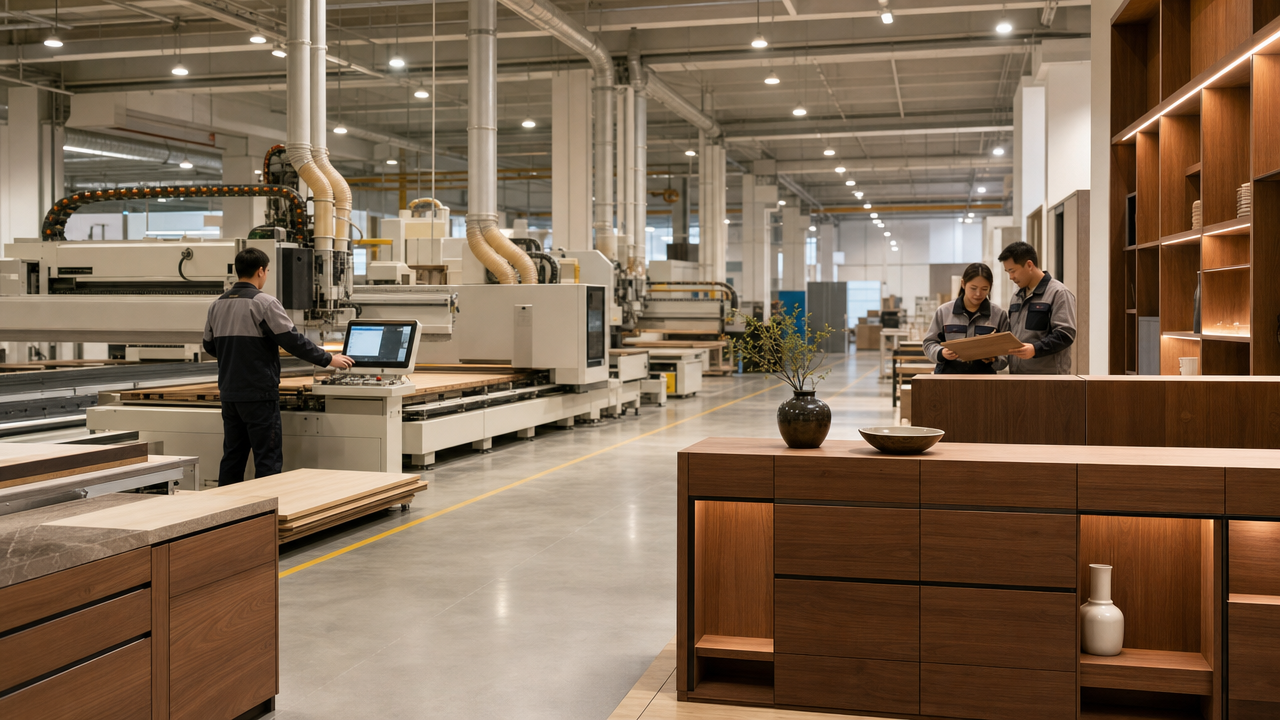
Mid-stream manufacturing divides into three models: (1) large-scale integrated factories (Oppein's Foshan complex processes over 5,000 orders per day using fully automated CNC lines); (2) mid-size regional custom shops (100–500 employees, serving local markets with semi-automated production); (3) small-batch artisan workshops (often serving designers and luxury renovation contractors). The competitive moat for category (1) is the digital manufacturing stack: 3D design SaaS → auto-generated cutting lists → CNC execution → barcode-tracked workflows → smart warehouse sortation. For category (2), competitive survival requires niche specialization (a product category or regional distribution territory that a national brand cannot efficiently serve).
Downstream channels have fundamentally restructured since 2020. Traditional large-format home furnishing malls (Easyhome 居然之家, Red Star Macalline 红星美凯龙) remain important for brand credibility and high-value transactions but are under pressure from declining foot traffic. E-commerce (Tmall, JD, Douyin livestream) accounts for 40%+ of sales for finished furniture and is growing toward 30%+ for custom goods as remote measurement technology (LiDAR scanning via smartphone) reduces the friction of online custom ordering. Whole-home design platforms (Tuba Tu 土巴兔, Qijia 齐家) aggregate renovation demand and channel significant custom furniture volume to brand partners.
Installation and after-sales have become competitive battlegrounds. The "last mile" of furniture delivery—scheduling, on-site assembly, defect resolution—determines NPS scores and referral rates. Brands investing in company-owned installation teams (rather than subcontracted labor) are achieving measurably higher customer satisfaction and lower warranty claim rates. Oppein's push into whole-home fit-out has necessitated significant investment in installation capability coordination across cabinetry, soft furnishings, flooring, and lighting subcontractors.
第六章 重点企业:龙头列传
Oppein Home Group (欧派家居, 603833): China's largest custom home furnishings brand by revenue. FY2025 revenue RMB 17.23 billion (-8.94% YoY), net profit RMB 2.30 billion (-12% YoY). The revenue decline reflects project-channel (B2B residential developer) contraction as major developers reduced procurement volumes. The strategic response—"Whole-Home Grand Living" (整装大家居)—reorients toward direct-to-consumer whole-home packages combining custom cabinetry, soft furnishings, lighting, and appliances in a single delivery contract. Early data from 2026 Q1 shows whole-home order growth outpacing the decline in single-product orders, validating the strategic pivot.
Sophia (索菲亚家居, 002572): Wardrobe-specialist-turned-whole-home brand. FY2025 revenue approximately RMB 8.5 billion. Sophia's key strategic asset is its dedicated kitchen brand Sidmi (司米), which competes directly in Oppein and Zhibang's core market. Sophia has been accelerating door-count expansion in Tier-3/4 cities to capture renovation-upgrade demand in markets less affected by Tier-1 property corrections.
Zhibang Home (志邦家居, 603801): Pure-play kitchen cabinet specialist. FY2025 revenue approximately RMB 4 billion, with project-channel revenue declining sharply and direct retail growing strongly. Zhibang has leaned into direct retail more aggressively than competitors, building company-owned showrooms in premium mall locations and investing heavily in frontline sales training.
Gold Medal Cabinetry (金牌厨柜, 603180): Premium kitchen specialist with a reputation for quality execution. FY2025 revenue approximately RMB 2.5 billion. Strategic emphasis on high-margin whole-kitchen solutions and premium hardware (full Blum specification).
Kuka Home (顾家家居, 603816): China's largest upholstered furniture company and the first Chinese furniture manufacturer to cross RMB 20 billion in annual revenue (FY2025: RMB 20.06 billion). Overseas revenue reached RMB 9.33 billion, representing 46.5% of total—a world-class overseas revenue ratio for a Chinese furniture brand. Factories in Vietnam (two plants), Mexico, and Indonesia (under construction) give Kuka a truly global manufacturing footprint. FY2026 Q1 revenue exceeded RMB 5 billion, confirming continued growth momentum.
Minhua Holdings (敏华控股, HK 1999): Hong Kong-listed functional sofa market leader. FY2025 (ending March 2025) revenue approximately HKD 16 billion. Minhua sells under the Cheers (芝华仕) brand in China and under OEM labels in North America and Europe. Its manufacturing is divided between mainland China and Southeast Asia, providing export flexibility.
Xilinmen (喜临门, 603008): Mid-tier mattress brand competing primarily on value-for-money. FY2025 revenue approximately RMB 4.5 billion. Xilinmen has adopted an AI-sleep product strategy, launching sensor-embedded mattresses with sleep monitoring apps. Strategic challenge: differentiation from both premium brands (Mousse) and commoditized online competitors.
Mousse (慕思股份, 001323): China's premium-positioning mattress brand. FY2025 revenue approximately RMB 3.8 billion. The brand's pivot to "AI sleep science" (AI睡眠科技) has been commercially validated—AI-feature products now account for over 10% of revenue, growing at 3x the brand average. The strategic risk: premium mattresses are heavily dependent on new-home move-in events, making revenue cyclically sensitive to property market timing.
Mengshen (梦百合, 603313): China's largest mattress exporter by volume, with a US factory (South Carolina) that reached profitability in 2025. H1 2025 net profit grew 117.82% YoY. Mengshen's competitive model is fundamentally different from domestic-focused brands: it competes on Amazon and Wayfair primarily on review scores and price competitiveness, with limited brand equity. The US factory provides critical tariff immunity for its largest single market. FY2026 Q1 net profit grew over 150% YoY, confirming the trajectory.
IKEA China: Continues to face structural headwinds from the customization gap. IKEA's "partial customization" service (按尺寸定制橱柜) addresses the symptom but not the root cause: its global supply-chain model cannot match the manufacturing flexibility of Chinese custom specialists. IKEA's strategic response has shifted toward experiential retail (smaller format urban stores) and service bundling (installation + design consultation).
第七章 中游产业带:从东莞到越南,家具工厂的全球迁徙
China's furniture industrial clusters are the manufacturing engine behind every brand discussed above. Tianxiagongchang (天下工厂), which tracks 4.8 million verified Chinese factories, identifies dense concentrations of home furnishing manufacturers across a dozen core clusters—each specializing in different product categories, price points, and export markets.
Guangdong (Pearl River Delta): China's largest furniture manufacturing base by output value. Dongguan and Foshan anchor solid-wood and upholstered furniture for export; Zhongshan specializes in lighting and hardware; Foshan-Shunde is the custom cabinetry heartland, with Oppein's principal manufacturing complex located there. Total Pearl River Delta furniture output exceeds RMB 1.2 trillion annually, representing approximately 40% of the national total.
Zhejiang (Yangtze River Delta): Anji County (安吉) is the world's largest bamboo furniture and office-chair production base, exporting 60%+ of global ergonomic office chair volume. Haining (海宁) is a national sofa leather and custom furniture cluster. Deqing (德清) hosts Mousse's principal manufacturing campus.
Jiangsu: Suzhou-Wuxi has a concentration of high-end custom cabinetry and full-house renovation contractors. Xuzhou Peixian (沛县) has emerged as a functional sofa cluster with lower land and labor costs than the coastal clusters.
Hubei: Zhongxiang (钟祥) and Tianmen (天门) have developed rapidly as upholstered furniture clusters serving the domestic mass market at competitive price points.
Overseas—Vietnam (Binh Duong, Ho Chi Minh City): Vietnam has absorbed the most significant flow of Chinese furniture manufacturing relocation. An estimated 200+ Guangdong-origin factories have established or expanded Vietnam operations since 2018. Vietnam furniture exports to the US exceeded USD 10 billion in 2025, making it the largest single source of furniture imports into the US. However, the growing US scrutiny of Vietnam-origin goods for Chinese content is creating a new compliance risk layer for manufacturers operating the "China-to-Vietnam assembly" model.
Overseas—Mexico (Monterrey, Querétaro): Mexico is emerging as a furniture manufacturing destination for the US market, with shorter transit times and "USMCA-origin" tariff advantages. Kuka's Mexico factory complex is the most visible example of this trend among Chinese brands.
For 2026–2030, three to four waves of capacity will compete for market share: existing China domestic factories (upgrading via automation), Vietnam-based factories (volume growing, compliance risk rising), Mexico-based factories (growing from low base), and emerging Southeast Asian locations (Indonesia, Malaysia, India). The factories that survive and thrive will be those that combine cost efficiency with quality consistency, digital manufacturing capability, and compliance agility.
第八章 细分专题:整家定制、功能沙发、智能床垫与出海战略
Whole-home custom fit-out is the strategic frontier of the custom cabinetry segment. The commercial logic is compelling: a single-product wardrobe order has an average ticket of RMB 10,000–20,000; a whole-home custom package (kitchen + wardrobes + study + entry hall + balcony + bathrooms) carries an average ticket of RMB 50,000–200,000. A 5–10x ticket uplift on the same installation visit and design engagement fundamentally changes the economics of a custom furniture brand.
Execution is the challenge. Whole-home delivery requires coordinating multiple manufacturing streams (cabinet factory, door factory, countertop supplier, soft furnishing partner) on a single installation schedule. The single-point failure risk is high: a delayed countertop delivery can cascade into an unacceptable installation experience. Oppein has invested heavily in its whole-home execution capability, including a dedicated project management software layer that sequences subcontractor deliveries and flags schedule risks automatically.
Functional/power sofas are among China's most innovative upholstered furniture products. The category's core consumer proposition—"hotel lobby relaxation in your living room"—resonates strongly with China's 35–60-year-old affluent homeowner segment. Electric recline, zero-gravity positioning, heated lumbar support, USB/wireless charging, and massage functions have become standard configurations on mid-range models (RMB 8,000–25,000). The next innovation wave adds IoT connectivity: voice-activated position control, posture-monitoring sensors, and Huawei/Xiaomi smart-home integration.
Kuka's functional sofa revenue has grown as a share of its overall mix as the category commands higher margins than standard upholstered sofas. Minhua's Cheers brand has built a lifestyle brand around the functional sofa category, with dedicated showroom spaces and lifestyle marketing that frames the product as a long-term wellness investment rather than a commodity purchase.
Smart mattresses are crossing the tipping point from niche to mainstream in the premium segment (above RMB 8,000). The AI sleep monitoring use case—sensors embedded in the mattress track sleep stage, respiratory rate, body movement, and heart rate variability, feeding data to a smartphone app that provides sleep quality scores and personalized recommendations—has proven genuinely compelling to health-conscious consumers. Mousse's AI-branded models reportedly carry 15–20% revenue premiums over comparable non-smart alternatives in the same physical construction.
The key enabling technology is ultra-low-power Bluetooth sensors (consuming less than 1 mW in sleep monitoring mode) combined with cloud-based AI inference that can distinguish light sleep, deep sleep, and REM phases from wrist-free accelerometer and pressure sensor data. This eliminates the wearable device requirement that limited earlier smart sleep products.
Overseas expansion strategy has become a defining capability differentiator. The decision matrix for Chinese furniture manufacturers on overseas strategy:
| Factor | Stay China-Export | Vietnam Hub | Mexico Hub | US Domestic |
|---|---|---|---|---|
| US tariff impact | Severe (25–145%) | Moderate (10–25%) | None (USMCA) | None |
| Lead time to US | 35–45 days sea | 25–35 days sea | 8–15 days truck | 3–7 days domestic |
| Labor cost | Rising | Still favorable | Moderate | High |
| Brand building | Difficult | Difficult | Moderate | Easiest |
| Capital requirement | Lowest | Moderate | Moderate–High | Highest |
Mengshen's US factory represents the most aggressive end of the spectrum—a genuine commitment to domestic US manufacturing that eliminates tariff risk entirely but requires managing US labor relations, environmental compliance, and supply-chain logistics at North American cost levels.
第九章 技术演进:数字化设计、智能制造与全屋 IoT
3D design and digital quotation has reduced the custom furniture sales cycle from 3–4 weeks to 3–5 days in leading showrooms. Customers arrive at an Oppein or Sophia showroom, provide their apartment layout (increasingly via smartphone LiDAR scan), and receive a photorealistic 3D rendering with itemized pricing within 2–4 hours. The design file, once approved, flows automatically to the factory ERP, where it is decomposed into machine instructions for CNC cutting, edge-banding, drilling, and assembly. Human error in dimension transcription—historically the leading cause of installation rework—has been virtually eliminated in digitally integrated factories.
Smart manufacturing within the factory itself has advanced substantially. Oppein's principal Foshan campus processes 5,000+ orders per day using a cell-based manufacturing layout where each cell handles a specific panel format range. Barcode tracking follows every panel from CNC output through edge-banding → drilling → sortation → packaging → shipping. Defect rates at packaging have fallen from 3–5% in traditional factories to under 0.5% in fully integrated smart factories. Order-to-ship cycle times have compressed from 35–45 days to 18–25 days for standard configurations.
AI-assisted design recommendation is the next frontier. Sophia's app uses machine learning trained on tens of millions of design interactions to suggest color combinations, hardware specifications, and space utilization optimizations based on input room dimensions and stated lifestyle needs. Early commercial data suggests AI-recommended designs carry 8–12% higher customer acceptance rates than purely designer-generated proposals—likely because the AI optimizes for demonstrated consumer preference patterns rather than designer aesthetic judgment.
Whole-home IoT requires furniture, lighting, climate control, and security systems to communicate on a unified protocol. The Matter standard (backed by Apple, Google, Amazon, Samsung) is emerging as the global interoperability layer. In China, Huawei's HarmonyOS Home and Xiaomi's Mijia ecosystems add a domestic competitive dimension. Oppein and Kuka have both announced deep integrations with HarmonyOS, allowing furniture-embedded sensors and actuators to appear natively in the Huawei smart home app. For exporters, Matter certification unlocks compatibility with US and European smart home hubs, reducing the friction of IoT-enabled furniture adoption in those markets.
The commercial opportunity embedded in whole-home IoT is significant: a furniture company that can position itself as the "integration orchestrator" for a consumer's smart home—providing the physical platform on which lighting, climate, entertainment, and security all connect—commands a relationship that extends far beyond the initial furniture purchase event, enabling ongoing service revenue (app subscriptions, remote diagnostics, upgrade packages) that traditional furniture companies have never monetized.
第十章 风险图谱:房地产、原材料、关税与品牌博弈
Real estate market risk remains the industry's dominant cyclical variable. China's property sector—after the 2021–2024 correction that saw major developer defaults (Evergrande, Country Garden) and a 30% decline in new housing starts—shows early stabilization signals in 2025 but has not entered a new growth cycle. Custom cabinetry's project-channel revenue (selling to developers for installation in new residential units before buyer occupation) has experienced the sharpest contraction; the sector's exposure to project-channel revenue has declined from approximately 35% in 2020 to under 20% in 2025 as brands have deliberately shifted toward retail direct-to-consumer. The medium-term base case: new-home completions stabilize at 60–70% of the 2021 peak, with renovation-cycle demand partially compensating for the new-construction shortfall.
Raw material cost volatility presents ongoing margin risk. MDF and plywood prices track global wood pulp and timber markets, which have been volatile since the Russia lumber export ban (2022) and the post-COVID supply chain normalization. Oil prices directly affect polyurethane foam (a petroleum derivative), fabric coatings, and transportation costs. Companies with long-term supply agreements and scale-purchasing advantages (Oppein, Kuka) are better insulated than smaller brands that procure on spot markets.
Tariff and trade policy risk is increasingly asymmetric. The US tariff structure (25% Section 301 on Chinese furniture, with potential further escalation) has materially altered the competitive economics of China-origin exports to the US. The EU is considering anti-dumping investigations on selected Chinese furniture categories. Vietnam's growing share of US furniture imports is attracting US Customs scrutiny for potential circumvention. Companies with genuine value-added manufacturing in low-tariff jurisdictions are best positioned; companies relying on simple assembly operations in Vietnam to claim non-China origin face rising compliance risk.
Brand competitive dynamics are intensifying at multiple levels. At the top end, Oppein and Sophia compete for whole-home budget share with IKEA's local customization services and with real estate developers' own interior fit-out packages. In the e-commerce channel, Linsy, QuanU, and dozens of Taobao-native brands compete primarily on price, compressing margins for brands attempting to hold aspirational positioning online. In the smart mattress segment, consumer electronics companies (Xiaomi with the sleep-tracking pad device, Huawei with its health-monitoring wearables) represent a potential channel for direct consumer health data that could displace mattress brands as the primary "sleep intelligence" relationship owner.
Personnel and execution risk at the operational level: whole-home installation quality depends on a skilled, motivated installation workforce that is difficult to staff and manage at scale. Customer satisfaction data from the industry suggests installation quality is the single most-cited complaint category, and a poor installation experience can permanently damage NPS scores even when product quality is strong. The brands investing most aggressively in installation team management, training, and incentive alignment (Oppein, Zhibang) are differentiating on a capability axis that competitors cannot quickly replicate.
第十一章 2026–2030 预测:整家时代的下一个增长极
China's home furnishing market will reach RMB 1.4–1.5 trillion by 2030 under the medium-scenario base case, implying a 2025–2030 CAGR of approximately 3–4%. The growth will not be evenly distributed; it will be concentrated in specific sub-segments and captured disproportionately by brands with the right strategic positioning.
Whole-home custom fit-out will dominate custom cabinetry growth. The shift from single-product orders to comprehensive whole-home packages will drive revenue per customer event from approximately RMB 15,000 (2025 average) to RMB 40,000–60,000 (2030 target for top-3 brands). This is not market growth through more customers—it is revenue capture through higher share-of-wallet from each customer interaction. Oppein, Sophia, and Zhibang are all racing toward this positioning; execution capability will determine the winner.
Overseas revenue will exceed 40% for top upholstered furniture brands by 2030. Kuka (already at 46.5% in 2025), Minhua, and Mengshen will continue expanding overseas manufacturing and brand-building infrastructure. The critical capability gap to fill: moving from platform-dependent sales (Amazon, Wayfair) to own-brand e-commerce and eventually to wholesale/retail channels in North America and Europe. True brand equity in Western markets will take 8–12 years to build; the companies that started earliest (Kuka, Mengshen) will have the most compounded advantage by 2030.
Smart bedding will mainstream. IoT-enabled mattresses and smart functional sofas will represent over 25% of new unit sales in the above-RMB-8,000 segment by 2030. The AI sleep monitoring use case will be validated and broadly accepted. The monetization model will evolve beyond one-time hardware sales to include service subscriptions (sleep data analytics, personalized health coaching) and hardware upgrade cycles (sensor modules, actuator replacements), creating recurring revenue streams that fundamentally change the unit economics of a "furniture sale."
Industry consolidation will accelerate. The top-10 listed custom cabinetry and upholstered furniture brands will increase combined market share from approximately 25% in 2025 to 35–40% by 2030. The middle tier—regional brands with RMB 500 million to RMB 2 billion in revenue—will face the most existential competitive pressure, as national brands extend into their geographic territories with whole-home packages that mid-tier brands cannot match in scope or investment.
Renovation demand will be the structural backstop. China's 2005–2015 construction vintage housing stock will require significant renovation across the 2017–2033 window. Approximately 1.5 billion square meters of housing built during this period will cycle through renovation, driving demand for kitchen replacements, wardrobe system upgrades, sofa replacements, and mattress renewals on a sustained, non-cyclical basis. This renovation wave is largely independent of new-construction cycles and represents the most reliable medium-term demand anchor for the industry.
第十二章 结论:地产重构下的家居产业新坐标
An industry's true resilience reveals itself not in boom years but in the discipline and creativity it brings to structural challenge. China's home furnishing industry is passing that test.
The 2021–2025 real estate downturn stripped away a decade of easy demand tailwind. What remains is a leaner, strategically sharper competitive landscape: brands that relied on project-channel volume without building genuine consumer preference have lost ground; brands that invested in consumer relationships, digital capabilities, and overseas manufacturing infrastructure have emerged stronger.
Tianxiagongchang (天下工厂), tracking industrial clusters and factory ecosystems across China, observes that the industry's true foundation is not the handful of listed companies but the hundreds of thousands of component suppliers, sub-contractors, and installation specialists distributed across Dongguan, Foshan, Suzhou, Xianyu, Deqing, and their overseas extensions in Vietnam and Mexico. These factories are the manufacturing substrate without which no brand promise could be kept.
The next decade's winners will be characterized by four shared attributes: (1) whole-home execution capability that converts a design consultation into a coordinated multi-product delivery; (2) overseas manufacturing infrastructure that can serve Western markets with compliant, competitive products regardless of tariff headwinds; (3) digital manufacturing systems that deliver custom products at near-batch efficiency; and (4) smart product portfolios that give furniture brands a recurring relationship with consumers beyond the initial purchase event.
The coordinates for the Chinese home furnishing industry's next growth phase are set. The race for whole-home market leadership is underway.
Data Sources and Principal References
This report integrates factory-level and industrial-cluster data from a 4.8-million-factory database, alongside public disclosures, official statistics, and authoritative industry media. Principal data sources include:
- Tianxiagongchang Industry Platform (www.tianxiagongchang.com): 4.8 million verified Chinese factory database and home furnishing cluster mapping
- Oppein Home (603833), Sophia (002572), Zhibang (603801), Gold Medal (603180), Kuka (603816) FY2025 annual reports and semi-annual reports (publicly disclosed)
- Minhua Holdings (HK 1999) FY2025 annual report (publicly disclosed)
- Xilinmen (603008), Mousse (001323), Mengshen (603313) FY2025 semi-annual reports (publicly disclosed)
- IKEA Ingka Group FY2025 press release: EUR 44.6 billion global retail sales
- Williams-Sonoma Inc. FY2025 Q3 10-Q filing (SEC EDGAR)
- China National Furniture Association (CNFA) 2025 industry economic briefing
- Qianzhan Industry Research Institute: China Custom Home Furnishing Industry Market Outlook and Investment Strategy Report (2025 edition)
- National Bureau of Statistics of China (NBS): Monthly furniture manufacturing output and export statistics
- General Administration of Customs of China: Furniture export statistics by destination market
- Bloomberg, Reuters, Caixin Media: Corporate news and market analysis coverage
- Yicai Global, 21st Century Business Herald: Company-specific coverage and executive interviews