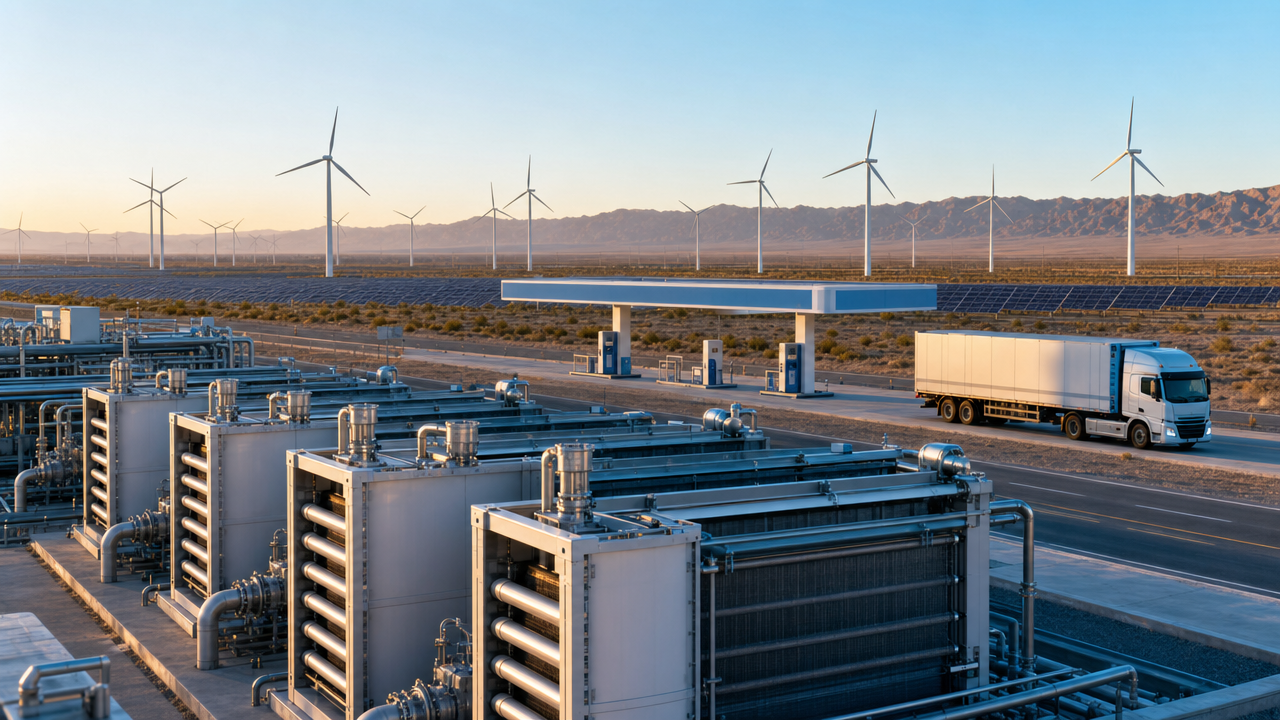

Hydrogen is the first element on the periodic table — the lightest and highest in energy density. The lower heating value of one kilogram of hydrogen is approximately 120 MJ, roughly three times that of gasoline or natural gas. Yet free hydrogen is virtually absent from the Earth. In nature, hydrogen exists as compounds, principally water (H₂O) and organic matter. Producing combustible or electricity-generating hydrogen requires energy to break these compounds apart. "What energy was consumed, and how much carbon was released?" — that question determines whether the hydrogen in your tank is a clean-energy carrier or a high-emission industrial commodity.
This is the central question the global hydrogen industry has wrestled with for thirty years, and it is the sharpest strategic contradiction facing China's hydrogen sector in 2026: China produces roughly 35 million tonnes of hydrogen per year — unrivalled in scale — yet more than 97% of that output comes from coal and natural gas, each tonne trailing a heavy load of CO₂. Zero-carbon "green hydrogen" accounts for less than 1% of the total, yet bears the industry's grandest commercial narrative and policy expectations.
This report attempts to measure that distance — how far, how long, and whether it is passable at all.
Let us begin with a concrete number, viewed from two entirely different angles.
Looking up: in 2025, the lowest winning bid price for Chinese alkaline electrolysers in public procurement fell to approximately ¥416 per kilowatt. This is a landmark figure. In 2021, the market price for the same equipment was around ¥3,000/kW. In four years, costs fell by more than 85% — faster than solar PV modules over the same period. Against that trajectory, no competitor has been comfortable: European electrolyser makers have been cutting headcount; U.S.-based Plug Power, after years of massive losses, only achieved positive gross margins in Q4 2025.
Looking down at the flip side: in the first half of 2025, China sold 1,965 fuel cell vehicles, down 21.8% year on year. The nationwide hydrogen refuelling station count reached 560, about 60% of the 2021 planning target. The two leading fuel cell system makers, SinoHytec (亿华通) and Sinohykey (国鸿氢能), posted a combined net loss exceeding RMB 1 billion for the year. Green hydrogen output was 250,000 tonnes against a total hydrogen production capacity of 35 million tonnes — less than 0.7%, a rounding error in the ledger.
This is the accurate portrait of China's hydrogen industry in 2026: the world's strongest electrolyser manufacturing base on one side; a commercialisation end-use market that has not yet closed the loop on the other; ambitious policy targets (1 million tonnes of green hydrogen and 1 million fuel cell vehicles by 2030) against a sobering progress gap.
Yet this is not necessarily a pessimistic signal. Almost every genuinely important industry, at the inflection point of transitioning from "policy-driven" to "market-driven," has passed through a similar "numbers-down period." The lithium battery industry of 2015–2016 saw slowing volume growth and leading firms in the red; the solar PV industry of 2018–2019 saw subsidy phase-out drive installation declines and several companies near bankruptcy. They emerged not because policy intervention increased, but because costs eventually fell to the level that genuine commercial demand could absorb, triggering self-sustaining market pull.
China's hydrogen industry is waiting for a similar moment.
What it is waiting for is not a single technological breakthrough — electrolysers are already cheap enough, and fuel cells are already reliable enough. It is waiting for an "ecosystem tipping point": enough refuelling stations, low enough terminal hydrogen prices, and enough fleet operators willing to "pay without subsidies." When those three conditions align, the industry's growth logic will switch from "policy transfusion" to "market self-generation," and the speed of adoption could surprise all expectations.
This report systematically maps every critical milestone on that waiting road: How far are costs from parity? Where are the infrastructure breakpoints? Who is most likely to close the commercial loop first? How is the global competitive landscape evolving? And — is the long wait worth it?
The answers are embedded in the thirteen chapters that follow. This is not a report that offers certainty, but it offers a detailed enough map that — in this hydrogen landscape still full of uncharted territory — you at least know where you stand, what the road ahead looks like, and which junctions are genuinely worth pausing to observe. In a field full of uncertainty, a sense of direction is more valuable than a sense of speed, and that is what this report is designed to provide. Understanding direction allows one to maintain patience, clear judgment, and — at the right moment — make decisions one will not regret. The hydrogen story is far from over.
Research methodology note: Data sources include public company filings (A-share, H-share, and U.S.-listed companies), government policy documents (NDRC, MIIT, NEA), industry association statistics (China Hydrogen Alliance, SAE-China, Shyin Energy), international institution reports (IEA, IRENA, Hydrogen Council), and authoritative media coverage. All forecasts carry stated confidence ranges and assumptions. Figures not attributed to external sources are reasonable estimates by the research institute based on public data, indicated by "approximately." This report does not constitute investment advice. Data is current through May 2026.
Executive Summary Key Conclusions and Data
Scale: China's annual hydrogen production capacity is approximately 35 million tonnes in 2025, ranking first globally (≈37–39% of world output); however, 97%+ is grey hydrogen (coal- and natural-gas-based), while renewable-electricity green hydrogen in operation totals only ~250,000 tonnes/year, under 1% of the total.
Electrolysers: China's average alkaline electrolyser procurement price has fallen to ~¥400–650/kW (2025), roughly one-fifth to one-third of comparable Western products; installed capacity reaches 20–30 GW/year, representing 60–70% of global capacity; LONGi Hydrogen holds over 30% domestic order market share, the highest in China. Public procurement totalled ~3,020 MW across 57 projects in full-year 2025.
Fuel cell vehicles (FCV): National fleet as of H1 2025 was 30,212 units; H1 2025 new sales were 1,965 units (−21.8% YoY); five demonstration city clusters combined to deploy 16,633 vehicles (51.2% of target completion), with Beijing-Tianjin-Hebei (6,191 units) the only cluster exceeding its target.
Hydrogen refuelling stations (HRS): Cumulative 560 stations nationwide as of H1 2025, No. 1 globally; H1 2025 added 29, implying an annual build rate of ~60, far below the 2021 planning target of "over 1,000 by 2025."
Green hydrogen cost: Best-case scenario (Baofeng Energy, Ningxia, self-built PV supply) ≈¥9–11/kg; national average ≈¥15–25/kg; grey hydrogen ≈¥8–10/kg — still a 1.5–3× gap.
Key company financials (FY2025):
- SinoHytec (688339): H1 revenue ¥71.93M (−53.3%), net loss ¥163M;
- Sinohykey (9663.HK): full-year revenue ¥300M (−32.2%), net loss ¥484M, stack gross margin −32.7%;
- Plug Power (PLUG): full-year revenue $710M (+12.9%), electrolyser revenue $187M, Q4 gross margin turned positive (+2.4%);
- Ballard Power (BLDP): full-year revenue $99.4M (+43%), Q4 operating cash flow positive.
2026 policy milestones: Three-ministry "open competition" pilot for comprehensive hydrogen application (6 scenario tracks, up to ¥1.6B reward per city cluster); 15th Five-Year Plan designates hydrogen a core "future industry"; green hydrogen CCER methodology officially published, opening carbon trading pathways for green hydrogen projects.
2030 targets vs. reality: Green hydrogen 1 million tonnes/year (probability ~65–75%); FCV fleet 1 million units (current trajectory projects ~150,000–300,000, a significant shortfall); 5,000 HRS (unlikely before 2030; likely postponed to 2032–2035).
Core thesis: Three gateway bottlenecks (cost / infrastructure / commercial loop) will be partially broken through in 2027–2030; four champions — LONGi Hydrogen, Sungrow Hydrogen, SinoHytec, and Sinohykey — dominate China's hydrogen value chain; China's transition from "world's largest grey hydrogen producer" to "green hydrogen industrial powerhouse" depends on when the first generation of "subsidy-free commercial projects" emerges.
Chapter 1 Definitions, Classification, and the Full Industry Chain
I. The Hydrogen "Colour Spectrum": Grey, Blue, Green, and Beyond
The hydrogen industry uses colours to classify hydrogen by source and carbon footprint — a taxonomy that has become a global communications standard.
Grey Hydrogen is today's highest-volume, lowest-cost hydrogen, produced via coal gasification or natural gas steam methane reforming (SMR) without carbon capture and storage (CCS). Grey hydrogen carries a heavy carbon footprint: coal-to-hydrogen emits roughly 11–14 tonnes of CO₂ per tonne of H₂; natural gas reforming emits ~9–11 tonnes. More than 97% of China's 35 million tonnes of annual hydrogen output is grey, with coal-based routes (gasification + coke-oven gas) accounting for 60–65%, natural gas SMR 15–20%, and industrial by-product hydrogen (chlor-alkali, coke ovens) 10–15%.
Blue Hydrogen follows the same production routes as grey hydrogen but adds CCS, capturing 85–95% of CO₂ and sequestering it geologically, reducing net emissions to ~1–4 tonnes CO₂/tonne H₂. Cost is 30–50% above grey hydrogen. Several countries (UK, Canada, Norway) treat blue hydrogen as a "transition low-carbon hydrogen," and China has pilot projects underway in Daqing and Ordos.
Green Hydrogen is produced by driving electrolysers with renewable electricity (wind, solar, hydro), splitting water (H₂O) into hydrogen and oxygen with near-zero net emissions. Its challenge is almost entirely cost: renewable electricity accounts for 60–70% of production cost, electrolyser capex 20–25%, and the remainder is operations, water treatment, and land. In 2025, green hydrogen accounts for under 1% of global production but is the strategic core around which virtually all policy, investment, and R&D is organised.
Additional niche colours include: yellow/pink hydrogen (nuclear-powered electrolysis, low-carbon but expensive), turquoise hydrogen (natural gas pyrolysis, producing solid carbon rather than CO₂), red hydrogen (biomass gasification), and white hydrogen (naturally occurring geological free hydrogen). These remain marginal in today's industry landscape.
II. The Hydrogen Application Spectrum: Four Scenarios
Industrial feedstock (largest existing market): Global hydrogen consumption is roughly 90 million tonnes in 2025, of which 40–45% is used for ammonia synthesis (fertiliser), 25–30% for oil refining (hydrocracking and hydrotreating), and ~15% for methanol synthesis. Almost all of this is grey hydrogen. These markets do not generate "green value" today, but they are the target markets for green substitution — replacing 90 million tonnes of grey hydrogen with green hydrogen would cut CO₂ emissions by roughly 900 million to 1.2 billion tonnes/year.
Energy storage (emerging, fastest growing): Power-to-hydrogen can absorb excess renewable generation during periods when grid export capacity is insufficient, then release energy via fuel cells or turbines during peak demand — enabling seasonal storage at a scale beyond lithium-ion batteries.
Transportation fuel (commercial focus): Hydrogen fuel cell vehicles (FCEV) offer rapid refuelling (~3–5 minutes), excellent cold-weather performance, and superior energy density for heavy payloads — giving them a structural advantage over battery EVs in long-haul heavy trucking, ships, railways, and specialty vehicles where battery weight and charging time are problematic.
Green chemicals/industrial applications: Green ammonia, green methanol, and hydrogen-direct-reduction ironmaking (green steel) represent the hydrogen industry's greatest long-term demand potential, and are the applications most likely to achieve economic parity before transportation uses.
III. Electrolyser Technology Pathways
Four commercial or near-commercial electrolysis routes exist:
- Alkaline (ALK): Mature, lowest cost (~¥400–650/kW in China, 2025), largest single-unit output (2,000 Nm³/h), but slow response (minute-scale). Best suited for stable, large-scale production.
- PEM (Proton Exchange Membrane): Fast response (millisecond-scale), high-pressure output, compact — but costs 7–12× ALK (~¥5,000–8,000/kW) and depends on imported membranes and platinum-group metal catalysts.
- SOEC (Solid Oxide): Highest efficiency (>80%), but operates at 700–900°C, with materials durability challenges; still in early commercialisation.
- AEM (Anion Exchange Membrane): Emerging route combining ALK's low-cost catalysts with PEM's fast response; not yet at commercial scale.
IV. Four Hydrogen Storage and Transport Pathways
- High-pressure gaseous: Most mature route. Vehicle-mounted Type III cylinders (35 MPa, steel + carbon-fibre wrap) or Type IV (70 MPa, all-composite). Pipeline hydrogen is the lowest-cost option for long-distance bulk transport (~¥0.5–1/kg per 100 km), but requires dedicated hydrogen pipelines (not existing natural gas lines, due to hydrogen embrittlement).
- Liquid hydrogen (LH₂): Liquefied at −252.8°C with ~3× the volumetric energy density of 35 MPa gas, but liquefaction consumes 30–40% of the hydrogen's own energy. China's civil liquid hydrogen supply chain is migrating from aerospace to commercial applications.
- Solid-state storage: Metal hydrides (e.g. LaNi₅, FeTi) or liquid organic hydrogen carriers (LOHC, e.g. dibenzyltoluene): high volumetric density, safe — but require heat for charge/discharge, with slow response times.
- Chemical carriers (ammonia/methanol): Green hydrogen is converted into NH₃ or CH₃OH, shipped as liquids using existing chemical infrastructure, and cracked back into hydrogen at destination — or used directly as a fuel (ammonia fuel cells, onboard methanol reformers).
V. The Full Value Chain: Seven Layers, Two Mainlines
The green hydrogen value chain spans seven layers: (1) Renewable electricity; (2) Electrolysis equipment and systems; (3) Hydrogen storage and transport; (4) Hydrogen refuelling stations; (5) Fuel cell stacks and power trains; (6) Fuel cell vehicles/ships/stationary power; (7) Green chemical industrial end-uses (green ammonia, green methanol, green steel).
These seven layers form two largely independent commercial mainlines: the "renewable electricity → electrolyser → green hydrogen → green chemicals/storage" chain; and the "hydrogen → fuel cell → electricity/transport" chain. They converge at the hydrogen node but involve different companies, technologies, and customer bases. Understanding this distinction is fundamental to reading China's competitive landscape.
Chapter 2 Global Competitive Landscape and Key Players
I. The Three-Pole Structure: European Ambition, North American Capital, Chinese Manufacturing
Europe's REPowerEU targets 10 million tonnes of domestic green hydrogen production and 10 million tonnes of imports by 2030. The European Hydrogen Bank completed its first auction (€630M in 2024). However, higher-than-expected renewable electricity costs, elevated financing rates (ECB peak 4.5%), and long infrastructure lead times have forced multiple gigawatt-scale European green hydrogen projects to delay or scale back. Nel ASA (Norway) and ITM Power (UK) both announced cost cuts and strategic pivots in 2024–2025.
The EU's Carbon Border Adjustment Mechanism (CBAM) entered full enforcement in January 2026, levying a carbon charge on imported steel, aluminium, fertiliser, cement, power, and hydrogen. This creates direct pressure on European industrial buyers to shift to low-carbon hydrogen feedstocks, and a strategic price premium for green ammonia and green methanol exports to Europe.
The U.S. IRA's Section 45V clean hydrogen production tax credit (up to $3/kg for the lowest-carbon green hydrogen, Tier 4) represents the world's most generous single-country green hydrogen subsidy. However, contentious implementation rules (hourly matching, additionality, geographic delivery requirements) have led multiple large U.S. green hydrogen projects to pause pending regulatory clarity. Political headwinds around IRA continuity add further uncertainty.
China's competitive advantages are: (1) world-lowest electrolyser manufacturing cost (alkaline ~¥350–650/kW versus Western ≈$1,200–2,000/kW, roughly one-fifth the price); (2) fully domestic supply chain covering electrolysers, fuel cell stacks, storage cylinders, and vehicles; (3) a relatively complete policy system anchored by the demonstration city clusters. China's weaknesses: green hydrogen still costs 1.5–3× grey hydrogen; commercial loops have not closed; the dominant fuel cell system makers remain loss-making.
II. Key Overseas Companies
Nel ASA (OSE: NEL, Norway) — founded 1927, the world's oldest electrolyser specialist; offers both alkaline and PEM. Pivoting from pure equipment sales to EPC integration services to differentiate against Chinese price pressure.
ITM Power (AIM: ITM, UK) — PEM specialist; Sheffield factory (1 GW/year capacity) delivered to Shell's Refhyne project. Under cost pressure; targeting break-even by 2027–2028.
Bloom Energy (NYSE: BE, U.S.) — started with solid oxide fuel cells (SOFC) for stationary power, expanding into solid oxide electrolysis (SOEC). The 24 MW SOEC module (installed 2024) is the world's largest commercial SOEC deployment.
Cummins (NYSE: CMI, U.S.) — acquired Hydrogenics (2019, ~$290M) for PEM and ALK electrolysers and fuel cells, marketed under the Accelera brand; also partnering with IVECO on fuel cell trucks for Europe.
Air Products (NYSE: APD, U.S.) — leading the NEOM green hydrogen/green ammonia project in Saudi Arabia (~$5B total investment, 12 million tonnes/year green ammonia target, aiming for production by ~2026); arguably the world's largest single green hydrogen project.
Plug Power (NASDAQ: PLUG) — FY2025 revenue ~$710M (+12.9%); electrolyser revenue $187M (record, ≈3× YoY); Q4 gross margin +2.4% (first positive quarter, vs. −122.5% in Q4 2024). North America's largest green hydrogen supplier; model is forklift fuel cells + liquid hydrogen supply for logistics warehouses.
Ballard Power Systems (NASDAQ: BLDP) — FY2025 revenue $99.4M (+43%), net loss $90.9M (narrowing), Q4 operating cash flow positive; record MW deliveries. Deep strategic alliance with Weichai Power (持股≈19.9%, ~$210M investment in 2019), with joint-venture PEM stack production for Chinese commercial vehicles.
Toyota (FCEV): Mirai Gen 2 (launched 2020), ~650 km WLTC range, global cumulative sales >20,000. Hyundai NEXO (2023 update), ~620 km range, global cumulative ~35,000. Honda e:FCEV relaunched 2024 (CR-V platform, small scale, lease model). Hyundai's Xcient Fuel Cell heavy truck — commercialised in Switzerland in 2020, the world's earliest commercial fuel cell heavy truck programme.
Chapter 3 Policy Environment (PEST Analysis)
I. Political/Policy (P): Three-Phase Policy Evolution and the 2026 Paradigm Upgrade
China's hydrogen policy system evolved through three clear phases.
2016–2020 (Technology incubation): Fuel cell vehicles entered the national EV subsidy programme at ¥300,000–500,000/vehicle (commercial vehicles), with HRS construction subsidies up to ¥4M. Demand was entirely driven by government procurement.
2021–2025 (Demonstration city clusters): Five-ministry circular (August 2021) launched five demonstration city clusters — Beijing-Tianjin-Hebei, Shanghai, Guangdong, Henan, Hebei — shifting from purchase subsidies to "mileage-based rewards." The Medium- and Long-Term Hydrogen Industry Development Plan (March 2022) officially elevated hydrogen from "hazardous chemical" to "clean energy" and set three-stage targets (2025/2030/2035). Mid-term evaluation by H1 2025 showed aggregate deployment of 16,633 vehicles (51.2% of target). Six new cities (Hami, Lüliang, Dalian, Puyang, Jiyuan, Cangzhou) joined the demonstration network in March 2025.
From 2026 (Comprehensive application pilot): In March 2026, MIIT, MoF, and NDRC jointly launched the "open competition" Comprehensive Hydrogen Application Pilot — the most ambitious policy upgrade to date. It covers six scenario tracks (FCVs, green ammonia/methanol, hydrogen-based chemical feedstock substitution, hydrogen metallurgy, blended hydrogen combustion, innovative applications). Four-year trial period; central government awards up to ¥1.6B per cluster. The same month, the CCER (voluntary carbon offset) methodology for renewable-electricity water-splitting was officially published, linking green hydrogen projects to carbon markets.
The 15th Five-Year Plan (released March 2026) lists hydrogen as a core "future industry" under the "forward-looking layout" cluster, specifically calling for green hydrogen infrastructure optimisation and extension of the green hydrogen chain into green ammonia/methanol and sustainable aviation fuel (SAF).
II. Economic (E): Cost Structure and Reduction Pathways
Green hydrogen cost equation: Cost ≈ Electricity (60–70%) + Electrolyser capex depreciation (20–25%) + Other (10–15%).
In the optimal Western China scenario (Ningxia/Inner Mongolia, utility-scale solar at ¥0.10–0.15/kWh, 2,000 Nm³/h ALK system): total cost ≈ ¥9–11/kg. National average (purchased green power at ¥0.25/kWh, medium project): ≈¥18–20/kg. Grey hydrogen (coal): ≈¥8–10/kg. The 1.5–3× gap is the fundamental market challenge.
Sensitivity analysis:
- If green electricity falls from ¥0.15 to ¥0.10/kWh (−33%): green hydrogen drops ≈¥2.5–3/kg
- If electrolyser price falls from ¥500 to ¥250/kWh (−50%): cost drops ≈¥1.5–2/kg
- If utilisation rises from 3,500 to 4,500 h/year: cost drops ≈¥1–1.5/kg
- CCER carbon credit (~¥100/tonne CO₂): ≈¥0.8–1.2/kg benefit
Combined, by 2028–2030, the best-case cost in northwest China could fall to ¥5–7/kg, closing to near parity with grey hydrogen when carbon costs of ¥3–5/kg are factored into grey hydrogen's "all-in" cost.
III. Social (S): Dual Carbon Pressure and Public Safety Perception
China's "dual carbon" targets (peak emissions by 2030, carbon neutrality by 2060) have made green transition a strategic imperative for major state-owned steel, chemical, and energy companies. ETS (carbon trading) prices reached ¥80–100/tonne CO₂ in 2025 and are expected to rise to ¥150–200/tonne by 2030. CBAM further pressures Chinese steel and fertiliser exporters to adopt low-carbon hydrogen feedstocks.
Public safety concerns — hydrogen's wide flammability range (4–75% by volume), colourless/odourless character, and high-pressure storage — remain a primary source of "NIMBY" resistance to urban HRS siting, with approvals taking 2–3 years in some cities.
IV. Technology (T): Five Core Breakthroughs of 2020–2025
- ALK scale-up: single-unit capacity rose from 500 to 2,000 Nm³/h (~4× increase);
- PEM domestication: domestic PEM electrolysers grew from near zero to ~15–20% of domestic procurement;
- FC system power: commercial vehicle systems rose from 60–80 kW to 200–300 kW; cold-start temperature improved from −20°C to −30°C;
- Type IV cylinder domestication: Sinoma Science & Technology batch-produces 70 MPa Type IV cylinders;
- Hydrogen metallurgy demonstration: HBIS Zhangxuan Technology and BAOWU Zhanjiang operated GW-scale hydrogen-reduced ironmaking projects.
V. International Dynamics: Carbon Tariffs, IRA, Export Barriers
CBAM's full enforcement from January 2026 puts concrete carbon-cost pressure on Chinese industrial exporters. U.S. IRA 45V's uncertain implementation adds volatility to global green hydrogen investment expectations. The EU is studying potential antidumping or countervailing duties on Chinese electrolysers — if imposed, China's core price advantage would be partially eroded.
Chapter 4 China Market Size: Layered Breakdown and Historical Context
I. Hydrogen Production Capacity: 35 Million Tonnes and the Industrial Reality
By production route: coal (gasification + coking) ~60–65%; natural gas SMR ~15–20%; industrial by-product ~10–15%; electrolysis ~1–2% (grid-powered); renewable green hydrogen <0.7%.
By consumption: ammonia synthesis ~40%; oil refining ~30%; methanol synthesis ~15%; other chemicals ~10%; energy-use (FCV, storage) ~3%.
Only ~3% of China's hydrogen enters energy markets; the remaining ~97% is industrial feedstock. The real task is (a) substituting green for grey in that 97%, and (b) growing the energy-use 3% to 30–50%.
II. Green Hydrogen: 250,000 Tonnes, a Real Starting Point
By end-2025, China's renewable green hydrogen operational capacity reached ~250,000 tonnes/year — a 10× increase from ~23,000 tonnes at the start of 2021. ~50–60% is concentrated in northwest China (Ningxia Baofeng, Inner Mongolia wind/solar projects, Xinjiang Hami). Against a total planned green hydrogen project capacity of >2 million tonnes/year, the plan-to-operation ratio is ~8:1.
III. FCV Fleet: ~30,000 Vehicles, Demonstration Period's End
As of H1 2025, the national FCV fleet was ~30,212 units; H1 2025 new sales were 1,965 units (−21.8% YoY) — the first significant YoY decline since the demonstration clusters launched in 2021. Heavy trucks account for 55–65% of the fleet; buses ~20–25%.
IV. HRS: 560 Stations, World's Largest but Far Below Target
560 stations globally first place (Japan ~170, South Korea ~250, Germany ~100, U.S. ~70). Against the 2025 planning target of 1,000+, only 56% achieved. Average station services ~54 FCVs, well below the ~500 kg/day break-even utilisation requirement.
V. Electrolyser Equipment Market: ~¥50–65B in 2025
Electrolyser system market ¥40–55B (2025); combined with fuel cell systems (¥35–45B), storage cylinders (¥15–20B), and HRS equipment (¥15–25B), total hydrogen equipment market is ~¥110–150B — one of China's fastest-growing manufacturing sub-segments.
VI. 2030 Targets vs. Current Trajectory
Green hydrogen 1 million tonnes: ~70% probability of achievement (≥4× from 250,000 tonnes, with >2 million tonnes in the construction pipeline). FCV 1 million units: current trajectory projects 150,000–300,000 by 2030 — a 4–10× shortfall versus target.
Chapter 5 Value Chain Analysis: Seven Segments
I. Electrolyser Equipment — China's Strongest Segment
ALK electrolyser technical parameters (China 2025 leading level): single-unit gas output 2,000 Nm³/h; system power consumption 4.0–4.3 kWh/Nm³; rated pressure 0.3–1.6 MPa; design lifetime 15–20 years; stack overhaul cycle 5–8 years. Cost fell from ~¥3,000/kW (2021) to ~¥400–650/kW (2025), a >80% reduction. Forecast 2030: ~¥200–300/kW.
PEM electrolyser: fast response (millisecond), can produce high-pressure hydrogen (1–5 MPa, saving compression steps), compact — but relies on Nafion membrane (Chemours, 80% global share), platinum-carbon cathode catalyst (0.3–1 g Pt/kW), iridium-oxide anode catalyst (~0.5–2 g Ir/kW). Iridium's global annual supply is only ~7–9 tonnes; large-scale PEM deployment faces an iridium resource constraint.
SOEC: highest efficiency (>80%), but materials durability and thermal cycling stability remain key challenges; commercial products are very limited. AEM: emerging route, projected to reach MW-scale commercialisation by 2028–2031.
II. Storage Equipment — Type III vs Type IV
Type III cylinders (35 MPa, aluminium liner + carbon/glass fibre wrap): gravimetric hydrogen density ~4.0–4.5 wt%, dominant in commercial vehicles. Type IV (70 MPa, full carbon fibre + thermoplastic liner): ~5.5–6.0 wt%, 30–40% lighter — preferred for passenger cars and premium commercial vehicles. Carbon fibre accounts for ~60% of Type IV cylinder cost; domestic T700/T800 CF (Guiwei Composites, Zhongfu ShenYing) is closing the cost gap.
III. Hydrogen Refuelling Stations
HRS core equipment: high-pressure diaphragm compressors (compressing from ~20 MPa delivery to 90 MPa storage), multi-pressure-stage storage tanks, pre-coolers (hydrogen must be pre-cooled to ~−40°C for 70 MPa fast-fill to prevent heating of onboard cylinders), and dispensers. Domestic equipment localisation has risen from ~40% (2018) to ~80% (2025); high-pressure compressor reliability remains a partial gap.
IV. Fuel Cell Stacks
A 200 kW commercial vehicle stack comprises ~300–400 cells in series; total weight ~60–100 kg; volume ~20–30 L; power density ~6–10 kW/L. Core materials bottlenecks: Nafion membrane, platinum-carbon catalyst, carbon paper (GDL, Japan's Toray dominant), bipolar plates. Metal bipolar plates (reducing thickness to 0.08–0.15 mm) improve power density by 30–50% and weight by 30–40% versus graphite composite plates.
V. System Integration and Full Drive Train
Fuel cell system integrators combine the stack with the balance of plant (BoP): air compressor, hydrogen circulation pump, thermal management, DC/DC converter. SinoHytec's core differentiation: −30°C cold-start algorithm, ~85% combined electrical-thermal efficiency, 10+ years co-development with OEMs (BAIC, Yutong, Foton). Refire's focus: high-power, high-reliability, low-maintenance systems optimised for long-haul heavy trucking.
VI. Vehicle Integration
A 49-tonne fuel cell heavy truck (300 kW system) achieves 600–800 km range and 10–15 min refuelling, with payload capacity near-equivalent to diesel. Current bottleneck: purchase cost ~¥1.2–1.8M (vs. ~¥0.4M for diesel), and hydrogen terminal price ~¥40–55/kg. TCO analysis: at ¥40/kg hydrogen, 100 km fuel cost ~¥148–200; diesel heavy truck ~¥262/100 km — already close but not yet clearly favourable.
VII. Green Chemical End-Uses
Hydrogen metallurgy (direct reduced iron, DRI): hydrogen gas (H₂) replaces coke as the reducing agent, reducing iron ore (Fe₂O₃) to sponge iron (FeHM, 90–94% metallisation rate) in a shaft furnace at 800–1,000°C. With green hydrogen + green electricity, CO₂ emissions per tonne of crude steel fall from ~2 tonnes to ~0.2 tonnes (>90% reduction). HBIS Zhangxuan's 1.2 million tonne/year project (operational, stable since Q3 2024; first green hydrogen metallurgy green automotive plate production line commissioned December 2024) and BAOWU Zhanjiang's full-hydrogen shaft furnace (1.8 million tonnes/year, commissioned late 2024) are the world's leading hydrogen metallurgy projects.
Chapter 6 Key Company Deep Dives
I. Electrolyser Sector: Four Leaders
LONGi Hydrogen (subsidiary of LONGi Green Energy, 601012): installed capacity ~2.5 GW, domestic order market share >30%; flagship Hi1 series single-unit capacity up to 3,000 Nm³/h, power consumption ~4.1 kWh/Nm³. Leveraging LONGi Green Energy's global solar module client relationships for bundled "solar + electrolysis" solutions; won multiple overseas contracts in Europe and Middle East in early 2025.
Sungrow Hydrogen (subsidiary of Sungrow Power, 300274): offers both ALK and PEM — one of the few domestic players with a full technology portfolio. Leverages parent company's solar inverter and energy storage control platforms for integrated "source-grid-load-storage-hydrogen" systems. Won the first-batch 16-unit ALK electrolyser order (¥81.82M) for CCEC Ordos Energy's 100,000 tonne/year liquid sunshine (green methanol) project.
Peric Hydrogen (subsidiary of CSIC 718 Institute): ~23% domestic market share; ALK-dominant with PEM capabilities; military-grade reliability heritage gives it an edge in demanding large-scale project procurement.
National Fuel Cell Technology Innovation Centre (NFTCI), Weichai Power (000338): Weichai built a full hydrogen supply chain — from base materials to stacks to engines — with a 300 kW large-power system and SOFC data-centre applications.
II. Fuel Cell System Sector: Four Contenders
SinoHytec (688339.SH / 2533.HK) (A+H dual-listed): China's leading publicly listed fuel cell system maker. FY2023: revenue ¥484M, net loss ¥219M. FY2024: revenue ¥367M (−24.2%), net loss ¥456M. FY2025 H1: revenue ¥71.9M (−53.3%), net loss ¥163M. Attempting vertical integration into upstream hydrogen supply; A+H capital platform provides financing headroom.
Sinohykey (9663.HK): FY2024: revenue ¥443M, net loss ¥407M, stack gross margin +33.8%. FY2025: revenue ¥300M (−32.2%), net loss ¥484M, stack gross margin collapsed to −32.7%. New-generation HonjinGIV stack launched 2025 with improved power density and durability.
Refire Energy (2570.HK): HK IPO in December 2024 (issue price HK$147, peaked at HK$283). Focused on heavy truck power trains; deep co-development with FAW Jiefang and Yutong. H1 2025 government grants ~¥27M (nearly 2× YoY).
Weichai Power (000338): Full supply chain for hydrogen commercial vehicles (fuel cell system + air compressors + driveline). 300 kW system entering mass production for Sinotruk HOWO trucks. SOFC products deployed in pilot data-centre applications. Strategic alliance with Ballard Power (~19.9% stake, ¥2.1B HKD invested 2019).
III. Storage Materials: Sinoma Science & Technology (002080)
Sinoma's Type IV 70 MPa composite cylinder (carbon fibre + thermoplastic liner) is in batch production for GWMC, Yutong, and other OEMs. Output ~500,000–800,000 cylinders/year (140L spec). As domestic T700/T800 carbon fibre (Guiwei 300699, Zhongfu ShenYing 688295) costs fall, per-cylinder cost is forecast to drop a further 20–30% by 2026–2028.
IV. The Meikin Energy Reflection (000723)
Meikin Energy's November 2025 announcement to terminate its fuel cell system manufacturing project mirrors the industry's bifurcation logic: Meikin's core asset is low-cost coke-oven by-product hydrogen (¥5–8/kg), while fuel cell system manufacturing requires competing directly with SinoHytec, Sinohykey, and Refire. The strategic decision — retaining "hydrogen supply + HRS operations," exiting manufacturing — is a clear signal that "hydrogen production" and "hydrogen utilisation" are professionalising into distinct industrial roles.
Chapter 7 Mid-Stream Industrial Clusters: Wind-Solar-Hydrogen Integration and Demonstration Hubs
Hydrogen's value chain is never completed within a single factory. It requires geographic coordination of "green electricity production + electrolysis + storage/transport + end-use consumption." In China, this manifests as two distinct pathways: western China (Ningxia/Inner Mongolia/Xinjiang) producing low-cost green hydrogen and converting it on-site into green chemicals, or piping it east; while east-central China (Beijing-Tianjin-Hebei, Shanghai, Guangdong) uses the demonstration city cluster framework to deploy fuel cell vehicles, drawing primarily on industrial by-product hydrogen as an interim gas source.
天下工厂's systematic review of China's 4.8 million verified factories' data reveals that hydrogen equipment manufacturers and fuel cell system integrators — from Inner Mongolia to Guangdong, Xinjiang to Shandong — have formed several nationally influential industrial clusters whose factory density, supply chain completeness, and technological depth constitute the foundational infrastructure for China's hydrogen transition from "demonstration" to "commercial."
Inner Mongolia: The Largest-Scale Green Hydrogen Manufacturing Base
Inner Mongolia has installed wind capacity exceeding 1.4 billion kW (China's largest) and solar irradiation among the country's highest, with vast available land. Utility-scale direct-supply green electricity costs as low as ¥0.10–0.15/kWh, enabling green hydrogen costs of ~¥10–15/kg. Ordos is the core hub for green hydrogen and green chemicals (green methanol from CO₂ + green H₂), with major projects by CCEC, Sungrow Hydrogen, Guofu Hydrogen, and Sany Hydrogen.
Ningxia: Baofeng Energy's Benchmark Demonstration
Baofeng Energy (600989) in the Ningdong base: 30 units of 1,000 Nm³/h ALK electrolysers all operational; ~240 million cubic metres (≈21,000 tonnes) of green hydrogen/year; 100,000 tonne/year green ammonia project near commissioning; March 2025 approval for 640 million m³/year expansion (total investment >¥1.4B). Green hydrogen production cost approaching ¥9–10/kg — the best-demonstrated commercial cost in China. The "Ningdong model" — self-built PV + on-site electrolysis + on-site green ammonia conversion — is directly replicable in Gansu, Xinjiang, and Ordos.
Xinjiang Hami: Western Frontier Expansion
Hami joined the demonstration cluster expansion in March 2025, providing validation of hydrogen fuel cell systems under extreme conditions (high temperatures, sandstorms, large diurnal temperature swings), and testing pathways for green hydrogen via special ultra-high-voltage transmission or local green chemical conversion.
Beijing-Tianjin-Hebei: The Best-Performing Demonstration Cluster
BTH deployed 6,191 FCVs (exceeding 5,300-unit target), the only cluster to achieve its target. Advantages: stable coke-oven by-product hydrogen supply (low cost), effective cross-city administrative coordination, and clear heavy truck logistics demand (steel/mineral transport from Hebei). SinoHytec (Beijing) and Weichai Power (Shandong, key supplier) form the hub of China's densest fuel cell industry cluster.
Shanghai: High-End Manufacturing and Technology Innovation
Shanghai hosts Jie Hydrogen Technology (SAIC subsidiary), Refire Energy (port-listed), and the nation's densest fuel cell core materials R&D ecosystem (Dongyue Group DF membrane, UniEnergy MEA, Honbase MEA, Himalayas Hydrogen air compressors, Wuhan RITEK MEA research base). No single technology path is favoured; competitive R&D is encouraged.
Guangdong: Complete Supply Chain, Execution Lagging
Guangdong has the most complete hydrogen value chain (Sinohykey in Foshan, Guangdong province-level state capital investment, the earliest hydrogen bus routes in China), but its ~23% cluster completion rate reflects the difficulty of urban HRS siting (high land costs, strict permitting), uneven inter-city progress (Foshan fast, Shenzhen slow), and incomplete charging/refuelling network.
Shandong (Weifang): Weichai's Home Base
Weichai Power, the National Fuel Cell Technology Innovation Centre (NFTCI, operated by Weichai), Ballard JV, and SINOTRUK heavy truck manufacturing — forming China's deepest "vertically integrated" fuel cell heavy truck ecosystem. In 2025, 300 kW commercial fuel cell trucks began commercial trial runs in Shandong dry-bulk logistics.
Chapter 8 Sub-Sector Deep Scan: Nine Key Tracks
Track 1 — Green Hydrogen Electrolysers: Domestic Price War and Export Sprint
2025 lowest procurement price: ~¥416/kW — 14% of the 2021 price. 27+ major electrolyser companies fighting over ~3 GW of domestic procurement. Top 5 (LONGi, Sungrow, Peric, Guofu, Sany) hold ~70% market share. Export is the breakout path: Chinese ALK at $55–90/kW vs. European ¥1,200–2,000/kW; 6–12 month vs. 18–36 month delivery. Risks: EU CE/ATEX certification costs, local service capability, carbon footprint compliance (EU Delegated Regulation 2023/1184), and trade barrier risk.
Track 2 — Fuel Cell Heavy Trucks: Primary Commercial Battlefield
300 kW system: 600–800 km range, 10–15 min refuelling. Purchase cost ~¥1.2–1.8M vs. diesel ~¥0.4M. Break-even economics require hydrogen at ≈¥30–35/kg and infrastructure coverage. 2025 annual sales ~3,000–4,000 units; 2030 target ~30,000–50,000 units/year requiring six simultaneous improvements: system unit price reduction (target ¥60M/set at 300 kW), terminal hydrogen price reduction (target ¥28–35/kg), highway refuelling corridor formation, vehicle TCO crossing diesel parity, carbon credit mechanisms, and digital fleet management.
Track 3 — Fuel Cell Buses: Established Demonstration Baseline
Yutong Bus (600066) leads China's fuel cell bus segment; products deployed in Beijing, Zhengzhou, Wuhan, Suzhou. Fixed routes and centralised depot refuelling make this the most commercially feasible current scenario.
Track 4 — Hydrogen Metallurgy: Strategic Path for Deep Steel Decarbonisation
China's steel sector (10 billion tonnes/year crude steel output, ~10 billion tonnes/year crude steel) is the largest single industrial carbon source (15–17% of national emissions). DRI-EAF with green hydrogen reduces emissions from ~2 t CO₂/t crude steel to ~0.2 t — a >90% reduction. HBIS Zhangxuan (1.2 Mt/year, stable operation verified Q3 2024) and BAOWU Zhanjiang (1.8 Mt/year shaft furnace, commissioned late 2024) are global benchmarks.
Track 5 — Green Ammonia: Industrial Decarbonisation and Energy Carrier
Global ammonia output ~180 million tonnes/year; green ammonia (green H₂ + N₂) cuts emissions ~100% vs. grey ammonia. Also serves as a "chemical hydrogen carrier" for transcontinental hydrogen transport (liquid ammonia, existing infrastructure, then cracking at destination). Baofeng Energy's 100,000 tonne/year green ammonia project (near commissioning) is China's largest; Inner Mongolia wind-solar-hydrogen-ammonia megaprojects plan >2 million tonnes/year capacity by 2030.
Track 6 — Green Methanol: Shipping Decarbonisation and Alcohol-Hydrogen Vehicles
IMO 2030 regulations drive demand for methanol-fuelled ships (Maersk ordered 25+ methanol dual-fuel vessels). Green methanol (green H₂ + captured CO₂) reduces emissions ~65–80% vs. HFO. Ordos "liquid sunshine" methanol projects are globally concentrated in green methanol production. Geely's alcohol-hydrogen technology (onboard methanol reforming → H₂ → PEMFC) is a uniquely Chinese approach that bypasses the HRS infrastructure constraint.
Track 7 — Hydrogen Ships: Commercial Demonstration on Inland Waterways
10–15 hydrogen passenger boats/ferries operational on the Yangtze River (Donghu, Chongqing, Wuhan) as of 2025. 250–500 kW FC systems are the focus; requirements include high corrosion resistance to salt/humidity and vibration tolerance.
Track 8 — HRS Networks: Breaking the "Chicken-and-Egg" Deadlock
Three Chinese strategies: (1) dedicated "hydrogen corridor" planning along national freight highways; (2) co-located "multi-energy stations" (HRS + fast-charging + battery swap) to share infrastructure costs; (3) SOE strategic loss-leader building (Sinopec's "H₂ + EV" dual-network strategy targeting 1,000 stations).
Track 9 — Chinese Electrolyser Export: Global Competition
2025 overseas order volume: >200 MW. China's advantages: price (55–90 $/kW vs. 1,200–2,000 $/kW Europe); delivery (6–12 months vs. 18–36 months); production scale (GW vs. MW). Challenges: CE/ATEX certification (~¥1–3M/model), local service infrastructure, EU carbon footprint compliance requirements, potential trade barriers.
Chapter 9 Technology Evolution: Seven R&D Frontiers
Frontier 1 — ALK Scale-up and Efficiency Improvement
2026–2030 target: single-unit capacity →3,000–5,000 Nm³/h; power consumption →3.7–3.9 kWh/Nm³; price →¥200–300/kW. Key advances: thinner membranes, higher current density, faster response (approaching PEM), extended stack lifetime (>150,000 h).
Frontier 2 — PEM Membrane/Catalyst Domestication
Dongyue Group's DF membrane progressing toward MW-scale project durability validation (target 25,000 h). DICP, Wuhan University of Technology, and Xiamen University making progress on low-iridium/iridium-free catalysts (target <0.2 g Ir/kW). Titanium PTL localisation ~30–40% (2025). By 2030, PEM's market share projected to rise from ~15–20% to ~30–40%.
Frontier 3 — SOEC High-Temperature Electrolysis
Global commercial leaders: Bloom Energy (24 MW SOEC installation, California, 2024). In China: DICP, HUST. Electrolyser efficiency at 80% LHV basis; combined with industrial waste heat, potential efficiency approaches 85–90%. Expected MW-scale GW-scale domestic demonstration by 2027–2030.
Frontier 4 — AEM: The Emerging Low-Cost High-Performance Option
Enapter (Germany) leads commercial AEM deployment. Chinese R&D: Zhejiang University, DICP. AEM's key challenge: membrane durability (target >20,000 h). Commercial products expected 2028–2031 for distributed small-scale hydrogen production.
Frontier 5 — Liquid Hydrogen Storage and Transport
Civilian LH₂ supply chain migrating from aerospace to commercial use. Key barriers: large-scale liquefiers (>10 tonne/day, few domestic producers), LH₂ storage tanks (superinsulation, <0.1%/day boil-off), and regulatory gap (civil LH₂ standards still being drafted). First commercial LH₂ supply chains expected 2027–2028.
Frontier 6 — Type IV Cylinder Carbon Fibre Cost Reduction
Domestic T800 carbon fibre (Zhongfu ShenYing, batch-producing since 2024–2025) at ~60–70% of Japanese import price. By 2026–2028, Type IV 70 MPa cylinder system cost to fall to ~¥30,000–40,000 per 140L unit (from ~¥50,000–70,000 in 2023).
Frontier 7 — Metal Bipolar Plates for Fuel Cells
Metal bipolar plates (stainless or titanium, 0.08–0.15 mm) enable 30–50% higher power density and 30–40% weight reduction vs. graphite composite plates. Key challenge: nanocoatings for corrosion protection (PVD TiN, amorphous carbon, gold) must sustain 15,000–20,000 hours. Domestic leaders: Zhejiang Horizon, Guangdong Hongtu (002101), Shanghai Jicong Hydrogen.
Technology Roadmap: 2026–2030 Key Performance Targets
| Technology | 2025 Level | 2028 Target | 2030 Target |
|---|---|---|---|
| ALK single unit (Nm³/h) | 2,000 | 3,000 | 5,000 |
| ALK power consumption (kWh/Nm³) | 4.0–4.3 | 3.8–4.0 | 3.7–3.9 |
| ALK price (¥/kW) | 400–650 | 300–400 | 200–300 |
| PEM price (¥/kW) | 5,000–8,000 | 3,500–5,000 | 2,500–4,000 |
| FC stack power density (kW/L) | 4–6 | 6–8 | 8–10 |
| FC commercial vehicle durability (h) | 15,000–20,000 | 18,000–22,000 | 20,000+ |
| FC system unit price (¥/300 kW set) | 80–120M | 60–80M | 50–70M |
Chapter 10 Risk Landscape: Eight Gateways and Industry Bifurcation
Risk 1 — Green hydrogen cost parity persistently delayed: Global "parity by 20XX" forecasts have been pushed back repeatedly. If green electricity cost reduction continues slower than projected (solar LCOE approaching physical limits), the parity timeline could slip beyond 2035, straining industry patience and capital.
Risk 2 — Solid-state batteries as a disruptive threat to fuel cells: If SSLB achieves >400 Wh/kg at mass-production scale by 2028–2032 with 15-minute fast charge, heavy truck fuel cell's core advantages (fast refuelling + long range) face direct competition.
Risk 3 — U.S. IRA policy reversal: Large-scale IRA amendment would collapse global green hydrogen investor confidence, indirectly weakening Chinese electrolyser export demand expectations.
Risk 4 — Domestic subsidy phase-out creating a policy gap: Mid-term evaluation fallout from the five demonstration clusters plus a 12–18 month lag before new pilot funding is disbursed could create a 2026 demand vacuum.
Risk 5 — HRS/FCV deployment spiral downward: Fewer than expected station builds → lower utilisation → HRS losses worsen → fewer new HRS investments → FCV demand declines. The H1 2025 −21.8% FCV sales signal that this spiral is partially in motion.
Risk 6 — Critical material supply chain vulnerabilities: Iridium (7–9 tonnes global annual supply, concentrated in South Africa); platinum (~30–50 g/200 kW FC system); carbon fibre (T700/T800 domestic scale-up still underway).
Risk 7 — Hydrogen safety incidents: A major accident at any HRS or hydrogen storage facility would severely damage public confidence and government approval velocity.
Risk 8 — Industry bifurcation accelerates: ALK electrolyser sector: CR5 projected to rise from 70% to 85–90%; ~20 of the current 27 major players will exit or merge. FC system sector: SinoHytec, Refire, and Weichai are likely survivors; small independents without OEM backing face bleak long-term prospects. Green ammonia/methanol: the earliest commercial parity scenario, lowest risk.
Probability × Impact Matrix (2026–2030)
| Risk | Probability | Industry Impact | Priority |
|---|---|---|---|
| Green H₂ cost parity delay | Medium (55%) | High | High |
| Solid-state battery disruption | Low (20%) | Very High | Medium |
| IRA large-scale reversal | Low (15%) | Medium | Medium-Low |
| Subsidy phase-out gap | Medium (45%) | Medium-High | High |
| HRS/FCV spiral | Medium (40%) | High | High |
| Critical materials disruption | Low (20%) | High (if Ir/Pt prices spike) | Medium |
| Safety incident | Low (15%) | Very High (systemic confidence) | High |
| Industry bifurcation/consolidation | High (80%) | Medium (opportunity for leaders) | Medium |
Chapter 11 2026–2030 Outlook: Three Mainlines and Five Milestones
Macroeconomic Context: From Policy Phase to Deep Commercial Water
2026–2030 will see Chinese hydrogen shift from "subsidy-sustained scale demonstration" to "market-validated real testing." Companies and projects that successfully complete this transition will be the long-term leaders of the industry after 2030; those that cannot will face a reckoning when subsidies fade.
Mainline 1 — Green Hydrogen Cost: Staircase Reduction
2026–2027 target: best-case cost in northwest China falls to ~¥8–12/kg. 2028–2030 target: northwest regional average enters ¥10–15/kg; combined "carbon pricing + CCER credits + CBAM spillover" makes green hydrogen economically attractive for industrial substitution (green ammonia, green methanol export-oriented) without direct subsidies.
Milestone 1 — 2027–2028: First Truly "Subsidy-Free" Green Hydrogen Industrial Projects
Baofeng Energy Ningdong green ammonia (100,000 t/year): green hydrogen cost ¥10/kg, green ammonia cost ~¥2,300–2,500/t, approaching grey ammonia market price (¥2,000–2,200/t) when carbon costs are added. This would be China's first commercially viable green hydrogen industrial application without direct subsidies.
Mainline 2 — Fuel Cell Heavy Trucks: Scale Leap
Projected trajectory: 2026: ~4,000–5,000 units → 2027: ~8,000–12,000 → 2028: ~15,000–25,000 → 2029–2030: ~30,000–50,000/year. 2030 cumulative fleet: ~150,000–300,000 (well below the 1 million target, but commercial momentum established). Six drivers must co-improve: system price (→¥60M/set), terminal hydrogen price (→¥28–35/kg), Beijing-Guangzhou-Shanghai corridor formation, vehicle TCO crossing diesel parity, carbon credit mechanisms, and digital fleet optimisation.
Milestone 2 — 2027–2028: "Beijing-Guangzhou-Shanghai Hydrogen Corridor" Substantially Formed
~25 service areas along the Jinggang'ao and Shenhai Expressways, spaced ~150–200 km; total capital requirement ~¥250–375M — within the reach of provincial or national government strategic infrastructure investment.
Mainline 3 — Electrolyser Export: Systematic Global Penetration
2026–2030 cumulative overseas signed orders projected >15–25 GW; annual ~3–5 GW, ~25–40% of global annual incremental deployment. Prerequisites: EU trade barriers not materialising before 2028; completion of local service networks in Middle East and Europe; at least 2–3 GW-scale Middle East projects with Chinese electrolysers as primary supplier.
Milestone 3 — 2030: China's Annual Green Hydrogen Production Exceeds 1 Million Tonnes
Achievement probability ~65–75%. Main risk: green electricity direct-supply policy coverage expanding slower than expected.
Milestone 4 — 2028–2030: China's First Fuel Cell Company Achieves Annual Operating Profitability
Most likely: Weichai Power (fuel cell business riding its commercial vehicle driveline synergy, clearest commercialisation path) or Refire Energy (high-value heavy truck systems; >5,000 units/year triggers margin turn). SinoHytec and Sinohykey may follow in 2030–2032.
Milestone 5 — 2030–2035: HRS Total Exceeds 5,000
From 560 today to 5,000 requires ~888 stations/year — 7–8× current pace. Achievable by 2032–2033 as FCV fleet tops 200,000–300,000 and per-station economics improve.
Chapter 12 Conclusion: Three Gateways, Four Champions, and China's Hydrogen Position
Thirteen chapters: from colour taxonomy to molecular formulae, from HRS density to solid-state battery threats, from electrolysis tanks in the Ningxia desert to green ammonia factories on the Saudi coast. Now, back to the most important questions.
A useful comparison: in 2009, China's solar PV industry was in the pain of "world-scale production, near-zero profit" — silicon prices had fallen sharply from peak, companies were losing money, and the bears were loud. By 2010, PV began turning from losses to profit. By 2015, China's PV had become the world's most competitive energy technology industry. Only six years. Today's hydrogen, in certain ways, resembles 2009 solar PV — electrolysers "competed" to a price floor, companies universally loss-making, commercialisation slower than expected. But hydrogen's structural differences from solar PV mean its commercialisation curve will not be as steep. It is not a single "grid-parity event" that triggers everything. Rather, hydrogen will see sequential commercial tipping points in different sub-sectors: green ammonia first, heavy truck FCVs second, hydrogen metallurgy third, liquid hydrogen fourth. The core investment skill is not "getting the macro direction right" — almost no one disputes that hydrogen is part of the future — but "getting the timing right."
Where Does China's Hydrogen Stand?
China is the world's largest grey hydrogen producer standing at a historic transformation inflection point — holding the world's strongest electrolyser manufacturing capability and the most complete domestic fuel cell supply chain — but facing three gateways that have not yet been broken through: cost, infrastructure, and commercial loops.
Gateway One: Cost. The ≈¥10/kg case study at Baofeng Energy is not an unbreachable physical limit — it is a "best-case, advance verification" case awaiting nationwide replication. The 2027–2028 timeframe is when this gateway is most likely to partially open for industrial uses (green ammonia, green methanol) in the northwest.
Gateway Two: Infrastructure. The Beijing-Guangzhou-Shanghai corridor, at ~¥3B in capital, is achievable within 2–3 years with sufficient political will. This gateway is expected to partially open in 2027–2029.
Gateway Three: Commercial Loops. SinoHytec, Sinohykey, and Refire's combined FY2025 net losses exceed ¥1.5B — no Chinese fuel cell system company has achieved annual profitability. But compared with CATL in 2019 (still losing money), SinoHytec/Sinohykey/Refire have working technology, paying customers, and losses that are a function of scale — not of viability. This gateway is expected to be first broken by Weichai or Refire in 2028–2030.
天下工厂's industry platform data show that China's hydrogen equipment manufacturers and system integrators — from Inner Mongolia to Guangdong, Xinjiang to Shandong — have already formed a network of more than 1,000 factories. The density of this network is China's most difficult-to-replicate competitive advantage. It is not any single company's technology edge; it is the resilience and self-iterating capacity of the entire industrial ecosystem.
China's journey from "the world's largest grey hydrogen producer" to "a green hydrogen industrial powerhouse" is not linear; it contains several tipping points. 2026–2030 will be the most critical window for determining when those tipping points arrive. The sequencing of gateway breakthroughs will write the true outcome of this history.
Chapter 13 Data Sources and Key References
This report is prepared by the 天下工厂 Industrial Research Institute based on the factory and supply chain data of the industry platform, combined with public information, official sources, authoritative media coverage, and public company filings. The platform (www.tianxiagongchang.com) tracks 4.8 million verified Chinese factories, covering electrolyser manufacturers, fuel cell system integrators, hydrogen cylinder manufacturers, HRS equipment suppliers, and the full hydrogen value chain.
Key data sources referenced:
- Hydrogen Industry Development Medium- and Long-Term Plan (2021–2035) (NDRC + NEA, March 2022)
- 15th Five-Year Plan of the People's Republic of China (NDRC, March 2026)
- MIIT, MoF, and NDRC joint Comprehensive Hydrogen Application Pilot Programme (March 2026)
- SinoHytec (688339) FY2024 Annual Report and FY2025 Semi-Annual Report (SSE)
- Sinohykey (HK 9663) FY2025 Full-Year Results Announcement (HKEX)
- Refire Energy (HK 2570) FY2025 Interim Report and IPO Prospectus
- Baofeng Energy (600989) FY2024 Annual Report and FY2025 Semi-Annual Report (SSE)
- Weichai Power (000338) hydrogen-related announcements (2025)
- Plug Power Inc. (NASDAQ: PLUG) FY2025 Q4 and Full-Year Financial Results (SEC 8-K, March 2026)
- Ballard Power Systems (NASDAQ: BLDP) FY2025 Q4 and Full-Year Financial Results (March 2026)
- Shyin Energy: 2024 China Green Hydrogen Market Summary and 2025 Outlook (January 2025)
- Shyin Data: 560 Cumulative HRS Built in China, H1 2025 New 29, Top 5 Integrators Capture 70% Market Share (July 2025)
- RMI: Climate Tech Start-up Investment Series: Green Hydrogen Technology Development and Investment/Financing Trends (September 2025)
- Xinhua: Green Hydrogen Cost Breakthrough: The Critical Window from Demonstration to Scale (April 2026)
- China Daily: The Rising Speed of China's Hydrogen — Deep Report on China's Hydrogen Industry Development and 15th Five-Year Strategic Transformation (May 2026)
- China Fuel Cell Vehicle Industry Development White Paper (2025) (SAE-China)
- People's Daily China Energy News: series on FCV demonstration application (May 2025)
- OFweek Hydrogen Network: From 5 Years of Public Procurement Data — How Alkaline Electrolyser Prices Fell to Near-Cost (March 2025)
- Hydrogen Council: Hydrogen Insights 2025; IRENA: Green Hydrogen: A Guide to Policy Making
- BloombergNEF: Hydrogen Market Outlook 2026
- Official announcements and news releases from LONGi Hydrogen, Sungrow Hydrogen, Peric Hydrogen, Guofu Hydrogen, Sany Hydrogen, Sinoma Science & Technology, Beijing Tianhai Industry, Yutong Bus, HBIS Zhangxuan Technology, BAOWU Zhanjiang, Jie Hydrogen Technology, Weishi Energy, HDPE Hydrogen, Xiongyu Shares (002733), Meikin Energy (000723), Beijing Capital (600860), Dongyue Group, and others