
Executive Summary
China's commercial aviation industry is experiencing a rare parallel acceleration in both technology and industrial history: three primary narratives — C919 mass production, C929 first flight, and the domestic CJ-1000A aero-engine breakthrough — simultaneously reached decisive windows in 2025–2026. Meanwhile, from titanium alloy forgings to carbon fiber composites, from superalloy turbine blades to aviation fasteners, a domestic aviation manufacturing supply chain stretching thousands of kilometers is transitioning from scattered breakthroughs toward systemic maturity.
In 2025, China's total aviation industry (including commercial manufacturing, military equipment, general aviation, and MRO) reached approximately RMB 800 billion. C919 delivered approximately 15 aircraft during the year, ARJ21 (C909) cumulative deliveries surpassed 175, and combined scheduled route coverage for the two aircraft reached 24 routes. On the engine side, CJ-1000A completed all 317 CAAC airworthiness tests and 6,142 cumulative hours, with CAAC final review expected in 2026; GE Aerospace's $190 billion order backlog confirmed robust global demand, while Rolls-Royce underlying revenue rose 15% to exceed £10.4 billion.
This report uses 2026 as its observation vantage point to systematically survey China's aviation engine and aircraft supply chain: market size, supply-chain structure, competitive landscape, key industrial belts, sub-sector technology topics, risk factors, and a five-year outlook.
Core conclusions:
- C919 is a mass-production capability proof-of-concept, not an order battle. Orders exceeding 1,000 aircraft already exist. What truly decides commercial fate is whether the annual production rate can scale from 15 to the 200-aircraft target by 2029 — which depends on coherent supply-chain coordination across Xi'an Aircraft (AVIC) fuselage section capacity, AVIC Industrial sub-system delivery cadence, CFM engine supply, and the CJ-1000A domestic substitution timeline.
- Domestic aero-engines are the deepest part of the story. Even if CJ-1000A is certified by 2027–2028, mass production is 2–3 years away. Until then, every C919 depends on imported LEAP-1C, which is the last hard constraint blocking the supply-chain localization rate from advancing from 60% to 80%.
- Military aviation provides the most stable base. Batch production of the J-20, J-35, and Y-20 provides high-visibility orders for AECC Power, AVIC Shenyang, and AVIC Heavy Machinery; military engine localization has already reached approximately 90%, and commercial-scale production management capability is transferring to civil programs.
- Materials, forgings, and carbon fiber are the real "chokepoint" second tier. Superalloy single-crystal blades, large-format titanium alloy forgings, and T800/T1100 large-tow carbon fiber — the localization progress of these three material categories will determine whether China's large commercial aircraft can achieve full autonomy after 2030.
- 2026–2030 is the historical inflection window. If CJ-1000A mass production validation, C929 airworthiness certification path locking, and C919 annual production exceeding 100 units can all be accomplished in these five years, China will have genuine pricing power in the global civil aviation supply chain.
Key data at a glance:
- China total aviation industry: approximately RMB 800 billion in 2025
- Civil aviation fleet: 4,394 registered transport aircraft at end-2024; domestic aircraft approximately 5%, 2026E approximately 8%
- C919 orders exceed 1,000 aircraft; 2025 deliveries approximately 15; cumulative deliveries approximately 30
- ARJ21 cumulative deliveries approximately 175, operating in 12 countries
- CJ-1000A: 317 airworthiness tests, 6,142 hours; 2027–2028 certification expected, 2030 mass production
- AECC Power (600893) FY2025 revenue RMB 46.3 billion, net profit RMB 634 million
- AVIC Shenyang (600760) FY2025 revenue RMB 44.7 billion, net profit RMB 3.5 billion
- GE Aerospace FY2025 revenue $45.9B, backlog $190B
- Boeing 2025 deliveries 600 aircraft; Airbus 2025 deliveries 793 aircraft
- C919 integrated localization rate approximately 60%; 2030 target 75–80%; C929 design target 85%+
Chapter 1 Definitions, Classification, and Full Supply-Chain Picture
1.1 Four Market Boundaries of Aviation
China's aviation industry statistically divides into four inter-related but logically independent market segments.
Commercial Transport Aviation is the largest segment, covering aircraft manufacturing (narrow-body, wide-body, regional jets), airframe structures, avionics, propulsion (engines), landing gear, interiors, and post-delivery support. Representative programs are C919 (narrow-body mainline), ARJ21/C909 (regional), and the under-development C929 (wide-body). The commercial logic revolves around a three-step cycle: airworthiness certification → airline orders → mass-production delivery. CAAC's airworthiness system and FAA/EASA international mutual recognition are the core variables determining market-entry barriers.
Military Aviation is driven by national defense procurement. Representative platforms include the J-20 (4th-generation stealth fighter), J-35 (carrier-based variant), Y-20 (strategic transport), Z-20 (utility helicopter), and L-15 (advanced jet trainer). Military engines are the only sub-field in China where engines are fully domestically produced, with localization at approximately 90%.
General Aviation encompasses business jets, agricultural aviation, emergency rescue, medical transfer, and low-altitude logistics. China's general aviation fleet is approximately 3,800 aircraft; policy initiatives on "low-altitude economy" are catalyzing rapid incremental growth in eVTOL and drone logistics.
MRO (Maintenance, Repair & Overhaul) is the service market that scales with fleet operations. China's aviation MRO market reached approximately $8.5 billion in 2025; engine MRO alone was approximately RMB 48 billion, forecast to grow to approximately $23 billion by 2030.
1.2 Aero-Engine Product Spectrum and Supply-Chain Architecture
The aviation industry's product spectrum has several technical tiers. Propulsion systems (engines) have the highest technology density; airframe structures are defined by large complex structural parts, high-precision mating, and carbon fiber composite integrally-formed panels; avionics (flight control computers, navigation, communications, displays, sensors) is the most information-intensive sub-system and is currently the area with the lowest overall domestic localization rate in China (approximately 30–40%).
The C919 supply chain localization structure reflects this hierarchy: airframe structures (Xi'an Aircraft AVIC 000768) and certain materials are highly domestic; but engines, core avionics, and primary landing gear remain imported. Reaching 80% localization requires engine substitution (CJ-1000A alone contributes approximately 20 percentage points) as the single largest breakthrough.
1.3 Six-Layer Supply-Chain Architecture
China's large commercial aircraft supply chain can be described in six layers from upstream to end-user:
Layer 1: Base Materials — superalloy (Fushun Special Steel 600399, BIAM), titanium alloy (Baoti 600456, Baoji Xi'gong Titanium), carbon fiber (Guowei 300699, Zhongfu Shenying 688295, Zhongjian 300777), aviation specialty steel;
Layer 2: Semi-Finished Parts — titanium forgings (AVIC Heavy Machinery 600765, Parker New Materials 605123, Zhuoyue Forging Wuxi), superalloy castings (Guiyang AECC Precision Casting, Chengdu Hangyu Superalloy), carbon fiber prepreg (AVIC Gaoke 600862);
Layer 3: Key Components — aviation engine blades (Yingliu 603308), aviation fasteners (Chaojie 301005, Dongfang Lantian Titanium, Jiangsu Maxon Aerospace), aviation brake materials (Boyun New Materials 002297), aviation structural parts (Nanjing Ruihan Aviation, Xi'an Lianzong Aviation Precision);
Layer 4: Sub-systems/System Integration — engine assemblies (AECC Power 600893, Guizhou Liyang International Manufacturing), avionics (Wuhan Hangxin Electronics), FCS (AECC Control 000738), airborne composite structures (Harbin Kapurey Guanglian Aviation Composites);
Layer 5: Final Assembly — COMAC (C919/ARJ21/C929 final assembly, Shanghai Pudong), AVIC Shenyang 600760 (fighters), AVIC Xi'an Aircraft 000768 (transport/C919 fuselage sections), AVIC Harbin (helicopters/ARJ21 tail section), Chengdu Aircraft (J-20);
Layer 6: Operations & MRO — Air China, China Eastern, China Southern, and MRO operators including AMECO, GAMECO, HAECO, and ST Engineering.
Chapter 2 Global Competitive Landscape and Overseas Leaders FY2025
2.1 The Global Commercial Aviation Duopoly
The global commercial aircraft market has been one of the highest-barrier binary monopolies in global manufacturing for the past 40 years. Boeing (NYSE: BA) and Airbus (PAR: AIR) together account for over 95% of all commercial aircraft deliveries above 100 seats globally.
In 2025, Boeing delivered 600 commercial aircraft (737-family 447, 787-family 88, 777-family 35, 767-family 30), its highest annual total since 2018. Full-year revenue reached $89.5 billion, marking a return to profitability after heavy losses in 2024. Airbus delivered 793 aircraft (A320neo family 607 + A220 family 93 + A350 family 57 + A330 family 36), total revenue approximately $82 billion.
China's C919, positioned against A320neo and B737 MAX, aims to capture the "third option" share in China's domestic market rather than competing directly with Boeing/Airbus internationally in the near term. The airlines' adjustment period with COMAC is essentially C919 building maturity credentials through real operational hours.
2.2 GE Aerospace: Leading the Industry Cycle
In April 2024, GE Aerospace completed its separation from GE Vernova (power generation) to become an independent listed aerospace company. FY2025 was GE Aerospace's first full fiscal year as an independent entity, with outstanding results: full-year revenue $45.9 billion (+18%), operating profit $9.1 billion (+25%), orders $66.2 billion (+32%), and order backlog reaching $190 billion, a record high.
GE Aerospace's core products include the LEAP series (co-developed with Safran via CFM International, powering A320neo and B737 MAX families), GE9X (B777X), GE90 (B777), and GEnx (B787/B747-8). LEAP-1C is the sole engine for C919 in current operation — CFM International is a supplier that COMAC currently cannot bypass, and this dependency gives CJ-1000A development its strategic urgency.
2.3 Rolls-Royce: Wide-Body Engine Leader's Recovery
FY2025 was a year of concentrated results for Rolls-Royce's (LON: RR.) strategic transformation. Underlying revenue £10.4 billion (+15%); underlying operating profit £3.5 billion (+40%). Three drivers: dramatic decline in Trent 1000 legacy defect repair costs; rapid growth in Trent 7000 and Trent XWB engine flying hours (EFH) as wide-body flight recovery accelerated, boosting MRO revenues; and defense business growth driven by sharply increased NATO-member defense expenditure.
2.4 Safran: The Hidden Champion of CFM
Safran (PAR: SAF) established global narrow-body engine leadership through its 50/50 joint venture CFM International with GE. The LEAP engine family — LEAP-1A (A320neo family), LEAP-1B (B737 MAX), LEAP-1C (C919) — is the best-selling narrow-body commercial engine product line globally. From China's perspective, Safran is the most direct benchmark and potential future competitor for domestic engine development.
2.5 Boeing 787 and Airbus A350: Wide-Body Competition as C929's Reference
Boeing's 787 Dreamliner entered service in 2011 as the world's first commercial wide-body with over 50% composite airframe, offering 242–330 seats and range 13,450–14,800 km. Airbus's A350 XWB entered service in 2015, also approximately 53% composite airframe, offering 268–480 seats and range 8,100–15,000 km. The Trent XWB's first use of titanium-aluminide (TiAl) low-pressure turbine blades in production — cutting blade weight by approximately 50% versus nickel alloys — represents the current frontier of wide-body engine materials.
C929's target is the same size class (280 seats, range 12,000 km) competing for the market currently served by A330neo and B787. Its core competitive advantage path is: domestic engine (CJ-2000) to reduce procurement costs, higher composite ratio (design target >50%) to reduce operating fuel burn, and CAAC domestic airworthiness advantage to lower market-entry barriers.
2.6 Pratt & Whitney and Honeywell
Pratt & Whitney's PW1100G GTF engine, powering A320neo family, underwent large-scale shop-visit inspections due to HPT disk defects in 2023–2024, causing global airline capacity tightness. The inspection completion proportion improved in 2025, and RTX's overall aerospace business returned to normal trajectory.
Honeywell Aerospace holds a particularly strategic position in China's aviation market as both a current-generation C919 system supplier (FMS, APU, sensors) and a builder of local R&D centers and joint-venture manufacturing bases. As C929 moves toward high domestic-content avionics, Honeywell's participation space will narrow considerably compared to C919.
Chapter 3 PEST Analysis: Policy, Economy, Society, and Technology
3.1 Policy (P): National Strategic Architecture
China's large commercial aircraft industry has been one of the highest-priority national science and technology strategic investments over the past 20 years.
"Large Aircraft National Major S&T Initiative" (National Major S&T Project No. 02) is the strategic parent of the C919 program, covering complete aircraft R&D, key system support, and airworthiness certification since its 2007 State Council approval; cumulative national investment is in the hundreds of billions of RMB range.
"Domestic Aero-Engine National Initiative" (Engine and Gas Turbine National Major S&T Project) runs in parallel, driving the development of CJ-1000A, CJ-2000, and other programs. The 2016 establishment of AECC (Aero Engine Corporation of China) as an independent entity from AVIC was the organizational structure for this initiative.
Commercial airworthiness mutual recognition is a key policy topic in 2024–2025. CAAC is actively pursuing bilateral airworthiness agreement negotiations with FAA/EASA; geopolitical factors have slowed progress, but the directional commitment has not changed.
COMAC IPO expectations: COMAC is currently a non-listed SOE. Once COMAC successfully IPOs, it will inject capital market narrative energy into the entire supply chain and provide platforms for strategic investor participation.
Export control impacts: US EAR/ITAR export controls for specific avionics chips, precision inertial navigation components, and certain precision sensor elements have accelerated domestic substitution R&D. Short-term costs are higher; long-term this produces positive technology internalization effects.
3.2 Economy (E): Industry Cycle and Capital Structure
The global civil aviation industry completed its full post-COVID recovery in 2024–2025. IATA data indicate 2024 global passenger traffic already exceeded the 2019 peak. Traffic recovery directly drives new aircraft demand and MRO market expansion — this is the macro background for GE Aerospace and Rolls-Royce's strong FY2025 results.
The capital structure of the aviation supply chain is characterized by high fixed-asset intensity, long payback cycles, and large accounts receivable. AECC Power's FY2025 accounts receivable (approximately RMB 44.4 billion) equals approximately 70 times its net profit (RMB 634 million). This characteristic reflects the long settlement cycle with national defense procurement counterparties, not credit risk.
3.3 Society (S): Demand Side and Talent Base
China's outbound aviation travel demand in 2025 continued to exceed the 2019 baseline. Intra-Asian (Southeast Asia, Japan/Korea/Australia/New Zealand) and long-haul demand growth provides long-term support for wide-body aircraft — C929's key market.
China's aviation engineering talent pool was built over the 15-year C919 development cycle (2008–2017 first flight, 2023 commercial service), training a core cohort versed in airworthiness systems, aerodynamic design, flight control algorithms, and assembly processes. These talent resources are the most important non-financial metric for localization capability development in 2026–2030.
3.4 Technology (T): Three Generations in Parallel
China's aero-engine technology roadmap shows three generations in parallel evolution:
Generation 1: Mature military (WS-10/WS-13/WS-20). In batch production; WS-20 high-bypass turbofan powers Y-20, completing full domestic engine production for China's strategic transport aircraft.
Generation 2: CJ-1000A. Benchmarked against LEAP-1C on thrust class, but gaps remain in single-crystal blade materials, fan blade aerodynamic efficiency, and FADEC control precision. 6,142 hours of cumulative testing and all 317 airworthiness tests completed in 2025 are the quantified maturity indicators.
Generation 3: CJ-2000. Supporting C929 wide-body with greater thrust and more complex cooling architecture, representing the highest difficulty in China's engine development. Ground testing exceeded 3,000 hours; flight trials and certification are still some distance away.
Chapter 4 China Market Scale: Dissecting the RMB 800 Billion Total
4.1 Total: The Composition Logic of 800 Billion
China's total aviation industry reached approximately RMB 800 billion in 2025. Sub-segment breakdowns:
- Aviation manufacturing overall (military + civil aircraft and components): exceeded RMB 500 billion in 2024, continued growth in 2025
- Aviation equipment market (engines, avionics, landing gear): approximately RMB 153.5 billion in 2024
- Civil aviation MRO: approximately $8.5 billion (RMB ~62 billion) in 2025, forecast RMB ~168 billion by 2030
- Aviation engine MRO specifically: approximately RMB 48.2 billion in 2025
- General aviation: approximately RMB 50–60 billion; low-altitude economy policy catalyzes incremental space
The RMB 800 billion total is approximately 0.5% of China's 2024 GDP, comparable in scale to the CNC machine tool industry (approximately RMB 240 billion output), far smaller than the automotive industry (approximately RMB 10 trillion). But in technology density, national strategic significance, and industrial multiplier coefficient, it sits at the top of the manufacturing pyramid.
4.2 Civil Commercial Aircraft Sub-Market
The most direct market indicator for commercial aircraft is deliveries × unit price. C919 standard price is approximately $99 million (RMB ~720 million); ARJ21 approximately $42 million (RMB ~300 million). Based on 2025 actual deliveries (C919 ~15 units, ARJ21 ~25 units), the civil large aircraft delivery revenue was approximately RMB 18–22 billion, still in the industry ramp-up phase.
The more meaningful perspective is order backlog value: C919 orders exceeding 1,000 (at $99M average, potential contract value ~RMB 720 billion), ARJ21 orders exceeding 500 (RMB 150 billion). Combined potential order value approximately RMB 870 billion — representing a 10–15 year manufacturing agenda that defines the entire supply chain's decade-long capacity investment logic.
4.3 Military Aviation Sub-Market
Military aviation is driven by the defense budget. China's defense budget grew approximately 7.2% in 2025. Air Force fleet of 3,309 aircraft at end-2024 (1,583 fighters, 913 armed helicopters, 289 transport aircraft) is expanding across J-20 batches, J-35 initial deployment, and Y-20 strategic transport batch deliveries.
Military aviation provides high-volume, high-continuity, stable-margin order baselines for AVIC Shenyang (fighters), AECC Power (engines), and AVIC Heavy Machinery (forgings). Military engine localization already at approximately 90%, and commercial-scale production management capability is transferring to civil programs.
4.4 MRO Market: The Most Certain Growth Sub-Segment
Aviation MRO is a uniquely resilient commercial model — demand is driven by fleet size × utilization rate × maintenance cycle arrival rate = MRO demand. With China's 4,394 registered transport aircraft at end-2024 and an aging fleet, maintenance workload grows in parallel.
Engine shop visits are the most expensive single MRO item, typically costing $2–5 million per visit. CFM LEAP-1C maintenance is currently performed exclusively through CFM's authorized network. Post-CJ-1000A mass production, domestic engine MRO will transfer to the AECC system — breaking CFM's pricing monopoly and potentially reducing engine overhaul costs by approximately 20–30%.
Chapter 5 Supply-Chain Deep Dive
5.1 Airframe Structure: AVIC Xi'an and Harbin's Division of Labor
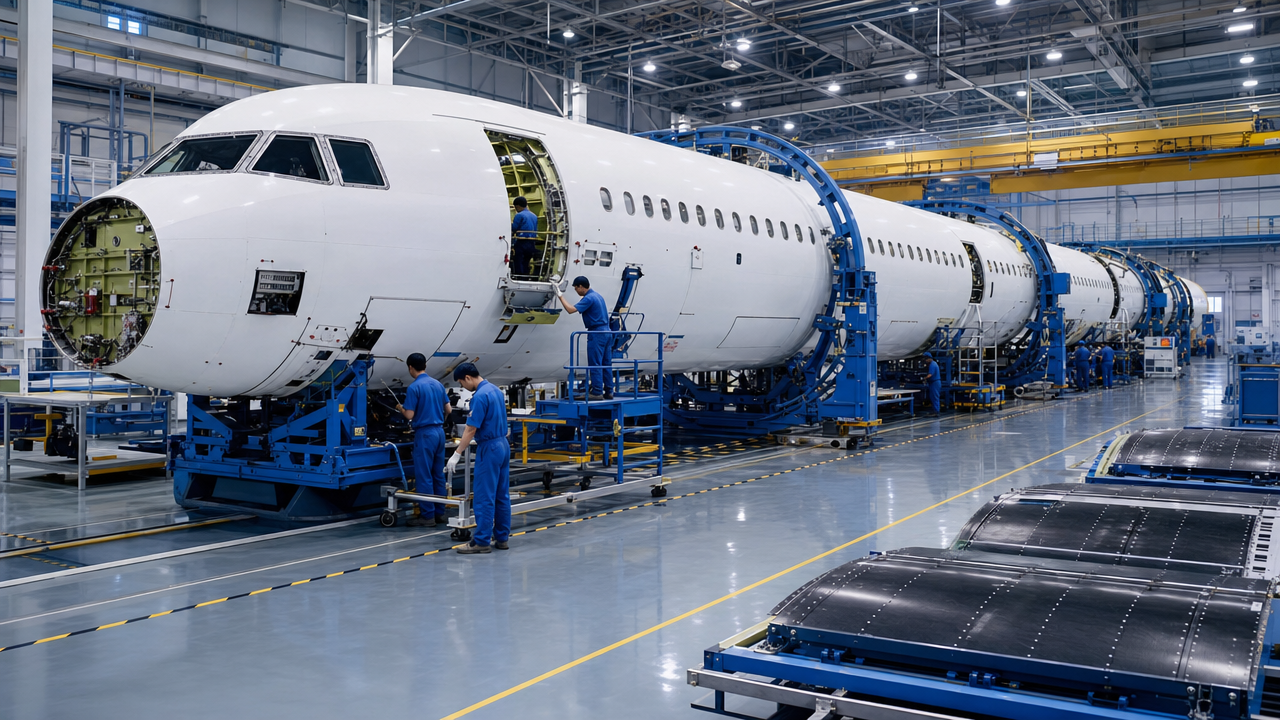
C919's airframe structure manufacturing divides COMAC's supply chain most clearly along "national system" logic. AVIC Xi'an Aircraft (000768, Xi'an Yanliang) manufactures C919 front fuselage (sections 01/02), center fuselage (sections 03/04), rear fuselage (section 05), and vertical tail — the single largest machine body section supplier by volume. It simultaneously handles Y-20 airframe final assembly and H-6 bomber batch production.
AVIC Shenyang (600760) primarily handles fighter final assembly (J-20, J-35, J-15). AVIC Harbin handles C919 pressurized frame and ARJ21 tail sections while serving as China's primary helicopter (Z-20, Z-9) final assembly base. AVIC Chengdu (Chengdu Aircraft) handles J-20 final assembly.
The core technical challenges in airframe manufacturing are: large composite panel integral forming (C919 composites ~12%, C929 target >20%), large aluminum/titanium skin digital milling and mating accuracy, and total assembly fixture high-precision mating (COMAC Shanghai sets the national benchmark for this precision).
5.2 Aero-Engine: From "Bottleneck" to "System Breakthrough"
Aero-engines are the most scrutinized and the most directly impactful sub-system for China's distance from world-class performance.
AECC Power (600893, Zhuzhou) is China's largest aero-engine complete-unit manufacturer, with primary production bases including Shenyang Liming (high-performance military engines, WS-10/WS-13/WS-15), South Aviation Engine (small/medium engines), and Guizhou Liyang (medium-thrust engines). FY2025 revenue RMB 46.3 billion (-3.23%), net profit RMB 634 million (-26.27%), gross margin 9.12%. Despite H1 delivery cadence being uneven, Q4 saw revenue up 7% and net profit up 292% YoY, demonstrating year-end delivery acceleration.
Harbin Yi Hang Power Machinery, Shenyang Liming Fara Aviation Power Engineering, and other configuration enterprises form the middle-tier support network in engine complete-machine manufacturing.
AECC Technology (600391) focuses on engine casings, blades, and key component machining as a Tier-1 supplier to AECC Power. AECC Control (000738) focuses on engine fuel control and FADEC full-authority digital engine control systems — the representative domestic company for the most information-intensive engine sub-system and a critical undertaker of CJ-1000A control system localization.
CJ-1000A current status: 317 CAAC-required airworthiness tests all completed, 6,142 cumulative ground and flight test hours, entering final review stage. Analyst firms project certification in 2027–2028, mass production by 2030.
5.3 Aviation Materials: Breakthrough Paths for Four Bottlenecks
Superalloys are the core turbine blade material. China's 3rd-generation single-crystal alloys are entering engineering application. Fushun Special Steel (600399) is a major domestic supplier; Chengdu Hangyu Superalloy is a key component processor.
Titanium alloys are critical structural materials for aircraft fuselage and engine fan/compressor. Baoti (600456, Baoji) is China's largest titanium materials producer. AVIC Heavy Machinery (600765), Parker New Materials (605123), and Zhuoyue Forging Wuxi are the key undertakers for large-format titanium forgings.
Carbon fiber composites: Light Polymer (Guowei 300699) has the broadest T300/T700/T800/T1100 product spectrum. Zhongjian Science & Technology (300777) focuses on T800 carbon fiber for military use. Zhongfu Shenying (688295) specializes in large-tow carbon fiber. AVIC Gaoke (600862) handles prepreg and CFRP component manufacturing. Harbin Kapurey Guanglian Aviation Composites and Xi'an Qixia Aerospace are smaller specialized composite processors.
Aviation fasteners: One aircraft uses hundreds of thousands of fasteners; C919's single-source dependencies here are real. Chaojie (301005) is the representative domestic listed company. Dongfang Lantian Titanium, Jiangsu Maxon Aerospace, Zhejiang Rongdeli Aviation, and Howmet Fastening Systems Suzhou form the multi-tier fastener supply ecosystem.
5.4 Avionics: The Deepest Localization Gap
Avionics (approximately 30–40% domestic localization) is the lowest-localization sector in China's supply chain. C919's IMA avionics platform is from Collins Aerospace; FMS from Honeywell. The next step toward high localization is C929's design — which requires core flight control computers and FMS that are fully domestic, with a time window of 2028–2032. Aviation electronics localization is the key variable determining whether supply-chain autonomy can make the leap from 60% to 80% after 2030.
Chapter 6 Key Company Analysis: Financials and Competition
6.1 AECC Power (600893): Protagonist of Domestic Engine
AECC Power's FY2025 financials: Revenue RMB 46.3 billion (-3.23%), net profit RMB 634 million (-26.27%), gross margin 9.12%, accounts receivable approximately RMB 44.4 billion (~70× net profit). Q4 single-quarter revenue RMB 23.4 billion (+7%), net profit RMB 530 million (+292%). The H1 decline resulted from uneven delivery cadence; H2 improvement validates full-year fundamentals.
Strategic significance: Post-CJ-1000A mass production, AECC Power becomes China's sole domestic commercial aircraft engine supplier. The current ~1.36% net margin represents a transition-period trough, not a long-term equilibrium. When civil CJ-1000A orders accumulate and scale effects emerge, structural improvement in profitability is expected.
6.2 AVIC Shenyang (600760): Fighter Leader's High-Margin Model
AVIC Shenyang is China's only 4th-generation stealth fighter assembly listed company. FY2025: Revenue RMB 44.7 billion (+4.25%), net profit RMB 3.5 billion (+3.65%), net margin approximately 7.9% — high by military manufacturing standards. Q4 revenue RMB 24.0 billion (+37%), net profit RMB 2.2 billion (+37%). The high margin reflects the high unit price and high gross-margin structure of military fighters, and scale effects from J-20 batch production.
6.3 AVIC Xi'an Aircraft (000768): C919's Industrial Foundation
FY2025: Revenue RMB 41.0 billion (-5.1%), net profit RMB 1.15 billion (+12.49%), net margin approximately 2.8%. The revenue-down / profit-up scissor effect reflects cost control progress and the increasing proportion of higher-margin C919 civil contracts in total revenue. C919 production ramp is the core indicator to watch for Xi'an Aircraft's revenue trajectory.
6.4 Yingliu (603308): Engine Blade Precision Specialist
Yingliu is the most representative listed domestic company in aviation engine blades and aviation precision castings. FY2025 Q1–Q3: Revenue RMB 2.12 billion (+11%), net profit RMB 290 million (+29.6%); Q3 alone revenue RMB 740 million (+14.8%), net profit RMB 110 million (+41.1%). Contract liabilities RMB 210 million (+20% YoY). Guiyang AECC Precision Casting is a similarly positioned superalloy precision casting enterprise in Guizhou.
6.5 Baoti (600456): Titanium Materials National Backbone
Baoti is China's largest titanium materials producer. The company released its 2025 preliminary performance announcement in January 2026; detailed financials await the annual report. Baoti's strategic value: first, as the primary-level raw material supplier for C919 and ARJ21 airframe titanium structural parts; second, as C919 production ramps, titanium alloy procurement will expand proportionally to aircraft output. Shaanxi Tiancheng Aviation Materials and Baoji Xigong Titanium Alloy Products form a complementary supply base.
6.6 AVIC Heavy Machinery (600765): The 100-Billion Forging Platform
AVIC Heavy Machinery is China's largest aviation precision forging manufacturer, covering titanium forgings, superalloy forgings, and large aluminum alloy forgings. H1 2025 achieved "double-half" (revenue and profit both over 50% of annual targets). The company's 300MN and 750MN die-forging presses are strategic heavy infrastructure for China's large civil forging manufacturing, providing an irreplaceable position in the supply chain.
6.7 Carbon Fiber Trio: Guowei, Zhongjian, Zhongfu Shenying
Guowei (Guowei Composites, 300699): Broadest product spectrum T300/T700/T800/T1100; T800 large-scale military supply; T1100 (equivalent to IM10 grade) small-batch supply; also has prepreg/composite part processing capability.
Zhongjian Science & Technology (300777): T800 carbon fiber focused on military market; only listed company with stable large-scale T800 military supply; strategic defense supply position.
Zhongfu Shenying (688295): Large-tow carbon fiber (48K–50K) specialist; lower cost per unit weight for wide-area structures; increasingly important as C929 targets >50% composites by weight.
Jiaxing Xiangyi Composites, Anhui Jiali Advanced Composites, and Xi'an Aorke Aviation are smaller specialized composite processing enterprises.
6.8 Boyun New Materials (002297): Brake System Monopoly
Boyun is China's core supplier of aviation brake materials (carbon-carbon composite brake discs), with full R&D and manufacturing capability for C/C composite brake discs serving ARJ21, C919, and multiple military aircraft programs. C/C materials' stable friction coefficient at high temperature is a core process mastered by no more than 10 companies globally; Boyun holds a quasi-monopoly position domestically.
Chapter 7 Mid-Stream Industrial Belts: Geographic Distribution and Cluster Capabilities
China's aviation large aircraft industrial belt features five core nodes — Shanghai, Xi'an, Shenyang, Chengdu, and Harbin — supplemented by Jiangsu (forgings/fasteners), Guizhou (engines/precision casting), and Beijing (materials R&D).
The Tianxiagongchang platform — China's B2B marketplace covering 4.8 million verified active factories — reveals high clustering of aviation supply chain enterprises in Xi'an, Chengdu, Shenyang, Shanghai, Nanjing, Suzhou, and Wuxi, spanning aviation precision machining, civil aviation components, and aircraft engine components.
Shanghai Pudong (COMAC HQ + Final Assembly): China's only civil large aircraft final assembly base; the most advanced digitally-equipped aircraft manufacturing facility in China. COMAC's supply coordination platform (SCP) manages hundreds of suppliers from Tier-1 to Tier-3.
Xi'an Yanliang (AVIC Xi'an + Aviation City): China's most complete aviation manufacturing industrial belt in a single city. AVIC Xi'an's C919 section machining lines and Y-20 final assembly line form the core; over 300 aviation supply chain enterprises cluster in the Xi'an Aviation Technology Development Zone. Xi'an Xiluo Aviation Components and Shaanxi Tiancheng Aviation Materials are representative nodes.
Shenyang (Shenyang Aircraft + Liming Engine): China's military fighter industrial heartland. AVIC Shenyang's assembly facility simultaneously completes J-20 and J-35 assembly; Liming Aviation Engine produces high-performance WS-10/15 military engines. Shenyang Jinghe CNC is a representative precision machining node.
Chengdu (Chengdu Aircraft + Aviation Economic Zone): J-20 final assembly at Chengdu Aircraft; Chengdu Hangyu Superalloy handles precision superalloy castings. Chengdu Tagel Aerospace represents a new-generation specialized enterprise.
Harbin (AVIC Harbin + Helicopter Industry): Z-20, Z-9 helicopter final assembly; ARJ21 tail sections; C919 frame components. Harbin Xinhua Aviation Industry is an important supply node.
Jiangsu (Wuxi/Suzhou/Nanjing: Forgings + Fasteners): AVIC Heavy Machinery Wuxi base (Zhuoyue Forging Wuxi), fastener cluster in Suzhou (Howmet Fastening Suzhou, Xinyu Aviation Manufacturing Suzhou), aviation structural parts in Nanjing (Nanjing Ruihan Aviation Components).
Guizhou (Guiyang: Engines + Precision Casting): AECC Liyang (WS-13/GTCP36), Guiyang AECC Precision Casting, Safran Aircraft Engines Guiyang. Guizhou represents a Third-Line Construction legacy turned specialty manufacturing cluster.
Beijing (BIAM + Aviation Research Institutes): Not a primary production base but China's primary aviation materials R&D center, providing material standards and test certification for the national supply chain.
Chapter 8 Sub-Sector Topics: Twelve Key Arenas
8.1 C919 Mass Production: Where Are the Bottlenecks from 15 to 200?
2025 actual deliveries approximately 15 aircraft versus year-start target of 50 (later revised to 75). Root causes are systemic multi-point constraints: AVIC Xi'an's section production rate ramp (needs 8x scale-up over 4 years); CFM LEAP-1C global delivery backlog; system integration and airworthiness verification. The 2026 target is monthly production 2–3 aircraft (~25–35/year); 2029 target 200/year requires all three constraints resolved simultaneously.
8.2 C929 Wide-Body First Flight: The Post-Russia-Cooperation Independent Path
C929 basic configuration: 280 seats, range 12,000 km, targeting A330neo and B787 market. Planned first flight 2026 H1; CAAC TC target 2032; commercial service target 2035. Partner engine CJ-2000 ground tests exceed 3,000 hours; planned flight trials 2027–2028. Post-Russia-sanctions restructuring accelerated C929's domestic content targets (>50% composites, fully domestic avionics).
8.3 CJ-1000A: Final Airworthiness Gate
CJ-1000A completed 317 CAAC tests and 6,142 hours of cumulative operation. CAAC final review stage ongoing; independent analyst forecast for certification: 2027–2028; mass production: 2030. Key technical achievements recently include: additive manufactured fuel nozzles (GE LEAP-similar approach), BLISK compressor rotor fabrication, and precision cooling hole laser drilling at batch-production consistency.
8.4 Military Engines: WS-15 and Next Generation
Military engine localization is the highest-achievement sub-field: WS-10 series (J-10C/J-16 full re-engining), WS-20 (Y-20 large bypass turbofan, completing strategic transport full domestic engine production), WS-15 (J-20 thrust-vectoring 5th-generation engine, late-stage flight validation). Military engine technology breakthroughs provide continuous technology transfer to CJ-1000A and CJ-2000 programs through personnel mobility and metallurgical process sharing.
8.5 Y-20 and Large Military Transport
Y-20 (Kunpeng): maximum takeoff weight ~220 tonnes, payload ~66 tonnes, range >7,800 km. Initial Russian D-30KP-2 engines being replaced by WS-20. Hubei Sanjiang Aerospace Jiangbei Mechanical Engineering serves Y-20 as a specialized structural component supplier.
8.6 Z-20 and Helicopter Industry
Z-20 (10-tonne class utility helicopter): fly-by-wire, composite airframe skins, single-engine-failure auto-takeover logic. Engine WZ-10 turboshaft produced by AECC South Aviation. Z-20 batch deployment drives demand for AVIC Heavy Machinery (rotor transmission forgings) and Guowei (rotor blade carbon fiber). Heavy helicopter (Mi-26 class) is China's next major helicopter program target.
8.7 ARJ21 Internationalization
ARJ21 (commercial name C909): cumulative deliveries approximately 175 aircraft, operating in 12 countries. Total orders exceed 500. International expansion target: 20–25 countries by 2030, with Southeast Asia, South Asia, and Africa as priority markets. EASA mutual recognition negotiations ongoing. ARJ21 international success is C919's airworthiness mutual recognition advance pioneer.
8.8 General Aviation and Low-Altitude Economy
China's general aviation fleet approximately 3,800 aircraft; 2024 flying hours approximately 1.45 million. The "low-altitude economy" policy introduced by MIIT and CAAC targets RMB 1.5 trillion in industry scale by 2030, covering eVTOL, cargo drones, and commuter aviation.
8.9 MRO: The C919 After-Service Chain Emerging
With C919 fleet growing, MRO demand enters a certain growth trajectory. The first C919 (delivered 2023) will reach C-Check cycle around 2028. COMAC is co-establishing C919 dedicated spare parts centers with three major airlines, targeting the major hubs' AOG support networks by 2026–2027.
8.10 SAF and Aviation Decarbonization
IATA's 2050 net-zero target is increasingly shaping aircraft design requirements. China's CAAC mandates SAF blend ratio of ≥5% for domestic flights by 2030. CJ-1000A is compatible with SAF blending without modifications — an important "backward compatibility" advantage that requires no additional certification procedures beyond the core engine TC.
Chapter 9 Technology Evolution: Eight Frontier Arenas
9.1 Single-Crystal Turbine Blades: The Materials Temperature Arms Race
China has achieved 3rd-generation single-crystal alloy (DD-5, DD-6) batch manufacturing for military engines. CJ-1000A turbine blades use an alloy system still somewhat below GE/Safran LEAP-1C's CMSX-4 level, which is the core material reason for remaining performance gaps. Achieving 3rd→4th generation single-crystal alloy is China's highest materials technology target for 2026–2030.
9.2 High-Bypass-Ratio Turbofans: Efficiency Revolution
Modern commercial aircraft use high-bypass-ratio turbofans (LEAP ~11, GE9X ~10) for approximately 15–20% lower fuel burn versus previous generations. CJ-1000A target bypass ratio approximately 8.8–9.2, benchmarked against LEAP. 3D-printed titanium alloy fan blades and BLISKs are key engineering tools; both are in early-stage production consistency optimization in China.
9.3 Additive Manufacturing in Aerospace
3D-printed fuel nozzles (GE9X: 304 additively manufactured parts), titanium aerospace fittings, and complex internal cooling passages are replacing traditional processes. China's top university teams (Beihang, NWPU) have breakthroughs in large titanium alloy laser deposition manufacturing (LMD); civil airworthiness certification for additive parts remains the commercial production barrier.
9.4 Composite Integrally-Formed Structures
A350 full fuselage barrel, B787 wing skins: integral cure composite forming reduces rivets from tens of thousands to thousands. C929's design target (>50% composites) requires Guowei/Zhongfu Shenying carbon fiber technology and RTM/prepreg autoclave processes to achieve production-scale breakthroughs simultaneously. Weihai Guangsheng Aerospace represents a new-generation composite aviation part forming enterprise.
9.5 Fly-by-Wire and Advanced Avionics
C919 FCS is based on Collins Aerospace platform; domestic substitution is still in exploration stage. C929's core design objective is full domestic avionics (IMA architecture using domestic flight management computers and bus technology ARINC 429/664). SiC power semiconductors in the aviation-grade (AEC-Q101 + high-temperature certified) range remain in R&D stage — the most watched semiconductor sub-segment in domestic avionics supply chain for 2026–2030.
9.6 Digital Manufacturing and MBD
COMAC fully introduced MBD (Model-Based Definition) in C919 development: 3+ million part digital mockup (DMU) using CATIA V5/V6, all suppliers using MBD for manufacturing. Shanghai final assembly introduced AGV pulsed production lines, robot auto-drilling systems, and laser tracker real-time positioning, reducing manual operation ratio from ~70% to ~45% (2028 target ~30%).
9.7 AI Applications in Aviation Manufacturing
NDT intelligent automation (AI defect recognition in ultrasonic C-scan), predictive maintenance (AI models predicting failures 100–200 EFH ahead from hundreds of sensor parameters), and AI-enhanced CFD/FEM simulation (100–1,000× speed-up with ~95% accuracy) are entering engineering deployment phases. GE Aerospace's Predix platform is the most mature commercial aviation engine predictive maintenance AI system; AECC Power and COMAC are developing equivalent domestic platforms.
9.8 Hydrogen Aviation and Future Propulsion
Airbus ZEROe and Boeing sustainable flight initiatives have positioned liquid hydrogen turbofan and hydrogen fuel cell propulsion as candidate routes for 2040–2050. China's COMAC, DICP (Dalian Institute of Chemical Physics), NWPU, and Beihang all have hydrogen aviation research teams. For domestic supply chain, hydrogen aircraft creates new demand for cryogenic-grade aluminum alloys and PEMFC components — incremental market opportunities for carbon fiber and titanium enterprises post-2035.
Chapter 10 Risk Factors: Six-Dimension Stress Test
10.1 Airworthiness Mutual Recognition
C919/ARJ21's international market entry depends on CAAC/FAA/EASA bilateral airworthiness agreements. FAA full TC for C919 expected 2030–2035; EASA approximately 1–2 years earlier (2030–2032). Pragmatic near-term path: ASEAN, Central Asia, and African bilateral agreements, building on ARJ21's 12-country operational track record.
10.2 Domestic Engine Schedule Risk
CJ-1000A certification delay is the most-watched single-point risk. Analyst forecast: 2027–2028 certification (more conservative than COMAC's "soon" messaging); mass production approximately 2030. A delay to 2029–2030 would extend full LEAP-1C dependence and create additional supply risk.
10.3 China-US Relations and Technology Export Controls
EAR/ITAR controls already covering specific avionics chips, precision inertial navigation components, and certain sensor elements are impacting portions of C919's system supply. The more realistic near-term risk is "soft blockade" — lengthened approval processes and increased license renewal frequency for LEAP-1C export without triggering formal sanctions.
10.4 C919 Airline Acceptance and Operational Reliability
Current dispatch reliability approximately 90%+ (vs. A320/B737's ~99%) reflects early-stage system integration, not fundamental technical defects. The track record is building. Any high-profile safety event would create disproportionate pressure on airline procurement decisions — making zero major incidents through 2030 the non-negotiable strategic prerequisite.
10.5 Supply Chain Reliability
Single-source dependencies — LEAP-1C engines, certain precision castings, certain high-performance aviation coatings — represent concentrated risk that a quality failure at any single node can interrupt final assembly. CJ-1000A's eventual certification creates the dual-source structure that eliminates the highest-concentration engine risk.
10.6 Global Aviation Industry Structural Disruption Risk
If C919 enters international markets post-2030, it creates non-symmetric risk for Boeing (narrow-body in emerging markets) and more direct risk for Airbus A320 (existing dominant position in China). For engine makers (GE Aerospace, Rolls-Royce), CJ-1000A mass production means loss of C919's full new-engine market (~150–200 units/year by 2030) and MRO competition. For aviation materials markets globally, Baoti's titanium and Guowei's carbon fiber entering international supply chains at scale would create pricing competition for established suppliers.
Chapter 11 2026–2030 Forecast: Three Mainlines of the Critical Five-Year Period
11.1 C919 Cumulative Delivery Path
Conservative scenario projections:
- 2026: Target monthly production 2–3, annual ~25–35; cumulative ~55–65
- 2027: With AVIC Xi'an line expansion, annual ~40–60; cumulative ~100–120
- 2028: CJ-1000A certification → domestic engine begins; annual ~80–100
- 2029: COMAC official target 200/year; conservative forecast ~120–150
- 2030: CJ-1000A mass production enables annual ~150–180
2030 cumulative delivery forecast: approximately 500–600 aircraft. Key insight: achieving even 120/year by 2029 represents the industrial maturity transition from "premium low-volume" to "industrial-scale" — the foundation for accelerated growth in the 2030s.
11.2 ARJ21 Internationalization
Target: expand from 12 to 20–25 operating countries by 2030, with Southeast Asia, South Asia, and Africa priority. EASA mutual recognition completion would unlock Europe/Australia/LatAm access (potentially by 2030–2032). ARJ21 international success serves as the advance proof-of-concept for C919's airworthiness mutual recognition negotiations.
11.3 C929 Wide-Body Market Positioning
C929 2026 first flight (if on schedule) is a historic milestone; but commercial delivery target remains 2033–2035, full operational maturity 2038–2040. China's annual wide-body demand (~91 aircraft/year per Boeing CMO) provides substantial domestic demand floor for C929. Short-term (pre-2030): no real competition with A330neo/B787; long-term (post-2035): meaningful market presence in China and Belt-and-Road partner markets.
11.4 Localization Path from 60% to 80%
Engine (CJ-1000A mass production, 2030): +20 pp. Avionics (C929 fully domestic, 2028–2032). Landing gear (domestic approval 2027–2029, +2–3 pp). APU (ARJ21-validated domestic APU to C919, 2028–2030).
2030 target: C919 comprehensive localization rate 75–80%; C929 design target directly 85%+.
11.5 Global Engine Market Restructuring
Post-2030, if CJ-1000A reaches 100+ units/year production, China becomes the third pole in large high-bypass turbofan supply (previously only GE/Safran CFM and Rolls-Royce/P&W). First impact in China (displacing LEAP-1C), then gradually extending to ARJ21 international versions and possible C919 export. GE Aerospace and Safran's long-term China business expectations will shift — this is the strategic-level competitive landscape change that deserves most attention.
Chapter 12 Conclusion: 2026–2030, The Historical Convergence Point for China's Large Commercial Aircraft
China's aviation engine and large aircraft industry is experiencing a historic convergence of technical, industrial, and commercial capabilities. The unique nature of this convergence is that it is not a breakthrough at a single point, but the simultaneous qualification of the full chain — from base materials to final assembly integration, from airworthiness certification to operational maintenance — and the breadth of this full chain makes it virtually impossible for other countries to replicate from scratch in the near term.
C919 matters because it is already in commercial service and every flight-hour is a live stress test of the entire supply chain. From commercial service launch in 2023 to end-2025, 36,000 safe flight hours and 4 million passenger-trips are industrial credibility backed by real performance.
CJ-1000A matters because once mass-produced, it will complete China's largest aircraft supply chain by unlocking the last structurally-dependent node. Engine localization is not just a technology autonomy symbol; it is the economic foundation for pricing power and supply-chain security when C919 faces international market competition.
C929 matters because it is China's first entry into wide-body aircraft — the highest-difficulty commercial aviation segment — fully by international standards and as a global competitor. Its success or failure will determine whether China's aviation industry can advance from "quantitative catch-up" to "qualitative parity."
Tianxiagongchang's database of 4.8 million active in-production factories can reveal the factory distribution density, enterprise scale hierarchy, and geographic clustering characteristics of this supply chain across dimensions including military aviation, aviation materials, aviation structural parts, and aircraft components. From Shanghai to Xi'an, from Shenyang to Guiyang, from Wuxi to Harbin, thousands of aviation precision machining enterprises together form an industrial map that is being densified — imperfect, with gaps and bottlenecks, but directionally set and irreversibly in motion.
The research institute's assessment: by 2030, C919 annual production will exceed 120 units, ARJ21 cumulative deliveries will approach 300, CJ-1000A will complete mass-production validation, and C929 will enter its final certification sprint. This is not an optimistic scenario; it is a structural judgment based on current supply-chain capabilities, policy continuity, and historical technology ramp-up patterns. The historical convergence point for China's large commercial aircraft is precisely this five-year window of 2026–2030.
Data Sources
Data in this report is aggregated from the following authoritative sources, with the Tianxiagongchang (www.tianxiagongchang.com) industrial database serving as the base data platform for factory distribution and supply chain enterprise tracking:
- COMAC (China Commercial Aircraft Corporation) official releases and media disclosures (C919/ARJ21 delivery data, 2023–2025)
- AECC Power (600893) 2025 Annual Report (April 2026, Shanghai Stock Exchange)
- AVIC Shenyang (600760) 2025 Annual Report (March 2026, Shanghai Stock Exchange)
- AVIC Xi'an Aircraft (000768) 2025 Annual Report (April 2026, Shenzhen Stock Exchange)
- Yingliu (603308) 2025 Q3 Report (October 2025)
- Baoti (600456) 2025 Preliminary Performance Announcement (January 2026)
- GE Aerospace FY2025 Annual Results & Q4 Press Release (January 2026)
- Rolls-Royce Holdings plc 2025 Full Year Results (February 2026)
- Boeing 2025 Commercial Aircraft Orders and Deliveries Summary (January 2026)
- Airbus 2025 Full Year Results and Deliveries Press Release (January 2026)
- CAAC Statistical Bulletin on Civil Aviation Industry Development 2025 (April 2026)
- CAAC Statistical Bulletin on Civil Aviation Industry Development 2024 (May 2025)
- Qianzhan Industry Research Institute: 2025 China Aero-Engine Industry Overview (2025)
- CAAC CJ-1000A Type Certification Progress Announcements (2025–2026)
- China Securities Pengyuan: "Domestic Large Aircraft Poised, Domestic Substitution Accelerating" (2025)
- OAG Aviation Consulting, CJ-1000A Certification Timeline Forecast (January 2026)
- IATA Global Air Transport Statistics Report (2025)
- Boeing Commercial Market Outlook 2025–2044 / Airbus Global Market Forecast 2025–2044
- Eastmoney Research, Dongwu Securities AECC Power/Shenyang research reports (2025)
- United Credit Rating 2025 Air Transport Industry Analysis Report