
Abstract
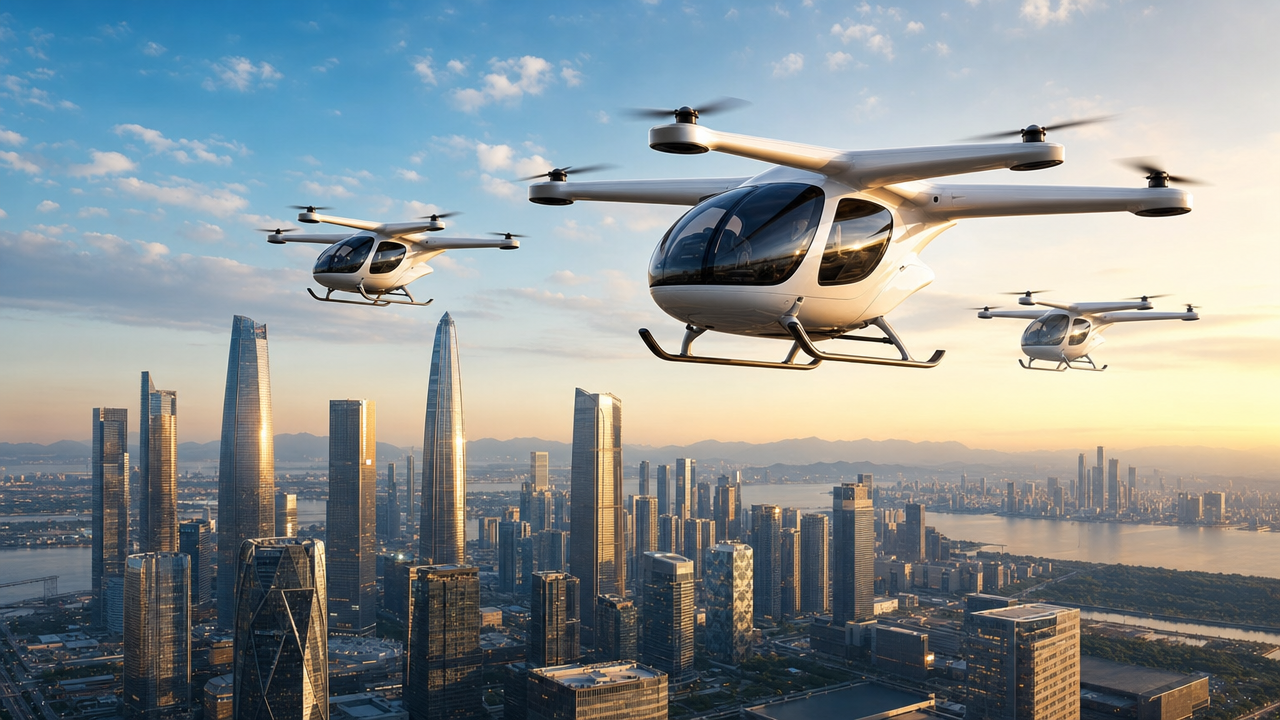
In December 2023, "low-altitude economy" was written into China's Central Economic Work Conference, placing it alongside new energy vehicles and commercial aerospace as strategic emerging industries. Two years later, a 16-rotor unmanned aerial vehicle hovers steadily over Guangzhou, selling ticketed flights to paying passengers — not science fiction, but EHang EH216-S in routine commercial operation. This aircraft has become the most tangible symbol of global eVTOL commercialization: its airframe is roughly 90% carbon fiber composite, there is no cockpit, no pilot; two passengers sit in the glass cabin, confirm their destination via mobile app, and take off.
China's low-altitude economy in 2025 is a year of converging milestones. Market-size forecasts range from 800 billion yuan to 1.5 trillion yuan, against a 2024 baseline of approximately 670.25 billion yuan — the industrial drone segment alone exceeds 65 billion yuan. EHang Intelligent (NASDAQ: EH) became the world's only eVTOL company holding the full "four certificates" (Type Certificate + Airworthiness Certificate + Production Certificate + Operating Certificate), a complete commercial-operation credential stack that no other company on earth has replicated. AutoFlight's V2000CG earned the world's first Production Certificate for a 2-tonne-class cargo eVTOL, with logistics partners including ZTO Express having signed orders for more than 200 aircraft; XPeng AeroHT's flying-car factory has topped out its roof structure, countdown to 2026 mass delivery underway; CATL completed flight testing of its 500 Wh/kg condensed-state battery on a 4-tonne electric aircraft and obtained AS9100 international aviation quality certification.
Abroad, the competitive landscape is diverging sharply. Joby Aviation flew in Dubai on the strength of nearly USD 1 billion from Toyota, completed piloted commercial flight demonstrations in the US, UAE, and Japan, and is in the final stage of FAA type certification, targeting its first commercial passenger flight in 2026. Archer Aviation delivered Midnight to the UAE, commenced flight testing in Abu Dhabi, and expects commercial flight operations within the year. Meanwhile the sequential bankruptcies of Lilium and Volocopter have stamped a lasting warning on the industry: more than USD 1 billion raised, more than nine years of development, ending with prototypes scrapped as metal waste — the most instructive cautionary case in the eVTOL era.
This report covers the complete industrial landscape of the "three-track parallel" structure — general aviation, eVTOL, and industrial drones — systematically reviewing market scale (approximately 670.25 billion yuan in 2024, targeting 3–5 trillion yuan by 2030), policy evolution (from the 2023 inaugural naming to the 2026 normalized-operations milestone year), technology roadmaps (multirotor / lift-cruise / tiltrotor + carbon fiber / aviation batteries / autonomous flight), key companies (EHang / XPeng AeroHT / AutoFlight / AutoFlight / DJI / ZXUAV + Joby / Archer / Vertical Aerospace), vertical segments (UAM / cargo / agriculture / inspection / emergency / tourism / MRO), and core risks (certification timelines / airspace reform / commercial-model closure / capital-market risk), with forward-looking projections for the 2026–2030 competitive landscape.
Core thesis: China has established the world's most advanced first-mover advantage in eVTOL commercialization. The speed at which airworthiness certification and airspace reform progress is the single largest variable determining when the trillion-yuan target will be realized. Cargo drones represent the most certain near-term growth driver over the next three years. And the quality transformation of thousands of component suppliers in the supply chain is the industry's true long-term competitive foundation.
Chapter 1 Definitions, Classifications and the Full Industry-Chain Panorama
1. The Boundaries of "Low Altitude": from Regulation to Industry Definition
In the Chinese context, "low altitude" is not a naturally formed geographic concept but a spatial boundary jointly defined by regulation and industrial policy. Under the National Airspace Classification Measures issued by the Civil Aviation Administration of China (CAAC) in 2024, Class G uncontrolled airspace covers altitudes below 300 metres, while Class W uncontrolled airspace covers below 120 metres; these are the primary operating altitudes for eVTOL aircraft, drones, and general aviation activities. Industry convention typically sets the upper limit of "low altitude" at 1,000 metres, sometimes extended to 3,000 metres in certain contexts, while defence-ministry regulations define below 1,000 metres as low altitude and 1,000–6,000 metres as medium altitude.
"Low-altitude economy" is officially defined as a comprehensive economic form centred on low-altitude flight activity that drives the integrated development of related industries. In December 2023 it was written into China's Central Economic Work Conference, elevated to the same status as new energy vehicles and commercial aerospace as a strategic emerging industry. This was the first time the low-altitude economy received formal naming at the highest level of policy conferences, and it marks the foundational logic behind the subsequent two years of dense policy releases, surging capital inflows, and competitive pilot-city deployments. From that point on, an industrial system spanning aircraft manufacturing, flight operations, air traffic management, landing infrastructure, and aviation materials began accelerating its assembly under the banner of national strategy.
From a political-economy perspective, the boundaries of the low-altitude economy are considerably wider than the boundaries of the airspace itself. It encompasses not only the aircraft flying in low altitude, but the full infrastructure supporting those aircraft (landing pads, charging stations, maintenance bases), the operational service ecosystem (route operations, pilot/operator training, insurance), and the value-added services derived from low-altitude platforms (low-altitude remote sensing, urban digital-twin interfaces). This definitional breadth is both the logical foundation for the "trillion-yuan target" and the root cause of the enormous discrepancy between different institutions' market-size figures. In 2024 China's low-altitude economy sector scale was approximately 670.25 billion yuan, with low-altitude aircraft manufacturing and operational services jointly accounting for roughly 55%. This figure is the baseline coordinate for understanding the sector's depth and growth trajectory.
Historically, the "low-altitude economy" did not appear from nowhere in 2023. As early as around 2010, CAAC launched low-altitude airspace management reform pilots in selected regions, with cities including Chengdu pioneering the opening of certain areas to low-altitude flight. But constrained by deep structural limitations of the airspace management system (military-civilian coordination) and the immaturity of commercialization technology (especially eVTOL), progress was slow for more than a decade. The 2023 policy elevation transformed airspace reform from a specialist matter within the civil aviation system into a national-level strategic deployment, opening the political channels for resource mobilization — which produced the dense implementation seen in 2024–2026.
2. Aircraft Classification: Four Coordinate Axes
Understanding the product landscape of the low-altitude economy requires simultaneous classification along four axes: type of flying vehicle, use case, propulsion method, and aerodynamic configuration. The intersections of these four axes define virtually every commercially significant low-altitude aircraft on the market today, and also determine each vehicle type's regulatory pathway, certification difficulty, and commercialization rhythm.
By flying vehicle type, three major segments can be distinguished:
The first category is General Aviation (GA), referring to all civil aviation activities other than scheduled commercial airline services, including business flights, flight training, agricultural and forestry operations, medical rescue, aerial tourism, and short-haul transport. Vehicles are primarily piston aircraft, helicopters, and jet business aircraft. As of end-2024, China had approximately 712 general aviation operating enterprises (excluding drones), a fleet of about 5,000 aircraft, and general aviation operational flight volume of 51.7 million flight-hours for the first seven months of 2024. General aviation is the most mature segment of the low-altitude economy — over 60 years old — but also the most tightly regulated and the slowest-growing. Its existing infrastructure (496 general aviation airports at end-2024) and pilot training ecosystem form the historical base for low-altitude economic development.
The second category is eVTOL (Electric Vertical Takeoff and Landing), the absolute focus of global capital and policy attention. eVTOL is characterized by electric propulsion and vertical takeoff and landing, targeting short-to-medium urban and inter-city travel, covering airport shuttles, point-to-point commuting, emergency rescue, and aerial tourism. Its key differentiating advantages: no runway required (vertical takeoff/landing), zero direct carbon emissions (fully electric), lower maintenance costs than traditional helicopters (electric motors are far simpler than combustion engines, with fewer moving parts), and relatively lower noise (rotor noise below that of helicopters). In 2024 China's eVTOL sector scale was approximately 3.2 billion yuan, projected to exceed 9.5 billion yuan by 2026 — small in absolute terms but the highest growth rate in the entire low-altitude economy supply chain.
The third category is Unmanned Aerial Vehicles (UAV), subdivided into consumer drones (aerial photography/entertainment/racing), industrial drones (surveying/inspection/agriculture/security/emergency), and logistics delivery drones. Drones are the most commercially mature segment: China's civilian drone industry exceeded 120 billion yuan in 2023, ranking first globally. DJI alone commands approximately 70%–74% of global drone market share — the highest market concentration of any single aircraft category worldwide. By August 2024, registered drones in China numbered approximately 1.987 million, up about 25% from 2023, with an industrialization depth comparable to the new energy vehicle components sector.
By use case, low-altitude aircraft cover six core application scenarios:
- Urban Air Mobility (UAM): airport-to-city shuttle, point-to-point urban commuting, and congestion-bypass routing — eVTOL's most commercially imaginative long-term scenario. Cross-city commuter routes such as Shenzhen–Zhuhai and Shenzhen–Guangzhou are the most closely watched deployment nodes for 2026–2028.
- Logistics and cargo: last-mile drone delivery (SF Fengwing, JD drones, Meituan drone trials), medical supply transport to remote areas, inter-city express cargo. AutoFlight's V2000CG represents the "tonne-class cargo eVTOL" — a technological leap from multi-kilogram deliveries to deliveries measured in tonnes.
- Agricultural plant protection: pesticide spraying, seeding, pollination, and field inspection, dominated by DJI and XAG, already deeply commercialized; in 2023 crop-protection drone operating area exceeded 1 billion mu-operations, the most mature application in the low-altitude economy.
- Industrial inspection: periodic inspection of power lines (State Grid / Southern Grid), oil and gas pipelines, bridges, dams, and railways, primarily using industrial drones, with companies such as ZXUAV (688070) and Piesat (688066) active in the segment.
- Emergency rescue: urgent medical supply delivery (mountain areas/islands), fire-fighting support (high-rise buildings), disaster reconnaissance and search-and-rescue — the scenario with the most emphatic policy endorsement, with government procurement as the primary commercial channel.
- Aerial tourism: short-haul experience flights by manned eVTOL such as EHang EH216-S at tourist destinations — the earliest scenario where eVTOL has begun charging market-rate prices (approx. 880 yuan per flight), with initial validation in the premium-experience consumer market.
By propulsion method, three technical routes:
- Pure electric: the current mainstream, zero emissions, limited primarily by battery energy density (mainstream NCM Li-ion batteries ~250–300 Wh/kg; CATL's condensed-state battery has reached 500 Wh/kg; solid-state battery commercial expectation around 2027 is ~400–500 Wh/kg). Range is the core constraint for pure-electric eVTOL; most commercial products today span 30–100 km.
- Hybrid (extended-range): a fuel generator continuously charges the battery, compensating for the range deficit of pure electric, suitable for urban-to-suburban medium distances (100–300 km). The commercial model for range-extension has already been validated in automobiles; the core challenge for eVTOL migration is weight management (fuel engine + tank + generator combined).
- Hydrogen power (H2VTOL): hydrogen fuel cells as the power source, with theoretical energy density far exceeding lithium batteries (hydrogen ~33.6 kWh/kg vs lithium-ion ~0.5 kWh/kg), and the only "emission" being water vapour. The weight and safety of hydrogen storage systems (high-pressure cylinders/liquid hydrogen) are the main engineering barriers. Domestic verification flights have already taken place; commercial products could emerge around 2028–2030.
By aerodynamic configuration, four major types:
- Multirotor: 4 to 20 rotors, simple control logic, technically mature, clear redundancy safety design (a single rotor failure can be compensated by the rest) — the fastest-commercializing configuration today. EHang EH216-S (16 rotors) is the canonical example. Drawback: poor aerodynamic efficiency — all rotors must continuously generate lift even in horizontal flight, consuming substantial energy and severely limiting range (~30–35 km fully loaded).
- Lift+Cruise (winged eVTOL): multiple lift rotors handle vertical takeoff and landing; a fixed wing provides lift during horizontal flight while the lift rotors can fold or stop; propulsion is handled by a tail pusher propeller. Aerodynamic efficiency significantly better than multirotor, range 150–240 km. Joby S4, Archer Midnight, and AutoFlight V2000CG all belong to this category. Challenge: the "transition phase" between takeoff/landing and horizontal flight involves the most complex control logic and receives the strictest scrutiny in airworthiness certification.
- Tiltrotor: rotors can rotate between vertical (takeoff/landing) and horizontal (cruise) positions, achieving the highest aerodynamic efficiency but the greatest mechanical complexity. TCab Tech E20 and Volant VE25 use this configuration — high performance but high engineering difficulty.
- Fixed-wing VTOL: vertical takeoff/landing enabled through special aerodynamic designs (e.g., vectored thrust, boundary-layer control), with efficient fixed-wing cruise; currently mainly seen in military drones and certain cargo drone research projects.
3. Full Industry-Chain Panorama: from Upstream Materials to End-Use Operations
The low-altitude economy supply chain spans four layers horizontally, each with distinct value distribution, competitive dynamics, and policy dependence.
Upstream: Key Materials and Core Components (approx. 10%–15% of value)
This is the highest-value-density layer of the entire supply chain and the most concentrated zone of "chokepoint" risk. Aviation-grade carbon fiber is the skeletal material of eVTOL: carbon fiber composites account for approximately 90% of an eVTOL's airframe, rotor blades, landing gear, and propellers, with per-aircraft consumption of 100–400 kg; compared with aluminum alloys, carbon fiber enables 30%–40% weight reduction, directly translating to improved range or payload. Zhongfu Shenying (688295) has developed medium-temperature prepreg products for the low-altitude economy and completed first-aircraft verification flights; its T1200-grade carbon fiber (world's first, launched 2026) enables a further 30% weight reduction for eVTOL airframes.
Aviation batteries determine range and operational economics. CATL's condensed-state battery (500 Wh/kg) has completed flight testing on a 4-tonne electric aircraft and holds AS9100 international aviation quality certification — the highest energy density of any mass-produced aviation battery today. High-rate fast charging (5C and above) is another dimension: it determines how long an eVTOL must remain at a Vertiport, and thus affects flight frequency and operational efficiency. Electric motors and controllers determine propulsion efficiency; flight control systems (software and chips) are the core value proposition of autonomous-flight eVTOL.
Midstream: Airframe Manufacturing (approx. 55%–65% of value)
Airframe manufacturing is the most value-concentrated node in the low-altitude economy supply chain, aggregating brand identity, customer recognition, and airworthiness credentials. China's domestic eVTOL airframe enterprise hierarchy has formed clearly: EHang Intelligent holds all four certificates and occupies the first tier; AutoFlight's cargo type is in mass production with the passenger variant in certification; XPeng AeroHT's factory is ~70% complete; AutoFlight (Chengdu-based, Geely subsidiary) has the fastest CAAC certification progress. In the drone segment, DJI is the absolute dominant player; ZXUAV is deeply entrenched in the industrial B2B drone market. The core barrier between airframe companies is the airworthiness credential — once a CAAC Type Certificate is obtained, it represents an extraordinarily high entry barrier that makes rapid catch-up by latecomers extremely difficult.
Downstream: Operational Services and Infrastructure (approx. 20%–35% of value)
Low-altitude operational services encompass flight dispatch, operator/pilot training, maintenance/repair/overhaul (MRO), and data services. In the early stages of commercialization these depend on policy subsidies, but as scaled operations mature, this layer is set to become the highest-margin segment in the entire chain — analogous to the position of airlines (rather than aircraft manufacturers) in commercial aviation's value chain.
Landing infrastructure (Vertiports/low-altitude landing pads) is the physical bottleneck for urban air mobility at scale. Shenzhen targets more than 1,200 landing pads by end-2026; Suzhou targets more than 200; Chongqing more than 1,500 — behind each of these targets lies billions of yuan in fixed-asset investment, and systemic opportunities to create employment, stimulate commercial real estate, and drive business-model innovation. Low-altitude UTM (Unmanned Traffic Management) is the digital neural hub for safe operations; Cdatc (002253) is the domestic leader in this segment.
Support Layer: Policy and Financial Ecosystem
In January 2026, the NDRC and two other ministries jointly issued the "Implementation Opinion on Promoting High-Quality Development of Low-Altitude Insurance," planning to establish mandatory UAV liability insurance by 2027 and a complete policy framework by 2030. Guangdong Province rolled out the "Low-Altitude Finance Twelve Articles"; the low-altitude economy was incorporated into the national 7-trillion-yuan new infrastructure investment framework. These policy instruments are steering the sector's risk-sharing mechanism away from "government subsidy" and toward "market-based insurance + finance" — an important signal of sector maturation.
4. The Three-Track Parallel Narrative Logic
Understanding China's low-altitude economy calls for a single, lean narrative framework: general aviation, eVTOL, and industrial drones advancing in parallel on three tracks. The three tracks differ markedly in maturity, policy environment, and commercial logic, but together constitute the full substance of the "low-altitude economy" as a strategic narrative.
General aviation is the historical accumulation and infrastructure foundation of the low-altitude economy, providing the most mature operational framework and regulatory system — but with limited growth, it is not the main driver of incremental expansion over the next five years. Industrial drones are the segment with the deepest commercialization and the largest output value: DJI's global monopoly position is the most concrete historical achievement of Chinese manufacturing in this track. eVTOL is the most imaginative but also the most uncertain new variable: its absolute sector scale remains modest, but it has the highest growth rate of the three tracks, and its innovation in technology routes, application scenarios, and business models is the core driver pushing the entire low-altitude economy narrative forward.
The three-track parallel structure is both a description of the current industrial reality and the structural support that makes the 2030 trillion-yuan target credible. No single track is sufficient to sustain that market scale on its own; all three tracks summed together provide the necessary mass. Understanding this structure is the prerequisite for evaluating the value of any individual company in the low-altitude economy.
Chapter 2 Global Competitive Landscape: The Rise, Fall, and 2025 Status of Overseas eVTOL
1. The Historical Context of the Global eVTOL Race
In the first decade of the twenty-first century, the commercial drone industry was already brewing in Shenzhen's factories. But the concept of Urban Air Mobility (UAM) did not truly reach a capital and technology inflection point until around 2016, when the Uber Elevate white paper turned "taking a flying taxi to work" from science fiction into a subject of MBA case analysis; the same year, multiple eVTOL startups completed early financing rounds.
This wave's technical foundation was the simultaneous maturation of three domains: lithium battery energy density roughly tripling during 2010–2020 (making pure-electric flight engineering-feasible rather than merely theoretical); the distributed electric propulsion control technology cultivated by the consumer drone industry (led by DJI) bringing rotor control algorithms from military labs into commercial factories; and the opening of a price window for certain categories of new materials (especially aviation-grade carbon fiber composites), making lightweight structures accessible outside of billion-dollar military aircraft programs. The convergence of technical maturity and capital enthusiasm created a global eVTOL development wave. By 2021–2022, publicly announced eVTOL R&D projects worldwide numbered more than 600, with over a dozen unicorns valued above USD 1 billion — including companies founded by NASA-pedigreed engineers, former Tesla engineers, and former Boeing designers.
Yet capital market enthusiasm could not mask the industry's core tensions: airworthiness certification cycles are extremely long (obtaining full certification from the FAA or EASA typically takes 5–8 years); commercial scale-up requires dense ground infrastructure (Vertiport construction is an urban planning matter that no single company can advance unilaterally); and there is a vast economic gap between per-unit manufacturing cost and the ticket price consumers are willing to pay (manufacturing one eVTOL costs hundreds to thousands of millions of yuan; users typically won't pay more than 1,000 yuan for a short flight). Beginning with the rate-hike cycle of 2022 and through 2023–2024, the boom began a brutal winnowing — and the sequential bankruptcies of Lilium and Volocopter are that winnowing's most instructive outcomes.
2. Joby Aviation: the Leading Player Closest to the Finish Line
As of 2025, Joby Aviation is the eVTOL company with the most advanced commercialization progress globally — the only company to have completed piloted commercial flight demonstrations in all three of the US, the UAE, and Japan.
Joby's aircraft is a five-rotor tiltrotor eVTOL (S4), with a maximum speed of 321 km/h, maximum range of approximately 240 km, and designed to seat four passengers plus one pilot. These specs place it in the most technically aggressive tier of current eVTOL products.
Toyota's strategic alliance: a landmark for automotive manufacturing entering aviation
Toyota Motor is Joby's largest strategic investor. As of 2025, Toyota's cumulative investment in Joby has reached close to USD 1 billion (USD 894 million confirmed; the first USD 250 million tranche of a further investment closed in May 2025). The two companies are finalizing a Strategic Manufacturing Alliance aimed at leveraging Toyota's Production System (TPS) to establish a scalable manufacturing pathway for Joby's aircraft.
2025 global flight footprint
In 2025, Joby's flight intensity increased dramatically, with annual operational tempo up 2.6× from the previous year. Notable activities: at Edwards Air Force Base the second aircraft was delivered to the US Air Force under military contract; in the UAE, Joby completed its first point-to-point air taxi flight in Dubai — from its Margham test facility to Al Maktoum International Airport (DWC) — and was the only eVTOL company to participate in the Dubai Airshow flying demonstration; in Japan, a flight demonstration was held at Fuji Speedway.
FAA certification: 2026 key milestone
Joby is currently in the final stage of its FAA Type Certificate process. The 2026 target: begin Type Inspection Authorization (TIA) flight testing and carry its first commercial passengers within the year. Joby also announced plans to double US manufacturing capacity, targeting production of four aircraft per month by 2027.
3. Archer Aviation: Factory-First, UAE-First
Archer Aviation (NYSE: ACHR)'s Midnight eVTOL uses a 12-rotor lift+cruise configuration (maximum speed ~240 km/h, ~100 km range, 4 seats). Rather than centering its narrative on FAA certification progress, Archer's strategy is "factory first, commercial presence first, show investors revenue first."
Stellantis serves as exclusive contract manufacturer with a target of 650 aircraft per year by 2030. The high-volume manufacturing facility in Covington, Georgia (adjacent to Covington Municipal Airport) completed construction in 2025. Simultaneously, Archer has six Midnight aircraft in various stages of production across both its Silicon Valley "Golden Manufacturing Line" and the Covington facility, with three in final assembly.
In 2025, Archer delivered its first Midnight to the UAE, commenced flight testing in Abu Dhabi under agreements with Abu Dhabi Aviation and the Abu Dhabi Investment Office (ADIO), and expects to generate its first commercial revenue within the year from the Launch Edition program. Archer also acquired a portion of Lilium's patent portfolio related to electric propulsion and motor control.
4. Vertical Aerospace: VX4 Progress and Funding Pressure
UK-based Vertical Aerospace (NYSE: EVTL)'s VX4 is a winged eVTOL designed for 320 km/h, 160 km range, and 4 passengers. In 2025, Vertical completed the full piloted transition flight sequence — a key milestone demonstrating technical readiness. On the capital side, the company raised USD 50 million in November 2024 and USD 90 million more in January 2025. Vertical plans to achieve EASA certification for the VX4 by end-2026.
5. Lilium and Volocopter: Two Bankruptcies Worth Studying
Lilium (Germany)
Lilium GmbH, founded in 2015 and headquartered in Munich, raised more than USD 1 billion (from investors including Tencent, LG Technology Ventures, and Baillie Gifford) for its seven-seat pure-electric jet eVTOL (Lilium Jet), which used 36 ducted electric fans distributed along the wings rather than conventional propellers. In October 2024, Lilium GmbH and Lilium eAircraft GmbH both filed for insolvency after the German federal government refused to guarantee a EUR 50 million loan. In February 2025, Lilium Aerospace filed for insolvency a second time after a rescue by the US investor group Mobile Uplift Corporation failed to materialize.
The two prototypes in final assembly sat unbuyed at Oberpfaffenhofen; photos circulating on LinkedIn showed them being systematically disassembled for scrap metal. Archer Aviation and Vaeridion each acquired portions of Lilium's patent portfolio, but the physical aircraft themselves met their end as scrap.
Lilium's key lessons: the more technically aggressive the configuration, the harder and more resource-intensive the certification process; a capital structure relying on secondary markets and government grants without any certified product is acutely fragile; and "letters of intent" for orders are not revenue — Lilium claimed more than 800 pre-orders before its collapse, but delivered zero aircraft commercially.
Volocopter (Germany)
Volocopter (main product VoloCity, two-seat multirotor, ~110 km/h, ~35 km range) also filed for insolvency in 2024. Unlike Lilium's technical aggression, Volocopter's route was conservative, but its commercialization pace was extremely slow — the company had operated for about 12 years without achieving real commercial operations. Most ironically, Volocopter had carefully arranged a commercial flight demonstration for the 2024 Paris Olympics but was unable to maintain planned normal operations due to technical issues, and eventually collapsed due to the funding chain breaking.
6. Wisk Aero: Boeing-Backed Autonomous Route
Wisk Aero is Boeing's eVTOL subsidiary, focused on autonomous (no-pilot) urban air mobility. Its core differentiator is the "automation-first" philosophy — that eliminating pilot cost is the key to making the eVTOL business model work (pilot cost represents approximately 40%–60% of operating costs). Boeing's backing provides unique resources for airworthiness certification, but full certification for autonomous manned flight is an even longer-cycle proposition than piloted eVTOL — FAA's regulatory pathway for autonomous manned flight remains incompletely defined.
7. Summary: Three Global eVTOL Tiers in 2025
Tier 1 (certified or closest to certification):
- EHang Intelligent (China): world's only "four certificates," normalized commercial operation underway
- AutoFlight (China): global first TC + PC for tonne-class cargo eVTOL, mass delivery underway
- Joby Aviation (US): FAA certification final stage, targeting first commercial passengers in 2026
Tier 2 (mid-certification, commercial trial):
- Archer Aviation (US): UAE Midnight delivered, commercial flight expected within year
- AutoFlight Chengdu / Geely (China): CAAC Stage 4, fastest domestic progress
- Vertical Aerospace (UK): VX4 transition flight complete, 2026 certification target
- XPeng AeroHT (China): PC application in process, 2026 mass production plan
Tier 3 (early R&D, no certificate yet):
- AutoFlight V2000EM Shengshilong (China): 2026 expected CAAC TC
- Wisk Aero (US): autonomous route, long cycle
- TCab Tech, Volant, Vertaxi and other Chinese entrants
Already exited:
- Lilium (Germany): second bankruptcy February 2025, prototypes scrapped
- Volocopter (Germany): bankruptcy 2024
- Kitty Hawk (US, Larry Page-backed): closed 2022
This tier structure reveals a compelling structural fact: the two most commercially advanced global eVTOL seats belong to Chinese companies (EHang and AutoFlight); the most technically aggressive pure-electric high-speed eVTOL closest to North American certification is America's Joby. Europe's pioneers (Lilium, Volocopter) have all exited. The global eVTOL race has evolved from "600+ companies in a melee" to "China and the US advancing in parallel, European pioneers gone" — and this configuration is China's distinctive strategic position in the global low-altitude economy.
Chapter 3 PEST Analysis: Policy, Economy, Society, and Technology
1. Political Dimension: National Will and Policy Evolution
December 2023's elevation of the low-altitude economy to strategic emerging industry status — on par with EVs and commercial space — is the starting point for understanding all Chinese low-altitude economy policy logic. Three policy development phases can be identified:
Phase 1 (2019–2022): Infrastructure and management framework first. CAAC launched low-altitude airspace management reform pilots; Chengdu became China's first city to operate a tiered low-altitude airspace. DJI's rapid growth during this period generated large volumes of real flight data to inform policy design.
Phase 2 (2023–2024): National strategy naming, top-level architecture deployed. The National Airspace Classification Measures formalized Class G (below 300 m) and Class W (below 120 m) uncontrolled airspace in law — the first time Chinese law provided explicit "permitted to fly without application" space for low-altitude aircraft. The Low-Altitude Economy Development Plan (2024–2030) set the trillion-yuan target, established six eVTOL pilot cities (Hangzhou, Hefei, Shenzhen, Suzhou, Chengdu, Chongqing), and granted those cities partial authority over airspace below 600 metres.
Phase 3 (2025–2026): Execution-layer dense implementation, normalized-operations milestone year arrives. CAAC issued the "Powered-Lift Aircraft Airworthiness Standards (Draft for Comment)" — a universal certification standard to replace vehicle-by-vehicle individual review, expected to compress average eVTOL certification cycles from 5+ years to approximately 3 years. CAAC established a "General Aviation and Low-Altitude Economy Work Leadership Group" in July 2025. Most consequentially, CAAC issued China's first batch of Operating Certificates (OC) for manned unmanned aerial vehicles — EHang Tong航 and Heyi Aviation became the first certified operators.
In 2026, policy has sharpened further: the NDRC-led low-altitude insurance framework; the low-altitude economy formally embedded in the national 7-trillion-yuan new infrastructure investment frame; dense provincial and municipal low-altitude economy plans. Industry consensus: 2026 is the normalized-operations milestone year.
Structural challenge: military-civilian airspace coordination
Despite the dense policy releases, airspace reform remains the deepest structural constraint on eVTOL commercialization. In China, the military retains substantial authority over low-altitude airspace; commercial eVTOL at scale requires a shift from a case-by-case approval system to flight-plan-based notification or prior-report filing — a systemic engineering exercise involving military-civilian coordination. The six pilot cities' partial management authority covers only six cities, only up to 600 metres, and only "partial" authority, indicating that progress is deliberate and incremental. Cross-city routes like Shenzhen–Zhuhai involve airspace coordination across two administrative jurisdictions — which is exactly why that route is "planned to open in 2026" rather than already operating.
2. Economic Dimension: Capital Flows and Commercial-Model Validation
The low-altitude economy's inclusion in the national 7-trillion-yuan new infrastructure framework is a powerful macro policy signal: landing-pad construction, low-altitude communications networks (5G low-altitude coverage, LEO satellite supplementation), and UTM digital infrastructure will enter China's regular fiscal planning rather than depending on ad hoc project applications. Government infrastructure investment then levers market capital to follow — the pattern repeatedly validated in EV charging infrastructure and 5G network rollout.
On the commercial side, EHang's current operations in Guangzhou at ~880 yuan per trip, ~4 flights per day, with government subsidies of 100–300 yuan per flight, are not yet a market-driven profitable model but constitute a meaningful milestone: consumers are now paying real money for eVTOL services. eVTOL operating cost is estimated at USD 0.5–2.5 per seat-mile, far below helicopters at USD 6–8 per seat-mile. As battery costs continue to fall (following the ~90% decline trajectory of automotive battery costs from 2015 to 2024) and airframe manufacturing scales, the projected 200–300 yuan per trip for routes like Shenzhen–Zhuhai in 2028–2030 is not unrealistic.
3. Social Dimension: Public Acceptance and Urban Form
Public acceptance: from "curious bystanders" to "paying passengers"
By 2024, EHang EH216-S was in commercial trial operation in Guangzhou with daily paying passengers. Several social-cultural factors make China's UAM market uniquely positioned for early acceptance: China's high-speed rail network has over 15 years conditioned 3+ billion annual passengers to embrace technologically innovative transport; China's world-leading smartphone and mobile-payment penetration makes "app-hail + seamless payment" frictionless for potential eVTOL users; and decades of urban traffic congestion give city residents a visceral motivation to seek out alternatives.
Noise and urban planning: the Vertiport siting dilemma
Multirotor eVTOL rotor noise at takeoff/landing ranges approximately 65–75 dB at 50 metres — lower than helicopters (85–95 dB) but still above typical residential-area nighttime standards (45–55 dB). Vertiport siting must carefully balance proximity to transit nodes (ensuring travel convenience) against distance from dense residential areas (preventing noise complaints). Shenzhen's target of 1,200 landing pads by end-2026 requires meticulous site selection involving urban planning bureaus, building management authorities, fire safety, and environmental agencies — a systemic urban-governance exercise, not simple infrastructure construction.
4. Technology Dimension: Materials, Batteries, and Software
Carbon fiber: from catch-up to leadership
Zhongfu Shenying (688295) has achieved T800-grade 24K carbon fiber using liquid moulding processes and completed flight verification on a new-energy aircraft; is advancing T1100-grade prepreg to mass production; and has developed six medium-temperature prepreg product lines for low-altitude economy applications. In 2026, China released the world's first T1200-grade carbon fiber — a landmark shift from "follower" to "leader" in carbon fiber technology.
High-energy-density batteries: each breakthrough directly expands eVTOL's commercial value
CATL's condensed-state battery (500 Wh/kg) completed 4-tonne electric aircraft flight testing and obtained AS9100 aviation quality certification. At 500 Wh/kg, the same battery weight carries 67%–100% more energy than current NCM batteries — extending EHang EH216-S-class products from ~35 km urban inner-city range to 70+ km urban inter-city range. Solid-state batteries (partial commercial aviation adoption expected 2026–2028) offer theoretically even higher energy density and far superior safety for passenger applications.
Autonomous flight: the largest lever on operational economics
EHang EH216-S and AutoFlight V2000CG are already operating commercially with no human pilot — China's core differentiating advantage over global peers. CAAC has established a replicable certification pathway for autonomous manned eVTOL that FAA and EASA have yet to match. China's lead in "autonomous manned eVTOL commercial certification" is approximately 3–5 years ahead globally — not a lead in the technology itself, but a lead in the regulatory pathway.
5. International Regulatory Alignment: China's Global Integration Path
China's largest institutional barrier to global expansion is the lack of airworthiness certification mutual recognition. CAAC, FAA, and EASA bilateral airworthiness agreements (BAAs) currently cover large commercial aircraft but not the new eVTOL category. Southeast Asia (Indonesia, Malaysia, Philippines, Thailand) and the Middle East (UAE, Saudi Arabia) are China's priority international markets — their regulators are more receptive to CAAC-certified products, and EHang EH216-S completed its first commercial flight in Indonesia in June 2025. The competition to shape international eVTOL standards through ICAO is the most important, and least-reported, strategic battleground in the low-altitude economy's global expansion.
Chapter 4 China Market Scale: The 800-Billion-Yuan Starting Point and the 2030 Trillion-Yuan Roadmap
1. The 2025 Baseline: the 670-Billion to 1.2-Trillion Estimation Range
Lower-bound direct industry scope: 2024 China low-altitude economy sector scale approximately 670.25 billion yuan (Qianzhan Research, Saidi Consulting references). 2025 forecast range: Saidi Consulting ~859.17 billion yuan; CAAC ~1.5 trillion yuan; consensus range 800 billion – 1.2 trillion yuan. The discrepancy reflects different statistical scopes — CAAC includes broader spillover effects; Saidi uses a stricter direct-industry definition. Either way, 2025 China low-altitude economy scale is indisputably approaching the trillion-yuan threshold.
2. Sub-Segment Breakdown
Industrial drones (largest current sub-segment): 2024 ~65.068 billion yuan, projected to reach ~171.015 billion yuan by 2029 (CAGR ~21%). This is the most commercially mature segment — plant protection, power inspection, surveying, and security all have proven business models independent of new infrastructure.
General aviation (slow incremental growth): ~712 operators, ~5,000 aircraft, ~51.7 million flight-hours (H1 2024). Growth is constrained by long pilot training cycles, high maintenance costs, and complex airspace access — not the main incremental source in the near term.
eVTOL (highest growth rate, smallest absolute size): 2024 ~3.2 billion yuan, projected to exceed 9.5 billion yuan by 2026 — approximately 3× growth in two years, supported by XPeng AeroHT X3 planned mass delivery, AutoFlight V2000EM expected certification, and EHang's expansion from trial to normalized commercial operation.
Landing infrastructure (underestimated hidden market): Shenzhen alone targets 1,200+ pads in 2026; at 2–5 million yuan per pad construction cost, Shenzhen alone represents 2.4–6 billion yuan. Nationwide 5G low-altitude communications, UTM systems, and digital operations platforms represent hundreds of billions in long-term infrastructure demand.
3. Three-Phase Roadmap: 2024–2026–2030
Phase 1 (2024–2026): Airworthiness certification and pilot operations. CAAC issues first OCs for manned UAV operators (done, 2025); pilot cities complete landing-pad infrastructure buildout; 1–2 eVTOL products reach year-on-year production of 100+ units. 2025 market scale projection: 860 billion – 1.5 trillion yuan; probability of crossing 1 trillion yuan in 2026: ~65%–70%.
Phase 2 (2026–2030): Scaled commercial deployment. Main urban clusters complete baseline low-altitude communications coverage; UTM in normalized operation; eVTOL operators establish stable commercial route networks. Cross-city routes (Shenzhen–Guangzhou, Shenzhen–Zhuhai, Shanghai–Suzhou) begin shifting from tourism/experience to daily commuting. Cargo drones enter high-growth period.
2030 target: 3–5 trillion yuan. CAAC/MIIT joint roadmap. In the central scenario, the realistic landing point is more likely 2–3 trillion yuan, with industrial drones ~30%–35%, general aviation ~20%–25%, eVTOL and UAM ~15%–20%, infrastructure and operations ~25%–30%.
4. Three Growth Levers
Lever 1: airworthiness acceleration — CAAC's universal certification standard compresses eVTOL cycle from 5+ years to ~3 years. Lever 2: airspace reform deepening — transition from case-by-case approval to flight-plan-based notification expands commercial route network scope. Lever 3: manufacturing cost curve — at current trajectories, EHang EH216-S unit cost could fall from 2.39 million yuan today to ~800 thousand–1.2 million yuan by 2030, opening a far larger consumer market.
Chapter 5 Supply Chain Deep Dive: from Carbon Fiber to Landing Infrastructure
1. Supply Chain Structure Logic
Value distribution: upstream materials and components (10%–15%), midstream airframe manufacturing (55%–65%), downstream operations and infrastructure (~20%–35%). Midstream holds the largest value concentration but the upstream materials and components define the technical ceiling. True commercialization scale depends on downstream infrastructure density and operations model innovation.
2. Upstream 1: Aviation-Grade Carbon Fiber
eVTOL airframe, rotors, landing gear, and propellers are ~90% carbon fiber composites, with 100–400 kg per aircraft. Zhongfu Shenying (688295) has validated T800-grade carbon fiber in flight; T1100-grade is advancing to mass production; six medium-temperature prepreg product lines for low-altitude economy have been developed. Guowei CF (Guangwei Composites) reported T1100 and above contributing more than 60 million yuan in 2025. China's global-first T1200-grade carbon fiber (2026) could enable 30% further weight reduction for eVTOL airframes at equivalent structural strength — a landmark shift in the carbon fiber power balance.
3. Upstream 2: Aviation Power Batteries
CATL's condensed-state battery (500 Wh/kg) completed 4-tonne electric aircraft flight testing; obtained AS9100; strategically invested in AutoFlight (AutoFlight/Fengfei) as battery system supplier (reducing per-charge operating cost ~30%). Fixed-state battery commercial aviation adoption expected 2026–2028, with theoretical energy density potentially exceeding 500 Wh/kg and superior safety (no liquid electrolyte combustion risk — critical for passenger aviation). Other players: EVE Energy, Ganfeng Lithium all positioning in aviation battery.
4. Upstream 3: Electric Motors and Controllers
Bafang Electric (603489), Jing-Jin Electric, and Wolong Electric are advancing aerospace propulsion systems. Domestic motor/controller localization rate ~60%–80%; the challenge is reliability certification and lightweighting design rather than fundamental technology.
5. Upstream 4: Avionics Systems
EHang Intelligent's EH216-S flight control system is fully in-house — the core technical basis for passing CAAC's autonomous manned eVTOL certification. Eliminating the pilot (training cost ~1–2 million yuan/pilot, annual salary ~500k–1 million yuan) is the single largest lever for making eVTOL operations economically viable.
6. Low-Altitude ATM/UTM Systems
Cdatc (002253) is China's leading air traffic management system company; its A-SMGCS products are deployed at multiple civil airports. Its low-altitude UTM product line will enter a rapid expansion cycle as pilot-city commercial operations ramp up.
7. Landing Infrastructure (Vertiport)
Shenzhen 2026 target: 1,200+ pads (vs. 483 in 2024). Suzhou: 200+. Chongqing: 1,500+. Hefei: 30+ eVTOL-dedicated pads within 3 years. Per-pad construction cost ~2–5 million yuan → these four cities alone represent 60+ billion yuan in infrastructure demand.
8. Operational Services: the Eventual Profit Pool
Commercial route ticket sales, cargo delivery services, MRO, operator training, data value-added services (low-altitude remote sensing, urban digital-twin interfaces) — in a mature low-altitude economy, this layer typically carries the highest margins. Currently these rely on policy subsidies (Guangzhou subsidizes each EHang flight 100–300 yuan). The transition from "subsidy-dependent" to "market self-sustaining" is expected to begin in leading pilot cities during 2027–2030.
Chapter 6 Key Company Profiles: from EHang to Joby
1. EHang Intelligent — World's First "Four-Certificate" eVTOL Company
EHang Intelligent (NASDAQ: EH) is the most commercially advanced eVTOL company on earth. Founded 2014, headquartered in Guangzhou, the EH216-S is a 16-rotor unmanned manned aerial vehicle: maximum takeoff weight 600 kg, 2 passengers, max speed 130 km/h, range ~35 km fully loaded. In 2025, EHang Tong航and Heyi Aviation obtained China's first-batch Operating Certificates (OC) for manned unmanned aerial vehicles — completing the world's first "four-certificate" stack: TC + AC + PC + OC. Guangzhou Huangpu District issued the world's first operating certificate for a manned eVTOL route. Commercial price: 2.39 million yuan. Current operations: normalized commercial trial in Guangzhou and Hefei (880 yuan/ticket, ~4 flights/day, with subsidy). June 2025: EH216-S completed first unmanned manned passenger flight in Indonesia. New long-range eVTOL product (200+ km range) has been announced for mid-distance scenarios. Net loss ~230 million yuan (2024) — pre-commercial-scale investment stage.
2. AutoFlight (Fengfei Aviation) — Cargo eVTOL Mass-Production Pioneer
World's fastest-advancing cargo eVTOL company commercially. V2000CG Kairiou: 2-tonne class, unmanned cargo eVTOL, lift+cruise configuration, max takeoff weight 2 tonnes, pure electric, deliverable equivalent to small helicopter. March 2024: world's first TC for tonne-class-or-above eVTOL. January 2025: world's first PC for 2-tonne-class eVTOL; appeared on CCTV Spring Festival Gala. Signed orders for 200+ aircraft including ZTO Express. CATL strategic investment; joint development cut per-charge operating cost ~30%. V2000EM Shengshilong (passenger version, 5 seats, 2,200 kg, 250+ km range record): CAAC Hua Dong certification underway, 2026 TC expected.
3. XPeng AeroHT — 2026 Mass Production Target
Subsidiary of XPeng Motors (NYSE: XPEV). "Land Aircraft Carrier": land vehicle + flight body (X3-F), 3-axle 6-wheel land body, CLTC range 1,000+ km, price under 2 million yuan. May 2025: X3-F Production Certificate application accepted by CAAC South China region. Factory ~70% complete, Q4 2025 target. 2026 mass delivery target. Market positioning: high-net-worth private consumers rather than commercial operators — lower regulatory dependence, smaller addressable market.
4. AutoFlight Chengdu (Geely subsidiary, "Wofei Changkong")
AE200 (5-seat transit eVTOL) has reached CAAC Stage 4 of 5 — fastest domestic progress among passenger eVTOL currently in certification (excluding already-certified EHang and AutoFlight/Fengfei). Expected full CAAC certification 2026. Geely backing provides automotive supply chain cost management capability and access to Chengdu's airspace reform leadership.
5. DJI — Drone Empire
DJI holds ~70%–74% global consumer drone market share — the highest market concentration of any single aircraft category globally. Plant-protection drone domestic share: 54.82% (first). Industrial drone plant-protection segment: 54.82% DJI, 37.59% XAG, ~93% combined = effective duopoly. DJI entered cargo drone market with DJI Flycart 30 (30 kg dual-battery, 16 km range).
6. ZXUAV (688070) and Industrial Drone Segment
ZXUAV (688070) is China's first publicly listed company with industrial drones as its core business. 2025 revenue ~621 million yuan (+31%), net profit ~10.68 million yuan (turnaround to profit) — a bellwether for the industrial drone segment approaching profitability inflection. Strategy shifted from "industrial UAV OEM" to "low-altitude digital economy solution provider," covering UAV + data link + ground station + cloud data processing.
7. Joby Aviation (NYSE: JOBY)
Joby Aviation — FAA certification final stage; S4 (5-rotor tiltrotor, 4 seats, ~240 km range) represents the technical frontier for North American eVTOL. Toyota ~USD 1 billion strategic investment. 2026 plan: begin FAA TIA flight testing; carry first commercial passengers within year. Expansion plan: double US manufacturing capacity, targeting 4 aircraft/month by 2027.
8. Archer Aviation (NYSE: ACHR)
Archer Aviation Midnight (12-rotor lift+cruise, 240 km/h, 4 seats). Stellantis exclusive contract manufacturer, 650 aircraft/year by 2030 target. 2025: UAE Midnight delivery completed, Abu Dhabi flight testing underway, UAE commercial first flight expected within year. Lilium patent portfolio partial acquisition strengthens electric propulsion IP.
Chapter 7 China Low-Altitude Industry Belt Map: Shenzhen, Guangzhou, Chengdu, and Eight City Clusters
1. Formation Logic of Industry Belts
China's manufacturing history consistently proves: a sector's ability to truly scale depends not on one or two star companies but on a whole industrial belt — a dense network of coordinating upstream/downstream factories. The low-altitude economy is no exception. Three primary axes are forming: Pearl River Delta (Shenzhen–Guangzhou dual core), Western Chengdu-Chongqing (Chengdu as core), and East China Yangtze River Delta (Shanghai–Hefei–Nanjing triangle), plus the low-altitude transformation of traditional aviation industry bases (Xi'an, Harbin, Zhuzhou).
2. Shenzhen: Most Aggressive Policy, Densest Supply Chain
Ranked #1 in 2025 China Low-Altitude Economy City Competitiveness TOP50 (China Economic Information Service, 90 points). Shenzhen's primary asset is DJI and its ecosystem — DJI's headquarters in Nanshan, with its ~70%–74% global market share generating a dense surrounding cluster of carbon fiber components, motor/controller suppliers, battery management systems, flight control chips, and ground station software. XPeng AeroHT core R&D is also based in Shenzhen. 2024: 94 new cargo drone routes, 483 landing facilities, cargo drone sorties +15% YoY (national #1).
Target: 1,200+ landing pads and 1,000+ commercial routes by end-2026; 10 low-altitude economy industrial parks; Shenzhen–Zhuhai cross-city eVTOL commuter route expected to open in 2026 (~20-min single trip).
The industry-belt formation logic: once airframe manufacturers arrive, component suppliers follow; supplier density creates a specialized labor market; talent density accelerates R&D iteration; faster iteration improves competitiveness and attracts more customers and investment — a self-reinforcing spiral.
3. Guangzhou: Birthplace of the World's First Commercial Aviation Operating Certificate
EHang Intelligent is headquartered in Guangzhou; the world's first manned eVTOL operating certificate (OC) was issued here (Huangpu District). Guangzhou has formed the earliest commercial ecosystem for manned eVTOL operations — operator services, operator training, MRO. GAC Group's aviation diversification and the Pearl River Delta auto-parts supply chain's extension into eVTOL lightweight structural components provide manufacturing cost advantages.
4. Chengdu: Fastest Airspace-Reform Pioneer
AutoFlight Chengdu (Wofei Changkong, Geely subsidiary) is located here. Chengdu is China's first city to operate a tiered low-altitude airspace and one of the first batch of low-altitude airspace management reform pilots. This airspace flexibility is part of why AE200 is CAAC's fastest Stage 4 domestic passenger eVTOL — Chengdu's airspace openness provides irreplaceable test-flight conditions. Aviation industrial base (AVIC Chengdu Aircraft, AECC Western facilities) is transitioning toward civil low-altitude.
5. Hefei: Strongest Government-Driven Experiment
EHang commercial operations second city. 30+ eVTOL landing pads planned within 3 years; "3-minute flight zone + 15-minute connection line" coverage concept. Hefei's low-altitude economy push replicates its successful "government-led investment → attract lead enterprises → secure industrial lead" model from NEVs (70 billion yuan Nio investment 2019) and semiconductors (CXMT).
6. Beijing: Research Institutes and State-Enterprise Focus
Not a hub for airframe enterprises but unique in research institute density: BUAA, CAUC, CAERI provide continuous technical talent and patent generation. UTM systems, avionics, aviation electronics companies cluster here.
7. Shanghai: Yangtze River Delta Coordination Node
AutoFlight (Fengfei) is headquartered here; V2000CG volume-production manufacturing in the Yangtze Delta. Cross-province logistics alliance achieving "single approval, universal operation" is an important policy breakthrough. Taigang–Shanghai/Nantong 20-minute low-altitude route is among the first demonstration routes for Delta low-altitude freight.
8. Nanjing / Jiangsu: Strategic Material Supply
Jiangsu (including Lianyungang, Zhenjiang) has formed a carbon-fiber-and-composites cluster. Zhongfu Shenying has key production bases in Lianyungang. Local material supply for eVTOL manufacturers within the same province substantially cuts logistics cost and lead times.
9. Xi'an and Zhuzhou: Traditional Aviation Industry's Low-Altitude Transformation
Xi'an: AVIC Xi'an Aircraft (Y-20 final assembly), AECC Xi'an aero-engine facilities — carbon fiber structural components and aero-engine component manufacturing excellence migrating toward civil low-altitude applications.
Zhuzhou (Hunan): AECC South Industry, Zhuzhou Times New Materials — applying aviation-grade manufacturing capabilities to eVTOL rotor blades and structural components.
One clear pattern observed in tracking China's manufacturing industry: a key industry's maturation is never a single breakthrough but "activation of a network" — inter-city supply-chain division of labor and coordination will be the decisive upgrade taking the low-altitude economy from "pilot cities operating independently" to "national supply-chain synergy."
Chapter 8 Vertical Segment Deep Dives: Commercialization Status and Outlook Across Seven Tracks
1. Urban Air Mobility (UAM): Most Imaginative, Farthest from Scale
UAM is eVTOL's core value proposition — reducing city interior and inter-city travel time to 1/3–1/5 of ground alternatives. EHang's normalized commercial trial in Guangzhou Huangpu and Hefei is the world's most advanced UAM commercialization example (880 yuan/trip, 4 daily flights, government subsidy 100–300 yuan per flight). Overseas, Joby's Dubai point-to-point flight and Archer's UAE Launch Edition both exemplify city-airport shuttle as the first mature UAM scenario. Shenzhen–Zhuhai (140 km, expected 2026, ~20 min, projected 200–300 yuan/seat) will be China's first inter-city eVTOL commercial commuter route — the critical test case for whether eVTOL can graduate from "experiential consumption" to "daily commuting."
Key bottleneck: Vertiport density. A commercially valuable eVTOL route requires convenient landing pads at both origin and destination embedded in urban core commercial/transit nodes — involving land-use planning, building retrofit, noise abatement — obstacles beyond pure technology.
2. Logistics Cargo Drones: Clearest Commercial Logic
Cargo drones are the fastest-landing low-altitude segment. SF Fengwing Ark AKR 150 (50 kg max load) operates regularly on some South China hilly and island routes. DJI Flycart 30 (30 kg, 16 km) is the drone giant entering cargo. AutoFlight V2000CG (2-tonne, unmanned) targets "heavy last-mile logistics" and "remote-area emergency supply" — ZTO Express among 200+ signed orders. Shanghai cross-province logistics alliance "single approval, universal operation" removes the key administrative barrier to inter-city drone logistics.
3. Agricultural Plant Protection: Most Mature, Story Nearly Complete
DJI: 54.82% domestic plant-protection share; XAG: 37.59% — ~93% combined duopoly. Competition now extends from product performance and pricing to data services and agricultural supply-chain. 2023 plant-protection drone operating area: 1+ billion mu-operations. Future growth from larger-payload longer-range machines and expansion from "spray machine" to "precision agriculture management system."
4. Industrial Inspection: Most Stable B2B Demand
Power-line, pipeline, bridge, and dam inspection — the most contract-value-stable B2B scenario. State Grid and Southern Grid drone procurement drives large-scale contracts. ZXUAV's government-and-industrial segment (including power/emergency/surveying) drove ~69% of its 2025 revenue growth increment. 5G enables real-time high-resolution transmission, supporting remote real-time diagnosis.
5. Emergency Rescue: Policy-Mandated Need
Large cargo drones (AutoFlight V2000CG, 2-tonne) for disaster-area supply delivery have been validated in multiple exercises. MEM procurement plus provincial emergency management bureau UAV equipment plans are the most guaranteed procurement sources. Manned eVTOL for medical transport (mountains/islands) holds large potential but is likely a government-procurement rather than market-operations scenario.
6. Aerial Tourism: eVTOL's Earliest Revenue-Generating Scenario
EHang EH216-S at tourist destinations (Guangzhou, Hainan), 880 yuan per trip — the earliest scenario where paying consumers can board an eVTOL. Advantages: experience-driven willingness to pay far exceeds daily commuting; lighter airspace regulation at scenic spots; simpler Vertiport planning. Future potential: cross-scenic-area express shuttles adding commute utility to experience value.
7. MRO (Maintenance, Repair, Overhaul): Underestimated Long-Tail Market
eVTOL MRO is lower-cost than helicopters (simpler electric motors) but still requires battery replacement (~500–1,000 charge cycles, replace every 2–3 years), rotor/blade inspection and replacement, flight control software updates. As eVTOL fleet size grows from hundreds to thousands to tens of thousands, MRO will enter a systematic expansion cycle.
Chapter 9 Technology Evolution: Six Frontiers from Rotor Configurations to Hydrogen Power
1. Aerodynamic Configuration Contest
Multirotor (EHang EH216-S): most mature, fastest-commercializing, lowest range. Lift+Cruise (Joby, Archer, AutoFlight V2000CG): better aerodynamic efficiency, 150–240 km range, more complex certification due to transition-phase control. Tiltrotor (TCab Tech E20, Volant VE25): highest efficiency, most mechanical complexity and engineering difficulty. Configuration selection is tightly linked to commercial strategy: fastest commercialization → multirotor or lift+cruise; bet on technical moat → tiltrotor.
2. Domestic Carbon Fiber: T800 to T1200 Generational Leap
T800-grade (aviation-main grade): Zhongfu Shenying achieved and flight-validated; broke Japan's export-control chokepoint. T1100-grade: Guangwei CF T1100 contribution >60M yuan in 2025; Zhongfu Shenying advancing to mass production — T1100 tensile strength >7 GPa, ~1.5× T700. T1200-grade (world-first, China 2026): potential 30% further eVTOL weight reduction at equivalent strength — China shifts from "follower" to "leader" in carbon fiber.
3. High-Energy Aviation Batteries: 5C Fast-Charge and Condensed-State Race
CATL condensed-state: 500 Wh/kg, 4-tonne electric aircraft validation, AS9100. 5C fast-charge (Kirin battery): charges fully in ~12 minutes; with intelligent battery-swap, Vertiport dwell time under 10 minutes. Solid-state (2026–2028 partial commercialization): theoretically 500–1,000 Wh/kg with superior safety — no liquid electrolyte, far lower fire risk.
4. Hydrogen-Power eVTOL: Long-Range Zero-Emission Solution
Hydrogen fuel-cell H2VTOL: theoretical mass-energy density ~33.6 kWh/kg vs Li-ion ~0.5 kWh/kg; only emission is water vapour. Main obstacles: high-pressure cylinder/liquid-hydrogen storage system weight. Domestic verification flights underway; first commercial H2VTOL products possible around 2028–2030.
5. Autonomous Flight: Eliminating the Pilot's Operating Economics
EHang EH216-S and AutoFlight V2000CG are commercially operating without human pilots — China's core differentiation vs. global peers. FAA and EASA remain conservative on full autonomous manned eVTOL certification while CAAC has built a replicable pathway — China leads globally by 3–5 years in regulatory pathway (not core technology). Flight control AI challenges: millisecond-level real-time path planning and collision avoidance in complex urban environments (high-rise wind effects, bird flocks, high UAV density) requires sensor fusion (LiDAR/millimeter-wave radar/vision) + deep-learning inference + low-latency 5G/satellite communications.
6. 5G+ Low-Altitude Communications
Current 5G base stations mostly aim antennas at ground/horizontal direction; low-altitude (50–500 m) coverage has systematic gaps. Solutions: specialized 5G low-altitude base stations (upward-tilted antennas) and LEO satellite supplement (China's Xingwang constellation). 5G low-altitude communications' strategic value: not only flight safety (loss of comms = loss of vehicle) but also as "digital highway" — real-time flight telemetry, weather sensing, surrounding aircraft situational awareness, UTM command delivery.
7. China vs. US Technical Route Divergence: China's Unique Advantage
US (Joby/Archer): pilot retained + high performance + long certification cycle — linked to FAA's conservative stance on autonomous manned flight. China (EHang/AutoFlight Fengfei): no-pilot + short-range validation + fast certification — linked to CAAC's regulatory innovation willingness. China's unique advantage: world-first autonomous manned eVTOL commercial certification pathway; this regulatory lead has potential to help Chinese eVTOL companies build first-mover commercial positions in Southeast Asia and Middle East markets where CAAC certification enjoys higher reciprocity.
Chapter 10 Core Risks: from Airworthiness Certification to Commercial-Model Closure
1. Airworthiness Certification: Structural Length and High Barriers
CAAC's eVTOL certification is structured in five phases; full certification takes 3–7 years. EHang EH216-S's TC took ~3 years; AutoFlight V2000CG ~2 years — already the industry's fastest records. AutoFlight Chengdu AE200 at Stage 4 (fastest domestic passenger eVTOL) is expected to certify in 2026 — meaning from application receipt to certification will still span more than 3 years. In the FAA system, Joby entered the certification process in 2020 and projects completing TIA testing in 2026 — more than 6 years even with NASA/FAA active collaboration. CAAC-FAA-EASA mutual recognition is not established for eVTOL, meaning Chinese-certified products face effectively re-certification for North America/Europe — nearly doubling time and capital requirements.
2. Airspace Reform: Deepest Institutional Constraint
China's military retains substantial low-altitude airspace authority; commercial eVTOL at scale requires systemic military-civilian coordination. The six pilot cities' partial management authority — covering only six cities, only to 600 metres, only "partial" — signals deliberate, incremental progress. Cross-city eVTOL routes (Shenzhen–Zhuhai) require multi-jurisdiction airspace coordination, which is why that route is "expected in 2026" rather than currently operating. Industry consensus: 2026 will be an important reform milestone year, with national low-altitude airspace classification expected to extend to more cities.
3. Public Acceptance and Safety Risk
eVTOL's "zero-accident pressure" in the commercial early stage is real: trust built from thousands of uneventful flights can be destroyed by a single high-visibility accident. Noise: multirotor eVTOL at takeoff/landing is ~65–75 dB at 50 m — lower than helicopters but above residential nighttime standards (45–55 dB), creating siting challenges for city-core Vertiports.
4. Commercial-Model Closure: Hardest to Validate
EHang EH216-S at 2.39 million yuan, assuming 6 daily flights at 880 yuan/trip, generates approximately 1.92 million yuan/year in revenue before any operating costs or depreciation — barely recovering the aircraft cost in one year. Battery replacement (500–1,000 cycles → every 2–3 years, cost ~200–400k yuan) further squeezes margins. Commercial closure requires either manufacturing cost to fall to below 1 million yuan/unit, or daily flights to increase to 20+, or both. This requires further regulatory relaxation and substantial infrastructure buildout.
5. Capital-Market Risk: The Lilium Lesson
Lilium and Volocopter's sequential bankruptcies gave global eVTOL investors a repricing education. China's A-share low-altitude economy theme stocks experienced rapid appreciation in 2024; some valuations are overstretched. Companies that can weather capital-market volatility must demonstrate measurable commercial operating data (flight count, passenger volume, revenue) within the 2026–2027 window — the key signal for capital markets shifting from "thematic investment" to "value investment."
6. Risk Matrix and Node-by-Node Risk Differentiation
Lowest-risk nodes (industrial drones/agricultural plant protection): proven business models, stable government/enterprise B2B buyers, mature regulation, no dependence on manned eVTOL certification breakthroughs. Most reliable risk-adjusted returns in the low-altitude economy. Medium-risk nodes (cargo eVTOL/MRO/landing infrastructure): technology risk mostly resolved for certified products; main risk is commercial ramp-up speed. Higher-risk nodes (manned eVTOL UAM operators): require four simultaneous conditions — aircraft certified, airspace open, infrastructure built, public trust established — any one lagging prevents scaling. Highest-risk nodes (uncertified eVTOL OEMs): all value is "potential" until certification success; Lilium proved that even USD 1B+ funding cannot guarantee a path to market.
Chapter 11 2026–2030 Forecasts: Trillion-Yuan Target, Commercial Routes, and Competitive Landscape Restructuring
1. 2026: The Most Critical Delivery Window
Key 2026 nodes: XPeng AeroHT planned mass delivery; AutoFlight V2000EM (Shengshilong) expected CAAC TC; AutoFlight Chengdu AE200 expected CAAC full certification; Shenzhen landing pads target 1,200+ (vs. 483 at end-2024); Shenzhen–Zhuhai cross-city commuter route expected to open (~20 min, projected 200–300 yuan/seat); Joby plans FAA TIA testing and first commercial passenger; Archer expects UAE commercial first flight; Vertical Aerospace targets EASA VX4 certification.
2. 2027–2028: Scaling Critical Zone
Forecast: leading eVTOL manufacturers (EHang, AutoFlight Fengfei, XPeng AeroHT) annual production passing 100-unit threshold, triggering scale economics (unit cost potentially down 30%–50% from current); first urban low-altitude traffic network taking shape in pilot cities; cargo drone high-growth period (V2000CG order delivery, SF Fengwing expansion, DJI Flycart commercialization).
3. 2030 Target: 3–5 Trillion Yuan
Optimistic (3–5 trillion): Requires airspace reform on schedule, leading eVTOL annual production >1,000 units, cargo drones penetrating express last-mile delivery. Central (2–3 trillion): More realistic; implies 3–4× growth from 2024 baseline over six years. Sub-segment breakdown (central): industrial drones 30%–35%, general aviation 20%–25%, eVTOL/UAM 15%–20%, infrastructure + operations 25%–30%.
4. Competitive Landscape Restructuring
Manned eVTOL domestic market CR3 forecast >70% by 2030: EHang first (four-certificate first-mover and operating data accumulation); AutoFlight Fengfei second (cargo + passenger dual product line); XPeng AeroHT third (brand and capital edge, high-end consumer market). Industrial drone: DJI near-unassailable in consumer segment; industrial drone will see more vertical integration (hardware + data services). Upstream — carbon fiber (Zhongfu Shenying, Guangwei CF) and aviation batteries (CATL) will see rising strategic leverage as eVTOL production scales.
5. International Path: Southeast Asia First, Then Global
EHang completed first commercial flight in Indonesia (June 2025). Southeast Asia (Indonesia, Malaysia, Philippines, Thailand) is the natural first international market — closer regulatory alignment with CAAC, island topography creating real low-altitude transport demand, strong policy appetite for advanced technology. Middle East (UAE, Saudi Arabia) — Archer's UAE Launch Edition market; EHang and AutoFlight Fengfei positioning there too. Rich-nation client density + infrastructure build-fast capability + supportive aviation policy = ideal early international pilot markets.
Chapter 12 Conclusions: Judgments for the Three-Track Parallel Era
1. Back to the Core Question
The "low-altitude economy" in China is not an isolated technology concept but a carefully designed industrial integration narrative — incorporating three tracks of varying commercial maturity (general aviation, eVTOL, industrial drones) into a single policy framework, mobilizing capital, resources, and regulatory relaxation under the banner of national strategy to drive a new industrial system toward maturity that could cross the trillion-yuan threshold before 2030.
2. Three Clear Conclusions
Conclusion 1: China has established the world's most advanced eVTOL commercialization first-mover advantage. This rests not on planning documents but on verifiable certificate records: EHang Intelligent is the only company globally holding the "four certificates" for manned eVTOL — meaning it is currently selling tickets to real consumers in a real city — something no other company on earth has done. AutoFlight's cargo V2000CG holds the world's first TC + PC for tonne-class eVTOL and is delivering mass-produced aircraft to logistics companies. These two facts jointly constitute China's global leadership in eVTOL for 2025–2026.
Conclusion 2: Airworthiness/airspace reform is the largest variable, determining how fast the trillion-yuan target is realized. The most exciting technology is sometimes stalled by the most bureaucratic administrative processes. China's eVTOL commercialization accelerator and decelerator are fundamentally policy tools: universalization of certification standards (CAAC advancing), devolution of airspace management authority to pilot cities (six cities piloting), deepening military-civilian airspace coordination mechanisms (2026 reform node). The precise way to forecast this variable is not to analyze technology roadmaps but to observe every shift in the boundary of airspace management language in each new policy document.
Conclusion 3: The Lilium lesson and the industry's cooling-off period are necessary costs of industry maturation. Lilium's and Volocopter's bankruptcies are not eVTOL industry failures but appropriate capital repricing of a new sector. China's eVTOL industry's health lies in its main companies (EHang, AutoFlight Fengfei, XPeng AeroHT) all being built on clear technical milestones: certify first, then mass produce; cargo first, then passenger; tourism first, then commuting. This cadence is more grounded than the vast majority of global eVTOL startups.
3. Research Institute Judgment and Forward Outlook
The 2030 trillion-yuan target is achievable under a central scenario — but not through single-track eVTOL passenger operations alone, but through the summed contribution of general aviation, cargo drones, agricultural protection, industrial inspection, and eVTOL across all five tracks.
Of those five tracks, cargo drones are the most certain growth source for 2026–2028 (AutoFlight Fengfei order delivery + DJI Flycart commercialization + logistics company last-mile automation); industrial drones are the most stable B2B base (power inspection, surveying, and emergency government procurement are demand-inelastic); UAM urban air mobility is the story requiring the most patience to unfold (Shenzhen–Zhuhai opening in 2026 is only the opening chapter).
The Shenzhen–Zhuhai cross-city commuter route — once stably operating — will mark the moment when the low-altitude economy goes from "world's largest pilot zone" to "world's first commercial eVTOL inter-city route." At that point, this 140-km, 20-minute route will answer more directly than any research report whether the low-altitude economy's commercial model has truly worked.
Tianxia Gongchang, through its deep tracking of 4.8 million genuine operating factories in China, continuously monitors the supply-chain factory community of the low-altitude economy: from carbon fiber structural-component processors and motor assembly suppliers in the Pearl River Delta, to carbon fiber prepreg manufacturers in Jiangsu, to aviation-grade casting companies around Chengdu — the low-altitude economy's supply chain is incorporating more and more factories that once served automobiles and consumer electronics into the aviation-grade quality standards system. This quality transformation of the supply chain is the most easily overlooked, and most long-term valuable, dimension of the low-altitude economy.
A low-altitude economy capable of supporting the 2030 trillion-yuan target will not be a solo performance by a handful of star airframe manufacturers. It will necessarily be a densely woven industrial network of thousands of component suppliers, service providers, and infrastructure operators. The density and quality of that network — not the brilliance of a few giants, but the thousands of collaborating factories collectively holding the whole thing up — is the true determinant of how far the three-track parallel era can ultimately go.
Data Sources and Key References
This report was produced by the Tianxia Gongchang Industrial Research Institute based on factory and supply-chain data from the Tianxia Gongchang industrial platform, supplemented by public information, official government releases, and authoritative media reports. All cited data underwent multi-source cross-verification. Market-size forecast figures involve multiple statistical scopes explained in detail in Chapter 4. Key data and factual sources include:
- Industrial platform China factory database and industry-belt data (www.tianxiagongchang.com)
- CAAC airworthiness certification policy announcements; General Aviation and Low-Altitude Economy Work Leadership Group establishment (July 2025)
- NDRC and partner ministries policy documents, including "Implementation Opinion on Promoting High-Quality Development of Low-Altitude Insurance" (January 2026)
- EHang Intelligent (NASDAQ: EH) official press releases; Guangzhou Huangpu District government portal announcement on world's first manned eVTOL Operating Certificate
- AutoFlight official disclosures, including V2000CG PC issuance announcement (CAAC News, January 2025)
- XPeng Motors official website, XPeng AeroHT "Land Aircraft Carrier" PC application receipt announcement (May 2025)
- Joby Aviation website and investor relations page (ir.jobyaviation.com), including 2025 Annual Review "Year of Flight"
- Archer Aviation website and SEC 8-K filings (2025), including UAE Launch Edition announcements
- Vertical Aerospace investor announcements and FlightGlobal aviation media coverage (VX4 transition flight, 2025)
- Saidi Consulting China Low-Altitude Economy Market Scale forecast (859.17 billion yuan, 2025)
- Qianzhan Research Institute 2025 China Low-Altitude Economy Industry Full Panorama
- BCG "China Manned eVTOL Industry White Paper" (September 2025)
- KPMG "The Golden Age of Low-Altitude Economy" (October 2025)
- Renmin University of China "China Low-Altitude Economy City Development Index (LCDI) 2025"
- China Economic Information Service China Low-Altitude Economy City Competitiveness TOP50 (2025)
- Zhongfu Shenying (688295) 2025 Semi-Annual Report; T800/T1100 carbon fiber low-altitude economy application data
- CATL official statements on condensed-state battery flight verification and AS9100 aviation quality certification
- ZXUAV (688070) 2025 Annual Report; revenue and profitability data
- 21st Century Business Herald, Securities Times, Xinhua, People's Daily, Guangming Daily coverage of low-altitude economy policy and corporate developments
- Lilium bankruptcy coverage: FlightGlobal, AeroTime, Vertical Mag (2024–2025)
- Jinyuan Securities "2025 Low-Altitude Economy Milestones and 2026 Investment Outlook" (February 2026)
- Feiauto.com XPeng AeroHT product database
- Saidi Consulting Low-Altitude Economy Research Center data
- CAAC Airworthiness Certification Division published eVTOL certification guidance documents
- Weihai municipal government and Guangzhou Huangpu District government announcements on manned eVTOL Operating Certificates
- FlightGlobal, AeroTime, Vertical Mag global eVTOL industry coverage (2024–2026)
- MIIT and Electronics Information Division policies on unmanned aerial vehicle management
- CAAC Airworthiness Certification Division eVTOL special working group technical documents