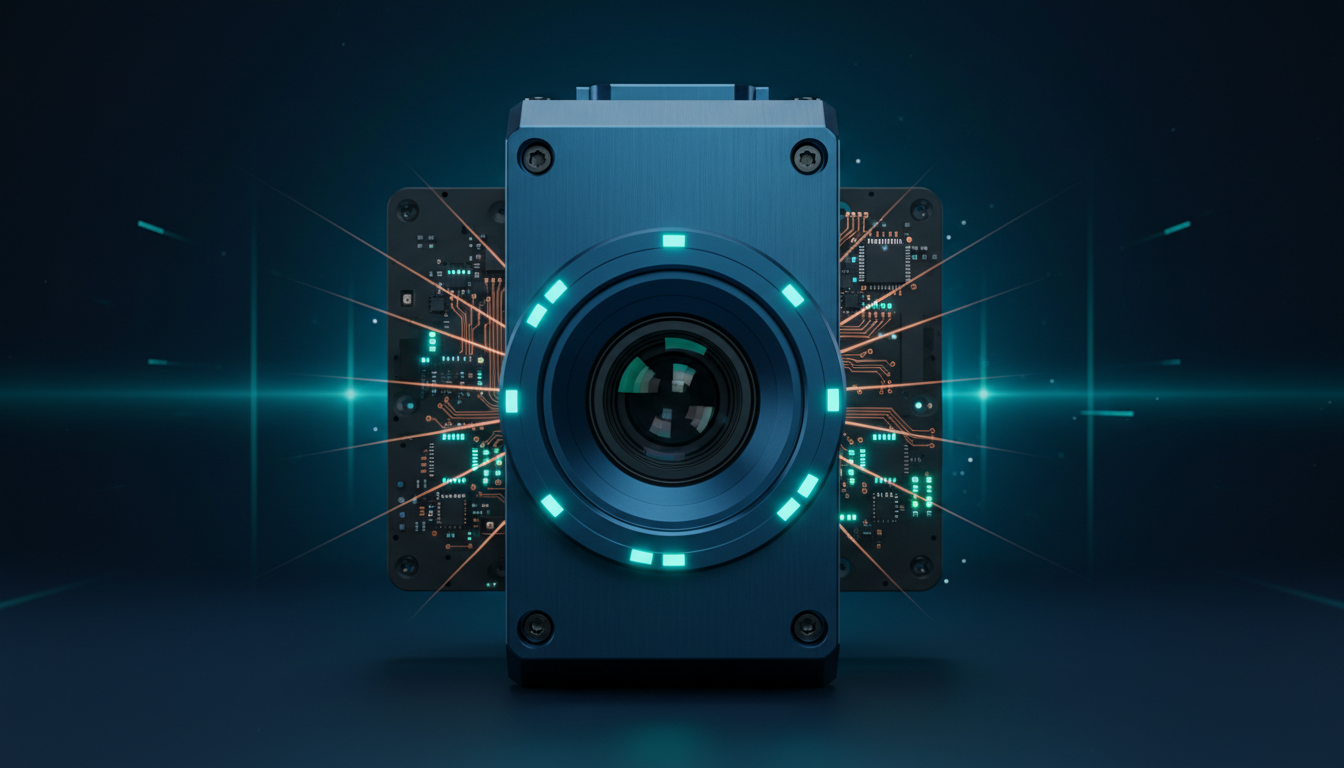

Chapter 1 Industry Overview and Definitions (Component Share of Machine Vision System Cost)
Machine vision is the technology stack that gives industrial production lines a set of "eyes." It captures images via industrial cameras, forms images through optical lenses, illuminates targets with light sources, transfers image data through frame grabbers, and finally delivers pass/fail decisions through vision software. From appearance inspection and dimensional measurement to character recognition and 3D positioning, machine vision is progressively replacing human vision as the sensory nerve ending of intelligent manufacturing lines.
I. System Boundaries
A machine vision system typically comprises six core modules: light source, lens, industrial camera (including the image sensor), image frame grabber, vision processor, and vision software. The first four belong to the optical-electronic hardware layer — the "core components" covered by this report. The last two belong to the computational and algorithmic layer, a distinct competitive dimension.
The rationale for defining these four as "core components" is straightforward: they set the physical ceiling of image quality. No algorithm, however powerful, can recover detail lost to blur, overexposure, or noise corruption. The sensor resolution and frame rate of the camera, the distortion and resolution of the lens, the uniformity and strobe control of the light source, and the bandwidth and synchronization precision of the frame grabber collectively define the physical foundation of any machine vision system.
3D vision modules have emerged as a standalone sub-segment — integrating structured-light projectors, ToF sensors, or stereo camera pairs — and are treated separately in this report.
II. System Cost Structure
A typical 视觉检测系统 (machine vision inspection system) has the following hardware cost allocation:
- Industrial camera (including image sensor): 25–35% of total system cost. The single largest cost item. A 2 MP GigE camera from a domestic brand typically costs RMB 800–2,500; a 5 MP global-shutter camera rises to RMB 3,000–8,000; a 12 MP scientific-grade unit can reach RMB 20,000–50,000 or more. The sensor itself accounts for approximately 40–55% of camera BOM cost.
- Optical lens: 10–20%. A standard C-mount fixed-focal lens starts around RMB 200, whereas a high-precision telecentric lens (used to eliminate perspective error in precision measurement) typically costs RMB 3,000–15,000, and a high-spec bi-telecentric lens can exceed RMB 20,000. German and Japanese brands have long dominated the high-end telecentric segment.
- Light source: 5–15%. LED ring lights, bar lights, backlights, coaxial lights, and strobe controllers form a rich product matrix. Domestic leader OPT (奥普特) holds over 30% of the China market, the highest localization rate among all component categories.
- Frame grabber: 8–15%. Standard GigE cameras do not require a dedicated frame grabber, but Camera Link and CoaXPress interfaces still demand a PCIe card. Single-card prices range from RMB 2,000 to over RMB 30,000; Belgian Euresys and Canadian Matrox have long dominated the high-end market.
- Other (cabling, triggers, mechanical structure, software licenses): approximately 15–30%.
III. Market Scale and Value Chain Shift
China's 工业相机 (industrial camera) market reached approximately RMB 7.8 billion in 2024 (+21.9% YoY), with 2025 estimated at RMB 9.2 billion and 2026 potentially reaching RMB 10.6 billion. China's overall machine vision market — covering both hardware components and system integration — surpassed RMB 21 billion in 2025, with 2026 forecast at RMB 23.5 billion.
Globally, the machine vision market was approximately USD 15.7–21.1 billion in 2025 (estimates vary across research firms). MarketsandMarkets places the 2025 figure at approximately USD 15.8 billion, growing to USD 23.6 billion by 2030 (CAGR ~8.3%). The 3D machine vision sub-segment is growing faster, from approximately USD 5 billion in 2025 toward USD 10.5 billion by 2032 (CAGR >11%).
The value chain's center of gravity is shifting from hardware toward software and algorithms. Smart cameras integrate processors and algorithms within the camera body; deep learning vision algorithm platforms have dramatically lowered the barrier for system integration. This trend pressures pure hardware vendors: commoditized components face intensifying price competition, while players offering "hardware + algorithms + industry solutions" command greater pricing power.
Chapter 2 Global Competitive Landscape and China's Position
I. Three-Pole Structure
The global machine vision core component industry currently exhibits a "European-American technology high ground — Japanese precision manufacturing — Chinese scale manufacturing" three-pole competitive structure, though this is evolving rapidly.
Europe and North America: Technology Supremacy and Standards Leadership
Germany's Basler AG established global industrial camera leadership through early dominance in GigE Vision and the GenICam standard. Belgium's Euresys and Canada's Matrox Imaging jointly command the high-end CoaXPress frame grabber market. Germany's Schneider Kreuznach holds strong pricing power in telecentric and high-resolution industrial fixed-focal lenses. Edmund Optics (US) is the global center for precision optical component R&D and distribution. US-based Cognex Corporation leads both smart cameras and vision software, with 2024 annual revenue exceeding USD 1 billion.
Japan: Deep Technology Roots, Slowing Volume Growth
Sony dominates global CMOS image sensors, holding approximately 40–45% of the high-end professional and industrial camera sensor market. KEYENCE focuses on high-value integrated vision sensors and smart camera systems, with FY2024 net profit margins exceeding 35%. CCS (Japan) is the single largest machine vision LED light source vendor globally, with a market share exceeding 10%.
China: Scale Manufacturing Emergence, Advancing from Mid-Range to High-End
China's 机器视觉零部件 (machine vision components) industry has experienced a breakthrough decade. Hikrobot's 2D industrial camera shipment share in China reached 54% in 2024; together with Irayple (16%), the two account for over 70% of the domestic market. OPT dominates the domestic light source market with a peak share exceeding 34%. Frame grabber localization remains lowest at ~30%, with Euresys and Matrox still commanding the high-end CoaXPress segment.
II. Three-Tier Stratification of Chinese Enterprises
Tier 1 — Already Globally Leading: Orbbec (奥比中光) in 3D vision sensors ranks in the global top three, with over 70% domestic service robot market share. The key: 3D vision emerged from consumer electronics (face unlock), and Chinese players nearly co-launched with international counterparts, accumulating mass-production experience early.
Tier 2 — Dominant in Mid-Range, Fast Catching Up in High-End: Hikrobot, Irayple, and Daheng Imaging command low-to-mid-end 2D industrial cameras, and are moving toward high-end global-shutter, high-resolution units. SmartSens (思特威) holds over 35% of global security-surveillance CIS, while OmniVision (豪威集团) is #1 in automotive CIS globally (43% share in 2024).
Tier 3 — Significant Gap Remains, Import Dependent: High-end CXP frame grabbers, precision telecentric lenses (especially 1× magnification and above), and ultra-high-resolution (20 MP+) industrial lenses still show a significant technology gap, with continued heavy reliance on imports.
Chapter 3 Core Technology Systems (CMOS / Lenses / Light Sources / Frame Grabbers / Algorithm SDKs)
I. CMOS Image Sensors: The Physical Core
The image sensor is the camera's "retina," setting the physical ceiling of sensing capability. Industrial-grade CMOS sensors differ from consumer products in several critical ways:
Global Shutter: Industrial scenes almost universally require global shutter (all pixels expose simultaneously), eliminating the "jello effect" caused by rolling shutter when imaging fast-moving objects.
Dynamic Range: Premium industrial sensors need dynamic range ≥70 dB (high-end products reach 120 dB) to simultaneously capture highlights and shadows under complex lighting.
Pixel Pitch: Industrial sensors typically have 2.74–10 μm pixel pitch; larger pixels capture more photons and generate lower read-out noise, suitable for low-light industrial environments.
Temperature and Reliability: Industrial-grade products must operate stably from −20°C to +70°C, with MTBF exceeding 100,000 hours.
Gpixel (长光辰芯, backed by Changchun Institute of Optics) is the most representative domestic enterprise in high-end industrial CMOS. Its GMAX series global-shutter sensors spans 2.4 MP to 271 MP; the GSPRINT series achieves up to 6,400 fps @ 10-bit for extreme high-speed applications. SmartSens' industrial global-shutter product line is expected to reach mass production of 12 MP and 24 MP units in the second half of 2025, a milestone for domestic industrial CMOS.
II. Industrial Optical Lenses: Nanometer-Precision Mechanical Art
Telecentric design: Telecentric lenses have chief rays parallel to the optical axis, making the magnification independent of object distance — an essential choice for precision dimensional measurement.
Ultra-low distortion: Distortion must be <0.1% for industrial metrology, and <0.01% for high-precision applications.
MTF matching: The lens's spatial resolution must be precisely matched to the sensor pixel pitch. High-resolution cameras (15 MP+) require that lens MTF at the image edge remains above 70% of the center MTF value.
Domestic lens companies (OPT, Computar-equivalent, Foctek) have gained ground in mid-range telecentric and standard fixed-focal lenses, but high-end precision lenses (15 MP+ matching, large image-circle telecentric) still depend about 60% on imports from Schneider Kreuznach, Edmund Optics, and Computar.
III. Vision Light Sources: The Most Under-appreciated Critical Variable
Light source design determines whether the most expensive camera-lens combination succeeds or fails. OPT's 38 standard series and 30,000+ custom design cases cover the full range from simple LED ring lights to complex high-frequency-strobe dome lights. Japan's CCS leads the global market in strobe controller precision (microsecond-level pulse width control), an area where domestic enterprises continue to narrow the gap.
IV. Frame Grabbers: High-Speed Digital Channels
Camera Link Full mode offers up to 6.8 Gbps; CoaXPress 2.0 (CXP-12) provides 12.5 Gbps per channel, with 4-channel systems reaching 50 Gbps — the current mainstream for high-end frame grabbers. 10GigE networks are increasingly popular as a cable-only alternative (no PCIe card required) for mid-range applications, applying structural pressure to the Camera Link segment.
Euresys's protective moat lies not just in hardware but in the eGrabber SDK ecosystem — thousands of global vision engineers have built projects on it, making migration costs very high for customers.
V. Vision Algorithm SDKs: Software-Defined Boundaries
MVTec HALCON (Germany) remains the global benchmark for comprehensive machine vision algorithm libraries. Deep learning vision SDK platforms from domestic companies (Hikrobot's VMVS, OPT's vision SDK) are catching up in specific scenarios (surface defect detection, OCR) but still lag in generality, operator library completeness, and low-level optimization depth compared with HALCON. Foundation Model-based vision SDKs (enabling few-shot learning for new defect types) are beginning to emerge in 2025, accelerating domestic SDK adoption in mid-to-high-end applications.
Chapter 4 Industrial Supply Chain Breakdown
I. Upstream: Material and Process Foundations
Key upstream inputs include: high-index optical glass (HOYA Japan, SCHOTT Germany dominate global supply; Chengdu Guangming in China covers standard grades but depends on imports for ultra-low-dispersion and ultra-high-refractive-index grades); semiconductor wafers and photolithography for CMOS fabrication (mainstream industrial sensors use 40–90 nm mature nodes, supportable by SMIC and Hua Hong domestically; advanced nodes face supply-chain constraints); precision mechanical machining (domestic capabilities are strong here, not a bottleneck); and LED chips for light sources (China's San'an Optoelectronics and Huacan Optoelectronics lead globally, supporting near-complete domestic LED chip availability for vision light sources).
II. Wafer Foundry and CIS Packaging Chain
Industrial CMOS sensors prioritize "process stability" over leading-edge nodes. Sony's BSI process platform on 65 nm achieves >80% QE @ 550 nm far exceeding theoretical predictions; onsemi has deeply optimized its 0.18 μm process for scientific CMOS noise characteristics. SMIC supports mid-range industrial CMOS foundry needs at 40 nm+; Hua Hong specializes in characteristic processes (BCD, eFlash) applicable to certain sensor types.
III. Midstream: Core Component Manufacturing
Industrial camera core processes: sensor procurement and OSAT, camera PCB design and manufacturing, optomechanical structure and precision assembly, firmware development, and camera calibration (distortion, color, gain correction). The calibration process — DSNU (dark signal non-uniformity), PRNU (photo response non-uniformity), distortion parameters, and color matrix for color cameras — is where each camera manufacturer builds proprietary know-how.
IV. Downstream: Industry Application Pull
The 2024 China market downstream breakdown: 3C electronics (22.32%), automotive (12.97%), semiconductor (10.74%), lithium battery (8.57%), logistics (fast-growing), and pharma/food (steady growth). Each vertical has distinct component requirements: 3C demands high-speed line-scan cameras; automotive increasingly drives 3D vision for welding seam and dimensional inspection; semiconductor requires the most extreme specifications across all component categories.
Chapter 5 Downstream Applications (3C / Li-Battery / Automotive / Semiconductor / Pharma / Logistics)
I. 3C Electronics: Largest Volume, Strongest Driver
3C is China's largest single downstream market for machine vision. The 2024 market reached RMB 4.675 billion (+14.02% YoY), with the 2028 forecast exceeding RMB 9 billion (CAGR >17%). Flagship smartphones, foldable-screen hinges, and new consumer electronics create continuous new inspection demands. Domestic components (Hikrobot cameras, OPT light sources and lenses) already dominate the majority of domestic 3C production lines. Penetrating Apple's supply chain (which requires "Apple Approved" qualification taking 6–12 months) remains a key milestone for domestic vision components targeting the highest tier.
II. Lithium Battery: Short-Term Pressure, Mid-Term Recovery
After a 17.13% decline in 2024 due to overcapacity in the battery industry (market dropped to RMB 1.412 billion), structural growth drivers remain intact. Solid-state battery pilot lines beginning in 2025 will require vision systems with 2–3× higher resolution than current liquid-battery electrode inspection. CATL's electrode inspection lines (16,384-pixel line-scan cameras, strobe peak illuminance >1,000,000 lux, line speed 120 m/min) represent the leading edge of domestic 面阵相机 and light source adoption.
III. Automotive: 3D Vision Explosion, Premium Lens Demand Rising
Automotive machine vision market reached RMB 2.845 billion in 2024 (+19.42%), forecast to exceed RMB 5.6 billion by 2028. New energy vehicle production brings dual demand: higher inspection precision in manufacturing (3D vision for weld quality, body gap & flush measurement) and explosion in vehicle-mounted camera production. Gap & flush measurement based on laser triangulation 3D vision is a key emerging application for Hypersen, Orbbec's industrial line, and similar 3D vision companies.
IV. Semiconductor: Highest-End, Hardest to Penetrate
Semiconductor inspection is the most technically demanding machine vision application. The 2024 China semiconductor machine vision market reached RMB 2.367 billion (+20.02%), forecast to exceed RMB 5 billion by 2028 (CAGR >20%). Deep UV light sources (domestic stable mass producers are extremely rare), 100 MP+ sensors (primarily Sony, E2V), and ultra-low-distortion 精密镜头 (mainly imported) simultaneously constrain domestic localization progress — creating a "bottleneck stacking" effect.
V. Pharma and Food: Safety-Driven, Stable Growth
Character recognition on pharmaceutical packaging, foreign particle detection in bottled liquids, and food appearance grading are traditional machine vision applications. Serialization/traceability requirements (DataMatrix/QR full-chain tracking) drove large investments in high-speed vision identification systems from 2024 onward. Visible particulate inspection (VPI) for biologics manufacturing is pushing detection sensitivity requirements higher, benefiting high-end camera and specialized light source demand.
VI. Logistics and Warehousing: AGV Vision Explosion
E-commerce and instant delivery have driven large-scale AMR/AGV deployment, making vision sensing central to navigation and obstacle avoidance. 3D视觉模组 (3D vision modules) for de-palletizing robots and package volume measurement (structural light or stereo vision, measuring package 3D dimensions in <0.5 s) represent the most mature 3D vision deployment at scale. Orbbec has established a strong position in service robot 3D sensing in this vertical.
Chapter 6 Key Player Overview (Cameras / Lenses / Light Sources / Frame Grabbers + 3D)
I. Industrial Cameras: Dual Giants and Rising Challengers
Hikrobot (海康机器人): China's and arguably the world's most dominant domestic industrial camera brand. 2024 domestic shipment share ~54.31%, with ongoing expansion into Southeast Asia, Eastern Europe, and beyond. Active in smart camera (Edge AI) development. Parent company Hikrobot is pushing toward an independent IPO.
Irayple / Huarui Tech (华睿科技, Dahua subsidiary): Domestic #2 at ~15.92% shipment share. FY2024 revenue RMB 902 million. The company's July 2025 Hong Kong IPO is the sector's key capital market event; prospectus data will establish an industry valuation benchmark.
Daheng Imaging (大恒图像): China's oldest industrial camera company (founded 1993), backed by CAS. Unique in offering both cameras and frame grabbers under one brand. Widely used DH-HV GigE and MER USB3 series enjoy broad SI user base.
Basler AG (Germany): The global benchmark for GigE/USB3 Vision industrial cameras. Migrating toward 60 MP+ and embedded smart camera territory to defend against domestic price competition.
Cognex (US): Dual leader in smart cameras and vision software, with FY2024 revenue >USD 1 billion and gross margin >75%.
KEYENCE (Japan): Integrated vision sensors for Japanese and Asian enterprise customers, with net profit margin >35%.
II. Industrial Lenses: Domestic Catch-Up, Imports Still Dominate High-End
OPT Machine Vision (奥普特): Full vertical stack from light sources through lenses to vision controllers. H1 2025 revenue RMB 683 million (+30.68%). Strong mid-range telecentric and standard fixed-focal lens line.
Sunny Optical (舜宇光学): Global #1 in handset and automotive lens modules (consecutive 13-year market leader in vehicle lenses). Cost advantage in standard industrial fixed-focal lenses.
Schneider Kreuznach (Germany): Century-old optical heritage, globally referenced for high-resolution industrial lenses and precision telecentric lenses in measurement-grade applications.
Edmund Optics (US): Precision optical elements and Techspec industrial lens series; strong in lab and precision industrial scenarios.
III. Vision Light Sources: OPT Leads Domestic, CCS Global #1
OPT (奥普特): Domestic peak market share >34%, 38 standard series, 30,000+ custom designs. Core advantage: rapid custom delivery (3–5 days for prototype), optical simulation tools, and bundled lens + light source solution capability.
CCS (Japan): Global single-brand leader (>10% global share), particularly noted for precision strobe controller technology (LTC series, <10 μs trigger delay, <1 μs jitter).
Kangshida / Ruishi Optics: Second-tier domestic players, 6–10% domestic share, covering standard applications.
IV. Frame Grabbers: European Dominance, Domestic Emerging
Euresys (Belgium): Global high-end CoaXPress frame grabber leader. Coaxlink Quad CXP-12 (4-channel, 50 Gbps), eGrabber SDK (GenTL-based, supports 200+ camera brands) — the de facto standard for semiconductor inspection and high-speed printing inspection. 2025 CXPoF (CoaXPress-over-Fiber) product extends transmission distance to 100+ meters.
Matrox Imaging (Canada, Zebra Technologies): Rapixo CXP and Radient Camera Link frame grabbers paired with MIL software library; strong installed base among older-generation vision engineers.
Daheng Imaging (China): The only domestic vendor with production-scale capability in both cameras and frame grabbers. Supporting Camera Link and selected CXP standards; GxIAPI SDK integrates with mainstream vision frameworks.
V. 3D Vision Modules: Domestic Lead, Orbbec at the Forefront
Orbbec (奥比中光): Among the world's seven companies capable of 3D vision sensor mass production at the million-unit scale. Full stack across all five 3D technology routes. Self-developed MX6800 depth engine chip (120 dB dynamic range, 40% lower power consumption vs. international peers). 2025 revenue RMB 941 million (+66.66%), first full-year profitable. Q1 2026 orders doubled with full production capacity utilization.
Mech-Mind (梅卡曼德): Deep integration of 3D vision with robot grasping algorithms; "3D camera + planning software + robot interface" all-in-one solution for industrial bin-picking and assembly guidance.
Hypersen (海伯森): Laser triangulation and line-structured-light 3D vision specialist; strong reputation in industrial precision measurement (weld quality, part dimensions).
Scantech (思看科技): China's leading handheld 3D scanner brand, serving reverse engineering and quality inspection in aerospace, automotive, and tooling industries.
Chapter 7 Localization Tiered Map and Industrial Database Insights
This chapter is the analytical core of this report, mapping all major machine vision component sub-segments to a four-tier localization framework.
I. Four-Tier Framework
- Tier 1 (Replacement Complete, Domestic Dominant): Localization rate >70%, negligible technology gap, domestic brands have clear price advantage.
- Tier 2 (Rapidly Replacing, Mid-Range Dominant, High-End Catching Up): 40–70% localization; domestic already mainstream in mid-range, still lagging in high-end, gap narrowing at visible speed.
- Tier 3 (In Progress, Clear High-End Barriers): 20–40% localization; domestic products can enter procurement shortlists, but high-end customers (especially foreign-invested factories, leading manufacturers) still default to imports; replacement cycle is 3–5 years.
- Tier 4 (No Substantive Breakthrough, Deep Import Dependency): <20% localization, critical technology missing or manufacturing capability inadequate; effective replacement is difficult in the near term.
II. Tier Assignments by Sub-Segment
| Sub-segment | Localization Rate (2025 est.) | Tier | Key Domestic Leader |
|---|---|---|---|
| Vision light source (mid-low-end) | >85% | Tier 1 | OPT, Kangshida |
| 2D industrial camera (standard) | 82.7% | Tier 1 | Hikrobot, Irayple |
| 3D vision module (robot scenes) | ~70% | Tier 1 | Orbbec |
| Industrial lens (standard fixed-focal) | ~70% | Tier 2 | OPT, Long Step |
| CIS sensor (automotive/security) | ~60% (specific segments) | Tier 2 | OmniVision, SmartSens |
| 2D camera (high-end global-shutter) | ~50% | Tier 2 | Gpixel (sensor) |
| Light source (high-end strobe/DUV) | ~35% | Tier 2 | Engineering samples only |
| Industrial lens (telecentric/high-res) | ~30% (mid-range telecentric) | Tier 3 | OPT TC series |
| Frame grabber (Camera Link) | ~35% | Tier 3 | Daheng Imaging, LightPath |
| Industrial CMOS (high-end industrial) | ~20% | Tier 3 | Gpixel |
| Frame grabber (high-end CoaXPress) | <10% | Tier 4 | ISCA (exploratory) |
III. Industrial Database Insights
天下工厂 covers 4.8 million active manufacturing factories in China. Distribution analysis of machine vision supply chain factories in the database reveals clear geographic clustering: the Pearl River Delta (Shenzhen-Dongguan-Foshan) is the highest-density region for machine vision companies; the Yangtze River Delta (Shanghai-Suzhou-Hangzhou-Ningbo) is the technology high ground; Central China (Wuhan-Hefei) is driven by semiconductor and display industry demand; and the Chengdu-Chongqing region is entering a period of rapid demand growth as electronics manufacturing migrates inland.
Camera companies are concentrated in Hangzhou (Hikrobot, Irayple) and Beijing (Daheng Imaging, LightPath); light source companies cluster in Shenzhen, Guangzhou, and Suzhou; lens companies are relatively dispersed (Sunny Optical in Ningbo, Long Step in Chengdu, OPT with dual centers in Guangzhou/Suzhou).
Chapter 8 Price Tiers and Business Models (BOM Cost vs. Gross Margin)
Industrial camera prices span from RMB 500–1,500 (domestic 2 MP GigE) to RMB 50,000–500,000 (imported scientific-grade). A typical 5 MP GigE global-shutter camera from a domestic brand at ~RMB 3,500 has a BOM of approximately RMB 2,600–3,850, implying gross margins of 9–25% (highly variable with sensor procurement price).
Light source gross margins are the highest among components (OPT's light source segment runs ~50–55% GM), driven by high customization value. Frame grabbers from Euresys are estimated at >60% GM, supported by the SDK ecosystem moat. Standard fixed-focal lens GMs are low (20–35%), while high-end telecentric lenses can reach 60%+ GM.
Business model evolution: the industry is shifting from "hardware sell-through" toward "hardware + service + software subscription." OPT's turnkey light-source-to-inspection-station model is the most advanced domestic example. International leaders (Cognex VisionPro, MVTec HALCON) have demonstrated that software-dominant vision platforms command 30–50 percentage points higher gross margin than pure hardware — the strategic roadmap for ambitious domestic players.
The price war in mid-low-end cameras (2 MP GigE average price dropped from ~RMB 2,500 in 2019 to ~RMB 800–1,200 in 2025) is compressing industry average GMs below 20% for commoditized models, accelerating the consolidation of profits at scale leaders like Hikrobot and pushing smaller players toward differentiated niches.
Chapter 9 Typical Customer Case Studies
Case 1: Electrode Inspection Upgrade at a Leading EV Battery Manufacturer (East China)
A leading Yangtze River Delta-area EV battery manufacturer upgraded its electrode appearance inspection system in 2025. The new system replaced imported line-scan cameras (Basler) and light sources (CCS) with domestic equivalents — a 16,384-pixel domestic line-scan camera (using a domestic CIS sensor) and high-brightness domestic strobe LED backlighting (strobe peak current 40× steady-state). Detection speed improved from 80 m/min to 120 m/min; combined camera and light source procurement cost decreased ~35%; detection precision held above the required 25 μm spatial resolution. This validates domestic 线阵相机 readiness for mainstream electrode inspection precision requirements (20–50 μm).
Case 2: Telecentric Lens Tiered Procurement at a Suzhou Automotive Precision Parts Maker
A Suzhou automotive precision parts manufacturer (supplying Japanese Tier-1 OEMs) adopted a dual-track procurement strategy in 2025: premium lines (±2 μm accuracy) continue using German Schneider Kreuznach Xenon-Topaz telecentric lenses; secondary lines (±5 μm) switched to domestic OPT TC-series telecentric lenses, reducing cost by ~45%. Third-party metrology testing confirmed OPT lenses met ±5 μm requirements (magnification stability <0.01%, distortion <0.08%), while Schneider lenses were required for ±2 μm (magnification stability <0.003%, distortion <0.018%).
Case 3: Full Domestic 3D Vision Procurement at a Logistics Robot Company
A leading domestic AMR company (annual shipment >10,000 units) reselected its 3D vision module vendor in late 2024. Orbbec Astra series scored highest on: SDK completeness for ROS2 integration, mass-production yield validation (>98.5% pass rate over 6 consecutive months), and delivery lead time. Despite a ~15% price premium over some competitors, Orbbec won on supply reliability (top score) and SDK maturity (top score). Key takeaway: for high-volume industrial customers, supply chain stability and technical support quality often outweigh pure price competitiveness.
Chapter 10 Investment and M&A Landscape
I. Investment Trends
China's machine vision sector attracted RMB 14.199 billion across 91 investment events in 2023, a historical peak. By 2024–2025, the focus shifted from "track enthusiasm" to "hard technology + revenue validation," with semiconductor-grade vision inspection (AOI), AI-powered vision systems, and robot vision sensing attracting the most capital.
II. Key M&A and Consolidation Events
LightPath Acquires JAI (Denmark, completed 2024): The most-watched cross-border M&A in China's machine vision history. JAI's multispectral industrial cameras and high-speed line-scan capabilities significantly bolster LightPath's high-end technology depth and international brand presence.
OmniVision Integration (OVT, by Himax/Weir Group): OmniVision's CIS technology consolidation progressing toward new industrial global-shutter product lines expected in 2026.
Hikrobot Independent IPO Preparation: Hikvision is positioning Hikrobot for an independent listing, which will establish an important valuation benchmark for the industrial machine vision sector.
III. Public Market Performance
- OPT (688686.SH): H1 2025 revenue RMB 683 million (+30.68%), net profit RMB 146 million (+28.80%). Clearest business validation among pure-play machine vision publicly listed companies.
- Orbbec (688322.SH): FY2025 revenue RMB 941 million (+66.66%). The scarce listed pure-play 3D vision sensor company, accelerating growth from the humanoid robot wave.
- OmniVision / Will Semi (603501.SH): 2024 net profit +498% YoY, a textbook tech-cycle beneficiary.
Chapter 11 Policy and Standards
I. Core Policy Framework
The "14th Five-Year Plan for Intelligent Manufacturing Development" (2021, jointly issued by 8 ministries including MIIT) is the top-level policy document for machine vision. The 2025 targets — digital-network integration at scale-up manufacturers, 500+ intelligent manufacturing demonstration factories — directly name machine vision inspection as a key enabling technology.
The April 2025 MIIT "Intelligent Manufacturing Typical Scenarios Reference Guide" explicitly lists machine vision inspection (appearance defect detection, dimensional measurement, character recognition) as a key intelligent manufacturing scenario, and encourages procurement of domestic vision inspection equipment.
The "15th Five-Year Plan" (2026–2030) cycle is expected to further elevate support: equipment renewal subsidies for domestic vision inspection systems, major R&D projects for high-end vision inspection equipment, and mandatory domestic procurement ratios for state-owned enterprise capital expenditures.
II. Standards Development
Machine vision national standards are managed by SAC/TC124 (National Standardization Technical Committee for Industrial Process Measurement, Control and Automation). Existing published standards include: Machine Vision General Terminology (2018), Machine Vision Light Source (2018), Machine Vision Camera (2019), and Industrial Vision System Vocabulary (2021). CoaXPress and 10GigE national standards are expected to be formally published in 2026, providing compatibility certification frameworks for domestic frame grabber producers.
Chapter 12 3–5 Year Trends and Research Institute Judgments
I. Technology Trends
Trend 1: AI embeds at the sensor edge. Deep learning inference is migrating from cloud to edge, directly embedded in cameras. Smart cameras with on-board NPUs or FPGAs complete image capture, feature extraction, and defect classification in a single closed-loop device. This challenges traditional frame grabber functionality as the compute moves into the camera.
Trend 2: Resolution and speed advance simultaneously. Sensor resolution is doubling approximately every 2–3 years. 100 MP+ global-shutter sensors are now commercially available (Gpixel GMAX series up to 271 MP). Cameras capable of >100 fps at these resolutions are unlocking new in-line quality inspection applications.
Trend 3: 3D vision from "expensive and slow" to "fast and affordable." Structured light module BOM cost has dropped >60% since 2019 (using Orbbec as a reference). The 3D vision penetration rate in industrial machine vision is forecast to rise from the current 15.5% to >25% by 2028–2030, driven by humanoid robot commercialization and the declining cost of 3D sensors.
Trend 4: CoaXPress 2.0 becomes the default for high-end. CXP-12 is becoming the default interface option for new high-end industrial camera releases, progressively replacing Camera Link's high-end installed base. CXPoF extends transmission to 100+ meters, enabling 3D vision system deployment in large-format factories.
Trend 5: Hyperspectral imaging enters industrial inspection. Hyperspectral cameras (currently RMB tens of thousands) are beginning to transition from laboratory to in-line industrial use in food foreign particle identification, pharmaceutical tablet content uniformity, and semiconductor thin-film thickness measurement.
天下工厂产业研究院认为(The Industrial Research Institute of Tianxia Gongchang concludes): AI vision's scaled deployment will undergo a critical inflection between 2026 and 2028 — from adoption by a handful of leading 3C brands and top battery manufacturers, to mass adoption among small and medium-sized manufacturers. This diffusion wave will drive a new round of volume-and-price growth for industrial cameras, light sources, and vision algorithm SDKs.
II. Competitive Landscape Forecast
- Industrial cameras: Domestic out-shipment share will reach 88–90% by 2028, but value-weighted localization (perhaps 60–65%) will trail volume localization, as imports persist in high-unit-price segments.
- CIS sensors: SmartSens's security-grade leadership and OmniVision's automotive supremacy are established; the remaining challenge is high-end industrial global-shutter sensors at 50 MP+ with low noise and high frame rates — the defining competitive question for Gpixel and OmniVision's industrial line through 2028.
- Lenses: Import dependency for precision telecentric (1× and above) and 15 MP+ matching lenses will remain above 50% through 2028; entry-level localization advances continue.
- Frame grabbers: First commercial domestic CXP-12 frame grabbers are expected in 2026–2027; real market penetration depends on SDK ecosystem completion alongside hardware.
- 3D vision: Orbbec projected to remain in the global top three through 2028, supported by humanoid robot demand; the competitive threat from solid-state LiDAR downselling into 3D vision's range remains a watchpoint.
Chapter 13 Risk Factors
I. Technology Obsolescence Risk
CoaXPress will eventually displace Camera Link; Edge AI cameras will partially displace frame-grabber-plus-host architectures; structured light vs. ToF vs. stereo vision competition in 3D is unresolved. Investors risk over-commitment to a technology route that is leapfrogged by the next generation.
II. Downstream Cyclicality Risk
The lithium battery industry's 2024 overcapacity caused a 17% decline in machine vision demand — a clear demonstration of how downstream capital investment cycles transmit to component procurement. Semiconductor fab capex cycles similarly create periodic demand shocks.
III. IP and Patent Risk
Cognex, Basler, and MVTec hold large patent portfolios covering industrial camera designs, vision algorithms, and robot guidance. Chinese companies expanding into Europe and North America face patent litigation risk; thorough freedom-to-operate analysis and design-around strategies are essential prior to market entry.
IV. Semiconductor Supply Chain Risk
CMOS sensors depend on advanced-node semiconductor foundry capacity. US export controls on advanced fab equipment continue to affect domestic wafer fab expansion, potentially constraining domestic high-end CMOS sensor supply security. Companies like Gpixel and SmartSens need multi-foundry sourcing strategies to mitigate single-source disruption risk.
V. Price War and Margin Erosion Risk
The mid-low-end camera price war (2 MP GigE prices down >50% in five years) is compressing industry average GMs below 20% for commoditized models. Companies that cannot differentiate toward software value, vertical industry depth, or high-end hardware will face sustained profitability pressure.
VI. Talent Competition Risk
Vision engineers require concurrent competence in optics, electronics, algorithm development, and industry process knowledge — a combination with a 3+ year cultivation cycle. Top vision engineers in China command RMB 300,000–600,000+ annual salaries in 2025, and are in short supply. Large enterprises (Hikrobot, OPT, Orbbec) can attract talent via equity compensation; mid-size SIs face talent drain risk to either larger companies or end-customer in-house teams.
Data Sources
This report draws from the following sources. All referenced information is provided for research reference only and does not constitute investment advice.
Tianxia Gongchang Factory Database
- 工业相机 / 工业镜头 / 视觉光源 / 视觉采集卡 supplier geographic distribution and capacity analysis — Factory database covering 4.8 million active Chinese manufacturers
Public Market Research
- MarketsandMarkets, Machine Vision Market Size, Share & Trends, 2025 To 2030 (2025)
- Fortune Business Insights, Industrial Machine Vision Market Size (2025)
- TBRC, Global Machine Vision Market (2025)
- QYResearch, Global Industrial Frame Grabber Market (2024)
- Allied Market Research, Industrial Machine Vision Lenses Market (2025)
- Optics.org, CMOS imaging sensors market bounces back to growth (2025)
China Industry Reports
- GGII, 2025 Machine Vision Industry Research Report (June 2025)
- HuaJing Intelligence Network, 2025 China Industrial Camera Industry Analysis
- Qianzhan Industry Research Institute, 2024 China Machine Vision Policy Overview
Listed Company Disclosures
- OPT (688686.SH) H1 2025 Interim Report
- Orbbec (688322.SH) FY2025 Annual Report, Q1 2026 Quarterly Report
- Will Semiconductor / OmniVision Group (603501.SH) FY2024 Annual Report
- SmartSens (688213.SH) relevant announcements
- LightPath (688349.SH) FY2024–2025 relevant announcements
- Irayple IPO Prospectus (2025)
Enterprise Resources
- Gpixel (gpixel.com) product specifications
- Euresys CoaXPress technical documentation
- Orbbec investor relations materials
- Hikrobot (Hikrobot.com) product catalog
- Basler AG 2024 Annual Report
Academic and Industry Media
- Vision Systems Design
- OFweek Electronics Engineering Network
- IEEE Transactions on Industrial Informatics
- SPIE Proceedings on Machine Vision
Research cutoff date: June 18, 2026. Data is current as of the report reference date; subsequent updates do not constitute amendments to this report.