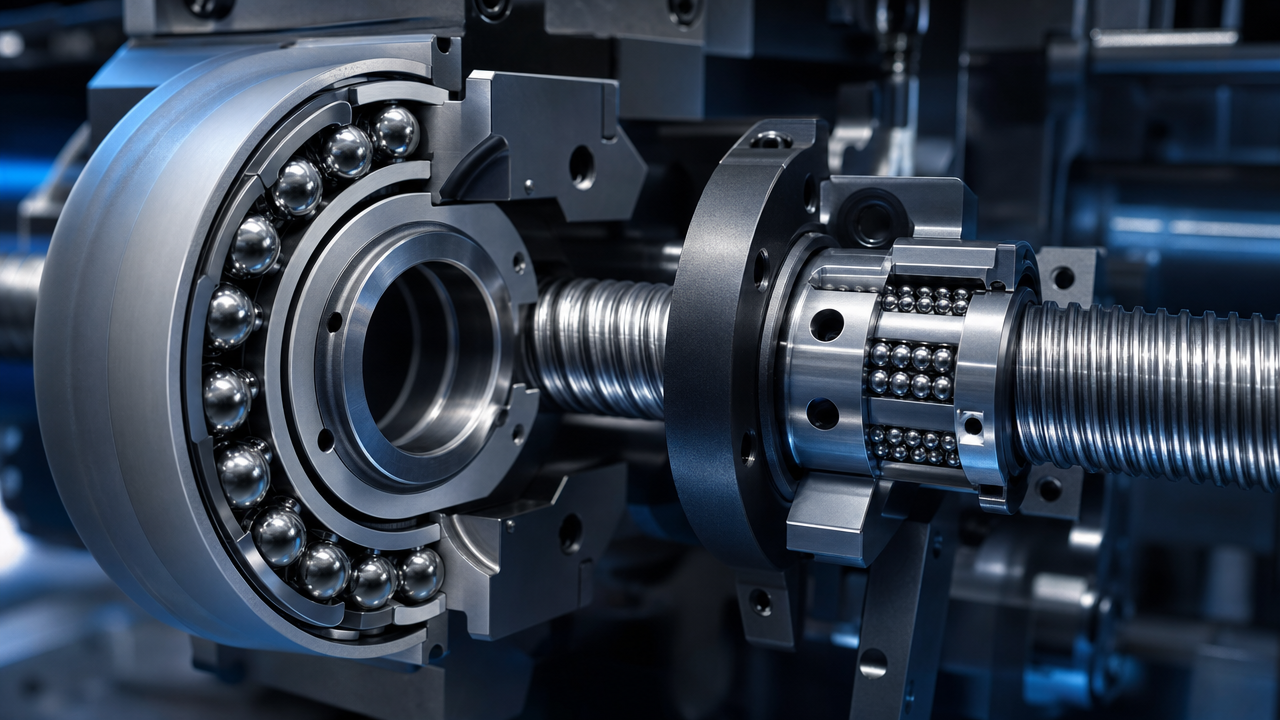

China Precision Bearings & Ball Screws 2026 — The Precision Lifeline of Machine Tools, Robots, and EV Drivetrains
Industrial Research Institute | 2026-06-18
Chapter 1 Industry Overview: The Iron Triangle of Precision Bearings, Ball Screws, and Linear Guides
I. Three Components, One Precision System
Among all core components of mechanical transmission, precision bearings made from precision bearing steel, ball screws, and linear guides form the "precision iron triangle" of modern manufacturing. Each plays a distinct role yet they are mutually interdependent: precision bearings support rotary motion, ball screws convert rotation into high-precision linear motion, and linear guides provide precise directional constraint for that linear motion. Together, the three components form the core of a CNC machine tool spindle system, the lifeline of an industrial robot joint, and the foundation of a precision platform in semiconductor lithography equipment.
Without precision bearings, a spindle cannot rotate smoothly at tens of thousands of revolutions per minute; without high-accuracy ball screws, a worktable cannot repeatedly position itself at the micrometer or even sub-micrometer level; without rigid linear guides, any lateral force will cause linear motion to deviate from its path. The technical level of these three types of components directly determines the precision ceiling of a country's machine tool industry, robotics sector, and semiconductor equipment industry.
From a product standpoint, the manufacturing logic of all three component types is highly consistent: precision grinding is a common key process step; bearing steel and high-strength alloy steel form a shared material foundation; stringent heat treatment is a common means of ensuring dimensional stability; and a clean manufacturing environment is a shared prerequisite for controlling contour error. It is precisely for this reason that the world's top suppliers — whether Japan's NSK and THK, Germany's Schaeffler, or Sweden's SKF — almost universally supply all three product types, forming an integrated linear motion solution of "bearings + screws + guides." This integrated supply capability is not only a comprehensive demonstration of technical ability but also a major negotiating advantage in procurement discussions with machine tool manufacturers and automation equipment makers.
Why does a single supplier need to make bearings, screws, and guides at the same time? Because all three product types share nearly identical foundational process DNA: high-purity specialty steel, sub-micron precision grinding, stringent heat treatment for dimensional stabilization, ultra-clean assembly environments, and nanometer-level precision measurement capabilities. Once a company establishes this capability base in one product category, the marginal cost of extending to the other two is far lower than building from scratch. This also explains why European and Japanese giants such as SKF, NSK, and Schaeffler can maintain leadership across all three product lines globally, while no Chinese company has yet reached a comparable scale in full-category precision transmission.
II. The Sub-Segment Landscape of Precision Bearings
In the broad context of the overall bearing market, precision bearings represent a sub-segment of relatively limited scale but with significantly higher technical barriers and profit margins. The global precision bearing market exceeded USD 20 billion in 2025, with ultra-precision grades (P4/P2 and above) accounting for approximately 35%, or roughly USD 7 billion. By comparison, the global total bearing market is approximately USD 120 billion; though the ultra-precision segment accounts for less than 6% of the total, its profit contribution exceeds 20%.
Within China, measured by downstream application, precision bearings can be roughly divided into six major sub-market battlefields:
Machine tool spindle bearings: This is the oldest and most classic application scenario for precision bearings. High-speed precision spindles require angular contact ball bearings or precision cylindrical roller bearings, with precision grade requirements of P4 or even P2, inner and outer ring roundness errors controlled to within a few micrometers, and rotational accuracy (radial runout RRIR) below 1 to 2 micrometers. Representative suppliers include NSK (ROBUST series), Schaeffler/FAG (BSBO/BSBL series), and Shanghai Tianjie. In 2025, China's machine tool spindle bearing market was approximately RMB 5 to 6 billion, with foreign brands accounting for approximately 70% to 80%.
Robot bearings and harmonic reducer bearings: The flexspline-rigid gear-wave generator structure of harmonic reducers requires ultra-thin cross-section bearings, especially crossed roller bearings and thin-wall deep groove ball bearings. These bearings have extremely thin cross sections (wall thickness of only 5 to 8 mm, outer diameter to cross-section height ratio typically exceeding 10:1), making precision grinding extremely difficult. This is one of the sub-categories with the fastest improvement in domestic substitution rate. Domestic companies such as ZYS (Suzhou, Chinese Academy of Sciences system) and Cixing Group (Zhejiang Cixi) have achieved some breakthroughs in the robot harmonic reducer matched bearing market, with domestic substitution rates rising from less than 10% in 2018 to around 30% in 2025.
Wind turbine main shaft bearings and pitch bearings: This is the precision bearing category with the most significant domestic substitution results in recent years. Companies such as LYC (Luoyang Bearing), ZWZ (Wafangdian Bearing), Xinqianglian (Luoyang Xinqianglian Slewing Bearing), Tianma Co., and Hengrun Co. have deeply entered this market. By 2025, the domestic substitution rate for main shaft bearings of major domestic wind turbine brands has exceeded 60%, and the rate for yaw and pitch bearings (slewing bearings) approaches 80% — the highest domestication rate among all precision bearing sub-categories.
High-speed rail bearings: This is one of the bearing categories with the lowest domestic substitution rate to date and also the most difficult technical fortress to break. The lifespan requirements for EMU axle box bearings (350 km/h grade) exceed 2.4 million kilometers (equivalent to 60 laps around the Earth), operating under severe vibration, impact, and extreme temperature differentials, with any premature failure being unacceptable as it means a safety accident. Currently, LYC (Luoyang Bearing) and ZWZ (Wafangdian Bearing) have completed bench verification of high-speed rail bearings and are advancing on-vehicle real-world verification, but it will still take several more years to reach mass supply.
EV/new energy vehicle bearings: With the rapid proliferation of NEV electric drive systems (motor + reducer + power electronics), EV-specific bearings have grown into the fastest-growing sub-category of China's bearing market. Core challenges include anti-electrical corrosion (electrochemical corrosion caused by shaft current) and high-speed operation (drive motor speeds exceeding 20,000 rpm under 800V high-voltage systems). Domestic companies such as C&U, ZWZ, and Cixing are conducting dedicated R&D to address the special demands of EV bearings.
Semiconductor equipment bearings: The ultra-precision category with the highest accuracy requirements, currently with a domestic substitution rate of less than 1% and almost entirely dependent on imports — the final frontier in the precision bearing domain.
III. The Strategic Position of China's Ball Screw Industry
The strategic position of ball screws within the precision transmission components system has risen sharply with the industrialization of humanoid robots. Before 2025, ball screws were primarily viewed as "basic functional components for machine tools," with market size of approximately RMB 3 to 5.5 billion and moderate growth. After 2025, the expected demand for planetary roller screws (PRS) from humanoid robots has pushed this track to the forefront of strategic competition.
Why do humanoid robots need large quantities of ball screws and planetary roller screws? The joint drive of humanoid robots requires converting the rotational motion of motors into linear motion of limbs. Compared with hydraulic and pneumatic actuation, the combination of ball screws and motors offers advantages of high precision, small size, light weight, and simple control, making it the mainstream solution for humanoid robot linear actuation. A single humanoid robot requires 15 to 20 sets of ball screws or planetary roller screws, with a per-unit value of approximately RMB 15,000 to 30,000 — one of the highest-value precision transmission components by single-machine value.
The key difference between a planetary roller screw (PRS) and a standard ball screw is: PRS replaces steel balls with multiple threaded rollers, dramatically increasing load capacity and rigidity through increased contact area while allowing a more compact form factor, making it the optimal solution for humanoid robot joint actuation. The current domestic substitution rate for PRS is approximately 20%, with per-unit value of approximately RMB 20,000 — the category with the lowest domestic substitution rate and highest value density among all precision transmission components, and the most urgent domestic substitution target from 2026 to 2028.
The full lifecycle service value of ball screws: Compared with the one-time purchase nature of bearings, the full lifecycle commercial value of ball screws is more complex, encompassing the following layers: initial purchase cost (precision ground screws: RMB 3,000 to 30,000 per set); periodic lubrication maintenance (grease replenishment every 1,000 to 3,000 operating hours); staged adjustment of preload level (reducing preload grade as wear progresses to extend usable life); and replacement cost at end of life. For CNC machine tool users, the wear curve of the screw directly affects machining precision — once backlash exceeds the allowable value (typically 3 to 8 micrometers), the machine's circular interpolation accuracy declines and "quadrant glitches" appear on workpiece surfaces, requiring screw replacement. This means the aftersales service and MRO (maintenance, repair, and overhaul) market for screws is an important source of stable revenue for screw manufacturers, with full lifecycle revenue approximately 1.5 to 2 times the initial purchase price.
Capacity expansion capability assessment for domestic screw companies: Under the anticipated demand explosion from humanoid robots, domestic screw companies are all accelerating capacity expansion, but the expansion speed is constrained by three critical bottlenecks:
First, procurement of precision thread grinding machines: global high-end precision thread grinding machines (such as KAPP-Niles and STUDER) typically have lead times of 12 to 24 months, and some models have begun to attract export control attention. The physical upper limit of capacity expansion depends on the number of grinding machines that can be procured.
Second, training skilled operators: an operator who can independently operate a precision thread grinding machine and meet C3 grade or above precision requirements needs at least 18 to 24 months of hands-on training — a human capital bottleneck on the speed of capacity expansion.
Third, synchronized expansion of quality systems: capacity expansion must be accompanied by a synchronized expansion of quality inspection capability (coordinate measuring machines, laser interferometers, ball bar testers, etc.); otherwise, production volume increases while quality control fails, creating the risk of mass returns — a fatal blow to the cash flow of screw companies.
Taking all three bottlenecks together, our research institute judges that the actual upper limit of annual capacity expansion for leading domestic screw companies (NJPE, Hanjiang Tool, and Yintai Technology) is approximately 20% to 30%, insufficient to support demand explosions of 100 times or more from the humanoid robot market — this means that if humanoid robots truly achieve mass production in 2027 to 2028, screws will become one of the tightest bottlenecks in the supply chain, and the bargaining power of leading suppliers will increase significantly.
IV. Precision Linear Guides: The Real Logic Behind Hiwin's Dominance in the Mid-Range Market
Compared with precision bearings and screws, the linear guide market landscape has one distinctive feature: Taiwan's Hiwin has become the world's number-one linear guide market share holder (approximately 30%), surpassing inventor THK (approximately 22%). Understanding how this came to be has important implications for understanding the future path of mainland Chinese precision transmission component companies.
Hiwin's linear guide products (precision grades H/SP/UP, corresponding to standard/precision/super-precision) have already basically matched THK's LM guides in technical specifications, at approximately 60% to 70% of the price of equivalent THK products. This price-performance ratio has enabled large-scale substitution of THK in machine tools, automation equipment, and other standardized applications. Currently, the procurement strategy of domestic precision machine tool manufacturers is universally "use Hiwin for standard grades, use THK for extremely precise applications," which has allowed Hiwin to establish extremely strong market share in the mainland China market.
Mainland domestic linear guide companies (Yintai Technology, Precision Drive, Taisheng Precision, etc.) hold some low-end market share in C5/C7 grades (ordinary industrial grade), but in SP/UP precision markets, the gap with Hiwin remains significant. Hiwin has production bases in Suzhou and Kunshan on the mainland, with supply capability and response speed essentially equivalent to a "local supplier," further squeezing the living space for mainland brands.
V. The Industrial Cluster Structure of China's Precision Bearings
China's precision bearing manufacturing is highly concentrated in a few industrial clusters. This concentration is not only historically formed but also a productive reality — in the precision bearing industry, the supporting industrial ecosystem (steel, heat treatment, grinding machines, calibration, technical worker training) can only be obtained at the lowest cost within a cluster:
Henan Luoyang: The city with the most concentrated precision bearing R&D and manufacturing capability in China, centered on LYC (Luoyang Bearing Group), radiating dozens of supporting SMEs covering ring forging, precision grinding, cages, precision grinding oil stones, and other supporting processes. It also hosts the country's only national key laboratory in the bearing industry.
Liaoning Wafangdian: Centered on ZWZ (Wafangdian Bearing Group), this is an important industrial base for large engineering machinery bearings, railway bearings, and large tapered roller bearings, and one of the most densely populated regions of China's traditional bearing industry.
Zhejiang Cixi/Ningbo: Cixing Group and surrounding supporting companies, focused on small precision bearings (miniature bearings, thin-wall bearings) and new energy vehicle bearings, forming an "East Zhejiang Bearing Cluster" that has rapidly expanded into the robot bearing market in recent years.
Jiangsu Suzhou/Changzhou: ZYS Suzhou Institute (Chinese Academy of Sciences system), Leader Drive, and multiple robot-matched bearing companies have gathered here, forming an emerging industrial cluster centered on robot precision bearings. The density of bearing-related companies in Suzhou Industrial Park is unrivaled nationally.
Shandong Linqing: A traditional ordinary bearing industrial cluster with huge annual output, mainly consisting of medium and low-end products. It is China's "quantity contributor" to bearings, but with a relatively lower level of precision manufacturing; its role in the precision bearing domestic substitution process is primarily to provide ring blanks and other support elements.
The formation mechanism of precision bearing industrial clusters: The formation of precision bearing industrial clusters is not random geographic distribution but follows several core industrial-economics logics:
Infrastructure-driven: The bearing clusters in Luoyang and Wafangdian fundamentally rely on the strategic layout of the bearing manufacturing industry among the "156 Soviet aid projects" in the early years of the People's Republic — these two cities possess a complete bearing manufacturing infrastructure accumulated over seventy years (specialized colleges, research institutions, equipment repair shops, raw material dealers, heat treatment contractors, precision instrument calibration agencies). New entrants to the bearing business in these two cities can obtain these supporting services at extremely low external transaction costs, significantly lowering the barriers and operating costs of starting up.
The positive feedback loop of talent density: Once a bearing industrial cluster forms in a region, large numbers of experienced bearing manufacturing engineers and technicians gather there, further reducing the cost for new companies to recruit talent and also accelerating the intra-regional dissemination of technical knowledge and process know-how (through talent mobility). This mechanism is particularly evident in Xinchang: the technology DNA of Xinchang's precision miniature bearing industry mainly derives from one source (a pioneer company founded by a core group of engineers from a Wanxiang Group bearing division); over subsequent decades, the resignations to start new businesses and the cross-flowing talent mobility of these engineers formed the technology family tree of Xinchang's hundreds of miniature bearing companies today.
Regional brand effect: "Luoyang bearing" and "Wafangdian bearing" as place-of-origin brands have created a first-mover impression among procurement personnel — bearings from "Luoyang" carry an inherent credibility bonus in the eyes of buyers, even though individual company brands vary in quality. This regional brand effect reduces the market development cost for companies within the cluster and is an important externality of cluster economies.
Conversely, industrial clustering also has negative effects: intense competition leads to frequent talent and technology outflow, low-end price wars erode overall profit margins, and there is a "bad money drives out good" risk (low-quality suppliers pull down the product reputation of the region as a whole). How to enjoy the cluster dividends while avoiding intra-cluster involution is a common management challenge facing the upgrade of bearing industrial clusters in Luoyang, Xinchang, and similar regions.
VI. The Technology Generation Gap in Precision Bearings and Screws: Why It Is Difficult to Catch Up Quickly
Understanding the true nature of the gap between China's precision bearings and ball screws and international leaders is a prerequisite for formulating the correct industrial strategy. This gap is not simply a matter of "insufficient funding" or "missing technology," but rather a generational gap of "accumulated time," manifesting in the following dimensions:
Metallurgical database of materials: Japanese bearing steel producers such as Sanyo Special Steel and Daido Steel have undergone more than 80 years of bearing steel smelting process optimization, accumulating massive databases of "bearing steel composition — heat treatment parameters — bearing performance" correlations. This database cannot be built through pure laboratory research alone; it must be accumulated through large numbers of batches in real industrial production — the composition of each batch of bearing steel varies slightly, and the corresponding bearing performance has subtle differences; only after accumulating thousands or even tens of thousands of batches of data can smelting engineers precisely control key process parameters to achieve predictability of bearing lifespan. China's steel companies are 20 to 30 years behind Japan in the depth and breadth of this database.
Tacit knowledge of process: A large part of the process knowledge in precision grinding and superfinishing is "tacit knowledge" — the combined control of grinding force, feed rate, coolant flow, and wheel dressing timing depends on the intuition and experience of process engineers, and cannot be fully reduced to written technical manuals. The tacit knowledge accumulated by veteran process engineers at NSK's Japanese factories is a core advantage that domestic companies cannot replicate from literature or patents in the short term. This is especially prominent in the superfinishing process: the most subtle quality gap between domestic and imported ultra-precision bearings often originates precisely in this step.
Equipment precision generational gap: Japan's Yasda YMC430 ultra-precision coordinate grinding machine has spindle radial runout of only 0.05 micrometers and positioning accuracy of ±0.5 micrometers — the apex of commercially available precision grinding machine specifications today. Domestic precision grinding machines have approximately 0.5 to 1 micrometer radial runout on equivalent metrics, a difference of about 10 times. This means that even if process engineers fully catch up to Japanese standards in skill, as long as domestic grinding machines are used, the ceiling on product precision is limited by the equipment to a lower level.
Time accumulation of brand and customer trust: Customers in precision bearings (especially ultra-precision spindle bearings and aviation bearings) prioritize "how many years this company's bearings have been running and how much usage verification data has accumulated" when selecting a supplier. NSK has been supplying bearings for a certain type of engine for more than 20 years, with cumulative data sufficient to prove long-term reliability under extreme operating conditions. Domestic suppliers newly entering these tracks, even if their product design is fully compliant, must still go through years or even decades of time accumulation before they can establish equivalent customer trust. This is an accumulation of brand assets that cannot be quickly compensated for through marketing spending or pricing strategies.
VI (cont.). Mass Production Consistency: The True Engineering Threshold for Precision Bearings
Producing one set of P4-grade sample bearings in a laboratory environment, versus producing tens of thousands of P4-grade bearings of equal precision with stable batch-to-batch consistency on a production line, are two engineering challenges of completely different magnitudes. Mass production consistency of precision bearings is the fundamental dividing line between "able to make a sample" and "able to deliver a product."
Statistical control of batch consistency: The precision machine tool spindle bearing production lines of Japan's NSK and Germany's Schaeffler have established statistical process control (SPC) systems centered on the process capability index (Cpk). Key quality characteristics (ring roundness, groove curvature, axial clearance) must have Cpk values ≥ 1.67, meaning the process variation range does not exceed 60% of the tolerance range, leaving sufficient safety margin. Domestic precision bearing companies typically only require Cpk ≥ 1.33. This difference appears small, but its meaning in mass production is: NSK producing 1 million P4-grade bearings would have a theoretical defect rate of approximately 0.6 ppm (0.6 per million); under domestic standards the defect rate is approximately 63 ppm — a difference of about 100 times. This is the deep statistical reason why, even when a domestic factory's equipment and process levels are close to NSK's standards, a perceptible gap in batch consistency and outgoing yield remains.
Ongoing compliance in cleanroom management: Cleanroom (class 100 to class 1,000) management for precision bearing assembly is not a "build it once and you're done" matter, but a systems engineering effort requiring continuous maintenance and personnel training investment. The core challenge of a cleanroom is not the physical facility but the ongoing enforcement of personnel behavioral standards: every opening of a door, every person entering or exiting, every material transfer must strictly follow cleanroom procedures; otherwise, microscopic particles can enter the assembly area and contaminate the bearing. Domestic precision bearing factories have basically met cleanroom physical facility standards, but there is still room to improve in the consistent execution of personnel behavioral standards — this is a cultural and management problem that is harder to solve quickly than a purely technical problem.
Precision of environmental temperature control: Assembly of ultra-precision bearings (P4/P2 grade) must be conducted in a constant-temperature environment (within ±0.5°C), because the thermal expansion of steel (linear expansion coefficient of GCr15 approximately 12×10⁻⁶/°C) causes bearing ring dimensions to change with temperature — a 1°C temperature change causes a 100 mm bore ring to change by approximately 1.2 micrometers, which is non-negligible compared with P4-grade tolerances (approximately 2 to 4 micrometers). The ability to maintain a stable constant-temperature assembly environment year-round 365 days (especially at peak summer cooling loads and winter heating demands) is an important indicator of the true authenticity of a precision bearing factory's production conditions.
Multi-batch performance consistency: For high-reliability applications (wind turbine main shaft bearings, high-speed rail axle boxes), batch-to-batch performance consistency is more important than single-set performance. Procurement parties typically require suppliers to provide outgoing inspection data for more than 30 consecutive batches (rotational accuracy, vibration values, axial clearance) to evaluate inter-batch performance stability. Domestic precision bearing companies, because of their relatively short production histories, still have insufficient data accumulation in this dimension of "completeness of historical data," affecting the purchase confidence of high-reliability customers.
From a statistical perspective, the essence of the mass production consistency problem is "the steady-state control capability of the manufacturing system" — the ability to maintain all process parameters within a narrow target range over the long term, excluding disturbances from equipment wear, personnel variability, and material batch differences. Building this capability requires at least 5 to 10 years of continuous improvement accumulation and cannot be rapidly leapfrogged through one-time technology transfer or capital injection.
VII. Bearing Typology: The Product Spectrum from Deep Groove Ball to Crossed Roller
When discussing domestic substitution and technical specifications of precision bearings, different bearing types face completely different technical challenges and degrees of difficulty in domestic substitution. Understanding the characteristics of major types helps to more precisely understand the competitive landscape of each sub-category.
Deep groove ball bearings (DGBB): The most common bearing type, capable of bearing both radial and axial loads simultaneously, the most common configuration in industrial motors, automobiles, and household appliances. The domestic substitution rate for precision deep groove ball bearings (P4-P5 grade) is relatively the highest; domestic companies such as C&U and Cixing have been supplying new energy vehicles and industrial robot markets in volume. The main difficulty in precision deep groove ball bearings lies in steel ball precision (roundness, diameter consistency) and the arc accuracy of ring grooves, where domestic products have made substantive breakthroughs.
Angular contact ball bearings (ACBB): Designed specifically for high-speed applications that must bear both radial and axial loads simultaneously, with 15° or 25° contact angles respectively adapted to different force balance requirements — the core bearing type for precision spindles. The manufacturing difficulty of precision angular contact ball bearings (P4-P2 grade, for high-speed spindles) lies in contact angle precision (contact angle deviation affects axial rigidity), light preload design (excessive preload generates overheating at high speed, while too little preload means insufficient rigidity), and consistency of matched-set installation (usually installed in pairs or sets of four, with axial clearance of each bearing highly consistent). This is one of the most difficult categories for domestic precision bearings to crack.
Cylindrical roller bearings (CRB): Load capacity is 3 to 5 times higher than ball bearings of the same specification, suitable for machine tool spindles bearing pure radial loads, and also the main bearing type for wind turbine gearboxes. The manufacturing key for precision cylindrical roller bearings is roller cylindricity (arc error in rollers leads to contact stress concentration) and ring flange precision. Domestic precision cylindrical roller bearings already have good mass production capability at P5 grade; P4 grade in major equipment applications still mainly relies on foreign brands.
Crossed roller bearings (XRB): Rollers are alternately arranged at 90° in a V-shaped groove, capable of simultaneously bearing axial, radial, and overturning moment loads in a single bearing — the core bearing type for precision turntables, robot joints, and coordinate measuring machines. Precision requirements for crossed roller bearings are extremely high — V-shaped raceway angle accuracy, roller dimensional consistency (diameter and length deviations both controlled to micrometer level) are critical. Domestic ZYS has significant accumulated expertise in crossed roller bearings, with some specifications achieving domestic substitution, but top precision specifications still mainly rely on THK and IKO imports.
Thin-wall bearings (Thin Section Bearings): Extremely thin cross sections (outer diameter to cross-section height ratio typically exceeding 6:1, even more than 10:1), the core configuration for harmonic reducers and precision turntables. The manufacturing difficulty of thin-wall bearings lies in the fact that rings are extremely prone to deformation during grinding and installation (roundness of thin rings cannot be guaranteed under clamping force), requiring dedicated non-clamping floating positioning grinding processes — one of the most technically challenging categories in domestic precision bearing development.
Four-point contact ball bearings: Contact between balls and grooves forms four contact points, capable of bearing bidirectional axial forces in a single bearing with compact structure; commonly used in wind turbine yaw bearings (replacing a combination of two angular contact ball bearings) and robot joint turntables. The key to precision manufacturing is the uniform spacing precision of the four-point contact grooves. Xinqianglian's pitch/yaw bearing products have extensive applications of this type and it is one of the bearing types with higher domestic substitution rates.
Chapter 2 Global Landscape and China's Position: Giant Territory and the Catch-Up Situation
I. Five Camps in the Global Precision Bearing Market
The global precision bearing and linear motion market is dominated by top-tier companies from Sweden, Germany, and Japan. As of 2025, the global bearing market size is approximately USD 120 billion, with the precision bearing sub-segment approximately USD 20 billion; the global linear motion product market (including linear guides, ball screws, and linear modules) is approximately USD 13.3 billion, expected to reach USD 22.4 billion by 2032, with a compound annual growth rate of approximately 7.7%.
First camp: Sweden's SKF
SKF is the century-old hegemon of the global bearing industry, founded in 1907, with brands including SKF and SNFA (ultra-precision bearings). SKF holds approximately 25% revenue share in the global precision bearing market — the highest share among single enterprises. Its ultra-precision bearings (SNFA brand) and spindle bearing product line are technologically leading, with deep presence in aerospace engines and semiconductor equipment. SKF's global revenue in 2025 was approximately SEK 98 billion (approximately RMB 63 billion), with industrial precision bearing business accounting for approximately 35% of total revenue.
SKF has five production bases on the Chinese mainland — in Shanghai (headquarters), Beijing, Dalian, Jinan, and Pinghu — with the mainland market contributing approximately 10% of its global revenue. In 2024, SKF completed the divestiture of its automotive wheel hub bearing business, focusing on industrial precision bearings and high-performance applications, further concentrating its product portfolio toward high precision and high added value. In the Chinese market, SKF's strategic focus is shifting from automotive bearings to precision industrial bearings, medical equipment bearings, and semiconductor equipment bearings.
Second camp: Germany's Schaeffler (FAG/INA brands)
Schaeffler Group was founded in 1946; its FAG brand (Friedrich Fischer invented the ball bearing in 1883; Fichtel & Sachs later became FAG) represents the highest standard of German precision machine tool bearing manufacturing. Schaeffler is Europe's largest bearing and linear motion product group. Its FAG BSBO and BSBL series ultra-precision spindle bearings are the industry standard configuration for five-axis machining center electric spindles, with installed quantities in the global high-end machining center market exceeding any other brand.
Schaeffler's Greater China revenue in 2025 was approximately RMB 22 to 24 billion (based on company annual reports and broker estimates), making it its second-largest single market globally. It has a dedicated ultra-precision bearing production line in Taicang, China, primarily supplying the Chinese market while also exporting to other Asia-Pacific markets. In 2024, Schaeffler completed the merger with Vitesco Technologies, gaining important system integration capability in new energy vehicle electric drive, further strengthening its strategic position in China's new energy vehicle supply chain.
Third camp: Japan's NSK
NSK (Nippon Seiko K.K.) was founded in 1916 and is Japan's largest bearing company, globally leading in precision machine tool spindle bearings. Its ROBUST-HC series ultra-precision spindle bearings can reach 120,000 rpm working speed (for precision grinding electric spindles), representing the world's highest-speed spindle bearing technology. NSK's fiscal year 2025 revenue (to March 2026) was approximately JPY 900 billion (approximately RMB 44 billion), with Greater China accounting for approximately 25%.
NSK is the primary supplier of axle box bearings (350 km/h grade) for China's EMU trains in high-speed rail — also one of the hardest links to break through in domestic substitution. In any single category, NSK's high-speed rail bearings are the hardest to replace because behind them lies a century-level accumulation of bearing lifespan verification data. NSK is also investing heavily in R&D resources in EV bearings; its world's highest-speed (2025 certification) ball bearings developed specifically for EV drive motors have industry-leading anti-electrical corrosion performance under 800V system high-speed operating conditions.
Fourth camp: Japan's JTEKT (Koyo brand)
JTEKT is Toyota's bearing company; the Koyo brand is globally top three in automotive bearings. Its precision spindle bearing products have also entered the machine tool market, but its precision bearing share in the Chinese market is relatively smaller than NSK/Schaeffler. JTEKT has deep ties with Japanese OEMs in automotive wheel hub bearings and steering system bearings; its share in China's precision industrial bearing market is approximately 5%.
Fifth camp: Three linear motion leaders (THK / NSK Precision / Hiwin)
In the ball screw and linear guide sector, Japan's THK is the global founder and the most authoritative technical standard setter — THK developed the world's first commercial linear motion guide in 1971, thereby founding the modern linear motion product industry. THK's fiscal year 2025 revenue was approximately JPY 470 billion (approximately RMB 23.5 billion); its LM guides (linear motion guides) are the de facto industry standard, and all followers (including NSK, Hiwin, PMI, etc.) produce products with dimensions and interfaces compatible with THK.
Hiwin as a Taiwan company has become the global linear guide market share leader through precise market positioning. Hiwin's global linear guide market share is approximately 30%; driven by the humanoid robot wave, the robotics business has become a new growth engine. In 2025, the robotics business accounted for approximately 7% of Hiwin Group revenue; it is expected to surpass 10% in 2026.
Ten-year evolution trends in the global precision bearing industry landscape: Looking back at the evolution of the global precision bearing industry landscape from 2015 to 2025, the following several trends are most notable:
First, mainland Chinese market share has expanded rapidly but with polarized quality distribution. In 2015, mainland Chinese companies held approximately 8% share of the global precision bearing market; by 2025, this has risen to approximately 15%, with significant quantitative growth. However, within this 15% share, approximately 85% is concentrated in P0 to P6 low-precision products, while the share of ultra-precision products at P4 grade and above is still less than 2%, reflecting a significant time lag between "quantitative catch-up" and "qualitative catch-up."
Second, European and Japanese giants have significantly increased their proportion of localized production in the Asia-Pacific region. SKF, NSK, and Schaeffler have all substantially increased their proportion of localized production in China and Southeast Asia; in 2025, NSK manufactures approximately 70% of its China sales in China (only approximately 30% in 2010), both hedging against exchange rate risk and accelerating delivery responsiveness. This trend continuously strengthens the cost competitiveness of foreign brands in the Chinese market, squeezing the price competition space of domestic brands.
Third, semiconductor equipment and medical robots have spawned new ultra-high-precision tracks. Before 2015, the highest-end applications for precision bearings were concentrated in machine tool spindles (P4/P2 grade) and aircraft engines (M50 steel). After 2020, new applications emerged — such as air-bearing bearings and guides for semiconductor lithography machine precision workpiece stages, thin-wall bearings for surgical robot joints, and ultra-low-friction miniature bearings for quantum computer cooling systems — pushing the technical ceiling of precision bearings higher once more. In these "ultra-high-end" applications, even NSK and SKF are in the R&D exploration stage, with domestic enterprise participation virtually at zero, but this also means there is no solidified competitive landscape in this field, and technological breakthroughs have greater strategic imagination space.
II. Mainland Chinese Companies: The Difficult Transition from Quantity to Quality
China is the world's largest bearing producer, with annual output exceeding 29.6 billion units, accounting for approximately 35% of global production. But in terms of output value, the average price of these bearings is extremely low — 29.6 billion units of bearings have an output value of approximately RMB 300 billion, equivalent to approximately USD 40 billion, while the global bearing market has output value of approximately USD 120 billion; China's quantity is approximately 35% of the global total, but its share of output value is less than 10%. This enormous gap between quantity and price clearly reveals the structural contradiction of China's bearing industry: world-first in production volume, while value creation capacity is far from matching.
In terms of company scale, the largest comprehensive bearing company on the Chinese mainland is the about-to-be-listed LYC (Luoyang Bearing Group Co., Ltd.), with 2025 operating revenue of RMB 6.034 billion and net profit of RMB 529 million, both all-time highs. ZWZ (Wafangdian Bearing Group) has annual output exceeding 8 billion units with revenues of approximately RMB 6 billion, with unique accumulation in large bearings. C&U Group (Shanghai, private), Tianma Co., Wuzhou Xinchun, and other companies together form the first tier of the domestic bearing industry, but the proportion of precision bearing products at these companies is relatively limited.
In the ball screw and linear guide sector, representative domestic companies include Nanjing Process Equipment (NJPE), Hanjiang Tool (under Hanjiang Machine Tool Group), Yintai Technology, and Jike Co., but the scale of these companies is relatively small (annual revenue mostly within RMB 500 million), mostly with C5 to C7 medium-to-low-end products as the main offering, and their combined market share in C3 grade and above precision does not exceed 10%.
III. The Historic Decline in Foreign Brand Market Share and Its Correct Interpretation
In 2018, foreign brands held approximately 79% of China's precision bearing (P5 grade and above) market. By 2025, this proportion has fallen to below 30%. This is a historic transformation, but it needs to be correctly understood to avoid overestimating the actual progress of domestic substitution.
This market share transfer has mainly occurred at the P5 grade (relatively ordinary precision level), i.e., in mid-to-high-end machine tools, automotive transmission, wind power, and other fields, where domestic bearings have achieved the leap from "not good enough" to "basically good enough" through large-scale capacity investment, continuous process improvement, and the push of "first-batch insurance" policies. At P4 grade and above (ultra-precision grade), especially in machine tool spindle bearings, semiconductor equipment bearings, and precision instrument bearings, the dominant position of foreign brands has basically not been shaken — NSK/FAG/SKF market shares in these categories are still above 80%.
The rational strategy is: actively advance domestic substitution in categories where domestic products have been proven reliable (wind turbine pitch bearings, mid-to-low-speed industrial robot joint bearings); maintain foreign procurement in categories not yet fully verified (high-speed spindle bearings, semiconductor equipment bearings) while launching verification projects to accumulate data.
Regional differences in the decline of foreign market share: The overall decline in the market share of foreign precision bearings shows significant differences across regions. In the North China heavy industry zone (Beijing, Tianjin, Hebei) and Northeast old industrial base (Shenyang, Dalian), domestic bearing substitution has progressed faster, because heavy machine tool and mining machinery OEMs in these regions have long-term matching relationships with local state-owned bearing enterprises (LYC, Harbin Bearing). In the Yangtze River Delta precision manufacturing cluster (Suzhou, Shanghai, Ningbo), high-precision machine tool and medical device OEMs that primarily export tend to retain foreign bearings to meet their downstream customers' quality certification requirements. In the Pearl River Delta electronics manufacturing cluster, Korean and Japanese precision bearings hold an absolute dominant position in the maintenance market for SMT placement machines and similar equipment. This regional difference suggests: national figures for precision bearing domestic substitution rates mask regional structural differences, and domestic substitution progress in different regions must be evaluated independently by industry and application scenario.
IV. Three Competitive Tiers in Global Precision Bearings
Top tier (P4/P2 ultra-precision, semiconductor, aviation, precision instruments): SKF, Schaeffler/FAG, and NSK form an absolute monopoly among European and Japanese giants, with combined market share exceeding 85%. The core competitive variable is precision grade certification capability and customer trust accumulation, not price. Domestic enterprises are basically absent from this tier and cannot form a substantive challenge in the short term (before 2030).
Middle tier (P4 to P5, high-end machine tools, industrial robots, high-speed rail): SKF/Schaeffler/NSK dominate, but Hiwin (linear motion products) and LYC (Luoyang Bearing) have made some breakthroughs. This tier is the most active battlefield for domestic substitution; foreign brand market share is contracting from approximately 75% in 2018 toward approximately 50% to 60% in 2025, but the contraction pace is slower than external expectations.
Bottom tier (P5 to P6, general industry, non-critical automotive parts, ordinary machinery): Domestic companies have basically completed substitution at this tier. LYC, ZWZ, C&U, Cixing, and others hold most of the market share; foreign brands retain share only in price-premium-sensitive situations.
The dividing lines between the three tiers are not fixed but continuously shift upward as domestic technological capabilities improve. Over the past 5 years, the dividing line has already moved upward from the P0/P5 boundary to the P5/P4 boundary — below P5 is already basically a domestic-dominated battlefield, P5 to P4 is the current most intense competition zone, and above P4 foreign brands still hold firm.
Historical evolution and future prediction of competitive tier dividing lines: Through historical data analysis, our research institute has plotted the evolution curve of precision bearing competitive tier dividing lines:
In 2010, the dividing line was near the P0/P6 boundary — below P6 grade (equivalent to the current ordinary industrial grade) there were domestic competitors; above P6 was almost entirely foreign territory.
In 2015, the dividing line moved up to near P5/P4 — domestic product share at P5 grade (mid-level industrial precision) broke 30%, marking the phased leap of domestic bearings from "basic industrial use" to "precision industrial use."
In 2020, the dividing line further differentiated within the P5 range — wind turbine pitch/yaw types (precision requirement P5/P6) saw domestic substitution rate exceeding 70%, while machine tool spindle types (also P5 grade but more demanding operating conditions) still had domestic substitution rates below 20%, reflecting sub-segment differences within the same precision grade but with different operating condition difficulty.
In 2025, the dividing line showed localized breakthroughs at the P4/P2 boundary — a few companies such as LYC passed verification by high-end machine tool manufacturers for specific models of P4-grade angular contact ball bearings, with domestic substitution rates rising from near zero to approximately 15%, but domestic substitution for P2-grade ultra-precision bearings remains near zero.
Our institute predicts that by 2030, the main dividing line of competitive tiers will advance to the P4/P2 boundary — i.e., the domestic substitution rate for P4-grade precision bearings (machine tool spindles) will break 40%, becoming the main competitive zone between domestic and foreign products, while P2-grade (ultra-precision, semiconductor and aviation) domestic substitution will rise from near zero currently to 5% to 10%. This pace of evolution (dividing line moving up one precision grade every 10 years) implies that the complete domestic substitution of precision bearings is a systemic project spanning at least 20 to 30 years, not a task that can be rapidly accelerated by short-term policy pushes.
V. Hiwin: A Successful Model for Asian Challengers
In the global precision transmission field, Hiwin is a rare case of an "Asian challenger successfully surpassing a Japanese leader." Founded in 1989, after 30 years of focused development, Hiwin achieved the feat of surpassing THK in global linear guide market share — extremely rare in the Japanese-dominated precision machinery field.
Hiwin's success strategy can be summarized in three points: first, providing products at 90% to 95% of performance with approximately 60% to 70% of the price of Japanese equivalents, precisely targeting the mass market of "good enough + reasonable price"; second, establishing large-scale production bases in Taiwan and Suzhou to control costs and guarantee delivery times through scale advantages; third, in product line expansion always following market demand rather than ahead-of-time positioning, gradually expanding from machine tool guides to high-end applications such as industrial robots, semiconductors, and medical equipment, with each expansion pulled by existing customer needs.
In 2025, Hiwin gained a new development opportunity in the humanoid robot wave. The company has entered the supply chains of Tesla's Optimus and multiple leading domestic humanoid robot companies, providing precision linear guides and some screw products, with the robotics business's proportion of group revenue rapidly increasing. Hiwin's coordinated operating model between its Taiwan headquarters and Suzhou factories gives it advantages in price, lead time, and customization capability over Japanese counterparts, which is an important advantage for entering high-growth tracks.
For mainland Chinese bearing and screw companies, Hiwin is a unique entity that is simultaneously both a competitor and a reference point — its development path shows that Asian companies, through specialized focus, scale, and cost optimization, can indeed compete with European and Japanese giants in precision machinery, but this requires decades of uninterrupted accumulation, not a leap that can be completed with one or two rounds of capital investment.
VI. Strategic Divergence Among Mainland Chinese Precision Transmission Companies
In 2025 to 2026, the strategic paths of mainland Chinese precision bearing and transmission component companies are diverging, with different types of companies choosing completely different development directions. This divergence will profoundly influence the industry landscape over the next 5 to 10 years.
Path A: Vertical specialization type (represented by LYC and Xinqianglian)
These companies choose to deeply accumulate in a single sub-category (wind turbine main shaft bearings, large slewing bearings), building hard-to-replicate moats through technical focus and scale effects. LYC's wind turbine main shaft bearings and Xinqianglian's pitch and yaw bearings are typical results of this path. The advantage of vertical specialization is fast accumulation and deep moats; the risk is that cyclical fluctuations in a single category have significant impacts on revenue (annual demand for wind turbine main shaft bearings is highly correlated with installed capacity in that year, with revenue differences between high and low installation years reaching 40% to 60%).
Path B: Robot new-track entry type (represented by Cixing Group and ZYS)
These companies use their existing precision bearing manufacturing capabilities as a technical foundation and proactively enter new application scenarios such as robot bearings. The attractiveness of this path lies in: robot bearings have high unit value (3 to 5 times that of same-specification industrial bearings), low domestic substitution rate (currently 25% to 35%), and strong growth potential. The risk lies in the uncertainty of the robotics industrialization timeline, and the development of new-track products (thin-wall bearings, crossed roller bearings) requires process accumulation somewhat different from traditional bearings.
Path C: Supporting service ecosystem extension type (represented by some SMEs)
Some smaller-scale precision bearing companies are choosing to evolve from pure manufacturers to composite service providers of "manufacturing + technical service + MRO parts," establishing specialized service ecosystems in specific industries (such as precision machine tool and semiconductor equipment maintenance). The commercial logic of this path is: high-end precision bearing manufacturing requires large amounts of capital and time accumulation, while providing professional services based on manufacturing knowledge is a path to reach high-value customer groups with lower capital investment.
Path D: Materials and process upgrade type (represented by upstream companies such as Xingcheng Special Steel)
At the very top of the precision transmission components industrial chain, materials companies are choosing to upgrade from providing qualified bearing steel to providing engineering materials solutions oriented toward specific applications: not just selling steel, but providing material heat treatment advice, bearing steel fatigue data support, and joint debugging services for materials and heat treatment processes, upgrading materials companies from raw material suppliers to precision manufacturing partners. This path requires materials companies to establish deeper data-sharing relationships with downstream bearing manufacturers and is an important direction for improving the value density of the entire industrial chain.
These four paths are not mutually exclusive, and successful companies often focus on their main path while moderately trying extensions into adjacent paths. But the core logic is consistent: under conditions of limited capital and technology accumulation, focused concentration is the optimal strategy; only after reaching a certain stage of accumulation is it the right time for moderate diversification and industrial chain extension.
Chapter 3 Core Technical System: Where Does Precision Come From?
I. Precision Grades: A Complete Mapping from ISO to Application
The precision system for precision bearings is jointly defined by the International Organization for Standardization (ISO) and national standard systems. In China, GB/T 307 series is implemented, dividing bearings into five precision grades P0/P6/P5/P4/P2, with smaller numbers representing higher precision: P0 is standard grade (general industrial bearings), P6 is high grade, P5 is precision grade, P4 is ultra-precision grade, and P2 is extreme precision grade (top ultra-precision, mainly used for ultra-precision machine tool spindles and aircraft engines).
Corresponding to international standards, ISO 492 divides bearings into Class Normal/6/5/4/2, Japan's JIS standard into JIS0/6/5/4/2, and US ABEC grades correspond to P0 through P2 as ABEC 1/3/5/7/9 respectively. The nominal equivalence relationship is: P5≈ISO Class 5≈ABEC 5, P4≈ISO Class 4≈ABEC 7, P2≈ISO Class 2≈ABEC 9.
It is worth particularly noting that the "nominal equivalence" of precision grades does not mean that same-grade products under different standards have completely identical technical performance. Due to differences in detailed tolerances, measurement methods, and evaluation conditions across standard systems, a product certified to P4 grade under one standard may only satisfy P5 grade requirements under the strict inspection of another standard. This is one of the technical challenges domestic precision bearings face when exporting to European and Japanese markets.
The correspondence between precision grades and application scenarios: P0/P6 grade is used for ordinary machine tool feed axes, wind turbine gearboxes, and general motors; P5 grade for ordinary CNC machine tool spindles, mid-to-low-speed industrial robot joints, and high-end household appliances; P4 grade for high-precision CNC machine tool spindles (precision milling/grinding), high-speed industrial robot joint axes, and medical CT scanner spindles; P2 grade for ultra-precision coordinate boring machine spindles, ultra-precision grinding machine spindles, optical instrument precision shafting, and some semiconductor front-end equipment precision motion axes.
The economics of precision grades: why tightening tolerances corresponds to exponential price jumps: The precision grade of precision bearings with each step up does not increase manufacturing difficulty and price linearly but shows exponential jumps, due to the following points:
First, non-linear increase in reject rate. The dimensional tolerance (ring roundness, groove curvature) for P4 grade bearing rings is approximately 50% stricter than P5 grade, but due to the tail effect of the normal distribution, the reject rate typically increases 3 to 5 times rather than 50%, directly pushing up the unit cost of P4 grade bearings.
Second, surging inspection costs. P4 grade and above precision bearings require high-precision measuring instruments (roundness instruments, coordinate measuring machines, laser interferometers); inspection time per bearing set is approximately 15 to 40 minutes, several times higher than P5/P6 grade (2 to 5 minutes); the proportion of inspection costs in manufacturing costs increases from approximately 5% at P6 grade to approximately 20% to 30% at P4 grade.
Third, environmental control costs. P4 grade and above assembly must be conducted in constant-temperature (±0.5°C) cleanrooms (10,000 to 1,000 class); cleanroom construction and operating costs translate to approximately RMB 20 to 100 fixed cost amortization per bearing set, significantly pushing up unit costs in small-batch production.
Fourth, grinding wheel and consumable costs. CBN superabrasive grinding wheels (diameter 200 to 400 mm) used for P4 grade precision bearing grinding have unit prices of approximately RMB 8,000 to 30,000 per wheel, with service life of approximately 50 to 200 bearing sets, translating to approximately RMB 50 to 200 per set in grinding wheel costs; compared with ordinary corundum grinding wheels used for P6 grade (RMB 500 to 2,000 per wheel, service life 2,000 to 5,000 sets), P4 grade grinding wheel costs are approximately 5 to 20 times higher.
The combination of the above four factors means that the manufacturing cost of P4 grade precision bearings is approximately 3 to 6 times that of same-specification P6 grade, while the market selling price is approximately 5 to 15 times, reflecting the dual effect of the premium space and technical barriers brought by precision grades.
II. In-Depth Analysis of the Ball Screw Precision System
The precision standard for ball screws differs slightly from bearings. Japan's JIS B1192 (China's corresponding GB/T 17587) divides ball screw precision into ten grades from C0 to C10, with smaller numbers representing higher precision. The core precision indicator is Lead Error — the deviation between the actual stroke and theoretical stroke of the screw:
| Precision Grade | Representative Lead Error (per 300 mm stroke) | Main Applications |
|---|---|---|
| C0 | ≤3.5 micrometers | Ultra-precision coordinate measuring machines, nanometer-level platforms |
| C1 | ≤5 micrometers | Precision machining centers, precision inspection equipment |
| C2 | ≤7 micrometers | High-end machining centers, precision grinding machines |
| C3 | ≤12 micrometers | Standard high-end CNC machine tools (largest volume demand) |
| C5 | ≤23 micrometers | Ordinary CNC machine tools, general automation equipment |
| C7 | ≤52 micrometers | Handling, simple positioning situations |
| C10 | ≤210 micrometers | Power transmission, low accuracy requirements |
C3 grade (12 micrometers/300 mm) is the mainstream demand specification for current precision machine tools and also the most fiercely contested dividing line for domestic substitution: below C5 grade domestic substitution has basically been achieved; C3 grade is the "main battlefield currently under siege"; and C2 to C0 grade almost entirely depends on imports (mainly THK and NSK Precision).
The precision standard for planetary roller screws (PRS) has not yet formed a unified international standard; manufacturers use their own specifications, mainly extending definitions with reference to the framework of ISO 3408 (ball screw standard). The precision currently required by humanoid robot applications roughly corresponds to the C3 to C5 level of ball screws, with more focus on repeatability and backlash than on pure cumulative lead error.
III. Material System: The Metallurgical Support Behind Precision
The material selection for precision bearings and ball screws is the physical foundation that constrains the manufacturing ceiling:
GCr15 (high-carbon chromium bearing steel): The most mainstream bearing steel material, with carbon content approximately 0.95% to 1.05% and chromium content approximately 1.3% to 1.65%. After heat treatment, hardness HRC 60 to 65, with good contact fatigue life and wear resistance, meeting all application requirements of P0 to P5 grade bearings, and also the mainstream material choice in P4 grade ultra-precision bearings. Ultra-pure GCr15 (oxygen content <5 ppm, non-metallic inclusions <0.5 mm²/dm²) produced by Xingcheng Special Steel represents the highest standard of domestic bearing steel.
GCr15SiMn/GCr15SiMo (improved bearing steel): Silicon, manganese, molybdenum, and other alloying elements are added on the basis of GCr15 to improve the hardenability of the steel, suitable for ring sections of large bearings (bore diameter >300 mm), the commonly used material for large wind turbine bearings and mining machinery bearings.
M50/M52 (high-speed tool steel): Used in aircraft engine bearings, maintaining high hardness (HRC 58+) above 200°C — the standard material for civil aviation engine main shaft bearings. Global major suppliers are Japan's Daido Steel and Sanyo Special Steel; domestic supply capability is limited.
Silicon nitride ceramic balls (Si₃N₄): Density is only 40% of steel balls, elastic modulus approximately 1.5 times that of steel, thermal expansion coefficient 25% of steel; at high speeds the centrifugal force generated is far lower than steel balls (at the same speed, centrifugal force is proportional to mass, and silicon nitride balls have centrifugal force only 40% that of steel balls), giving hybrid ceramic bearings (steel rings + ceramic balls) excellent performance under ultra-high-speed conditions. NSK's all-ceramic bearings and SKF's hybrid ceramic bearings are widely used in precision grinding spindles and semiconductor equipment. Domestic silicon nitride ceramic balls at G5 grade (diameter deviation ≤0.13 micrometers) can be supplied in volume, but G3 grade (≤0.08 micrometers) still relies on imports.
IV. Precision Grinding Process: The Critical Leap from Blank to Precision
The core process in precision bearing manufacturing is grinding, whose importance can be understood from the following perspective: the roundness error of bearing ring blanks (after forging + turning) is approximately 50 to 100 micrometers; after precision grinding and superfinishing, the roundness error of P4 grade rings must reach 0.5 to 1 micrometer — the grinding process needs to reduce roundness error by approximately 100 times.
Grinding processes are divided into: rough grinding (removing most of the allowance), semi-finish grinding (approaching target dimensions, leaving 0.1 to 0.3 mm allowance), finish grinding (reaching design dimensions, leaving minimal allowance), and superfinishing (reducing surface roughness from Ra 0.06 micrometers to Ra 0.006 to 0.01 micrometers). Each process step requires dedicated equipment: precision internal and external cylindrical grinding machines (supplied by Japan, Germany, Switzerland), groove grinding machines (Japan's Koyo Machinery, etc.), superfinishing machines (Germany's Supfina, etc.).
Key parameter control in grinding processes: grinding wheel grit selection (rough grinding P60, finish grinding P400 to P600, superfinishing P1500 and above), grinding speed (finish grinding spindle speed 15,000 to 25,000 rpm), feed rate (feed per revolution 0.001 to 0.005 micrometers), coolant (must have precision filtration to prevent grinding particles from causing surface scratches), workpiece temperature control (constant temperature ±0.5°C to prevent thermal deformation from causing precision drift). The comprehensive control of this series of parameters is where the core "tacit knowledge" of precision bearing manufacturing resides.
V. Precision Classification and Core Technology of Linear Guides
Linear guide precision classification (based on the THK system, widely adopted in the industry): Standard grade (Normal, H grade), Precision grade (P grade/SP grade), and Super Precision grade (SP/UP grade). THK's H grade guide straightness is approximately 12 micrometers/500 mm, SP grade approximately 3 micrometers/500 mm, and UP grade approximately 1.5 micrometers/500 mm — the precision ceiling of currently commercially available linear guides.
Key technologies for linear guides include: precision grinding of the hardened steel main body (guide rail straightness), raceway shape (circular arc raceway vs. double arc raceway, affecting contact rigidity and low-friction characteristics), preload grade (C0 no preload / C1 light preload / C2 medium preload — higher preload means higher rigidity but also greater friction), and circulation circuit design (affecting noise and high-speed smoothness). Hiwin's linear guides adopt a cross-section design fully compatible with THK's, and at C4 to C5 precision grades (corresponding to SP grade) have achieved the same level of specifications as THK at approximately 60% to 70% of THK's cost — currently the mainstream procurement choice for domestic machine tool manufacturers.
The supply landscape of the linear guide market (2025, Chinese market): THK approximately 15% (high-end precision, ultra-precision occasions), Hiwin approximately 30% (precision to ultra-precision), PMI approximately 10% (Taiwan, precision grade), mainland companies (Yintai Technology, Precision Drive, etc.) combined approximately 20% (standard grade to precision grade downstream), and the remaining approximately 25% scattered across other imported brands.
VI. Inspection and Certification System
Precision bearings must pass multiple strict inspection checkpoints before leaving the factory:
Dimensional accuracy inspection: Air gauges (resolution 0.01 micrometers) for inner and outer diameter inspection; roundness instruments (roundness measurement resolution 0.01 micrometer level) for inner and outer ring roundness inspection; contact profilometers for groove curvature inspection.
Rotational accuracy testing: Dedicated bearing rotational accuracy test stands measure inner ring/outer ring radial runout (RRIR/ORER) and axial runout (RAXR/OAER) under specified preload and speed conditions — the most critical test item for precision grade certification.
Vibration and noise testing (BVID): Bearing Vibration Instrument Detectors evaluate bearing vibration acceleration in three frequency bands (low, medium, high). For P4 grade and above bearings, vibration acceleration in the high-frequency band must be below extremely strict thresholds, directly related to bearing surface cleanliness and material uniformity.
Life bench testing: For high-reliability applications such as high-speed rail, wind power, and aviation, bearings must pass accelerated life tests under specified speed and load (usually equivalent to hundreds to thousands of hours of actual operating conditions) before shipment, verifying that bearing fatigue life reaches design targets.
China's bearing industry still lacks internationally recognized independent third-party inspection and certification agencies; most companies rely on self-built inspection rooms for outgoing inspection. Compared with Japan's mature JIS certification system (Japanese Bearing Industry Association) and Germany's third-party certification system (FAG/DIN standard certification system), this affects the trust-building of domestic precision bearings with international high-end customers.
The actual commercial value of international inspection certification: For precision bearing manufacturers, obtaining internationally recognized third-party inspection certification is not only an internal tool for quality management but also a commercial key to opening the door to high-end customers. Taking aerospace bearing certification as an example, obtaining AS9100D (Aerospace Management System Certification) requires approximately 18 to 24 months of system construction and third-party auditing, costing approximately RMB 500,000 to 2 million, but once certified, the company can enter the Qualified Supplier Database of the global aviation industrial chain (such as Boeing and Airbus supplier portals), showcasing qualifications to thousands of aviation manufacturers globally, with potential market value in the hundreds of millions.
The certification gap in Chinese precision bearing companies: The precision bearing industry in China has a clear "missing middle layer" in certification: the number of companies with basic ISO 9001 certification is large (thousands nationally), but companies with specific industry advanced certifications (AS9100D, IATF 16949, IRIS, etc.) are relatively scarce (hundreds), and precision bearing inspection agencies with international third-party laboratory mutual recognition capability (CNAS accreditation + ILAC mutual recognition) are even fewer (approximately 10 to 15 nationwide). This missing middle layer makes it difficult for many medium-sized domestic companies with actual precision manufacturing capabilities to enter the Qualified Supplier lists of multinational corporations due to lack of internationally recognized certification endorsement, creating a market predicament of "capable but lacking credibility." Building a more complete middle-layer certification system (especially specialized certification for robot and new energy vehicle bearings) is important infrastructure work for improving the overall international competitiveness of China's precision bearing industry.
VII. The Design Science of Precision Transmission Components: Hertzian Contact Theory and Engineering Boundaries
The performance limits of precision bearings and ball screws are fundamentally constrained by contact mechanics. A deep understanding of this underlying physical constraint is key to understanding why certain precision requirements cannot yet be met at current technology levels.
Application of Hertzian contact theory: The Hertzian contact theory established by British physicist Heinrich Hertz in 1882 describes the distribution of contact area and contact stress when two elastic bodies are in contact under force. In precision bearings, the contact between steel balls (or rollers) and ring raceways is a classic Hertzian contact problem: bearing steel balls (Young's modulus approximately 200 GPa) and rings (also approximately 200 GPa) produce extremely small elastic deformation under load, with the contact surface being an elliptical area (for ball bearings, area approximately 0.01 to 0.1 mm²), and peak contact stress approximately 1,500 to 3,000 MPa. This contact stress determines the theoretical upper limit of bearing steel fatigue life — when contact stress exceeds the fatigue limit of the steel (approximately 1,800 to 2,200 MPa), fatigue crack propagation begins on the raceway surface, ultimately leading to spalling failure.
This mechanism explains why the setting of bearing preload must be so precise: if preload is too large, contact stress increases and fatigue life shortens; if preload is too small, balls slip against the raceway (skidding) at high speeds, accelerating wear and causing precision to deteriorate rapidly. The preload window (the allowable ratio between maximum and minimum preload) for P4/P2 grade bearings is typically within ±5% to ±10%, placing extremely high demands on assembly processes (precision of preload application).
EHD lubrication theory and ball screw efficiency: The lubrication mode of precision bearings is elastohydrodynamic lubrication (EHD) — under high contact stress, lubricating oil in the contact zone is compressed into an extremely thin oil film (thickness 0.1 to 0.5 micrometers); oil viscosity increases significantly due to high pressure (piezo-viscous effect), forming an oil film of sufficient thickness to separate the contact surfaces and avoid direct metal-to-metal contact. EHD film thickness is highly sensitive to the base oil viscosity of the grease, bearing speed, and contact zone temperature: at ultra-high speeds (>20,000 rpm), contact zone temperature rise causes the base oil viscosity of the grease to drop sharply (viscosity-temperature effect), the EHD film thins and enters mixed lubrication or even boundary lubrication, friction coefficient increases sharply, bearing heat generation accelerates, forming a vicious cycle. This is the fundamental physical mechanism behind why high-speed precision spindle bearings have significantly shorter than designed service lives under extreme speeds, and also the theoretical basis for why grease formulation selection is so critical for P4 grade and above high-speed bearings.
Ball screw elastic deformation and positioning accuracy: In high-accuracy ball screw systems, the same Hertzian contact deformation exists between balls and screw spiral raceways. When axial load is applied, elastic displacement produced by contact deformation (at nanometer level) is superimposed on actual motion displacement, affecting actual positioning accuracy. High-precision machine tools in design need to quantify this elastic displacement through axial stiffness (unit N/μm) specifications; high-rigidity screw systems typically have axial stiffness in the range of 100 to 500 N/μm, meaning that under 100 N of axial force, the system elastic displacement is approximately 0.2 to 1 micrometer — still a non-negligible source of error for ultra-precision machine tools pursuing sub-micrometer positioning accuracy. Increasing preload can improve axial stiffness, but the trade-off is increased heat generation and shortened life — the eternal "preload triangle trade-off" (precision, life, rigidity) in precision screw design.
Mastering these contact mechanics theories and applying them in product design is the core knowledge leap for precision transmission component companies to evolve from "making by following examples" to "independent design optimization." Currently, the gap between domestic precision transmission component companies and European and Japanese giants in applied design capability for contact mechanics is an important constituent part of the "technology generation gap," no less important than the gap in grinding processes and materials.
VIII. Evolution of Bearing Life Prediction Theory and Engineering Challenges
Bearing life prediction is the core problem in precision bearing engineering applications and the ultimate test distinguishing bearing products of different technical levels.
L10 life basic theory: The bearing rated life (L10 life) defined by international standard ISO 281 refers to the theoretical number of hours that 90% of bearings can operate under given load and speed without fatigue spalling. Key parameters in the L10 life calculation formula are the ratio of rated dynamic load capacity (C) to actual load (P) (C/P), and the exponent determined by bearing type: 3 for ball bearings, 10/3 for roller bearings. From the formula, L10 life is proportional to a high power of (C/P), meaning that the impact of load on life is extremely sensitive: a 20% increase in load shortens ball bearing life by approximately 50%.
Engineering significance of the modified life factor (a₂₃ factor): The basic L10 life formula was established on data from the 1960s without considering the effects of material cleanliness, lubrication conditions, installation accuracy, and other factors. Modern ISO 281 introduces the modified life factor a₂₃ (or AISIM correction factor), incorporating material factor (am₁), lubrication conditions (aISO), and other factors into calculations, making life prediction closer to actual operating conditions. For high-end precision bearings using ultra-clean bearing steel (oxygen content ≤5 ppm) with optimized lubrication, the modified life factor a₂₃ can reach 15 to 50, meaning actual life is 15 to 50 times higher than basic L10 life. This is why top-tier precision bearings (NSK, FAG) can achieve far longer service lives than ordinary calculation predictions under specified operating conditions.
The statistical nature of fatigue life and engineering management: Bearing life is essentially a statistical quantity rather than a fixed value — even bearings from the same batch operating under exactly the same conditions will have actual failure times following a Weibull distribution; L10 is merely a certain quantile of this distribution (life corresponding to 10% failure probability). In practice, L50 (50% failure probability, median life) is typically approximately 5 times L10, while L1 (1% failure probability) is approximately 0.21 times L10. For high-reliability applications (aircraft engines, high-speed rail), engineers need to focus not on L10 but on Lna (extremely low failure probability, such as 0.1% or even 0.01%), which corresponds to the extreme small tail of the sample and requires far more test data than usual to accurately estimate — this is also the deep statistical reason why high-speed rail bearing certification cycles are so lengthy.
Complexity of operating condition effects: beyond simple load calculations: In actual operating conditions, bearing life is affected by the combined superimposition of load spectrum (complex variation history of load over time, not simple constant load), temperature history, lubrication state changes, installation precision, and shaft deflection. The load spectrum for wind turbine main shaft bearings is particularly complex: wind speed varies randomly, causing bearing loads to change simultaneously at two time scales — low-frequency (wind direction changes) and high-frequency (turbine speed). The traditional L10 life formula needs to be approximated using equivalent load methods, and this approximation may underestimate fatigue damage under extreme operating conditions (typhoons, turbulence). Mastering real-world operating load spectra and constructing accurate life prediction models is one of the core contents of deep technical cooperation between precision bearing manufacturers and OEMs, and also an important dimension of the gap between domestic bearing companies and foreign giants in high-end applications.
Chapter 4 Industry Chain: Upstream and Downstream Mapping — From Bearing Steel to Precision Rolling Elements
I. Upstream Materials: Specialty Steel Is the Starting Point of All Precision
The farthest upstream in the bearing industrial chain is specialty steel. Regarding the impact of materials on bearing service life, there is a classic engineering maxim: "For every order-of-magnitude improvement (10×) in the cleanliness (oxygen content) of bearing steel, bearing fatigue life improves by approximately 2 to 4 times." This means that from ordinary bearing steel with oxygen content of 50 ppm (sufficient for P0-grade bearings) to ultra-clean bearing steel with oxygen content of 5 ppm (required for P4/P2-grade bearings), the material itself can deliver a life-extension multiplier of 4 to 8 times — which is why precision bearing manufacturers impose such stringent cleanliness requirements on upstream bearing steel.
China's annual output of GCr15 bearing steel has exceeded 4 million tonnes, ranking first in the world and accounting for approximately 50% of global production. Domestic major suppliers include Xingcheng Special Steel (Jiangyin, Jiangsu, under CITIC Pacific Special Steel), Dongbei Special Steel (Jianlong Beiman Special Steel), Zhongtian Special Steel (Nanjing), and Nanjing Iron & Steel. Among them, Xingcheng Special Steel is the most representative in the R&D and mass production of ultra-clean GCr15 (oxygen content ≤5 ppm); its bearing steel products have already been adopted by some domestic precision bearing manufacturers, achieving partial substitution of Japanese imported materials.
However, in the high-end bearing steel segment (ultra-low oxygen content ≤3 ppm, extremely high carbide uniformity), a gap still exists between Chinese products and Japan's Sanyo Special Steel and Daido Steel. The bearing steel products of these two Japanese steel mills occupy a core position in the supply chains of global top-tier bearing manufacturers (SKF, NSK, Schaeffler/FAG, etc.), and their product quality stability and batch-to-batch consistency remain key advantages that domestic materials cannot yet fully replicate.
Materials for ball screws: The base material for ball screws is also primarily GCr15 bearing steel (for the screw body), while the nut uses S55C medium-carbon steel with carburizing treatment, or GCr15 with surface induction hardening, to achieve a combination of high hardness on the inner surface and toughness on the outer structure. High-speed screws (internally cooled) use a hollow structure, requiring materials with good machinability and dimensional stability during heat treatment.
Materials for linear guides: Guide rail bodies typically use cast iron (for large heavy-duty machine tools) or hardened steel (for precision machine tools and automation equipment). The steel linear guides from Hiwin Technologies and domestic peers use carburizing alloy steels such as SCM415; after carburizing and hardening, the guide surface hardness reaches HRC 58 to 62, and the hardened layer depth is uniform after precision grinding — this is the foundation for the wear resistance and long-term precision retention of linear guides.
II. Key Processes: Ring Forging and Heat Treatment
Precision bearing rings (inner and outer races) start from bearing steel bar stock or tube stock and go through forging → heat treatment → turning → grinding → superfinishing → assembly before becoming finished products. Every process step sculpts precision; loss of control at any step means loss of precision.
Ring forging: The goal of forging is to form steel bar stock into ring blanks through hot deformation, while aligning the material fiber flow direction with the ring's circumferential direction (improving fatigue resistance), and eliminating internal defects in the material through deformation amount and temperature control. Precision bearing rings must use precision hot-forging or warm-forging processes (forging temperature precisely controlled within an 800°C to 1,100°C window); they cannot be directly cut from steel tubes by mechanical cutting (the fiber flow direction of cut pieces is perpendicular to the stress direction, severely affecting service life).
The ring forgings for large wind turbine main shaft bearings (inner diameter exceeding 1 meter) may weigh several to over ten tonnes; forging dimensional accuracy, internal quality (ultrasonic inspection pass rate), and uniformity of grain size are key control indicators. Domestic forging companies have developed considerable capability in large wind turbine bearing forgings, but top-level precision and consistency stability still lag behind specialized bearing forging companies in Germany and Japan.
Heat treatment process: The heat treatment sequence for precision bearing rings includes quenching (heating to 830–850°C followed by rapid cooling, transforming the steel microstructure to martensite and raising hardness to HRC 60–65), tempering (low-temperature tempering at 150–160°C to relieve quench stresses and improve toughness), and cryogenic stabilization (holding at −60 to −70°C for 4–8 hours to eliminate retained austenite, preventing dimensional changes from subsequent martensite transformation in service).
Cryogenic stabilization is the most critical — and most frequently overlooked — step in precision bearing heat treatment. If skipped or insufficient, retained austenite in bearing rings gradually transforms to martensite under heat or stress during service, causing ring dimensions to change microscopically (expansion of approximately 2–5 micrometers), leading to unpredictable precision drift after 500 to 3,000 hours of operation. This is one of the most common causes of precision decay in domestic precision bearings over their service lives.
Deep-cryogenic treatment in engineering practice: Some high-end precision bearings (especially P4/P2 ultra-precision spindle bearings) require deep-cryogenic treatment (DCT) after conventional low-temperature tempering — placing rings in an environment of −80°C to −196°C for 2 to 24 hours to accelerate retained austenite conversion completion (from approximately 5%–10% retained austenite after conventional quenching to below 1%–2%). The engineering effect of DCT has been confirmed by multiple studies: dimensional stability of rings improves significantly (dimensional change rate reduced by approximately 50%–70%) and contact fatigue life improves by approximately 10%–30%.
The pivotal role of precision measurement in heat treatment quality control: Quality control for precision bearing ring heat treatment depends largely on real-time feedback capability from in-process measurement. Modern precision bearing heat treatment lines must perform 100% hardness inspection of each batch of rings after quenching (using eddy-current hardness testers, inspection time approximately 3–5 seconds per piece) and sampled metallographic inspection (retained austenite content, grain size, carbide distribution), to assess heat treatment process execution quality in real time and rapidly trace root causes when anomalies occur. Building this measurement-feedback-traceability system is the fundamental upgrade of precision bearing heat treatment from "following procedure" to "process quality control."
III. Precision Grinding: The True Sculptor of Bearing Precision
The final precision of precision bearings is determined by the grinding process. Grinding of bearing rings is divided into outer diameter grinding, inner diameter grinding, face grinding, and raceway grinding — each must be completed on precision CNC grinding machines with strict control of grinding force, cooling conditions, and ambient temperature.
Technical logic of grinding wheel selection: Precision grinding typically uses CBN (Cubic Boron Nitride) grinding wheels or electroplated wheels rather than traditional aluminum oxide wheels. CBN wheels are nearly as hard as diamond, with sharp and long-lasting abrasive grains that generate far less heat than aluminum oxide wheels during grinding, which helps control the thermal effect on workpiece precision. Raceway grinding for P4-grade and above bearings requires fine-grit CBN wheels (grit P400 to P1200), completing precision grinding at extremely low feed rates (feed per revolution <0.001 mm) — extremely slow and inefficient, but the necessary price for achieving the required precision.
Precision control of raceway curvature: The curvature radius of bearing raceways (conformity ratio — ratio of raceway curvature radius to ball radius) directly affects bearing contact stress and rigidity. Typically, deep groove ball bearings have conformity ratios of 0.515 to 0.520; precision angular contact ball bearings require tighter conformity control (0.505 to 0.515). Any deviation in raceway curvature leads to uneven contact stress distribution, accelerated local fatigue, and reduced bearing precision and service life.
Advanced precision grinding: Contemporary CNC compound grinding machines integrate multiple formerly separate processes (raceway grinding → superfinishing → lapping) into a single setup, completing all precision grinding of the ring inner surface, raceways, and end faces in one chucking, eliminating systematic errors introduced by multiple re-clamping operations.
Precise control of grinding temperature: During precision grinding, grinding heat is the primary risk for ring deformation (thermally induced shape deviation) and surface damage (grinding burns). The grinding wheel peripheral speed for precision bearing rings is typically 40–80 m/s, with instantaneous temperatures in the local grinding zone reaching 800–1,000°C. Coolant supply must be directly sprayed toward the grinding zone at a specific angle, at flow rates of 30–80 L/min, to prevent overheating and grinding burns.
IV. Assembly and Testing: Final Precision Consolidation
Precision bearing assembly: Must be conducted in Class 100 to Class 1,000 cleanrooms (particle control stricter than operating theatres) to prevent micro-dust from entering raceways. The assembly process includes precision ball sorting and matching (grouped by diameter tolerance of 0.1 micrometers; all balls within one bearing set must have diameter deviation ≤0.1 micrometers to ensure uniform load distribution), precise lubricant grease filling, cage assembly, and final sealing.
Complete inspection process: Precision bearing outgoing inspection is not only verification of manufacturing results, but also an important data source for identifying systemic process problems. Leading domestic precision bearing companies have established relatively complete outgoing inspection systems, but there is still room to improve in third-party certification credibility and transparency of inspection data to customers.
IV (cont.). Special Aspects of Linear Guide Manufacturing
Compared with rolling bearings, linear guides have several distinctive manufacturing process aspects worth dedicated discussion:
Precision grinding of the guide body: The hardened face of steel linear guide bodies (guide rail bars) must be ground on dedicated surface grinding machines to achieve straightness better than 3 micrometers/500 mm (SP grade) or 1.5 micrometers/500 mm (UP grade). Hiwin Technologies' precision in this process is a core reason it can supply SP/UP-grade guides at precision specifications close to THK at lower cost.
Precision challenges in carriage assembly: Linear guide carriages contain recirculating ball circuits; the precision of preload-grade control depends on accurate measurement of critical dimensions of carriage and rail, and ball-group matching (similar to precision ball sorting for bearings) to achieve target clearance.
Long-term retention of surface hardness and wear resistance: Linear guides under repeated high-speed reciprocating motion sustain extremely high Hertzian contact stress at the guide face and carriage balls. The long-term wear of the guide face after extended use is one of the ultimate indicators of guide manufacturing quality, which is why high-precision guides must be maintained with appropriate lubrication systems.
V. Precision Bearing Manufacturing Equipment: A Neglected Bottleneck
In discussions about "chokepoint" issues in China's precision bearings, attention usually focuses on bearing steel cleanliness, grinding process precision grade, or assembly environment cleanliness. However, one structural issue is often overlooked: precision bearing manufacturing capability is fundamentally limited by the precision of the equipment used to make it. If a grinding machine's spindle runout is 0.5 micrometers, no matter how skilled the process engineers, the roundness error of machined bearing rings cannot go below that number. This is a physical constraint, not a technical problem.
Grinding equipment: the true ceiling of precision bearing capability
Top global bearing-specific grinding machine suppliers are concentrated in Germany, Switzerland, and Japan. Germany's Schaudt (now under EMAG Group), Switzerland's Studer (now under United Grinding Group), Germany's JUNKER, and Japan's Koyo Machinery (JTEKT subsidiary) are the industry benchmarks. Studer's S33 and S41 series inner/outer cylindrical grinding machines have dynamic radial spindle runout as low as 0.03 micrometers — the global benchmark for precision internal diameter grinding.
For superfinishing equipment, Germany's Supfina is the absolute global leader, reducing raceway surface roughness from post-grinding Ra 0.06–0.10 micrometers to Ra 0.006–0.02 micrometers (mirror-level) in minutes — the core equipment for the "final precision consolidation" step for P4-grade and above bearings.
Inspection equipment: precision verification at the final stage
The UK's Taylor Hobson (Talyrond series roundness measuring instruments) is the industry gold standard for global precision bearing ring roundness measurement, with measurement resolution of 0.001 micrometers (1 nm) — the core basis for P4/P2-grade bearing roundness certification.
China's true status on equipment domestic substitution
As of 2026, since the domestic production rate of grinding machines in the P4-grade and above precision bearing manufacturing segment is approximately 30%, the upper limit of precision bearing manufacturing capability is in practice set by imported equipment. This dependency is not only an economic issue but also a security issue — if precision grinding machines were subject to export controls, domestic ultra-precision bearing capacity would be directly impacted, with effects far exceeding those of a bearing steel supply disruption.
Chapter 5 Downstream Applications: Machine Tools, Robots, Wind Power, High-Speed Rail, EV, Semiconductor
I. Machine Tools: The Traditional Main Battlefield of Precision Bearings and Screws
CNC machine tools are the single largest downstream market for precision bearings and high-end ball screws, and the application scenario with the most comprehensive precision requirements, as it simultaneously demands extreme rotational precision (bearing spindle), linear precision (screw feed), and directional precision (guide), all of which must work in coordination within the same machine.
From actual data in China's machine tool market, China's CNC machine tool output in 2025 was approximately 1.15 million units (all types combined), of which five-axis machining centers numbered approximately 30,000 to 40,000 units (high-end category, with per-unit value of RMB 800,000 to 5 million). This category concentrates demand for P4-grade and above precision transmission components most intensely. The spindle bearings (P4+), precision screws (C3+), and precision guides (SP/UP) for five-axis machine tools are entirely dependent on imports or Taiwan brands for supply — among the lowest domestic substitution rate sub-downstream segments, and the most commercially attractive target market for domestic substitution.
Stratified procurement strategy for machine tool bearings: Domestic machine tool companies have formed a clear "precision-stratified, source-differentiated" procurement strategy: spindle bearings (>10,000 rpm, P4+) mainly sourced from NSK and Schaeffler/FAG; feed-axis bearings (P5, medium-speed) mainly from domestic or Taiwan brands; headstock and tailstock bearings (P5/P6, low-speed, low-precision) fully domestic. This stratified strategy is rational and the optimal solution under current technical conditions, expected to gradually migrate toward domestic substitution over the next 5 to 7 years (mainly in the P4 medium-to-high-speed segment).
Status of ball screw domestic substitution in machine tools: C5-grade screw domestic substitution rate is approximately 70%; C3-grade approximately 25%–30%; C2-grade and above less than 5%. Based on 2025 data estimates, total procurement value of precision screws in China's machine tool industry is approximately RMB 2–2.5 billion, of which domestic products account for approximately 35%–40% and imports plus Taiwan brands 60%–65%.
II. Robots: Explosive Incremental Demand for Bearings and Screws
Industrial robots and humanoid robots represent the two sub-downstream markets for precision transmission components with the greatest growth potential, but the two have fundamentally different technical requirements and domestic substitution logic.
Industrial robots (six-axis articulated robots): Annual production approximately 450,000 units in 2025 in China, mainly using small angular contact ball bearings (at joints) and thin-wall bearings matched to harmonic reducers. In 2025, the total industrial robot bearing market was approximately RMB 1.5–2 billion, of which harmonic reducer bearings account for approximately 50%. The domestic substitution rate at the harmonic reducer complete unit level has already exceeded 30% (domestic harmonic reducer manufacturers such as Leader Drive and Haide Drive have risen rapidly), with matched harmonic bearing domestic substitution rate at approximately 25%–30%.
Humanoid robots: Estimated 60,000 to 100,000 units to be shipped in China in 2026, with each unit using approximately 30 to 50 precision transmission component sets (including approximately 15–25 bearing sets, 12–20 screw sets), with total value of RMB 15,000–30,000 per unit. Humanoid robot precision transmission component demand in 2026 is approximately RMB 900 million to 3 billion; by 2030 it is expected to exceed RMB 50 billion (based on 1 million+ unit shipment assumptions).
Planetary roller screws (PRS) are the most critical precision transmission demand for humanoid robots: each unit requires 3–5 sets, per-set value approximately RMB 3,000–8,000, total PRS cost per machine approximately RMB 15,000–40,000, accounting for 10%–15% of the complete machine BOM. Domestic NJPE (Nanjing Process Equipment) and Hanjiang Machine Tool/Hanjiang Tool Group are the fastest-advancing domestic PRS suppliers, expected to achieve small-batch volume production delivery in 2026 and stable large-scale supply in 2027.
Technology evolution roadmap for robot joint precision bearings (2026–2030):
2026: The main breakthrough is raising the domestic substitution rate of crossed roller bearings (CRB) from the current 25% to 40%–50%, driven by expansion of domestic harmonic reducer capacity; thin-wall deep groove ball bearings for robot wrist and end-effector applications achieve basic domestic substitution at mid-to-low-end models.
2027–2028: Focus shifts to reliability verification completion for planetary roller screws (PRS); once this threshold is crossed, rapid expansion of the domestic PRS supply chain becomes possible, with PRS cost expected to decline from the current RMB 3,000–8,000/set to RMB 1,500–3,500/set by 2030.
2029–2030: The robot precision transmission component market will evolve toward high concentration, with an estimated 3 to 5 large-scale domestic joint bearing and PRS suppliers emerging, and industry CR5 concentration rising from approximately 30% currently to over 60%.
III. Wind Power: The Sub-Segment with the Most Significant Domestic Substitution Progress
Wind turbine bearing domestic substitution is the most successful domestic substitution case in China's precision bearing industry over the past 5 years, and the result of combined action by industrial policy (first-batch insurance) and market-driven forces (large-scale trend creating new technical requirements).
China added approximately 85–90 GW of wind power installed capacity in 2025, with cumulative installed capacity exceeding 500 GW, making it the world's largest wind power market. Based on approximately 100–120 main shaft bearing sets consumed per GW of new installed capacity (including 3 MW+ large wind turbines), annual incremental demand is approximately 9,000–11,000 main shaft bearing sets, with market size approximately RMB 3–4 billion. Annual demand for yaw/pitch bearings (slewing bearings) is larger, approximately 40,000–50,000 sets, with market size approximately RMB 2–3 billion.
Key breakthrough milestones in domestic substitution: LYC (Luoyang Bearing) wind turbine main shaft bearing revenue exceeded RMB 2 billion in 2025, with market share exceeding 40% (by installed sets) — the most representative breakthrough case. Xinqianglian's yaw/pitch bearings (large-diameter slewing bearings) had 2025 revenue of RMB 4.628 billion, up approximately 86% year-on-year, with gross margin of 29.99%, making it the absolute domestic leader in slewing bearings.
The next battle in wind turbine bearings: offshore large-megawatt main shaft bearings: With onshore wind turbine main shaft bearing domestic substitution rates basically achieved, offshore ultra-large wind turbines (15–25 MW) main shaft bearings have become the next R&D priority. These bearings have inner diameters exceeding 2.5–3 meters and weigh over 30 tonnes; globally, very few manufacturers (SKF, Schaeffler, Timken) can stably supply them. LYC has already launched ultra-large wind turbine bearing R&D, expected to achieve large-scale volume production in 2027–2028.
IV. High-Speed Rail: The Hardest Precision Fortress to Break
EMU axle box bearings (high-speed rail bearings) are the hardest "tough bone" to gnaw on China's precision bearing domestic substitution agenda. Their difficulty lies not only in technology but also in the extreme strictness of safety verification — in any other industrial application, a component failure at most damages equipment and products, whereas in high-speed rail, a single axle box bearing failure could directly cause derailment, endangering the lives of hundreds of passengers.
Extremity of technical parameters: At 350 km/h operating speed, EMU wheel rotational speed is approximately 1,500–2,000 rpm; axle box bearings must withstand wheel-on-rail impact loads (approximately 100 kN+), bogie lateral forces (approximately 50 kN+), and long-term complex vibration loads at high rotational speed, while operating normally across a wide temperature range of −40°C to +60°C, with design life exceeding 2.4 million kilometers (equivalent to 60 laps around the Earth).
Extremity of verification cycles: China's high-speed rail bearing certification must go through: materials verification → bench accelerated fatigue testing (equivalent 2.4 million km) → small-batch vehicle real-world operation verification → CRRC system certification → batch supply qualification review. The complete process takes a minimum of 7 to 8 years, with no shortcut possible. Currently, both LYC and ZWZ (Wafangdian Bearing) have completed bench tests; field vehicle installation verification is in progress, with batch supply expected around 2028–2030.
V. New Energy Vehicles: A New Battlefield for Electric Drive Bearings
NEV drive motor bearing demand follows a different logic from traditional precision bearing markets: it is not a pure "import-to-domestic" substitution narrative, but rather a new market landscape where "the electrification transition of the automotive industry creates entirely new technical requirements on which domestic and foreign suppliers compete from the same starting line."
Core technical challenge: anti-electrical discharge corrosion (EDC): In NEV electric drive systems, motor stator windings are driven by inverters, generating high-frequency common-mode voltage, which forms parasitic current loops (shaft current) among the motor shaft, bearings, and ground. High-frequency currents (several amps, frequency 10–20 kHz) discharge through the Hertzian contact points of bearings, creating micro-discharge pits (fluting/washboard patterns) on raceway and rolling element surfaces, rapidly increasing bearing vibration and noise and significantly shortening service life.
Solutions include: insulated bearings (ceramic insulation coating on outer or inner ring), hybrid ceramic bearings (ceramic balls, which are non-conducting, fundamentally cutting off shaft current), and shaft grounding carbon brushes.
Technology evolution deep logic of NEV bearings: The impact of NEVs on the bearing industry goes far beyond "higher motor speed" alone, but comprehensively reshapes the automotive bearing technology roadmap — from product design to supply chain systems. NSK's lightweight deep groove ball bearings specifically designed for EV drive units (launched 2025), lighter than same-specification standard products by 15% and with 20% lower drag torque, can directly translate into several kilometers of additional range per charge.
VI. Semiconductor Equipment: Highest Precision, Hardest to Replace
Semiconductor manufacturing equipment represents the highest-specification precision transmission component requirements in the civilian domain, and is currently the sub-segment of China's precision bearing market with the lowest domestic substitution rate (less than 1%, almost entirely import-dependent).
In leading lithography machines (EUV/DUV), wafer stage platforms use magnetic levitation — no mechanical contact bearings; but lens adjustment mechanisms, reticle stages, and alignment systems use ultra-precision bearings with positioning accuracy requirements at the nanometer level (1–10 nm). Components in ultra-high vacuum chambers must use solid lubrication (MoS₂ coating, DLC diamond-like carbon coating) or all-ceramic structures, operating for tens of thousands of hours without failure in high-vacuum, ultra-clean environments.
Current domestic substitution status: Schaeffler/FAG and NSK ultra-precision bearings virtually cover all advanced semiconductor equipment manufacturers that have started production in China. The estimated domestic substitution rate in semiconductor equipment precision transmission components by 2030 will still be below 5%.
VII. Aviation Bearings: The Ultimate Frontier of Precision Bearings
Among all precision bearing sub-categories, aircraft engine main shaft bearings have the most extreme technical requirements — the last and hardest domestic substitution frontier, and the high-concentration direction of technology and capital focus for the next 10 to 15 years.
Special materials system: Aircraft engine main shaft bearings operate at temperatures up to 200°C–350°C and speeds up to 10,000–30,000 rpm. Ordinary GCr15 bearing steel loses sufficient hardness above 200°C and must be replaced by M50 high-speed tool steel (Mo4Cr4V). Global major suppliers are Japan's Daido Steel and Sanyo Special Steel; domestically, no more than 3 companies (all within the defense industry system) can currently stably supply aviation-quality M50.
Domestic progress on aviation bearings: State Machinery (AECC's 601 institute, part of CMES Group) is the core R&D institution for domestic aviation bearings, having supplied qualified main shaft bearings for domestic military engines (including WS-10 and WS-15 series). Migration to civil aviation faces additional barriers from CAAC airworthiness certification.
Chapter 6 Major Players Roundup: National Champions vs. Overseas Giants
I. SKF (Sweden — Global Bearing Market Share No. 1)
SKF, established in 1907, has built unrivaled technical accumulation and brand trust in the precision bearing field over more than a century of operation. Its ultra-precision bearings (SNFA series) are used in extreme precision scenarios and are the authoritative supplier for global aerospace engine and optical instrument precision bearings. SKF's competitive moats come from three sources: a century of service life data accumulation (customers need to see long-term verified data), a global service network (precision bearing installation and commissioning requires professional technical support), and ongoing R&D investment in materials and processes (annual R&D spending approximately 3% of revenue).
In China, SKF's strategic focus is shifting from automotive bearings (divested) to precision industrial bearings, medical device bearings, and railway bearings. Its five production bases cover major manufacturing clusters, with continuous increases in aftersales service and technical training investment to maintain technical stickiness with high-end customers.
II. Schaeffler/FAG (Germany — Ultra-Precision Spindle Bearing Leader)
Schaeffler's FAG brand is the global technology leader in high-speed machine tool spindle bearings; its Taicang factory in China is dedicated to producing ultra-precision spindle bearings for the Asia-Pacific market, with product quality equivalent to its German home factory. Schaeffler's China market strategy is "maintain high-end, participate in mid-range" — ultra-precision spindle bearings maintain high prices and margins, while participating in growth markets such as EV bearings and wind turbine bearings with appropriate competitive strategies.
Schaeffler's 2024 acquisition of Vitesco Technologies gave it system integration capability in NEV electric drive systems, making its positioning in China's NEV bearing market more complete.
III. NSK (Japan — Technical Benchmark for Machine Tools and High-Speed Rail Bearings)
NSK's core competitive strength lies in precision machine tool spindle bearings and high-speed rail bearings. NSK's ROBUST-HC series ultra-precision spindle bearings (120,000 rpm working speed) represent the world's highest-speed commercialized spindle bearing record, the industry standard for precision grinding electric spindles.
NSK is the primary supplier of EMU axle box bearings (350 km/h grade) for China's high-speed rail — also one of the hardest links to break through in domestic substitution. Behind these bearings lies a century of bearing service life verification data accumulation.
IV. THK (Japan — Inventor of Linear Motion Systems)
THK is the global originator of linear motion products; its LM Guides (Linear Motion Guides) were commercially launched in 1972 and are the industry de facto standard. THK's competitive advantage is the deepest technical foundation, most comprehensive patents, and most complete product line; in extreme precision scenarios such as semiconductor equipment, precision measurement, and medical devices, THK is the irreplaceable first choice.
In recent years, THK has faced challenges from Hiwin Technologies' large-scale encroachment on the standardized linear guide market, and has responded by migrating toward higher added-value applications (semiconductors, medical equipment, industrial robot joints) and system integration, while building out its humanoid robot precision transmission module portfolio.
V. LYC — Luoyang Bearing (China's Largest Comprehensive Bearing Company)
LYC (Luoyang Bearing Group) is the undisputed leader of China's precision bearing industry. 2025 revenue of RMB 6.034 billion (all-time high), net profit of RMB 529 million; products cover wind turbine main shaft bearings (domestic market share >40%), high-speed rail bearings (bench test completed), aerospace bearings, NEV bearings, and heavy equipment bearings.
LYC's unique resource is: it holds the bearing industry's only national key laboratory, has deep connections with the national scientific research system, and holds the strongest position domestically in theoretical research and engineering capability for high-end bearings. Its IPO (filed November 2025, approved May 2026, targeting RMB 1.8 billion fundraising) is a landmark capital event in the bearing industry.
VI. Xinqianglian and Hengrun Co. (Wind Turbine Bearing Specialists)
Xinqianglian (Luoyang Xinqianglian Slewing Bearing, SZ300850) is China's absolute leader in slewing bearings, dominating the wind turbine yaw/pitch bearing market. 2025 net profit growth of 1,151.44% is the most eye-catching performance in the entire precision bearing industry, fully validating the earnings elasticity of large precision bearing suppliers against the backdrop of rapid wind power capacity additions.
Hengrun Co. (Jiangyin, Jiangsu, SH603985), using flanged forgings as its foundation, has recently entered the wind turbine bearing precision component (rings, semi-finished products) market; 2025 wind turbine bearing revenue grew 86.87% year-on-year. It is a manufacturing enterprise in rapid transformation and upgrading.
VII. NJPE, Hanjiang Tool, Yintai Technology (Ball Screw Domestic Substitution Leaders)
NJPE (Nanjing Process Equipment): The longest-established domestic precision ball screw company, with more than 70 years of deep focus on precision functional components. NJPE is one of the few domestic companies with planetary roller screw mass production capability; its core technical advantage lies in long-accumulated precision thread grinding processes and full-chain manufacturing capability for functional components.
Hanjiang Tool (under Hanjiang Machine Tool Group, Hanzhong, Shaanxi): A historically significant domestic ball screw manufacturer; backed by the industrial foundation of Hanzhong's aerospace manufacturing, with deep accumulation in military and high-end CNC machine tool screws.
Yintai Technology (Jinhua, Zhejiang): Its core products are precision linear modules and linear guides, also operating precision ball screws, facing large numbers of automation equipment manufacturers in East China. Positioned as "high-value-for-money domestic precision transmission components."
VIII. ZYS — Suzhou ZYS (Robot Bearing Specialists)
ZYS (Suzhou, under Chinese Academy of Sciences) is a representative domestic company in the robot precision bearing field, with Chinese Academy of Sciences-backed R&D capability and years of engineering accumulation in industrial robot joint bearings. ZYS's core products are thin-wall bearings matched to harmonic reducers and crossed roller bearings for industrial robot joints; it is one of the earliest domestic companies to systematically tackle robot-specific precision bearings.
IX. Cixing Group (Zhejiang Cixi) — Miniature Precision Bearing Leader
Cixing Group is one of China's largest miniature precision bearing manufacturers by output volume. Cixing's entry into the robot precision bearing track leverages this mass production foundation, extending miniature bearing precision grinding capability toward thin-wall ball bearings and small cross-section angular contact bearings. A major approximately RMB 3 billion financing in 2022 was specifically for building new dedicated production lines for robot bearings and EV bearings.
X. Emerging Domestic Precision Screw Companies
Beyond NJPE and Hanjiang Tool, the precision screw and planetary roller screw track has attracted many new entrant startup companies since 2020. Technical talent sources are diverse — some from Hiwin's mainland factories, some from returnee PhDs or Japanese precision machine tool company engineers. The capital intensity of precision screw mass production is high; equipment investment for stable mass production capability typically requires RMB 30 million to 160 million in total equipment.
Chapter 7 Domestic Substitution Tier Map and Workshop Data Platform Insights
I. Three-Tier Classification Framework for Domestic Substitution
When analyzing the progress of domestic substitution in China's precision bearings and ball screws, simply saying "already domestically substituted" or "not yet domestically substituted" is inaccurate; a more differentiated classification framework is needed:
Tier A (Domestic already dominant, substitution rate >60%):
- P5/P6 wind turbine pitch bearings (yaw/pitch slewing bearings): domestic substitution rate close to 80%
- P5/P6 industrial robot mid-to-low-speed joint bearings: domestic substitution rate approximately 60%–70%
- C5/C7 ball screws (ordinary automation equipment): domestic substitution rate approximately 65%–75%
- P5/P6 NEV general electric drive bearings (400V systems): domestic substitution rate approximately 50%–60%
Tier A competition has evolved from "can we make it?" to "price war"; domestic company gross margins are continuously squeezed, and the competitive landscape is consolidating toward the leaders.
Tier B (Domestic and imports/Taiwan brands coexist, substitution rate 20%–60%):
- Wind turbine main shaft bearings (P4/P5): domestic substitution rate approximately 60%–65% (just reached the Tier A threshold this year), with LYC and ZWZ as main suppliers
- Industrial robot high-speed joint bearings (P4): domestic substitution rate approximately 25%–35%, with Cixing and ZYS as main players
- Harmonic reducer matched thin-wall bearings: domestic substitution rate approximately 30%
- C3-grade ball screws: domestic substitution rate approximately 25%–30%, main suppliers NJPE, Hanjiang, top precision screw companies
- Standard-grade linear guides (SP precision grade): Hiwin Technologies approximately 30% (quasi-domestic supplier), domestic mainland companies approximately 15%–20%
Tier B is the most active battlefield for domestic substitution, and the area where capital and policy support is most concentrated over the next 5 years.
Tier C (Still import-dominated, substitution rate <20%):
- P4 machine tool spindle bearings: domestic substitution rate less than 20%, concentrated in breakthrough at specific specifications
- P2 ultra-precision bearings: domestic substitution rate <5%, almost entirely imported
- High-speed rail 350 km/h axle bearings: domestic substitution rate <5%, domestic companies mainly in bench verification stage
- Semiconductor equipment precision bearings: domestic substitution rate <1%, fully import-dependent
- C0–C2 ultra-precision screws: domestic substitution rate <5%, virtually no domestic supply
- Planetary roller screws (PRS): domestic substitution rate approximately 20%, rapidly climbing
Tier C is where industrial policy, capital investment, and breakthrough effort is most concentrated, but also the field making the slowest progress — because the bottlenecks are not only capital and processes but also time and data accumulation.
II. Tianxia Gongchang Manufacturing Database: A Real Supply-Side Picture from 4.8 Million Factories
The factory database used in this report covers real data from 4.8 million factories currently in production. The supplier distribution of precision bearings, ball screws, and linear guides within this database provides a real manufacturing-side picture distinct from the capital market analytical perspective.
From a supplier search perspective, precision bearing-related manufacturers exceed 1,300; robot bearing-related manufacturers exceed 500; ball screw-related manufacturers exceed 120; linear guide-related manufacturers exceed 240. But among these numbers, companies truly capable of P4-grade and above production do not exceed 50 in the precision bearing field, and 30 in the precision screw field — the vast majority of manufacturers listed as "precision bearings" only possess P5/P6-grade ordinary precision production capability.
This data indirectly confirms the reality of "quantity-large, quality-uneven" in the precision bearing industry: a large number of manufacturers with extremely uneven capability distribution, with truly high-end manufacturing capability concentrated in a small number of leading companies.
From geographic distribution data: the supplier density of the Luoyang Bearing and Wafangdian Bearing industrial clusters is highly prominent on the heat map of "precision bearing" factory distribution. NJPE (Nanjing) and Hanjiang Tool (Hanzhong, Shaanxi) screw production centers show clear geographic clustering effects in "precision screw" distribution.
Another valuable perspective provided by the database: among precision screw manufacturers, those that can stably supply C3-grade and above ground screws number no more than 30 nationally; those that can supply C1-grade and above ultra-precision screws have extremely low actual pass rates when products are tested — the existence of suppliers that "claim to make C1" but whose actual delivery quality does not meet the standard is one of the biggest pitfalls for downstream machine tool manufacturers procuring precision screws.
How to identify true precision manufacturing capability in a factory database: When searching for precision bearing and ball screw suppliers in a factory database, a "multi-dimensional cross-validation" strategy is recommended rather than single keyword filtering: confirm both business registration address and actual production address; check company operating age and factory scale (precision bearing manufacturing requires years of process accumulation; factories less than 3 years old are most likely still in R&D stage for P4-grade and above products; factories smaller than 5,000 sqm generally cannot support a complete grinding–heat treatment–assembly–inspection production line); verify product certification coverage; examine export records and publicly verifiable major customer relationships.
III. Factory-Side Data: Real Supply Chain Geography from Geographic Distribution
The research institute's industrial factory database, covering 4.8 million factories currently in production, enables observation of the real supply chain landscape of the precision bearing and screw industry from the factory production side (rather than from capital market or statistical perspectives).
Geographic concentration of precision bearing suppliers: Searching for precision bearing-related factories, the three locations of Henan Luoyang, Liaoning Wafangdian, and Zhejiang Cixi account for approximately 45% of the national total. Filtering further for P4-grade precision bearing or machine tool spindle bearing-related factories, approximately 39 are found nationally, with Luoyang/Dalian/Suzhou accounting for over 60%.
High-speed rail bearing supplier extreme scarcity: Searching for high-speed rail bearing or EMU bearing specialized suppliers, effective hits are approximately 180, with the majority being agents or traders rather than manufacturers. Those that can be verified to have independent high-speed rail bearing manufacturing capability number no more than 5 nationally.
IV. Domestic Substitution Pathways and Lessons for Key Sub-Segments
Key success factors in wind turbine main shaft bearing domestic substitution: Reviewing the LYC-Envision Energy cooperation history, the key success factors were three: first, strategic initiative by a central enterprise/leading company; second, sufficient verification time; third, the "first-batch insurance" policy backstop.
Common rules of precision transmission component domestic substitution: From successful cases across wind power main shaft bearings, industrial robot bearings, and ball screws, the research institute identifies three shared rules: (1) there must be a leading OEM "willing to bear verification costs" as the first customer; (2) the technical route must prioritize "directions with sufficient accumulated foundation"; (3) domestic substitution does not equal simple technical parameter replication — it must include synchronized upgrading across the entire industrial chain.
Chapter 8 Pricing Bands and Business Models: The Industrial Logic Behind Cost-Performance
I. Unique Commercial Ecosystem of the Precision Bearing Industry
The sales logic of precision bearings is fundamentally different from ordinary industrial products. This unique commercial ecosystem is key to understanding why the competitive landscape of the precision bearing industry has long resisted disruption.
The formation mechanism of certification barriers: A high-end machine tool OEM (pricing above RMB 1.5 million per machine), when selecting spindle bearings, does not prioritize price but rather the bearing's ability to "endorse" the complete machine precision and service life. NSK/FAG brand usage data spanning decades is the most powerful endorsement — selecting foreign bearings lets the OEM tell customers "our spindle uses NSK ROBUST series," which is itself a sales competitive advantage.
The barrier of inventory stocking requirements: The variety of precision bearings (thousands of model specifications) combined with customer requirements for fast response gives foreign brands (NSK, FAG) with established regional warehouses in China (24 to 48-hour delivery for major specifications) a significant advantage in the MRO market.
The premium of customization capability: The actual demand for top-tier precision bearings is usually "customized" rather than "standard" — NSK/FAG have the capability to quickly design and produce to customer specifications, while domestic companies typically lack this customization capability.
II. Full-Spectrum Analysis of Precision Bearing Price Structure
| Category | Typical Per-Set Price Range | Domestic/Import Price Ratio |
|---|---|---|
| P0/P6 general bearings (small) | RMB 5–50 | Domestic 70%–90% of import |
| P5 machine tool feed axis bearings | RMB 50–500 | Domestic 60%–80% |
| P4 machine tool spindle bearings (medium) | RMB 1,000–15,000 | Domestic 30%–50% (limited domestic) |
| P2 ultra-precision spindle bearings | RMB 10,000–80,000 | Virtually no domestic (mainly imported) |
| Wind turbine main shaft bearings (3 MW class) | RMB 30,000–100,000 | Domestic approximately 50%–70% |
| High-speed rail axle box bearings (one set) | RMB 5,000–30,000 | Almost entirely imported |
| Thin-wall harmonic bearings (set) | RMB 500–3,000 | Domestic approximately 30% |
| Planetary roller screws (small diameter) | RMB 10,000–40,000 | Domestic approximately 20% |
Domestic precision bearings have a price advantage of approximately 30%–50% compared with imports; at P4-grade and above products, the price advantage is even larger (because imports enjoy higher brand premiums), but in actual procurement decisions, price is often not the primary consideration (especially in high-precision scenarios).
III. Ball Screw Price Structure and Cost Composition
C3-grade precision ground screws (diameter 20–32 mm, stroke 500 mm) reference prices: THK brand approximately RMB 2,000–3,500/set; Hiwin Technologies approximately RMB 1,200–2,200/set; domestic NJPE/Hanjiang approximately RMB 800–1,500/set; ordinary domestic products approximately RMB 300–800/set. Domestic high-end products (NJPE, Hanjiang) are priced at approximately 65%–75% of Hiwin's prices.
Planetary roller screw (PRS) pricing logic differs fundamentally from ball screws. Current market domestic PRS (small diameter, 12–25 mm) prices are approximately RMB 5,000–15,000/set, while German Rollvis and Japanese THK imports are approximately RMB 20,000–50,000/set. Domestic products have an enormous price advantage (approximately 25%–50%), but large-scale substitution has not yet materialized, because humanoid robot OEMs are highly cautious about PRS procurement decisions.
Precision screw cost structure breakdown: materials cost (GCr15 bearing steel rod + heat treatment) approximately 30%–40%; processing cost (precision thread grinding, lapping) approximately 35%–45%; equipment depreciation approximately 10%–15%; quality inspection approximately 5%–8%; other (management, sales, R&D) approximately 10%–15%. Gross margins for C3-grade and above products approximately 40%–60% (domestic companies), C5-grade and below approximately 15%–25%.
IV. OEM Direct Supply vs. Dealer Distribution: The Dual-Channel Model
OEM direct supply channel: SKF, NSK, and FAG have established OEM direct supply agreements with large domestic machine tool manufacturers and robot manufacturers — bearings are customized to OEM technical specifications, typically 15%–25% below market retail price. This channel accounts for approximately 40%–50% of foreign brand China sales.
Dealer distribution channel: Domestic authorized dealers serve the MRO market and small-to-medium customers. The value of dealers lies in maintaining large inventories of common specifications, providing fast local response, and providing installation and maintenance technical services. Distribution channels account for approximately 50%–60% of foreign brand China sales, typically with margins of 10%–20%.
V. Gross Margin Structure and Competitive Pressure
| Sub-Segment | Leading Domestic Gross Margin (est.) | Foreign Equivalent Gross Margin (est.) |
|---|---|---|
| P4 machine tool spindle bearings | 45%–55% | 55%–65% |
| Wind turbine main shaft bearings | 30%–40% (LYC ~35%) | 40%–50% |
| Wind turbine pitch bearings (slewing) | 28%–35% (Xinqianglian ~30%) | 35%–45% |
| C3-grade precision screws | 40%–50% | 25%–35% |
| C5-grade ball screws | 30%–35% | 15%–22% |
Xinqianglian's 2025 wind turbine product gross margin reaching 29.99% (up 13.03 percentage points year-on-year) is the most significant gross margin improvement case in the entire precision bearing industry, driven by successful product upgrades toward large-scale precision main shaft/pitch bearings.
VI. The MRO Market: An Underestimated Incremental Opportunity
The precision bearing aftermarket (MRO — maintenance, repair, and overhaul) is large in scale and often obscured by new product sales data. Based on an estimated annual domestic precision bearing (P4/P5) sales of approximately RMB 24–26 billion, the corresponding MRO procurement scale is approximately RMB 5–8 billion.
The key characteristic of the MRO market is "unplanned" and "fast-response-first" — sudden failure of a production line spindle bearing can directly cause production stoppage, with per-hour loss possibly far exceeding the bearing's purchase cost. NSK and SKF have both established professional industrial MRO service networks in China, providing integrated solution services including installation guidance, lubrication scheme design, fault analysis, and vibration diagnostics — this "bearing + service" model ties large customers to foreign brands through long-term service contracts.
Chapter 9 Customer Cases: Machine Tools, Robots, Wind Turbines, High-Speed Rail
I. Machine Tool Case: Procurement Logic for a Five-Axis Machining Center
Taking a medium-sized machine tool company in East China (annual production approximately 2,000 five-axis machining centers, product pricing RMB 800,000–1.5 million/unit) as an example to analyze precision transmission component procurement decision-making logic.
Spindle bearings: The high-end models are configured with 120,000-rpm electric spindles (for precision grinding), using NSK ROBUST-HC series P4-grade angular contact ball bearings (71910C series), directly imported, per-set cost RMB 8,000–15,000. At the procurement decision level, domestic substitution is not considered — spindle precision is the core of complete machine competitiveness.
The same machine's medium-to-low-speed spindle (6,000 rpm, P5-grade) has already switched to domestic Shanghai Tianjie P5-grade spindle bearings, with per-set cost reduced from RMB 3,000–5,000 (imported) to RMB 1,500–2,500, with significant cost savings.
Feed axis screws: The X/Y/Z three-axis feed screws on some models have already switched from THK C3-grade to Hiwin Technologies C3-grade; at the same precision grade, Hiwin's procurement price is approximately 60%–65% of THK's, saving approximately RMB 30,000–50,000 per machine in procurement costs. Domestic NJPE/Hanjiang C3-grade screws have passed internal testing with precision meeting specifications, but batch-to-batch consistency data is still in a continuous observation period of 6+ months.
Linear guides: All feed axis linear guides have been fully switched to Hiwin Technologies products (migrating from THK full range), completely meeting precision and rigidity requirements at C4 to C5-grade requirements, at 30%–40% lower price than THK.
This case has industry-wide generality: applying different domestic substitution strategies at different precision requirement levels within the same machine, rather than "all domestic" or "all imported" either/or choices.
II. Robot Case: Supply Chain Competition Behind Humanoid Robot Mass Production
Taking a major domestic humanoid robot company (target annual capacity 5,000–10,000 units) as an example to analyze the evolution of its key component procurement strategy.
Harmonic reducer bearings (thin-wall bearings): In 2025, this company prioritized domestic suppliers (ZYS, Cixing Group) for thin-wall deep groove ball bearings and crossed roller bearings matched to harmonic reducers. Decision logic: domestic suppliers have accumulated substantial real-world usage data in the industrial robot field, verifying basic reliability; domestic thin-wall bearing prices are approximately 30%–50% of Harmonic Drive's own-produced prices, significantly reducing BOM costs.
Planetary roller screws (PRS): For the verification stage (annual production <2,000 units), procurement strategy relies mainly on imported German Rollvis and Japanese THK PRS to ensure basic performance meets design requirements; for the 2026–2027 volume production stage (annual production >2,000 units), parallel certification with NJPE and Hanjiang is underway.
Linear guides: This company has completed full switching of linear modules (including guides and drives) to Hiwin Technologies Suzhou production, with approximately 35% lower cost compared with THK.
III. Wind Power Case: LYC and Envision Energy — Ten Years of Collaboration
The collaboration between LYC and Envision Energy (China's leading independent wind turbine OEM) is the most typical case of domestic substitution in China's wind turbine main shaft bearings, demonstrating the complete logic chain of domestic substitution success.
Starting point (2015–2018): Envision Energy proposed its "Envision Innovation Ecosystem" strategy, proactively conveying technical requirements to the supply chain and driving domestic substitution of core upstream components. LYC was one of Envision's selected domestic substitution partners for main shaft bearings, with joint development of 3 MW main shaft bearings (SRB spherical roller bearings, inner diameter approximately 800–900 mm) launched in 2016–2018.
Verification breakthrough (2019–2021): LYC completed bench accelerated life testing (equivalent 20-year service life) and passed Envision's supplier certification. In 2020, the first batch of LYC 3 MW main shaft bearings entered field operation, becoming Envision's first recorded domestic main shaft bearing application on China projects. First-batch insurance mechanisms (state-subsidized insurance costs for the first installed batches) provided risk coverage.
Scale-up advancement (2022–2025): As operating data accumulated (3–5 years of actual operation), LYC 3 MW main shaft bearing life data was fully verified. Envision Energy listed LYC as a priority supplier for all new projects from 2022 onward; LYC's share in Envision's system rose rapidly from approximately 15% in 2022 to approximately 60%–70% in 2025. In 2025, LYC's wind turbine main shaft bearing annual revenue exceeded RMB 2 billion.
Key lessons: This success was not driven by "government mandating domestic products" but by the simultaneous satisfaction of four factors: "OEM strategic initiative + sufficient verification time + first-batch insurance risk reduction + actual domestic product qualification." This model is difficult to directly replicate for high-speed rail bearings and semiconductor equipment bearings.
IV. Semiconductor Equipment OEMs: The Most Stringent Verification Logic
Among all precision transmission component downstream customer groups, semiconductor equipment manufacturers represent the most extreme requirements, highest barriers, and longest verification cycles.
Four-fold constraint: Nanometer-level repeated positioning accuracy (<5 nm); ultra-high vacuum requiring ultra-low out-gassing rate materials; ISO Class 1 cleanroom compatibility requiring no metal particle generation and non-magnetic; MTBF target of no replacement throughout device lifetime (15–20 years).
Main equipment OEM supply chain structure: ASML's precision bearings mainly rely on Schaeffler/FAG and NSK; Lam Research and Applied Materials mainly use THK and NSK Precision; TEL uses NSK and Koyo own-produced precision bearings.
Why domestic substitution is extremely difficult in this scenario: Certification path typically requires 4 to 7 years; ITAR export control creates additional restrictions for parts of the supply chain; every equipment OEM's internal certification standard is unpublished and independent, so passing one cannot be directly used for another. The domestic substitution rate for precision transmission components in semiconductor equipment is expected to remain below 5% by 2030.
Chapter 10 Investment, Financing and M&A: How Capital Reshapes the Industry
I. Listed Company Capital Market Activity
Capital market activity in the precision bearing and transmission component field was notably brisk in 2025–2026, with capital inflows and industrial demand resonating to form a rare industry upswing cycle.
LYC Luoyang Bearing GEM IPO: LYC filed for GEM listing on the Shenzhen Stock Exchange on November 28, 2025, targeting RMB 1.8 billion in fundraising; it passed the Shenzhen Stock Exchange Listing Committee review in May 2026 and submitted for registration, the most important capital event in the current precision bearing industry wave. Fundraising projects focus on four directions: high-speed rail bogie bearing development, NEV bearing intelligent production lines, major technical equipment precision bearing industry upgrades, and high-end precision small turntable bearings.
II. Primary Market Investment Boom in Precision Transmission Components
In 2025, the planetary roller screw (PRS) track concentrated the most primary market investment attention and capital inflows:
A leading domestic PRS company completed a financing of over RMB 1 billion, of which approximately RMB 700 million is specifically for humanoid robot high-end screw and robot bearing volume production base construction, expected to reach an annual output capacity of 980,000 sets of planetary roller screws, 2.1 million sets of miniature ball screws, and 70,000 sets of robot-specific bearings at full production. This financing scale is a historic high in the precision machinery components track.
Primary market valuation bubble risk: From 2023 to 2025, the explosion of humanoid robot concepts drove rapid valuation increases in the precision transmission components primary market. Domestic PRS startup company primary market valuations rapidly expanded from RMB 100–300 million (pre-financing rounds) in 2022 to RMB 3–8 billion (A/B rounds) in 2025, while most of these companies have not yet achieved volume production revenue, with valuations entirely based on technology prospects and market expectations.
The research institute's overall judgment on the primary market: this track has genuine long-term strategic value, but current valuations on some targets are significantly higher than what technology maturity and commercialization progress can support. In the 2026–2027 PRS volume production verification period, valuations may see phase-level corrections, while leading companies that emerge from volume production verification will welcome valuation re-evaluation in the 2028–2030 scale-up phase.
III. Primary Market Investment Characteristics: The Logic of Patient Capital
Precision bearings and ball screws require "patient capital" — from company establishment to stable mass production and certification by leading customers takes at least 4 to 5 years. Leader Drive (SH688017) is one of the few successful market-based investment cases in the precision transmission component track; from its 2011 founding to achieving scale revenue in 2017 took approximately 9 years, and after listing, the stock once exceeded RMB 100/share during the 2021 humanoid robot expectation wave.
IV. Global Integration Moves by Foreign Companies
Schaeffler and Vitesco deep integration (2024–2025): Schaeffler completed integration of Vitesco Technologies, achieving system-level solution capability in NEV electric drive systems (bearing + motor + transmission).
SKF automotive business divestiture (2024): SKF sold its automotive hub bearing business, focusing on industrial precision bearings; for the China market, this means increased resource commitment to precision industrial bearings, increasing competitive pressure on domestic precision bearing companies rather than reducing it.
THK accelerating robot deployment: THK in 2025 clearly designated the humanoid robot supply chain as its next major growth direction, having established supply relationships with leading humanoid robot companies including Tesla's Optimus and Agility Robotics.
V. Industry Consolidation Expectations and Acquisition Targets
The domestic precision bearing industry is highly fragmented (top 5 companies combined market share approximately 30%), with enormous consolidation potential. After LYC's listing, it may potentially use new fundraising to drive horizontal industry integration. PE/VC-driven "precision transmission component platform" integration thinking — integrating 3 to 5 companies specializing in different categories (bearings, screws, harmonic reducers) — is expected to see more actual action in 2026–2028.
VI. Secondary Market: Valuation Logic for the Precision Bearing Sector
Traditional valuation model (PE valuation): Before 2023, listed precision bearing companies typically had PE valuations of 15–20x as the valuation center, reflecting the market's expectation of steady growth (annual growth rate 10%–15%) for this mature manufacturing sector.
New logic dominance (PEG + industrial theme premium): In 2024–2025, as humanoid robot industrialization expectations heated up, the valuation framework for precision bearing companies was reshaped: any listed company that could be connected to the humanoid robot supply chain received significant theme premiums, with PE multiples jumping from 15–20x to 30–60x.
R&D investment intensity (R&D expenses/revenue) is an important indicator for judging technology upgrade willingness and capability: SKF (global) ~3.5%, NSK ~3.2%, Schaeffler ~4.8%, THK ~2.8%, LYC (domestic highest level) ~2.1%, Leader Drive ~8.2%. Domestic listed bearing companies' R&D intensity (1.5%–3%) has approached international peer levels, but absolute R&D amounts remain far below European and Japanese giants (NSK global R&D spending approximately JPY 30 billion/year, about 20x LYC's R&D investment).
Chapter 11 Policies and Standards: Influence Vectors Beyond Tariffs
I. Evolution of the Policy System for "Chokepoint" Breakthroughs
Precision bearings and transmission components have been clearly listed in China's successive "chokepoint" component breakthrough agendas; the policy support system has evolved from simple capital subsidies to more systematic capability-building support.
14th Five-Year Plan Key R&D Program (2021–2025): Established special support for high-end bearing fundamental research and engineering, focusing on ultra-precision spindle bearings, high-speed rail bearings, and aircraft engine bearings. Xingcheng Special Steel's led project "Green and Efficient Industrialization Core Technology for Long-Life High-Stability Bearing Steel" passed the mid-term on-site review in 2025.
"First-batch" major technical equipment insurance compensation mechanism: This is the most important policy innovation to date. Its logic: the greatest obstacle to high-end bearing domestic substitution is not technical capability (at least not in some categories) but the credibility deficit of OEMs "not daring to use" domestic products. The first-batch insurance mechanism has government backstop the insurance costs if domestic bearings fail in the "first batch" of installations, significantly reducing OEMs' concerns about adopting domestic bearings.
15th Five-Year Plan industrial policy (2026–2030): Policy will shift from "capital subsidies" to "capability building": building independent third-party testing and certification systems; driving leading company mergers and integration; supporting domestic precision grinding machine development; driving domestic substitution demonstration projects for key precision transmission components in emerging application scenarios such as humanoid robots.
II. Industry Standards Development
Spindle bearing precision standards: The GB/T 307 series has completed alignment with ISO 492, with precision grade definitions and measurement methods basically unified — providing an internationally recognized standards foundation for domestic precision bearing exports.
High-speed rail bearing technical specifications: Under CRRC's leadership, a "railway industry standard + CRRC enterprise standard" dual-layer system has been formed.
Ball screw standards: GB/T 17587 is basically aligned with ISO 3408, but at high precision grades (C0–C3), there are detailed differences in measurement methods and acceptance rules compared with Japanese JIS standards — a factor contributing to insufficient recognition of domestic high-precision screws in international markets.
III. Urgent Need for Industry Testing and Certification System Development
China's precision bearing industry has no internationally widely recognized independent bearing testing and certification agency. Compared with Japan's JBIA (Japan Bearing Industry Association) JIS certification system and Germany's DIN standard + TÜV third-party trust mechanism, these certification systems play important roles in improving customer trust and reducing procurement risk.
"15th Five-Year Plan" policy recommendation: establishing a national-level precision bearing testing and certification center equipped with complete ultra-precision rotational accuracy test benches (accuracy 0.01 micrometer level), fully automated vibration and noise analysis systems, and precision roundness measuring instruments (resolution 0.001 micrometer), and establishing equivalent certification mechanisms with international standards such as ISO/AFBMA, is the fundamental path to resolving the "self-certification, outsiders unbelieving" problem of domestic precision bearings.
IV. Trade and Tariff Environment
In 2025, the U.S. imposed tariffs of 25%–145% on Chinese precision mechanical components (some bearing and screw categories included), affecting Chinese precision bearing exports to some degree, but since exports are mainly mid-to-low-end products, the impact is relatively manageable. More importantly, these tariffs equally apply to foreign companies importing precision components from Europe and Japan to the United States, relatively improving the competitive position of "China's domestic supply chain."
V. Trade Structure Analysis: The True Nature of the Precision Bearing Trade Deficit
Import side: China imported approximately USD 8 billion in bearings in 2025, with Japan (35%), Germany (22%), and Sweden (~12%) as the top three import sources, collectively accounting for approximately 69% of total imports. P5-grade and above precision bearings account for approximately 55%–60% of import value.
Export side: China exported approximately USD 4.5 billion in bearings in 2025, mainly to developing markets in Southeast Asia, India, and the Middle East. P0/P6-grade general bearings account for approximately 75%–80% of export value; P5-grade and above precision bearing exports amount to only approximately USD 800 million to 1 billion.
Structural implication of the trade deficit: Import USD 8 billion, export USD 4.5 billion, net bearing trade deficit approximately USD 3.5 billion, highly concentrated in precision grades (P4/P2 bearings almost exclusively imported). China uses large quantities of cheap general-purpose bearings (average export unit price approximately USD 1.5–2/set) to exchange for small quantities of expensive precision bearings (average import unit price approximately USD 15–25/set) — a 10x unit price gap. Fundamentally solving the precision bearing trade deficit requires truly maturing domestic P4-grade and above precision bearing mass production capability.
Chapter 12 Trends and Research Insights from Our Manufacturing Data Platform
I. Zero: The Digital Transformation Wave in Precision Transmission Components
Before analyzing trends, one structural change not yet receiving sufficient attention must be noted: the precision transmission component industry is entering a critical stage of digital manufacturing transformation.
Digitization of manufacturing processes: From bearing steel rod to finished bearing, key parameters at every process step (temperature, pressure, grinding force, contour error) are being captured in real time, with predictive quality control through machine learning models. NSK's Japanese factories have already achieved "zero-defect" outgoing management — through whole-process data quality correlation models, predicting and rejecting potentially non-conforming products during processing rather than relying on final dimensional inspection to find defects. Domestic companies' digital investment and data accumulation in this direction are still at an early stage.
Product intelligence (sensor bearings): SKF and Schaeffler have launched "smart bearing" products — integrating vibration sensors, temperature sensors, and wireless data transmission modules inside bearings to monitor bearing operational status in real time. This "bearing as sensor" product form has enormous value in predictive maintenance for large industrial equipment (wind turbines, high-speed rail traction motors). Domestic companies are just starting in sensor bearing products and lack independent software ecosystems (data analytics platforms, predictive maintenance algorithms).
Supply chain digitization: Large bearing manufacturers are building digital supply chain management systems connecting upstream steel supplier material batch data, processing process parameters, finished product inspection data, customer installation records, and operational monitoring data into a complete digital thread for full lifecycle quality traceability.
II. Humanoid Robots: Creating a New Scale of Precision Transmission Demand
The research institute's core judgment: humanoid robot industrialization is the most important demand increment in the precision transmission component market from 2025 to 2030; its magnitude and structural novelty will fundamentally change the competitive landscape of the precision bearing and screw industry.
Quantity dimension: In 2026, approximately 60,000–100,000 humanoid robots are expected to be shipped in China, each using approximately 60–80 bearing sets, corresponding to bearing demand of approximately 4–8 million sets, market size RMB 5–8 billion; by 2030, if shipments exceed 1 million units, bearing demand will exceed 60–80 million sets, market size RMB 50–100 billion. This incremental addition will exceed the total current size of China's entire precision bearing market (P5 and above).
Structural dimension: Precision bearings for humanoid robots differ fundamentally from those for traditional machine tools and wind power — primarily small-diameter (5–50 mm), thin cross-section, high-precision, high-dynamic-response types, neither the large-diameter wind turbine bearings nor the high-rotation-speed machine tool spindle bearings.
Strategic position of planetary roller screws (PRS): In the humanoid robot industrial chain, PRS is the precision transmission component with the highest per-unit value, domestic substitution rate approximately 20%, and is the most urgent domestic substitution R&D priority. Domestic companies that can first complete stable mass production (C3-grade and above, small-diameter 12–25 mm specifications) and build deep-binding relationships with leading robot OEMs in 2026–2027 will gain first-mover advantages difficult to replicate.
III. Wind Power Scale-Up: Continuously Upgrading Technical Specifications
The large-scale trend in wind power is a continuous, irreversible industrial direction. Each new power level's main shaft bearing specification is a completely new R&D task for domestic suppliers. Onshore 18–20 MW+ offshore wind turbine main shaft bearings (inner diameter >2.5 meters) are the next major breakthrough target, with globally very few manufacturers capable of stable volume supply. LYC has launched ultra-large wind turbine bearing R&D, expected to achieve large-scale volume production in 2027–2028.
IV. Precision Grinding Machine Domestic Substitution: The Most Critical Equipment Breakthrough
The manufacturing capability of precision bearings is fundamentally constrained by the dependence on imported precision grinding machines. Domestic precision grinding machines have spindle runout of approximately 0.5–1 micrometer, while top Japanese (Yasda) and German (JUNKER) machines achieve 0.05–0.1 micrometers — approximately a 10x gap. With dedicated policy support in the 15th Five-Year Plan, domestic grinding machines may develop initial applicability for P4-grade precision bearing manufacturing in 2028–2030.
V. EV Bearings: Anti-EDC Technology as the Next Competition Focus
With the large-scale popularization of China's NEV 800V high-voltage platforms, the anti-electrical discharge corrosion (anti-EDC) performance of EV drive motor bearings is becoming the core competitive dimension. NSK and Schaeffler have technology first-mover advantages in anti-EDC bearings for 800V systems. By 2027–2028, leading domestic bearing companies (C&U, Cixing) are expected to complete certification by major automakers for 800V high-voltage anti-EDC bearings, with their overall EV electric drive bearing market share potentially rising from the current 30%–35% to 50%–55%.
VI. Aviation Bearings: The Ultimate Frontier
Among all precision bearing sub-categories, aircraft engine main shaft bearings are the last and hardest domestic substitution frontier, requiring M50 high-speed tool steel to maintain hardness above 200°C. AECC's Institute 601 (State Machinery, CMES Group) is the core R&D institution, having supplied qualified main shaft bearings for domestic military engines; civil aviation migration faces additional international airworthiness certification barriers.
VII. AI and Precision Manufacturing: Data-Driven Process Optimization
AI is bringing a new process optimization pathway to precision bearing manufacturing. Traditional precision grinding process optimization relies on experienced engineers' accumulated tacit knowledge. AI models trained on large production datasets can theoretically distill process parameter correlations that human engineers cannot intuitively perceive. However, AI process optimization model training requires large amounts of high-quality production data — NSK and SKF have accumulated decades of production data, so AI delivers "process optimization acceleration," not a shortcut to leapfrog the time-accumulation gap.
VIII. Research Institute's Comprehensive Judgments
Drawing on data collation and trend analysis from all preceding chapters, the research institute offers five core judgments:
Judgment 1: Domestic substitution of wind turbine and industrial robot precision bearings will be basically completed during the 15th Five-Year Plan period. Wind turbine pitch/yaw bearings are basically complete; wind turbine main shaft bearings will achieve full domestic substitution for mainstream models by 2027–2028; industrial robot P5/P6 bearings have already undergone large-scale domestic substitution; P4-grade robot joint bearings are expected to complete major OEM certification in 2027–2028.
Judgment 2: Planetary roller screws are the most noteworthy sub-track in 2026–2028. The resonance between humanoid robot demand explosion and domestic companies' approaching mass production breakthrough point will create enormous market opportunities in this three-year window. Companies completing volume production and delivery verification in this window (NJPE and Hanjiang as prime candidates) will gain customer binding advantages difficult for latecomers to replicate.
Judgment 3: Foreign domination of P4-grade and above precision bearings will persist into the 2030s. Ultra-precision spindle bearing domestic substitution is a technology-accumulation-intensive process that cannot be accelerated by capital alone; OEMs are advised to maintain "stratified procurement strategies" rather than pursuing 100% domestic substitution on a single dimension.
Judgment 4: Precision grinding machine breakthrough is the "last kilometer" of precision bearing domestic substitution. Without this breakthrough, dependence on imported equipment for ultra-precision bearing manufacturing will persist long-term. This is recommended to be incorporated into national major equipment support with strategic investment at the same level as chip lithography machines.
Judgment 5: Digitization and condition monitoring will reshape the business model of precision bearings. European and Japanese bearing giants are transitioning product sales toward long-term service contracts. Domestic companies that do not lay out "bearing + digital service" models early will fall behind in the service layer, affecting long-term competitive landscape.
Tianxia Gongchang research institute's platform data insights on the above trends: Based on the Workshop Data Platform covering 4.8 million factories in production, the research institute has tracked supply-side changes in the precision bearing and screw industry in real time — from supplier geographic distribution and capability structure to new company registrations and keyword search trends. The data shows that since 2023, new company registrations related to "planetary roller screw" and "robot precision bearing" in the national database have accelerated significantly, reflecting both capital-driven new entrants and real capacity expansion by established companies, with the overall supply-side capability of the domestic precision transmission component ecosystem evolving at a pace faster than purely looking at listed company data would suggest.
Chapter 13 Risks: The Double Squeeze of Market and Supply Chain
I. Bearing Steel Quality Fluctuation: The Invisible Latent Risk
Bearing service life and material cleanliness have an exponential rather than linear relationship. If non-metallic inclusion size increases from 10 micrometers to 30 micrometers, bearing fatigue life may shorten by more than 50%. The solution pathway: establish full-batch ultrasonic inspection (rather than sampling) of incoming steel materials, establish a quality commitment system with upstream steel mills for "oxygen content ≤5 ppm, carbide uniformity index ≤10%," and implement batch traceability systems for critical application bearings.
A specific risk that domestic precision bearing manufacturers must be particularly vigilant about: due to fierce competition in China's bearing steel market, some bearing steel traders may mix-supply steel from different heats (furnace batches) without notifying downstream users, creating additional challenges for incoming material quality control.
II. Precision Decay: The Life Contest Under High-Speed Operating Conditions
Precision decay of precision spindle bearings during actual high-speed operation is the ultimate test of whether domestic precision bearings are truly "good enough."
Manifestation: High-speed spindles (>10,000 rpm) have radial runout gradually increasing from initial 1–2 micrometers (P4-grade) to 3–5 micrometers after 1,000–3,000 hours of operation, causing customers to replace bearings prematurely (actual service life far shorter than designed life).
Root cause analysis: The main causes of precision decay are usually one or a combination of three: improper preload, rapid degradation of grease under high-speed high-temperature conditions, and gradual transformation of retained austenite in rings during service (causing dimensional micro-expansion and precision drift).
Domestic precision spindle bearing manufacturers can typically only guarantee "outgoing precision meets P4-grade specifications," but have limited capability to commit to "maintaining P4-grade precision after 3,000 hours of use" — whereas NSK/FAG's ROBUST/BSBO series can commit to longer precision retention life under specified operating conditions. This is the most difficult gap for domestic products to close currently.
III. The Sweet Trap of Price Wars
In China's precision bearing industry (especially P5-grade wind turbine bearings and industrial robot bearings), after capacity rapid expansion, there are already signs of intensifying price competition. In 2024–2025, procurement prices for some mid-range precision bearing categories fell 15%–25%, squeezing the gross margin space of leading domestic manufacturers.
Price wars are beneficial to buyers in the short term but fatal to the industry's long-term competitiveness: R&D investment squeezed by low-price competition causes process R&D stagnation for P4-grade and above products. Xinqianglian's 2025 wind turbine bearing gross margin improvement to 29.99% is a positive case of successfully "escaping" the price war through product upgrades — precision and specification upgrades are the most effective strategy against price wars, not following competitors in price wars on the same specifications.
IV. Foreign Technology Blockades and Patent Barriers
Foreign bearing giants have built patent coverage across the full chain in precision bearings: ring groove curvature optimization design, cage structure, grease formulation, precision inspection methods, etc. As domestic precision bearing market share rises, foreign giants have become more aggressive in patent litigation — NSK has filed infringement lawsuits in China on some precision bearing patents, and Schaeffler has had friction with domestic companies on linear motion product patents.
Domestic precision bearing companies must invest more resources in patent searching and design-around (Freedom to Operate analysis), significantly increasing technical development costs and time.
V. Uncertainty in Humanoid Robot Demand
Humanoid robot mass production timelines have been repeatedly delayed (Tesla Optimus's mass production plan delayed from 2023 to 2024 to "2025 as the first year of formal mass production"), creating enormous uncertainty for supply chain companies' capacity planning. Recommendation: precision transmission component suppliers adopt a "phased investment" strategy — first ensure small-batch supply capability (annual production of tens of thousands of sets), and only decide on large-scale expansion after obtaining stable order commitments from leading robot companies.
VI. Talent Cultivation and Skill Gap Risk
Talent in precision bearing and screw manufacturing is one of the most seriously underestimated long-term risks by capital markets.
Craftsmanship succession crisis: Precision grinding process engineers (especially those skilled in superfinishing operations) require 5–10 years to develop. The older generation of precision bearing process engineers (mostly born in 1950–1970, growing up in the LYC, ZWZ, and state-owned bearing factory systems) represent accumulated core wealth of the industry. As this cohort reaches retirement age, if process knowledge succession is not handled properly, it may lead to substantive regression rather than advancement in domestic precision bearing manufacturing capability.
Structural contradiction in university training: Most mechanical engineering graduates prefer to enter higher-paying industries (internet, new energy vehicles) rather than traditional bearing manufacturing companies, leading to continued shortage of process talent in the precision bearing industry.
VII. Geopolitical Risks and Supply Chain Security
Precision grinding machine export control risk: Japan's Yasda, Germany's JUNKER, and Switzerland's Studer top-tier precision grinding machines currently have no comprehensive export restrictions to China, but if Sino-Japanese and Sino-European relations deteriorate further, or precision grinding machines are incorporated into an export control system similar to semiconductor manufacturing equipment, domestic precision bearing companies' equipment upgrade capability will be severely constrained.
Special bearing steel import risk: M50, M62, and other high-temperature special bearing steels mainly come from Japan's Daido Steel and Sanyo Special Steel — irreplaceable in aviation bearing manufacturing.
Ultra-precision ceramic ball monopoly risk: G3-grade silicon nitride precision balls for ultra-precision ceramic hybrid bearings are monopolized by a small number of Japanese and European companies.
The research institute's geopolitical risk scenario analysis for 2026–2030: Scenario 1 (baseline, ~50% probability) — trade basically maintained with friction; Scenario 2 (partial controls, ~35% probability) — EU/US/Japan precision grinding machine export controls upgraded, slowing domestic companies' technology capability improvement speed by approximately 30%–50%; Scenario 3 (comprehensive controls, ~15% probability) — materials, equipment, and components all broadly restricted, severely impacting domestic aviation and semiconductor equipment precision bearing production capability.
Strategic countermeasures: Leading companies (LYC, Xinqianglian, etc.) are recommended to maintain strategic inventories of critical imported materials (special bearing steel, ceramic balls, special lubricants) at 12–18 months of usage, and to implement multi-supplier strategies for precision grinding machines to diversify single-source supply disruption risk.
Chapter 14 Data Sources
This report's data and viewpoints are drawn from the following public sources, all with clearly identified primary or authoritative secondary source foundations:
Tianxia Gongchang Industrial Database — sourced from 4.8 million verified Chinese factories in production. Precision bearing-related manufacturers exceeding 1,300 (search hits), robot bearing-related manufacturers exceeding 500, ball screw-related manufacturers exceeding 120, linear guide-related manufacturers exceeding 240. The database provides a first-hand perspective from the real supply-chain manufacturing side, enabling this report to triangulate capital market analysis with actual factory-side production data.
Listed Company Official Documents
- LYC Luoyang Bearing Group Co., Ltd. IPO Prospectus (November 2025, Shenzhen Stock Exchange·cninfo.com.cn) — historical revenue, net profit, product structure, and market position data
- Luoyang Xinqianglian Slewing Bearing Co., Ltd. 2025 Annual Report (March 2026, cninfo.com.cn) — revenue of RMB 4.628 billion, net profit RMB 818 million, net profit growth 1,151%, wind turbine product gross margin, and other core data
- Jiangyin Hengrun Heavy Industry Co., Ltd. 2025 Annual Report (March 2026) — revenue RMB 3.960 billion (up 129.43% year-on-year), segment data
- Suzhou Leader Drive Harmonic Technology Co., Ltd. 2025 H1 Report (August 2025) — H1 revenue RMB 251 million (up 45.82% year-on-year), harmonic reducer market share 12% data
Industry Media and Research Institutions
- Bearing Industry Trends 2026 (goldsupplier.com): Global precision bearing market size, P4/P2 market share, foreign brand market share historical data
- China Research Huapu/Zhiyan Consulting 2025–2026 Bearing and Screw Industry Research Reports (chyxx.com): China bearing total output 29.6 billion sets, market size approximately RMB 300–315 billion, domestic substitution progress data
- GlobalGrowthInsights Ultra-Precision Bearing Market Report (2026–2035): Global ultra-precision bearing market size projections, P4/P2 product structure data
- Gelonghui/Zhiyan Consulting ball screw market analysis: China ball screw market size approximately RMB 3.08 billion (2023), three-tier competitive structure, high-end market share data
Authoritative Media Coverage
- Xinhua Net June 2025 reporting (news.cn): "LYC Innovation Metamorphosis" series — wind turbine main shaft bearing 8,000th unit off the line, LYC domestic market share >40% milestone events
- National Business Daily (nbd.com.cn): Xinqianglian 2025 annual report data — net profit growth 1,151% and other data
- Securities Daily/Sina Finance: Hengrun Co. 2025 annual report interpretation — revenue and segment data
- CommonWealth Magazine August 2025 English report (Hiwin exclusive): Hiwin robotics business proportion, humanoid robot supply chain positioning
Industrial Chain and Technical Sources
- AIBang Robots (aibangbots.com): Humanoid robot bearing and screw domestic substitution progress, 30+ major supplier overview
- Sina Tech "Precision Screws, Chokepoint Components for Humanoid Robots" (January 2025): PRS domestic substitution rate, value, major domestic and foreign supplier data
- Xinhua Tech/Sina Finance: Humanoid robot 2025 shipments approximately 18,000 units, 2026 forecast 60,000–100,000 units data
- NSK Europe official website news (nsk.com/eu-en): EV lightweight deep groove ball bearing new product release (2025), technical specification data
- Hiwin official disclosure (English CommonWealth report August 2025): Robotics business 7%→10%, Morgan Stanley Humanoid 100 selection data
This report is originally published by the Industrial Research Institute. Research reference date: 2026-06-18. Reproduction or citation must credit the source.