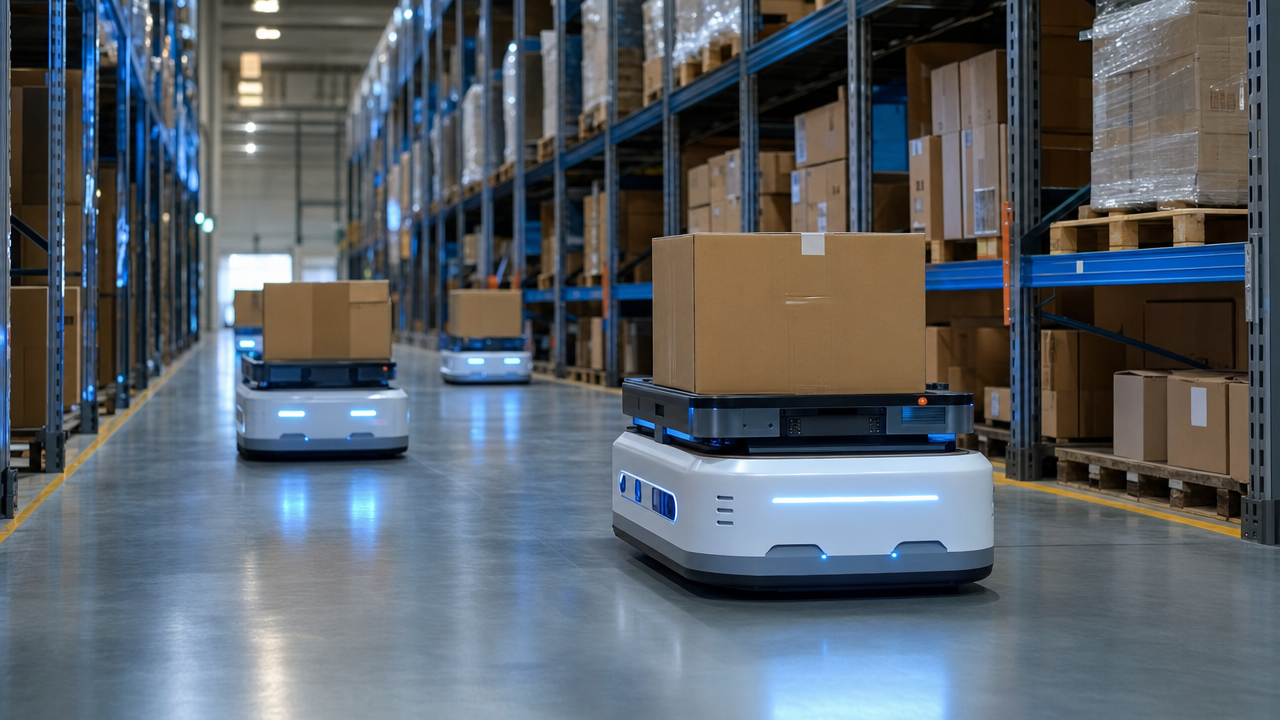

Chapter 1: Industry Overview and Definitions (AGV vs AMR vs Composite Robots)
1. From Magnetic Tape to Natural Navigation: The Technology Spectrum of Mobile Robots
Mobile robots are among the fastest-growing sub-sectors in industrial automation over the past decade. Their core value lies in replacing manual carts, forklifts, and conveyors with self-propelled autonomous vehicles, enabling dynamic and flexible material handling within factories and warehouses. However, "mobile robots" is not a single product category — it is a spectrum spanning navigation technologies, payload capacities, and application scenarios. Understanding this spectrum is the starting point for comprehending the entire industry.
At the technical definition level, the industry conventionally divides mobile robots into three main categories: AGV (Automatic Guided Vehicle), AMR (Autonomous Mobile Robot), and Composite Robots (Mobile Manipulation Robots). These three differ significantly in navigation methods, applicable scenarios, flexibility, and cost structure.
The history of mobile robots is nearly as old as modern industrial automation itself. In 1953, Barrett Electronics deployed the world's first towing-type automatic guided vehicle in a grocery warehouse in South Carolina. In 1973, Volvo deployed Europe's first AGV system in its Swedish factory for engine assembly line-side replenishment, marking AGV's formal entry into high-end manufacturing.
The real generational leap occurred in the early 2010s. In 2012, Amazon acquired Kiva Systems for the remarkable sum of USD 775 million. Kiva's products laid QR code matrices on warehouse floors, with robots reading floor codes via a downward camera to lift entire shelves and transport them to picking stations — the first large-scale commercialization of the Goods-to-Person model. Amazon internalized Kiva and stopped external sales, inadvertently triggering the mobile robot industry's first wave: the displaced market demand was rapidly filled by Chinese startups Geek+ and Quicktron, and US-based Locus Robotics.
Meanwhile, laser SLAM (Simultaneous Localization and Mapping) technology reached commercial maturity around 2015, making truly "natural navigation" (requiring no fixed infrastructure) possible for AMRs. The mobile robot industry then formally entered the dual-track AGV+AMR era.
2. AGV: The Reliable Guardian of Fixed Paths
AGV (Automatic Guided Vehicle) is the "veteran" category of mobile robots. Its most fundamental characteristic is reliance on known paths and pre-set maps for navigation. AGVs have low tolerance for environmental uncertainty but achieve extremely high reliability and precision on known paths.
Magnetic tape AGVs apply magnetic strips to the floor. The robots follow these preset tracks using magnetic sensors. The advantages are extremely low cost and simple maintenance; the disadvantage is completely fixed paths that require relaying strips when routes change, with poor adaptability. They are now mainly used in legacy factory scenarios with infrequent path changes.
Laser reflector AGVs mount rotating laser transmitters on top of the vehicle, using triangulation against pre-installed reflectors on fixed factory walls to achieve navigation accuracy of ±5-10mm. This was the mainstream industrial AGV solution of the 2010s. The drawback is that reflectors must be installed at fixed positions and re-calibrated when the factory layout changes.
Laser SLAM AGVs use lidar to continuously scan the environment, with the SLAM algorithm building a precise map on initial deployment and using it for real-time localization thereafter — requiring no fixed infrastructure. Though SLAM AGVs converge with AMRs in navigation method, the industry still classifies them as AGVs because they typically still follow pre-set fixed paths without dynamic obstacle avoidance and real-time path re-planning.
The AGV deployment engineering cycle — from site survey and path planning through infrastructure construction, single-unit commissioning, multi-unit integration, WMS/WCS interface connection, and trial operation — typically runs 3 to 6 months from contract signing to acceptance, with large customized projects potentially running 12 to 18 months.
Core AGV product types include under-ride lifting AGVs (KIVA type) for e-commerce warehousing (standard payload 500-1,500 kg, speed up to 2.0 m/s); forklift AGVs for pallet handling (light/medium/heavy classifications); and heavy-load AGVs for automotive OEMs, shipyards, and foundries (payload 5-60 tons, millimeter-level positioning precision).
3. AMR: The Flexible New Force of Natural Navigation
AMR (Autonomous Mobile Robot) represents the new-generation paradigm of mobile robots. Its most fundamental characteristic is "natural navigation" — requiring no fixed infrastructure, relying on onboard sensors to perceive the surrounding environment in real time, continuously updating maps via SLAM algorithms, autonomously navigating in completely unknown or dynamically changing environments, and dynamically re-routing around obstacles.
AMR's technical architecture has three core layers: the Perception Layer (multi-sensor fusion: 2D/3D lidar, depth cameras, ultrasonic sensors, IMU); the Localization and Mapping Layer (SLAM algorithms: GMapping, Cartographer, NDT); and the Decision and Control Layer (dynamic path planning, multi-robot collision avoidance).
Market data confirms AMR's commercial advantages: compared to equivalent AGV deployments, AMR achieves on average 35-40% lower total cost of ownership (TCO) over a five-year lifecycle (mainly by eliminating infrastructure installation and re-calibration costs); in warehouse operations, laser lidar AMRs complete approximately 28% more tasks per day and have about 22% fewer handling errors than traditional AGVs.
4. Composite Robots: The New Form of "Hand and Foot" Mobile Automation
Composite Robots (Mobile Manipulation Robots) mount collaborative robotic arms on mobile AMR platforms — the product of mobile robots' evolution toward integrated material handling and operational execution. AGV/AMR solves "how materials move"; composite robots further solve "how materials are handled after reaching their destination."
The architecture has three core modules: mobile chassis (SLAM AMR, natural navigation, dynamic obstacle avoidance); collaborative robotic arm (6 or 7-axis cobot, payload 3-20 kg, repeatability ±0.05-0.1mm, with torque sensing for human-safe collaborative operation); and end effectors (parallel grippers, suction arrays, or flexible grippers depending on task).
Composite robots have demonstrated commercial viability in cleanroom material handling for new energy battery lines, material supply for precision 3C assembly lines, pharmaceutical laboratory sample transfer, and semiconductor FOUP (Front Opening Unified Pod) automated transfer and loading.
Chapter 2: Market Scale and Competitive Landscape
1. 2024-2025 China Market Data
China's AGV/AMR market in 2024 reached a total output of 158,300 units, with total demand of approximately 150,000 units and market scale of RMB 19.665 billion. The industrial AMR sub-sector alone approached RMB 15 billion, representing industrial AMR's approximately 60% share of the broader mobile robot market.
Global projections: the global AGV/AMR market is forecast to reach USD 22 billion by 2030 (AGV CAGR ~18%, AMR CAGR ~30%). The global warehouse AMR market stood at approximately USD 5.3 billion in 2025, projected to reach USD 28.7 billion by 2034 (CAGR 20.4%). China dominates the Asia-Pacific region with over 30% global AMR revenue share.
2. China's Export Competitiveness: Quantitative Analysis
China's mobile robot export order ratio has risen dramatically: 2022: 25.87% → 2024: 37.12% → 2025: over 40%. In April 2026, China's industrial robot exports grew over 90% year-on-year.
The core reasons buyers choose Chinese mobile robots: first, price-performance ratio — Chinese AMRs are priced at roughly 40-60% of equivalent European/American products with broadly comparable core functionality; second, localization of key components — domestic lidar from Hesai and RoboSense, plus domestic controllers from SEER Robotics, have collectively reduced the hardware cost structure by approximately 35% since 2022; third, engineering support capability — Chinese vendors' local engineering teams in Southeast Asia, Europe, and North America can respond rapidly (typically within 24-48 hours) to customer demands.
3. Market Concentration: Fragmentation and Structure
Despite holding global #1 position by shipment volume for three consecutive years, even Hikrobot only has roughly 30-40% of China's market. The global AMR market is highly fragmented — the top four players combined (Hikrobot, Geek+, MiR, Quicktron) hold only about 23.5% global AMR market share as of 2024.
Key players and 2024-2025 data:
Hikrobot (海康机器人): 2024 revenue RMB 5.929 billion (+20% YoY, third consecutive year of 20%+ growth); 2024 total mobile robots produced 100,000+ units; cumulative by 2025: 180,000+ units; global shipment #1 for three consecutive years (InteractAnalysis); subsidiary of Hikvision.
Geek+ (极智嘉): Founded 2015; listed on HKEx main board July 9, 2025 (IPO raised HKD 2.545 billion net; institutional tranche oversubscribed 30×); delivered ~56,000 AMRs to ~40 countries; serves 800+ terminal customers including 60+ Fortune 500 companies (Walmart, Toyota, BMW); 75% repurchase rate; 2023 global #1 in AMR solutions (6.0% share).
Quicktron (快仓): 30+ countries, 1,000+ enterprise customers; 10 overseas offices including Germany, UK, Spain, USA, Japan, Singapore; unicorn status.
SEER Robotics (仙工智能): Founded 2020; 2025 global robot controller market share 24.8% (China: 45.2%), #1 globally; supports 2,000+ robot models, compatible with 400+ components; passed HKEx listing hearing June 7, 2026.
Hai Robotics (海柔创新): HAIPICK series warehouse robots; export ratio approaching 50%.
Global players: MiR (Denmark, Teradyne subsidiary) — global leader in industrial AMR; Locus Robotics (USA) — USD 109.7M revenue (2025); OTTO Motors (Canada) — USD 83M raised, heavy-duty industrial AMR.
Chapter 3: Core Technology Deep Dive
1. Navigation Technology: The Multi-Dimensional Competition
Laser SLAM dominates with approximately 42.5% share of the navigation technology segment (~USD 2.25 billion revenue) in 2025. Hybrid LiDAR+Vision AMRs rose to 30% of new models in 2025.
The leading lidar suppliers: Hesai (禾赛) reported robot lidar Q2 2025 shipments of 48,500 units (+743.6% YoY); RoboSense (速腾聚创) shipped 34,400 units in Q2 2025 (+631.9% YoY, 2,800+ customers); Livox (览沃, DJI spin-off) with its Mid-360 360° hybrid solid-state lidar serves 6,000+ customers; Slamtec (思岚) specializes in indoor positioning chips.
Next-generation navigation: AI visual SLAM using conventional cameras combined with deep learning feature detection; BIM (Building Information Modeling) integration combining factory digital twins for pre-deployment path planning; outdoor navigation via LiDAR+GNSS+HD-map fusion for port AGVs and outdoor industrial scenarios.
2. Fleet Management System (FMS): The Algorithmic Brain of Multi-Robot Coordination
The FMS is the "brain" of the entire mobile robot system, responsible for task allocation, path planning, traffic management, and deadlock resolution for large fleets. With more than 200 robots, scheduling algorithm performance differences create 10-30% efficiency variations in overall system throughput — in large projects, this annual economic value difference can reach tens of millions of yuan.
FMS scheduling algorithms have evolved through three generations: rule-based engines (fixed priority, regional division, pre-defined conflict rules — effective up to ~50 robots); optimization algorithms (Conflict-Based Search/CBS, Priority-Based Planning, Hungarian algorithm for task-robot matching — effective up to 200-500 robots); and reinforcement learning scheduling (robots trained via trial-and-error in simulation — commercial deployment still emerging but promising).
Key FMS capabilities at scale: warehouse throughput with 500+ AMRs requires peak task response time under 100 milliseconds; deadlock detection and resolution (when two robots block each other, the system must detect within milliseconds and issue re-routing commands without human intervention); priority preemption (high-priority tasks can preempt in-progress tasks while the interrupted task is properly suspended and resumed).
3. Human-Robot Collaboration Safety
Mobile robot safety systems in modern industrial environments must implement multi-zone detection: warning zone (typically 1.5-2m radius, robot slows from full speed to 0.5 m/s); protection zone (0.3-0.8m, robot stops completely); emergency stop zone (robot body or immediate periphery, mechanical emergency stop triggered).
Functional safety certification requirements: core navigation sensors must meet SIL 2 (Safety Integrity Level 2) and PLd (Performance Level d) standards. In human-robot collaborative scenarios, the ISO 3691-4 industrial truck safety standard mandates Speed and Distance Monitoring (SDM) — the robot's maximum allowable speed is calculated in real time based on the distance between the robot and the nearest human. Typical SDM parameters: at 3m human-robot distance, maximum robot speed is 1.2 m/s; at 1.5m, maximum 0.5 m/s; below 0.5m, full stop.
Chapter 4: Industry Chain: The "Smiling Curve" of Collaborative Value
1. Industry Chain Structure
The mobile robot industry chain has a clear three-tier structure:
Upstream (components and materials): sensors (lidar, vision sensors), controllers, motors, batteries, precision transmission components. Component localization rate has risen dramatically — key sensors (lidar) domestic substitution rate in 2024 approached 85% (down from ~30% in 2020).
Midstream (robot integration): full-process value creation from hardware design, software development, system integration to deployment services. This is the industry's most concentrated value node, with head players capturing 35-45% gross margins.
Downstream (system integrators and end users): large system integrators (e.g., Siemens, ABB) primarily undertake super-large project (1,000+ robots) turnkey implementations; SME integrators focus on vertical deep customization; end users span e-commerce, automotive, 3C electronics, lithium battery, pharmaceutical, and many other industries.
2. The "Smiling Curve" of Value Distribution
In mobile robot industry chain value distribution, the "smiling curve" effect is prominent:
High-value zone on the left side (upstream core components): Key components — robot controllers (SEER's 24.8% global share testifies to this high value), core SLAM algorithms, precision sensors — have strong technical barriers, high gross margins (40-60%), and substantial pricing power.
High-value zone on the right side (downstream software ecosystem): Fleet management systems, WMS/ERP integration middleware, data analytics services — these software-centric services capture recurring annual revenue streams (typically 10-15% of hardware price/year), forming stable cash flow with high renewal rates.
Relatively compressed middle (hardware manufacturing): The competitive landscape is intense, with price wars driving down gross margins for standardized hardware. Mid-range AMR (payload ≤1t) ex-factory prices have dropped from ~RMB 100,000-150,000 in 2020 to ~RMB 50,000-80,000 in 2025, a decline of 40-50%. This compression forces hardware-only vendors to urgently expand toward the high-value ends — which explains why most head vendors simultaneously invest in SLAM algorithm R&D (upstream tech) and FMS platform building (downstream software).
Chapter 5: Key Industry Applications
1. E-commerce and 3PL Warehousing
The e-commerce and third-party logistics (3PL) sector is the birthplace of China's mobile robot industry. The KIVA-type under-ride AMR model (Goods-to-Person) is the undisputed mainstream: warehouse throughput improved 300-500% vs. manual picking; picking accuracy improved to 99.9%+ (from 98-99% manual); the ability to increase robot count rapidly during peak seasons without emergency hiring; 24/7 non-stop operation.
JD Logistics' Asia No. 1 Intelligent Warehouse in Kunshan deploys 1,000+ mobile robots operating simultaneously, covering 40,000 sqm. Cainiao's smart warehouses in Wuxi cover over 300,000 sqm. Geek+ has deployed for Walmart, Amazon, Siemens and dozens of other global retail and logistics giants.
2. New Energy Vehicles (NEV) and Automotive
The automotive industry's AGV requirements are among the most demanding: bodies range from 500 kg (sedan) to 60+ tons (commercial vehicles), requiring 7×24 non-stop operation with MTBF >8,000 hours. Engine delivery AGVs need ±2mm positioning precision to ensure accurate alignment with assembly stations. Stringent compliance requirements (IATF 16949 quality management system) further raise the bar.
Port AGVs represent an especially specialized application. A modern fully automated container terminal AGV requires: payload 50-80 tons (a single loaded container), operation in outdoor complex environments (wind, rain, salt fog), 24/7 all-weather operation, simultaneous coordination with dozens of shore cranes and yard cranes. The Shanghai Yangshan Phase IV automated terminal operates 130 automated guided vehicles (AGVs) simultaneously, making it one of the world's most advanced automated container terminals.
3. 3C Electronics
The 3C electronics sector (computers, communications, consumer electronics) imposes unique challenges: extremely high precision requirements (some components require ±0.5mm positioning), clean room requirements (Class 10,000 or better), frequent product changeover (new product iterations every 3-6 months force frequent layout adjustments). Composite robots have found strong traction here, particularly for lens assemblies, circuit board handling, and small component feeding.
Key characteristics: Just-in-Time delivery with buffer optimization; line-side replenishment robots maintaining zero stockout risk; ESD-compliant (anti-static) AMR design; compatibility with MES-level traceability systems.
4. Lithium Battery Manufacturing
The lithium battery manufacturing industry is the current growth hotspot for domestic composite robots. Giant gigafactories (300,000+ sqm) with multiple processes across electrode production, cell assembly, and pack assembly create enormous intra-factory logistics demands. Requirements: cleanroom environments (Class 10,000), strict ESD standards, multi-material-type handling (electrode rolls, cells, modules, packs), extremely high intra-factory material flow volumes.
CATL, BYD, and CALB have become strategic reference customers for domestic mobile robot vendors. Hikrobot has deployed 1,000+ units at a single lithium battery gigafactory — arguably the world's largest single-site mobile robot deployment in this sector.
Chapter 6: Global Competitive Landscape
1. Chinese Players' Global Expansion
Chinese mobile robot companies have shifted from domestic-focused to genuinely global over 2022-2026. Export order ratios rose from 25.87% in 2022 to over 40% in 2025. Hikrobot has full Southeast Asia coverage (Malaysia, Thailand, Singapore, Vietnam, Indonesia). Quicktron operates in 30+ countries with 10 overseas service offices.
The three core competitive advantages of Chinese vendors in overseas markets: price-performance ratio (40-60% of European/American pricing), engineering service response speed (local teams in key markets), and co-innovation willingness with local system integrators (more flexible customization than Western competitors who typically insist on standard product sales).
2. European and American Players' Positioning
MiR (Mobile Industrial Robots): Danish company, Teradyne subsidiary. Products are characterized by safety, ease of deployment, and ease of use — optimized for mixed human-robot environments. Particularly strong in European and American manufacturing and healthcare logistics. MiR's FMS (MiR Fleet) supports 100+ robot management with mature compliance certifications (CE, UL).
Locus Robotics: US-based; 2025 revenue USD 109.7M; total raised USD 438M from 17 investors over 8 rounds. Core model: RaaS (Robotics as a Service) subscription, avoiding large CapEx for customers. Specialized in e-commerce 3PL co-warehousing scenarios.
OTTO Motors (Clearpath Robotics subsidiary): Canadian; total raised USD 83M; focused on heavy-duty industrial AMR for automotive, aerospace, and heavy industry. Known for extremely high reliability in high-risk industrial environments.
3. Competitive Dynamics
The fundamental structural difference in the global competitive map: Chinese players compete on price-performance and engineering service speed; European/American players compete on compliance certification depth, brand trust, and software ecosystem. In the medium-to-long term, the key question is whether Chinese vendors can close the compliance and brand trust gap in high-end markets while maintaining cost advantages. Given the speed of recent progress, this convergence is more likely than not within 3-5 years.
Chapter 7: Factory Database Perspective — Industrial Penetration
1. Current Penetration Rate Tianxia Gongchang's factory data platform — covering 4.8 million verified Chinese factories in production — shows clear geographic concentration of mobile robotics suppliers in Shanghai, Suzhou, Shenzhen, and Hangzhou.
From the platform database's factory-level data covering manufacturing enterprises, mobile robot penetration can be analyzed by enterprise size and industry.
Large enterprises (assets >RMB 100M): mobile robot deployment rate is approximately 15-25%, concentrated in automotive (40%+), 3C electronics (30%+), e-commerce warehousing (60%+ for large players), and lithium battery (rapidly rising to 25-35%+ in new gigafactories).
SMEs (assets RMB 5-100M): mobile robot deployment rate is roughly 3-8%, primarily limited to a small number of "industry champion" enterprises with automation investment awareness and capital capacity.
Very small enterprises (assets <RMB 5M): penetration is currently near 0, but with mobile robot prices falling toward RMB 30,000-50,000 (RaaS subscription costs falling to RMB 5,000-15,000/robot/year), the next 3-5 years may see initial penetration breakthroughs in manufacturing SMEs.
2. Industry Distribution of Penetration
The industry-by-industry deployment landscape reveals that mobile robot penetration follows the "maturity gradient" of the broader automation investment cycle:
Mature deployment industries (penetration >20%): automotive OEMs, e-commerce logistics centers, 3C electronics Tier 1 manufacturers, semiconductor fabs, pharmaceutical GMP warehouses.
Rapidly growing industries (penetration 5-20%): lithium battery, NEV components, steel/aluminum processing, food and beverage, medical device manufacturing.
Early-stage industries (penetration <5%): traditional light manufacturing (textiles, plastics, furniture), construction materials, agricultural processing, marine equipment — these represent the vast majority of China's 4.8 million factories and constitute the largest incremental market for mobile robots.
3. Price as the Key Unlock for SME Penetration
The single most important factor determining SME penetration is product price. Based on publicly available factory-level economic data, ROI becomes acceptable for SMEs (payback period <5 years) when AMR acquisition cost falls below RMB 50,000 per unit. In 2025, mid-range AMRs (payload 100-500 kg) are approaching this threshold. If the RaaS model matures to the point where subscription costs fall below RMB 10,000/robot/year with no up-front CapEx, the addressable SME market expands by approximately 5-8x.
Chapter 8: Business Models and Investment Landscape
1. RaaS: From CapEx to OpEx
RaaS (Robotics as a Service) represents the most significant business model innovation in the mobile robot industry since the Goods-to-Person model itself. The global RaaS market was USD 2.40 billion in 2025, projected to reach USD 14.82 billion by 2036 (CAGR 24.3%). China's RaaS market share was approximately 11.1% in 2025.
RaaS's core mechanism: the vendor owns the robots and maintains them; the customer pays a monthly or usage-based fee rather than purchasing equipment outright. The advantages: customers avoid large upfront CapEx; elasticity for business volume fluctuations (scale up during peak seasons, scale down in off-seasons, paying only for what they use); risk transfer (vendor bears maintenance costs, customers don't worry about obsolescence).
2. Investment and IPO Landscape
The mobile robot sector has experienced intense capital market activity in 2024-2026. Geek+'s HKEx listing on July 9, 2025 was the largest robotics IPO in Hong Kong's history — the institutional tranche was oversubscribed 30×, participated by sovereign wealth funds and international long-only funds. The offering raised HKD 2.545 billion net. As of 2025, 13 robot companies chose HKEx listings; 4 rang the bell, 20+ are in the pipeline.
SEER Robotics passed its HKEx 18C listing hearing on June 7, 2026 after its third submission attempt, having raised RMB 282.7M across 4 funding rounds at a C-round post-valuation of RMB 3.27 billion.
3. Capital Allocation Implications
For investors, the mobile robot sector presents a classic "platform vs. application" investment dilemma: upstream component specialists (SEER in controllers, Hesai in lidar) offer clear moat visibility and higher gross margins but limited addressable markets; full-stack robot vendors (Hikrobot, Geek+) offer scale and ecosystem advantages but face hardware margin compression; pure software/FMS platform plays are the most optionable but hardest to monetize independently without hardware bundling.
Chapter 9: Typical Cases and Best Practices
Case 1: JD Logistics — 1,000+ Robot Warehouse
JD's Asia No. 1 Intelligent Warehouse (Kunshan) demonstrates the Goods-to-Person model at full scale: 40,000 sqm, 1,000+ under-ride AMRs operating simultaneously, automated sorting conveyors, AI-driven order management. Throughput: 200,000+ orders per day during peak. This case established the operational benchmark for China's large-scale AMR warehouse deployment.
Case 2: Geek+ × Walmart — Cross-Border Supply Chain
Geek+ deployed AMR systems for Walmart distribution centers across multiple countries, including US and Asia-Pacific facilities. The cross-border deployment demonstrates the maturity of Chinese AMR vendors' global implementation capabilities — project management spanning language, time zone, regulatory, and network infrastructure differences simultaneously.
Case 3: Hikrobot × CATL — Lithium Battery Gigafactory
Hikrobot's 1,000+ unit deployment at a CATL gigafactory represents the current frontier of mobile robot deployment density. The project required integration with the factory's MES system for cell-level material traceability, cleanroom-certified AMRs throughout, and a fleet management system handling simultaneous scheduling of 1,000+ robots across multiple production zones.
Case 4: SEER Robotics — Controller Platform Strategy
SEER's "open controller platform" strategy (SRC series) represents a unique trajectory: rather than building full robots, they sell the "robot brain" to OEM robot manufacturers. With 2,000+ robot models worldwide using SEER controllers and 400+ compatible component libraries, SEER has positioned itself as the "Android of mobile robots" — a platform play that extracts value from every robot sold regardless of brand.
Case 5: Port AGV — Yangshan Phase IV
Shanghai Yangshan Deep-Water Port Phase IV uses 130 AGVs operating simultaneously in a fully automated environment. The technical complexity — outdoor environments with wind/rain/salt, 50-80 ton payload, real-time coordination with shore cranes and quay cranes — makes port AGV one of the most technically demanding applications globally.
Case 6: Pharmaceutical GMP Warehouse — Digital Traceability
A large domestic pharmaceutical company deployed 60 cleanroom AMRs for GMP-compliant drug logistics: RFID-tagged batches, AMR-mounted readers for automatic lot scanning, full electronic chain of custody records, integration with the pharma company's ERP system for serialization compliance. Key outcome: picking error rate reduced from 0.1% (manual) to 0.002% (automated), and regulatory audit preparation time reduced from 3 weeks to 3 days.
Chapter 10: AI and Technology Trends
1. LLM Integration: Task Planning, Not Bottom-Level Control
Large language models (LLMs) are being explored as a "natural language to task planning" interface for mobile robot systems — allowing operators to issue instructions in natural language ("move all pallets from Zone A to Zone B by 3pm") instead of manually programming task sequences in the FMS. The key insight on LLM integration constraints: the fundamental latency gap between real-time control systems (millisecond requirements) and LLM inference (hundreds of milliseconds to seconds) is unlikely to be closed by raw compute alone in the foreseeable future. Therefore, LLMs are more likely to integrate as the "task planning layer" rather than the "bottom control layer."
2. Embodied AI and Next-Generation Capabilities
The emergence of embodied AI (物身智能) — AI systems that perceive, reason, and act in the physical world — raises the possibility of mobile robots that can handle truly unstructured tasks: picking from a randomly piled bin of mixed parts, navigating environments they've never seen before, collaborating with humans through natural gesture and speech. While this remains 5-10 years from full commercialization in industrial settings, several intermediate steps are already appearing in 2025-2026: better multi-modal perception (vision + touch), more robust grasping via tactile feedback, and improved sim-to-real transfer for training composite robot manipulation policies.
3. Digital Twin Integration
Factory digital twins (BIM-level 3D models of the complete production environment) are becoming essential infrastructure for AMR deployment: pre-deployment path simulation (verifying no collision routes before physical installation), continuous synchronization between the digital twin and actual factory layout (detecting layout changes and auto-updating AMR maps), and fleet performance analytics (identifying bottlenecks by simulating counterfactual scheduling strategies on the twin before deploying changes to production).
Chapter 11: Standards and Regulatory Landscape
1. China's Standards Progress
China's standards work for mobile robots is progressing on multiple fronts. The China Mobile Robot and Robot Equipment Industry Alliance (CRIA) has been advancing a series of national standards covering: AMR safety requirements, FMS communication interfaces, navigation performance testing methods, and human-robot coexistence safety specifications.
China's robot density target is 200 units per 10,000 workers, which would represent catching up to South Korea (the global leader at ~1,000 units/10,000 workers in 2024) over the next 10-15 years and would imply an installed base growing by 5-8× from current levels.
2. Key International Standards
The European VDA5050 protocol (developed by the German Association of the Automotive Industry, VDA) has become the de facto international standard for AMR fleet communication. Supporting VDA5050 is now a prerequisite for Chinese AMR vendors entering the European automotive supply chain.
ISO 3691-4 (Industrial trucks — Safety requirements and verification — Part 4: Driverless industrial trucks and their systems) is the core safety certification for industrial AMR international market access. SIL 2 (Safety Integrity Level 2, IEC 62061) and PLd (Performance Level d, ISO 13849-1) represent the functional safety certification requirements that leading industrial AMR vendors must meet.
3. International Policy Comparison: China, Europe, USA, Japan
China: National-level "robot density improvement" targets in the 14th and 15th Five-Year Plans; MIIT smart manufacturing subsidy programs (2021-2025); 2025 MIIT + Ministry of Civil Affairs three-year robot elder-care pilot program; domestic robot substitution preferential policies.
Europe: EU Machinery Regulation (2023) replacing the Machinery Directive, with stricter AI-system safety requirements; EU AI Act's impact on autonomous mobile robots (classified as "high-risk AI systems" requiring conformity assessments); strong regulatory compliance requirements create barriers but also moat for compliant players.
USA: Executive Order on AI safety (2023) and emerging NIST AI Risk Management Framework; OSHA workplace automation safety guidelines; significantly less prescriptive than EU — creating a more permissive environment for rapid deployment but potentially less protection for workers.
Japan: Japan Robot Strategy 2035 targeting density of 1,000 robots/10,000 workers; strong government-industry collaboration on robot safety standards (JIRA — Japan Robot Industry Association); aging population driving strong elder-care and logistics robot adoption.
Chapter 12: Ecosystem Competition and the Platform "Data Flywheel"
1. Why Ecosystem Competition Matters From Tianxia Gongchang's research perspective, the next 36 months will determine whether AMR-centric domestic players such as Geek+ and Hikrobot consolidate global leadership or remain China-bound.
Mobile robot competition is not simply about who makes the fastest or cheapest robot. The battleground is increasingly the software ecosystem: whose FMS platform manages the most diverse robot types, whose API integration library covers the most WMS/ERP systems, whose cloud service delivers the richest analytics.
The "data flywheel" effect in FMS platform competition: more robot deployments generate more operational data → better data enables better scheduling algorithms → better scheduling algorithms attract more customers → more customers generate more deployments. Each successive round of this virtuous cycle widens the performance gap between the dominant platform and challengers. This is why Hikrobot's FMS (iVMS) now manages not just Hikrobot's own robots but robots from multiple third-party vendors — the value of the platform grows with every additional robot type it integrates.
The industry research team judges: over the next 5 years, the primary axis of competition in China's mobile robot market will shift from "who sells more hardware" to "whose software ecosystem manages the most robots" — similar to how Salesforce's CRM ecosystem has far more enterprise value than any single hardware peripheral.
2. Open vs. Closed Platform Strategies
SEER Robotics' open controller platform strategy represents one extreme of the spectrum: maximize ecosystem reach by supporting maximum robot variety. Hikrobot's integrated hardware+software strategy represents the opposite: use hardware volume as a wedge to establish FMS dominance, then expand FMS to manage third-party hardware.
The data flywheel creates a "winner-take-most" tendency, but mobile robot deployment is highly local and scenario-specific: no single vendor can be best in every scenario. This fragmentation keeps the market from full consolidation — there will be multiple strong platform players in different scenario niches (warehouse, automotive, semiconductor, port), with the global aggregate picture remaining fragmented even as individual niches consolidate.
Chapter 13: Risk Factors
1. Supply Chain Risks
Mobile robot supply chains remain partially exposed to geopolitical risks, particularly for high-end optical-electronic components: some advanced lidar sensors still depend on foreign-origin components (MEMS mirrors, certain custom ASICs). Though domestic substitution is proceeding rapidly (domestic lidar penetration rising from ~30% in 2020 to ~85% in 2024), a subset of leading performance specifications still depends on imported supply. Any disruption to this remaining import exposure — via export controls, trade disputes, or logistics disruptions — could affect delivery timelines and product performance.
2. Industry Ecosystem Risks
The current price competition and capacity excess cycle in China's mobile robot market creates systemic risks: some vendors are selling below cost to maintain market share, which may lead to exits or consolidations that leave customers with orphaned systems (no spare parts, no software updates, no field support). Buyers should evaluate vendor financial stability — not just product specifications — when selecting long-term automation partners.
Leading indicator signals to monitor: rising accounts receivable days at head vendors (indicating downstream payment delays and supply chain capital stress); accelerating price index decline for standardized robots (2024 H2 saw 40%+ price reductions in some categories — if this continues, it signals severe excess capacity); equity market robot sector P/E ratios persistently above 50× (when valuations decouple from fundamentals, any negative news can trigger broad sector valuation reset).
Data Sources
This report's data and conclusions are based on the following public sources. Data freshness is anchored at June 20, 2026. Tianxia Gongchang Factory Database — covering 4.8 million verified Chinese factories in production, used as the primary cross-verification source for company-level claims in this report.
Company Announcements and Prospectuses
- Geek+ (极智嘉) HKEx Main Board IPO Prospectus (January 2025, June 2025 final); HKEx listing announcement (July 9, 2025)
- SEER Robotics (仙工智能) HKEx listing application (May 2025, November 2025, May 2026 third submission; listing hearing passed June 7, 2026)
- Hikrobot (海康机器人) annual revenue and business operation data (2024, 2025 public disclosures)
Market Research Reports
- GGII (Gaogong Intelligence Industry Research): AGV/AMR Mobile Robot Industry Deep Research Report
- Qianzhan Industry Research Institute: 2025-2030 China Mobile Robot (AGV/AMR) Industry Development Forecast and Investment Strategy Analysis Report
- LogisticsIQ: Mobile Robots (AGV and AMR) Market to Reach $22 Billion by 2030 (2024)
- Grand View Research: Automated Guided Vehicle Market Report 2025-2033
- ABI Research: Mobile Robot Revenue by Mobility Type 2025-2030
- InteractAnalysis (UK): Global AMR Shipment Rankings 2022-2025
Technology Data
- Hesai Technology (禾赛科技): Q2 2025 quarterly report (robot lidar shipment data)
- RoboSense (速腾聚创): Q2 2025 quarterly report (robot lidar shipment data)
- IEEE Spectrum: Amazon Acquires Kiva Systems for $775 Million (2012)
- The Robot Report: A Decade After Acquiring Kiva, Amazon Unveils Its First AMR
Industry Media
- 36Kr, 钛媒体, Sina Finance, The Paper, Leiphone, OFweek Robotics, EETitle-China, relevant thematic reports
Policy Documents
- MIIT: Robot Industry Development Plan (2023 edition)
- MIIT: "Smart Manufacturing Special" series policy documents (2021-2025)
- China Mobile Robot and Robot Equipment Industry Alliance (CRIA): industry standards progress reports
Note: Some market forecast data in this report comes from multiple third-party research firms. Different firms apply different statistical calibration methods and forecasting models. Sources are cited where applicable; readers should apply their own judgment in applying these figures to specific business contexts.