
Report Framework
This report covers twelve chapters:
I. Definitions and Value Chain Overview II. Global Competitive Landscape III. PEST Macro-Environmental Analysis IV. China Market Scale and Price Dynamics V. Industry Chain Decomposition VI. Key Company Deep Dives VII. China's Industrial Clusters VIII. Sub-Sector Spotlight IX. Technological Evolution X. Key Risks XI. 2026–2030 Outlook XII. Conclusions
Data baseline: FY2025 annual reports + Q1 2026 data; price data as of early June 2026.
I. Definitions, Classifications, and Industry Value Chain Overview
1.1 What Are Non-Ferrous Metals?
Non-ferrous metals in China's industrial classification refer to all metals other than iron and ferrous alloys (black metals), encompassing dozens of categories including copper, aluminium, lead, zinc, nickel, tin, antimony, tungsten, molybdenum, and rare earth elements. By international convention, non-ferrous metals fall into four broad categories:
Common non-ferrous metals — copper, lead, zinc, aluminium, nickel, and tin — are the most widely used industrial base metals, all traded on the London Metal Exchange (LME); light metals — primarily aluminium, magnesium, and titanium — are valued for their low density in aerospace and automotive weight-reduction applications; precious metals — gold, silver, and platinum-group metals — combine monetary and industrial functions; rare metals — tungsten, molybdenum, vanadium, germanium, gallium, and rare earth elements — carry strong strategic significance as critical materials for modern defence, semiconductors, and new-energy equipment.
In China, the non-ferrous metals industry falls under the "Non-Ferrous Metal Smelting and Rolling Processing" sector (code 32) within the manufacturing classification standard GB/T 4754, subdivided into eight sub-categories: copper smelting, aluminium smelting, lead-zinc smelting, nickel-cobalt smelting, tin smelting, other non-ferrous metals smelting, non-ferrous alloy manufacturing, and non-ferrous metal rolling.
1.2 Classification by Metal
Copper: One of the most widely used industrial metals, prized for its excellent electrical and thermal conductivity. China is the world's largest refined copper producer; in 2025, output reached 14.72 million tonnes, approximately 40% of global production.
Aluminium: The most abundant metallic element in the Earth's crust, extracted from bauxite (Al₂O₃) through a two-step process of alumina refining and electrolytic smelting. China's 2025 electrolytic aluminium output was approximately 45.02 million tonnes, or about 56% of global production.
Lead and zinc: Lead-acid batteries (automotive, backup power) are the dominant lead end-use; zinc is used primarily for hot-dip galvanising of steel (construction, automotive, appliances) and zinc alloy die-casting (automotive parts, electronic housings). China is the world's leading producer of both.
Nickel: Primary demand comes from stainless steel and alloys (about 70%), with growing consumption in ternary battery cathode materials (NCM/NCA). Indonesia is the world's largest nickel ore source, and its export ban policies directly influence global nickel price movements.
Tin: Solder (electronics assembly) is the largest application; tin is a critical consumable in semiconductor packaging and PCB manufacturing. Global tin resources are concentrated in China, Indonesia, and Myanmar.
Antimony: China supplies over 85% of global output; primary uses are flame retardants (plastics, electronics) and lead-acid battery additives; China implemented export controls on antimony in 2025.
Tungsten and molybdenum: Tungsten, the hardest and highest-melting metal, is used in cemented carbide cutting tools, armour-piercing cores, and filaments; China holds about 65% of global reserves. Molybdenum is a special alloy element in steelmaking that enhances high-temperature performance; CMOC (603993) is one of the world's largest molybdenum producers, with operations now extending into Congo DRC copper-cobalt.
Rare earths: Comprising 17 elements, rare earths are core materials for permanent magnets (EV motors, wind turbines), phosphors (LEDs), and catalysts. China holds about 35% of global reserves and produces about 60%+ of global output; Northern Rare Earth (600111) is the world's largest rare earth producer.
1.3 Classification by Process
The non-ferrous metals production chain spans three tiers:
Mining and beneficiation: Mining and mineral processing stage — ore is crushed and float-separated into concentrate (e.g., copper concentrate, lead-zinc concentrate). This phase is highly capital-intensive with long lead times, and is heavily influenced by ore grade, local regulatory conditions, and transportation costs. China's copper ore resources are limited — reserves account for only about 4–6% of global totals — but consumption accounts for 40%+, creating a structural dependence on imported copper concentrate from Chile, Peru, Mongolia, and the DRC.
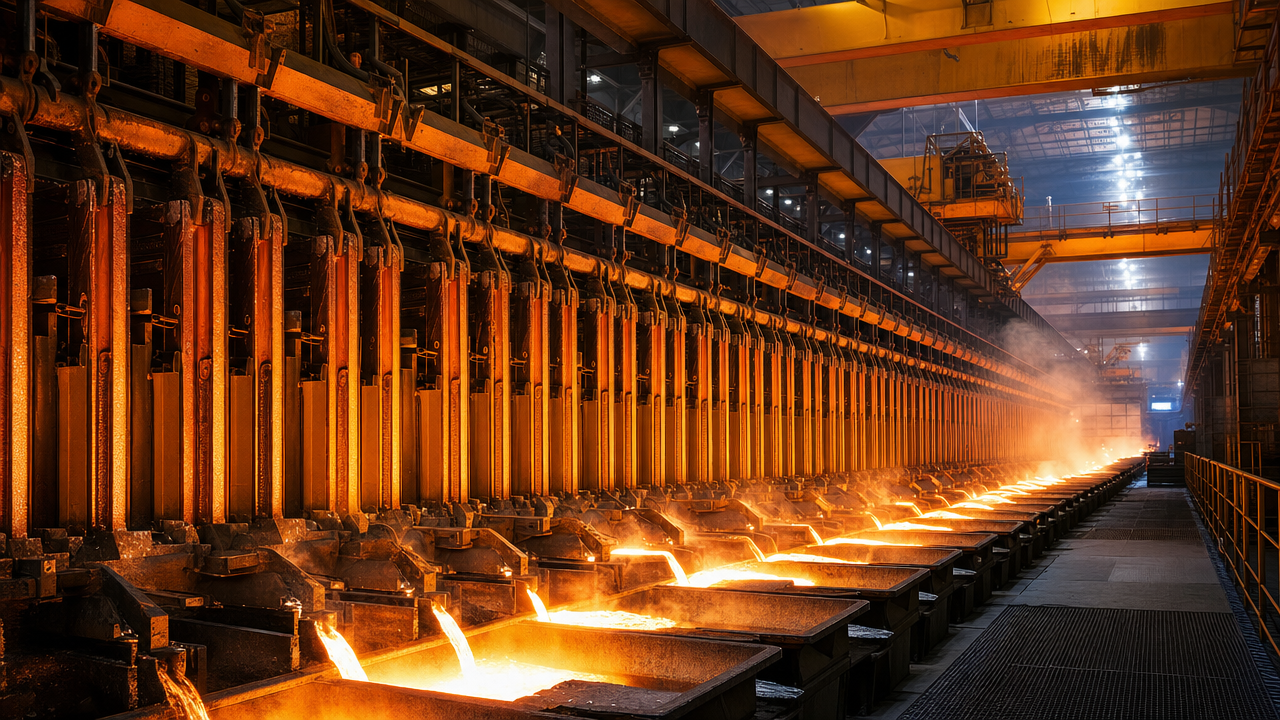
Smelting: Concentrate is processed by pyrometallurgical or hydrometallurgical methods to produce primary metal (electrolytic copper / cathode copper / lead ingot / zinc ingot / electrolytic aluminium). The dominant copper process is pyrometallurgy — concentrate → blister copper → anode copper → cathode copper, with refined copper purity reaching 99.99% (four-nines copper). Electrolytic aluminium is produced by electrolysis of alumina in molten cryolite, consuming approximately 13,000–14,000 kWh per tonne, making electricity cost the decisive competitive variable in aluminium smelting.
Fabrication (rolling and processing): Primary metal is processed into plates, rods, tubes, wires, foil, and sections for downstream manufacturing. Copper fabricated products include copper tubes (air-conditioning refrigeration), rods (mechanical parts), strip (lead frames, transformers), and foil (PCB laminate, lithium battery current collectors); aluminium products include extrusions (architectural curtain wall, industrial profiles), sheet and strip (automotive body, aerospace structures), and foil (battery foil, packaging foil).
1.4 Classification by End-Use
Power and energy infrastructure: Copper is the core conductor in electrical systems — for transmission and distribution cables (roughly 40% of copper consumption), transformer windings, and motors. Aluminium is emerging as an important substitute in distribution cable applications (aluminium-core cable). Grid upgrades for new-energy power are one of the most important sources of incremental copper and aluminium demand for 2025–2030.
Electronics and semiconductors: Copper foil (lithium battery current collectors, PCB printed circuit boards), brass terminals (contact components), aluminium substrates (high-power heat dissipation); gallium and germanium are critical semiconductor materials (GaAs, SiGe processes).
Transportation: EVs use 80–100 kg of copper per vehicle, 3–4 times more than a conventional vehicle (around 23 kg); vehicle lightweighting is driving aluminium content from an average of ~150 kg/vehicle (2020) toward 200–250 kg/vehicle (2030 estimate); aerospace aluminium (7-series high-strength alloys) is the core product of Nanshan Aluminium.
Construction: Aluminium extrusions (window and curtain wall framing) are the largest single aluminium consumption segment (around 20%); copper plumbing, brass radiators, and copper decorative elements are important construction copper applications.
Packaging: Aluminium foil, aluminium cans, and aluminium lids form the modern packaging ecosystem; aluminium foil is a critical material for soft-pack and cylindrical lithium batteries, as well as for pharmaceutical blister packs and food packaging.
1.5 Full Value Chain Map
The chain extends from mine to finished manufacturing, involving approximately a dozen processing steps and hundreds of product variants. China holds the world's most complete industrial chain in the smelting and fabrication segments, but suffers from insufficient upstream copper mineral resources, creating the structural pattern of "heavy dependence on imported copper concentrate upstream, exporting refined copper and fabricated products downstream."
1.6 Key Industry Statistics
- 2025 total value of China's non-ferrous metals industry: approximately RMB 8.5–9 trillion (including precious metals)
- China's dependence on imported copper concentrate: approximately 75–80% (about 26 million tonnes of physical imports, containing approximately 700–750,000 tonnes of copper metal)
- Electricity costs for electrolytic aluminium: Southwest hydro-power aluminium around RMB 0.28–0.35/kWh; central and eastern coal-power rates around RMB 0.40–0.50/kWh, yielding a cost difference of approximately RMB 1,000–2,000 per tonne
- China's copper fabricated product exports: approximately 1.2–1.5 million tonnes in 2025; aluminium fabricated product exports: approximately 5–5.5 million tonnes
- Secondary aluminium share: approximately 25% in 2025 (EU/US: 35–40%); significant room to grow as a key carbon-reduction pathway
II. Global Competitive Landscape
2.1 Copper: A Global Game Where Resources Reign
Global copper mineral resources are highly concentrated. Chile, Peru, the Democratic Republic of Congo, Australia, the United States, and Zambia together account for more than 70% of global reserves. Chile alone holds about 23% of global copper reserves, making it the undisputed "Copper Kingdom." Yet resource concentration does not mean stable supply — ageing mines, declining ore grades, rising energy costs, and growing negotiating leverage of host-country governments together form a structural long-term pressure on copper supply.
Codelco (Corporación Nacional del Cobre de Chile) is the world's largest single copper mining enterprise, with annual mine copper output of approximately 140–160 thousand tonnes, though production has consistently fallen short of targets in recent years due to declining ore grades and engineering delays. In 2025, Codelco's largest mine, El Teniente, experienced a temporary shutdown following a tunnel collapse accident.
Freeport-McMoRan (FCX, USA), whose Grasberg mine (Papua Province, Indonesia) is one of the world's largest copper-gold skarn-type ore bodies, is transitioning from open-pit to underground mining. In September 2025, a mud rush in the Grasberg underground block cave caused fatalities and forced production to halt; a phased restart is expected in Q2 2026. Even so, FCX's full-year mine copper output reached approximately 1.54 million tonnes (3.42 billion pounds), maintaining its position as the world's second-largest copper mining company, with copper contributing roughly 75% of revenues.
Rio Tinto (UK/Australia), traditionally an iron ore and aluminium giant, has significantly increased its copper and aluminium profile in recent years. The underground development of Oyu Tolgoi (Mongolia) was completed in 2025, driving a +61% year-on-year copper production increase and an overall group copper production gain of +11% YoY. Rio Tinto's 2025 post-tax profit reached approximately USD 10 billion, and it achieved a record annual bauxite production of 62.4 million tonnes.
BHP (UK/Australia) owns Escondida (Chile, the world's largest copper mine, BHP 57.5% stake) and Olympic Dam (copper, uranium, gold, silver). In 2025, BHP explicitly designated copper, potash, and nickel as its growth priorities, with Escondida producing approximately 1.05 million tonnes of copper — constrained by water resources and worker negotiations.
Glencore (Switzerland) is the world's largest copper trader and also holds Katanga/Mutanda copper-cobalt mines in the DRC and Antapaccay in Peru. Glencore was the world's largest cobalt producer in 2025; the DRC's cobalt export quota system (effective October 2025) warrants monitoring for its impact on Glencore's profitability.
Zijin Mining (601899) is becoming a significant new force in the global copper map. With mine copper output of approximately 1.085 million tonnes in 2025 (primarily from overseas operations in Kamoa-Kakula DRC, Timok Serbia, and Porgera PNG), its global ranking has entered the top ten. After years of constrained resource endowment, Chinese non-ferrous enterprises have — through the Zijin model of "going global" through mine acquisitions — achieved a quantum leap in both output and resource base.
2.2 Aluminium: A Global Landscape Dominated by China
The global aluminium landscape differs fundamentally from copper's: while copper competitiveness is determined by upstream resource ownership (mines), aluminium's true barriers lie in smelting-phase energy costs and scale economies as well as fabrication technical capabilities.
China's 56% share dominates global electrolytic aluminium production. 2025 global output reached approximately 82 million tonnes; China's 45.02 million tonnes led by a wide margin. The remainder is primarily in India (4.3 million tonnes), Russia (3.8 million tonnes), Canada (2.9 million tonnes), UAE (2.7 million tonnes), and Norway (~1.4 million tonnes).
Chalco — China Aluminium (601600), the central-enterprise flagship, produced 8.08 million tonnes of electrolytic aluminium and 17.35 million tonnes of alumina in 2025, holding world number-one capacity in both. Revenue was RMB 241.1 billion and net profit RMB 12.67 billion.
Norsk Hydro (Norway), Europe's largest aluminium enterprise and the world's largest aluminium extrusion maker, is powered by Norwegian hydroelectricity and is one of the global industry's lowest-carbon primary aluminium producers. Hydro is selling "green aluminium" at premium prices to automotive OEMs; the EU Carbon Border Adjustment Mechanism (CBAM) is a key strategic tailwind.
Rusal (Russia), with capacity of approximately 3.8 million tonnes/year, is the world's second-largest aluminium producer. Western sanctions following the Russia-Ukraine conflict restricted Rusal sales in European markets, redirecting product flows toward China and Asia.
Hindalco (India), India's largest aluminium producer (~1.3 million tonnes/year), owns Novelis — the world's largest aluminium sheet and strip rolling and recycling processor, with the number-one market share in automotive aluminium sheet — supplying BMW, Ford, and Jaguar with recycled aluminium sheet.
Yunnan Aluminium (000807) is China's showcase hydro-power aluminium enterprise, producing 3.226 million tonnes of aluminium products in 2025, net profit RMB 6.055 billion (+37.2% YoY). Leveraging Yunnan Province's rich hydroelectric resources, Yunnan Aluminium's electricity cost is approximately 15–20% below coal-power smelters, making it China's closest approximation to an international "green aluminium" standard.
III. PEST Macro-Environmental Analysis
3.1 Political
Strategic Mineral Nationalisation
Around 2025, major mineral-producing nations globally are pushing mineral resources toward national strategic priorities. Chile's Boric government sought amendments to copper royalties and taxes; the DRC continuously revised its Mining Code to impose super-profit taxes on foreign mining companies, with a cobalt export quota system coming into effect in October 2025 — directly impacting CMOC's cobalt product export timing. Indonesia's "natural resource nationalisation" stance has been consistent: the 2020 nickel ore export ban, the 2023 bauxite export ban, and copper concentrate export restrictions in 2025 pushed domestic smelting capacity development at the expense of raw ore exports.
Gallium, Germanium, and Antimony Export Controls
In August 2023, China formalised export licence controls on gallium (for GaAs semiconductors and LED chips) and germanium (for SiGe photodetectors and optical fibre preforms). In 2025, controls expanded to antimony (flame retardants, lead-acid batteries) and superhard materials. These controls created structural supply pressure for European, American, and Japanese semiconductor and defence industries.
US Tariff Escalation
US tariffs on Chinese imports reached 145% in H1 2026, directly impacting Chinese copper and aluminium fabricated exports (copper tubes, aluminium extrusions, aluminium plate). Structural pressure on China's copper-aluminium processing exporters intensified, with some pivoting toward Southeast Asia (Vietnam, Thailand), the Middle East, and Africa.
3.2 Economic
Copper's Super-Cycle
The LME copper three-month price surged approximately +41% YoY in 2025 — the best annual performance since 2009 — reaching an intra-year high of USD 12,960/tonne in late December, and an all-time record of USD 14,527.5/tonne on 29 January 2026. Structural drivers were multi-dimensional: AI data-centre build-outs (copper heat sinks, liquid cooling), grid upgrades (China's State Grid and Southern Grid investing approximately RMB 3–4 trillion over 2021–2030), accelerating EV penetration (China's pure-EV penetration rate exceeded 45% in 2025; 80–100 kg copper per EV vs. 23 kg for a conventional vehicle), record solar PV installations (700–800 GW globally in 2025), and supply tightening (mine ageing + Grasberg accident + Chile strikes + declining ore grades).
Aluminium's Structural Rise
The LME aluminium price recovered steadily in 2025 from around USD 2,540/tonne at year-open to around USD 2,800/tonne by year-end, a three-year high, with an intra-year peak around USD 2,880–2,900/tonne. Aluminium's structural support came from China's capacity ceiling constraints, transportation's lightweighting demand (EV bodies), photovoltaic panel frames, and energy storage enclosures.
3.3 Social and Environmental
"Dual Carbon" Goals and Green Smelting
China's "dual carbon" targets (peak emissions 2030, carbon neutrality 2060) impose emissions-reduction requirements on the non-ferrous metals sector. Electrolytic aluminium emits approximately 11–14 tonnes CO₂ per tonne when powered by coal; hydro-power aluminium emits below 4 tonnes. Green aluminium (low-carbon aluminium) is commanding 10–20% price premiums in the automotive sector, as major OEMs (BMW, Volvo) commit to supply-chain decarbonisation.
Safety in Mining
Mine safety is a socially sensitive issue in non-ferrous metals. FCX's Grasberg mudflow, CMOC's DRC mine accident, and multiple Chilean copper mine incidents in 2025 attracted international media attention and drove mine operators to accelerate digital safety monitoring investment.
3.4 Technological
Inert Anode Technology
The industry is exploring inert anodes (ceramic-based or metal-oxide-based electrodes) that do not consume during electrolysis and produce only aluminium and oxygen — eliminating CO₂ emissions from aluminium smelting entirely. Rio Tinto and Alcoa's ELYSIS joint venture completed industrial pilots in 2023–2025, though large-scale commercial deployment remains years away.
New Copper Demand Scenarios
AI data-centre thermal management (copper heat pipes, vapour chambers, copper cold plates) is an emerging growth frontier for copper demand. Liquid-cooled AI servers use approximately 2–5 kg of copper per server — 50–100% more than traditional air-cooled servers.
Digital Mines
Autonomous haulage systems, drone mapping, AI-assisted mineral processing optimisation, and mine digital twins are moving from pilot to scaled deployment at leading mine operators including Rio Tinto, Zijin Mining, and CMOC.
IV. China Market Scale and Price Dynamics
4.1 Refined Copper: Record Output, Super-Cycle Prices
China's refined copper output in 2025 reached 14.72 million tonnes, up 10.4% YoY — the first time the 14-million-tonne threshold was crossed, a historical record (National Bureau of Statistics data). H1 output was approximately 7.36 million tonnes, the highest for any first half in six years. This volume represents approximately 40% of global refined copper production.
LME copper price dynamics in 2025:
- Year-open (January 2025): approximately USD 8,800–9,200/tonne
- 2025 intra-year peak (December): approximately USD 12,960/tonne (near historical record)
- Full-year gain: approximately +41%, best YoY since 2009
- 29 January 2026 all-time high: USD 14,527.5/tonne (LME 3-month)
- Full-year 2025 average: approximately USD 9,500/tonne
China's copper consumption in 2025 was approximately 16 million tonnes (refined copper + scrap), with electricity infrastructure (power cables, transformers, motors) accounting for approximately 40–45%, construction ~15–18%, transportation (EV wiring harnesses, charging infrastructure) ~12–15%, home appliances and electronics ~10–12%, and industrial machinery ~8–10%.
4.2 Electrolytic Aluminium: Stable Growth Within the Capacity Ceiling
China's 2025 electrolytic aluminium output reached 45.02 million tonnes, up only 2.4% YoY — constrained by national policy. The low growth rate is not a demand problem but a supply constraint: national policy caps aluminium capacity at approximately 45 million tonnes, with all new capacity required to replace equivalent existing capacity on a tonne-for-tonne basis.
LME aluminium price recovered from around USD 2,500–2,540/tonne at year-open to around USD 2,780–2,800/tonne by year-end, with an intra-year peak around USD 2,880–2,900/tonne — the highest level in three years.
China's aluminium consumption in 2025 was approximately 46–48 million tonnes (including recycled aluminium), with construction (aluminium extrusions) ~22–25%, transportation (EV bodies, commercial vehicles, rail) ~20–22% (fastest-growing sub-segment), packaging (foil, cans, closures) ~16–18%, electricity/electronics ~14–16%, and machinery/other ~15–18%.
4.3 Other Metals
Lead price was approximately USD 1,900–2,200/tonne throughout 2025, modestly moved compared to copper and aluminium, as electric two-wheelers maintain steady lead-acid battery demand. Zinc ranged approximately USD 2,400–3,100/tonne.
Nickel was 2025's most disappointing non-ferrous metal, ranging USD 13,000–18,000/tonne — far below the 2022 peak of approximately USD 48,000/tonne — as Indonesian capacity expansion caused persistent oversupply.
Tin reached USD 25,000–35,000/tonne, boosted by AI server-related PCB solder demand. Antimony and germanium/gallium maintained elevated prices sustained by Chinese export controls.
V. Industry Chain Decomposition
5.1 Copper Value Chain: From Mine to Copper Foil
Upstream: Mining and Beneficiation
Copper ore body types include porphyry deposits (most common, roughly 60%+ of global reserves, e.g., Chile's Escondida, Chuquicamata; DRC's KFM, TFM), stratiform copper deposits (DRC copper belt, higher grades), and skarn deposits (often co-hosted with gold).
China's ore resource endowment is insufficient. Known copper mineral resources amount to approximately 30 million tonnes, about 4–6% of global totals, with generally low grades (mostly 0.3–0.6%). China imported approximately 26–27 million tonnes of copper concentrate (physical volume; approximately 720–750,000 tonnes of contained copper) in 2025, primarily from Chile (35%), Peru (20%), Australia (8%), Mongolia (7%), and the DRC (~6%).
Midstream: Pyrometallurgical Smelting
China's refined copper is overwhelmingly produced via pyrometallurgy (~95%+): concentrate → copper matte (flash smelting / Ausmelt) → blister copper (converter blowing) → anode copper (anode furnace refining) → cathode copper (electrolytic refining, purity 99.99%). Outotec Flash Smelting and Ausmelt/Isasmelt are the current mainstream intensified smelting methods at Chinese new smelters.
Major Chinese copper smelting bases:
- Jiangxi Yingtan (Guixi): JCC Guixi Smelter, one of the world's largest single copper smelters, annual cathode copper ~1.4–1.6 million tonnes
- Anhui Tongling: Tongling Nonferrous, ~1 million tonnes/year
- Yunnan: Yunnan Copper (Kunming)
- Gansu Baiyin: Baiyin Nonferrous Group
Midstream: Copper Fabricated Products
Copper tubes, rods, strip, foil, and wire are the primary copper fabricated categories. Copper tube is the dominant single-use application, primarily for HVAC (air-conditioning refrigerant circuits). Battery-grade copper foil (6μm and below for lithium battery negative current collectors) commands the highest fabrication premium in the copper value chain — approximately USD 1,500–3,000/tonne over the raw copper price for ultra-thin grades.
5.2 Aluminium Value Chain: From Bauxite to New-Energy Aluminium
The aluminium value chain runs: bauxite → alumina (Bayer process) → electrolytic aluminium (Hall-Héroult process) → aluminium fabricated products.
Key metrics:
- Electricity consumption: approximately 13,000–14,000 kWh per tonne of aluminium
- Electricity as percentage of total cost: approximately 40–45%
- Pre-baked carbon anode consumption: approximately 0.42–0.45 tonnes per tonne of aluminium
Downstream applications include one-piece die-casting for EV structures, automotive aluminium sheet (outer and inner panels, 5xxx/6xxx alloys), aviation aluminium (7075/7150 high-strength alloys for aircraft skins, stringers, and frames), battery aluminium foil (12–15μm for power battery positive current collectors), and PV panel aluminium frames (~1–1.5 kg per panel).
VI. Key Company Deep Dives
6.1 JCC — Jiangxi Copper (600362): World's Third-Largest Refined Copper Producer
2025 Financial Highlights:
- Revenue: RMB 544.6 billion (+5.42% YoY)
- Net profit attributable to parent: RMB 7.13 billion (+2.41% YoY); core net profit RMB 9.15 billion (+11.3%, record high)
- Cathode copper output: 2.38 million tonnes (+3.86% YoY)
- Gold output: 118.93 tonnes; silver: 1,383 tonnes; self-mined copper concentrate contained copper: 269,900 tonnes (+35.15%)
- Copper resource reserves: 8.56 million tonnes (100% equity basis)
JCC's strategic challenge: with only ~270,000 tonnes of self-mined copper concentrate against 2.38 million tonnes of cathode copper output, over 80% of raw material depends on purchased concentrate. As global copper TC/RC continued its secular decline in 2025, JCC's smelting margins were significantly compressed. The 2026 capital plan of RMB 26.58 billion signals accelerated investment in overseas mine development.
6.2 Zijin Mining (601899): China's Best Global Mining Expansion Story
2025 Financial Highlights:
- Revenue: RMB 349.08 billion (+14.96% YoY)
- Net profit attributable to parent: RMB 51.78 billion (+61.55% YoY — first time exceeding RMB 50 billion)
- Mine copper output: 1.085 million tonnes (+1.56% YoY; top-10 globally)
- Mine gold output: 89,577 kg (~90 tonnes) (+22.81% YoY)
- 2026 targets: copper 1.2 million tonnes, gold 105 tonnes; 2028 targets: copper 1.5–1.6 million tonnes
Zijin's core copper assets: Kamoa-Kakula copper mine in the DRC (39.6% equity; one of the highest-grade large copper mines globally at ~5–7% average copper grade; 2025 production exceeded 500,000 tonnes of copper), Timok copper-gold mine in Serbia (100% equity; commercial production underway), and Yulong copper-molybdenum mine in Tibet (China's largest, but at high altitude with complex logistics).
The Zijin model: "dare to acquire overseas mines, skilled at operating them" — entering mines during stress periods (low copper prices, mine problems) at low prices, creating value through operational excellence rather than overpaying for premium assets. Net profit from ~RMB 6.5 billion in 2019 to RMB 51.8 billion in 2025 — approximately 8× growth in six years — is one of China's capital market's most compelling value growth stories.
6.3 CMOC — Luoyang Molybdenum (603993): China's Global Copper-Cobalt Layout
2025 Financial Highlights (estimated from Q1–Q3 data):
- Full-year net profit approximately RMB 13.5 billion; copper output entered the global top-10 for the first time
- Full-year revenue crossed RMB 200 billion for the first time
- Q1–Q3 net profit: RMB 14.28 billion (+72.61% YoY; surpassed full-year 2024)
- Q1–Q3 mine copper output: 543,000 tonnes (+14.14% YoY)
Core assets: TFM (Tenke Fungurume Mine, DRC) — acquired from Freeport in 2016 for USD 2.65 billion; annual copper capacity ~450,000 tonnes and cobalt ~37,000 tonnes; KFM (Kisanfu Mine, DRC) — acquired in 2019 for USD 550 million; one of the world's highest-grade copper-cobalt ore bodies with annual capacity >150,000 tonnes copper and >50,000 tonnes cobalt; NPM (Northparkes, Australia) — copper-gold mine, ~70,000–80,000 tonnes copper/year.
The DRC cobalt export quota system (effective October 2025) introduced a medium-term constraint on CMOC's cobalt product exports. CMOC's strategic response includes accelerating copper production growth (targeting >1 million tonnes of copper by 2028) and downstream cobalt product value-adding (cobalt lithium compounds, cobalt sulfate).
6.4 Chalco — China Aluminium (601600): State-Owned Aluminium Champion
2025 Financial Highlights:
- Revenue: RMB 241.1 billion (+1.69% YoY)
- Net profit: RMB 12.67 billion (+2.25% YoY)
- Electrolytic aluminium output: 8.08 million tonnes (+6.2% YoY; world's largest capacity)
- Alumina output: 17.35 million tonnes (+2.9% YoY; world's largest capacity)
- Also holds world-leading capacity in high-purity aluminium, specialty alumina, and gallium metal
Chalco's competitiveness derives from its vertically integrated coverage: from bauxite mining (domestic + Weipa Australia) through alumina refining → electrolytic smelting → high-purity aluminium and aluminium alloy fabrication. High-purity aluminium (4N grade and above) and specialty alumina (ultra-fine / high-activity grades) are differentiated products that command significant premiums over ordinary electrolytic aluminium.
6.5 Yunnan Aluminium (000807): Hydro-Power Aluminium's Value Proposition
2025 Financial Highlights:
- Revenue: RMB 60.04 billion (+10.27% YoY)
- Net profit: RMB 6.055 billion (+37.24% YoY; core net profit +40.91%)
- Aluminium products output: 3.226 million tonnes (+6.5% YoY)
Yunnan Aluminium's integrated electricity cost is approximately 13,200 kWh/tonne at a rate of approximately RMB 0.28–0.32/kWh (lower in wet season), yielding a per-tonne cost advantage of approximately RMB 1,000–2,000 over coal-power smelters in Inner Mongolia and Henan. Against the backdrop of stronger aluminium prices in 2025, per-tonne pre-tax profit exceeded RMB 2,000, demonstrating substantial profit leverage.
6.6 Nanshan Aluminium (600219): Technical High Ground in Premium Aluminium
Nanshan Aluminium's core identity is "premium aluminium sheet" — automotive aluminium sheet and aerospace aluminium materials are the two highest technical-barrier sub-segments in China's aluminium processing sector, and Nanshan holds leading domestic positions in both.
Automotive aluminium sheet: 5182/6022/6016 series alloy sheet for vehicle doors, fenders, and hoods requires exceptional formability (elongation) and surface quality; Nanshan holds approximately 30–40% domestic share and supplies Tesla, NIO, Xpeng, SAIC, and others. Aerospace aluminium: 7075/7150 high-strength alloys for aircraft skins, stringers, and frames require AMS/NADCAP aviation certification — very few Chinese enterprises can supply at scale.
Through Q3 2025, Nanshan reported revenue of RMB 26.3 billion (industry 5th) and net profit of RMB 4.67 billion (industry 3rd).
VII. China's Industrial Clusters and the Tianxiagongchang Perspective
7.1 Logic Behind Cluster Formation
China's non-ferrous metals industrial clusters are fundamentally shaped by three variables: geographic distribution of mineral resources (copper in Jiangxi, Tibet, Yunnan; bauxite in Guangxi, Shanxi, Guizhou; lead-zinc in Hunan and Guangxi), energy costs (Southwest hydro-power vs. Northwest coal-power, which directly determines aluminium smelter location choices), and downstream industry agglomeration effects (Pearl River Delta electronics + automotive → copper-aluminium die-casting clusters; Yangtze River Delta → precision copper tubing and electronic copper materials; Shandong → premium aluminium sheet).
Tianxiagongchang has identified and catalogued over 4.8 million active factories, covering the complete non-ferrous metals supply chain from mining and beneficiation through copper-aluminium deep processing. The following is a panoramic map of China's major non-ferrous metals industrial clusters, based on analysis of these factories' geographic distribution and operational scope.
7.2 Jiangxi Copper Processing Cluster
Core areas: Yingtan (Guixi), Shangrao, Ganzhou, Yichun
Jiangxi Province is the most important copper smelting and processing hub in China. Its core node is Yingtan Guixi — home to JCC's Guixi Smelter, one of the world's largest single copper refineries, with annual cathode copper production of over 1 million tonnes. Around Guixi's smelting activities, a complete copper industry support ecosystem has developed for raw material supply, wastewater treatment, and copper material deep processing.
Representative factories queryable on Tianxiagongchang include:
- Guixi Hongyuan Copper Industry Co., Ltd. (Jiangxi Yingtan · Electrolytic copper, copper strip processing)
- Guixi Yuantai Environmental Technology Co., Ltd. (Jiangxi Yingtan · Blister copper, anode copper, electrolytic copper)
- Jiangxi Huilong Copper Industry Co., Ltd. (Jiangxi Yichun · Copper plate, busbars, rods, wire)
- Xinfeng Huarui Tungsten-Molybdenum New Materials Co., Ltd. (Jiangxi Ganzhou · Tungsten-molybdenum smelting, cemented carbide)
7.3 Yangtze River Delta Copper Processing Belt
Core areas: Jiangsu (Suzhou, Nantong, Wuxi), Zhejiang (Taizhou, Ningbo)
The Yangtze River Delta is China's core hub for precision copper fabrication, featuring: Suzhou and Wuxi's copper alloy drawing mills (copper alloy plate-strip-tube-rod), Nantong's copper tube processing cluster, and Zhejiang Taizhou's copper rods and brass fittings. Products are high value-added, precision-dimensional, primarily serving downstream HVAC copper tubes, automotive copper parts, and machine-tool copper components.
Key factories:
- Suzhou Hongnan Copper Co., Ltd. (Jiangsu Suzhou · Oxygen-free copper tubes, copper alloy tube-rod-section)
- Nantong Haimen Mingyang Copper Co., Ltd. (Jiangsu Nantong · Copper rods, tubes, castings)
- Nantong Haimen Xinmao Copper Co., Ltd. (Jiangsu Nantong · Copper rods, tubes, strip)
- Jiangsu Huansheng Alloy Technology Co., Ltd. (Jiangsu Taizhou · Copper-based alloy materials, copper strip and plate)
- Zhejiang Lingrui Copper Co., Ltd. (Zhejiang Shaoxing · Copper tubes and rods)
- Taizhou Jiuxin Copper Co., Ltd. (Zhejiang Taizhou · Copper wire, aluminium pump parts)
7.4 Pearl River Delta Aluminium Alloy Processing Belt
Core areas: Guangdong (Foshan Nanhai, Shunde), Zhongshan, Dongguan, Zhaoqing
Guangdong Province — particularly Foshan Nanhai — is China's largest aluminium extrusion production base. Building aluminium extrusions (window and curtain wall framing), furniture aluminium, and industrial aluminium run in parallel, with approximately 30–40% of national aluminium extrusion capacity concentrated here.
Representative factories:
- Zhaoqing Dunmei Aluminium Co., Ltd. (Guangdong Zhaoqing · Building aluminium extrusions, decorative extrusions)
- Guangdong Zhongnantian Industry Co., Ltd. (Guangdong Zhaoqing · Aluminium materials, copper materials, non-ferrous comprehensive processing)
7.5 Southwest Yunnan Hydro-Power Aluminium Belt
Core areas: Kunming, Qujing, Chuxiong (Yunnan Province)
Yunnan Aluminium's core electrolytic aluminium capacity is spread across Qujing, Chuxiong, and Wenshan in Yunnan Province, drawing on the province's hydroelectric resources (Wudongde and Xiluodu hydro-power stations) for low-cost clean power.
7.6 Northwest Xinjiang Coal-Power Aluminium Base
Core areas: Ürümqi, Wujiaqu, Changji (Xinjiang)
Xinjiang's abundant coal resources (Junggar and Turpan-Hami coalfields) enable China's lowest industrial electricity prices, attracting high-energy-intensity industries. Tianshan Aluminium (002532) is Xinjiang's electrolytic aluminium champion with capacity exceeding 2 million tonnes. The key risk for Xinjiang aluminium is long logistics radius and export sensitivity — rail transport to Southeast China ports is ~4,000–5,000 km, adding approximately RMB 400–600/tonne in shipping, and US/EU supply-chain audits (US Uyghur Forced Labor Prevention Act) create barriers to exports to Western markets.
VIII. Sub-Sector Spotlight
8.1 Copper in Power Infrastructure
Grid Upgrades and UHV Lines
China's power grid — the world's largest electricity network — is undergoing a major upgrade cycle. During the "14th Five-Year Plan" (2021–2025) through "15th Five-Year Plan" (2026–2030), combined grid investment is expected to total approximately RMB 6–7 trillion. Ultra-high-voltage DC transmission (UHV-DC) is one of copper's most intensive end-use applications: each 1,000-km ±800 kV UHV-DC line consumes approximately 4,000–6,000 tonnes of copper conductor; China plans approximately 20–30 new UHV corridors for 2025–2030, with total copper consumption exceeding 100,000 tonnes.
AI Data Centres: Copper's New Growth Pole
The AI computing wave has triggered a historic investment wave in data centres. 2025 global data centre new investment exceeded USD 500 billion; China's data centre investment was approximately RMB 300–400 billion. Copper in AI data centres: liquid cooling systems (copper cold plates, copper heat pipes, copper manifolds) with approximately 3–8 kg of copper per AI server (e.g., NVIDIA H100); high-density copper busbars for power distribution; copper DAC cables (100G/400G/800G direct-attach copper for short-reach interconnect). A 100 MW hyperscale AI data centre requires approximately 2,000–3,000 tonnes of copper.
8.2 Aluminium: Structural Demand Reshaping
Automotive Aluminium Sheet: National Sourcing Accelerates
EV aluminium sheet (outer panels, inner panels, hot-formed aluminium) is the fastest-growing sub-segment of the aluminium processing industry. Previously, China's automotive aluminium sheet was heavily dependent on imports from Novelis (Hindalco), Constellium (Europe), and Kobe Steel. Nanshan Aluminium's domestic sheet has progressively won qualifications from Tesla, NIO, SAIC, and others; the domestic substitution ratio rose from roughly 10–15% (2020) to approximately 40–50% (2025).
Battery Aluminium Foil
Battery aluminium foil (12–15μm thick for prismatic/cylindrical cells or 9–12μm for pouch cells) is a high-value-added aluminium foil market. Dingsheng New Materials (603876), Wanshun New Materials, and Changlu Aluminium have achieved commercial-scale production, supplying CATL, BYD, and CALB. As solid-state battery volume production progresses post-2027, next-generation aluminium foil (thinner, higher-strength) demand is expected to rise.
8.3 Rare Earth Permanent Magnets: Strategic Materials for New Energy
Rare earth permanent magnets (NdFeB) are the core functional materials in EV drive motors and direct-drive wind turbine generators. A typical EV drive motor requires approximately 1–3 kg of NdFeB per vehicle; a 5 MW direct-drive offshore wind turbine requires approximately 700–1,000 kg.
China produces approximately 85–90% of global NdFeB magnets. In 2025, driven by robust EV and wind power demand, high-performance NdFeB (N52UH, N50EH grades) was in strong demand. Chinese export quota tightening on rare earth oxides put pressure on European, US, and Japanese permanent magnet manufacturers.
8.4 Copper Foil: The Ultra-Thin Battle
Ultra-thin roadmap: from standard 8μm toward 6μm and even 4.5μm. The thinner the foil, the higher the copper savings, the greater the energy density — but production difficulty rises exponentially. Norde Co., Ltd. (600110) and Jiayuan Technology (688388) are domestic leaders; German Circuit Foil, Japan's Furukawa Electric, and Japan Mining Metals are major international premium foil suppliers. Sub-6μm ultra-thin copper foil is the technical high ground; next-generation composite copper foil (copper/PET/copper) is an emerging technical pathway that could eventually substitute conventional electrodeposited copper foil in some battery applications.
8.5 Germanium's Strategic Use and China's Export Controls
Germainium's main applications: optical fibre preforms (germanium tetrachloride as optical waveguide refractive index modifier, 30% of global consumption), germanium substrates (GaAs multi-junction solar cells for satellites), infrared optics (30%, thermal imagers, night-vision equipment), and SiGe high-frequency semiconductors (5G/6G RF front-ends).
Global germanium output: approximately 140–160 tonnes/year; China's share is approximately 70–80% (primarily from Yunnan Lincang and Guangdong Shaoguan, as a by-product of zinc smelting). China's 2023 germanium export control (export licence system) led to price surges from approximately RMB 800–900/kg pre-control to approximately RMB 1,500–2,000/kg by 2025. Chihong Zinc & Germanium (600497) produces approximately 15–20 tonnes of germanium annually (~10–15% of global output) and is the world's largest listed germanium producer.
IX. Technological Evolution
9.1 Copper Smelting: Intensified Smelting and Digitalisation
The dominant copper smelting technologies are Outotec Flash Smelting and Ausmelt/Isasmelt, which achieve single-furnace continuous melting, autogenous heat utilisation (from the combustion of sulphide concentrate sulphur), and high SO₂ concentration suited for acid production. Recent advances include:
- Scale-up and continuity: single-furnace capacity expanding from 100,000–200,000 tonnes to 300,000–400,000 tonnes/year or more
- Smart electrolytic cell control: real-time optimisation of current distribution, plate spacing, and electrolyte temperature via sensors and machine learning, reducing energy consumption by 3–5% and improving cathode copper quality
- Deep by-product recovery: efficient separation and refining of anode slimes (rich in gold, silver, and platinum group metals) — JCC's Guixi Smelter recovers over 100 tonnes of gold annually
9.2 Electrolytic Aluminium: Decarbonisation and the Inert Anode Revolution
The dominant technology is large-scale pre-baked electrolytic cells — now advancing from 500 kA to 600 kA and even 700 kA designs, yielding lower unit investment, higher automation, and lower specific energy consumption. China's leading smelters have achieved direct current consumption of approximately 13,000 kWh/tonne, ahead of the global average (approximately 13,500–14,000 kWh/tonne).
Inert anode technology: Traditional electrolysis uses carbon anodes that are consumed to produce CO₂; inert anodes (ceramic-based or metal-oxide-based) are non-consumable and produce only aluminium and oxygen, potentially making aluminium smelting "zero-carbon." Rio Tinto and Alcoa's ELYSIS project completed industrial pilots in 2023–2025 but large-scale commercial deployment remains years away.
Secondary aluminium: Carbon emissions from recycled aluminium are approximately 5% of primary aluminium, and energy consumption approximately 5%. China's 2025 recycled aluminium output was approximately 11–12 million tonnes, about 25% of total aluminium supply, below EU/US rates (approximately 35–45%). As China's end-of-life EV, appliance, and building aluminium enters the recycling cycle in greater volumes (2027–2030), the recycled aluminium share is expected to rise to 35–40%.
9.3 Digital Mines
Autonomous haulage systems (AHS), drone mapping, AI-assisted mineral processing optimisation, and mine digital twins are moving from technical validation into scaled deployment. Rio Tinto's AutoHaul system in Western Australia operates approximately 340 autonomous Komatsu 930E trucks. China's Zijin Mining and Western Mining have commenced autonomous truck trials domestically; Zijin's global mine network uses a unified digital mine management platform.
X. Key Risks
10.1 Metal Price Volatility
Non-ferrous metal prices are among the most volatile commodity categories, highly sensitive to global economic cycles, the US dollar, and speculative capital.
Copper downside risk: After copper's ~+41% gain in 2025 and its January 2026 all-time high of USD 14,527.5/tonne, analysts began asking "has demand been pulled forward?" Every USD 1,000/tonne decline in copper reduces Zijin Mining's net profit by approximately RMB 900–1,000 per tonne of mine copper; for JCC (smelting-focused), the impact is approximately RMB 1–2 billion/year.
Aluminium volatility: Driven by electricity costs, capacity policy, and demand. The main supply-side variable is China's capacity policy. If domestic real estate declines further or China slightly raises the electrolytic aluminium capacity ceiling in the 15th Five-Year Plan, aluminium faces price pressure.
Persistently depressed nickel and lithium prices: Nickel at USD 14,000–18,000/tonne (down 60–70% from 2022 peak) and lithium carbonate at RMB 70,000–80,000/tonne (down ~85% from RMB 600,000 peak) continue to compress margins for battery material supply chain participants.
10.2 Overseas Resource Country Political Risks
DRC: CMOC's TFM/KFM and Zijin's Kamoa-Kakula face risks from frequent mining tax policy changes (2018 Mining Code revision significantly increased super-profit taxes), cobalt export quota implementation (October 2025), eastern DRC M23 armed conflict near some mine areas, and weak infrastructure.
Chile: Worker strikes (at BHP Escondida, Codelco El Teniente), progressive copper profit tax reform, and a potential new government after 2025 elections all create supply and regulatory risk.
Indonesia: The nickel ore export ban is the global nickel industry's largest policy variable. Any adjustment (relaxing the ban to permit some exports) would reshape global nickel concentrate supply chains.
10.3 US Tariffs and Trade Friction
US tariffs of 145% on Chinese goods in H1 2026 directly impacted Chinese copper and aluminium fabricated product exports (copper tubes, rods, aluminium extrusions, aluminium plate). China-to-US direct export channels are essentially closed for these products; transshipment via Vietnam and Mexico faces "origin tracing" scrutiny from US Customs.
10.4 Environmental Restrictions
Electrolytic aluminium: In Yunnan's dry season (November–April), power shortages often trigger mandatory production curtailments for aluminium smelters. If the national government tightens high-energy-intensity industry power quotas, aluminium production risk increases. EU CBAM (fully effective 2026) will raise the cost of coal-power aluminium exports to the EU; hydro-power aluminium (Yunnan Aluminium) is relatively advantaged.
Copper smelting SO₂ emissions: China's increasingly stringent atmospheric emission standards for copper smelters have driven out under-equipped smaller smelters, accelerating industry concentration.
10.5 Resource Security
China's 75–80% dependence on imported copper concentrate is its largest structural long-term risk for the copper smelting industry. If a major supply country experiences a significant political event, natural disaster (Chile is earthquake-prone), or diplomatic deterioration, copper concentrate supply could face episodic shortages, compressing TC/RC further and squeezing domestic smelter profitability.
XI. 2026–2030 Outlook
11.1 Copper Price Floor Has Permanently Shifted
The structural demand increment from AI infrastructure + grid upgrades + EVs — together with long mine development lead times (15–20 years), declining ore grades, and heightened resource-country political risk — creates a structural supply-demand imbalance. Tianxiagongchang's research judgment: for 2026–2030, LME copper's price centre is expected to maintain USD 9,000–12,000/tonne, with potential to test USD 15,000/tonne if AI investment and grid upgrade pace outperforms. The medium-term conflict is the mismatch between insufficient mine capital expenditure and demand explosion.
11.2 Electrolytic Aluminium: Green Transition Within the Ceiling
The 45 million-tonne capacity ceiling is likely to hold through the 15th Five-Year Plan. Incremental production will come from hydro-power replacement (policy encouraging coal-power quota transfers to hydro-power regions, increasing hydro-power aluminium from ~28% to 35–40% of national output), secondary aluminium growth (end-of-life EV and appliance aluminium entering recycling), and premiumisation of aluminium fabricated products (automotive sheet, aerospace materials, EV battery foil).
11.3 Zijin Mining: Path to Global Top-5 Copper Producer
With 2026 copper target of 1.2 million tonnes and 2028 target of 1.5–1.6 million tonnes, plus contributions from ongoing projects (Porgera gold expansion, Yulong copper-molybdenum), Zijin's copper output by 2028–2030 could approach 50% of Codelco's, entering the global copper producer top five.
11.4 CMOC: Strategic Pivot Post-Cobalt Quota
Following the DRC cobalt export quota system, CMOC is accelerating copper production growth (targeting >1 million tonnes copper by 2028), expanding into phosphate mining (Brazil's Agri fertiliser subsidiary), and deepening cobalt product value-adding to work around export restrictions.
11.5 Rare Earths: Structural Strategic Premium Maintained
Despite challenges from US, Australian, and Canadian rare earth supply chain diversification initiatives, the global high-performance NdFeB permanent magnet supply chain remains approximately 85–90% dependent on China. This time window (5–8 years for alternative supply chain build-out) means strategic premium for Northern Rare Earth and other Chinese rare earth enterprises.
11.6 Key Forecasts
| Indicator | 2025 | 2030E |
|---|---|---|
| LME copper price centre | ~USD 9,500/tonne | USD 9,000–12,000/tonne |
| LME aluminium price centre | ~USD 2,650/tonne | USD 2,500–3,200/tonne |
| China refined copper output | 14.72 million tonnes | ~16–17 million tonnes |
| China electrolytic aluminium | 45.02 million tonnes | ~46–47 million tonnes (ceiling) |
| China secondary aluminium share | ~25% | ~35–40% |
| China hydro-power aluminium share | ~27–30% | ~35–40% |
| Overseas equity copper (Chinese enterprises) | ~2–2.5 million tonnes | ~3.5–4.5 million tonnes |
| Zijin Mining copper output | 1.085 million tonnes | 1.5–1.6 million tonnes |
XII. Conclusions
12.1 Triple Convergence: Why Copper and Aluminium Reached Historical Inflection Points Simultaneously
In 2025, copper gained ~41% and broke USD 12,960/tonne intra-year, while China's electrolytic aluminium output approached the 45.02 million-tonne policy ceiling — two events in the same year, not by coincidence.
Behind both lay a structural resonance in the energy transition revolution: every renewable power farm (solar + wind) needs copper for photovoltaic busbars and wind turbine cables, and aluminium for PV frames and nacelle housings. Every EV needs copper for motor windings and wiring, and aluminium for the lightweight body. Every AI data centre needs copper cold plates for GPU cooling and aluminium extrusions for rack structures. Every grid upgrade project needs copper conductors for power transmission and aluminium alloy stranded wire for long-distance high-amperage lines.
This is not a cyclical price fluctuation but a structural transformation with a clear trajectory — as long as humanity continues electrifying, copper and aluminium will have no substitutes.
12.2 Five Key Judgements
Judgement 1: Copper's price floor has permanently shifted upward. The triple demand overlay of AI infrastructure + grid upgrades + EVs, against a supply environment constrained by long mine development cycles and tightening resource-country policies, means copper's price centre will remain elevated in the USD 9,000–12,000/tonne range through 2030 — 50–80% higher than the 2015–2020 average of USD 5,500–6,500/tonne.
Judgement 2: Hydro-power aluminium is China's most valuable aluminium industry differentiator. As global carbon rules tighten, low-carbon aluminium (hydro-power aluminium, recycled aluminium) will command increasing premiums. The Yunnan hydro-power aluminium model — exemplified by Yunnan Aluminium — represents the scarcest structural asset in China's aluminium industry globally.
Judgement 3: Zijin's globalisation path will become the new template for Chinese non-ferrous metals companies. The Zijin model — boldly entering high political-risk mining regions, building international management teams, growing output and profit simultaneously — will be emulated by more Chinese mining enterprises. China's share of global copper-cobalt mineral rights will rise from approximately 12–15% (2025) toward 20–25% (2030).
Judgement 4: The rise in secondary copper-aluminium share is the most certain medium-term trend. End-of-life EV copper-aluminium recovery will scale up in 2028–2030; high copper prices and policy pressure improve the economics of scrap copper recovery. The secondary share will rise from ~25% to approximately 35%, reducing raw material costs and improving carbon emissions in the process.
Judgement 5: Strategic micro-metals (germanium, gallium, antimony, rare earths) will maintain elevated strategic premiums in the long term. As global supply chains restructure and decouple, European, American, and Japanese industries are actively rebuilding domestic or ally-country rare earth and micro-metal supply chains — but this will take 5–8 years. In this window, enterprises like Chihong Zinc & Germanium and Northern Rare Earth will enjoy strategic premiums beyond the metals' commodity prices.
12.3 The Tianxiagongchang Perspective: 4.8 Million Factories Behind the Non-Ferrous Industry
The panoramic picture of the non-ferrous metals industry is not merely a compilation of listed-company annual reports. In the small copper-rod and copper-strip mills of Jiangxi Yingtan, in the aluminium extrusion presses of Guangdong Zhaoqing, in the brass valve casting shops of Zhejiang Taizhou, in the enamelled copper wire winding operations of Anhui Xuancheng — these tens of thousands of factories form the true capillary network of China's non-ferrous metals supply chain.
Tianxiagongchang has identified over 4.8 million verified active factories, a substantial number of which are engaged in copper-aluminium precision processing, electrical materials, non-ferrous alloy die-casting, and aluminium extrusion deep processing. For B2B enterprises selling raw materials, equipment, chemical auxiliaries, and testing services into the non-ferrous metals supply chain, identifying the true demand scale and purchasing patterns of these factories delivers insights more actionable than any analysis of listed-company financial statements.
This is the founding purpose of Tianxiagongchang's industry research: to help B2B market practitioners better understand the full industry landscape through research, and then leverage factory data to find every specific opportunity embedded within that landscape.
Data Sources and Key References
This report was compiled by Tianxiagongchang Industry Research Institute based on public data, annual reports, and industrial research. Key sources include:
- Tianxiagongchang factory database and industrial cluster data (www.tianxiagongchang.com)
- National Bureau of Statistics: National Statistical Yearbook and Monthly Industrial Statistics; 2025 non-ferrous metals output data
- Shanghai Metals Market (SMM): refined copper and electrolytic aluminium output and price data
- Antaike (cnal.com): electrolytic aluminium production statistics
- JCC — Jiangxi Copper 2025 Annual Report (SSE filing, March 2026)
- Zijin Mining 2025 Annual Report (zjky.cn, March 2026)
- Chalco — China Aluminium 2025 Annual Report (chalco.com.cn, March 2026)
- CMOC — Luoyang Molybdenum 2025 Q1–Q3 Report and Annual Report (cmoc.com, October 2025 / March 2026)
- Yunnan Aluminium 2025 Annual Report (Eastmoney, March 2026)
- Nanshan Aluminium 2025 Q3 Report (Sina Finance, October 2025)
- Freeport-McMoRan 2025 Annual Report (SEC EDGAR, Form 10-K, 2026)
- Rio Tinto FY2025 Results (SEC Form 6-K, February 2026)
- LME (London Metal Exchange) historical price data
- S&P Global / Wood Mackenzie: Global copper and aluminium supply-demand outlook reports
- IEA (International Energy Agency): Critical Minerals Outlook 2025
- China Nonferrous Metals Industry Association (CNIA) industry data
- China Copper Processing Industry Association (CNFA) industry reports
- Alcircle, Benchmark Mineral Intelligence, Fastmarkets industry intelligence