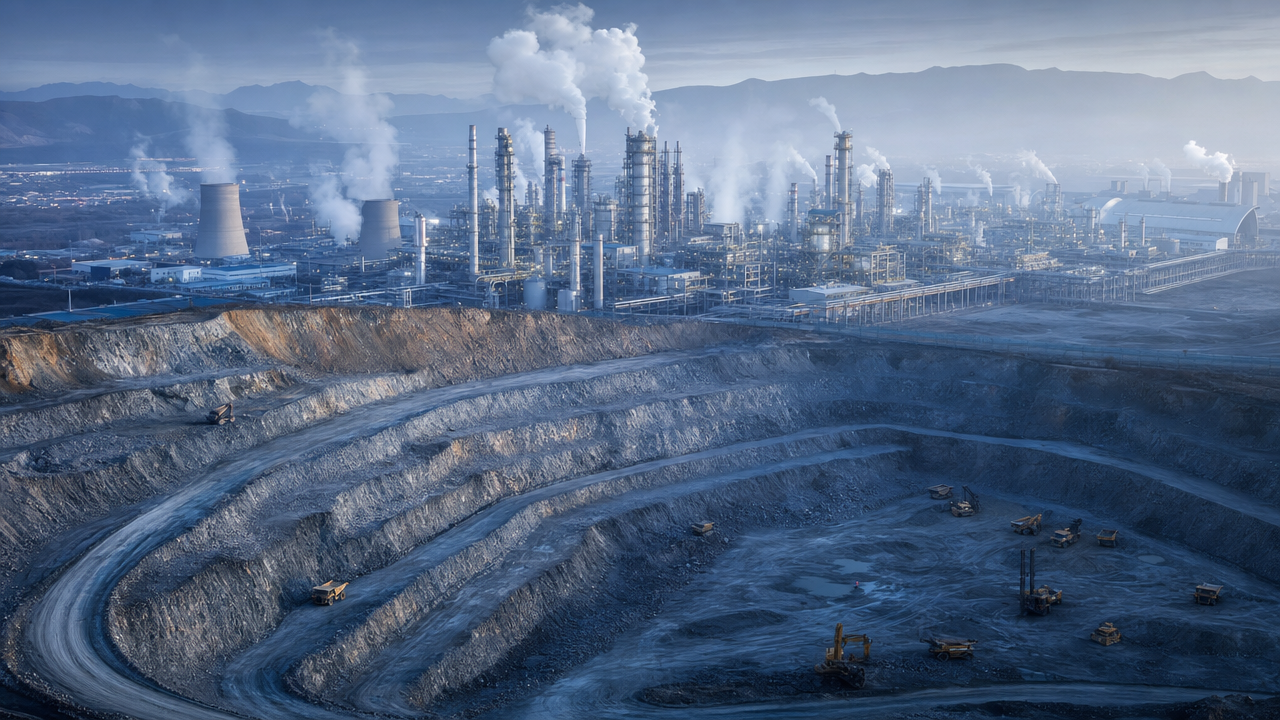

I. Industry Overview: Resource Boundaries of Global Phosphate Chemicals and China's Position
Phosphate chemicals is one of the most resource-constrained subsectors of the global chemical industry. While phosphorus reserves in the Earth's crust are not particularly rare, phosphate rock resources with industrially viable scale and adequate grade are highly concentrated in a handful of nations. According to the United States Geological Survey (USGS) Mineral Commodity Summaries 2025 and 2026, by year-end 2025 global economically recoverable phosphate rock reserves stood at approximately 74 billion tons (physical ore equivalent), with Morocco and Western Sahara holding about 50 billion tons (over 67% of global reserves) and China approximately 1.9 billion tons (about 2.6%). The remainder is distributed across more than a dozen countries including Egypt, Algeria, Brazil, Jordan, Russia, Saudi Arabia, Tunisia, and the United States. China, despite holding only a modest share of reserves, produced about 118 million tons of phosphate rock in 2025 out of a global total of approximately 235 million tons — roughly 50% of world output, making China by far the largest phosphate rock producer and the country with the most complete phosphate-chemicals value chain.
This asymmetry between resource location and production capacity is the inescapable starting point for any study of China's phosphate industry. Morocco's OCP (Office Chérifien des Phosphates) holds the world's largest single-country phosphate reserve — its resources in the Khouribga and Boucraâ districts far exceed the combined reserves of China's Yunnan, Guizhou, and Hubei provinces. Yet China leverages its complete downstream processing chain, vast domestic agricultural demand, and surging lithium iron phosphate cathode material requirements to push the "small reserve, large output" structure to its limit: contributing 50% of global output with 2.6% of global reserves, which mathematically implies that China's mining intensity (reserves-to-production ratio) is far below the global average.
By USGS figures published in early 2026, China's phosphate reserves-to-production ratio sits at about 16 years, far below the global average of over 300 years. Industry research firms using broader categories ("economically recoverable plus known convertible resources") still place China's ratio at only 30 to 35 years. The implications are significant: unless China aggressively develops overseas phosphate resources and improves the utilization of tailings and lower-grade ores, high-grade rock (P₂O₅ ≥ 30%, the so-called "rich ore") will become noticeably tight by the end of the 14th Five-Year Plan period, reinforcing phosphate rock's status as a strategic resource.
The Institute's cross-calculations of public annual reports, industry association data, and USGS figures suggest that 2025 phosphate rock output by Chinese province was approximately as follows: Guizhou about 45 million tons (38% of national output), Yunnan about 37 million tons (31%), Hubei about 28 million tons (24%), Sichuan about 7 million tons (6%), and other provinces less than 1 million tons combined. In other words, the three provinces of Yunnan, Guizhou, and Hubei together account for roughly 93% of national phosphate rock output — a "tripod" geographic structure that is the natural foundation of China's phosphate industry. This pattern reflects geological reality: China's phosphate deposits primarily occur in Sinian and Cambrian sedimentary phosphorite formations, which are concentrated along the southwestern and northern margins of the Yangtze Platform.
On pricing, the full-year average mine-mouth price of high-grade Chinese phosphate rock (P₂O₅ ≥ 30%, tax-inclusive) ranged between CNY 950 and 1,050 per ton during 2025, averaging about CNY 998 — a narrow 10% band that marked the most stable annual price range in the past three years. The "resource attribute" of phosphate rock has come to dominate price action: mining quotas are rigid, new mining rights are virtually frozen, and downstream demand from fertilizer and iron phosphate runs strong. Together these factors have kept phosphate rock prices on a high plateau for the past two years, with none of the violent "capacity glut → price collapse" cycles seen in 2014 to 2018. Mid-grade rock (P₂O₅ 24% to 28%) averaged CNY 580 per ton in 2025, while low-grade rock (P₂O₅ 20% to 23%) averaged CNY 350 per ton — a near-linear relationship between grade and price.
Comparing Chinese phosphate prices with global benchmarks reveals an interesting conclusion: Morocco OCP's high-grade phosphate rock exports (P₂O₅ 33% to 34%) to North African and European markets averaged USD 245 to 270 per ton FOB Casablanca in 2025, translating to roughly CNY 1,750 to 1,930 per ton — 1.7 to 2.0 times China's domestic tax-inclusive mine-mouth price for comparable grades. China's domestic phosphate rock thus trades at a significant discount to international FOB benchmarks, providing the entire Chinese phosphate-chemicals value chain with a sustained "raw material discount" that has been a critical factor in the global competitiveness of downstream products such as iron phosphate, glyphosate, and phosphorus-based flame retardants.
This raw material discount will not last indefinitely. Hubei province led a phosphate rock annual mining quota system in 2024, with Yunnan and Guizhou following suit in 2025. The "no-export-from-province" policy stance is becoming increasingly explicit across all three provinces. The Institute projects that from 2026 to 2030, domestic high-grade rock mine-mouth prices could drift from the current CNY 1,000-per-ton level up to CNY 1,300 to 1,500 per ton, adding a marginal cost burden of CNY 200 to 400 per ton on downstream products. Whether this marginal cost increase can be offset by corresponding price increases for downstream products — lithium iron phosphate batteries, glyphosate, flame retardants — will be a core determinant of profit margins for phosphate chemicals leaders during 2026 to 2030.
From a global value chain perspective, phosphate chemical products follow a clear value ladder: phosphate rock (raw material) → yellow phosphorus (basic phosphate chemistry) → industrial phosphoric acid (intermediate) → iron phosphate, phosphates, phosphorus-based flame retardants, glyphosate (specialty chemicals) → lithium iron phosphate cathode precursors, lithium iron phosphate cathodes, semiconductor-grade electronic phosphoric acid, pharmaceutical-grade calcium phosphate (high-value-added terminal products). From mine to electronic grade, the per-ton product price can be amplified 20 to 40 times. Understanding China's phosphate chemicals industry upgrade path is, in essence, understanding the technical thresholds, player structure, and profit distribution at each segment of this value chain.
1.1 Global Phosphate Rock Production Structure: Morocco's Reserve Monopoly and China's Production Monopoly
The global phosphate rock production structure is a peculiar dual oligopoly: Morocco dominates reserves while China dominates output. OCP Group produced about 42.5 million tons of phosphate rock in 2024 and is projected to reach 45 million tons in 2025 as downstream fertilizer and phosphoric acid demand strengthens. Under its announced 2027 capacity expansion plan, OCP aims to lift rock production capacity to 70 million tons by 2027 — nearly recreating an entire OCP. Morocco's phosphate rock primarily supplies its own downstream fertilizer (DAP/MAP/TSP) and phosphoric acid (including food and electronic grades) processing, as well as spot exports to Europe, India, and Brazil.
U.S. Mosaic produced about 7.6 to 8.0 million tons of phosphate (on a P₂O₅ basis) in 2025, with phosphate rock output around 14 million tons distributed between Florida and the Miski Mayo mine in Peru. Nutrien, primarily focused on potash, still ranks among the global phosphate fertilizer leaders with 2025 sales of 2.35 to 2.55 million tons. Together with Russia's EuroChem and PhosAgro, these three companies constitute the first tier of international phosphate chemicals.
China's domestic phosphate rock production is dominated by state-owned and mixed-ownership enterprises with steadily rising concentration. Three provincial state-owned leaders — Yunnan Yuntianhua Group, Guizhou Phosphate Group, and Hubei Yihua Group — together with listed companies such as Xingfa, Chuanfa Longmang, Chuanheng, Xinyangfeng, and Stanley control more than 70% of national rock production. The unique "provincial state-owned upstream resources plus nationally listed downstream processors" two-tier structure is the distinctive Chinese model of phosphate chemicals industrial organization.
1.2 2025 Phosphate Rock Supply-Demand Balance
The Institute's cross-validated estimates put 2025 global phosphate rock physical output at 235 million tons. Downstream consumption breaks down as: phosphate fertilizers about 185 million tons (79%), industrial-grade phosphoric acid about 30 million tons (13%), and other uses including feed-grade calcium phosphate and detergent phosphates about 20 million tons. China's 118 million tons of domestic output is allocated as: phosphate fertilizers about 82 million tons (70%), industrial-grade phosphoric acid about 22 million tons (18.6%), iron phosphate and cathode precursors about 9.5 million tons (8%, up from 6.5% in 2024 thanks to new energy vehicles and energy storage demand), and other specialty phosphate chemicals and flame retardants about 4.5 million tons.
A clear trend emerges from these numbers: although iron phosphate still accounts for only about 8% of domestic rock consumption, its growth rate far exceeds that of phosphate fertilizer (which has been essentially flat over the past three years) and is the largest variable in the structural evolution of phosphate rock demand. The Institute projects that by 2028, iron phosphate and the further downstream lithium iron phosphate cathode materials will rise to 14% to 16% of China's rock consumption, making lithium iron phosphate the second-largest downstream destination for Chinese phosphate rock after fertilizers. This structural shift will deeply reshape the regional allocation of phosphate rock — iron phosphate plants cluster in Hubei, Sichuan, Guizhou, Yunnan, and Hunan, where phosphate rock is produced, and "build the plant next to the mine" will become the basic organizing principle of the iron phosphate industry chain.
1.3 Two Core International Benchmarking KPIs
The Institute recommends two core KPIs for cross-country comparison of phosphate chemicals competitiveness: downstream product value density per ton of phosphate rock (USD per tonne ore), and per-ton product carbon intensity (kgCO₂e per tonne product). With high-grade rock (averaging P₂O₅ 31%) and the world's largest single processing complex (Jorf Lasfar industrial port with 3.5 million tons of P₂O₅ phosphoric acid capacity), OCP leads globally on value density. China is rapidly approaching the first tier on value density thanks to its specialty chemicals and cathode material extensions. But on carbon intensity, because Chinese phosphate chemicals rely on coal-based processes and a coal-heavy power grid, per-ton phosphoric acid carbon emissions still run 30% to 40% above Morocco and North America — the single largest latent risk for Chinese phosphate exports under the EU Carbon Border Adjustment Mechanism (CBAM).
1.4 Historical Lineage: From 19th-Century Superphosphate to 21st-Century Lithium Iron Phosphate
To understand today's phosphate chemicals industry one must look back 180 years. In 1842 the British agricultural chemist John Bennet Lawes obtained the industrial patent for single superphosphate at Harpenden, marking humanity's first industrial-scale conversion of the insoluble tricalcium phosphate in phosphate rock into water-soluble, plant-available phosphate — and the start of the modern phosphate fertilizer industry. Before Lawes, Europe and North America depended on bone meal, guano, and other natural organic phosphorus sources at extremely limited scale.
In the first half of the 20th century, core innovation in global phosphate centered on wet-process phosphoric acid. The U.S. Tennessee Valley Authority launched electrothermal phosphate rock melting research in 1928, laying the foundation for thermal-process phosphoric acid industrialization. By the 1950s, Dorr-Oliver, Prayon, and Sweden's SX had developed sulfuric-acid-based wet processes that scaled phosphoric acid plant capacity from less than 50,000 tons per year to the million-ton range.
In the second half of the 20th century, the global phosphate industry settled into a Morocco-rock, North America-fertilizer, Europe-specialty pattern: OCP became the dominant rock supplier to Western fertilizer companies; Mosaic predecessors Cargill and IMC built the largest North American fertilizer complex in Florida; Germany's BASF and France's Rhodia dominated food, pharmaceutical, and electronic-grade specialty phosphates. This pattern persisted for nearly half a century until China's phosphate industry began its large-scale rise in the late 1990s.
China's modern phosphate industry began with Yunnan and Guizhou rock exploration in the 1960s, followed by construction of the Anning (Yunnan) and Kaiyang (Guizhou) fertilizer bases in the 1970s. The Ninth Five-Year Plan in the 1990s formally listed phosphate chemicals as a core basic chemicals subsector, and provincial state-owned leaders such as Yuntianhua and Guizhou Phosphate rapidly grew. In the 2000s, Chinese phosphate fertilizer output overtook the United States to become the global leader. In the 2010s, specialty phosphate chemicals and electronic-grade phosphoric acid emerged as new growth pillars, with Xingfa Group gradually establishing global leadership in electronic-grade phosphoric acid. In the 2020s, the explosive rise of iron phosphate and lithium iron phosphate cathode materials accelerated the value pivot of Chinese phosphate chemicals from "fertilizer giant" to "fertilizer plus new-energy phosphate materials." Understanding this lineage is critical to assessing the 2026 to 2030 trajectory.
1.5 The True Meaning of Reserves-to-Production Ratio
The reserves-to-production ratio is among the most easily misread indicators in phosphate research. The Institute clarifies its real meaning here. The official definition is "proven economically recoverable reserves divided by current annual production." USGS's 308-year global ratio is calculated from 74 billion tons of economic reserves divided by 235 million tons of 2025 production — but this hides three details.
First, "economically recoverable reserves" is a dynamic, price-linked concept. When phosphate rock prices rise, lower-grade ore that was uneconomic becomes economic; when prices fall, marginal reserves drop out of the count. China's 19 billion tons in USGS data is calculated at current prices; if prices rise another 30%, economically recoverable Chinese reserves could expand to 30 to 35 billion tons.
Second, there is a significant gap between "proven" and "actually recoverable." China's broader "geological reserves" of phosphate could exceed 200 billion tons, but only about 10% to 15% can be economically mined under current technology and prices. This explains the large gap between USGS's 19 billion tons (economic) and the Ministry of Natural Resources' historical "geological reserves" figures above 200 billion tons.
Third, the global average masks regional divergence. The 308-year global ratio does not apply to any single country. Morocco's ratio exceeds 1,000 years, Russia about 130 years, the United States about 30 years, and China about 16 years. Resource concentration renders the global average meaningless for any single country.
The Institute's core reminder: in assessing the real constraint on Chinese phosphate resources, three dimensions must be considered simultaneously — economic reserves (short-term price-driven), geological reserves (long-term exploration conversion potential), and overseas resource acquisition capability (medium-to-long-term supplement). Concluding "China is running out of phosphate rock" based on the USGS single number alone is one-dimensional. But the core trend USGS reveals — that Chinese mining intensity vastly exceeds the global average — is a medium-to-long-term challenge the Chinese phosphate industry must face squarely.
1.6 Carbon Footprint and Climate Convergence
China's phosphate industry has spent the past decade in "scale-first" mode but, since the 2020 dual-carbon declaration, the "scale plus carbon" dual coordinate has begun to constrain industry evolution. Phosphate chemicals is the chemical industry's third-largest energy and emission subsector after ethylene and ammonia. The Ministry of Ecology and Environment's 2024 chemical-industry GHG accounting guidelines classify phosphate emissions in four buckets: feedstock emissions (mining and transport), energy emissions (electricity and fuel for the yellow phosphorus furnace, phosphoric acid production, and cathode material calcination), process emissions (CO₂ byproduct of reactions), and waste emissions (latent emissions from phosphogypsum storage). Energy emissions account for 60% to 70% of total emissions and are the focal lever for decarbonization.
The Institute estimates per-ton CO₂e intensity in 2025 across typical Chinese phosphate products: MAP about 1.8 tons; DAP about 2.1 tons; wet-process industrial phosphoric acid (P₂O₅ basis) about 4.6 tons; thermal-process industrial phosphoric acid about 11.2 tons (yellow phosphorus consumes 14,000 kWh per ton); battery-grade iron phosphate about 6.8 tons; lithium iron phosphate cathode about 9.5 tons. The gap to international peers is striking — OCP's comparable products run 30% to 40% lower carbon intensity thanks to Mediterranean renewables and high efficiency.
1.7 Concentration Trends
Chinese phosphate industry concentration has followed a "first disperse, then consolidate" trajectory over the past decade. In the early 2010s, domestic phosphate fertilizer CR10 was only about 38% and phosphate salts were even more fragmented. From 2010 to 2020, tightening environmental rules, scarcity of mining rights, and phosphogypsum disposal pressure drove the industry into a consolidation phase. By 2025, domestic phosphate fertilizer CR10 reached 58%, iron phosphate CR5 reached 55%, and electronic-grade phosphoric acid CR3 reached 75%. The Institute expects further concentration during 2026 to 2030 — phosphate fertilizer CR10 to 70%–75%, iron phosphate CR5 to 65%–70%, and electronic-grade phosphoric acid CR3 to stay above 80%.
II. Upstream Phosphate Rock: A Tripod of Yunnan, Guizhou, and Hubei and the Scarcity of Mining Rights
Yunnan, Guizhou, and Hubei collectively hold roughly 75% of national phosphate reserves and produce about 93% of national output. The three provinces differ sharply in resource endowment, mining technology, policy stance, and corporate structure, making upstream the most geographically differentiated segment of the Chinese phosphate value chain.
2.1 Yunnan: Largest Reserves, Highest Grade, Highest Altitude
Yunnan phosphate reserves total about 4.7 billion tons (broad measure including convertible resources), ranking first nationally. Resources concentrate in central Yunnan — Kunming, Yuxi, and Chuxiong prefectures — with the core belt running from Jinning-Kunyang-Haikou along the southeast shore of Dianchi Lake and the Jiangchuan-Hongta line in Yuxi. Yunnan's defining feature is rich-ore density: P₂O₅ ≥ 30% rich ore accounts for over 25% of reserves, far higher than Guizhou or Hubei. Representative mines include Jinning, Haikou, Kunyang, Anning, Dongchuan, and Yuxi Jinkun.
Yunnan's phosphate champion is Yunnan Yuntianhua Co., Ltd. (the listed unit of Yuntianhua Group, ticker 600096.SH). Formerly known as Yunnan Natural Gas Chemical Plant, the company listed in 1997. In 2025 its phosphate rock output reached about 14.5 million tons — one of the largest among listed companies nationally. Its Anning Phosphor-Power, Zhenxiong Phosphate, and Guanfang Phosphate subsidiaries form a complete "rock-yellow phosphorus-fertilizer-specialty" integrated matrix. Yuntianhua sold about 5.4 million tons (P₂O₅ basis) of phosphate fertilizer (MAP, DAP, TSP) in 2025 — roughly 18% of national fertilizer output and the country's largest single producer.
Beyond rich, sizable reserves, Yunnan offers an additional advantage: abundant hydropower. Thermal power accounts for only about 30% of Yunnan generation, while hydro, wind, and solar combined exceed 70%. Yunnan phosphate products thus carry a natural 25%-plus lower per-ton carbon footprint than Hubei or Guizhou — the natural moat against CBAM.
Yunnan also faces constraints: high altitude (1,800 to 2,200 meters at core sites), ecological sensitivity (Dianchi watershed protection lines, nine-plateau-lake water quality rules), and the country's strictest local requirements for phosphogypsum utilization and tailings management. The 2023 Yunnan provincial "Green Low-Carbon Phosphate Industry Implementation Plan" explicitly states "no new phosphate project unless phosphogypsum is fully consumed," meaning new phosphoric acid or fertilizer capacity is nearly impossible to permit. New growth in Yunnan phosphate will come from existing-player technical upgrades and value chain extension rather than simple capacity expansion.
2.2 Guizhou: Largest Output, Most Concentrated Mining Rights
Guizhou holds about 2.8 billion tons in reserves, ranking second after Yunnan, but produced roughly 45 million tons in 2025 — number one nationally. Resources concentrate in Kaiyang, Wengan, Xifeng, Fuquan, Zhijin, and Qingzhen, anchored on the central Guizhou Kaiyang-Wengfu belt. Rich-ore proportion is slightly lower than Yunnan (about 20%), but ore beds are stable and continuous, with mature underground conditions suitable for large-scale industrial mining.
Provincial state-owned capital dominates Guizhou phosphate. Guizhou Phosphate (Group) Co., Ltd. — formed in 2017 by merging the former Wengfu Group and Kaiphosphate Group — is the largest player, with 2025 rock output around 22 million tons, industrial-grade phosphoric acid capacity of 2.2 million tons, fertilizer capacity of 4 million tons, and yellow phosphorus capacity of 180,000 tons. The group operates through subsidiaries and joint ventures with listed players like Chuanfa Longmang and others.
Guizhou's "star variable" is iron phosphate cathode precursors. A Chuanfa Longmang–Wengfu joint iron phosphate plant, Hubei Yihua's Guizhou iron phosphate capacity, and the CATL-Shengtun joint Guizhou iron phosphate project together pushed 2025 Guizhou iron phosphate capacity to third nationally (after Hubei and Sichuan). The "rock-phosphoric acid-iron phosphate" on-site integration is most pronounced in Guizhou.
Constraints mirror Yunnan: massive phosphogypsum stockpiles (over 150 million tons historical accumulation in Guizhou), Wujiang River basin water quality protection, and thermal-heavy power mix. The 2024 "Guizhou Phosphate Industry High-Quality Development Action Plan" requires "production constrained by waste capacity" and "production constrained by water availability," meaning new projects must first solve phosphogypsum and water issues.
2.3 Hubei: Specialty Chemistry Heartland and Cathode Bridgehead
Hubei reserves total about 1.4 billion tons with 2025 output around 28 million tons. Resources distribute across Yichang, Jingmen, and Xiangyang prefectures, anchored on Yichang's Yuanan, Yiling, and Xingshan counties and Jingmen's Zhongxiang. Hubei phosphate's defining feature is deep coupling with downstream specialty chemistry: Yichang hosts the largest, most diverse specialty phosphate cluster nationally, with Xingfa Group, Hubei Yihua, Hubei Sanning, Xiangyang Zedong, and Jingmen Xinyangfeng all anchored there.
Hubei rock is "small but complete" — individual mines are smaller than Yunnan or Guizhou peers, but the downstream product matrix is the most diverse, spanning fertilizers, industrial-grade phosphoric acid, electronic-grade phosphoric acid, food-grade phosphoric acid, pharmaceutical-grade calcium phosphate, and lithium iron phosphate cathode precursors. Per-ton phosphate rock value (across the full chain) reaches about CNY 32,000 in Hubei in 2025, well above Yunnan's CNY 24,000 and Guizhou's CNY 26,000.
Hubei's trump card is lithium iron phosphate. Between 2024 and 2025, CATL, Hunan Yuneng, Dynanonic, Lopal, Hubei Wanrun, Hubei Rongtong Hi-Tech, GEM Hubei, and Hubei Liyuan deployed large-scale lithium iron phosphate cathode capacity in Yichang, Jingmen, Xiangyang, and Shiyan, making Hubei the absolute peak of national lithium iron phosphate cathode capacity. The "rock-acid-iron phosphate-LFP-cell" five-tier integration is taking shape at Xingfa and Yihua in Yichang.
Hubei policy is the strictest. The 2024 "Hubei Phosphate Rock Protective Development and Utilization Plan" requires strict annual output caps, strict out-of-province sales caps, and a freeze on new low-end fertilizer projects. The goal is to reserve as much high-grade rock as possible for in-province specialty chemicals and iron phosphate.
2.4 Sichuan and Other Provinces: The Supplementary Pool
Sichuan reserves total about 1.3 billion tons with 2025 output around 7 million tons, concentrated in southwest Sichuan: Mabian, Leibo, Jinkouhe, Hanyuan, Emeishan. Mountainous terrain, difficult transport, and smaller mine size have kept Sichuan's share below 8% nationally. But Sichuan leaders Chuanfa Longmang and Chuanheng have built a "Sichuan mining plus Sichuan processing plus national sales" model that keeps Sichuan relevant. Of note, Chuanheng's investment in Guizhou's Fuquan Chuanyandong mine — combined output exceeded 2.5 million tons in 2025 — exemplifies cross-province mineral right acquisition by Sichuan players. Other minor provinces include Anhui (about 200 million tons in Maanshan and Tongling), Hebei (about 100 million), Hunan (about 50 million), and Qinghai (about 30 million).
2.5 Mining Rights as the Hidden Valuation Anchor
The Institute's core conclusion is that mining rights will be the single most important variable explaining valuation differentials among Chinese phosphate leaders between 2026 and 2030. Three reasons: new mining right approvals are nearly frozen — Ministry of Natural Resources data show only 7 new approvals in 2024 and 5 in 2025, all consolidations of existing mines rather than genuinely new blocks. Second, exploration in existing belts is mature; depth and western exploration costs are rising and discovery yields are declining. Third, downstream demand keeps growing — particularly from lithium iron phosphate cathodes, which by 2028 could consume an additional 9 million tons per year, adding 7% to 8% to national phosphate rock demand.
Ranking listed companies by "per-unit-market-cap recoverable reserves," Yuntianhua, Xingfa Group, Chuanfa Longmang, and Chuanheng top the list. Their mining rights, valued at current rock prices, are worth more than the book value of their respective businesses.
2.6 Mining Technology Evolution
Phosphate rock mining method dictates cost and resource utilization. Open-pit mining (Yunnan's Haikou, parts of Guizhou's Kaiyang) suits shallow, flat-lying deposits with per-mine output capable of exceeding 5 million tons annually. Open-pit advantages: low extraction cost (CNY 60 to 90 per ton), high safety, fast ramp. Disadvantages: large land footprint, significant ecological impact, rising stripping ratios. Yunnan-Guizhou open-pit stripping ratios climbed from 1.8 in 2015 to 2.6 in 2025, lifting per-ton costs about 25%.
Underground mining suits deeper, steeper deposits. Hubei's Xingshan and Baokang use underground methods, with mine sizes typically 800,000 to 2.5 million tons annually. Underground advantages: small footprint, limited surface ecological impact. Disadvantages: higher cost (CNY 130 to 200 per ton), greater safety risk, higher equipment and labor requirements. About 65% of Hubei rock now comes from underground — the highest nationally.
Tailings and lower-grade rock utilization (P₂O₅ 18% to 25%) via flotation has become a critical technical direction as rich ore depletes. Flotation costs CNY 80 to 120 per ton, plus raw material CNY 200 to 300 per ton, yields all-in costs of CNY 300 to 400 — well below rich-ore mine-mouth tax-inclusive prices of CNY 950 to 1,050. The Institute estimates flotation will supply 40% to 50% of new domestic rock output during 2026 to 2030.
2.7 International Trade Structure
Although China is the largest phosphate rock producer, international rock trade is dominated by Morocco, Jordan, Russia, and Egypt. Global phosphate rock trade in 2025 was about 45 million tons: OCP exported about 11 million tons (24% of global trade), Jordan about 7 million, Russia about 5 million, Egypt about 4 million. Chinese rock barely exports (minor flows to Vietnam and Indonesia) and barely imports (minor flows from Central Asia). This "Chinese phosphate rock self-contained" pattern contrasts sharply with potash (China imports 80%) and iron ore (China imports 80%). Chinese phosphate self-sufficiency has been the material bedrock of three decades of value chain growth. But it also means that when domestic rock tightens, Chinese phosphate cannot ease supply pressure through imports — the constraint pathway is direct and rigid.
The Institute observes an interesting shift: in 2025, some Chinese phosphate leaders began importing small quantities of high-grade Moroccan rock (P₂O₅ 31%-plus) for electronic-grade phosphoric acid and high-purity phosphate production. Imports were small (about 180,000 tons full-year from Morocco), but the directional significance matters — Chinese phosphate is starting to leverage international high-grade rock to supplement domestic mid-low-grade supply. If this trend expands during 2026 to 2030, China could develop a "domestic mid-low grade for bulk, international high grade for premium" dual supply model.
2.8 Capital Markets for Mining Rights
Domestic mineral right capitalization accelerated over the past three years. Beyond market-based mineral right auctions, mining right mortgage loans, mining right trusts, and mining right REITs have entered practice. In 2024 a provincial state-owned phosphate company secured bank credit of about CNY 1.8 billion against its rock mining rights; in 2025 a listed phosphate leader explored a mining-right-backed trust product of about CNY 1.2 billion. These innovations turn previously "dormant" mining rights into financeable, transferable financial assets. The Institute expects "mineral right financialization" to become a meaningful complement to domestic phosphate leader financing over the next five years.
2.9 Tri-Province Coordination
The three provinces have established a cross-provincial coordination mechanism. The 2024 National Development and Reform Commission/Ministry of Industry and Information Technology-led "Upper-Middle Yangtze Phosphate Coordinated Development Joint Conference" pulls Hubei, Guizhou, Yunnan, and Sichuan industrial, ecological, and natural resources departments into regular consultation. Core agenda items: cross-province rock flow quotas, phosphogypsum utilization chain coordination, cross-province capacity matching, and cathode material regional division of labor. The Institute expects this mechanism to gain importance from 2026 to 2030, with the multi-tier "provincial SOE plus cross-province coordination plus central coordination" governance system shaping Chinese phosphate industry policy evolution.
III. Midstream Product Chain: Yellow Phosphorus, Industrial Phosphoric Acid, Iron Phosphate, Phosphates, and Flame Retardants
Understanding China's phosphate chemicals industry requires entering through the product chain. The Institute organizes the midstream into five tiers along processing depth and value-added: yellow phosphorus (the most basic industrial product), industrial phosphoric acid (the key intermediate), iron phosphate (the cathode precursor), phosphates (food, pharmaceutical, electronic grades), and phosphorus-based flame retardants (specialty chemicals).
3.1 Yellow Phosphorus: The Starting Point
Yellow phosphorus (P₄) is the most basic industrial product in phosphate chemistry, made by high-temperature reduction of phosphate rock with coke and silica in an electric arc furnace. Each ton of yellow phosphorus consumes about 9 tons of phosphate rock (P₂O₅ 24%), about 1.4 tons of coke, about 2.5 tons of silica, and 13,000 to 15,000 kWh of electricity. Power cost dominates the cost stack at 35% to 45%, so yellow phosphorus plants cluster in hydropower-rich Yunnan, Guizhou, and Sichuan.
China's 2025 yellow phosphorus capacity was about 1.1 million tons per year with actual production around 850,000 tons (utilization 77%). Yuntianhua, Guizhou Phosphate, Chuanheng, and Jiangsu Chengxing are the main producers. Domestic prices ranged CNY 23,000 to 27,000 per ton in 2025 (annual average CNY 24,800).
Downstream demand: industrial-grade phosphoric acid (about 70%), phosphates (about 15%), pentachloride and trichloride phosphorus intermediates (about 10%), flame retardants and specialty chemicals (about 5%). Yellow phosphorus price movements transmit directly to specialty phosphate product costs. Yellow phosphorus's extreme reducibility and toxicity are also the underlying reasons for the bifurcation between wet-process and thermal-process phosphoric acid.
3.2 Industrial Phosphoric Acid: Wet vs. Thermal
Industrial phosphoric acid (H₃PO₄) is the key phosphate intermediate, with two main routes: Wet Process Phosphoric Acid (WPA) and Thermal Process Phosphoric Acid (TPA).
Wet process: sulfuric acid decomposes phosphate rock. Mainstream for fertilizers. Each ton of WPA (P₂O₅ 54% basis) consumes about 3.0 tons of rock (P₂O₅ 28%) and 0.87 tons of sulfur. Advantage: scale and low cost. Disadvantage: high impurity content (fluorine, iron, aluminum, magnesium) requiring purification for food, pharmaceutical, or electronic uses. China's 2025 wet-process capacity was about 28 million tons of P₂O₅ with actual output around 20 million tons, mostly for fertilizers and iron phosphate.
Thermal process: burn yellow phosphorus to P₂O₅, then hydrate. Extremely pure (P₂O₅ 85%-plus, minimal impurities). Traditionally for food, pharmaceutical, semiconductor, and electronic grades. Higher cost (high yellow phosphorus price plus electricity). China's 2025 thermal capacity was about 650,000 tons, produced by Guizhou Phosphate, Chuanheng, Jiangsu Chengxing, and Xingfa.
The shift between these routes is a critical lens on industry upgrade. The Institute observes that wet-acid purification technology — particularly solvent extraction — has matured rapidly in the past three years. Yuntianhua, Xingfa, and Chuanfa Longmang now master "wet-process acid to food/electronic grade" purification, extending wet-acid downstream from traditional fertilizer into food, pharmaceutical, and battery-grade applications. "Wet purification displacing thermal" is the key technology evolution in phosphate, deeply reshaping thermal capacity from 2026 to 2030 — most pure-food and industrial-specialty thermal capacity will gradually retire in favor of lower-cost wet-purification.
3.3 Iron Phosphate: The Cathode Precursor
Iron phosphate (FePO₄·xH₂O) is the key precursor to lithium iron phosphate cathodes. Each ton of LFP needs about 0.96 tons of iron phosphate. Iron phosphate is produced by reacting industrial-grade phosphoric acid with iron sources (ferrous sulfate, ferric nitrate, iron powder), bridging traditional phosphate chemistry and new-energy materials.
China's 2025 iron phosphate capacity was about 4.1 million tons per year with actual production around 3.2 million tons (utilization 78%). Hubei Wanrun, Hunan Yuneng (through Hubei Tongcheng), Hubei Rongtong Hi-Tech, Chuanfa Longmang, Chuanheng, Anda Technology, Guizhou Phosphate, Hubei Yihua, Xinyangfeng, and Lomon Billions are the main producers.
Iron phosphate prices swung violently over the past three years: 2022 peak about CNY 25,000 per ton (driven by LFP battery rush installation), 2023 halved to CNY 13,000, 2024 dipped to CNY 9,000, late 2025 recovered to about CNY 10,500. The collapse came from 2022's "rush installation" triggering massive new capacity that flooded the market in 2023 to 2024. The shakeout wiped out pure iron phosphate processors without upstream rock or acid, while integrated leaders (Chuanfa Longmang, Chuanheng, Xingfa) with cost advantages survived. Domestic CR5 rose from 38% in 2022 to 55% in 2025. Integration has become the survival line — pure processors without rock or acid cannot break even at CNY 9,000 per ton.
3.4 Phosphate Salts: Food to Electronics
The phosphate salt family is sprawling. By application: food-grade (sodium phosphate, monosodium phosphate, sodium pyrophosphate, sodium tripolyphosphate) used in meat improvers, baking agents, beverage pH adjusters, and dairy stabilizers — Chinese 2025 market about CNY 6 billion (representative: Chengxing, Xingfa, Chuanheng, Yuntianhua). Industrial-grade (sodium tripolyphosphate STPP, sodium hexametaphosphate, trisodium phosphate) used in detergents and water treatment — about CNY 8.5 billion. Electronic-grade (electronic-grade phosphoric acid, electronic-grade diammonium phosphate, electronic-grade phosphine) for semiconductor cleaning and display manufacturing, demanding P₂O₅ 99.99%-plus purity with ppb-level metal ions — leader Xingfa Group, with over 60% national share; the highest-value-added segment in phosphate, electronic-grade acid prices CNY 12,000 to 18,000 per ton, 2 to 3 times food grade. Pharmaceutical-grade (calcium hydrogen phosphate, tricalcium phosphate, sodium phosphate) for pharma excipients, calcium supplements, and bone repair. Feed-grade calcium hydrogen phosphate — 2025 Chinese output about 3.8 million tons, China the largest global producer and exporter with annual exports around 1.3 million tons.
3.5 Phosphorus-Based Flame Retardants
Phosphorus-based flame retardants is among the fastest-growing specialty subsectors. Compared with brominated flame retardants (which release dioxins on combustion), phosphorus flame retardants are greener and more efficient, penetrating new-energy vehicle battery packs, printed circuit boards, insulation, engineering plastics, and cable jackets.
Major products: triphenyl phosphate (TPP), tricresyl phosphate (TCP), bisphenol A bis(diphenyl phosphate) (BDP), resorcinol bis(diphenyl phosphate) (RDP), ammonium polyphosphate (APP), aluminum hypophosphite. Chinese 2025 market about CNY 7.5 billion, projected to exceed CNY 15 billion by 2030.
Representative companies: Zhejiang Wansheng (603010.SH, global TPP share about 35%), Hubei Yachen New Materials, Xingfa, Jiangsu Yoke Technology (002409.SZ), Tsinghua spin-off Zhangjiagang Youpu Technology. Of note, Wansheng holds the global lead in engineering-plastics flame retardants on BDP and RDP — among the rare specialty subsectors where a Chinese company leads globally.
3.6 The Environmental Bind of Yellow Phosphorus and Technology Substitution
Yellow phosphorus is the most environmentally pressured node in phosphate. Electric-furnace production yields significant furnace gas (CO, phosphorus dust), slag (8 to 10 tons of slag per ton of yellow phosphorus), and phosphorus-bearing wastewater. Byproduct treatment costs run 8% to 12% of total cost. Historically variable treatment standards led to widespread small-mill shutdowns. China's 2025 yellow phosphorus capacity (1.1 million tons) is down 33% from the 2010 peak (1.65 million). Domestic leaders are exploring "wet-purified acid to specialty" pathways that progressively replace the high-energy, high-emission "yellow phosphorus to thermal acid to specialty" chain. The Institute expects yellow phosphorus capacity to decline to 800,000 to 900,000 tons over the next five years.
3.7 Industrial Acid Downstream Matrix
Industrial phosphoric acid downstream spans more than fertilizer and iron phosphate. Phosphate salts (about 15% of acid consumption) include dozens of products serving detergents, water treatment, flame retardants, food additives, pharma excipients, and feeds — domestic market about CNY 28 billion. Electronic chemicals (about 2% of consumption but more than 8% of value) — semiconductor cleaning, display, battery electrolyte — value 3 to 8 times bulk acid, highest-value-added segment. Flame retardants (about 3%) — inorganic (APP, aluminum hypophosphite) and organic (phosphate ester, phosphonate ester) — market about CNY 7.5 billion. Water treatment chemicals (about 5%) — corrosion inhibitors, scale inhibitors. Pharma and food specialties (about 2% of consumption but about 5% of value). Other specialties (about 8%): metal surface treatment, leather, ceramics, organic synthesis intermediates.
3.8 The Iron Phosphate Process Split
Two main iron phosphate routes diverge sharply on performance, cost, and environment. Ferric nitrate route: concentrated nitric acid oxidizes iron scrap to ferric nitrate solution, then reacts with phosphoric acid. Advantage: stable specs, precise Fe/P ratio, uniform quality. Disadvantage: ferric nitrate is expensive (CNY 9,000 to 12,000 per ton); nitrogen oxide byproducts add disposal pressure. Hubei Wanrun, Hunan Yuneng use this route mainly. Ferrous sulfate route: uses steelmaking byproduct ferrous sulfate plus phosphoric acid and oxidizer (H₂O₂, sodium persulfate). Advantage: cheap raw material (steelmaking ferrous sulfate at only CNY 200 to 400 per ton). Disadvantage: harder to control specs, more Fe/P drift. Chuanfa Longmang, Chuanheng use this route for parts of capacity. The Institute estimates ferric nitrate route iron phosphate raw material cost at CNY 5,500 to 6,500 per ton (phosphoric acid 4 tons P₂O₅ basis plus ferric nitrate 1.3 tons), ferrous sulfate route at CNY 3,500 to 4,500 (phosphoric acid 4 tons P₂O₅ plus ferrous sulfate 1.5 tons plus H₂O₂ 0.8 tons). In a 2025 iron phosphate market of CNY 9,000 to 10,500 per ton, ferric nitrate route producers face margin pressure while ferrous sulfate route producers fare relatively better. But for high-end cathode customers, spec stability favors ferric nitrate route products.
3.9 Phosphate Salt Subsegment Sizing
Sodium tripolyphosphate (STPP): about CNY 3.8 billion domestic market, used in detergents, ceramic dispersants, water treatment. Sodium hexametaphosphate: CNY 2.8 billion, used in water treatment, detergents, food (corrosion inhibitor, set retarder). Diammonium phosphate (industrial-grade): CNY 3.2 billion, used in flame retardants (APP feedstock), specialty fertilizers, electronic-grade. Tricalcium phosphate: CNY 1.2 billion, used in animal feed, pharma excipients, bone repair. Potassium phosphate: CNY 800 million, used in food, pharma, premium water-soluble fertilizers. Sodium pyrophosphate: CNY 600 million, used in food, electronic cleaning. The Institute summarizes: phosphate salts aggregate about CNY 20 billion across many small subsegments, providing differentiation opportunities for phosphate leaders.
3.10 Subsegments of Phosphorus Flame Retardants
Phosphate ester flame retardants (TPP, TCP, BDP, RDP) serve engineering plastics (polycarbonate, polyamide, polyphenylene ether) for electronics, automotive, and NEV battery packs. Leaders: Wansheng (global leader), Yoke Technology, Xingfa. Phosphonate ester flame retardants (e.g., diethyl phosphinate aluminum DEPAL) serve high-temperature engineering plastics like polyamide. Leaders: Yoke, Hubei Yachen, Zhangjiagang Youpu. Ammonium polyphosphate (APP): water-insoluble, heat-stable inorganic. Used in intumescent flame retardant coatings, thermoplastics, polyurethane. Leaders: Chuanheng, Xingfa, Beijing Tianming. Aluminum hypophosphite: high-efficiency inorganic, used in polyamide, polyester. Leaders: Yoke, Xingfa. Phosphorus-nitrogen synergy retardants (e.g., melamine phosphate, pentaerythritol cyclic phosphate ester) leverage P-N interaction. The Institute's view: phosphorus flame retardants' biggest growth driver over the next five years is NEV battery pack demand — each NEV battery pack consumes 4 to 8 kg of phosphorus flame retardant. By 2030 global NEV sales of 45 million units would require about 250,000 tons.
3.11 Electronic-Grade Phosphoric Acid: The Semiconductor Wet Chemical Key
Electronic-grade phosphoric acid serves semiconductor etching (silicon nitride, silicon oxide dielectric removal), cleaning (ionic decontamination), and chemical mechanical polishing (CMP). Purity requirements are extreme — P₂O₅ ≥ 85.5%, total metal ions ≤ 100 ppb (≤ 10 ppb for high-end), with strict particle counts. Grades: G1 (< 1 ppm metals), G2 (< 100 ppb), G3 (< 10 ppb), G4 (< 1 ppb), G5 (< 0.1 ppb). Semiconductor industry mainly uses G3 to G5, priced from CNY 12,000 (G3) to CNY 35,000 (G5) per ton.
Global electronic-grade phosphoric acid market about CNY 3.5 billion, with key suppliers including Japan's Rasa Industries and Daihachi, Taiwan's Chang Chun, and mainland China's Xingfa. Xingfa's 2025 electronic-grade phosphoric acid sales reached about 45,000 tons — global share about 22%, the absolute domestic leader. Domestic substitution rose from about 20% in 2020 to about 65% in 2025; the Institute projects 85%+ by 2030. Electronic-grade phosphoric acid is one of the most successful import-substitution stories in Chinese phosphate chemicals.
3.12 Glyphosate's Special Position
Although glyphosate is classified as a pesticide, its process routes depend deeply on phosphate chemistry (both dimethyl phosphite and glycine routes use phosphorus intermediates). China's 2025 glyphosate output was about 780,000 tons, roughly 70% of global production. Leaders: Xingfa (about 180,000 tons, 23% share), Wynca (about 160,000 tons, 21%), Fuhua Chemical (about 140,000 tons, 18%). Glyphosate prices retreated from the 2022 peak of CNY 65,000 per ton to the 2024 low of CNY 23,000, recovering to CNY 32,000 in 2025. The Institute expects 2026 to 2030 glyphosate prices to oscillate between CNY 28,000 and CNY 38,000 per ton — among the milder price cycles in specialty phosphate. Notably, glyphosate's byproduct DMC creates an independent silicone value chain, giving Xingfa and others rare "phosphate plus silicone" cross-business exposure with implications for earnings stability and chain coordination.
IV. Major Players: Domestic Leaders and International Benchmarks
The Institute benchmarks five representative Chinese phosphate leaders (Yuntianhua, Xingfa Group, Hubei Yihua, Chuanfa Longmang, Chuanheng) against three international giants (OCP, Mosaic, Nutrien) plus EuroChem and PhosAgro.
4.1 Yuntianhua (600096.SH): Largest Fertilizer Producer
Yuntianhua is the listed flagship of Yunnan provincial state-owned Yuntianhua Group. The business spans rock mining, phosphate fertilizer (MAP/DAP/TSP/MCP/NPK), ammonia and urea, polyformaldehyde, feed-grade calcium phosphate, and specialty phosphates. 2025 financials: revenue CNY 69.63 billion (–2.4% YoY), net income CNY 5.18 billion (+7.6%), gross margin 16.9% (+1.2pp), ROE 23.4%. Fertilizer segment 2025 revenue about CNY 32 billion (gross margin about 24%); chemicals and chemical fibers (ammonia, POM, pentaerythritol) about CNY 18 billion (margin about 18%); trade and logistics about CNY 15 billion (margin about 3.5%); other (fiberglass, organophosphate pesticides, battery materials) about CNY 4.6 billion.
Rock reserves: Anning, Zhenxiong, Haikou, Guanfang mining rights total about 810 million tons (P₂O₅ average 24%); 2025 output 14.5 million tons. At current rock prices, implied valuation exceeds CNY 500 billion — well above the company's CNY 35 billion market cap, the core anchor for its valuation. Strategically Yuntianhua is accelerating the "rock-acid-cathode precursor-cathode material" chain extension, with iron phosphate joint projects in Yunnan and Hubei. 2026 iron phosphate capacity target: 250,000 tons; 2028 target: 400,000-plus. Specialty extensions (APP flame retardant, electronic-grade acid) continue.
4.2 Xingfa Group (600141.SH): The Hidden King of Specialty Phosphate
Based in Yichang Hubei, Xingfa Group is the standard-bearer of specialty phosphate. Business spans rock, wet- and thermal-process phosphoric acid, silicone (a glyphosate byproduct chain — Xingfa is also a top-three glyphosate producer), iron phosphate, electronic-grade phosphoric acid, phosphorus flame retardants, and pesticides — the broadest product matrix among domestic peers.
2025 financials: revenue CNY 35.86 billion, net income CNY 2.74 billion (+38.2% on glyphosate price recovery and specialty product ramp), gross margin 19.8%. Xingfa's specialty business includes electronic-grade phosphoric acid (annual capacity 80,000 tons, national share over 60%), electronic-grade diammonium phosphate, and electronic-grade phosphine — the country's core wet electronic chemicals supplier with long-term relationships with SMIC, YMTC, Hua Hong, and others. Iron phosphate: 100,000 tons of capacity in 2025 via Hubei Xingyou (joint venture with Huayou Cobalt); 200,000 tons planned for 2026. Glyphosate 2025 sales about 180,000 tons, 25% national share — top three with Wynca and Fuhua.
Rock reserves: 8 mining rights in Hubei Yichang, Baokang, Shennongjia total about 420 million tons; 2025 output about 6.2 million tons. The "rock-acid-glyphosate/silicone/electronic acid/iron phosphate" five-tier chain is the most complete among domestic peers.
4.3 Hubei Yihua (000422.SZ): The Phosphorus-Ammonia Two-Wheel Veteran
Hubei Yihua, headquartered in Yichang Hubei, is a legacy fertilizer and specialty chemicals leader. Business spans phosphate fertilizer, urea, polyvinyl chloride (PVC), calcium carbide, iron phosphate, and lithium iron phosphate. 2025 financials: revenue CNY 24.83 billion, net income CNY 760 million (pressured by weak urea and fertilizer prices), gross margin 13.4%. Rock reserves about 180 million tons; 2025 rock output about 3.8 million tons. Iron phosphate capacity 220,000 tons in 2025, LFP capacity 180,000 tons. Hubei Yihua represents the "coal chemistry plus phosphate chemistry plus new energy materials" three-business model, but is the weakest profitability among the five domestic leaders.
4.4 Chuanfa Longmang (002312.SZ): Iron Phosphate's Western Leader
Controlled by Sichuan Development Group, Chuanfa Longmang (formerly Longmang Dadi) is the national leader in feed-grade calcium phosphate (about 30% share) and also among the largest iron phosphate producers. 2025 financials: revenue CNY 15.28 billion, net income CNY 1.35 billion (+22.3% on LFP recovery and feed-grade export strength), gross margin 19.6%. Rock reserves in Sichuan Mianzhu and (in cooperation with Guizhou Phosphate) Guizhou Fuquan Chuanyandong total about 350 million tons. Iron phosphate capacity 270,000 tons in 2025; 2027 target 500,000 — the largest in China. A 200,000-ton LFP cathode project in Xiangyang Hubei extends further downstream.
4.5 Chuanheng (002895.SZ): Feed-Calcium-Phosphate and New-Energy Dual Drive
Headquartered in Fuquan Sichuan, Chuanheng is the second-largest domestic feed-grade calcium phosphate producer, with phosphate fertilizers, iron phosphate, and LFP precursor additions. 2025 financials: revenue CNY 7.83 billion, net income CNY 1.26 billion (+28.4%), gross margin 28.2% — top of the listed phosphate peer group. Rock reserves in Guizhou Fuquan total about 450 million tons — the highest reserve-per-market-cap ratio among A-share phosphate names. 2025 iron phosphate capacity 300,000 tons; 2026 target 500,000. Long-term supply ties with CATL, EVE Energy, Sunwoda.
4.6 OCP Group (Morocco, State-Owned, Unlisted): The Global Resource Monopoly
OCP, wholly owned by the Kingdom of Morocco, is the world's largest single phosphate player, with the largest single-country reserves (about 50 billion tons), 2025 rock output around 45 million tons, phosphoric acid capacity around 7 million tons P₂O₅, and fertilizer capacity around 12 million tons. FY2024 revenue about USD 8.4 billion, EBITDA about USD 3.8 billion, EBITDA margin 45.2% — the world's most profitable phosphate firm. The drivers: high grade (average P₂O₅ 31%), single-mine scale (Khouribga is the world's largest single mine), and deep vertical integration ("own mine plus own port plus own plants plus own shipping"). The 2027 plan targets rock capacity of 70 million tons — nearly recreating an OCP — alongside 3.5 million tons of new phosphoric acid at Jorf Lasfar. Major implications for global phosphate markets and potential pressure on Chinese exports.
4.7 Mosaic (NYSE: MOS): Phosphate-Potash Strength
Mosaic is among the world's largest phosphate producers (2025 fertilizer output 7.6 to 8.0 million tons) and a major potash producer (about 8.8 million tons). FY2025 revenue about USD 13.2 billion, net income USD 541 million. In early 2026 Mosaic announced "cut phosphate, bet on BioScience" — phosphate fertilizer ceding strategic priority to biological agriculture. Rock assets are split between Florida (under groundwater protection pressure) and Peru's Miski Mayo.
4.8 Nutrien (NYSE: NTR): Potash-Led, Phosphate Auxiliary
Nutrien is the world's largest fertilizer producer with potash leadership. Phosphate is smaller but meaningful: 2025 sales 2.35 to 2.55 million tons. 2025 revenue about USD 28 billion, net income USD 2.45 billion.
4.9 Other International Players
EuroChem (Russia): top-five global phosphate fertilizer producer, 2024 output about 8 million tons, rock in Kovdor. Has pivoted to non-Western markets (China, India, Brazil) under sanctions. PhosAgro (Russia): largest Russian phosphate fertilizer producer, 2024 output about 11 million tons, Apatit rock at P₂O₅ 39% (highest grade globally).
Summary: vs. international giants, Chinese phosphate strengths are completeness of product matrix, depth of specialty extension, and global leadership in iron phosphate and LFP cathodes. Weaknesses: smaller individual mine scale, lower grade than Morocco and Russia, higher per-ton carbon, exposure to CBAM and trade frictions.
4.10 Per-Ton Earnings Comparison
The Institute computes per-ton net income across the five domestic leaders and three international peers by dividing 2025 net income by phosphate-related product volume. Chinese leaders: Xingfa about CNY 985 per ton; Chuanfa Longmang about CNY 1,180; Chuanheng about CNY 1,850 (feed-grade strength); Yuntianhua about CNY 760; Hubei Yihua about CNY 380. International: OCP about CNY 2,280; Mosaic about CNY 480; Nutrien about CNY 880 (phosphate fertilizer portion). Highest per-ton earnings: OCP (resource monopoly) and Chuanheng (feed-grade differentiation), followed by Xingfa (specialty matrix) and Chuanfa Longmang (iron phosphate share). The contrast highlights how scarcity plus high-value-added extensions doubly support earnings.
4.11 Capex Plans 2026-2028
Yuntianhua: CNY 23 billion planned, with about CNY 8 billion for rock expansion, CNY 6.5 billion for iron phosphate and LFP, CNY 4 billion for specialty and electronic acid, CNY 4.5 billion for non-phosphate (POM, pentaerythritol). Xingfa: CNY 16 billion, with CNY 3.5 billion electronic acid expansion, CNY 5 billion iron phosphate and LFP, CNY 3 billion phosphorus flame retardants and specialty, CNY 2.5 billion silicone expansion, CNY 2 billion park infrastructure. Chuanfa Longmang: CNY 13 billion — CNY 5 billion iron phosphate, CNY 4 billion LFP, CNY 1.5 billion feed-grade, CNY 2.5 billion rock and ancillary. Chuanheng: CNY 8.5 billion — CNY 3.5 billion iron phosphate and cathode, CNY 1.8 billion feed-grade, CNY 3.2 billion rock and ancillary. Hubei Yihua: CNY 12 billion — CNY 4.5 billion iron phosphate and LFP, CNY 2 billion rock, CNY 3 billion PVC/calcium carbide upgrade, CNY 2.5 billion coal chemistry ancillaries. Total CNY 72.5 billion. Iron phosphate plus LFP gets CNY 24.5 billion (34%); rock plus specialty gets CNY 22 billion (30%). The mix shows clear strategic emphasis on new-energy materials and specialty.
4.12 International Strategic Moves
OCP: "resource-driven international expansion" with the 2027 capacity plan; downstream specialty extension is slow with high-value-added revenue share staying below 15% by 2030. Mosaic: "cut phosphate, bet BioScience" reflects relative pessimism on legacy fertilizer growth and strategic conviction in biological agriculture; if successful, opens a path of "chemicals to agritech" for global phosphate leaders. Nutrien: "potash scale plus agricultural retail integration" — Nutrien Ag Solutions revenue around USD 11 billion in 2025 is the strategic backbone, with phosphate capex relatively restrained. EuroChem: "geographic plus resource diversification" — Asia, Africa, Central Asia pivots under sanctions. PhosAgro: "high-grade rock plus integrated processing" — Apatit's P₂O₅ 39% is a structural cost advantage.
4.13 Management Systems Gap
Less discussed but consequential: management systems. International majors typically run mature boards (50%+ independent), full ESG governance (board-level ESG committees, carbon footprint disclosure), globalized leadership teams with international operating experience, and deep digital management systems. Domestic leaders are dominated by provincial state-owned shareholders, with ESG governance still early-stage, predominantly local talent, and digital management mostly at the ERP and production levels. The Institute's view: management gap is the largest improvement headroom for the next five years. If domestic leaders invest seriously in ESG governance, internationalization, and digital management, they could materially close the gap by 2030.
4.14 Strategic Partnerships with Battery Companies
Domestic phosphate leaders' deep ties with battery makers are among the most important industrial trends of the past three years. Chuanfa Longmang and EVE Energy: 2024 strategic agreement for EVE to procure 1.5 million tons of iron phosphate and LFP cathode material over five years on a "cost plus margin" basis. Chuanheng and CATL: 2023 strategic agreement; CATL takes 20% in Chuanheng's iron phosphate project and commits to 800,000 tons over five years. Xingfa and Huayou Cobalt: 2024 JV Hubei Xingyou for 200,000 tons/year iron phosphate. Yuntianhua and CATL: 2025 strategic agreement for the LFP cathode project in Yichang, with CATL committing 500,000 tons over five years. Xinyangfeng with multiple battery makers: 2024 to 2025 medium-term agreements with EVE, Sunwoda, Gotion High-tech, SVOLT for an annual 250,000 tons of iron phosphate. The Institute observes the relationship is shifting from transactional to strategic — long-term, quantified, interest-aligned. This is the most important organizational innovation in Chinese phosphate over the past three years.
4.15 R&D Spending Comparison
2025 absolute R&D: Yuntianhua CNY 780 million (1.1% of revenue), Xingfa CNY 1.15 billion (3.2%), Chuanfa Longmang CNY 420 million (2.8%), Chuanheng CNY 230 million (2.9%), Hubei Yihua CNY 350 million (1.4%). OCP about CNY 2.5 billion equivalent (4.2%), Mosaic about CNY 800 million (0.9%), Nutrien about CNY 1.8 billion (0.9%). Xingfa leads on intensity domestically (3.2%), reflecting needs across specialty, electronic, and battery material lines. OCP at 4.2% is highest globally, consistent with its specialty and battery material extension. R&D directions: next-gen cathode (LMFP, solid-state cathodes), specialty (higher-purity electronic acid, new flame retardant grades), green low-carbon (wet purification displacing thermal, phosphogypsum utilization). International peers also work on biological agritech (Mosaic BioScience) and carbon capture (OCP green ammonia). R&D intensity will be a critical differentiator over the next five years.
4.16 Internationalization Pathways
Yuntianhua: "raw material trade plus overseas projects" — sulfur import (Middle East, Canada), fertilizer export (Southeast Asia, South Asia, South America), Laos ammonia and fertilizer JV. Overseas revenue about 8%. Xingfa: "export plus tech transfer" — glyphosate to global GM crop countries, electronic acid to Korea and Taiwan fabs, flame retardants to Western engineering plastic makers; specialty cooperation with Saudi Aramco. Overseas revenue about 15% — relatively most international. Chuanfa Longmang: "overseas capacity plus long-term agreements" — Indonesia iron phosphate, Southeast Asia feed-grade; long agreements with LG, SK On etc. Overseas revenue about 12%. Chuanheng: "export plus exploration" — feed-grade and phosphates as the global leading exporter; Malaysia Petronas iron phosphate JV. Overseas revenue about 18%. Hubei Yihua: "export-led" — fertilizer, PVC, calcium carbide. Overseas revenue about 10%. The Institute's view: domestic leaders' internationalization is in early-stage exploration with overseas revenue typically below 20%. Deepening it will be a key strategic vector for the next five years.
V. Downstream 1: Phosphate Fertilizers — Tradition Meets Structural Challenges
Phosphate fertilizers remain the single largest downstream destination for Chinese phosphate, consuming about 70% of 2025 phosphate rock. But the fertilizer industry has entered a mature phase of low growth, strong cycles, and tightening policy constraints.
5.1 MAP and DAP: The Two Pillars
Monoammonium phosphate (MAP, N12-P61, P₂O₅ 61%) and diammonium phosphate (DAP, N18-P46, P₂O₅ 46%) are the two main phosphate fertilizer products. MAP is mainly used as a base fertilizer and compound fertilizer feedstock; DAP serves as a base fertilizer and the leading export product. China's 2025 MAP output was about 11.8 million tons; DAP about 14.8 million tons. Mainstream MAP ex-works prices ranged CNY 3,100 to 3,450 per ton, DAP CNY 3,550 to 3,850. The 2025 phosphate export suspension made domestic DAP supply abundant and prices weak, while overseas markets (especially India and Brazil) saw DAP CFR prices rise 12% to 18% — domestic leaders captured outsized profit from export quotas.
5.2 Compound Fertilizers (NPK): Channel-Led Tier-Two Markets
Compound fertilizers are the dominant phosphate-end product. China's 2025 compound fertilizer output was about 58 million tons. Leading producers: Stanley (002588.SZ), Xinyangfeng (000902.SZ), Kingenta (002470.SZ), Yuntianhua, Hubei Yihua. The industry is relatively fragmented with national CR10 about 35%. Core competitiveness comes from channel depth (county/township distributor networks), brand trust (farmer brand loyalty), and product differentiation (slow/controlled release, enhanced efficiency, crop-specific). Xinyangfeng sold about 4.6 million tons of compound fertilizer in 2025, Stanley about 3.8 million — top two. Both are pivoting toward "compound fertilizer plus agrochemical services plus digital agriculture" integrated solutions — Stanley's direct service stations and Xinyangfeng's "Yangfeng Fengnong" agrochemical services exemplify the shift down the value chain.
5.3 Single Superphosphate (SSP): The Slow Phase-Out
SSP (P₂O₅ 12% to 16%) was once half of Chinese fertilizer output but is being progressively replaced by MAP/DAP and compound fertilizers due to low phosphorus content, high transport cost, and poor user experience. 2025 SSP output was about 3.8 million tons — only 25% of the 2010 peak. By 2030 SSP output is expected to fall below 2 million tons, the clearest "sunset" segment in fertilizer.
5.4 Three Structural Challenges
Challenge 1: weak grain prices suppress farmer purchasing intent. Weak corn, wheat, rice prices in 2025 delayed off-season fertilizer stocking by 2 to 4 weeks, pressuring fertilizer seasonality. Challenge 2: efficiency-improvement policies cap long-term demand. The Ministry of Agriculture's "Fertilizer Reduction and Efficiency Enhancement" program targets 45% nutrient use efficiency by 2030 (vs. 41.3% in 2025), capping traditional fertilizer volume growth. Challenge 3: rising environmental and phosphogypsum disposal pressure. Hubei, Guizhou, Yunnan phosphogypsum utilization rates were 60%, 52%, 48% in 2025 — still short of the 80% policy target for 2030. New fertilizer projects must comply with "phosphogypsum-determined production," restraining capacity additions.
5.5 Channel Evolution: From Tiered Distribution to Direct Service Stations
The traditional four-tier distribution model (plant → provincial → city → county/township) suited fertilizer markets formed in the 1980s and 1990s. Since the 2010s, the rise of scale farming entities (family farms, cooperatives, large growers) has driven a shift toward direct service stations offering "soil testing plus formulation plus delivery plus tech guidance." Direct model margins exceed traditional tiered distribution by 3 to 5 percentage points and have been a key driver of fertilizer leader margin improvement. Xinyangfeng operated about 1,200 direct service stations in 2025; Stanley about 850. Township coverage 35% and 25% respectively. The Institute expects further expansion of direct service stations during the next five years to over 50% township coverage.
5.6 Differentiated Formulations
Another major trend over the past decade is "differentiated formulations" — from generic NPK formulas (15-15-15, 18-18-18) to crop-specific blends (rice, corn, fruit, vegetable, tobacco, cotton). Examples: rice (slow-release nitrogen, anti-lodging), corn (high N high K, dense planting), fruit (chelated micronutrients, quality enhancement), vegetable (fast plus slow release, high K Mg), tobacco (controlled N high K, quality), cotton (high K, resilience). Crop-specific shares grew from 18% in 2015 to 38% in 2025; expected to exceed 55% by 2030.
5.7 Export: The "China Variable"
China is the largest fertilizer producer and exporter globally. 2022 exports were about 8.5 million tons (28% of global trade). 2025 export quotas cut exports to about 3.8 million tons but Chinese influence on global pricing remains decisive — every Chinese export policy adjustment transmits to global prices within weeks. The 2025 phosphate export suspension lifted global phosphate prices 15% to 20%; if 2026 exports resume, global prices may correct sharply. Global majors (OCP, Nutrien, Mosaic) have fully internalized this cycle. The Institute's view: Chinese fertilizer export policy is no longer mere trade policy but the source of Chinese phosphate's global market voice. Leaders should leverage this strategic position by deepening international engagement.
5.8 Channel Finance and Digitalization
Channel finance is another evolution. Traditional "cash on delivery" tied up dealer capital. Since 2020, fertilizer leaders partnered with banks to offer "channel financing" — dealers can borrow against purchase history and credit scores to fund inventory. This lifted dealer stocking capacity 30% to 50% and is a key channel expansion tool. Digital marketing: Kingenta's "Dafengshou" smart agriculture platform, Xinyangfeng's "Yangfeng Fengnong" service app, Stanley's "Stanley Soil Testing" app all expanded during 2022 to 2025, integrating soil data upload, e-commerce purchase, agronomy Q&A, weather alerts, policy dispatch.
5.9 Imports: Premium Differentiation
China imports about 950,000 tons of fertilizer in 2025, mostly Russian (PhosAgro, EuroChem), Moroccan (OCP), Jordanian. Imports concentrate in premium water-soluble and specialty compound fertilizers serving high-value horticulture (greenhouse vegetables, specialty fruit, export crops). Premium prices run 1.5 to 2.5 times domestic equivalents, supported by international brand and differentiated formulations. Imports represent only about 2% of the 50 million ton domestic compound fertilizer market — minor overall impact but meaningful in premium niches.
5.10 Water-Soluble and Controlled-Release: Premium Transformation
Water-soluble fertilizer (100% water-soluble, 80%–90% utilization rate vs. 40% traditional) reached about CNY 32 billion in 2025 with 18% CAGR. Leaders: Kingenta, Stanley, Xinyangfeng, Beijing Sino-Sannong Fortune. Subsegments: macro-element, secondary-element, micronutrient, amino-acid, humic-acid water-soluble. Controlled-release fertilizer (polymer/sulfur/wax-coated with N utilization 50%–70%, lasting 3 to 6 months) reached about CNY 9.5 billion in 2025. Leaders: Kingenta (global front-runner), Shikefeng, Sino-Sannong Huawei. The Institute view: water-soluble and controlled-release premiumization is the most important structural shift in fertilizer over the next five years. Total CNY 60 billion-plus by 2030 with 15%-plus CAGR — the core growth pole of the fertilizer industry.
VI. Downstream 2: Lithium Iron Phosphate — The New-Energy Growth Pole
If phosphate fertilizer is the "traditional bulk" of phosphate chemicals, lithium iron phosphate (LFP) cathode material is the "new growth pole." Over the past five years, LFP has gone from an undervalued secondary technology to the absolute mainstream of Chinese new-energy vehicle and energy storage batteries — a structural, deep-reaching shift for the phosphate value chain.
6.1 LFP's Rise: From "Low-End Alternative" to "Absolute Mainstream"
Compared with ternary lithium (NCM/NCA), LFP's core advantages are lower cost (less lithium carbonate, no cobalt or nickel, cheaper P and Fe), higher safety (higher thermal runaway temperature, lower flammability), and longer cycle life (4,000 to 6,000 cycles vs. ternary's 2,000 to 3,000). The main weakness is lower energy density (cell-level 180 to 200 Wh/kg vs. ternary 240 to 280 Wh/kg). Under China's 2015 to 2018 NEV subsidy system rewarding energy density, ternary won subsidy and LFP's passenger car share fell below 20%.
The turning point came 2020 to 2022. BYD's Blade Battery (an LFP structural innovation) pushed LFP energy density close to ternary while retaining cost and safety advantages. CATL's CTP (Cell-to-Pack) technology eliminated modules to further improve volumetric energy density. These breakthroughs revived LFP in passenger cars. 2025 data: LFP exceeds 75% of Chinese NEV installations (up from about 33% in 2020); over 90% of storage. LFP cathode 2025 Chinese output about 2.8 million tons — over 95% of global.
6.2 LFP Value Chain Critical Nodes
The LFP value chain breaks down into four critical nodes: phosphate rock (resource) → industrial phosphoric acid (intermediate) → iron phosphate (precursor) → LFP cathode (product). The first two belong to traditional phosphate chemistry; the latter two to new-energy materials. The Institute's view: the real "value choke point" is iron phosphate — its capacity additions cadence, cost competitiveness, and spec matching are decisive cost and quality drivers across the LFP battery chain.
2025 LFP cathode producers: Hunan Yuneng (301358.SZ), Dynanonic (300769.SZ), Lopal (603906.SH), Hubei Wanrun, Hubei Rongtong Hi-Tech, Anda Tech (830809.BJ). Most have strategic or JV ties with upstream phosphate leaders (Xingfa, Chuanfa Longmang, Chuanheng) to lock supply and cost.
6.3 Capacity Race and Price Shakeout
2022 to 2023 was the LFP cathode capacity expansion peak — capacity additions outpaced downstream battery demand growth, driving 2024 to 2025 cathode prices down from the 2022 peak of CNY 160,000 per ton to CNY 35,000 — a 78% drop. The collapse wiped out many small and mid LFP cathode players; the sector consolidated from 65 firms in 2022 to about 35 in 2025, with CR5 rising from 51% to 68%. Most consolidation completed in 2024 to 2025.
The pivotal 2026 variable is the second wave of storage demand. The Institute estimates 2026 global storage battery shipments at 480 GWh (+38%), Chinese market about 270 GWh. Plus continued NEV growth (China 2026 NEV sales around 14.5 million units), LFP cathode 2026 demand could reach 3.6 million tons (+28%). This is expected to absorb excess capacity and lift prices.
6.4 The "Hubei-Sichuan-Guizhou-Yunnan" Four-Province Highland
LFP value chain depends on upstream rock and acid, so plant locations cluster near mines. Hubei (Yichang, Xiangyang, Jingmen), Sichuan (Mianyang, Yibin, Ya'an), Guizhou (Wengan, Fuquan, Tongren), Yunnan (Kunming, Yuxi, Chuxiong) collectively hold 78%-plus of national LFP cathode capacity. Yichang Hubei has the most complete chain: rock → acid → iron phosphate → LFP → batteries — Xingfa, Hubei Yihua, Hubei Wanrun, Hubei Rongtong Hi-Tech, CATL Yichang base, GEM Hubei. The factory database lists more than 86 LFP-related plants in Yichang spanning cathodes, electrolytes, separators, cells, and packs. Yibin Sichuan combines CATL's Yibin base and Sichuan Times into about 350,000 tons of LFP cathode capacity. "Yichang plus Yibin" is China's LFP twin star.
6.5 Storage Batteries: LFP's Second S-Curve
If NEV is LFP's first S-curve, storage is the second. 2025 global storage battery shipments about 340 GWh, LFP share over 90%. 2030 global storage shipments expected to reach 1,500 GWh — 4.4x growth in five years (CAGR 35%). China is the largest single market: 2025 about 200 GWh, 2030 about 850 GWh. Each GWh consumes 2,500 to 2,700 tons of LFP cathode. By 2030 global storage will demand about 4 million tons of LFP cathode — 1.4 times 2025 total Chinese output. Storage will become the largest single LFP cathode demand source.
6.6 LFP's Global Competitive Structure: China Dominant
LFP cathode's global structure is unique — China holds over 95% of capacity and output, the absolute leader. Three reasons. First, LFP technology was invented in the U.S. (A123, John Goodenough at UT Austin) but largely shelved as U.S. battery shifted to ternary in the 2010s; Chinese players (BYD, CATL) persisted with continuous process improvements (carbon coating, nano-sizing, Blade, CTP) until 2015 to 2020 produced competitive performance and cost. Second, LFP relies on phosphate rock upstream — concentrated in China (output), Morocco (reserves), and Russia. OCP has rock but lacks battery chain; Russian PhosAgro likewise. China's value chain coordination makes it the natural LFP heartland. Third, Chinese LFP cathode cost competitiveness is extreme — domestic Tier 1 per-ton total cost CNY 25,000 to 30,000 vs. Western peers CNY 45,000 to 60,000 (50%+ gap). The gap is unbridgeable short-term — even with IRA, CBAM, and EU competition rules, Western peers struggle to beat Chinese on price. The Institute view: "China dominant" continues 2026 to 2030. Western policy could limit imports into U.S./EU but the majority of global markets (China, India, Southeast Asia, Middle East, South America) will remain Chinese-led.
6.7 Lithium Manganese Iron Phosphate (LMFP): Next-Gen Upgrade
LMFP introduces manganese to lift voltage plateau (3.4V → 4.0V) and energy density (theoretical 220 to 230 Wh/kg, +20% vs LFP, approaching low-end ternary) while keeping safety and cost. Industrialization accelerated 2024 to 2025. Hunan Yuneng, Dynanonic, CATL announced LMFP mass production plans. 2025 LMFP global output about 50,000 tons (still pilot), 2026 target 300,000 tons, 2030 target 2 million tons. LMFP demand for iron phosphate is similar to LFP (0.95 tons iron phosphate per ton LMFP), but adds battery-grade manganese sulfate demand — meaningful for the manganese value chain.
6.8 LFP vs Sodium-Ion: Competition and Complementarity
Sodium-ion batteries emerged 2024 to 2025 with cheap raw materials but low energy density (100 to 130 Wh/kg) — mainly serving low-end storage (fixed storage without range requirements) and low-end two-wheelers. The Institute estimates sodium-ion could reach 15% to 20% of global storage by 2030, marginally pressuring LFP storage share. Even at 20% sodium share, LFP still holds over 70% of global storage — dominance intact. The structure is "complement plus partial competition" — sodium for low-end storage and two-wheelers, LFP for NEV and mid-high storage. Mild impact on phosphate value chain — no disruptive threat.
6.9 Battery Recycling and Phosphorus Circularity
NEV battery recycling has become a latent growth pillar for the phosphate chain. With LFP battery life of 4,000 to 6,000 cycles (about 8 to 12 years), 2015 to 2018 first-batch installed LFP enters mass retirement 2025 to 2028. Expected 2027 retired Chinese LFP volume about 800,000 tons; 2030 about 2.5 million tons. Phosphorus content (about 0.18 ton P per ton battery) reaches 450,000 tons by 2030 — 0.4% of national rock demand. Small but meaningful as "secondary phosphorus resource." Recycling routes: hydrometallurgy (disassembly → crushing → sorting → acid leach → precipitation → purification; 95% P recovery) and pyrometallurgy (disassembly → roasting → reduction; about 75% P recovery). Leading recyclers: GEM (002340.SZ), Huayou Cobalt (603799.SH), Brunp (CATL subsidiary), Tianqi (002009.SZ), Guanghua Sci-Tech (002741.SZ). 2025 aggregate recycling capacity about 400,000 tons retired battery; 2030 target 2 million tons. Recycled phosphorus mainly returns to iron phosphate. The Institute estimates recycled P could supply 5% of Chinese iron phosphate raw materials by 2030.
6.10 Global Capital Flows in the LFP Chain
Chinese players' overseas builds: CATL plants in Germany, Hungary, Mexico, Indonesia; Hunan Yuneng, Hubei Wanrun considering Indonesia, Vietnam plants for local NEV and storage markets; Chuanfa Longmang and Chuanheng with battery makers building Malaysian and Indonesian iron phosphate and LFP cathode plants. Western battery in China shrinking: under IRA and CBAM, LG Chem, SK On, BMW, Ford retreating from Chinese battery — but still heavy import of Chinese iron phosphate and LFP cathode. Pattern: "Chinese tech and material out, overseas market install." Reflects China's LFP global leadership and is the core internationalization pathway.
6.11 Two-Wheelers and Microcars
Beyond NEV and storage: LFP also penetrating two-wheelers and microcars. China is the largest two-wheeler market — 2025 electric two-wheeler sales about 55 million. As lithium tech matures and LFP cost falls, two-wheeler shift from lead-acid to lithium accelerates: 2025 lithium penetration about 35%, with LFP at 65% of two-wheeler lithium. Every 10 percentage point lift in lithium penetration adds about 25,000 tons of LFP cathode demand. Microcars (A00 segment, low-speed EVs) feature short range (100 to 200 km) and low pricing (CNY 30,000 to 80,000) — extremely cost-sensitive, LFP's natural battlefield. 2025 microcar sales about 2.8 million, LFP penetration 95%. Combined two-wheeler plus microcar LFP cathode demand is about 350,000 tons per year, roughly 15% of passenger car demand — smaller scale but stable margin and rapid growth.
VII. Platform Perspective: Filtering Downstream Specialty and Cathode Plants by Process
The Chinese phosphate chain spans more than 12,000 upstream and downstream plants across 28 provinces. After mapping chain structure, leaders, and product matrix in earlier chapters, the next step is to ground abstract chain analysis in concrete plant identification — which plants can make MAP? Which can make electronic-grade phosphoric acid? Which can run the ferrous sulfate iron phosphate route? This fine-grained "by process plus by product plus by region" plant identification is the most actionable element of Chinese phosphate research.
Tianxia Gongchang is a B2B platform of 4.8 million factories. Its core difference from business-registry-based services such as TianYanCha or Qichacha lies in this: registry-based platforms cover all 100 million market entities (including services, trading firms, shell companies) and cannot distinguish "active manufacturers." the platform's data foundation is "real factories" cross-validated from pollution permits, electricity usage, tax filings, satellite imagery, and human verification — every one is a physical plant with actual production lines, defined capacity, defined products, and defined processes. The difference is especially critical in phosphate chemicals where capital intensity and process differentiation are high. Wet vs. thermal phosphoric acid plants, ferric nitrate vs. ferrous sulfate iron phosphate plants, food-grade vs. industrial-grade phosphate salt plants — registry data cannot distinguish among them. Only real process and capacity data can.
The Institute uses the platform's database to drill into the chain plant distribution.
7.1 Phosphate Fertilizer Plants
In 2025, plants with "annual capacity 100,000+ tons of compound or single fertilizer" total about 280, of which Yunnan, Guizhou, Hubei account for 175 (62%). Shandong (120+ compound fertilizer plants), Henan (90+ compound and water-soluble plants), Hebei (80+ blended fertilizer plants) — while not rock-producing — remain key downstream provinces thanks to market proximity and industrial heritage. A factory-identification subtlety: many compound fertilizer plants run multiple formula lines (NPK ternary, NP binary, NK binary, PK binary), so buyers and sellers need to filter by both process and formula.
7.2 Industrial-Grade Phosphoric Acid Plants
Plants with "annual capacity 50,000+ tons industrial-grade phosphoric acid" total about 110, of which Yunnan (28), Guizhou (24), Hubei (22), Sichuan (13), Jiangsu (8), Anhui (6). Distribution mirrors rock resources, though Jiangsu and Anhui leverage specialty chemicals and downstream electronic/pharmaceutical demand.
7.3 Iron Phosphate Plants
Iron phosphate plants are the most heavily added subsegment in 2022 to 2025. 2025 plants with "annual capacity 10,000+ tons iron phosphate" total about 95: Hubei 26, Sichuan 18, Guizhou 14, Yunnan 8, Hunan 7, Anhui 5, other 17. Of the 95, about 30 are "Tier 2" capacity built during the 2022 to 2023 rush — spec stability, tap density, Fe/P ratios materially behind the Tier 1 (Hubei Wanrun, Hunan Yuneng) — many fell into loss-making suspension during the 2024 to 2025 price collapse. Accurately identifying "in-production plus profitable" iron phosphate plants is critical for B2B buyers to avoid supply chain rupture and quality risk.
7.4 Specialty Phosphate Plants
Specialty plants (electronic-grade acid, pharmaceutical-grade salts, phosphorus flame retardants) differ from bulk plant distribution. Typically smaller (annual capacity 1,000 to 10,000 tons) but higher technical threshold and value-add. Concentrated in Hubei, Jiangsu, Zhejiang, and Guangdong, where chemicals and electronics industrial bases are strongest. The factory database holds 18 electronic-grade phosphoric acid plants, 53 phosphorus flame retardant plants, and 22 pharmaceutical-grade phosphate plants — meaningful data for semiconductor, battery, and pharma B-side buyers.
7.5 Glyphosate Plants
Glyphosate is technically a pesticide but is deeply phosphate-chemistry-rooted (dimethyl phosphite or glycine routes both use phosphorus compounds). 2025 plants with "annual capacity 10,000+ tons glyphosate" total about 23, CR5 about 78% — the most concentrated phosphate downstream subsegment.
7.6 LFP Cathode Plants
LFP cathode plants build on the analysis in Chapter 6. Additional identification dimensions: "wet process vs. solid-state route" (battery type fit), "above 4.3V high-voltage platform LFP capability" (high-end passenger car eligibility), "LMFP capability" (post-2027 competitiveness). These cannot be discerned from registry data alone.
The Institute's core view: the pain point in phosphate chain B-side matching is not "cannot find plants" but "found plants don't match process needs." This was nearly unsolvable in the registry era but materially eased in the real-factory data era. That is why the past two years have seen rising use of factory database by major phosphate, battery, and semiconductor companies' strategy, procurement, and marketing teams.
7.7 Iron Phosphate Plant Filtering Practice
A practical example. Step 1: filter by region. Iron phosphate plants cluster as above. South China battery makers (BYD Shenzhen, CATL Fujian Ningde) prefer plants in Hunan, Guizhou, Guangdong for shipping; North China makers prefer Hubei Yichang, Anhui, Henan plants. Step 2: filter by process route. Ferric nitrate plants (Hubei Wanrun, Hunan Yuneng, Hubei Rongtong Hi-Tech) have steadier specs — fit for high-end passenger car cells. Ferrous sulfate plants (Chuanfa Longmang, Chuanheng) offer lower cost — fit for storage and mid-low battery. Step 3: filter by scale. Annual 100,000+ tons Tier 1 plants (Hubei Wanrun, Hunan Yuneng, Chuanfa Longmang, Chuanheng, Hubei Rongtong Hi-Tech, Hubei Yihua) typically have stable quality and service. 10,000 to 50,000 ton mid-tier plants suit regional or specialty needs. Sub-10,000 ton small plants largely suspended in 2024 to 2025. Step 4: filter by customer certification. CATL, BYD, EVE, Sunwoda, Gotion, CALB, SVOLT certifications signal "battle-tested." About 12 iron phosphate plants are CATL-certified, 8 are BYD-certified, 6 are dual-certified. Step 5: filter by recent performance. 2025 utilization, sales volume, customer mix help avoid "semi-stopped" plants with sub-50% utilization. Together these steps narrow 95 plants to 5 to 10 best-fit candidates.
7.8 Factory Capability Data Update Mechanism
Capability is dynamic — new plants open, old plants pivot, capacity ramps, technology upgrades. The Institute's factory database updates capability via cross-validated multi-source data: pollution permit changes (capacity changes), electricity consumption (utilization), tax filings (sales), satellite imagery (plant expansion), industry news. Update frequency: monthly or even weekly — far above registry data's annual updates. For B-side users, "capability timeliness" is decisive. A plant in production six months ago may have stopped on price collapse; a small processor two years ago may have become a Tier 1 through capital action. Accurate tracking of these dynamic changes is key to avoiding supply chain risk.
7.9 Factory Identification in Cross-Chain Coordination
Plant identification serves cross-chain coordination too. LFP cathode makers (Hunan Yuneng, Dynanonic) use factory data to identify upstream iron phosphate plants' capacity, process, customer mix, optimizing procurement; battery makers (CATL, BYD) identify upstream phosphate leaders' capacity and expansion plans to set supply chain strategy. Semiconductor fabs (SMIC, YMTC, Hua Hong) identify domestic electronic-grade phosphoric acid suppliers' capability, purity grade, capacity to set localization pathways. NEV OEMs (BYD, Tesla, CATL OEMs) identify battery pack flame retardant and LFP cathode plants for supply chain planning. Compound fertilizer makers (Xinyangfeng, Stanley) identify upstream plants' formula capacity and regional distribution to optimize procurement and channel layout.
The Institute observes growing use of factory data by major companies' strategy, procurement, and marketing teams across phosphate, battery, semiconductor, NEV, and fertilizer chains — reflecting the broader trend of "data-driven chain coordination" in Chinese industry.
7.10 Application Boundaries of Factory Data
Factory data has boundaries too. Data lag: even multi-source databases lag days to months — limited support for ultra-short-term decisions (same-day procurement). Data depth: plant data captures "capability outline" (capacity, process, customer, region) but not internal management, financial status, or technical detail — major commercial decisions need on-site visits, long-term experience, and industry relationships. Interpretation: data alone cannot replace decision-making — same "annual 50,000 ton iron phosphate" plant may differ vastly in actual output, quality, service — needs experienced commercial judgment.
Core takeaway: factory database is a critical tool, not the decision itself. Professional judgment combined with data support is the optimal pairing for high-efficiency B-side decisions.
VIII. The Integration Moat: From Rock to Cathode and Per-Ton Margin Comparison
One of the core competencies of the Chinese phosphate chain is upstream-downstream integration depth — far higher than global peers. This is no accident but the joint product of resource scarcity, policy constraints, and market competition. Integration depth will further differentiate leaders from followers during 2026 to 2030.
8.1 Five Integration Models
The Institute classifies domestic phosphate leaders by chain segments covered into five integration types:
Model 1: Rock-fertilizer-chemistry-new-energy five-tier integration. Examples: Xingfa Group, Chuanfa Longmang. Highest integration. Pros: maximum value capture; internal absorption of cost/price shocks; strongest risk resilience. Cons: enormous capital intensity; demanding strategic discipline and execution.
Model 2: Rock-fertilizer-chemistry four-tier integration. Examples: Yuntianhua, Hubei Yihua. Covers rock, fertilizer, specialty; new energy via JVs or minority stakes. Pros: focus on legacy strengths; controlled risk. Cons: limited new-energy participation.
Model 3: Fertilizer-chemistry-new-energy three-tier integration. Examples: Xinyangfeng, Stanley. No rock mining, but with downstream processing and channels from imported rock or industrial acid. Pros: asset-light; strong channels. Cons: no rock-price hedge.
Model 4: Pure processor (no rock, no channel). Most consolidated out during 2022 to 2025.
Model 5: New cross-sector entrants. Examples: CATL, BYD extending upstream into iron phosphate and phosphate. Reverse "bottom-up" integration locking supply chain. Largest new variable in the chain over the past three years.
8.2 Per-Ton Margin Comparison
The Institute computes "per-ton phosphate rock consumed, full-chain gross margin" — gross margin generated from each ton of P₂O₅ rock through the full chain. 2025: Xingfa about CNY 5,800 (specialty plus iron phosphate); Chuanfa Longmang about CNY 5,200 (iron phosphate); Chuanheng about CNY 6,100 (feed-grade strength); Yuntianhua about CNY 4,800 (fertilizer-led); Hubei Yihua about CNY 3,600 (urea and fertilizer weakness); pure fertilizer plants about CNY 2,200. The pure-fertilizer-to-integrated specialty leap can amplify per-ton gross margin 1.5x to 3x.
8.3 Integration's Real Moats
Real moats are not processing tech (which can be bought or imitated) but two: mining rights and downstream customer binding. Rights: nearly frozen new approvals make existing rights irreplicable — the long moat for Yuntianhua, Xingfa, Chuanfa Longmang, Chuanheng during 2026 to 2030. Customer binding: high-value-added downstream products (iron phosphate, electronic acid, flame retardant) demand precise spec matching; customer certification cycles run 12 to 24 months; switching costs are extreme. This creates significant customer stickiness in specialty.
8.4 Integration's Limits
Integration has limits. First, capital intensity: five-tier requires hundreds of billions of CNY, pressuring free cash flow (Xingfa 2025 leverage 52.4%, Chuanfa Longmang 48.7%, both above pure processors' 35% to 40%). Second, organizational complexity: five-tier business covers vastly different technical, market, customer, and talent domains, demanding extreme organizational capability. Third, cyclical overlay risk: when fertilizer and iron phosphate cycle down together, integrated leaders' earnings can swing more violently than focused players. The Institute view: five-tier integrated leaders won't multiply over the next five years. Likely path: existing five-tier leaders consolidate advantage; new entrants pursue four- or three-tier integration plus downstream specialty focus.
8.5 International Benchmarking
OCP "mine-acid-fertilizer-port" four-tier integration: Khouribga rock to Jorf Lasfar port via owned rail and pipeline, then acid and fertilizer processing and direct shipping export. The mine-to-ship logistics chain cuts logistics 20% to 30% below peers — a key driver of OCP's earning power. Mosaic "phosphate-potash dual plus North-South Americas base": North America (Florida rock plus Saskatoon potash) and South America (Brazil Mosaic Fertilizantes). Product and regional dual integration hedges single-market shocks. Yara "global capacity plus global brand": plants across Europe, Americas, Australia, Middle East; 60-plus country sales network — globalization model very different from China's localized integration. The Institute view: Chinese leaders can learn from OCP (own logistics, especially in Yunnan-Guizhou-Hubei inland waterways and dedicated rail), Mosaic (product and region dual integration), Yara (global brand and channel in Southeast Asia, Middle East, India).
8.6 Integration vs Specialization Dialectic
Specialization is not strictly inferior. Wansheng (TPP global 35% share), Yoke Technology (photoresist and electronic chemicals) are specialization standouts — no rock, no fertilizer, focused on a single subsegment to achieve excellent profitability and brand. Neither is single-best; key is doing chosen path to the extreme. Integrated leaders must translate "chain coordination" into real cost and quality advantage; specialists must translate "global single-product leadership" into brand and pricing power. The future Chinese phosphate industry consists of a few integrated giants plus many specialized leaders coexisting and competing.
8.7 The Nonlinear Growth of Integrated Leaders
An interesting observation: integrated leaders' past three-year earnings showed nonlinear growth — multiple segments improving simultaneously amplifies earnings beyond simple sum. Xingfa 2025: net income +38.2% YoY while individual segments grew modestly (electronic acid +15%, glyphosate +12%, iron phosphate +18%, fertilizer +5%). The multi-business improvement compounded nonlinearly via three channels: feedstock coordination (internal phosphoric acid consumption and external sales naturally balanced, easing input cost pressure), shared R&D and management fixed cost amortized across more business, multi-business hedging reducing earnings volatility and lifting valuation stability. The Institute expects nonlinear growth to become more pronounced as new-energy materials mature — "business diversification lifts valuation premium" will be market consensus.
IX. Capacity Expansion: Guizhou, Yunnan, Hubei New Bases
Capacity expansion is the core window on supply-side change. The Institute organizes 2024 to 2027 Chinese phosphate new and expansion projects by region, product, and company.
9.1 Guizhou: Iron Phosphate Belt Rapid Rise
Guizhou 2024 to 2027 new capacity concentrates in iron phosphate and LFP cathode. Representatives: Chuanheng-Chuanfa Longmang JV at Fuquan Chuanyandong (200,000 tons 2025 stage 1; 500,000 tons by 2027); CATL-Shengtun JV in Wengan (300,000 tons); Hubei Yihua's Guizhou Qiannan iron phosphate (250,000 tons); Wengfu's iron phosphate (180,000 tons). Total Guizhou iron phosphate capacity by 2027: 1.45 million tons — over 3x 2024's 350,000. Core driver: on-site rock conversion under Guizhou's out-of-province restrictions.
9.2 Yunnan: Specialty and High-Purity Acid Focus
Yunnan 2024 to 2027 additions concentrate on specialty and high-purity acid. Yuntianhua Anning electronic acid (Stage 1 80,000 tons; Stage 2 120,000 tons), Zhenxiong specialty cluster (flame retardant, pharma-grade phosphate), Dianchi-Southeast wet-process purification (250,000 tons). Yunnan additions: "small but exquisite," aligned with the province's strict "no phosphogypsum no project" stance.
9.3 Hubei: Cathode and Electronic Chemicals Dual Expansion
Hubei 2024 to 2027 drivers: cathode and electronic chemicals. Yichang Xingfa electronic acid 80,000 to 140,000 tons, phosphorus flame retardant 50,000 to 120,000 tons, iron phosphate 100,000 to 250,000 tons; Hubei Wanrun LFP cathode 300,000 to 500,000 tons; Hubei Rongtong Hi-Tech 250,000 to 450,000 tons; Hunan Yuneng Tongcheng and Yueyang 350,000 tons total; CATL Yichang base expansion (200,000 tons LFP cathode plus cells/packs). 2027 Hubei LFP cathode capacity: 2.35 million tons/year (vs 950,000 in 2024); iron phosphate 1.8 million tons. The scale makes Hubei the absolute LFP heartland globally.
9.4 Sichuan: Yibin and Mianyang Twin Stars
Sichuan 2024 to 2027 additions concentrate in Yibin and Mianyang. Yibin: CATL Yibin base expansion (LFP cathode 350,000 to 650,000 tons plus cells and packs), Chuanheng-Chuanfa Longmang Yibin iron phosphate and LFP cathode (400,000 tons combined). Mianyang: Chuanfa Longmang Mianyang base iron phosphate (150,000 to 300,000 tons). 2027 Sichuan LFP cathode capacity about 1.3 million tons/year, iron phosphate about 900,000 tons — second-largest after Hubei.
9.5 Supply-Demand Matching by Subsegment
Phosphate fertilizer: capacity flat to negative (environmental constraints, phosphogypsum pressure), demand slightly down (reduction-efficiency policy), supply-demand balance stable. Industrial acid: capacity adds about 3.2 million tons/year (Yunnan, Guizhou, Hubei), demand adds about 2.5 million tons/year (iron phosphate and specialty), broadly balanced with regional structural tightness. Iron phosphate: capacity adds about 2.2 million tons/year (Hubei, Sichuan, Guizhou), demand adds about 1.5 million tons/year — oversupply continues, eased by 2026 second-wave storage demand. Electronic-grade acid: adds about 250,000 tons/year (Xingfa-led), demand adds about 180,000 (semiconductor localization) — broadly balanced. Phosphorus flame retardant: adds about 120,000 tons/year (Wansheng, Xingfa, Yoke), demand adds about 150,000 — supply-short, prices likely firm. Glyphosate: adds about 120,000 tons/year (Xingfa, Wynca, Fuhua), demand adds about 80,000 (global GM area expansion plus glyphosate-resistant crop adoption) — oversupply with price contingent on export cadence. Core view: total expansion remains weighted to high-value-added segments (iron phosphate, LFP cathode, flame retardant) while traditional fertilizer capacity essentially stalls.
9.6 Environmental and Social Constraints
Water: phosphate is water-intensive (1 ton industrial acid takes 8 to 12 tons water; 1 ton LFP cathode 15 to 25 tons). Several Yunnan-Guizhou-Hubei counties have hit water-resource limits — new projects must solve water balance first. Energy: high power needs especially for yellow phosphorus and LFP cathode calcination; hydro and wind rich in Yunnan-Guizhou but local grid capacity sometimes maxed; the 15th Five-Year energy double-control adds hard constraints. Environmental capacity: SO2/NOx, P-bearing wastewater, phosphogypsum storage. Core clusters (Yichang, Wengan, Anning) near limit; new bases need ultra-low emission plus full-process treatment plus waste utilization. Social: land acquisition, ecological compensation, employment, NIMBY effects — non-trivial social risk. The Institute view: environmental and social costs rise over the next five years, pressuring payback periods and accelerating leaders' pivot from "add capacity" to "raise quality plus upgrade product."
9.7 Regional Imbalance: East-West Divergence
Yunnan-Guizhou-Hubei dominate expansion; Shandong, Henan, Hebei (traditional fertilizer heartlands) face contraction pressure. Yunnan-Guizhou-Hubei adds concentrate in iron phosphate, LFP cathode, electronic acid, flame retardant — beneficiaries of upgrade. Shandong, Henan, Hebei face raw material reliance on out-of-province rock (declining cost competitiveness) and saturated traditional fertilizer demand (limited new capacity). Imbalance deepens — Yunnan-Guizhou-Hubei share of national phosphate value lifts from 56% in 2025 to 68% in 2030; Shandong-Henan-Hebei capacity gradually contracts, with some firms pivoting to formula-based compound fertilizer or exiting.
9.8 Overseas Capacity Exploration
Yuntianhua: Laos JV ammonia and fertilizer (300,000 tons ammonia, 500,000 tons fertilizer) serving Southeast Asia — early exploration. Chuanfa Longmang: Indonesia iron phosphate JV (150,000 tons/year by 2027) for Southeast Asia battery chain. Chuanheng: Malaysia Petronas iron phosphate JV (200,000 tons/year by 2028) for Southeast and South Asia. Xingfa: Saudi Aramco specialty cooperation (electronic acid, flame retardant) — early stage. Core motives: avoid Western IRA and CBAM barriers, serve Southeast Asia, Middle East, India new battery markets, diversify single-market risk. By 2030 expect domestic leaders' overseas capacity 800,000 to 1.2 million tons/year (iron phosphate, specialty) — 10% to 15% of total capacity.
9.9 Cross-Sector Entrants Status
The 2022 iron phosphate rush spawned many cross-sector entrants — most have retreated. Titanium dioxide: Lomon Billions (002601.SZ) leveraged TiO2 byproduct ferrous sulfate to enter iron phosphate; 2024 to 2025 capacity stuck around 100,000 tons with earnings pressure. CNNC Titanium White (002145.SZ) delayed its iron phosphate project. Coal chemistry: Hualu Hengsheng (600426.SH) shelved iron phosphate in mid-2024, refocusing on coal chemistry and new-energy materials (oxalate, DMF). Fertilizer: Kingenta (002470.SZ), Stanley (002588.SZ) progress slow; Xinyangfeng (000902.SZ) iron phosphate on track at 150,000 tons in 2025. Many small entrants since 2022 have suspended or terminated under the 2024 to 2025 price collapse. Window for cross-sector entry has closed; future expansion led by incumbents.
9.10 Capital Market Reaction to Expansion Plans
Positive reactions: 2024 Chuanfa Longmang iron phosphate 270,000-to-500,000 ton expansion — stock +18% within a week; 2024 Xingfa electronic acid 140,000-ton expansion — +25% within a month; 2025 Chuanheng iron phosphate 500,000-ton expansion — +22% within two weeks. Negative: 2022 Hualu Hengsheng cross-sector into iron phosphate initially positive (+15%), reversed sharply post-2023 price collapse, 2024 shelving announcement actually +8% (positive market read on discipline); 2022 mid-tier fertilizer firm cross-sector expansion +12% short-term, –32% on 2024 delay announcement. Patterns: "business relatedness" — expansions extending core business reward; cross-sector entries face skepticism. "Up-down chain anchoring" — expansions with downstream customer long agreements reward; absent customer binding, neutral. "Cycle stage" — countercyclical (bottom-of-cycle) expansions reward; pro-cyclical top-of-cycle expansions face caution. Domestic leaders should account for these patterns when planning.
X. Price Cycles: Iron Phosphate Collapse and Industry Shakeout
Price cycles are the most dramatic evolution window in phosphate. The 2022 to 2025 iron phosphate price collapse and industry shakeout is the most profound structural adjustment in Chinese phosphate over the past decade.
10.1 2022: "Irrational Exuberance" in the Rush
2022 was the iron phosphate price peak. Pre-subsidy phase-out rush installation, LFP battery rapid penetration in passenger cars, initial storage market boom — these stacked to drive 2022 average iron phosphate to about CNY 25,000 per ton (vs CNY 15,000 in 2021), peaking near CNY 28,000. This signal triggered the capacity expansion frenzy. Over 80 new projects announced totaling 3.5 million tons (more than 2x existing national capacity). Multiple listed companies announced cross-sector entries including Lomon Billions (TiO2), Xinyangfeng (fertilizer), Hualu Hengsheng (coal chem). In hindsight, classic "irrational exuberance." LFP demand growth, while fast, was far below 2022 expectations; capacity adds were chaotic; oversupply emerged within 18 to 24 months.
10.2 2023-2024: Price Halving and Shakeout
2023 iron phosphate average CNY 13,000 (–48% from 2022 peak). 2024 continued down to CNY 9,000 (–64%). Three causes. First, 2022 to 2023 capacity adds ramped in 2023 to 2024, flooding supply. Second, real LFP demand growth, while strong, fell short of 2022 forecasts. Third, LFP cathode players (Hunan Yuneng, Dynanonic) gained iron phosphate bargaining power and built captive iron phosphate, squeezing pure processors. The collapse forced widespread loss-making suspensions among non-integrated pure processors. 2024 industry utilization fell from 72% to 53% across the year. Many 2022 cross-sector entrants announced delays or terminations — Hualu Hengsheng paused iron phosphate mid-2024, Xinyangfeng announced "controlled cadence" late 2024.
10.3 2025: Bottoming Out and Concentration
2025 iron phosphate price oscillated at bottom — about CNY 8,500 early year, recovering to about CNY 10,500 late. Stabilization driven by: prior excess capacity largely consolidated out (utilization back to 78%); storage demand for LFP starting to ramp materially. Most important structural shift: industry concentration jumped. Iron phosphate CR5 rose from 38% in 2022 to 55% in 2025. Hubei Wanrun, Hunan Yuneng, Chuanfa Longmang, Chuanheng, Hubei Rongtong Hi-Tech hold the 55%. Concentration boosts pricing power, setting up further 2026 price recovery.
10.4 2026-2027 Price Outlook
The Institute calls: 2026 iron phosphate average CNY 10,500 to 12,500 per ton (midpoint CNY 11,500). Driver: storage second wave demand pulls LFP, which pulls iron phosphate. Capacity still excess limits recovery extent. 2027: CNY 12,000 to 14,500 per ton (midpoint CNY 13,500). Driver: LMFP industrialization breakthrough pulls high-spec iron phosphate; further Tier 2 capacity exits. 2028 to 2030: central scenario CNY 12,000 to 15,000 per ton new normal, "reasonable margin" range, leaders ROE 12% to 18%.
10.5 Historical Lessons
Lessons: (1) phosphate's resource attribute notwithstanding, capacity expansion cycles can be destructive; (2) non-specialist cross-sector entrants suffer most in shakeouts; (3) pure processors without upstream rights or downstream customer binding are most squeezed. These lessons matter for the next generation of phosphate materials (LMFP, phosphate solid-state electrolytes) — capacity planning, capital deployment, cross-sector entry all need restraint.
10.6 Micro Mechanics
Price cycles aren't pure supply-demand. Three micro mechanics matter. Futures signal: iron phosphate and LFP cathode have no futures contracts but upstream sulfuric acid, soda ash, lithium carbonate, coal do — futures signals transmit through input costs. Q3 2025 lithium carbonate futures rose from CNY 65,000 to 95,000 per ton, lifting LFP cathode cost about CNY 1,500 per ton; spot cathode rose about CNY 1,200 to 1,500 in 4 to 6 weeks. Long agreement vs spot: iron phosphate and LFP cathode sales split between monthly-priced long agreements with battery makers (about 70%) and spot (about 30%). Long agreements price by "cost-plus" or "spot average minus discount" — stable; spot is volatile. Inventory cycle amplification: downstream battery inventory cycle (2 to 4 weeks) amplifies spot price swings — anticipated rises trigger restocking accelerating rises; anticipated falls trigger destocking accelerating falls. Core: cycles are "futures signal plus long agreement stability plus inventory amplification" triple-layer.
10.7 Historical Cycle Statistics
Institute analysis of 2015 to 2025 iron phosphate monthly data reveals: cycle length 30 to 42 months peak-to-peak, average 36 months — consistent with the 18 to 24 month capacity "invest-build-commission" cycle. Amplitude: 60% to 100% peak-trough — 2022 to 2024's 78% is mid-range. Cycle phase margin dispersion: rising phase (12 to 18 months) — sector broadly profitable; falling phase (12 to 18 months) — Tier 1 marginal, Tier 2/3 widespread losses; bottom (6 to 12 months) — Tier 2/3 widespread exits, Tier 1 concentration up. 2026 to 2030 view: per 2022 peak / 2024 trough rhythm, next peak likely mid-2027 or early 2028. The Institute's 2027 forecast CNY 13,500 (+50% vs 2024 trough CNY 9,000) is consistent with this rhythm.
10.8 Price Cycles Shape Strategy
Strategy by cycle phase. Rising phase: expand and lock customers — capacity, long agreements, raw material stocking, capex up. Over-aggressive (e.g., 2022 cross-sector rush) suffers in next down cycle. Falling phase: cost control and wait for shakeout — pause new capex, optimize mix, raise efficiency, cash flow stability. Too conservative (full capex stop) misses next up cycle. Bottom phase: countercyclical positioning and share grab — low-cost acquisitions of distressed peers, accelerated next-gen R&D (LMFP), deeper customer ties. Decisive for next five years' market position. Chuanfa Longmang and Chuanheng both showed clear "countercyclical positioning and share grab" behavior during 2024 to 2025 bottom — iron phosphate capacity expansion, customer binding, LMFP R&D well above peers. This countercyclical investment is the key to their 2025 earnings recovery. The Institute view: "cycle judgment capability" will differentiate Tier 1 from Tier 2 in the next five years.
10.9 Cycle Effects on Industrial Organization
In stable phases, value chain margins stable, "specialization" can run efficiently. In violent phases, value chain margins shift sharply, "integration" absorbs and smooths shocks — its advantage amplifies. 2022 to 2025 iron phosphate violence was precisely when integration consolidated dominance. Integrated leaders' earnings stability far exceeded pure processors, pushing the organizational model toward integration. The Institute view: as cycle amplitudes potentially moderate (higher concentration, stronger leader pricing power), integration vs specialization debate finds some balance — but integration tendency continues.
XI. Policy: Phosphate Resource Tax, Export Controls, and Dual-Carbon Constraints
Phosphate is among the most policy-constrained chemical subsectors. The Institute reviews domestic and international policy frameworks shaping the industry and forward-looks 2026 to 2030 directions.
11.1 Domestic Policy: Four Core Dimensions
Resource tax and mining quotas. Post-2020 ad-valorem reform pegs Yunnan-Guizhou-Hubei resource tax at 8% to 10% of taxable sales. All three provinces enforce annual production caps; new mining rights nearly frozen. The Institute expects 2026 to 2030 rates to drift to 12% to 15%, strengthening phosphate's strategic fiscal attribute.
Export controls. 2025 MAP/DAP under intermittent restrictions; December 2025 NDRC announced "ordered phosphate fertilizer export suspension through August 2026." The Institute expects fertilizer export controls to shift from contingent to regular — quota-based management akin to urea. Phosphate cathode and electronic chemicals exports remain unconstrained for now, but 2027 EU CBAM full implementation will indirectly affect their international competitiveness.
Phosphogypsum utilization. Each ton P₂O₅ acid byproducts 4 to 5 tons phosphogypsum. Chinese historical stockpile exceeds 800 million tons; Yunnan-Guizhou-Hubei over 600 million. 2024 State Council "Phosphogypsum Utilization Plan" targets 80% utilization by 2030 — directly affecting new fertilizer and acid approvals.
Dual-carbon. 15th Five-Year (2026 to 2030) shifts from energy-double-control to carbon-double-control, pressuring high-energy-intensity phosphate capacity for phase-out. Synthetic ammonia (for DAP), calcium carbide (for yellow phosphorus), and electricity consumption all enter carbon accounting, demanding per-ton carbon improvements.
11.2 International: CBAM and Anti-Dumping
EU CBAM. 2026 enters formal levy phase covering MAP/DAP, phosphoric acid (HS 2809.20), fertilizer (HS 3103, 3105), ammonia (HS 2814.10), calcium carbide (HS 2849.10). Charged on "embedded emissions" times EU ETS price (2025 around EUR 75 per ton CO2e). Institute estimates Chinese fertilizer CBAM levy at EUR 35 to 55 per ton — 8% to 12% of ex-works price. EU absorbs less than 5% of Chinese fertilizer exports, so total impact limited. Real risk: future CBAM extension to electronic acid, flame retardant, cathode would structurally impact high-value-added exports.
India anti-dumping. India is the top Chinese DAP export destination (about 35% of exports). 2024 India launched anti-dumping investigation against Chinese DAP — preliminary 0 to 5% duty. Impact limited but exemplifies international trade frictions.
U.S. IRA. Strict "U.S.-domestic plus FTA-country" origin rules for battery supply chain materially impede Chinese LFP cathode to North America. The Institute expects 2026 to 2030 Chinese LFP cathode access to North America to remain limited; Europe, Southeast Asia, Middle East exports expand instead.
11.3 Policy Two-Sided Impact
Constraints: resource tax, mining quotas, phosphogypsum, carbon, CBAM jointly lift entry barriers and operating costs, squeezing small/mid players. Enables: fertilizer export controls protect domestic supply, stabilize prices; NEV and storage policy sustains LFP demand; phosphate green-low-carbon transition policy (phosphogypsum, green ammonia/hydrogen) creates green dividends for leaders. The Institute view: policy direction is clear — "restrain bulk, incentivize value-added and green." In this framework, leaders with resource, technology, scale advantages keep benefiting; undifferentiated mid/small players keep getting squeezed.
11.4 Policy Bargaining: Local vs Central
Domestic policy execution sees local resource-protection vs central industry-upgrade tension. Local: Yunnan-Guizhou-Hubei prioritize "retain rock for local processing." Tools: out-of-province sales caps, mine-mouth price guidance, "rock-for-capacity" mechanism for new projects. Central: stabilize national fertilizer supply, push industry upgrade, build strategic reserves. Some tension: central wants national rock flow (cross-province supply), local restricts. 2024 to 2025 "Hubei out-of-province sales quota" was a focal bargain between Hubei and Shandong/Henan/Hebei. Central coordinates with current line "maintain existing share, encourage in-Hubei deep processing." The Institute view: tension continues. Direction: out-of-province share gradually declines, Yunnan-Guizhou-Hubei in-province processing share rises — but moderately, not abruptly. Downstream fertilizer provinces' players should plan responses (long-term agreements with upstream rock, capacity migration to Yunnan-Guizhou-Hubei, more aggressive mineral right pursuit).
11.5 CBAM Specifics and Chinese Response
CBAM scope 2026 onward: MAP/DAP, phosphoric acid (HS 2809.20), fertilizer (HS 3103, 3105), ammonia (HS 2814.10), calcium carbide (HS 2849.10). Levy: product embedded emissions × EU ETS price (EUR 75/ton CO2e in 2025). Carbon accounting: exporters must report Scope 1 (process direct) plus Scope 2 (purchased electricity indirect). Chinese coal-based plus thermal-power-based phosphate emits materially more than Western or Moroccan peers. Chinese response: accelerate energy mix optimization (raise hydro and renewables share); raise process efficiency (lower direct emissions per ton); establish full carbon footprint accounting (ISO 14067 certification); explore CCUS industrialization. The Institute view: CBAM short-term impact limited (<5% EU share) but long-term threatens global competitiveness. "Green low-carbon" is the next five years' core strategic theme.
11.6 Policy Dividends
Policy is constraint and reward. NEV policy: subsidies retreated but dual-credit, green tax, local zone preferences continue supporting LFP demand. Storage policy: 14th and 15th Five-Year both prioritize new storage; national and provincial subsidies, capacity tariffs, ancillary services markets all drive demand. New materials policy: "first-batch new materials insurance compensation," "specialized small giants" recognition, R&D tax super-deduction support phosphate new materials players. Green finance: PBOC carbon-reduction support tools, green loans, green bonds offer cheap financing for leader green-low-carbon projects. The Institute view: leaders skilled at capturing these dividends can secure meaningful policy support 2026 to 2030 — a unique Chinese advantage over global peers.
11.7 International Policy Comparison
Morocco: "maximize national resource value." OCP as SOE enjoys full mineral right, tax, FX backing; no export restrictions; government supports international market access. The "resource economy" special model.
U.S.: relatively loose phosphate policy with constraint mainly from environment (Florida groundwater, phosphogypsum). Trade: anti-dumping on Chinese fertilizer, IRA on cathode — past decade's biggest policy events.
EU: "green low-carbon plus circular economy" core direction. CBAM, Circular Economy Action Plan (CEAP), waste regulations together shape EU phosphate direction. EU also pushes phosphorus recycling (from sludge, agri waste) industrialization — global leader in P circularity.
Russia: "maintain export scale plus manage Western sanctions." Russian government supports FX settlement, cross-border logistics, market access, helping Russian phosphate retain global share under sanctions.
Chinese policy uniqueness: dual goal (resource protection plus industry upgrade); combo tools (resource tax, export controls, phosphogypsum, carbon, NEV subsidies); central-local coordination layers. Reflects Chinese phosphate's dual strategic position (largest bulk fertilizer plus global LFP leader). The Institute view: this dual position requires diverse, coordinated policy — China's policy core challenge and opportunity.
11.8 Policy Risk Hedging
Recommendations: regular dialog with regulators (NDRC, MIIT, MEE, MNR) to track direction, reflect industry concerns, win policy support; green low-carbon capability buildup as core strategic pillar (energy structure, process efficiency, carbon footprint disclosure, green finance); market diversification (EU for CBAM, India for anti-dumping, Southeast Asia for emerging market, Middle East for strategic partnerships); R&D and tech upgrade to differentiate from bulk reliance (specialty high-value-added benefits relatively more policy dividends under bulk constraints). The Institute believes domestic leaders executing across these four can sustain stable growth in the complex 2026 to 2030 policy environment.
XII. Institute View: Five Structural Shifts in Phosphate Chemicals 2026 to 2030
After the systematic review of chain structure, leaders, policy, and price cycles, the Institute offers core judgments on the 2026 to 2030 evolution. These are both research views and B-side decision inputs.
12.1 View One: Mining Rights as the Core Valuation Anchor
The Institute's first core view: mining rights become the core anchor of valuation differentials among Chinese phosphate leaders. Three reasons. First, domestic new mining right approvals are nearly frozen — existing rights become irreplicable scarce assets. Second, downstream demand (LFP, electronic acid, flame retardant) continues to grow. Third, overseas mineral right acquisition is extremely difficult (Morocco and Russia largely closed; Western environmental hurdles); the international window is narrow.
Under this view, Yuntianhua, Xingfa, Chuanfa Longmang, Chuanheng are the "scarcity" representatives in A-share phosphate. Yuntianhua's mineral right absolute scale largest (810 million tons); Chuanheng's per-unit-market-cap reserves highest (about 8 million tons per CNY 100 million market cap); Xingfa's downstream most complete (specialty plus iron phosphate plus silicone plus glyphosate); Chuanfa Longmang's iron phosphate chain most focused.
Tianxia Gongchang Research Institute observes that over the past three years, multiple secondary-market funds have shifted research lens on domestic phosphate from traditional "margin plus PE" to "mineral right reserves plus chain integration depth" resource-scarcity lens. This shift reflects market's reassessment of mineral right strategic value.
12.2 View Two: LFP Battery Growth Enters "High-Base Low-Growth" Phase
Second core view: LFP battery production growth shifts from 2020 to 2024 "high-growth" to 2026 to 2030 "high-base low-growth." 2026 to 2030 LFP battery CAGR expected 15% to 22%, far below the 65% to 90% of the past five years. Causes: NEV penetration rose from 5.4% in 2020 to 50% in 2025 — limited remaining upside; LFP share in passenger car (75%) and storage (90%) approaching ceilings; energy density near physical limits. But slowing growth ≠ market stagnation. Absolute terms: 2030 Chinese LFP battery output expected to reach 1,200 GWh (vs about 480 GWh in 2025) — still the largest downstream growth pole.
12.3 View Three: Specialty Phosphate High-Value-Added Continues Benefiting
Third core view: specialty phosphate high-value-added segments (electronic-grade acid, phosphorus flame retardant, pharmaceutical-grade salts, LMFP, semiconductor wet chemicals) continue to benefit from "localization plus downstream growth" dual drivers 2026 to 2030.
Electronic acid: semiconductor localization drives demand from 60,000 tons in 2025 to 120,000 tons in 2030 — CAGR 15%. Xingfa absolute leader at over 60% share. Phosphorus flame retardant: NEV battery pack and electronics needs drive market from CNY 7.5 billion in 2025 to CNY 15 billion in 2030 — CAGR 14.9%. Wansheng (TPP), Yoke, Xingfa core beneficiaries. LMFP: next-gen LFP upgrade expected to industrialize 2027; 2030 market CNY 8 billion. Hubei Wanrun, Hunan Yuneng, CATL leaders.
12.4 View Four: Global Structure Shifts from "Chinese Dominance" to "China-Morocco Duality"
Fourth core view: as OCP's 2027 expansion (rock capacity 45 to 70 million tons) lands, the global supply structure shifts from past decade "Chinese dominance" to 2026 to 2030 "China-Morocco duality." OCP expansion brings significant global fertilizer and acid supply additions, pressuring Chinese exports. But Chinese phosphate competitiveness has shifted from bulk fertilizer to specialty and new-energy materials; OCP's specialty and cathode footprint remains limited. The duality plays out as: China leads high-value-added specialty and cathode materials; Morocco OCP leads bulk fertilizer and acid international trade. The division supports continued Chinese leaders' "down-chain high-value-added extension" strategy.
12.5 View Five: Green Low-Carbon Transition Accelerates
Fifth core view: green low-carbon transition accelerates 2026 to 2030. Specifics: phosphogypsum utilization rises from 55% in 2025 to 80% in 2030; phosphate per-ton carbon intensity drops 25% to 35% (power mix optimization, process upgrades, green ammonia substitution); EU CBAM forces Chinese leaders to accelerate carbon footprint management and "green phosphate" differentiation. The Institute view: domestic leaders' environmental performance (ESG) becomes a core institutional investor focus. Environmental leaders (Yuntianhua's hydro-heavy mix, Xingfa's phosphogypsum utilization leadership) earn valuation premium.
12.6 Combined View: Three "Irreversibles"
Summary: three irreversibles. (1) Mineral right scarcity reinforcement irreversible — frozen domestic approvals, narrow overseas window, continued downstream growth. (2) Phosphate value pivot to new-energy materials irreversible — continued NEV and storage growth, specialty localization deepening, bulk fertilizer saturated. (3) Green low-carbon transition irreversible — dual-carbon, CBAM, phosphogypsum policies make green a "must-have." The Institute believes grasping these three is the key to understanding the next five years.
12.7 Investment Perspective: Multi-Dimensional Valuation
Traditional financial valuation: PE, PB, EV/EBITDA apply but reflect cyclical caution — domestic leaders average PE about 14x, PB 1.8x in 2025, discount to CSI 300.
Resource scarcity valuation: "market mining right reference price" repricing of mineral rights gains acceptance. Per CNY 19 to 20 per ton reference, Yuntianhua mineral right implied CNY 15.4 to 16.2 billion (40%+ above market cap); Chuanheng CNY 8.5 to 9.0 billion (about 35% of market cap).
Chain integration valuation: "per-ton phosphate rock full-chain gross margin" reflects real chain value creation. Chuanheng leads (CNY 6,100), then Xingfa (CNY 5,800), Chuanfa Longmang (CNY 5,200).
New-energy materials valuation: leaders' iron phosphate and LFP cathode businesses can be valued separately against pure-play peers (Hunan Yuneng, Dynanonic). Chuanfa Longmang iron phosphate plus LFP businesses valued separately at CNY 8 to 10 billion (about 40% of market cap).
Recommendation: "traditional financial plus resource scarcity plus integration depth plus new-energy materials" multi-dimensional valuation. Single-dimension easily underestimates real leader value. This multi-dimensional approach should drive 2026 to 2030 systematic valuation recalibration.
12.8 Global Vision
China leads global phosphate on "output number one, most complete chain, most leading new-energy materials" but faces three challenges: limited reserves, higher carbon intensity, export exposure to trade frictions. Next five years: Chinese phosphate "global first" continues; but resource internationalization, green-low-carbon, chain high-value-added need systematic effort. The Institute believes the next five years are "consolidate global first plus achieve quality development" — grasping mineral right scarcity, advancing new-energy materials, accelerating green low-carbon are the three strategic pillars.
12.9 International Investment Perspective on Chinese Phosphate
Global mining investors (BlackRock, State Street): Chinese phosphate appeal lies in "global no.1 rock producer plus global LFP cathode leader" dual position — core resource plus new-materials portfolio. Global new-energy investors (Generation Investment Management, Wellington Climate Strategies): Chinese phosphate is critical resource chain underpinning global new-energy transition — Chinese leaders' "rock-cathode" integration makes them indispensable LFP chain participants. Global chemical investors (Fidelity, BlackRock chemical ETFs): Chinese phosphate appeal lies in specialty upgrade potential — electronic acid, flame retardant, pharma-grade salt localization and internationalization. The Institute view: as A-share internationalization deepens (Shanghai-Hong Kong-Shenzhen connect, QFII), international focus on Chinese leaders should rise. ESG governance, disclosure, internationalization improvements would attract more long-term international capital, positive for valuation.
12.10 Five Core Propositions for the Next Five Years
(1) Under tightening resource constraints, how to maximize downstream value per ton phosphate rock? Answer: chain vertical integration, high-value-added specialty extension, green low-carbon process upgrade. (2) Under global LFP value chain leadership, how to consolidate Chinese phosphate's global competitive edge? Answer: deep strategic binding with battery makers, accelerate next-gen battery materials R&D, deploy overseas capacity. (3) Under global carbon tariff and trade friction escalation, how to lower phosphate product carbon footprint? Answer: energy mix optimization, process efficiency, CCUS, green finance. (4) Under continued industry concentration, how do mid/small phosphate firms transform to survive? Answer: differentiation, cooperate with leaders, exit non-differentiated mid-low capacity, focus on specialty applications. (5) Under complex geopolitics, how does phosphate hedge geo-risk? Answer: market diversification, resource internationalization, partnership diversification, international operating capability building. Grasping these five propositions, Chinese phosphate achieves the dual goal of "consolidate global first plus quality development" over the next five years.
XIII. Risks: Slowing LFP Demand, Overseas Giant Counterattack, Rock Depletion
Every research view requires risk audit. The Institute reviews 2026 to 2030 risks and assesses probability and impact.
13.1 Risk 1: LFP Battery Demand Growth Materially Below Expectations
Three potential triggers: NEV sales growth slowing materially (global recession, large subsidy cut); ternary tech breakthrough (solid-state ternary first to scale industrialization) regaining passenger car edge; sodium-ion accelerating in storage. Probability assessment: medium (about 30%); impact: high. If triggered, iron phosphate and LFP cathode enter another down cycle, hammering pure processors. Integrated leaders (Xingfa, Chuanfa Longmang, Chuanheng) less affected — rock and traditional phosphate businesses hedge new-energy volatility.
13.2 Risk 2: Overseas Giants' Accelerated Expansion Pressures Domestic
If OCP 2027 expansion fully lands, global fertilizer and acid supply rises sharply. Russian PhosAgro and EuroChem India/Southeast Asia share gains also pressure Chinese fertilizer exports. Probability: medium-high (45%); impact: medium. OCP execution may face delays (Khouribga water constraints, Jorf Lasfar port expansion). Even if fully landed, impact mainly on bulk fertilizer and acid exports (15% to 20% of Chinese phosphate value); limited specialty and cathode impact.
13.3 Risk 3: Rock Depletion and Tightness
China's R/P ratio about 16 years (USGS), 30 to 35 years on optimistic measures including convertible resources. Structural long-term sustainability challenge. Probability: high (70% to 80%); impact: high long-term, medium short-term. Short-term (2026 to 2030) overall rock supply controllable but high-grade rich-ore tightness rises, pushing rock prices up and indirectly squeezing downstream margins. Long-term (post-2030) depletion becomes the core strategic challenge, requiring diversified responses (lower-grade utilization, secondary phosphorus recovery from phosphogypsum, overseas mineral right acquisition).
13.4 Risk 4: Phosphogypsum Disposal Pressure Escalates
Phosphogypsum 80% utilization target by 2030 is hard to hit. Utilization paths (building materials, cement additive, soil conditioner) all have limited market capacity. Probability: high (65%); impact: medium. Under-target utilization could push new capacity delays under "phosphogypsum-determined production," tightening total supply further.
13.5 Risk 5: CBAM Scope Expansion
CBAM currently covers fertilizer, acid, ammonia, calcium carbide bulk products; specialty and cathode not yet included. The Institute expects 2028 to 2030 may extend to phosphorus flame retardant, electronic acid, cathode, structurally affecting Chinese high-value-added exports. Probability: medium-high (50% to 60%); impact: medium. Extension raises Chinese phosphate high-value-added EU export cost; but EU is less than 25% of Chinese specialty exports, overall impact limited.
13.6 Risk 6: Phosphoric Acid Price Volatility
Phosphoric acid is the chain's key intermediate; its price moves transmit through fertilizer, iron phosphate, salts. Institute estimates per 10% acid price move, integrated leader margin moves 1.5 to 2.5 percentage points; pure acid processor margin moves 3.5 to 5 percentage points. Probability: high (60% to 70%); impact: medium. High volatility is intrinsic to phosphate; firms can hedge via futures, long agreements, integration.
13.7 Risk Assessment Summary
High probability plus high impact: rock depletion. Continued monitoring, but no near-term abrupt adjustment. Medium probability plus high impact: LFP demand slowdown. Monitor NEV and storage real growth and solid-state/sodium-ion tech. Medium-high probability plus medium impact: overseas expansion pressure, phosphogypsum escalation, CBAM expansion. Continuous monitoring of medium-intensity risks. High probability plus medium impact: phosphoric acid price volatility. Intrinsic, manage via integration.
Overall: 2026 to 2030 Chinese phosphate risk picture is "medium-intensity plus multi-factor stack." No single risk topples the industry, but stacked factors can drive local violent adjustments. Integrated leaders with rights, tech, scale, customer-binding moats maintain advantage; pure processors, cross-sector entrants, tech laggards face survival challenges.
13.8 Risk Management Tools
Futures hedging. Sulfuric acid, soda ash, lithium carbonate, coal futures all listed — leaders can hedge input costs. Chuanfa Longmang and Chuanheng have meaningful futures hedging participation; observed actual hedging benefit in 2024 to 2025.
Long-term agreements. With downstream battery and fertilizer dealers — monthly-priced or annually-set agreements stabilize sales price. About 60% to 75% of domestic leader sales are long agreements — important stability tool.
Vertical chain integration. As detailed, the most important strategic tool.
Insurance and derivatives. Agriculture insurance, P&C, liability for operating risk; carbon trading, CBAM-related derivatives for carbon tariff risk.
Market diversification. Domestic, EU, India, Southeast Asia, Middle East balanced to hedge single-market policy and demand risk. Domestic leader international diversification deepens over the next five years.
13.9 "Pressure Test" Scenarios
Simplified pressure test: assume 2027 simultaneously sees (1) LFP demand growth cuts from 25% to 8% (sodium-ion accelerated substitution); (2) OCP adds full 20 million tons of rock capacity; (3) EU CBAM extends to specialty and cathode; (4) Chinese phosphogypsum disposal cost rises 50%. Impact on domestic leaders: overall margins down 4 to 6 percentage points; net income down 25% to 35%. Integrated leaders with complete chain, rich rights, leading green credentials (Yuntianhua, Xingfa, Chuanfa Longmang, Chuanheng) less affected — net income down 15% to 25%; mid-stream processors more affected — down 40% to 60%, some Tier 2 may return to losses. Probability of extreme stack: 10% to 15% — low probability, high impact. Domestic leaders need ongoing risk preparation but shouldn't over-contract strategic deployment. "Stable expansion plus agile response" is the best stance for the next five years' uncertainty.
13.10 "Traffic Light" Risk Monitoring Framework
Simplified traffic-light framework for chain B-side users and investors. Green (low risk): LFP battery monthly YoY growth ≥ 15%; iron phosphate prices stable above CNY 11,000; rock mine-mouth stable CNY 900 to 1,100; CBAM stable EUR 60 to 80; phosphogypsum utilization rising YoY. Yellow (neutral): LFP growth 8% to 15%; iron phosphate CNY 9,000 to 11,000; rock CNY 800 to 1,200 narrow band; CBAM EUR 50 to 90; new capacity concentrated launch. Red (high risk): LFP growth persistently below 8% or negative; iron phosphate below CNY 9,000; rock sharp break above CNY 1,200 or below CNY 800; CBAM breaks above EUR 100 or below EUR 50; phosphogypsum stockpile rising YoY ≥ 10%. Track monthly to keep finger on the industry's risk pulse.
13.11 Crisis Preparation
Historical lesson: phosphate crises often erupt suddenly and adjust violently (2022 Russia-Ukraine, 2023 iron phosphate halving). Domestic leaders need complete crisis preparedness. Cash flow reserves during bottom phase to avoid forced asset sales or emergency financing. Dynamic inventory management — raw material up at rising phase, finished goods down at falling phase. Customer relationship "pressure test" — periodic long-agreement counterparty stress test. Annual crisis drills (export ban, customer default, mine collapse). Crisis management capability is among the core hidden capabilities determining long-term survival and competitiveness.
XIV. Data Sources and Further Reading
Data sources span four tiers: international authoritative bodies, listed company disclosures, industry association statistics, Institute internal computations. Below is the main source list.
14.1 International Sources
U.S. Geological Survey (USGS): global phosphate reserve, output, R/P data. Annual Mineral Commodity Summaries are the basic dataset for bulk-resource research. This report cites USGS 2025 and 2026.
International Fertilizer Association (IFA): global fertilizer (phosphate, nitrogen, potash) output, consumption, trade. IFA's annual global fertilizer statistical yearbook is the authoritative source for global fertilizer research.
Morocco OCP Group: world's largest phosphate firm — annual report, sustainability report, new capacity plan disclosures. OCP public disclosure is critical for understanding global rock and phosphate supply.
U.S. Mosaic: global phosphate-potash leader — FY2025 annual report, quarterly earnings calls, corporate sustainability report.
Canada Nutrien: global largest fertilizer producer — FY2025 annual report, quarterly earnings calls, corporate strategy plans.
Russia EuroChem and PhosAgro: Russian phosphate leaders' annual reports and news (PhosAgro listed in London).
Nikkei Asia and Reuters: international commodity and corporate strategy English news. Institute follows OCP capacity, EU CBAM, India anti-dumping coverage.
14.2 Domestic Sources
National Bureau of Statistics: fertilizer output, phosphate salts output, agro-economy macros.
Ministry of Industry and Information Technology: phosphate industry policy, fertilizer capacity supervision, green manufacturing standards.
Ministry of Ecology and Environment: phosphogypsum utilization, chemical-industry carbon management, phosphate environmental policy.
Ministry of Natural Resources: rock mining right approvals, reserve statistics, geological exploration bulletins.
National Development and Reform Commission: fertilizer supply, phosphate export controls, NEV subsidies.
China Phosphate Fertilizer Industry Association: phosphate fertilizer output, prices, imports/exports, utilization.
China Inorganic Salt Industry Association Phosphate Chemistry Branch: specialty phosphate subsegment output, prices, capacity.
14.3 Listed Company Disclosures
Domestic leaders' 2025 annual reports, quarterly reports, investor materials, briefings: Yuntianhua (600096.SH), Xingfa Group (600141.SH), Hubei Yihua (000422.SZ), Chuanfa Longmang (002312.SZ), Chuanheng (002895.SZ), Xinyangfeng (000902.SZ), Stanley (002588.SZ), Hunan Yuneng (301358.SZ), Dynanonic (300769.SZ), Lopal (603906.SH), Anda Tech (830809.BJ), Wansheng (603010.SH), Yoke Technology (002409.SZ).
14.4 The Platform Factory Database
This report's plant distribution, process capability identification, and chain coordination analysis rely deeply on the platform's real-factory database. The platform, a B2B service of 4.8 million factories, differs from registry-based services such as TianYanCha or Qichacha: instead of covering 100 million market entities, it covers real, in-production plants cross-validated from pollution permits, electricity, tax, satellite imagery, and other sources. The distinction matters most in capital-heavy, process-differentiated industries like phosphate, where wet vs. thermal acid plants, ferric nitrate vs. ferrous sulfate iron phosphate plants, food-grade vs. industrial-grade salt plants are indistinguishable in registry data and require real process and capacity data to filter precisely.
Plant counts in this report (e.g., 2025 about 280 fertilizer plants with 100,000+ tons/year capacity, 95 iron phosphate plants, 18 electronic-grade acid plants, 53 phosphorus flame retardant plants) all come from the platform's factory database.
Readers can further drill into the chain via the factory database: filter by process route for specific subsegments, query specific provinces, find plants meeting specific downstream needs. These granular filters are the core value of cooperation between the Institute and the platform's factory database.
14.5 Further Reading
Related Institute reports for further reading: China New Materials 2026 Comprehensive Research, China Chemical Fertilizer 2026, China Lithium Battery Cathode 2026, China NEV Value Chain 2026, China Semiconductor Wet Electronic Chemicals, China Specialty Chemicals Landscape. These constitute the Institute's systematic research matrix on Chinese chemical new materials.
14.6 Methodology Note
Data collection: listed company disclosure (annual, quarterly, briefings), industry association statistics (China Phosphate Fertilizer Industry Association, China Inorganic Salt Industry Association), NBS, Customs, USGS, IFA. All cited data carry source year.
Cross-validation: key data cross-validated from at least two independent sources. E.g., rock output from USGS, China Phosphate Fertilizer Industry Association, listed disclosure; iron phosphate capacity from factory database, association, listed disclosure.
Estimation and assumption: estimates state computation basis and assumptions (e.g., "P₂O₅ 28% average grade basis," "at current rock prices"). Readers can recompute or adjust.
Research judgment logic chain: "facts → patterns → trends → judgments." E.g., the "mining right strategic value" judgment starts from the fact "new approvals nearly frozen," distills the pattern "existing rights become irreplicable," forecasts the trend "right asset valuation continues to rise," and concludes "leader valuation anchor shifts toward resource scarcity."
Limitations: estimates may bias on non-public business secrets; capex pacing and pricing strategies unknowns may introduce errors; international policy (CBAM, IRA) execution details may shift with refinement.
14.7 Continuous Tracking
The Institute runs continuous tracking: monthly (output, price, inventory), quarterly (listed reports, utilization, exports), annual (industry structure, leader strategy, policy). Mid-2026 and early 2027 will see interim and annual update editions, with limited revisions to core judgments and systematic chapter-structure update.
Continuous tracking focuses on high-frequency indicators: rock mine-mouth price (monthly), iron phosphate and LFP cathode prices (weekly), fertilizer exports (monthly), NEV and storage production (monthly), listed quarterly reports and announcements (quarterly), policy dynamics (real-time).
14.8 Acknowledgments and Copyright
Acknowledgments to industry associations for data sharing, listed companies' investor relations for inquiries, academic and consulting institutions for exchanges. Copyright reserved to the Institute; no reproduction or excerpt without authorization. Cite as "Tianxia Gongchang Research Institute 2026 China Phosphate Chemicals Industry Research Report" when referencing data or views.
14.9 Concluding Note
The Institute believes 2026 to 2030 will be a defining five years for Chinese phosphate. Seizing the window: domestic leaders cement long-term global leadership. Missing it: face combined pressure from overseas giant counterattack and new-material substitution. The Institute will work alongside the chain to record this historic evolution and contribute research strength for the high-quality development of Chinese chemical new materials.