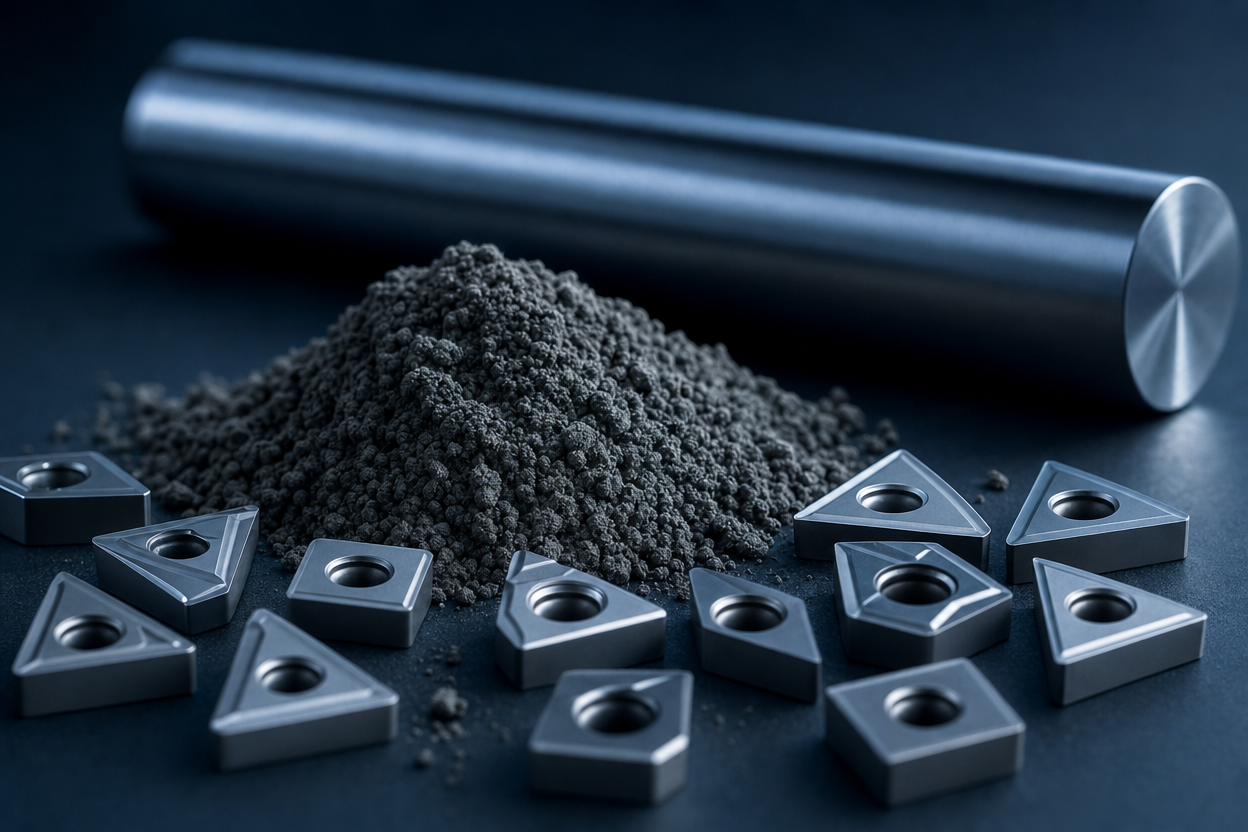

China Tungsten and Molybdenum Alloys 2026: Strategic Metals Across Cemented Carbide, Photovoltaic Tungsten Wire and High-end Equipment
Industry Research Institute | June 2026
I. Industry Overview: The Underrated "Industrial Teeth" and "Heat-Resistant Spine"
Tungsten and molybdenum are two metals on the periodic table characterized by extreme hardness, extreme melting points, extreme density, and equally uncompromising industrial roles. Tungsten melts at 3422 °C, the highest of any metal; molybdenum melts at 3422 °C... actually, molybdenum melts at 2623 °C, second to tungsten. Tungsten's density of 19.25 g/cm³ is 2.5 times that of iron, behind only platinum, iridium and osmium. Molybdenum's density of 10.28 g/cm³ is roughly equal to lead's. These extreme physical properties dictate that tungsten and molybdenum work where ordinary metals fail — and modern industry's most advanced, most critical, highest-value applications happen to congregate in exactly those extreme regimes.
The names of these two metals rarely appear in consumer daily life, yet they underpin the strictest boundaries of modern industry: the cemented carbide layer pressed onto the cutting edge of a CNC machine tool tearing through iron or titanium alloys; the rock-breaking head of a mining drill bit penetrating granite and basalt; the high-temperature alloy skeleton in the combustion chambers and turbine disks of aircraft engines; the few-hundred-nanometer-thick metal electrode on a TFT-LCD display; the 30-something-micron-thick wire inside the diamond wire saw cutting silicon wafers; the increasingly densely packed PCB drill bits on AI server motherboards. Every one of these applications places the same demand on materials: stable performance under extreme temperature, pressure and chemical environment. Tungsten and molybdenum are, today, the two veterans almost irreplaceable on this track.
2025 was the year these two metals were collectively repriced along the Chinese industrial chain. For tungsten: ammonium paratungstate (APT), the standard intermediate of the tungsten chain, traded between RMB 200,000 and RMB 210,000 per ton throughout 2024 and held near RMB 206,000 per ton in March 2025; from August onward, prices accelerated with a slope unseen in the past decade — RMB 415,000 per ton on September 8, 2025 (a 96.7% increase from the year's start); contract prices for major southern Chinese producers reached RMB 780,000 per ton (with VAT) in early June 2026. For molybdenum: 45% molybdenum concentrate hit RMB 4,605 per ton-degree in early September 2025, ended the year at RMB 3,695 per ton-degree (year-over-year +25%), with the 2025 average at RMB 3,836 per ton-degree (+6.7% YoY); the market consensus is that molybdenum prices may break above USD 30 per pound in 2026. These two strategic metals simultaneously entered a new cycle marked by tight supply-demand structure, an elevated price center, and strengthened policy attributes.
On February 4, 2025, China's Ministry of Commerce and General Administration of Customs jointly issued Announcement No. 10, imposing export controls on items related to tungsten, tellurium, bismuth, molybdenum, and indium. The scope includes: tungsten and tungsten alloys with tungsten content ≥97% (outside the existing 1C226 and 1C241 controlled items); copper-tungsten alloys with tungsten content ≥80%; 25 categories of rare metal products including APT, plus associated technologies. Exporters of these items must apply to the State Council's commerce department for licenses under the Export Control Law and the Dual-Use Items Export Control Regulations. This is a policy signal of considerable weight: China's global shares in these two strategic metal chains — tungsten reserves 53%, tungsten production 79%, molybdenum reserves approximately 40% — have for the first time been officially anchored by export control to their strategic value.
Around these two metals, three simultaneous structural scissor-gaps emerged across the 2025 industrial chain.
The first gap: upstream resources are extremely concentrated, while downstream applications are extremely dispersed. China's 2.5 million tons of tungsten reserves cluster in Jiangxi, Hunan and Henan, which together account for 82.22% of national reserves; molybdenum reserves concentrate in Henan, Shaanxi and Jilin, jointly 56.5%. Downstream, however, applications fan out across CNC cutting tools, PCB drill bits, mining drill heads, aerospace engines, LCD panels, semiconductor sputtering targets, photovoltaic tungsten wire, oil and gas drilling, molds, superalloys, electronic packaging, catalysts, radiation shielding, medical devices, and more. This V-shaped supply-application structure means any upstream policy or price disturbance transmits simultaneously to dozens of seemingly unrelated downstream tracks.
The second gap: domestic midstream concentration is high, while overseas midstream is consolidating rapidly. China's tungsten-molybdenum midstream processing — APT, tungsten powder, tungsten carbide powder, cemented carbide, molybdenum powder, molybdenum alloys, tungsten/molybdenum wire — is concentrated among a handful of listed companies: Xiamen Tungsten, China Tungsten and Hightech (Zhongwu Gaoxin), Zhangyuan Tungsten, CMOC (Luoyang Molybdenum), Jinduicheng Molybdenum, with combined global share exceeding 70%. Overseas, Sandvik (Sweden) recorded FY2025 revenue of approximately SEK 132 billion; Plansee Group (Austria) recorded FY2023/24 revenue of EUR 2.28 billion; Kennametal (US) recorded FY2025 revenue of USD 1.97 billion; ISCAR (Israel, part of Berkshire Hathaway's IMC Group) operates across 60+ countries — these four are the foundational pillars of global CNC cutting tools and cemented carbide. Meanwhile, H.C. Starck Tungsten Powders, the venerable German tungsten powder house, was sold by Vietnam's Masan High-Tech Materials to Mitsubishi Materials Corporation: the framework agreement was signed in May 2024, closing took place on April 2, 2025. The overseas tungsten powder midstream landscape underwent its largest equity restructuring since the Cold War in 2024-2025.
The third gap: downstream demand is rapidly switching from "traditional machining" to "emerging strategic applications". Traditional CNC cutting tools, mining alloys, and molds remain the base, but four new tracks — photovoltaic tungsten wire, AI-server PCB drill bits, semiconductor sputtering targets, aerospace hot-section alloys — exploded between 2024 and 2026. Photovoltaic tungsten wire penetration jumped from 20% in 2024 to 40% in 2025 (some leading estimates as high as 60%); AI server PCB drill consumption per unit is twenty times that of traditional servers, with 30+ length-diameter ratio micro-drills falling into industry-wide shortage in the second half of 2025.
This is a set of industrial facts whose full tension cannot be captured by the surface static indicators (tungsten output, molybdenum output, industry gross value). The present report builds on the latest 2025 annual reports of listed companies and the latest policy and price data through the first half of 2026, systematically reviewing China's tungsten-molybdenum alloy industry across fourteen dimensions: industry overview, upstream resources, midstream products, leading firms, downstream cemented carbide, downstream tungsten wire and molybdenum alloys, industrial belt geography, import substitution, capacity expansion, price cycle, policy environment, research institute judgments, risk matrix, data sources.
1.1 Why Discuss Tungsten and Molybdenum Together
In conventional bulk metal classification, tungsten and molybdenum belong to the "refractory metals" or "high-melting metals" family, alongside rhenium, tantalum, niobium, hafnium, zirconium, and vanadium. But the reason tungsten and molybdenum are discussed jointly in a single industry report rests on four independent industrial logics. First, in mineralogy the two are commonly co-occurring: molybdenum mines in Luanchuan's Nanniwhu and Zijinshan are simultaneously tungsten mines, and tungsten-molybdenum co-mineral deposits represent 18-22% of national resources. Second, midstream processing shares much equipment: APT and ammonium molybdate ammonia leaching crystallization workshops, hydrogen reduction furnaces for tungsten and molybdenum powders, vacuum sintering furnaces for tungsten and molybdenum rods — process platforms overlap heavily. Third, downstream applications complement each other: cemented carbide (tungsten-dominant) and superalloys (with molybdenum as a key alloying element) jointly serve cutting, mechanical engineering, and aerospace. Fourth, strategic attributes are now aligned: the February 2025 export control announcement listed tungsten, molybdenum, bismuth, indium, and tellurium together, formally anchoring the strategic integration of the two at the policy level.
1.2 The "Tungsten-Molybdenum Moment" of 2025
If 2025 must have a defining moment for the tungsten-molybdenum industry, the joint announcement of February 4, 2025 by the Ministry of Commerce and the Customs Administration is undoubtedly the watershed. Until then, tungsten and molybdenum's strategic-metal attribute rested largely on internal governance: mining indicators, resource taxes, strategic reserves. From that day onward, tungsten and molybdenum formally entered the licensing regime of global trade. Unlike the 2010 rare-earth export-control case, the 2025 tungsten-molybdenum control was launched from a position of absolute dominance — China already commanded 79% of global tungsten output and roughly 35-40% of global molybdenum output. Market reaction was much more measured than in 2010: overseas buyers rapidly entered "long-term contract locking" mode, domestic long-term contract prices began rising in August, and the August-to-September APT price surge accounted for more than 50% of the year's total increase. The price trajectory reflected both supply-demand fundamentals and policy expectations being fulfilled.
2025 had another moment worth recording: photovoltaic tungsten wire penetration crossing 40%. This is an industrial story about material substitution: replacing the steel core wire of diamond wire saws with tungsten wire reduced silicon wafer cutting loss from 100 microns to below 70 microns, lowering polysilicon consumption per GW of installed PV by 5-8% and saving the PV industry chain RMB 3-5 billion per year. It is not "disruptive" but profoundly substitutional — the single most important application that tungsten has found in the new-energy age.
1.3 Industry Chain and Global Position Overview
To grasp the Chinese tungsten-molybdenum chain in full, one needs a full panoramic map. Upstream mines: tungsten (wolframite, scheelite) and molybdenum (molybdenite); midstream processing: APT / tungsten powder / tungsten carbide / cemented carbide / ammonium molybdate / molybdenum powder / molybdenum alloys; downstream applications: CNC cutting tools / PCB drill bits / photovoltaic tungsten wire / molybdenum targets / aerospace hot ends / mining alloys / molds / specialty applications. China's global position along this chain can be summarized in four key numbers: tungsten reserves 53% global, tungsten production 79% global, APT 85% global, cemented carbide 70% global. In finer subsegments: photovoltaic tungsten wire global share 95%+, PCB drill carbide rod global #1, new capacity ranking global #1. This set of numbers makes China the de facto global leader of the tungsten-molybdenum chain, but the most advanced end of the chain — ultra-fine tungsten powder, high-end cemented carbide grades, semiconductor-grade molybdenum — still has 3-5 to 5-8 years of climbing ahead.
1.4 From 1958 to 2026: Sixty-Eight Years of Chinese Tungsten-Molybdenum Industry
The starting point of modern Chinese tungsten-molybdenum industry traces back to 1958: that year, Zhuzhou Cemented Carbide Factory (Zhuying) in Hunan was completed and put into operation — the first large cemented carbide enterprise in China; the same year, the Jinduicheng molybdenum mine in Shaanxi began construction, with molybdenum production starting in 1959. From then to 2026, the Chinese tungsten-molybdenum industry has traversed sixty-eight years, roughly divided into four phases: 1958-1978 founding-era (1-2 wt year output, planned-economy demand); 1978-2000 reform-era expansion (capacity, technology, exports all entering rapid growth, APT exports becoming a major source of global tungsten trade); 2000-2015 globalization (China becoming the world's largest producer and exporter of tungsten, molybdenum, APT, and cemented carbide); 2015-2026 structural upgrading and strategic-attribute return (supply-side reform, tighter mining indicators, environmental governance lifting concentration; emerging downstream applications repositioning tungsten-molybdenum as advanced materials; the 2025 export control formally anchoring strategic-attribute recognition).
1.5 Report Structure and Reader Guide
The remaining thirteen chapters of the report unfold in the order: upstream — midstream — downstream — industrial belts — import substitution — capacity expansion — price cycle — policy environment — research-institute judgments — risk matrix — data sources. Readers wanting a quick global grasp should prioritize Chapter 1 (overview), Chapter 12 (research-institute judgments) and Chapter 13 (risk matrix). Readers wanting depth on chain structure should focus on Chapter 3 (midstream products), Chapter 4 (leading firms) and Chapter 7 (industrial belts). Readers wanting to track emerging downstream applications should focus on Chapter 5 (cemented carbide downstream), Chapter 6 (tungsten wire and molybdenum alloys), and Chapter 8 (import substitution).
1.6 Clarifying Common Misconceptions
A few common misconceptions worth clarifying upfront. First: "tungsten and molybdenum are rare metals with tiny reserves" — wrong. Tungsten's crustal abundance is about 1.25 ppm (hundreds of times that of gold at 0.003 ppm), and molybdenum's is about 1.5 ppm. Both are scarce but not extremely scarce; "rare" refers more to processing difficulty than geological abundance. Second: "tungsten equals cemented carbide" — wrong. Cemented carbide is the largest downstream of tungsten (60-70%), but tungsten has many other uses — PV tungsten wire, filaments (now largely replaced by LEDs), electrical contacts, radiation shielding, X-ray tube anodes, kinetic-energy penetrator cores, counterweights. Third: "molybdenum equals a steel alloying element" — partly wrong. Steel alloying does account for ~75% of molybdenum consumption, but the remaining 25% — electronics, semiconductors, aerospace, catalysts — has far higher unit value. Fourth: "export controls equal embargo" — wrong. The 2025 controls are licensing, not embargo: normal trade is not blocked, only compliance flow is added.
1.7 The Dual Positioning of "Cyclical" and "Growth"
Tungsten and molybdenum are simultaneously cyclical commodities (prices fluctuating with supply-demand) and growth stocks (PV tungsten wire, PCB drills, semiconductor molybdenum targets, aerospace hot-end driving the chain to a level of growth not seen in over a decade). This dual positioning makes valuation logic complex. Pure cyclical framing (using historical PB/PE bands) underestimates growth; pure growth framing (PEG/PS premiums) ignores cyclical swings. The Research Institute's view is that during 2026-2028 the tungsten-molybdenum sector should be valued under a "cyclical-growth" framework — modest growth premiums layered on the mid-cycle base.
1.8 Global Comparison of China's Tungsten-Molybdenum Position
Globally, several facts stand out. Resource endowment: China dominates tungsten absolutely (53% reserves, 79% production) and relatively in molybdenum (~40% reserves, ~35% production). Midstream: China holds 70-85% of global tungsten APT-to-cemented-carbide capacity and 30-40% of global molybdenum ammonium-to-molybdenum-powder capacity. Downstream: China accounts for 50% of global cemented carbide consumption, 95% of PV tungsten wire, 25-30% of CNC cutting tools, 40% of molybdenum-based targets. Technology: parity in process-type innovation, with 3-5 years lag in originate-type innovation, coating and application engineering. Policy: the combined toolkit of mining quota + export control + strategic reserve + environmental standard is the most complete globally. This is "all-round dominance" — China is at once a resource giant, processing giant, consumption giant, and policy leader. The mid- to long-term continuation of this position is the most important premise of the 2026-2030 tungsten-molybdenum industry outlook.
1.9 Research Method and Data Standards
This report's research method and data standards are stated for the reader's reference. All cited company financial data come from publicly disclosed annual, semi-annual and quarterly reports filed with the Shanghai Stock Exchange, Shenzhen Stock Exchange, US SEC, and European exchanges. All cited industry data come from Ministry of Industry and Information Technology, Ministry of Natural Resources, Ministry of Commerce, General Administration of Customs, USGS, IEA, Wood Mackenzie, Roskill, Asian Metal, SMM, Mysteel, FerroAlloyNet, China Tungsten Industry Association, China Nonferrous Metals Industry Association, and similar authoritative channels. All cited policy documents come from public announcements by the State Council, ministries, and local governments. All judgments and analyses are based on objective reasoning over the public data, with appropriate uncertainty preserved in forward-looking projections. Readers are advised to verify against the latest official disclosures when citing.
1.10 Reading Cadence and Reader Expectations
The narrative cadence is "panoramic — detail — judgment — risk". Chapter 1 starts with the panorama; subsequent chapters drill into specific dimensions; Chapter 12 delivers comprehensive judgments; Chapter 13 frames boundary conditions through risk; Chapter 14 closes with methodology and data sources. This cadence lets readers grasp the big picture and the details together — the standard structure of a research-institute long report.
1.11 A Footnote of the Time
A "footnote" to close this chapter. 2025-2026 is a particular window in China's tungsten-molybdenum industry — dramatic price rises, strategic policy upgrades, multi-dimensional demand explosions, aggressive capacity expansion, high-end technology climbing, synchronized internationalization — all happening within the same window. This concentration is unprecedented in the past three decades. Understanding the industrial meaning of this moment is essential for executives, investors, researchers, policymakers, and stakeholders across the chain. The very existence of this report is to record, organize, judge, and offer decision-making support for the moment. This is industry research with the temperature of its time.
II. Upstream Resources: Tungsten in Jiangxi-Hunan and Molybdenum in Shaanxi-Henan
Tungsten and molybdenum do not exist as single minerals geologically. Tungsten mainly occurs as wolframite (iron-manganese tungstate) and scheelite (calcium tungstate). Wolframite has historically been the backbone of the Chinese tungsten industry; scheelite is more difficult to beneficiate but has larger reserves and has overtaken wolframite as the dominant source of new output in recent years. Molybdenum mainly occurs as molybdenite (molybdenum disulfide), often as part of porphyry copper-molybdenum or porphyry molybdenum deposits.
2.1 The Tungsten Belt: Nanling—Dabieshan
China's core tungsten resources are concentrated in the Nanling—Dabieshan tungsten metallogenic belt, stretching from Ganzhou (Jiangxi) and Chenzhou (Hunan) up to Luanchuan (Henan), Huoqiu (Anhui), and Shanghang (Fujian). This is the world's largest known tungsten belt by reserves. The 2025 USGS Mineral Commodity Summaries gives global tungsten reserves of approximately 4.7 million tons: China 2.5 million tons (53.19%), Russia 570,000 tons (12.13%), Australia 400,000 tons (8.51%); Vietnam, Bolivia, Portugal, Austria, Spain, UK and Canada together hold the remaining ~26%.
Within China, provincial concentration is even more pronounced: Jiangxi holds 1,693,600 tons (56.54%); Hunan 595,000 tons (19.86%); Henan 174,400 tons (5.82%) — together 82.22%. Jiangxi's tungsten is in nine counties of Ganzhou (Dayu, Chongyi, Shangyou, Anyuan, Xinfeng, Longnan, Dingnan, Xunwu, Yudu) — the historic origin of the "Eighteen Tungsten Factories of Jiangxi". Hunan's tungsten is in Chenzhou (Guidong, Rucheng, Yizhang, Linwu, Jiahe, Guiyang, Beihu, Suxian, Yongxing, Zixing), home of the famous Shizhuyuan polymetallic mine. Henan's tungsten lies at Luanchuan's Sandaozhuang and Shanggou — coexisting with molybdenum, forming the largest combined tungsten-molybdenum production area south of the Yellow River.
2025 global tungsten output was about 85,000 tons; China produced 67,000 tons, 78.82% share, ranking #1 for over three decades. Jiangxi + Hunan contributed 63.4% of domestic capacity, Henan 12.2%. From the early 2000s' 50,000 tons annual output to 2025's 67,000 tons, China's tungsten output grew at less than 2% CAGR over twenty years — far slower than downstream demand — meaning supply-demand gap has structurally narrowed rather than widened. The dramatic tungsten price rises of 2024-2025 had an objective resource basis.
China's tungsten industry is also defined by mining quota controls. From 1991 onwards, total tungsten mining quantity has been under control; in 2002 tungsten was designated a "specific mineral"; the 2024 quota stood at 114,000 tons, and 2025 at 116,000 tons (calculated as 65% WO3). Quotas have for many years been below allowable theoretical extraction. This is a policy choice distinct from many other metals: tungsten supply is not purely market-determined.
2.2 The Molybdenum Belt: Henan-Shaanxi-Jilin Tripartite
Molybdenum's reserve geography is entirely different from tungsten's. Henan holds 30.1%, Shaanxi 13.6%, Jilin 13%, Shandong 6.7%, Hebei 4%, Liaoning 3.7%, Inner Mongolia 3.6% — the top three provinces summing to 56.5%. The most landmark site is Jinduicheng in Huaxian (now Weinan), Shaanxi: 1.4 billion tons of ore, 1.28 million tons of molybdenum metal, one of the world's six great molybdenum deposits and the resource backbone of Jinduicheng Molybdenum (601958.SH). Henan's Luanchuan area — Nanniwhu, Shanggou and Sandaozhuang — forms China's largest molybdenum base, hosting CMOC's headquarters. Jilin's Dahei Mountain and Liaoning's Yangjiazhangzi are the two veteran molybdenum mines of Northeast China.
By deposit type, porphyry molybdenum accounts for over 80% of China's molybdenum reserves (Jinduicheng, Dexing, Luanchuan all belong to this type — moderate temperature, large ore body, moderate-to-low grade, suited for large open-pit or underground continuous mining); porphyry-skarn mixed types are represented at Nanniwhu where skarn contact zone enrichment is the hallmark. Unlike tungsten, China has not implemented nationwide mining quota controls for molybdenum, relying more on market signals and environmental permits. This gives molybdenum more elastic capacity response during price upcycles but has historically left a strategic-attribute policy gap — partly filled when the February 2025 export control listed molybdenum alongside tungsten.
2.3 Static Reserve-to-Production Ratio and Resource Succession
At 6.7-ton 2025 tungsten output against 2.5-million-ton reserves, China's static reserve-to-production ratio is about 37 years; computing against the annual 114,000-ton quota gives roughly 22 years. These are numbers worth watching. Jiangxi and Hunan's mature mining districts have heavily depleted accessible resources over twenty years; new reserves come increasingly from deeper or more challenging deposits. Fujian, Guangdong, Xinjiang, Inner Mongolia, Qinghai and other provinces began tungsten-molybdenum exploration between 2020 and 2025, but effective new capacity takes 5-10 years through the exploration-prefeasibility-feasibility-construction-ramp-up cycle. Long-term resource succession is a structural variable not to be ignored, perhaps even more important than price volatility.
2.4 Scheelitization and Lower-Grade Trends
China's tungsten resources have undergone two profound shifts over thirty years: scheelitization and grade-lowering. Wolframite-dominated to scheelite-dominated: historic Chinese tungsten was built on high-grade wolframite of Jiangxi and Hunan; entering the 21st century, scheelite's reserve advantage became visible — Shizhuyuan, Luanchuan Nanniwhu, and similar large scheelite deposits drive new capacity. Scheelite has lower grade (WO3 0.1-0.5% vs wolframite 0.5-2%) and harder beneficiation (combined flotation + acid leaching), but larger reserves. Grade-lowering: traditional wolframite ore frequently exceeded 1% WO3; new scheelite is 0.2-0.5%; some co-deposits below 0.1%. This structural rise in beneficiation cost-per-unit, combined with conservation pressures, drives tungsten concentrate's "all-in cost" gradually upward — partly offset by efficiency improvements and environmental upgrades. Recognizing this is important: the tungsten price-center uplift is partly a resource-endowment evolution, not just supply-demand cycle.
2.5 Copper-Molybdenum Coexistence
Unlike tungsten's "independent + co-occurring" structure, Chinese molybdenum is heavily marked by copper-molybdenum coexistence. Zijinshan Cu-Mo, Dexing Cu, Chengmenshan Cu, Yulong Cu — these large copper mines are also major molybdenum sources. Molybdenum from copper-molybdenum mines is a by-product of copper smelting, with cost depending on copper price and output tied to copper cycles. Throughout 2024-2025 China's copper output expanded, by-product molybdenum rose in step — supplying valuable elasticity. But by-product molybdenum is usually lower in MoS2 grade (45-50% vs 50-55% for standalone mines) and higher in Cu, Fe, Pb, P impurities, raising the bar for downstream ammonium molybdate and molybdenum powder processors. This resource feature also differentiates listed companies: Jinduicheng relies on its standalone mine with stable product quality; CMOC's name evokes molybdenum but its revenue is dominated by copper-cobalt from Congo; Zijin Mining, Jiangxi Copper, Yunnan Copper produce molybdenum as a copper-business by-product.
2.6 Upstream Industrial Belt Map
Four regional clusters define China's tungsten-molybdenum upstream geography. (1) Gannan—Xiangnan—Yuebei Tungsten Zone: Ganzhou (Jiangxi) through Chenzhou (Hunan) to Shaoguan-Nanxiong (Guangdong) — the world's most complete tungsten belt. (2) West Fujian—East Guangdong Tungsten Zone: anchored at Longyan-Shanghang (Fujian) and Meizhou (Guangdong), with Zijinshan polymetallic mine and Shanghang tungsten deposits anchoring. (3) Henan Luanchuan Molybdenum Zone: Nanniwhu, Shanggou, Sandaozhuang, Zhaiwo molybdenum mines together form China's most concentrated molybdenum geography. (4) Shaanxi Weinan—Liaoning Huludao—Jilin Tonghua Molybdenum Zone: Jinduicheng, Yangjiazhangzi, Dahei Mountain, Jideshi as the four traditional molybdenum pillars. These four zones together hold 85%+ of national reserves and 90%+ of output — the geographic coordinate system that any tungsten-molybdenum researcher must establish.
2.7 Deep Exploration and Resource Succession
Rapid depletion of mineable resources over the past two decades has elevated "deep exploration" as the central concern post-2025. Shallow resources at Dayu, Chongyi, Shizhuyuan, and similar veterans are near exhaustion; new resources come from deep (500-2000m) deposits. Jinduicheng and Luanchuan face similar dynamics. CGS's 2024-2025 deep-exploration special programs across Nanling, Qilian, and West Tianshan target tungsten-molybdenum as priorities. Technical challenges include 3D seismic/electromagnetic/gravity integrated geophysics, deep drilling, and 3D orebody modeling. Deep exploration will likely translate into new reserves between 2026 and 2030, with rising costs as a structural support for an elevated price center.
2.8 Resource Tax and Mining Right Auction Evolution
China's tungsten-molybdenum resource tax stabilized at tungsten 6.5%, molybdenum 5% after the 2020 Resource Tax Law. Mining right auction systems are evolving: the Ministry of Natural Resources' 2023 opinion ushered all non-strategic minerals into "招拍挂" (bidding/auction/listing) markets. Tungsten and molybdenum remain national-administered as strategic minerals, but some secondary rights (smaller mines complementing major ones) have begun entering market auctions. This shift offers entry windows for new players and challenges incumbents.
2.9 Mine Digitalization and Intelligentization
Tungsten-molybdenum mines are accelerating digitalization. CMOC's TFM in Congo runs autonomous mining trucks and digitalized ore transport; Jinduicheng started its "5G + Smart Mine" project; Jiangxi tungsten miners invest in 3D modeling and beneficiation automation. Returns include 30-50% reduction in unit labor cost, 70%+ reduction in accident rate, and 3-5 percentage-point gain in ore recovery — significant for both veteran-mine life extension and new-mine "green" credentials.
2.10 Jiangxi Ganzhou Tungsten Town: Inside the Numbers
Within Ganzhou: Dayu County is the heart of the "Tungsten Capital" — home of West Huashan tungsten mine and Zhangyuan Tungsten's headquarters; Chongyi's Maoping-Jiulong-Shangbu mine groups form the second largest Ganzhou tungsten zone; Shangyou (Miaobei-Yingqian-Yuancun), Anyuan (Banshi-Hugang), Xinfeng (Xiangshan-Tiekeng), Longnan (Zuokeng-Guanxi), Dingnan (Tianjiuling-Lingbei), Xunwu (Pangushan-Wenkou), Yudu (Niuxingba-Wulitang) — every mine carries decades of mining and industrial accumulation. Around these mines: hundreds of mining teams, hundred-plus flotation plants, dozens of APT plants, dozens of tungsten powder/carbide/cemented-carbide plants, hundred-plus tungsten-molybdenum traders, dozens of mining-machinery and supply firms. The full upstream-to-processing chain is presented vertically in a single prefecture — "tungsten vertical clustering" of a kind unmatched globally.
2.11 Hunan Chenzhou Tungsten Belt and Shizhuyuan
Chenzhou's tungsten reserves are ~600,000 tons, second only to Ganzhou. Inside Chenzhou: Yaoling (Guidong), Dafuqiao (Rucheng), Yaogangxian (Yizhang), Xianghualing (Linwu), Lutang (Jiahe), Miaoxia (Guiyang), Yangtianhu (Beihu), Shizhuyuan (Suxian), Baojing (Yongxing), Xiangshan (Zixing) — a continuous tungsten belt. Shizhuyuan polymetallic mine (Shizhuyuan Nonferrous Metals Co.) is China's and the world's largest tungsten-molybdenum-bismuth-fluorite multi-mineral co-deposit, single-mine tungsten metal reserves 800,000-1,000,000 tons — the crown jewel of Chenzhou. Its complex "scheelite + fluorite + bismuth + molybdenum" comprehensive recovery process is an international mining classic.
2.12 Henan Luanchuan Molybdenum Capital
Luanchuan alone holds molybdenum reserves over 2 million tons, 15-18% of national total — "China's Molybdenum Capital". Its Sandaozhuang, Shanggou, Nanniwhu, Zhaiwo mines form China's largest molybdenum cluster. Sandaozhuang is China's largest open-pit molybdenum mine, the open pit being 1500+ m diameter and 300+ m deep — an inverted pyramid from above. Shanggou is China's largest underground molybdenum mine; Nanniwhu features Mo-W-Ti co-mineralization; Zhaiwo is a newer Cu-Mo co-deposit. Around the four mines: hundreds of mining teams, magnetic/flotation/chemical separation plants, ammonium molybdate workshops, molybdenum powder/board/wire/alloy processors, traders. Luanchuan's tungsten-molybdenum-related GDP contribution exceeds 60% — a textbook example of "one-mine-supports-one-county".
2.13 Shaanxi Jinduicheng: China's Molybdenum Cradle
Jinduicheng molybdenum mine in Huaxian (now Huazhou District, Weinan, Shaanxi) was discovered in 1958, the preparatory committee was established in 1962, and production officially began in 1965. It witnessed the entire rise of Chinese molybdenum industry. Its 1.28 million tons of metal molybdenum (across 1.4 billion tons of ore) makes it one of the world's six greatest molybdenum deposits; the deposit is porphyry-type with moderate grade (0.05-0.10% Mo), suited for large-scale open-pit continuous mining. Today's Jinduicheng Molybdenum Group is the core asset of Jinduicheng Molybdenum (601958.SH), producing 40,000+ tons/year of metal molybdenum — China's #1 molybdenum miner. Jinduicheng is also a research cradle: China Molybdenum Industry Research Institute and Nonferrous Metals Institute's molybdenum branch maintain deep ties — one of the birthplaces of Chinese molybdenum metallurgy as a discipline.
2.14 Jilin Dahei Mountain: The Northeast Heavyweight
Dahei Mountain in Dunhua, Jilin, is China's largest northeastern molybdenum mine and a world-class deposit. Discovered in 1957, systematically explored from the 1980s, formally operational in 2008 (Jien Nickel's subsidiary), ore reserve 2 billion+ tons, molybdenum metal at the 1-million-ton scale. Porphyry-type, grade 0.05-0.08% Mo, suited for large-scale open-pit mining. Despite later start, Dahei Mountain's scale and low cost have placed it among China's top molybdenum miners — the "big brother" of Northeast molybdenum.
2.15 Liaoning Yangjiazhangzi: China's Earliest Molybdenum Mine
Yangjiazhangzi in Huludao, Liaoning, is among China's earliest molybdenum mines — discovered in 1908, small-scale mining began in the 1920s, large-scale construction from 1949. It carries special meaning in modern Chinese mining history — the first molybdenum mine with truly modern industrial character. From 1950s to 1970s, Yangjiazhangzi supplied the molybdenum alloying needs of Chinese steel (high-speed steel, stainless steel, alloy steel). It still operates today, an important industrial pillar of Huludao. The Liaoning molybdenum ecosystem (Huludao-Jinzhou-Dandong) is smaller than Luanchuan or Jinduicheng, but anchors China's northeastern tungsten-molybdenum geography.
2.16 Resource Type and Grade Details
Grade details worth recording: wolframite generally has 0.5-1.5% WO3, scheelite 0.1-0.5%; standalone molybdenite 0.05-0.10% Mo, copper-by-product molybdenite 0.02-0.05%. Lower grade means a larger share of beneficiation cost in total cost — the same tungsten output requires more ore extraction. Average grade of Chinese tungsten-molybdenum mines has declined modestly over thirty years, reflecting shallow high-grade depletion. This endowment shift contributes objectively to the structural cost uplift.
2.17 Long-Term Resource Constraint on the Chain
Upstream resource volume and grade impose a 30-50 year "long-term constraint" on the chain. Even maintaining mining quotas at 110,000-120,000 tons WO3 equivalent annually, the static reserve-to-production ratio under existing reserves is about 35 years; for molybdenum, 40-50 years. This constraint means tungsten-molybdenum's strategic attribute will not weaken in the medium-long term — if anything, gradual depletion of recoverable resources will strengthen it. Deep exploration, overseas resource acquisition, and tungsten-molybdenum recycling are the three principal paths to mitigate this constraint. Recognizing this resource constraint is one of the foundational starting points for industry research, investment decisions, and policy decisions.
III. Midstream Products: APT, Tungsten Powder, Tungsten Carbide, Ammonium Molybdate, Molybdenum Powder, Molybdenum Alloys
The midstream of tungsten-molybdenum is longer than commonly assumed. Tungsten travels six steps from mine to cemented-carbide cutting tool: ore → APT → tungsten oxide → tungsten powder → tungsten carbide powder → cemented carbide mix → sintered alloy block → ground inserts. Molybdenum travels five-to-six steps: molybdenum concentrate → roasting → ammonium molybdate → molybdenum oxide → molybdenum powder → molybdenum alloys / molybdenum wire / molybdenum plate / molybdenum target. Each link has its own technical barriers and market structure.
3.1 Ammonium Paratungstate (APT) — The Tungsten Chain's Reference Intermediate
APT, (NH4)10[H2W12O42]·4H2O, is the white crystal obtained from soda decomposition (or ammonia leaching), purification and crystallization of tungsten concentrate. Key quality indicators include WO3 content (≥88.5% for grade-0), impurities (P, As, S, Si, Mo at ppm levels), particle distribution and ignition-loss rate. China holds 85%+ of global APT capacity, with 2024 global output around 90-100kt of which China was 75-80kt. APT is the most important price barometer for the tungsten chain; 2024-2025 saw APT rise from RMB 200,000/t to RMB 780,000/t — virtually all downstream tungsten products followed in step.
3.2 Tungsten Powder and Tungsten Carbide Powder
Tungsten powder is the grey-black powder obtained from APT through oxidation (to tungsten trioxide) and hydrogen reduction. Particle sizes range from ultra-fine (sub-micron) to coarse (tens of microns). Key quality indicators include grain size, grain distribution, and oxygen content; ultra-fine (≤0.4 micron) tungsten powder is the key input for high-end cemented carbide. Tungsten carbide powder (WC) is obtained from tungsten powder + carbon black through carbonization at 1400-1600 °C; it is the main hard-phase component of cemented carbide. China's tungsten carbide powder capacity is around 60-70kt, with 2025 output ~55kt. Zhangyuan Tungsten's 2025 H1 carbide-powder sales of 2,975t (+19.25%) ranked among the fastest-expanding single producers.
3.3 Cemented Carbide — The Tungsten Chain's "Value Anchor"
Cemented carbide is the composite obtained from carbide powder + cobalt powder (or nickel powder) through ball-milling, spray-drying, pressing, and liquid-phase sintering at 1350-1500 °C. Hardness reaches HRA 89-93 and Vickers 1300-1900 — second only to superhard materials (diamond, CBN). Cemented carbide is categorized by use into cutting (CNC tools/inserts), mining (drills/picks), molds (drawing/extrusion dies), and wear (rolls/nozzles), absorbing 80%+ of tungsten output. China's 2025 cemented-carbide capacity is around 60kt with actual output ~50kt; China Tungsten & Hightech alone holds 14-15.4kt/year — nearly 30% of national share, the world's #1 cemented-carbide producer. Cemented carbide gross margins are among the highest along the tungsten chain: China Tungsten & Hightech 2025 cemented-carbide GM 18.93%, cutting-tool GM 35.05% — the latter already near the median of precision manufacturing.
3.4 Ammonium Molybdate, Molybdenum Oxide and Molybdenum Powder
Molybdenum midstream has its own vocabulary. Molybdenum concentrate (MoS2 45-55%) is roasted at 800-900 °C to yield industrial molybdenum oxide (MoO3 ≥57%), then ammonia-leached to yield ammonium molybdate (heptamolybdate or dimolybdate), crystallized and thermally decomposed to high-purity MoO3, then hydrogen-reduced to molybdenum powder. Molybdenum powder is the common precursor for molybdenum alloys, wire, plate, and targets. China's 2025 molybdenum-powder capacity is around 25kt; Jinduicheng Molybdenum and CMOC together hold 50%+ of the domestic market.
3.5 Molybdenum Alloys and Molybdenum Products
The molybdenum family is more dispersed than tungsten's: molybdenum plate for vacuum electronics and LCD-target substrates; molybdenum wire for early EDM cutting and heating elements; molybdenum alloy rods for aircraft engines and gas turbine hot sections; Mo-Nb, Mo-Na, Mo-W binary/ternary alloy targets for semiconductors and LCD panels; molybdenum crucibles for sapphire single crystal, rare-earth permanent magnet sintering, glass melting. Among these, semiconductor and panel molybdenum-based targets show the fastest growth — molybdenum alloys' most certain growth subsegment.
3.6 The Real Bottleneck in Midstream
China's midstream bottleneck is not capacity but "detail quality". For the same nominal grain size, top Chinese producers manage particle distribution CV ≤5%, while overseas Plansee and H.C. Starck achieve ≤3%. For the same nominal purity ammonium molybdate, China produces 99.95% at scale but 99.999% (for semiconductor-grade molybdenum target) still partly imported. For the same cemented-carbide grade, China makes commodity inserts 30% cheaper than overseas, but high-end titanium/superalloy machining grades lag 1-2 generations in lifetime. Midstream capacity "China-led" is fact; midstream high-end "China-leading" still has 3-5 years to climb.
3.7 APT Process Details
APT process is relatively standardized but details determine quality. Two main routes: soda high-pressure leaching (NaOH/Na2CO3 decomposition at 200+ °C and 20-30 bar) and ion exchange (extraction-based impurity separation). After decomposition, sodium tungstate solution is obtained, then purified (removing P, As, Si, Mo), converted (via strongly-acidic ion-exchange resin or solvent extraction to ammonium tungstate solution), and crystallized (slowly, to obtain APT crystals). Grade-0 APT (WO3 ≥88.5%, very low impurities) is the foundation for high-end cemented carbide and electronics-grade tungsten, priced 3-5% above grade-1 and 10-15% above grade-3. Fewer than 20 Chinese plants stably produce grade-0 APT — China Tungsten & Hightech, Xiamen Tungsten, Zhangyuan, Jiangxi Tungsten Holding, Qiandong Rare Earth Tungsten, Zigong Cemented Carbide, Henan Guochang Wear-Resistant being the main ones.
3.8 Ultra-Fine Tungsten Powder and Tungsten Carbide Powder
Ultra-fine tungsten powder is among the highest-difficulty links in midstream. Bringing particle size from 1-5 micron down to 0.4 micron and below requires solving particle uniformity (CV ≤5%), oxygen control (≤500 ppm), and sintering activity simultaneously. China Tungsten & Hightech, Plansee and H.C. Starck each have proprietary processes typically built on "low-temperature hydrogen reduction + surface modification" combinations. Ultra-fine tungsten powder feeds high-end PCB drills, AI compute-chip thermal substrate, 3D-printed metal powders, ultra-fine cutting tools — fetching 50-200% premium to ordinary tungsten powder. Tungsten carbide powder follows similar logic.
3.9 Ammonium Molybdate and Molybdenum Powder Process Differences
Ammonium molybdate's process is simpler than APT's. Molybdenum concentrate is roasted, ammonia-leached, and crystallized. But the "high-purity" challenge dwarfs the "high-output" challenge. Semiconductor-grade molybdenum requires ammonium molybdate with K, Na, Fe, Cu, Pb impurities below ppm level, 99.999% (5N) purity. Domestic supply of 5N ammonium molybdate remains concentrated in a few — China Tungsten & Hightech's refractory metals division, Zigong (molybdenum branch), Ningxia Orient Tantalum (early ammonium molybdate), Youyan Yijin, etc. Some high-purity grades still imported.
3.10 Cemented Carbide Grade Complexity
Cemented carbide is classified into cutting, mining, mold, and wear types — and each splits into dozens to hundreds of detailed grades. For cutting alloys: YG series (W-Co) mainly cast iron; YT series (W-Ti-Co) mainly steel; YW series (W-Ti-Ta(Nb)-Co) universal; newer YD, YN series for advanced CNC needs. Each grade represents a unique hard-phase ratio, binder content, grain size, sintering process. Overseas grade systems are denser: Sandvik's hundreds of GC1010, GC1115, GC4225, GC4325 grades; Kennametal's KC9215, KC9325, KCK20 series. Each grade fits a particular machining scenario. Chinese makers have closed the gap on universal grades, with remaining work concentrated in aerospace and semiconductor precision niches.
3.11 Coating Technology — Cemented Carbide's "Skin"
Cutting tool performance depends as much on coating as on substrate. Modern CNC inserts have 2-8 micron coatings: TiN, TiCN, TiAlN, AlCrN, and nano-multilayer (tens of nm × tens to hundreds of layers). Two process families: CVD and PVD. Sandvik's GC series is CVD-prominent; Kennametal's KC line uses both. Chinese makers catch up faster on PVD; the gap on CVD (especially aluminum-rich Al2O3) remains 1-2 generations. Coating is the key to 30-50% tool-life extension.
3.12 Cemented Carbide Recycling
Recycling is another key midstream link. Used cemented carbide from worn tools, mining alloys, and scrap molds totals 15-20kt/year in China. Two recycling routes: mechanical crushing + chemical dissolution (zinc-melt, acid-dissolution, electrolytic) for impure scrap; direct crushing + re-sintering for clean scrap. Domestic recycling rate is ~30-35%, vs ~60% in Germany, Austria, Japan. China Tungsten & Hightech, Zhangyuan, Zigong have in-house recycling lines; emerging specialist firms include Ganzhou Zhangyuan Recycling, Hunan Nonferrous Recovery Pilot Center. Recycled tungsten powder approaches primary in performance at 20-30% lower cost — the chain's "second supply source".
3.13 Midstream Energy and Carbon
Tungsten-molybdenum midstream is energy-intensive. Each ton APT consumes ~2000-3000 kWh electricity (including steam equivalent); each ton hydrogen-reduced tungsten powder ~800-1200 kWh; each ton cemented-carbide sintering ~1500-2000 kWh; each ton molybdenum powder ~700-1000 kWh. China's chain consumes 3-4 TWh annually. Under dual-carbon targets, energy and emissions optimization is the key issue for 2025-2030. Lead firms invest in rooftop solar (Xiamen Tungsten's Yongding base), green power PPAs (China Tungsten & Hightech), waste-heat recovery (Zhangyuan sintering).
3.14 Midstream Capacity "Origin + Customer" Logic
Two interlocking logics shape midstream capacity. Origin-driven: APT and powder capacity clusters near Jiangxi, Hunan, Henan to source ore. Customer-driven: cemented carbide, cutting tools, PCB drills migrate toward Yangtze-Pearl-Beijing-Tianjin clusters near downstream customers (auto, electronics, machinery). The intersection of these two logics produces hybrid geography — capacity in both ore proximity and customer proximity, a concrete manifestation of "process refinement" in Chinese tungsten-molybdenum industrial geography.
3.15 Midstream Quality Indicator Detail
Midstream quality systems are complex engineering languages. APT indicators: WO3, ignition loss, P/As/S/Si/Mo impurities (ppm levels), particle distribution, ash, moisture. Tungsten powder: W ≥99.95%, O ≤500ppm, particle (Fisher 0.5-10 micron), CV, apparent density, flow, impurities (Fe, Ni, Co, Mo, Cu). Tungsten carbide: carbide degree ≥98%, total C 5.85-6.20%, free C ≤0.05%, particle, oxygen. Cemented carbide: hardness (HRA, HV), TRS, density, magnetic moment/saturation, grain size, microstructure uniformity, surface roughness, geometric accuracy. These quality indicators form the "moat" — every metric demands process detail, equipment investment, accumulated experience.
3.16 Intermediate Trade and Global Circulation
Global APT trade: China dominates exports (~30% of domestic output exported); Vietnam (Masan), Bolivia, Rwanda, Portugal, Austria, Korea also export modestly. Tungsten powder trade is more concentrated: China, Austria (Wolfram Bergbau und Hütten), Japan (ALMT), Germany (H.C. Starck, now Mitsubishi) hold 80%+. Tungsten carbide powder: China 50%+ of international market. Cemented-carbide finished goods: Sandvik, Kennametal, IMC, Mitsubishi, China Tungsten & Hightech, Plansee — the dominant arena. Ammonium molybdate, molybdenum powder: relatively concentrated among China (Jinduicheng, CMOC), US (Climax Molybdenum), Chile (Codelco by-product), Canada (Molymet). High concentration with strategic policy re-division — a hallmark of tungsten-molybdenum's global-yet-fragmented nature.
3.17 Midstream Material-Sourcing Dispersion
Midstream material sourcing varies in concentration. APT's raw material (tungsten concentrate) comes from hundreds of upstream miners, with price transparency high but supply volatility high too. Tungsten powder's APT input is more concentrated (top-10 firms hold 80%), with long-term contracts at 60-70%. Cemented carbide's tungsten-carbide-powder and cobalt-powder inputs: carbide-powder follows APT dynamics; cobalt-powder supply concentrates among CMOC, Huayou Cobalt, Hanrui Cobalt — long-term contracts dominant. This "from ore to intermediate to alloy" stepwise concentration is the chain's "progressive concentration" characteristic.
3.18 Standardization vs Customization
Sales models split into "standardized" and "customized" tracks. Standardized products (national-standard APT, tungsten powder, carbide-powder, cemented-carbide grades, standard inserts) serve general markets with transparent pricing. Customized products (special geometries, custom alloy grades, specialty coating combinations, special-spec carbide rods and molybdenum alloy rods) serve high-end customers — gross margin 30-50% higher than standardized, but with longer sales cycles and deeper customer binding. The Chinese midstream product mix is shifting from standardized-dominant to standardized + customized dual-track, with customized share rising from 20-30% to 40-50% — the mark of "from material supplier to solution provider".
3.19 Quality Heritage Mechanism
A "quality heritage mechanism" is the invisible safeguard. From raw material inbound inspection through process inspection through final inspection through customer-use feedback — this complete heritage chain has decades-old tradition at Chinese leaders. China Tungsten & Hightech's Zhuzhou base, Zhangyuan's Ganzhou base, Xiamen Tungsten's Xiamen base, Jinduicheng's Jinduicheng base all carry strict quality heritage discipline. This is the root guarantee of Chinese midstream product quality stability and a hidden quality advantage in international competition.
3.20 Personalized Sales Model
Sales models are evolving from "standardized bulk" to "personalized custom + technical service" between 2024 and 2026. China Tungsten & Hightech, Zhangyuan, Zigong have built "customization delivery" teams keyed to client machining scenarios — recommending specific tungsten-powder particle size, cemented-carbide grade, insert geometry, coating combination for the client's part material, equipment, takt, and life requirements. This sales mode yields higher gross margin but more importantly builds deep technical partnerships — the key path for Chinese brand long-term competitiveness.
3.21 Circular Economy Outlook
Midstream's "circular economy" outlook is worth recording. Used cemented carbide, used tools, used PCB drills can be recycled as recycled tungsten powder or cemented carbide; used molybdenum (board, wire, target) recyclable to molybdenum powder. Chinese leaders ramp up circular-economy investment. By 2026-2030, the Chinese tungsten-molybdenum recycling industry should grow from today's 50-80kt tungsten-equivalent to 100-150kt — emerging as the chain's "second source of supply".
3.22 Conclusion: Midstream's Strategic Position
Midstream is the chain's most technology-intense and pivotal segment. China's "global dominance" in midstream capacity is fact, but the "high-end climb" still takes 3-5 to 5-8 years. This climb is the principal battleground for chain-wide import substitution and value-chain upgrade — the segment most worthy of attention from executives, investors, and policymakers. Strong midstream means strong chain; weak midstream means passive chain. This is the Research Institute's summary judgment on midstream's strategic position.
IV. Leading Firms: Five Chinese and Four Overseas
The head structure differs sharply between China and overseas. China features "comprehensive groups + specialized subsidiaries" — China Tungsten & Hightech, Xiamen Tungsten, CMOC, Jinduicheng Molybdenum, Zhangyuan Tungsten form the five-pillar landscape, each covering multiple links of the chain. Overseas features "specialized giants" — Sandvik, Plansee, Kennametal, IMC each deepening their niches over decades or even a century, with extreme specialization but smaller overall scale than the Chinese leaders.
4.1 China Tungsten & Hightech (000657.SZ): The World's #1 in Cemented Carbide
Owned through Sinosteel-Group-affiliated CTGI Group (Five-Mineral Tungsten-Titanium Group), the company covers tungsten concentrate → APT → tungsten powder → cemented carbide → CNC tools → PCB drill bits end-to-end. 2025: revenue RMB 17.639 billion (+19.34% YoY), net profit RMB 1.281 billion (+29.20% YoY). Revenue mix: tungsten concentrate and tungsten powders 32%, cemented carbide blanks and mining/roll alloy parts 26%, cutting tools / PCB drills 20.47%, refractory metals 15.39%, trading and others 6.9%. Cemented-carbide capacity 14,000-15,400 tons/year — global #1. CNC tools domestic share 25%+.
Two 2025 highlights: PCB drill bits — China Tungsten & Hightech holds 5,000+ tons/year of global #1 ultra-fine cemented-carbide rod, directly supplying domestic PCB drill leaders including Feiding, Jinzhou, Dongni Electronics. AI server explosion of high-multilayer PCB demand pushed this line into tight balance in H2 2025. Strategic asset injection — parent company injected high-quality tungsten mine assets including Yuanjing Resources into the listed entity, upgrading platform capabilities.
4.2 Xiamen Tungsten (600549.SH): Global #1 in PV Tungsten Wire
Xiamen Tungsten is another full-chain conglomerate but with weight shifted relative to China Tungsten & Hightech: emphasis on tungsten midstream (APT, tungsten powder) and fine tungsten wire (PV); other lines are new-energy materials (ternary cathode, LFP cathode) and rare earth. 2025 group revenue RMB 46.265 billion (+30.79% YoY); tungsten-molybdenum segment Q1-Q3 2025 revenue RMB 14.568 billion (+11.47%), total profit RMB 2.325 billion (+20.13%), representing ~76% of group total profit.
Xiamen Tungsten's "killer app" is photovoltaic tungsten wire. 2025 fine PV tungsten wire capacity 84.5 billion meters/year, market share >80%, global #1; the 100-billion-meter capacity expansion will bring total to 184.5 billion meters/year — the most aggressive expansion industry-wide. Q1-Q3 2025 PV fine tungsten wire sales 101.5 billion meters, with per-unit profit rising 30% YoY. Tungsten-molybdenum business contributed three-quarters of total group profit.
4.3 CMOC / Luoyang Molybdenum (603993.SH): The Chinese Giant in DR Congo
CMOC is the largest by revenue and most internationalized of the five. 2024 revenue RMB 213.029 billion (+14.37%), net profit RMB 13.532 billion (+64.03%) — the first year above RMB 200 billion revenue and RMB 10 billion net profit. 2025 forecast: net profit RMB 20-20.8 billion (record five-year-high streak); non-GAAP RMB 20.4-21.2 billion. The story's center of gravity has shifted from Henan Luanchuan molybdenum to two world-class mines in DR Congo.
TFM (Tenke Fungurume) and KFM (Kisanfu) started in 2023. TFM: copper 450ktpa, cobalt 37ktpa (one of the world's largest copper-cobalt mines). KFM: world's #1 cobalt mine, copper 150ktpa, cobalt 50+ktpa. 2024 CMOC copper output 650,200t (+55%) — first time among global top-10; cobalt output 114,200t (+106%), sales 108,900t (+266.23%) — the biggest 2024 global cobalt supply shock. The Luanchuan home base still contributes tungsten-molybdenum cash flow; 2025 copper output target 700,000t, 2026 target 800,000t. CMOC's scale has outgrown "Molybdenum Industry Co." — but the starting point is still the 1969 Yichuan copper-molybdenum mine.
4.4 Jinduicheng Molybdenum (601958.SH) and Zhangyuan Tungsten (002378.SZ)
Jinduicheng Molybdenum is the listed vehicle of Jinduicheng Molybdenum Group, anchored on the world-class Jinduicheng mine (1.28 million tons of molybdenum metal). 2025 total revenue RMB 13.834 billion (+1.94% YoY), total profit RMB 4.112 billion (+5.39% YoY); 2025 molybdenum product sales achieved 105.9% of annual plan, +2.13% YoY; domestic market share lifted to 28%; international market revenue +6.6%. Operating cadence remains steady, debt-to-asset lowest in industry, equity broke the RMB 17 billion mark in 2025.
Zhangyuan Tungsten is a Chongyi-Jiangxi-based "tungsten veteran", focused on APT, tungsten oxide, tungsten powder, carbide-powder, thermal-spray powder, cemented carbide — smaller scale than the comprehensive leaders but most levered to tungsten price. 2025 H1 revenue RMB 2.399 billion (+32.27% YoY), net profit RMB 115 million (+2.54% YoY); cemented-carbide sales 573.92t (-7.17%), Zhangyuan Aoketai cemented-carbide cutting-tool revenue RMB 189 million (+2.26%); tungsten-powder sales 2657.83t (+43.68%), carbide-powder sales 2975.12t (+19.25%). This company is a benchmark for mid-sized Chinese tungsten producers.
4.5 Four Overseas Giants
Sandvik (Sweden, Sandviken): tungsten business sits in Sandvik Manufacturing and Machining Solutions, with Sandvik Coromant — the world's #1 CNC cutting tool brand — leading. FY2025 revenue ~SEK 132 billion, adjusted EBITA margin ~20%. Sandvik's moats: GC (Gradient Coating) technology — PVD/CVD multi-layer coatings on cemented carbide substrates lift tool life 20-50% above domestic peers; and global customer and service network, delivering process solutions across auto, aerospace, energy, mold sectors annually — a capability not easily replaced by Chinese insert-sellers.
Plansee Group (Austria, Reutte): the global refractory-metals specialist. FY2023/24 revenue EUR 2.28 billion, 11,208 employees. Plansee runs full-chain — mine to recycling, powder metallurgy to precision components, materials supply to customer process collaboration — among the deepest in tungsten-molybdenum DNA. FY2024/25 in challenging European manufacturing climate and recovering semiconductor/aerospace markets, delivered "robust", with cautious optimism on Chinese recovery.
Kennametal (US, Latrobe, Pennsylvania): founded 1938, the largest US-domestic cemented-carbide cutting-tool firm. FY2025 (ending June 2025) revenue USD 1.967 billion (-4% YoY). Two segments: Metal Cutting (general machinery, auto, aerospace, energy metal cutting); Infrastructure (mining, oil & gas, earthworks wear-resistant alloy parts) — one of the few combining both. Kennametal's chief 2024-2025 challenge is the China import-substitution pressure.
IMC Group (International Metalworking Companies): owned by Berkshire Hathaway, which took 80% of ISCAR in 2006 and the remainder in 2013. ISCAR (Israel) is flagship among 15 subsidiaries, covering 60+ countries with 130+ subsidiaries and manufacturing centers, ~14,333 employees as of 2024. IMC does not disclose segment data, but its global cemented-carbide cutting-tool share is estimated at ~15%, second only to Sandvik.
Additionally, the 2024-2025 overseas tungsten-powder midstream saw a major reshuffle. H.C. Starck Tungsten Powders (Goslar, Germany), founded 1920, was sold by Vietnam's Masan High-Tech Materials to Mitsubishi Materials Europe B.V. — framework agreement May 2024, closing April 2, 2025. The largest equity restructuring in European tungsten powder midstream since the Cold War. The impact on global high-end tungsten powder supply will gradually unfold from 2026 to 2028.
4.6 Five Chinese Listed Companies' Differentiated Positioning
China Tungsten & Hightech: focus on "cemented carbide — CNC tools — PCB drills". Strength: full chain from raw material to terminal. Differentiator: PCB-drill carbide rod globally #1.
Xiamen Tungsten: focus on "tungsten + rare earth + new-energy materials" three tracks. Strength: PV tungsten wire global monopoly (80%+); new-energy materials and rare earth provide cash flow.
CMOC: focus shifted from "molybdenum business" to "global copper-cobalt + domestic molybdenum". Strength: TFM and KFM in Congo and scale; molybdenum revenue share is now 10-15%.
Jinduicheng Molybdenum: "pure molybdenum". Strength: anchored on world-class Jinduicheng mine, stable gross margin (30-40%), lowest debt ratio, RMB 17B equity. The purest molybdenum target in Chinese capital markets.
Zhangyuan Tungsten: "Jiangxi local tungsten". Strength: highest tungsten-price elasticity among the five.
4.7 Second-Tier Chinese Tungsten-Molybdenum Companies
Beyond the listed Big Five: Jiangxi Tungsten Holding (Jiangxi SASAC), Jiangxi's largest tungsten conglomerate, RMB 15+ billion revenue but unlisted; Zigong Cemented Carbide (Sichuan Zigong), Western China's most important cemented-carbide producer since 1965, capacity 5,000+ tons/year; Henan Guochang Wear-Resistant Group; Qiandong Rare Earth Tungsten Industry; Shizhuyuan Nonferrous Metals Company — these together control 20-30% of national capacity, a quiet backbone.
4.8 CNC Cutting Tool Listed Companies
Beyond China Tungsten & Hightech, the "cutting tool sector" includes Oukeyi (科创板), Huarui Precision (科创板), Wolde (科创板, superhard tools), Zhuhard Group (related to China Tungsten & Hightech), Kennametal Zhuzhou (Chinese subsidiary), ISCAR China. By scale: Zhuhard Drilling 7-8 billion, Oukeyi RMB 1.2-1.3 billion, Huarui Precision RMB 1.0-1.1 billion, Wolde RMB 0.6-0.7 billion; by high-end progression: Wolde (superhard) > Oukeyi = Huarui Precision (precision cemented-carbide inserts) > Zhuhard Drilling (comprehensive tools).
4.9 R&D and Patents
R&D intensity is a high-end-capability indicator. China Tungsten & Hightech 2025 R&D ~RMB 500-600 million (3.0-3.5% of revenue), 1,500+ patents; Xiamen Tungsten ~RMB 1.5-1.8 billion (3.5-4.0%), 3,000+ patents (including rare earth and new-energy materials); Jinduicheng ~RMB 300-400 million (2.5%), 600+ patents; Zhangyuan ~2.5% R&D, 300+ patents; CMOC R&D 1.5-2.0% (molybdenum-share small). Overseas: Sandvik ~SEK 6 billion (4.5%), 18,000+ patents; Plansee ~5-6% R&D; Kennametal ~USD 120 million (6%), 5,000+ patents. The R&D gap is the core reason China lags at the "high-end frontier" — catching up takes 10-20 years of sustained investment.
4.10 Boards and Management Teams
Governance differences are an underlying variable. China Tungsten & Hightech as a SOE platform has stable management but slower strategic adjustment windows. Xiamen Tungsten has family color (Huang Changgeng family long held chairmanship), with high strategic agility. CMOC under Yu Yong has decision-making speed and global vision. Jinduicheng (Shaanxi SASAC) is steady and conservative. Zhangyuan family (Zhong Qisheng) is market-responsive but with lower risk tolerance.
4.11 Industry Leaders
Key figures shaping the industry include former China Tungsten & Hightech Chairman Cao Jianglin (2017-2023, who drove CTGI integration); Jinduicheng's Chief Scientist Academician Zhang Guocheng (foundational contributions to molybdenum metallurgy); CMOC's Yu Yong (whose judgments on international M&A defined the company's global position); Xiamen Tungsten's Huang Changgeng (retired) and current management who envisioned the "tungsten + rare earth + new-energy materials" three-track strategy.
4.12 A-Share Tungsten-Molybdenum Index and Sector Movement
A-share tungsten-molybdenum sector — by SWS taxonomy (Nonferrous Metals — Small Metals — Tungsten-Molybdenum) — comprises a dozen names. Correlation analysis: China Tungsten & Hightech, Xiamen Tungsten, Zhangyuan move highly synchronously (tungsten-price-driven); Jinduicheng and CMOC are independent (molybdenum + copper-cobalt mix); downstream tools (Oukeyi, Huarui Precision, Wolde) lag the upstream-midstream by 3-6 months. Sector correlation is a "macro feature" useful for both timing and stock selection.
4.13 Rare Earth Magnetic and New-Energy Materials Synergies
Xiamen Tungsten's role as a conglomerate places it at tungsten-molybdenum, rare-earth magnetic, and new-energy materials concurrently. Mineralogically: scheelite often coexists with rare-earth ore, and tungsten-molybdenum co-deposits often contain rare earth; production-wise: Xiamen Tungsten's Longyan-Yongding tungsten base also processes rare earth; in EV-wind-robotics, tungsten-molybdenum specialty alloys (Mo-Re, W-Cu) and rare-earth permanent magnets find synergistic application. This three-track positioning makes Xiamen Tungsten the most comprehensive strategic-metals leader of the new-energy era — a useful differentiator versus single-line peers.
4.14 International Reach
International reach varies. CMOC: most international (TFM, KFM, Brazil niobium, Australia NPM — overseas revenue 70%+). Xiamen Tungsten: tungsten exports 30-40%, rare earth largely domestic. China Tungsten & Hightech: SE Asia/India/Africa expansion, overseas 15-20%. Zhangyuan: exports 25-30%. Jinduicheng: international market revenue ~25-30% (up 6.6% in 2025). Aside from CMOC, the others' overseas revenue is mostly below 40% — vast international upside remains.
4.15 "Hidden Champions"
Beyond listed companies, hundreds of "hidden champions" exist — RMB 500M-3B revenue firms holding 30%+ share of a specific high-end niche. Many concentrate in Ganzhou (Jiangxi), Zhuzhou (Hunan), Shenzhen (Guangdong), Longyan (Fujian), Zigong (Sichuan), focused on cemented-carbide deep processing, precision PCB drill processing, molybdenum-wire cutting, tungsten-molybdenum alloy rod machining. Technical depth, deep customer binding, lean operations, stable margins — these "hidden champions" anchor chain resilience.
4.16 Industry Associations and Coordination
China Tungsten Industry Association, China Nonferrous Metals Industry Association, and China Machine Tool & Tool Builders' Association play coordinating roles distinctive to Chinese industrial governance. Via member representative assemblies, technical committees, industry standards, market reports, government policy liaison — they align upstream-downstream, integrate resources, push industrial upgrading. The China Tungsten Industry Association's annual "Tungsten Industry Blue Book" and quarterly "Tungsten Market Analysis" are leading information platforms. The presence of these associations marks a more "organized" Chinese tungsten-molybdenum chain relative to overseas counterparts.
V. Downstream I — Cemented Carbide: The Three Mainstreams of CNC Tools, Mining Alloys, and Molds
Cemented carbide is the tungsten chain's value anchor — never more true than in 2025. China Tungsten & Hightech's cemented-carbide gross margin 18.93% and cutting-tool gross margin 35.05% lead the chain. Cemented carbide downstream splits into three mainstreams: CNC tools (including PCB drills), mining alloys (drill bits, picks, downhole tools), molds and wear alloys (drawing/extrusion dies, rolls, nozzles). CNC tools are largest, mining most stable, molds most dispersed.
5.1 CNC Cutting Tools — The Main Battleground of Import Substitution
CNC cutting tools are the most important consumable of mother machines. A CNC machining center consumes hundreds to thousands of tools per year, with tool life, machining precision, chip breakage, surface roughness directly determining unit cost and accuracy — the reason tools represent 3-10% of the machining cost of aerospace engine blades, turbocharger housings, wind-power gearboxes, semiconductor wafer carriers.
2025 China cemented-carbide CNC insert market ~RMB 6.12 billion (continuing the 2022 RMB 3.74B / 2023 RMB 4.46B / 2024 RMB 5.25B trajectory); overall CNC tool market exceeds RMB 25 billion. Market structure: high-end (aerospace, semiconductor precision) dominated by Sandvik, Kennametal, IMC, Mitsubishi — domestic share 20-30%; mid-range (auto, mold, general machinery) seeing fastest substitution — Zhuhard, Oukeyi, Huarui Precision, Zhuhard Group together at 35-45%; low-end (general cutting) substantially domestic. The latest substitution wave is driven by new-energy vehicle aluminum-alloy demand explosion — a sweet spot for domestic makers.
5.2 Mining Alloys — The Stable Cash Cow
Mining alloys are another stable growth subsegment. Coal mining, metal mine drilling, oil and gas drilling consume RMB 3 billion+ in drill bits, picks, downhole tools annually. China Tungsten & Hightech's mining alloy parts and cemented-carbide blanks together accounted for 26% of 2025 revenue — the company's cash cow business. Mining alloys' characteristics: not high-priced per unit, but consumption steady, process maturity demands high, customer switching costs high — the "low-scale, stable-margin" archetype.
5.3 Molds and Wear Alloys — The Long Tail
Molds and wear alloys cover drawing dies, extrusion dies, rolls, nozzles, roller-press sleeves, mining scrapers, tungsten anvils, and countless others. Few firms scale, but together this is a RMB 5+ billion market. Distinguishing: extreme SKU count, high customization, dispersed customers — the textbook long tail. The cemented-carbide deep-processing factory clusters around it concentrate in Ganzhou (Jiangxi), Zhuzhou (Hunan), Zigong (Sichuan), Zhengzhou (Henan) — the small-business heartland of the chain.
5.4 PCB Drills — The AI Era's "Sellers of Picks"
PCB drills aren't a CNC tool branch — diameter 0.1-0.3mm drills have distinct structure, process, life management. But their 2025 boom is the year's most important tungsten-chain story. AI server proliferation drove demand for high-multilayer PCB (14-32 layers, 64-100 layers); a single AI server's PCB drill consumption is 20x a traditional server's; high-end drills face accelerated lifetime decay in high-frequency, high-speed M6/M8 resin materials, multiplying overall consumption 4-5x. 30+ length-diameter ratio high-end drills entered industry-wide shortage in H2 2025, with prices rising disproportionately — single-bit prices from a few yuan to tens.
The PCB drill chain has two segments: upstream is ultra-fine cemented-carbide rod (diameter 1-6mm, mean grain ≤0.4 micron), with China Tungsten & Hightech holding 5,000+ tons of global #1 capacity; downstream is drill bit producers — Feiding, Jinzhou, Dongni Electronics, Jiebang, Bolide, Zhongcheng, Aikxin in China together holding 40-50% globally. The AI-compute-era tungsten chain begins with a 1mm carbide rod and a 0.2mm micro-drill.
5.5 The "Performance-Cost" Tradeoff
Cemented carbide performance hinges on hardness (HRA, HV), transverse rupture strength (TRS), grain size. Natural tradeoffs: harder alloys often less tough; finer grains often more expensive; stronger alloys often capped on speed. Customers must choose by machining target (material type, hardness, depth of cut, RPM, cooling). This multi-dimensional tradeoff is why cemented carbide has no "universal best" product — and why Sandvik / Kennametal sustain premiums via professional sales-process advisory networks: selling an insert is not a moat, selling "the optimal solution for your machining scenario" is.
5.6 NEV Reshaping Cemented Carbide Demand
NEV industry reshapes carbide demand profoundly. (1) Material shifts from steel/cast iron toward aluminum / composite — battery trays, motor housings, drive housings in aluminum, demanding PCD tools or aluminum-specific carbide grades; (2) machining shifts from rough to precision — silicon-steel sheet cutting, battery-electrode cutting, motor-shaft fine machining demand step-changes in precision; (3) takt times shift from medium to high — NEV lines run 30-50% faster than legacy auto lines, demanding lifetime, chip-breakage, cooling improvements simultaneously. These changes give Zhuhard, Oukeyi, Huarui Precision opportunities to compete with — and beat — Sandvik / Kennametal in select environments between 2023 and 2025.
5.7 Mining Cemented Carbide — Steady Demand Source
Coal mining, iron mining, gold mining, rare-earth mining, oil and gas drilling — all consume cemented carbide as a "consumable". Coal machine picks, iron-mine rock drills, PDC bits (cemented-carbide substrate with diamond surface) — each consumes thousands of tons annually. Low unit price (per pick tens to hundreds), steady consumption, high switching costs. China Tungsten & Hightech, Zhuhard Group, Zigong, Henan Guochang together hold 60%+ of mining alloys — the chain's "cash cow".
5.8 Molds and Wear Alloys — Industrial Belt Scatter
Mold cemented carbide and wear alloys form a dispersed "industrial belt scatter" market. Jiangsu Danyang's drawing-die belt, Zhejiang Ningbo's tungsten-steel cold-heading-die belt, Guangdong Dongguan's precision-injection-mold belt, Henan Zhengzhou's wear-alloy parts belt — each industrial belt has dozens to hundreds of small cemented-carbide deep-processing factories. These factories typically generate RMB 5M-50M revenue with 20-200 employees, populating the "most numerous factories, smallest per-firm scale, mid-tier tech" segment of the chain. Customer structure: regional manufacturing clusters — Danyang serves Jiangsu drawing firms; Ningbo serves Yangtze Delta cold-heading screw factories; Dongguan serves Pearl River Delta injection. High sales-acquisition difficulty but strong repeat purchase from steady customers — the "traditional market" most familiar to chain salespeople.
5.9 The "Customer Certification" Barrier
A widely underestimated barrier in high-end CNC cutting tool sales is "customer certification". To enter an aerospace engine blade machining line, a tool must pass the prime's material review, trial cutting verification, batch evaluation, and qualified supplier certification — usually 12-24 months. Once certified, switching costs are high for the prime — new tools must re-traverse the full process. This means overseas giants' decades of "certified position" is the hardest hidden barrier to local substitution. China's NEV chain (BYD, CATL) being relatively open is why domestic carbide tools could rapidly break through in NEV between 2020 and 2025.
5.10 Tool "Aftersales Service" Model
Cutting-tool sales is evolving from "selling product" to "selling service". Sandvik / Kennametal sales models embed aftersales (process optimization, life tracking, chip analysis, wear monitoring) representing 30-40% of total value; IoT sensors, digital tracking, AI-driven process optimization will lift the share further in 5 years. Chinese players are weak here — most still deliver in "ship and forget" mode. China Tungsten & Hightech, Zhuhard, Oukeyi have begun investing in process-advisor teams and digital service platforms, but lag overseas giants by 3-5 years.
5.11 Regional Tools Markets
Cemented carbide globally exhibits "regionalization". North America: Sandvik, Kennametal lead. Europe: Sandvik, Plansee, Walter. East Asia: Mitsubishi, Sumitomo, ISCAR in JP/KR; China Tungsten & Hightech, Zhuhard in China. India: IMC's Birla Tool and locals. SE Asia: Chinese, Japanese, Indian competition. Latin America: Chinese vs European competition. Chinese players' decade of international expansion has concentrated in SE Asia and India; the next 5 years expand to Europe (acquisition / JV) and Latin America (via Chinese manufacturing offshoring).
5.12 Grade Engineering Language
The cemented carbide industry runs on "grade engineering language". Each grade represents a specific combination of hard-phase ratio, binder content, grain size, sintering process, surface treatment, geometry — matched to a specific machining scenario. A mature carbide producer sells 100-500 grades; overseas giants sell 1000+. Each grade's "R&D → trial → process freezing → commercialization" cycle is 12-24 months, RMB millions in investment. This "grade engineering" is the invisible R&D — what customers see is a tool insert worth a few or a few tens of yuan, behind which lie decades of process accumulation.
5.13 Tool Industry Specialization
Cutting-tool players are specializing. Over a decade, comprehensive integrated-tool firms have differentiated into specialty product firms: Zhuhard positions as a comprehensive tool supplier; Oukeyi focuses on carbide CNC inserts; Huarui Precision on precision carbide inserts; Wolde on superhard tools (PCD/PCBN); Fujian Ruihong on milling cutters; Southwest Machine Tool on aerospace-specific tools; Shanghai Tool Factory on general tools. Specialization yields highest single-line efficiency, best quality stability, focused R&D — but with sales-channel complexity (clients piecing together from multiple suppliers vs "one-stop"). Long-term, specialization is the key step from "comprehensive imitation" to "differentiated competition".
5.14 The "High-End Price Rise" Phenomenon
Across H2 2025 tungsten-price surge, an interesting downstream pattern emerged — "high-end price rise". Mid-low end carbide grade prices rose alongside carbide-powder costs (20-30%); high-end grade prices rose more cautiously (5-15%). This reflects high-end customer "price insensitivity" — for a 50% lifetime gain customers tolerate 100-200% price hike, but for a 30% input cost rise the tolerance is lower. Behind the gap is differing buying logic: low-end on "per-piece price", high-end on "cutting economics". Understanding this is key for product-mix strategy.
5.15 Cemented Carbide's "Greenification"
Another 2024-2025 trend is "greenification". Traditional carbide's binder phase is cobalt powder — with occupational health risks (cobalt dust) and environmental release risks (cobalt release from worn tools). EU REACH and Germany TRGS 905 are tightening cobalt exposure and emission limits. The industry response: "cobalt-free" or "low-cobalt" carbides — using nickel or iron to partially or fully replace cobalt as the binder. This may become a new industry driver in 2026-2030.
5.16 CNC Tools "Going Global"
CNC tools' "going global" is another 2025-2030 theme. As Chinese manufacturing (especially NEV, machinery, 3C electronics) expands to SE Asia, Mexico, Europe, CNC-tool sales internationalize alongside. China Tungsten & Hightech, Zhuhard, Oukeyi, Huarui Precision built dense sales networks in Vietnam, India, Mexico, Eastern Europe between 2024 and 2026. Strength: cost-performance, service for Chinese clients' overseas plants. Weakness: brand recognition, localization. A long-term and gradual process — the next decade is a key window.
5.17 Tools "Aftersales Recycling"
Tool aftersales recycling is another growth angle. Used cemented-carbide tools replaced each year exceed thousands of tons in China. Overseas recycling rate ~60%, China ~30-35%. If raised to 50%+, recycling can recover 5,000-8,000 tons tungsten equivalent annually — reducing 5-10% of primary tungsten demand. Sandvik / Kennametal have built complete "tool recycling → regeneration → resale" systems; Chinese leaders China Tungsten & Hightech, Zhuhard begin investment. A circular-economy practice and a new path to deepening customer ties.
5.18 The "Generation Change"
China's cemented carbide industry faces a "generational change" in 2024-2026. The first generation (from Zhuying's 1958 founding) retired between 2010 and 2020. The second generation now leads. The third generation enters via university programs, new hires, skill competitions. This change is a challenge (experience and culture transfer pressure) and an opportunity (new ideas, new technologies, new sales models). It's reshaping the chain landscape for the next decade.
VI. Downstream II — Photovoltaic Tungsten Wire, Molybdenum Alloys, and Tungsten-Molybdenum Electronics Materials
Photovoltaic tungsten wire and molybdenum-alloy electronics materials are 2024-2026's highest-growth tungsten-molybdenum subsegments — corresponding to the energy (PV) and electronics (semiconductor / display) emerging-demand engines.
6.1 Photovoltaic Tungsten Wire — The Generational Change of Diamond Wire Saws
The diamond wire saw substrate (or "mother wire") for silicon-wafer cutting historically used high-carbon steel — 50-55 micron diameter, tensile strength 3000-4500 MPa. As the mother wire thins below 38 microns, steel's strength limit is reached — and tungsten wire becomes the answer. Tungsten wire can reach 35 micron or below, tensile strength over 5500 MPa, bending fatigue life 30-50% higher than steel, with 5-10% lower silicon cutting loss.
Under PV's "cost-down + efficiency-up" pressure, tungsten wire penetration jumped from below 5% in 2022 to 20% in 2024 to 40% in 2025 — some leading estimates 60%. Global tungsten wire demand CAGR 2025-2028 is projected at 41%; 2028 annual tungsten demand at the 15kt scale — the largest single demand spike in tungsten downstream in two decades.
Capacity response is aggressive. Xiamen Tungsten 2025 PV tungsten wire capacity 84.5 billion meters/year, market share 80%+; 100-billion-meter capex bringing total to 184.5 billion meters/year. China Tungsten & Hightech 10-billion-meter Phase 1 in production, 20-billion-meter Phase 2 planned. Other tier-2 players combined add 20-30 billion meters/year. The expansion has raised 2025 H2 market concerns of "is PV tungsten wire walking the lab-grown diamond path (overcapacity)?". But unlike lab-grown diamond: PV tungsten wire is a key cost lever for the entire PV industry; penetration is still in early stage; supply-demand will probably stay tight through 2028.
6.2 Photovoltaic Tungsten Wire Process Detail
PV tungsten wire in the diamond wire saw is not just "a wire" but a composite of tungsten mother wire + nickel/copper electroplating + diamond grit fixation + fine polishing. Mother wire 30-40 micron diameter; nickel or copper coating 5-10 microns; diamond grit 8-20 microns. Process precision is extreme — minor variation across any step affects final saw precision and lifetime. Chinese leaders not only produce mother wire but also coordinate downstream — Xiamen Tungsten and China Tungsten & Hightech have built diamond-saw chain coordination capabilities beyond mother wire.
6.3 PV Tungsten Wire Process Evolution
Today's mainstream PV tungsten wire spec is 35-38 micron diameter. The next generation — 30 micron and below — requires even finer tungsten powder (≤0.2 micron), longer drawing-die life, finer annealing, more stable tension control. Expected in 2026-2028 to become mainstream, lifting penetration further; unit usage per wire decreasing but wire-count rising; tungsten consumption per GW PV roughly stable or slightly down. The evolution favors top players and is another tier-2 reshuffle window.
6.4 Molybdenum-Based Sputtering Targets
Molybdenum and molybdenum-alloy sputtering targets are key metallization for semiconductor ICs and LCD panels. In TFT-LCD: Mo / Mo-Nb alloy as the gate-source-drain metallization (typically 200-500 nm thick) — one of the most important conductive layers. In semiconductor IC: pure Mo target as barrier/adhesion layers. PDPs, FEDs, touch screens, thin-film solar back-electrodes (CIGS, CdTe), sapphire glass coatings, decorative coatings — all use molybdenum targets.
Mo-Nb alloy targets (with Nb 5-10%) are the most important grade for panel use; Nb addition improves wet-etch uniformity and oxidation resistance. Mo-Na (Na 0.1-1%) is dedicated to thin-film-solar Mo back-electrodes. Mo-target is among the few semiconductor materials in which China has fully achieved self-sufficiency — Jiangfeng Electronics, Youyan Yijin, Acetron, Longhua Technology together hold 80%+ of domestic market, and from 2024-2025 began exporting to overseas panel plants.
6.5 Tungsten-Molybdenum Alloy Rod in Aerospace Hot Sections
Tungsten-molybdenum alloys in aerospace and gas turbine hot sections are niche but strategically critical. Aerospace engine combustion chambers, guides, turbine blades, turbine disks are mainly Ni/Co-based superalloys, and molybdenum (plus tungsten, rhenium) are key solid-solution-strengthening elements — typical Ni-based single-crystal superalloys (CMSX-4, RenéN5, DD9) contain Mo 0.5-2.5%, W 5-10%, Re 3-6%. W and Mo additions significantly improve creep strength and oxidation resistance at 1000-1200 °C — key to engine thrust and life improvements.
China's "Two-Engines Major Project" entered a critical phase in 2024-2025, with CJ-1000, AEF1300, AEF3500 engines driving sustained superalloy demand. Corresponding tungsten-molybdenum suppliers: Jinduicheng (molybdenum), Baoji Titanium (W-Mo alloy rod), Fushun Special Steel (superalloy master alloys), ATI (some high-end grades still imported). High unit value (RMB 5,000-20,000/kg), long certification cycles (5-8 years), highly concentrated customers — the chain's "high-margin, slow-pace" archetype.
6.6 Tungsten and Molybdenum's "Long Tail"
Beyond the above, tungsten-molybdenum alloys serve a long tail: radiation shielding (medical linac, CT tube), rocket engine throat liners, kinetic-energy penetrator cores, counterweights (high-density blocks replacing lead), vacuum electronics (molybdenum wire, molybdenum mesh), X-ray tube anodes (tungsten target), etc. Together this is a RMB 5-10 billion segment — small but stable.
6.7 Molybdenum-Based Target Substitution
Mo target import substitution is among the few Chinese semiconductor-materials niches achieving "complete self-sufficiency". Reasons: (1) Mo target's technical bar is lower than Cu/Ti targets; (2) domestic BOE, CSOT, HKC's 2017-2022 localization push gave domestic Mo target firms scale orders; (3) Jiangfeng, Youyan Yijin, Acetron, Longhua's 2019-2024 sustained R&D investment matched overseas on key indicators. By 2025 China's TFT-LCD Mo/Mo-Nb target domestic share is 80%+, semiconductor Mo target domestic share 50%+ — among China's most successful semiconductor materials substitution cases, alongside wafer, CMP slurry, electronic specialty gases.
6.8 Mo Alloy Rod for Aero Engine
Mo alloy rod (for aero engine and gas turbine hot sections) has the longest certification cycle in tungsten-molybdenum downstream — 5-8 years from material trial to customer certification. This means new entrants need long capital commitment and patience. Fewer than 5 Chinese firms supply aerospace-grade Mo alloy rod at scale: Jinduicheng, Baoji Titanium, Fushun Special Steel, Shanghai Heavy Machinery Plant, China Iron & Steel Research Institute. Baoji Titanium holds the largest Mo-W rod share; Jinduicheng provides pure Mo board/rod as the base. Domesticization rate ~90%, with a handful of newest variants (for new wrought superalloy W-Mo master alloys) still imported.
6.9 W-Mo Alloy Powder for 3D Printing
W-Mo alloy powder for 3D printing is an emerging 2024-2026 niche. Spherical tungsten powder (15-45 micron) for EBM or SLM 3D printing enables complex tungsten parts — fusion reactor first walls with internal cooling channels, X-ray tube rotating anodes, medical collimators, etc. Industrialization in early stages 2024; China Tungsten & Hightech, Youyan Yijin, Shanghai Materials Research Institute, Beike Yiye release commercial spherical tungsten powder 2025-2026. Market scale small (50-100t/year) but high growth, high unit price (RMB 800-2000/kg, 3-5x ordinary), and represents the future of manufacturing — a niche worth long-term attention.
6.10 Specialty Alloys and Mo Electronics Packaging
Mo "specialty applications" worth recording: W-Cu and Mo-Cu alloys for high-power electronic device packaging (power semi, RF microwave); Mo wire (18-100 micron) for EDM cutting (early mainstream, now partially replaced by W wire in PV cutting) and heating elements; Mo crucibles for sapphire single-crystal growth (phone camera windows, smartwatch covers), rare-earth permanent-magnet sintering, glass melting; Mo plate for vacuum electronics (TWT, magnetron, X-ray tube anode supports). Together these "specialty applications" represent 5-10% of Mo total consumption — the "long-tail revenue" of Mo downstream.
6.11 Tungsten-Molybdenum in Aerospace's Mid-Long Term
W-Mo in superalloys offers high mid-long-term imagination. China's "Two-Engines Major Project" targets serialized advanced engines by 2030, with superalloy demand growing from 40-50kt in 2025 to 80-100kt in 2030; given current alloy formulas this adds 2,000-3,000t tungsten and 5,000-7,000t molybdenum to demand. Small in absolute, very high unit value (W-Mo master alloy at RMB tens of thousands per ton), extremely concentrated customers (only a few engine primes), extremely high technical bar (5-8 year certification cycles) — tungsten-molybdenum's "high-end long-term market".
6.12 Medical Devices
Medical-device application is another "small but beautiful" niche. Linac (radiotherapy hospital core equipment) shielding is mostly W alloy; CT tube anode is W alloy; high-end interventional surgical guidewires use W core (for X-ray visibility and torque); surgical robot precision joints partly W-Mo alloy; precision dental castings partly Mo alloy or W-Mo alloy. China's medical-device localization in 2024-2025 lifted this niche from RMB 0.5-0.8B to RMB 1.0-1.5B. Extreme quality demands, long certification cycles — tungsten-molybdenum's "high-end long-term" niche again.
6.13 Military and Space
Military and space tungsten-molybdenum applications include: armor-piercing rounds (W alloy core, anti-armor munition); rocket engine throat liners (W-Cu or W-graphite composite, withstanding 3000+ °C combustion gas); satellite structural parts partly W-Mo; missile balance blocks; nuclear reactor neutron-absorbing materials; hypersonic vehicle leading edge and thermal protection. Extreme unit value, deep technical confidentiality, extreme customer concentration (state defense industry), limited market disclosure. Chinese 2024-2026 defense modernization drives growth, supplied by Beike Group, Baoji Titanium, Fushun Special Steel, Shanghai Alloy Materials Plant, China Iron & Steel Research Institute — state specialty-alloy firms.
6.14 Nuclear Industry
Nuclear industry is another specialty niche. Reactor neutron-absorbing materials partly W-based alloys; nuclear fuel reprocessing equipment's radiation-resistant parts in Mo alloys; fusion devices' (ITER, China CFETR, EAST) first-wall materials in W-based composites (W is the leading candidate for plasma-facing material). China's nuclear progression 2024-2026 (Hualong-1, Linglong-1, Gen-IV, fusion research) drove modest growth in nuclear W-Mo demand. High-threshold, long-cycle, high-unit-value specialty niche.
6.15 Catalysts
Catalysts: another important Mo direction. Petroleum hydrodesulfurization (HDS) catalyst's active component is Mo sulfide (MoS2); ammonia synthesis promoter contains Mo; propylene-nitrile ammoxidation catalyst contains Mo; propylene-oxide Mo-based catalysts; polymer-polymerization Mo-based catalysts. China's chemical sector's 2024-2026 transition (especially clean refining, new-material chemicals, new-energy chemicals) drives Mo catalyst growth. Market ~RMB 3-5 billion — another "long-tail application" of Mo downstream.
VII. Industrial Belt Perspective: The Tungsten-Molybdenum Geography of Jiangxi-Hunan-Henan-Fujian-Beijing
Mainstream financial narrative simplifies tungsten-molybdenum geography to "Jiangxi + Hunan + Henan". The real industrial geography is more complex. From mine to midstream to downstream to customer service, tungsten-molybdenum industrial belts emerge by clear geographic logic.
7.1 Jiangxi Ganzhou — Global Tungsten Industry Capital
Jiangxi Ganzhou is known as "China's Tungsten Capital" — the world's most complete, largest tungsten industrial belt. Nine of Ganzhou's eighteen counties (Dayu, Chongyi, Shangyou, Anyuan, Xinfeng, Longnan, Dingnan, Xunwu, Yudu) together form the world's largest tungsten ore cluster (1+ million ton reserves, 30%+ of national). Midstream: a dozen APT/W-powder/WC-powder firms (Zhangyuan, Jiangxi Tungsten Holding, Qiandong Rare Earth Tungsten). Downstream: cemented-carbide plants (Zhuhard Alloys, Zhangyuan Aoketai, Zhangyuan Weisheng). From open pits to streamside flotation plants, county-level APT workshops, industrial-park alloy plants — Ganzhou's tungsten chain unfolds geographically as a one-day-traversable complete chain.
Tianxia Gongchang is a B2B sales lead platform covering 4.8 million in-production factories — different from registry tools like Qichacha or Tianyancha, its data foundation is "is the factory really producing, what category, for whom". In Ganzhou, the platform cross-filters by craft / capacity / registered capital / years to drill down to township-level cemented-carbide deep-processing factories, tungsten-powder smelters, and mining-alloy manufacturers — currently among the most effective entry points for upstream sales people on the tungsten-molybdenum chain looking for customers.
7.2 Hunan Zhuzhou — The Other Pillar of China's Cemented Carbide
Hunan Zhuzhou is geographically complementary to Ganzhou: Ganzhou mines and powders; Zhuzhou alloys and tools. Zhuzhou's cemented-carbide tradition traces to 1958 with Zhuzhou Cemented Carbide Factory (Zhuying) — China's first cemented carbide enterprise, also core of China Tungsten & Hightech. The ecosystem includes Zhuhard cutting tools (China Tungsten & Hightech subsidiary), Zhuzhou Huarui Precision (KCB-listed), Zhuzhou Oukeyi (KCB-listed), Zhuhard Group, Kennametal (Zhuzhou) — a dozen + alloy and tool factories, hundreds of suppliers, forming the world's highest-density cemented-carbide / CNC-tool cluster. Zhuzhou's cemented-carbide cutting-tool industry RMB 8+ billion in 2025 — the heart of localization.
7.3 Xiamen — Nanping — Longyan — Another Fujian Line
Fujian's tungsten industry anchored on Xiamen Tungsten extends to Nanping and Longyan. Fujian's tungsten reserves rank below Jiangxi-Hunan, but Xiamen Tungsten's positioning across midstream (APT, tungsten powder), downstream (PV tungsten wire, rare-earth magnets, new-energy materials) made the Xiamen-Nanping-Longyan line a third pole alongside Jiangxi-Hunan. The Longyan-Yongding-Shanghang tungsten belt rose in the 2010s; Zijinshan Cu-Mo simultaneously contributes Cu, Mo, W capacity.
7.4 Henan — Shaanxi — Liaoning — China's Molybdenum Tripartite
China's molybdenum geography centers on Henan, Shaanxi, Liaoning. Henan Luanchuan single-county Mo reserves exceed 2 million tons — China's largest Mo base, hosting CMOC, Eastern Molybdenum (delisted), Luanchuan Zhongye. Shaanxi Weinan (Jinduicheng) hosts the purest Mo-listed Jinduicheng Molybdenum. Liaoning Huludao (Yangjiazhangzi), Jinzhou, Dandong form Northeast Mo extensions; Yangjiazhangzi is among China's earliest molybdenum mines.
7.5 Beijing — Shanghai — Headquarters and R&D Hubs
The chain's HQ/R&D nodes concentrate in Beijing and Shanghai. Beijing: Sinosteel Group HQ, Beike Group (BGRIMM), China Nonferrous Metals Industry Association — the governance/R&D core. Shanghai: Baowu / Baowu Special Steel's W-Mo procurement and superalloy R&D capabilities place Shanghai at downstream-application R&D center. This "HQ — R&D — production" triangle is key to understanding China's tungsten-molybdenum policy, R&D investment, and industrial upgrade paths.
7.6 Sichuan Zigong — Tungsten-Molybdenum's "Western Pivot"
Sichuan Zigong is often-undervalued "Western Pivot" of the chain. Zigong Cemented Carbide (1965 founded, "Third Front Construction" era) is China's second-large carbide enterprise (after Zhuhard), 5,000+ tons/year, covering all four (cutting/mining/mold/wear) categories. Zigong Cemented Carbide is Sinosteel Group affiliated — alongside China Tungsten & Hightech under one "CTGI Group" system. The Zigong ecosystem includes Zigong Jinggong, Zigong Xingxin — a dozen + suppliers — forming Southwest's most important tungsten-molybdenum industrial belt. Zigong is also a tungsten R&D center — Sichuan University, Zigong Cemented Carbide Research Institute, Zigong Engineering Lab decades of carbide materials, sintering, coating accumulation.
7.7 Henan Zhengzhou — Luanchuan — Luoyang Molybdenum Triangle
Henan's molybdenum geography can be drawn as a "Zhengzhou — Luanchuan — Luoyang" triangle. Zhengzhou: provincial capital, hosts Henan Nonferrous Metals Group, Henan Guochang Wear-Resistant Group and other molybdenum-related listed companies' HQs. Luanchuan County: China's largest Mo base; Sandaozhuang, Shanggou, Nanniwhu — the three pillars. Luoyang: CMOC HQ, CITIC Heavy Industries, CMOC Research Institute — R&D center, sales and logistics hub. The triangle: "mining in SW (Luanchuan) — R&D in NW (Luoyang) — HQ/sales in NE (Zhengzhou)" — a classic Chinese-style "mining — R&D — sales" geography.
7.8 Taiwan, Hong Kong, Overseas Chinese — The "SE Asia Line"
A "SE Asia line" worth recording. Taiwan since the 1970s has tungsten-steel industry; Chunpao Tungsten Steel remains a force in precision tools, molds, PCB drills. Hong Kong has a few tungsten-steel traders as China's tungsten product transshipment points. Vietnam Masan High-Tech Materials (formerly Núi Pháo Mine) is Asia's largest non-China tungsten listed company; the 2024-2025 H.C. Starck sale to Mitsubishi was a Masan capital operation. Malaysia, Indonesia have partial tungsten-steel processing and mold manufacturing. These overseas-Chinese-involved nodes form "China's tungsten-molybdenum chain Southeast Asian extension", a supplement to global chain pattern.
7.9 Factory Stratified Drill-Down — Industrial Belt Micro-Entry
Similar micro-drill-down applies in other belts: Hunan Zhuzhou cemented-carbide insert makers, integrated-tool makers, PCB-drill suppliers number in the hundreds, spread across Tianyuan, Lusong, Hetang, Shifeng, Lukou, Youxian, Chaling, Yanling, Liling — nine districts/counties. Henan Luanchuan and Luoyang area has dozens of molybdenum-powder smelters and Mo-alloy-rod processors. Fujian Longyan-Shanghang-Yongding tungsten line has 100+ ore extraction and primary-processing SMEs. Shaanxi Weinan-Tongguan-Huayin area has 100+ Mo-business support SMEs. In these belts' micro-entries, platform tools can accomplish what traditional industry maps and corporate-info tools can't — "stratified drill-down by process" is the dual value for both sales front-line and investment research.
The practical value of industrial-belt micro-entry to salespeople and procurement specialists can be understood through a simple comparison. Traditionally, an upstream tungsten-molybdenum salesperson (selling tungsten powder, carbide powder, cemented-carbide blanks) finding a Ganzhou mid-sized 50-200t/year cemented-carbide deep-processing factory as a customer would spend 2-3 weeks attending trade shows, scraping registries, cold-calling, leveraging connections. Using platform stratified drill-down, the same salesperson first filters "Jiangxi Ganzhou + cemented-carbide deep processing + registered capital 5M+ + years 5+" to ~60-100 candidates, then "factory size + main products + main clients" narrows to 20-30, then makes precision contact — collapsing the process to 2-3 days. This is not "marginal" sales-process improvement but structural efficiency. In 2026 — with localization accelerating and upstream tungsten-molybdenum sales competition intensifying — this structural efficiency gap is becoming the divider between top-firm sales teams and SME sales teams.
7.10 Industrial Belt Talent and Education Ecosystem
Another dimension is talent and education ecosystem. Jiangxi University of Science and Technology (Ganzhou) hosts the "MoE Engineering Research Center for Efficient Tungsten Resource Development" — China's leading tungsten research and talent base. Central South University (Changsha) covers nonferrous metallurgy of tungsten-molybdenum. Beijing University of Science and Technology covers materials science and powder metallurgy — the main supplier of cemented-carbide talent. Xi'an Jiaotong University's refractory metals institute supports molybdenum R&D. Sichuan University, Hefei University of Technology, Luoyang Normal University all have tungsten-molybdenum research directions. University-enterprise "industry-academia-research" is the core mechanism of Chinese tungsten-molybdenum R&D capability uplift.
7.11 Industrial Belt Logistics and Infrastructure
Logistics and infrastructure are "invisible elements" of chain operations. Ganzhou logistics builds around Ganzhou Port, Ganzhou Comprehensive Bonded Zone, Ganzhou International Land Port, Beijing-Kowloon Railway, Ganlong Railway. Zhuzhou logistics rests on Zhuzhou North Logistics Park, Zhuzhou East Station, Beijing-Guangzhou HSR, Beijing-Guangzhou Railway. Luanchuan: G242, Luanchuan-Luoyang Expressway, Luoyang East Station. Weinan: G30, Longhai Railway. Maturity of these infrastructures directly shapes product flow efficiency, logistics cost, emergency response — the "hard backbone" of belt clustering.
7.12 Industrial Belt Policy and Service
Belt-level "policy + service" coordination: Ganzhou Development & Reform Commission, MIIT, Natural Resources Bureau align around tungsten; Zhuzhou government's "Hunan Tool Valley" plan; Luoyang's molybdenum-industry guidance fund; Xiamen's fiscal-tax support for Xiamen Tungsten; Weinan's research support for Jinduicheng — combined with China Tungsten Industry Association, China Nonferrous Metals Industry Association's industry services, these constitute the "soft backbone" of the chain. Maturity of this soft backbone is the most distinctive advantage of Chinese tungsten-molybdenum chain relative to other countries.
7.13 The "Industry-Academia-Research-Application" Four-Chain Synergy
Belt maturity reflects in "industry-academia-research-application" four-chain synergy. Jiangxi: Jiangxi University of Science and Technology, Gannan Academy (academia-research-application) + CTGI, Zhangyuan, Jiangxi Tungsten Holding (industry) + local government policy support. Hunan Zhuzhou: Central South University, Hunan Metallurgy Research Institute (academia-research-application) + Zhuhard Group, Zhuhard (industry) + Hunan's "Manufacturing Power Province" strategy. Maturity of four-chain synergy is the marker of whether the belt can evolve from "capacity cluster" to "innovation cluster".
7.14 Industrial Belt "Generational Inheritance"
Another feature: "generational inheritance". Jiangxi Dayu's Zhangyuan Tungsten's "second-generation succession" of the Zhong Qisheng family; Hunan Zhuzhou's Zhuhard Group has gone through several management generations since 1958; Henan Luanchuan's Mo mines have a multi-generation handover from miners to engineers to managers. This "generational succession" is the belt's endogenous force for sustainability — neither policy nor capital can fast-build it. Chinese chain's generational inheritance is mature — a hidden long-term stability guarantee.
7.15 Belt "Craftsmanship and Traditional Skills"
The belts also retain traditional "craftsmanship". Ganzhou's old tungsten miners' eye for vein direction and grade; Zhuzhou's old carbide workers' touch for sintering heat and microstructure uniformity; Jinduicheng's old molybdenum workers' experience with flotation and reagent ratios — these "traditional skills" carry tacit knowledge of "site sense" and "process intuition" even as automation replaces them. Top Chinese firms have started "experienced craftsman transmission" — pairing veterans with new hires, knowledge management systems, skill competitions to externalize and transmit these tacit knowledge.
7.16 Belt "Internationalization Window"
Belt "internationalization windows" expand. Ganzhou's "China International Tungsten Industry Conference" is Asia's leading tungsten meeting. Zhuzhou's "International Cemented Carbide and Tool Exhibition" is Asia's core CNC-tool show. Xiamen Tungsten's annual international customer conference convenes global tungsten chain players. China Tungsten Industry Association maintains regular dialogues with Japanese, Korean, Vietnamese counterparts. These "internationalization windows" are channels for Chinese belts to engage global peers — and the foothold for Chinese industry voice expansion.
7.17 Belt's Next-5-Year Evolution
Outlook for the next five years: Ganzhou further consolidates as "Tungsten Capital", extending from ore to higher-value PCB-drill carbide rod, PV-tungsten-wire raw material, high-end cemented-carbide deep processing. Zhuzhou builds the "Asia CNC Tool Valley", drawing more chain players. Xiamen-Longyan-Nanping advances PV tungsten wire, rare-earth magnetic, new-energy materials simultaneously. Henan Luanchuan-Luoyang-Zhengzhou Mo belt invests in high-end Mo products and semiconductor Mo targets. Shaanxi Weinan-Jinduicheng pushes smart mining and Mo-alloy R&D. Coordinated evolution of these five core belts defines China's tungsten-molybdenum chain industrial-geography pattern from 2026 to 2030.
VIII. Import Substitution: The Climb from Mid-Range to High-End
Import substitution is one of the most prominent narratives along the 2024-2026 Chinese tungsten-molybdenum chain. It is not merely a continuation of the past decade's "domestic replaces imported", but a compound phenomenon in which policy, demand, and technology simultaneously enter new phases.
8.1 CNC Tools Substitution — More Complex Than Imagined
China's CNC cutting tool market exceeds RMB 25 billion in 2025, with domestic share around 35-40% — an oft-cited statistic that hides structural differences. In "low-mid-range general tools", domestic share already exceeds 80%; in "mid-range auto, mold, machining", localization is accelerating to 50-60%; in "high-end aerospace, semiconductor, precision medical", domestic share remains only 15-25%. CNC tool localization has reached the "bottleneck zone" — the next step into high-end requires coating tech, geometry, grain-size control, customer process collaboration improvements each an order of magnitude harder than mid-range.
The 2024-2025 surge of substitution cases worth noting: (1) NEV chain — BYD, CATL demanding 70%+ supply-chain localization, driving Zhuhard, Oukeyi, Huarui Precision to >60% share in NEV main-shaft, motor-housing, battery-tray machining. (2) Phone / consumer-electronics molds — Foxconn, Luxshare, GoerTek precision-mold machining; domestic cemented-carbide tool share rose from <30% in 2020 to ~55% in 2025. (3) Aerospace — the hardest, with breakthroughs finally appearing in 2025: Zhuhard alloys and Sichuan aerospace-engine-maintenance collaborative titanium alloy tools entered airline pilots, but 5-8 years remain to scale into prime-OEM bulk purchases.
8.2 PV Tungsten Wire — "Global Export Substitution"
PV tungsten wire is among the few Chinese tungsten-segments achieving "global export substitution" — not domestic-replaces-imported but Chinese products dominating global share. Xiamen Tungsten alone holds 80%+ globally. With China Tungsten & Hightech, Ningbo Furui, Guangdong Xianglu, and Guiyan Platinum's capacity, 95%+ of global PV tungsten wire capacity sits in China. Overseas PV plants (LONGi Vietnam, Trina Vietnam, Hanwha Korea, First Solar US) have 90%+ tungsten wire from Chinese suppliers.
8.3 High-End Tungsten Powder — Still Catching Up
High-end tungsten powder is China's "weak point". Plansee, H.C. Starck (Mitsubishi-owned), ALMT, Wolfram Bergbau und Hütten's ultra-fine tungsten powder (sub-micron, ≤0.4 micron), low-oxygen tungsten powder (O ≤500ppm), specialty-morphology tungsten powder (spherical for 3D printing) accumulated 2-3 generations of process. China is still the largest tungsten-powder country by quantity, but most-high-end carbide-grade raw material still imports. China Tungsten & Hightech, Zhangyuan, Zigong Cemented Carbide, Xiang Yi, etc. ramped large-scale R&D investment 2024-2025; closing the gap with overseas takes another 3-5 years.
8.4 Semiconductor Mo Product Localization
Semiconductor-grade Mo products (Mo target, Mo crucible, Mo wire, Mo rod) are another key battleground. Jiangfeng Electronics, Youyan Yijin, Acetron, Longhua Technology made significant 5-year breakthroughs: Jiangfeng's 28nm-process Mo target supplies YMTC, SMIC, ChangXin in volume; Youyan Yijin's Mo-Nb alloy target holds >60% of BOE, CSOT, HKC's lines. This is among the most certain Chinese Mo high-growth subsegments.
8.5 Substitution's Next Stop
The next stop has three key variables: (1) high-end coating technology — nano-multilayer, alumina-rich, DLC coatings as overseas giants' core moats, requiring domestic players 5-8 years to break through one by one; (2) customer certification systems — particularly aerospace AS9100, semiconductor SEMI, automotive IATF 16949; (3) global customer networks — the real moat of Sandvik etc. is not "good products" but global sales-service-tech-support networks of tens of thousands of customers, a 10-20-year capability building for Chinese players.
8.6 The Real Extent of the Coating Gap
The coating gap is the chief substitution bottleneck. Coating tech: (1) chemistry combination (TiN/TiCN/TiAlN/AlCrN/AlTiCrN/nano-multilayer); (2) equipment + process parameters (CVD/PVD, target purity, deposition rate, anneal, surface treatment). Overseas giants combine 50-year process accumulation with dedicated equipment makers (Oerlikon Balzers, Platit, Hauzer). Chinese players catch up faster on PVD; CVD (especially Al-rich Al2O3) lags 1-2 generations. Al-rich Al2O3 is the aerospace-superalloy machining "killer" coating; domestic adoption is still pilot-stage. The coating gap dictates the tool-life gap — same substrate, ordinary TiN vs Sandvik GC4225 can differ in life by 50%+.
8.7 Geometry, Chip-Breakage and Customer Synergy
Geometry (front, back, edge angle, chip-breaker form) is another hidden barrier. Sandvik, Kennametal, Mitsubishi have decades of geometry know-how, 10K+ specific-application grades, and dedicated process-synergy teams that help clients pick optimal combinations. Chinese players are level on general geometries but lag on special scenarios (thin-wall, deep-hole, superalloy, composite). The gap doesn't yield to material or coating alone — it requires process engineers, application labs, long-term customer co-development. This is the typical area where Chinese makers caught up "hard" but still climb "soft".
8.8 Atypical Substitution Cases
Several atypical substitution stories worth recording: (1) Oukeyi's silicon-steel-sheet machining — silicon steel is the key motor material, lamination 0.2-0.5mm thick, high hardness, hard to machine. Oukeyi's carbide inserts won large 2022-2024 orders from BYD, CATL motor plants. (2) Wolde's PCD tools — PCD for aluminum high-speed machining, historically Sandvik, Sumitomo, Element Six (De Beers subsidiary) dominated; Wolde's in-house PCD cutting-edge tech won NEV aluminum-alloy machining bulk orders. (3) Huarui Precision's turbocharger housing machining — heat-resistant cast iron, hard to cut. Huarui Precision's carbide inserts won 2024-2025 bulk orders from major turbocharger makers. Common to all: starting from a specific downstream scenario, taking 3-5 years to refine a "just-right" solution, building replicable sales models. This is substitution's "engineer paradigm" — not slogans but engineering.
8.9 Jiangfeng Electronics — A Semiconductor Materials Localization Template
Jiangfeng Electronics (300666.SZ) is the textbook Chinese semiconductor Mo-target localization template. Founded 2005, IPO 2017, initially positioned as a full-line semiconductor target supplier. Through sustained investment and deep collaboration with SMIC, YMTC, ChangXin, etc., Jiangfeng pushed semiconductor Mo target localization from near-zero to 50%+ between 2018 and 2024; TFT-LCD Mo-Nb target localization above 60%. The path is the "textbook semiconductor-materials localization logic": pick a moderately-difficult niche (Mo target easier than Cu/Ti) as entry point; co-develop with domestic head customers; spend 5-8 years through "sample → verification → mass production → certification → expansion"; continually extend to harder niches (Cu, Ti, precious-metal targets). This logic is the "successful model" for Chinese semiconductor materials localization — directly transferable to other niches.
8.10 Substitution's "Customer-Side" Driver
Substitution's core driver is clear downstream customer choice. NEV (BYD, CATL, NIO, Li, XPeng, Huawei Car BU), semiconductor (SMIC, YMTC, ChangXin, Hua Hong), consumer-electronics precision components (Foxconn, Luxshare, GoerTek, Sunny Optical), PV (LONGi, JA, Trina, Jinko) — these four customer groups drove tungsten-molybdenum chain substitution acceleration 2020-2026. In this context, substitution is not just "policy-driven" but market-driven customer choice — and that sustainability is the firmest base of the substitution story.
8.11 Substitution's "Going Out"
The next stop is "going overseas with Chinese manufacturing". NEV chain expansion to SE Asia, Mexico, Europe drives Chinese carbide tool sales growth in those regions; Chinese semiconductor equipment plants going to Japan, Korea, SE Asia drives Mo target overseas business; Chinese PV plants' Middle East, SE Asia, North America expansions drive tungsten wire overseas support. This "going overseas with Chinese manufacturing" mode is substitution's extension from "domestic market" to "global market" — the next 5 years are the key window.
8.12 Substitution's "Standards and Certifications"
Another hidden substitution dimension: "standards and certifications". National standards, industry standards, enterprise standards for cemented carbide, CNC tools, semiconductor Mo targets, PV tungsten wire have been densely issued in past years — the China Tungsten Industry Association's "Cemented Carbide Grade System", "PCB Cemented Carbide Drill Classification", "PV Tungsten Wire Specifications" are foundations. Meanwhile, Chinese makers progress in AS9100 (aerospace), IATF 16949 (auto), ISO 14001 (env), ISO 45001 (occupational health), SEMI (semi) certifications. These standards and certifications are not just technical proof but the "passport" for Chinese makers entering international markets.
8.13 "Marketing and Brand Building" Beyond Substitution
Brand building is another often-ignored dimension. In a "specialist market" like carbide cutting tools, brand matters hugely — Sandvik, Kennametal, Mitsubishi, IMC's decades of brand accumulation make customers naturally prefer overseas in same-performance scenarios. Chinese leaders have ramped 5-year brand-building — China Tungsten & Hightech's "China Tungsten" + "Zhuzhou Drilling" dual-brand operation; Oukeyi's tech marketing events; Huarui Precision's engineer-community engagement; Wolde's flagship-case dissemination across NEV chains — these accumulate brand effects gradually visible 2026-2030.
8.14 Substitution's "Collective Capability"
Substitution is not just single-firm's matter but chain-wide collective-capability uplift. Coordination, info-sharing, standards unification, R&D synergy from mine to midstream to downstream to customer — these together represent the "systematic" stage of substitution. Time-consuming, but Chinese chain has solid foundations — high belt clustering, clear gov guidance, effective associations, willing leader firms. Expect 2026-2030 to be the key window where Chinese chain's "collective capability" evolves from "rapid accumulation" to "systematic output".
8.15 "Talent Localization"
"Talent localization" is another hidden substitution dimension. Overseas firms' high-end talent (engineers, application experts, chain managers) have decades of industry depth; Chinese firms have rapidly built corresponding teams via "headhunting + cultivation" dual-track. China Tungsten & Hightech, Xiamen Tungsten, Oukeyi, Huarui Precision, Jiangfeng's R&D VPs, application directors, overseas-sales directors increasingly carry "overseas career experience + long-term domestic" compound backgrounds. This is indispensable "soft capability". Expect 2026-2030 to bring a new phase — from "replicating overseas talent" to "cultivating original talent".
8.16 "Customer Education" — A Long-Term Project
Another long-term project: "customer education". Many Chinese customers have for decades been habituated to overseas brands; trust in domestic brands takes time. Chinese leaders ramp customer education via tech symposia, process case-sharing, joint client-plant labs, application-tech training. This "customer education" is not marketing gimmick but building "long-term use habit" of domestic brands. 5-10 years of investment; the next phase's core work.
8.17 Substitution's "Reverse Inspection"
Another dimension is "overseas players' Chinese R&D centers". Sandvik, Kennametal, Mitsubishi in recent years opened R&D centers / application labs in China (Shanghai, Suzhou, Shenzhen) — both serving Chinese customers locally and researching specific local needs. This "reverse inspection" reflects the global importance of China's market. For Chinese players, a potential talent/tech exchange window too.
8.18 The "Dual-Direction Value Flow" of Substitution
Substitution is not zero-sum substitution but "dual-direction value flow". One side: Chinese makers capturing share previously held by overseas; the other side: Chinese manufacturing upgrade, emerging-industry rise, diversifying customer demand creating new value-creation for the chain. This means substitution is not "zero-sum" — overseas players' share drops but absolute revenue may stay or rise; Chinese makers both capture share and open new markets. Recognizing this dual-direction value flow is important for objectively assessing substitution's ultimate landscape.
IX. Capacity Expansion: Tungsten Wire, PCB Drills and Congo Mines
2024-2026 is the most aggressive capacity-expansion window for Chinese tungsten-molybdenum industry in two decades. PV tungsten wire, PCB drills, overseas mines, semiconductor Mo targets — four main lines simultaneously.
9.1 PV Tungsten Wire Capacity Map
PV tungsten wire is the most aggressive expansion. Xiamen Tungsten 2025 existing capacity 84.5 billion meters/year, 100-billion-meter capex, total 184.5 billion meters/year by 2026-2027 — a single company's annual capacity ≈ 10x 2022 global total. China Tungsten & Hightech Phase 1 10B m/year operational, Phase 2 20B m/year planned. Other players 20-30B m/year combined. Estimated 2025 global tungsten wire demand 130B m (Xiamen Tungsten's Q1-Q3 2025 sales of 101.5B contributing 78%); 2028 estimated 400-500B m; industry-wide capacity 4-5x expansion.
This raises 2025 H2 "lab-grown-diamond style overcapacity" concerns. But differences: (1) tungsten wire is the key cost lever for PV; penetration still early; (2) tech bar higher than lab-grown diamond (tungsten-powder drawing, ultra-fine wire processing, surface treatment are real moats); (3) PV industry's "silicon-wafer-cell-module" cost-down compels tungsten wire "cost-performance" — no "lab-grown-diamond price collapse" scenario.
9.2 PCB Drill "Ultra-Fine Cemented-Carbide Rod" Bottleneck
PCB drill bottleneck is not the bit makers but the upstream ultra-fine cemented-carbide rod. Diameter 1-6mm, mean grain ≤0.4 micron carbide rod is PCB drill's only raw material. Fewer than 10 producers globally do this — China Tungsten & Hightech 5,000+ tons #1; others Sumitomo Electric Hard Metals, Sandvik, Mitsubishi Materials. 2025 H2 AI-server PCB-drill explosion makes carbide rod the industry-wide expansion bottleneck. China Tungsten & Hightech started Phase 2 expansion but from project to production takes 18-24 months.
9.3 CMOC in Congo
CMOC's expansion arena is in Congo. TFM 2023 ramp-up: Cu 250kt → 450kt; KFM 2023: Cu 80kt → 150kt; Co 50kt+. 2025 Cu target 700kt+, 2026 target 800kt. This scale makes CMOC one of the global top-10 Cu producers, with the company forecasting 2025 net profit RMB 20-20.8B — far above other Chinese tungsten-molybdenum peers. Note: CMOC's "Mo" share within the company is now diluted by Cu / Co — in fact, CMOC has become a global Cu-Co leader, not just "Luoyang Molybdenum".
9.4 Semiconductor Mo Target and High-End Tungsten Powder Ramp-Up
Semiconductor Mo target expansion driven by Jiangfeng Electronics, Youyan Yijin, Acetron, Longhua, adding 200+ tons/year (28nm Mo target equivalent) capacity 2024-2025. High-end tungsten powder driven by China Tungsten & Hightech, Zhangyuan, Zigong, adding 1,000-1,500 tons/year ultra-fine tungsten powder 2024-2025. Neither matches PV tungsten wire / PCB drill speed but each represents the most critical step toward high-end.
9.5 Ultra-Fine Cemented-Carbide Rod — A Hidden Bottleneck
Ultra-fine cemented-carbide rod expansion is harder than it appears. Process: ultra-fine carbide powder → ball-mill mixing → spray-dry → press → sinter → grind. Each step demands extreme equipment, parameter, grain control. Scaling to thousands of tons requires 18-24 months, RMB billions, hundreds of engineers. China Tungsten & Hightech's 5,000+ tons reflects 10+ years of accumulation. Competitors need at least 5-8 years to match. In the AI-compute PCB-drill explosion window, this moat's value 2025-2027 only grows.
9.6 Semiconductor Mo Product's "Small Step, Fast Run"
Semiconductor-grade Mo target, crucible, wire expansion follows "small step, fast run" — each step is modest (30-50 tons/year) but 5-8 years of accumulation push domestic capacity from near-zero to 80%+ domestic-needs. Jiangfeng Mo target 2018 50 tons → 2025 200+ tons; Youyan Yijin Mo alloy target 2018 30 tons → 2025 150+ tons; Acetron, Longhua combined +100 tons/year. This "small step, fast run" is optimal for high-threshold, long-certification niches.
9.7 Capacity Funding Source and Recovery Period
Capacity expansion 2024-2026 total investment exceeds RMB 50 billion. Funding three categories: listed-company refinancing (Xiamen Tungsten RMB 10B private placement, China Tungsten & Hightech phased investment); bank loans (typically receiving manufacturing-priority loans); self-funded (Jinduicheng has ample cash flow). Recovery period: PV tungsten wire project at 184.5B m / RMB 0.5 per m, ~RMB 9B revenue, 30% gross margin, ~RMB 2.7B gross profit, 4-5 year recovery; PCB drill carbide rod 5,000 tons / RMB 1-2M per ton, ~RMB 5-10B revenue, 35% gross margin, RMB 1.7-3.5B gross profit, 3-4 year recovery. These two are the best-return projects in tungsten — hence the aggressive expansion.
9.8 Capacity's "Internationalization" Dimension
Beyond domestic expansion, 2024-2026 also sees overseas expansion. CMOC TFM, KFM expansion already operational; China Tungsten & Hightech's cooperation with overseas tool makers extends to Europe, SE Asia; Xiamen Tungsten PV tungsten wire covers 30+ countries; Jiangxi Copper, Zijin Mining in Tajikistan, Serbia, Tasmania tungsten-molybdenum mining rights. This dimension is the key step from "China-led" to "globally-led" by Chinese tungsten-molybdenum.
9.9 Cemented-Carbide Tool Expansion Coupled with PV / PCB
PV tungsten wire and PCB drill expansion drives cemented-carbide tool "complementary expansion" — NEV lines and semiconductor-equipment lines directly drive CNC-tool demand. China Tungsten & Hightech, Zhuhard CNC-tool capacity 2024 500M units → 2026 800M-1B; Oukeyi CNC inserts 2024 80M → 2026 120M; Huarui Precision, Wolde 30-50% expansion plans. Core drivers: NEV Al-alloy machining, semiconductor equipment parts, consumer-electronics precision components — three customer types.
9.10 Capacity Expansion and Chain Collaboration
Tungsten-molybdenum capacity expansion is not single-firm but requires upstream-downstream coordination. Xiamen Tungsten PV tungsten wire expansion drives upstream tungsten concentrate and APT purchases, directly benefiting Jiangxi, Hunan miners; China Tungsten & Hightech PCB drill carbide rod expansion drives carbide-powder and ultra-fine tungsten-powder demand; NEV chain expansion drives full CNC-tool upstream-downstream synergy. This "coordinated expansion" extends the past decade's manufacturing supply-chain coordination, accelerating 2024-2026 on the tungsten-molybdenum chain.
9.11 Operational Efficiency Race After Expansion
The next step after expansion is operational efficiency race. Same 100B m PV tungsten wire — yield, energy use, per-capita output differ markedly between leaders and second tier; same 5,000-ton carbide rod — process stability, customer response, customization are leaders' vs second-tier core differences. As 2026-2028 expansion approaches completion, operational efficiency race will be the chief landscape-determining factor — the transition from "expansion era" to "lean operations era".
9.12 Capacity Expansion's "Greening" Pressure
Tungsten-molybdenum capacity expansion faces "greening" pressure. New projects must meet stricter environmental review, energy-consumption indicators, carbon-emission constraints. "Greening investment" is 15-25% of total project investment, up from 5-10% in 2015-2020. Leaders can absorb; SMEs face "entry barrier". Medium-long term: industry concentration further rises, leader advantages further reinforced.
9.13 "Automation and Digitalization"
Another dimension: "automation and digitalization". New capacity uses higher automation — APT crystallization automation, continuous-hydrogen-reduction furnaces for tungsten powder, automated press/sinter for cemented carbide, automated grinding/inspection for tools, automated welding/inspection for PCB drills. Lowers unit-labor cost 30-50%, lifts quality stability, adds flexibility. Digital: MES, ERP, QMS, SCM systems traceable, agile.
9.14 Capacity Expansion and Talent Reserve
Beyond hardware, capacity expansion requires talent reserve. A modern tungsten-molybdenum plant needs hundreds to thousands of engineers, technicians, operators, managers. Recruiting, training, retention are key challenges. Jiangxi, Hunan, Henan, etc. feel "specialist scarcity" pressure 2024-2025; some firms respond via school-enterprise cooperation, technician training, targeted recruitment, internal promotion. Medium-long term: tungsten-molybdenum talent reserve aligns with manufacturing's broader "engineer dividend" attenuation.
9.15 Capacity Expansion's "Financialization"
Another trend: "financialization". Beyond listed-company financing — PE funds, government guidance funds, mining REITs, green bonds engaged 2024-2025. Jiangxi SASAC tungsten industry fund, Hunan SASAC nonferrous metals fund, Luoyang Mo fund, Shaanxi metal-mining fund, plus social-capital "strategic metals funds" — all multi-source funding. This financialization makes capital sources more diverse, risk diversification broader, evolving tungsten-molybdenum from "industrial" to "industrial + financial dual-attribute".
9.16 "Lean" Investment Beyond Expansion
Another expansion dimension: "lean" investment in existing capacity. Beyond new capacity, leaders heavily invest in lean upgrade — process optimization for yield (+5-10 pp), energy upgrade (10-20% reduction), automation for labor cost (-30-50%), QMS upgrade (5-10% rework reduction). Returns often beat new capacity — modest investment (RMB tens to hundreds of millions per project), short recovery (1-2 years), qualitative ops upgrade. China Tungsten & Hightech, Xiamen Tungsten, Zhangyuan all 2024-2026 list "lean" alongside "expansion" as capex priorities.
9.17 Capacity Expansion's "Regional Coordination" Logic
Another logic: "regional coordination". PV tungsten wire expansion tilts to Fujian (Xiamen Tungsten base) and Guangdong (Pearl Delta PV chain); PCB drill expansion to Hunan Zhuzhou (China Tungsten & Hightech) and Guangdong Shenzhen (PCB cluster); semiconductor Mo target to Hefei (Jiangfeng) and Shanghai (semi cluster). This regional coordination is both historical path-dependence and optimal sum of "capacity + customer + supply + logistics". Understanding it is key to predicting future expansion-project geography.
9.18 Capacity Expansion's "Medium-Long Constraint" Outlook
Mid-long-term constraints have three sides: upstream resources (mining quota, deep-exploration cost), midstream environment (energy, emissions, water), downstream demand (PV, AI, semi actual growth). Under these constraints, 2026-2030 total tungsten-molybdenum expansion may shrink 20-30% from current plans — some can't get policy/env clearance, some delayed due to slower-than-expected demand. Understanding this is important for objectively assessing chain's capacity-digestion ability.
9.19 Expansion and M&A Dual-Track
Beyond endogenous new capacity, M&A is another path. 2024-2025 saw Zhangyuan acquiring small tungsten mines, China Tungsten & Hightech integrating Yuanjing assets, CMOC overseas Cu-Co expansion, Xiamen Tungsten upstream-downstream integration. Expect 2026-2030 "expansion + M&A" pace to accelerate; concentration further rises; CR5 from 60% in 2025 to 70-75% in 2030.
9.20 Conclusion: Capacity Expansion's "Double-Edged Sword"
To conclude: tungsten-molybdenum capacity expansion is a double-edged sword — necessary action to capture emerging-demand window and potential seed of future overcapacity. PV tungsten wire, PCB drills, semiconductor Mo target, overseas Cu-Co — these four lines all need 2026-2028 sustained tracking. The Research Institute's view: leaders' expansion is relatively rational, second tier may follow blindly; chain capacity-absorption capacity depends on downstream demand-fulfillment pace. "Expansion discipline" through the "super-cycle" is the management's most important wisdom in tungsten-molybdenum — and the Research Institute's foremost concern in the years ahead, hoping the chain upstream and downstream collectively attend and steer healthy development through the key window.
X. Price Cycle: APT Doubling, Mo at Highs, and Transmission
2025 is a milestone year for the tungsten-molybdenum price cycle. To understand it: trace transmission from ore → intermediate → end-product.
10.1 APT's "Two-Stage Rise"
APT price 2024 stable RMB 200-210K/t — past decade's mid-range. 2025 Jan-Jul still RMB 206-213K/t. From Aug 2025 onward, acceleration: Sep 8 RMB 415K/t (+96.7% YTD); 2026 continues rising — Jun 2026 first-half Guangdong major plant contract price RMB 780K/t. The APT doubling driver: three layers — (1) tungsten-concentrate mining quotas below market need for years; (2) export controls divert overseas demand to domestic long-term contracts; (3) PV tungsten wire, PCB drill, aerospace hot-end emerging demand explosion.
10.2 Tungsten Concentrate and Tungsten Powder Synchronous Rise
Tungsten concentrate (wolframite 65% WO3) and APT track tightly. Early 2025 RMB 130-140K/t; Sep 2025 RMB 220-250K/t; Jun 2026 RMB 350-400K/t. Tungsten powder, carbide powder doubled: tungsten powder 2024 RMB 280/kg, Sep 2025 RMB 550, Jun 2026 RMB 950; carbide powder 2024 RMB 295, Sep 2025 570, Jun 2026 970. Cost pressure direct on downstream carbide makers — carbide cost is 70-80% carbide powder.
10.3 Cemented Carbide and Tool "Lagged Transmission"
Downstream carbide makers experience lagged transmission. China Tungsten & Hightech 2025 carbide GM 18.93% (down slightly from 23% in 2024), cutting-tool GM 35.05% (flat) — upstream APT doubling, only partially passed to customers, the rest absorbed by midstream. "Lagged transmission" is the tungsten chain's hallmark: upstream ore volatile, midstream buffer, downstream end-prices relatively stable.
10.4 Mo's "Wide Range + Cost Support"
Mo's story differs. 2025 45% Mo concentrate wide-range: high RMB 4,605/t-degree (Sep 1), low RMB 3,300 (Feb late), year-end 3,695, annual average RMB 3,836/t-degree (+6.7% YoY). Domestic Mo smelting cost ~RMB 4,000/t-degree — cost support around RMB 4,400. 2025 global Mo demand growth 10%+, supply 1-2%; global Mo stocks at 5-year lows (22-23 days). SMM and similar forecast 2026 Mo price breaking USD 30/lb is high-probability.
10.5 Price Fluctuation's Impact on Chain Profit Distribution
Price upcycles tilt chain profit distribution upstream. 2025: tungsten-concentrate firms profit margin 60%+; APT firms 30-40%; tungsten-powder firms 20-25%; carbide firms 15-25%; tool firms 20-30%. Classic "upstream most benefits, midstream pressured, downstream relatively stable" pattern. Implications for investing: pure tungsten miners (Zhangyuan, Jiangxi Tungsten) most levered; comprehensives (China Tungsten & Hightech, Xiamen Tungsten) stable but less levered; downstream tools (Oukeyi, Huarui Precision, Wolde) relatively independent.
10.6 Historical Tungsten Price Cycle Comparison
2025 H2's surge is the largest in the past decade. 2015-2016 was low (APT below RMB 100K/t), 2017-2018 modest rebound to RMB 140-160K, 2019-2020 retreat to RMB 130-140K, 2021-2023 RMB 160-220K range, 2024 stable at RMB 200-210K, 2025 H2 breaking historic high. Over the past decade APT ranged RMB 100-220K/t; 2025 H2 breakthrough means "past decade's price center" is history. The new structural uplift driver: mining quotas long below market need + export controls + downstream demand explosion three-fold resonance forming "super cycle".
10.7 Mo Price's "Dual Drivers"
Mo's 2025 path is more complex — "dual drivers". One: stainless-steel and alloy-steel industrial demand (75% of total), moderate alongside soft global manufacturing. The other: high-end applications (aerospace, gas turbines, nuclear, specialty chemicals — 25%), growing faster than industrial. The combination: "wide-range fluctuation" but rising annual average. SMM, AnTAIKE, Wood Mackenzie 2026-2028 Mo price median forecasts USD 25-35/lb, well above past five-year average USD 16-22/lb.
10.8 Price Fluctuation's Impact on Procurement Strategy
Severe tungsten-molybdenum volatility reshapes downstream procurement. Pre-2024 "buy-as-needed" dominant; 2025 H2 widespread shift to "long-contract lock" — locking 6-12-month quantity, settling at "today's price" or "monthly avg". Upstream miners (Zhangyuan, Jiangxi Tungsten Holding, Zigong Cemented Carbide) gain sales visibility; midstream processors (APT, tungsten powder firms) gain procurement-cost controllability. But spot market becomes more brittle — H2 2025 client-inventory-strategy changes made spot market exceptionally fragile.
10.9 Capital Market Valuation
Price-cycle's reflection in capital markets is striking. Aug-Dec 2025 tungsten price rise → China Tungsten & Hightech, Xiamen Tungsten, Zhangyuan stock prices +50-150%; Jinduicheng, CMOC +30-80%. But market valuations are forward-looking — A-share tungsten-molybdenum sector warmed up from H2 2024, valuations near peak by 2025 mid-year reports; H2 stock rise more "earnings delivery" than "expectation upgrade". 2026 capital market sentiment toward the sector more cautious — confirming long-term price-center uplift while watching post-expansion supply-demand imbalance.
10.10 The "3-5 Year Cycle" Pattern
Historical tungsten-molybdenum data show a relatively stable "3-5 year cycle". From 2010 to 2025, tungsten prices saw a notable rise every 3-5 years — 2010-2011 (rare-earth event boosting strategic metals), 2014-2015 (midstream capacity cleanup), 2017-2018 (environmental cleanup), 2021-2022 (post-pandemic recovery), 2024-2025 (quota + downstream + export controls). This cyclical pattern provides important reference for upstream/midstream/downstream inventory strategies, long-term contract terms, capex timing. Note: 2024-2025 amplitude is the largest in fifteen years, potentially marking "3-5 year cycle" being replaced by "super cycle" — traditional cycle pattern's validity needs reassessment.
10.11 Price Expectation Management and Downstream Response
Severe tungsten-molybdenum volatility makes "expectation management" critical. Upstream miners signaled via media, broker research, association channels in H2 2025 — "mining quotas won't loosen short-term", "export controls are long-term policy" — strengthening market expectations of price-center uplift. Downstream processors and end-customers cope via long-term contract lock, hedging, product price increases, self-built inventory. This bidirectional expectation game is another 2025 chain-operations thread.
10.12 Price Trend's Global Chain Pattern Implications
Tungsten-molybdenum price-center uplift has profound global-chain implications. Overseas tungsten mines (Portugal, Austria, Canada, Korea, UK) accelerate restart or new construction under high prices; overseas downstream tungsten-molybdenum firms (Sandvik, Plansee, Kennametal) face cost pressure, may deepen long-term contracts or even backward-integrate upstream; Chinese leaders' chain-pricing-power further enhances — the key step from "China-led" to "China-pricing" of the global chain. This global pattern evolution will accelerate 2026-2028.
10.13 Futures and Price Discovery
Tungsten-molybdenum's futures and price-discovery mechanism is another detail. SHFE, SMM, Asian Metal, FerroAlloyNet, Wood Mackenzie, Roskill publish indices and assessment reports — the main reference for price discovery. But unlike Cu, Al, Pb, Zn etc. (with standardized futures), tungsten-molybdenum has no standard futures contracts — price discovery rests on spot transactions, long-term contracts, agency assessments' "mixed mechanism". Less transparent, more volatile, fuzzier signals. Building tungsten-molybdenum futures (especially APT) is a long-standing industry topic, but requires regulatory, contract, liquidity readiness.
10.14 Long-Term vs Spot "Dual-Track"
A clear "long-term + spot dual-track" emerged 2024-2025. Top downstream customers (PV, PCB, tool, auto plants) prefer to lock 6-12-month tungsten-powder, carbide-powder, cemented-carbide key inputs via long-term contracts; SMEs rely more on spot. The dual-track makes leader-leader relations tighter (long-term binding) and SME-SME looser. Mid-long term: long-term contract share will rise (40-50% in 2024 → 60-70% in 2028), spot share will shrink — another "specialization" facet of the chain.
10.15 Price Transmission's "Upstream-Downstream Game"
Price transmission upstream-to-downstream is a dynamic game. Upstream miners during upcycles tend to raise spot prices, keeping more profit upstream; midstream processors lock raw material long-term and pass through spot or monthly averages to downstream; downstream end-users hedge, build inventory, raise product prices; ultimate consumers absorb part of the rise. Every link in this game is an actual commercial negotiation — every price rise is a chain-profit redistribution. Understanding this dynamic is key for any tungsten-molybdenum chain researcher.
10.16 Price Trend's Feedback on Mining Cost
Tungsten-molybdenum price rise has feedback effects on mining costs. When prices rise enough to make mines profitable, mines extend life and expand mineable resources (including formerly "low-grade, unprofitable" marginal resources), raising unit "marginal cost" — the classic "cost curve right-shift" in mining economics. Medium-long term, this mechanism makes "all-in cost curve" dynamic with price cycles, adding complexity to "price-center" forecasts. The Research Institute's view: 2025-2027 high tungsten prices will stimulate Chinese deep exploration, overseas mine restart, tungsten recycling — pushing global tungsten "marginal cost" to RMB 250-350K/t APT-equivalent by 2027-2028; this cost rise will become the price-center's "lower support".
10.17 Price Volatility's Effect on Capex Pace
Tungsten-molybdenum price volatility has important effects on company capex pace. 2025 H2 upcycle accelerated leader capex — PV tungsten wire expansion, PCB drill carbide rod expansion, high-end carbide R&D all moved faster. The acceleration's backstop: high-profit-driven reinvestment. But warning: cyclical downturn could leave capex inertia leading to 2027-2028 overcapacity. Healthy capex pace should be "counter-cyclical" — retaining capital during high-profit upswings to face possible downturns. This is tungsten-molybdenum management's "cycle wisdom".
10.18 Cycle and Strategic Choice
Cycles shape company strategic choice. Upcycles call for "expansion + R&D + brand + customer-binding"; downcycles call for "cost-control + lean + diversification". In practice, complete "cycle wisdom" alignment is difficult — cycles' inflection points hard to identify, capex commitments have inertia, market expectations self-reinforce. So "counter-cyclical wisdom" is relative — "moderate counter-cyclical" is leader-level; "complete counter-cyclical" requires master-level management. Understanding this is important for assessing company managerial caliber.
10.19 Price Fluctuation at the "Factory Customer" Level
Back to the end of the chain, price fluctuation is direct and visceral at factory-customer level. A 50-ton/year-carbide-powder mid-sized cemented-carbide deep processor: 2024 raw-material cost ~RMB 15-18M; 2025 H2 doubling lifts to RMB 28-34M; the RMB 13-16M annual increment exceeds most SMEs' annual net profit. Customer response: shorten payment terms, pass through partial increases, tighten inventory, prune low-margin SKUs, accelerate higher-value products. This is real H2 2025 chain-end-customer status — and the most direct sign of cyclical chain stress.
10.20 Reading Cycles from Financial Reports
Chinese listed tungsten-molybdenum company financials directly mirror cycle transmission. Zhangyuan 2025 H1 revenue +32.27% but net profit only +2.54% — "revenue rises with prices but cost lifts in parallel" — lagged transmission. China Tungsten & Hightech 2025 revenue +19.34%, net profit +29.20% — "revenue growth + gross margin stable + operating leverage" combination. Xiamen Tungsten tungsten-molybdenum-segment profit +20.13% beats revenue +11.47% — structural mix improvement (high-margin PV tungsten wire share rising) works. Jinduicheng revenue +1.94%, profit +5.39% is classic "steady cyclical stock". CMOC's RMB 20B+ net profit mostly from Cu-Co not Mo, but full-chain synergy obvious. Reading these numbers for cycle-transmission pace is the most concrete homework for industry research.
10.21 Cycle and "Industry Self-Discipline"
Severe volatility brings "industry self-discipline" back to the agenda. During upcycles: avoid vicious expansion, undercutting, breaching long-term contracts — all need self-discipline. China Tungsten Industry Association, China Nonferrous Metals Industry Association push self-discipline via member compacts, industry meetings recent years. Industry self-discipline, while not market-mechanism, acts as a "shock absorber" — a hallmark of Chinese industrial governance.
10.22 Cycle and Next-Generation Materials
Price-cycle also impacts "next-generation materials" R&D. Upcycles typically stimulate substitute-material R&D — ceramic tools, superhard coatings, CBN/PCD as "substitute or supplement to cemented carbide" are accelerating. But substitute materials mature over 10-15 years; upcycles' short-term impact is limited. Medium-long term, this substitute-R&D is sustained "competitive pressure" the tungsten-molybdenum chain must watch.
XI. Policy Environment: From Mining Quotas to the Strategic Upgrade of Export Controls
Tungsten-molybdenum's strategic-metal policy attribute was unprecedentedly strengthened 2024-2026.
11.1 Mining Quota Continuity
China's tungsten-concentrate mining quota system has run for thirty-plus years. 1991 introduced "dual controls" (output + permits); 2002 designated tungsten "specific mineral"; post-2010 quotas stabilized at 90-120kt; 2024 quota 114kt, 2025 116kt. Quota system's three core goals: protect strategic resources, control supply to avoid over-competition, maintain price-floor stability. Multi-year practice proves this is the key institutional arrangement supporting tungsten chain's relative stability.
11.2 February 2025 Export Control — A Heavy Signal
On Feb 4, 2025, MOFCOM and Customs jointly issued the "Decision to Implement Export Controls on Items Related to Tungsten, Tellurium, Bismuth, Molybdenum and Indium" (Announcement 2025 No. 10). Scope: Tungsten — tungsten and ≥97% W-content alloys (outside existing 1C226 and 1C241 lists), Cu-W with ≥80% W content. Molybdenum — 25 rare-metal products and tech including APT, Mo and Mo alloys. Indium, Bismuth, Tellurium — related compounds and tech. Exporters must apply to MOFCOM under Export Control Law and Dual-Use Items Export Control Regulations. The shift from "free export" to "license-based" is a heavy signal globally.
11.3 Resource Tax and Recycling Policy
Resource tax post-2020 Law: tungsten ore 6.5%, tungsten concentrate 6.5%; molybdenum ore 5%, molybdenum concentrate 5%. Stable 2024-2025. Recycling: NDRC 2024 "Opinions on Promoting Recovery and Use of Waste W and Mo" supports recycling projects. Domestic waste-tungsten recovery ~30-35% vs 50-60% in developed economies — significant upside.
11.4 Environmental Policy and Capacity Elimination
2024-2025 environmental policy on tungsten-molybdenum midstream was notable. Jiangxi, Hunan, Henan, Fujian clusters saw stepped-up emissions-permit, energy-double-control, safety-production inspection; some SMEs were shut or merged, lifting concentration. Leaders' compliance advantages further reinforced.
11.5 Geopolitics and Industrial Policy Double-Layer
US IRA listed tungsten-molybdenum in critical-minerals; EU CRMA listed them as strategic raw materials; G7 pushes supply-chain "de-risking". China's export controls offset / respond. 2026-2030 this bidirectional policy game will continue strengthening strategic attribute.
11.6 Export Control Implementation Details
Post-Announcement No. 10, MOFCOM and Customs issued detailed implementation rules Mar-Jun 2025 — identification Q&A, application procedures, HS-code reclassification clarifications. Core: codify "W content ≥97%", "Cu-W ≥80%" into customs identification rules; clarify license timeline (30 working days), required materials (end-user, end-use, contract excerpts). For Chinese exporters: rising compliance cost but rising overseas-client dependence on Chinese suppliers — once a stable "long-term client — long-term supplier" relation, license convenience makes switching to other Chinese or overseas substitutes more expensive. This "administrative-barrier customer stickiness".
11.7 National Strategic Reserve
China's national strategic reserve of tungsten-molybdenum is another policy dimension. SBR holds long-term reserves of tungsten concentrate, APT, tungsten powder, molybdenum concentrate — scale and specifics sensitive but "million-ton scale" confirmed. Reserve trades influence market prices — e.g., 2018-2020 reserve additions stabilized tungsten prices; 2024-2025 reserve dynamics also watched. Reserves provide "ballast" for China's strategic-metal supply security.
11.8 "De-Sinicization" Under Reverse Pressure
2024-2025 EU, US, Japan, Korea, Australia raise domestic chain support. US IRA tax credits for domestic critical-minerals; EU CRMA targets 25-30% domestic supply/processing/recycling by 2030; Japan economic-security law subsidies "friendly-nation supply"; Korea critical-minerals strategy; Australia King's Island (Dolphin Mine) restart — cumulative effect: China's chain share slowly retreats from 2025's 79% to 2030's 65-70%. Not Chinese chain decline but global rebalance.
11.9 International Negotiation and the "W-Mo Variable"
In China-other-country international negotiations, the W-Mo "variable" role is increasingly significant. China-US trade dialogue: critical minerals are mutual focus; China-EU strategic dialogue: critical raw materials supply security is recurring topic; China-Japan-Korea trilateral cooperation: semiconductor strategic-material supply is key content. China's export controls on tungsten-molybdenum are a "ready but used carefully" card — strategic value lies in "deterrent presence" not "frequent use". Understanding this international-negotiation dimension matters for forecasting export-control actual implementation pace.
11.10 Local Government Industrial Policy and Support
Jiangxi, Hunan, Henan, Fujian, Shaanxi etc. issued dense 2024-2025 tungsten-molybdenum support policies. Jiangxi "Tungsten Industry Upgrade Action Plan" tax breaks and subsidies for high-end niches; Hunan "Changzhutan integration" supports Zhuzhou cluster R&D and expansion; Henan dedicated funds for Luanchuan logistics/energy/R&D; Fujian preferential policies for Xiamen Tungsten capex and rare-earth synergy; Shaanxi dedicated support for Jinduicheng smart-mine and high-end Mo R&D. Local-government industrial policy is the concrete landing of national tungsten-molybdenum strategy, with significant influence on belt-level mid-long-term landscape.
11.11 Government-Guidance Fund Industrial Investment
Government-guidance funds are another important tool. National IC Industry Investment Fund ("Big Fund") I & II investments in semiconductor Mo target, semiconductor W products drove Jiangfeng, Youyan Yijin rapid expansion; National NEV Industry Guidance Fund supported carbide-tool NEV-chain penetration; local guidance funds (Jiangxi state capital, Hunan SASAC) also in 2024-2025 stepped up. These "capital + policy" combinations key for chain high-end-ization.
11.12 "Compliant Export Controls" Under WTO
China's 2025 controls' "compliance" under WTO is worth noting. Unlike the 2010 rare-earth case, China explicitly framed controls around "national security / non-proliferation", and non-discriminatory across countries. This "national security" rationale is generally accepted under WTO (GATT Article 21 exception) — a policy upgrade from the 2010 precedent. This compliance means overseas appeals are legally weaker; Chinese controls' policy stability is high — risk premium structurally embedded mid-long term.
11.13 International Peers' "Reactive" Policies and "Friend-Shoring"
2024-2025 EU-US-JP-KR-AU "friend-shoring" deeply affects tungsten-molybdenum chain. US-Canada-Mexico under USMCA, EU-Africa under Global Gateway, JP-Korea-ASEAN under IPEF — all strengthen "friendly" critical-minerals supply chains. US invests in Canada, Australia, Chile, Peru; EU in Norway, Finland, Brazil, Congo; Japan in Vietnam, Philippines, Indonesia, Australia; Korea in Vietnam, Indonesia, Philippines. "De-Sinicization" mid-long strategy, but actual impact on Chinese chain limited — overseas projects take 5-10 years from concept to output; Chinese midstream capability advantage won't be upended by upstream diversification.
11.14 International Negotiation's "W-Mo Variable"
In China's international negotiations, W-Mo's "variable" role grows in prominence. China-US trade negotiations: critical minerals a mutual focus; China-EU strategic dialogue: critical raw materials supply security as recurring topic; China-Japan-Korea trilateral cooperation: semiconductor-related strategic-material supply. China's W-Mo export controls are "ready-but-used-carefully card" — strategic value lies in "deterrent presence" not "frequent use". Understanding this matters for forecasting export-control actual implementation pace.
11.15 Policy Stability and Enterprise Expectations
Tungsten-molybdenum policy stability significantly shapes enterprise expectations. China's mining quota, resource tax, export controls, environmental standards have been relatively stable over fifteen years — no "180-degree reversals" — the basis for enterprises to commit to long-term capex. Expect 2026-2030 to maintain this stability; possible fine-tuning: mining quota minor adjustments per resource succession, export licensing simplification/optimization, new environment-energy indicators. For management: understanding "stable but tunable" is the basis for long-term strategy.
11.16 Bidirectional Policy-Chain Feedback
Policy and chain "bidirectional feedback" exists. Policy gives direction (quotas, controls, env standards); chain operations feed back (capacity, prices, tech progress) to inform policy. Pace of this feedback accelerated 2024-2025 — MOFCOM/Customs' export controls "rose to the occasion" of chain change; implementation rules continuously refined per chain feedback. This bidirectional feedback is "grounded" Chinese tungsten-molybdenum policy.
11.17 Policy Implementation "Execution Details"
The "execution details" determine how chain actually feels policy impact. How mining quotas allocate to specific mines, how export licenses are assessed and granted, how environment standards are inspected and penalized, how tax preferences are applied and paid — these details determine actual policy effect. Chinese tungsten-molybdenum executives heavily value day-to-day liaison with local governments and ministries to stay current on execution details. The intensity of attention to "execution details" is another hidden leader-vs-SME advantage.
11.18 Policy "Long-Term Consistency"
Another foundation is "long-term consistency". From 1991 tungsten dual-controls to 2002 specific-mineral, to 2010s institutionalized quotas, to 2025 export controls — thirty-plus years of evolution have maintained the consistent theme of "strengthen strategic management, protect resources, drive high-end-ization". Long-term consistency is the policy basis for leaders making 10-20-year capital commitments. Against the backdrop of global industrial-policy reshuffling, Chinese tungsten-molybdenum policy stability is a relative advantage.
11.19 Co-Evolution of Industrial Policy and Enterprise Strategy
Chinese tungsten-molybdenum industrial policy and enterprise strategy have co-evolved healthily over decades. Policy direction (encourage high-end, push localization, strengthen export controls) and strategy direction (climb to higher-value links, R&D investment, deep domestic market, steady internationalization) align; policy tools (mining quotas, resource tax, dedicated funds) and operating environment (stable supply-side, controllable cost expectations, clear policy support) reinforce each other. This "policy-enterprise" co-evolution is the fundamental institutional foundation of Chinese tungsten-molybdenum chain long-term health. Expect 2026-2030 deepening — beneficial for chain resilience and upgrade pace.
XII. Research Institute Judgments: Five Structural Directions for 3-5 Years
The Industry Research Institute, synthesizing upstream resources, midstream capacity, downstream applications, policy and price cycles, presents five structural-direction judgments for China's tungsten-molybdenum alloys industry 2026-2030. (The first Research-Institute brand anchor in this chapter, as required by the brief, is naturally embedded here as we open the comprehensive judgment section.)
12.1 Judgment One: Tungsten Price Center Uplift Has Been Established; 2026-2028 Likely to Hold at Highs
The tungsten price center's uplift was completed in H2 2025. APT moving from RMB 200K to RMB 700-800K per ton is not short-term speculation but the structural result of multi-year quota suppression + downstream-demand explosion + export-control tightening. 2026-2028 tungsten prices likely fluctuate between RMB 600-1000K per ton; return to the RMB 200-300K "comfort zone" is unlikely before 2030. The full-chain implications: structural — upstream miners sustained beneficiaries, midstream absorbs costs via structural pricing, downstream end-prices rise 10-30%.
12.2 Judgment Two: Photovoltaic Tungsten Wire Is the Most Certain Track, But Capacity Competition Is the Fiercest
PV tungsten wire's demand certainty is the highest in the tungsten chain for the next five years — diamond saw mother-wire tungstenization is irreversible, 2028 penetration likely 70-80%, corresponding global tungsten-wire demand 400-500B m/year, 15kt-class annual tungsten consumption. But capacity expansion is approaching "white-hot competition" edge. Xiamen Tungsten, China Tungsten & Hightech, second-tier capex aggregate already meets 2028 global needs — local oversupply possible 2026-2027. Ultimate winners: most process-stable (highest fine-wire yield) and deepest customer binding — Xiamen Tungsten's lead 3-5 years unshakeable.
12.3 Judgment Three: PCB Drills and Semiconductor Mo Targets Are High-Certainty, Low-Capacity-Competition "Sweet Spots"
PCB drills (AI server boost) and semiconductor Mo targets (domestic storage + logic chip ramp) are the two "high-certainty + low-capacity-competition" subsegments for 2026-2028. Common features: high tech barriers, high customer concentration, high unit value, high entry barriers for new players. China Tungsten & Hightech (PCB drill carbide rod), Jiangfeng Electronics (semi Mo target) approach "monopoly"; entry takes 3-5 years of certification.
12.4 Judgment Four: High-End Cemented-Carbide Tool Substitution Enters "Bottleneck Zone"
High-end carbide tool (aerospace, semi precision) substitution is at bottleneck — next-step breakthrough requires simultaneous upgrades in coating, geometry, grain control, customer process synergy. Much harder than previous "mid-range substitution" climb — 5-8 years expected to reach 35-45% high-end share. During this period: Sandvik, Kennametal, IMC, Mitsubishi retain China high-end dominance; Chinese makers continue to accumulate local breakthroughs via NEV, semi, consumer-electronics specifics.
The Industry Research Institute's observations of H2 2025 China cemented-carbide / CNC tool / PCB drill chain customer-structure data show: NEV, semi-equipment, consumer-electronics precision components — three subsegments — see the fastest growth in domestic-tool procurement; the "mid-tier customers" with single-customer annual procurement of RMB 5M-50M see the fastest count growth — the market signal that domestic mid-range substitution is pushing toward high-end boundary.
12.5 Judgment Five: Mo Price Center Modestly Rises; the Congo Variable Determines Global Co Market
Mo price-center uplift is more modest than tungsten's — full-year 6.7% rise is not aggressive in commodities, but layered on global stocks at 5-year lows, demand 10%+ outpacing supply, 2026-2028 Mo prices likely break USD 30/lb. Key variable: CMOC's Congo TFM, KFM expansion pace. Congo's political stability, Cu-Co price linkage, electricity supply — any disturbance significantly affects global Mo (and Cu, Co) supply.
12.6 Judgment Six: Tungsten-Molybdenum Industry's "Super Cycle" Characteristics
Combining the above five judgments, tungsten-molybdenum chain 2026-2030 shows several "super cycle" features: (1) structural price-center uplift (W price RMB 600-1000K/t, Mo USD 25-35/lb); (2) downstream multidiversified explosion (PV, AI, semi, aerospace); (3) overseas supply slow recovery but failing to dethrone Chinese dominance; (4) sustained strengthening of policy attribute (export controls, reserves, env); (5) capital-market valuation-center uplift for tungsten-molybdenum sector. This kind of "super cycle" is rare in bulk metals — comparable past examples are 2003-2008 Cu super cycle and 2009-2014 rare-earth super cycle. Unlike Cu super cycle, this is "policy attribute + emerging-application explosion" dual-drive; unlike rare-earth super cycle, this has more stable downstream demand fundamentals (PV, AI compute demand won't be short-term substituted like rare-earth permanent-magnet motors). Hence this super cycle's "duration" may be 2-3 years longer than rare-earth's — the Research Institute's core view for the next 5 years.
12.7 Judgment Seven: Differentiated Investment Targets
For capital-market participants, tungsten-molybdenum chain targets can be classified by "price elasticity, demand elasticity, policy elasticity".
Most price-elastic: pure tungsten miners / tungsten producers — Zhangyuan, Qiandong are typical. Highest leverage upcycle, most fragile downcycle.
Most demand-elastic: PV tungsten wire, PCB drills, semi Mo target downstream leaders — Xiamen Tungsten, China Tungsten & Hightech, Jiangfeng. Dual "volume + price" boost during downstream explosion.
Most policy-elastic: comprehensive mining groups — CMOC, Zijin, Jiangxi Copper Mo business most sensitive to global geopolitics.
Most stable: Jinduicheng-style "pure mining, low-debt, high-dividend" — low Mo-price elasticity but highest earnings visibility.
For different investor types, target choice depends on risk appetite and investment horizon.
12.8 Judgment Eight: "Sales-End Toolization Upgrade"
Sales-end toolization upgrade is another 2026-2030 direction worth attention. Traditionally, tungsten-molybdenum upstream sales (tungsten powder, carbide powder, cemented carbide) heavily depended on personal networks, trade shows, customer visits — low efficiency, narrow coverage, slow iteration. From 2025 onward, factory-customer lead platforms, smart industry-research tools, industrial databases emerged, letting sales rapidly locate prospects via "craft + capacity + registered capital + belt" four-dimension crossfilter. The penetration on tungsten-molybdenum chain currently 10-15%; expect 40-50% by 2028-2030 — synchronous with manufacturing-sales digital transformation.
12.9 Judgment Nine: "Mid-Long ROE" Judgment for Tungsten-Molybdenum Chain
Mid-long-term ROE varies significantly across chain links. Upstream miners' ROE 25-40% upcycle, 5-10% downcycle (Zhangyuan, CMOC, Jinduicheng). Midstream processors ROE relatively stable 10-18% (China Tungsten & Hightech, Xiamen Tungsten tungsten-molybdenum business). Downstream tool firms ROE 12-25% (Oukeyi, Huarui Precision, Wolde). End-application firms (auto, semi, PV) ROE 5-40% wide spread. ROE variations reflect different "price elasticity — cycle volatility — competitive moats" combinations. For long-term investors, understanding ROE differences is key to allocating across the chain.
12.10 Judgment Ten: On the "Can Super Cycle Last to 2030" Research-Institute View
The Research Institute's core view: probability of super cycle lasting to 2030 exceeds 60%. Reasons: (1) mining-quota constraint on supply has no signs of relaxation; (2) downstream demand-explosion diversity (PV, AI, semi, aerospace) means growth doesn't depend on single industry; (3) geopolitics and export controls strengthen Chinese tungsten-molybdenum "policy attribute" mid-long term; (4) capacity expansion, while aggressive, is constrained by tech barriers, customer certification, operating-efficiency differentials — won't see "rush" overcapacity. Cautions: PV installation growth may slow, overseas mine restart may accelerate, potential tech substitution (laser cutting, new PV cutting processes) uncertainty. Comprehensive judgment: super-cycle continuation probability high but requires sustained tracking.
12.11 Judgment Eleven: Enterprise-Level Strategic Priorities
For chain executives, 2026-2030 strategic priorities can be considered along: (1) consolidate upstream resources — via domestic deep exploration, overseas mining rights, recycling — to secure raw materials; (2) climb midstream high-end — ultra-fine tungsten powder, high-end carbide grades, semi-grade Mo are localization "bottleneck-zone" attacks; (3) deepen downstream emerging markets — PV tungsten wire, PCB drills, semi Mo target, aerospace hot end are highest-certainty growth tracks; (4) strengthen brand and sales service — from "selling product" to "selling solution" is the next localization phase core capability; (5) intensify international layout — via export, overseas projects, cross-border M&A, overseas sales networks. The combination is the "action framework" for chain executives in the next 5 years.
12.12 Judgment Twelve: Research Institute's "Forward Look" on Key Chain Variables
The Research Institute gives "forward look" on several next 3-5-year variables: APT price center may run RMB 600-900K/t; cemented-carbide industry capacity growth ~8-12%, CR5 from 30% to 40%; PV tungsten wire penetration breaks 65-75% by 2028 but per-GW W usage slightly down; semi Mo target domestic self-sufficiency breaks 75% by 2028; Mo price center breaks USD 25/lb, may episodically hit USD 35/lb; domestic CNC carbide insert market breaks RMB 10B by 2028; PCB drill carbide rod supply-demand reaches tight-balance edge 2027-2028. These are not predictions but "base scenarios" based on current data and trends, requiring continuous revision per real chain conditions.
12.13 Judgment Thirteen: Market-Perception Shift from "Growth-Cyclical" to "Cyclical-Growth"
The tungsten-molybdenum sector completed an important "market-perception shift" 2024-2025 — from past "growth-cyclical" (growth first, cycle second) to "cyclical-growth" (cycle first, growth second). Marker: investors increasingly focus on "sustainability of cycle highs", "capacity-expansion profit realization", "price-center uplift stability", not just "next 3-5 years' demand growth story". This shift makes sector valuation sturdier, volatility more controllable, more attractive to long-term value investors. The Research Institute's view: this perception shift marks tungsten-molybdenum sector's "maturation" — good news for mid-long-term capital allocators.
12.14 Judgment Fourteen: Tungsten-Molybdenum Industry's "Value-Chain Leap"
From a longer historical view, tungsten-molybdenum industry is undergoing a "value-chain leap" — from past "mineral + simple processing + bulk sales" to "mineral + high-end processing + solutions sales". Marker: chain-link profit distribution shifts from "upstream miner most-profitable → midstream next → downstream least" to "upstream stable → midstream notably-up → downstream most-profitable". 5-10 years to realize — China's tungsten-molybdenum's fundamental path from "resource country" to "tech country".
12.15 Judgment Fifteen: Synthesis as "Base Scenario"
Synthesizing the above 14 judgments, the Research Institute's "base scenario": 2026-2030 China tungsten-molybdenum chain in "super cycle + structural upgrade" dual-dividend window; industry-wide high prosperity; leader market-positions further consolidated; chain-link localization advances; emerging-downstream-application demand sound; structural price-center uplift long-term confirmed. Key variables: mining-quota and export-control implementation stability; PV installation actual realization; AI-server PCB-drill demand sustainability; semiconductor localization pace; overseas mine restart scale; geopolitical extremes. Their combinations make tungsten-molybdenum sector remain a core track for Chinese manufacturing upgrade and strategic-metal value-re-rating 2026-2030.
12.16 Judgment Sixteen: The Research Institute's "Simplest Conclusion"
If the Research Institute's view on the next 5 years of China's tungsten-molybdenum industry must be summarized in one sentence, it is: "Tungsten-molybdenum is upgrading from the past decades' 'traditional bulk industrial commodity' to 'strategic high-end new material'. The structural price-center uplift, emerging-downstream-application explosion, policy-attribute strengthening, and deeper localization together form the 'super cycle' undertone of China's tungsten-molybdenum industry 2026-2030. Leaders' market positions will further consolidate in this window; the global voice of domestic chain will continue to rise; the evolution from 'resource country' to 'tech country' accelerates." This is the condensation of the previous fourteen judgments — the Research Institute's core conviction.
12.17 "Five-Sentence Counsel" to Executives
Five sentences of counsel to chain executives: First, respect resources — strategic attribute mid-long-term irreplaceable; resource security at strategic-priority. Second, hold to R&D — tech gap is localization-bottleneck core; long-term R&D not to be slacked. Third, deepen customers — from "product seller" to "solution seller" is the domestic-brand's mandatory path. Fourth, watch cycles — "super cycle" up-leg doesn't equal forever; counter-cyclical wisdom indispensable. Fifth, embrace globally — internationalization is mandatory in the next 5 years, via exports, overseas investment, international cooperation. These five sentences distill decades of Chinese tungsten-molybdenum industry experience — the Research Institute's sincere advice to executives.
XIII. Risk Matrix: PV Demand Slowdown, Overseas Mine Restart, and Geopolitics
Every industry research must face risks. Tungsten-molybdenum chain 2026-2030 risks worth following:
13.1 PV Installation Growth Slowdown Transmission
PV installation growth from 70%+ in 2023 to 20-30% in 2025, market consensus 10-20% in 2026-2028. This deceleration transmits to tungsten-wire demand — particularly if PV enters "thicker silicon wafer" counter-cycle (low probability but not excluded), the marginal benefit of tungsten wire substituting steel wire weakens. Xiamen Tungsten, China Tungsten & Hightech must adequately prepare before massive capex.
13.2 Overseas Tungsten Mine Restart and Substitute Supply-Side Risk
Overseas tungsten mines accelerate restart or new construction under 2024-2025 high prices. Portugal Panasqueira, Austria Mittersill, UK Hemerdon (shut, restart plan), Canada Cantung (restarting), Korea Sangdong (restarted) — combined new capacity 5,000+ tons in 2025. The supply rebuild won't shake China's 79% global output but eases overseas chain's China-export dependence. Medium-long: China's "dominance" trends mildly weaker.
13.3 Export Control Counter-Measures and Global Trade Frictions
2025 Feb export controls are double-edged: strengthen Chinese voice in chain; may accelerate overseas market "de-Sinicization" and domestic-capacity investment. US, EU, Japan, Korea all stepped up domestic chain support 2024-2025 — US IRA, EU CRMA, Japan economic-security, Korea critical-minerals. The end result of de-globalization may slow-retreat Chinese chain global share from 80% to 65-70% — bigger impact on pure exporters than on conglomerates.
13.4 Capacity Expansion Overshoot Latent Risk
PV tungsten wire, PCB drills, Mo target — the three fastest expansion tracks — may enter "overcapacity" edge 2026-2027. Xiamen Tungsten alone 184.5B m = 1.42x 2025 global demand; with China Tungsten & Hightech and second-tier per plan, 2027 global tungsten-wire capacity may reach 400-500B m, near 2028 demand. Any demand-growth shortfall could trigger tungsten-wire price war. Lab-grown diamond, LFP, PV-module overcapacity stories remain cautionary mirrors.
13.5 Geopolitics and FX Volatility
Congo political stability, Indonesia Co export policy changes, Russia (#2 tungsten-mine country) vs West trade relations — these all transmit. RMB/USD volatility on CMOC (foreign revenue 70%+), Xiamen Tungsten (exports 30%+), China Tungsten & Hightech (exports 15-20%) profits has material impact.
13.6 ESG and Carbon Constraints
ESG investment trends and dual-carbon targets penetrate tungsten-molybdenum. APT production is energy-intensive (per ton APT 2,000-3,000 kWh + steam), cemented-carbide sintering similar. 2024-2025 parts of Jiangxi, Hunan started demanding "carbon-emission intensity"; expect 2026-2028 expansion from local to national, from energy to lifecycle carbon footprint. Leader-advantageous, SME-disadvantageous.
13.7 Technology Substitution Risk — PV Cutting "Next Generation"
PV silicon-wafer cutting's next-generation path is unclear. Laser cutting (directly replacing diamond wire saw) has industrial pilots 2024-2025 — won't replace short-term but disruptive mid-long term. If laser cutting scales 2028-2030, tungsten-wire's full downstream market faces "disruptive disappearance". Alternative: "wafer thickness drops sharply" (130 → <80 micron) — this reinforces tungsten-wire demand instead. These opposing tech-evolution scenarios are tungsten wire's biggest "unknown risk".
13.8 Waste Tungsten Recycling's "Competitive Supply"
Tungsten is highly recyclable — used cemented carbide, used tools, used PCB drills all recyclable. Domestic recovery rate ~30-35% vs 50-60% overseas. Lifting to 50%+ could form "competitive supply" against primary tungsten — a latent threat to upstream miners' long-term pricing power. Near-term (5 years): primary tungsten remains the bulk of supply.
13.9 Single-Mine Accident Risk at Leaders
Mine safety is an often-ignored risk. Jiangxi Dayu's tungsten mines, Hunan Shizhuyuan have had collapses, gas, flooding accidents in the past decade; Congo TFM, KFM face 2024-2025 power-supply, community, political-stability challenges. A major mine disruption can materially hit listed-company results — CMOC, Jinduicheng, China Tungsten & Hightech are all "single-mine-heavy" targets. The sector's "tail risk".
13.10 International M&A and Strategic Restructuring
2025 H.C. Starck transfer from Masan to Mitsubishi showed overseas tungsten-powder midstream M&A possibility. Future 5 years' possible global tungsten-molybdenum M&A: overseas tungsten-miner consolidation (Plansee broadening chain?); Chinese leaders' overseas acquisitions (Chinese Aluminum, Sinosteel acquiring strategic tungsten-molybdenum mining in Kazakhstan, Mongolia, SE Asia?); chain players + downstream "vertical integration" (PV makers extending into tungsten-wire upstream?). These reshape global chain.
13.11 Risk and Opportunity Coexistence
Every risk has its opposite as opportunity — basic industry-research logic. PV installation deceleration risk corresponds to opportunity in PCB drills, semi Mo targets, etc. Overseas mine-restart risk corresponds to Chinese makers' overseas layout opportunity. Geopolitics risk corresponds to further concentration and bargaining power in domestic chain. Capacity-overshoot risk corresponds to post-shakeout leader-concentration opportunity. For executives and investors, understanding the bidirectional coexistence is the 2026-2030 strategic foundation.
13.12 Trust and Integrity Risk
In midstream and downstream, "integrity risk" is often overlooked but real. Past expansion cycles saw some SMEs "shoddy substitutes", "inflated capacity", "fake orders" — cumulative loss to downstream customers and reputation to industry. 2024-2025 association ("China Tungsten Industry Association", "China Nonferrous Metals") and leader-led "industry self-discipline pacts" address some integrity issues; complete chain trust still takes 3-5 years to establish.
13.13 Climate Change and Extreme Weather
Tungsten-molybdenum mines concentrate in southern Chinese mountains (Jiangxi, Hunan, Fujian) or specific geographies (Henan, Shaanxi). Extreme weather increased 2024-2025 (Jiangxi heavy rain, Hunan floods, Henan extreme drought, Shaanxi ice/snow) raising mining "force majeure" risk. Climate-change-driven extreme frequency/intensity may further increase in 5-10 years — affecting operations continuity, beneficiation cost, safety. Strategic and investment frameworks must incorporate.
13.14 Risk Hedging Tools and Strategies
Tools and strategies the chain can deploy: long-term + hedging combos for price volatility; multi-source procurement + strategic inventory for supply-side risk; geographic diversification + overseas layout for geopolitical risk; digitalization + lean for env and energy risk; deep customer coop + co-R&D for tech-substitution risk. Reasonable combinations are critical to executive resilience in uncertain environments.
13.15 Risk Assessment "Probability × Impact" Matrix
Categorizing risks into 2-D "probability × impact": high-prob high-impact — capacity overshoot, overseas mine restart, ESG/carbon constraint; high-prob low-impact — talent reserve, ESG compliance cost rise; low-prob high-impact — extreme geopolitical events, laser-cutting tech sub, single-mine accident; low-prob low-impact — local climate event, integrity issue. Matrix helps executives and investors allocate attention and prep resources by risk tier.
13.16 "Cycle View" of Risk and Opportunity
From cycle view, risk-opportunity balance shifts by phase. Currently (2025-2027) is "opportunity > risk" phase — price upcycle, downstream new demand, policy favorable. 2027-2029 may see "opportunity and risk coexist" phase — capacity overshoot saturated, downstream growth slowing, price center may stage corrections. 2029-2031 may enter "risk > opportunity" phase — new overcapacity wave, price downturn, industry consolidation. Understanding this possibility informs capex pace, inventory strategy, manpower planning, customer mix. Of course specific cycle trajectories are subject to many variables — this report gives "base scenarios" not specific predictions.
13.17 Risk Communication and Stakeholder Management
Tungsten-molybdenum chain firms' "risk communication" and "stakeholder management" are 2026-2030 key topics. Regulatory compliance comms (export control, env, tax); customer supply-assurance comms (relationship maintenance during high-price and supply-tight); investor expectation management (capital-market comms during earnings volatility); employee stability comms (talent retention during industry swings); community responsibility comms (relations with mine-area communities) — the five together directly affect mid-long resilience. These are ESG-era enterprise "soft power" essentials.
13.18 Black-Swan and Gray-Rhino Dual Lenses
Tungsten-molybdenum risks can also be analyzed through "black swan + gray rhino" dual lens. Black swans (low-prob high-impact events): major mine accidents, extreme geopolitical (China-US trade war escalation), sudden tech substitution. Gray rhinos (high-prob high-impact but ignored long risks): capacity overshoot, overseas mine restart, ESG tightening, talent gap. Executives: hedge black swans via insurance, contingency, geographic dispersion; manage gray rhinos via sustained attention and pre-emptive response. Reasonable management of both is core of risk resilience.
13.19 "Safety Redundancy" Building
The root method of risk-response is "safety redundancy". Supply-chain redundancy: diversified raw-material sourcing, strategic inventory, long-term contracts, overseas backup capacity. Customer-mix redundancy: customer-type / regional / industry diversification. Tech-reserve redundancy: multiple process routes for core tech, R&D pipeline for next-gen tech reserve. Capital-structure redundancy: prudent debt ratio, ample cash, available financing channels. These "safety redundancy" are core strategic dimensions for 2026-2030 — addressing short-term swings while supporting long-term development.
13.20 Risk Research's "Sustained Tracking" Mechanism
Tungsten-molybdenum chain risk's "sustained tracking" mechanism needs key nodes: monthly tracking of upstream tungsten concentrate / APT / tungsten powder / Mo concentrate / ammonium Mo prices; quarterly tracking of leader earnings, capacity utilization, inventory, orders, key operating metrics; semi-annual assessment of PV installation growth, AI-server shipments, semi equipment capex, NEV sales etc. downstream-demand indicators; annual evaluation of industry landscape, capacity expansion, policy change, geopolitics etc. structural variables. Sustained tracking output supports strategy adjustments, portfolio rebalancing, risk-contingency activation. Industry research's value lies in this sustained, systematic — not single-moment — judgment.
13.21 Risk Management's "Organizational Capability"
Tungsten-molybdenum chain risk management needs "organizational capability" support. Complete system includes: board-level risk governance (risk appetite, strategy, oversight); management risk function (CRO or risk committee); business-level identification and response (procurement, sales, production, R&D, HR); back-office monitoring and reporting (IT, internal control, compliance, audit). This complete system takes 5-10 years to build and mature. In 2026-2030 uncertain environment, tungsten-molybdenum firms' risk-management organizational capability is a key pillar of resilience.
13.22 Closing with Optimistic-Caution
Closing this chapter with an "optimistic-caution" stance. Tungsten-molybdenum chain risks are real, but Chinese chain has hard and soft power to face them — globally dominant resource endowment, chain completeness, leaders' R&D and operations capability, mature industrial belts, long-term policy consistency, sufficient talent reserve, association coordination. Against this base, facing the next 5 years of risks: the Research Institute's stance is optimistic-cautious — optimistic from chain fundamentals' soundness, cautious from objective uncertainty. This "optimistic-caution" is the most responsible industry-research posture and the right mindset for executives and investors.
XIV. Data Sources and Methodology
All citations are from public channels. Chinese listed-company financial data come from disclosed 2024 annual, 2025 semi-annual, 2025 Q3, and 2025 annual reports on the Shanghai and Shenzhen stock exchanges. Overseas company data come from Sandvik AB 2024-2025 annual and interim reports; Plansee Group 2023/24 annual disclosure; Kennametal Inc. FY2025 10-K (US SEC EDGAR); Mitsubishi Materials 2024 disclosures. Industry data come from MIIT tungsten ore mining quota announcements; Ministry of Natural Resources mineral-resources management announcements; MOFCOM export-control announcements; USGS Mineral Commodity Summaries 2025; IEA Critical Minerals Outlook 2025. Price data come from SMM, Mysteel, Asian Metal, FerroAlloyNet, China Tungsten Industry Association.
Data timing: report completed June 2026; company financial data anchored to 2025 annual reports supplemented by 2026 Q1 and latest earnings preannouncements; industry data anchored to FY2025 and H1 2026. All monetary units RMB unless specified. Overseas company data cited in original currency, with key data sometimes converted by exchange rate.
Methodologically, the report uses an "industrial chain mapping + company fundamentals + cycle judgment + risk identification" framework. All conclusions rest on objective analysis of public data, with appropriate uncertainty preserved for projections. Readers citing this report should verify the latest official disclosures.
Authoritative source links:
- Tianxia Gongchang tianxiagongchang.com — 4.8 million-factory B2B sales-lead platform, an industrial entry-point for tungsten-molybdenum chain factory-client search.
- Shanghai Stock Exchange sse.com.cn and Shenzhen Stock Exchange szse.cn
- MIIT miit.gov.cn, tungsten mining quota announcements
- MOFCOM mofcom.gov.cn, Announcement 2025 No. 10
- Ministry of Natural Resources mnr.gov.cn
- China Tungsten Industry Association ctia.net.cn
- USGS Mineral Commodity Summaries 2025
- IEA Critical Minerals Outlook 2025
- Sandvik Annual Report 2025 home.sandvik
- Plansee Group Annual Report plansee-group.com
- Kennametal Annual Report investors.kennametal.com
- H.C. Starck Tungsten Powders hcstarck.com
- Mitsubishi Materials Corporation mmc.co.jp
Major referenced companies and industry links: China Tungsten & Hightech, Xiamen Tungsten, CMOC, Jinduicheng Molybdenum, Zhangyuan Tungsten, Zhuhard Drilling, Oukeyi, Huarui Precision, Wolde, Jiangfeng Electronics, Youyan Yijin, Baoji Titanium, Fushun Special Steel, Acetron, Longhua Technology, Feiding, Jinzhou Drill, Dongni Electronics.
The Industry Research Institute's tungsten-molybdenum chain partner-factories already cover Jiangxi Ganzhou tungsten belt, Hunan Zhuzhou cemented-carbide cluster, Henan Luanchuan molybdenum base, Fujian Longyan tungsten-molybdenum belt, Shaanxi Weinan molybdenum core industrial belts. The Tianxia Gongchang platform underpins these connections. We hope this report offers a verifiable reference for upstream sales, downstream procurement, investment research, and policy research along the chain.
— Industry Research Institute, June 2026