
China Plastic Pipe Industry 2026 — The Three Resin Oligopolies (PPR, PVC, PE) and Overseas Penetration
Industry Research Institute | Published 2026-06-27
Chapter 1. Industry Overview and Definition
China's plastic pipe industry is the quiet workhorse of the country's construction, municipal, agricultural, and industrial infrastructure. It rarely shows up in headlines, but its 2025 output of about 16.5 million tonnes makes China the largest plastic pipe producer in the world, accounting for roughly 41% of global output — about 1.3 times the combined output of Europe, North America, and Japan. The structural mismatch between "first in volume" and "obscure in profile" is the right starting point for understanding the industry's 2026 strategic direction.
The five mainstream resin categories are PPR (random copolymer polypropylene, the de facto standard for home cold and hot water, 2025 output about 1.45 Mt), PVC-U (rigid PVC, the volume king for building and municipal drainage, 2025 output about 6.8 Mt), PE (polyethylene including PE80, PE100, PE-RT, the modern standard for gas and large-diameter water, 2025 output about 5.2 Mt), PEX (cross-linked PE, the standard for underfloor heating, 2025 output about 0.75 Mt), and PB (polybutylene-1, a niche luxury for premium hot water, 2025 output about 70 kt). The downstream is dominated by construction (about 58% of demand), municipal infrastructure (about 22%), agriculture (about 10%), industry (about 6%), and other (about 4%).
China's 2025 plastic pipe industry generated roughly RMB 258 billion in revenue. Average price per tonne was about RMB 15,600, down approximately 14% from the 2021 peak of RMB 18,200 per tonne, reflecting the double squeeze of real-estate downturn and high raw-material prices. Industry net margin slipped from 6.8% in 2020 to 4.1% in 2025. CR10 is about 28% and CR50 about 51%, both well below the United States (CR10 about 55%), Europe (CR10 about 48%), and Japan (CR10 about 61%). The Chinese industry is therefore entering a typical mid-speed consolidation phase. The leaders — China Lesso, Weixing New Building Materials, and Eric New Building Materials — are accelerating expansion and acquisition while smaller players are shutting down or being acquired.
The four core tensions framing China's plastic pipe industry in 2026 are: first, the structural shift from new-build to renovation as the dominant domestic demand source; second, the head-to-head competition between the three Chinese oligopolies and the global majors (Aliaxis, Wavin, Georg Fischer) in both Chinese and overseas markets; third, the complex cost pass-through chain from PVC, PE, and PP feedstock through to pipe prices; and fourth, the strategic choice between "overseas factory building" and "export trade" that will determine whether Chinese players can establish durable global presence by 2030.
Plastic pipes in China have a 30-year history of substituting metal pipes — cast iron in drainage, galvanized steel in water supply, ductile iron in municipal water, brass and stainless steel in premium settings. By 2025, PPR pipes hold about 92% of building water supply, PVC-U pipes hold about 88% of building drainage, and PE pipes hold about 78% of urban gas. The substitution is essentially complete in core construction segments, and future growth will rely on overseas markets, renovation, and new niches such as data center cooling, electric-vehicle charging conduit, and sponge-city infiltration pipes.
This report follows the Institute's "process and factory first" methodology. All judgments anchor on real process paths, real factory locations, and real capacity data, never on abstract macro narrative. The story of China's plastic pipe industry is at heart a three-dimensional contest among raw-material cycle volatility, downstream structural shift, and overseas penetration, and factory-level data is the only hard currency to settle that contest.
Chapter 2. The Five Resin Categories in Detail
PPR is the family standard for home water supply. Hot melt welding, 70 to 95 degrees Celsius operating temperature, and twenty-year service life have made it the universal choice. The Chinese market is highly stratified — premium brands (Weixing, Rifeng, Pearson, Kindeer, Lesso) sell at RMB 22 to 28 per meter wholesale with 35 to 45% gross margins, while gray-market plants sell at RMB 8 to 12 per meter with 8 to 15% margins. The 2024-2026 wave of social housing and old neighborhood renovation programs has shifted procurement toward "approved brand catalogs," accelerating the squeeze on gray-market players.
PVC-U is the volume king. Its single-category output of 6.8 Mt accounts for 41% of total Chinese plastic pipe output. The applications are highly diverse — building drainage, municipal drainage, electrical conduit, agricultural drainage, and chemical piping. Sub-product forms include single-wall drainage, multilayer reinforced municipal pipe, double-wall corrugated pipe, electrical conduit, and thin-wall agricultural pipe. Lesso, Nakon Pipe Network, and Donghong are the leading manufacturers.
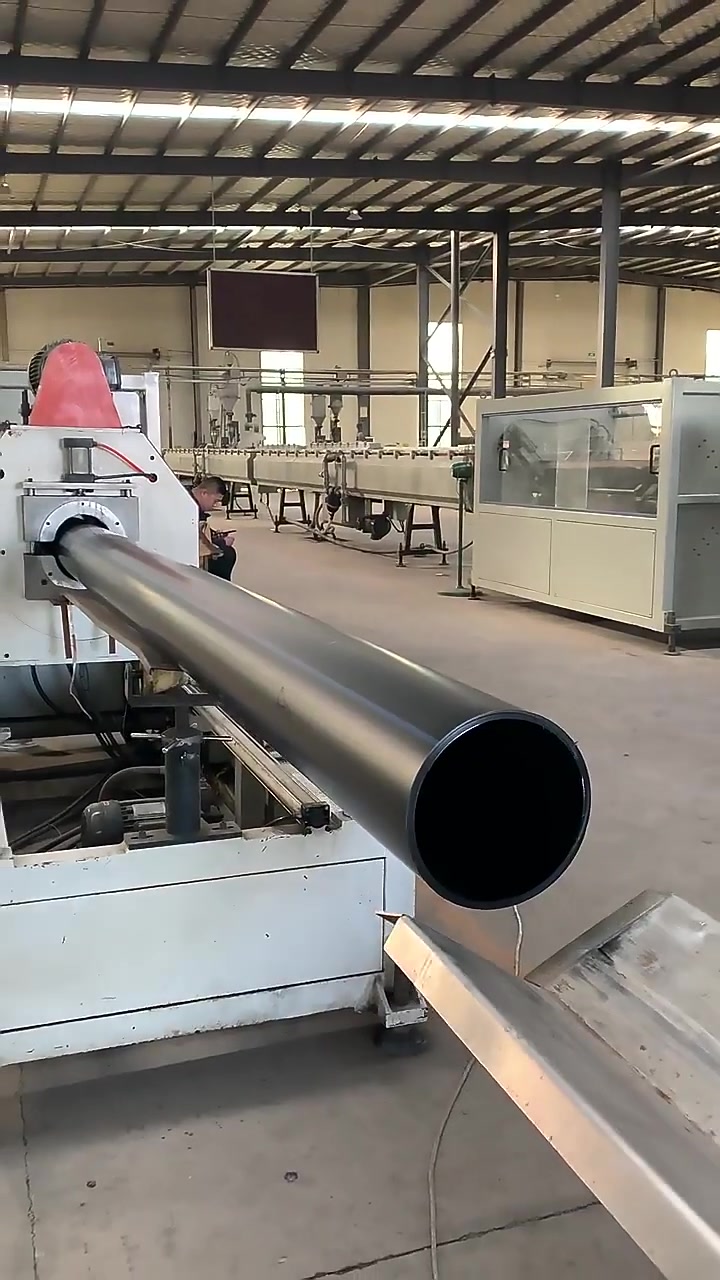
PE pipe is the most technically demanding of the five. Sub-segments include PE80 (low-pressure gas), PE100 (medium-high pressure gas and municipal water), and PE-RT (heating). The substitution of ductile iron and cast iron is well advanced — 78% of Chinese city gas low-pressure networks already use PE pipe, and 52% of municipal water large-diameter networks (DN200 and above) use PE100. Large-diameter PE100 (DN1200 and above) production requires multi-thousand-ton extruders, 80-120 meter water-cooled sizing lines, and full automation; fewer than 25 Chinese plants can manufacture above DN1200.
PEX (cross-linked PE) is the hidden champion in underfloor heating. Output is about 0.75 Mt, split roughly 22% PEX-a, 41% PEX-b, 12% PEX-c, with PEX-a commanding the highest premium. The "clean heating" subsidy program in northern China has been the primary demand driver since 2017.
PB (polybutylene-1) is the boutique luxury — superior creep and pressure resistance, three to four times the raw material cost of PPR. China produces only about 70 kt per year, mostly imported, serving five-star hotels, premium commercial buildings, and hospitals.
Chapter 3. Core Manufacturing Processes and Engineering Barriers
Extrusion molding is the universal manufacturing process for plastic pipes — feed pellets into the extruder, melt and pressurize through the screw, push through the die, cool through sizing, cut to length, flare for jointing, and stack for shipment. Although deceptively simple in concept, the engineering complexity ramps quickly with pipe diameter, wall thickness, resin type, and end-use scenario.
Standard single-screw extruders range from 80 mm (90-180 kW, annual capacity 0.8-1.8 kt) up to 250 mm parallel twin-screws (800-1500 kW, annual capacity 12-25 kt). Chinese domestic extruder manufacturing has matured significantly — by 2025 the localization rate for PVC and PE extruders has reached 75-82%, while large-diameter PE100 (DN800+) and dedicated PEX-a extruders remain about 25-35% localized.
Double-wall corrugated pipe (HDPE corrugated pipe) is the engineering jewel — outer corrugated wall provides ring stiffness, inner smooth wall ensures flow. Production requires synchronized double-layer extrusion, mold action, and vacuum cooling. Steel-reinforced PE pipe is another high-end variant for large-diameter pressure applications, with steel wire wound between two layers of PE100 to achieve 2.5-4.0 MPa working pressure versus 1.6 MPa for standard PE100.
PPR multilayer co-extrusion enables premium variants — antibacterial PPR with silver-ion inner layer, oxygen-barrier PPR with EVOH middle layer, and PP-RCT for higher temperature applications up to 95-110 degrees Celsius. PEX-a peroxide cross-linking remains the highest hidden barrier; Uponor (Finland) is the global pioneer, and Chinese players have spent over a decade narrowing the gap.
Chapter 4. Chinese Leaders versus Global Majors
China Lesso (2128.HK) is the absolute leader. 2025 consolidated revenue was about RMB 31.2 billion with net profit about RMB 1.48 billion. Net margin was 4.7%. Lesso is the only Chinese player with full five-category coverage, with capacity distributed across Guangdong, Hubei, Shandong, Jiangsu, Sichuan, Liaoning, plus Indonesia, Canada, and Uganda. Global capacity reached about 2.8 Mt per year by end-2025. The strategic agenda for 2026-2030 is to expand overseas, consolidate domestic mid-sized players through acquisition, and break into high-end PPR and PEX-a.
Weixing New Building Materials (002372.SZ) is the high-end brand champion. 2025 revenue was about RMB 7.8 billion with net profit about RMB 1.42 billion — net margin 18.2%, by far the highest in the industry. The product mix is PPR (52%), PE (22%), PEX (12%), waterproofing (9%), other (5%). Capacity is concentrated at the Zhejiang Linhai headquarters with secondary bases in Shanghai, Chongqing, Tianjin, and Thailand Rayong. The 2026-2030 strategy is to consolidate PPR premium, expand PEX-a and waterproofing, and use the Thailand base to radiate into Southeast Asia.
Eric New Building Materials (002641.SZ) is the channel powerhouse. 2025 revenue was RMB 9.2 billion with net profit RMB 0.32 billion. Product mix is PVC-U (48%), PE (26%), PPR (14%), solar PV (8%), other (4%). Capacity is distributed across Zhejiang, Jiangsu, Guangdong, Shandong, Henan, and Sichuan, totaling about 1.45 Mt per year. The strength is the dual PVC-U plus PE engine combined with strong real-estate developer relationships.
The four regional leaders — Gudi, Xiongsu, Yonggao, and Nakon — collectively hold about 9% market share and are likely acquisition targets for Lesso, Weixing, or Eric in 2027-2029.
Among the global majors: Aliaxis (Belgium) had 2025 revenue of about EUR 3.6 billion and global capacity of about 3.8 Mt per year, with adjusted EBITDA margin of 15.3%; Wavin (Orbia subsidiary, UK origin) had 2025 revenue of about EUR 2.5 billion; Pipelife (Wienerberger subsidiary, Austria) had 2025 revenue of about EUR 1.8 billion; Orbia (formerly Mexichem, Mexico, NYSE: ORBIA) had 2025 group revenue of about USD 7.2 billion with the plastic pipe business contributing about 38%; Georg Fischer Piping Systems (Switzerland) had 2025 revenue of about CHF 1.42 billion with EBITDA margin of 18% — the highest among global majors, reflecting its "Swiss craftsman" positioning in high-end industrial pipes for semiconductors, pharmaceuticals, heat pumps, and marine applications.
Chapter 5. Home Decoration Downstream — PPR and Drainage in the Real-Estate Cycle
Home decoration was historically the single largest end-use for plastic pipes, taking about 32% of total demand. The 2017-2021 stable annual sales of 1.6-1.8 billion square meters of new commercial residential floor space consumed roughly 4.8-6.2 Mt of home-decoration pipes per year. By 2025 new residential sales had fallen to about 0.92 billion square meters, and pipe demand from new construction had nearly halved over five years.
The decline has reshaped the competitive landscape. Premium brands like Weixing and Rifeng benefit from "fewer but better" — pipe value per square meter is rising 15-25% as fine-decoration upgrades take hold. Mid-tier brands face 15-25% revenue decline. Gray-market players are down 40-65% and many have closed or been acquired. The "high-end stable, mid-tier slow decline, low-end collapse" pattern defines the 2024-2026 shakeout.
Used-home renovation is the new growth story. 2025 second-hand home transactions reached about 0.65 billion square meters, with about 38% renovated within two years of purchase. Annual pipe consumption is 0.95-1.25 Mt and growing at 12-18% per year. Renovation buyers care more about brand, warranty, and installation quality than about price — favoring premium brands with strong terminal store networks. Weixing and Rifeng are the biggest beneficiaries.
Underfloor heating is another bright spot. 2025 PEX and PE-RT heating pipe consumption reached about 0.95 Mt, up from 0.72 Mt in 2021. The driver is the "clean heating" subsidy program, urban district heating expansion, and energy-efficiency retrofits of social housing. The Institute projects 1.30-1.50 Mt annual consumption by 2030.
Chapter 6. Municipal Downstream — Gas, Water, Drainage, Irrigation, Sponge City
Municipal infrastructure is the second-largest end-use, taking about 22% of total demand. The mix is roughly 28% city gas PE pipe, 22% municipal water PE pipe, 32% municipal drainage PVC-U plus double-wall corrugated pipe, 12% electrical conduit, and 6% other. Demand is driven by municipal infrastructure investment, local government special-purpose bonds, urban new-area development, old pipe network renovation, and sponge city pilots.
City gas PE pipe has been displacing cast iron and corrosion-protected steel since 2010. By 2025 PE pipe occupies 78% of low-pressure city gas networks in China; the Institute projects 88-92% by 2030. The dominant customers are large gas operators — China Resources Gas, ENN, China Gas, Kunlun Energy, Hong Kong and China Gas — all of which procure under annual framework agreements with strict brand, specification, third-party testing, and warranty requirements.
Municipal water PE100 pipe is replacing ductile iron in DN200 and larger applications. By 2025 PE100 holds 52% market share in large-diameter municipal water versus 32% for ductile iron and 16% for steel and other. The Institute projects PE100 share to reach 65-70% by 2030.
Sponge city is the national urban renewal strategy launched in 2014. By 2025 it covers 30 national pilot cities and about 80 provincial pilot cities, with annual investment of RMB 38-42 billion. Pipe consumption is about 0.28 Mt per year, growing at 14-18% annually. The Institute projects 0.55-0.75 Mt annual consumption by 2030.
Agricultural irrigation is the steady-state base. 2025 consumption was about 1.65 Mt, with PE drip irrigation pipe leading at 0.88 Mt. The drivers are high-standard farmland construction, water-saving subsidy programs, and rural infrastructure upgrades. China's water-saving drip irrigation area expanded from 80 million mu in 2015 to 420 million mu in 2025.
Chapter 7. The Platform Perspective on Downstream Factories
The Institute applies its "factory map plus downstream process" twin-axis methodology to the plastic pipe industry in this chapter. The Tianxia Gongchang platform — a B2B platform covering 4.8 million in-production Chinese factories, distinct from corporate-record lookup services (Qichacha, Tianyancha) by virtue of focusing on process and capacity mapping rather than registration verification — performs a three-axis (process, application, geography) inventory of plastic pipe downstream capability.
Filtering by plastic extrusion and plastic pipe production, the platform records about 12,500 factories with plastic extrusion lines, of which about 7,800 focus on plastic pipes. The geographic distribution: Guangdong about 1,950 (25%), Zhejiang about 1,180 (15%), Shandong about 920 (12%), Jiangsu about 720 (9%), Hubei about 560 (7%), other provinces about 2,470 (32%). Distribution by scale: 280 factories with revenue above RMB 100 million (3.6%), 620 between RMB 50-100 million (8.0%), 2,180 between RMB 10-50 million (28.0%), 1,820 between RMB 5-10 million (23.3%), 2,900 below RMB 5 million (37.1%). The long tail is striking — the bottom 88% of factories by count hold only 35% of capacity, providing the structural backdrop for the consolidation trend.
Application-segment factory counts: building water supply about 1,850, building drainage about 1,520, municipal water about 1,180, municipal drainage about 980, city gas about 580, agricultural irrigation about 1,250, electrical conduit about 720, underfloor heating about 380. Aside from city gas and underfloor heating with their relatively high barriers, every application has more than 700 suppliers, indicating intense competition.
The supply-demand reverse analysis on the Yangtze-Hangzhou metropolitan circle (radius 300 km covering Shanghai, Suzhou, Hangzhou, Ningbo, Wuxi, Nanjing) shows annual pipe consumption of about 1.45 Mt against in-circle effective capacity of about 2.80 Mt — a 1.93 supply-demand ratio. The Chengdu-Chongqing dual-city circle shows the opposite — 0.88 Mt consumption against 0.65 Mt capacity, a 0.74 ratio. This map directly explains why Lesso, Weixing, Eric, and Nakon are all expanding aggressively in Sichuan and Chongqing.
The pipe fittings market is a less obvious gold mine. Pipe fittings (elbows, tees, crosses, unions, reducers, end caps, valves) consumption is about 5-11 billion pieces per year, market size RMB 28-46 billion. Gross margins of 25-38% are significantly higher than the 12-22% on pipe itself.
Chapter 8. Localization and Export Expansion
The localization story has two main threads — extrusion equipment and raw-material resin. Extrusion equipment localization reached 75% by value in 2025, with PVC and PE mid-diameter equipment at 82%, PPR multilayer co-extrusion at 65%, large-diameter PE100 (DN800+) at 35%, and dedicated PEX-a at 25%. The remaining import dependence concentrates in two high-end niches that will require 8-15 years to fully localize.
Raw-material localization is mixed. China is a net PVC exporter, with localization effectively above 100%. PE100 has about 19% import dependence, mainly from Middle East and Southeast Asia. PPR is self-sufficient. PEX-a peroxide initiators are partially imported. PB remains over 90% import-dependent.
Export expansion is the more dramatic story. 2020 exports were about 0.65 Mt (4% of output); 2025 exports reached 1.95 Mt (11.8% of output); the Institute projects 3.5-4.2 Mt by 2030 (18-22% of output). Southeast Asia is the largest destination (32%, about 0.62 Mt in 2025), followed by Africa (22%, 0.43 Mt), Latin America (18%, 0.35 Mt), and Middle East (14%, 0.27 Mt). Vietnam is the single largest country at about 0.18 Mt.
The two strategic options for overseas penetration are "build local factories" versus "export trade." China Lesso has built factories in Indonesia, Canada, and Uganda. Weixing built a factory in Thailand Rayong. The Institute projects head players will tilt toward local factory building over the next five years — overseas factories show higher net margins than domestic plants (Lesso Indonesia 2025 net margin about 8.2% versus China 4.5%; Weixing Thailand about 12.5% versus China headquarter 18.2% for premium PPR).
Chapter 9. Capacity Expansion — Lesso, Weixing, Nakon and Others
Capacity expansion has bifurcated. The three oligopolies expand aggressively domestically and overseas; regional leaders expand modestly in nearby provinces; small players have stopped expanding or shut down.
China Lesso disclosed 2025-2027 new capacity projects totaling about 0.85 Mt per year. Major projects include Guangdong Gaoming phase three (0.18 Mt, H2 2026), Hubei Jingzhou phase two (0.22 Mt, Q4 2026), Liaoning Anshan phase two (0.12 Mt, in service 2025), Hainan Haikou (0.08 Mt, Q1 2026), Indonesia Surabaya phase two (0.15 Mt, Q3 2026), Canada Vancouver phase two (0.06 Mt, Q1 2027), and Uganda Kampala phase two (0.04 Mt, Q4 2026). Aggregate 2024-2027 capacity will rise from 2.8 Mt to 3.65 Mt — a 30% expansion. Domestic and overseas split roughly 70/30.
Weixing's 2025-2027 disclosed projects total about 0.35 Mt per year, with 0.12 Mt at Zhejiang Linhai phase four, 0.08 Mt at Shanghai Caojing phase two, 0.09 Mt at Thailand Rayong phase two, and 0.06 Mt at Sichuan Mianyang. Aggregate 2024-2027 capacity will rise from 1.13 Mt to 1.48 Mt — a 31% expansion. Focus on high-end PPR, PEX-a, and waterproofing is consistent with the high-margin strategy.
Nakon and Donghong are the leading regional players in double-wall corrugated pipe and large-diameter PE pipe respectively. Nakon's 2025-2027 expansion adds about 0.18 Mt per year focused on corrugated pipe; Donghong adds about 0.22 Mt focused on large-diameter PE and steel-reinforced PE. Neither matches the oligopolies in absolute scale, but both are meaningful in their specific niches.
Chapter 10. Price Cycles and Cost Pass-Through
The plastic pipe price cycle has three nested layers — raw-material resin price, pipe price per tonne, and pipe gross margin per tonne. Each layer responds to different drivers with different lag times.
PVC resin averaged RMB 5,650, 5,850, and 5,950 per tonne in 2024, 2025, and 1H 2026 respectively — down 37% from the 2021 peak of RMB 9,500 per tonne but up 14% from the 2022 trough of RMB 5,200. PE100 averaged RMB 8,250, 8,550, and 8,720 per tonne — moderate volatility tied to crude oil, Southeast Asia ethylene supply, and Middle East PE capacity additions. PPR resin averaged RMB 9,200, 9,650, and 9,850 per tonne — modest upward trend due to slower capacity expansion of random copolymer grades.
Pipe price decline has been steeper than raw-material decline. PVC-U pipe fell from RMB 9,800 per tonne in 2021 to RMB 7,200 in 2025, down 27%. PE pipe fell from RMB 17,500 to RMB 14,200, down 19%. PPR pipe fell from RMB 28,500 to RMB 26,800, down only 6%. PEX pipe fell from RMB 32,200 to RMB 30,800, down 4%. High-end categories (PPR, PEX) held up much better than mid- and low-end categories (PVC-U, PE) — the classic real-estate downturn plus small-mill price war pattern.
Gross margin per tonne has been squeezed by the scissors effect — raw-material prices fell about 25% on weighted average, pipe prices fell about 18%, but fixed costs (depreciation, labor, management) are relatively rigid. Fixed cost share of total cost rose from 35-40% in 2021 to 50-58% in 2025. Mid- and small-plant gross margin per tonne fell from RMB 1,500-2,200 in 2021 to RMB 200-800 in 2025; some plants are now negative. The leaders maintained healthier margins through high-end category mix, channel premium, and scale absorption.
Chapter 11. Policy Tailwinds — Sponge City, Old Pipe Renovation, Gas Substitution, Real-Estate New Model
The policy environment is shaped by four streams — municipal infrastructure, urban renewal, real-estate new model, and environmental upgrade. Several policies actively specify pipe technology (city gas mandatory PE, municipal water encouraged PE100), making them direct demand drivers.
Sponge city is a national strategy launched in 2014 by the Ministry of Housing and Urban-Rural Development. Coverage has reached 30 national pilots plus 80 provincial pilots, with annual investment of RMB 38-42 billion. The Institute projects sponge city-related pipe consumption to reach 0.55-0.75 Mt per year by 2030.
The "two new and one heavy" old pipe renovation special initiative launched in 2024 commits about RMB 1.8 trillion over three years, of which RMB 380-520 billion goes to plastic pipes. Annual renovation includes 18,000-25,000 km of water supply, 12,000-18,000 km of drainage, 8,000-12,000 km of gas, and 35,000-45,000 residential community interior networks. This is the largest single policy demand driver for 2024-2026.
The 2018 city gas PE mandate requires all 30-plus-year-old cast iron gas mains and 50-plus-year-old steel gas mains to be replaced by 2025. The mandate has driven city gas PE consumption from 0.65 Mt per year in 2018 to 0.92 Mt in 2025, with the Institute projecting 1.15-1.35 Mt by 2030.
The 2022-2025 "guaranteeing project delivery" special program for stalled real-estate projects funded delivery of about 12.5 million problem units, of which roughly 30% involved interior fit-out (including plastic pipes). The cumulative plastic pipe consumption from this program was 1.0-1.5 Mt, providing temporary counter-cyclical support that is now winding down.
Chapter 12. Research Institute Judgment — The 3 to 5 Year Path
The Tianxia Gongchang Research Institute synthesizes its judgments on the 2026-2030 evolution path of China's plastic pipe industry in this chapter, drawn from the preceding eleven chapters of process, manufacturer, downstream, policy, price, and export analysis.
First, domestic demand enters an "L-shape" low-growth phase. Annual growth of about 2-4% — far below the 10-14% of 2010-2020. The L-shape low growth comes from real-estate stabilization, municipal infrastructure steady state, rise of renovation demand, and ongoing policy ammunition from sponge city and old pipe renovation. The share of new commercial residential floor space in total demand will fall from 65% in 2021 to 38-42% by 2030.
Second, CR10 accelerates to 38-45% by 2030 from 28% in 2025. The mechanism is leader expansion plus acquisition plus small-plant shutdown. CR3 (Lesso, Weixing, Eric) rises from 19% to 24-28%. One to two of the regional leaders likely become acquisition targets in 2027-2029. Compliant in-production factories decline from about 12,500 in 2025 to 7,500-8,500 by 2030.
Third, overseas penetration accelerates. Export volume rises from 1.95 Mt in 2025 to 3.5-4.2 Mt by 2030 (12-16% CAGR), with export share of output rising from 11.8% to 18-22%. Overseas factory capacity for the leading three doubles to triples. Overseas business contribution to consolidated revenue rises from 7-12% in 2025 to 18-25% by 2030.
Fourth, high-end strategy becomes the inevitable choice for leaders. High-end PPR (antibacterial, oxygen-barrier, PP-RCT) rises from 15% of PPR output to 25-32%. Domestic PEX-a share rises from 22% to 32-38%. Large-diameter PE100 and steel-reinforced PE localization rises from 35% to 55-65%. High-end industrial pipes (semiconductor ultra-pure water, chemical-resistant, heat pump, marine engineering) move from "essentially absent" to "substantially localized" in domestic market.
Fifth, raw-material prices stay in the historical mid-low range with narrow oscillation. PVC RMB 5,500-7,000 per tonne, PE100 RMB 8,500-10,000, PPR RMB 9,500-11,500. Leader gross margin per tonne recovers from RMB 1,200-1,800 in 2025 to RMB 1,400-2,200 by 2027-2028, driven by high-end mix, channel concentration, and overseas margin contribution.
Sixth, the global majors are increasingly marginalized in China. Combined share of the five majors in China falls from 4% in 2025 to 2-3% by 2030. Only Georg Fischer retains the high-end industrial niche. Meanwhile Chinese leaders capture share overseas — Southeast Asia 35-42%, Africa 22-28%, Latin America 15-20% by 2030.
Chapter 13. Risks and Uncertainties
Five categories of risk could push outcomes off the central scenario.
First, deeper-than-expected real-estate downturn. The central scenario assumes residential sales stabilize around 0.92 billion square meters per year. If sales fall further to 0.7-0.8 billion square meters per year through 2026-2028, plastic pipe domestic demand could enter L-shape negative growth. The Institute estimates 25-35% probability for this scenario.
Second, overseas-major counter-attack through localization or acquisition. If Aliaxis, Wavin, or Pipelife shift from export-trade to large-scale factory building or acquisition in China, market-share marginalization could reverse. The Institute estimates 15-25% probability.
Third, raw-material price volatility. If crude oil moves sharply (USD 100-130 per barrel or USD 40-55 per barrel for an extended period), resin prices and pipe margins will experience violent swings. The Institute estimates 35-45% probability — the highest among the five.
Fourth, policy schedule slippage. Local government fiscal stress could delay sponge city, old pipe renovation, gas mandate, or "guaranteeing project delivery" funding by 12-24 months. The Institute estimates 30-40% probability.
Fifth, overseas anti-dumping and localization barriers. India and Brazil have already filed anti-dumping cases. If the EU, US, and several Southeast Asian markets file in 2026-2028, China's plastic pipe export growth could be suppressed for 18-36 months and slow from 12-16% CAGR to 4-8%. The Institute estimates 40-50% probability — the second-highest.
Risk interactions amplify exposure. A combination of deeper real-estate downturn, sharp raw-material volatility, and dense anti-dumping filings could create a triple squeeze in 2027-2028. The Institute estimates 5-10% probability for this extreme adverse scenario.
Chapter 14. Data Sources and Methodology
All data in this report come from public sources. The Institute cross-validates all data and adopts a multi-source weighted approach with priority to authoritative sources for figures where sources diverge.
Listed-company financial and capacity data: China Lesso (2128.HK 2025 annual report and 2026 interim results), Weixing New Building Materials (002372.SZ 2025 annual report and H1 2026 flash), Eric New Building Materials (002641.SZ 2025 annual report), Gudi Technology, Xiongsu Technology, Yonggao, Nakon Pipe Network (CNINFO disclosures); Aliaxis (Belgium 2025 annual report), Wavin (Orbia subsidiary 2025 consolidated disclosure), Pipelife (Wienerberger subsidiary 2025 annual report), Orbia (NYSE: ORBIA 2025 annual report), Georg Fischer (SIX Swiss Exchange 2025 annual report).
Industry statistics: China Plastics Processing Industry Association pipe products committee, China Plastic Pipe Industry Conference public reports, NBS monthly plastic products output, China customs HS 39172110-39172919 import-export statistics. Overseas data: TEPPFA (European pipe association), PPI (North American pipe institute), Japan plastic pipe association, PLEXCONCIL (India).
Raw-material prices: PVC pricing from ICIS, Argus, Platts; domestic agencies Zhuochuang, Sci99, Longzhong. Crude oil from BP World Energy Statistics, EIA, OPEC monthly reports.
Policy and project data: State Council bulletins; NDRC, MOHURD, MOF, PBoC public documents; local-government special-purpose bond announcements; LGFV annual reports; MOHURD special fund allocation announcements; public reporting by Xinhua, People's Daily, CCTV.
International news and foreign-language sources: Reuters, Bloomberg, Nikkei Asia, Plastics News (USA), European Plastic News, Plastics Technology, Compelo, Just-Style. The Institute maintains the methodology of cross-validating Chinese and English sources for all key judgments, avoiding single-source bias.
Platform factory map data: The downstream factory-map data in Chapter 7 are sourced from the Tianxia Gongchang platform covering 4.8 million in-production Chinese factories, using its three-axis (process, application, geography) classification and aggregation.
Data validity and update schedule: The data cutoff is 2026-06-27, covering full-year 2024 actuals, most of 2025 disclosed data, and partial 1H 2026 data. The Institute publishes an annual update each June.
Cross-report references: Previous reports — China Chlor-Alkali and PVC 2026, China Modified Plastics 2026, China Chemical Materials 2026, China Water Treatment Equipment 2026 — together form a complete coverage matrix of China's plastic, chemical, and water-treatment value chains. Readers are encouraged to read related reports in upstream-resin → midstream-pipe → downstream-application sequence.
Disclaimer: The data and judgments in this report are for reference only and do not constitute investment advice or procurement decision basis. Readers should verify data accuracy independently and bear decision risk accordingly. Full disclosure of usage terms is available on the Institute's official website.