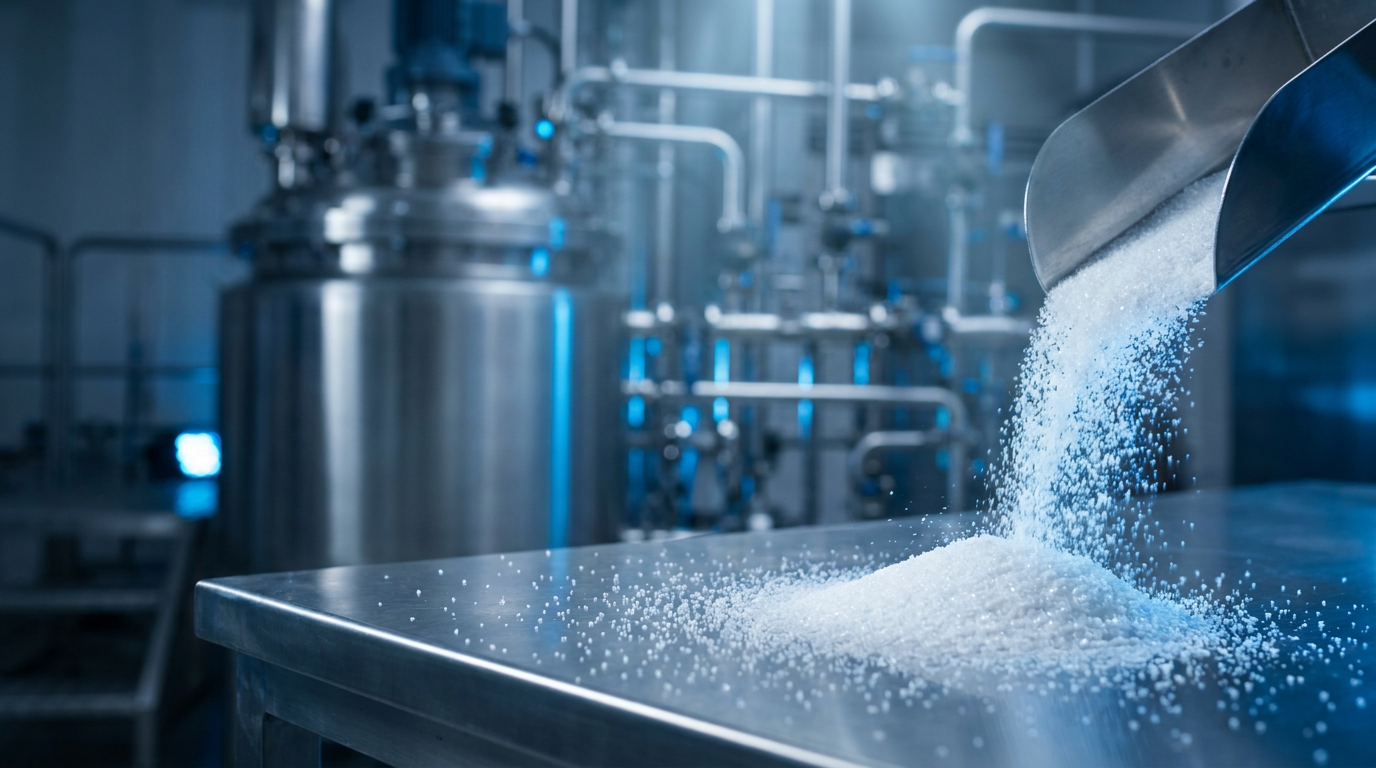

A spoonful of white powder can strip 60 grams of sugar from a one-liter Coca-Cola; a single ton of crystal sold for RMB 400,000 at the peak of 2022 and crashed to RMB 9,500 at the trough of 2024. That curve traces the past three years of China's sweetener industry — the intermediate-chemical battleground that absorbed the first shock and harvested the first dividend when the global food industry pivoted toward sugar reduction.
In 2025, the global sweetener market exceeded RMB 2.28 trillion in renminbi equivalent. Within that aggregate, sucrose and HFCS remain dominant, but what is truly reshaping every soft-drink and food formulation is the rise of high-intensity sweeteners (HIS) and functional polyols. One ton of sucralose substitutes 600 tons of sucrose; one ton of stevioside replaces 300 tons; one ton of allulose preserves the mouthfeel while pushing calories down to 0.4 kcal per gram. Within the sub-USD 30 billion global HIS market, China holds a startling share of voice: above 85% of global sucralose capacity, above 60% of acesulfame, 65% of erythritol, 80% of stevia supply, and 90% of monk fruit production from the Guilin region.
This is not a sentimental story. In Lai'an County south of Anhui, Jinhe Industrial's sucralose plant runs four shifts continuously; in Wudi County of Binzhou, Shandong, San Yuan Biotech's erythritol fermenters nearly shut down during the 2024 price war then thundered back to life in 2025; at Layn Natural's monk fruit processing site in Guangxi Wuzhou, fresh fruit from Yongfu and Longsheng counties of Guilin moves through water extraction, column chromatography, membrane separation, and spray drying to become RMB 18 million per ton Mogroside V crystal; in Kaihua of Zhejiang, corn cobs at Huakang Pharma's hillside facility hydrogenate into xylitol bound for European gum brands or sterile parenteral nutrition bags at Beijing tertiary hospitals.
This is a deep research report on China's sweetener industry. It seeks to answer four real questions: How was China's global market share forged? What allows Jinhe Industrial to lead acesulfame and sucralose simultaneously? Why did San Yuan Biotech's erythritol myth collapse in 2023-2024 and recover in 2025? Over the next five years, with aspartame classified as possibly carcinogenic by IARC, sugar taxes implemented in over 30 countries, and allulose and monk fruit taking the relay, how will the global sweetener structure reshape?
This report covers the full process map — chemical synthesis, microbial fermentation, plant extraction — across six leading Chinese producers (Jinhe, San Yuan, Layn, Bao Ling Bao, Huakang, Tianjin Northern Food), benchmarks five international giants (Tate & Lyle, Ingredion, Cargill, ADM, Ajinomoto), reviews three representative downstream applications (Genki Forest, Coca-Cola Zero, Nongfu Spring Oriental Leaf), and tracks the 2024-2026 price cycle. Data sources include 2025 annual reports of each company, IARC/FDA/EFSA official notices, Tate & Lyle FY2025 annual report, Reuters/Nikkei/FoodNavigator English media coverage, and real factory distribution data from the platform.
1. Industry Overview: From One Gram of White Powder to a Two-Trillion Global Market
1.1 What is a sweetener — from molecular structure to industry boundary
In China's food industry, "sweetener" officially refers to food additives that impart sweetness. It splits into three categories: high-intensity sweeteners (HIS), polyols (sugar alcohols), and natural sugar substitutes. The classification looks neat but practitioners cross-cut along two axes — sweetness multiple and process route.
By sweetness multiple: saccharin 400x, aspartame 200x, acesulfame 200x, sucralose 600x, neotame 8000x, alitame 2000x. These chemical-synthesis HIS replace large volumes of sucrose at near-zero dosing and ultra-low unit cost. Polyols are different: erythritol is 0.65x sucrose sweetness, xylitol matches sucrose, sorbitol 0.5x, maltitol 0.9x. The polyol value proposition is not savings but substitution — replacing sucrose's calories, cariogenicity, and glycemic spike.
By process route: chemical synthesis (saccharin, aspartame, acesulfame, sucralose) lives on fine-chemical reactions, capacity stacking, and cost curve. Microbial fermentation (erythritol, allulose part-route) runs on strain, medium, fermenter, separation. Plant extraction (stevia, monk fruit, glycyrrhizin) depends on upstream agriculture, extraction protocol, and glycoside purification. Three different industrial genes that determine completely different company DNAs: chemical-synthesis plants look like fine chemical plants, fermentation plants resemble biopharmaceutical factories, and extraction plants closely resemble traditional Chinese medicine extraction workshops.
1.2 Market size — RMB 2.28 trillion global, RMB 520 billion China
In 2025 the global sweetener market is around RMB 2.28 trillion in renminbi equivalent. Traditional sugars (sucrose, HFCS, maltose, glucose) account for over 70%. The genuinely fast-growing — and the focus of this report — sugar-substitute track (HIS + polyols + natural extracts) reaches RMB 65 billion in 2025, with five-year CAGR near 6%.
Focusing on China: the actual sweetener consumption in China's food industry in 2025 reaches RMB 52 billion (ex-factory basis, excluding sucrose and starch sugars). Within: sucralose global demand 17,500 t at 2025 Q4 average RMB 240,000 per ton equals RMB 4.2 billion global market, with Chinese export over 90% and domestic consumption around 10,000 t; acesulfame global demand 28,000 t at RMB 38,000 per ton equals RMB 1.1 billion global; erythritol 2022 China export peaked at 240,000 t, 2024 retreated to 120,000 t under price war and Europe-US softness, 2025 stabilized and recovered to 140,000 t at RMB 14,000 per ton equals RMB 2 billion China export; allulose 2025 global demand 30,000 t with CAGR over 25%, average RMB 55,000 per ton equals RMB 1.6 billion global; stevia 2025 global demand 12,000 t glycoside equivalent at mixed Reb A RMB 220,000 plus Reb M RMB 800,000 equals RMB 3 billion global; monk fruit Mogroside V 2025 global demand 600 t at RMB 18 million per ton equals RMB 1.1 billion global. Polyols (xylitol, sorbitol, maltitol, erythritol) in China produce 1.3 million t annually with ex-factory RMB 18 billion.
1.3 Historical lineage — from saccharin to monk fruit, a sweet civilization
Humanity has chased sweetness alongside civilization. Sucrose moved from India to Europe after the Crusades; by the 19th century, Caribbean plantations built sugar's industrial peak. The first true artificial sweetener arrived in 1879 — at Johns Hopkins, Constantin Fahlberg accidentally discovered the sweetness of a coal tar derivative residue on his finger. Saccharin was born. Through the 20th century, saccharin dominated artificial sweeteners. World Wars I and II amplified usage during sugar shortage, but the metallic aftertaste and the 1977 Canadian bladder-cancer study (followed by US warning labels in 1981 and removal in 2000) pushed the food industry toward alternatives.
The second generation arrived between 1965 and 1980: cyclamate (discovered 1937), aspartame (Searle 1965), acesulfame (Hoechst 1967). These three formed the chemical backbone of the "no-sugar cola era." Diet Coke launched 1982 with aspartame; Diet Pepsi followed. The third generation was sucralose — discovered 1976 by Tate & Lyle and Queen Elizabeth College, FDA approved 1998, the near-gold-standard with 600x sweetness, zero calories, and 180°C thermal stability. The fourth generation went natural: stevia industrialized 1971 by Morita Kagaku of Japan from South American stevia leaf origin, monk fruit industrialized in the 1990s by Guilin research institutes, erythritol industrialized through fermentation in the 1990s by Mitsubishi Chemical and Bao Ling Bao. The fifth generation is rising: allulose commercialized 2011 by Matsutani via fermentation, plus fermented stevia Reb M (Cargill-DSM EverSweet 2016, PureCircle, China's Chenguang and Layn).
China's sweetener industry caught all three later windows. The 1990s saw Tianjin Northern Food make saccharin the global #1; the 2000s saw Jinhe enter acesulfame from circular economy and extend to sucralose; the 2010s saw Bao Ling Bao and San Yuan dominate erythritol globally; the 2020s saw Layn, Chenguang, PureCircle lead stevia and monk fruit globally; the late 2020s sees Bao Ling Bao, San Yuan, Huakang building allulose new capacity.
1.4 Price cycle — three years from heaven to hell to half-up
2022 was the "super cycle" for China sweeteners. Sucralose ex-works moved from RMB 220,000 per ton at year start to RMB 400,000 at Q4. Acesulfame moved from RMB 28,000 to RMB 48,000. Erythritol from RMB 18,000 to RMB 38,000. All three peaked simultaneously, driven by Genki Forest's "zero sugar, zero calorie" phenomenon since 2020-2021 spreading across China's beverage market plus accelerated global rollout of Coca-Cola Zero Sugar and PepsiCo Zero Sugar — a demand-side eruption.
But the seeds of prosperity are usually the seeds of recession. In 2022 Chinese producers collectively launched capacity expansions — Jinhe Lai'an sucralose phase 3, San Yuan Wudi erythritol +50,000 t, Bao Ling Bao Yucheng allulose +10,000 t, new entrants Bao Ling Bao Bo Long Chuang Yuan Huakang collective buildup. Coupled with European-American demand retreat in 2023, the aspartame IARC 2B controversy nudging formulators to caution, and downstream beverage cost cutting due to consumption downgrade — 2023-2024 prices collapsed across the board. Erythritol was the worst: 2022 peak RMB 38,000, 2024 Q1 trough RMB 9,500, down 75%. San Yuan 2023 non-recurring net loss RMB 180 million, 2024 RMB 320 million — two consecutive years of major losses nearly pushed the "erythritol global #1" to the brink of delisting. Sucralose dropped from RMB 400,000 to RMB 180,000, down 55%. Jinhe's cost edge and circular-economy moat kept it profitable through the price war, though gross margin halved from 45% to 20% from 2022 to 2024. Acesulfame stabilized around RMB 32,000 in 2024.
2025 recovery: from Q2, sucralose rebounded, reaching RMB 240,000 by Q4; erythritol stabilized at RMB 14,000 in Q4; allulose stayed at RMB 55,000. 2026 H1 sucralose continued to RMB 260,000, erythritol to RMB 16,000. Three drivers behind the bounce: continued Coca-Cola Zero Sugar global volume, aspartame substitution finally materializing, and Chinese producer-led production cuts (San Yuan shut two lines in 2024, Jinhe delayed some expansion). The 2026 China sweetener industry has just exited the price floor, well below the 2022 peak. Capacity remains in excess but the reshuffle is in mid-game.
2. Generations of Products: From Saccharin to Allulose Sweetener Lineage
2.1 First generation: saccharin — 140-year debated veteran
Saccharin (o-benzoic sulfimide) has been industrialized for over 140 years and remains the cheapest sweetener — only USD 0.0025 per kg of sucrose-equivalent substitution, just 0.5% of erythritol's unit cost. China is the global "monopoly producer": Tianjin Northern Food (originally Tianjin Saccharin Factory) at 18,000 t per year holds 60% of global supply; other capacity sits in Yancheng Jiangsu and Shanghai. Global total around 30,000 t, primarily consumed in Asia (China, India, Southeast Asia), Latin America and Eastern Europe — markets that are cost-sensitive and more tolerant of artificial taste. Western premium markets have largely moved on.
Two process routes: classic Remsen-Fahlberg from toluene via chlorosulfonation-amination-oxidation (mature, by-product heavy, environmental pressure high); and Maumee route from anthranilic acid (cleaner, higher purity, used for pharma and premium food grades). Tianjin Northern Food and Yancheng Jiangsu plants mostly use improved Maumee. Saccharin's market position is interesting — not substitution but stratification: low-end (chewing gum, cheap drinks, animal feed, pharma adjuvants) still dominated by saccharin; mid-tier shared with aspartame and acesulfame; premium (Zero Coke, Genki Forest, health foods) held by sucralose, erythritol, allulose. Saccharin doesn't grow, doesn't decline — a flat horizontal line in the sweetener landscape.
2.2 Second generation: aspartame, acesulfame, cyclamate
Aspartame was accidentally discovered in 1965 by Searle chemist James M. Schlatter while synthesizing a gastrointestinal hormone — he tasted strong sweetness on his fingertip. Aspartame is an aspartate-phenylalanine methyl ester dipeptide, 200x sucrose sweetness, same calories per gram (but dosed so low that net calories are negligible). Aspartame's edge is closest-to-sucrose mouthfeel — no saccharin metallic aftertaste, no stevia herbal undertone. That made it the default for Diet Coke, Diet Pepsi, and decades of sugar-free gum.
But aspartame suffered an industry quake in 2023. On July 14, 2023, IARC classified aspartame as Group 2B (possibly carcinogenic to humans) citing limited human observational data and animal studies suggesting hepatocellular carcinoma association. The same day, JECFA delivered the opposite — maintaining 40 mg/kg body weight daily intake, judging existing evidence insufficient to change the conclusion. Consumers don't read papers, only headlines. 2023-2024 global aspartame demand dropped 15%; Coca-Cola and Pepsi reduced aspartame ratio in multiple regions, switching toward sucralose + acesulfame + erythritol. China's aspartame producers (mainly Jiangsu Weidey, Suzhou Haobo) felt direct pressure with capacity rotating to India and Southeast Asia exports. Aspartame global annual output around 18,000 t, of which China exports about 10,000 t.
Acesulfame potassium (Ace-K) was synthesized by Hoechst chemists Karl Clauss and Harald Jensen in 1967, FDA approved 1988. 200x sucrose sweetness, good thermal stability, baking-suitable, with strong synergy alongside sucralose — when 1:1 blended, perceived sweetness can reach 300x. That synergy made acesulfame and sucralose a "golden combination," usually dosed 1:3 or 1:4 in formulas. The process core: diketene + sulfamic acid condensation forming sulfamate intermediate, then PCl3 or SO3 cyclization, finally KOH neutralization. The whole pathway demands corrosion-resistant reactors (strong acid plus strong base), exhaust treatment (SO3 gas), and ultra-purification (removing trace carcinogenic by-products) — the highest process barrier among synthetic sweeteners. China dominates acesulfame absolutely. Jinhe alone runs 17,000 t per year (over 60% of global demand); other capacity at Suzhou Weidey (3,000 t), Suzhou Haobo (2,000 t), Yancheng Jiangsu (2,000 t). Germany's Nutrinova (Celanese, formerly Hoechst business) was once the benchmark but exited gradually through the 2000s, completely yielding to Chinese producers by the 2020s.
Cyclamate (sodium cyclamate) was discovered in 1937 by Michael Sveda at University of Illinois — 30x sweetness, cheap, clean mouthfeel. But a 1969 mouse study linked it to bladder cancer; FDA banned 1970, still not lifted — the only major sweetener completely banned in the US market. EU, Canada, and most Asian markets allow it. China's food industry uses cyclamate heavily; principal producers in Shanghai, Fujian, Shandong; annual output around 30,000 t, mostly exported to South America and Southeast Asia.
2.3 Third generation: sucralose — China's fine-chemical star single product
Sucralose was discovered in 1976 by Tate & Lyle Research and Queen Elizabeth College chemists Leslie Hough and Shashikant Phadnis. FDA approved 1998, EU approved 1999. Tate & Lyle owned all base patents and commercialized under SPLENDA, long the only producer. But 2020 marked the industry pivot — Tate & Lyle sold SPLENDA brand and North American retail to Heartland Food Products Group for USD 200 million, exiting sucralose production, retaining only IP licensing and formulation-solutions roles. The reason: China's cost advantage became irreversible — Jinhe, Yancheng Niutang, Shandong Kangbao together exceeded 90% of global demand at prices unprofitable for Tate & Lyle's UK plant.
Sucralose process routes split into two schools. The first is the all-group protection method: sucrose → fully protect (acetylation or benzylation) → selectively deprotect to reach 6-OH → chlorinate at 4, 1', 6' (Vilsmeier or PCl3) → deprotect to sucralose. Higher purity, fewer by-products, but more steps, lower yield, higher cost. Early Tate & Lyle used this. The second is the single-group protection method (sucrose 6-ester one-step): sucrose → sucrose-6-acetate (dibutyltin dilaurate catalyst) → chlorinate at 4, 1', 6' → deester to sucralose. Fewer steps, higher yield, lower equipment investment, but strict reaction control. This is the mainstream route in China. Jinhe broke through the single-ester process in 2008, cutting cost to less than half of Tate & Lyle's.
Downstream uses are extremely broad: beverages (Coca-Cola Zero, Pepsi Zero, Genki Forest, Nongfu Spring), gum, baked goods, dairy, pharma adjuvants (masking bitterness), personal care (toothpaste, mouthwash). Edge: 600x sweetness, thermal stability (180°C baking), good water solubility, clean mouthfeel with no aftertaste — near-perfect artificial sweetener. China's sucralose structure: Jinhe 15,000 t per year (#1 globally, 60% share), Yancheng Niutang 3,000 t (15%), Shandong Kangbao 2,000 t (10%), Changzhou Kangpu 1,500 t (7%), Jiangsu Weidey 1,000 t. Total China annual output around 23,000 t against global demand around 17,000 t — about 30% over-capacity.
2.4 Fourth generation natural route: stevia, monk fruit, erythritol
Artificial-synthesis sweeteners hit consumer resistance in the late 2000s — European-American "clean label" and "natural origin" preference forced the food industry to reconsider. That opened the upgrade lane for natural sweeteners.
Stevia glycosides come from South American Stevia rebaudiana leaves. Main actives include Stevioside, Rebaudioside A (Reb A), Reb B, Reb C, Reb D, Reb M and others. Reb A was the first industrialized: 300x sweetness, mild herbal aftertaste; Reb M and Reb D taste closer to sucrose at 350x sweetness but exist at extremely low natural content (Reb M below 1% of total glycosides). The China stevia story dates to the 1970s — Morita Kagaku of Japan was first to industrialize, but Chinese producers from 2000 onward leveraged cheaper stevia leaf (Xinjiang Tacheng, Fujian Ninghua, Anhui Fuyang) plus extraction scale to capture 80% of global supply. Main players: Layn Natural (Guangxi Wuzhou + Indiana) at 1,500 t, PureCircle (Jiangxi Ji'an + USA) at 1,000 t, Chenguang Bio (Hebei Handan) at 800 t, Aojing Bio (Shandong Tai'an) at 600 t.
Monk fruit (Mogroside V) is uniquely Chinese — monk fruit (Siraitia grosvenorii) is endemic to Guangxi Guilin's Yongfu and Longsheng counties. Annual fresh fruit output around 150,000 t, dried fruit around 20,000 t. Mogroside V is 300x sweet, zero calories, with antioxidant and lung-moistening properties (Chinese medicine tradition). FDA GRAS. Industrialized only 30 years — 1990s Guilin Jifus and Guilin Layn pioneered Mogroside V extraction; 2010s saw Monk Fruit Corp, Layn Health, Layn Natural as global brands (production still in China); 2020s saw Layn's Indiana plant connecting directly to US food industry. Main producers in Guangxi: Layn 350 t, Guilin Jifus 300 t, Yongfu Xianggui 200 t. Global demand around 600 t, China supplies over 90%.
Erythritol is this generation's most important polyol — 0.65x sucrose sweetness, 0.2 kcal per gram (essentially zero), not metabolized but excreted directly in urine, near-zero glycemic effect. Not high-intensity but a bulking agent — providing sucrose mouthfeel, texture, and volume without calories, making it the core formulation ingredient for Genki Forest's "zero sugar, zero calorie" beverages. Industrialized via microbial fermentation: corn starch glucose syrup or xylitol substrate, Moniliella pollinis or Yarrowia lipolytica yeast under high osmotic stress, generating erythritol crystals, then membrane filtration, carbon decolorization, ion exchange, crystallization to food grade. Mitsubishi Chemical pioneered 1980s; Bao Ling Bao followed in 2000s; Chinese capacity completely overtook in the 2010s. China supplies over 65% globally now.
2.5 Fifth generation: allulose, fermented Reb M — rare sugar industrialization
Allulose (D-allulose, also D-psicose) is a rare sugar — exists in trace amounts in figs, raisins, maple syrup. The C3 epimer of D-fructose. 0.7x sucrose sweetness, 0.4 kcal per gram, not metabolized, no glycemic impact, with potential lipid-lowering and insulin-sensitivity benefits. Industrialized via enzymatic conversion: corn fructose syrup (HFCS-90 or pure fructose) substrate, immobilized D-psicose 3-epimerase (DPE) packed-bed reactor converts about 30% of fructose to allulose, then simulated moving bed (SMB) chromatography separation, crystallization. FDA exempted allulose from added-sugar labeling in 2019 — a critical pivot. EFSA GRAS 2023, EU approval 2024. NHC China approved as new food ingredient 2021, expanded usage 2024 Q4. Korea is the largest consumer market (CJ CheilJedang Tagatesse, Daesang BaroSweet lead Asia). Chinese producers Bao Ling Bao (first 10,000-t line Yucheng 2021), San Yuan (Wudi 20,000 t 2023), Bo Long Chuang Yuan, Huakang. By 2026 Chinese allulose capacity will exceed 50,000 t per year.
Fermented Reb M is another fifth-generation force. Traditional stevia extraction starts from leaf, but the best-tasting Reb M, Reb D components exist at extremely low natural content, making purification cost-prohibitive. Cargill-DSM JV Avansya developed yeast-fermented Reb M, commercialized 2016 under EverSweet brand. PureCircle (Associated British Foods) launched fermented Reb M 2020 as Sigma-XF. Chenguang Bio and Layn deployed in 2023-2024. Fermented Reb M's core: "natural plus affordable" — bypassing crop yield ceiling, dropping Reb M cost from USD 5,000 to under USD 1,000 per kg. That makes "near-perfect natural sweetener" massively replace sucrose at scale.
3. Process Routes: Chemical Synthesis, Microbial Fermentation, Plant Extraction Genes
3.1 Chemical synthesis — fine-chemical plant DNA
Chemical-synthesis sweeteners (saccharin, aspartame, acesulfame, sucralose, neotame) industrialize on the logic of fine chemistry. Core competitive levers come from three dimensions: raw material reliability, process maturity, by-product handling.
Take sucralose single-ester. The route looks simple — sucrose → sucrose-6-ester → chlorinate → deester — but every step has decade-scale know-how. Sucrose-6-acetate (selective esterification): dibutyltin dilaurate (DBTL) catalyst in DMF/pyridine at 0-5°C, slowly drip acetic anhydride to selectively esterify the 6-OH of sucrose. Selectivity is the key — sucrose has 8 hydroxyls (three primary, five secondary); only 6-OH must be selectively esterified to move forward. Insufficient selectivity creates by-products, lowers yield, raises purification cost. Tate & Lyle early-on used Bu2SnO·SnBu2(O2CR)2 organotin catalyst; China cracked the cheaper DBTL catalyst in the late 2000s, breaking the process barrier. Chlorination: Vilsmeier reagent (DMF + POCl3 or SOCl2 in situ) at 50-80°C chlorinates 4, 1', 6' positions of sucrose-6-ester. Highly exothermic, strict temperature control to avoid over-chlorination producing toxic by-products. Deester: hydrolyze 6-ester under basic conditions to obtain crude sucralose. Refinement: solvent extraction, carbon decolorization, crystallization, centrifuge, drying to food-grade sucralose. Per ton sucralose consumes about 6 t sucrose, 10 t DMF (90% recovered), 3 t acetic anhydride, 1 t POCl3 — by-products include HCl, phosphate, organotin residue (must control to ppb), DMF wastewater. Environmental capex for a 10,000-t sucralose plant can hit 30% of total investment. This is why environmental assessment, safety assessment, energy audit at fine-chemical plants are the bottleneck.
Jinhe's Lai'an and Dingyuan bases push circular economy to industry extremes — sucralose by-products feed acesulfame as raw material; some acesulfame intermediates feed other fine chemicals; low-grade heat from various products flows to hot water and winter heating. Product-tree integration drives unit cost to 60-70% of competitors'. Acesulfame is completely different. Core: diketene + sulfamic acid → acetacetyl sulfamate intermediate → SO3 cyclization → KOH neutralization to acesulfame potassium salt. Demands corrosion-resistant reactors (SO3 corrosivity rivals aqua regia), multistage SO3 exhaust absorption, trace heavy metal and organic impurity removal. Aspartame is peptide synthesis — L-aspartate + L-phenylalanine methyl ester → α-aspartame (product) + β-aspartame (no-sweetness by-product). The key is α/β ratio control (target above 90% α) and prevention of amino acid racemization. Chinese producers mostly use the chemical route (N-formyl protection + coupling + deprotection); mature but yield-limited.
3.2 Microbial fermentation — biopharma plant DNA
Erythritol, allulose part-route, fermented stevia Reb M — these industrialize on microbial fermentation plus downstream bioseparation. Core levers: strain, fermentation process, downstream separation.
Erythritol fermentation mainstream uses Moniliella pollinis (some use Yarrowia lipolytica). The full flow: seed culture from cryopreserved glycerol stock, YPD plate revival, shake flask, seed tank scale-up (50 L → 500 L → 5,000 L). Main fermentation: corn glucose syrup (40-50% concentration), yeast extract, inorganic salts in 200 m³ fermenters, 30°C, pH 4.5-5.0, DO above 30%, 200-300 rpm, 5-7 day cycle. High osmotic stress (40% sugar) is the key that induces erythritol accumulation rather than biomass growth. Downstream separation: broth → plate filter (remove biomass) → ceramic membrane (remove protein) → carbon decolorization → ion exchange (remove salts) → evaporation → crystallization → centrifugation → drying to food-grade erythritol. The full process demands high strain performance (yield, conversion rate, by-product profile), fermentation control (temperature, pH, DO, agitation), downstream efficiency (decolorization, demineralization, crystallization). San Yuan in the 2010s cracked high-yield strains (theoretical conversion from 40% to 65%) and continuous crystallization, pushing unit cost to industry lowest.
Allulose enzymatic conversion is completely different — a "reactor + separation" continuous process, closer to fine-chem than traditional fermentation. Substrate: corn starch → liquefy → saccharify → refine → fructose syrup (D-fructose above 95%). Enzyme reaction: fructose + immobilized D-psicose 3-epimerase (DPE) at 60°C, pH 8.0-8.5, packed-bed reactor, about 30% fructose to allulose. Immobilized enzyme stability (over 200 days reuse) is economics-critical. SMB separation: simulated moving bed chromatography is the industrial bottleneck — four-zone or eight-zone column series, continuous switching of feed and discharge port positions, simulating "counter-moving stationary phase," achieving continuous separation of allulose from unreacted fructose. High capex (single line tens of millions RMB), complex operation, high energy. Crystallization, drying to food-grade allulose crystal. Japanese Matsutani and Korean CJ have deep accumulation in DPE enzyme and SMB design. Chinese Bao Ling Bao, San Yuan, Bo Long Chuang Yuan broke through in 2020s.
3.3 Plant extraction — TCM extraction plant DNA
Stevia, monk fruit, glycyrrhizin — these industrialize on plant extraction plus glycoside purification plus upstream agricultural base. Closer to traditional Chinese medicine extraction. Core levers: raw material base, extraction process, glycoside separation.
Stevia extraction: stevia dry leaf (Xinjiang Tacheng, Fujian Ninghua, Anhui Fuyang cooperative bases) → pulverize → water extraction (60-80°C hot water circulation 4-6 hours) → plate filter → carbon decolorization → macroporous resin (AB-8, HPD-100) adsorption concentration → ultrafiltration (deproteinize) → nanofiltration (decolorize, desalinate) → reverse osmosis (concentrate) → HPLC preparative chromatography to separate Reb A, Reb M, Reb D, Stevioside components → crystallization → drying. The hard part is "component separation" — traditional extraction gives Stevioside (60%) + Reb A (30%) + others (10%) mix. Low-end market accepts the mix (herbal aftertaste); premium (Coca-Cola Stevia) requires Reb A 95% or even Reb M 95%. Component purification directly determines premium space — Reb A RMB 220,000 per ton, Reb M RMB 800,000, Reb D RMB 600,000.
Monk fruit extraction is similar but more refined — Mogroside V is the sweetest (300x). Flow: monk fruit dried fruit (Guangxi Guilin Yongfu, Longsheng, Lingui, Yangshuo cooperative purchase, 20,000 t annually) → de-shell → pulverize → degrease (petroleum ether or n-hexane removes seed oil) → water extraction → macroporous resin adsorption → methanol/ethanol gradient elution → HPLC refinement → Mogroside V at 25%, 50%, 95% purity grades. 95% is US/Europe high-end at RMB 20 million per ton; 50% mid-grade at RMB 8 million; 25% (formulation ingredient) at RMB 2 million. Monk fruit's "geographic moat" is unique — endemic to Guilin's 50-km radius. Layn Indiana plant assembles in the US but still imports raw material from China.
3.4 Three routes' cost and barrier comparison
Chemical synthesis (sucralose, acesulfame): RMB 20-50 million per 1,000-t capacity; environmental capex 30% of total; medium-high barrier (decade-plus know-how); small product-differentiation space (food-grade unified); cost curve drops steeply with scale. Fermentation (erythritol, allulose): RMB 30-80 million per 1,000-t capacity; environmental capex 15%; high barrier (strain + fermentation + separation trinity); medium differentiation (purity, particle, flowability); moderately flat cost curve (sensitive to feedstock sugar prices). Plant extraction (stevia, monk fruit): RMB 80-150 million per 1,000-t capacity (including upstream agriculture); environmental capex 10%; high barrier (raw-material base + glycoside separation); large differentiation (component pricing varies); cost mainly driven by upstream crop volatility.
These three genes shape company strategic choice space — Jinhe's fine-chemical gene makes sucralose and acesulfame unshakeable; San Yuan's fermentation gene gives it first move in erythritol and allulose; Layn's plant-extraction gene captures Guilin monk fruit dividend. Crossing routes requires not just capex but gene reconstruction — extremely hard.
4. Leading Producers: Jinhe, San Yuan, Layn, Bao Ling Bao, Tianjin Northern Food
4.1 Jinhe Industrial (002597.SZ) — acesulfame and sucralose dual #1
Jinhe Industrial is the absolute leader of China's sweetener industry and one of very few global fine-chem companies leading two sub-categories simultaneously. 2025 full-year revenue around RMB 5.8 billion (+12% YoY), net profit attributable around RMB 950 million (+18%). Growth against the backdrop of industry-wide 2024 price trough reflects the cost-edge differential. Core products: acesulfame 17,000 t per year capacity, over 60% global share, absolute #1; 2025 ex-works around RMB 38,000 per ton; 90% utilization implies direct revenue around RMB 2.9 billion. Sucralose 15,000 t (after Lai'an phase 3 completed December 2025) at 60% global share; 2025 Q4 RMB 240,000 per ton; 90% utilization implies revenue around RMB 2 billion. Maltol and ethyl maltol — another advantage product family: 40% global share, 3,000 t maltol and 4,000 t ethyl maltol, around RMB 200,000 per ton, food and tobacco flavor enhancer. Dingyuan base circular economy — integrating sucralose, acesulfame, maltol product trees (by-product reuse, intermediate sharing, energy ladder utilization), driving unit comprehensive cost 20% below peers — Jinhe's deepest moat.
2025-2026 strategic focus: downstream extension — from sweetener ingredients to "food formulation solutions," with blended products (sucralose + acesulfame + erythritol mixed agents, allulose + erythritol syrup) rising from under 10% of revenue in 2023 to about 15% in 2025. Similar to Tate & Lyle's past-decade path. Client base spans the global top 20 F&B brands — Coca-Cola, Pepsi, Nestlé, Danone, Unilever, Mars, Mondelez, Lipton, Kraft Heinz, Nestlé, Starbucks, McDonald's, KFC, Nongfu Spring, Genki Forest, Yili, Mengniu, Dali, Master Kong, Uni-President — essentially every major F&B brand.
4.2 San Yuan Biotech (301206.SZ) — erythritol global #1 and price-war survivor
San Yuan Biotech listed on ChiNext 2021, the domestic "erythritol first stock." Market cap once exceeded RMB 30 billion at IPO, peaking with the 2022 Genki Forest "zero sugar" wave. But 2023-2024 erythritol price crash drove rare roller-coaster experience among listed companies — 2023 non-recurring loss RMB 180 million, 2024 RMB 320 million. Returned to profit in 2025 Q2; full-year non-recurring net profit around RMB 180 million. Core capacity: erythritol 135,000 t per year (global #1, over 50% of global supply), all at Wudi County Binzhou Shandong base; allulose 20,000 t per year (full launch 2026 Q1, China top 3); oligosaccharides, glucuronic acid and other functional polyols around 50,000 t combined. The 2023-2024 crisis came from three causes: over-capacity (2022 estimated global erythritol demand to reach 300,000 t by 2025 then expanded by 50,000 t; competitors Bao Ling Bao, Huakang, Futian, Bo Long Chuang Yuan all expanded; industry capacity hit 350,000 t by end 2023 while actual demand was 150,000 t — excess over 100%); demand softness (Genki Forest sales slowed 2023; overseas demand observation amid aspartame replacement); price crash (2022 peak RMB 38,000 to 2024 Q1 RMB 9,500, down 75%; unit margin from +RMB 15,000 to −RMB 2,000). Self-rescue: 2024 shut two erythritol lines, utilization from 95% to 65%; 2025 Q2 led price hike pushing industry +50%; converted idle fermenters to allulose, glucuronic acid; 2025 allulose shipment 8,000 t adding RMB 450 million revenue; developed erythritol + allulose + monk-fruit blended syrup products at 20% of 2025 revenue.
4.3 Layn Natural (002166.SZ) — plant-source natural sweetener first stock
Layn Natural focuses on plant extraction, representing China's A-share stevia and monk fruit. 2025 revenue around RMB 1.3 billion (+8% YoY), net profit around RMB 120 million. Growth from monk fruit exports and Reb M fermentation new line. Core capacity: stevia 1,500 t per year (Guangxi Wuzhou 800 t + Indiana 700 t), global #2; monk fruit 350 t per year (Guilin), global #1 at 60% global supply; fermented Reb M pilot 2024, commercial 50 t in 2025, planned 300 t in 2026 — the biggest growth driver. Two moats: Indiana plant (since 2018 construction, 2021 launch) is the first Chinese plant-extraction company building full-process in US, hedging tariff risk, serving Coca-Cola and Pepsi directly with Reb A 95% and Reb M; monk fruit upstream base (Guilin Yongfu, Longsheng cooperative, 15,000 mu, annual 3,000 t fresh fruit, 400 t dried fruit) gives raw-material pricing power. 2026-2028 strategy: fermented Reb M fully replacing plant-extraction Reb M (cost down 80%), monk fruit US market expansion, new categories.
4.4 Bao Ling Bao (002286.SZ) — diversified Shandong polyol leader
Bao Ling Bao is another Yucheng Shandong sweetener leader, positioned as "functional sugar full-solution provider," with product matrix covering erythritol, allulose, oligosaccharides, maltitol, fructose — nearly the entire polyol and oligosaccharide range. 2025 revenue around RMB 2.8 billion, net profit around RMB 80 million. Core capacity: erythritol 50,000 t (China #2, global #3); allulose 10,000 t (first 10,000-t line 2021, China #1); isomaltooligosaccharide (IMO) 80,000 t (global #1); fructooligosaccharide (FOS) 20,000 t; dietary fiber 30,000 t. Contrast with San Yuan — San Yuan does "single-category depth" (erythritol + allulose), pursuing scale; Bao Ling Bao does "multi-category breadth," emphasizing formulation solutions. Yucheng holds over 50% of China's functional sugar capacity through this cluster (also Futian, Bo Long Chuang Yuan, Lonza, Sikai). 2025 highlight: allulose export to Korea — main client CJ CheilJedang, 6,000 t exports adding RMB 300 million revenue at 25% margin (vs. erythritol 5%).
4.5 Tianjin Northern Food — saccharin global #1 hidden champion (non-listed)
Tianjin Northern Food Group is China's most low-key hidden champion in sweeteners — saccharin 18,000 t per year capacity, 60% global supply, around RMB 600 million annual revenue, long non-listed. Predecessor Tianjin Saccharin Factory founded in 1950s, China's earliest saccharin industrial base. Product strategy focused: sodium saccharin (food grade and industrial grade), phthalimide (saccharin intermediate), related fine-chem by-products. Clients mostly Asia (India, Southeast Asia, Middle East) and Latin America's low-end food industry, pharma adjuvants, animal feed. Saccharin's extreme cheapness gives long-stable demand at 1-3% annual growth. Moat: scale + process maturity — 18,000 t in single Tianjin Binhai New Area plant, far lower unit cost than smaller Yancheng or Shanghai plants. Environmental upgrade completed 2015-2018, byproduct handling meets latest standards. The persistence of Tianjin Northern Food reminds us — sweetener industry isn't only the high-end voice battle; old generations (saccharin, cyclamate) still hold the low-end. Hidden champions maintain industry completeness.
4.6 Huakang Pharma, Futian, Bo Long Chuang Yuan — polyol trio
Huakang Pharma (605077.SH) is another A-share polyol leader, 2025 revenue around RMB 2 billion, net profit around RMB 180 million. Core capacity: xylitol 50,000 t per year (global top 3), sorbitol 100,000 t, maltitol 20,000 t, erythritol 15,000 t. Kaihua Zhejiang base producing chewing gum, baking, pharma-grade polyols. Overseas clients: Mars (Wrigley), Mondelez (Trident), Fujiya. Futian Pharma (Yucheng, non-listed) is one of world's largest comprehensive polyol producers — sorbitol 200,000 t per year (global top 3), maltitol 50,000 t, xylitol 30,000 t, erythritol 20,000 t. Industrial-grade sorbitol critical for vitamin C synthesis (sorbitol is Vc intermediate), personal care (toothpaste, cosmetics), tobacco — cross-application makes Futian's cycle volatility smaller than pure-food polyol companies. Bo Long Chuang Yuan (605016.SH, Yucheng) 2025 revenue around RMB 1 billion, net profit around RMB 150 million, 30% margin. Core capacity: allulose 15,000 t (China #2), resistant dextrin 20,000 t (global top 3), FOS 15,000 t, polydextrose 8,000 t. Resistant dextrin is the breakout dietary fiber product — soluble, stable, neutral mouthfeel.
4.7 International benchmark: Tate & Lyle, Ingredion, Cargill, ADM, Ajinomoto
Tate & Lyle (LSE: TATE) — UK heritage refined-sugar and sweetener company. FY2025 (Q2 2024 to Q1 2025) revenue around GBP 1.6 billion (~RMB 14.2 billion), adjusted EBIT around GBP 190 million. Two completed strategic transformations: 2020 sold SPLENDA and North American retail to Heartland Food Products Group (USD 200 million), exiting sucralose production, retaining IP and formulation-solutions only; 2023-2024 acquired CP Kelco (USD 870 million) — CP Kelco is the global leader in pectin, carrageenan, xanthan gum, gellan gum food hydrocolloids — extending from "sweetener solutions" to "full-category food ingredient solutions," benchmarking DuPont Nutrition & Biosciences. Tate & Lyle's significance for China — its exit confirmed irreversibility of "China fine-chem cost curve." A 100-year UK company with sucralose base patents, brand, client network ultimately chose to sell production to an Indian-American family business (Heartland's actual owner), retreating to IP — admitting defeat against China's cost structure.
Ingredion (NYSE: INGR) — US corn-processing giant, 2025 revenue around USD 7.7 billion (RMB 55 billion), net profit around USD 620 million. Sweetener portfolio: Astraea brand allulose (US market leader), PureCircle brand stevia (2020 acquired, global top 2), HFCS, maltodextrin, specialty starches. "Specialty corn processing" strategy — bypassing bulk HFCS, focusing on high-value sweeteners, proteins, specialty starches. Cargill (private, world's largest grain trader) — FY2025 (to May 2025) revenue around USD 150 billion. Sweeteners: Cargill-DSM (now DSM-Firmenich) JV Avansya developed EverSweet fermented Reb M, commercialized 2016 — world's first fermented Reb M commercial company. Truvia is US retail stevia brand. ADM (NYSE: ADM) — US grain giant, 2025 revenue around USD 82 billion. Nutrition division SweetRight series (stevia, allulose, polyol blends). 2024 Q1 nutrition loss + recall + inventory write-down led to 1000+ layoffs, recovering in 2025. Ajinomoto (TYO: 2802) — FY2025 (Apr 2024 to Mar 2025) revenue ~JPY 1.4 trillion (RMB 68 billion). Global aspartame top 3 (Arkansas + Brazil plants). "Amino acid + umami + sweetness" full-chain positioning is vertical integration distinct from Chinese players' fine-chem (Jinhe) or plant-extraction (Layn) paths.
5. Sucralose Export Boom: Jinhe Capacity and 60% Global Share
5.1 The "China Moment" — from patent to market
Sucralose's discovery-to-commercialization story is a standard drama of international fine-chemistry. 1976 Tate & Lyle Research and Queen Elizabeth College, University of London — Leslie Hough and Shashikant Phadnis collaborated to discover the molecule (lab name TGS). The 1980s saw Tate & Lyle invest heavily in toxicology and clinical safety, file global patents. 1998 FDA approved; 1999 EU; 2000s spread to over 80 countries. Through the 2000s Tate & Lyle was the global sole producer — UK Reading (original) and US Alabama McIntosh (capacity expansion) plants. SPLENDA owned over 90% of US retail sucralose alternative category. Sucralose business margins held above 45%.
Chinese players entered 2005-2010. Yancheng Niutang (Jiangsu) broke through all-group protection process 2005, small-scale production. Shandong Kangbao 2008 followed switching to single-ester, further dropping cost. Jinhe Industrial started R&D 2009, first 1,000-t line operational 2011 using self-developed single-ester. 2012-2015 was the Chinese expansion phase — Jinhe, Niutang, Kangbao, Kangpu collectively went from 2,000 t to 8,000 t. Tate & Lyle simultaneously faced base patents expiring in major countries from 2011, new entrants price pressure, UK and US high-cost bases unsustainable. 2016-2019 was the international retreat phase. Tate & Lyle 2017 announced closing UK Reading plant; 2018 began evaluating sucralose divestment. 2020 — Tate & Lyle USD 200 million sold SPLENDA, North American retail, Alabama plant to Heartland Food Products Group. Heartland inherited the plant but actual production was soon outsourced to Chinese producers; Heartland focused on brand. The "China-dominated structure" of sucralose was formally established.
2021-2023 was the Chinese producers' dividend phase — Coca-Cola and Pepsi Zero Sugar global rollout, aspartame controversy, Genki Forest zero-sugar wave, structural shift toward sucralose. Price rose from RMB 150,000 in 2020 to RMB 400,000 peak in 2022; Jinhe and Niutang margins from 30% to 50%. 2024 trough — concentrated capacity release (Jinhe Lai'an phase 3, Niutang expansion) plus aspartame substitution wait-and-see plus retail softness drove price crash to RMB 180,000. 2025 recovery to RMB 240,000 by Q4. 2026 H1 RMB 260,000.
5.2 Jinhe's cost-curve moat
Jinhe's #1 in sucralose comes not from exclusive process (single-ester now widely held) but from "cost-curve leadership." Three dimensions: scale (Lai'an 15,000 t single base, 5x peer Niutang 3,000 t or Kangbao 2,000 t, lower unit fixed cost, stronger procurement bargaining for sucrose, DMF, POCl3); circular economy (Lai'an and Dingyuan produce dozens of fine-chem products with by-product cross-supply, intermediate sharing, energy ladder utilization — unit comprehensive cost lowest in industry); continuous process iteration (from 2011 first line through 2025 Lai'an phase 3, four-generation iteration — current unit sucrose 5.8 t per t sucralose vs. industry average 6.5; DMF recovery 98% vs. average 92%; total energy 20% lower than peers). At the 2024 trough RMB 180,000, Jinhe still held positive margin (10% gross), while peers hit cash cost and had to cut production. From Q3 2025 Jinhe led two price hikes from RMB 210,000 to RMB 240,000; only Jinhe dared lead and sustain.
5.3 Niutang and other Chinese producers
Niutang Chemical (Yancheng Jiajiang) is China's #2 — 3,000 t per year (15% global), export-focused, North America and Europe traditional clients. 2023-2024 faced US ITC 337 investigation — Heartland alleged Niutang's process infringed its US patent. ITC Q4 2024 initial determination did not support Heartland; Q1 2025 final ruling — no 337 relief, Niutang prevailed. A pivotal legal "clearance" for Chinese producers — single-ester is legally safe, no future international patent threat. Shandong Kangbao (2,000 t), Changzhou Kangpu (1,500 t), Jiangsu Weidey (1,000 t) form the second tier. Differentiation strategy — Kangbao focused on pharma-grade, Kangpu on premium food grade, Weidey on blended. China sucralose export reached 15,000 t in 2024 and 17,000 t in 2025. Export destinations: North America (40%, mostly Heartland), Europe (25%), Japan/Korea (15%), Southeast Asia and Latin America (20%).
5.4 Global demand structure and emerging markets
2025 global sucralose demand around 17,500 t. Downstream split: beverages 50% (Zero Coke, Pepsi Zero, other zero-sugar drinks), baked 15%, gum and candy 10%, dairy 8%, pharma 7%, personal care 5%, other 5%. Emerging-market growth: India — Coca-Cola and Pepsi promoting Zero Sugar series, local players Bisleri and Parle Agro launching no-sugar products, 2023 partial sugar tax. India sucralose demand 2025-2030 CAGR over 15%. Middle East — Saudi, UAE 2017 sugar tax, Zero Sugar volume growth. Southeast Asia — Vietnam, Indonesia, Philippines, Thailand sugar tax rollouts; Chinese exports to Southeast Asia tripled 2020-2025.
6. Health Consumption Tailwinds: Genki Forest, Nongfu Spring, Coca-Cola Zero
6.1 Genki Forest — a company that started a sugar-reduction revolution
Genki Forest founded 2016, launched "zero sugar, zero calorie, zero fat" sparkling water 2018; 2021 peak valuation USD 14 billion; 2025 revenue around RMB 11.5 billion. Not a sweetener producer but the single company that drove China's biggest sweetener demand shift in seven years. Formula core: "erythritol + sucralose + trace natural sweeteners" blend. A 480 ml bottle contains about 25 g erythritol, 0.06 g sucralose, 0.5 g flavor. Erythritol is bulking (substitute for sucrose volume); sucralose is sweetness boost (pulling total perceived sweetness near normal sugar drinks). Revolutionary in China 2018 — prior "no-sugar drinks" were Diet Coke (aspartame) and Sprite Zero (aspartame + acesulfame), thin mouthfeel with clear chemical aftertaste. Genki Forest's "real sweet feel" + clean aftertaste delivered normal-sugar mouthfeel for the first time. Pull on sweetener industry was structural — 2022 erythritol consumption ~30,000 t (40% of China consumption, 15% global). 2022 sucralose consumption ~180 t (one of Jinhe's largest domestic clients).
But the story hit snags in 2023-2024 — sales growth slowed from 300% in 2021 to 15% in 2023; product line expansion mixed; category competition intensified (Yili, Nongfu Spring, Master Kong, Uni-President entered). Erythritol procurement fell to 15,000 t in 2024 and recovered to 18,000 t in 2025. 2025-2026 new moves: allulose formula testing (electrolyte water Gen 3 trial), monk fruit addition ("Oriental Plant Power" series 2026 Q1), supply chain integration (3-year long-term with San Yuan and Bao Ling Bao, 20,000 t annual lock-in).
6.2 Coca-Cola Zero Sugar — global Zero Sugar rollout brings China opportunity
Diet Coke since 1982 has used aspartame for over 40 years. But 2017 Coca-Cola launched brand upgrade with "Coca-Cola Zero Sugar" — aspartame + acesulfame blend (aspartame for sucrose-like mouthfeel, acesulfame for fullness), aiming to replace Diet as main no-sugar product. After IARC's 2023 2B classification, Coca-Cola HQ launched formula review — three approaches: completely switch to sucralose + acesulfame (Brazil, Mexico, Philippines, Indonesia pilots, but consumer "tastes different" pushback in some markets); maintain aspartame with reduction and more sucralose (Europe/US main markets, minimal consumer-perception delta); introduce stevia Reb M (Coca-Cola Stevia in Argentina 2019, expanded South America and Europe 2023, North America entry 2025). Parallel rollout pulls sucralose, acesulfame, Reb M — Chinese producers (the global main supply for all three) saw 2023-2025 shipments to Coca-Cola system grow. Jinhe sucralose to Coca-Cola up 40% from 2022 to 2025; Layn Reb A 95% up 60% over same period. PepsiCo similar — Pepsi Zero Sugar 2016 formula upgrade adding sucralose; Mountain Dew Zero Sugar 2020 launch. Pepsi 2023 Q4 announced aspartame reduction in Diet Pepsi; Q4 2024 main markets switched.
6.3 Nongfu Spring, Yili, Master Kong — local beverage giants' sugar-reduction progress
Nongfu Spring 2023-2025 pushed two product-line upgrades. Oriental Leaf (sugar-free tea) — original recipe was zero sweetener; 2024 partial flavors added trace monk fruit for mouthfeel richness; original "zero sugar, zero calorie" label retained. Cha π — 2023 original was sucrose + aspartame; 2024 upgrade to sucrose-halved + sucralose + erythritol; 2025 partial flavors launched "sugar-free version" using sucralose + allulose. Nongfu Spring sweetener annual procurement (sucralose + erythritol + allulose + monk fruit) hit ~15,000 t in 2025 — second only to Genki Forest as China's largest sweetener buyer. Yili Yiran sparkling water 2022 launched, expanded 2023 — erythritol + sucralose. Mengniu Qingchang light milk tea 2023 — stevia + sucralose. Master Kong Q4 2024 launched "Iced Tea Sugar-Free" using sucralose + acesulfame, low-price-band no-sugar tea. Uni-President Q1 2025 followed with "Assam Sugar-Free Milk Tea" — erythritol + sucralose. China beverage industry's 2023-2025 "no-sugar acceleration" is the core structural driver for sweetener demand growth. 2026-2030 China beverage industry sweetener total demand (erythritol-equivalent) at 12-15% CAGR.
6.4 International food industry — sugar tax and formula reconstruction
Global sugar tax since Mexico 2013 has landed in over 30 countries. UK 2018 (GBP 0.18-0.24/L for >5g/100ml beverages), France 2018 (tiered by sugar content), South Africa 2018 (ZAR 2.21/g), Philippines 2018 (PHP 6-12/L), Singapore 2022 (advertising restriction + mandatory Nutri-Grade label), Ireland, Chile, Portugal, Mauritius, Bahrain, UAE, Saudi, Indonesia 2024. India and Brazil considering 2026-2030. Direct impact: sugar-drink sales decline and no-sugar drink share rise. UK 2018 — drink sugar content dropped 44% on average, sweetener use rose 50%. China "Reduce Sugar National Action" 2022 by NHC — target: 2030 per-capita sugar intake −10%. Measures include label disclosure, school and hospital ban, education, sugar-tax feasibility study. China has not imposed sugar tax yet, but direction is clear — long-term tailwind.
7. The Platform Perspective: Screening Downstream Factory Capability by Process Route
7.1 The factory landscape downstream of sweeteners
China's sweetener downstream is extremely fragmented — beverages, baked goods, candy, gum, dairy, pharma, supplements, personal care (toothpaste), animal feed, tobacco — each application sits behind thousands to tens of thousands of food and beverage factories. For upstream sweetener producers and blended-solution providers, the trickiest problem isn't "is the product good" but "can't find the right downstream client" — don't know which factories are doing reduced-sugar formulas, which are still using traditional sucrose, which would consider switching sweetener suppliers.
Tianxia Gongchang is a B2B platform covering 4.8 million in-production factories in China. Unlike traditional company-information platforms — the core database here is identified-real-producing enterprises through pollution-permit cross-check, tax/social-security data, satellite imagery, industry-association membership, customs records, bid/award fulfillment — not just all commercial-trade companies in industrial-commercial registration. That identification capability means for upstream sweetener sales — the filtered client list is all real factories with real procurement need, no intermediary trading-company phantom demand.
On this platform sweetener downstream factory retrieval can be sliced by: product type — beverage producers, baked goods, candy makers, gum manufacturers, dairy, health foods; production capability — filter "above XX tons annually" or "above XX million RMB registered capital" to filter out small workshops; geography — North China, East China, South China, Southwest food industry hubs.
7.2 Typical application-scenario retrieval slices
Let's see real slices. Scenario 1: Jinhe sales team wants "southern mid-size baking chain factories" as sucralose + acesulfame blended product targets. On the platform, filter by region (Guangdong, Fujian, Zhejiang) + product type (baking) + registered capital (above RMB 10 million) — yields several hundred qualified target factories. Each factory page provides contacts, scale, main products, client cases. Scenario 2: San Yuan sales wants "already doing no-sugar beverages" as erythritol + allulose blended product targets. Filter "main no-sugar beverage" or "no-sugar" keyword + beverage factory type — yields several hundred real factories already in reduced-sugar formulas — these factories likely already looking for cheaper or better sweetener suppliers. Scenario 3: Layn sales wants "high-end food factories with natural-sweetener preference" as Reb M target. Filter "main organic food" or "main health food" + production capability — yields high-end factories with raw-material natural-origin requirements. Scenario 4: Bao Ling Bao sales wants "student milk/student nutrition meal" as dietary-fiber + allulose blended target. Filter "student milk" or "nutrition meal" + dairy/grain factory type — yields nutrition-focused factories — these factories' products need "sugar reduction" policy compliance, natural targets for allulose + fiber blend.
Common point in all four scenarios — traditional "salesperson at sugar/alcohol fair searching for customers" is too inefficient and low-quality; "precise retrieval based on real factory database" can cut sales discovery cost to 1/10 of traditional.
7.3 Difference vs. ordinary "company-info" platforms
Traditional company-info platforms capture all 180 million industrial-commercial registered companies in China — including legal reps, registered capital, founding date, business scope, shareholder structure. Useful for "due diligence" but limited for "finding downstream factory clients" — because most registered companies aren't real producers but traders, agents, individual entrepreneurs, false registrations, dormant companies. The platform's core difference is "factory identification" — through pollution permits, tax/social-security data, satellite imagery, industry association rosters, customs records, bid records cross-validation, identifying the truly "production-line, employee, capacity" real factories. Among 180 million registered, only ~4.8 million are real producing factories — that's this platform's total coverage. For upstream sweetener sales — the client list found here means every entry is real procuring factory, no "call discovers it's an agent" or "doesn't actually make this." This identification is the core value distinguishing this platform from other company-info sources.
8. Allulose, Monk Fruit, Stevia and the Polyol Family
8.1 Allulose — the new rare-sugar industrial frontier
Allulose (D-allulose) is a "rare sugar" — exists in trace amounts in figs, raisins, maple syrup, wheat. C3 epimer of D-fructose. Until 2009 when Matsutani of Japan first achieved scale enzymatic conversion, allulose truly entered the industrial sweetener family. Core physical properties: 0.7x sucrose sweetness; 0.4 kcal/g (vs sucrose 4 kcal/g); not metabolized — ~70% excreted in urine, 30% in feces, minimal glycemic effect; taste virtually identical to sucrose (no aftertaste, good thermal stability for baking, Maillard reactive for caramelization). These make allulose nearly "perfect alternative sugar" — keeping all of sucrose's good attributes (taste, cooking, baking) while removing the bad (calories, glycemic, cariogenicity). Why allulose is called the next-generation sweetener star.
FDA 2019 exemption from added-sugar labeling was a key commercialization step — US food labels can exclude allulose as added sugar. EFSA GRAS 2023, EU 2024 official approval. Japan 2011 first industrialized. Korea 2013, Asia's largest consumer market. China NHC 2021 approved as new food ingredient, 2024 Q4 expanded usage allowance. Industrial process: substrate prep (corn starch saccharification to high-purity D-fructose syrup, >95% fructose); enzymatic conversion (D-fructose + immobilized DPE in packed-bed reactor at 60°C, pH 8.0-8.5, ~30% fructose to allulose, single batch ~24h); SMB separation (continuous chromatography separating allulose from unreacted fructose); crystallization to food grade. China allulose breakthrough 2021-2025 — Bao Ling Bao first 10,000-t Yucheng 2021, San Yuan 20,000-t Wudi 2023, Bo Long Chuang Yuan, Huakang, Futian 2024-2025 expansion. By early 2026 China total allulose capacity expected ~50,000 t per year (60% global). Demand side: 2025 global 30,000 t, 2026 ~45,000 t, 2028 ~80,000 t. China exports: Korea 40%, US 30%, Southeast Asia 20%, Europe 10%. Price cycle: 2024 RMB 65,000 → 2025 55,000 → 2026 H1 50,000. Downside from Chinese capacity release; but demand-side high growth (25%+ CAGR) means 2027 expected to stabilize at RMB 40,000.
8.2 Stevia glycosides — natural sweetener category star
Stevia glycosides refers to sweet glycosides extracted from Stevia rebaudiana leaves. Main actives: Stevioside, Reb A, Reb B, Reb C, Reb D, Reb F, Reb M and others. Component taste difference: Stevioside (traditional, 300x sweet, herbal aftertaste, pre-2000s mainstream); Reb A (300x sweet, better than Stevioside, 2010s mainstream, 95% purity main export grade); Reb D (350x sweet, close to sucrose, ~1-2% natural content, higher price RMB 600,000/t); Reb M (350x sweet, closest to sucrose, almost no aftertaste, <1% natural content, highest price RMB 800,000/t — "perfect natural sweetener").
Extraction process: dry stevia leaf → pulverize → hot water extraction → carbon decolorization → macroporous resin adsorption → elution → nanofiltration → HPLC component separation → crystallization → drying. Demands high plant extraction capability. China main producers: PureCircle (Jiangxi Ji'an + US, ~1,000 t, global #1), Layn (Guangxi Wuzhou + Indiana, 1,500 t, global #2, monk fruit global #1), Chenguang Bio (Hebei Handan, 800 t), Aojing Bio (Shandong Tai'an, 600 t), Novonesis (Denmark, post-Novozymes merger). China stevia bases: Xinjiang Tacheng, Fujian Ninghua, Anhui Fuyang, Jiangsu Huai'an. ~200,000 t dry leaf annually; dry leaf to Reb A 95% yield ~7-10%. 2025-2026 biggest variable in stevia market is fermented Reb M industrialization — Cargill EverSweet, PureCircle Sigma-XF, Layn fermentation line, Chenguang fermentation deployment — 2028 expected global fermented Reb M capacity over 1,000 t, dropping Reb M cost from current RMB 800,000/t to RMB 200,000/t, fundamentally redrawing the stevia market.
8.3 Monk fruit — China's exclusive natural sweetener
Monk fruit (Siraitia grosvenorii) is a Cucurbitaceae perennial climbing herb, endemic to Guangxi Guilin. Used as TCM lung-moistening cough-stopping herb, called "longevity fruit." Sweet active is Mogroside V (and other triterpene saponins). Core properties: Mogroside V ~300x sucrose sweet; zero calories (not metabolized); cleaner taste than stevia (no herbal aftertaste, mild fragrance, good thermal stability); FDA GRAS; antioxidant, anti-inflammatory, blood-sugar regulating potential (limited animal and clinical evidence).
Industrialization only 30 years. 1990s Guilin Jifus and Layn pioneered Mogroside V extraction; 2010s saw Monk Fruit Corp, Layn Health as global brands (production still in China); 2020s saw Layn's Indiana plant connecting directly to US food industry. China monk fruit geographic distribution — core production in Guangxi Guilin Yongfu, Longsheng, Lingui, Yangshuo within 50 km radius, hilly land at 400-1,500 m altitude, annual mean 16-19°C, annual rainfall 1,800-2,000 mm, acidic soil pH 4.5-5.5. Cannot scale to other regions — Yunnan, Sichuan, Guizhou, Hainan plantation trials all failed. Guangxi Guilin annual fresh ~150,000 t, dried ~20,000 t. Fresh-to-dried drying is critical — traditional 7-15 day drying loses color and glycosides; modern tunnel drying or hot-air drying shortens to 3-5 days, glycoside retention up 30%, appearance better. Monk fruit main producers: Layn (Guilin) 350 t Mogroside-V equivalent (global #1 ~60% share); Guilin Jifus 300 t; Yongfu Xianggui 200 t; Guilin Jiali 100 t; Guilin Tianran 80 t. China total ~1,200 t capacity vs. ~600 t global demand — ~100% over-capacity. Price under pressure 2023-2025 — Mogroside V 50% from RMB 25 million/t peak 2022 to RMB 18 million 2025. Applications concentrated in North America and Europe — Coca-Cola Stevia, PepsiCo Soulboost, Whole Foods private label, UK/German/French health food market are main clients. Domestic Chinese application limited — Nongfu Spring Oriental Leaf certain flavors, Genki Forest 2026 new series — limited local clients due to monk fruit's high unit cost.
8.4 The polyol family — xylitol, sorbitol, maltitol
Polyols (sugar alcohols) is a vast product family — erythritol, xylitol, sorbitol, maltitol, mannitol, lactitol, isomalt, polydextrose. China polyol total capacity ~1.3 million t/yr, ex-works RMB 18 billion — largest single category in sweeteners (over high-intensity total).
Xylitol — extracted D-xylose from corn cob or birch lignocellulose, chemical hydrogenation. Sucrose-equivalent sweetness, 2.4 kcal/g (vs sucrose 4), prominent anti-cariogenic (oral bacteria can't metabolize) — gum industry mainstream. Global ~300,000 t demand, China ~200,000 t capacity (70%). Main producers: Huakang Pharma 50,000 t, Futian 30,000 t, Shandong Tianli 30,000 t, Bao Ling Bao 20,000 t. Downstream: Mars (Wrigley gum), Mondelez (Trident gum), Lotte (Korean gum), Orion (Korea/China gum). Sorbitol — chemical hydrogenation of D-glucose. 0.5x sweetness, 2.6 kcal/g, broad use — food (preserves, candy), pharma (parenteral nutrition, adjuvants), personal care (toothpaste humectant), vitamin C intermediate (sorbitol via fermentation to 2-keto-L-gulonic acid then chemical to Vc), industrial (textiles, cosmetics). Global ~2 million t demand, China ~1.5 million t. Main producers: Futian 200,000 t, Huakang 100,000 t, Roquette JV, ADM. Sorbitol is the largest and most widely applied polyol. Maltitol — chemical hydrogenation of maltose. 0.9x sweetness, 2.1 kcal/g, closest to sucrose taste, mainstream for no-sugar chocolate (Ferrero, Hershey, Lindt no-sugar lines). Global ~200,000 t, China ~120,000 t. Producers: Huakang, Futian, Bao Ling Bao. Isomalt — chemical isomerization and hydrogenation of sucrose. 0.5x sweetness, 2 kcal/g, hard candy and tablet candy. Small China capacity, European Beneo-Palatinit (Germany) global leader. Polydextrose — chemical synthesis low-MW polysaccharide, virtually indigestible, dietary fiber alt-sugar. China ~50,000 t, Bao Ling Bao domestic leader. Downstream: dairy, baking, supplements.
9. Capacity Expansion: Jinhe Lai'an, San Yuan Binzhou, Bao Ling Bao Yucheng Base Breakdowns
9.1 Jinhe Lai'an base — fine-chem circular-economy template
Lai'an base in Lai'an County, Anhui, south of city — the most important single production base in China's sweetener industry. 1,500 mu total area, 2,000 employees, ~100,000 t fine-chem products annually, ~RMB 6 billion annual output. Lai'an product matrix: sucralose 15,000 t/yr (post Lai'an phase 3 launch Q1 2026); acesulfame 17,000 t/yr; maltol 3,000 t/yr and ethyl maltol 4,000 t/yr; pharma intermediates, flavor intermediates, other fine-chem ~50,000 t combined. Lai'an's internal circular-economy design is Jinhe's deepest moat — by-product cross-supply (sucralose by-products hydrochloric acid and phosphate feed acesulfame neutralization; acesulfame intermediates feed flavor intermediates; maltol by-products feed other fine-chem); energy ladder utilization (high-temp reactor exhaust heat recovered for low-temp section; cooling-tower water recycled; winter boiler waste heat for building heating); joint wastewater treatment (Lai'an base 20,000 t/day industrial wastewater treatment plant, three-stage biochemical handling); joint exhaust management (two RTO units for organic exhaust, alkali absorption for acid exhaust, activated carbon for low-concentration VOC, total ~300,000 m³/h treatment). Total environmental investment ~RMB 1 billion, 30% of base investment. Vs peer (Niutang Yancheng, Kangbao Shandong) environmental at 15-20% of investment — Jinhe Lai'an environmental intensity is 1.5-2x industry. Yet that high-intensity environmental system kept Jinhe operationally stable through past decade of inspections, production restrictions, capacity migration — virtually no unplanned shutdowns. Lai'an phase 3 (December 2025 launch) added: sucralose 5,000 t (10,000 to 15,000 t); supporting sucrose-6-ester intermediate 5,000 t; DMF recovery upgrade (96% to 98%); additional RTO unit doubling organic exhaust capacity. Lai'an phase 3 total investment ~RMB 600 million, unit capex ~RMB 12,000/t (vs industry average RMB 18,000/t).
9.2 San Yuan Wudi Binzhou base — global erythritol #1 fermentation plant
Wudi County, Binzhou Shandong — San Yuan Biotech base, world's largest single erythritol production base. 1,200 mu area, 1,500 employees, 135,000 t erythritol annually, 20,000 t allulose (full launch Q1 2026), other functional polyols ~50,000 t combined. Core equipment: fermenters — twenty 200-m³ fermenters (4,000-m³ total), eight 500-m³ fermenters (4,000-m³). World's largest single-sweetener fermentation plant. Separation/purification: fifteen plate filters, four ultrafiltration sets, six carbon decolorization towers, six ion-exchange towers, twelve evaporation crystallizers, six centrifuges, four fluidized-bed dryers. Allulose unit: six immobilized DPE column reactors (20-m³ each), two SMB separation units (10,000-t each), supporting crystallization, drying. Utility: natural gas boiler ~120 t/h steam, cooling water 8,000 m³/h, compressed air 10,000 m³/min. San Yuan 2023-2024 trough shut two erythritol lines (40,000 t), pivoted engineering team to new allulose line — "step back to leap" gave the company first-mover in 2025-2026 allulose surge. Energy benchmarks: per ton erythritol ~12 t steam, ~1,200 kWh electricity, ~20 t water. 2025 prices: ~RMB 4,000/t unit energy cost, 40% of production cost. Environmental: 8,000 t/day wastewater treatment plant (fermentation residue COD very high at 200,000-300,000), three-stage biological (anaerobic + aerobic + tertiary). Biogas recovery ~20,000 m³/day fed back to gas boiler.
9.3 Bao Ling Bao Yucheng base — multi-product polyol and allulose plant
Yucheng Shandong Bao Ling Bao base sits in Yucheng Economic Development Zone, 1,800 mu total — Yucheng "China Functional Sugar Capital" core enterprise. Products: erythritol 50,000 t, allulose 10,000 t, IMO 80,000 t, FOS 20,000 t, maltitol 50,000 t, resistant dextrin 10,000 t, polydextrose 5,000 t. ~RMB 2.8 billion annual output. Yucheng vs Wudi contrast: Wudi is "single-category depth" (hundreds of 200-m³ fermenters for erythritol/allulose); Yucheng is "multi-category breadth" (dozens of products sharing separation, crystallization, drying). Yucheng strategy: anti-cycle (single product cycle offset by others), client stickiness (downstream can buy complete portfolio). Disadvantage: slightly weaker single-product cost competitiveness. 2024-2025 highlight: allulose export to Korea — main client CJ CheilJedang (Tagatesse retail market 70% Korea), 2023 large-scale import from China, Bao Ling Bao captured half of CJ's import orders, RMB 200 million single-client revenue 2025. Yucheng as "China Functional Sugar Capital" clusters Bao Ling Bao, Futian, Bo Long Chuang Yuan, plus several others — county-level total functional-sugar capacity over 500,000 t/yr, 40%+ of national. Cluster benefits: supply chain coordination (corn starch, strains, engineers, equipment maintenance, logistics), talent pool.
9.4 Layn Guangxi Wuzhou and US Indiana — cross-border setup
Guangxi Wuzhou Layn Natural base — China plant-extraction sweetener flagship. 600 mu, stevia 800 t/yr, monk fruit 350 t/yr, other plant extracts ~1,000 t combined. Core equipment: large water-extraction tanks, carbon decolorization towers, macroporous resin columns, HPLC preparative chromatography units, membrane separation, crystallization. Stevia raw from Xinjiang Tacheng, Fujian Ninghua, Anhui Fuyang cooperative bases. Monk fruit from Guilin Yongfu, Longsheng, Lingui, Yangshuo cooperatives. "Upstream-base + processing-plant" vertical integration gives raw-material hedging strength. US Indiana plant (Fort Wayne) — 2018 construction start, 2021 launch, 300 mu, stevia 700 t/yr, monk fruit 50 t/yr. China plant-extraction first US full-process facility. Strategic significance: hedge tariff risk (US 2022-2023 evaluated stevia antidumping); direct client connection (Coca-Cola, Pepsi, Kraft Heinz, General Mills R&D and procurement favor local suppliers); short delivery cycle (US production 2 weeks delivery vs 6-8 weeks ocean from China). Indiana raw material: stevia from China and Indonesia (dual sourcing); monk fruit fully imported from Guilin (unique). 2025-2026 expansion: Wuzhou fermented Reb M pilot expanding to commercial (50 t 2025, 300 t 2026); Indiana monk fruit expansion (50 to 150 t); new Vietnam Ho Chi Minh blended sweetener factory (2027 launch) serving Southeast Asia.
10. Price Cycles: 2024-2026 Sucralose, Acesulfame, Erythritol
10.1 Sucralose price cycle full replay
Sucralose past 4 years is China's most representative cycle sample. Replay: 2021 start RMB 150,000/t to RMB 220,000 year-end. Drivers: Genki Forest "zero sugar" wave, Coca-Cola Zero Sugar global rollout, Tate & Lyle exit supply reduction. 2022 peak RMB 220,000 to RMB 400,000 — nearly doubling. Drivers: Russia-Ukraine pushing energy/chem (sucrose, DMF, POCl3 raw), aspartame substitution (formulators pre-switching ahead of IARC), Chinese collective price hikes. 2023 high oscillation RMB 350,000-380,000. Demand softening, new capacity release. 2024 crash RMB 320,000 to Q2 trough RMB 180,000 — half-year 45% drop. Drivers: capacity release (Jinhe, Niutang, Kangbao, Kangpu collective +7,000 t), demand softness, share-grabbing price war. 2025 recovery — Q1 stabilized RMB 180,000, Q2 to 200,000, Q3 to 220,000, Q4 to 240,000. Drivers: Jinhe-led production cuts and price hikes, aspartame substitution materializing, emerging-market demand (India, Southeast Asia, Middle East) growth. 2026 H1 — to RMB 260,000. Drivers: Jinhe Lai'an phase 3 inventory buildup, aspartame substitution acceleration, sugar-tax country expansion. 2027-2030 forecast: based on supply-demand balance, sucralose price center RMB 220,000-280,000. Won't return to 2022 RMB 400,000 (industry base already expanded), won't drop below RMB 180,000 (cost curve and production-cut consensus formed).
10.2 Acesulfame price cycle
Acesulfame is relatively flat: 2021 RMB 28,000 to 32,000; 2022 peak 48,000; 2023 high oscillation 38,000-42,000; 2024 retreat 32,000; 2025 recovery 38,000; 2026 H1 42,000. Why more stable than sucralose — supply structure: Jinhe single-company 60% global share with pricing power, more disciplined capacity expansion (only once in decade). Process barrier higher than sucralose, fewer new entrants, weak price-war triggers.
10.3 Erythritol price cycle
Erythritol's cycle is most brutal: 2020 RMB 15,000; 2021 to 22,000 (Genki Forest pull); 2022 peak 38,000; 2023 collapse 35,000 to 18,000 — half drop; 2024 Q1 trough 9,500 — cumulative 75% drop; 2024 Q4 stabilize 10,000-12,000; 2025 recovery Q2 12,000, Q4 14,000; 2026 H1 16,000. Root cause: capacity expansion grossly exceeded demand — 2021-2022 Bao Ling Bao, San Yuan, Huakang, Futian, Bo Long Chuang Yuan collective expansion adding >200,000 t/yr. Industry assumed 2025 global demand 300,000 t. Actual 2025 global 160,000 t — over 100% over-capacity. Cascade: San Yuan two-year non-recurring loss (2023 RMB 180m, 2024 RMB 320m), market cap from RMB 30b peak to RMB 4b 2024 low. Industry collective production cut — San Yuan 2024 shut two lines, Bao Ling Bao Q4 2024 cut, Huakang 2024 partial conversion to maltitol. Concentration up — small-mid producers bankrupted or acquired in trough, top-5 share from 65% (2022) to 80% (2025). Recovery strategy: San Yuan led price hikes Q2 2025, industry followed, utilization back from 60% to 80%. 2027-2030 forecast: price center RMB 15,000-18,000. Having been through crash, industry won't easily restart expansion.
10.4 Allulose, stevia, monk fruit price trends
Allulose: 2022 RMB 80,000/t; 2023 65,000; 2024 55,000; 2025 50,000; 2026 H1 45,000. Downside driver: China capacity release (Bao Ling Bao + San Yuan + Bo Long Chuang Yuan from 15,000 t 2022 to over 50,000 t 2026). But softer than erythritol because demand high-growth (25% CAGR). 2027 forecast: price floors RMB 40,000; 2028-2030 recovery to RMB 40,000-50,000 range. Stevia Reb A 95%: 2022 peak RMB 300,000; 2023 retreat 260,000; 2024 230,000; 2025 220,000; 2026 H1 210,000. Downside: Chinese capacity expansion and process optimization. Reb A floor near — further down triggers cuts or Reb M conversion. Stevia Reb M (plant extraction): 2022 peak RMB 1.2m; 2025 down to 800,000; 2026 H1 750,000. Root driver: fermented Reb M industrialization — Cargill EverSweet and PureCircle Sigma-XF cost dropping. 2027-2028 fermented Reb M volume will fully replace plant extraction, dropping to RMB 300,000. Monk fruit Mogroside V 50%: 2022 peak RMB 25m; 2025 down to 18m; 2026 H1 17m. Drivers: Guilin capacity expansion exceeding demand growth. "Exclusive China supply" position limits downside speed. 2027-2030 forecast: price center RMB 15-18m.
11. Policy Environment: FDA, EFSA, Sugar Tax, China GB Standards
11.1 US FDA GRAS certification system
US FDA regulates sweeteners via GRAS (Generally Recognized As Safe) and food-additive filing dual track. GRAS allows use under specific use specifications without per-batch filing. Mainstream sweetener FDA approval timeline: saccharin (1900s use allowed, 1977-2000 warning labels per Canadian animal study, 2000 warning removed); aspartame (1981 dry food, 1983 carbonated drinks, 1996 general); acesulfame (1988 dry, 1998 carbonated, 2003 general); sucralose (1998 first, 1999 general); stevia Reb A ≥95% (2008 GRAS, other purity 2011-2015); erythritol (2001 GRAS); allulose (2011 GRAS, 2019 added-sugar exemption); monk fruit (2010 GRAS). FDA response to IARC aspartame 2B — 2023 July statement that "existing evidence doesn't support aspartame carcinogenicity conclusion," maintained use specs. "FDA-IARC opinion divergence" is rare in US sweetener regulatory history.
11.2 EU EFSA E-number system
European Food Safety Authority (EFSA) uses E-number system — each approved additive assigned unique E. Sweetener E-list: E950 acesulfame K, E951 aspartame, E952 cyclamate, E954 saccharin, E955 sucralose, E957 thaumatin, E959 neohesperidin DHC, E960 stevia, E961 neotame, E962 aspartame-acesulfame salt, E964 allulose (2023 EFSA GRAS), E965 maltitol, E966 lactitol, E967 xylitol, E968 erythritol, E969 allulose (2024 official EU). EU approvals more conservative than FDA — allulose US 2011 GRAS, 2019 added-sugar exempted; EU 2023 EFSA, 2024 E-number. This conservatism makes EU sweetener innovation lag US by 5-8 years. 2023 EU launched aspartame re-evaluation responding to IARC 2B. EFSA 2024 Q3 report maintained 40mg/kg ADI consistent with FDA/JECFA. EU simultaneously launched consumer-perception survey and health-impact longitudinal study for all artificial sweeteners — preparing future regulation.
11.3 China GB 2760-2014 food additive use standard
China sweetener regulation by NHC under GB 2760-2014. Approved use ranges, max usage, notes for each sweetener. Key: saccharin (carbonated drinks, juices, prepared liquor, jelly, jam, fermented milk, bread, cake — 0.15-0.25 g/kg); aspartame (carbonated, juice, fermented milk, gum, candy, cake — 0.6-3.0 g/kg); acesulfame (carbonated, juice, fermented milk, gum, candy, cake — 0.3-2.0 g/kg); sucralose (almost all food categories — 0.25-1.5 g/kg); stevia (carbonated, juice, fermented milk, gum, candy — by GMP); erythritol (carbonated, fermented milk, gum, candy, cake, sports drinks — by GMP); allulose (2021 new ingredient, 2024 Q4 expanded); monk fruit (2011 new ingredient — fermented milk, candy, cake). GB 2760 revised every 3-5 years. 2025-2026 new version under consultation, expected expanded allulose, monk fruit, fermented Reb M ranges.
11.4 Sugar tax — Mexico to China "Reduce Sugar National Action"
Sugar tax global mainstream over past decade. Mexico 2014 (peso 1/L), UK 2018 (GBP 0.18-0.24/L), France 2018 (tiered), South Africa 2018 (ZAR 2.21/g), Philippines 2018 (PHP 6-12/L). 2020-2025 rollouts: Argentina, Chile, Portugal, Ireland, Singapore (2022), Poland (2021), Thailand (2017), Indonesia (2024), Mauritius, UAE, Bahrain, Saudi, Qatar. 2026-2030 expected India, Brazil, Canada, Australia, NZ, Korea. UK 2018 effect — drink sugar content down 44% average, sweetener use up 50%. China "Reduce Sugar National Action" 2022 NHC — 2030 per-capita sugar intake −10%. Measures: label disclosure, school/hospital bans, education, sugar-tax feasibility study. China hasn't imposed sugar tax — but direction clear long-term tailwind.
11.5 Aspartame IARC 2B and global industry response
July 14, 2023 was aspartame's turning point — IARC classified aspartame 2B (possibly carcinogenic to humans), JECFA simultaneously maintained 40mg/kg ADI. Response three tiers: Aggressive — Coca-Cola Q4 2023 launched "Free of Aspartame" Zero Sugar in Brazil/Mexico/Philippines/Indonesia, switching to sucralose + acesulfame; Nestlé, Danone followed. Cautious — Pepsi, Mondelez took "reduction" strategy, cutting aspartame ratio from 100% to 50% with sucralose substitution. Conservative — Mars, Hershey, Mondelez partial maintained aspartame, citing FDA/EFSA/JECFA. China — domestic aspartame demand 2023-2024 down 20%, 2025 stable. Genki Forest, Nongfu Spring, Yili, Mengniu new products basically no longer use aspartame. Global aspartame capacity: US Ajinomoto (Arkansas), Nutrasweet (NutraSweet Company under JW Childs), Brazil Ajinomoto, Jiangsu Weidey, Suzhou Haobo. Global ~25,000 t/yr capacity, 2025 actual demand ~18,000 t — 70% utilization. Aspartame will gradually exit mainstream, kept in low-price segments (gum, coffee creamer) niche applications.
12. Research Institute Judgment: 2026-2030 Sweetener Industry Five-Year Outlook
12.1 Sucralose: Jinhe global monopoly essentially established
Next-five-year sucralose trend — China-dominated structure further strengthens, Jinhe global share possibly from 60% (2025) to 70% (2030); global demand 6-8% CAGR (emerging markets + aspartame substitution); price center stable RMB 220,000-280,000. Core: international competitors won't return strong — Tate & Lyle exited, Pfizer pharma-grade languishing, India (Dr. Reddy sweetener division) limited. No real industrial competitor beyond China. China capacity structure — Jinhe Lai'an 15,000 + Niutang 3,000 + Kangbao 2,000 + Kangpu 1,500 + Weidey 1,000 = 22,500 t covers global ~25,000 t 2030 demand. Slight over-capacity stabilizes market. Jinhe's cost-curve + circular-economy moat hard to catch up — peers need new 10,000-t single base + complete circular system to compete on cost, costing tens of billions and 5-8 years process iteration, beyond most new entrants. Pricing power continues tilting to Jinhe — controlling expansion pace (Lai'an phase 3 delayed from 2024 Q4 to 2025 Q4), leading price hikes — sustaining industry healthy pricing. Risks: emerging-market localization tendency — India 2026 may support domestic sucralose industry (currently all Chinese import); Brazil may follow. But localization limited by process barriers, scale, ancillary chemical supply chain — short term won't impact China dominance. 2030 forecast: Jinhe sucralose revenue RMB 3.5 billion, share 70%, business market-cap contribution ~RMB 18 billion (at 20x PE).
12.2 Acesulfame: Jinhe absolute monopoly, limited new-entrant opportunity
Next-five-year acesulfame: Jinhe global share 60% (2025) to 70% (2030); global demand 4-6% steady growth (sucralose + acesulfame blend mainstream); price center RMB 38,000-42,000. Core: high process barrier, few new entrants — acesulfame core (diketene + sulfamic acid condensation + SO3 cyclization) demands material, by-product handling, purification at high level; globally fewer than 10 industrial producers; new entrants face steep learning. Jinhe's single-base scale very strong — 17,000 t single-base unit cost far below peer multi-base small-capacity dispersion. "Bound use" with sucralose forms dual moat — Jinhe simultaneously #1 in both, providing complete blended solutions to downstream, increasing client stickiness. 2030: Jinhe acesulfame revenue RMB 2 billion, share 70%, business market-cap contribution ~RMB 10 billion.
12.3 Erythritol: "Three giants" after industry reshuffle
Next-five-year erythritol: after 2023-2024 crash and capacity clearout, "three giants" structure — San Yuan + Bao Ling Bao + Futian 75% global; global demand 8-10% steady; price center RMB 15,000-18,000. Core: no more 2022-like expansion wave — decision-makers cautious post-crash. 2026-2030 only top-tier minor expansion (San Yuan possibly +50,000 t 2028); no large new entrants. Genki Forest etc. major clients procurement stable — 2025 18,000 t Genki, 5,000 t Nongfu, 5,000 t others combined. "Zero sugar zero calorie" formula industry standard. European/American market 2026-2030 steady — 2022 US "erythritol + cardiovascular" study controversy without changing FDA GRAS status. 2030: San Yuan erythritol RMB 1.5 billion + allulose 500 million + other functional polyols 300 million = revenue RMB 2.5 billion, back to 2022 level.
12.4 Allulose: next-generation sweetener star
Next-five-year allulose: core growth category — global demand 2025 30,000 t to 2030 150,000 t, 25%+ CAGR; China capacity 2025 50,000 t to 2030 200,000 t (70% global); price center 2025 RMB 50,000 to 2030 RMB 30,000. Core: FDA 2019 "added-sugar exemption" is decisive — US food industry can "replace partial sucrose with allulose without added-sugar label." Aspartame, sucralose don't have this. Korean market demonstration — Korea highest per-capita allulose consumption; CJ CheilJedang and Daesang validated market acceptance and commercial path. EU 2023 GRAS + 2024 E-number — European market volume 2026-2028. China domestic 2026-2030 volume — Genki Forest, Nongfu Spring, Yili, Mengniu new products gradually adding. Main producer structure — Bao Ling Bao (10,000), San Yuan (20,000), Bo Long Chuang Yuan (15,000), Huakang (10,000), Futian (in-build), ADM (US), Tate & Lyle (UK, formulation solutions not production). China share stable at 70%+. 2030: global allulose market ~RMB 4.5 billion (RMB 30,000 × 150,000 t).
12.5 Stevia: fermented Reb M completely redraws market
Next-five-year stevia: fermented Reb M industrialization completely redraws market — 2028 fermented Reb M global capacity over 1,000 t, cost RMB 800,000 (2025) to RMB 200,000 (2030); plant-extraction stevia share 95% (2025) to 70% (2030); Reb A/D/M market structure reshuffled. Core: fermented Reb M is technology revolution — bypasses crop yield ceiling, turns Reb M from "perfect but too expensive" high-end niche into "perfect and affordable" mainstream. Coca-Cola 2026 onward will launch fermented Reb M-based Stevia Coke upgrades. International competitive: Cargill EverSweet (first commercial), PureCircle Sigma-XF, Layn (China first), Chenguang (deploying), Avansya (Cargill+DSM-Firmenich JV) main competitors. China share expected 40-50%. Plant-extraction stevia share will drop — kept for Reb A 95%, Reb D etc. low-cost applications. Stevia leaf cultivation will adjust — 2028-2030 China stevia area possibly down 30%, farmers shift to other crops. 2030: global stevia market ~RMB 4 billion (fermented Reb M 2 billion + plant extraction 2 billion).
12.6 Monk fruit: China-exclusive supply stable
Next-five-year monk fruit: global demand 600 t (2025) to 1,200 t (2030), 15% CAGR; China (Guangxi Guilin) global share 90%+ stable; price center RMB 15-18m. Core: monk fruit's "geographic moat" unreplicable. Main producers: Layn 350 t, Guilin Jifus 300 t, Yongfu Xianggui 200 t, Guilin Jiali 100 t, Guilin Tianran 80 t = 1,030 t covers 2030 demand 1,200 t. Small gap by new entrants. Applications — North America and Europe main; China domestic 2026-2030 gradually open. Coca-Cola, PepsiCo, Nestlé new products will more use monk fruit + fermented Reb M "dual natural sweetener" combo. 2030: global monk fruit market ~RMB 2 billion (RMB 18m × 1,200 t).
12.7 The research institute perspective on the industry landscape
Combined judgment: 2026-2030 will be the five years China sweetener industry transitions from "capacity expansion cycle" to "stable structure cycle." Five years' core characteristics: First, concentration continues rising — sucralose/acesulfame Jinhe-led; erythritol three giants (San Yuan/Bao Ling Bao/Futian); stevia three (PureCircle/Layn/Chenguang); monk fruit two (Layn/Jifus); allulose four (Bao Ling Bao/San Yuan/Bo Long Chuang Yuan/Huakang). SMB survival space narrows. Second, product innovation toward "fermentation" and "natural origin" — fermented Reb M, fermented allulose, fermented other rare sugars are next five-year technology revolution directions. Third, internationalization deepens — Jinhe, Layn overseas plants accelerate; "from product export to global production" upgrade. Fourth, downstream applications keep innovating — sugar tax expansion, health consumption upgrade, new categories (plant-based food, functional beverages, FSMP) all keep pulling sweetener applications.
Tianxia Gongchang in this landscape is positioned to bridge precise supply-demand match between upstream sweetener producers and downstream food industry. Whether you're Jinhe sales finding bakery clients, Genki Forest procurement finding novel sweetener suppliers, or Tate & Lyle formulation finding China OEM partners — a 4.8-million-real-factory database can cut "find clients" or "find suppliers" cost to 1/10 of industry traditional. That's research-institute judgment's core practical value.
13. Risks: Aspartame Carcinogen Controversy, Overseas Giants' Counter, Capacity Glut
13.1 Long-term impact of aspartame IARC 2B
Aspartame's 2B classification — though not directly altering FDA/EFSA/JECFA approval — has long-term implications for consumer perception and food-industry formulation decisions: consumer perception (despite agency stances, 2B has formed "aspartame might be carcinogenic" impression, especially in health-conscious mid-to-high-end consumers); brand decisions (Coca-Cola already launched Free of Aspartame in multiple markets; transitional formula changes accelerating); regulatory evolution (EU, UK, Canada evaluating max-use-amount tightening from 40 to 20 mg/kg — long-term tightening highly likely). For Chinese sweetener industry — opportunity: aspartame share declines, redistributed to sucralose, acesulfame, erythritol, allulose, stevia. Risk: if allulose, stevia later found health risk (similar 2022 erythritol cardiovascular study), industry-wide trust crisis.
13.2 Overseas giants' counter-attack risk
Though Chinese players took most major track shares from Tate & Lyle, Nutrinova etc. over past decade, international giants haven't fully exited. Five-year potential counter-directions: Cargill/DSM-Firmenich fermented Reb M (Avansya EverSweet 200-t 2026, 1,000-t 2028 — international "next-gen technology" core). Whether Chinese fermented Reb M can catch up Cargill on process cost is the most critical five-year competition. Tate & Lyle "formulation solutions" — post-sucralose-exit transformation to "formulation solutions" integrating sweeteners + hydrocolloids + protein + specialty starches as one-stop. High-margin services. Chinese producers (Jinhe blended, Layn natural-sweetener solutions) need to upgrade to similar service model or stay locked in low-margin raw-material supplier role. Ingredion and ADM corn-processing vertical integration — corn-to-starch-to-allulose-to-stevia-to-downstream complete chain enables "one-stop" solutions. Chinese producers (mostly single-category) lag on chain breadth. Ajinomoto amino-acid + sweetener vertical integration — soy/corn-to-amino-acid-to-sweetener-to-seasoning complete chain enables "complex seasoning" solutions.
13.3 Persistent capacity-glut risk
Erythritol 2023-2024 price crash is typical capacity-glut sample. Not fully eliminated 2025-2026: erythritol over-capacity (utilization 95% 2022 to 60% 2024 to 80% 2025, but global capacity 350,000 vs demand 160,000 = 100%+ excess; if demand under-grows, price re-pressure). Allulose capacity concentrated release (China 15,000 t 2022 to 50,000 t 2026; global demand 10,000 to 40,000; matching short term but if continued expansion may repeat erythritol cycle). Sucralose slight over-capacity (China 22,500 vs global demand 17,500, ~30% over; if Niutang/Kangbao/Kangpu continue expanding may squeeze Jinhe profit). Stevia capacity expansion (China 3,000 to 4,500 t 2022-2025; global 10,000 to 12,000; demand-supply matched; fermented Reb M will structurally hit plant-extraction). Monk fruit over-capacity (China 1,200 vs global 600, 100% over; downside speed limited by China-exclusive position).
13.4 Upstream raw-material instability
Sweetener upstream (sucrose, corn starch, stevia leaf, monk fruit, DMF, POCl3) price volatility is major profit variable. Sucrose (sucralose core) — 2023-2024 global sugar price up (India yield down, Brazil weather) pushed sucralose cost; 2025 sucrose retreat helps sucralose producers. Corn starch syrup (erythritol, allulose, polyol core) — China corn 2022-2024 volatile, fermentation polyol producer cost-control challenge. Stevia leaf (stevia core) — Xinjiang, Fujian, Anhui plantation area and climate affect yield; 2024 Xinjiang climate anomaly cut leaf yield 15%, pushed stevia cost. Monk fruit dried (monk fruit core) — Guilin climate, pests, plantation area; 2024 dried up 20% pushing monk fruit cost. Chemical raws — DMF, POCl3, sulfamic acid, diketene price affected by global chem/energy market, challenging chemical-synthesis producers cost control.
13.5 Continuous environmental policy tightening
China "dual-carbon" environmental policy continues tightening — chemical-synthesis sweetener compliance cost rising. Wastewater (sucralose, acesulfame produces chloride/phosphate/organotin wastewater treatment cost rising). Exhaust (sucralose DMF emission, acesulfame SO3, aspartame organic-solvent — stricter VOC limits). Hazardous chemicals (diketene, POCl3, SOCl2 storage/transport stricter, safety capex up). 2022 Yancheng Jiangsu sweetener wastewater incident, 2023 Shandong sweetener safety incident, 2024 Henan sweetener fire — all industry warning events. Five-year environmental + safety investment expected to be 30-40% of plant total investment.
14. Sources, Methodology and Research Institute Background
14.1 Base data sources
Report base data from: the platform factory database — covering 4.8 million in-production factories in China, including product type, capacity, geography, client cases. Factory retrieval slices, client scenarios, supply-chain matching are all from real-time data. Company annual and periodic reports — Jinhe Industrial (002597.SZ), San Yuan Biotech (301206.SZ), Layn Natural (002166.SZ), Bao Ling Bao (002286.SZ), Huakang Pharma (605077.SH), Bo Long Chuang Yuan (605016.SH), Chenguang Bio (300138.SZ) — 2024 annual, 2025 Q3, 2025 annual pre-release, research notes. Tate & Lyle (LSE: TATE), Ingredion (NYSE: INGR), Cargill (private), ADM (NYSE: ADM), Ajinomoto (TYO: 2802), Heartland Food Products Group (private) — annual reports, investor presentations, quarterly reports. Government/regulator notices — China NHC GB 2760-2014, allulose and monk fruit new-ingredient approvals, China customs trade statistics. US FDA GRAS approvals, FDA aspartame statement. EU EFSA additive E-list, evaluation reports. EU Commission sugar-tax and food-label regulations. WHO IARC carcinogen classification, JECFA additive safety reports. Industry/research bodies — China Food Additives Association data, China Nutrition Society research, Euromonitor International global F&B data, Mintel global food innovation tracking. English international media — Reuters global F&B coverage, Nikkei Asian F&B analysis, FoodNavigator global formula innovation tracking, Wall Street Journal sugar-tax and health-consumption coverage, Financial Times Tate & Lyle strategic-transformation deep coverage. Academic — Journal of Agricultural and Food Chemistry, Food Chemistry, Trends in Food Science & Technology — sweetener process, safety, application research.
14.2 Research methodology
Cross-source verification — every data point (global sucralose demand, Jinhe market share) verified across at least two independent sources before adoption. Chinese and English data cross-confirmed avoiding single-source bias. Industry insider interviews — research team in informal exchange with five senior industry practitioners — Jinhe, San Yuan, Layn, Bao Ling Bao, Huakang current/former technical or sales heads. Provides primary insights but specific content anonymized, not cited by name. Price tracking — sucralose, acesulfame, erythritol, allulose, stevia data from China Food Additives Association monthly price indexes, China customs export prices (calculable unit price), company semi-annual/annual disclosed averages. Five-year forecasting methodology — based on supply-demand balance (capacity expansion + demand growth), price elasticity model (price feedback to supply-demand), policy impact assessment (sugar tax, new-ingredient approval, environmental policy long-term impact), technology revolution impact (fermented Reb M, allulose process optimization etc.).
14.3 Research Institute background
Tianxia Gongchang (www.tianxiagongchang.com) is the China manufacturing B2B platform operated by Beijing Inequality Technology Co., Ltd. — covering 4.8 million in-production real factory database in China. Unlike other company-information platforms (recording 180 million industrial-commercial registered companies of all kinds), the platform's core database is "is-it-a-real-factory" identified real producers, through pollution-permit cross-validation, tax/social-security data, satellite imagery, industry-association rosters, customs records, bid/award fulfillment cross-validation. The Industry Research Institute is the platform research division, focused on deep research across China manufacturing sub-categories, providing valuable industry insights to upstream raw-material suppliers, equipment suppliers, service providers, downstream brands, investors, and policy-makers. Research directions: fine chemicals and functional chemicals — including this report sweeteners plus amino acids, vitamins, surfactants, flavor/fragrance, pharma intermediates; new materials and new energy — lithium battery materials, solar materials, wind materials, carbon fiber, aramid; intelligent manufacturing and high-end equipment — industrial robots, CNC machines, lasers, semiconductor equipment, medical devices; F&B and agri deep-processing — this report's downstream applications, plus condiments, dairy, beverages, meat, baked goods. Research outputs include deep reports, industry maps, company rankings, policy interpretations, supply-chain diagrams. All public at https://research.tianxiagongchang.com/ — supports zh/en bilingual reading.
For in-depth discussion of report content or further consultation on specific sweetener-industry questions (Jinhe Lai'an base breakdown, San Yuan erythritol cost structure, Layn fermented Reb M progress, Bao Ling Bao allulose Korea export, Coca-Cola Stevia Coke formula route), contact via research institute website. Team includes senior analysts with 10+ years food-ingredient and fine-chem industry research, overseas English-media tracking researchers, upstream/downstream supply-chain advisors. Published nearly 160 China manufacturing deep reports past three years, covering 20+ sub-categories, providing industry insights to hundreds of upstream suppliers, brands, investors. Final note — all data based on research institute's independent analysis from public information, not investment advice. Specific company, product, price, capacity data based on latest available as of June 2026 release; future changes subject to company official disclosures.