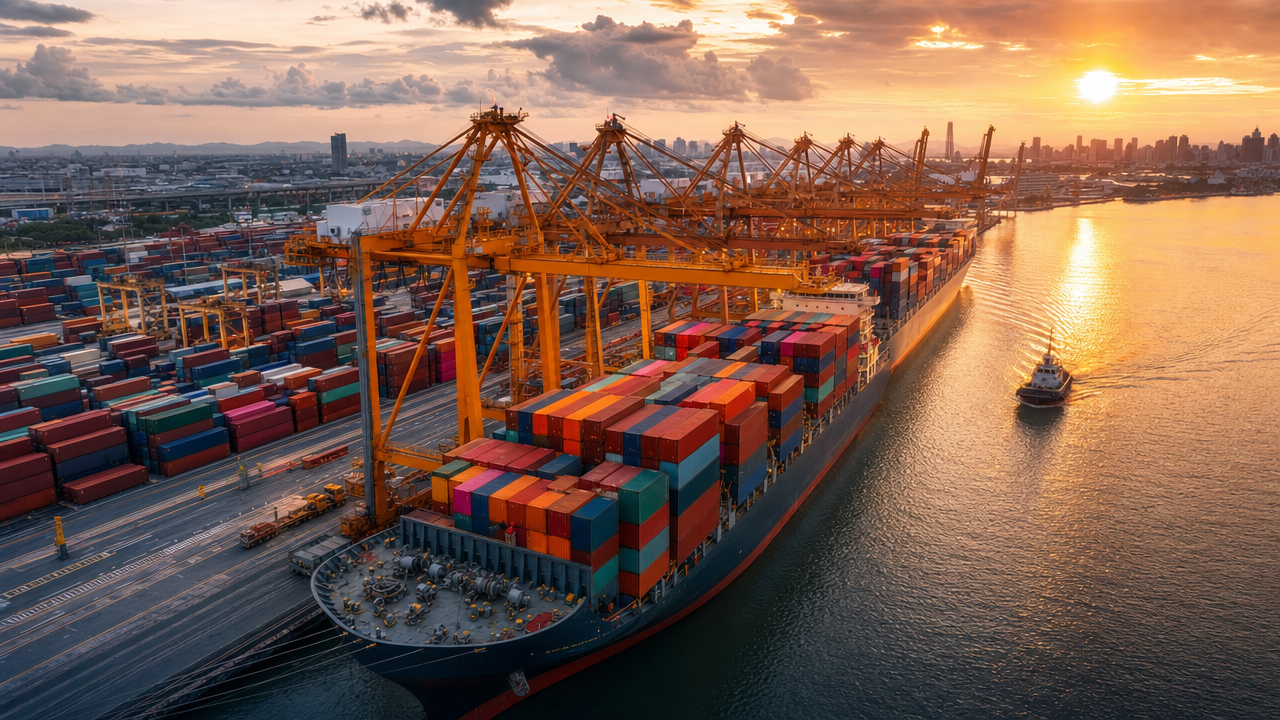

In 2025, as the dispatching center display at Ningbo-Zhoushan Port lit up with "17th consecutive champion," China's port industry no longer needed words to prove its status — it is simply the busiest cargo transshipment hub on the planet.
That year, Ningbo-Zhoushan Port's cargo throughput exceeded 14 billion tons, making it the first port in recorded history to surpass this figure in a single year. Shanghai Port handled 55.063 million TEUs, ranking first globally for the 16th consecutive year. These two records, held simultaneously along the same coastline separated by just 100 kilometers, represent an industrial achievement unprecedented in modern port history.
Yet the backdrop was turbulent. In late 2023, Houthi attacks in the Red Sea forced major container carriers to reroute via the Cape of Good Hope. Simultaneously, the Panama Canal faced historic drought, compressing transit capacity. With two of the world's most critical trade arteries disrupted simultaneously, container freight rates surged to near-record levels before sharply declining in the second half of 2025 as new vessel deliveries flooded the market. The Shanghai Containerized Freight Index (SCFI) fell approximately 37% year-over-year; the China Containerized Freight Index (CCFI) fell approximately 23%.
COSCO SHIPPING Holdings, riding this rate rollercoaster, reported FY2025 revenue of RMB 219.5 billion and net profit of RMB 30.9 billion — down 6.1% and 37.1% respectively. Yet despite the decline, COSCO remained one of China's most profitable listed companies, holding over 10% of global container capacity. That resilience alone tells the story of where Chinese shipping stands in the global value chain.
Meanwhile, China's automated terminal network surpassed any other nation in scale. Over 30 fully automated container terminals and 30 automated bulk cargo terminals were in operation nationwide. In May 2025, Qingdao Port's automated terminal set a new world record for the 13th time — 62.62 natural moves per hour per crane. At Shanghai's Yangshan Phase IV, the world's largest single-site fully automated terminal, every crane, AGV, and rail-mounted gantry was manufactured by ZPMC (Zhenhua Heavy Industries).
This report provides a systematic anatomy of the industry. Across 14 chapters, tracking FY2025 core data across six pillars — container shipping, dry bulk, tankers, LNG, automated terminals, and BRI overseas ports — it aims to establish a clear picture of where China's port and shipping industry stands in 2026, what variables it faces, and where it is heading.
Chapter 1 Definitions, Classifications and Industry Chain Overview
I. Port Types and Functional Specialization
A port is the convergence node between maritime and land transportation, handling the physical transition of cargo between ocean shipping and road, rail, or inland waterway transport. From a macro perspective, ports are the most important physical infrastructure of global supply chains — approximately 90% of international trade by volume moves by sea, and all of those goods begin and end at ports.
Container Ports represent the highest-volume, most technically sophisticated, and most globally integrated port type. Standardized metal boxes (20-foot or 40-foot TEUs) carrying manufactured goods, consumer products, and agricultural goods are handled by Ship-to-Shore (STS) cranes transferring containers between vessels and the terminal, then moved by yard cranes or Rubber Tyred Gantries (RTGs) within the yard, and dispatched by container trucks (tractor-trailers). China's 集装箱 (container) throughput reached approximately 340 million TEUs in 2025, roughly 35% of global total.
Dry Bulk Ports handle iron ore, coal, grain, fertilizer, cement, and other commodities transported without packaging. Core equipment includes ship unloaders, car dumpers, belt conveyors, reclaimers, and large-scale 装卸设备 (cargo-handling equipment). China is the world's largest importer of iron ore and coal — approximately 1.1 billion tons of iron ore and 500 million tons of coal in 2025 alone.
Liquid Bulk Ports handle crude oil, refined petroleum products, LPG, and 液化天然气 (liquefied natural gas, LNG). These require dedicated liquid berths, loading arms, pipeline systems, and storage tanks, operating under stringent safety codes segregated from other cargo types.
RoRo Ports are specialized for automobiles, trucks, and other wheeled vehicles. Pure Car and Truck Carriers (PCTCs) use multi-deck internal ramps for drive-on/drive-off loading. The surge in Chinese EV exports during 2023–2025 caused severe berth shortages at Shanghai, Tianjin, Guangzhou, Yantai, and Lianyungang.
II. Shipping Sector Subdivisions and Business Models
Container Liner Shipping operates on fixed routes, fixed schedules, and published tariffs. Freight rates reference indices including the SCFI. The market is highly oligopolistic — the top 10 carriers control over 92% of global capacity. COSCO (China), Maersk (Denmark), MSC (Switzerland/Italy), CMA CGM (France), and Hapag-Lloyd (Germany) are the global top five.
Dry Bulk Shipping operates primarily through charter contracts. The Baltic Dry Index (BDI), published daily by the Baltic Exchange, is the authoritative barometer of dry bulk market conditions, covering Capesize, Panamax, and Supramax vessel classes.
Tanker Shipping moves crude oil and refined products. Vessel classes range from VLCCs (300,000–320,000 DWT) and Suezmax (130,000–200,000 DWT) to Aframax (80,000–120,000 DWT) and product tankers (MR/LR). COSCO SHIPPING Energy Transportation (COSCO Energy) operates the world's largest VLCC fleet.
LNG Shipping carries liquefied natural gas at –163°C in specialized cryogenic containment systems. One LNG carrier costs approximately USD 250 million — 6–7 times the cost of a comparable dry bulk vessel. Only Korean shipyards (HD Hyundai, Samsung Heavy Industries, Hanwha Ocean) and a small number of Chinese yards (Hudong-Zhonghua Shipbuilding) have mastered LNG carrier construction.
PCTC/RoRo Shipping is the fastest-growing segment, driven by China's EV export surge. China's top PCTC operators — COSCO SHIPPING Specialized Carriers and China Merchants Energy Shipping — have been rapidly expanding fleets.
III. Five-Layer Industry Chain Structure
Layer 1 — Upstream Equipment Manufacturing: Port cranes (码头起重机), 港口机械 (port machinery), AGVs, ARTs, bulk handling equipment (car dumpers, stacker-reclaimers), dredgers, harbor tugs, TOS (Terminal Operating Systems), and port IoT devices. ZPMC commands over 70% of global new STS crane market share.
Layer 2 — Port Operations: Port groups invest in, build, and operate berths, perform cargo handling and yard management, provide vessel pilotage services, and supply value-added logistics. Major Chinese operators include Shanghai International Port Group (SIPG), Ningbo Port, CMPort, Qingdao Port, and Tianjin Port.
Layer 3 — Shipping Companies: Container liners, bulk carriers, tankers, LNG carriers, and PCTC operators form the global trade flow orchestrators, dynamically allocating capacity and rates between shippers, ports, and freight forwarders.
Layer 4 — Trade Logistics Services: Freight forwarders, NVOCCs, ship agents, customs brokers, harbor tugs, insurers, and trade finance institutions constitute the service ecosystem surrounding port operations.
Layer 5 — Fuel and Energy Supply: Conventional bunker fuel (HFO, VLSFO), LNG ship fuel, green methanol, and green ammonia represent parallel energy options. Chinese ports are building multi-fuel bunkering infrastructure to serve the next generation of vessels.
Chapter 2 Global Landscape: Oligopolistic Competition and Market Concentration
I. Container Liner Market Structure
As of end-2025, global container liner capacity is approximately 30 million TEUs, with the top 10 carriers controlling over 92%. The alliance structure shifted in 2025 to a dual-alliance format:
Gemini Cooperation (Maersk + Hapag-Lloyd): Focused on Asia-Europe and Trans-Atlantic lanes, differentiated by schedule reliability. Maersk reported FY2025 revenue of USD 54 billion, EBITDA of USD 9.5 billion.
OCEAN Alliance (COSCO SHIPPING / OOCL + CMA CGM + Evergreen + Yang Ming): Comprehensive global network coverage. Hapag-Lloyd FY2025 volume +8% to 13.5 million TEUs, profit approximately USD 1 billion.
MSC leads global capacity at approximately 6.4 million TEUs (19.9% share); Maersk second at ~4.7 million TEUs (14.6%); CMA CGM third at ~3.5 million TEUs; COSCO fourth at ~3.1 million TEUs; Hapag-Lloyd fifth at ~2.1 million TEUs.
II. Port Operator Global Rankings
PSA International (Singapore): ~105 million TEUs handled globally, revenue SGD 8.3 billion. DP World (Dubai): H1 revenue USD 11.24 billion, EBITDA USD 3.0 billion, net profit USD 960 million (+69% year-over-year). APM Terminals (Maersk subsidiary): Global terminal network integrated with Maersk's logistics strategy. CK Hutchison Ports: Announced sale of ~20 Western port terminal stakes in 2025 under political pressure.
III. Chinese Port Groups: Global Top 10 Dominance
China occupies approximately 9–10 of the top 20 global container port rankings. The top 5 Chinese container ports are Shanghai, Ningbo-Zhoushan, Shenzhen, Guangzhou, and Qingdao.
Chapter 3 PEST: Macro Drivers and Disruption Factors
I. Political Factors
Red Sea Crisis (2023–2025): Houthi missile and drone attacks on commercial vessels forced major carriers to reroute via the Cape of Good Hope, extending Asia-Europe voyage times by 10–14 days, effectively removing 8–10% of global effective capacity — the single most important driver of container rate volatility in 2024–2025.
Panama Canal Drought: Extreme drought reduced canal water levels to historic lows, compressing transit capacity. Combined with the Red Sea crisis, the two most important shortcut trade routes were simultaneously constrained.
BRI Overseas Port Investment Under Scrutiny: CK Hutchison Ports' announced sale of ~20 Western port stakes reflects growing Western concerns about Chinese capital in critical infrastructure. ZPMC crane security reviews by U.S. authorities marked a turning point in geopolitical scrutiny of port equipment.
China-US Tariff Escalation: The 2025 high-tariff confrontation began reshaping supply chains structurally — accelerating manufacturing migration to Vietnam, Bangladesh, and Mexico, with long-term implications for transpacific trade volumes.
II. Economic Factors
WTO forecasts 2026 global merchandise trade growth at approximately 3%, below the pre-pandemic five-year average of ~2.8%. IMF 2026 global GDP growth forecast: ~3.2%. China container port throughput 2026 forecast: ~360 million TEUs (+5–6%), outpacing global trade growth as China's export manufacturing maintains its global supply chain centrality.
III. Social Factors
Global seafarer supply-demand imbalance: approximately 1.5 million certified seafarers globally, with a projected shortfall of 150,000–200,000 senior officers by 2026–2030. China is a major seafarer-supplying nation; Dalian, Shanghai, and Guangzhou maritime universities produce tens of thousands of graduates annually.
IV. Technology Factors
AI applications in shipping/ports: route optimization and slow steaming management (estimated 5–10% fuel savings per vessel); predictive maintenance reducing unexpected downtime; automated container damage detection and box number recognition; berth-assist docking support systems. Digital twin deployment at Shanghai, Singapore, and Rotterdam ports for real-time operations management and predictive maintenance.
Chapter 4 China Market Scale: World's Largest — Scale and Causation
I. Throughput Data
National cargo throughput (2025): approximately 17.5 billion tons National container throughput (2025): approximately 340 million TEUs Concentration: Top 10 ports account for approximately 75% of national container throughput
China's port throughput scale reflects structural demand factors: China is the world's largest manufacturer, the world's largest coal and iron ore importer, the world's largest LNG importer (approximately 73 million tons in 2025), and a major steel and petroleum products exporter.
II. Industry Chain Economic Contribution
China's port and shipping industry directly supports over 6 million jobs (port operations, seafarers, ship crew, logistics). The indirect multiplier across associated industries (shipbuilding, port equipment, marine insurance, trade finance) extends the economic contribution significantly. Port infrastructure investment has consistently ranked among the top three infrastructure categories in China's annual fixed asset investment statistics.
Chapter 5 Industry Chain Deep Dive
I. Port Terminal Segment
Container terminals: Capital-intensive, stable cash flow, volume-correlated revenue. China's top-tier container terminal operators achieved operating margins of approximately 30–45% in FY2025.
Bulk cargo terminals: Iron ore and coal handling dominate. Specialized equipment (ship unloaders, rail car dumpers, stacker-reclaimers) represents high fixed costs; per-ton handling fees are the primary revenue driver.
LNG receiving terminals: Strategically critical. Key equipment includes cryogenic unloading arms, storage tanks (160,000–270,000 m³ per tank), vaporizers, and BOG re-liquefaction systems. LNG terminal construction accelerated significantly, with multiple new projects in Zhejiang, Guangdong, and Bohai Bay.
II. Port Equipment Segment
ZPMC dominates global STS crane market with >70% share. Key equipment categories: 岸桥 (ship-to-shore cranes), 轮胎吊 (rubber-tyred gantry cranes), 集装箱起重机 (container cranes), AGVs, ARTs, ARMGs.
III. Shipping Segment
Container liners: COSCO SHIPPING Holdings dominates China's presence globally (3rd–4th by capacity). China Merchants Group (CMPort) and COSCO shipping coordination amplifies network value.
Tankers: COSCO Energy (world's largest VLCC fleet), China Merchants Energy Shipping (VLCC + LNG carrier combination).
LNG carriers: China Merchants Energy Shipping (long-term charter contracts, stable cash flow), COSCO Energy (expanding into LNG segment).
PCTC: COSCO SHIPPING Specialized Carriers, China Merchants Energy Shipping (methanol dual-fuel PCTC deliveries in 2025).
IV. Container Manufacturing
China accounts for ~90% of global container production. Key players: CIMC Group (000039), Singamas Container (0716.HK), Orient International (600270). Average container lifespan of 10–12 years creates annual renewal demand of 3–3.5 million TEUs globally.
散货码头 (bulk cargo terminals) and 集装箱叉车 (container forklifts) are key equipment categories in port logistics operations.
Chapter 6 Key Company Analysis
Shanghai International Port Group (600018.SH) — FY2025
Revenue: ~RMB 39.6 billion Net profit: ~RMB 13.5 billion Container throughput: 55.063 million TEUs — 16th consecutive year as global #1
Structural competitive advantages: Yangshan deep-water port (15–16m natural depth, accommodating largest ULCS); Yangshan Phase IV — world's largest single-site fully automated terminal (16 STS cranes, 130+ AGVs, 46 ARMGs, all by ZPMC); Yangtze River Delta hinterland (electronics, EVs, chemicals, textiles); 100+ international container routes to 200+ ports globally.
Ningbo-Zhoushan Port Co. Ltd. (601018.SH) — FY2025
Revenue: ~RMB 31 billion Net profit: ~RMB 5.17 billion (+5.63% year-over-year) Container throughput: 52.98 million TEUs (+11.2%) — 3rd globally Total cargo throughput: 14+ billion tons — 17th consecutive year as global #1
Unique dual-function advantage: bulk cargo (iron ore iron ore transshipment hub for Yangtze Delta steel mills) + container (Ningbo-Zhoushan manufacturing export hub). The combination of these two independent revenue streams creates exceptional throughput resilience.
CMPort (001872.SZ) — FY2025
Revenue: ~RMB 17.25 billion Net profit: ~RMB 4.61 billion Total container volume: 206.11 million TEUs (+5.6%) Overseas containers: 38.93 million TEUs (+12.3%) Overseas revenue gross margin: 57.4% — significantly higher than domestic
CMPort operates 51 ports across 26 countries. Overseas high-margin rationale: limited local competition, lower labor costs, first-mover advantages attracting new liner calls. Sri Lanka HIPG: throughput +700% year-over-year.
Qingdao Port International (601298.SH) — FY2025
Revenue: ~RMB 18.81 billion Net profit: ~RMB 5.27 billion Container throughput: 34.2 million TEUs (+6.3%)
World record automated terminal efficiency: 62.62 natural moves per hour (13th world record, May 2025). QQCTU (Qingdao Qianwan Container Terminal United) is the benchmark for globally automated terminal productivity.
Tianjin Port (600717.SH) — FY2025
Revenue: ~RMB 12.79 billion Container throughput: ~20.81 million TEUs
Northern China's largest comprehensive port; primary seaport for Beijing, Hebei, Shanxi, and Inner Mongolia. Comprehensive cargo mix: containers, coal, steel, crude oil, chemicals.
COSCO SHIPPING Holdings (601919.SH) — FY2025
Revenue: RMB 219.5 billion (-6.14% year-over-year) Net profit: RMB 30.9 billion (-37.13% year-over-year) Container volume: 27.43 million TEUs (+5.76%)
Despite the profit decline, COSCO's FY2025 "trough profitability" of RMB 30+ billion in a down-cycle year represents a structural improvement from the 2016 near-insolvency. Structural drivers: predominantly owner-operated fleet (lower fixed costs than chartered vessels), COSCO SHIPPING Ports terminal assets smoothing carrier cycle, continuous cost optimization.
Key port equipment and ship components suppliers form the supply foundation for these port operators. China's manufacturing ecosystem covers the full range from port cranes to marine engines and vessel accessories.
COSCO SHIPPING Energy Transportation (600026.SH) — FY2025
Revenue: ~RMB 23.9 billion Net profit: ~RMB 4.0 billion World's largest VLCC fleet. Long-term contract (70% of fleet) + spot market (30%) strategy balances stability with upside. 2025 delivered new LNG carrier orders, entering the high-barrier LNG shipping segment.
China Merchants Energy Shipping (601872.SH) — FY2025
Revenue: RMB 28.18 billion (+9.22%) Net profit: RMB 6.01 billion (+17.71%) — highest profit growth among Chinese listed shipping companies Tanker revenue: RMB 10.3 billion (+11.77%), gross margin 39.91% New deliveries: 7 LNG carriers + 2 methanol dual-fuel PCTCs (9,300-car capacity) + 2 bulk carriers + 3 heavy-lift vessels
Maersk — FY2025 Summary
Revenue: USD 54 billion, EBITDA: USD 9.5 billion, EBIT: USD 3.5 billion. Transformation thesis: from container carrier to end-to-end supply chain manager. Terminal business growth partially offset ocean segment decline, providing early validation of diversification strategy.
Hapag-Lloyd — FY2025 Summary
Volume: +8% to 13.5 million TEUs; EBITDA: USD 3.6 billion; net profit: ~USD 1 billion. Gemini Cooperation with Maersk drives schedule reliability differentiation.
ZIM (NYSE: ZIM) — FY2025 Summary
Asset-light model: primarily chartered vessels. High cyclical elasticity — significant profit compression in down-cycle, fleet reduction flexibility in downturns through expiring charters. Focus on high-value specialty routes (Israel, US East Coast).
PSA International and DP World
PSA: ~105 million TEUs handled, SGD 8.3 billion revenue. DP World H1: revenue USD 11.24 billion (+4.5%), EBITDA USD 3.0 billion, net profit USD 960 million (+69%).
Chapter 7 Industrial Clusters and China's Core Port Hubs
China's port system is not a collection of isolated terminals — it is an economic ecosystem deeply integrated with the manufacturing hinterlands it serves. Every major port is a maritime gateway for specific industrial belts; every cargo movement maps the production, procurement, and global value chain position of the factories behind it.
As China's B2B manufacturing platform covering 4.8 million active factories, Tianxia Gongchang (天下工厂) maintains extensive coverage of port equipment, handling equipment, and maritime component suppliers, connecting the capillaries of this industrial network.
Shanghai Yangshan Deep-Water Port
Yangshan Phase IV: 2,100m shoreline, design capacity 2.1–2.3 million TEUs annually. World's largest single-site fully automated container terminal — 16 STS cranes, 130+ AGVs, 46 ARMGs, all ZPMC-manufactured. National depth 15–16m accommodates largest ULCS vessels. Hinterland: world's most developed manufacturing cluster (Jiangsu, Zhejiang, Anhui).
Zhejiang Zhoushan: Bulk Cargo Heaven and LNG Energy Hub
Zhoushan archipelago's natural deep-water anchorage accommodates simultaneous mooring of dozens of VLOC vessels (Very Large Ore Carriers, 300,000–400,000 DWT). Iron ore from Australia and Brazil arrives here, is discharged, and distributed to Yangtze Delta steel mills. Ningbo-Zhoushan is expanding LNG receiving capacity (Daxie Island, Jintang LNG terminals).
Shandong Qingdao
Qingdao Port: automated terminal world records. Rizhao Port: largest iron ore transshipment port in northern China. After the consolidation of Shandong Port Group (Qingdao + Rizhao + Yantai + Bohai Bay), differentiated functional positioning reduces intra-provincial competition.
Guangdong Shenzhen-Guangzhou-Xiamen Cluster
Shenzhen Yantian (approximately 17 million TEUs/year), Shekou (major export hub), Guangzhou Nansha (rapidly expanding, full automation capacity): together form the third-largest container cluster in China. Hinterland: Shenzhen electronics and EVs, Dongguan components, Foshan home appliances, Guangzhou automotive.
Hong Kong (approximately 15 million TEUs in 2025, down from 24+ million TEU peak): transitioning from direct export hub to specialized transshipment and value-added logistics services.
Tianjin and Bohai Bay
Tianjin: northern China's largest comprehensive port. Tangshan (Caofeidian): fastest-growing northern port, 7+ billion tons throughput, VLOC deep-water berths (25m+ depth). Huanghua: major coal loading terminal (Inner Mongolia/Shanxi coal export). Rizhao: iron ore + container.
BRI Overseas Ports
Piraeus (Greece): COSCO SHIPPING Ports 67% stake. ~5 million TEUs/year. Major Asia-Europe transshipment hub for South/Southeast Europe.
Sri Lanka HIPG (Colombo): CMPort 85% stake. Throughput +700% year-over-year in 2025. Indian Ocean transshipment node.
Pakistan Gwadar: CMPort operation. CPEC southern terminus. Strategic oil/gas pipeline convergence point.
Israel Haifa New Port: CMPort investment. Politically sensitive; triggered U.S./Israel security reviews.
Rotterdam Euromax and Hamburg HHLA: CMPort minority stakes in Europe's largest container ports.
Greece Piraeus + Rotterdam + Duisburg: China's BRI port investment anchors key nodes on the Europe-Asia logistics corridor.
Chapter 8 Specialized Topics: Market Segments in Depth
I. Container Cycle and SCFI Dynamics
SCFI 2025 annual average: ~1,400–1,800 points (down approximately 37% year-over-year). Key cycle drivers: Red Sea crisis temporarily removed 8–10% of effective capacity; new vessel deliveries (200+ million TEUs in 2023, 150+ million TEUs in 2024–2026) are the primary structural supply growth driver; Gemini Cooperation's schedule reliability premium versus OCEAN Alliance's network breadth creates new competitive differentiation within the rate structure.
Container rate forecasting has inherent unpredictability beyond 6 months — exogenous shocks (Red Sea, tariffs) can overwhelm all structural supply/demand variables.
II. Baltic Dry Index and Dry Bulk Market
BDI 2025 annual average: approximately 1,300–1,500 points. Iron ore: approximately 1.1 billion tons imported (BHP, Rio Tinto, FMG from Australia; Vale from Brazil). Coal: approximately 500 million tons imported (Indonesia and Australia primary suppliers). Grain: Brazil 2025 soybean record harvest drove mid-year Panamax rate spikes.
Long-term structural pressure: China's steel electric arc furnace (EAF) substitution for blast furnace (BF-BOF) will gradually reduce iron ore intensity per ton of steel, moderating BDI upside.
III. Tanker Market: VLCC Structural Analysis
Global daily crude consumption approximately 100 million barrels; China approximately 16 million barrels/day (imports ~11 million barrels/day). ME-China VLCC route is the world's highest-volume crude oil shipping lane. COSCO Energy FY2025 net profit approximately RMB 4 billion, benefiting from Middle East production stability and Chinese import demand.
BDTI (Baltic Dirty Tanker Index) reflects daily VLCC market conditions. VLCC TCE ranges from below USD 10,000/day (trough) to over USD 100,000/day (peak) historically.
IV. LNG Shipping Ecosystem
China LNG imports approximately 73 million tons in 2025. GTT membrane-type cargo containment system (patented) is the key technical barrier. China Merchants Energy Shipping holds long-term LNG charters (15–20 years), providing stable, cycle-resistant cash flows.
Green methanol: Laura Maersk (16,000 TEU, world's first large green methanol dual-fuel containership, delivered 2023). Green methanol cost currently 4–6× conventional bunker; expected to approach LNG cost parity by 2028–2030. Dalian Changxingdao green ammonia/methanol bunkering base project launched January 2025.
V. RoRo/PCTC and Chinese Automotive Export Surge
China became world's largest automobile exporter in 2023, driven by NEV (new energy vehicle) exports. PCTC market capacity shortage pushed rates 3× in 2023–2025. China Merchants Energy Shipping and COSCO SHIPPING Specialized Carriers are the primary Chinese PCTC operators.
VI. Automated Terminals: Economic Boundaries
Construction cost: 3–4× conventional manual terminals. Operating cost: 70%+ reduction in labor; higher technical maintenance costs. Breakeven: typically requires 1+ million TEUs/year annual throughput. Efficiency record: Qingdao QQCTU 62.62 NMPH — ~1.6× peak manual operation. Advantage beyond efficiency: eliminates human-machine interaction accidents, enabling 24/7 zero-downtime scheduling, increasing single berth annual effective utilization hours by ~15–20%.
VII. Port Digitalization and IoT
5G port private networks: AGV-TOS communication backbone. Beidou high-precision positioning: centimeter-level positioning for automated equipment (replacing GPS). Port digital twin: real-time 3D asset monitoring, predictive maintenance, scenario simulation. AI scheduling (reinforcement learning): dynamic global optimization of crane/AGV/gantry sequences.
VIII. Inland Waterway and Coastal Shipping
Yangtze River annual freight volume: 3+ billion tons — world's busiest inland waterway. Iron ore from Shanghai/Ningbo distributed to inland steel mills via river barges. COSCOCS (Zhonggu Logistics) holds ~20% of China coastal container shipping market (1,000–3,000 TEU vessels). Chongqing leverages China-Europe Railway Express + river barge multimodal connections.
IX. BRI Overseas Port Investment Deep Analysis
CMPort's 57.4% overseas gross margin comes from: limited local competition enabling premium pricing; lower local labor costs versus China; first-mover advantage creating positive feedback (better facilities → more liner calls → higher volumes). Sri Lanka HIPG +700% YoY demonstrates the Base Upgrade → Attract Lines → Volume Growth flywheel. Middle distance from strategic control: Gwadar (CPEC gateway), Piraeus (South European hub), Colombo (Indian Ocean hub).
X. Green Shipping Regulatory Framework
IMO GHG Strategy (2023 revision): –40% carbon intensity by 2030 (vs. 2008); –70% absolute GHG by 2040; net zero by 2050. Tools: CII ratings (mandatory since 2023), EEDI (new vessel design), FuelEU Maritime.
EU ETS covering shipping: 40% carbon quota obligation in 2024, scaling to 100% from 2026. For a 15,000 TEU Asia-Europe vessel: ~EUR 2.5–3 million annual compliance cost at EUR 60–80/ton CO₂.
LNG transition: –20–25% CO₂ vs. HFO; near-zero SOx; –80–90% NOx. Primary commercial pathway through 2030.
Green methanol: zero carbon lifecycle if from renewable sources; common temperature/pressure storage simplifies infrastructure vs. LNG; currently 4–6× cost of conventional bunker.
Green ammonia: zero-carbon combustion products (N₂ + H₂O); toxicity and explosive range create safety requirements; MAN Energy Solutions engine expected commercial readiness 2027–2028; bunkering infrastructure near-zero globally.
Wind-assisted propulsion: Flettner rotors and rigid wing sails achieving 5–10% fuel savings on bulk carriers and PCTCs.
Chapter 9 Technology Roadmap
I. Phase 1 Automation (Current): "Unmanned" Operations
Current full-automation standard: STS cranes + ARMG + AGV/ART fully automated, with remote monitoring. Human presence limited to maintenance and exception handling. Example: Yangshan Phase IV, Qingdao QQCTU, Tianjin Port, Guangzhou Nansha automated terminals.
II. Phase 2 Automation (2025–2030): Intelligence Upgrade
Reinforcement learning for TOS scheduling: AI optimizes across crane/AGV/gantry sequences considering equipment failures, weather, priority cargo, simultaneously — outperforming rule-based optimization in complex scenarios. Predictive maintenance: sensor data (vibration, temperature, pressure) + AI models predict failure hours-to-days before occurrence. Real-time digital twin synchronization enabling scenario simulation before operational decisions.
III. Autonomous Vessels
Remote pilotage trials in Netherlands and Denmark. Autonomous vessel technologies commercially proven in near-shore/river applications. Deep-ocean full-autonomy faces legal barriers (SOLAS requires licensed watch officers) and liability frameworks. Forecast: inland/near-shore autonomous vessels commercial by 2030; deep-sea full autonomy requires additional time.
IV. LNG/Methanol/Ammonia Propulsion Roadmap
2025–2028: LNG dual-fuel fleet expansion dominant; green methanol begins commercial scaling (Maersk fleet); IMO CII compliance forces retirement of high-emission legacy vessels.
2028–2032: Green methanol cost parity approach with LNG; ammonia engine commercialization (MAN, WinGD); port ammonia bunkering infrastructure first deployments.
2032–2040: Green ammonia and methanol viable commercial alternatives across key routes; wind-assisted propulsion standard on slow-steaming bulk carriers.
2040–2050: Fleet approaching net-zero; hydrogen fuel cells in niche applications; biofuels supplementary role.
V. 5G + Beidou + Port IoT
5G private network enables millisecond-latency AGV control, eliminating previous Wi-Fi-based positioning delays. Beidou centimeter positioning replaces GPS in all Chinese port automated equipment — a strategic technology independence milestone. IoT sensors embedded across all moving equipment enable fleet-wide real-time telemetry feeding digital twin systems.
VI. Blockchain and Electronic Bills of Lading
TradeLens (Maersk-IBM) shut down in 2022 due to ecosystem participation gaps. eBL platforms (BOLERO, essDOCS, CargoX) achieving growing adoption on select trade lanes but global penetration remains under 3%. Structural obstacles: multi-party coordination complexity, legal recognition fragmentation across jurisdictions.
Chapter 10 Risk Matrix
I. Geopolitical Risks
Red Sea / Middle East (High impact, Moderate probability): Three scenarios — full reopening (30% probability, bearish for rates), status quo (50%), escalation (~20%). Each scenario represents a fundamentally different rate environment for 2026.
China-US Trade Friction (High impact, Ongoing): Tariff escalation accelerates supply chain diversification (Vietnam, Mexico). Scenario A: partial tariff relief (25%); Scenario B: status quo (50%); Scenario C: further escalation (~25%).
ZPMC Security Scrutiny in US Ports: Structural headwind for ZPMC's US market expansion. Potential regulatory restrictions on new ZPMC crane procurement by US federal port operators.
II. Industry Cycle Risks
Container Rate Oversupply (2025–2027): 2019–2023 order boom → 200+ million TEU deliveries in 2023, 150+ million TEU in 2024–2026. Carrier blank sailing/slow steaming strategies partially offset, but structural overcapacity pressure persists.
BDI Structural Compression: China EAF substitution for BF-BOF gradually reduces iron ore intensity per ton of steel, threatening long-term BDI upside. Coal demand uncertainty (energy transition policy sensitivity).
III. Green Compliance Risks
EU ETS Cost Escalation: Carbon prices and coverage expansion will create USD 2.5–3 million annual compliance cost per Asia-Europe vessel by 2026 (100% quota coverage). Cost pass-through to shippers will eventually occur, but timing and degree of market acceptance remain uncertain.
CII Downgrade Risk: Vessels with C/D/E annual CII ratings face mandatory improvement plans, accelerating retirement of older high-emission vessels. For ship owners with aging fleets, this creates either early retirement losses or capital expenditure requirements for retrofitting.
IV. Geopolitical / Overseas Port Risks
Host Country Political Risk: Debt restructuring, regime change, anti-China sentiment, contract renegotiation. Sri Lanka 2022 debt crisis demonstrated vulnerability; CMPort's HIPG maintained operations but the systemic risk environment highlighted.
Revenue Concentration Risk: Overseas ports heavily dependent on specific liner company calls for cargo volumes. If an alliance reduces port calls (strategic adjustment), throughput can drop significantly.
Currency Risk: Emerging market host country currency depreciation reduces local currency revenues in USD/RMB terms.
Chapter 11 2026–2030 Trend Forecasts
I. Throughput Forecasts
2026 baseline (50% probability):
- China port cargo throughput: ~18 billion tons (+3%)
- China container throughput: ~360 million TEUs (+5–6%)
- SCFI annual average: 1,200–1,800 (Red Sea status quo scenario)
2026 upside (20% probability / Red Sea escalation):
- SCFI: 2,000–2,800; COSCO SHIPPING Holdings net profit: RMB 40–50 billion
2026 downside (30% probability / Red Sea full reopening + tariff escalation):
- SCFI: 800–1,200; industry profitability compression
II. 2026–2030 Structural Trends
Automation penetration: China fully automated container terminals projected 60+ by 2030 (vs. 30+ in 2025). 70%+ reduction in labor cost per TEU at automated terminals. Automation ROI payback period 8–12 years at current construction costs.
Green shipping transition: LNG fleet proportion rising from current ~8% to ~20% by 2028. Green methanol commercial scaling from 2027. CII compliance requirements retiring 5–8% of high-emission legacy fleet annually by 2027–2029.
CR10 consolidation: Global container market top-10 concentration expected to deepen from 92% to 94–95% by 2030. Alliance reshuffling possibilities as Gemini proves/disproves its schedule reliability premium thesis.
BRI overseas ports expansion: CMPort global port network projected to exceed 70+ ports by 2030, with overseas throughput exceeding 40% of total. Overseas gross margins expected to stabilize at 50–60%.
Digital twin and IoT standard: All top-10 China ports expected to have operational digital twin platforms by 2028. Port IoT sensor deployment doubling current base; Beidou+5G private network universal adoption at full-automation terminals.
III. Key Company 2026 Profit Forecasts (Baseline)
| Company | 2026 Net Profit Forecast (Baseline) |
|---|---|
| SIPG (600018) | RMB 13–15 billion |
| Ningbo Port (601018) | RMB 5.5–6.5 billion |
| CMPort (001872) | RMB 4.5–5.5 billion |
| Qingdao Port (601298) | RMB 5–6 billion |
| COSCO Holdings (601919) | RMB 20–30 billion |
| CM Energy Shipping (601872) | RMB 5–7 billion |
| COSCO Energy (600026) | RMB 3.5–4.5 billion |
Forecasts are indicative only; do not constitute investment advice.
Chapter 12 Conclusion: The True Coordinates Behind Global Supremacy
China's port and shipping industry in 2026 faces three structural pressures simultaneously: freight rate cycle pressure (container rate decline, overcapacity concerns), green transition pressure (IMO/EU ETS compliance costs, new fuel technology investments), and geopolitical pressure (ZPMC scrutiny, BRI port political risks, tariff supply chain restructuring).
Yet it also possesses three structural competitive advantages that are difficult for any competitor to replicate within a relevant time horizon:
Hinterland scale is irreplaceable: China remains the world's largest manufacturer and trader. The goods flow from 4.8 million active factories represents a permanent throughput base for China's ports that cannot be restructured away by short-term geopolitical friction.
Technology leadership in select segments: Fully automated terminal (Qingdao world record), port equipment manufacturing (ZPMC 70%+ global share), LNG carrier construction (Hudong-Zhonghua entering top-tier club) — China has shifted from follower to leader in specific domains.
Global first-mover positioning: CMPort's 51-port global network, COSCO SHIPPING Ports' strategic nodes at Piraeus and beyond — built over 20 years and requiring massive capital — cannot be rapidly replicated.
The Tianxia Gongchang Industrial Research Institute believes China's port and shipping industry in 2026–2030 will enter a phase of "efficiency dividend deepening" — shifting from scale expansion (more berths, more ships) to efficiency competition: automation rates and digital management maturity, green transition timing and cost control (LNG → methanol → ammonia pathway), comprehensive supply chain services (from terminal handling to door-to-door logistics), and overseas asset commercial return quality (from "having presence" to "profitable presence").
The true question is not whether China can hold its global first-place position — it can. The question is whether, in the next wave of technological transformation (green shipping + smart ports), China can evolve from "largest by volume" to "most advanced by technology." From Qingdao's world records, ZPMC's global market share, and China Merchants' green fleet expansion, the early evidence already points toward yes.
Chapter 13 Port Supply Chain: Factories and Industrial Ecosystem Behind the Berths
China's port industry ecosystem extends far beyond the terminal operators whose names appear in financial headlines. For every meter of berth operating at full capacity, there is a dense network of specialist manufacturers providing the components, equipment, and systems without which no port can function.
I. Container Manufacturing Industry
China accounts for approximately 90% of global container manufacturing. CIMC Group (000039.SZ) and Singamas Container Holdings (0716.HK) together command the majority of global market share. The supply chain behind each container (20-foot or 40-foot TEU) includes Corten steel suppliers, wooden flooring, corner castings, door hardware, and paint. Container lifespan runs 10-12 years, generating steady annual replacement demand of 3-3.5 million TEUs globally.
Container forklifts and yard handling equipment within port operations represent a parallel ecosystem of specialized manufacturers. Heavy-duty forklifts capable of handling loaded 40-foot containers (25+ tons) are manufactured by Hyster-Yale, Kalmar, and expanding Chinese competitors.
II. Port Crane and Equipment Manufacturing
ZPMC (600428.SH) dominates the global port machinery market with >70% share of new STS crane orders. Supporting ZPMC are steel fabrication specialists, electrical and automation component suppliers, hydraulics manufacturers, and wire rope producers. The cargo handling equipment market globally is approximately USD 8-10 billion annually.
Every container crane system integrates: drive control electronics (Siemens/ABB), laser positioning sensors, anti-sway algorithms, spreader mechanisms, and PLC-based automation. The quay crane (STS) arm reach has extended from 18 to 26+ container rows wide to serve the latest 24,000+ TEU mega-vessels.
RTG (rubber-tyred gantry crane) manufacturers include ZPMC, Liebherr, and Konecranes. Automated ARMG rail-mounted gantries run on fixed rails and are the preferred yard handling technology in fully automated terminals.
III. Vessel Components and Marine Engineering
Every vessel calling at Chinese ports contains thousands of components from China's coastal industrial belt. Key categories:
Marine Engines: Marine engine manufacturing is concentrated in Shanghai, Qingdao, and Dalian. MAN ES and Wartsila license two-stroke low-speed designs to Chinese manufacturers. Dual-fuel (LNG/HFO) engine variants are now standard on newbuild container vessels.
Ship Parts and Components: Ship parts such as propellers, rudders, anchors, chains, and mooring equipment, along with vessel accessories like navigation electronics (radar, AIS, ECDIS), cluster in Zhoushan (ship repair hub), Jiangsu Taicang, and Guangdong.
Vessel Equipment: Vessel equipment including cranes, winches, hatch covers, ballast water treatment systems, and exhaust gas scrubbers is supplied by European specialists and expanding Chinese competitors. China's shipbuilding industry consumed approximately 12 million tons of steel in 2025.
IV. Port Fuel and Bunker Supply
China's 航运 (shipping) operations consume enormous quantities of marine fuel (bunker fuel). Zhoushan International Bunker City is China's largest bunkering hub. The transition from HFO to VLSFO (post-IMO 2020) and emerging LNG and green methanol pathways represent fundamental shifts in the bunker value chain.
LNG bunkering infrastructure is expanding at Zhoushan, Tianjin, and Guangzhou. By 2026, China aims to be the world's leading LNG ship fuel bunkering hub in terms of total volume supplied.
V. Industrial Geography of Port Supply Clusters
Zhoushan archipelago: Ship repair capital. Over 100 repair yards; ship parts trading market hosts hundreds of distributors.
Shanghai Changxingdao: Largest shipbuilding island. Jiangnan Shipyard, Hudong-Zhonghua, ZPMC manufacturing base.
Jiangsu Nantong and Taicang: Marine equipment (pumps, valves, fittings), port equipment components.
Guangdong coastal belt: Marine electronics, navigation equipment, marine paints.
This industrial geography — millions of suppliers providing specialized components within a one-day logistics radius of China's major ports — is why China's port and shipbuilding cost structure remains globally unmatched.
The bulk cargo terminal ecosystem parallels the container world: specialized unloaders, stacker-reclaimers, conveyor systems, and dust-suppression equipment are all manufactured by dedicated industrial clusters in Hebei, Shandong, and Jiangsu.
Chapter 14 Data Sources and Key References
This report is based on publicly available sources, official information, corporate financial reports, and authoritative media coverage, compiled for industry research reference. All cited data has publicly verifiable sources; conclusions represent independent analysis based on facts and do not constitute investment advice. Key data and factual sources include:
- Tianxia Gongchang (天下工厂) China factory database and industrial chain data (www.tianxiagongchang.com)
- Shanghai International Port Group (600018.SH) FY2025 Annual Report and listed company announcements
- Ningbo-Zhoushan Port Co., Ltd. (601018.SH) FY2025 Annual Report
- CMPort Group Co., Ltd. (001872.SZ) FY2025 Annual Report
- Qingdao Port International Co., Ltd. (601298.SH / 06198.HK) FY2025 Annual Report
- Tianjin Port Holdings Co., Ltd. (600717.SH) FY2025 Annual Report
- COSCO SHIPPING Holdings Co., Ltd. (601919.SH) FY2025 Annual Report
- COSCO SHIPPING Energy Transportation Co., Ltd. (600026.SH) FY2025 Annual Report
- China Merchants Energy Shipping Co., Ltd. (601872.SH) FY2025 Annual Report
- A.P. Moller-Maersk (MAERSK-B.CO) FY2025 Annual Results Announcement
- Hapag-Lloyd AG (HLAG.DE) FY2025 Annual Report
- ZIM Integrated Shipping Services (NYSE: ZIM) SEC Form 6-K (2025)
- Shanghai Zhenhua Heavy Industries (600428.SH) FY2025 Credit Rating Report
- Ministry of Transport China Port Cargo Throughput Statistical Bulletin (2025)
- Xinhua News Agency, People's Daily, 21st Century Business Herald, ShippingChina, Sinopec Marine authoritative media reports on China port and shipping (2025)
- Drewry World Container Index and port market reports
- Baltic Exchange BDI historical data
- IMO GHG Strategy (2023 Revised) documents
- China Port Yearbook (2025)
- WTO Global Trade Statistics (2025)
- IMF World Economic Outlook (April 2026)