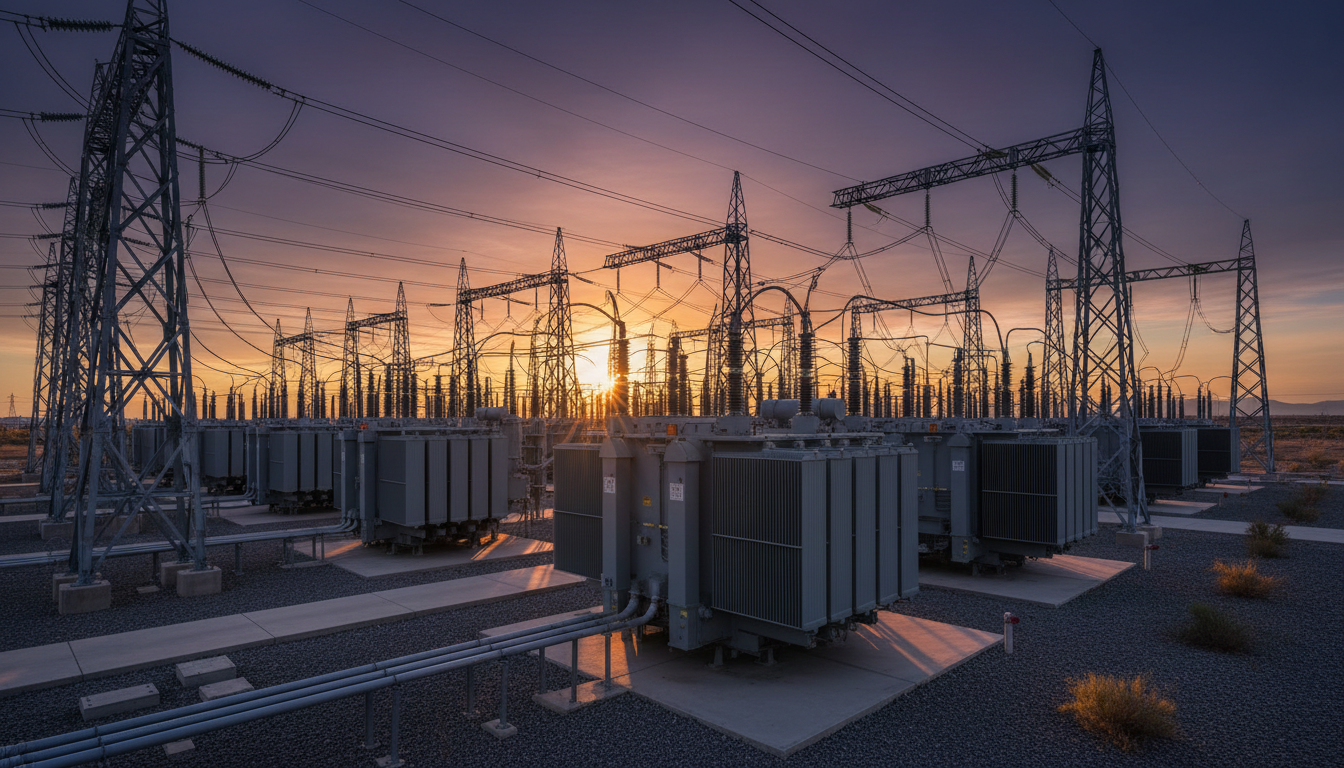

In April 2025, a 2,681-kilometre power artery began construction in earnest across the frozen permafrost of the Qinghai-Tibet Plateau and the deep gorges of the Hengduan Mountains. This is the Southeastern Tibet–Greater Bay Area ±800 kV Ultra-High-Voltage Direct Current (UHVDC) transmission project — rated at 10 GW, equivalent to the combined full-load output of ten large coal-fired power stations, drawing entirely on Tibet's inexhaustible high-altitude hydropower. At the far end of that line lies the Pearl River Delta, China's highest-density manufacturing corridor, where every circuit board, every new-energy vehicle, every smartphone depends on an uninterrupted electricity supply. Power flowing from plateau to bay is the most epic, most industrially poetic stroke in China's energy transition.
Placed in a broader historical perspective, this single line is not alone. In 2025, the combined capital expenditure of State Grid Corporation and China Southern Power Grid exceeded RMB 800 billion — the highest figure ever recorded. State Grid alone crossed RMB 650 billion for the first time, up approximately 7% year on year; Southern Power Grid allocated RMB 175 billion in fixed-asset investment, another historical high. Every renminbi is converting into converter transformers, gas-insulated switchgear, high-voltage cables, protective relays, distribution automation terminals, and smart meters. China's power T&D equipment industry — with an annual output value already exceeding RMB 1 trillion — is in the busiest, most demand-intensive moment it has ever known.
At the same time, its products are reaching every corner of the globe at an unprecedented pace. In 2025, China's transformer export value approached RMB 65 billion, up nearly 36% year on year; exports to the United States rose roughly 182%, and to Europe roughly 138%. Ageing grid infrastructure and surging renewable installations in North America and Europe have driven urgent equipment demand — and China's factories deliver two to three times faster than European peers at 20–30% lower cost. The global drive to upgrade power grids is channelling demand into Chinese production capacity at scale.
This is a comprehensive research report on China's power transmission and distribution equipment industry. Its protagonists span from ultra-high-voltage converter transformers to the smart meter at the customer's door — the entire value chain from ±1100 kV mega-DC projects to the last-mile distribution network. The time frame is 2025–2026. The report's core questions: How large is this industry? Who is leading the feast? Where are the technical frontiers shifting? And how do opportunities and risks distribute across the next five years?
Chapter 1 Definition and Industry Chain Overview: From UHV Converter Stations to End-User Meters
Power T&D equipment spans an extraordinary breadth — from the step-up transformer at a power plant's outlet to the metering box outside a residential building, crossing dozens of sub-categories and drawing on mechanical engineering, electrical engineering, power electronics, advanced materials, and industrial software.
Primary Equipment: The Physical Skeleton
Primary equipment directly participates in generating, transforming, transmitting, and distributing electrical energy. The most critical categories are as follows.
Transformers are the most numerous and highest unit-value equipment category in the power system. By function: step-up transformers at power plants; step-down transformers at substations; auto-transformers for cross-regional interconnection; converter transformers dedicated to HVDC; and distribution transformers (配变) at the end of the network. By voltage level, from 35 kV and below all the way to 750–1100 kV UHV, each voltage tier brings substantially greater material content, manufacturing complexity, and technical barriers. Converter transformers and smoothing reactors are the core dedicated equipment for UHVDC projects. Their manufacture involves insulation design, oil-paper insulation systems, special winding arrangements, and control of partial discharge at extreme field strengths — tasks so demanding that only a handful of enterprises worldwide can independently fulfil a super-large ±800 kV converter transformer contract. China's TBEA (特变电工) and Xi'an Transformer (西变股份, under China XD Group) are the two most important.
Switchgear handles the switching, protection, and isolation of electrical circuits. Gas-Insulated Metal-Enclosed Switchgear (GIS) integrates circuit breakers, disconnectors, earthing switches, instrument transformers, and surge arresters into a sealed metal enclosure filled with insulating gas, reducing footprint by 70–80% versus conventional Air-Insulated Switchgear (AIS) — ideal for urban underground substations and mountain UHV stations. Circuit breakers clear short-circuit faults in milliseconds. Disconnectors provide electrical isolation during maintenance. Ring main units (RMUs) control 10 kV urban distribution ring networks in large numbers.
Reactive power compensation equipment has grown in strategic importance as large wind and solar bases connect to the grid. Shunt capacitor banks supply fixed reactive power; shunt reactors absorb line-charging reactive power; STATCOM (Static Synchronous Compensators) respond in milliseconds and are the most advanced reactive devices available; SVG (Static Var Generators) are a simplified variant widely used in distribution.
Surge arresters and overvoltage protection devices form the first line of defence against lightning and switching overvoltages. Metal-oxide surge arresters (MOA) are today's mainstream technology; domestic suppliers include Zhejiang Yatong and Yuneng High-Tech.
Secondary Equipment: The Nervous System
Secondary equipment does not carry electrical energy directly but rather measures, monitors, controls, protects, and dispatches the power system — its nervous system. Key categories include protective relays (line, transformer differential, busbar, high-frequency, distance protection), Energy Management Systems (EMS), SCADA, Distribution Management Systems (DMS), and distribution automation terminals such as DTU, FTU, and TTU. NARI Technology (国电南瑞) holds close to 30% of the dispatching automation market — an uncontested market leader.
Power Cable: The Veins
Power cables are classified by voltage: low voltage (≤1 kV), medium voltage (6–35 kV), high voltage (66–220 kV), and extra-high voltage (≥330 kV). Different tiers require vastly different insulation materials, manufacturing processes, and installation methods. Far East Cable (远东股份), Baosheng (宝胜股份), ZTT (中天科技), and Jinkui Electric (金杯电工) are major A-share listed cable makers.
Smart Meters: The Terminal Neurons
Smart meters integrate metering, communication, monitoring, and control, and are the core sensing device at the distribution network's endpoint — and China's single highest-volume power equipment export category. Linyang Energy (林洋能源), Wasion (威胜信息), and Hexing (海兴电力) have established strong competitive positions in both domestic and global markets.
Upstream–Downstream Structure
Upstream: raw materials and key components — grain-oriented electrical steel (transformer cores), oxygen-free copper rod (winding conductors), SF6 gas (GIS insulation medium, now under substitution pressure), epoxy resin (dry-type transformers and GIS insulation), SiC and IGBT power semiconductors (VSC converter cores), high-purity aluminium alloy (GIS enclosure castings), XLPE (HV cable insulation). Midstream: the equipment manufacturing and system integration covered by this report. Downstream: two dominant buyer groups — State Grid (serving approximately 88% of the national supply area) and Southern Power Grid (approximately 12%), plus self-supplied substations of generators, industrial users, new-energy developers, and data centres.
The most important structural characteristic is the duopolistic centralised procurement by State Grid and Southern Power Grid. Their annual framework tenders — one or two rounds per year across all categories — determine the revenue visibility of upstream equipment makers for one to two years. This tight coupling between demand rhythm and grid capex cycles is the first and most critical factor for understanding near-term industry dynamics. State Grid's Q/GDW technical standards also create a powerful non-tariff technical barrier for foreign suppliers and a continuous technical upgrade mechanism for domestic manufacturers.
Chapter 2 Global Landscape: ABB, Siemens Energy, Schneider Electric, Hitachi Energy, and GE Vernova — Five Giants
Before examining China's competitive map, it is necessary to lay out the global picture. Chinese leaders' export opportunities and competitive pressures both come from direct or differentiated competition with these multinationals, and their FY2025 financial results are the most direct, authoritative evidence that the global grid investment super-cycle is real.
ABB (Switzerland): Electrification Business at a Historical Record
ABB's Electrification segment competes directly in the T&D market. In Q4 2025 alone, ABB group revenues reached approximately USD 9.1 billion, up 9% organically; full-year order intake was approximately USD 10.3 billion with a book-to-bill of 1.11, driving a record-high backlog of approximately USD 25.3 billion (up 21%). Full-year operational EBITA grew 19%; ROCE reached 25.3%. Three forces drove Electrification: the data-centre build-out centred in North America (explosive demand for transformers, switchgear, and UPS); accelerating renewable energy integration globally; and systemic ageing-grid replacement programmes in multiple countries.
Siemens Energy (Germany): The Strongest Barometer of the Global T&D Cycle
Siemens Energy's FY2025 results (October 2024–September 2025) were a full-spectrum beat of market expectations. Revenues of EUR 39.1 billion, up 15.2% organically; orders of EUR 58.9 billion, up 19.4%; year-end backlog at a record EUR 138 billion; net profit EUR 1.685 billion. The company sharply upgraded mid-term guidance: FY2026 organic revenue growth guided at 15–17%.
Its Grid Technologies division stands out: revenues up 25.4% organically, EBIT margin 15.8%; full-year orders over EUR 21 billion, book-to-bill of 1.9; backlog EUR 42 billion. Drivers: urgent demand in North America (large power transformers and HV switchgear, driven by data-centre expansion and ageing grids); massive new-energy grid infrastructure in MENA; and accelerating HVDC projects in Europe (particularly the North Sea offshore wind interconnectors).
GE Vernova (USA): Order Backlog Reaches USD 150 Billion
GE Vernova, spun off from General Electric in 2024, covers power generation, grid solutions, and renewable energy. FY2025 revenues USD 38.1 billion, up 9%; order intake USD 59.3 billion, up 34% organically; year-end backlog USD 150 billion, a record. Its Grid Solutions sub-segment in Q3 2025 grew 32% organically; EBITDA margin 15.1%, up 550 bps. GE Vernova also acquired Mexican transformer maker Prolec GE in 2025, substantially strengthening North American transformer supply capacity. Q4 2025 orders up 65% year on year.
Hitachi Energy (Japan/Switzerland): Absolute Leader in HVDC Technology
Hitachi Energy — formed from ABB's Power Products division, acquired by Hitachi in 2020 — is one of the world's core HVDC patent holders. Its HVDC Light (VSC flexible DC) technology is the preferred solution for North Sea offshore wind interconnectors and Nordic cross-border networks. It maintains important shares in large power transformers, STATCOM, and DC cable systems in Europe and North America, and is actively expanding in India and the Middle East.
Schneider Electric (France): Mid/Low Voltage and Digital Dual-Track
Schneider excels in medium/low voltage switchgear, building automation, and energy management software. Its product focus sits in medium-voltage switchgear, switchboards, the EcoStruxure energy management platform, and industrial automation. In data-centre electrical infrastructure, it stands alongside ABB and Eaton as one of the three largest global suppliers. In China, Schneider focuses on mid/low voltage users and has substantially retreated from the main-grid HV market, now dominated by domestic brands.
Three Deep Global Trends
Trend 1: The global grid is entering the most intensive upgrade investment cycle in nearly 30 years. The compound of energy transition, digitalization, and ageing infrastructure has simultaneously pushed all major players' backlogs to all-time highs. The global T&D equipment market is projected to expand at a CAGR above 10% through 2030.
Trend 2: Supply-side structural constraints. European and American incumbents slashed capacity over the past 20 years. Large transformer lead times have stretched from 6–12 months to 18–36 months, some beyond four years. This structural supply shortage is a critical historical window for Chinese manufacturers to penetrate high-end markets in the West — a window expected to last at least through 2028.
Trend 3: A strategic dilemma on trade barriers. Western governments are imposing tariffs and review processes on Chinese electrical equipment, yet cannot find alternative supply in the near term — a "strategic double bind" where they build walls while still being forced to buy. This state is expected to persist until Western domestic capacity expansion begins to partially close the gap (projected 2027–2028).
Chapter 3 Macro Drivers: Four Themes Through a PEST Lens
Political / Regulatory (P): Dual-Carbon Strategy Restructuring the Energy Supply System
Dual-carbon is the deepest, most sustained policy driver for China's T&D equipment demand. China's commitments — peak carbon by 2030, carbon neutrality by 2060 — imply exponential growth in renewable installations. By end-2025, cumulative wind and solar capacity is projected to exceed 1.5 billion kW, surpassing coal to become China's largest installed source. But resource–load geographic mismatch — wind and solar concentrated in the west and north, loads concentrated in the southeast — makes UHV transmission the essential backbone. The 14th Five-Year Plan elevated UHV, new-type power systems, and new-form energy storage as priority construction areas, providing political certainty that grid investment will remain resilient even in weaker macroeconomic phases.
One-Belt-One-Road energy infrastructure extends Chinese equipment makers' market boundary into Central Asia, the Middle East, East Africa, and Southeast Asia, backed by policy and engineering procurement opportunities. Power market reforms (spot markets, ancillary service markets, distribution reforms) are simultaneously driving secondary-equipment and distribution automation upgrade demand.
Economic (E): All-Time-High Capital Expenditure Meets a Global Export Boom
State Grid + Southern Power Grid 2025 combined capex above RMB 800 billion breaks all records. Approximate structural allocation: UHV converter station equipment (converter transformers, valves, smoothing reactors, DC filters) RMB 50–80 billion; 500 kV and above main-grid substations RMB 150+ billion; distribution network smartening and renewables connection RMB 300+ billion; digitalization (dispatch automation upgrade, digital twin substations, intelligent inspection) approximately RMB 40 billion. State Grid's "15th Five-Year Plan" target of approximately RMB 4 trillion total investment signals RMB 800 billion as the new normal — not a one-off peak — fundamentally shifting the valuation logic for equipment makers from short-cycle speculation to long-cycle earnings visibility.
Overseas economic demand is equally substantial: Saudi Aramco and Saudi Electricity Company plan 25 new substations and 2,500+ km of new lines; UAE, Qatar, and Kuwait are modernising grids at scale; NTPC of India targets 300 GW of new renewable capacity with associated transmission build; Indonesia, Vietnam, and the Philippines show strong demand from rapid industrialisation; ageing-grid replacement plus data-centre expansion in Europe and North America is generating demand for large transformers and HV switchgear that local capacity cannot satisfy.
Social (S): Regional Equalisation and Rural Electrification
China's energy geography mismatch is both a technical challenge and a policy mandate. Transmitting western clean energy to eastern load centres creates jobs and tax revenue in western provinces while easing supply pressure in the east. National policy requires maximising local absorption of new energy in western regions, further stimulating local grid and consumer-facility investment. Rural grid upgrades and urban-village power supply improvements are prominent social infrastructure projects in the 15th Five-Year Plan, directly stimulating demand for distribution transformers, LV switchgear, and smart meters.
Technology (T): Three Layers of Concurrent Disruption
Layer 1: VSC-HVDC technology is rapidly maturing, enabling long-distance offshore wind transmission and large-scale asynchronous renewables connection. This directly benefits Xuji Electric (许继电气), NARI Relay (南瑞继保), and RongXin HuiKe (荣信汇科) as primary VSC equipment suppliers. Layer 2: Environmental pressure to replace SF6 insulating gas — the EU has issued a firm timeline and China's National Grid has listed no-SF6/low-SF6 switchgear as a priority R&D direction — is triggering a systemic GIS product refresh. Layer 3: Digital grid technology — digital twin substations, AI-assisted dispatch, intelligent inspection robots — is scaling from demonstration to mass deployment, opening new incremental markets for secondary equipment, software systems, and smart hardware. Silicon carbide (SiC) wide-bandgap power semiconductors are accelerating their penetration into VSC converters and will reshape the converter equipment landscape in 2025–2030.
Chapter 4 China Market Size: A Trillion-Renminbi Market, Record Capital Expenditure, and Structural Breakdown
Clarifying Multiple Statistical Definitions
The "China power T&D equipment market" figure varies greatly by definition. A narrow definition — main-grid transformers, HV switchgear, power cables, and protective relays — yields RMB 500–700 billion (2025). A broad definition — adding distribution-network full chain (distribution transformers, LV switchgear), consumer-side smartening (smart meters), distribution automation (DTU/FTU), power cables (including LV), power-electronics equipment (STATCOM/VSC), system integration, and O&M services — reaches RMB 1.2–1.5 trillion (2025 estimate). This report uses the broad definition, consistent with mainstream industry research.
2025: A Historical Peak Year for Grid Capex
State Grid's RMB 650+ billion plus Southern Power Grid's RMB 175 billion totals more than RMB 800 billion — approximately 15% above 2024's combined total and 48% above 2020's. This is the largest single-year demand pulse in the industry's history. More importantly, State Grid's "15th Five-Year Plan" target of approximately RMB 4 trillion (RMB 800 billion per year average) signals this is a new normal, not a transient peak, fundamentally transforming equipment-maker valuation logic from short-cycle bets to long-cycle lock-ins.
Sub-Segment Breakdown
UHV converter-station dedicated equipment (converter transformers, converter valves, smoothing reactors, DC filters): a single ±800 kV line's double-end converter stations procure RMB 10–20 billion of equipment; with more than five lines under concurrent construction in 2025, this sub-market alone is RMB 50–100 billion annually. Entry barriers are extreme; participants are very few.
Main-grid substation equipment (500 kV / 220 kV / 110 kV): transformers, GIS, circuit breakers — State Grid's annual framework procurement estimate exceeds RMB 150 billion; Southern Power Grid adds RMB 20–30 billion. This is the core revenue source for TBEA, China XD Group, Sieyuan, and Pinggao.
Distribution-network equipment (35 kV and below): 配电变压器, ring main units, pole-mounted switches, smart meters, distribution automation terminals — largest by volume, most competitive, estimated over RMB 300 billion annually, CR10 below 35%.
Extra-high-voltage power cable: UHV DC project submarine sections, urban underground extra-HV cable-isation, offshore wind export — approximately RMB 50–70 billion annually, growing above sector average.
Dispatch automation and secondary equipment: estimated RMB 40–60 billion in new market annually; NARI Technology alone holds nearly 30% share.
Smart meters: domestic procurement approximately 400–500 million units per year plus export growth; total approximately RMB 50 billion annually, with two to three years remaining in the favourable domestic replacement plus export window.
CR10 Comparison Across Sub-Segments
UHV converter transformers CR3 above 80%; HV GIS (110 kV+) CR5 approximately 60%; medium-voltage GIS and RMU CR10 approximately 35–45%; distribution transformers CR10 below 30% (over 2,000 domestic manufacturers); smart meters CR5 approximately 50%; distribution automation platforms CR5 approximately 60%. High barriers → high concentration; low barriers → high fragmentation.
2025 Growth Outlook
Driven by State Grid capex at a historical high, dense UHV construction, and export explosion, estimated overall market growth in 2025 is 15–20% — 1.5–2× the ten-year average of 8–10%. UHV and main-grid HV side is growing fastest (20%+); distribution grid grows steadily under "closing the gap" policy (8–12%); transformer exports are the standout (about 36% full-year, with US and Europe above 100%).
Chapter 5 Deep Dive: Industry Chain from Electrical Steel and Copper Rod to Power Semiconductors
Grain-Oriented Electrical Steel: The Core Material
Grain-oriented electrical steel (GOES) is the key soft-magnetic material for transformer cores, requiring very low iron loss and high permeability in the rolling direction. The highest grades (Hi-B, laser-scribed Hi-B) are hardest to make. Three firms — Nippon Steel (Japan), JFE Steel (Japan), and Thyssenkrupp (Germany) — control approximately 70% of high-grade global supply. China's Baosteel (宝山钢铁) and Shougang have made notable progress in high-grade GOES; Baosteel's mid-to-high grades now approach international best-in-class, though the highest-grade laser-scribed products still lag Japan. Baosteel's expansion roadmap targets above 80% domestic self-sufficiency in high-grade GOES by 2027–2028.
Oxygen-Free Copper Rod: The Biggest Single Material Cost
Copper windings represent 30–45% of total transformer material cost, far above the share of core steel (15–25%). The copper price — maintained at RMB 70,000–80,000 per tonne in 2025 — is the single biggest price-risk for transformer margin. Large makers hedge via Shanghai Futures Exchange copper contracts and embed copper-price-linkage clauses in customer contracts. Domestic supply is concentrated in Jiangxi Copper (江西铜业), Tongling Nonferrous, and Yunnan Copper — no supply risk, prices track LME.
SF6 Gas and Environmental Substitution: A Crossroads for GIS Technology
SF6 has a global warming potential of 23,500 (over 100 years) — among the most potent greenhouse gases. The EU's revised F-Gas Regulation bans SF6 in new medium-voltage switchgear from 2026. China has no equivalent mandatory regulation yet, but NDRC and State Grid have listed environmentally friendly switchgear as a priority development direction. Three main substitution routes: g³ gas (C₄F₉N / CO₂ / O₂ mixture, GWP approximately 2,500, already commercialised in Europe at 145 kV); dry air (GWP ≈ 0, suitable for ≤72.5 kV); CO₂/N₂ natural gas (GWP ≈ 1, suitable for lower-voltage use). Domestic makers — Pinggao, Sieyuan, China XD Group — have prototype no-SF6 GIS in 110–252 kV, but volume production is still years away. SF6 substitution will drive a systemic GIS product refresh through 2025–2035.
SiC / IGBT Power Semiconductors: The Heart of Flexible Power Transmission
The core semiconductor of HVDC and VSC (STATCOM/SVG/flexible DC) converters is the IGBT or, increasingly, SiC MOSFET. SiC MOSFETs offer 50–70% lower switching losses, higher junction temperature tolerance (175°C vs. 150°C), and superior efficiency versus silicon IGBTs — the next-generation direction. The global high-power IGBT market is dominated by Infineon (Germany), ABB (Switzerland), and Mitsubishi Electric (Japan). Domestic challengers — Starpower (斯达半导), BYD Semiconductor, Zhuzhou CRRC Times Electric — have achieved volume production at medium voltages (1,200–3,300 V), but still lag in the full-press-pack super-high-voltage IGBTs (4,500–6,500 V+) used in UHV converter valves. SiC substrate makers Tianyue Advanced (天岳先进) and San'an Optoelectronics (三安光电) have reached 6-inch production and are pushing toward 8 inches; commercial-scale SiC converter module delivery is expected to take shape around 2028.
Other Key Upstream Materials
Ultra-clean XLPE for HV cables: long dependent on imports (Borealis, Sumitomo Chemical); Wanhua Chemical and ZTT are in late R&D and trial production stages — accelerating. Transformer insulating paperboard: primarily imported from Weidmann (Denmark); domestic manufacturers are in certification stages. Converter-valve DI-water cooling: fully mastered domestically by Xuji and NARI Relay. GIS aluminium-alloy enclosure casting: stable domestic supply chains in Xi'an and Suzhou.
Chapter 6 Key Company Deep Dives: Six Primary-Equipment Leaders and Three Smart-Meter Champions
TBEA Co., Ltd. (600089): Global-Scale Transformer + Transmission Leader
TBEA is China's largest transformer and transmission-equipment maker by capacity and revenue range. FY2025 results: revenue RMB 97.227 billion, up 60.13% YoY; total profit RMB 8.052 billion, up 66.56%; net profit attributable to parent RMB 5.954 billion, up 43.69%; EPS RMB 1.161, up 45.49%; R&D expense RMB 1.732 billion (up 27.70%), total R&D outlay including capitalised items RMB 4.785 billion, 4.92% of revenue.
The transmission & transformation core drove growth: domestic orders signed RMB 56.2 billion, up 14.47%; international product orders USD 2 billion, up approximately 68%; international turnkey project backlog exceeded USD 5 billion at year-end. Most emblematic: winning a SAR 8 billion+ (approximately RMB 16.4 billion) super-high-voltage contract from Saudi Electricity Company — one of TBEA's largest-ever single overseas orders, confirming that China's UHV converter transformer capability has officially entered the Middle East's super-HV market. The new-energy (solar) segment suffered from sector-wide cyclical pressure: revenue RMB 13.555 billion, down 26.85%. Coal revenue RMB 16.966 billion, down 11.93%. TBEA targets FY2026 revenue of RMB 110 billion.
China XD Group / Xi'an High-Voltage (601179)
China XD Group's listed platform covers HV/EHV/UHV transformers, circuit breakers, GIS, isolators, CTs/VTs, surge arresters, and full turnkey T&D engineering. The Xi'an manufacturing base is China's oldest HV equipment hub. FY2025: revenue RMB 22.281 billion, up 5.07%; net profit RMB 1.054 billion, up 17.50%. A core supplier to State Grid in all 500 kV-and-above main-grid procurement rounds. Overseas revenue is approximately 10% of total — a long-term growth lever.
Sieyuan Electric (002028): GIS + Transformers at High Velocity, Private-Enterprise Export Model
Sieyuan is the A-share power-grid equipment sector's fastest-growing private enterprise. FY2025: revenue RMB 21.205 billion, up 37.18%; net profit RMB 3.163 billion, up 54.35%. Overseas revenue accounted for 34% of total — highest overseas ratio among A-share T&D equipment makers. Sieyuan covers GIS from 66 kV to 750 kV and exports to over 100 countries; it has established a joint-venture factory in Saudi Arabia (local manufacturing), the first GIS plant in the Middle East by a Chinese maker.
Pinggao Electric (600312): HV Switchgear Specialist under NARI Group
Pinggao focuses on HV switchgear (GIS, circuit breakers, disconnectors) and distribution equipment. FY2025: revenue RMB 12.517 billion, up 0.93%; net profit RMB 1.120 billion, up 9.45%; gross margin 23.92%, up 1.56 ppt. HV segment revenue RMB 7.747 billion (61.89% of total). Strong incumbent position in State Grid's UHV and 750 kV switchgear procurement; overseas revenue at 2.06% is a key growth opportunity.
Xuji Electric (000400): Deepest Moat in Converter Valves and Flexible DC
Xuji Electric (under NARI Group) is a key supplier of DC transmission systems (converter valves), flexible AC/DC (STATCOM/SVG), protective relays, and distribution automation. Domestic ±800 kV UHV DC converter-valve supply is a duopoly between NARI Relay and Xuji — foreign competitors cannot enter. With VSC-HVDC demand accelerating for offshore wind and asynchronous grid connections, Xuji's most differentiated businesses will sustain high growth.
NARI Technology (600406): Total-Intelligence Grid Platform, Software + Hardware Full Stack
NARI Technology is China's absolute leader in grid dispatching automation, protective relays, and distribution automation — among the highest-market-cap A-share T&D stocks. FY2025 revenue RMB 58.623 billion, up 28.76% — the largest single-company revenue in the A-share T&D sector. Its SCADA/EMS dispatching systems cover nearly all provincial and above dispatching centres; DMS share exceeds 20%. As digital-twin substations, AI-assisted dispatch, and intelligent inspection robots scale up, software-and-services revenue should rise from approximately 20% to 35%+, creating a quasi-SaaS high-margin, high-retention business model.
Dongfang Electric (600875): UHV + Power Generation Equipment
Dongfang Electric manufactures large power-generation equipment (hydro, nuclear, thermal, wind) and in the UHV segment supplies smoothing reactors and specialised transformers. The hydroelectric sector (southwest river basins) and nuclear (HPR-1000 batch) expansion is driving strong power-generation equipment demand.
Far East Cable (600869): Extra-High-Voltage Cable Pioneer
Far East's products extend to ±500 kV DC and 500 kV AC cables. As UHV projects, urban underground cabling upgrades, and offshore wind build out, 超高压电力电缆 demand is expanding rapidly, with HV-side technical barriers providing materially above-average gross margins.
The Three Smart-Meter Champions: Linyang, Wasion, Hexing
Smart meters are China's most export-competitive single power-equipment category. All three hold meaningful domestic procurement shares (Linyang approximately RMB 7 billion; Hexing approximately RMB 4 billion; Wasion approximately RMB 2.5 billion); overseas is the growth engine. 海兴电力 exports account for over 50% of total revenue, covering markets across Asia, Africa, and Latin America. Linyang's 2025 overseas sales were up nearly 50% YoY. Wasion regularly wins energy-utility tenders in Africa and the Middle East. With the global meter replacement cycle (roughly every 15 years) arriving synchronously across Asia-Pacific, Africa, and Europe, Chinese makers win tenders through cost advantage, multi-protocol certifications (IEC, ANSI, STS, DLMS/COSEM), and flexible local customisation.
Chapter 7 Industry Cluster Map: Xi'an XD, Henan Pinggao, Suzhou Sieyuan, and the Middle East Export Network
China's power T&D manufacturing map is not uniformly distributed but has crystallised into several geographic clusters with distinct historical roots and industrial character. Tianxia Gongchang industrial platform has systematically surveyed China's 4.8 million active factories; in the power T&D equipment field, the following clusters are the most representative, and the factory networks and supply-chain ecosystems behind them are among the hardest for external competitors to replicate quickly.
Shaanxi Xi'an: China's Historic High-Voltage Equipment Hub
Xi'an is China's oldest and most established HV electrical equipment manufacturing centre, a status anchored in the early industrial layout of the People's Republic. China XD Group's headquarters and core subsidiaries (Xi'an Transformer, Xi'an High-Voltage Research Institute, etc.) have been here for decades. The extended Xi'an / Guanzhong region hosts a complete supply chain — HV transformer castings, GIS aluminium-alloy enclosure foundries, HV bushings, insulators, HV cable accessories — with hundreds of specialist suppliers. The cluster's competitive advantage is not just individual enterprise capability but decades of accumulated talent ecosystems, intellectual-property networks, and long-established strategic trust with State Grid's UHV procurement departments.
Henan Pingdingshan / Xuchang: Central-China Hub for HV Switchgear and Converter Valves
Pinggao Electric (Pingdingshan) and Xuji Electric (Xuchang) are the twin anchors. Surrounding them are specialist SMEs in GIS castings, HV insulation materials, converter-valve cooling components, protective-relay modules, and secondary control equipment. Both are under NARI Group, whose centralised management enables rapid response to large State Grid orders, but also limits each entity's independence in pursuing overseas markets — a structural reason why Pinggao and Xuji have lower overseas revenue ratios than Sieyuan.
Jiangsu Suzhou / Nanjing / Changzhou: Private-Enterprise Vitality
Suzhou is Sieyuan's R&D and high-end manufacturing centre, and hosts dense clusters of medium/low-voltage switchgear, distribution-transformer, and distribution-automation-terminal makers — one of China's highest-density private T&D equipment clusters. Changzhou has a long-established distribution-transformer industry with hundreds of specialist makers (traction, mining, wind-farm step-up transformers). Nanjing hosts technology-intensive mid-size firms specialising in protective relays and distribution automation, many spun off from Southeast University and NUAA. The Yangtze River Delta cluster's strength: private-enterprise dynamism, fast product iteration, dominance in medium/low-voltage distribution and turnkey project packages.
Zhejiang Wenzhou / Taizhou: Low-Voltage Switchgear and Chint Group
Wenzhou's Liushi town is the world's largest low-voltage switchgear manufacturing and distribution hub. Chint Electric (601877), Delixi, and Renmin Electric all originated here. Chint's products cover LV circuit breakers, RCDs, contactors, relays, and switching power supplies, with broad share in domestic and overseas LV distribution markets, including One-Belt-One-Road markets. Taizhou specialises in power cable and transformer accessories.
Shandong: Transformer + Cable Dual Presence
Shandong is an important distribution-transformer manufacturing base; Taikai Group (HV switchgear, unlisted) serves the North China distribution network. Baosheng (600973) has cable plants in Xuzhou; Jinkui Electric (002533) has national cable operations. Shandong transformer production is primarily distribution-level, serving medium/low-voltage grid and commercial users.
Overseas Extension: Saudi Arabia, Indonesia, Russia — Three Main Export Routes
Export is rapidly evolving from "product shipping" to "local manufacturing + EPC turnkey." Saudi Arabia is the hub for China's high-end T&D entry into the Middle East: TBEA's RMB 16.4 billion super-HV EPC win, Sieyuan's joint-venture Saudi factory. Indonesia is one of the fastest-growing export markets for smart meters and distribution equipment. Russia — cut off from Western supply by sanctions — has become one of China's fastest-growing export destinations since 2022; TBEA, China XD, and Sieyuan have all established stable supply channels.
In tracking domestic T&D equipment export routes, research found three export channels with distinct demand drivers: Russia prioritises traditional grid maintenance and upgrades (unable to source from the West); the Middle East prioritises new-energy ancillary grids and UHV backbone upgrades; Southeast Asia prioritises primary power infrastructure for rapid industrialisation. Differentiated product and service strategies for each channel are key to sustained success.
From the cluster perspective, China's T&D equipment competitive advantage lies not only in the individual technical capabilities of a few listed companies, but in the thousands of tier-2 and tier-3 suppliers behind each cluster — from foundries and copper-drawing factories to insulation-material makers, coil winding shops, and assembly/test facilities — constituting supply-chain density and collaboration efficiency that no foreign competitor can replicate in the short term.
Chapter 8 Thematic Deep Dives: UHVDC, Flexible DC, Smart-Meter Exports, and the Digital Grid
UHVDC: ±800 kV in Intensive Build, ±1100 kV Defining a New Record
China is the global leader in UHVDC technology. More than 20 ±800 kV lines are already in operation. The Zhundong–Wannan ±1100 kV project — 3,324 km, 12 GW, the world's highest-voltage, longest-distance DC line — benchmarks China's uncontested global leadership. New ±800 kV lines entering service in 2025 include Longdian-Rudong (Gansu–Shandong, 8 GW), Jin-shang-Hubei, Ningxia–Hunan, Hami–Chongqing, and more. State Grid's 2026 "Five DC Four AC" nine-project start-up, with total investment exceeding RMB 120 billion, is the largest single-year pipeline in history. By 2030, cumulative UHVDC in-service lines are projected to exceed 60, with combined capacity above 600 GW. Core equipment procurement: 换流变压器 (TBEA, Xi'an Transformer); converter valves (NARI Relay + Xuji duopoly); GIS (Pinggao, Xi'an High-Voltage, Sieyuan); 平波电抗器 (TBEA, Xi'an Transformer). Domestic content rate is approaching 100%.
UHV AC: Continuing to Extend the Backbone Framework
China's UHV AC backbone has established a "one-longitudinal, two-transverse" structure linking North China, Central China, and Northwest grids. The 2025 start-up of the Shaanxi–Henan 1000 kV AC project further expands the backbone. Core 1000 kV AC equipment (1000 kV transformers, GIS, series capacitors) is also approaching 100% domestic content.
VSC Flexible DC for Renewables: STATCOM/SVG and Offshore Wind
As large wind and solar bases connect to the grid, dynamic reactive support demand has surged. STATCOM(静止同步补偿器) and SVG(静止无功发生器) new installations are growing at high speed. VSC-HVDC (Voltage Source Converter flexible DC) is used for long-distance offshore wind transmission (Guangdong, Fujian, Zhejiang large offshore projects), multi-terminal DC networking, and asynchronous renewables connection. Xuji, NARI Relay, and RongXin HuiKe are the main domestic VSC equipment suppliers. SiC power device penetration will reshape this space's technology landscape in 2025–2030.
Transformer Exports: A Historic Supply–Demand Imbalance Opportunity
The global large-power transformer market is experiencing structural undersupply. US domestic large-transformer plant count has shrunk from 100+ at peak to fewer than 15; European production is equally constrained. Lead times in the West are 2+ years, some exceeding four years. China's lead times (4–10 months) are 2–3× faster; cost is 20–30% lower. 2025 data: China transformer exports approximately RMB 64.6 billion, up approximately 36%; export average price soared approximately 33%; US exports up 182%, Europe up 138%; Asia exports RMB 12.8 billion, up 38%. China's transformer production capacity accounts for approximately 60% of global output.
Smart Meters: The Second Global Replacement Wave
Europe's 80%+ smart-meter deployment mandate (end-2025 deadline); India's 250 million-unit procurement plan (largest single-country programme ever); Southeast Asia, Africa, and the Middle East transitioning to advanced metering. China's meter makers — cost 30–50% below Western competitors, multi-protocol certified, flexible in local customisation — win tenders repeatedly. November 2024 China smart-meter exports up 13% YoY; Asia-Pacific export value up 33%. Hexing, Linyang, and Wasion are the primary beneficiaries.
The Digital Grid: From SCADA/EMS to AI-Assisted Dispatch
NARI Technology's SCADA/EMS covers virtually all provincial dispatching centres; DMS is expanding from 60% to 90% distribution automation coverage. Digital-twin substations, AI-assisted dispatch, and intelligent inspection robots and drones are scaling from pilot projects to mass deployment. The digital-grid software and intelligent-terminal market is projected to grow from approximately RMB 40 billion in 2025 to RMB 80–120 billion by 2030.
Chapter 9 Technology Evolution: SF6 Replacement, SiC Penetration, Digital Twins, and AI Dispatch
SF6 Replacement: Systemic GIS Product Refresh
SF6's GWP100 of 23,500 makes it one of the most impactful atmospheric greenhouse gases. The EU's F-Gas Regulation from 2026 bans SF6 in new medium-voltage switchgear. Three main substitution routes' technical comparison: g³ gas (GWP approximately 2,500, good insulating and arc-quenching characteristics, commercialised in Europe at 145 kV, leading route for medium/high voltage); dry air (GWP ≈ 0, most environmentally benign, suited for ≤72.5 kV medium voltage); CO₂/N₂ (GWP ≈ 1, requires larger enclosures, suited for lower voltages). Domestic status: prototype no-SF6 GIS at 110–252 kV tested at Pinggao, Sieyuan, and China XD; volume production not yet started. In medium-voltage (10–40.5 kV), no-SF6 solid-insulated switchgear (SIS) is commercially mature; Chint and Renmin Electric have established products. SF6 substitution will drive systematic product line replacement in 2025–2035 and create technical barriers for early movers.
SiC Power Semiconductors: The Next Revolution in Converter Efficiency
SiC MOSFETs vs. conventional Si-IGBTs: switching losses 50–70% lower; junction temperature tolerance 175°C vs. 150°C; lower conduction resistance; higher switching frequency. These attributes make SiC converters smaller, lighter, and more efficient — significant advantages for VSC converter valves, STATCOM, and energy-storage PCS. International landscape: Infineon, Onsemi, ROHM, STMicroelectronics dominate. SiC substrate: Wolfspeed long dominated high-quality 6-inch supply; domestic Tianyue Advanced and San'an have reached 6-inch volume, targeting 8-inch. Commercial-scale SiC converter module delivery expected around 2028 — at which point VSC valve domestic content should rise from approximately 30% to 60%+.
Digital Twin Substations: Virtual–Physical Integration in O&M
Digital twin substations map every device's 3D model, material attributes, operating parameters, and real-time sensor data into a digital space, supporting simulation analysis, fault prediction, maintenance optimisation, and remote O&M. State Grid has piloted digital twins in some 220 kV and 500 kV substations; the target is full coverage for new builds by 2030 and phased retrofit of existing. Hardware involves partial-discharge sensors, distributed-temperature sensing fibre, vibration sensors, and edge computing gateways; software involves 3D modelling, physics simulation, big data analytics, and AI prediction. NARI Technology and Xuji Electric have leading positions on the software platform side; Huawei Cloud and Alibaba Cloud are actively cutting into cloud modelling and analytics services — a cross-industry competitive dynamic.
AI-Assisted Dispatch: The Intelligent Brain of the New Power System
The scale-up of wind and solar has raised dispatching complexity exponentially: over 1 million turbines, over 1 billion PV modules, rapidly fluctuating EV charging/discharging, large volumes of distributed storage. Traditional human-plus-simple-math dispatching systems cannot effectively handle this high-dimensional real-time decision problem. AI dispatching systems — trained on historical dispatching data via deep reinforcement learning, enhanced by real-time sensing — achieve load forecasting, unit-commitment optimisation, power-flow dispatch, and frequency-regulation functions at millisecond-to-minute timescales, and assist operators in rapid decision-making in complex abnormal scenarios. NARI Technology is China's primary AI dispatch supplier, with modules already deployed at multiple provincial dispatch centres. Over the next five years, AI dispatch will move from advisory tools toward partial automation execution.
Intelligent Inspection: Drones and Robots at Scale
Drone inspection (visible + infrared + LiDAR) is extensively deployed by State Grid — effectively identifying conductor wear, insulator pollution flashover, and tower rust. Indoor wheeled inspection robots routinely monitor all device temperatures, noise levels, oil levels, and switch positions, greatly reducing human labour. This market is currently approximately RMB 10 billion; as robot costs fall and AI recognition improves, the growth trajectory is substantial. DJI, Shaneha Intelligent, and Yijiahe are key domestic suppliers.
Integrated Energy-Storage Grid Connection: The Emerging Market
Storage transformers (optimised for frequent charge/discharge harmonics), PCS (Power Conversion Systems), and grid-connection switchgear form the complete storage integration equipment set. TBEA and Dongfang Electric have launched dedicated storage transformers; Sungrow, Huawei, and BYD dominate the PCS side. With China new-form energy-storage installed capacity expected to exceed 100 GW by 2030, the associated grid-connection equipment market is expanding rapidly — an important emerging sub-track within the T&D equipment space.
Chapter 10 Risk Map: Capex Rhythm, Tariff Barriers, Raw-Material Volatility, and Technology Bifurcation
Risk 1: Grid Capex Rhythm and Project Execution Delays
Grid capex volume and timing are highly dependent on the macroeconomic environment, government fiscal capacity, and regulatory policy. Historically, State Grid cut capex below expectations in 2012–2014 due to electricity-pricing mechanism disputes and SOE profit pressures, visibly impacting equipment-maker revenues. Today, despite strong policy support, project approval rhythm (NDRC approvals for UHV lines are not fully predictable), environmental-impact assessment, and local land acquisition are all administrative processes that can affect actual procurement timing and revenue recognition. UHV project construction spans three to five years, with verification/handover milestones concentrated, causing potential quarterly earnings volatility for equipment makers.
Risk 2: Western Tariffs and Long-Term Trade Policy Uncertainty
The US has raised tariffs on Chinese electrical equipment substantially; EU is investigating anti-subsidy measures for Chinese transformers. For makers targeting North America and Europe as primary export markets, this creates direct headwinds — though because near-term Western substitution is impossible, actual import volumes have not collapsed, and some buyers are routing through third countries. Long-term, trade barriers are a structural trend; China's export geography will shift more toward the Middle East, Africa, and Southeast Asia. EPC turnkey projects and overseas local manufacturing will become the primary channels for maintaining presence in Western markets.
Risk 3: Sustained High Copper and Electrical-Steel Prices
Copper and GOES together represent 50–65% of total transformer material cost. Copper at its 2025 historical highs directly compresses transformer margins. In export markets, the multi-month to year-long gap between contract signing and delivery means raw-material price surges can substantially erode realised margins versus contracted expectations. Futures hedging and price-linkage contract clauses are the primary mitigation tools, but not all scale players can implement them effectively.
Risk 4: SF6 Technology-Route Bet
Different manufacturers are backing different substitution routes (g³ vs. dry air vs. natural gas). If the market's eventual mainstream diverges from a maker's chosen investment, the R&D sunk costs are substantial. And laggards risk losing eligibility to enter the EU market once its ban takes full effect. This is a "technology-route bet" uncertainty where management judgment of strategic timing is decisive.
Risk 5: Long-Term Distributed-Energy Impact on Distribution Equipment Demand
Distributed PV, commercial/industrial storage, and microgrids are transforming end-distribution-network demand structure. As traditional one-way distribution evolves to bidirectional active distribution, demand for sophisticated distribution automation, protection coordination, and power-quality treatment rises substantially — while some traditional standardised distribution products (fixed reactive capacitor banks) face demand headwinds. UHV backbone logic is unaffected by distributed energy (geographic resource–load mismatch is a physical constraint), but distribution equipment makers must evolve their product roadmap.
Risk 6: Price Spiral and Intensified Intra-Industry Competition
State Grid framework tenders are extremely competitive — severe price-spiral behaviour has already appeared in low-tech-barrier categories such as distribution transformers and LV switchgear. In high-barrier segments (UHV converter transformers, converter valves), price war is not the primary concern. But in 500 kV main-grid transformer procurement, as private entrants (e.g. Sieyuan) cut in, competition intensity has risen and some product tender prices have fallen noticeably. Industry consolidation in distribution equipment is likely to accelerate — structurally improving the pricing environment.
Chapter 11 Price System and Profitability: From Framework Tenders to Export Premiums
State Grid Framework Tender Price Formation Mechanism
State Grid procurement is dominated by framework tenders: competitive bidding annually or bi-annually per category, yielding a framework price list. In highly standardised categories (distribution transformers, 10 kV pole-mounted switches), price is almost the sole differentiator, sustaining downward pressure. In technically differentiated categories (converter transformers, HV GIS), technical scoring carries higher weight, moderating price competition and better protecting leaders' margins. FY2024–2025 framework data: 500 kV transformer prices fell approximately 5–10% from 2022; distribution transformer prices fell 15–20% from their 2021 peak — reflecting competition intensity balancing against demand-side capex growth.
Export Market Price Premium Effect
In export markets, price formation logic is the reverse. With acute Western production shortfalls, buyer bargaining power has weakened, and Chinese products are seeing rare price upward pressure. In 2025, China's transformer export average unit price rose approximately 33% — the mirror image of domestic tender price declines. This "internal price spiral, external demand premium" structural bifurcation is reshaping leading equipment makers' profit-source composition: TBEA's 68% international order surge and Sieyuan's 34% overseas revenue ratio are both cases of converting domestic pricing pressure into overseas profit premiums through strategic export expansion.
Gross-Margin Tiering Across Categories
A clear gross-margin stratification is visible in A-share major T&D companies' financials. Highest: converter valves (40–50%, NARI Relay) and dispatch-automation software systems (35–45%, NARI Technology core). Next: HV GIS and EHV transformers (20–30%, Sieyuan, Pinggao, China XD). Then: medium/low-voltage transformers and medium-voltage switchgear (15–22%, more competitive). Lowest: distribution transformers, LV switchgear, standardised cables (8–15%, highly competitive red-ocean). This tiering is strongly correlated with technical barriers.
Raw-Material Cost Pass-Through
Copper price per RMB 10,000/tonne increase adds approximately RMB 10,000–15,000 per 100,000 kVA main transformer, about 0.5–1% of sale price. Large makers with active copper-futures hedging (TBEA, China XD, Sieyuan) have significantly better cost management than smaller players without hedging capacity. High-grade GOES prices fell approximately 15–20% from their 2023 peak to 2025, providing some positive relief on transformer procurement costs.
Medium-Long-Term Profitability Outlook
In 2026–2030: high-end main-grid equipment makers (TBEA, Sieyuan, NARI Technology) should sustain margins near current levels, with export premiums as a structurally positive support. Distribution-equipment margins will remain under pressure but should improve as industry consolidation removes weaker competitors. Software-and-services revenue-share growth is the most important driver of structural margin improvement for NARI and other secondary equipment leaders. Early entrants in SiC-enabled products will earn high-margin early-mover advantages in VSC converters.
Chapter 12 Forward Outlook 2026–2030: Dense UHV Commissioning, Accelerating Overseas Expansion, and Deepening Digitalization
UHV Construction: Harvest and Acceleration
The 15th Five-Year Plan designates UHV as a core energy-infrastructure build. State Grid's 2026 "Five DC Four AC" nine-project start-up — total investment exceeding RMB 120 billion — is the largest single-year pipeline in history. From 2026 to 2030, multiple new lines are expected to reach approval and construction annually. 换流变压器, converter valves, and UHV GIS annual demand will substantially exceed current levels. Simultaneously, lines commissioned in 2015–2020 will enter major-overhaul and upgrade cycles, creating a retrofit market alongside new-build.
By 2030, cumulative in-service UHVDC lines in China are projected to exceed 60, with total in-service capacity above 600 GW — making China by far the world's largest UHV power nation.
Export: From Product Shipping to Turnkey EPC and Local Manufacturing
China T&D equipment export is upgrading from pure product shipping to "system integration + EPC turnkey" and "local manufacturing." TBEA's EPC turnkey project share is rising continuously; Sieyuan is progressing toward local manufacturing in Saudi Arabia; China XD and Chint are actively bidding Southeast Asia and Africa substation turnkey projects. By 2030, China T&D equipment export value is projected to exceed RMB 150 billion; EPC share should rise from below 20% currently to above 40%; overseas revenue ratios above 25–30% should become standard for leading enterprises.
Competitive Landscape: Concentration at HV; Consolidation in Distribution
The HV/UHV side will not change fundamentally in the short term (UHV converter transformer CR3 above 80%). On the distribution-equipment side, with State Grid tender standards tightening, financially weak small players are being continually squeezed out; CR10 is projected to rise from approximately 30% today to above 50% by 2030 — consolidation is accelerating.
Digitalization: Software-Led High-Margin Business Models
As digital-twin substations, AI dispatch, and intelligent inspection scale up, NARI Technology and other secondary-equipment leaders' software-and-services revenue ratios should rise from approximately 20% to 35–40%, forming quasi-SaaS high-margin, high-retention business models — more resilient during State Grid capex fluctuation.
Localisation: Electrical Steel, SiC, and XLPE Breakthroughs Near
High-grade GOES (Baosteel roadmap: 80%+ domestic self-sufficiency by 2028); large SiC modules (commercial-scale delivery capability expected around 2028); UHV XLPE (Wanhua Chemical, ZTT in type-test stages, volume production expected 2027–2028). These material breakthroughs will further lower raw-material costs, reduce import dependency, and improve global pricing flexibility.
Pumped Storage and New Energy-Storage: High-Growth Sub-Track
15th Five-Year Plan target for new pumped-storage commissioning above 100 GW, plus large-scale lithium-energy storage — associated storage transformers, PCS grid-connection equipment market expanding rapidly. This is one of the highest-growth sub-segments in the sector for the next five years, and its competitive landscape is not yet settled.
Market Size Projection: By 2030, China's power T&D equipment broad-definition market is projected at RMB 1.8–2.2 trillion (50–80% above 2025), CAGR approximately 8–12%. Exports should progressively grow from an incremental contribution to a structural pillar, reaching over RMB 150 billion.
Chapter 13 Conclusion: Four Themes in Resonance — China's Power T&D Sector Enters Its Broadest Historical Window
The analysis across all chapters of this report converges on several clear conclusions.
Conclusion 1: UHV + New Power System + Global Expansion + Digital Grid — Four Themes Simultaneously in Full Resonance for the First Time in 2025–2026
Over the past decade, the four themes each had their own rhythm: UHV had bursts and pauses; new-energy absorption was the theme but grid-side investment lagged; overseas expansion was stuck in early product-export stages; digital grids mostly remained at the pilot-demonstration level. But 2025 is a historically rare year of all four progressing simultaneously and accelerating: State Grid capex first topped RMB 650 billion; UHV commissioned and under-construction line density is at a historical high; transformer exports have fully erupted with average price up 33%; digital twins and AI dispatch are entering scale deployment. This "four-in-resonance" demand intensity far exceeds any single-driver cycle in history — which is why all major players' financials simultaneously show record order backlogs and earnings beats.
Conclusion 2: Chinese Manufacturers' Global Competitive Positioning Has Made a Qualitative Leap
From "low-price replacement of low-end markets" to "±800 kV converter transformers 100% domestic-made, UHV GIS domestic rate approaching 100%, smart meter exports covering 100+ countries" — the technical capability ceiling has already converged with global top-tier levels. Western supply shortfalls in transformers have created a rare export window expected to last at least through 2028. TBEA's 68% international order surge and Sieyuan's 34% overseas revenue ratio are the most powerful evidence.
Conclusion 3: Industry-Chain Weak Points Remain, but Closing Speed Is Accelerating
High-grade GOES, large SiC modules, UHV XLPE — three core material bottlenecks are each expected to see substantive breakthroughs in 2026–2030, providing the material foundation for the next round of competitiveness gains.
Conclusion 4: Digitalization Is the Key Fork in Industry Profitability Over the Next Decade
Firms that first build ecosystem moats in dispatch software, digital twins, and AI inspection will enjoy gross margins far above the hardware level and extremely strong customer retention. NARI Technology is currently the most competitively positioned candidate.
The factory data platforms Industrial Research Institute, in continuously tracking the industrial data of 4.8 million active factories, has one clear judgement on the T&D equipment sector — this is one of China's manufacturing categories with the highest domestic-content rate, the fastest improvement in global competitiveness, and the most pronounced simultaneous benefit from both the domestic mega-market and global infrastructure demand. Every coil of copper wound in a transformer oil tank, every arc-quenching operation in a GIS breaker cabinet, is the fundamental electrical bedrock of this country's industrial system and modern life.
TBEA, China XD Group, Sieyuan Electric, Pinggao Electric, Xuji Electric, NARI Technology — six leaders that have multiplied their order backlogs and revenue scales in the past five years. This is not accidental industry eruption but the concentrated realisation of 70 years of technical accumulation and a decade of massive investment in China's power industry. For those doing procurement, sales, or research in this sector, the window now open is one that rarely appears — and it is at its widest right now.
Data Sources and Key References
This report was compiled by the Tianxiagongchang Industrial Research Institute based on factory and industrial-chain data from the industrial platform (www.tianxiagongchang.com), combined with listed-company announcements, government documents, authoritative media reports, and industry association information. Major references include:
- Industrial platform active-factory database and industry-chain data (www.tianxiagongchang.com)
- TBEA Co., Ltd. (600089) FY2025 Annual Report and related announcements
- China XD Group Co., Ltd. (601179) FY2025 Annual Report
- Sieyuan Electric (002028) FY2025 Annual Report and performance flash
- Pinggao Electric (600312) FY2025 Annual Report
- NARI Technology (600406) FY2025 Annual Report
- Dongfang Electric (600875) FY2025 Annual Report
- Xuji Electric (000400) related announcements and China Electric Equipment Group credit rating report
- Far East Cable (600869), Linyang Energy (601222), Wasion (688100), Hexing (603556) related announcements
- ABB Q4 2025 Results Press Release (ABB Newsroom, new.abb.com)
- Siemens Energy FY2025 Earnings Release Q4 (siemens-energy.com)
- GE Vernova Full Year 2025 Financial Results Press Release (gevernova.com)
- State Grid Corporation 2025 Work Conference public information and investment plan
- China Southern Power Grid 2025 fixed-asset investment plan announcement
- National Energy Administration electricity statistics and China Electricity Council annual report
- China Securities Pengyuan Research — "Power Equipment 2025: Sustained Prosperity — Focus on UHV + Overseas + AIDC"
- CPEM National Power Equipment Management Network 2025 UHV Project Annual Review
- Jefferies — State Grid 2025 Capital Expenditure Breakdown Expert Call Highlights
- 21st Century Business Herald, Interface News, China Business News, China Energy News, Polaris Power, and other media reports
- China Energy Engineering Group — Southeastern Tibet–Greater Bay Area ±800 kV UHVDC Project Progress Announcement
- Guanyan Report — "Full-Chain Beneficiary + Accelerating Overseas: China's UHV Industry Chain Map and '15th Five-Year Plan' Opportunities"